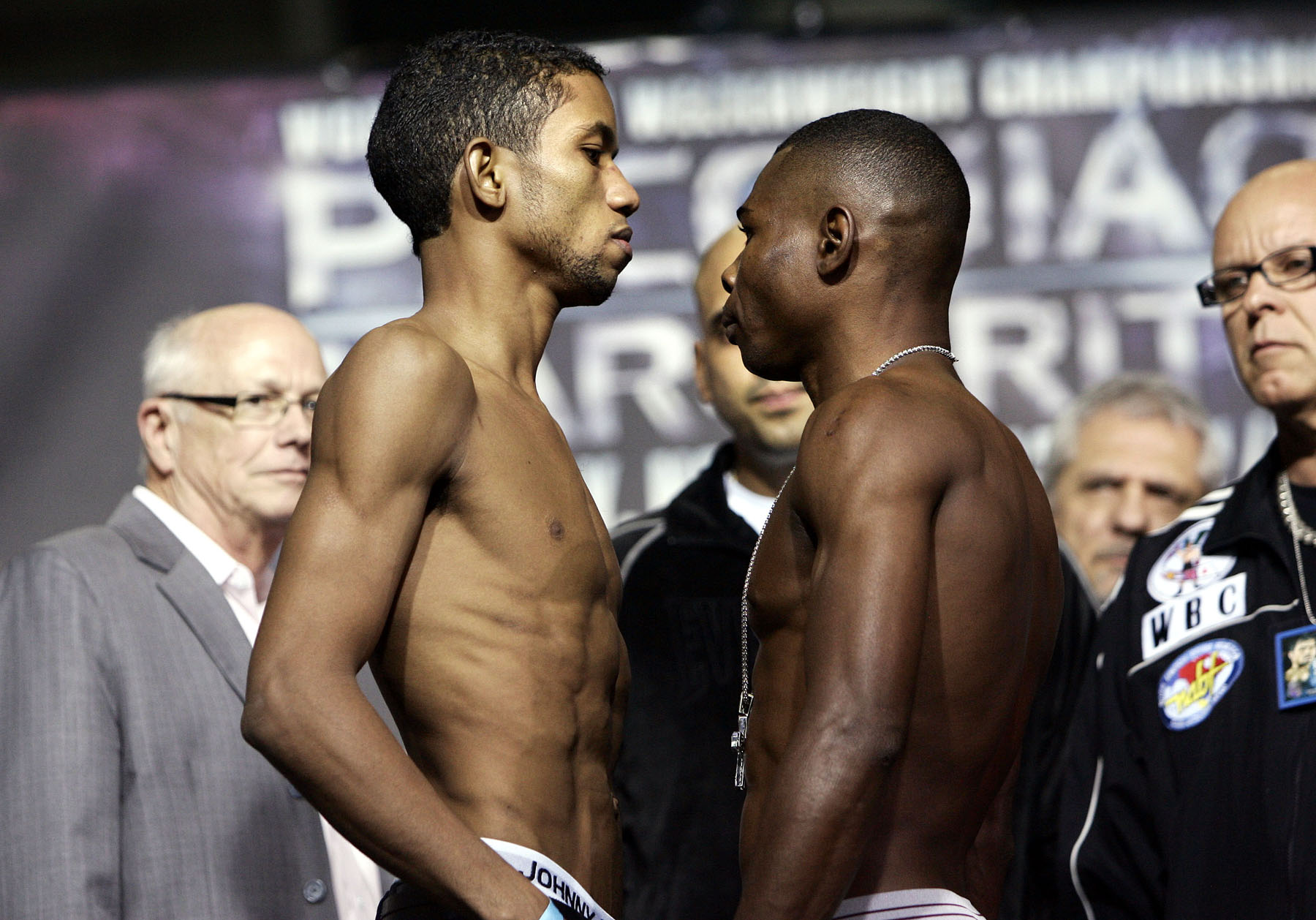
ELVIR MURIQI TO BATTLE DANIEL JUDAH SATURDAY NIGHT IN BROOKLYN IN NEW YORK GRUDGE MATCH AT THE AVIATOR SPORTS COMPLEX

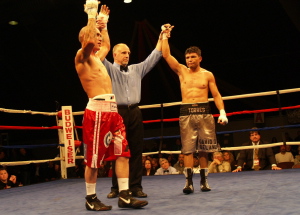
BROOKLYN, NY (November 17, 2010)—This Saturday night at The Aviator Sports Complex, two of the most prominent fighters in the New York fight scene for the better part of a decade as Elvir Muriqi will take on Daniel Judah in ten round Light Heavyweight bout that will headline a big night of boxing promoted by Robert Diaz and Havoc Boxing Promotions.

“To have this bout top our card on Saturday is what New York Boxing is all about. The best fighting the best”, said Diaz

“This is a fight that fans in the New York Boxing community have been whispering about for years and we at Havoc Boxing is honored to be putting the bout on”

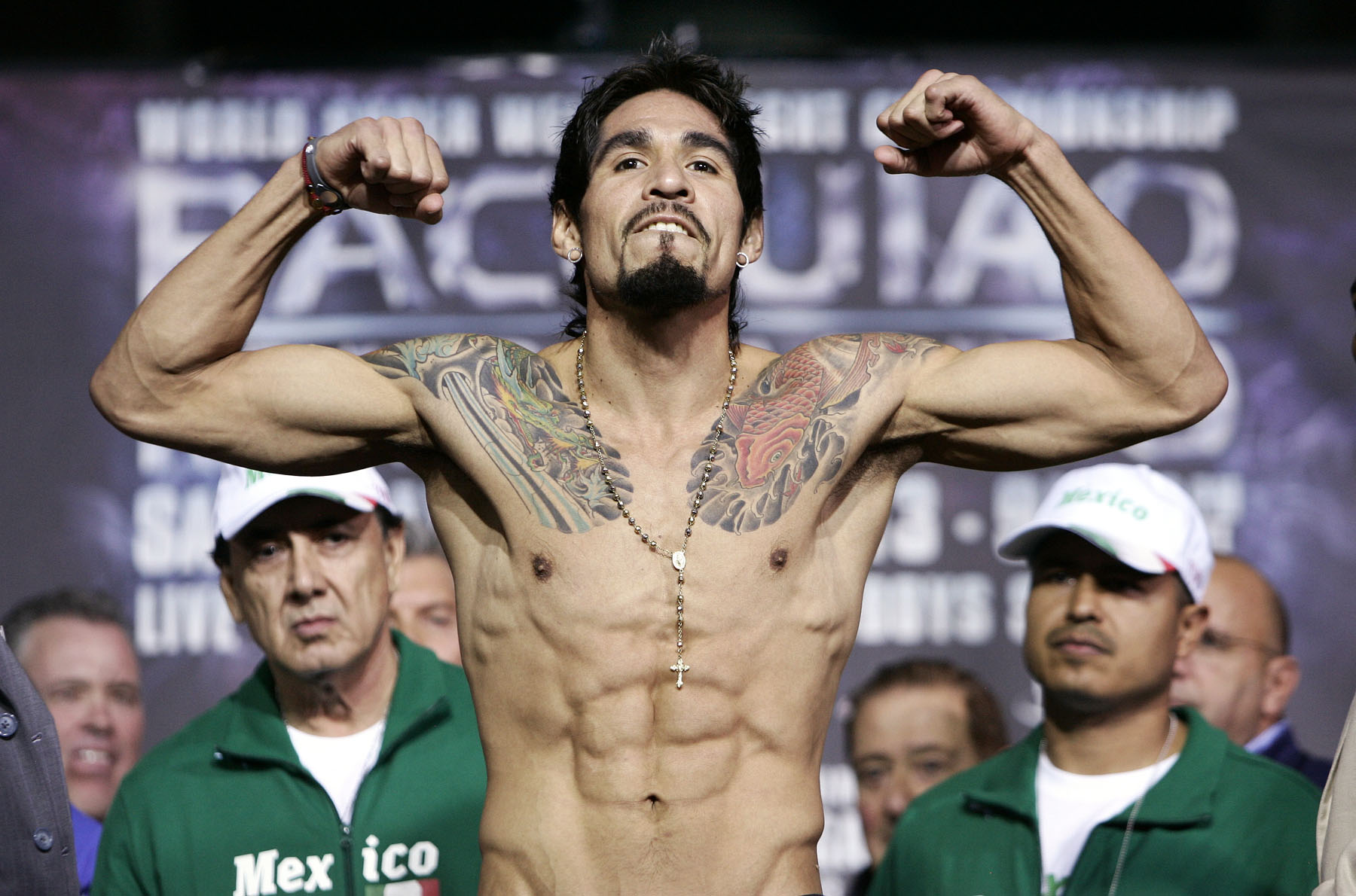
Muriqi of New York via Kosovo has a record of 37-5 with twenty-three knockouts and will be back in the ring after a thirteen month layoff.

Muriqi won his first thirteen bouts before suffering a suffering controversial loss to Dan Sheehan on March 24, 2000.

Muriqi went on to win seventeen straight fights which included signature victories over Sam Ahmad (16-2-3) & Tony Menefee (77-19-1).

After a run where Muriqi went 4-2, he challenged former undisputed Light heavyweight champion Antonio Tarver.

Muriqi fought a valiant fight against the heavily favored Tarver only to fall short by a razor thin majority decision.

Muriqi has gone 3-1 since with his only defeat being a twelve round unanimous decision to former world champion Clinton Woods in Woods hometown in England.

Muriqi is on a two fight winning streak with his latest outing being a 2nd round stoppage over Tiwon Taylor on October 10, 2009 in Greensboro, North Carolina.

Judah of Brooklyn has a record of 23-6-3 with ten knockouts and like Muriqi, has been knocking on the doorstep of major fights since he turned pro in 1999.

In his first twenty-three fights, Judah raced out to a record of 20-0-3 as he claimed victories over the likes of Craig Salamone (13-1-1) and held future world champion on Fighter of the Year Glen Johnson to a draw.

Judah has taken on the top of the Light Heavyweight division with mixed results as he holds wins over former world title challenger Jaffa Ballogou (46-6) and suffering defeats at the hands of Eric Harding (22-3-1); Darnell Wilson (18-5-3); Yusaf Mack (24-2-2); Johnson in the rematch; undefeated Prospect Ismayl Syllakh (11-0) and in his last bout he was stopped in five by Adam Seal (7-1) on May 28th in Norfolk, VA.

The exciting undercard features a battle of undefeated Light Heavyweights from Brooklyn as Will Rosinsky (12-0, 7 KO’s) takes on Yasin Rashid (7-0, 2 KO’s) in an eight round bout.

U.S. Army Captain, Boyd Melson makes his long awaited pro debut against Andrew Jones (0-1-1) of Buffalo in a for round Jr. Middleweight bout.

Stivins Bujac (2-0, 2 KO’s) of New York will take on debut Abdul Mateen of Brooklyn.

Also appearing in separate bouts will be undefeated Featherweight Joselito Collado (11-0, 3 KO’s) in a six round bout; Emanuel Gonzalez (5-0, 5 KO’s) in a four round Super Featherweight bout and Chazz McDowell (2-0, 1 KO) in a four round Super Featherweight bout.

Tickets for this special night of boxing are priced at $50 for all seats and can be purchased at the Following Locations:

The Aviator Box Office
New Legend Boxing Club (718) 487 4474 or
www.havocboxingnyc.com

The Aviator Sports Complex is located at:

3159 Flatbush Ave – Brooklyn, N.Y. 11234

For more information on Havoc Boxing, Click:
www.havocboxingnyc.com


Douglin to Fight December 3!


Morganville, NJ (November 17, 2010) – Undefeated and highly touted junior middleweight prospect Denis “Da Momma’s Boy” Douglin will return to the ring Friday, December 3, at the Chumash Casino in Santa Ynez, CA.

A former National Golden Gloves Champion, Douglin, 11-0 (7 KO’s), has shown solid improvements each time he returned to the squared circle. In his most recent bout, the Morganville, NJ native need less than a round to destroy once beaten Orphius White.

Since turning pro in 2009 after a magnificent amateur career, Douglin has scored impressive victories in four states and is looking forward to putting on a show in his first trip to the west coast.

“I am excited to perform in front of a new audience,” said Douglin. “I want the whole world to know who I am so fighting all around the world is the way to do it. I’m planning to make a statement in California and I can’t wait until fight night.”

Douglin’s opponent will be announced shortly and the bout will take place on the undercard of a ShoBox doubleheader promoted by Gary Shaw Productions.

Fans can follow Denis at twitter.com/Damommasboy.


Video: Interview with David Torres

This past Saturday night at the Emerald Queen Casino in Tacoma, Washington, longtime local favorite David Torres fought to a majority draw with Santos Pakau in an action-packed ten-round contest. Torres (21-2-1, 13 KOs) of Othello, Washington felt as though he won the fight and talked to 15rounds.com about the draw and his future plans.


Watch 15rounds.com Interview with David Torres


Video: Interview with Santos Pakau

This past Saturday at the Emerald Queen Casino in Tacoma, Washington, veteran Santos Pakau fought a spirited battle with David Torres en route to a ten-round majority draw. Pakau (27-6-2, 10 KOs) of Spokane, Washington by way of Auckland, New Zealand felt that he had deserved the nod and was obviously dejected by the official decision, but spoke to 15rounds.com about the fight and his future.


Watch 15rounds.com Interview with Santos Pakau


Good things don’t last forever


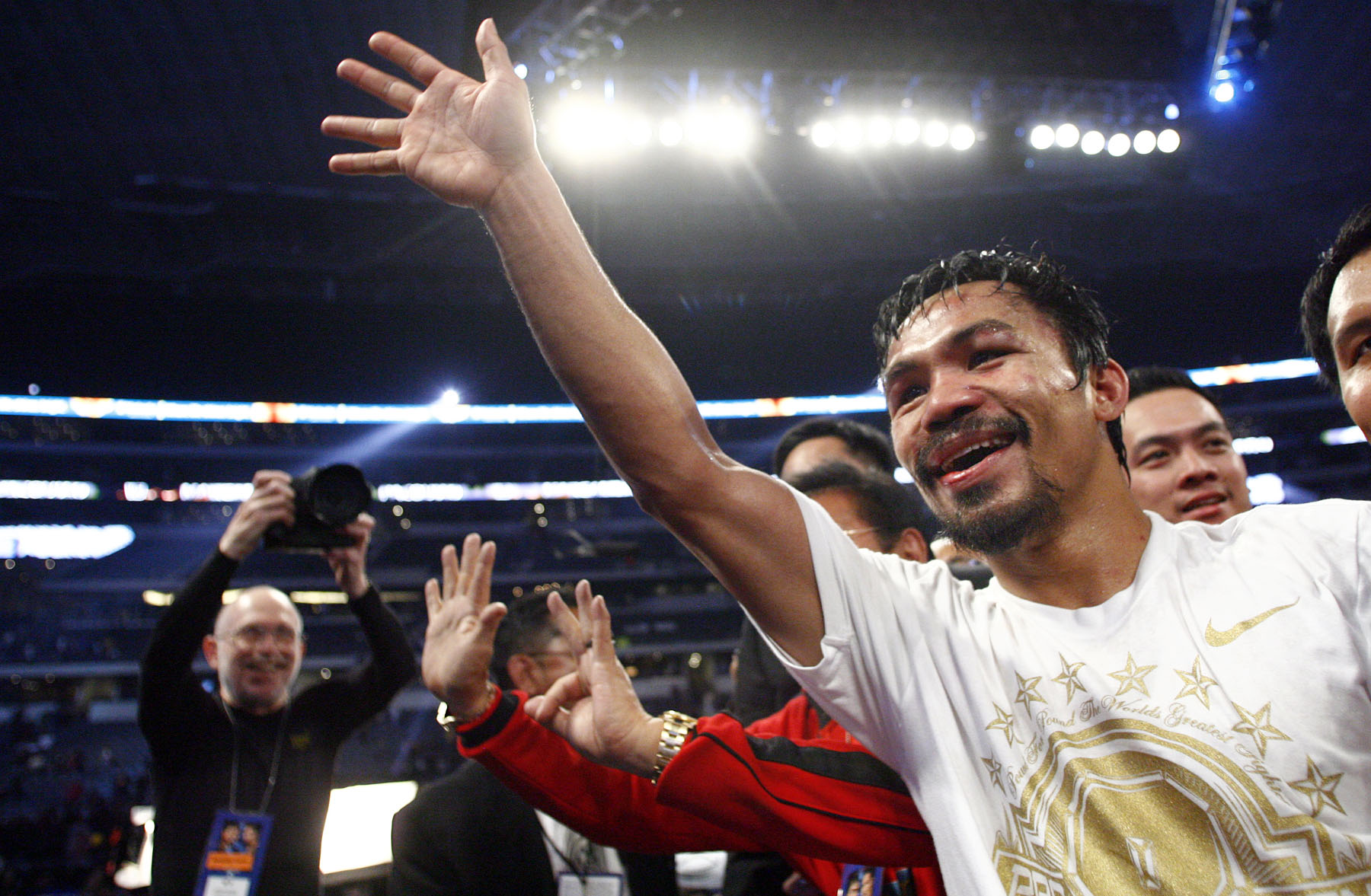
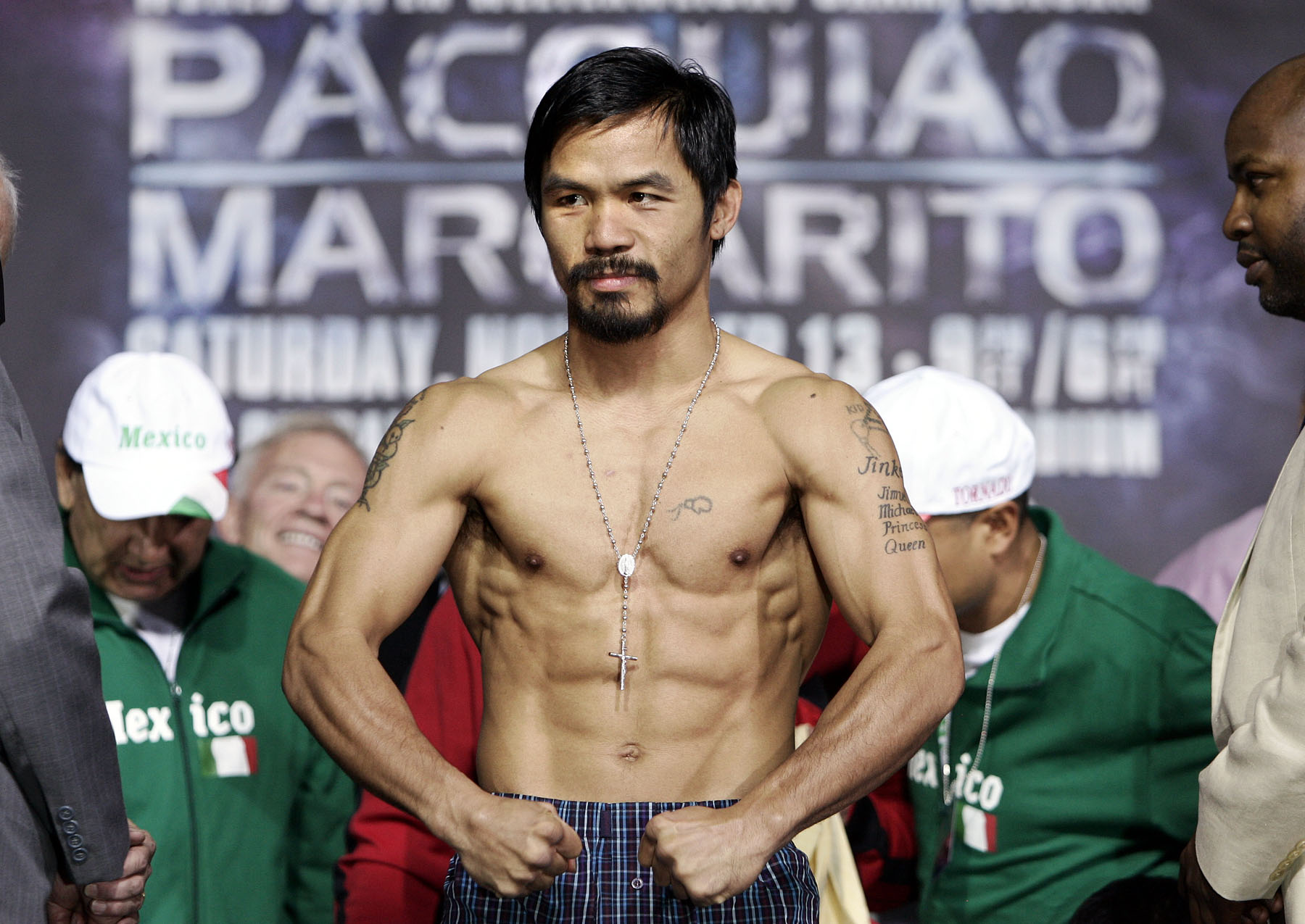
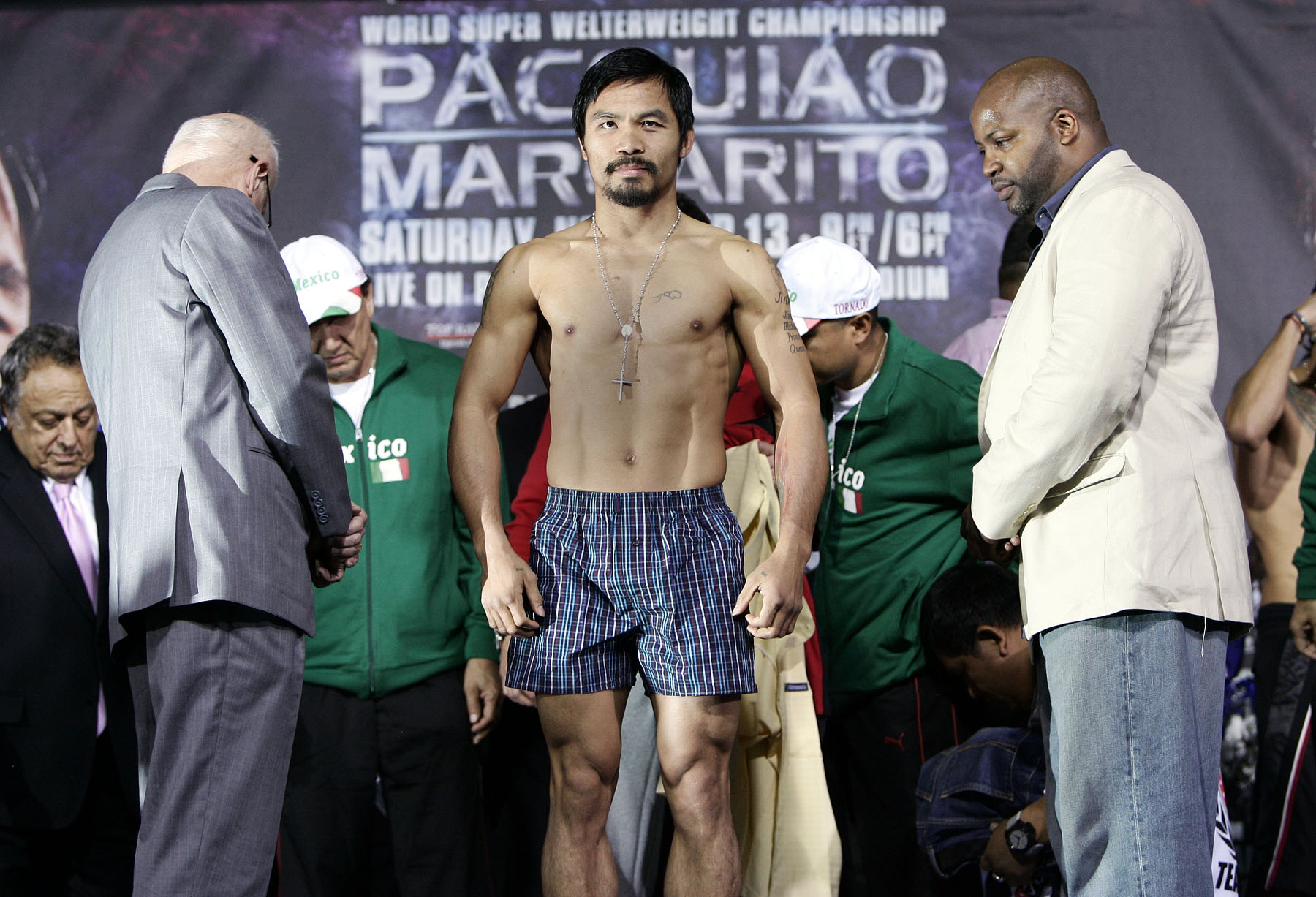
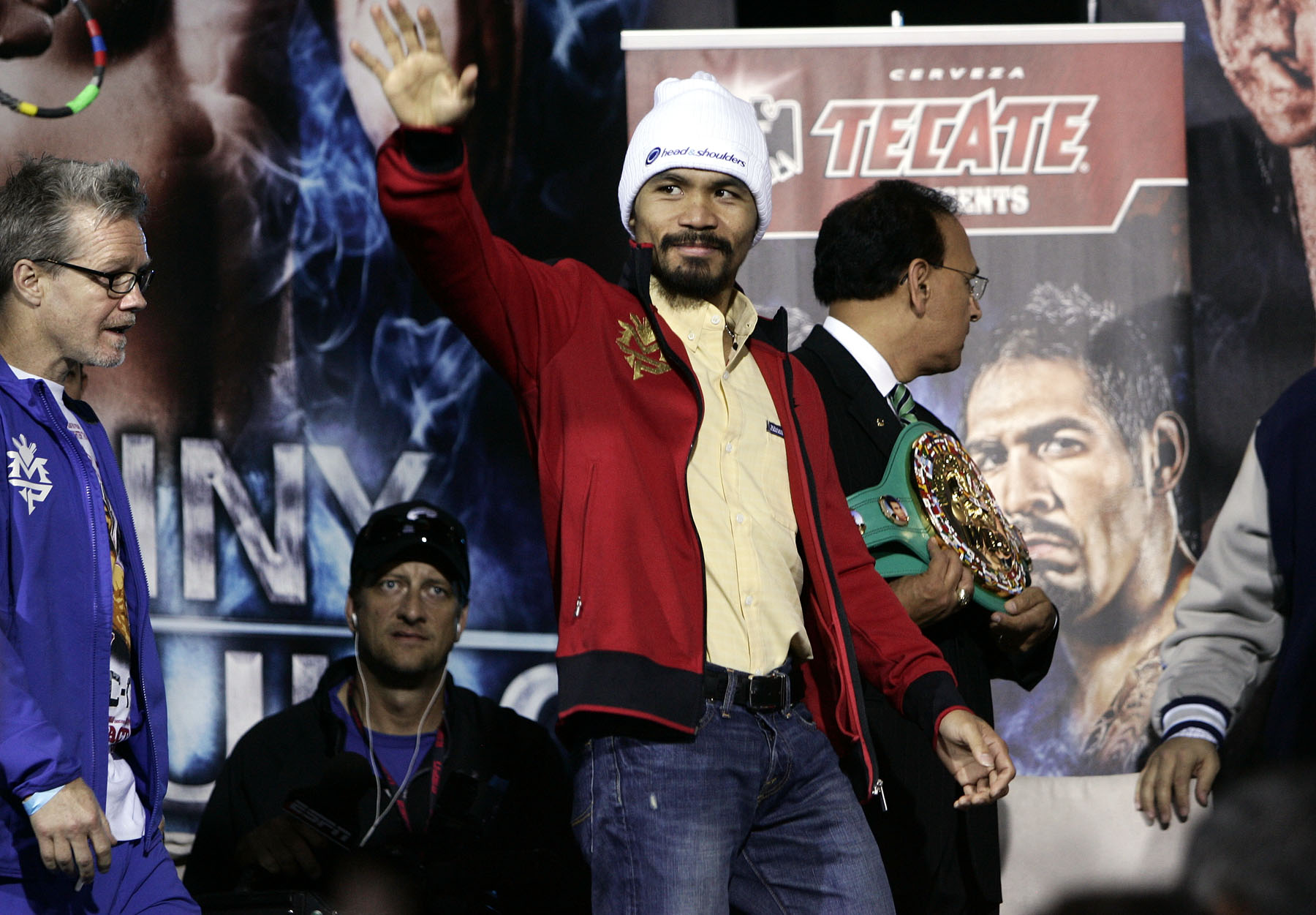
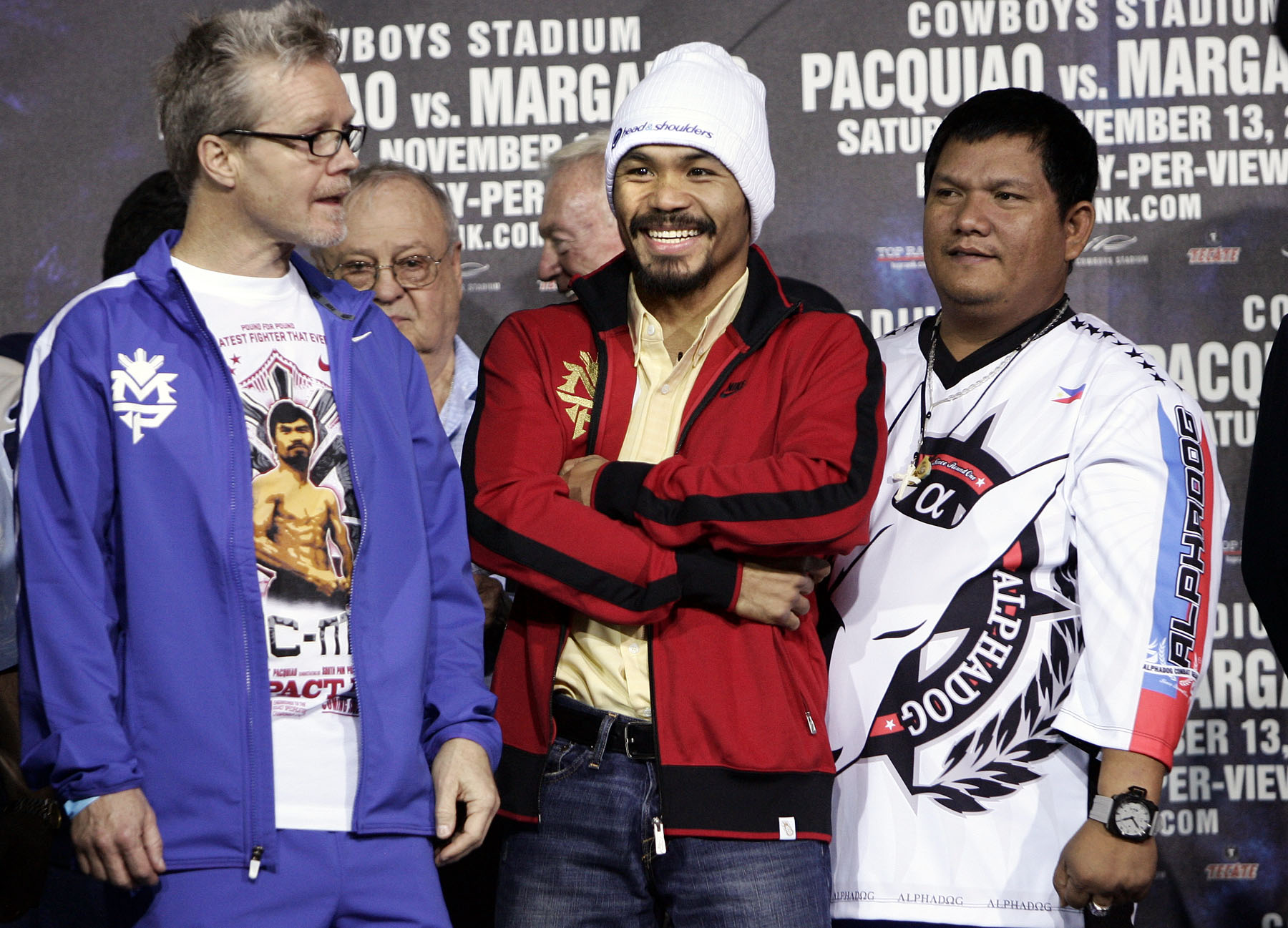
With each tick of the biological clock, Manny Pacquiao’s boxing career draws one second closer to an end.

In recent years, Freddie Roach always seems to think Pacquiao’s next fight might be his last.

Manny’s mother, Dionisia, said before Saturday night’s fight, that she expected it to be her son’s final bout.

Whenever Pacquiao does call it quits, I imagine it will be abrupt. I imagine him going out on top.

Fortunately for the sport, Pacman says he’s got “two to three” more fight’s left in his dynamite fists.

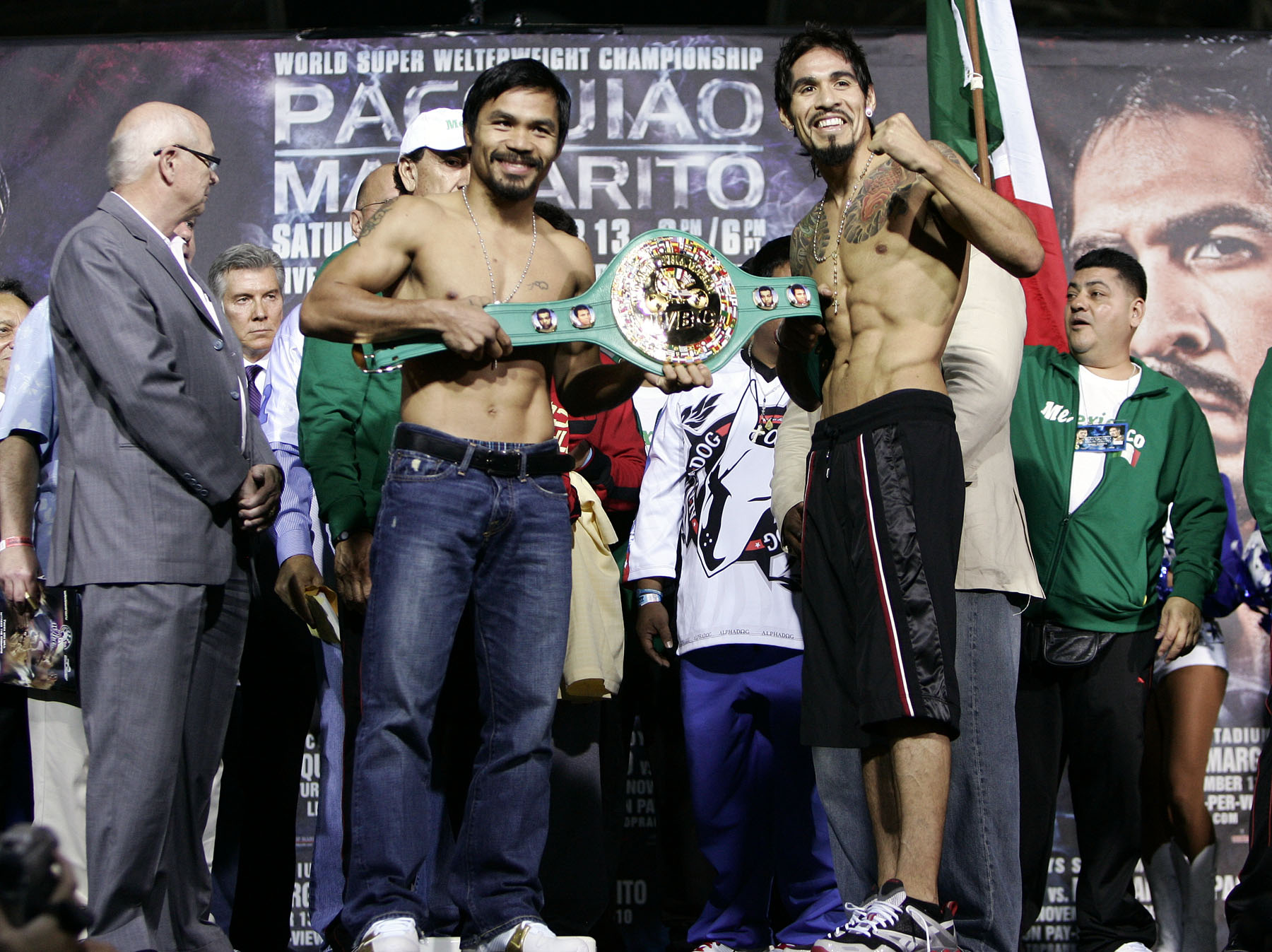
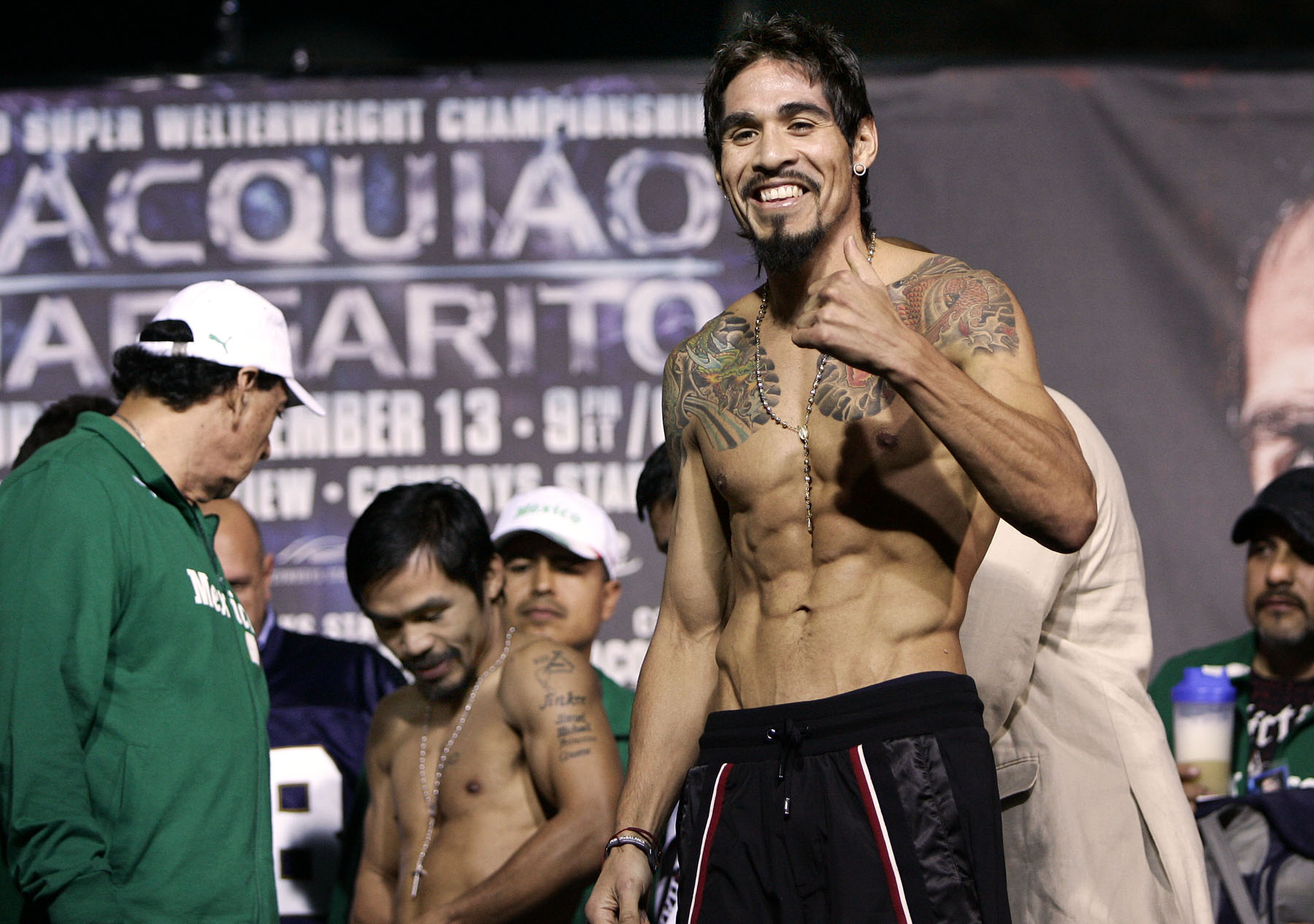
After disfiguring notorious Mexican, Antonio Margarito, Pacquiao told the media that he still has business to tend to within the ropes.

Roach added to that sentiment, telling AOL’s Fanhouse, that for the rest of Pacquiao’s career, he will not fight below 147 lbs.

With that said, we could seemingly rule out a Pacquiao-Marquez trilogy — seeing how much trouble Marquez had moving up in weight when he faced Floyd Mayweather.

The elusive fight with Mayweather still remains an option for 2011, but Money May apparently would rather tussle with his girlfriend, security guards, or Johnny Law instead of getting in the ring with the Filipino Congressman.

If any of the standouts at junior welterweight moved up to challenge Pacquiao, he’d win with ease. Although, Gary Shaw insists once Tim Bradley downs Devon Alexander in January (which by no means is a foregone conclusion), he’ll be ready to take on Pacquiao. I think otherwise.

Two possible fights for Pacquiao to take next would be a bout against the winner of the rematch between Sergio Martinez and Paul Williams, which takes place this Saturday in Atlantic City, New Jersey.

Both men would be present Pacquiao with an overwhelming size disadvantage. Further, they both possess lightning quick hands and thunderous power.

Perhaps it is a fight with Paul Williams that would finally be the fight where Pacquiao bites off more than he can chew. But in order for this fantasy to have a chance at becoming reality, Williams will need to successfully navigate past the crafty Argentinian on Saturday night.

Williams has insisted for the past two and a half years that he can make 147 lbs. whenever he needs to, but hasn’t weighed in for a fight less than 153 lbs. since November of 2008.

If the opportunity presents itself, the man who many consider the number three pound-for-pound boxer in the world, would have to put his money where his mouth is and come down in weight for a shot to knock off boxing’s best.

But unfortunately — besides a fight with Mayweather — the most money probably lies in a Sugar Shane Mosley vs. Pacquiao bout — a fight in which Pacman would surely disassemble the heavy-handed veteran.

The most important thing for fight fans, however, is that we recognize that no good thing lasts forever.

When Pacquiao relinquishes his post as boxing’s best, the torch he carried will not be passed down; there is no heir apparent.

It is for that reason that we should look past the fact that Pacquiao-Mayweather may never come to fruition. Whether you think Pacman’s relentless volume punching would overwhelm the defensive-minded Mayweather, or that Money May’s counterpunching would carry the day, let’s just enjoy what’s left of Pacquiao’s career before it’s over.

Let’s be grateful for the buzz Pacquiao creates around our sport every time he fights. And let’s marvel at the fact that a 5’6” man from Kibawe, Bukidnon, Philippines has steamrolled his way to a record setting eight divisional titles.

Savor the moment while it lasts; I highly doubt there will ever be another eight division champion. And one thing is for sure: there will never be another Manny Pacquiao.

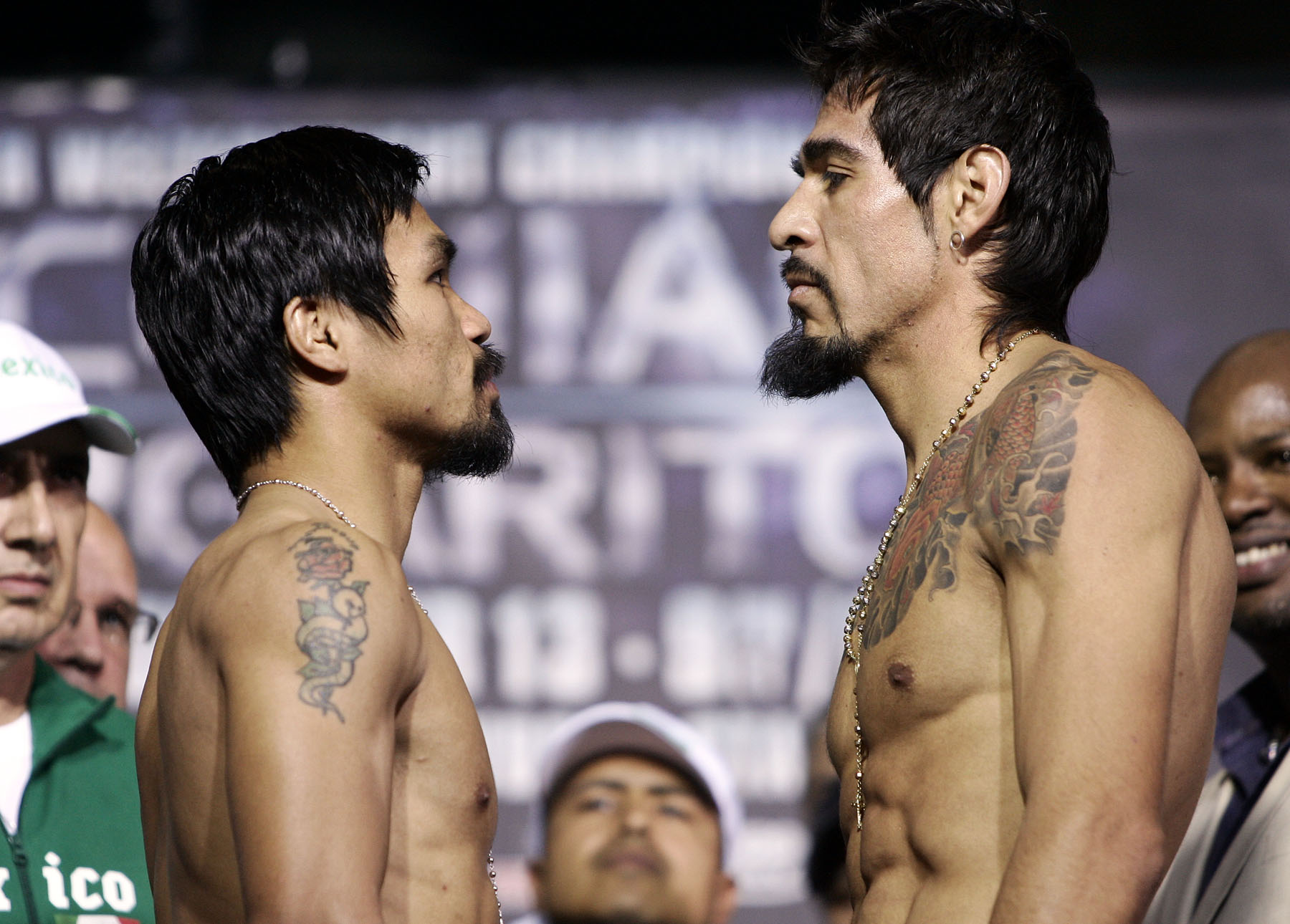
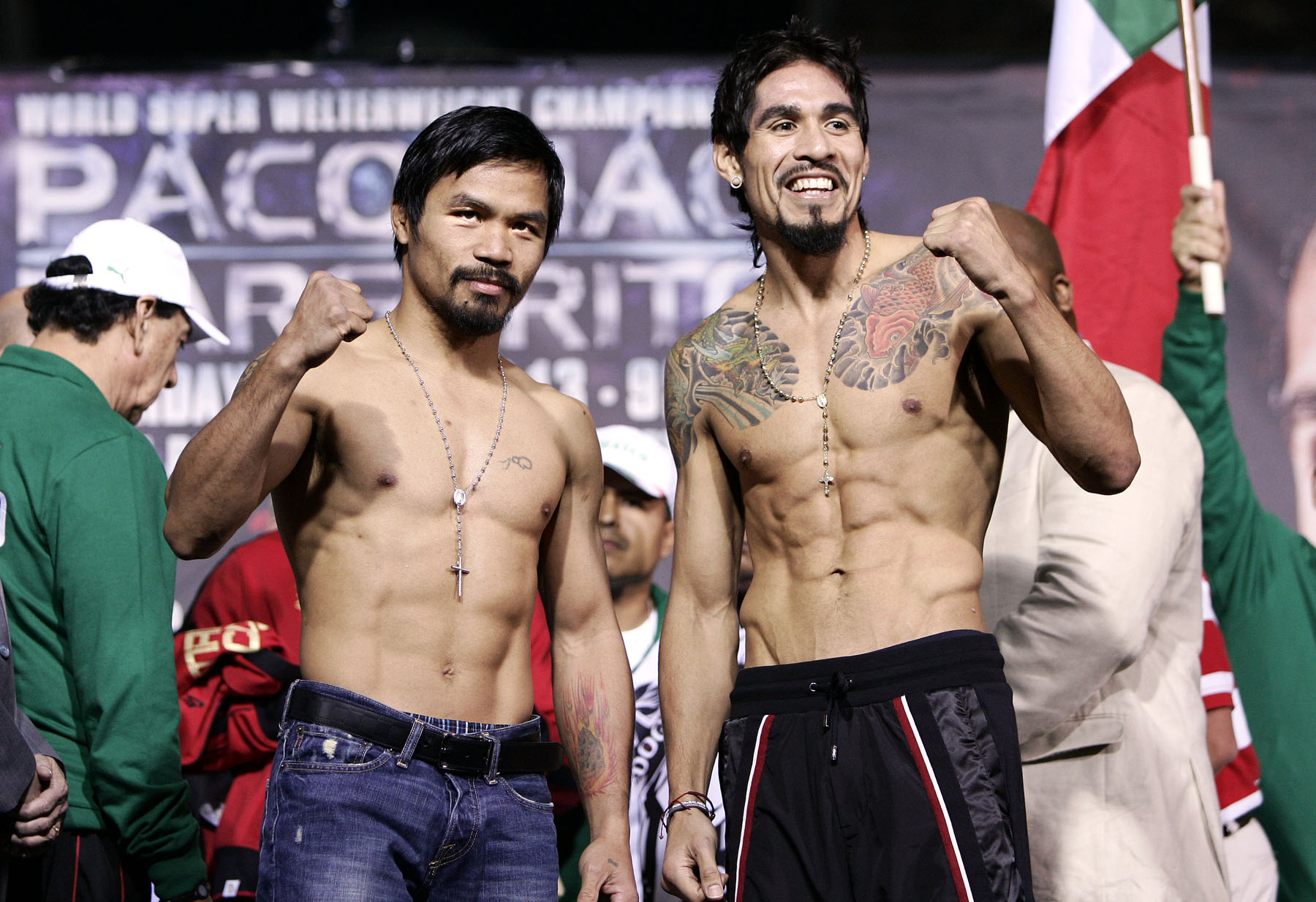
Photo by Chris Farina / Top Rank


MARGARITO SURGERY SUCCESSFUL


“So when can I start running?” asked Antonio Margarito moments following successful surgery today to repair a fractured right orbital bone at Methodist Hospital in Dallas, Texas.

Sergio Diaz, manager of Margarito, said “the doctor told us everything went perfect – no complications of any kind. There is nothing wrong with his right eye.

“Antonio is such a warrior. The first thing he asked was ‘when can I start running’ and we told him he has to relax for awhile,” Diaz said. “For sure, at least 60 days of no contact of any kind in a gym.”

Margarito said “I fought as hard as I could against a great champion in Manny Pacquiao.”

Margarito will stay at Methodist Hospital this evening. He is with his wife Michelle, managers Sergio Diaz, Francisco Espinoza and chief trainer Robert Garcia. Margarito and his team will take a flight to Los Angeles on Wednesday.

Photo By Chris Farina/ Top Rank


UNDEFEATED PROSPECTS HIGHLIGHT STACKED BATTLE II UNDERCARD THIS FRIDAY AT HARRAH’S CASINO AND RESORT IN ATLANTIC CITY–WATCH LIVE ON GFL


CLICK TO ORDER THE FIGHT
ATLANTIC CITY, NJ (NOVEMBER 16TH, 2010)—Six undefeated prospects will be on display on this Friday night as part of a championship fight card dubbed BATTLE II: Battle For The Belt that is promoted by Mike Brestle’s Spartan Fight Promotions.

The Main event will be a NABF Super Middleweight clash between undefeated Farah Ennis of Philadelphia taking on Victor Lares of Corpus Christie, Texas.

The co-feature will be an explosive Heavyweight bout between top contender Chazz Witherspoon and upset minded Alex Mejias.

The undercard will be feature six undefeated fighters and will be headlined by Lavarn “Baby Bowe” Harvell.

Harvell of Atlantic City has a record of 6-0 with two knockouts and he will take on Frankie Filippone, 6-2 with two knockouts from Norfolk, VA in a six round bout.

Joel De La Paz (5-0, 4 KO’s) of Atlantic City will see action in a six round Super Middleweight bout against an opponent to be named.

Keenan Smith (2-0) of Philadelphia will take on Anthony Royal (0-1) in a four round Super Featherweight bout.

The son of former WBA Heavyweight champion Bruce Seldon, Isiah Seldon (2-0, 1 KO) of Atlantic City will take on an opponent to be named in a four round Super Middleweight bout.

Ismael Garcia (1-0) of Millville, NJ will battle Corey Preston (0-1) of North Carolina in a four Jr. Middleweight bout.

Joey Tiberi (1-0, 1 KO) of Newark, DE will face Antonia Parker (0-1) of Wilson, NC in a four round Super Featherweight tussle.

There will be a press conference on Wednesday November 17th at 7:00 pm at GNP Fitness in Atlantic City which is located at 11 S. Iowa Ave, Atlantic City

Tickets for this great evening of boxing are priced at $90; $60; and be purchased through Ticketmaster (1 800 736 1420); The Harrah’s Box Office or GNP Fitness (609 348 4999)

The card will be broadcast LIVE on www.gofightlive.tv for $9.99

Principles of Adult Learning: Application to safety training

Professional Safety September 1, 2007 | Galbraith, Diane D; Fouch, Sandra E THE U.S. WILL FACE A SHORTAGE of 10 million skilled workers by 2010, according to the Bureau of Labor Statistics. Each year in the U.S., millions of dollars are spent to train adults-ranging from $658 per employee in healthcare to $1,059 per employee in the service sector (Speizer, 2006). Companies are searching for a competitive advantage through workers who are better trained and each development dollar expended needs to directly correlate to the bottom line.

At the intersection of training and development lies andragogy, an often-overlooked adult learning theory. Andragogy-the study of adult learners-is distinct and plays an important role in effectively training adults. This article describes the elements of andragogy and the importance of incorporating these learning principles into safety training. In addition to examining current adult education theories, the article defines andragogy and discusses elements of adult learning. It also reviews a limited study regarding the inclusion of adult learning principles in safety training.

The Process of Learning Learning is often defined as a permanent change in behavior or as knowledge acquired by study. Creating a learning culture is imperative in today’s economy. In the workplace, such a culture begins with corporate training and education at colleges, technical schools and universities. Many government-sponsored programs require employee training to promote safety, growth and development. Other agencies and corporations use training to enhance productivity, train new employees or promote employees.

Adult learning must begin with a basic understanding of ways that adults learn. Often, trainers know the content to be presented, yet they may be unaware of the most effective methods to deliver the information. In the SH&E field, the difference between effective and ineffective training may be death, injury, pain, suffering and lost profits (Robotham, 2001).

Can training be more effective if adult learning strategies are incorporated? A limited study conducted at Carnegie Mellon University measured behavior changes in laboratories following safety training. The study compared OSHA violations as measured through laboratory inspections following two groups of employees. The goal was to look beyond satisfaction ratings for the training and to focus on measuring the impact of the training on observable behaviors in the workplace. Before discussing the study and its outcomes, let’s discuss adult learning theories-andragogy in particular.

Adult Educational Theories How do adults learn? Table 1 shows the five fundamental adult learning theories that are the focus of most literature: sensory stimulation theory, cognitive theory, reinforcement theory, facilitation and andragogy (Munoz & Munoz, 1999).

Andragogy is the focus of this article. A Chinese proverb advises that “the beginning of wisdom is to call things by their right name.” Andragogy and pedagogy refer to the study of teaching, with andra meaning man, adult and peda meaning child. Thus:

[A]ndragogic learning designs involve features which recognize the essential maturity of the learner; they are problem-centered rather than content-centered; they encourage the learner to introduce past experiences into the processes in order to reexamine that experience in the light of new data; the climate of the learning process must be collaborative as opposed to authorityoriented; planning and evaluation are mutual activities between learner and instructor; evaluation leads to reappraisal of needs and interest and activities are experiential, not “transmittal and absorption” as in standard pedagogy (Laird, 1985, pp. 125-126).

What Is Andragogy?

Although adult learning theory was pioneered by Malcolm Knowles, the field of study is relatively new. The term andragogy was first used in 1833 by a teacher in Germany and was reintroduced by a German social scientist in the 1920s. The term was further adopted by adult educators in Europe in 1957 before coming to the U.S. (Thorns, 2001). Although pedagogy originated with early monks who recorded common characteristics among children who were learning basic facts, it was not until the mid-20th century that instructors realized that their assumptions about how children learn did not apply to adults (Knowles, 1984a). Therefore, the more formal discipline of andragogy research continues to expand.

Learning is required throughout one’s life in order to adapt to life’s circumstances and the environment. Most research confirms that the ability to learn increases throughout a person’s life from age 20 to 70, although the needs of adult learners and the context in which learning occurs differ from childhood.

Learning can be formal (e.g., in-classroom education) or informal, and is usually motivated by an individual’s transitions and experiences. Adults may seek more formal education to advance in their careers or develop new skills, or as continuous learners to develop personally and professionally. The learning demands that adults face will depend on their choices, opportunities and resources, and will be affected by factors such as social, cultural and historical contexts, as well as gender, class and ethnicity (Lemme, 2002).

What is an adult learner? Knowles (1984a) identified adults by two criteria: 1) an individual who performs roles associated by today’s culture with adults (e.g., worker, spouse, parent, soldier, responsible citizen); and 2) an individual who perceives himself/herself to be responsible for his/her own life.

Knowles (1984a, 1984b) also identified a series of characteristics of adult learners:

* Autonomous and self-directed. Trainers should involve participants in the learning process and serve as facilitators, not teachers.

* Accumulation of life experiences. Adult experiences should be incorporated into the learning to provide a base of connectivity and relevance.

* Goal-oriented. Structure training with defined elements that are consistent with the learners’ goals.

* Relevancy-oriented/immediacy. Set objectives immediately so that learners can relate to the concepts and understand the reasoning behind the objectives, then can apply them in their own lives.

* Practical. Focus on the “what” and the “why” so adults will apply the lessons that are most useful in their environment.

* Respect. Trainers should encourage participants to add value by sharing their experiences and allow for freedom of expression (Lieb, 1991).

A basic assumption of adult learning is that it is best achieved in dialogue. Principles of adult learning include the belief that adults have sufficient life experiences to be in dialogue with the trainer on any subject and, in fact, they will learn new knowledge, skills and attitudes best in relation to their experiences (Vella, 2002). in our site adult learning theory

Principles of Andragogy & Applications to Training Some principles are critical to beginning, maintaining, nurturing and retaining dialogue with adults. Needs assessment is the first principle of andragogy or adult learning and it involves the participants’ contribution to the content of the material to be learned. Instructors and learners should shape course content based on the relevance and applicability to adults (Vella, 2002).

Safety is the second principle. It is linked to respect for learners as decision makers and also the trainer’s ability to create an inviting environment for adults. A trust in the competence of the design and the instructor, a relevancy of the learning objectives, an ability to express thoughts and logic to the sequence of activities all contribute to a safe learning environment (Vella, 2002).

Sound relationships are the third principle. They are essential-starting at the initial meeting between the trainer and the student-to establishing a sense of inquiry and curiosity. Learning cognitively, affectively and with psychomotor aspects are principles that are often neglected. Using these three aspects-learning with the mind, emotions and actions respectively-can reduce the anxiety associated with a new event in adult learning.

Praxis is a Greek word that means action with reflection. Most educators agree that the application of this fourth principle is valuable since adults learn by doing and praxis is a form of doing with built-in reflection. Learning tasks is then not a matter of practice but praxis. Inductive forms of learning invite reflection or action on a particular circumstance using new content. If the learning is deductive, participants consider new content and ways to apply the material in new scenarios. In both, the adults practice a new skill and are encouraged to analyze the quality of their practice-transitioning practice to praxis (Vella, 2002).

Participants should receive material in bite-size chunks. This prevents them from becoming overwhelmed and allows an opportunity for mastery. Adult learners also prefer the “whole-part-whole” learning strategy that demonstrates the new skill or use of knowledge, describes the details, then reinforces the concepts using other examples (Thorns, 2001).

The final three principles are teamwork, engagement and accountability. Teams can provide a quality of safety and real-world experience. Teams simulate a participatory universe in which people live, and learning is enhanced by peers who can assist and mentor with clarity, tenderness and skill. A healthy environment of competition is fostered. The word competition is derived from com meaning with and petition meaning asking-as in an environment in which participants are asking and learning together. Instructors can use activities that foster constructive competition by structuring teams so they work together collaboratively in the learning process and encourage pride in their achievement as a team. Generally, adults work enthusiastically in teams when the learning tasks are related to themes and adequate time is provided for the task.

The concept of engagement refers to learners being actively involved with issues of their organizations and their communities versus passive units of production as described by scientific management scholar Frederick Taylor. Trainers can engage teams in learning by involving them in strategic planning sessions so that it becomes difficult for the students to extricate themselves from the excitement of learning.

Finally, accountability encompasses all of the principles, as the design of learning events must be accountable to the learners in the form of the learning outcomes being met. Possible outcomes include: what was proposed to be trained is taught; what was meant to be learned is learned; the skills intended to be gained are visible; and the knowledge to be conveyed is manifest in the adults’ language and reasoning (Velia, 2002, pp. 24-27).

Andragogy & Pedagogy Although most research has been devoted to childhood learning and development, many attributes of adult and child learners are similar. Like children, adult learners need to play, take initiative, make choices, act and interact. Learning should be fun and exploratory, and people in that stage of learning do not need challenges, they need shared enthusiasm (Jones, 1986). When comparing an adult and child in a learning situation:

* Children are dependent while adults see themselves as self-directing.

* Adults expect to be able to answer part of their questions from their own experience and children expect their questions to be answered by outside sources.

* Children expect to be told what they need to do, while adults may have a very different viewpoint on that issue based on firsthand experience.

* Adults frequently want input in their learning.

Several other differences are important to note and should be applied in an adult learning environment as well. Three such differences are:

* life experience as a barrier;

* life experience as a positive trait;

* understanding the relevance to their lives (Alexander, 1999).

Adults arrive at training with baggage when compared to children. They have many more life experiences, time demands and psychological barriers (such as past negative experiences). The instructor should attract and maintain attention and evaluate the experiences that may hamper the learning process. Disengagement will occur when adults have had negative educational experiences they need to overcome before they can learn new skills. Adults also may be plagued by more incorrect information and knowledge than children, which impedes the learning process.

In contrast, the life experience that adults bring to learning may provide the foundation for their new learning. Adults benefit from reflecting on, sharing and communicating their insights with others (Alexander, 1999). This practical knowledge can be an asset during the moments of reflection if the instructor can encourage dialogue and curb comments such as, “This is how we did it.” Otherwise, participants may not want to change procedures or may not be open to new ideas (Thorns, 2001).

Adults also must see the relevance of the material to their immediate needs since time limitations and commitments apart from work may make it difficult to make learning a priority (Alexander, 1999). They want a choice in the content and have a strong need for immediate application.

The question posed by the study described here was, “Will incorporating these adult-learning strategies affect the training results to a degree that demonstrates the need for application in future training?” Scope of the Project The project was conducted at Carnegie Mellon University to determine whether this no-cost application could affect behavior within the school’s laboratories. The study targeted new employees with the rationalization that training the new, then indirectly the current, employees would affect the climate of safety at the university The study was developed to look specifically at OSHA requirements and regulations with the thought that following these requirements would translate to reducing the possibility of incidents and injuries.

The Environmental Safety and Health Department at the university, as part of a program evaluation (per 3.4.1 of ANSI Z490.1-2001), identified a need to assess the effectiveness of laboratory safety training. Department members began to evaluate slides used within the training as well as to monitor laboratory safety inspection data. In doing so, they became concerned about the number of regulatory violations noted during the inspections. While the number of reported incidents had not increased, the department wanted that trend to continue by improving the climate of safety within the university.

Therefore, the department looked to both internal and external resources with a goal of designing a new safety training program that would include observation of safety behaviors in the labs after employees had attended training. This project was conducted with the assumption that decreasing the number of regulatory violations would be a preventive measure which would help to retain a safe environment. Department leaders wanted to observe behavior change rather than simply rely on participants’ satisfaction with the training satisfaction, which is usually measured with post-training surveys. This project was designed to assess observable behavior following the training.

Seventy-three participants were selected from 20 different departments and divided into two groups-those who attended the “old” training and those who attended the “new” training. Since trainees were scheduled based on employment date, it is assumed that the groups would be relatively homogenous. The training sessions covered the same OSHA standards applicable to laboratories, including safe handling procedures, housekeeping procedures and PPE requirements. The original training met criteria outlined in ANSI Z490.1-2001, but it did not actively employ recommended strategies for adult learning theory. Based on casual observations of staff members, the behaviors discussed in training were not being transferred to the workplace. Therefore, the new program was designed to include activities that would involve the learners and demonstrate the relevancy of the training to their individual situations. go to web site adult learning theory

The new training incorporated the following elements of adult learning theory:

*placing material into bite-sized chunks and using the whole-part-whole concept;

*simulating the worker’s actual environment, providing scenarios and problems;

*designing training to meet participants’ needs.

Relevance for employees should be enhanced by reviewing the training objectives up front, then organizing the training by major categories. While there was no specific test for relevance, those involved expected to see a decrease in violations related to the safety behaviors that were discussed in training.

Staff members randomly observed training participants after they completed the training to verify that safety precautions were being followed. Since the observers were monitoring for behaviors during their inspections, the only training they required was how to document violations. Laboratory employees would not notice any difference in the inspections so it was determined that behaviors observed would not occur simply because employees were reacting to the inspectors.

The laboratory auditor technician recorded safety and regulatory violations in the following behaviors:

*Wearing proper protective gear. Wearing eye protection, lab coat, gloves and appropriate clothing (no open-toed shoes, long pants);

*Using proper housekeeping practices. Work area neat and orderly, no evidence of eating or drinking, and no one working alone.

*Containers (primary and secondary) labeled correctly.

*Hazardous waste container properly labeled, closed and in secondary containment.

The auditor completed the record sheet as the laboratories were inspected on a random basis. The observation occurred within 1 week of the training session and any violations observed were noted. Data were then entered into a database and SPSS was used to analyze the data through the use of t tests (Table 2).

Since the interval of 0.49 to 1.48 does not include zero, the data support the hypothesis that the number of safety violations would decrease between the old and new training groups, and the null hypothesis was subsequently rejected. The hypothesis was one-way only-that there would be a decrease in the number of violations.

Comparing the Training Programs The original training program began by discussing the regulations involved, whereas the new program began by showing the training objectives so that employees knew what to expect and ways in which the training would impact them personally.

The original program was primarily lecture-based with a handbook and questionand-answer session at the end. Participants also were given a quiz at the end and the answers were discussed before a grade was recorded-a procedure that was explained before the training began. The training immediately delved into the rules and regulations, guiding the training instead of focusing the employees on workplace safety. The presenter detailed the rules and regulations requiring employee attendance, but there was no other discussion regarding training goals or rationale.

The new program used photos from laboratories on campus rather than the clip art found in the original program. The new program also included sections arranged to provide whole-part-whole information so participants would get the “big picture,” then discuss the specifics. At the start of the session, participants were given the opportunity to describe what they hoped to gain from the training. This discussion helped to focus employees and provided relevant reasons-other than simply fulfilling a requirement-for attending the training.

Limitations Several limitations of this study must be noted:

1) The sample size was small-only 20 in each group. Forty of the 73 total participants were used in order to have evenly matched departmental groups. The sample size was selected after discussing practicality and time constraints with the staff.

2) No baseline data were available for the selected participants to see whether the training alone was responsible for the decrease in infractions.

3) Only the beginning portion of the newly designed training was implemented. An online portion and a hands-on test have been designed for the future. Therefore, further observations are needed to determine whether there would be a greater effect.

4) The presenter changed between the old and new training sessions, thus presenter personality may have had an effect. Both presenters were experts in the field and both knew the program content extremely well. In addition, the original presenter worked with the panel to develop the new program.

Implications for Trainers Training professionals should strive to use as many adult learning principles as possible. The principles that this study found to be most critical are:

*Relevance. The material presented should be relevant to the adult participants. This is best accomplished when the participants realize and recognize this relevance themselves.

*Similarity. To facilitate the transfer of skills learned, the information presented should closely resemble the employees’ workplace conditions. The trainer must be able to spend time in the workplace or provide activities in which the participants can supply the similarity through materials they bring to the training or discussions and role-play.

*Active participation. Employees should be able to interact with other workers and the trainer. The atmosphere should help them feel safe to risk participating. It takes adults longer to perform some activities and to feel safe to speak out and ask questions.

*Providing objectives. By showing the objectives in the beginning, adult learners can see the big picture and know the direction of the session. They also can judge the time and know when the training is almost over. Adults have many demands on their time and attention so it is important to define the parameters of the training in advance.

After evaluating the new program through observations of training participants, it was noted that the number of violations has decreased. However, there is still room for improvement on campus. The number of violations that continue to occur in the laboratories warrants the ongoing improvement of training practices.

After analyzing the results from the two training groups, the hypothesis was supported-the new training participants showed a significant decrease in safety violations. There was an average decrease of .99 violations between the two groups. To further support the results, the data among departments and between genders was examined. The only instance of a significant difference in means occurred between the old and new training groups. The training may have accounted for this decrease, but, ultimately, it was the employees’ behavior that was responsible for the decrease. Because no baseline data were collected for each participant before training, it was assumed that the training was responsible for the decrease.

Is the decrease of one violation realistically significant concerning laboratory worker safety? When examining the results, the violations were found to be statistically significant when comparing average violations. When OSHA or EPA inspects the laboratories, even one violation could result in fines and sanctions. Therefore, by eliminating safety violations, overall safety and laboratory quality is improved.

It also is important to note that even one safety violation could result in injury or property damage, or negate research results. So, the one-violation reduction could mean an eye saved from a chemical splash if that person wears safety glasses after attending the training. Any reduction in violations means that the laboratories are safer following the training than before the training. Therefore, realistically, even a decrease of one is significant.

Recommendations & Conclusion The major difference between the training sessions was the inclusion of relevance so that trainees understood the program’s objectives. They were made aware of gaps in their knowledge-where they are versus where they need to be-which should be a goal in every training session. Explaining how the training will help the participants encourages engagement. This limited study also suggests that dialogue is instrumental in successful adult learning and application.

Incorporating adult learning theory and practices into workplace training is compelling when compared to incurring the cost of even one injury or fatality. A safe work environment should be the goal of every organization and the adoption of andragogic concepts can support this objective.

This project showed the contribution to be gained by incorporating adult learning principles and focusing on the value of safety and the relevance to the trainees’ well-being. When adults participate in the content and understand the training, they are more likely to engage in the process and transfer the training concepts to their daily work routines. The principles of adult learning should be applied to safety training and in an effort to attain the best working environment for all employees. “Adult learning takes place in context, where tools and the context intersect with interaction among people” (Merriam, 2001, p. 43). Andragogy is relevant in safety training because minimizing even one error could prevent permanent damage.

Each year, more than 40 million adults participate in educational activities including safety sessions. Effective training is an important competitive differentiator and those companies that focus on adult education may benefit financially. To address the impending shortage of skilled workers, engaging adults through relevant training will help mitigate these deficiencies. As the Chinese proverb says, “Fish for me and I eat today. Teach me to fish and I eat forever.” [Sidebar] ASSE on Adult Learning ASSE offers several books that include information on meeting the needs of adult learners in today’s complex work environments.

The Participation Factor: How to Increase Involvement in Occupational Safety What safety slogans are more appropriate? What kinds of incentive/reward programs could increase participation? And what safety performance metrics should we use to increase positive stress rather than negative stress (or distress) and, thereby, encourage empowerment and involvement? In answering these questions, E. Scott Geller debunks many of the myths behind the “common sense” approach to improving participation. (ASSE Order #4391) Safety Supervision This book will both broaden the supervisor’s safety skill set and provide practical, results-oriented and measurable improvement in crucial supervisory activities. The author explains how proven coaching and motivational techniques, applied to supervisory safety practices, combine to produce a “safety culture” at all levels of the workforce. (ASSE Order #4363) Managing the Generation Mix Generational conflicts mirror critical business issues every organization faces as it transitions from the workplace of the past to that of the future. This book is designed to help readers facilitate collaboration within a multigenerational workforce. (ASSE Order #10634) Coaching & Mentoring Skills Topics include building trust, showing empathy, active listening, using influence tactics, goal setting, giving feedback and training. In addition, case studies, self-assessments and skill-building exercises are included. (ASSE Order #10603) [Reference] References Adams, SJ. (2000, Dec.). Improving safety instruction and results: Five sound principles of sound training. Professional Safety, 12, 40-41.

Alexander, N.P. (1999). Understanding adults as learners. Child Care Information Exchange, 11, 82-86.

ASSE/ANSI. (2001). Criteria for accepted practices in safety, health and environmental training. ANSI Z490.1-2001. Des Plaines, IL: Author.

Boyce, A. (1996, August). Effective training begins with needs assessment. Occupational Health & Safety, 65, 72-73.

Jones, E. (1986). Teaching adults: An active learning approach. Washington, DC: National Association for the Education of Young Children.

Knowles, M. (1984a). The adult learner: A neglected species (3rd ed.). Houston, TX: Gulf Publishing Co.

Knowles, M. (19841)). Andragogy in action. San Francisco: Jossey-Bass.

Laird, D. (1985). Approaches to training and development. Reading, MA: Addison-Wesley Publishing Co.

Lemme, B. (2002). Development in adulthood (3rd ed.). Needham Heights, MA: Allyn & Bacon.

Merriam, S.B. (2001). Tlie new update on adult learning theory. San Francisco: Jossey-Bass.

Munoz, M.A. & Munoz, M.D. (1999). The role of occupational training and evaluation in the learning organization. Louisville, KY: University of Louisville. (ERIC Document Reproduction Service No. ED465875).

Pearce, T. (2003). Leading out loud: Inspiring change through authentic communications (rev sub ed.). San Francisco: Jossey-Bass.

Robotham, G. (2001, May). Safety training that works. Professional Safety, 5,33-37.

Skinner, B.F. (1969). Contingencies of reinforcement: A theoretical analysis. Englewood Cliffs, NJ : Prentice-H all.

Speizer, I. (2006, March 22). More spending, more scrutiny. Workforce Management, S1-S2. Retrieved July 7,2006, from http : / /www.workforce .com /tools /reports /Workforce Managern en tSpecial ReportT&D.pdf.

Thoms, K.J. (2001). Tliey’re not just big kids: Motrvating adult learners. Paper presented at the Annual Mid-South Instructional Technology Conference, Murfreesboro, TJM.

Vella, J. (2002). Learning to listen, learning to teach: The power of dialogue in teaching adults. San Francisco: Jossey-Bass.

[Author Affiliation] Diane D. Galbraith has nearly 20 years’ experience managing major business relationships in the retail/grocery, telecommunications, financial services and overnight delivery industries. Her experience also includes 6 years of teaching at the university level. Galbraith currently teaches at Slippery Rock University, where she is pursuing her doctorate degree.

Sandra E. Fouch holds a doctorate degree in educational psychology from West Virginia University. She is director of the KnowledgePoint Academy of the Regional Learning Alliance in Cranberry Township, PA. Fouch has 12 years’ experience teaching and training adults.

Galbraith, Diane D; Fouch, Sandra E
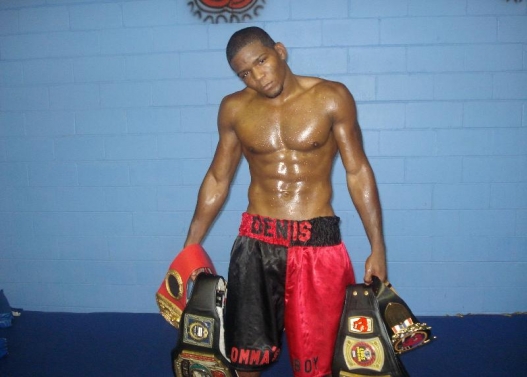


SIX QUESTIONS WITH JUSTIN “THE SILVERBACK’’ WILCOX FRIDAY, NOV. 19, IN JACKSON, MISS., LIVE ON SHOWTIME®

JACKSON, MISS. (Nov. 16, 2010) – Feeling like he wasn’t getting the competition he craved, former college wrestler turned competitive bodybuilder Justin “The Silverback” Wilcox decided to give Mixed Martial Arts (MMA) a try five years ago. He’s been hooked ever since.

Now, Wilcox finds himself in the biggest fight of his career, taking on lightweight (155 pounds) star and Brazilian Jiu-Jitsu black belt Vitor “Shaolin” Ribeiro in the headlining fight of a STRIKEFORCE Challengers event on Friday, Nov. 19, at Jackson Convention Complex in Jackson, Miss., LIVE on SHOWTIME® at 11 p.m. ET/PT, (delayed on the West Coast).

Wilcox (9-3), a 31-year-old former NCAA wrestling star, has won his last four starts. In his most recent outing on March 26, he registered a unanimous decision over Shamar Bailey at STRIKEFORCE Challengers in Fresno, Calif., the city where his family currently resides.

A member of San Jose, Calif.’s Team AKA, one of the most fearsome fight teams in the world that also plays home to STRIKEFORCE superstars Josh Thomson and Cung Le, Wilcox wrestled for Edinboro University of Pennsylvania and is from Cincinnati, Ohio.

Wilcox answered six questions recently.

QUESTION: What do you think about Vitor Ribeiro? He thought he beat Lyle Beerbohm (he lost a split decision May 15) in his last fight. What did you think?

WILCOX: “I think it could have gone either way. I think he looked good. I know he’s a four-time Jiu-Jitsu world champion and he’s 20-4. I’m not underestimating him in the least. I know people think there won’t be a lot of striking; that we’re both going to want to get it to the ground. Wherever he wants to take it is fine by me. I have faith in my ground game and I’m working with Dave Camarillo at AKA, just an incredible Jiu-Jitsu coach.

QUESTION: What’s it like training at the AKA gym in San Jose?

WILCOX: “It’s been awesome. It’s one of the top gyms in the world. I don’t see myself training anywhere else. Going into my fights I don’t get too nervous because I’m training against such high-level guys and some world champions. The gym is so complete. You don’t have to travel to get high-level boxing or high-level wrestling. It’s all right there. That’s why I love it so much.”

QUESTION: Who’s the toughest guy you ever fought?

WILCOX: “Each opponent has had his strong points. They’ve all been tough. I don’t take any of them lightly. If I had to pick one I would say the (Daisuke) Nakamura fight (which Wilcox won by unanimous decision on Dec. 19, 2009). I had to take the fight on two weeks notice. He was such a high-level opponent.”

QUESTION: In your first professional fight in 2006 you beat Bobby Voelker, another Cincinnati fighter (who scored a major victory over previously undefeated Roger Bowling last Oct. 22 on STRIKEFORCE Challengers on SHOWTIME). Does that seem like a long time ago?

WILCOX: “That was also a tough one. I was just a wrestler back then. Everything he could throw at me he did. People after that fight were like, ‘Wow, wait till you get that chin.’ I don’t know. I just want to keep moving forward. That was my first fight. Bobby’s had some success recently with STRIKEFORCE which is great. We’re kind of on the same path. He’s a great kid. I like Bobby a lot.”

QUESTION: Is there any opponent you’d like to face? Where do you see yourself in the sport in a year?

WILCOX: “I see myself wearing that belt. Each fight is one step closer to that belt. That’s what I see myself going after and being a world champion. Whoever they put in front of me is fine. Whoever has the belt at the time is who I want to fight and who I want to beat.”

QUESTION: What do you like to do in your free time?

WILCOX: “I just really like to hang out with my 3-year-old daughter Natalie and being with my family. I’m up here in San Jose training and they are down in Fresno so I go down on weekends and see them a lot. Just being with my little girl and my wife Leslie is what makes me happy. Just hanging out and spending time with the family.”

The Mixed Martial Arts (MMA) fight card presented by Rockstar Energy Drink will mark STRIKEFORCE’s initial foray into the state of Mississippi.

Tickets are on sale now to the general public at all Ticketmaster outlets, including the Coliseum box office and Be-Bop Record Shops, by phone at 800-745-3000 and online at Ticketmaster.com and STRIKEFORCE.COM.

Doors at Jackson Convention Complex will open at 6:45 p.m. CT. The first non-televised preliminary bout will begin at 7:30 p.m. The first televised main card fight will begin at 10 p.m.

About STRIKEFORCE
STRIKEFORCE (www.strikeforce.com) is a world-class mixed martial arts cage fight promotion which, on Friday, March 10, 2006, made history with its “Shamrock vs. Gracie” event, the first sanctioned mixed martial arts fight card in California state history. The star-studded extravaganza, which pitted legendary champion Frank Shamrock against Brazilian Jiu-Jitsu black belt Cesar Gracie at San Jose’s HP Pavilion, played host to a sold-out, record crowd of 18,265. Since 1995, STRIKEFORCE, sanctioned by ISKA, has been the exclusive provider of martial arts programming for ESPN and, after 12 years of success as a leading, world championship kickboxing promotion, the company unveiled its mixed martial arts (MMA) series with “Shamrock vs. Gracie.” In May 2008, West Coast Productions, the parent company of STRIKEFORCE, partnered with Silicon Valley Sports & Entertainment (SVS&E), an entity created in 2000 to oversee all business operation aspects of the San Jose Sharks and HP Pavilion at San Jose. In March 2009, STRIKEFORCE signed a multi-year agreement with SHOWTIME® to stage live events on the premium cable television network. The promotion has since also produced two live, primetime events on the CBS Television Network.


Video: Interview with Lafarrell Bunting

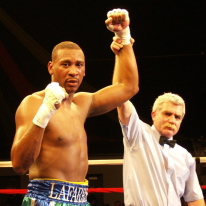
Competing for the first time in over three-years, Lafarrell Bunting flexed his still formidable power with a sixth-round stoppage over Junior Moar at the Emerald Queen Casino in Tacoma, Washington this past Saturday. Bunting (17-3-1, 17 KOs) of Memphis, Tennessee spoke to 15rounds.com about the victory and a potential match-up with world ranked Otis Griffin.


Watch Lafarrell Bunting Interview with 15rounds.com

SCHOOL DISTRICT APPOINTS NEW HEAD

The Boston Globe (Boston, MA) April 1, 2004 | John Laidler, Globe Correspondent A New Jersey schools chief will become the new superintendent of the Masconomet Regional School.

Claire Sheff Kohn, the superintendent of the Princeton, N.J., Regional Schools, agreed on Tuesday to a five-year contract offer from the Masconomet Regional School Committee. She will start Aug. 1.

Her decision ended a period of uncertainty over whether Kohn, the committee’s top choice for the job, would end up as the next superintendent of the district, which serves just over 2,000 middle school and high school students from Boxford, Middleton, and Topsfield.

The committee voted, 12-0, last Tuesday to offer the position to Kohn, who was one of three finalists out of 20 applicants. Kohn reviewed the committee’s offer and made a counteroffer Friday. On Monday, the committee made its own counteroffer, the proposal that Kohn ultimately accepted.

Under the contract, Kohn, who succeeds retiring Superintendent Kathleen M. Lynch, will be paid a salary of $140,000, according to School Committee chairwoman Kathryn Hartmann.

The other two finalists were Michael Ananis, the superintendent of School Administrative Unit 39 in Amherst, N.H., and Dennis Richards, associate superintendent in Reading.

Since Lynch is not scheduled to leave until the end of August, Hartmann said she and Kohn will serve in a cosuperintendent capacity during that month.

“I’m very excited. I think this is a wonderful district and I’m excited at the prospect of being their superintendent,” Kohn, 56, said in a telephone interview Tuesday from her office in New Jersey.

She said what stood out to her about Masconomet were the people she had encountered there. go to site princeton regional schools

“I had a wonderful site visit and had the good fortune to meet not only with School Committee members but with faculty, administration . . . students, and others,” she said. “The thing that impressed me the most was the relationship between the teachers and the students. There’s a genuine respect and affection. The kids love their teachers and the teachers are there for the kids. That’s very compelling.” In addition to Masconomet, Kohn had been a finalist for superintendent’s posts in Danvers, Brookline, and Holliston, she said. She dropped out of the running for the Danvers position on the morning before that town’s School Committee awarded its job last week. here princeton regional schools

“We feel she’s an A-plus candidate all around,” Hartmann said. “She has a very strong, proven track record as superintendent. She’s a strong educational leader with an excellent grasp of finances.” “She’s articulate, she’s a terrific writer, she’s knowledgeable,” Hartmann added, observing, “We felt we had two other strong candidates in the wings, but we were excited she took our offer. She was our first choice.” Kohn, who grew up in Weymouth, has a bachelor’s degree in English from Stonehill College in Easton, a master’s of education in guidance and counseling from Boston College, and a doctorate of education in school administration from University of Massachusetts at Amherst.

She began her educational career in 1971 as an English teacher at Bicknell Junior High School in Weymouth. After a year in that position, she went to Concord-Carlisle Regional High School, where she worked for a year as a humanities teacher and for a year as a counseling intern. She then spent six years as a guidance counselor at Westwood High School.

In 1980, she began an eight-year stint as an administrator at the Norwell public schools, first as an assistant principal and for six years as assistant superintendent. From there she spent five years as school superintendent in Hull.

In 1993, she began a seven-year stint as superintendent of Lawrence Township Public Schools, a 4,000-student district in New Jersey. She became superintendent of the 3,400-student Princeton Regional Schools in 2000.

Kohn is married to Gerald Kohn, formerly superintendent for the Triton Regional School district and currently school superintendent in Harrisburg, Pa. The two have a commuting marriage, a situation that will continue when Kohn begins the Masconomet job.

“New Jersey has been very good to me,” Kohn said. “I’ve enjoyed it. Both districts have been really good districts.” Her decision to return to Massachusetts was prompted by the fact that she had spent 21 years of her career here, and by family reasons, said Kohn, whose mother and two brothers still live in Weymouth, and who also has siblings in New Hampshire.

In her present job, Kohn has faced some of the same challenges that superintendents must face in Massachusetts, including tight budgets and high stakes testing. New Jersey instituted a graduation test before Massachusetts.

“We’ve had our own version of `ed’ reform,” she said of the 10- year-old Massachusetts law.

Asked about her leadership style, Kohn called herself a “good listener. I have enough experience and knowledge that I know when it’s appropriate to make a decision as superintendent, and when it’s appropriate to get input.” “I try very hard to be fair,” she said, “but in the end, I will make decisions I think are in the best interests of the students and the district.” John Laidler, Globe Correspondent


Darren Barker “I’m Back”


It hasn’t been the 2010 that British Middleweight Darren Barker was hoping for. While he’s maintained his undefeated record, he’s been bogged down with a persistent hip injury that has seen him fight just once this year back in April.

That win saw him pick up the Vacant European title against teak tough Frenchman Affif Belghechem, who he bested over twelve rounds. The longstanding hip injury however wasn’t getting any better and Team Barker decided that they could no longer continue to fight anything less than 100%.

So Barker underwent surgery, over the course of the summer it was announced that Barker would defend against British rival Matthew Macklin in one of the most anticipated domestic showdowns of recent years. The fight was scheduled to appear on the “Magnificent Seven” show in Birmingham on 18 September.

It seemed too good to be true, and sadly that proved true when less than a week from fight night Barker was forced to pull out. The hip injury hadn’t healed; he was still in pain when he made the heart wrenching decision to pull out of a fight he also couldn’t wait to fight in.

His trainer Tony Sims said of the injury “Every time he ran it was hurting him, it got to the point where he couldn’t walk properly, that’s why it was necessary to have the operation”

“We went to Tenerife to train and he did one run there and he was in agony, we were out there for 2 weeks in a place where you do road work, we’d flown all that way and he couldn’t run up the mountain. That was the whole reason we were there. We knew when we came back there was no way we could fight (The Macklin fight)”

As the old saying goes the show must go on, the honourable Barker relinquished his treasured European title that Macklin dually picked up on the aforementioned “Magnificent Seven” card. The proviso being that Barker would have a direct shot at the European title when he returned from injury. “When he tried to come back for the Macklin fight, he never gave it long enough”

Adding “He did the hip 2 year previous, in reality I wish he had got it done then. The runs were becoming smaller and smaller because of the pain, in the end he couldn’t even walk”

When asked about Barker wanting to fight Macklin, Sims offers this about his charge “For two years we were chasing Macklin. Barker should of fought Elcock when Elcock was (British) Champion but Hennessy didn’t want them to fight but then the board took it to purse bids Barker, Elcock, Macklin & McDermott and they made a strange decision to make Darren fight McDermott in a final eliminator and Macklin straight in with Elcock”

“We won the final eliminator, Macklin won, good luck to him but I think Darren would of done the same thing to Elcock anyway. We wanted him then, he was the one avoiding us at that time. The Amin Asikainen fight he won, but you have to remember Asikainen was 33 and had been knocked out twice before he fought Macklin”

Though remaining respectful of Macklin’s ability Sims says “I think the two best names he beat were over the hill and knocked out before, they weren’t undefeated”

While believing that the British showdown will happen eventually after both guys were forced to pull out of scheduled fights with each other through an assortment of injuries he hopes it’s for a world title when they can maximise one of the most interesting domestic fights possible at the moment.

Though he doesn’t think that they needed Macklin as much he he needs them “We sold 4,000 tickets for Darren’s European title fight while they can barely do 1,500, he needs us more than we need him”

It was just a waiting game and Barker along with his team including Sims had to sit tight and hope that given the time that the hip would get better and respond to physio and get back to normal. Like many things there is no exact science to it, it’s simply waiting. The doctor told them “With an ordinary person they’d be a 100% but with an athlete you never know”

There was a time when Barker and everyone around him thought he may have to hang the gloves up and retire from the sport he loves so dearly.

Last week Barker went back to the gym and after rigorous work outs seems to be getting back to where he wants to be. Thankfully the pain that existed for several months seems to of subsided allowing him to move freely. “The progress is good, he’s not in pain and that’s the main thing, we’ll just keep seeing how he goes” However he reasons “All the sparring aint going to be the same as an actual fight”

When asked how long it maybe until Barker can get back into the squared ring Sims offers “Where hoping for February, that will be 10 months then since he’s fought. It’ll be a ten rounder, until he fight’s his mind isn’t going to be 100% right. After that fight where we can shake of the rust we’re right back into things and ready for anyone”

Weekend thoughts: Full credit to Pacquiao, he looked sensational. Enjoy him while he’s here, a true all time great…Say what you want about Margarito but he took his licks like a man…It took Brandon Rios a few rounds but when he got into his grove he looked pretty good, especially for a guy who was called up at late notice…Back last September I headed to Miami and saw Guillermo Rigondeaux and thought he had the look of a Superstar, he was passive against Cordoba he looked more Erislandy Lara than Yuriorkis Gamboa, he can’t half throw a gut wrenching bady shot…Jones-Soto Karass was a war, rematch anyone?…I’m not sure what they feed them in Mexico but I wish I could bottle it Margarito & Soto Karass showed hearts the size of true warriors…While the Boxing world tuned into the happenings in Dallas, Britain had it’s Boxing business, in Wladimir Klitschko’s words “Heavyweight Championship of London” David Haye destroyed Audley Harrison. Hopefully now Haye will step up and fight one of the Klitschko’s don’t hold your breath though…Harrison reportedly earned in the region of £1 Million pounds, we really do live in an age of mediocrity. Word is the BBBC are looking into with holding some of his purse…While most British Boxing enthusiasts headed for Manchester, I headed 30miles or so east to watch the Britain’s next generation of top amateur’s, in the first Olympic Qualifier. The most impressive performance arguably came from former European champion Luke Campbell who put on a clinic over Ian Weaver by 23-6, there we also wins for Tom Stalker, Bradley Saunders, Anthony Ogogo & Simon Vallily…I also caught up with David Price who’s headed to spar with Dereck Chisora ahead of his fight with Wladimir Klitschko, he said he hopes to fight next early next year on the Sam Webb-Prince Aaron card in a step up fight.


Q & A with Terry Norris


Through out the 90’s one of the best fighters in the World Pound for Pound was “Terrible” Terry Norris. He finished with a record of 47-9(31) and was a career Light Middleweight winning the WBC & IBF titles in his twelve year career. Norris now 43, still keeps in shape and keeps himself busy with various activity’s. Here what Norris had to say on a variety of subjects.

Hello Terry, welcome to 15rounds.com

Thanks for having me!

Anson Wainwright – Firstly how are thing’s? It’s been 12 years this November since retired what have you done with your time?

Terry Norris – Well I’ve just been relaxing, enjoying life.

Anson Wainwright – Do you still get fight fans recognise you and come over and have chat with you?

Terry Norris – People still recognize me when I’m out. Its nice to be remembered. I always take the time to talk with them. People also often mistake me for Keenan Wayens. Haha!

Anson Wainwright – Are you involved in any capacity in Boxing these days?

Terry Norris – Yes! I am currently just excepted an offer from the WBF to be Regional Supervisor for California. I’m training a few fighters and celebrities in my home gym in L.A doing some private boxing sessions. I’m also putting together a Youth Boxing Program for summer and after school. I’m forming my own boxing team/club. My wife and I have founded “The Final Fight” a foundation for Pro Boxers new and retired. We will provide resources such as financial advice, medical, housing etc. As you may know there are a lot of fallen Champs. I feel its time the real truth be told about what’s going on with them. We will use our foundation to also work towards the formation of a UNION for pro-boxers. We are doing a Reality Show and Documentary about it Called “The Lady and The Champ” this will also be the Title of my book.

Anson Wainwright – You had a really good career winning the WBC Light Middleweight crown three times and the IBF title once. You also fought a who’s who of 154 pounders. What was your proudest moment in Boxing?

Terry Norris – I have to say it was winning my first world title.

Anson Wainwright – Can you tell us about how you first became interested in Boxing and the path you took until you eventually turned pro?

Terry Norris – My mom was the one to push me to start boxing to get me off of the streets. My dad was training my brother at the time. I spared a lot with my brother. I fought 290 amateur fights

Anson Wainwright – Who would you say was the best fighter you ever shared the ring with?

Terry Norris – Ray is by far the best I have shared the ring with. Amazing man and friend till this day.

Anson Wainwright – You were a career Light Middleweight, how come you never moved up to Middleweight?

Terry Norris – My physical condition was and still is amazing. I sometimes can’t believe it myself. I never fought Middleweight because I could never gain the required weight.

Anson Wainwright – Was there ever a fighter who you wish you could of fought, going back i remember reading in the press that about you fighting Trinidad, Whitaker and even Chavez. How close did any of those fights come to being made?

Terry Norris – Well I would have liked to fight all of them. But the Trinidad fight was inked. I actually still have the contracts signed by Don King and Trinidad. I’m going to frame it and hang it in my gym.

Anson Wainwright – Through out your Boxing career you must of seen or been involved in some amazing things. Do you have a story that you could share with us?

Amazing story? Wow, I have so many. Hard to pick one. Hahaha!

Anson Wainwright – How is your brother Orlin doing these days? What’s he upto?

Terry Norris – My brother is good. Living the family life.

Anson Wainwright – You fought for much of your career for Don King, how did you find working with him?

Terry Norris – Don king? No comment.

Anson Wainwright – What fighters today would you of liked to of fought and how do you think it would of gone had you fough them?

Terry Norris – Fighters today? Well I’m a true warrior I would fight them all! But Floyd, yea I would have beat. To strong and fast for him.

Thanks for your time “Terrible” Terry

Anson Wainwright
15rounds.com


Mayweather in alleged incident with security guard

According to tmz.com, Floyd Mayweather had an alleged run-in with a member of his own security detail

Law enforcement sources told tmz.com a private security guard who was patrolling inside Floyd’s gated community drove up to Floyd’s house a few hours ago to confront the boxer about a parking situation.

We’re told the security guard rolled down his window to talk to Floyd … and that’s when Floyd allegedly unleashed his finger — striking the guard in the face.

Cops were called to the scene and knocked on Floyd’s door — but we’re told the boxer refused to open up.

We’re told since Floyd was only suspected of a misdemeanor battery — and because the alleged incident didn’t take place in front of a police officer — cops merely took a report and did not make an arrest.

Law enforcement sources tell us cops plan to turn the case over to the D.A., who will decide whether or not to press charges.


Good riddance to Margarito, so long to Pacquiao


ARLINGTON, Tex. – There was a time when Antonio Margarito was my favorite story in boxing. He was humble, friendly, kind to fans and writers, and willing to absorb copious abuse to prevail. The night he defeated Miguel Cotto at MGM Grand remains a highlight of my time in boxing. But Saturday night, at about 10:20, I realized I don’t like the man anymore.

When the opening bell rang and I saw how much larger he was than Manny Pacquiao, my stomach tightened unexpectedly because at any moment in the next 36 minutes, Margarito might hurt Pacquiao. He might win. And I discovered a Margarito victory was a possibility that repulsed me.

Saturday at Cowboys Stadium, Filipino Manny Pacquiao did not allow Mexican Antonio Margarito to prevail. He clipped him, cut him, closed his eyes and whupped him. The judges scored the match 120-108, 118-110, 119-109 for Pacquiao. I had it 120-109, scoring 10 rounds for Pacquiao, with rounds 6 and 8 even.

Before you scoff at scoring anything for Margarito, consider what Pacquiao said about the sixth, in the post-fight press conference.

“I’m lucky to have survived that round.”

When have you ever heard Pacquiao say something like that?

It was a subdued conclusion to a night that was weird. The return to Cowboys Stadium went not as hoped. Attendance was announced at 41,734 – though we’ll not know the actual number till the Texas Department of Licensing and Regulation reports on gate receipts. Still, that was 10,000 fans fewer than was announced for Pacquiao’s March fight with Joshua Clottey. It was 19,000 fans fewer than we’d been told to expect all week.

And while Pacquiao-Clottey was a subpar performance in a remarkable edifice, Pacquiao-Margarito was a remarkable performance in a subpar edifice. Cowboys Stadium, a billion dollars later, had no reliable WiFi; Ethernet cords abounded – just like 1998. Cowboys owner Jerry Jones, ubiquitous in March, was hard to find all week.

The home team goes 1-7, in other words, and everyone, from the owner to the bus driver, stops caring about details.

I spent much of Saturday’s undercard on the East Side Plaza, asking Mexican fans about their unceasing loyalty to Margarito even after his 2009 banishment for wearing tampered-with inserts in his hand wraps. They almost had me convinced. Then allegations of ephedra use exploded from Margarito’s dressing room during Saturday’s undercard.

One camp said it was Hydroxycut – a dietary supplement that once contained the banned stimulant ephedrine. The other camp said that it was Splenda, a no-calorie sweetener, Margarito sprinkled in the four cups of coffee he drank in his dressing room. Though it was ultimately an irrelevance, it merits treatment.

The ECA Stack – comprising ephedrine, caffeine and aspirin – is more common in boxing gyms than you think. It is a powerful appetite suppressant that takes a remarkable effect on the central nervous system. Ephedrine races your insides while sending a signal to induce drowsiness. Caffeine ensures that signal never arrives at your brain. Aspirin, meanwhile, thins the blood to increase the duration of the stimulus. A fighter who used it to cut weight in training camp could easily become enchanted by its effect on hand-speed, timing and stamina.

It cannot make you a better fighter. But it can make you a more resilient one – with only a small chance of cardiac arrest.

And so my stomach tightened at ringside late Saturday night. To see Margarito’s size advantage and imagine it leavened with artificial speed and courage was hard to bear.

Margarito’s unofficial advantage was 17 pounds of weight and 4.5 inches of height. It was much more than that, though. Pacquiao is a 140-pound man who couldn’t weigh 160 after a sedentary month of rapacious grazing at a Las Vegas buffet. Margarito is a 190-pound man who, one way or another, weighs less than 150 pounds for a few hours of every year.

Oh, but size isn’t that important. Skill is. Combination punching is. Quickness and accuracy are. Right, right and right. But if size doesn’t matter, what was that scale doing at Cowboys Stadium, Friday?

When you are the much smaller man, see, every punch must be thrown with knockout power. In order merely to keep the larger man off him, a smaller fighter must forsake range-finding punches and deliver each blow with complete commitment. And that is positively exhausting. Even for Manny Pacquiao.

An hour after Saturday’s fight, in a makeshift media area under Cowboys Stadium, Pacquiao was spent. This post-fight press conference was not the celebration others have been. Pacquiao said it was the hardest fight of his career. What he didn’t say, perhaps because he’s gracious, was that Margarito was the least-skilled prizefighter Pacquiao has faced in a championship match. Indeed, size mattered.

After cracking the orbital bone under Margarito’s right eye early in the fight and almost stopping the Mexican in round 4, Pacquiao was astonished to be hurt by him in the sixth. Margarito pinned Pacquiao to the ropes and hit him with sustained punches for the first time. Margarito dipped into his well of resentment – a disrespected Tijuana club fighter made good – and tried to break Pacquiao.

But for once, Margarito faced a man with a deeper well of difficult experiences from which to summon fortitude. Take that, marry it to once-in-a-generation speed and power, and well, you have something pretty special there.

So, thank you, Manny, for being the purest embodiment of what we love about prizefighting.

And now, say goodbye to us. The risk-reward ratio is all wrong for you, as you realized Saturday night: To make big purses you have to fight men who are too big. There is nothing left for you to do to burnish your legacy. There is nothing more for you to give to boxing but a happy ending.

It’s now time to retire a legend, wits and fortune intact, and serve your people in a more meaningful way.

Bart Barry can be reached at bbarry@15rounds.com. Additionally, his book, “The Legend of Muhammad Ali,” co-written with Thomas Hauser, can be purchased here.


Torres and Pakau Battle to a Draw in Tacoma


TACOMA, WASHINGTON — With most of the boxing world’s eyes focused on events taking place about 2,000 miles southeast, fight fans of the Northwest were treated to an entertaining night of action Saturday at the Emerald Queen Casino. Longtime local favorite David Torres fought to a majority draw with Santos Pakau in the main event of a competitively-matched card from top to bottom.

Pakau (27-6-2, 10 KOs) of Spokane, Washington got off to a solid start in the fight as he employed a focused body attack in the early going and followed up with right hands to the head of his opponent. Torres (21-2-1, 13 KOs) of Othello, Washington began to wake up late in the second round, but was clearly not punching with the same power as Pakau, especially in the early rounds.

Pakau, 137, must have been feeling good, as he even played to the crowd, waving his right fist in the air. Torres, 139, was constantly moving forward and finally broke through with a solid left hook to the body, which momentarily stopped Pakau in his tracks. Action picked up as both fighters landed well in an exchange near the close of the fourth.

Pakau looked good in rounds five and six, as a right uppercut stunned Torres and forced him to hold on. Then early in the sixth, Pakau landed a clean left hand. Pakau found a range in the round where he could land and the shorter Torres could not reach him. Torres continued to press forward, and did get close enough to land some shots on the inside to close out the round.

Pakau began to look tired in the seventh and was warned for pushing. Torres was coming on, but still did not seem to have the power to really hurt Pakau. Torres did land a clean straight right late in the stanza, a round that was clearly his.

Torres outworked Pakau in the ninth, though the New Zealander did land a pretty left hook and traded well to close out the round. Both fighters came out aggressively in the tenth, as they unloaded at close quarters. Pakau would end up cut in the corner of his right eye before the two stood their ground and traded to close out the fight.

When it was all said and done, one judge favored Pakau 96-94, but was overruled by identical even scores of 95-95, forcing the draw. As should be expected after a draw, both fighters felt as though they should have been declared the winner.

“I feel I had at least six of the ten rounds,” said an obviously disappointed Pakau after the bout. “I should have worked that little bit extra I guess. But what do you do? I got a draw I guess, it’s better than a loss.”

Torres feelings on the scoring were very similar to Pakau’s only the other way around. “I think it was a really good fight for both of us, but honestly I feel I won the fight,” said Torres, who is open to the idea of a rematch. “I think I had at least six rounds. He kept a little busier, but I threw the better shots.”

A side story to the fight revolved around the weight, and weighing-in. The Torres camp was concerned going in that Pakau, who had fought most of his recent fights at or near 147-pounds, would come in heavy, or at least enter the ring with a great weight advantage. Therefore both Pakau and Torres weighed in officially on Saturday morning to hopefully curb how much weight Pakau could gain by the time they actually fought.

“They were very worried,” said Pakau after the fight. “They made me weigh-in the same day. I don’t know why, little stupid tactics. I had to drive nearly an hour out of Tacoma to go for the weigh-in this morning. It didn’t faze me, but it was just stupid.”

Although he has fought around 139-pounds for much of his career, Torres and his team have plans to eventually move down in weight. “I feel good at 139, but my goal is to go lower, probably down to 135,” said Torres.

When asked about a potential rematch, Pakau did not sound too thrilled about his prospects for a fair decision on Torres’ home turf. “It would be interesting, but what am I going to get out of it?” said Pakau. “Nothing really. There is no point in it. I knew coming into this fight that I wasn’t going to win unless I knocked him out. It’s as simple as that.”


It is incredible how a puncher can change a fight in an instant. Out of action for the last three-years, Lafarrell Bunting showed he still has an eraser for a right hand with a sixth-round stoppage over Junior Moar in the co-main event of the evening.

Bunting (17-3-1, 17 KOs) of Memphis, Tennessee and Moar (8-3, 2 KOs) of Richmond, British Columbia, Canada were two fighters just as different as their entrance music. Moar, who entered the ring accompanied by Native American drummers and dancers, is not a puncher, but is an aggressive, forward-moving fighter. Bunting, who came out to expletive-laden rap, fought most of the fight in the style of a boxer-mover, before displaying his fight-changing kayo power.

Moar, 176, was the aggressor early and often in the fight. Bunting, 175 ½, played the part of counter-puncher at the outset, as he appeared to be getting his timing right and perhaps shaking off some rust.

Things began to heat up in the second, as each fighter landed a solid blow in an early exchange. Bunting caught Moar with a left uppercut and Moar retorted with a combination of hooks upstairs. Before the end of the round, Bunting would be warned by referee Louis Jackvony for a low blow that doubled Moar over near the ropes. Moar would return to his corner with a cut near his left eye, which Jackvony told the ringside judges was the result of a punch.

Moar began to impose his will in the third, pressing Bunting against the ropes with his attack. The rough fight continued to get rougher, as Moar was warned for hitting on a break and Bunting admonished for holding the Canadian’s left hand under his own, a tactic he would employ at various times in the fight. Moar refused to complain and instead worked Bunting’s body over a bit with his free right hand.

Moar did well for much of the fourth as well, pressing the fight still while Bunting mostly looked to cover up and move away. A stiff left jab from Moar got a reaction from the crowd, but did not appear to hurt Bunting. The Memphis native reverted back to using his own jab to keep Moar off balance in closing the round.

Moar continued to press forward and land well in the fifth, but did get caught by a left uppercut that Bunting timed and measured accurately. Bunting continued to at least give the impression he was looking for that punch again, as he repeatedly loaded up with the uppercut. Moar closed out the fifth by pressing Bunting, who was again covering up along the ropes. Despite the way the fight was going, it was Moar’s face that looked the worse for wear, with his cut bleeding freely and a bad knot forming high on his left temple.

Bunting would be warned again for a low blow early in the sixth. Soon after, Jackvony called time to give the doctor a chance to look at the cut, which did look pretty bad. The referee ruled that the cut was made worse from an accidental headbutt. Jackvony would warn Bunting again, this time for hitting behind the head.

Soon after action resumed, Bunting landed the counter he had been looking for, an overhand right that dropped Moar. Three stiff rights and a left would drop Moar a second time. When Moar returned to his feet, Bunting flurried him into the ropes, prompting Jackvony to wave off the fight. Official time was 2:57 of the sixth round.

The official scores entering the sixth and ultimately final round were 49-46 and 48-47 twice, all for Moar. Had he made it out after the two knockdowns, Moar would have likely been down on two cards (57-55) and even on the third (56-56) with two rounds to go. That being said, with Moar’s apparent condition, the timing of the stoppage was just.

After the bout, Bunting expressed his confidence going in, but gave Moar credit for his performance. “Going into this fight, even though I had been off for three-and-a-half years, I knew I had the power to pull off this win,” said Bunting. “It was a tough fight. Junior Moar came to fight and I have a lot of respect for him.”

Going into the bout, promoters had designs on matching the winner with world ranked Otis Griffin for the vacant WBO NABO Light Heavyweight title. While Griffin is likely headed for an IBF title eliminator against Yusef Mack, he had informed 15rounds.com that he would be willing to take on the winner after that as a “tune-up.”

“Hey, Griffin, take the fight and stop running,” said Bunting after he was informed of Griffin’s thoughts on the prospective bout. “Why don’t you meet me January 8th, here at the Emerald Queen Casino. Let’s make it happen.”


In a rare paring of undefeated heavyweights early in their careers, Vincent Thompson (6-0, 1 KO) of Federal Way, Washington scored a six-round unanimous decision over former National Golden Gloves Champion Charles Ellis (6-1-1, 5 KOs) of Vancouver, Washington.

Despite size and strength advantages, Ellis, 227, never looked comfortable in the fight. Thompson, 226 ½, was comfortable early and became more and more confident as the fight progressed. Early action was fought on the inside, before Thompson morphed into a boxer-mover in the fourth round. Thompson would continually land his shots and move out of range. By the fifth, the plodding, discouraged Ellis refused to offer up much offense and even looked to his corner, shaking his head in the sixth. When Ellis would pin Thompson in a corner he could not, or would not, get anything done. In the end, one judge scored the bout 59-55, with the other two scoring it a shutout, 60-54, all for Thompson.


In what was a closely-contested match-up every step of the way, Rob Diezel (4-1, 1 KO) of Seattle, Washington boxed his way past Marco Cardenas (1-3) of Salem, Oregon by way of a four-round split decision. Their roles were defined in the early going, as Diezel, 130 ½, was clearly the classy boxer and Cardenas, 129 ½, the aggressor. In the end, the judges were won over by Diezel’s boxing skills.

Diezel was busted open in the second, from what was ruled a headbutt, although there was a clean overhand right that landed in that spot during the same sequence. By the third, Cardenas would be bloodied as well, as he began to leak crimson from his nose shortly after a Diezel right hook. The fourth featured many toe-to-toe exchanges. Ultimately, two judges favored Diezel, 39-37, with the lone dissenter scoring it for Cardenas, 39-38.


Former local amateur standout Virgil Green (1-0) of Arlington, Washington got his pro career off on the right foot with a four-round unanimous decision over Miguel Garcia (2-2) also of Arlington. Despite giving up his sizeable height and reach advantages by fighting on the inside for much of the bout, Green, 139 ½, proved too quick and slick for Garcia, 141, who was no pushover.

Garcia landed his best shot in the third, a solid left hook, but did not follow up. Despite his corner’s instructions to move forward and throw punches, Garcia decided to play the role of counter-puncher. In the fourth, Green took complete control and backed up his posturing opponent en route to the victory. Scores read 39-37 and 40-36 twice all for Green.


In the curtain raiser, Ralph Prescott (1-5) of Seattle moved into the win column with a four-round majority decision over professional mixed martial artist and debuting boxer Omar Avelar (0-1) of Moses Lake, Washington. Prescott, 139, fought one of the more determined fights in the history of 0-5 fighters in a back-and-forth bout from start to finish. Avelar, 145 ½, appeared to be the harder punch throughout, but began to fade midway through the fight. Rounds three and four ended with both men standing their ground and trading shots, much to the crowd’s delight. In a bout that could have gone either way, two judges favored Prescott by the scores of 40-36 and 39-37. The third scorer had it even, 38-38.

On Saturday, ESPN.com’s Dan Rafael reported that the Showtime-televised bantamweight doubleheader would be taking place here December 11th, but to say that is definite would be premature. Currently the Charlie Daniels Band is scheduled to perform at the casino on that date, but efforts are being made.

Boxing will definitely be returning to the Emerald Queen Casino in 2011, with five dates already scheduled. Brian Halquist Productions will kick off the year with “Battle at the Boat 80” on January 8th.

Mario Ortega Jr. can be reached at ortega15rds@lycos.com.

Soap star’s tribute to Morton.

Birmingham Evening Mail (England) January 16, 2001 Byline: Graham Young TV Editor CORONATION Street star Sue Nicholls today paid tribute to her old friend Andrew W Morton, the former Crossroads’ star who has died aged 73. go to site christmas card sayings

As Carlos the chef in the Birmingham soap, he shared many motel scenes in the 60s with Sue who played Marilyn Gates.

They also enjoyed several foreign trips together when the show pioneered foreign adventures in hotspots as diverse as Tunisia and Torremolinos.

Morton, who lived in a council flat in Highgate, died on Sunday after a short stay in Selly Oak Hospital. web site christmas card sayings

Sue, now famous for playing Audrey Roberts for 21 years in the Street, said: ‘I am so sorry to hear the news. I feel like part of me has gone.

‘Anthony was very much part of my life and my family’s life even though I hadn’t seen him for some time.

‘I sent him a Christmas card saying I would see him this year.

‘Anthony would be very acerbic but witty with it.

‘He used to make me laugh. He wasn’t into sentimentalities at all.

‘That part of my life when I worked with him was a very joyous one and part of a big learning curve for me. ‘ CAPTION(S):

TRIBUTE: Sue Nicholls


Mexicans’ support of Margarito never quit either


ARLINGTON, Tex. – In January of 2009, Mexican Antonio Margarito was caught with a plaster-like substance smeared on the knuckle pads of his hand wraps before a defense of his welterweight title. His license was revoked. He was banned from prizefighting for a year. But his countrymen did not abandon him. Why not?

To answer such a cultural question one would need a sociology laboratory. Fortunately, in the East Side Plaza of Cowboys Stadium, there was one.

Saturday night, at a match that Manny Pacquiao won by large-as-possible margins, Margarito did not want for fans. He wanted for class and endurance, perhaps. But not fans. How could his popularity not have waned?

With camera crews – local, national and international – lurking, there were plenty of Mexican fight fans from which to draw an opinion sample about that, in Spanish. And the sample came in the form of two questions, the first of which went: Have you forgiven Margarito for what he did, or do you think he even requires forgiveness at all?

“It happened a long time ago, and nobody told him what was on his hands,” said Marisol Manis, an attractive woman from the Mexican state of Veracruz, who dressed in GreenWhiteRed and held a handwritten sign encouraging Margarito. “In our culture, the Latin culture, the past is the past.”

Roberto Pantoja, a well-dressed man from Margarito’s hometown of Tijuana, thought the entire incident was questionable.

“It was a judgment brought by (a rival promoter),” said Pantoja. “It was doubtful.”

Pantoja, interestingly, was not the only Mexican who thought a certain Mexican-American fighter-cum-promoter was involved in what was found in Margarito’s hand wraps. Sergio, a Tijuanense who wore a Mexican flag knotted on the front of his forehead and draped over his shoulders like a turban-and-cape getup, also found the circumstances of Margarito’s banishment suspicious.

“There is no reason to forgive (Margarito),” he explained. “It was an injustice done by Oscar de la Hoya.”

While colorful, such conspiracy theories are discredited in the testimony heard by the California State Athletic Commission in 2009, testimony the CSAC used to revoke Margarito’s license, finding that even if Margarito’s trainer was the only one aware of the illegal inserts – as Margarito still claims – that was cause enough.

Other Mexicans gathered at Cowboys Stadium on Saturday were reticent about addressing what happened in that Los Angeles dressing room 22 months ago and more interested in the present.

“We are all humans, and we all make mistakes, Margarito, too,” said Carlos, a twentysomething guy from the Mexican state of Monterrey, dressed in a Mexican baseball shirt with the number 10 on the left breast pocket. “He’s a good boxer, and we always support Latin fighters.”

Which raised the second opinion-sample question: Did Margarito’s fans feel a personal connection with him, or did they gather in Dallas mostly to cheer the Mexican flag?

“I am here supporting him because he is a good boxer,” said Eric, a young man from the Mexican state of San Luis Potosi, who wore a Mexican flag round his neck like a cape. “And because he’s Mexican. Both.”

Jose, a middle-aged man from the Mexican state of Durango, wearing a dark leather jacket and drinking a beer at a table in the concourse, was firmer about his loyalty.

“We feel a real connection with Margarito,” he said. “We have followed him for years. We like his manner of fighting. Good fights.”

Perhaps, then, the last explanation is the best. Mexicans, in their proud fighting tradition, want a good scrap when they spend their pesos for a prizefight. Margarito, for all his questionable actions and judgment, has never failed to make the type of fights that enchant his countrymen.

Asked after his beating from Pacquiao, one in which he lost every round and had both eyes closed by cuts, if he ever considered quitting, Margarito spoke to his people’s heart.

“Not possible,” he said. “I am a Mexican. A Mexican never ceases in a fight.”

Laboratory closed.

Photo by Chris Farina / Top Rank


HAYE DESTROYS HARRISON, WELL SORT OF!

In my experience as a boxing fan and historian I’ve never witnessed such a poor excuse for a World heavyweight championship fight, I felt ashamed to call this a fight, it was more of a farce as it happens!

Audley Harrison’s effort or should that be lack of has earned him the number one position of the worst ever title challenger in a World championship fight and I mean any World championship fight, I felt sorry for myself having just paid out 95 for almost nine minutes of a non event, but more so for the high rollers who paid 50 yes that’s right the best part of two thousand pounds for a disgraceful fight if you could call it a fight that is?
Sure there’s been poor displays from some fairly inept challengers through the history of the big men, Puerto Rico’s Joe Roman was brutally outclassed by the fists of George Foreman inside of a round in Japan in 73, Liston it was claimed threw the ‘fight’ against Ali in 65 and so forth but Audley Harrison on this showing has topped that list, to think they call him A Force, surely after this they should rename him A Fraud!

So enough of my rant, let’s read about the so called fight, shall we….?
Coming into the ring to a chorus of boo’s I mean Audley came in decked in a red t shirt about saving some adventure playground, Haye the champion was given a better welcome.
Haye outweighed by just over three stones {43lbs} looked much the smaller man despite being just two inches the shorter, as the paying public anticipated the outcome and that Harrison always had the proverbial punchers chance, sure the tangibles were there though David was much the more fancied going into this his second defense of the W.B.A heavyweight title.
Both to begin with did very little though Audley pressured to begin with as he came forward but Haye soon had Audley backing off with the odd attempt of a punch that failed to land and has soon as forty or so seconds had elapsed into the round the knowledgeable few began to boo both combatants, which I felt was a little premature and unfair, Haye to his credit threw a two punch combination to silence the few impatient fans, and a roar went up, but it didn’t last long!
Thing is one minute had elapsed, then yep you guessed it two minutes as neither boxer threw a punch that landed and even when they did throw which was a rarity in itself they missed or fell short has both looked far too cautious and then the bell rang to conclude the worst three minutes in the whole history of the World heavyweight championship in my opinion, I felt disgusted to even call this interesting but hey give the guys a chance, the usual feeling out process is all very well in the opener but you expect to see at least one of two meaningful punches land, sadly neither party wanted to dance!
So to the second but yet again both Audley and David did anything other than spar for a opening and it wasn’t pretty, again unbelievably neither was willing to take the initiative, it was dismal plain and simple and yep you guessed it right again, no body threw a punch and to think people call the Klitskco’s boring is rather unjust when you watch fights like this, at least they do show a little work rate.
If British heavyweights through boxing history have been called the horizontal heavy, then it’s bad enough seeing them just stand there and look at each other, no body was willing to do anything and I mean anything, even the third man Luis Pabon called for more action and to think they billed this one as ‘the best of enemies’ it seemed they were really the best of friends! by now within eighteen seconds of the second stanza the crowd began a slow hand clap…..oh dear!
Then Haye after a minute or so of inactivity finally threw a right hand that had Harrison on the retreat with his hands up, though Haye landed with a cuffing right hand shot that had very little power behind it, before both went into retirement mode again, however Haye did manage to land a decent straight right to Audley’s midsection about several seconds later but again both went to sleep and after almost a minute and a half into the round Ref Pablon called for them to get busy! Haye did in the last thirty or so seconds but landed with half hearted shots has he simply wasn’t setting himself properly, Audley seemed content to just cover up and get on the move……..the crowd booed some more at the bell to end another fruitless session, both were tarnishing the heavyweight championship, a belt that Mssr’s Johnson, Louis, Marciano and Ali had once held with pride, was now becoming something of a joke!
Oh yeah sorry meant to say Audley did actually land a straight southpaw jab to Haye’s handsome countenance in the second, sorry it was so boring it was hard to keep track!
So to the third and Harrison met Haye center ring, Haye cockily had his left hand slightly extended as if he was using it as a measure to Harrison’s chin, Harrison tried the odd punch but couldn’t find the target, after fifty seconds of unequaled boredom Haye finally came too life and threw a combination beginning with a succession of rights that had Audley backing away to the ropes where Haye punctuated it with a two handed body attack, again both looked each other over and then Haye exploded a two punch combination with a solid right that landed to Harrison’s chin before getting out of harms way, literally seconds later a series of right hands caught the bigger Harrison on the ropes that sent him spinning around, before Haye launched a series of right hands that found the target starting with a big right to the body before bringing the attack to Audley’s head has he cowered on the ropes and seemed to be here to make up the numbers, a series of straight rights pierced Harrison’s high guard before Haye unleashed right uppercuts and started to catch Harrison around the side of the head with more rights that had Audley dazed, a final combination sent Harrison over for the count as he fell forwards and rolled onto his back, Audley was almost a pathetic sight as he got too all fours and made it to his feet at the count of eight, the referee Pablon put Audley’s gum shield back in as though he was prolonging Audley’s agony, Haye like a tiger patiently waited in the corner and wasn’t to let victory out of his sights as he went in for the finish rushing across the ring trapping Audley and not allowing him off the ropes and with both hands flailing, a left hook and a few right hooks had Harrison wobbling again but the third man Pablon had seen enough and saved Audley the embarrassment of a second visit to the canvas in as many seconds as he rightfully waved it off, Audley still erect but badly wobbled stopped at 1:52 of the third.
Haye did the job but seemed too cautious in my opinion and it was beginning to stink out the joint, in the post fight interview David spoke of the brothers but on this performance Haye should really reconsider such a task, beating Audley Harrison’s one thing but in against either brother would be a far tougher proposition, as Harrison spoke of possibly giving it another go!
THIS WASN’T BOXING, THIS WAS BORING!

Any comments to micksnice@aol.com


Update: Torres and Pakau Make Weight


David Torres and Santos Pakau, fighters for tonight’s main event at the Emerald Queen Casino in Tacoma, Washington, both made the contracted weight of 139-pounds this morning, Torres’ manager Lalo Martinez confirmed to 15rounds.com.

Longtime local favorite Torres (21-2, 13 KOs) of Othello, Washington is returning from his second career defeat this past January as he takes on veteran gatekeeper Pakau (27-6-1, 10 KOs) of Spokane, Washington in a ten-rounder. Torres, the naturally smaller fighter, scaled 139-even. Pakau, who has campaigned at welterweight in recent years, scaled 137-pounds.

Both fighters weighed in before Washington State Department of Licensing officials this morning in Olympia, Washington. Members of Torres’ team had expressed mild concerns regarding Pakau’s ability to make the weight at last night’s undercard weigh-in. Torres’ promoter, and host of tonight’s fights, Brian Halquist believes Torres could make 130-pounds for the right fight. Pakau comes first however, in what is an important bout in determining the direction for rest of Torres’ career.

Tickets for tonight’s six-bout card, promoted by Brian Halquist Productions, are available online at Ticketmaster.com.

Mario Ortega Jr. can be reached at ortega15rds@lycos.com.


MMA Results from Akron, Ohio

Akron, Ohio is known as the Rubber City and the home of the All American Soap Box Derby, now is has another legacy, Dan Bobish territory. The former 2 time Super Heavyweight Champion of the World’s promotion, Ultimate Cage Battles, invaded Akron to a capacity crowd at Akron’s hot spot, The Barley House. Fans were treated to a 9 bout card that left the fighters bloody and the crowd screaming for more.

In the main event, Victor “The Italian Stallion” Guarriello stopped Bryan Gregory at 2:51 of the second round via a TKO due to strikes. Both combatants are known for their ground and pound game but the first round was mostly a stand up boxing match reminiscent of Rocky Balboa vs Apollo Creed. In the second, The Stallion took control early and Gregory could not keep up the pace of Guarriello. In his post fight interview, Guarriello thanked the fans for their support he received as he traveled into hostile territory all the way from Jamestown, New York. Guarriello, fought like a true warrior as he took this career changing bout on only 4 days notice. The Stallion improved to 3-1 while Gregory dropped to 3-2.

On the under card

Ed “Mighty” Mouse improved to 10-4 with a second round stoppage due to strikes over Trevor Stiles.

Kyle “Lil Bam-Bam” made quick work of Tyler Bess stopping him in just 24 seconds with vi\vicious strikes.

Debuting Travis Griffith upset “The Handgun” Dallas Dishman at 1:05 in the first round as he made “The Handgun” tap out with a arm choke.

“The Beast” Christian Anderson was victorious in is MMA debut over John “Big Bang” Compton who was also making his MMA debut.

Late substitute Jeremiah Yeager made Josh “Pitbull” Berkley tap out in the very first round with a Rear Naked Choke. The time was 2:29.

Brad Osborne won a 3 round unanimous decision over DeAndre Billingsly.

John Darin Choked out Sean Brown in the first round. The time 1:36.

UFC legend Wes Sims was in attendance working the corners of the Buckeye MMA fighters.

Following intermission, Dan Bobish announced the January 15, 2011 in Cleveland, Ohio will be the next installment of Ultimate Cage Battles. This pro-am card is already shaping up to be an amazing show. Already signed to fight is Brian Rogers 5-2. This 205lb combatant is riding a 4 fight win streak. None of his victories have gone past the first round.

For more information visit www.cagebattle.net


Pacquiao knows and now so does everybody else: The Congressman is a champ.


ARLINGTON, Tex. – Manny Pacquiao’s congregation wore T-shirts that said it all. Say it all.

Manny Knows

Does he ever.

There’s never a hint of doubt in that enigmatic smile and child-like eyes. Pacquiao never doubts. He just believes and on Saturday night at Cowboys Stadium he crushed those doubts and Antonio Margarito with hands that deliver an unrivalled mix of speed and power.

Questions about Pacquiao’s commitment and priorities were everywhere and building for weeks before he would challenge for an unprecedented eighth title, junior middleweight, at a catch weight. He was said to be more of a politician than a puncher since his election to the Filipino Congress. The guessing game was that he wanted a political title more than a boxing one. When he isn’t in the ring, maybe he does.

But at opening bell, this Congressman is still the pound-for-pound champion.

Margarito never had a chance in losing a decision. It was more than unanimous. It was one-sided. Judge Jurgen Langos scored it 120-108. It was 118-100 on Glen Crocker’s card. Oren Schellenbruger had it 119-109. On the 15 Rounds card, Margarito won only one round, the eighth, out of the scheduled 12. Even that one might qualify as a gift to the gutsy Margarito, who withstood a blinding succession of combinations and was clearly finished after the ninth.

“He is a tough fighter,’’ said Pacquiao, (52-3-2, 38 KOs), who said he was hurt by body punch along the ropes in the sixth.

But he is a slow fighter.

That became oh-so-evident quickly.

Seconds after the opening bell, Pacquiao was more effective with a consistent jab and an accurate right that began to expose Margarito’s ponderous lack of speed.

Pacquiao’s right landed, landed and landed in the first round. There it was again in the second, even in the face of a more aggressive Margarito, who landed an uppercut that served as an early warning and a powerful reminder that standing still was a one-way ticket to defeat for the Filipino.

Suddenly, a crowd announced at 41,734 began to witness answers to questions about Pacquiao had done the roadwork. He had. From round-to-round, Margarito moved forward. He knows no other way.

Through at least seven rounds, Pacquiao darted out of the corner, off the ropes, around Margarito as he landed a bewildering array of punches off-balance and always on the fly.

“He is the fastest fighter of our era,’’ Margarito trainer Robert Garcia said. “We’ve never seen anything like him.’’

In the later rounds, Margarito (38-7, 27 KOs) had trouble seeing at all.

In the third round, Pacquiao opened up a cut below Margarito’s right eye with an uppercut. With each round, the swelling grew and it looked as if it began to affect Margarito’s vision. By the 11th, even Pacquaio was concerned. He turned and seemed to ask referee Laurence Cole to stop it.

“My opponent looked bad,’’ Pacquiao said. “I didn’t want to damage him permanently.’’

But damage might have been done to Margarito’s future as fighter. At least, Roach thought so.

Margarito, Roach said, has “the worst corner.’’ Garcia, he said, should have stopped the fight to save Margarito’s career. But Margarito would not quit and said so in the ring after it was over. His pride, his Mexican heritage, would not permit surrender, he said. Still, there was no chance at victory either.

Magarito came into the ring just three pounds lighter than a super-middleweight and 17 pounds heavier than Pacquiao, who at 148 pounds was just one heavier than a welterweight.

Margarito gained 15 pounds between weigh-in and opening bell. He grabbed the water bottle after stepping off the official scale Friday and must have kept room service busy with orders for pasta, more pasta, for the next few hours.

But the early issue involved something that isn’t on any menu. Ephedra, a stimulant, is illegal. Roach suggested that Margarito might have been sprinkling it onto that pasta, or spiking his breakfast cup of coffee with the stuff.

In the end, neither the pounds nor ephedra, not anything else mattered.

But like the T-shirt said Pacquiao already knew that.

A good, sometimes great fight, unfolded while laptops at ringside were abuzz with tweets about a locker room debate initiated by Manny Pacquiao trainer Freddie Roach, who asked that Antonio Margarito undergo drug testing for ephedra, an illegal stimulant.

It wasn’t clear who was winning in the locker room.

It also wasn’t clear who was winning in the ring between Philadelphia welterweight Mike Jones (23-0, 18 KOs) and Mexican Jesus Soto-Karass (24-5-3, 16 KOs). In the end, Jones got the nod, a 12-round majority decision, over Soto-Karass.

Jones and Karass brought the crowd to its feet with a toe-to-toe, free-swinging exchange in the second. Jones won the round. For awhile, however, it looked as if had lost the fight. He nearly exhausted himself and Soto-Karass capitalized with stubborn aggressiveness and body shots followed by head-rocking right hands. Judge Serio Caiz scored it 97-93 for Jones. Jones won, 95-94, on Levi Martinez’ card. Gale Van Hoy scored it 94-94, leaving Soto-Karass with a tough loss to go along with bloody cuts near both eyes.

Guillermo Rigondeaux (7-0, 5 KOs), an Olympic gold medalist from Cuba, won a fight, but no fans. They had a new way to spell his name, as in Rigondull.

That’s what his split decision over Panamanian Ricardo Cordoba (37-3-2, 23 KOs) for a World Boxing Association interim junior-featherweight title was: Dull, dull and duller. Did we forget to say dull?

The only cheers were for legendary Roberto Duran, who accompanied Cordoba into the ring. After that, there were yawns, then boos and even the wave, which might have been the most derisive gesture from bored fans awaiting Manny Pacquiao and Antonio Margarito.

For awhile, it sounded as if the restless crowd was watching the Cowboys, who have yet to win a game this NFL season on the home turf beneath the ring.

Rigondeaux escaped with a victory, in part because Cordoba went down on to a knee in the fourth from an apparent body shot. The Cuban won 117-109 on one judge’s card and 114-112 on a second. The third judge scored it 114-112 for Cordoba.

For the first time in days, there were cheers for Brandon Rios, who had been booed for mocking Manny Pacquiao trainer Freddie Roach’s Parkinson’s symptoms in a controversial video.

Rios was booed at Friday’s weigh-in.

He was booed when he walked to the ring Saturday for the first fight on the HBO pay-per-view telecast that featured Pacquiao-Antonio Margarito. And booed when he stepped through the ropes. And when he was introduced.

The cheers came later, after Rios (26-0-1, 19 KOs), a super-lightweight from Oxnard, Calif., was declared the winner by TKO over Omri Lowther (14-3, 10 KOs) of Valdosta, Ga.

Rios cut off the ring, cut off every avenue of escape and began to subject Lowther to a withering succession of body punches. In the fifth, a few well-placed head shots brought about the inevitable end for an exhausted Lowther.

An Antonio Margarito sparring partner was beaten up in the gym and beaten Saturday night on the card’s opening bout.

Los Angeles welterweight Rashad Holloway (11-2-2, 5 KOs) lost an unanimous decision to Dennis Laurente (35-3-4, 17 KOs), one of Manny Pacquiao’s fellow Filipinos.

Fellow Filipinos already in their seats at Cowboys Stadium probably hoped that was a good sign for their revered Congressman in a main event scheduled to start six hours after the opener. For Margarito fans, it might have been a sign of what they hope he will do to Pacquiao.

Margarito reportedly hurt Holloway in sparring. One of his injuries was reported to be a dislocated eye socket. Holloway never had a chance against Laurente, who won seven of eight rounds on one card, six on another and five on the third.

In the second bout, Mexican super-lightweight Oscar Meza (20-4, 17 KOs) left no questions, scoring a knockdown in the fourth and final round for a unanimous decision over Jose Hernandez (10-3, 4 KOs) of Dallas.

There were some questions in the third fight. Filipino flyweight Richie Mepranum (17-3-1, 3 KOs) got the favorable answer, an eight-round split decision over Anthony Villareal (10-4, 6 KOs), of Perris, Calif.

Phoenix prospect Jose Benavidez Jr. (9-0, 9 KOs) knocked fellow super-lightweight Winston Mathis (6-3, 2 KOs) of Stockbridge, Ga., down and around, but never much sense into him.

After scoring two knockdowns in the first round, Benavidez sent Mathis up and back onto his heels with a looping right that landed with the impact of bat onto a fastball. Referee Neal Young looked into the hazy daze of Mathis’ eyes. What he saw was obvious: The end.

Young stopped it at 2:24 of the third. But the stoppage angered Mathis, who for a moment raised his hands and ran at Young as if he had decided to continue the fight against a different opponent. Mathis lost that one, too

Notre Dame graduate Mike Lee did to Keith Debow what the Irish used to do to Navy. He mauled him. Lucky for Debow, this one didn’t last four quarters.

It was over at 1:33 of the first round.

Lee’s report record as a light-heavyweight remained perfect (3-0) with his second knockout, which came about as a result of big right hand followed by several more against defenseless Debow (0-3-1), a St. Louis who leaned on a neutral ring post as though it if it were the only thing keeping him up and in the ring.

First-round stoppages began to become a theme in the next bout, the sixth on a card scheduled for 11. Dallas featherweight Robert Marroquin (17-0, 13 KOs) scored the encore, knocking down Mexican Francisco Dominguez (8-8, 7 KOs) twice within 87 seconds for a TKO victory at 1:27 of the first.

It was a swing fight. For super-featherweights Angel Rodriguez (6-4-2, 4 KOs) of Houston and Juan Martin Elorde (11-1, 4 KOs) of the Philippines, it was swing and mostly miss through flour erratic rounds. Rodriguez missed less often Elorde. He scored a unanimous decision over the previously unbeaten Filipino.

Photo By Cgris Farina / Top Rank


Ruiz decisions Ler

Jesus Ruiz scored a twelve round unanimous decision over Julio Ler in a Super Bantamweight bout in Polanco, Mexico.

Ruiz used his height advantage to pick apart Ler and and win every round on all three judges scorecards. Those card read 120-108.

Ruiz, 121 lbs of Sonora, Mexico is now 24-3-2. Ler, 121 lbs of Cordoba, Argentina is now 30-8.


Torres Looks to Get Rolling Again, Takes on Pakau in Intrastate Showdown


FIFE, WASHINGTON — Two years ago, David Torres was an unbeaten, but unproven prospect before taking a major step up in class against former world champion Julio Diaz. The step proved to be too big, as Diaz stopped him in five. Torres has gone 1-1 in his two fights since, and will look to get back on track against fellow local Santos Pakau in the main event tonight at the Emerald Queen Casino in Tacoma, Washington. Undercard fighters weighed in late Friday at the neighboring Emerald Queen Hotel & Casino in Fife.

Torres (21-2, 13 KOs) of Othello, Washington has been a fan favorite at the Emerald Queen Casino since shortly after turning professional in 2003, having fought all but three of his fights at the venue. Torres has only been beaten once on his home court and that defeat came last time out when Raymundo Beltran halted him in the seventh round this past January.

Pakau (27-6-1, 10 KOs) of Spokane, Washington by way of Auckland, New Zealand has taken on a very tough schedule in recent years. Since moving from New Zealand to the United States Pakau has been thrown in with a bevy of prospects and top contenders, including top welterweights Paul Williams and Randall Bailey. For the fight against Torres, Pakau is moving back down to a weight at which he could likely be more competitive. The contracted weight for tonight’s ten-round bout is 139-pounds.

Although he has routinely weighed around 139, if Torres were to ever vie for a title, it would likely be at 135-pounds. Pakau has fought the majority of his fights of late at or near the welterweight limit of 147. Thus it is to the benefit of the naturally smaller Torres that the official weigh-in takes place Saturday morning, so that Pakau has less time to plump up in weight after hydrating and eating. Thus, Torres and Pakau will weigh-in at 9:00 A.M. this morning before Washington State officials in Spokane.


In the co-main event, Lafarrell Bunting (16-3-1, 16 KOs) of Memphis, Tennessee will return from a three-year absence against Junior Moar (8-2, 2 KOs) of Richmond, British Columbia, Canada in an eight-round light heavyweight bout. Bunting, a well regarded prospect at 168-pounds a few years back, weighed in at 175 ½-pounds on his second try. Moar, the reigning Canadian Light Heavyweight Champion, will be making his U.S. debut. Moar scaled 176-pounds. Promoters have designs on putting the winner of this bout in a regional title fight on a future show.


In a battle of unbeaten big men, Charles Ellis (6-0-1, 5 KOs) of Vancouver, Washington will take on Vincent Thompson (5-0, 1 KO) of nearby Federal Way, Washington in a six-rounder. Ellis, the 2003 National Golden Gloves Heavyweight Champion, weighed in at a solid 227-pounds. Thompson, coming off of his career best win over former amateur rival Villi Bloomfield in August, scaled 226 ½-pounds.


Rob Diezel (3-1, 1 KO) of Seattle, Washington will meet Marco Cardenas (1-2) of Salem, Oregon in a four-round super featherweight rematch. Diezel scored a close four-round unanimous decision over Cardenas less than one month ago in Ferndale, Washington. Diezel was ahead by one point, 38-37, on two of the official cards. Cardenas scaled 129 ½ Friday, while Diezel came in at 130 ½.


Professional mixed martial artist Omar Avelar of Moses Lake, Washington will make his debut as a boxer against Ralph Prescott (0-5) of Seattle in a four-round welterweight fight. Avelar, who has a 4-0 record in MMA, scaled 145 ½-pounds after taking the fight on short notice. Prescott, who tipped the scales at 139-pounds, is winless in five tries, but has only been stopped by former Olympian Sadam Ali.


Debuting Virgil Green of Arlington, Washington will take on Miguel Garcia (2-1) also of Arlington in a four-round light welterweight fight. Green, a former regional Golden Gloves and PAL champion, weighed in at 139 ½-pounds, while Garcia scaled 141-pounds.

Tickets for the event, promoted by Brian Halquist Productions, are available online at Ticketmaster.com. Saturday’s event is the 79th edition of the “Battle at the Boat” boxing series.

Quick Weigh-in Results:

Light Welterweights, 10 Rounds
Torres*
Pakau*

Light Heavyweights, 8 Rounds
Bunting 175 ½
Moar 176

Heavyweights, 6 Rounds
Ellis 227
Thompson 226 ½

Super Featherweights, 4 Rounds
Diezel 130 ½
Cardenas 129 ½

Welterweights, 4 Rounds
Prescott 139
Avelar 145 ½

Light Welterweights, 4 Rounds
Green 139 ½
Garcia 141

*will weigh-in at 9:00 A.M. this morning

Mario Ortega Jr. can be reached at ortega15rds@lycos.com.


Ossie Duran cruises to victory over Matt Vanda–WATCH FIGHT ON DEMAND ON GFL


CLICK TO ORDER THE FIGHT CARD
NORTH BERGEN, NJ — In a ten round middleweight bout, Ossie “The Ghanaian Gladiator” Duran (25-8-2, 9 KO) easily outpointed tough veteran, Matt “The Predator” Vanda (43-11, 25 KO). Working behind an electric jab, Duran was awarded a unanimous decisions by the scores of 99-91 and 100-90 twice.

From the opening bell Duran established an effective jab, consistently tagging Vanda at will. With his snapping jab, Duran was able to keep the usually combative Vanda at bay, never letting him fight on the inside.

After breezing through two rounds, Duran found himself trading with Vanda early in round three. “The Predator” came out aggressive, trying to turn the tide, but it was not meant to be. Every time Vanda enjoyed a bit of success, Duran would fire right back even the score.

By round four, Duran was peppering Vanda with a variety of punches. Besides throwing his unavoidable jab, “The Ghanaian Gladiator” was beginning to frequently land ill-intentioned body blows. Vanda’s suspect defense did little to stop the determined Duran as he began punching through or around “The Predator’s” gloves and to an exposed body.

In round seven, Vanda showed a sense of urgency by firing left hooks and straight rights Duran’s way. He tried to overwhelm Duran with power punches and backed the “Ghanaian Gladiator” up against the ropes, where he pounded away at a well-defended Duran.

Although this was Vanda’s most successful round, “The Predator” ran out of gas in the final minute, not throwing many punches and allowing the persistent Duran to steal the round.

Duran warded off a few more Vanda attacks before the final bell, but never found himself in any danger.

Juan “JZ” Zegarra vs. Bryan “The Brick” Abraham — 4 Rounds, Jr. Welterweight

In a bout that was explosive while it lasted, Juan “JZ” Zegarra stopped Bryan “The Brick” Abraham within two rounds to improve his already impressive record to 6-0, with 6 KOs.

The fight’s opening punch was a straight left hand courtesy of Zegarra that landed flush on the face of Abraham (2-4-2, 2 KO). To his credit, Abraham fired right back, connecting with wide but heavy punches. Zegarra seemingly respected Abraham’s power, but was willing to continue trading with him for the rest of the round.

Zegarra, a North Bergen import, via Lima, Peru, landed a huge straight left that rocked Abraham, sending him off balance. Abraham, although never falling to canvass, used his gloves to help keep him on his feet, resulting in a knockdown.

In the second round, Zegarra continued to trade with Abraham, seemingly willing to eat a punch or two in order to land his own shots. The Peruvian was clearly getting the better of the exchanges when his persistence paid off when he stunned Abraham with a huge left, sending him back into the ropes where Zegarra followed up and finished the job. Referee Eddie Cotten saw enough and called a halt to the bout at the 1:46 mark in round two.

Todd Erickson vs. Joe Dunn — 4 Rounds, Super Middleweights

In an impressive performance, Dover, New Jersey’s Todd Erickson (2-4-1, 1 KO) scored a unanimous decision victory of Philadelphia’s Joe Dunn.

Erickson used his height and reach advantage to keep Dunn from ever landing anything significant. The taller Erickson worked behind an effective jab in the early goings and gained more confidence as the bout progressed, as he rattled off more combinations in the last two rounds.

Dunn spent the first three rounds an arms length away from Erickson. In the final round, showing a little more urgency, Dunn attempted to get on the inside and fire off some punches, but he ended up paying a price for his efforts.

Erickson cruised to a unanimous decision victory with all three judges scoring it 40-36 for the fan-favorite.

Juan “The Beast” Rodriguez vs. Salim “The Dream” Al Quaadir — 4 Rounds, Jr. Middleweight

Juan “The Beast” Rodriguez made quick of Salim “The Dream” Al Quaadir to improve his record to 5-0, 3 KOs. Rodriguez dropped Al Quaadir (1-3) twice in the first round, with the second one concluding the fight.

Al Quaadir, who was fighting for the first time in twelve years, must have wished he never returned, as he spent the 2:57 of the first round on the receiving end of “The Beast’s” vicious punches.

Midway through the inaugural round, Al Quaadir took a knee after Rodriguez rattled off a steady stream of punches while Al Quaadir was backed into a corner.

The second knockdown, which Al Quaadir never recovered from, came courtesy of a thudding right to the body. The fight was stopped at the 2:57 mark of the first round.

Deano “Bad Newz” Burrell vs. John Passantino — 4 Rounds, Lightweight

In his highly anticipated professional debut, Deano “Bad Newz” Burrell (1-0, 1 KO) did not disappoint the tens of fans who traveled from London to North Bergen to watch him fight. For the four minutes and forty-four seconds Burrell was in the ring, he was dishing out punishment to Selden, New York’s John Passantino (0-2).

Burrell, a southpaw, battered his smaller opponent in the opening round, dropping him with a huge overhand left at the end of the round.

In the second round, Burrell picked up right were he left off, punishing his opponent with crackling body shots, ultimately forcing Passantino the drop to one knee. After beating the referee’s count, the spent Passantino backed into the ropes, where he became prey for a predator. Burrell pummeled Passantino until the referee stopped the bout at the 1:44 mark of round two.

Donald “Stone Face” Bernard vs. Rogilio Sanchez — 4 Rounds, Jr. Middleweight

In the night’s opening bout, Paterson, New Jersey’s Donald Bernard (2-0) was awarded a split decision victory over Fort Wayne, Indiana’s Rogilio Sanchez.

Sanchez forced the action the entire fight, always coming forward and pressuring Bernard. In a fight that was anything but a defensive clinic, both fighter’s had their fare share of success, but also put their chins to the test.

In the end, Bernard was awarded the split decision victory.

Judges Tony Perez and Pierre Benoist scored the bout 39-37 in favor of Bernard, while judge Alan Rubenstein scored it 39-37 in favor of Sanchez.


Notre Dame grad wants to add a belt to his degree

ARLINGTON, Tex. – He graduated near the top of his class at Notre Dame with a major in finance and a grade-point-average of 3.8, or just two-tenths-of-a-point short of perfect.

So what’s somebody with a resume stamped for post-graduate study doing in a place that smart guys avoid?

Stupid question, at least it is when put to Mike Lee.

“I love to fight,’’ said Lee, the smart guy with the Notre Dame degree, the 3.8 GPA and a light-heavyweight apprentice who figures to extend his record to 3-0 against Keith DeBow (0-2-1) of St. Louis Saturday night on the Manny Pacquiao-Antonio Margarito undercard.

It is fitting, perhaps, that Lee will fight in a ring on a football field beneath the big top at Cowboys Stadium. Notre Dame and football are synonymous, although success is a fading factor in that part of the Irish tradition.

Notre Dame is 4-5 with a home game Saturday against No. 15 Utah. Lee has a better chance in Dallas than his alma mater has in South Bend, Ind., Saturday.

Some of his fellow alums seemed to know that Friday at a Friday weigh-in on the East Pavilion at Cowboys Stadium, where Pacquiao is 1-0, or one more than the home team has won this NFL season. They surrounded Lee, dressed in Notre Dame colors. Only that acrobatic Leprechaun was missing.

“With the football team struggling, maybe I can give them to cheer for,’’ said Lee, who weighed in at 175.25 pounds in front of a noisy crowd of more than 1,000. “I’d love to do that.’’

Lee’s interest in boxing started as a 16-year-old in Wheaton, Ill. He hung around the gym, listened to the rhythms of the speed bag, hit a few bags himself and began to think he wanted to step through those ropes. By the time he reached Notre Dame after a year at the University of Missouri, he did. It didn’t take long for him to realize he liked the action as much as he liked those financials.

He won the Bengal Bouts, which like so much of everything at Notre Dame has a football tie. It was started about 80 years ago by Knute Rockne.

“I had a lot of opportunities to train with good coaches and in a great environment,” said Lee, who has been working in Houston with trainer Ronnie Shields in gym that includes former lightweight champ Juan Diaz and junior-featherweight prospect Guillermo Rigondeaux. “But the priority was always to get my degree. That was first.

“Once I did that, I wanted to pursue something I think I love and I think I can be great at. I can only find out whether I can accomplish that now. I can’t wait 10 years from now. I wouldn’t want to wonder then whether I should have tried now.’’

Give him another A for knowing himself and what he wants.


Margarito makes weight; Pacquiao makes less


ARLINGTON, Tex. – Boxing history is littered with great fighters going one weight class too high. The oddsmakers still say Filipino Manny Pacquiao has not made that mistake. But if Saturday’s fight brings an unexpected loss for Pacquiao, no forensic team will be needed to uncover a cause. The evidence will be found on the scale.

Friday afternoon at Cowboys Stadium, Pacquiao and Mexican Antonio Margarito took the indoor stage of the East Side Plaza before a roaring crowd of perhaps 1,000 fight fans – moved inside by the possibility of rain. Both fighters were bundled up in multiple layers, as the Texas temperature had dropped 20 degrees in a few hours.

Margarito weighed the fight’s contracted maximum of 150 pounds. Pacquiao weighed 144.6. If Margarito’s weight was expected, Pacquiao’s was another thing entirely.

Throughout the promotion of Pacquiao-Margarito, questions have arisen about Pacquiao’s commitment to his training regimen. The naturally smaller man, by a significant margin, Pacquiao was expected to add muscle enough to weigh at least the welterweight limit of 147 pounds. He wasn’t close.

More intrigue happened when the two men stood beside one another.

After Margarito approached the scale in an all-black track suit, gold chain and gold earrings, and made weight, with a loud and mixed reception from Mexican and Filipino fans, he waited for Pacquiao to disrobe and mount the scale. And then came the customary stare-down. It held a surprise.

Margarito wore the more defined of the two bodies on Friday’s stage.

Pacquiao’s physique was muscular, not shredded. Margarito, meanwhile, was taller, wider, and closer to “ripped.”

Friday’s weight, though, may be only the beginning of the story. Pacquiao is believed to have eaten freely this week, as he has regularly during fight weeks since his move to welterweight in 2008, and if that is the case, he may not even weigh as much on Saturday as he did Friday afternoon. Margarito, on the other hand, is fully expected to be above the middleweight limit of 160 pounds, and maybe quite a bit above it.

Pacquiao remains the favorite, because of speed and class. But a fight that was already more interesting than initially expected grew more interesting, still, Friday.

Saturday’s Pacquiao-Margarito card is scheduled to begin at 5:00 PM local time, with Cowboys Stadium doors opening at 4:00 PM. The pay-per-view portion of the card will begin at 8:00, with the main event scheduled to start at 10:00. 15rounds.com will have full ringside coverage.

Photo By Chris Farina / Top Rank


Pacquiao – Margarito Weigh in Photo Gallery

Superstar Manny Pacquiao and three-time world champion Antonio Margarito weigh in at (Pacquiao 144.6 lb,Margarito 150 lb) for their superfight on November 13 at Cowboys Stadium in Arlington,Texas. Pacquiao vs Margarito is promoted by Top Rank in association with MP Promotions and Cowboys Stadium. The Pacquiao vs Margarito telecast will be available live on HBO Pay Per View.

Photos by Chris Farina / Top Rank


Faber Chokes out Mizugaki in one

Urijah Faber made his Bantamweight debut by choking out Takeya Mizugaki at 4:50 of round one of a scheduled three round bout that headlined a WEC card at the Pearl at the Palms in Las Vegas.

Faber choked Mizugaki and was impressive in his new weight class.

Faber, 136 lbs of Sacramento, CA is now 24-4. Mizugaki, 136 lbs of Japan is now 13-5-2.

Chad Mendes remained undefeated with a three round unanimous decision over Javier Vazquez in a Featherweight bout.

Scores were 30-27 on all cards for Mendez, 145 1/2 lbs and is now 9-0. Vazquez, 146 lbs of Rancho Cucamunga, CA is now 15-5.

Cub Swanson scored a three round split decision over Mackens Semerzier in a Featherweight fight.

Swans0n, 145 lbs won by scores of 29-28 on two cards while Semerzier won a card 29-28.

Erik Koch landed one devastating and made quick work over previously undefeated Francisco Rivera by scoring a stoppage in round one of their scheduled three round Featherweight bout.

Koch landed a hard left kick to the face that sent Rivera to the canvas and quickly pounced on Rivera before referee Steve Mazagatti stopped the bout just ninety-six seconds into the bout.

Koch, 146 lbs of Cedar Rapids, IA is now 11-1. Rivera, 146 lbs of Buena Park, Ca is now 5-1

Joseph Benavidez submitted Wagney Fabiano in round two of the scheduled three round Bantamweight bout.

Benavidez locked in chokes on three separate occasions with the third time being the charm as Fabiano finally tapped out.

The end came at 2:45 of round two for Benavidez, 136 lbs of Sacramento is 13-2. Fabiano, 136 lbs of Rio Di Janerio, Brazil is now 14-.3

Demetrious Johnson choked out Damacio Page in round three of their scheduled three round Bantamweight bout.

The end came at 2:27 of round for Johnson 135 lbs of Parkland, Washington is now 12-1. Page, 136 lbs of Albuquerque, is now 12-5.


CHAZZ “THE GENTLEMAN” WITHERSPOON TO BATTLE ALEX MEJIAS ON NOVEMBER 19TH AT HARRAH’S RESORT AND CASINO IN ATLANTIC CITY–WATCH LIVE ON GFL


CLICK TO ORDER THE FIGHT
ATLANTIC CITY (November 12, 2010)—Top American Heavyweight, Chazz “The Gentleman” Witherspoon will now take on Alexis Mejias as an exciting ten round co-feature that will be part of a big night of boxing promoted by Mike Brestle’s Spartan Fight Promotions and is dubbed BATTLE II. The show will take place at Harrah’s Resort and Casino

In the main event, undefeated Farah “The Quiet Storm” Ennis will take on Victor Lares for the NABF Super Middleweight title.

“We are ecstatic by the response as tickets are moving very fast. We have sold out two of our four ticket ranges”, said Brestle.

“We have been getting calls from all over the world as people are coming to town for a great weekend of fights. There is no better way to start off the weekend then with a championship fight card which will feature one of the best American Heavyweights plus some of the best prospects around”

Witherpsoon has a record of 27-2 with nineteen knockouts and is regarded as one of the top American Heavyweights.

Witherspoon, twenty-eight years old of Philadelphia, PA, won his first twenty-three bouts with fifteen knockouts as he defeated the likes of Michael Alexander (11-0); Talmadge Giffis (24-6-3); Jonathan Haggler (18-1); which set up a big showdown with fellow undefeated and rising star Chris Arreola (23-0)

On June 21, 2008 Arreola scored a third round disqualification win in a fight that Witherspoon boxed well but decided “To bring out the Philly in him” and slug with the heavy handed Arreola.

Witherspoon went on to win three consecutive starts which included an eighth round stoppage over Adam “Swamp Donkey” Richards (21-1) on the undercard of the Jermain Taylor – Jeff Lacy battle in Memphis, Tennessee.

In his last bout, Witherspoon took out perennial contender Livin Castillo (16-8) in seven rounds as part of SPARTAN FIGHT PROMOTIONS: BATTLE I on August 28th at the Trump Taj Mahal in Atlantic City.

Witherspoon is a graduate of St. Joseph’s University in Philadelphia and has a degree in Pharmaceutical Sales and he is very involved in the community as he is a mentor in many youth groups in the tri-state area

Mejias of Paterson, New Jersey sports a record of 11-5 with five knockouts and has faced top competition.

Mejias won his first seven bouts before losing a four round majority decision to “Punching” Pat Nwamu in 2004.

Mejias took four years off before coming back to win three in a row before a four fight losing streak to the likes of prospects Derric Rossy (22-2); Tor Hamer (10-0) and Bowie Tupou (18-1).

Mejias rebounded nicely in his latest bout as he scored a third round stoppage over previously undefeated Kimdo Boykin (4-0) on September 11 in Albany, New York

An exciting undercard featuring some of the best prospects in the area that will include Light Heavyweight Lavarn “Baby Bowe” Harvell (6-0, 2 KO’s) of Atlantic City; Super Middleweight Joel De La Paz (5-0, 4 KO’s) of Atlantic City; Son of the former Heavyweight champion, Isiah Seldon (2-0, 1 KO) in a Middleweight bout; Jr. Middleweight Ismael Garcia (1-0) of Millville, NJ; Joey Tiberi (1-0, 1 KO) will fight a four round Super Featherweight bout; Rounding out the card will be undefeated Super Featherweight Keenan Smith (2-0) of Philadelphia, PA in a four round bout

Tickets for this great evening of boxing are priced at $90; $60; and be purchased through Ticketmaster (1 800 736 1420); The Harrah’s Box Office or GNP Fitness (609 348 4999)


PHILLY’S RISING STAR SERRANO RETURNS TO ATLANTIC CITY DECEMBER 4TH AT BALLY’S–WATCH LIVE ON GFL


CLICK TO ORDER THE FIGHT
On Saturday December 4th, Philadelphia’s rising star, Raymond “Tito” Serrano (13-0, 6KO’s) returns to Atlantic City, when he takes on veteran Geoffrey Spruiell in the Grand Ballroom at Bally’s. The bout, scheduled for eight rounds in the welterweight division, will be one of the feature bouts of the evening. The card is promoted by Star Boxing, and is headlined by Atlantic City’s own, Shamone “The Truth” Alvarez (21-2, 12KO’s) taking on Ayi Bruce (17-3, 12KO’s) for the vacant IBA Welterweight Title.

“We are excited to be featuring Raymond on this upcoming card,” stated Joe DeGuardia, CEO and President of Star Boxing. “Raymond continues to improve every time he steps into the ring. He is an exciting fighter, and each time we have had him on a card in Atlantic City, he has given the fans in attendance a great fight, and we expect nothing less come December 4th.”

The 21-year-old Serrano, is a very skilled boxer, with extremely quick hands, and who isn’t afraid to mix it up. Serrano is coming off his most impressive victory to date, where he defeated a promising 15-2 fighter in July, also in Atlantic City. The fight on the 4th will mark Serrano’s 4th in Atlantic City since turning pro in late 2007. The young Serrano has been featured under the bright lights of ESPN’s “Friday Night Fights” as well and has yet to disappoint when in the National spotlight. The proud Puerto Rican has served as one of Manny’s Pacquiao’s main sparring partners in the past, and recently has been helping fellow Philadelphian prospect Mike Jones (22-0, 18KO’s) prepare for his upcoming bout against Jesus Sotto Karass on the undercard of the Manny Pacquiao vs. Antonio Margarito Jr. Middleweight Championship at Dallas Cowboys Stadium.

“I’m excited to be back fighting in Atlantic City at Bally’s,” said Serrano. “I really enjoy fighting in Atlantic City, being that it’s so close to my hometown it allows my family and friends to come out and show their support. My fan base continues to grow and I expect more people than ever to be in attendance come December 4th. I’m plan on putting on a good show, and finishing 2010 strong and undefeated. I’m looking forward to bigger and better things in 2011, but first I must take care of business on the December 4th.”

A complete list of undercard will be announced shortly. Tickets are currently on sale and are being priced at $75, and $50 with a few limited 1st Row VIP Packages also available ($150). Tickets can be purchased by visiting any ticketmaster location, or simply by CLICKING HERE:. Tickets may also be purchased by calling Star Boxing at (718)823-2000 or visiting www.starboxing.com. Bally’s Atlantic City, is located at Park Place and the Boardwalk (1900 Pacific Ave.) Atlantic City, NJ 08401. For more information call (609) 340-2000.

ABOUT STAR BOXING:

Star Boxing, Inc. has been in operation since1992. Star Boxing has worked to produce some of the most exciting and memorable boxing events in recent history. Star has continued to work with and develop a number of very exciting world champions, world rated contenders and young prospects. Star has consistently brought credibility, integrity, and exciting fights to the boxing
industry. For more information on Star Boxing, visit the official website at www.starboxing.com

Star Boxing

Star Boxing Exclusive Merchandise


Lafarrell Bunting: Don’t Call It a Comeback


Sometimes when a fighter goes a year or two without a fight, we tend to assume he is either retired or at least taking a sabbatical from the sport. However, that is not always the case. When we last saw former prospect Lafarrell Bunting it was during his early exit from season three of The Contender series in 2007. Bunting will return to the ring for the first time in over three years this Saturday night at the Emerald Queen Casino in Tacoma, Washington. However, it is not a comeback, because Bunting has been active in those three years, we just did not know it.

Bunting (16-3-1, 16 KOs) of Memphis, Tennessee was eliminated from the reality series in the first episode without getting the chance to fight. “On the show I actually got headbutted,” says Bunting. “That kind of put a dent in my career. That was a great big opportunity with The Contender show. I know if I would have made The Contender show I would have won the tournament.”

Though a precious opportunity had slipped through his grasp, another would come months later for Bunting. “What a lot of people in boxing don’t know is that I got the opportunity with to work a lot of great fighters and champions – Sebastian Sylvester, Arthur Abraham, Marco Huck, Alexander Frenkel,” recounts Bunting. “And I was on a journey.”

Bunting’s journey would turn into an invaluable learning experience as he was able to hone his craft, even though he did not compete in a sanctioned bout. “I had the luxury of getting the opportunity to spar with these guys to help them win these title fights, as well as help myself. At the same time, I was making decent money so therefore I went on that journey for a while. I went without a fight, but I could call over to Europe and get the opportunity to travel overseas and make good money. But to call it a return, or a retirement or something like that, I never did retire.”

His experiences against some of the top fighters in the world have only invigorated the competitive fires in Bunting, a former amateur star and professional prospect. “I think my travels and my experience against top opposition in the those champions has motivated me more so than anything else,” says Bunting. “I went by myself, without a team, held my own and did not come out punch-drunk or hurt. I would rather have did what I did than fight, because I had made many mistakes in training and fights and I think I am at point now where I have corrected a lot of my mistakes from the past and I am ready to show the world what Lafarrell Bunting, “the Memphis Fairway” is all about now.”

Bunting’s first opportunity to show the world takes place this Saturday when he takes on reigning Canadian Light Heavyweight Champion Junior Moar (8-2, 2 KOs) in a bout billed as a WBO NABO title eliminator. “I don’t know anything about him, but I don’t take anybody lightly,” said Bunting. “With my experience, with all of the sparring, and it goes beyond sparring because some of those sparring sessions were like fights, so I don’t worry too much about what he brings to the table. I worry about what I bring to the table, most importantly that I am a major puncher in the game. But it’s a good fight. The guy has a good record. He is not a slouch with an upside down record, so he is coming to win as much as I am.”

When we last saw Bunting he was campaigning at super middleweight, but Saturday’s fight takes place at light heavyweight. Bunting, who fought at light heavy and even cruiserweight early in his career, feels his power will be the difference in his fights at any weight. “I take it one fight at a time,” says Bunting. “Super middleweight, light heavyweight – whatever opportunity comes my way. Most importantly I know I can punch with power either way, so therefore it doesn’t matter which weight at which I get an opportunity. Win this fight, and then we move onto the next. Whenever that opportunity comes down the line, we will be ready for it.”

Although he boasted a stellar amateur background and won 16 of his first 18 fights, opportunities have been hard to come by in the career of Bunting, such as hooking on with a promoter. Now a more experienced veteran, Bunting has decided to take control of his future and make his own opportunity. “Instead of taking a bulldozer and knocking a wall down, sometimes you have get down with your hands,” says Bunting. “And I think where I’m at with my career right now, I am going to get down with the two hands that I have, beginning with the fight on Saturday night.”

NOTES

-The last time Bunting claimed victory, in August of 2006, he took on then once-beaten Jose Luis Herrera on a few days notice in the first round of the Shobox Super Middleweight Tournament and scored a fifth-round knockout. Bunting, who reportedly dropped fourteen pounds on the short notice, came in as a replacement for Sakio Bika. The season of The Contender reality series which Bunting had to exit from, without getting the chance to fight, ended being won by Bika. In two weeks, three years after winning The Contender, Bika will challenge Andre Ward for the WBA Super Middleweight title.

-Saturday’s fight between Bunting and Junior Moar, which is scheduled for eight-rounds, is billed as a WBO NABO Light Heavyweight Title Eliminator. It is not clear what that actually will mean for the victor, since the title is currently vacant.

Mario Ortega Jr. can be reached at ortega15rds@lycos.com.


Weights from North Bergen!–WATCH ON GFL


CLICK TO ORDER THE FIGHT
10 Rounds, Light Middleweight
Ossie Duran — 159 lbs.
vs.
Matt Vanda — 160 lbs.

6 Rounds, Light Welterweight
Juan Zegarra — 140 lbs.
vs.
Bryan Abraham — 141.5 lbs.

4 Rounds, Featherweight
Deano Burrell — 135.5 lbs.
vs.
John Passantino — 134 lbs.

4 Rounds, Welterweight
Juan Rodriguez — 148.5 lbs.
vs.
Salim Al Quaadir — 146 lbs.

4 Rounds, Light Welterweight
Donald Bernard — 150 lbs.
vs.
Rogelio Sanchez — 150 lbs.

4 Rounds, Light Heavyweight
Todd Erickson — 168.5 lbs.
vs.
Joe Dunn — 161 lbs.

On Friday night November 12th, Paterson New Jersey’s “Ghanian Gladiator” Ossie Duran, 24-8-2, 9 KO’s will take on Matt “The Predator” Vanda, 43-11, 23 KO’s who fights out of Saint Paul, Minnesota. This 10-round junior middleweight bout will set the tone for a card featuring fighters who take great pride in the fact that they do not turn down fights and they come to fight 100% every time out. “Rumble in the Park” will take place at Schuetzen Park in North Bergen, New Jersey.

The night of boxing will feature Newark, New Jersey’s Jr. middleweight prospect and 2000 Olympian Jersen “Superjerz” Ravelo, 20-5, 12 KOs, and “The Brick City Spoiler,” world ranked lightweight, Carlos Vinan, 10-8-4, 2 KOs. Exciting, well-known prospects will both make their pro debut, Deano “Bad Newz” Burrell and Scotty “Spade Ace” Burrell. Local favorite, KEA Boxing’s Juan Rodgriguez, 4-0, 2 KOs will also be fighting in addition to three other bouts. The girls of www.Roundcardmodels.com will also be featured.

Tickets for “Rumble in the Park” are priced at $100 and $45 and can be purchased by calling 201-774-1646. Doors open at 6:30 pm, first bout is at 7:30 pm.