Gabe Oppenheim, and one of the last good books about boxing
By Bart Barry–
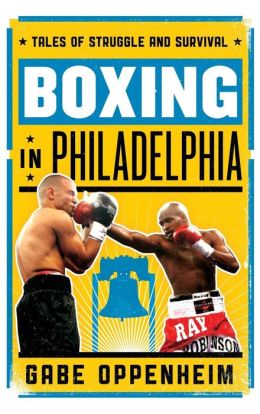
“If you’re gonna write about boxing, you need facts and grittiness and maybe even some awkward bad writing. It can’t be perfect. It can’t be ethereal. It can’t be self-contained. It can’t be its own art. It has to be bled into by the fighting itself.
“But only the defeat is permanent in boxing. And I guess the point of the book is to ask, could it really ever be any other way?
“Again and again and again and again and again and again and again.
“Until you can’t ask it anymore because you’re fucking tired of it.”
So states Gabe Oppenheim in the introduction of his book “Boxing in Philadelphia” (Rowman & Littlefield; $45.00), and if he fails to meet that standard it is only for a lack of awkwardness in his “bad writing” – an element his book noticeably lacks. Oppenheim treats boxing often as a metaphor, as writers often do with boxing, but Oppenheim does it on boxing’s terms, more fairly, more roughly, than most writers who treat boxing – as opposed to boxers who later try their bruised hands with sentences – in an effective way that feels like he wrote the first drafts too smoothly then went back and scuffed them with truth.
Oppenheim alludes to something like this, as well, in his introduction:
“It’s not just that boxers grows suspicious when a clearly out-of-place white college student tries to enter their gym to talk to them; it’s that I, too, grow suspicious of myself, not wanting to take advantage of anyone, to exploit people’s real lives.”
There’s wisdom in that sentence, written well about a form of suspicion that confronts anyone empathetic enough to write well and arrogant enough to choose boxing for a subject. We all go through it initially – in the olden days, many were assigned a boxing beat by an editor at a newspaper that no longer exists (replaced by Associated Press stories, and slideshows), and had that as an exculpating reason for wandering in a gym where they clearly did not belong – because anyone who does not go through it does not write well about our sport, regardless of readership size or class.
My pathway through suspicion was headgear and gloves, being just athletic and large enough to prevent permanent damage, and a shortcut like this: Once a man has put his knuckles on you, he trusts you because he knows you’re available for him to do it again if need be, and he knows he didn’t give you more than 2/3 of his power, whatever your closed eye and bleeding mouth say of it.
Oppenheim’s pathway through suspicion was an aged former trainer, Mr. Pat, and many, many hours. After the quality of the prose and the depth of admiration the author feels for his subjects, commitment is what resonates most about this book. To write a book like this about lesser-known figures in a lesser city requires much, much more than would a book about Joe Frazier and Bernard Hopkins’ favorite Philly cheesesteak spot or Oscar De La Hoya’s escape from East Los Angeles; those men’s stories are well-trod and research material is ample, and researching – now known as googling – is far easier than confronting the rejection of a fighter’s suspicion or a trainer’s unreturned phone calls or a possemember’s idiotic snickering.
Oppenheim faced these discomfiting forms of rejection and wrote about them, most clearly in his treatment of Meldrick Taylor, the Olympic gold medalist who came a fabled two seconds from beating Mexican Julio Cesar Chavez in his prime – something no man officially did (though of course we know how that Pernell Whitaker fight actually went, three years after Chavez broke Taylor). Taylor’s sorry condition is well known today, and both he and those close to him are understandably reticent about it, a matter Oppenheim writes creatively round, drawing instead connective tissue between Taylor and the then-decaying city that raised him.
“‘Awtheysaynottoomanykidouttometheywrotebadthingsaboutme –
‘theamanamesaidIwaswashedup,’ Taylor slurs and mumbles without pause,” writes Oppenheim, in an innovative attempt at drawing a literary map of punch-drunkenness.
Oppenheim also follows closely the careers of two contemporary Philadelphia prospects, Teon Kennedy and Mike Jones, both of whose careers effectively ended on a Manny Pacquiao undercard, June 9, 2012, when Guillermo Rigondeaux dropped Kennedy five times in as many rounds, and Randall Bailey brought 15,000 spectators to a collective start by stretching Jones with a chastening right uppercut.
“It’s an inevitable fact about most jobs that increased success leads to increased stability,” Oppenheim writes about the trajectories Kennedy’s and Jones’ careers followed. “In boxing, on the other hand, success breeds irregularity.”
Oppenheim notes with a touch of irony the fighting city of Philadelphia’s two celebrated prospects, Jones and Kennedy, did not emerge as champions the way Danny Garcia – not exactly Puerto Rican, not quite Philly – somehow managed to do. There’s something touchingly Philadelphian about that development, too; as anyone who’s attended a sporting contest of any kind in Philly can tell you, those folks love to make a lot of noise when they’re completely wrong.
“Boxing in Philadelphia” ends on a slightly false note of optimism about both the city and the fight game. While Philadelphia tries to replicate other cities’ purported urban renaissances – think: hipster lofts in abandoned warehouses – boxing now accelerates towards a day, arriving before 2020, when its sole promoter owns the media that covers his events; if boxing thrives again, it will be as professional wrestling in gloves. And on that day, Oppenheim’s book will be deservedly considered one of the last good books written about our sport.
Bart Barry can be reached via Twitter @bartbarry