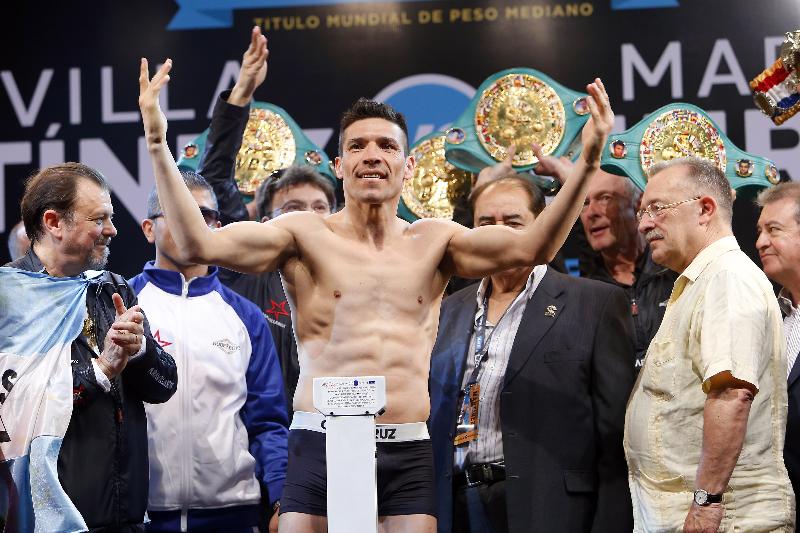
Timothy Bradley’s fine young consensus

Timothy_Bradley
LAS VEGAS – “He seemed to be selling something, as if by not getting knocked-out, he was winning. Odd ending for Bradley. Hard to see him winning this, but who knows?” Those were the final words in my ringside notes from Saturday’s main event, notes oblivious of whatever whacky scorecard happened on the pay-per-view telecast, and if I may be allowed to italicize something retroactively, I’d like to put the emphasis here: “but who knows?”

At Thomas & Mack Center, in the winner’s bracket for promoter Top Rank’s unannounced and asymmetrical welterweight tournament – we’ll get something akin to a middle bracket in Denver on Saturday and the loser’s bracket in China next month – American Timothy “Desert Storm” Bradley decisioned Mexican Juan Manuel “Dinamita” Marquez by split scores of 115-113, 113-115 and 116-112, scores whose reading put the majority-Mexican crowd in a lather.

I scored the fight for Marquez, 116-114. Rounds 1, 3, 4, 8, 9 and 11 went to the Mexican. Rounds 2, 6, 10 and 12 went to the American. Rounds 5 and 7 were even. And rounds 1, 2, 3, 4, 6 and 8 were all marked with an asterisk to remind me I was not certain who won them. If you’re looking for a blowhard expert, rarely right but never uncertain, an ally in your endless battle against any who would dissent, in other words, look elsewhere.

And let the well-deserved reevaluation of Timothy Bradley continue apace, as it did Saturday, as one expected it eventually would, with many folks milling round ringside citing as a reason for scorecards that went narrowly, and in some cases widely, for Bradley: Marquez missed an awful lot. That’s exactly right, he did, confirming Bradley’s awkward elusiveness, and raising hope many of these insiders will take their fresh consensus – consensus being something some crave like diabetics do insulin – along with Manny Pacquiao’s subsequent vulnerability, and someday review Bradley-Pacquiao with a touch more scrutiny, noticing, at last, Manny Pacquiao missed an awful lot too.

The inertia 16 months ago was with Pacquiao, though, and confirmations abounded, from the promoter to the HBO commentating crew to the drunken masses on social media. The inertia that informs such confirmatory musings is now shifted Bradley’s way, and good for him. Bradley was disciplined enough to engage Marquez only rarely, and solely when something invisible between the men made an audible click in Bradley’s mind that assured him the arrangement was changed and he would get the better of what came next, an audible click whose false positives Marquez’s career was built creating. But when Bradley leaped at Marquez, cranking his right hand as Bradley is wont to do, never a straight cross but more a bent, arcing, descending motion dependent on pulling violently backwards on the lead shoulder, he somehow knew Marquez’s only meaningful counter would come via a left hook, and so, whatever else Bradley did, he returned his right glove to temple, quickly, and kept it there on the way out.

But where was The Marquez, the fabled left-uppercut-lead, right-cross combination with which the Mexican outboxed Pacquiao for the final 18 minutes of their third encounter? The answer to that question is perhaps a doorway in the room of why the Bradley consensus now shifts: The few times Marquez threw it, necessarily using a leftwards tilt for its trigger, Bradley clubbed him with a short left of his own that disrupted the trajectory of Marquez’s punch enough to have it miss and make Marquez, a master boxer who delights little in being struck unnecessarily, holster his trademark combination. In this subtle way, too, Marquez was able to holster Bradley’s otherwise effective jab by flashing a signal of some kind, a thing only the fighters sensed, something imperceptible to others as the consent given by mating birds of paradise, that told Bradley to alter immediately his rhythm because Marquez had the pattern marked, the code deciphered, and Bradley’s next repetition might be his last repetition.

Marquez was embittered afterwards, in part because he is a Nacho Beristain fighter, and that requires absorbing elements of the master’s dour disposition, a stream of resentment that runs deep and cold and fresh, going unnoticed like an abandoned well never filled-in, only covered, until one hits the wrong spot and suddenly plumbs its depths. Where Marquez’s embitterment about the third Pacquiao fight was well placed – he had beaten Pacquiao for 16 1/2 of their match’s final 18 minutes and seen a scorecard by Glenn Trowbridge capture its image like a photographic negative, exactly transposed, perfectly backwards – his embitterment about Saturday’s decision seemed overly theatrical, almost Hopkinsesque, but that’s Marquez, and that’s coming from someone who scored the match for Marquez.

There was a moment of unexpected angst for me in round 10, Saturday, when I wondered if I should even continue scoring the match, so little sense I was able to make of it. To my eyes, neither guy was hitting the other more than a couple meaningful times every three minutes, and while Marquez was not moving much (his personal trainer gave him power to extend and extend again a career that looked done with in 2009, but not even Memo’s prodigious potions returned Dinamita’s once balletic legwork), Bradley was exulting way too much in not being hit. Bradley’s plan appeared to be about not getting hit, finishing on his feet conscious enough to enjoy the view, and everything else was muddling through, a mess of athleticism and fitness and the disproportionately large head with which he struck Marquez in round 1, and selling ring generalship to the judges, and bless him, it worked!

This was not Bradley’s best fight, just as Pacquiao was not Bradley’s best fight, and if Bradley is still undefeated in five years, imagine for a moment what it will say of his legacy that he beat Manny Pacquiao and Juan Manuel Marquez on nights his advocates do not believe were his best.

Welcome to your fine young consensus, then, Tim, and enjoy it. Heaven knows you earned it.

Bart Barry can be reached at bart.barrys.email (at) gmail.com


Finding a way: Bradley decisions Marquez to retain welterweight title

Timothy_Bradley
LAS VEGAS – Timothy Bradley now has decision victories over two of the very best prizefighters in a generation. The victories may both be controversial, but this much is not: In a collective 72 minutes of trying, neither man ever caught Bradley cleanly enough to hurt him for an instant.

Bradley_Marquez_131012_002a
Saturday at Thomas & Mack Center on the UNLV campus, American Timothy “Desert Storm” Bradley (31-0, 12 KOs) decisioned Mexican Juan Manuel “Dinamita” Marquez (55-7-1, 40 KOs) by split scores of 115-113, 113-115 and 116-112, in a fight that saw only four rounds scored unanimously, one way or the other, by the judges. The 15rounds.com ringside scorecard dissented from the official decision, marking a 116-114 tally for Marquez.

“This is my ticket to the boxing hall of fame,” said a jubilant Bradley after the victory, his voice drowned-out by boos from the partisan-Mexican crowd.

There were very few rounds of the 12 in which one man clearly outclassed the other, and until the final two seconds of the match, no moment in the fight when one man clearly hurt the other. As feared, two superbly professional fighters offset one another’s strengths, with each man missing far more often than he landed cleanly.

“You don’t have to knock the other guy out to win a fight,” said Marquez afterwards, characteristically disgruntled after a decision loss. “I thought that I clearly won.”

From the opening instant of the match, when the men strolled from their corners and began a very wide, very respectful circle, until the 35:58 mark of the fight, when the men silently agreed to break the counsel of their trainers and engage one another maniacally, the fight was a tactical one bound to lead to frustrated fans and questions about scoring. Such frustration and scoring inquiries, though, will be shown, by time, to be misplaced.

“I’ve been robbed six times in my career,” said Marquez nevertheless.

The Mexican, for all his mastery, never solved Bradley. While Bradley appeared to exalt too much in his not getting hit by Marquez, showboating when he should have been countering, potshotting when he should have been using combinations, Marquez was not mobile enough to outwork Bradley for sustained periods of time, and Marquez was also, in the evening’s largest surprise, inaccurate when he did have open looks at Bradley.

“I’ve always tried to fight for the fans,” said Bradley, while those same fans lustily booed him.

After 11 even rounds in which one man was elusive while the other was predatory if immobile, in the final instants of round 12, in a moment of sudden suspense that would be ultimately inconsequential, Bradley staggered Marquez with a counter left hook, sending the Mexican spinning and spasming leftwards. Bradley then raised his hands and posed like a statue, enjoying already a victory that was barely assured.

Bradley, as is his tendency, apparently knew something the rest of us didn’t.

Orlando_Salido
ORLANDO SALIDO VS. ORLANDO CRUZ
Topping an undercard filled with novelties, into the co-main event ring came Puerto Rican featherweight Orlando Cruz, boxing’s first active fighter to announce publicly that he is gay, his fighting attire adorned in rainbows, his ringside entourage preceded by a rainbow flag, and his black gloves highlighted with pink, to fight Mexican stalking horse Orlando Salido. But as boxing rarely respects decorum or politics, no matter how well scripted, Cruz’s fabulous ring entrance was the last enjoyable part of his night.

Salido_Cruz_131012_001a
Saturday’s co-main event ended at 1:05 of round 7 – with Salido knocking Cruz out.

After two uneventful rounds that saw Salido (40-12-2, 28 KOs) too slow to find Cruz (20-3-1, 1 KOs) and Cruz too light-hitting to punish Salido’s navigational errors, things changed in the third, and Salido began to use his awkward crossover style to drive heavy lefts and crisp rights into Cruz’s body and face.

By the middle of round 4 it was apparent that, for all his flair and fashion sense, Cruz simply did not have heavy enough hands to keep a veteran attrition fighter like Salido off him. Salido casually stepped backwards and recollected himself after every exchange won by Cruz, while Cruz was forced to flee exchanges in which Salido proved superior, skipping sideways, leaping out the way of body punches, and having his balance regularly compromised by Salido’s strikes – even, or perhaps especially, when they missed.

One does not make his living in this sport without toughness, though, and Cruz fought back gamely in the fifth, absorbing Salido right crosses to the body that moved him backwards, and taking even sterner abuse in the sixth. As the rounds progressed and Cruz’s activity diminished, it became increasingly important for Cruz’s corner to look for a chance to save its brave fighter from himself.

The corner never had to intervene, however, as Salido caught Cruz on the ropes with an overhand-right, left-uppercut combo, both punches landing to Cruz’s increasingly battered head, Cruz dropped, the 10-count completed without incident, and Orlando Salido was the new WBO featherweight champion of the world.

VASYL LOMACHENKO VS. JOSE RAMIREZ
What sort of a monster makes his professional debut in a 10-round match for a minor featherweight title? Two-time gold medalist Vasyl Lomachenko, that’s who – and that’s how promoter Top Rank wishes Saturday viewers to remember the new Russian prospect’s debut.

Fighting with technical proficiency from a southpaw stance, Lomachenko (1-0, 1 KO) dropped Mexican Jose Ramirez (24-3-2, 15 KOs) with a body shot in the opening 90 seconds. For a southpaw to overcome angular problems enough to land that punch is no mean feat. For him to land it on a Mexican in the opening round, though, is still more impressive.

Rounds 2 and 3 saw less explosiveness from the Russian, as he absorbed some blows and landed many more, occasionally employing the nifty trick of sending himself to the ropes, so as to spring from them with a harder counter, quicker-arriving for being enhanced by the ropes’ elasticity.

Early in the next round, Lomachenko stopped Ramirez with what appeared to be a double left uppercut to the solar plexus, causing the Mexican to stop, drop and begin rolling about the blue mat, showing the sort of anguish that can be given a prizefighter solely by a punch to the body. No 10-count was necessary, Ramirez was still writhing at the count of 20, and Lomachenko had his first professional victory at 0:59 of round 4.

SEAN MONAGHAN VS. ANTHONY SMITH
Most every insider regards New York light heavyweight Sean Monaghan as a novelty concept, a way for promoter Top Rank to exploit an Irish marketplace of fight fans. Monaghan’s victory over unheralded Pennsylvanian Anthony Smith did little to disabuse anyone of that, in Saturday’s first televised fight.

While Monaghan (19-0, 12 KOs) was able to strike Smith (14-2, 10 KOs) with impunity at the open, worrying little about counterpunches or meaningful traps, he was unable to hurt Smith through six minutes of assault. That changed in round 3, when Smith unadvisedly tried applying a wee bit of offensive pressure and got clocked by Monaghan. Sensing his opponent was stunned, Monaghan transformed from a light-hitting boxer to a light-hitting hurricane, striking Smith with a dozen or so unanswered punches until referee Tony Weeks waved the match off at 2:49 of round 3.

And like that, the WBC Continental Americas Light Heavyweight Title was successfully defended.

UNDERCARD
A few years back, and understandably, a parade of Manny Pacquiao-inspired fighters began to emerge from the Philippines; they are all southpaws, they all like to bounce, and they all tend to leap in with their hands perilously low. Filipino featherweight Jun Doliguez is yet another in what promises to be a generation-length parade. Fighting a journeyman Mexican, Geovanny Caro (23-14-4, 19 KOs), in Saturday’s fourth match, one who nevertheless appeared not to know he was fated to lose, Doliguez (17-0-1, 13 KOs) leaped in, leaped out, bounced a lot and kept his lands low. He got stunned a few times by headbutts, and buckled once by a right hand, à la his role model, but otherwise won in excellent fashion, dropping Caro twice with straight left hands, and stopping the overmatched Mexican at 2:53 of round 6. Doliguez is clearly not Pacquiao, but he likes contact and will make a fun spectacle every match.

If Mikael Zewski’s fans traveled from Canada to see their favorite welterweight defeat an overmatched Californian by violent stoppage, they almost got what they came for. Zewski (21-0, 16 KOs), who is charismatic and hails from a fight-crazed nation, whacked away at Riverside’s Albert Herrera (9-10-1, 5 KOs) for five rounds, busting-up Herrera’s face till the Californian’s corner abided no more and stopped the match, providing Zewski a TKO-5 for his resume, at which time Herrera leaped off his stool, grinned broadly and made a lap round the canvas waiving to what few fans were in the arena.

The second match of the night saw McCumby (13-0, 10 KOs) decision game West Virginian Eric Watkins (10-5-1, 4 KOs), but not before landing on the canvas. After dominating the first round and part of the next, McCumby, who sacrifices all sorts of defense for power and has little head movement on the way in, got caught with a right hand as he threw a right hand, and he dropped quickly. McCumby rose and appeared fine, but he was absolutely knocked to the blue mat by a fighter with only four knockouts in 15 previous prizefights. McCumby then restored order in the fourth round, dropping Watkins and commencing to beat him severely for the next 2 1/2 rounds, winning a unanimous decision: 59-53, 59-53 and 58-53.

Saturday’s card began with a classic case of a dull boxer with good reflexes against a pressure fighter without them, when Louisiana welterweight Brad Solomon (21-0, 8 KOs) outclassed Kenny Abril (14-7-1-1, 7 KOs), moving and infrequently landing meaningful punches and more infrequently having meaningful punches landed on him, en route to a unanimous decision: 79-73, 79-73 and 80-72. It is imperative, with his style, that Solomon remain undefeated.

Opening bell rang on a cavernous Thomas & Mack Center at 3:39 PM local time.

Photos by Chris Farina / Top Rank


Bradley and Marquez: Match of those vindicated

Timothy Bradley
HBO’s vastly improved “Face Off With Max Kellerman” franchise, the penultimate episode of which found California’s Timothy Bradley seated at its brushed-steel tabletop with Mexican Juan Manuel Marquez, showed Bradley vulnerable and honest in his native language and Marquez happy to say nothing in his second language, English, one whose learning was fully inspired by and limited to marketing considerations. It was an advantage Marquez did not seek but certainly enjoyed, being able to study serenely from a meter’s distance an opponent earnestly examining health concerns and working through existential crises.

Until that faceoff between the men who will contest Bradley’s welterweight championship Saturday at Thomas & Mack Center on the campus of UNLV, it was proper to fear their match heading towards the cruelest paradox boxing affords its pay-per-viewers: The hostility two men show one another before a fight is inversely proportionate to the hostility they’ll show one another during a fight. Bradley’s allusion in a promotional video to Marquez’s historic growth prompted such fears but also, and unexpectedly, prompted Marquez to extend a considerable invitation.

What makes Marquez’s invitation considerable – that, to dispel rumors of advantages through PED use, Marquez and Bradley share the same strength and conditioning camp, complete, one assumes, with Marquez’s coach and whatever supplemental cocktail he gives Marquez – is that it inadvertently handles the PED question much as the NFL does it: Our evenly matched athletes are the largest, strongest creatures to roam the earth, and you love it, don’t you? (It is worth reiterating that America’s adulation for a league whose players are enhanced by any measure sets the hands on the proverbial clock of whether American sportsfans care about PED use.) We may care about fairness, some, or at least its gerrymandered appearance, but we will forgive winning in nearly any form we find it.

Manny Pacquiao, the prizefighter who moved up a weightclass and leveled lightweight titlist David Diaz, moved up another weightclass and knocked champion Ricky Hatton rigid, moved up another weightclass and beat Miguel Cotto till Cotto’s wife fled the arena, then beat him some more, and a year later crushed Antonio Margarito’s orbital bone, well, he might have escaped public suspicion had Floyd Mayweather, prizefighting’s greatest handicapper, not made PED testing a prerequisite for the Fight to Save Boxing.

While that saggy saga flubbed along, little Juan Manuel Marquez, who fought Pacquiao evenly when no one else could then survived 12 rounds with Mayweather when Mayweather had the back of a middleweight and Marquez the legs of a super bantamweight, declared, in his countrymen’s tradition, “¡Ya Basta (Enough)!” and became big Juan Manuel Marquez, photography’s most evidently enhanced athlete since Barry Bonds. His personal trainer smiled warmly and cited “science” whenever asked, and really, it wasn’t Memo’s fault if our sport assumed he meant physics, not chemistry.

It is worth reiterating, too, none of us is innocent as all of us when it comes to PEDs: To imagine anyone in boxing did not think PEDs were in use at every level until Marquez dropped Pacquiao in a lump last December is to credit us without 30-percent our intellects. What happened in MGM Grand was this: One athlete with a famous personal trainer and extraordinary quadriceps and calf muscles leaped on the right fist of another athlete with a famous personal trainer and extraordinary deltoids, and their collision produced one of the more violently wondrous moments in our sport’s storied story.

Timothy Bradley would do well to remember two men for each of the 2,160 seconds, or fewer, he is in Saturday’s prizefighting ring with Marquez: Manny Pacquiao, of course, and Juan Diaz. Bradley must neither leap fullboard Marquez’s way, à la Pacquiao, a mistake Bradley is unlikely to make, or get his head extended over his front knee, à la Diaz, a mistake Bradley made numerous times against Pacquiao, one Pacquiao never exploited with an uppercut because, for all the happy talk of Pacquiao’s evolution as a prizefighter, the Filipino has always been more athleticism than technique – something no one ever opines of Marquez.

There is not a more predatory man in prizefighting than Juan Manuel Marquez; as Bradley undoubtedly has been reminded every hour in training camp, if he pulls the macho stunt with Marquez he pulled with Ruslan Provodnikov in March, Bradley’ll need Big Ray to carry him to his dressing room afterwards. No one in prizefighting finishes with Marquez’s precision and indifference for other men’s health: Marquez will not bull an unconscious Bradley to the ropes for a frantic last stand, gifting Bradley’s indomitable spirit with legs and leverage; Marquez will lure Bradley’s pride to the center of the canvas, let his force and desire push his shoulders forward, drop his head necessarily, and meet Bradley’s downrushing chin with an uprushing right fist – and when it’s done Bradley will hear the 10-count no better than Pacquiao did.

Or perhaps not. Perhaps Bradley will move in and out, never overcommitting to a punch, swim without getting wet, as Naazim Richardson puts it, and frustrate Marquez by not fighting him. Perhaps Bradley will make Marquez wonder what in the hell his wonderful strength and conditioning is for if neither finds a man who will test it, disgusting Marquez with the possibility 36 minutes with Timothy’s feathery fists are less taxing than 10 minutes with Memo’s medicine ball, using Marquez’s machismo against him the way Sugar Ray Leonard did it to Roberto Duran in New Orleans.

Events would suggest, via Bradley’s decisioning Pacquiao and Marquez’s being decisioned by Mayweather, Marquez doesn’t mind losing a glorified sparring session any more than Bradley enjoys winning a glorified fitness contest – and pity the pay-per-viewer who expects March’s Bradley versus December’s Marquez and gets, instead, the Bradley who fought Pacquiao against the Marquez who fought Mayweather. That happening is not impossible, but as we board our flights for Las Vegas, friends, what do you say we pretend it is?

Timothy Bradley and Juan Manuel Marquez are my two most favorite prizefighters, so I’ll take Bradley, SD-12, or Marquez, KO-9, and be happy for the winner regardless.

Bart Barry can be reached at bart.barrys.email (at) gmail.com
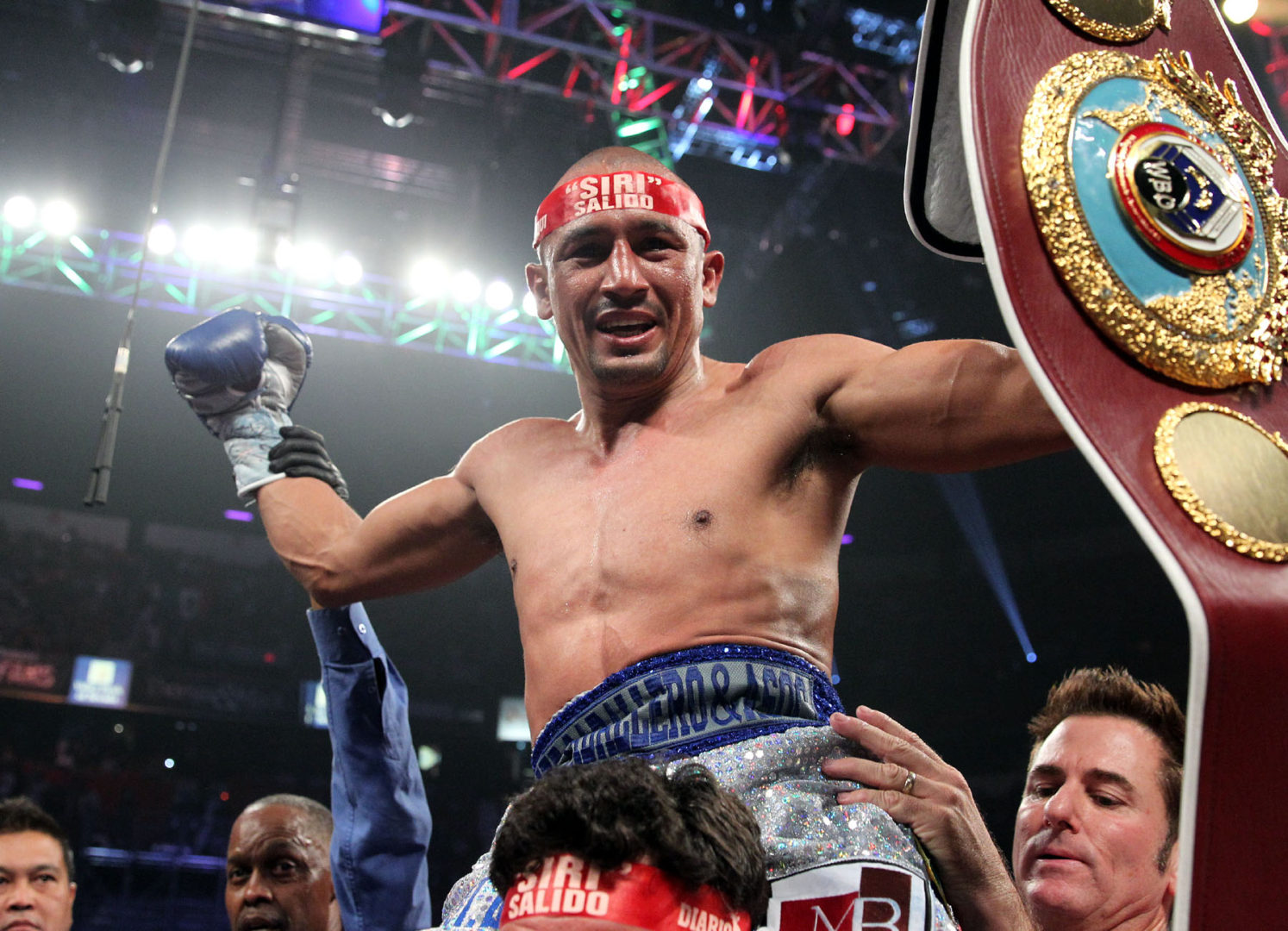


The legend’s son prevails

Vera_Chavez_PCMexican “Son of the Legend” Julio Cesar Chavez Jr. – the man whom middleweight champion Sergio Martinez alternately calls “a lie” and “the lie” – likely lost the chavezweight championship of the world to Bryan Vera, Saturday, were we able to get scorecards in what Shakespeare called honest hands (“And put in every honest hand a whip / To lash the rascals naked through the world”), but that is irrelevant to both Chavez’s legacy and his promoter’s immediate plans. And probably Chavez didn’t lose boldly as television said he did.

Live from the inanely named StubHub Center in Carson, Calif., came Chavez’s 173-pound fight with Texas middleweight Bryan Vera, a man long on chin as he’s short on defensive wherewithal, in a match that presented what scoring difficulties come whenever one man hits another disproportionately harder and less often than he gets hit. Official scores all went for Chavez: 96-94, 97-93, 98-92. My scorecard did not concur, finding for Vera, but as my vantage came via television’s profoundly distorting lens, I’ll defer to personal experience and flee our sport’s social predators as they perpetually pack in pursuit of dissenting judges.

Regardless of record or baubles, it is enough to see Son of the Legend struck repeatedly, is it not? So goes the strategy for promoting Chavez henceforth, in a subtle way fans recognize even when they do not grasp it: the more outraged a man was with Saturday’s decision, the more hardily he hoped for a larger and better opponent to do Chavez wrong and thorough-like, for attendance figures show very, very few disinterested folks feel strongly enough about Bryan Vera or his career to demand a rematch, and if the remainder of strong feelings about Saturday reasonably then can be summarized as “I’d like to see Chavez’s bitch ass beat unconscious,” will anyone be sated by a rematch with little Bryan Vera so much as a run-in with super middleweight champion Andre Ward, or something vengefully served by light heavyweight champion Adonis Stevenson?

How rich it was to see Junior deftly maneuver the compulsories of Saturday’s prefight-promo video (not “Punching in the Rain” but the other one), citing his professionalism and habit of making weight, every time, in a manner nimbly unconscious of his same body having missed weight at least three times, four if one counts the postponement, and having missed it in a way to make his fight-contract a fight-expand, a miss so gloriously wide countrymen Erik Morales and Jose Luis Castillo now appear pikers beside him. It was an out-of-body trick Chavez pulled, talking about himself like a talent scout proud of this Chavez kid, disciplined as he is, before he treated the inexpressible joy of pending fatherhood – and show us a professional fighter not prone to sympathetic pregnancy symptoms! – in what might have been a piece of only slightly embarrassing symmetry, had the Legend in the moniker “Son of the Legend” spoken of his ineffable pride at siring a lad like Junior, had the HBO production crew not already spent its budget making it rain elsewhere.

Bryan Vera outworked Chavez, while neither out-defending nor out-slugging him, making furious an HBO broadcaster otherwise reliably derisive of judges who score activity alone, but so what? Cheering for Chavez to get beaten is a thing that transcends what petty barriers otherwise divide us; who but Son of the Legend – his country casting about for a new hero, anything to look away from Cinnamon Alvarez for a spell – agrees to fight at a rust-removing 162 pounds then takes the scale 2 1/2 from the light heavyweight limit, smiles jubilantly, raises his hands triumphantly, and hits a most-muscular pose in peach micro briefs?

And that was not the best of Chavez’s stylishness – as he would go on to tire expectedly in the second half of Saturday’s fight and ape his vanquisher, the aforementioned Sergio Martinez, dropping his hands, hanging his arms loosely, and hopping at Vera with lead power shots. Fortunately nothing tragic happened at StubHub Center, and let us not conflate tragedy with travesty, because Chavez was not conditioned well enough to do his signature left-shoulder corral and whale Vera for more than five-second increments.

Had Chavez a whit of conditioning, he might have beaten Vera severely, as the Texan’s defensive tactics approached self-sabotage in their carelessness; Vera dropped his right hand as an offensive prerequisite – he did not attack, even with his left, until his right was secured on the metallic-rust waistband of his trunks, allowing himself to be hit flush with left-hook leads, the successful landing of which surprised Chavez enough to embolden him. It is not a just world that sees someone like Chavez so much better outfitted for combat than someone serious as Bryan Vera, but there was nothing just about the entirety of last week’s spectacle, and but for the 34-minute denuding Martinez performed on him in 2012, the concluding 90 seconds of which saw Chavez nearly return himself to regally adorned splendor, what about Chavez’s career has even feinted justice’s way?

A thought that came to mind between rounds Saturday, as Chavez Sr. called for a right cross to the body that would be the most debilitating blow his son landed in 30 minutes: Does the Legend ever imagine what it would be like to fight Son of the Legend, does he ever shunt fatherly considerations and empathize with those men who have none of the benefits given his son, benefits he did not have? Does Julio Cesar Chavez, in other words, ever suspend disbelief and catch himself accidentally cheering a Bryan Vera to whup his son, the way his longtime fans now do?

Bart Barry can be reached at bart.barrys.email (at) gmail.com
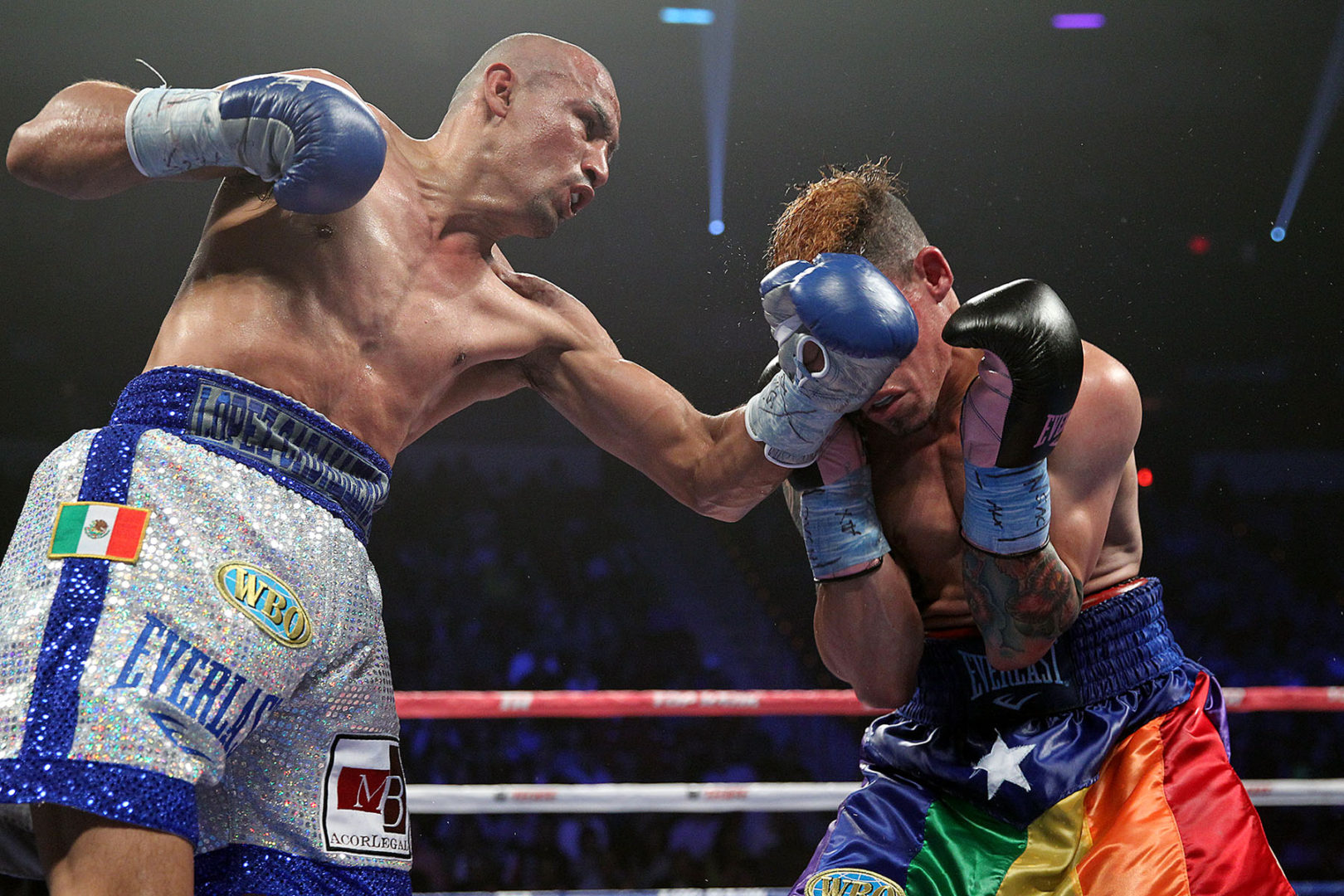


Return of the legend’s son

SAN ANTONIO – There’s a fine barber shop in the basement of the historic Gunter Hotel in the center of this city’s downtown, it’s called Barber Shop and has three barbers and a shoeshiner and a barber’s pole and Playboy magazines, and if its banter isn’t quite of an Ice Cube flick, it’s just as manly and fun. Since every barber shop could use a boxing writer, and since a boxing writer encounters few venues so appreciative of his gifts, I spend a half hour every month giving an editorial review of prizefighting’s calendar, 1974-present.

Austin is 70 miles up I-35 from here, and Austin middleweight Brian Vera, who fights Mexican “Son of the Legend” Julio Cesar Chavez Jr. at StubHub Center in Carson, Calif., Saturday, apparently has an interested relative who frequents the same barber shop. And so, every month for what feels like seven, I’ve been asked when Vera is going to get to fight Chavez, a request for information to which I confess honest ignorance, citing Chavez’s unpredictability and eliciting, without fail, a question like: What the hell is wrong with that kid?

And as I climb in the chair, I tend to say, “Where does one begin?”

Lost in the justifiable concern about Sergio Martinez’s knee after the extraordinary conclusion of his otherwise unmemorable match with Julio Cesar Chavez Jr. 53 weeks ago, the last time Chavez fought, were the lasting effects of the beating Chavez sustained, a beating that included 300 flush shots to the Mexican’s head by a man who knew how to do it with gusto. Chavez has an uncanny flair for midwifing others’ resentment. Even the men whom Chavez defeats, in an original twist, rarely have good things to say about him, a surprising departure from the tradition of saying the guy who beat me is a great champion because, well, I wouldn’t lose to a nobody.

Speaking to Sergio Martinez four months after he and Chavez made one of the more rapturous 90 seconds prizefighting has accomplished, a half of the 12th round nearly unbearable in its suspense and just as nearly the opposite of what Día de Independencia Mexicana ’13 yielded, the Argentine had little good to say about Chavez, a rarity for Martinez, rarely dismissive of his ambassadorial duties.

Martinez implied several times and with uncharacteristic urgency marijuana – the drug for which Chavez tested positive and received an absurdly harsh fine and suspension – was the least of Chavez’s banned-substance affairs, wondering how a man with so little use for weight control or proper camp comportment was so strong after 34 1/2 minutes of collecting five or so concussing shots every minute. That Martinez saw the final 90 seconds of his September match with Chavez as a sum of his own poor choices, misjudgments of time and space and improvisation manifesting themselves as carelessness, was an unsurprising turn for a world champion jealously guarding life’s controllable moments. That Martinez would not cop to a tittle of admiration for a former opponent, too, was unsurprising when that former opponent remained a future opponent. That Martinez would take a lobbed question about a challenger winning a bit of his respect, though, and use it as the doorway into a room of specific accusations and untrammeled resentment was a surprise and a half.

It was a peek at the peaks of what Chavez piques so uniquely among prizefighters that no one empathized even slightly with the abuse he suffered from Martinez’s left hand, which hand rendered Paul Williams instantly unconscious two years before, or wondered where it might leave Chavez’s career. Such is the sentiment Chavez inspires that even today, as a fight that was considered for June and has been moved all round the calendar and western states finally draws near, no one attributes any of Chavez’s camp injuries to anything but sloth. But slothful as Chavez was, imagine such indolence now confronted by a mind that may not be more than 2/3 right, a trainer and dad whose mind cannot possibly be rated that well, and an opponent who rightfully regards this match as a career opportunity, which it might be.

Brian Vera is good enough, as he showed against Andy Lee and Sergio Mora and Serhiy Dzinziruk, to surprise opponents who do not take seriously his limited pressuring style, and he’s also the sort of grinder boxing likes to see matched against those it resents. Vera is the constant, of course, and Chavez is the variable; in the very unlikely case that Saturday’s opening bell finds the same Chavez it found for round 1 in Thomas & Mack Center a year ago, Chavez will handle Vera the way he handled Peter Manfredo and luckless Andy Lee, wearing them down by channeling others’ hatred for him – yes, and again, Chavez knows exactly where he stands with you – and beating on them for royalty’s sake.

This time Chavez will have his dad in his corner, too, where Junior will be able to ignore him more easily than when dad was credentialed by TV Azteca to be ringside and bark maniacal instructions at a son physically incapable of executing more than half them and mentally equipped for perhaps their first tenth, barking directly over former chief second Freddie Roach’s strong preference for a quiet, respectful corner.

What Vera stands to gain by beating Chavez is at least an argument for a larger future payday on HBO, banishing for a moment a thought he could be Rigondeauxn, while Chavez might with a win return to the superfight-cashout sweepstakes, nominating himself for a supporting-actor role in Andre Ward’s 2014 pay-per-view debut, and a chance to don once more his pink briefs and show those tired “24/7” episodes the aplomb with which he carries the Chavez name.

Bart Barry can be reached at bart.barrys.email (at) gmail.com


Three worthy performances at “The One”

Danny Garcia
Apropos of something entirely unrelated to “The One,” I spoke with Don Turner last week, a delightful man of gradual delivery and enviable authority, whose words set me to remembering, Saturday, others of his words spoken in 1996 before his charge, Evander Holyfield, undid Mike Tyson: Tyson can punch, but he can’t fight.

While it is wrong to write Argentine Lucas Matthysse can only punch, and a character-measuring abomination to compare Danny Garcia’s father to Turner, it is not improper to guess Angel Garcia’s wager in preparing his son for Saturday’s co-main event victory over Matthysse was not unlike Turner’s wager 17 years ago: Just as soon as he punches you, son, you punch him right back, and see if he freezes.

There are very few hard punchers of any kind, and particularly those who can bring unconsciousness with a single blow, that respond effectively to someone hitting them back; it’s a skill many never cultivate while racing through the professional ranks because each heavy punch of theirs that does land changes the man across from them completely enough to make for power punchers a habit of relaxing and stepping forward to drop a period at the end of their sentence or, just as likely, reread the sentence and enjoy their prose. Manny Pacquiao is an exception to this, and for that he was exceptional: He was a puncher who, if you punched him back as he attacked you, he punched you again, and so it went till he dropped you – as experienced by Juan Manuel Marquez in his second fight with Pacquiao and Miguel Cotto in his only fight with Pacquiao.

Far more common is the reaction Lucas Matthysse showed Danny Garcia, which was an inactivity not entirely dissimilar from what Tyson showed Holyfield whenever they engaged. The secret to stop a force like Matthysse or Tyson (or Gennady Golovkin) is to promise yourself the harder he hits you the faster you will leap at him. It is what Garcia did in Saturday’s meaningful fight – “The One,” as it were – each time Matthysse landed clean, whether with a right cross or left hook; Garcia followed his plan, resolute in a belief that if Matthysse was striking him hard, Matthysse was overcommitted and therefore open to be struck hard.

Each time Garcia did this, Matthysse bore a greater resemblance to Vic Darchinyan, taking a step back and adjusting his trunks and touching his gloves and readying for a next lunging collision, than what great fighters he’d enjoyed a plethora of comparisons to recently – despite completing 9 1/2 years of prizefighting without a world championship (Garcia won a world title in his fifth year, and Floyd Mayweather in his second). The fighting impulse Matthysse forced Garcia to show, yet again, was probably the evening’s most impressive sight, whenever Garcia found terms of engagement equally favorable and engaged Matthysse directly, though just barely.

The evening’s second most impressive sight was Floyd Mayweather, simply put. On the occasions Mexican Saul “Canelo” Alvarez struck Mayweather with a clean punch, and they were infrequent enough to be named and numbered, Mayweather did exactly as he’d done when Mosley buckled him in a rare moment of carelessness and Cotto brought the pugilist out of him in 2012: Mayweather took a traditional fighting stance, hands up, legs bent, and punched the hell out of the Mexican. That Mayweather rarely gets hit anymore makes a generation of casual fans think he cannot withstand contact when he is struck, and that is ridiculous in the strictest sense of the word – worthy of ridicule.

Alvarez’s greatest asset Saturday was not his red hair, though that was how he got the fight years and accomplishments prematurely, but the brittleness of Mayweather’s right hand. Had Mayweather a right fist structurally reliable as Alvarez’s, Mayweather would have stopped Canelo, and Canelo’s promoter six years ago. Which is not to discount wholly Canelo’s performance Saturday, for he did land that crisp lowblow in round 4 and a well-placed shoulder in round 6, but to compliment the inconsolable bent Alvarez showed in Saturday’s postfight press conference. It was the humble posture his performance demanded; no accusing Mayweather of running, no flashing that gorgeous smile and proclaiming a hunger to get back in the gym Monday, no appealing to ethnic loyalty – “nosotros, los mexicanos, sabemos quien realmente ganó” – but a headbent befuddlement fitted to the occasion of his undressing by a man who, despite having only one more prizefight on his resume, was approximately five times the sweet scientist Canelo is.

Here’s an appropriate place, too, for recognizing Paulie Malignaggi’s insightfulness during Saturday’s Showtime broadcast. Malignaggi has become that rarest of professional athletes: a man capable of saying something intelligent about a subject other than himself. Malignaggi caught every nuance of Saturday’s main event confrontation, sometimes speaking over what cloying salesmanship cluttered the evening – like a just purchased car barking at its new owner “how about that handling? you see how bright those headlights are? This is probably the greatest automobile purchase anyone ever made!” – to share, in an instant, what Mayweather did to provoke Alvarez’s lowblow in the fourth and thraw his attack during the other 35:55 of Saturday’s fight, minutes nevertheless more suspenseful than most Mayweather affords, because the man across from Mayweather was very much larger.

A larger opponent is the only way this “Money May” deal remains compelling, and so let us have no more talk of a fight with little Danny Garcia in May. Even casual fans now know no one can outbox Mayweather, no style makes him fight, and in order to get their $74 again Mayweather will have to find himself a middleweight.

Bart Barry can be reached at bart.barrys.email (at) gmail.com
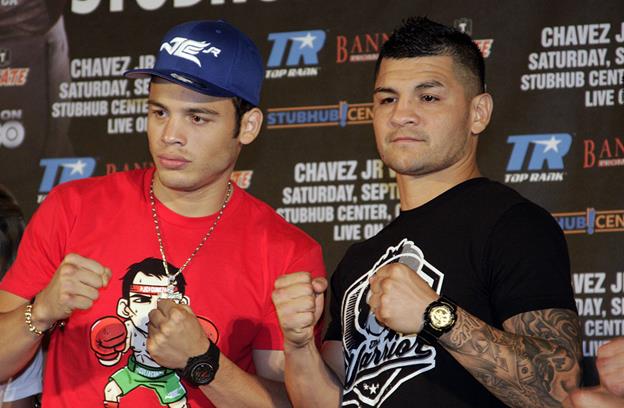


About “The One” and its other co-main

Lucas Matthysse
Saturday boxing fans will congregate for “The One,” a pay-per-view fight card with two co-main events, Argentine junior welterweight Lucas “The Machine” Matthysse versus Philadelphian Danny “Swift” Garcia, and Floyd Mayweather versus Saul Alvarez. Since that questionable prefix “co” was put there by someone else, and since any aficionado can tell you Matthysse-Garcia is much the more interesting fight, here is its preview.

That Lucas Matthysse is unknowable is a development charming as can be, that a fighter of temperament so unsuitable to the day’s discipline of promoting twice to fight once now supplies the entertaining portion of our sport’s largest 2013 event is a hopeful turn. Matthysse is a fighter who effectively hails from parts unknown, an Argentine township, Trelew, named after a colonizing Welshman, of all incongruous things, immigrated to Patagonia 130 years ago. Patagonia’s climes are famously harsh and unknown even to most Argentines, cold temperatures and rough seas and the sort of beating wind that, wherever it occurs round the world, makes the people whose ears it cuffs notably insular.

In a June conversation, Sergio Martinez, Argentina boxing’s singularly gracious ambassador (how many active world champions give 30 minutes to a writer asking questions unconstruable, even tangentially, to themselves?), conceded he was not quite familiar with Patagonia, thinking he could have passed through years before, maybe – but what winds and harshness its climate was about, and what men of almost unmatchable physical strength it birthed! Matthysse is not charismatic like his brother Walter, four years Lucas’ senior; he is timid in a way unaware of its timidity – those who joke about his quietness get a curious glance from him, as if he were certain he misunderstood them, a man who considers being in their presence a concession enough to gregariousness: I am here answering your questions, and I believe you said I am not talkative, but that cannot be correct, because I am here, so perhaps you’ll repeat yourself?

Danny Garcia is more talkative, if less charismatic, but appears nearly quiet by contrast with his buffoonish father who, conceivably, alleviates his son’s obligatory promotional affrays by servicing every hysteria, and the more publicly the more hysterically, with an impulsive bent nuns once exorcised from third graders with rulers. What should be obscured by manufactured story lines – “We are one week from ‘The One,’ and Lucas Matthysse loves his daughter, and Angel Garcia loves his son” – were there not more compelling subjects to treat, like Saul Alvarez’s ginger coif and Floyd Mayweather’s orchidaceous rides, is this: Matthysse and Garcia, both, are prizefighters in the best sense of the term. Both have been doing it a long time, both take seriously the craft, and neither was expected by his promoter to be where he is.

Matthysse was an anonymous Argentine, in 2010, with a likely inflated record that might nevertheless by rubbed against the vessel of Zab “Super” Judah’s latest self-reinvention, Comeback VII, till it flashed a shiny Brooklyn Back in the House! at those who go for such, and when Matthysse pulled Super offscript, dropping him in round 10, American matchmakers put a “*not on my watch” beside the Argentine’s name. Danny Garcia was probably supposed to lose to Nate Campbell and Kendall Holt in 2011, he was certainly supposed to lose to Erik Morales in March 2012, and when that didn’t happen, he was granted a dream chance to present Amir Khan with the WBC’s garish green belt before that esteemed institution could complete an audit of Garcia-Morales I and uncover a contractual clause that read: “The belt will be awarded to Erik Morales on March 24, or left vacant until the belt can be awarded to Erik Morales.”

Garcia promptly proved Khan’s career was fraudulent as Morales’ comeback, a comeback to which Garcia put the lie, drilling Morales on the canvas like a screw in soft pine, before apparently pleading with his advisor Al Haymon, whom he now shares with Matthysse, to spare him the Argentine’s unrelenting cruelty. This narrative, deliciously as it complements Matthysse’s taciturnity with Garcia’s fashion sense, is all wrong because it assumes, in part, Garcia was surprised as everyone else he could drop a trio of Morales, Khan and Judah six times in 30 rounds, but Garcia was not surprised, and do believe he’ll be unsurprised, too, if he does what has proved heretofore impossible: Drop Lucas “The Machine” Matthysse. It’s not impossible, and no longer even feels impossible, when one marries two images in his mind: The force with which Garcia turned his left fist on Morales’ chin in October, and the force with which Matthysse turned his chin onto Lamont Peterson’s left fist in May.

What is most underrated about Garcia, the justifiable underdog in the meaningful match of Saturday’s card, is his sense of timing, his understanding of an opponent’s rhythm and physique. Garcia has self-belief as well and confides in his left hook to the head the way Mickey Ward fancied a left hook to the body. That sort of thing can get a lad spearchiseled by Matthysse, which may well happen anyway but shouldn’t till Garcia somehow lands his reckless/wreckful left hook and subjects Matthysse’s soul to what doubts he makes money giving others. It says here if a knockout is scored in the first two rounds it will be Garcia’s, if a knockout is scored between rounds 3 and 10 the victory will belong to Matthysse, and if Saturday’s best fight somehow makes it to round 11 there is no telling what happens in the six minutes of butchery that follow.

Bart Barry can be reached at bart.barrys.email (at) gmail.com


Monday night mildness: Collazo decisions Sanchez in dull affair

Luis Collazo
SAN ANTONIO – The greatest victory of New York City welterweight Luis Collazo’s career thus far has been a controversial decision loss to WBC titlist Andre Berto in 2009, and Monday night against Californian Alan Sanchez, Collazo fought like a man about whom that can rightly be said.

The main event from Cowboys Dancehall, a second installment of the early week boxing schedule Fox Sports 1 recently kicked-off and a collaboration between Golden Boy Promotions and Leija-Battah Promotions, was a 10-round welterweight fight that represented the least of its nine-match card – starting, continuing and ending as a lusterless sparring session in which neither man was imperiled and Collazo relied on two of the distinct features that keep his generally unremarkable fights on television: His hometown and tattoos.

Collazo (34-5, 17 KOs) defeated Sanchez (12-3-1, 6 KOs) by unanimous scores of 99-91, 98-92 and 97-93, using his crafty southpaw style to subdue both the light-hitting Sanchez and the Texas crowd. Without a round onto which a marker might be placed, with, in other words, round 4 being the same as round 7 being the same as round 10, Collazo’s third win in two years was cautious to a point of being incautious: A fighter with Collazo’s record and aspirations must not squander television dates the way he did Monday night.

RAUL MARTINEZ VS. DANIEL QUEVADO
If it cannot be said the career of San Antonio junior featherweight Raul Martinez is in upswing, after “La Cobrita’s” Monday victory over California’s Daniel Quevado things might nevertheless be better than they appeared four months ago when Martinez was soundly beaten at Alamodome by a fighter with a losing record.

After the opening three rounds of Monday’s match, Martinez (30-3, 18 KOs), who appeared early not to have power enough to keep Quevado (13-14-3, 8 KOs) at bay, began to walk the larger Californian into punches, connecting with several of the match’s most meaningful blows at the end of the third.

Then after nearly three minutes of unsustained offense in which neither man had a decisive advantage, in the final seconds of round 4 Martinez buckled Quevado, this time with a 3-2 combo. Immediately afterwards, Quevado, who’d spent much of the previous six minutes moving his right arm in a winding motion while throwing nary a punch with it, told his corner he was unable to continue, citing his right shoulder and awarding Martinez a victory officially scored TKO-5.

That Martinez won by knockdown was important for his future, after his April loss in a four-round match. That Martinez appeared slower and less powerful at his new weight, and absorbed blows aplenty from a .500 fighter like Quevado, though, leaves a number of doubts about that very same future.

RAU’SHEE WARREN VS. OMAR GONZALEZ
Officially, Cincinnati’s Rau’shee Warren’s made-for-television showcase match was a lopsided decision that came after Warren dropped his opponent, San Antonio junior featherweight Omar Gonzalez, five times. In actuality, though, the fight had more suspenseful moments than its score would imply and decidedly more than Warren or his handlers anticipated.

In the second television bout of Monday’s fight card, Warren (7-0, 3 KOs) decisioned Gonzales (6-10, 1 KO) by unanimous scores of 60-49, 60-49 and 60-51. Despite hurling, and landing, a multitude of left crosses from his southpaw stance, though, Warren was not able to stop Gonzales, and collected a fair number of counter left hands himself.

After a truly shaky start, an opening round that found him dropped twice by counters, Gonzales applied himself more effectively in the second, giving nearly as good, if not accurately, as he got from his three-time Olympian opponent. The third saw Gonzales land the round’s more powerful punches, straightening-up Warren several times with right-hook counters thrown from the San Antonian’s southpaw stance.

The entirety of the match’s momentum changed in the fourth, however, as Warren made the puncher’s compact – let’s both hit each other and see what happens – and landed accurate punches enough to fell Gonzales. An adjustment between rounds, too, convinced Warren he could not miss with left-hand leads, and then he did not miss.

Warren’s rhythm did not sustain, though, and the fifth was a far closer round than its predecessor, leading to a sixth that saw Warren return to form and drop Gonzales twice more, this time with increasingly vicious shots that knocked Gonzales down with considerably greater force. The decision brought no suspense but did come at the end of a prizefight that reiterated a number of lingering questions about Warren’s power and defense, the sorts of questions a man with a losing record should not be allowed to ask a top prospect with Warren’s resume.

UNDERCARD
The seventh fight of the card, a match between local junior middleweight Jairo Castaneda (3-0, 1 KO) and Austin’s Warren Stewart (0-2), delighted the filled-in Cowboys Dancehall crowd, with Castaneda securing his career’s third victory by three scores of 40-36, but also showed Castaneda to be a fighter whose chin is inappropriately high in exchanges and whose right crosses need improved power if their thrower is to become more than a local attraction.

Monday’s final pre-television bout, one featuring two Texas middleweights, Austin’s Kenton Sippio-Cook (3-0, 3 KOs) and Brownsville’s Juan Manuel Reyna (4-2, 2 KOs), saw a spirited round and a half followed by an odd ending, when Sippio-Cook landed a low blow from which Reyna was unable to rise, at 2:08 of round 2, after five minutes of attempted recuperation. While the official result was announced as a technical knockout for Sippio-Cook, this will have to be reviewed by Texas officials – as a referee who believed a knockdown to be scored by a clean punch would not give a fighter five minutes to recover.

Before that, two Texas flyweights threw heartily at one another in a four-round female match that saw Laredo’s Christina Fuentes (2-3-3) decision Houstonian Paola Ortiz (0-1) by unanimous scores of 39-37, 39-37 and 40-36.)

Monday’s second fight saw a massive mismatch in fighter weights if not class, as two Texas heavyweights, Austin’s Aaron Rosa (0-0-2), who weighed 256, and Brownsville’s Juan Manuel Alvarez (0-0-1), who weighed 200.4, made battle for four rounds, mutually assaulting and tiring one another and scoring a majority draw the ringside judges had 40-36, 38-38 and 38-38.

The night’s opening match between two Texan junior lightweights, Houston’s Rogelio Moreno (1-1) and San Antonio’s Christian Santibanez (0-2), one that featured Moreno’s activity against Santibanez’s reach and flying chin, ended with a unanimous decision for Moreno by scores of 39-37, 39-37 and 40-36.

Opening bell rang on a half-filled Cowboys Dancehall at 6:38 PM local time.


About “The One” and its co-main

floyd-mayweather2
On Sept. 14 boxing fans will congregate for “The One,” a pay-per-view fight card with a main event, Floyd “Money” Mayweather versus Saul “Canelo” Alvarez, and a co-main event, Lucas Matthysse versus Danny Garcia. Since that questionable prefix “co” was put there by someone else, and since any aficionado can tell you Matthysse-Garcia is much the more interesting fight, what do you say we save its preview for next week and treat Sept. 14’s other main event now?

There is a temptation whenever one watches Floyd Mayweather on a program he credits himself with executively producing to fixate on the banality of the spectacle, the vapidity of a guy telling you autobiographical details for the 17th time that were boring the first time, 6 1/2 years ago. But such fixation is missing the point if one wishes to understand the spectacle, forgiving, as always, any adult understandably uninterested in understanding the spectacle.

The purpose of the spectacle, and this Mayweather well comprehends, is saturation, a process television does better than its predecessor mediums, a means not unlike what immersion serious foreign-language students subject themselves to, a way of surrounding a person’s associations, and therefore thoughts, with an idea that goes to the very root of what makes a mind human: Sociability. A desire to socialize is what helped our ancestors climb out the trees in which they were cowering from all predators larger and faster and stronger, which were most, and develop an unprecedented form of communication that took them, in record time, to a place of predatory dominance so far beyond their adversaries they locked up the descendants of the creatures that feasted on them, in zoos, for their children’s amusement.

A biological drive to be round others and communicate with them, connecting in some necessary way, is the trait television preys on, flashing images that say nothing so profoundly as: “This is important because everyone is watching it because it is important enough for everyone to watch.” It’s an algorithm even a kindergartner can untwine, doing something because you are doing it, and it works and works so long as television can find its way to your retina, a gambit the ongoing unpleasantness between Time Warner Cable and CBS now cancels.

But wait, Showtime’s got round Time Warner Cable by posting its wholly unoriginal “All Access” program on the internet! Yes, well, that is helping it reach exactly zero new pay-per-viewers, because if you cared enough about “All Access: Mayweather vs. Canelo” to search for it online, your purchase of their Sept. 14 show is already accounted for; you are the 300,000th buyer, not the millionth. Which leaves the promotion with Canelomania in Mexico, real a phenomenon as anything built on television but doubtfully enough to set what records “The One’s” press tour assured.

Canelomania is evidence of television’s power in a way not even Mayweather quite understands; Alvarez is marketed continually, and has been for years, by Grupo Televisa, a media outfit whose affiliates own more than half the television stations in Mexico – for an American to understand Televisa’s power, he’d have to go back to the pre-cable days of three channels in the United States, and then combine a couple. The Televisa script says Alvarez is a midnight-clad villain but an innocent-faced hero, a fireheaded anomaly but an everyman, a taciturn corrupter of other men’s flesh but a caresser of baby’s cheeks, an urbane fashionista but a tamer of beach steeds, a man who dines in a silver microfiber suit and bathes in a ballbearing black bikini bottom – like an OkCupid profile unrestrained by plausibility. He has dated a Televisa reporter, dated Miss Mexico for Televisa, and visited on Televisa with Mexican president Enrique Peña Nieto, the husband of a Televisa actress.

Canelo Alvarez is the Mexican rendition of contemporary American marketing’s best invention: An otherwise unmarked canvas with a unique imprimatura layer – Tiger Woods in 1998, Barack Obama in 2004 – onto which young and old alike can project their own best qualities. Earl Woods, an all-American dad in the very worst sense of those words, helped market his son as a savior; before America’s leader was President Obama he was derisively called “The One” by Republican campaign operatives; and in two Saturdays Saul Alvarez fights in “The One,” a singular event that will either mark Alvarez as boxing’s savior (Mayweather sure wasn’t) or, much more likely, mark him as yet another “one” some country or ethnicity got hoodwinked into projecting its collective pride on for what 36 minutes it took Floyd Mayweather to unknit him.

Is this fight unwatchably predictable as Mayweather’s last? No, decidedly it is not; Alvarez is a legitimately larger prizefighter who throws his right cross early, like one who knows no better, and Mayweather is a man who, Shane Mosley avers, can be caught with a righthand during the five minutes it takes him to secure escape routes and seal an opponent’s every exit. If Alvarez somehow buckles Mayweather the way Mosley did, Money May will have pounced on him a creature sourly distinct from the Sugar Shane he got 40 months ago.

But if the bell rings to begin round 3 and Alvarez has yet to imperil Mayweather, well, you’ll still have the co-main for solace, but not suspense: In his lifetime of fighting both amateurs and professionals, Mayweather has seen everything about Canelo, save his fabulous redbrick hair, at least 50 times, while Canelo has seen the likes of Mayweather not once. Plan accordingly.

Bart Barry can be reached at bart.barrys.email (at) gmail.com


Jhonny and Abner, Leslie and Glenn

Jhonny Gonzalez
Saturday in Carson, Calif., Jhonny Gonzalez floored Abner Mares with a left-hook lead in the third minute of their featherweight title match then stopped Mares at 2:55 of round 1, scoring the sort of delightful upset that makes prizefighting a dasher of corporate plans and the corporate-minded folks that plan them.

Saturday’s plan was to continue a coronation of Mares, the 126-pound Mexican titlist who, in light of Nonito Donaire’s recently razed stature and Guillermo Rigondeaux’s impossible style (he’d handle Mares more easily than he handled Donaire), has run out of what opponents might attract large crowds, and fees from Showtime, a network long supportive of Mares for the good reason that he won its 2011 bantamweight tournament. Mares was valuable to Showtime though more important to Golden Boy because he was a first prizefighter developed by the outfit into a world champion, an accomplishment disproving, in small part, what was rightfully said of the promoter – handsome figurehead, good salesmen, no eye for talent.

There is, in other words, no chance Golden Boy expected its first homegrown world champion to get stretched in fewer than three minutes by a stalking-horse Mexican they promoted in an inaugural Boxing World Cup nearly eight years ago, when Gonzalez stopped Ratanachai Sor Vorapin to win the WBO’s bantamweight title, one Gonzalez defended seven months later against Fernando Montiel, in a rainstorm of boos at a venue then named Home Depot Center. Four months after that Gonzalez made the best fight any American saw live in 2006, a super bantamweight donnybrook with Israel Vazquez, a fight Vazquez won by 10th-round knockout, a fight that, were it not for YouTube, would have won 2006’s fight-of-the-year honors.

A 2007 knockout loss, on a body shot from a southpaw, a nifty bit of crossed-over footwork by one of the two best Filipino fighters Americans have seen, Gerry Penalosa, marked Gonzalez as the sort of man who did not win his biggest fights, which in its way made him pleasantly predictable, pleasant for being predictable, to any matchmaker looking to sell his network a genuine test, from a fabled and ubiquitous “tough Mexican” challenger, for any great young fighter. But Jhonny “Jhonny” Gonzalez did not see his career the way others do.

Gonzalez does not show the same self-deprecation about his craft he does about his name; in a number of interviews at Desert Diamond Casino, just south of Tucson, Ariz., in 2008 and 2007 and 2005, Gonzalez proved himself serious to a point of surliness, a man who believed he was cut from elite cloth and did not cotton to insinuations that first-round knockouts of unremarkable opponents like Leivi Brea were about burnishing a resume bright enough to get him beaten by more talented men on pay television.

The plan for Saturday was to have Showtime commentators walk a circular tightrope like this: While it would be an insult to Jhonny Gonzalez’s legacy to say he’s now what he was in his prime, it would also be an insult, an outrage even, to imply he is anything but the sternest possible test for Mares – a true superstar who just proved himself such by knocking out a man, in Gonzalez, many of us believed had a chance to beat him. That loop, repeated and reversed and reiterated thrice more, is how Saturday was scripted to go when Mares, the young superstar who once ate out of garbage cans and reminds himself he once ate out of garbage cans whenever he considers throwing money away (in garbage cans, one presumes), either scored a remarkable stoppage after round 8 or an incredible stoppage before then.

Instead of another Mares coronation, though, Showtime and Golden Boy must presently put together a rematch their young star must win – or else do it the HBO way, pretending Gonzalez no more beat Mares than Timothy Bradley beat Manny Pacquiao or Rigondeaux beat Donaire, and risk looking equally ridiculous. Writing of HBO, a child of Time Warner, a company that wisely divested itself of Time Warner Cable a few years back, there is Time Warner Cable’s ongoing contractual dispute with CBS, the parent company of Showtime. A goodish number of subscribers who pay Time Warner Cable to watch Showtime programming were sent scrambling for pirated online streams of Saturday’s fight because Time Warner Cable now blocks Showtime channels with a script that begins “The outrageous demands from CBS . . .”

It is the verbiage of businesschildren, not businessmen. Raised in a garishly self-interested generation to believe compromise is ever a synonym for weakness, the leaders of these companies, politicians more than entrepreneurs, and grotesquely overcompensated more than anything, now fail at one thing they are good at, if they are objectively good at something: Making a deal. They interrupt their customers’ service for the good of their customers, they say, and this is true, because their customers are not the witling Americans who purchase their products, but rather what computers daytrade their stocks, an army of machines collectively and absurdly called “shareholders” that sets executive compensation via the ticker symbols TWC and CBS. Any Time Warner employee of any kind itching to defend this system might first answer a simple question – “Why are we no longer called ‘AOL Time Warner’?” – and then familiarize himself with the historical omniscience of this free-market system that once openly guffawed at his company’s expense, and expenses.

Look elsewhere, then, for character, and find Jhonny Gonzalez and Abner Mares’ interaction on Twitter 38 days before their title match. While in training to render one another unconscious on Aug. 24, they had this exchange in their native Spanish on July 17:

Mares: A greeting to my great friend and proximate rival @JOGLEZ who is training hard, the same as I am, to give you all a great fight. #mexico

Gonzalez: @abnermares00 equally, a hug (for you), champion, and we’ll see each other in the ring. Encouragement!

That is what character looks like.

Bart Barry can be reached at bart.barrys.email (at) gmail.com


A relenting pursuit of Juan Diaz’s relentlessness

Juan Diaz
LAREDO, Texas – Saturday at this city’s Energy Arena brought nothing unexpected, and perhaps 1,000 or so spectators, with the red corner going 6-0 (5 KOs), and Houston lightweight Juan “Baby Bull” Diaz winning the second fight of his comeback by a technical knockout that brought two white terrycloths flying in the ring from the corner of Diaz’s Brazilian opponent, Adailton De Jesus, in round 5. Saturday also brought recognition Diaz did not dissipate during his brief consideration of a career in pettifogging instead of prizefighting, and perhaps a wee bit of observational inadequacy too.

Even sitting 15 feet from Diaz and making him one’s sole point of concentration yields few fruitful revelations about the origins of his stamina. The question was got at a number of times from different angles during Diaz’s reign as lightweight champion, and usually, and properly, attributed to the smoothness of his physique, the languid shape and execution of his fatty-wrapped though not-nonexistent musculature – won by hours swimming laps in lieu of pumping reps, a physique naturally warmed by driving a baseball bat in a heavybag rather than snapping bicep-tightening uppercuts at a trainer’s handpads.

Diaz’s footwork is not spectacular, though he is rarely off balance in any way but one customary to volume punchers: weight too far forward, body draped over the left knee. Diaz remains, as ever, a proverbial sucker for the back uppercut, the punch Juan Manuel Marquez finished him with in the second loss of his career, a punch it takes a gambler to throw since it opens his chin to a left hook, a punch Diaz throws nearly well to the head as he throws to the body.

Diaz does that with an untold ferocity; it was the only part of being ringside for his Saturday fight with Adailton De Jesus that carried something unexpected: Diaz does not know he does not possess one-punch stopping power, or at least he fights like a man who does not know. He is instead a man who must apply geology’s study of pressure and time to undo the wills of other men who hurt other men for a living, to snatch their desire to punch him by showing them a different nature, a beast they’ve not seen, one who will not tire and will not stop punching them. While there is not one Diaz punch or even one Diaz combination that makes an opponent wince at the championship level, there is a relentlessness that raises an exasperation the peerless Larry Merchant once captured in a fittingly exasperated voice: What do I have to do to make this guy stop hitting me?

Opponents, and more so bystanders, see Diaz’s flaccid physique, the way his flesh tumbles harmlessly over the black waistband of his babyblue trunks, and suspect whatever viciousness he brings to the opening minutes is mere hot blood, akin to prison-yard fury. It’s not till the 15th minute opponents, and more so bystanders, begin to wonder what detail they missed about this friendly college grad any barroom tough would unhesitatingly accost, how in the holy hell Diaz has not relented one moment, how he could appear so physically unprepared for a craft he is so masterful at.

That’s when many a Diaz opponent makes the worst possible calculation, to try rope-a-doping a smart guy, to begin stopping each of Diaz’s punches with his body rather than slipping or ducking them – because, really, what could be the harm: The Baby Bull famously does not hit hard. The harm is this: by stopping Diaz’s punches for him, doing half his physical work, an opponent reaffirms Diaz’s fighting philosophy relentlessly as Diaz’s punches can be thrown. “This is comfortable,” Diaz thinks, “this feels right, this is like we do in the gym on those days when if they didn’t yell ‘Time!’ a 23-minute round could happen because when I’m in my place, turning into each punch turns me away from the next punch till the motion takes care of itself and I barely know or remember what happened that last half hour.”

Diaz keeps his hands open wide as his battleship-gray gloves allow until the last three or so inches before they crash against an opponent’s body, and at that instant he closes them into fists, providing just enough torque to make another prizefighter know he’s being hit by a prizefighter, not a soft, local-attraction, college-kid-makes-good, slapper, twisting his knuckles in the man’s elbows and shoulders and ears till that man’s capacity for proper defense is pulverized, and Diaz’s knuckles start to taste what’s tastier: ribs, cheeks, chin, liver. Diaz follows every clean punch with another clean punch; he does not pause if a left hook makes another man’s bones momentarily feel like lard on his fist, he does not “take a snapshot” – as promoter Oscar De La Hoya rightly accused Danny Garcia of doing in Diaz’s native Houston against Erik Morales – but instead watches with eyes big the other man’s sternum, a head’s length below the man’s now exposed chin.

What Diaz does to another in a prizefight is an entirely impersonal event, it is a fitness contest with a heavybag that occasionally punches back, and whether that man tires or does not is an afterthought to Diaz who has a tally of fully thrown punches to reach, 600 at least though perhaps 900, before he asks what his opponent is doing. It is a mindlessness mindfully planned that makes Diaz susceptible only to men who are more accurate than he, and derive deeper pleasure from meaningful punches perfectly delivered, and such men are rare.

That is why Adailton De Jesus’ cornermen threw one white towel over the rope just after the midway point of round 5, and when that didn’t make referee Jon Schorle make Diaz relent, they hurled a second towel at Schorle himself, bypassing decorum to demand mercy for their charge.

Bart Barry can be reached at bart.barrys.email (at) gmail.com
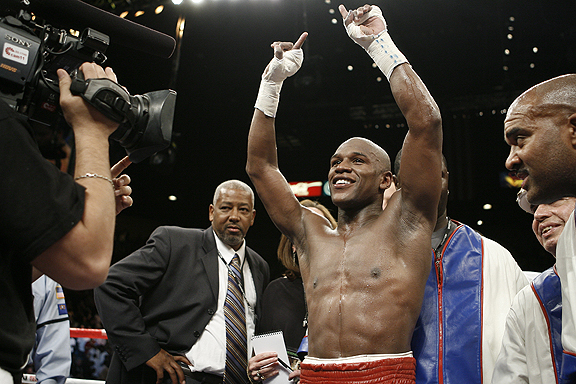


Diaz (Baby) Bulls his way to stoppage victory over De Jesus

download2
LAREDO, Texas – A small but committed group of partisan-Mexican fight fans gathered to see how real Juan Diaz’s comeback was in its second test. The crowd was relieved to find it pretty serious thus far.

Saturday before a sparse crowd at Laredo Energy Arena, Houston lightweight and former world champion Juan “Baby Bull” Diaz (37-4, 18 Kos) outworked and outhit Brazilian Adailton De Jesus (30-8, 24 KOs), eventually causing the De Jesus corner to stop the match before its midway point, at 1:51 of round 5.

From the opening moments of Saturday’s main event, Diaz swarmed and struck De Jesus, attacking him as if after the Brazilian’s very spirit. De Jesus, who wore a noble face and made manly gestures of indifference through the next 15 or so minutes, was not in the fight and knew he was not in the fight, finding himself in the position so many Diaz opponents have, the realization that punching back at Diaz is the only way temporarily to make him stop punching you, until you tire – which you inevitably will.

“I went right to the body to break him down,” Diaz said after stopping De Jesus. “I felt good doing it.”

Each round became like its predecessor, by its closing bell, with Diaz whacking elbows and gloves when he could not find De Jesus’ softer spots, and each new round began with the waistband of De Jesus’ gray trunks pulled higher and higher in the hopes of fooling referee Jon Schorle into warning Diaz, but Schorle was not fooled.

“I threw a lot of hard, accurate punches,” Diaz explained.

The assault continued, with Diaz’s trademark activity rate, until De Jesus’ corner could abide no more and threw not one but two white towels in the ring, bringing an end to the match and a continuation to Diaz’s comeback, one promoter Top Rank envisions eventually concluding with a title match.

“I am still young, only 29,” Diaz said. “And I have a lot of fight left.”

IVAN NAJERA VS. ROGER ROSA

Undefeated San Antonio lightweight Ivan Najera goes by the nickname “Bam Bam,” and every fight symmetry dictates Najera supply one Bam, and collect the other. With an action-making style that relies on a flying chin and talent for turning into opponents’ blows, Najera has yet to encounter a man who is unskilled enough for the San Antonian to make a dull fight with. And Najera’s Saturday opponent, Brazilian Roger Rosa, was not unskilled as his record indicated.

The evening’s third match was its undercard’s best, with Najera (12-0, 9 KOs) winning a unanimous decision by scores of 59-54 and 58-55 and 58-55 over Rosa (4-4-1) – a man of small stature, short muscles and enough chin and confidence to test Najera several times in their six rounds together.

A Najera counter left hook dropped Rosa in round 1, making the official scorecards somewhat wider in margin than the fight they evaluated. The right man won ultimately, but aficionados can be forgiven their concerns about the longevity of a prospect like Najera who makes wars in six rounders against opponents without knockout power.

ALEX SAUCEDO VS. RAMON PENA

There is one young fighter matchmaker Bruce Trampler travels to see wherever he fights, and he is Chihuahuense Alex Saucedo, an undefeated 19-year-old welterweight who calls himself “El Cholo” and fights out of Oklahoma City. And each time Saucedo steps in a ring, Trampler’s wisdom is confirmed more deeply.

Saturday’s second fight saw Saucedo (10-0, 7 KOs) hurt Mexican opponent Ramon Pena (7-4, 5 KOs) with every punch he threw, and hurt him badly with every punch he landed. It was a Saucedo left hook to the head, officially, that was the match’s final punch, at 1:00 of round 1, but it was actually a couple left hooks to Pena’s liver that stopped the overmatched man from Los Mochis, Sinaloa, and kept Saucedo’s record perfect.

download1
DENIS SHAFIKOV VS. SANTOS BENAVIDES

Promoter Top Rank is well known for cultivating talent, but undefeated Russian lightweight southpaw Denis Shafikov appears to have come to them ready-made. Much like Shafikov’s opponent, Nicaraguan Santos Benavides, came to Shafikov in Saturday’s opening match, a 10-round affair that was effectively finished after its first minute, though didn’t end officially till the bell rang to conclude round 6 – when Benavides’ corner wisely called an end to their guy’s evening.

One minute was how long it took Shafikov (32-0-1, 17 KOs) to decipher the secret to Benavides’ (23-4-2, 17 KOs) jab, the southpaw brings it home slow, and begin blasting him with left crosses that made Benavides’ legs shake every time they landed. And they landed with more ferocity as rounds went on until Benavides’ corner did the sage and merciful thing and ended the mess.

Shafikov might just be good as his record anticipates.

UNDERCARD

Saturday’s first televised fight was a 66-second drubbing that saw U.S. Olympian Jose Ramirez (5-0, 4 KOs) drop hopeless Oklahoma super lightweight Mike Maldonado (6-2, 1 KO) three times, twice with body shots, bringing an end to the match barely a minute after it started.

Rangy California super welterweight Danny Valdivia (1-0, 1 KO), who appears extremely tall for a 154-pound fighter but doesn’t seem to know it, fighting behind a short man’s high guard and relying on inside punching, blasted-out Texan Jamaris Chaney (1-2) in fewer than six minutes, Saturday, winning his professional debut at 2:51 of round 2 and then launching an exuberant cheering routine of jumps and kicks.

The evening’s final match, a six-round super bantamweight tilt between Connecticut’s Tramaine Williams (8-0, 2 KOs) and Californian Raymond Chacon (4-6), ended in a no contest at 0:51 of round 3.

Opening bell rang on an empty Laredo Energy Arena at 7:05 PM local time.


To Laredo for the Baby Bull: Another homage to 2009’s fight of the year

Juan Diaz
SAN ANTONIO – Saturday at Laredo Energy Arena, about 150 miles southwest of here, Houston’s Juan “Baby Bull” Diaz will make a 10-round match with Brazilian Adailton De Jesus, as part of the second fight of a however-many-fight comeback Diaz plans to pursue till peril massively outweighs treasure and he returns to a retirement he apparently did not enjoy in 2011 and 2012. I will be there because Laredo is not too far, Diaz is one of my favorite fighters – in part because of the match he made with Juan Manuel Marquez 4 1/2 years ago – and because Diaz’s new promoter, Top Rank, has not been in Texas nearly as much as hoped this year.

Juan Diaz’s comeback may be sincere and well designed and likely to succeed or it may not, and as there’s no way to tell at this point what it is, Top Rank has chosen for Diaz an opponent who may or may not be serious himself. Adailton De Jesus is a Brazilian lightweight whose talents do not travel particularly well. He was last seen in the United States losing an uncomplicated decision to Marco Antonio Barrera three years ago at Alamodome. That Barrera bore little resemblance to the man who twice decisioned Erik Morales; the Barrera who fought De Jesus returned from a 15-month sabbatical, almost three years after announcing a “retirement” caused by his one-way rematch loss to Manny Pacquiao (a forgettable fight historic only for bringing a cessation to Top Rank and Golden Boy Promotions’ first feud) to investigate how much money Barrera could raise on the nostalgia circuit before he careered into broadcasting full-time.

De Jesus’ career, a venture apparently paused when his first-round knockout of a 14-14-1 opponent in 2011 was nonviolent enough to warrant investigation by Brazilian officials, a knockout that came just three Saturdays after De Jesus was stretched in four rounds by Mexican Humberto Soto in Mexico, was a one marked by losses on the road complemented by resume-builder wins at home. Nothing about the Brazilian lightweight’s 19-month vacation, which will end Saturday in Laredo, indicates a new desire to compete; likely this is a fight made by a matchmaker who spoke to a matchmaker who spoke to a manager – “Adailton always was tough, and Diaz never could punch” – that will get De Jesus a new truck in Sao Paulo and/or VIP passes to the 2016 Olympic Games in Rio.

If the unforeseen comes to pass and De Jesus upsets Diaz, the Brazilian’s team will see if they can’t parlay the victory towards a guaranteed loss in a staybusy fight for Miguel Vazquez or Mike Alvarado or Brandon Rios or whomever Top Rank envisions someday feeding a plate of Baby Bull. Diaz-De Jesus, then, will determine nothing about the lightweight or junior welterweight divisions we do not already know, but it will afford an opportunity to see Diaz in action, which, for a small band of aficionados, is a treat not to be missed.

For a number of reasons Diaz was never popular with the masses as hoped; not as Don King hoped, when, by his own admission in 2006, King slipped a DKP contract over Golden Boy’s, with Diaz’s pen dangling portentously above, to get Diaz on a Liakhovich-Briggs card at Chase Field, when it became apparent nobody in Arizona knew Scottsdale’s Sergei Liakhovich, victimized just Friday on ShoBox, and the reliable Latino revenue stream would need be tapped. But Mexicans never much related with Diaz, a volume puncher with an everyman physique – long, loose muscles framing a midsection that jiggled – who possessed neither knockout power nor a fixation on opponents’ livers.

A couple years and some televised fights later, King got Diaz’s title lost to Nate Campbell in Mexico, which led Diaz, finally, to Golden Boy Promotions, an underappreciated decision over Michael Katsidis and the 2009 fight of the year with Juan Manuel Marquez, a man for whom, posterity now says with a chuckle, Diaz appeared structurally too large at 135 pounds, bulling Marquez for much of the match’s opening 18 minutes before succumbing to the finest counterpunching seen in a generation and being stopped by a gorgeous right uppercut in round 9.

Diaz’s rehabilitation tour did not go as planned; he decisioned Brooklyn’s Paulie Malignaggi in Diaz’s native Houston, and then Malignaggi premiered what can fairly be called his signature postfight speech about boxing’s evilest forces, money and corruption, being allied against a fighter from the economically irrelevant township of New York City. A lackluster rematch with Malignaggi got the “Magic Man” his desired decision, and eight months later got Diaz handed to Marquez in another rematch no one asked for – certainly not Las Vegas, the match’s unfortunate and unfortuned host, enjoying then its second year of 18-percent unemployment – and Diaz feinted at more fighting then said goodbye to attend law school or become a lawyer or some other narrative thread nobody pulls anymore because Diaz is a good guy and it’s unkind to ask if a rising Houston attorney would subject himself to other men’s fists for UniMás (formerly Telefutura) money.

How relevant is any of that to me? Not at all, honestly. Volume punchers are my favorites – whether their names are Juan Diaz, Timothy Bradley or Nihito Arakawa. Some aficionados have justified grievances with volume-punching types – they tend to outpoint the stylists whom purists pride themselves on adoring – and most casual fans hate them even more for neither scoring highlighted knockouts nor having what euphonious names garner from aficionados’ faces the admiring expressions casual fans love to cause at sportsbars. Diaz’s ability to relax in the presence of stronger punchers and stronger men, though, has enchanted me most of his career, and if his retirement did not go as planned, at age 29 he is welcome to keep plying his trade.

Expect me at ringside any time the Baby Bull fights in Texas.

Bart Barry can be reached at bart.barrys.email (at) gmail.com


Prizefighting, Saunders, damages, vulnerability, graciousness

Most American prizefighters are damaged necessarily, damaged from taking others’ fists and hopes, damaged by youthful experiences that guided them through amateur boxing’s comparative tenderness to a career hurting others. In this era when most Americans who cover prizefighting do so without compensation, it is fair to assume a fair number of us, too, are damaged, and as much as we chose to write about prizefighting because it is one of three sports, with baseball and golf, that reliably lend themselves to good writing, we also got chosen by prizefighting in a way neither golf nor baseball chose us.

Monday was unexpectedly pleasant for me. Summoned for jury duty, my first as a resident of Lone Star State, at the Bexar County Courthouse – an edifice majestic as the county comprises, something one can say for a courthouse in most any Texas county – I sat in an enormous room with crisp air, a delightful rarity in these parts from now till October, and comfortable chairs and sternly polite strangers and wonderfully absent television sets (those are kept in adjoining rooms with walls thick enough to be soundproof).

From eight in the morning till the last jury panel was threatened but not assembled at nearly four in the afternoon, I read George Saunders’ “CivilWarLand in Bad Decline,” a collection of six short stories and one novella that are absurd and violent, primarily, but also imaginative and humorous and the standard to which contemporary American satirists should aspire. A day or so later, I happened on the recently published text of Saunders’ address to Syracuse University’s class of 2013, a speech that could be titled “Try to be Kinder,” and thought it was all too coincidental, or if it wasn’t, well, what was happening in our sport this week that I couldn’t wander off the left/right/left path?

Vulnerability, it seems, is the best place to follow Saunders’ convocational advice, and prizefighting is fine a place as anyone might look for vulnerability – its expression and discovery and expression. So is the writing it inspires, or perhaps more ably put: so are those who write about our sport. There is a disappearing middleground in our craft (I had “business” there at first, but it looked preposterous), like so much of American life, lamentably enough, and we now line up on a side that is either too gracious or not fractionally gracious enough. If as the old saw has it, academic politics are vicious because their stakes are small, boxing-writing’s stakes, tiny by comparison, have brought a proportionate viciousness that is profoundly offputting to the very few persons who still care what we do.

For years I believed this was an unpleasantness blogs wrought – young writers proselytized by misanthropic editors telling them one’s soul, or at least his backbone, was traded for a ringside credential – but now see I was wrong, as increasingly our clan’s comity is undermined by men who should expect to see one another at ringside this year, an actuality that tends to govern tongues and once governed keyboards. “Please don’t bring this pettiness to ringside” – that is what I find myself thinking as I peruse Twitter, an activity that once made every hour’s last five minutes at my dayjob nearly euphoric but now discomfits me more than my dayjob.

Ringside, you see, is a gracious place; it’s where the very voice of Arizona boxing, Norm Frauenheim, spoke to a first-year boxing writer about the craft, for hours at a time, many times, simply because they were sat beside one another and the young writer had questions and questions, and because Frauenheim is the first boxing person I thought of while reading Saunders’ address; ringside is where online boxing-writing’s trailblazer, Doug Fischer, made a point of being friendly and vulnerable with any young writer who introduced himself, and interrupted his own deadline reporting to jog to row’s end and pose for pictures with ticketholders; ringside is where our craft’s most celebrated practitioner, Thomas Hauser, still goes hours before he is due in a main-event fighter’s dressing room, to sit with young writers and impart wisdom about boxing and things that have nothing to do with boxing.

One trip to a Major League Baseball pressbox: that’s what it took to convince me how special ringside was, with its jovial regulars and enthusiastic newcomers and everyone ready to answer standard inquiries from their neighbors, like “Did you get the time on that one?” or “But it was a left hook that started it, no?” That MLB pressbox was, as my host would later call the Associated Press tent at the Beijing Olympics, the unhappiest place on earth, one filled with large suspicions and mean jealousies, reporters shoulder-blocking laptop monitors lest someone with a Visitors badge steal their peerless prose and decide, on second thought, the catch by the centerfielder in the third inning was actually unbelievable, not amazing.

See that, what’s above? It’s ungracious, and were this not a piece, in part, about vulnerability, it’d get struck on rewrite, but it will stand for purposes of illustration. There is no reason not to be gracious to one another, to suspect the other guy is doing his best the same as I am, to forego occasionally the hasty and public rebuttal, safe in the knowledge none of it will be remembered by the damaged people who now anonymously cheer it on.

Damaged is good a word as any for them, for us, a word to invoke empathy from most who read this. A desire to cover prizefighting, men who beat one another for money, percolates upwards from a spring of injury often as a willingness to beat another man for money does. Most of us who write about this sport, and a goodish number of our readers, are damaged, simply, complicatedly, and what good might come of damaging one another further, for free?

Bart Barry can be reached at bart.barrys.email (at) gmail.com
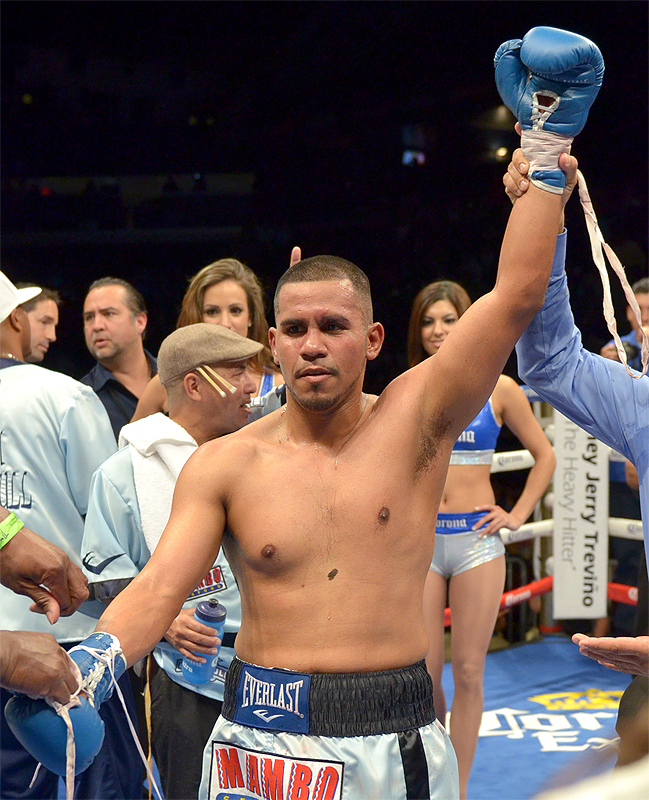


Figueroa and Arakawa, humility and volume punching

Omar Figueroa
SAN ANTONIO – I like to think I write quickly, finding words within the readymade template, lede to nut to quote to body, that governs ringside reporting and probably has for centuries. Yet Saturday, as I groped to describe what happened during Andre Berto versus Jesus Soto-Karass, as fine a main event as our sport may see for the rest of 2013, I was entirely alone. Before I was within 300 words of filing, there was nary a soul in AT&T Center’s other 10 rows of particleboard tables.

Turns out, half the writers left after the co-main, and those who stayed did not have editors that wanted more than a line about the walk-out match, and raced back to the media center to reserve a seat at the press conference. Such is the drawing power of Weslaco’s Omar Figueroa in South Texas, and such was the match he made with an indomitable Japanese lightweight named Nihito Arakawa.

Figueroa is every good thing South Texans say about him, but there, too, was Arakawa, all through their 36 minutes of mutual belligerence, cussedly stomping forward, making the volume puncher’s compact with Figueroa who was prepared as possible for a meaningful and violent confrontation but necessarily unprepared for the grotesquerie of Arakawa’s bottomless capacity for absorption, as if punches were an ocean and he was set on the task of patiently mopping the beach and emptying its seawater in a bucket.

That was exactly how futile Arakawa’s task appeared to three judges – a Californian, a Mexican and a Nevadan, no Texans, who scored an intensely fine match 119-107, 118-108, 118-108, grading Arakawa’s performance somewhere between Short Notice and Heavybag – yet Arakawa did not relent. There is a momentum to prizefighting, of course, but it hasn’t nearly the fluidity professional scorekeepers observe at ringside, where every fighter who won the previous round begins the next with a symmetrical lead, and keeps that till his opponent overcomes a judge’s mental inertia with force great enough to convince him something materially different has occurred. Chuck Giampa, deservedly famous for taking Showtime viewers inside the mind of a judge, instructs aficionados, elsewhere and here: There is not an iota of infallibility to be found at ringside, so do not look for it or rage at its unjust absence.

Arakawa’s secret to absorbing punishment is a kin to his having informidable punching power; he does not commit fully to any punch because he’d rather remain within himself, in full self-possession, working to a rhythmic tempo he alone hears, keeping his southpaw hands and feet in motion, right hook and shoulder and left cross and shoulder and left to the body and right to the head, shoulder, shoulder, backwards step, overhand left, backwards stutter, right foot shuffle, shoulder, left hook . . .

Arakawa’s mental resilience is not a matter of making adjustments to an opponent in mid-fight but one of preparation and self-knowledge, of reducing his required thoughts in combat to a simple yes/no question – “Am I comfortable?” – that he can answer even when partially or fully out of his mind. It is not the simpleton’s approach for which it is mistaken, always, by those who’ve not employed it, either for having natural gifts of power or reflex too great to sacrifice, or for having never worn gloves; it is the choice of our sport’s most introspective and intellectually hardy practitioners, an intelligent choice that asks, in all humility: What am I not as good at as another, and how can I reduce his advantages?

Arakawa, blasted repeatedly in the opening six minutes by a South Texas lad with 17 knockouts in 22 fights, a lad yet to meet man or beast capable of absorbing more than a baker’s dozen of his best strikes, a lad, coincidence would smilingly note, who shares a trainer with Timothy Bradley, boxing’s finest practitioner of the very style Arakawa applies pretty damn well himself, a lad who said two Fridays before he would have to strip naked in the breathless heat and pitiless light of a South Texas supermarket parking lot at two o’clock on a July afternoon that if the time came for his mind to blank in an orgy of attrition, like Bradley’s did in March, he prayed not to solicit the white feather, wilting before another man’s greater desire – blasted repeatedly by that lad, Arakawa relaxed, found his comfortable place, and forced his will on Figueroa’s fighting spirit, and Figueroa did not wilt.

But he did tire. As he took the scale Friday afternoon, he looked somewhat drawn, in the tradition of longarmed Mexican prizefighters who bring severity to other men at a weight no fewer than 25 pounds below a physique nature would not begrudge them, and then he missed by a quarter pound, 135 1/4, and had to disrobe entirely. It was an interesting spectacle of modesty and awareness, that. Figueroa, who emphasizes his desire to be a role model to kids in the Rio Grande Valley where Weslaco sits, requested a barricade of blinding towels, a square perimeter of white terrycloth, and then took to the scale, package in hand, cupping his manhood in his right fist, and made weight – disproving one physics-defying myth of Mexican prizefighters: Raising your arms overhead and inhaling will begin a negotiation with gravity that reduces slightly your weight. This curious show of modesty brought a tiny, unexpected touch of further likability that explained why Figueroa was, by far, AT&T Center’s most popular prizefighter.

And that was before Figueroa and Arakawa made a historic show of valor and sportsmanship, elevating one another’s public standing, making even wizened fight scribes grateful.

Bart Barry can be reached at bart.barrys.email (at) gmail.com


Undercard results from “Knockout Kings II”

SAN ANTONIO – The largest reaction of Saturday’s “Knockout Kings II” undercard came before its fourth and final off-television match, when lanky San Antonio junior welterweight Armando Cardenas (2-0, 2 KOs) entered the ring for his expected annihilation of designated opponent Stephen Salazar (0-1), a hopelessly overmatched fellow Texan from Laredo making his pro debut.

The hoped-for annihilation came quickly at 1:21 of round 1, with Salazar having been to the blue mat once but still on his feet. Cardenas had the second knockout of his career, and the local crowd, still sparse when the undercard completed, had its desired knockout.

The first knockout of “Knockout Kings II” came in its third fight, when Michigan light heavyweight Anthony “The Dog” Dirrell (26-0, 21 KOs) dropped reeling Ohioan Anthony Hanshaw (23-4-2, 14 KOs) with a right cross, and the match was waived off at 2:36 of round 3, despite Hanshaw’s being up by the count of 4. The match was an aesthetically displeasing affair, as Dirrell, whom Hanshaw flipped over his back in the first round, spent much of it flexing and posing and explaining, through his performance, why a fighter undefeated in 25 matches would be fighting off-television.

Before that, in a battle of San Antonio junior lightweights, it was clean punching against a good chin, as Joseph Rodriguez (4-0, 2 KOs) won a unanimous decision over Jesse Anguiano (1-3-2) by scores of 39-37, 40-36 and 40-36. Rodriguez landed right uppercuts and left hooks enough against the vulnerable Anguiano to raise questions about his power, going forward, while removing any doubt about the solidity of Anguiano’s chin.

Saturday’s card began with an upset, as California junior lightweight Andrew Cancio (15-2-2, 11 KOs) decisioned Corpus Christi’s Jerry Belmontes (18-2, 5 KOs) by unanimous scores of 98-92, 98-92 and 97-93. Over 10 evenly matched rounds, rounds in which neither man was able to imperil the other for a sustained period, Cancio got the better of most every exchange, winning a fair decision against a South Texan in South Texas, never a mean feat.

Opening bell rang on a sparsely populated AT&T Center at 5:03 PM local time.


Omar Figueroa, “Knockout Kings II” and the Rio Grande Valley

Omar Figueroa
SAN ANTONIO – The promotional posters for “Knockout Kings II” that arrived in some writers’ inboxes these last few weeks were different from the original posters that featured Haitian-American Andre Berto and Mexican Jesus Soto-Karass, the men who will fight in the main event Saturday at AT&T Center. The new posters featured Texan Omar “Panterita” Figueroa, who will fight Japan’s Nihito Arakawa for the WBC’s interim lightweight title and have to sell more tickets than Berto, Soto-Karass and Arakawa, combined, for Leija-Battah Promotions’ first post-Canelo event to succeed at the box office.

“(Arakawa) is going to be tough,” Figueroa said Friday morning. “Usually Japanese fighters are a lot like Mexicans in the fact that that they fight with a lot of pride, a lot of heart. There’s no quit in them either. I’m preparing for a good 12 rounds, hopefully . . . I mean, hopefully, it doesn’t go that long.”

There has been a gradual but pronounced shift away from the main-event fighters and towards Figueroa, as it appears circumstances have confirmed what was long known about Saturday’s headliner, Andre Berto: He does not sell tickets. Berto makes interesting fights when he is matched with someone who can beat him, a scenario to which he was rarely treated during his deservedly maligned HBO tenure. Berto was no more the next Floyd Mayweather than Victor Ortiz was the next Oscar De La Hoya, despite programmers’ hopes, though both men were close enough in appearance to make network executives believe otherwise. Now on Showtime, Berto is in the precarious place where his next loss may be his last televised loss.

He is aware of this, or aware as Berto can be; at the announcement press conference in this city’s famed Mi Tierra restaurant in May, Berto mentioned coming close to a Mayweather fight twice, against Ortiz and then Robert Guerrero, losing both tryouts, and being determined not to lose a third. How enthusiastic anyone might be about a Mayweather-Berto fight is dubious, else Golden Boy Promotions would not have announced Matthysse-Garcia, a casting call for Mayweather’s next opponent, as its Sept. 14 co-main, last week. Since Berto is not an introspective lad, though, it’s best for all parties to have him believe Saturday’s fight is to win the Mayweather lottery. There is something about the way Berto claps that bears watching as a metaphor, or insight into his connection with fans: He doesn’t mirthfully slap his hands together but rather does a two-fisted, right-pinky-knuckle-to-left-index-knuckle touch, that says: I am too cool for all this.

Omar Figueroa is the draw upon which Saturday’s gate relies. Berto’s opponent, Jesus Soto-Karass, is the fabled tough Mexican, of course, but Mexicans are quite familiar with him subsequently, and will never see him as more than Antonio Margarito’s limited stablemate. And while the third Knockout King, Florida’s Keith Thurman, might become a draw someday, he’s not known well enough to sell tickets in Texas against a welterweight who’s only once fought outside Argentina.

Figueroa is from Weslaco in the Rio Grande Valley, a four-hour drive south of San Antonio, a city in South Texas (so is the awesomeness of Lone Star State: “South” Texas begins 250 miles north of Texas’ southern border) – a place known by Texans as “The Valley” and home to more than a million persons who are Texans by both birth and generations. More than 80-percent of them share ethnic origins with the Mexicans just a few miles south of Figueroa’s Weslaco, but most of them have been in the United States, or at least Texas – whether during its time as a Confederate state, its own republic or part of Mexico – longer than your family has.

“Honestly, I do not know, but I’m glad they do,” Figueroa said, when asked why fellow Valley residents drive four to five hours to see his matches. “We’re mainly Mexicans in the Valley, and Mexicans, we have such a passion for everything we do.

“It’s a mutual thing. They support me, and I put on my best face when it comes to fighting.”

Figueroa’s fans are Texans in the very core of their being, and Texans support their own, especially when their own looks as they do and fights ferociously as Figueroa does.

“I go in there to just punish my opponent as much as possible, in the sense that the knockout will kind of, sort of, come – sooner or later?” Figueroa said. “That’s our plan, I guess.”

“Panterita” – the affectionate diminutive of the Spanish word for panther – has power in both hands and a willingness to engage in attrition fighting, the kind both Mexicans and Texans thrill to. Figueroa is trained by Joel Diaz in Indio, Calif., where Timothy Bradley shares his camp.

“Bradley, whom I have the pleasure of working with, has a lot of heart and a lot of brains,” Figueroa said, then addressed his campmate’s March showing against Ruslan Provodnikov. “If I’m ever in one of those – in that circumstance? – I hope that I react the same way, that I don’t cower and quit. I don’t know if anyone else, except for the Mexicans, those types of fighters who live to fight fights like that, would have put up with that sort of punishment and try to keep the fight going.

“It was just an amazing feat for a human being to take those kinds of punches and fight on.”

Bradley is the name Figueroa mentions first and solely when asked for prizefighters he models himself after; he hopes to react to semi-consciousness in the mindless and miraculous way Bradley does, and while he does not admit to seeking such a chance, one detects in his voice a sense he would not mind it. If somehow Nihito Arakawa takes Figueroa to that state, endures the Texan’s attack without wilting then catches him on the way in, and Figueroa fights his way through it, comporting himself with even some of Bradley’s honor, on national television, South Texas will have its new draw, and Leija-Battah Promotions will have still more of what leverage it has already earned.

Bart Barry can be reached at bart.barrys.email (at) gmail.com
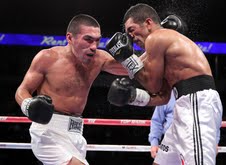


“The Good Son” is great stuff

“The Good Son,” an online preview of which I watched Saturday evening, froze two times at its 35-minute mark. The first time I rose from my sofa and casually refreshed the page, thinking little of the inconvenience. But the second time I felt something like anxiety, an actual discontent at the possibility I might not finish the movie, and when relief followed the video stream’s return, it became apparent I was watching something quite a bit better than I was prepared for.

“The Good Son,” a documentary about Ray Mancini and his father and Deuk-Koo Kim and his son, a movie based on Mark Kriegel’s acclaimed 2012 book of the same title, is excellent – better textured than most contemporary documentaries, and considerably more affecting than what “documentaries” HBO and Showtime often use to promote our sport. That is because of Mancini, a man whose physical stature is slighter, and whose humanity is larger, than most likely remember them. One forgets that Mancini, after making the cognomen “Boom Boom” nearly ubiquitous as “Sugar,” was retired before his 25th birthday, after his second loss to Livingstone Bramble, in 1985 – with a nonstarter decision loss to the late Hector Camacho four years later and a hopeless knockout loss to Greg Haugen three years after that.

There is another loss on Mancini’s ledger, of course, and “The Good Son” employs a bit of nimble footwork to avoid it. That loss was Mancini’s first, when he was stopped in the 14th round of his 1981 challenge for the late Alexis Arguello’s WBC lightweight title – when, seven months before becoming WBA lightweight champion, Mancini was shown to be only a very good and inordinately willful fighter and not a talent great as Arguello’s.

A theme of the movie’s second third, one that feels assembled by a publicity team more than its otherwise serious collaborators, goes something like: “Ray ‘Boom Boom’ Mancini had it all and was poised to have it all – and have it all! – if he could just get past one hardscrabble case from South Korea, an anonymous fighter from humble beginnings named Deuk-Koo Kim. But their fight would change everything.” Whatever veracity this claim has gets an assist from Bob Arum, who promoted Mancini and performs with magical authority before the camera, equal parts age and intelligence and presence, informing us that in 1982 this lightweight prodigy from Youngstown, Ohio, was on the precipice of overwhelming every limit of national consciousness previously imposed on prizefighters. This claim is best appreciated in the absence of Mancini’s having been stopped by Arguello in 1981, and in the absence of Arum’s having made even more outlandish claims 25 years later about a different prodigy from Youngstown.

There, if one wishes for criticisms of this documentary, that is about the extent of them. The movie is wonderful, otherwise. There is an appropriately rusty hue to most of the film, especially those parts that deal in Mancini’s hometown, an orange-peel underlayer everywhere; even the faded newspaper clippings feel more reddish amber than yellowish gray.

A reason to watch this movie even if you’ve read the book: An unlikely reunion between Kim’s son, Ji Wan, born months after his father died from wounds suffered in a Las Vegas prizefighting ring, and Mancini, the man whose honest pursuit of a brutal craft caused the death of Ji Wan’s father. There is perhaps more use of the word “closure” than purists will enjoy, but the scenes that fill the final third of “The Good Son” are touching and genuine.

Genuineness is a quality quite routinely sacrificed at the altar of reality; today, everyone is an actor, a person who absorbs lines written by others until he is able to deliver them like his identity depends on it, and all the more passionately with a recording device in the vicinity. Mancini has long pursued and at times enjoyed an acting career, but he appears to have left his craftsmanship elsewhere as he invites the son and fiancée of Deuk-Koo Kim to meet his family and eat at his dinner table.

Ji Wan is there in part to learn about his father through the man who caused his death and in part to forgive Mancini for all that followed – Ji Wan’s paternal grandmother, Deuk-Koo’s mother, committed suicide shortly after her son was removed from his life-support system in a Nevada hospital – but Ji Wan botches the forgiveness line in a way that proves he did not have it read to him for rehearsal in English on the way to the Mancini home. As Mancini sits at the head of his table and tries to say something poignant enough to bring solace, and is unable to, because he was a professional fighter raised by a professional fighter not someone whose first love was timely rhetorical devices, it reminds one of life’s myriad of unfairnesses, beginning with the way Mancini’s image acquired a demonic pall for anyone not already familiar with the jeopardies he and Kim freely chose to confront as prizefighters – the way television worked 30 years ago, and the way boxing was accessible enough for an eight-year old to happen on such a world title fight accidentally, as I recall doing.

All that changed ineradicably enough in short time, and some of it was attributable to the matter – truthful but inaccurate – of Americans watching a man gradually beaten to death on national television one Saturday afternoon in November. Deuk-Koo Kim deserved a better fate than what befell him, certainly, but so did Ray Mancini, and this movie is an excellent reminder of it.

Bart Barry can be reached at bart.barrys.email (at) gmail.com


An evening with The One

Saul Alvarez
SAN ANTONIO – Monday round 6:00 PM a large crowd awkwardly gathered round a stage awkwardly situated in the plaza that precedes Misión San Antonio de Valero, known today as the Alamo, and bent its collective neck in a variety of unnatural directions to catch glimpses of Mexican Saul “Canelo” Alvarez and American Floyd “Money” Mayweather, as they made what had become, with the day’s earlier cancellation of a Phoenix stop, the penultimate destination of a 10-city tour designed to announce “The One” and enrich those gathered onstage – except only One, Alvarez, was actually onstage, while One was, by his much later account, contending with a scheduling cross-up and a delayed flight and a family emergency in Houston.

The temperature was unseasonably cool, and as the media were seated beneath a famously large oak tree left of the stage, the only point of complaint at the open was the extraordinarily tall and robust speaker fewer than six feet from the press seats and given to pitiless eruptions whenever its deejay stopped spinning and welcomed his emcee to the microphone.

“My name is Tattoo Golden Boy Promotions,” the emcee announced, without inflection – too real for a comma – named, anyway, after an act Mayweather has often enjoyed.

Haranguing and Twitter-handling and hyping ensued, beseeching a crowd significantly smaller than announced, and significantly smaller still by the time it crescendoed at 7:53 PM with Mayweather’s arrival, to practice cheering the fighters’ processions along a carpeted ruby walkway. It was a curiously reflexive spectacle: townspeople gathered to be entertained by persons who will charge them to watch boxing on pay-per-view being put through rehearsals for how to act entertained, Monday. Of course, out of pomp’s context, the entire idea of a press conference with fewer than half its media-reserved seats filled, a press conference with a deejay and an emcee, for that matter, was an absurd spectacle nobody doing journalism 25 years ago would have recognized.

Mayweather’s tardy arrival afforded such observations; the hour that passed between Canelo’s terse greeting and Mayweather’s attempt at improvisation stripped the spectacle of its pomp, and therefore context, leaving a mostly bare stage, bored administrative types, a sheepish emcee, a humiliated CEO, a tired but seemingly amused television executive, and two prizefighters of Mexican origin, Alvarez then Oscar De La Hoya, who departed the event right about the time Mayweather’s flight departed Houston. It was De La Hoya, nobly enough, who had the least patience for his former rival’s antics. With no music or deejay onstage but a plethora of live mics, De La Hoya said to one of his employees at 6:39 PM: “He hasn’t even taken off yet?”

With that, a goodish number of those gathered made plans for takeoff. It was De La Hoya’s clearest moment. There is no chance he enjoys being onstage with Mayweather, not after the boorish way Mayweather comported himself on their 2007 press tour, the event that changed “Money’s” moniker and career entirely, and being stuck doing promotional work for Mayweather often leads De La Hoya to offer uncomfortable non sequiturs like: “I have to admit, I do miss the ring. That doesn’t mean I’m coming back. It means Canelo Alvarez is ‘The One’.”

The disjointedness, though, was not really even underway when De La Hoya went out the front entrance, signing autographs and looking both annoyed and apologetic. The disjointedness would come 75 minutes later when Mayweather led a diminished crowd through a few soggy bars of “Hard work! . . . Dedication!” then looked over his left shoulder at the Alamo and asked promoter Richard Schaefer, a Swiss national, to say the place they were gathered, to ensure it was pronounced correctly, before Mayweather rambled through a few lines about his wagering on the Spurs, before he rambled through the same lines again. It is not until one sees Mayweather in person, a 150-pound man with quick eyes and nervous mannerisms, so inept at ad-libbing that he fills time on the microphone telling assistants what great jobs they’re doing, that a person properly appreciates what a transformative power television wields.

Remaining media were invited backstage after a few more “Hard Work!” sing-alongs, and when television was done with its 16 minutes, print journalism got its six, and Mayweather got one serious question about a thing he said on one of Showtime’s infomercials for his May fight with Robert Guerrero – an uncannily insightful moment, when Mayweather talked about his time in jail, saying that while the incarcerated was supposed to be getting rehabilitated, all the incarcerated actually did was get angrier – a question treating the epidemic of young black men today being incarcerated for profit by America’s privatized prison system, and Mayweather’s potentially using his platform to address it. After smiling intermittently through the question, like a chess player watching a witless opponent attempt an unsophisticated trap, the man who sociology professor Michael Eric Dyson once allowed to compare himself to Muhammad Ali, Martin Luther King and Malcolm X explained he didn’t like to see anything as a “black thing” but rather saw his time in jail as evidence of things happening to a person in life, and that it was just a thing he had to get through.

It was a well-rehearsed, publicist-prepared answer for a gotcha question that was not asked – “Aren’t you setting a poor example?” – and a reminder to any parent who might mistakenly forego Charles Barkley’s 20-year-old advice and teach his children modern athletes are heroes: Barkley was both insightful and correct when he declared “I am not a role model,” and Barkley was much closer to being a role model than today’s best prizefighter.

Bart Barry can be reached at bart.barrys.email (at) gmail.com
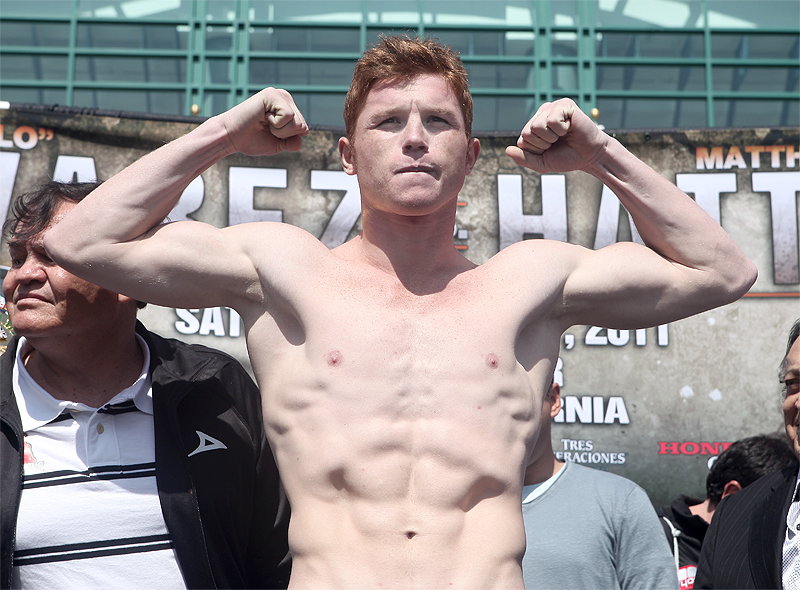


Gennady Gennadyevich Golovkin: Good, giving and game

Gennady Golovkin
Kazakhstani middleweight titlist Gennady Gennadyevich Golovkin wears his initials and nickname on the waistband of his trunks, often in gold blocks, and inadvertently titillates at least a few ironically minded folks who know whence the term “GGG” originates: Born in the gay community and minted by syndicated columnist Dan Savage, it means “good, giving, and game” – three qualities to which any man might hope a prospective partner aspire.

With his beginner’s command of English, Golovkin almost certainly does not know this, and one hesitates to reveal it for fear of the nickname’s future censorship. It embroiders the youngishly handsome face, statuesque physique and impersonal sadism Golovkin brings in a prizefighting ring too ably to be lost – sprinkling glitter on the complicated texture of prizefighting’s most frightfully entertaining new attraction, an attraction that savagely undid Matthew Macklin in fewer than three rounds Saturday at Foxwoods Resort.

Because artful writing needs no lists, there’s little reason to take what letters form both Golovkin’s initials and a quality valued by sexual subcultures of all orientations, today, and make a bulleted termpaper of them, but here’s this: Golovkin is good in the sense that he is good for prizefighting; as a man with no appreciable promotional allegiance, he is a de facto HBO project and fights whomever the network approves, without much debate, because it gives him what exposure the opening six years of his career wanted and lends the network more credibility than its other staples do, allowing HBO to boast half prizefighting’s most interesting practitioners on cable television right now – with Argentine Lucas Matthysse, the other half, awaiting a Danny Garcia match promised him on Showtime.

Golovkin is giving: He hits with both hands in a way few prizefighters today hit with either hand. Saturday he corralled with his counter jab Macklin, a 33-fight Irishman, or at least a veteran of Irish stock and thus unknown to squeamishness, sending him rightwards, then blasted Macklin with a right cross that sent him leftwards then corralled Macklin again with a left hook that sent him reeling towards the right cross once more, all before Macklin’s unhelpful trainer told him to move away from Golovkin’s right hand, returning Macklin to the very left hand that within 4 1/2 minutes dropped “Mack the Knife” – body oozin’ life – choking, scriggling and grimacing like a man stabbed.

GGG is game as hell, too, because he doesn’t mind milling. In the final moments of his short time in a prizefighting ring with Golovkin, the discomfited moments when, blood dribbling in his left eye and hopelessness enveloping him, Macklin decided it was swing-and-let-swing time, pounding Golovkin with what little other than fear remained in his arsenal, Golovkin became more relaxed in a manner that cannot be faked.

Golovkin’s unkinked face went slacker, a breathing antonym for Paulie Malignaggi’s flicking tongue or Oscar De La Hoya’s nuts-in-my-cheek jawline, and he pursued Macklin with no malice whatever, cursorily tapping Macklin’s guard with a telegraphed right hand – “Good boy, Matthew, leave that right elbow high for Gennady” – before yanking back on his own right shoulder, snapping closed the inside of his left hip, and driving the middle knuckle of his left hand through the geometrical center of Macklin’s exposed liver. It was fleying how Macklin reacted, wincing and plunging leglessly downwards as if what strength Golovkin’s hook left his body was for surds of pain alone.

Golovkin’s reaction indicated the ending was both unexpected and unsurprising; GGG comported himself like a man who went out to fight properly, set his feet in place, defend responsibly, place his punches with leverage and accuracy, and see if the knockout comes – for once a fighter who appeared not to look for the knockout got it effortlessly. That is legerdemain, or its facial equivalent, though, as what makes Golovkin every bit appealing as Matthysse is that he verily does look for the knockout with nearly every punch. It was merely a Golovkin jab 90 seconds after the opening bell that thrust the fight directly out Macklin’s soul.

If there is a possible weakness in Golovkin’s approach to ruining other men it is the energy required a man who throws every punch with ruinous objective; that kind of design frustrated for eight or nine rounds can weary a fighter, and as fatigue makes cowards of all men, someone who was able to deflect fractionally Golovkin’s shots and make Golovkin burn calories for 24 to 27 minutes and encounter the stress of tiring, itself boxing’s most counterintuitively stressful sensation, might come on a fairly average fighter with a stationary head before him, not unlike the man James “Buster” Douglas sent on a mouthpiece-recovery expedition in Tokyo 23 years ago. Who is the man to do that? No middleweight comes to mind.

A prime Sergio Martinez at 154 pounds might have turned the trick, but today’s incarnation has little chance and every right to try. Disregard anything Martinez’s promoter said about that Saturday; he books “Maravilla’s” fights, he doesn’t make them. The wisest course for Martinez is to suggest he’ll be happy to fight in 2014 the winner of a Golovkin-Julio Cesar Chavez Jr. fight; the middleweight champion of the world is in no condition to rematch Chavez right now, much less top whatever that was Saturday – but it’s impossible the winner of GGG-Junior won’t be slightly softer for his participation. Flip in a bad training camp, with a hand injury and a bout with influenza and maybe food poisoning, and, well, one never knows.

Which is to write Sergio Martinez absolutely has earned a chance to ruminate on the matter of GGG for the rest of 2013 and a few months of 2014 before anyone declares Golovkin his better, as that declaration will almost invariably come within 36 minutes of their contesting Martinez’s title, and so, why hurry it?

Bart Barry can be reached at bart.barrys.email (at) gmail.com


Broner, Malignaggi, and the pleasure of seeing each get hit in the face

Adrien_Broner_1
Saturday in Brooklyn two of prizefighting’s reliably unlikable personalities spent 36 minutes punching one another, much to the delight of those who watched them do it. Cincinnati’s Adrien “The Problem” Broner decisioned Brooklyn’s Paulie “Magic Man” Malignaggi by split scores of 117-111, 115-113 and 113-115 in a match for some welterweight title or other. All the cards were about right, depending on a judge’s preference for accurate counterpunching or jittery busyness, and if the fight was not a historic donnybrook, it was nevertheless a sight much greater than what its belligerents’ prefight antics anticipated.

The match was also the type likely to be closer on television than at ringside, where punch quality can be heard, making Broner’s significantly harder punches substantially more influential on judges – a species into whose minds Chuck Giampa once tantalizingly led us. As Malignaggi is a television fighter in numerous senses of the word now, it was also a fight close enough to make him bellow about a conspiracy, á la his antics in Texas four years ago, and convince the tiny minority of aficionados who are his partisans the entirety of prizefighting’s socioeconomic system would be stacked against a fighter from the tiny hamlet of New York City. The decision was correct, just the same; Broner fought better than Malignaggi, according to any creditable definition of the verb “to fight.”

It’s not until you settle into viewing a match contested by two persons for whom you feel no affection whatever that you understand what an appeal such spectacles hold. The only wish many aficionados had for Saturday’s main event was that it continue indefinitely; so long as Malignaggi had enough energy to sting Broner, or stall his attack long enough to embarrass him with his quicker wit and tongue, or at least prevent himself from being beheaded by a left-hook counter, the spectacle could have proceeded for another hour or two without the television audience asking for its end. The fight was entertaining in the way a fight can be when its observers care not a whit who wins or loses so long as both men get hit in the face often as possible.

Malignaggi has never been likable to a fraction so many people as have been told he’s likable to everyone but them; Paulie is a neighborhood hero with the great fortune of being from a neighborhood in NYC. Were someone with a squeaky voice, sideways cap atop ghoulishly dyed hair and career knockout ratio below 20 percent from anywhere else in the country, nay the world, he’d have been forgotten after Miguel Cotto victimized him in 2006. So few good boxers come from such a great media market, however, we’ll never be rid of Malignaggi till he is rid of gloves, which is a shame because he’s already a more enjoyable commentator than ever he was a fighter.

Cotto is a good place to look at what boxing has in Broner. Some seven years ago, when Malignaggi was 25 years-old and undefeated, Cotto dropped him in round 2, shattered his orbital bone and beat him savagely enough not one of the three official judges in Madison Square Garden was able to give a majority of rounds to the hometown fighter. And if memory serves, the infrastructure of Malignaggi’s face was too fully sabotaged for him to uncap a signature postfight speech like Saturday’s.

Broner, in other words, did not do nearly well against Malignaggi as Cotto did, and while there are plenty of reasons for this – and Broner’s leaping two weight classes mustn’t be forgotten, and should be praised – it still says something about the state of today’s game. There is more hyperbole about Broner now than there was about Cotto then, despite their having the same number of prizefights at the time of their confrontations with Malignaggi, who is decidedly not the cocksure fighter he was when he threw hands with Cotto. Broner, boxing tells itself, is the future of the sport, and with a heavyweight division that does not belong on American television, what choice does anyone have but to believe it?

Broner is very good, and this era is shaping up to be pretty poor. The divisiveness between the sport’s only relevant promoters, now each with the vacuum seal of its own network to ensure undesired realities do not interfere with licensing fees, has wrought little good. This era will pass and be recalled for its passing of the pay-per-view standard from one well-managed American cherrypicker to the next, and be forgotten quicker than even skeptics right now believe.

Malignaggi did remind future Broner opponents of something noted before: So long as you are punching Broner, he is not punching you. In the opening minute of round 4, Malignaggi proved this decisively by throwing some 15 unanswered punches at The Problem. Barely half of them landed, and only two, a right cross that followed a left hook, were meaningful, but what made Malignaggi’s punch reel interesting is how defensive it made Broner. After Malignaggi landed three or four tapping jabs on Broner’s lead shoulder, elbows and gloves, Broner prepared to throw a well-leveraged potshot counter, but then Malignaggi leaped back on his chest and threw his best combination of the night, and all Broner did was lean farther back before jackknifing forward to a position from which it was impossible to punch.

Broner’s calculus, that Malignaggi could not sustain the panicky rate of his fidgety assault for 36 minutes, was a fair one, and Malignaggi, in a workable eulogy for his career, faded constantly enough in the first 150 seconds of each round to let close ones, such as the ninth and 11th, get stolen from him in their final sixths.

Afterwards, Broner and Malignaggi showed their few supporters why the rest of us so enjoy seeing both of them get struck in the face.

Bart Barry can be reached at bart.barrys.email (at) gmail.com


Garcia, Lopez, Bearden and resilience

GarciaLopezBearden
DALLAS – Thirty five miles due west of American Airlines Arena, where Oxnard’s Mikey Garcia unpicked Puerto Rican Juan Manuel Lopez Saturday, there is a bold and colorful exhibition of 20th century American artist Romare Bearden’s work. It is called “A Black Odyssey.” Its collages and cut-paper works are vibrant depictions of acts that were necessarily intimate, vile and lunatic, acts captured in historic prose by Homer. That such acts led to such words led to such visual art is a testament of sorts to the species’ resilience.

Our startling recuperative powers felt like a theme last weekend. To see Garcia on Friday and the discomfort the sight of him caused others, specifically his octogenarian promoter Bob Arum, a man who, for all his reassuring words publicly uttered during and after Garcia jeopardized his fight with Lopez, did not even look at Garcia when he returned from an hour of admitting there was no way to lose what two pounds stretched between his desiccated body and the featherweight limit, to see Garcia’s wretched demeanor, a combination of shame and shame weakened, like the rest of him, by hunger, was to wonder how such a man would summon reserves enough to rise from bed the next day – much less make violence with a former world champion in the evening.

Yet there was Garcia 33 hours later, a transformed man, or at least a returned one, a person reassured enough to stand directly in front of another world class fighter and do everything with a confidence that is Garcia’s most noticeable quality at ringside. Order was restored by a man who feels orderly, a man who absorbs others’ teachings and heeds others’ carefully worded observations and places his right cross elegantly.

There is an ecosystem in boxing, fragile as it is small, one that relies on a premium network providing meaningful programming to its audience, in the form of championship fights, one that relies on fighters arranging their calendars such that on the day or three of every year they perform they are at or very near their top physical capabilities, or else willing to be victimized by men who are, and all that was imperiled by Garcia’s weighing 128 pounds Friday afternoon.

When Arum shuffled to the podium and declared the title fight cancelled and then departed nearly alone while his matchmakers and publicists continued to speak to HBO programmers and others, it was a reminder, too, of how little about the prizefighting industry we know or get told. This was not lost on the media; few of what could be called reporters remained after the initial weights were read and Mikey Garcia strode on the sunbleached walkway outside American Airlines Arena.

The Romare Bearden exhibition in Fort Worth is the sort of pleasant surprise in which the Amon Carter Museum of American Art specializes. Southernmost destination in a triangular mall that features better known collections at The Modern and The Kimbell, Amon Carter, for being committed to American art alone, finds itself liberated to make original exhibitions – like bright construction-paper collages of black figures reenacting Odysseus’ homewards journey – its larger neighbors might not. If there are parts of the Bearden exhibition that remain partially inexplicable, Bearden’s talent for shape and color and narrative remains uncompromised. And when such expressive colors as Bearden’s are juxtaposed with Homer’s uniquely pitiless descriptions, blood brought by steel and leaked always in a wine-dark sea, one is startled such art came of such depredations, that our species recuperated enough to make visually pleasing depictions of something described in “The Iliad” thusly:

The famous spearman struck behind his skull,
just at the neck-cord the razor spear slicing
straight up through the jaws, cutting away the tongue –
he sank in the dust, teeth clenching the cold bronze.

The Bearden exhibition was a fair way to prepare oneself for what he expected to happen later to Juan Manuel Lopez and did happen to him. Juanma, once the future of promoter Top Rank’s stable and celebrated as Mikey Garcia is celebrated now – though with a larger and more reliably rabid following, especially when endorsed continually and publicly by Felix Trinidad, as Juanma was and fellow Puerto Rican Miguel Cotto was not – was there to be felled and sacrificed in the erection of a new flawless promotional creation, though ultimately not free of flaws as hoped or promised.

Juanma Lopez, once accurately described by an insider as “a world-class dissipater,” nevertheless made the contracted weights for his fights, whatever had to be done – which is not to accuse of lollygagging Garcia, a man who complained of his eyes being too poorly lubricated Friday to blink without discomfort.

In black bugeye shades and a pumpkin skull cap and saddle jacket, there was Juanma at ringside Saturday, two hours before the opening bell would ring on the last meaningful match of a career that would be excellent by most other standards – there to escort his wife to her ringside seat and sit beside her through preliminary bouts. It is an interesting thing these Puerto Rican fighters do, for Cotto does it as well: Wander through an arena’s worth of people hours before a gladiatorial spectacle that anticipates their consciousness sacrificed, or another’s, or worse.

It is a reminder they are sportsmen, craftsman at something that is beastly, more than warriors. Their perspective is a healthier one than the Mexicans with whom they form our sport’s best rivalry.

Bart Barry can be reached at bart.barrys.email (at) gmail.com


Early Results From Dallas

Valdez_Garcia_130615_001a
DALLAS – If this city’s partisan-Mexican crowd came out Saturday to see one of its own blast away a rugged but overmatched opponent in the last fight of its untelevised undercard, it got its wish when Sonoran Oscar Valdez (6-0, 5 KOs) brought a properly leveraged right cross counter square on the face of Houstonian Gil Garcia (5-5-1, 1 KO) in the second round of their featherweight match, Saturday’s seventh, dropping Garcia on his back and marking as inevitable Valdez’s victory.

Instants after referee Laurence Cole brought the fighters together, Valdez, showing the sort of thrill for combat that pleases fans and makes promoters salivate, swarmed Garcia, striking him with any punch he could land and bringing a merciful stoppage at 2:32 of round 2.

Valdez has an exciting style and desire for contact that should make him a friend of fans in years to come.

MIKAEL ZEWSKI VS. DAMIAN FRIAS
Completing a hat-trick of undefeated Top Rank prospects, in Saturday’s sixth match Canadian Mikael Zewski (20-0, 15 KOs) boxed and slugged and generally outclassed Florida welterweight Damian Frias (19-8-1, 10 KOs), ultimately decisioning him by three scores of 77-74.

Despite applying plenty of commitment to his punches, and throwing them in cleaver and accurate combinations, Zewski never appeared to have Frias imperiled, after dropping the Floridian in the first round. Rounds 2 through 7, in fact, were dull enough affairs to have much of the American Airlines Arena crowd expressing its loud disapproval. All such noise as that stopped in the final round.

Appearing to be winded by his own onslaught in the preceding rounds, Zewski put whatever he had left behind his blows in round 8, opening himself to accurate and surprisingly hard counters from Frias – whose punches appeared to lack commitment most of the night. Despite clipping Zewski a number of times in the eighth, ultimately Frias did not have enough to cast doubt on the outcome, and the decision went the Canadian’s way.

Korobov_Duran_130615_001a
MATT KOROBOV VS. OSSIE DURAN
Saturday’s most pleasant surprise came in its fifth fight when Russian middleweight Matt Korobov (20-0, 12 KOs), once more highly touted than he is now, performed a vicious stoppage of New Jersey’s Ossie Duran (27-11-2, 10 KOs) at 0:51 of round 3. After a slow start that brought nearly unanimous boos from the Dallas crowd, Korobov landed a twisting counter left cross from his southpaw stance in the closing minute of round 2, one that dropped Duran and seemed to surprise both fighters.

Korobov attacked from the very beginning of round 3, showing an intensity of assault unpredicted by his record’s paltry knockout ratio, winging and digging left crosses to Duran’s midsection. Duran dropped quickly, his face showing the wincing hopelessness brought only by a liver shot, and the match was over. And Korobov was on his way back towards important matches in the middleweight division.

Vanes_Martirosyan
VANES MARTIROSYAN VS. RYAN DAVIS
Buried in the third match of a nine-fight card in Texas was likely not where 2004 U.S. Olympian Vanes Martirosyan (33-0-1, 21 KOs) anticipated his career would be if he came to his 33rd professional fight still undefeated, and yet, that was where he was, dropping and stopping Illinois super welterweight Ryan Davis (24-11-3, 9 KOs).

Martirosyan landed most every punch he threw, including batting-cage right hands with which he was unable to miss the hopeless Davis, and succeeded in looking impressive as he needed to, en route to a corner stoppage at 2:01 of round 2.

UNDERCARD
The knockout of the night came in Saturday’s fourth match, when local super bantamweight Tony Lopez (4-0, 2 KOs) dropped South Carolina’s Jonathan Hernandez (1-3-1, 1 KO) at 0:38 of round 4, and dropped him in a way that brought ringside doctors on the canvas before the 10-count was finished. Hernandez, who had fired back valiantly through the opening three rounds, finally caught the southpaw Lopez’s left cross in a way that ended his night emphatically.

Saturday’s second fight, a welterweight tilt between Puerto Rican welterweight John Karl Sosa (7-0, 5 KOs) and Mexican Ramon Alejandro Pena (7-3 5 KOs), was an overmatched affair in which Pena landed very few right hands and absorbed many more. The end came at 1:54 of round 2, when a Sosa left hook found its mark on Pena’s liver and rendered the Mexican wholly unable to continue.

The evening began on a fine note, with Austin middleweight Kurtiss Colvin (8-1, 7 KOs) stopping Arlington’s Angel Sigala (8-4, 2 KOs) at 0:22 of round 5.

Opening bell rang on a sparsely populated American Airlines Arena at 6:03 PM local time.


Un-cancelled: Garcia misses weight, Lopez does not

DALLAS – Once considered a model young professional, the quintessence of what a proper boxing pedigree could produce, California featherweight Miguel Angel “Mikey” Garcia appeared to be another thing entirely at the weigh-in for his Saturday fight with Puerto Rican Juan Manuel “Juanma” Lopez. Garcia lost his world title on the scale, the least-professional place to lose it.

At American Airlines Center Friday, Garcia (31-0, 26 KOs) weighed 128 pounds, two in excess of the featherweight limit, while Lopez (33-2, 30 KOs), about whose weight concerns were openly expressed in previous weeks, made 125 1/4.

A drawn Mikey Garcia took the stage first, and when he raised his hands above his head, like a famished swimmer about to dive in a pool, he did not look well. The number got read by announcer Lupe “El Más Macho” Contreras, and there was no reaction among those gathered, though 128 did seem an odd number, even for a catchweight fight, which this palpably was not but rather an HBO “Boxing After Dark” main event, and the network had paid for a world-title fight. When Juan Manuel “Juanma” Lopez then marked 125 1/4, the gravity of Garcia’s miss became apparent even to those giving the formalities only partial attention.

Garcia, preceded by part of his team, though notably not his older brother and trainer Robert, and followed by Top Rank ace publicist Lee Samuels, wandered out the arena into the miserable heat of downtown Dallas in June, ostensibly to wriggle or boil two more pounds from his desiccated frame. Lopez conducted a brief interview for the promoter’s streaming-video link, and it provided the first official announcement of Garcia’s miss.

Asked about Garcia’s comments earlier in the week that the Californian was a better professional fighter than him in every way, Lopez, usually an affable type quicker to smile than glower, was uncharacteristically direct and critical.

“Maybe he is the better professional in the ring,” Lopez said, “but he is no one professional on the scale.”

The rest of the weigh-in went along, the co-main fighters – Nebraska lightweight Terence Crawford (20-0, 15 KOs) and Mexican Alejandro Sanabria (34-1-1, 25 KOs) – each made 134 1/2 pounds, and the waiting began, as what crowd had gathered gradually returned to the rest of its Friday afternoon. Forty or so minutes later, nervous Top Rank personnel gathered near the stage began to communicate with hand gestures and head shakes and whispers in promoter Bob Arum’s ear.

Twenty minutes after that, a roughdried Mikey Garcia returned to the concourse from the door he’d exited one hour before. While Top Rank’s Carl Moretti placed a reassuring arm across Garcia’s shoulders and other insiders exchanged knowing glances, Arum discussed loudly and disapprovingly a money issue of some kind on stage.

Lupe Contreras was called to the podium and then returned without making an announcement. Texas commission officials and the WBO supervisor watched as Garcia made his way to the podium, not the scale, and affixed his signature on some contractual item or other. It became apparent Garcia’s first weight, 128, would be his only weight – there would be no reweighing him – and everyone from Top Rank’s Bruce Trampler to HBO’s Peter Nelson appeared uncertain what would come next.

Arum then strode towards the staircase leading from the makeshift stage to the concourse floor, stopped at the podium and approached its microphone like an annoying obstacle between him and the staircase about which he cared thrice as much.

“Card’s going to go on,” Arum announced. “The title fight has been cancelled.”

Then negotiations began in earnest.

Garcia-Lopez will be contested after all. Garcia is no longer the WBO featherweight champion of the world, though Lopez, for making weight, will have an opportunity to claim Garcia’s now-vacant title if he wins their match. Saturday’s opening bell will ring on the American Airlines Center card at 6:00 PM local time.


Her vengeance unassured

She sets her left foot slightly in front of her right and tries to keep them a shoulders’ width apart, whatever that means, and counts her punches as they leave her shoulder instead of listening for them like her brother does. They don’t sound much but remind her others might be listening, listening and watching.

“How many rounds you got left on the bag?” a guy in a yellow Under Armour shirt asks, and he looks away as she answers.

“Two?” she says, and he walks away. “Coach said I could –”

“Whatever, it’s cool,” he says. “That’s the lucky bag. There are others. As you were.”

Impersonal questions feel like achievements and feel good to answer as nobody. Hers is a morbid futility, more than her other morbidity, because nothing about her new regimen is hopeful to anyone but her, or perhaps not her either, and certainly to no one who does not know what fuel she finds in betrayal, timeless betrayal, and the timelessness of betrayal’s catalyzing force.

It was fuel enough to fuel her intake of fuel till she weighed quite nearly 400 pounds or maybe more had there been a scale available to mark her, but there wasn’t, so her brother, moved back to mom’s by a disgruntled ex, used their mechanical scale and marked how far beneath the dial’s last score, 290 in bold black, she spun the red metal needle, and it was probably 103 but as he knew his sister was unable to see beneath herself, and as he wanted her to find momentum during the first month when anything done with her body might shrink it, he told her it was 110, which weighed her a symmetrical 400 pounds. It invested her first week with the hope of a 10-pound loss, one miraculous enough to return anyone for a month to the lunglike haze of the city gym where an amateur program thrives even as the city’s retired champion gets the kids when they turn pro.

She knows the guys at the gym who didn’t know her family thought her younger brother, born in 1996 and only three years her junior, was actually her son, so different were their appearances, so ageing was the flesh that made the distinguishing contours of her brown face float between her forehead and chin like the yolk of a fried egg, she was too aware, but she appreciated their treating her like nobody after the first shocked glances and customary leers. No cruelty, despite their cruel ages. That was a gentle surprise till her brother explained the code of truthtelling required once a person slipped beneath the delimiting bungee cord that separated the gym’s spectators from boxers: “Be honest, if you’re going to fight anyway.”

A year of eating after the guy nobody believed was interested in her was interested in her for a week, long enough to get it, and then uninterested as everyone imagined him, what few people knew they were together at all – and those few included her mother, who surely knew the tally when he came to retrieve her daughter for their date but didn’t caution her daughter because she wanted experience and that had to begin with an experience.

Now her mother wonders at the silence she showed the events of that week, and the 51 that followed as she sat on their sofa and said only cursorily encouraging things, as she sits in the spectator area and sees her daughter’s want of coordination and oxygen, exerting on the heavybag in an awful impression of the gym’s better athletes, brokenwrist slaps beneath an uneven face of coffee grounds sprinkled on sandpaper and splotched now with a fire-engine red, angry as her new gloves, ones her mother bought at the secondhand store as a reward for her daughter’s initiative in losing a miraculous 11 pounds that first week in the gym when her daughter wore the same black sweatpants and black cotton shirt from Wal-Mart, where they stocked XXXXL in the men’s section, five days in a row, walking each night to the laundry room of the small Southtown apartment complex with a roll of quarters her mother bought on her lunchbreak that Monday to ensure no foreseeable obstacle lay on her daughter’s path.

She swats the bag with hapless hooks, knocking on a door hung sideways, and fixates on her hunger, on the enormously empty sensation and impossibility of what one reward could reliably compensate for the acid now in her shoulders and wrists, and the cramps on the bottoms of her feet caused by tennis sneakers, from a smaller time and biting mad about it. She tries to count her breaths like she heard an old guy say to one of the pros, something about getting him with a hook on the inhale, whatever that could mean.

Her brother helps pull the stiff gloves off her small hands, and she replaces them, squeaking, in their black mesh packaging then unwinds her stretchy pink wraps and drops them in a small gearbag from her brother. She turns three quarters of the way from the bench and sidles to her mother, her ride, in the spectator area, careful not to face the enormous shadowboxing mirror opposite the bench where her brother put the gearbag. Her mother shows stoicism instead of bubbly encouragement, as her son exhorted, but still quietly tells her daughter at this rate she can’t imagine where she’ll be in a month, and the thought stops there because neither is sure she’ll return tomorrow.

Bart Barry can be reached at bart.barrys.email (at) gmail.com


Froch and Kessler, gentlemen and consensus

Kessler Froch Weigh in
In round 6 of their super middleweight match, Saturday, Englishman Carl “The Cobra” Froch and Dane Mikkel “Viking Warrior” Kessler briefly got separated by the ref after a Kessler blow struck well beneath Froch’s cranberry-satin belt line. Froch shook it out, dangling his right foot off the mat till he was rearranged enough to resume, and then the two men came together and Kessler belly-piped Froch with a 2-3 combo that was Kessler’s best of their match’s first half.

Froch, practiced as any prizefighter at showing an opponent no spiritual weakness while showing sundry technical weaknesses in a uniquely shameless way, tucked his hearth-bottom chin, took the blows, and fought back without spite or regard for personal safety – the way a gentleman is expected to do. London’s aficionados applauded raucously, the scrap continued apace, and Froch had his satisfaction, prevailing in a rematch with Kessler by unanimous decision.

There is something absurd about Carl Froch’s self-belief, and the absurder element of it is its contagiousness, an infectious impulse so potent others catch it and assign Froch many times more effectiveness than his attacks merit, a reflexive thing that confirms itself while denying reason. The affliction of Froch’s self-belief does not noy cautious and naturally suspicious technicians like Andre Ward, a man likely to believe the most potent thing about any opponent for 10 minutes, but someone like Mikkel Kessler, a man with little cause for caution who nevertheless finds his attack bilked, time and again, by the force of Froch’s absurd self-belief and its awkward manifestation – so awkward an attentive spectator must sometimes ask: Where does The Cobra practice such moves?

It’s a proper question because you cannot toss yourself at the handpads the way Froch tosses himself at an opponent, and no one would shadowbox with such raveled feet or twisted torso, and you cannot make a heavybag elusive as Froch can make an opponent; it is as if, in camp, Froch begins swimming at a line of double-end bags, punching, missing, bracing, absorbing, eluding, biting, countering, pivoting, blocking, tasting, and pirouetting, before he arrives at the rusted pipe of their frame, touches it with a spin, then swims home, getting as well as he gives, and ending each lap with an avouching nod. Pity poor Mikkel Kessler, then, for showing any vulnerability to a man capable of such random violence and indefatigable self-belief.

Their second fight, though, was very much closer than one official judge and one unofficial judge had it. Rounds 3, 4 and 5 could probably have gone either way, with two of them perhaps belonging to Kessler. Rounds 9 and 10 were good, even affairs. When five rounds of 12 were that close, there is no reason for one man to win a fight 118-110, unless a judge is scoring crowd noise, and if she is doing that, how much better is she than a decibel meter?

Lost in the cacophony about Froch’s chin was a point open to be made about Kessler’s: He caught the entirety of the fight’s unpredictable punches and the final counter in every exchange, an absurdly confident Froch punctuation mark at the end of every paragraph, and yet Kessler did not buckle as he did in their first match. He got shuffled round the ring, and his head got jammed backwards more than advisable, but he was never in danger of being stopped, and if anyone wintled from a punch, it was Froch in round 11, when the Cobra sprang into a rightcross counter and staggered ropesward immediately after.

Froch-Kessler II was a gentleman’s fight in gentlemanliness’ birthplace, an agreement between two chums to make a hellacious scrap, dirty as it need be, entertain those gathered, and embrace at the close. There was a tender moment when, after hugging the man he verily believed he’d beaten, and while still buzzing from what blows the man sloshed his brain with, Froch held Kessler’s handsome pink face between his black gloves and asked several times if his friend were all right. It was a thing Europeans have to show us how to do; our best Americans take themselves too seriously, and therefore every punch too personally, to fight so hard or show such affection immediately afterwards; and Latin America’s finest, usually Mexicans, keep score of grievances too proficiently and with much too much granularity, in their fetish for vengeance, to hope for a foe’s health while their own remains compromised.

The world does not await a rematch between Andre Ward and Carl Froch, a rematch the victor seems to want more than the vanquished; Froch alluded to Ward’s spoiler style and how incapable it often proves of uplifting observers’ spirits, Ward replied no fighter ever prefers a style than solves his own, and both men were correct. After ignoring the super middleweight division and its deserving champion for years, HBO now appears to have wagered its future on Ward’s charisma, a characteristically wrongheaded bet and typical overcorrection by a network whose commentating crew regularly swings like a tardy pendulum between proofs and disproofs of its prefight narrative, and prizes consensus more than interesting people do.

Ward convincingly defeated Froch 17 1/2 months ago by accumulating a large points lead, conserving strength, and finishing hungrily – but if Ward won the second half of their fight on an unbiased scorecard, it wasn’t by much. Which is a thing that should be said about Froch’s Saturday victory over Kessler. Froch-Kessler III will be more enjoyable for all involved than Ward-Froch II.

Bart Barry can be reached at bart.barrys.email (at) gmail.com
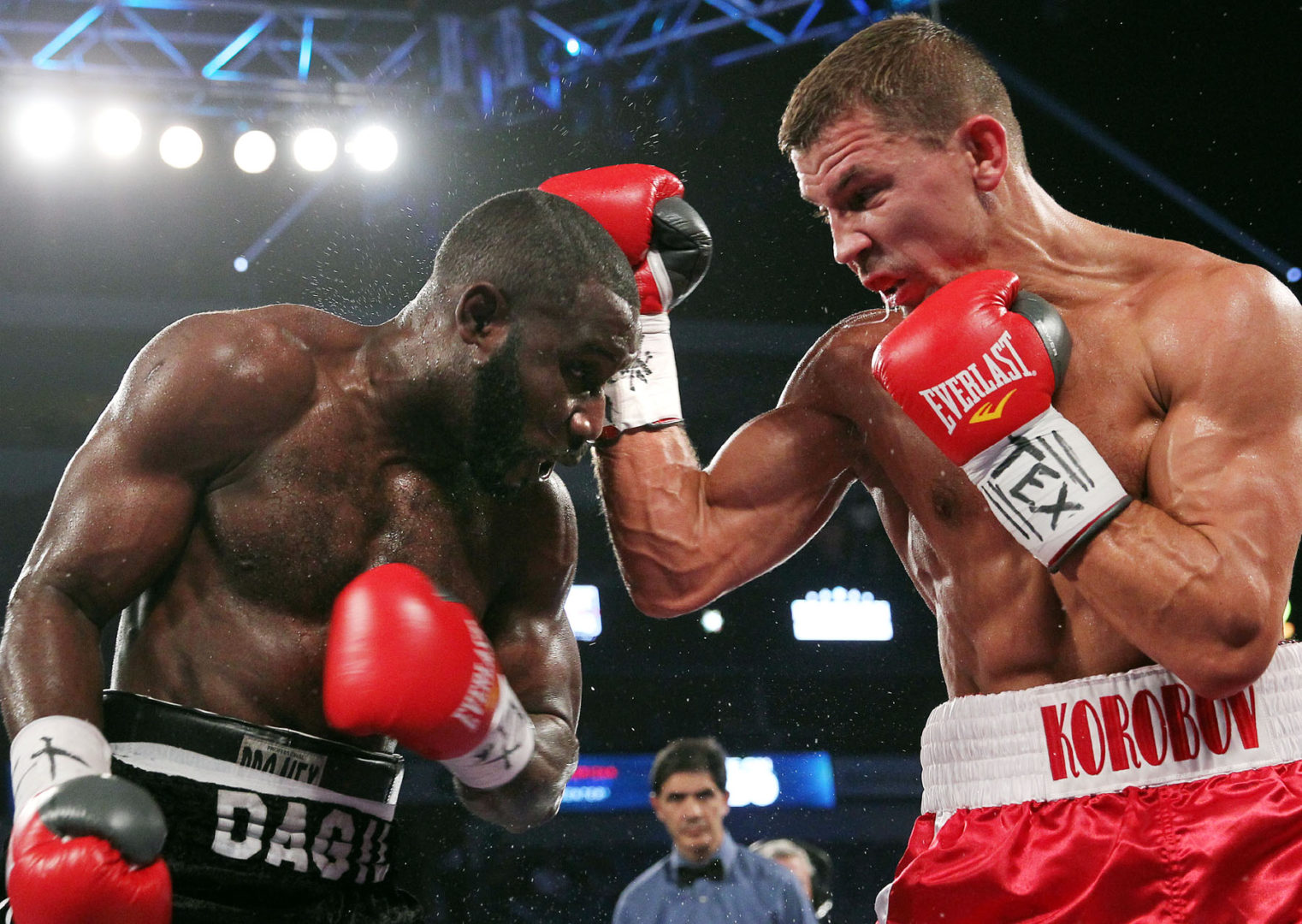


The Machinery of enthusiasm

Lucas Matthysse
“Yes, right,” said Argentine Lucas Matthysse in Spanish, Saturday, when asked if he next wished to fight junior welterweight champion Danny Garcia. “For that reason, I am thankful to Golden Boy and Al Haymon. They are going to get me that fight, and I know that it is going to be like that.”

Hear the difference in tone? It is not a translation trick but the firmness of a man expressing a proper understanding of power’s proper balance. Having undone Lamont Peterson in fewer than three rounds at Boardwalk Hall, Matthysse did not plead with his promoter to fulfill a contract tortured by an attorney from English to Latin and back, nor did he bend his knee in supplication to a manager or television exec. Matthysse instead gave a polite order to his American promoter, manager and network in the clear language of one genuinely empowered: Thank you in advance.

What you feel about Lucas “The Machine” Matthysse today is a thing to take measure of, perhaps record in a diary, and use as your standard to come, because what you feel is genuine enthusiasm, the euphoria of discovery, a sensation of hopefulness one gets when he realizes the world is a more original, entertaining place than previously surmised. The optimism comes from a place of promise: If this discovery happened, there was a wondrous thing out there I knew nothing about, which means there are other wondrous things out there I know nothing about, wondrous things I necessarily know nothing about knowing nothing about, and life might put them in my way, and what better reason to answer tomorrow’s alarmclock?

Everyone appears to realize the epiphany of Matthysse except Matthysse, and why would he? He is the person he expects himself to be, courteously indifferent and trancedly unbothered by what details modern fight fans think need admiring – entrance music, posse count, apparel sponsorships, purse sizes, management choices.

Ah, management choices; one of the more enchanting things about Matthysse is how he tells Jim Gray whatever he wishes after a fight because Gray works for Richard Schaefer who works for Al Haymon who works for Lucas Matthysse. For once a Haymon-managed fighter did not begin by thanking Haymon and God, reconfigurable in many fighters’ minds, but directed a man whom he pays as an employee. It is sensed, and quivers every brink-pink strand of their free-market pom-poms, while manifesting itself most deliciously in the spectacle of Schaefer arresting Gray’s microphone to whoop like an apprentice hype-man at a freestyle battle.

There is a financial component to this, of course; Matthysse understands what fellow Argentine Sergio Martinez, too, understands: He now needs his promotional team fractionally much as they need him. But there is also a cultural component one sees in other Latino phenoms like Saul “Canelo” Alvarez: They originate in lands where their country’s best athletes amassed incredible stores of celebrity and wealth in a sport, soccer (fútbol [whatever]), unbroadcasted by American networks. Alvarez visited with Mexican president Enrique Peña Nieto last month. Martinez’s last kickoff press conference was emceed by Argentine president Cristina Kirchner. To empathize with how such experiences might affect these men, an American can answer this question: After a meeting with Barack Obama, how seriously would I take a promoter promising I might, with his help, someday, if I’m incredibly lucky, make it to the prestigious airwaves of Showtime?

There will ever be a place for a handsome guy with knockout power in both hands, a place in our sport, a place in general sports lore, a place in popular culture at large, and even if Matthysse somehow does not know this, he necessarily senses it, and if he feels any compulsion whatever, and perhaps he does not, it is a compulsion to verily pain the man across from him, as he did in quick time against Lamont Peterson, Saturday.

Much could be deduced from the final instants of round 1, when Matthysse landed a leaping lefthook lead that imparted to Peterson such significance all athleticism fled Peterson’s legs in the minute that followed, a minute after this moment: At the bell Matthysse watched Peterson take his first steps towards the corner, with a predator’s facade, placid to a point of complacency, one not often seen since Juan Manuel Marquez studied Juan Diaz at the close of every round in Houston – like a disinterested curator pondering a work’s craquelure. “The Machine” confirmed about Peterson what Matthysse enters every fight suspecting of every opponent: He is fragile.

Matthysse then waited a few minutes before timing Peterson’s jab, using the twitch of Peterson’s left shoulder as a trigger, and spear-chiseling him with a right cross that drained the match of any suspense save: How badly will Lucas hurt Lamont?

Both men started left hooks in the middle of round 3, and while Matthysse’s arrived earlier by a piece of a second, the difference in the punches’ effects was anticipated by their hips, not their fists: Matthysse squared his feet and completed a 180-degree hip turn before his punch struck. Peterson threw his punch more correctly – short, balanced, fist pronated – and it made Matthysse’s eyes widen for a moment, which is now a solacing detail Peterson might find on replay, since Peterson was, by the time Matthysse reacted, dropping canvasward in the unresisting way unique to the freshly unconscious.

Welcome to boxing’s new pleasure, then, a comely man who unwreathes other men with a dispassionate glaze on his eyes that he rinses with tears at the mention of his daughter’s name on an American television channel he cares rather little about.

Bart Barry can be reached at bart.barrys.email (at) gmail.com
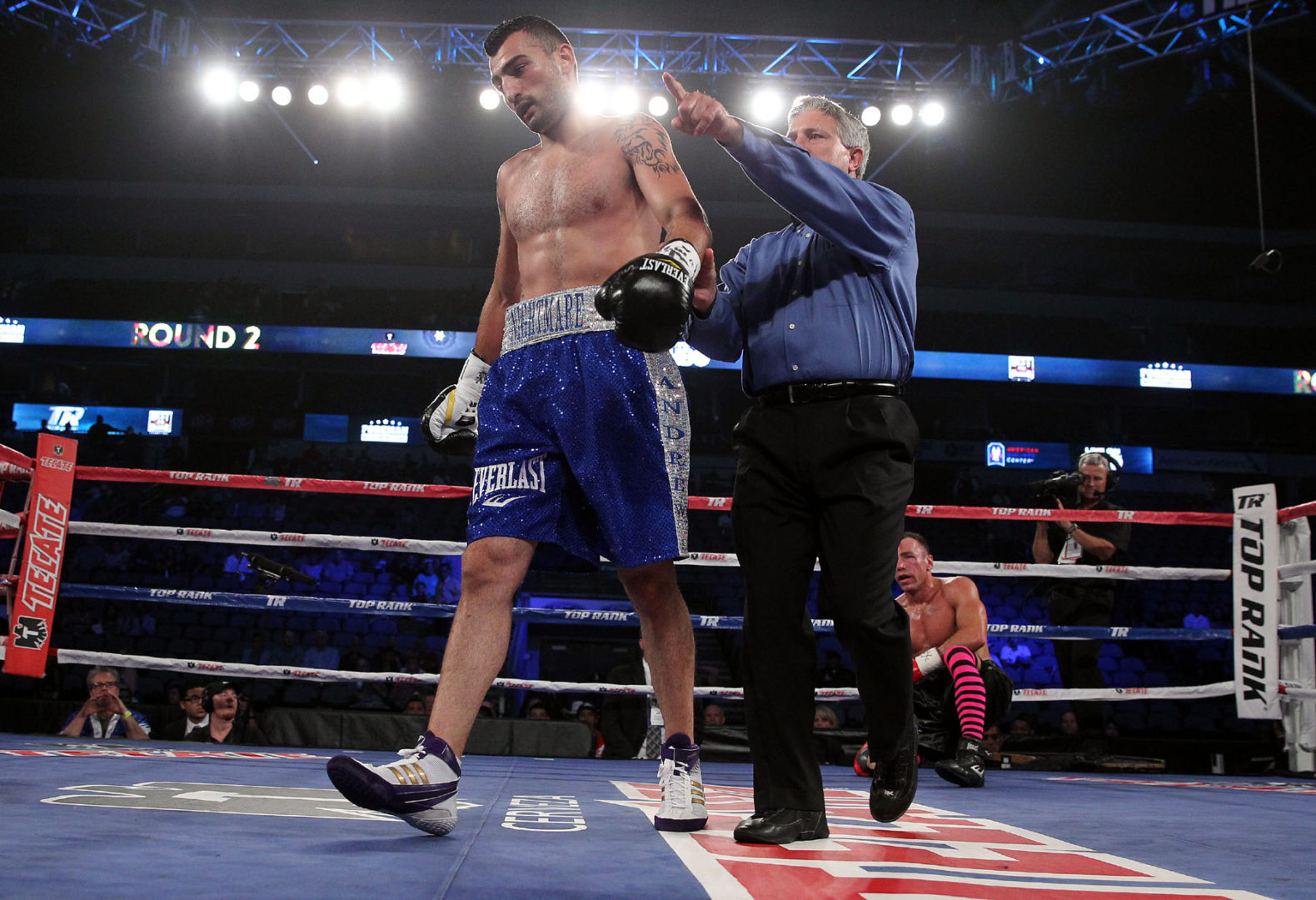


Un-forgiving Lamont Peterson

Lamont_Peterson
To return to aficionados’ better graces, Saturday Lamont Peterson must perform a stern act of contrition at Boardwalk Hall in Atlantic City, one from which his career is unlikely to emerge intact: a visit to the crucible Argentine Lucas Matthysse makes of a prizefighting ring, a place of penance whence no prizefighter returns undamaged.

What Peterson confronted when he faced Kendall Holt in February is not nearly what will confront him Saturday. Matthysse has none of Holt’s regard for personal safety; Holt possess a certain frailty, like all power punchers, a certain possibility of discouragement that seems untroubling to Matthysse – who luxuriates in knowing that no matter the result, so long as he applies himself relentlessly, his admirers, both male and female, will applaud him because his opponent will be hurt. A scroll through Matthysse’s BoxRec entry since 2009 is instructive: “Castaneda down three times” / “Judah down in rd 10” / “Corley down twice in the 5th, once in the 6th and 3 times in each of the 7th and 8th rounds” / “Alexander down once in rd 4” / “Soto down once at the end of rd 5” . . . and those don’t include what five other prizefights Matthysse ended prematurely.

Lamont Peterson, a man whose persona was fabricated upon making people feel good about him (and in self-interest’s anfractuous way, good about themselves by projection), a man whose career was resurrected after he won cleanly perhaps two rounds, though officially even fewer unanimously, against Timothy Bradley 3 1/2 years ago, resurrected after a draw with flighty Victor Ortiz in 2010 and a surprise decision victory over fragile Amir Khan in 2011, has fought but once in 18 months.

This is because Peterson’s confirmatory B sample came back positive one year ago last week for a banned substance later obfuscated as a non-enhancing form of “bioidentical testosterone derived from soy” by a doctor in the medical-research hotbed of Las Vegas, where Peterson went to be diagnosed with hypogonadism, a condition that caused the testosterone levels of this muscular, fully bearded professional athlete to be so perilously low it “literally shocked” his esteemed physician. Peterson has been forgiven mostly by fans and certainly by the IBF, whose junior welterweight belt he will not defend Saturday, for a pretty simple reason: Fans don’t care about the use of PEDs because fans are paying to be entertained, and athletes who use PEDs are more entertaining than athletes who do not.

There is a parallel to be draughted, a parallel worthy of much greater investigation than it will receive here and now, between the painters of the Renaissance and the athletes of today. In his formative work, “Secret Knowledge,” a book whose study would replace entire art-history departments were academia a meritocracy, British artist David Hockney asserts the historic progression that painting undertook before and during the Renaissance was a technological leap first of all. Beginning most evidently with Jan Van Eyck’s 1434 depiction of a golden chandelier in “The Arnolfini Wedding,” painters employed lenses, which took nature’s camera effect – one first commented on by the ancient Greeks – and projected subjects’ likenesses on a screen, from which they could be traced, a practice that continued uninterrupted until, about 400 years later, chemistry replaced the artist’s hand with a process that became known as photography.

When a person visits, say, National Gallery of Ireland and beholds Caravaggio’s seminal 1602 work, “The Taking of Christ,” and proclaims to her peers, why, it looks just like a photograph!, she doubtfully knows how very right she is. Caravaggio, like Van Eyck before him, and Velazquez and Vermeer after him, fulfilled a demand for realism made by his patrons: the most realistic image wins, and the means of accomplishing such realism should be protected assiduously as the trade secret it is. As Hockney returned to the masterpieces of the last half-millennium and scrutinized them with the improved eye of a skeptic, so might sports fans return to the accomplishments of the last 30 years at least – the records that were set, the feats of theretofore impossible athleticism now routinely accomplished – and assume guilt, always, contrary to what generous impulses they otherwise assign themselves.

Boxing fans were for the most part angry at Peterson for getting caught, if we’re being honest: They wanted a rematch, and Peterson’s carelessness got that rematch cancelled. Sportswriters, meanwhile, were more enraged by the false piety of the spectacle – from the promoter’s self-aggrandizement to the Peterson camp’s ludicrous explanation to the way Peterson’s positive results aged the florid prose with which writers adorned the story of upstanding Lamont, brother Anthony and trainer Barry. Lance Armstrong, now famous for cycling, taught the unscrupulous world of professional athletics how to put the First Amendment on ice with well-placed lawsuits – and that was before every contributor had to “agree to indemnify and hold harmless” his publisher. Telling a reader his hero was a product of chemistry more than work ethic was ever thankless, long before writers were legally liable, as individuals, for doing so.

While it was possible for master painters to take the lessons taught them by lenses and evolve beyond them – Rembrandt and Velazquez certainly did, and Vermeer used them creatively enough to make their obvious use an artform of its own – such is not and will never be possible for athletes, men whose talents are eclipsed by years at the same ages others’ talents are enhanced by them. Lamont Peterson will not return to the form he showed in training camp a year ago, or probably the form he showed against Amir Khan, or probably the form he showed against Timothy Bradley, such as it was, when he fights Lucas Matthysse.

This is a fine turn for all but a handful of Saturday viewers, as the rest of us would like nothing better than ghoulishly to indulge what sadistic impulses delight at others’ subjections to pain – and all the better if a sense of justice can be invoked.

Bart Barry can be reached at bart.barrys.email (at) gmail.com


A Mayday in September

Saturday heavyweight world champion Wladimir Klitschko knocked out a 240-pound Italian named Francesco Pianeta, and few in the United States without an internet connection saw it, and many fewer cared, because there is no interest in Klitschko; because he is dominant his fights are too predictable. Some hours later, in a fight many more Americans knew and cared about, Floyd Mayweather dominated challenger Robert Guerrero in predictable a match as fans have paid extra to see since Mayweather’s last.

In his first event since beating Miguel Cotto a year ago by slightly more lopsided scores than he beat Guerrero, Mayweather allowed Guerrero, and pay-per viewers, six minutes of hope the fight would be entertaining and Guerrero could be competitive, and then, his paycheck cleared, Mayweather snatched all hope away, strolling to a unanimous decision and promising, as he does every year, to fight again soon – early, this time, as September.

The worst blow the Mayweather brand could sustain would be an increase in its namesake’s activity. His admirers ask to see more of him because it is the reasonable request any admirer makes any object of his affection, a request that relies upon a humility that goes: I am not observant enough to capture all your colors and luminosity on first sight and must look and look again and more closely till I have cataloged the entirety of your charms.

But the prefight Mayweather documentaries, saturating and interchangeable, revealed this: The more time you spend round Mayweather, the duller he gets. Have you ever seen so many people nodding-off, catching naps or crashed on couches, while the subject of a documentary – a subject worthy of a documentary, rather – is awake and performing? Showtime featured four or five documentaries on Mayweather, or perhaps they were two, or 47 (it’s impossible for an average mind to keep them separate), that held a revelation and a question: First, everyone falls asleep after a couple hours in Mayweather’s presence, and second, did a 36-year-old really just write his name on the steamed window of a shower door?

A Mayweather event is more spectacle than combat, more fashion art than fine art, and absolutely worth the 70 annual dollars that has become its tariff. But who that has $140 of disposable income – as opposed to money borrowed from mom – would pay it to watch the spectacle twice? It is a question Showtime unadvisedly will answer if given its druthers, one Mayweather is probably too wise to answer. An all-time great handicapper of challengers, Mayweather is too knowledgeable about boxing to find his prizefights entertaining enough to watch twice.

Were he able regularly to end his matches with violence, like he ended Ricky Hatton or even Victor Ortiz, tip the highlight-reel maker, as it were, instead of doffing his cap at B+ opponents postfight, he could work at Manny Pacquiao’s previous rate, or at least try his (right) hand at it. Therein lies the problem: Mayweather’s best punch is the potshot right – a demonstrated susceptibility to which will land you a fight with Mayweather quickest of all – but that hand is brittle a weapon as there is in our beloved sport.

A man does not strike another easily with one punch as Mayweather began to do to Guerrero with righthands in round 3 and then stop unless his hand is fragile or he wishes to carry his opponent. While either is possible when a salesman like Mayweather makes a fight with an opponent pedestrian as Guerrero, probability favors Mayweather’s history of hand problems, though Mayweather detractors are cautioned not to become hopeful about the future: His fight with Carlos Baldomir showed “Money” is still less entertaining in a one-handed fight.

Saturday’s match followed Mayweather’s three-part design; there were the studying rounds followed by the potshotting rounds followed by the uppercutting rounds. Guerrero was a relevance during the first part; Mayweather tied him up and tasted his counters and drew the perimeter in which he might creatively roam for the next half hour. After the second round, Guerrero was a target, interchangeable with Shane Mosley or Oscar De La Hoya.

Mayweather confounded Guerrero by hitting him with righthands from everywhere, hard, accurate, stinging punches Guerrero likely fancied himself walking through in training camp without fancying how impossibly far away Mayweather would be by the time Guerrero’s neurons registered the punch, without fathoming Mayweather’s head and foot would follow directly behind his glove, on a plane so confoundingly low to Guerrero’s left-cross counter they might well have been attached.

Then Guerrero was too confused to hurt Mayweather by any one punch he landed, every punch now thrown from a tentative mien that asked over and again “Is this an opening or a trap?” – then once Guerrero realized it was an opening and tried to repeat the punch, the opening was gone. To hurt Mayweather, as Mosely did, you must put all your confidence behind a punch that exploits an actual opening; it is boxing’s rarest occurrence because you are hoping, not exploiting, in the opening rounds, and by the time you are familiar enough with Mayweather’s rhythm and patterns to see an actual opening, you no longer have confidence enough to make a dent.

Part three of the Mayweather design was to drop a then-desperate Guerrero on right uppercuts the way Andre Berto did. This final phase failed only because Mayweather lacked the commitment to throw his evidently damaged right hand with the force required to position it properly for greeting Guerrero’s downrushing chin.

Mayweather is in danger now of becoming Wladimir Klitschko. He is a fighter too dominant for his own good who may be about to learn it is disproportionately easier to filch $70/year from American consumers than $140. Mayweather’s next fight will open at odds even with those that say it will not do a million buys.

Bart Barry can be reached at bart.barrys.email (at) gmail.com
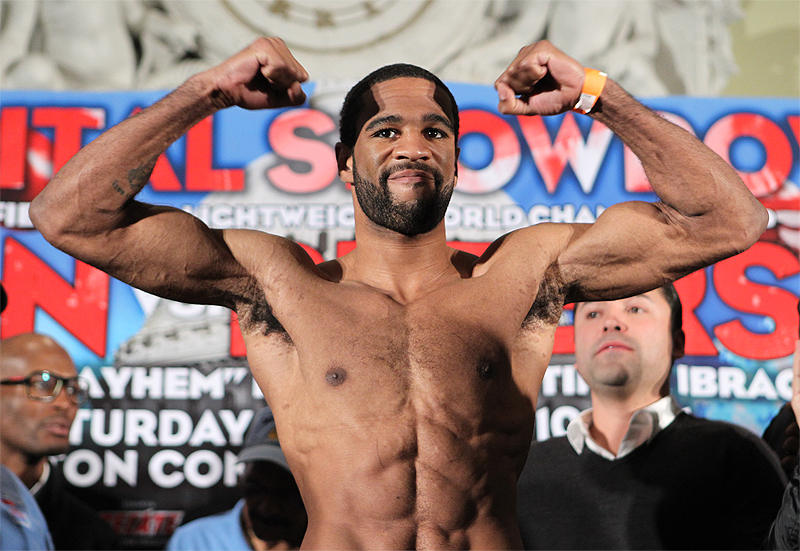


Martinez and Datsyuk: The erosion of reflex in great figures of preparedness and grit

Sergio_Martinez
DALLAS – The career of middleweight champion Sergio Martinez will not end any better than our sport ends its every practitioner’s career, and that is an unfortunate revelation made obvious Saturday, when the Argentine Martinez made a homecoming title defense against Englishman Martin Murray and won a unanimous decision narrower than what its three rainswept judges, surrounded in a soccer stadium by 40,000 Argentines, tallied. The decision was not controversial because the decision was really not the point at all.

This was an exhibition, a career retrospective of Martinez’s works, and if it was rougher than planned for the homecoming champion, a scrap more than a celebration, it will not appear that way in the official record, which reads Martinez UD-12 Murray.

There is a level of introspection to Sergio Martinez that is rare among professional athletes in general and prizefighters in particular, perhaps because Martinez did not come to acclaim until he was well in his 30s, which is to impart Sergio Martinez knew himself, what he was and what he thought of what he was, before others could tell him what he was and what they thought of what he thought of what he was. There is a composure to Martinez, an affability, a willingness to show vulnerability – yes, that is the differentiating word: vulnerability – rare among professional athletes and all but impossible among prizefighters.

I spoke to him in January, nearer his penultimate fight than Saturday’s, and he was willing to describe, in surprising detail and self-deprecation, what discomfortingly intense moments ended his September match with Julio Cesar Chavez Jr. He treated rage-at-self and what drunkenness comes from sipping a homebrew of fatigue and abuse, and the revelatory fact nothing at the end went as he prepared it to go. Immediately after that I borrowed Thomas Hauser’s advice and asked Martinez what question he would ask those who ask him questions, his interviewers, if given the chance.

His answer was unique and personal: “What is the key to finding inspiration to write?” He spoke of what travails he encountered working on his first book, the hours cum days cum weeks of a blank page followed unexpectedly by a visit from the muse at three in the morning. Readers of this column will be unsurprised by how I answered: You must be willing to write garbage, Sergio, to keep your fingers flurrying on the keys, knowing your first draft is likely to be schlock anyway, and so why belabor it?

Saturday I was not in Buenos Aires, or Brooklyn, but rather at the final professional hockey game of the 2013 season in Lone Star State, this city’s Stars against the Detroit Red Wings, and I was not there to see either team or even the game of hockey, particularly, one I played through my adolescence, but rather an individual who plays the game close to perfectly as I have seen done: Pavel Datsyuk. His connection to Martinez is that Martinez is the professional athlete Datsyuk just edges on my list of favorite professional athletes. There is no one in any sport I appreciate more than Datsyuk.

I did not watch Saturday’s game, consequential as it was for the Red Wings franchise, but Pavel Datsyuk. When he was on the ice I followed him to the exclusion of the puck, and when he was not on the ice I was distracted, like other Texans, by campy fan-appreciation giveaways, shapely ice girls in lycra bottoms and a themeless potpourri of loud music. Datsyuk’s skating skills are now quietly eroded by knee surgeries; it is why he conserves energy by making large Cs more than large strides, more and more. His warmup stretching routine is novel for all the contortions it comprises, and his pregame skate was noteworthy for the number of times he lost edges, and the way he stood apart from the rest of the team, making passes to invisible marks on the boards, as his teammates swooped round him. While others collected pucks to fire at the Red Wings goalies – at them, not by them, by design – Datsyuk stood in innocuous places on the ice, passing the puck between the skates of his teammates to private spots on the boards.

Datsyuk is known in the league as “The Magician” for the innovative way he handles the puck, but that is missing the point of his greatness, which is a preparedness leavened by grit; no one makes it to the NHL without he can do things with a rubber disk and blacktaped blade of wood others appreciate in direct proportion to what hours they’ve practiced the same – which is altogether different from impressing naïfs and dilettantes, or Texans – but Datsyuk’s greatness is found in his individual battles with other men put on earth, they believe, only to play hockey. He defeats these men by being as good from either side of the puck, forehand or back, as no one before him has.

Martinez, for an enchanted stretch, bore a similarity to this. He stood before larger men and discouraged them, dis-couraged them, by causing their professionally aimed shots to miss by fractions of acceptable spaces in ways they could not predict. Martinez no longer has this capacity – as Martin Murray proved often, Saturday, but most especially in round 6, when Martinez invited Murray to discourage himself by missing Martinez repeatedly, and Murray repeatedly did not miss. Martinez hasn’t the technical perfection to perform adequately against larger men now that his reflexes have been taken by those larger men and what repairs to his body they’ve made necessary.

Saturday’s postfight happenings brought word Martinez will not return till April 2014. Better to call it a career, now, having filled a venue with his countrymen in a way no American prizefighter has done in decades.

Bart Barry can be reached at bart.barrys.email (at) gmail.com