The Mares and Garcia composition

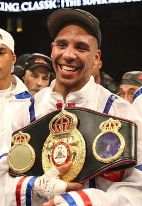
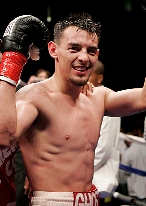
Taken in composite, Mexican Abner Mares and American Mikey Garcia make a quite compelling fighter, and despite competing networks and the promoters that milk and direct them, Saturday brought a chance to see the men in a composite – not to compare them, though that day might yet come, and neither to see how they complement each other, but rather to see how, together, as the important fighters on their respective cards, Mares as main on Showtime and Garcia as co-main on HBO, they made Saturday an enjoyment.

Garcia, who found a late replacement for Mexican Orlando Salido in Argentine Jonathan Barros, who was overmatched then not overmatched then, yes, overmatched, enjoys a credibility advantage because of who promotes him, and that might as well be set forth early: Top Rank is good at developing fighters, as fighters then attractions, as any promotional company in boxing history. Golden Boy Promotions is not, or certainly not yet.

Top Rank makes a high virtue of never putting a fighter in a match for which he is unprepared; when a Top Rank project like Julio Cesar Chavez Jr. or Juan Manuel Lopez loses, it is not because Top Rank hurried him but rather Top Rank, or more specifically Bruce Trampler, our sport’s finest noncombatant practitioner, believes nothing more can be done to prepare him for what elite opponents remain. Once a fighter has proved himself fully developed, Top Rank’s bent changes from research and development to sales; while prospect Alex Saucedo’s next opponent is being chosen right now to determine and maximize Saucedo’s potential as a prizefighter, regardless of what revenue he brings in 2013, Manny Pacquiao’s next opponent was chosen to maximize Top Rank’s earnings. An excellent model, that.

Golden Boy is all sales all the time. Projects appear chosen for their bilingualism and beauty – the assets responsible for Oscar De La Hoya’s ascent, his company believes – or other qualities that strike scouts as exceedingly marketable. Golden Boy’s is not a model sustainable as Top Rank’s because it involves either overpaying for proven commodities or investing in developmental ventures that go nowhere for their want of selection criteria and strategy. Abner Mares is the exception.

Saturday at Staples Center in Los Angeles, Mares made another brutal and entertaining match against another well-regarded opponent, a Panamanian named Anselmo Moreno, who, in aficionados’ imaginations at least, had the exact tools to disarm him. Mares can be disarmed but not dissuaded, so long as an opponent allows him to move recklessly, and therefore wreckingly, forward. He is a consummate Mexican prizefighter in this sense, all tenacity and hooks to the body with an overhand right he hurls head-down, though he’s somewhat less Mexican in his devotion to fouling energetically till the referee stops him. A traditional Mexican code says a prizefighter solely fouls an opponent he is not man enough to defeat fairly – and that ethic says it is better to lose honorably to a better man, in a fight to unconsciousness or worse, than foul one’s way to a different outcome.

Mares’ methods, in this sense, seek refuge in American clichés: “winning is everything”, “if you’re not cheating you’re not trying”, “bend the rules to their breaking point”. Mares charges to set his shoulders beneath your elbows, a position in which he has you handcuffed and is free to whale away, and if you retaliate by setting yourself on the back of his neck, to push his lowered head a little lower, he blasts you in the balls then comes up shrugging. He does not have-to throw that punch, no, but then you didn’t have to lean on his neck, and he knows the worst that cup shot will bring is a double warning, offsetting fouls, and whereas he had every choice to throw that punch or not, you had little choice to do what you did. You’ll do it again, reflexively, a few more times, and if the referee does not penalize you, Mares’ll put knuckles where your cherries grow in the meantime.

Mares gets, and quite possibly deserves, the benefit of officiating doubts because he is trying to make a fight at every moment of every match, to a point of dropping his shiny purple gloves and loping after an opponent, as he did in the 12th round Saturday. Mikey Garcia would not do that. He is more polished than Mares, more apt to throw the perfect punch with perfect leverage at the perfect moment. Garcia is fantastic but also imperfect, as we got reminded Saturday.

That Garcia is hittable is not truly worrisome; while there was nothing edifying about how he turned away from Barros after the Argentine’s left hook snapped his chin in round 7, aficionados appropriately trust if Garcia hadn’t a chin, his promoter would have discovered that 15 fights ago. It’s the technical flaws that bring concern with Garcia, specifically an urge to parry, with his right hand, jabs to the body. That is a major no-no and sets one to imagining what’ll happen the first time Orlando Salido, or worse, Yuriorkis Gamboa, feints that jab, watches Garcia’s right hand drop, and remortgages his home on a left hook to Garcia’s right chin. Salido will answer that question graciously, and perhaps gratuitously, in Garcia’s next fight in January, while being more durable before Garcia’s own left hook than Barros was.

Abner Mares wants his next opponent to be Top Rank’s Nonito Donaire, and it was refreshingly uncouth the way Mares demanded that Saturday. Donaire’s December opponent, Mexican Jorge Arce, was not, in his prime six years ago, good as Mares is right now, and one can rightfully assume if Donaire-Mares never happens it is because Top Rank did not think Donaire was ready, or did believe there was much more and easier money elsewhere.

Bart Barry can be reached at bart.barrys.email (at) gmail.com.


Four more years: Consequence vs. eventfulness

This will not be a political piece by any means other than its acknowledgement of what tomorrow, known in these United States as the first Tuesday after the first Monday in November, or Election Day, will bring, which, it predicts here, is four more years, because American history says it requires a remarkable political talent to overcome the myriad of advantages an incumbent President enjoys, and this year’s challenger enjoys some talents shy of a myriad.

If four more years is how things are fated to go Tuesday, it is not a bad way to think about boxing this week, as the next four years will move us far from where we are now. In November 2016, Floyd Mayweather will be months from his 40th birthday, Manny Pacquiao will be heading to 38, and both Juan Manuel Marquez and Sergio Martinez will be too old to be making a living in combat – though Bernard Hopkins, 51 years young and still citing Graterford, will likely be calling someone out, and HBO will be negotiating a way to broadcast it with options on future matches if he wins.

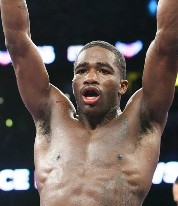
The apparent bet is Adrien Broner will, in 2016, be an approximation of what Floyd Mayweather is right now. An approximation or facsimile is all “The Problem” will be because he’ll not have the benefit of discovery Mayweather has. Whatever one opines of Mayweather’s villainous “Money” character, Mayweather deserves recognition aplenty for inventing it, recognition whose reserves will not be spent on Broner if he never becomes more than Money May with a talking hairbrush, his current azimuth.

Or perhaps Broner will in four years be where most imitators end up in American entertainment: making an unreasonably good living as a courier from the last innovator to the next. We’ll surely not be rid of him, no matter what happens Nov. 17 within or without the confines of a new stretch of beach formerly known as Atlantic City, where Broner is scheduled to confront Mexican southpaw Antonio Demarco in what will be at least Broner’s biggest test in four fights and quite possibly more than he can handle. Broner-Demarco is the most consequential fight from here to New Year’s because its outcome is unknowable and will tell us if boxing is headed where its plotters and plotting wish to take our wallets.

Rocky Juarez’s upset of Antonio Escalante in San Antonio a few Saturdays ago brings a timely reminder: No favorite is safe in the main event of a Golden Boy Promotions card, especially if he is aligned with Golden Boy Promotions. If Broner or his team knows what they’re courting with Antonio Demarco, no evidence suggests it. Broner’s high self-esteem, one suspects, keeps him from watching others’ highlight reels, and Broner’s promoter never knows what an opponent will bring.

Broner’s shoulder-rolling, counter-right-uppercutting style is all wrong for a well-chinned southpaw three inches taller than him, a man whose straight left is the punch that picks the shoulder-roll lock (six years since Money May’s last southpaw opponent is no coincidence), one who brutalized Jorge Linares, a Venezuelan more highly touted by aficionados in his day than Broner is now, last year, and needed less than a minute to stop John Molina (24-0) in September. Demarco can be beaten, the late and prodigious Edwin Valero proved that, but Broner (24-0) has yet to merit inclusion in Valero’s company, which is a fine reminder of what makes this fight indeed so consequential: If Broner beats Demarco, however he does it, and especially if he does it spectacularly, the sharp edge of aficionados’ resentment will be dulled. Broner’s next four soft touches on HBO may not be suffered gladly, but neither will they be accompanied by feelings of betrayal for those exulting in the hairbrush narrative or the hairbrush narrator.

That a commodity annoyingly unproven as Broner can be in the most consequential of upcoming fights, with Manny Pacquiao and Juan Manuel Marquez set to take their rivalry from trilogy to tetralogy three weeks later, uncovers a comment on the difference between consequence and eventfulness. Pacquiao-Marquez IV at MGM Grand on Dec. 8 will be the largest event of the second half of the year, but it will not be consequential because no one mistakes the likely winner, Marquez this time, as the future of prizefighting, and even the specter of Marquez ending (muted) calls for The Fight to Save Boxing now brings with it a fraction of schadenfreude’s once tangy delight. Time and other agents, but time most of all, have corroded the fantastical Pacquiao-Mayweather brand such that even Pacquiao’s unexpectedly stopping – in his fourth try – a man Mayweather whitewashed three years ago will bring demands barely more than perfunctory for them finally to settle accounts in the ring. Make no mistake about either man’s coming need to settle accounts, though.

Chances are good Pacquiao will be busy enough this time against Marquez to win on cards scored with a 2009 pen but will see his opponent, for the second time in 2012, shown all the scoring benefits Pacquiao once enjoyed. That should be for Mayweather a frightening outcome while he plans next year’s Vegas fundraiser, particularly if Adrien Broner, the man scheduled to replace him, does something definitive against Antonio Demarco.

Bart Barry can be reached at bart.barrys.email (at) gmail.com


Juarez reminds; Leija recalls

SAN ANTONIO – Three miles east of the Alamodome stands Freeman Coliseum in the southwestern part of an enormous lot it shares with AT&T Center, home of the Spurs. Saturday evening Freeman felt cavernous because it was mostly empty, especially compared to the Vicente Fernandez concert nextdoor. Nevertheless old Freeman allowed a redemptive act to happen in its ring, an act made by Houston’s Rocky Juarez – boxing’s serial contender.

There stood Juarez prefight, waiting in the smoke of an improvised made-for-televisión walkway next to a curtain that covered empty space in the back of an historic old arena, where a locker room and a steep gray ramp and little else were. He was in white, green and gold, and serious. Serious is the word; none other works for Rocky – not charismatic or enticing, certainly, though perhaps humble.

Juarez is humble and serious, like a Mexican prizefighter with a countenance more Asian than Spanish, though Texas-born, and once a standout in USA Boxing before it was an embarrassment. Professional is the other word for Juarez, a man who, no matter what palpable discouragement preceded his career’s palpable disappointments, soldiered forward, pressuring and attacking in a style nostalgic for a 15th round, without ever quite getting to the place that makes special fighters.

There was a moment in most every prime-Juarez fight when he, as the shorter man with the shorter brown arms, maneuvered himself through footwork efficient and proper to just the spot from which to throw decisive punches. Then he paused. It was rarely more than an instant, but an instant that still expands in supporters’ minds today till it is mostly what they recall of Juarez’s championship challenges.

That instant when Rocky paused to ensure all was just right, and everything got away. The opponent, shocked by his good fortune, escaped, or did something – a parrying jab or wildly missed hook, or anything – that caused Juarez to doubt himself, reset and return to the hard task of maneuvering back in range (or get caught, one time, with an audacious right-uppercut lead Juan Manuel Marquez threw his way in their 2007 fight in Tucson, Ariz., when the air audibly escaped the hydraulics of Juarez’s fighting spirit). Rocky: walking to his corner, red blood streaming from a deep and accidental cut, smart enough to wonder how the hell he’d got hit with such a punch, schooled enough to know what it portended.

Rocky: head bowed, seriousness and frustration all over his face, but not urgency, no urgency, shuffling to his corner after each round of his second fight with Marco Antonio Barrera, a Las Vegas rematch of a 2006 fight Juarez deserved to win in Los Angeles four months earlier, a second fight whose closing bell saw Barrera, spiteful in a way few yet realized, spit his mouthguard in his palm and chase Juarez to the Houstonian’s corner to tell him, as Barrera recounted in the mall at Caesar’s Palace an afternoon later: I will always be a master, and you will always be a student.

Before five months had passed there was Juarez at Desert Diamond Casino in a “Solo Boxeo” main event, when Telefutura still had a franchise of which it was proud and protective, willing to fight for a fraction what he’d been paid on Mexican Independence Day. “The way I look at it, this is the most money I’ve ever made for a Telefutura fight,” Juarez said with a nod, not a shrug: serious. He got other chances, and he never got there. So he became an opponent, a target with a name and something of a following, whose defeat might bolster the credibility of a new promotional signee.

Do not doubt that was the plan Saturday when Juarez, 0-6-1 these last four years, got matched against Antonio Escalante, recent signee of a three-fight deal with Golden Boy Promotions. Aside from the main event, the blue corner – from which Juarez fought – went 1-5, Saturday. But Juarez, the b-side who emerged from that improvised white smoke to precede the new signee to the ring, made a professional spectacle of himself, throwing properly leveraged if less telegenic punches at Escalante, dropping him in the third and finishing him in the eighth, and drawing a line beneath Golden Boy Promotions’ inability to spot talent and inability to learn to spot talent.

There was, for once, a small sense of joy at a Juarez fight, especially in the shiny black chairs of Freeman Coliseum’s tiny, empty media section, where a very few of us who’d attended a number of Juarez fights smiled at Rocky’s unlikely accomplishment. In its size and location – now 20 rows back of the ring – and dwindled attendance, Freeman Coliseum’s media section worked well as any metaphor for the boxing community at large when the honorary 10-count came for trainer Emanuel Steward, who passed away after a short fight with a vicious disease, Thursday.

This followed a reminder of how small boxing’s community is, Friday afternoon, when James Leija, one half of Saturday’s Freeman Coliseum host, Leija-Battah Promotions, spoke about Steward, who, posterity oughtn’t forget, worked Leija’s corner at Alamodome in the first of Leija’s four matches against Azumah Nelson, 19 years ago.

“I even posted something on Facebook where it was he and I in the ring when he worked the corner,” said Leija. “During my whole career, it was one of those things where, whenever he sees you, he says, ‘I’ll never forget those guns at the Alamodome.’ He always brought that up, and that was one of those things we had going: ‘I remember walking out to the ring, and those guns blaring.’

“During the fight, he was saying, ‘Keep your jab up high, keep your jab up high.’ What he meant by that was: Don’t drop your jab, because Azumah Nelson’s trying to counter.

“We’d talk in Vegas or wherever we saw each other, and he’d go, ‘I’ll never forget those guns!’

“And he always had that smile.”

Bart Barry can be reached at bart.barrys.email (at) gmail.com


Alamo City beat down: Juarez stops Escalante


SAN ANTONIO – Whenever a boxing match can be reduced to a good athlete versus a good fighter, one is advised to bet the fighter. Rocky Juarez, for all his career’s near misses in championship matches, has never been mistaken for less than a professional fighter. Antonio Escalante, for all his athleticism, was out of his depth with a man precise and serious as Juarez, and it told.

Saturday at Freeman Coliseum a few miles east of the downtown area, in the main event of a sparsely attended seven-fight card presented by Leija-Battah Promotions and televised by Telefutura, Houston junior lightweight Rocky Juarez (29-10-1, 21 KOs) stalked, stung, dropped and ultimately beat-down El Paso’s Antonio Escalante (27-5, 19 KOs), stopping him at 1:29 of round 8.

“I want to fight the biggest names at 126,” Juarez said afterwards. “I’m in the gym. I’m focused. I knew I was going to knock him out.”

After an opening round that was close and saw Escalante busier and Juarez more powerful, the next two stanzas found Juarez gradually grinding Escalante down. Escalante would throw more and land more, but every punch Juarez landed, whether a left to the body or a counter right cross, mattered more. Escalante looked impressive. Juarez was effective.

“I’m not interested in fighting at 130,” Juarez said, when asked afterwards about the prospect of a match against Gary Russell Jr. “I want to fight the biggest names at 126.”

After dropping Escalante in round 3, Juarez allowed Escalante’s confidence to return in the fourth, fifth and sixth – making those at ringside familiar with Juarez’s litany of near-misses apprehensive. The seventh, however, saw Juarez land a left hook to the body followed by an overhand right that wobbled Escalante. The end was preordained after that. Juarez charged out his corner at the beginning of round 8 and beat on Escalante till referee John Schorle abided no more.

BENJAMIN WHITAKER VS. JAWNTA MANSON
Saturday’s opening bout saw local middleweight Benjamin “Baby Boy” Whitaker (2-0) continue a career that began in August on another Leija-Battah Promotions card against a tricky and awkward opponent. Saturday’s opponent, Austin’s Jawnta Manson (2-3-3 1 KO), was neither as tricky nor as awkward as Whitaker’s debut opponent, though, despite his appearance, he was conditioned well enough to take Whitaker’s best punches – which, Saturday, were right crosses.

Both men began at a quick pace and exchanged zealously in the fight’s opening round. But a few Whitaker left-hook counters took most of the fight out of Manson. Soon enough, Whitaker detected it and began to deliver left hooks to Manson’s soft midsection. The hooks led to crosses, and the crosses brought a knockdown.

All three judges saw the fight Whitaker’s way, giving “Baby Boy” his second career decision win.

KENDO CASTANEDA VS. ALBERT ROMERO
Pro debuts before hometown crowds are supposed to be highlight-reel affairs: The celebrated local amateur comes in, throws his favorite combination, the designated opponent folds, and talk of future golden belts fills the arena. None of that happened for San Antonio lightweight Kendo Castaneda (1-0) against Austin’s Albert Romero (1-3-1) Saturday.

After starting well, gliding and setting and popping Romero in the first round, things got tougher for Castaneda in the second. By the third, as he pressed Romero to the ropes, collapsed space too much and put himself in a place Romero was comfortable having him, Castaneda began to eat left hands from his southpaw opponent. Castaneda, whose heart proved his best asset, nevertheless fought back gamely, worked through his difficulties and dropped Romero as the bell rang to end the fourth and final round.

That knockdown was decisive, as Castaneda escaped his debut with a unanimous decision victory – three scores of 38-37 – that was going in the books as a draw till the last instant.

UNDERCARD
Saturday’s co-main event, California featherweight Julian Ramirez (5-0, 4 KOs) against Fort Worth’s Steven Gutierrez (4-2-1, 2 KOs), started fast, continued fast, and ended violently, with the southpaw Ramirez too good from the outside and the inside, defeating Gutierrez by knockout at 0:16 of round 5.

Among the evening’s most entertaining bouts was a four-round scrap between Texas lightweights, Saul Montes (3-0) from San Antonio and Marty Gutierrez (1-1) of Robstown, a match Montes won by unanimous decision despite fading late and employing a genuinely bizarre habit of touching his lead glove to his trunks before throwing each jab.

Opening bell rang on the professional portion of the card in a quiet Freeman Coliseum at 7:20 PM local time.


Erik Morales’ Terrible goodbye


This is not a grateful farewell to Erik Morales. That column happened six years ago, when it was still merited. This, rather, is an acknowledgement “El Terrible” has fully amortized his legend and no more is due him. No longer must his failures in the ring be treated in reverent, hushed words wrapped with dignity. Anymore, the dignified aura Morales wears is a projection – some combination of a recently more approachable self when his gloves are off, and aficionados’ appreciativeness for what he gave us the first 50 matches of his career.

There was nothing dignified about Morales’ performance Saturday in the inaugural main event of Brooklyn, N.Y.’s Barclays Center, and there was nothing dignified about the maneuvering last week to ensure it went off. And there was nothing dignified – splendid, perhaps, but not dignified – about the way Danny “Swift” Garcia defended his junior welterweight titles by screwing Morales into the blue mat with a gorgeous left hook at 1:23 of round 4, after taking Morales’ measure in the final minute of the opening round by nimbly retreating from Morales and noticing he did not bother to give chase.

Morales is Erik the Terrible no longer. He is Erik the bloated, today, Erik the uninterested, Erik the mercenary, Erik the unmotivated salesman who tells you he’s got a product that sells itself. The “El Terrible” to remember and tell kids about ended his career with aplomb March 19, 2005. That night Morales, having lost the third match of his trilogy with Marco Antonio Barrera fewer than four months ago, beat back the man becoming known as “The Mexicutioner.” That night, in a show of mindless bravery, Morales, leading on all scorecards after 11 rounds, fought Manny Pacquiao as a southpaw for the 12th, an act in contemporary prizefighting without equivalent.

Since then Morales’ record in world title fights is 1-6. The best part of Morales’ career was over when Barrera was through with him, though no one suspected it. The prime Morales looked starved, his ribs countable on a skinny, almost weird body that conjured paeans to malnutrition more than athleticism. He looked frail enough for his fellow Mexicans to go for those ribs, and his liver, and get served right-uppercut counters unlike anything their palates knew before.

Within six months of his signature victory over Pacquiao, though, Morales’ face was puffy in a way it has been ever since, flesh glommed onto the pits where his cheeks were once hollow – when his lightweight debut saw him undressed by Philadelphian Zahir Raheem. Saturday it was Garcia, a different Philadelphian, who undressed him. More accurately: Morales got stripped, not undressed, Saturday, the remnants of his greatness in a prizefighting ring yanked from one arm, spinning him rightwards, then snapped off his legs, spinning him left.

In a merciful twist Morales should find absurd on reflection, the lower two ropes preserved years on the end of his life. Had Garcia’s seeing-eye left hook caught Morales in the center of the ring, Morales’ torqued shoulders would have pushed into the blue mat and bounced the back of his head off of padded plywood, jostling his brain and ageing it still further. The knockout was violent enough to bring Morales’ chief second rushing at the same ropes that now tangled his charge and struggling through them as the 10-count commenced. If Morales wanted an exclamation point on the end of a sentence that told him to give up boxing, Garcia put two punctuation marks on it in homage to their Spanish heritage: ¡Retírate ya!

It is no longer easy to doubt Morales’ capacity for absurdity as it once was, because Morales is no longer as honest a prizefighter as he once was. There was a time his then-promoter Bob Arum rightly compared El Terrible to Marvelous Marvin Hagler – a professional who showed up and fought whomever under whatever circumstances. There was a refreshing obliviousness about Morales then; if he knew what others opined of him, he did not let on. He has long been more self-aware than that, long been fluent enough in English to know exactly what is written and said of him and react to it, but this awareness of himself as a legendary figure whom tradition stopped constraining years ago, the awareness he now brings beneath a layer of fat to each weighin, is unseemly.

Did he take the banned substance clenbuterol to suppress his appetite during training camp – as U.S. Anti-Doping Agency’s samples A and B and C and D but apparently not E and F indicated last week? More must be learned on that score, but no disinterested observer can put banned substances outside the reach of any modern athlete, much less one whose name has long cashed checks his body was unable to cover. Most disinterested observers should admit, too, American sportsfans don’t care a bit about PEDs, deep down, as the NFL’s popularity in America would be said to have grown proportionately with its players – had the league’s 53,200-percent increase in 300-pound players between 1970 and 2010 not made that a mathematical impossibility.

Nutritional pharmacology is a science like economics, not physics – filled, that is, with invented constructs, like “metabolism” and “caloric value,” used to obfuscate more than clarify – but this much about the effects of central nervous system (CNS) stimulants like clenbuterol can be proved: They suppress appetite and race the heart. Coming off them, though, is a horror of deep headaches and malaise. It is an understatement, indeed, to say a suddenly clean athlete whose body has acclimated itself to CNS-stimulant use might begin a competition, or even the perusal of a morning newspaper, “sluggishly.”

Would clenbuterol, known colloquially as “clen” in boxing gyms everywhere, make it easier for an aged fighter like Morales to starve himself but still have adequate energy and concentration for the daily toil and boredom of a training camp?

Does Antonio Margarito like ephedrine with his coffee?

Bart Barry can be reached at bart.barrys.email (at) gmail.com


The right way

Here’s what happened Saturday. An excellent junior welterweight prizefight scheduled for 10 rounds ended in the seventh. The busier and more effective man through the match’s opening five rounds was startled in the sixth and wobbled in the seventh. Headbanging on stiffened legs, he was one landed-punch from unconsciousness but not felled. A referee erred on the side of caution, and the right man won. Both fighters were gracious afterwards. Each was open to a rematch.

If Brandon Rios’ technical-knockout victory over Mike Alvarado on the tennis courts of Carson, Calif.’s Home Depot Center was not every fanciful thing for which youngsters set their DVRs, it was close enough. It was, in fact, fantastic. Its six rounds, one minute and 57 seconds – the fight’s duration when it was stopped with Alvarado still on his feet – were the equal, in courage and violence and brutality, of every 12-round fight yet seen, and likely to be seen, in 2012.

The fight was decided by right hands: where they were placed, and where heads were, or weren’t, put to avoid them. It made for a curious spectacle when the match turned on a midfight adjustment made by our sport’s proudest caveman, Brandon Rios, and not his larger, more refined, better-situated opponent. That adjustment was the everything-must-go right hand Rios threw in the sixth and ended Alvarado with in the seventh.

Did Rios mean to wait so long to throw it? After his 12 unskilled rounds with Richard Abril in April and the opening 16 or so minutes with Alvarado, you’d have thought: No, it’s impossible Rios didn’t throw a punch, out of strategy. Rios doesn’t bother himself with strategy because it tires him more than having his brain sloshed round its protective shell, evidently. After the adjustment was made, though, made and returned to – trainer Robert Garcia cheering, not plotting, once Rios discovered it himself – you at least must wonder.

But first is the question of how Rios got himself in a position to throw the punch, and the answer, truly, is that he got in position for the right hand by taking himself entirely out of position for the left. And he did that to avoid Alvarado’s right uppercut, a punch Alvarado lustily winged in the fight’s opening round and nearly every round after. It’s the only punch a prizefighter of Rios’ pedigree fears because there is nothing inescapably disorienting or jarring as dropping one’s head on another man’s upwards-rushing fist. It is a punch that needn’t travel more than a foot to devastate its target. Rios solved the problem of Alvarado’s right uppercut – a punch Rios was acutely aware Alvarado had in his arsenal, and constantly sought to avoid – by placing his head outside Alvarado’s left shoulder, on the way in.

Rios then did the same astoundingly wrong thing with Alvarado he perfected against Abril: Punching a man in the head with your left fist after settling your head behind the man’s left shoulder. A contortionist’s error of such stupefying lines Picasso couldn’t have drawn it, Rios’ tactic was to uncoil a punch from an already, and entirely, uncoiled position. It didn’t work. And while it wasn’t working, Alvarado, the larger and smoother and better balanced man, moved Rios round the ring with his jab and right hook.

Channeling Floyd Mayweather – ultimately to his detriment – Alvarado threw right hooks round Rios’ high guard the very way Mayweather did to Miguel Cotto in May. And Alvarado’s right hands stung the smaller man more than Mayweather’s right hands stung his larger man in May. Alvarado, too, kept his lead, left, hand low in an effort to catch Rios’ right hands with his raised left shoulder. Such a defense is a counterpuncher’s specialty and an inane tactic for an offensive fighter like Alvarado to employ, and his corner said as much several times. Mayweather catches opponents’ right hands on his high lead shoulder because Mayweather looks for opponents’ right hands at every fraction of every second of every round, and has for years. Alvarado, incredibly, dropped his lead guard then forgot Rios had a right hand at all.

Wrong as it was for Rios to start left hooks from outside his opponent’s left shoulder, that spot was the perfect place to begin right hands from, as Rios discovered (or planned?) in round 6. His body cocked rightwards, his left shoulder turned forward in an otherwise squared-up stance, Rios yanked his head across the plane of Alvarado’s chest, and brought his right hand behind it. Rios’ overhand rights landed in a way reminiscent of southpaw Sergio Martinez’s left hand on Paul Williams in 2010, with one difference that might lead purists to credit Rios more than one is generally inclined: Rios kept his eyes on Alvarado’s chin the whole way, ensuring the punch landed precisely where he aimed it.

Was the stoppage by referee Pat Russell too quick? Yes, by a punch. Alvarado was absolutely in peril, genuinely out of his mind. He was still upright, though, and appeared to be readying either to hold Rios’ head down or clinch him. Would it have made a difference? That is doubtful.

“Maybe the ref should have given him a little more time,” said Rios, whose words, for coming from a masochist more than a sadist, have weight.

“I thought that was stopped a little too early,” said Alvarado afterwards. “Yeah, I was surprised by it.”

The fight’s stoppage precluded the exact parallels to the Gatti-Ward I and Corrales-Castillo I fights aficionados were hoping to draw, and so – very well. There’s an even better trilogy that began with a fight that did not see the eighth round, though: Rafael Marquez versus Israel Vazquez. Let the first man who does not wish to see Rios-Alvarado II call Saturday’s match a failure of any kind.

Bart Barry can be reached at bart.barrys.email (at) gmail.com


Alvarado-Rios: Redeem yourselves, rid us of pestilence, make a masterpiece


DALLAS – Four miles north of this city’s Main Street District, on Southern Methodist University’s beautiful campus, stands Meadows Museum – a collection of Spanish art so extensive it fulfills founder Algur H. Meadows’ vision of a “Prado on the Prairie.” Complementing perhaps the finest collection of Diego Velazquez’s work outside Madrid are works by Spanish masters Murillo, Goya and El Greco. Here hangs, as well, an excellent Fernando Yanez work of Saint Sebastian, cheekily called “the pin-cushion saint” by art students.

Sebastian, a third-century Christian martyr, was a subject treated often by Renaissance painters and always with arrows piercing his body. Tradition says those arrows represent pestilence. Martyrdom, pestilence and masterpieces compose a vantage fitting as any from which to preview Saturday’s undercard scrap between Colorado’s Mike Alvarado and California’s Brandon Rios, a junior-welterweight title-eliminator match that will begin HBO’s “Boxing After Dark” program. It is a fight to which both men seem eager to martyr themselves, a fight to rid boxing briefly of its pestilence, and a fight more likely to become a masterpiece than any this year or next.

Beside my laptop sits a six-year-old media credential that acts as a reminder Mike Alvarado was once something quite different from what he is today. On June 2, 2006, Alvarado represented a future of sorts for his promoter, Top Rank. That night in Tucson, Ariz., at a venue called Club Envy, Alvarado was the main event even if he wasn’t in the main event.

The night’s final match, actually, was Jesus Soto-Karass against “Cool” Vince Phillips in a brutal fight broadcasted by Telefutura’s once-invaluable “Solo Boxeo” program. Soto-Karass beat down the man who stopped hall of famer Kostya Tszyu in 1997 – and yes, Phillips, himself, is on this year’s ballot – in a fashion so assiduous and harsh Phillips tried to retire immediately afterwards. Programming issues, though, prevented Phillips’ public retirement, and so, unsurprisingly, Phillips was back in a prizefighting ring, this time in Russia, one year later.

But my credential makes no reference to Phillips or Soto-Karass. It emphasizes boxing, Top Rank and Mike Alvarado – in order of font size. Alvarado went through a welterweight target named Maximino Cuevas that night, stopping the overmatched New Yorker in round 5. One paragraph about Alvarez from the Tucson report stands out:

“Despite absorbing a number of right hands in the first round, Mike Alvarado quickly adjusted to Cuevas’s style by the start of the second, allowing more distance and landing straight punches. In the closing moments of Round 2, Alvarado rocked Cuevas with a fierce right uppercut that was the fight’s best punch.”

Two notes: 1. Six years ago Alvarado was open to right hands as he is today, and 2. Alvarado’s arsenal included, and one assumes still does, a fight-changing right uppercut. That is germane to Saturday’s match because the right uppercut is not a punch anyone but the peerless Juan Manuel Marquez throws as a lead. It is ever a counter, one thrown at a volume-punching aggressor who unadvisedly gets his weight over the lead knee. It is a punch executed by taking a quick hop backwards, planting one’s right elbow just about on the right hip and shooting both upwards at once. The counter right uppercut is devastating for a volume puncher – the one blow they all fear. It requires of its thrower poise enough to take a hop backwards, geometric awareness enough to establish a tempting plain for the aggressor to stretch himself over, and timing enough to drop that aggressor’s chin on an upcoming fist.

In 2006, after only 28 months of prizefighting, Mike Alvarado’s record was 14-0. Seventy-six months later, Alvarado’s record is 33-0. This dramatically slowed rate is attributable, in part, to time Alvarado spent in jail. His career has been a disappointment. He is 32 years old, which surprises fans who believe they’ve made the discovery of a new action fighter. Alvarado is more exciting than ever, now, because he has to be.

He and Brandon Rios are the sorts of fighters Top Rank makes an industry of. They are the prizefighters Bob Arum threatens other fighters with, the way he shook Antonio Margarito, like a fist, at Jose Luis Castillo when the latter got his rubber match with Diego Corrales canceled because of twice missing weight.

If that sounds at all familiar, it is because twice is how many times Rios has missed the lightweight limit of 135 pounds since ruining Urbano Antillon in July 2011. Remember, the plan was for Rios to fight Juan Manuel Marquez in Cowboys Stadium three months ago, not Mike Alvarado in a co-main event on the tennis courts of Home Depot Center.

Alvarado can outbox Rios because Alvarado is a better athlete than Rios and because, as Richard Abril demonstrated in April, Rios can be thoroughly outboxed. Whatever his amateur pedigree, Rios’ ring IQ is questionable. Alvarado chooses to make savagery with others because he has to, Rios because he can – for when he has to, as he did against Abril, Rios often trips over himself. Alvarado represents for Rios his largest opponent; Rios represents for Alvarado his best.

Both men need redemption. Their fight is, in essence, Margarito versus Margarito – and promises to be that entertaining. In redeeming themselves through suffering, in absorbing abuse that will probably shorten their lives and invariably compromise what health they take to retirement, Alvarado and Rios will also, like Saint Sebastian, rid us of the pestilence that adheres to our sport – for a spell anyway.

I’ll take Alvarado, MD-12, in a savage affair that redeems both men.

Bart Barry can be reached at bart.barrys.email (at) gmail.com


Vincent Valdez, and boxing as metaphor


SAN ANTONIO – Five miles northwest of the Alamo stands a remarkable edifice and concept known colloquially as “The McNay,” Texas’ first museum of modern art. It comprises a collection of more than 700 works bequeathed by Marion Koogler McNay, a childless and eccentric heiress who, in her femininity and childlessness and eccentricity and wealth, helped compose a tiny cohort of 20th century Americans: Those who were not for sale.

Last week The McNay opened its fall exhibition, “Estampas de La Raza,” a somewhat forgettable collection of prints that nevertheless features a marvelous mini-exhibition, “America’s Finest,” by local artist Vincent Valdez. “America’s Finest” comprises, among other works, six large, graphite-on-paper portraits of prizefighters. Expertly hung in a minimalist style that spaces the rich works – pencil drawings with no backgrounds, framed by white wood – evenly across a bare white wall, “America’s Finest” reminds South Texas art aficionados what talent lives in our community and prizefighting aficionados how many things our sport is about.

What Valdez is after is boxing as metaphor. In interviews, he’s confessed he is not enamored of prizefighting. There is an element of brutality to it that likely offends what reservoir of empathy makes him capable of art. He is able to wade into brutality’s immediate effects and distant consequences and make art of them, but he is doubtfully drawn to the living, bleeding spectacle of one man pulping another’s face and spirit.

The nearly demolished human spirit is another thing Valdez is after. He is not interested in the underdog’s senseless self-belief – that uncertainty of outcome Carl von Clausewitz taught us is a prerequisite for courage – but rather what irrepressible thing makes a fighter lumber forward to collect a whupping in silence. Valdez is after what possesses a man, far removed from any chance of victory, to sanctify an unwillingness to be broken. As a creator Valdez knows such men are not like him; they construct nothing. But he understands, and proves, they are essential as fundament; they are the crushed and melted and hardened elements upon which an ethnicity constructs its identity in America. In this way the characters Valdez portrays are both our “finest” in their superiority of character, and in the nature of what particles remain once they’ve been pulverized for our amusement.

All Valdez’s works are evocative. None is substandard. They begin with a man whose shimmering trunks bear the Star of David atop the outside of his thick right quadriceps. He is followed by a Native American, done up in a headdress and trunks that partially read “Big Chief” – his promotional costume complemented by Saint Sebastian’s arrows, both as a reminder of what comical gimmickry boxing employs, and what cultural expiation the man performs.

The only of Valdez’s six drawings that features an immediately recognizable figure is his black prizefighter – one who, with his heavy eyelids and gangly frame, could be no one but the Motor City Cobra, Thomas “Hitman” Hearns. Curiously, Valdez situates him atop a black panther-skin rug. The next figure is either an Irishman or an Italian, coins and bills scattered at his feet, a tattoo of a sinking ship circled by banners that read “THIS TOO SHALL PASS” on his tensed left forearm.

Valdez’s most interesting study is his Latino prizefighter. Posed in a ready stance, his right heel lifted, the man wears two teardrop tattoos beside his left eye, signifying either familiars he has lost or others’ familiars he has taken. The band of his trunks has an “N” placed before its iconic “EVERLAST” brand. Beside the fighter a memorial wreath hangs on a squat stand, and across its flowers slumps a satin ribbon whose calligraphic letters spell “NI MODO,” a Spanish phrase used in dismissal. Literally translated, “ni modo” means “neither mode,” the exact opposite of what English speakers mean by “either way.” Figuratively translated, Valdez’s “NI MODO” means “it didn’t matter”; whatever volition the individual showed, larger forces predetermined his ruin.

The final figure is an Asian fighter, a serpentine dragon tattoo circling his shoulders and wrists, with his face, blood streaming from its right nostril, a reminder to those old enough to remember the misshapen countenance of Duk Koo Kim – a South Korean man killed by an American prizefighting ring. An improvised altar of tattered prayer cards and candles spreads before the toe of his left boot.

Much like the black and white photographs in Holger Keifel’s “Box” (a book found in museum giftshops), Valdez’s work shows what the violence of our sport does to the human form. Valdez’s “Big Chief” has much of the left side of his face caved-in from punches, his eye shuttered and its brow peaked and sharpened, his left cheek swollen, even the feathers on the end of his headdress seemingly shaved away. Whomever’s right fist hit him however many times, its concussion induced a stroke victim’s dull mask.

Valdez concerns himself with the aloneness in which a prizefighter traffics. While members of a prizefighter’s ethnicity elect him their savage representative, someone to remind other Americans what a man who goes to synagogue or lives in Chinatown can do them if wrongfully provoked, he is wholly alone in the violence he perpetrates and endures. In a poetic explanation stenciled on the wall opposite his drawings, Valdez is more celebrative than political but confident in what his work is about:

“These poor men, these boxers, these representatives of multitudes
ranked by color of skin, width of nose, and kink of hair,
stand guard above the sacred symbols that mortared and bricked,
hammered and sawed, planted and picked this country
with broken, bandaged hands.”

Praise boxing, then, for inspiring this art, for giving our flinching contemporary culture a place it can still revel in ethnic pride and work through its resultant conflicts. Boxing is America’s most truthful sport, and praise Valdez for capturing it.

*

Author’s note: Large photographs of four of Vincent Valdez’s six portraits, including the one above, can be found at the artist’s website.

*

Bart Barry can be reached at bart.barrys.email (at) gmail.com


And still . . .


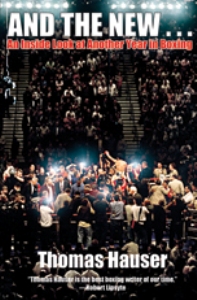
The best writing in Thomas Hauser’s new collection, “And the New . . .” (The University of Arkansas Press; $24.95), barely treats boxing at all. Hauser’s best writing, instead, comes in his book’s final piece, “Elvis (and Ali),” and concerns itself with the ruinous effect celebrity, and what brings celebrity, visits on the lives of exceptionally gifted Americans.

Hauser evidently set out to write about Elvis Presley, but because Hauser is a writer, because he discovers a subject during its writing and not necessarily before, he found in his treatment of Presley a unique metaphor and parallel with Muhammad Ali: Both men were shorn – of hair in Presley’s case, of the heavyweight championship in Ali’s – by the establishment, and then softened in exile, their sharpest edges grinded on, before being permitted to return as icons. Presley was not the same force after his time in the Army, and Ali was not the same force after refusing induction.

“And they were so good when they were young,” Hauser wistfully concludes about those two Americans on the final page of his latest book.

At 235 pages, “And the New . . .” is the shortest of Hauser’s recent collections about boxing. It is more digestible. There is little missing from the 80 or so pages not in this book. Any boy who is eight years old today and just hearing about this sport of ours, a boy who in 10 years will be an adult who visits a bookstore to learn about boxing generally and what happened in 2011 specifically, will find as apt a summary of the year in this Hauser collection as another.

The likelihood, though, is that no one who reaches adulthood in 2022 will have a bookstore to visit. If you’ve been in a Barnes & Noble lately you already sense it; the last of our country’s largest booksellers is a Starbucks sharing floorspace with Toys “R” Us and Sam Goody, with an airy attic of books whose covers sparkle with raised print. Hauser and his work stand athwart this movement because it is exceedingly important to Hauser that whatever he writes make its way onto paper, a medium of endurance for a few millennia now.

“And the New . . .” is a more optimistic book than Hauser’s last collection, “Winks and Daggers,” felt. If boxing is not in a more hopeful place today, it is at least in a place where sabotage is suspected less. Everyone is acting in a rapaciously self-interested way, business as usual, but there appears a modicum less cynicism now that the premium networks have had their little shakeups, with HBO Sports’ chief pursuing other opportunities, Showtime Sports’ leader replacing him, and a lawyer replacing him. To revisit some of the programming choices made in 2010 and 2011 by HBO is to wonder if there were not poison pills being sewn; if the network’s loyalty to certain fighters were not a means of subverting the next regime.

Ah yes, HBO – the subject for whose treatment Hauser is perhaps best known. No longer. In March, Hauser became a consultant for the network. Urgent criticism in our small community greeted this news, some of it in good faith, much of it not. The good-faith concern was this: HBO’s greatest critic is no longer free to criticize. That is indeed a loss. Calls for Hauser’s removal from the full-member rolls of the Boxing Writers Association of America went out and were heeded, showing, in a fine twist, that among writers, HBO is considered a promotional entity more than a journalistic one.

Touché. This decision on the part of the BWAA’s leadership, though, brought one terrible consequence: Hauser resigned from his post at the head of the BWAA membership committee, where he still retains a vote. Hauser is a writer first; he speaks the language of writing, cares about prose, and understands the rigors of rewriting in a way deadline reporters do not. Hauser’s motto of event coverage – not first but best – is authentically different from the wires’ or their editors’.

As head of the membership committee, Hauser combed the internet for good writing about our beloved sport, caring considerably more about what words he found on a page than what URL floated in the address bar above. Hauser reached out to otherwise unknown writers. He elevated our work. Because Hauser is a writer, he knows this: Only the words endure. Page views, Twitter followers, breakfasts with a promoter; all of that is ephemeral noise when set against a writer’s words.

“And the new . . .” has plenty of good writing, of course, and Hauser’s usual number of good choices. “It was as though someone had shoved a tennis ball beneath the skin and painted the entire area purple,” Hauser writes of a fighter’s countenance in “Rodriguez-Wolak: A Great Fight,” an unplanned piece he was moved to write after being ringside for Pawel Wolak and Delvin Rodriguez’s surprisingly excellent first match.

Much of Hauser’s event coverage treats Manny Pacquiao and the possible repercussions his move to Showtime would cause. It was a fling, we now know, and seismic only so much as it cost the leader of HBO Sports his job. But there is a strain in some of it; Hauser captures well the lugging that began 21 months ago when the announcement came that Pacquiao would fight Shane Mosley on Showtime. So desperate were we for change of some kind after 2010 that we squinted to find meaning that was not there, interrogating every press release like a poem by Hart Crane.

We’re in a better, more relaxed place now. No promoter today would schedule another midnight conference call about Pacquiao not-fighting Floyd Mayweather. No one would dial in if he did.

Bart Barry can be reached at bart.barrys.email (at) gmail.com


Momento de Maravilla


LAS VEGAS – Only prizefighting, among all sports, is able to induce a vicarious sensation so near to personal tragedy one’s mind, in a headlong rush for homeostasis, begins to tamper with its stimuli, misreading moments and writing them in memory more creatively than truthfully. To see a man so large in what gorgeous violence he perpetrates on another suddenly diminished, panicked, desperately swimming towards his foe like a drowning child after pool’s edge, is to witness sport extended to its legal limit.

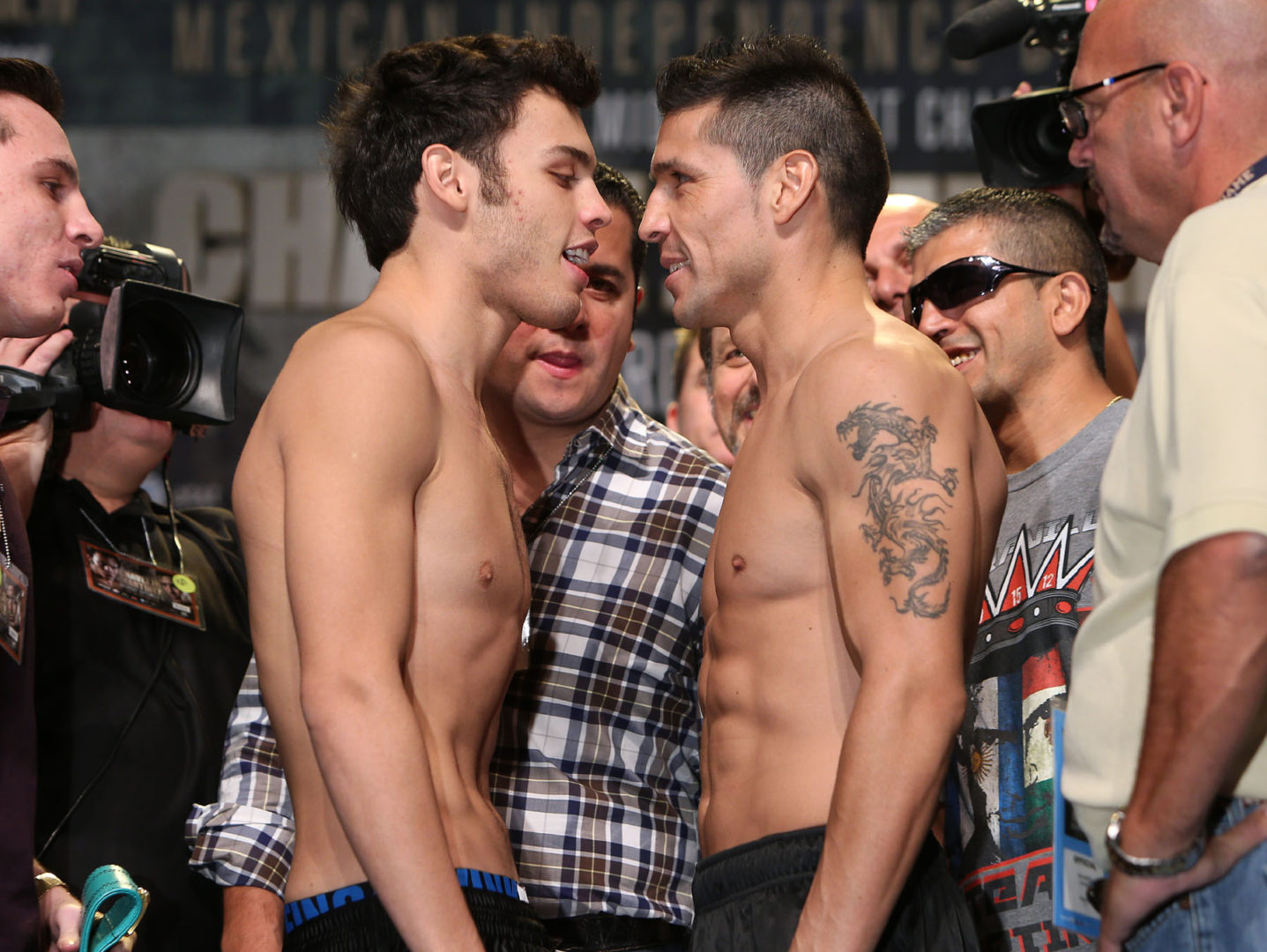
That is what happened Saturday in the final two minutes of 37-year old Argentine Sergio “Maravilla” Martinez’s successful defense of his lineal middleweight championship against 26-year old Mexican titlist Julio Cesar Chavez Jr. at Thomas & Mack Center, a match Martinez won by lopsided unanimous-decision scores after being forced to the blue mat twice in its 12th round.

There was “Maravilla” in the final 80 seconds, eyes big, body failing, fright both overwhelming and accelerating his exhaustion – the man who boasted before training camp that in his matches “99 percent is studied” beforehand; every wink, every straightening of his trunks, every shoulder shimmy, every smile, every word, all of it, devised in his downtime, planned in his training, executed by a tyrannical actor/director who does not abide improvisation on the set after a bell calls Action. Then none of it was planned.

Felled as much by fatigue as Chavez’s short left hook, a punch that hadn’t found a meaningful mark more than a pair of times in Chavez’s 34 1/2 minutes of winging it, Martinez emoted a confused panic even he didn’t know was in his theatrical range. Martinez rose and tackled Chavez, causing a second knockdown ruled a slip because it didn’t matter how it was ruled because the scorecard never mattered a whit to Chavez. Entirely unconscious of himself or strategy or script, Martinez fought a just-exhausted-enough Chavez off him in a minute that Martinez’s curious mind and creative memory will now stretch to a width most hours of his life will not rival for duration or anxiety.

Anxiety was the large part of that extraordinary final minute. After a 10th round that saw Chavez cast his fourth and fifth urgent and nearly hopeless glances at referee Tony Weeks, beseeching him to do something about Martinez’s low punches or dangerous head, the Argentines in the arena began to serenade their champion and each other. They filled Thomas & Mack with song. A Buenos Aires fútbol rally in the middle of a city that was once Mexico, on the weekend of El 16 de Septiembre: ¡Pinches argentinos, hijos de la Chingada!

After the 11th, a round that saw Chavez land his most meaningful right hand of the evening then see another rally extinguished by Martinez’s sense of the moment and its augmentative, momentum, the aisle in section 112 began to fill with well-dressed Mexicans stomping up the stairs towards the exit. There was no suspense at the end of the 11th, and let no one tell you otherwise.

The suspense happened when the bell to begin the 12th rang and Chavez remained on his stool. Martinez raised both hands above his head, certain he’d beaten “Son of the Legend” yellow on the eve of Mexican Independence Day. Then Chavez, that child of privilege and man of an eccentric nonchalance almost goofy, showed Martinez his mouthguard and hopped off his stool.

When Chavez’s left hook came home and Martinez’s wondrous legs finally failed him moments later, an energy coursed through Thomas & Mack Center like no other. It was a catharsis whose pursuit is the very reason any self-respecting experientialist pays his airfare to Vegas and endures its gauche price-gouging ways – to experience a mindless union with 18,000 others, a burst of something so chemically pure the body hates it, an intensity unendurable for more than a few seconds. The moment could not have been improved upon; its potency was a product of surprise: “Maravilla” in an instant diminished, worn, fragile, spent, withered, more miserable than he’d made Chavez in a half hour of smacking his face with knuckles.

Does it detract from the moment to price it? Surely it does, but that’s why it’s called prizefighting after all. The most terrifying moment of Sergio Martinez’s career will be the one that makes him a much wealthier man. He is now damaged and old, more likely to find underestimation than over. Somewhere from Floyd Mayweather’s fighting soul – the sacred part of him as yet unsullied by “Money” – there must today be a voice that says, “You’re gonna tell me I gotta avoid a guy Little Chavez had out?”

And while Julio Cesar Chavez Jr., right now, knows just how physically ruinous Martinez’s 300 flush blows were to his young body and younger brain, Mexicanismo will ensure he forgets posthaste: “¿Qué haría tu papá, Júnior?”

Whatever he said about it afterwards on Saturday night, his head still thrumming with concussion and ears throbbing each beat of his heart, Sergio Martinez is too introspective, too gentle-spirited, not to have doubt. “Maravilla” is not delusional and does not wish to become so. He fought Chavez perfectly Saturday, just enough playfulness and just enough clean striking and just enough macho, and came within a punch of drowning. It will not be lost on him what will come if he fights imperfectly in a rematch.

Bart Barry can be reached at bart.barrys.email (at) gmail.com


Martinez decisions Chavez widely after a pair of incredibly close minutes


LAS VEGAS – And in an instant, Martinez-Chavez went from Pacquiao-De La Hoya to Chavez-Taylor.

Not since Manny Pacquiao retired Oscar De La Hoya had a small southpaw looked so profoundly dominant against a larger titlist as Sergio Martinez looked against Julio Cesar Chavez Jr. for 11 rounds. And not since Chavez Sr. came back to stop Meldrick Taylor in the final seconds of a fight he was losing lopsidedly had such a profound change of fortunes been brought to a world champion the way Chavez brought it to Martinez in the 12th.

Saturday night, in a match at Thomas & Mack Arena that disappointed all expectations of suspense for 33 minutes before becoming an unforgettable thing in its final three, Argentine middleweight champion Sergio “Maravilla” Martinez (50-2-2, 28 KOs) rose from the canvas in the final round to survive and decision Mexican Julio Cesar Chavez Jr. (46-1-1-1, 32 KOs) by unanimous scores of 117-110, 118-109 and 118-109. The 15rounds.com ringside scorecard concurred, marking 117-110 for Martinez – while marking the final round 10-7 for Chavez.

“We are two professionals,” Martinez said afterwards. “And we comported ourselves as professionals.”

The fight began the way all prognosticators believed it would. Martinez’s class was too much for Chavez in the first round and each of its successors. What little sense of geometry Chavez showed in the opening round, extending Martinez’s circles to the perimeter somewhat, was gone by the third.

“I began slowly,” Chavez said in the ring after the judges’ cards were read. “But I will not do that in the rematch.”

In fact, not till the sixth round did Chavez land anything consequential. Though Chavez was the much larger man, Martinez was the far more balletic, polished, athletic and accurate, hitting Chavez with nifty left uppercut leads and other inventive combinations. Chavez, sporting a knee brace and suffering abrasions and swelling round both eyes, was not dissuaded, however.

“This confirms me in boxing,” said Martinez, to an outnumbered but surprisingly vocal Argentinean group of fans. “Long live Argentina!”

More fatigued than he knew as the bell for the 12th rang, Martinez walked into a short Chavez left hook that wobbled and shocked him in the final two minutes. Martinez’s eyes bulged and he collapsed in the ropes. A pair of rights and lefts from Chavez then tossed him limply to the canvas. But Martinez rose, ran, held, slipped, and ultimately punched his way to the final bell, as suddenly enchanted Mexican fans rabidly urged their man on.

“Of course,” Martinez said when asked if he would grant Chavez a rematch.

“Long live Mexico!” cried Chavez at the end of his postfight interview.

ROMAN MARTINEZ VS. MIGUEL BELTRAN JR.
In an attempt at prophecy, or at least wishful thinking, Saturday’s excellent Top Rank co-main event featured a hard-pressing Mexican slugger named “Junior” against a foreigner named Martinez. Unfortunately for the emotional Mexican crowd, the Mexican did not prevail.

Fighting for a vacant WBO super featherweight title, Puerto Rican Roman Martinez (26-1-1, 16 KOs) sneaked past Mexican Miguel Beltran Jr. (27-2-0-1, 17 KOs), besting him by split-decision scores of 116-111, 113-114 and 113-114. The fight would have been a majority draw, were it not for a penalty assessed to Beltran in the championship rounds.

Each round of Martinez-Beltran featured punches both well leveraged and well landed by both fighters, but in each of the opening six rounds, regardless of what Martinez did, Beltran appeared to do a little more. In the sixth, Beltran landed the match’s most-devastating punch, a right cross that snapped Martinez’s head back between his own shoulder blades.

The seventh round, though, saw Martinez begin to establish a more effective attack, catching Beltran on the way in, with oddly placed punches. But by the middle of the eighth, Beltran again appeared the stronger man. By the end of the 10th, Martinez, game as he was, did not appear to want much more.

The 11th brought a point deduction to Beltran’s tally from overly officious Nevada referee Russell Mora, though, tightening ringside scorecards somewhat. Martinez also flurried in the 12th, appearing to steal that stanza as well. Ultimately, the fight was a close one that might have gone either way and probably should have gone the way of a majority draw.

MATTHEW MACKLIN VS. JOACHIM ALCINE
Matthew Macklin makes his ring entrance to a hybrid song of “Mack the Knife” and “Rocky Road to Dublin,” in a two-part nod to his nickname and heritage. But Saturday, he didn’t have to take his opponent very far down a rocky road before knifing him.

In the penultimate match of the evening’s undercard, Macklin (29-4, 20 KOs) caught Canadian middleweight Joachim Alcine (33-3-1, 19 KOs) with a flush right cross in the opening moments of the fight then marched him down, dropped him a second time and brought the match to an exciting knockout conclusion at 2:36 of round 1.

Despite a record with four losses on it, Macklin again proved that he can rally a crowd and make an exciting, satisfying match whomever he is given for an opponent.

GUILLERMO RIGONDEAUX VS. ROBERTO MARROQUIN
After a 2010 showing in Cowboys Stadium that brought loud boos from those fans not yawning, Cuban super bantamweight Guillermo Rigondeaux needed two years of exciting knockouts to make fans forget how displeasing his defense-first style can be. Saturday in Thomas & Mack Arena, though, they were reminded once more.

Rigondeaux (11-0, 8 KOs) successfully, and rather easily, defended his WBA super bantamweight title against tough if limited Texan Roberto Marroquin (22-2, 15 KOs) by unanimous scores of 118-108, 118-108 and 118-109. And if there is a prizefighter today who fights like Floyd Mayweather as well as Mayweather does, he is Rigondeaux, right down to the cautiousness.

Rigondeaux established a superiority of reflex over Marroquin – a superiority of reflex Rigondeaux enjoys over most every opponent he faces – and then put the match on a form of cruise control that did little to entice fans. Possessed of every punch and step in the boxing lexicon, Rigondeaux does not appear to enjoy physical matches with larger men, and he certainly did not look for one with Marroquin, who appeared a weight class or two larger than Rigondeaux on Saturday.

Twice in the match Marroquin managed to land a pulled left hook that temporarily destabilized the Cuban southpaw’s otherwise flawless footing, but from each of those faux scares, Rigondeaux quickly recovered and returned to mastering Marroquin technically if not combatively.

In round 10, bored by Rigondeaux-Marroquin, the crowd – partisan Mexican though with an Argentinean contingent – began to sing futbol songs at one another till the match was over, despite Rigondeaux’s scoring the match’s one knockdown in its final two minutes.

MIKE LEE VS. PAUL HARNESS
Mike Lee is undoubtedly the best light heavyweight on the Notre Dame campus, but he is decidedly not the best light heavyweight in the world. Further evidence of this came at the midway point of Saturday’s undercard when Lee (11-0, 6 KOs) whacked away at Kansas City opponent Paul Harness (4-4-1, 3 KOs) for four rounds and ultimately prevailed by unanmious scores of 40-36, 40-36 and 40-36.

Questions about Lee’s power – he landed at least four clean right hands in every round without once felling Harness – and his defense, though, remain, and grow, with every showing. Despite leading comfortably in the fourth round, Lee nevertheless was tagged by several knee-buckling shots by Harness.

UNDERCARD
Highly regarded super welterweight John Jackson brought his undefeated record in the Thomas & Mack Center ring for Saturday’s third bout, against Cleveland’s Willie Nelson, and Jackson’s ‘0’ left the ring before Jackson did. In a close fight that might have been scored either way, Nelson (19-1-1, 11
KOs) decisioned Nelson (13-1, 12 KOs) by unanimous scores of 96-94, 96-94 and 98-92.

Before that, in an eight-round super welterweight match, Mexican Michael Medina (26-3-2, 19 KOs) scored a lopsided decision victory over North Carolinian James Winchester (15-5, 5 KOs). All three judges had the match 80-70 for Medina.

The evening began with an eight-round, unanimous-decision victory for California welterweight Wale Omotoso (23-0, 19 KOs) over Puerto Rican Daniel Sostre (11-7-1, 4 KOs).

Opening bell rang on a sparsely populated Thomas & Mack Center at 3:17 PM local time.


Chavez upsets Martinez on the scale


LAS VEGAS – The weekend’s first upset happened Friday, and it wasn’t by way of a punch at Thomas & Mack Center. In what may turn out to be the greatest surprise of Martinez-Chavez, barring of course an early stoppage, Argentine Sergio Martinez outweighed Mexican Julio Cesar Chavez Jr. Friday afternoon at Wynn Las Vegas’ Encore Theater. But if either man was surprised, neither showed it.

Martinez, considered by most to be a small middleweight champion, and Chavez, considered by all to be an enormous middleweight titlist, shared a one-pound disparity on the scale: Martinez made 159, and Chavez made 158.

“He said it’s going to be a war,” Martinez said immediately after a talkative stare-down with Chavez that followed both making weight for their middleweight world championship match. “I want a war.”

Martinez, known as much for his cool demeanor and handsome countenance as his jazzy southpaw style, appeared uncharacteristically anxious Friday afternoon. Dressed in a black sweatsuit and dark shades, Martinez preceded Chavez to the stage and the scale and made a show of rallying a small Argentinean contingent waiving robin’s-egg-blue and white flags, stage left.

“He said that he is going to rip my head off,” said Chavez, when asked what words Martinez spoke to him after he climbed off the scale. Then Chavez, easily the cooler character Friday, laughed and shrugged.

While Saturday’s match for the lineal middleweight championship of the world – along with belts from The Ring, WBC and surely a few others – will be the biggest fight of both men’s careers, Chavez shows the demeanor of a man who knows other superfights will inevitably follow. Martinez, about whom the same cannot be said, appears to be channeling some of his handlers’ nervousness.

Part of what led to onlookers’ general surprise at Friday’s weighin, and specifically Chavez’s coming-in two pounds under the middleweight limit, were reports of undertraining by the Mexican champion. Numerous sources reported Chavez had skipped scheduled sessions with trainer Freddie Roach during his camp, preferring to work-out at home instead.

But Chavez’s promoter, Top Rank, expressed no concern. Chavez made weight easily, and apparently needs little instruction in how to cut-off a prizefighting ring, as he is expected to have to do against Martinez on Saturday.

Early Friday afternoon, one last thread of controversy was stitched in the Martinez-Chavez tapestry: Trainer Nazim Richardson will attend the wrapping of Chavez’s hands in behalf of the Martinez camp, Saturday. Richardson, of course, was the man who caught a hardening substance on the wraps of Antonio Margarito before the Mexican champion’s 2009 match with Shane Mosley.

Nevada State Athletic Commission executive director Keith Kizer said on Friday that while he’ll be at both of Saturday’s fight cards – Martinez-Chavez, and Saul Alvarez vs. Josesito Lopez a few blocks away at MGM Grand Garden Arena – the main event he’ll be attending is Chavez-Martinez, as Kizer anticipates potential prefight controversy at Thomas & Mack Center.

Photo by Chris Farina / Top Rank


Andre Ward’s hometown: Pleasant surprises and a mean streak


OAKLAND, Calif. – Last week’s fight headquarters were at Marriott City Center in the middle of this recovering town. Friday night Andre Ward sat in its lobby area, his back to the window, a white baseball cap pulled over his eyes. His face was darker than it appears on television, and meaner too. It was the first glimpse of a Ward that any unknowing stranger would avoid out of instinct. Ward wasn’t that playful chap taking his kids to school for HBO’s camera; he was a man concentrated on the manifestation of another’s pain.

In that lobby, with his dark and oblivious scowl, Ward was severed entirely from the dot-com millionaires who once made Porsches more ubiquitous than Hondas, 50 miles south of here. Ward was not, either, a delicate San Francisco artisan returned from complementing an hour in the SFMOMA collection with a crabmeat salad at Fisherman’s Wharf. He was not Silicon Valley or Bay Area. He wasn’t even East Bay. Ward was Oakland.

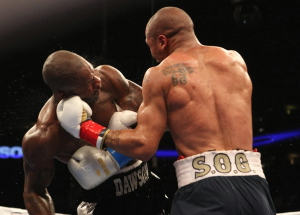
That portended the very worst for Connecticut’s “Bad” Chad Dawson, a unified light heavyweight world champion who fought Ward for his unified super middleweight championship Saturday at Oracle Arena. Whatever violence Dawson saw as a youth in New Haven, Conn., it was qualitatively different from the Oakland brand Ward showed him Saturday. Dawson, discomfited from the moment Ward’s short left hook dropped him in round 3, succumbed entirely at 2:45 of round 10 – when he rose from a spot on the mat Ward’s left hand put him, and gave referee Steve Smoger tacit approval for a TKO stoppage.

Ward and Smoger were and are a lovely combination, the one most likely to lead Ward, with his mauling and grappling and pressuring, into pleasing aesthetic spectacles. Another ref would have broken Ward and Dawson endlessly, Saturday, and it would have set a precedent that ruined everything – for when a fighter knows every clinch brings an officious ref leaping to the rescue, he does more of it, because even for a prizefighter not-fighting is easier than fighting. And this brings obvious choices whose consequences do not get tabulated till the next morning when that fighter reads about what a dullard he was, in Sunday’s paper.

Ward churns his feet in a clinch. That is his secret. He does not merely push and pull with his upper body, content only to throw a completely open punch at a completely open chin, as so many fighters today do. Ward continues to dig and bend, pivot and tilt, certain that waxed human flesh licked with perspiration is too slippery to hold still for long. He frees his hands with his legs. He sincerely wishes to sink knuckles in flesh, too, making the volume-puncher’s compact: I will hit you anywhere you let me, and let the art critics go to hell.

Writing of which, and continuing a theme of this city’s pleasant surprises – including a number-five placing on The New York Times’ “45 Places to Go in 2012” list – downtown Oakland plays host to the Bay Area’s most surprising art collection: Oakland Museum of California (OMCA). Located atop a history floor and another dedicated to science, OCMA’s paint collection features works by or about Californians. It is exhaustive and fantastic. It is not quite the de Young Fine Art Museum but is at least good, and in every way more accessible, as San Francisco Museum of Modern Art.

The less-artful compact Ward made with Dawson Saturday saw Ward follow every landed right cross with a chopping left hand. It was an ugly, barely legal punch that offended Dawson’s sense of decorum. It also took his balance and ruined him in the 10th round.

Poor Chad Dawson; he simply has no mean streak. He’s a superb athlete. But were he in the NFL, he’d play wide receiver, not tight end; in the NBA he’d swish gorgeous fall-away jumpers but never drive the lane; if hockey were his game, he’d be a perennial contender for the Lady Byng. There were numerous exchanges Saturday that told this tale: Dawson is an athlete who makes money fighting, but Ward is a prizefighter. Dawson was longer, taller, and ostensibly the harder puncher. And yet, when he hit Ward he got lunged at, and when he got hit by Ward he took a step backwards and showed Oracle Arena a look that said: “It’s cool, guys, I know he hit me, but we quashed all that and things are good between us now.”

Nobody in Oakland respected Dawson’s nonbelligerent stand. Frankly, they wanted to see him beaten for it. Attendance was announced at 8,500 but felt like more – with some local newspaper scribes estimating 10,000 or even 12,000. Imagine, an announced boxing gate that felt underestimated! Knockouts are louder, though, because they bring persons leaping upwards at once. Standing, shouting, high-fiving, fist-pumping men bring a force of feeling disproportionate to their number. There were plenty such men, and women too, Saturday, and the audience was darker-complected than most major boxing crowds. A splendid thing, that, and one that speaks to the authentic, and therefore sustainable, fanbase Ward is building in his hometown.

Andre Ward is becoming a professional sports franchise in Oakland, this pleasantly surprising place with a mean streak. Nobody has trod a fairer path to local acclaim than Ward. No prizefighter deserves acclaim more. And so, on nights like Saturday, in the roiling bodies and noise, for an hour at least boxing can feel like a meritocracy.

Bart Barry can be reached at bart.barrys.email (at) gmail.com


Andre Ward fights for local fans, and to find more of them

OAKLAND, Calif. – Saturday Andre Ward made the most impressive showing of his career, stopping lineal light heavyweight world champion Chad Dawson in round 10 before an impassioned hometown crowd. Impressive, Ward’s performance certainly was. Whether it was enough to make him the superstar some aficionados feel he deserves to be, though, remains to be seen.

“I’m here to see Andre Ward,” said Bay Area resident Devon Donahue, standing at a table in the lower concourse of Oracle Arena during the undercard. “This is my first fight.”

Ward has suffered, unfairly in the opinion of many, a lack of exposure. He has been on premium cable, winning Showtime’s “Super Six World Boxing Classic” most notably, and he fights in a relentless fashion, oblivious of style, a fashion that should appeal widely to the folks in this town. And Ward does appeal, partially.

“First Ward fight,” said Oakland resident Anthony Brown before the main event. “I just want to see a good one.”

Ward is known by aficionados, and respected if not beloved. There is a momentum building, with attendance figures climbing each time he does his punching in the East Bay. But he is decidedly not yet the draw of, say, Floyd Mayweather – even in his hometown.

“Mayweather is established,” said Donahue. “A lot of people here don’t know about Andre Ward. Yet.”

Ward is an Olympic gold medalist, the only current American champion able to make that claim. He is undefeated as a professional. He is a model citizen outside the ring. What, then, does he need to do to become a bigger draw?

“He needs to talk a little shit,” said Elija Holcomb, an East Bay resident whose allegiance to Ward took him to Atlantic City for Ward’s last fight, a decision victory over Carl Froch in December. “We were arguing about that on the way over, would it make a difference? Mayweather is an event. People tune in. I might not like Mayweather, but I watch him.”

There were some billboards on I-880, the interstate East Bay commuters take southwards, this week, and there were banners hanging on Broadway outside the City Center Marriott that hosted fightweek personalities, downtown, but promotional materials for Ward-Dawson were hardly ubiquitous.

“Man, they should have shoved this down their throats,” continued Holcomb, in a lower-concourse booth, pre-fight. “The guy who cuts my hair used to cut (Ward’s) hair. He didn’t – my point is, Ward’s a little invisible. He’s a little invisible.”

In his comportment, both before and after fights, Andre Ward is a gentleman. He believes that if he can continue to fight and beat the very best men in the world, he will eventually become a beloved figure.

“Against the better competition,” Ward said after whupping Dawson, Saturday, “I rise to the challenge.”

Ward’s next challenge will likely be selling himself as a pay-per-view attraction.

Photo by Alexis Cuarezma


Why I’ll be in Oakland this weekend


Saturday evening in Oakland, Calif.’s Oracle Arena super middleweight world champion Andre Ward will defend his title against light heavyweight world champion Chad Dawson. I will be there, I’m happy to report, and eager to make the trip. What follows is an opinion-laden exploration of why.

Ward-Dawson will be a match between the world’s two very best prizefighters between 161 and 175 pounds. That is enough for the purist in me to make the trip from South Texas. It is a rarity anymore the best fight the best, regardless of popular demand, or its absence, and when that happens, it merits a celebration oblivious of subjective or aesthetic concerns.

Oakland’s Andre Ward is a chance to see a better version of a young Bernard Hopkins. Ward does nothing spectacularly but everything quite well. He hasn’t chloroform on either fist but keeps stronger men the hell off him. His footwork is steady, not inventive. He is confident more than stylish. He is self-conscious in the best sense of the term; thousands of concentrated hours have taught him how to keep comfortable in a fight, and the man who can discomfit him has yet to be found (a boy in his 12th year, Jesus Gonzales, was the last to do it, in 1996). And Ward likes to smoke where another man lives, as Joe Frazier put it, to fight on an opponent’s chest – a singularly endearing quality.

Today’s Bernard Hopkins apologists, kids who were usually too young to know or care about Hopkins when he stopped Segundo Mercado 17 years ago and began his middleweight title reign, have little interest in Ward. He is not confrontational enough. He is a careful father rather than a reformed crook. He does not fill a three-minute answer with five minutes of self-aggrandizement. He conforms to the system rigidly, and the system takes care of him. Nothing dangerous there. He is a professional who, by his own estimation, took boxing training too seriously in his youth and now, as he matures, has learned to remand it to a less dominating place – consider for a second how different from the average prizefighter’s career trajectory that is. Ward is not particularly charismatic, and there is little to discover about him outside the ring: Loving dad, religious devotee, proud man, disciplined citizen. Yawn.

Connecticut’s Chad Dawson is less knowable still. Surely there are a few dangerous corners in New Haven, Conn., and Dawson was right to avoid them as a teenager, but there is an element to the Dawson biography, as told by HBO anyway, that feels effortful. Not Victor-Ortiz effortful, of course, but effortful just the same.

Dawson is not a bad guy. Ward is not a bad guy. Both are excellent fighters, the very best in their divisions, and that is not enough? For me it is. I did not believe Ward was at all special when the Super Six tournament began. I expected Mikkel Kessler to prove how meaningless an Olympic gold medal is these days – meaningless as the advisors of each member of our last two Olympic teams did, and will, tell us. But the very opposite was true, wasn’t it? There is a reason Andre Ward is both our country’s last gold medalist and very best prizefighter over 154 pounds.

Ward is a winner. He has a sense of exactly where he stands in relation to another man and where their performances stand in relation to one other. The day a man bests him, Ward will know it and likely concede it, publicly. Chad Dawson does not have this sense. Dawson is talented enough to beat anyone put in front of him, and beat him convincingly, but Dawson does not know how good he is. He does not trust himself or the roster of trainers hired over the years, and how could he? They tried to make him what he is not, he laments. It is hard to imagine Andre Ward mouthing those words.

I am going to the Bay Area, in part, for the same reason I went to Michigan 20 months ago for Bradley-Alexander: as a silent challenge to the black community to support its fighters. In conversations with black boxers and trainers, there is a confidence, or conceit, that relies on a belief that, at any time in the last century, one of their own was the best prizefighter in the world, recognized or not. That’s a conceit I share. But if black men, as a community, are not supporting boxing’s ecosystem, will it always be so? Timothy Bradley does not touch your souls, OK; I do not understand that but accept it. If a community turns away from Bradley, Ward and Dawson to celebrate Floyd Mayweather’s comic-book id or Adrien Broner’s hairbrush, though, that’s another thing entirely, one that raises a question of perspective.

I am also going to the Bay Area because, culturally, it is one of our country’s richest places. I spent two years there as a young, overpaid, Silicon Valley software developer during the dot-com boom and haven’t been back since 2001. There’s a nostalgia for those lovely, hopeful times.

No, this is not a full-throated or objective endorsement of Ward-Dawson, which is why I chose to write it in the first person. I do not expect a great fight. I expect each man to employ his very best technique, and for those techniques to offset each other. I expect Ward to win by using his head – make of that what you will – but think Dawson is uniquely qualified to upset him. Yet I am nearly as excited about seeing Oracle Arena, Saturday, as Thomas & Mack Center seven days after. Call it wanderlust.

Bart Barry can be reached at bart.barrys.email (at) gmail.com


Portrait of a barroom tough’s first visit to a boxing gym

Javier pulls open the matte-gray door and sees the fresh black and yellow paint and so much heat. The gym’s heat is palpable, visible even. The heater’s flat hum leans on the beeping timer as three sounds pierce the haze of summer South Texas humidity. There is a deep stench of old perspiration and new latex sealant.

“He wanted it bad the other night,” Javier says to himself, “now we’ll see what the little bitch’s got.”

He snickers at the formality of gloving-up, headgear, vaseline. His first three overhand rights push Enrique backwards, landing: shoulder, shoulder, collarbone. But the little guy straightens and raises his gloves, white mouthpiece protruding.

Javier’s hands weigh 40 pounds each now.

The timer beeps thrice, someone calls “Tiempo!” and Javier spits his bloody mouthpiece out the ring and bites down on the top of his left glove, gnawing and tugging.

“C’mon, dude,” Enrique says, “we’re just starting to move around.”

*

Javier starts at how full the gym is inside. There must be 10 guys for every car in the lot out back. He recognizes no one but everyone looks familiar. No one talks. A few take terse instructions – “yab, gancho; no upper” – from a round coach with thick, prickly black hair. He squirts water in their mouths.

There is little sound except smacking, rope on rubber, wet leather on wet leather.

Soon as both gloves are tied tight round Javier’s wrists, his left palm starts to itch. The little brown guy who puts one strip of tape over his laces smiles and shrugs. Then he theatrically slaps the knuckles of each glove and says, “Listo!”

The bleeding parade down the four steps from the ring is embarrassment tempered by exhaustion, and shaking legs underneath a forehead enveloped by unnatural heat, the veins in his temples throbbing hundreds of times that minute.

*

Javier pauses at the top of the ramp to reminisce on the smacking sound it made when he cuffed Enrique behind the ear outside Bar Cielo last Thursday morning round two. One of Enrique’s crew, tatted on the neck with a sleeve to his left wrist, stepped between Javier and the putito.

“Vamos al gimnasio, mejor,” he said.

“Que sea, cabrón,” said Javier. “Tuesday, don’t be late.”

Javier feels stung and even a little concussed by Enrique’s left hook. Those gloves looked so round and soft, shapeless and dumb, till Enrique put the center of the left one on Javier’s right nostril.

Yup, that’s what blood tastes like. Warmer’n you’d think.

Mostly Javier feels fatigue. His hip bones hollow-out and everything below, clear to his heels, starts to shake.

*

Javier strides down the ramp, eyes fixed on the table with piles of headgear and 16-ounce gloves. So old, used and putrid, that gear, smack-faded red and sweat-yellowed white. The leather spokes atop the headgear were gone years ago, and got replaced with elastic bands that say “why bother?”

Get in quick. That’s how you do at Bar Cielo. Then go all maníaco on him. Hit him till the bouncers pull you off. Make him take the steps back. Just beat him down, it don’t matter where, but go for the head. It ain’t gonna last but five minutes. Hold and smack. Make him bleed, take a souvenir of shirt collar or something. Shake it at las pollitas, show’em what you did to their man.

*

Javier likes that nobody stirs when he gets to the table. Nobody shows him his respect. You’re just making it worse for your bitch, he thinks. Enrique and his boy are there, but neither does more than tip his forehead slightly upwards. Settle this like men?

“You are ready, or you want the warm-up?” says a little brown guy in a white t-shirt, worn green sweatpants and scuffed oxblood penny loafers. “I hit you the pads, yes?”

“Just put the gloves on,” Javier says. “Nice shoes.”

“I go to the work after,” the little brown guy says, and he shrugs.

Javier doesn’t bother to touch gloves when the bell rings. He flies at Enrique. First three rights land somewhere. Easy work.

*

Javier climbs the blue-painted steps on the opposite corner of the ring. It’s elevated a little. He pushes through the narrow space between the third and top ropes. He sees Enrique use the space between the second and third. Use my height, he thinks.

Wherever he puts his head, now, Enrique smacks it. Javier points his face at the gray mat and pulls his palms against the headgear. Just make myself tiny, he thinks. So Enrique smacks Javier’s gloves.

Javier comes out his crouch and lashes at Enrique with a right haymaker. But Enrique is evasive, now, without moving. There is no available air. Javier’s eyes bulge. Enrique nearly fits three knuckles of his left glove in Javier’s mouth.

The little brown guy in the penny loafers smiles, shakes his head and waves at Enrique’s friend in the other corner.

“Basta, ya,” he says, and he pulls the strip of blood speckled medical tape from round Javier’s left wrist. “Ya.”

*

Javier notes how rough-taped the ropes are, like shaking strings with full rolls of shiny white and red wrapped their lengths. Give him a burn when I mash him against them, he thinks.

He is sure they extended the round on him. He was so strong that first minute. Chasing Enrique, smacking him. They extended the round, los cabrones!

There had to have been five minutes, then, before that single beep made the little brown guy yell “30 segundos!”

Everyone looks at Javier, shaking and scuffing up the ramp to the matte-gray door. None of them says a thing.

Bart Barry can be reached at bart.barrys.email (at) gmail.com


Walking among masterpieces, thinking about failure


FORT WORTH, Texas – Our beloved sport continues its mid-year recess, a deserted time before the mania of September. There were no fights here Friday or Saturday. There will be none here next weekend. What is here, though, are collections – those of The Modern, Kimbell Art Museum, and Amon Carter Museum of American Art – so detailed, well-presented and complete, only an ambitious, energetic fool would traverse them in seven hours’ time.

But indulge anyway, why not, because you must attend works of art the same way you must attend fights. A piece of fruit tastes nothing like a picture of a piece of fruit. There are art books and exhibition catalogues galore, works of careful photography and prose, but they encourage what literary critic Harold Bloom termed “misprision” – a sort of fundamental misreading that, if imitated, will cause an original interpretation. Original interpretations by dilettantes are mostly rubbish.

How many trainers in how many American gyms have seen dilettantes’ original interpretations of Floyd Mayweather, recently, and of Roy Jones before him, and of Muhammad Ali before him? These are the artistic equivalents of one who sees the works of a single artist in a book, goes to a supply store, and begins hurling paint that same afternoon.

Much contemporary American art, like much contemporary American prizefighting, looks haphazard and improvised, when seen upclose, like the work of people trained by people who watch videos but never put themselves in the loneliness of a ring with another man then consign themselves to a week alone on a heavybag to solve technical problems. It is a derivative of a derivative; a shallow misreading of another’s shallow misreading of an original style.

These are what thoughts happened as I walked through a different collection – Dallas Museum of Art’s abstract expressionism – Saturday. Works by people more concerned with being artists than making art; persons who sought the straightest possible line to acclaim, men who suffered from a want of solitude, seeking companionship and affirmation at every turn – with a work by their patron saint, Andy Warhol, supervising the entrance.

There was a Warhol self-portrait, too, at The Modern, thirty miles west of Dallas. It was neon, lineless, loud and famous but suffered a genuine misfortune: It hung outside this city’s astounding new exhibition of Lucian Freud’s portraits. Warhol and his t-shirt-ready screen prints of Marilyn and Jackie look insubstantial set beside a contemporary like Freud’s works (if perhaps not Freud’s early, is-that-a-Modigliani efforts).

Walking round Saturday, I thought of Marco Antonio Barrera, as I often do. I thought of the rarity of what he did to “The Prince” Naseem Hamed in 2001 and the three years and seven fights that separated Barrera’s second loss to Junior Jones and only loss to Erik Morales – the solitude of those matches in Caesars Tahoe and Fantasy Springs. I thought of his stylistic overhaul in the three fights between Morales and Hamed, the solitude of New Orleans Arena or an opponent like Jesus Salud. Then I thought of how, after undressing the astonishingly overrated Hamed for a half hour, Barrera summoned the fury of those years in the woods to ram The Prince’s goofy face in a turnbuckle, risking disqualification, caring not a whit.

The careless chance-taking of a master craftsman; that is what one sees in Freud’s 1997 work “Sunny Morning – Eight Legs,” hung expertly at The Modern adjacent to 1993’s “And the Bridegroom.” In both paintings, a dressing screen stands in the background, and when one looks at the way the middle of the piece is protuberant while its floor and ceiling distend, one sees what Freud was after: He is behind the screen, painting what is reflected by a large, convex mirror. In Freud’s work one sees a thing most rare in contemporary paint: a direct link to Van Gogh and his collapsed space between foreground and back; the Spanish master, Velazquez, and his use of mirrors; the Italian master Caravaggio and his genius for human form; and the German master, Durer, and his compulsion for movement. The grandson of another and more famous genius, Freud had the influences and resources and talent to absorb masterworks then retreat to solitude, puzzle them out, and repeat their techniques. Only then, his toolbox complete, did Freud set about going where the daemon took him.

Great artists fail. One sees dreadful works by Cezanne and worse by Picasso. Failure in boxing is different from losing, just as artistic failure is sometimes subjective. There are informed critics who see genius in Pollock’s works like “Cathedral,” which hangs at Dallas Museum of Art; but if one has been to Museum of Fine Art, Houston, and seen young Pollock’s attempts at more academic painting, he can be forgiven for saying “That’s why he evolved to drizzles and splatters.”

Barrera’s failures were not his knockout loss to Jones in 1996 or Manny Pacquiao in 2003 or unofficial loss to Rocky Juarez in 2006. Barrera’s failures were his too-cautious performance with Juan Manuel Marquez in 2007 and his cash-on-delivery, rematch showing against Pacquiao seven months later.

But indulge anyway. Attend the fights; attend the canvases. You can see a prizefighting masterpiece on television no better than a Rembrandt in a book, after all. Plan trips. Do not worry about outcomes. A master’s failure is ever more informative than a dilettante’s triumph.

Bart Barry can be reached at bart.barrys.email (at) gmail.com


Observations about local fight promotion from behind black cocktail dresses

SAN ANTONIO – Saturday saw the return of national figures and national Spanish-language television, Telefutura this time, to the northernmost fraction of Alamodome, a pastel-highlighted and becurtained area called Illusions Theater. Seven undercard matches whose blowouts were either unexpected or presented local prizefighters doing the blowing-out rallied an enthusiastic Alamo City crowd for what was an entertaining main event.

Rugged Texan Brian Vera decisioned crafty Sergio Mora, a national figure who won the first “Contender” program and briefly held the WBC’s light middleweight title in 2008. The judges’ decision was correct, if unfairly wide in two cases, and Mora stormed to his dressing room and had a conniption. As neither Vera nor Mora, nor their rematch, provided new insights about prizefighting, it should prove more constructive to examine local shows and the promoters who host them.

One needn’t cover the sport of prizefighting for a decade to see his first dozen promoters fail. The pattern becomes familiar: A man successful in some other venture decides his hometown’s consumers have not been adequately tapped. He has an angle of some kind, often an assumed familiarity with his city, a familiarity whose supposed lack caused other promoters’ previous failures. Occasionally his angle is a direct line to a stable of talented local prospects, and in the best scenarios it is access to a prizefighting grandee.

The new promoter sets out to make his first card a conquest. He leases the talent and services of a national outfit or at least a well-regarded matchmaker. He rents a noteworthy venue. He begins to employ what salesmanship made his other venture a success. Everything runs crisply. Press releases get released. Open workouts open on time. Promotional events promote relentlessly. Advance ticket sales advance. The local promoter loses between $20,000 and $40,000.

But the debut gets good reviews. He has already promised to do a minimum of five shows or more because he understands the importance and finickiness of momentum – even if his burn rate has already trebled startup estimates. His second card goes much like the first. The local promoter approaches a crisis stage and thinks maybe conjuring a reliable audience for prizefights is not as his initial calculus concluded.

Boxing is filled with local freelancing operatives who haven’t succeeded at previous business ventures but believe, on the strength of their betrothing common observations and uncommon vocal cords, boxing is where a fortune, their fortune, can be made. If it’s not an impossible scenario, it’s neither a probable one. The promoter turns to these freelancers for enthusiasm if not advice because optimism is at least infectious.

For his third card, the new promoter decides he’s learned much about the business from national outfits as he’s likely to. He cuts PR costs dramatically, though keeps the matchmaker and venue. Reviews are not raved as before, but of course expenses are lower. He stocks the card with local talent – the national guys, after all, sell television licensing (which their national promoters keep), not tickets – and maybe attempts affiliation with his city’s thriving amateur scene. Keep things homegrown and intimate.

But even small events are more expensive than they feel to attendees. Members of the local media, wary of a diminishing infrastructure they’ve seen before, lose some interest. They’ll be there fightnight, perhaps, but no longer have an impetus to act as tools in the promotional apparatus. This brings a capitulation stage, wherein the local promoter leaves boxing, feeling in no small part bamboozled, and tries his luck with amateur MMA or writes-off entirely his errant undertaking.

Leija-Battah Promotions, by all appearances, approached a crisis stage after its second show, a small Cinco de Mayo event that drew a reasonable crowd to the bullring of a large San Antonio dancehall but nevertheless featured talent more national in price than notoriety. Then came a kickoff press conference in June for its third show, Mora-Vera II, a press conference made complete by an appearance from the Golden Boy himself, Oscar De La Hoya, beside his one-time rival and new promotional partner Jesse James Leija. Locals reasonably anticipated future Golden Boy sightings. But the June press conference – despite promises of a Thursday “meet & greet” and Friday weighin at 1 PM – was the last De La Hoya was seen in South Texas. His June affair was about selling the event to Leija-Battah Promotions.

Friday’s weighin was inexplicably moved to 3 PM, Thursday night, which did not correspond to blue-collar dads’ lunch breaks. Saturday’s card featured a media section nothing like the first Illusions Theater configuration Top Rank’s Lee Samuels arranged in March. Rather than two consecutive rows of tables, there was one row, restricted mostly to television personalities who never materialized, and a second table well back of it. Between the two tables were five or six rows of “media seating” that featured black cocktail dresses in lieu of notebooks – which was good because had these credentialed writers brought so much as a pen with them, they’d have had to balance the reports they scribbled on their spectacular, shapely knees.

The card itself left one hopeful, nonetheless. It showcased local talent like Adam Lopez, Javier Rodriguez, Steve Hall and Benjamin Whitaker. The main event was excellent too. There were 17 amateur bouts before the professional show, and each of those amateurs was tasked with selling 25 tickets. Attendance was estimated above 3,000, and while it is not likely so many tickets were sold, seeing more than 1,500 people gathered for boxing in a local venue is always edifying.

What comes next for the promotional partnership between local businessman Mike Battah and local hero Jesse James Leija is unknowable. Being a prizefighting promoter, a profitable one, is unlike any other venture.

Bart Barry can be reached at bart.barrys.email (at) gmail.com


Vera decisions Mora by questionably wide scores in South Texas

SAN ANTONIO – If you come to Texas and fight a Texan you have to beat that Texan down. Californian Sergio Mora returned to Texas and did not beat Austin’s Brian Vera down (though he probably outboxed him), and again the result went Vera’s way.

Saturday in the main event of a “Solo Boxeo” card promoted by local outfit Leija-Battah Promotions within Alamodome’s Illusions Theater, in an excellent rematch of their 2011 fight Vera (21-6, 12 KOs) decisioned Mora (23-3-2, 7 KOs) by split scores of 114-114, 118-110 and 117-111. The first score was accurate, the others were likely too wide by half.

Afterwards, a furious Mora, who goes by the moniker “Latin Snake,” had venomous things to say about the decision and the state of Texas.

From the opening bell, insiders knew the fight would be determined by Mora’s accuracy or Vera’s activity. Vera’s activity won. Though Mora landed a multitude of right crosses from his shifting stance, and often had Vera outclassed, Vera’s relentlessness impressed the local judges more.

After an opening three rounds that saw Vera busier and Mora significantly more accurate, Vera’s busyness began to tell. Mora, who’d successfully set up shop in both neutral corners and snapped Vera’s head back with counter uppercuts, found his mouth open and his activity diminished as the middle rounds came and went.

But as the championship rounds approached in a match for a vacant NABO middleweight title, and as Vera’s pace slowed slightly, Mora appeared to become the aggressor, landing with hard combinations in the fight’s closing six minutes. Ultimately, though, it was an effort by Mora ineffective as it was tardy, and Vera had his second victory over Mora in as many fights.

ANTONIO ESCALANTE VS. LEONILO MIRANDA
An old saw goes: The man is most dangerous when he is hurt.

That old saw proved itself true once more Saturday when El Paso featherweight Antonio Escalante, retreating on buckling knees, stopped, planted and connected with a short right cross from which Mexican Leonilo Miranda could not rise.

The official end came at 1:19 of round 2, after an uneventful first round saw neither Escalante (27-4, 19 KOs) not Miranda (26-5, 25 KOs) land anything meaningful. Early in the second, though, Miranda connected with a left hand that affected Escalante, putting him on stiff legs.

Then Miranda leaped in, emboldened by Escalante’s retreat, and Escalante snapped a perfect right hand. The 10-count was unnecessary.

BENJAMIN WHITAKER VS. GERMAIN CARSON
Saturday’s first match featured a professional debut by Benjamin Whitaker, a local welterweight, against an awkward fellow Texan named Germain Carson – an entirely successful debut by Whitaker that saw him win by stoppage at 2:33 of round 2.

After a first round that found Whitaker (1-0, 1 KO) leaning with right-hand leads on the southpaw Carson (0-2), leads Carson picked up and evaded for the most part, Whitaker began to move forward and look for openings. With Carson’s high chin, Whitaker found a big opening quickly enough.

“I felt better, actually,” Whitaker said of using lighter gloves and fighting without headgear for the first time. “My hands felt lighter. I liked it.”

A left hook from Whitaker caught Carson late in the second round and dropped him for the full count of 10. It was an excellent debut for a likable local prospect before a lively crowd.

DAQUAN ARNETT VS. ISHWAR AMADOR
The evening’s second bout, a junior middleweight match between undefeated Floridian Daquan Arnett (6-0, 4 KOs) and many-times-defeated Mexican Ishwar Amador (11-11, 7 Kos) did not last long. In fact, it lasted only so long as it took Arnett, an Al Haymon-advised fighter with a Floyd Mayweather style, to land his first right hand.

That right hand was a crisp cross that found its home on Amador’s chin and resulted in a no-count-needed knockout for Arnett at 0:36 of round 1. Arnett, who has both talent and proper management, is a fighter to keep an eye on.

ADAM LOPEZ VS. MARIO DELGADO
The evening’s third match found former local amateur standout Adam Lopez (4-0, 2 KOs) making quick work of fellow Texas bantamweight Mario Delgado (0-3) of Brownsville, stopping him with a left hook to the belly at 1:21 of round 1. Lopez, who suffered a flash knockdown in the first round of his last appearance at Illusions Theater, fought more effectively Saturday, though his competition has diminished considerably lately.

STEVE HALL VS. MILTON RAMOS
In the undercard’s most entertaining match, a battle between Texas welterweights, local fan favorite Steve Hall (5-3, 5 KOs), an Englishman who wears a sombrero and serape to the ring, went through six hellish rounds with Milton “Bad Boy” Ramos (8-3-2, 2 KOs) of Waco, in a match Ramos won by unanimous scores of 60-54, 59-55 and 58-56.

From the opening minute, when a balance shot stunned Hall, Ramos found his San Antonio opponent with most every right hand he threw. Hall was game, though, wading into whatever Ramos served, and tasting three or four of them at a time, in the hopes of landing a right of his own or a left hook behind Ramos’ right elbow.

The match was closer than six-rounds-to-one, but the right man was victorious, much to local fans’ dismay.

UNDERCARD
Saturday’s fifth match saw local junior featherweight Javier “Pitbull” Rodriguez (3-0-1) decision fellow San Antonian Kermit Hendricks (1-3) by three scores of 39-37.

The penultimate match of the evening, a swing bout between Texas featherweights Jerren Cochran (5-0, 3 KOs) and Jesus Rocha (3-3), began on a very entertaining note and ended in a unanimous decision for Cochran – scores of 40-35, 40-35 and 39-36 – who got hit with a surprising number of punches for a man who fights out of a shell.

Opening bell rang on the card’s professional bouts at 7:10 PM local time. Attendance was estimated by someone associated with the promotion at about 3,000.


A call for military intervention

For a brief time Friday, the hours between the elimination of Team USA’s last male boxer and his reinstatement on appeal, the 2012 Men’s Boxing team was, by record, the worst in American history. If welterweight Errol Spence is able to win Tuesday and Friday, assuring himself at least a silver medal, the 2012 Men’s Boxing team will be redeemed: By medal count, it will be the second-worst in American history.

This team is not the aesthetic disaster that 2008 brought. Kids like Spence, Joseph Diaz, Jose Ramirez, Jamel Herring and Terrell Gausha fight in a physical, forward-pressing, ineffective-aggressiveness-is-better-than-inactivity style that makes them easier to cheer than our last Olympiad’s counter-hook specialists were. If that’s a comfort, though, it’s a frigid one.

Americans were furious enough Friday to demand substantive change. Begin the housecleaning Saturday, not Monday! Oscar De La Hoya, in a fit of sincerity CNBC reported without irony, recruited himself and Mark Breland and Sugar Ray Leonard to coach the 2016 squad, on Twitter. The usual calls for professional trainers went out. A call for existing American pros – Dream Team style – got dusted off. None of these is a solution, of course, but they at least represented Americans’ readiness for radical reform.

Put the military in charge, then. An answer to each riddle insiders pose about how to reform USA Boxing lies in Department of Defense’s Armed Forces Sports Council (AFSC), whose directors are culled from the Army, Marine Corps, Navy, Air Force and Coast Guard. Soldiers, airmen and marines already clean-up at many regional Golden Gloves tourneys round the country, and if they are not our sport’s very best athletes, they’re close enough. The AFSC can then set about resolving reform riddles like:

“There are too many warring factions in USA Boxing.” Anyone who’s ever asked any authority what is wrong with our Olympic team hears this sort of thing early and often. The cited factions usually organize round ethnic and geographic loyalties. The Armed Forces has a pretty good record of razing such loyalties in the name of a cohesive fighting unit.

“USA Boxing does not have enough money.” Setting aside the economic realities of those countries whose boxers routinely best ours and going along with this canard for a second, Americans can now sigh with relief, for once, after a glance at the annual budget over at DoD.

“Our kids do not get enough international experience.” A child to the funding explanation, this point is actually an essential one and worthier than its predecessors. International experience, after all, was the difference in Friday’s match between Team USA’s Errol Spence and Indian welterweight Vikas Krishan – a match Krishan had won until Americans, made rabid by the decision, browbeat the International Amateur Boxing Association into reversing itself on confounding hypothetical grounds. Good for Errol, though; he’s one of ours, and physical too.

How did he lose the initial decision? By corruption! No, actually, Spence lost by driving Krishan to dead spots on the mat – places where few of the five judges, perhaps not even three, could see his punches land cleanly. Once there, Spence taught the judges to see his punches as non-scoring blows, repeatedly assaulting Krishan’s raised guard with all manner of ferocity, such that when an occasional scoring blow did sneak through for Spence the judges were desensitized to it. Behind after two rounds, Spence allowed himself to be held in the third, and then, in the moments after the ref broke the fighters – the very moments the judges’ eyes were best focused – he allowed Krishan to leap in with single, looped blows that were easy to detect. Spence absolutely outfought Krishan, yes, but he did not understand international scoring the way Krishan did, and neither did his coaches.

The next time you’re in a gym that is part of USA Boxing’s network – you do go to the gym, right? – ask any of the kids where the judges were positioned for his last fight. Ask him where the dead spots on the canvas were, where the judges’ viewing was likely obstructed. Ask his coaches. Count the blank looks you get.

That’s because they’re not preparing for international competition! But why not? Every Cuban is. Why don’t we have an American boxing system crafted to please international judges’ eyes the way successful countries do? Because for the last 20 years we’ve been busy teaching “fundamentals” and “preparing them for the pro game”? Well.

American civilians do not like to learn new systems that do not promise quick and vast riches. We’re all ferocious individualists, often in a way inversely proportionate to our talents, and we pass that along to American children. Much of what ails Team USA ails USA in general.

Put AFSC in charge of boxing, then. For the next three Olympiads at least, make only boxers who are on active duty in the Armed Forces eligible for international competition. These kids will represent us proudly; they already box full-time, they pass drug tests, they successfully adjust to what excellent coaches like USMC’s Jesse Revelo teach them, they are uniform in every way – which Team USA, during its Las Vegas appearances in June, was not – they do not bat their lashes at professional promoters, and it is a metaphysical impossibility the Pentagon will run out of money.

For everyone else, here’s an even better option: Promoter-run farm systems. Like they do in baseball and hockey, kids who think they’ve got a chance at making a living in boxing can join a new Golden Boy league or qualify to fight at Top Rank’s Double- or Triple-Gloves levels. These kids will gain valuable experience and insight from knowledgeable professional trainers and matchmakers. They will learn a pro fighting style and skip the inconvenience of international-scoring clinics. They can make professional debuts on their 18th birthdays, enriching their families and managers and advisors.

You were mad enough Friday to demand something radical. There it is.

Bart Barry can be reached at bart.barrys.email (at) gmail.com


Ghost story


Just south of Tucson in November 2007, Robert “The Ghost” Guerrero made the definitive statement of his prizefighting career. Defending an actual world title – IBF featherweight, as opposed to NABO this or “intercontinental” that or “interim” the other – against a proven contender, Mexico’s Martin Honorio, Guerrero, fighting for a wife recently diagnosed with leukemia, charged out his corner, moved elegantly, and with the first left hand he landed, knocked Honorio silly.

Honorio rose from the blue mat, staggered across the canvas and allowed referee Tony Weeks to save him, only 56 seconds in the contest. That was almost five years ago. Guerrero has never improved on the form he showed in Arizona, but his PR team sure has – explaining away inactivity, accusing sundry champions of avoiding him, and making Casey Guerrero the centerpiece of its marketing strategy. Or aren’t we allowed to call it that?

Robert and Casey’s story was retold once more Saturday, this time by Showtime, as the leadin for Guerrero’s interim WBC welterweight title match with the WBC’s Silver welterweight titlist, Selcuk Aydin of Turkey, in San Jose, Calif.’s HP Pavilion, a match Guerrero won by fair, unanimous-decision scores. The Guerreros’ tale is one of privation, commitment and resilience, and medical triumph. That it should become grist for a press-release mill is an apt commentary on this unfortunate era.

Robert Guerrero is not a welterweight, even if he is now an interim welterweight titlist. Guerrero does not belong in the division because his best punches are not forceful enough to keep a middling opponent off him, and this fact is more important than any tactical counsel he may or may not receive and may or may not heed. The layman’s favorite advice to his favorite fighter is to “move” and “use angles” or “box” more. But because the ring is only so large and three minutes within it is a disproportionately long time, fleeing an opponent whom one is unable to hurt is both an evolutionarily obvious tactic and a rarely successful one. A prizefighter must find a way to hurt his opponent, or else.

This is the difference between the sport Guerrero engaged in Saturday night in San Jose and what amateurs did Saturday night in London. Punches in Olympic boxing are judged by aesthetics, not effect; a punch that passes unobstructed from one man’s shoulder to another’s head is the best kind in the Olympics, regardless of shape or consequence. Olympic boxing, and the effects its scoring has wrought, are often and appropriately compared to fencing.

Fencing provided the shuffle step Selcuk Aydin preceded his jab with in the opening rounds Saturday – one of several clever and overlooked techniques Aydin featured. It was a similar step to what Miguel Cotto used against Shane Mosley a week after Guerrero blitzed Honorio in 2007, when much to onlookers’ surprise Cotto’s jab was consistently quicker than Mosley’s.

Guerrero has plenty of class and showed a good bit of it Saturday, and the earlier the better. His best combination – because it is boxing’s best combination – was uppercut/hook. As Guerrero is a southpaw, the combination began with a left uppercut thrown at Aydin’s lowered, charging head.

The uppercut transfers its thrower’s weight to his front foot and pushes his back shoulder forward. The hook then returns all the weight to his back foot, snapping the front hip round and pulling on the back shoulder. The front hand follows its hip and collides with an opponent’s just-raised head. The beauty of this combination, along with the leverage it generates, is that a fighter who lands the uppercut is unlikely to miss with the hook.

Guerrero did not miss with his left uppercut or right hook in the opening rounds of Saturday’s match. And neither punch had any meaningful effect on Aydin because Guerrero does not punch like a welterweight. Aydin walked through Guerrero’s blows. There were times Guerrero used activity and footspeed, and clinching and more clinching, to fluster Aydin and reduce the Turk’s activity, but there were very few moments Aydin stepped backwards because of anything Guerrero did.

Afterwards, Gilroy, Calif.’s Guerrero, goaded by his hometown followers’ euphoria at his victory, did something a wee bit maniacal. He called-out Floyd Mayweather, last seen bouncing right hooks and crosses off the head of a 154-pound Miguel Cotto. Against Aydin, Guerrero showed a large susceptibility to right hands. By insistently dipping to his left, Guerrero put his head in a place even a sloppy orthodox fighter could find it. Mayweather is not a sloppy orthodox fighter. Mayweather may well be boxing’s most accurate puncher, putting the middle knuckle of his right fist within a dime’s radius of wherever he aims it, with terrible frequency.

Guerrero needs to revisit what thoughts and emotions he experienced in the second half of Saturday’s 10th round, when the only way he precluded Aydin’s punches from moving him round the ring was by placing both hands behind Aydin’s back and doggy-paddling to the ropes, then ask himself if welterweight is really the place to make his living. If somehow he decides the answer is yes, he should fight Victor Ortiz before Ortiz’s jaw heals or hope Andre Berto fails another drug test. Guerrero ought to return to lightweight, instead, and work on winning a meaningful title there.

One thing he cannot be allowed to do is face Floyd Mayweather. Guerrero is a good guy, as we’ve been told so very many times, and he doesn’t deserve what Mayweather would do to him.

Bart Barry can be reached at bart.barrys.email (at) gmail.com


Adults gone missing in Cincinnati


Cincinnati’s Adrien Broner (24-0) is not the next Floyd Mayweather. At best, he is New Mayweather, a product that compensates for recent layoffs in R&D by hiring an outside marketing team. Broner does not have Mayweather’s pedigree: he did not win an Olympic bronze medal at age 19, he did not come from an immediate family of talented prizefighters, and he sure as hell did not just stop an undefeated Diego Corrales (33-0, 27 KOs) to remain champion at 130 pounds.

That’s what Mayweather did in his 24th professional fight – after becoming a world champion by beating Genaro “Chicanito” Hernandez into retirement, blitzing Angel Manfredy and making five successful title defenses. Broner, conversely, picked up a vacant 130-pound belt from unknown guy with an 0-1 record outside his native Argentina, made one title defense, and then missed weight by 3 1/2 pounds, Friday, before stopping an outmatched and outweighed Vicente Escobedo (26-3, 15 KOs) Saturday.

There was an uncomfortable lack of adult supervision in Cincinnati last weekend, as Broner jeopardized his first HBO main event by missing weight twice. The one adult present was Broner’s manager, Al Haymon, who, reports say, was embarrassed by what his charge pulled. Haymon is exceptionally good at what he does – identifying marketable athletes, outsmarting network executives – but in his roots, he is a concert promoter, not a boxing guy. His eye for fighter talent is arguable. He is, in some senses, Bob Arum without matchmakers Teddy Brenner and Bruce Trampler – which makes him a lot like Richard Schaefer.

Which means nobody knows exactly how to develop Broner as a fighter; he is more AndreBerto2.0 than a second coming of Money Mayweather, whose development as a prizefighter, some might recall, was handled by Top Rank. Broner does some things very well. One is throw the counter right uppercut against plodding Latino fighters who were taught at a young age every confrontation reduces to a game of Left Hook to the Liver. Broner whipped the right uppercut at Escobedo in round 2 and took most of the fight right out of him.

One sees this in the gyms of the Southwest. Every Mexican kid, or at least every kid with Mexican parents, is taught to keep his right hand high on his cheek when he swoops in to throw his left hook. This defensive posture assumes his opponent will be throwing a left hook of his own at the same instant, and whoever lands first will invariably corkscrew the other guy in the canvas. But none of them, as he sets his weight too far forward and gets his chin over his left knee, has a defense for a right uppercut right up the middle. Some guys in Detroit have noticed this. Someday, Mexican trainers will give their fighters Joe Frazier’s advice – set your right fist palm down, between your chin and the top of your chest, when you throw the 3 – but that day isn’t arrived yet.

Besides, there may be only one way to overcome the shell defense Broner learned from watching Mayweather, and Roy Jones Jr. is not about to tell us what it is. This column has no such loyalty: A long jab is what picks the shell’s lock. Designed to catch the right cross with a high lead shoulder and thwart the left hook with a high right hand, the shell can either slip the jab or counter it, but not both. Jab the shell effectively enough, and the right hand moves from cheek to chin – and then interesting things happen. This is why Escobedo’s most effective punch Saturday was a jab, and it’s why, of the names Broner said “can get it” next, Antonio Demarco, a lightweight titlist who stands 5-feet-10, is most interesting.

Broner is an altogether lesser fighter than Mayweather, but the biggest difference between them is not a stylistic one; it is something measured by the way others react to them. Other prizefighters like Mayweather. He is one of them, and better than they are. There was a mishap with the Juan Manuel Marquez weighin, yes; Mayweather borrowed more advantage than he needed then saw how tiny Marquez was and paid him handsomely for the difference, all the while acting annoyed by his contracted promoter.

Other fighters don’t seem to like Broner. It takes a whole lot for a guy like Vicente Escobedo, Saturday’s sacrifice, to come out of a beating and still be frustrated by an opponent – as opposed to begrudgingly impressed. But frustrated is what he was. In Escobedo’s postfight tears was a statement like this: You could have beaten me fair and square, but you chose not to, which means you are not one of us.

What happened with Broner, his outgrowing a weight class, is nothing new. That it was preceded and followed by such classlessness, though, is a bit novel. Broner has a man’s body, a man’s strength, and perhaps a man’s ring IQ, but emotionally he is a 14 year old. He does not connect actions to consequences and does not appear particularly adept at pattern recognition. He is not, in other words, intelligent or mature. Most professional athletes aren’t – they stop maturing the day a coach or parent recognizes their exceptional reflexes – but Broner’s case appears predetermined for unpleasantness because there are no adults to provide the guidance needed by someone of his temperament.

Adrien Broner’s dad needs to put the hairbrush down, then, cancel his son’s Twitter account, and say, “Boy, stop acting a fool.” For if his dad doesn’t, Broner’s manager just might.

Bart Barry can be reached at bart.barrys.email (at) gmail.com


Danny Garcia ruins the Khan game


Philadelphia junior welterweight Danny Garcia was gradually fading against Erik Morales in March. The old Mexican master was coming forward in Houston’s Reliant Arena, and having taken away one of Garcia’s best punches, winning rounds and remembering his legacy. Then Morales began a right uppercut, moving forward and from distance – two mortal sins in one punch – and Garcia put his life behind a left-hook counter, and Morales crumbled.

In the final minute of the third round of his fight with Amir Khan Saturday in Mandalay Bay, Garcia was gradually missing Khan by wider and wider margins. Then Khan, catalyzed by the prospect of not being hit, began a right uppercut, moving forward and from distance, and Garcia put his life behind a left-hook counter, and Khan crumbled. The rest were details that ended with this line: Garcia TKO-4 Khan.

Danny Garcia used proper footwork to stand his ground from the opening bell, Saturday, choosing to be a fighter – not merely an athlete. The slower-reflexed man, Garcia took Khan’s first shot over and again and threw a dozen counter left hooks and overhand rights, which landed or barely missed, before he got the definitive punch of his career to come home. It struck Khan on the neck, arriving from an overshot place behind the ear, and rattled Khan’s stem enough to shake his brain, claim his equilibrium, and give him a storefront on Queer Street memorable as where Zab Judah set up shop against Kostya Tszyu in 2001. Khan’s footwork was worse with communication severed from his central nervous system to his lower body, yes, but only marginally so.

It’s not that Khan is a victim of brave choices – a man like that, after all, would have re-fought Marcos Maidana a couple Aprils ago instead of cherrypicking Paul McCloskey – rather it’s that Khan has enormous technical flaws boxing’s star system continues to overlook because it does not fit the narrative of a handsome, multicultural “warrior” with “fast hands” and “so much heart”

That is the confection boxing’s star system tried, and tried again, and will try at least one more time, to make of Khan. But boxing, bless its dark and easily corruptible heart, always finds the truth in its ring eventually, and the truth is this: Amir Khan, while a very decent and telegenic young athlete, is not a championship caliber fighter. He never has been because he is missing something, and it is not the obvious thing.

What Khan is missing is a certain willingness to be hit, and that is a flaw that unless one is a defensive specialist, professionals like Garcia and Maidana and Lamont Peterson will discover with an almost audible “Eureka!” and exploit. Even Garcia, a light hitter requiring an opponent’s wrong-leaning momentum to score a knockdown, threw haymakers, both counters and leads, from the fight’s opening minute. Why? Because he realized that, unlike Morales before him, Khan is not wired to step inside a wild punch and abuse its mania. Khan is hardwired to show athleticism – to leap backwards and demonstrate for euphoric onlookers how quick he is of hand and foot from the (way) outside. So long as Garcia threw threatening punches, then, he could trust Khan’s counters would be late-arriving and halfhearted when they got there.

Give Khan a chance to step forward, front-run and lead, and he’ll make a heavybag of you. But hurl crazy punches his way, and Khan’s first instinct, one trainer Freddie Roach has been unable to overcome, much to his reputation’s chagrin, is to flee momentarily and return once the craziness abates. It takes an opponent of incredibly little power across from him, a Paulie Malignaggi, say, for Khan to commit to a proper counter.

Khan’s handlers and their enablers thought they had that guy, again, with Garcia, a man who’d needed the full 36-minute distance to beat a fat and semiretired Erik Morales, and had only stopped 14 of his first 23 opponents. They were wrong, but do not expect them to admit it. Danny Garcia is not the guy they want. He’s prickly in his garish tiger stripes. He’s more Philadelphian than Puerto Rican but just Puerto Rican enough to not invoke images of Joe Frazier or Bernard Hopkins. “I want to thank God, I want to thank Al Haymon,” Garcia said immediately after stopping Khan, “he changed my life!”

And Garcia’s dad is a racist and a bigot, too. Goodness gracious, but when did boxing become about nonviolent expressions of offense? Yet, as part of Saturday’s HBO event, viewers were treated to broadcaster-cum-advocate Jim Lampley laying into Garcia’s dad like it was a cable talkshow. It was a better time when networks’ prefight meetings were candid affairs, and someday their programmers will rue broadcasting such footage.

It was a better time to be an aficionado, too, when broadcasters were not advocates, when they simply called both fighters’ punches and did not try to sell an audience the narrative most favorable to their last, or next, side project. But bad as Lampley was Saturday, that’s how good Max Kellerman was. He was the one member of HBO’s team who saw Garcia land several significant punches before the one that dropped Khan in a heap and made it a technical impossibility to celebrate Amir any further.

Saturday Garcia unified three titles in the junior welterweight division, though the path to that “unification” – as outlined by David Greisman on Twitter – does brings a chuckle. This Garcia knockout win, then, was not what was planned or promised, but aficionados are nimble enough to pivot like the Philadelphian, celebrate a great performance by an underestimated talent, and enjoy whatever comes next. We’ll see if the star system’s footwork is good as Khan’s.

Bart Barry can be reached at bart.barrys.email (at) gmail.com


Reevaluating the Filipino Flash


In February local fans attended “Welcome to the Future” in San Antonio’s Alamodome to see how Julio Cesar Chavez Jr. would finally fare against a fellow Mexican. Aficionados, though, attended the event to see the “Filipino Flash” – a man whose talents were large enough to place his name among prizefighting’s elitist. Nobody was disappointed, and nobody was overwhelmed.

Saturday in what appeared to be a half-filled Home Depot Center tennis stadium in Carson, Calif., Nonito Donaire returned to HBO’s airwaves, this time a headliner, against a tall South African super bantamweight named Jeffrey Mathebula. Donaire won a unanimous decision, dropping Mathebula in the fourth round and generally outclassing the gangly South African throughout, and again nobody was disappointed and nobody was overwhelmed.

But the birdy hop made another appearance. It was its third apparition in as many fights for Donaire, a thing that happened before the midway point of each fight, within a round or two of Donaire’s realizing he’d be unable to stop his opponent in the spectacular, one-shot way he stopped Vic Darchinyan five years ago or Fernando Montiel two Februaries past.

The birdy hop happens when Donaire squares his feet, drops his hands to his sides, sets his face forward, and begins to hop frantically about an opponent, like an incited goldfinch, flapping his gloves threateningly. Sometimes he throws punches, occasionally he lands them cleanly, but mostly he hops hither and yon in an expression of frustration intended to provoke an opponent’s reciprocal frustration.

It is a wonder Donaire’s trainer Robert Garcia allows the birdy hop; it seems antithetical to what Garcia’s gym of seriously striving Mexican journeymen tries to be about. One imagines if the birdy hop came out in sparring with another of Garcia’s charges, five or six of his mates would gang up on Donaire in the restroom of an Oxnard restaurant and deliver schoolyard justice. Or is that “bullying”? The reason that doesn’t happen seems to be that Donaire doesn’t belong in Garcia’s gym as much as Kelly Pavlik does, and Pavlik – a long pressure fighter with a once-stupendous right cross – belongs there only insomuch as Oxnard, Calif. is not Youngstown, Ohio.

In San Antonio, Donaire did a mitts session with retired champion Jesse James Leija, and Leija came away from the session impressed by Donaire’s interest in trying new things – an informal curiosity betrayed by Donaire’s casual employment of the word “fun” in fight descriptions. Donaire’s pursuit of fun in the ring, though, now begins to undo his pursuit of stardom.

Local newspaper reporters always come away from boxing’s prefight promotions impressed by a B-side’s charisma and how much more time he has for them than the A-side fighter does. Donaire has a special gift for being an A-side fighter who makes himself B-side accessible during a promotion. He performs a public-workout routine where he invites youngsters to join him in the ring. He dresses well and speaks so respectfully most overlook his saying the same things everyone else does.

All of this is tolerable, nay, commendable, when Donaire blows through highly regarded opponents. The façade’s plastic shell, though, become less impressive the more time Donaire spends across from men like Omar Narvaez (UD-12) and Wilfredo Vazquez Jr. (SD-12) and Jeffrey Mathebula (UD-12). HBO viewers, three times now, have turned on a Donaire fight to see a prodigy and instead have seen talent shy of prodigious, shy of the mark set by the man whose image is meant to be conjured by the “Filipino” part of the Flash’s nickname.

Against Narvaez, Donaire’s elite talents were stymied by his opponent’s defensive posture – what Carlos Acevedo, with characteristic panache, called “airplane-crash position” – against Vazquez it was a broken hand or blood vessel, and against Mathebula it was a pair of sleepy legs.

Much has been made of Donaire’s noble choice to subject himself to year-round Voluntary Anti-Doping Association (VADA) testing. The group’s evangelists hope Donaire’s example will become a standard in prizefighting. Donaire’s unripped physique, stay-at-bantamweight power and dead legs, though, do not thus far bode well for the group’s prospects. There is an important balance to be struck between entertaining spectacle and fighter safety – which are not allies – and it remains to be seen if year-round drug testing is the way to accomplish it.

Balance is also part of what has claimed Donaire’s power in his most recent three fights. His balance was perfect when he clipped Montiel 17 months ago in one of his career’s two signature knockouts, but it has been imperfect since. Some of this is performance anxiety; as a man who nears his 30th birthday, Donaire realizes he’ll not be a “young superstar” in boxing much longer and tries to force a spectacular knockout in the first five minutes of each match. Some of it, too, is the nature of added weight. Just three years ago, Donaire fought 10 pounds lighter than he does now.

Quite a bit of Donaire’s newly imperfect balance, though, is attributable to his being hit more often. After Saturday’s fight, he said imperfect balance was the only thing that came between his dropping Mathebula with a round-4 counter left hook and taking Mathebula’s consciousness entirely. That’s true, but so is this: Donaire’s balance was compromised by catching most of Mathebula’s right cross with the left side of his head before throwing the counter hook over Mathebula’s outstretched arm.

Postfight talk turned to Donaire’s next opponent and his trying to become the next Asian fighter to accumulate titles of all different kinds in all different weight classes. It will not be lost on historians, however, that Donaire did not unify the bantamweight division before moving on to 122 pounds, missing quite notably the winner of Showtime’s Bantamweight Tournament. And it will not be lost on anyone if Donaire grows his way out of the super bantamweight division without first fighting Guillermo Rigondeaux.

Bart Barry can be reached at bart.barrys.email (at) gmail.com


The “K9” cure

Here’s one more reason to attend fights whenever possible rather than sit complacently on a couch feeling satisfied by a medium that tells you to: Delightful spectacles happen at ringside. In January 2011 at Pontiac Silverdome, a decidedly undelightful venue, one such delight happened in the form Cornelius “K9” Bundrage’s copiously furred winter coat draped over its bearer’s impressive shoulders while he circulated press row – its writers all runny noses and doubt – flashing his unforgettable smile and schmoozing and distributing laminated brochures about himself.

Whatever one knew about Bundrage’s fistic rage or justifiable displeasure with then-promoter Don King, who happened to be co-hosting a major card in the IBF light middleweight titlist’s backyard without inviting him to participate, one strained to take Bundrage seriously in that shimmering, furry getup. Which was fine; as Showtime viewers saw in Bundrage’s barking postfight interview, Saturday, “K9” does not take himself too seriously either.

That interview came after Bundrage blitzed and assaulted former world champion Cory Spinks, stopping the son of Leon and nephew of Michael at 2:32 of round 7, after forcing him to the canvas four times with an assortment of blinding and blind overhand rights.

Bundrage pitched the right hand at Spinks in their rematch the same way he threw it in their 2010 match: without regard for anything but ferocity. It was a faithful effort; Bundrage believed, in accordance with very limited evidence, if he stepped outside, removed his eyes and head fully from his target, and sailed the right hand in a wide enough arc, it would devastate Spinks.

It is a task to describe adequately how awful Bundrage’s punching form can be. Usually his overhand right overshoots its mark by being too wide to clip even a target’s far ear or temple. When it scores, it does so by bringing the outside of the knuckle of Bundrage’s right index finger crashing into some part of the left side of an opponent’s face. The “outside of the knuckle of Bundrage’s right index finger,” really, is too charitable by half. It’s the pleated folds of the Grant glove between the V where the thumb breaks from the fist and the small strip of leather that fastens the appendage back on at its thumbnail – that is what crashes against the left side of an opponent’s face.

From there Bundrage’s Sunday punch is mainly muscle. The cuff of his right glove pressed to an opponent’s chin, Bundrage throws the opponent downwards, as his right foot swings over his left like a little-leaguer on a dangling rubber whose lost footing unbalances the follow-through. Often the most devastating part of the Bundrage right hand comes from the blue mat onto which his opponent is tossed. Such was the case, Saturday, when the most concussing blow of Bundrage’s seventh-round barrage came when the apron bounced off the back of Spinks’ head.

But Bundrage, bless his soul, is all fighter. He is not an athlete who nearly got a basketball scholarship and dejectedly followed a friend downstairs after a pickup game, put on a pair of gloves, collected immediate compliments on his hand speed and reflexes and athleticism, and then set about doing his best Roy Jones Jr. impersonation. (Though that does appear to be what Bundrage is after.) Like golfer Lee Trevino imagining his swing on Ben Hogan’s plane, Bundrage looks nothing like RJJ. All the better; he lacks everything a prime Jones had, including an aversion to combat and well-matched opponents.

Jones once peppered a postfight interview with this suspicious and suspiciously delivered suspicion: “Y’all just want to see me bleed.” Bundrage would bleed on-command if asked to. Because any eye can see Bundrage’s formless ferocity, though, those who purport to be experts turn their heads away in disapproval, tacitly implying anyone could do what Bundrage does. That’s wrong.

Bundrage, for all his spread-eagled awkwardness Saturday, consistently placed his lead foot well outside the southpaw Spinks’. Perhaps Bundrage is not in boxing’s doctorate program, but critics must concede he’s well past putting Boxing 101 on his transcript.

Writing of transcripts, does anyone think Manny Steward wants a picture of Bundrage on his hall-of-fame-trainer résumé? One imagines Steward watching Bundrage spar fellow Kronk Boxing Gym standout Andy Lee and wondering what other marvels life might bring. How the hell did these two end up apprenticing in the same studio? Steward is among boxing’s great trainers because he is offense-oriented, and boxing, when done properly, is too. That much Steward must love deeply about Bundrage; “K9” never needs to be peptalked with a street poem about an opponent’s trying to steal food from his family.

“K9” already takes punches so personally the only enemy to the fight in that dog is fatigue, which is Bundrage’s great affliction of course. One doesn’t wear Bundrage’s short, tight musculature, and keep it tensed at all times, without dropping his jaw to suck breath, as Bundrage does early and often.

If Saturday’s card, opened by effectively undefeated Cuban southpaw Erislandy Lara and closed by Detroit’s Cornelius Bundrage, was a casting call for Mexican Saul “Canelo” Alvarez’s next supporting actor, it was a failure. Neither Lara, “age 29,” nor Bundrage, age 39, should be allowed the unconscionable leap from ShoBox: The New Generation to pay-per-view main event. But if Golden Boy Promotions and Showtime do make plans for hara-kiri on Sept. 15, Bundrage-Lara could make an excellent co-main.

Lara, who has every boxing tool, often fights reluctantly, and fights not at all once an opponent gets inside his punches. Bundrage, whose toolbox comprises only a piece of jab and a stub of cross tossed carelessly on a bed of befuddlement and fierceness, wants nothing but to fight. Let Lara try that no-hand head-butt trick on “K9,” and watch what chaos ensues. There are worse ways to spend an undercard, no?

Bart Barry can be reached at bart.barrys.email (at) gmail.com


Machito time, European girls and blue-raspberry slurpees

SAN ANTONIO – Saturday, Hector “Machito” Camacho Jr., fighting for the first time in 16 months, dropped an overmatched opponent on the red canvas of an outdoor ring erected in La Villita’s Maverick Plaza about a two-minute stroll from the River Walk. Meanwhile at ringside, and on message boards everywhere, and on YouTube, debate about Bradley-Pacquiao continued, though in significantly politer terms.

Camacho’s comeback, as these things go, does not appear a particularly serious one. He is George Foreman, with the religious awakening and cheeseburgers but without the stopping power. Camacho is a Puerto Rican welterweight/junior middleweight/middleweight/super middleweight, not an American heavyweight, and so he also must rely on shtick more than Foreman did. Shtick is a family specialty, though; cry not at all for Machito.

His dad, without whom the Camacho name in Puerto Rico would be more obscure, by far, than the Chavez name in Mexico, does not care a whole lot about his son’s conversion to Islam, one that finds Junior prefacing statements with “God is great” and donning a white thobe that clings more than billows at ringside. Saturday, Camacho’s shiny silver trunks, too, clung, in a summer look that said, Whoa, even I didn’t think my ass could get this full. And “full” is good a word as any to describe Camacho’s physique.

Four and a half years ago, when he weighed an embarrassing 173 pounds in Scottsdale, Ariz., for a fight the day before Super Bowl XLII, Camacho said he thought maybe he should get down to 147, to prove he was serious. He’s not down there yet, though he claimed Friday he weighed as little as 157 before his opponent fell-out and he learned the sacrifice they were trucking up from Corpus Christi would be well over the middleweight limit. That sacrifice, J.D. Charles, caught a Camacho left uppercut to the belly in the second minute of their main-event tilt and went down and stayed down. Afterwards, he said he could have gotten up but didn’t. With the short notice and purse they offered him, in other words, he’d more than fulfilled his obligation when the 120th second passed. Camacho didn’t grandstand or insult Charles.

Therein lies a little of the appeal Camacho holds for those who’ve crossed paths with him during his 16-year campaign. He can actually fight when he wants to and is so wonderfully self-deprecating, and therefore empathetic, he would never fault a fellow prizefighter for wanting effort. Camacho understands the exact brutality of our sport and talks candidly about it. In all his court-jesterliness, he is, when the bell rings, additionally a reminder of something Carlo Rotella wrote in an excellent 2003 book called “Cut Time”:

“The lowliest of professional opponents . . . can fight better than almost everybody else on earth. Any one of them could beat the hell out of the typical top-flight contact-sports jock remotely his size, and any one of them could single-handedly clear out a bar full of fight-goers, writers, and other smart alecks who dismiss him as a stiff when he boxes in the ring.”

Camacho, seeming stagy but sincere, tells you he is embarrassed about what shame he’s brought on his career. Then he tells you about the women he enjoyed during that run – and you realize the insincerity of those lines about shame. For a short, chunky kid with a birthmark that runs the left side of his face, he’s done things to women more than reason expected. Where his father was a character, a leading actor in many a hijinks, Machito is a storyteller, a supporting actor who doubles as narrator. Had his reflexes been a tad slower, he’d have made a good cameraman in gonzo pornography – such is his charisma, timing and capacity for disarming inquisitors.

“F–king the girls I was f–king in my days?” Camacho Jr. explained in the foyer of Allstar’s Gentlemen’s Sports Club, Friday. “You can’t blame me, man! I was f–king the baddest girls, from Switzerland and Europe. You cannot blame me, man!”

Ah, the effects of the camera. Saturday, a third ringside experience in as many weeks brought another chance to reflect on what happened in Bradley-Pacquiao, and what happened to those at ringside and those at home. Locked in a narrative that said Pacquiao would win an easy decision, after the sixth round, many a serious ringside journalist on a tight deadline – thank Pacquiao’s fascination with the NBA playoffs, in part, for that – put his head down and wrote while the last 15 minutes of the fight happened. Then he turned-in a scorecard that was not close as perhaps it should have been, for a fight all three professional judges saw turn on a single round.

The home viewer? He was treated to an experience that bore only a derivative resemblance to reality, and primed for another outrage. That outrage was nearly universal, but rather than fixate on the “universal” part of that clause, in a maniacal search for absolute consensus some have fixated on the “nearly” part. Well. You’ll get no apologies for those three ringside scorecards that dissented, so stop asking.

A few days after the latest unconscionable robbery that is the reason no one will ever watch another prizefight again in the history of humankind, apropos of nothing at all I had a conversation like this:

“I like the ‘blue raspberry’ slurpees at 7-Eleven better than real raspberries.”

“You know those drinks are filled with artificial sweeteners, concocted in laboratories to be delicious, unfilling, and to make you buy more, right?”

“They still taste better.”

The televised-fight experience – with its infallible commentators, scorecards and superduper slow motion – may well taste better than the real, ringside experience. But for goodness’ sake, do not tell a gardener that the corn-syrupy, synthetic blue mess in a plastic cup you got at the corner store tastes “more like real raspberries” than what he picks from red canes.

Bart Barry can be reached at bart.barrys.email (at) gmail.com


Camacho Jr. makes quick work of Charles in La Villita’s Maverick Plaza

SAN ANTONIO – Hector “Machito” Camacho Jr.’s belly might not have been tight as an average prizefighter’s Saturday, but his belly was not the softest in the Maverick Plaza ring during the main event. But then neither was his punch.

Fighting J.D. Charles (7-5, 1 KO), a Corpus Christi welterweight-cum-middleweight found on one day’s notice, Camacho (54-4-1, 29 KOs) showed the very large distance between a beginner and a seasoned pro – however unprofessionally that pro sometimes comports himself – stopping Charles at 2:05 of the first round in an outdoor arena in the historic downtown neighborhood of La Villita.

After slipping a few shots and throwing a few power leads in the opening minute, Camacho, fighting from his customary southpaw stance, pressed Charles to the ropes and landed a heavy left uppercut to Charles’ body that dropped him, cast his mouthpiece on the red canvas and caused an end to the match quite early.

“We’ve been working on body shots, back home,” Camacho said afterwards, referring to his native Puerto Rico.

Camacho, whose career’s only time spent as a serious contender came at junior lightweight, looked soft at 164 1/2 pounds. He plans to lose weight and go to junior middleweight or pursue a title or two.

“I want Chavez Jr.,” Camacho said. “I want Jesse James ‘Vieja’ if he’s around. People said ‘Camacho’s not ready, he’s not serious.’”

And they’ll probably continue to do so.

JOEL GARCIA VS. JOSEPH RIOS
Saturday’s co-main event, a well-matched super flyweight scrap between two Texans, San Antonio’s Joseph Rios (11-7-2, 4 KOs) and El Paso’s Joel Garcia (5-1, 1 KO), went its full six-round distance and resulted in a majority decision for Rios, one that official judges scored 58-56, 57-57 and 59-55.

Rios, who attained the largest applause of the evening, moved his head and legs like a mini Mike Tyson – though without Tyson’s concussive power on the inside collected a few too many early punches on his way in. What power Rios showed came by way of Garcia’s occasional overeagerness.

“Coming into the fight, I knew he was going to be tough,” Rios said after his career’s 11th victory.

Garcia, whose right hand never quite turns over at the end, explaining his anemic knockout percentage, had power questions of his own and didn’t seek to answer them with much of what overeagerness Rios initially relied on.

In round 5, though, Rios’ relentlessness began to change the fight’s tenor, opening a cut over the outside of Garcia’s left eye, a cut bad enough to cause referee Ellis Johnson to march Garcia to a ringside physician for a mid-round checkup. The sixth and final round saw Rios charge out of his corner in an effort to stop the match within its distance, but Garcia fought him off and made it to the match’s final round.

CHRISTINA RUIZ VS. NOHIME DENNISSON
Fighting before her hometown fans and trained by Austin’s Ann Wolfe, local super bantamweight Christina Ruiz (6-4-2, 4 KOs) tried her best to knock-out Albuquerque’s Nohime Dennisson (4-2-2) but never quite made enough contact to do so, instead settling for a fair, majority-draw decision: 39-37 (Ruiz), 38-38 and 38-38.

In the opening minutes, when Ruiz tried to land fight-altering right hands, she was unable to find her fluid-moving New Mexican foe, causing Ruiz’s trainer Wolfe to shout repeatedly “Fight her, Chris!”

But as the match progressed, Ruiz began to work behind her jab, fight – not plod – her way inside and connect with punches heavy enough to draw a trickle of blood from Dennisson’s nose

“Hopefully, I kept all of you as my fans,” Ruiz said after the fight, before she addressed the late-arriving jab her corner implored her to throw. “I finally listened to my coach, and it worked. I got to listen more.”

Ruiz’s humble and likable postfight presence drew a sustained applause from the La Villita crowd.

KENTON SIPPIO-COOK VS. MARTINEZ PORTER
Austin middleweight Kenton Sippio-Cook (1-0, 1 KO) made a pronounced debut Saturday, as he caught Fort Worth’s Martinez Porter (1-3) leaning forward and cracked him with a photogenic right-cross counter that dropped Porter with such force that Referee Ellis Johnson did not even trouble himself with a full count, stopping the match at 1:49 of round 2.

“I was just keeping calm and cool so I could see it,” Sippio-Cook said after his debut, before promising an active schedule. “Oh, definitely once a month. This is what I love to do.”

Elated with his win, Sippio-Cook even managed to acknowledge and thank a former schoolteacher of his who’d made the 300-mile southwards trip from Denton.

ROLANDO CAMPOS VS. HENRY HERNANDEZ
In an entertaining opening match between two men with offenses disproportionately better than their defenses, lanky hometown slugger Rolando Campos (6-4, 2 KOs) decisioned fellow Texas lightweight Henry Hernandez (1-5, 1 KO) by three unanimous scores of 39-37, despite being wobbled and dropped just after the bell rang to end the second round.

Opening bell sounded on a well filled-in Maverick Plaza at 8:08 PM local time.


Machito time: Hector Camacho Jr. weighs-in

SAN ANTONIO – Boxing aficionados who have long suspected Hector Camacho Jr. was a better fit for a stripper’s pole than a prizefighting ring got their chance to see fate show its wares Friday afternoon. Saturday, they’ll get a chance to see “Machito” back in a prizefighting ring, too.

On center stage at Allstar’s Gentlemen’s Sports Club a few miles northwest of the downtown area, Camacho (53-4-1, 28 KOs), without a late-replacement opponent to stand across from, took center stage at the weighin for his Saturday fight. Then the moment took him. Pulling a towel from his soft waist and revealing nary a stitch lay between the audience and his smooth brown skin, Camacho climbed on a stripper pole and slid along it while his name was called.

An iota of decorum returned, the towel was held in front of the weighin’s medical scale, and Camacho made 164 1/2 pounds – his career’s second-highest weight. His substitute opponent, John David Charles (7-4, 1 KO), of Corpus Christi, Texas – a man who has weighed between 137 pounds and 155 1/2 in his last four fights – will be weighed on Saturday morning.

“They called me this morning,” Camacho explained about his weight, “they told me, ‘Your opponent’s scratched-off, so you can eat.’ I said, ‘Huh? That’s a joke!’ I thought it was a joke. ‘Don’t tell me twice,’ I told them, ‘I’m going to eat. I don’t want to hear no sh-t about my weight.’ I warned them, and you know I warned them.”

Camacho, who began his career at junior welterweight and was undefeated for five years before a no-contest against San Antonio’s Jesse James Leija in 2001 began his career’s spiraling away, is now a practicing Muslim, attributes his latest comeback to the good habits Islam has taught him, and believes he still has the talent, and name, to get himself another title shot at a lower weight.

“I weighed fifty-seven (157) this morning,” Camacho said before weighing-in. “Maybe at 54. I could make 47. I’ve got no excuse. I’m small. I ain’t no 68 pounder. I shouldn’t be fighting no motherf–king animals. I shouldn’t have to, man. I should not have to. I must be sick.”

Asked what advice about his comeback his father – Hector “Macho” Camacho – has offered him, Camacho Jr. replied with characteristic candor.

“He told me, ‘It’s rare that somebody get a second chance in boxing. You got it, now, take advantage’,” Camacho said, before continuing in his dad’s voice. “‘You f–ked up your own name, now it’s up to you to get it back.’”

Camacho, who now divides his residency between Panama and his native Puerto Rico, will be making a return of sorts to Alamo City, as Saturday’s match will be his second time fighting in this town. Fourteen years ago next month, Camacho fought on the undercard of Leija’s fourth and final match with Azumah Nelson.

“I call him ‘Jesse James Vieja’ now,” Camacho said, and he laughed. “He’s old. I call him ‘Vieja.’ That’s Spanish for old. Jesse James ‘Vieja’; I’m going to call him out.”

Doors open at 6:00 PM on Saturday’s card at La Villita’s Maverick Plaza, with first bell scheduled to sound at 7:30. 15rounds.com will have full ringside coverage.


Chavez Jr. and El Paso: Correcting misapprehensions


EL PASO, Texas – Little more than a pitstop on I-10 or a piece of Fort Bliss infrastructure in the imagination of most Americans – lacking New Mexico’s enchantment or Arizona’s Grand Canyon – this city nevertheless must compete for tourist dollars with America’s better-known desert destinations. On the western edge of an enormous state and sister to what might be the Western Hemisphere’s most dangerous city, El Paso, then, has made a significant choice, opting to invest in culture and history more than golf courses and resorts.

That’s the sort of investment that, were tourism a meritocracy, would thrust it to the front of Americans’ minds, well ahead of opulent but culturally barren places like Scottsdale, Ariz. The product of a multicultural history – Indigenous, Spanish, Mexican, Texan, American – one the El Paso Museum of History euphemistically calls “complicated,” today this city finds itself in a struggle with misapprehensions about its class and fitness.

Which made it fine a host as any for Julio Cesar Chavez Jr’s latest middleweight title defense, a Saturday fight with “Irish” Andy Lee that Chavez won by cruel stoppage at 2:21 of round 7 in Sun Bowl Stadium.

Chavez has made a home for himself in Texas, maturing and improving as a professional in Lone Star State, where he has made four of his last six fights. If his fans are not yet all his, not yet cheering for “Junior” so much as a combination of Senior and the Mexican flag, they are more his today than ever before and no longer feel foolish admitting it.

Chavez beats men down. He started terribly against Lee on Saturday, looking befuddled and clubfooted in the match’s opening rounds, an awkwardness he later attributed to leg cramps, but used his early and abject ineffectiveness to proctor an examination of Lee’s power on UTEP’s campus. It was an exam Chavez’s southpaw challenger did not come close to passing. Fifteen minutes in their match, Lee, by now wide-eyed and disconcerted, watched with horror as Chavez took his best shots, laughed at them, talked about them, and pleaded for more of them.

Chavez hasn’t his father’s class or relentlessness, but he takes punches every bit as personally as dad did and uses physicality and resentment where his father used accuracy and pride. And Junior has physicality aplenty. With improved footwork and timing, he now locates men who box and move better than he does sooner than those men want to be found. And once he locates them, Chavez bodies them to the ropes, crouches, touches his head to theirs, and brutalizes them with fully leveraged punches – a product of his time with trainer Freddie Roach.

Attracting the Chavez-Lee fight, an event for which El Paso itself paid a $500,000 sponsorship, this city sought to thrust itself higher on American tourists’ credible-destinations list. And it did so eventually but not without a cold start of its own. In April, University of Texas System Chancellor Francisco G. Cigarroa – from an Austin office that is far from this lovely town as the capital of Maine is from Washington D.C. – cancelled the fight, citing, in a cut unkindest of all, a “higher than normal” security concern.

Promoter Bob Arum mobilized his public-relations forces, and with help from the city’s mayor and other officials created outrage enough to make the chancellor reconsider. Arum’s bluster can be at turns entertaining and excruciating, but in this case of El Paso’s, Arum was exactly right. The city mobilized behind the fight; billboards, store-windows, free entertainment weeklies – wherever you went in the downtown area, there was evidence of Chavez-Lee. Even the delightful clerk at El Paso Museum of Art’s gift shop knew her way round the details of the controversy.

About EPMA: It is part of a collection of free-admission museums – 23 in all – that represent this city’s outstanding cultural commitment. You enter its lobby during extended Thursday-night hours expecting little and finding it then ascend directly to the second floor, where there is contemporary and modern fare that is pleasant but not sublime, then round a corner and come to “Mountain Landscape,” a large and complicated work by William Louis Sonntag, a champion of the 19th-century Hudson River School movement, and things take a surprising turn. You find works from the 1600s by Spanish Baroque masters like Jusepe De Ribera and Bartolome Esteban Murillo preceded by 18th-century masters of Venetian landscapes like Bellotto and Canaletto. Then a few meters away, you hear the museum’s only other visitor give voice to your exact sentiments, mumbling in a European accent, “Do they know what they have here?” Perhaps they do not.

The same may now be said of boxing and Chavez Jr. He deserves another, closer, more-thoughtful look than the cursory glance most American fight fans cast his way a few years back. He does a lot of things well – he picked up Lee’s left cross and countered it perfectly by round 6 of Saturday’s match – and he entertains the hell out of ticket-buyers. His punches stun more than they stop, which means each Chavez fight becomes about attrition, about taking the obstinate force across from him and rending it.

After Saturday’s postfight press conference, Top Rank’s Lee Samuels confirmed the following: Chavez will fight Sergio Martinez on Sept. 15 in UNLV’s Thomas & Mack Center on a fight broadcast by HBO pay-per-view. If schedules hold, the card will go “mano a mano” – as Arum once put it – with a Golden Boy Promotions and Showtime pay-per-view event to feature Saul “Canelo” Alvarez and Victor Ortiz, on Mexican Independence Day weekend.

Don’t be surprised if Chavez’s opponents in September, both Martinez and Showtime, join a growing list of men surprised and ruined by Junior’s size and strength.

Bart Barry can be reached at bart.barrys.email (at) gmail.com


Chavez weighs less than Lee in West Texas


EL PASO, Texas – In what may well prove to be the weekend’s largest upset, Julio Cesar Chavez Jr. weighed a quarter pound less than Andy Lee, Friday, and did so on-time and looking good.

Inside the historic Plaza Theatre – originally opened in 1930 – made available for the early afternoon weigh-in because of overwhelming local interest and temperatures, Lee preceded Chavez to center stage and marked 159 1/4 pounds on a medical scale featured prominently. Then came Chavez, bearded and smiling, who strolled towards the scale with none of the apprehension he showed a similar arrangement in February.

Before a successful defense of his WBC middleweight title at Alamodome in San Antonio, Chavez was nearly 30 minutes late to the weighin and arrived with a drawn face and soaked in perspiration. He then required that a sheet be held beneath the scale, for decency’s sake, removed all his clothing and came in a half pound under the limit, before slumping on a chair and taking a prolonged pull of sportsdrink.

Friday brought no such suspense. Chavez took the scale at 1:05 PM and made 159, with his best physique yet. His skin was papery, and his musculature was improved too. Chavez is favored both to beat and outweigh Lee, Saturday, at Sun Bowl Stadium on the campus of UTEP.

15rounds.com will have full undercard coverage from ringside.

Photo by Chris Farina / Top Rank