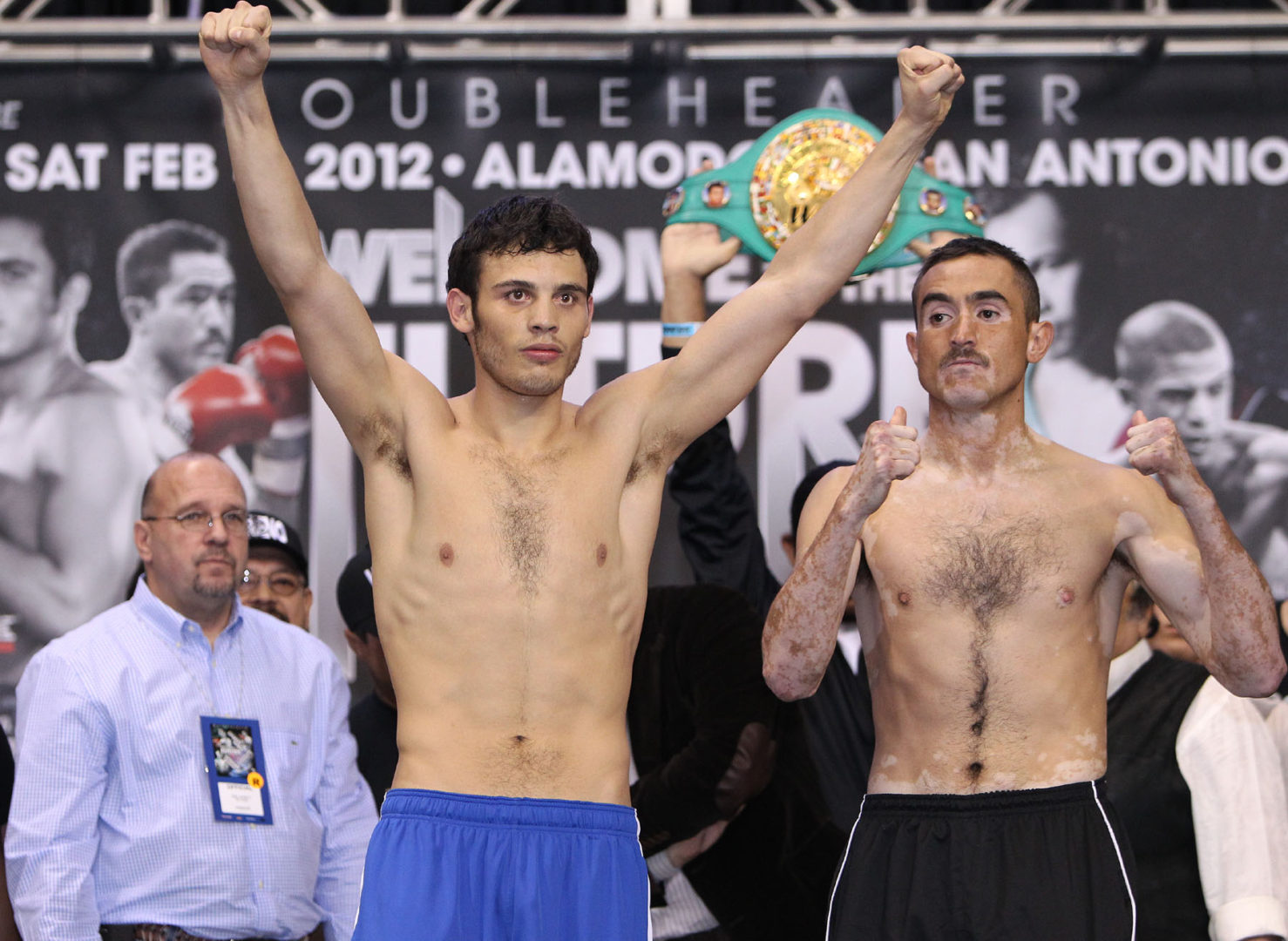
Bradley-Pacquiao: Allowing plenty of faults

LAS VEGAS – The Bellagio Gallery of Fine Arts, a short cab ride from the week’s poorly cooled and hastily erected media tent outside MGM Grand Garden Arena, currently features an exhibition called “Claude Monet: Impressions of Light.” It has its charms, featuring much of Monet’s early work – dash of orange here, square of blue there – but is for the most part unremarkable, save one quote from the Impressionist master: “I allow plenty of faults to show in order to fix my sensations.” Let that guide what follows.

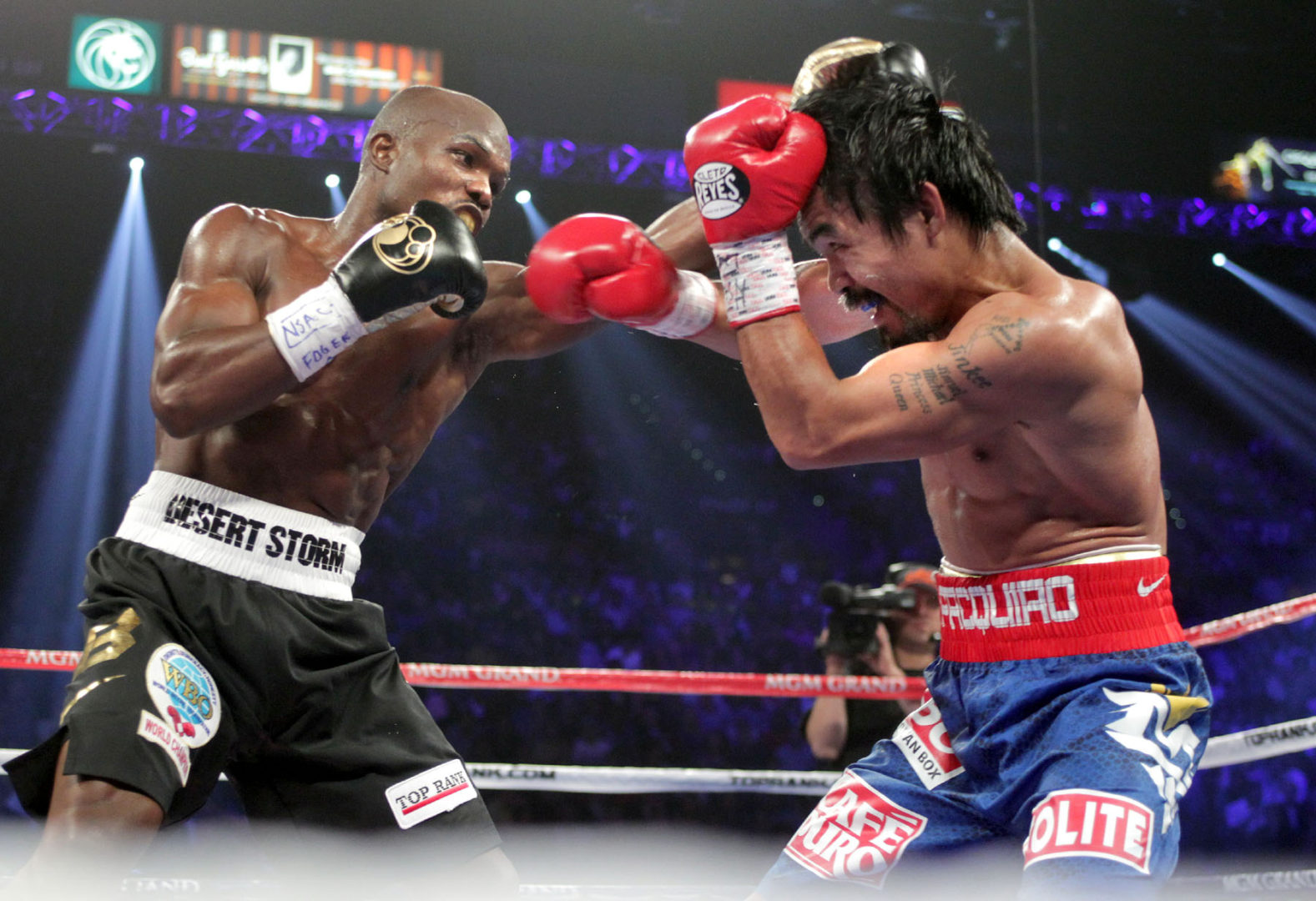
Saturday at MGM Grand, Timothy Bradley decisioned Manny Pacquiao by split scores – 115-113, 115-113 and 113-115 – that infuriated most observers. Bradley, later wheeled into the media center with a foot he may have broken in round 2 and fought on anyway for a half hour, was gracious in victory, promising his vanquished foe an immediate rematch. Pacquiao, face unmarked, was gracious in defeat, reminding those gathered how many blessings boxing bestowed on him. Bradley’s and Pacquiao’s, though, were examples of graciousness ignored by most everyone else.

In a nod to what Monet was after above, there were faults aplenty in the impressions caused by the lights of our beloved sport, Saturday. The judges, unique among those at ringside for being paid to be competent at scoring, determined, collectively, the fight’s result was extraordinarily difficult to discern. Only five of the match’s 12 rounds were seen unanimously for one fighter or the other. If that formed a conspiracy, it was at least a conspiracy degrees more sophisticated than boxing’s usual antics.

My ringside scorecard had Bradley by a point, 116-115. I gave the new champion rounds 2, 6, 7, 11 and 12. I gave Pacquiao rounds 3, 4, 9 and 10. I scored rounds 1, 5 and 8 even. Am I entirely confident of my card’s accuracy? Actually, no. I marked with an asterisk five rounds as either/or affairs, and I scored another three even. But I am certain of my card’s truthfulness – another thing Monet was after. Despite sitting ringside for no fewer than 400 prizefights during my time as a boxing writer, I was not at all sure of what I was seeing Saturday night. Which raises a genuine suspicion for me about the origin of others’ loud certainty.

Three professional judges disagreed seven of 12 times. Reasonable writers at MGM Grand, intelligent men with proven cognitive aptitudes, colored a wide array with their opinions. The only ones sure of their infallibility were a few usual suspects at ringside, compensated for what they know more than what they discover, and the entire HBO pay-per-view audience.

Let that be a commentary on the viewing experience, not the reality, and know better than to demand of ringsiders a review of Saturday’s telecast to find the wrong of their ways. We were there, friends; we know what we saw, and what we saw was the real thing, unfiltered, thanks.

Timothy Bradley did not fight well as even his supporters believed he would need to fight to beat Pacquiao. Hobbled and often unexpectedly reluctant, Bradley followed a questionable counterpunching strategy designed in his camp to preclude him from being the Ricky Hatton-redux Pacquiao prepared for. And Pacquiao, to his credit, fought considerably better than most anticipated he would.

There was a tone of disbelief in the media center at the postfight press conference. Part resulted from having not seen Pacquiao lose in 15 highly visible fights. There was confusion, a product of the result’s unusualness. Pacquiao lost to Marquez by a much wider margin than this in November, the thinking went, and he got that decision. This, therefore, is an outrage.

To score a fight impartially, one must look at the neutral plane between the fighters and follow any punch that enters that plane to its destination. Does anyone do this? No. Scorers select a narrative, often not consciously – “Pacquiao will catch Bradley coming in with those wide punches and beat him down,” say – and look to see it disproved, if they’re scientific, or proved (if they’re human). With few exceptions, Saturday’s fight showed an observer whatever he was looking for. If a scorer believed that Pacquiao, returned to his wildman and free-hurling ways, could hurt Bradley with most any punch he landed, he saw that every time Bradley swung his upper body like a windshield wiper. If a scorer believed that Bradley, quicker of reflex and less relenting than Pacquiao’s recent opponents, could grind the underconditioned Congressman to exhaustion in the championship rounds, he saw that instead.

More observers looked for Pacquiao to win. More observers saw Pacquiao win.

Pacquiao did catch Bradley with left uppercuts, though not nearly as many as he should have with a guy who put his chin on a tee every time he ducked rightwards. And the only time Pacquiao had Bradley in distress was when he flurried crazily with 10 obtusely angled punches, and four or five landed.

Bradley kept his right hand high – no Hatton redux, he – fought Pacquiao off him, held when he had to, and closed stronger than Pacquiao, confirming many prefight worries about the Filipino’s once-vaunted conditioning. Bradley also landed several punches, like a right cross in the fight’s opening 90 seconds, the partisan-Pacquiao crowd took no account of.

Promoter Bob Arum donned his performance garb in the media center afterwards, took an oath – a few oaths really – to ensure a rematch on November 10, and protested mightily the fight’s official outcome. Were this Shakespeare, in fact, Hamlet’s mother would have said Arum protested a bit too much.

Bart Barry can be reached at bart.barrys.email (at) gmail.com


Timothy Bradley shocks the world


LAS VEGAS –Things did not go according to plan for Manny Pacquiao. He was more aggressive than he had been in years. He threw with abandon, luring his opponent into maniacal exchanges. He fatigued only slightly down the homestretch. And he lost for the first time since 2005.

In an enormous upset whose scorecards will remain hotly debated, Californian Timothy “Desert Storm” Bradley (29-0, 12 KOs) decisioned the Philippines’ Manny Pacquiao (54-4-2, 38 KOs) by scores of 115-113, 115-113 and 113-115, Saturday at MGM Grand, to become recognized as the world’s best welterweight.

The 15rounds.com ringside scorecard concurred, marking 116-115 for Bradley – scoring rounds 1, 5 and 8 even.

While there were almost no rounds that one fighter won clearly on a neutral card – and only five rounds, of 12, were scored unanimously on the official cards – a number of patterns emerged early that appeared destined to favor Pacquiao. Las Vegas judges, long known to reward activity over effectiveness, were expected to see all close rounds for Pacquiao, who was nothing if not the more active fighter.

But Bradley, throughout the fight, landed the cleaner, and usually harder, punches. Most of the Pacquiao punches that brought feral howls from the partisan-Pacquiao crowd were grazing, at best, and clean misses at worst. Neither fighter was dominant. Either fighter might have won all but the final round, and that round, with the fight on the line, was Bradley’s, unanimously.

JORGE ARCE VS. JESUS ROJAS
The match intended to save Saturday’s undercard began well, with a knockdown in the first round, but ended in profound disappointment and ultimately a no-decision caused by an unintentional foul.

Mexican Jorge Arce (60-6-2, 46 KOs) versus Puerto Rican Jesus Rojas (18-1-1, 13 Kos), a 10-round featherweight scrap that started with Arce dropping Rojas in the opening minute, ended at 0:09 of round 2, when Rojas, lunging-in and trapped under Arce’s elbow, threw what became a low blow, and followed it with a crisp right hand behind the left ear of Arce’s turned head.

Arce went straight down, later citing disequilibrium, and remained on the mat for the entirety of what five minutes referee Kenny Bayless allotted for his recovery. The match was declared a no-decision when Arce was unable to continue. Both fighters expressed interest in a rematch afterwards.

MIKE JONES VS. RANDALL BAILEY
Mike Jones came to Las Vegas wearing the IBF welterweight belt and hoping to change people’s minds about what many considered a dull style. He took care of the dull part. But he’ll be going home without his belt.

In Saturday’s most dramatic knockout, Floridian Randall “The Knock-Out King” Bailey (43-7, 37 KOs) stopped Philadelphia’s Jones (26-1, 19 KOs) at 2:52 of round 11.

Jones began the fight in a fashion so timid that boos rained down from the half-full Garden Arena before the bell to end the first round h’d had a chance to clang. Rounds 2, 3, 4 and 5 saw more of the same, as neither Jones nor a man who calls himself “Knock-Out King” engaged one another in even a moment of sustained combat.

In round 6, having landed nary a telling blow between them, Jones and Bailey began to feint at each other – and react to one another’s feints – as though hard punches were somehow on the way. Finally, in round 9, Jones landed a balance-shot right hand that made Bailey appear to stumble, but rather than press his advantage, Jones quickly retreated, hands high, to ensure he didn’t get caught with any of the punches Bailey had not thrown for 26 minutes.

Everything changed at the end of round 10, though, when a perfectly leveraged right cross from Bailey stretched Jones on the blue mat. Jones leaped to his feet in time for the bell to ring and end the round and then came out moving tentatively in the 11th. But it took the “Knock-Out King” only 2 1/2 minutes to find him again, this time with a counter right uppercut that sent Jones, splayed and ruined, to the canvas.

Referee Tony weeks began a 10-count over Jones’ writhing, rising, falling and rolling body but soon saw the futility of it and waved the match off at 2:52 of round 11.

“I just put it in God’s hands,” Bailey said afterwards, choking on tears of joy, “and did what I had to do.”

GUILLERMO RIGONDEAUX VS. TEON KENNEDY
Cuban super bantamweight Guillermo Rigondeaux appears to have every tool except fan-friendliness, and that’s nothing a few knockouts can’t cure.

Rigondeaux (10-0, 8 KOs) took apart Philadelphian Teon Kennedy (17-2-2, 7 KOs) in the first fight of Saturday’s “Pacquiao-Bradley” pay-per-view telecast, dropping him several times with a left cross thrown from his southpaw stance, and eventually causing referee Russell Mora to wave an end to the WBA title match at 1:11 of round 5.

If Rigondeaux can continue blitzing good, if light-hitting, challengers like Kennedy, the Cuban may soon see his following get on track with his evident talent.

UNDERCARD
Doing his best to entertain what Filipino fight fans gathered hours before their hero’s arrival, General Santos City’s Ernie Sanchez (13-3, 5 KOs) decisioned Minnesota featherweight Wilton Hilario (12-3-1, 9 KOs) by scores of 78-74, 78-74 and 79-73. The fight was a lackluster affair that saw uneven contact and bursts of activity from Sanchez followed by long stretches of neither guy chancing anything.


Before that, undefeated Canadian welterweight Mikael Zewski (15-0, 11 KOs) turned an initially tentative affair into a decisive victory, stopping Coloradoan John Ryan Grimaldo (8-2, 5 KOs) at 0:59 of round 3.

Saturday’s second bout saw undefeated California junior welterweight Andrew Ruiz (2-0, 1 KO) stun but not stop Nevadan Taylor Larson (0-3-1) in a four-round match Ruiz won by unanimous scores of 39-36, 40-35 and 39-36.


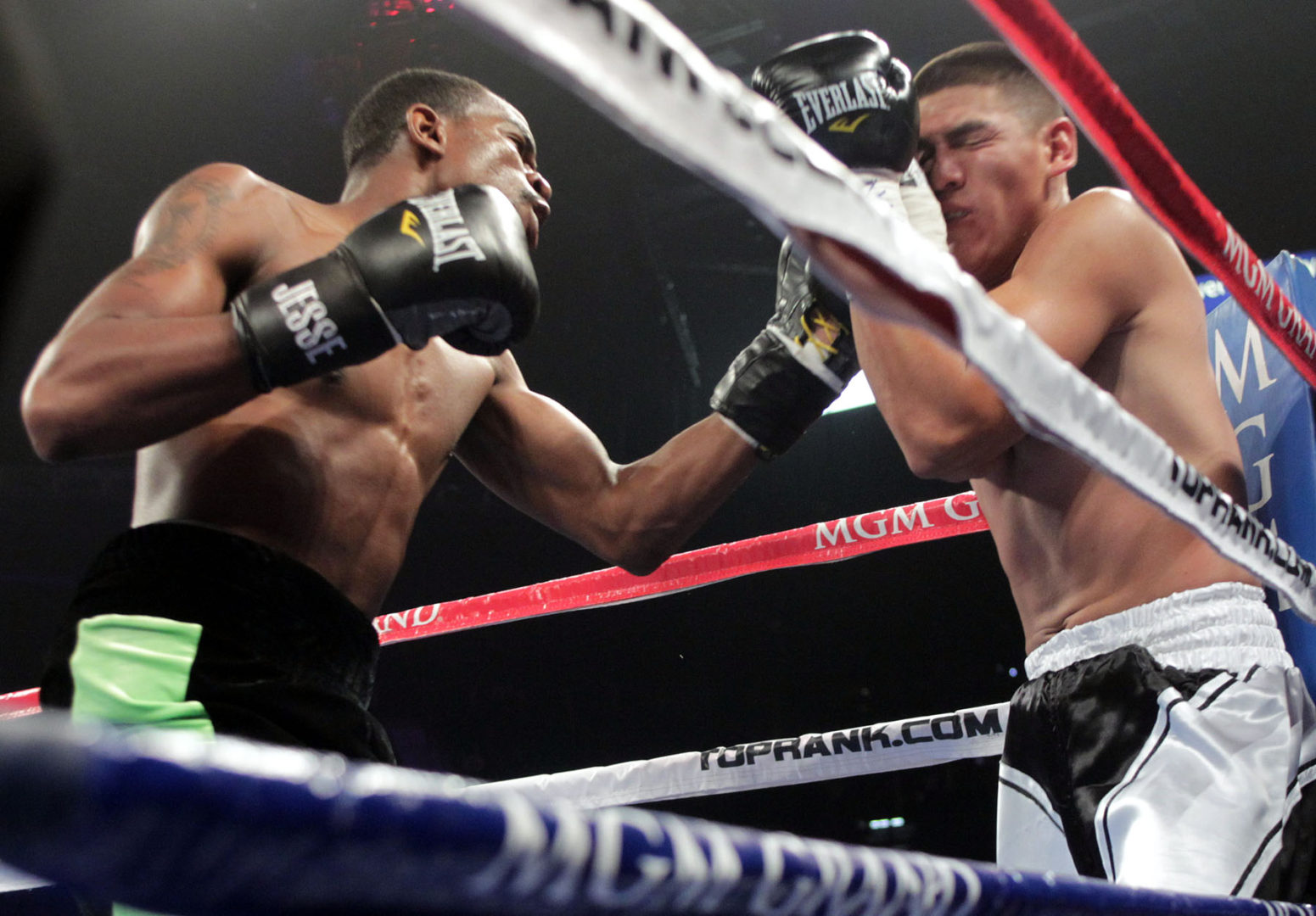
Highly touted Top Rank prospect Jesse Hart (1-0, 1 KO), a middleweight Philadelphian, made a definitive debut in the evening’s first bout, drilling New Mexico’s Manuel Eastman (0-2) with a right cross that was followed by a few more right crosses, and brought referee Joe Cortez racing in to end Hart’s assault, at 0:33 of round 1.

Saturday’s opening bell echoed through MGM Grand Garden Arena at 3:17 PM local time.


Pavlik and Lee get by at Hard Rock


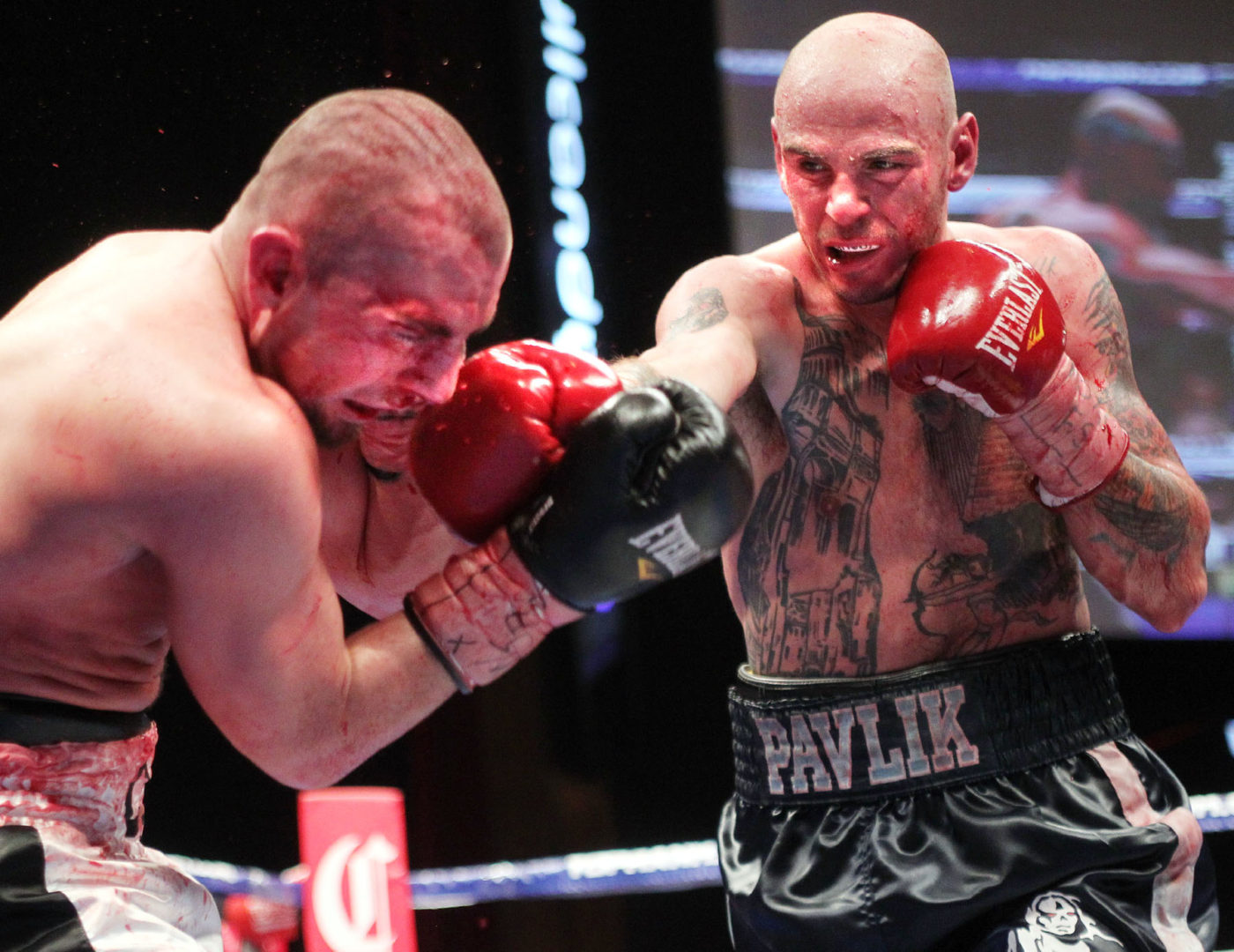
LAS VEGAS – When Kelly Pavlik fought in March, his first time in a prizefighting ring in 23 months, the match was about seeing where he was. Friday, Pavlik was in a prizefighting ring for the second time in three months to answer the same question.

And the answer went: About the same place as before.

In the main event of ESPN2’s “Friday Night Fights,” broadcast from The Joint at Hard Rock Hotel & Casino, Pavlik (39-2, 35 KOs) put in solid work and went rounds with super middleweight Scott Sigmon (22-4, 12 KOs), a Virginia opponent who was initially afraid to punch but later proved himself possessed of a better chin, and heart, than set of fists. Ultimately, Pavlik did what was expected of him, if a little less, left-crossing and right-hooking his way to a second consecutive victory – this time a seventh-round technical knockout caused by his opponent’s profuse bleeding.

“He did a lot of good things,” Pavlik’s manager Cameron Dunkin said after the fight. “He just worked. He didn’t want to load-up.”

With little more than a timid punching bag before him in the fight’s opening round, Pavlik did initially load-up on left hook-right cross combinations – right wrist flipping back whenever he landed – and supplied a fair number of emotional moments for the Vegas fight crowd.

“I’m not heard-headed,” Pavlik said afterwards about stylistic adjustments made under new trainer Robert Garcia. “I’m learning.”

As the rounds grinded along, though, and Pavlik’s occasional left-hook leads to the body brought no decisive end to the fight, Pavlik’s mouth gradually opened, his spacing gradually worsened, and his punching power gradually lessened. Pavlik had too much of everything for Sigmon, in the end, but Pavlik did not show the same head-snapping power he once used in terrorizing the middleweight division.

“Any of the top guys,” Pavlik said about future opponents, after the fight. “As long as it’s a better guy.”

Time will tell if a better guy is what Pavlik’s career actually needs.


MIKE LEE VS. ELISEO DURAZO
Fighting before a crowd that was almost all his – a gaggle of ringside dwellers in navy blue and gold t-shirts – Chicago light heavyweight Mike Lee (9-0 5 KOs) was prepped to make a sensational statement against soft Mexican setup man Eliseo Durazo (3-3) in the opening bout of ESPN2’s “Friday Night Fights” program. But the statement Lee made was less than hoped for, winning by three unanimous-decision scores of 59-54, in a fight that exposed more defects in Lee’s attack than planned.

Appearing to struggle with a belly-jiggling opponent who nevertheless did not know he was there to lose by spectacular knockout, Lee committed well to his punches and defended best he was able throughout.

If Lee is destined to show himself as more than a novelty act, though, he did not bring himself any closer to doing so, Friday.

UNDERCARD
Friday’s last pre-television bout was its most entertaining, as undefeated California super middleweight Rudy Puga (3-0, 3 KOs) made a hellacious five-minute scrap with hardnosed Idahoan Tommy Turner (2-2, 1 KOs). Despite being dropped with right hands thrown from most every angle, Turner continued to rise and fight on until a Puga right uppercut violently ended his night at 2:19 of round 2.

Before that, in the card’s largest surprise, unheralded Kansas lightweight Gerardo Robles (18-10, 9 KOs) dropped Californian Roger Gonzalez (27-6, 18 KOs) in each of the first two rounds of a fight whose round count showed “8/6” on the night’s bout sheet, and sneaked his way to a majority-decision victory: 76-74, 76-74, 75-75. The match’s oddest turn came after round 6, when Robles, believing the fight had reached its conclusion, mounted the turnbuckle in triumph, only to be told he would have to fight two rounds more. Those rounds were ultimately academic, though, and Robles won an upset victory.

The evening began with a good four-round scrap between two undefeated super featherweights – Californian Saul Rodriguez (4-0, 3 KOs) and Washington’s Kevin Davila (1-1) – in a fight Rodriguez won by unanimous scores of 40-36, 40-36 and 39-37. Despite losing most rounds by narrow margins, Davila, trained by 2000 U.S. Olympic head coach Tom Mustin, caught Rodriguez with enough quality punches to make ringsiders speculate about what could happen the first time Rodriguez is matched with a heavier-handed foe.

Opening bell rang at The Joint in Hard Rock Hotel at 5:31 PM local time.

Photos by Chris Farina / Top Rank


Pacquiao the convert, Bradley the shameless


Manny Pacquiao can be beaten, but this is not news because any man who ties gloves on his fists and makes combat with large and good enough men will be beaten eventually. Manny Pacquiao can be beaten by the man he faces Saturday, and this is news. It is not an outcome aficionados have allowed-for in a Pacquiao fight since at least Miguel Cotto but probably Oscar De La Hoya – and nobody knew what the hell was going to happen in that fight.

Pacquiao was unofficially beaten by Juan Manuel Marquez in November, yes, but you couldn’t find three people to predict it aloud in the MGM Grand Media Center during fightweek. It will be different this week. Pacquiao has not looked sensational against another prime fighter since his second tilt with Marquez in 2008 – another fight he may have lost with every scorecard in an honest hand. None of his recent opponents, not even Marquez seven months ago, prepared him for what he’ll see Saturday, when he faces Timothy Bradley at MGM Grand for the WBO welterweight title.

Bradley, 7-0 in world title fights, is an undefeated 28-year-old volume puncher who leads with his head. That sentence comprises everything needed to beat a subprime Pacquiao.

It has been more than five years since Pacquiao faced someone who had no idea how to lose, and that was the overmatched Jorge Solis at Alamodome in a fight with more anxious moments than one infers today from its boxscore. Those moments came behind a collision of heads that caused a cut to drop blood in Pacquiao’s eye, much as had happened two years before in the last prizefight Pacquiao lost – when Erik Morales took notice of the queasy look Pacquiao showed him after a visit to the ringside doctor. The Solis cut, too, brought a queasy look, one followed immediately by Pacquiao thrice making the Sign of the Cross – forehead to breastbone, left shoulder to right – in rapid succession, before tearing into Solis with a savageness unpredicted by any previous act in the fight.

The Sign of the Cross is a thing young Catholics learn to make in anxious situations, an emergency petition of sorts: I could be in over my head, here, so please watch over me. Pacquiao learned to do it as a child, like millions of others, and has continued to do it through a career that, as discovered in this match’s promotion, saw him occasionally eschew the teachings of Rome. Pacquiao’s rededication to his Catholic faith is sincere, but like other sincere initiatives Pacquiao has launched – like eradicating world poverty with yellow gloves – this one looks flighty.

It should be a private matter, either way, Pacquiao’s born-again Catholicism during a prizefight promotion, but as a matter that exploits Americans’ dual fascinations with evangelism and salesmanship, it was too rich for HBO not to shine its documentary light on – as part of a “24/7” programming concept, once innovative in 2007, that now covers mostly itself and predicts storylines it once discovered.

Pacquiao’s unconventional conversion is a bit relevant, too, because a fighter is not supposed to “feel empty inside” during training camp. If he is not too physically exhausted and mentally obsessed with another man’s injury to partake of such flummery, he’s likely not throwing hard enough at the heavybag. Or is that too ungentle for this era? Well. Can you imagine Marvelous Marvin Hagler, cloistered at the Provincetown Inn – the better to marinate in hatred and rage – having a telegenic advisor to ensure his spirit felt fulfilled? Heavens.

Just another part of the Pacquiao mystique, we are told. The soap-operatic entourage, the constituents in Sarangani Province, record deals, lawsuits and countersuits, the feuding corner, training breaks for Bible study; none of these is a distraction because Pacquiao has preternatural focus in the prizefighting ring. Or he’s been well-matched.

Inherent in most aficionados’ Pacquiao fight predictions has been a wager like this: Too much money to be made in a Floyd Mayweather fight for promoter Top Rank to risk it with a miscue. This has been a well-placed bet on the legendary marriage of matchmaker Bruce Trampler’s prowess and promoter Bob Arum’s business acumen, and their continued assumption a superfight with Mayweather is still doable.

Timothy Bradley’s one other showing at welterweight, an unimpressive 2010 outing with Luis Carlos Abregu, also indicates a prime Pacquiao will have his hand raised Saturday. Bradley is special in his way, special in both style and character, but he is not quite special as a guy who went 4-1-1 (3 KOs) against the primest versions of his era’s three best Mexican champions, as Pacquiao did. When was that prime-Pacquiao last seen, though? Pacquiao is the variable, Saturday, not Bradley; if the Pacquiao who has been showing up since he decked Ricky Hatton makes a pre-concert appearance at MGM Grand later this week, he will get conclusively outworked.

We already know what a volume puncher like Bradley brings: a glorious sort of shamelessness. Bradley doesn’t care much where he hits you and cares even less if you stretch him; so long as he surrenders himself fully to his intensity and does what his corner tells him, he is contented. Bradley doesn’t have to worry about losing because he has never done so as a professional, and because a volume puncher knows quickly when someone is decisively better than he is, as Pacquiao will be, and finds euphoria in breaking that man’s spirit with a want of polish, an enchanting rudeness.

I’ll take Bradley, SD-12, then – with a dissenting 112-116 scorecard filled-out the day before.

Bart Barry can be reached at bart.barrys.email (at) gmail.com


Carl Froch: Against the hypothetical


“I’m very tough, you know,” Carl Froch said Saturday, after he ruined Lucian Bute. “I’m a bit of an animal.”

It was the sort of self-assessment that, when unleavened by criticism, comes off as boorish and predictable sales-speak intended to preclude fisticuffs more than promote them. But from Froch’s mouth, which bears a frank tongue that quickly, and consistently, conceded the man who decisioned him in December, Andre Ward, was, is, the better man, the statement had exactly the right panache. In Froch’s Nottinghamshire, that is, in a place Ward has not been and will not be seen, Froch is the world’s most ferocious 168-pound man.

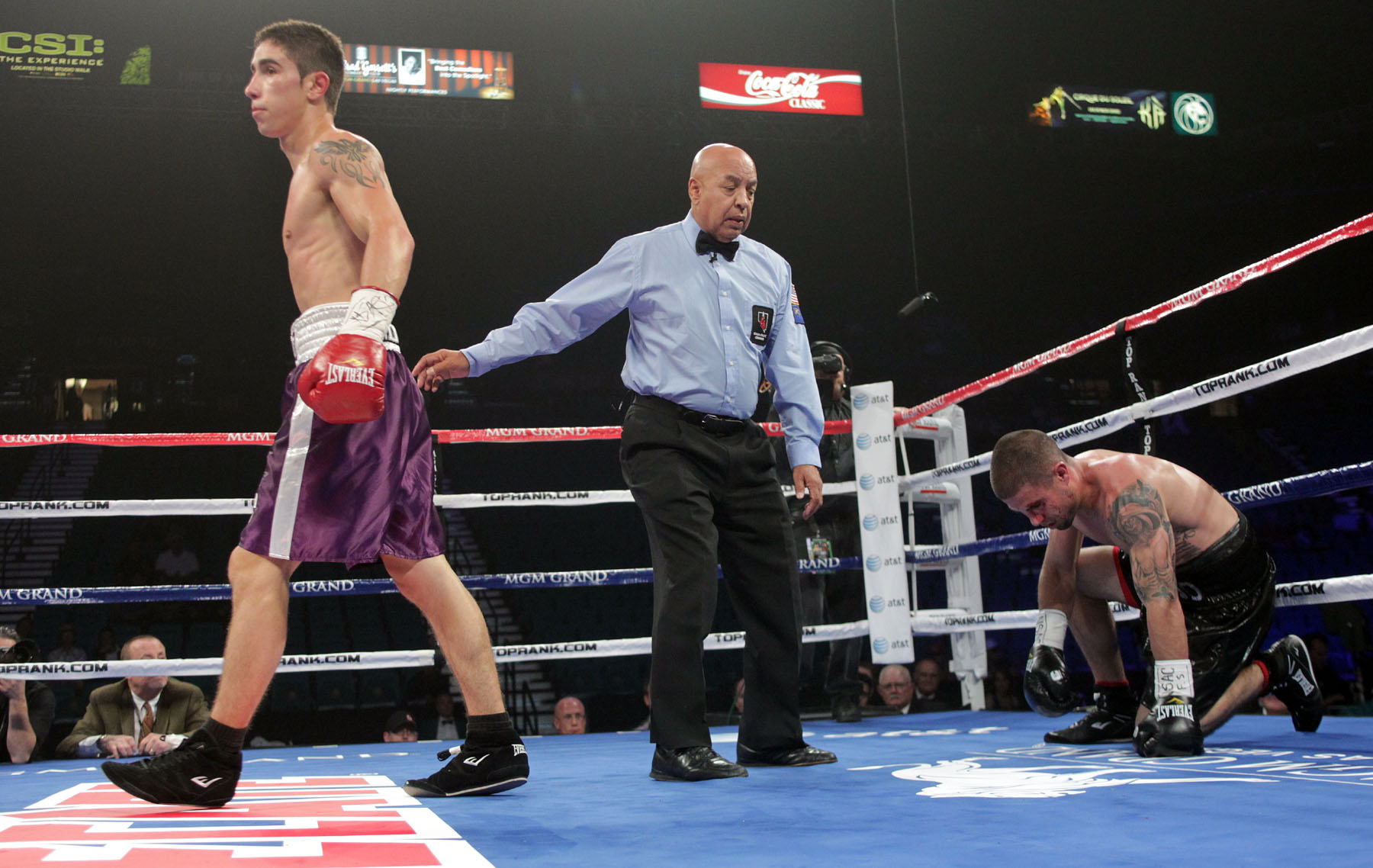
He proved that by tearing through IBF super middleweight champion Lucian Bute, Saturday, in England’s Capital FM Arena, and stopping the undefeated Romanian-born Canadian southpaw at 1:05 of the fifth round, when American referee Earl Brown, shaken by the sight of Bute’s head nearly touching his shoulder blades, waved-off the fight, restarted the fight, and had his authority usurped entirely (and appropriately).

There is plenty to be said for making fights to please fans, to fill arenas, to ensure future generations’ writers shake their heads at modifiers’ inadequacies as they happen off the fingers. But there’s one other thing to be said for making fights, and it is a thing that is occasionally lost for good reason. Because prizefights weaken their participants – alter their motor skills, shorten their lives, reduce their abilities to associate thoughts that aren’t immediate familiars – it is intuitively advisable to have an athlete make few of them as possible en route to comfortable a retirement as possible, with comfort defined in realms both physical and financial. This is truer the older a fighter gets; who would begrudge Evander Holyfield or Roy Jones Jr. a retirement party now?

But when an athlete is still prime, there’s a different strategy to consider: Fight more because you will fight better. Most arguments for increased volume are made by aficionados for self-interested reasons. We wish to see better spectacles more often while enjoying an ancillary chance at converting laymen to devotees. Nothing wrong with a little self-interest, of course, but in Carl Froch’s case, it misses the point – as Froch reminded us while uttering this clause at the end of a postfight answer, Saturday: “Most importantly, that’s what I want.”

What Froch wants is to be a great prizefighter, an international item, an immortal – a thing over which he has almost no control. Barring that, he wants to be an improving prizefighter, and in a twist that is proper, not ironical, Froch’s activity has brought that very effect. He has matched himself as a prime fighter against other prime fighters, and he is a better fighter right now, this very moment, than he was before he did. All clichés about styles aside, there is a very good chance the Carl Froch who engaged in that aesthetic disaster of a Super Six opener with Andre Dirrell 31 months ago would not have done to Lucian Bute what Froch just did.

The lesson of that fight with Dirrell, that some men who place a premium on trap-setting and reflexes are athletes not fighters and need to be gone-through not abided, changed the way Froch approached his opening minutes with Bute – a man superior in both reflex and athleticism. And the fight that came after Froch-Dirrell, the close decision loss to Mikkel Kessler that put a first blemish on Froch’s record and saw Froch, in its fifth round, land a buckling right hand then do a moment’s showboating with his right glove, taught Froch a hurt man is more interested in his continued consciousness than you are, and must be treated accordingly.

At a fundamental level that stylists often shun, a choice must be made in a prizefight that is otherwise even. It is a calculation of what a man will sacrifice – what percentage of his dignity and health – to undo an opponent. From the opening round, when Froch swam at Bute, throwing the right hook then crossing his feet over and crunching misplaced limbs one against the other, Froch proclaimed: All of it; I will sacrifice all of it in my hometown, right now, in the next instant even.

It has been written of Froch that he badly wants to fight even if sometimes he does not appear to know how. There were moments of that, too, in Saturday’s match. But the hardiness of his offense and the thrill Froch evinced in round 1 when Bute caught him with what Froch might call “something sweet” and both men paused to mark how comparatively little it affected the Brit, those were things for which Bute, whatever his class, was unprepared. Or so he looked – unprepared, uncomfortable, overwhelmed.

We must honor Froch as a bulwark against the rising and increasingly persuasive tide of the hypothetical. Had Froch not swapped blows unsuccessfully with Andre Ward six months ago, right now, on the virtue of what Froch did to Bute – widely considered no worse than the world’s second-best super middleweight – we’d be making a hypothetical Froch-Ward match in which even Ward’s supporters would concede that, if in the unlikely event their man could steal a decision from Froch, Ward would be hurt worse by Froch than any opponent before or after.

Instead we know exactly where we stand. Froch, to his resounding credit, fought both Ward and Bute and stated rather plainly before and after both occasions he was at his very best. Ward is definitively better than Froch, and he will be tomorrow. Froch is definitively better than Bute, and he will be until the men retire.

We do not believe that, or present persuasive arguments about its likelihood – silly rhetorical exercises that disintegrate into ad-hominem suspicions if not attacks – rather, we know it. Bless Carl Froch for providing that knowledge.

Bart Barry can be reached at bart.barrys.email (at) gmail.com


Another night in the gym

Inside the double blue doors, old wood with matte aluminum handles, the heater is off because with all the bodies inside and the humidity outside even the innocently sadistic traditions of the sport, ways for fighters to make weight by stretching them on a rack of dehydration, cannot find purchase in raising the temperature.

The stairs that descend from the entrance are rows of concrete, thick and soft with layered gray paint. Folding aluminum chairs, their legs scuffed by cheap polish off cheap brown and black shoes, line the stairs’ levels – a few dutiful mothers lying across them, bored by spectacle and tired from downtown-hotel housekeeping jobs, their phones in their right hands for emergencies or texting. A fibrous-patterned slip rope that sees little action in a gym with little head movement stretches wall to wall as a border to complement its handwritten sign: “Only registered fighters past this point.”

The walls sparkle with gold and black paint, oil on cinderblock, in a lost tribute to a crew of handymen boxers lost to a reduced schedule. Spongy black mats at the base of the sparkly walls float on stacked plywood that floats over the once-gleaming hardwood lanes of a collegiate bowling alley from the 1950s. Every so many meters, sporadically placed, stand borrowed trash receptacles, some tin and others blue plastic, one bearing partially a white recycling cartoon of circled arrows. The ring is elevated, four steps above the floor, its bungee-tightened canvas blue, its ropes taped red and white, and its new spit funnel crowned by a metal tray slick with petroleum jelly.

Two boys, grammar-school kids whose small heads take on alien, lopsided shapes under their red headgear, push 10-ounce gloves harmlessly at one another. Both have begun young enough to take punches on the nose impersonally. Ricky, the shorter, slower of the two, carries his lead hand low, mostly because he is tired but partly because his dad took him to see the Mayweather fight on a movie screen a few weeks back, and Mayweather made the low lead hand look more promising than Ricky’s trainers say it is. The boy will be fat someday – a fortune told in his chin and cheeks – but Dad will force the day out far as possible with strenuous hobbies like boxing, which despite their strenuousness are almost helpless to the boy’s fantastic aptitude for detecting, in every venture, the road most traveled.

Skipping rope before a wall-sized shadowboxing mirror is Temo, a youth champion, one of the gym’s best and necessarily cockiest kids, marking time till the yellow metal timer above the mirror makes its electronic enh-enh-enh sound. He floats a centimeter above the spot his leather rope slaps and may never be big enough to make a living at prizefighting, whatever others’ outsized and not-selfless hopes. Temo’s beauty and charisma will take him to an affluent place in 20 years, though his slight frame will doubtfully bear others’ piling on it.

Squared to the softest of the new 75-pound leather bags the gym got for Christmas is Clarence (everyone calls him “C”) tapping with hybrid left and right hooks the low part of the sack where red leather was stitched to black reinforcement and its inner sand is compacted tightest. C repeatedly puts his middle knuckles on the exact places where he can apply greatest force but make the bag swing least. His shirtless back, wet with exertion, is hard and dark and shiny like the wood of an oboe. The Christmas bag’s tight, noisy chain extends 10 feet in the air where it wraps round an exposed metal beam. Upstairs on the basketball courts, pickup games happen on one side and a women’s roller-derby practice on the other, and their exertions come through the gym’s ceiling like base thumps and zipping marbles.

Behind the double-end and heavy bags hangs an ovoid chunk of puke-yellow foam and crusted silver duct tape, its leather entirely shed. It glares resentfully across the floor at a new Everlast – heavier and harder, shapelier – into which boxers now drive their uppercuts and not this old bag, merely the X on a map where instead of buried treasure lies a broken board of floating floor that’d been twisting careless kids’ ankles.

On the second wooden bench, soft with layered gray paint in front of strewn dumbbells with rusted-over poundages and a heavy creaking Universal machine, copper with age and abuse, sits a pudgy kid named Victor. He’s in his twenties and 300s. Promised sparring, he’s been gloved-up and waiting, the toe of his right Ringside boot planted while its misshapen heel vibrates in the air just off the mat, hours now. His supposed partner, a thirtyish guy with a beard who wears a fat-burner belt under dark t-shirts and says he fought in a faraway place years ago and recently declared too loudly that he wanted sparring because he needed to say it to believe it, won’t be in. Tomorrow, there’ll be tendonitis or car problems or food poisoning to blame, and the day after that too.

Bart Barry can be reached at bart.barrys.email (at) gmail.com


How I overcame Low V

We must learn to see in boxing’s story the energy and cruelty our rapturous drive demands, like the drum and swish and smack and scuff and grunt of a boxing gym. The faintest frown of fortune sends some boys back to well-paid labor, but those of us enraptured by the dulcet art, we who are beastly creatures in whom all the horror of sex is blatant, must overcome what dilettantism is rife in boxing, because an ox without a rope can lick himself just fine.

What’s above is a paragraph I wrote in November. It was part of a column that elevated me from a workaday boxing writer to a champion sportswriter. Before I attended any awards dinners to see the work honored, though, I voluntarily submitted my work to a readability test because I want to see the craft of sportswriting cleaned up. Last week, my column came under scrutiny after a writing laboratory at UCLA found the following:

WRITER: BART BARRY
RESULTS: PLAGIARISM; CONSISTENT WITH THE USE OF OTHERS’ WORDS.

The lab results, which I do not dispute, found in that paragraph elements of Philip Roth, Hugh McIlvanney, A. J. Liebling, Somerset Maugham and Miguel de Cervantes, a compound known in writing laboratories as “RMLMC-Identical Letters.”

I want to state unequivocally that I did not plagiarize. I look forward to the day when my side of the story, and its requisite obfuscation, overwhelms what information currently circulates about me. To that end, I am assembling a team of lawyers and publicists to ensure the actions I took are forever misunderstood. In the interim, though, I’d like to provide a self-serving and confidentiality-protected version of events:

After failing to meet my potential in a number of important columns over the years, I noticed, last November, while readying for the most important column of my career, that I was unable to form sentences with the speed or élan employed by a great writer. This concerned me deeply because I am unable to make money doing anything but writing. I spoke to my editor, and he recommended a writing workshop in Las Vegas called Desert Mirage. I submitted numerous samples of my work, and Desert Mirage returned with a diagnosis of Low Vocabulary, commonly known as “Low V,” and prescribed the RMLMC-Identical Letters treatment mentioned above.

(I would encourage you to visit the Desert Mirage website and read about this for yourself, but the page that describes the revolutionary treatment is coincidentally now under construction.)

My workshop leader, a “conventionally trained” linguist “who also has extensive knowledge and experience with less traditional yet highly effective approaches,” assured me he had worked with a vast number of student essays and ghostwritten white papers in the past. After reading a blog about the treatment, I was satisfied that RMLMC-Identical Letters is completely different from the “representing of another author’s work as one’s own” that readability tests were created to detect. Just to be on the safe side, though, my workshop leader injected others’ words in my column at a ratio about six percent below the threshold used in Nevada plagiarism tests.

I wish to reiterate that no part of this treatment made me a better writer. Instead, this was a treatment necessary to my regular employment in any professional field, not just writing. In fact, when my workshop leader reviewed the samples I submitted to Desert Mirage, he was “literally shocked” – not figuratively, mind you; a charge of electricity shot through his body – that my vocabulary was so low. In routinely treating both illiterates and folks who’ve not read a full-length book in 50 years, he had never seen a vocabulary low as mine.

This was not a case of writer’s block brought on by deadlines, as happens naturally to both writers and non-writers alike. This was an incidence of Low V and part of a trend my workshop leader has seen accelerate in the last few years, one he successfully cures with his literary-based treatment. Again, these words were taken from actual literary works. They were not words created by lexicographers manipulating letters into artificial patterns. Using others’ naturally occurring words to help reestablish my vocabulary at normal levels didn’t make me Shakespeare by any means; it merely allowed me to use my innate ability to write a championship column.

I applaud readability tests and all they are doing. I am, of course, sorry they so misunderstood what I was doing. I’m confident that once my side of this story is parsed, processed and repackaged by my legal and publicity team, there will be reasonable doubt enough in your mind about my culpability in this matter that further analysis of my previous work will represent for you such a needless loss of time that you will forget this happened and consider paying to read me in the future.

(To underscore the seriousness of my commitment to using my own words, I admit my legal team helped with that last sentence.)

*

That is satire, yes, but barely more absurd than the explanations athletes’ spokespersons now regularly feed us. Lamont Peterson’s case, of which we began to learn Tuesday, is but another lamentable example. How cognizant Peterson was about the legality of what “Bio-Identical Hormone” treatment he underwent in November is debatable.

This is not: Testosterone is a hormone that causes the development of male sex characteristics such as facial hair and musculature and when taken in excess leads to increased aggressiveness.

A person who suffers from low testosterone may be capable of many things, but professional fighting is not one of them. If today Lamont Peterson – fully bearded and rather muscular – does not have even normal levels of naturally occurring testosterone, that is life speaking to him in one word: Retire.

A prizefighter without testosterone, after all, makes no more sense than a writer without a vocabulary.

Author’s note: Special thanks to Lem Satterfield’s extensive reporting on the matter, and a special recommendation of Gabriel Montoya’s exhaustive “Floyd Mayweather and the new wave of drug testing in boxing.”

Bart Barry can be reached at bart.barrys.email (at) gmail.com


Above a Texas bullring, a reminder about Floyd Mayweather


SAN ANTONIO – Suspended above a bullring on a wire-mesh floor below a cinema-size screen, one story and 50 yards from where Cowboys Dancehall’s dancers danced, 75 or so aficionados gathered to look up to a gigantic image of Floyd Mayweather looping right crosses off Miguel Cotto’s left temple. They had arrived round 6:00 PM and sat through seven local-talent fights co-promoted by Jesse James Leija, and a pay-per-view co-main as well.

Although their view was front row of a movie theater that made customers stand, these aficionados enjoyed certain uncommon benefits: they were in a lively if respectful group comprising more serious observers than the folks downstairs keeping one eye on the Spurs game, there was instead of HBO’s audio feed the odd musical assortment that explodes from cowboy-bar speakers – Sir Mix-A-Lot opening for Garth Brooks – and there was the unexpectedly good event that went off above them.

Floyd Mayweather decisioned Miguel Cotto by unanimous scores, Saturday, in MGM Grand. The scorecards, while wide, were about what prognosticators expected, when in a reflection of bookmakers’ opinions, they favored Mayweather nine or so to one – with the one in that ratio usually having an ethnic or financial stake in picking the loser. Writers at ringside had the fight closer than the official judges, and ringside writers and official judges composed the matter’s sole authorities.

Nobody sincerely believed Cotto would win Saturday’s fight, and he did not. But Cotto made a fight more satisfying for spectators than any he had made since Manny Pacquiao stopped him 30 months ago. And make no mistake, it was Cotto who made Saturday’s fight. In round 2, he put Mayweather on the ropes – and Referee Tony Weeks left him there – and it led to a heap more abuse than Mayweather expected, all postfight protestations to the contrary.

In implying afterwards that his initial trip to the ropes was voluntary, that allowing Cotto to whale on his arms and sternum was plan A, Mayweather struck a curiously familiar note; those were Roy Jones’ words immediately after he sneaked past Antonio Tarver in 2003: I went to the ropes to entertain my fans. But in actuality, as the world soon learned, Jones went to the ropes because his diminishing reflexes and footwork allowed Tarver to put him there.

A similar hollowness accompanied Mayweather’s words because his fans, like Jones’ before them, generally want no part in a competitive spectacle. They do not watch a Mayweather fight to see their guy endangered or struck on the face a hundred times. They watch for a transcendent display, for proof that super heroes happen off the pages of their comic books.

What little vocal reaction happened above the bullring at Cowboys Dancehall, Saturday, came just as the bell rang to end round 8, Cotto’s best.

“He ain’t doing nothing!” somebody barked.

“He ain’t nothing!” agreed a second voice, its volume proportionate to its nervousness.

Then Mayweather gave them a rebuttal that was articulate (since that word has come out of hiding): I am a fighter, not an entertainer. It was what Mayweather said in the third round of his match with Shane Mosley, when he put his hands in a classic, high position and attacked the older man. It was a phrase he spoke in his fourth round with Victor Ortiz when he exploited the younger man’s weakness to cut his consciousness. And it was what he said for 30 of Saturday’s 36 minutes with Miguel Cotto. I am this, primarily this, and not what most of you think I am.

Something often missed by Mayweather’s detractors and ever missed by his devotees: Before he was “Money May,” master of the era’s race-baiting nuances, before he made pundits who should know better assign unprecedented import to his undefeated record, he was a fighter – a man who collected blows for a living.

There was a touch of requited love in the way Mayweather handled Cotto’s head on a break in round 4, something almost tender about it. Another man was speaking to him fluently in their first language – not hip hop’s Ali-copycat speak, not the cloyed and serenaded words the mercenaries sing to Money, not those adverbial clauses everyone spits at video cameras – but the language of professional combat in a proper tongue. It betrayed for a moment what most observers do not realize: Other fighters genuinely adore Floyd Mayweather because he is, at root, exactly as they are.

But other fighters also know what historians will uncover: There is a reason you must fight the fights. Mayweather beat Cotto, yes, but does any knowledgeable observer think he is, today, a stronger man for doing it? He is not. Mayweather was brutalized, softened, his health compromised, his life likely shortened some, in those 12 rounds with another professional puncher. It was what both men signed up for, of course, and if Mayweather was not enthusiastic about paying the tariff, he was still, and absolutely, good for it.

Historians, those plodding, careful men who assess records not hand speed, will note Mayweather never fought or beat, in his prime, a man who was favored over him. It’s too late to change that, and subsequently Mayweather’s legacy is for the most part settled. But then, respectfully, so is this: Floyd Mayweather was and is more of a fighter than he was or ever will be anything else.

Bart Barry can be reached at bart.barrys.email (at) gmail.com


Najera and Hall entertain & Ellis and McCumby thrill on Cinco de Mayo card

SAN ANTONIO – Seeing a neighbor don gloves and swap blows in a prizefighting ring is often thrilling enough for any fan to go home from a night at the fights fully satisfied. Performing before his hometown, though, Ivan Najera decided to provide local fans a bit of an extra thrill.

After showing poise and superiority of class in the opening half of the opening round of Saturday’s Leija-Battah Promotions main event, San Antonio’s Najera (8-0, 8 KOs) started a left hook-lead at fellow Texas junior welterweight Gerardo Dominguez (1-15, 6 KOs) an instant after Dominguez started to throw a left hook of his own. Dominguez’s landed first, and down went Najera in front of a surprised Cowboys Dancehall crowd.

Unfazed by what was obviously a flash knockdown, Najera rose, reestablished his poise and efficiently took his outmatched opponent apart. The end began with a left uppercut-lead in the opening minute of the second round, and the end ended with a quick combination that dropped Dominguez and rendered him unable to continue – at 1:06 of round 2 – despite Dominguez’s rising before the referee’s count reached 10.

It was a good win and a better lesson for one of this city’s most talked-about young prospects.

JAVIER RODRIGUEZ VS. THEO JOHNSON
Saturday’s most competitive match came in its co-main event, a four-round junior featherweight battle between two San Antonians, Javier “Pitbull” Rodriguez (2-1, 1 KO) and Theo “Thriller” Johnson (0-1). Each threw every punch in his arsenal multiple times, with Rodriguez early establishing himself as the better-balanced and -leveraged puncher, and with Johnson making several chin-jarring right crosses count late in his pro debut.

The official scorecards were fair, with all three scoring the match 39-37, three rounds to one, for Rodriguez. Well as they matched up and hard as they fought, if Rodriguez and Johnson continue to improve as professionals, they might just see one another on a blue mat in their hometown again.

UNDERCARD
Local favorite Steve Hall (5-2, 5 KOs) brought the San Antonio crowd to its feet early in his welterweight match with southpaw Texan Alberto Espinoza (2-1), assaulting him with right crosses and even mimicking his southpaw stance for a bit in the middle of the first round. After that, though, the British-born San Antonio prospect got down to business, stretching Espinoza with a picturesque right cross and stopping him at 2:52 of round 1.

Before that, in one of Saturday’s two best displays of class and power, Arizona light heavyweight Trevor McCumby (5-0, 5 KOs) went directly through Georgian Perseus Givens (1-2), stopping him at 2:55 of round 1. Givens was never truly in the fight, as McCumby assaulted him with left hook-right cross combinations from the opening bell. Finally, it was a McCumby right cross to Givens’ belly that ended Givens’ night.

Austin junior welterweight and Ann Wolfe charge John Arellano (7-1, 7 KOs) then made a violent and ultimately satisfying six-minute show against Mexican veteran Julian Rodriguez (19-21-4, 13 KOs), stopping him at 0:31 of round 3.

Saturday’s second match featured one of the card’s two most highly regarded prospects, Boston’s Ronald Ellis (3-0, 3 KOs), in a super middleweight fight scheduled for four rounds against Texan Delvery Wofford (0-3). Whatever was scheduled, the match was doomed to end quickly soon as Wofford got a first taste of Ellis’ impressive power. The match lasted fewer than 75 seconds, with Ellis attaining his career’s third knockout at 1:14 of the first round.

The evening’s opening bout, a four-round featherweight tilt between southpaw Texan Kermit Hendricks (1-2, 1 KO) and South Carolinian Chris Nicolosi (0-1), ended at 1:31 of round 3 when Nicolosi, after fading for a round and a half in his pro debut, succumbed to a barrage of left crosses from Hendricks – who got his first professional win.

Opening bell rang on the bullring of a semi-full Cowboys Dancehall at 6:32 PM local time.


“Will they forgive us for this?”

Somewhere in the 11th round of Saturday’s HBO main event one man’s lovely face expressed wholly what viewers wished to see. It was Oscar De La Hoya’s. Once a great fighter, now a promoter of sorts, De La Hoya, sandwiched between the man who runs his company and his evening’s co-promoter, gazed at the ring, and therefore the camera, with a look that said: “Will they forgive us for this?”

To De La Hoya’s right his co-promoter, Gary Shaw, a more complete manifestation of the American entrepreneurial spirit – If it makes me money, it is good! – showed no remorse for what happened before him. Shaw’s guy was stumbling, holding and fading his way towards another big payday because somewhere it is written in HBO’s charter the winner of Saturday’s eyesore will be paid again and again according to a compensation scale made of durable pixie dust.

But De La Hoya, for all his recent fruitiness, remains a former fighter and a fan. As his autobiography implies, he is the product of two cultures, and one of those cultures watches a confrontation between two men with expectations greater than an accountant’s. And so the best description of what De La Hoya’s handsome countenance showed Saturday was sheepishness.

There was a feeling of quiet embarrassment to the entire main event that was Chad Dawson decisioning Bernard Hopkins for light heavyweight titles at Boardwalk Hall in Atlantic City, N.J., in a rematch to an October fight considered an embarrassment by both casual fans and aficionados.

Pay-per-view receipts, or at least rumors about them, implied there was no appetite for Dawson-Hopkins II. However unfinished the business from their first meeting, a disqualification that ended in a tangle of limbs, winces and recriminations, Dawson and Hopkins’ business together was clearly and shamefacedly finished. The rematch happened anyway.

Chad Dawson fought as a young man embarrassed that his path to celebrity required him to beat on a 47-year-old. Mauling someone born in 1965 seemed to offend Dawson’s sense of decorum, and so he chose not to. In defiance of everything Joe Calzaghe showed the world four years ago, Dawson waited for perfect opportunities – which even at 70 Hopkins would never afford him – and when they didn’t come, Dawson chose not to risk the embarrassment of swinging at and missing a man so much older. Which led Dawson to suffer a greater fear indeed: What if my conditioning fades, and after doing nothing I actually find myself physically incapable in front of this guy? What will people say about me then?

A question of others’ opinions hung limply over the ring from the opening bell. For all Hopkins’ bluster, he is fantastically preoccupied with others’ opinions of him – a preoccupation sometimes dandied up with words like “legacy.” Dawson lies awake at night with the same preoccupation, though without the same chamomile of achievement to soothe him. Dawson fights like a man very much afraid of humiliation.

How delicious might it have been had referee Eddie Cotton played on these men’s capacities for shame? Any round of the middle eight or so, Cotton might have seen them come together in an embrace and shuffled himself to a neutral corner and stood there, shoulders shrugged. After what duration of clinching and playacting at violence – 90 seconds? 110 seconds? – would either Hopkins or Dawson have become ashamed enough to detach himself and throw a punch? Perhaps the embarrassing job would have devolved entirely to the timekeeper’s bell.

There was a moment in the final minute of round 9, though, a three-second intermission from a 30-minute hug, when each man threw more than a single punch at the other. An exchange ensued. Each man took the other’s punches personally and cared more about avenging them than avoiding the embarrassment of missing or being hit. And within that moment came a reminder for posterity: Were this an actual fight rather than a spectacle, were this a private affair not to be stopped until either Hopkins or Dawson had what honorable men once called “satisfaction,” Hopkins, even at age 47, would have prevailed.

Lowering his chin and head and tearing forward to catch his opponent with an accidental right cross or an intentional headbutt, Hopkins was, during most of Saturday’s 12 rounds, still more interested in confrontation than “Bad” Chad Dawson. Hopkins’ performance was unbefitting a man who calls himself “The Executioner” – hell, it was unbefitting an executive order – but it was often as not a representation of the best Hopkins could do. There was not one round about which the same could be said of Dawson’s effort.

After the judges’ tallies were read, after a first card of 114-114 tantalizingly predicted he might have gotten away with something, Hopkins flashed a perfunctory look of disbelief about his loss. It was not shock but obligation. His theatricality retired, or just tired, Hopkins made a tiny down payment of insincerity on the possibility of grifting HBO one more time. Why couldn’t an “On Graterford” special set the table for a retirement match, complete with another contract extension in the event of a win or honorable loss?

Dawson showed less shame still. He summarized Saturday’s incident thusly: “(Hopkins) came back, he fought his heart out, and it was a great fight.” No, Chad, it was a breathing antonym for “great fight.”

Whatever promoters and publicists next try to do with the spectacle of Dawson-Hopkins II, however much obfuscation gets heaped on this thing, there will happily remain the image of Oscar De La Hoya’s beautiful face to tell Saturday’s story all too eloquently.

Bart Barry can be reached at bart.barrys.email (at) gmail.com.


Watching a writer watch a fan watch Floyd Mayweather


“Makes fun of the Easter Bunny / Reunites with dad / Goes to pololoco for chick . . . plays basketball; crosstraining? Hungry again, narrator says: more fried chicken”

Those are the writer’s notes on Saturday night. It’s preliminary sketching for a piece he has to write for one of the wire services, about the marketing of boxing pay-per-view attractions. They were supposed to be out of this business of network advertising after the last one went so terribly, but then a reader used the word “hater” in an email to the editor, and now the writer has to redeem the service. Coincidences abound, thinks the writer, as he edits what he will record about what he is watching because his editor is a goaltender who doesn’t take to combat sports and holds it against every article that treats them, and so he’s going to have to shoot for the corners if any of this story will make it to print.

The writer sits on the opposite side of a couch from his girlfriend’s son, who is 15 and typical. He says he is a fan and an athlete; he attends the boxing gym – when his dad takes him – but mostly goes upstairs and plays basketball, as that is where the girls, and so the better athletes, congregate. His mom says he is a JV player on Mayweather’s “Money Team,” forgetting the captain for about half of each year.

“Floyd’s right, you know?” the kid says to the room. “The Easter Bunny laying eggs is dumb.”

The writer makes a note about Floyd’s grasp on the obvious, wondering if the obvious vulgarly expressed was as alluring when he was 15. He decides it was. Floyd’s primary appeal may lie in his saying things others won’t. It resonates with a teenager who sees conformists getting invited to parties that snub nonconformists.

“‘Floyd and I’s bond is unbreakable’?” the writer notes, transcribing what Mayweather’s fiancée says on the first of two HBO programs about Mayweather. “Loyalty?”

“Even women want to stay on the Money Team,” the kid says to the room. “Ms. Jackson knows she’s got it better with Floyd.”

“‘Ride-or-die’?” the writer notes with an asterisk, to remind himself to see what that means later, or maybe think of a gentle way to ask his girlfriend’s son.

“I’m still going strong!” Mayweather shouts at the camera. “I still look good and young. Feel strong. Still got big muscles. Still flamboyant. Still shit-talking. Fly whips, big mansions!”

The kid smiles at the television and thinks Floyd had to say that, cued by the producer. Like a switch. For the haters. It makes white people, the Republicans, buy fights to see Floyd get beat up. But Floyd never loses. He’s too smart.

“There’s 50!” the kid says to the room. “He’s a genius.”

The writer changes his posture, instantly defensive. This derelict “a genius”? Isn’t he the guy who got rich singing it was somebody’s birthday? “WTF?” the writer scribbles in large letters.

“That’s crazy,” the kid says. “I thought 50 was out, like, every night.”

The writer’s previous posture returns. “Curtis Jackson as an introvert and artist . . .” he writes. Actually hadn’t crossed his mind.

“Floyd’s got’em again,” the kid says. “How you gonna call yourself ‘loyal’ and fire your own uncle, Cotto? Floyd’s real. He can only act like he doesn’t care a little. Then he brings the truth.”

He’s not a good actor either, the writer thinks. A pro shouldn’t get tired while on set. “Half-assed villain,” the writer notes.

“Hey, it’s the nerdy dude from the Tupac movies!” the kid says. “I didn’t know they were doing two ‘24/7s’.”

“‘On Floyd Mayweather’,” the writer puts at the top of a new page in his notebook, and underlines it.

The kid watches Floyd yell at his father and throw his ass out of the gym. That’s what you get. You show up, now, when your boy is famous, and you try to take over his gym for the cameras, and you dis your own brother by saying you did everything? Throw his ass out.

“Mayweather’s dad / cussing him out / says he’s nothing / former drug dealer / comes back for control,” the writer notes, wondering how much of Floyd’s point, here, would be lost in exposition.

The kid checks his cell. He’s bored. The nerdy dude is making Floyd look weak.

“King and Malcolm X!” the writer says to the room. “You’re no civil rights hero for going to jail, Floyd!”

“Malcolm wasn’t what y’all would call a ‘civil rights hero’ when he went to jail, either,” the kid says. “Was he?”

“No one would never understand me,” Mayweather says to Michael Eric Dyson.

“I understand you,” the kid says. “Because nobody understands me.”

No 15 year-old thinks anyone understands him, the writer thinks. He gives others what Oscar Wilde called the benefit of his own inexperience. “‘Nobody understands me’ / same thing Tyson said,” the writer notes; “they capture the disconnectedness of the American teenager”

“Floyd’s making the professor the student,” the kid says. “The nerdy dude just said Floyd was intelligent and well-spoken. Put him on the Money Team, Floyd.”

“‘School will always be there’?” the writer notes. How can he say that to a college professor? how can he be so dismissive? how can the professor just sit there and take it, smiling? “wtf?” the writer scribbles again.

“That’s what a man does, dude,” the kid says. “Floyd had a family to take care of. He made the man’s choice.”

Mayweather leans over and shakes Dyson’s fingers, and the camera swoops upwards.

Bart Barry can be reached at bart.barrys.email (at) gmail.com.


From outrage, an outrageously good idea

You’re angry, angrier than you have been since March. Feed that rage a touch, then, before endeavoring to diffuse it. A catharsis might be in the offing.

When the receipts from the “Too Big for One Country” event get tallied – both at the box office and your local cable provider – there’s going to be a calculation made about what happened Saturday: Not enough people saw Brandon Rios get outclassed by an unknown Cuban to boycott Rios’ next fight. “Brandon Rios MD-12 Richard Abril” is the line that went in the books. Bring on Cowboys Stadium in July.

Outrageous! Yes, yes, but first, Saturday’s main event – Juan Manuel Marquez UD-12 Serhiy Fedchenko in Mexico City – and its good reminder: It was arranged that Marquez be the main event even before Rios missed weight for a second consecutive fight and lost nine rounds to Abril, because Marquez was the card’s draw because Marquez is exceptional. As he nears his 39th birthday he is still, if we’re being knowledgeable and truthful, among the last men in the world whom you should confront or show vulnerability to.

It is indecent, however, to laud Marquez for what he does at his advanced age – Bernard Hopkins in a lower weight class, fighting three minutes of every round, clinching no one – without making an observation about his physique. It is transformed. Or half of it is. Marquez, helpfully, has left his lower body at 126 pounds while making his upper body, delts and traps specifically, into something a 170-pound man would proudly wear on any beach. It is impossible that this has been done by an adult Homo sapiens nearing the end of his fourth decade, with just a little more attention to diet and some hours in the gym. Juan Manuel Marquez now ingests chemicals he did not previously ingest, and they enhance his performance.

Are they banned substances or “PEDs”? No, evidently they are not. Today’s arbitrary restrictions and their arbitrary tests applied by arbitrarily lionized experts detect nothing. It’s a little reminiscent of what President Barack Obama said about passing the Wall Street Reform and Consumer Protection Act a few years ago: Turns out most of the actions that brought the world to the precipice of financial insolvency on Sept. 18, 2008 were legal.

What is written above applies equally to Sergio Martinez, Floyd Mayweather and Manny Pacquiao, to pick the only three men in the world who might currently be better at prizefighting than Marquez. All are performing better in their 30s than they did in their 20s. And none of us is gullible as he pretends to be.

Stay your rage, though. Save it for the day somebody’s scorned personal trainer publishes a tell-all book. And don’t give us that lame “But by then I’ll be tired-out from being outraged so many times before!” line, either. Nobody believes that, not after this, the year of outrage.

Saturday, the new worst decision in history favored the favored fighter, again. Richard Abril decisioned Brandon Rios on every scorecard that did not count (including mine) while never, not for one moment, trying to render his opponent unconscious – once the object of prizefighting. Will we never see the day some manager or trainer or fighter tells himself and others: “The judges are every bad thing people say, and so I’ll be damned if I trust my career to their discernment”?

Rios remains what he is, which is three parts aggressiveness and self-promotion for every one part talent. Against Abril, he did not get his aggressiveness on the side of the ledger that reads Effective more than a handful of times. He did something, too, that betrays a misunderstanding of the physics of punching: He repeatedly set his head behind his opponent’s left shoulder and threw a left hook. This was not the seeing-eye overhand right that no-hopers throw in gyms across the fruited plain. It was much worse. You doubt it? The next time you’re in a gym, set your left ear against the heavybag and throw a left hook, and then ask yourself how an undefeated professional could turn such a contortionist’s trick so many times in a half hour.

Marquez-Rios in Cowboys Stadium in July has not been canceled yet, though, has it? Promoter Bob Arum loves a challenge. This will be two. First, sell the Rios mess to Jerry Jones, and second, sell it to the public.

Count me out! I’m at the end of my tether! I’ve had it!

Arum doesn’t believe you, and frankly, experience says he shouldn’t. But before all is lost, before the contracts get signed in the next month or so, why not be imaginative?

Keep the summer date and the colossal venue, but instead of Marquez-Rios, let’s have Juan Manuel Marquez versus Erik Morales, with Brandon Rios in the co-main against Mike Alvarado. It’s doubtful Morales is under some long-term obligation to his current promoter that can’t be circumnavigated. The people under Bob Arum still love Morales, and he likes them right back. Marquez would be favored, sure, but the fight would be compelling, as neither Mexican would be disrespectful or ignorant enough to employ physical force alone. If you’re trying to attract Mexicans, can you think of two better names? And for the aficionados among us, there’s still Rios-Alvarado, a fight that has less chance of missing than Cotto-Margarito did in 2008.

There. From outrage, an outrageously good idea.

Bart Barry can be reached at bart.barrys.email (at) gmail.com.


Eating barbecue, thinking about El Paso and geometry


LULING, Texas – Here is a town that is home to 5,000 souls and represents the southernmost point of a golden corridor of Lone Star State cuisine. Luling to Lockhart to Spicewood, a 76-mile stretch that cuts through Austin and whose three towns’ populations total merely 26,000 people, somehow hosts six of the 50 best barbecue joints – according to Texas Monthly magazine – in all 268,580 square miles of the Republic.

Quite a feat, that. Smoked brisket, ribs and sausage are three things Texans know at least as well as their sports. “Good barbecue don’t need sauce,” they say down here, and it’s a fine way to keep straight the difference between Texas barbecue and its cousins in Memphis and Kansas City. El Paso, on this Republic’s western wing, does not have an entry on the cherished Top 50 list – the closest finalist is in Monahans, 250 miles away – but it has a whole lot of boxing fans.

Tuesday those fans learned they will be hosting an important event on June 16. Mexican middleweight Julio Cesar Chavez Jr. will face Andy Lee, an Englishman of Irish stock and Detroit residence, in a Sun Bowl fight that will decide both a title and the second-best man in the middleweight division.

The best man in the division remains Sergio Martinez. Much was made, Wednesday, of Martinez’s signing a one-signature rebuttal contract to make a match with the winner of Chavez-Lee in September. September, of course, is a decade away in boxing years.

Chavez will make his fight with Lee in June because Chavez’s promotional handlers at Top Rank believe he is ready. Ready as he’s going to be, anyway. A day quickly nears when Chavez will no longer be able to make the middleweight limit – that day, in fact, may have passed weeks ago, uncommemorated – and before Chavez can be steered away from Andre Ward at 168 pounds, the thinking goes, he’ll have to honor a few obligations in a middleweight division where he has already made six fights.

Chavez’s middleweight title is a gift from the WBC, a way of celebrating the legacy of Chavez’s dad, many argue, and once Junior gets in the ring with a real middleweight in his prime, a man like Lee, the end of this fraud will attain an exclamation point. Possibly. But Andy Lee has not quite raced through the sport’s best 160-pounders either.

Lee is the charge of celebrated trainer Manny Steward, and therefore, in the star system television makes of boxing, credited with recent wins over Troy Lowry (27-10) and Alex Bunema (31-7-2) and Saul Duran (40-19-2) in a somewhat exaggerated way.

Chavez’s trainer, too, is a star-system story that now feels overworked. Freddie Roach, who took on Chavez as part of a 2010 post-diuretic rehabilitation tour Junior’s people launched, has not altered Chavez’s fighting style in any permanent-looking way. But he has added the thorny Alex Ariza to Team Chavez. And somewhere between the potential drama of Chavez getting his coddled ass beaten and the palpable suspense of Chavez’s every trip to the scale, boxing fans have been enticed out of hiding.

Chavez, steadily becoming the most interesting man in the boxing world, doesn’t always fight in the United States, but when he does he prefers Texas (stay angry, my friends). Chavez is favored here and will be in June. Boxing has a rich history of hometown favoritism that television recently rediscovered in time to feign shock over it, because shock is entertaining.

Reporters have begun likening Texas to Germany, where crowd favorites enjoy spectacular advantages. Coincidentally, Texas and Germany are just about the last places on earth 40,000 boxing fans still congregate from time to time. All soliloquies to fairness aside, boxing is an often-filthy place that does not work as the branded and sanitized thing airless television studios endeavor to make of whatever their medium touches. Television wants known unknowns; boxing, bless its heart, gives them unknown unknowns.

Chavez will probably sell as many tickets on June 16 in El Paso as Floyd Mayweather and Manny Pacquiao combine to sell in Las Vegas, on May 5 and June 9 respectively, whatever television says about it. That used to be the measure of a star in prizefighting.

How did the rise of Chavez come to this? More naturally than anticipated, actually. Freddie Roach, speaking after his first abbreviated training camp with Chavez, which culminated in Chavez handling Irishman John Duddy, said Chavez came to him already understanding the geometry of the ring – from Chavez’s watching his father master it, and other men, as a boy. In a sport of time and space, Chavez’s geometric astuteness brought him into boxing 50 percent farther along than most.

Boxing is Julio Cesar Chavez Jr.’s native language. Roach may polish the grammar of some Chavez flourishes, but his primary function lies in discovering opponents’ sentence patterns, and then having Chavez recite them a few hundred times in training camp.

Andy Lee speaks boxing fluently, too. Immersion in Manny Steward’s curriculum ensured that. Lee does things with a technical proficiency Chavez usually lacks. But Lee also appears to remember learning the language of boxing, where Chavez could not if he wanted to. That’s a difference.

A palate for Texas barbecue is an acquired quality. Brisket can seem dry and sausage too spicy. And the absence of sauce on ribs can be, to the uninitiated, a touch unsettling. Texans, raised on brisket tacos and such, need no curriculum on barbecue, though, and as connoisseurs, need no directions to this city, Lockhart or Spicewood.

Texas fight aficionados will need no directions to El Paso in June. They know Chavez-Lee will be a good fight because Chavez does not make bad ones.

Bart Barry can be reached via Twitter @bartbarry


Sustainability in South Texas


SAN ANTONIO – The Illusions Theatre made its debut as a boxing venue here Saturday. Named in a nod to irony, Illusions is not a theater at all. Rather, it is a northern edge of Alamodome festooned with pastel-lighted bunting and a perimeter of dark sheets, in a cavernous oaf’s loveable attempt at intimacy.

Two miles north of Alamodome and eight hours before Illusions Theatre opened for boxing, the Pearl Farmers Market made its weekly appearance on the grounds of a renovated complex of shops and restaurants that stand where J. B. Behloradsky Brewery was founded in 1881 along the banks of San Antonio River. On Saturday mornings, there is a booth hosted by Restaurant Gwendolyn – a concept dining spot with food prepared from 19th century recipes and only with 19th century implements – whose owner and executive chef, Michael Sohocki, also created the menu for a quirky and teeming eatery called The Cove, which features organic foods and is bookended by a carwash and a landromat.

All four downtown spots – Alamodome, Pearl Farmers Market, Restaurant Gwendolyn, and The Cove – are, in their own ways, about sustainability. And in some part, so was Saturday’s boxing card.

People unfamiliar with South Texas might be surprised to learn of its outstanding commitment to sustainability. John Mackey and Rene Lawson founded Whole Foods just 80 miles from here. Texas politics may be unpalatable to many Americans, but they have exceedingly little to do with the people who reside in these hundreds of miles between Austin and Mexico.

Agricultural sustainability, as an idea, is, like most things worth considering, more complicated than advertised. Eating locally grown foods is the wisest dietary course, yes, but the popularity of Pearl Farmers Market and The Cove raises an interesting question: Will a revolution of local organic eating not cannibalize itself eventually? As an urban area grows, and its consumption of healthy foods grows with it, is it not fated to become another victim of capitalism’s creative destruction – with demand outpacing supply while farmland is overworked even as its acreage contracts to accommodate an expanding metropolis?

Texas boxing remains sustainable because of its fanbase. Most of the last decade, as show after show moved to desert casinos where sellouts to scalpers happened before tickets went on sale, our sport’s intelligent commentators begged for a more sustainable model of putting local draws in their hometown settings, reducing ticket prices and allowing our sport to play to full houses. Texas answered that call.

The Texas Department of Licensing and Regulation (TDLR), whose officials supervise boxing, has its flaws. It has a reputation for appointing judges that favor local fighters. It employs referees whose collective discretion attracts scrutiny. But many of its recent controversies – such as the scorecards for Tavoris Cloud versus Gabriel Campillo – are disagreements on subjective matters that only appear objective because television invents a form of populist outrage then reports it. Much of the discontent with Texas boxing is discontent with the moment – Great Recession, social media, uncertainty – projected on boxing, never at a loss for outrageous happenings, and subsequently projected on Texas, where more boxing happens than in other states.

Would that those who regularly malign the TDLR had been ringside immediately after Saturday’s main event between Evgeny “Mexican Russian” Gradovich and Frankie “Little Soldier” Leal. Twenty-nine brutal minutes of combat, minutes in which Gradovich often got the better of Leal but not by much, found Leal vulnerable to a crisp left hook from Gradovich. Leal hit the blue mat. He rose well before referee Rafael Ramos’ 10-count was through. Then Leal stumbled a step rightwards.

Ramos immediately stopped the match. Other TDLR officials climbed through the ropes and signaled for cornernmen and hangers-on to remain off the canvas while they conducted an evaluation of Leal’s lucidity. Although Leal was conscious and able to answer questions, TDLR officials removed him from the ring on a gurney and immediately transported him and his team to a local hospital, where Leal was able to respond to doctors.

It was a timely reminder that TDLR’s primary obligation is not to tackling cornermen, overruling referees or concurring with made-for-television scorecards. It is to fighter safety. If you keep fighters safe, most other offenses are forgivable.

Former lineal middleweight champion Kelly Pavlik, for whom the majority of ringside personnel gathered at Illusions Theatre, has not been a picture of sustainability lately. Saturday marked Pavlik’s second appearance in a prizefighting ring in 23 months. He wore Miami Dolphins teal and orange, and even more tattoos. He also stretched his Florida opponent with a left-hook lead in the second round.

Acreage and sustainability: Pavlik now nears the logical end of his body-art project, a project whose expansion has been inversely proportionate to his success as a prizefighter. Pavlik’s body will never again resemble that of the man who stopped Jermain Taylor, a single tattoo on each shoulder, but there is near-universal hope that his form someday approximates it.

That hope is prevalent among those Top Rank people who, Saturday, composed their typical picture of professionalism. Men like publicist Ricardo Jimenez – who often handles his employer’s underdogs and invariably becomes their friend and loyal fan – are why Top Rank shows are a model of organization.

Top Rank’s people gathered on the south side of the ring, Saturday, with the media. Behind them was a black curtain and behind that a few hundred yards of empty Alamodome floorspace. Since it failed at its first purpose – attracting an NFL franchise – Alamodome has been quite a few things. Illusions Theatre is a latest try at making something sustainable of the Alamodome idea.

Someday, this city’s planners sagaciously might choose to employ Alamodome’s enormous and usually empty lots as the landing for a downtown-shuttle service. In the meantime, Illusions Theatre and Texas boxing deserve plaudits for their Saturday efforts.

Bart Barry can be reached at bart.barrys.email (at) gmail.com
Phillips, Voice of Clemson Tigers, Dies

AP Online September 9, 2003 00-00-0000 Dateline: CLEMSON, S.C. Jim Phillips, the radio voice of Clemson’s sports teams for 36 years, died Tuesday at 69. go to web site greenville memorial hospital

He died at Greenville Memorial Hospital following seven hours of surgery after his aorta burst, the school said.

Outside Clemson’s booster office, the team’s orange Tiger paw flag flew at half staff. The Clemson football team will wear the initials “JP” on its helmets during Saturday’s game.

“There has been a lot of tradition and history at Clemson and he’s definitely a big part of it,” football coach Tommy Bowden said.

Phillips was the dean of Atlantic Coast Conference broadcasters. He was the only ACC play-by-play announcer to call baseball as well as men’s and women’s basketball.

ACC commissioner John Swofford called Phillips a “landmark” in the conference.

Phillips opened the season calling the Clemson-Georgia game, his 400th for the Tigers. He also called Saturday’s Clemson-Furman game. this web site greenville memorial hospital

“He was the father figure of Clemson, right now,” said Will Merritt, a former Clemson lineman who took over as color analyst on the broadcasts this year. “I truly loved him every time I was around.” Phillips is survived by his wife, Ruth, a son and a daughter.

The funeral is Friday in Simpsonville.


Gradovich stops Leal; Pavlik succeeds in comeback


SAN ANTONIO – It was “Mexican Russian” against “Little Soldier” at Illusions Theatre, in Saturday’s main event. All of the monikers were apt.

Fighting in a 10-round “Top Rank Live” match made for Spanish-language network TV Azteca, undefeated Russian featherweight Evgeny Gradovich (13-0, 7 KOs) and Mexican Frankie Leal (17-6-3, 10 KOs) made the night’s most savage battle, engaging each other constantly and from close range every second of every round. Gradovich prevailed by technical knockout, stopping Leal with a short left hook in the match’s final minute. The fight then took on a tragic hue.

Rising well before referee Rafael Ramos’ 10-count completed, Leal stumbled slightly rightwards. Ramos took note and wisely waved an end to the match at 2:15 of round 10. Immediately thereafter, Texas officials began a postfight evaluation of Leal that resulted in his being removed from ringside on a gurney. As he was wheeled from the ring, however, Leal was conscious, and referee later Ramos confirmed that Leal had been able to answer questions.

A later report from a local hospital indicated that Leal was responding to doctors’ questions. The word “precautionary” was being used hopefully at ringside.

It was a sad end to what was a hell of a scrap.

KELLY PAVLIK VS. AARON JACO
It has been a long time since former middleweight world champion Kelly “The Ghost” Pavlik fought in the second co-main of a local card, but that was the position in which he found himself Saturday, while making only his second prizefight in 23 months.

Pavlik (38-2, 33 KOs) responded well to the unfamiliar, and blasted overmatched Florida super middleweight Aaron “Jedi” Jaco (15-3, 5 KOs), forcing the 35 year-old to the blue mat twice, once in each of the first two rounds, and stopping him at 0:45 of round 2.

“He was looking for the right hand,” Pavlik said afterwards. “How do you think my left hand looked?”

Pavlik dropped Jaco with a left-hook lead in the second minute of the first round, a few seconds after a less-professional-looking overhand-right lead failed to move Jaco. Pavlik, working for the first time in his career with a trainer outside of Ohio, this time new chief second Robert Garcia, made left hands the focus of his new look.

“I had a really good camp, and you can see I had more of a bounce in my step,” Pavlik said. “My left arm was actually getting tired in there.”

In round 2, Pavlik connected with another left-hook lead, this one verily damaging Jaco. Fully outmatched but still tough, Jaco rose before the count of 10 but was in no condition to continue.

“We’re going fight-by-fight,” Pavlik said, when asked about his current fighting weight and future plans. “I just don’t know yet.”

This first fight of Pavlik’s latest comeback told observers little more than this: Pavlik is back, can make the super middleweight limit, and is working on his left hook.

ADAM LOPEZ VS. RAMON BAYALA
As a highly praised prospect in his second prizefight, Adam Lopez was supposed to make quick work of a limited Puerto Rican with nary a victory on his record. But Ramon Bayala, that limited Puerto Rican, sent Lopez to the mat in round 3 and made Lopez work much harder than anticipated throughout.

Ultimately, Lopez (2-0, 1 KO) decisioned Bayala (0-3-1) by three unanimous scores of 38-36, scores that reflected both Bayala’s third-round knockdown and his fourth-round holding penalty, one provoked by a shoulder he threw on a break.

“He was holding, but the ref warned me,” Lopez said afterwards, still in apparent disbelief. “And I got mad and lost my concentration.”

Lopez rose after his first professional knockdown and struggled to a neutral corner. Referee Jon Schorle moved in, completed his count and twice cleaned Lopez’s gloves, and Lopez made his way through the rest of the stanza.

“He got up too early,” said Ronnie Shields, Lopez’s trainer, who said there was lots of work to be done on Lopez – starting with keeping his hands up.

UNDERCARD
Saturday’s second match of its TV Azteca broadcast saw local lightweight Ivan Najera (7-0, 7 KOs) run through unprepared Michigander James Lester (9-8, 4 KOs), dropping him twice and stopping him with a left hook to the body at 0:35 of round 2.

The best fight of the undercard was a four-round battle of Texas featherweights Luis Zarazua (3-0-1, 1 KO), of Edinburgh, and Victor Sanchez (1-3-1), of Houston, one that ended in a fair and proper majority draw that ringside judges scored 38-38, 38-38 and 39-37 (Zarazua). Sanchez began the fight winging uppercuts that betrayed a surprising familiarity with Zarazua’s style. But Zarazua soon solved that puzzle and did enough to win three rounds on one scorecard, in an excellent match.

Before that, in a four-round light heavyweight match between Cleveland’s Eduardo Alicea (3-0, 2 KOs) and Houston’s Edwynn Jones (1-4-1, 1 KO), four uneventful rounds punctuated by a few suspenseful seconds of action led to a decision victory for Alicea that all three judges scored 40-36. Alicea, who slaps when he throws an ill-advised right hook to the body and also got himself clipped by a surprise uppercut in round 3, nevertheless did enough to decision Jones easily.

California featherweight Saul Rodriguez (4-0, 4 KOs) remained undefeated in the evening’s second match, stopping Houstonian Ricardo Valencia (1-3-1) at 0:19 of round 1. Charging out his corner and connecting with his first combination – a nifty right cross, left hook mix – Rodriguez then landed a pair of right hands that brought referee Rafael Ramos racing in to stop the fight before it got too ugly, or even truly started.

Saturday’s card opened with a four round super welterweight scrap between Florida’s Bryant Perrella (2-0, 2 KOs) and San Antonio’s Arturo Lopez (0-2), a match referee Jon Schorle stopped at 2:08 of round 4 when Lopez did not respond adequately to a series of combinations from Perrella.

Attendance for Leija and Battah Promotions’ debut was estimated at 1,500. Opening bell rang on a sparsely occupied Illusions Theatre at 6:03 PM local time.

Photo by Chris Farina / Top Rank


Pavlik returns in Leija’s debut

SAN ANTONIO – Kelly Pavlik, the former lineal middleweight world champion and fighting pride of Ohio, approached the small stage at a crowded cantina, Friday afternoon, after joking he’d be at a loss for words if asked to address the South Texas crowd. Then he climbed on the scale and showed more pounds and tattoos than his old fans remembered.

More pounds, perhaps, but still within the contracted weight for his Saturday fight. More tattoos, definitely, but apparently more comfortable in his own skin that he’s been in a while.

Friday afternoon at Ojos Locos, a sports bar northwest of the downtown area, Pavlik (37-2, 32 KOs) and his Saturday “Top Rank Live” co-main event opponent, Aaron Jaco (15-2, 5 KOs), who calls himself “Jedi” but whose knockout record shows limited use of the force, each came in under their agreed-upon weight of 170 pounds. Pavlik weighed 169 1/4 pounds, while Jaco made 169 1/2.

Saturday will be Pavlik’s first match with new trainer Robert Garcia, who indicated Pavlik had no trouble whatever with weight during their 10-week training camp. Saturday will also mark the promotional debut of retired world champion Jesse James Leija, a native son of San Antonio’s and owner of two local ChampionFit Gyms.

“Five and a half weeks ago,” said Leija, when asked at a Thursday open workout when he decided to become a promoter. “My buddy Mike Battah and I were talking about bringing fights back to San Antonio, and we started talking to the right guys, like (Pavlik manager) Cameron Dunkin, about a core base of fighters that people would want to come see.”

Leija and Battah Promotions will make its first event in Alamodome’s Illusions Theatre – so named, in part, because it comprises a temporary stage, ceiling and curtain arrangement converted from an existing stretch of Alamodome’s endless floor – with plans for regular shows, as many as six in the new firm’s first year.

“They needed a place to put the fight, and we had a couple different places,” said Leija. “But I said let’s do the Alamodome. We’re just going to have to work harder.”

Local interest has apparently kept pace with Leija’s ambitions, as noted matchmaker Chris Middendorf verified Thursday.

“This is a great fight city,” Middendorf said of San Antonio. “So much local interest.”

Middendorf’s assessment was proved apt Friday at Ojos Locos, where the weighin for a comparatively small, Spanish-language-broadcast card brought a full bar’s worth of supporters out on a workday afternoon, hours before quitting time.

Alamo City’s tradition of supporting boxing cards is part of what convinced Leija to start promoting, regardless of what aficionados sometimes opine of his new profession.

“The number one sport for Mexican-Americans is boxing, and we have a huge base of Mexican-Americans here in San Antonio,” said Leija. “And no one can take your good name away from you except you.”

Leija promised that as a promoter he would remain a fighter’s guy.

“Look, I know what they’re going through,” said Leija. “I know what it’s like to have to do this to put food on the table for your wife, and for your kids. I’ve been there. You get paid, and the check goes in two weeks. I know.”

Leija’s hope is to create an infrastructure that can nurture young professional talent in what has long been one of the country’s best fight cities. That hope currently rests on the 119-pound frame of Adam Lopez (1-0, 1 KO), a local amateur standout who will make his second career prizefight Saturday, against Puerto Rican Ramon Bayala (0-2). Ivan Najera (6-0, 5 KOs), a San Antonio lightweight who will face Detroit’s James Lester (9-7, 4 KOs) Saturday, is also expected to attract ticket-buyers.

Saturday’s main event will see undefeated Russian featherweight Evgeny Gradovich (12-0, 6 KOs) fight Mexican Franky Leal (16-5-3, 10 KOs). Alamodome doors will open at 5:00 PM local time, with first bell scheduled to ring on its eight-match card at 6:00. 15rounds.com will have full ringside coverage.


Host of masters, target of scorn

HOUSTON – Here is the largest city in the state that comprises the world’s most corrupt athletic commission, a beast of two backs that screws prizefighters and fans alike – to hear and read accounts of those outsiders who compose what member Paulie once called “the unsilent majority.” To walk this city’s streets and visit its museums and ride its METRORail, though, you’d never know its residents strain under the burden of such a facinorous bureaucracy. It’s almost like they’re oblivious of it.

But fear not, dear reader, Saturday’s postfight umbrage was thick in Reliant Arena, spread the way it usually is in boxing: Proportionate to one’s distance from the ring itself. Managers, writers, and – heaven help us – television viewers, were more outraged by how things unfolded in the co-main event than its participants, Carlos Molina and James Kirkland, who both seemed happy with their fine efforts and ready to make a rematch.

Ban this, investigate that, and so on. Saturday’s officials enforced the rules objectively: Molina’s cornerman was on the apron before the 10th round and its ref’s 10-count concluded – and that count does not conclude the moment Molina returns to his feet – and the rules say that disqualifies his charge, even if it has no effect on the action, as explained at every prefight rules meeting in every jurisdiction in the land, even the corrupt ones. Molina was leading on every scorecard save Gale Van Hoy’s, of course, and that made his necessary disqualification unfortunate.

“Use common sense!” the masses then chanted, voices hoarse and necks rippled white with indignation.

Be subjective, in other words. In Texas. Enough.

There is an exhibit currently at Museum of Fine Arts, Houston – “Elegance and Refinement” – that treats the works of an old master named Willem van Aelst and features one work in particular, “Still Life with Fruits and a Wineglass,” in which Van Aelst uses the reflection of a glass goblet to paint a silver plate and its contents, windows, the light from those windows, the way the goblet’s white wine refracts that light, the city beyond, and the artist within. He solves many technical puzzles of light and its behavior in a successful attempt to make what his Dutch contemporaries called “reflexy-konst” and considered “an effective demonstration of (the artist’s) mastery over nature.”

Erik Morales, an old Mexican master of a different canvas, the rigid and bloody blue one, failed in his attempt during Saturday’s main event to dominate a subject some three miles from MFAH. Ah, but he came close. He solved most of Danny Garcia’s technical puzzles by the end of round 10 and endeavored to impose his mastery on the much younger Philadelphian, to make a suspenseful ending to their junior welterweight title match while erroneously discounting Garcia’s limited power.

Morales’ derring-do took him a step too far in the 11th, possessing him to throw a right uppercut from distance – a technical mistake of a punch when thrown by anyone but that other Mexican master, Juan Manuel Marquez – and Morales suffered a fate different from what he anticipated. Danny “Swift” Garcia justified his moniker, clipped Morales with a proper counter left hook, dropped him on the blue mat and ended Morales’ comeback.

On the MFAH wall opposite Van Aelst’s “Still Life with Fruits and a Wineglass” hangs his “Hunt Still Life with a Velvet Bag on a Marble Ledge” – a masterwork coincidentally created one year before another Delft painter, Jan Vermeer, completed “Painter in His Studio,” the pound-for-pound champion of its era. Van Aelst’s velvet bag is now a brilliant blue, a curious color for a hunting satchel. When Van Aelst painted it 347 years ago, however, the velvet bag was green, a color Van Aelst made by mixing ultramarine with a yellow-lake pigment. Time and light have taken all the yellow from the canvas, revealing a gorgeous sort of hue that is nevertheless different from what its artist intended.

So it has gone with “El Terrible.” Taken are most of his refining hues of quickness and conditioning. Friday, he effectively showed up at the weighin and said: “The WBC what? No, no, tomorrow’s fight is for the Morales Championship of the World. It will be contested within three pounds of whatever I weigh right now. And give me a pull on that sportsdrink, will you?” And nobody argued.

With faded reflexes and conditioning, Morales’ underlayers – technique and wiliness – now shine through in a way they did not when he was in his prime, when he was an ass-stubborn antagonist who forewent convention, advice and even his orthodox stance to beat on men he wrongfully held in contempt. A prime Morales stops Danny Garcia in seven rounds. Saturday’s Morales, the master who took away Garcia’s right hand after the fourth round saw the young man celebrate its success just a little too much, knew what had to be done to win but waited too long to do it and was vulnerable when he hustled to catch up.

Will El Terrible retire? Nobody knows anything about that but this: Morales will do whatever the hell he wants.

Just like Texas. Great scorn will continue to be heaped on this state and its maddening officials – and the farther one is from Texas, the greater the scorn. Indeed. But it says here Texas will have the richest vengeance of all: Living well. See you next week in San Antonio.

***
Author’s note: Special thanks to Skira Rizzoli Publications, whose excellent collection of essays in the “Elegance and Refinement” catalog provided whatever insights on painting happened above.

Bart Barry can be reached at bart.barrys.email (at) gmail.com.


Not Terrible: Garcia decisions Morales in Houston


HOUSTON – Finally, Erik “El Terrible” Morales, at age 35, did not have enough of what once made him great to wrest a victory from a well-prepared young challenger. There was no shame in Morales’ losing, and there was enough pride in his effort to make Danny “Swift” Garcia’s victory a meaningful one.

Saturday in Reliant Arena, Philadelphia’s Garcia (23-0, 14 KOs) decisioned Tijuana’s Morales (52-8, 36 KOs) by unanimous scores of 117-110, 116-112, 118-109, in a fight for a junior welterweight title that Morales lost on the scale Friday, when he missed the fight’s contracted weight by two pounds.

Saturday, after an uneventful first round that Garcia nevertheless won with quicker hands, both fighters became slightly more active in the second. Despite a trio of right uppercuts landed by Morales at the midway point of round 2, though, the second belonged to Garcia much as the first had.

The end of the third round saw Garcia land a succession of right hands to Morales’ chin that forced the Mexican icon to drop his gloves, hold onto the ropes and look startled. Morales resumed his hesitancy in the opening third of round four before being caught with one Garcia right hand too many. Morales then adjusted his left guard, promised himself he’d not lower it again, and promptly had his best round of the fight.

After an even fifth that saw Garcia warned for a low blow, the Philadelphian pinned Morales to the ropes and assaulted him with lefts and rights for the opening 90 seconds of round 6. Then Morales, showing some of his world-class wiles, set a trap for the younger man and beat him back in the round’s final minute.

After that, Garcia made an adjustment of his own. He stopped endeavoring to hurt or stop Morales and merely tried to outbox him. The adjustment worked, and Garcia won the seventh, eighth and ninth.

Round 10, though, saw Morales find Garcia with right hands enough to begun a stream of blood from Garcia’s nose, marking the first round Morales convincingly won in four.

In the eleventh, Morales’ confidence led him to launch a right uppercut from distance, a classic no-no, and Garcia capitalized by dropping him with a left hook. Morales rose at the count of eight and made it to the end of the round, but his legs were not sturdy.

The fight ended much the way it began, with Garcia too young and fast for the Mexican veteran.

Ringside judges marked a wide unanimous decision for Garcia. And the 15rounds.com card concurred, scoring the match 117-111 in his favor.

KIRKLAND VS. MOLINA
A remarkable fight was stopped prematurely in Saturday’s co-main event. The culprit was a cornerman or referee, depending on one’s feelings about enforcing the letter of a regulation.

Texas super welterweight James Kirkland (31-1, 27 KOs) defeated Chicago’s Carlos Molina (19-5-2, 6 KOs) by 10th-round disqualification, in a fight Molina was winning, when Molina’s cornerman improperly stepped on the ring apron before the 10th round had officially concluded.

Afterwards, both Kirkland and Molina said they would like a rematch.

Molina started the fight boxing and moving well, circling away from Kirkland’s power and keeping himself out of reach with range-finding jabs and crosses to Kirkland’s body. After an even second round, Molina worked his way back on to Kirkland’s chest in the third, slowing the Texan’s pace and discomfiting him for at least two of the round’s three minutes.

In round 4, a trend emerged clearly: James Kirkland was fading after the first minute of each stanza. Kirkland would have little trouble finding Molina with left crosses and uppercuts, from his southpaw stance, but then would lose his pace after 60 seconds. Kirkland, his mouth open, would start taking breathers, and Molina would move forward, land scoring punches and steal rounds.

The fifth and sixth, both very close, were marked by Kirkland’s loading-up on aggressiveness and punches early, in the apparent hopes of making an impression enough on the judges that Molina’s lighter, though more sustained, offense would not sway them in the final 90 seconds of each round.

Rounds 7 and 8 saw declining activity from both men, but enough activity by Molina to win them. The eighth, particularly, saw Kirkland exposed in some ways as a prizefighter who is uncomfortable on the inside and incapable when pushed backwards.

Even the ninth round, which may have been Kirkland’s best, saw the Austin prizefighter fade late and collect light but effective right hands from Molina.

The 10th saw both men exhausted enough to land on the blue mat, Kirkland from exhaustion, Molina from a punch. And that was when the fight fell apart. Beating referee Jon Schorle’s count comfortably after the bell to end the round had rung, Molina walked back to his corner, where his trainer had already entered the ring. Enforcing a rule that mandates a fight must be stopped if a cornerman climbs on the apron before the end of a round, referee Schorle disqualified Molina, awarding a 10th round victory to Kirkland.

At the time of the stoppage, Molina was winning by majority-decision scores of 87-84, 88-83 and 85-86. The dissenting scorecard belonged to Texas judge Gale Van Hoy. The 15rounds.com ringside scorecard concurred with the other two judges, marking the match 88-85 for Molina.

“I’ve been refereeing 29 years,” said Schorle after the fight. “That’s the first time I’ve ever had to do that.”

UNDERCARD
In the last pre-television fight of the night, Houston super welterweight Jermell Charlo (17-0, 8 KOs) did what his brother Jermall could not earlier, dropping his opponent, Chicago’s Chris Chatman (10-2-1, 5 KOs), and stopping his match in a thrillingly concussive way. After an interesting pair of opening rounds, six minutes that saw Chatman look lively and Charlo slip most of his punches, Charlo floored Chatman, whose head slammed the blue mat, causing the fight to be stopped at 1:22 of round 3.

Irish lightweight Jamie Kavanaugh (9-0-1, 4 KOs), who fights out of California, needed none of his people’s fabled luck in the evening’s fourth match, working his way through Florida’s Cesar Cisneros (3-4-2, 1 KO) and stopping him at 2:28 of round 5. After being cut in the match’s opening stanza, Kavanaugh sat down on his punches, opened a gory gash over Cisnero’s right eye and finished the match with aplomb.

Local welterweight Lanard Lane (13-1, 8 KOs) completed Saturday’s third fight with an exclamation mark of sorts, beating on game but overmatched Milton Ramos (7-3-2) of Waco, Texas, and stopping him at 1:34 of their eighth and final round. In claiming the eighth knockout of his career, Lane showed every tool but stopping power, landing numerous right crosses without quite claiming Ramos’ consciousness and ultimately leaving the referee to stop the bout.

The second match of the night, a super welterweight match between undefeated Houstonian Jermall Charlo (9-0, 5 KOs) and Nebraskan Shawn Wilson (5-9, 1 KO), was a mismatch from its opening moments, as Charlo was too long, too well-schooled and too fast for Wilson, who fought with a certain strong-jawed resignation through the first four rounds before succumbing to a sustained assault and losing by technical knockout at 2:21 of round 5.

Saturday’s action began with a quick stoppage, when Florida super welterweight Daquan Arnett (2-0, 1 KO) dropped San Antonio’s Fabian Cancino (0-4) with a left hook to the liver. After an enthusiastic start, Cancino was unable to rise before the 10-count, and Arnett scored his first career knockout at 1:51 of round 1.

Opening bell rang on an empty Reliant Arena at 5:12 PM local time.


El Terrible, finalmente


I started to write about boxing because of Erik “El Terrible” Morales, whose face, along with those of Israel Vazquez and Juan Manuel Marquez, is the first my mind associates with the word “prizefighter.” Morales was not my first favorite fighter. He wasn’t even my favorite fighter in his first two matches with fellow Mexican Marco Antonio Barrera. Morales’ charms were not immediate or obvious as other prizefighters’. But they were lasting.

Morales’ third match with Barrera was the first time I wrote about prizefighting – in an email exhaustive enough for a friend to post on his website. Columns followed. My seventh treated El Terrible’s victory over Manny Pacquiao. Morales UD-12 Pacquiao induced a euphoria, even through television’s bastardizing lens, that I innocently assumed would be a regular compensation for journalizing the sport. How naïve. I’ve revisited that euphoria scarcely more often since March 2005 than Morales has visited the indomitable form he showed against Pacquiao seven years ago.

And yet. Saturday I will cover El Terrible from ringside for the first time. It is an honor I did not believe would happen, a privilege for which, had you presented me a contract 380,000 words ago, I would have gladly written volumes about prizefighting. Morales will fight undefeated Philadelphian Danny Garcia for something called the WBC light welterweight title, in Houston’s Reliant Arena in a fight HBO will televise, though the fight itself is mostly beside the point. That point, championship-level violence, will be lent support by a 10-round undercard scrap between Texan James Kirkland and Mexican Carlos Molina. The main event needs help because nobody should follow any sport in which a 35-year-old Erik Morales is the greatest 140-pound practitioner.

We didn’t grow up together though we’re close in age. The first time I wrote seriously about El Terrible, he was at the apogee of his prime, already the bloated, dehydrated/rehydrated victim of a fair and unfavorable decision in his rubber match with Barrera. What Morales presented was an initial catalyst, a first promise that struggling to describe boxing holds a private reward of its own, independent of others’ affirmation. That late-prime Morales remains a standard against which I judge prizefighters and find most deeply wanting.

Morales was an unlikely standard. He was not eloquent as Barrera. He was not thrilling or durable as Pacquiao. He was steered wide of Marquez. He didn’t throw the hook like a Mexican but used instead a deceptive and jarring right uppercut triggered by the touch of a glove on his elbow, a punch to dissuade his countrymen’s voracious, liver-feeding left hands. He was awkwardly skinny, too, a gawky, rib-tallied Tijuananense with a big nose.

Good God, but he made the masculine choice every time.

Masculine, macho, entertaining – Morales was all of these words, not one a synonym for “prudent.” His finest moment was imprudent as hell. Ahead on official scorecards after 11 rounds against Manny Pacquiao, Morales fought the 12th as a southpaw, several times realizing his folly before willing himself back in an awkward stance that assured Pacquiao every chance to hurt him. This, just after his father pleaded with him not to do anything crazy – y nada estupido. Before you compare your favorite fighter to Morales, ask first: Would my guy offer his head to Pacquiao for three minutes of a fight he is winning, just to entertain someone like me?

Six months after such unforgettable boldness, Morales moved up to lightweight to fight Zahir Raheem and proved, definitively, that a man who cannot make super featherweight is by no means a lightweight. Then Pacquiao blew him out, twice, and the David Diaz match came nine months after Pacquiao KO-3 Morales. By then I’d published enough to be credentialed for Chicago, but see, El Terrible had said goodbye thrice against Pacquiao – once when he winked at his dad from the canvas and twice in an interview bungled by HBO’s former interpreter – and I took him at his word.

Morales’ comeback, after 2 1/2 years of retirement, has a whiff of boredom to it, as if El Terrible were sitting at home one night, tired of domesticity and grown fluffy, and saw Amir Khan hightailing from Marcos Maidana while being called great, and said “¡Ya basta!” to his television set. Morales has a Twitter account for combating boredom, too, one he uses to retweet wife jokes and regularly post, of his training regimen, “The mouse likes cheese.” There has been no reason to board a plane for a Morales fight since 2007, as any aficionado knows, but Houston is within driving distance.

Morales’ comeback also feels a little like Julio Cesar Chavez’s “Adios” tour. Chavez was 12 years and pounds beyond his prime, at age 42, further beyond his prime, by far, than Morales is at 35, and came back in pursuit of money. A few tilts in, Chavez found himself a patron to pay for the tour and promote his son. In a fine show of incremental audacity, Chavez’s one “Adios” fight became “Adios Los Angeles” then “Adios Arizona” then “Adios Phoenix” – with “Adios Tucson” and “Adios Flagstaff” lurking – before someone named Grover Wiley put an end to the silliness in America West Arena.

Danny Garcia should decision Morales, Saturday – and what ever happened to Grover Wiley, anyway? So long as Morales acquits himself nobly, though, he’ll be presented a WBC silver or diamond belt before April Fools’ Day, and his comeback will go on till he tires of training or being beaten on. Or maybe Morales will win Saturday like he did in September, in a fight you probably watched, even if you can’t now remember Morales’ opponent or its official outcome.

It will be an honor to sit ringside at a Morales fight, regardless. A feeling of pride, a certain personal indulgence, will wash over me when the name “El Terrible” rings through Reliant Arena. We made it, kid.

Bart Barry can be reached at bart.barrys.email (at) gmail.com


Salido-Lopez II: Only the Violence Mattered

All that is essential about our sport, in both amateur boxing and prizefighting, happens between its ropes and bells. What occurs during a match, the gravity of fists crashing against skulls, and how, is complicated enough to occupy a nimble mind for hours with conditional clauses. The rest of our sport comprises noise mostly, and the more oblivious of it one remains, the better.

What Mexican Orlando “Siri” Salido and Puerto Rican Juan Manuel “Juanma” Lopez did with each other Saturday on Showtime’s “Championship Boxing” in Puerto Rico’s Coliseo Roberto Clemente, the honesty with which they made their rematch for the WBO featherweight title, the way they contrasted and locked and made a gorgeous violence, was a celebration of what is true in boxing. Salido prevailed by technical knockout, as he did in their April match, felling Lopez in the 10th round with force enough to bounce the Puerto Rican’s right ear off his own shoulder and cause referee Roberto Ramirez Sr. to stop the match though Lopez was on his feet well before the count of 10, stumbling about.

Saturday’s match was a reminder of what is important in boxing and why it overwhelms the unimportant – erroneous descriptions, postfight happenings – with the enduring marks its violence carves in one’s memory.

Regardless of what television persuaded viewers to think, Salido-Lopez II was an even fight through four rounds. Orlando Salido, whose amateurishness – a grade-school jab and habit of touching his gloves before every surge – is offset by a faith in power and activity, was able to land seeing-eye rights over Lopez’s negligent guard.

How does Salido, his head down and weight too far forward, land such punches on an elite fighter?

He sets his eyes on an opponent’s chest and trusts a piece of anatomical geometry short fighters know well: The chin is one head above the chest. If you look at a man’s lower sternum and throw your fist a head’s length above, you’ll find a chin more times than not, and never worse than a jaw. Some fighters learn this through experimentation. Most learn it from an exasperated trainer in a monologue that goes: “Damn it, don’t get over your front knee! . . . Don’t throw that . . . Hey, if you’re going to do it, remember his chin is only a head above his chest, OK? Stop bouncing that punch off the top of his head.”

Juan Manuel Lopez, a southpaw whose left guard floats when he throws rights and whose chin floats generally and reliably, believes in his right hook nonetheless, whether using it as a lead or a check counter, and he nearly changed the trajectory of his career with it Saturday. Catching Salido at the end of a fifth round that was an even heat for 2 1/2 minutes till Salido opened up Lopez and had him retreating, Lopez checked Salido and sent him corkscrewing forward, into the ropes and onto the blue mat. Salido beat the count and wobbled towards his stool, grateful the knockdown happened in the round’s last 20 seconds, not its first.

Here it became plain Showtime’s play-by-play broadcaster, Gus Johnson, was capable of transcendent badness, embracing a sensationalistic impulse that would steer another wonderful fight towards the perilous territory of yet another scoring controversy and yet another made-by-television “disgrace” for boxing. It wasn’t so much that he mistook Lopez’s perfect right hook for a Salido slip but rather how his shouted messages collided with one another: The strongman Salido was beating down a shellshocked Lopez, outlanding him by a frightful margin, in the most competitive fight of 2012! Can a fight be both one-sided and competitive? Apparently so. Johnson preps to call the greatest fight in history or the greatest robbery in history each time his microphone goes live; all the better if both happen in the same fight.

The ninth round was a special one that saw Lopez plow obstinately forward, his mouth open and power undone and footwork a knot, in a distressed try to make Salido win by doing something even Salido’s gym mates probably didn’t know he could: counterpunch off the ropes. It was a round that was too good to score with conviction, though Lopez probably took it.

Which made the series of punches Salido landed in the first half minute of the 10th – a definitive set of combinations begun and ended with a right hand – so thrilling. Salido broke Lopez, ahead by majority-decision scores after nine rounds, as he did their first time and predicted he would again. Salido is every good thing people say about him.

Then came Lopez’s postfight comments, boldfaced assertions the referee who stopped the rematch, and his son who stopped the first fight, share a gambling addiction about which Lopez had warned the commission that appointed them. This was not a stunt by Lopez; he believed the veracity of the allegations he made. You want reality? There it is. We can fetishize people being real and celebrate Lopez’s candor, or we can say performers have a responsibility to maintain artistic distance, a barrier of insincerity. But we can’t have both – and especially not from concussed men still in the hot blood of a fight. The nature of Lopez’s allegation, and the appearance that Ramirez Sr.’s decision to stop the match was justified, mean Lopez now must produce evidence or a recantation very soon.

Whatever the outcome of that and however Showtime’s broadcasts lately compromise aficionados’ enjoyment of its product, nothing can be allowed to detract too much from the spectacle of Lopez’s heart or Salido’s desire to dominate it. The solace, as ever, is here: Only the 27 1/2 minutes Salido and Lopez made war on one another will be remembered.

Bart Barry can be reached at bart.barrys.email (at) gmail.com


Into the filth

In his 2001 essay “A rough trade,” British novelist Martin Amis writes ferociously, and with ironic humanity, about the increasing violence one finds in the pornographic-movie industry, probably America’s last bastion of pure capitalism. He employs an invocative clause – “jack-knifed over his flying fist” – before sorting out what is what in an industry that generated $8 billion annually, 10 years ago, and today generates much more than that. Then Amis sets out, in resume-builder fashion, the requirements of a porn actor.

In the middle, Amis lists “suffer(ing) from nostalgie de la boue” – a French term which denotes “yearning for the mud” while connoting “attraction to what is unworthy, crude, or degrading.”

What follows, too, will suffer nostalgie de la boue. It will plunder the trashcans of boxing gyms, Petri dishes of human waste kept at a humid temperature that would make a jungle envious.

Boxing gyms test their participants’ immune systems much as their chins and balls. If the American hospital has become world heavyweight champion of places to acquire a staph infection, boxing gyms nonetheless fight nobly on as sturdy, stubborn contenders. The fluids that flow in them are, in the frequency of their secretions: perspiration, saliva, blood, urine, semen and excrement.

A true boxing gym, as opposed to a fitness club, submits to the presence of sweat. Trapped in a 19th century ethic, boxing gyms, even in the world’s most humid spots, employ heaters. They keep themselves well above 90 festering, oppressive degrees, as if to answer the late Joe Souza’s rhetorical inquiry: “How else will our fighters make weight?” Boxing gyms are like lungs.

But they smell worse. Their scent is a fetid mix of human exertion and whatever industrial cleaners film these exertions’ leather surfaces. Handwraps, worked hard and put away wet, emit a stench curiously resembling corn chips. These are twisted round fists then pushed in the nylon interiors of gloves dutifully sprayed with an agent that is like PAM.

Fighters rub their bodies with Albolene, a makeup remover that induces perspiration, then climb in a shared contraption called a “sauna suit,” a plastic garbage bag with elastic seals for the neck, wrist and ankles. A sauna suit is not wrung-out afterwards but emptied like a wineskin. Then it dangles off a bench to drip dry – a state it never reaches, passing directly from wilted to crunchy.

A cotton t-shirt worn in a boxing gym is soiled irreparably. It will come out the dryer smelling like any other piece of laundry, yes, but add even a drop of perspiration, and its funk revives as a menace worse and more elusive than cat piss.

Bernard Hopkins says a proper boxing gym is one in which you can spit on the floor without drawing notice. If there is a human fluid ubiquitous as sweat in a boxing gym, it is saliva. In the documentary “Rumble in the Jungle,” Ferdie Pacheco refers to what comes off a fighter’s mouthpiece as “slobber” – the same white froth that accompanies a tennis ball wrestled from a dog’s mouth. The dainty latex gloves doctors wear on television are not worn in boxing gyms, places those ringside physicians would condemn on first visit.

Fighters plagued by chest colds, too, hawk phlegm from their throats then cast furtive glances at dark corners and concrete walls before looking for more polite receptacles.

Blood stains much fabric in gyms, and diversely enough that no forensics team could finger its source. Headgear precludes flesh-cutting better than brain-concussing, and so most blood comes from noses. Once a boxer’s nose begins to bleed in sparring, it is wiped by a trainer with some towel, any towel, between rounds. This, like most preventative acts taken during sparring, is to preclude humiliation. Careless official judges, they say, “score the blood” – but not nearly as much as fellow boxers leaning on a ring apron do.

A lonely urinal generally sits beside the shower in a boxing gym’s bathroom. The best way to tell the difference of the two spots is the height of their drains. The shower smells like the urinal. Its washing water is the same, of course, and whatever cleansing effect that may take, a mildewed towel is often passed over its bather’s body, just after the towel is pulled from a sweating locker, or communally employed.

There’s an old trainer’s tale that abstinence is a prerequisite for a prizefight; sex, the saying goes, weakens the legs. Perhaps. But more than one trainer, when frustrated by a charge’s tension, has counseled masturbation. A former Texas Golden Gloves champion imparted this anecdote:

I was a smooth boxer, so I needed to be relaxed. My coach told me to go in the men’s room before a bout and jerk-off before gloving up. I did it the first time, and it worked; I moved that day like syrup. Before my next match, I decided more would be better, and did it twice (ah, youth!), and I tell you it took my legs away. No more of that, Coach said.

Then there’s excrement. It happens round heavyweights, men whose diets are untroubled by making weight. They take lots of proteins in the ring with them because they have that luxury. A cruiserweight contender once fresh from a heavyweight’s training camp described what happened when a third-round body blow shocked the man’s large intestine into vacation.

“We took a break. He excused himself and went to the bathroom. Nobody mentioned it. Then we went back to work.”

All of this foulness, and the often-public way one is subjected to it, though, serves a purpose of its own: It tests a man’s desire to make combat, asking what he will endure to come out of a fight whole. It also creates a bond among its participants. It is, like much in boxing, cruel and essential.

Bart Barry can be reached at bart.barrys.email (at) gmail.com
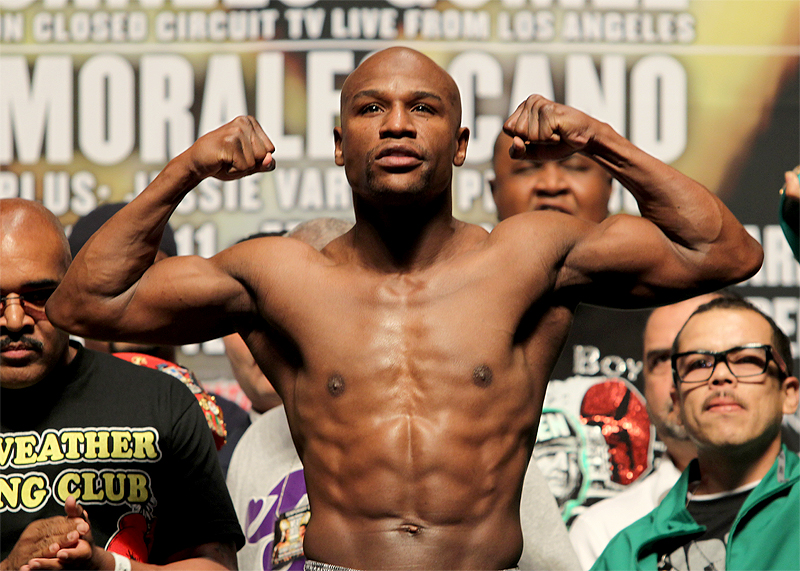


Examining the conscience before confessing the scorecard

We begin in a discomfiting place – Catholicism’s examination of conscience – and hope to move to an optimistic one. This column should be a secular spot, one where believers and nonbelievers frolic playfully as one, but as a column priding itself on finding instructions wherever they occur, it goes like this: If there is one Catholic tradition that will survive what its priests did to children for decades, it may be the examination of conscience.

According to this tradition, a believer creates an inventory of sins committed since his last confession. He reviews what thoughts and deeds composed his behavior, privately and best he is able, and takes the list to a confessional, in the hopes of absolution and a not-too-long penance to say. This inventory is by its nature useless if incomplete. Who would the believer fool by being dishonest?

The examination of conscience, as it happens, may also be a way for an aficionado to review his scorecard before he confesses it. (These are metaphors, of course; the stakes are comparatively low even for the most committed of Sweet Science’s flock.)

Nothing but coincidence attends this discussion and Devon Alexander’s Saturday victory over Marcos Maidana. Alexander, who may not actually be very good – or who, conversely, may be the man to prove first Timothy Bradley’s greatness – unmanned Maidana, who, it can be conceded, was never good as Victor Ortiz and Amir Khan made him look. Alexander-Maidana happened to be the televised fight that happened after Tavoris Cloud’s controversial decision victory over Gabriel Campillo in Corpus Christi, Texas, and all the questions about scorekeeping it necessarily raised.

An examination of conscience was in order before the next scorecard got confessed, then. So many well-intentioned folks took such exception with that Cloud-Campillo ringside scorecard that it was right for the scorer to look at himself. Coincidence again interfered, though, and confessing a one-sided scorecard with which all three official judges concurred is not so courageous. Alas.

An honest scorecard admits, after the fact, its biases of vantage point, ethnicity, style and personality. It is self-conscious in the best sense of that term; it qualifies its certainty by considering its limitations and imperfections. To wit:

For seeing Alexander’s jab is wrongly thrown, early in his career, I confirm this each time he fights. I believe Ortiz and Khan are media creations partially exposed by Maidana, and so I’ve not been fully convinced of Maidana’s ferocity or persistence. I believe I favor Latino fighters over African-American fighters – because I lived in Mexico, speak Spanish, and like volume punchers more than boxers – and so I try to offset this perceived bias when scoring (which may have influenced a Cloud-Campillo card that I marked 114-113 for Cloud). I know very little of Maidana’s biography but have felt a fraternal sort of pride about what boxing helped Alexander escape in his native St. Louis. I believed, going in, Alexander’s chin was as underestimated as Maidana’s power was overestimated. I believed that since Alexander-Maidana was only 10 rounds, Steve Smoger was a perfect choice of referee because he would allow Maidana to rough Alexander up, if it came to that. I believe Alexander’s trainer, Kevin Cunningham, is overrated. And finally, Timothy Bradley is one of my favorite fighters, and any victory for Alexander, whom Bradley beat, feels like a win-by-proxy for Bradley.

There. What is above is written in good faith and seems to predict I would score close rounds for Alexander, which I did, marking both rounds 1 and 3 for him and scoring round 2 even, while watching on HBO.

Is a fight better scored from ringside? Yes, otherwise judges would score fights from high-definition monitors in quiet backstage rooms. A ringside scorecard is also, for the most part, free of others’ opinions; nobody lasts long on press row if he talks through each round. Television commentary, on the other hand, is about exactly this. It is very difficult to ignore, because television is about keeping your attention, and why you tune in is fractionally important as keeping you tuned-in is.

Contrary to what sports-talk radio might say, what is important for an aficionado scoring a fight is not that his scorecard be right but that it be honest, which is why no examination of conscience is complete without ethnic considerations. Anyone who says fighters’ ethnicities do not color his scorecard stands somewhere between naïve and cynical.

All of this hopes to improve the ongoing argument that consensus is overrated. Did your friends agree with your scorecard? did your editor? did the guys at the gym? These questions are important to one who doesn’t know his own mind – or conscience, as the case may be. Your biases are secrets held only between you and yourself, though; everyone else sees them pretty clearly. Discovering them openly compromises your infallibility only with people silly enough to believe in infallibility.

Boxing gyms are invaluable in this sense; everyone expects everyone else to favor others who look like he does, and everyone laughs at himself when he finds out it’s true. This makes boxing gyms wonderful spots for examinations of conscience because they are some of the very few places in America where race is discussed openly and properly, and in good humor.

We go back to the scorecards.

Years from now you’ll probably not remember how you scored Cloud-Campillo or whatever next month’s hellish travesty is. But a postfight examination of conscience might lead to a cathartic moment of discovery. And if you can concede such cathartic things happen suddenly and at the oddest moments, why not posit they can happen while scoring a fight, and then pursue them?

Bart Barry can be reached at bart.barrys.email (at) gmail.com


Something less than photo realism on the Bay


CORPUS CHRISTI, Texas – If you were here in the beautiful coastal climes of the Gulf, 65 degrees with a cool saltwater wind, you felt differently about “Triple Threat” than if you were not. The ringside experience, with its emptied press-row tables, unfamiliar faces and well-lubricated fans just beyond, had none of the rabid emotion – investigate this! protest that! suspend the other guy! – sincerely expressed by those who were not at American Bank Center Arena.

Make of that what you wish, after you consider that television’s primary role is entertainment. Television succeeds when it provokes strong emotion. To assign it greater merit than entertainment is to overestimate the medium.

Saturday on the Bay brought a swirl of emotions and impressions and other happenings. They ranged from a feeling of disappointment to a narrative of injustice to an inference of unapproachable rage and ultimately ended, as these swirls inevitably do, with exhaustion and boredom. If that is unfair to a semi-rehabilitated fighter or a wronged one, or his outraged manager set to file protest Monday, it is nevertheless honest – though oblivious of what narratives shape it.

There is likely no lead here, just an unkempt swirl of hastily chosen words. But that might be the best way to express a rage that was directly proportionate to one’s distance from its catalyst.

Art Museum of South Texas, which shares a lovely spot and parking lot with Saturday’s fight venue – which had half its 10,000 seats curtained off and its upper bowl closed – is running a three-month exhibit called “Art of the Dive: Portraits of the Deep,” an appropriate subject for a collection that overlooks the Bay. The exhibit is a mild disappointment, with a few pleasant surprises that use impasto.

It has some good works of photo realism, a movement that is better than photography when done right because it accesses thrice the color palette of a lens and film. But it is a movement still subverted by a thought: Did the artist paint this or trace it?

It must not be a simple task to present subaqueous themes; what we know of them is already passed through multiple filters – diving mask, bubbles, refracted light – and anticipated for most of us by television cameras.

Do not discount the importance of anticipation; it colors what follows. If, to use a timely example, you anticipated a tightly wound knockout artist would fade against a loose-handed, stiff-legged, southpaw cutie whose mastery is regularly missed by fair judges – none of whom ply their trade in the crooked Lone Star Republic – you might see something different from a person, say, who showed up to watch the main event and didn’t think many thoughts during the co-main aside from: Yes, enjoyable!

But O, to borrow Shakespeare, for in every honest hand a whip / To lash the rascals naked through the world / Even from Houston to th’ El Paso.

Very well. But do not consider a team of broadcasters much more than a single voice. And do not cite the disapproval of a Spanish-speaking crowd deep in its cups and stirred by a black promoter’s earlier employment of an ethnic slur. Few of the thousands in attendance would recognize Tavoris Cloud in a diner tomorrow morning, but they began without hesitation a chorus of “Don King sucks!” after a Spanish-speaking challenger lost to King’s fighter.

That was in Saturday’s best match, a scrap for the IBF light heavyweight belt. Florida’s Tavoris “Thunder” Cloud defeated Spanish southpaw Gabriel “Chico Guapo” Campillo by scores (116-110, 111-115 and 114-112) that were outrageous on Twitter and TV and almost right at ringside, where an inexperienced local press corps – guys who later argued the WBC International Silver belt denoted a championship at stake – barely shrugged.

Reasonable men at ringside, too, had Cloud narrowly winning. We’ll take our lashings. But when a fighter who lost a round 10-7, never hurt his opponent, and cruised and clowned during the championship rounds, then loses a split decision, do not yell “robbery!” if you wish to be considered reasonable.

Campillo won on many viewers’ cards because he did what they thought he would do, which is to imply their scorecards were not blank when the opening bell rang. Alas, no one’s scorecard ever is.

Chris Arreola, the ticket-seller in South Texas, took umbrage with Don King’s use of the word “wetback” and then took it out on Texas heavyweight Eric Molina, making a wondrous 150 seconds of violence, punctuated by a decisive overhand right. Arreola’s gatekeeper disgust with King’s saying “wetback” at a Thursday press conference was not forced, but neither was it devoid of theatrics. Nothing Arreola does in public is.

“I’m a commodity,” Arreola said Saturday. “A big Mexican commodity.”

Arreola is a fine showman who is quieter and more approachable in reality than on television. King, a fine showman of his own who clearly did not intend offense and rebutted “We all wetbacks, baby,” chose his words poorly and got roundly booed by American Bank Center, which was justice enough – no need for a coerced apology or further gnashing of teeth.

Paul Williams, ostensibly “Triple Threat’s” main-event draw, won a decision over Nobuhiro Ishida, a sturdy Japanese super welterweight, in a fight that put the arena to sleep, regardless of its participants’ activity. Hundreds of punches were thrown and landed in 36 minutes – question never Williams’ activity or desire – and yet writers played on their cell phones and fans discussed ring-card girls’ asses, while Williams outclassed Ishida.

Why a Williams fight is boring is hard to say. That it is boring, though, is not. It is difficult to read Williams’ biography or watch him politely interact with people at a weigh-in and cheer against him. It is just as difficult, unfortunately, to look forward to his next fight.

Bart Barry can be reached at bart.barrys.email@gmail.com


Williams brings silence, Cloud brings controversy, Arreola brings violence


CORPUS CHRISTI, Tex. – Paul “The Punisher” Williams burst on the scene years ago as a gangly, volume-punching giant whom no manager wished to match his fighter against. That made him entertaining. He is the same man today. But no one is entertained by it any longer.

In the main event of Saturday’s “Triple Threat” card from American Bank Center Arena, Williams (41-2, 27 KOs) beat Japanese super welterweight Nobuhiro Ishida (24-7-2, 9 KOs) by shutout scores of 120-108, 120-108, 120-108. Not one of the three judges scored a round for Ishida. And not one of the fans attending Saturday’s card seemed to care.

“This win feels really good,” Williams nevertheless said afterward.

Through the opening quarter of Saturday’s main event, an awkward nine minutes that saw the fighters’ limbs entangle, dropping Ishida twice on non-knockdowns, Williams was the slightly busier and more aggressive man, though Ishida gave little ground.

Round 4 found Williams finally landing effective punches, employing several times a right hook-left cross combination that backed Ishida up. After more of the same in round 5, Williams allowed Ishida to come inside in the sixth. Once inside, though, Ishida found that wasn’t necessarily where he wanted to be, as Williams, a much better in-fighter than his frame anticipates, continued to land.

And so it went.

As the crowd slowly deflated and American Bank Center Arena’s energy went away, Williams-Ishida went from main event to walk-out bout, regardless of the concerted effort both men made. When the final bell rang, the arena was quiet as it had been when the doors opened five hours earlier.

“We’re going to make it back to the top again,” Williams said, though by then the arena had emptied.

TAVORIS CLOUD VS. GABRIEL CAMPILLO
Dressed like a tiger, IBF light heavyweight titlist Tavoris “Thunder” Cloud walked into something of a lion’s den, Saturday, fighting Gabriel “Chico Guapo” Campillo, a tricky southpaw Spaniard, before a partisan-Spanish-speaking crowd, and emerging with his title but lots of controversy.

The three official judges disagreed on what happened in many of the rounds, turning in split-decision cards of 116-110, 111-115 and 114-112 for Cloud. The 15rounds.com ringside scorecard, too, had the match for the champion, 114-113.

“He was the busier fighter, and that is what the crowd here in Corpus Christi responded to,” said Cloud, in explanation for the crowd’s vociferous disapproval of the official result.

From the opening bell, Cloud (24-0, 19 KOs) wasted no time whatever, charging out his corner and cracking Campillo (21-4-1, 7 KOs) with a lunging right cross that dropped the handsome Spaniard in the fight’s opening two minutes. Cloud would drop Campillo again with a barrage of rights and lefts, 30 seconds later, winning the first round 10-7.

“He won the first round,” Campillo said afterwards. “But after that, I dominated.”

Campillo proved his mettle in the second round. Having risen from the blue mat twice in the opening stanza, Campillo outboxed Cloud, catching him with left uppercuts and right hooks from his southpaw stance and then outclassing him with slick movement in the third.

Rounds 4, 5 and 6 found Cloud, still bemused by Campillo’s tricky style, pressing forward with greater aggressiveness, no longer retreating to the ropes and trying to set traps. Still, Campillo had the better movement and more accurate punches, while some sting appeared to come off Cloud’s blows.

The fight’s most even round, its seventh, saw a cut over Cloud’s left eye begin to bleed and cause the referee to take a double look after each clinch. The blood flowed even more loosely in the eighth, after a sustained assault by Campillo backed the champion into a corner. Cloud fought back when pressed, but Campillo’s left-uppercut lead was a riddle Cloud never solved all night.

After a trip to the doctor’s corner midway through the 11th caused Cloud to fear the fight could be stopped on account of his left eye, Cloud increased his aggressiveness three-fold, narrowly winning the championship rounds on two of the three judges’ cards.

“I felt like I won the fight,” Cloud said of his effort.

CHRIS ARREOLA VS. ERIC MOLINA
If Texans circled one match on the American Bank Center card, if there was one fight that brought them out Saturday night, it was California heavyweight Chris “The Nightmare” Arreola (34-2, 30 KOs) against Texan Eric Molina (18-2, 14 KOs), and the match was excellent while it lasted. Unfortunately for fans, it lasted only 150 seconds, as Arreola, despite being hurt early, dropped and stopped Molina at 2:30 of round 1.

Arreola, who has lost at least 20 pounds from previous fighting weights, now appears somehow less menacing in his trimmer figure but nevertheless brings a row every time he steps between the ropes. Molina learned this harsh lesson after stunning Arreola 90 seconds into their match.

“I said before the fight that if I had him hurt, I would come in and try to finish, and I did,” Molina said afterwards. “And he caught me.”

Arreola has more class than his detractors are often wont to admit. He looks and talks like a face-first brawler, but this brash exterior belies a stellar amateur pedigree and an impressive ability to land seemingly blind overhand rights on contender-caliber heavyweights. After being backed to the ropes by Molina and forced to clinch, Arreola used a pair of such right hands to get Molina off him.

And then it was a walloping right hand that put Molina’s lights out.

“I did my best,” said Molina.

Arreola did better.

MALIK SCOTT VS. KENDRICK RELEFORD
The evening’s first undercard fight televised by Showtime Extreme, an eight-round scrap between undefeated Philadelphia heavyweight Malik Scott (33-0, 11 KOs) and Texan Kendrick “The Apostle” Releford (22-16-2, 10 KOs), saw a technically superior though light-hitting Scott preserve his ‘0’, decisioning Releford by unanimous scores of 79-73, 80-72 and 80-72.

Throughout the occasionally sober match, Scott tagged Releford with right uppercut-left hook combinations that snapped Releford’s braided hair upwards and leftwards but did not imperil him.

Scott has every punch in the boxing lexicon, and appears to commit to each one, too, but whatever the mysterious force that gives a prizefighter one-punch stopping power, Scott does not possess it.

UNDERCARD
The undercard ended well with a competitive four-rounder between two Texas lightweights. Corpus Christi’s Gregorio Gutierrez (5-1, 2 KOs) prevailed over Brownsville’s Hector Garza (3-5, 2 KOs) by three scores of 39-37.

Saturday’s fifth fight saw the evening’s biggest upset, when unknown New Orleans super middleweight Justin Williams (4-5-1, 2 KOs) decisioned local and well-known contender Alfonso Lopez (22-3, 17 KOs) by unanimous scores of 57-56, 58-55 and 58-55. Williams was faster and better throughout, dropping Lopez once and doing everything necessary to win a fair and well-deserved victory.

Before that, hometown welterweight Julian Barboza (2-0, 2 KOs) made decisive work of San Antonio’s Arturo Lopez (0-1). Lopez, making his professional debut, came out quickly and boxed confidently for the bout’s opening minute, but then Barboza began to take him apart with tight combinations, stopping him at 2:11 of the second round.

Saturday’s first match, a hesitant six-round affair between undefeated Washington D.C. light heavyweight Thomas Williams Jr. (7-0, 4 KOs) and Louisiana’s Kentrell Claiborne (2-5, 1 KO), went to Williams by three unanimous scores of 40-35.

Opening bell rang on a silent American Bank Center Arena at 6:22 PM local time.


Williams, Cloud and Arreola lead a spirited “Triple Threat” weigh-in


CORPUS CHRISTI, Tex. – The banner behind the scale on the hastily erected stage read “Three of boxing’s biggest threats, seeking world supremacy.” Far as promotional taglines go, it wasn’t a most-ridiculous claim, though of course it was exaggerated. California heavyweight Chris Arreola then took the stage, and the force of his mass, or personality, made the centerpiece banner fall.

“It’s the spirits!” cackled promoter Don King.

“Motherf-ckin’ Zapata!” said Arreola, identifying exactly whose spirit he believed had dropped the embellished banner. Arreola’s guess was good as any.

So ended the prefight buildup of a week that saw a few open workouts and a Thursday press conference that featured a meandering history of Texas provided by none other than King, who referred to Mexicans as “wetbacks” in a sort of slave-ship-to-White-House way King intended to be evidence of empowerment but to which others later lent their own bad faith. Arreola seemed to respond, in small part, to King and his mini-controversy, Friday, when he shouted Emiliano Zapata’s name in a tribute to a Mexican revolutionary hero whose umbrage was nevertheless reserved for Mexican hacienda owners, not Texans.

The entire spectacle was a bit confusing. Originally scheduled to happen on the outdoor patio of a nearby restaurant, Friday’s “Triple Threat” weigh-in was moved, unbeknownst to any but friends and familiars, to a spot off the staircase of American Bank Center, the host venue for Saturday’s fight. There, the fighters mingled with the crowd, sitting in chairs and posing for pictures anxiously while awaiting a chance to make weight.

First on the scale was main-event opponent Nobuhiro Ishida of Japan, who weighed 155 pounds for his super welterweight match with Paul “The Punisher” Williams, who weighed 153 1/2. The fighters’ registering two different weight classes raised some quiet confusion about where on the scale the fight would happen. Super welterweight, apparently. Though, as Williams and Ishida will not be fighting for a title, Ishida did not have to make 154.

Following them were IBF light heavyweight titlist Tavoris “Thunder” Cloud – who made 175 pounds – and Gabriel “Chico Guapo (Handsome Boy)” Campillo, who weighed 173 1/2. Cloud, who is not a prohibitive favorite in their Saturday match by any means, was all dignity and composure before and during the weigh-in, belying the storm he brings with him in the ring. “Chico Guapo,” meanwhile, took the post-scale stare down as a good chance to look over the hundred or so gathered, with his dreamy eyes.

The card’s biggest draw, the aforementioned Arreola, was sixth on the scale, weighing 245 pounds. He was preceded by Texas heavyweight Eric Molina, who made 228. Immediately after Arreola cited Zapata and appeared trimmer than the man who was once a premium-cable headliner, he got in a stare-down shouting match with Molina that was 99 percent shtick and perhaps one percent genuine animosity. Arreola, for his Mexican roots, is expected to attract whatever crowd attends Saturday’s card.

Doors open at 5:30 PM local time, with first bell scheduled to ring at 6:30. 15rounds.com will have full ringside coverage.


Lucky punches and Paul Williams’ threat of a triple


The prizefighter formerly known as “Boxing’s Most Feared” has a problem with misfortune. Paul Williams, in his mind and his handlers’, has been a victim of bad luck. Williams’ trainer, George Peterson, sees no reason to make changes, Williams seems unsure if he’s ever technically lost, and Dan Goosen, who receives a promoter’s fee from Williams, says Miguel Cotto is a redemptive tale for Williams because Cotto just signed a big contract for a fight he will almost certainly lose.

With friends like these, Williams returns to battle, Saturday, against Japan’s Nobuhiro Ishida at American Bank Center in Corpus Christi, Tex. Williams will be joined by IBF light heavyweight titlist Tavoris “Thunder” Cloud, in a match with Spain’s Gabriel “Chico Guapo” Campillo, and California heavyweight Chris (Chico Menos Guapo) Arreola. Showtime “Championship Boxing,” a program whose name deserves quotation marks round it this time, will broadcast the action on a couple of its channels and in Spanish, too.

The card is called “Triple Threat,” which is fitting; it is exactly what Williams’ career now faces. Having lost by 2010 Knockout of the Year to Sergio Martinez, and having won by 2011 Robbery of the Year against Erislandy Lara, Williams is in danger of making the sort of triple performance that would take him off premium cable in the future.

Is this just? Technically. Were he not going to make a rubber match with Martinez, one might argue, and many did, Williams did not deserve a rehabilitation match on HBO in July. HBO’s commentators caught this drift and effectively retired Williams in the final third of his match with Lara. That the judges’ decision went to Williams mattered little to anyone. Other events were unfolding.

Back to those in a bit. First, there is Williams’ ongoing implication that he is a victim of misfortune. This sets up a tricky conundrum for Williams. If luck was all it took for the southpaw Martinez to land an overhand left on Williams, one that cut Williams’ lights long before he landed facefirst on an Atlantic City canvas, luck is probably what got Williams his breakout decision over Antonio Margarito in 2007, his blowout rematch victory with Carlos Quintana in 2008, and his bizarre victory over Kermit Cintron in . . . OK, let’s not get carried away; luck may have had nothing to do with Cintron tossing himself out that California ring in 2010.

Luck is a poor choice of culprit for a prizefighter. It exists, sure, but it behooves no one to enter his training camp citing it. And not even luck can explain Williams’ collecting so many left hands from the southpaw Lara that observers had genuine concerns for his health in the championship rounds. Williams has no defense for fellow southpaws’ left hands, we now know – even if no one in Williams’ camp does.

But about those other unfolding events. Williams has lost favor in a way disproportionate to his performances. Never particularly popular – as a polite black man from Georgia, apparently, he offended multiple ethnic sensibilities – Williams nevertheless took a righteous path to his welterweight title by outworking Margarito and being ballsier than him in their 12th round. He then avenged a decision loss to Quintana, beat down Verno Phillips, decisioned Winky Wright and made a wonderful first match with Martinez.

But a curious thing went against Williams, very much the way it went against Juan Diaz three months or so before. Diaz, you’ll remember, made a close 2009 match with Paulie Malignaggi in Diaz’s native Houston. The decision could have gone either way, but Texas judge Gale Van Hoy gave the match to the hometown kid by a ridiculous margin, 118-110. So folks turned on Diaz.

Williams-Martinez I could have gone either way, too. But New Jersey judge Pierre Benoist favored Williams by an inexplicable 119-110 margin. And folks began to turn on Williams. Five months later, Martinez won the lineal middleweight title from Kelly Pavlik. A month after that, Williams watched in disbelief as Cintron dove through the ropes and exited their match on a stretcher, punching an ambulance door. When Williams and Martinez made their rematch in November 2010, Martinez was the prizefighter folks wanted to cheer, and Martinez gave them every reason to.

Another curious thing worked against Williams. Al Haymon, boxing’s quietest mastermind and Williams’ advisor, became a target of aficionados’ ire. Haymon, the narrative went, was chief among the reasons HBO Sports lost its way. Some of this was rival Bob Arum’s lusty spinning, and some of it was true.

Everyone h’d had enough of the Haymon-influenced regime at HBO Sports by the time Williams made his 2011 fight with Lara. When Williams spent most of the second half of that fight being abused by Lara, only to see his hand raised by majority-decision scores, Williams won the very ire aficionados had been saving for his advisor, ire that only grew when the New Jersey State Athletic Control Board – the very same group that took no umbrage with Pierre Benoist – suspended the three Williams-Lara judges.

Maybe there is something to be said for Williams’ finding a culprit in bad luck.

Ultimately, though, Williams has never stopped being in the ring what he always was: a freakishly large, volume-punching southpaw who makes entertaining matches against even difficult opponents. Outside the ring, his demeanor has turned a bit surly, but that surliness is honestly acquired. He likely feels wronged but has no idea by whom.

I’ll be in Corpus Christi, Saturday, for a couple reasons. First, Texas is my beat, and Art Museum of South Texas shares a parking lot with American Bank Center. Second, and more importantly, I do not want to think of myself as someone who wrongs Paul Williams. Boxing would be a better place if it were populated by more guys like Williams, and it will be an honor to cover him.

Bart Barry can be reached at bart.barrys.email (at) gmail.com


Chavez Jr. and Warhol, juxtaposed


SAN ANTONIO – Tuesday, three or so hours after Julio Cesar Chavez Jr. skipped an open workout at Jesse James Leija’s gym, a workout that might have given local insiders a more favorable view of him, a remarkable new exhibition opened at The McNay – the crown jewel of South Texas art museums. “Andy Warhol: Fame and Misfortune,” a collection that includes 150 of Warhol’s works, examines the fascination we have with celebrities, especially when tragedies befall them.

Several days later, more than a few of the more than 14,000 South Texans who gathered in Alamodome to see Chavez fight fellow Mexican Marco Antonio Rubio no doubt looked forward to a tragedy befalling a celebrity in the main event.

Alas, they were disappointed once more. Chavez, confronting for the first time since 2007 another Mexican national, went chest-to-chest, head-to-head and elbow-to-shoulder with Rubio for at least 30 of their 36 minutes together and beat the smaller man convincingly, or at least unanimously.

Ringside judges had the match for Chavez by scores of 115-113, 116-112 and 118-110. Scoring from ringside, my card, too, went for Chavez, 116-114. That’s not a typo. I scored the first two rounds even, 10-10, before scoring rounds 3, 5, 6, 8, 10 and 11 for Chavez, and the rest for Rubio. I scored the first two rounds even because it seems a scorer’s job is not to strain to divine a winner in each round but rather allow the combatants to strain for his favor.

Why juxtapose Culiacan’s Chavez and Pittsburgh’s Warhol, when aside from a temporary accident of geography, the two men have nothing in common? Because fame, a thing that happened naturally for the less talented – though not that much less talented – Chavez was a point of endless pursuit and fascination for the late Warhol who is, and will remain, more influential in the world than Chavez or the father whose name he won at birth.

A note about that name. At the kick-off press conference in January, Chavez was more animated than usual. Rubio and Sergio Martinez had been calling for fights with him, using, of course, the none too subtle implication Chavez was as protected in his prizefighting career as in his early life. The WBC’s Jose Sulaiman had recently risen from his wheelchair to wrest the belt from Martinez’s person and give it to Chavez – giving the Argentine middleweight champion a fair claim on some future match with Chavez.

“They want to make money with my name and my fame,” Chavez responded in Spanish, without even a theatrical touch of irony. “Of course I am frustrated.”

Wait, whose name and fame?

That question is a poser for Warhol’s philosophy, as it turns out. Warhol saw fame and achievement and commercial success, all, as one in the same thing. He raised cupidity to an art form, mass producing screen prints in a workshop and publicly measuring their value by the strictest monetary means. He reduced aesthetics to economics, and in so doing showed Americans, those curious children of the world’s most ambitious salesmen, a pastel-coated reflection of themselves. And instead of being revolted, we very much liked it.

Warhol endures today in large part because he was a first mover – to employ a marketism that should revolt any art critic. Warhol anticipated everything from the logo on the t-shirt you wore this weekend, to HBO’s “24/7” program and the celebrity it has made of Money May, a character who, in his desperation and grasping, likely would have enchanted Warhol. But Warhol also had an Eastern Orthodox sense of justice (incidentally, he was quite religious).

He wanted fame to be earned in some way. Which is where the Chavez case makes things interesting. Famous in his country from about the time he began grade school, Chavez never wanted for notice or celebrity. When he made his pro debut, without so much as an amateur tune-up, it was nationally televised in Mexico – the sort of acclaim Americans no longer accord even Olympic gold medalists, if ever we have another of those.

Chavez was famous solely for another man’s toils, and one might infer such an outcome would not have enchanted Warhol.

But what about today’s Chavez, the man who shoved and whacked Marco Antonio Rubio round the ring, Saturday? That’s a more interesting question. This Chavez, still resentful of underclass usurpers, still prone to the majestic rights of doing whatever the hell he pleases – showing up 30 pounds overweight for training camp and then adhering to the spartan ritual of driving the streets of Los Angeles allegedly drunk at 4:30 on a Sunday morning – this Chavez, as a self-inventing celebrity of his own, is another thing entirely.

He has something for each observer to loathe and admire at once; anyone who still thinks Chavez is all good or all bad is employing a filter too many.

Chavez can fight a little bit, can’t he? Rubio was probably just past his expiration date, as predicted, but power is the last thing to go, as the old timers say, and Chavez absorbed plenty Rubio right hands. Lefts, too. What did Chavez do? He moved closer to his aggressor, wading into the beating rain of Rubio’s fists till he found a quieter, softer place. Exactly as you’re supposed to do. Who would have thought that five fights into a collaborative experiment with trainer Freddie Roach – and weightloss guru Alex Ariza – Chavez Jr. would be fighting so much more like Chavez Sr.?

Misfortune will befall Chavez eventually; it befalls everyone who makes his living in this brutal, gorgeous game. Chavez will be stretched prone across the canvas by someone in the next 10 years, finally making of himself an apt subject for a Warhol canvas.

Chavez, as a subject, grows more interesting with each fight.

Bart Barry can be reached at bart.barrys.email (at) gmail.com
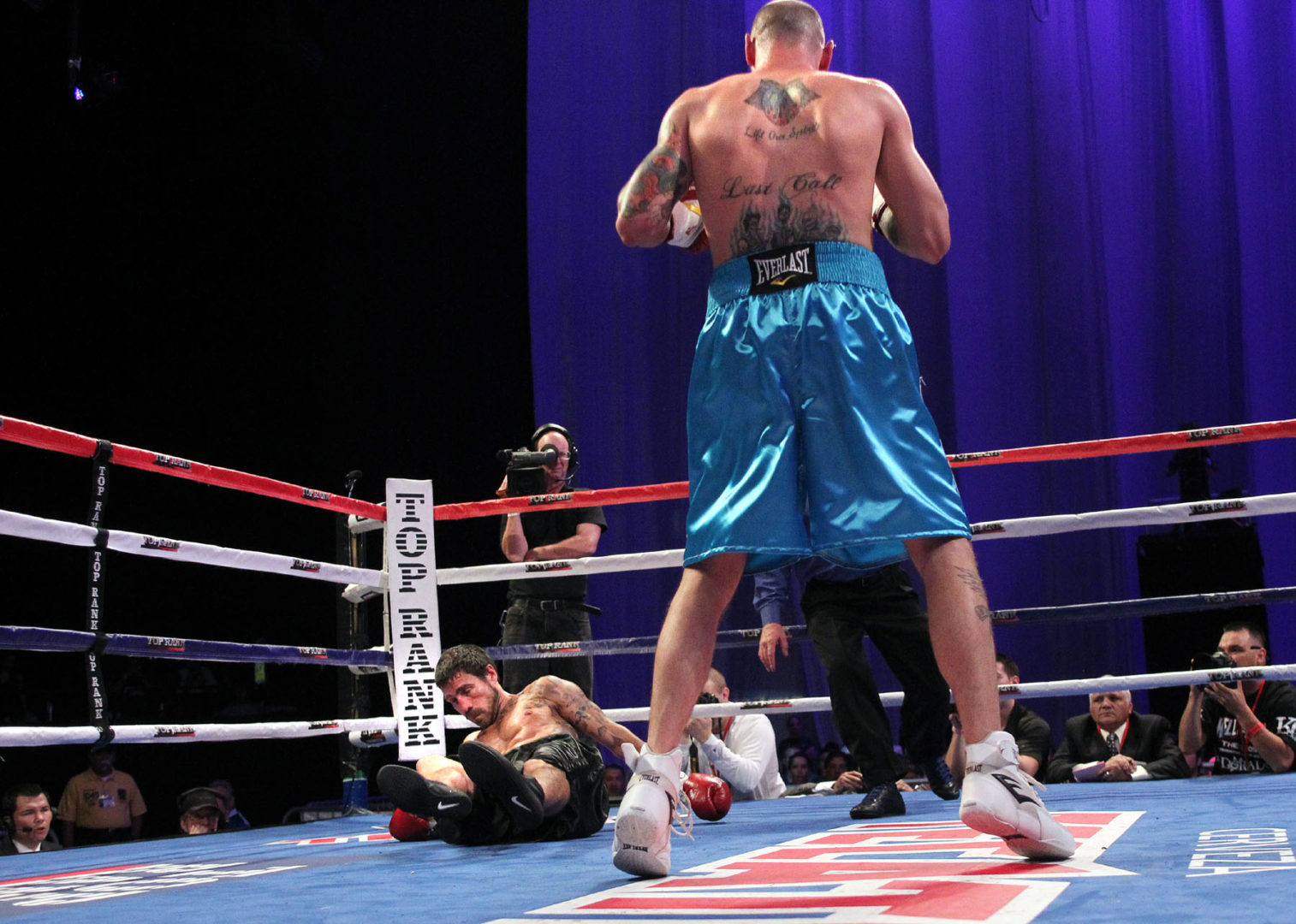


EARLY RESULTS FROM SAN ANTONIO

SAN ANTONIO – The final undercard match of Alamodome’s “Welcome to the Future” card featured Mexican super bantamweight Raul Hirales (16-0-1, 8 KOs) against Colorado’s Shawn Nichol (5-9, 5 KOs), in a six-round match that was the evening’s least-inspired, one in which Hirales prevailed by curious split-decision scores of 59-55, 55-59 and 58-56.

ALEX SAUCEDO VS. JEAN COLON
The undercard’s best knockout was scored in its sixth bout when Mexican-born Oklahoman Alex Saucedo (2-0, 2 KOs) stretched Florida welterweight Jean Colon (0-2) at 1:03 of the first round, with a devastating left hook.

ADAM LOPEZ VS. RICHARD HERNANDEZ
In the night’s biggest match of local interest, San Antonio amateur superstar Adam Lopez (1-0, 1 KO) made his professional debut and did it emphatically, stopping fellow Texas bantamweight Richard Hernandez (0-2) at 2:53 of round 1. Lopez showed the speed and technique that made him a finalist for the U.S. Olympic team, snapping Hernandez’s head leftwards with hooks and dropping him twice.


VANES MARTIROSYAN VS. TROY LOWRY
Saturday night, undefeated perma-prospect Vanes Martirosyan (32-0, 20 KOs) of California knocked out oft-defeated Minnesotan Troy Lowry (27-12-0-2, 15 KOs) at 2:53 of round 3, successfully hoisting the WBC Silver super welterweight belt overhead.

WALE OMOTOSO VS. NESTOR ROSAS
In the evening’s third match, Nigerian welterweight Wale “Lucky Boy” Omotoso (21-0, 18 KOs) remained undefeated if not particularly enthralling, stopping Texan Nestor Rosas (9-3, 6 KOs) at 0:55 of round 6. After establishing a superiority of craft early, Omotoso gradually wore Rosas down until the referee could abide no more.

IVAN NAJERA VS. DAVID CASTILLO
Before that, local lightweight Ivan Najera (6-0, 6 KOs) of host city San Antonio remained both undefeated and unchallenged, scoring a technical knockdown at 2:54 of round 2 over New Mexico’s David Castillo (2-4).

JEREMY LONGORIA VS. RICARDO VALENCIA
Saturday began with an exciting four-round featherweight match between two Texans. In a mild upset, theretofore un-victorious Ricardo Valencia (1-2-1) of Houston decisioned theretofore unbeaten Jeremy Longoria (3-1, 1 KO) of Corpus Christi by unanimous scores of 38-37, 39-36 and 39-36, dropping him with a body shot in round 2.

First bell sounded on a half-full Alamodome at 6:15 PM local time.


Waiting for weighting: Chavez Jr. and Rubio take the scale


SAN ANTONIO – There was Bob Arum. There was Wilfredo Vazquez Sr. There were Nonito Donaire and Wilfredo Vazquez Jr. There were Jose Sulaiman and Lupe Contreras. There were Marco Antonio Rubio and a mariachi band adorned in tight rose-colored garb and silver buckles. They were all waiting – waiting for Junior.

Friday at Alamodome, 25 minutes after he was scheduled to take the scale, Julio Cesar Chavez Jr. (44-0-1, 31 KOs), who will face fellow Mexican Marco Antonio Rubio (53-5-1, 46 KOs) for the WBC middleweight title Saturday night, led his entourage to the stage. In a moment it was over; Chavez Jr. had weighed 159 1/2 pounds and Rubio had made 159, and the last of their prefight rituals was finished.

Chavez Jr. arrived in royal-blue workout attire – every thread of which he removed before taking the scale – and arrived looking drawn but otherwise unworried. After skipping an open workout Tuesday, under orders from his fitness trainer, Alex Ariza, Chavez did not hurry to endear himself to Alamo City fans. Instead he went through the motions, did no more than necessary, and did little to disabuse those who commented on his arrogance this week.

Chavez Jr., who has not faced another Mexican national since stopping Raul Munoz five years ago, might be surprised how transient his fans’ collective loyalty can be – if he gets in trouble against Rubio, Saturday. Chavez Jr. is absolutely the ticket-seller for this event, one expected to attract 12,000-14,000 fans, but fighting, as he will, before a South Texas crowd, more than a partisan-Mexican one, he could find more than a few in attendance cheer his opponent.

Before Chavez Jr. and Rubio took the scale, Friday, “Filipino Flash” Nonito Donaire (27-1, 18 KOs) and Puerto Rican Wilfredo Vazquez Jr. (21-1-1, 18 KOs) each made weight for their WBO super bantamweight title match. Donaire weighed 121.6 pounds, and Vazquez Jr. weighed 122.

Donaire, who strolled through the Alamodome crowd in what appeared to be a Tampa Bay Lightning hat cocked sideways, was his usual picture of quiet confidence. Vazquez, though, possessed the more chiseled physique onstage and did not tire of showing it to a small Puerto Rican contingent gathered behind the barrier.

Alamodome doors for “Welcome to the Future” will open at 5:30 PM local time, Saturday, with first bell scheduled to ring at 6:30.


Donaire entertains locals, shows eye for talent at open workout


SAN ANTONIO – “Filipino Flash” Nonito Donaire is already celebrated among boxing insiders for his hand speed, footwork, power and charisma. Now insiders have one more gift of Donaire’s to celebrate: an eye for talent.

Wednesday at ChampionFit Gym, Donaire conducted an open workout for fans and media, as part of promotional festivities for his Saturday super bantamweight title fight with Puerto Rican Wilfredo Vazquez Jr. at Alamodome. After light stretching, Donaire invited two local boys to join him in the ring. The first one demurred, but the second bound through the ropes.

Seeing the boy was a southpaw, Donaire held his right hand aloft and ordered jab, double-jab, and jab-cross combinations. After four combos, Donaire had seen enough, looked at the ringside crowd, and said, “He’s going to be good!”

Turned out, he already is. Jesse “Bam” Rodriguez was the youngster Donaire thrilled and complimented Wednesday, not knowing that in offering his bare hand to the diminutive Rodriguez, Donaire was absorbing blows from a 2012 National Silver Gloves finalist. Rodriguez was in the gym with his dad to see Donaire – Rodriguez’s favorite fighter – before leaving later in the day for Missouri, where he will compete for a national title.

Also present to supervise Donaire’s open workout was former world champion Jesse James Leija, owner of ChampionFit Gym. Leija watched Donaire work with trainer Robert Garcia and spoke about his own experience of a handpad workout with Donaire earlier in the week.

“He kicks like a mule,” Leija said. “He has power and speed, and what I really like is that he says, ‘I love trying new things.’”

Asked if he thought Donaire had a high ring IQ, Leija was emphatic.

“Very!” he said. “You can’t do the things he does without knowing.”

For his part, Donaire was confident but humble, answering questions for local media before climbing in the ring and entertaining gathered fans. Unsurprisingly, based on his roots and promoter, Donaire was asked several times to compare himself to Filipino icon Manny Pacquiao.

“If you ask me (who’s better), I am going to tell myself that I am,” Donaire said, before clarifying that such self-belief is essential to any successful prizefighter.

Asked about trash-talking and being disrespectful of opponents, Donaire was animated.

“I respect my guys,” he said. “I respect everyone. I don’t do that sh-t.”

Donaire and Vazquez Jr. will join headliners Julio Cesar Chavez Jr. and Marco Antonio Rubio for a Friday weigh-in, before Saturday’s event. Friday’s trip to the scales will be held in front of the Alamo at 2:00 PM CT. It is open to the public.