Pontiac & Prizefighting: Listlessly seeking rebirth


DETROIT – At 7:00 AM on Sunday, Timothy Bradley walked gingerly through the Southwest terminal of Metro Airport. He was anonymous. I deposited my luggage and strolled over to congratulate him. He was affable but subdued. He thanked me. We conversed briefly.

Bradley was exhausted, busted up and bandaged, his left eye swelled shut from accidental collisions with Devon Alexander’s head. He was also the world’s best 140-pound prizefighter – if anyone cared.

It appeared no one did. And that was fitting a footnote as any to the weekend’s depressed and depressing event, a spectacle billed as “The Super Fight” that filled little more than five percent of Silverdome’s available seats in Pontiac, Mich. Bradley versus Alexander – a match Bradley won by technical-decision scores of 97-93, 96-95 and 98-93 – will not be remembered as a super fight at all. How much boxing itself will be remembered is now in play, too.

“The Super Fight’s” host city is forgotten. But for a Marriott village southeast of its downtown area Pontiac is in hibernation with no hint of springtime. Pontiac is not a dangerous place, though; it’s too listless for that.

Rumors of an art gallery in the Business District sent me to downtown Pontiac. At 2:00 PM on a Saturday, at Saginaw & Pike Street, a complete inventory of open businesses went: Pontiac’s Pawn Stars, a bail bondsman, an award-winning trauma center and a ceramics shop.

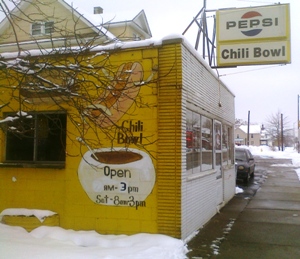
I drove a mile down Cesar E. Chavez Avenue and came to the first open restaurant I’d seen in 15 minutes. Chili Bowl, a 12-seat diner in a cinder-block box painted a cheerful yellow, will be 60 years old in November. Its grillman cheerlessly recounted what he’d heard about downtown Pontiac: Two years free rent for anyone who’ll open up shop, and still no one comes.

That’s a stark departure from the optimistic literature you find 30 miles south of Pontiac. In this city, folks are divided between native Detroiters and new arrivals. The natives are clamped-down, girded for the worst and suspicious of your curiosity about their infamous economy.

Then there are the young professionals, a sunnier bunch, many sporting law degrees, most aflutter with talk of “amazing” nonprofit opportunities and signs of rebirth.

Trust the natives. They’ve seen this before and now wonder about the nature of altruism itself. Why would you leave a comfortable life somewhere else to come help less-fortunate folks? Because you have a good heart? Yes, maybe. Or is it because the life you’ve left isn’t comfortable as advertised and directing your energy at other folks’ troubles is easier than tackling your own?

Hard to say. There are smart folks working in good faith towards the common good, here. But some of them are defensive, unrealistic and emotionally unstable.

At least they’re energetic. That much could not be said of Silverdome, Saturday. Its ring tucked deep in a corner of the field where Barry Sanders once galloped and juked, Silverdome had enough available floor space to store five trailers, including HBO’s production truck. It barely had enough heat from human bodies to keep the mercury above 60 degrees, though, contributing to its funereal ambiance.

The announced attendance was over 6,000. That was an unlikely number even if you counted credentialed media, Silverdome staff and every motorist who drove past the stadium between the hours of 6:00 PM and midnight.

Timothy Bradley was the favorite in the main event because Devon Alexander really isn’t that good. Yes, he has quick hands, a great biography and a trainer who’s a former cop. But he also has a predictable delivery, a floating chin and a left guard that wanders away from his face when he jabs. Did Bradley notice this? Damn right he did.

Eight hours after he finished whacking Alexander with fists and cranium, Bradley and I chatted a spot about what he’d seen Saturday.

Me: Did you notice Alexander’s guard flies off his face when he jabs? Is that how you cracked him with right hands?

Bradley: That’s right, I did. And I cracked it – no I cranked it. Just cranked that right hand.

Bradley’s delivery was wide open, awkward and at times pedestrian. It relied on ineffective aggressiveness and some defense. He made Alexander miss and walked him to the ropes. Once there, he flared a meaningless jab wide, corralled Alexander to his right, then blasted him with one punctuating cross or hook every three minutes.

Alexander was out of his depth, discomfited throughout. Bradley was too far away, too near, and never where he wanted him. The rounds were close, but you could argue Alexander didn’t win any of them. Then head butts took his mind away.

Bradley crouches and leaps inwards. Shorter than most junior welterweights, his head comes from an awkward angle and leads the charge. There’s no science or malice to it, though. Against any southpaw, his style is bound to cause butting.

Bradley got as well as he gave. Again, his left eye was useless, too, Sunday morning. But Bradley was able to win ugly. Alexander was not.

Like Andre Dirrell – a Michigander at ringside Saturday – Alexander is a great athlete who knows how to box. He is not a fighter.

Bradley is a fighter, which is good because he’s no clairvoyant. During promotion of “The Super Fight” he predicted Saturday’s scrap would be so phenomenal both he and Alexander would emerge superstars. Fact is, neither man came out of it great as he went in.

And so began boxing in 2011. Most pre-fight criticism of Bradley-Alexander concerned its promoters’ choice of venue. That was unfair. After 2010, an empty building in a dilapidated American city was the exact spot for our sport to showcase its wares.

Bart Barry can be reached at bbarry@15rounds.com.


Bradley strikes out Alexander to become unified champion


PONTIAC, Mich. – There’s a reason it’s hard to get in the major leagues with a hitch in your swing. St. Louis’ Devon Alexander may have made it to the majors, but Saturday night he ran into a first-rate pitcher in Timothy “Desert Storm” Bradley and got struck out.

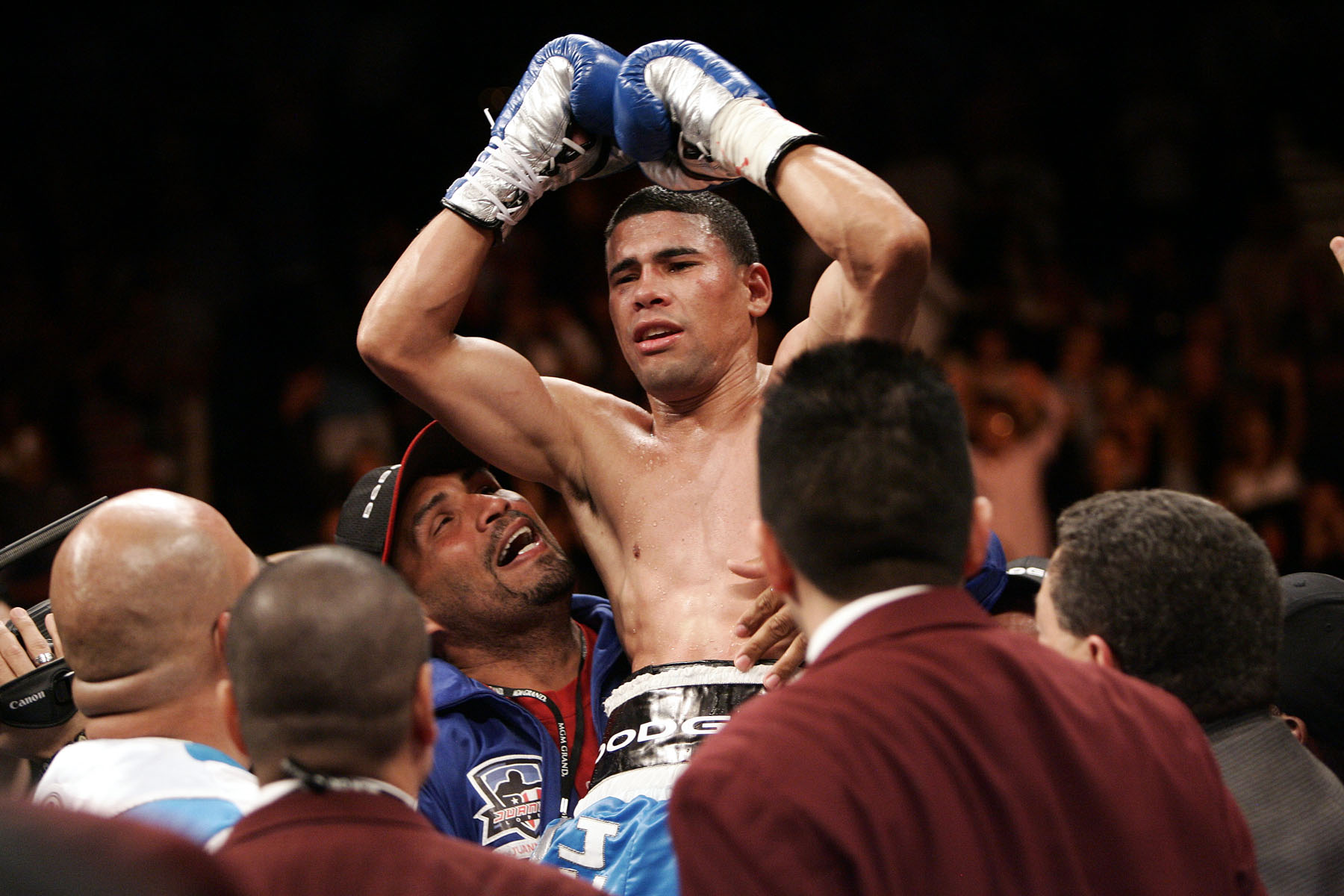
In the main event of “The Super Fight,” boxing’s debut in the Silverdome, California’s Bradley (27-0, 11 KOs) defeated Alexander (21-1, 13 KOs) by technical-decision after fewer than 10 rounds – when the fight was stopped because of an accidental head butt – and did so by scores of 97-93, 96-95 and 98-93, establishing himself as the world’s premier junior welterweight.

The 15rounds.com ringside scorecard concurred, scoring the match a lopsided 99-92 for Bradley.

While both fighters began tense and nervous in the opening rounds, Bradley loosened up, catching Alexander with one decisive right hand in each stanza, and bullying Alexander with ineffective aggressiveness. Alexander appeared overwhelmed, never finding his range or setting a successful trap.

As the fight progressed, Bradley detected the massive hitch in Alexander’s proverbial swing: Alexander cocks his every combination. Once Bradley deciphered this, he hit Alexander awkwardly and often. Alexander had begun to fade when the two fighters’ heads collided severely enough in round 10 to disrupt Alexander’s vision and cause the ringside doctor to advise a stoppage.

After the fight, Bradley graciously called Alexander a warrior, promising the St. Louis native would one day be champion again. Bradley then quixotically called-out Manny Pacquiao, a junior-middleweight titlist who would likely whup him.

VERNON PARIS VS. EMANUEL AUGUSTUS
Vernon Paris (24-0, 14 KOs), the undefeated Detroit junior welterweight the largest number of Saturday’s fans came to see, might have reviewed his opponent’s record and smirked during training camp. But Emanuel Augustus (38-34-6, 20 KOs) proved to be a humorless test for Paris, who, despite being roughed-up, frustrated and worn-down, won by unanimous-decision scores of 76-73, 77-72 and 77-72.

Augustus, a veteran of 77 fights who now calls himself “The Outlaw,” would not be run out the ring. He resorted to a large number of the tricks in his substantial bag to take the younger and faster crowd-favorite off his game. Once Augustus had Paris distracted, he began talking to him, dancing between rounds and fouling him wherever the referee couldn’t see.

The referee did see enough antics, though, to penalize Augustus two points for a fraction of the indiscretions he committed.

But whatever the final tally, Augustus proved he can still teach a young fighter, and Vernon Paris still has plenty left to learn.

UNDERCARD
The penultimate undercard match of the night saw its most-devastating knockout as Miami heavyweight Bermane “B-Ware” Stiverne (20-1-1, 19 KOs) rocked then ruined Trinidad and Tobago’s Kertson Manswell (19-1, 15 KOs), stopping him at 1:52 of the second round – with a 1-2 followed by four left hooks – to take the ‘0’ from the loss side of Manswell’s ledger.

In the evening’s sixth and dullest fight, Marcus Oliveira (21-0-1, 16 KOs), an undefeated Kansas light-heavyweight, decisioned Detroit’s Demetrius Jenkins (21-18-1, 16 KOs) by unanimous scores of 60-54.

The evening’s second-most-lopsided mismatch came in its fifth bout, as New Jersey’s Kendall “Rated R” Holt (26-4, 13 KOs) made an NC-17 mess of Florida welterweight Lenin Arroyo (20-15-1, 4 KOs), knocking him cold at 1:50 of the first round and causing the few knowledgeable fans in attendance to wonder why a prizefighter of Holt’s caliber would even be making eight-round tilts with 14-loss journeymen.

New York welterweight Allen Conyers (12-4, 9 KOs) calls himself “Dream Shatterer,” and in the fourth fight of Saturday’s Silverdome card, formerly undefeated Texan James De La Rosa (20-1, 12 KOs) learned why. Dropped thrice and made to look like a lousy Zab Judah impersonator, De La Rosa dropped the first decision of his career, losing a 10-round fight by three scores of 95-92.

Saturday’s most-lopsided mismatch came in its third bout, when Philadelphia’s Julian Williams (5-0, 4 KOs) blew directly through Indiana’s Alan Moore (2-10, 2 KOs) in 28 seconds to win a first-round technical knockout. Moore’s shaky legs at the opening bell and complete want of competitiveness raised questions of how he was even able to attain a license from the Michigan Unarmed Combat Commission.

Before that, in an entertaining eight-round super middleweight scrap, Detroit’s own “Son of a Preacher Man” Darryl Cunningham (22-2, 10 KOs) outclassed Dominican Alberto Mercedes (16-15, 10 KOs), dropping him in the final round and winning by three, unanimous-decision scores of 60-53. Despite absorbing punches and being hurt at the 1:30 mark of round 8, though, Mercedes stayed game throughout, even dissuading the onrushing Cunningham in the fight’s final minute.

Saturday’s opening fight, California welterweight Julio Diaz (38-6, 26 KOs) versus Tijuana’s Pavel Miranda (16-7-1, 8 KOs), ended in an eighth-round TKO for Diaz when a disappointing Miranda could not continue.

Doors for “The Super Fight” opened at 6:00 PM, and the opening bell rang on an empty arena at 6:15. The event’s promoters announced an attendance of 6,247.


Bradley-Alexander is built, but will they come?


PONTIAC, Mich. – Junior welterweight champions Timothy Bradley and Devon Alexander shared a lot of similarities Friday at Silverdome. Both were dark, muscular and respectful to one another and those gathered round a makeshift stage in a glass-paneled sports bar overlooking the arena. If it was a study in contrasts you were after, then, the place to look was backstage.

That was where Alexander’s indefatigable promoter Don King plied his syrupy cackle and unpredictable vocabulary in a final publicity push for Saturday’s “Super Fight.” And in a corner across the room stood Bradley’s promoter, Gary Shaw, quietly prepping for an upcoming rules meeting.

Friday afternoon Bradley and Alexander took to the scale and made 139.5 pounds and 140, respectively. Both looked excellent. Neither looked ready to relent. Each looked a righteous foil to the other.

Meanwhile, their promoters acted more in complementary roles than adversarial ones.

King is, and has been for decades, more famous than the fighters he promotes. The shocked hair, the bedizened jean jacket, the exploding voice; all contribute to a presence round which even confident public figures orbit like tiny moons. Regardless of the merits of his product, King is the spectacle that fills the tent. Few bring to any job the mastery and joy King brings to public self-edification. And yet.

There’s an easily missed humility in the access he affords every promotion. He is not a wind-up toy; were he that, writers would have stopped quoting him 30 years ago. Rather, he is a robust cult of personality hurling himself on the mercy of a crowd.

“You want them to buy what you’re selling!” King said Friday, when asked about an appearance schedule this week that has put his distinct voice all over local Michigan airwaves. “Give them what they want. People are my most important asset!”

But are they buying what he’s selling this time, and just how many assets will be in seats Saturday night?

“Make the economy rise!” King thundered, when asked about his choice of a city 30 miles north of Detroit. “The spirit of Detroit is alive! Detroit is a model for the rest of the country.”

That it is. To most of the rest of the country, though, Detroit is a model of what an American city should not become. While the reports of Detroit’s death are indeed exaggerated, there’s no doubt the area is wanting in both capital and hope.

“The people need you here,” said King. “This is a commercial for three or four hours for Detroit. This (fight) is an infomercial.”

Standing in a hallway 50 feet away – but by no means outside the range of King’s voice – Gary Shaw contrasted his style with that of his co-promoter’s.

“Don is a self-promoter, he’s the marketing,” Shaw said. “I am more operationally seasoned.”

When asked if he thought the two made a good team, Shaw nodded.

“Don’s a legendary name,” he said. “That’s not who I am.”

How good a team the two men have made will be challenged Saturday at Silverdome. Friday’s view of the arena afforded a glimpse at how ticket sales are going. With the ring tucked in a far away corner, blue curtains indicated fewer than a fifth of Silverdome’s 80,000 or so seats will be on sale.

A strong walk-up crowd is predicted. Any service person in uniform will be given a free seat. But whatever the actual gate, you hope for a good throng of committed boxing fans. Detroit and Pontiac need it. Timothy Bradley and Devon Alexander deserve it.

Doors to “The Super Fight” open Saturday at 6:00 PM local time. 15rounds.com will have full ringside coverage.


A tough gig: Don Escobar plays “Ratsville”


TEMPLE, Tex. – Sometime after this town was created in 1881 by the Gulf, Colorado & Santa Fe Railway Company, folks riding the trains in and out of its depot gave it a few creative nicknames. Some called it “Mudville” for the nature of its soil; others called it “Tanglefoot” for its ungoverned frontiersman spirit; and a couple even called it “Ratsville” for the creatures that populated it.

Don Escobar, a 31-year-old lightweight who kicked-off a seven-match “Mayhem at the Mayborn” card Saturday night, must wonder why the last nickname ever went away.

Escobar made his second professional fight, at the Frank W. Mayborn Civic & Convention Center, a few miles north of Temple’s towncenter, on Saturday, and for the second time in his career faced a hometown favorite. Jerry “The Flash” Fuentes, making his professional debut, beat Escobar by technical-knockout at the 0:59 mark of the fourth and final round.

But this is boxing, of course, so it’s never that simple.

Escobar fights out of San Antonio, 145 miles south-southwest of Temple. While Escobar and Fuentes are both Texans – and therefore expected to get the benefit of every doubt from Lone Star State officials if they fight a guy from, say, California – Texas is an awfully big state. Figuratively, then, Escobar hailed from another country when he met Fuentes.

Why the hell was I 2 1/2 hours from home to watch a card comprising fighters with an aggregate record of 25-40-11? For a chance to visit Opie’s BBQ in Spicewood, yes, but that’s not all. I also wanted to see Temple’s “Ironhorse District” featuring the Railroad & Heritage Museum. Oh, and one other thing: I consider Don Escobar a friend.

Escobar is a fighter in every sense of the word – good and bad. He divides his training time evenly between two San Antonio gyms, Morones Boxing House of Champions and San Fernando Gymnasium. He trains himself for the most part, relying on tricks he learned 10 years ago in the military – boxing at Fort Huachuca, Sierra Vista, Ariz. – and years later from a guy named Joe Souza.

Escobar likely gave his best years to sparring. As an amateur he never committed quite the way he might have.

“I was a single father of two boys, you know?” he says, by way of explaining why his amateur record was less than his talent said it should be. “I couldn’t be traveling everywhere they wanted me to.”

He turned pro in October and promptly lost a majority decision in Laredo, Tex., to a fighter from Laredo, Tex., by interesting scores of 35-40, 37-38 and 38-38.

He got a bit discouraged – face marked up, nose busted. But he’d made a good fight; his manager had no trouble finding him another b-side gig 300 miles north of Laredo in Temple 106 days later. He struggled with weight, calling himself a “tropical fighter” whose body’s misbehavior is indirectly proportionate to the thermometer’s mercury. He was seven pounds above the lightweight limit on Wednesday and came in at 136 1/4 on Friday’s official scale.

Jerry Fuentes, meanwhile, made 134. And Fuentes’ 134 looked a lot more impressive Saturday than Escobar’s 136 1/4. Fuentes was the larger man, both taller and better muscled.

That was my first observation. It came shortly after a singing of the National Anthem and the reading of an interesting prayer by the ring announcer, one that called God’s attention to this fight-night detail: “If there are injuries, only minor ones.”

In the first round, and the three that followed, Fuentes also proved to be the better-conditioned athlete – for the opening minute. After that, though, Fuentes was Exhibit A of the largest difference between amateur boxing and prizefighting: A round in the pros is 50-percent longer. Fuentes allowed the smaller man to bull him into the ropes and work him over with body shots and grappling in rounds 1, 2 and 3.

Escobar also caught Fuentes with a combination of punches he’s come to call, simply, “The Marquez.” Named after Juan Manuel Marquez, probably the only prizefighter ballsy and talented enough to routinely throw uppercut leads in championship fights, “The Marquez,” when thrown by a southpaw like Escobar, goes: Right uppercut, overhand left.

Fuentes hadn’t seen many uppercut leads in sparring, especially from someone with his back on the ropes.

Checking my own likelihood of bias, then, I had those Marquez combos and Escobar’s aggressiveness making a tally of 2 rounds to 1 (29-28) for Escobar, with one round to go.

Then controversy struck. Fuentes came out his corner extra strong at the start of the last round of his first prizefight and rocked Escobar with a 1-2. Escobar’s head snapped up, and his body tossed forward. He wrapped Fuentes in a bearhug, and referee Danny De Alejandro broke the fighters. Escobar took a few steps back and set his hands to block Fuentes’ next assault. Fuentes threw a couple more punches, and De Alejandro leaped between the men and waved the fight off.

Temple’s Jerry “The Flash” Fuentes had a knockout for his pro debut.

Don Escobar lost himself. He shoved De Alejandro’s hands away and immediately accused the referee of favoring the hometown fighter. Then Escobar stormed out the ring and had his gloves pulled off before the fight’s result had even been read. If it was a doubtful act of sportsmanship on Escobar’s part, it was also a pretty good show of lucidity; Escobar never went down, was not ‘out’ on his feet, and knew where he was well enough to know he wasn’t the hometown fighter.

“Mayhem at the Mayborn’s” next two fights featured actual knockdowns, but no stoppages.

Frank W. Mayborn, after whom Temple’s civic center is named, was a publisher who founded four newspapers and a television station, in Counties Bell and McLennan – serving Waco, Killeen, Taylor, Sherman and Temple.

In honor of Mayborn’s reporting spirit, I queried the helpful Texas Commission of Licensing and Regulation about Saturday’s scores.

Don Escobar was ahead on all three cards – by scores of 29-28, 29-28 and 30-27 – at the time of Danny De Alejandro’s questionable stoppage. And as referee, De Alejandro was the man who’d collected each scorecard from its judge after every round.

Should the result be overturned? That’s a dicey proposition. Escobar deserved much better than he got. But so might Fuentes, if the fight were changed from “TKO-4 Fuentes” to “No Contest.” Fuentes, after all, had Escobar drunk with fatigue and punches, and there’s no telling what might have transpired in the fight’s last two minutes.

“But this is the kind of thing that gets me discouraged about the sport,” Escobar said afterwards. “I’ll always love boxing, but . . .”

As I strolled out the Mayborn Convention Center a couple hours later, still full with Opie’s Texas barbecue, having not had to make weight, and in a spectator’s euphoric trance after seven competitive matches – having collected nary a blow myself – I was past the vicarious injustice I’d initially felt for Don Escobar. I contented myself with a “that’s just boxing” for the nth time, the same way you would have.

But if we’re always going to say it like that, with such cynicism, are we right to continue encouraging others to pursue careers in our beloved sport?

***

A special note of thanks to Dr. Stuart A. Greene for the enjoyably concise history of Temple on his website, QualityDentistry.com.

Bart Barry can be reached at bbarry@15rounds.com. Additionally, his book, “The Legend of Muhammad Ali,” co-written with Thomas Hauser, can be purchased here.


Pontiac in January


Much has been made about poor ticket sales for Timothy “Desert Storm” Bradley versus Devon Alexander “The Great.” The venue, Silverdome – originally so named because of the glare off its white fiberglass roof – has been criticized. Along with its undefeated fighters. Along with the black community to which Bradley-Alexander should appeal on Jan. 29.

Is such criticism just? Perhaps. But if we’re going to make a fetish of removing prizefights from casino settings and putting them in spots with local interest, we owe it to “The Super Fight” and our sport to suspend judgment and attend the event.

I’ll be there even though getting there is a logistical mess. The fight is not in Detroit. It is in Pontiac, Mich., 35 miles due north.

That means renting a car at the airport. And no, there aren’t many direct flights from South Texas to DTW. There will also be the questions of where the hell the press conference and weigh-in happen. All that, of course, is before you consider the lunacy of traveling from 60-degree days to a spot between Lakes Erie and Huron, in January.

But I want to see Detroit. I want to see if it could possibly be as Charlie LeDuff described it a few months ago in Mother Jones.

“Today—75 years after the beavers disappeared from the Detroit River—‘Detroitism’ means something completely different,” wrote LeDuff. “It means uncertainty and abandonment and psychopathology.”

Psychopathology. In an American city? We like to think such things are kept below the border in abattoirs like Ciudad Juarez.

As always, then, this boxing trip is an excuse to see a city with fresh eyes. Preliminary emails with young locals provide some happy possibilities. They say Detroit is in the midst of a rebirth. It’s not even 40 miles from Ann Arbor, after all, and so many University of Michigan undergrads set loose on an urban center that is “rewilding” – having places abandoned so long they return to their natural state – might just give the place a social consciousness, along with a conscience.

Well, why not? When they graduate, those kids aren’t finding jobs anyway.

But I’m also going to “The Super Fight” to support two undefeated titlists and make a challenge to the community that shaped them.

Timothy Bradley is the favorite among knowledgeable boxing folks – people who actually skip rope and hit heavy bags and know how easily hand-speed can be neutralized when it’s set atop a shaky foundation. Bradley’s style is a relentless one. He is a volume guy, the most exciting kind of fighter. And his matchmaking approach has undergone a recent and refreshing revision.

The year 2010 was about staying undefeated, he said last week on a promotional conference call. This year, conversely, is about making the best fights.

“My biggest goal in boxing is just to be remembered,” Bradley said. “I don’t want to be forgotten about.”

You hear that? It’s the sound of a smart young fighter reviewing the “Money May” bio and deciding it’s a cautionary tale, not an epic. The Bradley-Alexander conference call in some ways felt as though it were marking a reevaluation of Floyd Mayweather’s self-indulgent template. Like a realization that Mayweather’s money will be gone soon enough, but may still outlive his legacy.

A number of folks are now able to see the day when a 30 for 30-type documentary will be made about “The Greatest Fight that Never Was.” On the A-side will be President of the Philippines Many Pacquiao addressing a roiling crowd of one million countrymen. On the B-side, meanwhile, Mayweather will be in a poorly lit gym, working the hand pads with a Golden Gloves runner-up and saying, “Everyone knows I’d a beat ‘Pooch-iao’.”

Devon Alexander does not have Bradley’s loquaciousness, but he has a quiet confidence that is appealing. And he has something else Bradley does not seem to have yet: An ability to sell tickets. Some of that is his promoter. Even in a grieving state, Don King is a master ticket-seller. But some of that, too, is Alexander’s admirable calmness.

Until last week’s call, I’d not given him much of a chance against Bradley. He looked most vulnerable in August against Andriy Kotelnik. His trainer is a loud motivator who seems never to have noticed how alarmingly his charge’s guard strays while jabbing.

But something about Alexander’s demeanor made me rethink things. He was happy to let Bradley play emcee. He knew Bradley was better at talking, and so he let him talk. He seemed eerily comfortable in his role, offering little more than variations on a “now is my time” theme. Alexander might just have the perfect temperament to foil a Desert Storm.

Which leaves us with a challenge of sorts for the black community that shaped Bradley and Alexander. On last week’s conference call, both men slipped a question about what their match – two undefeated African-Americans fighting just north of a city that is 83 percent black – might mean to their community. Bradley said it was a great fight for Americans, not just African-Americans. Alexander said it was a throwback event.

“This is a fight like the old days,” he said. “The greats wanted to fight the best.”

Why would they slip such a question? Maybe because they’re afraid their people won’t show up. Boxing insiders use words like “invisible” when describing the black community and live gates; they may rally round a pay-per-view event every few years, but don’t expect them to fill an arena.

Well, this is a chance to surprise some folks – like they do at Alexander’s fights in St. Louis. This is a chance for Don King to work a crowd as only he knows how. This is a chance to roar a bit and prove to the country Detroit has more to offer than psychopathology.

A few of us will be there to report it, do believe. As it is. However it turns out.

Bart Barry can be reached at bbarry@15rounds.com.


Integrity’s integral part in prizefighting

“I cannot find language of sufficient energy to convey my sense of the sacredness of private integrity. . . . With so much awe, with so much fear, let it be respected.” – Ralph Waldo Emerson, “Lecture on the Times,” Dec. 2, 1841

Friday, the Boxing Writers Association of America announced its 2010 winner of the James A. Farley award for honesty and integrity in boxing: “Irish” Micky Ward of Lowell, Mass. The announcement treated Ward’s celebrated trilogy with Arturo Gatti then dedicated a paragraph to “The Fighter” – a movie about Ward currently in theaters.

It almost felt as though Ward’s integrity was now prize-worthy because Hollywood recognized Ward’s life as movie-worthy. Which felt like a non sequitur.

So be it. The important thing is that Ward will be honored this year. Whatever integrity Ward demonstrated in his private life, he was the very model of integrity in a prizefighting ring. He made honest fights.

The word “integrity” is a durable one. It has survived the usual onslaught of overuse from corporate marketeers and what politicians they employ – survived, that is, in a way hollowed-out words like “quality” and “amazing” and “patriot” have not. Calling a person a man of integrity still elevates him.

“Integrity” comes from the Latin “tag” – roughly, “to touch” – with the nullifying prefix “in” before it. Integrity, then, was originally said of something that was untouched, intact, whole. It was not a word that made any judgment on the complicatedness of its bearer; it asked only if that thing was in an uncompromised state.

Of the tests sports present to their participants, probably no sport tests wholeness as boxing does. Boxing is not complicated as, say, the blocking scheme executed by an offensive lineman in the NFL. It does not necessarily require the athletic feat of an alley-oop in the NBA or penalty shot in the NHL. Nor does it require quite the conditioning of a cyclist on the Tour de France.

But nothing tests the wholeness of an individual’s character – however small or simple – the way boxing does.

Micky Ward fought with integrity. He kept his hands high and took no umbrage with being struck. He was not clever. He relied heavily on the left hook to the body – a punch more likely to sever a man from his wholeness than any other.

During one of Ward’s HBO fights late in his career, commentator Jim Lampley teed-up a question for George Foreman, and Big George hammered it. Lampley asked Foreman why Ward’s left hook to the body was such an effective punch. Foreman did not try to explain the human liver or what message the brain sends when a vital organ comes under assault. Rather, he conveyed a book’s worth of boxing wisdom with five words:

Because Ward believes in it.

Obdurate application of a single tactic in boxing, of course, can take a man on a direct route to unconsciousness. When the single tactic does not work, its fighter becomes a self-immolating figure. But when that single tactic, and its stubborn use, causes cracks to appear in an opponent’s will, it is the most indispensable of tools.

Feb. 28, 2009 saw a fight of just such stubbornness – a fight, actually, of great integrity. Juan Diaz fought Juan Manuel Marquez with something akin to an unblemished belief in his own will and activity. He charged the champion and hit him everywhere, placing only a secondary emphasis on accuracy. Marquez, meanwhile, remained faithful to his belief in fundamentals, hitting Diaz less often but more accurately – all the while absorbing everything Diaz threw.

Marquez-Diaz I was an honest fight in the sense that both men wanted to sink their knuckles in the other. Both men were whole, strong, and anxious to test another man at his very best, and break him or be broken by him. They wanted a confrontation, and they made one. That is the essence of boxing’s vicarious thrill for its fans.

But do you know who received the largest ovation in Houston’s Toyota Center that night? George Foreman. When Foreman’s presence at ringside was announced, its applause dwarfed that garnered by Oscar De La Hoya or even Houston’s own Juan Diaz. Foreman, too, was, and is, recognized as a man of integrity in his hometown.

Writing of Foreman, his voice can be heard a few times in “The Fighter” – a movie that wants to be untouched and intact and almost is. “The Fighter” is a good movie. Had it been made before all its predecessors, it would have been a remarkable achievement. Unfortunately, its many predecessors did precede it, and so its strict adherence to a shopworn template precludes it from being more than a good movie.

You don’t need to know who Micky Ward is, in other words, to know where “The Fighter” is going every step of the way.

The female leads in the movie – Amy Adams as Charlene Fleming, and Melissa Leo as Alice Ward – are excellent. They speak the movie’s original lines and deliver performances that occasionally surprise. The males leads, on the other hand, rarely stop being Mark Wahlberg and Christian Bale.

It’s not that Wahlberg didn’t study Ward’s fighting style enough, or that Bale didn’t successfully change his physique from Batman’s into a crack-addicted version of Ward’s brother and chief second Dickie Eklund’s. They did. And bravo. But they’re still Wahlberg and Bale.

What Wahlberg failed to capture about Micky Ward was his Lowell obliviousness and leprechaunish charm. In trying to make Ward’s character deservedly sympathetic, Wahlberg made him too worldly and polished.

But again, so be it. Wahlberg’s and the BWAA’s honoring of a fighter like Micky Ward is a fine thing. May Ward’s integrity in the ring inspire tomorrow’s prizefighters.

***

A special note of thanks to trainer Adrian Rodriguez, another man of integrity, for his suggestion of this topic.

Bart Barry can be reached at bbarry@15rounds.com.


A mosaicked revisit to last year’s most interesting fight – Parts 1 & 2

Authors Note – In previous years, I’ve broken these treatments into two parts because we needed original content. Kyle Kinder and Anson Wainwright now give us all that and more on weekdays. So here come two parts in one.

Author’s Postscript – Julio Cesar Chavez Jr. vs. John Duddy on June 26 made no one’s Best-of list. Still, it was my favorite event of 2010.

Mosaic (n.) A picture or decorative design made by setting small colored pieces, as of stone or tile, into a surface. 2. A composite picture made of overlapping, usually aerial, photographs.

Dave & Busters restaurant at a place called Crossroads just outside downtown San Antonio, where I-10 and Loop 410 knot, is where assembled media gathered for a rescheduled kick-off press conference to announce “La Furia de México 15” – and neither of the primaries at the press conference would actually be on the fight card.

We were into the opening tosses of our year of discontent by then, May 11, but none of us yet knew how badly the succeeding months, July to November, would go.

As Jorge Arce and Eric Morel addressed the media, after playing a game of pool together Top Rank publicist Lee Samuels fretted was “too friendly,” Rafael Marquez and Israel Vazquez conducted a conference call for their “Once and Four All” fight to happen in Staples Center three states away; one had nothing to do with the other, though Arce was happy to say he couldn’t wait to see the other fight.

“Latin Fury 15” would be announced at Alamodome six weeks before the fight, in a press conference with main-event fighters Julio Cesar Chavez Jr. – son of the legend – and Ireland’s John Duddy, and then it would not be: Chavez had visa issues, and so Duddy, already in town, went for a stroll with manager Craig Hamilton round the Alamo.

I first interviewed Chavez Jr. two days before his 22nd fight – in the concourse of America West Arena – and he was so singularly dull in 2005, so filled with clichés and hedging, that after I asked him two questions I turned to the Univision guys and told them they could have him, and keep him.

Alamodome was nearly empty on May 27, by the time Todd DuBoef and the rest of Top Rank finally corralled Chavez Jr. – though this time not Duddy – into an announcement press conference (a second one; the first somehow happened in Los Angeles), and Chavez was a livelier performer in 2010, though how charismatic could any Mexican look sharing a stage with the eloquence and grace of Marco Antonio Barrera who, with Arce-Morel scrapped, would now share co-main billing?

Jesse James Leija’s ChampionFit Gym hosted an open workout the Tuesday of Fight Week, and after Barrera did some light exercise Freddie Roach arrived and began a full instructional hour with Chavez.

I was startled by how much Chavez struggled with a rudimentary pivot off the ropes – first month of boxing stuff – and so was Leija, though sitting at the apron, he was also surprised by how low Chavez returned his hands while throwing combinations.

Freddie Roach answered questions with a characteristic honesty that makes him great for writers even while it must make him at times maddening to his charges, admitting he wished he’d had more time with Chavez, and that his guy tended to get hit with the very right hands Duddy was adept at throwing, and that, contrary to all ominous rumors, Chavez was a rather likable kid with a great work ethic.

Headquarters for “Latin Fury 15” was the Doubletree hotel just east of I-10 in downtown San Antonio – a Radisson back when Top Rank promoted Pacquiao-Solis from there in 2007 – and it was still too far from the River Walk to offer its guests much of an Alamo City experience.

I sat at a dinner table with Thomas Hauser and Craig Hamilton and marveled at how much Hamilton had read of American history, and how much boxing folks went out of their way to greet Hauser.

In the Doubletree lobby Thursday night, on a set of facing couches, sat Freddie Roach, Thomas Hauser and Bruce Trampler, talking some about boxing, some about Trampler’s mentor Teddy Brenner and lots about Wilt Chamberlain.

The Arneson River Theatre is an amphitheater of white stone steps separated from the stage they view by a loop of the San Antonio River created more than 70 years ago to ensure Texas merchants a fair shot at attracting shoppers – the theatre’s backdrop features the five Hugman Bells that commemorate the city’s founding Spanish missions: San Antonio de Valero (Alamo), San Jose, San Juan, Concepcion, and Espada.

Hot as it was, a goodish crowd of San Antonians assembled on the stone steps Friday afternoon and looked at their river, down which drifted “Latin Fury 15’s” participants on a river taxi; few of us noticed Julio Cesar Chavez Sr., in an Affliction t-shirt and wrap-around shades – a lesson in celebrity’s flightiness.

Chavez Jr. made weight but hopped off the scale quickly, and Craig Hamilton stopped the proceedings, worried his fighter could not get a fair shake in a WBC-sanctioned event held in South Texas – which for 26 years in the 19th century had been part of a newborn country named México.

Saturday afternoon was hot as Friday had been, but San Fernando Gym, a mile or so from Alamodome, was cooler than usual, employing air conditioning for once, while it hosted a 34-bout smoker that ended a few hours before “Latin Fury 15” began.

Saturday morning, my 80-year-old neighbor Walter knocked on my door and told me he’d seen my name in the paper; Express-News’ celebrated boxing scribe John Whisler quoted me saying Mexicans thought Chavez Jr. a “fresa (strawberry),” a child of privilege, whom they wouldn’t mind seeing roughed-up a touch.

There was little to glean at San Fernando that you could use at Alamodome; amateur boxing is a different sport from prizefighting.

Saturday’s co-main event saw Marco Antonio Barrera dissuade and punish and dissuade some more Brazilian lightweight (fighting for Barrera at 140 pounds or so) Adailton De Jesus; Barrera fought back when he had to and boxed the rest of the time, the same way he’d once exposed Prince Naseem Hamed and survived a rematch with Manny Pacquiao.

I listened to the two women who sat in borrowed seats while Hilario Lopez endured a hellacious beating from Houston’s Omar Henry, women who were likely a spouse and a mother/in-law; all they desired was for Lopez to remain upright, and Lopez did, much to his detriment, and the next day when I read Lopez had spent the night in a San Antonio hospital I hoped he would not fight again – and I later learned that, not 90 days later, he was on another Texas card in El Paso.

Junior bantamweight Raul Martinez carried the undercard for San Antonio, stopping his friend Gabriel Elizondo in the seventh round of a fight that would see Martinez hotdog a bit too much for some of his fellow Texans’ tastes – especially those who’d trained with both men.

The conventional wisdom for Chavez-Duddy was simple: If Duddy could make Chavez ignore trainer Freddie Roach and stand in the proverbial phone booth, giving and taking shots, Duddy could prevail in a 12-round fight.

On press row, I wore a pair of navy blue socks with green shamrocks that my dad had bought at a County Cork souvenir shop a decade before, because, well, no other appropriate occasion had yet presented itself.

Duddy probably got the better of Chavez in the opening six minutes, but it would matter little to posterity.

The acoustics for anyone on the southern side of the ring were all wrong because the 9,000-person crowd’s cheers from the north side, where all were gathered, had to float hundreds of empty feet to the back of Alamodome, bounce off the wall and come back, weakened.

The ninth and 10th rounds were when a number of us began to worry about Duddy’s health, as much of a beating as he was catching from Chavez, but Duddy continued to fight back, and Referee Jon Schorle was not likely to stop the match so long as Duddy was upright, in a reminder that our bravest fighters must be protected from themselves.

Chavez knew how to relax in the ring; he was quick to retaliate against punches Duddy landed, but he also appeared calm regardless of what Duddy threw at him, and if Chavez’s unflustered display surprised Duddy a bit he was not alone.

San Antonio enjoyed a good fight, filled with drama more than suspense, a fight in which the strawberry was in fact touched up by a veteran pugilist but listened to his trainer and dished out a whupping of his own, unexpectedly thorough and remorseless.

I had the final tally 117-112 for Chavez, scoring the first round even and all but the second, sixth and 12th rounds for him, too, but how much did it say about Duddy that, having ringsiders worried for his health in the 10th, he’d come back to win the 12th?

Judge Juergen Langos, flown in from overseas to submit a 120-108 score he might have filled-out during the undercard, would reappear in Texas five months later and make a redemptively accurate tally for Pacquiao-Margarito.

The post-fight press conference happened in a room somewhere in the interstices of Alamodome and featured non-media folks – as these things inevitably do.

After the fight, Chavez talked about the next day’s Mexico-Argentina World Cup soccer game – and called his previous self “huevón” – and having proved himself to himself proved to be in all ways more likable than he’d been before, and promoter Bob Arum said at least three times that we had “a new star in boxing!”

A few months after the signature win of his career against John Duddy, Julio Cesar Chavez Jr. returned to form, canceling a tune-up fight and then making a last-moment withdrawal from a pay-per-view card he was to headline, and boxing forgot its “new star” quickly.

The last man to leave the dais at a post-fight press conference, almost without fail, is trainer Freddie Roach; he talks to anyone who approaches him and gives thoughtful answers every time.

I stood beside John Whisler, and we quizzed Roach about Chavez, expressing lots of surprise at how well Roach’s charge had acquitted himself.

There’s a geometry in the ring, a language of space, Roach explained without quite chiding, and if you learn it through immersion at a young age – the way Chavez Jr. must have by watching his father’s myriad of training camps – it is a language you speak fluently, even if you guys don’t believe it about Little Chavez, the strawberry.

Alamodome was empty of all but maintenance workers when the press conference crowd dispersed into the night.

Bruce Trampler told me he had, in fact, read the preview column I wrote and also took exception to the part where I criticized his company’s in-house promotions; he explained how difficult life could be working co-promotions with other companies.

On the drive back to the Doubletree, Trampler said, “I never talk off the record; if there’s something I don’t want to talk about, I’ll say, ‘Bart, I’d prefer not to talk about that,’ but I don’t talk off the record” – and may that someday be every public figure’s approach.

There was a decent crowd in the Doubletree bar 100 minutes after the main event, but Craig Hamilton was still its best-dressed man.

Thomas Hauser, beside whom I’d sat at Alamodome, told me to show Hamilton my shamrock socks, and before I had my right pantleg pulled to my ankle, an Irish accent said “I have to buy that guy a drink!” and a smiling John Duddy walked over.

His face marked but his spirit unblemished, Ireland’s John Duddy stood in the Doubletree bar for an hour at least, posing for pictures with his new Mexican fans, passing cell-phone salutations to their disbelieving spouses, and saying that the Irish-Americans of New York City, those who buy tickets for his Madison Square Garden fights, had taught him an appreciation of Ireland he might not have had otherwise.

Bart Barry can be reached at bbarry@15rounds.com.


The Spaniard after whom our gym is named


“In order to allow our employees to spend time with their families, we will be closed on Christmas Day.” Is any sign so relentlessly dishonest and ubiquitous during the holidays? A paucity of shoppers ignites merchants’ sudden interest in their employees’ families, and what could be more in keeping with the spirit of Christmas shopping season than a work furlough?

No, it was not always so. Perhaps one must return to an epoch well before his own to find a more sincere time and something more substantial. So be it, then. Back centuries we go – eight of them, actually.

We do so in the name of a boxing gym closed on Christmas Day and Christmas Eve, too, so that its employees really could spend time with their families: San Fernando Gymnasium, on the corner of Travis and Santa Rosa Streets, in downtown San Antonio.

Constructed in 1948 as part of San Fernando School complex, the gymnasium was administered by the Catholic Youth Organization. Two years later, on Dec. 3, 1950, the gymnasium was dedicated to a 12th century Spaniard whose legacy the city’s most famous plaza and cathedral already celebrated.

Fernando III, King of Leon and Castile, born near Salamanca in 1198 – known today in English-language hagiographies as “Saint Ferdinand” but known throughout South Texas as San Fernando.

This man, at whose cathedral in San Antonio Pope John Paul II prayed in September of 1987, ascended to the throne of Castile before his 20th birthday, coming to power in the throes of a time dominated by Spanish Christendom’s attempt to take back land from the Moors, Muslim conquerors who appear in Spanish literature as everything from “Saracens” to “Moorish Bands” to “Gangsters of the Frontier.”

Nineteen years into his reign and more than a century into what Spaniards would call “La Reconquista,” Fernando III won his most significant victory in a battle that started almost accidentally when skirmishers felled part of Cordova, then a Muslim city.

“The religious and administrative quarter, the Medina, held out for some time,” writes historian John Edwards for the Library of Iberian Resources Online (LIBRO). “But the ‘official’ armies of (Fernando) III of Castile and Leon were called in almost as an afterthought.”

Fernando III, like all men, learned a morality informed by the time in which he lived. Reconquest of Christian lands was the highest ethic to which a ruler of Fernando III’s era could aspire. Reconquest was goodness. Plenary indulgences were established by Pope Urban II in 1095, at the time of the first Crusade, and continued for centuries to come. To kill in the name of Christendom, then, was an act that forgave all prior sins. Fernando III led armies that did so, and well.

And once Reconquest happened, Fernando III distinguished himself with foresight, organization and a profound desire to ensure the Church’s enduring rule.

“As in the earlier stages of the Reconquest, there was no doubt in contemporaries’ minds that the absolute priority was colonisation,” writes Edwards. “Land should not go to waste and the vanished or evicted Muslims should have no chance to return to it.”

Fernando III set about converting the glorious Muslim mosques that stood in reconquered Cordova and, later, Seville.

“He turned the great mosques of these places into cathedrals, dedicating them to the Blessed Virgin,” Ferdinand Heckmann wrote in 1909 for the New Advent Catholic Encyclopedia. “He watched over the conduct of his soldiers, confiding more in their virtue than in their valour, fasted strictly himself, wore a rough hairshirt, and often spent his nights in prayer, especially before battles.”

Fernando III’s rule of these reconquered lands was noteworthy for his mercy shown the vanquished, encouraging conversion to Christianity by the soldiers of defeated armies. Fernando III did not impose steep tariffs to pay for his crusades, either.

“He took the greatest care not to overburden his subjects with taxation, fearing, as he said, the curse of one poor woman more than a whole army of Saracens,” notes Edwards.

In a treatment of Fernando III for the “Santoral Franciscano (Franciscan Hagiography)” historian Jose M. Sanchez de Muniain adorns Fernando III’s governance with still greater superlatives.

“As a ruler he was at once severe and benign, vigorous and humble, audacious and patient,” writes Sanchez de Muniain, “gentile in court and pure of heart.”

Fernando III lived to father 12 children, seven by his first wife Beatriz de Suabia, and five more by his second wife Juana de Ponthieu – whom he married after Beatriz’s death. He died on May 30, 1252, and the age of 54.

“(Fernando) was buried in the great cathedral of Seville before the image of the Blessed Virgin, clothed, at his own request, in the habit of the Third Order of Saint Francis,” recorded Ferdinand Heckmann. “His body, it is said, remains incorrupt. Many miracles took place at his tomb, and (Pope) Clement X canonized him in 1671.”

Today in South Texas, the architectural tradition of San Fernando’s mosque conversions endures. Many churches here resemble nothing so much as domed mosques with crosses set on top, in a nod to the Moors’ influence on Spanish Catholicism.

As for South Texas’ most famous place of boxing, San Fernando Gymnasium, there’s this.

On Oct. 31, 1974, the City of San Antonio acquired the gym and its 0.92-acre lot for $52,100, preventing it from being razed. The gym has since been managed by the city’s Parks and Recreation Department. An impressive roster of prizefighting elites have trained here: Julio Cesar Chavez, Mike Tyson, Danny Lopez, Oscar De La Hoya, Evander Holyfield, Salvador Sanchez, and of course Jesse James Leija – whose name joined Fernando III’s in the gym’s appellation four years ago.

On any weekday afternoon, today, young boxers can be seen throwing their fists in San Fernando’s gym – in a fitting tribute to a man about whom it was said: “No conoció el vicio ni el ocio (He knew neither vice nor leisure).”

Bart Barry can be reached at bbarry@15rounds.com. Additionally, his book, “The Legend of Muhammad Ali,” co-written with Thomas Hauser, can be purchased here.


An unironical look at what happened in Pascal-Hopkins I


There’s irony in every Bernard Hopkins controversy. No one, that is, means exactly what he says. Hopkins talks and talks and sees what sticks in his admirers’ collective craw. He plays them like umbrage-tuned fiddles. Except that he doesn’t, not quite, because for all their hectoring, his fans rarely care enough to buy tickets.

That is why a man who calls himself legendary had to travel to Canada to find his first packed house in ages. His opponent sold tickets. And so his opponent, the champion, got the benefit of most every doubt. Welcome to life.

Saturday at Quebec City’s Pepsi Coliseum, American Bernard Hopkins likely did enough to win his challenge for the Ring magazine’s light heavyweight championship against Quebec’s Jean Pascal. But the judges saw things differently, scoring the fight a majority draw: 113-113, 114-114 and 114-112 (Hopkins). Since that last card cannot act as a tiebreaker, Pascal remained the champion, and Hopkins’ effort to break George Foreman’s record as the oldest man to win a title fell a spot short.

My card? I had Pascal retaining his title a conventional way: 115-113. An odd tally, that. How did I get it? I gave Pascal rounds 1, 3, 8, 10 and 12. Hopkins won rounds 2, 4, 6, 7 and 11. I had rounds 5 and 9 even. And rounds 1 and 3 went to Pascal 10-8 because he scored knockdowns in both.

You agree? I don’t care. You disagree? I still don’t care. The fight was excellent. It was entertaining the entire way, even when it wasn’t entertaining – because of what that implied – and there’s something else: My scorecard for a Hopkins fight affects my identity not in the slightest.

Pascal-Hopkins I was much better than most believed it would be. Hopkins was much more fun to watch than even he believed he would be – as evidenced by his smile in the final round.

I hope they do it again. And unless Hopkins can suddenly locate 10,000 new fans to complement his usual draw, I hope they do it again in Quebec City.

Let me guess. You hate Canada now. Very well. But realize, as you rail against Canadian injustice, that your hatred of Canada says much more about you than it says about that land of polite, decent people who happen to support boxing in a way that makes American prizefighters envious. And don’t pretend for a moment you weren’t more enticed by the moments before a Hopkins fight, Saturday, than you have been in years.

Oh, the electricity in that building; like a celebration of our sport. And Hopkins’ approach in round 1 was perfect for it. He expected overenthusiasm from a young, emotional opponent. And how do you foil such an action fighter? With a backwards step, of course.

Forward-pressing guys like to get you lined-up and throw themselves at you, regardless of consequence. You hit them, they hit you, whatever. Pascal wanted to make contact with Hopkins, and make it on his terms. Once Hopkins showed the mien of a man willing to engage, making his own forward presses, Pascal should come forward, and when he did, like all action guys before him, he’d get his weight wrong-shifted. Then he’d be vulnerable.

But then you noticed Pascal had an interesting counter to that. He’d imagined correctly beforehand how a man of Hopkins’ experience and craft would undermine a forward-press from a younger man. The solution Pascal hatched was novel.

He would show Hopkins all the enthusiasm expected from the first punch in his combo. But it would be a punching feint, as it were; the first punch wouldn’t be much at all. Hopkins would relax or counter. Then Pascal would blast him with the committed part of his combination – the second punch.

Hopkins looked fragile in those opening 12 minutes, make no mistake. His body softer than before, his legs not set sturdily beneath him, Hopkins went down three times in the opening four rounds. The last was called a push. The first, caused by a right hand to the back of Hopkins’ left ear in round 1, was properly called a knockdown. The second, from a short left hook that caught Hopkins coming off the ropes in the third, was indisputable.

Didn’t stop Hopkins from disputing it, though, did it? Nah. He stood, blamed a wet spot on the canvas, said he’d slipped, even checked the mat for moisture with his boot. Irony everywhere.

But by round 6, Hopkins had Pascal completely solved. With left hooks to the body and right crosses, Hopkins put Pascal in a place that frightened the champ. Pascal responded honorably if not effectively. Then instead of chasing Pascal’s unconsciousness, Hopkins sensed Pascal’s weakness and decided to clown around.

Not exactly the way Foreman set the record against Michael Moorer.

The ending to the fight was wonderful, though. Both men traded like maniacs. Rounds 10, 11 and 12 could have gone to either.

After the final bell sounded, Hopkins began to campaign for his victory. He protested a bit too much – almost like Marvin Hagler dancing after his final round with Sugar Ray Leonard. It was for the judges, you figure. The cards they returned, really, were fine. Hopkins’ reaction was the usual. But he’d have made a more sympathetic figure of himself if he had tried harder for a knockout in the sixth, seventh and eighth rounds.

Anyway, he now has a chance to be an even older man when he beats Pascal in a rematch. I think he will if the fight happens. Still, he just made a far more compelling spectacle against Pascal than others have.

Should Bernard Hopkins retire? Not unless Chad Dawson does first.

Bart Barry can be reached at bbarry@15rounds.com. Additionally, his book, “The Legend of Muhammad Ali,” co-written with Thomas Hauser, can be purchased here.


Another night of undercuts and uppercuts

Let us not dwell on a way to fix this broken sport we love. But let us not be remiss, either, in mentioning the trouble of Saturday’s fantastic prizefighting. Once again, if you loved boxing, you had to watch two matches on delay. Digital video recording was mandatory.

Ah, but that’s boxing! we say. Well let us stop, and say, instead: It is ridiculous that in a year that saw our sport go dark for whole months at a time, two of the last three Saturdays had HBO and Showtime cumulatively stacking nine fights, in a five-to-four arrangement, atop one another – ensuring nobody saw more than half of them live.

Shame on all counterprogrammers.

Now we move on. Saturday did bring fantastic prizefighting, didn’t it? Showtime took the first innovative concept in ages – “Super Six World Boxing Classic” – shortened it to four fighters, and introduced “Winner Takes All,” a bantamweight tournament. From the Emerald Queen Casino in Tacoma, Wash., then, Mexican Abner Mares decisioned Armenian Vic Darchinyan by split scores of 115-111, 114-112 and 111-115, advancing to the finals where he’ll face Ghana’s Joseph King Kong Agbeko, who decisioned Columbia’s Yonnhy Perez by unanimous scores of 117-111, 116-112 and 115-113.

In Texas, at least, Showtime’s event began first. So I watched that one. Meanwhile, down the dial on HBO, a place my DVR grows more familiar with whenever there is counterprogramming, England junior welterweight Amir Khan narrowly escaped decimation by Argentina’s Marcos Maidana, at Mandalay Bay, decisioning him by scores of 114-111, 114-111 and 113-112.

The evening was, in its way, a tribute to the late Jay Larkin, who introduced through Showtime the concept of “great fights, no rights.” Larkin succumbed to brain cancer in August, but his spirit lived, Saturday.

On HBO, you saw in one frame the alternative approach. Seated a few rows back was promoter Oscar De La Hoya, greatest beneficiary of HBO’s star system. Beside him sat Saul Alvarez, star-system hopeful. And in the ring Amir Khan, star-system contender, plied his craft. All three looked strikingly handsome, their perfect skin in hues of gold, snowflake and cinnamon, respectively.

Showtime, meanwhile, took four, 118-pound men from various non-English-speaking corners of the Earth and matched them for intriguing fights. None was pretty as the HBO stars, none was as big, none was as celebrated. But all four had that desperate sort of desire that cares little about matchmaking, promotion or biography.

Abner Mares’ victory was the more suspenseful of the “Winner Takes All” semifinals. He went against Vic “Raging Bull(y)” Darchinyan and disarmed him. Down in the second round and penalized a point for low blows in the fourth, Mares nevertheless gained a victory that I scored 115-112 in his favor.

Say this for Darchinyan, though: He’s much better than his awkward approach looks. Ask Mares – after you ask Cristian Mijares. Both Mares and Mijares placed their chins in the exact spot Darchinyan’s hybrid left hand goes when he leaps forward with it, and both were knocked backwards by it. Behind Darchinyan’s scowl and bluster, in other words, there’s real science there.

But it was not enough. Darchinyan may be a great fighter when he can intimidate an opponent. When he is unable to do it, though, he is only a bit above average. He did not have Mares intimidated for a moment, Saturday. Round 6 even saw Mares nudge referee Robert Howard out of the way so he could get on Darchinyan once more. Not the sort of thing Darchinyan was accustomed to seeing from an opponent in the 17th minute.

Mares will make an interesting challenger for Joseph King Kong Agbeko, who conclusively avenged his loss to Yonnhy Perez from 14 months before – in a fight that merited more consideration than it got. In fact “More Consideration Than He Gets” might be a fitting nickname for Agbeko, since “King Kong” is apparently on his birth certificate.

Agbeko is a small fighter from Africa, and that has to be some of the reason nobody realizes what a gem he is. He’s a reminder that the style Floyd Mayweather Sr. taught his son mustn’t be insipid. Agbeko kept his lead hand low, Saturday, and pot-shotted Perez with right hands. But Agbeko did not then leap forward and hold, or hop backwards with his left elbow high. Instead he showed some of boxing’s best legs, gliding side-to-side, forward-and-back.

As a matter of fact, trainer Freddie Roach might want to borrow Agbeko to teach Amir Khan how to move laterally like a professional. Khan, whose hand speed impressed everyone but Marcos Maidana, skipped sideways and burned energy like a 12-year-old lad in a youth-boxing clinic. He also got clocked numerous times by Maidana’s blind right hands.

That’s how a fight that was supposed to continue Khan’s introduction to America turned into what Oscar De La Hoya exuberantly tweeted was “Fight OF the decade.” Despite hopes, Khan is not the next Ricky Hatton; he lacks Hatton’s charisma and work rate. Imagine for a moment what would have happened had Maidana endeavored to bully his way into a prime Hatton’s wheelhouse the way he got to Khan.

Now stop. If you didn’t open by imagining Hatton and Maidana collectively tossing referee Joe Cortez over the top rope, first, try again.

If Khan was not quick or powerful enough to dissuade Maidana, put me in the camp that doesn’t think he can beat Timothy Bradley – the likely winner of next month’s fight with Devon Alexander. And if Khan cannot beat Bradley, he probably won’t fight him. And HBO’s 140-pound round-robin will stall.

Which returns us to the difference between the networks. The winner of Showtime’s bantamweight tournament will not be a household name, but he will be a world champion. The winner of HBO’s unofficial junior-welterweight tournament likely will not be crowned – but he’ll be a household name anyway.

Bart Barry can be reached at bbarry@15rounds.com. Additionally, his book, “The Legend of Muhammad Ali,” co-written with Thomas Hauser, can be purchased here.



Saul Alvarez vs. Javier Bardem

The other night Mexican Saul “Canelo” Alvarez made his ringwalk to a song from the American movie “Rocky IV.” If you were thinking Crossover Appeal, well done. I’ve long thought there was a better song for him, though: “Güero Canelo” by Calexico, an Arizona band.

But then I checked the lyrics. The song might be about a Tucson restaurant and the general crime that happens in the southern part of its city, or maybe not. Whatever it’s about, “Güero Canelo” features an exhaustive list of narcotics. It’s probably better, then, that a Mexican star not precede his performances with a song like that.

Saturday night in the Mexican state of Veracruz in a venue called Estadio Beto Avila, Jalisco’s Alvarez won a unanimous decision over South African Lovemore N’dou by scores of 120-108, 120-108 and 119-109. N’dou fought like a good sparring partner should, trying to win no more than 30 of the match’s 2,160 seconds. And the Veracruzanos went home certain they’d seen a future great.

Since we won’t know about that for a long time, let’s go back to the Calexico tune.

Did you catch 2004’s “Collateral” with Tom Cruise and Jamie Foxx? If so, “Güero Canelo” was the song that played for the dancing Sinaloans in the scene at El Rodeo night club. If not, here’s a touch of back story.

Vincent is a hit man played by Cruise. He climbs in a taxi driven by Max, a cabbie played by Jamie Foxx. Max learns the destinations to which he is chauffeuring Vincent are actually hits, witnesses for the prosecution in a drug case set to begin the next day, and demurs. Eventually, he also trashes Vincent’s witness work-ups, with two hits to go. Vincent sends Max into a Mexican club called El Rodeo to pretend he is Vincent and retrieve work-ups on the two remaining witnesses.

And this is where most American moviegoers meet actor Javier Bardem for the first time. Bearded and elegant, Bardem plays a Mexican narcotraficante named Felix. Enraged by “Vincent’s” having lost the work-ups, Felix tells a wonderfully imaginative story about Santa Claus’s special helper in Mexico named “Pedro el Negro.” And Bardem shows incredible presence.

Despite being the first Spanish actor ever nominated for an Oscar, four years before, Bardem was cast in what might have been a five-minute throw-away scene in the middle of an action movie in 2004 – his first American work in two years, at the time.

Not exactly Saul Alvarez’s career path.

After a shaky opening to his own American debut in May on the undercard of “Who R U Picking?” – when the 19-year-old Mexican was temporarily walked down Queer Street by Jose Miguel Cotto (yes, the other Cotto) – Alvarez rallied and won by TKO in round 9. A couple months ago, Alvarez also blasted his way through Carlos Baldomir. Saturday he was a red-headed rock star whose girlfriend got about as much camera time as N’dou’s corner did.

That old saw about nothing attracting a crowd like a crowd perfectly captures the reflexivity that feeds the hype machine and so, too, aptly captures Alvarez’s celebrity. Fight aficionados, of course, want an organic star, someone who learns his craft in obscurity before emerging properly seasoned, preferably in an upset – someone like Michael Medina, Dmitry Pirog or Sergio Martinez. Promoters, and the casual fans they hope to feed, want something else entirely.

They want someone who’s equipped for immediate stardom if not pugilistic excellence. Someone like, say, Alvarez. Golden Boy Promotions, whose eye for talent gets blackened by reality here and there, needed a Mexican prospect to offset rival promoter Top Rank’s cynical celebration of Julio Cesar Chavez Jr., son of Mexico’s fistic legend. The country’s other famous Juniors all had a loss or three on their records. And HBO hates that.

“Canelo” is good-looking, undefeated, and of Mexican origin, so he became the next Oscar De La Hoya.

Look, Alvarez is a good fighter. He has uncommonly powerful legs for a junior middleweight. His footwork is serviceable. He counters right hands fairly well after nibbling on them. His punches are straight and committed.

But he’s slow-handed more than heavy-handed. N’dou, a 39-year-old man whose best days came at 140 pounds, was not in trouble for a moment against the 154-pound Alvarez, Saturday. Alvarez showed characteristics of a young fighter accustomed to blowing through overmatched opponents. He threw lead hooks and paused after they landed, expecting N’dou to be felled instantly.

Perhaps Alvarez will become Mexico’s next legend. Right now, though, his celebrity feels wholly manufactured.

A month before his 18-line performance as the narcotraficante Felix, Javier Bardem arrived in the United States as a semi-obscure foreign actor. He spent five weeks perfecting the differences between English spoken with a Mexican accent and English spoken with his Spanish one. Then he made an unforgettable performance. And today, American moviegoers know him as the Oscar-winning actor from “No Country for Old Men” – a role that still didn’t come for three years after “Collateral.”

Bardem’s celebrity feels a bit more authentic by comparison, doesn’t it?

One other thing about “Canelo”: He’s only 20 years-old, and he’s had 36 professional fights. That point was rehearsed and exuberantly retold numerous times by HBO Latino’s commentators Saturday. Well.

The last time we heard about such a young sensation from Mexico, his name was Julio Cesar Garcia, and his nickname was “Baby Face.” Garcia was 40-2 (34 KOs) on his 20th birthday. He’s 1-2 in the three years since then. And before you think De La Hoya will be the difference for Alvarez, remember that Garcia had Roberto Duran.

Saturday’s fight, lastly, was Alvarez’s second defense of an esteemed WBC Silver title. WBC Silver, you’re thinking, who else has a silly title like that? Julio Cesar Chavez Jr., actually.

A proposal, then: Alvarez and Chavez Jr. fight to determine whom we should take seriously going forward – and the loser stays in Mexico to defend the silver.

Bart Barry can be reached at bbarry@15rounds.com. Additionally, his book, “The Legend of Muhammad Ali,” co-written with Thomas Hauser, can be purchased here.


A Cobra, a Son of God, and some Dynamite


As Nottinghamshire’s Carl “The Cobra” Froch made his ringwalk, Saturday, Showtime commentator Steve Farhood recounted Froch’s run of super middleweight opponents since 2008 – Jean Pascal, Jermain Taylor, Andre Dirrell, Mikkel Kessler, Arthur Abraham – and approvingly added, “There’s not another active fighter you can name who’s faced that caliber of competition in such a period of time.”

Farhood’s assertion went untested for about 90 minutes. Then Mexico City’s “Dinamita” Juan Manuel Marquez made his way to a prizefighting ring on the other side of the world and took up Farhood’s challenge – naming Manny Pacquiao, Joel Casamayor, Juan Diaz, Floyd Mayweather, Juan Diaz again, and Michael Katsidis.

At worst, Dynamite finishes tied with The Cobra.

But Saturday was such a celebration of what boxing should be that, for once, the only disagreements worth tracking are those conducted between the ropes. No, Saturday, Nov. 27, was not enough to keep 2010 from being a steadfastly bad year, but it was still quite something. From the Hartwall Arena of Helsinki, Finland, to Oracle Arena in Oakland, USA, then back to MGM Grand in Las Vegas, boxing did itself proud.

In the final fight of Group Stage 3, part of Showtime’s durable “Super Six World Boxing Classic” – a tournament that, one way or many others, has managed to isolate four of the world’s five best 168 pounders in its upcoming semifinals – Carl Froch dominated Germany’s Arthur Abraham in Helsinki, winning by unanimous scores of 119-109, 120-108 and 120-108.

A while later, Super Six favorite Andre “Son of God (S.O.G.)” Ward, who defeated Andre Dirrell by walkover a month ago, participated in the hardest fight of his career, against Cameroonian Sakio Bika, and prevailed by misleadingly lopsided scores of 120-108, 118-110 and 118-110.

And while Ward brawled heavy with Bika in Oakland, master craftsman Juan Manuel Marquez rose from a knockdown to stop Australian Michael Katsidis at 2:14 of round 9 and remain the undisputed lightweight champion of the world, in Nevada.

Three completely different fights with six markedly different fighters leading to three matches that compared favorably with any Thanksgiving fare any other sport served up. Made you proud to love boxing, finally.

We start with Froch because his win was unexpected. The fight was a toss-up, really, as every fight in Showtime’s groundbreaking tournament has been. Froch was not favored. Arthur Abraham, looking to redeem himself after the year’s most notorious cheap shot, was expected to find Froch’s chin often enough to prevail. Instead, Froch borrowed Andre Dirrell’s approach and executed it better than Dirrell ever could.

Why did a man without Dirrell’s speed or class prevail over a man whom Dirrell was fading against in their March fight? Because Froch is a fighter, not merely an athlete who chose boxing because he heard you could make a lot of money doing it.

Remember for a moment the end of Dirrell-Abraham – with Dirrell on his trunks after a slip, legs splayed, chin in the air, hands on the mat, perfectly defenseless – when Abraham blasted him with a punch that merited immediate disqualification, rendering Dirrell unable to continue. Now see if you can imagine Froch in that same position.

You can’t. The idea of Froch helpless after an inanely showy move that dropped him on the canvas can’t be conjured. Froch has quirks, but expecting sportsmanship to stand between him and violence in a prizefighting ring is not one of them.

Froch did to Abraham what Manny Pacquiao did to Joshua Clottey. He determined his opponent would not punch so long as he was being punched, and he kept punching. The few times Froch was tagged by Abraham, like in the fifth round, Froch dropped his chin to his chest with a thud, then glared at Abraham from the tops of his eyes.

And in the 11th, when a borderline blow to Abraham’s beltline made the former middleweight champion a thespian, Froch had none of it. He went directly at Abraham, smacking him with three more body shots in a way that said: “This is a fight actually, you wanker, so have some more.”

Writing of fighting, how about that Andre Ward? A mollycoddled Olympian no more. The last American to win a gold medal looked like nothing so much as a prizefighter, Saturday. He went foul-for-foul with a crafty, rugged professional and beat him right. That’s no indictment of Bika, though. Bika made every Super Six fan wonder how Allan Green ever got an invitation to substitute for Jermain Taylor.

Froch and Ward both impressed, yes, but neither was in a fight impressive as Juan Manuel Marquez’s, Saturday. Froch and Ward are excellent champions working towards greatness. But Marquez is a legend.

In round 3 of his championship match with Katsidis, Marquez slipped under a spell of his own offensive arsenal, as he’s wont to do, and got blasted with a left hook while cocking one. Marquez went down almost too hard. The back of his head kissed the canvas. Had the canvas been but two inches higher, not even Marquez would have risen to do what he did.

And that was plant his feet and engage a younger man in a desperate exchange of fire. Just as he had done against a younger man named Juan Diaz in Houston, Marquez made the purist’s calculation: My short straight punches tell more than your looped leveraged ones do. Six rounds later, Katsidis was in need of rescue, and referee Kenny Bayless provided it.

Now we look forward. Sometime in the next six months, Froch will make an entertaining scrap with Glen Johnson. Round that time, Ward will battle the remnants of Arthur Abraham’s pride. Anything could happen. But Froch and Ward have to be the favorites to meet in the finale of the Super Six. And what a spectacle that’ll be.

Now if only we could find an opponent for Juan Manual Marquez . . .

Bart Barry can be reached at bbarry@15rounds.com. Additionally, his book, “The Legend of Muhammad Ali,” co-written with Thomas Hauser, can be purchased here.


Simplemente maravilloso

The most memorable knockout punches resemble nothing so much as upper-deck homeruns. Arizona Diamondbacks commentator Mark Grace is fond of pausing over the point of impact that precedes each upper-deck homerun to emphasize its pitch’s certain whereabouts: belt-high, over the plate.

So it goes with knockout blasts and their victims’ hands at the point of impact: belt-high, chin well off the chest. Gone!

So it went Saturday in Atlantic City’s Boardwalk Hall when middleweight champion Sergio “Maravilla” Martinez found Paul Williams’ chin over the plate, at 1:10 of round 2 in their rematch, and connected with boxing’s upper-deck blast of 2010. Williams landed forehead-first on the mat, eyes open. He didn’t move for the entirety of referee Earl Morton’s 10-count.

With one punch, Martinez solidified his place as Fighter of the Year – one who outclassed the ghost of Kelly Pavlik in April and made Williams a highlight-reel fixture seven months later. If there is a downside to having as boxing’s middleweight champion of the world a Latino who both looks and fights better than Oscar De La Hoya, it doesn’t spring to mind. In other words, ¡Viva El Maravilla!

Something else best knockout punches have in common with best homeruns is the way they induce a spontaneous sort of awe. Two adversaries engage in a duel neither is winning by more than a slight margin, and then in an unexpected flash of violence, one establishes a degree of superiority over the other impossible to imagine even an instant before.

Get a tape of Martinez-Williams II and take a look at the first second of Williams’ unconsciousness, just as his body bends in two, just before it tilts leftwards. You’ll count no fewer than 21 dropped jaws at ringside. That is, 21 persons who care enough about the sport to be within 30 feet of a middleweight championship fight show physical surprise. It is involuntary. Before any can register the consequences of what’s happened, leaping from his seat or dropping his head in his hands, each person’s brain sends a signal of wonder to his body.

This is different from a homerun looped round the foul pole in the 11th pitch of an at-bat. This is different from a homerun that sneaks over the leather fingers of the right fielder’s outstretched glove. It’s different in the same way that Martinez’s knockout is different from an eighth-round corner stoppage or even a spot of unconsciousness induced by a shower of five blows to the head.

This was an 0-1 fastball thrown by a power pitcher. Belt-high. Over the plate. Gone.

It sure saved Earl Morton’s night. Morton, a veteran referee, was handling the first four minutes of the fight like a juror hoping to invoke a mistrial. He was well out of position several times. And in the opening 30 seconds of round two, instead of breaking the fighters he actually grabbed hold of Martinez’s right arm, from behind, and got pulled into the corner.

Pierre Benoist, the judge who watched Martinez and Williams trade rounds in their first fight but nevertheless turned-in the 119-110 (Williams) practice card he’d worked on the night before, was not invited to score the rematch. His spirit, though, was everywhere. This fight was going to go Williams’ way, do not doubt, if it was close.

After conceding weight, venue and officials the way a middleweight champion should never have to, though, Martinez showed the rest of the prizefighting world – with its myriad of beltholders and businessmen – what a world champion looks like. He did it the right way, stretching his opponent like a landed fish.

After a close first round that some scored for Martinez on clean punching but HBO commentator Manny Steward enthusiastically scored for Williams, Martinez weathered Referee Morton’s intervention and got to center ring. He bounced backwards, planted, tucked his chin and threw from his southpaw stance a short left cross to make Mike Tyson smile. All night, Martinez followed, purposefully or not, Tyson’s blueprint for fighting a taller man whose chin you suspect: Shorten, don’t lengthen, your punches, and commit to them all the way.

But Martinez launched himself at Williams with a degree of athleticism even Tyson might envy. He caught Williams just right. And in boxing, “just right” means to catch an opponent turning his own fully committed punch your way. Williams’ high chin got snapped to his left shoulder, and when it returned to its proper place, Williams’ brain was disengaged from the rest of his person. He was unconscious well before he was extended across the canvas.

Martinez’s homerun trot was a vision of its own. Uncommonly certain of what he’d done, Martinez actually had his right glove in the air before Williams’ head touched the mat. It was not Barry Bonds’ heroic pose or Sammy Sosa’s exuberant hop. Rather, it was Manny Ramirez tearing open the velcro on his batting gloves before leaving home plate. Gone.

One can only imagine the jolt writers at ringside felt. A chat with HBO unofficial scorer Harold Lederman in Texas a couple weeks ago had him impart that punch velocity is lost on television. So, too, is punch sound. A replay of Pacquiao-Margarito preceded Martinez-Williams II, Saturday, and I can tell you the sixth round – one Pacquiao said he was lucky to survive – was nowhere near suspenseful on television, even in high definition, as it was in person.

But television – HBO specifically – is a good place to insert a final note on Sergio Martinez’s first defense of his middleweight title. To wit:

Martinez is a humble star. Be careful with him. Don’t put him on pay-per-view. Rebuild your “Championship Boxing” brand around him. Don’t maneuver him towards Golden Boy Promotions. Be an honest broker for his best interests and those of boxing, realizing such things can converge. Martinez can be the crossover sensation you’ve longed for. Make the most of him.

Bart Barry can be reached at bbarry@15rounds.com. Additionally, his book, “The Legend of Muhammad Ali,” co-written with Thomas Hauser, can be purchased here.
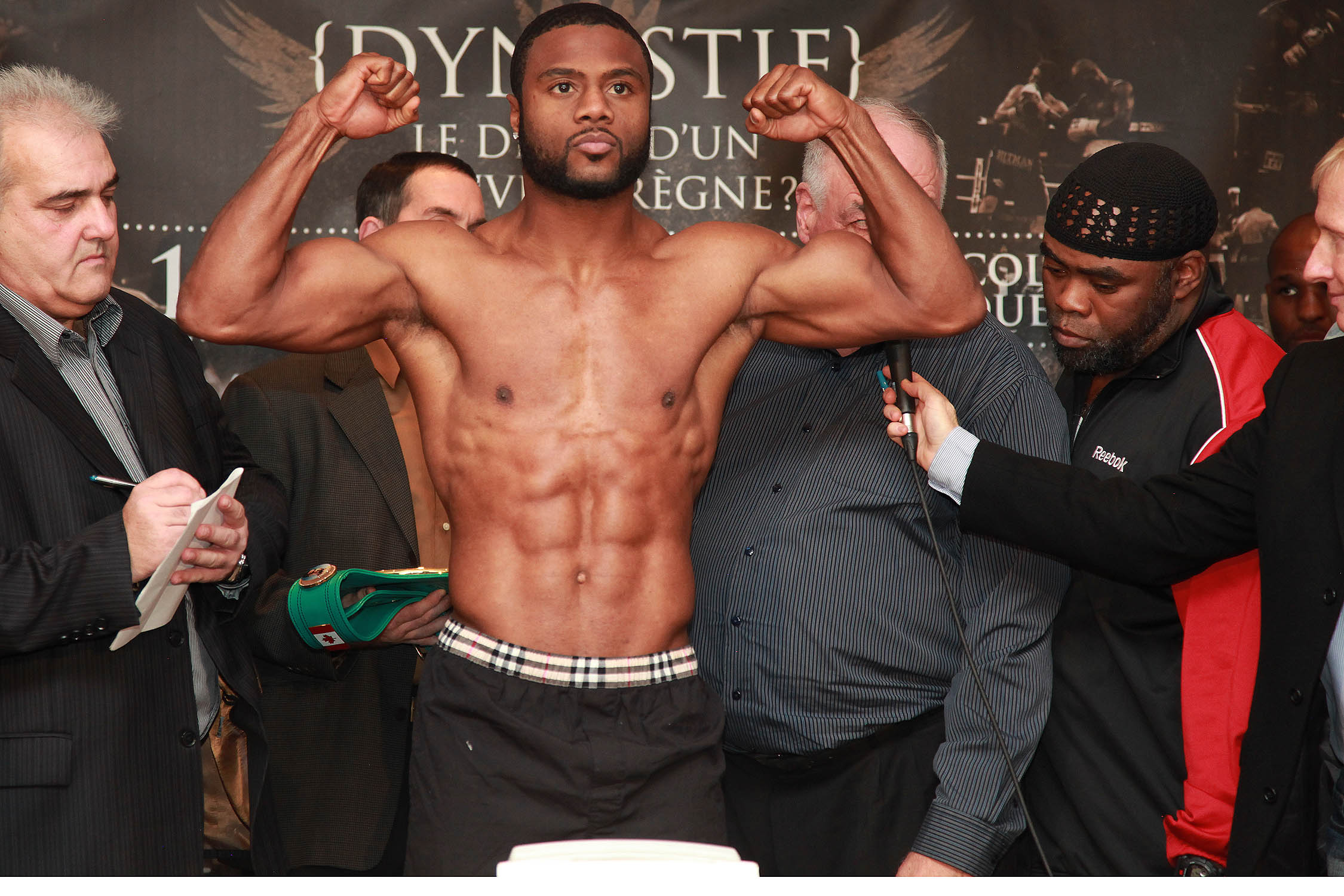
Case closed on scandal; Babysitter’s silence frustrated investigators. site my babysitters a vampire

The Boston Herald January 2, 1998 | Mulvihill, Maggie; Raposa, Laura For investigators, Michael Kennedy’s stunning death on an Aspen ski slope closes the door on the sex scandal that vaulted him from respectable businessman to trash TV fodder as he faced a statutory rape probe last year.

“It is just a tragic end to a very trying case,” said Cohasset police Chief Brian Noonan, who unsuccessfully tried to persuade Kennedy’s former babysitter to press charges against him for the five-year affair that allegedly began when she was 14.

But from the teenager and her family, there was silence yesterday.

The Cohasset teen is vacationing with her mother out of the country and couldn’t be reached, said her spokeswoman, Nancy Sterling, yesterday.

Neither the woman, nor her parents, who were close family friends of Kennedy, are expected to attend his funeral.

The babysitter – a sophomore studying public relations at Boston University – has had no contact with Kennedy since Norfolk County District Attorney Jeffrey A. Locke ended his investigation of the 39-year-old Kennedy last July, said Sterling.

The woman and her family declined to cooperate with the D.A., which forced him to pull the plug on the investigation.

Sterling also said the young woman remains in therapy to deal with the affair, which brought about the end of Kennedy’s 16-year marriage to Victoria Gifford Kennedy.

After Locke dropped his probe, Kennedy apologized to the woman and her family.

“She’s doing very well,” Sterling said yesterday. “He has not been in touch with her at all.” The furor touched off by the babysitter scandal triggered a backlash against Kennedy in Cohasset, the affluent South Shore suburb where neighbors were aghast at the allegations that brought tabloid TV cameras and supermarket tabloids to their bucolic little town.

Kennedy’s seaside estate on Atlantic Avenue was vandalized more than once, and yesterday the family requested a uniformed police officer be posted there for the next 48 hours, said the police chief.

Kennedy lived in the home alone after Vicki and their three children, Michael Jr., 14; Kyle, 13 and Rory, 10, packed up and moved to Milton when the babysitter scandal broke. Sources have said Kennedy also talked about moving to Milton to be closer to his children.

Still, he had maintained an extremely low profile in Cohasset, Noonan said.

“I haven’t seen hide nor hair of him in months,” he said.

While the sex scandal forever changed the lives of the babysitter and Michael Kennedy, it also affected the way the Kennedys dealt with each other. And for the first time in history, some Kennedy kin were very public about their disdain for one another. this web site my babysitters a vampire

Cousin Michael Skakel, Michael Kennedy’s driver and confidant, urged his cousin to seek treatment for his sexual and alcoholic addictions and cut off his relationship with the babysitter.

Skakel, the son of Ethel Kennedy’s brother, blew the whistle on his cousin and told the Norfolk County D.A. that Michael had slept with the babysitter at least four times before she was 16, the legal age of consent.

“They totally iced him out,” said one Skakel pal. “He’s been ostracized by the family.” Then there was his cousin, George magazine editor John F. Kennedy Jr., who lashed out at his cousins, Michael and Joe, in an editorial calling them “poster boys for bad behavior.” And then the family went on “60 Minutes” and spoke publicly for the first time about the sex scandal.

“I made it very clear to Michael that his actions can never be condoned but need to be condemned,” the congressman told Ed Bradley during a sit-down at Hickory Hill with six of Robert Kennedy’s children. “It was just a horrific thing that was done.” Mulvihill, Maggie; Raposa, Laura


Good riddance to Margarito, so long to Pacquiao


ARLINGTON, Tex. – There was a time when Antonio Margarito was my favorite story in boxing. He was humble, friendly, kind to fans and writers, and willing to absorb copious abuse to prevail. The night he defeated Miguel Cotto at MGM Grand remains a highlight of my time in boxing. But Saturday night, at about 10:20, I realized I don’t like the man anymore.

When the opening bell rang and I saw how much larger he was than Manny Pacquiao, my stomach tightened unexpectedly because at any moment in the next 36 minutes, Margarito might hurt Pacquiao. He might win. And I discovered a Margarito victory was a possibility that repulsed me.

Saturday at Cowboys Stadium, Filipino Manny Pacquiao did not allow Mexican Antonio Margarito to prevail. He clipped him, cut him, closed his eyes and whupped him. The judges scored the match 120-108, 118-110, 119-109 for Pacquiao. I had it 120-109, scoring 10 rounds for Pacquiao, with rounds 6 and 8 even.

Before you scoff at scoring anything for Margarito, consider what Pacquiao said about the sixth, in the post-fight press conference.

“I’m lucky to have survived that round.”

When have you ever heard Pacquiao say something like that?

It was a subdued conclusion to a night that was weird. The return to Cowboys Stadium went not as hoped. Attendance was announced at 41,734 – though we’ll not know the actual number till the Texas Department of Licensing and Regulation reports on gate receipts. Still, that was 10,000 fans fewer than was announced for Pacquiao’s March fight with Joshua Clottey. It was 19,000 fans fewer than we’d been told to expect all week.

And while Pacquiao-Clottey was a subpar performance in a remarkable edifice, Pacquiao-Margarito was a remarkable performance in a subpar edifice. Cowboys Stadium, a billion dollars later, had no reliable WiFi; Ethernet cords abounded – just like 1998. Cowboys owner Jerry Jones, ubiquitous in March, was hard to find all week.

The home team goes 1-7, in other words, and everyone, from the owner to the bus driver, stops caring about details.

I spent much of Saturday’s undercard on the East Side Plaza, asking Mexican fans about their unceasing loyalty to Margarito even after his 2009 banishment for wearing tampered-with inserts in his hand wraps. They almost had me convinced. Then allegations of ephedra use exploded from Margarito’s dressing room during Saturday’s undercard.

One camp said it was Hydroxycut – a dietary supplement that once contained the banned stimulant ephedrine. The other camp said that it was Splenda, a no-calorie sweetener, Margarito sprinkled in the four cups of coffee he drank in his dressing room. Though it was ultimately an irrelevance, it merits treatment.

The ECA Stack – comprising ephedrine, caffeine and aspirin – is more common in boxing gyms than you think. It is a powerful appetite suppressant that takes a remarkable effect on the central nervous system. Ephedrine races your insides while sending a signal to induce drowsiness. Caffeine ensures that signal never arrives at your brain. Aspirin, meanwhile, thins the blood to increase the duration of the stimulus. A fighter who used it to cut weight in training camp could easily become enchanted by its effect on hand-speed, timing and stamina.

It cannot make you a better fighter. But it can make you a more resilient one – with only a small chance of cardiac arrest.

And so my stomach tightened at ringside late Saturday night. To see Margarito’s size advantage and imagine it leavened with artificial speed and courage was hard to bear.

Margarito’s unofficial advantage was 17 pounds of weight and 4.5 inches of height. It was much more than that, though. Pacquiao is a 140-pound man who couldn’t weigh 160 after a sedentary month of rapacious grazing at a Las Vegas buffet. Margarito is a 190-pound man who, one way or another, weighs less than 150 pounds for a few hours of every year.

Oh, but size isn’t that important. Skill is. Combination punching is. Quickness and accuracy are. Right, right and right. But if size doesn’t matter, what was that scale doing at Cowboys Stadium, Friday?

When you are the much smaller man, see, every punch must be thrown with knockout power. In order merely to keep the larger man off him, a smaller fighter must forsake range-finding punches and deliver each blow with complete commitment. And that is positively exhausting. Even for Manny Pacquiao.

An hour after Saturday’s fight, in a makeshift media area under Cowboys Stadium, Pacquiao was spent. This post-fight press conference was not the celebration others have been. Pacquiao said it was the hardest fight of his career. What he didn’t say, perhaps because he’s gracious, was that Margarito was the least-skilled prizefighter Pacquiao has faced in a championship match. Indeed, size mattered.

After cracking the orbital bone under Margarito’s right eye early in the fight and almost stopping the Mexican in round 4, Pacquiao was astonished to be hurt by him in the sixth. Margarito pinned Pacquiao to the ropes and hit him with sustained punches for the first time. Margarito dipped into his well of resentment – a disrespected Tijuana club fighter made good – and tried to break Pacquiao.

But for once, Margarito faced a man with a deeper well of difficult experiences from which to summon fortitude. Take that, marry it to once-in-a-generation speed and power, and well, you have something pretty special there.

So, thank you, Manny, for being the purest embodiment of what we love about prizefighting.

And now, say goodbye to us. The risk-reward ratio is all wrong for you, as you realized Saturday night: To make big purses you have to fight men who are too big. There is nothing left for you to do to burnish your legacy. There is nothing more for you to give to boxing but a happy ending.

It’s now time to retire a legend, wits and fortune intact, and serve your people in a more meaningful way.

Bart Barry can be reached at bbarry@15rounds.com. Additionally, his book, “The Legend of Muhammad Ali,” co-written with Thomas Hauser, can be purchased here.
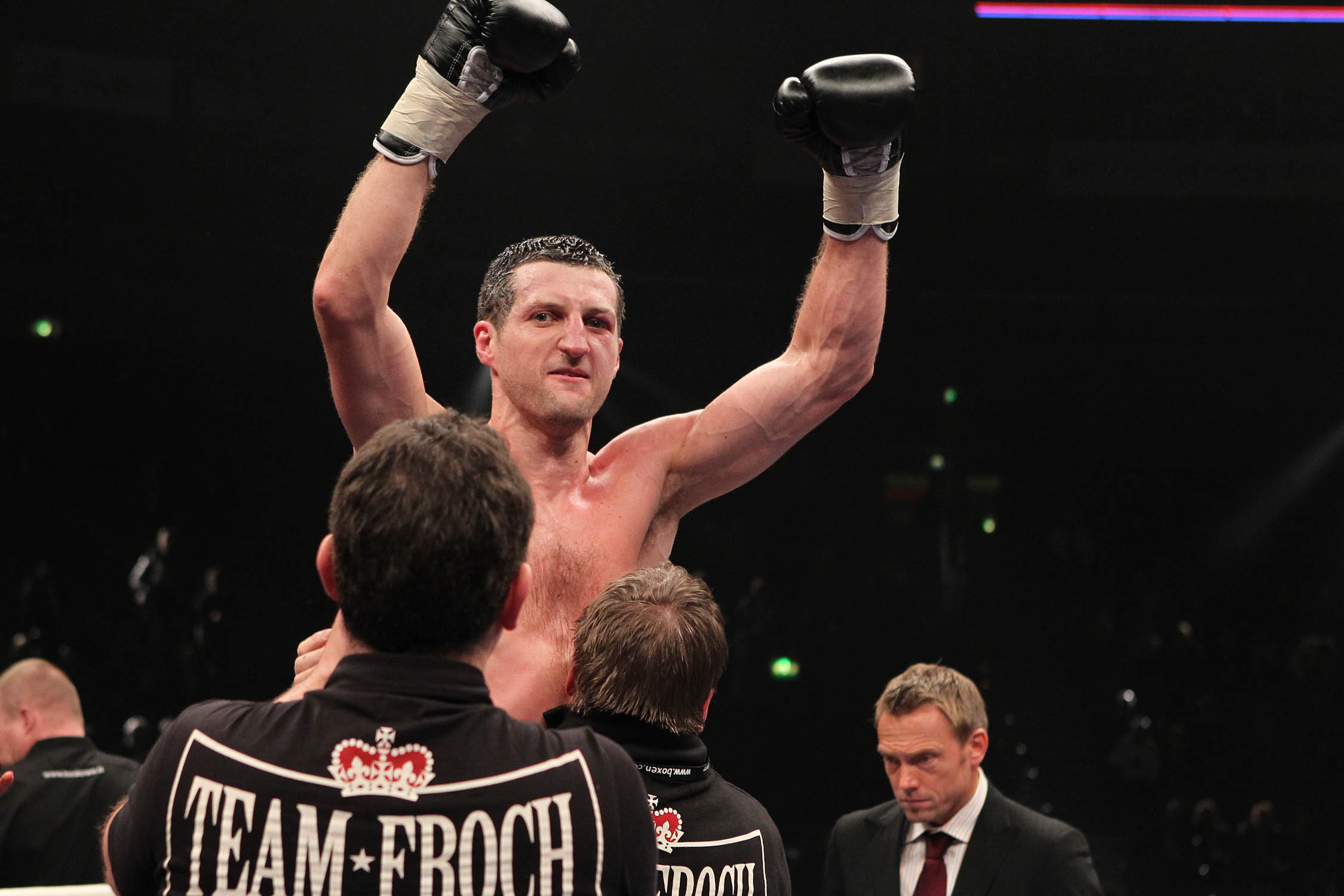


Mexicans’ support of Margarito never quit either


ARLINGTON, Tex. – In January of 2009, Mexican Antonio Margarito was caught with a plaster-like substance smeared on the knuckle pads of his hand wraps before a defense of his welterweight title. His license was revoked. He was banned from prizefighting for a year. But his countrymen did not abandon him. Why not?

To answer such a cultural question one would need a sociology laboratory. Fortunately, in the East Side Plaza of Cowboys Stadium, there was one.

Saturday night, at a match that Manny Pacquiao won by large-as-possible margins, Margarito did not want for fans. He wanted for class and endurance, perhaps. But not fans. How could his popularity not have waned?

With camera crews – local, national and international – lurking, there were plenty of Mexican fight fans from which to draw an opinion sample about that, in Spanish. And the sample came in the form of two questions, the first of which went: Have you forgiven Margarito for what he did, or do you think he even requires forgiveness at all?

“It happened a long time ago, and nobody told him what was on his hands,” said Marisol Manis, an attractive woman from the Mexican state of Veracruz, who dressed in GreenWhiteRed and held a handwritten sign encouraging Margarito. “In our culture, the Latin culture, the past is the past.”

Roberto Pantoja, a well-dressed man from Margarito’s hometown of Tijuana, thought the entire incident was questionable.

“It was a judgment brought by (a rival promoter),” said Pantoja. “It was doubtful.”

Pantoja, interestingly, was not the only Mexican who thought a certain Mexican-American fighter-cum-promoter was involved in what was found in Margarito’s hand wraps. Sergio, a Tijuanense who wore a Mexican flag knotted on the front of his forehead and draped over his shoulders like a turban-and-cape getup, also found the circumstances of Margarito’s banishment suspicious.

“There is no reason to forgive (Margarito),” he explained. “It was an injustice done by Oscar de la Hoya.”

While colorful, such conspiracy theories are discredited in the testimony heard by the California State Athletic Commission in 2009, testimony the CSAC used to revoke Margarito’s license, finding that even if Margarito’s trainer was the only one aware of the illegal inserts – as Margarito still claims – that was cause enough.

Other Mexicans gathered at Cowboys Stadium on Saturday were reticent about addressing what happened in that Los Angeles dressing room 22 months ago and more interested in the present.

“We are all humans, and we all make mistakes, Margarito, too,” said Carlos, a twentysomething guy from the Mexican state of Monterrey, dressed in a Mexican baseball shirt with the number 10 on the left breast pocket. “He’s a good boxer, and we always support Latin fighters.”

Which raised the second opinion-sample question: Did Margarito’s fans feel a personal connection with him, or did they gather in Dallas mostly to cheer the Mexican flag?

“I am here supporting him because he is a good boxer,” said Eric, a young man from the Mexican state of San Luis Potosi, who wore a Mexican flag round his neck like a cape. “And because he’s Mexican. Both.”

Jose, a middle-aged man from the Mexican state of Durango, wearing a dark leather jacket and drinking a beer at a table in the concourse, was firmer about his loyalty.

“We feel a real connection with Margarito,” he said. “We have followed him for years. We like his manner of fighting. Good fights.”

Perhaps, then, the last explanation is the best. Mexicans, in their proud fighting tradition, want a good scrap when they spend their pesos for a prizefight. Margarito, for all his questionable actions and judgment, has never failed to make the type of fights that enchant his countrymen.

Asked after his beating from Pacquiao, one in which he lost every round and had both eyes closed by cuts, if he ever considered quitting, Margarito spoke to his people’s heart.

“Not possible,” he said. “I am a Mexican. A Mexican never ceases in a fight.”

Laboratory closed.

Photo by Chris Farina / Top Rank


Margarito makes weight; Pacquiao makes less


ARLINGTON, Tex. – Boxing history is littered with great fighters going one weight class too high. The oddsmakers still say Filipino Manny Pacquiao has not made that mistake. But if Saturday’s fight brings an unexpected loss for Pacquiao, no forensic team will be needed to uncover a cause. The evidence will be found on the scale.

Friday afternoon at Cowboys Stadium, Pacquiao and Mexican Antonio Margarito took the indoor stage of the East Side Plaza before a roaring crowd of perhaps 1,000 fight fans – moved inside by the possibility of rain. Both fighters were bundled up in multiple layers, as the Texas temperature had dropped 20 degrees in a few hours.

Margarito weighed the fight’s contracted maximum of 150 pounds. Pacquiao weighed 144.6. If Margarito’s weight was expected, Pacquiao’s was another thing entirely.

Throughout the promotion of Pacquiao-Margarito, questions have arisen about Pacquiao’s commitment to his training regimen. The naturally smaller man, by a significant margin, Pacquiao was expected to add muscle enough to weigh at least the welterweight limit of 147 pounds. He wasn’t close.

More intrigue happened when the two men stood beside one another.

After Margarito approached the scale in an all-black track suit, gold chain and gold earrings, and made weight, with a loud and mixed reception from Mexican and Filipino fans, he waited for Pacquiao to disrobe and mount the scale. And then came the customary stare-down. It held a surprise.

Margarito wore the more defined of the two bodies on Friday’s stage.

Pacquiao’s physique was muscular, not shredded. Margarito, meanwhile, was taller, wider, and closer to “ripped.”

Friday’s weight, though, may be only the beginning of the story. Pacquiao is believed to have eaten freely this week, as he has regularly during fight weeks since his move to welterweight in 2008, and if that is the case, he may not even weigh as much on Saturday as he did Friday afternoon. Margarito, on the other hand, is fully expected to be above the middleweight limit of 160 pounds, and maybe quite a bit above it.

Pacquiao remains the favorite, because of speed and class. But a fight that was already more interesting than initially expected grew more interesting, still, Friday.

Saturday’s Pacquiao-Margarito card is scheduled to begin at 5:00 PM local time, with Cowboys Stadium doors opening at 4:00 PM. The pay-per-view portion of the card will begin at 8:00, with the main event scheduled to start at 10:00. 15rounds.com will have full ringside coverage.

Photo By Chris Farina / Top Rank


Apologies everywhere at Pacquiao-Margarito undercard press conference

GRAPEVINE, Tex. – Antonio Margarito is sorry. Brandon Rios is sorry. Robert Garcia is sorry. And all three would now like to move on.

Thursday in a convention room of the expansive Gaylord Texan Resort, some 25 miles north of the stadium where Pacquiao-Margarito will happen, promoter Top Rank hosted a press conference for the fighters who will be featured on Saturday’s undercard. Each received warm introductions from Bob Arum, approached the podium, and then said he was ready, felt strong.

Brandon Rios was an exception. He had a different statement to make.

“First of all, I want to get one thing off my chest,” began Rios, addressing the AOL Fanhouse footage of him, Margarito and Garcia making fun of Freddie Roach’s trembling hands and straining neck – symptoms of Roach’s Parkinson’s disease. “It was between camps and camps. It was a bad video from my behalf.”

Then Rios did what he and his camp probably should have done earlier.

“If Freddie Roach is out there, I’m sorry,” Rios said. “Things got heated up in the moment. And I’m sorry.”

Before the press conference could conclude, Arum ended with a surprise visitor. Margarito, who did not talk about the video at Wednesday’s main-event press conference, made an unplanned trip to Thursday’s undercard event. He took the podium and explained that the footage of him was contextually inaccurate.

“The video was edited,” Margarito said. “I never, never, would make fun of Freddie Roach with that disease.”

Then Margarito tried to recreate the scene that preceded the odd face and outstretched, trembling hands he showed a reporter’s camera.

“I was just arriving at the gym,” Margarito said. “Someone said to me, ‘Hey, Margarito, Freddie Roach says Manny Pacquiao is going to knock you out.’ I said, ‘Ooh, what fear!’ and shook my hands.

“I wish for the gentleman (Roach) to accept my apology if he was offended.”

Margarito then apologized to anyone else he might have offended.

“If they were offended, I ask for forgiveness from all of those who have that disease,” Margarito said. “Never, never, would I make fun of that disease.”

After the fighters left the podium, Brandon Rios stopped and spoke a bit more about the bad-faith that has accrued to him and the Margarito camp.

“Robert called me and said, ‘Hey, f–k, dude, this sh-t is getting big!’”Rios said about the way he found out from his trainer that the video had gone viral on the internet. “My wife is yelling at me. I feel bad for saying it. Nothing personal. I feel bad.”

Then his trainer appeared and added to the apologizing.

“I just got finished talking to Freddie Roach,” Robert Garcia said about a two-minute conversation he’d had with Pacquiao’s trainer during the press conference. “I told him, ‘Freddie Roach, I want to tell you that I’m very sorry for what happened. Now that I am talking to you, I feel much better.’”

When asked, Garcia confirmed that Roach had been receptive to Garcia’s call.

“I accept your apology,” Garcia said that Roach told him. “And best of luck this weekend.”

Fight week festivities will continue on Friday when all combatants take the scale. The weigh-in will be held at Cowboys Stadium at 5:00 PM local time and is open to the public.


Pacquiao and Margarito take the stage; Sulaiman steals the show


ARLINGTON, Tex. – Unless the weekend’s combatants come to blows on the dais itself, Wednesday press conferences usually are dull affairs. Television executives, beer sponsors, secondary and tertiary promoters, personal trainers, all, read rehearsed remarks to writers who patiently await lunch. Business as usual.

The president of a sanctioning body, though, can be a refreshingly different story – as the media learned at Cowboys Stadium.

Wednesday afternoon in the final pre-fight press conference Filipino Manny Pacquiao and Mexican Antonio Margarito will have to attend before their Friday weigh-in, the president of the World Boxing Council, Jose Sulaiman, made his way to the podium and stole the show. More about Mr. Sulaiman in a bit.

Pacquiao and Margarito and their entourages gathered in the “House that Jerry Built” – though the builder, Dallas Cowboys owner Jerry Jones, was not present – to say one last time that they were ready for one another.

Pacquiao, introduced by promoter Bob Arum as “the greatest credit, in our era, to the history of boxing,” presented his customarily likable self, filled with a gracious smile, words of thanks for everyone gathered, and a becoming humility that has not changed one bit throughout his rise to international prominence.

His opponent in Saturday’s superfight, Antonio Margarito, cut a grimmer figure. Exonerated fully by his promoter, if no one else, for the illegal inserts found in his hand wraps before a 2009 fight with Shane Mosley, Margarito and his team have recently acted several times in questionable taste. There was the footage of Margarito wrapping a piece of concrete over his knuckles during the second episode of HBO’s “24/7” series. And now footage of several people, from Margarito’s camp, imitating the effects of Pacquiao trainer Freddie Roach’s Parkinson’s disease has surfaced on YouTube.

Margarito trainer Robert Garcia spoke at the podium about this, Wednesday, saying that he had admonished his fighters about inappropriate behavior like that in his gym. He further explained that one of his fighters claimed not to know even that Roach has Parkinson’s disease. Garcia did not, however, simply turn a few degrees to his right and offer an apology to Roach.

Freddie Roach, for his part, did not address the Margarito camp at all, preferring to focus on Congressman Pacquiao’s initial distractions.

“Little bit of a different training camp this time,” Roach said from the podium. “Just a little bit mental at first. (Pacquiao) wasn’t 100 percent there.”

But things did apparently improve when the camp relocated from the Philippines to California, and Roach saw no reason for concern.

All of those statements, though, were preceded by Jose Sulaiman, president of the WBC. Dressed in a silver suit with a white shirt and blue tie, Sulaiman ambled to the podium, apologized for his English and then offered Wednesday’s most entertaining spectacle.

He asked who could have imagined, way back in a time of short pants, that his friend Bob Arum would grow to become boxing’s “greatest promoter.” When that title was inadequate, Sulaiman then announced the WBC’s annual convention had just voted, unanimously, to declare that “in the 300-year history of the WBC,” Arum was one of boxing’s “two greatest promoters.” And then Sulaiman presented to Arum a curious piece of hardware that appeared to be a gray figurine balanced on green felt.

Finding his stride, Sulaiman next explained the colors of his suit. In a nod to Cowboys Stadium, Sulaiman declared not just himself but also his family “Cowboys.” He raised his blue tie and waved it at the media for dramatic effect before proclaiming the depth of his clan’s loyalty to Dallas’ professional football team:

“We cry when they lose, and we get drunk when they win!”

Friday’s Pacquiao-Margarito weigh-in will take place at Cowboys Stadium at 5:00 PM local time and will be open to the public.

Photo by Chris Farina / Top Rank


Celebrating Rafa; reconsidering Juanma


Juan Manuel “Juanma” Marquez is a very strong featherweight. In the ring, the Puerto Rican has the power of two men. How do we know this? Because he managed to wobble two guys, Saturday, with the force of his left hook.

Trouble was, one of those guys was Lopez himself. The other, of course, was Mexican Rafael Marquez who challenged Lopez for the WBO featherweight title at MGM Grand in the main event of a standard-setting episode of Showtime’s “Championship Boxing.” Lopez prevailed by technical knockout when Marquez was unable to continue.

As the bell rang to begin the ninth round, Marquez waited long enough for Lopez to drop to his knees at center ring in celebration, and then Marquez rose from his stool and walked across the canvas touching his right shoulder with his left glove. Afterwards, Marquez would say his shoulder was too weak to raise his right hand. Should we believe him?

Damn right we should.

Forget Marquez’s pedigree. Forget his participation in one of the greatest trilogies in boxing history with Israel Vazquez. Consider, instead, where Marquez’s prized weapon was all night. The right cross, a punch Marquez used in a reign of terror over the bantamweight division for six years, was nowhere to be found in his fight with Lopez.

At the end of the second round, in fact, I asked my notebook a rhetorical question about it: “For some reason, Marquez doesn’t see any available right hands against a southpaw?”

Then the third round happened. Lopez, a larger man than Marquez, threw a short left cross from his southpaw stance that caught Marquez on the forehead. Marquez was off-balance when the punch landed and much more so after. He stumbled backwards across the ring, found his balance, planted and threw a right cross at Lopez’s onrushing jaw.

No he didn’t. Actually, Marquez found his balance, planted, cocked his right hand in front of his shoulder and pushed the weight of his body behind it. A first occasion of what became a regular occurrence in the fight: Marquez using Lopez’s own force to supply power. Lopez obliged, running into Marquez’s pushed right glove and halting a bit. The next round was more interesting still.

Rafael Marquez, much like his older brother Juan Manuel, struggles a bit against men who fight taller than he does. Accomplished as Los Hermanos Marquez are – probably prizefighting’s best brother tandem of all time – neither ducks punches well as he does everything else. Both put their chins in predictable places.

Marquez, then, would repeatedly duck Lopez’s lead right hook and drop his head to the red and black Dodge insignia on the waistband of Lopez’s trunks. While he was down there, though, he had occasion to make a surprising discovery: Lopez’s right glove, too, was even with that Dodge insignia.

How long do you think it took a fighter of Marquez’s caliber to realize that if Lopez’s right glove was even with his waistband, Lopez’s head was completely unguarded?

Quickly Marquez began to drop his shoulders, duck Lopez’s right hand, shift his shoulders leftward and rise on the other side – making a backwards U. Once there, he countered Lopez with light left hooks – light because, remember, despite Marquez’s Mexico City upbringing, he is a Nacho Beristain fighter, not a Julio Cesar Chavez knockoff, and so the left hook is not his Sunday punch.

But Lopez had another tactical mishap to complement his low lead hand. Annoyed more than deterred by Marquez’s counter hooks, Lopez began to square his feet and fire a left hook of his own behind his missed right hook. Now, lead hand low, Lopez entered in to a left-hooking contest with one of the best Mexican prizefighters in a generation. He’s lucky he survived it.

In round four, Marquez waited for Lopez’s lead right hook, made his U and threw his left hook. Lopez supplied half the power of the punch by snapping himself leftward with a hook of his own. Marquez’s hook landed first, and Lopez wobbled, eyes wide. Then Marquez pushed a right cross that knocked him into the ropes, and a fight ensued.

That was the end of the drama, if not the suspense. Lopez returned to his corner after the round, got a hold of himself and effectively put the left hook away. He began to throw left crosses, as he should have been doing all the while. Then he closed space, walked the smaller man down and began to brutalize Marquez. Within six minutes, order was restored, and Lopez ground Marquez to dust.

Marquez would not have finished the fight even if he hadn’t canceled it himself. Lopez was too big and too good. The question was not why Marquez stopped things after the eighth round but why he entered the ring in the first place.

“It had hurt me before (in training), but I didn’t want to cancel the fight another time,” Marquez said about a match he had already postponed once because of a hand injury. “But in the fourth and the fifth rounds, I couldn’t throw punches.”

Marquez then said as soon as his shoulder was better, he would like a rematch. He’s entitled to it, but: Shoulder and hand injuries in a 35-year-old’s training camp are Life speaking in short, declarative sentences about age.

And here’s a short, interrogative sentence for Juanma Lopez: What if those Marquez left hooks had come from Yuriorkis Gamboa?

Gamboa is a natural featherweight slugger who loads up on left hooks. Marquez, meanwhile, was a natural bantamweight whose best weapon was not a left hook. And yet look what Marquez did.

Bob Arum, who promotes both Lopez and Gamboa, says we may get the answer to that interrogative sentence in June. Until Saturday, frankly, I’d have bet the house on Juanma against Gamboa. But after Saturday, I’m filled with doubt.

Bart Barry can be reached at bbarry@15rounds.com. Additionally, his book, “The Legend of Muhammad Ali,” co-written with Thomas Hauser, can be purchased here.


Poised for a Juanma knockout


We begin with a Juanma Lopez story. It was January of 2007, and a few of us gathered in a Phoenix Days Inn conference room to hear Tommy Morrison announce his comeback. The press conference was scheduled to begin an hour before it began, but I arrived on time like a fool.

There was one other writer there, and he didn’t speak Spanish, so Top Rank’s Phil Soto motioned towards a group of Puerto Ricans in matching track suits and told me to be the first to interview Juan Manuel Lopez – the day before Juanma’s “ShoBox” debut.

Lopez has acquitted himself splendidly since then, of course, and faces the challenge of his career, Saturday, at MGM Grand against Mexican Rafael Marquez in a fight for Lopez’s WBO featherweight title. But that’s not the point of the story.

That day in the near-empty conference room, I strolled over to the guys in track suits, picked one who looked like a fighter and asked him how he got started in boxing. He was happy to tell me. His dad, or uncle, or somebody, took him to the gym and, why, he loved the sport and was excited to be in Phoenix – his first time. The guy beside him, a little younger and smaller, flashed a wide grin that didn’t leave his face for the next five minutes.

I was out of questions by then and began to move towards a seat from which I could watch Tommy Morrison spin his yarn. That was when the small kid with the big smile told me that, while his friend was indeed a Puerto Rican who loved boxing, he, Juanma, was the guy fighting on Showtime tomorrow, and would I like to ask him any of the same questions?

The following night, after Lopez looked fantastic against Cuauhtemoc Vargas, I hurried to escape an interview with Tommy Morrison. “The Duke” – as some doctor called him in a supposedly official medical document – wouldn’t be making his comeback fight that night because he’d hurt his wrist. This was no less believable than anything else Morrison would say in the months that followed, but it was already too much. I hustled up a back staircase at Dodge Theatre and came to an exit. There was Juanma, patiently knocking. I let him in, and he gave me a hug and told me to remember him because he was going to be a good fighter.

What struck me that week about Juanma Lopez was his poise. He was not in a hurry to become famous by manufacturing some cult-of-personality thing to get on American television. He was not trying too hard, in other words. He was relaxed and confident; he knew he was likable and good, and in time Americans would know that too.

He’s going to need that poise Saturday. The man who comes for his title, Rafael Marquez, has been in bigger fights against better fighters than Lopez has. Marquez has also been in the finest boxing trilogy many have yet witnessed, with Israel Vazquez. His right hand is arguably the most impressive weapon, pound-for-pound, boxing has seen in a generation.

And Lopez, for all his poise, hasn’t got boxing’s best chin. But neither does Marquez. And that’s why folks in the know are so excited about this fight.

When Marquez’s last match was announced, a fourth scrap with Vazquez, in Los Angeles, Marquez fans felt a touch of relief. Vazquez was a man of unmatchable will, but he was also a man with ruined flesh round his eyes. Their guy would cut him up before Vazquez could rend any wills. And that’s exactly what happened in May, though it happened quicker than expected. Vazquez did not last 10 minutes with Marquez.

In the euphoria of that post-fight press conference at Staples Center, Marquez, seated beside trainer Daniel Zaragoza, the man who’d replaced Nacho Beristain, mentioned Juanma Lopez, and we all gave the idea some thought. Far more thought than we might have given the same suggestion two years before – when Marquez was sent reeling across the ring in the 12th round of his third fight with Vazquez and needed 18 months to recover.

The idea of either Marquez or Vazquez moving up four pounds and challenging Lopez was not a serious one, then. It is now.

Lopez, a southpaw, has been felled by lesser men than Marquez. Rogers Mtagwa, a Tanzanian strongman who boxes about as well as Marquez did at age 10, had Lopez out on his feet not too long ago. And after his career’s most impressive showing against Steven Luevano in January, Lopez was in a thrilling match with Filipino Bernabe Concepcion in July. Too thrilling, actually. In two rounds, there were four knockdowns, and Concepcion’s trunks weren’t the only ones cleaning the canvas.

Both Lopez and Marquez can box. Quite well. And both have a tendency not to box until they’re very near unconsciousness. A firefight, you’d think, favors Lopez, the larger of the two men. But we can’t be too sure.

That’s why we’ll watch Showtime, Saturday. But it’s not the only reason. The undercard match, a super-middleweight fight between two subs – Allan Green and Glen Johnson – should be an entertaining way to do something that’s good for us and boxing, too: Support the “Super Six.” Boxing’s best idea has had a rocky go of things lately, so here’s hoping Green-Johnson will be a fitting good-riddance to Andre Dirrell.

The main event, though, is the reason to tune in. Two honest, exciting fighters who are respectful and admired by those who know them. Rumor is, Puerto Rican-versus-Mexican occasionally makes for a decent rivalry, too.

Give us a pick, then? Sure. Good as Marquez is, exciting as a victory by him would necessarily be, he’s not young enough or big enough to stop Lopez. So I’ll take Lopez by 10th-round KO – unless his eagerness runs him into a Marquez right hand.

Bart Barry can be reached at bbarry@15rounds.com. Additionally, his book, “The Legend of Muhammad Ali,” co-written with Thomas Hauser, can be purchased here.


Watching “24/7” while thinking about Mexican television


Boxing doesn’t have seasons, or much boxing either, anymore, but it does have pay-per-view events that mark artificial seasons. These happen late in winter, spring, summer and fall. This year’s late-winter and late-summer offerings were weak and dreadful, respectively. This year’s late-fall season kicked-off Saturday with the first episode of “24/7 Pacquiao/Margarito.”

If you’re not thinking that it would be better to read a column about boxing than one about television about boxing, you should be. To such a concern I offer the merest anecdote:

One summer, after suffering through a semester of Eng102 at Arizona State University I happened on its professor in the ASU Rec Center and told him what I thought of his class. And he replied, “Boring to you? I had to teach the damned thing.”

We make a mistake if we discount the need for boxing on television, though, and that is why we take a look at HBO’s “24/7” program and its effect. Much as we make of competitive undercard matches and b-side fighters in main events, network researchers snicker at our concerns because they know what we do not believe: Once the a-side fighter is in place, the success of a pay-per-view is determined by “24/7.”

Mayweather-Mosley in May was a more compelling spectacle than Pacquiao-Clottey in March, as we all knew it would be, but not twice as compelling. The difference in pay-per-view sales these shows garnered, if those numbers are to be believed, was roughly 100 percent. That is, Mayweather-Mosley sold about twice as many pay-per-view buys as Pacquiao-Clottey. One had “24/7.” One did not.

Look, “24/7” is not for you, the serious fan. It is for the wife or father of a casual fan. It is about helping a casual fan attain $50 of permission from his spouse or guardian by offering variable plotlines. That’s how Pacquiao’s puppy featured prominently in “24/7” before the fight with Miguel Cotto; that’s why we now know Margarito’s wife hates her husband’s flatulence.

Super fights need that sort of promotion today because there are no longer a million serious boxing fans in the United States. Boxing lost most of its fans when it left network television, though it still pretends otherwise. It lost more fans when it put an additional purchase price on meaningful fights. And it lost another healthy chunk this year when it promised something real, failed, then delivered, instead, something broken.

Which gets me thinking about Mexico. Today, having backed away from the failed American model, Mexico has great fights on basic cable. It’s a new thing. Mexicans are embracing it enthusiastically. When I talk to folks in Tamaulipas or Jalisco, now, I hear about fights in Germany and Poland I did not know about and could not have seen if I had. Beyond that enthusiasm, though, is a coming sadness.

Boxing did not suffer too much when American kids could no longer watch it on public airwaves. That is, American boxing suffered, suffered terribly, but the sport wasn’t ruined. Because of prosperity, Americans were destined to supply boxing’s audience, not its participants, soon, anyway. Not so with Mexico.

Boxing was not on Mexico’s public airwaves for most of the last decade because of the same shortsighted greed that afflicted, and afflicts, things here in the U.S. Mexican great Marco Antonio Barrera, in fact, cites the renewed availability of boxing in Mexican homes as a reason for his comeback: None of his countrymen saw his glory days. Unless you were a Mexican with a satellite dish or access to a sports bar that had one, then, you probably gave up on boxing sometime after 2001.

Ten years is a long time. Imagine a Mexican who turns 20 this year; he’s spent half his life without boxing. Now imagine that Mexican was to be the next Barrera. Whatever else he may be, he’s not the next Barrera anymore.

Today, we are told Saul Alvarez and Julio Cesar Chavez Jr. are among Mexico’s greatest young fighters. The troublesome thing is that it might be so. Expect just as many Mexican “greats” to be fed to us by promoters in the next decade as we had in the last, but don’t expect many actual great fighters out of Mexico for 10 years to come.

Oh, enough of the dreary prognostications already! Very well. Back to pay-per-view season.

The first episode of “24/7” was better than it could have been. There were the same old overwrought and overproduced elements, sure. Freddie Roach’s pursuit of anonymity in a mall – while accoutered in bright Team Pacquiao garb and followed by a camera crew – was the best example. But anyway.

The first episode dealt fairly with the issue of Margarito’s hand wraps. It reported the facts of the case; the discovery of the pads, the result of the California State Athletic Commission’s investigation, the revocation of Margarito’s license, and the restoration of Margarito’s license in Texas. Then it gave Margarito his chance to convince potential buyers “he didn’t know” – that he still “doesn’t know!” (not in subtitled translation) – anything was wrong with his wraps the night he faced Shane Mosley.

And then “24/7” went to Roach casually saying Margarito is lying before showing Pacquiao, in an uncommon bit of satire, pantomiming Margarito’s path to obliviousness – complete with covering his eyes with one hand while extending the other to an imaginary trainer. Yes, Margarito’s explanation remains, in the strictest sense of the word, unbelievable.

But he still won’t make much of a villain. He has a sleepy-eyed humility that makes him pretty hard to hate. He is not going to cut it as a Mexican hero, either, though; wherever they found those extras for the car-wash plot, Margarito now cuts things a little too fine, in both beard and palliation, to be a working-class hero.

But this is good as it gets right now. Take it or leave it.

Bart Barry can be reached at bbarry@15rounds.com. Additionally, his book, “The Legend of Muhammad Ali,” co-written with Thomas Hauser, can be purchased here.
Photo by Chris Farina/Top Rank


Arlington in November

Cowboys Stadium is not in Dallas or anywhere near Grapevine, Tex., home of the Gaylord Texan – official hotel of the Dallas Cowboys. The stadium is in Arlington, a half hour west of Dallas and a half hour south of Grapevine and one parking lot from Rangers Ballpark. Let’s pause for a moment to celebrate stadiums named after teams that play in them and not corporations that don’t.

There. That’s the end of homage to the House that Jerry Built. Manny Pacquiao’s last prizefight was about seeing him in Cowboys Stadium. That trick won’t work twice.

Pacquiao hasn’t changed. He’s perhaps more of an icon in the Philippines for having won a congressional election since his March fight with Joshua Clottey, but saying Pacquiao is more of an icon in the Philippines is like calling him “perfecter.” Which means that for Pacquiao’s fight on Nov. 13 to succeed, Tijuana’s Antonio Margarito is going to have to draw better than Ghana’s Clottey did. Piece of cake – preferably tres leches – right?

Not so fast. If Spanish-language emails coming to bbarry@15rounds.com can be believed, not all of Mexico is buying the Margarito line. They have not forgiven or forgotten. And they are right not to.

If you are reading this, you have considered and reconsidered the Margarito case. I don’t plan to persuade you of his innocence or guilt; I’m too conflicted about it, myself, to do a creditable job. But I will be in Cowboys Stadium next month and wonder if watching someone wrestle with his own ambivalence mightn’t prove cathartic to you.

I worry about the precedent Margarito will set in November: Break the rules (wittingly or otherwise), receive banishment, go into exile, miss a fight, take a tune-up match, shop for a sympathetic commission, enjoy your richest payday. It’s obviously unfair, but adults don’t whine about unfairness.

It is troublesome too, though, because this precedent begs for a copycat effort. Why shouldn’t some other fighter, or his trainer, try it?

Still, Margarito will not fight in November with any foreign substances smeared across his hand wraps because Pacquiao’s trainer Freddie Roach will be an incredible pain in the ass during the hand-wrapping that HBO’s cameras will cover like it’s part of the undercard. But here’s something to consider.

If we take Margarito at his word – that he was oblivious of his trainer’s transgressions – we’re left to determine when Margarito’s trainer began tampering with wraps. Margarito cannot help us answer that question because he recused himself from the case by expressing complete ignorance of his trainer’s comportment, numerous times before the California State Athletic Commission.

In other words, was Margarito ever honestly better than the 10-3 journeyman he began his career as?

Well, if the answer is no, we’re in for a bloodletting to make Pacquiao’s unraveling of Ricky Hatton look civilized.

Boxing is a theater that requires suspension of disbelief much as any other. Let us suspend our disbelief, then, and imagine Margarito’s hands were coddled in the softest of gauze and tape the evening he beat Miguel Cotto in 2008 and th’t that same Margarito will be in Arlington four Saturdays from now.

Manny Pacquiao is far too quick for Margarito to find early. Margarito will lope forward, hands low and wide, smiling as Pacquiao hits him 50 times every round. Pacquiao will have spent weeks sparring before Freddie Roach, who probably will have stopped the action each time Pacquiao’s back touches the ropes. Pacquiao, in other words, should come off those ropes like they were an electric fence. And Margarito is none too effective in the center of the ring.

Why not? Because Margarito has a signature crossover move that requires space and time. It goes like this. He puts his jab out to start the combo in motion. He brings his right foot forward with his right cross, which is a loopy, corralling punch thrown to trigger the left uppercut/hook hybrid. Then from a southpaw stance, he pulls on his right shoulder and launches his left fist upwards, with all his being behind it.

But Pacquiao is three things that foil this crossover: Small, quick and southpaw. He will be able to parry the looping cross and move away from it by pivoting quickly on his lead right foot in a tight circle that makes Margarito’s hybrid punch wider than usual. Margarito will hit mostly air, turn leftwards and taste a left cross or four. And he’ll be down 60-54 on all three judges’ cards when the seventh round commences.

But he will not be discouraged.

He will be the largest man Pacquiao has faced. He will be a man who fights with a special kind of resentment. He will be outclassed but not outwilled. And he will weigh more than Joshua Clottey did in March – when the Ghanaian proved that if a welterweight is hell-bent on not getting hurt by Pacquiao he needn’t be.

Margarito has a chance because of physics. Pacquiao’s power above 147 pounds is unproved. Boxing history is rife with great fighters who went one weight class too high. Margarito’s relentlessness would not be enough if he were Pacquiao’s size. But he is not. He is much bigger.

One of two things is likely to happen in November. Margarito never finds Pacquiao, chasing him in hopeless circles round the center of the ring and collecting the 36-minute beating so many Americans, and Mexicans too, believe he deserves. Or Margarito finds Pacquiao late in the fight and makes it a dramatic spectacle indeed.

So I ask myself, would I go to this match if it were in Las Vegas and not my home state of Texas? I think so, but I’m not sure. Would I buy it on pay-per-view, otherwise? Yes. Should you come see this match in Texas? Yes. Should you buy it on pay-per-view, otherwise? I think so, but I’m not sure.

Bart Barry can be reached at bbarry@15rounds.com


PALing around, looking for a fight

SAN ANTONIO – If you walked along the remnants of Chalk It Up on Houston Street, Saturday, hundreds of drawings in dusty pastel colors underfoot, then came to a staircase for the River Walk – no, not the tourist loop but the one that takes you to Brackenridge Park – and exited at Navarro Street, heading eastwards, you were on your way.

Municipal Auditorium was on your left. A majestic stone building erected in 1926, during the period that saw most of the city’s enduring stone landmarks constructed, Municipal Auditorium stood before, but cast no shadows on, two war memorials. Korea then Vietnam – the latter housing, in an air-tight compartment, the names of all 60,000 San Antonians who served in Southeast Asia.

Inside Municipal Auditorium were the National Association of Police Athletic / Activities Leagues boxing championships, known universally as “The PALs.” This year’s championships were especially important because the winners in each weight class qualified for a berth at the Olympic trials in Colorado Springs. Ten dollars, in other words, bought you a seat at ringside where you got to see 40 of our country’s best boxers.

It was a good respite from another lousy week in an astoundingly bad year for prizefighting. Last week’s announcement that Andre Dirrell would not fight Andre Ward in November changed Showtime’s “Super Six” tournament to a Super Three. More about that in a bit.

Back to Municipal Auditorium. A few minutes after I took a random seat, Saturday evening, good fortune sat a teacher one row behind me. He was Tom Mustin, Team USA’s 2000 Olympic coach, mentor to future stars like Jermain Taylor, Jeff Lacy, Rocky Juarez and Brian Viloria. And along with being a fine conversationalist, Mr. Mustin was a pair of reminders.

First, no matter how much you know about professional fighters and their trainers, no matter how many fights you’ve seen or stats you’ve memorized, beside a career amateur coach you don’t know much. Men like Tom Mustin or Kenny Weldon teach eight year-olds how to box, travel the world with their kids and act as surrogate fathers as much as trainers.

And second, you should temper your criticism of USA Boxing’s results with an appreciation for the sacrifice its teachers make. The hours are brutal. The pay is low. And the responsibilities are many more, and deeper, than what professional trainers, gunslingers by comparison, take on.

Watching a national amateur championship also affords you insights into someone like Rau’shee Warren. A two- and likely three-time Olympian, Warren is probably America’s best amateur. Among his feats is maintaining the same weight at age 23 that he had at 17. The training grants he continues to win from USA Boxing are superior to the purses he’d earn as a 114-pounder, so why turn pro?

He is now, in both age and skill, a man among boys. His Saturday bout matched him against San Antonio’s Adam Lopez, a boxer now trained by Jesse James Leija. Lopez opened the first minute of the first round with an interesting tactic. He punched at Warren’s right arm. Warren, a southpaw, carried his lead hand low, and the theory was that by targeting the middle of his arm, Lopez might disrupt Warren’s up-jab and activity. It worked.

For about 60 seconds. Then Warren came alive with quickness, accuracy and unexpected ferocity, and everything stopped working for Lopez. The final line – “Warren dec. Lopez, 20-2” – squashed further description.

The evening’s most curious spectacle came a little later in the 201+ division, and he came complete with pink headgear and an infuriating style. Lenroy Thompson, originally from Florida but now boxing out of Kansas, does everything technically wrong en route to beating everyone he faces. I asked Mr. Mustin if someone like Thompson might actually represent our country in London in 2012.

“Why not?” said Mr. Mustin, and he began to chuckle. “He’s the type that could win a gold medal.”

Thompson’s style and achievement are a good place to turn and start back towards the matter of Andre Dirrell. Amateur boxing is a meritocracy based on computerized scoring, which has its own logic. If you know where to position yourself on the canvas and how to hit your opponent in a way three of five judges can see, while precluding your opponent from doing the same – à la Lenroy Thompson – you become a champion.

Professional fighting is a different sort of meritocracy, one adhering to box-office receipts. Just as being exciting does not win you amateur titles, being able to hit your opponent twice in a round in which he hits you but once does not win you lucrative purses, or many fans.

Of the two meritocracies, Andre Dirrell came closer to mastering the amateur than the professional. He was an Olympic boxer whose style was so displeasing to so many people in his first title fight, with Carl Froch, that many doubted the sincerity of his injury when Arthur Abraham fouled him in his last match. I did not.

Last week, though, after Showtime had rescheduled Dirrell’s match with Andre Ward for November – location “TBA” (Ticket Buyers Absent) – most fans doubted the sincerity of the “neurological issues” that caused Dirrell to be the third man to drop out of the Super Six.

If I were Dirrell, I would have offered some medical documentation with my press release.

Which brings us to the Super Three. Something else we can borrow from amateur boxing is the “walkover” result. Let’s use that and say Ward “walked-over” Dirrell, leaving Froch-Abraham to decide who’ll fight Ward in the finals. Those are the only two fights anyone wants to see now, anyway.

Finally, while Ward and Dirrell were Olympic teammates, only one of them – in style, charisma and box office – made a successful transition to pro. There’s really no shame in that for Dirrell. But now that we realize it, we must move on.

Bart Barry can be reached via Twitter.com/bartbarry


In celebration of Oscar’s candor


Heretofore, sincerity has not been a hallmark of the Golden Boy brand. Both as a fighter and promoter, Oscar De La Hoya has often used borrowed words to transport his statements someplace other than where his thoughts would steer them. But that changed last week.

In an interview with Broadcasting & Cable, one that was deeper and more honest than anything boxing writers have come to expect from the man or his company, De La Hoya spoke of a desire to take over boxing. He implied all would be better if he were granted sole authority over the sport.

In his words, and despite the semi-retractions that followed, De La Hoya set the truth free. Lacking an adequate lexicon of meaningless expressions, he spoke without his betters’ nuance. Bless him for it.

De La Hoya’s candor brought clarity. Golden Boy Promotions will no longer be able to hide in the silly, one-for-all costume that aspiring monopolists tend to don. And other promoters will no longer be able to make unsatisfactory efforts, lose to Golden Boy Promotions, and then feign victimhood. They now know De La Hoya wants to eat their children – to borrow another fighter’s timely candor.

Oh, but they were taken aback. “Is this not America!” they thundered. Along with a goodish number of commentators, Golden Boy Promotions’ rivals reached for the flag and free market. It was that reaction – indeed reactionary – that made De La Hoya’s unguarded statements provocative.

While some were boning up on MBA-speak in their twenties, De La Hoya was imperiling, and being imperiled by, others. Today, he wishes to obfuscate better than he’s equipped to do. Undoubtedly, he thinks capitalism is just a cool system for making him rich – like most everyone who prays at the altar of the free market. Frankly, you could name the system “potatoes” and not budge their faith.

And then there’s the idea of competition. Does any businessman ever celebrate it until he’s certain of the outcome? Only the winner erects a monument to competition. That doesn’t make it untenable, of course, it just means you should be suspicious of anyone in business who claims to love the idea.

What may well be untenable, though, is capitalism itself. The very system promoters and writers summoned against De La Hoya’s plot last week is what facilitated De La Hoya’s plotting in the first place. Contrary to 30 years of literature on the subject, capitalism is a great destabilizing force that devours itself and eventually puts us all on the same side of the ledger.

So long as one does not openly speak about driving others out of business, though, so long as his only sin is offering customers a better product – with that rubbery definition of “better” stretching to fit any circumstance at all – he is merely a market participant, blameless for the fate of his competition. Everyone purchases his product because he competes and wins, and we’re all better for it. Look at the innovation!

Except that we are not all better for it. Imbalances beget imbalances until no one is left on the other side of a trade. That is why boxing, for all its unscrupulousness and poor execution, still manages to reward 10 percent of its participants with 90 percent of its revenues.

Then it plays the poor ones off against one another, saying that they, too, could be rich one day. Though of course they can’t be.

De La Hoya’s plans for Golden Boy Promotions are not too dissimilar from Todd DuBoef’s plans for Top Rank.

“We need to sign all the talent and get all the TV dates,” De La Hoya said last week. “Then you can have your own agenda and have a schedule for the fans and the sport.”

“In boxing, virtually all of the publicity is keyed to a specific fight and, on a few occasions, to a specific fighter,” DuBoef said in June, by way of explaining a major impediment to his “brand of boxing” concept.

The biggest difference between those two statements? Polish.

Both De La Hoya and DuBoef cite as a model Major League Baseball, an entity which – as Norm Frauenheim pointed out Friday – enjoys an antitrust exemption. How about those animal spirits!

So let’s consider for a moment this “commission” of De La Hoya’s and “brand” that entices DuBoef, while the two men gaze longingly at professional baseball’s model. MLB is, of course, a league. And that league has a union to protect the interests of its employees.

Now ask yourself, is there a boxing promoter in this life or the next who wants prizefighters to unionize?

Until someone can answer yes to that question, let us have no more talk from promoters about being in the business to help fighters. Promoters are in boxing to enrich themselves, and whatever benefits accrue to outside parties are at best ancillary and usually accidental.

The bad news out of last week’s candor from De La Hoya was that nothing is new in boxing. Golden Boy Promotions is not the transformational entity it said it was years ago. The good news, too, is that nothing is new in boxing. There is little chance of one promoter gaining power enough to deal our sport a deathblow.

Whither Oscar’s vision, then? In 2003, columnist George Will ridiculed our President’s rosy prediction by writing: “Iraq needs only four people to achieve post-Saddam success. Unfortunately they are George Washington, James Madison, Alexander Hamilton, and John Marshall.”

Well, Oscar needs only three people to achieve his stated goal. Unfortunately they are Bob Arum, Bruce Trampler, and Lee Samuels.

Bart Barry can be reached via Twitter.com/bartbarry


Hauser’s writing is . . .

Eight years ago Jonathan Yardley, The Washington Post’s longtime book critic, mentioned his policy about reviewing friends’ works. He doesn’t do it. He didn’t explain why, but his reasoning must reduce to a fear of losing readers, or friends. The policy struck me as too strict, then.

It still does. A disclaimer in the form of a disclosure should suffice for interested readers. To wit: Thomas Hauser is a friend and mentor of mine. He is also a colleague of sorts; next month a book we wrote together, “The Legend of Muhammad Ali,” will be published. There, now let’s get to it.

On Friday, Oct. 1, Hauser’s 2010 collection “Boxing Is . . .” (The University of Arkansas Press; $22.50) will go on sale. It is 270 pages of articles written about boxing in 2009. It comprises four self-explanatory sections – “Fights and Fighters”, “Curiosities”, “Issues and Answers” and “Non-Combatants” – and captures a year of prizefighting well as any of Hauser’s collections has.

Reading “Boxing Is . . .” subjects you to one theme more than others. Quiet validation. The articles, arranged as they are, validate one another much the way time has validated them since they were written.

After an opening biographical piece about Sugar Ray Robinson, Hauser profiles two New York prospects. The second such profile, about Danny Jacobs, bursts with confident proclamations from its subject and ends on a prophetic note from the author: “Time will tell.” It did, indeed, when Jacobs got comprehensively undone by an unknown Russian in July. But that’s not the crafty part.

Hauser’s craft comes through in the next article, the first of four dedicated to Manny Pacquiao. And that craft is juxtaposition. An American who has accomplished almost nothing while speaking brashly sits beside a Filipino who has accomplished almost everything while speaking modestly. Is that an accident?

I can’t imagine it. Hauser is meticulous – in the sense that he will never have to revisit his work and wonder what the hell he was thinking when he wrote something (or arranged it).

There are other points of subtle craft. Take this passage from an article about light-hitting Israeli Yuri Foreman:

“The English equivalent of ‘Yuri’ is ‘George.’ When it comes to punching power, George Foreman and Yuri Foreman are vastly different fighters.”

That’s a fun bit of miscellany, but it’s also worth reviewing. The more you play with those two sentences – rearranging them, eliminating surnames, trying pronouns – the more you see the author’s fingerprints; Hauser considered other deliveries before settling on the right one.

Another feature of Hauser’s writing this year, as in past years, is his exceptional access to fighters. In the prologue to a different book, due in November and for which Hauser provided text – “Box” by photographer Holger Keifel (Chronicle Books; $29.95) – Hauser shares the philosophy of access that brought him to prizefighting:

“But one can’t just walk into Yankee Stadium and talk with the New York Yankees. . . . Boxing, by contrast, is the most open of all sports. A fan can walk into virtually any gym in any city in the world and talk with the fighters who are training there.”

The boxer whose accessibility Hauser wisely makes the most of is Manny Pacquiao. Granted dressing-room passes before and after Pacquiao’s 2009 fights with Ricky Hatton and Miguel Cotto, Hauser unfurls two of his last-word treatments of the matches. He complements these with two other articles, “Tina Meets Manny” and “Fighter of the Decade.” We now know Hauser intends to surround Pacquiao with eyewitness accounts the way he surrounded another iconic figure, Muhammad Ali. Don’t bet against him.

Especially if you’re a fellow writer. Hauser works within a different timeframe. Nowhere is this clearer than in a short tribute he does to Nathan Lee and La Mont Starks, two men who sit at a table outside MGM Grand’s media center every fight week.

That is, Hauser paused to chat with those two guys then wrote 500 words about Lee and Starks while the rest of us dashed past them to jockey for promoter-canned quotes.

But the most important contribution of “Boxing Is . . .” likely will be Hauser’s treatment of HBO. Along with offering a worthwhile thought experiment in boxing’s long-term prospects without the cable network, Hauser provides a 10-point manifesto for improving HBO’s coverage of our beloved sport.

By my count, five of those 10 recommendations have been addressed since Hauser confronted the president of HBO Sports directly. Three have been checked-off, and two have been considered.

More important, though, is the tone. In January of 2009, “Memorandum for Ross Greenburg” appeared at Hauser’s online home, SecondsOut.com. I later criticized the piece as “unnecessarily harsh and personal.” Well. I just reread the letter last week, and – to borrow Twain’s satire – I was astonished at how much Hauser had learned in 22 months.

Hauser’s ferocity in the 35 pages he devotes to HBO is one summoned from a love of boxing and well-hidden optimism. He genuinely thinks HBO can be improved if not fixed. His criticism has aged well.

Lastly are Hauser’s instructive features on two figures in the final section of “Boxing Is . . .” Seth Abraham, former president of HBO Sports, presents himself as a learned and content individual. And the late Arthur Curry, former manager of sports-talent relations at HBO, is presented as a heroic figure bringing contentment to others. An inquiry of Abrahams’ portrait – can I say this about my life? – and of Curry’s portrait – can others say this about my life? – provide two guideposts for good living.

Online, some of us don’t read Hauser’s serious pieces because they are long. Others don’t take his short pieces seriously because they’re under 5,000 words. Both problems are solved by revisiting him in book form. “Boxing Is . . .” belongs on your shelf because it encapsulates 2009, but buy it because you’ll enjoy the read.

Bart Barry can be reached at bbarry@15rounds.com


What I did with $8 on Saturday instead of paying $44.95 for “200”

SAN ANTONIO – There was an excellent festival here called “Jazz’Salive,” downtown, Saturday. Some rain and lots of clouds, too. The rain was unwelcome but the clouds weren’t. No charge, though. Anyone who followed his ears to Travis Park got free jazz. And while that happened, a half mile down West Travis Street a whole lot of boxing happened for only $8 more.

That’s why it was so easy to forgo “200” later that night.

For a little less than 1/6 the price of “200: Celebrate and Dominate,” a four-fight Golden Boy Promotions pay-per-view card that certainly should not have been, a boxing fan round here could see 30 amateur bouts in a club show presented at San Fernando Gym by the South Texas Amateur Boxing Association.

The name of Saturday’s other card referred to the 200-year anniversary of Miguel Hidalgo y Costilla’s famous “Grito” of death to the Gachupines and long life for the Virgin of Guadalupe. The shout launched Nueva España’s battle to become México and sufficed for 100 years till something like a Mexican civil war, oddly called “La Revolución,” led to another anniversary and sundry schoolhouse-renaming efforts.

San Antonio Parks and Recreation’s card featured more than a few kids whose lineage traces back to Spanish rule, too. Most names on the bout sheet that didn’t end in ‘s’ or ‘z’ went Guajardo or Garcia.

San Fernando Gym, itself, had a celebratory feel. Or maybe that was just the air conditioning. Some members didn’t know the basement could boast temperatures below 100 degrees; a heater blows year-round at the gym, even when it’s 95 outside. There was yellow tape across the heavy bags, and the speed bags, slip bags and double-end bags were in storage. In their stead were hundreds of aluminum folding chairs, convenient if not comfortable for five hours of boxing.

And it’s boxing, not fighting, by the way. The distinction is often a pedantic one, but there is a difference. Amateurs are boxers that outpoint one another in bouts. Professionals are prizefighters that hurt one another in fights.

There are some other differences. Amateurs wear headgear and heavy gloves and punch for shorter durations. Fatigue takes its same effect, though. That’s where it gets interesting. If you have less time and fewer means of inducing fatigue in your opponent, what do you do? Try harder. That means more punches and less defense. And that means quicker pace.

Quicker pace than, say, Saul “Cinnamon” Alvarez and Carlos Baldomir? Indeed. That fight on the “200” card featured an under-proven Mexican hopeful and a worn-out Argentine, and opening reviews were not positive. Then Alvarez stretched the hard-headed former welterweight champ, and hope was restored.

Alvarez is not the next great Mexican prizefighter. But he’ll suffice until Bob Arum finds him.

Hundreds of punches fly every couple of minutes in an amateur bout. Knockouts are few. Not many kids have the skill or strength to render another boxer unconscious. Too, there is a focus on process – one kid was penalized twice Saturday because his mouthpiece protruded – as much as on winning. And that’s a good way to build upstanding citizens if not future prizefighters.

Even with all the extra cushioning, though, future stars separate themselves. Saturday, that was Jairo Castaneda – a San Fernando product who knocked his opponent out hard. You can tell right away; some kids have a certain poise, regardless of fighting style. It’s impossible to fake. Castaneda measured his opponent for a round then exploited his every weakness.

Sounds like Victor Ortiz did the same thing to “Vicious” Vivian Harris in Staples Center later on. Good. Harris should not have been allowed back in a prizefighting ring after the stunt he pulled in Tucson 13 months ago. Realizing Mexican Noe Bolanos was going to beat him, Harris used an accidental collision of heads to fake a brain injury. His gurney ride from the ring actually drew taunts from the crowd at Desert Diamond Casino. When have you ever heard a gurney booed?

Worse yet, out of concern for Harris’ health we spiked a great lead that night:

“Vivian Harris entered the ring wearing ‘Vicious’ as his nickname and ‘Sugar Factory’ on the back of his trunks. The trunks won.”

That brings us to the Saturday bout that, for personal reasons, comprised the most interest: San Fernando’s Jimmy Martinez Jr. against Cutting Edge’s Henry Arredondo in a 119-pound bout of three, 90-second rounds. See, Jimmy Jr. and his father Jimmy Sr. train every weeknight at San Fernando. And they are a picture of class.

“I’m teaching him boxing because that’s what I know,” says Jimmy Sr., once a local amateur standout. “If I knew tennis, I’d teach him tennis.”

He’s also going to have to teach him not to cock his jab before throwing it. Arredondo read this hitch in Jimmy Jr.’s swing early and managed to slip every jab thrown his way. Still, the bout was excellent and worth the wait. And that’s saying something about less than five minutes of boxing that came in a card’s 325th minute.

Anyone think the main event of “200” was worth the wait? Then forgive but don’t forget. That goes for Golden Boy Promotions, of course, but more for HBO – who lent its dwindled credibility to the card.

Oh, let me guess. If it weren’t for pay-per-view, Shane Mosley and Sergio Mora would have had to split the gate – a fraction of their Saturday purses – and those of us not in Los Angeles would have missed the chance to see them. Such a bad deal?

Bart Barry can be reached via Twitter.com/bartbarry


Laborious dudgeon everywhere

Another bad month in a dreadful year. Dudgeon is high, patience low. Civil disagreements between smart folks deteriorate into fights. Even high-minded dialogue shows a tincture of personal pettiness. And still no one actually fights. A barren calendar for a month forwards and a month back. Promises for a great November that no one truly believes.

Let’s see if we can stretch the tether just a bit more, then. Make the leash taut.

I had come to defend Money May, not to bury him. Then he complemented his racist diatribe against Filipino Manny Pacquiao, the world’s best fighter, with a lame apology. That was the hardest part for reasons worth exploring.

Nothing else is going on. What, that phenomenal scrap in Glasgow on Saturday? Nah, it wasn’t televised in the U.S.

It was available on the internet. Puerto Rican super featherweight Roman Martinez against Scotsman Ricky Burns for the WBO belt. That “trinket”? Yes, but don’t tell the Scots; they derived a good bit of pride from their new world champion.

You know what else was on the internet last week, don’t you? Floyd Mayweather Jr – the great annoyance calling itself “Money May.” For reasons unclear to anyone, he was checking in with his myriad fans, answering his cell phone and stuttering about Filipinos’ skin color, culinary tastes and average height. He insulted a national icon of the Philippines because that’s what he does. Trainer Nassim Richardson knew it better than any; he didn’t talk about Islam in front of HBO’s camera – Money May’s great enabler – because he knew where Mayweather’s small brain would go with it, and he knew that could cause real trouble.

But let’s talk about racism for a moment. Actually, let’s let Mickey Sabbath, the protagonist of novelist Philip Roth’s masterwork “Sabbath’s Theater,” have a shot at it:

“I’m proud to say I still have all my marbles as far as racial hatred is concerned. Despite all my many troubles, I continue to know what matters in life: profound hatred. One of the few remaining things I take seriously.”

Sabbath was speaking the unspeakable, then, expressing a deep contempt for an entire country’s worth of citizens. Much of Roth’s point was satirical, though: Don’t demand “real” if hatred, in whatever form it expresses itself, makes you uneasy.

It’s doubtful Mayweather hates Pacquiao; he lacks that much focus. But Mayweather’s rage is genuine, rage about something, the American system, perhaps, whose name even he dare not speak for fear of losing revenue. Mayweather is unworthy of comparison to Muhammad Ali in any context, of course, but we’ll make one anyway, and be done with it: Ali would not have apologized two days later. Ali espoused things far more offensive – to his own countrymen – in his time, and he lost a lot more than a Reebok sponsorship, too.

But see, Ali had character.

Here’s one more bit of bad news about Mayweather. Last week’s antics did not cost him a single fan. Not one. As time washes the miasma of dudgeon away, we think a lot more like Mickey Sabbath than we confess; we don’t take racism a fraction as seriously as we tell others to. Besides, an American who’s black, rich and powerless insulting a Filipino congressman is about a ‘1’ on the racial-grievance meter.

But, but, that’s a double standard! Of course it is.

Writing of not losing fans, though, how about that Tony Margarito? He was out and touring the country last week. He’ll be one half of a pair that breaks the domestic attendance record in November. For if Pacquiao was able to approach that mark with a Ghanaian sharing the marquee, he’ll surpass it easily by fighting a Mexican in Texas.

There’s the promotional calculus: Pacquiao vs. Mexican in Cowboys Stadium sells tickets. Margarito was the only notable Mexican in the Top Rank stable Pacquiao had not beaten. “If it makes dollars, it makes sense,” right?

That brings us to a Labor Day thought or two. What Mayweather and Margarito have in common is an exploitation of Americans’ belief in the free-market system. There was a time not long ago Americans saw the market for what it was: an amoral means for setting prices imperfectly. Then out of a combination of laziness and cowardice, we made the market our country’s moral arbiter.

A free market could not have handled that burden, and our market was far from free. After President Nixon floated the world’s reserve currency in 1971, Americans began playing an economic game different from any the world had seen. Those that tell you today that a national debt of $10 trillion will bankrupt our country said it about $10 billion years ago and $10 million before that.

We haven’t handled the world’s printing press all that badly, but we haven’t handled it too well either. We allowed the market an authority it did not deserve, and it took us down a long road towards collective misery. Americans’ wages are deplorable, given the reported values of the corporations for which they work. And while the market cannibalizes itself and its participants, we still pay it homage.

On this first Monday of September, we might ask, Where did labor go? The market took care of it; a generation ago, a man could support his entire family writing columns like these.

So we come to a moment of disgust, whether with Floyd Mayweather’s speech or Antonio Margarito’s hand wraps, and devoid of a moral compass, we look to the market to fix it for us. We ask a corporation to cancel a contract or a stadium to cancel a show. We demand the market do our job of punishing Floyd and Tony. Goodness, that’s rich.

Bart Barry can be reached via Twitter.com/bartbarry


Into a laboratory of fear


“Everyone always asks us who is going to be the next great heavyweight. Well, on Sept. 11, we feel it will be Sam Peter’s shining moment.” – Todd DuBoef, president of Top Rank, Aug. 27

There is no possibility Sam Peter is going to be the next great heavyweight. He auditioned for the post years ago and was found wanting in savvy, dedication, heart and bottom – in everything but power, actually. Todd DuBoef is Peter’s promoter, of course, but he’s also a pretty sharp guy. So take a second look at the above quote: He cocks a haymaker then throws a jab.

In DuBoef’s defense, it should be remarked that his quote came at the end of a conference call tough to finish. Peter was indecipherable and taciturn. He did not want to discuss the past or future. He just wanted folks to watch him on Sept. 11.

That day on ESPN, Peter will challenge Wladimir Klitschko for one half of the heavyweight championship of the world, in Frankfurt, Germany. It will be a rematch of an entertaining 12-round scrap that happened almost exactly five years before. In promoting the fight, Peter did not give meaningful answers to any questions of strategy last week but, again, instructed us to watch Sept. 11. Why should we?

As it happens, there are two good reasons: what Peter did in his first fight with Klitschko, and what Peter did in his last fight in Texas.

Let’s journey back to 2005 and recall the time of Klitschko-Peter I. A different time indeed. If there were a Klitschko anyone took seriously, it certainly was not Wladimir. His older brother Vitali was coming off a pair of knockout victories in 2004 and about 10 months from announcing his retirement to go into Ukrainian politics, after injuries kept him from defending his WBC belt against Hasim Rahman. Wladimir, meanwhile, had our pity.

He’d not lasted four minutes against Corrie Sanders in 2003. He’d been unable to answer the sixth-round bell against Lamon Brewster in 2004. He’d hired trainer Manny Steward in the hopes Steward might play Wizard of Oz to his Lion. And every time he got hit, he wore a queasy look on his face that said, “Get me out of here.”

He was desperate to revive his career. So desperate, in fact, that he agreed to a fight against a wild-swinging undefeated African strongman incapable of being deterred by good boxing. If you’re new to the heavyweight division, that is, you might be shocked to learn that, in September of 2005, Wladimir Klitschko was perhaps boxing’s most sympathetic figure.

Klitschko-Peter I was about two questions: Is there a single well-delivered punch to Klitschko’s head that won’t knock him down? and does Peter have any boxing skills whatever? Neither question was answered. Most every time Peter landed a clean punch, Klitschko went down. And in 36 minutes, Peter landed about three clean punches.

But you cheered for Klitschko that night against Peter because he was so obviously fighting a fragile psyche as much as an undefeated opponent. He was dropped thrice and rose each time. Manny Steward bolstered his spirit between rounds, and Klitschko survived to win a unanimous decision.

But had you then told anyone watching that, in 2010, two Klitschko brothers would be seen as essentially indestructible, you would have needed to invent a third brother – Mikhail, Boris or Nikita, maybe? – to be taken seriously.

Today, Wladimir Klitschko is a monster of sorts; former contenders threaten their children with tales of his right cross before bedtime. And if you could take a model of Samuel Peter and give it any other name, Klitschko would ruin him. But there’s a very real chance that in a couple Saturdays, once the bell rings and Klitschko’s nimble brain runs a query on the image of Peter before him, some frightful values will get returned.

Then we’ll enter a laboratory of fear with Klitschko as our guide. Fear has a weakening effect whenever you experience it, of course, but it writes sentences with exclamation points in prizefighting. It begins with a hollowing-out of the upper legs and spreads to the knees, burning energy at an accelerated pace for which no conditioning regimen can prepare you. Run a marathon in camp, spar 100 rounds on Fridays, skip rope for six hours – go right ahead. Once you are afraid, once your body gets the message from your brain, you’re not conditioned well enough to finish a championship prizefight.

Is this guaranteed to happen? Of course not. Wladimir may in fact look across the ring on Sept. 11 and see the guy his older brother embarrassed in 2008 and Eddie Chambers decisioned in 2009. He may hit Peter with so many long jabs in the first six minutes that Peter reverts to form.

But Peter’s form, coincidentally, is the second reason his rematch with Klitschko could be interesting. Were you at the Gaylord Texan in March? If not, here’s the most surprising appearance made that weekend: Samuel Peter’s abdominal muscles. They were visible. At his lowest weight since 2001, Peter looked fantastic against Nagy Aguilera. He counterpunched with patience. He wasn’t shy about finishing his overmatched opponent, but he wasn’t reckless either. He waited for Aguilera to hang jabs and blasted him with right hands.

Klitschko does not hang his jab; frankly, he’s too skittish to hang any punch. But he does like to extend his left glove and use it as a sensor cum patty-caker. If Peter were somehow able to land his right hand over Klitschko’s outstretched left arm, he might just get another look at Wladimir’s queasy face.

It’s a long shot, but Todd DuBoef’s quote above could prove right on both counts. People are indeed always asking – and will still be asking – who is going to be the next great heavyweight. And Sept. 11 might actually be Sam Peter’s shining moment.

Bart Barry can be reached via Twitter.com/bartbarry


Trancazos, Arizona and beer

There was “Trancazos” on Friday night. He waved to an Arizona crowd that didn’t much respond to his post-fight salute. He applauded his victorious opponent. He held the other man’s glove aloft and nodded. He raised his own taped fist when he thought a photographer asked for it. Then his opponent went off to celebrate, and “Trancazos” stood there, guileless as ever, awaiting his corner’s instructions.

It brought some memories that turned the nostalgia crank with old teeth I’d mistaken for nubs.

There was Mexico City’s Genaro Trazancos, whose nickname, “Trancazos,” was chosen because it means “punches” in Spanish and because, well, can you think of anything that rhymes with Trazancos? He had just lost by convincing knockout to undefeated Filipino Mercito Gesta. He’d been balanced on his stool in center-ring by a doctor. And now he was upright once more and going through an odd ritual of indulging his vanquisher.

Five years and some months ago, I sat in a Days Inn conference room in downtown Phoenix and waited for a Thursday weigh-in to happen. Chance put me in a seat beside Trazancos. A 30-minute conversation ensued, just as soon as Trazancos apologized if his breath smelled bad – as he’d not so much as sipped water in days.

He was in Arizona as an opponent for a touted prospect on Telefutura’s “Solo Boxeo” program that Friday. He had a roundtrip plane ticket he lamented. He’d wanted to stay in Phoenix for another day and buy a truck he could drive back to Mexico. But he didn’t want to waste the ticket. He wanted to know why my credential showed a large picture of Steven Luevano but no picture of him. He really wanted a drink of water. And he was sure he’d win the next night, which of course he would not.

Last Thursday afternoon in Tucson, “Trancazos” was in the same situation, five years later, though I was not, and neither was Arizona. In 2005, Grand Canyon State hosted 15 televised fight cards. In 2010, it needed eight months and 20 days to host its first. Arizona’s economy, as measured by its property values, has not deteriorated at quite that rate. But to its homeowners, you can bet it feels like it has.

And Arizona’s property values are a smart place to look for an explanation of SB 1070, the piece of immigration law that is now a national issue. The entirety of the debate is wrapped in cynicism – a mindset that makes you believe nobody means what he tells you. But Americans’ outrage at illegal immigration is ever related to the economy, not the immigration rate – which has been steadily declining in Arizona since 2007 and HB 2779.

How do Arizonans feel about their new law, which was defanged by U.S. District Court Judge Susan Bolton in July? I can’t say. But here comes a good anecdote for how others in the Southwest feel about it.

I’d been a Texan for almost three months when SB 1070 became law in April. I had no plans to change my cell-phone number from its Phoenix area code. And then, in one week, I had three conversations like this:

“That’s not a local area code. Where is 480 from?”

“Arizona.”

“You mean where they hate Mexicans?”

How do you combat that? I chose flight over fight and changed my phone number.

Promoter Top Rank chose a similar tack in May and canceled plans to host a “Top Rank Live” show in Phoenix, citing disapproval from broadcaster TV Azteca and sponsor Tecate.

And yet, there was Tecate everywhere you looked, Friday. Ring posts, canvas, between-rounds commercials.

Apparently Judge Bolton’s injunctions meant quite a bit to the brewer. Which makes little sense. If Tecate’s refusal to sponsor boxing in Arizona was a principled stand against Arizonans, whose elected congressmen wrote and passed SB 1070, how did a judge’s temporary ruling nullify that? Seems muddled as the immigration debate itself.

So let’s offer a point of clarity for that debate then move on.

A person who enters this country illegally knows the difference between a place where work is and a place where work isn’t. If you are serious about restricting the flow of undocumented immigrants to the United States, go after their employers – yes, the sainted small-businessmen whom politicians court with their inane “lifeblood of the economy” bit. Because if criminal employers are not your first target for immigration reform, you’re a huckster or a cheerleader; you’re not a reformer.

Genaro Trazancos is not a huckster, cheerleader or reformer but a decent man who’s made a passable living in a brutal profession. Five years ago in Phoenix, he got done-in by Steven Luevano, who would go on to win and defend the WBO featherweight title five times before being done-in himself by Juan Manuel Lopez in January and announcing his retirement last week. Best of luck to you, Steven.

“Trancazos” had been promised a big fight if he beat Luevano. He got a bigger fight for losing; nine months later in Japan, he became the first of 18 men to last a full round with the late Edwin Valero.

Friday, he faced Mercito Gesta (19-0-1, 9 KOs) and did so having gone 2-9 in seven years, having been knocked-out seven times in his last 11 fights, and having lost in one round to Mike Dallas Jr. four months ago. He fought in an announced temperature of 104 degrees and lasted till the first minute of the seventh round. Gesta looked spectacular blasting him into unconsciousness. Mission accomplished.

Then “Trancazos” rose from his precautionary medical exam and clapped for Luevano. He had shown no hit-back reflex or savvy, just pride and diminished reflexes. He induced others’ sympathy because he had no idea how pitiful he looked.

If “Trancazos” is ready for his final bow in prizefighting, though, he’s also fine a reminder that goodness can outlast small-minded acrimony.

Bart Barry can be reached at bbarry@15rounds.com


Some easygoing messiness from the streets of South Texas

LAREDO, Tex. – A great Texas writer named John Graves once wrote a great Texas book named “Goodbye to a River” in which he described South Texas as “a piece of country with four or five different breeds of men and a consequent easygoing messiness of tone.” He got that right.

We honor Graves’ description with a stroll through this historic place and the prizefighting that happened in its confines Saturday.

You can’t start much better on the messiness of tone than with the climates you find in South Texas. There’s San Antonio – “Deep in the Heart” – that’s tropical as any city in the country. There’s Corpus Christi and Padre Island, which comprise some of Texas’ hundreds of miles of Atlantic coastline. And then there are the green and brown grasses and sturdy oaks that line the Rio Grande, a treacherous river that divides old Laredo from Nuevo Laredo, Tamaulipas, Mexico.

It’s all Old Mexico, though, whatever arbitrary lines mapmakers eventually drew, whatever today’s overheated immigration debate says about it. A secret well-kept from legislators thousands of miles to the north: Laredo was here before there was a United States or Mexico; Laredo will be here whatever comes of them.

San Agustín de Laredo cathedral, a Catholic church a couple hundred meters from the Rio Grande, was founded in 1755 – 21 years before the American colonies declared their independence, 33 years before nine states ratified the Constitution and made ours a country of its own. The cathedral’s steeple still makes it Laredo’s second-tallest building.

Across Zaragoza Street sits something called the Republic of the Rio Grande Museum. It was closed three hours early, Saturday, locked up though its shudders were open. But the kindly concierge of the palatial La Posada Hotel next door knocked on the windows and insisted the proprietor must be round here somewhere.

That’s good a place as any to wade into the prizefighting that happened a few hours later in the Energy Center, a 10,000-seat edifice miles northwest of San Agustín, near the international airport. Its marquee had to compete for viewers with both a larger boxing telecast in Montreal and a local card from eight days before.

Energy Center’s director of marketing, Anissa Trevino, who deserves high marks for the hospitality she shows out-of-towners, said that local card bit into South Texans’ willingness and ability to support a second event in two weeks’ time.

Attendance was sparse – generosity said 2,000 folks were there – for “Top Rank Live,” a two-fight broadcast headlining a seven-fight card of mostly Texans. Among the visitors that acquitted themselves best, Oxnard, Calif.’s Mikey Garcia merits first mention.

Garcia went against Detroit southpaw Cornelius Lock, a man whose nickname could have become “Conquistador de Los Garcias” had he been able to handle Mikey well as he handled Juanito in 2008 and Jorge and Luis in 2002. Lock, you might remember, fought Juanito Garcia, a then-undefeated prospect out of Phoenix, on Telefutura’s “Solo Boxeo” program, on two-days’ notice, and starched him in the fourth round.

He had nowhere near so much luck with Mikey Garcia, Saturday.

Garcia appears to have every tool you look for in a prospect cum contender. At 22, he’s young. In 23 prizefights, he’s undefeated. And having now beat up Lock in an IBF featherweight eliminator, dropping him twice and making the referee stop the match early in the 11th round, Garcia’s 19 knockouts are validated. Keep an eye on him.

Writing of eyes, or perhaps views, we come to some of that South Texas messiness Graves told us about. “Top Rank Live’s” main event was a scrap for the vacant IBF lightweight title between Mexican Miguel Vazquez and South Korean Ji-Hoon Kim. The ringside judges scored the fight widely for the Mexican: 119-109, 120-108 and 118-110.

I wasn’t close to the action as they were, but my scorecard varied wildly from theirs. I had it 116-114 for Kim, and the Mexican beside me had the South Korean by an even wider margin. I scored rounds 1, 7, 8, 9, 10 and 12 for Kim. I had Vazquez winning rounds 3, 4, 6 and 11. And I made rounds 2 and 5 even.

Way I saw it, Vazquez was all head and shoulders and clinching, while Kim did the clean punching. If you haven’t seen him – and now, regrettably, you might not get the chance – Ji-Hoon Kim is fun to watch. He starts every round with a 1-2. He puts a light jab out there then launches a right cross. It’s thrown from the shoulder, correctly, and with so much intent that Kim’s right foot sometimes comes wholly of the mat. It takes some extra fortitude to expose yourself that openly time and again.

But Vazquez was bigger and stronger. He walked Kim 10 feet backwards in every extended clinch, as the South Korean unsuccessfully tried to free his arms and find space enough to punch. Vazquez wore Kim down, yes, but he didn’t land 20 consequential punches in 36 minutes of trying. And that 120-108 scorecard unfortunately says more about officials approved by the Texas Department of Licensing and Regulation than either fighter.

As someone who was in Energy Center Saturday, I can say I’d love to watch Kim fight again and will likely have to be reminded who Miguel Vazquez is when promoter Top Rank puts him in its upcoming lightweight tournament.

Which brings us back to the “Streets of Laredo” – old and Nuevo – and the Larry McMurtry novel that bears that famous title. You didn’t think I’d drive 150 miles each way without a literary soundtrack, did you? Augustus McCrae is dead by the time we get to the final audio book in McMurtry’s deservedly esteemed “Lonesome Dove” tetralogy. And Woodrow Call is an old man chasing a bandit through South Texas.

A bandit in Laredo, eh? Seems a good place to end things.

Bart Barry can be reached at bbarry@15rounds.com