Oleksandr Usyk – our wonderful secret

By Bart Barry-
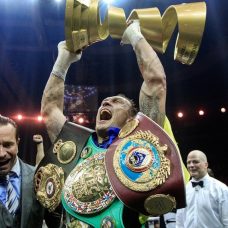
Saturday in England undefeated Ukrainian southpaw Oleksandr Usyk defended his trove of cruiserweight world titles – Ring, WBA, IBF, WBC, WBO – from the challenge of England’s Tony Bellew, last seen doubleaxing heavyweight David Haye, by emphatic eighth-round knockout. In these United States the match happened before dark, aficionados’ hour, on DAZN, aficionados’ network, while American casual fightfans reliably watched college football.

What a wonderful secret is Usyk for the longsuffering American aficionado. He has fought but twice in our hemisphere, and once in Inglewood on the undercard of Bernard Hopkins’ unforgettable if entirely forgotten farewell to boxing (a lesson from the B-Hop archive: when a man tirelessly tells you you’ll miss him when he’s gone, you won’t). When last Usyk fought in our hemisphere it was 18 months ago and he won via lopsided decision on HBO, which is to write if anyone watched him and remembered him that person has since endured disappointments enough to’ve lost his memories of Usyk in the strogranoff of former Soviet fighters served by Comrade Pyotr during HBO Boxing’s pominki.

Since then Usyk has fought on afternoons, here in the States, on YouTube streams and apps; the nearest he’s come to slickly produced punchstats and pedantic commentators is when he stepped in the WBSS’ whitelight show before unmanning Murat Gassiev in July to hoist the bestlooking new trophy in sport.

It gets better. There’s nothing cool about Usyk in the way American influencers understand the term. He’s zany and awkward and devoutly religious. He’s more likely to kiss a felled challenger than taunt him. And since he doesn’t cherrypick opponents or fight on terms bent to prohibitive there’s no telling how good or bad he’ll look when the opening bell rings. Then there’s the way he fights. He’s none of countryman Lomachenko’s pizzazz, especially not to what untrained eyes have yet to try DAZN. He’s more obviously awkward than innovative, which means whenever the American laity eventually catches up with him they’ll unlikely sense the innovation of making every man across from him, even the most obdurately orthodox, awkward unto paralysis. Usyk is an acquired taste and American casuals haven’t the palate or patience to acquire tastes, accustomed as they are to forcefeedings.

Round 5:30 PM ET on Saturday Usyk began to study and pull apart Bellew in yet another packed English arena (it would be a surprise and mistake if semifinal rounds of WBSS Season 2 happened in many American venues, large and cultivated as the European fanbase is become, comparatively funereal and hollow as American venues now sound). Usyk did nothing outlandish to Bellew. He respected the Brit’s power from the open. He established the quirky beat ever playing between his temples and fought to it till Bellew made him stop. And Bellew did do that numerous times.

As it should be. Two judges in fact had Bellew ahead many rounds later, and whatever DAZN commentators said about it in English, the Spanish booth had Bellew ahead, too. If Usyk was winning on any honest card it wasn’t by much.

There’s not any way to argue Usyk won round 1. Perhaps Bellew didn’t either. That’s a 10-10 round, then, which is not a scorekeeping impossibility, by the way, no matter how anomalous. Usyk and Bellew fairly well split their first 12 minutes together, however that shook-out on the cards. By the midway point of the match the match was close enough not to care about the decision; if one man didn’t snatch the other’s consciousness he wouldn’t have a sympathetic ear among aficionados when his handlers whined about a robbery afterward, as they’re wont to do.

Usyk heard us thinking that, he did. He next invited Bellew to lefthand city, a place not quite inhospitable as Ray Mercer’s fabled righthand city, but a place in the vicinity nonetheless. On the way there Bellew realized he was fully spent.

That’s what will be lost on American casuals most frequently – the psychology of what Usyk does other cruiserweights. Because Usyk is not ferocious his physicality can be lost on careless eyes. Usyk’s combination of size and relentlessness, though, is unprecedented. Nobody his size moves continually for every minute of every round. There’s a tacit assumption harbored by any man who confronts a man big as Usyk: So long as I don’t get hit flush by this beast there’ll be respites aplenty. But there aren’t. Instead there’s a dancing madman with a belligerent jab that portends a lampswitch left. Standing armslength to that is exhausting for any 200-pounder the world over. It’s why Usyk’s attack evinces no urgency. So long as he’s on his rhythm and jabbing and you’ve ceded centermat, he’s swapping your energy for fatigue, and he knows it and you know it and now you know he knows it. And that is terrible depleting.

Bellew was so beaten so instantly Saturday th’t American casuals will mistake the finale for force, they’ll expect other men Usyk touches with his cross to backsplash like Tony, and when they don’t American casuals will accuse Usyk of deterioration and aficionados of exaggeration. So be it. Usyk doesn’t need the bigoted buffoons of the Mayweather faithful to surpass what expectations he’s set for himself, and if he immediately ascends to heavyweight and fights Anthony Joshua at Wembley Stadium it will be unwise but lucrative, and it will happen on a Saturday afternoon in the States, blessedly.

Bart Barry can be reached via Twitter @bartbarry


Unfortunate sympathy’n the Super Series

By Bart Barry-

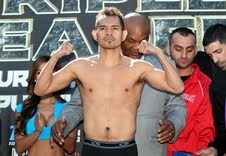
Saturday brought yet another delightful multihour multiplatform celebration of a sport even weekly columnists feared might die four years ago (Pacquiao-Algieri, for bottomwatchers). The World Boxing Super Series delivered another pair of quarterfinal matches on DAZN, late afternoon, and ESPN+ presented an entertaining if not historic scrap from El Paso a few hours later. Our wonderful recrudescence continues Saturday with the return of Oleksandr Usyk on DAZN, in a match to ensure he is recognized as 2018’s best fighter.

Going last to first Mexican super featherweight Miguel Berchelt diswilled Mexican Miguel Roman in a Texas beating brutal as promised. Scottish super lightweight Josh Taylor denuded American Ryan Martin in Scotland. Nonito “Filipino Flash” Donaire benefited from an uncommon bit of bad luck when Northern Ireland’s Ryan Burnett lost his bantamweight title via searing backache.

One of the German philosophers, must’ve been Nietzsche, posited sympathy was the worst emotion because it required its possessor be unseemly superior to its object; a person may feel many emotions towards a person of circumstances superior to his own but sympathy be not one of them. One keeps such a teaching behind his lifelong thoughts after he reads it and especially as he watches prizefighting and especially especially as he watches prizefighting to write about prizefighting. Beatings, hundreds to thousands of them, he witnesses without perching himself highly enough to sympathize with the vanquished because, frankly, why should he? Even the loser of a prizefight has engaged in a display of public courage.

Still, Saturday brought a genuine and weird tingling of sympathy for Ryan Burnett. To see a fighter so dramatically reduced so rapidly through no decipherable fault of his own was unpleasant. So freakishly, too. One sees injured hands, eyes and noses enough to be immune their happenings. Where brittle hands are tragic they’re also to prizefighting what height is to a professional basketball player – sure, theoretically, you could make it to the NBA at 5-foot-9, but it is unlikely your destiny.

But to see a 26-year-old championship prizefighter slip a disk while throwing a cross?

Yet there was Burnett after 10 minutes of movement both mechanically correct and innovative suddenly near paralyzed across half his body. Donaire, having done nothing to cause the injury, had no choice but to exploit his opponent’s weakness unto unconsciousness if possible. Burnett didn’t allow that but neither was he allowed out his corner for round 5 and not too long – though excruciatingly – after that he was wheeled out the arena, unable to make the walk. One winces at thoughts of Burnett’s next week ambling about his house.

Weird and deep as went the pang of sympathy for Burnett, one suspects there was selfishness in the brew. The opening three rounds of Donaire-Burnett were fantastic compelling. Donaire was outclassed but giving an excellent account of himself, and Burnett was beginning to invent and transcend, hitting Donaire disrespectfully and unusually for a fighter his size.

Remember, the last time any aficionado saw Donaire at 118 pounds he was electrocuting Fernando Montiel and unilateraling Omar Narvaez; nobody at that weight who stood and swapped with Donaire did so without fear he’d be Darchinyan’d. Burnett did so fearlessly and creatively. Donaire’s seven years and 15 fights (11-4, 6 KOs) removed from his best bantamweight days, of course, but during lots of exchanges Saturday he was similar enough to prime Nonito – Victor Conte affiliate, future VADA posterboy – to make Burnett look awesome to trained eyes.

No one looked better in a mainevent Saturday than Burnett did those opening 10 minutes against Donaire. The creative way he used the lefthook to corral Donaire into a right uppercut, throwing the 3 as a wide lead, and the way he chalked Donaire with the cross. Then came the cross that felled Burnett, and if you didn’t immediately think “pre-existing condition” you’ve not spent sufficient time round boxers or Democrats. It’s the only sensible explanation that burst over the synapses: Burnett did some sort of campy crosstraining something, whether sledgehammering a tire or pulling a tractor, that made him unright a month out. But with massages, painkillers and pilates, hopes were high things’d hold up. And they did, too, enough for Burnett to move not-gingerly until the moment he was unable to move.

All that is merest speculation but more believable, anyway, than a fighter’s 10,000th thrown punch disconnecting his back from itself.

It was in the shadow of this climactic anticlimax Josh Taylor outclassed Ryan Martin. Readers are duly admonished to suspend judgement on Taylor, as he did nothing more than exactly what he was supposed to do Saturday and in unremarkable fashion. Oh, but his footwork is bewitching!

If that’s true it will manifest itself quickly enough in a tournament designed to reveal character. See, there’s no longer any need to be early on these things. There’s no longer a need to squint at the screen in the hopes of being the only one to see how special a fighter is before he’s proved it, lest he never have the chance to prove it. The WBSS proves it. If your guy is a great fighter he’ll win his season of the WBSS, and in so doing will justify for at least a halfyear your belief in him by being recognized as the world’s best in his weightclass.

Tournament boxing eliminates the matchmaking (cherrypicking) that brought so much misplaced anxiety and argument to Money May’s era and GGG’s middleweight reign. HBO’s gone now, too, so there’s no need to rehash the banal hypothetical hash that became the network’s lowly specialty once Larry Merchant left: Our middleweight champion just poleaxed a welterweight, which proves if he were to campaign at super middleweight he’d have no trouble dominating there, either.

That brings us to Saturday’s third mainevent and a commentary like: Blessed be Timothy Bradley among all ESPN mainevent commentators (Brian “Bomac” McIntyre is fantastic, too, but he does undercards) for realizing our beloved sport is moved on from HBO so there’s no reason to audition for Max Kellerman’s seat, there’s no need to interrupt insights about the present with cliched musings about fighters’ pasts, there’s no need to reargue and reheat and recycle whatever tiny detail your cohosts didn’t buy fully enough, there’s no need to unearth the human condition with every single punch.

Bart Barry can be reached via Twitter @bartbarry


Second-lining: The WBSS parades through New Orleans

By Bart Barry-

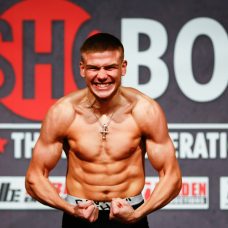
Saturday on DAZN, boxing’s now-essential network, the quarterfinals of the World Boxing Super Series super lightweight tournament happened in New Orleans. Belarusian Ivan “The Beast” Baranchyk (19-0, 12 KOs) walloped the sparkle out Sweden’s Anthony Yigit (21-1-1, 7 KOs) in the first mainevent. And in the second New Orleans’ Regis “Rougarou” Prograis (23-0, 19 KOs) decisioned unanimously England’s Terry Flanagan (33-2, 13 KOs). It was puncher-versus-survivor, both matches, and if that pitting didn’t make the best fights the WBSS has delivered thus far, they were still widely better than what American premium-cable swill they usurped.

Prograis doesn’t hit nearly hard enough for the posing he does. One suspects the origin of this posturing bent of his can be found in his record and generally soft stuff he’s built his resume with. He knows exactly how to throw the blastoff counter and admire its results but is less adept at following the counter with a few more punches. At no point in Saturday’s match was he better balanced and prepared for what came next than after he dropped Flanagan in round 8. He had the pose just right and the strut to the neutral corner down, too, much more than what finishing tactics one’d need to cut the lights of a former titlist.

Prograis has oodles of what the kids call swag – something like a young Yuriorkis Gamboa, without the Olympic gold medal to justify it. He is the fighting pride of transplanted New Orleans, a group generally longer on fight than pride. He’s also the number-one seed in a tournament bound to reveal whatever weaknesses he has, even if they don’t unravel him, and deserves a nod of approval for testing his fistic skills in single-elimination rather than some documentarian’s imagination in an episode of HBO’s defunct “2 Days” series.

Prograis will be 30 years-old round about the time of his semifinal match, which is to write he’s in the permanent period of his career, the time when any loudly publicized alterations to his fighting style will be cosmetic (he’s a lopsided-decision loss away from an Abel Sanchez Mexican-style makeover [though, while we’re on the subject, will any boxing figure’s profile go flaccider absent HBO stimulus than Abel’s?], where he’ll learn not to compromise his punches with head movement).

A prototypical U.K. prizefighter, full of heart and chin as he is bereft of power, Flanagan was an excellent opening exam for Prograis. Flanagan knew some tricks. While he did nothing to raise a referee’s suspicions he intended to elbow Prograis if given the chance, he sure brought his elbows back high and wide on the inside for a guy ostensibly defending himself from counters. He dipped low before clinches, too, the better to butt his assailant. Which is to write, he made Prograis earn victory the right way – by fighting.

Few are the men – no current practitioner save Naoya Inoue springs to mind – who have talent enough to win at the championship level and remain virgin pristine in tactic. Great fighters are dirty fighters, men who in their most challenged moments draw on experiential reserves of every trick employed against them by veteran fighters who often didn’t know and always didn’t care about the potential of the men across from them.

To wit, here’s an anecdote a young prospect recounted some years ago about sparring with Yori Boy Campas:

I knew he was going to hit me in the liver if he could. I’m bigger than him, so I don’t need to get too close to him. His arms don’t look that long. We’re two minutes in and he catches me there and nods. Just to tell me he could do it anytime he wanted. I was like, that’s pretty sneaky. He sees me get ready and throws the hook, really big. Except it doesn’t do anything because his glove is open and he’s hitting me on my elbow. But he’s not hitting my elbow. He’s, like, cupping it. Shoving it out of the way. And he’s still on his right side. Then right behind it come the knuckles. It was tap-slam.

You don’t pay the rent for long with hurting other men unless you’re a supernatural talent, which Campas wasn’t, or you master the patterns of your body and others’. Campas won his 107th professional fight in March, how easily we forget, and will never make any historian’s Top 50 list, true, but upon exiting the crucible of a boxing ring with him no man ever did not admire him, in large part because Campas knew, knows, every single way one man may hurt another with gloved fists. Flanagan is no Campas but surely taught Prograis some things Saturday, things Prograis will call upon unexpectedly someday if he’s humble enough to be wise, which he mightn’t be.

If Prograis challenges himself consistently for the next five years his defense is such he’ll find himself exactly where Flanagan was in round 8, eventually, and if Prograis was conscious of anything more than his own aesthetics after he dropped Flanagan, which he mightn’t’ve been, he’ll draw upon the experience of his own frustration in being unable to foreclose on a man like Flanagan who pays the mortgage but sporadically.

Another reason to evangelize for the World Boxing Super Series, and the concept of tournament boxing in general: There aren’t but a handful of gainfully employed matchmakers anymore worth a ha’penny – there are easily a dozen matchmakers worth quite a bit more than that, but the current marketplace has overvalued signature-destination storytelling, or whatever be the PBC’s equivalent, more than earnest competition – and so, select eight men in any division overlooked by American networks, and then let competition, talent and chance do the rest. Throw in a visionary broadcasting platform and some cool white lights and keep the tournament moving.

Whoever emerges with the Muhammad Ali Trophy (named after Muhammad Ali, we learned Saturday) is henceforth a signature-destination fighter for aficionados; if you’re less excited for Usyk-Bellew than you were for Jacobs-Derevyanchenko you’re a publicist, aspiring or actual, not an aficionado. Tournaments value competition over narrative (the 2009 narrative went: Andre Ward, a spoiled American gold medalist, will be stapled to the canvas by Mikkel Kessler in round 1 of the Super Six), achievement over character development.

Bart Barry can be reached via Twitter @bartbarry


The Saturday mashup

By Bart Barry-

Three broadcasts Saturday, and nothing that happened was quite great and some was very good but everything was at least good, and a block of five hours of good boxing, live sports programming not storytelling, represents an embarrassment of riches suddenly arrived for every aficionado nimble enough to cord-cut and app-embrace. In such case, we are, as the great man said, the aficionados we’ve been waiting for.

Things happened on two apps in three cities, and if a title or two unexpectedly changed owners it wasn’t the important part because the abundance of available boxing was, and there was at once so much of it and it was so good, one now suspects sabotage more than incompetence put our beloved sport in the dismal two-provider forest we just escaped, completely and enthusiastically.

How about a detour?

Not long after reading my 700th book – that looks like a lot but for a writer, truly, it isn’t – I realized, tardily one might say, the act of reading was doubtful to make me a better writer anymore, and based on my retention from the first 700 books, it, too, was doubtful to increase in any endurable way my knowledge of any new subject. If one imagines the average book length to be somewhere round 300 pages and one reliably reads a page every two minutes he spends about 10 hours with each book, and what does he consciously retain from the experience?

In the first year after reading the book about a paragraph’s worth of information – plot and character and style and other loose associations – and after five years perhaps two sentences and a decade later a sentence if lucky and prompted. Some books considerably more than that and most books a bit less. So I nearly stopped reading for a year. When I returned it was via a revelation of sorts: The only reason to keep reading was if I enjoyed it and the only way to enjoy it was to read books I enjoyed – every other consideration be damned. Unexpectedly, this brought me to reading more books generally and many many more books coincidentally.

Which is where in the hell this column is going in its pursuit of a new way to enjoy and enjoy covering and enjoy coverage of boxing: I now read between six and 12 books at once, and if I don’t try to blur them together I neither mind if they do. Someone famous or important once said or wrote something to the effect th’t were it financially feasible any true artist should choose anonymity. My new reading approach grants authors effectively that since I can’t hope to keep more than two or three voices straight at once when I’m making no effort to do so. I read till I have a thought that removes my eyes from the page, have that thought then pick up another book. I don’t have any order, and I don’t seem to get more than 10 pages deeper in one book before migrating to the next.

I impart this lengthily because if you’re reading this you enjoy reading and might try this approach and because, more to the point, it seems a proper fitness regimen for our new aficionado endeavor.

Perhaps this makes me look a quitter to the prigs amongst us; the day a person who’s given more than an average amount of his life to the sobriety and tranquility of the written word opts to ingest it like a teenager on Facegramsnaptwitter, the evilest faction of information technology has ruined us. Quite possibly. Though happily.

So went my Saturday of toggling between three fightcards on two apps. I went Roku (DAZN) to cell (DAZN) to Roku (ESPN+).

“Ain’t you got a laptop?” say my betters.

I do, but I realized I liked choosing more than absorbing a blitz; I didn’t want more than two playing at once and’ve developed an oddly enjoyable dependence on peripheral vision. What follows is by no means a factual report of what happened but an honest account of how I remember perceiving what happened:

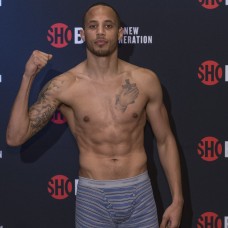
Stephon Young is not in the WBSS, is he, better check, no, then what’s up with DAZN’s notification system, OK, over to the other DAZN to see the Tommy Coyle guy the Spanish-language broadcast from Boston likes, looks like he’s landing on the Pole, but whoa, that hook to the liver from Ryan Kielczweski just changed the fight entirely and the Spanish broadcasters missed it somehow, so let’s check ESPN+ to see if San Antonio’s Adam Lopez is on, he isn’t, but there’s the Irish kid with the middle finger from the Olympics, Michael Conlan, against some frightened Italian – now this belongs in Boston, south versus north, more than Las Vegas – and Conlan can’t cut Nicola Cipolletta’s escape which reveals Conlan is exactly basic as “Bomac” just gently implied; the leadin movies for WBSS look better than I expect Esquiva Falcao will so it’s over to DAZN in Florida where the turnout is poor but the fights won’t be because the Cuban with a name like Doritos can crack proper and the veteran Pole’ll have chin enough to make him, and after five rounds it’s true Yuniel Dorticos concusses more than Mateusz Masternak but after seven rounds it’s no longer true, and this fight is excellent and close just like Dorticos’ last fight, which makes me think the second mainevent, the one between the Aussie pingpong player and the Puerto Rican titlist, too, will be good and close, but there’s “The Monster” Inoue, and after five rounds of Rodriguez-Moloney I think Inoue could decision Rodriguez with the jab at the same time he flashfreezes Moloney with the cross so it’s time to give Top Rank’s next Asian ticketseller a second look, disappointing as he looked a year ago, and who’s this Rob Brant dude, does anyone else think he’s making Ryota Murata look like Murat Gassiev against Oleksandr Usyk, and bless Tim Bradley for choosing to score the fight before him, over and over, rather than scoring debate points on his cocommentator – Tim has found himself a new career, not a mere hobby – and bless the Vegas judges, too, for scoring the match, not its promoter’s best interests.

Three cheers for Rob Brant!

Power off.

After all that I thought of Top Rank and Todd duBoef’s Brand of Boxing concept, late Saturday, with its partial anonymization of fight-provider. A few times I was quite conscious I was watching Top Rank and a few more times I was quite willfully watching World Boxing Super Series, but most of the rest of the time I was watching boxing and enjoying watching boxing and feeling my 15 monthly dollars very well spent on ESPN+ and DAZN – whoever was doing the broadcasting.

For dropping HBO at the end of 2017 I’m still paying with the house’s money, anyway.

My loyalty to Showtime in 2019 is by no means assured.

Bart Barry can be reached via Twitter @bartbarry
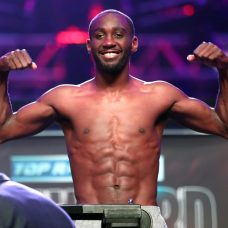


Orthodox / southpaw: Enjoying Crawford-Benavidez from different angles

By Bart Barry-

GUADALAJARA, Mexico – “How many services must one rent monthly to watch a championship prizefight?” went my thoughts Saturday from an apartment in nearby Zapopan, as ESPN+ and Roku and Sling, one after the other, collected my usernames and passwords then returned unhelpful errors about availability outside the United States. The next gambit, a virtual private network (VPN) that is another monthly service, brought only less helpful errors that implied: We don’t know where you are, pal, and that means you must be somewhere you shouldn’t be.

And so it went, miserably, until four monthly subscriptions took me limping to a compromise pathetic as it was welcome: A YouTube Live stream of a guy holding the camera of his phone at a 30-degree angle to a television, filling 2/3 of his screen with darkspace dark as deep space, while chatty fellow viewers warned him to keep the volume down lest ESPN dam his damned stream.

Without the tranquility of a reliable service and without an audio narration to help me know what I saw, frankly, Saturday’s match ended kind of suddenly, when welterweight titlist Terence Crawford beat to mushy Jose Benavidez Jr. on ESPN, a Disney property still beholden to ancient cable providers the way you and I are beholden to oxygen.

He notices there’s more talk of boxing on SportsCenter these days and imagines such talk representative of boxing’s ascendancy without quite getting his finger on the affiliate scheme that drives much of SportsCenter’s coverage of anything. There’s more boxing on ESPN now, too, which is further evidence of the sport’s ascendancy. ESPN, he assumes, in the few thoughts he bothers giving these sorts of things, has taken the sporting world’s pulse and predicted, accurately it turns out, boxing is rising in the American consciousness the same way soccer did a decade ago. He’s watched his share of Muhammad Ali documentaries and Mike Tyson knockout clips, and if he remembers correctly George Foreman used to do awesome commentary of Roy Jones fights on HBO, or maybe it was the other way around, and since boxing just came on after college football, well, why not?

I didn’t get to a shark metaphor in 5 1/2 previous years of watching Crawford but it came along clear Saturday night after a day at Acuario Michin (admittedly), this city’s new aquarium and its country’s largest – to complement this city’s zoo, its country’s most populous. After the Friday weighin antics, unexpected as a Monday morning, and the symmetrical hatred they supposedly evinced one imagined Crawford’s eyes would flash Saturday if they were capable of it, and they didn’t. Not in the veiny enraged way one understands the term. They were unknowable, like Crawford. They observed Benavidez and did not blink. Which made me wonder if Crawford’s sadism hasn’t been overstated a bit by me and others. Crawford is a predator true. The better a creature is at preying the more indistinguishable be his satisfaction and euphoria, the more lesser predators and prey alike project a euphoria, an almost erotic joy, on his violent activities. Mining such acts for mindfulness, though, introduces an autoimaginary element – how could I do such a thing without it brought me pleasure?

He likes the depictions of street credibility ESPN’s leadin biopics offered before Crawford – “Bud” is a weird nickname for a fighter, but whatever – and “Junior” went after each other Saturday. Lots of athletes come from bad places, but boxers get to really do something about it. The hatred between the fighters was real, anyone could see that. When the opening bell rang he expected the two men to throw the ref out of their way and frenzy violently, but they didn’t because of strategy.

I sat a few feet behind Crawford in February as Benavidez worked through someone named Matthew Strode in Corpus Christi, Texas, and the prevailing emotion Crawford expressed was polite boredom. Some local-sponsor type asked him – “hey, champ!” – what he thought of Benavidez’s performance, and Crawford gazed blankly up from his seat to say, “What do you think?” At 135 pounds, it’s safe to infer, Crawford’d not have been allowed in a ring with Benavidez without first procuring a license to hunt. But at 147 Benavidez was a far abler foil.

He knows these men are smaller than heavyweights, his bailiwick, but there’s this pound-for-pound thing that makes these guys better than heavyweights on a sliding scale of some sort. Crawford is able to drain the spirit out of a bigger man like Benavidez by punching his body. Crawford, too, does this thing with switching his stance that makes him able to hit and not get hit, even if it looks like he’s getting hit. Definitely.

I want men who are not heavyweights to climb weightclasses because doing so reveals their weaknesses in the unfair way of physics. Crawford has few if any weaknesses, but physics precluded him from dashing through Benavidez because Benavidez was a significantly larger man who knew what he was doing better than he was able to do it. Forget not, while an unknown Crawford made fights in Knoxville and Iowa City, 8 1/2 years ago, Benavidez made his third prizefight in a banquet room of our fightweek compound in Texas the night before Manny Pacquiao starred in Cowboys Stadium – Benavidez, not Crawford, would be Top Rank’s successor to Pacquiao.

He sort of sees what the ESPN commentators mean about Benavidez being a good counterpuncher, but he wishes Crawford would just leap in and dominate him like everyone says he can. Crawford’s controlling the outside foot and stuff, and he obviously hits harder, so why not go for it? Can’t be that complicated!

I enjoyed the tension in the ring early, the portentous feeling the wrong man might just win and ruin a whole lot of Nebraskans’ night out. I liked how Benavidez disrespected the champ, hands at his waist, and how Crawford saw something, some honest signal, that dissuaded his attacks for a halfhour, no matter his superior quotient of skill. Benavidez possessed magical skills for a 16-year-old while Crawford possessed them for a 30-year-old, advantage Crawford, sure, but if one were to tally athletic assets then return to Benavidez’s side of the ledger what being shot in a leg took out, the final accounting would be damn close, do not doubt.

I enjoyed the fight.

He loved the ending.

Bart Barry can be reached via Twitter @bartbarry
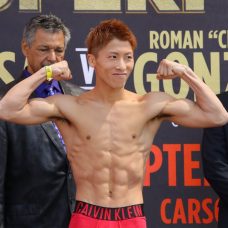


Naoya Inoue and a pox on pandering henceforth

By Bart Barry-

Sunday morning on DAZN Japan’s Naoya “The Monster” Inoue performed the feats of scoring his second knockout as a bantamweight and completing his first round as a bantamweight, in a two-second span. He snatched Dominican Juan Carlos Payano’s consciousness with the first combination he threw in the second season of the World Boxing Super Series. Since arriving at 118 pounds in 2018 Inoue has needed but three minutes and two seconds to go 2-0 (2 KOs).

Actually, that report is unjust to Inoue. To measure properly Inoue’s knockouts by rounds or minutes is to overgeneralize. There’s a more granular method. Punches landed. His knockouts increasingly come in opening rounds, but incredibly the term “first-round knockout” understates what Inoue is up to. “Seventy-second knockout” brings us closer but not even halfway, since Inoue generally does not throw a punch for a match’s opening minute. What he did Sunday with a former world titlist who made his pro debut 13 pounds (and four weightclasses) heavier than Inoue did, needs be measured in punches landed.

Two. Naoya Inoue landed two punches, and Payano was headbanged to boardstiff.

Whatever one opines of Payano as a person or puncher, fact is, a man does not slumber in the gym where he trains then travel across the globe to get atomized by a twopunch. Even in a match betwixt a man who knows how to punch and a man who doesn’t, more than two punches be near always the rule. You could pay your children’s college tuitions by wagering the largest man in every city $100 he cannot take your consciousness with two punches – no matter how great he and meager you.

It’s very difficult to take an unsuspecting man’s consciousness that quickly and nigh impossible to do it a man whose fists are raised. But a twotime Olympian like Payano? A man for whom the gym is both workplace and habitat, with a twodecade dossier of dissuading boxing’s most basic combination? Impossible such a man’s lights might be cut, jab cross, and yet. Inoue so surprised and unbalanced Payano with a jab, the 1, a punch you learn within two minutes of your first handwrapping, Payano somehow had no expectation Inoue’s cross was next.

A halfdecade of squandering the word “devastating” on a Kazakhstani attrition fighter leaves some of us now entirely beneath the task of describing what Inoue’s gloves conceal. It sure ain’t sixth-round-corner-stoppage power or controversial-decision-loss-to-a-smaller-man power, and so let us be chastened by the misdeed of our past embellishments. If we can’t pledge to abstain from exaggeration in the future we might at least pause to concede some of us unduly weakened the language all of us use by pandering to the invention of a disintegrating network reduced to pandering to our beloved sport’s casualest fans.

A pox on such pandering henceforth!

There are sundry lessons for broadcasters to glean from the pending extinction of HBO Boxing, but an accessible one is this: The easiest way to attain 500,000 viewers is to begin with 2 million and replace matchmakers with storytellers.

Since when does boxing need postmodernist cant about contextual empathy in lieu of evenly matched combat? Not only needn’t one be savvy with a textbook to make great matches, but as it turns out, too much textbooking be a liability.

If DAZN doesn’t know this, thus far in its American incarnation it’s doing a workable imitation of a network that does. In 15 days DAZN has broadcast to Americans a heavyweight championship fight attended by 80,000 Brits, the conclusion of a super middleweight tournament in Saudi Arabia, an entertaining many-fight card from Chicago and the opening of two new tournaments in Japan. An aficionado’s total adjusted cost for all this is $5.

That comes with no Gatti List and no pettifogging commentary team. Blessedly. No Game of Thrones, either, which ought be acceptable to adults.

If there’s a criticism for DAZN it lies in the contrast of commentary crews the network trots out for its American cards. Brian Kenny’s mining every act by an official for controversy is tiresome already, Sergio Mora’s too salesy, and why is Sugar Ray Leonard involved? To lend his immortal name. That’s fair, Leonard is genuinely among our sport’s greatest living practitioners, and he’s gracious, too, but there’s no need for him to have a microphone since nothing is lost when he’s quiet.

More to the point, enough with the threeman commentary crews – for if you pay a man to talk, talk he will. Disagree? Check out DAZN’s singleman broadcasts. Whoever that man is, he’s excellent and unintrusive (and naming him would miss the point widely).

*

But if we don’t narrate for the casual fans, why, they’ll go elsewhere to cross-pollinate cultural issues for their lens humanizing mission.

So be it, really, since evidently they are not empathetic enough to be contextualized.

*

The second half of Sunday’s WBSS kickoff, a super lightweight tilt between Belarusian Kiryl Relikh and Russian Eduard Troyanovsky, a match Relikh won by close and unanimous scores, was competitive and entertaining if partly shaded by its predecessor match. There’s simply no following Inoue right now.

Bart Barry can be reached via Twitter @bartbarry


Callum Smith: Whupping George Groves, giving the Yanks a helpful juxtaposition

By Bart Barry-

Friday in an excellent conclusion to the World Boxing Super Series’ excellent first season, super middleweight edition, England’s Callum Smith stopped England’s George Groves in round 7 to win the tournament and become The Ring world champion. The match happened in Saudi Arabia on DAZN, a broadcaster that, in six days, at a weekly rate of $2.33, featured the world’s best heavyweight and the world’s best super middleweight, each, in competitive matches that ended with knockouts.

Let that sentence mark how much our beloved sport will miss HBO.

Smith won a world title exactly as you are supposed to turn the feat, with one’s opposite number beaten till he cannot continue – whether via unconsciousness or in Groves’ case a deep desire to relent. Groves was awake and headshaking halfway through the count, Friday, emptied, beaten in every sense of the word.

Groves’ foldings ever come suddenly. While nothing incriminating happened much before the Smith lefthook that made Groves consider other careers, something happened between the men in round 6. Groves became a touch more theatrical and Smith more cunning. Groves began an incongruous tactical pairing of throwing punches harder while circling wider. Smith ignored Groves’ noisy punches and inferred Groves’ true signal. Groves’ twitching did little to dissuade Smith in the fight’s opening and much less as Groves did connect with what blows his feints threatened. And all the while Groves made the much wider circles on the blue mat, and Smith knew conditioning’d become a factor eventually.

It wasn’t conditioning that turned Groves into Smith’s dandy hook – “a peach” as DAZN christened it properly – but it was fatigue that made a fully conscious Groves decide to rise at 10 1/2 and not bother protesting as he did when Carl Froch origamied him 4 1/2 years ago. With a minute to go in round 7 Groves had every right to continue and no desire whatever. It taught Groves a little something new about himself, which is ever the most devastating thing you can do a fighter like George Groves.

Groves more than most considers a prizefight a search for character weaknesses and believes his weaknesses fully inventoried before any opening bell rings. He fancies himself both introspective and psychologically superior; Groves has answered every one of hundreds of questions he’s asked himself about George Groves but he’s not so sure you’ve done the same. There’s a fragility to you Groves sees, while any fragilities you sense in him are mere traps, blemishes on his facade he applied like decals to fool you, definitely not cracks. This set of autobeliefs has taken Groves pretty far indeed, confirming him twice the second best man in his weightclass while getting him stamped number 2 by getting stomped by numbers 1. Groves has tangible talents – quickness and form, a good chin and fitness, interesting offense and an eagerness to counter – but not championship intangibles in the ring to match what brand awareness and marketing intangibles he employs outside it.

Smith on the other hand has these intangibles, not unlike Froch – which is not, yet, to liken one to the other. Each beat the spark out Groves, but the comparisons stop there. Smith does things classical well, and he recognizes as an enormous super middleweight he begins any match with what initiative the other man must seize. By virtue of his size and technique Smith enters any title fight at 168 pounds up a round or two, and he does nothing to squander this lead. He maintains a masculine poise, or perhaps it’s juxtaposition coloring this Yank’s view of things.

Twenty-four hours before Smith unmanned Groves an entirely different sort of confrontation happened before American eyes. The testimony of a man who would be, and probably still improbably will be, a justice of the Supreme Court of the United States. What follows is neither political nor partisan; it is instead a measure of what sort of public manliness Brett Kavanaugh tried to display, Thursday, a performance subverted effortlessly by Callum Smith’s manly comportment on a small and foreign platform Friday.

Sniffling and barking, his face contorted in something mean and measly, Kavanaugh sought to intimidate septuagenarians and women with a performance he no doubt imagined wrathful. Instead he disgusted most, the septuagenarians wishing they were 20 years younger to punch his mealy mouth, and every woman knowing perfectly well what he was up to. The performance, Americans quickly inferred, was not for us but for our President, alone, a man whose timing and method were learned in the improvisational crucible of professional wrestling. There was something a touch regional about it, too, the audiencemembers on Kavanaugh’s stageleft hailing from professional-wrestling hotbeds like the Carolinas and Texas, those on his right hailing from places where ice-hockey tryouts often outpopulate even football, states like Vermont, Rhode Island, Connecticut, Minnesota. Professional wrestlers are gigantic and flamboyant performers who publicly swear to inflict unthinkable violence on other men before (albeit athletically) enacting rehearsed and premeditated spectacles. Ice-hockey players, conversely, are men of comparatively unexceptional physiques who publicly compliment their opponents before committing nightly acts of unpremeditated assault.

On a spectrum of masculinity, with a five-year-old Shirley Temple at one pole and a 25-year-old Roberto Duran the other, Brett Kavanaugh was no nearer Duran than Temple during his Thursday performance. And on Friday, Callum Smith damn near touched the Duran pole by coolly separating George Groves from his aggression while showing no fear and evincing no weakness to a man both desperately seeking it and possessed of the tools for its discovery.

Bart Barry can be reached via Twitter @bartbarry
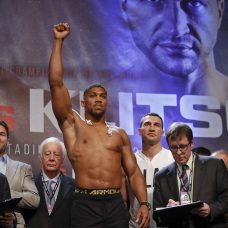


Another splendid showing by AJ

Bart Barry-

Saturday world heavyweight champion Anthony Joshua once again filled a gigantic football stadium and successfully defended his multitude of titles by knocking silly a man one doubted any man might knock silly. This time it was former Olympic super heavyweight gold medalist Alexander Povetkin, possessed of both fists and chin. Joshua punched him till Povetkin’s trainer pleaded for mercy on the apron while the match’s referee tried to soften Povetkin’s second plunge to the blue mat.

Whatever happens next, let us pause and rejoice at a present good fortune so aptly illustrated through the pair of Povetkin challenges that just concluded. Before anyone scoffs or even dares consider it, he’s invited, first, to watch this fight, every last second of its 36 minutes, and see what Joshua so blessedly rid us of.

Have you forgotten how awful most Wladimir Klitschko title defenses were? I sure had. Then I took what happened Saturday and subjected my memories of it to what happened five years ago when Povetkin made his first title challenge. The aesthetical disaster of it, the frightfulness that made a man gargantuan as Klitschko fistfight in a way best classified as passive-aggressive: jab-jab-hook-bellyflop-armwrap-tackle | where’s the ref? | leapback-dolphinbreach-armwrap | where’s the ref? | jab-gloveswaddle-headtuck | where’s the ref?

We’re properly spoiled by Joshua if as aficionados we’re not genuflecting to him semiannually. He didn’t untitle Klitschko the way Tyson Fury did, by outwladding Wlad, but rather he made the temperamentally temperate titlist go man-to-man for once and beat him into retirement, beat him right, gave Klitschko a last stand more honorable than the sum of its 20 predecessor stands. And Klitschko thanked him for it in part because, as a 40-year-old man whose career began before YouTube, Klitschko hoped longsuffering fans long since driven to welterweight spectacles instead of his might recall of his legacy only the images of those final rounds in Wembley and the text of his resume.

But do notice how very little anyone misses the Brothers Klitschko, how fully this new era of heavyweights makes us forget the last era’s insipid sibling monopolists.

A brief recap why. Saturday the heavyweight champion of the world, in round 1, stood near enough and grappled little enough with a puncher who knew how to get his nose bloody bloodied and his equilibrium briefly beggared. No preceding quarterhour of guardslapping (what infamous 2008 tactic against Sultan Ibragimov got Wlad exiled a sevenyear from American arenas) – instead a man throwing hands with another man and letting come what might. Then a change in tactics that concerned punching, actual punching, a new target, a changed trajectory, but still punching, not fleeing, not landing the grand jeté, but punching a challenger who wanted to hurt the champ with every offering. And finally the finale, a gorgeous cross thrown at a man still plenty dangerous followed by a pursuit ferocious to a point near recklessness.

Joshua wanted to be tested in a way the heavyweight division’s previous princes never did. He justified once again his enormous following’s faith in him by competing and winning in entertaining a fashion as possible. Then he demonstrated an uncanny rapport with what 80,000 Brits braved the raw conditions of an outdoor arena where the skies drizzled them. He had a laugh at his promoter’s expense. He conceded a sense of the pressure so many folks’ reliance on him brings. He promised an April return. He named fellow titlist Deontay Wilder as his preferred opponent.

Not so fast, there, AJ. Whatever the oddsmakers say there’s good a chance as not a countryman of yours will wear the WBC belt in the new year, not Wilder. My, how fully we’ve forgot, on the evidence of a single showing a halfyear ago, how bad Wilder can be at boxing. And where Joshua should probably outclass the winner of Wilder-Fury nobody should be surprised if Fury outclasses Wilder, 11-1, in a soggydamp spectacle Americans in attendance do not forgive quickly.

There’s a mounting momentum that assumes Wilder deserves a win against Fury because of Fury’s apparent madness, and that’s not how our beloved sport works. Much as Wilder eschews traditional technique is how much Fury eschews traditional entertainment demands. Fury fights nothing like a man his size should, but his style is likely a full foil for Wilder’s. Everything that looked right about Saturday’s spectacle is what will look wrong in December.

Saturday’s challenger attacked, tried to take the champ’s crown by offing the head that bore it. And the champ replied with measure and mastery. Povetkin got in with clever aggression, throwing punches leveraged to devastate. He clipped Joshua with an uppercut-hook combo textbook as it was unexpected. He made an honest confrontation from the opening bell: I’m going to hit you hard as I can, and if that means you do the same to me I’m prepared for it. Before the match Joshua predicted a violent game of chess but it was blessedly more belligerent than that.

December, contrarily, will see a challenger actively endeavor to shame a champ from attacking him – making Wilder hate him so much before the opening bell Wilder hates the idea of failing to hurt Fury slightly more than he hates Fury. It’ll bring entertainment in both a different way and in the bizarre way only heavyweight prizefighters, among all athletes, can. Life’s greatest attestation to this may forever remain the number of German venues Wladimir Klitschko filled.

Bart Barry can be reached via Twitter @bartbarry
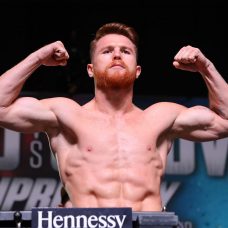


The greater man won

By Bart Barry-

“The war’s over. It’s over. I saw it on television. I saw it on TV.” – Conrad Brean, “Wag the Dog”

Saturday in Las Vegas Saul “Canelo” Alvarez narrowly decisioned Gennady “GGG” Golovkin to become the middleweight champion of the world. The fight was excellent, and there was blood if no knockdowns. That should make the judges’ decision irrelevant to most of us.

Canelo and GGG proved their equality, a re-proof that reproves much believed about Golovkin by his champions, a group that long resided along a spectrum of gullible to incredibly so. Before the scorecards were read Canelo won the series for being upright and triumphant after 24 rounds with Golovkin as he was before 24 rounds with Golovkin, just as Golovkin’d’ve won the same way had he remained upright and triumphant after 24 rounds with Andre Ward (stop laughing – HBO’s opening salespitch for GGG included an ability, nay, willingness, to fight any man between 154 pounds and 168, while Ward was still super middleweight champion). But let’s right the hands on that clock one last time: You don’t lose the aggregate of 24 rounds on an aggregate of five judges’ scorecards to a man who made his pro debut at 139 pounds and see one closing bell with Ward, much less two.

But, but, what about everything they told me Golovkin was on television?

Yes, let’s address that, as Golovkin eventually follows his promotional network into boxing obscurity. HBO’s schedule for Golovkin’s debut, lo these many years ago, featured an intriguing match with Dmitry Pirog, the man who cracked open Danny “The Golden Child” Jacobs like squares on an icecube tray. Through no fault of Golovkin’s, Pirog withdrew from that match and boxing itself, and then Golovkin’s ace PR guy, Bernie Bahrmasel, by dint of hardwork and will, persuaded two generations of HBO executive and one tiring generation of commentator Golovkin was the middleweight of their lifetimes. The callouts began – never to men larger, alas – along with the mismatches, and soon the hyperbolic became true to a generation raised on the wisdom of Conrad Brean’s lines above.

This was all over last week’s prediction panels, which read wonderfully similar to last year’s prediction panels; Golovkin’s otherworldly power didn’t imperil Canelo once in 2017’s match because of Adalaide Byrd’s scorecard. Next year’s prediction panels, should Canelo do the quixotic thing and forego easier paydays to grant Golovkin an immediate rubbermatch, will follow last week’s: Golovkin, a puncher of historic might, despite striking Alvarez 452 times in 72 minutes, didn’t fell Alvarez once because Vegas judges scored the boxoffice.

OK, enough practicing on the disappointed, let’s address the only memorable thing, which is the fight. No, not quite yet. A last note for those whose Saturday experience got ruined by the scorecards. Learn to prize knockouts so fantastically much that when one doesn’t happen in a championship prizefight you’re at the refrigerator or in the bathroom when the cards get read. If you didn’t bet on the match you should trust your sense of things and caren’t a whit what the officials officially say, and realize all the pundits who tell you to care about it are being paid to peddle outrage their employers hope to monetize. Better put, if outrage brings you a pleasurable spike, embrace it, by all means, but if it doesn’t, go forward in the faith it genuinely doesn’t matter – no one with a valuable opinion will opine more or less of you for such apathy.

Both guys did one thing incredibly effectively Saturday and succeeded incredibly well and will look back with great surprise how effectively their opponent’s one incredible thing offset that one incredible thing each did. For Golovkin it was the jab, which succeeded viscerally more than anything a scorecard might report. Golovkin tormented Canelo the way Muhammad Ali tortured Floyd Patterson 53 years ago. Like this: If you jab a man’s forehead while his chin be properly tucked the force of the blow traverses his spine and collects in a pool of pressure on his lower back.

Canelo touched his toes before and after every middlelate round, and found his lead leg stiff and almost useless in rounds 10 and 11. For about four minutes Canelo was no more mobile or dangerous than Matthew Macklin or Daniel Geale. He was there for Golovkin’s having but Golovkin had him not.

Because Canelo’s committed bodypunching (and occasional hipstriking) throughout the match’s opening 2/3 detorqued Golovkin’s delivery. Canelo had no way to run or hide precisely when Golovkin had nothing for Canelo to run or hide from.

This was a Golovkin fan’s crowning frustration. The act to justify six years’ fidelity appeared with an unmistakable clang, the finish to whisk a Golovkin fan from gullibility to sagacity happened obviously as Canelo’s frightened retreat, and nothing much after it but a couple 10-9 rounds. It’s not enough to say Canelo’s hand raised a quarterhour later salted this flayed sensibility – it’s worse than that: Golovkin’s hand raised a quarterhour later would have brought no true balm. One doesn’t know how deeply Golovkin felt this, how much of his palpable disappointment was empathy with his unrequited supporters, but it’s there now. Even to the most avid, a whiff of fraudulence will accompany Golovkin’s next act of carnage on a super welterweight, loyally accompanied by an HBO soundtrack of inane historical references and overwrought lectures.

These fights, entertaining though they be, take out of Canelo something disproportionate to their reward. He’s no incentive to do it again in May when he can otherwise continue his predecessor’s reign over undersized aspirants. For moving up a weightclass and fighting a world champion, he was already a greater man than Golovkin before Saturday’s match even opened.

Bart Barry can be reached @bartbarry


Late blood, no knockdowns: Porter decisions Garcia effortfully

By Bart Barry-

Saturday in Brooklyn welterweight “Showtime” Shawn Porter outworked Philadelphia’s Danny “Swift” Garcia for the WBC’s suddenly coveted iteration of a 147-pound title. The scorecards were fair, and the fight was even enough a draw wouldn’t have outraged anyone who wasn’t already outraged by other goingson. But the fight otherwise adhered to Premier Boxing Champions’ strange template of abundant drama followed by little suspense but Jimmy Lennon Jr.’s cardreading.

Until the final halfminute when a bang of heads caused an abrasion halfahead from Garcia’s chin and some blood meandered its way to Garcia’s cheek in time for the final bell it had been another miraculously bloodless and upright championship match for PBC. Were the manners reversed – were prizefighters unable to break smoke rings suddenly starching fellow champions – conspiratorial thoughts would bubble. But this PBC conspiracy is something else entirely (and counterintuitively): Howsoever do so many competitive 12-round fights with men who can crack end so anticlimactically with their fighters no more scarred, severed or swollen than chiefseconds?

There has long been suspicion PBC’s founder is a pacifist – so drawn he is by defensive specialists and quicktwitch feinters. But even so, how does he get contracted agents to comply? Perhaps by the sublime oddity of his request.

A thought like this happened between one of the 12 selfsame rounds of Saturday’s comain, when Cuban Yordenis “Yawn” Ugas got beseeched by his corner not to be such a nice guy to Argentine Cesar Miguel Barrionuevo.

Anyone else find this curious?

OK, anyone else make it through half the comain?

Men by their 23rd prizefights may have adopted all type of bad habits, but excessive sympathy is a rare one. Maybe Ugas’ tenure on La Finca taught him boxing’s only point was points, and his knockout record does betray this, but how did anyone rub the bad intentions off Garcia’s and Porter’s gloves before Saturday’s main?

By moving one up in weight, is the likeliest answer. Porter has never struck hard or accurate as champions do, but Garcia sure as hell once did.

Oh, good point: Not at welterweight. Garcia’s greatest gambles and payoffs happened at 140 pounds, where if he wasn’t an A fighter he at least never let anyone prove it publicly. He’s been a B- since scaling those seven pounds. He hits hard enough to stand pocketwise and torque the right shoulder backwards but he barely dissuades other titlists now and chloroforms nary a contender and never a champion, which is altogether too bad.

I find myself pulling for Garcia for the purest of reasons. We have nothing in common, not age or ethnicity or home decor; gravity makes Tyson Fury a more weight-appropriate avatar for me than a guy at 147; and frankly the Puerto Ricans with whom I often watch fights make only nominally more claims on Garcia than Kermit Cintron. But I verily love Garcia’s composure when blitzed. It enchants me how he stands and fixates on cocking his left shoulder and another man’s chin even while that other man helicopters right at him. If it’s not the opposite what life’s conditioned me expect from a man in animal prints, it’s at least refreshingly different. It’s an irregular type of fearlessness but it’s certainly fearless more than cerebral.

Garcia, it bears repetition, fights nothing like a six-toed weirdo in a Phantom mask – he plants and preys. He’s a faith if he can get you to throw your best punch at the moment he throws his best punch his will snatch your consciousness and often gives the impression he doesn’t much care what befalls his own consciousness in the offing. The rest of the time, admittedly, he’s quite average. He’s not bad, of course; he’s contender-level in his other facets but nowhere near so special as when he wings the lefthook, and admittedly admittedly, he no longer wings it gorgeous recklessly as once he did. Another unfortunate consequence of his outgrowing 140.

Let this not detract from Showtime Shawn. He is a coach’s overachieving fantasy and the nearest thing we’ve had to Timothy Bradley since Manny Pacquiao ankled Desert Storm in 2012. Saturday Porter wanted it more than Garcia enough to overcome Garcia’s palpable pride and more-palpable delta of talent above Porter’s.

But a confession: I didn’t watch Porter much. There was a string of rounds, latemiddle, when you couldn’t watch the combat and set your eyes elsewhere from Porter, but most of the rest of the match’s 25 minutes it was easier to watch Garcia loadspring his traps. Which Porter navigated expertly. It appeared Porter took Garcia more seriously, as an adversary, than Garcia took Porter. Some of that is style much as temperament – Porter must prepare himself for a specific opponent where Garcia needn’t – but some of it is mean will. Porter bounced in Saturday’s ring imploring the boxing gods like: Let all other things be equal, tonight, and I’ll do the rest with desire. Garcia slid through the ropes like: All other things aren’t going to be equal, Shawn.

Both men fought best they could and executed about as expected, Porter busier, Garcia sharper. Both men had their frustrations, Porter neutralized, Garcia unconcussive. In a fair if close accounting, though, Porter’s evening won the quotient; slightly more execution, slightly fewer frustrations.

For purposes of forecasting, too, one sensed Porter thought his evening might’ve gone even better whereas Garcia was complacent about his work if not the judges’. Garcia might yet jinx some overrated prospect as he hardens in his welter-gatekeeper role, à la Robert Guerrero or Luis Collazo, but he’d need a titlist’s offnight to win another belt at 147 pounds. Porter, meanwhile, promises to make a fun scrap with anyone but especially Errol Spence whose canned postfight callout Saturday suffered in equal parts from his decency and Porter’s. Spence should win that fight with Porter, since they’re effectively the same fighter and Spence is better, and it, too, should prove surprisingly bloodless.

Bart Barry can be reached via Twitter @bartbarry


Labor Day: Essay, email, list, query, interview, counterpoint, speech, About us, conclusion

By Bart Barry-

There is ever much thought given to layers and how they might best be created in a thing linear as the written word but some new thoughts on the subject. The layers be supplied by the reader and the rest is anxiety about how uncontrollable be that reader – the bolding and italicizing and capslocking and footnoting, and, to a lesser extent, the rigid overapplication of commas, howsoever grammatically justifiable. Ultimately it appears folly no matter where its writer’s heart.

Hi Mom . . . had these thoughts while enjoying a bout of what turned out to be a virile and viral strain of food poisoning in the Ecuadorian township of Otavalo – who orders a steak medium-rare in South America (possible answer: hardly anybody; the waitress failed thricely to dissuade my prep instructions)? – and its 48 hours of refractory restlessness, a mashup of thoughts and sensations occasioned by zaniness and immobility 18 storeys above Quito. I was staring out a pair of windows, as you know I’m wont to do, and reading a book I found in my borrowed apartment, “Envisioning Information” by Edward R. Tufte, and thinking about my futile chase in words of what visual artists do in a different sort of collaboration with the human eye. The book did nothing so much as convince me graphic artists, like my Quito host, practice applied visual arts the way racecar (a palindrome!) engineers practice applied physics. Along we go . . . Bart

Juan “Baby Bull” Diaz comes first to mind when I think after a boxing incarnation of the Labor Day spirit for these reasons:

1. He applied a template of constant pressure.

1a. If he relented, everything would collapse – his defense, his footwork, his identity.

2. He wore blue.

3. He was workforce, not management.

3a. He punched-in for a full, 36-minute shift.

4. When he was put in a bad system (against Juan Manuel Marquez) the system won.

Marquez doesn’t spring to mind as a Labor Day prizefighter, and yet, how else did he attain such technical mastery but via hundreds of thousands of repetitions, and isn’t that workmanlike?

A Brief Oral History of Why Marquez Was Not Workmanlike . . .

MONEY: I’m the reason he changed his physique, you know?

MEMO: I don’t know about that, but I truly did not hear from him until after you fought him.

MANNY: I went crazy when he hit me to the mat with that loop right hand in our four fight. The punch was not happy. The punch was a lie.

MEMO: But you opened the door to that when you didn’t want to do testing.

MONEY: Only reason people know he didn’t want the test was because of me.

If you posit those who use modern scientific methods to enhance their performance are undeserving of Labor Day recognition you foolishly imply, at least partially, anyone with the same cocktail regimen of whatever these guys ingest would, too, become world champion. And before this finds you on hindlegs asserting it’s all so unfair to those who adhere to whatever arbitrary group happens currently to be enforcing arbitrarily agreed-upon standards, maybe ask a few questions about the testing agencies’ agents’ self-interests and just how pure you’re certain all the publicized adherents are actually. Marquez didn’t need PEDs to be elite and neither did Barry Bonds, but the sort of ambition that brings eliteness is not slumberous. It rarely obeys a threshold and hasn’t an off switch. Which is to imply in an era of PEDs any argument about any athlete not needing PEDs to be elite is self-invalidating.

[Hit to start]
Thank you. Please take your seats. Thank you. (PAUSE) (Spread hands) Congratulations to Prizefighting University’s class of 2018! (((((())))))) When I was asked to give this commencement address, I did a lot of thinking. What might I say to send y’all off from the amateur ranks of boxing and scoring to the (raise crooked fingers in air quotes) hurt business? (Lower hands to podium) Then it came to me. (Pause) Two things, actually, came to me. (Take sip of water) The first was a five-word admonishment from a trainer friend of mine. The second was about layers, levels, what have you. (((((())))))) First the five words. (Raise right hand and count on fingers) You. Ain’t. Gonna. Reinvent. Boxing. (PAUSE) Keep your damn chins tucked and your damn guards high. (((((())))))) Now I’m going to riff a little about layers. (Signal grandly with right hand for TelePrompTer to be powered-off) (((((())))))) Conclusion: The year of your graduation, one way or the other, will see a Ukrainian named Fighter of the Year. Supply your own metaphor.

These thoughts about creating a threedimensional experience with a twodimensional medium like words-arranged-in-paragraphs began in 2001! A few writer friends had a magical vision: To spread goodwill by making the already enjoyable reading experience way different by departing from proven methods. Whether in an effort to hide stylistic shortcomings or in the name of literary revolution (founder’s note: Or boredom!) these writers sought to celebrate a subversive experience for their readers by applying a “rigid standard of ultimate quality, craftsmanship and creativity” like Happy Socks!

In conclusion, whatever happened to labor in America or appreciation of those who do labor – and if you’re reading this from your job on Labor Day, why, that’s the point – things shall certainly worsen before they betteren. Employers flatten and automate, making entrylevel a permanent level, now that leveraged shareholders have replaced customers and workers, and so, and still, if boxing does not repay fully what vicarious expectations – better put: expectations for vicariousness – we lend our beloved sport, it ever holds the possibility a man, some man, may rise from hopeless circumstances, may overcome derogatory socioeconomic factors numerous, and improbably become celebrated and secure while entertaining us. If Oleksandr Usyk, world’s unified and undisputed and undefeated cruiserweight champion, possessed of a quirky workhorse style that requires constant motion and occasional improvisation, does not represent every American everyman’s Labor Day ideal, he represents ideals enough.

Bart Barry can be reached via Twitter @bartbarry


A pleasure to meet you, Mr. Dogboe

By Bart Barry-

Saturday at Gila River Arena in the greater Phoenix area Ghanaian super bantamweight titlist Isaac Dogboe raced through Japan’s Hidenori Otake in about two minutes of their comain tilt. Those two minutes got so filled so well with courage and technique and menace as to make any who saw them suddenly more interested in querying the Dogboe videovault than staying awake till Sunday morning for ESPN’s mainevent.

Just as baseball scouts celebrate Dominican batters’ promiscuous strikezones by saying “no one walks off the island” so should aficionados acknowledge African prizefighters’ chins by saying “no one runs off the continent” – before you saw Dogboe tested, then, you already knew by virtue of his Ghanaian birthplace he had a chin. But then so did countryman Joshua Clottey.

No, what makes Dogboe special is his audacity. Isaac Dogboe is a bad man. How good it feels to write that without irony or hyperbole or satirical smirk.

It feels like when this column began it needn’t be written often because it was assumed often; Pacquiao, Barrera, Morales, Marquez – none of them was mysterious about his intention in a prizefighting ring. His role was to hurt the other man unto unconscious or the closing bell, whichever came first, but he wasn’t to relent trying to hurt the other man unto unconsciousness till the closing bell clanged. That was his brand. That was his legacy.

For reasons of culture or simple good wiring those men doubted the next morning’s risen sun more than a belief like this: If I fight every man unto unconsciousness, his preferably but mine otherwise, I’ll have done my job and should be beloved. If these men feared pain and mortality much as the next they did not fear humiliation; their professional code of conduct drew for them a straight line. They stood apart from the twitchy brand-obsessed Americans who followed, the men who for reasons of culture or simple poor wiring feared nothing so much as public humiliation and fought like it.

Things are getting better by dint of volume – the more airwaves contracted to provide prizefighting the more committed the search for fighters who follow a code in lieu of building a brand. For this, too, we probably ought thank the PBC, for believing so completely in the power of branding above every other consideration as to show our beloved sport the logical ends of the gambit, for not pausing to glance at a Ghanaian bantamweight like Dogboe during the outfit’s Olympic courtship of an American flyweight like Rau’Shee Warren.

Dogboe might’ve succeeded regardless, Errol Spence has somehow, but Dogboe’s chances of succeeding as a fighter if not a brand were improved by his alliance with Top Rank, an outfit that develops prizefighters best. Everything else belongs to Dogboe. His commitment to punches, so full, is uncommon for a man who places them well as Dogboe does. Saturday’s left hook sent every man jack with internet access to YouTube to see what he missed by way of a bullshit filter that kept him offline in April when Dogboe first entered the collective consciousness of American aficionados. Far too many champions and contenders and prodigies and prospects, even, have been prematurely blazoned these last 10 years for any reasonable man to attribute to anything more reliable than Stockholm syndrome most sudden socialmedia enthusiasms. Too hungry are we for something credible to doubt reflexively (as we should) the publicist-readied origin stories that reach us well before our fighters’ first meaningful tests.

Oh, I know, I know, it’s not careful matchmaking that keeps a fighter from being tested his first halfdecade but rather his otherworldly talent, and that’s why I should care about his stepdad or immigration status years before I know if he’s the whiskers to be entertaining or elite.

If that reads like an indictment of Saturday’s mainevent it is one, if only partially. After what Dogboe showed, after the obviousness of Dogboe’s presentation, it was ugly hard to appreciate the subtlety of whatever Jose Pedraza and Raymundo Beltran did one another in their sweepstakes drawing for a December cashout against Vasyl Lomachenko. Saturday’s mainevent was, in a word, mediocre. That’s not to besmirch Beltran’s I-485 application to register permanent residence or audit what paternal love got showered on young Pedraza but more to report yet again none of that matters a whit if what happens in the combat itself is dull, and it was.

Aficionados are a generally shameless lot, but just in case, let’s reiterate: Be not ashamed to call a halfhour of grappling punctuated by an uppercut what it is.

For it cheapens what Dogboe did to call what followed it more than that. Perhaps Dogboe’s mother is a real taskmaster, maybe his dad strapped him with the leathery rinds of a studded soursop, or maybe Dogboe fights for his people – you know not of it matters truly because you didn’t need to know any of it to appreciate the hook he pronated on Otake’s chin in round 1, the same hook he pronated on Cesar Juarez’s chin in January. What’s wonderful about that hook is when it’s thrown – against Otake, before Dogboe knew if Otake could cut his lights, and against Juarez after Dogboe knew the Mexican could pepper him if Dogboe snapped his chin on Juarez’s left knuckles.

Which is most of Dogboe’s charm – he imperils himself for our amusement. Is he open for a counter when he launch-land-plants himself for the lead hook? Why, certainly. But Dogboe wagers his consciousness no opponent’ll combine precision and commitment at that same instant fully as he does. More of that, please.

Bart Barry can be reached via Twitter @bartbarry


Column without end, part 17

By Bart Barry-

Editor’s note: For part 16, please click here.

*

QUITO, Ecuador – No telling where this’ll head as its teetotaler writer’s synapses get tickled by the nutrients of a café bombón after what 48-hour involuntary fasting now evidently succeeds any hike he conducts more than 9,000 feet above sealevel. The empty stomach and mindful, not moral, abstinence from any substance stronger than chlorophyll, whose benevolent effect can be noticeably strong at altitude, already do their work: Who knew teetotalism (probably once t-totalism) had nothing to do with tea but rather extra totaling – the same way the Spanish prefix “re” takes the writing of this column from divertido, fun, to redivertido, absurdly so?

This city is lovely gentle by any measure but especially the measure of Andean capitals. Gentler is the word that presents itself more than another here. Among its sierra siblings, somewhere betwixt Bogota’s relentless vice and Lima’s suffocating virtue, Quito balances gently and invitingly, courteously curious, not professionally so as in Colombia, not stonefacedly unso as in Peru, interrogating an American tourist the way you might question a newly arrived and friendly seeming Martian. With one outlier worth noting:

A Venezuelan taxista so distraught with his country’s freefall into monstrous disrepair – 4,000: that’s the number of daily Venezuelan refugee arrivals to Quito everyone cites – he declares, in Spanish, without a sense of hyperbole much less irony or recourse to a plan b: “Trump! Trump is our only solution!”

Gentler is this city but not gentle, as the Andes are not gentle. Nothing soft grows above 10,000 feet. The plants, though plentiful and often gorgeous, make no outstanding effort to shade you from a sun that glares very much in the transitive sense of the verb, taking an object – namely your oncepink flesh. There’s not the same sense of pending elimination one gathers from subzero temperatures so much as a flinchless indifference; you do not exist to the Andes.

Burned and fatigued after four hours and a thousandfoot ascent, wandering dispiritedly away from homebase while wondering about fractals and how the circumference of a volcanic lake, if measured by microscope, might be infinite, you lose any doubt how unimportant you are. Ambivalence is all: I got myself in this ordeal (empowered) and nothing for 3,800 km is careful enough to get me out (powerless) so I can continue (empowered) or not (powerless) but there will be no conscious witness to my plight while I’m still conscious (ambivalent).

Whysoever more ambitious souls than mine freesolo mountains, I realize I punch at hikes well above my weightclass (by recommending bodyweights well below) not because they’re there but because they can be done, primarily because others not only did them but did them so comfortably and found their doing so worthwhile as to return them with infrastructural equipment – stones in Cusco, logs in Cotacachi – to ease others’ ascents. It may not be gratitude, quite, as one oftentimes resents these handmade staircases as they finish with him, but it is at least a small homage to one’s betters.

Writing of which, the tens of hours of idle thinking that mark this trip much as its altitude, the Airbnb vistas chosen to encourage mindless gazing, arrived unexpectedly at the works and thoughts of a Quiteño painter, a British bodybuilder and an American novelist: Guayasamín, Yates and Wallace.

Capilla del Hombre (Chapel of Man), designed by Oswaldo Guayasamín though not completed before his demise in Baltimore, makes Quito every bit what an aesthete’s destination is Donald Judd’s Marfa or Antoni Gaudí’s Barcelona. A stone box the majority of whose contents are subterranean, La Capilla’s cupola depicts in part those indigenous women of the Spanish conquest who perished in South American mines. But “perished” doesn’t approach what happened.

These persons were born in the mines, bred like livestock in the mines, and discarded in the mines, without once they saw sunlight. If it’s a feat anylonger to horrify in the 21st century Guayasamín’s tribute does it; imagining a life considered so disposable as to be denied even natural light touches a place anymore invulnerable to expertly arranged statistics and expertly layered depictions of man’s cruelty.

Whatever his myriad of influences Guayasamín’s works themselves feel like a synthesis of the Mexican Siqueiros’ murals and the Briton Lucian Freud’s portraits.

Thoughts of a Brit good at layering brings us to Dorian Yates, a letter to whom in Flex magazine in 1994 marked my first “published” “work” and whose lat spread was in its time a transcendental grotesquery. What an interesting journey Yates has taken himself on since injuries ended his Mr. Olympia run 21 years ago, and thanks to whatever YouTube algorithms mixed my affinity for Ravishing Rick Rude ringwalks and comedian Norm MacDonald compilations to recommend Yates interviews that’ve filled many of my Andean-dark evenings in Ecuador.

All but one, actually. That evening got filled by an excellent Netflix offering called “The End of the Tour” – a movie about David Foster Wallace, the American writer whose novel “The Pale King” may be the joyleast posthumous work ever published. Wallace, though, as depicted by actor Jason Segel and subsequently confirmed in hours of interviews, had at least as much a capacity for joy as a capacity for postmodern irony (or whatever Wallace’d’ve preferred we call it).

Wallace’s legion of imitators, too, are perfectly if not quite intentionally portrayed by the actor Jesse Eisenberg – anxious little anglers desperate to achieve literary acclaim by footnoting every sentence, written or spoken, with fauxinquisitive annoyances like “let’s unpack that word ‘desperate’” and “what do you actually mean by ‘acclaim’?”

A last observation unrelated to anything above or anything pugilism (no kidding, bud). Spirals figure prominently in the patriotic signage of both Ecuador and Peru, the latter choosing a font like Maya script and the former choosing a versicolor underlined by “ecuador ama la vida (Ecuador loves life)”. Amen to all that!

*

Author’s note: The picture that accompanies this column features a mixedmedia piece, “Vencedor condenado a la derota por agotamiento sucesivo (Victor condemned to defeat by successive exhaustion)”, created by the Ecuadorian artist José Luis Celi and displayed in Museo Nacional de Quito. The scrolls in the boots read “LA DIGNIDAD” and “LA ETICA”.

*

Bart Barry can be reached via Twitter @bartbarry
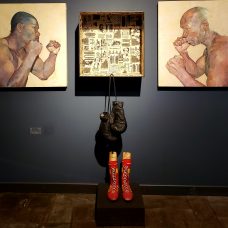


Krummy: Moving on from Krusher Kovalev to expressions of euphoria

By Bart Barry-

Sundays like these you spend wondering if this will be it, the last Sunday, the one when the words or at least the impetus to type the words won’t come eventually. Last was scheduled for a thoroughly mediocre weekend of prizefighting and should’ve remained such but for the surprise effect of a Colombian-Canadian light heavyweight who finished what work Bernard Hopkins demonstrated as possible and Andre Ward made manifest.

There was never too much to recommend Sergey “Krusher” Kovalev but cruelty and his promoter, Kathy Duva, who is excellent at her craft and among the final and most-deserving beneficiaries of HBO’s collapsed empire. Kovalev himself was not particularly compelling unless he represented a chance at unification, which we learned last month be among the most-compelling products boxing can deliver, but once such a unification gambit went away with Adonis Stevenson’s departure for another network Kovalev became a frontrunner bully the totality of whose offseason outreach comprised punching a keyring speedbag when HBO cameras reliably panned to him during most every broadcast.

Kovalev won a boring decision over Bernard “The Fighting Quinquagenarian” Hopkins and got copious plaudits for so doing. Then Andre Ward showed the world what was what, and Kovalev rode down the usual rebranding conveyor, firing what cornermen built him and traumatizing overmatched challengers en route to a manufactured title or two. HBO ran out of money not so quickly as it ran out of talent, and so Kovalev benefited alongside his comrade at middleweight, and Danny Jacobs.

Saturday made future benefiting considerably more difficult when Alvarez fragiled Kovalev more clearly even than Ward did, dropping him thricely and yanking the bitch out him unforgettably as Ward did, which is another way of writing: There aren’t enough Vyacheslav Shabranskyys in Christendom to make Kovalev viable again unless he avenges what just happened, and he doesn’t have it in him to do that – Alvarez knowing what he now knows goes through Kovalev quicker next time, as did Ward – and so Krusher’s network is down to a couple middleweights, the super flyweight division and Andre the Giant.

This should be a celebration of Eleider Alvarez, I get that I do, but it’s too late to reverse course and was too late to do so even when a couple disbelieving texts arrived in what felt like the middle of Saturday night.

Since a weekend headlined by Kovalev, Andre Berto and Devon Alexander hasn’t quickened the pulse in a halfdecade, if ever, previous considerations for this column revolved round Lucas Matthysse’s retirement and the man who caused it and why that man continues to fight, and if there’s not 1,000 words of interest round those subjects there’s at least enthusiasm for them where there wasn’t for what preceded them.

Matthysse feels a bit like Kovalev, though it might be the calendar allowing such clumsiness of analogy; excellent in a firefight in which he’s sure he’s the outgunner but fragile in the clutch. Life’s not so symmetrical but if Krusher announces his retirement in a couple weeks the analogy matures to metaphor, and there’s another column written during the slog betwixt now and GolovCanelo 2, though I’ve a plan for just that (see author’s note below).

What’s more interesting are Manny Pacquiao’s reasons for continuing to fight. Before Pacquiao’s successful showing against Matthysse, newsletterman Rafe Bartholomew’s enjoyable “Respect Box” made insightful counterarguments against the Manny-is-broke refrain that was never convincing as its selfinterested proponents believed. Here’s a sample:

“We apply the ‘Joe Louis, casino-greeter’ narrative to Pacquiao, when it’s not a perfect fit, and we have no real way to know how rich or poor he is. The articles about Pacquiao’s finances tend to quote Freddie Roach, Bob Arum, and other Americans with some but not full insight into his situation.”

The first thing many of us noticed about Pacquiao many years ago was the joy he exuded during ringwalks – he was so delightfully eager to fight. Only Felix Trinidad springs to mind as a man so enchanted by the prospect of public combat and the injury and humiliation it might bring. While many of us can imagine the euphoria a victory might cause and imagine the humiliation a defeat might summon very few of us have the experience needed to calculate a quotient that makes one justify the other.

Probably none of us does, not even Manny or Tito. Their secret, then, is to revel in the entirety of the event, to derive euphoria from leaving the hotel room, driving to the arena and touching the toes, taping the hands and watching how nervous others around them are for them in the dressingroom, listening to their names called and punching another man in the face, being punched by him, too, and being nearly unconscious with exertion. That sort of autogenerated presence, addictive, is enough to keep a man sparring till 50 other men in empty gyms – much less thrilling a full and feral arena, a deafening collective of other men momentarily freed from their lives’ every worry. Much less making an entire country suddenly proud.

What replaces that feeling? Certainly not legislative matters or the campaign trail. Certainly not concerns about abstractions over future health. And most especially not watching the digits grow in one’s checking account.

If Manny does not fight on solely for the boundless thrill of it, that thrill, anyone can concede, is a part of why Manny fights on. Would that any man’s passion might make others so euphoric.

*

Author’s note: This column will not appear next week, as its author will be in Ecuador to get krushed by a hike up Rucu Pichincha volcano.

*

Bart Barry can be reached via Twitter @bartbarry
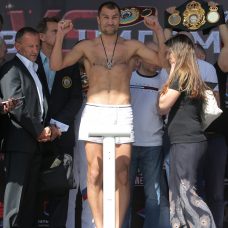


Mikey Garcia goes linear

By Bart Barry-

Saturday in Los Angeles in a match that unified lightweight titles without undisputing them Mikey Garcia outboxed Robert Easter and decisioned him unanimously, much as oddsmakers, aficionados and Garcia himself expected he would. Then Garcia did something unexpected by requesting a match with one of the world’s two best welterweights. Potent at 135 pounds, Garcia’s punching didn’t march to 140 quite as expected in March, making him something less than a twofisted threat at 147.

Garcia made his shocking callout immediately after beating Easter because he’s aware enough of everything that happens in a prizefighting ring to know how temporarily gullible television makes us and how fully history later erases what enthusiasm accompanied the gullibility, often with a bite. On television you can get yourself likened to Manny Pacquiao and Juan Manuel Marquez by beating Sergey Lipinets, and likened to Diego Corrales and Jose Luis Castillo simply by signing to fight Robert Easter, but you also know if ever you bump into Pacquiao or Marquez and present your Lipinets and Easter scalps they’ll wonder what you’re doing.

Garcia touched Easter early in round 2 Saturday and an alarm sounded on the canvas, a vibratory something both fighters and the referee sensed immediately: “A protected man is here.” Whatever victories brought Easter in a ring with Garcia, however deserving’f celebration they were in their moments, they were not proportionate with his titles, and now everyone had to know. Easter sensed in that moment his ascent was a bit of a ruse, and now the ruse was up, and worst of all, he sensed, Garcia knew it too well to let it go. Easter still had his prohibitive height and reach advantage, prohibitive enough his handlers (who ought’ve known better) failed to notice these last 5 1/2 years his poor footwork and pushy jab, but he’d no chance at intimidating or dissuading Garcia unto victory; Easter was going to lose, the question was how, and what might change after he lost.

Garcia went in Easter with classic boxing, 1-2 3-2 1-2, chastened Easter with every jab, frothed him with every cross. Therein lies most of Garcia’s appeal; he proves what every boxing coach has preached every year since about the time of Odysseus: If you take what you learn your first month in the gym and practice it till perfection then apply it fearlessly, you’ll surprise everyone how far it takes you. A minute into Saturday’s match Garcia feinted Easter out of position by throwing even his rangefinders properly; Garcia measured Easter for counters and realized the task before him might be still easier than he visualized while partying in his dressing room during the undercard.

Easter didn’t yet realize his task was hopeless. He was the taller, busier guy with the fast hands, and everyone told him his combination of speed and reach was otherwordly – so what if he tripped over his feet a little just then?

Then Easter’s righthand started wandering out to do pickoff duty. Garcia hooked round it just to see, and what he saw was Easter yanking on the back of his own head, tweaking the axle, imbalancing the apparatus, making mistakes too big to correct with the bigness of his frame. Easter started moving back like he didn’t know why he was moving back but yet he was moving back. If Easter wasn’t frightened he began to look frightened.

Garcia did things just right; he took Easter’s jabs to the body without moving his hands a centimeter offline: If this gangly dude is willing to shrink to my height to pittypat my belly, amen to that! In round 3 Garcia dropped Easter linearly: 1-2-3. That basic. Everything about Easter’s ascent told him basic couldn’t touch him, and yet basic just dropped him near effortlessly, Easter’s feet a tangled then splayed mess. Do notice how unaffected Garcia was by the act of dropping Easter – he’d said the right things in the leadup and promised Easter was a fellow champ, not a bend in the road, but Garcia’s prerehearsed postfight plans belied most of that.

Round 9 Easter bloodied Garcia’s nose by fighting deep inside but the tactic pained and exhausted Easter while energizing Garcia, and Easter smartly cancelled it for what nine minutes remained. When the results were announced Easter wore what placidity of countenance told most of this story; he stayed buoyant in case his handlers made good on implications he was the money fighter, the future, and anything close should go his way, but relief washed over it all when the result was just and he could relax.

Which is a way of writing none of this is Robert Easter’s fault and shouldn’t be held against him or his other Band Campers who are good athletes doing what any of us might. It’s hard to imagine there being impetus or skill enough to overhaul Easter’s flaws – Kevin Cunningham, after all, never repaired any part in Devon Alexander’s jab and telegraphed delivery – and so there’ll be roundrobins and such between prospects and “the youngest lightweight champion in PBC history” (or however else they market Easter), but whatever greatness Easter attains will be of the sterile, PBC sort, safe and gainful paydays under an unacknowledged ceiling above which actually historic things happen.

Those things might elude Garcia as they have thus far, and it scares Garcia more than Errol Spence does, evidently. Why else suggest Spence afterwards? No one asked for the fight. It makes little sense for either man. A Spence victory makes Errol look like another cherrypicker bully. A Garcia victory, highly unlikely, takes years off Garcia’s career.

Maybe that’s what Mikey’s after. He’s incredibly good at something he’s a little reluctant to do – frankly, challenging Spence is the act of a man who simply has had it with hearing from familiars: “If only I’d have had your talent . . .”

It’s not a cash-out but a legacy-out, a way to preclude what demonic what-ifs keep preternatural-in-their-prime men like Roy Jones still collecting headshots decades later. Better to reach one’s limits whilst feeling limitless than after, better to mark the boundaries of your talent, set your arms in a W and start doing more seriously things you’d rather be doing.

Bart Barry can be reached via Twitter @bartbarry
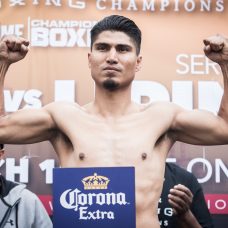


Turkish delight: Usyk unmans Gassiev on Tivibu Spor

By Bart Barry-

Saturday in Moscow undefeated Ukrainian Oleksandr Usyk became the first unified cruiserweight champion of the world since Evander Holyfield, pitching a 12-round no-hitter against Russia’s Murat Gassiev to win the inaugural season of the World Boxing Super Series. Usyk decisioned Gassiev so lopsidedly not one round went unanimously the Russian’s way. It was a remarkable conclusion to a remarkable run in no way diminished by Americans’ having to watch it on a YouTube stream from Turkey.

Usyk’s was a wonderful performance in consequential of a match as we’ve had in years. What Usyk betrayed through nearly every moment of 36 minutes and Gassiev failed to disrupt more than a pair of times was comfort. There’s an equation of sorts for how a stalking powerpuncher attritions a clever boxer, and it relies mostly on fatigue begotten by discomfiting. If Usyk’s jab and movement looked nervy anxious in Saturday’s opening two minutes they looked strategic gorgeous in the closing round, and the importantest part: They looked nearly the same all through the 32 minutes separating those.

Gassiev may not have landed a single clean shot the entire fight and certainly nothing Usyk didn’t see en route; Gassiev’s few noteworthy blows went through Usyk’s southpaw guard and touched Usyk’s gloves and arms before touching his head.

There was subtlety and awkward wonderment in what Usyk did, and if it was missed by many Americans for the match’s inaccessibility, well, let’s correct what of that we might.

No matter how the opening 2:50 of most rounds went, and most especially the especially consequential middle rounds – when Gassiev had to take anything he learned watching Usyk for five six seven frames and apply his rebuttal – Usyk found a way to punctuate doubt in Gassiev’s mind as the round closed. A wellplaced right uppercut, 5, or uppercut-hook, 6-3, didn’t so much hurt Gassiev as tell him: “I can hit you anytime with anything I want, and I beseech you remember that as your trainer whispers sour nothings in your ear for the next minute.”

Gassiev didn’t get angry, he’s too good and unattached for that, but he got verily discouraged in those pivotal rounds when he expected to begin striking Usyk properly. He trudged cornerwards while Usyk strolled.

And who was there to greet Gassiev when he arrived?

Why, none other than Abel “Plan A” Sanchez, the architect of Mexican Style, a form of prizefighting not one of Mexico’s five greatest prizefighters would recognize. Sanchez’s fighting philosophy appears to rely on, well, not head movement or innovative defense but perhaps initiative – a Sanchez fighter must want to hurt the other man more and oftener, and then everything else sort of works out? To carry such initiative, such enduring and quicksummoned rage, through 36 minutes, is nigh impossible, so a Sanchez fighter must be well-conditioned and attrition his man well before the championship rounds. He must hurt his opponent with every landed punch, and this works because, at the championship level, surely even the least-creative attack must find some purchase sometime in 2,160 seconds of opportunity.

Except Saturday.

In Moscow the Sanchez tactical vision for Gassiev reduced to: Go punch that guy.

Usyk obviously knew what Gassiev would do a third of a second or more before Gassiev did and a halfsecond or more before Gassiev started to do it. If it were a football game Saturday’s fight would evince a stolen playbook; stolen signals, were it a baseball game. Since it’s a fight, though, and there are only so many punches and ways of throwing them, there’s no conspiracy – the verb “to outclass” suffices.

Gassiev recognized it, applauding for Usyk through the reading of the scorecards, but since it might be less apparent to aficionados treated since 2012 to what gullibility has marked Mexican Style’s reception, let’s set the hands unmistakably upon the clock: Usyk outclassed Sanchez at least as much as he outclassed Gassiev.

This was no aberration, either – and a replica preview of how Gennady Golovkin would fare against Billy Joe Saunders, were GGG’s handlers careless enough to make that match (unlikely: Saunders is an actual middleweight).

Usyk is a weird and wonderful gentleman pugilist, dancing ever elegantly to a ballet of his own conjuring. He is physically enormous; let not the title cruiserweight mislead you. And howsoever lightly he appeared to hit Gassiev he is mighty and unwilling to be moved or bullied about the ring. While there’s no doubting Gassiev had power enough to affect Usyk painfully in the first eight rounds of the match – hence Usyk’s abiding vigilance – there’s neither doubting Usyk’s resilience and power of resistance. Out of ideas by round 3 Gassiev’d’ve shoved Usyk where he could were he not routinely chastened by Usyk’s lefthand. Usyk didn’t (doesn’t) hit hard as Gassiev but he sure as hell hit hard enough to dissuade Gassiev.

With frustration came fatigue and with fatigue went Gassiev’s initiative. Even had Gassiev found a way to surprise Usyk after the ninth round nothing about the result’d’ve changed – Gassiev alternately winged wildness or tentatively threw darts, and if Usyk was far too seasoned to be caught by Gassiev’s windups his chin was also far too low to be destabilized by anything less than a combination, and Gassiev threw nary one of those #MexicanStyle.

Let’s close with a few words of gratitude. Thank goodness for the Turks on Saturday. Tivibu Spor, a 24/7 sports unit of Istanbul’s TTNET, delivered for aficionados where no American broadcaster bothered. Much of Saturday’s undercard and every second of its main event happened on Tivibu Spor’s YouTube channel, crisply, cleanly and legally. No logons, no credit cards, no monthly fees, no popups or pirating – just live boxing with commentary blessedly outside our comprehension. One of the talkers was wild for Gassiev, shouting crazily the three times Gassiev threatened Usyk, but otherwise it was a flawless broadcast.

Bart Barry uzerinden ulasilabilir Twitter @bartbarry


Arguably the greatest ESPN+ fight in history

By Bart Barry-

Saturday on the ESPN+ app Filipino Manny Pacquiao smelted Argentine welterweight titlist Lucas Matthysse in Malaysia. Saturday on no app whatever undefeated Russian cruiserweight Murat Gassiev will fight undefeated Ukrainian cruiserweight Oleksandr Usyk in Moscow to unify their division. If the latter’s lack of an American broadcaster is bizarre, the former’s broadcaster was indeed apropos.

A temptation at times like these is to hedge one’s SportsCenterish prepositional phrase. Y’all know the drill: “in recent memory” is the way you take credit for boldness one word before you walk things back with a comma. Not today. After Saturday’s 25-minute comain of commercials, junior-dev graphics and overwrought pontification, it’s time someone other than an ESPN employee asserts what so many of us feel.

Manny Pacquiao’s comeback tilt in Kuala Lumpur was the greatest ESPN+ fight in history.

Before its cancellation some years back ESPN’s “Friday Night Fights” consistently presented the weakest boxing on television, the sort of underbudgeted slop advertisers and reputable promoters skirred. Far from appearing on FNF himself Pacquiao wouldn’t consider permitting towelboy Buboy to chiefsecond even Manila minimumweights on the program. Yet here we are in 2018 and Pacquiao’s now fighting on the smartphone equivalent of FridayNightFights.com.

A word or two about that, actually. What the hell are commercials doing on a paid stream? Having charged us $5/month ESPN gave us at least a halfhour of commercials during its otherwise-inexplicable 150-minute prefight Pacquiao promotion, and had its commentary crew act like nothing was the matter. “Two revenue streams!” some pitchman inevitably proclaimed, but that’s all sorts of wrong because most Saturday viewers were on a free trial and won’t be renewing after the three hours of their lives they just gave ESPN+ for seven rounds of desired boxing. “But wait,” they say, “there are all those Muhammad Ali fights that come with your subscription!” – like either they don’t know about YouTube or figure we don’t.

Almost a decade ago one of promoter Top Rank’s leaders talked about a concept he called “brand of boxing” – encouraging his peers to imagine their sport as an ecosystem whose general health be far more important than any one of their events. Today an American aficionado spends monthly $25 for basic cable (ESPN), $10-$15 for Showtime, $5 for ESPN+ and soon $10-$20 for DAZN – and that $50-$65 monthly bill assumes both a savvy cordcutting bent for our aficionado and his cancellation of HBO some time ago. But here’s the brand-of-boxing punchline: That kind of money spent the first week of July, our aficionado looks forward to the year’s best fight this Saturday and finds to his amazement somehow not one of these sundry pay services is televising Murat Gassiev vs. Oleksandr Usyk to crown the rarest thing in our beloved sport – an undefeated, undisputed, unified champion of the world.

A word or two about that, too, actually. Gassiev-Usyk is a fascinating cruiserweight culmination of World Boxing Super Series’ inaugural season. Former Golden Boy Promotions CEO Richard Schaefer is associated with the WBSS and repulsive. There’s no history needed to make that assertion; if we, as men, were taught to trust our intuition the way mothers do, we’d all have heeded our genuine first impressions of Schaefer 14 years ago. But while Schaefer once combined visibility and repulsiveness in a unique way he’s not otherwise repulsively unique and definitely not repulsive enough to keep us from enjoying what exceptional cruiserweight matches WBSS gave us in its semifinal round. But Schaefer or somebody affiliated with him appears to have repulsed American broadcasters sufficiently to keep Gassiev-Usyk off even our smartphones.

Which makes brand-of-boxing, for the next week at least, toxic.

Writing of which, how about that Lucas Matthysse? We already knew power punchers kept prizefighting’s frailest psyches, but Matthysse’s comportment these last few years makes one consider the symmetrical possibility a boxer’s mental hardiness is inversely proportionate to his punching power.

Five years ago while writing The Ring cover story mentioned on Saturday’s broadcast I came across an exquisite Argentine boxing writer named Osvaldo Príncipi whose Spanish prose and presence make him something like South America’s Hugh McIlvaney. During our correspondence he attributed a whole lot of things like Mathysse’s tattoos to a divorce. I felt for Matthysse then; by all accounts the guy does little in his life but love his daughter, play with his dogs, avoid the media and fight.

Saturday’s second knockdown, though, is hard to excuse. It’s one thing to realize you’re in over your head and race towards unconsciousness, but it’s something else entirely to court it so wishfully – to hope a punch cuts the lights, find it didn’t, then in full consciousness genuflect to your opponent. Let’s move on.

Saturday’s iteration of Manny Pacquiao was a pleasant return to what belligerence once endeared him to so many of us. A return to the man who dealt swiftly and disproportionately with anyone who caused him a sting, a man who didn’t collect grievances or connive but rather sought instant redress – that’s who we saw go after Matthysse each of the three times the Argentine did something offensive to Pacquiao. And it was electrifying.

So Pacquiao fights on. One can’t seriously entertain the possibility GGG is a great middleweight – hard stop – and begrudge Pacquiao three or four farewell tours against career 140-pounders like Matthysse or a talented lightweight like Vasyl Lomachenko. In fact, Pacquiao-Lomachenko in Helsinki might make a great Christmas present for ESPN+ subscribers.

Bart Barry can be reached via Twitter @bartbarry
.


An interview with the boxing writer by the boxing writer, parts 1 & 2

By Bart Barry-

Editor’s note: A year ago, bereft of ideas for his weekly column, Bart Barry interviewed himself again about the state of the craft. That went so well, we asked him to do it this week.

BB: Looking better, kid.

BB: It’s the fasting.

BB: Really?

BB: Doubtful.

BB: Yet it persists.

BB: Fasting, Kundalini, cold showers – they’re all of a piece, wethinks. Something gets read about these things’ benefits so they get tried suffered through. Month laters their effect be nighnil, but by now it’s a question of discipline or will.

BB: Fasting –

BB: Breaks up the monotony. Not eating on Mondays or Thursdays makes the week compelling. Half of two days spent under the illusion a bite of food can solve every problem. Their successors followed by ambivalence.

BB: This solved nothing, and it’s wonderful to be free to eat again?

BB: Yes!

BB: No more boxing gym.

BB: Not for quite a while. Miss it not slightly.

BB: What do you miss the least?

BB: The heat the heat. San Fernando that damn heater.

BB: Barbaric.

BB: Fighters make weight, they don’t lose it. Look at Duran.

BB: Is he the purest manifestation of –

BB: Yes.

BB: How goes the craft?

BB: Easier.

BB: Because the quality of subject improved?

BB: Not noticeably but maybe.

BB: Then it’s a venue change?

BB: Not a change of venue but venues changing. As this city grows denser there’s less space less time that makes everyone tenser. Even in the South Texas heat there seem more heels tapping more nervousness more suspense less time less space.

BB: That helps the writing?

BB: Helps the boredom.

BB: When did boredom surpass wordlessness as top concern?

BB: One doesn’t mark these things but it must’ve been when we started writing the column at coffeeshops instead of using them as rewards for having written the column. You write in a hermetically sealed space when you’re afraid you’ll stop because you can’t fill the blank page.

BB: Now it’s a matter of its being unamusing?

BB: But it is exactly amusing. Sunday trips to the coffee shop are the weeks’ best parts that are predictable.

BB: Who excites you the most right now?

BB: David Benavidez.

BB: Why?

BB: There’s something perishable there. An originality, too. I didn’t realize how much I liked him till you asked.

BB: Is it a Phoenix thing?

BB: No nostalgia. In a dozen years there never felt a Phoenix thing – not in the way there’s a San Antonio thing or a Silicon Valley thing or a Boston thing.

BB: When you think of Phoenix boxing, Arizona boxing even, you think of Benavidez?

BB: No. I think of Norm, I think of Desert Diamond Casino, I think of the late Don Smith.

BB: Lately.

BB: February I sat next to him in Corpus.

BB: You conflate him with the Colorado matchmaker?

BB: Invest each with the other. Was a Top Rank card – Zurdo Ramirez. We didn’t recognize each other till we started talking about Norm and the Brothers Benavidez, Jose on the undercard. There’s a guy down here with a local chapter of Veterans for Peace, reminds me of both Don Smiths.

BB: A name you say like a single word.

BB: Like an alias.

BB: Excited about GolovCanelo 2?

BB: No.

BB: Should be a good fight.

BB: Yup. Don’t care about either guy. Both good men. Professionals. Talented. All that. No sense of character with either of them. Their first fight was two good fighters making a good fight.

BB: The fight wasn’t great. They aren’t great.

BB: It feels business cycle more than boxing cycle. We’ve got a redhead Mexican can fight a bit. HBO loves the Soviet Bloc. Golden Boy needs money. Golovkin can’t be the second coming of Hagler till he beats his Hearns. The fight has to be made because it can’t be made. Before anyone can settle into addressing how historically average both guys are we get keelhauled with revenue projections.

BB: And that’s the story.

BB: It’s a reflexive trick sort of halfassed bullying: You don’t know what you’re talking about because look at how much money it’ll make!

BB: What’s the rebuttal to that?

BB: There isn’t one because it’s a different conversation. The person who makes that argument doesn’t want the original conversation or wasting cycles to persuade you or you him.

BB: You wrestle him back?

BB: Nah. He has the energy. You sidle away. What’s the difference?

BB: What are we reading?

BB: Mitochondria.

BB: Why?

BB: No idea.

BB: Here’s a go. There’s a theory out there mitochondria was a predatory bacterium that eventually found symbiosis with a eukaryote, and cancer is a reversion by mitochondria to its original predatory state –

BB: And since Mom just passed away from cancer –

BB: This is a tribute of sorts.

BB: But it isn’t, really, not even a weak one.

BB: Then why do it?

BB: This week?

BB: Aside from calendar, boxing or general.

BB: It goes back to “Las Meninas” by Velazquez, painted, as you know, 41 years after Cervantes writes the second volume of “Don Quijote” in the same city. Cervantes has his fictional characters reading about themselves. Then Velazquez paints himself painting himself. Both do it a little messily, with irony.

BB: In the sense of not-sanitized?

BB: Cervantes is satirizing imposters. Velazquez pretends to be just painting something, that you later discover is a portrait of some royal couple, that you later discover isn’t that at all. The technical mastery is obvious and beside the point.

BB: This is neither.

BB: Neither, yes. This isn’t even Picasso cynically looping and looping till you’re so confused he must be a genius.

BB: Then do it for the ease.

BB: Easier than mailing-in a preview of a Pacquiao fight you don’t honestly care about.

BB: And because of Vermeer.

BB: You determined to make this a two-parter?

BB: If you are.

BB: Across the room from the wood-mounted print of “Las Meninas” is a wood-mounted print of “The Art of Painting” – as you know.

BB: Again.

BB: It’s the crown-thingy on the model’s head. Notice the artist is painting it differently on the canvas than Vermeer painted it on his canvas.

BB: Because of the angle of the artist’s painting.

BB: A tie-in with what Velazquez and Cervantes are up to. Vermeer is painting himself painting a model differently from how Vermeer is painting that same model.

BB: You don’t see any of this in boxing?

BB: Almost. Sometimes. Nearly. Chocolatito hanging the jab near his opponent’s right shoulder so his opponent’s counter, a right cross naturally, bangs his shoulder into Chocolatito’s glove, which bangs into his opponent’s chin.

BB: Punching himself for trying to punch Chocolatito, or Vazquez pinning –

BB: Yes, kinda, Vazquez pinning Marquez’s right arm to Vazquez’s left shoulder to pull Marquez into a right uppercut. Mijares making an opponent miss so wildly so often he injures his shoulder. Marciano and Valero punching their opponents’ arms. Rigondeaux rehearsing a combination, in full, before he throws it.

BB: What about Lomachenko?

BB: He has the timing and space to do it, but where’s the irony? He’s sensational. Technically transcendent. But he’s like what happens in the middle of Vermeer’s studio, where he’s got easel legs and chair legs and the artist’s legs and tiles all juxtaposing so successfully you have to believe him, and know you couldn’t pull it off, and suspect no one else could either.

BB: But is it joyful?

BB: But is it joyful.

Bart Barry can be reached via Twitter @bartbarry


Saucedo-Zappavigna: A sacrificial sheep made into a ram

By Bart Barry-

December 15, 2012, Houston,Texas — Welterweight Alex Saucedo remains undefeated at 7-0 after stopping Eddie Cordova in the 3rd round , Saturday, at Toyota Center from Houston,Texas. — Photo Credit : Chris Farina – Top Rank (no other credit allowed) copyright 2012

Saturday on ESPN in Oklahoma City junior welterweight Alex “El Cholo” Saucedo made an adopted-homecoming match against Australian Leonardo “Lenny Z” Zappavigna thrilling in the moment as it was disappointing for Saucedo’s future. Saucedo ultimately prevailed when Zappavigna, blinded by his own blood, got rescued by his corner. Within an hour of the match’s conclusion Zappavigna retired from prizefighting.

Alex Saucedo, meanwhile, is now upon a plateau, or perhaps beneath it. He is not what promoter Top Rank thought he was or hoped he’d become.

The first time I interviewed Bob Arum, 13 years ago, I asked him what was the most important quality a fighter might have. Arum answered in the form of a question: “Does he dissipate between fights?” It does not appear Saucedo does (Juanma Lopez, conversely, was a worldclass dissipator).

If it is essential to Top Rank one of its fighters not forfeit quality when he is not fighting one can easily infer it is doubly better when a fighter gains quality in that same unsupervised stretch. This brings a second, if unspoken, prong to the Top Rank development program: Can we work with his trainer?

Top Rank’s matchmaking staff, best in class, is not particularly fond of the we-grow-together, entrepreneurial-dad model whereby a fighter’s father or fatherfigure acts as chief second during junior’s ascent. Trainer dads be tolerated so long as junior progresses on Top Rank’s aggressive schedule, but once a fighter falls offpace Top Rank is not timid about recommending the pursuit of a new trainer in a new city.

The first time I was ringside for a Saucedo fight, El Cholo’s pro debut on a Son of the Legend undercard in Houston, 2011, hopes were high for the lanky 17-year-old welterweight. Three months later hopes at ringside were even higher in San Antonio for Saucedo’s second professional match. Four months after that in El Paso hopes were still climbing, albeit at a slightly reduced rate. Saucedo’s first year as a prizefighter concluded in Houston on the undercard of Nonito Donaire’s soulsnatching Jorge Arce. Saucedo was by then 7-0 (5 KOs), but the two matches that were not KOs brought some concern given the opponents involved. A pair of matches back in Oklahoma preceded a return to South Texas: Laredo, Corpus Christi, Laredo. Which preceded a return to Alamodome, another Son of the Legend undercard, and openly expressed concerns about Saucedo’s development.

Saucedo costarred on Donaire’s HBO card at the end of 2012 but was an afterthought 16 months later.

“You know any good trainers in Oklahoma?” went one insider’s reply when I mentioned at ringside Saucedo was not where we thought he’d be 13 prizefights in.

I found the mood dispirited enough to stop following closely Alex Saucedo much the same way I stopped following closely Jose Benavidez, who in his third career fight, as part of Pacquiao-Clottey weekend, looked every bit promising in 2010 as Saucedo did 20 months later.

After Saucedo failed to score a knockout in 2016 against three men whose résumés indicated an ability if not a willingness to be stretched a new trainer and region got summoned for Saucedo. Abel “Mexican Style” Sanchez, the great beneficiary of HBO’s manufacture of Gennady Golovkin, became Saucedo’s chief second and evidently decided Saucedo, born in Chihuahua, wasn’t Mexican Style enough and needed a Big Bear residency at the GGG School of Robotic Pursuit where Saucedo could learn at the master’s feet exactly how far a fighter can go with the right combination of careful matchmaking and no head movement.

Reliably enough Saucedo next went down a weightclass then went lunatico on Gustavo David Vittori, an Argentine who made his pro debut 10 pounds below Saucedo’s and didn’t get a chance to leave Argentina till the call came for a Saucedo sacrifice: KO-3. Four months later it was Abner Lopez’s turn: KO-7.

Which brought Saucedo loping to Saturday’s match with Lenny Z, a b-level trialhorse and a-level bleeder. Zappavigna, who made his pro debut as a lightweight, was 32-1 in his native Australia but 5-2 in the U.S., and looked the perfect opponent for Saucedo’s homecoming on ESPN, primetime, a proud man whose face came presliced.

And for most of the match’s opening, things followed their script: El Cholo attacked without too much variety, Lenny Z swelled and readied to bleed. Then round 4 opened and Zappavigna decided to stop pretending he didn’t notice Saucedo’s head remained ever stationary. Zappavigna tagged Saucedo with righthands enough to realize Saucedo wasn’t open to them because he wanted to be but because he hadn’t the defense to have a choice. Then Lenny Z caught Saucedo going Mexican Style with a left hook, and clocked him.

Saucedo stumbled backwards to taste a lefthand hungrily as he’d eaten what right preceded it. Zappavigna went after Saucedo and in so doing showed Mexican Style comes unadorned with footwork or infighting. (Confirmed, not showed, actually; Canelo Alvarez showed this the world last September, no?)

How this was the round of the year in the fight of the year is anyone’s guess. Zappavigna beat Saucedo all round the ring for three minutes and bled profusely from the mere exertion of it. Saucedo bled, too, but did little more than that and survive Zappavigna’s relentless attack.

From there Zappavigna’s face did as it was contracted to do, spilling open and gushing everywhere, until Saucedo did exactly what an undefeated prospect in his 28th prizefight is supposed to do with a retiring journeyman – pillowface his every initiative till a handler flies the pink towel.

Saturday’s match was good and hard but won’t make anyone’s Top 5 list by year’s end, and neither, frankly, will Alex Saucedo at 140 pounds. That’s an endorsement neither of his talent nor his new trainer.

Bart Barry can be reached via Twitter @bartbarry
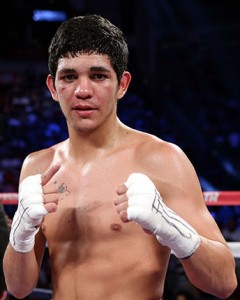


Pride in great male writing about men

By Bart Barry-

This is not a trigger warning but a preamble. What follows is a consideration of fantastic writing about men, the sort of writing we aspire to do while treating our beloved sport, that happens to be written by a gay man about gay men. This column will attend neither to prurience nor politics. Rather it’s a coincidental product of a Monday falling within LGBT Pride Month after a weekend I spent reading fiction more than watching boxing.

This space once was about writing much as it was about boxing. Though it had floated away from most concerns about description by the time it began in 2005, its author nevertheless fancied himself quite good at description when called upon, since like most writers, his ability to describe objects better than others do was what first got him recognized by a teacher (in this case, Ms. White, fourth grade).

The move away from descriptive writing was not conscious, quite, but happened via a definitely conscious choice to avoid “writing” in the meretricious sense of the term, to avoid those squeamish points in all forms of literature when an author suspends subject to go on a look-at-me-I’m-writing! riff. If memory, unreliable as ever, manages to serve, the move away from descriptive writing happened in Puerto Vallarta, Mexico, 2002, when a visit to a writers club found a bunch of selfcelebrating folks rarely bothering themselves with the unglamorous toil of writing while unrarely sharing brief moments of inspiration that sparked “writing”.

If this reads like an oddly hesitant preamble perhaps it is born of nervousness about treating what follows justly. Well, anyway, off we go:

“. . . as I waited, and looked around at the dozens of bodies, squatting, lying, straining, muscles sliding to the surface in thick-veined upper arms, shoulders bending and pumping, the sturdiness of legs under pressure, the dark stains on singlets that adhered to the sweating channel of the back, the barely perceptible swing of cocks and balls in shorts and track-suits, with, permeating it all, the clank and thud of weights and the rank underarm essence of effort.”

I read that about a month ago and decided I’d not read before the male body or a collection of male bodies so aptly described. That passage happens about 50 pages in to Alan Hollinghurst’s masterfully executed novel “The Swimming-Pool Library”, a firstperson account of a young gay man in London in the early 1980s, remarkable for its profiles and voice and its numerous descriptions like what’s above. What makes these descriptions remarkable is their departure from the way men’s bodies generally get described by straight authors, both male and female.

Straight men describe other men’s bodies like sanitized, actiontaking machines – on the rare occasion a muscle ripples it does so to cause an act: the shoulder vibrated as his left glove struck the opponent’s ribs. Straight women do something similar, though describe qualities of masculinity that are physical mostly by coincidence:

“Mr. Darcy soon drew the attention of the room by his fine, tall person, handsome features, noble mien, and the report which was in general circulation within five minutes after his entrance, of his having ten thousand a year.”

Contrast that with what Hollinghurst does. He sees and smells and hears men in a way crossed between a predator and a food critic.

Would it help our descriptions of prizefighters in the act of prizefighting if we saw them through a lens of sexual attraction? Quite possibly. It would sate, too, any writer’s search for originality. But there is, of course, the rub: Such things are not easily faked since most pathways to forgery betray their takers – you can imagine your favorite fighter is a woman and describe him thusly but imagining him treating you like a woman is another leap entirely, and unless you have both you’re not fooling any careful readers or even careless readers’ intuitions.

Good news. There is some boxing in “The Swimming-Pool Library” to leaven this Pride-month celebration of fine description. Hollinghurst’s narrator attends a night of youth boxing and offers it his often irreverent voice:

“One trio of teenage stylists bawled their encouragement while grinning and chewing, selfconscious, acting manly, caring and not caring.”

and

“After brief deliberations between the ref and the officious, serious judges (this was their life, after all) the unanimous decision was announced.”

and

“The mood here also was one of pure sportsmanship, of candid bustle, like a chorus dressing room.”

There is one more element to this novel, a historical one, that recommends it. Lost in the recent events of European marriage-equality referendums and an American Supreme Court decision is the matter of 16th-century British sodomy laws (inherited round the world) and their successors and their arbitrary and generally cruel enforcement in our lifetimes. In a few episodes Hollinghurst shows how very easily it was to be entrapped and sentenced to jail time for a man who pursued, if he did not consummate, a sexual relationship with another man. Undoubtedly this charged the exciting act of seduction with danger’s energy right up till the moment it didn’t, when, with a thud, a man’s hormonally induced sense of invincibility disbelievingly crashed into disbelief.

And of course no irony is lost on Hollinghurst: How very much serendipitous companionship awaited a gay man sent to prison for gay acts. Or is this merely an empathy offramp taken by a straightmale reader – some way to dull what a profound sense of injustice sometimes happens in us?

Bart Barry can be reached via Twitter @bartbarry
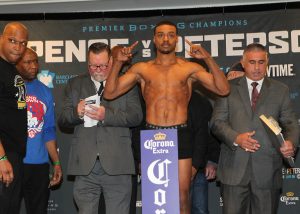


The Truth is . . .

By Bart Barry-

SAN ANTONIO – Almost exactly 300 miles north of here Saturday welterweight titlist Errol “The Truth” Spencer strolled through an overmatched Mexican named Carlos Ocampo at – let’s get this right – The Ford Center at The Star, in Frisco, Texas, home of the Dallas Cowboys’ practice field. No matter how highly one regards a prizefighter, nine hours is too much of a roundtrip drive to perform for an exhibition bout, and whatever fears any Texan had of missing out, anyway, got quelled in three minutes.

If you were to draw a circle with a 30-mile radius round the center of Dallas you’d enclose an area called the Metroplex. You’d include both Frisco and a region twice as populous as Los Angeles and 85-percent populous as New York City. You’d also be missing the country’s fourth-largest city, Houston, and its seventh-largest city, this one. Texas is not so much a boxing state, in other words, as an enormous one.

The not-particularly-believable 14,000-paid attendance figure bandied about before the gates even opened Saturday and all through Showtime’s broadcast would be a breathtaking occurrence in, say, Amarillo, but it’s less than breathtaking somewhere within a four-hour drive of 11-million people. Heaven help this column if that reads like an impeachment of Jerry Jones’ math; after all, the owner of America’s Team has his “world” headquarters within the Metroplex, and the principles and integrity of any NFL owner are above doubt. That written, there were some questions about the announced attendance for Manny Pacquiao’s two Cowboys Stadium tilts in 2010, and columnists often have long, selective memories.

However many Texans attended Saturday’s match those in attendance thrilled Errol Spence, and it was joyfilling to see a well-deserving object of affection enjoy such affection.

Let us not let that detract, though, from the fact Saturday’s mainevent sucked.

New rule: When the sacrificial b-side of a homecoming mismatch is seen nervously chewing his gumshield before walking to the ring, the match is immediately reduced to a four-round affair and the champion begins three points behind on official scorecards. Seems fair. These new mercy-feasting rules in no way endanger Spence’s undefeated record, presently or retroactively, and they give commentators some suspense worth shouting at.

Spence was fighter enough to feel ashamed of what happened Saturday and man enough to admit it. Spence wanted real contact; his style demands a certain quotient of mutual abuse to please, and had he known Ocampo would fold so quickly and completely The Truth surely would’ve holstered his best punches at least a round or two longer.

Spence has grown immensely since his first Texas prizefight five years ago in Our Lady of the Lake University Gym, five miles west of where this column happens. Frankly, the odds of Spence filling any arena back then were longer than Ocampo’s odds Saturday. Whisked by what would become the PBC from America’s worst Olympic boxing team – on which, admittedly, Spence was the best fighter – to mostly empty venues like nearby Cowboys Dancehall (neither a world headquarters nor those Cowboys) Spence looked destined howsoever unfairly to follow teammates like Terrell Gausha and Rau’shee Warren to the Sam Watson-less edges of Al Haymon’s roster, off-television.

But Spence had something few other PBC prospects did: A willingness to be hit in order to hit. Everything was rougher about Spence than his stablemates, starting with his accent. Spence was “country” – as they call it round here. His accent was obviously Texan. So was his likability. He was guileless outside the ring as he was inside it. He was such a departure from the promotional antics of the PBC’s signature asset, Adrien Broner, one quickly wondered how long Spence would stay in his managerial arrangement, illfitting as it appeared.

Then Spence went tangential and put himself on a new trajectory for a PBC fighter. Spence visited someone else’s country and won a title by knockout – otherwise known as the right way. Then he began using the names of reluctant PBC welterweights in interviews. Then he washed and wore a PBC mainstay. For this he was rewarded with an illfitting homecoming 50 miles north of his native DeSoto as the headliner of what often felt like an infomercial for America’s Team and its owner – unless you believe a 147-pound man wanted more desperately to be a professional football player than a champion prizefighter.

For goodness’ sake, let them have their fun!

Yes, well, fine – so long as there is boxing to write about. But there isn’t, is there, in large part because of dreadful matchmaking, the sort that makes most aficionados feel like suckers most of the time we open our minds to the PBC brand.

Some of this is Showtime’s fault, you say? Fair enough.

Boxing’s best network now has easy access to every fighter in the world unaligned with promoter Top Rank, which is most of them. Showtime has far too many available fighters and far too few available dates to be cowed into b-sides like Carlos Ocampo. And let us have no more loose talk about mandatories. Errol Spence wishes to be the world’s best welterweight, not merely the IBF’s, and if he’s debasing himself with mandatory challengers it’s because his handlers’ handling of their other welterweight titlists makes Spence worry his share of the welterweight title is his only leverage – which is absurd if true.

A twofight series with Terence Crawford on ESPN – fight 1 in Omaha, fight 2 in Arlington (not Frisco) – would make Spence a household name, regardless of outcomes. Then he could return to Showtime as the new face of the PBC, increasing the credibility of the both his management outfit and its sole remaining broadcast sponsor.

Or Spence can fight Yordenis Ugas or Qudratillo Abduqaxorov in December and Devon Alexander next May.

Bart Barry can be reached via Twitter @bartbarry
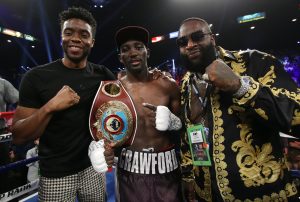


Terence Crawford is wonderful

By Bart Barry-

Saturday on ESPN+ Nebraska’s Terence Crawford won his first welterweight title the right way. He beat to relenting titlist Jeff Horn, the Aussie who upset Manny Pacquiao in 2017.

Crawford is everything.

He came in our collective consciousness the right way – making his television debut on short notice in a higher weightclass, then winning his first title in another country. He understands fighting at its genetic level; he is good enough at fundamentals to find space enough between confrontational moments to ask himself what-if questions that reveal new options, some of which improve him (the route to better ideas, firstly, comes of having more ideas). He has a high physical IQ; he senses another man’s intentions at least as soon as those intentions get set. He keeps his personality out the way – he knows what it is and requires to be great at something and knows th’t he, like most of us, hasn’t the resources to make a great spokesman. He takes chances, hitting and getting hit early in matches, the faster to assess the men across from him. He is ambitious; much lesser talents than “Bud’s” have made gainful livings staying in one weightclass to gorge on smaller men.

And he is mean.

There are myriad socioeconomic factors that make Crawford the perfect concoction this moment locates him as, but not one of them needs excavation here.

(Been thinking a good bit about machine learning lately, and its contemporary sexed-up alias, artificial intelligence, and the more seriously one considers such things the quicker and more frequently he returns to Arthur Samuel’s checkers-playing program, nearly 60 years-old now, and an idea occasionally lost in contemporary celebrations of Samuel’s other remarkable ideas like alpha-beta pruning. The idea goes like this: The entirety of any piece’s relevant history in a game of checkers is contained in its current position on the board. Human minds have way, way more processing and storage power than Samuel’s hardware did, obviously, and likely way more processing power than even today’s liberal approximations assign them, but the metaphor is instructive just the same: Everything that made Terence Crawford what he is was cumulatively contained Saturday in the 26 1/2 minutes he spent unbelting Horn.)

There may be contentment or at least satisfaction in relating things Crawford did to their histories but not joy. Here’s joy: When Crawford stuck Horn to the body in round 8 and an instant later you chucklecoughed or whistled alone in a room. That moment for one, other moments for others, canceled the argument – no conditions, no comparisons, no reductions, no history.

We are blessed as aficionados right now to have at the highest level of our sport – a level shared by Crawford and Vasyl Lomachenko, hard stop – two men who cancel the argument for those of us who enjoy sports primarily for their making us present, not giving us identities (I’m someone who knows things) or outlets (helps me forget the ways others have wronged me) or income.

Crawford did so many things so well Saturday. He placed fast, precise combinations – middle knuckle of fist within a quarter’s radius of intended target – and converted possibilities to openings. He bullied the larger man, walking Horn backwards without once pleading backwards for official intervention; he took Horn’s initiative, to remind Crawford every second he was in a fight, not an athletic spectacle, and amplified it, ensuring Horn felt in every clinch Crawford’s sinews. No give, no defensiveness.

He remanded Horn to a corner every three minutes for 60 seconds of doubting his handlers’ expertise – yes, I will leap off this stool filled with positive thoughts, I promise I will, but in another minute or two, that guy you told me wasn’t my better is going to start hitting me again, not you, so thanks for the water, I guess?

He lashed Horn’s belly with left crosses and hooks and uppercuts no one hit Horn with before. Horn reacted like a man prepared to be hit in ways he didn’t prepare for, prepared to remind his body everything was all right with stiffening thoughts galore, but since you can’t outthink a feeling no amount of thinking could enduringly offset what painful signals Horn’s body sent in torrents.

This is where physical IQ trumps intellect in every fight; Bud Crawford probably couldn’t put it in a poem or a paragraph or a painting (nor could Horn), but in hot blood Crawford’s mind knew where to put his knuckle on Horn’s body to stop the flow of actionable thoughts to and from Horn’s brain, a brain, one must remember, roted to continue that flow of actionable thoughts no matter how torrential the signals bubbling up from his body. Horn didn’t interrupt Crawford’s thoughts but a fraction so often.

Crawford enjoyed Horn’s diminishment. He felt Horn relenting and smiled.

This is what makes men like Crawford (or Mayweather or Marquez or Hopkins) exceptional; where something like empathy for a man being stripped publicly of his dignity begins to drain others, such a stripping makes the purest fighters euphoric. It transcends professionalism: I’m not doing this because it’s my job, no, I’m doing this because I like hurting you. You can’t really teach this; for who that knew how to teach it could conscience doing so? Those who would say they can teach it mistake sadism and chance for a template.

Herein lies the distinction between Crawford and Lomachenko, the world’s two best fighters, ranked numbers 1 and 1: Where one senses Lomachenko learned to hurt men for glory’s sake, Crawford glories in hurting men.

Bart Barry can be reached via Twitter @bartbarry
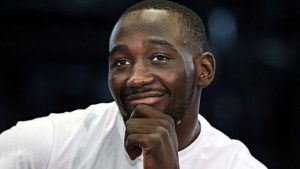


Things to do this Saturday

By Bart Barry-

Three fights happen across nine timezones Saturday in a crescendo of sorts before boxing’s summer ritual ends much of our fun. Going least essential to most, Tyson Fury returns against someone named Sefer Seferi in England, Leo Santa Cruz and Abner Mares finally rematch in Los Angeles, and Jeff Horn defends his fraction of the world’s welterweight championship against Terence Crawford in Las Vegas. If none of these events is great or particularly consequential, none is bad either, and all three should entertain.

This was going to be a piece about how much better than the rest of us a gay novelist can describe the movements of a man’s body – for glancing through a lens of avarice – then a glance at next week’s docket undid those plans. As we round the bend and race towards our seasonless sport’s annual doldrums wisdom advises against spending boxingless ideas the week before three compelling things happen. Fear not, though, an attempt to explore and celebrate a sexualized description of the male form will happen at least before GolovCanelo 2 does.

MGM Grand becomes Hornet’s Nest Northern Hemisphere this week as Aussie hoards ascend on Las Vegas, one hopes, to see their man defend his WBO title against one of today’s two best fighters. This marks Terence Crawford’s debut at 147 pounds, and it’s not a particularly easy one mainly for this reason: Horn’s first prizefight happened against a man who weighed 154 1/2 pounds, while Crawford’s first opponent weighed 138.

This three-weightclasses difference might mean less if Horn were a boxer or a slugger – since Crawford could slug his way through a long cutie or use defense and footwork to dissuade a onetrick puncher. But Horn’s a volume guy, a physical one, who expects to get hit often by men who likely punch harder than, if not accurately as, Crawford. The angles and stanceswitching tricks Crawford uses to disarm then attack smaller men mightn’t make much difference to Horn. So long as some part of Crawford is somewhere in front of Horn, regardless which part is in front of the other, expect Horn to hit that part. Horn cuts easily, and Crawford is very good at what he does, so there’s little chance Horn makes it to the closing bell, and even littler chance Vegas judges give him what doubtful benefits judges do in Brisbane, but the match should be fun.

The competing priorities of ESPN’s app launch and < $5.99 pay-per-view price (if you combine “Nature Boy”, noticeably better than “Andre the Giant”, for an adult anyway, with Horn-Crawford, you’re paying 95-percent less than you paid for Crawford-Postol) leave only one worry, which returns, as usual, to commentary. If ESPN plays it straight, tempering the crew’s admiration for Crawford with investigative stories about Horn’s having a father, all will be fine, regardless of outcome. But if ESPN has already decided Crawford must win because promoter Top Rank promised he would and having the world’s two best fighters on the network overwhelms every other consideration, things could go staggeringly sideways, the way they did when Horn narrowly upset Manny Pacquiao and widely upset Teddy Atlas.

Nothing so untoward will happen on Showtime when boxing’s best broadcast team covers Santa Cruz-Mares 2, a rematch no one considers anymore essential but everyone has a reasonable expectation will be safe and busy as their first match. Neither man has suffered an unavenged loss in the nearly three years since their first fight, but their promotional and managerial situation precludes either man from maintaining professional momentum. Santa Cruz now fights every eight months – a rate of activity at which Mares gazes lustfully. After PBC paid ESPN to televise the men’s first scrap, aficionados suspected the delay that followed was attributable to PBC’s having to save up to buy another broadcaster for the rematch, but evidently we were wrong. Santa Cruz would return six months later to beatdown Kiko Martinez and Mares would go underground for 16 months.

Much as both men rely on activity the more active fighter will win Saturday, and that should be Santa Cruz. The gloves will look too big and the rounds will meld together, but the match will have action enough for someone to mistake it for 2018’s fight of the year, until at least July.

That leaves only the return of boxing’s clown king, Tyson Fury, on a Saturday afternoon card illegally streaming from Manchester. It has been 2 1/2 years since England’s enormous lunatic decisioned Wladimir Klitschko and everything has changed about the heavyweight division except Fury. There have been suspensions and cancellations and rehabilitations and protestations, but Fury is unbowed, genuine and loony as he was ages ago when he became heavyweight champion of the world. He’s either out of shape or in the shape of his life for his return against an unknown man with whom he hopes to log rounds. He is publicly vulnerable in a way one does not expect a 6-foot-9 and 247-274-pound professional fighter to be, and so he wins fans’ forgiveness for being likable. He is capable of decisioning any man in the world, too, including Anthony Joshua, and likely as not to denude Deontay Wilder, 120-108, if ever PBC’s poverty forces such an encounter.

Frankly Wilder-Fury is the fight we deserve, whatever better match we happen to want, a reasonable man who fights crazy against a crazy man who fights reasonable, and both men grasp their division is about spectacle much as merit – while AJ’s dignity precludes his being less or more than a rolemodel, however little boxing fans honestly ever want such a thing.

Writing of which, let’s see if we can collect some clicks in this, our new, legalized-sports-betting country:

Crawford stops Horn on cuts in round 11.

Santa Cruz decisions Mares 115-113, 113-115, 115-113.

Fury TKOs Seferi with a somersault punch in round 7.

Bart Barry can be reached via Twitter @bartbarry



Mashing it up with my new app

By Bart Barry-

I was up before dawn Friday morning to begin the day for 20 minutes before I remembered I was up to watch my first live event on ESPN+, boxing’s newest app: Japan’s Naoya Inoue versus England’s Jamie McDonnell for yet another historic title attempt, this time at bantamweight. Such historic offerings happen no worse than monthly in our sport anymore, though history must record May and ESPN as twice-historic for their two historic broadcasts.

At great risk to my credibility as a surveyor of historic happenings, I must concede I do not recall before seeing McDonnell in a prizefighting ring. Which is to write my first impression of him was indeed a pathetic one. This is troubling because in order for me to certify Inoue as a historic talent I should first see him ply his wares against a competent opponent if not a historic one.

Call it stubbornly unfashionable but an undefeated puncher blasting his way through a boxer titlist in six or fewer punches heralds, for me, great matchmaking much as great punching. Time will tell how wrong I am about Inoue.

The ESPN+ app itself has a pleasantly lowbudget feel to it; my favorite part of Friday’s telecast was when some visionary made the decision to stop promoting upcoming mismatches flummery and simply go to a blank screen with a mainevent start time at the bottom. Would that we had more such honesty; we’ve run through our contingency material and welcome you, dear viewer, to set an alarm and go do something better with your time.

And now, dear writer, you may do the very same . . .

*

I am not a Philip Roth scholar or interested in being mistaken for one. I flatter myself to believe he influenced me during the year or so I read nearly all his works in 2003 or 2004. I later read his later works as they came out, thinking, I’m sure inappropriately, “The Plot Against America” was his worst novel since “Portnoy’s Complaint” (though “Our Gang” was proper dreadful, too) – and nearly every other of the novels he published after 2004, “Everyman” and “Exit Ghost” and “Indignation” and “The Humbling”, were excavation vehicles for incomplete scenes from his masterwork, “Sabbath’s Theater”.

That is the work of Roth I return to and return to for its relentlessness, for its boundless pleasure in offending, for its desecration of everything it encounters. Its arc is a parabola. I’m sure when I first read it, when it was about sex and sex and sex, I didn’t believe a writer could sustain such a pace for 30 pages much less 300 (years later, when I returned to it, I read death and death and death).

Here’s my favorite passage in all American literature, presented without context but deliciously offensive for those familiar with what precedes it:

“It couldn’t have ended otherwise. Final proof that life is perfect. Knows where it’s going every inch of the way. No, human life must not be extinguished. No one could come up with anything like it again.”

There’s not a Zuckerman-narrated novel I didn’t enjoy, though if pressed for a Roth book to rate immediately behind Sabbath, I’d probably choose “Operation Shylock” for its originality. I’m not a Jew or a misogynist or a feminist or whatever other political identify makes one cheer or boo Roth. I enjoyed Roth’s books as an American, and for me he is the quintessential American author of the last 40 years. He began with a tight ethno-religious identity and transcended it, first-person to third-. And that maneuver, first-person to third-, is the technique I enjoy most of his: First-person introduces an informality that permits the narrator later intrude on his story whenever he wishes, however formal its third-person progression.

At his worst Roth is political and screechy, a parody of himself recognized by itself, a product of the idealism of his times – at his worst, he just can’t help himself. The rest and best of the time he is mock heroic; Zuckerman behind drunken Jaga in “The Anatomy Lesson”, Mickey Sabbath as he “passeth the time, pretending to think without punctuation, the way J. Joyce pretended people thought . . .” Serious literature done by a writer whose narrators made you laugh at them.

Where does Roth rate in the canon of literary blah, blah, blah? Who, for heaven’s sake, cares! One should rate what he reads according to what joy it brings him, and to hell with every single other consideration.

Are you able to return to an author’s words and enjoy them more than once? Then you’ve found your version of great literature. Ranking art against itself is an empty, academic game, a game Roth subjected a character to when he wished torture that character a wee bit, like he did, and often, to Coleman Silk in “The Human Stain” – Rage!

Roth went gracefully, not tragically, when his time came. He stopped writing almost a decade before he passed, absolving his obituarists any cookiecutter lamentations about how much more he had to give. He wrote what he had, justified his gifts, and brought joy to his readers. It could have ended otherwise, but thankfully it did not.

*

Thus far in 2018 Showtime and ESPN are the two indispensable networks for aficionados. ESPN+ certainly is not that yet but might become so. Eddie Hearn’s DAZN is not likely to become indispensable this year, but it might. Which makes one premium network glaringly dispensable, does it not?

Bart Barry can be reached via Twitter @bartbarry
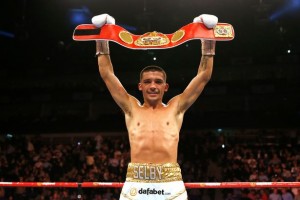


Who I was cheering for, and why?

By Bart Barry-

One doesn’t know when the urge to experimentalism will strike but one learns indulge it until he learns not to (many efforts before he learns to indulge it once more, in the doubly helical way of creative and open systems). Saturday’s aficionado’s buffet – Lee Selby versus Josh Warrington and Gary Russell versus Joseph Diaz, for featherweight titles, and Adonis Stevenson versus Badou Jack for the light heavyweight championship – present a clean enough roster to explore biases and their possible origins.

This column happens in a coffeeshop as it has for a number of years now, ever since I discovered making the process a reward itself was more sustainable than making the process a thing that merits reward; a decade of Sunday morning procrastinations followed by struggles followed by coffeeshop rewards accidentally gave way to an obvious solution that became such only once it happened accidentally. Then a minor epiphany followed: It’s more fun, if not demonstrably better, to write in a loud and bustling place, and to allow the noises and bustles seep in the column, than run the fool’s errand of sealing your system off – what happens when one’s weekly fears shift from being blocked to being bored.

There are echoes and architectural debates and orders and gossiping happening all round – “flood zones” gets articulated but won’t be used – the workaday wanderings of a mind that spent 25 senseless minutes on haploid cells before sending himself northwards to one of the five coffeeshops of the Sunday morning circuit. The irony of exchanging, or having exchanged for us, immortality for rapid improvement, to become fitter, though alas no more adaptable, than bacteria, sets itself outside of irony for preceding irony by a few hundred million years.

No segue. No bridge.

I didn’t care who would win Warrington-Selby for at least a round. Then it became apparent via observation and commentary Warrington was the shorter busier guy, the volume-puncher to Selby’s boxer, and I began to favor Warrington. I’ve been the shorter busier guy far more often than the taller craftier one, and I initially cheer for whomever reminds me of myself, like you do, though not quite inflexibly as Roy Jones does.

Whither the ancient journalistic ideal of unbias? I’m no longer sure it exists or ever did; bias precedes interest a bit like friction precedes motion. Until we have a thought to prove or disprove, I suspect, we’re daydreaming.

No sooner was Selby bleeding from beside both eyes then I began rooting for Selby in the same halfhearted way I rooted for Warrington. Then Selby and Warrington bled together as different arms and legs of the same general body and I began to root for a fair decision, to root halfheartedly for prizefighting itself, until the decision got read. Then I took a nap.

No segue.

I didn’t care who would win Russell-Diaz for a round and a half. I believed Russell was way overrated when HBO hardsold him to us 6 1/2 years ago the same way I believed Vasyl Lomachenko was way overrated when HBO hardsold him to us four years ago. Then they fought, and by virtue of Lomachenko’s victory Lomachenko could no longer be overrated as Russell.

I interviewed Jose Ramirez six years ago for The Ring magazine and wondered if the California-born U.S. Olympian with a last name ending in ‘z’ mightn’t be Diaz until I spent a few minutes looking that up Sunday morning (since I stopped caring if he was, a minute into round 2 Saturday night). The guy I interviewed was too polished by half, too entrepreneurial, too much about branding, to show what composure Diaz showed 30 seconds into Russell’s flashassault on his gloves Saturday.

I’m so tired of hearing about handspeed, Russell’s or anyone else’s. Maybe because I can’t relate. Maybe because I think it’s an unimaginative way to describe a prizefighter – one doesn’t cultivate handspeed any more than he cultivates height or eyecolor.

Russell’s hometown crowd’s cheering his brief show of exhausting ineffectiveness in round 2 made me cheer against him. Then Diaz’s aggressive reply made me stop caring if Diaz was the young branding executive I spoke with in 2012. I continued to cheer for Diaz until the ninth or 10th round, when by virtue of Russell’s not wilting, howsoever many Diaz bodyshots made Russell’s narrow waste crinkle, I decided Russell was doing something very clever to disarm Diaz. The final round I cheered for suspense, and therefore Diaz, but I didn’t mind the decision.

And I admire Russell for giving himself a C+ and being vulnerable about what vulnerable knuckles keep him inactive. While we lament a talent wasted by indolence Russell finds solace and pride in concealed deficiencies overcome.

No bridge.

I didn’t care who would win Stevenson-Jack for its entirety – an acknowledged disinterest influenced in part by the hour when the match’s opening bell rang. At times I wanted the 40-year-old southpaw to do something reckless and violent with his left hand and end the fight because the fight was not entertaining most of its duration. Later I wanted Jack to wearout the old man and end Stevenson’s deeply unsatisfactory reign as world’s lineal light heavyweight champion.

I wanted to cheer for Stevenson because he won his title the right way, lest we forget, mowerstrapping a talented champion favored to outclass him easily, and because Stevenson has a certain roguish charisma, but finally I couldn’t because Stevenson is neither talented nor active enough to bias me. Stevenson obviously received the draw like a victory, not because he thought he won the fight, unconscious as he was when it ended, but because he got to leave the Canadian ring with his title, ensuring one more championsized purse.

Stevenson and Sergey Kovalev, today, form a pair of prizefighters that stands further from a once-desired rivalry than anyone does.

Bart Barry can be reached via Twitter @bartbarry
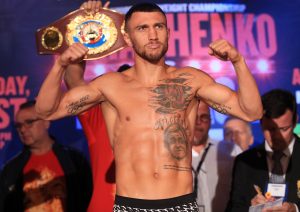


Vasyl Lomachenko: A one-punch indictment, a 10-punch justification

By Bart Barry-

Ukrainian prizefighter Vasyl Lomachenko and his promoter Top Rank accomplished something pretty extraordinary Saturday when Lomachenko stopped lightweight champion Jorge Linares with a liver shot in the 10th round of a primetime ESPN match at Madison Square Garden. They justified a mountainous pile of euphoric forecasting and premature acclaim so high as to appear unjustifiable. Top Rank did this by putting its star in a fight he could lose – scorecards were a split draw after nine rounds – and Lomachenko did this by riding the moment to a transcendent version of himself.

In one punch Lomachenko indicted most of our current era’s best fighters but especially what prizefighter The Ring currently ranks world’s best. That punch was one Lomachenko took, too, from the middle knuckle of Linares’ right fist square on his pretty nose. It was a punch only a larger champion might deliver a fighter of Lomachenko’s talent and craft. It showed, in one moment at midfight, how much margin-for-error disappears when a man’s courage and ambition command him fight progressively larger men. And it showed the Gennady Golovkin reign for the fraud it has been.

I leaped from my seat and cried at my elderly Mexican companion, “¡Ya, vamos a ver que realmente es (now we’re going to see what he really is)! ¡Ya, vamos a ver!” It was a moment both feral and euphoric – finally a favored, celebrated fighter (other than Roman Gonzalez) in a nationally televised fight intentionally challenging himself enough to be dropped. Finally!

Lomachenko rose too quickly, his pride damaged much as his balance, but got through the round abetted in part by Linares’ hesitation – for which Lomachenko deserved much credit as Linares’ previous vanquishers. Lomachenko fought from that moment forward like he was in a fight, not a danceoff or freestyle floor routine. He surpassed himself, too, he accomplished what he’d taken on faith to that point: If circumstances render my routine inadequate, I will respond creatively and it will be glorious. It was.

He finished Linares with boxing’s version of a southpaw encryption key: 2-2-3-1-6-1-6-3-1-4: cross, cross, hook, jab, left uppercut, jab, up-jab, left uppercut, hook, jab, left hook. What should Linares have done differently? Who the hell knows? None of that can be trained for because there’s no history of it. Lomachenko himself did not expect the combination; his left hook to Linares’ body (when the palm faces up, it’s not a cross, whatever latterday purists may tell you) was the first punch in a threestrike combo Lomachenko raced past Linares’ collapsing form. Lomachenko observed Linares on the canvas and pumped his fist with the realization he’d touched the button, inaccessible usually to a southpaw, and Linares couldn’t possibly be conditioned enough to recuperate from it in the 10th round. He wasn’t. Linares didn’t beat the count so much as get unwilted by referee Ricky Gonzalez’s helping him to his feet.

Lomachenko justified the anticipatory hype about him Saturday in a way few modern athletes do. What usually happens, instead, is television promoters, scripts written by boxing promoters, get themselves in front of each story by calling everything they see greatness – across the dial on Saturday Night Fights, a telecast missing only its Just for Men spots, the names Mike Tyson and Tommy Hearns were invoked in the same minute of a 122-pound comain – cynically certain audiences will forgive decades of hyperbole in the event some athlete actually becomes what telecommentators say every other athlete will be. For it is better to call 100 Danny Jacobses elite than call the next Muhammad Ali only above-average.

Which leads to a few recent thoughts about contemporary television commentary. Watching a series of highlights from Tiger Woods’ round 3 at The Players Championship after reading an interesting essay on metamodernism led me to reconsider the role of live sports commentary and entertain the possibility it is becoming more an expression of sincerity than cynicism. For the last two decades its formula has sounded like: You, dear viewer, wish to believe you are extraordinary and unique and consequently curate only what else is extraordinary and unique, and so allow us to tell you everything you watch on our network is extraordinary and unique. That 6-4-3 doubleplay you just saw? Only the seventh time since 2012 a second baseman of Lithuanian descent has assisted a Dominican-born shortstop in ending a scoreless inning on a Tuesday. Historic!

But now, as a generation of secondstring actors, ironists and models makes its historic way off the world’s stage, congratulating itself on historic journalism, television commentary is infiltrated by something professionally sincere. As in:

We are looking for someone to help promote the Tiger Woods brand by accepting applications from energetic public speakers who know how to cheer like drunks in the gallery do.

Why, I have a degree in communications and I love Tiger – I just didn’t think I could get paid for it. I’m in!

There’s no longer a pretense of objectivity, which is oddly refreshing. It’s a performance that requires energy more than skill. Saturday’s ESPN team rehashed the same story of Lomachenko’s dance classes for at least its 83rd public iteration but did so with a fanatic’s sincerity. As Lomachenko, a southpaw, endeavored to keep his front foot outside his orthodox opponent’s – something you learn in boxing just after jab-cross and before hook – the onus fell upon Timothy Bradley and Mark Kriegel to join this pedestrian thing to the legendmaking decision Lomachenko’s dad took to make his son’s footwork the best in all sport, and Bradley and Kriegel were not cowed by the challenge. Even while the fight was tied Bradley assured us Lomachenko was something never before seen while Kriegel reiterated father-son dynamics once more for whatever male viewers are neither fathers nor sons.

Then Lomachenko did something excellent, and it all felt pretty good.

Bart Barry can be reached via Twitter @bartbarry
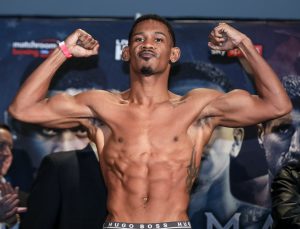


Column 676

Bart Barry-

A genuine pursuit of greatness is not exasperating. It may be breathtaking or ridiculous or sobering or exhilarating, but it may not be exasperating. What many of us sensed late Saturday night and early Sunday morning was exasperation: This was not the best you could do with the resources allotted you, so stop telling us it was.

Let this be a warning to Ukrainian prodigy Vasyl Lomachenko. If after you decimate limited men in American arenas you tell us in broken English you will fight anyone, you should mean it because eventually we will know if you didn’t. We now know it about Gennady Golovkin. We hope not to learn it about Lomachenko. But there are enough similarities between the men’s backgrounds, ascents and sources of popularity, and limited enough evidence of Lomachenko’s true ambition, to worry a bit.

I don’t know what’s going to happen Saturday when Lomachenko makes fists with Venezuelan lightweight champion Jorge Linares, a former prodigy, and was unsure enough to check betting odds before even typing this sentence. Oddsmakers have a professional obligation to weigh reality against publicity in a way the rest of us do not, and they’re not often seduced. Evidently they’re unconvinced by Linares’ recent farmleague showings and remember his being slapjiggled by Juan Carlos Salgado and bled by Antonio DeMarco and gaffherringed by Sergio Thompson.

Linares is The Ring’s lightweight champion, and that is meaningful, and he’s the most accomplished unsuspended fighter in the Golden Boy Promotions stable, which says little and even less when he’s only a nominal part of that stable. Linares has benefited greatly from HBO’s Canelo-retention moves – though still less than Danny Jacobs has benefited from the network’s AJ-capture gambit (though even Linares and Jacobs must’ve watched Saturday’s midnight snack with jaws agape at what lengths the network now goes for any fighter whose father once sang “Be Glorious, our free Motherland”) – but years before Canelo was a glimmer in Oscar De La Hoya’s eye HBO was hardselling Linares as the Golden Boy’s goldenest successor.

He surely wasn’t that. Now Linares is a hardened professional more than a gorgeous usurper and a tactician whose ferocious mien benefits appropriately from what rehabfare composes his diet for years and years after his each knockout loss. But here’s the thing: Linares is sorta precious the same way Lomachenko is sorta precious, and watching them punch one another should be fun. And Linares has been a 135-pound fighter punching and being punched by other 135-pound fighters five years longer than Lomachenko.

Lomachenko is way nearer his prime than Linares is, but if Linares is able to land a punch – and he may not be, according to Juan Carlos Salgado – he will strike Lomachenko with a quotient of force and accuracy Lomachenko has not yet felt. It is doubtful Lomachenko will next melt; Orlando Salido was about big as Linares when Salido made war on Lomachenko’s codpiece four years ago, and Lomachenko did not complain during or after. But he didn’t dance, either, did he?

There’s something frontrunnerish about what prizefighters come from the former Soviet Union – if they don’t quite fade in later rounds they’re neither known for their comebacks. If they know they’re superior when the first bell rings, they may be jab-and-grapplers (Wlad Klitschko) or tigers (Golovkin) or sociopaths (Sergey Kovalev) or performance artists (Lomachenko), but once their actual noses get punched by actual equals who actually know how, they let caution preside. Or as the kids might put it: They. Are. Not. Reckless.

Yes, comrades, I know there are deep cultural reasons for this, attributable to Lenin or Stalin or Collectivization or Glasnost, but before we virtuesignal about atrocities leading to cautiousness we might also, or at least coincidentally, consider Cold War bogeymen making for great modern marketing. All the guys mentioned above were considered great before they did anything to prove it. While boxing historians will someday marvel at Floyd Mayweather’s handicapping his way to an historic-looking resume they might also marvel at the way this era’s fighters from the former Soviet Union didn’t even have to bother.

In this sense Golovkin’s obliteration of Vanes Martirosyan on Saturday marks GGG’s signature win – seeing the middleweight titlist tear apart an unretired junior-middleweight sub reminded us all why we have whatever strong feelings we do about Golovkin’s reign. Those who believe Golovkin is way more than he actually is now tell themselves fairytales that begin like: “In his 40 previous fights Vanes Martirosyan had never been stopped . . .” The rest of us wonder how the fight even got licensed. Then we talk past one another and write for those who already agree with us.

To date Lomachenko has benefited from this dynamic but that might soon change. As he gets taken literally by his promoter and moved up in weight commensurate to his stated ambitions Lomachenko may soon find his accomplishments outpacing their praise. Top Rank, after all, just spent a dozen years promoting Manny Pacquiao; they know what it looks like when a man climbs weightclasses in pursuit of greatness, and they know there was an Erik Morales for every David Diaz, and they know we know the difference. They also know when they make real fights these days they get an extraordinary platform in primetime, and when they make balderdash they get remanded to an app. Lomachenko-Linares gets you 8-10 pm ET on ESPN, and less than Lomachenko-Linares gets you anytime on WiFi.

Bart Barry can be reached via Twitter @bartbarry
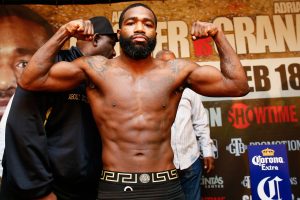


An infomercial for an infomercial for a . . .

By Bart Barry-

Saturday on an HBO telecast from Brooklyn middleweight mandatory challenger Danny “Miracle Man” Jacobs dropped and decisioned Polish junior middleweight Maciej “Certainly Top 10, Maybe Top 5” Sulecki. Before that American heavyweight contender Jarell “Big Baby” Miller didn’t drop but did decision French journeyman Johann Duhaupas. Watching the 24 rounds felt heavy, damp, soggy even, like the card wasn’t primarily intended to entertain but to portend entertaining happenings some other time.

Twas another mediocre broadcast for HBO, but writing that feels bullying, unseemly, beneath oneself – uninsightful because anyone who already doesn’t know it anyway feels it. This column has lacked charity for boxing’s former heart and soul for sometime now, and since its writer isn’t sure such ungraciousness be merited, he needs err to the bonhomous side of the truth on occasion. Let’s try and make this that occasion.

Closing arguments are set to happen today in the Department of Justice’s case against a merger between communications company AT&T and media company Time Warner, parent to HBO, parent to HBO Sports, parent to the World Championship After Dark family or whatever brandnames boxing currently hides under (c’mon now, keep it gracious). These last two years of merging and not merging have to have hamstrung HBO’s coverage of our sport and serve to emphasize the importance of corporate continuity howsoever much business selfhelp literature still fetishizes disruption. Some clarity from a federal government that, under any other executive leadership of the last halfcentury or so, would’ve rubberstamped such a merger – does it obviously harm consumers in the next three months? well, in that case, 30,000 layoffs down the road is just the market god’s way – must be welcomed by those who operate within budgetary constraints. The case against the merger looks arbitrary and spiteful, of course, but it may set an unintentional precedent of asking how a corporate merger benefits customers and employees, not solely shareholders, rather than applying an eroding threshold of how much it harms them.

None of that helps HBO Sports’ nearterm outlook. If the merger gets blocked, a return to business-as-usual sees HBO continue to reexamine its relationship with our beloved sport, writing of erosion, under a new set of assumptions about how essential boxing is (we know boxing is in a bit of a renaissance right now, but the old data in the old bulletpoints of the old slideshows upon which old executives of old media companies make their decisions, why, those are probably partying like it’s 2014). If the merger happens, which even in our current war-is-peace moment still appears probable, HBO must immediately set about the task of seducing its new master, and does anyone think Danny Jacobs or Maciej Sulecki or Jarell Miller or Johann Duhaupas (or Vanes Martirosyan) composes a compelling case for more money?

Nobody does, no. Even those who would pay these guys whatever they were paid see them as a way to bring Anthony Joshua to HBO, or barring that, as a promotional tool for the GolovCanelo rematch that won’t happen Saturday. It’s the only obvious reason you pay the Miracle Man to fight the last weekend in April against a fortunately unknuckled Polish junior middleweight like Sulecki: To ensure by contrast a captive audience for the fifth installment of GolovCanelo 24/7. Untethered from that nearly nothing about Saturday’s broadcast makes sense much less resonates.

Jarell Miller is not very good; there’s not imagination enough in the known universe to call a 300-pound man who doesn’t hurt people compelling. “Oh, but he’s really active and his chest protrudes more than his belly!” – not a recommended bulletpoint for HBO Sports’ first presentation to AT&T management.

Danny Jacobs is a b-level talent with an interesting story that is now threadbare. He’s a cool guy you cheer for when he’s an underdog, but if you have to squint to see nextlevel talent against a tailormade b-side like Sulecki there isn’t nextlevel talent. “He went rounds with GGG!” – a mark of excellence solely within the ranks (measurably reduced since September) of an alternate reality that insists Golovkin is a historic talent. Anyway, when a unanimous-decision loss to Gennady Golovkin is the second-best victory of a prizefighting career begun in 2007 its bearer is not the future of the middleweight division.

Perhaps, then, Vanes “Former U.S. Olympian” Martirosyan is.

No.

A controversial and surprising conclusion, that, I know, but one written by a man who wears with understandable pride this distinction: I attended Martirosyan’s pro debut 13 years ago. That evening at Fort McDowell Casino the man then known as “The Nightmare” had Freddie Roach in his corner but couldn’t stop a 4-3-1 Texas trialhorse named Jesse Orta, foretelling a mildly disappointing career mildly full of mild disappointments.

Saturday Martirosyan becomes the third non-middleweight of the last four men to challenge middleweight champion Gennady Golovkin who is so dominant no middleweight will face him. Surely then, you’re thinking, if the most feared puncher in the history of the middleweight division hasn’t been fighting too-frightened middleweights he must’ve spent the last two years decimating light heavyweights or at least super middleweights? Why, no, actually. Golovkin’s reign of terror at 160 pounds has been perpetrated on two light-middleweights, and get this, a welterweight – 154, 154, 147 – a streak broken by an aforementioned victory over Jacobs inconclusive enough to be part of Jacobs promotions ever since.

But as this column nominally sought a philanthropic spirit towards HBO Sports’ prospects, let us end with a clarifying question about future budgetary items: How do the purses of HBO’s mainevent b-sides, Sulecki and Martirosyan, compare with the stipends paid for those events to Jim Lampley, Max Kellerman, Roy Jones and Harold Lederman?

Bart Barry can be reached via Twitter @bartbarry
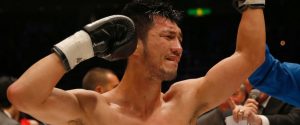


Adrien “About Thousands” Broner, but still about 13 of them

By Bart Barry-

Saturday at Barclays Center overweight Ohio junior welterweight Adrien “About Billions” Broner lost a majority draw to Jessie “The Pride of Las Vegas” Vargas in a pair of unique six-round prizefights the men split, more or less, 6-6. Vargas brought a jab and proper technique, Broner supplied reflexes and a chin, and each man showed plenty of will. Neither man, though, willed himself to a convincing win in round 12, so a draw was just and just fine.

AB was in another excellent fight. That’s not all there is to it, not for this era’s sportsfan and not with a whole lot of blank page between here and column’s end, but that’s what’s important to this and any who should read this.

Broner grates on everyone – lest you think it’s an ethnic thing, look at Sam Watson’s uncharacteristically grim mug leaving the ring Saturday – and if such grating’s not exactly Broner’s appeal it is a sizable part of his staying power, and howsoever unjust it makes the universe, Broner does have staying power. Broner is a ham and a fraud. He’s been those things since we met him on HBO seven years ago, but by virtue of our still watching him seven years later, no matter how maniacal our hopedfor schadenfreude, he is a ham whose hamfattering overcomes its fraudulence in a reflexive way; the object of his hamming is retained visibility no matter how poorly he does at his dayjob. And check this: he’s a perfectly mediocre 6-3-1 (2 KOs) in the last 4 1/2 years and still attracting 13,000 Brooklynites to a catchweight match. He’s got something, in other words, tangible or otherwise, that makes him watchable, the genetic structure of which fully eludes men like Guillermo Rigondeaux and Erislandy Lara – men who follow the rules and bore our pants off.

The day Broner quits on his stool everything dissolves for him, and he absolutely gets this. So long as he gives us the pleasure of his atonement by ordeal every halfyear we inadvertently forgive his criminal acts and bottomless boorishness by paying him in the ratings currency that now rules the American realm. And before any fellow American takes his hindlegs to teeter on principle like a fatigued crossfitter at the stability ball, look around, look at our infatuation with branding, look at our President – in the world’s eyes AB isn’t nearly so much of a caricature as we content ourselves to think he is.

“Not my champion!”

You sure about that, bruh?

In this way Broner’s chin is his best asset; we may not relate to his buffoonery but when we allow our hypothetical selves to be him (and we should, too) we probably conclude like: I’d never wish to arouse so much disgust in so many strangers, but if by chance I did, I would hope I’d make it to the closing bell each time I got tested.

Perhaps by this model featherfisted Jessie Vargas was not the ideal inquisitor, no, but Mikey Garcia was, and Broner toed the line 12 times, then, too. Vargas, himself a mediocre 2-2-1 (1 KO) since 2014, transcended himself a goodish bit Saturday, and had he kept his jab pistoning he’d have won a decision lopsided. Instead he succumbed to who he is and will be: a 144-pound fighter who, on his best night, is equal to Adrien Broner. Every single round Saturday opened with a 10-second forecast of itself. If Vargas landed a jab, he won the round on any honest card. If he did not land an early jab, he made scoring the round the sort of subjective thing that invariably favors a ticketseller.

This was because Broner has no transition, defense to offense. Broner’s defense is a terrible mess concealed by a fabulous chin (which, were it found on an upstanding lad’s pink face, honestly, we’d attribute to incredible conditioning wrought by otherworldy discipline). Broner gets unsettled and imbalanced by other men’s punches so thoroughly he resorts to avoiding them by pocketing his gloves or throwing them overhead while he yanks himself backwards. There isn’t a contortionist the circus over who can throw from such a windup.

That Broner’s perennially overrated new trainer, Kevin Cunningham, installed no patches for this flaw in Broner’s operating system is likely the reason Broner, when asked to list Cunningham’s greatest effects, postfight, named only Cunningham’s giving Broner the chance to thank Broner’s old trainer for his graciousness. However uncouth Broner may be, he has a very high physical IQ – you cannot have his poor form and survive the opponents he’s survived without you read and understand other men’s bodies at least as well as they understand themselves – and Broner intuitively senses his technique is not improved and won’t be by an hysterical disciplinarian like Cunningham.

As an aside, how uncouth is Broner, truly? He appreciates another man’s graciousness, after all, and remains friendly with his former opponents, and holds Jim Gray in contempt.

A quick few words about that: Gray is now the only point of weakness on boxing’s best broadcast crew. Best by a noticeable margin. Al Bernstein has never not been better than Max Kellerman, and Paulie Malignaggi is three times better than an HBO threeway parlay of Jones-Ward-Hopkins, which brings us to Mauro Ranallo. He is hyperbolic at every turn, admittedly, but his heart is in the right place, he cares deeply about the language, and he makes his teammates look good. He is now better than Jim Lampley in the exact proportion Showtime boxing is better than HBO’s.

Bart Barry can be reached via Twitter @bartbarry


Sunday breakfast with Ryota “HHH” Murata

By Bart Barry-

ESPN2 broadcast a middleweight title fight between Japan’s Ryota Murata and Italy’s Emanuel Blandamura at 0800 ET on Sunday morning. Right network, right timeslot. And if Murata’s next opponent is weak as Blandamura, ESPN has a smartphone app and 0500 spot ready to go, too.

Turns out Sunday morning boxing is unlikely to replace church services in America, but it’s not a terrible thing to do with the seven o’clock (CT) hour if you’re already awake. Logging my second Murata fight, Sunday, convinced me he’s not worth setting an alarm for.

Promoter Top Rank has its reasons for vending any ticketseller, be he Mexican (Julio Cesar Chavez Jr., Salvador Sanchez II) or Chinese (Zou Shiming) or gigantic (Butterbean), though often the reasons feel reducible to a Bob Arum autochallenge – Watch this! – and now ESPN has found the perfect programming slot for such fare. Murata-Blandamura sated a demographic like: Bored Italo-Japanese sportsfan undecided between SportsCenter and an abridged NBA replay.

Nothing inspiring happens during a Murata fight. There is bodypunching, sort of – it reliably happens when Murata misses with his cross – and what robotic offensive determination happens when a man is unthreatened by his opposition. We’ve seen this approach, though, ad nauseum, in HBO’s conjuring of Olympic silvermedalist Gennady Gennadyevich Golovkin. The only obvious difference thus far is the timeslot and commentary.

Teddy Atlas, apparently back from exile, though as yet not allowed ringside, saw a b-level prizefighter Sunday morning and said exactly as much. Howsoever wrongheaded Atlas can be the man is independently wrongheaded. Such independence is refreshing when set against HBO’s tickle-me-Elmo promotion of GGG, one that took a b-level prizefighter matched with c-level opponents and caused a nationwide hyperbole drought.

One is tempted to see comeuppance in the ongoing search for a May 5 Golovkin victim; Golovkin is not an a-side in the pay-per-view sense of the term, and initial attempts to make him one went where they belonged. Now Golovkin and his handlers attempt to find some nohoper desperate enough to take short money on shorter notice.

There has long been something cheap about Golovkin’s ascent. Few serious efforts were made to pay serious men like Andre Ward or Carl Froch enough to give Golovkin what opposition might’ve revealed him worthy of the praise so shamelessly heaped on him, and the first such effort – making Golovkin the b-side against Canelo Alvarez – revealed a talent well shy of generational (no, it doesn’t matter if Golovkin deserved the decision; his inability to hurt an oversold junior middleweight damned the whole enterprise).

This current rash scramble for a sacrificial offering sets the mind racing backwards 15 years to Lennox Lewis versus Vitali Klitschko, a fight for the lineal heavyweight championship of the world made on two weeks’ notice. That’s not a typo. Kirk Johnson withdrew from his June 21, 2003, match with Lewis on June 7, and in a turn of matchmaking that now appears miraculous, Vitali (the Klitschko with a chin), who was scheduled for the undercard, signed to fight Lennox. And Lennox signed to fight Vitali. Lewis was unready for Klitschko, and had he not cut Klitschko to the bone early in the match, Lewis likely’d’ve lost. Lewis did not fight again.

To be charitable, all that likely precludes Golovkin from fighting a fellow titlist like Billy Joe Saunders or Murata in June is money. Saunders fights in June, anyway, and will make weight; Murata just made weight and hardly taxed himself sleepstalking Blandamura. It would be an appropriately vengeful tack for Golovkin to take, writing Canelo out of middleweight-title contention: I make fight Saunders June, I make fight Murata September, I forget Clen-elo.

Here’s the less-charitable reason these fights won’t happen: Saunders undresses Golovkin, and Murata loses to Golovkin but shortens what’s left of the GGG salesblitz.

No, Top Rank is not hurrying to match Murata with anyone who’s won a fight outside his native land – a feat Murata may never accomplish – but Top Rank is savvy enough to take a long payday for Murata in a fight that will be dynamite for a few rounds, rather than see its unidimensional Godzilla decisioned by some other tiertwo journeyman on ESPN.

That’s written in good faith, too: I believe Golovkin-Murata would be spellbinding since neither man believes any other 160-pound man in the world hits hard as he does, and both have prepared their defenses accordingly. Golovkin’s not going to eat a Murata righthand and land a knockout punch in the same second, and Murata’s not going to miss high with the cross just to land the hook; both men would be initially bashful, sure, but as neither man has the dexterity or impetus or chief second to fashion a plan b, Golovkin and Murata eventually would resort to smashing one another until the better man wins. Probably that’s Golovkin, but then, he’ll not be the Olympic goldmedalist in the ring that night, will he?

ESPN could use Golovkin-Murata as a meaningful launchparty for ESPN Plus, and maybe even offer HBO Sports some much needed step-aside money (as LL Cool J put it: “With a third of my deposit / I’ll buy your whole crib, plus the clothes in the closet”). Having a pay-per-view match cancelled on account of a drug test was unfortunate and fully unexpected, so how about we not respond predictably with safetyfirst matchmaking rubbish?

Bart Barry can be reached via Twitter @bartbarry