Who the hell is Isaac Chilemba and why’s he on HBO (again)?

By Bart Barry-
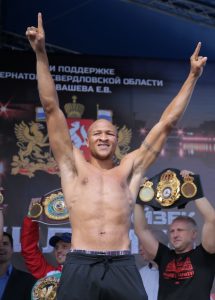
Isaac Chilemba
Sometime soon – or conceivably as you read this – light heavyweight champion Sergey “Krusher” Kovalev will beat up a South African named Isaac Chilemba in a Russian city called Yekaterinburg. HBO will air the mess sometime this evening as part of a yearlong promotional attempt to have Kovalev fight Andre Ward in the network’s one anticipated fight of 2016.

Since now everyone is a promoter anyway . . .

This afternoon the man who calls himself “The Golden Boy” but others know as the Joburg Jo and the Malawi Malcontent, the Gauteng Gatlin Boy and the Terror of Turning Stone, Miguel Isaac Chilemba Zuze, brings his broadfists and rage in a Russian ring with the express purpose of mauling Sergey Kovalev not far from the Soviet Union’s best-known nuclear-waste dump. Frankly the broadcast in broad daylight should be rated R and the reason HBO will not do its tapedelay till after dark. That a network specializing in naked violence and graphical gore like “Game of Thrones” would ultimately flinch at a live broadcast of a boxing match reports to its viewers the unalloyed peril that accompanies Chilemba whenever gauze mounts his knuckles and leather rides his flying fists.

Actually Chilemba is the right man for the job of launching HBO’s one-off MNB series as men returning from second shifts at work will conduct an informal race with Krusher to determine if Kovalev can put Chilemba to sleep before Chilemba snatches the consciousness from HBO’s viewing audience. Such suspense now heralds the Monday arrival of the manly art of self-defense.

The case of Chilemba raises what has become a common question for main events in a way it once was a common question only in undercards and walkouts: Does Chilemba know he is going to lose or will awakening from unconsciousness bring him more than the standard surprise? And if he does know he’s going in the ring as a sacrifice, did he know it before signing the contract or while boarding his flight to Russia or during the weighin that probably happened while this got written?

There was a time so many Mexican taxistas and albañiles staffed the nohoper side of undercards one brought his opera glasses to spot Alfonso Zayas at welterweight or Tun Tun at straw, a time competent matchmakers allowed nary a victor to shuffle from the red corner across a 12-match marquee. After showing valor and a certain whimsical willfulness for a quarter hour this hopeless opponent of the prospect being developed would catch a left hook or right cross flush and drop as if shot then rise to his right knee before the seven count and retain his crouch till the fabled 10 1/2-count at which time he would spring upright and spread his gloves to plead the ref allow his continuance. The referee would make some avuncular gesture or other embracing the lad to tell him neither could conscience his absorbing one more blow. Then the nohoper would do a shameless lap of posture and disbelief before conceding it was not the prospect’s fault and in a show of abiding sportsmanship raise the victor’s taped fist high above both heads.

After a short medical suspension this taxista or albañil would be back on the circuit making enough money to bid zealously on a used pickup truck postfight (my favorite such character was the supremely courteous Genaro “Trancazos” Trazancos who after beginning his career 1-1-1 managed to get himself on television a number of times and fight Miguel Cotto’s older brother and Steven Luevano and Edwin Valero in a three-loss streak that became a curtain-calling 1-11 [10 KOs] close to his career). Such men had no believable chance of prevailing but truly believed they might ring one up and slice the other man just once – since it takes only a punch – and gave honest fighting efforts in a way few of us circumstanced similarly would do. Their job was to ensure a knockout. They were stuntmen who expected to complete the jump but didn’t mind a net stretched just below.

With the advent of the PBC and its quality bending effect there’s no longer any banking on an opponent’s honest effort. Most of the a-siders have adjusted to this and found solace in admonitions to win tonight and look good next time and while that next time never comes it’s not a thing PBC handlers think a biographical video cannot fix. Writing of biographical videos, the only reasonable explanation for HBO’s signing a contract that binds the network to air this farce is a chance to roll viewers towards a Terence Crawford infomercial for a pay-per-view match that mayn’t find its 100,000th viewer in a couple weeks.

Kovalev is a problem for the contemporary nohoper arrangement. He’s a bully-cum-sociopath who derives open joy from torturing lesser men. One might hope performing before a crowd of fellow Russians would leash his psychopathy a teensy-weensy bit until one recalls Kovalev killed Roman Simakov in the very same city five years ago. Kovalev is a loving father now, we’re told, and probably appreciates human life fractionally more than he did then and so Chilemba may well be safe this afternoon.

Therein lies another explanation for boxing’s moribund fanbase: Another main event, an HBO main event no less, finds aficionados fixated on the health and safety of its network-sanctioned opponent.

Bart Barry can be reached via Twitter @bartbarry


Things to do on Independence Day weekend instead of writing a boxing column

By Bart Barry-
boxing-ring-1024x690
SAN ANTONIO – There’s a coffeehouse and bar concept called Halcyon in the south-downtown part of this city called Southtown and what brought me here the first time years ago were the make-your-own open-flame s’mores they bravely serve under the paintings local artists hang for-sale on their walls. What brought me here this afternoon was the eclectic crowd that assembles on Sundays and Mondays. If this column is about boxing at all its author’ll be surprised.

There’s a finch nest tattered in the corner above the window that reflects beside my seat. The nest hung there a month or so and by design was unnoticeable unless you were seated directly beneath it when an occupant flew home or you were an airborne predator and in the second case it was still necessarily unnoticeable. The nest came apart a half hour ago when the wind took the dominant strand away and the unraveling accelerated to disorder. The occupants returned a few minutes ago, a couple – not unlike the folks who just sat across from me on a couch fractionally comfortable as it looks and we’ll see how long they endure it. The finches have no apparent memory how was the nest when they departed but recognized instantly the place they alighted on is uninhabitable currently but shows potential as a home with some repairs – a fixerupper possibly in foreclosure. They set off fusslessly on their task and collect from the ground a blessedly large collection of twigs – what good fortune, this! – that is their former nest unbeknownst to them.

The lass across from me is attractive but covered in tattoos each with a story and pretty clearly in the throes of a tinder date with a douchebag of sorts who nonetheless satisfies the Texas female’s one mating requirement: He is tall. He’s whispering to her about me and it raises an interesting question for any writer: Did he know I thought this about him before I read what I’d written and realized I thought this about him because I didn’t realize I’d noticed him so much as the finches, much less like a competitor, till the beginning of this runon sentence? They’re giggling girlishly now (about my hat probably) and it brings to mind the timeless wisdom of Sir Mix-A-Lot: “I’m a giggle wit’em, ‘cause I wanna get wit’em.”

It’s later than usual and that keeps the brunch crowd from occupying too many tables and it makes the mix in Halcyon right now quite good – modellish women, bearded men, students, lesbians, a few toddler siblings dressed in matching purple outfits by their conscientious mom. The temperature is rising unfortunately because there’s only so much of the good fight any establishment might wage against the summer suffocation of South Texas and if the cooling system kept things below 75 when the place was 1/3 full it’s got no chance against the arrival of the second- and third-third. Its initial emptiness signed departed South Texans, our townsfolk off and enjoying the holiday elsewhere, and much as one hoped the city removed itself to Calgary or Montreal to enjoy rejuvenating climes the greater likelihood is folks who’d otherwise be here brunching were instead floating inebriatedly southwards on one of our many waterways.

Even a year ago I might’ve glanced at a boxing calendar on some site or other before writing a column about not writing a boxing column but it didn’t cross my mind last night when the idea for this column scurried on in. That marks its own demarcation of an extraordinary sort: There was a time I started worrying about my next column Tuesday morning and chastised myself openly if Wednesday evening didn’t bring a workable plan. While I haven’t quite drawn a bead on what my more honorable and mechanical self of 2005 should’ve opined about the writer I am now I suspect he’d have been amused – an appreciation of absurdity being the one thing that held constant in the boiling variable stew of this last decade. Or so I hope.

A good column in a good paper this morning returned me to a months-old pledge to read more Rudyard Kipling and so I enjoyed “The Drums of the Fore and Aft” before going to Central Library, this city’s colorful architectural event that comprises a Botero sculpture in the front atrium and Chihuly glass in its middle. There was a time a tale of cowardice and redemptive courage such as Kipling’s on a Sunday morning would’ve won a tangential inclusion in the week’s column. Instead its allusion here is direct and freely unrelated. Read Kipling because he’s imaginative and not in order to learn something.

Funnily enough the working title for this column was to be “Planning a trip to Johannesburg instead of writing a column” – as planning was what I’d planned to be do doing – but thoughts of a short and wonderfully cheap flight to Cape Town midway through a two-week stay in South Africa seemed unacceptably premeditated when set below all that preceded. It’s something like intuition the way these destinations get chosen or a feeling assembled preconsciously of sounds and images and promised delight from Dublin to Barcelona to Bogota to Joburg.

And now I’m going to mention the young lady who replaced the tall-n-tatted couple on the lima-green sofa, in a faded midnight-blue blouse with upsidedown pink elephants marching between paisleys because I just imagined a conversation with her in which I’d tell her I’m writing about the rebuilding birds’ nest reassembling above us in lieu of writing about boxing and after a 20-minute soliloquy about creative process at the end of which she’d say in exasperation she was overdue at her boyfriend’s or girlfriend’s place I’d tell her to check this column the next morning and see if I was joking when I said I’d mention her.

Bart Barry can be reached via Twitter @bartbarry


Good if not quite timeless: One Time decisions Showtime

By Bart Barry-
Keith Thurman
Saturday in Brooklyn, Florida welterweight Keith “One Time” Thurman hit Ohio’s “Showtime” Shawn Porter many many times and all over though not too often on the chin and beat him by three fair scores of 115-113. Social media reacted with uncharacteristic sobriety to a match Showtime-on-CBS-presented-by-PBC commentary mistook for a historic war from opening bell to closing after promising a historic war over and over and over.

The match was better than expected and about a third what viewers heard it was from the PBC’s circusbarking play-by-play dude. Somewhere in his relentless drumbeat of historic punchstat figures and legendary power this contradiction became obvious in a way best posed like a question: How come Mike Tyson never set any activity records in his heyday?

Television, mankind’s greatest yet enthusiasm-dissemination device, embraces then amplifies emotions as they arise, picking them up and setting them down instant by instant, and therefore no conflict registered to Saturday’s on-air lunacy. But here it is in a plainspoken way television can’t do: If Keith Thurman hits so damn hard, how come 200 chops with the Thurman axe didn’t dent much less fell the Porter tree? How come a Sunday morning camaraderie pic of Thurman and Porter saw Porter looking so clean, safe and sane?

Because Porter has a legendary chin! Sure, right, whatever; legends don’t get dropped by clowns like Adrien Broner and Porter did.

Great acts of combat inspire great prose.

“They both appeared exhausted in the final round but let it all hang out,” wrote ESPN’s Dan Rafael.

“With the kind of tremendous action they created in the ring, a rematch is a no-brainer and an easy sell,” wrote USA Today’s Mike Coppinger.

Porter was what his supporters believed he was and Thurman was a bit less. Like every other volume puncher in history Porter erred with his chin over his front knee, too anxious to impose himself and consequently wide open to counter uppercuts. Thurman landed a few and more of other counters like his left hook but often Thurman was in such frantic and tanglefooted retreat the punches did not measure on Porter’s chin the way they attacked PBC viewers’ ears.

Congratulations of a sort for that: The missing component of television broadcasts has long been its flattening audio that makes all punches sound the same. PBC raced directly past that issue in a wide circle that now has every punch sounding much louder and the same.

It is easy to call Porter a fun fighter without calling him or Saturday’s match legendary and probably advisable too. Being anywhere but Brooklyn for a columnist had the advantage of being far from the event’s boorish puppet-promoter sweating and screaming across press row about the quality of his product. Porter combines athleticism, desire, and yes, intelligence the way young Timothy Bradley and Juan Diaz did. He is aware of his limitations in a way his opponents are not; volume guys do not fear violence or exhaustion or ridicule the way they shudder at others’ right uppercuts but it takes a Juan Manuel Marquez – much more than a Keith Thurman – to plant and hold steady with a wildman racing your way. Porter’s jab wasn’t merely the decoy it appeared but wasn’t much more than that either. When the two men jabbed together Porter’s jab was often the first arriver but no credible source ever said Thurman had a great jab.

What Thurman has is a right hand and sometimes a left hook but it’s been so long since he fought an opponent bad enough to make him look invincible it’s admittedly hard to recall what made us so excited about him years ago but speed and intensity are good places as any to look. Or perhaps it was our delirious search to find some welterweight who might ice Floyd Mayweather that made us see in Thurman more than was there. Whatever images once danced in our heads Thurman’s footwork today rates, on a scale of novice-to-master, about: Amir Khan + 1.

Porter was able to jab him out of position and spin him fairly easily because, whatever postfight allusions Thurman concocted about Muhammad Ali (who as an aside gave away opening rounds in order to knock George Foreman out, not decision him narrowly) Thurman’s feet rarely anchored his body properly. His vaunted power, which took precious little fight out of Porter, relied heavily on Porter’s aggressiveness and Porter delivered that aggressiveness, swinging and missing ferally and fairly often(ly), but Thurman was out of position or in-position and retreating at the time of Porter’s arrivals mostly. A generation raised to confuse wide circles and wasted effort with great defense surely saw in Thurman’s tactics something like genius but not the rest of us. Better put: In 36 minutes of what horizontal ferocity snaps heavybags from gym ceilings vertically Thurman didn’t once show Porter as much conviction or technique or effect as “About Billions” did.

Still, Thurman-Porter 1 was dramatic throughout and suspenseful occasionally. Let us see an immediate rematch. According to their Sunday pic neither guy was ruined by Saturday’s match and according to previous box-office receipts neither guy is popular enough to spend another year starching novices. Provided the check clears this week CBS should agree to air the rematch in December, too – maybe even at a discount.

Bart Barry can be reached via Twitter @bartbarry


Thurman-Porter: Trying for enthusiasm

By Bart Barry-
Keith Thurman
Saturday in Brooklyn in what remains of an anticipated title match for an expiring sport Ohio welterweight “Showtime” Shawn Porter will square up with Florida’s Keith “One Time” Thurman in a match that figures to disappoint what exaggerated expectations desperate aficionados have affixed to it. This will be yet another chance and in all probability one of the last for PBC to captivate a nationwide audience and win new fans to its brand of boxing.

Thurman and Porter have nearly identical records and nearly identical stretches of inactivity, and while that sort of thing once may have marinated things richly today it does little more than serve as a reminder of the incompetence with which they’ve been handled. Their manager/promoter group, once the brainchild of a visionary and rapidly becoming what kids these days call a cautionary tale, has taken whatever whitehot enthusiasm ever existed for either of these fighters and doused it to soggy.

Thurman, a charismatic action fighter whom an accomplished promoter like Bob Arum might’ve made an international heartthrob, is now a joke of sorts. He has steadily lost others’ esteem even while not losing a match. Wait, when did I last see him fighting? – you probably wonder. In a July homecoming fiasco that saw Luis Collazo wave off his own bout to ensure the PBC darling got another w and Collazo got his name engraved on the PBC Employee of the Month plaque hanging above a headquarters restroom with what majesty GoPros hang off PBC-referee headbands.

Is that too irreverent? Then let us acknowledge the irreverence as a reflective surface off which bounces former aficionados’ disgust with what has become of their, our, oncebeloved sport.

Nothing holds constant in this game. That is the lesson of what has happened to a sport that was passably popular if not thriving just five years ago. No, folks round the proverbial watercooler were not fluttering their tongues about prizefighting but those who cared about the sport had four or five annual events worth traveling to, incredible happenings in no way tarnished by others’ absent interest. That is gone now. Quickly as the quality of combat deteriorated the reverence for sanctioned combat accelerated directly past it. Boxing attracts misanthropes and was long vulnerable to its supporters’ routine sneers. What it collects now is fulltime indifference occasionally interrupted by derision. People, often former readers, now ask boxing writers what sort of writing we’re doing these days, convinced it couldn’t be boxing and too uninterested to find our URLs in the forgotten Boxing folder of their Favorites bar.

Do Porter and Thurman deserve the blame for all that? Of course not, but their manager and promotional network deserves a halfshare.

Thurman postponed the match, too, helping folks to assume someway it would not happen. But that postponement should not undo our memories; if this fight had happened when it was scheduled to go off, the gap in both men’s careers still would’ve been unacceptable: Sugar Ray Leonard and Thomas Hearns, two fighters whose first match in 1981 remains the standard against which all welterweight tilts are measured 35 years later, each fought less than three months before their championship match – a true superfight.

This is what that has come to: Both Thurman and Porter went in tough about a year ago, Porter barely surviving Adrien Broner and Thurman needing Collazo’s selfejection to remain undefeated. Neither Leonard nor Hearns would’ve needed more than five rounds to obliterate either Collazo or Broner (or Thurman or Porter), and both men would’ve fought again round Labor Day having done so. With the collective departure of Mayweather and Pacquiao, Thurman and Porter are two of the world’s three best welterweights and considered the benevolent PBC god’s reply to years of aficionados’ futile prayers.

The worst part is the fight won’t be great and likely not entertaining either. Porter, for all his ferocity, just isn’t very good. He’s a boxing-is-bodybuilding sort whose physique anticipates a concusiveness well subverted by his technique. But what musculature!

Whatever we thought Thurman was three or four years ago he hasn’t been very much of it in recent fights. If your talent or tactics see you grinding out a lame decision against a 40-year-old Leonard Bundu, you’re probably not going to go HAM on someone with 16 career knockouts. Expect a keepaway effort from Thurman, while the announcing team drills and exercises about courage and nonstop whatever.

It will be sanitized, too, whatever else it is. PBC boxing feels far too safe to keep serious fans or attract casual ones. It is Mayweather’s brand of violence without Mayweather’s brand of promotion. It is men behaving like gentlemen in press conferences and amateur boxers in the ring, concerned with points and safety and so forth more than violence or pain or willfulness.

I’ll take Thurman by dull decision, in a match social media, queued by PBC commentary, initially mistakes for a historic war.

Bart Barry can be reached via Twitter @bartbarry


Interview with San Fernando Gymnasium

By Bart Barry
boxing-ring-1024x690
Originally conducted for the San Antonio Historic Preservation Society in 2012, this interview is reprinted with the gymnasium’s permission.

BB: I sure appreciate your getting together to do this chat with me. It’s an odd request, I admit.

SF: Not a problem. Surprises me more people don’t ask. This isn’t going to be a podcast?

BB: No, this is for print.

SF: Obscurity does not offend me.

BB: You began as a bowling alley, correct?

SF: In part. The apartments (Soap Works, today) round me were all part of a campus. We were a Catholic school, and I its gymnasium. The legend is another thing.

BB: Of the church or the saint?

SF: The church. I don’t know much about my namesake. We feel our influences but don’t know our fathers too well. What I know comes from construction chatter as the walls went up.

BB: Before we began, you mentioned being a young edifice in an old city is a different experience from being a young edifice in a young city. These things are relative, too. But what informs your thinking of one city being older than another?

SF: Friendliness. I notice it when there’s a tournament upstairs or down. People come from younger cities. They’re used to bending edifices which way they want. They’re gentler to the walls, harsher to the regulars and staff. Things break all over me after big tournaments. Always with the water. They talk faster. They talk about making a difference to their sons or the generation after that. That’s young-city talk.

BB: That’s not refreshing in some sense?

SF: In no sense. If they get their way, I get torn down, made into more hospital parking or another hotel in –

BB: But you recognize the value of touri –

SF: Some of the buildings I admire most are hotels and hospitals, yes.

BB: As someone who moves around on your mats –

SF: (Smiling) I’ve seen you.

BB: Figuratively speaking, then, as someone who moves around on your mats, there’s a unique, almost hollow feeling. There’s not concrete on –

SF: There’s concrete down here, but you don’t want to touch it.

BB: It’s wooded-over, then?

SF: Yes, exactly. I began as a bowling alley. Some of the wood rotted. It’s been a half century. Those were fun times. Made quite a racket. The buzzer is not torturous as the candlepins were noise-wise. But it’s worse in its way.

BB: Not volume?

SF: Not at all. It’s soft and tinny by comparison.

BB: Then?

SF: My concept of time is decades. It’s hard for me to imagine increments less. Like y’all with millimeters –

BB: Milliseconds?

SF: Yes. I prefer metric. The buzzer goes off so often, so many times, and it builds this terrible anticipation. Like waiting for the next water to drop on your forehead. Relief comes when the damn thing gets turned off at night.

BB: Speaking of which, you’re well preserved in part because of how little time you’re actually open these days. You get mornings off.

SF: That is true. I do enjoy a lighter schedule. It began round 1980, six years after the Close Call.

BB: When they were going to raze you?

SF: Pretty euphemism.

BB: How close did you come?

SF: Well. They had demolition guys walking round. You think they do that at Monticello?

BB: How the hell do you know –

SF: Be surprised the things one picks up.

BB: Basketball game?

SF: Roller derby. They began coming on Tuesday nights some years ago. Then there’s the basketball people. And you guys in the ring below.

BB: Ever have any famous roller-derby participants?

SF: Any what?

BB: How about basketball players?

SF: Doubtful.

BB: Boxers?

SF: Plenty.

BB: How can you tell?

SF: It’s a congregation thing. There’s a way men and women upstairs look at certain players. It’s an admiration, like they’re watching while they imagine themselves being those persons. Then there are the looks sometimes downstairs. It’s a look of incredulousness. It’s the look persons give to persons they did not think they would ever see in front of them.

BB: It’d help this exercise a lot if you remembered any names.

SF: Julio Cesar Chavez, Mike Tyson, Danny Lopez, Jack Johnson, Oscar De La Hoya, Evander Holyfield, Salvador Sanchez.

BB: Those guys have all been here?

SF: Except Jack Johnson. Made that one up.

BB: He was from Texas at least.

SF: Like me.

BB: I’ve read there’s a rule every building grows. But you seem not to have grown.

SF: Inside, some, but no, not outside. They’ve updated bathrooms and put on coats of paint. The lockers and shower downstairs, those weren’t with me before. There are walls inside, concrete. The materials are cheaper inside than out. Because of that infernal heater, I guess.

BB: It’s the only part of you I hate. Who the hell installs an industrial heater in steamy South Texas?

SF: The crazy Portuguese, that’s who!

BB: Joe Souza?

SF: Yes. He did all my interior decorating, too. Such as it is.

BB: These are his fight posters?

SF: All of them. They say his family wants them. The Parks & Rec guys will probably paint me again once they’re gone.

BB: How long have you been city property?

SF: 1974.

BB: Does it bother you?

SF: Not like it did. We are not all destined to be museums, coddled and soft, temperature-controlled this and that. There’s the historic-preservation people, too. Seeing y’all makes me hopeful. It means if someone decides to buy me from the city, which I do not expect to happen, these people will not be able to tear me down.

BB: That’s good.

Bart Barry can be reached via Twitter @bartbarry


The obligatory: Muhammad Ali, 1942 – 2016

By Bart Barry-
Muhammad Ali
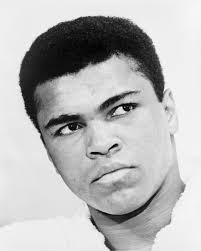
Muhammad Ali died Friday evening at the age of 74. His death was long anticipated by those who follow our sport and know the ruinous effect it visits on each of its professional practitioners. Round the world Saturday persons instantly and for the most part sincerely began to mourn a man most had not thought about in decades, reliably imparting how much larger Ali was than his and our sport.

The happiest benefit of writing for a site like this, a boutique affair designed for aficionados, is the relief that washes over a writer when he remembers on days like these he does not need to put the accomplishments of a prizefighter in the larger context of others’ fantasies. If he doesn’t have a champion’s record memorized, quite, he has access to memories enough to write confidently about the only interest a reader should bring to a site like this. It isn’t liberating in the wildeyed gamboling-through-a-daisy-patch way we lately understand the word but it’s sufficiently liberating to make an exercise futile as this one doable.

This won’t be a piece that cherrypicks anecdotes showing how well the deceased represented my specific and fairly narrow worldviews, a selfhelp epic stiffened by another man’s violence, and it won’t be an exhaustive and autobiographical drumroll either; my earliest recollection of Ali was his being a sad foil to Larry Holmes, and therefore no amount of YouTube immersion makes Ali’s effect on me deep or enduring as those taken by champions of my youth and adolescence like Marvelous Marvin Hagler and Mike Tyson.

If you’re here for a definitive obituary you’re going to be disappointed. What follows is better read as an honest attempt at an obligatory act.

It begins with violence. In the press to canonize Ali his impulse to violence has been scoured till bleached. He danced and floated with a gorgeous face and an enchanting physique and golden glow because he was a pacifistic poet who would shape a generation and show a worldful of people their better selves. No, not really, but the cardboard saint must be propped high – the better to reflect us for us.

Doubt not the importance of Ali’s reflective surface on the legacy so many now celebrate. As Parkinson’s (disease, syndrome, etc.) made a marble facade of his once-expressive and often-offensive countenance Ali’s capacity for challenging others’ ideals to a point of repugnance and rage congealed to a face tailored for beloving. Ali went along with it because he did love others’ adoration and because he also loved money and because, ultimately, how much choice did he have as he watched in amusement an entire country following a pattern of attraction seen in bars round the world every night: Repulsion to curiosity to fixation?

Ali was an original who inadvertently provided future marketing masterminds a template they ably applied to Tiger Woods then Barack Obama, neither of whom was possible before Muhammad Ali.

Back to violence. Look closely at how Ali set his mouth when he threw righthands – hurting punches thrown with every intention of bringing pain or unconsciousness or both to the men across from him. Don’t dismiss this as an anomaly either; Ali had athleticism and charisma enough to make his living quite a few ways other than hurting others but he hurt others for a living because he was great at it in a way we rightly call historic. That is an aesthetic judgment, not a moral one; it is a reminder Ali’s ascent from Olympic gold medalist to heavyweight champion of the world relied necessarily on his conversion from an athlete who boxed for points to a fighter who hurt other men, and he didn’t do it reluctantly.

Look at his mouth when he threw right hands and look at his eyes when he took other men’s consciousness. Ali was all fighter. Since that is not palatable to many target demographics today we are told how much larger than his profession Ali was by people who for the most part do not understand Ali’s profession and wish to assert the greatness of their times by making the greatest of their times relatable to absolutely everyone.

This collision happened a lot in the obituaries that happened in the hours after Ali’s death, obituaries many sportswriters began composing a decade ago. What to say about a great man when one’s peers in radio and television use the word “great” to describe a hundred things weekly? Ultimately, if you have any craft at all you revert to understatement and hope for the best, as many of our craft’s best craftsmen did. Otherwise you convict language itself of inadequacy then use a sprinkler-system approach, dashing from accomplishment to accomplishment in the hopes some rule of sheer yardage will capture the totality of the man.

Inspiration is ephemeral but sexy to claim from another. Of those millions who today claim Ali as the source of their inspiration, it is proper to ask: Inspiration to do what?

Social media answers the question in most cases: Try to become famous.

Those claiming to be inspired by Ali to do other things are persistently unreliable with one exception: Fighters. There’s some mention of Ali in every boxing gym across the land (at our gym, curiously, there’s a black-on-gold mural of Ali with a quote attributed to him that goes: “Champions are not made in the gym”) and Ali surely inspired a large number of fighters in the generation following his to don gloves and dance, hands lowered, looking pretty. And most every one of those guys got his clock cleaned in month one and retired instantly thereafter.

To the cultural critics goes the task of naming, numbering and coloring-in every way the man was larger than his profession. To aficionados it need go no further than this: Muhammad Ali was the very best fighter in his division’s very best era.

Bart Barry can be reached via Twitter @bartbarry


Southwest boxing roundbench

By Bart Barry-
Boxing Ring
“By the time the matador enters with his cape and sword, the bull is already swaying sideways and forwards as if at sea, with punctured and twitching muscles – surprised, I think, and offended, but here is the thing – seeing itself for the first time in true relation to something else, no longer alone and dominant, but suddenly half of a two-way exchange.” – Samantha Harvey, Dear Thief

Cast
RAMIREZ …. Barber and trainer, former amateur boxer in San Antonio, tall.
SIL …. Aircraft engineer, former Texas Golden Gloves champion in Dallas, fast.
BIG RICK …. Construction worker, former Alabama defensive lineman, strong.
SAFE HANDS …. Writer, fifty pounds overweight, relaxed.

RAMIREZ: Big Rick gets done with him, and I say, ‘Another victim.’ Safe Hands starts auctioning it all off. He donates his headgear to the gym, kept his gloves, and gives a Mexican kid that hightech mouthpiece he was so proud of.

BIG RICK: Was a surprise, dude. I didn’t think it was that bad.

SAFE HANDS: It was that bad. Let me be clear.

SIL: Good chin and a long fuse when we sparred, Safe Hands.

RAMIREZ: Same thing with Big Rick.

SAFE HANDS: Y’all weren’t getting hit by him.

BIG RICK: I went easy. I didn’t put it on you. What would’ve happened if I did?

SAFE HANDS: No worse because you’d have tensed up, slowed down. Only time in my life I had this terrible thought: What if he kills me by accident?

RAMIREZ: Never been there. I take that shit personal.

SIL: Me either. It’s a fight.

RAMIREZ: Safe Hands, you kept leaning left, putting yourself in cannon alley.

SAFE HANDS: I was out of my mind. Every time Big Rick hit me, I wondered why the hell I was still conscious.

BIG RICK: You make me into more than I am.

SAFE HANDS: Bullshit. Fear doesn’t lie.

RAMIREZ: You ever spar him, Sil?

SIL: Safe Hands? Lots.

RAMIREZ: Big Rick.

SIL: Once. I don’t know about them right hands. I wasn’t availing myself of them.

BIG RICK: Frustrating as shit, man. I couldn’t find him anywhere I looked.

RAMIREZ: I only did pads with him. Did that before I put him in with Safe Hands. I knew what was coming.

SAFE HANDS: Thanks, friend.

RAMIREZ: (Laughing) You’re welcome, friend.

SIL: Why they start calling you ‘Safe Hands’?

SAFE HANDS: Ask Ramirez – his nickname.

RAMIREZ: I seen this lazy whiteboy barely hitting the bag. Putting in no work. Three minutes was his finish line, and he don’t care how he gets there. But he knew how to wrap hands. Safest hands in the gym, ain’t that right, Safe Hands?

SIL: He used to war a little with me.

SAFE HANDS: You brought it out, Sil. That incessant tapping. He’d make me wear headgear, which I hated, just so he could aim at that Everlast label on my forehead. A target.

SIL: I told you.

SAFE HANDS: No lie. He told me to get headgear with a label so he’d have something to aim those jabs at. Tap, tap, tap.

SIL: Eventually he’d get mad and pounce. It was either wrestle him or war with him, and we usually wrestled. He had a chin and some hook. I don’t war with that.

RAMIREZ: Why didn’t we ever spar, Safe Hands?

SAFE HANDS: I’ll tell you exactly why. That kid Joe. He was my height, much faster and about half my age. I watched you run him into that left elbow four times. Fifth time you split his eyebrow.

RAMIREZ: You’re gonna to be a tall Puerto Rican in Little Mexico, kid, you better have something. I got scalps with that elbow.

BIG RICK: Ramirez can crack. Tall skinny dude who brings it.

RAMIREZ: It’s the chinups. I tell the kids do chinups. A knotted upper back is how you get power.

SAFE HANDS: Or you can be three hundred pounds of muscle like Big Rick.

RAMIREZ: That’ll do.

SIL: Not every big guy –

RAMIREZ: Was just going to say that.

SIL: – knows how to punch. You weigh three hundred pounds, you can hurt another man. But there’s a difference between that muscle-punching and a guy who has technique.

SAFE HANDS: Big Rick was rough when I first saw him. I told my wife, ‘Black guys hate getting hit in the face. I’ll just put a jab in his face, his hands’ll go way up, I’ll jump in under his elbows, and he’ll get tired after a couple rounds.’

BIG RICK: You were right about hitting me in the face.

SAFE HANDS: Did I?

RAMIREZ: You landed a couple.

SAFE HANDS: Big Rick got out of range so damn fast. That first step backwards, man, that’s what did me in. He’d be out of range, and I’d be soldout over my left knee, and then, boom!

BIG RICK: I’m strong as shit, dude, but I can move.

SAFE HANDS: I wasn’t ready for that. Sil, sure, he’s polished. But not you, Big Rick.

BIG RICK: I ain’t moved like Sil in my life.

SIL: (Smiling) Put the sweetness in the science, brother.

SAFE HANDS: How tall are you, Sil?

SIL: I tell people six-foot.

RAMIREZ: I’m six-four, Sil, and I got you by half a foot.

SIL: Hush, child.

SAFE HANDS: First ten times I sparred with Sil, I swore he was seven-foot. He was ten feet away from me. I’ve never sparred with anyone who understood space like Sil.

BIG RICK: I still ain’t hit him, seen him.

SIL: Got to keep the young folks at bay.

RAMIREZ: You calling Safe Hands ‘young’? How old are you Sil?

SIL: Not important.

RAMIREZ: He shaves his head and refuses to talk.

SAFE HANDS: What do you guys think of that quote at the top?

BIG RICK: About the bull?

SIL: I kinda liked it. But I like sparring more than sex truly. Moving around is a drug for me. It’s why I’m still doing it –

SAFE HANDS: At whatever age.

SIL: There you go.

RAMIREZ: You ever get sparring so good you don’t care if you lose, if you look bad, because you’re just so glad you found someone you match so well with?

BIG RICK: Hell no.

SIL: Nah.

RAMIREZ: Me either. But I hear stories.

SAFE HANDS: I have.

RAMIREZ: Fucking Safe Hands.

Bart Barry can be reached via Twitter @bartbarry


The tension into

By Bart Barry-
boxing-ring-1024x690
It finds the men squaredoff and relaxed in their postures from the prebell instructions of their trainers, assurances of their conditioning and readiness and the high number of times those trainers have been there, here, exactly in this place, so trust me.

It starts in the tops of the hips a quarter of the way from the points to the knees and hollows them, thinning their thighs from dense meatslabs to brittle scaffolding to papier-mâché shells. Knee weakness sings the alarm causing fright. The doublingback on itself begins nature’s progression: Notice begets more fatigue begets concern begets more fatigue begets worry begets more more fatigue begets fear begets more more more fatigue begets panic begets more more more more more fatigue begets resignation. Tension succeeds by beginning its doubts here: Am I ready for this? why do I ask? because I don’t know if they know what they’re talking about? but if they’ve been here so many times before? have they? was it like this? were others like me? were their opponents anything like him? why did I agree to this? what happens tomorrow? when, demons, will that bell ring?

It finds the ref watching the fighters closely because he wants to be fair clearminded effective in his task of ensuring a just outcome imposing little permanent injury as possible. There are the cameras to mind. His trademarked tagline shouted he wants to be deliberate not fidgety; he wants to be invisible to the spectators unless some intolerable something happens then be fleet. But if he’s invisible he relies on chance to get noticed all that fairness effectiveness wasted ignored unacknowledged. Be noticed only to be recognized by strangers? No not that – to be seen participating interacting watching closely watching in case something like that other time happens and a kid falls of his own weight really not a punch, sideways, a slipped punch that began a tilt that became a lean that fired the canvas’s upwards launch at an awareness disconnected offduty lazy. No count, the tension reminds him, no need for a count but flailing at a wrong corner as from a different corner men rushed towards the center of the ring a brother trainer or father and the stretcher paramedics’ scrabbling for an oxygen mask.

The tension gets him by a proportion this queer: The louder the applause for the departing gurney the greater the recrimination for the referee who let the fight go too far.

It finds the judges confident in their intention or their execution of someone else’s. “Score a round 10-10 if you have to and let posterity work it out,” one tells himself and affirms it with a quick nod. Then the cheering becomes disproportionate for the right ethnicity and he begins bleeding from a punch caused by a cut or was it butted accidentally – damn it why doesn’t this referee e-nun-ci-ate for us like the cameras when he tells us these things! The tension mounts him and his two peers with iterations of the same thought: If that round was close and they both scored it opposite the way I scored it my card will look wrong to the majority and I’ll have to defend myself to the commission next week unless I’m sure so I better watch both guys (the other guy) more closely this round in case it’s close.

It finds the promoter defacto manager of the a-side considering his work a success arena full and television revenues pop an accidental cut on the a-side makes the crowd gasp. Awkward as all hell that sound. We haven’t recouped even the signing bonus, says the tension, much less the dozen signing bonuses for other prospects much less the broadcast idea the studio stupidity the infomercial production a hundred takes at a hundred a take, and kid’s up there hamming and gushing and gushing and hamming round like the blood is rolling in his ears listen to the crowd for God’s sake.

It finds the publicist happily looking over press row counting noses ranking noses numbering distribution lists and enthusiasm so very much for the YouTube highlights 20,000 hits and the merchandising to come. Look for action to remind the major writers about: Remember when he landed that left hook, kaboom, the way the crowd jumped this guy told me he had a soundifier-thingy app on his phone and he’s’n last row of the upper balcony, and when the left hook landed, this guy tells me, his app gets an error cause it can’t read that much sound. Not sure his name but I’ll find out. The tension finds him watching the writers watching and squinching their adoring faces about just a little bit of blood no big deal best cutman in the business and you get hit more when you hit the other guy a lot. Boxing 101.

It finds the writers in their usual spot the tension doesn’t have to search for because it never departs them.

It finds the celebrity actorguest with his fist raised for the roving camera that records him to have an image to beam at the arena to ensure the unfortunates they’ve attended for once a happening and are exotic. Did it linger on me long as it lingered on the basketball player long as it lingered on the former fighter? The tension finds him and asks why if he is the star of an incredible upcoming series is his date looking at the former fighter who is shuffling over with a fake smile for him and an arm round her waist for a selfie she promises to send him if he gives her his number?

At the arenaback in the filthy b-side dressing rooms filmed by wet tape shreds and bloody towels it finds the vanquished studying their commission checks and wondering if there’ll be more checks and this one’ll get the eviction sticker off the keyhole of the tiny apartment he shares with his girlfriend and her newborn son Gustavo.

Bart Barry can be reached via Twitter @bartbarry


Into the tension

By Bart Barry–
boxing_image
Arrived too early in their dressing rooms, to satisfy broadcaster’s schedules, and bored, the main event guys do anything to calm themselves: text watch the monitors’ undercard scraps stretch nap . . .

There’s weightshifting in the queue, left to right to right right to left. Someone has a small banner in the right leg of his jeans covered in clever script about a cousin’s friend on the undercard and he fingers its stitching to a rash. Many of the guys wear shiny suitjackets or shirts with shiny script congruent to the MMA fashion show (a redundancy) of the decade past. Others wear flared-tight-flared white buttondown ensembles with roughsilk piping and bluejeans with logos and an overpriced belt they think women notice, a profession of physique and badassery to put others on notice if anyone were able to distract himself from autofixation long enough to notice.

pace undress partially redress, not time yet, talk through handlers’ concerns meet local celebrities absorb familiars’ fears laugh senselessly at a promoter’s lame support tell a bottling company exec how much his sponsorship means

The few women in line clutch their men’s hands in an unspoken theatrical treaty: If all these guys are posers like you, sweetie, then I have nothing for you to protect me from and that’ll make you feel emasculated enough to drink too much and create a petty confrontation to save me from, so let me act a little frightened in this ridiculous red dress you bought me for this occasion to impress your buddies.

lower eyelids cradle napes with folded fingers imagine remembering a hundred training tips fantasize about the purse check stretch stretch doubt the other guy’s routine envy no one

Security at the door is a hyperbolic symmetry of the same sorts of men in line, though paid marginally less, and trying to put a charismatic mask on faces quick to trigger and show offense, all faux players in a faux presentation of peril and might. Keys, wallet, belt and hat resecured, there are the concession lines to navigate, which way’s the beer and why must bottled water be poured in a cup?

listen for noise from the other guy’s room field rumors about the other guy’s camp make fists then relax replay the weighin with goodfaith replay the weighin with badfaith worry what the eyes betrayed of fear or excitement like fear or calm like fearlessness feel lonely enough to blame the manager and familiars

Inside the usual human gambit of imitation for affirmation’s sake finds too many beers bought causing overwrought reactions to a combatant’s bravery via its contrast – his opponent’s inactivity, resignation, caution; failure. No fight is average, no match is scored fairly, no prizefighter makes a simple decent account of himself; every match is a war or a waste of time like I told ya was going to happen, every decision has a corrupt judge or an honest judge whose virtue is wildly offset by two villains, every prizefighter is a future great I saw first or worthless.

feel misunderstood wish the whole thing might be called envision a loss and how it can be soothed tomorrow catch scold think about bills say everything is handled concentrate worry concentrate worry worry worry concentrate begin to exert in relaxing postures get anxious about the middle knuckle of the left hand forget about that knuckle text a compassionate someone, wife friend mom, i love you

The lights dimmed and the main event entrance tunes beginning to roar, press row fills with yawns inexplicably – except yawns as a circuitbreaker, not an expression of boredom, a fatigue courted by anticipation, a recognition of the coming fight’s value, a collective plea that what happens next bring an unbearable spectacle but not quite, all underwritten by a collective of individual fears about talent and presence and the tall pile of unpredictables and unknowables and uncontrollables (luck) that conspire to make a written account of combat either something that duly honors its subject or doesn’t.

obey orders begin to warm meet the referee and seek connection try to read sympathy get frustrated by the cameras and their effect take the trunks off their hanger and leave the robe adjust the cup both balls in and snug but not tight or queasiness put the boots on and slam the heel left foot first and tie the laces watch the other guy’s trainer watch the hands get wrapped notice the games transcend the games wonder if feeling above the games is being a victim of the games then try to be oblivious of the other trainer’s games unless it’s too much but what is too much if it’s his job to be too much

The heeltapping triples its time under the collapsible tables as young writers do a last rewrite of their prework and old writers wish they would just get on with the fight for fuck’s sake.

punch palms with freshwrapped fists out of habit force the open hands in leather stiffness and scent watch the white taperoll go round round round round wonder what the official’s blackmarker scribble means to him more posturing hit the pads endure the national anthem going on and on hear the name amplified wish it were over hear the first notes push through the door surge surge surge clear bright loud glide doubt affirm affirm nod trust hope doubt hope hope . . .

The bell rings and everywhere everything wiggles: relief, no relief, relief, no relief.

Bart Barry can be reached via Twitter @bartbarry


Theater of the fully expected

By Bart Barry-

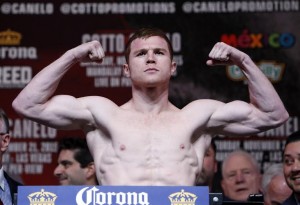
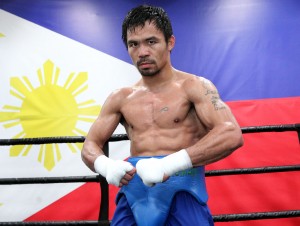
Miguel Cotto vs Canelo Alvarez PPV Weigh-in   11-20-2015 WBC Middleweight Title  Miguel Cotto 153.5 vs. Canelo Alvarez 155 photo Credit: WILL HART
Miguel Cotto vs Canelo Alvarez
PPV Weigh-in 11-20-2015
WBC Middleweight Title
Miguel Cotto 153.5 vs. Canelo Alvarez 155
photo Credit: WILL HART

Saturday at T-Mobile Arena in Las Vegas lineal middleweight champion Saul “Canelo” Alvarez wrung Amir “King” Khan’s neck with a single and singular righthand in round 6 of their mismatch. No count was needed and fortunately no stretcher either. It was another installment of contemporary boxing’s Theater of the Fully Expected, a distasteful inversion of most that once made our sport widely palatable.

Let us have no more talk of Khan’s exceptional bravery in waging a fight everyone knew he would not win, already, because if we do that we must also credit Canelo’s equal bravery, and how badly does anyone wish to do that? The 19th century military theorist Carl von Clausewitz teaches us courage requires a sort of symmetry that relies necessarily on a doubtful outcome. Rarely is there cowardice in boxing; an absence of bravery in the ring manifests itself as resignation caused by a doubtless outcome, not openwinged flight.

To be courageous in victory a winner must entertain doubt of a contest’s outcome; to be courageous in defeat a loser must also retain doubt about that outcome – when a 300-pound bouncer snatches the consciousness from a drunk 150-pound fratbro no one credits the bouncer’s courage and, quite properly, no thinking person credits the fratbro’s bravery either. Von Clausewitz’s insistence on a doubtful outcome makes courage an intensely personal quality, a thing only its bearer can certainly audit. As it should be.

There are no fans of reductionism here, so let us traffic in probabilities and possibilities. Is it possible Amir Khan, a fighter 29 of 30 experts expected to lose, did not expect at any time during the proposal and promotion and performance of his fight with Alvarez that he might possibly win and went through with the discombobulating ruse only to amass a fortune? Yes, definitely possible; no, definitely not probable. Is it possible when Alvarez felt that first underpronated right cross from Khan in round 1 Canelo thought, “This is madness, I’m in with a beast, my victory is nigh impossible, and my survival unsure!”? Again possible, not probable.

Somewhere between these poles is where most of life and all but an instant of Saturday’s match happens/ed. Whatever postsalesmanship went off during the telecast with the team’s squinting to assure buyers they’d gotten at least nine minutes of competitiveness more than feared and Harold Lederman ably ratifying their pitch, writing as one person who picked Canelo to win by knockout I can offer without equivocation there were not three seconds of the 900 that comprised the opening five rounds during which even a pinhole of doubt flashed my mind. Khan was going to sleep unless Andre Ward’s trainer mounted the apron midround.

Frankly one didn’t even need to watch Khan’s customarily jittery approach to know it; Canelo’s mien told the entire tale. Certain as I am I did not doubt Canelo would take Khan’s consciousness is how uncertain I am I watched Khan as more than a prop in the opening five rounds – like a fidgety double-end bag. It was not until the fifth round brought palpable contempt in Canelo’s bearing, though, the outcome became doubtless. Canelo got Khan with the same move with which Canelo cut James Kirkland’s lights a year ago in Houston. He even got Khan’s hopeless, unwinding left to play corkscrew and win Canelo his second consecutive knockout of the year, and congrats on that.

Canelo dishragged Khan and it was magical.

The entertainment runnerup Saturday was the contortionist’s trick of HBO broadcasters mentioning repeatedly Mexico City’s WBC and its suddenly binding resolution to make the HBO middleweight champion of the world the WBC middleweight champion, without mentioning the WBC by name. It felt born of what fantastic consequence the nearly inconsequential media assigns itself; with a new man at the helm of the WBC here’s a chance for him to get his agency’s acronym back in our throats (even if half our infomercial series and all of our introductions and postfight festivities are a voluminous WBC endorsement in highdef) but if the new guy chooses not to strip with urgency his country’s most popular fighter, why, he can say adios to a future “Real Sports” feature and an edgy “On Mauricio Sulaiman” film and even a perky journalist saying amazing things about him on “The Fight Game.”

Canelo is selfaware and arrogant enough to know HBO and the WBC need him much more than he needs them, and good luck dictating terms to him about ratifying Gennady Golovkin as the greatest middleweight champion in recent memory (an authoritative prepositional phrase we use when we’re too young to know very much or too lazy to do research more than google). Golovkin will fight Canelo on Canelo’s calendar and by Canelo’s rules or Golovkin will cost HBO increasingly more money in promotional subsidies subsidized by revenues from Canelo’s pay-per-view matches. That seemed to be the message in Canelo’s postfight use of the Spanish term “mamadas” (better even than the colorful translation it got): Your network can take the funds I raise and use them to erect and decorate another fighter at my expense but before you say any of this to my face, Max, remember who works for whom, who pays your salary and Gennady’s promotional fees.

If David Lemieux starts dieting right now there’s a good chance he can make 155 for Sept. 16.

Bart Barry can be reached via Twitter @bartbarry


Canelo, Khan and a battle to become the middleweight champion we deserve

By Bart Barry-

Miguel Cotto vs Canelo Alvarez PPV Weigh-in   11-20-2015 WBC Middleweight Title  Miguel Cotto 153.5 vs. Canelo Alvarez 155 photo Credit: WILL HART
Miguel Cotto vs Canelo Alvarez
PPV Weigh-in 11-20-2015
WBC Middleweight Title
Miguel Cotto 153.5 vs. Canelo Alvarez 155
photo Credit: WILL HART

Saturday Mexican super middleweight Saul “Canelo” Alvarez will defend the lineal middleweight championship of the world, not to be confused with the PBC middleweight championship or the HBO middleweight championship, against Britain’s Amir “King” Khan, currently the WBC’s silver champion of the welterweight division. The match will happen in Las Vegas on pay-per-view, naturally.

All the boxes are checked – Face Off, 24/7, Greatest Hits – but interest is wholly wanting.

I’ve been ringside for fights enough of Canelo’s to know they’re better in person than via television yet I hadn’t a farthing of an impetus or a modicum of that farthing to travel to see this fight. Amir Khan has never struck me as better than a highlight reel of nationalistic and ethnic special effects. Surely some Brits and lots of Pakistanis feel something like pride when they watch him, but in many more cases, I infer, persons claim to be impressed by Khan because their own box-checking told them to be so: Handsome, well-spoken, fast hands, bilingual, beloved by others.

That was certainly Oscar De La Hoya and Richard Schaefer’s calculation way back when. Not too long after Khan – an Olympic silver medalist, have you heard? – got plastercracked by Breidis Prescott in 2008, he won a cynical rehabilitation match against Marco Antonio Barrera 18 months after Barrera resigned his ownership stake in Golden Boy Promotions by retiring, and not long after that Khan began appearing at ringside as Oscar’s guest.

After racing through Paulie Malignaggi in the best performance of his career Khan raced away from Marcos Maidana in the expiring moments of their 2010 match – a performance that couldn’t be talked to pretty. The image of Khan in perimeter-hopping flight, eyes wide, tail high, pride low, endures and endures. It’s why many of us cheered for Danny Garcia in 2012, seven months after Khan lost a decision to Lamont Peterson. Garcia uncorked Khan with a left hook that’s aged better than both Garcia and Khan.

Then it was back to the rehabilitation circuit for King Khan, a string of decision victories against opponents a prizefighter of Khan’s celebrity should not have needed judges to best. After making Chris Algieri, a small welterweight, look formidable enough to get Algieri recently fed to a PBC prospect, a year ago Khan settled in for a victory hibernation. It took a cashout arrangement for Khan and his advisor – I’m going to cash you out, Amir, because I’m out of cash – to get Khan back in the ring, this time in a match for the lineal middleweight championship of the world Cinnamon Alvarez beat from the waist of Miguel Cotto who won the title from a cripple who decisioned a drunk.

Which mightn’t be amusing as it is were it not for the purists now propped high on their hindlegs by dudgeon for Canelo’s refusal to defend this august title above 155 pounds. Gennady “He’ll Fight Anyone Between 154 and 168 Pounds” Golovkin, the reigning, defending and undisputed middleweight champion of HBO, may not have a chance to sue posterity for greatness, his partisans fear, if he cannot accumulate on his record some marquee welterweights or 154-pounders willing to face him at the middleweight limit.

Fans are now clamoring for Canelo to fight Golovkin, except they aren’t. HBO is clamoring for Canelo to fight Golovkin for a combination of reasons like: The Golovkin marketing budget is starting to outpace its effect. Most idiots left boxing with Money May, and the aficionados who remain are more interested in great matches than abetting networks’ lame starsystems, which means the HBO middleweight champion will never get back on pay-per-view without either luring Canelo into a match with him or, heaven forbid, moving up in weight and challenging himself.

Golovkin won’t move up in weight for the same reason Canelo won’t move up in weight: Why the hell take a risk when there are millions to be made by not taking risks? And before you say “Posterity!” wipe that smirk off your face.

Nobody thinks Canelo will beat Golovkin at 160 pounds – so how does anyone expect the disinterested among us to believe there is clamoring for a match whose promotional tagline would be “Ratify Golovkin!”? Canelo knows this, and Canelo knows he is the AAA-side in a match with Golovkin, and he is behaving like it. A question for those who sincerely believe Golovkin’s starching Canelo at 160 pounds is what’s best for our beleaguered sport: Then what? Canelo is off pay-per-view till he can be rehabilitated, and Golovkin has no one to fight with his easy new prestige. Or is the idea actually to harangue the welterweight champion of the world out of retirement?

Goodness, stop it.

Back to Saturday’s spectacle. The best outcome is Khan, SD-12: A narrow, controversial decision in which Khan outbusies Canelo, who shows massive amounts of frustration for his loyal fans at Khan’s unwillingness to engage in a manly way. Oscar, Canelo’s promoter, can get in the ring afterward and tell us about protesting the decision and hiring investigators and so forth. The WBC – to whom Golovkin’s folks pretend they’ve pinned dreams of fairplay; yet in whose sweatsuit Canelo trains – can order an immediate rematch, and knowing Canelo will win that by prefilled scorecards emulate Hollywood by ordering a sequel to the rematch at the same time they order the rematch, filling Canelo’s calendar until Mexican Independence Day 2017, time enough for him to grow in to a middleweight while Golovkin grows out of one.

Some folks will remember Canelo didn’t move up to 160 pounds while Golovkin was still there. Some folks remember Golovkin didn’t move up to 168 while Andre Ward was still there. As we’ve seen, though, that’s nothing some quality agitprop can’t fix.

I’ll take Canelo, KO-8, because, who are we kidding, Khan has no chin.

Bart Barry can be reached via Twitter @bartbarry


Column without end, part 14

By Bart Barry-
59557278-1071-4f92-be9a-4c8ed5ed86ff
Editor’s note: For part 13, please click here.
SAN ANTONIO – Thursday evening in this city’s irreplaceable McNay Art Museum, as part of its quarterly series Artists Looking at Art, local sculptor James Hetherington conversed with the museum’s chief curator about what relationships are shared by the materials he uses and their discovery and the works they eventually compose. Series of reactions he catalyzes that often form tributes to the originators of their component parts, Hetherington’s sculptures are large and enormously heavy and assembled from pieces he recovers from a local salvage yard. They form among many things Hetherington’s contribution to an ecological conversation about sustaining our world by repurposing materials.

What Hetherington is after does correlate in its way with boxing (for once).

Somewhere in his language of sustainability, an idea whose cliche is not lessened by the fullness of its artist’s belief, is the idea of taking parts as life presents them and relating them to one another oftener with a welding torch than a saw and prizing the sum of their reactions followed by their new collective’s reactions to the elements of their spaces.

When his thoughts were interrupted by questions about the colors he uses Hetherington confirmed with diminishing enthusiasm the colors of his sculptures come via oxidation much as intention. The artist’s vision for his work is its initial condition and what follows is iterative; the pieces he scavenges in junkyards and fits together and the effects then taken on them by wind and rain and sunlight, elements taking their effects meanwhile and too on those who view the sculptures, harmonize (cooperate) with and alter (compete with) the pieces in a process whose varying results are, like every other experience, equal parts impossible and inevitable.

In this sense Hetherington plays an exceptional boxing trainer much more than a fighter or a middling trainer. Our beloved sport bursts with middling trainers – men who endeavor to carve or melt younger men into proven or at least popular fighting styles and shapes without very much regard for these men’s natural endowments or deference either to nature. Even exceptional trainers rarely prove to be ponies with more than one trick but at least they have that trick, and with promotional-television revenues involved, one trick a multimillionaire can make.

Emanuel Steward was very good at teaching tall men to dominate with straight punches. Freddie Roach is quite good at helping athletic punchers maintain their balance while increasing aggression. But Roach would prove no better at improving Wladimir Klitschko – whose post-Steward dominance of opponents remains proportionate to the number of inches he towers over them – than Steward proved at improving Miguel Cotto.

If the best trainers, then, work to harmonize the materials they’re given within the hard if not narrow boundaries imposed by a sport in which death is possible and permanent damage is assured, a new question arises: How essential are exceptional trainers?

Their essentiality generally relates to the experience of the men they train. While Floyd Mayweather Sr. and Nacho Beristain, both, were perfectly essential in the developmental stages of their respective prodigies, Little Floyd and Juan Manuel Marquez, neither has provided more than comfort and familiarity in his charge’s most recent matches. Maybe even Abel Sanchez once was essential to the development of Olympic silver-medalist Gennady Golovkin after Golovkin was already good enough to win a silver medal without him, but with the competition K2HBO now feeds him, Golovkin could score a knockout with an actual pony in his corner.

This may not be an important question as it relates to contemporary art but it remains an interesting and frequent one since Andy Warhol elevated tracing others’ works, whether labels or photographs, to something critics credited with approximating originality. It’s a question that made James Hetherington a touch sheepish Thursday night too. While he properly believes his talent for vision and scavenging and attachment makes him an artist and his productions art, Hetherington is aware consensus among the commonfolk at times can be shaky.

The laity reliably appraises fine art, as opposed to fashion art, by asking: Could I do this? If the answer is yes the art is fashion and if the answer is no a piece requires secondlooking. Yes, but. Like most who enjoy reduction – pursuing the known, not the unknown – these earnest folks who would doubt a curator that included commonly doable things in an exhibition (still preferable company to what art-school airheads relentlessly shout “a-mazing!” at their classmates’ collaborative doodles) must move the variable t before they reject what they see once it exists.

This seemed to be Hetherington’s slightly defensive rebuttal when he reported he sees all these works in his mind before he finds their parts. That is his art (where welding and pipefitting get regarded as trades and crafts). There’s a reason, Hetherington properly insists, no one else in the neighborhood meanders in the same junkyard then scores commissions to erect his works in public spaces no matter how obvious these creations later appear in their finished states.

It’s a skill, a science even, to reduce works of complexity to their component parts; it’s an art to snatch from the inconstant pulses of one’s own mind a set of shapes and materials to recover and conjoin and ultimately present to the eyes of other impossibly complex beings whose own inconstant minds pulse ever rabidly about. The most Hetherington or any creator can do is drop his works in the universe of feedback loops and hope for the best.

Bart Barry can be reached via Twitter @bartbarry


Errol Spence: A good fighter with much potential

By Bart Barry-
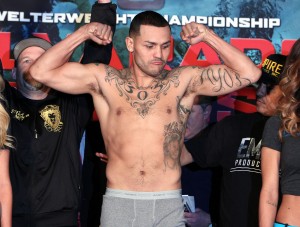
Errol Spence
Saturday at Barclay’s Center in a PBC match televised by NBC, Texas welterweight southpaw Errol Spence stitchripped New York’s Chris Algieri. Spence won every round en route to a TKO in the fifth. Algieri was game throughout, though, again transcending what lowly expectations his social-media brand sets.

Errol Spence is a good fighter with much potential, and that is everything we know of him. He knockedout a viable opponent in only his fourth year of prizefighting, and that puts him well ahead of the standard PBC development template. But Chris Algieri is the consomate b-side, a guy teed-up to be stiffened by Ruslan Provodnikov execution-style two years ago who managed both to survive and win, getting himself invited to Manny Pacquiao’s “Live from China” tour – joining Algieri evermore to a trivial club whose only other member is Brandon Rios – getting him knocked down a bushel and a peck by the congressman, which got him elevated to the top of Amir Khan’s wishlist, getting him decisioned unanimously though not indignantly by Canelo Alvarez’s next victim, making Algieri a perfect matchup for Errol Spence’s primetime debut.

Last year Spence might have fought on NBC against a lad whose name rang no bells with aficionados, both in April and October, but last year the PBC’s coffers were bursting and the public’s perceived appetite for steaming refuse was unlimited. Limits of gullibility shown by viewers and an eerie echo emanating from those coffers this year led the PBC to drop Spence in Lake Algieri, the sort of blackwater-peril Keith Thurman didn’t see till his ninth year of professional fighting. And Spence became the first man to stop Algieri in the 140 years since the 9th Marquess of Queensberry sanctioned rules, so there!

“First man to knock out (insert well-worn journeyman)” is a dumb way to promote a victory, but it’s what the PBC had, and so it made its way instantly into independent fight reports across the fruited plain. To knockout a guy who goes on to dismantle champions is a feat. To knockout an undefeated man, too, is a feat oftentimes. To use a knockout like an exclamation point on a runon sentence comprising oodles of predictable clauses is no feat at all or not one appropriate to the concerns of writers – unless they’re angling for jobs with a promoter or lazy.

Here’s an appropriate concern to those who would profess an expertise in pugilism or sentencemaking. Spence shows a slight case of Devonitis – an affliction named after Devon Alexander and identified via the following symptoms while jabbing: A guard that flies off the cheek, and a chin that rises with a combination’s progress. Spence does not have a severe case, and even if he did, Alexander’s career informs us, those who are paid to notice such things wouldn’t notice such things anyway until a few millions of dollars were made.

USA Boxing, of which Spence is a product, specializes in the dropped-gloves charge, too, and if Spence doesn’t do it baldly as others like Vanes Martirosyan, he does do it a bit. Which is a good thing for aficionados because it means there’s a chance someone on the PBC roster might make fights that are both dramatic and suspenseful.

Spence can be counterpunched and was counterpunched by Algieri. Spence fired back because that is his composition as a prizefighter and because Algieri doesn’t hit very hard. When Spence caught Algieri with left crosses that arrived with the curvature of hooks Algieri was devastated by the blows in a way he was not by Provodnikov’s or Pacquiao’s or Khan’s, in part because Spence is a natural welterweight while Provodnikov fought Algieri at 140 pounds and Pacquiao began his career at 106 and Khan is, well, Khan.

If that is not entirely fair to Spence, neither was the hyperbole heaped upon him by the PBC broadcast crew Saturday. Fairness travels both directions, and presenting Algieri as more than a quintessential b-side is not fair to the men who beat Algieri however much such unfairness is encouraged by their promoters.

Spence did what he was supposed to do, albeit three years prematurely, and that is a comfort of sorts to those few of us who still take a disinterested interest in our oncebeloved sport. Spence has special qualities. In a previous era there’d be no reason to write that already, as professional matchmaking would make his development inevitable and his ascent obvious. In this era, though, and with Spence’s advisor/manager/promoter seeing to Spence’s development, there’s no telling.

Spence made the fourth fight of his career in a small San Antonio gymnasium, the 11th fight of his career in a San Antonio bullring, and the 12th at a converted venue Alamodome expertly named Illusions Theater. Each time I was ringside, and each time Spence was the most talented fighter on the card. In the bullring Spence’s palpable talent was made noticeably more palpable through its juxtaposition with an Olympic teammate’s talent. Terrell Gausha is not good enough at boxing to make his living as anything but a PBC prospect, and so the PBC’s championing of Gausha brings a necessarily nervous titter from those who might otherwise assert Spence will someday reach his potential under that banner.

Bart Barry can be reached via Twitter @bartbarry


Goodbye till the next time, Manny

By Bart Barry-
Pacquiao_Wildcard_150423_004a
Saturday at MGM Grand in the first retirement match of his career and second rematch with California’s Timothy Bradley, Filipino welterweight Manny Pacquiao decisioned roundly Bradley by three fair scores of 116-110, an odd-looking tally representing both a Pacquiao pulldown in round 7 and a knuckleball knockdown in the ninth. The deserving man won. Little more can be said for the fare.

An emotional sendoff it was not. It was a luggery, a strained thing, an effort to aggrandize hoarse as Teddy Atlas’ voice. Too, there was promoter Bob Arum seated beside Jerry Jones, owner of the stadium where Pacquiao fought Joshua Clottey and Antonio Margarito in 2010, as if to put the lie squarely to the halfassery of promoting the match in front of them like Pacquiao’s last – or was Jones onhand to offer Arum his venue for Lomachenko-Walters?

Pacquiao fought Bradley the way he had for their 24 rounds that preceded Saturday’s belligerence: as a congressman vote-counter campaigning for a win. There was naught of the mania Pacquiao showed Erik Morales, naught of the rage he flashed at Juan Manuel Marquez. It was a politically correct effort by Pacquiao, sanitized, sportsmanlike, humane. Right down to the requisite spar-with-me-bro glove kisses at the open of each round.

Bradley wanted to win the right way more than he wanted to win, seeing chances to lead with his head as he so often did on his way to the majors and banishing the thought quickly as it arrived. Manny and Timmy are great buddies! They fought like it, too, much to the chagrin of the comparatively small number of us born-every-minute folks who purchased their fight.

Trainer Teddy Atlas convinced Bradley during their camp what the promotion somehow convinced the rest of us: Finding and blitzing a heavybag like Brandon Rios prepared a man for counterpunching Pacquiao. The only men who succeeded in counterpunching Pacquiao in his career, though, were the two master counterpunchers of the era, Marquez and Floyd Mayweather. Bradley, a volume puncher athletic enough to counterpunch b-level guys, was not going to win a match in which he was outworked anymore than Pacquiao had a chance of outsmarting Mayweather 11 months ago.

There was a spot in the first rounds of the match in which Bradley clearly knew Pacquiao was about to jab him, prepped himself to parry or slip, and got smitten anyway. When something that discouraging happens to a professional athlete his trainer can feed a third of MGM Grand with five loaves and two fish between rounds and it ain’t going to matter. Atlas spent a commentary career watching Pacquiao on video like the rest of us, no doubt thinking all the while if only he could teach someone with great reflexes to see Pacquiao’s triggers and tells the way Atlas did, historians would wear Atlas’ name on their lips for a generation. He got that guy with Bradley, and it mattered nothing at all.

Bradley’s best chance with Pacquiao was his first chance; Bradley was the wildcard in that fight, rhythmically unpredictable, flexibly awkward. It was a match in which either guy might have sprained an ankle careening past the other, and it just happened to be Bradley who did. Ever since then Pacquiao has been everything Bradley is – only much more so.

By the sixth round Saturday what became apparent was this: Only Marquez among all men who matched themselves against Pacquiao had the balls to see Pacquiao’s jabfeint-hopback-jabpounce and step directly into it, manifesting a faith in his physical genius that said, “One of us goes to sleep right now, and I don’t much care which.” Bradley saw Pacquiao’s signature move and tried to jab it or retreat from it or absorb and counter it. But not once in 108 minutes of standing across from Pacquiao did Bradley sellout the right hand Marquez-style. Wherever go one’s memories of Pacquiao, then, should follow Marquez – the two matched wonderfully and gave us so very much in their four fights.

Asked for Pacquiao’s legacy my thoughts go immediately here: 6-2-1 (3 KOs). That is Pacquiao’s record against prime versions of Marco Antonio Barrera, Erik Morales and Juan Manuel Marquez. There is nothing any prizefighter has done in the last 25 years that is so impressive as that. No handicapping, no trickeration, no legerdemain, no bullshit: Pacquiao fought three first-ballot guys nine times. And most of that happened before SportsCenter even knew the Filipino’s name.

Pacquiao leaves the game, if he does, having amortized most of that goodwill, yes – despite what those whose salaries now rely primarily on Pacquiao revenue tell us during telecasts. Some of us have enriched him for woeful garbage like his matches with Shane Mosley, Brandon Rios and Chris Algieri. So be it. Historians will not either forgive Pacquiao’s effort against Mayweather with its submissive lack of urgency, even while they concede things might have been different before Floyd orchestrated a five-year delay (we will not forget how close they came to signing contracts in December 2009).

When Pacquiao’s matches happened against Oscar De La Hoya and Ricky Hatton and Miguel Cotto, I cared very little. I care less now. The way Pacquiao unmanned Barrera, though, 2 1/2 years after Barrera undressed Naseem Hamed and 15 months after Barrera decisioned Erik Morales, the way Pacquiao made Morales make heroic choices to beat him 11 years ago, the way Pacquiao swarmed Marquez in 2008 till both men were covered in blood – those images form Pacquiao’s legacy for me.

Before his charge’s third fight with Pacquiao, Mexican trainer Nacho Beristain – actually the sort of mentor Teddy Atlas tells everyone Atlas is – described Pacquiao as “a wildcat.” A better image of the prime Pacquiao is not yet unearthed: Beaming maniacally round his mouthguard, banging his gloves together, blood on his trunks and gloves and beard, beseeching madness and violence from other men before slashing their faces open with weirdly angled punches thrown at the wrong moments of an unknowable beat . . .

Bart Barry can be reached via Twitter @bartbarry


Pacquiao-Bradley 3: The first last match

By Bart Barry-
Pacquiao_workout_150428_004a
Saturday at MGM Grand in a fight for the vacant WBO International (better than domestic, less than world) Welterweight belt Filipino Manny Pacquiao will make the first last match of his career against California’s Timothy Bradley. It will be the third time the men meet and Pacquiao’s first fight since disappointing himself, pay-per-viewers and his entire country against Floyd Mayweather in May. Expectations are low.

And so we return to the unpleasantness, the badfaith, the malcontentment. This fight will be preyed upon by what abiding discontent aficionados feel towards Pacquiao, and after his performance in the Fight to Save boxing there’s no chance casual fans want a part of it.

Cynicism all round, then, and what else is new? It’s deeper and uglier this time.

Those casual fans who felt hoodwinked by Pacquiao’s performance 11 months ago and then rightly resented talk of his shoulder afterwards, persons inexperienced in the hucksterism of our beloved sport, persons who didn’t know every loser in every fight has a plethora of excuses – the dishonorable ones reading us their list; the honorable ones having their trainers do it – had no intention of buying the second fight of their lives Saturday, but Pacquiao’s comments against homosexual acts, well, those ignited the same persons to encourage a boycott.

It’s not a legacy or a revenues booster, but bless Pacquiao for holding his line frankly, for resisting the media bullying that now passes for awareness or enlightenment or openmindedness or whatever the next euphemism is for herd animals collectively rising on their hindlegs to whinny disapproval via social media, outstanding birthplace of antisocial behavior. Pacquiao’s comments were not new or in any way different from previous comments he’s made, and they were far more honest than whatever halfassed apologies came later and the corporate distancing his business partners foisted on us, hating the sin and the sinner unless some revenue might yet be milked from the sinner and then hating only the sin.

Once more the foil in all this is Timothy Bradley, decent, gracious, genuine, grateful, and wholly unmarketable. Someone somewhere probably hoped the folks so theatrically offended by Pacquiao’s unwavering commentary would rally behind a friendly black Californian, husband in a mixed marriage, father to biracial children, but no: Those who consider being offended an intellectual feat rally against things, not for them.

Bradley did his part to get the rubber match: he looked vulnerable against secondrate competition till hiring a famous trainer then looked unstoppable against secondrate competition. Teddy Atlas has failed a bit as a ham, though, hasn’t he? There was supposed to be a battle of wits between Teddy and Coach Freddie, an antagonism onto which novelty seekers might latch, but it hasn’t come off. Atlas, finally, takes himself and his profession too seriously to make mirthful with Coach Freddie. There is no American interest in the sport of boxing anymore either, which must be considered a hindrance of sorts.

Pacquiao has chosen for his farewell tilt a far superior opponent to the guy Money May used for his failure of a goodbye in the fall, but it’s hard to imagine that will save this. Bradley, after all, is the unsympathetic guy who robbed Pacman in 2012.

That was an enduring example of the way misanthropes rally against things and not for them. Tired as they were of cheering for Pacquiao a large number of folks decided to project their rage with life on Bradley, just about the least-deserving target of mass hatred prizefighting has produced in a generation. It took Bradley to show some of us what a large number of despicable people populate our ranks, and no we haven’t forgotten.

Coincidentally, this was not Pacquiao’s fault. He thought he won the first match with Bradley, even if he knew he didn’t win its predecessor, his third match with Juan Manuel Marquez, but he wasn’t fractionally animated in the post-Bradley-fight press conference as his promoter Bob Arum – realizing, as Arum did, this decision would cool talk of a Mayweather megamatch for years. We forget that now for a couple reasons, the largest of which being what a dreadful thing the Mayweather match was when it did happen.

The other reason: Marquez knocked Pacquiao stiff six months after Pacquiao was robbed by Bradley. Those of us who watched from ringside as Pacquiao was conclusively outboxed in the second half of his third fight with Marquez and then made to miss continually by Bradley were not surprised Marquez got him – even if every person at ringside was jolted by how decisively Marquez took Pacquiao’s consciousness – and even less surprised how hopelessly Pacquiao fought Mayweather 2 1/2 years later.

Apparently Pacquiao beat Bradley in their rematch – after mis-scoring their first fight I was seated too far from the ring to see the fighters as more than circling electrons in a microscope, and I didn’t care enough to watch the tape – which got Pacquiao a shot at Chris Algieri, which somehow got Pacquiao a shot at Floyd Mayweather, which again went the way every aficionado knew it would even while some boxing writers did their promotional best to envision ways Pacquiao might win.

One hopes Saturday’s match is competitive as it should be, raising Bradley’s next purse while sending Pacquiao into his first retirement with dignity. It can’t possibly be worse than his last fight.

I’ll take Pacquiao, SD-12, in a match Bradley wins by two rounds.

Bart Barry can be reached via Twitter @bartbarry


Tuneup II: Ward controls Barrera

By Bart Barry-
Andre Ward Post Fight
Saturday in Oakland former undisputed super middleweight champion and current number-one ranked contender for the HBO light heavyweight championship Andre Ward completely decisioned undefeated Cuban Sullivan Barrera. Despite controlling every minute of the match Ward displayed enough vulnerability to whet hopeful aficionados’ imaginations something dangerous and competitive might happen in the late fall if Ward has the stones to risk life and limb in a match with Sergey “Second Most Feared Fighter on HBO” Kovalev.

It was a typical Andre Ward fight comprising technical precision and relying on its opponent’s craft to provide emotion. Barrera had some craft but mostly strongman assertiveness. As Ward boxes most every opponent the same, a manifestation of his obsessive control, there weren’t many surprises after the first three minutes passed. While the mammalian mind specializes in pattern recognition, the human mind specializes in pattern completion, recognizing patterns with less data than other species – abstraction, that is – and so there was nary a human who watched round 1 of Saturday’s match and didn’t intuit about exactly where it was going in the next 33 minutes, and that was where it went.

That marks Ward at once an extraordinary craftsman and substandard entertainer. But his entertainment value is evidently others’ concern – though neither of his copromoters, Roc Nation Sports and Home Box Office Sports, seems fractionally good at its craft as Ward is at his. For the best part of his professional career Ward has understood his status as American boxing’s last and probably final Olympic gold medalist and the weight of that metal, ignoring any who endeavored to move him anydirection he did not choose himself. Ward is a bright dude, too, and that precluded others’ convincing him their direction for him was his own direction.

If and when Ward chooses to redeem HBO’s matchmaking by matching himself with the network’s light heavyweight champion it will be on terms that do not appear favorable to anyone but Ward, and this will happen because Ward doesn’t need the fight because his selfworth is too well established to bend very much. Kovalev will bend in negotiations, one assumes, because he probably wants the Ward fight more than Ward does. Kovalev doesn’t need the fight, but he does want it; Ward seems neither to need nor want to fight Kovalev.

Having emptied a once-exceptional 168-pound division and failed to lure Gennady “He’ll fight anyone between 154 and 168 pounds!” Golovkin to fight him at super middleweight, Ward now tentatively, carefully, controllingly moves himself to 175, requiring three tuneups to ascend seven pounds, a tuneup-per-pound mark unlikely to be surpassed until Cinnamon Alvarez’s eventual ascent to 160. And that’s not a criticism of Ward either. He knows it’s HBO’s credibility, not his, that requires a 2016 match with Kovalev, and he knows, too, the only equalizer Kovalev has in that fight is size. So Ward patiently acclimates himself to the new weightclass, caring very little for what arbitrary timelines a broadcaster sets, gradually and decisively removing the sole advantage the network’s light heavyweight champion has.

If one draws up a chart of things Kovalev has more than Ward, it probably stops here: 1. Size, 2. Right cross. Notice meanness and ferocity didn’t make the list. Kovalev might have psychopathy going for him, but he is no more ornery in a fight than Ward is and not nearly so adept at fouling. Ward has approximately twice Kovalev’s craft and can effectively fight while moving in three times as many directions as Kovalev, who does incredibly well while moving forward and moving forward. Ward will tangle him and frustrate him in a way Bernard Hopkins was too old to do and no one else’s had the chops to try.

Early Saturday Ward reviewed Barrera’s physicality and class and decided it was better to slip punches and keep distance than go shopping inside. He’ll decide otherwise against Kovalev, planting his shoulders in the Russian’s chest and his head all over the Russian’s face, yes he will. Kovalev will make the bully’s choice and endeavor to outmuscle Ward, and Ward will have him. Ward is good an infighter as we’ve seen in a generation, and the secret of that goodness is his footwork; Ward churns his hips and feet where others stand still and wrestle above the waist. There are lots of ways Ward can prepare for Kovalev and not one way Kovalev can prepare for Ward, and one senses nobody who knows that in Kovalev’s circle will tell the Russian, making the proper assumption th’t refitting Kovalev at this point is a fool’s errand; go forward with full confidence, Sergey, or don’t go.

Talk of Ward’s rust or slippage, too, is irrelevant. Ward has been sharp enough to control every opponent he’s faced since his 13th birthday, and that will be true of Kovalev or Ward will not make the fight. Ward takes through all his life the confidence and distrust Floyd Mayweather brought in the prizefighting ring; where Mayweather played the buffoon in promotions then got real serious when the bell rang, Ward stays real serious.

Immediately before and after the dullest spectacles of his career Bernard Hopkins warned us how much we’d miss him when he was gone. He’s been gone for nearly a year and a half, and he isn’t missed – in large part because we still have Ward. There is neither another Andre Ward in the pipeline nor even much of a pipeline: In the end we may miss Ward more even than Hopkins assured us we’d miss Hopkins.

Bart Barry can be reached via Twitter @bartbarry



Crumbling infrastructure, Mile High Mike, The Baby Bull, and Izzy

By Bart Barry-
Mike Alvarado
HOUSTON – In the good times there was a lameness to this city that didn’t make the brochures; places closed early, nothing opened Sundays, and when folks told you how proud they were of their city it felt strained. That lameness has been replaced by a sort of anger that happens to cities that once boomed then stopped booming then stopped telling others how much they were booming (salesmen necessarily being the most oblivious of rejection) and then resigned themselves to settling in, and whose transplants now look about and realize they didn’t want to live here in the first place.

We were gathered in this city, just the same, for an eight-match Top Rank card that featured the returns of hometowner Juan Diaz and Colorado’s Mike Alvarado, and both men won by knockout, but only one of them, Diaz, should continue fighting.

No one ever told me he moved to Houston and loved it. There was money here, though, and that money calmed the slight uneasiness one feels when he’s uprooted himself for something that isn’t quite-quite. Two years ago crude oil was trading over $100 per barrel. Today it is heaving to return to $40. This city’s humor rises and falls with those prices, and right now its humor is lower than it has been anytime in the last decade – except last month; oil is up $10 since then, and it’s springtime after all, so how about them green shoots?

The boom times are not reflective times, and what a city does with its wealth while it booms sets a floor of sorts for where it goes when it busts (except in prolonged cases like Detroit, the one ever-busting American city of the last halfcentury). This city did some Texas tackiness, big hair and sparkly things, sure, though nothing that approached Dallas’ scale, and its skyline remains alluring, but it neglected wholly its infrastructure. With all the money that sloshed about, one wonders, and did wonder, why are its surface streets barely fit for urban attack vehicles (ah, the Hummer – enduring symbol of a different bust: Phoenix housing market) and otherwise unfit for any sensible car?

Back when Austin, this state’s capital, was actually weird – not “keep Austin weird” weird – it got by with a hippy sensibility like: we’re all in this together, so yield the right of way when you know I can’t see round the tree at the intersection. Houston’s eroding infrastructure is making it weirder every day, though without any sensibility but greed to bind its citizenry; in Houston, now, you drive like a maniac because some primal intuition tells you you’re safer that way, and you are – because when you’re moving faster than the loons on either side, you regain half your attention by no longer needing a rearview mirror.

Arena Theatre was a fine, if well-hidden, venue to watch a fight Saturday, and only a sucker paid for better than the cheapest seat, since there wasn’t a distant view in the entire bowl, and the ring sat up shiny in the venue’s very center. Heard in the Top Rank section: “Small rings make for great matchmakers.” The ring was tiny; no one larger than a middleweight set foot in it during the card’s eight matches, and everyone looked large.

There’s a slapdash South American-mercado feel to much Spanish-language television, the don Francisco style of having the host perform commercials onstage during a show, and it interrupted the pleasure of Saturday’s card, some. Television owns boxing, of course, the programming director tells the commission when it may ring the opening bell, but the delays of a show performed for Spanish-language television are, even by the known standard, a touch gratuitous. Seated a few rows behind the UniMás commentary team with a clear view of their monitors, one sees the main event is being delayed by week-old commercials advertising the co-main event that already went off; it’s a sloppy, sales-blitz mentality wherein the host sees himself as an emcee, not a journalist, and his target demographic meanwhile slumps its shoulders and trudges back to the beerline.

Saturday’s crowd was the usual mix of hometown fight figures and familiars and friends and hangerson, and local businessmen reveling in others’ danger. A lawfirm gathered in the row behind me, and when they weren’t hellbent on outnamedropping one another, they were admonishing the fighters to “punch him in the neck” or “knock his head off” or “finish him”! And so.

Mile High Mike looked exactly the same Saturday as he did the last time you saw him, and that’s a problem, obviously, because the last time you saw him he was stopped by a limited fighter, albeit a former champion, and this time he plied his wares against a lighthitter with 10 knockouts and six losses in 25 matches. Eventually Alvarado bludgeoned him down with wild righthands, but Mile High Mike and his rehabby salespitch, “I’ve been fighting my demons as much as my opponents,” are through with major championship prizefighting.

The Baby Bull looked about the same, too, and that’s a really good thing. Never the bearer of a pinup physique, Juan Diaz still weighs and fights the exact same way at 32 as he did at 22. He does not set on any punch so he does not have concussive power, but he doesn’t need it: Because he’s somehow stayed in the same weightclass, where his chin is proven, and because he possesses more belief in his own conditioning than just about anyone in the game today, and because there’s exactly no chance of another Nate Campbell or Juan Manuel Marquez or even Paulie Malignaggi showing up at lightweight in the next five years, Diaz will make a competitive and fun title match with anyone he fights.

It was good to see Juan Diaz do so well in front of his friends and family.

The best sight of all, though, was Israel Vazquez, the color guy on the UniMás broadcast team, being as unassuming in retirement as ever he was vicious in the ring. The fans queued up for photos with him, and Izzy lost himself in their adoration, requiring several times the program director to scold him for nearly missing cues. Vazquez’s delta – violence in combat to gentleness in society – is the greatest I’ve seen in our sport that has so very few happy endings, and how properly joyful it makes me to think Israel might be one of them.

Bart Barry can be reached via Twitter @bartbarry


Nostalgia touring Houston

By Bart Barry-
Juan Diaz
Saturday at Arena Theatre in Houston, Juan “Baby Bull” Diaz and “Mile High” Mike Alvarado will return to prizefighting on an UniMás telecast. Diaz will fight a Mexican lightweight named Fernando Garcia, and Alvarado will fight a Mexican welterweight named Saul Corral. Garcia and Corral appear to be statement-type opponents; Diaz and Alvarado will either use such men to make flattering statements about their futures by dominating them, or there will be statements made by others about overdue retirements.

I’ll be there because I did not expect to be ringside again for a fight featuring either man, let alone both, and I do not expect to have such a chance again, and I wish our sport comprised more men like Diaz and Alvarado once were.

I have been ringside for four of Juan Diaz’s last six fights, and while I did not realize it till time came to write this column, in retrospect, I’m glad it’s been that way. I knew little about the Baby Bull when I sat ringside for his 2006 match against Fernando Angulo at Chase Field, but his activity was infectious, and his selfbelief exceptional for a fluffy lightstriker. Volume punchers, men like Diaz and Timothy Bradley, are compelling fighters because of their limitations, because their offenses are more pesky than concussive, unlike sluggers’, and their defenses are steady applications of offense with a dusting of head movement, unlike boxers’.

There are few fighters whose style I enjoy more than Diaz’s – and one of those few is Juan Manuel Marquez, the man whose style ruined Diaz in one of the very best matches I’ve covered from ringside. That match happened in Houston more than seven years ago, a fact that dates this column sympathetically or ruthlessly whatever one’s philosophy of time, and it marked an apogee of sorts for Marquez, a moment of lightweight supremacy just before his own greed and his promoter’s greed and guilelessness got him humiliated in a sparring match with the world’s best welterweight, Floyd Mayweather. (The lesson from that match: Tossing boulders at altitude and drinking your own piss, training in the naturalest way possible in other words, is dimwitted; a year or so later, Juan Manuel contacted Memo and things got supernatural for his second campaign at welter.)

By the time Diaz fought Marquez the first time, in a Toyota Center that was full and loud, he was no longer undefeated, having been beaten by Nate Campbell in a Don King-special event conducted in a Quintana Roo bullring, the culmination of a weird promotional relationship initiated in 2006 when King, realizing he’d never sellout a Phoenix baseball stadium with a Belarusian and Shannon Briggs, heard a Latino ticketseller named Diaz might be about to sign a contract with Golden Boy Promotions, and finding Diaz’s pen dangled cautiously over his new Golden Boy contract, King slipped a King contract in its stead.

Diaz and King were not a sensible match, and eventually Diaz was with Golden Boy Promotions, and through fifteen minutes appeared ready to devour Marquez at Toyota Center. Those of us ringside fretted openly about the cost of Marquez’s pride; Diaz did not strike hard enough to unseam Marquez with one punch or 20, and as Marquez looked old and worn and Diaz appeared much the larger man, we verily worried something tragic might befall Marquez before the 12th round concluded.

Goodness, but we were wrong. Marquez made of Diaz his most gorgeous finish (until the Pacquiao icing years later), stubbornly wagering his straight punches would best Diaz’s crooked ones no matter their quantitative disparity. Diaz fell prey to the uppercut like every volume puncher must, tallying shots on Marquez so feverishly he neglected to notice his weight fully spilled overknee, and Marquez, his era’s master closer, brought Diaz’s unconsciousness with a customary precision and lack of ruth.

Their rematch was a dud fought in a soulless casino while the Vegas economy experienced gravity in a vacuum. And with that the Baby Bull was finished with boxing and ready to become a lawyer. Initially I didn’t care when he returned because it felt, like most of our sport’s comebacks, a fated mix of betrayal and desperation.

Writing of which, “Mile High” Mike will be in Saturday’s co-main, his first ringside sighting since the autohumiliation he perpetrated on himself and his fellow Coloradoans 14 months ago in his second rematch with Brandon Rios. The standard ploy, changing trainers and promising rededication, was not going to be enough for Alvarado to sell his return, and so he attended rehab and got married.

Promoter Top Rank forgives Alvarado his numerous transgressions because Alvarado atones properly; Alvarado has fought five times since 2012, when his career was reresurrected after legal issues aplenty, and what fights were not with Rios were with the aforementioned Marquez and Ruslan Provodnikov – five consecutive fights with any combination of Provodnikov and Rios and Marquez exceeds in peril the product of every 2015 PBC main event multiplied by 50, and so Alvarado gets forgiven. The beating Alvarado took from Provodnikov in 2013 was mansized and vigorous; it was the only time I recall seeing at ringside a defending champion wince in the first round of a title fight, as Alvarado did after several of Provodnikov’s facinorous blows befell him.

I’m an unapologetic fan of Diaz and Alvarado both; I’ve traveled to Nevada and Colorado to see prime versions of the men and consider those trips time and resources well-consumed. Neither is good enough, anymore, for me to leave the state of Texas to see, but either is worth the 200-mile drive to Houston, and the two of them together, a treat. This nostalgia tour continues along happily.

Bart Barry can be reached via Twitter @bartbarry


How HBO’s statement helps explain Donald Trump’s popularity

By Bart Barry
Pacquiao_Mayweather_weighin_150501_001a
Wednesday HBO released a statement about Manny Pacquiao’s weeks-old statement about the prizefighter’s interpretation of the Bible’s anticipation of the current LGBTQ platform. There is rarely a reason to interrogate press releases from cable networks, but this one seemed portentous: One opened the email thinking HBO, in an incredible expression of solidarity with oppressed persons everywhere, had announced its refusal to condone Pacquiao’s hate speech by cancelling its distribution of the Filipino’s match with Timothy Bradley in April.

Well, no, actually – of course not. Instead, in a manifestation of what groupthink imbecility corporations reduce themselves to whenever trying to accomplish anything different from revenue (like moral judgements), the network decided to condemn Pacquiao’s sincerely held, sincerely stated and sincerely reiterated beliefs by implying, in the insincerest way possible, the network’s endorsement of Pacquiao would continue unabated because of its “obligation to both fighters” – only a network far less scrupulous than HBO, in other words, might punish Bradley for Pacquiao’s ignorance.

But why bother? why now? what could this accomplish? Answer: To illustrate tidily how Donald Trump is, in March, nearer to becoming our 45th President in November than any contemplative person in January imagined he would be.

It’s the insincerity of the HBO statement that rankles, and since HBO is a media company, it should be instructive for us, the large percentage of the country that cannot grasp whence Donald Trump’s popularity derives, to contrast the event of HBO’s statement with the event of Trump’s ascent. Trump embellishes most everything, exaggerates his own record, obfuscates, and often says things he knows are not true, but he never appears insincere. His appeal is his sincerity – his zealous belief in his own greatness; anything might be said in service to it – and his supporters are not the idiots we think they are.

For a few presidential cycles now, the dog-whistle metaphor has been fashionable, likening the insincere and euphemistic bits politicians say to a sound humans cannot hear but puppies can. Probably this sort of analogy first achieved acclaim with Ronald Reagan’s laudable/infamous (depending on one’s region and political bent) States’ Rights speech in Mississippi 36 years ago, a speech that winked at Southern segregationists while giving its speaker all sorts of deniability.

If employing rhetorical irony is saying something that means more than merely the denotative sum of its words, being cynical often is saying something that means nearly the opposite of its literal contents – “all natural ingredients” for instance – and cynicism is inferring from another’s rhetoric its opposite. While the crafters of dog-whistle statements would defend them as irony, Shakespeare’s own mechanics, they rely on the cynicism of their audiences, which in its own tawdry way attributes more talent and imagination to these audiences’ members than outsiders generally do.

What Trump practices is not dog-whistle so much as dog-tail; in all of nature, there are few things as decisively honest as a dog’s tail. A dog does not wag its tail ironically, a dog does not eat food it dislikes then whip its tail sarcastically about, a dog may misunderstand, and a dog may stand bemused by human indecision, but a dog’s tail ever tells the truth. What Trump’s supporters watch is his tail; when he is speaking in circles, when he is contradicting himself, when he is insulting his opponents, when he is effusively praising himself, his supporters ask only one question: Does he believe this? Their support for him as a candidate, not his platform or ideas that are alternately threadbare and frightening and frighteningly threadbare, are proportionate to how enthusiastically his supporters see his tail wagging and subsequently how enthusiastically their own tails wag back.

Well what have we here? This column has now done the unthinkable, likening humans to animals, the sort of ruse that got the congressman from Sarangani Province summarily scolded by blogs across the fruited plane, disowned by an apparel manufacturer notorious for its international labor practices, and called “insensitive, offensive and deplorable” by HBO.

Really, you say, your own tail beginning to stir, a broadcaster stated something that honestly about one of its assets?

Well, no, actually – of course not. Manny is none of these things to HBO on the eve of a broadcasting event with revenue expectations in the millions of dollars; his “recent comments”, you see, those are the insensitive and offensive and deplorable things, not the beloved lad nicknamed Pacman who once eradicated world poverty with yellow gloves (to pick the one ludicrous Pacquiao prefight storyline for which HBO is not responsible).

Saturday after results from the Republican primaries came in, Trump opened the floor to media inquiries by saying, “I would love to take a couple questions from these dishonest people.” It’s no wonder his supporters howled and cheered; much as members of the media may hold them in contempt, much as they may coin ironical terms like “low information” and “poorly educated” as descriptors, Trump supporters hate members of the media all the more, and their surging hatred now sloshes over every abstract and arbitrary barrier, from decency to integrity to education to partisanship.

Trump’s contempt is genuine; he considers his opponents beneath him, and he hates the dishonesty of an electoral/press cycle in which the candidates who purchase the most advertising traditionally receive the most coverage from a media that calls itself independent, unbiased, objective, and fair and balanced. The sole way to disabuse Trump’s supporters of their fervor is to prove in some playful and offhanded manner their man is inauthentic.

That feat, though, would require both authentic spokesmen and media outlets capable of recognizing and disseminating authentic commentary.

Bart Barry can be reached via Twitter @bartbarry


Expectations met: Crawford stops Lundy

By Bart Barry-
Terence Crawford
Saturday in New York City, undefeated Nebraska junior welterweight Terence “Bud” Crawford, an HBO fighter, put the sixth blemish on Philadelphian Hank Lundy’s ledger via TKO in round 5. Though Crawford’s assault did not take Lundy’s consciousness, it took his spirit, much as was anticipated by their records and all who watched. Crawford is aware there is an unseemly dearth of viable opponents for him, with the men who might’ve played challengers in bygone eras currently being overpaid by the PBC to behave like titlists, and he properly beats them to submission. If Crawford is not creating new aficionados, he is at least ensuring no more aficionados depart our sport on his watch.

Once televised boxing became predictable, we moved our commentaries to new subjects, and many concerned judges and their disagreeable tallies and referees and their improper stoppages, ever early or late, and point deductions, ever too much or too little, and if it isn’t an apt substitute for writing especially well about great spectacles, our unfortunate choice is partly palliated by the quality of the spectacles: It is no more possible to write greatly about a mediocre subject than stitch a great suit from burlap. Saturday’s match was not mediocre fabric, quite, it was in its punchcount and intent about good, though certainly not great, and what precluded its mediocrity, or eventual and desperately required salvation from mediocrity, was a choice its referee made in the closing moments of round 3.

Steve Willis, whose trademark enthusiasm is appearing ever more frequently during televised mainevents, chose not to act at the end of the third round, and it redeemed almost immediately a match that was strolling, and feinting and flexing, its way towards mediocrity. With a halfminute remaining in the round, Hank Lundy tried valiantly to close distance by swinging wildly and folding forward, and once Crawford began to set his weight on the back of Lundy’s neck in mammals’ universal manner of establishing dominance over another, Lundy flashed his torso leftwards then upwards, jamming the top of his head exactly where Crawford did not want it: against his chin. Crawford covered Lundy’s head with both blue gloves, and a leveraging match ensued with Lundy in the manifestly favorable position of having a lower center of gravity.

It has become an unspoken clause of sorts, call it the Mayweather Rule, that a fight’s promotional a-side shall not be discomfited by anything but a perfectly clean punch. While the b-side can be forearmed, elbowed, clinched, suffocated and occasionally butted, the a-side must not lose his title on anything but unspotted punching with the middle knuckle of his opponent’s fist – all other tactics must be treated as infractions and subjected to intense audiovisual scrutiny.

Referee Willis eschewed the Mayweather Rule, very much the way Tony Weeks got the Mayweather Rule ratified in 2014 (when, after allowing Marcos Maidana to strike Floyd Mayweather without Mayweather’s express permission a few too many times, in a fight, Weeks found himself quietly barred from officiating Mayweather matches evermore), and an actual fight began, allaying what fears aficionados developed after seeing the usually composed Crawford behave brashly during fightweek media events. Crawford is no one’s bitch, and he responded to Lundy’s aggression exactly as a champion should do: he clubbed his challenger nearly unconscious in the next five minutes.

Before that, though, Crawford found himself forced, via Lundy’s appropriate activity and Willis’ more appropriate inactivity, to grab hold of Lundy and wrestle him away. What was Willis doing meanwhile? HBO viewers will never know; blessedly Willis was removed enough from the combatants the frame did not contain him through much of it.

Crawford got Lundy off him and began to give Lundy what Lundy wanted and needed: less space to close. This is the sort of choice Crawford makes that makes him a better entertainer than his stylistically similar peers across the dial on the PBC. Crawford had the size and reflexes to discourage Lundy with space; however many inches taller Crawford actually is, he must’ve looked a foot taller and a meter farther away to Lundy than he was in Saturday’s first 2 1/2 rounds. Crawford, were he a PBC prospect, would have gone on feinting and flexing and scowling and leaping inrange long enough to pushoff a chest jab, and then leaping out of space, over and over, hoping Lundy might fatigue enough to make a sustained attack perfectly safe, and even then perhaps not chancing it. Crawford must know this; it would be impossible to watch boxing in the last decade, much less practice it at such a level, without noticing men of good reflexes no longer need to get struck in order to make their first million; so long as you purport to ferocity and make c-level opponents look bad, boxing needn’t be a fullcontact sport for you.

Crawford has the excellent fortune of being a Top Rank fighter, not a PBC asset; he is developed by the same experts who crafted Floyd Mayweather and Manny Pacquiao and Oscar De La Hoya, and they didn’t develop those men by tolerating a pacifistic approach to combat (unbeknownst to most of the Money Team, in his first eight fights young Mayweather was compared to Mike Tyson). Crawford is a finisher, the way Top Rank expects its fighters to be; the rare case of a Top Rank fighter not being a born finisher, Tim Bradley for instance, is marked by that man’s willingness to undergo hellacious tests regularly. Not every match must end in a knockout, but boxing’s dwindled fanbase is through with talented athletes moving cautiously for a halfhour then suing posterity for scorecard points – particularly after making fraudulent prefight promises during press conferences and other promotional perfunctories.

Crawford expects to knock his opponents rigid, and he knows his promoter expects the same. If there are moments in his matches Crawford wonders about his professional choice to practice his brutal profession quite so brutally, he draws reinforcement from pride and expectations. Crawford is a very proud man, and his corner and promoter have very high expectations.

A good bit of punching, a restrained ref, and a decisive ending; if Saturday was not boxing’s best, it was a pleasant distance from its worst.

Bart Barry can be reached via Twitter @bartbarry


Column without end, part 13

By Bart Barry-
7aee28c4-a8f4-4664-a0df-9bab4185b065
Editor’s note: For part 12, please click here.

*

SAN ANTONIO – Very good artists inspire imitation – why so much boxing writing of the 1970s and 1980s looks like stepped-on Hemingway – but great artists inspire others to pursue their craft regardless where it leads. Thursday evening in this city’s irreplaceable McNay Art Museum, as part of a celebration of local artists, painter Stefani Job Spears gave a talk about her abstract paintings and the glorying in color complements and fractals that charges her process that creates them.

And layers – she spoke quite a lot about layers. Many of her watercolors have a hundred layers to them, each layer equal parts mathematically insignificant and aesthetically essential, and this layering effect was one she discovered, in part, by making colored paper, a process through which the fibers in pulp are blended by crushing. Layers consume Spears’ recent work as they consume every artist’s work, often in a proportionality with the artist’s seriousness.

What plagues Spears’ work, or would were she not adamantly opposed to such a plaguing, is what plagues all who obsessively pursue layers: a lack of tension, which resolves itself as muddiness in visual arts and noisiness in music and nervously linked anecdotes in writing. The most painful part: Artistic tension follows a balloon’s model – it is generally greatest, with metaphors stretched to shiny, the instant before it deflates with a pop. Artists abandon works eventually after this deflation happens though never soon enough; they set out to reconcile the sudden lack of tension by rebuilding, relayering, repiling, but such conscientiousness seldom wins the day because the composition grows only looser as the colors muddle, and all the while, crueler still, their memory of the gorgeous tension their works comprised, the wrenching into existence their creation celebrated, now overdyes each forwards gaze they cast at their suddenly unsatisfactory and worsening piece.

How does one know when to stop layering? There are two paths that both reduce, eventually, to luck – for the greatest works of art ever evince chance as much as another quality, and the greatest artists never evince any emotion more than gratitude, profound thankfulness for their fortune – and those paths are: 1. Luck, and 2. Feedback properly observed. The works that endure best, that receive the highest appraisals centuries after their births, are those that impress us as relying least on chance, though there’s a good chance this is our misperception more than any actuality their creators would recognize.

Miguel de Cervantes, we assume, had no chance of getting lucky for two books and 700 pages of Don Quijote, and this is close to true as we’re likely to come. But the genesis of his idea, to take histories purporting to nonfiction and have them drive a reader to a portrayal of delusion – and again, friends, this question is the reason the book endures: Was Quijote delusional, or by inventing a character publicly addled enough for others to play along with him, for their own amusement, did Quijote accomplish a life very near his ideal of one? – probably arrived in a seed owed to good fortune, and besides, anyone who has read or reread El Quijote in English or Spanish can attest to something nearly objective like: If Cervantes got unlucky on hundreds of those pages, so unlucky in his first book, in fact, he spent a couple lucky sentences in book two making fun of his own terrible writing, it is not untoward to suggest his best sentences, too, owed some to chance.

Enough with the tautologies; luck is luck, yes, and? – take us to feedback (which is the feedback). That is what Stefani Job Spears was about in her Thursday discussion when she said she did not allow a work to muddy itself beyond repair, and she did not allow her students to allow their works to muddy themselves beyond repair. She believes and teaches a work must be wrestled back from that muddy brink, and it’s a wonderful technique that saves future works while appearing to save present ones. Knowing one may not abandon a work whose canvas has popped, oozing its tension from electric orange to beige to mahogany, see, makes an artist err just to the restrained side of his next work; the anxiety that leads him to continue adding layers, to continue pursuing a beautiful truth, finds itself moderated by a cultivated anxiety about what destruction one last layer might bring, and here is where a tension begets another tension that amplifies the tension created by two other tensions, and these iterated tensions make a work that endures.

To those who might rebut “Works fail all the time – look at this column,” Spears’ process counterargues: Completed works fail, yes, but a work cannot be a failure till it is completed, and considering works incomplete until they succeed remedies that indeed (a spirally argument more than a circular one). And this brings us to the essence of the approach: Works must only be completed in order to achieve acclaim or revenue; an artist who finds his life’s highest fulfillment in creation’s very process needn’t ever declare a work completed, and therefore mustn’t ever concede failure, even while the ecstatic tension of his creating, feedback’s feedback, continues its accumulation.

Until this column ends, it does not fail.

Bart Barry can be reached via Twitter @bartbarry


Nostalgia of a sort: Saucedo decisions Booth on UniMás

By Bart Barry-

December 15, 2012, Houston,Texas ---  Welterweight Alex Saucedo remains undefeated at 7-0 after stopping Eddie Cordova in the 3rd round , Saturday, at Toyota Center from Houston,Texas. --- Photo Credit : Chris Farina - Top Rank (no other credit allowed) copyright 2012
December 15, 2012, Houston,Texas — Welterweight Alex Saucedo remains undefeated at 7-0 after stopping Eddie Cordova in the 3rd round , Saturday, at Toyota Center from Houston,Texas. — Photo Credit : Chris Farina – Top Rank (no other credit allowed) copyright 2012

Saturday in California welterweight Oklahoman Alex “El Cholo” Saucedo decisioned Florida’s Clarence Booth by inappropriately wide scores of 79-73, 79-73, 78-74. I watched the 11th hour fight on a Univision app Googlecasted to a television; the stream split and spilled, the buffering was routinely inadequate, and Tecate’s black eagle unfailingly annoyed. The experience, however, was not just a pleasure on its own: it was a reminder of how much better boxing can be and not long ago was.

Back when I found our sport intriguing enough to cover many fightcards and travel a dozen times a year at personal expense, I sat ringside for eight of Alex Saucedo’s first 12 prizefights, and it was an undulatory ride that trended progressively upwards till it was hard-down by March 2014. Initially Saucedo seemed Top Rank’s exact replacement for Antonio Margarito, a rangy Mexican welterweight with a chin and joy for combat, though thrice as polished. And he was merely 17 years-old when we saw him begin his career in Houston (on a card that featured Son of the Legend’s unbuttoning Peter Manfredo).

Though a Chihuahuense by birth, Saucedo fought and still fights out of Oklahoma City, which is the sort of place you’re more likely to recruit a rehab opponent for Son of the Legend than find a future Mexican champion, but like other elements of the Saucedo story, that was an enchanting anomaly until it wasn’t – until it became painfully apparent Saucedo’s exposure to worldclass teaching, training and sparring was wanting in Sooner State. For Saucedo’s match two years ago at Alamodome, the last time I watched him from ringside, the card on which Son of the Legend decisioned Bryan Vera and Orlando Salido fouled Vasyl Lomachenko’s first title match, an old guy named Gilbert Venegas, four deep in the concluding 11-loss streak of a 12-20-4 career, found himself an imported sacrifice for El Cholo – who missed weight by more than a pound and set to clanging what alarms sound when a prodigy begins to disappoint those who’ve invested reputations in him.

That wasn’t me, quite – though I’d sneaked Saucedo on a 2012 list of The Ring’s best prospects after only his seventh prizefight – but it was Top Rank matchmaker Bruce Trampler, an actual legend of his craft previously interested enough in Saucedo to journey all the way to Corpus Christi, Tex., to attend the Oklahoman’s second match. Trampler’s face is not an easy read at ringside, but he seemed duly underwhelmed by Saucedo’s decisioning of Venegas that night at Alamodome, and he might have said explicitly that were an HBO employee named Peter Nelson not in the immediate vicinity.

That year, 2014, became a lost year of sorts for Saucedo, and boxing itself – probably why few noticed one of Top Rank’s prospects, a kid who at age 18 had opened an HBO broadcast for Nonito Donaire, was gone almost entirely missing. Saucedo fought five opponents in 2014, sporting an aggregate record of 56-58-4, and showed little more than a granitic chin he allowed other men to test too often.

The way Top Rank handled Saucedo’s career in 2015 gives fine an example as any the difference between a professional outfit and whoever runs the PBC, an outfit with more money than talent that likely would have gone full-promotional with Saucedo, feeding him increasingly worse competition for increasingly more money till even Keith Thurman started to snicker at Saucedo’s announced opponents. Instead Top Rank put Saucedo in four 2015 matches against opponents with an aggregate record of 69-28-5 and without a losing tally among them, veterans who did not respect a 20-year-old, men who possessed power and craft and intent enough to ice Saucedo unless he improved his defense or demonstrated an incredible chin.

Based on Saturday’s episode, Saucedo did the latter more than the former; his defense is marginally better, yes, and his chin is really quite excellent. Clarence Booth was just the opponent for Saucedo, too, a man who, bursting with musculature and ferocity, looked considerably more menacing than opponents would report – Booth has only stopped two of the last seven men to test his power – and made Saucedo make decisions some of us stopped believing he was capable of making.

“Solo Boxeo Tecate” looked excellent, and it was wonderful to see Israel Vazquez (a rare prizefighter who, in honor of Valentine’s Day, was “one that got away” from Trampler and Top Rank), a man among the noblest of our beloved sport’s noble practitioners, offering commentary. The whole thing brought nostalgia of a sort: I remember this! I remember traveling to Tucson to cover fights like these! I remember Lupe Contreras’ goofy delivery of his “más macho” tagline! I remember Bernardo Osuno adlibbing through Friday night cards! I remember caring enough about boxing to find Spanish-language streams because there were actual consequences for the men who fought on Telefutura and for the sport itself!

Writing a fight report can be simple stuff, simpler even than a conference-call report; yes there are nonlinear elements to it, but the rounds do, after all, arrive in sequence, and few who read fight reports do so for any reason more than: They can’t help themselves. It said a lot to me about me I’d come to find things like PBC or UniMás dreary enough to go through the trouble of writing on subjects farfetched as Catalonian architects or Colombian sculptures, or rewriting entire columns from bygone years.

Well, the times have changed: I now live in Texas, where the main event of a UniMás card doesn’t happen till 11 PM, three hours later than “Solo Boxeo de Miller” sent its Friday mainevents off in Phoenix, and the roster of meaningful challengers for rising prospects is fractionally thick as it was even a decade ago, and current attendance in local gyms assures that situation will worsen. But Saturday’s card was good fun, for once, and that must be counted.

Bart Barry can be reached via Twitter @bartbarry
Photo By Chris Farina / Top Rank


To the contrary: In celebration of Oscar and Bob’s competitiveness

By Bart Barry-
Oscar De La Hoya (640x360)
About 5 1/2 years ago, I wrote a column that treated Oscar De La Hoya and Todd DuBoef’s tactical use of candor and celebration of the free market and called it “In celebration of Oscar’s candor.” Today I rewrite it.

*

When Golden Boy Promotions’ Richard Schaefer revels in the free market’s amorality or Oscar De La Hoya discusses the defensive liabilities of any man he’s fought, put your smartphone down and immerse yourself in their wisdom. When they reverse roles, when De La Hoya gives you a stocktip or Schaefer talks combat, return to Facebook – unless you need a subject for your Monday column or a chance to opine generally about capitalism.

“We need to sign all the talent and get all the TV dates,” De La Hoya said last week to Broadcasting & Cable. “Then you can have your own agenda and have a schedule for the fans and the sport.”

While De La Hoya neglected to preclude that statement with a proper disclaimer – “as my friend Richard always tells me” – prizefighting’s most oleaginous figure was likely in the room with De La Hoya or else revising the interview’s first draft immediately afterward. In the few years since he began to conduct the orchestrations of Golden Boy Promotions, Schaefer has shown himself a shrewd strategist and singularly unlikable man. He thinks bigger than what small-potatoes promoters he occasionally mocks, seeing in their lack of national scope a want of desire, a want of ambition, a want, honestly put, of greed.

American English differs from Romance languages in its celebration of the word ambition – where a Peruvian called ambicioso would be properly insulted, inferring from the adjective he is naturally endowed with talents befitting a lower station than his aspirations’, any American called ambitious by a guidance counselor or prospective mate feels a burst of affirmation. Schaefer comes from a Swiss tradition that is neither American English nor Romance language, but he sees his success and others’ failures through a very American lens.

It is fair to imagine De La Hoya, a product of East Los Angeles and son of Mexican immigrants, enjoyed in his youth the company of exactly as many successful businessmen as young Schaefer befriended prospective prizefighters. They are anomalies to one another, then, and this benefits Schaefer more than De La Hoya.

De La Hoya’s path to success evinces an incredible combination of talent and luck. Fighters talented as De La Hoya are uncommon but do exist. None of them became the Golden Boy, though; to begin where De La Hoya began and arrive where De La Hoya arrived is probable as lightning hitting a lottery winner. To begin as a banker in Switzerland and arrive where De La Hoya found Schaefer is no rarity whatever. But De La Hoya probably doesn’t know this, and Schaefer, like all ambitious finance folks, is great with autobiographical musings of catastrophes overcome, extraordinary individual know-how, and foilings of what plotters would otherwise foil him.

It must rile Top Rank’s Todd DuBoef here and there to consider how insincere Schaefer is and how much money DuBoef’s stepdad, Bob Arum, failed to reap from De La Hoya’s 2007 match with Floyd Mayweather (another former Top Rank fighter). Not long ago, DuBoef floated an idea he called “brand of boxing” – a postmodern construct that celebrated postcompetitiveness. Unlike his stepdad, who wagers his credibility on three or four different fightcards annually and excavates rough jewels from mines in bad neighborhoods to present matchmaker Bruce Trampler for inspection, cutting and polishing, DuBoef occupies a time and land where prizefighting makes lots of money for the fortunate few who steer its enormous cash barge down an extraordinarily wide revenue river.

DuBoef prefers to maneuver round competitor islands and other nuisances, creating a television-production crew and handling pay-per-view cards in-house, where his stepdad prefers to go through them or over them or in any event at them.

“In boxing, virtually all of the publicity is keyed to a specific fight and, on a few occasions, to a specific fighter,” DuBoef said in June, lamenting boxing’s enduring competitive zealotry.

DuBoef’s model is nearer Schaefer’s model than Arum’s, and both Schaefer and DuBoef, faithful disciples of a system that coincidentally enriched them and assured them their riches evinced merit, not the luck of birthplace or parentage, likely wonder why Arum must do everything with such redness of tooth and claw, why he must be in constant and violent rivalry with some unfortunate or other to do his job effectively.

Bet De La Hoya understands.

While Arum’s success in life was perhaps more preordained than De La Hoya’s, the success of Arum as a boxing promoter was not. De La Hoya made combat with his athletic equals, men both interested in and capable of rendering him unconscious. Arum matched intellect, legal acumen and energy with his promotional equals, men both interested in and capable of his company’s ruination – including a once-a-century hustler like Don King. De La Hoya and Arum know lack and reflexivity; both men know the extraordinary effort, risktaking and luck required to attain momentum from a standing start, and they know how momentum feeds upon itself and moves money in hyperactive ways. Schaefer and DuBoef know a history of the modern free market and take as an article of faith it will reward those who respect it or love it praise it or whatever.

Schaefer’s future in boxing without De La Hoya, if ever they parted, would be but marginally less certain than DuBoef’s without Arum.

Bart Barry can be reached via Twitter @bartbarry


Kovalev krushes Koach Freddie, et al

By Bart Barry-
Sergey Kovalev
Saturday at Montreal’s Bell Centre, Russian light heavyweight champion Sergey “Krusher” Kovalev beat Haitian-Canadian Jean Pascal till Pascal’s corner told its charge to remain seated at the end of round 7. While the match was at no point competitive, while it was the rematch of a 2015 match that was not competitive, it was not that much less competitive in the seventh round than the sixth or the fifth or the fourth. The reason for the stoppage, apparently, was what disproportionate pleasure Kovalev began to derive from wounding the man across from him. During a sporting event.

Sergey Kovalev is a very good prizefighter in a decent division in a tired and tiring and tiresome era – and unfortunately for him and his copromoters, Main Events and HBO, no magical number of iterations will someday make him a great prizefighter (in the sense of Floyd Mayweather or Manny Pacquiao or Juan Manuel Marquez). A certain number of prizefighters get elected to the hall of fame each year, though, and boxing’s fabric is diaphanous and thinning, and so, sometime in the next 15 years, Kovalev’s immortality will gain purchase of a sort, with youngsters backing and filling our memories of his good fights with numbers and metaphors to prove his greatness.

It’s all in the game, sure, but howsoever will “Legendary Nights: Kovalev Krushes Pascal Twice” weather a scheduling error that sets it beside “Legendary Nights: The Tale of Hagler vs. Hearns”?

Better, probably, than Freddie Roach’s reputation will suffer Pacquiao’s first retirement a few months from now. Coach Freddie was back in promoter mode last week, casting colorful quotes at bored writers in the buildup to a rematch of a first match that was not competitive, assuring those gathered the improvement he wrought with Pascal was not subtle. But it was exactly that, as Pascal demonstrated by enduring Kovalev’s fury for 63 seconds less than he did 10 months ago. Coach Freddie’s solace is found here: The version of Pascal who sneaked past a lad named Yunieski Gonzalez in July was fated for a fiveround stoppage Saturday in Montreal, and the small, but enormous, stylistic details, that were overhauls, performed by Coach Freddie kept Pascal conscious if barely competitive for an extra six minutes of abuse.

Pascal has a great physique and a handsome face, both improvements made by Roach, and a penchant for winging wide punches and stumbling over his own aggressiveness – also wrinkles, pleats really, Coach Freddie ironed in. Unconvinced? Coach Freddie is going to overhaul that last sentence, a strategic revision about which he says, “Every writer is different in a job like this, but making Barry’s sentence better is kind of easy because there are so many mistakes.”

Let’s have a look:

Pascal has a tremendous physique and a striking face, both improvements made by Roach, and a tendency to wing punches wide and stumble over his own aggression – also wrinkles Coach Freddie folded in.

There you have it. Editor of the year.

With or without Roach, Pascal now returns to the toughman circuit to which Englishman Carl Froch remanded him seven years ago and whence Chad Dawson and Bernard Hopkins drafted him in 2010. Pascal is the sort of dark brute our nightmares convince us to favor in confrontations with wafers like Froch or Kovalev, but Pascal’s menace, much like Adonis Stevenson’s, is a cultivated superficiality, an amplifier of North American stereotypes more than a genuine bit of danger.

Froch was not menacing; Froch was a craftsman, a man who obsessed over manly comportment, found its purest manifestation in prizefighting, and obsessed over prizefighting. Froch wanted to be a great prizefighter and didn’t particularly care what pathway might get him there. Kovalev is a different thing entirely.

Were he not bludgeoning men with his fists, Kovalev would’ve done things vile enough to someone like Liam Neeson and his family for the subtext of “Taken” to have been Inspired by true events. Trainer emeritus Don Turner once used a telling word to describe Kovalev: mean. From Matthew the college professor or Sarah the barista, a word like that describing a professional fighter does not register, but from a man whose livelihood derives in large part from midwifing a will-to-cruelty in other men, the word is potent. The word manifests itself in the deadness of Kovalev’s countenance when he attacks – a predatory lack of empathy. Kovalev is more an athletic psychopath, more Sonny Liston, than an athlete who suspends his conscience to steal another man’s consciousness.

After Pascal’s corner waved the white towel Saturday, Kovalev fumbled a bit with the straightening of his Krusher kap, and it sent the mind to no coordinate sharper than Juan Manuel Marquez a minute after he snatched the animating force from Manny Pacquiao – mounting the turnbuckle a length from Pacquiao’s stillmotionless body, and ensuring his bill was just so for the cameras. Marquez’s willingness to kill another man in the ring, though, was tempered slightly by a very deep Mexican prizefighting tradition, a decree from the elders like: Thou shalt not. Russian boxing, an amateur-only affair till the 1990s, a sportsman’s endeavor performed with pillowy gloves and headgear till Kovalev was at least 10 years-old, has no such tether for its current practitioners.

Which means Andre Ward’s undefeated record, nay his life, is in jeopardy! Not so fast.

Kovalev is a very good 175-pound prizefighter. Andre Ward is a great 168-pound prizefighter. If Ward is not quite mean as Kovalev, he’s resentful as hell, distrustful, and unafraid to lead with his head or hit a man low if the moment warrants it. For all his menace and horror of intention, Kovalev barely dented a 50-year-old Bernard Hopkins in 36 minutes of trying. Anyone who thinks Kovalev is going to krush a 31-year-old version of Hopkins needs to start muting his HBO telecasts.

Bart Barry can be reached via Twitter @bartbarry


Garcia decisions Guerrero in front of exciting legend Floyd Mayweather

By Bart Barry-
Danny Garcia
Saturday at Staples Center, Philadelphia welterweight Danny “Swift” Garcia decisioned Californian Robert “The Ghost” Guerrero by unanimous if narrow scores of 116-112. Both men adhered to sound strategies, and the spectacle was entertaining, benefitting as it did from a televised undercard stuffed with b-side quitters (jaw, tongue, hand, elbow). The match’s result enabled a hotly anticipated event of some sort in the fall, and the captain of The Money Team, Floyd “Money” Mayweather, himself, presided over about 2/3 of the main event from ringside, providing one member of the telecast an incredible opportunity for autographs.

The PBC’s struggles with authenticity continued unabated. Garcia-Guerrero, a fair and competitive fight conducted at a level three above most PBC fare, nevertheless felt somehow inauthentic – as if the combatants were in 20-ounce gloves.

Before prizefighting was scripted, back when Richard Schaefer lacked the managerial acumen to do what Al Haymon successfully did last year, Danny Garcia made a pair of matches with Mexican Erik “El Terrible” Morales, and whatever their druthers, Golden Boy executives stood by while Garcia twice beat their guy. The first fight happened in Houston, and Morales, six fights in an illadvised comeback, missed weight widely, got dropped in round 11, but nevertheless did unexpected things enough for Golden Boy to try again for their chance to promote Morales as a legendary champion (not long after Top Rank’s promotion of former Golden Boy partner Marco Antonio Barrera fizzed to its end). Garcia corkscrewed Morales in the canvas during the rematch, one that placed a blemish of unseriousness on both Golden Boy’s and New York’s PED Police badges, and that ended Morales’ career on a note sour as the meat that contaminated the many drug tests he failed till he passed one.

However obviously Golden Boy wanted a Morales victory, however comically they stretched rules in efforts that failed, the Garcia-Morales fights never felt inauthentic the way Saturday’s did, the way PBC cards ever seem to. The rounds went by – and this may speak to an interest in either fighter that does not endure – and little happened to excite viewers, and this may be an offsetting sort of reaction viewers have to the potent inauthenticity of PBC commentators, as if, in search of a mental sort of homeostasis while watching a PBC card, viewers turn down the credulousness settings on their HDTVs – or it might be something quite different actually: their eyes fatigued by squinting to see whatever the hell the commentary crew is on about through the undercard, PBC viewers’ gazes glaze during the main event and their minds go off to graze on nostalgic happenings of yesteryear, be they Garcia’s starching Amir Khan or Guerrero’s icing Martin Honorio.

It was that 2007 fight, right there, a Guerrero co-main in Tucson that preceded Juan Manuel Marquez’s undressing of Rocky Juarez, that brought a stitch of annoyance to Saturday’s viewing, when one of the commentators who was not a fighter continued to stress the talent disparity between Garcia and Guerrero. Talent was simply the wrong word, though exactly the word one might choose if he didn’t know who Guerrero was till a series of music videos preceding “The Ghost’s” 2013 match with Floyd Mayweather (who was in the building Saturday, who was in the building Saturday, who was in the building Saturday).

Before Guerrero became a popup ad for Christ and cancer survivorship, he was a very good, if somewhat overhyped, flyweight, and that is worth reiterating because it belies the apparent disparity in talent Guerrero suffered across from a career junior welterweight like Garcia: At 126 pounds, Guerrero put men to sleep faster than Garcia did at 140. Guerrero turned from boxer-puncher to brawler as he climbed weightclasses because it improved the probability of his consciousness at the ends of welterweight matches.

That was strikingly apparent Saturday, as Garcia graciously ceded large amounts of ring estate for a possibility of putting Guerrero at the end of a righthand lead. At distance, Guerrero had nothing but chin to match Garcia’s fist, and both men knew it. Guerrero was solely successful inside Garcia’s punches; if there were a miscalculation in the match, it was not Guerrero’s but Garcia’s – “Swift” overestimated the devastation his crosses and hooks would wreak when they did land and came within a round or two of needing the very homerun for which he kept swinging.

Fighters gain weight on their chins more than their fists, generally, and Garcia, while still possessed of concussive pop at 147, is not the same puncher he was at 140, a debilitation offset mostly by the experience he acquired fighting championship-caliber men in his pre-PBC years. Whatever Keith Thurman, now as much a salesman as a prizefighter, opines of his own power, the chance of his blasting Garcia before Garcia blasts him is long indeed – not because Thurman lacks talent for the trick but because, unlike Garcia who fought real men in real matches as a real underdog before the PBC pardoned him from doing very much of that, Thurman went from prospect to PBC without proving he has the wiles for unfastening another champion.

Guerrero marked a genuine challenge for Thurman, an opponent that required Thurman’s best to win a safe decision. For Garcia, Guerrero was a showcase opponent of sorts, a knownguy Garcia never worried might beat him, a Money Team-made celebrity Garcia would either look spectacular smashing to pieces or else decision without worry. Guerrero brought more violence than anticipated, and Garcia appeared grateful for it, appreciative of the reminder their 36th minute together gave him: A promotional b-side in a rigged affair who nevertheless believes he will win and fights like it – I remember that feeling!

Bart Barry can be reached via Twitter @bartbarry


On beauty and boxing: New York Times edition

By Bart Barry-
Mago 206
Recently the New York Times published a column on beauty by David Brooks and a long-form piece on boxing by Dan Barry. Brooks’ column marked a sincere effort to celebrate a thing its author freely concedes he does not understand. Barry’s investigation marked a sincere effort to demonize a thing its author thinks he understands. One challenges its readers, and the other “challenges” its readers.

As Barry set out to write his literary synthesis of Thomas Hauser’s 2013 investigative report, one senses, he did it with an editor’s silent incantation – “What is the angle here?” – drumming through his head. A tragedy happened, and that means a villain, or villains, and the more villains, the less any one villain deserves empathy, who has time for that when villains lurk round every paragraph, and that means going hard-down on whichever villain, full-literary, award-winning, drilling to the “truth” – however superficial that particular truth might be, however much of a caricature you must make of a nobody or two to get that truth through your editor’s filters.

In Barry’s case, the villain is a villainous inspector endangering a prizefighter, his home state’s reputation, and the sanctity of sport itself, all in the petty pursuit of handwraps (he uses as a fundraising tool for former prizefighters). One hopes the first angle for this story was an irony like: An inspector trying to raise money for impoverished prizefighters inadvertently minted another impoverished prizefighter. That first angle might not have suffered an editor’s skepticism, though: These barbarians believe in saving them after they destroy them?! Subsequent reporting, too – interviewing men Hauser’s story already gave a mirror with which to study themselves for two years – revealed, much as Hauser already had, that the language barrier, Russian-to-English, likely precluded Abdusalamov’s words from tripping an inspector’s alarms, no matter his attentiveness.

As Barry re-reported, Abdusalamov’s stating his face hurt carried fractionally the conditional impact of his stating his head hurt. A light headache is expected by any athlete who exerts like that for 30 minutes, much less an athlete struck repeatedly to the skull, and as boxers are of the sturdiest stock if a fighter tells an inspector his head hurts, he’s describing a perilous abnormality, and a chain of actions gets triggered. When those actions do not get triggered, later interviews with medical professionals tend to reveal nothing so much as the extraordinary self-aggrandizement of someone who attends medical school. The hypotheticals are invariably rich and the mistakes of others who are not them invariably inexcusable: Every second counts!, everything might have been different!, were it my hospital . . ., it reminds me of someone I saved!, they did what?

A few years ago, the least-pleasant writing assignment I’ve endured sent me to fetch the likeliest cause of Frankie Leal’s 2013 death, asking if it could have been avoided. The question itself is an angle-beggar: Every event in a human life is not equal parts impossible and inevitable, and you need to decide which this event was and prove it. I interviewed a host of experts, lost most of my admiration for the field of neurology – the delta between its certainty and expertise being absurd – and concluded Leal’s death was equal parts impossible and inevitable, and if anyone were to blame it was Leal himself (a verdict and sentence, both, Leal would have accepted).

Last week Carlos Acevedo provided a review of Barry’s piece that included this insight: “That an underclass pursuit as barbaric as boxing can still exist in 2016 in a country known for its exceptionalism and for meritocracy is a shock to progressives who, like Marxists, view prizefighting as the exploitation of the destitute for the frivolous benefit of the bourgeoisie. But in the streets where gunshots echo in perpetuity, where drug gangs rule corners in daylight and moonlight alike, where unemployment is a scourge and in which prison terms are more common than college degrees, risk is a relative concept.”

Notice the empathy, notice the dexterity, notice the tolerance for ambiguity. Among Acevedo’s advantages over Barry are these: Talent, and softer editing – Acevedo didn’t have to compose his story before he wrote it and then watch anxiously as his boss changed his prose and then changed those changes.

Whatever David Brooks’ stature as a writer, he is remarkably adept at navigating editors and getting his occasionally angle-less columns published with charming ambiguity. His Jan. 15 column has something like an angle – he favors beauty over economists – but it allows a wide enough band for agreement as to have no angle at all. He also addresses something like physical intelligence, a form of beauty often misclassified as athleticism – that linear measurement of times and spaces, adored equally by scouts, geeks and other men enchanted by being right.

Because of the way it punishes errors, more viciously than another sport, boxing uncovers its practitioners’ physical intelligence in a way no IQ test or SAT ever measured a brain. It engenders intimacy, too: A man will forget his sexual partners before he forgets his sparring partners. Much to the chagrin of those who would ban it, boxing reveals what man senses even when he cannot prove it: This world is an unpredictable and often violent place for all who occupy it. Boxing is ugly and vital, and often its vitality grows in proportion to its ugliness.

And boxing buries its undertakers.

Bart Barry can be reached via Twitter @bartbarry


To the contrary: Marco Antonio Barrera’s polemical decisions

By Bart Barry-
marco_antonio_barrera_3
In only its second week, 2016 promises a paucity of suitable subjects to rival its predecessor. Rather than write 52 columns without end, we begin a new series called “To the contrary” – in which I will select some column from my archives and rewrite it, expressing a different, if not wholly opposite, opinion in celebration of subjectivity.

*

About 9 1/2 years ago, I wrote a preview of Marco Antonio Barrera’s rematch with Rocky Juarez and called it “No polemical decisions.” Today I rewrite it.

*

At a recent dinner after a Celebrity Theatre card with the creator of this site, John Raygoza, the subject of a charismatic local cruiserweight’s intellect got broached.

“He’s a smart guy,” said John.

“No,” I said, “he’s a smart fighter. Out in the rest of the world, there are lots of smart guys.”

What the hell does this have to do with Saturday’s rematch in Las Vegas between Mexican Marco Antonio Barrera and Texan Rocky Juarez, a mulligan for May’s match, one for which Barrera was ill-prepared when Juarez, a short-notice replacement, very well may have beaten him on any honest scorecard in California? Admittedly little, though it might have a goodish amount to do with Barrera, or at least our perception of him.

Back to that in a moment. First, a few reasons why Juarez might fare worse in his rematch with Barrera than he did in their first encounter. Juarez hasn’t a championship speed in his gearbox. We saw it in last year’s loss to Humberto Soto. And if ever Juarez’s ambition takes him in the ring with another master like Juan Manuel Marquez or Chris John, we’ll see it there too. Juarez surprised Barrera in May with the rude force of his youth, pouncing on the 65-fight veteran and thoroughly discomfiting him. But if Barrera is perhaps a smart fighter more than a smart guy, he is nevertheless an incredibly smart fighter.

“No me gustan las decisiones polémicas,” said Barrera, when asked why he granted Juarez an immediate rematch.

While “polemical” was a curious choice of words, it signaled Barrera’s decisiveness of craft more than his precision, quickness or relaxation with the Spanish language. Better put: Barrera will not be surprised twice by Juarez’s youthful exuberance. To win a decision that is not polemical against Juarez, Barrera will have to thwart Juarez, dis-couraging him from first bell.

Who better to complete a pattern like that, match to rematch, than Marco Antonio Barrera?

Since Barrera’s 2001 masterpiece against Naseem “The Prince” Hamed, the doctoral dissertation he gave the precocious undergrad Hamed, a roaming exploration of everything from self-defense to balance to concussive leverage to a textured and personal experience with a turnbuckle’s cover, Barrera has been considered by some aficionados, this one especially, more than a smart prizefighter. We considered him a smart guy

But isn’t this always the way with eloquence? In a postmodern haze of admiration, that our own cant might someday be admired by other postmodernists, we find ourselves enraptured by the words another man chooses, excited by our own imagining of him crouched over a dictionary improving himself with a rapacity like ours.

Some persons’ eloquences are a paragon of willfulness and discipline, perhaps, but most of us evince nonlinear systems’ sensitivity to initial conditions more than our own striving. A human’s capacity to grow from a pair of microscopic cells to an NBA center, after all, is nonlinearity’s calling card. And the initial conditions?

Homes in which our native languages are spoken well by the adults we hear speaking before we know what language is, before we have even a concept of “we” to assign letters to – these form the initial conditions that, subjected to hundreds of millions of iterations, eventually form a capacity with sounds and letters we are told is eloquence.

Barrera grew up in the relative luxury of Mexico City with parents who spoke the language well. His accent is upper-middleclass, his confidence appreciable Has he strived to improve his use of the language? Possibly. Did he have a considerable head start on peers raised in homes where Spanish was spoken less eloquently? Certainly. Does he feel a touch of contempt when he hears them speak? Probably.

Along with what close, and fairly unfair, decisions their first two fights brought, Barrera’s eloquence and evident breeding offended the sensibilities of nemesis Erik Morales, a tijuanense Barrera once derisively called an “Indian,” enkindling a rivalry outside the ring detrimental to the men as what they’ve now done to one another during 108 minutes of sanctioned violence together.

In their public exchanges, Barrera has contented himself to play the diplomat, leaving Morales, and tacitly encouraging him, to play the role of resentful savage. Barrera’s charm, an eloquence that occasionally strays from detached insight to gilded emptiness, got displayed yet again in Tucson a few months back when, as Golden Boy Promotions’ designated partner, Barrera was ringside at Desert Diamond Casino.

Asked if he might someday welcome an induction to boxing’s hall of fame alongside his rival Morales, the way Michael Carbajal recently accompanied Humberto Gonzalez, Barrera paused then replied:

“For our part, there is nothing against Morales. I have always said that he is a great champion. It does not displease me that we are mentioned together.”

It was pure Barrera – eloquent and disingenuous to the last.

Bart Barry can be reached via Twitter @bartbarry


Portrait of 2015’s best knockout, part 2

By Bart Barry-
2015-12-27 19.35.28
Editor’s note: For part 1, please click here.

*

The May morning of 2015’s knockout of the year, the Saturday Mexican Saul “Canelo” Alvarez spearchiseled Texan James “Mandingo Warrior” Kirkland in Houston, no one was certain just yet how debasing for the sport of prizefighting 2015 would be, how mercenary, how joyless, but the previous weekend’s fare served notice to all aficionados, and the worst part, too: Mayweather-Pacquiao was what we asked for, demanded, allowed the sport to suspend itself in pursuit of, for five years that did nothing so much as hollow-out the fanbase by loitering in Las Vegas while more gymnasiums shuttered and fewer American boys explored boxing as more than a cynic’s plan-c moneymaking ruse, a trashtalking musicvideo to film after flunking football and basketball.

In March, Oscar De La Hoya promised Canelo Alvarez as a savior for the sport, and everyone applied the ironist’s filter, instantly and properly, hearing: Canelo Alvarez is the man the Golden Boy hopes will save his struggling brand. It was lost on no one how instrumental De La Hoya and “his” “promotional company” were to Money May’s ascent during the seven years De La Hoya vainly searched for someone, beginning with himself, to humble Floyd Mayweather; instrumental, in fact, is not strong enough – during the partnership years, Golden Boy Promotions was the fulcrum in Al Haymon’s lever, making De La Hoya and his former friend Richard Schaefer mechanically essential to a movement that, in 2015, changed its name from “HBO” or “Showtime” to Premier Boxing Champions, PBC, and began appearing on the same terrestrial television networks promoter Bob Arum convinced aficionados should be boxing’s rightful place (about a decade after Arum first moved boxing from terrestrial television, of course).

Very few pundits realized when Canelo fought Kirkland what an existential crisis the PBC presented, with its hostility to independent media and indifference to competitive matchmaking, and only marginally more recognize it today – choosing, symmetrically, to save such a collective revelation for the very moment their powerlessness to alter it achieves fullness and perfection (with writer David Avila a noble exception).

*

The May morning of 2015’s knockout of the year, the Saturday Mexican Saul “Canelo” Alvarez spearchiseled Texan James “Mandingo Warrior” Kirkland in Houston, brought merely one concern about a tardy arrival at the ballpark: There mightn’t be time for socializing and reminiscing with writers Kelsey McCarson, a fellow Texan, and David Greisman – not a fellow Texan but doing his level best that week to be one.

My fears were misplaced. The endless and uninspired undercard offered plenty of time for chatting and sharing a photo on the grass roamed by Astros outfielders. Seated directly in front of me, too, was Welshman Anson Wainwright, once a contributor to this very site and today a regular contributor to The Ring’s always engrossing “Best I Faced” series.

The ranks have thinned since my first visit to pressrow in 2004, and in the next five years the PBC’s subversion of media access will end either the PBC or pressrow, but wherever more than a halfdozen writers are gathered at a Texas fightcard, good health and good humor shall remain the rule.

*

The May morning of 2015’s knockout of the year, the Saturday Mexican Saul “Canelo” Alvarez spearchiseled Texan James “Mandingo Warrior” Kirkland in Houston, anyone who told you he was sure what to expect from Kirkland was embellishing the case a bit. Kirkland had done his preparations with San Antonio’s Rick Morones, instead of Austin’s Ann Wolfe, and while it likely made no difference to the outcome – Canelo is simply a higher level fighter than Kirkland, whatever Kirkland’s conditioning – it was not the plan in March when the Canelo-Kirkland presstour made its way to Alamo City’s historic Aztec Theatre and a pleasant and plump Kirkland confidently and ominously reported his manager was in negotiations with Ms. Wolfe.

Kirkland is a known entity in San Antonio, not quite a legend but one remembered in local gyms for having manstrength even as a boy. Kirkland was the right person to make Canelo look spectacular, a lie-detector type, rough and unrelenting, one to establish quickly the difference in caliber between a champion like Canelo and a local attraction.

Canelo had not before had a man of Kirkland’s class run across the ring at him on first bell and begin hurling punches without regard for anyone’s safety, but he managed the incident as if he had, and many times. That poise is a large reason Gennady Golovkin apologists, those who’ve amplified the Golovkin-camp line for three years, the risible assertion GGG, despite never fighting anywhere but middleweight, is ready to fight any man between 154 pounds and 168, strongly prefer 2016’s superfight happen at 160.

If that fight happens, this much will be made immediately clear: While Canelo Alvarez has fought at least one man considerably better than Golovkin, and maybe several, GGG’s reign of terror at middleweight has yet to include anyone close to Canelo’s talent.

*

The May morning of 2015’s knockout of the year, the Saturday Mexican Saul “Canelo” Alvarez spearchiseled Texan James “Mandingo Warrior” Kirkland in Houston, the 200-mile eastwards drive got justified by both men’s reputations and the increasingly unfortunate realization Canelo Alvarez will be the Mexican prizefighter most remembered in our current era – despite his technical inferiority to each member of our last era’s Mexican triumvirate: Juan Manuel Marquez, Marco Antonio Barrera and Erik Morales.

Because of Mexican television rights and other complexities, including their standard-issue dark heads of hair, the best fighters of the last era accomplished fractionally much celebrity in their homeland as Canelo did before his 25th birthday. Canelo cannot be blamed for that. He’s squandered no opportunities, whatever his limitations of speed and power, and he remains a prompt and courteous interview even when he does not need to be. He has far surpassed his only realistic competition for Mexico’s heart, “Son of the Legend” Julio Cesar Chavez Jr., and he’s done it with discipline and class.

Any aficionado seated ringside for Canelo-Kirkland and knowledgeable of Mexican prizefighting history – practically a redundancy, that – left the experience balancing a sentiment like this: An era of Mexican prizefighting could do better than having Canelo Alvarez as its standard bearer, yes, but it could also do much worse.

Bart Barry can be reached via Twitter @bartbarry


Portrait of 2015’s best knockout, part 1

By Bart Barry–
2015-12-27 19.35.28
The May morning of 2015’s knockout of the year, the Saturday Mexican Saul “Canelo” Alvarez spearchiseled Texan James “Mandingo Warrior” Kirkland in Houston, catalyzed no thoughts of making the 150-minute eastwards trek from Alamo City to Minute Maid Park, home of Major League Baseball’s Astros, a stadium with a functional train in left field in homage to its location on the hallowed grounds of a hundred-year-old station. The stadium, celebrating its fourth and surely not final appellation, was christened “Enron Field” 15 years ago – back when energy arbitrage, electronically creating shortages and satisfying them at usurious prices, eGouging as it were, appeared to Wall Street like the industry to make America great again.

The usual credentials hassle handled by fightweek intervention from a powerful editor, a man so respected I was seated onfield under the opening of the opening rooftop, I celebrated my newly unprecedented access by not beginning the 2 1/2-hour drive from San Antonio till after the opening bell of an eight-hour fightcard rang on its cavernous park.

There was an enormous Chinese heavyweight on the undercard, a 7-foot and 280-pound Dong, he may even have been co-main, but he was so dreadful, and what followed was so excellent, the enormous Dong barely got written to the hard drive.

San Antonio promoter Mike Battah, the man who put more than 40,000 folks in Alamodome for Alvarez-Trout, invariably expected a better turnout for Alvarez-FellowTexan than he got, but blessings be rained upon him, he was deep in the PBC fold before the year was out, anyway, scared neither by public uninterest nor oversized venues (he rented AT&T Center for NBC’s December PBC broadcast).

Kirkland swarmed Alvarez at the opening bell, acquitting himself more savagely than insiders feared he mightn’t – so often veteran aggressors choose matches like these to apply singleply boxing skills, making the young champion hunt instead of defend – and Alvarez demonstrated composure appropriate to his record more than age.

Canelo iced Kirkland spectacularly before 31,000 Texans in round 3.

There’s a presence about Alvarez – these things begin with selfbelief and color in the details later – that speaks to a pair of ideas at first not apparently kin: mythology and confidence.

*

The May morning of 2015’s knockout of the year, the Saturday Mexican Saul “Canelo” Alvarez spearchiseled Texan James “Mandingo Warrior” Kirkland in Houston, was not facinorous humid as feared when the match got announced, in fact, for as long as it took to open the rooftop, blow papers about, wet the bluemat, and close the rooftop, the May breeze off the Gulf was not facinorous at all.

In lieu of a mediacenter vending machine, the promoter gave each writer a giftcertificate to a ballpark vendor, and the balance bought an astrodog and cola, or nachos and change. The match happened a week after The Fight Boxing May Never Forgive, a legacymaking bore between Floyd Mayweather and Manny Pacquiao, a humiliating affair for all but one man and his advisor, and a humbling affair for the compliant media in attendance – men who knew the match would suck but didn’t dare opine so publicly lest their unassigned fightweek access remain unassigned come fightday.

Perhaps Kirkland was handpicked an opponent for Alvarez as critics insisted he was, but surely the tricky Austin Trout and dreadful Erislandy Lara were not, and Alvarez made fisticuffs with them willingly as he did with the Texan Mandingo.

What Alvarez came in boxing knowing still better than his promoter Oscar De La Hoya, who knew it rather well himself, is th’t we do not believe myths because they are true; myths become true when we believe them. Alvarez came to America believing his own myth, and excepting only his disgraceful showing against Money May, Alvarez, in both the opponents he’s selected and the way he’s undone them, has satisfied the requirements of his post.

*

The May morning of 2015’s knockout of the year, the Saturday Mexican Saul “Canelo” Alvarez spearchiseled Texan James “Mandingo Warrior” Kirkland in Houston, there was some question if Kirkland’s ferocity mightn’t give Alvarez a momentary fright, but it didn’t, whatever Kirkland claimed after the match about a brief exchange in the first round. Kirkland’s conditioning was a certainty to no one, his relationship with mentor Ann Wolfe switched to Off for the biggest event in Kirkland’s unpredictable career, and the opening minute allowed those with eyes to see an inferential chance they’d not miss:

Kirkland conditioned himself for a savage 10-minute assault and a dramatic conclusion, his hand raised or chest chinpinned, and the match’s conclusion was not surprising as its style.

Alvarez did not grindout Kirkland, keepaway jabbing till the Texan was soft. Alvarez clipped him with a hook, clipped him with an uppercut, and iced him with a telegraphed righthand he framed for photographers by exaggeratedly feinting low, halfjabbing Kirkland to the body and watching his sternum. Kirkland dropped everything, realized he’d been hoodwinked, and started a hopeless lefthook in time to complete the aesthetics, winning Canelo 2015’s best knockout by compliantly screwtopping himself ropes to canvas.

***

Editor’s note: Part 2 will be posted next Monday.


A first-person mosaic of a first PBC experience (from the suite, not pressrow)

By Bart Barry-
Chris Arreola
SAN ANTONIO – From a suite at AT&T Center, home of the fivetime worldchampion Spurs, boxing looks like nothing so much as the jiggling tattoos on Chris Arreola’s back.

The media section far below is three tables deep. Behind it are another seven or eight rows of seats of tickets sold as ringside, or more likely given away to valued sponsors of the promoters’ primary businesses. Three press tables deep for a card in an arena whose capacity exceeds by 2,000 MGM Grand’s. Few media tables as there are, the majority of those situated in the media section bear the nervous salesy look of the publicist, the favordoer, the tweetdeck profiler.

Omar Figueroa’s imperfections are heavier than his weight. The seriousness of his craft is the imperfection most notable – increasingly notable as the seasoning of his opponents increases. Figueroa is a high-school dropout’s Juan Diaz, or Juan Diaz if he’d spent 11th grade goofing round with his buddies at allnight diners instead of studying for midterms. Diaz hit no harder but committed more fully, and that commitment improved his balance, and Diaz, notetaking at the classroom’s front, not penning poetry to lasses in the back, understood where his feet belonged and where his shoulders best complemented those feet.

Figueroa has no meaningful jab – a bit like sending a young poet in the world without he memorizes the alphabet. Because Figueroa did not learn to jab, he makes a nervous sort of waggle with his cross, when he’s orthodox, and then he crossesover, rightfoot behind righthand, and finds himself a southpaw – discovers, really; it doesn’t look altogether premeditated – and begins waggling his now-southpaw jab, squares his feet, and hopes to harass an opponent to enervation.

Antonio DeMarco, battered six years ago by Edwin Valero, razed simply by Adrien Broner in 2012, and plying his craft more than three years removed from a victory over anyone you know, is decisioned by Figueroa on Saturday, yes – outbusied but not beaten down. DeMarco, in fact, bears the relaxed countenance throughout of an old mechanic; he knows his role, knows his wage, and knows his craft too well to let a bursting valve spray him with harmfulness. There isn’t a moment DeMarco experiences peril during Figueroa’s 36 minutes of assault.

The match is not suspenseful. Behind me, the suite fills with spirited and lubricated realty talk – the roomful of alpha gorillas sorting out what’s what in homepricing, homebuilding, tiling, carpeting, and expiring childsupport garnishments. It’s a pleasant distraction, frankly; theirs is the perfect comportment for a match that hasn’t 30 seconds’ suspense, and it makes me wish such conversations were allowed on pressrow, the sacred gathering spot for a species uncannily aware of its coming extinction.

There’s nothing serious about our sport as a PBC presentation. It is staged. The production quality in the arena is fantastic; a team of graphic artists and video specialists (and venture capitalists) in search of a subject. The digital glistening of a yellow lightsource hitting a reflective black surface, over and over and over, distracts my eye during rounds in which everyone knows what will happen.

The official attendance number comes in above 5,000. From a suite above every occupied seat – the upperdecks wear black curtains, as does the back quarter of AT&T Center’s 18,581 seats – my guess is 3,500. The suite’s salesman estimates 10,000, and the suite’s veteran trainer says 2,000. The official number is inflated, then, but not garish. Attendance figures are guidelines, but public gatherings are relative and reflexive things; performers affect and reflect congregants’ collective enthusiasm as something often called “energy” – which is decent a contemporary catchall as any. The energy of AT&T Center is measurable in flickers so few and slight they get tallied by hand. Despite diverse musical interludes, plenty of flashing indicators, and a backlighting stage that glows enormous, the South Texas crowd, one likely comprising someone who knows someone who boxes or boxed, in every occupied seat, is not roused.

The walkout bout outdoes itself. Even before US Olympian Terrell Gausha, who is decidedly awful, decisions a helpless lad named Said El Harrack, the arena is emptied. If there are 300 persons still within AT&T Center by the third round of Gausha-El Harrack, it’s only because arena staff’s hourly, not salaried.

I arrived at 7:09 PM, 21 minutes before NBC took the air, and there were hot music and cool lights and no boxing and less interest. Confirmation bias is possible: If the PBC survives, I forecast, it will be as a made-for-television spectacle conducted in venues no more authentic than Hollywood backlots. PBC contractors will compose what press there is – a great seat, and $50 for a night of Facebooking – the 2,000 seats visible by cameras will contain rafflewinners and gymrats and locally stationed military, and two undefeated fighters will not be matched.

“The reason NBC is here is because now everybody wants in boxing,” says a guy from suiteback.

The statement pierces the area’s otherwise cacophonous and sincere speechmaking about estate commissions and bargain rates for squarefeet of tile, and it does so with a sincerity of its own: If prizefighting means more to you than entertainment, if it is a fever that defines some part of your identity, the PBC’s timebuying is not ineffective. You derive affirmation from your sport’s presence on network television; your coworkers still ignore your passion, sure, but the PBC at least makes them channelsurf round it, which is greater mind than they’ve paid boxing since the 1980s.

Bart Barry can be reached via Twitter @bartbarry