Don’t blame Oscar Valdez, blame the business

By Norm Frauenheim –

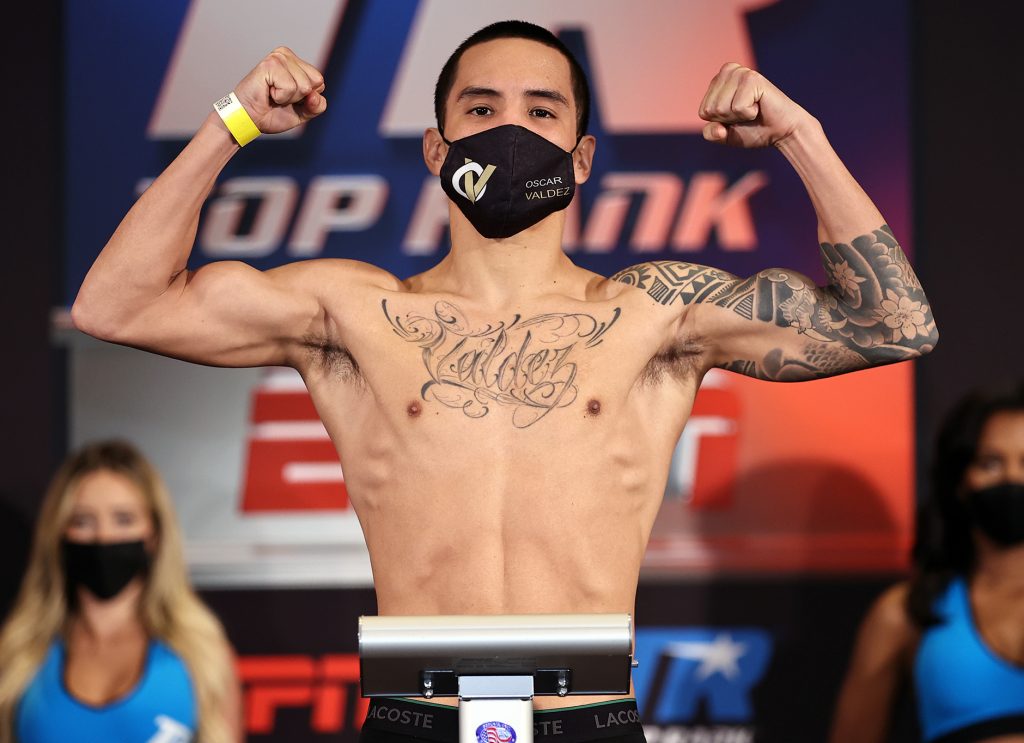
It looks as if Oscar Valdez won the argument. He’s expected to fight, expected to defend his junior-lightweight title on Sept. 10 in a homecoming, according to an ESPN report both in English and Spanish. But he could have never known he’d be going home to so much controversy.

Fight or no fight, the controversy will be there at Casino del Sol, about 12 miles down the road from downtown Tucson where he grew up.

It’ll be in headlines and social media. It’s already been there, a virtual storm of criticism and the usual taunts. Brazilian challenger Robson Canceicao might be a lot easier to beat than questions that promise to come at Valdez like dangerous punches from unseen angles.

Valdez’ title, patience and poise are among the heightened stakes in an expected fight that appeared to be in real jeopardy just a day ago because of a positive test for a reported stimulant.

Three contentious days full of an ongoing debate about whether he should or shouldn’t fight appeared to end late Thursday. The Top Rank-promoted fight is on, according to ESPN’s Mike Coppinger, who cited unnamed sources in his report.

The reported decision to go forward came a day after a Zoom meeting that included Top Rank, Valdez attorney Pat English, the World Boxing Council’s Mauricio Sulaiman and the Pascua Yaqui.

The fight at an outdoor arena adjacent to the casino is subject to approval and jurisdiction by the Pascua Yaqui commission. 15 Rounds could not confirm ESPN’s report. There was no answer to calls to Commissioner Ernie Gallardo’s office at the Pascua Yaqui headquarters. However, the bout was still advertised on both Casino del Sol and Top Rank websites late Thursday.

The reported decision also came down a few hours after news, also from Coppinger, that Valdez’ B-sample tested positive.

Who’s right? Who’s wrong? Who knows? There’s never much clarity, much less certainty, in the hazy, balkanized business of boxing and drugs. We can only be sure that there probably will be another opening bell.

As this one approaches, public and pundits are increasingly split, thumbs up or thumbs down. But it’s not that simple.

Deliberations had been ongoing since the story broke Tuesday on ESPN, which also is scheduled to televise Valdez-Conceicao on its premium channel, ESPN+.

There’s an inherent conflict-of-interest in ESPN’s role. Emphasis on conflict. But boxing wouldn’t have its corner on chaos without the messy mix of conflicting interests. It’s always there, often just beneath the surface, but always ready to emerge with more conflict, confusion and controversy.

That made everything about Thursday’s news volatile, hard to predict. As I wrote early Thursday, the jury was still out. A decision was expected soon. But mostly the controversy raged on, especially on social media.

It’s been noisy enough for ESPN to sell more premium buys for the bout. Yes, that’s cynical. But cynicism, like conflict, is also part of boxing.

Let’s face it, Valdez-Conceicao was interesting.  And it still figures to be more competitive than expected. But it was never a must-see bout. Until now.

Over just a few days, it’s been transformed — turned into a hot-button issue — for fans who might have had a moderate interest, but now have a definite opinion. They’ll buy the telecast.

Add to that, a capacity crowd – about 5,000 – at Casino del Sol’s Ampitheatre. Sellouts, in any sport, have been rare during the Pandemic. This will be an exception.

The Pascua Yaqui is not new to professional boxing. It knows what it’s getting into. The Tribal Commission has been regulating bouts since Fernando Vargas fought there in 2003. It’s also a Commission that’s been caught squarely in the conflict-of-interest web. Fair or not, a sellout will be seen as motivation for the Pascua Yaqui to sanction the bout, despite the positive test for a banned substance.

The Pascua Yaqui commission is aligned with the Association of Boxing Commissions, which means it should follow its guidelines.

Then again, so is the Arizona State Boxing & MMA Commission, which licensed Julio Cesar Chavez Jr. to fight Danny Jacobs in December 2019. Chavez turned to Arizona when Nevada said no after he reportedly ran away from VADA when it showed up at the Wild Card Gym in Los Angeles prepared to subject him to a a random test.

Chavez got his AZ license and then went on to lose, quitting on the stool against Jacobs, at the Phoenix Suns arena. The crowd erupted, throwing debris in a near-riot. But that’s another story.

Another Arizona story.

This chapter will be controversial for everyone involved, regardless of what happens.

It’s inevitable that discussion at Wednesday’s meeting included an argument that Valdez tested positive for a substance, phentermine, that WADA (World Anti-Doping Agency) prohibits only on the day of competition. Valdez’ underwent the test while training mid-August in San Diego.

If Valdez were a UFC fighter, there’d be no doubt.  according to Kevin Iole in a story for Yahoo. WADA rules apply, meaning Valdez would be fighting on Sept. 10 without questions.

But this is boxing, meaning options, loopholes and argument. The Valdez test was conducted by VADA (Voluntary Anti-Doping Association). WADA, VADA, nobody knows nada. But there’s a difference, minor most of the time but major now.

VADA doesn’t differentiate between in-competition and out-of-competition when it comes to phentermine, which suppresses the appetite for people trying to lose weight. It’s banned, period.

For someone who had plans to cover the fight, I would have been happy if everyone just tested positive for Moderna.

But I understand the argument that Valdez, a good guy, should be held accountable. Perhaps, he was confused. As a two-time Mexican Olympian, he was under WADA rules. As a pro, he’s under VADA rules. Too many different rules mean no rule at all. Confusion is understandable. But not an excuse.

That said, everybody on social media and elsewhere, please, stop condemning Valdez. Please, get off the pulpit. There’s no high ground in boxing. There’s just that messy collection of rules, regs, commissions, acronyms, egos and self-interest.

If Valdez wins, he’ll still have to deal with scarring questions that never go away. His stablemate, Canelo Alvarez, still gets hammered by talk from the cheap seat in social media about whether tainted Mexican beef was the real reason he tested positive for performance-enhancing clenbuterol in 2018.

Meanwhile, boxing continues to sow the confusion that allows it to move on. That’s unfair to Valdez and any other fighter so often caught in the middle.

Don’t blame him. Blame the business.


On the Schedule: Timing is sure to generate more talk about Benavidez-Canelo

By Norm Frauenheim-

Sometimes, schedule makers are a little bit like map makers. They can draw up a pretty good path to what might be next. Or, at least, how to get there.

Connect the dates, which on boxing’s current map means David Benavidez-versus-Canelo Alvarez might be closer than ever. For a couple of years, it’s been mostly talk, most of it from Benavidez.

There was a chance, but it vanished about 13 months ago when Benavidez failed to make weight for the defense of a World Boxing Council title he had regained. Had he made the weight, he would have kept the belt. He went on to beat Roamer Alexis Angulo.

But the vacant title fell into Canelo’s powerful hands, who took it easily in what was a one-sided decision over an overmatched Callum Smith last December

Had Benavidez’ kept the belt, Canelo’s determined pursuit of a unified super-middleweight title might have already led to the Phoenix fighter. Instead, Canelo will go after the 168-pound’s last piece, the International Boxing Federation belt held by Caleb Plant.

That’s going to happen on Nov. 6, presumably in Las Vegas. Showtime made it official last week. Plant showed up at press row Saturday before the Yordenis Ugas’ upset of Manny Pacquiao at Vegas’ T-Mobile Arena, confirming that – yeah – they finally had a deal.

“Don’t congratulate me now,’’ Plant told reporters, who wanted to applaud the resolution to talks that had fallen apart a couple of weeks ago. “Congratulate me after the fight.’’

Three days later, Showtime and Premier Boxing Champions (PBC) announced that Benavidez-versus-Jose Uzcategui – originally set for Aug. 28 and postponed by Benavidez’ positive test for COVID — had been rescheduled for Nov. 13, a week later, still at the Footprint Center, the Suns arena in downtown Phoenix.

Coincidence? Only if you’re not paying attention to the signs. The timing is just the latest piece to fall in place for a fight that has been near the top of the fans’ wish list.

A Benavidez victory would put him back at the front of the WBC line for another shot to regain the title he has held twice. He would be the so-called mandatory challenger to Canelo. Benavidez, still unbeaten, is favored.

That’s not to say Uzcategui doesn’t have a chance. The Venezuelan has challenged for a major title, losing a decision to Plant in January 2019. But he’s considered a steppingstone for Benavidez, 24 and still emerging.

Before the fight was postponed, some betting sites listed Benavidez as a 1/9 favorite, meaning he has about a 90 percent chance at winning. That seems a bit much. But you get the idea. Benavidez figures to win – and win big – in his first appearance before hometown fans since he fought his way to stardom.

Canelo, too, is a big favorite, although some think Plant’s combination of footwork and toughness will surprise the sport’s top draw. Canelo is a minus-600 favorite, meaning an 85.71-percent chance at victory.

Whatever the odds, it looks as if it’s a lock that Benavidez and Canelo will win convincingly, one Saturday after the other in November. What’s not a lock is what happens next. That’s boxing, not betting. Odds are always pretty good that something unforeseen – from injury to insanity — will happen.

Benavidez-Canelo, Mexican-American-versus-Mexican, would be a good Cinco de Mayo bout in 2022. May 5 falls on Thursday next year. That Saturday, May 7, would be the day to celebrate with an opening bell.

But all of that depends on another road map, the one Canelo has drawn up for his career. He talks about history. If he beats Plant, he will have accomplished one goal with a unified title.

It’s not clear if his next step would be the pursuit of a unified title at light-heavyweight. His record already includes a key 175-pound victory, a stoppage of Sergey Kovalev in November 2019. During the on-and-off negotiations with Plant, there was talk that he might opt for a fight against Dmitry Bivol, who holds a light-heavyweight belt.

Canelo’s decision might hinge on a couple of scales — the one that measures weight and the bigger one that measures history. There’s another one, too: Benavidez. He failed on the first scale, but he’s back and still there on the second, a face and a factor that Canelo will eventually have to confront.

Now or then, at another date or another weight, November’s timing will make it inevitable.


Manny Pacquiao can’t beat time or Yordenis Ugas

LAS VEGAS – Father Time came knocking Saturday night. He looked a lot like Yordenis Ugas.

Manny Pacquaio couldn’t stop him.

Pacquiao, still a timeless legend, finally ran into that inevitable moment. The clock said it’s time to move on, time to do something else. Maybe a campaign for the Filipino presidency will be his next fight. Maybe he can go on to be a 43-year-old President. Then, he would be a young man all over again. But at 42, he’s old and finished as a fighter.

There are no more opening bells left on his calendar. Just another birthday in December. Pacquiao would not say what he plans to do next. But he didn’t have to.

Ugas punches told him again and again throughout 12 rounds.  Nearly every round included signs that Pacquiao’s days as a fighter are over. Ugas scored a unanimous decision, 115-113 on one card and 116-112 on two.

Ugas’ power moved Pacquiao backwards and sideways. At times, he looked awkward in trying to stay away from the Cuban, who was a late stand-in for the younger, stronger Errol Spence Jr. Mostly, the Filipino Senator looked stationary, a target for Ugas, a welterweight who is a step or down the welterweight ladder from Spence and Terence Crawford.

“My legs were tired,’’ Pacquiao (62-8-2, 31 KOs) said after his first fight in 25 months. “I just couldn’t move.’’   

It didn’t take long to see that Pacquiao has only moved into middle age.

“Manny, Manny, Manny.” The chants were from a crowd that remembered a younger man. They started long before opening bell. They echoed through the jammed T-Mobile Arena, loud enough to be heard on the Vegas’ strip and maybe on the streets of Manila.

In the first round, Pacquaio predictably pursued early, backing up the bigger, broad-shouldered Ugas. There was some immediate uncertainty evident in Ugas body language. Pacquiao’s foot speed and punching angles have bewildered just about everyone he has faced for more than two decades. Initially, it looked as if Ugas (27-4, 12 KOs) would be just another confused face. Pacquiao has seen a lot of them. Beaten most of them.

Near the end of those first three minutes, however, Ugas landed a big body shot. For a split second, it was almost like flipping as switch. Pacquiao froze. Those feet, ever fleet for so long, suddenly quit moving. Ugas a sent message, to both Pacquiao and himself. Pacquiao knew Ugas had the power to hurt him. Suddenly, Ugas was emboldened, knowing his size and strength were enough to offset Pacquiao’s diminished skillset.

For the rest of the bout, Pacquiao seemed to fight in desperate spurts. He’d rock Ugas, but never really hurt him. Ugas would respond, always countering with a big jab or an overhand right. Increasingly, the Cuban knew it was his fight. He’d smile at Pacquiao as if to say the fight and the 147-pound belt belonged to him.

“Most of all, I want to thank Manny Pacquiao,’’ Ugas said through a translator. “I want to thank him for what he has given me.’’

A gift from Father Time.

Guerrero scores dull decision over Victor Ortiz

It was a fight between ex-champions. Victor Ortiz-versus-Robert Guerrero might have worked Triller. But on a traditional boxing card featuring Manny Pacquiao-Yordenis Ugas, it just didn’t work.

There were boos throughout the 10 rounds.

There were cheers, but only in the end

Guerrero (37-6-1, 20 KOs) won, scoring a unanimous decision over Ortiz (32-7-3, 25 KOs) at T-Mobile Arena. In what looked to be a capacity crowd waiting for Pacquiao-Ugas, it was also unanimous, unanimously happy that it was finally over.

Mark Magsayo scores 10th-round KO

Call it a double down, two right hands that put Atizapan de Zaragosa onto the canvas and kept him there for a couple of scary moments in a devastating 10th-round knockout in a World Boxing Council featherweight eliminator Saturday on the Manny Pacquiao-Yordenis Ugas card at T-Mobile.

Magsayo (23-0, 16 KOs), a Filipino who had Pacquiao trainer Freddie Roach in his corner, ended any chance of an upset on the cards. Zaragosa (32-5-1, 28 KOs), of Mexico, surprised Magsayo, knocking him down in the fifth. In the end, however, Magsayo’s power said it once. Said it again. Said it all.  

Carlos Castro delivers dramatic KO of Escandon

In the first round, he survived. In the middle rounds, he had to be stubborn. Then, he had to be resilient. Then, he was sensational.

Phoenix featherweight Carlos Castro (27-0, 12 KOs)did it all Saturday night in his first pay-per-view appearance on the Manny Pacquiao-Yordenis Ugas undercard at T-Mobile Arena.. First, he endured a bug punch. Then, he recovered.

Then, he won by knockout with a whirlwind of punches that left former contender Oscar Escandon exhausted, dazed and beaten.

At 1:08 of the 10th, it was official: Castro  was the KO winner and a proven contender at 126 pounds. 

Escandon (26-6, 18 KOs) rocked Castro in the closing seconds of the opening round. Then, it looked as if Castro was in for a long night. But he regained his footing and his wits. Then in a wild seventh, he gained momentum and kept it with a long jab and slick skillset. Escandon looked confused. He lunged and missed with a punch that sent him crashing onto the canvas like a kid doing a belly flop.

In the final round, Castro pursued and delivered a whirlwind-like finish with a beautiful succession of punches for a defining victory, the biggest thus far in his emerging career. 

-Mexican featherweight Angel Contreras (11-4-2, 6 KOs) upset any chance that John Dato (14-1-1, 9 KOs) might warm up the ring for fellow Filipino Manny Pacquiao in the final fight before the pay-per-view telecast for the Pacquiao-Yordenis Ugas card. Contrerras beat Dato, handing him his first loss and flooring the Filipino in the third-round of an eight-round  unanimous decision.  

California lightweight Mikel Clements (1-0) leaped into his pro debut on a major card, lunging to land punches through four head-rocking rounds for a unanimous decision over Eliseo Villalobos (1-2) of Simi Valley, CA.

The Pacquiao-Ugas undercard resumed after a long break following the tripleheader beginning like a guy waking up from a nap. It was a yawner. Super-middleweights Burley Brooks (6-2-1, 5 KOs) of Dallas and Cameron Rivera (9-6-4 of Fife, WA fought to a dull draw. Neither could gain an edge or even momentum in the six-rounder. 

The Manny Pacquiao-Yordenis Ugas card started with a triple-header, an afternoon matinee, before the fans were allowed into T-Mobile Arena Saturday.

Behind closed doors and in front of empty seats, Mexican lightweight Jose Valenzuela (9-0, 6 KOs), drawing first blood in a one-sided assault for a fourth-round TKO of Donte Strayhorn (12-4, 4 KOs) of Cinicinnati.

In the second bout, power-forward-sized heavyweight prospect Steve Torres (5-0, 5 KOs) of Reading, PA, landed early and often, scoring a first-round TKO of Justin Rolfe (6-3-1, 4 KOs) of Fairfield, ME.

In the third bout, Detroit lightweight Frank Martin (14-0, 10 KOs) outscored, outpunched and overwhelmed Ryan Kielczweski (30-6, 11 KOs) enroute to a unanimous decision over the fighter from Quincy, MA.  


Hello or Bye-bye? Pacquiao steps off the scale and waves at the crowd for at least one more opening bell

By Norm Frauenheim-

LAS VEGAS – Manny Pacquiao stepped off the scale, walked to the edge of the stage and winked. Then, he waved.

Weigh-ins are nothing if not about body language. In a week full of talk about whether Pacquiao is on the eve of his last fight, one wave Friday was enough for endless speculation and interpretation.

Was this one more goodbye wave? All week long, he has been dropping hints that he might be moving on.

Or was he just saying hello? Just Manny being Manny.

Or was the gesture a mocking way of saying that he intends to make Yordenis Ugas go bye-bye Saturday night at T-Mobile Arena in a pay-per-view fight? Pacquiao’s corner is saying he will win by knockout, which would be his first as a welterweight and his first since 2009.

The possibilities are all there, tipping the scale toward an intriguing fight, an event that could mark the final chapter to one legend and the beginning of another in the Filipino Senator’s likely campaign for his country’s presidency.

Pacquiao, now a practiced politician, never says much. Pacquiao, the presumed candidate and eight-division champion, also knows a thing or two about how to throw an artful feint, in the ring and on the stage. He dedicated the fight to the people who will cast ballots in next year’s presidential election, May 9.

“For the Filipino people,’’ Pacquiao said after weighing 146 pounds, one less than the mandatory, for the 72nd fight in a career that includes world titles in four decades.

Pacquiao (62-7-2, 39 KOs) is the favorite, both at the sports book and on the street. That’s not much of a surprise. He was more than a 3-1 favorite about 24 hours before opening bell on the PPV card (6 p.m. PT/9 p.m. ET). The weigh-in was closed to the public. Only a media crowd of a few hundred was allowed into the scheduled ritual at the Grand Garden Arena at the MGM, because of the ongoing surge in COVID.

But the Pacquiao constituency was there, gathered up a flight of stairs and behind a roped-off barrier.

“Manny, Manny,”” they chanted.

It was loud and clear. Their echoes could be heard on the floor, up on the stage and on the scale. They expect 42-year-old Pacquiao to win.

He’s only smaller physically. In stature, he overshadows Ugas in every conceivable way. At 5-foot-9, Ugas is taller by a couple of inches.  With a 69-inch reach, he’s wider. He was also one pound heavier Friday at 147. But there was no way to get out from under long shadow that the Pacquiao legend casts.

“I respect him,’’ Ugas (26-4, 12 KOs) said Friday, sounding very much like a young man speaking of a wise elder.

On Saturday, however, Ugas promises something else.

“All respect is finished when we get into the ring,’’ the 35-year-old said through an interpreter.

In terms of respect, there’s not much of it on Ugas’ side of the scale. He’s the late stand-in, rushed into the main event off the undercard because Errol Spence was found to have a torn retina during a formal physical a couple of weeks ago.

Ugas has neither Spence’s power nor proven skillset. But he does have a performance that some think indicates he has a chance. He lost a controversial split-decision to Shawn Porter in March 2019. Many thought he won.

Few are picking Ugas to win. If Porter were fighting Pacquiao instead of Ugas, however, Porter might get the nod. At the very least, it would be a pick’em fight  

  “I’m here to wreck any future plans Manny Pacquaio has in the ring,’’ Ugas said when he arrived at the MGM Grand Tuesday.

Maybe, Pacquiao was waving bye-bye to that one.


Boxing’s Elvis: Is Pacquiao in the building for the last time?

By Norm Frauenheim-

History follows Manny Pacquiao. It’s a parade of titles, weight classes, money and mostly fans that has marched, Pied Piper-like, down through the decades.

Is it ending? It might be. The if has been attached to Pacquiao’s fight Saturday night against Yordenis Ugas at Las Vegas’ T-Mobile Arena in a pay-per-view bout.

That if, in fact, is a bigger part of the fight than just about anything, including Ugas, a relatively unknown Cuban who is a late stand-in for Errol Spence, out with a torn retina.

That’s not fair to Ugas, a competent enough welterweight with perhaps a better chance at springing an upset than the betting odds suggest. But it’s hardly a surprise.

That if has transformed the fight into an event. To wit: Will Elvis be in the building for the last time?

The fact that Pacquiao is thinking about moving on is about as big a secret as his plans to run for President of the Philippines are. Front-and-center, it’s the story – the theme — leading up to the PPV card’s first bell (6 p.m. PT/9 p.m. ET, $74.95). It might be hard to sell Ugas. But a chance to see a legend answer the bell for the last time? Now, there’s a compelling sales pitch.

“It might be my last fight,’’ Pacquiao said, hinting at retirement all over again, during the final news conference Wednesday at the MGM Grand. “Or, there is more.’’

More, of course, could mean just about anything. More could mean a run for President. He has until early October to declare his candidacy. More could mean Spence or Terence Crawford. He mentioned both if and when he decides to continue his ring career.

But Spence or Crawford could also give his political rivals some red meat. Current Filipino President Rodrigo Duterte has already said Pacquiao is “punch-drunk.’’ That suggestion might gain some real traction if Pacquiao were to fight Spence or Crawford, both of whom are more than just competent welterweights. They’re dangerous, especially against a man years past his physical prime and well into middle age.

In the here-and-now, the decision hinges in how the 42-year Filipino Senator performs Saturday. He’s favored, of course, by odds that are expected to grow — and grow some more — by opening bell. He was minus-360 Thursday, which means about a 73-percent chance at victory. That chance promises to multiply, driven by public sentiment. It’s a powerful factor, and all of it is in Pacquiao’s corner.

It’s an understatement to say that Pacquiao is beloved. To his fans, he’s Manny, the same Manny he was more than two decades ago. His fans have grown up with him. They’ll bet on him, if for no other reason than to have a betting slip as a souvenir for what might be his last fight.

For the politician in Pacquiao, that’s good news, a sign that he might get as much support at the polls as he does at the window.

Just a couple of days before opening bell, however, it’s not clear that the last-chance pitch has had much impact at the box-office. On Thursday, seats were still available throughout T-Mobile at prices that range from $211 to $1,292. The announcement a couple of weeks ago that Spence was out and Ugas in didn’t help. But there are other circumstances, including another surge in COVID.

Fans might not fill the building, but the guess here is that they’ll be there, in the pay-per-view audience to watch their Elvis for maybe the last time.


Still In The Ring: Senator Pacquiao poised for another opening bell

By Norm Frauenheim-

From pugilist to populist, the campaign continues. Manny Pacquiao is always running, toward the fight and for the Senate. Maybe for President, too.

Before a run at the Filipino Presidency, however, there’s a fight, at least one more in a life as storied as it is improbable. Pacquiao will answer another bell, not against Errol Spence Jr., an encounter as feared as it was anticipated.

Instead, the Senator faces Yordenis Ugas, a capable welterweight yet without any of Spence’s notoriety. Spence was a real risk; Ugas is a late stand-in.

That’s unfair to Ugas, a Cuban who got the call Tuesday after Spence was forced out of the August 21 pay-per-view date at Las Vegas T-Mobile Arena by a torn retina. But nothing about public perception, or boxing, has ever been fair. It’s fickle. Dangerous, too.

For Pacquiao, a late change in opposition has done little to alter the danger. He’s 42. The 31-year-old Spence could have hurt him. The 35-year-old Ugas can too. It all depends on how Pacquiao adjusts. Ever the politician, Pacquiao promises no adjustment is too much.

Spence is left-handed. Ugas is right-handed. So what, says Pacquiao, whose two-plus decades in the boxing and political rings have shown he can work both sides of any aisle.

“I consider myself a bipartisan boxer,” Pacquiao said Wednesday during a Zoom session with reporters. “I am used to fighting right and left-handed, so it’s not going to be a problem,”

It was a good quip, one that suggests Pacquiao is also in training for an imminent presidential campaign.  In the here-and-now, however, the pressing question is whether his reflexes have resisted time’s corrosive process.

 If not, Pacquiao’s career could end as abruptly as so many others have. Pacquiao’s quick hands and quicker feet could carry him in-and-out of danger, in-and-out of victory. But he hasn’t fought in more than two years. He hasn’t tested those reflexes since a split decision over Keith Thurman on July 20, 2019.

He looked forever young against Thurman. But 25 months later, forever might be forgotten. Spence or Ugas, that’s part of the risk. Part of a perverse attraction, too. But Pacquiao has never been afraid. In part, that helps explain his popularity. It endures. His chin has betrayed him. But never his popularity.

Against Spence, the numbers were daunting. He was four inches shorter. Eleven years older. He had a five-inch disadvantage in reach. Yet shrinking odds, driven by public sentiment, gave Pacquiao a chance against Spence. How come?

Because he’s Manny.

The world’s love affair with Pacquiao continues. It’s also an exception. Politicians are hated. Fans buy fights because they want to see the designated bad guy take a whipping. But Pacquaio, pugilist and politician, is loved. His goodness is inexhaustible. It also might be the only thing about him that hasn’t aged.

It helps explain how opening odds favoring Spence were cut in half, from 4-1 to 2-1, within just a couple of weeks. With Spence out and Ugas in, Pacquiao is the favorite, minus-300, meaning he has a 75-percent chance at victory.

From this corner, the odds are off.  The younger Ugas has a real chance in what looks to be a pick-em fight. Had it been Spence, it still might have been close to an even fight at opening bell.  

The bet, really the hope, is that goodness will prevail all over again. It’s rooted in what is remembered about Pacquiao. Risk was never tied to reward. For Pacquiao, it has never been part of a ratio. From Oscar De La Hoya to Antonio Margarito, he just took it on. Now, he decides to fight Ugas, a real fighter, instead of a Paul. Hard not to love that.

But the risk has never been bigger. Time isn’t sentimental. It just moves on. A tale of the tape tells you that Ugas has Spence-like advantages in almost every relevant dimension. The clock tells you something else. Ugas is in his prime; Pacquiao is not.

Pacquiao’s 26-years in the pro ring are a thorough record of what he does. There are no secrets. His power is intact. But nothing should surprise Ugas, whose advantages and relative youth will allow him to play a punishing waiting game. Like an incoming target, Pacquiao will have to pursue — step inside repeatedly.

Ugas figures to erode his energy with blows early and hurt him with big punches later. The Pick: Ugas, unanimous decision.

Ugas will beat him, but not knock out his popularity. Pacquiao might have enough of that to win the Filipino presidency. It’d be nice to see a good guy go on to win that fight.


David Benavidez withdraws from August 28 date because of COVID

By Norm Frauenheim

David Benavidez, unbeaten in the ring, can’t win one outside of it.

The super-middleweight’s string of trouble continued Wednesday with his withdrawal from an August 28 homecoming in Phoenix against Jose Uzcategui because of a positive test for COVID, according to multiple Phoenix sources who confirmed a story first reported by Boxing Scene.

Benavidez (24-0, 21 KOs) was supposed to fight Uzcategui (31-4,26 KOs), of Venezuela, in a 12-round eliminator for a mandatory shot at the World Boxing Council’s version of the 168-pound title, currently held by Canelo Alvarez. Benavidez, 24, is already the WBC’s No. 1 contender for a title he has held and lost twice.

He was stripped of the belt for a positive cocaine test in September 2019. He regained it, then lost it on the scale, failing to make weight for a title defense in August 2020.

As of Wednesday, it wasn’t clear whether the bout at the newly-named Footprint Center, the Phoenix Suns home arena, would be canceled or postponed. A postponement looked likely. Tickets have been for sale since the Showtime-televised card was announced in mid-July.

A request for formal approval of the card was on the agenda Wednesday at a meeting of the Arizona State Boxing & MMA Commission.

On the undercard, there’s a scheduled comeback by Benavidez brother Jose, who won his first title – a World Boxing Association interim welterweight belt – in May 2015, also at the Suns Arena.

Jose Benavidez, set to come back against Argentine Francisco Torres (17-3, 5 KOs), hasn’t fought since Terence Crawford stopped him in the twelfth round in October 2018.

The undercard also has included unbeaten Phoenix featherweight Carlos Castro (26-0, 11 KOs) against Oscar Escandon (26-5, 18 KOs) of Colombia.

Showtime was expected to televise both Jose Benavidez-Torres and Castro-Escandon.


No Doubt: Maturing David Benavidez has no questions about what’s next

By Norm Frauenheim

There’s been uncertainty surrounding Canelo Alvarez’ next fight, questions about when, where, weight and mostly who.  There’s been none about David Benavidez, whose mind and purpose are locked in on an August 28 homecoming in Phoenix.

All paths lead to Canelo, or at least they have for Benavidez, who poured a lot of noise into social media in trash-talking Canelo, the game’s biggest draw.

Follow the money in today’s boxing business and it inevitably leads to Canelo. But there’s no sure way to get there, a fact that Caleb Plant might have learned the hard way. Plant’s speculated date in mid-September with Canelo is reportedly off because negotiations went awry. Instead of Plant, Canelo’s next foe looks to be Dmitry Bivol, according to promoter Eddie Hearn.

“Bivol is the front runner, in my opinion, for that slot on September the 18th, Hearn said Monday during an appearance on The DAZN Boxing Show.  “I think if it’s not Bivol, then I think there’s a very good chance that September 18 will be put on hold, and we’ll move on to another date and potentially another opponent.’’

As of Thursday, there was no new of a deal. That could change Friday, or Saturday or whenever. Boxing talks are nothing if not notoriously unpredictable

“Now I’ll reiterate that he wants that Plant fight, you know, it’s the undisputed fight, but he also wants to face other champions,’’ Hearn said. “So, we’ve been in touch with Dmitry and they’re ready to fight Canelo Alvarez on September the 18th. They’ve been sort of training really for the last two or three weeks in the hope that they do get that pick.” 

Plant has always been seen as the fight at the top of Canelo’s immediate wish list. Plant holds the International Boxing Federation’s super-middleweight belt. Canelo’s stated goal has been to be the first in the division to unify the168-pound title. He could always go back to Plant and resume negotiations if he beats Bivol, who holds a light-heavyweight belt, the World Boxing Association’s version, the least-respected piece to boxing’s unification puzzle.

Bivol, perhaps weakened by a battle to fight at a catchweight, would qualify as a stay-busy date. It would fill a traditional boxing weekend that celebrates September 16, Mexican Independence. It also could become a megaphone for the growing number of fans who want to see Benavidez fight Canelo.

It all depends on what Canelo does – whether he in fact fights on Sept. 18 and how Benavidez (24-0, 21 KOs) performs against Venezuelan Jose Uzcategui (31-4, 26 KOs) in a Showtime-televised bout at the newly-name Footprint Center, the Phoenix Suns home arena.

Benavidez knows that. In a mark of his emerging maturity, the 24-year-old talked this week, in effect saying he can control only what he does instead of what Canelo may – may not — do.

“This is a big opportunity for whoever wins this fight, Benavidez said Tuesday in a zoom session with reporters. “He’s (Uzcategui) been in this sport for a long time and has a lot of experience. This is the kind of fight we both need to get to the bigger dogs. I’ll fight whoever I have to in order to get back to the world title. I’m going to earn my opportunity any way it comes.’’

Benavidez might have already fought Canelo had he not lost the World Boxing Council belt on the scale nearly a year ago, Aug. 14, for a title defense against Alexis Angulo. He went on to score a 10th-round stoppage of Angulo. Then, he made weight and stopped Ronald Ellis on March 13. Against Uzcategui, he faces a former champion who lost a unanimous decision to Plant in January 2019.

“I take my career fight-by-fight and I of course want to get back in the ring as soon as possible after this fight,’’ Benavidez said. “Right now, August 28 is the only thing on my mind. I can’t overlook anybody, especially an ex-champion like Uzcategui.

“I want to be in the game for 10 more years. So, it doesn’t matter when the belt comes back to me. I have to keep taking it, fight by fight, and let the rest take care of itself.’’

No question about that either.


From A-to-Z: Arizona’s resilient boxing culture stays in the fight

By Norm Frauenheim-

The Arizona boxing market is little bit like the mythic symbol for which the state’s capitol is named. It’s always climbing off the deck like that proverbial bird seen on the side of a Phoenix bus and in the city’s flag. It’s fighting to take flight.

Always fighting.

Appropriately, there’s been more fight than flight in the state’s boxing history. It’s been up-and down, poised somewhere between new heights and familiar depths.

Barring another COVID disruption, the old fight goes on, this time with a real chance to reach an unprecedented peak. Two major cards are scheduled within two weeks in late summer, the first featuring super-middleweight David Benavidez on Showtime on the Suns home floor in downtown Phoenix on August 28 and then junior-lightweight champion Oscar Valdez Jr. on ESPN at Casino del Sol in Tucson on Sept. 10.

It’s a powerful combo, a testament to a lively market that lives on without coverage from the state’s traditional media. Full disclosure: I covered boxing for The Arizona Republic for three-plus decades before the state’s biggest newspaper pulled the plug on me and the sport.

The sport is thriving. Me? I’m older than that ancient bird. I’ll let somebody else decide. But boxing’s resiliency in Arizona is no surprise. It’s deeply rooted in the state’s culture, unique for the number of mom-and-pop gyms throughout neighborhoods in Phoenix and Tucson. They’re next to convenience stores, in backyards and on the sidewalk in front of a barber shop.

It’s appropriate that David Benavidez and his brother, Jose, will be fighting at the newly-named Footprint Center. Boxing’s footprint is everywhere in Arizona.

It was there in the 1950s with Jimmy Martinez, a Phoenix middleweight and an undisputed world traveler whose passport nearly included as many stamps as his record included fights (142). It was there all over again, this time generating headlines when Michael Carbajal came out of his Phoenix backyard, won silver at the controversial 1988 Olympics and fought his way into the Hall of Fame.

In late August and early September, that indelible footprint re-appears, potentially in a way that it never has. Once, twice, it’s a speed bag of affirmation that AZ boxing will outlive just about anything, even newspapers.

“Phoenix, Arizona made me into the vicious puncher and entertaining fighter I am today,’’ David Benavidez (24-0, 21 KOs), a former two-time champion at 168-pounds, said after his bout with Venezuelan Jose Uzcategui (31-4, 26 KOs) was formally announced Thursday. “I am grateful to have given up my childhood and be in the gym all day in phx to become something other than just ordinary.’’

Ordinary became extraordinary in the years after Benavidez left home. He hasn’t fought in Phoenix since a victory in May 2015 when he won a prelim on a card that featured brother Jose in a junior-welterweight title win, also in a ring on the Suns home floor at what was then US Airways Center. The arena’s name has changed. So, has David Benavidez. He looms as very real possibility for Canelo Alvarez, the biggest name in the sport.

It’s no coincidence that Canelo’s trainer, Eddy Reynoso will be in Tucson a couple of weeks later with Valdez (29-0, 23 KOs), a two-time Mexican Olympian who went to school in Tucson. Valdez’ strong ties to AZ are evident in his record. He has fought four times in the state, twice in Phoenix and twice in Tucson. His title defense against Brazilian Robson Conceicao (16-0, 8 KOs) is intriguing on a couple of levels.

They have history. Conceicao, a 2106 Olympic gold medalist at the Rio de Janeiro Games, beat Valdez by a single point for a Pan American Games gold medal in 2009.

For Valdez, the fight is his first since his dramatic upset of Miguel Berchelt for the 130-pound title. Few gave Valdez a chance against Berchelt last February. Then again, few have ever given him much of chance against the best, first at featherweight and now at junior-lightweight.

Nevertheless, he fought his way through a broken jaw on a rainy night in an outdoor ring in Carson Calif. to beat a bigger Scott Quigg in Match, 2018   

There were doubts he would be able to come back from that bloody triumph. Valdez, the winner, was put on a stretcher and rushed to the emergency room.  Nearly three years later, he beat a feared, bigger Berchelt in a 10th-round stoppage.

It was stunning. From A-to-Z, It was a testament to resiliency, a stubborn streak that defines him and the state of the AZ game. 


The Olympic Ring: A pound-for-pound look at Olympic history

By Norm Frauenheim–

Opening ceremonies mean first bell for an ancient craft older than the Olympics. Punches for medals. Punches for prize-money. Punches for vengeance. Punches for bribes. Punches for national pride. It’s been hit, miss, memorable and misery for as long as anybody can recall.

The show must go on, this time in Tokyo for troubled Olympics dubbed the Pandemic Games. COVID is no game. I’m not sure these Olympics will be much of a game either. But the modern version of Olympics has survived world wars and boycotts. It has even survived boxing, an Olympic stepchild again at the brink of expulsion for scandals that have become a permanent scar.

Preliminary bouts begin Friday without the usual acronym, AIBA, running the show. In effect, AIBA is on probation for reported financial transgressions, controversial judging and who-knows-what-all. That leaves questions about who and how judges and referees will be appointed. And paid. The International Olympic Committee says it will be running the competition. But if the IOC really knew anything about boxing, the corruption would have ended generations ago.

Boxing, which can be as resilient as it is corrupt, survives in spite of itself. It’s there in part because third-world nations don’t need world-class swimming pools to field a team. A pair of hand-me-down gloves can be a down payment on a ticket to the Olympic ring. According to the IOC, boxers from 73 nations are in Tokyo. Everybody fights. It’s a common language, understood as much as it is forever feared.

But there’s even more. There’s the history. The Olympics just wouldn’t be the same without the names and legends who have stepped through the ropes and onto the medal stand.

Here are a few, a pound-for-pound look at Olympic boxing.

1.   – Teofilo Stevenson. He’s the Olympic legend, one that captures worldwide imagination because there appeared to be no limit on what he could have done. He was the beginning of the Cuban legacy. Fidel Castro had outlawed the pro game. He won three gold medals – 1972, 1976 and 1980. He never fought as a pro. But there was talk that he was better than Muhammad Ali, the original GOAT (Greatest Of All Time.)

2     — Ali. Then named Cassius Clay, he won gold in 1960 at light-heavyweight, He would later change his name and the world. Somehow, he lost the medal. He said he threw it into the river in hometown Louisville. It was a good story, but it isn’t true. The medal was never found. But the Olympics never forgot him. He lit the Atlanta cauldron in 1996.

3     – Joe Frazier. Without Joe, the Ali legend wouldn’t be the same. Frazier, a heavyweight gold medalist in Tokyo in 1964, and Ali created a defining rivalry. There are great rivalries. But there is only one Ali-Frazier

4     — George Foreman. Like Frazier, the Ali story wouldn’t be the same without Foreman, a 1968 gold-medalist who will forever be remembered for a photo of him clutching a small American flag in his bear-paw-sized hand after his victory in Mexico City. Without Foreman, there would have been no Rumble In The Jungle, Ali’s epic victory in Zaire.

5     – Felix Savon. He furthered Stevenson’s Cuban legacy, winning gold in 1992, 1996 and 2000. He might have won a fourth if not for Castro’s boycott of the 1988 Seoul Olympics.

6     — Sugar Ray Leonard. The light-welterweight gold-medalist was the face of America’s 1976 team, the best US team ever. He put boxing at center stage in Montreal at an Olympics otherwise known for Romanian gymnast Nadia Comaneci. He then became cornerstone for The Four Kings, an era dominated by his rivalries with Marvin Hagler, Thomas Hearns and Roberto Duran.

7     — Laszlo Papp. He was Vasiliy Lomachenko before Loma. A Hungarian, Papp was the first three-time boxing gold-medalist, winning at light-middleweight and middleweight in 1948, 1952 and 1956.

8     — Lomachenko. The Ukrainian won gold at featherweight in 2008 and again in 2012. He won a major title in only his second pro fight. His story continues to unfold in a career that saw him come back with an impressive victory after a loss to Teofimo Lopez in October.

9     — Roy Jones Jr. He’s known for what was stolen from him in 1988. Jones, whose great talent was confirmed throughout his Hall of Fame pro career, got robbed of gold in a light-middleweight bout in Seoul. There was evidence when the fixed scorecards were announced. There was further evidence in secret-police files made public after East Germany fell a couple of years later. The IOC has yet to correct the record. It has yet tp give Jones his rightful gold. It’s no coincidence that the boxing scandals continue.

10 – Oscar De La Hoya. The 1992 gold medalist at lightweight had a great story. He won for his mom, Cecilia, who died nearly two years before the Barcelona Games. His victory also set the stage for a brilliant pro career, one that made him a wealthy man in the pay-per-view industry of the 1990s.

11 – Andre Ward. He won gold for his performance and his poise in 2004. The Americans struggled. But Ward quietly and proficiently won gold at light-heavyweight on the day of closing ceremonies in Athens. An American man hasn’t won boxing gold since. He went onto to an unbeaten pro career.

12 – Claressa Shields. She won two gold, first in 2012 in London and again in 2016 in Rio de Janeiro. Shields, the first American woman to win gold in the Olympic ring, brought international media attention to women’s boxing, new to the Olympics.

13 – Howard Davis. The 1976 lightweight gold medalist, Leonard’s teammate, was voted the most outstanding boxer on a team that also included gold-medalists Leon and Michael Spinks.

14 – Vassily Jirov. The 1996 light-heavyweight gold medalist got world-wide headlines long before Gennadiy Golovkin and long before anybody knew where Kazakhstan was. Jirov, also a former IBF light-heavyweight champ also got the Val Barker Trophy for a memorable gold-medal run that included an upset of favored American Antonio Tarver in the semi-finals.

15 – Floyd Patterson. He won gold as a middleweight in 1952. Likeable yet shy, he went on to fight as an undersized heavyweight, winning the title twice, first against Archie Moore and then in a rematch with Ingemar Johanssen. At the time (1956) of his victory over Moore, Patterson was 21, then the youngest heavyweight champ in history.


Crushing KO for AZ featherweight title followed by a brawl in the seats

PHOENIX – The room was decorated for weddings. But there were no vows. Just violence, in the ring and the seats.

In a ring beneath a ceiling covered with a white floral display, a fight card ended wildly Friday night at the Legends Event Center in Maryvale on the westside of Phoenix.

Danny Barrios (6-0, 2 KOs) executed a definite end to the regulated violence with a powerful succession of uppercuts that drove fellow Phoenician Edward Ceballos (9-4-1, 5 KOs) though the ropes and flat on his back on the ring’s apron at the end of a scheduled six rounder. That’s where he was counted out by referee Wes Melton.

The fight for a state featherweight title sanctioned by the Arizona State Boxing & MMA Commission was over. But the brawl was just beginning.

As Ceballo’s corner rushed to help their fallen fighter, spectators talked trash and hurled cups of beer. The exchange quickly escalated. Members of Ceballos’ corner and spectators started shoving each other. They had to be separated as the small crowd scattered and headed for the parking lot amid flying chairs and debris.

Barrios’ victory was the main event on a card that had been scheduled to feature former lightweight champion Ray Beltran. But Beltran’s comeback was cancelled. His opponent, Daniel Perales Osorio of Monterrey, Mexico, chose not to fight.     

Best of the Undercard

Left-handed Michael Norato (9-0, 20 KOs), a tall lightweight from California, had a long jab that kept Isaac Camarillo (3-2-2, 1 KO), of Yuma, AZ, at bay, off balance and bloodied. Norato, who had ex-Oscar De La Hoya trainer Robert Alcazar in his corner, won a one-sided decision, 60-54 on all three cards.

The Rest

Phoenix super-middleweight William Northran (3-0, 2 KOs) used his superior reach and faster feet to score a second-round TKO of Tommie Stephens (0-1) of Eloy, AZ.

Brian Velasquez (3-0, 2 KOs), a Phoenix junior-featherweight, relied on agile feet and a long body to counter aggressive pursuit from Nestor Robledo (7-13-2) for a four-round majority decision over the Mexican.

Joseph Rivas, a welterweight from Coolidge, AZ, survived a tough test in his pro debut, enduring four head-rocking rounds for a unanimous decision over Misael Chacon (4-24-3, 3 KOs) of Florence, AZ.

Maximus Castro (2-0, 2 KOs), a Phoenix junior-featherweight also trained by Alcazar, possessed power, sending winless Kendall Ward (0-8), of Idaho to his knees repeatedly with big body shots that finally led to a stoppage at 1:34 of the fourth round.

Axel Rosales (3-0, 2 KOs), a Phoenix lightweight, scored with body shots, offsetting a busy style for a majority decision over Gregory Cruz (2-1, 1 KO) of Seattle.Attachments area


Ray Beltran’s comeback fight cancelled

By Norm Frauenheim-

Ray Beltran’s 23 years in the ring include lots of punches. Lots of lessons, too.

One of those lessons landed all over again Thursday. No payday is ever guaranteed. Beltran’s comeback fight Friday night at Legends Center in Maryvale on the west side of Phoenix has been cancelled. His scheduled opponent didn’t show up for the weigh-in Thursday.

Beltran (36-9-1, 22 KOs), a former lightweight champion, said he was told Wednesday night that Osorio just didn’t want to fight. The bout, which would have been Beltran’s first since a stoppage loss to Richard Commey in June 2019, was supposed to be at 143-pounds. Osorio (12-20-2, 8KOs), of Monterrey, Mex., was 2-6 over his last eight bouts.

“It’s disappointing,’’ said the 40-year-old Beltran, once Manny Pacquiao’s primary sparring partner. “You invest a lot of time and money into training and all.  But it’s part of boxing. Part of the business. I used to fight because of my passion for the game. I still do. But now I also see it as a business.’’

Beltran, who lives in Avondale on the west side of Phoenix, said he hopes to fight on a card featuring super-middleweight David Benavidez-versus-Jose Uzcatequi on Aug. 28. It was announced this week that the Showtime-televised card will be at Talking Stick Arena in a ring on the Suns home floor in downtown Phoenix.

Jose Benavidez Jr. is also expected to fight on the card. It would be Benavidez Jr.’s first bout since a 12th-round stoppage loss to welterweight champion and pound-for-pound contender Terence Crawford in October 2018. The Benavidez brothers grew up in Phoenix.

“That’s going to be a big night for Phoenix boxing,’’ said Beltran, who was brought to Phoenix from Mexico in the late 1990s by late Hall of Fame trainer Emanuel Steward.

Beltran made his pro debut in Tucson in July 1999.

“At this stage, I just want to stay busy,’’ said Beltran, who says he will fight at junior-welterweight. “I’m hoping for August 28. Then, maybe in September. At this stage, I’ve got to stay busy. I can’t sit around and wait.’’

With the Beltran comeback off Friday night’s card, young featherweights Danny Barrios (5-0 1 KOs) and Edward Ceballos (9-3-1, 5 KOs) will fight in the main event for a 126-pound state title sanctioned by the Arizona State Boxing & MMA Commission. First bell is scheduled for 6 p.m.


From Tokyo Olympics to Fury-Wilder 3, the COVID threat still looms

By Norm Frauenheim-

The Olympics are often portrayed as a standard, the flip side to what the boxing acronyms represent. But the IOC, the International Olympic Committee, is beginning to look like just another ruling body with a rack of made-up belts for sale. The IOC wraps itself in flags, national anthems, mottos and the medal count. But the IOC counts only the money.

A looming disaster in Tokyo exposes the bottom line.

Citius – Altius – Fortius. That’s Latin, Olympic-speak, for Faster – Higher – Stronger. More like Faster – Higher – $tronger.

The IOC landed in Tokyo this week like the WBA seeking a sanctioning fee for an interim title. Opening ceremonies for the already postponed Olympics, the 32nd in the history of the Summer Games, are supposed to happen on July 23, just 16 days from the date that Japanese health authorities declared a state of emergency.

Sha’Carri Richardson, an American sprinter banned for smoking pot, won’t be the only one not there. Fans won’t be either. They’ve been banned from attending because of the re-emergence of COVID-19. Apparently, The Games must go on. But the delta variant isn’t playing games.

The emergency declaration coincided with IOC President Thomas Bach’s arrival in Tokyo, where he began three days of quarantine at a five-star hotel. Enjoy the room service. It’s hard to know what else there will be to enjoy at a joyless Games. It’ll be an Olympics in the bubble, essentially a television show.

For Japan, it’s already a financial disaster. Japan invested a reported $12.6 billion to organize the Olympics before the Pandemic. Now it’s reported to be at least twice that much.

Who pays? The Japanese, who in polling over the last six months were increasingly opposed to staging the Pandemic Games. The IOC should have listened, or at least been prepared with alternate plans. But the money – rights’ fees, advertising, travel and all the rest – added to a force that led to the danger confronting a nation and the world’s best athletes.

 The debt is staggering. All it buys is the potential for more of a Pandemic that just won’t go away. It scares the stock market. It means empty planes, empty hotel rooms and empty seats all over again. Vaccines are supposed to work. But not everybody is willing to take a couple of jabs. No vaccine for stupidity.

Meanwhile, the ominous news is everywhere, including boxing, which had begun to move ahead with plans for business as usual.

On the same day that Japan’s emergency ban on fan attendance at Olympic venues was announced, there was a Twitter report from Mike Coppinger about a possible COVID outbreak in Tyson Fury’s training camp for a second rematch with Deontay Wilder on July 24 at Las Vegas T-Mobile Arena. As of Thursday, there was no confirmation of the report.

If true, however, it would represent a major setback in boxing’s hopes for business as usual. At best, it would force a postponement, another one in a long series of chaotic delays. At worst, it would mean no fight at all. Only a ruling through arbitration forced the third fight.

But neither Fury-Wilder III nor Tokyo Olympics XXXII is worth the risk of more COVID.  If this Pandemic continues, there won’t be any sanctioning fees left for anybody.Attachments area


Gold Fix: Time to give Jones and Carbajal what they fairly won 33 years ago

By Norm Frauenheim

Amateur boxing is talking reform. Again. With another Olympics just a few weeks away, the sport’s international ruling body says it plans far-reaching change for what it promises will be “a fair fight.’’

Fair enough. Easy to do, too. The body, AIBA, took an opportunity to grab the bully pulpit this week with an international news conference less than a month before opening ceremonies. Trouble is, AIBA isn’t supposed to have anything to do with boxing at the delayed Tokyo Games.

The Olympic czars in Switzerland have ordered AIBA to get its house in order. That means cleaning up a reported $16-million debt, a mob-like history of bureaucrats and bosses and decades full of corrupt judging.

Olympic boxing makes the scarred pro game look like Mister Clean. Hard to do. Yet, it hangs on, pushed to the edge of the Olympic fringe because of its long history and its universality. Everybody fights, and everybody has been fighting since at least the ancient Greeks. It’s there, in spite of itself.

But it’s not clear how many people watch anymore. Exasperation at boxing’s failure to root out the corruption forced NBC to drop it as a featured part of its telecast schedule. It’s embarrassing and has been since Roy Jones Jr. got robbed 33 years ago in Seoul. The world saw it. Then, boxing still generated an audience, one that remembered 1976 and a Montreal Olympics that starred Sugar Ray Leonard.

The Jones theft, a decision that cost him the gold medal, might as well be forever framed in yellow-crime tape. It was defining, for him and the Olympics. It was no coincidence, perhaps, that Jones was part of the news conference from Lausanne. He appeared alongside AIBA’s new president, Umar Kremlev, a Russian. Remember, Jones is Russian, too. At least, he has a Russian passport. The American was granted citizenship by Vladimir Putin in 2015.

Whatever the connection, Jones belonged there. Despite all of his great moments in the pro ring and his long run atop the pound-for-pound ratings, he will be remembered for what happened at the 1988 Olympics. His voice is the key to any discussion about Olympic boxing and its troubled path to irrelevance. Say it in Russian. Say it In English. Roy Jones Jr. said it all this week.

“Whenever I see that, it feels like yesterday,’’ Jones said of the photo that shows the ref raising South Korean Park Si-hun’s hand in victory for the light-middleweight gold. “And not in a great way.

“All the judges that were part of that decision were crooked. They’ve all been banned. And I know they were not the only ones.

“So, I’ve said it before and I’ll say it again. The judges were crooked. The whole world knows it. Even my opponent agrees I won the fight. But how come I don’t have my gold medal? How can you beat someone so bad and not get the gold medal, and they don’t go back and fix it? Because I’m still here. And I still earned it. And we have to make sure nothing like that ever happens again.’’

The key is in Jones question: Why-oh-why doesn’t he have the gold? More than three decades have come and gone. Jones was awarded the Val Barker Trophy, the award for being the most outstanding boxer at the Seoul Games. In 2002, the IOC honored him with something called The Olympic Order.

But never the gold.

Kremlev said this week that he wants Jones to finally get that gold. For Olympic boxing, it’s a beginning, really the only beginning.

All of the talk about reform is hollow – Fool’s gold – until Olympic boxing gives Jones his moment on the podium’s top pedestal. In the years since 1988, enough has been revealed to give not only Jones the gold. Give one to Michael Carbajal, too. Carbajal’s loss to Bulgarian Ivailo Hristov was just the beginning of rigged judging in a scheme that included an officer in the former East German police force (Stasi). Years after the Seoul Games and subsequent collapse of East Germany, Stasi files were found to include allegations that the fights were fixed and bribes were paid.

Carbajal, of Phoenix, fought and lost on Oct. 1. Jones lost the next day. The night before the Carbajal fight, talk circulated that the fix was in. A shouting match erupted between the American coaching staff and members of the committee responsible for assigning the judges.

Stan Hamilton, a judge-referee from Knoxville, Tenn., told the Los Angeles Times about a contentious 2 a.m. meeting. Hamilton told sportswriter Earl Gustkey that two judges, Hiouad Larbi of Morocco and Alberto Duran of Uruguay, were supposed to have been suspended for questionable work early in the Olympics. He said neither was eligible to work any gold-medal bout. But they worked both the Carbajal and Jones losses – five judges-to-zero against Carbajal and 3-2 against Jones.

Before the meeting ended, Hamilton said, committee member Vladimir Gordienko, of the former Soviet Union, left and ran into Jim Fox, then executive director of the U.S. amateur federation.

“Gordienko was angry,” Hamilton said. “He found Fox and told him: ‘You will lose, 5-0, to the Bulgarian.’ ‘’

That’s what happened. First, Carbajal, then Jones, both losing with judges working while suspended. Carbajal and Jones moved on, both to Hall-of-Fame careers. Neither Hristov nor Park fought again, amateur or pro.

It was the fix that never got fixed. Until it does, there will never be a new beginning for Olympic boxing.

A fair fight is possible, but first give Jones and Carbajal the gold they fairly won.Attachments area


Vasiliy Lomachenko at the crossroads

By Norm Frauenheim-

It’s high risk for a fighter who calls himself Hi-Tech.

Vasiliy Lomachenko, a consensus pound-for-pound No.1 for a couple of years in the post-Floyd Mayweather era, is at a career crossroads in a fight that appears to be a way of strengthening his argument for a rematch with Teofimo Lopez.

But Masayoshi Nakatani is a tough way to go. In Nakatani, Lomachenko encounters all of the dimensions –and then some – that troubled the Ukrainian in his move up the scale and into a loss last October to Lopez.

Lomachenko’s scorecard defeat was debatable on a couple of levels. The judging was one-sided, especially the 119-109 and 117-111 scores. ESPN’s Andre Ward, former super-middleweight and light-heavyweight champion, scored it a draw. So did I.

After reviewing the lightweight bout several times, my card could have been 115-113 or even 116-112, — the third official score – all for Lopez. Never for Lomachenko, who has since said he is convinced it was a draw.

From every angle in repeated reviews, Lopez wins the argument with energy, poise, size and – in the end – knowing he was the bigger guy. That was the key then. It might be the key now for Lomachenko (14-2, 10 KOs) Saturday night (ESPN+, 4:15 PT./7:15 pm ET)) against Nakatani (19-1, 13 KOs) at Las Vegas’ Virgin Hotels.

Nakatani is bigger in every significant aspect. At 5-11 ½, he is 4 ½ inches taller than Lomachenko and 3 ½ inches taller than Lopez. In reach, he has a 5 ½ advantage over Lomachenko, 3 ½ over Lopez. The appropriately named tale-of -the-tape doesn’t measure everything, of course. If it did, Russian 7-footer Nikolai Valuev would still be the heavyweight champ. It doesn’t measure those proverbial intangibles. Lomachenko has plenty in terms of footwork, punching angles, smarts and instinct.

Then, again, so does Nakatani. The Japanese fighter’s skill set has been questioned, but there’s not much doubt about his will. He’s there for the distance. For Lomachenko, that’s the problem. And the challenge.

Lomachenko needs a stoppage. He has to do what Lopez could not. His argument for a rematch with Lopez hinges on one because Nakatani is the reference point. Nakatani forced Lopez to go the distance for the first time a couple of years ago in Oxon Hill, MD.

Lopez won a unanimous decision, similar to his decision over Lomachenko in that the scoring didn’t reflect the fight in July 2019. It was close, or at least a lot closer than the 118-110, 119-109, 118-110 cards. Even the ever-confidant Lopez called the bout, a then a lightweight title eliminator, “horrible.’’

A decision — from one-sided to close and everything in between — just won’t do it for Lomachenko. A complication, perhaps, is injury. Since the former featherweight and junior lightweight champion jumped to 135 pounds, he’s been vulnerable. He underwent surgery on his right shoulder the week after his loss to Lopez. He apparently aggravated a lingering injury. But, apparently, it was enough to make him cautious through the first seven rounds against Lopez.

Believe what you want, he can’t afford another injury, even with a definitive stoppage of Nakatani. He’s 33. The best of his prime is probably behind him. Another injury, even in a definitive knockout of Nakatani, would leave him with a dilemma.

Risk further injury against Lopez, perhaps at even heavier weight, 140 pounds?

Move back to 130, where his skill set was dominant in every way?

The latter would end any hope at avenging his loss to Lopez, who is already calling out undisputed junior-welterweight Josh Taylor.

There’s really no choice for a fighter whose Hi-Tech nickname has summed up the variety of options included in his unique skill set. Lomachenko needs a clean stoppage for his career at the top of the game to continue. Attachments area


No Disguise for Wilder’s Silence: It’s just another costume

By Norm Frauenheim-

Silence from Deontay Wilder can be a good thing. But even a little wasn’t enough in a news conference bizarre, even by boxing’s twisted standards. A lot was said about Wilder’s decision to say almost nothing during a scheduled appearance in front of the media this week for the formal announcement of a third fight with Tyson Fury.

Wilder wore sunglasses dark enough to hide his eyes and headphones, presumably the noise-canceling model. He appeared to be a man determined to insulate himself from the chaos he and his craft promise. It was an angry look, appropriate for the stage.

But it was also another costume. The last time he fought, he wore a comic book-like suit of armor into the ring, a get-up he would later blame for his loss to Fury in their second bout. He went on to blame a lot of things. But never himself. It’s hard to blame somebody you don’t know. Increasingly, that’s who Wilder appears to be. There’s a confused sense of self in the ex-heavyweight champ, one that has been further fractured by the loss of his title to Fury 16 months ago.

The belt was his identity. It’s gone.

Power also has been his identity. But Fury left some doubt about its potency. It’s fight-stopping potential is still there, still dangerous enough respect. To fear. But Fury stripped some of the deadly certainty out of Wilder’s right hand and perhaps his mind when he got up – twice — in their first bout, a draw in December 2018.

It looks as if Wilder can’t be sure of much, including himself, these days. Perhaps, the costumes are a way of hiding, or a method of searching for changes that can transform him into the fighter he once knew. For now, however, it just looks like an act, one that’s not fooling anyone, especially Fury.

Fury had all the lines in what was supposed to be the only news conference before their July 24 bout at Las Vegas’ T-Mobile Arena.

“Thank you everybody for coming out for this one-sided press conference,” said Fury, who knows something about acting and even more about a show-stopping quip.

By then, it was already evident that the silence was just one part of the act. Before the Los Angeles news conference, Wilder talked to UK reporters via Zoom. After the news conference, he met, one-on-one, with Elie Seckbach for the popular ESNEWS on YouTube.

Turns out, silence was a little bit more expendable than the vow it appeared to be during the presser. In Wilder’s ever-changing wardrobe, it was just a costume accessory. This one proved to be awkward for PBC, Top Rank and everybody else trying to conduct the newser.

It ended with perhaps the longest, if not the strangest, face-off ever. Fury and Wilder were asked to pose for the cameras. It’s a ritual that sometimes goes awry because of a shove or a punch. Without the extracurricular violence, it’s a pose meant for video and still photos. Look mean, act angry. It’s marketing. It’s theater. Wilder and Fury walked to center stage, separated by a few feet. Fury smiled, talked some trash. Then, Wilder took off his sunglasses in what could have been interpreted as a threatening gesture. The idea, perhaps, was to show Fury his angry eyes, an intimidating look into his furious soul.

Fury looked. And looked. He also smiled. Wilder looked. And looked.  He also ran his tongue beneath his lower lip, back-and-forth, in a gesture meant to add to a scary mask.

For an estimated five-and-a-half minutes, nobody would break the stare. The first to blink is a sign of weakness. At least, that’s an old theory in an ancient sport. Fury and Wilder might still be standing there if not for the bodyguards and security who stepped between them and begged them to walk away.

Wilder was the first to break it off.  It was time for another costume change.


Pacquiao back in the gym and back for a risky bet in his rivalry with Mayweather

By Norm Frauenheim-

Manny Pacquiao got back into the gym for some honest work for his summer date with Errol Spence a few days before Floyd Mayweather pulled off another heist, an exhibition he called legalized bank robbery.

The timing was mere coincidence, yet symbolic of how the two are connected by opposite paths each has taken since their fight six-plus years ago fell woefully short of expectations.

The differences have never been more polarized. Pacquiao still embraces risk; Mayweather has never been more risk-averse. Despite their divergent paths since Mayweather’s unanimous decision in 2015 over Pacquiao in the richest fight ever, danger is there for both in what looks to be a dilemma for a troubled business and its polarized fan-base.

Applaud Pacquiao for his courage, but worry that a younger, bigger Spence might hurt him. Defend Mayweather’s right to make as much as he can, but worry about his legacy.

Mayweather’s string of cash grabs continued Sunday in Miami against one of the Pauls. Logan or Jake or Rand? I can’t keep them straight. I also didn’t watch a show without an official winner, although both corners apparently scored a victory for their bank accounts. Showtime’s pay-per-view telecast was expected to hit the one-million mark, according to multiple reports.

Mayweather still sells, although recent photos of him made me think of a word applied to a former boxing entrepreneur and ex-president who was back on the bully pulpit in North Carolina last weekend. The New York Times called him diminished.

Diminished might just be another way of saying Mayweather, 44, is beginning to look old. Apparently, nothing about his net worth has been diminished. Still, there’s a question about whether his string of legalized bank robberies is diminishing the legacy he has defined and marketed with his official record, 50-0.

From this corner, TBE — The Best Ever — looks to be a diminishing acronym. Stop The Steal, Floyd, or the unbeaten legacy will become unrecognizable.

There might be opportunity in that. Mayweather’s diminishment might be Pacquiao’s enrichment. But the risk is huge. In age, Pacquiao is a lot closer to Mayweather than Spence. At 31, Spence is squarely in his prime.

He’s also bigger, a big welterweight, who at opening bell on August 21 is sure to be the middleweight he is about to become. Think Antonio Margarito. Pacquiao beat him decisively on the scorecards in a junior-middleweight bout on the Dallas Cowboys home field in Arlington, Tex. But Pacquiao called it his toughest fight. The bigger Margarito hurt him with body punches along the ropes midway through the bout. Hurt him 11 years ago.

The question is whether Pacquiao can still endure — and recover — from that kind of punishment. He thinks he can, although he hasn’t answered an opening bell in a couple of years. When he faces Spence, it will be about 25 months since his last fight, a split decision over Keith Thurman in July 2019.

“It’ll be a good fight,” Pacquiao told The Philippine Star Wednesday after nearly a week of some preliminary work at his home in Manila. “A lot of world titles will be at stake. Spence is unbeaten, younger. But I’m confident, I have the experience, speed and power.”

The Filipino Senator with Presidential aspirations also has wear and tear, all inevitable after 26 years in the pro ring. The middle-aged Pacquiao is the early underdog. He was at minus-240 this week, according to various on-line betting sites That translates to a 29.41-percent chance of victory. There might be a better chance of him getting hurt.

But the role is not new. Oscar De La Hoya was a huge favorite, Then, there was also fear that a smaller Pacquiao might get hurt. Pacquiao stopped him, forcing De La Hoya to quit after eight rounds. It was a career-defining moment. A moment that happened 13 years ago.

For now, Pacquiao seems to enjoy being the underdog. Maybe, it makes him feel younger.

“It was the same trend when I fought Thurman,” said Pacquiao, who was expected to move his training to his hometown, General Santos City, on Thursday. “In the beginning, he was the favorite, but as people found out how I was training and saw my speed and power hadn’t changed, the odds reversed by the time the fight started.”

He’s an underdog with a legacy that will always be compared to a rival moving in another direction, yet on a parallel track. Each has a risk-to-reward ratio. Each also has own way of calculating it.

For Mayweather, it’s the safest possible bet on more money, his nickname. For Pacquiao, it’s another risky chance at history. 


Joshua-Usyk? The Only Option

By Norm Frauenheim-

It’s hard to know what to make of talks for an Anthony Joshua-Oleksandr Usyk fight, especially in the turbulent wake of an arbitrator’s ruling that ended any chance of a Joshua-Tyson Fury showdown in August.

After months of nothing but rumors and unfounded promises, caution is the only way to approach today’s heavyweight division.

Here’s what we do know: Fury has moved on, almost seamlessly, to an agreement to fight Deontay Wilder for a third time on July 24, reportedly somewhere in Las Vegas.

What we don’t know involves Joshua, whose plans and training were disrupted by a former federal judge’s unexpected interpretation of the Joshua-Wilder contract, signed before their second bout and won by Fury in a one-sided stoppage.

Fury looked to be ready for a Joshua bout in Saudi Arabia for a share of oil money reported to be $155 million. Not so fast, the ex-judge ruled. First, fight Wilder.

The immediate guess was that Joshua would move on to the Usyk option as quickly as Fury did. Not so fast.

An early reason for caution surfaced this week. Joshua-Usyk was supposed to be announced Tuesday, the deadline set by the World Boxing Organization for what is supposed a mandatory defense for Joshua.

Mandatory has become a euphemism for messy in today’s acronym-speak. It has led to lousy bouts and all of the usual threats to vacate or strip.

According to news reports, the WBO granted an extension. What else was it going to do? Grant a pardon? It wants the sanctioning fee. The WBO didn’t grant anything. It said, yeah, please take all the time you need to get this done.

Maybe, a deal gets announced within a few days. That would be the good news.

Maybe, talks get extended for another week or two. That’s kind of the same-old-news, given what happened with Fury-Joshua.

Going to a purse bid would be the next step in a tiresome process. That would mean an 80-20 split, the lion’s share going to Joshua

But Joshua promoter Eddie Hearn made that sound unlikely. At least, he did in comments after lightweight Devin Haney’s decision over Jorge Linares last Saturday.

“We’ll either make a deal or we’ll vacate,” Hearn said. “I mean, we won’t be going to purse bids or anything like that.’’

Hearn also forecast that there would be an extension beyond Tuesday’s deadline.

“I do think where we are with negotiations, we would probably say to the WBO: ‘If there’s no deal by Monday or Tuesday, could we have another week, please?’ Hearn said. “Like if both teams say that, then they’ll give you more time, you know?”

Of course. Say no and there’s no fee.

This time, however, there are back-up possibilities, options if for some reason Usyk does not agree to terms. There were none, at least none apparent in the headlong pursuit of Joshua-Fury, still the only heavyweight fight that really matters.

The names of Dillian Whyte, Luis Ortiz and Andy Ruiz Jr. were dropped as possibilities in the event of no agreement with Usyk.

Whyte, a British heavyweight fresh off a stoppage of Alexander Povetkin in March, would keep Joshua’s UK base of fans happy. In the United States? A collective yawn.

The aging Ortiz still has a respected skill set. Yet, the Cuban doesn’t do much to excite fans anxious to see Joshua face the new, instead of the shopworn. It’s a stay-busy date.

Ruiz? A third fight would do well with Mexican-Americans, a key fan demographic on any continent. It also might be an opportunity for Joshua to answer some questions, still lingering after his loss to Ruiz in a 2019 stunner followed by a scorecard victory in a cautious decision in a rematch. A knockout of Ruiz would knock out some of the doubts.

The doubts about Joshua are still there, reflected by odds that had been posted for the expected Fury fight. Fury was a slight favorite, minus-175, which translates to a 63.6-percent of victory.

In Usyk, Joshua would encounter a newly-minted heavyweight, one who hopes to make himself the reigning face of the division. There are still plenty of questions about Usyk after just two bouts in the division. The former cruiserweight champion looked tentative. There were some inevitable questions about his power. But the promise is still intact. Hype and expectations are there.

Joshua-Usyk would be easy to sell. Hopefully, easy to make, too. 


Tyson Fury gets a big win on the legal scorecard

By Norm Frauenheim

It’s been called a surprise, Maybe, it was. Maybe, it was an artful feint. Whatever it was, an arbitrator’s ruling looks to be a win for Tyson Fury.

Former federal judge Daniel Weinstein abruptly silenced all the hype for a Fury-Anthony Joshua fight in Saudi Arabia with a decision last week that Fury owes Deontay Wilder a second rematch.

Fury-Joshua, a fight for the unified heavyweight title, was said to be a done deal. Now it’s gone, faster than a desert mirage.

There’s anger, seemingly all from Joshua and his promoter Eddie Hearn, who for months had trumpeted the proposed fight as a showdown for the ages.

But a promised date with history came undone because of a contract clause. It’s as if the king’s clothes suddenly unraveled because of an unseen flaw in an overlooked stitch. Nobody saw it, or if they did, nobody was concerned about it.

Hearn sounds as if he’s embarrassed. Fury has yet to express any frustration. Even Fury had announced on social media that he would be fighting Joshua on August 14.

The next day, Weinstein issued a KO ruling, saying no, Fury would have to honor the clause and fight Wilder before Sept. 15. Within days, Joshua and Wilder had a date, July 24, for a third fight in Las Vegas.

Then, Fury showed up at ringside last Saturday for Josh Taylor’s compelling decision over Jose Ramirez for the unified junior-welterweight titles at Vegas’ Virgin Hotels. He signed autographs. He posed for photos. He smiled. He had the look of a man happy to move on.

“If this was me in that case, I would have done absolutely everything I could to save this fight,’’ Hearn told IFL TV Tuesday. “They didn’t try one thing. That also sits on Tyson Fury, because he didn’t try and do one thing either. There’s nothing I can do about it because, as I said leading up to this fight, the only thing I can’t control is their team. But where are your bollocks, Tyson Fury? If you really wanted this AJ fight, you have not said anything negative about this situation.

“You have not said how disappointed you are, you have not looked at your promoters – who clearly could have terminated this contract a long time ago – and gone: ‘What have you done? You’ve not only cost me fifty or sixty million dollars, you’ve cost me the biggest fight of all time, the undisputed fight because you’ve dropped the ball. And if you haven’t dropped the ball, why are you not fighting this and trying to come up with a Plan B.’

“I’ve not seen one thing from Tyson Fury, where he’s saying – ‘I’m devastated, I can’t believe this, we had a deal in place, I was happy, guys, I’m sorry.’ “

Memo to Eddie Hearn: Fury didn’t say anything negative — isn’t sorry – because he got exactly what he wanted.

Throughout the long-winded negotiation, Hearn was too busy talking to Saudi Princes, instead of listening to what Fury was saying. All along, Fury said he wanted a tune-up.

His decision to walk away from a third bout with Wilder initially came about because he wanted to fight. 

Early last October, Fury declared that the clause for a third fight had expired in the weeks since his stoppage of Wilder on Feb 22, 2020 at Vegas’ MGM Grand.

Fury said he needed to stay busy. He then went ahead with plans for a stay-busy fight in the UK late last year. But those plans were cancelled because of a COVID surge in the UK. Meanwhile, talks with UK rival Joshua had begun. Joshua went on to stop Kubrat Pulev on Dec. 13 in London. But Fury remained idle, yet he continued to hint that he wanted – needed – a tune-up.

Weinstein gave him one.

Wilder’s power is still a risk. It always will be. But Fury has dealt with it. He survived it, getting up twice in their first fight, first in the ninth round and again in 12th, in a Dec. 1, 2018 bout that ended in a split-draw.

In the rematch, Fury went straight at Wilder, suffocating him and never allowing him the leverage he needs to launch his right hand. Fury won easily, forcing Wilder’s corner to throw in the towel in the seventh. It was a surprise. Many corners, including this one, thought Wilder’s power would prevail all over again. But Fury proved that Wilder had only power. Take it away and he was clueless.

Fury’s tactics looked reckless. Five months earlier, He had suffered a nasty cut over his right eye in a tune-up win over a little-known Swede, Otto Wallin. The guess was that Wilder would re-open that cut. A scar is still evident. But Wilder never got close to that scar. He simply didn’t have enough in his limited skillset to set up a shot against the clever, ever-elusive Fury. It’s hard to see it going any other way on July 24. Fury knows exactly who he’s fighting in this tune-up, unlike his tune-up against Wallin.

Meanwhile, Joshua faces a far more challenging task in a mandatory defense against Oleksandr Usyk, who is two fights into his heavyweight career after dominating the cruiserweight division. Usyk beat Chazz Witherspoon and Derek Chisora, but his performance in both left doubts.  There are questions about his power and size against the giants in the heavyweight division. Nevertheless, Usyk still has dangerous potential.

Put it this way: Who would you pick in a Usyk-Andy Ruiz Jr. fight? Ruiz upset Joshua in a stunner on June 1, 2019. Joshua avenged the loss, yet he fought cautiously in winning a decision throughout a rematch in Saudi Arabia. The 6-foot-3 Usyk is an inch taller than Ruiz, listed 6-2. Usyk’s 78-inch reach gives him a four-inch advantage over Ruiz, listed at 74. Usyk is not as heavy as Ruiz, whose battle with weight led to lousy conditioning in the Joshua rematch.

Translation: Usyk is a much bigger threat to Joshua than Wilder is to Fury in a third fight.

Fury should send Weinstein a thank-you note.


No Dispute: Josh Taylor wins the argument and all the belts in a decision over Ramirez

LAS VEGAS – No dispute.

Josh Taylor made sure of it, knocking down Jose Ramirez twice enroute to winning all of the pieces to the junior-welterweight title with unanimous decision Saturday night in front of a small crowd at Virgin Hotels and an ESPN audience.

 The judges scored it the same way. It was 114-112 — once, twice, three times — all for Taylor. The margin was only two points, a nod perhaps to Ramirez’ toughness. But the difference between the two was clear, indisputable. There was no argument. No need for a rematch.

Taylor moved toward an even bigger date, perhaps with leading pound-for-pound contender Terence Crawford at a heavier weight, welter. But there were no lingering questions Saturday about who he was. There’s not a better 140-pound fighter on this planet or any other.

“I have been waiting for this moment all my life,’’ he said to a crowd of fellow Scots who chanted his name and waved the Scottish flag.

Taylor (18-0, 13 KOs) seized the moment midway through the fight with all of his advertised guile and power. He had promised to knock out Ramirez (26-1, 12 KOs). But that was the only promise he didn’t keep. He knocked put everything else, including some early doubt.  

Ramirez was first to enter the ring, wearing a robe in bright colors and dark shoes. Taylor followed, clad in Scottish tartan and a waistband in gold. It was a clash of culture. A clash of colors. A clash of styles.

After a couple of days marked by escalating trash talk, they had finally arrived at the moment when they would communicate with hands bound in white gloves and loaded with dark intent.  

Ramirez was the first to strike. For three plus rounds, he moved forward throwing right hand leads with his first step toward Taylor. It appeared to surprise Taylor. For few moments, the Scotsman looked uncertain, even dazed. But he would recover, adjust and mount the fight’s second and third strikes.

Late in the fourth and throughout the fifth, Taylor seemed to regain his footing and eventually the momentum. He imposed his will, if not his superior height on Ramirez, moving forward in much the same way that Ramirez had in the earlier rounds.

In the sixth, Taylor caught, a left-handed counter that landed on Ramirez’ chin and dropped him onto the canvas. In the seventh, Taylor struck again, this time in the split second after referee Kenny Bayless separated them. Bayless stepped back from the break and Taylor fired a left uppercut.

Ramirez was back on the canvas, down for a second time. He got up. But the spring in that first forward step was gone.

Suddenly, Taylor looked bigger.

Looked stronger.

Looked to be in control.

He was.

“We used his aggression against him,’’ Taylor said. “No disrespect. I’ve got nothing but love for Ramirez. This week was no disrespect. It was all part of the mind games to get in his head, to make him more eager to jump in at me and be more aggressive, to use his aggression against him.”

Ramirez wasn’t finished after the knockdowns. He never is. He carried on the fight with the resilience that has been a trademark to his career and his character. In the eleventh, an incoming Ramirez appeared to stun Taylor, who fell into him and then hung onto him. But it wasn’t enough and Taylor knew it. He waved a gloved right hand at the crowd, limited to 750 people by COVID protocol, as he walked to his corner after the eleventh.

One more round, and there would be no dispute.  

“I’ve got nothing but love for Ramirez. This week was no disrespect. It was all part of the mind games to get in his head, to make him more eager to jump in at me and be more aggressive, to use his aggression against him.

“I thought the scorecards were a little tight. I thought they were well wider than that. I wasn’t too happy with the selection of the judges, but I wasn’t going to moan. I was confident in winning this fight anyway.”

Ramirez said, “He took advantage of some of those clinches but, hey, I got back up and tried to give it my best and stay smart. I was never hurt. I was aware. I was just disappointed every time it happened. I tried to shake it off and get back to my rhythm. But it was overall a good fight. Hopefully, I get back and I learn from my mistakes. You win some and you lose some. 

“I felt like I landed some clean shots. It came down to the clinches. He would let his hands go as soon as he got his chance and I think I left it to the referee to do his part and it was a lack of experience on my part.”

Zepeda Decisions Lundy

Jose Zepeda didn’t have much time to celebrate. He won with precise punches. Then, he went back to work as a hopeful observer.

Zepeda (34-2, 26 KOs) kept himself in line for a junior-welterweight title with a unanimous decision, 98–92 on all three cards, over Hank Lundy (31-9-1, 14 KOs) Saturday in the Theater at Virgin Hotels.

Then, he took seat, hopeful for a shot at the winner of the next fight, Jose Ramirez-versus-Josh Taylor for all of the pieces to the 140-pound title. Zepeda, of Long Beach, Calif., looked solid against Lundy, a Philadelphia fighter. For 10 rounds, it was all business for Zepeda, who was coming off a wild Fight of the Year in October when he got up from four knockdowns to knock out Ivan Baranchyk. In 2019, he lost a majority decision to Ramirez.     

Sims Upsets Rodriguez via Majority Decision

The show began with an upset. Kenneth Sims Jr. scored it, opening the ESPN telecast for the Jose Ramirez-Josh Taylor bout with a stunner, a majority decision over junior-welterweight prospect Elvis Rodriquez at Las Vegas’ Virgin Hotels. Rodriguez (11-1-1, 10 KOs), of the Dominican Republic, started strong. But he appeared to tire midway through the eight-rounder. Sims (16-2-1, 5 KOs), began to catch up with him, rocking him with repeated blows and staggering him in the closing moments of a bout that ended with him leading on two cards, 78-74 on each. On the third, it was a draw, 76–76.  

Sims remarked, “I got a baby on the way, so that’s all the extra motivation I needed.” 

Mexican featherweight Jose Vivas overcame two knockdowns and a point reduction for a low blow to score a unanimous, yet narrow decision over Louie Coria of Moreno Valley, Calif. Vivas (21-1, 11 KOs) looked beaten in the third when Coria (12-5, 7 KOs) dropped him twice. But Rivas, a Manny Robles-trained fighter, came roaring back with an aggressive inside attack. Over the next five rounds, Vivas rocked him with repeated body blows. The judges noticed. All three scored it, 75-74, for him in the final fight on the ESPN+ portion of the Ramirez-Taylor card. 

Las Vegas junior-lightweight Andres Cortes (14-0, 7 KOs) relied on aggressiveness in a tough fight to stay unbeaten, scoring a 77-75, 78-74, 75-3 decision over Eduardo Garza (15-4-1, 8 KOs), a Texas fighter who kept it close with body punching throughout eight rounds of the fourth fight on Ramirez-Taylor card.  

Cuban featherweight Robeisy Ramirez (7-1, 4 KOs) combined precision and power to score repeatedly over six rounds for a one-sided decision over Ryan Allen (10-5-1, 5 KOs) of Las Vegas. Allen’s hands-down defense left him wide open for repeated blows from Ramirez throughout the third bout on the Jose Ramirez-Josh Taylor card.  

Raymond Muratalia (12-0 10 KOs), a lightweight from Fontana, Calif.,  had all the advantages. His strength, size and power overwhelmed Jose Gallegos (20-11, 15 KOs) midway through the fifth round of a scheduled eight-rounder. It was over, a TKO, at 1:40 of the round during the second fight on card featuring Jose Ramirez-Josh Taylor at Las Vegas’ Virgin Hotels.

Javier Martinez remained undefeated with a fourth round stoppage over Calvin Metcalf in a scheduled six-round middleweight bout.

In round four, Martinez landed a perfect right hook to the head that sent Metcalf down and out at 1:33.

Martinez, 162.5 lbs of Milwaukee, WI is 4-0 with two knockouts. Metcalf, 160.4 lbs of Kansas City, MO is 10-6-1.


Ramirez-Taylor an Even Fight? It is on the scale amid escalating hostility between the junior-welterweights

By Norm Frauenheim-

LAS VEGAS – On the scale, nothing separates them. A fight projected to be even in every way was exactly that at the weigh-in.

Not an ounce separated Jose Ramirez and Josh Taylor Friday. It was 139.6 pounds each for all four of the significant pieces to the junior-welterweight title Saturday at Virgin Hotels.

Ramirez has two of the belts. Taylor has the other two. Half-and-half, split right down the middle in a bout (ESPN 8pm ET/5 pm PT) between two fighters with different, yet equal styles.

Take your pick.

In Taylor (17-0, 13 KOs) , there is a versatile skillset, an ability to switch from right to left and agile footwork that allows him to move in, out and away. In Ramirez (26-0, 17 KOs), there is dogged grit, a tireless determination to move forward with a will that seeks, even embraces, adversity.

Take your pick.

The best one might be Fight of the Year. Late Friday, only the betting wasn’t divided. Taylor was a slight favorite. In a pick-em fight, it looks as if the bettors favor Taylor because he has more options, more ways to win.

But Ramirez has an instinct that is very hard to beat. Think Erik Morales. Think Michael Carbajal. Think Oscar Valdez Jr. They seemed to get better when hurt. Adversity is an ally. Their way.

For Taylor, the task is to break that will. He’s confident enough to believe he can.  Ramirez is vulnerable, Taylor said.

“Vulnerable to be stopped,’’ he said in a conference call earlier this week.

Taylor is promising a knockout to anyone willing to listen, especially Taylor. Ramirez has been there, face-to-face, for photos Thursday after a news conference and again Friday.

An angry confrontation erupted as Taylor and his cornermen left the weigh-in and encountered a crowd of Ramirez fans in a hallway outside of the ball room. At the hotel elevators, Ramirez and Taylor shoved each other, each exchanging insults and threats. Opening bel can’t come soon enough.

For the last couple of days, the Scotsman called The Tartan Tornado has been The Tireless Trash Talker. It’s only business, perhaps. He says he respects Ramirez. But Ramirez, he says, is his enemy through Saturday.

If trash talk is a calculated weapon, it might be working. Ramirez, the quiet son of farmworkers in central California, reacted to Taylor’s rhetorical footwork Thursday and again Friday. Ramirez told Boxing Scene that Taylor is “a fake” after Thursday’s final news conference.

After they faced off after Friday’s weigh-in, Ramirez matched Taylor, word-for-word, as they stood nose-to-nose. Eventually, Taylor trainer Ben Davison stepped in between the two. As Davison led Taylor away and toward the edge of the stage, Ramirez gestured to him as if to say the Scot was all talk, only talk.

It was noteworthy only because nobody has ever seen Ramirez react with that kind of angry emotion. Was Taylor in his head? Had Taylor distracted him? Or had Taylor only motivated Ramirez even more?

Ramirez has already talked about what a victory could do for him in terms of legacy.

“This is a historical fight for me,’’ he said a few days ago. “You know, this could open up the doors for the Hall of Fame for me in the future.’’

It’ll open a lot of immediate doors for the winner. There’s talk of a fight against welterweight champion and leading pound-for-pound contender Terence Crawford, the last junior-welterweight to hold all four belts.

Crawford has nothing on his schedule. Manny Pacquiao announced Friday that he will fight Errol Spence Jr. on August 21.

“One-forty-seven, 140, 135,’’ Taylor said. “The possibilities, the options after this fight, are massive.’’

Take your pick.


Ramirez-Taylor: No heavyweight confusion about a real fight with a real chance at Fight Of The Year

By Norm Frauenheim

Nothing can mix and confuse extremes quite like boxing. From courage to cowardice, it’s all there all at once. That’s part of the attraction. Part of the problem, too.

This weekend, it’s all there all over again, another example of what has been called life-in-a-shot glass. Good-and-bad, 180-proof, in a cocktail sure to enthrall and exasperate.

Start with the good, Jose Ramirez-versus-Josh Taylor Saturday night (ESPN, 8p.m. ET/5 p.m. PT) in a fight at Las Vegas’ Virgin Hotels for all of the relevant belts between junior-welterweights, both unbeaten and in their primes. What’s not to like?

Taylor (17-0, 13 KOs), a confident Scotsman, and Ramirez (26-0, 17 KOs), a farmworker’s son from central California, bring all of the personal and physical elements to a bout that promises to be a classic. At every level, it’s compelling.

It’s also a refuge from the other side of a whiplash-like week that sums up the schizoid state of the game.

It’s a short trip from classic to crap, which is a polite way of describing the spit-bucket full of ongoing headlines about Anthony Joshua-versus-Tyson Fury. Will it happen? I don’t care. Not anymore.

It feels as if the heavyweight talks have lasted as long as the Pandemic. They haven’t, of course. Like the virus, however, there just never seems to be a real end to reported negotiations for a fight said to be worth $155-million.

Only the insults escalate in what appears to be a fight with diminishing chances at landing on any calendar in any hemisphere.

The latest problem looks to be an arbitrator’s ruling to uphold Deontay Wilder’s contractual right to a third fight sometime before September 15 or The Twelfth of Never.

Fury has been suggesting he needs a tune-up, which is exactly what Wilder might offer if his performance in losing a seventh-round stoppage to Fury in a rematch last February is any indication.

Meanwhile, Joshua promoter Eddie Hearn is suddenly issuing deadlines instead of promises. And Fury is issuing threats, challenging Joshua to a street brawl instead of a fight that Fury said would happen in Saudi Arabia on August 14.

Joshua-versus-Fury is getting to be a little like Terence Crawford-versus-Errol Spence Jr. Maybe, we’ll see both on Triller a couple of decades from now.

But there is Taylor-versus-Ramirez.

“Now at the end of this pandemic, we have the best fight of the whole pandemic experience,’’ Top Rank promoter Bob Arum said. “We don’t have to sell anything about this fight. We just mention the fighters. They are both undefeated, both former Olympians, both world champions. This will be a great fight!”

Arum, a man of many words. has unloaded his share of vitriol during his role as Fury’s co-promoter. But he didn’t have to say much about Ramirez-Taylor

That says volumes about what might be Fight of the Year.


Canelo stays busy with a convincing campaign

By Norm Frauenheim-

Canelo Alvarez’ pursuit of unification is about more than just belts. It’s about consensus.

Canelo, fresh off his stoppage of Billy Joe Saunders Saturday, figures to win the fourth and final piece to the super-middleweight title in a projected bout against Caleb Plant.

Contracts have yet to be signed, but betting odds already have been posted.

Canelo is at -600, meaning he has an 85.71-percent chance at taking Plant’s IBF version of the 168-pound title in a fight expected to happen in mid-September.

Las Vegas looks likely, perhaps at Allegiant Stadium on Sept. 11, two nights before the Raiders opener against the Baltimore Ravens Monday Night Football and five days before Sept. 16, Mexican Independence.

The Raiders’ new home is booked Saturday, Sept. 18, with college football, Iowa State-versus-UNLV.

Where ever or whenever, indoors or outdoors, it’s clear Canelo belongs on the biggest possible stage. Against Saunders on the Cowboys home field at AT&T Stadium in Arlington TX, a crowd of 73,126 set boxing’s indoor record.

His popularity is growing. Canelo is boxing’s biggest draw. No doubt about it. Meanwhile, odds are that soon it’ll be hard to argue with his dominance of the super-middleweight division. David Benavidez might have one and it’s a good bet that we’ll hear it more than once. If Canelo takes that fourth belt, however, he wins the debate.

But consensus is not as simple. Polls never are, and there have been plenty lately about where Canelo belongs, both today and among Mexico’s all-time greats.

Canelo continues to say he wants to make history. Mexico’s boxing history means one face: Julio Cesar Chavez. In a Boxing Junkie poll last week, Canelo was fourth, behind Ruben Olivares, Salvador Sanchez and – of course — Chavez at No. 1.

https://boxingjunkie.usatoday.com/2021/05/boxing-junkie-poll-is-canelo-alvarez-the-greatest-mexican-boxer-of-all-time

Over time, the theory is that Canelo might one day supplant Chavez. There are plenty of factors. First, he has to beat Plant, which might not be as much of a lock as early odds suggest. Then what? A fight against a still-maturing Benavidez? A jump to light-heavyweight, which would mean Artur Beterbiev and/or Dmitry Bivol?

Time is still Canelo’s ally. He’s 30. He says he might fight for seven more years. That’s a span that offers countless opportunities to fight major bouts before huge crowds. Think of it as a political campaign. Each bout is a way to eliminate rivals and convince skeptics.

In effect, that’s exactly what Canelo has been doing in that other debate, the current pound-for-pound race. Six months ago, the argument raged. Canelo or Terence Crawford?

Crawford looked good in a stoppage of former champion Kell Brook on Nov. 14. Crawford’s body-of-work, his overall resume, is dismissed by critics, who question the quality of his opposition.

But Crawford’s supporters are impressed by the immediate, the eye test that seems to say that nobody at 147 pounds could beat Crawford’s thorough skillset and predatory instinct.

Trouble is, there’s been no test for any eye to measure since Crawford’s victory over Brook six months ago. There was talk about Manny Pacquiao. Rumors, only rumors.

Crawford has been idle.

Meanwhile, Canelo has been busy, fighting three times – a unanimous decision over Callum Smith on Dec. 19, a stoppage over Avni Yildirim on Feb. 27 and a stoppage of Saunders on May 8.

Busy is convincing, especially in a pound-for-pound campaign that is essentially political. It’ll continue. It always does. Maybe, Crawford gets a chance to re-state his case in a fight against the Josh Taylor-Jose Ramirez winner May 22 in an intriguing junior-welterweight showdown (ESPN) at Las Vegas’ Virgin Hotels. There’s talk that the winner will make the jump, from 140 pounds to 147, for a shot at Crawford.

For now, however, Canelo is winning the debate in a couple of ways. There are notable victories within the ropes. And huge crowds outside of them.


Still Learning: Canelo plans on delivering another lesson

By Norm Frauenheim-

Canelo Alvarez’ evolution continues, proceeding incrementally with stubborn attention to detail. He never quits learning, which helps to explain why he never quits improving.

It also explains why he’s a 7-to-1 favorite over unbeaten Billy Joe Saunders Saturday (DAZN/8 pm ET, 5 pm PT) in a bid to win another piece of the super-middleweight title on the Dallas Cowboys homefield in Arlington, Tex.

A few years ago, those odds wouldn’t have been so one-sided. Then, Canelo (55-1-2, 37 KOs) looked to be vulnerable to the slick sort of skillset possessed by the left-handed Saunders (30-0, 14 KOs).

There were moments when Canelo looked confused in a unanimous decision over Austin Trout in 2013. About a year later, he escaped with a split-decision over Erislandy Lara. In between Trout and Lara, there was a one-sided loss delivered by the masterful Floyd Mayweather Jr.

Lessons, each and every one, for the student in Canelo.

His career has unfolded like one long lesson-plan. Potential for some new move or tactic is always there. For Saunders, it’s reason to be wary. For everybody else, it’s something to respect. Canelo learns and never forgets.

He introduced some head movement a few fights ago. Now, he has begun to master the head games that precede any significant fight. In terms of public interest, Canelo-Saunders looks to be a biggie.

A crowd of more than 60,000 is projected, which would break the Texas-sized record of 59,995 at San Antonio’s Alamodome for the controversial Pernell Whitaker-Julio Cesar Chavez draw in September 1993.

For the last week, it’s been evident that Saunders has tried to distract Canelo. That’s hard to do. In the eight years since Mayweather, only Gennadiy Golovkin has managed to rattle the impenetrable calm that seems to surround Canelo like a fortress. There were words at news conferences and shoving at the weigh-in before their 2018 rematch.

Saunders tried to land a psychological punch. He and his father, Tom Saunders, issued a series of complaints. They grumbled that Eddie Hearn, Saunders longtime promoter, was favoring Canelo. They complained about the assignment of judges. Not one is from the UK, Saunders’ home country. Not one is from Mexico, Canelo’s home country, either.

On and on, it went.

Finally, Saunders complained about the size of the ring, saying he wouldn’t fight in one measuring 18-feet-by-18 feet. Hearn said he assured him that the ring would be 20-by-20. Saunders, who might need every available inch of canvas to elude Canelo, demanded 24-by-24. He and his dad also threatened to withdraw if the demand wasn’t met.

Hearn countered: How about 22-by-22? OK, Saunders said. But this tale of the tape still needed Canelo’s approval.

No problem, Canelo said.

From a man known for his lethal counter-punching, it was brilliant. Ring size wasn’t ever the real issue, anyway. Guess here: This fight could be in a ring as big as an aircraft carrier. Canelo will beat Saunders.

In a fight before the fight, Canelo ended the head games, quickly and quietly, this time with some smart head movement.

He disarmed Saunders, who was left with nothing else to say. It looks as if Canelo’s life-long lesson plan included a course in psychology. He aced that one too.


No Heavyweight Rumor: Ruiz-Arreola, Parker-Chisora are for real

By Norm Frauenheim-

The heavyweight division, once revered, has been reduced to a rumor. Only Tyson Fury-Anthony Joshua seems to matter, despite mounting doubts about reported negotiations full of promises and short on specifics.

Joshua promoter Eddie Hearn says it will happen this summer.

Fury co-promoter Frank Warren says it won’t.

That’s where it started months ago.

That’s where it still is, although there’s a growing chorus of frustration from Fury and his American promoter Bob Arum, whose skepticism about a $150 million offer from Saudi Arabia was evident in multiple media reports this week.

A deal hinges on whether the money is really there. A deal – date and place – has yet to be announced, hence deepening suspicions that the offer is bupkis, just more dust in a Haboob.

Meanwhile, Fury has taken to social media and Hearn is his target. Fury, whose trash talk is as deadly as his jab, is ripping Hearn, saying that the UK promoter has cozied up to Canelo Alvarez in the Mexican’s title fight against UK super-middleweight Billy Joe Saunders on May 8 in Arlington, Tex.

For the May fight, at least, Hearn is the promoter of record for both. But Fury is questioning his allegiances, which means Hearn is probably as popular as a piñata back home in Britain.

Such is that state of the heavyweights, a flagship as rudderless as ever. Yet, chaos at the top hasn’t silenced it.

Andy Ruiz Jr. and Chris Arreola, Joe Parker and Derek Chisora will do what Fury and Joshua may — may not — do.

They’re fighting Saturday, Ruiz (33-2, 22 KOs) versus Arreola (38-6-1, 33 KOs) in Carson, Calif., on Fox pay-per-view (9 pm ET/6 pm PT) and Parker (28-2, 21 KOs) against Chisora (32-10, 23 KOs) in Manchester, England, on Sky Sports Box Office.

Both fights are interesting. Both are linked. Both Ruiz and Parker are ex-champions.

Ruiz, the first heavyweight champ of Mexican descent, is the most memorable for his stunning stoppage of Joshua at New York’s Madison Square Garden in June 2019. He’s also the most forgettable for his messy loss in a rematch six months later in Saudi Arabia.

Ruiz blamed the scorecard defeat on lousy conditioning. He was about 30 pounds heavier than he is expected to be Saturday in his first bout with Canelo trainer Eddy Reynoso. Ruiz described the defeat as a kind of “self-death’’ during a news conference Wednesday.

“I killed the old Andy and am reborn with the new Andy,” he said.

It was a good line from Ruiz who looked to be re-energized if not resurrected. At 31, Ruiz still has a chance to be a player at heavyweight if –as expected – he beats the 40-year-old Arreola.  Perhaps, a Parker rematch awaits Ruiz, who emerged as a contender in a narrow loss – majority decision – to Parker for a vacant World Boxing Organization title in 2016 in Auckland, Parker’s hometown.

At least, it’s real instead of rumor. No telling what happens to the Fury-Joshua possibility.

Put it this way: Fury expects to take a day off from his training regimen in Las Vegas Saturday. He plans to be in Louisville at Churchill Downs for the Kentucky Derby. The 20-horse field includes a horse named for him after his stoppage of Deontay Wilder in a rematch in February 2020.It’s beginning to look as if the horse, King Fury, a 20-to-1 longshot, has a better chance of winning the Derby than Joshua-Fury has at happening anytime soon.


Proven Power: Berlanga’s dilemma is to prove there’s more

By Norm Frauenheim-

It’s a powerful introduction. Edgar Berlanga’s intro is memorable because of power for which there’s been no time for a counter.

Hello-goodbye. That’s about how long it has taken in Berlanga’s 16 fights, all of which have ended within the first round.

Berlanga is also generating a predictable buzz, a welcome one in a business drifting toward a carnival featuring You Tube wannabes and aging legends trying to squeeze a few more dollars out of their fading name-recognition.

Jake Paul, Logan Paul, Peter, Paul and Mary. Who cares? Plenty do, it turns out. You-Tuber Jake Paul’s one-round skit in a win over Ben Askren last Saturday reportedly drew a pay-per-view audience estimated between 1.2 and 1.6 million. Canelo Alvarez must be jealous.

Yes, there’s money in virtual power, an irresistible illusion for gamers and an opportunity for anyone seeking a quick buck.

But Berlanga’s power is real, sustainable if he can prove that there’s something more. The task continues this Saturday (ESPN, 10 pm ET/7 pm PT) against Demond Nicholson (23-3-1, 20 KOs) in a super-middleweight fight on a card featured by Emanuel Navarrete’s featherweight title defense against Christopher Diaz in Kissimmee, Fla.

Berlanga-Nicholson is scheduled for eight rounds, not that seven of them – second through the eighth – will matter. Berlanga’s professional apprenticeship suggests they will not. Therein, however, is the dilemma for a 23-year-old Puerto Rican who grew up in Brooklyn.

He goes into the bout with hype surrounding the first-round KO streak. Can he make it 17 straight? But his development hinges on what he can do beyond the first. He’s a fighter hoping for a career that goes the distance. At some point, he’s got to prove that he can with skills not yet seen. Until he does, he remains a prospect.

Berlanga knows what awaits him. He’s heard the questions at the heart of the dilemma.

“Everybody’s always like, ‘Oh, how he’s gonna do when he goes to the second?’ ‘’ he said Tuesday during a zoom session with the media. “At the end of the day, listen man, I’ve been boxing for 16 years.

“You know, I got all the experience in the world. I’ve been all over the world. I’ve sparred and I’ve got the most experience I could as an amateur, and even just sparring and everything, you know. So, for me to go into the second round, I know everybody out there will make it seem bigger than what it is.’’

From this corner, going into the second round would represent a second step in his promising career. A graduation, of sorts. The power is proven. But feared power can be fickle.

To wit: Deontay Wilder. No fighter in today’s generation was more celebrated or feared for his power than Wilder, whose 32 stoppages include 20 in the first round. Wilder grew certain that the power in his right hand would always prevail.

There were doubts, however, skepticism about whether he had a jab, footwork or any of the other skills he’d eventually need. Tyson Fury proved he did not in a seventh-round stoppage of a heavyweight rematch in February 2020.

Wilder went on to blame the loss on armor in a costume he wore into the ring, on a spiked water bottle and who-knows-what-all. What he didn’t blame was the one-dimensional belief in his power.

It proved to be more feint than faith.

A powerful lesson.


Fury-Joshua: Still waiting to hear on the when and where

By Norm Frauenheim-

Tyson Fury is in Las Vegas this week, but is he tuning up his vocal chords or his jab?

It’s hard to know, given the ongoing talk about the when and where surrounding a fight with Anthony Joshua for the undisputed heavyweight title.

Daily headlines have become a tease, a rhetorical fan dance promising something big, very big, yet delivering little, very little.

Maybe, this is the week. At least, that’s what Joshua promoter Eddie Hearn promised a few days ago. Hearn talked about the end of week, which presumably would mean now.

But timetables are like glass jaws. They are there to be broken, especially in a business often ruled by Fury-co-promoter Bob Arum’s old comment: “Yesterday I was lying, today I’m telling the truth.” A line to set your clock by, if there ever was one.

So, if Friday and Saturday pass without something specific about the when and where of Fury-Joshua, the dance goes on. By now, just about everywhere has been mentioned. Saudi Arabia, the United States, China, Qatar, Singapore, Dubai and the UK have all been teased by Hearn.

“Both sides have approved the site offer that they want to go with, and now we’re just finalizing the site deal and we’re in a great place,’’ Hearn told Behind The Gloves after reportedly speaking Tuesday with Fury after he arrived in Vegas to begin training.

Yet, Hearn’s comment was notable for what it still lacked. No place, no date. Speculation has the fight going to Saudi Arabia. Speculation has it happening on July 24. But more speculation only spawns more skepticism

Last Tuesday appeared to be leverage, a drop-dead date. That’s the day Fury said he needed to know something specific about what would be the first in a two-fight deal.

“We have to go to Monday, Tuesday by the latest,’’ Fury said, also to Behind The Gloves, last weekend. “If I don’t know anything by Tuesday, I’m just going to move on, because it’s been a long time in the making.’’

More to the point, it’s been a long time since Fury has fought. Nearly 14 months have come and gone since he stopped Deontay Wilder. If the idle time hasn’t left rust, it has created an impatience in Fury, whose earning potential is at its peak. He’s 32.  

Fury’s father says it’s time, past-time, for his son to fight. If not a summer-date against Joshua, John Fury suggested a tune-up for the heavyweight champ who likes to sing before and after bouts. Bye-Bye, Miss American Pie, he sang to the media during a post-fight news conference after he fought Wilder to a draw in their 2018 fight.

“We will fight anyway, with or without AJ (Joshua),” John Fury told Sky Sports. “We have made this quite clear.’’

Only a place and date could make it any clearer.


Still On The Job: Joe Smith gets second shot at first title

By Norm Frauenheim

He’s the Common Man with a common name. There are 4,791 people named Joe Smith, according to a web site that keeps track of these things for everybody who needs to know. It’s an anonymous name, common enough to be an alias.

Go ahead, tell somebody you’re Joe Smith. Sure, you are.

But this isn’t a common Joe Smith. He has been fighting to separate himself from the everyman tag that was attached to him since 2016 when he followed a first-round stoppage of Andrzej Fonfara with a KO that knocked Hall of Famer Bernard Hopkins out the ring.

He showed uncommon power then. He has shown uncommon determination since then, with five fights, winning three and losing two to Sullivan Barrera and then to Dmitry Bivol.

He lost to Barrera in his first fight after the stunner over Hopkins. He lost a one-sided decision to Bivol in his only shot at a significant light-heavyweight title in 2019.

The Bivol loss might have been a sign it’s time to return to the union hall and go back to work as a laborer in Long Island, N.Y. It would have been the common thing to do. But Smith continued to fight, beating contenders Jesse Hart and Eleider Alvarez.

Smith (26-3, 21 KOs), perhaps a late-bloomer in a tough craft, still had some work to do. Namely, a job without a major title is a job still undone.

He’s back for a second shot, this time for the World Boxing Organization’s version of the 175-pound title against former cruiserweight Maxim Vlasov (45-3, 26 KOs) Saturday (ESPN, 10:00 pm ET/7 pm PT) in Tulsa, Okla., in a bout re-scheduled after Vlasov tested positive for COVID in February

“Becoming world champion and hearing the words, ‘and new!’ it’s going to be an amazing feeling,’’ Smith said this week before his bid for the WBO’s vacant crown. “This is everything I have been working for since I was 15 years old.”

About five years have come and gone since Smith did to Hopkins what nobody ever could. He’s 31 years old. He’s married. His sudden prominence in the wake of crashing Hopkins’ retirement party has also created options. The former laborer now has his own company, Team Smith Tree Service. He’s still a working man. A working man’s fighter, too. That’s still a big part of his story, still one of the best in boxing.

An irony perhaps is that he’s pursuing a belt and there may be nothing more common than that in boxing these days. There might be more belts than Joe Smiths. But this Smith might be in a position to claim one more belt if – as expected – he beats Vlasov, who enters the ring within a couple of months of his positive test for the virus.

It looks as if the Smith-Vlasov winner would set up a light-heavyweight biggie against Artur Beterbiev, who holds two pieces to the light-heavyweight puzzle. Beterbiev is considered the best in the division.

Beterbiev scored a 10th-round stoppage of Adam Deines on Mar. 20 in Moscow. But it was a mandatory defense, which is another way of saying it was forgettable. The mostly-unknown Deines had no chance.

Guess here, the determined Smith would. Call it common sense.


Location, Location, Location: Shopping for new ring real estate

By Norm Frauenheim

History is easy to advertise. It’s harder to make. But some history is part of the promise attached to what otherwise would be just another title bout for another acronym-sponsored belt if not for location, location, location.

Jamel Herring and Carl Frampton are fighting in Dubai Saturday.

If it were Las Vegas or any other of boxing’s familiar stops, the fight for Herring’s junior-lightweight belt (ESPN+, 4 pm ET, 1 pm PT) would be interesting in terms of what’s next for a 130-pound division re-energized by Oscar Valdez’ stirring upset of Miguel Berchelt.

But interesting doesn’t qualify as history, or even noteworthy. Let’s just say that Herring-Frampton is a potential ground breaker for what it could do to boxing’s traditional real estate. It’s the first title fight ever in Dubai.

“I don’t have any doubts with the fight happening in Dubai because I’m a U.S. Marine.,’’ said Herring, a veteran of two combat tours in Iraq, including the battle of Fallujah in 2005. ”I’ve fought everywhere, in terms of the battlefield or in the ring.’’

The difference rests in rules and regs, presumably there to govern what happens in the ring. The violence is supposed to be controlled, unlike the killing fields Herring saw and survived 16 years ago. In part, those rules and regs will be subjected to something of a test run Saturday in Herring’s title defense against Frampton, an oft-injured ex-champ from Belfast.

If all goes well Saturday, the first of a reported two fights between Tyson Fury and Anthony Joshua for the undisputed heavyweight title might be headed to Dubai later this summer. Dubai has been mentioned repeatedly as a possibility for Fury-Joshua, both UK fighters. It’s fair to ask why, in the name of the Queen, would two British heavyweights fight anywhere other than the UK? There’s only one answer. It the same one you’ll get to the question about why the London Bridge is in the Arizona desert (Lake Havasu City).

Money.

Promoters are looking for site fees, which these days have been eroded by restrictions brought on by a Pandemic that is in Year Two and counting. There’s hope that it’ll end soon because of effective vaccines. By fall, there’s optimism that socially-distancing vanishes and seats are filled by paying customers instead of cardboard cutouts.

That’s already the plan in Texas. The state is open for business. The Texas Rangers are hoping for a capacity crowd (40,300) next Monday for their home opener against Toronto Monday at Globe Life Field in Arlington, Tex., Next door at AT&T Stadium, Canelo Alvarez hopes to fight Billy Joe Saunders in front of 70,000 fans on the Dallas Cowboys homefield on May 8. But medical experts worry whether so-called COVID variants will turn the baseball-opener into a super-spreader. It’s anybody’s guess what that might do to crowd expectations for Canelo-Saunders. But the risk is there.

Nevertheless, shopping for the best site-fee continues for what might be the biggest heavyweight fight in years. At Dillian Whyte’s stoppage of Alexander Povetkin last Saturday in Gibraltar, Joshua promoter Eddie Hearn told Boxing Social that he’s hitting the road for the next three weeks, all in search of a country willing to pay a king’s ransom for Fury-Joshua.

Hearn acknowledged there’s talk that the first fight should happen late in the fall. But Hearn insists June or July. Neither Joshua nor Fury can wait much longer, he says. Fury has been idle for more than year. He hasn’t fought since a Feb. 22, 2020 stoppage of Deontay Wilder. Joshua hasn’t fought since a stoppage of Kubrat Pulev last Dec. 12.

Fury, at least, has been idle long enough to reconsider and ask for a tune-up. He has mentioned that possibility. But the push is on, and it’s motivated by the pursuit of a site fee in the Middle East, where there’s money and oil to burn.

The heavyweights have already been there with Joshua avenging a loss to Andy Ruiz with a decision over the Mexican-American on Dec 7, 2019 in Saudi Arabia. It was called Clash On The Dunes, but it was more cash than clash.

Look for the bidding to begin Saturday, with the cash perhaps big enough to buy a piece of history. 


Tyson-Holyfield 3? Yes, no, only Tyson knows

By Norm Frauenheim-

Mike Tyson isn’t back in the news. He never left. He’s there this week with a swift succession of contradictory headlines that would leave you with whiplash if it weren’t for what we already expect from him.

He has more moods than weather has fronts. It’s impossible to forecast what he’ll say or do next. One minute, he’s fighting Evander Holyfield. The next minute, he isn’t.

The best question is to ask whether anybody cares. But the answer only raises more question. Turns out, plenty of people do care and most of them don’t read The Ring

Boxing has run out of crossover fans. But Tyson still has them. They’re there, following TMZ, which broke the latest story. No, TMZ reported Wednesday he won’t fight Holyfield in a May 29 exhibition in Miami despite other reports that, yes, he would.

The week began with news from the Holyfield camp that the fight was off. It continued Tuesday with Tyson saying it was on during an Instagram interview with Haute Living.  Haute Living’s masthead advertises a publication that reports on Lifestyle, Celebrity, Travel and Fashion. No mention of pound-for-pound ratings.

·       Yeah, it’s confusing. Then again, what could be more confusing than plans for a fight between two men, each older than half a century? Tyson is 54; Holyfield is 58. A license to fight isn’t a license to drive. But that’s another story

The story here is Tyson’s celebrity. It’s durable, which is another of way saying you can bank on it. Tyson, the personality, still fascinates. Hence, the headlines in TMZ and Haute Living. Most of their audience would never be interested in the reasons Errol Spence-versus-Terence Crawford hasn’t happened. Come to think of it, they probably have never heard of Spence or Crawford.

But Tyson? Stupid question. Everybody knows Tyson for all the usual reasons, both crazy and compelling. They were there four months ago for his exhibition against Roy Jones Jr. The Triller-staged pay-per-view production on Nov. 28 did numbers that boxing hasn’t done in years. Reportedly, 1.6 million bought the telecast. Reportedly, it generated $80-million in revenue. They weren’t buying to see Jake Paul slam-dunk Nate Robinson like a basketball.

They were buying Tyson.

Still are.

The guess here is that they’ll still get a chance to buy Tyson in a show that might include Holyfield. Might not. Holyfield beat him twice in the 1990s and only lost a piece of his ear. But the show belongs to Tyson no matter who’s in the supporting cast. Even if the rounds are limited to two minutes and the gloves are pillow-sized, there’s a suspicion that Tyson really doesn’t want to fight Holyfield anyway.

Fighting is in Holyfield’s DNA. There’s a good chance he’ll be as serious, mentally and physically, at 58 as he was at 34 in the 1997 Bite Fight. Who knows with Tyson? He’s an entrepreneur at 54 and as unpredictable as ever. He hopes to succeed with his Legends Only League, a concept that defies the clock and how it erodes ankles, arms and athletes.

Tyson might be his league’s only legend, mostly because of his hold on the public imagination. If widespread reports are accurate, it’s strong enough to spawn a planned television series, a biopic starring Jamie Foxx as Tyson.

It sounds crazy, as in crazy money. That’s the only sure thing with Tyson.