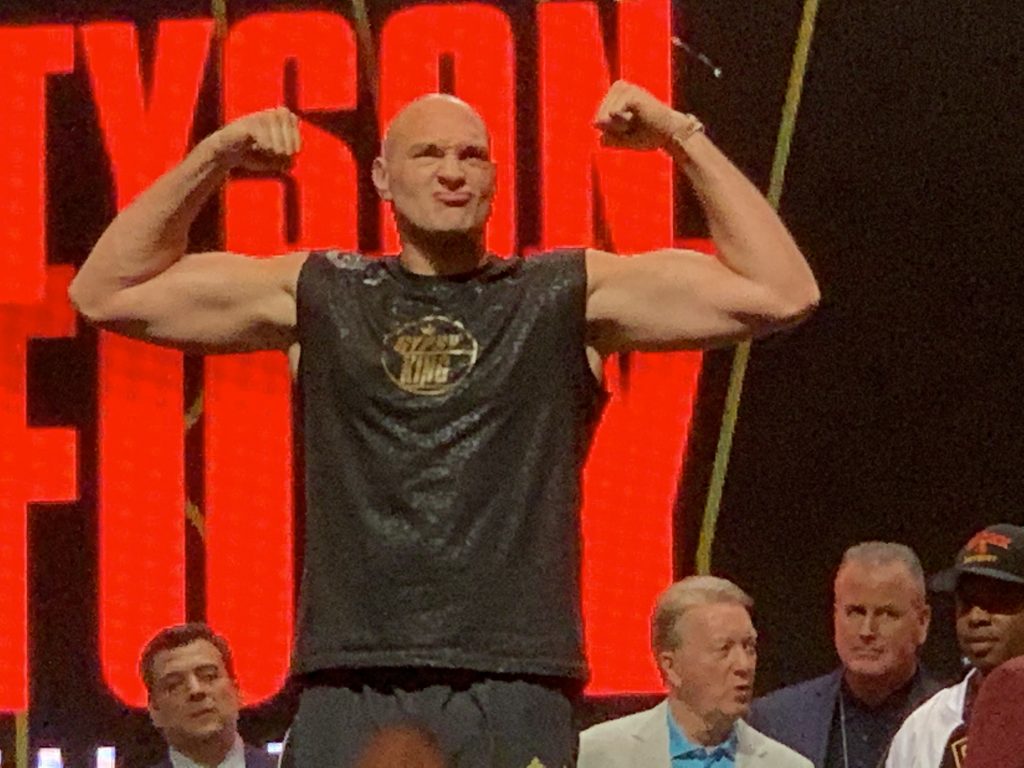
Tyson-Holyfield 3? Yes, no, only Tyson knows

By Norm Frauenheim-

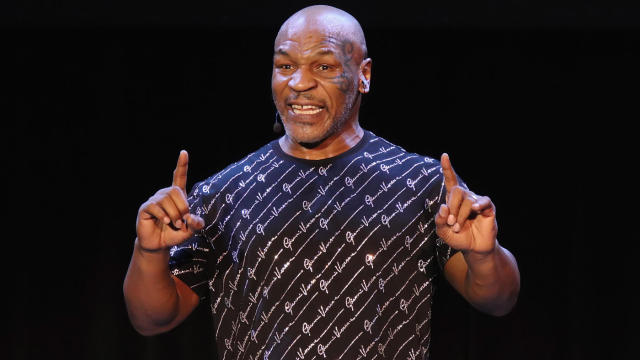
Mike Tyson isn’t back in the news. He never left. He’s there this week with a swift succession of contradictory headlines that would leave you with whiplash if it weren’t for what we already expect from him.

He has more moods than weather has fronts. It’s impossible to forecast what he’ll say or do next. One minute, he’s fighting Evander Holyfield. The next minute, he isn’t.

The best question is to ask whether anybody cares. But the answer only raises more question. Turns out, plenty of people do care and most of them don’t read The Ring

Boxing has run out of crossover fans. But Tyson still has them. They’re there, following TMZ, which broke the latest story. No, TMZ reported Wednesday he won’t fight Holyfield in a May 29 exhibition in Miami despite other reports that, yes, he would.

The week began with news from the Holyfield camp that the fight was off. It continued Tuesday with Tyson saying it was on during an Instagram interview with Haute Living.  Haute Living’s masthead advertises a publication that reports on Lifestyle, Celebrity, Travel and Fashion. No mention of pound-for-pound ratings.

·       Yeah, it’s confusing. Then again, what could be more confusing than plans for a fight between two men, each older than half a century? Tyson is 54; Holyfield is 58. A license to fight isn’t a license to drive. But that’s another story

The story here is Tyson’s celebrity. It’s durable, which is another of way saying you can bank on it. Tyson, the personality, still fascinates. Hence, the headlines in TMZ and Haute Living. Most of their audience would never be interested in the reasons Errol Spence-versus-Terence Crawford hasn’t happened. Come to think of it, they probably have never heard of Spence or Crawford.

But Tyson? Stupid question. Everybody knows Tyson for all the usual reasons, both crazy and compelling. They were there four months ago for his exhibition against Roy Jones Jr. The Triller-staged pay-per-view production on Nov. 28 did numbers that boxing hasn’t done in years. Reportedly, 1.6 million bought the telecast. Reportedly, it generated $80-million in revenue. They weren’t buying to see Jake Paul slam-dunk Nate Robinson like a basketball.

They were buying Tyson.

Still are.

The guess here is that they’ll still get a chance to buy Tyson in a show that might include Holyfield. Might not. Holyfield beat him twice in the 1990s and only lost a piece of his ear. But the show belongs to Tyson no matter who’s in the supporting cast. Even if the rounds are limited to two minutes and the gloves are pillow-sized, there’s a suspicion that Tyson really doesn’t want to fight Holyfield anyway.

Fighting is in Holyfield’s DNA. There’s a good chance he’ll be as serious, mentally and physically, at 58 as he was at 34 in the 1997 Bite Fight. Who knows with Tyson? He’s an entrepreneur at 54 and as unpredictable as ever. He hopes to succeed with his Legends Only League, a concept that defies the clock and how it erodes ankles, arms and athletes.

Tyson might be his league’s only legend, mostly because of his hold on the public imagination. If widespread reports are accurate, it’s strong enough to spawn a planned television series, a biopic starring Jamie Foxx as Tyson.

It sounds crazy, as in crazy money. That’s the only sure thing with Tyson.


Benavidez makes weight and statement, but is Canelo watching or listening?

By Norm Frauenheim

On a couple of scales, David Benavidez has been hard at work. He’s turned up the volume. And he made weight. Both have kept him in the mix, if not the hunt, for the one fight he desperately wants.

If you haven’t heard, he’s pursuing Canelo Alvarez. He has turned the internet into a virtual bully pulpit, jumping from platform to platform, stating and restating his ultimate goal of a fight with Canelo.

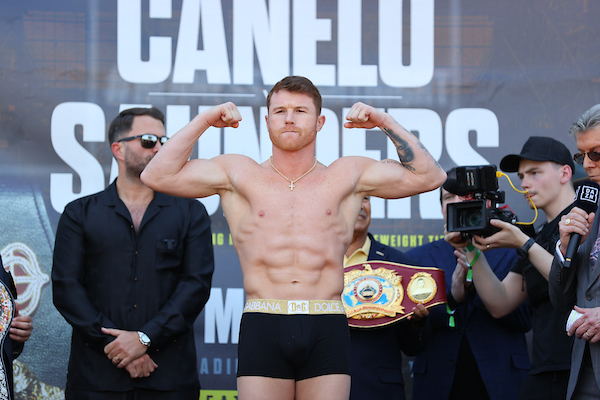
No telling whether Canelo is listening, although it would be hard not to. But Canelo has other tasks already on his schedule, including a super-middleweight title date with Billy Joe Saunders on May 8. Then, there are plans for Caleb Plant in a bid to unify the acronyms. Canelo, already known for his stubborn focus on the business at hand, is busy and probably will be for a while.

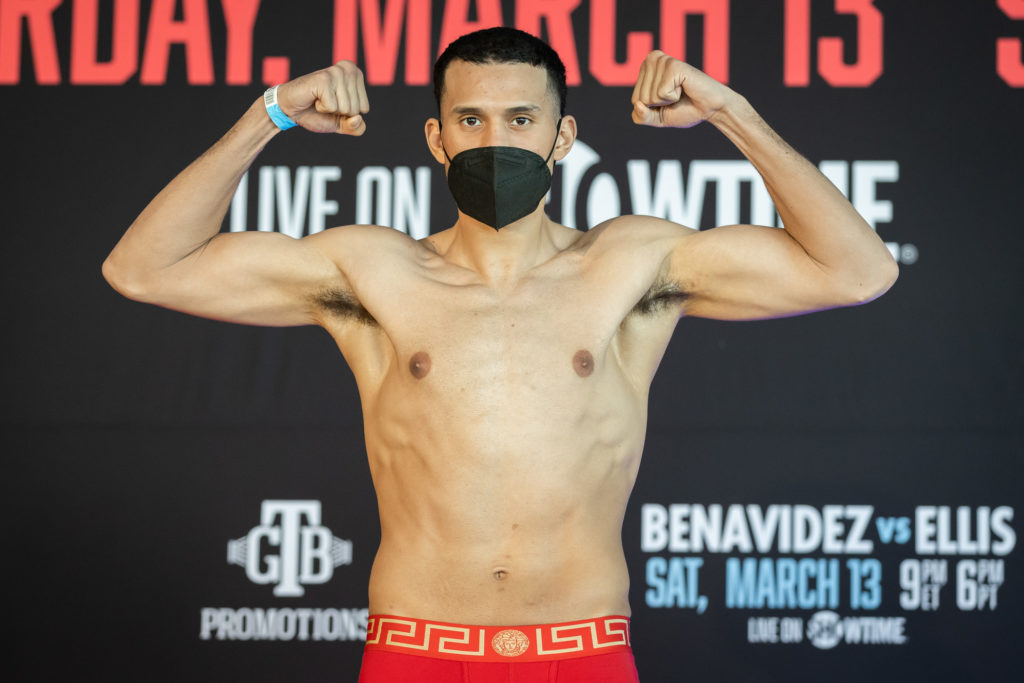
For Benavidez, that means more of the same. Stay relevant, both on the internet and in the ring. The signs are good that he will. His 11th-round stoppage of Ronald Ellis last Saturday was somewhat lost amid news of Marvin Hagler’s death.

Then, there was attention on Juan Francisco Estrada’s split-decision over Roman Gonzalez. It was a Super Fly classic, worthy of a Curtis Mayfield replay.

Nonetheless, Benavidez was impressive, more perhaps for the victory he scored on the scale than his predictable win over Ellis. He made the mandatory, coming in three-quarters of a pound under 168. Then, he went 10-plus rounds with no sign of the kind of fatigue brought on by an exhausting battle to shed pounds. There was plenty of talk in the wake of a scale fail last August against Roamer Alexis Angulo that he wouldn’t. That he couldn’t. But he would and could.

Light-heavyweight will have to wait.

Yet, it’s problematic how long a wait it’ll be before Benavidez will have to make the jump. He’s 24. He’s listed at 6-feet-and-1/2 inch and looks bigger. Light-heavy is inevitable and he knows it. The question is whether the Phoenix fighter can forestall that inevitability long enough to keep himself in line for Canelo in what would figure to be a mandatory shot at one of the Mexican’s titles. Benavidez lost the WBC version in August when he came three pounds heavier than the limit.

For now, it’s clear that Canelo has no interest in fighting anybody without a title or the right to a mandatory challenge. He talks about history, which means his priority is winning and keeping all of the relevant belts. That means Saunders, who has the WBO version. Then, there’s Plant, who holds the IBF title.  Canelo already has the WBA and WBC pieces to the puzzle, both of which he claimed in a one-sided decision over Callum Smith.

The other question is whether Canelo will even bother with a risky title defense. The aggressive Benavidez looms as risky a challenge as anybody in the division.  Canelo has been known to make risky challengers wait. To wit: Gennadiy Golovkin. GGG is still waiting for a third fight after a controversial draw followed by a debatable loss by majority decision.

Canelo is letting Golovkin grow old. GGG turns 39 on April 8. He might let Benavidez grow out of the division. It’s not clear whether Canelo will move up for a second bid at a 175-pound belt. He stopped Sergey Kovalev for a light-heavyweight title in 2019. Then, he relinquished it. For now, Canelo trainer/manager Eddy Reynoso says he doesn’t want him to fight against a naturally bigger man.

But, weight, like age, changes. Canelo, himself, still might grow into a natural 175-pounder. The real question might be Artur Beterbiev. How good is he? He looked unbeatable in a 10th-round stoppage of Oleksandr Gvozdyk in a light-heavy unification bout in October 2019.

Beterbiev (15-0, 15 KOs) is back Saturday (ESPN/ET 3 pm) in Moscow against Adam Deines (19-1-1, 10 KOs). According to Sports Betting Dime, Beterbiev is a minus-5000 favorite, meaning his chances at winning are at 98.4 percent.

Translation: Beterbiev is all but a lock to look sensational, impressive enough to keep Canelo at super-middleweight for now or forever. Benavidez doesn’t have that option. But he does have fans, enough of them to keep him busy with at least one possibility. Jermall Charlo, an unbeaten middleweight champ, called him out his week.

“Yeah, let’s make that fight happen,” Charlo said on The Last Stand Podcast with Brian Custer.

Charlo called him a “punk.” He promised to knock him out. All music to Benavidez, who has never been afraid of trash talk.

“I give him four rounds, five rounds,’’ Charlo said. “I knock him out in about five rounds, six rounds—no more. He get hit too much. I’m powerful. I’ll explode on him.”

Charlo, like Benavidez, has been chasing Canelo. The idea is that a fight with Benavidez would put the winner in position to finally fulfil that ambition. Both are looking for opportunity. For Benavidez, Charlo is a much better one than a rematch with Anthony Dirrell. Been there, done that.  It also looks to be an easy enough fight to make. Both are linked to PBC (Premier Boxing Champions).

On any scale, it would be one way to stay in line and a better way to move on if Canelo says no.


More Than A Little History: Gonzalez, Estrada have a chance at some on a flyweight anniversary

By Norm Frauenheim

Saturday is an anniversary. The calendar repeats itself. Maybe, history will too.

Roman Gonzalez and Juan Francisco Estrada meet in a fight featuring two of the best from boxing’s lightest divisions exactly 28 years since Michael Carbajal and Humberto Gonzalez fought for the first time.

Carbajal and Gonzalez were junior flyweights on March 13, 1993. So-called little guys, 108 pounds each. Combine the two and you’d barely have one heavyweight in today’s sumo-sized weight class.

But the little was gone nearly three decades ago, knocked out by Carbajal and Gonzalez after a bout long-remembered for its big-boy impact. Carbajal got up twice, first in the second and again in the fifth. Gonzalez went down once and stayed down, beaten in the seventh at the Las Vegas Hilton.

It was violent on any scale. It was dramatic on every scale. It set a standard, still there and perhaps still unequalled in any of the divisions at the bottom of the scale.

From 115 pounds and down, there is still a search for another fight that can again re-define the fighters at weights so often overlooked.

Gonzalez and Estrada are called junior-bantamweights or super-flyweights. Pick your acronym. The weight is the same: 115. The pick here is Super Fly, as in Curtis Mayfield.

Here’s hoping somebody plays Mayfield’s classic soundtrack to a 1972 film with the same name when they enter the ring in Dallas (DAZN, 8 p.m. ET/5 p.m. PT).

Both Gonzalez (50-2, 41 KOs) and Estrada (41-3, 28 KOs) have been super at lighter weights. Their bout Saturday is rematch of a fight at 108 pounds, which Gonzalez won by unanimous decision in November 2012 at the Los Angeles Sports Arena. A lot has happened since then. The Sports Arena is gone, torn down in 2016. Gonzalez is 33, no longer 24 and entering his prime. Estrada is 30, no longer 21 and tireless.

Their sequel is a little – perhaps a lot – too late. Carbajal and Gonzalez wasted little time. They fought twice more, both at 108 in 1994, first at The Forum in Inglewood, Calif. and then Mexico City. Neither rematch compared to the original. Gonzalez won both, scoring a split decision at The Forum and a majority decision in Mexico City.

Nevertheless, the first fight left a public appetite for more. The Forum rematch drew a crowd of 15,102. It was full of fight fans and celebrities, including Magic Johnson who had a seat on a floor he so often dominated during his days with the Showtime Lakers.

The second rematch drew a crowd of an estimated 30,000 at an old bullring.

There haven’t been audiences that big for any bout in the light divisions since then or perhaps before then.

Those numbers also added up to purses still never equaled at any of the lightest weights. Carbajal signed for a promised $1 million for the first rematch. The reported seven figures made him the lightest fighter to ever collect the sum. He’s still at the top of that historical pay scale.

That surprises him.

“Then, I thought this was just the beginning of something new,’’ said Carbajal, now 53 and still living on the street in the central Phoenix neighborhood where he grew up.

It is surprising, mostly because of Gonzalez, a masterful tactician with a mixture of great balance and power. He might not have Carbajal’s ferocious power or the tactical skill of the brilliant Ricardo Lopez, the best ever at 105 pounds.

But the Nicaraguan has displayed enough of both.

At junior-fly (108) and flyweight (112), Gonzalez was as complete a fighter as any. It propelled him to the top of the pound-for-pound debate. After Floyd Mayweather’s announced retirement, The Ring made him the lightest ever to be No. 1 in the publication’s 2016 ratings.

Then a flyweight, Gonzalez decided to move up the scale in pursuit of bigger money. He wanted a $1-million payday. He didn’t get it. Instead he got a couple of losses, both to Thailand’s Srisaket Sor Rungvisai at 115 pounds.  

Gonzalez’ biggest payday was $600,000 for a knockout loss to Rungvisai, according to contracts filed with the California State Athletic Commission after Gonzalez defeat, his second straight after a decision loss to Rungvisai, both in 2017.

There are reasons for weight classes. There’s price in not remembering them, too. The undersized Gonzalez paid for the jump. Carbajal stayed at 108 throughout his career.

“I never had to go up,’’ said Carbajal, whose decade-long career would end in 1999 with an 11th-round knockout of Jorge Arce, later a bantamweight and super-bantamweight champion.

The fights came to him, said the Hall of Famer, who had the advantage of being an American whose pro career was preceded by media visibility that came with his Olympic bouts at the 1988 Games.

He got a silver medal after a controversial loss for the gold to a Hungarian who was never heard from again after the Seoul scores were announced. It was a preview of what the world was about to witness – the outright theft of Roy Jones Jr., who lost gold at light-middleweight to a South Korean. Like the Bulgarian, the South Korean never fought again.

Carbajal and Jones came home known and liked by an American audience that saw them perform with poise, despite the adversity. The fix was in, yet they fought on.

It’s been harder to get known — to win over fans — for Gonzalez and Estrada, a Mexican born in Puerto Penasco, a fishing town on the Sea of Cortez about five hours south of Phoenix.

But maybe this is the time. Maybe the calendar is more than just coincidence. It’s a chance to make, if not repeat, more than just a little history.      


Waiting for May: Boxing hopes to get back to business as usual in a month full of maybes

By Norm Frauenheim

May is a month projected to be the new beginning, a comeback from business in a bubble.

First, Canelo Alvarez in a fight for another super-middleweight belt against Billy Joe Saunders May 8 at the Raiders new stadium in Las Vegas. Then, Jose Ramirez and Josh Taylor on May 22 in a junior-welterweight fight for the unified title and perhaps a piece of history.

It’s an ambitious return from killer COVID. It’s a reason, a season, for cautious optimism. Filled seats instead of empty ones, faces instead of cardboard cutouts and real cheers-jeers instead of artificial noise are all part of that light at the end of the proverbial tunnel.

Everybody can get a jab in May, President Biden promises. Hopefully, everybody can begin to watch and hear jabs thrown from seats they purchased. But caution lingers. The pandemic has its own counters, so-called variants, a euphemism for what they really are. They’re mutants, unpredictable and ominous.

So, make that May, as in maybe.

Expect sellouts, yet no capacity crowds. Socially-distancing figures to still be in place in about every locale other than Texas and Florida. But it’s a beginning, the next step back to where we left it.

In effect, boxing, as we knew it, came to an abrupt end on Feb. 22, 2020 in front of a roaring crowd at Las Vegas’ MGM Grand for Tyson Fury’s wild stoppage of Deontay Wilder in a heavyweight rematch. Since then it’s been live streams, Zooms and pay-per-view.

There have been a few lessons too. Start with pay-per-view. Pre-pandemic, it was what every fighter wanted. They wanted to be a PPV fighter. They still do. Teofimo Lopez values that acronym next to his name as much as any acronym-named belt. Post-pandemic, however, PPV might have lost its value.

During the pandemic, PPV simply became another way of saying that no network or advertiser is willing to pay for this schlock. Example: Chris Arreola-Andy Ruiz (FOX) on April 24 is PPV; Ramirez-Taylor (ESPN) is not.

The pandemic turned the PPV model on its head. It’s lousy advertising. Maybe, that changes. But it won’t until the business can figure out how much the landscape has changed.

Back to business, whatever that looks like, will include some new stars and some of the same old suspects. Start with the stars, Lopez and Oscar Valdez.

Lopez won the most significant fight of the Pandemic with his decision over former pound-for-pound king Vasiliy Lomachenko in October. Valdez won the Pandemic’s most dramatic bout with an upset stoppage of feared junior-lightweight Miguel Berchelt a couple of weeks ago.

They were the biggest winners, although Lopez might have created problems for himself in the wake of his game-changing upset of Lomachenko. He is feuding with Top Rank, the promotional entity that lost the purse bid for his lightweight title defense against Australian George Kambosos to Triller, which is coming off its PPV biggie – the Mike Tyson-Roy Jones Jr. exhibition.

Lopez told The Ak and Barak Show on Sirius XM that he might split with Top Rank after two more fights. This is the same Lopez who has said he’s probably moving up the scale, from lightweight to junior-welterweight. He has talked about how wants to fight the winner of Ramirez-Taylor, both Top Rank fighters. He might have a tough time reaching a deal with an ex-promoter, Bob Arum, still angry at losing the purse bid. Words create headlines and consequences.

Meanwhile, Lopez’ fight with Kambosos is interesting, mostly because Kambosos is Manny Pacquiao’s ex-sparring partner. There’s also a caveat. It’s a mandatory, which suffered as much as PPV. Canelo’s third-round stoppage of Avni Ylidirim last Saturday was a mandatory title defense. Caleb’s Plant’s decision over Caleb Truax in January was mandatory. Both were forgettable. Mandatories should be too.

If Lopez beats Kambosos as expected, however, there’s bound to be speculation about a bout with Pacquiao, a small welterweight probably more comfortable at 140 pounds. Pacquiao’s durable celebrity has already attracted a long line of wannabe opponents. Terence Crawford, Ryan Garcia and Conor McGregor have all been rumored.

The latest to put himself in line is Mikey Garcia, who was quoted this week as saying a deal is near. But it’s all speculation until Pacquiao, himself, says something definitive. Until then, I’ll wait to hear from Triller that it will stage another exhibition, a Pacquiao-Floyd Mayweather sequel.

Just kidding. Then again, Maybe not.


From Oscar Valdez to Canelo: A learning corner

By Norm Frauenheim

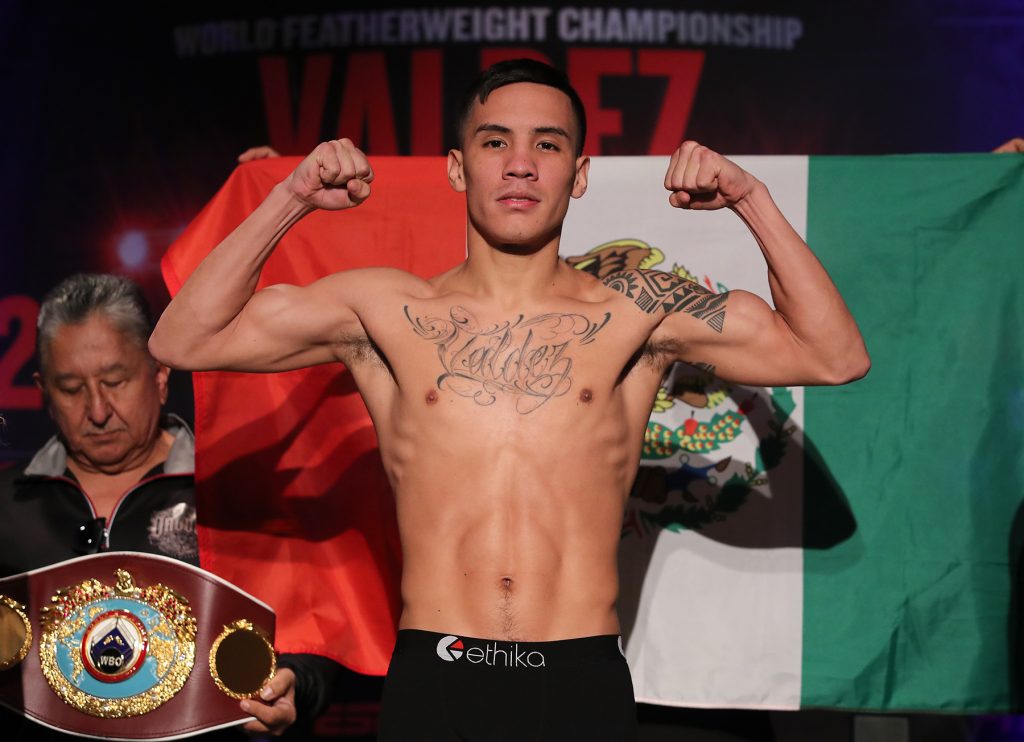
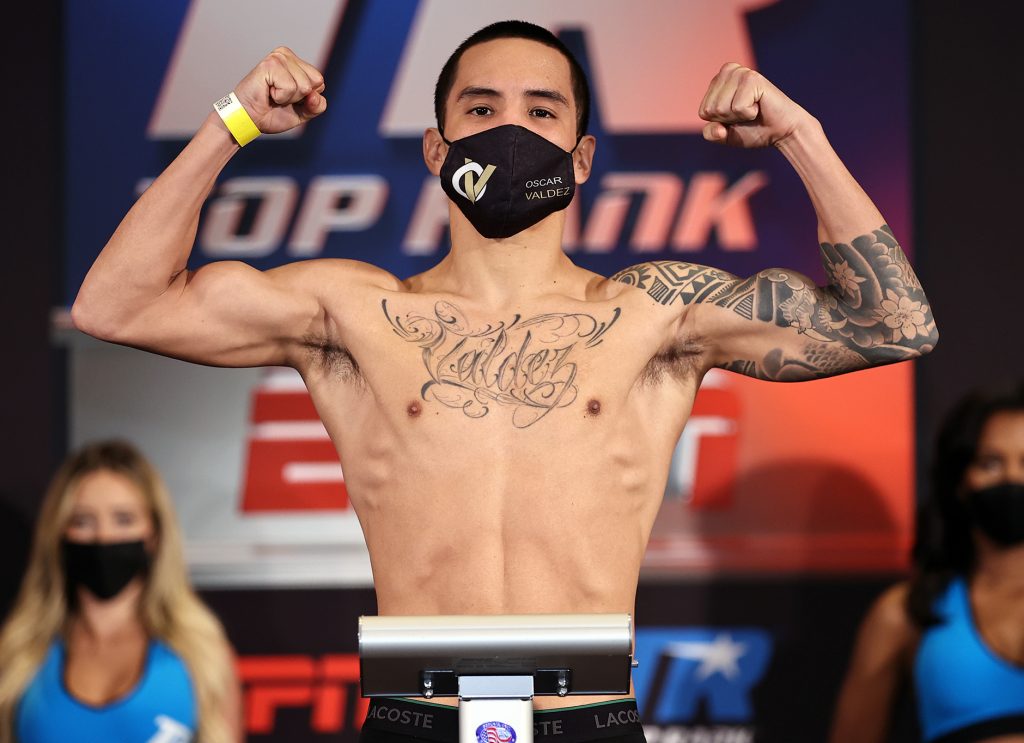
Oscar Valdez was motivated by a chance to shut mouths. He did that, including this one. But his compelling stoppage of Miguel Berchelt was – make that is – more than immediate satisfaction gained from silencing the doubters.

It is validation, enduring proof, of who he is. It was there in a victory loaded with lessons for a cynical business short on patience and poise. Quaint notions, both, but Valdez practices them with faith impossible to break. Fracture his jaw, but not his ethics.

They are why he won, leaving the feared Berchelt face- down on the canvas last Saturday. That patience and poise, instead of purses and pound-for-pound claims, are why we’re still talking about a fight that happened nearly a week ago, almost an era today in the social-media’s accelerated time zone. A good guy won in a timeless way.

Maybe, it takes him into a fight with Shakur Stevenson. Or maybe, Gervonta Davis. Already, the cynics are circling, saying he wouldn’t have much of a chance against either. If that sounds familiar, just look at last week’s headlines and odds. Very few suggested that Valdez had any chance.

But cynics beware. Valdez is the defining face of what it is to overcome. A broken jaw didn’t finish him in the rain against Scott Quigg three years ago. He was carried out on a stretcher, looking very much like a fighter who won what some believed was his last stand.

But only his jaw was broken. Not his resiliency. The jaw healed and left a lesson he used to propel himself to what has become a great story for a sport with too few. He started over in a place and in a corner that allowed him to find himself. In Eddy Reynoso, Valdez found his identity.

It was evident in a couple of fight-turning moments midway through the bout. It was further affirmed in colleague Bart Barry’s brilliant column Monday. http://www.15rounds.com/oscar-eddy-and-the-power-of-powerful-questions/

Both are evolving. But that mutual evolution wasn’t clear until those middle rounds, one that could have taken a nasty turn with Valdez instead of Berchelt face-down in the 10-round. Their mutual understanding of what was happening and what was at stake was the key.

Berchelt survived a shaky fourth and began to exert himself. Signs of Valdez, pre-Quigg, were evident. His face was flushed. He looked as if he were about to sacrifice poise and smarts to an instinct that had taken over so often. He would brawl, which was a sure way to lose.

But he didn’t. Reynoso was there to remind him to remember the plan and resist the temptation. It was timely, advice strategically brilliant because of how it was carefully delivered and then stubbornly executed.

The trainer-fighter relationship is often nothing more than personal chemistry. Think Freddie Roach and Manny Pacquiao. But Reynoso-Valdez looks to be something even more. They’re both students, learning from each other. Teaching each other, too.

Until those moments in the middle rounds of Valdez’ victory for a junior-lightweight title, it was hard to get a solid read on Reynoso. Turns out, that was unfair. He’s best known for Canelo Alvarez, who ranks among the game’s most accomplished fighters.

The assumption was that Canelo would make any trainer look good. Think of Phil Jackson, whose coaching abilities were somehow questioned simply because he had Michael Jordan in Chicago and Kobe Bryant with the Lakers.

Reynoso was a virtual novice when he moved into Canelo’s corner. After Canelo’s lone loss in a one-sided decision to Floyd Mayweather Jr. in 2013, I still remember the great Rafael Mendoza, a Hall of Fame manager, telling me that Canelo would have to learn on his own.

The insightful Mendoza, a former Mexico City sportswriter, had worked with Canelo early in his career. Both lived in Guadalajara. But he split with Canelo, he said, because he wanted Eddy and his father, Chepo, to hire a more experienced trainer.

The Reynosos were there for Canelo in the beginning, but as investors not as trainers. Mendoza, who died in May 2018, wanted a more experienced voice. Not sure who he had in mind, but I’m guessing Mexican legend Nacho Beristain, whom he brought into Humberto Gonzalez’ corner after a 1993 loss to Michael Carbajal. With Beristain, Gonzalez won the next two fights in a junior-flyweight trilogy, beating Carbajal by narrow decisions in both.

We’ll never know how Canelo would have fared with Beristain instead of Eddy Reynoso. By then, Beristain was more of a revered teacher, an authoritarian never to be questioned. But I’m betting Mendoza would be applauding how Eddy Reynoso has transformed himself into the best trainer of the day. He listens, and It’s clear that Valdez and Canelo listen to him.

It’s that intriguing evolution that makes watching worthwhile. I’ll even watch Canelo Saturday against the longest of longshots, 50-to-1 underdog Avni Yildirim, in a super-middleweight title fight (DAZN 8 pm ET/5 pm PT) at the Dolphins stadium in south Florida. However, I wouldn’t watch if not for what was seen in Valdez’ triumph over Berchelt.

The head movement, jab and footwork exhibited by Valdez have been there at an ever-improving rate in Canelo.

They’re still learning.

So, too, are we all.   


Harm’s Way: Oscar Valdez is back in a familiar place against Miguel Berchelt

By Norm Frauenheim

Harm’s way is often the only way for Oscar Valdez. He has survived there. Prevailed there. Instinct has taken him there in a risky path toward danger and away from a safer route.

Safe, of course, is a relative term. In the ring, there’s no refuge. There’s no real escape, but there is elusiveness in tactics taught by wise trainers and booed by the blood-lust demographic in the boxing crowd.

Therein, rests the dilemma.

And the drama.

Both are there for Valdez (28-0, 22 KOs) Saturday night (ESPN 10pm ET/7pm PT) against a junior-lightweight with a presence that puts a defining face onto harm’s way. A feared face. Miguel Berchelt has size, power, a five-and-a-half-inch advantage in reach and stoppages in each of his last six fights.

In body and spirit, Berchelt (37-1, 33KOs) has the look of somebody built to inflict the pain in what Mike Tyson once called the hurt business. Get in his way and he’ll do the harm.

There’s peril there, possibly as much as Valdez has ever faced in what will be only the third bout at 130 pounds for the former featherweight champion.

It’s enough for the oddsmakers to force Valdez into a new role. For the first time, he’s the underdog. SportsBettingDime makes Berchelt a minus-190 favorite. At other books, the number is at about 4-to-1 and climbing, all in favor of Berchelt, the defending champion. Translation: Nobody gives Valdez much of a chance in the Top Rank bubble at Las Vegas’ MGM Grand.

Even Mexican icon Julio Cesar Chavez is picking Berchelt in what could prove to be another chapter in the Mexican tradition of blood and guts.

“Julio Cesar Chavez says Berchelt will win this fight,’’ said Valdez, who during a Zoom session talked about how he has found motivation in the one-sided odds. “Doesn’t bother me. A great thing about boxing is shutting mouths.’’

The pre-fight promotion includes inevitable parallels to Erik Morales-versus-Marco Antonio Barrera and Israel Vazquez-versus-Rafael Marquez. History sells. Hype does, too.

“The winner, I believe, can be the next superstar in Mexico,’’ said Berchelt, who is anxious to fulfill a dream he has had ever since he was a kid watching the Morales-Barrera trilogy.

History is probably a reach, but the potential for a memorable fight, if not a classic, is there in large part because of what has already been seen from Valdez. There’s been blood. And guts. He’s encountered, if not embraced, adversity. He endured it. And conquered it.

That was never more evident than nearly three years ago on a rainy, chilly night in Carson, Calif.  Beneath a tarp, Valdez fought Scott Quigg, who missed the 126-pound mandatory and was weaponized by several pounds of added leverage at opening bell.

Valdez manager Frank Espinoza advised him not to fight after the scale fail. But Valdez, never one to back away, said no and moved forward, straight into harm’s way. Espinoza saw what could happen.

In the fifth, Quigg broke Valdez’ jaw. For the next seven rounds, Valdez boxed, brawled and bled. After it was all over, the rain washed away footprints and debris from the canvas. Only the stain in the Valdez corner remained from the blood he had spilled, spit up between rounds.

He was the winner. But it was hard to celebrate. Even a smile had to hurt as he was placed on a stretcher and into an ambulance after scoring a decision, a unanimous testament to his courage. The experience, he says now, is a source for confidence.

“The broken jaw made me a better fighter, because I know I can compete when I’m hurt,’’ he said.

Proof of that had been delivered more than once. He fought through pain and a surprising challenge from Filipino Genesis Servania in September, 2017 in Tucson, where the two-time Mexican Olympian went to school and still has family.

In April of that year, he was way ahead on the scorecards against a dangerous challenger, Miguel Marriaga, yet he waved at him in an invitation to brawl in the 11th and 12th rounds. He was doing it for the fans, he said. He wanted to give them a show.

After his jaw healed in the months post Quigg, Valdez changed trainers, leaving Manny Robles for Eddy Reynoso, Canelo Alvarez’ trainer. He’s been with Reynoso for four fights. He has tried to replicate the head movement and defense so evident in Canelo’s ever-evolving style.

Valdez says he has worked at adding more options. Yet even with Reynoso in his corner, he got knocked down by a late sub, Adam Lopez, in 2019. He went on to win a seventh-round TKO.

“Being with Eddy has made me a more complete fighter,’’ Valdez says. “I don’t think people have seen me at my best.’’

Against Berchelt, Valdez says there are options.

“Plan A, Plan B, Plan C,’’ said Valdez, whose Olympic resume includes training in the game’s defensive fundamentals.

He might need all three and a few more. Plan D, E, F and G. Then again, if those plans break like that jaw, Valdez might be at his dangerous best. In his unbeaten run, Valdez has been a little bit like Michael Carbajal, a Hall of Fame junior-flyweight who grew up in Phoenix, about 180 miles north of Nogales, Valdez’ hometown in Mexico.

Carbajal, like Valdez, was at his best when he was hurt. A badly-bloodied and seemingly-beaten Carbajal knocked out Jorge Arce in 1999. Carbajal got up from two knockdowns to knock out Humberto Gonzalez in 1993.

Harm’s way is a dangerous way. For some fighters, however, there’s no other way  


Jabs: Taking one or two is fundamental to a May comeback

By Norm Frauenheim

The lines are getting longer and maybe the wait is getting shorter. If that sounds like a contradiction, welcome to a fine mess that has been raging for 12 months. February marks a forgettable anniversary. More headstone than happy.

Gone is the world as we knew it. At least, it’s been absent since Tyson Fury’s stoppage of Deontay Wilder in a Las Vegas rematch on Feb. 22. What followed was a prolonged string of postponements, social-distancing, masking-up, empty seats, bubble bouts and boredom.

Maybe, sellouts, beer lines, boos and cheers come back. Even trash talk would sound better than the artificial noise that fills today’s empty arenas. It’s the Pandemic version of elevator music.

Hope, at least, is on the horizon. There’s a chance to think that a meal in a restaurant, a regular haircut and a seat at ringside will cease to become a risk.

The Pandemic appears to be in retreat, according to various experts and numbers. An ongoing decline in the infection-and-hospitalization rate looks to be the result of vaccinations and COVID-19 survivors, according to the New York Times.

Combine the two, and you get the beginnings of herd immunity, according to the story. I hate crowds, but I’m hoping to join that herd. I’m eligible for my first jab, the UK word for a shot. Getting an appointment is a hustle. Getting in line is a hassle. But getting the virus is worse. There’s optimism in the waiting, unlike a few months ago when there was only worry and wondering.

Wondering if it would ever end.

There are still reasons to wonder. To wit: Thursday’s news that the Joe Smith-Maxim Vlasov fight for a vacant light-heavyweight title in Las Vegas won’t happen Saturday. COVID hasn’t quit yet. Vlasov tested positive.

 “I am devastated with the postponement of my world title fight against Joe Smith Jr,’’ Vlasov said in a Top Rank release about a bout that had been scheduled to headline an ESPN telecast. “I have been following strict protocols, I have done regular testing with negative results, and I have no symptoms. I am well prepared and had an excellent training camp. I look forward to the rescheduling of the fight.’’

The news is a reminder and a warning, both timely. Too much can still go awry in the fight to come back from a virus with almost as many mutations as there are masks. Health experts call them variants. They come from South Africa, or the UK, or Brazil, or the dark side of the moon. They’re scary because of their unpredictability. They could land like that proverbial punch, the one you never see.

Still, there’s the dose of hope that comes from the end a needle.

Signs of its potential impact are emerging. There was news this week that Canelo Alvarez has been granted a promoter’s license by the Nevada State Athletic Commission. It’s the first step in what looks to be plans for Canelo to fight UK super-middleweight champion Billy Joe Saunders on May 8 at Allegiant Stadium, the Raiders new home in Vegas.

May appears to be the target month for boxing to get back to something that resembles business-as-usual.

A long-anticipated Jose Ramirez-versus-Josh Taylor title-unification bout at junior welterweight is also scheduled for May 1 or May 8.

Then, there are heavyweights Anthony Joshua and Fury. They’ve reportedly agreed to two fights. The first is expected to happen in “late May, early June,” Joshua promoter Eddie Hearn has said repeatedly in multiple media reports.

The thinking – make that hope – is that the herd will have developed enough immunity in May to gather in numbers that can produce the kind of gate that can pay the fighters. The Pandemic’s empty seats have eroded the kind of purses fighters grew to expect, pre-COVID.

Example: Teofimo Lopez. He became a star with his decision in October over Vasiliy Lomachenko for the lightweight title in a bubble filled with cardboard cutouts instead of paying customers. It was the Fight of the Pandemic. It put Lopez in the top tier of the pound-for-pound scale. But the pay scale remains diminished. Pandemic pay will never fulfill Lopez’ current asking price — $10 million.

Only a vaccinated herd, healthy in body and wallet, can generate that kind of money. That’s as fundamental as jabs.

Delivering them.

Taking them, too.  


Plant-Benavidez: A real chance to make it happen?

By Norm Frauenheim

During days when there’s more talk about fights that don’t get made instead of those that do, promoter Eddie Hearn has an interesting idea involving the latest one to frustrate fans.

Caleb Plant-versus-David Benavidez has been near the top of the wish list for a couple of years, yet no amount of trash talk or apparent interest has moved it any closer to reality.

It’s right there, another fantasy fight consigned to never-never land. Maybe, it’ll show up as a co-feature on the Terence Crawford-Errol Spence Jr. card. Yeah right. Wait on. Dream on.

On the surface, Plant-Benavidez appears to be as unlikely as ever in the wake of Plant’s one-sided decision over Caleb Truax last weekend. Plant added a victory to his record and a loss to his reputation.

His skillset was exposed, shown to be wanting, especially in his hopes for a super-middleweight biggie with Canelo Alvarez. Perhaps, Plant’s performance was an aberration.

Plant had said he wanted to get past his mandatories. That’s all he did against Truax.  He also could have been limited by a hand injury, which he said he suffered midway throughout the 12-round shutout.

Maybe.

Just maybe.

Abundantly clear to Hearn and everybody else in a surprisingly large FOX audience (1.887 million, peaking at 2.019 million, according to Nielsen), however, was that Plant isn’t ready for Canelo any more than Benavidez is.

Hearn suggested during an appearance on “The Ak & Barak Show” (DAZN and SiriusXM) that Plant and Benavidez meet in what would be an eliminator for the right to face Canelo, perhaps in September.

It makes sense

Maybe too much sense.

Remember, this is boxing, constant chaos.

In post-fight interviews after Truax, Plant repeated that he intends to wait on Canelo, who has a mandatory defense scheduled for Feb. 27 against Turkish challenger Avni Yildirim in Miami and then a title unification fight with UK belt-holder Billy Joe Saunders in early May.

From a promotional standpoint, Plant-Benavidez might inject some anticipation for Canelo’s next couple of bouts. He’s a 20-to-1 favorite over Yildirim. Those odds figure to multiply as opening bell approaches.

The Saunders bout promises to be a lot more competitive, yet Canelo still figures to be the favorite. Plant-Benavidez would just be another reason to talk about Canelo, who recently signed a two-fight deal with Hearn. Talk is also another way of turning up the volume on Canelo’s ongoing campaign for No. 1 in the pound-for-pound debate.

It would work, work on a couple of levels.

Then again, it could come apart because of that constant chaos, boxing’s only reliable business model. It’s not clear how serious Plant’s hand injury is. If it keeps the super-middleweight belt-holder out of the gym for a long stretch, a promotional idea remains on the wish list.

More problematic, perhaps, is Benavidez’ weight. Can he make 168 anymore? He failed the day before his stoppage of Roamer Alexis Angulo last August. It cost him his belt and an immediate chance at Canelo. 

There’s talk that Benavidez is already in the 175-pound division. We’ll find out the day, March 12, before he fights Ronald Ellis on March 13 when he returns to the scene of the August scale fail at Mohegan Sun Casino in Uncasville, Conn.

That’s when and where Benavidez will be back on that scale as either a light-heavyweight or with a renewed chance to get back in line for Canelo.


Mandatory: Only the fans are

By Norm Frauenheim-

Mandatory means order, command. Do it or else. But it could mean just about anything in today’s boxing dictionary, which is another way of saying it means bupkis.

There are mandatory challengers. Super-middleweight champion Caleb Plant faces one in another Caleb, Truax, Saturday (Fox 5 pm PT/8 pm ET) in Los Angeles.

There are mandatory defenses. Canelo Alvarez is scheduled for one on Feb. 27 (DAZN) against super-middleweight challenger Avni Yildirim in Miami.

Trouble is, there’s no mandatory watching.

Mandatory in boxing is just another day at the office. (Insert yawn here.) It’s process, procedure. It’s a nice enough idea, a fair way to reward journeymen like Truax and Yildirim. For Plant and especially Canelo, it’s a prerogative, one that comes with a belt and their respective records. Take an easy, stay-busy fight and call it a mandatory.

But there’s no mandate that anybody has to care. Guess here: Few do. In the end, it’s the fans who still have a mandate that hasn’t been reduced to euphemism.

They can choose to watch.

Or not.

Their prerogative.

It’s a slam dunk to say that they’d watch David Benavidez against Plant instead of Truax. The Benavidez-Plant rivalry has been boiling for a couple of years now. Their ongoing exchange of trash talk was there throughout this week, despite Plant’s imminent date with Truax and news that Benavidez will fight Ronald Ellis on March 13.

Benavidez, a Phoenix fighter who lost his belt on the scale in August, posted a photo of Plant on a Wanted, Dead Or Alive poster on Instagram this week.

“But he’s gonna have to wait in line like a good little boy, off to the side, because I got my fight January 30th and then I got bigger fish to fry with Canelo after that, and then I’ll get to him when I get to him,’’ Plant told FightHype.

Expect more of the mandatory trash talk not long after Saturday’s fight. Plant by stoppage –say the seventh round – looks likely. Plant is an overwhelming favorite – from minus-1200 at SportsBettingDime.com to minus-3000 at BetMGM

Odds favoring Canelo over Yildirim are even bigger. He’s at minus-5000 and counting, according to some books. In other words, Yildirim has about as much a chance at winning as Donald Trump has at apologizing.

Meanwhile, we wait on some real drama at 168 pounds, perhaps with Plant-Canelo or Canelo-Billy Joe Saunders in May. It’s a loaded division, but for now it’s loaded only with potential. It’s those mandatories that get in the way.

A path around that process, however, might be emerging. So-called exhibitions are a threat to business-as-usual. There’s been more talk this week about a possible Ryan Garcia-Manny Pacquiao exhibition than there has been about Plant-Truax, a sanctioned title fight. The Mike Tyson-Roy Jones Jr. pay-per-view exhibition in November drew a bigger audience than any bout last year.

On one level, it’s ridiculous to call any fight an exhibition. The risk of injury is still there. A fight is a fight is a fight, whether in a parking lot or in a regulated ring.

Garcia’s social-media popularity and Pacquiao’s enduring celebrity are part of the buzz. At opening bell, however, people will watch no matter what it’s called. Garcia-Pacquiao is an interesting exhibition. Interesting fight, too. A title belt and all of the attached mandatories just don’t matter much anymore.

Garcia, who holds an interim (aren’t they all?) belt, put it best in an interview with ESPN’s Stephen A. Smith.

“What doesn’t matter is belts,’’ said Garcia, who made a belt sound like a hood ornament. “I wear this belt because it looks good. Doesn’t it look good? It does make me look good. The truth is, there’s too many belts, there are too many champions. You don’t know who the true champion is.’’

The genuine in Garcia looks better than any belt ever could. It’s what appeals to young fans, who have a mandate of their own. Pay attention to it. That’s a mandatory warning. 


Battle Plan: Canelo has one in his new deal with Matchroom

By Norm Frauenheim

Canelo Alvarez’ contract with Matchroom for two fights with DAZN, the streaming service he sued, is a further example of his power. He gets what he wants.

The deal, formally announced Thursday, is also a further look at a career path carefully drawn up to include bouts and belts that figure to strengthen his claim on the top spot in the pound-for-pound debate.

Canelo is as stubbornly methodical outside of the ropes as he is within them. He’s working to eliminate any other pound-for-pound argument. The process resumes on Feb. 27 in Miami against Turkish challenger Avni Yidirim in a stay-busy bout that sets the stage for a further unification of the super-middleweight title against Billy Joe Saunders or Caleb Plant.

Of the two, Saunders looks to be the most likely in large part because of a long-term promotional relationship with Matchroom’s Eddie Hearn. Saunders also brings the UK audience. But exact date doesn’t seem to matter much. If it is Saunders in May, it figures to be Plant in September. Or vice-versa.

The key is that each has a 168-pound belt that Canelo needs to unify the title and finish the argument. For now, it continues, an ongoing argument reflected in polls conducted and marketed by rival networks. DAZN’s No. 1 is Canelo; ESPN’s No. 1 is welterweight Terence Crawford. Pick your acronym and reasoning.

There’s the body of work theory, which favors the once-beaten Canelo. There’s the eye-test, which favors the unbeaten Crawford. At least, it does from this corner. Put it this way: 2020 ended with Crawford finishing Kell Brook on Nov. 14 in a fourth-round TKO and Canelo scoring a one-sided decision on Dec. 19 over an overmatched Callum Smith.

Canelo’s side of the debate could include a couple of more belts and a busier schedule. For now, that’s the advertised plan and advertising counts for a lot in this debate. Canelo is moving forward. Other than more talk about an ever-elusive date with Errol Spence Jr, it’s not clear what’s next for Crawford.

Meanwhile, Canelo’s plan does not include any mention of Gennadiy Golovkin or David Benavidez. For both, it’s a case of weight and wait, a frustrating dilemma for them and fans.

Golovkin fought Canelo to a controversial draw and lost to him narrowly by majority decision, both at middleweight. But GGG’s prime is going, going, gone. Time is an issue.

If Canelo’s 2021 schedule is already booked with Yidirim, Saunders and Plant, Golovkin will probably have to wait until 2022. GGG will be 40 on April 8 of that year.

At the other end of the age and weight scale, there’s Benavidez, who many believe might have the best chance at upsetting Canelo. Benavidez is 24. He’s young, but that’s the problem. His failure to make weight presumably dropped him off of Canelo’s short list.

With a belt, he would have been there. But he lost it – the World Boxing Council’s version – on Aug. 14 when the Phoenix fighter was 2.8 pounds heavier than the limit for a defense against Roamer Alexis Angulo.

Benavidez went on to stop Angulo, forcing the Venezuelan’s corner to throw in the towel after the 10th round. But he lost a career-defining opportunity. He’s still young enough to regain it. But making the 168-pound limit doesn’t figure to get any easier for the maturing Benavidez, who figures to be a light-heavyweight within a couple of years. 

The costly scale-fail in August happened in part because of the Pandemic, according to Benavidez, who said it disrupted familiar routines for his bout at Mohegan Sun Casino & Resort in Connecticut. There was no sauna. There was no gym other than a treadmill and a stationary bike in the hotel.

Benavidez, a lanky 6-foot-1 ½, says he plans to stay at super-middleweight for as long as he can.  But time, already a problem for Golovkin, is there for Benavidez too. The alarm sounded when he stepped on that scale in mid-August.

Without a belt, Benavidez’ only leverage is the media. He repeatedly calls out Canelo. But Canelo doesn’t seem to hear him. He’s got other plans.


Different times, different numbers for a game forced into a new business model

By Norm Frauenheim-

Baseball Commissioner Rob Manfred estimates that owners have lost $3 billion. A shortened spring-training schedule cost the state of Arizona $281 million in economic impact. Baseball players took a 63-percent cut in pay. The National Hockey League chief says the NHL is skating toward a $1 billion loss. 

Teofimo Lopez says he wants $10 million to fight.

Apparently, Lopez hasn’t read the headlines from other arenas, both in sports and real life. Nothing is immune from a pandemic that is bankrupting optimism and eroding bank accounts.

It’s hard to blame Lopez, the emerging face of boxing’s new generation. The 23-year-old lightweight champion grew up watching The Money Team. His generation saw Floyd Mayweather Jr. count stacks of cash and collect exotic cars. Mayweather’s purse mattered more than the punches.

But Mayweather’s economic model is gone. Vaccines won’t save it, at least not in the short term. It’s time to climb out of the bubble and take a look around. Look at the seats, vacant because of COVID. Empty seats are a little bit like empty pockets.

Look at the news. Example: Los Angeles firefighters, 3,600 strong, agreed to the delay of a pay raise because of budget cuts that could lead to job losses. Don’t expect too many firefighters to shell out $50, $60, $70 in pay-per-view. It’s a new world. A painful one, too.

Yet, the ring craft remains the same. Compelling and crude, still painful no matter how big — or small — the purse. At some level, it’ll always be there.

Lopez’ arrival is simply a matter of lousy timing. It’s not his fault. But $10-million to fight Devin Haney or George Kambosos Jr. in Australia isn’t realistic, either.

Haney promoter Eddie Hearn told Boxing Social that Lopez demanded $10-million during an encounter in San Antonio during Canelo Alvarez’ one-sided decision over Callum Smith last month. Then, Lopez repeated the demand when Boxing Scene asked him about a proposed fight with Kambosos in Sydney.

Haney-Lopez is “a wonderful fight,” Hearn said.

But not at that price.

“In this world right now, it ain’t going to happen,’’ Hearn told Boxing Social.

The key has been – and continues to be – a live crowd not limited by the social-distancing mandated in the ongoing fight against COVID. Until then, purses will also be limited.

Maybe, vaccines will change all of that later this year. Then again, maybe not. The availability of vaccines and the process of getting an injection are still a hodgepodge of bureaucracy and politics. Hurry up and wait.

The uncertainty continues to be reflected in the where and when of the proposed Tyson Fury-Anthony Joshua fight. If ever a fight belonged in the UK, Fury-Joshua is it. It would be a historical clash between UK heavyweights. It’s ridiculous to even say that it could go elsewhere. But elsewhere looks likely because there’s a lot more COVID than cash in the UK these days.

Somehow, Fury-Joshua in Saudi Arabia is akin to the London Bridge in Lake Havasu City, Ariz. But that happened. In 1967, the bridge over the River Thames was dismantled and relocated four years later above the Colorado River in western Arizona.

Ridiculous, yet real. Trouble is, what should just be silly threatens to further erode the fringe of what is already a fringe sport. Core fans are loyal, but their patience is a little bit like their money. It’s not limitless.

Lopez’ $10-million price is already being interpreted as his way of saying he just won’t fight Haney. Maybe, Lopez is just woofing. He’s entertaining, confident and likes to talk. He’s good for the game. But if the demand is real, the lightweight division is in danger of going the way of the welterweights.

Lopez’ dramatic upset of Vasiliy Lomachenko on Oct. 17 followed by Ryan Garcia’s seventh-round stoppage of Luke Campbell on Jan. 2 pushed the 135-pound division to center stage. If the welterweights can’t save the game, the lightweights can. Lopez, Haney, Gervonta Davis and Ryan Garcia have already been dubbed Four Kings. Add current 130-pound champion Shakur Stevenson and you’ve got a Fab Five.

But the danger in Lopez’s demand could turn a game-saving division into another never-never morass. At 147 pounds, there’s Terence Crawford and Errol Spence Jr. They should have fought a couple of years ago. Increasingly, it looks as if they’ll never fight, or at least they won’t in their respective primes.

That’s bad for business.

In any time.    


A New Year and the same old fight

By Norm Frauenheim-

Canelo Alvarez finished 2020, which ended amid relief and hope that business as usual will be there sometime in a new year. Then, Ryan Garcia started 2021 with a bang as loud as a firecracker and yet still haunted by concern that the new will be a lot like the old.

Canelo’s decision over an overmatched Callum Smith on Dec. 19 promised a resumption of some lost reliability. That was followed by some real momentum in Garcia’s powerful stoppage of Luke Campbell on Jan. 2.

But it gave way to a hiatus, which is a polite word describing the same void that descended on boxing like a curtain last year. There were more postponements, cancellations and quarantines than opening bells. For a haphazard 10 months, there was no way out of the bubble.

Are we there all over again? Hope not. But there’s no boxing for nearly two weeks, or at least until Jan. 20 when ShoBox is scheduled to begin a 20th season with junior-welterweight “Marvelous” Mykquan Williams (15-0-1, 7 KOs) against Colombian Yeis Gabriel (15-0, 10 KOs) in a bout between unbeaten prospects at Mohegan Sun Arena in Connecticut.

Scheduled is the operative word, of course. Maybe, maybe not. Tomorrow is as tentative now as it was a month ago. The calendar has changed, but not much else.  

Big fights are getting shut down for the same reason that everything else is. Only COVID is unbeaten. The killer pandemic rages on. Anybody remember when they had a sit-down meal inside a restaurant? Didn’t think so. I haven’t had one since about the last time I had a seat near ringside. The plate remains mostly empty for now.

No big fights are imminent, mostly because of the surging Pandemic, which has forced a shutdown in the usually busy UK until at least the end of the month.

On Jan. 23, junior-featherweight Angelo Leo is scheduled to defend a 122-pound title against Stephen Fulton, also at the Mohegan Sun, on Showtime.

A week later (Jan. 30), Caleb Plant is scheduled to stay in line for a shot at Canelo in a 168-pound title defense against Caleb Truax on Fox.

On the same day, shopworn ex-light-heavyweight champ Sergey Kovalev is scheduled to re-appear for the first time since getting knocked out by Canelo (Nov. 2, 2019). Kovalev is scheduled to face Bektemir Melikuziev on DAZN in Moscow in a bout that presumably hinges on whether the Sputnik V vaccine really works or is just another piece of fictional garbage from some Russian hackers.

Meanwhile, there will be mostly talk:

·    Talk about how Terence Crawford and Errol Spence Jr. should fight in perhaps the best welterweight bout in many years, but probably never will.

·    Talk that Teofimo Lopez is willing to fight anybody in the lightweight division. He just told The Athletic he wants to fight Devin Haney, Gervonta Davis and Garcia.  ‘We’ve got to face one another’, he said. Hopefully, he also wants to fight Shakur Stevenson, currently a junior-lightweight champ. Lopez, Haney, Davis and Garcia are already being called Four Kings, a nod to the terrific George Kimball book on Sugar Ray Leonard, Marvin Hagler, Roberto Duran and Thomas Hearns. Guess here: The predicted Four Kings will become The Fab Five. Expect Stevenson, perhaps the best of them, to move up the scale to 135.

·    More talk from Tyson Fury about how he plans to knock out Anthony Joshua. And more talk from Joshua about how he’ll silence Fury. And more crazy talk from Deontay Wilder.

·    More talk from Canelo that, yeah, he’ll fight Gennadiy Golovkin in a decisive third bout. But, first, he plans to fight a mandatory super-middleweight defense against Turk Avni Yildirim and then pursue title unifications against Plant and Billy Joe Saunders. Check back in January, 2022. Canelo will still be talking about a third date with GGG.

A belated Happy 2021, a new year that defies plans and predictions. Just a prayer works. Pray that the vaccines work. Pray we can all meet at ringside and then at a restaurant to celebrate the fights, the fighters and lost friends.


Ryan Garcia hopes to put an optimistic new into New Year

By Norm Frauenheim

A welcome chance to say goodbye to a lousy year begins amid reasons for skepticism about whether the new one will be any better.

The calendar changes.

The mood doesn’t.

Not with comments from Errol Spence and Terence Crawford that seem to eliminate any chance of them fighting in 2021 or any other year. Not with Canelo Alvarez headed for a mandatory title defense against Avni Yildirim, a super-middleweight with less name recognition and perhaps fewer skills than Callum Smith.

Yet, the year’s second day offers some promise, a glimpse perhaps at an emerging new face that can drag boxing out of a balkanized never-never land crisscrossed by rival promoters, networks and acronyms.

The promise is there, in Ryan Garcia’s unscarred face. There, too, in power augmented by hand speed. There, too, in charisma, the so-called “it” factor. It isn’t quite the intangible it once was. Garcia can put a number on it.  His social-media audience is reported to 7.8 million. That’s not a following. It’s an empire.

That it, and all of its expectations, will be watching Saturday when Garcia’s star potential undergoes its first substantive test against Luke Campbell on DAZN at American Airlines Center in Dallas.

News broke Thursday that no more tickets were available for seats allowed under the socially-distancing protocol mandated by Texas. It wasn’t exactly clear what the sellout means in terms of numbers. But there’s a sense that Garcia would generate a capacity crowd no matter how many seats.

It’s easy to dismiss the social-media aspect. It’s a target, an inevitable one for Campbell, a UK Olympic gold medalist who says Garcia’s popular appearances on video are a one-man show. In the ring’s reality, he’ll be facing – fighting — Campbell instead of just a stationary bag and a camera.  Yet in an unexpected twist for fans skeptical of social media, Garcia’s huge following is a reason to like him.

He was a fighter before he was a social-media star, unlike the new generation of YouTubers. They gained social-media fame before they ever stepped through the ropes. On a YouTubers’ tale of the tape only the social-media number counts.

To wit: Garcia is real, the Paul wannabes aren’t. I wouldn’t know Jake from Logan or Rand. I just know one of them is supposed to fight Floyd Mayweather Jr. some time in February in an exhibition that figures to make them money and a few fight fans exasperated.

The fear is that the YouTubers are poised to become the future face of the game. From this corner, that’s a future that won’t last long. But Garcia is the potential counter. He has a real chance at putting some reality back in the virtual. Can he? Will he?

A lot will be learned Saturday in a bout that is also another sign that the 135-pound division will be boxing’s best in 2021. There’s Teofimo Lopez, Devin Haney, Gervonta Davis and Australian George Kambosos Jr. There’s still Vasiliy Lomachenko, who doesn’t figure to disappear after his loss to Lopez. The vanishing prospect of Spence-versus-Crawford makes the welterweights less interesting, even irrelevant. Crawford recently tweeted that, bleep it, he’d go back to lightweight. He, too, can see that things look a lot more interesting at 135 than 147.

On Saturday, the lightweight division’s many possibilities may continue to unfold. For Garcia (20-0, 17 KOs), it’s a risky step, mostly because Campbell (20-3, 16 KOs) knows what he’s doing. In his only world-title shots, the Brit lost a unanimous decision to Lomachenko and a split decision to Jorge Linares.  He also lost a split decision to Yven Mendy nearly five years ago.

Campbell, 33, has been hit by punches from angles never seen by the unbeaten Garcia, who is coming off four straight stoppages, the last two in the first round. Campbell is a good body puncher. His pressure figures to back up Garcia, who has never shown he can fight off his back foot.

More important, perhaps, Campbell has never been stopped. He’s tough, a seasoned fighter against a young one who has never gone 12 rounds. The 22-year-old Garcia has gone 10 rounds twice, both in 2018.

For Campbell, the fight looks like A Last Chance. For Garcia, it’s A Beginning.

The pick: A Beginning.

Garcia’s punches travel at a rate never seen by Campbell. He still won’t see them, especially the left which will land more than once for Garcia, who will win a significant measure of proof along with untold numbers of additional social-media followers in a seventh-round TKO. 


Boxing Day: Time to say good bye to a tough year

By Norm Frauenheim-

One more week to go. A forgettable year is ending. Good-bye, good-riddance, 2020. But any farewell is worth a look back. Besides, Saturday is Boxing Day in Britain, Canada and other countries. Not sure about the name’s genesis.

Historically, it’s supposed to be a time to give money collected in Christmas boxes to the poor. Yet these days, it’s also a bank holiday. That sounds a little bit like an oxymoron. Nobody goes to the bank for charity. Then again, Boxing Day in this country could mean pay-per-view. Still, it’s as good an opportunity as any for a last look.

The good, the bad and the silly:

Fighter Of The Year: Tyson Fury. The heavyweight champ did exactly what he said he would on a memorable night on Feb. 22 in a rematch with Deontay Wilder. Fury talks a good game. He executes an even better one. He went straight at Wilder, confusing him and dropping him twice. Wilder’s corner threw in the towel midway through the seventh.

Fighter Of The Year, Honorable Mention: Teofimo Lopez. The lightweight champ displayed poise, patience, and – in the end – power for a unanimous decision on Oct. 17 over Vasiliy Lomachenko, No. 1 in several pound-for-pound polls. It propelled Lopez to his first ranking among the pound-for-pound top 10. Expect him to be there for a long time in an emergence that could put could put in contention for the top spot in 2021.

Best Music For A Ring Walk: Fury entered the ring to Crazy, Patsy Cline’s country classic. It was an acknowledgement of Fury’s own battle with depression. But it also foretold how Wilder would behave for weeks after the crushing defeat. He went crazy. Wilder blamed his comic book costume – an armored medieval-like number for fatigue in his own ring walk. Then, he went for weeks before firing trainer Mark Breland for throwing in the towel. Then, he alleged his water bottle was spiked and Fury’s gloves were loaded. Crazy.

Fight Of The Year: Jose Zepeda vs. Ivan Baranchyk The junior-welterweight bout on Dec. 12 would have been a Fight of the Year in almost any year. There were eight knockdowns over five rounds. Up and down, it went, a dizzy drama from start to finish. Zepeda, down twice in the first round, got up a total of four times, finishing Baranchyk with a right-left combo. Baranchyk, unconscious as he fell, landed on the canvas on the back his head. His right leg was pinned at wrenching angle beneath him. It was crazy. It was stunning.

Knockout Of The Year: See Fight Of The Year.

Welcome Back: Errol Spence Jr. Questions followed Spence into the ring on Dec. 5 for the first time since the welterweight champion was thrown through the windshield of a Ferrari as it flipped in midair in a frightening accident in October, 2019. Spence answered them all, scoring a unanimous decision over a dangerous Danny Garcia.

Think Again: Spence’s successful return seemed to re-ignite talk about a 147-pound showdown with Terence Crawford. But Spence quickly threw cold water on the speculation, however, in an interview before Canelo Alvarez’ beatdown of UK super-middleweight Callum Smith on Dec. 19. For the fight to happen, Spence said, he would have to get the lion’s share of the total purse. A 60-40 or 70-30 split, he told DAZN. Translation: He’s not fighting Crawford, at least not any time soon.

Prospect Of The Year: Edgar Berlanga Jr. The 23-yerar-old super-middleweight tweeted he would have knocked out Callum Smith “within six rounds” on the night Canelo scored a 12-round decision over the super-middleweight champ in A San Antonio MISMATCH. Who’s going to argue? Berlanga is perfect. That’s perfect, as in 16 fights, 16 victories, 16 first-round knockouts.

The Debating Game: There’s no end to it. Who’s pound-for-pound No. 1? Canelo or Crawford? Depends on the network. ESPN has Crawford on top of its poll. DAZN ranks Canelo No. 1. The debate is really about the two networks. Crawford has been fighting on ESPN. Canelo sued in a split with promoter Oscar De La Hoya and DAZN. De La Hoya is gone, but Canelo’s still fought on DAZN.

Year’s Biggest Loser: Pay-per-view. Lots of numbers get reported. But the sources are never identified. Be skeptical. It’s safe to say the PPV market has been slammed by a Pandemic that has lot boxing’s traditional customers struggling to pay the rent.

Year’s Biggest Winner: Top Rank’s Bob Arum. At 89, he still understands the market place better than anyone. Pay-per-view is the wrong model for tough times. Throughout the Pandemic, Arum has kept his cards in the Bubble and off pay-per-view. It’s time to preserve the customer base. A PPV price tag for forgettable fights only chases away potential buyers.
Happy Boxing Day.


Don’t Ask: GGG-Canelo 3?

By Norm Frauenheim

A media call with Gennadiy Golovkin this week was preceded by a warning not to ask a question. The question. Don’t ask about Canelo Alvarez, the electronic missive said. You will be muted.

Give me liberty or give me muted.

Saying no to reporters is a little bit like ordering lions not to eat red meat. If not defiance, it often ensures an artful attempt at a round-about way to ask the prohibited without mentioning the letter-of-the law.

But there was nothing artful and surely no defiance during a Zoom session a few days before GGG’s return to the ring Friday night against Kamil Szeremeta (21-0, 5 KOs) in Hollywood, Fla.

Promoter Eddie Hearn answered questions about Canelo. But Hearn’s history tells you he’ll talk about almost anything. After all, he once promoted Logan Paul. Meanwhile, Golovkin (40-1-1, 35 KOs) was asked about his future. (Hint, hint). He was asked about his legacy. (Hint, hint, hint).

He never went there. Not once. He later was quoted about Canelo in a story reported by AFP, the international press service headquartered in Paris.

“I don’t think about this because I’m tired of thinking about it,” Golovkin told AFP. “It’s been over two years that we’ve been throwing this around. It’s not my fault that this fight has not taken place. Currently, it’s too early to say, but there is a possibility this fight might never happen.”

Done. Enough said. For once, a prohibition on one question makes sense. There nothing left to say about GGG-Canelo 3. No outrage necessary, mostly because a third GGG-Canelo fight is way beyond its past-due date.

The question lingers this week only because of the DAZN schedule. By coincidence or not, GGG’s middleweight title defense (DAZN/5 p.m.ET/2 p.m. PT) in his first fight in 14 months is followed 24 hours later by Canelo (53-1-2, 36 KOs) in a super-middleweight bout against Callum Smith (27-0, 19 KOs) Saturday (DAZN/8 p.m.ET, 5 p.m. PT) in San Antonio. The scheduling is a sign that DAZN still wants a return on GGG and its initial investment in Canelo, who is now a free agent after suing both the streaming network and his former promoter, Oscar De La Hoya.

“I really think the challenge he wants is Canelo Alvarez,’’ said Hearn, who will be in San Antonio Saturday as Smith’s promoter.

But, Hearn said, “a lot has to happen.’’

Maybe too much.

From the looks of it, GGG is in terrific condition. He stepped on the scale Friday at a sculpted 159.2 pounds, safely under the 160 mandatory. He’s never missed weight. Truth is, there’s been any doubt that he ever would. GGG has been the consummate pro. But a scale isn’t a clock. GGG is 38. Presumably, he’ll be near or at 39 the next time he fights. His birthday is April 8. His hourglass is running out of prime time.

Meanwhile, Canelo is 30. He’ll be 31 on July 18. Best: A couple of prime-time years are still on Canelo’s clock. But the scale indicates he has moved up and beyond middleweight. There’s a reason he’ll be at super-middleweight (168) in his first fight since his 11th-round stoppage of Sergey Kovalev at light-heavyweight (175) more than a year ago (Nov. 2, 2019).

“I personally don’t see Canelo coming back to 160,’’ Hearn said.

The question, then, is whether GGG, a natural middleweight, can ever really fight at 168. Then again, that’s a question that Canelo might have to answer Saturday against the unbeaten Smith.

It’s hard not to conclude that GGG and Canelo missed the optimum moment for a decisive third fight. They fought to a controversial split-draw in September 2017. Canelo won a debatable majority decision in September 2018. The third fight, a trilogy’s definitive chapter, should have happened a year later, September 2019. But it didn’t because of personal animosity. The contempt is mutual and real.

Perhaps, big money can change that. But an opportunity has been missed, more by Canelo than GGG. Canelo’s claim on pound-for-pound supremacy is attached to skepticism from fans who argue that Canelo did not beat GGG decisively, if at all.  A chance to deliver the proof was there in 2019, Pre-Pandemic, at a time when Canelo was improving and GGG appeared to be in decline.

Now? Who knows? Or who cares?

From a historical perspective, there’s a parallel. In September 1981, Sugar Ray Leonard and Thomas Hearns, then welterweights, fought one of the most memorable bouts ever. Leonard, then 25, beat the 23-year-old Hearns, scoring a fourteenth-round TKO in an outdoor ring on the tennis courts behind Las Vegas’ Caesars Palace. The fight begged for a rematch. Begged for a trilogy. But it took nearly eight years for even a rematch to happen, in part because Leonard retired and then came back because of a detached retina.

But they had lost their moment. Time robbed them of it. By today’s standards, they were still young. Leonard was 33; Hearns was 30. But the fight at super-middleweight, also at Caesars Palace, was a bust. It was a draw, despite two knockdowns. Hearns floored Leonard, once in the third and again in the eleventh. But it was more than controversial. It was forgettable.

Not worth asking about, either.


Year-ending Trilogy: Three fights, three chances to say goodbye to 2020

By Norm Frauenheim

Three more significant fights close out a year best forgotten. Good-bye and good riddance, 2020. The fear is that a long, dark year won’t be so easy to dismiss, not for boxing or anything else.

But symbolically, at least, the proverbial page turns amid hopes, perhaps prayers, that Anthony Joshua or Shakur Stevenson or Canelo Alvarez can knock out the nightmare.

Joshua and Stevenson fight this Saturday, Joshua on DAZN against Kubrat Pulev in London and Stevenson against Toka Kahn Clary on ESPN in Las Vegas in the so-called bubble at the MGM Grand.

Canelo gets the last word seven days later, Dec. 19, in an interesting fight against super-middleweight champion Callum Smith, also on DAZN, at San Antonio’s Alamodome.

All three have one thing in common. Joshua, Stevenson and Canelo are fighting to stake a claim on better days expected in 2021. Vaccine, the COVID counter, is here. It’s already being administered in the UK where the injection is called the jab. At a boxing level, that figures. The UK speaks the language.

For the last year, at least, the UK proved it knew more about boxing than the U.S. ever did. Before the pandemic forced the sport into a shutdown and into a bubble, UK heavyweight Tyson Fury had a jab and American Deontay Wilder did not. On Feb. 22, Fury overwhelmed Wilder, who blamed his loss on a spiked water bottle, loaded gloves and maybe voter fraud. He even blamed a bizarre costume, a medieval-looking outfit that clanked like a tomato can on his walk to the ring.

He went down like a tomato can, too.

But it’s not clear whether a lesson in the fundamental necessity of a jab came out the wreckage of a seventh-round surrender to the skilled, clever Fury. Without at least that, it looks as if Wilder might have to settle for Bridgerweight wages in a new division (200-224 pounds) announced by the World Boxing Council.

From this corner, it looks as if Fury will bypass a third fight against Wilder and go straight to an all-UK showdown with Joshua. Joshua figures to beat Pulev. There are some questions, however, that linger like everything in a bad year. We haven’t seen Joshua fight since he played it safe in a unanimous decision over a woefully-unprepared Andy Ruiz more than a year ago – Dec. 7, 2019 – in Saudi Arabia. It was a rematch of his stunning loss, a seventh-round stoppage, on June 1, 2019 to Ruiz, then a stand-in and forever a stand-in.

A cautious Joshua? Or the Joshua who lost to Ruiz? Either version loses to the pedestrian, yet competent Pulev. But Joshua has had a year to forget about Ruiz. It would be a surprise if he hasn’t moved on. Expect him to return more like the heavyweight who stopped Wladimir Klitschko in such dramatic fashion in April 2017.

Then, there’s Stevenson in a Saturday doubleheader. He’ll be making his second appearance at 130 pounds against Clary, known mostly for MMA success. Stevenson, who opened Top Rank’s bubble in June with a stoppage of Felix Caraballo and will close it in December, is talking as though he has pound-for-pound aspirations.  He says he wants to knock Carl Frampton into retirement. He called out former pound-for-pound No. 1 Vasiliy Lomachenko, telling Boxing Scene that the Ukrainian was “too scared” in his loss to Teofimo Lopez on Oct. 17. He’s placing bet, a P4P chip on 2021.

So, too, is Canelo. He might have the best bet of all. But his bout against Callum Smith is problematic, in part because of Smith solid skillset and his own extended stay on the sidelines. Canelo has been idle for more than a year. His last fight: November 2, 2019 in an 11th-round stoppage of shopworn light-heavyweight Sergey Kovalev.

Since then, Canelo sued and split with promoter Oscar De La Hoya. He’s a free agent, his own promoter. He’ll be back on DAZN, at least for this fight in front of a socially-distanced crowd of fans who figure to be culturally aligned with the best Mexican fighter of his generation.

The Canelo fight also will happen five weeks after welterweight Terence Crawford’s stoppage of Kell Brook in a pound-for-pound statement on Nov. 14.

Errol Spence followed that up with a solid decision over Danny Garcia last Saturday in his first bout since surviving a scary car crash more than a year ago. Now, there’s talk that Crawford-versus-Spence has to happen in 2021. Didn’t we hear that last year? And the year before? Blah-blah-blah.

The clock is ticking while fans are talking. Crawford is 33; Spence is 30. There’s not much prime time left in the hourglass. Yet, Crawford, himself, isn’t exactly clear about what he wants to do. The latest uncertainty came in the form of a tweet this week.

“I’m moving back down to 135,’’ the former lightweight champ said Wednesday in a tweet that ended with an expletive.

Is Crawford, who knows how to feint, just effing around?

It’s also not clear how Canelo will look in his first fight in more than a year. But he will have the last word. Here’s hoping it includes Good and bye to a year that in boxing terms has been an undisputed mess. 


More Than Nostalgia: Pay-Per-View for Tyson-Jones adds up to urgency for the current state of the game

By Norm Frauenheim

A business always in search of an audience moves on to Errol Spence-Danny Garcia one week after Mike Tyson-Roy Jones Jr. left questions about where it is headed:

Back to the future.

Or back to nowhere.

For now, at least, it might not be limited to either-or. There are other potential options, like say a stop at the senior-citizen center. A dangerous sport, one seemingly limited to the young and fearless, drew a huge audience last Saturday for a couple of fighters older and vulnerable. Only their name recognition hasn’t eroded. The numbers don’t lie.

I called Tyson-Jones, an exhibition featuring a couple guys in their early fifties, “mostly frivolous.” I was wrong. Nothing frivolous about a reported 1.59 million pay-per-view buys and counting. At $49.99-a-buy, that’s $74.985 million and counting. That’s some serious business.

Spence and Garcia, who are a couple of decades younger, won’t approach that number, especially at a pay-per-view price tag $25 more than the Tyson-Jones fee. At $74.99, it’s hard to guess how many potential PPV customers just won’t buy. Even at the more reasonable price offered by the Tyson-Jones promoter, it’s safe to say that most in the Tyson-Jones audience won’t reach into their pocket.   

Too expensive? Maybe. Still, the most optimistic guess is that the Spence-Garcia welterweight bout this Saturday on Fox will get a fraction of the buys that Tyson-Jones did. Plug in your own guesstimate here. But the reason for the expected small fraction exposes a perilous fault line in today’s boxing business.

There are no proven stars. The potential stars remain unproven, because they don’t fight each other anymore. There’s nothing new about that statement. But the numbers for Tyson-Jones, an exhibition in nostalgia, punctuates it with some powerful evidence. And urgency.

Maybe, Terence Crawford-versus-Spence emerges as a realistic possibility, post-Pandemic, from the Spence-Garcia fight on the Dallas Cowboys homefield in Arlington, Tex. But there are a couple of big ifs attached to that one. Spence has to win while also looking like the fighter he was before he was thrown from his Ferrari in October 2019. He hasn’t fought since then.

Garcia might have been at his best at a lighter weight, 140 instead of 147, but he’s been a giant killer and his counter left could do some real damage in early rounds when a tentative Spence is still trying to regain familiarity with his old work place.

Meanwhile, more senior citizens are bound to get out of their rockers for just a chance at a fraction of the money collected by Tyson, whose purse was reported to be $13 million. Call the bout an exhibition. Call it two guys in a brawl at a backyard barbecue, Snoop Dog’s apt description. Call if whatever. They didn’t pay Monopoly money. The cash real, enough to buy a lot of ribs.

Before Tyson-Jones, Oscar De La Hoya said he would watch carefully. De La Hoya, who turns 48 on Feb. 4, has been talking about a comeback. He had to like the numbers he saw from Tyson-Jones. He could have seen a new revenue stream for his company, Golden Boy Promotions, since the split with Canelo Alvarez.

Already, there are headlines about Evander Holyfield calling out Tyson for a rematch. After all, Holyfield still has one ear to give. There’s Buster Douglas, too, in what would be the inevitable rematch of his 1990 stunner over Tyson, one of the biggest upsets in the last century.

For a few years, there are endless possibilities. No telling what would happen to the rules. Endless possibilities there too. The Tyson-Jones rules were written to prohibit a knockout. In a few more years, a state commission might have to include a rule that you can’t hit your opponent over the head with a cane. OK, I’m getting carried away.

But the point is this: Boxing among seniors with name recognition and notoriety is not sustainable. The business goes nowhere without the younger generation that will fight this Saturday night. The young guns were there in the late 1970s and into the 1980s.

An aging Muhammad Ali fought a wrestler in Tokyo in 1976. George Foreman fought five guys in Toronto in 1975. But the circus came and went, mainly because Sugar Ray Leonard, Marvin Hagler, Roberto Duran and Thomas Hearns were there and preparing to fight each other through an era as rich as any in history.

It’s time for history to repeat itself. If it doesn’t, only the business will be history.  


Tyson-Jones: Old Guy rules include some KO confusion

By Norm Frauenheim

It’s not exactly clear what Mike Tyson and Roy Jones Jr. will be doing Saturday night. Best guess: It’s part boxing, part nostalgia and mostly frivolous.

But the circus never loses its appeal, especially if the pay-per-view money buys a few laughs. Not enough of those these days. Twelve-ounce gloves, eight two-minute rounds, and no official winner, all for $49.95.

The California State Athletic Commission also has included no knockouts in rules and regs for an exhibition that might have been a cellar fight, so-called during an era when boxing was mostly an underworld pursuit.

The no-KO rule sounds like a necessary precaution — the legal fine print perhaps — for a couple of legends who are a couple of decades beyond their head-knocking best. Tyson is 54, Jones 51. But the KO prohibition is also absolutely ridiculous, especially for Tyson, whose feared identity has always been defined by scary power.

No KO chance, no real drama, fewer PPV buys.

The California Commission (CSAC) knows that, of course. That’s why executive director Andy Foster offered an explanation when updated rules were reported this week.

“So, technically, there won’t be a winner unless a knockout somehow occurs, or either fighter is deemed unfit to continue,’’ Foster said.

Somehow is the operative word here. Triller, the exhibition’s promoter, responded, saying that a KO could happen. Of course. The only way to prohibit one is to prohibit the exhibition altogether.

“A knockout is allowed,” Triller co-owner Ryan Kavanaugh told Variety, a show-biz publication that will never be confused with The Ring.  “We heard someone say there’s no knockouts. A knockout is absolutely allowed.  …

If someone’s bleeding, the fight’s not going to stop.”

Kavanaugh also had his own explanation for 12-ounce gloves instead of the usual 10-ounce.

“That’s like putting in an extra Kleenex between two trucks crashing,” he said.

Also, there will be judges, although they won’t be working for the Commission. They won’t even be in the building, the Staples Center in downtown Los Angeles. They’ve been appointed by the World Boxing Council. Former women’s great Christy Martin, ex-light-heavyweight champion Chad Dawson and former lightweight and junior-middleweight champ Vinny Pazienza will judge from a studio. No franchise belt for the winner. But there is a WBC title, the Frontline Battle Belt, which will honor Black Lives Matter, also inscribed on the belt.

If reports about the purses are accurate, they’re astonishing. Reportedly, Tyson will collect $10 million, Jones $3 million. Remember, when this exhibition was announced it was supposed to be

for charity.

Triller also announced Wednesday that DraftKings is the event’s “official sports-betting partner.” However, sports books reportedly began to take down the line Thursday, an expectation perhaps of further controversy. Off-shore betting sites had Tyson as a slight favorite over Jones, who held titles from 160 to 175 pounds and took a heavyweight title from John Ruiz in March 2003.

The wager here: Fatigue. The hope: Both fighters get tired before they can land a knockout punch. Call it a safe bet.


Career Clock is ticking on Terence Crawford’s next move

By Norm Frauenheim

The dimensions to Terence Crawford’s dynamic versatility often looks to be unlimited. Within the ropes, he has all the angles. Left-handed to righthanded, there’s power and poise, all wrapped within an edgy, defiant persona.

Like him. Fear him. Avoid him. This Bud is not for everyone. But he’s impossible to ignore, especially in a sport populated with fewer and fewer performers who know how to close the show. Name one other than Crawford.

Canelo Alvarez? Naoya Inoue? Yeah, maybe. Stoppages are part of their job description.

But nobody has that predatory instinct, evident in both eyes and in each hand, at the very moment when an opponent is hurt and ready to fall. It’s a reason to watch. Crawford defines the ring’s so-called controlled violence better than anyone in his generation. Nobody controls that violence more skillfully. Nobody finishes with such deadly efficiency, either. Kell Brook still doesn’t know what hit him.

But the supreme control that Crawford exerts within the ropes isn’t always apparent outside of them. It’s an irony, a paradox, perhaps. But it’s not exactly a new one. Politics, promoters and time have always been there, been in the way. They are there for Crawford, now at a career crossroads.

Controversy has raged since his fourth-round stoppage of Brook Saturday in a bout that furthered his claim on the pound-for-pound’s top spot. He can’t finish the debate. Then again, who can? That’s why it’s called a debate. It’s a parlor game. For Crawford, the ongoing argument doesn’t rage so much about whether his No.-1 claim is credible. It is and — for now – he has the last word. The question is how to strengthen that claim, along with his Hall of Fame resume.

From this corner, he passes the eye test. He’s No. 1. But the record says something else. Consider Brook. His skillset is a lot more faded than his name. If Canelo is impressive against Callum Smith on Dec. 19 in his first fight in more than a year, the pound-or-pound momentum figures to shift in his favor.

For Crawford, the argument continues to be Errol Spence Jr and/or Manny Pacquiao. Only against one or both can he further his pound-for-pound argument. In the immediate wake of the Brook victory, he said wanted Pacquiao, whose name brings big money and international attention. Mention Pacquiao, however, and fans think 42. That’s how old the Filipino Senator will be on Dec. 17. Of course, Crawford is expected to be a 42-year-old man.

That turns to the debate to where it has always been:

Spence.

From the fans perspective, Spence-Crawford has to happen. Crawford’s credibility hinges on it. Boxing’s credibility depends on it. But there’s a potential problem. Actually, there are a couple.

Problem One: The demand for Crawford-Spence is as loud now as ever, precipitated by Crawford’s knockout of Brook and the Dec. 5 date between Spence and Danny Garcia. The demand’s tone, however, assumes that Spence will be the same fighter he was before his scary car crash in Dallas October 10, 2019. Nobody has seen Spence answer an opening bell since then. Then, there’s the accomplished Garcia, no soft touch. Remember, Garcia upset Amir Khan and Lucas Matthysse when nobody thought he had a chance. Garcia has been at his best when he’s overlooked. Let’s just hold our breath, wait and see.

Problem Two: Even if Spence wins and looks like the welterweight we remember, boxing’s promotional rivalries might make the fight impossible. Crawford is under contract until next October, according to multiple reports. Spence is a PBC client. Spence is also a big welterweight. He’s already talking about a jump to middleweight in a bid to fight Canelo, who faces Smith at super-middle.

Noisy signs of a Crawford-Top Rank split have been apparent for a week. Top Rank’s Bob Arum ripped Crawford for not being a better self-promoter in a story reported by The Athletic.

“He’s got to promote like [Teofimo] Lopez does. He’s got to promote like Shakur [Stevenson] does… like [Floyd] Mayweather did, like [Manny] Pacquiao did.” Arum told The Athletic. “If he doesn’t, then who the f–k needs him? He may be the greatest fighter in the world, but, hey, I ain’t going bankrupt promoting him.

“The question is, ‘Do we want to keep him?’ I could build a house in Beverly Hills on the money I’ve lost on him in the last three fights, a beautiful home. Nobody questions Crawford’s innate, tremendous ability. By beating a naturally bigger guy [in Kell Brook], decisively, that’s a big statement that’s he’s making. The question is, ‘Does he pay the bills?’ Look, you can have the greatest opera singer in the world. If the fans don’t support it, you’re out of business.”

Arum suggested that Crawford is a virtuoso without an audience. The next day, Crawford countered on The Ak and Barak Show.

“Personally, if he feels that way, he can release me now,’’ Crawford said on the Sirius XM show. “He can just release me.’’

He can. But an outright release is not Arum’s history.

Mikey Garcia sued him in April 2014. At the time Garcia was 26, unbeaten and a fighter with a pound-for-pound future. The lawsuit put him on the shelf for about two-and-a-half years. His career stalled. Garcia, a four-division champion, lost at welterweight in a one-sided, disappointing performance against Spence.

Now, Garcia wants a fight with Pacquiao. But time is an issue.

Garcia is 33, same as Crawford.

Crawford can’t afford to wait. On the career clock, he’s in prime time. Maybe, he could try to do what Floyd Mayweather did. Mayweather bought his way out of a contract with Top Rank after he said no to an $8-million offer to fight Antonio Margarito. The buyout cost him $750,000. Turns out, it was a brilliant investment. Eleven years later, Mayweather was the world’s richest athlete with a billion dollars in career earnings.

A key difference was time. Mayweather gave himself some. He was 29 when he bought himself out of his Top Rank deal. On Crawford’s clock, the time to move looks a lot like right now.


Read The Mask: Crawford intends to make a pound-for-pound statement against Brook

By Norm Frauenheim-

Terence Crawford, not known for wearing his heart on his sleeve, wore it on his face instead. There it was on a mask that could have been a billboard.

P4P, pound-for-pound, repeated and emphasized in black across white cloth. It was bold messaging impossible to mistake, especially for Kell Brook or anybody else tempted to interpret the body language in boxing’s faceoff ritual.

Crawford plans to state his case.

Or, at least, restate it Saturday in his first appearance during a Pandemic that has shuffled and re-shuffled the pound-for-pound debate.

It changes by the week.

Vasiliy Lomachenko gets knocked off in a loss to Teofimo Lopez. Naoya Inoue wins easily, knocking out an overmatched Jason Moloney. Gervonta Davis makes a bid for consideration with a stoppage of accomplished Leo Santa Cruz. Devin Haney puts himself in the conversation with a thorough decision over faded Yuriorkis 

Gamboa. Canelo Alvarez puts himself back on the board, formally splitting with promoter Oscar De La Hoya amid plans to fight somebody, reportedly Callum Smith, in mid-December.

It’s intriguing. Contentious, too.

At the top of the pound-for-pound scale, there are three – Crawford, Canelo and Inoue. There’s a good argument for any of the three, reasonable enough to argue that the top spot should be vacant until somebody delvers a convincing performance.

Enter Crawford, who takes his turn at the bully pulpit against Brook on ESPN in the Bubble at the MGM Grand’s Conference Center in Las Vegas.

“I’ve always felt that I’m Number One, pound-for-pound, in the world,” Crawford said, mask and message still in place, during a news conference Wednesday. “This is what I do.”

Crawford, a leading pound-for-pound contender for the last couple of years, has been criticized for the quality – specifically the lack of it – in his opposition since the former lightweight champion jumped from junior-welterweight to welter in June 2018 against Jeff Horn.

It’s the kind of criticism often attached to any claim on the pound-for-pound’s top spot. That’s why it’s called a debate. Roy Jones Jr. was dogged by the criticism throughout much of his brilliant career, which once included a 2002 hip-hop lyric and career slogan: Ya’all Must’ve Forgot. Viewed through history’s unerring vision, it’s unforgettably clear today. Jones dominated, especially in 1994 when he scored a dazzling decision over dangerous James Toney in a super-middleweight bout. There was simply nobody better.

It’s hard to know whether Crawford will be seen the same way one day. Boxing’s balkanized rivalries might mean the Top Rank-promoted Crawford will never face anybody on PBC’s (Premier Boxing Champions) deep welterweight roster – Errol Spence Jr., Danny Garcia, Keith Thurman and Shawn Porter.

Before Spence’s scary car crash in October 2019, there was talk – urgent talk – about Spence-Crawford. It had to happen. Now? Who knows? In another bout with potential pound-for-pound significance, Spence returns for the first time since the crash on Dec. 5 against Garcia. It’s no tune-up. Spence calls himself The Truth. We’ll get the truth, post-accident, in about three weeks.

Crawford had an interesting comment during a Zoom session about Spence and whether his career hinges on a showdown with the Dallas welterweight. Crawford wasn’t sure. He was asked: If there’s no fight with Spence in 2021, is there a chance it’ll never happen?

“Yeah, it might,” Crawford said. “It might. You know, but like I said, I never really felt like I really needed Errol Spence for my legacy or my career. You know, I’ve accomplished so much in the sport of boxing that, you know, I really didn’t need him.

“You know, yes, I needed him for my legacy at the welterweight division and becoming a two-time, undisputed champion at two different weight classes. But if that fight don’t happen, I don’t feel like, you know, it’ll hurt my legacy. It just hurts the legacy of (me in) the welterweight division.”

Like the rest of boxing, it sounds as if he’ll wait and see how Spence looks against Garcia. There’s nothing else Crawford can do, especially against Brook, a sudden star when he upset Porter more than six years ago.

Since then, he lost to Gennadiy Golovkin in a jump to middleweight and then to Spence in a move back to welter. He suffered a fractured eye socket in each. Brook, who has also fought at junior-middleweight, is bigger than Crawford. The power in his right hand is dangerous.

“He’s never faced a fighter like me,’’ said Brook, who said he has always been prepared for Crawford’s quicksilver way of switching from orthodox to southpaw and back.

For Crawford, the task is to prove there is simply no fighter like him at any weight. His mask says he will.


Shuffle to change the collective face of the game is underway

By Norm Frauenheim

Boxing during the Pandemic will be remembered for more than postponements, life in a bubble and eroding wages. There’s risk, which means winners and losers in a shuffle that figures to alter the look – the very faces — of a game fighting to move into a post-Pandemic era.

Four Winners

No. 1: Teofimo Lopez. His upset of Vasiliy Lomachenko puts him on top of this list. He’s poised to be the game’s biggest star after his career-changing performance. He won by a decision, which appeared to be the most unlikely way to beat the skilled Lomachenko. The versatile Lopez is comfortable in the ring and in front of the camera. That combo will be very hard to beat.

No. 2: Naoya Inoue. He’s been called the next Manny Pacquiao. The Next in boxing is like The Next in any other sport. There’s never been another Muhammad Ali or Roberto Duran. But the Japanese bantamweight champ lights up a ring with singular speed and power. He doesn’t have Pacquiao’s back story or the Filipino Senator’s political ambitions. But he is as much fun to watch as Pacquiao was in his early days.

No. 3: Gervonta Davis. His KO last Saturday of Leo Santa Cruz is a Knockout-of-the-Year contender. His dangerous power is dynamic, in the ring and at the box-office. It stops, it sells. There are questions. His misadventures outside of the ring continue to threaten his career. If he can continue to show the poise and discipline he had against Santa Cruz, however, anything to everything looks possible, including a huge fight with Lopez.

No. 4: Shakur Stevenson. He was the first known name to enter the bubble and defend his featherweight title last June in a predictably one-sided victory, a sixth-round stoppage, over Puerto Rican Felix Caraballo in June. His well-balanced skillset is as deadly as it is thorough, perfect for post-Pandemic pound-for-pound contention.

Four Losers

No. 1: Deontay Wilder. He blames everybody and everything but himself for a career gone awry last February in brutal rematch loss to Tyson Fury. His social-media rant last week is embarrassing.  It’s loaded with conspiracy theories. From altered gloves to a spiked water bottle, it’s all there. What’s missing is accountability. Wilder can be entertaining. Yet, his rant sounds like a desperate cry from a fighter who hasn’t turned the loss into a valuable lesson. He’s one dimensional, a heavyweight champ seemingly left with nowhere to go.

No. 2: Lomachenko. There’s a reason for weight classes. Lomachenko went a few too many notches on the scale above his optimum weight. He’s a natural featherweight. His move to lightweight led to injuries, including his shoulder. He underwent surgery during the week after Lopez. There are fights for him at featherweight or perhaps junior-lightweight. But big money won’t be there.

No. 3: Mikey Garcia: Once a leading pound-for-pound contender, Garcia has been idle throughout the Pandemic since his decision in February over Jessie Vargas, a comeback after a disappointing loss to Errol Spence Jr. in March 2019. Garcia had hoped to fight Pacquiao, but COVID eliminated that possibility. Garcia also had once been seen as possibility in a dream fight against Lomachenko when both were at featherweight. It didn’t happen. At 32, Garcia has beginning to slip out of sight, out of mind from a business that is moving on.

No. 4: Canelo Alvarez. A $280-million lawsuit against streaming service DAZN and promoter Oscar De La Hoya has put him on the shelf for who-knows-how-long. Only the lawyers are busy. He’s idle. He hasn’t fought in a year. Fair-or-not, it’s impossible to defend his pound-for-pound claim without a fight.

Four On The Waiting List

No. 1: Devin Haney. His number is about to be called. He finally gets his chance to crash the shuffle at the top of the game with a bout Saturday night on DAZN in a lightweight bout against Yuriorkis Gamboa, whose reflexes have faded a lot more than his name. The bout is a mismatch, but it is chance for Haney to test a surgically-repaired shoulder in his first fight in nearly a year. “All eyes are on me,’’ he said Thursday. “It’s my time to show up and show out.’’

No. 2: Oleksandr Usyk: He was a great cruiserweight – maybe the best ever. But there are still questions about whether he belongs in the heavyweight division. He scored a decision last Saturday over nine-time loser Dereck Chisora, but it wasn’t easy.

No.3: Terence Crawford. The unbeaten welterweight makes his first appearance during the Pandemic on Nov. 14 against Kell Brook, a former welterweight who had been fighting at junior-middleweight and middleweight. It’s an interesting fight. It’s also Crawford’s first fight since a TKO of Egidijus Kavaliauskas last December. Idle doesn’t win many arguments. For Crawford, Brook is a chance to re-assert his pound-for-pound credentials.

No. 4 Spence: The unbeaten welterweight is back from a scary car crash in October 2019. He faces Danny Garcia on Dec. 5 on the Dallas Cowboys homefield in Arlington, Tex. It would be a risky fight no matter when or what the circumstances. For Spence, however, that risk represents the opportunity that is changing the face of the game.


Pound-for-Pound Campaign: A couple of contenders hope to strengthen their claim in a re-ignited debate

By Norm Frauenheim

From presidential to pound-for-pound, it’s the political season. The first will conclude, hopefully, in a few days. Only relief will be unanimous at the end of a presidential bout with more low blows and cheap shots than rules and decorum.

The other will continue, as contentious as it is entertaining. Actually, the pound-for-pound campaign is just starting all over again, re-ignited a couple of weeks ago by Teofimo Lopez’ upset of Vasiliy Lomachenko.

Lopez’ victory in a compelling lightweight bout knocked a leading, longtime contender out of the debate. Lomachenko had been No. 1 or No. 2 in virtually all of the pound-for-pound ratings. But his loss shuffled the deck, moving Lopez into the argument for the first time with a ranking among the Top 10’s second five.

It also left Canelo Alvarez alone and idle at No. 1.

Idle is the issue. Time is the question. How long? How long will Canelo’s lawsuit against streaming-service DAZN and promoter Oscar De La Hoya keep him out of the ring?

There are no victories in inactivity. It’s fair to argue that Canelo should not be penalized because of legal process. But he filed the lawsuit. Fair or not, inactivity is an unwanted consequence. Nevertheless, a prolonged stretch outside of the ring will only erode his claim on No. 1.

Only a current, convincing argument keeps you in the debate. Canelo doesn’t have one. The middleweight champion’s last fight was almost exactly a year ago –  an 11th-round stoppage of light-heavyweight Sergey Kovalev on Nov. 2, 2019 in Las Vegas.

Since then, a speculated bout with super-middleweight Billy Joe Saunders never happened because of the Pandemic. Then, there was the Canelo lawsuit for $280 million in damages. It’s a huge number, all adding up to potential complications that could keep the lawyers in court and Canelo out of the ring for who-knows-how-long.

Meanwhile, the pound-for-pound contenders and wannabes will fight, each hoping to deliver a performance convincing enough to further their own claim. Two of the contenders will be in the ring Saturday.

In Las Vegas, there is top-five contender Naoya Inoue in his Top Rank debut and his first appearance since his Fight-of-the-Year performance against Nonito Donaire, also last November. Inoue, appropriately nicknamed The Monster for a Halloween-night fight, faces Australian Jason Moloney. Inoue is supposed to win. Still, it’s an interesting bout, in part because Moloney is the bigger fighter. He started at junior featherweight (122 pounds) before moving down to bantam (118).

There’s a reason for weight classes. Inoue, a former junior-flyweight (108) champion, suffered a fractured eye socket in his dramatic victory over Donaire at 118 pounds. That might have been a red flag in Inoue’s attempt to move up the scale. We’ll see. If Inoue emerges unscathed and delivers a big victory, however, his pound-for-pound cred only strengthens.

Meanwhile in London, Oleksandr Usyk has an opportunity to prove he belongs among the top five pound-for-pound contenders and in the heavyweight division. Usyk faces Dereck Chisora at Wembley Arena. Usyk, who can twist his face into a scary Halloween mask, ranks as one of the best cruiserweights ever. But his heavyweight debut in a seventh-round TKO of Chazz Witherspoon Oct. 13, 2019 in Chicago left questions. Usyk can answer and reaffirm his right to pound-for-contention.

Then at the Alamodome in San Antonio, there is pound-for-pound wannabe Gervonta Davis in a 130-pound pay-per-view fight (Showtime) against Leo Santa Cruz in what might be the best Halloween offering. Davis is younger. He turns 26 on Nov. 7, a week after the fight. He possesses more power than Santa Cruz, 32, who was at his best at featherweight.  Davis is bigger.

Does Santa Cruz still have the wheels and energy to take Davis into the 12th and final round for what would likely be a victory on the scorecards? Can he elude Davis’ power? Can he endure it?

Davis thinks not. So, too, do the oddsmakers, who make Davis a minus-700 favorite, meaning he has an 87.50 percent chance of winning.

“I think the winner should be in the top 10 of the pound-for-pound list,’’ Davis said Thursday at a news conference.

It sounds as if Davis is already campaigning for a ranking that might lead to a showdown with Lopez, who started this edition of a pound-for-pound debate that promises to get very interesting.   


Big audience the biggest winner in Lopez’ upset of Lomachenko

By Norm Frauenheim

There wasn’t a knockout. There wasn’t even a knockdown. The classic expected in this corner and few others did not happen. But Teofimo Lopez-Vasiliy Lomachenko was a winner for the audience it attracted and interest it continues to generate.

Boxing, forever pushed to the edge of an imagined grave by critics and abolitionists, is alive and well. Not even a pandemic can kill it.

The numbers and noise are proof. First, the numbers. Ratings for the ESPN telecast were at a three-year high for boxing. Viewership for Lopez’ upset of Lomachenko averaged 2.729 million. The audience peaked at 2.898 million. Two-million was the reported goal. But who knew? In effect, the lightweight bout was a check-up, a moment to take a long look at what has happened since COVID crashed the party.

Turns out, the patient has a heartbeat.

Post-fight, I got a call from a friend, who is as spot-on insightful as he is fearless in what he thinks about an ever-scarred game. The best thing about the fight, he said, was that it wasn’t on pay-per-view. True, true and true on so many levels.

The decision not to attach a PPV tag onto the bout was the right thing to do. It’s hard enough to pay for groceries these days. But it was also the wise thing to do. If it had been PPV, maybe the audience would have been about 100,000. Fighters, managers, promoter and network would have split meager receipts, moved on and muddled on, still clueless about the state of the game.

Now, they know there’s still a market, an audience still hungry for the right fight. With its mind-numbing preponderance of titles, acronyms and the usual cast of suspects, boxing will never be exactly healthy. That’s part of the charm. But never doubt its resiliency. Lopez-Lomachenko showed it’s still there, vibrant as ever.

In part, the public appetite for a great fight created expectations. What happened in Lopez’ unanimous decision over Lomachenko, however, won’t ever be compared to Diego Corrales’ 2005 stoppage of Jose Luis Castillo or Robert Duran’s lightweight reign. It wasn’t even a Fight of the Year.

But nothing about it diminished that appetite for more. Nearly a week after the bout, people are still talking about the 119-109 scorecard (Really?), Lopez’ arrival (A Star Is Born), Lomachenko’s slow start (Why?) and news of Lomachenko’s subsequent shoulder surgery (That’s why).

A lot of the talk is familiar, including an argument that Lomachenko’s surgery is only an excuse. If it was really an excuse, you’d think he would have mentioned it in post-fight interviews.  He didn’t. His injured right shoulder is simply the result of fighting above his natural weight. Lomachenko, a true featherweight, began to suffer injuries when he moved to 135 pounds. He first injured his right shoulder in 2018 when he won a lightweight title against Jorge Linares.

Guess here: Lopez knew that Lomachenko was vulnerable at any weight above 130. For two years, he lobbied for the fight. Then, Lopez, a lightweight about to move up to 140, looked like the bigger fighter in a dominant 12th round, a convincing finale to what had been a close bout.

Lopez won the argument. Won the future, too, with a big audience that is still talking.


Lomachenko-Lopez: Forget all the uncertainty, this one could be a real classic

By Norm Frauenheim

It’s a fight for the times, or at least one that for a while has a chance to knock out all of the garbage that has left yesterday, today and tomorrow feeling like a precarious walk on a sharpening edge of uncertainty.

We live amid a virus that nobody wants to fight or knows how to fight. We hear politicians, separated by philosophies and plexiglass, exchanging trash talk that sends pundits reaching for blow-by-blow metaphors. The words, they say, are punches. If only they were.

Finally, the punches will be real in an expected delivery of an old craft — as true as it is dangerous — from lightweights who want to fight and know how to. Teofimo Lopez-Vasiliy Lomachenko is no metaphor. It’s figures to be as real as it gets in any era.

That’s not to say there hasn’t been some trash talk. Tension is there. But the words will in fact be settled by punches sometime after 7:30 pm ET/4:30 p.m. PT Saturday on a Top Rank card televised by ESPN from the so-called bubble, the Conference Center at Las Vegas’ MGM Grand.

The bubble means masks, social distancing and the uncomfortable hope that the cough you just heard doesn’t mean that a positive test is imminent. It’ll be a relief when that bubble bursts, giving way to a time when a Lopez-Lomachenko can return to the familiar sights, sounds and ticket sales generated by a live crowd. Two-hundred-and-fifty people will be allowed inside the bubble. First-responders, friends and family will be in the socially-distanced seats for a fight that had been scheduled for May at New York’s Madison Square Garden.

It was re-scheduled and moved for the same reason that bars and restaurants have been shut down. During the Pandemic, last call has taken on new meaning that doesn’t promise much of a tomorrow. But, at least, Lopez-Lomachenko is still happening for what is expected to be a big audience. There is no pay-per-view price tag. It’s the right thing to do during days when it’s hard to pay the rent. It’s also a rare chance to attract the casual fans who don’t watch PPV boxing but might watch Lopez-Lomachenko without having to invest another $80.

It’s a fight loaded with all of the elements that can define boxing at its singular best. There’s the young Lopez, a 23-year old with Honduran roots and a cocky accent from his Brooklyn upbringing. There’s the older Lomachenko, a taciturn 32-year old Ukrainian who casts disapproving looks at Lopez like a demanding master offended by a restless apprentice.

Lopez promises a Takeover. The decorated Lomachenko, nicknamed Hi-Tech, promises a lesson. The best promise is a classic.

Put it this way: Promoter Bob Arum says Lomachenko’s versatile skillset is the best he has seen since Muhammad Ali. In a Zoom session with media this week, World Boxing Council President Mauricio Sulaiman said Lopez had “all the elements of Roberto Duran.’’

Ali and Duran, legends from different weight classes. Ali was – is — an iconic heavyweight; Duran arguably the greatest lightweight ever. They could never have met in the ring. Only in the imagination or in a video game.

On real canvas, however, Lomachenko (14-1, 10 KOs) and Lopez (15-0, 12 KOs) might play out that pound-for-pound dream. Who wins? Who know? The guess from this corner is Lomachenko, a two-time gold-medalist and probably the greatest boxer in Olympic history. Lomachenko will throw punches from angles that Lopez has never seen.

But danger rests in Lopez evident power and size. He’s a big lightweight. He’s at least one inch taller than Lomachenko, listed at 5-7. Across his shoulders, he looks bigger than the Ukrainian. It also looks and sounds as if Lopez won’t be at 135 pounds much longer. On Zoom with international media a couple of weeks ago, he talked about a jump to 140 for a possible date with either of the junior-welterweight champions, Jose Ramirez and/or Josh Taylor.

“Josh Taylor in the morning and Jose Ramirez at night,’’ said Lopez, who is known for celebrating victories with a head-over-heels back flip.

He’s talking about taking his career to some dizzy heights.

But there’s plenty of reasonable doubt about whether he’ll be doing a backflip Saturday night. Despite only 15 pro fights, Lomachenko’s amateur record is reported to be an astonishing 396-1. He has seen it all, most as the winner. His key is to elude, perhaps survive, an early assault from Lopez. The guess is that Lopez can – perhaps will – hurt Lomachenko somewhere between the first and sixth rounds.

For Lomachenko, there’s no talk of a move to junior-welterweight. He as heavy as he can be. There’s speculation he would be better off at 130 pounds or 126. There’s a lesser chance of injury. Lomachenko has undergone shoulder surgery and suffered hand injuries. He has the physical frame of true featherweight. But there’s bigger money and a more enduring legacy at lightweight, one of boxing’s original divisions.

But it’s a risk, one that was evident when Jorge Linares knocked him down in the sixth round of a bout in May 2018. Lopez has seen the knockdown. He has more power than Linares. He figures Lomachenko won’t get up if he lands the same kind of a shot. Maybe.

What’s lost amid all of the attention on Lomachenko’s brilliant tactical skill, however, is his toughness.

Lomachenko, 4-0 as a lightweight, got up and scored a 10th-round stoppage of Linares. The guess here is that Lopez will hurt Lomachenko early. Guess here: Lopez will knock him down early. Guess here: Lomachenko gets up.

The question here is whether Lopez will have the skillset to deal with Lomachenko’s many-sided attack over the final six rounds.

The pick here: Lomachenko wins on all three scorecards, by two to three points, in a classic, a real one. 


The Comeback: Lopez-Lomachenko might be the beginning of one

By Norm Frauenheim-

Teofimo Lopez calls it The Takeover. Promoter Bob Arum might have another description for it.

Call it The Comeback, or at the least the beginning of one.

The Lopez-Vasiliy Lomachenko fight is a biggie in any time. It includes all of the elements necessary to create a classic. There’s Lopez’ power. There’s Lomachenko’s off-the-chart skillset. There’s just the right amount of tension between the two for some essential drama.  The stakes include pound-for-pound bragging rights. Even what’s missing is an addition. There’s no pay-per-view price tag attached to the ESPN telecast.

It’s all there, a buzz in the bubble, in a fight for a unified lightweight title next week Saturday (October 17) at Las Vegas’ MGM Grand.

But there’s something else, too.

Lopez-Lomachenko takes on some added significance because of when it’s happening. It’s a milestone fight, perhaps historical for what it will say about how boxing can fight its way out of a Pandemic from hell.

“This is the biggest fight of the year,’’ Arum said this week during back-to-back Zoom sessions, first with Lopez and then Lomachenko.

We might have already witnessed the Fight of the Year – junior-welterweight Jose Zepeda’s stoppage of Ivan Baranchyk over five furious rounds and eight knockdowns last Saturday.

Zepeda-Baranchyk was spontaneous combustion. Who knew? Lopez-Lomachenko has been in the forefront of fans’ collective imagination for a while. It also been at the top of the business agenda. It offers a way back. A big part of the promotion includes 250 of those fans who will be allowed into the so-called bubble.

They will include first-responders, as well as friends and family of each fighter, in socially-distanced seats. No tickets are for sale. All COVID protocols will be enforced, Arum said.

In effect, it’s a test run, a hope and a look at how to take the next step. Boxing will only survive with live gates, paying customers instead of cardboard cutouts.

“Two-hundred-and-fifty people are better than no people at all,’’ says Lopez, who understands his COVID math.

A small crowd without infection on Saturday can lead to bigger crowds, bigger purses and the big fights that looked to be inevitable, pre-Pandemic.

“Absolutely, this is a trial run,’’ said Arum, who has been working closely with Nevada and the state’s Athletic Commission. “We hope this will lead to when we can have paying customers.’’

Specifically, Arum mentioned Las Vegas’ Allegiant Stadium, the Raiders’ brand new NFL address. Arum has hoped to stage Tyson Fury-Deontay Wilder 3 at Allegiant. Like so much else during the Pandemic, however, the proposed second rematch has bounced around the calendar more often than Zepeda and Baranchyk were on the canvas.

Sometime in December appears to be the best hope for a fight that had been scheduled for July and then October. Put it this way: It’s a fight searching for a live gate big enough to pay the heavyweight purses. Fifteen-to-20,000 paying customers in socially-distanced seats might do it.

Much depends, however, on what Arum can’t control. The virus moves at its own unpredictable pace. It appears to be spiking all over again in some places.

But the pragmatic Arum promises to be ready. He’s not expecting a miracle, a day when COVID just disappears.

“Who the hell knows when we’ll get a vaccine,’’ he said. “One step at a time.’’

Lopez-Lomachenko is as good a step as any. 


Hearn’s positive COVID test spreads more uncertainty during a Pandemic with no end

By Norm Frauenheim-

In the bubble, out of the bubble.

It doesn’t matter where you are these days. There’s not much protection from anything. If it’s not COVID, it’s uncertainty. It’s the uncertainty that infects everyone, everything. It’s the symptom for which there is no treatment. No quarantine.

A dispiriting reminder of that came with news that UK promoter Eddie Hearn has tested positive. He announced it on his twitter account Thursday.

“Gutted to just find out I tested positive for Covid-19 today and have to leave the bubble immediately. Thankfully all other tests were negative. Heading home to rest – catch up tomorrow,’’ Hearn tweeted.

Then, he tweeted a photo of himself at work on a speed bag.

Godspeed, get well soon, Eddie.  

Hearn was at work, promoting a card Sunday featuring light-heavyweights Joshua Buatsi (12-0, 10 KOs) and Croatia’s Marko Calic (11-0, 6KOs) at Stadium MK in Milton Keynes, England.

All 12 fighters on the card, the fourth in Hearn’s Fight Camp series, tested negative. The show goes on. So, too, will the Pandemic, random and tenacious. Exhausting and seemingly endless.

There are moments when you wonder when it will end and what will be left. Boxing survives. It always does, in large part because of the energy and over-the-top confidence that Hearn and his rival promoters have for the timeless game.  Their promotional hype is annoying. But in the here and now, I miss it.  I can laugh at the hype. I can argue with it. But there’s no fighting the Pandemic. Hide and hope are the only combo in a futile fight with no good counter.

The hope is for a game that comes back as it was about seven months ago. Through Tyson Fury’s stoppage of Deontay Wilder in a heavyweight rematch on Feb. 22, boxing was in a comfortable rhythm. The trash talk was loud. The lies were outrageous. All of the usual suspects were there. The scripted chaos was comforting, or at least it looks that way now when only uncomfortable uncertainty is real.

October looms with reasons to be hopeful. Above all, there is Vasiliy Lomachenko versus Teofimo Lopez on Oct 17 in a lightweight bout loaded with pound-for-pound significance. There’s also Naoya Inoue, a three-division champion and bantamweight whirlwind last seen in a November victory over Nonito Donaire in a Fight of the Year – just about any year. A year later, Inoue is back on Oct. 31 against Jason Moloney. The Monster on Halloween. It’s a comeback party.

But Hearn’s positive test is a reminder that nobody can count on much of anything amid a Pandemic that looks to be mounting a comeback of its own this fall. Lomachenko-Lopez, Inoue-Moloney and a projected third fight between Fury and Wilder, perhaps in December, are three legs toward a recovery. But the Hearn news is reason to be wary.

It’s also reason for frustration, which Fury has begun to express at further news that the second rematch with Wilder will probably be moved from its targeted date, Dec. 19. The trilogy bout has skipped across the calendar like a flat stone on a pond. Excuse Fury if he’s lost count. Everybody has. Now, Fury, who has been training since March, says he intends to fight before the year ends. Pandemic-Slamdemic, Fury has had it.

“I’m very ready to fight right now, but the problem is I keep hearing different stories,’’ Fury told Talk Sport. “I’m supposed to be fighting against Deontay Wilder on December 19 in Las Vegas. Recently I read they’re trying to move it forward a week or back a week, but the one thing I want to announce to the world is I will be fighting in December.

“Whether it is Deontay Wilder in Las Vegas or Joe Bloggs in England, I want to fight. We are just waiting for the fight to be announced. If they put it back to next year, I want to fight now.

“I made it very, very clear that if we can’t fight in America, then I want to come back to England and have a homecoming. I’m about an hour from going AWOL. I need to know what’s happening because the dates keep getting moved. Now they’re saying December might not happen. BT Sport, if you’re listening, get your hand in your pocket and get me back home. I’m on the verge of going AWOL again.’’

Absent Without Leave is something of a euphemism, Fury’s way of saying the Pandemic’s uncertainty is about to send him back around the bend, back into the depression he has fought and still fights.

These days, there’s no escape. If the COVID doesn’t get you, the uncertainty will.   


Pay-Per-View in the Bubble? A Tough Sell

By Norm Frauenheim

It’s an intriguing weekend. Jermell and Jermall Charlo, maybe the most interesting brothers since the Klitschkos, are on one card, each in title fights.

Yuniel Dorticos and Mairis Briedis fight in a cruiserweight final of a concept, the World Boxing Super Series (WBSS), that somehow is back during a Pandemic that has made so much else oh-so forgettable. Josh Taylor is back for the first time in 11 months in a mandatory defense against challenger Apinun Khongsong in a London bout that could set up a long-awaited junior-welterweight showdown with Jose Ramirez.

It’s a loaded Saturday that tempts those of us – most of us – outside of the bubble to take a look. Maybe this is it, the moment when boxing begins to show it is ready to come out from behind closed doors and back under the marquee lights.

Hope springs eternal these days.

Then again, feints do, too.

Start with the Charlos, twins separated by only a vowel and six pounds. Jermell (33-1, 17 KOs) hopes to add Jeison Rosario’s (20-1-1, 14 KOs) two belts to his own, the World Council’s 154-pound belt. Jermall (30-0, 22 KOs) defends his WBC 160-pound belt against Sergiy Derevyanchenko (13-2, 10 KOs).

The Charlos are a good story. But they’re not a pay-per-view story. Not during a Pandemic or before one. Post-Pandemic, maybe.  Even before Covid, their evolving careers were short of a major bout and name recognition. Nevertheless, a PPV tag, $74.95, has been attached to their featured bouts on a Showtime card (7 p.m. ET/ 4 p.m. PT) from the Mohegan Sun in Uncasville, Conn.

Will anybody pay to watch? Put it this way: Not many have been watching bubble bouts without the PPV price tag. Blame the economy. There’s not much disposable income. No stimulus from a deadlocked Congress, either. Fan interest has declined as much as the household budget. Fewer and fewer fans are watching.

There wasn’t much marketing momentum last Saturday in Showtime’s telecast of Erickson Lubin’s dull victory over Terrell Gausha. According to Nelsen, ratings for the Lubin-Gausha-featured card averaged 116,000 viewers. It peaked at 122,000, the smallest since Showtime resumed its boxing schedule August 1.

The trend seems to say — make that scream — for a couple of terrific bouts without the PPV investment. Boxing is in desperate need of some good advertising.  The Charlo twins could do exactly that. They could retain an audience and perhaps bring back a few of those who have already left the building. But a PPV price tag threatens to keep them away, leaving the game wrapped in a buzz-less bubble.

Maybe, that changes on Oct. 17 when Vasiliy Lomachenko and Teofimo Lopez meet on ESPN in a lightweight bout loaded with pound-for-pound significance. It’s a fight still in the bubble, yet without a PPV tag.

Maybe, it only changes with what would be a surprising return of Canelo Alvarez, the leading PPV star over the last couple of years., The Athletic reported Thursday that Canelo is talking to DAZN, which he had sued along with his promoter, Oscar De La Hoya. The suit was dismissed for a technicality. A simple rewrite would restore it.  An amended lawsuit is due Monday.  According to The Athletic, DAZN is offering Canelo $20 million, about $15 million less than the per-fight purse included in his original contract with the streaming service.

Maybe, maybe. Maybe, Terence Crawford is close to a deal to fight Kell Brook on Nov. 14. Maybe, fans will be allowed to sit in socially-distanced seats for Tyson Fury-Deontay Wilder 3, targeted for Dec. 19 at the brand new Allegiant Stadium, the Raiders new home in Las Vegas.

The bubble is full of more maybes than real fights. Don’t make the fans pay for the little that is real. They can’t afford it. Neither can boxing.


Pandemic knocks out boxing’s box-office dates

By Norm Frauenheim

Being a sports fan during the pandemic from hell isn’t easy. It’s more about what’s missing than what’s really there, somewhere in the empty bubble amid seats filled with cutouts and annoying noise generated to sound like cheers.

Some things, of course, never change. I give you the Los Angeles Clippers, who were among the missing all over again this week in a vanishing act against the Denver Nuggets that was almost a nostalgic trip back to the old Clip Joint, basketball futility gone yet still not forgotten.

The Clipper fold in blowing a 3-1 lead in a best-of-seven series during the Pandemic Playoffs wasn’t pretty. For the Clippers, consolation probably rests in the circumstances of a trying time that everybody hopes to soon forget. It’ll come with an asterisk, a symbol that will mean it really doesn’t count. Yet in the here-and-now, it was almost comforting. During a time when it feels as if everything has changed, the Clippers didn’t.

They were familiar when little else is.

I mention this because it’s mid-September, a time when boxing would dominate the week. Wednesday, Sept. 16, was Mexican Independence Day. The familiar fireworks had become an annual ritual, an expectation of a major bout that began with Julio Cesar Chavez and continued with Oscar De La Hoya. It and Cinco de Mayo had become the game’s double date, a stage that belonged to the sport’s biggest stars, even if they weren’t Mexican or Mexican-American.

Floyd Mayweather Jr.’s last 10 fights, and 11 of his last 12, were on Saturdays tied to May 5 and Sept. 16. Since 2007, it’s no coincidence that two of the four top pay-per-view bouts were held on these dates, including the record setter – Mayweather’s decision over Manny Pacquiao on May 2, 2015 at Las Vegas’ MGM Grand.

It was a time to do business. A time, also, to prove that boxing could still stop the world, hold center stage.

But that’s missing this week. I had almost forgotten about it until I glanced at the calendar and realized that last Saturday or this Saturday was supposed to belong to Mexican middleweight champion Canelo Alvarez, who about five years ago had promised to take back the May and September dates from Mayweather.

Alvarez has fought in May and/or September seven times since his loss to Mayweather on Sept. 14, 2013 to Mayweather, also at the MGM Grand. His last fight in either month was in a victory over Danny Jacobs on May 4, 2019 at Las Vegas’ T-Mobile Arena.

But the traditional dates have gone dark since then. First, there was the pandemic, which eliminated any chance of Canelo facing UK super-middleweight champion Callum Smith in May or September. Now a lawsuit, filed last week, against promoter Oscar De La Hoya and streaming-service network DAZN leaves Canelo and the business without a date.

Boxing needs Cinco de Mayo and Mexican Independence on Sept. 16 as much as college basketball needs March Madness. On the calendar, those were days to circle. Days to make money. Days that define.

Without them, Canelo and the business are just a couple of guys hoping for a blind date. Not much future in that.


Big lawsuit, bigger questions in Canelo’s suit against De La Hoya and DAZN

By Norm Frauenheim

The lawsuit isn’t a surprise. It’s been looming, brewing for at least a year in the contempt Canelo Alvarez has for Oscar De La Hoya and in mounting impatience he has for DAZN.

It finally landed, all 24 pages of it, in federal court this week in Los Angeles. From money to broken promises, it’s full of all the usual grievances and suspects.

Canelo is suing for $280 million. He wants out of his DAZN contract, a $365-million over 11 fights a couple of years ago. Then, it looked like a titanic deal and it still does, at least in terms of what seems to be happening to DAZN. It never foresaw the pandemic. Who did? But it appears to have blown a huge hole in what the streaming service had hoped to do.

DAZN looks to be sinking. In negotiations for a September fight, it’s alleged that it could no longer afford Canelo’s contracted minimum, $35-million a fight.  Canelo was reportedly offered a smaller purse and some stock in the company. It didn’t take Canelo long to figure out that the stock might soon be worth about as much as the contents of a spit bucket.

He decided to get what he could in court.  Nobody knows how long the pandemic will last and what the impact on simple households and billionaire budgets will be. Long, drawn-out legal proceedings – is there any other kind? – could end with a judgment and no payoff. In boxing terms, just another paper champion.

But Canelo has the time and the money to risk it. He’s 30, which means there are three, four, maybe as many as five more years left in his prime. Plus, he’s already wealthy, thanks in large part to DAZN. He grossed $105 million for three fights — Rocky Fielding, Danny Jacobs and Sergey Kovalev. There was no Gennadiy Golovkin, which figures to be an issue in court. DAZN invested plenty on the bet that it would happen. Fans have wanted it. But the lawsuit says a third GGG-Canelo fight is past its due date.

Time to move on. But to where? And to whom?

The guess is that Canelo has plenty in the bank, perhaps enough for him to promote himself. According to Forbes, he made $94 million in 2019, including victories over Fielding and Jacobs. Add $35 million for his victory over Kovalev in his last fight, and he earned $129 million over the last couple of years.

He’s got deep pockets. But is it enough for him to follow De La Hoya and Floyd Mayweather Jr. into independent entrepreneurship? Impossible to say. De La Hoya and Mayweather split with established promoters and during eras when there was no COVID. Each found a network partnership. But it’s hard to say what happens during a time rocked only by uncertainty

Even if the money is there, it’s not clear that anybody would partner with Canelo. He has the pay-per-view numbers to say he is the biggest draw in boxing. But there’s a debate about whether he’s the world’s best fighter, pound-for-pound. There are lingering questions about whether he could in fact become the face of the game in the defining way De La Hoya and Mayweather were.

De La Hoya had good looks and fast hands. People liked him. Mayweather’s dazzling elusiveness frustrated foes and his cocky claim on being The Best Ever exasperated fans. People hated him.

In marketing terms, both De La Hoya and Mayweather knew their roles and played them, each with their own kind of genius. But Canelo’s identity has never been quite so evident. He doesn’t have De La Hoya’s smile. Unlike Mayweather, he appears to be uncomfortable with criticism from fans, who didn’t like Mayweather, yet paid for just a chance to see him get beat.

His unpopularity, even among Mexican fans, was mentioned by Julio Cesar Chavez during an interview during the before his stoppage of Kovalev. Chavez, who could do no wrong in a different Mexican era, said that not everybody likes Canelo during a new Mexican era.

Symptoms of that have been evident. Fans left Las Vegas’ T-Mobile Arena amid scattered boos after his draw with GGG in their first fight in 2017. Mayweather would have heard the boos and turned them into business. De La Hoya would have smiled.

Canelo doesn’t seem to know what to do.

Who to be.

It’s hard to be the face of any game if the fans aren’t sure who you are. Canelo may go his own way after the lawsuit is resolved and COVID is gone.

But will anybody follow?


An Empty Bubble: Missing fans are a growing factor in a socially-distanced season

By Norm Frauenheim-

It was a moment that summed up a pandemic. There was Jimmy Butler, a defining face of social-distancing as he stood all alone at the free throw line. The lane was empty. So were the seats. Butler sank the free throws. Game over.

It ended like that proverbial tree falling in the forest. Does it really make a sound if nobody hears it? It’s dutifully noted in the NBA record book. In NBA history, too. Miami’s 116-114 victory over Milwaukee Wednesday night was only the third playoff game to end at the line.

But who knew? More to the point, who cares? It’s nobody’s fault, really. The pandemic rolls on and on with no apparent end in sight. The NBA should be applauded for rigorous, responsible procedures that include regular testing and everything else that protects players, coaches and officials from COVID.

When the league resumed, it looked like a fast-break into disaster. But it hasn’t been. It’s been a disciplined model on how to deal with a health threat. The NBA is proving to be a more reliable guide than The Centers for Disease Control (CDC), a federal agency with more conflicting directives these days than Donald Trump has bleach.

But there’s an inherent problem with the NBA’s pandemic response. The league isn’t in the health business. Show biz is the NBA game. That means a close relationship with fans. But that’s hard to sustain in a so-called bubble in Orlando. The fans are represented by cardboard cut-outs. But, increasingly, fans are being cut out of the game, any game.

It’s just hard to be a fan these days. That was evident, more so than ever, in Butler’s singular moment at the line. In terms of proximity. In basketball, fans are never too far away. In normal times, Butler’s focus might have been interrupted by a raucous crowd in the baseline seats.

But they weren’t there. Cardboard doesn’t cheer. There’s only silence, which is what we’re getting from a fandom that might be losing interest.

According to reports this week, television ratings for the NBA were down 20 percent. There was an immediate reaction, a predictable knee-jerk from the crowd that blames the NBA for its walkout last week in protest of the shooting of Jacob Blake in Kenosha, Wisc.

Politics are an easy target, especially during these turbulent times. Too easy. I’m not buying it. The real reason is a rupture in the fundamental relationship that the NBA and any other sport has with fans.

It’s no secret that ratings have been down in boxing. The fights have been hard to watch. Sustaining fans’ interest is almost impossible. A reason is the absence of a loud ringside crowd. The connection between a live crowd and the fighters is as integral to boxing as it to basketball.

Fans, fair or not, can influence the judging. More important, perhaps, is their impact on the fighters. From this socially-distanced seat, that helped explain the uneven performance from Jose Ramirez last Saturday in a decision over Viktor Postol in a key junior-welterweight fight.

In his first fight under pandemic rules, Ramirez missed the loyal fans who follow him. He supports them with water projects and money for the farm workers in Fresno, his hometown. Their allegiance and loud support for him, an intangible combination, has been hard to evaluate. But they were missing Saturday and part of him was missing, too.

Watching Ramirez made me think of something Tiger Woods said a couple of weeks ago. Woods shot a sensational 66 in the final round of The Northern in Norton, Mass.

“Obviously the energy is not anywhere near the same,” Woods told ESPN. “There isn’t the same amount of anxiety and pressure and people yelling at you and trying to grab your shirt, a hat off you. This is a very different world we live in.

“You hit good shots and you get on nice little runs, we don’t have the same energy, the same fan energy.’’

Jimmy Butler and Jose Ramirez know the feeling.