Ali’s Lesson: Sports and politics do mix

By Norm Frauenheim-

Games don’t matter much, at least they haven’t throughout about a relentless pandemic. Only the platform does. The NBA took its game off the floor and out of the bubble this week to protest the police shooting of Jacob Blake in Kenosha, Wisconsin.

It was the right thing to do.

It would have been too easy to just move on through playoffs in a season that has felt artificial. Fans are missing. So is much of the fun. There was a title at stake and still will be if the playoffs resume. But will anybody remember the eventual winner? Probably not.

What will be remembered is the way the NBA used its so-called platform to take a stand against a summer full of racial unrest. What was forgettable became memorable, thanks to the Milwaukee Bucks-led walkout Wednesday.  Not everybody agrees, of course. That’s what also makes the NBA’s fast-break move from diversion to relevance so controversial.

Politics and sports aren’t supposed to mix, or so goes the argument from those who think anyone with athletic talent surrenders their right to speak out. But tell that one to generations of athletes.

Tell it to Olympic sprinters Tommie Smith and John Carlos, who flashed the black-power slate while standing on the 1968 Mexico City medal stand as though it were a bully pulpit.

Tell it to Jackie Robinson.

Tell it to Jack Johnson

Tell it to Muhammad Ali.

Of all of them, Ali has become the historical face of protest. He’s the loud voice that sums up the reasons athletes sometimes have to use their sport and stardom as a megaphone. Ali’s sport, boxing, is an appropriate setting. As a symbol, there’s nothing quite like the ring, which is something that politicians use all the time. They talk about heavyweights and lightweights. They love to talk about in-fighting and how they fight off-the-ropes. They’ll also tell you not to confuse sports and politics.

It’s good to hear LeBron James and Los Angeles Clippers coach Doc Rivers say otherwise. Rivers attacked Donald Trump and his bucket guy, Mike Pence. The President and Vice-President talk about violence in the cities and fear in the suburbs.

“All you hear is Donald Trump and all of them talking about fear,’’ Rivers said Tuesday after a Clippers victory over Dallas. “We’re the ones getting killed.’’

Rivers’ comment made me think of Ali.

“You’re my opposer when I want freedom, you’re my opposer when I want justice,’’ he said when he changed his name from Cassius Clay to Ali and had his heavyweight title stripped for refusing to be drafted during the Vietnam War “You’re my opposer when I want equality.

“You won’t even stand up for me in America for my religious beliefs and you want me to go somewhere and fight, but you won’t even stand up for me here at home.”

During the turbulent 1960s, it was a powerful statement for a fighter who could be as cruel as he was cocky. But there was never much doubt about his timing on either side of the ropes in a battered craft that is and always will be what Mike Tyson has called it: The hurt business.

Ali knew when to jab. Knew when to counter.

Mostly, he knew when to take a stand. There’s always been an argument about where he stands among the all-time fighters. Even among the heavyweights, there’s a fair enough debate over who was the GOAT. Some say Joe Louis. Some say Ali.

But there’s never been much debate about who has had the greatest overall impact. George Foreman, stopped by Ali in 1974’s legendary Rumble In The Jungle, once told me that Louis was a better heavyweight, but that Ali was the better man.

The best ever.


Weight or Wait: David Benavidez confronts one of boxing’s inevitable combos

By Norm Frauenheim

Wait?

Or weight?

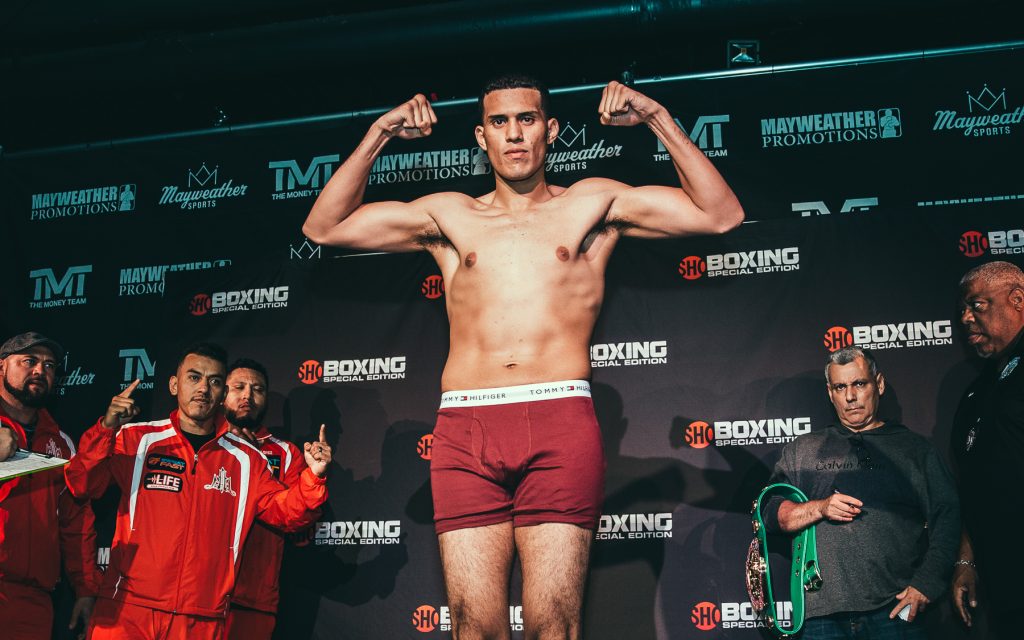
For David Benavidez, they are two options that sound alike and are linked by what he does after losing his super-middleweight title on the scale before his stoppage of Roamer Alexis Angulo last week.

He can wait, get back in line, fight his way back into a mandatory shot for his old title or a different one. The guess here: That wait wouldn’t be a long one. If he isn’t the world’s best 168-pound fighter right now, he soon will be.

But soon is a relative term, defined by a clock he can’t always control. Benavidez is 23. He’s growing, faster perhaps than he knows. His maturing body and metabolism will have the final say-so, no matter what he eats or how long he sits in a sauna.

For now, he’s gambling he can forestall the inevitable with a strict diet and Spartan-like discipline. He said after forcing Angulo to quit after the 10th round that he’ll stay at super-middleweight.

In part, he blamed his weight – 2.8 pounds over the 168-pound maximum – on pre-fight changes forced by the COVID pandemic. I hear him. I’m dragging around a lot more than an extra 2.8 pounds since gyms and pools shut down. It’s hard to mask the quarantine fifteen.

“When I usually lose weight, I follow a system,’’ Benavidez said after he beat Angulo into submission at the Mohegan Sun in Uncasville, Conn. “Two gallons of water, you know, on Sunday, then two on Monday. Then, you know, but I cut all that off. You know what I mean? Because I wasn’t really sure how this bubble was going to work. We were only able to work out one hour a day, for an hour.

“And I didn’t have a sauna, and really the stuff I need to cut my weight. You know what I mean? But at the end of the day, I’m a man. You know, I missed weight, so you know, I’m not making any excuses. But I’m very disappointed about that. You know, stripped of my belt, paid a huge fine. You know what I mean? But at the end of the day, I’m still undefeated.”

He protected his record (23-0, 20 KOs). That was a wise move from a young fighter smart enough to know that Angulo was heavy-handed enough to be dangerous, especially if he had entered the ring weakened by a futile attempt to make weight. Benavidez could have returned to the scale two hours later. But he said no, knowing he couldn’t shed the extra pounds. He probably won’t remain unbeaten forever. Meanwhile, there are plenty of belts.

There are reasons to think his old belt, the World Boxing Council’s version, will be available to him after a relatively short wait. Canelo Alvarez got himself in line for it in a bout against Turk Avni Yildirim, who was set for a mandatory shot at Benavidez before the scale fail.

By a 36-1 vote this week, the WBC Board of Governors granted Canelo’s request for a shot at the vacated title. I’m not sure who cast the lone dissenting vote, but I wouldn’t be surprised if it was somebody who has an investment in DAZN. Canelo-versus-Yildirim? Yildirim has two losses, including one to Anthony Dirrell, who Benavidez stopped a year ago. Safe to say, DAZN wants more for its money. The streaming service has been paying Canelo $33 million a fight. Now, there are reports that he is due $40 million for his next fight.

In a third fight against Gennadiy Golovkin, may be. Against somebody named Yildirim, no way.

In large part, Benavidez hopes to stay at 168-pounds long enough for a showdown against Caleb Plant, who holds the International Boxing Federation’s super-middleweight belt. Trash-talk escalation between Benavidez and Plant fueled hopes for a fight later this year. But COVID-19 changed expectations. Now, Benavidez-Plant doesn’t figure to happen until next year. It’s also not clear whether Plant would want to fight a Benavidez without a title.

For now, at least, Benavidez needs to test to determine whether he can still make 168. That means a bout under today’s COVID-dictated protocol with a 168-pound somebody. Maybe a somebody like Avni Yildirim.

Another scale fail would dictate a move up in weight to light-heavy.

Then, Benavidez would have to wait on Plant to make the move.

Wait and weight, it’s one of boxing’s inevitable combos.


Back In Business: David Benavidez re-enters the work place for first time in about a year

By Norm Frauenheim-

From college football to gyms, it often seems as if the world is going out of business these days. It’s the shutdown era. But David Benavidez hasn’t seen the signs. He’s back in business, or at least he will be Saturday night.

Benavidez will resume his career, fighting for the first time in nearly a year in a super-middleweight title defense against a dangerous Colombian, Roamer Alexis Angulo on Showtime in Uncasville, N.Y.

It was a fight that was supposed to happen in mid-April in Phoenix. But the pandemic forced it to a later date and out of Benavidez’ hometown. Without any hometown fans allowed to be in the seats, it would have been hard to sell it as a homecoming anyway.

For now, at least, home is wherever and whenever Benavidez can finally answer another opening bell, this time in a fight to reignite the momentum he had after a stoppage of Anthony Dirrell last September at Staples Center in Los Angeles.

“Right now, I just want to get back into it,’’ said Benavidez, who at 23 is among the brightest young stars in an emerging generation expected to lead boxing into whatever awaits us in the post-pandemic era.

Without COVID and its crippling tentacles, Benavidez would probably have one, perhaps two, more victories on the left side of his unbeaten resume. He’d be further down his projected career path than he is now. But the boxing shutdown also was an opportunity, a moment to reflect on who he is. Who he wants to be.

Above all, he realized how much he missed the ring. And, above all, it sounds as if he deepened his commitment to a craft as uncompromising as it is brutal.

Amid uncertain times, Benavidez is more certain than ever.

“I feel like it’s a new chapter in my life,’’ Benavidez said during a call with reporters this week from Mohegan Sun Arena.

It is, in large part because Benavidez has more to fight for than ever. He’s about to be a father.

“In three weeks, I’m going to be a dad,’’ he said.

He’ll be a dad with lots of ambition, lots of skill to get what he wants and an evident willingness to fight. It’s that undisguised willingness that makes him so interesting. In terms of skill, he’s an unfinished fighter.

That was evident against Dirrell, who walked him into traps and punches before Benavidez simply wore him down and out. 

But that willingness, complemented by an abundance of energy, are traits of a fighter anxious to learn. Translation. There’s a lot of upside. He can get better. A lot better.

So much so that he believes he can be the world’s undisputed super-middleweight champ.

“There can’t be four champions at super-middleweight,” he said. “We can’t all be unbeaten. All of us need to take a risk. We need to fight each other. There’s Caleb Plant, Billy Joe Saunders, Callum Smith and hopefully, king of the boxing world, Canelo Alvarez.”

In Benavidez’ new life, he envisions fighting all of them. That would be more than one chapter. More like a book. But there won’t even be a forward without a victory over Angulo, who last January upset Anthony Sims in a pre-Super Bowl card in Miami.

“Angulo is very heavy-handed and he wants to win. He’s coming off of an upset win and I think that has him motivated to believe he can beat me,’’ Benavidez said. “…”I’ve just been working on every aspect of my game. My defense, the jab, body shots and keeping the distance especially. I think Angulo is the perfect opponent to display everything I have. This is going to be a rugged and tough fight but that’s what I expect for every fight from now on. As long as I prepare myself correctly, I think I’ll be fine.’’

Preparation is a sure sign of emerging maturity in Benavidez, who will be defending a World Boxing Council belt that he regained after it was taken from him for a positive cocaine test.

Benavidez is predicting a one-sided victory, but not necessarily a knockout.

“I want to win clearly,’’ Benavidez said of Showtime’s main event on a card scheduled to begin at 9 pm. ET/6 p.m. PT. “I don’t want there to be any doubt in anyone’s mind.’’

If he gets the decisive win, he wants to fight again in December or January. Benavidez hopes for an immediate title-unification shot at rival Celeb Plant. First, however, he might have to take care of a mandatory date against Avni Yildirim. Benavidez was supposed to Yildirim in April, but the Turk withdrew with an injury. That led to Angulo, but Yildirim is still ranked as the WBC’s mandatory challenger.

Whatever happens, a date with Plant appears to be more when than if. A long-running trash-talk exchange seems to make it inevitable.

“I want to fight Caleb Plant next.’’ Benavidez said “…I want those other belts. I want to take the chances now and show everybody, including myself, that I’m the best.

“There are lots of great fighters out there, great fights to be made for me. I want to take all of them.’’


COVID to Comeback, Phase 2, offers some main-event anticipation

By Norm Frauenheim

The path from COVID to comeback isn’t exactly clear. During an era defined by masks and mixed messages, it can go just about anywhere. Only a new stage, the next step, is certain. Top Rank is preparing to take it.

Call it Phase Two, a succession of nine cards from August 15 through October 13, according to a report in The Ring.

It’s still a life dictated by social distancing, but it’s also one full of hopes for the bigger fights that were there in the initial phase, 13 ESPN-televised cards from June through July at Las Vegas’ MGM Grand.

That series of shows often felt like a collection of undercard bouts always in search of a main event. But there were reasons for that. The necessary exercise was all about learning how to stage an event amid the wildly-unpredictable swings of a dangerous virus. It was more about establishing protective procedures and protocol.

There was some drama, but not much. At times, it was a little bit like watching major-league baseball’s Miami Marlins take the field after their roster was gutted by a widespread COVID infection.

Who are those guys?

In Phase 2, the promise and anticipation of major fights will be included, even if fans in seats are not. The biggest might be a lightweight bout with pound-for-pound implications between Vasiliy Lomachenko and Teofimo Lopez. A week ago, there were reports that the fight, scheduled for Oct. 3, was in jeopardy because Lopez wants too much money.

On Thursday, however, The Athletic reported that Lomachenko has agreed to a $3.25-million purse for a pay-per-view appearance. Whether the bout ever gets to an opening bell still depends on the pandemic, which has already forced boxing through a mind-numbing cascade of cancellations and postponements. Nobody is safe. Examples abound, happening almost daily. UConn canceled its football season Wednesday. Eight UCLA football players tested positive Thursday.

There’s no bunker deep enough, no bubble secure enough to hide from it. It could still deliver another disruption to plans for Lomachenko-Lopez. Nevertheless, there’s hope in reports of a looming deal. For a while, at least, half-empty looks half-full. Maybe, this one will in fact happen. 

It’s significant, one that suggests boxing’s comeback from COVID is progressing.

I’m not sure it will ever completely be the same, even with a vaccine that medical professionals say could be available late this year or early next. The most significant fight these days is being waged in labs. But a Lopez-Lomachenko agreement represents a badly needed injection of confidence for a sport beginning to wonder whether there will ever be a third Tyson Fury-Deontay Wilder fight.

There are other signs, too. Danny Garcia and Errol Spence Jr. have a reported agreement for a PBC-promoted welterweight fight on Nov. 21 on Fox pay-per-view. It would be Spence’s first fight since he was thrown from his car in a scary crash last October, just a few weeks after he fought his way into the pound-for-pound debate with a victory over Shawn Porter.

On Top Rank’s Phase 2 schedule, the promotional company goes back to a time when the pandemic was still an epidemic. Jose Ramirez-Viktor Postol was scheduled for Feb. 1 in China, where the virus started. It was canceled. Then, rescheduled.

Another cancellation and rescheduling later, here we are, Ramirez-Postol on August 29 in what is seen as a stepping stone for a 140-pound unification bout between Ramirez and Josh Taylor.

It’s too uncertain for a complete comeback. But it’s a beginning, all the way back to the beginning of the kind of fights that sustained the business and still can.


Maturing David Benavidez ready for return, ready to stay busy and ready for a career that might lead to Canelo

By Norm Frauenheim

From height to reach, a tale of the tape is a reliable enough scale. But it doesn’t measure maturity. Growing up is a lot different than growing bigger. It’s an intangible, making it hard to quantify, but it’s there in tone and temperament.

You know it when you hear it.

It’s there in David Benavidez, a 23-year-old super-middleweight champion and wise beyond his years. An ongoing pandemic has already altered behavior and is about to change the marketplace, especially for prizefighters who grew accustomed to unprecedented wages during pre-COVID days.

Those days are gone. So, too, is a lot of the money, although it’s becoming clear that not everybody has awoken to the sobering news.

There are increasing reports of fighters at or near the top of the pay scale balking at projected fights because of money. Dollar-for-inflated dollar, Canelo Alvarez stands alone. But there are increasing reports that DAZN is asking him to take a cut in pay.

The streaming service, which signed Canelo to a contract worth $33 million-a-fight, is trying to cut costs. According to a Bloomberg story, DAZN wants out of its soccer deal with UEFA Champions League in Asia.

That report coincides with news that DAZN wants to re-negotiate with Canelo for a fight that has been proposed for Sept. 12. During the COVID era, there are no guarantees. There are no crowds either, which means Canelo will either have to wait for a later date – perhaps November — or a virus-killing vaccine, whichever comes first.

Then, maybe – just maybe – the eight-figure paycheck will be back in the market place. But don’t bet on it.  Only masks and social distancing are guaranteed these days. Benavidez seems to understand that.

“It’s understandable to think that taking a pay cut isn’t fair,” Benavidez said during a conference call introducing a Showtime schedule that begins Saturday with junior-featherweight Andy Leo against late stand-in Tramaine Williams and continues on Aug. 15 with Benavidez in a World Boxing Council title defense against Roamer Angulo in Uncasville, Conn.  “My contract states that my deal stays the same for this fight and the next fight.

“If I have to take a pay cut, I will take a pay cut. That’s up to my promoter and my manager, you know. We can definitely come to an agreement.’’

It looked as if Benavidez was poised to take big step up the pay scale last September after he scored a ninth-round stoppage of Anthony Dirrell and became only the second Arizona fighter to collect a $1-million purse since junior-flyweight legend Michael Carbajal scored the seven-figure feat against Humberto Gonzalez in a 1994 rematch.

But then there was COVID, which altered budgets if not mindsets. Amid reports of stalled negotiations with Canelo, Terence Crawford said he wouldn’t take a pay cut. Ryan Garcia said he wanted big money. Thursday, The Athletic reported Teofoimo Lopez was balking at offers to fight Vasiliy Lomachenko. Lower your masks, gentlemen. It’s only supposed to cover your nose and mouth. Not your eyes. That marketplace is changing. There’s no Floyd Mayweather Jr.-like payday in anybody’s post-COVID future.

Benavidez gets it.

“As for my fights, I give the best fights that I can possibly can give and deserve the pay that I get. But if we have to come to an agreement, we can come to an agreement.”

Dollars are the devils in the details, of course. But it sounds as if Benavidez has an unspoken awareness of what he has to do. To wit:  Keep himself in the mix and in the public eye.  His immediate goal is still a fight with Caleb Plant, who holds the International Boxing Federation’s version of the 168-pound belt.

But his name continues to be dropped as a possibility for Canelo, the reigning middleweight champion who won a secondary 168-pound title over Rocky Fielding and relinquished the 175-pound belt he won in a stoppage of Sergey Kovalev.

Callum Smith appears to be the leading candidate for whenever and where ever Canelo fights next.  If not Smith, maybe David Lemieux. Or maybe Benavidez.

Benavidez knows he is on Canelo’s short list. That awareness was evident this week when he appeared on the WBC’s internet production, Tuesday Coffee.

“I have a title that Canelo wants, the WBC,’’ said Benavidez, who had been scheduled to fight Angulo in Phoenix on April 18 in his first hometown appearance in five years. “If he gives me the fight it will be an honor for me. And if he gives me the opportunity I will be ready. I think I have what it takes to beat him: Youth, strength, speed.  I think I can beat him.”

“It is a fight that I want and, if he gives me the fight, it is going to be a war for people and it is a fight that people want to see. Boxing wins with that fight.” 

For now, however, Canelo-Benavidez has only been talk.

“Never an offer,’’ Benavidez said during the Showtime call.

 Also, never a doubt about a maturing fighter’s foresight to know that one day there’ll be one.


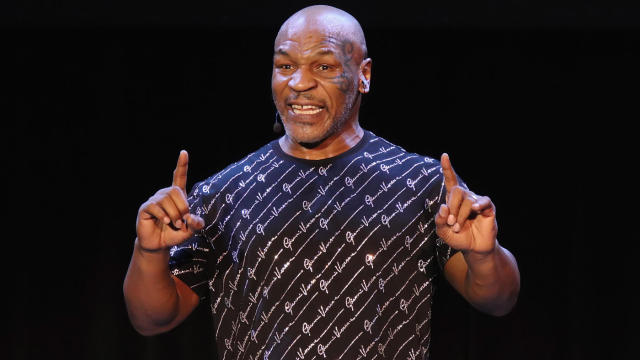
Mike Tyson-Roy Jones? Exhibition announced, but it is still a long way to an opening bell

By Norm Frauenheim-

Go ahead, wear a mask, stay away from crowds, stay at home and maintain social distancing. That might be enough to keep the COVID away. But the craziness? There’s no protection from that.

Example:

Mike Tyson versus Roy Jones Jr.

Apparently, it’s going to happen. I say apparently, because it looks as if a lot of things still have to happen after Thursday’s headlines about the planned event subside. Here’s what we do know:

The Dignity Heath Sports Park in Carson, Calif., has been reserved for Sept. 12, according to a story first reported by Yahoo. Tyson, 54, and Jones, 51, will wear 12-ounce gloves. The three-hour show is set to be distributed on pay-per-view on a new entertainment platform called Triller

Andy Foster, executive director of the California State Athletic Commission, told Yahoo that Tyson has put a hold on the date. Foster also said he spoke to Tyson and Jones via Zoom.

But details about financial backing and other significant details weren’t included. It’s being called an eight-round exhibition. As of Thursday, however, it was only an exhibition in how to generate headlines. Nobody better at that than Tyson. 

From pre-pandemic to pandemic, his power to generate publicity remains undiminished.

But buyer beware. I’m not sure this gets past the first drug test. That of course, presumes that there will be testing at all. That issue wasn’t addressed Thursday. But, safe to say, it will be for a bout between two legends already eligible for their AARP cards.

Tyson, of course, has been marketing himself and his ring resurrection for months through videos that display his punching power. Yeah, it’s still scary. It’ll be scary 10 years from now. Punching power is the last thing to go. George Foreman still had it when he regained a heavyweight title in a comeback at age 45 in 1994. Foreman, now 71, could probably still rattle the heavy bag with enough impact to light up message boards.

The surprise in Thursday’s news was that Tyson approached Jones about the exhibition. All of the speculation had been about a Tyson-versus-Evander Holyfield exhibition, a nostalgic look back on their infamous 1997 Bite Fight. Holyfield has posted his own videos, all of which showed that the retired heavyweight champ is in as good shape as any 57-year-old man could expect to be.

Instead, Tyson reached out to Jones, who had an almost mythic hold on the pound-for-pound crown during his middleweight, super-middleweight and light-heavyweight reign. Jones did win a heavyweight belt, scoring a unanimous decision over John Ruiz in 2003. Jones was the much smaller man, but Ruiz was no match for his blend of footwork and hand speech.

That blend is long gone, a fact that proved to be Jones’ undoing late in his career and now a potential danger against Tyson if the power in those videos is indeed real.

“I’m looking to be 100% of Mike Tyson in the ring,’’ Tyson said on ESPN’s First Take after plans for the exhibition were announced Thursday. “ … I’m a neophyte in taking it easy. I don’t know how to do it that way.

“I am one speed — forward. I don’t know, Roy is just going to have to deal with that.”

There’s still power in Tyson’s sales pitch, too.  He says he is launching a Legends Only League for retired athletes in all sports. Maybe, his planned exhibition with Jones is a beginning.

For Jones’ part, however, it was not clear that the exhibition was a done deal.  In a video posted on Twitter with Dr. Beau Hightower before a workout, however, Jones confirmed he had been contacted.  He’s interested.

“I still want to see these hands go,’’ Jones said. “I mean, I don’t know how to say no. So, don’t make me do it.  

“Mike is still a hell of a specimen.

“Still a problem to deal with.’’

A problem he might never face if a litany of other problematic details aren’t dealt with. 


No Opening Ceremonies during an Olympic year when masks mean more than medals

By Norm Frauenheim-

The Olympics were supposed to start a week from now. On July 23, Opening Ceremonies were scheduled for the 2020 Games. Like so much else, the Tokyo Olympics are just another postponement in a year that will only be remembered for a pandemic.

Maybe it doesn’t matter much during a time when diversions have been supplanted by infections and death counts. Masks are a lot more important than medals these days.

Still, it was a chance to see if there’s another Michael Phelps, or another Usain Bolt, or another Claressa Shields, or more of Simone Biles and Katie Ledecky. That’s the beauty of the Olympics. Amid its parade of pageantry and history, there’s always the promise of something new.

From Mark Spitz to Phelps, from Jessie Owens to Bolt, from Muhammad Ali to Joe Frazier and George Foreman, the Games recreate themselves. They remind us we’re getting faster and perhaps better. They’re overdone and way too expensive. But optimism isn’t cheap, which is something that becomes increasingly evident with every postponement forced by multiplying numbers that suffocate hope.

The Olympics will be back in some way, in some form. For now, the 2020 version has been rescheduled for 2021, still in Tokyo next year starting on July 24. In times ruled only by chaos, however, it’s fair to wonder if the Games will in fact go off as planned. Postponement is today’s only certainty.

Even if there are Opening Ceremonies next July, some of the key athletes might have already moved on. There’s no paycheck in waiting, especially when a pandemic is the boss. That’s especially true for boxing, which has pushed itself to the Olympic fringe over the last three-plus decades. Fact is, boxing has almost eliminated itself as an Olympic entity with successive scandals that date back to judging that robbed Roy Jones Jr. of a gold medal at the 1988 Seoul Games.

For every scandal, however, there are also fighters who come out of the Olympics and become the stars that are the pro game’s lifeblood and profit margin.

American Oscar De La Hoya won a gold medal in 1992. Floyd Mayweather Jr. won a bronze medal for the US in 1996.  American Andre Ward won gold at the 2004 Olympics in Athens. Gennadiy Golovkin (Kazakhstan) and Amir Khan (UK) won silver medals in Athens. Ukrainian Vasiliy Lomachenko won gold medals in two Olympics – 2008 and 2012. American heavyweight Deontay Wilder won bronze at Beijing in 2008. UK heavyweight Anthony Joshua won gold London in 2012. American Shakur Stevenson, an emerging star, won silver at Rio de Janeiro in 2016.

Without them, the pro game of the last 28 years would have been much poorer.

That creates a problematic future for today’s version of pro boxing. Although Olympic boxing has receded in terms of media attention, history says it is still an important resource. The best Olympic boxers arrive in the pro ranks already known to most of the customers. They have experience with the media, they know how to fight away from home and they know their way around the ring.

To wit: The business still needs them.

But no Olympic boxing in 2020 could strip the promoters and networks of the personalities and performers they will always need. Already, there is uncertainty about one of America’s best prospects, Keyshawn Davis.

Davis, the world’s No 1-ranked amateur lightweight and a silver medalist at the 2019 World Championships, did not report to Colorado Springs this week for training toward the re-scheduled Tokyo Games, according to a report in Boxing Scene. It’s not clear why he didn’t show up in camp Monday.

Davis, of Norfolk, Va., and a Stevenson friend, has sent out mixed messages about his plans. When the Tokyo Games were postponed in late March, he told some media outlets that he still wanted to go for Olympic gold. He would not turn pro until after the Olympics a year from now, he said. But he also said there was “a 70 percent” chance he’d go pro.

Who knows?

That’s about all anybody can say during days dominated by only questions instead of the Olympic motto: Citius – Altius – Fortius. The three Latin words means Higher-Faster-Stronger in most years. But they could mean anything, anything at all in 2020.


Ivy League: Cancellation might have been the smart move

By Norm Frauenheim-

Ivy League football has more followers today than it has in years. Nobody is exactly happy to be among that newfound crowd.

But the Ivy League is No. 1 this week for taking a step that might be an early-warning sign of what – or what not – to expect for the rest of the year.

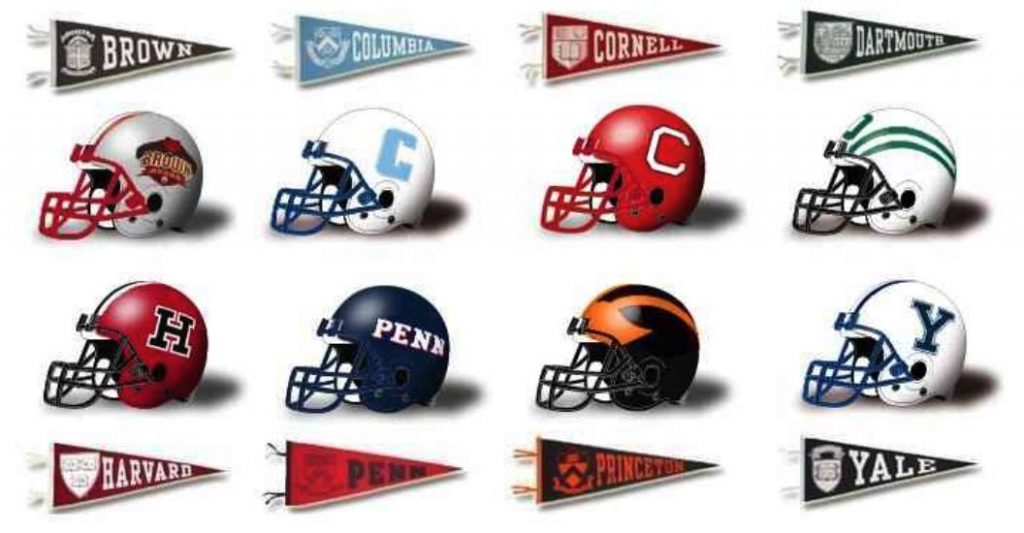
There’ll be no Harvard-Yale game this fall. There’ll be no kickoffs at all. The conference, known more for Nobel Prizes than Heisman Trophies, canceled autumn sports this week because of the pandemic-from-hell. Don’t expect the Southeastern Conference to fall in line anytime soon, if ever.

It’ll be a lot harder to cancel or postpone SEC football than it will to take down another statue of a Confederate soldier. A Saturday afternoon in autumn without the Crimson Tide and Lynyrd Skynyrd’s Sweet Home Alabama is harder to imagine than a Southern breakfast without grits. Football is more than a game. It is today’s version of Southern rock-and-roll. Rest in peace Charlie Daniels and Roll Tide.

Then again, I would never have imagined a May without a major Cinco de Mayo fight, a June without the NBA Finals and a July 4th without baseball. Maybe, the NBA and baseball are about to happen in some way and some abbreviated form. But I’ll believe it when I see it. The Diamondbacks are scheduled to open at San Diego on July 24. The Suns and Wizards are scheduled for a July 31 opener in the so-called bubble in central Florida

But it’s hard to get excited, mostly because of a pandemic that is a game only for mask-less fools. There are plenty of them. At least, there are in Arizona, which might explain why the state is No. 1 in desperation. AZ leads the infection rate, world-wide.  As of Thursday, infections were found in 28 percent of COVID-19 tests. That’s one in every four people. I stood in a line of eight shoppers in the grocery store Thursday. If the stats are right, two were infected. I tightened my mask and stepped outside into 113 degrees.

It’s hot.

It’s scary.

It’s Ground Zero.

I’m not sure any kind sport will provide much refuge from that. At least, not in the here-and-now.

Amid the mind-numbing heat and fear, there was finally some sense from the smart guys in the Ivy League. They decided to quit playing around with the annoying succession of cancellations and postponements.

Let’s hear an opening bell when there’s a vaccine.

It’s hard to guess where boxing is headed amid it all. There may not be another wave of the pandemic this fall. But there already has been one wave of uncertainty after another. Top Rank has been staging regular cards for ESPN in Las Vegas for a month now. I like what they’re doing. They’re keeping the game alive and keeping some young fighters busy.

I also applaud Bob Arum for taking the lead in staging cards limited by social distancing, testing and all the rest, including some of the usual stupidity. To wit: Heavyweight Jarrell Miller, Big Baby All Over Again, tested for a PED in what was his second positive test since he was disqualified for a shot at Anthony Joshua, who went to lose to stand-in Andy Ruiz Jr. more than a year ago. Some things never change. It’s almost comforting. Almost.

But Arum is caught in the same uncertainty that has paralyzed the sports business. He had been working toward a September 19 date for Teofimo Lopez-Vasiliy Lomachenko fight. It is an intriguing bout, loaded with pound-for-pound potential. More significant, it looms as a fight that could be the beginning of business, post-pandemic. It’s hard to know whether that means business-as-usual. But it’s a date that was seen as a way to restore the profit margin.

Now, however, Lopez-Lomachenko has been moved to Oct. 3, according to Boxing Scene. The pandemic forced the move. At the rate it’s spreading, it’ll force some more, leaving Ivy League football with more followers than anybody could have imagined a few months ago.


Lots of hope invested in December date for Fury-Wilder 3

By Norm Frauenheim-

The third Tyson Fury-Deontay Wilder fight was supposed to happen this month.

Early in the pandemic, the July 18 date at Las Vegas MGM Grand was viewed as something of a benchmark, a hopeful sign that business – the world – would be back as we’ve known it. Lived it.

But hope, known to spring eternal in better times, is futile these days. First, Fury-Wilder 3 was postponed to Oct. 3. Now, it has moved, pushed to Dec.19 at Vegas’ new Allegiant Stadium amid promoter Bob Arum’s hopes that a live crowd of about 20,000 will be allowed to sit in seats separated by today’s social-distancing dimensions.

“That is the date that we all want,” Arum told Las Vegas’ Review Journal. “That’s the date that both sides are happy with. Whether we’ll be able to do it in the stadium with limited seating, that’s in the hands of the gods.’’

Four months ago, few would have imagined that December would be a possible target date for the resumption of business as usual.

Then again, COVID-19 sounded like science fiction in those days. Who knew that masks would become a fashion statement?

Nobody, despite the mix of fairy tales and fake news from a White House collection of Baghdad Bobs, who keep saying the virus is going to disappear like a miracle. If only that miracle would make them vanish, too.

There are no miracles. But there is some hope, albeit frayed. And there is a potential vaccine, albeit delayed.

A vaccine might be the only realistic hope. The mounting fear of COVID-19 is summed up in the rising number of infections, especially in Arizona, Florida, Texas and California.

Just a couple of months ago, Arizona was thought to be the place where baseball would make its comeback. MLB talked about an abbreviated season in the desert at the spring-training sites in Phoenix. But that was before the virus hit Arizona like a haboob. It’s spreading faster than summer temperatures are rising.

Arizona, baseball’s epicenter in February, is a very different kind of epicenter now.

What has happened in Arizona, my home state, is just another example of what still figures to happen. No telling when the rate of infections will subside. Then, there’s the possibility of a second wave in November, the month before the projected third leg in the Fury-Wilder trilogy.

There are already widespread doubts about whether there will be a college football season this fall.

The NFL, perhaps, has a better shot at some sort of season, yet even it is talking about fans and even players signing some sort of waiver, an acknowledgement that even pro football fears that the pandemic will continue.

From boxing to baseball, money is a motivation for the attempt to get back in the game. Fighters and players still want to get paid. Networks are begging for live content. But the attempted return is as expensive as it is risky.

The NBA is planning to gather in Orlando where it will go into the so-called bubble, which is where boxing has been for nearly a month with weekly Top Rank shows in Las Vegas.

The players, like the fighters, will test, train, eat, sleep and play, all away from fans.  But life in the bubble isn’t cheap. It’s expensive to maintain and sustain. Yet, it’s an investment in keeping fans interested and around for the days when social distancing is a forgotten dimension.

But it’s beginning to look as if only a vaccine can ease public fears and bring the fans back into the arena for a first bell or an opening tip. I’m still hoping to hear that bell for Fury-Wilder 3. But, mostly, I’m hoping for a lab to produce a vaccine.

A vaccine might be the best investment. Long-term, it’s the only way to bet.


More Pandemonium? COVID-19 infections continue to haunt old routines

By Norm Frauenheim-

It’s a pandemic. Pandemonium, too.

Chaos is everywhere, a symptom seemingly suffered by many who apparently have not been infected by a virus that appears and re-appears like some mutant ghost.

Don’t believe in ghosts? Well, this one is real. It’s named COVID-19 and it’s got everybody scrambled, left with only a few ideas and yet no clue as to how to make any of them happen.

Sports are about routine. Go to the gym, do the roadwork, take batting practice, swim the laps, lift weights, spar, spar and spar some more. There’s a lot more comfort in the routines than there is in wearing a mask.

But that mask – day after day after day — is about the only thing anybody can be sure of any more. Of course, there are the exceptions, the fools who think a mask is a symbol or a statement. They won’t wear one, which is little bit like a skydiver taking the jump without a parachute.

All of this is a long-winded way of getting around to the point. Sorry for that. But these are days when you fill in the blanks while practicing social distancing. Maybe, that’s why Oscar De La Hoya said he’s still thinking about a comeback. What else has he got to do?

The routines are a framework for what’s possible. They represent realistic limits. Maybe, that’s why I miss them. I never thought I would, which in retrospect makes me think I was as foolish as that skydiver without the chute.

But, increasingly, I miss exactly what I had come to think was mundane, if not boring.  

In late June, I miss checking the major-league baseball standings. In May, I missed the NBA playoffs, the Kentucky Derby and Canelo Alvarez. In April, I missed the Masters. In March, I missed the opening rounds of the NCAA Basketball Tournament.

Mostly, I miss hearing an opening bell from a ringside seat.

All of the familiar moments and sounds are supposed to return. Baseball plans a 60-game season, scheduled to begin in late July. The NBA plans a play-off-like format in the so-called bubble. There’s talk of Vasyl Lomachenko-versus Teofimo Lopez in September. The signs are welcome, but suddenly other signs are disconcerting enough to think that I’ll have only the mask for the next few months.

Arizona, my home state, is suddenly in a race with Texas and Florida to be Ground Zero in the COVID-19 resurgence. It depends on the day and the percentage of infections per tests. I’d rather read the box scores.

It’s nerve-wracking and it raises troublesome questions over just how MLB plans to pull off a 60-game schedule built on teams playing within their region. The Diamondbacks, Rangers and Astros are supposed to play each other regularly, home and away. The Dodgers, Angels, Padres and Giants are in the region, too.

No fans are expected to be there. In cities confronted with rates exploding at a scary rate, however, how will they play in Phoenix, Dallas, Houston, Los Angeles, Anaheim, San Diego and San Francisco without somebody getting infected? One infection is enough to suspect a much bigger problem.

Infections are suddenly happening everywhere. Golf, considered an essential business in Arizona when the pandemic first hit, is dealing with them this week.

Four-time PGA Tour champion Brooks Koeppa withdrew from the Travelers Championship Wednesday because his caddie, Ricky Elliot, tested positive. Koeppa’s brother Chase, also withdrew. He had qualified for a spot in the Travelers field.

Golf prospect Cameron Champ tested positive and withdrew as well. Former U.S. Open champ Graeme McDowell, a former U.S. Open champion, withdrew because his caddie, Ken Comboy, tested positive.

Golf is ominous proof that no game is immune. The golf course, almost pastoral.  is perfect for social distancing. The game is played outdoors, where physicians say it’s harder to transmit than indoors. Golfers often stand close to their caddies, but it looked as if the 6-foot distance could be maintained without sacrificing communication or the way in which clubs are exchanged. Just wipe the clubs down in each and every exchange.

But the infections happened anyway. From clubs to bats, more look to be likely.

No way to mask the pandemonium. No way to trash that mask either. Anybody got a working parachute?


September Comeback? A possibility instead of the same old futility

By Norm Frauenheim-

On the traditional calendar, September means change, summer turning into fall. But it means something more these days, at least it does for a sport hoping to break out of a lonely bubble and back into crowded arenas.

There’s really no telling when the ongoing pandemic will subside long enough for the return of fans and the live gates that might restore a zero or two to purses. For now, however, September appears to be a potential window for the return of some of the game’s biggest stars.

At the top of the list, there’s a projected bout between lightweight Teofimo Lopez and Vasyl Lomachenko, who was No. 1 in most pound-for-pound ratings, pre-pandemic. It’s an intriguing fight in any month. Any year. September in Las Vegas is the hope in what would be an appropriate welcome back for boxing at its highest level.

Bob Arum, Lomachenko’s promoter, is also looking to bring back unbeaten welterweight Terence Crawford in September or perhaps October. Arum told ESPN that Manny Pacquiao is a possibility. Like Lopez-Lomachenko, Crawford-Pacquiao is a biggie any time.

“We’re going to have Terence fight in September, or October, period,” said Arum, who also mentioned Kell Brook, Shawn Porter, Keith Thurman and Yordenis Ugas.

Then, there are photos of Canelo Alvarez, in training for a projected fight in mid-September, presumably on the Saturday before or after Mexico’s Independence Day, which falls on Wednesday, Sept. 16. Canelo, the reigning middleweight champion, is the game’s leading pay-per-view attraction. It’s tough to underwrite a fight featuring Canelo without a live audience. Same for Lomachenko, Crawford and Pacquiao.

But uncertainty – more like chaos – still reigns because of COVID-19. The virus is spiking in Texas and Arizona, both key boxing markets. All bets are off, at least in term of anything other than tentative. Still, September is a possibility, albeit temporary. Medical experts are saying it could subside during late summer.

It’s no coincidence that September is considered the best month for baseball to wrap up an abbreviated season. That’s only if and when owners and players can reach an agreement over – what else? – money.

In a terrific story, Dr. Anthony Fauci, director of the National Institute of Allergy and Infectious Diseases, told the Los Angeles Times that baseball would be wise to confine its season to the summer months.

“I would try to keep it in the core summer months and end it not with the way we play the World Series, until the end of October when it’s cold,” Fauci said in a story published Tuesday.

“I would avoid that.”

There’s concern of a second wave in the fall. The infamous Spanish Flu more than a century ago killed millions worldwide, most of the deaths happening in a second wave that hit in October of 1918.

“Even in warm weather, like in Arizona and California, we’re starting to see resurgences as we open up,” Fauci said. “But I think the chances of there being less of an issue in the end of July and all of August and September are much, much better than if you go into October.”

If and when boxing can return with some sort of fan presence, Arum’s Top Rank will be better prepared than any other promotional venture. Top Rank’s ESPN shows in the so-called bubble are ongoing, including a card featuring lightweight Gabriel Flores Jr. against Josec Ruiz, Thursday in a ballroom at Las Vegas’ MGM Grand.

The shows have not been without some hitches. Thursday’s card was supposed to feature junior-welterweight Jose Pedraza vs. Mikkel LesPierre. But the bout was cancelled when LesPierre’s manager tested positive for COVID-19. It forced a shuffle. But expect the unexpected. Top Rank is doing exactly that, in the lead – in the bubble, too – in re-learning how to stage cards in a new and cruel world.

Work in the bubble will prepare Top Rank for the moment when the bigger cards can happen.

“You would want to do it at a time when there isn’t the overlap between influenza and the possibility of a fall second wave,” said Fauci, who could have been talking about any sport.

Fauci also cautioned that there were no guarantees.

But there is September, a possibility instead of futility.  


Joshua-Fury: Fury already favored, but what are the odds of it ever happening?

By Norm Frauenheim-

News of an agreement for two Anthony Joshua-Tyson Fury fights next year was quickly followed by bookies installing Fury as a slight favorite.

Maybe the headlines generated some business at the books. But the real odds are on whether these two fights will ever happen. Agreements are like a glass jaw. They get broken all the time.

Of course, Joshua and Fury agree that they would like to fight a couple of times.  Of course, Fury co-manager Frank Warren reportedly said Fury would be happy at a 50-50 split.

It’s easy to agree on half-a-share of nothing.

In effect, that’s what the Joshua-Fury news was this week. It was a tease, a diversion from all of the uncertainty that has boxing and virtually every other sport seeking to hit the restart button amid the ongoing pandemic.

There’s no way to predict when COVID-19 will vanish. And there’s no way to know what the world will look like after it does. If it’s business-as-usual in the post-pandemic era, then Joshua-Fury will move on to the astonishing money that appeared to be inevitable before anyone had ever heard of coronavirus.

But don’t bet on it.

The unemployment figures are too high and the lines at community food banks are too long to think there will be much pay-per-view money in anybody’s pocket for a while. The best bet is that they’ll be negotiating for a total purse that’s a lot smaller than anybody would have imagined just six months ago.

Besides, there’s a minefield full of things confronting each heavyweight before they could even re-visit their reported agreement in an effort to sign a contract, a real deal.

First, Fury, a 7-4 to 2-1 favorite over Joshua, is mandated to fight Deontay Wilder in a third bout, which has been postponed multiple times. There are reports of the second rematch going to Macao or Australia. Maybe, an option is the Raiders’ new stadium in Las Vegas with fans in seats configured by today’s social-distancing limits.

Then, there’s Joshua, who has a date with Bulgarian Kubrat Pulev. Like everything else, it’s been postponed repeatedly. Then, there’s talk of Joshua in another mandatory title defense against Ukrainian Oleksandr Usyk. No idea of when or where or even if. There are no plans these days. Just quarantines and curfews.

Even if Wilder-Fury 3 happens and Joshua faces Pulev, there is only more of the uncertainty that defines a pandemic thus far known only for deadly chaos. The singular power in Wilder’s right hand could score an upset.

Meanwhile, Pulev has little to lose and is tough, which means he’s dangerous for a Joshua who just hasn’t been the same fighter he was in a dramatic stoppage of Wladimir Klitschko in April 2017.

Joshua was curiously cautious in winning a decision over Andy Ruiz Jr. last December, about six months after Ruiz stunned him, scoring a seventh-round stoppage in New York.

Now, we see Joshua on crutches, his left knee in a brace for an injury he says he suffered while running in the woods.

He looks vulnerable.

Maybe that, too, is an illusion, another wager during a time when all bets are off.  


First Round: Top Rank launches its post-pandemic plan

By Norm Frauenheim-

Top Rank is poised to hit the re-set button next week, mid-week, with live telecasts, the first in about three months, which is only a short season on a calendar that has been stripped of its ordinary reliability by the extraordinary.

Spring turns to summer no matter what, but it’s hard to know whether a long-awaited succession of opening bells continues to ring into autumn and winter with something that sounds like business-as-usual.

We’ll begin to find out, first Tuesday with featherweight champion Shakur Stevenson (13-0, 7 KOs) in a 130-pound bout against Puerto Rican Felix Caraballo (13-1-2, 9 KOs) and again Thursday with former 122-pound champion Jessie Magdaleno (27-1, 18 KOs) against Dominican Yenifel Vicente (36-4-2, 28 KOs in a featherweight bout, both on ESPN and both in a ballroom at Las Vegas’ MGM Grand Convention Center.

They are ordinary fights anytime other than now. The pandemic makes them extraordinary for what is known and unknown. Empty seats are the only sure thing.

Fans won’t be there.

Media won’t be.

Maybe, COVID-19 won’t be, either. That’s the idea, yet that’s all it is in what is essentially a couple of test runs in boxing’s first concerted attempt since the ring lights went dark in late March.

“This is something that nobody, at least from our end, has experience with,’’ Top Rank’s Bob Arum said Thursday during a conference call that included Stevenson and Caraballo. “It’s really been a work in progress, and it continues to be a work in progress.

“Imagine, as guys come into Vegas, they got to go into what is a bubble.

They’ve got to be escorted to a place where they can shake out, train. There’s a place to eat. We have a special dining room set up in the convention center. All of this is something we’re not used to. We’re not starting out with title fights. But maybe in a few weeks, we’ll start doing some title fights.

“There are issues with the organization. So, it’s not easy. We’re doing it one step at a time.’’

Arum has divided the comeback into phases, much like state governments are doing with the plan to re-open restaurants and businesses. This week, Phase One, is just an attempt to see what works. What doesn’t.

Phase Two would include a mix of second-tier title fights and perhaps a measured return of ringside media. Along the way, fans would be brought back, first in limited seating and then until all the seats can be filled without fear of a widespread infection of the dangerous virus.

Underlining it all is testing. Test before training. Before dinner. Test, test, test at all times. Arum estimated testing for each card costs more than $25,000.

“Just for testing,’’ Arum said. “Plus, the rooms, special security, the meals. This is a very, very large undertaking. But, obviously, we’ve get to get it done. We’ll probably be doing this for three months – June, then July and probably August.

“Hopefully by September, we’ll get back to doing events with spectators in a limited capacity.

“Then, hopefully by the end of the year, we’ll be doing events with virtually full capacity.’’

If it all works, then maybe – just maybe – boxing will be back to what it was by year’s end or early 2021. That would mean Tyson Fury-Deontay Wilder 3 and perhaps a third fight between Canelo Alvarez and Gennadiy Golovkin. All kinds of intriguing fights have been speculated. Terence Crawford-Manny Pacquiao has even been mentioned.

But it all depends on what begins to happen next Tuesday and Thursday. It is the logistical origin of a potential template that could guide a sport as old as any back to its future or send it down a path to its place in a post-pandemic era.


Forbes 100: It’s a different list with an expensive warning

By Norm Frauenheim

The Forbes list used to belong to Floyd Mayweather Jr., who became better known for dominating the money ranks than the pound-for-pound ratings.

Dollars buy crossover fans and Mayweather seemed to have an endless supply. The cash filled his suitcases and the minds of young fighters, who wanted to spend like him even if they couldn’t fight like him.

The biggest reward for the smallest risk, a ratio and a role model, became as important as any combination of punches. No matter what the sport, Mayweather employed it as effectively as anyone ever has.

But the ratio is vanishing in a pandemic for which there has been no apparent immunity. The risk is still there. Boxing without risk is aerobics. Have a nice workout. But the reward is eroding at a rate that will soon force fighters to think twice about that inherent risk.

The latest Forbes list of the world’s highest-paid athletes was released about a week ago. It includes four boxers – Tyson Fury at No. 11 with $57 million, Anthony Joshua at No. 19 with $47 million, Deontay Wilder at No. 20 with $46.5 million and Canelo Alvarez at No. 30 with $37 million.

At the top, Roger Federer, who is the first tennis player to ever be ranked No. 1 with $106.3 million in earnings and endorsements for the period between June 1, 2019 and June 1, 2020. He won’t be standing in line at any food banks before his next match.

Nevertheless, the list is a red flag, an early earning sign of financial trouble awaiting all sports and especially boxing, which includes few guarantees, other than stitches and scars.

Start at the top. Federer is there with income less than half of what Mayweather earned during days when he was No. 1 often enough to be named for the list. In 2018, Forbes Mayweather led the way with $285 million, most of it from his all-reward and no-risk dance with Conor McGregor, a mixed-martial arts performer then posing as a boxer.

Two to three years later, the money looks to be vanishing faster than a full-time job. Top-to-bottom, the pay-for-play list for the top 100 is down nine percent from what it was a year ago. Cancellations started in late February and never stopped until the entire sports landscape went dark in April.  Forbes predicts a steeper decline in its next list. No play, no pay.

https://www.forbes.com/athletes/#696328ea55ae

There are signs that some sports will return this summer in an abbreviated format. The NBA and NHL are talking about schedules at single sites in a format that would essentially be a payoff schedule. For now, baseball is locked into talks about money. Thus far, players are balking at proposed pay cuts.

Boxers aren’t that lucky. During the pandemic, they aren’t collecting any pay anyway. They are independent entrepreneurs. They have to fight to get paid, contract-to-contract. Boxing is set to hit the re-start button on June 9 in a bout featuring emerging featherweight champion Shakur Stevenson against Felix Caraballo in Las Vegas. Further bouts are scheduled throughout June and July.

But, essentially, they will be studio shows. In an effort to safeguard fighters and officials from catching the lethal coronavirus, there will be no fans. No ringside media. The bouts will be televised by ESPN, which is desperate for live content.

Yet, the absence of a live crowd limits the purse. That might be OK for young boxers still fighting to make their name. But for the established star, there’s no chance at earning the big money that was a hallmark of the Mayweather era and its immediate aftermath during pre-pandemic days.

Without a live gate, it’s hard to foresee Fury-Wilder 3 or a third Canelo Alvarez-Gennadiy Golovkin fight any time soon. How about Terence Crawford-versus-Errol Spence Jr.? Not this year, if ever.

No live gate also looms as a potential complication for Manny Pacquiao, the Filipino Senator who had been hoping to fight sometime this summer.

Pacquiao had been fighting for about $20-million. That’s a big number. He’ll be 42 on Dec. 17. That’s a short window for a fighter near retirement.

A solution? There might not be one during a stretch when the money will be short and Forbes forgettable.


Money or History: Pandemic pushes Canelo to the edge of a potential dilemma

By Norm Frauenheim-

Canelo Alvarez is fighting for history. At least, he was, pre-pandemic, last November in his light-heavyweight stoppage of Sergey Kovalev. But history, like profit, has been suspended for who-knows-how-long because of COVID-19.

Alvarez is lucky. He was a wealthy man before the virus appeared and spread its deadly appendages like a weapon of mass destruction. Over just three fights in his rich DAZN deal, he earned $97.5 million, more than enough to pay for a lifetime of bills and a few Ferraris.

Canelo doesn’t have to fight, unlike most in the prize-fighting profession who are praying for some sort of paycheck in studio shows that figure to begin next month. But if money isn’t a motivation anymore, Canelo’s immense pride is. That’s why the reigning middleweight champion talked – and talked — about history before an 11th-round knockout of Kovalev Nov. 2 at Las Vegas’ MGM Grand in his first and only fight at 175 pounds.

For Alvarez, history isn’t complicated. It’s simple. Singular. Julio Cesar Chavez is the defining face of Mexico’s fabled boxing history. He was when Canelo was born in 1990. He has been ever since.

In winning a title in a fourth weight class, Canelo had begun his monumental pursuit of supplanting Chavez. His run at history was underway. Now, a pandemic-altered landscape includes a potential dilemma for Canelo and DAZN.

History or profit?

Money or legacy?

Canelo’s claim on legacy is hard to make, much less sustain, when he’s not fighting. Inactivity opens the way to a skepticism that’s hard to counter. Think of LeBron James in his great debate over who’s The GOAT: James or Jordan?  James’ only argument is to play, just play. Yet just as the pandemic shuts down the NBA, the ESPN documentary, The Last Dance, reminds us just how good Michael Jordan was. Without another season and another title run, James has no way to further his claim on being basketball’s best ever.

James has to play.

Canelo has to fight.

Until then, it’s hard to argue with legendary trainer Nacho Beristain, who questions whether Canelo will be remembered as Mexico’s best ever.

“I think it is going to be a little difficult for him to end up being one of the best fighters to come out of Mexico,’’ Beristain told El Boxcast. “He is a good fighter, no doubt about that. I particularly feel how he boxes is attractive. But for him to be the best pound-for-pound, he’s not and he’s not going to be.

“I think they are intelligently evading some middleweight fighters who may harm him and are taking care of his career because they are making a lot of money. To a certain extent he is good, but I think he is not the best.”

The money is a staggering complication, the proverbial devil in the looming dilemma.

It’s easy to say that making history is the goal when you’re making $32.5 million-a-fight. That has been Canelo’s guarantee for each fight in the landmark, $365-million contract he signed with DAZN in 2018. He beat Rocky Fielding, Danny Jacobs and Kovalev in the first three bouts of an 11-fight deal. They were solid victories, but forgettable on a historical scale. Canelo, a former junior-middleweight champion, won a fringe 168-pound title against Fielding, retained his middleweight supremacy against Jacobs and won a fourth division title against a fading fighter, yet a known name in Kovalev.

Short-term, it did not answer questions still lingering in the wake of two fights with Gennadiy Golovkin. There was a draw and then a narrow scorecard victory for Canelo, who won a majority decision in the rematch. History and DAZN demand something definitive. But the world is operating on a different a timetable these days. Tick-tock, we’re all on the pandemic clock. There was talk about a third GGG-Canelo fight in September. Then, there was talk of interim bouts — Canelo-versus-Billy Joe Saunders and GGG-versus-Kamil Szeremeta before the final leg in a trilogy.

“We realistically want two fights this year,” Canelo trainer Eddy Reynoso told Box Azteca. “We couldn’t fight in May, so we are looking at September and December. We’re talking about [opponents] like Billy Joe Saunders.

“There’s also Caleb Plant and the WBC world titleholder at 168 pounds [David Benavidez]. There are several [options] … Golovkin could be the fight for December. His people have already said that he doesn’t want to fight Canelo until after the [Kamil Szeremeta] fight.”

When fights were cancelled, DAZN lost subscribers. Can the streaming network even afford to pay Canelo his minimum anymore? Will former subscribers renew after months of lost wages? Would Canelo be willing to make less money while he tries to make history?

Only the virus knows.


What Comeback? Mike Tyson has never left the stage

By Norm Frauenheim

In case you haven’t heard or seen, Mike Tyson is coming back. That’s news, of course. But it’s strange to call his plans a comeback. When did he ever leave? He’s always in the public imagination. In deed. In name. In words. And now in video.

Video of Tyson in the gym went viral during a time when a real virus has kept so many at home with nothing much to do other than fantasize. Yeah, It’s Mike all right, waking up the past with echoes of his crazy power.

It’s fun to watch. It’s even fun to wonder.

Still, I’m not sure Tyson can still fight at 53 years old. Precedent and caution say no. But Tyson is nothing if not unprecedented.

Above all, the power in his ability to fascinate and entertain remains undiminished. Forgettable he’ll never be. At one level, it’s astonishing how much attention he can still generate. The internet is on fire with talk of him fighting Evander Holyfield.

Forget that it’s supposed to be a four-rounder for charity. Headlines, driven by runaway imaginations, frame it as the third fight in a rivalry with more imagined sequels than just another trilogy.

The hunt for the last piece of Holyfield’s ear from the 1997 Bite Fight might already be underway. In perhaps an apocryphal story, it was found on the canvas by maintenance, placed on a cocktail napkin and then lost in a cab during a wild ride from the MGM Grand to a Las Vegas emergency room after Tyson bit it off in the third round.  Maybe, the National Geographic Channel can find it preserved in gold at a pawn store or buried in liquid nitrogen in a cryonics coffin beneath the Welcome to Fabulous Las Vegas sign.

It’s a story that will never go away. Then again, neither will Tyson. In a twist on an old line, you just can’t make him up. His craziness is a jagged collection of contradictions, yet genuinely compelling.

To this day, I’ll always remember him from a moment a couple of decades ago when he was living and training at the old Central Boxing Gym in downtown Phoenix. It was July. In the Arizona desert, only hell is hotter and not by much. Tyson was in the gym. The doors were wide open. A few box fans provided the only AC. Tyson was happy. I was sweating.

Turns out, it was a day when Tyson just wanted to talk. There were pigeons and food and philosophy and history and music. He talked and talked some more. Finally, I told him I had to leave. He follows me out of the gym and to my truck. I open the truck’s door and put my right foot inside the cab. Suddenly, I feel a hand as heavy as an anvil land on my left elbow.

Whoa.

Remember, Mike wanted to talk.

So, I listened.

I’ll never forget the power, running from his hand through my arm, like a force of nature. With one yank, he could have ripped my arm from my shoulder. I stood there, right foot in the truck and left foot on the street, planted by that one hand.

He was frightening.

He was fascinating.

He was everything then that he is today.

Even on video, that compelling mix is evident. People watch, still watch, in part because Tyson’s extremes can’t be faked. Genuine is an increasingly rare commodity in our fake-news world. In Tyson, it’s still there, abundant as it is vulnerable

Truth is, I’d rather Tyson not fight at all. There’s too much risk for him and the 57-year old Holyfield. I’m not convinced either will ever answer another opening bell anyway. Mind and name recognition might withstand the cumulative damage from blows over more than half a century. But the body will not.

Injuries in training are a real risk, perhaps one that will be enough to cancel plans to fight again. We don’t need to see a Tyson comeback. He’s not going anywhere anyway.   


Jimmy Glenn, Rest In Peace

By Norm Frauenheim-

Mike Tyson wants to fight four-rounders. So, does Evander Holyfield.  I’ll let you figure out where that leads. The public imagination is capable of just about any fantasy these days. There’s not much else to do.

The imagination is an escape, a refuge from the tragedy of a pandemic that kills those we love, those we admire and those we wish we had known. There are no baseball standings. No NBA box scores. No opening bell. There’s only the obit page. It’s endless, columns of names, some celebrity and some anonymous, yet all gone.

There’s been a lot of talk about business-as-usual this week. That would be nice. Something to hope for. Pray for. But, for now, it’s another fantasy, just like Tyson-Holyfield 3. The obit page says that intensive care and funeral homes will be doing most of the nation’s business for a while.  

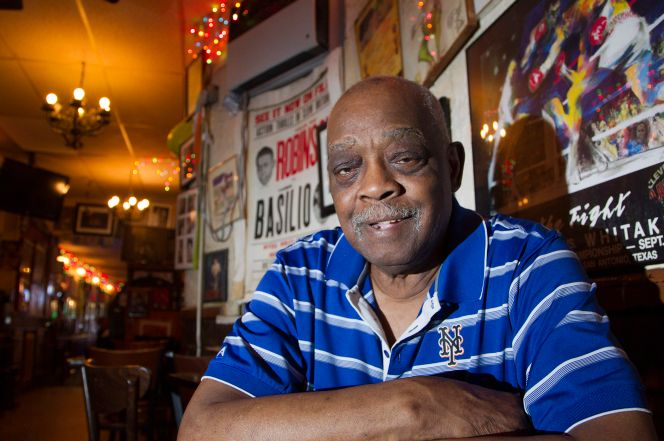
Jimmy Glenn’s name is on that page today. Glenn, 89, died early Thursday after a long battle with coronavirus. He was an amateur boxer, trainer, a cut man, manager and bartender. It was his bar, Jimmy’s Corner near New York’s Times Square, that has become a defining piece of real estate for a sport that has seen it all.

Glenn had seen it all. Or at least most of it. He used to talk about fighting former heavyweight champion Floyd Patterson as an amateur. Patterson won.

“But I went the distance,’’ Glenn told The Sweet Science in 2005.

He could have been a contender, too.

For 50 years, his bar became a gathering place for the contender in all of us.

The walls are covered with the posters and memorabilia that decorate scarred gyms everywhere. History fills the place like a shot glass. Tourists step in to gawk. Fight fans gather to debate or celebrate what they’ve just seen at Madison Square Garden. Writers are there to drink in the history and any other potent spirit.

Like so much else about boxing, the place is a mix of fact and fable. Among all of the photos, there’s one of Muhammad Ali, overlooking the bar. Then there’s a still from Raging Bull, the classic film starring Robert De Niro in his role as Jake LaMotta. The movie’s closing scene was filmed at Jimmy’s Corner.

Jimmy is gone.

His Corner is still there, a heartbeat for a sport and world in desperate need of one.


History is repeating itself, maybe boxing will too

By Norm Frauenheim-

Nostalgia will survive the pandemic. So, too, will boxing, the world’s second-oldest profession.

A sure sign of boxing’s resiliency, its heartbeat, is in the interest for the video about the good old days that the networks are playing during coronavirus shutdown.

From Ali and Frazier, to Sugar Ray Leonard, Roberto Duran, Hagler, Hearns and all the rest, the legends are as current as they’ve ever been. They live on while the world has stopped, anxiously awaiting an end to a virus as dangerous as any since 1918.

The Spanish Flu was around then.

 So, too, was Jack Dempsey.

I’m not sure there’s another Dempsey, who won his first heavyweight title on July 4, 1919 and went on to be one of history’s iconic champions during the 1920s. Film on ESPN and Showtime of the greats over the last 50 years is a library full of evidence that confirms how much better the fighters of yesterday were than they are today. Above all, there were just more of them.

But the coronavirus tragedy is a painful lesson about history, good and bad. It does repeat itself.  Boxing’s history is as rich as it is long. There’s plenty to repeat.

It’s anybody’s guess as to whether it will. Or even can. The economics, post-pandemic, are problematic, at best. But the attempt is already under way.

Last Saturday, there was a card in Nicaragua at a Managua arena named for another legend, Alexis Arguello. Fighters went into the ring wearing masks. Former pound-for-pound No. 1 Roman Gonzalez was there, doing interviews with his mask in place. Fans were scattered throughout the arena, separated by at least two empty seats between them.  It was awkward, but it was a first bell after a couple months of a sobering silence.

Expect more.

More of the awkward.

A card is scheduled for May 23 in Patzcuaro, Mexico. It’s a joint promotion – Roy Jones Jr. and Carlos Molina’s King Carlos Promotions. Fans won’t be there. The card will be available, live-streamed with Molina (31-11-2, 10 KOs), a former junior-middleweight champion, in the main event against Michi Munoz (27-10-1 8 KOs).

Then, there are plans for junior-bantamweight champion Emanuel Navarrete to fight in an Azteca TV studio in Mexico City on June 6, according to The Athletic. The bout is subject to approval from Mexican health officials, who presumably would try to protect the fighters from the virus before they endanger each other.

Meanwhile, there are plans in the UK for a possible return to the ring in July. The British Boxing Board of Control (BBBofC) announced it was ready to work with UK health officials, if and when restrictions are lifted sometime this summer.

“Depending upon Government decisions it is hopeful that professional Boxing will commence in July 2020 and we will continue to use our best endeavours to do so and are working closely with our Promoters,’’ the BBBofC said in a statement this week.

The initial plan is to stage the cards without a live audience. Only fighters, a referee, judges, regulator, cameras and health officials will be there. Given fears about crowds these days, there’s a chance that few fans would show up, even if allowed.

According to a poll from National Public Radio (NPR)/PBS News Hour/Marist this week, 91 percent said it was a bad idea for large groups of people to attend sporting events.

The other nine percent might have been boxing fans, a small number, yet maybe as historically resilient as ever.


Missing the chaos, dreading the emptiness

By Norm Frauenehim-

Big fight weeks are little bit like the seasons. They are on the calendar, a date to anticipate, celebrate and debate. Next week was supposed to be Canelo Alvarez-Billy Joe Saunders. Maybe, the May 2nd bout in Las Vegas would have been a good one. Maybe, it would have been a colossal dud.

But at least it would have been there, a reliable moment for the week-long routine before any opening bell. The give-and-take can be funny, then compelling, sometimes bloody, always edgy and often outrageous. It’s a crazy mix, but the chaos is imminent.

You can plan for it.

Not much to plan for now.

That calendar is as empty as the Vegas Strip. The emptiness is unnerving. It’s impossible to plan for what can’t be seen.

No neon, no nothing.

There’s no telling when the lights will come back on for boxing, or much of anything else these days in a world gripped by a crippling pandemic. We stay at home. We stay a so-called safe distance away from friends and neighbors. We stand in line outside of grocery stories, hoping to score a roll of toilet paper and looking for shelter at the first sound of a dry cough.

We watch bikers stare down nurses wearing masks in front of state capitols in protests that include people wearing AK-47s. I like the nurses’ chances at shooting down coronavirus a lot better than any of the thugs with weapons. The nurses are lot smarter. A lot tougher too.

I’d also prefer to see a Canelo-Saunders stare-down, too. It’s a lot safer.

There was a time when it looked as if Canelo-Saunders might mark the beginning of a boxing comeback from the pandemic. But that was before the Strip went dark, before the crowds moved out and the coyotes moved in. That was a couple of months ago. Seems like a different era now, and it was in ominous ways that continue to emerge.

There’s no telling how long the virus will hang around. There’s no idea whether it will vanish during summer heat and then make a vicious comeback in the fall. There’s just that emptiness.

Canelo, himself, hopes to be back in the ring in September, perhaps for a third middleweight-title fight against Gennadiy Golovkin.

“In my mind, I’ll be fighting in September, so hopefully this whole issue will pass and we can follow through with that possible date,’’ Canelo told Box Azteca.  “I do not know what is coming next, because everything is off. There were very good plans for this 2020, so hopefully in a month we will see positive results.”

If there was anywhere to place a bet on that in Vegas right now, you probably wouldn’t get very good odds. Increasingly, sports look as though they won’t be back as we know them until there’s a vaccine. That probably means next year.

Big crowds are where the virus gets transmitted the most. The beginning of the pandemic in northern Italy has been blamed on a soccer game in Milan. The pandemic took root in Louisiana because of the Mardi Gras party up-and-down Bourbon Street in New Orleans. If the virus has a chance to come back after a summer departure, it’ll happen while tailgating before a college football game or in the beer line before opening bell to a big fight in Vegas.

Germany just announced it has cancelled Octoberfest, Mardi Gras with a German accent. It’s a sure sign that the virus is expected to be around in some way through the end of this year, or at least until there’s a vaccine.

Boxing already has modest plans for its initial return. Top Rank’s Bob Arum is exploring ways to put together cards that will provide some live content for ESPN, perhaps as early as this summer. But the big bouts – a Canelo-Saunders kind of bout – will have to wait.

“There’s a limit to what we can do,” Arum told Top Rank’s Crystina Poncher in a two-part interview in the Catching Up With Crystina series. “It’s not going to be easy. Everybody has to be patient.’’

The cards would essentially be studio events, featuring fighters who would ordinarily appear on undercards for major bouts. There would be no fans. No live crowds mean no known stars. Promoters need the big gate to pay the big purses.

“Where the gate money is so much a big percentage of the revenue, I don’t see how you can do it without spectators,” Arum said.

That raises another question. When the pandemic ends, will anybody have enough money to buy a ticket at pre-coronavirus prices? Will the game’s richest fighters be willing to accept a fraction of the money they earned before the pandemic? Unemployment is projected to be at Depression-like levels.

Pockets figure to be empty.

Hard to plan for that, too.


Essential gets lost in the ring

By Norm Frauenheim-

Pro wrestling is essential, at least it is in Florida, which apparently needed something to replace spring break and Mickey Mouse as a necessary diversion during the pandemic.

It sounds silly. Make that bizarre. Then again, pro wrestlers do wear masks, more to shock and mock than to protect. They’ll wear them into the ring, but maybe not into the grocery store.

Put it this way: There’s no disguise for it. Crazy is essentially everywhere these days, especially in Florida, my old home state. But the essential craziness knows no borders, any more than coronavirus does. It infects, destroying body and mind in just about any zip code. These days, home is Arizona, where golf has been deemed essential.  

At opposite ends of the Sun Belt, common sense, essential to survival in just about any time, is a casualty at this time. Try telling medical personnel that golf and pro wrestling are essential, too. A 9-iron is as essential as a respirator? If you say yes to that one, you’re essentially a fool or a Donald Trump supporter.

Trump is in the WWE (World Wrestling Entertainment) Hall of Fame. It’s no coincidence, then, that Florida deemed the WWE as essential at a cuckoo kind of news conference Monday in Orange County, Orlando, where the WWE has a rehearsal/training facility somewhere near Disney World. Only the citrus is real.

WWE chief executive Vince McMahon and his wife, Linda McMahon have given millions to Trump’s campaign. Trump, a Florida resident, appointed Linda McMahon to lead the Small Business Administration. She quit about 14 months ago to take a leading role in Trump’s 2020 campaign.

Nothing in this scenario is surprising. The money is a map. Follow it to a destination as scripted as any WWE event.

To use Trump’s language, it’s fake. Fixed. He likes it that way. He’s good at it, too. Otherwise, he wouldn’t be in the WWE Hall of Fame.

The trouble with Florida’s official declaration of the WWE as essential, however, is the potential opening it gives boxing and other sports. Top Rank’s Bob Arum told ESPN that he’s exploring ways to get ready for the day when the sport can resume.

“We would sanitize the Top Rank gym, limit the availability to those in the program and bring everybody into Vegas,’’ Arum said. “If the hotels aren’t open, rent them a facility to live in and get them ready when we do open up and we do the events with the testing and so forth, whether it’s in California, Nevada, Texas or Florida, any of those places.

“So, we’re working on all of that, but again, it’s a work in progress because we’re flying blind.”

But history already includes an ominous warning. Among the many parallels to the infamous Spanish Flu more than a century ago, there is a deadly chapter involving boxing, according to a story Thursday in The Guardian.

Bouts were suspended in October 1918 because of the pandemic. But they were allowed to resume that November. Eight boxers, two promoters and one gym owner died, according to The Guardian.

https://www.theguardian.com/sport/2020/apr/16/what-ufc-can-learn-from-boxings-mistakes-during-the-spanish-flu-outbreak

History, like common sense, should be essential. But it’s another casualty.

Trump’s push to resume business as usual includes a 16-member advisory group. Vince McMahon is one, of course. So, too, are owners and officials from the NFL, major-league baseball, NBA, NHL, golf, tennis and soccer. Dana White, UFC chief and Trump friend, is part of the group, too. A week after ESPN and parent-company Disney said no to his plans for a UFC event on Native-American property in Central California, White still vows to stage mixed-martial arts on an island.

Notably missing from the panel is anybody from boxing, not even Don King, who partnered with Trump in promoting Mike Tyson. Trump doesn’t have too many friends in boxing these days. Arum rips him readily and often. According to Arum, Trump still owes him about $2.5 million for Evander Holyfield’s 1996 decision over George Foreman in a fight hosted by Trump’s failed Atlantic City casino.

But Trump apparently wants live sports back on his television screen. He said he’s tired of baseball reruns. That, apparently, has reignited interest in baseball moving to Phoenix for a season played at spring-training parks and the Diamondbacks home, Chase Field. Reportedly, Arizona Governor Doug Ducey is already talking with baseball officials. He can’t play essential golf all day, after all.

How exactly the baseball suggestion would work, however, is still anybody’s guess. Games would be played without fans in the seats. Players would be tested for the virus constantly. They would be quarantined in hotels between games. They would be quarantined in buses to and from games. In a sport with so many moving parts, it sounds like everything else during days when a major victory means you’ve found a few rolls of toilet paper on otherwise empty shelves.

Essentially impossible.


Defiance not enough to keep coronavirus off an island or the UFC on ESPN, Dana White taps out

By Norm Frauenheim-

At first, Dana White said he was going to stage the UFC’s next event on an island. Then, there was news that he decided on Native-American land in Central California, instead.

Guess Rikers Island wasn’t available.

Turns out, nothing was.

White can bully reporters, but he couldn’t bully his bosses at ESPN and parent-company Disney to go forward with his plans for UFC 249 on April 18. They said no.

“The powers that be there asked me to stand down and not do this event,” White said Thursday in an interview with ESPN, which was contracted to televise the event.

It was a surprising move. ESPN is desperate for live content. White is nothing if not defiant and defiance defines the UFC, even more so than boxing.

White expressed it in a style both pugnacious and pigheaded throughout the last several days. The cage czar sounded as if he still believes that coronavirus is either a hoax or as harmless as the common cold.

A mounting death toll says something else.

Defiance isn’t a vaccine

Yet, the cage czar marched on, a man who behaved like an island, even though it didn’t look as if he had found one.

He was a character out of an old movie, Apocalypse Now, a film loosely based on Joseph Conrad’s Heart of Darkness, a novel with a title that sums up the times. White is a composite, two characters in one.

He looks like Marlon Brando’s version of Colonel Kurtz, an eccentric and deranged version of a Green Beret officer hidden in the jungle at the end of a Viet Nam river. He often behaves and sounds like Robert Duvall’s version of an Air Cavalry commander who blows away a Viet Nam village with his helicopter gunships, surfs to celebrate and then says:

“I love the smell of napalm in the morning.’’

Translation: The risk of a few more body bags is just the price of doing business. But the potential cost in terms of perception and public health was just too steep for the network.

White was trying to cross a line that not even boxing could. Boxing, never a role model, has done business with notorious dictators and regimes.

There was George Foreman-versus-Muhammad Ali in 1974 in then Zaire in a deal with despot Mobutu Sese Seko.

In 1975, there was the third Ali-Joe Frazier fight in Manila in a deal Don King negotiated with Ferdinand Marcos.

Last October, Eddie Hearn took the Anthony Joshua-Andy Ruiz Jr. rematch to Saudi Arabia in a deal arranged by a monarchy seeking to distract from its history of repression. The bout was called part of the Kingdom’s “sports wash” policy.

Nothing new about tyrants and thugs in boxing. They are a known risk. Caveat emptor. For now, however, coronavirus is a different kind of risk. A very different kind of tyranny. Only a fool messes around with Mother Nature. She never taps out.

But White, perhaps like his friend President Donald Trump, didn’t appear to have much respect for nature. Trump, an ex-boxing promoter and current promoter of controversial hydroxychloroquine, had been as serious about coronavirus as he has been about climate change.

Trump’s attitude appears to have to have been altered, perhaps by experts or scientific data or just the simple fact that his soul mate, British Premier Boris Johnson, spent a few days in intensive care.

But the stubborn White tried to move forward anyway, with a pay-per-view show on April 18 at the Tachi Palace Casino Resort near Fresno. White didn’t plan the move because Tribal land is somehow immune.

It’s not.

On the Navajo Nation in northern Arizona and western New Mexico, there were 384 infections, according to reports late Thursday. A reservation-wide curfew was ordered through Easter weekend, April 10-April 13.

The reason White wanted to move onto Native-American real estate is all about jurisdiction, jurisdiction, jurisdiction. It’s not subject to state law. There’s an ongoing ban of boxing and mixed-martial arts throughout California. But that doesn’t apply to Tribal land.

White’s attempted move to property outside traditional regulation isn’t new. It happened in June 2007. Tommy Morrison, a former heavyweight champion, made his MMA debut at the Yavapai-Apache Nation in a hillside arena on the east side of the freeway from Phoenix to Flagstaff, AZ.

Morrison was found to be HIV-positive in 1996. A decade later, however, he insisted he was HIV-free, even amid questions about the validity of the blood tests he underwent.

On Apache land, he was not subject to testing. Before the bout, Morrison’s former agent Randy Lang told me, then a sportswriter for The Arizona Republic, that Morrison had tested positive for HIV as late as January 2007.

But the bout went on anyway, including rule changes. Morrison was allowed to wear shoes. His opponent, John Stover, a Native American from South Dakota, was not allowed to strike with his knees or feet. Morrison won, breaking Stover’s nose within two minutes.

Morrison left the ring, still insisting he was HIV-free.

Nearly 69 months later – Sept. 1, 2013 – Morrison, 44, was dead, just weeks after Morrison’s mom told ESPN that her son had full-blown AIDS.

“He’s too far gone,” she said. “He’s in the end stages. That’s it.”

It’s a sad story. It’s an important one to remember. Important not to repeat, too. Not on Native-American land. Not on an island. Not here. Not anywhere.  And, above all, not now.


Another Opening Bell? Plan for one and then plan for everything else to be different

By Norm Frauenheim-

There’s not much to do while trying to honor a stay-at-home order. There’s music. There’s yard-work. There’s listening to pundits and Trump’s lies and wondering if ear plugs would help. They’re probably not much protection from the virus, but maybe they’ll silence the misinformation and the idiocy.

Mostly, there’s just counting the cancellations. Wednesday, it was Wimbledon. Thursday, it was an extension of the California State Athletic Commission’s cancellation of boxing through the end of May.

None of it is a surprise anymore. It’s just another couple of depressing drumbeats in the funeral-like march of news about escalating deaths and a rising rate of infection. It’s beginning to sound as if everybody will be wearing masks before long. Nobody seems to know if they’ll stop the virus. But they will hide the frowns.

What’s next? Who knows? Nobody seems to know. As a sportswriter, you live a life measured by seasons and events. Opening Day, Opening Ceremonies, opening tip, opening bell. Now, they’re all gone, postponed once and then twice. After a while, you wonder what they’ll look like when and if the virus subsides.

It’ll be different. Best guess is that the days of big money — or to use today’s operative term – have been postponed for the foreseeable future. Who’s working? Disposable income? How about any income at all?

For boxing, that’s especially problematic. Who’s going to have money for streaming services, much less pay-per-view? Not many, at least not for a while. Meanwhile, there are the fighters themselves. If they don’t fight, they don’t get paid. Journeymen, boxing’s vital working class, will move on to something where there is a paycheck.      

“There’s always a fallout from this kind of stuff, you know, that changes the landscape of a business or the sport,” UK promoter Eddie Hearn told iFL TV this week.

Hearn is trying to foresee something positive. The shutdown, he believes or perhaps hopes, will force promoters and fighters to re-think how they do business. Above all, it’s an urgent reminder of just how vulnerable any opportunity is. Don’t waste it.

“I think how this will change is you’ll see fighters being moved into bigger fights quicker,’’ Hearn said. “I think that people will realize sometimes things aren’t guaranteed, nothing is given, and rather than having a warm-up fight or having this one first or this little one, I think people will be looking to have bigger fights.”

Maybe.

But they’ll have to be willing to fight for less, maybe a lot less, than the staggering purses before coronavirus. Post COVID-19, the world figures to be a very different place.

“It’s gonna be difficult,” Hearn said. “You know, when you come back – whether it’s June, whether it’s July – don’t just expect the whole world to go back to normal.’’

Best guess?

Expect a lot less.


No Escape: No opening bell either, but there is a place to keep right on going

By Norm Frauenheim-

FLAGSTAFF, Ariz. — No Opening Day. No Opening Ceremony. No opening bell. I’m almost afraid to open the door. Any door.

It’s hard to know exactly what to do in a world that has suddenly gone dark, locked down and left without much of anything to do other than wait — pray — for the coronavirus pandemic to subside.

I’m bunkered down these days in Flagstaff, an Arizona mountain town a couple of hours north of Phoenix. The Grand Canyon’s south rim is about 60-miles away. It felt like a place to go, perhaps an escape from the daily onslaught of news about something often called COVID-19, suddenly an ominous acronym if there ever was one.

But there’s really no escape. The masks are here, a symbol of the fear that has gripped almost every community, big or small. I saw those masks on a trail, a popular two-mile loop between the snow-capped peaks that soar above Flagstaff’s historic downtown.

It’s a place to walk. It’s also a place to run, another trail that has long attracted Olympic medalists to train at altitude. They’re still here, running for perhaps the same reason I’m walking. We’re trying to get away from the bad news that is always there and always with no apparent end in sight.

Despite the natural beauty, I felt bad for them. Just a couple of weeks ago, they were running for a reason. They were running for a gold-medal finish. But, for now, that’s gone, pulled away by this week’s announcement that the Tokyo Olympics have been postponed until 2021. It’s the right thing to do. Really, it’s the only thing to do. It’s even what they wanted.

It’s what the USA Track and Field asked for in a statement Saturday, the day after USA Swimming asked for a postponement. Some of the world’s best swimmers also train here, indoors at a state-of-the-art Olympic-sized pool at Northern Arizona University. Take a Deep Breath, it says on wall at the pool. You’re at 7,000 feet.

But, truth is, the wind has been knocked out of them. The pool is closed. It looks as though Senator Rand Paul, a former competitive swimmer at Baylor, might have been the last person to get in a few laps. He was spotted in the Senate pool on the day he learned he had tested positive. Now, the Senator has got coronavirus to go along with ignorance. Maybe, the virus subsides in quarantine. But there’s no cure for the ignorance.

Sorry, for the angry aside. But there’s a void. Anger fills it these days. Paul is in the pool and the rest of us are swimming in lies from the White House. About a month and more than a thousand American deaths ago, we were told that the virus was under control. We were told that it would vanish like a miracle.

Bob Arum once told the media: “Yesterday I was lying, today I’m telling you the truth.’’    

The President, the Ex-Promoter-In-Chief, acts out that line, from day-to-day-to-damning day, in those press briefings. Too many of those – the lies, not the briefings – sent me out on to the trail like Forrest Gump. At least, I thought about Gump’s line:

“That day, for no particular reason, I decided to go for a little run. So, I ran to the end of the road. And when I got there, I thought maybe I’d run to the end of town. And when I got there, I thought maybe I’d just run across Greenbow County. And I figured, since I run this far, maybe I’d just run across the great state of Alabama. And that’s what I did. I ran clear across Alabama. For no particular reason I just kept on going. I ran clear to the ocean. And when I got there, I figured, since I’d gone this far, I might as well turn around, just keep on going. When I got to another ocean, I figured, since I’d gone this far, I might as well just turn back, keep right on going.’’

That’s kind of what those world-class runners are doing on that trail. They don’t know what else to do. Neither do I.

No telling when I’ll hear another opening bell. I thought it might be July 18. That’s when the third Tyson Fury-Deontay Wilder was supposed to happen. But now that’s been shelved, Arum told ESPN. The Athletic reports that the new date is Oct. 3. Don’t be surprised if that date changes a few more times. It’s just hard to believe much of anything.

But there is that trail, a place high in the mountains and a place to keep right on going.


March Madness suddenly an empty season

By Norm Frauenheim-

March Madness has taken on a new meaning. More like Sadness.

There’s been a crazy whirlwind of postponements, then cancellations. College basketball fans were told to stay away and watch the NCCA Tournament on TV. Then, they were just told to forget about it.

There’s no fast break these days, unless you’re heading to quarantine or trying to buy a roll of toilet paper. Don’t get trampled. The projected numbers from coronavirus are multiplying at a scary rate. Neighbors, at least I think that’s who they are, are wearing surgical masks.

Wash hands, don’t shake them. Practice social distancing, which apparently is done in a lot of ways. At first, I thought I had been doing that all my life. Hey, I’m still single. But then I learned. Stay six feet away from the person in front of you. Stay at home. Actually, that’s getting to be easy. There’s nowhere else to go, not even out to dinner.

The wild, wild world of sports has just gone weird. Very weird. That’s just another way of saying life’s toy department is not immune. Maybe, it never has been. America boycotted the 1980 Moscow Olympics. Athletes were killed by terrorists at the 1972 Munich Games. Baseball players, basketball players and football players have all walked picket lines.

But this feels different. It’s dark. Empty. It’s no game and there’s really no way to know when one will be back, at least not one burdened by the fear surrounding virtually everything in the here-and-now.

There’s an idea that sports can go on without fans in the seats.

That’s what boxing had planned to do a week ago for the Shakur Stevenson-Miguel Marriaga fight, a featherweight title bout at Madison Square Garden’s Hulu Theatre in New York. Fans would have been banned. The Top Rank-promoted fight would have been seen only on ESPN. Essentially, it would have been a studio show.

For years, people have predicted that’s exactly where sports are headed anyway. Amid today’s prohibitive ticket prices, why not watch at home where a six-pack is about half-the-price of one beer?

The scary part is that I’m not sure anybody will be able to afford a beer, much less a ticket, after a virus that has suddenly crippled the way we do business. Streets, restaurants and bars today are as empty as those seats would have been for Stevenson-Marriaga.  

Top Rank eventually did what the NCAA did with the basketball tournament, an annual rite of spring. Actually, it didn’t have much choice. The New York State Athletic Commission pulled the plug hours after Top Rank had announced the show would go on, empty seats and all. Since then, the dominoes have been falling, one cancellation after another. Promoters are calling them postponements, but don’t ask them for a date.

They don’t know.

Nobody knows.

Coronavirus has a mind of its own.   

Besides, games in empty arenas would still mean sweating players, referees and everybody else needed to keep the lights on and the doors open.

Pandemic, fandemic. It doesn’t discriminate. Players, coaches and ball-boys are as vulnerable as anybody else, including cut men, bucket guys and the ex-promoter currently in the White House. Only the ball and gloves are immune. Basketball games and fight cards are just another way of spreading the virus.

Why risk it? Boxing is interesting because of its unshakable streak of defiance. But sparring with the coronavirus threat wouldn’t be defiant. Just dumb. Wait for another day. Big fights get postponed all the time by injuries sustained in training.

A move into the studio would have been a move to save the bottom line. But a game or a fight card without fans only sounds desperate. It’s a little bit like that old line about a tree in the forest. If it falls and no one is around to hear it, does it make a sound?

Does it matter? Says here, it doesn’t. It wouldn’t.

If sporting events without fans in the seats are an example of “social distancing,’’ then we’ve gone too far. People enter the arena to do some “social connecting.’’ Eliminate them and you eliminate the sport. Top Rank and the New York commission decided to fight on another day. There will be one. It was the right thing to do. The only thing.


After The Beatdown: Tyson Fury has some empathy for Deontay Wilder

By Norm Frauenheim-

Deontay Wilder is a predictable target on sociopath media these days. Anybody, which means just about everybody, with a keyboard and an insult is piling on in the wake of his one-sided loss to Tyson Fury.

Everybody, that is, but Fury.

The fundamental goodness in Fury has been evident throughout interviews this week in the UK. Fury beat him up. Forced his corner to surrender in the seventh round. Within the ropes, he showed no mercy. Outside of them, he has shown empathy for a fellow fighter struggling to come to terms with his first defeat.

In part, perhaps, that’s because Fury has already been trashed by the virtual vigilantes, who have buried Wilder beneath their malice for blaming his loss on the collection of nuts, bolts and batteries that were part of his armored costume. The 40-pound get-up weakened him in his walk to the ring, Wilder said before video surfaced of him saying he trained while wearing a 45-pound weighted vest.

There’s been no bunker deep enough, no armored suit protective enough, to shield him from what has followed.

Fury has been there, a target of public shaming, during dark days of drinking, drugging, eating and agonizing in the aftermath of his 2015 upset of Wladimir Klitschko.

He was the heavyweight champ with heavyweight mental issues, an accident in the making and always in the headlines. He was stripped of his titles and stripped of his sanity. But he made it back, came back with a unique understanding of the kind of adversity now facing Wilder.

Fury came into the ring to Patsy Cline’s country classic, Crazy. Fury knows something about crazy.

I can understand where he’s coming from,” Fury told ITV’s This Morning. “In every fighter’s mind, there’s got to be a reason why they’ve lost. It can never be a simple fact (of) I wasn’t good enough on the night and lost to the better guy. It’s always got to be: ‘The camp was wrong. It was the trainer’s fault. It was my suit, it was my toe.’

“With me, if I’m injured or whatever the problem is, it’s like, ‘OK, the performance wasn’t great. But I’m going to move on and crack on.’ ‘’

The question is whether Wilder will be able to move on. He’s already exercised a contract clause for a third fight, tentatively set for July 18 at Las Vegas MGM Grand, site of the last bout. With an interim fight, Wilder might be able to restore some confidence, which figures to be shaky after the beatdown he suffered on Feb. 22.

But business is business, and Fury promises to subject him to another business-like beating.

 “I beat him the first time,” said Fury, who fought Wilder to a controversial draw on Dec. 1, 2018 in their first meeting. “I beat him the second time. I’ll surely beat him the third time.’’

Hard to argue with that.

However, it’s also clear that Fury and Wilder like each other. Throughout all the trash-talking exchanges at news conferences before the rematch, there were moments when that was evident. You could see it in their eyes and their body language. After shoving each other at the final newser, there was a break. They smiled, an acknowledgement that those were friendly shoves.

Fury was also careful not to spark any racial controversy. Race has always been part of boxing. After all, it’s the sport the created The Great White Hope. Wilder dropped some racial hints. February was Black History Month. Wilder said he wanted to turn Fury into a Black History Month trivia question.

But Fury wouldn’t go there.

“This is not a racial war,’’ Fury said when asked about Wilder’s comment a couple of days before opening bell.

No, it was not.

Is not.

It simply was about two men who happen to like each other despite the war that awaited them.

And still awaits them.

“The one thing I will say about Deontay Wilder is he’s a very worthy opponent, and he’s a very dangerous opponent,” Fury said. “He has that eraser power of 43 knockouts, only the one defeat, and you can never write a guy off like that. It’s always one punch away from disaster with Deontay.

“Like he famously says, ‘They have to be correct for 36 minutes, I have to be correct for one second.’

“And that’s so true.”

Nice to hear something so genuinely true, too.Attachments area


Stubborn streak takes Mikey Garcia back for another test at welterweight

By Norm Frauenheim-

Mikey Garcia has been called stubborn more than once. It’s a multi-edged adjective. There’s the good stubborn, as in the tenacious Garcia. There’s the bad stubborn, as in the obstinate Garcia.

Apply the good or the bad, it doesn’t make much difference. Garcia proceeds on his terms and always with his own idea of what he wants from an accomplished career that already includes titles at featherweight, junior-lightweight, lightweight and junior-welterweight.

That stubborn streak has taken him back to the city and the weight he was at a year ago in a disappointing loss to Errol Spence Jr. at AT&T Stadium, the Dallas Cowboys home field.

Garcia (39-1, 30 KOs) will be nearby in Frisco at The Ford Center against Jessie Vargas (29-2-2, 11 KOs) Saturday night on DAZN. He says he has something to prove, perhaps as much to himself as to his fans.

“I’m here to do one thing,’’ he said at a news conference this week. “I’m here to take over. I’m here to show that there’s a lot more to Mikey Garcia. I’m here to show all my skills, here to remind everyone that I can be a serious welterweight contender.’’

He last time we saw Garcia in the ring, he looked like a fighter who had moved too far up the scale. He looked sluggish. Out of sorts. It was forgettable and perhaps it could have been forgotten altogether by a fight at a lighter weight that would showcase, instead of suffocate, a disciplined skillset that had put Garcia among the top five in the pound-for-pound debate. The talk was that Garcia would be best-served back at 140 pounds, perhaps in a big-money bout against Manny Pacquiao.

But Garcia hasn’t forgotten the performance against Spence. Or the talk. Time is one way to forget. But Garcia wants to knock out the memory with a stoppage of the bigger Vargas. Vargas hasn’t fought in nearly a year since his stoppage of Humberto Soto last April in Los Angeles. But Garcia hasn’t exactly been busy either. He hasn’t fought since Spence dominated him in every way in scoring a unanimous decision on March 16.

Vargas’ superior size and world-class resume at 147 pounds are factors that could remind Garcia of what happened to him a year ago.

“He has everything, all of things that people say about what I shouldn’t be doing and fighters I shouldn’t be fighting,’’ Garcia said. “That motivates me.’’

Motivates him to be as stubborn as ever.


Arum calls Anthony Joshua a “scared” fighter

By Norm Frauenheim-

LAS VEGAS – There been a lot of talk about what — who — awaits the Deontay Wilder-Tyson Fury winner of a long-anticipated heavyweight rematch Saturday at the MGM Grand.

The winner moves on to a bigger fight and a bigger challenge against Anthony Joshua, who holds most of the heavyweight belts. At least, that the presumptive plan.

But Fury promoter Bob Arum thinks the challenge is overrated.

Joshua is not among the elite, Arum said in a reference to Andy Ruiz Jr.’s stunning stoppage of Joshua on June 1 at New York’s Madison Square Garden.

Any fighter that loses, not only loses, but gets knocked out by Andy Ruiz, who at best is a slightly above-average heavyweight, is not an elite fighter. Period,” Arum told a few reporters this week.

Arum also was not impressed with Joshua in a rematch victory over Ruiz on Dec. 7 in Saudi Arabia. Joshua decision was celebrated by fans and media, who called it vindication for the UK heavyweight.

“Secondly, when Andy Ruiz goes into the second fight obese – obese, not even really having trained – and Joshua doesn’t knock the guy out and destroy him, instead dances around for 12 rounds, he is not an elite fighter,” said Arum, who once promoted Ruiz.

Joshua scored a one-sided decision — winning 10 rounds on one scorecard and 11 rounds on each other two – with a cautious strategy.

Arum said Joshua fought scared.

“I think Joshua will fight all the rest of his fights in his career scared,” Arum said. “And you know what happens to scared fighters.”

If Fury wins and there’s no immediate rematch with Wilder, negotiations with Joshua promoter Eddie Hearn could get scary, too.


Carlos Castro takes next step in title quest in Phoenix

By Norm Frauenheim-

Phoenix junior-featherweight Carlos Castro faces a key step in his pursuit of a shot at world title Friday night at Celebrity Theatre.

Castro (24-0, 10 KOs) faces Jesus Estrella Ruiz (41-8-5) for a bout that could win him a mandatory shot at the World Boxing Council’s version of the 122-pound belt.

If not a mandatory, a victory over Ruiz would put him in line for an elimination bout for the mandatory slot, according to Robert Vargas of Iron Boy Promotions. Castro is currently ranked No. 3 by the WBC. Unbeaten Mexican Rey Vargas (34-0, 22 KOs) holds the WBC belt.

Castro, 24, has been pursuing a major title ever since he signed with top Rank a couple of years ago. Vargas said Castro was willing to fight emerging star Emanuel Navarrete (30-1, 26 KOs), the World Boxing Organization champion, on the card featuring the Deontay Wilder-Tyson Fury heavyweight rematch Saturday night at Las Vegas’ MGM Grand.

However, Top Rank decided to match Navarrete against Filipino Jeo Satisima ((19-2, 16 KOs) instead.

In Ruiz, Castro faces a fighter with power. He’s from Nogales on the Mexican side of the border with Arizona. He has trained and sparred with former featherweight champion Oscar Valdez Jr, also of Nogales.

Doors open at Celebrity at 5 p.m. (MST).


Sides and Styles: Fury’s many dimensions confront Wilder with a dangerous guessing game

By Norm Frauenheim-

Tyson Fury moves from profane to prophetic in interviews in much the same way he switches from orthodox to southpaw in the ring. It’s subtle, almost seamless, which makes it hard to detect. It also makes him dangerous.

He’s a man with many sides. He’s fighter with many styles. The idea is to keep everybody guessing, especially Deontay Wilder, who believes his singular power will be enough to knock down and knock out whatever version of Fury shows up from round to round in their long-awaited rematch Feb. 22 at Las Vegas’ MGM Grand.

“I’m ready for war, one round or twelve,’’ Fury said during an international conference call this week.

Translation: It might — emphasis on might – mean that Fury is prepared for any eventuality in what many say is an extension of the 12-round fight than ended in a draw 14 months ago at Los Angeles’ Staples Center. This heavyweight rivalry could end in the 13th round or the 24th round. But Fury is confident it will end in his favor. He’s also confident it will end in a knockout.

He likes his chances, in large part because he simply has more ways to fight than Wilder does. Fury has options; Wilder has only one.

“I learned that he can be hit quite regularly,’’ Fury said. “He’s one-dimensional, a one-trick pony, and on Feb. 22 I’m going to prove that.’’

Wilder’s dimension is in the power he possesses in a right hand that is delivered with leverage and astonishing speed. Wilder’s record speaks for itself. Forty-one stoppages in 43 fights is a formula to fear. But Fury isn’t afraid, in part because he has done something as singular as Wilder’s right hand. He’s the only one who got up from it, not once, but twice – first in the ninth round and again in an incredible twelfth.

“I felt the power,’’ Fury says. “Ain’t so bad, ain’t so bad.’’

Ain’t so good, perhaps for Wilder, who might be left wondering whether he has run into the one fighter resilient enough to survive boxing’s version of a weapon of mass destruction. If doesn’t work this time, what will?

“It’s not about getting knocked down,’’ Fury said. “It’s about what happens when you get up.’’ 

There’s controversy about whether the count from referee Jack Reiss was too long in the dramatic final round on Dec.1, 2018. Nevertheless, Fury got up in time to resume what was yet to be decided. He got up in time to work his body into even better condition. This time, there was no crash diet, no battle to a lose a reported 100 pounds over long year.  He looks to be in condition.

“You’re going to see the best Tyson Fury that’s ever been,’’ he said, promising still another version of a fighter who never quits re-inventing himself into someone Wilder never expected.


Fury pose is intended for an audience of one

By Norm Frauenheim-

The before-and-after photos are astonishing. The physical transformation of Tyson Fury continues. A couple of years ago, he made Andy Ruiz Jr. look skinny.

Now, he might be making Deontay Wilder nervous.

Come to think of it, that might be the reason for the photo of Fury looking fit and fight-ready for the heavyweight rematch Feb. 22 at Las Vegas’ MGM Grand. In an Instagram post this week, Fury poses with arms crossed and eyes focused directly into the camera and straight into Wilder’s eyes. 

https://www.instagram.com/p/B8IN_FTpqZY/?igshid=ymeu96nc959

It’s a pose intended for an audience of one.

A month ago, Fury predicted he would knock out Wilder in two rounds. Wilder laughed. So, too, did the media. Why would Fury even think about trying to counter Wilder’s singular power with power he has yet to deliver?

Tyson’s clever skillset had him ahead through eight rounds of their first bout in December 2018 at Los Angeles Staples Center. Then, he got knocked down, first in the ninth round and again in the twelfth. It ended in a controversial draw. Without the knockdowns, it’s a one-sided decision for Fury. So why-oh-why wouldn’t he just make a simple adjustment: Stay away for the full 12 rounds in the sequel.

Conventional wisdom dictates that’s what he – in fact — will do. But the Instagram pose is there, suggesting that Fury has done the work he needs to have any chance at a stoppage in any round, much less the second.

Fury says he is at his optimum weight now. He’s at 270 pounds, which he says will be his weight at opening bell. He was at 256 ½ in the first fight. Thirteen-and-half more pounds suggest he’s attempting to put some additional force behind his punches. He jumped from trainer Ben Davison to SugarHill Steward, a Kronk student of the late Emanuel Steward’s power-punching philosophy. The idea, Fury said, is to augment whatever power he might possess with technique, practice-practice-practice and a few more pounds.

Will it work? Probably not. In big fights – and this rematch is as big as it gets – fighters become who they have always been. Fury, who calls himself a student of the game, knows that. In the first couple of rounds, however, he might do something unexpected in an early attempt to confuse Wilder.

He’s doing that now. Fury-being-Fury means lots of talk, head fakes and moves calculated to distract, enrage and entertain.

He says he’ll win within two. He says he toughens up his hands by dipping them in gasoline every day. He’s on fire. Maybe, Wilder is listening, but don’t expect him to call 911.

Fury sticks out his tongue. He rolls his eyes in clownish disbelief. He’s joking. Maybe, Wilder is laughing.

This week, Fury poses. It’s a good photo-op, another app in the psychological game. Maybe, Wilder is watching. But who’s winning? That’s a maybe, too, despite the promises, photos, posts, predictions, pounds and poses.