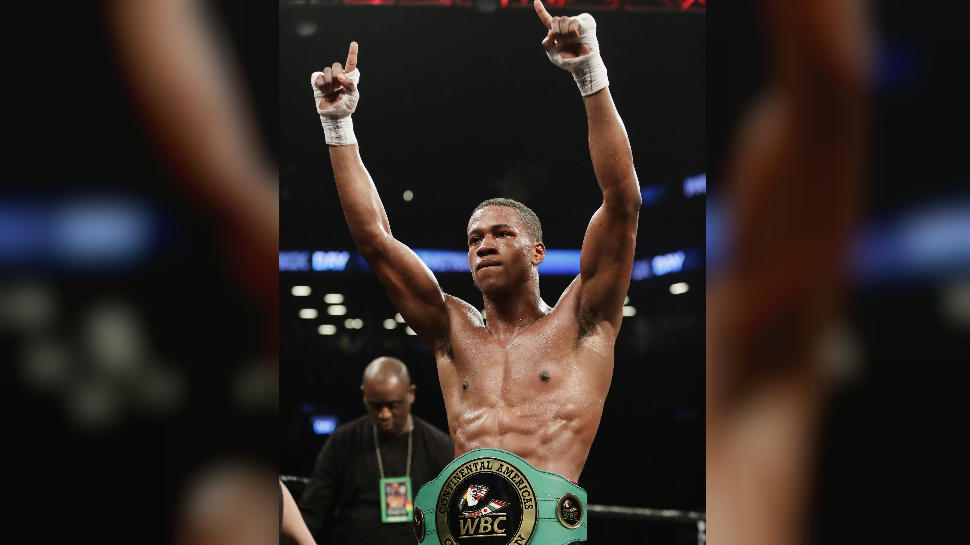
Ancient Games: Tyson Fury jabs at Wilder with rhetorical feints

By Norm Frauenheim-

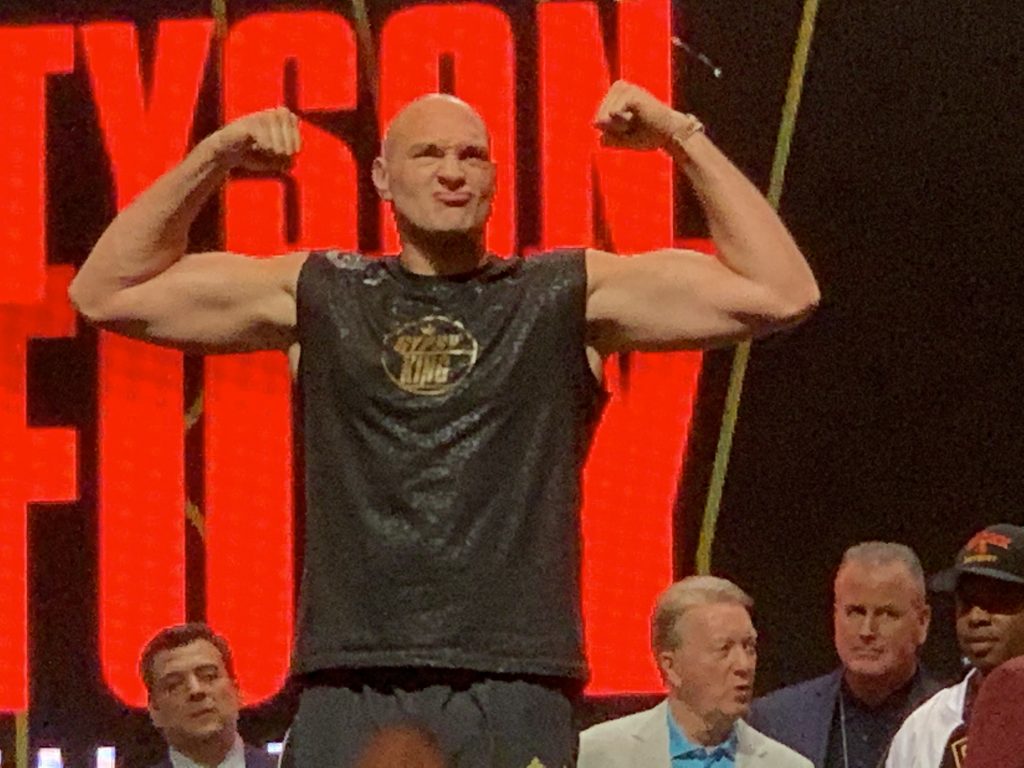
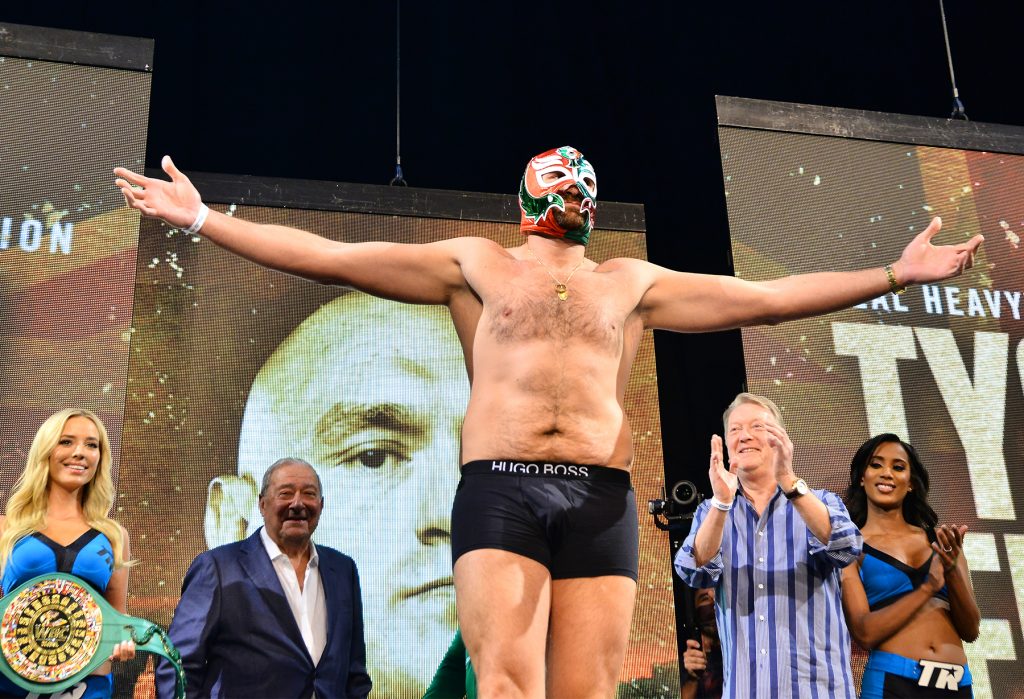
Tyson Fury calls himself a boxing historian, which means more than a basic understanding of what it is to be the lineal heavyweight champion. Mostly, it means he understands deception.

He practices the art and even drops occasional references to Sun Tzu, an ancient philosopher quoted by Generals, cornermen, West Point professors and lineal heavyweight champs. Deontay Wilder calls Fury a con man and maybe he is. But a fighter without a good con enters the ring without a fundamental weapon. No feint, no chance.

“All warfare is based on deception,’’ Tzu said in his classic, The Art of War.

“Appear weak when you are strong, and strong when you are weak,’’ he also wrote.

Those are quotes to remember as Fury’s rematch with Wilder approaches on Feb. 22 at Las Vegas’ MGM Grand in a Fox/ESPN pay-per-view bout.

Between sticking out his tongue and mocking Wilder with dancing eyes, Fury talks. And talks. It’s hard to know what’s real and what’s fake, what’s true and what’s feint. But that’s the idea in the buildup, a series of news conferences that set the stage for the head games that precede any opening bell.

Fury is trying to confuse Wilder, who knocked him down twice with the most feared right hand in at least a generation. Wilder says there’s no eluding his power. Few have. His record includes an astonishing 41 stoppages in 43 fights. But the record also includes the draw with Fury Dec. 1, 2018 in Los Angeles.  In the twelfth round, Fury got up from the punch that landed with the concussive force that has finished virtually everyone else. But Fury got up, a singular answer to Wilder’s singular power.

Why Fury and nobody else? It’s a question Fury has been asking Wilder, again and again, in the face-to-face ritual for the cameras. Ask often enough, and maybe Fury plants a seed of a doubt, a crack in Wilder’s faith in his right hand.  Wilder shouts BOMB SQUAD and laughs at Fury, saying the right will keep Fury on the canvas this time. Maybe, it will. Maybe, there’s no way to avoid it. But Fury will continue to remind Wider that his resurrection on Dec. 1 is a reason to wonder whether that right is as all-powerful as he thinks. It’s a psychological feint from Fury, straight out of that Sun Tzu playbook: Appear strong when you are weak.

There’s also this: Fury promises to turn the tables on Wilder. He says he will knock him out in two rounds. He says he’s developing his own right hand in training with Emanuel Steward’s namesake and mentor, SugarHill Steward, of the Kronk school of power. Fury talks about a right he’ll deliver with Tommy Hearns-like leverage.

Wilder laughs at that one, too. How could he not? Conventional wisdom seems to dictate that Fury relies on his superior boxing skill to stay away from the right throughout 12 rounds. If he had done that in the first fight, there would have been no controversy. He would have won a clear-cut decision.

But Fury has never been conventional. Perhaps, he’s trying to confuse Wilder with a wild prediction. But think again. Fury goes into the fight with scar tissue from a cut above the right eye that required 47 stitches after a bloody decision over Otto Wallin on Sept. 14.

In the first of two news conferences in Los Angeles, he told www.boxingjunkie.com that he wouldn’t risk a further cut in training.

“If it ruptures, it’ll happen in the fight,’’ he said.

Translation: He might have to win an early stoppage. Nobody can be certain that the scar tissue can withstand 12 rounds. Repeated blows, even glancing ones, could result in a fight-ending rupture. Wilder believes that the fight with Wallin would have been stopped if not for the prospect of the February rematch.

Wilder has also looked into Fury’s face and sees what everybody else does. The scar is evident, a target if there ever was one. Wilder has joked that he intends to see how good Fury’s plastic surgeon is. It’s a signal he’ll go after the eye, early and often.

Fury seems to be inviting him to do exactly that. It’s as if he is urging Wilder to step inside in a head-long assault to bloody up a healing wound. Then and there, Fury might deliver his own right-handed power. The lure is that scar, also straight out of the Sun Tzu playbook.

“Hold out baits to entice the enemy,’’ he wrote. “Feign disorder, and crush him.’

Timeless advice from an ancient philosopher who could have been a corner man in any era.


Dumb, Double-Down Dumb: Ruiz throws loyalty and trainer Manny Robles under the bus

By Norm Frauenheim-

Andy Ruiz Jr., who needs as many friends as he can find, fired the best one he had.

He fired Manny Robles.

The move isn’t exactly a surprise. It didn’t even surprise Robles. Let’s just say it was dumb, double-down dumb.

Ruiz, the first heavyweight champion of Mexican descent, has followed up his embarrassing rematch loss to Anthony Joshua with a public-relations debacle hard to explain and harder to excuse. A People’s Champ lost more than a title. He lost the people.

Those people will be harder to win back than titles. There are plenty of belts, even a few that might fit Ruiz’ expandable waistband. But loyalty, once squandered, is hard to regain. Ruiz grew up in a community where loyalty is a currency valued more than money. In Loyalty We Trust. You hear it from Canelo Alvarez in his criticism of Oscar De La Hoya.

Canelo delivered a stinging rip of De La Hoya in an interview with The Athletic before his Nov. 2 stoppage of Sergey Kovalev. He called him disloyal, yet he stays with De La Hoya, loyal to his commitment to the Golden Boy promoter. He stays with his original trainer and manager, Eddy and Chepo Reynoso. He has been with them and evolved with them from the beginning and throughout criticism of their work in the wake of a loss to Floyd Mayweather Jr. in September 2013.

Canelo is the reigning example of what to do.

Ruiz is the sad face of what not to do.

His fans would have forgiven him for his one-sided decision loss to Joshua in a rematch of Ruiz’ Rocky-like upset in June at New York’s Madison Square Garden. They would have even forgiven him for partying more than training for the rematch. Who wouldn’t? They would have partied like a lottery winner, too. They identified with him, each and every flabby ounce. But firing his trainer is unforgivable.

Robles is a convenient fall guy for what happened in Saudi Arabia. He got thrown under that proverbial bus, which happens to be something else fans understand. They’ve been there, tossed aside and into the expendable exhaust.

“It is what it is, I don’t know what to tell you,’’ Robles told ESPN, which broke the story.  “It’s not the first time it’s happened to me. I’m sure it’s not the first time it’s happened to other coaches.

“It happens time and time again. We always end up getting the short end of the stick. But it is what it is, you keep moving forward.”

Robles knows all about picking himself up. He did it after Oscar Valdez Jr. left him for Eddy Reynoso in August 2018. But the circumstances were different. Valdez moved on, still unbeaten and still a featherweight champion. He wasn’t coming off a loss and looking for a scapegoat.

Robles never expressed any anger at Valdez. Instead, he thanked Valdez. He called him friend and said he would always be a Valdez’ fan.

The split with Ruiz is different, both in proportion and style. Ruiz’ upset of Joshua and his subsequent loss were magnified, made bigger by untold multiples by a media captivated by an epic moment on a huge stage. In June, was the everyman, fat and fantastic all at once on an improbable night in New York. In Saudi Arabia, he was just a fat fool.

But Robles thanked him, too.

“Absolutely, look I’ve got to tell you I’m absolutely grateful and blessed to have been able to experience everything that I was able to experience in 2019,” Robles told ESPN. “I mean, we made history, and I have to be thankful for that. I have to be thankful to Andy and his dad for giving me the opportunity to be part of something special, to have made history — for him to become the first Mexican heavyweight champion of the world.’’

Thanks, Manny Robles, a good guy who got a raw deal.


Wilder-Fury 2: Lots to say about a fight that might hang on some surgical thread

By Norm Frauenheim-

The hyperbole is already underway. Insults, expletives and exaggerations were delivered, exchanged and countered this week in downtown Los Angeles, just across the street from where Deontay Wilder and Tyson Fury fought to a controversial draw more than 13 months ago at Staples Center.

More words, a lot more, are inevitable throughout the five-plus weeks before the rematch on Feb. 22 at Las Vegas’ MGM Grand. It’s show biz, entertaining and redundant all at once.

But it’s also boxing, unpredictable on any scale but never more so than at heavyweight. That unpredictability, of course, is a double-edged dynamic. Dangerous and dramatic. It can end faster than an accident, a violent collision created more by power than skill.

The Fury-Wilder sequel figures to get more interesting as the opening bell gets closer, mostly because both like the bully pulpit.

Wilder is over-the-top noisy. Bomb Squad, he screams at a window-rattling volume.

Fury is quick-witted. Jokes are as much a part of the Fury skillset as the jab.

Both are profane.

If you’re scoring the early rounds of press conferences, these two are exactly where they were after 12 rounds at Staples. It’s a draw, Wilder scoring with energy and Fury scoring with stinging counters. From this corner, the guess is that the exchange will continue without either getting much of a psychological edge before the first punch.

A fight of many words and promotional angles, however, might hang on a thread. Forty-seven of them, to be exact. That’s how many surgical threads Fury needed to sew up a wound above Fury’s right eye after Otto Wallin cut him during a Fury victory by decision on Sept. 14 at Las Vegas’ T-Mobile Arena.

The stitches are gone, removed just a few weeks after the bloody bout. But a question remains about whether the wound has healed enough to withstand a punch, or punches, delivered with Wilder’s kind of power.

The scar is evident.

For Wilder, it’s a target.

For Fury, it’s a risk.

Fury conceded the risk when asked about the scar this week at LA Live. He said he would be careful not to rupture it in sparring at his Las Vegas’ training camp.

“If I’m going to get cut, it’s going to be in the fight,’’ Fury said.

He was also asked how it felt when a punch landed on the scar. Fury made it sound as though he would not take any test blows on the scarred tissue.

“I can’t risk it,’’ he said.

Neither Fury nor Wilder wants a postponement. Nobody does, especially the promoters and networks, ESPN and Fox, which have joined together in rare cooperation for a pay-per-view telecast expected to do big business.

For Wilder, news of Fury’s caution must be welcome. Wilder is also happy that the Sept. 14 fight wasn’t stopped because of blood that poured down the right side of Fury’s face and into his eye. In just about any other fight, Wilder believes it would have been stopped. But the prospect of a rich rematch made this one different. The stakes were big enough, Wilder said, to let it go on.

It went on — and on – leaving Wilder with an opportunity to finish the bloody job. Maybe, that’s why he’s so confident. In a fight full of unpredictable factors, one thing is certain: Wilder won’t exercise Fury’s caution. He’ll go after that scar, targeting it early and often, in a simple tactic that might say it all.


Opening The Door: Josh Taylor moves to Top Rank and closer to 140-pound classic against Jose Ramirez

By Norm Frauenheim-

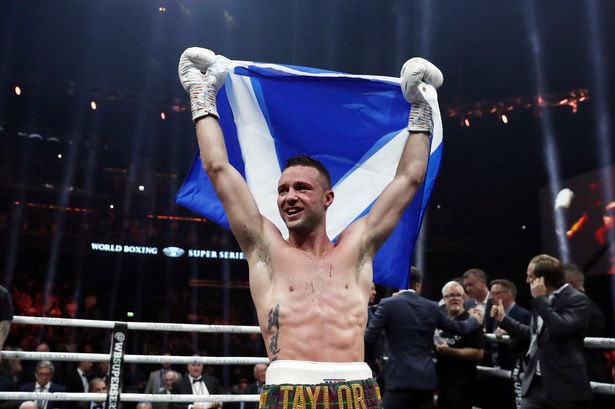
Top Rank’s roster got deeper and its reach grew farther with Thursday’s surprising announcement that it had signed Josh Taylor, the Scottish junior-welterweight whose imminent stardom was evident in his majority decision over Regis Prograis for two of the 140-pound belts in late October.

It was the second signing of worldwide significance for Top Rank, which signed bantamweight champion Naoya Inoue on the same day in November when he beat Nonito Donaire in a Fight of the Year performance.

From Japan to Scotland, the sun never sets on Top Rank’s promotional empire these days.

The top of the pound-for-pound debate provides a pretty good look at a promotional roster that is long on substance and name recognition. Among the top five, the order changes, but three are Top Rank fighters – Terence Crawford, Vasiliy Lomachenko and Inoue.  Canelo Alvarez of Golden Boy and Errol Spence Jr. of PBC complete the elite five.

There’s a chance, a good one, that more Top Rank fighters will begin to climb into pound-for-pound consideration on Top Rank’s ESPN schedule throughout 2020. There’s light-heavyweight Artur Beterbiev, junior-welterweight Jose Ramirez, lightweight Teofimo Lopez, featherweight Shakur Stevenson, junior-featherweight Emanuel Navarrete and now Taylor.

For Taylor, it all depends on how he does against Ramirez. Taylor’s new deal opened the door for a Taylor-Ramirez fight for all of the relevant pieces to the 140-pound puzzle. Look for that one later in year. First, Ramirez has a date against Viktor Postol on Feb. 2 in China.

On several levels, Taylor’s move is intriguing and controversial. It further stoked the fires of an already hot rivalry between Matchroom’s Eddie Hearn of the UK and Top Rank’s Bob Arum. Hearn in early 2020 is to Arum what Don King was to a younger Arum late in the last century. They just don’t like each other.

Arum is not shy about Hearn’s move into the United States. He threw verbal bombs at Hearn for Matchroom’s Julio Cesar Chavez Jr.-Danny Jacobs fight in Phoenix on Dec. 20 before fans threw beer bombs at Chavez when he decided not to continue after five rounds. Less than a month later, Arum moves into Hearn’s backyard and signs Taylor, who is Top Rank’s answer to Matchroom’s signing of Mikey Garcia last month.

The controversial side to Taylor’s move to Top Rank involves Barry McGuigan, who fired off a statement to UK media Thursday, saying Taylor was still under contract to Cyclone Promotions.

Taylor quickly countered with a statement of his own, saying he had ended the deal with Cyclone.

“I terminated my promotional agreement with Cyclone as a result of various breaches of contract including, in particular, breaches relating to a conflict of interest on the part of the promoter,” he said. “That allowed me to search for a new promoter, which I have found in Top Rank. I wanted to part ways amicably and without resorting to court proceedings [and] I thought and hoped the McGuigans would feel the same way given the litigation they are involved in with other fighters.’’

Cyclone Promotions has been in and out of court with Carl Frampton, a former featherweight champion from Belfast who is recovering from hand surgery in hopes of fighting junior-lightweight champion Jamel Herring in May.

The controversy figures to continue. But boxing wouldn’t be what it is without turmoil. On both sides of the ropes, the business is always fighting, yet always resilient enough to recreate itself with bouts worth watching. Taylor-Ramirez is one of them.


A few predictions and only one bleeping lock for 2020

By Norm Frauenheim-

Fights we want to see.
Fights we won’t see. It’s that time of the year. Old is supposed to give way to
the new. But boxing is a business that has seen it all, or almost all.  We still haven’t seen Terence
Crawford-versus-Errol Spence Jr. and I have a hunch we won’t see it in 2020
either. Hope springs eternal, but old habits make the world go ‘round.

Bob
Arum, who has seen it all, told The Athletic that boxing is poised for a terrific
year. All the fundamentals are there.

“It’s
going to be off the charts,’’ Arum said.

But
then there was the caveat. The if.

“If,’’
Arum said, “everybody doesn’t bleep it up.’’

Bleep
is a boxing habit. For whatever reason, it won’t stay in the spit bucket. It
always seems to be there just when you begin to think the battered game is
about to get up and off the canvas. Let’s face it, 2019 was forgettable.

Sure,
there were some moments. Canelo won at a fourth weight, winning a
light-heavyweight title in a 10th-round knockout of Sergey Kovalev.
But did anybody really think that wasn’t going to happen?

It’ll
be a night remembered more for the delay in the opening bell. In a misguided
attempt to boost the DAZN audience, the logistics around a good Las Vegas fight
featuring boxing’s biggest draw waited until a UFC card in New York ended. It
was embarrassing and a sure sign that boxing’s place in the market and the
public imagination had further eroded.

That
slide will continue this year without a serious attempt at breaking out of the
same old bleep. The Deontay Wilder-Tyson Fury rematch on Feb. 22 looks as if it
could be a pretty good beginning, a launching pad to what Arum hopes will be an
off-the-charts year. I’d settle for a year that puts 2019 in the rear view
mirror.

Here
are a few predictions, all with the caveat in mind and the tongue in cheek.

  • Wilder knocks out Fury. Fury, already a
    betting favorite, promises that Wilder won’t touch him. But the real question
    is this: Can Fury hurt Wilder? Fury is clever, yet he lacks power. Wilder lacks
    skill, but he is tough. He can withstand punishment. The longer the fight, the
    more likely it is that Wilder’s lethal right lands. This time, Fury doesn’t get
    up.
  • Canelo, who gave up his light-heavyweight
    belt, fights Gennadiy Golovkin for a third time. DAZN’s investment mandates the
    bout. Canelo agrees, knowing it will generate significant income. There’s no
    debate about the result this time. Canelo wins a dominant decision.
  • Mikey Garcia is again reminded of why there
    are weight classes. Garcia faces welterweight Jessie Vargas on Feb. 28, nearly
    a year after Spence easily beat him in a performance that said –round-to-round
    – that Garcia should have stayed at 135. Vargas keeps it close. But Garcia wins
    a narrow decision in a performance that suggests he’s vulnerable. Manny
    Pacquiao sees the fight—and the vulnerability. Pacquiao and Garcia agree to fight
    later in the year.
  • Gervonta Davis fights for the second time at 135
    pounds. Misses weight for a second time, too.
  • Jose Ramirez blows away Viktor Postol in China
    on Feb. 2 in a junior-welterweight bout. That sets up a unification title fight
    with Josh Taylor in either the UK or Las Vegas. Ramirez shows he can win
    anywhere, unifying the title and then looking to move up the scale to
    welterweight in a fight with Crawford.
  • Anthony Joshua talks, talks and talks about
    Wilder-Fury, yet struggles against Kubrat Pulev in a mandatory defense of one
    of his titles in a spring bout. A bout with Wilder gets delayed until early
    2021.
  • Emanuel Navarrete defends his
    junior-featherweight title two more times and moves up the scale to 126 pounds.
    But none of the featherweights will fight him. They’re afraid of him.
  • Naoya
    Inoue comes back from eye-socket fracture sustained in Fight of the Year
    victory over Nonito Donaire. Inoue re-asserts his pound-for-pound credentials
    and adds another bantamweight belt against either Nordine Oubaali
    of France or Filipino Johnriel Casimero sometime in
    mid-year in either Los Angeles or Las Vegas.
  • Fury fights MMA,
    wrestles, writes another book and gets a television series, The Furys, A Kardashian Look at a Boxing
    Family.
  • Floyd Mayweather Jr. says
    he’s coming back. Then says he’s not coming back. Throughout the next year,
    there will be as many rumors about Mayweather-Pacquiao 2 as there are pages in a
    calendar.
  • Teofimo Lopez finally
    gets a shot at Vasiliy Lomachenko late in the year. He pulls off a stunner. He
    fights to a controversial draw with Lomachenko, the pound-for-pound No.1 in
    most ratings. But a rematch dictated by the draw never happens. Lomachenko is
    injured in the fight. Then, he decides to move back down the scale to a more
    natural eight, 130 or 126
  • Bleep happens. That’s
    the only sure thing in this year or any other year.


Danny Jacobs fights on in the memory of Patrick Day

By Norm Frauenheim-

PHOENIX – Danny Jacobs is moving up. But not on.

Jacobs will wear his feelings for an absent friend Friday night when he enters the ring for his first fight at a heavier weight against Julio Cesar Chavez Jr. at Talking Stick Arena. You’ll see them on his robe. You’ll see them on his trunks.

All Day

Patrick Day

Those are the words, inscribed near the top and near  the bottom of a robe that Jacobs had specially made for his first bout since Day died four days after suffering brain trauma during a fight in Chicago on Oct. 12.

“The robe is symbolic of what he meant to me,” Jacobs said when he introduced the robe and trunks he plans to give to Day’s family after the DAZN-streamed bout.

In addition to All DayPatrick Day, the white robe with blue stitching includes a picture of the middleweight, a Rest in Paradise inscription and the dates, 1992-2019, of a life that ended too early.

For a while, his grief for Day was more than just a symbol. It hurt. It made him wonder.

“Boxing is not the same,’’ Jacobs said when the fight against Chavez Jr. was announced.

Grief lingers. Perhaps, it always will. But Jacobs is also prepared to re-enter the ring and confront the dangers that killed a friend. In part, the robe helps him remember a fighter and friend who did what he loved despite the risk.

“I know he would want me to not be sad, to be an inspiration in the ring,’’ Jacobs said. “That’s who he was. We sparred numerous times in the ring, spent countless hours together.

“He was a beautiful person, and I know he would want me to keep moving forward.”

Moving forward every day, All Day.

Notes: Jacobs (35-3, 29 KOs) and Chavez (51-3-1, 33 KOs) had agreed to a super-middleweight fight. However, the contract was re-negotiated Thursday morning when Chavez realized he couldn’t make the mandated weight. He was nearly five over the 168-limit at 272.7. Jacobs weighed 167.9.

In the re-done deal, they agreed to a catch-weight, a 173-pound fight. But it cost Chavez plenty. According to multiple sources at the morning weigh-in, Chavez agreed to pay Jacobs $1 million.

According to contracts filed with the Arizona Boxing & MMA Commission, Jacobs and Chavez had equal purses, $2 million each. With the redone deal, however, Jacobs will walk away with $3 million and Chavez Jr. $1 million.  


Crawford looking to Cement Pound for Pound Status on Saturday

By Norm Frauenheim-

The pound-for-pound debate is nothing more than an argument. It has no promoter. It offers no belt. Win it, and you won’t get a dime. Just another argument. Terence Crawford knows that, of course.

He’s been the argument, front and center, for a couple of years now. By now, Crawford (35-0, 26 KOs) has heard it all, or at least enough of it to understand that the only fight he can win is the one within the ropes. He’s been doing that and doing it masterfully throughout his career.

That figures to continue with efficiency as seamless as it is deadly Saturday (ESPN) against Lithuanian Egidijus Kavaliauskas (21-0-1, 17 KOs) at New York’s Madison Square Garden. Crawford will win. The argument will resume. Only the argument won’t be decisive. Bet on it.

The argument against Crawford at No. 1 is fair enough. It falls under a time-tested category: Beat The Best To Be The Best. In a balkanized business, however, that’s problematic. The game’s promotional entities are like rival kingdoms. They are divided by their ties to different networks and ego. Crawford is aligned with Top Rank. Shawn Porter, Keith Thurman, Errol Spence and Manny Pacquiao are with PBC. A virtual no-man’s land seems to separate the two.

A deal is not impossible, of course. Example: The Deontay Wilder-Tyson Fury rematch on Feb. 22. Wilder is tied to PBC. Fury signed with Top Rank after their dramatic draw a year ago. Business is possible. Top Rank’s Bob Arum is already thinking about Porter as a Crawford possibility in 2020. It’s still not clear what Spence’s plans are since he was thrown from his Ferrari on Oct. 10 in a scary crash in Dallas.

Spence had that accident and he’s not, I think, going to be around for a while,’’ Arum told Fight Hub TV this week.

So, Arum is considering Porter, who lost a narrow decision to Spence in late September at Los Angeles’ Staples Center.

“The guys who will tell you if a fight will sell are the bookmakers,’’ Arum said. “If they make a fight 50-50, 6-5, 7-5, then you know you got something.

“Now, I think Porter and Crawford will be in that margin, 8-5 or something like that. So that would be interesting. Danny Garcia with Terence Crawford is about 5-1, so that’s not as interesting to me as a Porter fight.”

Porter, tough and smart, would be interesting and might mute some of the Crawford critics. If Crawford beat Porter – and it says here he would – maybe the critics would stop saying that the Omaha welterweight is from the “wrong side of the street.”

It’s a lousy line.

Deontay Wilder is about to fight Tyson Fury and you never hear about any ‘sides of the street,’ ‘’ Crawford said this week. “It’s just something people say when it comes to Terence Crawford.

“You don’t hear ‘wrong side of the street’ with any other fighter but Terence Crawford. Why do all these other fights get made, but when it’s Terence Crawford, it’s about the ‘wrong side of the street.”

From this corner, Crawford is No. 1 on any side of the pound-for-pound street. His instincts, timing and overall ring IQ are unequalled in today’s generation.

Enough has already been said about his ability to switch from right-handed to southpaw. But it’s still eye-catching. Switch-hitting is often seen as liability. It’s a sign a fighter has no power in either hand. But Crawford has turned a perceived weakness into a strength. Either hand is potent. For Crawford, there’s no wrong side of the street. No wrong hand either.

Only time can beat him. He’s 32. In an interesting radio interview on Ariel Helwani’s MMA Show on ESPN, Crawford was asked about Sergey Kovalev. Kovalev, stopped by Canelo Alvarez in early November, is 36.

“Really, I don’t see myself fighting at 36,’’ Crawford said. “I want to retire from boxing before boxing retires me.’’

No argument there.Attachments area


Joshua-Ruiz 2: Joshua promises not to celebrate, just to win

By Norm Frauenheim-

Anthony Joshua promises not to celebrate. That’s just one of the many promises attached to Joshua.

First and foremost, there’s the promise to win Saturday, avenge the stunning defeat to Andy Ruiz Jr. in June. A failure to fulfill that one and you can toss the rest of Joshua’s advertised promise into the spit bucket.

A lot is at stake for him and promoter Eddie Hearn in a rematch aptly dubbed Clash On The Dunes. Lose it, and Joshua’s career won’t be worth much more than a handful of sand. Win it, and he can hit the re-set button on what had been boldly sold and sculpted as a sure thing.

We’ll see.

Doubts at all that’s been said and sold about Joshua will linger no matter what happens in a sequel (DAZN) in a ring near the Saudi oil fields. Joshua had been called a generational athlete. The media bought it. UK fans bought it. Yet, he was beaten in one of the biggest upsets of his generation. The heavyweight hype is gone, leaving him with only a burden of proof.

Has he shaken the psychological aftermath of his June 1 demise?

Will he have enough agility and speed in his feet and a reportedly leaner upper-body to elude and eventually counter Ruiz’ fast hands?

Answers are hard to find, in part because Ruiz’ upset – a seventh-round TKO – was so one-sided. Ruiz (33-1, 22 KOs), a late replacement for Jarrell Miller, was the stand-in. But Joshua (22-1, 21 KOs) fought like the stand-in, hitting the canvas four times.

Who was this guy?

Who is this guy?

A hint to the second question is forthcoming. For Joshua, the task Saturday is to restore some of the advertised identity he lost in New York. He’s right to say there’s no reason to celebrate.

“I was asked this – will it be a special moment?” Joshua said at a news conference Wednesday.  “I said, ‘no,’ because I know I belong there. So, it’s not special.

“I know I belong there. I know what I’m capable of doing. So, when I regain those belts, I’m probably just going keep cool and stay focused, because it’s not a time to celebrate.’’

He went on to say that he always fought as though he was destined to be great.

“When I came into boxing, I didn’t come to take part,’’ he said. “I came to take over.’’

His words are underlined by an unmistakable resolve. But words don’t win fights. Fast hands do. Ruiz can win the rematch with hands that move with a magician’s agility. What Ruiz is missing this time however, is the surprise factor. From this corner, that’s critical.

Ruiz has forever proven that he was underrated. In some ways, he still is. He’s 2-to-1 underdog despite his one-sided stoppage of Joshua in June. But the guess is that Joshua has no illusions about how good Ruiz is, or about how perilous his own future appears to be. Joshua knows about the fast hands. Knows about Ruiz’ resiliency, too.

It would be no surprise to anyone, including Joshua, if Ruiz is the first to hit the canvas. He was in June in a third-round knockdown. But Joshua let him off the hook. Maybe, Joshua got lazy. Or, perhaps, he was just unprepared. But expect Joshua to be vigilant and prepared for that moment when Ruiz does get back up all over again. For the Mexican-American, that will mark the time when the fight is just beginning.

For Joshua, however, it’s a chance to capitalize with superior strength and overall athleticism. That’s when Joshua can begin to punish Ruiz with his power, which is one element that wasn’t oversold. It’s real.

Prediction: Joshua might not be great heavyweight, but he’s good enough to win the rematch with a late-round TKO in a victory that will put him back in line for a day when he can really celebrate. 


Buenos Aires: Wilder-Ortiz didn’t matter in a city once known as a fight town

By Norm Frauenheim-

BUENOS AIRES – This is a long way from Vegas where history is always just a bulldozer away. Vegas sells itself for all that is supposed to stay there. That’s the cliche anyway.

It’s not true, of course. Nobody much remembers what they did in Vegas. They lose. They go home. They forget.

But there’s no forgetting in Argentina’s capitol city. It’s full of monuments and surrounded by decaying elegance. Streets are named Eva or Evita. Take a left, take a right and there’s a pretty good chance you’ll wind up in Ciudad Evita.

One of the city’s leading tourist stops is a graveyard, Cementerio de la Recoleta. You can say hello to Eva Peron, there, too. Or at least you can say your last respects.

Her tomb is there, next to others, all done in a dizzy array of architectural styles. It’s a well-manicured piece of monumental real estate, the best in the city. Once there, it’s easy to understand why you might want to stay forever.

Among the many decorated graves of Argentine greats, there’s a boxer, Luis Firpo. Forgive the longwinded tour to the point in this column. Then again, nothing happens very quickly in Argentina. Trust me, I’ve stood in several interminably long lines to show my passport at the airport and to exchange currency. (More on this later.)

Firpo’s place in the cemetery is a symbol of what Buenos Aires has been and some ways still is. It was a great fight town. Firpo, one the great heavyweights in the 1920s, is remembered for a wild bout with Jack Dempsey. He knocked Dempsey out of the ring. But Dempsey won, knocking him down seven times.

I mention Firpo, because I was here, passing through Buenos Aires on my way to Patagonia’s glaciers, lakes and mountains on the same day that Deontay Wilder stopped Luis Ortiz last Saturday in a rematch at the MGM Grand. If not for the long-planned trip, I would’ve been in Vegas.

So, I figured that Wilder-Ortiz had to be a must-see event in a city that reveres Firpo and in a country that still celebrates Marcos Maidana and Sergio Martinez. Another heavyweight, Oscar Bonavena, is an Argentina native. He twice took Joe Frazier to the scorecards, losing both. He lost a 15th-round TKO to Muhammad Ali.

Then, of course, there is Carlos Monzon. They still talk about the all-time middleweight in Buenos Aires. A local television station is planning a documentary series on the fighter, who died in an auto accident in 1995 on a furlough from prison. He was convicted of killing his girlfriend in 1988. Monzon still fascinates.

So, they had to know Wilder, right? No, no, nada. Then, they had to know Ortiz, right? After all, Ortiz is Cuban.  Che Guevara, a Cuban revolutionary, was born in Argentina. He went to school in Buenos Aires. Maybe there was a link, a reason to cheer for Ortiz? No, no, nada.

On the day of my arrival, I only heard some mild interest while standing in line at customs from three Americans, who were a lot more interested in partying in the endless parade of bars up-and-down so many of Buenos Aires’ streets.

So, I searched, first for a sports bar that might show the telecast. But no, no, nada. If there’s a television not showing soccer in Buenos Aires, it’s probably not on. It’s soccer, soccer and more soccer, all day long and all the time.

It was about then that I thought I would invest the $79.99 for the Fox pay-per-view telecast. At the moment I made that decision, the exchange rate, Argentine pesos-for-dollars, was at 56-to-1. Buster Douglas was given a better chance before his monumental upset of Mike Tyson in Tokyo.

Anyway, I’m not sure what the PPV price tag added up to in pesos. Besides, it doesn’t matter. The exchange rate changes, almost by the hour. As I write this, it’s 60-to-1. Whatever the PPV toll in Argentine currency was, it was in the thousands and I forgot to pack a wheelbarrow to carry them around.

Anyway, I headed back to my hotel room, thinking I’d follow the fight on twitter. First, I turned on the television, flipped my way through a few dozen soccer games and, suddenly, there it was Leo Santa Cruz beating Miguel Flores. Wilder-Ortiz was next. But the Fox telecast was carried by rival ESPN for its South American audience.

I didn’t have to shell out a dollar or a single peso. The fight, itself, played out the way I thought it would. Wilder’s right hand lands and it’s over, this time in the seventh round instead of the 10th. Different timing, same scenario.

Yet, what struck me more than anything were the background shots at the MGM Grand Garden Arena.  Empty seats were everywhere. A crowd of 10,000-plus for heavyweight title fight was announced. Turns out, Wilder isn’t must-see TV in his own country either.

Pick the reason. Maybe, it was a date too close to the Thanksgiving holiday. Or, maybe, neither Wilder nor Ortiz has much appeal to fans. Or maybe the house was over-priced. Pick one, pick all.

But for one night, at least, Vegas and Buenos Aires weren’t as different as I had thought.  


Wilder-Ortiz: Will Wilder’s right hand continue have the final say?

By Norm Frauenheim-

Deontay Wilder’s power, potentially a double-edged weapon, has yet to strike back at him. The theory, perhaps expectation, has long been that it will undo him and his heavyweight reign.

Yet, his right hand, a weapon that is singular in every way, has always been there, a force of nature almost reliable as an incoming tide.

Nobody has ever been able to avoid it, not even Tyson Fury. Fury got up from it in a controversial draw. But not even the clever Fury could elude it.

Now, the many-skilled Luis Ortiz has a second chance Saturday night at Las Vegas’ MGM Grand in a Fox pay-per-view bout.

Ortiz, who learned the trade in Cuba’s exacting amateur ranks, vows to not let it happen again. Ortiz envisions a rematch without a repeat. He foresees only a reversal.

Perhaps, he figures he can exert his own power and finish what was left undone on March 3, 2018 when he had Wilder in big trouble in the seventh round before losing a 10th-stoppage. Perhaps, he will re-assert a younger version of himself with some old tricks he learned in Cuba.

It’s hard not to like Ortiz. He has a compelling story that includes his flight in 2005 from Cuba in a desperate battle to help a daughter born with a skin condition.

He’s a quiet man in front of the media.

He’s a dangerous man in front of an opponent.

He also believes now — perhaps more so than ever – that his chances at a heavyweight title have never been better. It’s evident he’s done the work throughout training in Las Vegas, a long way from his home in Miami. If conditioning is any factor, there’s good reason for his confidence.

Physically, he has never looked better. For now, forget the jokes about his age. Forty or 50, he looked as if he were ready to fight a few weeks ago.

But appearances are misleading, if not an outright illusion. Ortiz’ good look doesn’t mean he has found any way to elude Wilder’s wild right hand. Who has?

In all of the attention on that one massive punch, however, Wilder’s durable chin is often overlooked. He can do more than throw a punch. He can take one, too.

That durability allows Wilder to take a fight into later rounds. It’s a factor that multiplies chances that his right hand will land, especially in moments when energy and focus begin to fade. He’s been durable enough to successfully defend his title nine times. Now, it’s time for No. 10 with no real reason to think anything has changed.

Prediction: In a repeat and rematch, Wilder wins another 10th-round stoppage.


Wilder talks differences, but promises more of the same in Ortiz rematch

By Norm Frauenheim-

Deontay Wilder likes to talk about differences, what he believes separates him from Luis Ortiz, Tyson Fury and just about everybody else.

He’s different, no doubt, from the kid, who won a bronze medal at the 2008 Beijing Olympics. Even then, however, there was a singular difference, one that separated him from every other boxer on the U.S. team. He was the only American in Beijing to medal.

Since then, he’s grown older and louder by multiple decibels. Still, there are questions about how much better he is within the ropes. His right hand is the one thing that continues to make a powerful difference. It is a singular strike, scoring 40 knockouts in 42 fights. He throws it with Tommy Hearns-like leverage.

Fury got up from it in their celebrated draw nearly a year ago. But that was more about Fury and his inexhaustible resilience than Wilder. Yet, there’s a sense – even a fear among promoters planning on a Fury-Wilder rematch in February – that Ortiz has the wherewithal to beat him on Nov. 23 (Fox pay-per-view) in their sequel at Las Vegas MGM Grand.

“He can screw this whole thing up,’’ said promoter Leonard Ellerbe, who didn’t exactly say screw, but you get the idea. “He can screw it up.’’

He can, mostly because of a versatile skill set that makes him more capable of adjusting than Wilder. Longtime boxing observers and bettors have always believed a good boxer beats a power puncher. But Wilder has knocked out that formula while knocking out just about everybody he has faced.

Giving a good boxer a second chance, however, might enhance chances of an Ortiz upset, which also would put all of those plans for Wider-Fury II on hold.

At a media workout a couple of weeks ago in Las Vegas, Ortiz looked as though he was in good enough shape to make lots of adjustments throughout 12 rounds. He blamed fatigue for the loss in their first fight, which ended in a Wilder stoppage in the 10th.

Ortiz’ confidence matched his well-conditioned appearance. He assured reporters that, yes, he was 40-years-old and not a day older.

Then in a conference call this week, he said the Wilder fight was not his last chance at a heavyweight title.

No, absolutely not,’’ Ortiz said. “I’m going to win the title, so no need for another opportunity. I will be the champion.’

Wilder scoffed at that, of course.

“This might be his last at 40 years old,’’ Wilder said. “Coming in, we all know when you fight Deontay Wilder, I take something from you. I take years from your life. ‘’

An over the-top confidence has become a noisy trademark for Wilder, who is poised for a 10th defense of a belt he won in his only decision over Bermane Stiverne on Jan. 17, 2015, also at the MGM Grand.

“I’m a totally different king,’’ Wilder said. “I’m a totally different beast. I’m the best in the world and I prove it each and every time I go in the ring. I’m not worried about going in and making any mistakes and stuff. And if I do make any mistake in the ring, rest assured, I will correct it as the fight goes on.

“I see this fight going one way, and that’s Deontay Wilder knocking out Luis Ortiz, point blank and period.

“You know it.

“He knows it.

“I know it.’’


Monster Star: Only a rapid ascent up the scale is a threat to Inoue

By Norm Frauenheim-

It was a defining fight for Naoya Inoue. It was also a reason for caution.

In watching Inoue’s courageous brilliance in a unanimous decision over Nonito Donaire early Thursday morning, it was hard not to be reminded that there is huge drama packed into boxing’s smallest weight classes.

From Ricardo Lopez to Michael Carbajal to Roman Gonzalez and now Inoue, there has always been this singular mastery of tactical skill, footwork, instinct and guts. All of those elements make them look bigger. But they’re not.

Inoue, a champion in all three flyweight classes, tested himself against an aging, yet bigger Donaire in a bantamweight bout. For 10-rounds, he fought with blood from a long, deep cut below his right eyebrow dripping into his eye and down his cheek like tears.

He said he suffered from double vision. Yet, he never lost sight of what he wanted. And wants.

“I’m not the greatest of all time, yet,’’ he said while standing in the middle of the ring in Saitama, Japan. “I think I have to go over the fight and get stronger. Next year and on, I’ll keeping fighting. I’ll be victorious.

“I want to be the strongest of all time.’’

Therein lurks the danger.

All-time, at least in this era, means moving up the scale. That’s what Canelo Alvarez was doing just a few days ago in his self-proclaimed pursuit of history in taking a fourth division title, light-heavyweight, in an 11th-round stoppage of Sergey Kovalev.

For the smallest fighters in the business, moving up in weight is an even bigger hazard. Their smaller frames mean every single pound is a little bit bigger. Against Donaire, there were moments when that small difference in pounds was evident in multiples. Donaire, who has fought at featherweight, rocked him. Cut him.

Inoue fought through all of it, yet it was impossible not to think of an old line, as true now as ever.

To wit:

There are weight classes for a reason.

Now, the 26-year-old Inoue has a Top Rank contract and is expected to continue his career in the United States. Already, there’ s speculation of a fight with Mexican junior-featherweight Emanuel Navarrete, an emerging star after successive victories over Isaac Dogboe.

At 5-foot-7, the Top Rank-promoted Navarrete, 24, is more than two inches taller than Inoue, who is 5-5 ½. Navarrete’s reach is listed at 72 inches, five more than Inoue’s 67. He is rapidly growing into a full-fledged featherweight.

Would he fight Inoue? Of course. Inoue is really a flyweight, whose emerging stardom on different sides of the world is expected to generate heavyweight money.

Inoue might find himself in the same situation as Vasiliy Lomachenko, also a Top Rank fighter. Both are ranked among the top four pound-for-pound contenders in virtually every rating.

In the chase for bigger money and wider fame, Lomachenko has also been moving up the scale. He’s a featherweight campaigning at lightweight. He’s winning, but not without injuries that began with stoppage of Jorge Linares in May 2018. Lomachenko underweight shoulder surgery after that one.

Now, there’s talk that he wants to go back to his natural weight, 126 pounds.

“He wants to go down, because he’s getting touched up,’’ Gervonta Davis said last week while talking about his own move up to lightweight against Yuriorkis Gamboa on Dec. 28 in Atlanta.

Perhaps, that’s for any little guy in any era a lesson for any era. Inoue, the reigning Lord Of The Flies, doesn’t have to go anywhere, at least not in terms of weight.


History Once, history twice: Does Kovalev have a chance during a good week for road teams?

By Norm Frauenheim-

LAS VEGAS — The road team does win sometimes. Proof of that happened Wednesday night when the Washington Nationals beat the Houston Astros, winning a World Series in which only the road team won.

In more than a century of baseball, that’s never happened. In the 116th-version of the modern Series, it finally did. It was hard — make that impossible — not to wonder whether Sergey Kovalev has any kind of chance against Canelo Alvarez Saturday night (DAZN) at the MGM Grand.

If anybody ever represented a road team, it’s Kovalev, who is the underdog in a bid to stop Canelo from making his own kind of history.

He’s moving up the scale, from middleweight to light-heavyweight, in his pursuit of a fourth division. A victory over Kovalev would put Canelo among the elite in Mexico storied boxing history.

It’s no coincidence that a chance at Mexican history would be played out in front of a Mexican crowd. It’s Canelo’s town. It’ll be his crowd, too. It’s hard to find an oddsmaker, or a fan, or a pundit who doesn’t think it’s his fight, too.

By now, there are familiar theories as to why.

Theory #1: Kovalev is vulnerable to body punches, Canelo’s best punch.

Theory #2: Canelo, 29, is younger and continue to improve. Age has begun to erode the 36-year-old Kovalev’s skill set.

Theory #3: Kovalev has never been the same since Andre Ward stopped him with succession of body punches in their 2017 rematch. Kovalev says the punches were low blows. Maybe, they were. But the damage to the Russian’s career looks to be irreversible.

Apply one theory or all three, and it looks as though  it’s not a matter of if, just when, Canelo adds a fourth division belt to the other three he already has in his personal history.

Throughout this week in Vegas, however, there were subtle signs that it might not be Canelo in blowout. There’s evident personal chemistry between Kovalev and his new trainer, Buddy McGirt, who has scaled back Kovalev’s training. There’s less sparring and more of an emphasis on restoring fundamental technique, especially the jab, Kovalev’s signature punch.

“I’ve told Sergey: ‘You’re an older person now which means you have to be a smarter person,’ ‘’ McGirt said.

Best guess is that smarts, the so-called ring IQ, will prove to be the decisive factor. Canelo appears to have an edge, but it’s to say how much smarter he will be throughout the scheduled 12 rounds. His intelligence, however, has been evident over the last few years. At each opening bell, he adds a new element to his skill set.

There more, a lot more, to what he can do, his trainer Eddy Reynoso says.

“People haven’t seen it all,’’ Reynoso said.

Much of his intelligence is rooted in reasonable caution. Don’t expect him to race at a bigger man with a bigger punch.

“It will be complicated, especially in the early rounds,’’ Canelo said.

It also might be complicated in the later rounds, especially if Kovalev hasn’t left the best of himself in the gym.

From this corner, Kovalev-Canelo figures to go to the scorecards. It’ll be close, but it looks as if Canelo is just a little bit smarter and has more in his ever-evolving skillset.

In this week, the real history belongs to the Nationals and Astros.

Pick: Canelo wins a close, yet unanimous decision. 


Michael Carbajal goes into the Arizona Sports Hall of Fame

By Norm Frauenheim-

They called him Little Hands of Stone. The impact on Arizona was huge and now forever indelible.

Michael Carbajal, the best fighter in the state’s history and one of the best in the history of lightest divisions in long and colorful sport, will be inducted to the Arizona Sports Hall of Fame Friday at the Scottsdale Plaza Resort.

Carbajal, a former junior-flyweight champion, grew up in downtown Phoenix. He earned to box in a makeshift ring in his backyard. Old hoses were used as ropes. There was dirt instead of canvas. Mostly, there’s was Carbajal’s passion and skill for craft sometimes call The Sweet Science. He still lives in the house that is front of that modest training ground.

It produced an Olympic silver medalist at the 1988 Seoul Games.

It produced the first little guy, a 108-pound fighter, to win a $1 million purse for fight in 1994. From the World Boxing Council to the International Boxing Federation, he won multiple titles in pro career that spanned a decade, 1989-1999, and included 53 fights – 49 victories, 33 by knockouts and four losses.

Along the way, there were chances to move on. At times, there were reasons to move on. There was adversity. But Carbajal always said no. He said he would never leave his community, his home town or home state.  As a fighter, he would always say: “Never quit.” Lots of fighters say that. But they never lived up to the promise. Carbajal lived up to it on both sides of the ropes.

He never quit in the ring or on his vow to stay at home.

Now 52 and already a longtime member of several Hals of Fame, including the international Hall in Canastota, N.Y., Carbajal finally joins the Hall that defines who he is:

An Arizonan.

Carbajal is joined in the 2019 class by late University of Arizona football coach Dick Tomey, former Suns forward Tom Chambers, Olympic swimming medalist Amy Van Dyken-Rouen, Diamondbacks President Derrick Hall and former Northern Arizona University trainer Michael Nesbitt.


Prograis’ rising star runs into a career-defining risk against Josh Taylor

By Norm Frauenheim-

Star power is behind him. Star potential is within him. What looks so close, however, could suddenly become a star-too-far for Regis Prograis, who is a cutting-edge face to boxing’s emerging generation.

Much, if not all, depends on how Prograis tests his evident charisma and versatile skill-set against Josh Taylor Saturday in a bout (DAZN) loaded with career-defining elements.

Prograis, whose management team incudes Mark Wahlberg and filmmaker Peter Berg, has a back story to tell and he knows how to tell it.

He fled New Orleans and the devastation left by Katrina in 2005. Where there weren’t wrecked homes, there was personal chaos. Prograis survived, then thrived. Out of the storm, came the fighter.

The story introduces him. He’s done the rest, scoring 20 stoppages in 24 victories and winning a junior-welterweight belt. No matter the rating, he’s ranked among the top three at 140-pounds alongside Taylor and Jose Ramirez.

Now, he’s on the road in London, where he puts it all at risk against Taylor (15-0 12KOs), a fighter from Scotland’s Edinburgh who is a slight betting underdog yet figures to be a huge crowd favorite at the O2 Arena in southeast London.

Both left-handers, Taylor has advantages in size. At 5-feet-9, Taylor is an inch taller than the 5-8 Prograis. He has a 2 ½-inch edge in reach. In terms of volume, he figures to have all of the decibels from the crowd cheering in his favor.

It’s hard to pick against him.

“I’m quite a bit better than him in every department,’’ Taylor said Thursday at the final news conference.

No argument there. If a pre-fight news conference is the equivalent of a political debate, however, score this one for Prograis.

“He should be able to land a solid, flush punch on me and when that happens, nothing will happen,’’ said Prograis, who is as comfortable in front of the cameras as he is telling stories. “When that happens, things will change. He will realize that I am an iron-man with an iron jaw.

“Once he lands his hardest shot and I look at him with a face of disdain, he will think: ‘Damn, I’m in trouble.’ “

Damn, he might be right.

Taylor argues that Prograis’ unbeaten record is padded with a lot of nobodies and wannbes. He has yet to encounter Taylor’s kind of power, the Scotsman says.

Yet, it’s also evident that Prograis has almost a quick-silver way of adjusting. His mastery of different looks can confuse even a prepared opponent. In so many words, Prograis says Taylor doesn’t know, can’t see, what’s coming.

Prediction: Prograis wins a decision, unanimous, yet close on every scorecard.


Patrick Day: He’s dead, but not gone for a conflicted game looking for answers

By Norm Frauenheim-

It’s a conflicted sport. That borders on redundancy. Boxing wouldn’t be what it is without conflict. Yet, Patrick Day’s death exposes all of the jagged fault lines that have always been there. Drama and death. What thrills, kills.

It’s all there, hard to explain and now hard to understand. The conflicting emotions from Day’s death four days after suffering traumatic brain injuries in a knockout loss to Charles Conwell figure to haunt the game for a while.

The business moves on. There’s a great fight Friday, Artur Beterbiev-Oleksandr Gvozdyk in Philadelphia. Promoters are calling the light-heavyweight bout (ESPN) a possible Fight of the Year. They’re right. It promises drama. It promises thrills.

Yet, it’s hard to look forward to the looming clash without some trepidation, some anxiety, even some anguish. Cheers will come with concern. Day’s death hangs over the game, leaving troubling questions and a search for answers that might not be there. Yet, the search must happen. Lou DiBella said it best in his statement in the wake of Day’s death Wednesday.

“It becomes very difficult to explain away or justify the dangers of boxing at a time like this,” DiBella said. “This is not a time where edicts or pronouncements are appropriate, or the answers are readily available. It is, however, a time for a call to action. While we don’t have the answers, we certainly know many of the questions, have the means to answer them, and have the opportunity to respond responsibly and accordingly and make boxing safer for all who participate.’’

DiBella, in effect, was making a heartfelt plea. Don’t let Day die in vain. Don’t let Maxim Dadashev and Hugo Santillan die in vain. Both died within days of each other in July. Don’t let Boris Stanchov die in vain. He died of an apparent heart attack during a Sept. 21 fight. 

There are some signs that regulators are trying to make the sport safer for those willing to take the risk, The California State Athletic Commission voted earlier this week to cancel a fight if a fighter is 15 percent above the contracted weight on the day of the bout. It’s believed that wild swings in weight, from the day before to the day of the bout, endanger fighters. Buddy McGirt, Dadashev’s trainer, told www.boxingjunkie.com that weigh-ins should be moved to the day of.

“They should have the weigh-ins the day of the fight,” McGirt said. “Listen, guys don’t fight at their normal weight because they know they have 24 hours to put weight on. Make the weigh-ins the day of the fight. Then you would know that you can’t really dry out and then have an IV and fight five, six hours later.

“I think you’d have less injuries. Say you’re trying to make 140 when you should realistically be at 147. You weigh, say, 143 and think, ‘I can get down to 140.’ But you have to dehydrate yourself, and that’s not good for your body or your brain. I’m not a doctor, but I’m not an idiot either.”

There are other possible safeguards. Day had been knocked down in the fourth and eighth rounds before the fatal blows landed in the 10th. On this scorecard, he was trailing 89-80. He couldn’t win on points. Given, the prior knockdowns, it was safe – emphasis on safe – to assume he wouldn’t be able to win by a late KO. Why not just stop it after the eighth?

It’s just one question, one of many. In Day’s name and for the sake of a conflicted game, answers are imperative.


Say a prayer for Errol Spence Jr.

By Norm Frauenheim-

It is as unforgiving a business as any. Boxing moves on, always moves on from tragedy. But the game stopped early Thursday morning in Dallas, on a road during the lonely hours after midnight and in the twisted wreckage of what was once a beautiful car.

A beautiful fighter survived just a few weeks after he looked immortal.

Pray for Errol Spence Jr.

He had emerged as a face of a resilient game and it looks as if he might need every bit of that trademark resiliency now. He is coming off the biggest fight of his career into what looks to be the biggest fight of his life. We cheered for him against Shawn Porter throughout 12 rounds of welterweight drama on Sept. 28.

We pray for him now in a collective cry of tweets and thoughts. Porter prays for him. Terence Crawford prays for him.

The news is hopeful. Premier Boxing Champions released a statement, an updated report on his condition fewer than 24 hours after he was rushed to Methodist Dallas Medical Center.

“Spence is awake and responding and his condition is listed as stable,” the PBC statement said. “He did not sustain any broken bones or fractures but has some facial lacerations. He is expected to make a full recovery.

“He is currently resting with his family by his side. They want to thank everyone for their prayers and well wishes and are extremely grateful to the Dallas first responders who rushed to the scene to attend to Errol after the accident and the doctors who are taking care of him at the hospital.”

Exactly what happened is still being pieced together. According to a Dallas police report, Spence, of nearby Desoto, Tex., was driving his white Ferrari at a high speed when the vehicle hit the median and flipped wildly at about 3 a.m, Central Standard Time.

Spence, who reportedly was not wearing a seat belt, was thrown from the car. He was not a boxer then. He was everyman, caught in the cross hairs of time and place, simple physics and scary consequences.

It could’ve been you. Could’ve been me. His fight, our fight, is just starting. Pray that he wins this one.


GGG is back for another duel in a bid to reassert his middleweight dominance

By Norm Frauenheim-

The whispers are hard to ignore. Gennadiy Golovkin has surely heard them. He’s changed, they say. A different guy, they say.

But the only thing for certain is what we know from his birth certificate. He’s older, a 37-year -old fighter who intends to silence those whispers and reaffirm what he has always believed.

Pre-Canelo and Post-Canelo, Golovkin has always been a middleweight. It’s the division that defines him. It’s also a division he dominated.

It’s that domination, perhaps, that he intends to re-assert in a tricky bid to reclaim a major 160-pound belt against Sergiy Derevyanchenko Saturday at New York’s Madison Square Garden in a DAZN-streamed bout.

After all of the mind-numbing controversy swirling about Canelo Alvarez’ move up to light-heavyweight in decision to bypass a third fight with Golovkin, GGG says nothing has changed. He says he is back in the gym with the same work ethic and same vigilance.

 “You can’t underestimate your opponent,’’ he said during a conference call. “It’s kind of like a duel. If you underestimate it, it could be your last one.’’

GGG (39-1-1, 35 KOs) is sick of talking about Canelo, who said he was finished with GGG on the day his step-up to 175-pounds against Sergey Kovalev on Nov. 2 was announced. Ask the inevitable and you can almost hear a weary sigh. Hard to blame him. But there’s no escaping the questions

This time, he was asked if he feared that there might be a void in his career if he doesn’t get a third shot at Canelo.

“My biggest opponent is not a particular person,’’ said GGG, who is 0-1-1 against Canelo. “My career is about what I do.

“It just looks like he (Canelo) couldn’t or didn’t want to fight me. Sergey Kovalev was his only option. How can I be disappointed, looking at those people?’’

“I feel great, just like I always have. I always feel like I am a champion. For me, every fight is the same.’’

For now, he can look at what, who is in front of him. Derevyanchenko (13-1, 10 KOs) is a Ukrainian who put himself in the middleweight mix last October with a split-decision loss to Danny Jacobs, also at Madison Square Garden.

He went on to score a unanimous decision over Jack Culcay in April, a few weeks before Canelo scored a one-sided decision over Jacobs on the Cinco de Mayo weekend.

Despite a record that includes only 14 fights (13-1, 10 KOs), Derevyanchenko has the look of a fighter who is just beginning to figure out how good he really is. He’s 33 and a late bloomer.

His promoter, Lou DiBella, thinks the time and place are perfect for Derevyanchenko to spring a major upset.

DiBella believes the whispers. He says GGG is a step beyond his prime.

“At this point in his career, he’s not getting younger, he’s not getting faster, he’s not getting better,’’ DiBella said. “Sergiy Derevyanchenko is an incredible risk to GGG.” 

Prediction: GGG wins a unanimous decision against a tactically-skilled fighter aptly named “The Technician.’’


Spence wins split decision over Porter in a unanimous crowd-pleaser

By Norm Frauenheim-

LOS ANGELES — Only the judges disagreed.

There was no debate about the drama that began early and lasted throughout 12 rounds Saturday night in a split decision won by Earl Spence Jr. over Shawn Porter for two pieces of the welterweight title in front of roaring crowd of 16,709 at Staples Center.

Judges Rey Denescon of California and Steve Weisfeld of New Jersey scored it 116-111 for Spence. Larry Hazard, Jr., also of New Jersey saw it different. Hazard scored 115-112 for Porter.

The crowd? It was unanimous. There was no dissent about what a terrific fight was. There was a little bit of everything. Porter made it rough and repeatedly forced Spence to show he had some grit to go along with his reach, power and speed. Spence had poise, a jab and the wherewithal to control the center of the ring at exactly the moments he had to. In the end, Spence also had one quick counter, a left, perfectly timed and placed, to score a knockdown of Porter. It was the key to the fight.

It knocked Porter off balance in the closing moments of the eleventh round. Porter grazed the canvas with a glove. But the touch was like a torch to his chances at an upset.

“I think that knockdown was the difference,” Porter (30-3-1, 17 KOs) said “I couldn’t come back to the corner with my head down after that.”

No, he didn’t. He pursued throughout the 12th round, the bout’s final three minutes. He rocked Spence with a couple of lefts. But there was no way to knock victory out of the bigger man’s powerful grasp.

“Porter was throwing a lot,” said Spence, still unbeaten at 26-0 with 21 KOs. “I wanted to show I was the bigger and stronger welterweight.”

Bigger and stronger, however, doesn’t necessarily mean the best. That’s still up for debate. Spence hopes to further cement his claim at being No. 1 at 147 pounds against Manny Pacquiao. But that still leaves the unresolved question about when or if he’ll ever face the Top Rank-promoted Terence Crawford, who celebrated a birthday Saturday. He’s 32. There are stiil no signs that a Crawford-Spence fight will happen before his next birthday.

“if I can’t get Pacquiao and nothing happens with Terence, maybe Danny Garcia,” said Spence, who collected a $2 million guarantee and could wind with more depending on the pay-pe-view numbers for the Fox telecast..

A sign of what might happen next, perhaps, was there among those who rushed into the ring to congratulate Spence. Danny Garcia was there, perhaps the most prominent face in Spence’s future.

“I’ve told my team, you line them up, I’ll knock them down,” Spence said.

Meanwhile, there was little talk of a rematch, despite a split card scorecards that seemed to dictate a sequel. Porter had no argument with the scoring.

“For me to say it was robbery, no, that ain’t coming form me,” Porter said. “Did you all like the fight?”

Oh, yeah.

In the co-main event, 22-year-old super-middleweight David Benavidez (22-0, 19 KOs) became boxing’s youngest two-time champion, scoring a ninth-roundd soppage of bloodied Anthony Dirrell (33-2-1, 24 KOs). Benvidez claimed the 168-pound title that was stripped from him when he tested positive for cocaine last year

“There are so many emotions coming at me at once, said Benavidez, whose $1 million purse is the biggest collected by an Arizona fighter since Hall of Famer Michael Carbajal, also of Phoenix, cashed a $1 million paycheck for his rematch loss to Humberto “Chiquita” Gonzalez in 1994. “We put so much hard work into this training camp. We left home and were away from everything. But I had the dream to become the youngest two-time super middleweight world champion and I made my dreams come true.

“Everything just fell in place perfectly. From the suspension to all the big fights I’ve been in. All of that helped me out in this fight. I did not make a mistake or open myself up more than I needed to. I worked behind my jab and got the stoppage. Things are going to get better and get tougher and I’m ready for the challenge.”


Porter will need more than a microphone to beat a bigger Spence

By Norm Frauenheim-

Shawn Porter is good with a microphone. He uses it to analyze. He uses it to comment. Predict and argue, too. He also uses it to deliver a few opening salvos in the opening rounds of the fight before the fight. Psychology always precedes the punches, and that’s where Porter appears to have gained a slight edge over the favored Errol Spence in their welterweight unification fight Saturday night at Los Angeles’ Center.

Porter, a Fox studio analyst when he isn’t in the gym, has spun all the rhetorical angles at Spence, who delivers more ounches from angles than one liners.

It’s been entertaining. It’s also been something of a diversion. It’s hard to tell if any of the talk has had any impact on Spence. He’s tough to read. Tougher to beat. Just ask Mikey Garcia, who came up in weight and appeared to be winning all of the news conference and media appearances. At opening bell in a ring at about the 50 yard line on the Dallas Cowboys home field at AT&T Stadium in Arlington, Tex., last March, however, Garcia never had a chance in losing a one-sided decision. Porter, of course, has an explanation for that. He has said repeatedly that Garcia was a lightweight making a futile jump to welterweight.

“Truth is,” Porter said in repeated play on Spence’s nickname, “is that I’m a real 147-pounder.”

But, truth is, Porter rarely mentions a common foe who sums up the difference between the two: Kell Brook. Porter (30-2-1, 17 KOs) lost to Brook. Spence (25-0, 21 KOs) beat him.

Spence knocked him out in in 2017, scoring an 11th-round stoppage in an eye-opening upset in Sheffield, Brook’s hometown in the UK. Brook was coming off a loss, a fifth-round stoppage, to Gennadiy Golovkin at middleweight at a time when GGG was in his prime. The two-division jump up the scale was too much for Brook. He returned to his natural weight, which he had dominated. But he had no answer for Spence.

About three years earlier in 2014, Porter, a heavy favorite, lost a majority decision to Brook in Carson, Calif. The victory over Porter did for Brook what the victory over Brook did for Spence. Each went from interesting to the most feared welterweights of their day. In terms measured by physical dimensions, Porter will see and then encounter a fighter built a lot like Brook Saturday on Fox PPV. At 5- foot 9, Brook was a big welterweight. At 5-10, Spence is even bigger. Spence also has three more inches in his reach than Brook, 72 to 69.

Truth is, all of those numbers add up to tougher task for Porter, who is listed at 5-7 with a 69 1/2-inch reach. Porter’s argument is that Spence has never had to face the kind of adversity Spence has. Porter has had to fight his way out of trouble. Spence never has. But there’s a reason for that, one as simple of that tale on the tape and a common foe, Brook.

Prediction: Spence wins a unanimous decision.


Canelo moves up the scale and away from GGG, but DAZN money has the final say-so

By Norm Frauenheim-

Canelo Alvarez says and does whatever he wants these days. Money buys that kind of power and Canelo has plenty.

It’s hard to argue with his $365-million contract with DAZN. But money exerts its own price. Makes its own demands.

At some point that money is going to force Canelo to take the fight he says he doesn’t want.

In formally announcing a Nov. 2 bout with Sergey Kovalev at Las Vegas MGM Grand in a risky jump up the scale from middleweight to light-heavy, Canelo said he was finished with Gennadiy Golovkin.

Canelo, who still holds three middleweight belts, said he would go back to 160 pounds no matter what happens against Kovalev in his bid to win a fourth title at a fourth weight.

But, he told reporters at a news conference Wednesday at Los Angles’ Union Station, it won’t be against GGG, who is 0-1-1 against him. Both fights were close, close enough to beg for a third.

But, no, Canelo said.

“We are finished ,’’ he said.

I’d bet $465 million that they’re not. That’s the total DAZN has invested in exactly the bout he now says won’t happen. There is his deal, the lion’s share. There is another $100 million in a contract that GGG signed in the wake of Canelo’s landmark deal.

GGG advisor Tom Loeffler has said GGG signed with DAZN because he saw it as the fastest way to a third fight. But only social media are immediate these days.

From Tyson Fury-Deontay Wilder to GGG-Canelo, there are no quick turnarounds. There’s just the waiting.

But DAZN has time and reason to wait on the one rematch that might allow it the streaming network to cash in on its investment. Demetrius Andrade is an interesting fight, but it doesn’t have the upside that third bout with GGG has. Take it the bank.

Canelo promoter Oscar De La Hoya continues to say the third bout will happen in 2020.

“Oscar says many things that make no sense,’’ Canelo said in a counter that raises some question about where the Canelo-Golden Boy Promotions relationship is headed.

But De La Hoya is right about his one. It makes sense. Lots of cents.


Staying Busy: Navarrete punches renewed meaning into an old concept

By Norm Frauenheim

LAS VEGAS – Emanuel Navarrete

Is restoring an old-school definition to a term that has long been part of the boxing glossary.

Busy is today’s way of describing a fighter’s work rate. It’s a simple description for a relentless attack driven by fast feet, faster hands and inexhaustible energy.

Navarrete, a super-bantamweight from Mexico City, is all of those things. Just ask Isaac Dogboe, who got knocked off the fast track to stardom by Navarrete’s tireless assault, first by decision last December and again by an overwhelming stoppage in May.

Within the ropes, Dogboe could do nothing to slow down Navarrete. It’s outside those ropes, however, that Navarrete is making promoters remember what busy also used to mean.

Navarrete is back in the ring Saturday night on the Tyson Fury-Otto Wallin card on ESPN+ for a second title defense within one month. Navarrete, who scored a third-round stoppage of Phoenix fighter Francisco De Vaca on August 17, said yes to Saturday’s bout against Filipino Juan Miguel Elorde without hesitation.

“Your answer came quicker than your punch,’’ Top Rank promoter Bob Arum said to Navarrete Thursday during a news conference for a T-Mobile Arena card that is part of Mexico’s annual celebration of Independence on Sept. 16.

It was also an answer that must have been a trip back, way back, in time for Arum. Arum, 87, was there, in the last century when fighters would answer an opening bell every other month. Compare that to today when twice-a-year is thought to be busy enough.

But the 24-year-old Navarrete (28-1, 24 KOs) is seemingly ready at all times.  Ring rust has no chance against him.

“I just want to tell him I’ll fight in December too,’’ Navarrete said as an interpreter translated his Spanish into English for Arum.

Arum smiled at words that define an ever-ready fighter. Some fight for money, and if it’s big enough they’ll fight as seldom as possible. Why risk a big paycheck?

But at the heart of the craft, there’s passion that keeps a fighter restless and always seeking for a chance to punch in, punch out.   

“If you’re a fighter, you want to fight as much as possible,’’ Arum said. “If he could, this kid could would fight eight times a year.’’

During this week, at least, Navarrete isn’t looking past Saturday against the grandson of a Filipino legend. There’s more than one. Before Manny Pacquiao, there was Flash Elorde, the world’s junior lightweight champion from 1960 through 1967.

Juan Miguel Elorde (28-1, 15 KOs) was born about a year after his famous grandfather died in 1985. The grandson’s first chance at world title is a steep one, especially on a card put together in honor of Mexico’s Independence Day.

“It is my lifetime dream to become a world champion, and I think it is becoming a reality,’’ Elorde said.

Elorde best chance might rest on the tale of the tape. He is an inch taller than Navarrete, who at 5 feet 7 is usually bigger than most in the 122-pound division. But Elorde is also about eight years older than Navarrete, a young man who is as ambitious as he energetic.

Navarrete is seeking to unify the 122-pound belt, before moving up the scale. He foresees himself at junior-welterweight one day. For now, however, another super-bantam belt is on the agenda. Enter Arum, who says unbeaten Rey Vargas, a 122-pound belt holder from Mexico City will be at ringside Saturday.

“Thank you for bringing him,’’ Navarrete said to Arum. “He can see what he will face.’’Probably, sooner than later. 


Joshua’s Journey: Search for a road win takes him to Saudi Arabia

By Norm Frauenheim-

Anthony Joshua is unbeaten at home in the UK. He’s winless on the road.

It’s hard to know whether his record serves as much of a roadmap, but it might be a signpost of why he’s headed to Saudi Arabia, a site as unlikely as it is controversial for a heavyweight title fight.

Joshua, 22-0 in the UK and 0-1 on the road, has yet to prove he can fight away from the UK’s adoring fans and media. He even won his Olympic gold medal in 2012 at the London Games.

He could no wrong until he answered his first opening bell on foreign shores where Andy Ruiz Jr.’s fast hands left him looking confused and his fans betrayed throughout a stoppage loss at New York’s Madison Square Garden.

The futile journey to New York June 1 was supposed to represent his first step toward would-wide celebrity. It was designed to raise American awareness of a UK heavyweight who had been sold and packaged as a transformational athlete. All it did, however, was raise a red flag.

It’s not exactly clear what happened in New York to Joshua, who was bewildered by Ruiz combinations throughout six-and half rounds. The bewildering defeat was followed by strange behavior. Joshua celebrated with Ruiz. He smiled like a naive kid who didn’t look as if he exactly knew where he was or why he was there.

“There’s pressure, being an ambassador for boxing, to be bigger than boxing,” Joshua said Thursday in a return to New York in the second stop of a three-city tour for the Saudi Arabian rematch with Ruiz. “That’s my ambition and I have to deal with it.”

Boxing needs another ambassador like it needs a new Don King. A genuine heavyweight champ isn’t created by diplomacy, although some of today’s matchmaking might suggest otherwise. It’s just about skill and will, a couple of ingredients that were missing in Joshua’s last performance.

Whether a sense-of-self shattered in New York can be repaired a half-year later in Saudi Arabia is anybody’s guess. But the journey might be worth the risk. Might be the only option, too.

A lot has been made of the site fee. Saudi Royals reportedly are paying $40 million to Joshua promoter Eddie Hearn for the right to a fight that has been called part of a PR campaign to clean up the country’s image with “sportswashing.” Forty million buys a lot of bone saws.

The trip to Saudi, however, also is an opportunity for Hearn to control much of what can never be controlled in New York. There’s still no clear news on how the fight will be regulated. Or by whom. It’s not even clear how many seats will be available in an arena still under construction.

It’s hard to imagine Joshua’s UK fans will want to travel to a country where they can’t buy a beer. They might just prefer to watch the bout on DAZN at home where they won’t need a ticket or a visa. Then, at least, a stocked refrigerator will be nearby in the event Joshua’s journey fails to produce a victory that says this heavyweight can still travel onto much bigger things.  


Dormant Debate: Lomachenko promises to re-awaken pound-for-pound talk

By Norm Frauenheim

It’s a debate looking for a few good arguments. For the last few months, there haven’t been any. The pound-for-pound title is vacant these days.

Vasiliy Lomachenko hopes to change all of that Saturday in an attempt to knock the dormant out of the old debate in an interesting lightweight title fight against Luke Campbell in London.

Lomachenko has as good a chance as any to re-invigorate talk about who has a leading claim on No. 1. Among a few good men, Lomachenko might be the best.

“I think I’m the best, pound-for-pound,’’ Lomachenko (13-1, 10 KOs) told the UK’s Daily Mail this week during the usual hype before opening bell at O2 Arena (ESPN+, 5 p.m. ET/2 p.m. PT). “Terence Crawford thinks he is. Canelo Alvarez thinks he is.

“For me, Crawford is second, Canelo is third.’’

No argument with Lomachenko’s claim or contenders. From this corner, Japanese bantamweight Naoya Inoue and Dallas welterweight Errol Spence Jr. also belong.

Both are unbeaten and each has a chance later this year to further their own argument – Spence against Shawn Porter on Sept. 28 at Los Angeles’ Staples Center and Inoue against Nonito Donaire on Nov. 7 at Saitama, Japan.

Of the five, Inoue might be in the best position to deliver the most powerful argument. He’ll be in his home country against a clever, yet fading Donaire, a Filipino-American whose name recognition in the United States will further awaken American interest in the intriguing Inoue.

For now, however, the first shot in re-awakening the pound-for-pound debate rests in Lomachenko’s creative hands, which continue to introduce new angles to a brutal geometry sometimes called The Sweet Science.

The guess here is that the resourceful Lomachenko will prevail, but not with the convincing performance he’ll need to win the pound-for-pound debate in 2019.

Above all, Campbell (20-2, 16 KOs) has some skill of his own. He’ll also be in his home country and the city where he won Olympic gold in the 2012 London Games. Above all, he is bigger than Lomachenko, who can be seen looking up at Campbell in photos of the ritual face-off this week.

At 5 feet 7, Lomachenko is two inches shorter than Campbell, who is listed at 5-9. Another key dimension: Campbell has a five-and-a-half advantage in reach over Lomachenko.

Lomachenko is a featherweight fighting two classes above his natural weight. There’s risk in that. It was evident in Lomachenko’s 10th-stoppage of lightweight Jorge Linares. Linares knocked him down in the sixth.

More of the same would not be a surprise in a bout Lomachenko figures to win, yet not without at least one moment that leaves questions about whether he is pound-for-pound’s undisputed No. 1.

It looks as if Lomachenko’s best chance at a performance that sweeps away the doubt is at 126 pounds. But against whom? Mikey Garcia was taken off the pound-for-pound board in his equally-risky jump in weight to welter in a one-sided loss to Spence at AT&T Stadium in March.

Spence’s victory over Garcia marks a beginning of the troubling silence in the pound-for-pound debate, a popular pastime, yet also a significant marker in determining the state of the game.

A vacant pound-for-pound crown is just another empty seat, and there have been too many of those lately. The good news is that no vacant seats are expected at the O2 Saturday. It’s a beginning, perhaps, at filling that vacancy at the top the game. 


Remembering John McCain: Boxing Senator is gone, but Ali Act is still there and in need of an update

By Norm Frauenheim-

Sunday represents a sad anniversary. John McCain, statesman and soldier, died a year ago on August 25 on his Arizona ranch, about 100 miles north of an NHL arena in nearby Phoenix where ESPN was about to televise a fight card.

An opening bell was followed by 10 bells, a mournful memorial for a former amateur fighter who was called “the boxing Senator” by Bob Arum. McCain’s death wasn’t a surprise. His battle with cancer was public. And painful.

Yet, the timing was almost haunting. He died, 81, at about the same time young fighters, kids, on the undercard began to make that long walk from the dressing room to the ring. McCain identified with them. He had been one of them at the Naval Academy.

Later in life, he fought for them, a powerful advocate for young men from tough streets who knew that only their fists would fight for them.

McCain wrote, lobbied and pushed through the Muhammad Ali Act, which was introduced in 1999 and enacted in 2000.

McCain is gone, but the Ali Act is still there. It’s a small part of McCain’s many-sided legacy, seemingly made more powerful 12 months after his death. McCain stands in stark contrast with a president who did not like him and has always been quick to rip him. In life. In death.

The unfathomable depth of Donald Trump’s anger – call it hate – for McCain often makes me wonder why he hasn’t tried to rescind the Ali Act, which includes an attempt to ensure some financial transparency.

After all, Trump pardoned Jack Johnson without ever mentioning McCain or his tireless leadership in pushing for one. Trump, too, learned a trick or two in the boxing business with Don King. King lied about crowds long before Trump ever did. Yet even with Mike Tyson on the marquee, Trump drove his Atlantic City casino into bankruptcy.

Maybe, Trump is just too busy, what with Greenland and all. The sad truth, however, is that the Ali Act just doesn’t matter much. It has never been enforced the way McCain hoped it would.

Early on, it did force promoters to open up their books to fighters, who have a right to know what the gross income is expected to be. They are only negotiating for their fair share of that projected pie. That financial transparency is one reason boxers still make more money than mixed-martial artists get from the UFC, which is not subject to the Ali Act

But everything else about the legislation – conflicts of interest, enhanced safety measures – have been mostly ignored. Like his pursuit of the Johnson pardon, McCain had hoped to further empower the Ali Act with patience and time. But there was never enough interest in it from McCain’s Congressional colleagues. It’s still a law, but it’s little bit like the speed limit. Nobody pays attention to it anymore.

Two deaths in the wake of McCain’s death, however, are reason to re-energize his pursuit of some rhyme, regulation and reason instead of the usual chaos. Two of the kids with whom McCain identified are gone, dead from head trauma suffered in bouts.

First, Russian junior-welterweight Maxim Dadashev died July 23, about four days after fighting in Maryland. Two days later, Argentine junior-welterweight Hugo Santillan died from injuries sustained in a fight in Buenos Aires.

A shocked game moved on, as it always does. The attention quickly turned to what Canelo Alvarez isn’t doing and what Gennadiy Golovkin will do. There’s always another opening bell, which is another way of saying it’s business as usual.

If McCain were still alive, however, it’s fair to say he’d be calling for a thorough investigation in Maryland and an update of the Ali Act. But the Arizona Senator’s voice is long gone. What he left, however, was a blueprint, still a pathway to ensure that death never becomes usual in the boxing business.


Canelo-Golden Boy: Fight with Sergey Kovalev would mean more to fans than an apology

By Norm Frauenheim-

Trouble between Canelo Alvarez and Golden Boy Promotions isn’t exactly a surprise. Seeds and signs of discontent have been circulating for at least a year.

It’s not clear how it will end. For now, Golden Boy is saying all is okay, meaning business as usual will continue despite news a couple of weeks ago that Canelo is unhappy.

That wasn’t a mere rumor. It came from him in a social-media salvo full of frustration at how he said he was kept in the dark by Golden Boy throughout the futility that led to the International Boxing Federation’s move to strip him of its middleweight title.

Canelo wanted answers.

A couple of weeks later, it’s not clear how many he got. There was a reported meeting this week about what to do next, or at least when to do it.

November 2 is the proposed date for Canelo’s next bout, his fourth since signing a $365-million landmark deal with DAZN. Golden Boy president Eric Gomez told ESPN Thursday that the first Saturday in November has been placed on the Nevada State Athletic Commission’s agenda for consideration at its meeting on Tuesday.

But there’s not much else about where or even against whom. There are only the questions.

Demetrius Andrade, who holds the World Boxing Organization’s 160-pound belt, still appears to be the most likely foe. But there’s also persistent talk that Canelo, who has a World Boxing Council “franchise belt” and the World Boxing Association’s title, is still thinking about a jump up to light-heavy for a shot at Sergey Kovalev, who fights Anthony Yarde on Aug. 24 in Russia.

Just a guess, but DAZN executive John Skipper’s preference might be Kovalev. Andrade could be a tougher challenge for Canelo. But Andrade is not as well-known as Kovalev, who generated headlines throughout controversial losses to Andre Ward, first in 2016 and again in 2017.

Kovalev also might be a perfect fit for Canelo in a PR battle to halt the erosion in the Mexican’s popularity. In boxing’s traditional good-versus-evil plot, Kovalev would play the bad guy. He’s a natural.

There are lots of reasons for fans to wonder why they like Canelo. Against Kovalev, however, he’d look good in comparison and perhaps even better in fact if he wins definitively. Winning, however, is the risk. Kovalev has proven to be resilient since Ward.

The Russian is still dangerous. For Canelo, however, there’s more danger to his career and public persona if he doesn’t try to halt a string of controversy that has left fans exasperated.

First, there were negotiations with just about everybody but Gennadiy Golovkin.  Then, there was the announcement that Canelo would forgo his expected bout on Sept. 14, a date that would coincide with Mexico’s annual Independence Day on Sept. 16. Then, there were failed talks with Ukrainian middleweight Sergiy Derevyanchenko and the IBF’s subsequent stripping.

Canelo apologized to the fans in the same message that asked Golden Boy for answers. But fans aren’t very forgiving. Guess here, they want Kovalev, more than an apology or an Andrade.

For a while, at least, a winnable bout at 175-pounds against Kovalev might make fans forget about Golovkin while also re-assuring DAZN that it made a good investment. GGG would still be there, waiting and ready for a third fight. For now, however, GGG is off the board. But Kovalev will be there, if – as expected – he beats Yarde, a UK prospect.

Kovalev and a Canelo victory over the feared Russian also might be the only way Golden Boy and Canelo can start over. It’s a risk, but business-as-usual poses even bigger risks.


On Alert: Death and serious injury heightens concern for fighters’ safety

Two deaths within a few days in late July are part of a dangerous trend for fighters, whose safety was addressed with a sense of growing concern and urgency by officials throughout the sport this week at a convention of the Association of Boxing Commissions.

The Association (ABC) met for five days in Scottsdale, Ariz., for its annual conference in the wake of Russian junior-welterweight Maxim Dadashev’s death on July 23 in Maryland and Argentine Hugo Santillan’s death on July 25 in Buenos Aires from injuries sustained in the ring.

The deaths follow serious injuries suffered by Canadian light-heavyweight Adonis Stevenson, welterweight Zab Judah, Mexican bantamweight Felipe Orucuta and Christian Castillo, the son of former lightweight champion Jose Luis Castillo.

Stevenson, a former 175-pound champion, underwent emergency surgery and was placed in a medically-induced coma following an 11th-round knockout loss to Ukrainian Oleksandr Gvozdyk on Dec. 1 in Quebec City.

Judah, a former champion at 140 and 147 pounds, was hospitalized with bleeding on his brain after an 11th-round KO loss to Cletus Seldin on June 7 in Verona, N.Y.

Orucuta, a two-time challenger for major titles, suffered a brain injury, also on June 7, in a knockout loss to Jonathan Rodriquez in Zihuatanejo, Mexico. He underwent emergency surgery to remove a blood clot.

Stevenson, 41, was able to walk and talk two months after surgery.

Judah, also 41, was “awake, communicating with his family and doctors and making progress,” Star Boxing promoter Joe DeGuardia told ESPN two days after the injury. Judah’s family asked for privacy, DeGuardia said.

Orucuta, 33, was awake and showing signs of improvement last week, according to reports in the Mexican media.

Castillo remained hospitalized late Thursday after suffering an injury last week while sparring for his second pro fight scheduled for last Friday in Tijuana, according to ESPN Deportes. His condition was complicated by pneumonia, according to the report.

“We are all concerned,’’ said World Boxing Council President Mauricio Sulaiman, who attended the ABC convention.

Symposiums on drug testing and safety dominated the convention’s agenda, including one conducted by Sulaiman, whose Mexico City-based organization is monitoring weight with periodic weigh-ins for its champions and leading contenders. Wild fluctuations in weight are believed to be a factor in ring injuries and fatalities.

“Weight is a key,’’ said Sulaiman, whose organization also sponsors VADA – the voluntary drug testing program run by former Nevada ringside physician Dr. Margaret Goodman. “There are many things we have to consider and research. It is a process. There are bad matches. Late substitutions are dangerous There are injuries suffered in the gym. Many things can happen and do.’’

It’s not clear what any regulatory agency or sanctioning body can do, however. Boxing is inherently dangerous, made more dangerous by a lack of uniformity in the regulations that govern it in from country-to-country, state-to-state. Despite the Muhammad Ali Act, there is still no single governing body in the United States.

The Ali Act’s author, Arizona Senator John McCain, died last September. A fan and advocate, McCain was seen as the last real proponent of boxing regulation in government. Without him, there has been little interest or energy to enhance or enforce the Ali Act. This year’s ABC convention honored McCain’s role in boxing. His son, James McCain, was the keynote speaker as the convention concluded its business with a banquet Wednesday night.

`

Still, the ABC has no real authority. It can only advise and educate. It has no real role in an expected investigation of the Dadashev death by the Maryland State Athletic Commission and its executive director, Patrick Pannella

“We will support Patrick in every we can,’’ said Brian Dunn, a Nebraska commissioner who was elected the ABC’s new president this week. Legal advice, whatever we can do. This happens in boxing.’’

Happens too often.


Death And The Ring: Two fighters die in long week that forces fans and media to ask questions that have always troubled a troubled game

By Norm Fraueheim-

Boxing has been called life in a shot glass. From tragedy to triumph, it’s all there all at once, 180-proof. It tests your limits, takes you for a dizzy ride and sometimes leaves you in the gutter.

This week is one of those times.

Two deaths – first Russian junior-welterweight Maksim Dadashev Tuesday from injuries sustained in a fight Friday in Maryland and then Argentine junior-welter Hugo Santillan Thursday after a bout Saturday in Buenos Aires — just days after celebrating a dramatic display of skill, guts, resilience and class in Manny Pacquiao’s split-decision over Keith Thurman leaves a hangover full of troublesome questions. Doubts about why we watch.

I had other plans for this week’s column. There was the 40-year-old Pacquiao and a legacy that continues to make history. There was Errol Spence Jr. and his hopes to maybe fight Pacquiao and his determination to one day face Terence Crawford.

But none of that seemed to matter after the deaths of young fighters known by few of us. Dadashev was 28. Santillan was 23. They were young guys who labored on undercards for small purses and in front of empty seats.

Nobody much cares about them as fighters. But we care about them in death, because, I think, of what it says about us. If the unknowns can die, the great ones can, too. There’s no immortality on either side of the ropes.

In that ever-present danger, there’s drama.

A dilemma, too, and it’s inescapable.

They give – make that gave – it all in game compelling because of what it takes to conquer the fear. Fighters accept that risk. Fans are there to see how they deal with it. Unlike just about any other sport in this universe, there’s no ambivalence about what we’re watching and perhaps why some watch and some won’t.

In another lifetime, I used to cover auto racing, mostly NASCAR in Daytona. Drivers died. I always believed many of the more than 100,000 fans jammed into the Speedway were there just because any race was always a blown tire away from a massive accident.

Death would happen. That was always a danger and, in fact, part of the tension that drew those fans to the track. But it was also a byproduct.

The drivers weren’t there to disable each other.

But boxers are.

There wouldn’t be boxing if not for each fighter’s intent to disable the other. That’s the difference and it’s a dramatic one. It is as honest as it stark, a reason why many people just won’t watch. Boxing’s abolitionists figure to repeat their demand that the sport be outlawed in the wake of this week’s deaths. I can’t argue with them. I can’t agree with them, either. That’s part of the aforementioned dilemma.

Much, perhaps too much, about boxing offends the reasonable people concerned about the long-term damage done to the boxers who do survive. I understand. But I also understand that young men will always fight in the ring or on the street. Unregulated or regulated, they’ll fight with intent and no doubt about the danger.

Over the years, I have learned to sit at ringside for every fight on every undercard, no matter how big the main event. I didn’t know Dadashev. I didn’t know Santillan. But I have watched fighters like them for years and my admiration for their courage has grown during the many rounds before Pacquiao, or Floyd Mayweather, or Canelo Alvarez or Gennady Golovkin.

I’m there because of what might happen, what did happen to Dadashev and Santillan. I’ll be there, at ringside, all over again and I’ll pray I won’t have to write about another ring death. But that’s hoping against hope. Life in boxing’s shot glass means death, too.


Pacquiao-Thurman: Compelling bout has some legends buzzing

By Norm Frauenheim-

LAS VEGAS – There were three legends and one who wants to be one. They were there to talk about a legend and one who promises to be one.

Manny Pacquiao, already a longtime legend, and Keith Thurman, the man seeking to make his own, are at a compelling crossroads. It’s young lion versus old. It’s legacy versus wannabe. Pacquiao-Thurman Saturday night at the MGM Grand and on Fox pay-per-view television is loaded with all of the elements for a potential classic.

It’s anybody’s guess whether all of those pieces fall together into picture of anticipated drama or simply fall apart. There are lots of questions. Can Pacquaio’s 40-year-old body hold together against a younger and bigger Thurman? Can the 30-year-old Thurman battle through the injuries that have put his once-promising career on hold? Only the moment after an opening bell can provide those answers.

For now, however, there are platy of opinions about a welterweight bout that looms as the biggest fight of the summer, especially in the wake of Wednesday’s announcement that reigning middleweight Canelo Alvarez will postpone his planned Sept. 14 bout because of futile search for a suitable opponent.

For now, at least, there is a good fight that sets up further possibilities at 147 pounds. The PBC path leads to a welterweight unification bout, probably early next year against the Pacquiao-Thurman winner and the Errol Spence Jr.-Shawn Porter winner on Sept. 28 at Staples Center in Los Angeles.

In part, that’s why Porter was there Thursday, part of round-table at the Grand Garden Arena alongside former middleweight champion Winky Wring, and ex Pacquiao foes Marco Antonio Barrera and Erik Morales.

For the record, Porter was one of three who figures he’ll be facing Pacquiao. No reason to ask whether he thinks he’ll beat Spence. He wouldn’t have agreed to the fight if he didn’t think so.

“Pacquiao by decision,’’ said Porter, the World Boxing Council champion who did offer a disclaimer, saying that Thurman’s confidence and power could force the Filipino Senator into retirement.

Morales and Barrera agree with Porter. Barrera picks Pacquiao to win a decision. Morales says the Filipino wins, by knockout or decision. Both faced Pacquiao when he was near or at his prime. Morales fought him three times, winning the first and losing the next two.

“When I beat him, I was at my technical best and that’s what Thurman will have to be if he hopes to have a chance,’’ Morales said.

Pacquiao went 2-0 against Barrera — an 11th-round knockout in 2003 and a unanimous decision in 2007.

“Psychologically, it’s tough to fight Pacquiao, because he keeps that pressure on you,’’ Barrera said.

Only Wright picked Thurman. But that was no surprise. Wright was a mentor a to young Thurman in gyms around the Tampa Bay area, where both grew up. Thurman was there, then a 16-year-old amateur, when Wright stunned Felix Trinidad, scoring a unanimous decision over the heavily-favored Puerto Rican on May 14, 2005, also the MGM Grand.

“Bobble-head night,’’ Thurman said of a bout he remembered for the way Wright’s deadly-accurate jab made Trinidad’s head bounce around as though his head were attached to his body by a spring.

Wright admires Pacquiao. But, he says, not even legends can beat the clock.

‘’Only Father Time is undefeated,’’ he said. “Over the many years and fights, it might take away just a split second from his speed. But that might be enough. How fast is this Manny as opposed to the Manny we knew in the day?’’


Many-sided Thurman in the role of a lifetime in his fight to unseat Pacquiao

By Norm Frauenheim-

Keith Thurman has lots to say, more than enough for Manny Pacquiao to pick and choose whatever he might need for just the right amount of motivation before their welterweight fight July 20 at Las Vegas MGM Grand.

“Never been more focused,’’ Pacquiao said Wednesday during a media workout at the Wild Card Gym in Los Angeles and again on Thursday during a conference call.

Never more grateful, either.

Pacquiao has heard it all over nearly two decades at the top of a very noisy game. At this point, the Filipino Senator, boxing’s humble elder, knows what to use and what to discard. It doesn’t matter if it’s true. It just matters if it works. Enter Thurman, who is providing a whole menu of rhetorical options.

Want outrage? Thurman can do that. In the early news conferences, he promised to “crucify” Pacquiao, a deeply religious man.

Want cocky? Thurman can do that, too. Throughout subsequent media days and conference calls, he said he had the most complete resume in the welterweight division. Terence Crawford and Errol Spence Jr. are the consensus best at 147 pounds, but they don’t’have the bully pulpit this week or next.

For now, that stage belongs to Thurman, a many-sided personality who is doing his job. Big fights are about salesmanship, and Thurman is delivering it fearlessly and relentlessly. That’s a dangerous combination. But it is endlessly fascinating from a fighter who has also called himself an entrepreneur. He understands risk and roles. He has taken on both in a difficult challenge of Pacquiao, who has always played the good guy.

That’s Pacquiao’s natural role, his only role. Guess here, Thurman knows that and has filled the only role left to him. He knew he was the bad guy the day he signed for the fight. The black hat fits him well. But does it define him? I don’t think so.

“I bring entertainment,’’ Thurman said this week in a conference call. “If I win, I bring entertainment. If I lose, I bring entertainment.’’

If that stretch of canvas between the ropes is theater, Thurman might be the most versatile actor of them all. There’s a fair question as to whether he has as many punches as he has sides to his personality. But his bold salesmanship is bound to attract an audience full of Pacquiao fans who want to see him silenced and another crowd wondering whether he can in fact back it up. For now, it’s a pick-em fight

After it is all over, however, it would be no surprise to see two fighters more alike than different. Many-sided often means inherent contradictions, and there were plenty of those on display in Thurman throughout the build-up for the Fox pay-per-view fight. Thurman practices yoga. There is a spiritual side to him, just like Pacquiao.

There’s a practical side to him.

I asked him last week if he envisioned fighting at 40. He’s 30; Pacquiao is 40.

“Hell, no,” he said. “At 35, I’ll pick up a book and maybe go to college.

“At least now, I can afford a college education.’’

Oh yeah, he’s funny, too.

Mostly, however, there are repeated reasons to believe he really admires Pacquiao, despite all of that over-the-top trash talk. Thurman watched Pacquiao beat Adrien Broner at the MGM Grand in January, his first fight after he turned 40 in December. Thurman had a fight a week later against Josesito Lopez, whom he beat in a so-so performance on Jan 26 in Brooklyn.

But Pacquiao inspired him.

“I went out for a run at 1 a.m. the week before my own fight because of what Manny did,’’ Thurman said. “I was inspired by what I saw in him, by what he wants to do now at 40.’’  

Now, Thurman is in a role to stop who, what inspired him.