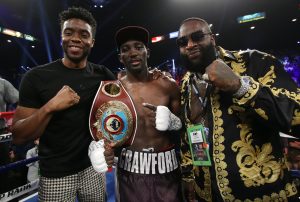
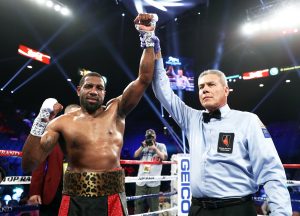
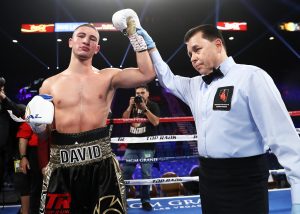
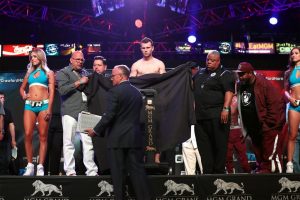
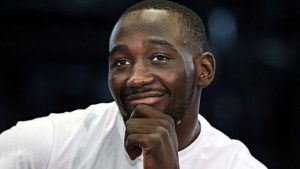
Crawford tells Horn not to confuse him with Pacquiao

By Norm Frauenheim-

LAS VEGAS – Despite mounting doubts about his reflexes, speed and durability, there’s still plenty of power in Manny Pacquiao’s name. Celebrity is the last thing to go these days. But don’t mistake Terence Crawford for Pacquiao. Crawford doesn’t have any of Pacquiao’s celebrity. He’s not exactly the nice guy Pacquiao is, either.

Not that Crawford cares.

For now, at least, Crawford is not seeking Pacquiao’s kind of global celebrity or personal likability. It sounds as if another wicked stoppage would be enough. And that’s exactly what Crawford is pursuing Saturday night at the MGM Grand in his welterweight debut against Jeff Horn, once an unknown Aussie who is in Las Vegas this week because of his controversial decision over Pacquiao in Brisbane nearly a year ago.

“I’m not Manny Pacquiao,’’ Crawford said Thursday at a news conference in a matter-of-fact tone. “I’m bigger. I’m stronger.

“I’m in my prime. And that’s gonna show, come Saturday. A lot of people are comparing how he pushed around Pacquiao. But that’s not me.’’

Crawford (32-0, 23 KOs), who is ranked No.2 behind Vasiliy Lomachenko in most pound-for-pound debates, is heavily favored – minus-950 at Vegas books late Thursday — to take the 147-pound belt that Horn (18-0-1, 12 KOs) took from Pacquiao last July. Some foresee the ESPN+ featured bout (6:30 pm PT/9:30 pm ET) as a showcase for the world’s next dominant welterweight. Errol Spence might have something to say about that. But more on him at a later date.

“We’re here to take over at 147,’’ Crawford trainer Brian McIntryre said. “Jeff just happens to be there, happens to be the first victim.’’

But there’s a theory that Horn’s size, rugged strength and bullish tactics will make the Top Rank-promoted Crawford regret that he decided to venture into a heavier division.

“We think Top Rank erred,’’ Horn promoter Dean Lonergan said. “We think Top Rank put Crawford in against the wrong guy.’’

It’s a matter of record that Top Rank put Pacquiao in against the wrong guy last summer. In a long, bruising 12 rounds Down Under last July, Horn punished Pacquiao in ways that nobody has. But it was a different Pacquiao. The Filipino Senator looked tentative. The fighter in all of those Bruce Lee-like poses from a decade ago look like a shrunken version of who and what he had been. He sure didn’t look like himself and it’s safe to safe he didn’t look anything like the Crawford Horn figures to see Saturday.

It’s as if we’re only beginning to see Crawford’s many dimensions, including an evident like for the brutal task of breaking down an opponent. There’s a mean streak in eyes that elicit their damage with hands that Crawford delivers with equal speed and accuracy. Right or left doesn’t matter. Crawford uses both, leads with either in an almost seamless switch, with lethal precision. Then, he smiles. It’s a deadly combo.

Yeah, Horn is bigger. Crawford is shorter by about an inch, a listed 5-foot-8 to Horn’s 5-9, which was more than three inches taller than Pacquiao (5-5 ½). The more significant tale on the tape, however, is in reach. The shorter Crawford has that advantage by two inches, 70 to Horn’s 68, in an edge that figures to multiply very quickly with a two-handed attack.


GGG-Canelo: The Time Is Now

By Norm Frauenheim-

Stalled negotiations for a Canelo Alvarez-Gennady Golovkin rematch are diverting attention and headlines away from two intriguing fights – Abner Mares-Leo Santa Cruz II in Los Angeles and Terence Crawford’s welterweight debut against Jeff Horn in Las Vegas, both on June 9.

It reminds me of an old line: The only thing killing boxing is boxing. It is the flaw, the proverbial glass jaw, that always seems to undercut a chaotic business that just can’t get out of its own way.

Television ratings have been promising this year, especially on ESPN. There’s an audience of young fans in America’s changing demographics. There’s looming interest in Crawford, Mikey Garcia, Vasiliy Lomachenko, Santa Cruz, Mares, Oscar Valdez Jr., Anthony Joshua and Deontay Wilder.

But today the business is being held hostage by talk that has been about percentages. According to various reports, GGG wants an equitable split, 50-50, since Canelo’s positive PED tests and subsequent withdrawal from a rematch that was supposed to happen on May 5. Canelo’s Golden Boy reps are reportedly standing by numbers they said were the terms of the initial deal, 65 percent for Canelo and 35 for GGG.

Those are numbers that are interesting only if you’re shopping for a new mortgage. Fans, I suspect, only want to know there’s a date and place for an opening bell.

In the here and now, who knows. There has only been a chilling silence for the last week. As I write this, there have been no reports talks have resumed.

I keep thinking back to GGG’s comment a couple of days before his swift, second-round stoppage of Vanes Martirosyan on May 5 at StubHub Center in Carson, Calif. Then, he said there was only a 10 percent chance that a rematch of their controversial draw last September would happen.

Then, it sounded like an opening line in re-setting the table for a new deal in the controversial wake of the Canelo PED controversy, which includes an ongoing, Nevada Athletic Commission-imposed suspension that will end in mid-August. Now, it sounds like a prediction,

I can only hope he’s wrong. At the time, there appears to be some sympathy for his attempt to get more favorable terms. Fifty-fifty looks unlikely. Canelo still ranks as the bigger draw and becomes more of one because of the controversy that now surrounds him.

But a better deal for GGG only seems fair, especially after the cancellation of the May 5 bout. GGG had no hand in the cancellation and, in fact, fought for a reported $1 million guarantee against Martirosyan on the same day. GGG’s promotional rep, Tom Loeffler of K-2, suggested that the Nevada Commission should have levied a fine against Canelo in addition to the suspension. The Commission said a fine was not possible, because Canelo’s positive PED tests in February were not related to a fight that had already happened in the state.

Still, Loeffler said damage had been done to GGG. The only way to get some of it back is through negotiations. Thus far, however, Golden Boy has yet to buy any of it. Hard to know where it goes next, if anywhere.

No rematch is a loss for just about everybody. Hardcore fans will eventually move on to Crawford, Lomachenko, Garcia, Santa Cruz, Mares, Valdez, Joshua and Wilder. But causal fans will again have another reason to stay away.

Meanwhile, no deal for a sequel on September 15 is reason to wonder whether there will ever be a rematch. GGG has bigger global footprint than Canelo. The Kazak fighter, whose pro career started in Germany and includes stops in Monaco, could go to Tokyo for good money against Ryota Murata.

There are also opportunities for Canelo, although the rumored one is bound to get only boos. Spike O’Sullivan? Really? Arguments over a proposed purse split are more interesting.

Billy Joe Saunders also has been mentioned. But both GGG and Canelo need to be careful about the emerging UK middleweight. Saunders has a chance to beat both. GGG has begun to display some wear and tear. At 27, Canelo continues to fight in spurts. Fatigue just might be part of his genetic make-up.

But it’ll get him beat, just as surely as time will eventually beat GGG, who will be 37 next April.

A year or two from now, GGG and Canelo could come back to talk with a loss or two between them and a lot less on the table.

The time is now.


Jack Johnson Pardon: When boxing and politics collide, be sure to protect yourself at all times

By Norm Frauenheim-

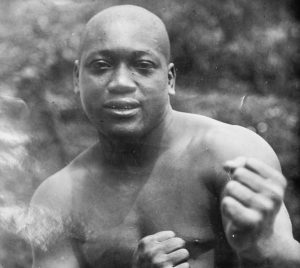
Boxer Jack Johnson. Courtesy LOC/via REUTERS

Politics and boxing, like former business partners Donald Trump and Don King, often play by the same rules. Only one really matters. Protect yourself at all times. Forget that, and the potential consequences are as dangerous and long lasting as a concussion.

I kept reminding myself of that fundamental Thursday after hearing that President Trump pardoned Jack Johnson, who a century ago served 10 months in federal prison for transporting a white woman across state lines “for immoral purposes.” It was a conviction rooted in that era’s racism.

A pardon was the right thing to do, and maybe that’s where we should leave it. Yet, there is skepticism, here and elsewhere, because of the timing. Trump issued the pardon at precisely the same time African-American activists are criticizing him and the National Football League, which this week announced it would fine teams with players who continue to protest by taking a knee during the national anthem.

Last year, Trump noisily ripped players who refused to stand for the anthem, urging owners to fire them. Critics see the NFL’s move this week as acquiescence. Trump praised the NFL for a policy that would allow players to stay in the locker room during the anthem. Trump also said, almost in an aside, that players not willing to stand for the anthem maybe “shouldn’t be in the country.’’

The NFL decision sets the stage for another long season of discontent, full of further charges that Trump is a racist. On the same day that the debate re-ignited, however, Trump pardoned Johnson, the original name in a compelling history of African-American athletes, including Joe Louis, Jackie Robinson, Jim Brown, Muhammad Ali, John Carlos and Tommie Smith.

Today, however, Trump has a counter he didn’t have a few days ago. He pardoned Johnson.

Barack Obama could have, should have, and yet history’s first African-American president didn’t issue the overdue order for reasons that have never been very clear.

One was repeated Thursday in the New York Times, which reported that “the Obama administration passed on pardoning Johnson, citing in part allegations of domestic violence against women.’’

Huh? When have there ever been pardons for allegations? If there were, Trump would have already pardoned himself multiple times. Maybe, century-old allegations are more a matter for archaeologists and historians than current law.

Guess here is that the Obama administration decided it didn’t want to waste time or money on a pardon for a historical figure in a sport that – even in good times — has been a guilty pleasure for some and an outrage for others.

But the pardon was necessary. The Mann Act was no allegation. It was the racist law that put Johnson behind bars for crossing state lines with a woman named Belle Schreiber, who had worked as a prostitute and had dated the heavyweight champion.

Arizona Senator John McCain knew it was a wrong that had to be acknowledged when he and New York Representative Peter King introduced a resolution a decade ago to pardon Johnson, who 100 years earlier – 1908 – sparked a furious search for The Great White Hope after he won the heavyweight title in a victory over Canadian Tommy Burns in Sydney Australia. Two years later — 1910, he beat the designated Great White Hope, American Jim Jeffries, in Reno. In 1913, the Mann Act was the only Great White Hope that could stop Johnson. He was convicted by an all-white jury, left the country and returned in 1920, only to wind up in jail for nearly a year.

“Mr. Johnson’s conviction was motivated by nothing more than the color of his skin,” McCain and King said in a statement about 10 years ago. “As such, it not only injured his family, but also our nation as a whole.”

About a decade later, there is profound irony that McCain’s long and worthy pursuit of the pardon would finally end with Trump granting it. Enmity between Trump and the ailing McCain is hardly a secret these days.

But I suspect the ailing McCain, a boxer during his days at the Naval Academy, welcomes the pardon more than he would an apology from the Trump administration for the ghoulish joke about him dying a few weeks ago. There also has never been an apology from Trump himself for his mocking dismissal of McCain’s experience as a Viet Nam prisoner-of-war. Early in the last presidential campaign, Trump said he preferred people “who weren’t captured.’’

Yet, McCain has a win, thanks to a president he doesn’t like. The contempt is mutual. But, again, boxing and politics also mean that your worst enemy can sometimes be your best friend. Just be sure to protect yourself. All the time.


GGG-Canelo: Back at the table for same rematch but probably a different deal

By Norm Frauenheim-

Canelo Alvarez’ enrollment this week in VADA, voluntary drug testing, represents relief for a nervous business still counting on big bucks from a rematch with Gennady Golovkin.

But don’t misinterpret it as a deal.

That would be foolishly premature, way too simple, especially after a contentious few weeks after the May 5 date was scrubbed in the turbulent wake of news that Canelo had tested positive twice for a banned substance.

The rematch is still very possible, probably likely. But circumstances have changed, all of which could have a significant impact on negotiations for a proposed Sept. 15 rematch of the controversial GGG-Canelo draw last September. The door on talks re-opened with Canelo’s tweet Tuesday that he’s back in the VADA program. But the table looks like a very different place from the day when the cancelled May sequel was announced on Jan 29.

GGG, whose evident frustration at the judging in last year’s draw morphed into obvious anger at Canelo’s after the PED controversy in February, said repeatedly before his stoppage of Vanes Martirosyan May 5 that he wanted more equitable terms.

That starts with money, of course. Ends there, too. There’s nothing to discuss without it. Canelo promoter Oscar De La Hoya was quoted in media reports that Canelo decided to re-join VADA for his fans. For the money, too. Where else is he going to get a chance at $50 million?

That’s was the potential for his final purse last September for a fight that did a reported 1.3 million pay-per-view buys. According to media speculation before the bout, the PPV number would have had to have been 1.5 million for Canelo to get the $50 million max. It not clear whether he did. But he got close enough to want to take another bite at about that, far and away, makes the most sense. And dollars.

This time around, however, it fair to guess that Canelo is going to want a bigger share. Based roughly on guarantees — $5 million for Canelo and $ 3 million for GGG — filed in contracts with the Nevada Athletic Commission last September, the final split of revenue was 62.5 percent for Canelo and 37.5 percent for GGG.

It’ll be no surprise if GGG demands a 50-50 split. The first fight, after all, was a draw. On the scorecards, it was demonstrably 50-50. In the court of public opinion, meanwhile, it’s still a debate, also an ongoing sales pitch for the rematch.

Then, there’s controversy surrounding Canelo’s PED tests for clenbuterol, a banned substance he says he got from unknowingly eating contaminated Mexican beef. GGG doesn’t believe him. Turns out, neither do a lot of fans, who expressed their skepticism throughout media reports of GGG’s decision to fight on Cinco De Mayo anyway, against Martirosyan, a late stand-in at StubHub Center.

The bout was panned by many in the media. Martirosyan was gone, knocked out and flat on the canvas, before the end of the second round. But the argument about Canelo and why he had not re-enrolled in VADA lingered.

Unintended or not, a forgettable fight provided a forum for criticism of Canelo in social and mainstream media. It grew, putting pressure on Canelo to do Tuesday what had to be done if the rematch was to have any chance at happening.

It’s a mystery as to why he didn’t enroll in VADA earlier. It’s a mystery, too, as to why he didn’t hold a news conference in late February to just say that he, like anybody else, sometimes gets a meal off the back of a taco truck. He ate one with some tainted meat. No crime there. A lot of people would not have believed him. A lot of people never will. But some would have.

Now, however, Canelo finds himself with a burden of proof he has never had to shoulder. The skepticism expressed about him over the last couple of months is perhaps symptomatic of an erosion in faith from fans whose unquestioned loyalty gave him leverage in negotiations. He could always say he was the draw. He still is, but maybe not by the margin he once had.

What happens within that margin figures to decide when and where – maybe even if — this rematch happens.


Lomachenko-Linares: First shot in looming pound-for-pound debate

By Norm Frauenheim-

Vasiliy Lomachenko-Jorge Linares Saturday at New York’s Madison Square Garden is an opportunity to reset the table on a year that began amid promise and yet has been muddied by the May 5 cancellation of Gennady Golovkin-Canelo Alvarez and the continuing controversy over when — or if — Canelo will enroll in VADA, the voluntary testing procedure that appears to be fundamental to any chance of reaching an agreement for a rematch in September.

There’s no controversy about Lomachenko-Linares. There’s just intrigue, anticipation and the pound-for-pound argument.

Lomachenko’s bid for a third title at a third weight, 135 pounds, is the first half of a 2018 debate about a further claim on the pound-for-pound’s mythical title. At the end of 2017, Lomachenko, a former featherweight and junior-lightweight champion, held a slight edge in the various polls and among the voters.

But Terence Crawford was always in the hunt. Still is.

Crawford, a former lightweight and junior-welterweight champ, will deliver his bid next month, June 9 at Las Vegas MGM Grand, in his first bout at 147 pounds against Australian Jeff Horn.

Guess here: Both Lomachenko and Crawford will prevail.

The real question rests in who will have looked better in their first fight at a heavier weight.

It’s a debate that figures to continue for a while. Lomachenko and Crawford are the same age. They’re both 30.

Lomachenko (10-1, 8 KOs) possesses an unprecedented array of angles in his variety of punches. For the ringside aficionado, there is a cutting-edge style to what Lomachenko does with his gloved hands.

In Crawford, there’s ruthlessness matched by ambidextrous hands quick to strike from just about anywhere.

Both Top Rank-promoted fighters are fascinating to watch. Take your pick and be prepared to change it over the next few years. They figure to energize the pound-for-pound debate no matter what happens with GGG-Canelo.

Saturday is the opening salvo. Linares (44-3, 27 KOs), the World Boxing Association’s 135-pound belt holder, says he is not fooled by all that has been said about the creatively-dangerous Lomachenko.

“I am going to prove that Lomachenko is not an invincible fighter,’’ Linares said this week during the promotional build-up to the main event on the ESPN-televised card (8 p.m. ET).

Linares, who is an inch taller and has a 3 1/2 -inch advantage in reach, is promising to take Lomachenko into later rounds. But the cutting-edge adjective so often applied to Lomachenko might to be more than just a rhetorical embellishment of what Lomachenko does to Linares. Linares has suffered bad cuts in at least three bouts, including successive losses to Antonio DeMarco and Sergio Thompson in 2011 and 2012. Lomachenko’s many angles can put a real razor-like affect into that cutting edge.

We’ll see.

Then, we’ll see Crawford.


GGG delivers a thank you and a powerful message with swift KO of Martirosyan


CARSON, Calif. – It was a quick thank you. Gennady Golovkin delivered it efficiently, precisely and exactly as promised.

Vanes Martirosyan never had a chance. He was just there, like a Cinco De May piñata, or perhaps a billboard targeted to carry a message for who was supposed to be there instead, but wasn’t because of two positive PED tests in February.

Was suspended Canelo Alvarez watching? Who knows? If he was, he didn’t have to watch for long. GGG (38-0-1, 34 KOs) didn’t waste much time. It probably took him longer to finish his entrance, which took him around the ring and to his corner in a walk that allowed him to wave to as many of the 7,837 fans at StubHub Center as possible.

It took him less than two rounds to finish Martirosyan, a huge underdog who actually surprised him in the opening round. Martirosyan (36-4-1, 21 KOs) landed early, landed late. On the 15 Rounds card, he was leading, 10-9, after the first three minutes.

The next 113 seconds, however, were a very different story. GGG, awakened and energized, went to work in a fashion as ruthless as it was sudden. A big left hand started it. Then, there were at least three successive jabs. A couple of more lefts followed. Martirosyan was down, his face on the canvas. He tried to get up, but fell forward. Referee Jack Reiss immediately and wisely wave it off. GGG had his 34th knockout and a 20th straight defense of two of middleweight titles, tying a record held by Brnard Hopkins.

“I want everybody,’’ GGG said when asked who he would like to fight next.

Next, of course, begged the inevitable question:

Canelo?

“Absolutely,’’ he said.

But that’s a rich rematch that still has to negotiated and those talks figure to be a lot more difficult than the GGG fight Saturday night was.

But for one night, he had a reason to celebrate and thank his Southern California fan base. Along the way, he also got some appreciation form another one of South California fans. Martirosyan knew he had power. But feeling it was something else.

“It was like being hit by a train,’’ he said. “Not just one punch. All of his punches.’’

In a controversial welterweight fight, women’s champion Cecilia Braekhus (33-0, 9 KOs) survived a knockdown for a unanimous decision over tough Kali Reis (13-7-1, 4 KOs).

Best Of The Undercard

Kazakh junior-welterweight Ruslan Madiyev (12-0, 5 KOs) warmed up the ring for Golovkin, his fellow countryman and stablemate, with a sudden burst of energy and power over the last couple of rounds for a furious finish to a unanimous decision over Jesus Perez (22-1,16 KOs) of Tijuana.

The Rest

Cleveland prospect Ryan Martin (22-0, 12 KOs), looking more comfortable and powerful at 140 pounds, overcame a point penalty for low blows in the fourth and went on to a unanimous decision over Breidis Prescott (31-12, 22 KOs), a one-hit wonder still remembered for knocking out Amir Khan.

New York welterweight Brian Ceballo (2-0, 1 KO) employed patience and precision throughout four one-sided rounds for a unanimous decision over Nam Phan (3-6, 2 KOs) of Grand Garden, Calif.

Los Angeles junior-flyweight Jesse Rodriguez (6-0, 4 KOs) opened the show with a blinding succession of punches, including a head-rocking left for a third-round stoppage of Armando Vasquez (25-22-1, 7 KOs) of Mexicali.


Weight and Wait: GGG exactly at 160 pounds as the talk about Canelo continues

By Norm Frauenheim-

LOS ANGELES – Gennady Golovkin smiled. Said thanks. He might have kissed a few babies, too.

The middleweight, best known for his GGG acronym, did everything he had to Friday at a hotel just a few miles of roadwork from the LAX runways. Oh yeah, he made weight, too.

GGG (37-0-1, 27 KOs) was supposed to be at 160 pounds and that’s exactly what he was, not a digital fraction over or under the mandatory for a defense of two of his titles, the WBC and WBA, against Vanes Martirosyan on HBO (9 p.m. PT/11 p.m. ET) Saturday at StubHub down the freeway in Carson.

Martirosyan (36-3-1 21 KO), a huge underdog from nearby Glendale Calif, was at 159.6 pounds for his first bout at middleweight.

There were no missteps on the scale or anywhere else from Golovkin (37-0-1, 33 KOs) in a moment that was as political as it was pugilistic. It was almost as if GGG wanted to let the contrast with his original opponent, suspended Canelo Alvarez, say it all.

For weeks, GGG has been saying plenty to the media about his contempt for Canelo, who tested positive twice for a banned substance and then withdrew from what would have been a rich Cinco de Mayo rematch of last September’s controversial draw in Las Vegas. At the weigh-in, however, GGG only had a couple of words, which he repeated after the ritual weigh-in and nose-to-nose pose for the photographers in a jammed ballroom.

“Thank you, thank you,’’ he said to the crowd, which included lots of fans wearing shirts and caps saying Mexicans For GGG.

The thanks came in the wake of further news that casts a shadow on whether there will be a Sept. 15 rematch with Canelo, whose six-month suspension from the Nevada Commission will end in mid-August. Before the thanks, GGG said Canelo was bad for boxing in an interview with ESPN and BoxingScene. He told Yahoo that, at best, there was only a 10 percent chance of the rematch happening. If he beats Martirosyan as expected, no telling what he’ll say at the post-fight news conference. May be, he’s only negotiating. If so, the negotiations have a long, perhaps rocky way to go.

For now, it sounds as if GGG is no rush to get the rematch, even though it would – far and away – represent his biggest payday. According to contracts filed with the California Commission Friday, GGG’s guarantee for Saturday is $1 million.

It’s believed he will get more, perhaps three times as much, after percentages are included for a card that promoters began to put together just two-and-a-half weeks ago. Whatever his final take is, however, it will be a fraction of what he and Canelo made in September.

According to various sources, Canelo collected $50 million. GGG, who can tie Bernard Hopkins’ record for 20 successive title defenses Saturday, got less than that. There are conflicting reports, but whatever it was, it was several multiples more than what he’ll see for fighting Martirosyan, a former junior middleweight whose guarantee for Saturday is $225,000.

Saturday night televised card will also include an HBO first. Welterweights Cecilia Braekhus and Kali Reis will be the first women to appear in a co-main event.


Going the distance with a changing GGG can be a deadly destination

By Norm Frauenheim-

CARSON, Calif. — Going the distance with Gennady Golovkin is a dead end.

That, at least, is big part of the sales pitch for GGG’s starring role in a Cinco De Mayo bout that is still an annual rite despite Canelo Alvarez’ withdrawal and subsequent six-month suspension for two positive PED tests in February.

The Fiesta has moved west, from Las Vegas to StubHub Center at Carson, Calif. The opponent has changed too, Vanes Martiroysan instead of Canelo. But, make no mistake, the story is about GGG, who is a little bit older and angrier than the friendly face who once was known for saying “Big Drama Show.’’

The GGG smile is still there. But mention Canelo and a grin once considered cute suddenly looks menacing. He has no patience for the rival middleweight. He doesn’t believe Canelo when he says he tested positive for Clenbuterol because of eating meat the Mexican says he didn’t know was tainted with the banned substance.

Inevitably, the Canelo question has been asked. There really is no other question, at least not in the two-and-half weeks promoters had to stage the HBO bout at a new location and against a different opponent. Time has been a challenge, also the biggest one of all for GGG, a fighter entering middle age and furiously pursuing a legacy. In Canelo, perhaps, he sees a fighter who has stood in his way, first with judging that he called “terrible” in a Las Vegas draw last September and now with a PED suspension.

There are moments when GGG’s frustration flares. These days, it’s as if it is always there, a little bit like that grin was. And, for the most part, still is. Hard to blame him. He’s 36, an age when most fighters are beginning to exit their prime. He doesn’t want to be kept waiting for any reason. He can’t afford it. Finances are just one factor.

According to multiple sources, he is guaranteed close to $3 million for Martirosyan, a capable junior middleweight who is moving up to 160 pounds after a couple of years of inactivity. That’s a fraction of the $15 million GGG reportedly got for last September’s draw. There were reports he could have collected $20 million for a rematch originally scheduled for Saturday. Now, there’s talk that the Canelo rematch will happen on September 15.

But most of that talk is coming from Canelo’s Golden Boy promoters. GGG continues to throw cold water on the possibility. He did so again this week when he told Yahoo there was only a 10 percent chance the rematch will happen. Guess here: He’s already negotiating. He wants to make Canelo pay, both financially and in the ring.

In the ring, at least, the rematch has emerged as the one fight fans want to see, in part because GGG seems to be saying that he intends to punish Canelo in what would be defining moment for the Kazak.

That brings us back to what GGG promoter Tom Loeffler and trainer Abel Sanchez have been saying about him.

“Once you go twelve rounds with Golovkin, you are never going to be the same,’’ Sanchez said Monday during an international conference call.

It was a comment that Sanchez made when asked about Danny Jacobs, who won a decision over Polish middleweight Maciej Sulecki in Brooklyn last Saturday. Jacobs is 2-0 since losing a 12-round unanimous decision to GGG in March 2017. Sanchez said he has seen a decline in Jacobs since the 12-round battle with GGG.

“It’s not only Jacobs,’’ Sanchez said. “If you go back to (David) Lemieux, to (Curtis) Stevens, to (Dominic) Wade, to Willie Monroe, they are never the same. (Martin) Murray, also. They are never the same after they go rounds with Gennady.’’

The danger in all of this, however, is that GGG often looks as is if he’s not exactly who he was anymore, either. He took a lot of punches against Jacobs in a bout that some thought Jacobs won. Bruising, often an early symptom of aging in a fighter, has been evident.

Against Martirosyan, GGG is expected to win easily. But Martirosyan, who fought at the 2004 Olympics when GGG won a silver medal, is clever. He knows his way around the ring. He might not win, which is another way of saying he doesn’t have much to lose.

Going the distance against GGG would be victory for Martirosyan. But don’t expect it, not in a bout that looks a lot like the first step in his angry plan to add Canelo to a Sanchez list that already includes Jacobs, Lemieux, Stevens, Wade, Monroe and Murray.


GGG-Canelo II? Still the only fight that makes sense and dollars

By Norm Frauenheim-

Gennady Golovkin and Canelo Alvarez are linked only by mutual contempt, genuine in tone and intensifying in the wake of the May 5 bout canceled by Canelo’s withdrawal from the rematch before his subsequent six-month suspension for two positive PED tests in February.

After the Nevada Athletic Commission announced an abbreviated suspension of Canelo last week, the prevailing assumption was that the middleweight sequel would happen in September in what would eventually look more like a postponement than a cancellation. Guess here: That’s still a pretty good assumption. Economically, it’s still the fight that makes the most sense. Dollars, too.

But GGG’s anger, rooted in his frustration at scoring in last September’s draw, continues to be loud, clear and amplified by his mistrust in Canelo’s assertion that the PED, clenbuterol, was simply the result of tainted Mexican meat.

There are moments when GGG just sounds as if he’d like to walk away from the prospect of any further business with Canelo.

“Canelo?” GGG asked this week in response to a question during a media session for a stay-busy fight against Vanes Martiroysan in a Cinco De Mayo party re-scheduled for StubHub Center in Carson, Calif. “Right now, he is over. Do I want to have the rematch in September? We’ll see. It’s a different deal. The boxing business is crazy. I’ll fight Canelo again. Ask him if he wants to fight me.

“I no longer think about Canelo.’’

It’s pretty clear that Canelo is anxious to fight – make that punish – GGG in September, about a month after his suspension ends. His promoter, Oscar De La Hoya, has been talking almost as if the September rematch is a done deal. It’s not, of course. First, there’s Martiroysan. GGG is a huge favorite. An upset would be a shocker. Then again, Canelo’s positive PED tests were a shocker, too.

The last couple of months are an inconvenient reminder that bleep and head butts happen. GGG has to win easily and cleanly, meaning he has to finish it without suffering an injury – a fracture or cut — that could sideline him beyond the projected September 15 rematch.

If everything happens as hoped, however, GGG will prevail with a victory and without mishap. Then, it’s on to the negotiations, where the real fight awaits. By now, we know the fighters don’t like each other. There’s enough tension there to suggest that the talks will be difficult.

There are options, good ones for each, if no agreement can be reached. One will play out this Saturday with likable Danny Jacobs in his second fight since a debatable loss by unanimous decision to GGG in March, 2017.

Jacobs made Golovkin, 36, look vulnerable, or at least older. Now he faces a mostly unknown, yet unbeaten Pole, Maciej Sulecki (26-0, 10 KOs) in an HBO-televised bout (7 p.m. PT/10 p.m. ET) at Brooklyn’s Barclays Center. At 31, Jacobs is in his prime. If he looks good against Sulecki, he would have a pretty good claim on a GGG rematch for the right to be the world’s best middleweight.

Another option is Jermall Charlo, whose emergence at 160 pounds continued with a stoppage of Hugo Centeno last Saturday. Then, there’s Ryota Murata, an Olympic gold medalist with only 15 pro bouts (14-1, 11 KOs), yet big television ratings in Japan.

Jacobs, however, looms as real threat to both GGG and Canelo. On the business scale, Jacobs represents more risk than reward. Charlo might still be a middleweight fight or two away from climbing into contention. Murata looks like good money and an introduction to the rich Asian market.

With every option, however, there’s no match for the interest, significance or money attached to GGG-Canelo II. Even the current level of mutual contempt is stoking public interest for a September showdown. In the here and now, it’s still the only fight that matters.


The real test of Canelo’s words awaits him

By Norm Frauenheim-

LAS VEGAS – Canelo Alvarez insists he is clean. Now, he has a chance to prove it.

The Nevada Athletic Commission gave him that opportunity Wednesday with a unanimous approval of an agreement that means he will serve a six-month suspension instead of a full year for the banned substance, Clenbuterol, that showed up in two tests in February, subsequently forcing him to withdraw from a Gennady Golovkin rematch scheduled for May 5.

The abbreviated suspension means he can still fight Golovkin in September. For now, the cancellation looks more like a postponement. That was the good news for hotels, cab drivers and bartenders up and down the Vegas Strip. They can still look forward to a Cinco De Mayo-like windfall on Sept. 15, the day before Mexican Independence. Yeah, money is still a factor here. Somebody has to pay for those slot machines.

There’s more, however, to it than just that. But it’s up to Canelo, who says the prohibited drug wound up in his blood stream unknowingly. He told Nevada he did not intentionally ingest the steroid-based substance. He blamed it on tainted Mexican beef. In so many words, he makes it sound as if he were an unwitting part of a corrupted food chain. From the butcher to his plate, he says he never knew he was ingesting a compound that has wound up being a very expensive piece of meat.

There’s plausible deniability in all of this, of course. There’s precedence, too. Mexico’s cattlemen have been using the substance to keep their product lean. Mexican boxers and soccer players have tested positive. Meanwhile, The Nevada Commission, a state agency, is bound by law. It played by the book, including Canelo’s status as a first-time offender and his willingness to cooperate as factors in its unanimous approval.

But the court of public opinion is not constrained by law, much less decorum. It’s been a free-for-all, especially on platforms where snark, suspicion, allegation and profanity are part of the digital disorder. It’s social media in name only. Since Wednesday’s ruling in Las Vegas, Canelo has been a convenient target, one of many. No surprise there. Canelo must have known it was coming.

The surprise here, however, is that he wasn’t proactive in addressing the inevitable criticism.

If he had been, he would have been enrolled in VADA – Volunteer Anti-Drug Testing Agency – before it was announced that the Nevada Commission had voted 5-0 in favor of the agreement for his shorter suspension.

Minutes after the hearing, VADA’s Dr. Margaret Goodman told 15 Rounds and the Los Angeles Times that “he was not enrolled at this time.’’ Sure enough, a check of Canelo’s page on www.boxrec.com showed he was not in the testing program that is aligned with the World Boxing Council. Meanwhile, a notation on GGG’s page shows that, yes, he is enrolled. Just checking.

Maybe, Canelo has already turned in the docs that will enroll him. Maybe, he’s doing so while this is being written. Maybe, it’s just process. Or, maybe, it’s just an oversight. But the maybes are an opening for everybody who just doesn’t believe him. There’s not much presumption of innocence left for anybody anywhere any more. But boxing has never enjoyed that presumption any way. There are no innocents, just the usual suspects.

But Canelo has a rare opportunity, one the Nevada Commission gave him Wednesday. He can provide a record, a clean slate of tests supporting what he said after the positive tests were disclosed. The burden of proof awaits him.


Canelo suspension cut to six months, GGG rematch possible in September

By Norm Frauenheim-

LAS VEGAS — Canelo Alvarez agreed to a six-month suspension and the Nevada Athletic Commission unanimously approved that agreement Wednesday, opening the way for him to fight Gennady Golovkin on Sept. 15 in a rematch that had originally been scheduled for May 5.

The Commission voted 5-0 to accept a signed settlement from Canelo, whose 12-month ban for two positive drug tests was cut in half and will be dated back to the initial test, Feb. 17.

Canelo, who underwent what was reported to be minor knee surgery last week, did not attend the hearing. He was represented on the telephone by attorney Ricardo Cestero.

Canelo, a first-time PED offender, met with Commission Executive Director Bob Bennett and Chairman Anthony A. Marnell a couple of weeks ago in Las Vegas for an hour-and-twenty minutes. Bennett said he answered his questions.

“’He did everything we asked for,’’ Bennett said.

Cooperation from Canelo, who blamed positive tests for Clenbuterol on tainted Mexican beef, allowed the Commission to reduce his ban by 50 percent, according to new rules written by the state regulatory board a year ago.

Golden Boy Promotions, Canelo’s promoter, said it was satisfied with the Commission’s approval of Canelo’s agreement to the reduced ban. Golden Boy’s prepared statement:

“As we have maintained all along, the trace amounts of clenbuterol found in Canelo’s system in February came from meat contamination, and we provided the Nevada State Athletic Commission with a great deal of evidence to support those facts.

“Although most professional sports, international anti-doping agencies and United States boxing commissions treat meat contamination differently from other positive tests, Nevada does not. Canelo and Golden Boy Promotions respect the rules of Nevada and are therefore satisfied with the settlement agreement reached today.

“Canelo looks forward to returning to the ring in September for Mexican Independence Day weekend to represent Mexico and boxing in what will be the sport’s biggest event of the year. He is ready to continue his remarkable record of fighting at the highest level.”

If all goes as planned, Golovkin’s suspension will be over in mid-August and he’ll be able to fight on the weekend celebrating Mexican Independence, presumably at Las Vegas’ T-Mobile Arena. That’s where the Cinco de Mayo fight, the rematch of a controversial draw last September, was supposed to happen. Canelo withdrew on April 3.

But a lot has to happen before Canelo and GGG can meet again. First, GGG has to win what now appears to be an interim fight against Vanes Martiroysan on May 5 at StubHub Center in Carson, Calif., in what looks like a Cinco de Mayo bout for some of his most ardent fans.

“He has been looking good and he really wants to fight well for the fans who are at the grass roots of his popularity,’’ said GGG trainer Abel Sanchez, who attended Wednesday’s hearing. “You worry a little that some of this might be a distraction. But he knows what he has to do.’’

GGG is a huge favorite against Martiroysan, who hasn’t fought in a couple of years. If GGG wins as expected, the next step is a deal with Canelo. That might be more difficult than it sounds

If the rematch returns to Nevada, the state Commission will subject Canelo to testing. At this point, however, no fight is scheduled. Nevada only has jurisdiction over fights within its own borders. Meanwhile, Canelo is not currently subject to VADA, the agency that does testing for the World Boxing Council.

“I do not have him (Canelo) enrolled at this time,’’ VADA’s Dr. Margaret Goodman said after the hearing.

Golovkin is enrolled.

GGG representative Tom Loeffler of K2 Promotions said Canelo would have to join VADA for there to be a deal for a September rematch.

“Absolutely,’’ said Loeffler, who also attended the hearing. “Definitely, that would be a condition.’’


Mayweather still a media master in Faustian bargain that leads him back into harm’s way

By Norm Frauenheim-

Floyd Mayweather Jr. is as good at staying in the news as he was at staying a top the pound-for debate.

Evidence of that played out all over again throughout this week with speculation that he might make another comeback, this time in mixed martial arts. As usual there were a lot of mixed messages about whether he will or won’t, could or should. Who knows? If last August’s bizarre boxing bout with UFC star Conor McGregor is any guide, it’s safe to say he probably will.

Whether it would be safe to his health is another issue altogether. Remember, he once talked about retiring before a punch – or perhaps a kick to the temple – left him hurt and without the capacity to enjoy all of the unprecedented money he has collected. I’m not sure he really wants to fight again. Against McGregor, he didn’t look to be in the best condition, although he appeared to carry the novice boxer for several rounds before ending it with a TKO in the tenth round.

The guess from this corner is that people are telling Mayweather to stay away from the ring, or the cage, or any other version of harm’s way. Trouble is, he can’t resist the media, a siren’s song that reminds him and everybody else that he is as relevant and rich as ever.

It stokes his ego.

It re-fills his garage and bank accounts.

And it works.

The best and most recent example was the McGregor match. After months of stoking media speculation and criticism, interest was high enough to attract a reported 4.4 million pay-per-view audience in the U.S. That was just short of the record 4.6 million he posted for his decision over Manny Pacquiao. I can’t help but think that Mayweather-Pacquiao II will happen one day in a cage. But that’s another story for another day.

This is about Mayweather and his uncanny ability at manipulating the media. He does at as well as he eluded a punch. A hint here, a shoulder roll there and, before long, what looked like a feint suddenly becomes real. It creates a momentum all its own and inevitably sweeps Mayweather, now 41, back into the dangerous place he vowed to avoid about five years ago. Maybe, Mayweather can duck and dodge strikes, kicks, elbows and knee caps. Maybe, he can command enough money and clout to amend rules in such a way that only a cosmetic cage will make his UFC debut look like the real thing. But, maybe he’s made a Faustian bargain that ends in a disabling blow.

It’s no coincidence perhaps that media attention on combat sports is at a place similar in April to what it was last August. Then, the media focus was on Mayweather-McGregor just three weeks before opening bell to the Gennady Golovkin-Canelo Alvarez draw. Eight months later, circumstances have changed. Boxing has only itself to blame this time. But the names and attention are the same. GGG promoters were scrambling this week to find an opponent for May 5 after Canelo’s withdrawal in the wake of a positive PED test. A news conference was held Thursday. It was announced that there was no announcement.

About three weeks before what would be opening bell, we’re back to where we were in August: Talking about Mayweather. Yeah, there’s McGregor, too. But after the Irishman allegedly caused a near riot at Brooklyn’s Barclay’s Center at UFC media event last week, there were questions about his future.

Video shows him attacking a bus. He was released on $50,000 bond. According to witnesses, he and his crew stormed the backstage, broke a window and injured fellow UFC fighters. He was arraigned on one count of felony criminal mischief and three counts of misdemeanor assault. He was allowed to return Ireland, but has been ordered to appear in court in New York on June 14.

If convicted, he might be spending more than just few a rounds in a cage.


Hearing of the Year: Canelo’s appearance before Nevada Commission is getting all of the attention

By Norm Frauenheim-

It’s not a promising year when the most anticipated moment is a hearing instead of an opening bell.

For now, however, that’s what boxing has at the top of its agenda after a disappointing first quarter and now a second quarter dominated by a Nevada Athletic Commission meeting on April 18 that is expected to determine the length of Canelo’s suspension for two positive PED tests he says were the result of tainted meet.

Much hangs in the balance, including when or even if the Canelo-Gennady Golovkin rematch will happen. It’s off the schedule after Canelo’s withdrawal from a bout originally set for May 5 at Las Vegas’ T-Mobile Arena. For now, it’s a cancellation. But I wouldn’t be surprised if it looks more like a postponement six months from now. Money is still a factor here and there’s still plenty of it.

The guess from this corner is that Canelo’s withdrawal, despite his denial about knowingly ingesting Clenbuterol, will be viewed as cooperation by the Commission. Canelo and Golden Boy Promotions took the reasonable step. Even if they had fought the allegations and retained the right to fight on Cinco de Mayo, there just wasn’t enough time for fans, promoters and Vegas hotels to properly put on the show. The MGM Grand was already offering ticket refunds. HBO had pulled its advertising. Fans were canceling room and flight reservations.

Canelo’s withdrawal was a pragmatic way to hit the re-set button on the middleweight sequel to their controversial draw last September. Perhaps, a cynical way, too. Whatever you think of it, there’s plenty of reasonable speculation that Canelo, a first-time PED offender, will serve a six-month suspension that will be dated back to the first test, Feb. 17. That means he’ll be eligible to fight again on August 18. The rematch could be re-scheduled for Sept. 15, a Saturday on the weekend celebrating Mexican Independence.

But there are no safe assumptions here, especially after a wildly unpredictable three-plus months since New Year’s Day. Terence Crawford’s intriguing welterweight debut against Jeff Horn was postponed from April 14 to June 9 at Vegas’ MGM Grand because of an injury to his right hand. Welterweight champion Keith Thurman postponed his comeback from elbow surgery, scheduled for May 19, because of an injury to his left hand.

Then, there was Anthony Joshua versus Joseph Parker. Other than another-rock-and-roll like crowd for Joshua at Cardiff, Wales, the fight was a dud. Lots of heavyweight hype produced a lot of ho-hums. Joshua won a decision, his first after winning 20 bouts by stoppage. A conservative Joshua fought mostly not to lose. Perhaps, he was playing possum in anticipation of a showdown with Deontay Wilder or Tyson Fury. But fan-friendly, it wasn’t. I said it before and I’ll say it again: Andre Ward must be tempted.

For now, the Fight of the Year is featherweight Oscar Valdez Jr.’s epic show of guts in a decision over Scott Quigg on March 10 at StubHub Center in Carson, Calif. It was riveting. It was scary. It was bloody. The drama unfolded on a night when there were more puddles than patrons at StubHub’s open-air arena. It rained, water mixing with the blood that poured from Valdez’ busted jaw. It was a fight that drained everything from Valdez but his courage.

But it also left questions, ones that might have been avoided had Quigg agreed to do a secondary weigh-in on the morning of the bout. He said no after missing the 126-mandatory by 2.8 pounds the day before opening bell. At fight time, Quigg repeatedly outweighed Valdez by nearly seven pounds.

In Quigg’s thudding punches throughout and in Valdez’ battered face after the carnage, however, it looked like a lot more. It might have happened without the reported weight disparity. Valdez takes chances, a risky style that leaves him wide open for damaging shots. A lighter Quigg might have busted up Valdez anyway. But we’ll never know, and those haunting questions will linger as Valdez battles to recover for what figures to be a challenging comeback for a fighter who has been an emerging star.

If anything, the last three-and-half months have been an almost uninterrupted sequence of moments that exemplify just how vulnerable those stars and their plans really are. I’m not sure a hearing can correct any of that. For now, however, it’s about all we’ve got.


Canelo controversy opens another door for Joshua

By Norm Frauenheim-

Anthony Joshua can strengthen, if not secure, his claim on being the face of a tribal game Saturday against Joseph Parker because of an ongoing mess that leaves a lot of questions about Canelo Alvarez.

Other than mounting controversy, it’s hard to know what’s next for Alvarez, boxing’s pay-per-view leader since Floyd Mayweather Jr.’s exit.

Chances that Alvarez’ middleweight rematch against Gennady Golovkin will happen on May 5 at Las Vegas’ T-Mobile Arena look increasingly unlikely after the Nevada Athletic Commission filed a formal complaint against him on Thursday for testing positive on February 17 and again on Feb. 20.

The Nevada Commission is expected to rule at a meeting re-scheduled for April 18. It had originally been scheduled for April 10.

The complaint appears to be the first step toward a suspension of Alvarez, who says Clenubuterol was found in his system nearly three weeks after the fight was announced on January 29 because of tainted meat he says he ate while training in Guadalajara.

Even before Thursday’s filing, there were plenty of signs that a suspension looms. HBO pulled its ads for the fight. The MGM Grand said it is offering ticket refunds.

Translation: Fewer and fewer people think the fight will happen, at least not on May 5, an annual Mexican holiday that some fans have now dubbed Cinco de Maybe.

According to the complaint, Alvarez faces a suspension of nine to 24 months. It can be reduced by as much as half if Alvarez is deemed to be cooperative and credible. He is expected to speak to the Commission at the April 18 hearing.

The best guess is that the Commission issues a six-month suspension dating back to the first positive test, Feb. 17.

That would mean Canelo would be eligible to fight on August 18, opening up the possibility that the rematch could move to September 18, two days after Mexico’s Independence Day celebration on Sept. 16.

Alvarez and Golovkin fought to a controversial draw last Sept. 16, also at T-Mobile. That one begged for a rematch and still does.

All of this is happening just as the unbeaten Joshua, the IBF and WBA champion, gets ready to defend his belt (Showtime 5 p.m. ET/2 p.m. PT) in Cardiff, Wales, against Parker, also unbeaten and a likeable New Zealand heavyweight with the WBO title.

The Cardiff fight at a soccer stadium is expected to draw a crowd of about 80,000. That would mean Joshua has draw 250,000 customers over his last three fights, including a reported 90,000 at London’s Wembley Stadium for his stoppage of Wladimir Klitschko last April.

Those are numbers that suggest Joshua is already more popular than Canelo.

A sensational performance against Parker would leave little doubt.

Potential erosion in Alvarez’s popularity coincides with UK promoter Eddie Hearn’s plans to introduce Joshua to an American audience, perhaps against Deontay Wilder, who promotes himself better than anybody else has or could.

This week, Wilder has caused a mild storm by refusing to attend Joshua-Parker, apparently because he wouldn’t be allowed to go face-to-face with Joshua after the fight.

Face-to-face, the only Joshua-Wilder meeting that matters is at opening bell. That looks more like a when than an if.

Especially amid a growing flap that leaves fans frustrated and looking for a new, fresh face with a future still untainted by filings, complaints, hearings and possible suspension.


Heavyweight Restoration: Rebuilding continues with Joshua-Parker

By Norm Frauenheim-

It’s a good time to be a heavyweight. At least, it appears to be. The old flagship division is beginning to resurface with HMS Anthony Joshua’s stunning emergence to UK prominence with numbers impossible to ignore.

No matter how you add them up, Joshua is a force creating worldwide waves of interest in a weight class that just a few years ago looked as if it had sunk into rusting irrelevancy, a relic beyond restoration

If expectations for Joshua’s March 31 bout against Joseph Parker on March 31 in Cardiff, Wales are accurate – and there’s every reason to think they are, Joshua will have fought in front of nearly 250,000 fans over his last three bouts. According to various reports, he will have earned $65 million.

That’s not a relic. That’s relevancy.

Evident momentum suggests it will continue. The bout against Parker (Showtime 5 p.m. ET/2 p.m. PT) for three key pieces to the heavyweight title represents a significant look at where it is and where it’s going. It isn’t Joshua’s biggest fight. That came in his epic stoppage of Wladimir Klitschko last April at London’s Wembley Stadium.

He turned in a mixed performance in a TKO of Carlos Takam in his subsequent appearance in October. It was forgettable, at least that’s what it will be if Joshua resumes what he believes is another step in his ascendancy to a title that has a nice ring to it. Maybe, the undisputed heavyweight title isn’t exactly what it used to be, but it still represents a crown jewel in sports history.

There’s no secret to how Joshua, the IBF and WBA belt holder, hopes to get there. First, Parker for the WBO title. Then, American Deontay Wilder for the WBC belt in what could Joshua’s first fight in the United States.

Joshua promoter Eddie Hearn sounded optimistic about the chances for Wilder-Joshua, saying a couple of days before Oscar Valdez’ bloody victory over Scott Quigg March 10 in Carson, Calif., that he thought it could happen later this year.

In the here-and-now, however, the key is Parker. Victory is a must and prohibitive betting odds say that’s a lock. More important, perhaps, is how he wins. That’s not fair to the likable and durable Parker, of course. But the primary questions before opening bell March 31 are about Wilder and Joshua.

“You’ve got to remember that a lot of that talk about me and Wilder started in 2017 after he beat Bermane Stiverne,” Joshua said this week in a conference call. “But I haven’t spoken much about it. I’ve got great people in my corner that handle the business while I focus on the handling of my boxing technique.

“We reached out to Deontay Wilder’s team before the fight with Joseph Parker was made. And once that fight didn’t happen, I put Wilder aside and focused solely on Parker.

“I’m not the one overlooking Joseph Parker and I’m not the one hooting and hollering about what’s happening next. I’m really focused on Parker because, as you know, if I don’t get past Parker, it slows down the train and derails everything we’re trying to achieve in terms of becoming the undisputed heavyweight champion of the world.”

Can Parker surprise? Impossible to say. He’s durable, likable for his forthright manner and has a compelling story. He’s from New Zealand, a Kiwi born in Auckland to Samoan parents. He’s known as Parker to fight fans and Lupesoliai La’auliolemalietoa to the people in his parents’ home village, Faleula. He grew up boxing. His father, Dempsey, was named after American heavyweight great Jack Dempsey.

He grew up wanting to be like David Tua, the last good New Zealand heavyweight. But he’s a long way from home. New Zealand is known for the All Blacks, kind of the New York Yankees of worldwide rugby. Parker has a chance to show the Northern Hemisphere that there’s more to boxing in New Zealand than Mike Tyson’s Maori tattoo. But in front of a Joshua crowd that is bigger than some armies, nobody disputes how big that challenge really is.

“As we know, there’s no secret about it,’’ said Parker trainer Kevin Barry, who believes Parker is more mobile and quicker than Joshua. “This is the biggest test that Joe’s had in front of him. But I also believe that this is the biggest test that Anthony Joshua’s had in front of him. We are expecting a much better Anthony Joshua than the one that fought Klitschko.

“I think there’s a lot of improvement in him just as there’s a lot of improvement in Joe. We’re anticipating that the styles of both these guys are going to make for a real fan-friendly fight and a very exciting fight.”

Among the many unpredictable elements, however, here’s another one: Parker is coming off surgery to both elbows. He quietly underwent the twin procedure in December. He has told New Zealand media that he feels stronger. Surgery restored his power, he and Barry say.

But nobody will really know until opening bell against an emerging heavyweight with power, momentum, the crowd and a plan to go global. Fair or not, Parker just looks like a guy in Joshua’s way.


Fighting On: Oscar Valdez’ career-defining victory puts him into a battle to overcome injuries

By Norm Frauenheim-

For 48 minutes, Oscar Valdez Jr. showed more courage than you’ll see in a career. Six days later, I can only worry that maybe it was a career. Valdez’ epic battle in the rain against Scott Quigg at StubHub Center left him with broken teeth and a busted jaw. Only the heart wasn’t knocked out of place.

It was the kind of fight that can leave more than just scars. Truth is, it was more than one fight. There were several within the 36 minutes of exhausting punches and the one-minute between each three-minute battle. Those 60 seconds between rounds offered no refuge, no peace. Valdez spit up blood that fell into a pool faster and deeper than rain into puddles. The rain evaporated. The blood did not.

In the moments before the bell tolled and sounded a resumption of the conflict from round to round – from the second to the 12th, I wondered whether the carnage could continue. It could. It would. It still does. Now, Valdez sits with his jaw wired backed together. The fans and ESPN’s cameras are gone. The business has moved on. He’s left with pain, rehab and inevitable doubts about what kind of fighter he’ll be when he returns.

Valdez, who underwent the medical procedure on Monday, will be back, of course. But questions about whether that repaired jaw can hold up will be there. So, too, will questions about whether the wild fight exposed some newfound cracks in the psyche. The guess in this corner is that the psyche, like that heart, withstood the battle. But somebody will test it. Boxing is predatory art. Always has been.

Still, I wonder if this one could have been different. The controversial weigh-in leaves questions about whether Valdez could have avoided some of the damage he sustained in retaining his WBO featherweight title in winning a brutal decision over Quigg on March 10.

On the day before opening bell, Quigg came in nearly three pounds – 2.8, to be exact – above the limit, 126. He forfeited a chance to win the title and paid a 20 percent penalty of his documented purse, which in this case was a $100,000 contract filed with the California Commission. It’s believed Quigg’s real purse was about five times as big. The filing with California didn’t include UK money. But only the California number mattered, meaning Quigg forfeited at least $20,000, $10,000 of which went to Valdez. According to various sources, Quigg also agreed to pay an additional sum to Valdez, whose purse was $430,000, including Quigg’s penalty. The amount of the additional payment was never disclosed.

Whatever it was, it wasn’t enough, especially if the damage sustained by Valdez was enough to curtail a long career with potential for a lot more money. Quigg paid, but didn’t weigh.

Valdez manager Frank Espinoza demanded Quigg weigh in on the morning of the bout. Espinoza wanted the UK featherweight at 136 pounds. But Quigg, who said his road work was limited by a stress fracture suffered about month before the bout, and his promoter Eddie Hearn refused. At opening bell, Quigg came in at 142.2 pounds an Valdez at 135.6, according to ESPN.

In effect, Valdez was a lightweight fighting a junior-welterweight. Did it matter? Hard to say. Valdez had already shown a brawler’s instinct. He brawled in each of his two prior fights, first against Miguel Marriaga and than Genesis Servania. It was risky then and perhaps even riskier against a fighter who was said to be nearly seven pounds heavier. Midway through the fight, there were moments when Quigg’s advantage in size was hugely evident. In the sixth, he literally picked up Valdez and tossed him onto the canvas.

When Espinoza advised Valdez not to fight when Quigg said refused the morning weigh-in, Valdez – stubborn and determined – said no, he’d fight. From this corner, that was no surprise. The decision to fight was an expression of his brawling instinct and his heart. The purse also had to be a factor. His biggest payday ever hung in the balance.

My question is this: Shouldn’t there be a rule in the books of every state Commission mandating a morning weigh-in if one or both of the fighters in a title bout miss weight the day before? I understand all of the medical reasons for not doing a weigh-in on fight day for every bout. A fighter weakened by a battle to make weight can be a fighter in peril after opening bell. But a fighter with a significant, yet undisclosed weight advantage can put a smaller opponent in danger just as surely as a banned substance. Fighters missing weight is a trend. It’s as if they are using the scale like another PED.

The Japanese Boxing Commission has suspended Mexican bantamweight Luis Nery indefinitely. Nery was at 123 pounds, five heavier than the 118-limit, in his first trip to the scale for a March 1 bout with Shinsuke Yamanaka in Kyoto. Eventually, he got down to 121 and the fight was allowed to go on, although Nery was stripped of the WBC title. Nery went on to stop Yamanaka with four knockdowns in an overwhelming second round. The WBC suspended Nery within days after the bout. The Japanese Commission followed up Wednesday

It’s not clear whether the WBO will act, or even investigate. Valdez won, retained his title and the world moves on. But isn’t it a Commission’s duty to protect the fighters? It’ll be awhile before we know whether Valdez was protected enough to fight on.


Braveheart: Oscar Valdez battles through broken jaw for dramatic decision over Quigg

By Norm Frauenheim-

CARSON, Calif. – It was a brutal fight. Not even hours of rain could wash away the evidence on damp canvas. Long after the carnage had ended, it was there, a pool of blood, Oscar Valdez Jr.’s blood.

Valdez won.

He paid, too.

The price for Valdez’ unanimous decision over Scott Quigg Saturday night in front of more puddles than fans at StubHub Center and an ESPN audience was a broken jaw, damaged teeth and a long, nasty cut above one eye.

He was asked to got to the emergency room by paramedics who jumped into the ring almost at the same time as the 117-111, 118-110, 117-111 scorecards were announced. But Valdez, ever stubborn and resilient, said no.

Instead, he celebrated, his trainer Manny Robles said.

“He was laughing,’’ said Robles, who was there at the post-fight to talk for Valdez simply because the WBO’s reigning featherweight fighter just couldn’t.

Laughing at risk and fear.

Laughing at doubts and off the-scale disadvantages. They are there, seemingly always there for Valdez 24-0, 19 KOs). But he faced them and took them down again in a wild ride that for his fans in southern Arizona and Sonora, Mexico, have seen and sometimes endured again.

“He’s a warrior, a Mexican warrior,’’ Robles said.

He is and he’ll have the scars to prove it. Quigg (34-2-2, 25 KOs) put them there like nobody else has with power leveraged by about a seven-pound advantage the UK fighter had at opening bell. Quigg surrendered any chance at taking Valdez’ 126-pound title when he failed to make weight Friday. Quigg was 2.8 pounds above the limit. Then, his management said no to a second weigh-in Saturday morning. There was some talk that maybe the fight was off. In the end, however, the only talk that mattered came from Valdez.

“He made the decision,’’ Robles said.

In effect, Valdez was fighting somebody in one weight class heavier than he was. At opening bell, Quigg was a reported to be 142.2 pounds. Valdez was reported to be at 135.6.

The evident difference in size began to tell in the fourth or fifth round. Valdez’ superior quickness was clear early. But a stalking Quigg began to land big rights after the third.

In the fourth or fifth, one those rights broke Valdez’ jaw. For the next seven to eight rounds, blood poured from his mouth, down his chin and onto that spot on the canvas near his corner.

For the rest of the fight, cut man Miguel Diaz would not take out Valdez’ mouthpiece. The corner was afraid it would not be able to put that piece back into his misshapen, twisted jaw.

It was like his teeth had been moved to one side, ‘’ Robles said.

But nothing about his heart was ever out of place. He fought on. And on. He wasn’t the only one who paid in flesh. So, too, did Quigg, who suffered a suspected broken nose, a bad cut over his left eye and was left with a Frankenstein-look to him after it was all over.

Quigg, too, didn’t come to the post-fight news conference. Instead, his promoter Eddie Hearn was there to speak for him.

“The right man won,’’ Hearn said.

No argument there from anybody.

The only debate is about what’s next — who and when — for Valdez. In an interview for ESPN at the center of the ring in the wake of the fight, Valdez talked about fighting Leo Santa Cruz, or Carl Frampton, or Abner Mares.

Top Rank’s Todd DuBoef kept it short when asked what he wanted Valdez to do next.

“Heal,” said. duBoef who said it best.

Best of the Undercard

Anybody up for a rematch? One between super-featherweights Andy Vences (20-0-1, 12 KOs) and Erick De Leon (17-0-1, 10 KOs) looks inevitable after they fought to a hard-fought majority draw.

The Rest

Liver shots paralyze. Junior-welterweight Alex Saucedo (27-0, 17 KOs) threw one that was accurate and lethal, dropping Abner Lopez (26-1,16 KOs) into a paralyzed heap on a damp canvas at 1:18 of the 7th

Los Angeles junior-welterweight Arnold Barboza Jr. (18-0, 6 KOs) relied on his superior reach, carefully kept his distance and scored a unanimous decision over Michael Reed (23-2, 12 KOs of Maryland.

When it rains, first-round KOs pour: Heavyweight Andy Ruiz scored the fourth first-round stoppage in the first four fights, a landing a right for stoppage of Devin Vargas at 1:38 of the first.


Quigg misses weight, throwing turmoil into featherweight fight with Oscar Valdez

By Norm Farauenheim-

MANHATTAN BEACH, Calif. – If you think it never rains in Southern California and Scott Quigg never misses weight, think again.

Quigg failed to make weight for the first time Friday and showers are expected Saturday night for a featherweight fight against Oscar Valdez Jr. in an outdoor ring at StubHub Center down the freeway in Carson..

Bring an umbrella and leave your assumptions at home. Let’s just say that there is plenty of unpredictability in the forecast. The only sure thing is that Quigg (34-1-1, 25 KOs) won’t be fighting for Valdez’ WBO title. He forfeited that opportunity and $20,000 for being 2.8 pounds heavier than the 126-pound maximum at the weigh-in. Valdez 23-0, 19 KOs), who came in at 125.8, will vacate the WBO title if he loses.

Quigg was not allowed a chance at trying to make weight because of a California rule that prohibits fighters more than two pounds heavier than the limit from returning to the scale.

Quigg apologized to Valdez, his trainer Manny Robles, manager Frank Espinoza and fans jammed into a ballroom for the weigh-in. But it didn’t end with an apology. Robles called the Quigg camp “unprofessional.’’ Then, the Valdez camp asked Quigg to step on the scale for another weigh-in Saturday morning.

Negotiations for the Saturday weigh-in were underway not long after both fighters stepped off the scale for a fight scheduled to be telecast by ESPN (7:35 p.m. PT/10:35 pm ET).

The Valdez corner wanted to be sure that Quigg didn’t add too many pounds through re-hydration during the hours between the formal weigh-in and opening bell. The exact weight under discussion wasn’t clear. However, indications late Friday was that it would be at about 136 pounds.

Further money from Quigg to Valdez was also discussed. But the amount of money under discussion also wasn’t clear.

Immediately after the weigh-in, there were mixed signals whether the Quigg camp would even agree to the morning weigh-in. Quigg promoter Eddie Hearn said it was decided early Friday that the UK featherweight could not cut any more pounds. Hearn said they would go on with the fight, even with out a chance at the belt.

“All the things he usually does, his body wasn’t responding,’’ said Hearn, who said Quigg couldn’t shed the last few pounds during a workout Thursday night. “He would usually lose three or four pounds. He lost one. You have to think about his health. I feel for Scott. He’s devastated. He was in tears. He wanted to challenge for the title. It’s very frustrating.”

Quigg’s failure to make weight would cost him $20,000 penalty. The fine represents 20 percent of the $100,000 contract that was filed with the California Commission. Quigg’ final purse is believed to be much more, perhaps five times as much. It didn’t include UK money, most of which came from a deal with Sky Sports.

The fine, calculated off the number filed with California, will be split two ways — $10,000 for the state and $10,000 for Valdez. It would boost Valdez purse to $430,000 from the $420,000 field with the Commission before Friday’s weigh-in.

“Nothing about this changes anything for what I have to do,’’ said Valdez, a two-time Mexican who went to grade school in Tucson. “I made weight. I did my job in the gym. Now, it’s time fro me to do my job in the ring. I’ll come out with the win. I’m taking that belt back to Mexico with me. ‘’


Film Critic: Film on Oscar Valdez Jr.’s last win is lesson plan for a test against Scott Quigg

By Norm Frauenheim-

LOS ANGELES – Oscar Valdez Jr. has watched the video repeatedly. But not to celebrate, even though he got off the deck for the first time in his pro career and won a dramatic decision over Filipino Genesis Servania last September.

Instead, it’s film that provides a lesson plan, a primer on what not to do the next time.

“I watch it and I get mad at myself,’’ Valdez said Thursday, just a couple of days before the next time arrives Saturday night on an ESPN-televised card (7:35 p.m. PT/10:35 p.m. ET) against Scott Quigg at StubHub Center in Carson, Calif.

Valdez, a two-time Mexican Olympian who went to grade school in Tucson, studies the film and sees mistakes that could cost him an unbeaten record and his WBO title. It doesn’t take long for a sloppy student to become a former champion.

“We went back to work, back into the gym and went back and forth on the mistakes,’’ said Valdez (23-0, 19 KOs), whose instinctive aggressiveness often left him with hands down and vulnerable to big shots from Servania. “We worked hard to correct them. I‘m excited.’’

Excited, perhaps, to prove that he’s still evolving. Excited, too, to test that process against a Freddie Roach-trained featherweight who many believe is Valdez’ greatest threat. Quigg (34-1-2, 25 KO) is tough and tested. His lone loss was by split decision to Carl Frampton. His promoter, Eddie Hearn, is surprised that Valdez and his promoter, Top Rank’s Bob Arum, agreed to fight Quigg.

“I was shocked,’’ Hearn said at a news conference in downtown Los Angeles. “They could have picked somebody easier,’’

Quigg delivered a quick follow-up, saying he would make sure that they would regret picking him.

It all sets up an intriguing clash at 126 pounds in an outdoor ring and on a night when there’s rain in the forecast. It never rains in Southern California, or at last that was a popular song in the early 1970s. Quigg grew up in the UK, where it always rains. He had his own lyric.

“I’ll be dancing in the rain,’’ Quigg said.

But Valdez trainer Manny Robles doesn’t need a weather map. He has already seen a lot of Quigg.

Valdez and Quigg sparred about a year ago. Valdez was training for his unanimous decision over Miguel Marriaga in another back-and-forth battle on April 22, also at StubHub. Robles recalls twelve rounds over two sessions.

“It was good,’’ Robles said. “Oscar did well.’’

So, who won the sparring? Robles wouldn’t say. At least, he didn’t name the winner. But his answer hinted at a forecast all his own for Saturday .

“I don’t think you you need me to tell you who won the sparring,’’ said Robles, who trained Valdez for Quigg at a camp in Mexican mountains near Guadalajara. “I don’t you need me to tell you why we didn’t think twice about taking this fight.’’


Eddie Hearn optimistic about a Joshua-Wilder fight in 2018

By Norm Frauenheim-

LOS ANGELES — Anthony Joshua promoter Eddie Hearn is confident a Joshua-Deontay Wilder fight for the undisputed heavyweight title can happen in 2018 if Joshua beats challenger Joseph Parker on March 31.

Hearn talked about the Joshua-Wilder possibility Thursday after a news conference with his UK featherweight, Scott Quigg, for Saturday’s ESPN’s bout with WBO champion Oscar Valdez Jr. at StubHub Center in Carson, Calif.

“The Wilder fight is the one,’’ Hearn said. “It’s the biggest fight in world boxing.’’

Hearn said there is no uncertainty about whether Joshua-Wilder would happen. He called the fight “inevitable.’’ But there are still questions about when. First, Joshua, the IBF and WBA champion, has to beat Parker, the WBO champ, at the end of this month in Cardiff, Wales.

If Joshua — a prohibitive favorite – wins as expected, Hearn says he then will consider a couple options. Before Wilder retained the WBC version of the heavyweight title with a stoppage of Luis Ortiz Saturday, there had been talk about Joshua making U.S. debut against Jarrell “Big Baby” Miller in August.

“Options are that we go in August against someone and then Deontay Wilder, or straight on to Wilder,’’ said Hearn, who said the Showtime ratings (peak audience 1.2 million/average 1.1) for Wilder-Ortiz were good. “But if we do Wilder, it probably will be October, November December.’’


Many Fronts: Ortiz just one fight in Wilder’s multi-dimensional campaign

By Norm Frauenheim-

Deontay Wilder, whose powerful right hand is often called his single dimension in the ring, is fighting a multi-dimensional campaign on both sides of the ropes for further respect and a bigger audience.

Short-term, that means a chancy test against Luis Ortiz Saturday night in a Showtime-televised bout (6 p.m. PT/9 p.m. ET) at Brooklyn’s Barclays Center. Long-term, it’s a fight for numbers – audience share — in an attempt to pressure Anthony Joshua into a fight later this year instead of 2019.

It’s problematic. Ortiz, who has plenty of his own power, is good enough to beat Wilder, especially if he is distracted by his attention on business beyond Saturday night.

If Wilder looks right, left, ahead or at anything other than the Cuban heavyweight directly in front of him, a big Ortiz punch could quickly leave him with only a look at bleak future. Simple as that.

During the last couple of weeks, Wilder (39-0, 38 KOs) has been promising a third-round knockout of Ortiz (28-0, 24 KOs, 2 NC) while also calling out Joshua, who has been quietly at work on taking care of some of his own business later this month, March 31, against Joseph Parker.

Is Wilder good enough at multi-tasking to accomplish all he hopes to? Maybe. Ortiz is reported to be 38, yet looks older and often moves around like a man with more years on his body than on his birth certificate.

“I don’t have any worries about Ortiz at all,’’ Wilder said in one of many interviews “When I look at Ortiz, he doesn’t look powerful. I know he has nice skills like all Cuban fighters. That’s nothing to me. It’s going to be up to him to prove me wrong.”

Guess here is that Wilder’s bigger body and over all athleticism will be enough to wear down and eventually wear out Ortiz. But an upset would not shock.

Put it this way: there’s a better chance Wilder loses to Ortiz than Joshua loses to Parker, of New Zealand. Depending on the bookmaker, Wilder is favored from minus-325 to minus-230. On those same books, Joshua is an overwhelming favorite – a prohibitive minus-2500.

Meanwhile, any talk from Wilder about Ortiz inevitably turns to Joshua.

“I don’t want anybody to change their prediction about me versus Joshua after what they see on Saturday night,’’ Wilder said not long after he said he had no worries about Ortiz.

But there’s more than an Atlantic ocean that separates Joshua and Wilder. There’s a universe of options and Joshua has all of them. The London heavyweight has become a rock-and-roll-like star in the UK, drawing crowds of 90,000 and 70,000 in his last two fights. Wilder isn’t even the biggest draw in his hometown, Tuscaloosa, also home for Alabama’s Crimson Tide, college football’s perennial power.

In large part, that’s why Wilder is talking. And talking. He’s trying to get more American fans interested in him, and he’s trying to talk his way into a 2018 date with Joshua, who already has a couple of possibilities. The biggie would be a rich blockbuster with UK rival Tyson Fury. The trouble with that one is the unpredictable Fury, whose erratic lifestyle has been a bigger opponent than just about any heavyweight contender.

If that lifestyle continues to keep Fury out of the ring, there’s always a plan for Joshua to introduce himself to the U.S. First rumored stop: New York. But there’s speculation that Joshua’s American debut would be against Jerrell “Big Baby” Miller instead of Wilder. Maybe, a big audience and a big Wilder victory could change Joshua’s mind. Wilder’s quick stoppage of Bermane Stiverne on Showtime last November drew a peak audience of 887,000, according to Nielsen. A Fox audience for his stoppage of Gerald Washington last February peaked at 1.86 million, also according to Nielsen.

If there’s an increase in the audience by several multiples and a dramatic Wilder knockout of Ortiz, maybe Joshua re-considers. But, again, maybe is the key word here. Even if Wilder accomplishes all he hopes to with Saturday’ WBC title defense, Joshua promoter Eddie Hearn might want to let the interest in Wilder-Joshua percolate for a while. Marinate is the promotional word for it.

Marinate would only frustrate Wilder. But that’s a better option than losing to Ortiz.


Putting some punch back into the neighborhood: Carlos Castro wins old-school rivalry

PHOENIX – An old neighborhood got some of its punch back Saturday night.

Carlos Castro and Alexis “Beaver” Santiago put it there with a back–and-forth battle at Celebrity Theatre in front of a sellout crowd of 2,650 fans who exchanged chants at a rate that the Phoenix super-bantamweights traded punches.

In the chants — “Carlos, Carlos” then “Beaver, Beaver”, there were echoes of a time when a city’s boxing history was perhaps at its lively best. Neighborhoods would show up like rival tribes to cheer for their own. It happened in 1991 when Phoenix welterweight Cassius Clay Horne beat cross-town rival Eric Hernandez.

Seventeen years later, it happened all over again on a terrific card staged by Iron Boy Promotions. This time, Castro prevailed, winning when Santiago’s corner threw in the towel at 1:50 of the tenth round.

It was a moment to look back.

A moment to look forward.

With the victory, Castro’s record moved to a nice, noteworthy 20-0. That’s hard to ignore and Castro did everything thing he could to make sure that some better-known fighters wouldn’t. For the last couple of years, he has talked about fighting Diego De La Hoya.

“I’m ready for you,’’ a triumphant Castro said as he stood in the middle of the ring and called out De La Hoya. “Send me a contract.’’

It’s not clear whether De La Hoya can even make the weight, 122 pounds, any more. He failed in his last attempt in December. It’s also not clear whether De La Hoya has any real interest in facing Castro.

What was evident, however, is that Castro wants to test his skills and reputation at a level beyond the neighborhood. His promoter, Roberto Vargas, thinks Castro is ready to take that step up in class and attention. If not De La Hoya, then maybe contender Ronny Rios, Vargas said.

Above all, Vargas said, the 23-year-old Castro has begun to improve. To wit: He did to Santiago (21-6-1, 8 KOs) what nobody has done. Castro stopped the Mayweather Promotions fighter, adding a ninth KO to his own resume. Castro did it with versatility, agile footwork in the mid-rounds and some big right hands late.

There was some confusion at the stoppage. Santiago’s trainer stepped on to the ring apron once. He risked a disqualification in doing so. Nobody noticed and no towel was thrown. Seconds later, however, there was the towel, spinning in midair and onto the canvas. Santiago looked surprised, then angry. But the bruises on his face said his corner had done the right thing.

The fight was over and the old neighborhood belonged to Castro.

Best Of The Undercard

Lots of punches. Lots of energy. A whole lot of Phoenix featherweight Francisco De Vaca (18-0, 6 KOs) overwhelmed Christian Esquivel (30-2-1, 23 KOs).

With Oscar De La Hoya first pro trainer Robert Alcazar in his corner, De Vaca unleashed a withering succession of body punches that put Esquivel on to his knees, exhausted and beaten at 1:59 of the sixth round.

The Rest

It was back-and-forth. It was wild. It was bloody. Mostly, it was dramatic. In the end, it belonged Phoenix super-middleweight Eduardo Ayala (2-0), who wound up with a bloody nose and a unanimous division Lenny Correa, also of Phoenix.

Phoenix heavyweight Oswaldo Cortez (2-1) survived bludgeoning blows from 314-pound Dante Stone, a boxing version of the Round Mound of Rebound. Stone, of Chandler, Ariz., bounced off the canvas once, bounced off the ropes repeatedly, yet lost a unanimous decision to the more the more precise Cortez.

Joshua Greer (16-1-1, 7 KOs) of Chicago brought a pillow as prop to his corner and power in his hand to the ring. The power prevailed, stopping Basilio Nieves (15-6, 3 KOs) of southern California in a super-bantamweight bout.

Floridian James McGirt (24-3-1, 14 KOs), son of Buddy McGirt, made quick work of over-matched Mexican Gilberto Rubio (8-7, 6 KOs), putting him onto his knees and finishing him midway through the second round.

After 16 years away from the ring, Phoenix light-heavyweight Fidel Hernandez (18-4, 11 KOs) celebrated his comeback with a bruising unanimous decision over Cesar Barraza (3-1-1), also of Phoenix.


Canelo-GGG: Same address, better fight set for the rematch

By Norm Frauenheim-

Location, location, location. It’s no surprise that the real estate won’t change for the Canelo Alvarez-Gennady Golovkin rematch. The middleweights will pick up where they left off at Las Vegas T-Mobile Arena on May 5, Cinco de Mayo. Canelo de Mayo, too.

Canelo always said he would re-claim the holiday for Mexicans. He has. Now that Floyd Mayweather Jr. has moved on and presumably won’t try to move in on the date like he did three weeks before the Sept. 16 bout late last August against Conor McGregor, Canelo will continue to reign as the NHL arena’s primary boxing resident. Tickets go on sale Tuesday.

“I am happy to return for the fourth time at T-Mobile Arena for this historic rematch against Golovkin,” Canelo said Thursday in a news release announcing that there will be no change of address. “I opened the doors of this place to the world of boxing, and it has become my favorite venue. This is where the fight started, and this is where I’ll end it by doing what I and my fans most desire: knocking him out.”

On the prediction scale, Canelo’s KO promise is boiler-plate. Still, a stoppage of GGG might be the only way for him to silence some boos from Mexican fans unhappy with his performance in the draw last September. Canelo fought in spurts. He’s going to change up his preparations this time around.

He’s headed to Colorado to train at altitude that might augment his conditioning. I’m not sure that will weaken GGG’s chin, however. Can Canelo win? Yeah, oh yeah. Above all, he’s proven to be a very good student, especially in the aftermath of an embarrassing loss to Mayweather in September, 2013. At 27, it’s safe to say we have yet to see the best of him.

Meanwhile, the theory is that GGG is a step beyond his prime. He’s 35. He’ll be 36 at opening bell. His birthday is April 8. More telling, perhaps, are the bruises and swelling apparent in his face after his last three fights – Kell Brook, Danny Jacobs and Canelo. Those optics are early signs of an aging fighter. But sometimes the younger man shows up, especially in fighters as good as Golovkin has been.

From this corner, the intersection of time and place appears to favor Canelo. But early betting odds say something else. They slightly favor GGG (minus 170) over Canelo (plus 140). In other words, it’s almost a pick-em fight. Surely, the rematch is intriguing on multiple levels, even more so than the first one. Canelo promises explosive drama by saying he’ll knock out GGG. Good enough. Knockouts sell. But adjustments fascinate. Look for plenty of the latter. Each fighter possesses a high-ring IQ. There’s some danger in that, of course. Their respective smarts set up a sequel that could go to the scorecards all over again. Judging proved to be a huge controversy in the first one. If there’s any surprise about the rematch’s site, it’s the state not the arena. GGG was angry at the draw delivered by the judges last September. Some of his fans urged him not to return to Vegas.

The first bout and post-fight news conference will be remembered for outrage over Adalaide Byrd’s 118-110 score for Canelo. For some at ringside, Dave Moretti had it right a 115-113 card for GGG. Lost amid all of the anger at Byrd, however, was Don Trella’s card. He scored it a draw, 114-114.

Like the fair-minded Moretti, he gave the final rounds to Canelo. But his score for the seventh is curious. Moretti, most in HBO television audience, the crowd at T-Mobile and the ringside press gave the middle rounds, including the seventh, to GGG. Even Byrd scored the seventh for Golovkin. In fact, it was one of only two rounds that Byrd gave to GGG.

But Trella gave the seventh to Canelo, 10-9. Had he scored it as most everyone else seemed to, GGG would have won a split decision.

GGG’s reunion with the Nevada State Athletic Commission figures to be the biggest story during the weeks before the rematch. There will be plenty of talk about the assignment of the judges. Safe to say, it won’t be Byrd. But that and the location, location, location of a possible trilogy are the only sure things.


Beltran: A famed trainer introduced the fighter and he’s been fighting ever since

By Norm Frauenheim-

Emanuel Steward’s impact on boxing endures long after the famed trainer died. He’s been gone for more than five years now. Yet there are moments when echoes of his voice can still be heard and his influence still seen.

You’ll hear and see it Friday night (ESPN 9 p.m. ET) in Raymundo Beltran.

Steward brought Beltran to the United States, using his influence and celebrity to introduce him and his potential to American media in October 2002. I was there, a reporter for the biggest newspaper in Phoenix, when Steward asked me to say hello to the world’s next great fighter.

“They’re already calling him Sugar, Brown Sugar, in the Phoenix gyms I’ve taken him to,’’ Steward said with the gentle smile that always seemed to be there when he knew he had found somebody special. “Can’t be a Sugar if they don’t think you’re fighter.’’

Steward didn’t project multiple titles or even a legacy for Beltran. But Steward knew there was something there, something within the young man from Mexico that would last.

It has. Beltran has.

His long journey has taken him from a talked-about talent, to a forgotten prospect, to a sparring partner, to a club fighter, to a champion, an ex-champion and a good guy. I’m not sure the last element doesn’t matter the most. Above all, however, Beltran has become somebody a lot like his American mentor. In some capacity, he’ll always be a fighter.

At 36, he steps through the ropes in Reno, Nev., against Paulus Moses (40-3, 25 KOs) for the 43rd time in a bid for the World Boxing Organization’s lightweight title. It’s a fight he calls “the most important” in his career.

On a couple of different levels it probably is. For one, it puts him in line for what could be very good payday. If he wins, there’s talk about a title defense against Felix Verdejo or Vasiliy Lomachenko. Then, there’s the ongoing battle for a green card amid the rancorous immigration debate.

The stakes are huge, of course. They are all part of what motivates Beltran (37-7-1, 21 KOs). They are the components to what a fighter can use. From bell to opening bell, it’s the fuel that keeps him going to the gym, doing his roadwork. But it would just be spilled gas if not for the motor and mentality that keeps Beltran moving forward and in harm’s way.

At a defining level, his whole life is his most important fight. It never ends. In an era when the O is to be protected at all costs, Beltran fights on. There aren’t many fighters today with seven losses who are still active at 36. Name one who is near the top of the game? Beltran is just about the only answer. It’s a craft defined by adversity. Beltran hasn’t exactly embraced it. But he hasn’t run away from it either. Instead, he’s learned from it.

His adopted home continues to be Phoenix. That’s appropriate. The first four fights in his pro career were in Arizona — a debut in Tucson and then three bouts in Phoenix. His headline-grabbing battle to stay in the United States is in many ways a reflection of Ground Zero in the immigration debate. What is now an angry national confrontation began in Phoenix with demonstrations against state legislation, SB 1070. Beltran has seen it. Lives it. Continues to fight it.

In a noteworthy sidebar, his fight in Reno could lead to a noteworthy moment in Phoenix’s long and lively boxing history. If Beltran wins the WBO title Friday and David Benavidez (19-0, 17 KOs) retains the World Boxing Council’s super-middleweight title in Showtime-televised rematch against Ronald Gavril (18-2, 14 KOs) at Las Vegas’ Mandalay Bay Saturday night (7 p.m. PT/10 p.m. ET), it’ll be a first ever that two fighters from Phoenix will hold major belts at the same time.

It almost happened in 1990. Louie Espinoza, now a carpenter in the Phoenix suburb of Chandler, held the WBO’s featherweight title, but lost it to Jorge Paez in a controversial decision in April of that year. Just a few months later in late July eventual Hall of Famer Michael Carbajal won his first junior-flyweight title, the International Boxing Federation’s version, with a seventh-round stoppage of Thailand’s Muangchai Kittikasem.

Who knew that a simple handshake might introduce some Phoenix history some 16 years later? I’ve got a hunch that Emanuel Steward had a pretty good idea. I can hear that voice and see that smile now.


Roy Jones the Senior looks back and sees an all-time Junior

By Norm Frauenheim-

Roy Jones, a lot more of a Senior than a Junior these days, walks away and hopefully stays away after what he says was his final fight Thursday night in the same Pensacola arena where it all began nearly a decade before there was Google.

That’s a lot of hits.

He’s landed them.

And absorbed them.

Jones’ 75-fight career, including major titles in four weight classes over 29 years, amounts to a legacy that will lead to the Canastota Hall in upstate New York five years from now.

About that, there’s no debate. The only real question is whether he was an all-timer, a rival to the legends in any era. He says yeah, hell yeah.

“You can’t pretend there has ever been anyone come close to doing what I did,” Jones said in several rounds of media interviews this week. “Nobody you could name could touch me and I’m talking about nobody who’s around now, nobody who was around in my prime, and nobody who was around any time.’’

Muhammad Ali in the late 1960s and early 1970s? Sugar Ray Robinson in the late 1940s and throughout the 1950s? Not sure. It is tough, perhaps impossible, to compare great fighters from very different eras.

But there is a compelling element to Jones’ all-time claim. Within the ropes, he says, he was a better than Floyd Mayweather Jr, who has caps and T-shirts that boast the acronym TBE – The Best Ever.

Jones, who turned 49 on Jan. 16, has no argument with Mayweather’s business acumen. He is The Best Earner in history. Mayweather perfected the risk-for-reward ratio. He surpassed late heavyweight champ Rocky Marciano’s iconic 49-0 mark, going 50-0. But he did it by beating a Conor McGregor, a mixed-martial-arts star yet a novice boxer, in August.

The point to Jones’ argument, however, is that Mayweather was better at making money than he was at fighting. It’s hard to contest that one. On virtually every level other than financial, Jones proved to be resilient, coming back from repeated losses. He stayed busy, beginning with a middleweight title and reviving a dormant light-heavyweight division while also beating John Ruiz for a heavyweight title in 2003. He is the first middleweight to win a heavyweight belt since Bob Fitzsimmons did it 120 years ago. He also has a signature win, a 1994 dominant decision over James Toney, who at the time was a pound-for-pound frontrunner.

What undercuts Jones’ all-time claim was an early reluctance to travel, especially to Germany for a bout against Dariusz Michalczewski. At the time, Jones was at the peak of his physical powers. He was everywhere — in the ring and elsewhere.

In north Florida, he was the most versatile athlete since Florida State’s Deion Sanders, a cornerback who on one day in 1988 played in a spring football game, played baseball and ran in a track-and-field meet.

Eight years later, Jones played point guard for Jacksonville of the United States Basketball League in the afternoon and scored an 11th-round knockout of Eric Lucas in a super-middleweight title defense that night.

The guess here is that a Jones’ victory over Michalczewski would have been a slam-dunk in Germany or Antarctica. But an apparent reluctance lingered in Jones, perhaps from what happened to him at the 1988 Games in Seoul. It was a heist of Olympic proportions, a proven fix that gave the gold to a forgotten South Korean and left Jones with silver. Twenty years from now, that infamous moment might be how Jones is remembered.

From this corner, however, his pro career is at least worthy of some all-time consideration. Let’s just say he’s in the conversation. At the risk of contradicting myself on the difficulty of comparing different eras, I’ll make an exception: Four Kings.

That’s the title to the terrific book by the late George Kimball, who wrote about the Sugar Ray Leonard, Marvin Hagler, Thomas Hearns and Roberto Duran rivalry that defined the 1980s. It was boxing’s last great era. The guess here is that Jones in his prime could have held his own against those guys. There would have been Five Kings, each an all-timer.


The G.O.A.T: The original is still the only one

By Norm Frauenheim-

Amid all of the hyperventilating, over-eating and hyperbole preceding the annual Super Bowl spectacle, there’s now another reason for indigestion:

The G.O.A.T. debate.

The acronym — Greatest Of All Time — is often traced back to Muhammad Ali. In 1971, Ali began to call himself the greatest, often adding “of all time.’’ He never called himself the G.O.A.T. Who did? It was a loser’s label in those days

The four letters evolved later in pick-up games on asphalt courts and rap lyrics on street corners. In 1992, Lonnie Ali, whose husband died 20 months ago in Scottsdale, Ariz., incorporated Greatest of All Time, Inc. (G.O.A.T. Inc.), licensing it as her husband’s intellectual property.

Ali created it.

Owned it.

Yet, the original G.O.A.T. is not part of the argument in the hours before the Philadelphia Eagles and New England Patriots kick off Sunday in Minneapolis. At most, there’s a passing mention of Ali during the endless rounds of give, take and redundancy about who is better: Pats quarterback Tom Brady or retired NBA star Michael Jordan.

One number appears to be at the heart of the current debate. Actually, it’s one ring. Jordan has six NBA championship rings. Brady has five of the NFL’s version. If Brady wins his sixth Sunday, who’s the best? If it’s only about the respective resumes — Brady’s versus Jordan’s – fair enough. But don’t ever put ever next to best. And don’t ever talk about The Greatest without mentioning Ali. In 1971, that would be enough to make you the lower-case goat.

Depending on who is debating, Ali gets tossed out because he wasn’t involved in a team sport. In other words, he didn’t have a Scottie Pippen or Randy Moss. But how does that eliminate him? Yes, this is a column on a boxing website. Am I biased? Of course.

From a boxing perspective, an individual sport is a better test of how great an athlete really is than team sport ever could be. There was never a back-up quarterback in Ali’s corner. When he got hurt, he had to reach within and fight on or he was finished.

Jordan and Brady always have had a reserve waiting to come in long enough to shake off pain or some other trouble. In boxing, adversity of just about every strip is part of the contest. More than that, it helps explain what it means to be the G.O.A.T., which is what Ali was in coming back from a 1971 loss to Joe Frazier and enduring George Foreman’s massive power in 1974.

It’s also impossible to fully define G.O.A.T. by restricting it to what happens in the arena. Ali, named the Sports Illustrated Sportsman of the Century in 1999, had a personality and fearlessness that went far beyond the ropes. In fact, there are reasonable arguments within boxing circles that Sugar Ray Robinson and Joe Louis might have been better boxers. But nobody had Ali’s impact on culture and politics.

He is remembered for his controversial stand against Viet Nam. He’s also admired for paying a price that neither Jordan nor Brady ever had to pay. He was banned from the ring for three years. Ali’s history doesn’t need to be repeated here or anywhere else. At times, however, it seems to be forgotten in what really takes to be the G.O.A.T. Jordan and Brady will be remembered for rings, victories and money. They might be the greatest athletes of their time. But of all time? There’s still only one.


Showtime announces schedule with lots of promise and one big question

By Norm Frauenheim-

It didn’t exactly resemble the NFL’s release of its annual schedule. Then again, nothing remotely resembles boxing.

Still, Showtime tried to put some order onto the sport’s trademark chaos Wednesday with an orderly news conference full of dates, hopes and fighters dressed like first-round draft picks.

On one level, it worked. It offered a plan and expectations with a calendar-like reliability about what should happen.

From this corner, the best of the promised dates is a featherweight rematch, Leo Santa Cruz against a re-energized Abner Mares on June 9 at Los Angeles’ Staples Center, the setting for the first one — a dramatic Santa Cruz victory by majority decision in 2015.

On another level, Showtime’s announcement was familiar. Remember, this is boxing, meaning the sort of intrigue that is an uncomfortable mix of anticipation and concern.

To wit: Deontay Wilder-Luis Ortiz on March 3 at Brooklyn’s Barclays Center. It’s a key test for Wilder’s heavyweight aspirations and a pivotal step toward a potential blockbuster – Wilder-Anthony Joshua. The worry is that it will never happen because of Ortiz’ PED history. Ortiz was forced to withdraw from a Nov. 4 bout because of a positive test. Instead, Wilder beat an out-of-shape stand-in, Bermane Stiverne. Wilder frets he’ll never see Ortiz in the ring because of another positive test. He should worry. Showtime should, too.

The network’s calendar of nine cards runs through June and opens on Feb. 17 with Phoenix super-middleweight champion David Benavidez in a rematch against Ronald Gavril on Feb. 17 in Las Vegas.

It’s something of a blueprint, something to build on. That means it’s incomplete, in part by design, yet also because of the chaos that is always there.

Despite anticipation for Santa Cruz-Mares and the unsettled intrigue surrounding Wilder-Ortiz, there are doubts about a potential fight that has had everybody buzzing in the days since welterweight Errol Spence Jr. put himself squarely in the middle of the pound-for-pound debate with a stoppage of Lamont Peterson.

There’s a lot of talk that Spence is already the world’s best. Not sure about that one. I’d still like to see him in another big bout before putting him ahead of Terence Crawford, Vasiliy Lomachenko and Mike Garcia. But after Saturday his name has to be included in any current pound-for-pound debate.

Forcing Peterson to quit after the seventh round was a display of Spence’s dynamic skillset, yet the victory was hard to judge because of everything Peterson lacked.

Spence, it seems, is one fight away from proving he should be No. 1 in the pound-for-pound debate. A fight against Keith Thurman.

For now, however, it looks as if he might denied that opportunity in a fight later this year. Thurman told reporters Wednesday at the Showtime news conference in New York that it wouldn’t happen in 2018.

On the Showtime schedule, Thurman is scheduled to fight May 19 in his first bout since undergoing elbow surgery last year. For now, there’s only TBA next to Thurman’s name for that date. To Be Announced is not on anybody’s list of contenders. For Thurman, however, it’s a reasonable way to test that elbow.

But then what? Another TBA? Thurman called 2018 “a get-back year’’ Wednesday. If he looks good on May 19, however, there figures to be calls for him to re-consider a late-year showdown with Spence, who has a June 16 date somewhere in hometown Dallas, perhaps in a mandatory title defense against Mexican Carlos Ocampo.

Spence said he is wiling to give Thurman “a pass” in his first bout this year. But it’s not clear if that pass will still be there 10 months from now.

Trouble is, Spence is on the fast-track to stardom. Already, there’s talk about opportunities for him at 154 pounds, which would allow to move up the scale and into a division that Floyd Mayweather Jr. also dominated.

Thurman is understandably careful. He’s been battling injuries. He hurt a shoulder while training in 2014. He hurt his neck in an auto accident in 2016. He will have been idle for more than a year when he finally returns in May.

He’s right. He needs time. If Thurman takes too much of it to get back, however, Spence might be long gone.


Place and Possibilities: Spence hopes to win both with a big performance

By Norm Frauenheim-

It’s a fight about possibilities, one to measure where Errol Spence Jr. belongs and another about generating some real buzz for bigger business.

It’s all up to Spence (22-0, 19 KOs), an overwhelming favorite who will be judged more on how he wins than if he wins a Saturday night bout with Lamont Peterson (35-3-1, 17 KOs). Expectations have come with Spence’s dynamic rise through the welterweight ranks.

He’s expected to be great, a pound-for-pound contender alongside Terence Crawford, Vasiliy Lomachenko, Mikey Garcia, Gennady Golovkin and Canelo Alvarez.

A date with Peterson at Brooklyn’s Barclays Center is a test of what has been seen and said about him. Spence calls himself The Truth. A Showtime audience (6 p.m. PT/9 p.m. ET) will be looking for it in a fighter who just had a birthday. He turned 28 last Saturday.

“Everyone knows my style,’’ Spence told the media Wednesday at a public workout. “The outcome usually is a stoppage. I won’t be looking for it, but if it presents itself, I’ll be ready to take advantage.’’

Guess here: That opportunity will be there, early and often. There is much to like about Peterson. Growing up homeless makes him a compelling story. In the ring, he’s a mix of clever skill and inexhaustible will. He’s a survivor. But he hasn’t fought since his only bout in 2017, a scorecard victory over David Avanesyan last February in Cincinnati. He celebrates his own birthday a few days after Saturday. He turns 34 Wednesday. He is leaving his prime just as Spence is entering his.

What’s more, Peterson, a former junior-welterweight champion, has never been known for power. Against Spence, that’s problematic. Spence moves forward, ever forward, like water in a high-pressure hose. Without some sting in Peterson’s hands, it will be tough to keep the incoming Spence off him.

It all adds up to a fight that few think Peterson can win. The odds are overwhelming. Spence is favored anywhere from 10-to-1 to 15-to-1 on the various internet books. In Vegas, Spence is minus-2500, Peterson plus-1100. Forget the if. The only pick-em in this one is when. From this corner, Spence ends it within six rounds.

If the survivor in Peterson forces the bout to the scorecards, there are bound to be questions, especially if it is close. A narrow decision would erode Spence’s pound-for-pound credentials. It also would damage the business’ immediate prospects.

There’s already plenty of talk about Spence-versus-Keith Thurman for all the perceived marbles in the welterweight division. Thurman is still in rehab for surgery on an elbow injury sustained in a victory last March over Danny Garcia. He figures to test that elbow in at least one bout. Then, perhaps a showdown with Spence looms later this year.

There’s also mounting talk about Spence against Crawford, already No. 1 on several pound-for-pound lists. Crawford, who won pound-for-pound votes with his dominant stoppage of Julius Indongo in August, is moving up from 140 to welterweight, probably in April against Jeff Horn.

Now it’s up to Spence to deliver a performance that puts some punch into those possibilities.


David Benavidez promises to knock out the doubts

By Norm Frauenheim-

He’s a prospect and a champion. It’s hard to be both. Perhaps, impossible. But that’s the dilemma for David Benavidez as he begins a new year after winning a piece of the super-middleweight title.

As boxing’s youngest champion with a major belt, the 21-year-old Benavidez says he hopes to unify the 168-pound title. First, however, the fighter who looked like a prodigy 12 months ago has to prove he’s no longer a prospect.

“I have to make a statement,’’ Benavidez said last week in Los Angeles at a news conference for his rematch with Ronald Gavril on February 17 at Las Vegas’ Mandalay Bay “I have to get the knockout.’’

Has to knock out the doubt.

Questions linger since Benavidez won the WBC’s vacant version of the crown on Sept. 8 with a split decision over 31-year-old Ronald Gavril, who brought journeyman-like credentials into the ring, yet repeatedly tested a tiring Benavidez. Gavril, who scored a 12th-round knockdown, appeared to gain confidence. Gavril is nine-and-half years older. Late in the bout, however, it often looked as if pedestrian Gavril knew what he was doing while Benavidez was still trying to learn what to do.

“He’s a young fighter who still has a lot of things to learn,’’ Gavril said. “Right now he’s the champion, but he will have to be ready. This won’t be an easy fight for him. I’m going in there to hurt him.’’

Maybe, adversity in the later rounds last September were moments when Benavidez began to grow up and beyond the apprenticeship stage. Tougher challenges await him at super-middleweight. There’s Gilberto Ramirez, the WBO champion and perhaps the best in the division. There’s Jesse Hart, who lost a dramatic decision to Ramirez in Tucson a couple weeks after Benavidez’ narrow victory over Gavril

“It’s been my dream since I was a little kid to unify titles and that’s what I’m working towards now,’’ Benavidez said. “I want to be one of the best in the history of the weight class and I’m working very hard to accomplish that.

“I’m the youngest super middleweight world champion in history. I’m going to show Gavril why. I’m extremely motivated to look even better than last time and get the knockout.’’

Benavidez, brother of former WBA junior-welterweight belt-holder Jose Benavidez Jr., already is working like a young man with a point or two to prove. The Phoenix native has been sparring light-heavyweight contender Oleksandr Gvozdyk in Oxnard, Calif. He plans to spar with WBA light-heavyweight champion Dmitry Bivol. His father and trainer, Jose Benavidez Sr., has brought an often-controversial Alex Ariza into camp as a conditioning coach. It’s as if David Benavidez wants to be known more for his maturity than his youth. He wore a beard to last week’s news conference.

“The strategy of this fight will be a little bit different,’’ said Benavidez, whose rematch figures to be the best bout on a Showtime-televised card that includes welterweight Danny Garcia against Brandon Rios. “We have some things that we’re planning. But it’s still going to be a war, because I want to be a fan friendly fighter. I’m hoping to steal the show.

“I’m the champion so I feel like I’m in a position to make some great fights in the near future. I want the winner of the World Boxing Super Series 168-pound tournament. I’m honored to be in the same column as the other champions and I can’t wait to get in the ring with them.

“I didn’t overlook Gavril the first time. I knew he was a contender and he came in tough and ready to fight. I know his style now, so I’m going to go to work getting better.’’

It’s the only way to become a grown-up champ.


Twelve predictions for every page in a new calendar

By Norm Frauenheim-

Finally, a new calendar with all of the renewed optimism and good humor that goes with it. Twelve predictions, one for every month:

  • Opening bell for the New Year begins on Jan. 20 with an appropriate face. Errol Spence Jr. looks a lot like the future and he’ll provide an interesting preview on Showtime against Lamont Peterson at Barclays Center in a welterweight fight. Spence wins, impressively enough to ignite speculation about a bout with Keith Thurman and even Terence Crawford.
  • Roy Jones Jr. fights for what he says will be his farewell on Feb. 8 in hometown Pensacola. Six weeks later, he announces that he’ll fight one more time.
  • Deontay Wilder gets out-boxed early by Luis Ortiz. Ortiz tires late, drops his hands and gets knocked out by a Wilder right in the 10th. When Ortiz regains consciousness, he realizes he was leading on all three scorecards at the time of the stoppage.
  • Anthony Joshua blows away Joseph Parker in front of another UK soccer-like crowd. Talks for a heavyweight showdown between Joshua and Wilder begin, but stall. Wilder wants a 50-50 split. Joshua demands 60-40. Joshua agrees to fight Tyson Fury instead.
  • Oscar Valdez Jr., gets knocked down by Scott Quiqq on March 10 at StubHub Center, gets up and scores a late-round TKO in another crowd-pleaser from the Mexican featherweight, who gives fans more drama and trainer Manny Robles another gray hair.
  • A Russian tests positive.
  • Adrien Broner gets arrested.
  • Canelo Alvarez shows he doesn’t forget. He learned a lot from his 2013 loss to Floyd Mayweather Jr. He proves he’s still a good student, learning from his 2017 draw with Gennady Golovkin. This time, Canelo scores a unanimous decision over GGG.
  • After Mikey Garcia wins in a dominant performance over Sergey Lipinets on Feb. 10 in San Antonio for a 140-pound title, he goes back to 135 for a stoppage of skilled Jorge Linares. But a much-talked-about showdown with Vasyl Lomachenko looks to be as far away as ever, mostly because Top Rank is still angry with their former client. Top Rank decides to let the Lomachenko-Garcia possibility marinate for another year.
  • A restless Andre Ward decides to attempt a comeback. He is tempted by heavyweight wages. In a test run at cruiser (200 pounds), however, the 6-foot-1 former light-heavyweight champ learns he’s just too small for a division topped by the 6-6 Joshua and 6-7 Wilder. Srisaket Sor Rungvisai, who dethroned Roman Gonzalez in 2017, agrees to a 118-pound bout with Naoya Inoue, known as The Monster in Japan. In the history of the forgotten little guys, the fight ranks among the best ever. At the end of 2018, it’s also a leading contender for Fight of the Year.
  • UFC President Dana White continues to make inroads into boxing. All the while, his relationship with Bob Arum heats up and boils over into an entertaining exchange of one-liners and insults. It’s the best promotional rivalry since Arum-Don King throughout the 1980s and into the 1990s when the business was wildly successful