Mayweather-McGregor: A license to make money, but not history

By Norm Frauenheim

It’s beginning to look as if Floyd Mayweather Jr. and Conor McGregor are just a few dancing bears away from reaching an agreement on whatever it is they intend to do in June, or September or, whenever.

All of the talk is creating its own momentum. Where there’s smoke, there’s cash these days and there should be enough of the latter to ensure that the spectacle will happen.

By all accounts, it’ll be a boxing match, although there are good reasons to think it’ll turn into something else.

It’s no secret that McGregor has no boxing experience, which is another way of saying he’d have no chance against the best boxer of the last decade. McGregor knows that. If he doesn’t, he’d find out soon enough.

At the very second he discovers he’s got no shot, the guess here is that he’d kick Mayweather in the head. McGregor gets disqualified and probably fined. But what would he have to lose? He’d still bank seven, maybe eight, figures and his MMA loyalists would love the crazy moment.

Yeah, it would be outrageous. But isn’t that a reason so many people are talking about it?

After all, Mayweather-McGregor wouldn’t be about sportsmanship. We aren’t talking about a gentle game of lawn croquet here, although their respective fans might watch even that. Who knows? McGregor might pick up one of those mallets and drop Mayweather faster than Victor Ortiz.

Truth is, it’s hard to know exactly what to make of Mayweather-McGregor. Neither fish nor fowl. More like fishy and foul.

From a boxing perspective, the real problem rests with Mayweather’s pursuit of legacy. It’s not about the cash. Mayweather is better at making money than just about anybody under the big top. Money is his nickname.

He’ll be remembered more for that than even his ample boxing skill. Still, legacy is important to him. If it weren’t, he wouldn’t be selling those T-shirts and caps bearing that familiar acronym, TBE – The Best Ever.

But it would be a cheap insult to history if Mayweather were allowed to go 50-0 – one victory better than Rocky Marciano’s iconic record – against a mixed-martial artist with no boxing experience.

If Nevada or New York or any other state agency sanctioned Mayweather-McGregor as a boxing match, the result – win, lose or draw – becomes a matter of record.

There’s already precedent for that. In an internet event on pay-per-view in Phoenix a year ago, Roy Jones Jr. added a victory and knockout to his record (65-9 47 KOs) in an Arizona-sanctioned boxing match against an MMA novice, Vyron Phillips, who told the AZ commission that he had boxed as an amateur.

McGregor, of course, says he will pull off a global shocker and knock out Mayweather. What else is he going to say? Other than his MMA loyalists, however, there is no argument in any language about McGregor’s chances. It’s zero, nada, bupkis.

It would be against Manny Pacquiao in a rematch, or Timothy Bradley, or Keith Thurman, or Shawn Porter, or Danny Garcia, or Errol Spence, or Kell Brook, or Amir Khan, or Jessie Vargas. Any of them would be a truer test than McGregor could ever be.

Come to think of it, all of them and more should sign a petition and deliver it to state commissions, asking that McGregor-Mayweather not be sanctioned as a boxing match.

License it for what it is: A big money-maker, but not a history-maker.


Hoops or PPV: It’s a tough sell for GGG-Jacobs

By Norm Frauenheim-

— Photo Credit : Chris Farina – K2 Promotions
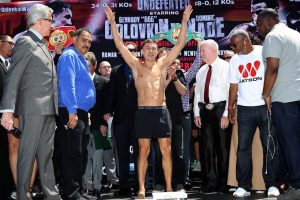
April 22, 2016 , Los Angeles, Ca. — Boxing Superstar and Unified World Middleweight Champion Gennady “GGG” Golovkin, 34-0 (31KO’s) and Undefeated Mandatory Challenger Dominic Wade, 18-0 (12KO’s) weigh in Friday in Los Angeles, California.
Boxing Superstar and Undefeated, Unified World Middleweight Champion Gennady, “GGG” Golovkin, 34-0 (31KO’s) will defend his titles (WBA, IBF, IBO and WBC “Interim’) against Undefeated Mandatory Challenger Dominic Wade, 18-0 (12KO’s) on Saturday, April 23 at the Fabulous Forum in the main event at UNDEFEATED.
Co-featured will be Consensus #1 Pound-For-Pound Fighter and WBC Flyweight World Champion Roman “Chocolatito” Gonzalez, 44-0 (38KO’s) battling World Ranked Contender McWilliams Arroyo, 16-2 (14KO’s) of Puerto Rico.
Both bouts will be televised Live on HBO World Championship Boxing® beginning at 10:00 p.m. ET/7:00 p.m. PT.
Tickets for UNDEFEATED, priced at $400, $300, $200, $100, $60 and $30, are now on sale through Ticketmaster (Ticketmaster.com, 1-800-745-3000) and the Forum Box Office.
Golovkin vs. Wade is promoted by K2 Promotions, GGG Promotions and in association with TGB Promotions. Gonzalez vs. McWilliams is presented by K2 Promotions in association with Teiken Promotions and PR Best Boxing Promotions.

It’s a many-sided fight, loaded with intrigue and potential for explosive surprises at just about every level. But will Gennady Golovkin-Danny Jacobs Saturday night sell?

It’s an HBO pay-per-view fight screaming for attention during the first week of the NCAA basketball tournament.

Although already perilously close to joining boxing at the sporting fringe from November through February, college basketball still comes off the edge and squarely into the spotlight for three weeks from mid March to early April.

It’s a spring rite, an annual fast break full of moms and pops with brackets in one hand and a few dollars to wager in the other. Office pools are everywhere and that means everybody is watching, especially during the first couple of rounds when big upsets are likely.

If you’ve ever been in Las Vegas for a fight during the first week of the NCCA tournament, you know what I’m talking about. The books are jammed. Lines stretch from the betting windows almost out on to The Strip with people wanting to bet on the next Cinderella. A very good fight might be at the casino’s arena that Saturday night. But nobody knows about it.

In America’s virtual village, Golovkin-Jacobs, at New York’s Madison Square Garden, is that fight. Looks to be good, could be great. Jacobs is a terrific story. He beat cancer and he’s been beating everybody in front of him ever since.

Golovkin (36-0, 33 KOs) has been that force of nature, an unbeaten and unstoppable middleweight who hopes to pound out a legend the equal of any in a division with a rich history. His bout against Jacobs has been called a steppingstone to a bigger confrontation with Canelo Alvarez. Yet, Jacobs (32-1, 29 KOs) is a challenge – perhaps GGG’s biggest ever as he approaches another birthday. He’ll be 35 on April 8.

If the fight had been in mid-February or mid-April, it would have had a better chance at a solid PPV number. In an era of declining expectations, solid would mean anything from, say, 250,000 to 300,000. GGG’s pay-per-view sample is too small to judge. He has fought on PPV only once, against David Lemieux in October, 2015 in an HBO telecast that did a reported 150,000.

With the Canelo showdown still on the horizon and the compelling Jacobs story as part of Saturday’s promotion, there’s more reason to watch. But it happens on a day with second-round NCAA tournament games on CBS, TNT and TBS scheduled from noon (ET) to 9:30 p.m. (ET) and all without a PPV price tag.

The day’s final tournament game is scheduled a half-hour after the start of the PPV telecast of a card that includes pound-for-pound king and junior-bantamweight Roman Gonzalez (46-0, 38 KOs) against Srisaket Sor Rungvisai (41-4-1, 38 KOs).

It’s a good card. Maybe great. On a day full of basketball for free, however, is it worth $54.99 for the standard telecast, $64.99 for high-def? After wall-to-wall hoops, I’m guessing a lot of casual fans will just pass and wait for the replay.

That’s unfortunate, especially for the under-appreciated GGG, Jacobs and Gonzalez.

GGG, who sells out arenas, draws a solid audience in non-PPV bouts. His victory over Kell Brook in September drew 843,000 for a London bout that happened earlier in the day in the U.S. His April victory over Dominic Wade at The Forum in Inglewood, Calif., posted a biggie, 1.34 million.

Let’s assume Golovkin does the expected and beats Jacobs. If the victory is spectacular, yet the PPV number isn’t, it creates a potential complication for him in negotiations with Canelo, whose May 6 bout with fellow Mexican Julio Cesar Chavez Jr. could be PPV blockbuster. Let’s assume Canelo does the expected and beats Chavez Jr., yet with a PPV number three to four times bigger than GGG’s number against Jacobs.

What should be a 50-50 fight, won’t be in terms of what Canelo says he’s worth. He’ll ask for the lion’s share of a 60-40 or 55-45 split. GGG, who has been the consensus champ at 160, wouldn’t be the first fighter to be insulted by that kind of proposal. He also wouldn’t be the first to walk away from the table, further delaying a fight the business desperately needs.

That begs a question: On a weekend dominated by attention on the NCAA tournament, why-oh-why is GGG-Jacobs on pay-per-view? That answer is a slam-dunk.


No, No: Boxing biz moves on despite combo that didn’t happen

By Norm Frauenheim-

A couple of things didn’t happen during the last week, neither one much of a surprise and yet both significant for a sport that is either dying, or rebounding, or just going nowhere.

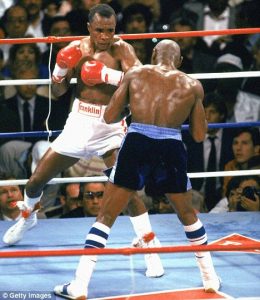
Item One: Nothing about Keith Thurman’s split decision over Danny Garcia last Saturday resembled Sugar Ray Leonard’s classic over Thomas Hearns in 1981. It was more like the Leonard-Hearns rematch in 1989. Don’t remember that draw? Neither does anybody else.

Item Two: Manny Pacquiao and Amir Khan announced a fight in the United Arab Emirates and then found out a promised $38-million was, well, fake news. The real story: There was no money, no fight at all.

What to make of it?

Bottom line, there is no more lotto at the end of a boxing rainbow that appeared like an illusion in 2015 when Floyd Mayweather Jr. collected between $220-and-$230 million for a dull bout that netted Pacquiao a reported $180 million.

Promoter Bob Arum, who warned Pacquiao about another UAE tease, told the Los Angeles Times that the Filipino and advisor Michael Koncz “were talking to the wrong people.’’

Truth is, there are no right people anywhere – not in the UAE, or Dubai, or Vegas, or New York — willing to invest $38 million in a boxing card these days.

The business is starting over, which might be bad news for Pacquiao, a Filipino Senator who is generous to a fault and always looking for a way to fund his next political campaign.

He needs the money. That’s no secret. If the Senator is entering his prime as a politician, however, he’s past his peak as a fighter. No secret there, either.

Pacquiao, who was guaranteed $4 million for a victory over Jessie Vargas in his last bout, is caught in a changing market. The irony is that he helped fuel the astonishing run-up of purses that climaxed with his loss to Mayweather.

Now, however, there are younger welterweights willing to fight for a fraction of the wages he and Mayweather earned.

That brings us back to Thurman and Garcia. Each had career-high guarantees of $2 million for a CBS fight that generated big ratings in prime time. The audience averaged 3.74 million over the 12 rounds and peaked at 5.1 million.

The fight itself is hard to judge in terms of whether it won over some disaffected fans. There were no knockdowns. Over the final three rounds, Thurman played it safe, staying out of harm’s way. The split scorecards say that was a risky tactic. But, in the end, it worked for him.

The bigger debate is about whether the bout was another turn-off for casual fans. The guess in this corner: It wasn’t. There was no pay-per-view, a fee that almost ensures outrage if it isn’t a classic.

The parallel to the first Leonard-Hearns bout was an impossible reach. But it was free. It didn’t cost anybody $100 for the right to get bored and then angry, all in high definition.

In part, that was always Al Haymon’s plan when he introduced Premier Boxing Champions a couple of years ago. He foresaw that pay-per-view was killing the business. His validation rests in the numbers for CBS’ primetime telecast.

Mayweather-Pacquiao set a pay-per-view record. At its peak, the 5.1 million for Thurman-Garcia was bigger than the 4.6 million PPV number for Mayweather-Pacquiao.

Under the old PPV model, Thurman and Garcia would still be invisible to casual fans. They aren’t now. They are introducing themselves to a bigger audience and doing it for price that might sustain the business as it finally moves into the post Mayweather-Pacquiao era.


Back To The Future: Leonard Sees It In Thurman-Garcia

By Norm Frauenheim-

Boxing loves history. It remembers, yet it can’t repeat. Not yet, anyway. I’m not sure it has to. These days, just a good fight is enough. Keith Thurman-Danny Garcia Saturday in CBS prime time looks as if it fits the latter part of the bill.

With the year only a couple months old, it’s the best in 2017 thus far. It has a chance to be better than anything seen last year. History can wait, perhaps on a rematch in the evolution of a classic rivalry. Yet, the parallels are there, as irresistible as they are inevitable. In part, that’s why Sugar Ray Leonard will be there as a CBS analyst and a ringside symbol of what the sport would like to be all over again.

Thurman, the WBA’s welterweight champion, and Garcia, the WBC champ, are fighting for the same titles that were at stake when Leonard and Thomas Hearns battled each nearly 36 years ago in a September, 1981 bout that ranks among the all-time classics.

Changes since Leonard prevailed — retaining the WBA’s belt and taking the WBC’s version from Hearns in a 14th-round stoppage– at an outdoor ring behind Las Vegas Caesars Place and before a reported network television audience of 300 million – have forever altered boxing. There are countless titles and more television networks than acronyms. There are fewer fighters these days. More great athletes risk head trauma on the football field than they do in the ring anymore.

“Fortunately, I was in an era where there were just a lot of guys out there who were so talented,’’ Leonard said during a conference call before Saturday’s bout (PT 6-8 pm/ET 9-11 pm) at Barclays Center in Brooklyn.

For Leonard, there were so-so many, although it’s ironic that the rivalry with Hearns was a business partnership that fell short of its potential. They fought a second time, nearly eight years later in 1989.

But it was forgettable, a draw that left nobody interested in a third step of a trilogy. Still, there was Roberto Duran and Iran Barkley and Marvin Hagler and all of the other legends of that time. There were so many chances at creating legacies, and Leonard, Hearns, Duran and Hagler did exactly that.

There aren’t as many opportunities these days and perhaps the willingness to do so just isn’t there anymore. The game conducts itself according to Floyd Mayweather Jr.’s business model: The biggest reward for the smallest risk. It worked for Mayweather, who fulfilled his Money nickname millions of times over. But it has created problems for fighters who might have had a better chance at a legacy for themselves in Leonard’s era.

“I always thought that we had to continue to raise the bar as a fighter, as a champion, and continue to fight better and better competition,’’ he said “When I was fighting, I swear, I wanted to be the underdog -psychologically, spiritually and mentally. If I wasn’t challenged, if I wasn’t considered somewhat of an underdog, I couldn’t perform the way I normally would. It’s what would get me going.’’

For Thurman (27-0, 22 KOs) and Garcia (33-0, 19 KOs) those kind of challenges loom in a bout that is only the third between unbeaten welterweight champions and the first since Felix Trinidad’s controversial victory over Oscar De La Hoya in 1999.

Thurman-Garcia is also intriguing for elements not reflected in their records. Thurman is a compelling personality. He is boxing’s enlightened warrior, a fighter who studies Eastern religions, plays music and talks philosophy.

He’s likable, the flip side to Danny Garcia’s offensive trainer and father, Angel, whose racial slurs at a news conference a few weeks ago left questions about whether the New York State Athletic Commission would license his to work the corner. It did, which adds a controversial edge. Will Angel’s presence put additional pressure on his son?

Danny Garcia is likable in his own way, but his father has turned him into the bad guy. Every great fight needs some good-and-evil, but Danny Garcia has been forced into an ill-fitting role by an offensive dad.

Meanwhile, the ever-poised Thurman has kept his cool throughout the race-baiting rhetoric from Angel Garcia. At opening bell, however, will he be motivated to make the son pay for what the dad said? There’s a danger in that, too especially against the counter-punching Danny Garcia, whose left is as lethal as any if it is allowed to land.

There’s potential on several levels for the kind of fight that Leonard experienced and endured.

“It is an out-of-body experience,’’ said Leonard, who on Wednesday picked Thurman to win. “It’s déjà vu. Like holy, I’m 60. It’s a kind of thing that is so special. It’s so rare of a unification. it seems like. It speaks volumes to me as far as the significance of it. And these guys, Keith and Danny, they know it.

“They realize it.”

Leonard has been there. Maybe, Thurman Garcia and will get there.


BJ Flores delivers a stoppage in his heavyweight debut


PHOENIX, Ariz. – BJ Flores is a good talker. He’s known for his commentary. But his identity is still on the dangerous side of the ropes.

“I just wanted to remind people that I can still fight,’’ Flores said.

That reminder was delivered definitively and with hands as fast as ever Saturday night at Celebrity Theatre on an Iron Boy Promotions card. Flores has moved up the scale, beyond 190-pounds and into the heavyweight division. Nobody will ever confuse Jeremy Bates with a heavyweight contender. He was more Butterbean than Anthony Joshua.

But it was a new beginning for Flores (33-3-1, 21 KOs), who blitzed Bates (26-19-1, 22 KOs) with quick combos, scoring two knockdowns for a first-round TKO victory in his heavyweight debut.

“I’m ready to go again, right now,’’ said Flores (33-3-1, 21 KOs), a former cruiserweight contender who hopes to answer another opening bell in May. “My hand speed is still there. I think that speed can give a lot heavyweights a lot of trouble.’’

Flores weighed in at 223 pounds. He said he wants to be even heavier next time around. But against whom? He’s not calling out Joshua or Wladimir Klitschko. He didn’t call out Deontay Wilder, who retained his WBC title Saturday with a stoppage of Gerald Washington in Birmingham, Ala. But he did mention Lucas Browne.

Meanwhile, more work at ringside commentary figures to be there for the fighter, who gained international prominence for his insight on NBC. If given a choice between another network job and a fight, Flores said he’d take the fight.

“Every time,’’ he said. “That’s what I do and I think I’ve still got a lot left in me.’’

On Saturday night, not even commentator could argue with that

In a co-main event, there was not much action. But there was a knockdown and one was enough for Phoenix middleweight Andrew Hernandez (18-5-1, 8 KOs), who scored it in the first round with an overhand right that dropped Siju Ade Shibaz (6-3, 2 KOs), also of Phoenix. Nine rounds later, Hernandez had a bloodied left eye, a victory by unanimous decision and the WBA’s national versions of the 160-pound title.

On The Undercard
The Best: Super-flyweight Luis Espinoza of Mesa, Ariz., has a prospect’s power in his hands, agile speed in his feet and a trainer with some world-class credentials. Add it all up and Christian Bartolini of Mexico never had had a chance.

Espinoza (6-0, 2 KOs), who had former Timothy Bradley trainer Julio Diaz in his corner, tagged Bartolini (1-3-1) with a short left – precise as it was powerful – for a fourth-round stoppage.

The Rest: Phoenix flyweight Adrian Servin ((3-0, 1 KO) struck early, held on late and prevailed at the end of a back-and-fourth four rounder for a unanimous decision over bloodied, yet resilient Jesus Godinez (0-1) of Mexico.

Junior-lightweight Viktor Slavinsky (1-0, 1 KO) traveled a long way from his native Ukraine. He didn’t forget to pack the power in his right hand. It rocked Mexican Oscar Quezada (3-8-1, 2 KOS) immediately and repeatedly, scoring a second-round stoppage in an impressive debut for Slavinsky.

Marine and combat vet Jamie Bojado (1-0, 1 KO) of Phoenix displayed some resilience, recovering from a head-rocking blow with two quick knockdowns for a first-round stoppage of El Paso welterweight Shem Prieto (0-1).

Another Ukrainian, junior-middleweight Yulian Tembotou ((1-0, 1 KO), dominated the Phoenix ring as though he were at home, landing a crippling body shot for a first-round stoppage of Brandon Davis (1-1) of Ohio.

Mesa junior-lightweight Jose Ibarra (1-0), capitalized on his power, scoring a unanimous decision of crosstown rival Joel Moran (0-1) of Phoenix.


Canelo, Chavez Jr. shake hands, but don’t bet on it

By Norm Frauenheim-

Okay, we’ve all seen it. Canelo Alvarez and Julio Cesar Chavez Jr. shook hands on a bet that begs another wager.

Real?

Phony?

Promotional show?

Odds are, it’s the third – all for show. Odds are, neither fighter could afford the payoff. Let’s say the purses for their HBO pay-per-view bout on May 6 at Las Vegas T-Mobile Arena are close to what each fighter says they are – $24 million for Canelo and $6 million for Chavez.

Is either fighter going to throw away that kind of a guarantee on something as fickle as a lucky punch, or a lousy judge, or inadvertent slip on a slick stretch of canvas? Didn’t think so.

And what trainer, or manager, or bucket guy, or promoter, or gofer would continue working for a fighter who just bet his whole purse? These guys work for a living, too. They need their piece of the purse just to eat. They’ll get an attorney before they let this bet rob them of their livelihoods.

In the wake of their handshake in front of television camera at a Univision studio Wednesday in Mexico City, Chavez Jr. – of all people — sounded like the grown-up in what appeared to be a spontaneous moment brought on by Canelo’s sudden willingness to risk it all.

“Let’s see what the exact terms of the bet are going to be,’’ Chavez Jr. said through an interpreter who might have been a lawyer.

Meanwhile, Bob Bennett, executive director of the Nevada State Athletic Commission, sounded skeptical about the bet in comments to the Los Angeles Times.

“I’m not sure out deputy attorney general would even allow it,’’ Bennett told the Times.

At least, he wouldn’t allow it in Nevada. But who’s to say that they couldn’t live up to the handshake-seen-across-the world, days after the bout and after both have returned to Mexico?

The cynic in me says there are better bets on what really could happen.

To wit: There’s a pretty good chance that Chavez Jr.’s purse will be at least $1 million lighter on the day before opening bell. According to contract terms, he pays $1 million to Canelo for every pound he is over the 164.5-pound catch-weight. Chavez’ problems on the scale aren’t a secret.

To wit: There’s a pretty good chance Chavez Jr., a 4-1 underdog, gets frustrated late in a one-sided fight. With nothing to lose, he throws a low blow or an elbow, injuring Canelo in way that further delays the showdown with Gennady Golovkin. That’s a losing bet for a business that desperately needs Canelo-GGG in the wake of lousy 2016.

That said, Canelo-Chavez Jr. looks like a very good preliminary to this year main event. That handshake on a winner-take-all bet makes it all the more entertaining. It gets people talking about what they imagine boxing is all about.

Or should be all about.

Limbs are at risk. Their lives are at risk. But the money? Don’t bet on it.


BJ Flores ready to make heavyweight move Saturday


PHOENIX, Ariz. – BJ Flores moves up the scale, from cruiserweight to heavyweight, in a fight to re-ignite his career Saturday night at Celebrity Theatre.

Flores, who is known for his insightful commentary as a boxing analyst for NBC, lost a third-round TKO in a bid for the WBC’s cruiserweight title to Tony Bellew in the UK on Oct. 15.

At 38, the former cruiserweight contender steps into the heavyweight ranks on the same day that WBC champion Deontay Wilder tries to regain momentum in his career against Gerald Washington in Birmingham, Ala.

Flores (32-3-1, 20 KOs), who lives in Chandler, Ariz., is scheduled to face Jeremy Bates (26-18-1, 22 KOs), a heavyweight from Charleston, W.V, who is coming off a loss to Oscar Rivas last June in Montreal.

Flores-Rivas is the main event on an Iron Boy Promotions card. Seven bouts are scheduled. First bell is scheduled for 7 p.m. (MST).


Business might force Lomachenko to move up the scale


By Norm Frauenehim
Pound-for-pound recognition comes with a lot credentials. But it doesn’t pay the bills. In fact, it often makes a good payday harder to find.

Vasyl Lomachenko, whose rapid rise to pound-for-prominence is unprecedented, is finding out just how hard it can be.

During a conference call Wednesday for an April 8 title defense against Jason Sosa, Lomachenko, already a pound-for-pound contender after only eight pro fights, expressed frustration about the way potential fights fall apart. Why? His varied skillset is just too much of a risk for opponents looking for a way to get ahead.

“Other champions were running like rats from a sinking ship and not coming into the ring,’’ said Lomachenko, who will defend his WBO 130-pound at MGM National Harbor in Oxon Hill, MD, in an HBO-televised bout. “Nowadays, it’s not about the sport. All of the boxers have become businessmen and they are looking just to get the money and not the glory.’’

There’s no protein in glory, of course. Prize-fighting – emphasis on prize – is strictly business, especially for aging fighters. Lomachenko was hoping for a rematch with longtime gate-keeper Orlando Salido, who beat the two-time Olympic gold medalist in the Ukrainian’s second pro bout in March 2014. But after 61 bouts, the 36-year-old Salido might be looking for more than just one more payday. A likely loss to Lomachenko in a rematch would probably mark the end of his chances at another good purse.

“Yes, I was a little disappointed,’’ Lomachenko said when asked what he thought of futile negotiations with Salido. “Ass far as I knew, everything was moving along and everything was agreed to. Then all the sudden, they turned around and said he wasn’t going to fight. But, you know, such is life.’’

The good news for Lomachenko is that his professional life is just beginning to unfold. For now, he’s at that never-never stage, a career step as inevitable as it feared for some of the best. Being feared also means you’re avoided. But there are ways out of the dilemma, especially for a 28 year-old fighter who still appears to be a year or two from his prime.

At a lanky 5-foot-6, Lomachenko looks as if he has room to grow up and out of the junior-lightweight division.

“If the thing is going to go like it is today — everybody running away and not fighting me — I will be forced to go to 135 pounds,’’ he said “I would hope that the guys at 135 would be standing up and coming to fight.’’

That brings us straight to a potential mega fight with Mikey Garcia, who came out of his frightening knockout of Dejan Zlaticanin on Jan. 28 with a third title at a third weight and his own share of pound-for-pound recognition. Would a Garcia-Lomachenko fight happen right away? Nothing ever does in boxing anymore. But Garcia sounds willing and Lomachenko’s current career path seems to make the bout more likely, perhaps early next year.

Garcia, who has added scary power to his brilliant tactical skill, has already achieved some of what Lomachenko is pursuing.

Lomachenko joked on the conference call that he doesn’t see a pound-for-pound contender when he looks in the mirror

“I am usually working on my hair at that moment,’’ he said.

When he does look at the 135-pound lightweight division, however, he sees himself at the top of the pound-for-pound debate.

“If you want to just talk regarding me as a pound-for-pound fighter, I would probably say that I will probably be the No. 1 pound-for-pound after I beat a couple of champions at 135,’’ he said.

From promoters to networks to fans, Lomachenko-versus-Garcia would look awful good in any mirror.

Attachments area


Nevada Fame: Carbajal voted into the Hall where his fame began

PHOENIX, Ariz. –Michael Carbajal has always been known best for what he did in Nevada. It’s where he staked his first claim on real fame. It’s fitting that he’ll be remembered there too when he is inducted to the Nevada Boxing Hall of Fame.

“It’s an honor, a real honor, to be voted into a Hall alongside the great, great fighters who fought in boxing’s mecca,’’ said Carbajal, who will be inducted to the Nevada Hall in a class that includes Thomas Hearns, Salvador Sanchez, Erik Morales, Michael Spinks, Leon Spinks, Ken Norton, Lucia Rijker and Richie Sandoval.

Sandoval, a former bantamweight champ, talked Top Rank’s Bob Arum into signing Carbajal, a junior-flyweight. It was the first time Arum had ever promoted a fighter in one of boxing lightest divisions.

Carbajal’s most memorable moment came on March 13, 1993 at the old Las Vegas Hilton. That’s when he got up from two knockdowns, one in the second round and again in the fifth, to score a dramatic seventh-round KO of rival Humberto Gonzalez.

The victory earned him a rematch and $1-million paycheck, the first ever for s junior-flyweight. Gonzalez beat Carbajal in controversial decisions in subsequent rematches, the first in Los Angeles and the second in Mexico City. But the only one anybody remembers is that first one in Vegas on a memorable Nevada night.

Carbajal, now 49, had 53 pro bouts, winning 49 and losing four. He scored 33 knockouts, including a stoppage of Jorge Arce in his last bout in 1999. He is remembered as one of history’s greatest little guys, alongside Gonzalez and Ricardo Lopez. He was inducted to the International Boxing Hall of Fame in Canastota, N.Y., in 2006.

He won an Olympic silver medal for the United Staes at the 1988 Seoul Games. He continues to live in the downtown Phoenix home where he grew up. He works with kids at his Ninth Street Gym.

Carbajal and his fellow inductees will be honored at a dinner on Aug 12 at Vegas’ Caesars Palace.


Power Player: Mikey Garcia’s big KO lights up his career

By Norm Frauenheim-

Power speaks for itself. Find it, and a fighter doesn’t need words. He already has the singular answer for nearly every question. Just ask Mikey Garcia.

With one frightening flash of power a couple of weeks ago, Garcia ignited an interest in him that hadn’t really been there until he left Dejan Zlaticanin on his back, as lifeless as a flat board, under the ring ropes at Las Vegas MGM Grand.

Just like that, Garcia was somebody he had never been. He was scary, scary good.

The cognoscenti had always appreciated him for his tactical skill and evident smarts. Amid boxing’s chaos and carnage, Garcia was an example of an art form seldom seen in a scarred game sometimes called the sweet science. But an if or two were also attached to him.

He was too much the craftsman, a precise artist who could paint by the numbers as effectively as anyone. It was art all right, yet without the edgy anticipation that it could all end with one broad brush. Art is good in a museum, but it doesn’t do well on pay-per-view.

Garcia transformed himself from very good to potential stardom with a signature knockout of Zlaticanin in what had been considered a risky fight on the undercard of Leo Santa Cruz’ rematch victory over Carl Frampton.

Santa Cruz-Frampton was an entertaining bout, good enough to probably make a third one inevitable. A couple of days after, however, it had come and gone. But there is still talk about Garcia, whose knockout of Zlaticanin might be the biggest at the MGM Grand since Manny Pacquiao lifted Ricky Hatton off his feet and dropped him onto the canvas in a lifeless heap for several long moments in May 2009. Power has its own momentum, too.

There are stories and questions all over social media about who and what are next for Garcia, who won his third title in a third weight class in only his second bout since more than two years on the shelf during a contract dispute with Top Rank.

“I could get back very, very soon,’’ said Garcia, who is already back in top the 10 of the various pound-for-pound rankings. “I don’t want to wait.’’

Nobody else wants to wait either. Hopefully, he’ll get a chance this summer to unite the 135-pound title against the winner of Anthony Crolla’s challenge on March 25 of Jorge Linares, The Ring and WBA champion. There are also possibilities against WBO champ Terry Flanagan and Robert Easter Jr., the IBF’s belt holder.

But all of it sounds like a prelude to what could be one game’s next mega fight. Terence Crawford, the current champ at 140, has been speculated.

The other, Vasyl Lomachenko, is even more intriguing. In terms of style, Garcia-Lomachenko always has loomed as a chess match between two the game’s re-eminent masters. Garcia’s newfound power introduces a whole new element.

“I would definitely take on a challenge like that if he comes up to 135,’’ Garcia said after his victory over Zlaticanin. “He’s still at 130. If he decides to move up, we’ll talk. But it’s not up to me. It’s up to him to move up.’’

The good news is that Lomachenko is already thinking about a move to 135, according to his promoter, Bob Arum, who told ringtv.com Tuesday that he expects the two-time Olympic gold medalist to make the jump by the end of this year.

That begs another question. Would Arum, also Crawford’s promoter, be willing to do business with Garcia after the prolonged contract dispute? More good news. Arum told the Las Vegas Review-Journal last week that, yeah, he would.

“If the fight makes sense, then why not?” Arum said. “Whatever happened between Garcia and us is in the past. The one thing I have learned is to never hold grudges. If a fight with Lomachenko or Crawford makes sense, and if there’s a market for that fight, we would be open to it.”

Power is about business, too.


AZ junior-lightweight Abel Ramos back on ShoBox

By Norm Frauenheim-
Abel Ramos is back on ShoBox Friday night on a card in Miami, Okla., for another chance at a minor belt he hopes will serve as a springboard into the mix for a world title.

This time ,it’s for a USBA junior-lightweight title against prospect Ivan Baranchyk (13-0, 10 KOs), a Russian living in Brooklyn.

“He likes to fight moving forward,’’ said Ramos, of Casa Grande, Ariz., south of Phoenix. “So do I.’’

In Ramos’ only defeat, the aggressive 130-pounder lost a ninth-round TKO to Regis Prograis, who won the NABF’s version of the belt and has since won two more bouts to remain unbeaten at 18-0, including 15 knockouts.

Ramos, who has won three straight since the loss, promises a violent collision. Baranchyk, nicknamed The Beast, promises something more.

“I will enjoy knocking him out,’’ he said.

Showtime’s ShoBox card is scheduled to begin at 10:05 p.m. ET/PT. Three fights are scheduled. A heavyweight bout featuring Lippe Morrison, the son of late heavyweight champ Tommy Morrison, was canceled. The unbeaten Morrison, who was scheduled for an eight-rounder against Daniel Martz, suffered a cut above his left eye in training.


Heavyweight Tales: Povetkin a mystery wrapped in mess

By Norm Fraienheim-

Anthony Joshua and Wladimir Klitschko arrived in New York this week for a timely news conference that helped deflect attention on the bizarre circumstances that continue to unfold in the wake of Alexander Povetkin’s positive test for a banned substance in December.

The prospect of Joshua-Klitschko on April 29 in front of a projected crowd of 90,000 at London’s Wembley Stadium offers some hope in what looks like the most compelling heavyweight fight in years. The flip side is Povetkin, a mystery wrapped in a mess.

Two days after Joshua and Klitschko met the media at Madison Garden, there were reports from Russia that Povetkin’s B-sample came up positive for the PED that forced a cancellation of his Dec. 17 bout against Bermane Stiverne for the World Boxing Council’s interim belt in Ekaterinburg, Russia.

It’s hard to know what to make of the early reports from Russia. Donald Trump might believe them. Without some confirmation from The Associated Press or some other mainstream outlet, however, it’s wise to be skeptical. The test of the B-sample was conducted in Los Angeles. The original test was reportedly done on Dec. 6, presumably in Russia.

I tend to believe initial stories abut the B- sample, which confirmed that there were traces of Ostarine, a steroid, in Povetkin’s A-sample. Here’s why: Quotes defending Povetkin and questioning the integrity of the testing process from promoter Andrey Ryabinsky and a Russian lawmaker were included in reports about the B-sample.

It was as if they knew what the result would be.

Ryabinksy said Povetkin came up clean in “alternative tests” conducted in Lausanne. Somehow, this sounds like those “alternative facts” that Trump staffer Kellyanne Conway introduced to today’s Orwellian rhetoric.

Then, there was a reported lawmaker and chairman of a sports committee, Mikhail Degtyaryov, who was quoted as saying: “The provocation against Povetkin exposed the fragility and weakness of the anti-doping system.’’

The Russian lawmaker didn’t mention that other system, state-sanctioned doping, which The New York Times exposed in May 2016. Not even Vladimir Putin could completely deny that report. It resulted in a partial ban of the Russian track-and-field team at last summer’s Rio Olympics. Ramifications continue.

On the same day that there were reports from Russia about Povetin’s B-sample, Reuters reported that the International Olympic Committee stripped the Russian women of the 400-meter relay silver medal from the 2012 Olympics after Antonina Krivoshapka’s B-sample came up dirty.
https://sports.yahoo.com/news/ioc-sanctions-three-athletes-anti-doping-breaches-092922488–oly.html

It’s impossible to separate Povetkin, a 2004 Olympic gold medalist, from the rest of Russia’s sports system. I don’t know him. I’ve never met him. I liked his boxing skills and he might have beaten Deontay Wilder in Moscow last May. But that one got cancelled, too, when Povetkin tested positive for meldonium.

Regardless of whether he gets sanctioned or suspended, the best guess is that Povetkin will simply fade from the scene, forgotten amid all the attention on Joshua and Klitschko. The game will move on.

The question is whether Wilder can regain the momentum he had before the cancellation. It cost Wilder a reported $4.5 million and a lot more. In an effort to stay busy, he fought and beat Chris Arreola in July, but he suffered costly injuries to his right hand and biceps.

He’ll test the hand and arm in a Feb. 25 return against former football player Gerald Washington, who replaced Poland’s Andrzej Wawrzyk. Wawrzyk got bumped off the card because – yeah, you guessed it – he came up dirty in drug testing.

It’s fair to wonder whether Wilder would have beaten Povetkin in a Moscow victory big enough to put him first in line for Joshua. Could it have been Wilder at New York’s news conference instead of Klitschko? We’ll never know. Then again, we’ll never know a lot of things in a world growing curiouser and curiouser.


Trilogy Talk: It is inevitable after Santa Cruz beats Frampton in rematch


LAS VEGAS –Anybody for a trilogy?

It appears inevitable, a third step in a match of styles, personality and culture between two likeable featherweights who are even after two fights. It was hard to pick the winner in either.

But on the scorecards, Leo Santa Cruz has won one and Carl Frampton has won one. Each by majority decision.

Santa Cruz returned the favor Saturday night at the MGM Grand, winning 115-113 on two scorecards in a rematch of his narrow loss to Frampton last summer in Brooklyn for the WBA’s 126-pound title.

There was plenty of debate about the cards at ringside and in the ring in the bout’s immediate aftermath. There were questions about judge Burt Clements’ 114-114 score. There were arguments that the two-point margin on cards kept by Dave Moretti and Glenn Feldman should have been bigger.

There was consensus only in the middle of the ring. After the scores were announced, Santa Cruz (33-1-1, 18 KOs) and Frampton (23-1, 14 KOs) embraced.

“They told each other: ‘Let’s do it again,’ ‘’ promoter Richard Schaefer said after a PBC bout televised by Showtime.

Will a third fight settle anything? Maybe. Maybe, not. Santa Cruz and Frampton always figure to be in fight too close to call. In the second bout, Santa Cruz looked more comfortable, perhaps because his father and trainer, Jose, was back and healthy after a bout with cancer that kept him out his son’s corner last summer.

“Before the fight I said I wanted revenge and I wanted to work hard,’’ Santa Cruz said. “I went to the gym and I worked hard and I did what I had to do.

“Carl Frampton is a good fighter. Let’s make it a third fight.’’

Frampton didn’t argue. Not about Saturday’s result or the call for a second rematch.

“I really think Leo deserved it,’’ Frampton said
“He told me what he was going to do. The brawler was out-boxing the boxer. My fault. I’m sorry. We will have to do it again. We have to do it again.

“He was very clever and he used his reach. I think he deserved it. I’m being honest. I think he deserved it. But it was a very good fight. I think I can perform slightly better. No excuses.

“Let’s do it again.

Santa Cruz was more effective with his punches. His timing looked a little sharper and his defense was as good as perhaps as good as ever. Still, Frampton was always there, changing up on his tactics from round to round, minute to minute.

There were no knockdowns, although Frampton slipped in the fourth. There wasn’t even a moment when either fighter appeared to be in real trouble. Instead, it was tactical, a chess match at almost every turn.

A crowd 10,085, including Floyd Mayweather Jr., loved it. The house sounded as if it was split, 50-50. There were the Irish fans who traveled from Belfast with song, beers and cheers for Frampton. On the other, there were the Mexican and Mexican-Americans who chanted “Leo, Leo.’’

They’ll be back for another go-round. It’s time to order up a trilogy.

Mikey Garcia has always been known for tactical brilliance, versatility and smarts. There’s something else now, too. He’s scary.

The fear factor in Garcia (36-0, 30 KOs) struck suddenly and lingered long with a knockout of Dejan Zlaticanin in the third round of a WBC lightweight title fights before the Carl Frampton-Leo Santa Cruz rematch on Showtime Saturday night at the MGM Grand.

Zlaticanin (18-1, 11 KOs) came into the bout with a reputation for dangerous power. He was supposed to be the feared fighter. Turns out, he never had a chance.

After two-plus rounds of controlling pace and distance with a precise jab, Garcia turned him sideways with an uppercut, then stepped around and dropped him with a right that might be remembered 11 months from now as the biggest punch in 2017

Zlaticanin went down, under the bottom ropes, flat on his back and as motionless as a board for several long, scary moments. The ringside physician scrambled to revive him with oxygen through a plastic mask. For Garcia, jubilation at a big victory was suddenly supplanted by concern. He was worried and you could see it in his face.

Finally, Zlaticanin got to his feet and walked out the ring. The crowd was relieved and Garcia said it best with is first post-fight word.

“Thank God, he’s okay,’’ said Garcia, who has more than just ring smarts.

There was patience early and power in the end.

That proved to be the perfect combo for Ukrainian lightweight Ivan Redkach (20-2-1, 16 KOs), who controlled tempo for seven-plus rounds and finished Demond Brock with a lightning bolt of a counter left hand late in the eighth in the final fight on the Showtime Extreme part of the Santa Cruz-Frampton card Saturday night at the MGM Grand.

The left and a subsequent follow-up dropped Brock, who somehow managed to get up. But it was only a matter of time. Make that seconds. Redkach quickly attacked, forcing referee Jay Nady to end at 2:30 of the eighth.

David Benavidez took another step from prospect to contender.

A big one.

Benavidez, the younger brother of former junior-welterweight champion Jose Benavidez Jr., scored a powerful stoppage of Sherali Mamadjanov of Uzbekistan on the Showtime Extreme part of the Frampton-Santa Cruz card Saturday night at the MGM Grand.

Benavidez (17-0, 16 KOs), a super-middleweight from Phoenix, scored a first-round knockdown and then finished Mamadjanov (14-2, 7 KOs) with successive left hands at 1:04 of the second.

Scottish junior-welterweight Josh Taylor stayed unbeaten, yet not perfect.

Taylor, whose reputation for power preceded him, improved to 8-0, yet he had to settle for his first victory without a KO in a unanimous decision over Mexican Alfonso Olvera (8-2-1, 3 KOs), who withstood everything the Scotsman threw at him in the first televised bout on the Showtime Extreme part of the Frampton-Santa Cruz card Saturday at the MGM Grand.

Taylor’s feared left rocked Olvera in the fourth. The Mexican stumbled, but would not fall then or at any other time during the next four rounds.

Ledaun Barthelemy, a Mayweather Promotions prospect from Cuba and the brother of former lightweight champion Rances, continued to show promise, adding another victory to his unbeaten record (12-0, 6 KOs) with a unanimous decision over unknown Jesus Aguinaga (5-5-1) in a six-round featherweight bout.

Jose Santa Cruz was 2-0 Saturday before his son Leo even arrived at the MGM Grand Garden Arena for the main event against Carl Frampton.

Jerry Perez, a Jose Santa Cruz-trained featherweight from Harbor City, Calif., needed only 54 seconds to win his pro debut, a three-knocodwon wipeout of overmatched and overwhelmed Javier Cepeda (0-5) of Roswell, New Mexico.

Echoes, empty seats, Herbert Acevedo and Chris Singleton opened the show.

Four hours before the start of a Showtime telecast featuring a Carl Frampton-Leo Santa Cruz rematch at the MGM Grand Saturday, Acevedo, a Los Angeles welterweight, prevailed, winning a six-round unanimous decision over Singleton of Baton Rouge, La.

Acevedo (13-2, 6 KOs) threw a short body shot, flooring Singleton (17-4-2, 8 KOs) in the second round. Singleton got up up and fought through the remaining four-plus rounds, yet could never overcome the early knockdown. The card’s opening bout might have been a good sign for Santa Cruz, whose father and trainer, Jose, was in the corner for Acevedo.

Belfast West: Frampton’s fans jam the weigh-in for Santa Cruz rematch

By Norm Frauenheim

LAS VEGAS – The dateline is accurate. But the feeling was something else. More like Belfast.

Carl Frampton’s fans, Framptonistas, were there, transforming a weigh-in Friday at the MGM Grand Garden Arena for a featherweight rematch Saturday with Leo Santa Cruz into a scene that resembled a Belfast pub at last call.

There are some conflicting numbers about just how many Belfast fans traveled the 4,896 miles to Las Vegas. One estimate put them at 4,000. There’s another one at 5,000. There’s a third at 5,500. Whatever it is, it had to surprise Santa Cruz, a Los Angeles resident who thought – perhaps hoped — he would be the crowd favorite.

Santa Cruz wasn’t in Brooklyn last July when Northern Irish fans jammed Barclays Center for Frampton’s victory by majority decision. If the weigh-in was any indication, Frampton is at home just about anywhere. Where ever he fights, Belfast follows.

There was no difference on the scale. Both featherweights were at 125 pounds. But on any scale that measures noise, Frampton was the deafening favorite. There were flags, chants, beer, beer and more beer. Did we mention beer?

A personal memory: A couple of years ago, I traveled to Belfast. After touring the city’s turbulent history and the wall that symbolizes what it citizens call “The Troubles,’’ I checked into a downtown hotel.

Some time in the early morning, I awakened by the sound of trash cans. After long night at a pub, some kids were kicking them down the street like soccer balls and screaming: “I’m effing Irish, so do something about it.’’

Those kids are here. Will it matter? Frampton (23-0, 14 KOs) is a slight favorite in the Showtime televised bout (telecast begins at 10 p.m. EST/7 p.m. PST). Any edge might tip it one way or the other. For Santa Cruz (32-1-1, 18 KOs), that could have meant a more favorable crowd. Without that, he’ll have to count on his father and trainer, Jose, who has recovered from the cancer that kept out of the corner last summer.

“It’s going to be another great fight, another hard fight,’’ Santa Cruz said moments after he stepped off the scale. “But we’re going to win.’’

The crowd booed.

Selby-Barros bout off the card

Lee Selby’s defense of his IBF featherweight title was cancelled because challenger Jonathan Barros failed to get licensed by the Nevada State Athletic Commission. The cancellation was announced during the weigh-in. No details were provided. According to various reports, Barros failed the physical, which includes eye and blood tests.

“I’m terribly sorry,’’ Selby, a Welshman, said. “I’m almost in tears.’’

Mikey Garcia makes weight for tough test

Mikey Garcia’s lightweight title is at risk against emerging Dejan Zlaticanin. Both were at 134.5 pounds Friday.

“I didn’t want to cherry-pick opponents,’’ Garcia (35-0, 29 KOs) said. “I want to fight the best guys out there and he’s one of them.’’

Zlaticanin (18-0, 11 KOs) of tiny Montenegro is unknown among fans. But he promises that will change.

“After Saturday, you won’t have a problem pronouncing my name.’’ he said.


Family Fight: Frampton and Santa Cruz fighting each other for the only thing that really matters

By Norm Frauenheim-

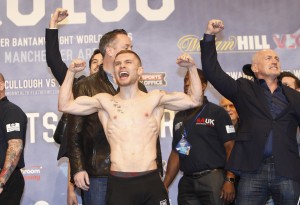
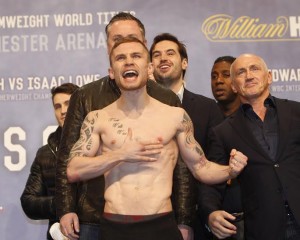
FRAMPTON-QUIGG IBF/WBA SUPER BANTAMWEIGHT UNIFICATION TITLE FIGHT
WEIGH IN
MANCHESTER ARENA,MANCHESTER
PIC;LAWRENCE LUSTIG
IBF CHAMPION CARL FRAMPTON AND WBA CHAMPION SCOTT QUIGG WEIGH IN

LAS VEGAS – The styles are different. Their neighborhoods are on different sides of the globe. But they fight for the same reason.

Family, Leo Santa Cruz said as he looked at Carl Frampton Thursday during a new conference for their featherweight rematch at the MGM Grand.

“He fights for his family,’’ Santa Cruz said. “I fight for mine. When you do that, you do it from your heart. That’s why this fight will be so good, better even than the first one.’’

It’s a sequel notable in part for what it is absent. There’s no malice in the build-up. Mutual respect can be hard to market. In social media clogged by angry words and noisy insults, it’s hard to get noticed these days. After a while, Conor McGregor and Donald Trump start to sound like the same guy. There’s always another insult. But there’s never a fight. Not a real fight, anyway.

But there will be one, another one, Saturday night between two fighters who seem to like each other almost much as they like to fight. Frampton and Santa Cruz will enter the ring for the Showtime-televised bout tied together by respect for each other and the craft they‘ve learned – Santa Cruz from his dad and Frampton from a Northern Irish heritage exemplified by his manager, Barry McGuigan.

The stakes have never been higher for either. For Frampton, it’s a chance for a Belfast kid to stake a claim on bigger money and international celebrity. For Santa Cruz, it’s a fight he hopes to win for a dad and trainer, Jose, who has beaten cancer. In the end, it’s family business for both.

Stakes means expectations — pressure, and perhaps more of that confronts Santa Cruz than it does Frampton, the favorite after his victory by majority decision in Brooklyn last July. Santa Cruz suffered his first loss without his ailing dad in the corner. There’s always a question about how a fighter reacts to his first loss. For Santa Cruz, his first fight after his only defeat includes his father, who sat next to him wearing a black cowboy hat during Thursday’s news conference. They looked inseparable, son-and-father, a relationship determined to re-prove itself as a winning combination.

Santa Cruz conceded he would have to do some things differently in the rematch. He said his roots as a Mexican fighter often lead him into a brawling style, all designed to please fans.

“This time, I have to use distance and my reach,’’ said the 5-foot7 ½-inch Santa Cruz, who holds a seven-inch advantage in reach over the 5-5 Frampton. “It’s important to go out and be smart.’’

But Frampton doesn’t foresee too much that Santa Cruz can change from the first 12-rounds.

“I think this fight can’t be much different than the last one,’’ said Frampton, a thinking man’ fighters who has stayed unbeaten with fast hands and unerring instinct to make the right adjustment at precisely the right moment in close bouts.

In part, Frampton has the edge in betting odds and perhaps confidence because there’s pressure on Santa Cruz to make the first adjustment.

“Leo Santa Cruz has lost his first fight,’’ Frampton trainer Shane McGuigan said. “I feel like he he’ll have to make the first adjustment.’’

The suggestion is that Frampton will have a counter. He always has. But the guess is that there will be more than just one. Otherwise, there’d be no reason for a rematch between a couple of craftsmen who know that each will need plenty of counters to continue that fight for family.


Rematch To Rivalry? Frampton-Santa Cruz II might be that fight

By Norm Frauenheim-

FRAMPTON-QUIGG IBF/WBA SUPER BANTAMWEIGHT UNIFICATION TITLE FIGHTWEIGH IN MANCHESTER ARENA,MANCHESTERPIC;LAWRENCE LUSTIGIBF CHAMPION CARL FRAMPTON AND WBA CHAMPION SCOTT QUIGG WEIGH IN

Carl Frampton and Leo Santa Cruz fight on Jan. 28 for a second time, early in a year that might be remembered for compelling sequels that create enduring rivalries.
From personal adversity to heightening stakes, all the elements are there.

Frampton begins 2017 as the game’s most decorated boxer. From The Ring to ESPN, he’s the consensus Fighter of the Year. He’s the emerging star, unbeaten and among the world’s best featherweights after his narrow victory, a majority decision over Santa Cruz on July 30 at Brooklyn’s Barclays Center.

“I would like a rivalry, where in 20, 30 years from now, people remember it,’’ Frampton told Mark Kriegel on Showtime’s digital series, THE REVEAL. “You always need a dance partner, and Leo Santa Cruz could be mine.”

That suggests a trilogy, which probably would mean a Santa Cruz victory in a dramatic rematch at Las Vegas’ MGM Grand, site for a memorable rematch at featherweight won by Marco Antonio Barrera in a unanimous decision over Erik Morales on June 22, 2002 in the second step of their history-making trilogy.

Frampton, of course, has other ideas, all supported by a 23-0 record replete with examples of toughness and smarts. Bottom line:
The Belfast featherweight knows how to win.

His ascent to stardom might come with heightened expectations from his Northern Irish fans, but I get the sense he looks at pressure the same way Charles Barkley did. When the former NBA Most Valuable Player was with the Phoenix Suns, I once asked him about pressure and he told me: Pressure is for tires.

Apply that bit of philosophical punditry to Frampton, and you’ve got a fighter not easily distracted. There’s only the task directly in front of him, and that happens to be somebody he has already seen throughout a hard-fought 12 rounds.

The intriguing question is whether the Santa Cruz he encounters in late January will be different than the one he saw last summer. Santa Cruz has come through a personal trial. His beloved dad and trainer, Jose, was battling cancer before the July fight.

“It was hard, it was hard to train, to concentrate,’’ Santa Cruz told Kriegel. “I still went to the gym and trained, (but) I didn’t train as hard. I didn’t train as the other fights because my dad wasn’t there. My dad was going to chemo, he was going to radiation…I thought to myself, maybe tomorrow he won’t wake up.”

After the narrow defeat – his first in 34 bouts, Santa Cruz apologized.

“I told my dad, sorry,’’ Santa Cruz said during THE REVEAL interview. “I’m sorry we didn’t get the win and that I disappointed you. My dad told me, ‘that’s all right. You didn’t disappoint anybody. We’re going to get him in the rematch.’ ”

During a conference call Thursday, Jose Santa Cruz said he was back and healthy.

“I have been here for this entire camp,’’ Jose said. “It has been great with training and sparring. I believe me not being present for the last camp affected him.”

That potential difference is just one compelling reason for a rematch and maybe a rivalry.


First Bell: DeGale-Jack is the opener in boxing’s fight to get off the deck

By Norm Frauenheim-

The James DeGale-Badou Jack fight Saturday night is a good bout and perhaps the first step in an attempt to hit the reset button after a sobering 2016.

It’s no secret that there wasn’t much to celebrate in the bygone year. It’s hard to know if the business has hit bottom and can finally embark on a long recovery.

But at least that old calendar can be tossed and replaced with one that includes inevitable hopes for a renewal.

DeGale-Jack at Brooklyn’s Barclays Center in a Showtime-televised 168-pound fight represents a beginning in a January that includes a terrific rematch of featherweight Carl Frampton’s decision over Leo Santa Cruz on the 28th.

A chance at gaining some momentum is there. The question is whether that’s enough to bring back some of the fans who raced for the exits in something of an exodus during the 20 months after Floyd Mayweather’s disappointing decision over Manny Pacquiao in May 2015.

It’s impossible to overstate the damage done by Mayweather-Pacquiao. Other than time, it’s not clear what can repair it. Just follow the money, always a reliable guide.

Forbes released a list on Tuesday, a projection of boxing’s top moneymakers in 2017. From one to 10, they are:

Canelo Alvarez, Andre Ward, Gennady Golovkin, Sergey Kovalev, Pacquiao, Wladimir Klitschko tied at sixth with Anthony Joshua, Keith Thurman, Deontay Wilder, Terence Crawford and Vasyl Lomachenko.

Alvarez is at the top because he reigns as the game’s biggest draw based in part on a reported pay-per-view audience of 300,000 for his knockout of Liam Smith in September at Cowboys Stadium. There’s also promoter Oscar De La Hoya’s promise that Canelo will finally fight Golovkin next September.

For now, Canelo-GGG is seen as the bout that will put boxing back at one million on the PPV scale. The number means more than money. It represents relevancy.

In the larger sports market, boxing has been sliding toward irrelevancy at a perilous rate. Again, follow the money.

In Forbes’ last ranking of the world’s top 100 athletes for earnings from June 2015 to June 2016, three boxers were included – Mayweather at No. 16 with $44 million, Pacquiao at No. 63 with $24 million and Canelo at No. 92 with $21.5 million.

The retired Mayweather, No. 1 in three of Forbes’ last four lists, is there, mostly for the $32 million he collected for his last fight, a victory over Andre Berto in September 2015.

Pacquiao got $20 million for his rematch victory over Timothy Bradley in April 2016. Canelo cracked the top 100 for his purses against Miguel Cotto in November 2015 and Amir Khan in May 2016.

Here’s the question: Will any boxer be among the next 100 on the 2017 list Forbes is expected to release in June?

Doubtful. A blockbuster would have to happen during the next six months.

Joshua-Klitschko on April 29 at London’s Wembley Stadium? Maybe. The emerging Joshua figures to beat an aging Klitschko, but he might be a year away from entering the Forbes’ rankings.

A possible Canelo-Julio Cesar Chavez Jr. fight in early May? It would be a moneymaker, especially among Mexican and Mexican-American fans. But it is way past due and would fall short of being Forbes’ worthy.

The best chance at restoring the relevancy defined by money appears to be in the June 2018 list, which would account for the promised GGG-Canelo showdown.

But even that hinges on bringing fans back into an increasingly empty tent. From this corner, the public appetite for a good fight is still keen.

But boxing has failed to provide it, hence all of the silly talk about Mayweather versus Conor McGregor, the mixed-martial arts megaphone who was at No. 85 on Forbes’ last list with $22 million.

If Mayweather-McGregor ever really happens, I’ll begin to believe some of those boxing obits. Mayweather-versus-McGregor would be a damning confirmation that boxing can no longer provide fights that the market place wants and will always want.

For now, the key is to show that the business can still deliver. That brings us back to the beginning, back to DeGale-Jack Saturday night in what could be the first fight in a much bigger one.


Rematch or retirement? Ward keeps all options on the table

By Norm Frauenheim

Andre Ward has talked retirement not just once, but at least twice, since his controversial victory over Sergey Kovalev. It sounds like some early posturing in negotiations that began the moment the news conference commenced in the wake of the 114-113 scores that favored Ward in November.

This time, Ward dropped the possibility in an interview with Rolling Stone. Never take anything off the table. Ward hasn’t. Retirement represents the nuclear option. Push that button and there’s no rematch.

It puts pressure on Kovalev, who was predictably unhappy with the decision and wasted no time in exercising the rematch clause in his side of the contract. That clause gives Kovalev some legal and financial leverage, but only if Ward continues to fight.

If he retires, that rematch clause wouldn’t buy that proverbial cup of coffee, much less a refill.

“I really just got to take my time right now because I really don’t have to fight anymore,” Ward told Rolling Stone.

He went on to say that he wanted to be “sure that every decision that I make and every fight that I take is the right situation because if it’s not, I don’t know if it makes sense to continue on.’’

Translation: Back off Kovalev.

Ward repeatedly suggested that he would continue to fight and even said there he had personal reasons to consider a rematch with the smart and dangerous Kovalev, who must have spent the Holidays wondering why he let Ward off the hook after knocking him down in the second round.

“You have to entertain [a rematch] and I would love to put my stats on in such a way that there isn’t a conversation about who won and who lost,” Ward said.

Then, he added: “Proving something to people is a tricky thing to get involved in. If we did the rematch it would be more just to silence Kovalev and silence his team and to just put a stamp on the rivalry we had.’’

There’s a strong suggestion in those words that Ward would like to silence more than just Kovalev and the Russian’s corner. There are also the fans and media who argued that Ward got an early Christmas gift.

His immense pride compels him to prove his critics wrong. It always has. I was there, at the Athens Games in 2004, when he was the last American man to win Olympic boxing gold on a day when nobody gave him a chance.

The U.S. men’s Olympic program was a mess then and has been ever since. But Ward rose above it all, the last American man to stand stop the medal stand’s summit. He didn’t lose in Athens and he hasn’t lost as an amateur or a pro since 1997.

To this day, Ward and his trainer, Virgil Hunter, talk about losing to Ernie Gonzales and John Revish as if it happened yesterday. He was 13 or 14 years old, yet he remembers the scorecards, the judges and the lessons. Those long-ago defeats are at the heart, the beginning, of what still drives Ward.

He finds a way. There’s an ongoing debate – as reasonable as it is noisy – about whether Ward’s way was good enough for a victory over Kovalev. Only a rematch for the light-heavyweight title and perhaps pound-for supremacy will settle that. The good news is that Ward knows that, mostly because nobody will let him forget about it. A rematch gives him another chance to say he was right the first time around.

Still, the negotiations are problematic for a couple of reasons. Above all, the money just doesn’t appear to be there anymore. Ward-Kovalev was a pay-per-view loser, generating a reported 160,000 buys, or nearly half of modest expectations.

Would promoters even try to go the pay-per-view route again? In boxing’s current business climate, can either Ward or Kovalev get a raise in a rematch? Ward collected a $5 million purse. Kovalev was guaranteed $2 million. How much money would be in the total purse for a rematch? How would it be split?

Ward told Rolling Stone that “it’s not about the money anymore.’’

I’m not sure it ever has been. It’s been about that pride. It motivates him to fight again in an answer to his critics. In part, it’s measured by his percentage of the total purse.

Offend that pride, however, and he’s shown that he’s willing to walk. He fought only once over nearly three years at the peak of his prime in large part because of a legal dispute with late promoter Dan Goossen.

Retirement? Not likely. Not at 32 and not with a chance to extend his unbeaten record, including a shot at an undisputed claim on the top spot in the pound-for-pound debate. Then, of course, there are all of those critics. Ward has another chance to do what he’s been doing all of his life:

Answer them.


Mourning a tough year and hoping for a better one

By Norm Frauenheim-

One year ends and another begins in a couple of days amid regrets and grief from the last 12 months and a wellspring of hope for something better in 2017.

It’s been a year to mourn, remembered mostly for who and what boxing lost. Legends are gone. Goodbye, Muhammad Ali, Aaron Pryor and Howard Bingham.

Their deaths are powerful symbols of an era that has passed. The business long sustained itself on Ali, Bingham’s poignant photographs of him and great fighters who followed in a generation personified in part by Pryor.

Where does it go from here? Who knows? At 85, former Ali promoter Bob Arum is optimistic. Throughout the last year, Arum’s consistent theme was the sports’ international look and reach.

The business has always been international, of course. History’s great moments have played out all over the globe. There was Africa for Ali’s epic victory over George Foreman in the Rumble in the Jungle. There was Manila for Ali’s rematch in a triumph of courage, will and skill over the late Joe Frazier.

But the fighters were American. That’s what has changed. Today, they are from Kazakhstan, Russia and Ukraine. Gennady Golovkin, Sergey Kovalev and Vasyl Lomachenko are as skilled as anyone in today’s generation.

But can they draw? Does anybody in the American audience care? Ratings and pay-per-view numbers from 2016 say no.

Home Box Office’s PPV number, a reported 160,000, for Andre Ward’s controversial scorecard victory over Kovalev in November was a disappointment, even in the face of modest expectations.

The light-heavyweight fight was thought to be the biggest in a year made barren by further, frustrating delays in a Canelo Alvarez-Golovkin showdown.

Ward was the American end of the marketing equation. He was the last American to win an Olympic gold medal. He’s unbeaten and he was moving up in weight after dominating the super-middleweight division. Yet, not even his resume moved the meter.

Perhaps, it will in 2017 in a rematch mandated by a contract clause already exercised by Kovalev. Perhaps, it’ll be the second step in a trilogy. Fundamentals for a rivalry are in place. Yet, questions about whether either Ward or Kovalev can ever draw an audience linger.

Maybe, the problem rests in the pay-per-view business model, which collapsed after Floyd Mayweather Jr. and Manny Pacquiao squeezed every last dollar out of it in their dud of a bout in May 2015.

Boxing isn’t dying, but pay-per-view might be. Junior-welterweight Terence Crawford, emerging welterweight Errol Spence and the return of lightweight Mikey Garcia are just three reasons to think there’s still some life in the American end of the business.

Meanwhile, most of next year’s business figures to get done in the UK.

From Belfast featherweight Carl Frampton and his Jan. 28 rematch of a victory over Leo Santa Cruz in Las Vegas to heavyweight future Anthony Joshua and his April 29 Wembley Stadium showdown with Wladimir Klitschko, the UK has the stars and an audience that wants to see them.
UK fans also travel.

They were there in Vegas, for Ricky Hatton, first against Mayweather and then Pacquiao. For Frampton-Santa Cruz II, they’ll be back, but this time with an unquenchable thirst for Guinness. Imagine the UK crowd that would follow Joshua to Vegas.

Arum is right. Potential for a huge rebound is there.

But a few things have to happen. First and foremost, there’s Golovkin-Canelo, which Canelo promoter Oscar De La Hoya promises will happen in September. Then, there’s Ward-Kovalev II, perhaps sometime in late spring or early summer. Above all, there has to be a way that GGG, Kovalev and Lomachenko can be transformed into names that fans know and personalities with whom they can identify.

Without all three, it’ll be hard to have a Happy New Year.


No Lie: No polygraph needed to ban boxing in Russia

By Norm Frauenheim–

Alexander Povetkin and everybody in his camp were scheduled to undergo a polygraph this week, according to promoter Andrei Ryabinksy, who in media reports from Russia insists he is determined to get the truth and nothing but the truth about the positive drug test that scuttled the WBC title fight with Bermane Stiverne in Ekaterinburg last Saturday.

No kidding.

I’m not sure who will be conducting the test. But to whoever is at the controls: A question or 15, please, about why Povetkin was allowed to fight Frenchman Johann Duhaupas, who was there as if the promotion knew that Povetkin would test positive and Stiverne would just say nyet.

The whole sequence of events is beyond believable. If not so dangerous, it would be laughable. Somewhere in media reports from Russia, it was reported that “regulators” allowed Povetkin to fight despite the Russian heavyweight’s positive test for Ostarine, a banned supplement reported to be a steroid.

There’s nothing – nada – on who the regulators might have been. Vladimir Putin’s relatives? Russian hackers freelancing after exposing Hillary Clinton’s E-mails? AA couple of hamsters? All week long, I’ve been waiting for the polygraph results. Maybe we’ll have to wait on something from Wiki-Leaks.

Ryabinsky was quoted as saying that Ostarine can come from tainted meat. Yeah, maybe, although the recent positive test were related to tainted meat were for clenbuterol from cattle injected with the substance in Mexico.

Whatever the substance and its source, Povetkin should not have been allowed to fight, period. It was his second positive test for a banned performance-enhancer. He tested positive for meldonium, scuttling a fight with Doentay Wilder last May in Moscow. His ban was dropped because of a technicality and perhaps because of some influence from the case involving tennis star Maria Sharapova, whose two-year ban for the same drug was reduced to 15 months.

The substance and why he tested positive demands an investigation, which the World Boxing Council has promised. But the bigger issue is just why Povetkin went on to fight a stand-in. From here, there is no good answer. We don’t need a polygraph. We need a ban on title fights in Russia.


From common to special, the fight never ends for Bernard Hopkins

By Norm Frauenheim-

Shtick is often strategy and sometimes dangerous. Bernard Hopkins knows that, perhaps better than anybody. He’s been using it like a survival skill throughout an uncommon career that has always been about being ready for fights waged in all of their various forms, from brutal to subtle.

Hopkins was at it, all over again, during a news conference Wednesday a few days before what he says will be his last bout within the ropes Saturday night against Joe Smith Jr. at The Forum in Inglewood, Calif.

Hopkins (55-7-2, 32 KOs) sat on one side of the dais, looking like a hawk searching for an opening – rhetorical prey – to appear. Sure enough, there it was.

Smith (22-1, 18 KOs), a laborer with an active union card from New York’s Local 66, was called the common man in an introduction from his promoter Joe DeGuardia. Smith is a good story. But this was Hopkins’ moment. His stage. Smith’s story was Hopkins’ opportunity.

The best fighters can turn a foe’s strength into a weakness and that’s what Hopkins tried to do nearly three days before opening bell to his planned finale in an HBO-televised light-heavyweight bout (10 p.m. ET/PT).

“I listen to what people say,’’ Hopkins said in his turn at the bully pulpit. “I listen to words, because words give you some kind of blueprint on what a person is thinking. What he’s about.

“How articulate, or whatever, it’s not fully judging, but it gives you some type of platform to work with. Joe DeGuardia said ‘common.’ ‘’

Hopkins went on to say he is not.

In a theatrical gesture, he looked directly at Smith and then delivered words that he has so often used as psychological blows – punches before the opening bell.

“Special,” Hopkins said as he pointed to himself.

Then, he paused, almost as if he had rehearsed it.

“Common,” he then said, pointing at Smith.

Smith, a common man with a common name, never blinked. He must of felt like a prop, albeit a dangerous one if the power he exhibited in his June stoppage of Andrzej Fonfara is any sign.

It wasn’t as if Smith could have done or said much. Hopkins was on a roll.

“Common man, special man,” Hopkins repeated. “Which one you want?

“I want the special.’’

He has been, in large part because of the defiance that has driven him since the day he walked out of Graterford Prison after serving five years on a robbery conviction. Then, he was going to follow the common path of an ex-con. When he was released, warden Buddy Rush told him he’d be back in six months. Hopkins promised he wouldn’t. Turns out, that was the first in a lifetime full of fulfilled promises. Rush heard what sportswriters, promoters, lawyers and fans have been hearing from him ever since.

Hopkins’ life has been about doing what everybody says he can’t. There were 20 successful defenses of the middleweight title. There was the victory over Felix Trinidad. And another one over Kelly Pavlik. Nobody beats Father Time. Then again, no 49-year-old has ever held a world-title belt, either. Now 51, Hopkins will challenge Father Time once more against the 27-year-old Smith.

For anybody else in the post-50 crowd, the task would just be foolish. But Hopkins has made it special, because of his cunning and – also his clever mastery of every aspect of what it takes to be a fighter.

But there’s another element, too. He understands what it is to be common. His common touch is part of his charm. Writers who have been around him throughout his long career know he remembers names and faces. Then, he’ll always be remembered for carrying that Costco card, which is a lot more familiar to the common man than one of Floyd Mayweather’s Jr.’s Bugattis ever will be.

He keeps his common roots close to him, almost as if they were a touchstone of motivation. Hopkins’ identity as an inmate is a number he never forgets.

“He’s from the Union, I’m from the Union of the State Correctional Facility of Gratersford,” Hopkins said, talking to Smith. “I never bought silk underwear, but let me tell you what I did keep in my pocket. It’s called a Y-4145 prison I.D. card with my picture on it.’’

He went on to say that the prison I.D card reminds him of who he was, who he is and why he fights.

“You can always be common, it’s so easy to be common,” said a special fighter, who has taken the commonplace to a place never envisioned.


Busy Saturday and two big questions precede 2017

By Norm Frauenheim-

The end is near for another forgettable year, memorable mostly for fights that didn’t happen and a controversy still raging over the one that did.

Yeah, 2016 was lousy, yet the year’s final month is a sure sign of a heartbeat despite the usual obituaries. Year-end diagnosis: Boxing isn’t dead, but pay-per-view might be.

A sure sign that the scarred patient is still kicking unfolds throughout a Saturday with five cards on three networks from time zones on all sides of the international dateline.

There’s heavyweight contender Joseph Parker-versus-Andy Ruiz Jr. in Auckland on HBO, tape delay. Featherweights Abner Mares and Jesus Cuellar meet on Showtime in Los Angeles. Unbeaten junior-welterweight Terence Crawford is at home in Omaha against John Molina Jr. on HBO. Anthony Joshua, the projected face of a resurrected heavyweight division, faces Eric Molina in the UK on Showtime. Julio Cesar Chavez Jr., now 30, is back, back all over again, against German Dominik Britsch on beIN in Mexico.

The sun never sets on the pro ring. Not yet, anyway.

Each of the cards helps set the table for a New Year, hopefully a better one. A year from now, however, it looks as if only two things will determine how we’ll look back at 2017:

· An immediate rematch of Andre Ward’s controversial decision over Sergey Kovalev for the light-heavyweight title.

· Gennady Golovkin-versus-Canelo Alvarez for the middleweight title.

Both have to happen. If they don’t, we may be hearing last rites instead of reading tired obits. Kathy Duva of Main Events, Kovalev’s promoter, exercised the rematch clause within minutes after Ward was declared the winner, 114-113, on all three scorecards on Nov. 19 at Las Vegas’ T-Mobile Arena.

Meanwhile, Oscar De La Hoya of Golden Boy, Canelo’s promoter, has promised repeatedly that the long-awaited showdown with GGG will happen in September.

But this is boxing, which means caveat emptor is attached to every promise and rematch clause. With less than a month left in the year, we’ve yet to hear Ward’s management even acknowledge that the reported rematch clause is in place.

It’s clear that Ward’s management is keeping options open, perhaps for an immediate bout against somebody other than Kovalev. The Russian would have to agree, but only at a steep price. It’s called step-aside money.

In this case, it would be stepping all over public expectations for a quick sequel, if not an immediate resolution to the noisy debate over the scoring. The business — still reeling from 2015’s Floyd Mayweather Jr.-Manny Pacquiao dud — can’t afford a postponement. A 2016 full of frustration over no Canelo-GGG bout is symptomatic of an impatient fan base that won’t tolerate much more delay.

Canelo is working his way back from a right-thumb injury sustained in a stoppage of the UK’s Liam Smith in September. Projections are that Canelo will fight again, perhaps some time in early 2017. Will the junior-middleweight champion need one fight, or two, against a true 160-pounder before GGG? Will the thumb hold up?

In most years, small questions. But the answers loom large, larger than ever in a critical 2017.


Just say no to more talk of Mayweather-McGregor

By Norm Frauenheim-
Floyd Mayweather
Talk, talk and more talk about Floyd Mayweather Jr.-versus-Conor McGregor continue to light up social media these days with no end – or relief – in sight.

Not sure who to blame, but the tirelessly talkative McGregor appears to be doing what Mayweather mastered in marketing himself and then landing a huge Showtime contract that led to about a $220-million payday against Manny Pacquiao.

McGregor could generate international attention for getting a driver’s license these days. Essentially, that’s what the UFC’s mega-mouth did in acquiring a boxing license in California. It cost him 60 bucks. He had to fill out a four-page form and pass a physical. It was quick, simple and nobody asked him to parallel-park.

In no time, Twitter, Facebook, websites and even mainstream media exploded all over again with speculation about a McGregor bout with Mayweather. Stock the shelves with antacid, because there’s going to be a lot more of this stuff.

Chances appear to be slim-to-none that the bout would — could — happen. McGregor is under contract to the UFC. Meanwhile, Mayweather continues to send out mixed messages about whether he wants to come back.

If McGregor tries to get out of his UFC contract in pursuit of a Mayweather bout, a long and tangled legal battle is likely. Mayweather, who is one victory short of 50-0, has a lot of things, but time isn’t one of them. He’ll be 40 on Feb. 24.

I doubt it will happen. But I’m old, more than old enough not be included in the emerging generation of MMA fans. I also suspect that my doubts reflect an opinion shared by many in the aging crowd of fellow boxing fans. To wit: I hope it doesn’t happen. Could it? In an era when a presidential campaign is won with tweetstorms, anything can.

There’s momentum in the internet fascination. Betting odds were even posted by Westgate in Las Vegas Thursday. If the bout went from mythical to fact, Mayweather would be a 25-1 favorite in what would be a boxing match against McGregor, who began as an amateur boxer as a 12-year-old in Dublin.

Translation: Nobody thinks McGregor would have any kind of chance at all. So why is social media still buzzing about it?

There are all kinds of reasons, including a compelling one offered by Mayweather Promotions CEO Leonard Ellerbe. Ellerbe told ESPN’s Dan Rafael that people are talking about it because of race. McGregor is Irish and white, Mayweather is African-American and boxing has a long racial history defined by The Great White Hope.

If Ellerbe is right – and I think he is, the racial component will only fuel further talk about the bout. More talk means more of the one thing that could make it happen: Money, which also happens to be Mayweather’s nickname and motivation. Speculated numbers have been all over the place. They’ve also been uniformly big, anywhere from $800 million to a billion.

That would pay a lot of McGregor’s legal bills and might be enough to lure Mayweather back through the ropes. Then, however, the global bubble of anticipation would quickly deflate. Remember the mix of disappointment and outrage over Mayweather’s decision over Pacquiao in May, 2015? Multiply that, again and again.

There’s also precedence for what might happen. Classic boxing matches between a boxer and MMA fighter have been a mixed-martial-arts mess. I sat through one in Phoenix, Ariz., last March.

That’s when aging Roy Jones Jr. scored a second-round stoppage in a made-for-pay-per-view event over a guy named Vyron Phillips, who had been fighting MMA and had experience as an amateur boxer.

Phillips got a boxing license from the Arizona State Boxing and MMA Commission, but he had no business in a ring within punching range of a boxing legend way past his prime. The event was a joke, an embarrassment not worth repeating, especially on a global stage that could be a billion times more embarrassing.


From The East To The Beast: Lomachenko might be the best

By Norm Frauenheim-
Lomachenko
The evolution of boxing’s surprising new generation – fighters from the old Soviet Union – continues Saturday with Vasyl Lomachenko, who many believe will be the best of them, if not one of the best ever.

In the lead-up to the Lomachenko-Nicholas Walters bout at The Cosmopolitan in Las Vegas, his promoter, Bob Arum, compares the Ukrainian to Muhammad Ali.

Being called the next anything can create some problematic expectations. To wit: There’s never been another John Wooden or Jack Nicklaus and the NBA is still looking for the next Michael Jordan.

But, it’s fair to argue, that there’s never been anyone in any sport quite like Ali. In the arena of history’s icons, Ali is the greatest ever. On the boxing canvas, he’s Michelangelo. Whether there’s a Sistine Chapel in Lomachenko’s creative hands is anybody’s guess. After all, the two-time Olympic gold medalist has only seven pro bouts (6-1, 4 KOs).

But Arum is absolutely right about one thing: Lomachenko is fascinating to watch. Arum has seen them all. First of all and above all, Ali.

The promoter, who turns 85 on Dec. 8, celebrates his 2,000th card Saturday night. That amounts to boxing every night for nearly five-and-half years. Arum thought he had seen all the angles until he saw Lomachenko, who has been creating some new dimensions in boxing’;s traditional geometry

He possesses a bewildering array of punching angles augmented by hand speed and clever footwork. Ali?

We’ll only know more about that one in the face of further adversity, perhaps in an HBO-televised bout (10:35 p.m. ET/PT) against a dangerous Walters (26-0-1, 21 KOs) who has frightening power.

Lomachenko has already encountered some of that in a loss to a stubborn and brawling Orlando Salido. Salido might have taught him a career-full of lessons during one long night in March 2014. Lomachenko is no dummy. The guess here is that he will be cautious early and creative late for a stoppage in the final couple of rounds over a tiring Walters.

A successful defense of his WBO junior-lightweight belt might propel him to an immediate jump in class, perhaps to a 2017 bout at 140 pounds against Manny Pacquaio. I would also like to see a bout with Mikey Garcia, although that one could be difficult to put together because of Garcia’s split with Top Rank.

Nevertheless, Lomachenko against the tactically skilled and always-poised Garcia would loom as an intriguing match-up and another test of what Arum foresees for the Ukrainian.

For now, Lomachenko ranks No. 3 on this list of fighters from the old Soviet bloc making an impact in the U.S. Middleweight Gennady Golovkin is still no. 1. Light-heavyweight Sergey Kovalev is No. 2, despite his controversial loss to Andre Ward last Saturday.

If fans angry at Ward’s one-point victory on each of the judges’ card had a vote, Kovalev might in fact be No. 1. Despite the noisy controversy, however, it still goes down as a loss for Kovalev, who seemed to let the clever Ward off the hook after the Russian scored a second-round knockdown.

For Lomachenko, that’s an opportunity to become No. 2 on what might just be an early list of all that Arum thinks he’ll achieve.


Ward wins narrow decision in dramatic victory over Kovalev

andre-ward

LAS VEGAS — Andre Ward delivered. He got stung by punches early. He was down early, on all fours and only canvas looking back up into his dazed eye. But he got up. He adjusted. And, in the end, he did what he has done for just about as long as anybody can recall.

From winning a gold medal on the last day of the 2004 Olympics in Athens to his career defining moment against a feared Russian light-heavyweight, Ward prevailed with subtle moves, quick punches and unshakeable poise.
Sergey Kovalev represented the biggest test of all those Ward qualities. Kovalev had — still has — all of the stuff to perhaps beat Ward in what appears to be an inevitable rematch. On Saturday in an HBO pay-per-view bout, many of the right moves and most of the timely punches belonged to Ward. So did the victory by the narrowest of margins. Ward won, 114-113, on all three scorecards.
“We did what we set out to do,” said Ward (31-0, 15 KOs), who was a 2-1 betting favorite at opening bell. “It’s amazing. It’s my most important and satisfying win.”
Amazing, yes. Yet, predictable too,
If taken within the astonishing context of Ward’s singular career. He always finds a way and he did again. This time, it was somewhat controversial. Scores alongside press row were split. HBO Harold Lederman had Kovalev wining by five points. The 15-rounds.com scorecard was 114-113 for Ward, identical to the judges. It was that close.
Kovalev disputed the decision. No surprise there. He scored the bout’s only knockdown with a short right hand in the second round.
“It’s the wrong decision,” said Kovalev (30-1-1, 26 KOs), who surrendered the IBF, WBO and WBA titles in front of 13,310 roaring fans at T-Mobile Arena.  “I don’t want to say my opinion.  The witnesses are here. They saw it.  It was a fight of my life I am disappointed in the judges decision.
 
“He got maybe a few rounds. I agree with that.  I kept control.  I lost maybe three rounds the whole fight.
Kovalev has a rematch clause in his contract. Nobody had to ask him or his promoter, Kathy Duva of Main Events, whether he intends to enforce it.
“Of course,” he said after his first loss. “And I will kick his ass.”
In the end, Kovalev’s loss might be boxing’s win. It has a rivalry. It needs one.

Ward-Kovalev undercard finally ends with a dull draw

A forgettable undercard finally came to an end with a result that summed up everything that came before it.

It was a draw.
A dull one
As a crowd began to gather for the Andre Ward-Sergey Kovalev showdown at T-Mobile Arena Saturday night, Dallas junior-welterweight Maurice Hooker (21-0-3, 16 KOs) and Darleys Perez (33-2-1, 21 KOs) left it yawning.
Hooker couldn’t capitalize on his reach. Perez, of Colombia, couldn’t sustain his aggressiveness. On one scorecard, it was 97-93 for Hooker. On another, it was 97-93 for Perez. On the third, it was 99-99. A unanimous dud.

Gvozdyk punishes Chilemba for a TKO victory

Ukrainian light-heavyweight Oleksandr Gvozdyk calls himself The Nail. It’s an appropriate nickname. At least, it was on HBO’s pay-per-view undercard before the Sergey Kovalev-Andre Ward main event.

Gvozdyk (12-0, 10 KOs), an Olympic bronze medalist, nailed Isaac Chilemba (24-5-2, 10 KOs) with repeated punishment, forcing him to quit after eight rounds Saturday night. With blood streaming from both nostrils,Chilemba, a South African, finally surrendered because of a fractured right hand.

Stevens retains minor middleweight title with a unanimous decision

Curtis Stevens retained his role as a fringe middleweight contender with a 96-92, 98-90, 96-92 decision over James De La Rosa for a minor 160-pound title in the first pay-per-view bout on a card featuring Kovalev and Ward Saturday.

Stevens (29-5, 21 KOs), of New York, scored an early knockdown with a short left counter in the opening moments. Then, he fought in spurts, offsetting a one-point penalty for a low in the seventh round. De La Rosa (23-5, 13 KOs), of Harlingen, Tex., damaged his chances at an upset in the sixth when he appeared to hurt his right hand.

Claressa Shields wins pro debut

There’s more than Olympic gold in Claressa Shields’ possession. There some pro power, too. Shields, a two-time gold medalist from Flint, Mich. used it repeatedly in a head-rocking debut for a unanimous decision over Franchon Crews, a Baltimore super-middleweight who also was making her debut on the Kovalev-Ward undercard.

A sparse crowd booed. Only Tyler McCreary cheered. The Toledo featherweight had good reason to. McCreary (12-0, 6 KOs) won a controversial majority decision over Vincent Jennings (5-3-1, 4 KOs) of Grand Rapids, Mich., in a dreary eight-rounder in the fourth bout on the pay-per-view card featuring Kovalev-Ward

Toledo junior-welterweight Sonny Frederickson (15-0, 9 KOs) employed quicker hands and superior reach to score a unanimous decision over Gabriel Duluc (11-2, 2 KOs), a Boston fighter who was left with nasty over his left eye midway through an eight-rounder on the non-televised portion of the Kovalev-Ward card.

Rock rock solid in winning one-sided decision

Philadelphia heavyweight Darmani Rock stayed unbeaten (6-0, 4 KOs) with a one-sided decision — a four-round shutout on all three scorecards — over Brice Ritani-Coe of San Pedro, Calif., (4-5-1, 3 KOs) in the last bout before HBO’s pay-per-view telecast of the Kovalev-Ward card.

Russian middleweight scores Kovalev-like stoppage

Russian middleweight Bakhraim Murtazaliev (7-0, 5 KOs) came into the ring wearing trunks with Sergey Kovalev’s last name on the belt line. It didn’t take long for the Robert Garcia-trained Murtazaliev to do what the guy with the familiar name does in the second bout on Kovalev-Ward card. He crushed Bortirsher Obidov (6-1-1, 2 KOs), knocking down the Uzbekistan fighter three times in the second for a stoppage at 2:52 of the round.

First Bell: Kovalev-Ward card underway with middleweights in opening bout
In an empty NHL arena seven hours before the main event, a couple of unknown middleweights opened a card that would end later Saturday night with Sergey Kovalev and Andre Ward.

Meiirim Nursulatnov and Henry Beckford stayed upright. Nobody got iced. But heavy-handed Nursulatnov (1-0) of Kazakhstan emerged with an easy victory in his pro debut, winning a unanimous decision with a shutout on all three scorecards over Beckford (5-5, 1 KO) of Hempstead, N.Y


Kovalev-Ward: Fighting for a classic and an audience

By Norm Frauenheim-
Sergey Kovalev
LAS VEGAS – On the scale, there was no difference. Not even a fraction of an ounce separated the two. It was 175 pounds even for each in a weigh-in that seems to reflect how tough it is to pick between Sergey Kovalev and Andre Ward.

The betting odds are almost as even as the scale was Friday for the light-heavyweight bout scheduled for Saturday night at T-Mobile Arena and HBO’s pay-per-view television. Talk in the press room tips one way, then another, favoring Kovalev at one moment and Ward the next.

It’s a fight that looks to be as close as possible. Each has 30 victories. Each has never lost. As advertised, it also should have a heavy impact on the pound-for-pound debate. The winner figures to get No. 1 recognition in the first bout between unbeaten fighters ranked among the top five in The Ring’s pound-for pound ratings since Felix Trinidad’s upset of Oscar De La Hoya in 1999.

The only real question is whether anybody really cares. Ticket sales have been slow. Seats at all prices were available Friday. Less than two years since Floyd Mayweather and Manny Pacquiao disappointed a record 4.6 million PPV customers, the boxing pay-per-view business has been in the toilet. Kovalev-Ward promoter would be happy – make that ecstatic – with 300,000 buys.

It’s anybody’s guess what a reasonable PPV expectation might have been in the heady days before Mayweather-Pacquiao. Kovalev-Ward has all the elements that would have made it a solid attraction. Maybe there would have been 500,000 PPV buys in the bout’s history, knockout power in Kovalev’s right hand and tactical skill in Ward’s overall ring IQ. It’s puncher versus boxer. It could be a classic.

For now, however, it might be fight that a lot of people wished they had had seen. That might represent a new beginning for a battered business. A great fight might lead to a rematch, a renewed appetite and perhaps a recovery. In the here and now, however, Kovalev (30-0-1, 26 KOs) and Ward (30-0, 15 KOs) can only take care of the immediate task that awaits them at opening bell.

The close nature of the bout has led to each camp trying to get an edge, which means there has been a lot of talk over the last few days.

“I think it’s simple,’’ Ward said moments after he stepped off the scale. “He doesn’t like me. I don’t like him. This will be my best performance of all time. I’m not leaving Las Vegas without those belts.’’

The belts – an acronym collection that includes the IBF, WBO and WBA light-heavyweight titles – belong to Kovalev, a Russian whom Ward has repeatedly called a bully.

“I’m not going to disappoint you,’’ said Kovalev, an unknown amateur in Russia whose steady rise began in North Carolina five years after Ward got big headlines for winning America’s last boxing gold medal at the 2004 Olympics.

In many ways, it’s an unusual fight. To wit: The purses are upside-down. Kovalev, the champion, is getting $2 million or less than half the challenger’s purse. Ward is getting $5 million.

“The challenger gets a boat load of money, but the champion don’t,’’ said Ward trainer Virgil Hunter, who has had a lot to say throughout press conferences and even weigh-ins. “I don’t understand it. Maybe, it’s not true. But it bothers me.’’

Over the last couple of weeks, Hunter has spent a lot of time confronting Kovalev trainer John David Jackson, questioning his credibility and even his readiness on the eve of the bout. As Kovalev and Ward posed after stepping off the scale, Hunter started in on Jackson in an exchange that proved to be the weigh-in’s only fireworks.

He told Jackson that Kovalev looked “a little dry,” suggesting that the Russian might have weakened himself in battle to make weight. Jackson replied, saying that Hunter isn’t taking the punches.

“Ward will,’’ Jackson told him.

Enough said.


Andre Ward never forgets the lessons from losses long ago

By Norm Frauenheim-
Andre Ward
LAS VEGAS – Andre Ward has done nothing but win for as long as just about anybody can remember. In fact, it’s been so long since a Ward loss that it takes a little research – or maybe an archaeologist – to figure out exactly when it happened. How it happened.

For a while, Ward’s loss happened he was 13 years old to Ernie Gonzales, who went on to fight to 29 pro bouts as Jesus. After some checking through amateur records, however, that has been corrected. The last loss, also as a 13-year-old, was in fact to John Revish, a former Louisiana junior-welterweight, Ward said.

Amateur records can sometimes as hard to verify as UFO sightings. But you get the idea. Ward’s combined record, pro and amateur, is otherworldly. Over almost two decades, the 32-year-old light-heavyweight hasn’t lost.

The 2004 Olympic gold medalist says he is 125-5 as an amateur. Add that to the 30-0 pro mark he’ll risk Saturday night against Sergey Kovalev at T-Mobil Arena in an HBO pay-per-view bout, and he is 155-5 as a fighter. Modern translation: He’s an adult who doesn’t lose, perhaps because of what he learned against Revish and Gonzalez. Lessons learned as a kid have stayed with Ward the mature fighter. To this day, he and his trainer, Virgil Hunter, recalls the defeats as though they happened yesterday.

“I remember how it felt and I remember telling myself that I won’t let it happen again,’’ Ward said Thursday before a formal news conference at the MGM Grand.

There’s an ongoing guessing game that Kovalev’s long powerful right will do enough damage to pound out a memory that Ward has so agilely, so smartly eluded for so very long. But don’t bet on it.

Gonzales, for one, wouldn’t. The former Phoenix fighter picks Ward to win by unanimous decision. These days, Gonzales, a one-time prospect who went 27-2 with 14 KOs as a middleweight, works with kids in a Houston gym when he isn’t driving a truck to support his family, which includes two sons, 9 and 5. He has watched Ward ever since he won a split decision over him in a controversial bout in Ontario, Calif., a few generations ago.

“I didn’t know who he was then, but I had begun to hear about him,’’ said Gonzales, who says the bout was fought at 139 pounds. “To get to Ward, I had to beat Timothy Bradley.’’

Yeah, that Timothy Bradley.

“Hey, I beat everybody,’’ said Gonzales, whose pro career ended in a crushing knockout loss to Adonis Stevenson in 2012 in Montreal.

Gonzales recalls winning a 3-2 decision. Instead of computer scoring, the bout he said was determined by five ringside judges. To this day, Ward and his trainer, Virgil Hunter, dispute the loss, almost as if it is as controversial today as it was a couple of decades ago.

“Ernie’s mom was one of the judges,’’ Hunter said Thursday.

But Gonzales remembers something else. He recalls a winning strategy. He said Ward was just learning how to use a counter punch.

“I kept my left hand out there and moved my back foot backwards, almost a full foot back,’’ Gonzales said. “He just couldn’t get to to me. But what I remember mostly is that he was a real nice guy. After the fight, we ran into each at the concession stand and he bought me a hot dog.’’

Gonzales looks at today’s Ward and sees a fighter who he believes can thoroughly frustrate Kovalev.

“To me, he’s a lot like Floyd Mayweather,’’ said Gonzales, who was a Mayweather sparring partner for Mayweather’s victory over Robert Guerrero in May, 2013. “It’s just really hard to predict what he’s going to do.’’

It’s only easy to predict that he won’t forget.


Ward-Kovalev: Different roads lead to the same place

By Norm Frauenheim-
Andre Ward
Only the records are similar, almost identical. Unbeaten on one resume. Unbeaten on the other. But that’s where the similarities end.

Sergey Kovalev (30-0-1, 26 KOs) and Andre Ward (30-0, 15 KOs) come from different sides of the globe, grew up speaking different languages and eating different foods.

Then, there are their respective career paths. They began at opposite ends of the professional spectrum in a journey that will put them in the same dangerous place, a ring at Las Vegas’ T-Mobile Arena on Nov. 19, in a fight more intriguing than any over the last year-and-a-half.

Ward has the Olympic pedigree, gold in 2004 and the last American man to fight his way on to the medal stand’s top pedestal. When Ward was winning gold, Kovalev was virtually unknown, even at home in Russia.

Ward had fame before he answered his first bell as a pro. Kovalev toiled in anonymity, first in Russia, then North Carolina before anybody in the U.S. could pronounce his name. Now, these light-heavyweights are fighting on equal terms for perhaps the top spot in the pound-for pound debate.

“There’s no A-side and no B-side,’’ Kovalev promoter Kathy Duva of Main Events said this week during a conference call. “It’s two great fighters fighting each other. Sergey holds the titles right now, Ward has held titles in the past. Ward is a legendary fighter; Sergey is trying to become one. …There are certain fights that defy that A-side/B-side description and I think this is one of them.”

Ward, a slight favorite when the bout was announced, is considered the boxer. Kovalev is seen as the puncher. But their assigned roles in an anticipated classic are too simplistic. Both are blessed with ring intelligence as well as an ability to know when and how to adjust.

Kovalev gets the edge in power because he has the better knockout ratio and long, precise right hand as lethal as any in the business. Ward has the edge in boxing skill, in part because he a switch-hitter who seamlessly switches from left to right and back again. Show Ward a style, and he’ll adjust quickly and with chameleon-like subtlety.

The fight is fascinating, because of the psychology. It’s a thinking man’s fight and Kovalev thinks he has the edge.

“For me this is a mental fight,’’ he said. “It’s not who is stronger, but who is smarter and brings best skills into the ring and who is mentally stronger.’’

It’s an old game, one that Ward has played often.

“Mentally, it’s honestly the same to me,’’ he said. “Obviously, there’s a lot at stake and it’s a different challenge moving up in weight, pay-per-view, all of those things make it a little bit different. Whether it’s Alexander Brand or Sergey Kovalev, I approach every situation the same way. I wouldn’t be able to get to this level and stay at this level if I checked in and checked out.

“It’s the same dedication and it’s the same work. For me it’s about trying to be the best in sport where there’s little room for error. I understand that every time I step into the ring and leads to me making sure I prepare accordingly.’’

But the HBO pay-per-view bout ranks as a potential favorite among thinking fight fans because of that anticipated moment, or moments full adjustments and counter adjustments. To wit: Puncher becomes boxer; boxer becomes puncher.

Duva suggests that Kovalev might have an edge because of his life experience in an industrial corner of Russia

“I’ve seen Sergey demonstrate his mental toughness time and time again,’’ she said. “He’s been through more adversity in his life than most fighters have ever even contemplated. I’m aware that Ward has faced adversity, but I never heard Sergey talk about how boxing is a sacrifice, where we frequently hear from Ward about how it is. Sergey’s attitude towards boxing has always been, ‘Oh wow, this is a great opportunity and I’m so happy I’m doing it.’

“I know he has tough times and there’s days at the gym where he probably doesn’t feel that way. But his attitude has always been about loving his work, and loving what he’s doing. He can’t wait for the fight to start. He works hard because he wants to be the best. It’s not just his mental toughness, it’s his mental attitude, I think it’s very positive and I think that’s the thing that carries him.

“That and the chip on his shoulder. That has been there forever. Just wanting to prove he’s the best. You take that combination of work ethic, and chip on his shoulder and focus like a laser, and then loving what he’s doing. Sometimes, when he gets in the ring, he looks like he’s about to have a steak. That’s the kind of look on his face. I think that’s part of what makes it so much fun to watch him.”

The counter is Ward’s life experience, told for the first time in a poignant HBO documentary. Ward lost his dad.

“This is the first time that I really, really opened up,’’ he said. “From my standpoint, I’m a private person, Number One. Number Two, I’ve always wanted to respect my mom and dad. My dad was a dying addict. My mother is doing well right now and I’ve always seen the rags to riches, the kids that come from the ghetto, and I didn’t want to come into the game with that type of story preceding me.

“I wanted it to be about who I was as a person, about my talent, my ability. Then I felt like at the right time I’ll start to open up about it. It took twelve years. I’ve been a professional for almost twelve years now and it kind of got me going, where I just started to feel content with myself. I feel like my supporters and my fans know me and know part of my story. But I felt it was important to open up and pull back the curtain and let them know it hasn’t always been easy.’’

No, it hasn’t. Not for either fighter. Both have been tested and tempered by different kinds of adversity that has brought them to a time and place that might be defining.
Attachments area


Senator Champ: Pacquiao takes WBO title from Vargas

Pacquiao_trains_150422_003a

LAS VEGAS–Governments across the world are filled with senators who address themselves as honorable. But there’s only one who can call himself champ. Meet the Honorable Manny Pacquiao, Senator Champ.

Pacquaio restored the championship part to his name with a WBO welterweight title he took from a game, yet overmatched Jessie Vargas on a pay-per-view card at Thomas & Mack Saturday night. A Pacquiao with a boxing title instead of political title is the one remembered in every part of the world outside of the Philippines.
At 37 years old, the fighter with titles in eight weight classes was not exactly that same any more. If he had been, his knockout drought wouldn’t be at seven years and counting. Make no mistake, his punches still sting. Vargas’ badly-bloodied right eye was evidence of that. But the opponents he would have stopped a decade ago are withstanding his punches now. Vargas did, although he was dropped by a straight right in the second round and it often looked as if he was perilously close to getting stopped in the late rounds.
“I was cautious,” said Pacquaio (59-6-2, 38 KOs), who expected to get at least $4 million and a percentage of the PPV buys. “I didn’t want to get drawn in and hit by a counter. I felt like I could do more. With every round, I thought I got closer to a knockout.”
But the KO never came, in part because of Vargas’ inherent toughness and some power of his own, especially in a dangerous right hand.
“I thought it was a very close fight,” said Vargas (27-2, 10 KOs), who collected $2.8 million. “It was a very fast chess match.”
What’s next? Pacquiao can only be sure that he goes back to work in the Filipino Senate on Tuesday. There’s bound to be intense speculation about who he’ll fight next, sometime in 2017. Floyd Mayweather Jr.’s presence in the crowd of 16,123 guarantees months of speculation on Twitter. Terence Crawford was there, too.
“We’ll see,” said the Senator, a champ who knows that boxing is sometimes as hard to predict as politics.

Valdez stops Osawa in 7

Oscar Valdez Jr. went to his knees in thanks. He celebrated in joy on top of trainer Manny Robles shoulders. He screamed. He cried. He did it all. Above all, he won.

A first-time featherweight champion became a two-time champ, blowing away Japanese contender Hiroshige Osawa with a seventh-round TKO in the final undercard bout Saturday on the pay-per-view card featuring Manny Pacquiao and Jessie Vargas at Thomas & Mack.
Valdez (22-0, 19 KOs), a two-time Mexican Olympian who grew up in Tucson, appeared somewhat tentative early in  a defense of the WBO title he won in July. Osawa (30-4-4, 19 KOs), unknown outside of Asia, was taller and possessed a four-inch advantage in reach. But he had little else.
A deliberate and careful Valdez would begin to figure figure that out with devastating certainty in the fourth round. That’s when he put Osawa on the seat of his trunks with a left hand that was precise as it was long.
The inevitable was just three rounds away. Midway through the seventh, Valdez landed another left, backing up Osawa. Valdez pursued, step-for-step, with a blitz of punches that finally ended with the Japanese fighter defenseless and finished against the ropes.

Magdaleno thrives, survives for a stunner over Donaire

Speed and toughness. Quicksilver, then iron.

Jessie Magdaleno possessed a motherlode of both in an alloy that Nonito Doanire couldn’t capture, then couldn’t break Saturday in a terrific junior-featherweight bout for the WBO’s 122-pound title on the Manny Pacquiao-Jessie Vargas card at Thomas & Mack.
Magdaleno (24-0, 17 KOs) took the  belt from Donaire (37-4, 24 KOs), scoring a unanimous decision, first with speed that scored often and easily in the first few rounds. Magdeleno suffered a cut above his left eye in the fourth, but it didn’t bother him. Nothing did.
From the eighth round on, a slower Magdaleno caught one right hand after another from Donaire, who was surprised that the judges scored against him.
“Losing never crossed my mind,” said Donaire, who argued that he controlled the second half of the bout.
But he couldn’t finish Magdaleno. Donaire’s big right rocked Magdaleno’s head, sending his brightly dyed-shock of hair flying in every direction. The blows buckled his legs at the knees. They sent him crashing into the ropes. But nothing could send him into defeat. And nothing would.
Zou wins first major title in a one-sided decision
 Sometimes, it was dull. Often, it was funny. In the end, it was a first, at least for Zou Shiming.
Zou, a Chinese icon for his three Olympic boxing medals, won his first pro title, the WBO’s flyweight version, with a decision over Thailand’s Prasitak Phaprom that was unanimous on the cards and one-sided in every way
In the first pay-per-view bout on the Manny Pacquiao-Jessie Vargas card Saturday night at Thomas & Mack, Zou (9-1, 2 KO) eluded most of Phaprom’s  punches with his reach and quick feet. But the Chinese fighter was never able to end the 12-rounder, a rematch.
He appeared more content to dance away or mock the Thai than finish him. In the sixth, Phaprom (39-2-2, 24 KOs) lunged at Zou in an attempt at landing a big punch. He swung for the fences and landed on his face.  A Zou uppercut could have been there to meet him before met canvas. But Zou had already danced away.
It’s hard to know what’s next for Zou. But he has a major title and that could lead to some big money in China, especially in an Asian showdown with Japanese prodigy Naoya Inoue. Maybe easy money for Inoue, too, although he appears to be more interested in a tougher challenge against pound-for-pound king Roman Gonzalez
Brazilian gold medalist wins debut
-There was gold in Rio. There might be more in the United States. Brazilian lightweight Robson Conceicao, a gold medalist at the 2016 Olympics in August, flashed all of his potential with power that echoed throughout Thomas & Mack for a successful pro debut, a unanimous decision over Clay Burns (4-3-2, 4 KOs) of Alexandria, La
Teofimo Lopez prevails in five knockdown bout  
There was nearly a knockdown a  minute. In the end, only Teofimo Lopez was standing.
Lopez, a featherweight from Florida, scored four knockdowns, two in the first round and two more within 2:02 of the second, ending his debut in the second bout on the Pacquiao-Vargas undercard with a body shot for a knockout of Ishwar Siqueiros (3-2-2) of Mexico.
Russian prospect stays unbeaten
Alexander Besputin has trainer Robert Garcia and Sergey Kovalev manager Egis Klimas in his corner. Much is expected from the Russian junior-middleweight. His promise remains intact after forcing Panamanian Azael Cosio to quit after six rounds. Besputin (5-0, 5 KOs) got rocked a couple of times, but his energy never flagged in a performance that saw him repeatedly back up Cosio (20-5-2, 17 KOs) with movement and precise body shots.

First Blows: Fuentes opens Pacquiao-Vargas card with a decision over Chinese featherweight

 With nearly as many people in the ring as there were in seats at Thomas & Mack, featherweights Fernando Fuentes and Xu Que opened the show.
Fuentes (9-7, 2 KOs), of Riverside Calif., landed the first punch and won the first fight on the Manny Pacquiao-Jessie  Vargas card Saturday, scoring a 58-56, 59-55, 58-56 decision in the Chinese fighter’s first loss. Xu (9-1-1, 2 KOs) proved to be elusive in the middle rounds, but could never sustain much of an attack in any round.


Motivational Chip? Vargas might have one in quest to upset Pacquiao

By Norm Frauenheim-
Vargas_DeMarco_weighin_141121_002a
LAS VEGAS – There was enough room on Jessie Vargas’ shoulder for a world title belt when he faced Manny Pacquiao in the nose-nose, eye-to-eye ritual for cameras Friday after the formal weigh-in for their welterweight bout Saturday at Thomas & Mack.

Apparently, that chip didn’t get in the way.

That proverbial chip — and all the motivation it is supposed to represent – has been among the many story lines leading up to Top Rank’s pay-per-view card (6 p.m. PT/9 p.m. ET). Vargas has been friendly enough. The bigger the media, the friendlier he became. He seldom betrayed any sign he might be angry at being the so-called B-side despite his ownership of the WBO title.

But it’s there, Vargas trainer Dewey Cooper said.

“He’s kind of pissed at you all,’’ Cooper said to reporters during a roundtable session. “I’m trying to keep him clam about all of this.’’

Mission accomplished, at least through the last days and final few hours before opening bell to the scheduled 12 rounder. Vargas has kept his emotions in check, saying the expected.

“I feel great,’’ Vargas (27-1, 10 KOs) said after stepping off the scale at 146.5, nearly two pounds heavier than Pacquiao, (58-6-2, 38 KOs) who was at 144.8. “My motivation is to prove I’m the best in the division. Pacquiao is a legend. Fighters who have beaten him become legends. I plan to be a legend.’’

Odds say otherwise. They were at 7-1 in favor of a Pacquaio victory Friday in the crowded sports book at the Wynn, the host hotel. The one-sided line suggests a blowout victory for Pacquiao, a Filipino senator who hopes to add a major boxing championship to his political title.

Pacquiao’s historical pursuit and his international celebrity are irresistible for the media. In prefight interviews, there’s also a sense that Pacquaio’s energy and instincts have somehow been reborn. He’s been thoughtful and often funny. His English has never been better. In part, that’s because the Filipino Senate conducts its business in English. He has had to speak it and write it every day since he won a Senatorial seat in May.

That and more mean it has been easy to overlook Vargas. Maybe, too easy. But that’s nothing new for Vargas, who is a decade younger and four inches taller than Pacquiao. He’s made a career out of being overlooked.

In an impressive stoppage of Sadam Ali last March at the D.C. Armory in Washington, Cooper said Vargas didn’t get any respect. Didn’t get a dressing room either.

“We were out in a hallway, near the door,’’ Cooper said. “We were brought in as a sacrificial lamb.’’

But the lamb walked out of that hallway with a title he won with power few thought he had. The question is whether any of that power will be able to slow down and perhaps even stop Pacquiao. The, there’s a question whether Vargas might have a bit too much motivation. He is promising to be aggressive from the beginning. Pacquiao welcomes that prospect. So does Pacquiao trainer Freddie Roach.

“If he comes too aggressively, he gets knocked out early, maybe in four or five rounds,’’ said Roach, who says Pacquiao is more motivated for a stoppage than ever in part because of the media reporting repeatedly that he hasn’t scored one since 2009.

Timothy Bradley, who will be at ringside as an analyst for the pay-per-view telecast, has fought both. He believes Pacquiao’s overall speed will be too much for Vargas. He picked the Filipino to win. But he also says that Vargas’ is very tough.

And maybe motivated just enough.

Best of the undercard: WBO featherweight champion Oscar Valdez Jr. (21-0, 18 KOs), of Tucson and Nogales, Mexico, makes his first title defense against Japan’s Hiroshige Osawa. Valdez (21-0, 18 KOs) weighed 125.25 pounds. Osawa (30-3-4. 19 KOs) was also at 125.25.

In the immediate wake of Valdez’ victory for the WBO title in July, Top Rank had tentative plans to stage the two-time Mexican Olympian’s first defense in Tucson, where he went to school. His mom also still lives in the southern Arizona city. But Arum opted to put him on the pay-per-view card. Arum said this week that he still plans for a Valdez bout in Tucson, perhaps next year when he is expected to fight at least four times.

In another undercard bout, Nonito Donaire (37-3, 24 KOs) faces Jessie Magdaleno (23-0, 17 KOs) in a junior-featherweight bout. Donaire weighed 121.8 pounds. Magdaleno was 121.1. Donaire has talked about moving back up to featherweight. If he beats Magdaleno and Donaire beats Osawa, Donaire-Valdez is a possibility.