The Fight Goes On: Remembering Ali means legacy is more than a T-shirt

By Norm Frauenheim-
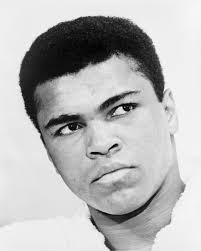
Muhammad Ali
Legacy is for sale these days. Bottle it, slice it up into parcels, package it, label it with an acronym and sell, sell, sell it on caps and T-Shirts. Just dial 1-800-LEG-ENDS, and you can have one too.

It’s become a cliché, mouthed in locker rooms, gyms and studios so often as to become meaningless. But Muhammad Ali’s death re-defined it for what it really is. Legacy ain’t cheap.

In fact, it can’t be bought at all, at not least in the dollars that these days seem to serve as the final arbiter of what and who has value. Of what and who doesn’t.

It took Ali’s death on June 3 and an extraordinary funeral on June 10 in hometown Louisville to remind us of that. This is not meant to be another eulogy of who he was and what he means. How history looks at him will change and evolve from generation to generation.

In the here-and-now, however, Ali’s singular place as a heavyweight champion and a cultural icon serves as an example of what boxing has been, can still be, yet isn’t because of a business model gone awry.

The worldwide reaction to Ali’s passing is a sure sign that there is still a global fascination with boxing. I know, I know. Media and corporate elites uncomfortable with the sport’s inherent brutality say Ali was bigger than boxing. But he would have been just another gasbag if not for a ring that allowed him amplify his fearless nature.

Fifty years from now, I’m willing to bet he won’t be remembered for pictures alongside Malcolm X or of him being escorted out of a federal building in Houston after saying no to the Army’s draft at the height of the Viet Nam war. It’ll be that Neil Leifer photo of him posing over a fallen Sonny Liston.

That was Ali in a snapshot.

It sums up the fighter and personality who didn’t calculate his career and life in terms of the risk-to-reward ratio, an equation built to enhance the money while eliminating the chance of defeat.

He took the risk. Paid for it too, in a brutal 1975 victory over Joe Frazier in a second rematch and a 1974 victory over George Foreman in a fight famous for the rope-a-dope. Ali exhausted Foreman by absorbing punches that make you wonder whether one night’s tactic led to the Parkinson’s discovered a decade later.

Parkinson’s terrible symptoms were what subsequent generations of fighters would see and many would avoid.

At the same, time, the best of those generations would always strive to achieve what Ali had in his legacy-defining career. The unusual twist is that Ali never talked about legacy during his battles with Liston, Frazier and Foreman. Who did? It could have been a brand of cologne for all he or anybody else knew.

It became a part of every fighter’s vocabulary because of Floyd Mayweather, Jr., who has said he surpassed Ali. TBE – The Best Ever, Mayweather calls himself, mostly because he is unbeaten (49-0) and Ali wasn’t (56-5). The TBE acronym is on shirts and caps in every size. Just try one on. No legacy is too small or too big.

But this off-the-rack legacy cheapens what Ali did and, in turn, has turned off most of those in the global congregation that mourned his passing.

Mayweather’s real legacy is money. Nobody in any sport has ever earned as much. Maybe, TBE means The Biggest Earner, because that’s what Mayweather is and will be for awhile, if reports of his $240 million for a victory over Manny Pacquiao in May, 2015 are accurate.

In today’s dollars, Ali’s $6 million for his ‘75 victory over Frazier would be about $27 million. Very big money, but just a few more Bugatis in Mayweather’s garage.

Mayweather, a terrific boxer and a better businessman, turned Ali’s legacy into a calculation that enriched him, yet left the rest of the business scrambling in the wake of his victory over Pacquiao.

On-and-off negotiations for Mayweather-Pacquiao inflamed the public’s imagination for years. It’s no coincidence that the global appetite for boxing, dormant for so long, suddenly came alive in anticipation of a bout some thought would be the second coming of Ali-Frazier.

That didn’t happen. Not much of anything happened, other than the consequences. That’s no secret in an ongoing decline reflected in crashing PPV numbers – a reported 400,000 to 500,000 for Pacquiao’s rematch victory over Timothy Bradley in April and 450,000 to 600,000 for Canelo Alvarez’ knockout of Amir Khan in May.

That’s not a legacy anybody would want

In the weeks after Ali’s death, boxing starts over. It’s no coincidence that he will be mentioned often. That will begin June 25 for Keith Thurman-versus-Shawn-Porter in a CBS-televised welterweight bout at Brooklyn’s Barclays Center.

It will be the first time CBS has televised boxing in primetime since Leon Spinks upset Ali on Feb 2, 1978. Appropriately enough perhaps, it set the stage for another of Ali’s trademark comebacks – a decision over Spinks – the following September for his third heavyweight title.

“With the return of boxing to CBS Primetime, we’ve got big shoes to fill,’’ Stephen Espinoza of Showtime, a CBS subsidiary, said during a conference call this week. “It took something very special for CBS to step back in, and that’s exactly what we have.’’

Call it a moment, a chance, to remind a lost generation of fans that legacy is more than a T-shirt.


Ali: In the end, still fearless and always ready

By Norm Frauenheim–
Muhammad Ali
Muhammad Ali’s journey, 74 years long, ends Friday where it started. The world that worshipped him will gather in the city where he was born. Heads of state, old rivals, actors, rappers, preachers, priests, promoters, poets and punchers are in Louisville for the Funeral of the Century.

Ali, who lost to Joe Frazier in the Fight of the Century 45 years ago, planned it. He’d give the eulogy if he could, but not even The Greatest could manage that. He’ll have to let former President Bill Clinton speak for him. He’ll have to let the crowd cry, cheer and chant his name.

Ali Bomaye! Ali Bomaye!

That was the African chant before, during and after his 1974 stoppage of George Foreman in what was then Zaire. Listen for that and for the butterfly, the bee and everything else on the sound track that helped define the young Ali, who once said he was so mean he’d make medicine sick.

He’ll be remembered for all the crazy words. For Foreman, Frazier and Sonny Liston, too. For Malcolm X. For refusing to serve in the U.S. Army because of his opposition to the Viet Nam War. For changing his own name, too. Born Jan 17, 1942 as Cassius Marcellus Clay in Louisville, he returns to the Kentucky city with the Muslim name that will never be forgotten.

He might not have been history’s greatest fighter, a spot that belongs to Sugar Ray Robinson. He might not even have been the greatest heavyweight. Joe Louis probably hit a little harder and didn’t let his hands drop in a way that left Ali perilously open, leaving only his durable chin as a defense.

Only Ali would take punches from the powerful Foreman and label the tactic as rope-a-dope. It was risky and unexpected. But Ali did it, exhausting Foreman in a bout that makes you wonder whether it was factor in the terrible disease that would befall him a decade later. Ali couldn’t exhaust Parkinson’s, but he fought it – day-to-day, hour-to-hour – with quiet dignity for 32 years before he died in Scottsdale, Ariz., last Friday at 9:10 p.m. (PST).

I’m not sure how I’ll remember him. As an Army beat living in faraway bases, I had my ear pressed against my dad’s radio to hear what ever I could above the static of the blow-by blow accounts of his victories over Liston.

As a young sportswriter in Florida, I watched the back-and-white telecasts of his 1971 loss to Frazier at a closed circuit venue. I went to a crowded movie theater to see him beat Frazier in their first rematch. Then, I saw him beat Foreman and Frazier again in Manila, all in grainy-and-gritty black-and-white.

It wasn’t long before I moved to Phoenix. My interest in boxing was still there and had peaked with eventual Hall of Famer Michael Carbajal, whom I began to cover at the 1988 Olympics.

Then one day in 2005, I looked up and saw Ali standing in front of me at halftime of a Phoenix Suns game. We shook hands, yet said very little. I wasn’t sure whether Parkinson’s had yet robbed Ali of his speech. I soon found out that it had not. He grabbed me from behind and whispered in my ear.

“You sure are uglyyyyyy,’’ he said.

Surprised, I turned and looked into dancing eyes full of playful mischief. On other encounters, there were the familiar magic tricks.

Then, there was an afternoon in downtown Phoenix about eight years ago. I sat next to him at a Diamondbacks game. He grabbed my notebook and pen. Fifteen minutes later, he gave them back.

On a page in the notebook, there’s a sketch, a stick figure walking toward a leafless tree that seems to be on the edge of a faraway canyon. I wasn’t sure what to think of it then. But I looked at it again this week while thinking of Ali’s death and his funeral Friday. Ali was looking at the uncertainty of the end he knew was coming.

He did the only thing he could do. He got ready.


Going Pro: Or is Olympic boxing just going away?

By Norm Frauenheim-
Olympic_Rings.svg
Olympic boxing’s long slide into irrelevancy continued this week with an acronym’s decision to let pros fight amateurs for medals.

The outrage was predictable because, of course, it’s dangerous. Men shouldn’t be allowed to fight boys, although that’s been going on ever since the Cubans began their dominance of the medal stand’s top pedestal generations ago.

Olympic boxing has been an unfolding accident ever since Roy Jones Jr. got robbed of gold in a documented fix at the 1988 Seoul Games. In the wake of a scandal at an Olympics also marred by 100-meter dash winner Ben Johnson’s positive test for steroids, there were some cosmetic moves.

Olympic bureaucrats altered the scoring, replacing the cards with computers. But software is as corruptible as pen and paper. Since Seoul, the whiff of corruption has hung over Olympic boxing. There has even been speculation that Olympic movers-and shakers have thought about eliminating the sport altogether.

That would be tough to do, mostly because countries without the money for swimming pools and equestrian can always produce a boxer or two. Nevertheless, the sport has moved from the midway to the fringe, from prominence to obscurity. Sugar Ray Leonard won his gold at a Montreal venue near the gymnastics arena where Nadia Comaneci won her 1976 gold.

Twenty-eight years later, you had to leave the main Olympic park to find the boxing venue, a rundown building in rundown part of Athens, to see Andre Ward win in 2004, America’s last gold.

Four years later, the city was different, but boxing was as hard to find in Beijing as it was in Athens. It was if the Olympic establishment and the sponsoring networks wanted to keep it out of sight, if not out of mind. In 2008, a scandal erupted over how judges were assigned. There were allegations that some shadowy figure in an Eastern European country was offering money in an attempt to influence the assignment of favorable judges.

A news conference was called and held late at night, somewhere in between Michael Phelps’ eighth gold medal at the pool and Usain Bolt’s first at the track.

A couple of reporters, including this one, showed up. Stories were written, filed and ignored. Point is, nobody cares about Olympic boxing anymore. There’s outrage at AIBA’s decision to allow pros into the ring, starting this summer with the 2016 Rio de Janeiro Olympics, the Zika Games.

But it will subside, a little bit like the Olympic sport itself. AIBA’s decision pushes boxing closer to tragedy – a serious injury or fatality – than it has ever been. Then, it really will vanish. But will anybody really care?


Duran: A legend and lesson about the value of being genuine

By Norm Frauenheim-
roberto_duran_image
Roberto Duran has been everywhere lately. He was in France, at the Cannes film festival, a few days ago, hanging out with Robert DeNiro, for the first look at the big screen portrayal of his life, Hands Of Stone.

He was in Las Vegas a few weeks ago for the Canelo Alvarez-Amir Khan bout, marketing the movie and mostly doing what he does best:

Being himself.

This weekend he’s in Arizona, where he has some roots. His father used to work and live in Flagstaff in the mountains a couple of hours north of Glendale, a Phoenix suburb where on Saturday night he’ll be working a corner for Shane Mosley in the 44-year-old’s ongoing comeback against David Avanesyan at Gila River Arena in a CBS Sports Network-televised bout (10:30 p.m. ET/7:30 pm PT) on a seven-fight card scheduled to begin at 5 p.m. (PT).

There’s an ongoing fascination with Duran that doesn’t need twitter or Facebook or some other modern manifestation of social media to further it. The film, starring DeNiro as trainer Ray Arcel, is just the latest expression of how there’s no end in the interest the public has for Duran, who ironically was once known for uttering no mas.

The growing Latin influence in American media and culture helps explain some of it. The current generation of Latino fight fans all had dads who told their sons about Duran. But there’s more to it than just that.

From this corner, Duran has become the face of what boxing once was. Through the days before Canelo’s crushing stoppage of Khan on May 7, I ran into Duran hugging fans, kissing babies and telling stories. History is full of the so-called People’s Champ. But, I suspect, a true measure of one is what happens long after the final bell. So many just vanish from our collective memory. They show up at staged events and autograph shows. They’re there for a few sound bites and then are gone all over again.

But Duran is still in the crowd, stirring up emotions and imaginations if he had never left. One of those weathered hands of stone will grab you and leave an indelible mark.

Every time I see him, I go back to a memorable 40 minutes that Bart Barry, my longtime colleague and wordsmith extraordinaire, and I had with him. He was in Phoenix. We were a couple of reporters, alone in big ballroom for a press conference otherwise ignored by local media. Had it been just about anybody other than Duran, he’d been gone, angry and embarrassed at the lack of attention.

But for the people-centric Duran, two reporters were an audience he couldn’t resist. He talked to Bart and me as if the New York Times and Wall Street Journal were in the room. He talked about punching out a horse for the chance to win a fifth of Chivas Regal, which was worth more than the purse he got for winning an earlier bout in Panama City.

He talked about injuries he suffered in auto accident in Argentina. Barry, bi-lingual, was the designated translator. Through Bart, he said he had been in a coma for two months. In English, I immediately interrupted by saying “Two months?’’

Here came that hand of stone. It grabbed my forearm. Suddenly, Bart’s able translation was not necessary.

“Two months, two weeks, two days, two hours, two minutes,’’ Duran said in English. “A coma, OK?’’

OK.

He talked about being in the hospital, although it didn’t appear to be a hospital when he first awoke. He said he looked up and saw a white circle above him. He explained through Bart that he took that as a heavenly sign. He had made it, he said. And, he said, he started chanting exactly that, loudly and often.

Suddenly, he said, an arm reached out and grabbed the wrist on one of those hands of stone. Then, there’s a voice from the occupant of a nearby bed, an old man, who told him to shut up, because he was only in a hospital room.

I didn’t know how much was true, or embellished. At that point, however, it didn’t mater. Bart and I didn’t care. We didn’t know whether to believe the story, but we just wanted to hear him tell it. There was a generosity in Duran’s spirit and energy in just telling a story. It was more than a sign that Duran liked to perform. It was a moment – one of 40 – that said Duran genuinely liked people, no matter how many there were or who they represented.

This is the same fighter who agreed to a rematch with Sugar Ray Leonard within six months after winning a unanimous decision over him in Montreal on June 20, 1980. On November 25 of that year, Duran lost the rematch by uttering the then- infamous no mas during the final seconds of the eighth round.

In explaining the circumstances leading up to that fight, Duran said he had been living in New York, celebrating non-stop.

“Women-women-women, drink-drink drink, eat-eat-eat,’’ he said through Bart.

Somewhere between the women, the booze and the food, Leonard’s management offered the rematch. The money, Duran said, was too good to pass up. But I also suspect that Duran knew he owed something to fans. He loved them as much as the women, the booze and the food.

He owed them a rematch –a bout — that they wanted as soon as possible. Would that happen these days? Could it? It took years for Floyd Mayweather Jr.-Manny Pacquiao to happen. The same scenario appears to be unfolding amid all the talk about Canelo-Gennady Golovkin.

Duran said yes to the Leonard rematch despite the fact there really wasn’t enough time to get ready. Duran took the risk, suffered for what he did and said, yet re-emerged nearly 36 years loved as much, if not more, than ever.

It was genuine then and looks to be more genuine now in when compared to today’s way of throwing up artificial delays that only wind hurting the people.

Duran’s people.


A Civil Alliance: Jones, Toney move forward as old comrades and co-promoters

By Norm Frauenheim
toney19
TUCSON – There was no main event. There was only a reunion.

Roy Jones Jr. and James Toney stole the show — their own show — Friday night, as co-promoters of a card at Casino Del Sol that lost its main event when junior featherweight Hanzel Martinez was hurt Wednesday night in an auto accident.

Jones and Toney, once sworn enemies in a 1994 super- middleweight out called Uncivil War, re-emerged as business partners in what they say is just the beginning.

“We’re going to take over the world, man,’’ said Toney, who made his old rival laugh at his dance steps, jokes and gestures as they stood in the ring, almost arm-in-arm, before each bout televised by the CBS Sports Network. “We’re just starting.’’

More like starting over.

Twenty years ago, the guess was that the two would only meet again in a bitter rematch or an old-fashioned duel. There could only be sequel of the hostility that lingered after Jones’ unanimous decision over Toney in a clash at Las Vegas MGM Grand.

“Nah, nah, nah’’ Toney said. “You gotta get past all of that. Time to grow up.’’

John “Pops” Arthur — Toney’s CEO, advisor, mentor and confidante — said Toney and Jones ran into each other last year at a boxing meet-and-greet.

“James had always wanted a rematch, yeah,’’ Arthur said. “I told him to move on and put his anger aside. I told him to approach Roy like a businessman. When people saw them together, I think they probably thought they’d only agree to rematch.’’

Given their pasts, it would have been a reach to think anything else. Both fighters have continued to fight far beyond their primes, despite calls from fans and media for them to retire.

This time, Arthur said, they shook hands. But not for a remake of some old hostility. This time, it’s all about business, Arthur said.

Arthur foresees a long-term partnership, which would be a lot better for their financials and their brain cells than a rematch ever could be.

“We’ll do a lot more of these, no doubt,’’ Toney said.

With the Martinez-Prosper Ankrah bout off the card because of a concussion and back injury suffered by Martinez during an accident in Tijuana, the show went on with Emmanuel Robles in an eight-rounder against Pipino Cuevas in a junior welterweight bout.

In his first bout since signing with Roy Jones Jr. in early March, Robles (15-0, 4 KOs) made it look easy against an out of-shape Cuevas

Robles floored Cuevas (17-16-1, 15 KOs), winless over his last seven bouts, with a crushing left in the third round. Cuevas got up, but blood poured from his nose. He looked beaten. in the fourth, he would be.

At 25 second of the round, referee Tony Zaino stopped it when Robles landed a series of blows against a defenseless Cuevas.

On The Undercard

Keenan Carbajal (11-2, 6 KOs) wore red-and-white trunks cut in the style of his Hall of Fame relative, junior-flyweight legend Michael Carbajal. Flashed a little bit of his power, too.

Keenan Carbajal, bigger and more confident than ever, delivered a lethal succession of combinations, overwhelming an overmatched Lorenzo Trejo in the second round.

The featherweight bout was scheduled for eight rounds. Carbajal, of Phoenix, could have put Trejo (35-31, 22 KOs), of Mexico, onto the canvas that many times or more, if not for referee Rocky Burke, who ended it at 2:21 of the second and Trejo on the canvas for the third time in the round.

An introduction of Randy Moreno’s power was warning enough for Christopher Turton. Moreno (3-0, 2 KOs), of Las Vegas, rocked him, sending Turton stumbling across the canvas midway through the first round of a lightweight bout scheduled for four. A dazed Turton (2-3, 1 KO), of Colony, Tex., took a seat after the first and quit before the second ever began.

Tucson cruiserweight Jesus Santamario’s debut was a knockout, but not exactly the kind of knockout a young fighter envisions for his first pro bout. Edgar Ramirez (3-0, 1 KO), of Mexico City, crushed him with power he had never encountered, bouncing him off the ropes and onto the canvas for a quick knockdown, then finishing him with short right to the back of the head at 1:13 of the first.

Before the CBS telecast, Phoenix super-flyweight Elihu Soto (5-0, 3 KOs) employed precise and painful body blows to score a four-round unanimous decision over Yezber Romero (2-2, 1 KO) of Eugene, Ore.


Canelo’s surrender of WBC title is an empty gesture

By Norm Frauenheim

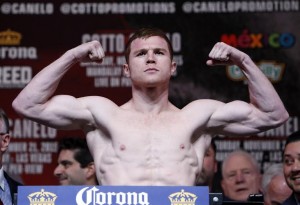
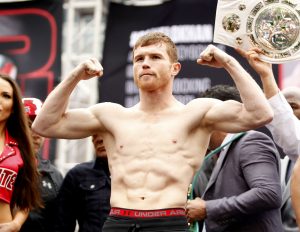
Miguel Cotto vs Canelo Alvarez PPV Weigh-in   11-20-2015 WBC Middleweight Title  Miguel Cotto 153.5 vs. Canelo Alvarez 155 photo Credit: WILL HART
Miguel Cotto vs Canelo Alvarez
PPV Weigh-in 11-20-2015
WBC Middleweight Title
Miguel Cotto 153.5 vs. Canelo Alvarez 155
photo Credit: WILL HART

It’s hard to know what to make of Canelo Alvarez’ surrender of the WBC’s middleweight title late Wednesday in an announcement that wasn’t exactly a shocker.

A disappointment, yeah. But a surprise? Not these days, not in the wake of a fan base eroding faster than political civility in the year since the Floyd Mayweather Jr.-Manny Pacquiao dud.

The best that can be said of Wednesday’s move is that it was an empty gesture.

In boxing speak, Canelo “vacated” the title about a week before a deal was mandated for bout with Gennady Golovkin In a prepared statement, he said he did so because he didn’t want reported negotiations with GGG to be subjected to “artificial deadlines.”

Vacated and artificial are just a couple of ways of saying empty, empty.

Put it this way: Canelo gave up a 160-pound title that he won and defended at 155 pounds. GGG was awarded a title he has long pursued without ever having to throw a punch.

Meanwhile, Canelo is still the division’s lineal champ, meaning he beat the man who beat the man. Think of a flow chart, lines of succession. I’m not sure where any of the lines really lead, other than nowhere in boxing’s current climate.

At best, it was a subtle way of saying that Canelo-GGG won’t happen until next year. But didn’t we suspect that anyway? In so many ways and words during the days before Canelo’s dramatic knockout of Amir Khan on May 7, that was the message.

During trainer’s roundtable a couple of days before opening bell at Las Vegas new T-Mobile Arena, Canelo’s corner man Eddy Reynoso essentially told everybody they’d have to wait until at least next year.

He said that Canelo would not fight a true middleweight in his first bout after Khan, who jumped from welterweight to sacrificial lamb in a bold, yet futile bid to upset the maturing Mexican.

“No, not at all,’’ Reynoso said through an interpreter.

When asked when Canelo would face a fighter with a proven record at 160, Reynoso said: “Maybe in two or three fights. But now, not at all.’’

In giving up the WBC title, Canelo might be getting out from under mounting pressure for him to defend a time-honored title at a catch-weight while forcing the 34-year-old GGG to wait until after still another birthday.

The move also could weaken whatever leverage GGG had in negotiations, which both sides say are still ongoing. He’s no longer the mandatory challenger.

But does any of this matter to fans? Canelo promoter Oscar De La Hoya has said that the GGG-Canelo fight is the antidote for a lingering hangover from Mayweather-Pacquiao. No argument, there.

But De La Hoya is caught in a dilemma. What’s best for boxing might not be best for Canelo and De La Hoy’s business. He’s trying to maximize the money he and his star client can make in a long-awaited confrontation against GGG.

Okay, but the timing is risky. Crashing pay-per-view numbers since the Mayweather-Pacquiao turnoff are evidence that GGG-Canelo has to happen ASAP.

De La Hoya likes to refer to promoter Bob Arum’s old term about how to market a major bout. Marinate, says Arum, who likes to let public demand stoke the fires for a while.

But while Canelo vacates, the public marinates in familiar exasperation and further impatience. An empty gesture this week threatens to create more empty seats everywhere. That’s a lousy recipe in any book.


Hanzel Martinez off CBS card after reported auto accident

By Norm Frauenheim-
Hanzel Martinez suffered undisclosed injuries in a reported auto accident Wednesday night, forcing him to withdraw from a main event Friday night at Tucson’s Casino Del Sol on a card televised by the CBS Sports Network.

Martinez, 23-2 with 18 KOs as a junior featherweight, was reported to have been involved in the accident while leaving Tijuana, Mexico, on his way to Tucson.

Martinez, a former brother-in-law to Antonio Margarito, was scheduled to face Posper Ankrah (24-7, 15 KOs) of Ghana.

With Martinez-Ankrah off the Roy Jones Jr.-promoted card (11 p.m. ET/8 p.m. PT), the main event will feature junior welterweight Emmanuel Robles (14-0-1, 4 KOs) against Gerardo Cuevas (17-15-1, 15 KOs).

In another Arizona card Friday night, Phoenix super-bantamweight Panchito De Vaca (14-0 4 KOs) faces Gustavo Molina (22-11, 9 KOs) for a NABF junior title at Celebrity Theatre in Phoenix. The Iron Boy Promotions card is scheduled to begin at 6 p.m.


Just Say Nyet: Wilder’s biggest victory would be a boycott of Russia

By Norm Frauenheim-
DEONTAY WILDER
Deontay Wilder, an emerging champion and a compelling personality, wants to make history. Maybe, he should just make a statement, instead.

Wilder is about to leave for Moscow and become the first American heavyweight champion to defend his title there on May 21 against Alexander Povetkin in a risky venture complicated by ongoing disclosures of Russia’s systematic doping.

Depending on the source and based on a very big assumption that all will be on the up-and-up, the fight is a toss-up. Wilder might win. Might lose. But he would score a victory for everybody – boxers, skaters, skiers, sprinters and swimmers – if he just said, hell no, he won’t go until the Russians clean up their act.

What would he have to lose? Plenty, at first. He’d lose a paycheck. He’d risk lawsuits and his title. The World Boxing Council probably would have no choice but to strip him of the belt. Then, there are crazies in the boxing crowd who would question his guts and his promise to knock out Povetkin.

A Wilder victory on Russian scorecards would have to go down as a contender for Upset of the Year. After all, this is a country that, according to the New York Times, conducted a urine exchange – dirty for clean — though a hole in the wall at the Sochi Olympics.

http://www.nytimes.com/2016/05/13/sports/russia-doping-sochi-olympics-2014.html?_r=0

Yet despite Russia’s Hole In The Wall Gang, there have been no criminal charges while the country continues to move forward on plans for the 2018 World Cup.

https://www.theguardian.com/sport/2016/apr/08/russian-doping-scandal-no-criminal-charges-sports-minister

http://www.business-standard.com/article/news-ians/russian-doping-scandals-won-t-impact-2018-world-cup-preparations-116051200324_1.html

The fight will happen two weeks after the WBC announced its Clean Boxing Program, year-round testing that will be administered by the Voluntary Anti-Doping Association President Dr. Margaret Goodman.

Wilder Promoter Lou DiBella said Wednesday during a conference call that testing has been underway for seven to eight weeks. However, DiBella also said he would have preferred to have had the testing begin earlier.

The unfolding scandal probably means the Russians will be very careful not to exchange urine samples like shots of vodka before opening bell next week. The world is watching. But that’s not the point.

Thus far, we’ve heard from bureaucrats representing all of the world’s sporting acronyms. We’ve heard threats to ban Russia’s track-and-field athletes from this summer’s Brazil Olympics. Blah, blah, blah. It’s bupkis, or business as usual after the fight. We’ve yet to hear from an athlete in a substantive way. Enter Wilder, who has a chance to say and do something that – long term – would stand as a courageous triumph.

It wouldn’t be the equivalent of the U.S.-led boycott of the 1980 Moscow Olympics for Russia’s invasion of Afghanistan. Over time, the boycott, ordered by then-President Jimmy Carter, has been judged to be a mistake. Athletes were caught in the middle, forced to pay a price for an international confrontation they didn’t create.

But state-run doping is all about the athletes. It puts their integrity, livelihood and health in jeopardy.

The heavyweights have a rich history of making a real difference. Jack Johnson broke the color line before Jackie Robinson, becoming the first African-American to win the heavyweight title during an era that spawned The Great White Hope. Joe Louis knocked out Germany’s Max Schmeling in a 1938 rematch that came to symbolize the coming world war between democracy and fascism. Muhammad Ali was stripped of his title and license when he refused to be drafted because of his opposition to Viet Nam.

They are remembered for how they responded when confronted by events, each in their own time. It’s Wilder’s time.


Tabiti fighting to get into cruiserweight title mix on ShoBox

By Norm Frauenheim-
Andrew Tabiti
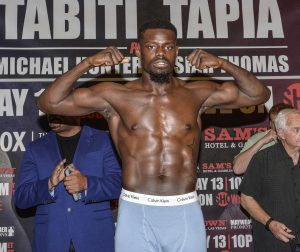
Andrew Tabiti, a Floyd Mayweather Sr, trained fighter, hopes to take some of the snoozer out of cruiser against Keith Tapia Friday night in the 200-pound division tonight at Las Vegas Sam’s Hotel and Gambling Hotel in a bout televised by ShoBox: The New Generation.

Tabiti (12-0, 11 KOs), of Las Vegas, is looking for victory over Tapia (15-0, 6 KOs), of of Puerto Rico, that would put him into the championship mix of a Euro-dominated division.

It’s no coincidence that the card (10 p.m. ET/PT) features another cruiserweight bout between 2012 U.S. Olympian Michael Hunter (11-0, 8 KOs) against Isiah Thomas (15-0, 6 KOs) of Detroit.

The undercard includes Tucson welterweight Alfonso Olvera (7-2, 3 KOs) against Sanjarbek Rakhmanov (4-0, 3 KOs) of Uzbekistan.


Canelo lands the punch that stirs boxing’s drink

Canelo Alvarez

LAS VEGAS – Canelo Alvarez had none of the speed. None of the footwork. But he had one punch. It was enough and now he has it all.

Canelo’s power was summed up Saturday night in one mighty strike that sent Amir Khan bouncing off the canvas like a flat board off a concrete floor midway through a bout that re-asserted the Mexican’s ability to dictate what’s next. Who’s next.

As a statement, it was as definitive as it was dramatic. It showed just how quickly Canelo (47-1-1, 33 KOs) can turn things, everything and anything, in his favor. For weeks, there was a debate about a 155-pound catch weight for a bout that was his first defense of the WBC’s 160-pound title.

Five pounds here, five pounds there. The power is heavy on any scale. It landed, lightning bolt-like, just when it looked as if a major upset was brewing. Khan’s hand speed and agile feet were giving Canelo fits throughout the first five rounds. In the second round, a knot appeared on Canelo’s right cheek bone. But it was there long enough to become a critical target for Khan’s long and accurate jab.

“I was getting in the ring with a big guy,’’ said Khan, who was taken to a nearby emergency room for observation after the bout. “Unfortunately, I didn’t make it to the end.’’

In one momentary lapse, Khan (31-4, 19 KOs) ducked and Canelo threw a right hand counter that landed like a bomb on a chin that has long been a target. At 2:37 of the sixth round, it was over in knockout in an HBO pay-per-view bout, the first at the new T-Mobile Arena.

The crowd went wild. For a few scary moments, Khan never heard the roar. He was out. The back of his head had bounced off the canvas at least once. A crowd of Nevada officials and corner men surrounded him like paramedics. They waved a white towel in what looked to be desperate attempt at getting him to regain consciousness. It looked like an accident scene.

All the while, Canelo paraded from one side of the ring to the other, celebrating his victory. He waved at Gennady Golovkin, who was in a ringside seat.

“i invited him into the ring,’’ Canelo said. “Like we say in Mexico: ‘We don’t f— around.’

“I don’t fear anyone. We don’t come to play in this sport. I fear no one in this sport.’’

When asked if he would fight GGG this year in a title defense mandated by the WBC, Canelo said he was ready.

“Right now,’’ he said. “Right now, I’ll put on the gloves.’’

That didn’t happen, of course. And there’s still doubt about whether it will happen later this year. Canelo has all the leverage, which means he could continue to demand a 155-pound catch-weight, even at the risk of having the WBC title stripped from his thick waist.

“Gennady, Gennady where are you?’’ Canelo promoter Oscar De La Hoya said from the ring after the bout. “We want to talk to you, talk to and your representatives tomorrow.’’

According to the WBC, Canelo has 15 days to negotiate a deal with GGG.

“I am old school,’’ Golovkin said before opening bell. “Middleweight is 160. I respect the sport of boxing.”

But Canelo holds the upper hand at the negotiating table, especially if the pay-per-view audience is anywhere near the one million mark.

For now, all of boxing’s respect and its perks are on Canelo’s side of the table. That’s power, too.
Attachments area

David Lemieux says it’s a beginning.

Call it a second beginning.
Lemieux quickly put his career back on track Saturday night at T-Mobile Arena after it looked as if it had come to an end in losing an eighth round stoppage to Gennady Golovkin in October. After the feared GGG, of course, everything looks easy. Glen Tapia was.
Lemieux (35-3, 32 KOs) rocked Tapia from pillar to post and to just about any other place he chose through the first three rounds. In the fourth, Lemieux threw a huge left hook that dropped Tapia onto the canvas and nearly under the ring’s bottom rope. It was as good as over, and Tapia’s corner knew it. It stopped the fight at 56 seconds of the round. Tapia (23-3, 15 KOs) protested, saying he would have fought differently and pursued a knockout had he known his Freddie Roach-led corner was poised to end it.
But the corner simply did what Lemieux might have done later in the fourth and surely in the fifth.
“I was looking for openings and I began to find them,” Lemieux said. “It’s a beginning.”
A good one.


Frankie Gomez finally passed a test that will allow him to graduate from prospect to contender.

Long considered as talented as he was immature, there were always doubts about how Gomez would do against a longtime pro with fundamental know how. Mauricio Herrera is that gatekeeper.
Gomez (21-0, 13 KOs, of Los Angeles, dominated him in every way Saturday night at T-Mobile Arena, adjusting to changes in style and tempo for a unanimous decision — a 100-90 shutout on all three cards — over the respected Herrera (22-6, 7 KOs) in a 10-round welterweight bout..


Curtis Stevens changed his nickname.

The former Showtime now calls himself The Cerebral Assassin.
New identity? Maybe. Maybe, not.
Lets just say that the Cerebral in the re-dubbed part of Stevens (28-5, 21 KOs), a Brooklyn middleweight, didn’t have to think too long or hard to unleash a counter-right Saturday night that lifted Patrick Teixeira into mid-air like a leaf caught helplessly in the wind.
By the time Teixeira (26-1, 22 KOs) landed on the canvas at T-Mobile Arena, he was done. The Brazilian climbed to his feet. Referee Tony Weeks looked into his face and and saw a pair of vacant eyes looking back at him. Weeks ended it at 1:04 of the second round.


Diego De La Hoya has more than a legend’s last name. He has some speed and sting in his hands too.

He used both Saturday in way that would have made Uncle Oscar, also his promoter, proud in a seventh-round stoppage of Rocco Santomauro, a California fighter who had former Oscar De La Hoya rival Shane Mosley in his corner.
Diego De La Hoya (15-0, 9 KOs) knocked down Santomauro (13-1, 1 KO) in the second round and bloodied him above the right eye in the fifth in the last bout before the first pay-per-view televised bout on the Amir Khan-Canelo Alvarez card at T-Mobile Arena.


Jason Quigley waved an Irish flag. Danced to Irish music.

Quigley’s victory over James De La Rosa of Harlingen, Tex., came with an Irish accent and punches accented by power.
De La Rosa (23-4, 13 KOs) tried to elude them and often mocked the blows Saturday night in a 10-round middleweight bout before the Canelo Alvarez-Amir Khan bout at T-Mobile Arena. In the end, however, he didn’t have enough to counter them in losing a unanimous decision to Quigley (11-0, 9 KOs), a lanky middleweight from Donegal
In an eight-round lightweight bout, Lamont Roach Jr. (11-0, 3 KOs) of Washington, D.C., made it look easy, controlling tempo and landing punches almost at will in scoring a unanimous decision over Jose Arturo Esquivel (9-5, 2 KOs) of Mexico.

Rashidi Ellis walked out of T-Mobile Arena the way he walked in.

Unbeaten.
Ellis (15-0, 11 KOs), also as unmarked as T-Mobile’s brand new seats, overwhelmed Marco Antonio Lopez (24-9, 15 KOs)  with a volume of punches and power, scoring an eight-round decision that was unanimously one-sided in an junior-middleweight bout, the second Saturday on a card featured by Amir Khan-versus-Canelo Alvarez.


It was a double debut.

For the building and the fighter.
David Mijares, a super-lightweight from Santa Monica, answered the first opening bell at the new T-Mobile Arena Saturday on the Amir Khan-Canelo Alvarez card.
Mijares (1-0) won his debut, scoring a four-round unanimous decision over Omar Reyes (1-3) of Corpus Christi, Tex.,  about four hours before the HBO’s pay-per-view telecast was scheduled to begin.


Right Place, Right Time: Canelo needs the right performance against Khan

By Norm Frauenheim
Canelo_Alvarez
LAS VEGAS – Canelo Alvarez stood on a stage, beneath threatening skies and surrounded by weathered, scarred and aging faces of fighters who have been what he hopes to be.

He looked to his right and saw Roberto Duran. To his left, he saw Evander Holyfield and Lennox Lewis, Oscar De La Hoya and Bernard Hopkins. Each has been where Canelo wants to go.

“The thing is, I want to be legend,’’ he said during a conference call a couple of weeks before his fight Saturday night against Amir Khan in a defense of his WBC middleweight title at the new T-Mobile Arena.

There is no map, no well-traveled path, on how to get there. For every great fighter on the stage Friday for a weigh-in in front of the T-Mobile Arena, there were different challenges and controversies. They are legends, in part, because of skill, durability, style and guts.

There’s also luck. Legend making can be as unpredictable as the approaching weather. But there was no downpour Friday despite dark clouds that promised a desert storm. It was just coincidence, but legends can’t be made without good timing. For Canelo, the timing has been almost perfect throughout his career.

De La Hoya, his promoter, calls him the game’s new face. He might not be quite there yet. But Canelo is in the right place and precisely at the right time to put a face on a game that has begun to search for one.

Maybe Floyd Mayweather Jr. is coming back. Maybe not. Crazy stories about him fighting UFC star Conor McGregor are just a sure sign that the comeback talk will be with us at least until we know whether Hillary Clinton or Donald Trump is moving into the White House next year.

Early next week, we’ll know whether Manny Pacquiao is a new Filipino Senator. Elections are scheduled for May 9. After beating Timothy Bradley on April 9, Pacquiao said he’s “50-50” on retirement. If he wins a seat in the Filipino Senate, it will get a lot harder for him to move back into the ring.

Opportunity is in the forecast.

Years from now, Canelo’s date with Khan might not be considered critical. It’ll only be critical if he loses, and few expect that in a 155-pound bout against a skilled, yet undersized Khan, who has been at more than 140 pounds only four times before a two-division jump for a spot on Saturday HBO’s pay-per-view card (6 p.m. PT/9 p.m. ET).

For Canelo (46-1-1, 32 KOs), the key is not so much in if he wins. It’s in how.
If Canelo is a legend in the making, he has to look good – very good — against Khan (31-3, 19 KOs). Five-to-one odds in favor of Canelo suggest that the Mexican will dominate in a style that will only further speculation about a showdown with Gennady Golovkin, who plans to be at the fight.

At the sports book and on the scale, he has key advantages. He is expected to be 17 to 18 pounds heavier than he was Friday. That means Khan, who is not expected to heavier than 165 at opening bell, could be facing a fighter who is a couple of pounds short of being a light-heavyweight. Khan’s quick feet might not be fast enough to keep Canelo off him throughout the scheduled 12 rounds.

“I’m confident that this is my time,’’ Khan said at the weigh-in.

If Khan stays disciplined and resists the temptation to trade punches, maybe it will be his time. Slick defense and agile footwork are supposed to keep him out of range, and away from Canelo’s dangerous combinations.

From start to finish, however, Canelo’s stubborn pursuit and upper-body strength figure to keep the pressure on. The betting odds are one-sided because few think Khan can stick to his game plan. One moment of fatigue, physical and/or mental, could leave Khan’s vulnerable chin open for the KO combo that many believe is inevitable, perhaps in the later rounds of just one chapter in a bigger story.

Notes From The Scale: David Lemieux has been mentioned as a possible foe for Canelo. However, Lemieux has had trouble making 160, much less 155. Lemieux (34-3, 31 KOs) was right at 160 Friday for his middleweight bout Saturday against Glen Tapia (23-2, 15 KOs), who was at 159.5. …Curtis Stevens (27-5, 20 KOs) was at 160 and Patrick Teixeira (26-0, 22 KOs) was at a 159. …Mauricio Herrera (22-5, 7 KOs was at 145.5 and Frankie Gomez (20-0, 13 KOs) at 146 for their welterweight bout.


Memo to GGG: Trainer says Canelo is 2 to 3 fights from facing a true middleweight

By Norm Frauenheim-
Gennady Golovkin
LAS VEGAS – Canelo Alvarez is not a middleweight now and probably won’t be one until sometime next year.

That, at least, was trainer Eddy Reynoso’s likely timetable when asked Thursday whether Canelo’s next fight would be against a true middleweight if he beats Amir Khan Saturday at a catch-weight in his first defense of the WBC’s 160-pound title.

“No, not at all,’’ Reynoso said during a trainer’s roundtable at the MGM Grand. “Maybe in two or three fights. But now, not at all.’’

The plan is for Canelo to fight two more times this year, once in September and again in December. He intends to fight both times at 155-pounds, the contracted weight for the HBO pay-per-view bout against Khan at the new T Mobile Arena.

The question, however, is whether Canelo still will have the WBC title if the 5-to-1 betting favorite beats Khan.

According to an agreement with the WBC for an interim fight after his victory for the belt over Miguel Cotto in November, Canelo has 15 days after the Khan bout to reach an agreement with Gennady Golovkin, the mandatory challenger and presumptive middleweight champion.

Without an agreement with GGG or another deal for an interim bout in the wake of a predicted Canelo victory, the WBC’s next step would be to strip the popular Mexican of the title.

“We will follow the rules,’’ WBC President Mauricio Sulaiman said.

Canelo’s stubborn demand for a catch weight has generated controversy over whether the 25-year-old is ready for thunbeaten and feared Golovkin.

“We’re ready to fight anyone,’’ Reynoso said. “It’s not a difficult fight. It’s a hard fight to make and we’re going to have to sit down with Oscar De La Hoya to do that.

“But as a fight, it is not difficult, because he (GGG) is a fighter who comes forward.’’

Bernard Hopkins, De La Hoya’s promotional partner, defends Canelo’s right to demand a catch weight.

“Who’s the star?’’ said Hopkins, a longtime middleweight champ in 2004 when he agreed to a 158-pound catch weight for a bout against De La Hoya.

Hopkins came in at 156 and won a ninth-round stoppage in a career-defining bout. De La Hoya was fighting at middleweight for only the second time, but his celebrity propelled Hopkins to more money and media attention than he would have received against any other fighter.

“The guy fighting on Cinco de Mayo weekend is the guy generating the numbers,’’ Hopkins said. “He’s the star. Why does everyone want to give GGG a free pass?’’

Canelo has said that GGG has fought a collection of nobodies. A couple of those nobodies are on Saturday’s undercard. There’s David Lemieux, who lost to GGG in October. There’s Curtis Stevens, who lost to GGG in November, 2013.

“Triple-G not being ready for Canelo?,’’ said Lemieux, who faces Glen Tapia Saturday night. “I don’t think that’s the case. Sometimes, people have got to say whatever they want to say.

“But we all know Triple-G has a long amateur history. He’s a very good fighter. And it’d be a very interesting fight if he fought Canelo. Canelo has fought a lot of tough opponents, but so has Triple-G.”

Canelo, Stevens said, has the leverage because of his pay-per-view numbers, including 900,000 for his victory over Cotto.

“Canelo, he’s the man, the pay-per-view superstar, and he is a junior-middleweight, not a true middleweight,” said Stevens, who fights unbeaten Patrick Teixeira Saturday. “Canelo makes the rules in this case. It’ll be a good fight if it happens.”


Khan lands first good blow with punch line directed at Trump

By Norm Frauenheim-
Amir Khan
LAS VEGAS, Nev. – Amir Khan might be a big underdog against Canelo Alvarez Saturday, but he won the news conference Wednesday.

Khan scored a knockout with a punch line.

“You never know, but this could be the last fight for me and Canelo here,’’ Khan said at the MGM Grand. “That’s it, if Donald Trump becomes president.’’

Khan is Muslim, a UK fighter of Pakistani descent. Canelo is Mexican. Trump’s call to make America great again doesn’t exactly include either.

Trump, the Republican Party’s presumptive nominee, has campaigned by saying he would bar Muslims. He’s also promising to build a wall, 10 feet high, along the border between the U.S. and Mexico.

Oh yeah, Trump also might be at the Khan-Canelo fight Saturday night in the T-Mobile Arena’s boxing debut.

After Khan’s line, promoter Oscar De La Hoya announced that Trump would be attending the middleweight bout for Canelo’s World Boxing Council title.

“I just received confirmation that Trump will be here Saturday night,’’ De La Hoya said.

De La Hoya re-confirmed to a handful of reporters after the news conference that he had been told Trump had accepted his offer.

De La Hoya offered Trump two tickets last week during an appearance on Cavuto Coast to Coast on Fox Business News.

Tickets are still available for the fight, an HBO pay-per-view bout. The billionaire politician, who got Mike Tyson’s endorsement last weekend and was at ringside for Gennady Golovkin’s victory over David Lemieux at Madison Square Garden in October, could probably afford to spring for a couple of tickets on his own dime.

But De La Hoya wants Trump to witness a unique, international event between two accomplished athletes from backgrounds he has targeted with comments that have angered Mexicans and immigrants.

“”I have Amir Khan, a Muslim fighter from the U.K., fighting against the most popular boxer in Mexico, Canelo Alvarez, opening up the new T-Mobile Arena,” De La Hoya said when he first made an offer that he figured Trump could only refuse. “We have an opportunity to show Mr. Trump just what Mexicans and Muslims can achieve — and in a city that screams America: Las Vegas. Trump, let me invite you so that you can see what a Mexican and a Muslim can generate.”

It’s not exactly clear where Trump, a former business associate of Don King and Bob Arum, would be seated if he shows up, presumably with somebody other than Ted Cruz. At recent campaign stops in California, violence erupted among demonstrators opposed to Trump, whose name has been booed loudly by fight crowds ever since the ex-promoter became a politician.

“Not in ringside seat,’’ De La Hoya said during the news conference. “But we’ll make sure he sees the fight.’’


GGG: It’s the acronym that figures to dominate the week before Canelo-Khan

By Norm Frauenheim
Gennady Golovkin
By now, all the arguments have been stated and re-stated. We’ll hear them again, ad nauseam, next week in the final days before Canelo Alvarez and Amir Khan fight at Las Vegas’ new T-Mobile Arena.

Catchweight or middleweight? Should Canelo surrender the WBC’s 160-pound title or move forward with a mandatory defense against Gennady Golovkin? Those questions will be heard about as often as Donald Trump’s name.

Fair or not, Khan figures to become a footnote, at least in the pre-fight proceedings. That might become a very big piece of motivation for him and he’ll need every bit of it against the bigger, stronger Canelo.

Nevertheless, the GGG question isn’t going to go away. For Canelo promoter Oscar De La Hoya, it’s a classic dilemma.

The young promoter, a Hall of Fame fighter who wanted to fight the best and still does, faces controversy no matter what path he chooses in the wake of a likely Canelo victory.

On the one hand, there’s growing public pressure on him to do the deal for Canelo-GGG in September. On the other, there’s the risk of losing income that Canelo, the game’s current pay-per-view leader, figures to generate if he isn’t ready and suffers a one-sided knockout.

What would you do? For vocal fans armed with the various forms of the social-media megaphone, it’s easy to demand that the bout happens ASAP. They don’t have any skin in the game. It’s not their money. If it was, what would they do? If it was your money, what would you do?

The guess here is that a big percentage would delay the inevitable, especially after watching GGG’s powerful blowout of Dominic Wade last Saturday.

Wade won’t be remembered for anything other than being GGG’s 22nd straight knockout victim. He didn’t look as if he could beat any known middleweight, or good junior middleweight for that matter. Nevertheless, GGG’s dominance was evident in his power, style and body language. He’s in his prime and fought as if he wanted everybody to know exactly that.

With all due respect to unbeaten flyweight Roman Gonzalez and his one-sided decision over McWilliams Arroyo Saturday, Golovkin trainer Abel Sanchez said GGG was pound-for-pound No. 1. No argument here. I didn’t hear much of an argument from anywhere else either.

I’ve said before and I’ll say it again: Khan’s skill set – fast hands and faster feet – could make Canelo look bad. But Khan’s instinct is to brawl after he gets tagged. At some point, that will do him in, say, after the eighth round. Canelo wins a stoppage, but not in a dominant enough fashion to suggest he’ll have any chance against GGG four months from now. He’s 25, yet still another fight or two away from the kind of maturity he’ll need for a legitimate shot against GGG.

“Many things have changed,’’ Canelo said of how he has grown since his lone loss to Floyd Mayweather Jr. “I’m more experienced now. I’m more of a complete fighter. I’ve learned so much in that fight. So many things have changed. I think I have more confidence around the ring, so there’s many things that have changed.’’

But the suggestion is that more still has to change in an ongoing process for the young Mexican who is about nine years younger than GGG. Canelo’s demand for a 155-pound catchweight is just a dodge. Truth is, it’s his corner’s way of saying he still needs to mature. It would be refreshing if they just said that. But pride and business won’t allow them to. Instead, we get euphemistic talk, all rhetorical feints and all very annoying.

For De La Hoya, the question looks to be simple enough. Canelo is the key to his financial war chest, which will be critical for a while.

The boxing business is down, predictably so amid the continuing hangover from Mayweather-Manny Pacquiao, a turn-off for all of the causal fans who bought the hype and the fight last year. HBO has cut it boxing dates. That’s why Bob Arum will stage Terence Crawford-versus Viktor Postol on pay-per-view on July 23.

There’s a further red flag in a $925-million lawsuit that investors have filed against Waddell & Reed, which bankrolled Al Haymon’s ambitious PBC venture. http://www.courthousenews.com/2016/04/28/investors-furious-at-money-put-into-boxing.htm

It’s hard to know where the suit is headed. But it is enough to know that a big risk in September just wouldn’t be wise.


GGG and Canelo have other fights, but all the talk is about them fighting each other

By Norm Frauenheim–
Gennady Golovkin
If boxing mimics politics – as it so often does, Gennady Golovkin and Canelo Alvarez are still in the primary season.

It moves onto another stage Saturday (HBO 10 pm ET/ 7 p.m. PT) with Golovkin expected to make another statement about his middleweight dominance against Dominic Wade at The Forum in Los Angeles just two weeks before Canelo faces Amir Khan on May 7 at T-Mobile Arena in Las Vegas.

It’s only a guess as to whether the two fights can push GGG and Canelo closer to fighting each other. If it had been up to GGG, he would have been looking into Canelo’s unblinking eyes during the nose-to-nose stare-down for the cameras in a news-conference ritual Thursday in Los Angeles.

But it was the unknown Wade instead of Canelo staring back at GGG because of an agreement that allowed Canelo one defense of the WBC’s 160-pound title he took from Miguel Cotto in November.

It’s a deal that has generated inevitable criticism from fans weary of waiting. The last time they waited, they got Floyd Mayweather Jr.’s dud of a decision over Manny Pacquiao. Anybody want to do that again? Didn’t think so.

But the question of when remains as unclear now as it was months ago. Perhaps, more so, especially in the wake of Canelo’s continuing insistence that the fight be at a catch weight, 155 pounds.
“I really haven’t discussed the topic of Canelo, or regarding Canelo, with Golden Boy,’’ said Tom Loeffler, CEO of K2, GGG’s promoter. “We had the meeting with the WBC when Canelo was obligated to fight Gennady by winning the WBC title.

“But since then, since we had the agreement that he could have one voluntary defense and then would have to fight the winner, Gennady, or Dominic Wade, since then we haven’t had any discussions. We figure we’d focus on April 23, they would focus on May 7 and then after those two fights, we’d figure out the situation.’’

There’s little, if any, doubt abut the outcome in either fight. Golovkin is an overwhelming favorite to continue his string of knockouts, now at 21 and counting. Odds in his favor are anywhere from 70-to-1 to infinity-to-1.

Two weeks later in T-Mobile Arena’s first opening bell, Canelo is nearly a 5-to-1 favorite. That’s one-sided, yet close enough to think Khan has a better chance at making Canelo look bad than he does at beating him.

Khan has the right skill-set – quick feet and hands – to make it difficult for Canelo. In evaluating Khan, there’s been a lot of talk about Canelo’s loss to Mayweather, who in 2013 schooled the popular Mexican, then 22.

But Mayweather has taken just about everybody he’s faced to school. That’s why he’s 49-0. A more telling moment in Canelo’s career, perhaps, was Erislandy Lara in July 2014.

Lara never kept his distance, circling Canelo like a spinning top. An aggressive Canelo moved forward throughout the 12 rounds, an aggressive pursuit which was enough for a split decision.

But Lara made him look bad. Since then, Canelo, now 25, scored a sensational stoppage of James Kirkland and followed up against Cotto with a performance that included some newfound signs of maturity.

Against Cotto, he showed more upper-body movement. He was a more complete fighter, but perhaps not complete enough to contend with GGG, who at 34 is in his prime.

The guess in this corner is that he beats Khan, but his performance will determine whether he goes straight from Khan to GGG or back to the WBC for another agreement on another voluntary title defense.

Canelo promoter Oscar De La Hoya would not eliminate any option during a conference call this week. Even a Cotto rematch is a possibility.

“Might be,’’ De La Hoya said.

A move to further delay a mandatory with GGG could also put the WBC in an awkward spot. The WBC will have to decide whether to strip Canelo of the title if he doesn’t face GGG next. The ruling body is based in Mexico City. Canelo is, far and away, Mexico’s most popular fighter. Remember, boxing mimics politics.

“I’m not even thinking about that,’’ Canelo said this week. “I’m preparing for this fight on May 7. I’m not even thinking about that.

“After the fight, we’ll see. We’ll decide and see what’s the best course of action. But right now, it’s not even in my mind. Hasn’t even crossed my mind. I don’t know.”


Donaire set for PPV fight in Philippines in quest to recapture 2012

By Norm Fraunheim-
Nonito_Donaire
Nonito Donaire remembers 2012 as though it is history about to repeat itself.

Donaire fights for the first time in 2016 Saturday at home in the Philippines at Cebu City against Hungarian Zsolt Bedak in defense of a title he won in December and at a weight, 122 pounds, he dominated four years ago when he was Fighter of the Year.

“I have a second opportunity,’’ Donaire said in a conference call Thursday for a bout that will be televised in the U.S. by InDemand Pay-Per-View. “Not everybody gets that. I want to re-write everything that I did in 2012.’’

Re-live it too, yet this time with a deeper appreciation for what it all means.

In the first defense of a WBO super-bantamweight title he won in a decision over Cesar Juarez in December in Puerto Rico, Donaire returns to his Filipino roots in a fight the has dedicated to his father, Nonito Sr, who will be in his corner.

“My dad never left me through all my ups and downs,’’ said Donaire, who is 3-0 since Nicholas Walters knocked him out in a 126-pound bout in October, 2014. “I just want to thank him.’’

Donaire (36-3, 23 KOs) also intends to thank his Filipino fans with a victory over Bedak (25-1, 8 KOs), who beat Abner Mares at the 2004 Olympics.

In a sure sign that Filpino boxing is still thriving in the post-Manny Pacquiao era, about 18,000 tickets have already been sold, according to Donaire and promoters. There’s talk that the walk-up sale could put the crowd at 30,000, he said.

“Boxing will always thrive here,’’ Donaire said. “Filipinos want somebody to represent them, somebody to look up to. For me, it’s an honor and I’m going to show that in my performance.’’


Trump doesn’t have a wall big enough to separate the American from the Mexican in Oscar Valdez

By Norm Frauenheim
Oscar Valdez
Bob Arum ripped Donald Trump. Mocked him, too, from a bully pulpit on a stage for what the promoter called the No Trump Undercard. It was clever advertising and might have generated as many pay-per-view sales as Manny Pacquiao’s decision over Timothy Bradley in the main event.

Part show and part substance, part satire and part serious, it was mostly words, another political debate during a political season as silly and tiresome as any boxing news conference ever could be.

But it had a face, too.

Oscar Valdez’ face.

In one promising featherweight, Valdez personifies two cultures that Trump wants to divide with a wall. Valdez’ roots are on both sides of the border between Arizona and Mexico. He went to grade school in Tucson. He began to box there. Then, he moved to Nogales on the Mexican side of the border where he became a two-time Mexican Olympian. He speaks like an American kid. He speaks like a Mexican kid. There’s no wall big enough to separate the American from the Mexican in Valdez.

“I’m not really into political end of things in the USA,’’ Valdez said before delivering the card’s best performance, a fourth-round stoppage of Evgeny Gradovich, the self-proclaimed Mexican-Russian and the IBF’s former 126-pound champion, at Las Vegas’ MGM Grand. “But what I do know is that I that I wouldn’t want Trump to be president of the United States. It would affect other countries.

“Mostly, I’m just focused on this fight. But I’m also excited to be on this card. Knowing that we have Bob Arum’s support on what he’s calling the No Trump Card, it just brings a little more flavor to it.’’

More edge to it, too.

In addition to Valdez, the April 9 card included Gilberto Ramirez, who won a WBO title became the first Mexican to win a major super-middleweight belt with a decision over Arthur Abraham, a German of Armenian descent. There was also junior-welterweight Jose Ramirez, a 2012 U.S. Olympian, faces Manny Perez of Denver in a bout scheduled for 10 rounds. Ramirez, the son of farm workers in central California, is an activist in water conservation.

Valdez, Gilberto Ramirez and Jose Ramirez were the collective face of what Trump’s proposed wall opposes, Arum said. Trump loves to talk about winners. On Arum’s card, however, he was the loser. Mexico 3, Trump 0.

“Without a wall, they just show that, back and forth, great things happen across the border between the two countries,’’ Arum said.

There is already a wall along much of the border between Mexico and Arizona, where there was a heated immigration controversy about six years ago with the state legislature’s passage of SB 1070.

Valdez, who fought in Tucson in December, has traveled through that wall’s checkpoints often, visiting his mom and grandmother in Tucson and his family in Nogales.

“I’m blessed to have grown up on both sides,’’ said Valdez, who now lives in Hermosillo when he’s not training in Southern California. “Having grown up in Mexico means so much to me. My culture, my family, is everything. Having grown up in the United States means so much. It’s so important to know English. It’s meant so much to have gone to school in Tucson and still have friends and family there. It will always be my second home.’’

In part, Valdez’ emergence as a featherweight contender is a symbol of Arizona’s resilience as a boxing market. It’s always been a good one, yet it all but disappeared for a couple of years in the wake of SB 1070.

Mexican advertisers stayed away, forcing Arum to move a Jose Benavidez Jr.-featured card in 2010 out of the state and to Chicago early in his career. The controversy even prompted Jose Sulaiman, the late president of the World Boxing Council, to issue an edict, asking Mexican fighters to boycott the state. Some did, some didn’t. But the impact knocked Arizona out of the ring of viable markets long enough to wonder if it would ever come back.

It has, it is, because of the gyms that dot the state’s Sonoran desert like cactus. From Phoenix to Tucson, from Michael Carbajal to Oscar Valdez, there’s always another one. Good fighters are part of the landscape. Part of the culture.

At some point, Valdez, who stopped Gradovich with the best left hand from a fighter with Arizona roots since Carbajal, hopes to fight again in Tucson, although his rapid ascent might keep him in bigger markets. In the immediate aftermath of his victory over Gradovich, there was talk he would wind up on the Terence Crawford-Viktor Postol card on July 23, also in Vegas at the MGM Crawford.

“I do know people – cousins, friends, family — who have been deported, especially in the state of Arizona. There was a time there when it got really crazy. You know, it was sad. Just sad. I know my friends. They’re not terrorists. They just come to work, come to make a better life.’’

Fight for one, too.


Pacquiao says he is retired after scoring one-sided decision over Bradley

pac arrival 1
LAS VEGAS – If it was a farewell fight, it will be remembered for how Manny Pacquiao kept the good in bye.

Pacquiao flashed some moments of his best days as a fighter, knocking down Timothy Bradley twice and scoring a unanimous decision in a one-sided fight Saturday night that left no questions, other than perhaps why these welterweights ever had to fight three times.

Pacquiao’s speed and power began to assert their superiority in the fourth and left Bradley looking resigned and even somewhat demoralized after knockdowns in the seventh and again in the ninth. The second knockdown, the result of wicked left hand from Pacquiao, nearly set Bradley head over heels.

Above all, Pacquiao’s victory provided further evidence of just how wrong those scorecards were when Bradley won a split decision in 2012.

In the immediate aftermath of hearing the scores 116-110 on all three cards, there wasn’t much celebration from Pacquiao (58-6-2, 38 KOs), who won a clear-cut decision in a 2014 rematch. If anything, he was subdued, uncertain perhaps about what he’ll do next.

He’s a Filipino Congressman. He faces an election for his country’s Senate on May 9. It looks as if he is moving into his life after boxing.

“Yes, I am retired,’’ he said in the middle of the ring. “I want to go home and spend time with my family and serve the people.’’

If the crowd of 14,665 at the MGM Grand represented his people, they want him to serve by continuing his ring career. They cahnted “Manny, Manny”” from round to round. They stood and applauded through the final minute of the bout. Their roaring affection for him could make it very hard for him to stay retired.

Meanwhile, Bradley (33-2-1, 13 KOs) seemed to have as much affection for him as anyone. Pacquiao invited him to payer meeting Sunday morning and, according to a publicist, Bradley was planning to go.

They smiled and embraced like old buddies after the final bell. The loss leaves uncertainty about his career. He said he would discuss what to do next with wife and manager Monica.

“I can still fight,’’ Bradley said.

He can, but not against Pacquiao anymore.

Mexico 3, Trump 0

The No Trump Undercard was Bob Arum’s way of expressing his opposition to presidential candidate Donald Trump’s controversial comments about Mexicans and the Republican front-runner’s promise to build a wall along the United States’ southern border.

It was a message that needed a follow-up.

The follow-up was delivered, a three-punch combo, before the Pacquiao-Bradley main event.

Three bouts featured fighters of Mexican descent. All three won with power and precision that could have knocked down just about any old wall.

Gilberto Ramirez (34-0, 24 KOs) became the first Mexican to win a super-middleweight title by scoring a shutout, 120-108 on all three scorecards, over Germany’s Arthur Abraham (44-5, 29 KOs) for the WBO’s version of the 168-pound title.

Two-time Mexican Olympian Oscar Valdez (19-0, 17 KOs), who began boxing in Tucson, put himself in line for a shot at a world featherweight title by throwing the best left from a fighter with Arizona roots since Michael Carbajal for a fourth-round TKO of Evgeny Gradovich, who calls himself the Mexican Russian. After Valdez dropped him, Gradovich (21-2-1, 9 KOs) looked like neither. He only looked finished

Super-lightweight Jose Ramirez (17-0, 12 KOs) , a 2012 U.S. Olympian who fights for water conservation in central California when he isn’t fighting in the ring, punished Manny Perez (25-12-1, 6 KOs) of Denver in a sustained beating throughout 10 rounds for a 97-93, 98-92, 99-1 decision.
Best of the Undercard

Oleksandr Gvozdyk calls himself The Nail. Nadjib Mohammedi knows why.

Gvozdyk (9-0, 7 KOs), a Ukrainian light-heavyweight and a 2012 Olympic bronze medalist, nailed him with straight right that dropped Mohammedi (39-5, 24 KOs), face-first and unconscious, onto the canvas at 2:06 of the second round.

Mohammedi speaks French. Jay Nady gave the 10-count in English. Didn’t matter. Mohammedi never heard it.

The Rest

Welterweight Egidijus Kavaliauskas (13-0, 11 KOs), a Lithuanian training at Robert Garcia’s gym in Oxnard, Calif., was better in every way, scoring a unanimous decision over Deniz Ibay (15-1, 9 KOs) of Germany

Youth was served with German teenager Leon Bauer’s unanimous decision over Russian super-middleweight Hshat Khusnulgatin (12-2, 6 KOs) in a bout that set one record. The 17-year-old Bauer (8-0, 6 KOs) was 10 days younger than Jose Benavidez Jr. was in his in 2010 debut.

There was a second helping of youth with another 17-year-old, Las Vegas super-featherweight Devin Haney (4-0, 2 KOs) winning a unanimous decision over Puerto Rican Rafael Vazquez (2-5)

Russian welterweight Konstantin Ponomarev (30-0, 13 KOs) stayed unbeaten, but keeping that 0 intact was tough and controversial in a 10-round split decision over Brad Solomon, a Lafayette, LA fighter who left the ring once beaten.


No upsets at the weigh-in, but Bradley promises to score one in the fight with Pacquiao

By Norm Fraueheim-
Pacquiao_reporters_150428_002a
LAS VEGAS – Timothy Bradley stepped onto the scale and gestured as if to say there wouldn’t be any surprises

There weren’t.

At a weigh-in without an ounce of the unexpected, Bradley and Manny Pacquiao both came in under the welterweight limit of 147 pounds for their third fight Saturday in an HBO pay-per-view bout at the MGM Grand.

Bradley, his face a serene mask of confidence and his upper body sculpted like an ancient statue, came in at 146.5 pounds. Pacquiao, a little less sculpted yet smiling as he always has, was one pound lighter at 145.5.

There was no trash talk. No threats. History stood between them and perhaps in front of them. Roberto Duran was there, holding a WBO belt specially made for the occasion.

Pacquiao was to his right, Bradley to his left. After posing for the requisite photographs, they turned and left Duran, standing alone with the belt and alone in his undisputed place among history’s all-time greats.

For Pacquiao (57-6-2, 38 KOs) and Bradley (33-1-1, 13 KOs), history isn’t the issue. Only Saturday night is. For them, it’s one last chance to settle some of the questions that have been there since Bradley’s controversial victory by split decision in their first meeting in 2012.

It’s a chance for Bradley to prove that maybe it wasn’t quite as controversial as everybody thought it was four years ago. For Pacquiao, it’s a chance to put a final punctuation point on what is perceived to be a rivalry, despite his clearcut decision in their first rematch. The Filipino can prove, once and for all, that he has always been the better fight.

“I have a lot to prove,’’ Pacquiao, a slight favorite, said Friday in what has become a refrain throughout the last few weeks.

Enough proof might be a definitive reason for him to walk away, say farewell, to a career that has already made its own share of history in the ring and for the Philippines. He’s a Congressman and candidate for his country’s Senate. There’s talk he might be president one day.

On Saturday, however, the current Congressman, would-be Senator and wanna-be President only hopes to be the winner.

Bradley, who has endorsed him as politician, is confident that the canvas-covered district between the ropes will belong to him this time around

“Got to get ready for tomorrow, baby,’’ Bradley said. “I think there are going to be a lot of disappointed fans out there.’’

Bradley was talking to Pacquiao’s constituency, a deeply loyal crowd whose faith in him as a Filipino icon remains unshaken by his controversial comments about gays in February.

Questions linger, of course. At opening bell, the biggest one will be about Pacquiao’s right shoulder.

He underwent surgery for a reported muscle tear after a disappointing loss to Floyd Mayweather Jr. in May. How strong is the shoulder? Pacquiao’s promoters say he has fought with the tear since his 2008 victory over Oscar De La Hoya. There are questions about why he didn’t undergo surgery then.

If he had undergone surgery earlier, would he have avoided his long knockout drought? He hasn’t scored stoppage since 2009.

“I don’t know,’’ Pacquiao said.

The guess is that Bradley will test the surgically-repaired shoulder often and early. But the other guess is that Bradley could encounter twice as much power and from more angles from Pacquiao now than he did before surgery.

There are a lot of guesses now. In the end, maybe there’s a surprise.

HBO’s pay-per-view telecast is scheduled to begin at 6 p.m. with junior-welterweight Jose Ramirez (16-012 KOs of Avenal, Calif., against Manny Perez (25-11-1, 6 KOs) of Denver. Ramirez was 138 pounds and Perez was 137.5 Friday.

The telecast’s second bout features Mexican featherweight Oscar Valdez (19-0, 16 KOs) of Nogales against ex-IBF champion Evgeny Gradovich (21-1-1, (KOs) of Russia. Valdez was 125 ½ pounds, Gradovich 126.

The third televised bout features WBO super-middleweight champion Arthur Abraham (44-4, 29 KOs) of Berlin against Mexican Gilberto Ramirez (33-0, 24 KOs). Both were at 168 pounds Friday.


Politics and Boxing: Pacquiao gets endorsement from a rival who really will punch him

By Norm Frauwnheim
Pacquiao_workout_150428_002a
LAS VEGAS – At a time when politics appear to be imitating boxing or vice-versa, there was an endorsement Wednesday for a politician from a fighter who will do more than just promise to punch his rival in a few days.

Donald Trump and Ted Cruz weren’t even there.

Too bad.

They might have learned something about decorum from Timothy Bradley and Manny Pacquiao.

Bradley gave Pacquiao a ringing endorsement for his run at another political office in the Philippines at the final news conference for their welterweight rematch Saturday night at the MGM Grand. Bradley got the office wrong.

“He deserves to become governor of the Philippines,’’ Bradley said.

Last anybody checked, Pacquiao, a current Congressman, is running for the Senate. The talk is that he hopes to be the Filipino president one day. Governor of the Philippines is not a title that exists, although maybe the World Boxing Association can create one. But you get the idea. Trump and Cruz wouldn’t endorse each other for dogcatcher. Instead, they look at each other like a dogcatcher might look at his shoes to see what he just stepped into.

But it looks as if Bradley and Pacquiao genuinely like each other. Before the news conference, they stood next to each other, talking and smiling. They posed for the cameras without the unblinking stare-down that is part ritual and part theater. They just looked like a couple of old comrades, happy at the chance to do some more business.

Bradley’s endorsement, of course, included a presumption that he’ll win Saturday night. He prefaced it by saying that he didn’t agree with the idea that Pacquiao has to win the fight to win votes for a seat in the Filipino Senate.

“I think that’s baloney,’’ said Bradley, who spoke for about 10 minutes and thanked juts about everyone, including his wide and manager, Monica, whom he called Super Woman.

Losing a fight, Bradley said, should have no impact on how Filipino’s looks at Pacquiao, an icon whose image took hit in February for controversial comments about gay sex.

“He’s truly a man who is going to do it right for the Philippines,’’ said Bradley, a 2-to-1 underdog in their third fight. “He’s a man of his word, a man for the Filipino people. He’ always shown that.’’

In his turn at the bully pulpit, Pacquiao sounded a lot like politician on a campaign. He talked about his faith and his humble roots.

“You know my life,’’ said Pacquiao, who says he will answer an opening bell for the last time Saturday night in an HBO pay-per-view bout. “I came from nothing. I slept in the streets. No food. I just drank water to survive.’’

He’s done more than survive. His ring earnings, including an estimated $150 million for his dull loss to Floyd Mayweather Jr. in May, were unimaginable for a kid sleeping in cardboard box on the streets of Manila when he first began boxing. Much of that money has gone to help his fellow citizens, said Pacquiao, who is guaranteed $20 million Saturday. Bradley will get $4 million

“The money you pay for this boxing goes to thousands of poor people,’’ Pacquiao said.

His generosity and political career raise questions about whether he can afford to walk away from the pay-for-punches racket. He gives away much of what he banks, according to his promoter, Bob Arum of Top Rank.

“I once said, and it’s still true, that the social system in the Philippines is called Manny Pacquiao,’’ Arum said.

Pacquiao’s political life creates complications. They were evident during the new conference. The Filipinos regulate how much TV time a political candidate gets. According to Arum, Pacquiao is limited to 120 minutes.

“It’s crazier than the Democrats and Republicans in this country,’’ said Arum, who is staging a No Trump Undercard featuring junior-welterweight Jose Ramirez, super-middleweight Gilberto Ramirez and featherweight Oscar Valdez before Pacquiao-Bradley.

So crazy, Arum said, that the Filipino agency assigned to regulate political campaigns was still arguing Wednesday whether a 12-round fight would be counted as 36 minutes, three for each round, or 48 minutes, which would account for the 60 seconds between each round.

There’s also a Trump-versus-Cruz -like intensity to the rivalry between the respective trainers, Teddy Atlas for Bradley and Freddie Roach for Pacquiao.

“Like the old-timers used to say,’’ Atlas said when he was introduced Wednesday, “it’s all over but the shooting.’’

Shooting is what almost happened many years ago when Roach and Atlas figured out they didn’t like each other, according to story by Lance Pugmire for the Los Angeles Times. In 1997, Michael Moorer, the IBF’s heavyweight champion, Atlas quit and he hired Roach.

Roach told Pugmire that he walked in on argument that Atlas and Moorer’s manager, John Davimos. Atlas punched Davimos, according to Roach. Then, Roach said, two men, each with a gun, pointed their weapons at him. Roach said he believed the men were Atlas’ associates. Roach said he was told to leave.

Apparently, a good governor wasn’t around.


Distractions are a sign that the old Pacquiao might be back

By Norm Frauenheim-
May Pac PC 3
There was a time when Manny Pacquiao was known for distractions as much as his power. It’s hard to tell whether that power will ever be back. But there are signs that the distractions are making a comeback.

They are there in angry tweets and the social-media outrage that have echoed for nearly two months in the wake of his comments about gay sex during a political stop in the Philippines.

They are there in his campaign for a step up in political class, from Congressman to Senator.

The tone is different. There is widespread condemnation instead of the familiar praise before his April 9 rematch with Timothy Bradley at Las Vegas’ MGM Grand in an HBO pay-per-view bout.

The inevitable questions are all about whether the potential distractions can have the same effect as a well-executed feint.

Pacquiao has heard them all before.

Maybe, that’s why he’s smiling the way he used to.

He was at his best within the ropes when there was a storm of distractions outside of them.

Don’t forget, Pacquiao was considering his first run for office when he stopped Erik Morales in a second rematch in December, 2006. He lost an election for a seat in the Filipino Congress in May 2007 and went on to beat Marco Antonio Barrera in their rematch that October.

In November 2009, he was thinking about his second run at a Congress when he scored a 12th-round TKO of Miguel Cotto in his last stoppage. He went on to to win the election in May, 2010 and then scored a punishing decision over Antonio Margarito that November.

Oh, yeah, there was also basketball, questions from tax authorities, acting, singing, women, gambling and who-knows-what all on an exhaustive laundry list of items, all with a better chance at beating Pacquiao than any opponent in those days.

Maybe, distractions are like sparring partners. Pacquiao needs them. Some fighters, perhaps the best, do. That, at least, was Bradley trainer Teddy Atlas’ suggestion in a conference call.

“He’s had distractions, that maybe you could call chaos,’’ said Atlas, who won’t let himself or Bradley get fooled by the distraction theory. “Definitely a lot of things swirling around him throughout most of his career.

“Whether it was politics, whether it was singing, whether it was some personal situations he was going through that everybody goes through. Whether it was religious thoughts and growth, so to speak. Whether it was all the pulls on him because he’s an iconic figure in his country, where he gets all the attention you could never get here for one fighter.

“He has always dealt with that. It’s never impacted him.”

It hasn’t, perhaps because the distraction theory doesn’t go far enough. Maybe, distractions are a source of strength. A reborn Pacquiao before his loss to Floyd Mayweather in May had the body language of a fighter nobody recognized any more. The old smile looked artificial, almost as if it was forced. He had to fight because so much money was at stake. But it was a joyless exhibition.

He was there, single-minded and yet also suffering an undisclosed shoulder injury that led to a dull performance. He didn’t have any fun and neither did anyone among a record-setting pay-per-view audience. There’s been a reported lack of buzz for the April 9 fight, and its fair to say that the disappointing May bout is the reason.

Yet, the fight is interesting on a couple of other levels, including the question about whether Pacquiao can resurrect the genuine enthusiasm he once had for a brutal craft that is at the very foundation of his political career.

For him, maybe, the distractions are part of a crazy show, a circus parade that ended with a Pacquiao knockout. Or, maybe, the ring has always been the one place he could control when chaos trapped him as a poor kid and the chaos his wealth bought when he got rich. But he embraced all of it. About that, there’s no maybe.

“I make the comparison to Floyd Mayweather,” Atlas said. “They said the same things about Floyd throughout his career.

‘You think this distraction is gonna bother him, Teddy?’ ‘No, because the last one didn’t. And the one before that didn’t. And the one before that didn’t.’

“Floyd was a guy who always had distractions, who always had stuff going on in his life that might distract somebody else. But at the end of the day, it did not distract him from what he was doing.

“I feel like Pacquiao is the same kind of person in that way.’’

If Atlas is right, the current distractions might make Pacquiao a dangerous fighter all over again


Andre Ward begins another chapter in trying to turn Olympic gold into PPV gold

By Norm Frauenheim-
andre-ward
Nearly twelve years have come and gone since Andre Ward won America’s last Olympic gold medal in boxing, yet there’s a sense he’s still unknown among casual fans who know all about Floyd Mayweather Jr., know a little about Manny Pacquiao and remember Mike Tyson.

Mayweather sells cash and controversy. Pacquiao sells a naïve smile, his role as a man-of-the-Filipino people and some controversy of his own lately with comments about same-sex marriage. Tyson sold fear.

For them, it has been a business model, a way to unlock the pay-per-view vault. Through design or just dumb luck, they figured out how to achieve the kind of celebrity that makes them more than a boxer and puts them on a list a lot more valuable than any rating. Dollar-for-dollar or pound-for-pound? Any bets on where Ward would rather be ranked? Forbes or The Ring?

But he’s never been on Forbes’ annual list of the highest earning athletes, despite his pound-for-pound credentials, mostly because he’s never been a pay-per-view headliner.

Perhaps, that’s because of inactivity brought on by injuries and a promotional lawsuit, or stubborn pride, or just his unerring competency over a couple decades. He hasn’t lost a fight since he was 12 years old. Mistakes attract attention, especially these days, and Ward (28-0, 15 KOs) just doesn’t make many on either side of the ropes. He’s hard to know. Harder to beat.

Now 32 and the clock ticking on his prime, he embarks on a stage of his career defined by a last chance to become the pay-per-view star that everyone thought he would be after he stepped off the medal stand at the Athens Games.

It begins Saturday in hometown Oakland on HBO (9:45 pm ET/PT) in his debut at light-heavyweight against former Cuban amateur Sullivan Barrera (17-0, 12 KOs), whose record and size suggests his welcome to 175 pounds could be a tough one.

“We did not pick him because he’s a soft touch,’’ Ward said at a media workout. “We picked him because he was going to get me ready and show me what this weight class is all about. If you look at my career, there’s a place for tune-ups, which I haven’t had a lot of. You want to fight the best and if you aren’t fighting the best, you want to fight the No. 1 contender. That’s what we’re doing.’’

What Ward is doing is testing his readiness for Sergey Kovalev, the feared holder of most of the light-heavyweight belts and a Russian fighting to get his own foothold in America’s PPV market. Kovalev, who is expected to be ringside at Oracle Arena, and Ward have an agreement to fight, perhaps in November and presumably on HBO’s pay-per-view.

It’s a projected fight that has fans more interested in combinations than celebrity drooling in anticipation. With the Canelo Alvarez-Gennady Golovkin possibility looking as if it will be placed in a Mayweather-Pacquiao-like delay because of Canelo’s continuing insistence on a 155-pound catch-weight, Ward-Kovalev is the biggest fight out there.

The question is just how big it could be. Hints at an answer will be in how Ward does against Barrera, whose promoter, Main Events, also promotes Kovalev. Ward’s singular brilliance has been absent from the ring’s stage, in part because of injuries that are surely causing some sleepless nights at HBO, Main Events and his own promoter, Roc Nation.

He fought and beat Carl Froch at 168 pounds in 2011 with a hand that was broken in two places during sparring. Surgery on his right shoulder forced the cancellation of a planned bout with Kelly Pavlik in 2013. A knee injury forced him off the PPV card featuring Canelo’s victory over Miguel Cotto on Nov. 21.

His history of injuries and his introduction to 175 pounds against someone with 12 stoppages in 17 fights add up to a reason for concern. The guess here is that his command of the ring and versatile skillset will be too much for the tough Barrera. Ward wins.

But he needs to do more than just that. He needs to emerge unscathed and able to fight on in a way that will remind fans of where he has been.

And where he is going.


Roy Jones Jr. has predictable victory and an unpredictable future

By Norm Frauenheim-
royjones2
PHOENIX – About his status as an all-time great, there are no doubts. About his future, there are plenty.

Roy Jones Jr., the world’s best fighter for about a decade, did the expected Sunday in a pay-per-view on line event that had to leave its audience wondering why-oh-why it spent $11.99 for a look at the future Hall of Famer.

He beat somebody named Vyron Phillips, making the mixed-martial arts pro look like the random fan that the Arizona State Boxing and MMA Commission said Jones’ foe could not be.

Jones stopped Phillips with a sweeping right hand, one of the few punches he threw at 2:30 of the second round.

In the aftermath of the predictable finish to a URShow.tv production, Jones said thanks to Phillips, who would have collected $100,000 bonus if he had beaten the legend in a bout scheduled for six rounds. He thanked a sparse crowd at Celebrity Theater. He said a lot. But he didn’t say goodbye.

“I haven’t got anything planned,’’ Jones said before the URShow.tv card, which included wrestling, MMA, and rap, all in an elevated ring surrounded by three ropes instead of the usual four.

Nothing, Jones said, is planned, including retirement, despite fans and media calling for him to quit since he suffered a brutal knockout on Dec. 12 in Russia.

Even Phillips would be happy to see him retire.

“I’d like to see him go away from this,’’ said the 33-year-old Phillips, who idolized Jones when he was a kid. “Maybe, coach. I don’t want to see him get hurt.’’

But Jones, 47, wasn’t ready to announce his retirement Sunday.

“We’ll see what happens,’’ said Jones, who appeared to carry Phillips through most of the first until he rocked the former amateur boxer with combination in the round’s closing.

Jones weighed 201.7 pounds and Phillips was at 194.6 for the event with specifics such as glove size still uncertain a couple of hours before opening bell.

Jones told the Arizona commission that he wanted to use 14-ounce gloves, according to Matthew Valenzuela, executive director of the state’s regulatory agency.

However, Phillips balked, saying he wanted to fight with 10-ounce gloves, the version used by boxing pros in heavier weight classes. The 14-ounce pair primarily a training glove. As a 185-pound MMA fighter, Phillips wears a four-ounce pair.

“Just give me a chance to show what I can really do,’’ Phillips said after Saturday’s weigh-in. “That’s all I’m asking.’’

When told that Phillips wanted the smaller gloves, Jones said okay, according to Valenzuela.

“Roy said that’s what he’s been wearing all along as a professional,’’ Valenzuela said. “He said if he wants the 10-ounce, that’s fine.’’

Valenzuela said he and Jones wanted to use the bigger gloves to ensure safety. As it turned out, Phillips might have regretted the smaller gloves. But though he never had an ounce of a chance anyway.

In marketing the event, the Canadian-based URShow.tv advertised that Jones would fight a fan, often described as “random” in subsequent headlines. Phillips was selected to fight Jones about 12 days ago by a vote on Facebook. Arizona licensed him Friday. He’s not exactly a random fan. But he wasn’t a seasoned pro either. From The Ring to MMA, you won’t find his name in any top 10.

Phillips, a former basketball player at Algoma University in Canadian Ontario, was 6-1 as an amateur boxer with his last fight in 2014. He said power was his strength, both in MMA and as a boxer.

“I train with my hands,’’ said Phillips, who thought smaller gloves would augment his power. “Striking is my best weapon.’’

The power, Phillips said, would surprise Jones.

On a night with no surprises, it didn’t.


Differences: Bradley vows they will add up to a win without doubts in Pacquiao rematch

By Norm Frauenheim-

Nov 6, 2015, Las Vegas,Nevada   ---  WBO Welterweight Champion  Timothy "Desert Storm" Bradley Jr. and  former world champion Brandon Rios weigh in for their upcoming world title fight, Saturday, Nov. 7, at the Thomas & Mack Center in Las Vegas on HBO.  --- Photo Credit : Chris Farina - Top Rank (no other credit allowed) copyright 2015
Nov 6, 2015, Las Vegas,Nevada — WBO Welterweight Champion Timothy “Desert Storm” Bradley Jr. and former world champion Brandon Rios weigh in for their upcoming world title fight, Saturday, Nov. 7, at the Thomas & Mack Center in Las Vegas on HBO.
— Photo Credit : Chris Farina – Top Rank (no other credit allowed) copyright 2015

Timothy Bradley, a genuine personality in a business often defined by a feint, has a chance to eliminate any questions about an item on his record. He doesn’t have to correct it. A victory over Manny Pacquiao on June 9, 2012 is there and always will be.

No asterisk included.

No apology either.

But the questions, like echoes, are still there from the crazy controversy that raged for weeks after the scorecards awarded him a split decision over Pacquiao. To this day, there aren’t many people who think Bradley won. There are times when it sounds as though Bradley isn’t convinced either.

In a conference call this week, he dropped another hint that says he still has some doubts. In talking about his third fight with Pacquiao on April 9 at Las Vegas MGM Grand, he talked about the bout almost as though it was a chance to beat Pacquiao for the first time.

“It is an opportunity for my kids to talk about years from now with their classmates – that their father beat Manny Pacquiao,’’ he said.

Actually, his kids can say that to their classmates now, but probably not without most of the school shouting them down with the same heated argument that tormented Bradley and his family for too long.

Perhaps, his comment was just a slip. He was answering a question about whether he was weary of fighting Pacquiao.

No, he said, he welcomed a third chance. Then, he hinted at what virtually everyone has believed since those scorecards were announced nearly four years ago. Bradley has never been able to carry off a feint for too long. His genuine nature won’t let him. But it’s more than even that.

There’s a sense that he wants to eliminate some of the questions still in the public mind and perhaps in his own. A victory on April 9 might do that.

“Everyone has their own opinion regarding the first fight,’’ he said. “How ever way you want to look at it, it was a very close fight. The second fight, Pacquiao definitely won that fight hands down.’’

Bradley goes into the third fight with a different trainer in Teddy Atlas and his wife Monica as his manager. He promises Pacquiao will be encountering a much different fighter than the he saw in 2012 and again in a rematch decision over Bradley on April 12, 2014.

“This time around I have a new guy — Teddy Atlas — a guy who analyzes fighters for a living,’’ Bradley said. “That’s what he does — he’s an analyst and a trainer. The approach this time is going to be a lot different and I will be looking to exploit Pacquiao’s weaknesses.’’

The weaknesses have been there, brought on by erosion in speed and perhaps a more cautious nature that is summed by Pacquiao’s failure to score a knockout since 2009.

Pacquiao isn’t the same guy. Then again, neither is Bradley.

In Bradley, however, the most intriguing change might simply be his health. He got injured in each of the first two bouts. In 2012, he won the fight. But the winner was in a wheelchair at the post-fight conference with a fractured left foot and a sprained right ankle. In 2014, the muscle mass in his right calf sustained tears in two places.

It begs a question: What would have happened in the first two if Bradley’s legs had not betrayed him? Of course, there’s another question: Is he just prone to leg injuries and about to suffer another one or three?

But Bradley is confident his legs will carry him to a victory that this nobody will question this time.

He says he was over-trained and under-fed for the first two fights. Under former trainer Joel Diaz, he say he did too much running when he wasn’t in the gym. He also was a vegan. Beans and no beef are a diet without a combo for a fighter in training.

Between the steaks, Bradley says “we don’t run on off days anymore. We don’t do any of that stuff. Everything now just feels like it’s all down to a science the way Teddy’s got this thing orchestrated.”

Orchestrated, perhaps, in a genuine attempt to remove some lingering doubts that are a matter of record.


At The Crossroads: Benavidez looking at ways to re-ignite career

By Norm Frauenheim
jose_benavidez_signing_100114_001
Jose Benavidez Jr. is considering several options, including a move up in weight, in an attempt to re-ignite a career that has stalled since Top Rank thought about putting him in against Terence Crawford, yet decided on Hank Lundy.

Benavidez, unbeaten (24-0, 16 KOs) at 140 pounds, was considered a leading possibility for Crawford, who on Feb. 27 blew away Lundy in a fifth-round stoppage on HBO in The Theater at New York’s Madison Square Garden.

But Benavidez didn’t look good in scoring a unanimous decision on Dec. 12 over unknown Sidney Siqueira of Brazil on a Univision card in Tucson that featured emerging featherweight Oscar Valdez in a sensational victory.

The crowd booed Benavidez, whose rope-a-dope tactics are not popular. He said he had the flu. At the weigh-in, he was 152.4 pounds, 4.4 heavier than the contracted 148 for a non-title fight. Between rounds, he struggled to breathe.

It’s not clear whether that performance knocked the Phoenix fighter out of consideration for Crawford, whom he called out repeatedly before the Tucson card. But Benavidez didn’t regret the decision to fight, despite the flu.

“No, not at all’’ his father, trainer and manager, Jose Benavidez Sr. said from Hill Street Boxing in Los Angeles where he is training his younger son, David Benavidez, for an appearance on the Chris Algieri-Errol Spence Jr. card on April 16 at Barclays Center in Brooklyn. “I mean, he was in the co-main event. In that kind of situation, you’re never right. Imagine the reaction if we had canceled out.

“At the same time, I knew he could beat the guy. It was a big risk. We knew he’d win. But we also knew he wouldn’t look good. But the crowd thought he should of stopped him. I thought he should have stopped, too. But he was sick.’’

The best that can be said is that Benavidez emerged from difficult night with his unbeaten record intact. Still, one of boxing’s brightest prospects six years ago faces an uncertain future. He no longer has the WBA’s interim 140-pound belt, according to his father. He took it from Mauricio Herrera about sixteen months ago in a decision as controversial as any in 2014.

After defending it once in a 12th-round stoppage of Jorge Paez Jr. last May, the WBA ordered a mandatory for the acronym’s regular belt against Italian Michele di Rocco (40-1-1, 18 KOs), an Italian. That’s when Benavidez found out what interim really means.

“They stripped him,’’ the senior Benavidez said. “It’s kind of ridiculous what they wanted. They wanted us to go fight over there. They wanted us to fight for very little money. Then, they wanted us to pay the sanctioning fee. It didn’t make sense.

“I mean, we were trying to fight Crawford, or Jessie Vargas, or Viktor Postol. Those fights make sense.’’

Dollars, too.

Now, common sense says it’s time for the 5-foot-11 Benavidez to move up to welterweight. He’ll be 24 years old on May 15.

“I think we go to 147 and stay there, unless something big breaks like Crawford, or Postol, or something like that,’’ Benavidez Sr. said. “He’s still young. The body hasn’t really changed much. He could definitely make 140 for a big opportunity. If not, we’ll just stay at 147.

“But I do think he needs big fights. So many of these guys he’s been fighting, there’s just no motivation.’’

Nothing has been scheduled, yet. However, Benavidez is expected to resume training with brother David next week in Los Angeles.

“We want to fight, but I don’t what’s going to happen,’’ his father said. “We’re just going to stay focused and try to regroup. Hopefully something comes up. You never know.’’


Planting Time: How about a Canelo-GGG guarantee next to that olive tree?

By Norm Frauenheim-
Saul Alvarez
World Boxing Council President Mauricio Sulaiman says an olive tree will be planted amid the neon surrounding Las Vegas’ new T-Mobile Arena during the week of the Canelo Alvarez-Amir Khan fight on May 7.

The tree, Sulaiman says, will be a symbol of peace and unity. It’s a nice idea. But few would confuse boxing with peace or unity. It’s about imminent violence. It’s why we watch.

It’s why we watch Donald Trump, too. Trump’s sneers, profanity and insults are straight out of a boxing news conference. That shouldn’t be a surprise. Trump learned the schtick as a business partner with Don King during the days when Mike Tyson fought in Atlantic City.

Are those debates getting huge ratings because people want to hear what Ted Cruz and John Kasich say? Didn’t think so. The network could sell the debates, pay-per-view, because Trump’s rhetoric heightens the drama, if not the sense that his over-the-top talk threatens to a degenerate into a real brawl.

Trump even went so far as to defend his manhood on Fox Thursday night. It was his response to Marco Rubio’s crack about his small hands. He sounded a lot like Tyson once did. Tyson has grown up since then. Too bad Trump hasn’t. Come to think of it, Trump could learn a lot from Tyson, who is lot more statesman-like these days than the presidential candidate with more insults than answers.

Trouble is, we all seem to be living in Trump’s world. After all, Trump’s angry rhetoric is the real reason Sulaiman said he plans to plant that olive tree. Everybody with something to say and sell is on the Trump bandwagon for the number of hits the mere mention of him generates in social media.

Even Oscar De La Hoya tossed out the Trump name during a Canelo-Khan press tour that stopped in London, New York and Los Angeles. De La Hoya says he actually decided to put together Canelo-versus-Khan – Catholic-versus-Muslim – while watching Trump channel Don Rickles during one of those debates. It’s a good story. It’s better marketing, a sure way to generate hits and tweets. Maybe a few olives, too.

Here’s one request of Sulaiman: Next to that tree, plant a guarantee that there will be an immediate Canelo-Gennady Golovkin fight if – as expected – Canelo beats Khan.

A lot of things were said during the Canelo-Khan tour. But when the inevitable question about Canelo-GGG was asked, the answer was always — and only — an assurance that it would happen. No specifics and no real time frame were included. Maybe, an olive tree represents a peaceful counter to Trump.

But boxing needs more than an olive branch. It needs Canelo-GGG. Without it, there won’t be much to harvest in its immediate future.


The Lundy List? Terence Crawford motivated to join a much bigger one

By Norm Frauenheim-
hank-lundy_harney
A pound-for-pound debate without a mention of Terence Crawford isn’t much of a conversation. At least, he doesn’t think so. Does Crawford belong?

“Of course,’’ he said. “I feel like I’m already in that conversation.’’

Maybe.

Hank Lundy has some of his own ideas. Turns out, Crawford wouldn’t even make the top three on Lundy’s list.

“No, he’s not the best guy I’ve fight,’’ Lundy said.

Lundy went on to say a lot of things. On the Lundy list, Crawford would rank behind Viktor Postol, Ajose Olusegun, and maybe Dannie Williams.

Lundy might have found a few other names to rank ahead of Crawford if only he had had more time to hold court on his portion of a conference call this week

If he’s as good a fighter as he is a talker, Crawford (27-0, 19 KOs) is in trouble Saturday night (10 p.m. ET/PT) in an HBO-televised junior-welterweight bout in The Theater at New York’s Madison Square Garden.

But the guess in this corner is that Lundy has only managed to talk himself into trouble while also giving Crawford a big chance on a very big stage. An impressive victory over Lundy (26-5-1, 13 KOs) would get Crawford off the fringes of a debate currently dominated by flyweight Roman Gonzalez, middleweight Gennady Golovkin and light-heavyweight Sergey Kovalev.

“It’s hard to rank myself against guys who are in different weight classes,’’ Crawford said. “They would never be my opponent. They are either too big or too small. They do good in their weight division and I do good in mine.’’

So good, in fact, that you can make a pretty good argument that Manny Pacquiao bypassed him for Timothy Bradley for the same reasons that middleweight belt-holders have ducked Golovkin for so long. The risk is too big.

If true, the unbeaten Crawford is left with the motivation to be as impressive as possible. Wittingly or not, Lundy’s talk might have sparked some emotional flint not yet seen in the somewhat stoic fighter from the Midwest.

“I don’t know what’s going on in that boy’s head,’’ Crawford said. “Come Saturday there’s not going to be much talking to do.’’

Crawford conceded that there was some disappointment at not getting the chance to face Pacquiao, who says he’s retiring after the Bradley bout on April 9.

“I wouldn’t say it was a letdown but I wouldn’t say it was exciting,’’ Crawford said the Pacquiao decision. “When they told me the names, they then told me Lundy. He and I had been going back and forth on Twitter for a long time. Now I just want to shut him up.

“He has said a couple of things that upset me, but nothing that has made me change my game plan or fight different than I would normally fight. I am going to go in there and fight my fight. Do what I have to do to get the job done.’’

Then, maybe, Crawford can say thanks to Lundy and hello to a more accepted place in an ever-evolving argument.


Jessie Magdaleno stays unbeaten in renewed pursuit of a world title

By Norm Frauenheim-
J.Magdaleno_Castaneda _140215_001a
PHOENIX – Jessie Magdaleno jumped onto the ring post and gestured at his waist as if to say he needs a belt.

A world title belt.

His record, at least, says Magdaleno is good fit for at least a shot at one. He ‘s unbeaten. The important O on the right side of his ledger is still there after a seventh round stoppage of Filipino Rey Perez in SoloBoxeo televised bout Saturday night at Celebrity Theatre.

“I want a shot at a world title,’’ Magdaleno (23-0, 17 KOs) said after stopping Perez (20-8, 5 KOs) with a body shot at 2:51 of the seventh round. “I think it’s time.’’

If it is, it’s arrived in part because Magdaleno is going to his future. He has reunited with trainer Joel Diaz and perhaps reunited with goal that a couple years ago appeared to be a good bet.

In the first half of the televised doubleheader, Phoenix featherweight Carlos Castro (15-0, 6 KOs) needed his agile feet, long jab and toughness to win a six-round unanimous decision over rugged Rafael Reyes (6-6, 5 KOs).

Reyes employed every trick in the book – and some not in the book – in an attempt to draw Castro into brawl. Often, he succeeded by holding and landing blows right at the belt line of Castro’s trunks.

The referee never ruled that any punch was a low blow. But in the third and fourth rounds, a few were low enough to slow down Castro, who in the fifth and sixth kept his distance. The crowd booed. But Castro got the last laugh. The last cheer, too. To win, he did what he had to.
Best Of The Undercard

Best of the Undercard
Phoenix light-heavyweight Trevor McCumby entered the ring to Johnny Cash’s Folsom Prison Blues. He had Superman’s logo on his socks. He had it all, leaving poor James Freeman with no chance and only Boogie written across the back of his trunks.

Sure enough, it was Boogie down not long after the last lyric in Cash’s memorable song. McCumby (22-0, 17 KOs) walked all over Freeman (9-8, 7 KOs), dropping the Texan to his knees in the first round and stopping him at 1:48 of the second with a right hand followed by a thudding combination.
The Rest

The Rest
Phoenix junior-welterweight Luis Olivares (10-0, 7 KOs) picked up where stable mate McCumby left off, scoring a first-round knockout with a liver shot that dropped Mexican Omar Garcia (4-2-, 1 KO) onto the ring’s apron, where he stayed until the evident pain subsided.

Phoenix super-bantamweight Paul Romero (7-0, 1 KO) entertained the customers in a near-capacity crowd, scoring a unanimous decision over a bloodied Jaime Gutierrez (5-11) of Mexico.

In a back-and-forth battle of Phoenix flyweights, Luis Espinoza (2-0) scored a first-round knockdown and then relied on a punishing body shots that left red welts on Luis Guerrero’s waistline and a loss by unanimous decision on his record (0-2).

A sure sign of a well-matched card is a good swing bout and that’s what the crowd got from Houston super-featherweight Jesse Garcia (2-0, 2 KOs), who was losing when he threw a lightning-bolt of a left for a third-round stoppage of Derick Bartlemay (0-2) of Eugene, Ore.


The It Factor: For Felix Verdejo, it means a title shot

By Norm Frauenheim-
Felix Verdejo
A blueprint of the next great fighter would look a lot like Felix Verdejo. Fast hands, agile feet, power and a long, lanky body that will easily grow into bigger weight classes and multi-division titles.

But there’s more.

“The it factor,’’ Top Rank President Todd duBoef says.

Assign whatever value you want to it. The intangible usually means charisma, which can’t be found on any tale of the tape. In this era of analytic-engineered major-league baseball rosters and NBA teams, an element without a reliable measurement might mean it can fool you just as surely as a fragile chin.

In Verdejo, however, it looks real. Feels real, so real that the young Puerto Rican moves into the next step of a process that Top Rank believes is bound for stardom.

Sometime in 2016, Verdejo hopes to fight for a world-title belt that is a symbol of a fighter moving on from prospect to world class.

“I don’t have a specific opponent in mind… I just want to fight for a championship,’’ Verdejo (19-0, 14 KOs) said Thursday through a translator during a conference call for his first appearance in the New Year on a HBO-televised card Feb. 27 against William Silva (23-0, 14 KOs) in The Theater at New York’s Madison Square Garden.

Verdejo’s fight against Silva on the undercard of Terence Crawford-Hank Lundy is intriguing on several levels. Silva was an accomplished amateur and, like Verdejo, is unbeaten as a pro.

The Brazilian lightweight is also listed at 6 feet 1, which makes him the tallest foe Verdejo has faced since turning pro after the 2012 Olympics. More important, perhaps, it represents a further test of Verdejo’s left hand. He was sidelined for six months last year after undergoing surgery to have bone spurs removed.

There were no problems with the left in a mid-December wipeout of Josenilson Dos Santos in Puerto Rico. Then again, Verdejo didn’t really have to use the left. He landed a perfect right that resulted in a second-round stoppage.

“Everything, thanks to God, is fine with the hand,’’ he said Thursday.

Confidence that he’ll succeed against Silva is enough for Top Rank to think about the rest of 2016. He’s already scheduled for a bout on April 16, probably in Puerto Rico where he’s close with his mentor and hero, Felix Trinidad.

Trinidad, Verdejo says, “teaches me how to act inside and outside of the ring.’’

Depending on the champions and their willingness to fight him, duBoef estimates Verdejo might get a title shot in six to 10 months.

For now, the WBO lightweight title is the preferred target. The UK’s Terry Flanagan holds the belt sanctioned by an acronym based in Puerto Rico. Flanagan, ranked No. 5 by The Ring, is scheduled for a title defense against Derry Mathews on March 13 in Liverpool. The bout has already been postponed twice, first in December and then a few weeks ago. First Flanagan said he needed more time off. Then, he said suffered an injury to his left foot.

Somehow and at some point, a shot at a major belt will be there for the emerging Verdejo. Against Silva, he is making his sixth appearance in New York. He’s already popular in New York’s huge Puerto Rican community, which is looking for a star to succeed Miguel Cotto as a centerpiece to its Puerto Rican Day celebration in June.

“Fans in New York should look forward to seeing me fight for a long time,’’ said Verdejo, whose it factor also means he knows how to talk to the customers.


Solo Boxeo, ShoBox to feature AZ fighters

By Norm Frauenheim
J.Magdaleno_Castaneda _140215_001a
A busy stretch for Arizona boxing continues this weekend with appearances on Showtime’s ShoBox in Atlantic City Friday and on UniMas’ Solo Boxeo at Celebrity Theatre in Phoenix Saturday.

Super-bantamweight Jesse Magdaleno (22-0, 16 KOs) of Las Vegas headlines the UniMas card (11 p.m. ET/PT) in a scheduled 10-rounder against Filipino Rey Perez (20-7, 5 KOs).

The seven-fight card, a Top Rank and Iron Boy co-promotion, also is scheduled to include light-heavyweight Trevor McCumby (21-0, 16 KOs) and super-bantamweight Carlos Castro (14-0, 6 KOs), both of Phoenix.

First bell is scheduled for 6 p.m. (MST).

On ShoBox (10 p.m. ET/PT) unbeaten Adam Lopez (14-0, 7 KOs), a former Phoenix fighter now of San Antonio, faces Mario Munoz (16-0-1, 10 KOs) at Adrian Phillips Ballroom in Atlantic City’s Boardwalk Hall.

On Tuesday, Phoenix bantamweight Alexis Santiago (21-3-1, 8 KOs), of Mayweather Promotions, got things started on Fox Sports with a unanimous decision over Erik Ruiz (15-5, 6 KOs) of Mexico.