Politics and Boxing: Pacquiao gets endorsement from a rival who really will punch him

By Norm Frauwnheim
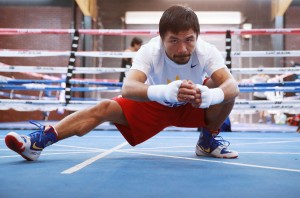
Pacquiao_workout_150428_002a
LAS VEGAS – At a time when politics appear to be imitating boxing or vice-versa, there was an endorsement Wednesday for a politician from a fighter who will do more than just promise to punch his rival in a few days.

Donald Trump and Ted Cruz weren’t even there.

Too bad.

They might have learned something about decorum from Timothy Bradley and Manny Pacquiao.

Bradley gave Pacquiao a ringing endorsement for his run at another political office in the Philippines at the final news conference for their welterweight rematch Saturday night at the MGM Grand. Bradley got the office wrong.

“He deserves to become governor of the Philippines,’’ Bradley said.

Last anybody checked, Pacquiao, a current Congressman, is running for the Senate. The talk is that he hopes to be the Filipino president one day. Governor of the Philippines is not a title that exists, although maybe the World Boxing Association can create one. But you get the idea. Trump and Cruz wouldn’t endorse each other for dogcatcher. Instead, they look at each other like a dogcatcher might look at his shoes to see what he just stepped into.

But it looks as if Bradley and Pacquiao genuinely like each other. Before the news conference, they stood next to each other, talking and smiling. They posed for the cameras without the unblinking stare-down that is part ritual and part theater. They just looked like a couple of old comrades, happy at the chance to do some more business.

Bradley’s endorsement, of course, included a presumption that he’ll win Saturday night. He prefaced it by saying that he didn’t agree with the idea that Pacquiao has to win the fight to win votes for a seat in the Filipino Senate.

“I think that’s baloney,’’ said Bradley, who spoke for about 10 minutes and thanked juts about everyone, including his wide and manager, Monica, whom he called Super Woman.

Losing a fight, Bradley said, should have no impact on how Filipino’s looks at Pacquiao, an icon whose image took hit in February for controversial comments about gay sex.

“He’s truly a man who is going to do it right for the Philippines,’’ said Bradley, a 2-to-1 underdog in their third fight. “He’s a man of his word, a man for the Filipino people. He’ always shown that.’’

In his turn at the bully pulpit, Pacquiao sounded a lot like politician on a campaign. He talked about his faith and his humble roots.

“You know my life,’’ said Pacquiao, who says he will answer an opening bell for the last time Saturday night in an HBO pay-per-view bout. “I came from nothing. I slept in the streets. No food. I just drank water to survive.’’

He’s done more than survive. His ring earnings, including an estimated $150 million for his dull loss to Floyd Mayweather Jr. in May, were unimaginable for a kid sleeping in cardboard box on the streets of Manila when he first began boxing. Much of that money has gone to help his fellow citizens, said Pacquiao, who is guaranteed $20 million Saturday. Bradley will get $4 million

“The money you pay for this boxing goes to thousands of poor people,’’ Pacquiao said.

His generosity and political career raise questions about whether he can afford to walk away from the pay-for-punches racket. He gives away much of what he banks, according to his promoter, Bob Arum of Top Rank.

“I once said, and it’s still true, that the social system in the Philippines is called Manny Pacquiao,’’ Arum said.

Pacquiao’s political life creates complications. They were evident during the new conference. The Filipinos regulate how much TV time a political candidate gets. According to Arum, Pacquiao is limited to 120 minutes.

“It’s crazier than the Democrats and Republicans in this country,’’ said Arum, who is staging a No Trump Undercard featuring junior-welterweight Jose Ramirez, super-middleweight Gilberto Ramirez and featherweight Oscar Valdez before Pacquiao-Bradley.

So crazy, Arum said, that the Filipino agency assigned to regulate political campaigns was still arguing Wednesday whether a 12-round fight would be counted as 36 minutes, three for each round, or 48 minutes, which would account for the 60 seconds between each round.

There’s also a Trump-versus-Cruz -like intensity to the rivalry between the respective trainers, Teddy Atlas for Bradley and Freddie Roach for Pacquiao.

“Like the old-timers used to say,’’ Atlas said when he was introduced Wednesday, “it’s all over but the shooting.’’

Shooting is what almost happened many years ago when Roach and Atlas figured out they didn’t like each other, according to story by Lance Pugmire for the Los Angeles Times. In 1997, Michael Moorer, the IBF’s heavyweight champion, Atlas quit and he hired Roach.

Roach told Pugmire that he walked in on argument that Atlas and Moorer’s manager, John Davimos. Atlas punched Davimos, according to Roach. Then, Roach said, two men, each with a gun, pointed their weapons at him. Roach said he believed the men were Atlas’ associates. Roach said he was told to leave.

Apparently, a good governor wasn’t around.


Distractions are a sign that the old Pacquiao might be back

By Norm Frauenheim-
May Pac PC 3
There was a time when Manny Pacquiao was known for distractions as much as his power. It’s hard to tell whether that power will ever be back. But there are signs that the distractions are making a comeback.

They are there in angry tweets and the social-media outrage that have echoed for nearly two months in the wake of his comments about gay sex during a political stop in the Philippines.

They are there in his campaign for a step up in political class, from Congressman to Senator.

The tone is different. There is widespread condemnation instead of the familiar praise before his April 9 rematch with Timothy Bradley at Las Vegas’ MGM Grand in an HBO pay-per-view bout.

The inevitable questions are all about whether the potential distractions can have the same effect as a well-executed feint.

Pacquiao has heard them all before.

Maybe, that’s why he’s smiling the way he used to.

He was at his best within the ropes when there was a storm of distractions outside of them.

Don’t forget, Pacquiao was considering his first run for office when he stopped Erik Morales in a second rematch in December, 2006. He lost an election for a seat in the Filipino Congress in May 2007 and went on to beat Marco Antonio Barrera in their rematch that October.

In November 2009, he was thinking about his second run at a Congress when he scored a 12th-round TKO of Miguel Cotto in his last stoppage. He went on to to win the election in May, 2010 and then scored a punishing decision over Antonio Margarito that November.

Oh, yeah, there was also basketball, questions from tax authorities, acting, singing, women, gambling and who-knows-what all on an exhaustive laundry list of items, all with a better chance at beating Pacquiao than any opponent in those days.

Maybe, distractions are like sparring partners. Pacquiao needs them. Some fighters, perhaps the best, do. That, at least, was Bradley trainer Teddy Atlas’ suggestion in a conference call.

“He’s had distractions, that maybe you could call chaos,’’ said Atlas, who won’t let himself or Bradley get fooled by the distraction theory. “Definitely a lot of things swirling around him throughout most of his career.

“Whether it was politics, whether it was singing, whether it was some personal situations he was going through that everybody goes through. Whether it was religious thoughts and growth, so to speak. Whether it was all the pulls on him because he’s an iconic figure in his country, where he gets all the attention you could never get here for one fighter.

“He has always dealt with that. It’s never impacted him.”

It hasn’t, perhaps because the distraction theory doesn’t go far enough. Maybe, distractions are a source of strength. A reborn Pacquiao before his loss to Floyd Mayweather in May had the body language of a fighter nobody recognized any more. The old smile looked artificial, almost as if it was forced. He had to fight because so much money was at stake. But it was a joyless exhibition.

He was there, single-minded and yet also suffering an undisclosed shoulder injury that led to a dull performance. He didn’t have any fun and neither did anyone among a record-setting pay-per-view audience. There’s been a reported lack of buzz for the April 9 fight, and its fair to say that the disappointing May bout is the reason.

Yet, the fight is interesting on a couple of other levels, including the question about whether Pacquiao can resurrect the genuine enthusiasm he once had for a brutal craft that is at the very foundation of his political career.

For him, maybe, the distractions are part of a crazy show, a circus parade that ended with a Pacquiao knockout. Or, maybe, the ring has always been the one place he could control when chaos trapped him as a poor kid and the chaos his wealth bought when he got rich. But he embraced all of it. About that, there’s no maybe.

“I make the comparison to Floyd Mayweather,” Atlas said. “They said the same things about Floyd throughout his career.

‘You think this distraction is gonna bother him, Teddy?’ ‘No, because the last one didn’t. And the one before that didn’t. And the one before that didn’t.’

“Floyd was a guy who always had distractions, who always had stuff going on in his life that might distract somebody else. But at the end of the day, it did not distract him from what he was doing.

“I feel like Pacquiao is the same kind of person in that way.’’

If Atlas is right, the current distractions might make Pacquiao a dangerous fighter all over again


Andre Ward begins another chapter in trying to turn Olympic gold into PPV gold

By Norm Frauenheim-
andre-ward
Nearly twelve years have come and gone since Andre Ward won America’s last Olympic gold medal in boxing, yet there’s a sense he’s still unknown among casual fans who know all about Floyd Mayweather Jr., know a little about Manny Pacquiao and remember Mike Tyson.

Mayweather sells cash and controversy. Pacquiao sells a naïve smile, his role as a man-of-the-Filipino people and some controversy of his own lately with comments about same-sex marriage. Tyson sold fear.

For them, it has been a business model, a way to unlock the pay-per-view vault. Through design or just dumb luck, they figured out how to achieve the kind of celebrity that makes them more than a boxer and puts them on a list a lot more valuable than any rating. Dollar-for-dollar or pound-for-pound? Any bets on where Ward would rather be ranked? Forbes or The Ring?

But he’s never been on Forbes’ annual list of the highest earning athletes, despite his pound-for-pound credentials, mostly because he’s never been a pay-per-view headliner.

Perhaps, that’s because of inactivity brought on by injuries and a promotional lawsuit, or stubborn pride, or just his unerring competency over a couple decades. He hasn’t lost a fight since he was 12 years old. Mistakes attract attention, especially these days, and Ward (28-0, 15 KOs) just doesn’t make many on either side of the ropes. He’s hard to know. Harder to beat.

Now 32 and the clock ticking on his prime, he embarks on a stage of his career defined by a last chance to become the pay-per-view star that everyone thought he would be after he stepped off the medal stand at the Athens Games.

It begins Saturday in hometown Oakland on HBO (9:45 pm ET/PT) in his debut at light-heavyweight against former Cuban amateur Sullivan Barrera (17-0, 12 KOs), whose record and size suggests his welcome to 175 pounds could be a tough one.

“We did not pick him because he’s a soft touch,’’ Ward said at a media workout. “We picked him because he was going to get me ready and show me what this weight class is all about. If you look at my career, there’s a place for tune-ups, which I haven’t had a lot of. You want to fight the best and if you aren’t fighting the best, you want to fight the No. 1 contender. That’s what we’re doing.’’

What Ward is doing is testing his readiness for Sergey Kovalev, the feared holder of most of the light-heavyweight belts and a Russian fighting to get his own foothold in America’s PPV market. Kovalev, who is expected to be ringside at Oracle Arena, and Ward have an agreement to fight, perhaps in November and presumably on HBO’s pay-per-view.

It’s a projected fight that has fans more interested in combinations than celebrity drooling in anticipation. With the Canelo Alvarez-Gennady Golovkin possibility looking as if it will be placed in a Mayweather-Pacquiao-like delay because of Canelo’s continuing insistence on a 155-pound catch-weight, Ward-Kovalev is the biggest fight out there.

The question is just how big it could be. Hints at an answer will be in how Ward does against Barrera, whose promoter, Main Events, also promotes Kovalev. Ward’s singular brilliance has been absent from the ring’s stage, in part because of injuries that are surely causing some sleepless nights at HBO, Main Events and his own promoter, Roc Nation.

He fought and beat Carl Froch at 168 pounds in 2011 with a hand that was broken in two places during sparring. Surgery on his right shoulder forced the cancellation of a planned bout with Kelly Pavlik in 2013. A knee injury forced him off the PPV card featuring Canelo’s victory over Miguel Cotto on Nov. 21.

His history of injuries and his introduction to 175 pounds against someone with 12 stoppages in 17 fights add up to a reason for concern. The guess here is that his command of the ring and versatile skillset will be too much for the tough Barrera. Ward wins.

But he needs to do more than just that. He needs to emerge unscathed and able to fight on in a way that will remind fans of where he has been.

And where he is going.


Roy Jones Jr. has predictable victory and an unpredictable future

By Norm Frauenheim-
royjones2
PHOENIX – About his status as an all-time great, there are no doubts. About his future, there are plenty.

Roy Jones Jr., the world’s best fighter for about a decade, did the expected Sunday in a pay-per-view on line event that had to leave its audience wondering why-oh-why it spent $11.99 for a look at the future Hall of Famer.

He beat somebody named Vyron Phillips, making the mixed-martial arts pro look like the random fan that the Arizona State Boxing and MMA Commission said Jones’ foe could not be.

Jones stopped Phillips with a sweeping right hand, one of the few punches he threw at 2:30 of the second round.

In the aftermath of the predictable finish to a URShow.tv production, Jones said thanks to Phillips, who would have collected $100,000 bonus if he had beaten the legend in a bout scheduled for six rounds. He thanked a sparse crowd at Celebrity Theater. He said a lot. But he didn’t say goodbye.

“I haven’t got anything planned,’’ Jones said before the URShow.tv card, which included wrestling, MMA, and rap, all in an elevated ring surrounded by three ropes instead of the usual four.

Nothing, Jones said, is planned, including retirement, despite fans and media calling for him to quit since he suffered a brutal knockout on Dec. 12 in Russia.

Even Phillips would be happy to see him retire.

“I’d like to see him go away from this,’’ said the 33-year-old Phillips, who idolized Jones when he was a kid. “Maybe, coach. I don’t want to see him get hurt.’’

But Jones, 47, wasn’t ready to announce his retirement Sunday.

“We’ll see what happens,’’ said Jones, who appeared to carry Phillips through most of the first until he rocked the former amateur boxer with combination in the round’s closing.

Jones weighed 201.7 pounds and Phillips was at 194.6 for the event with specifics such as glove size still uncertain a couple of hours before opening bell.

Jones told the Arizona commission that he wanted to use 14-ounce gloves, according to Matthew Valenzuela, executive director of the state’s regulatory agency.

However, Phillips balked, saying he wanted to fight with 10-ounce gloves, the version used by boxing pros in heavier weight classes. The 14-ounce pair primarily a training glove. As a 185-pound MMA fighter, Phillips wears a four-ounce pair.

“Just give me a chance to show what I can really do,’’ Phillips said after Saturday’s weigh-in. “That’s all I’m asking.’’

When told that Phillips wanted the smaller gloves, Jones said okay, according to Valenzuela.

“Roy said that’s what he’s been wearing all along as a professional,’’ Valenzuela said. “He said if he wants the 10-ounce, that’s fine.’’

Valenzuela said he and Jones wanted to use the bigger gloves to ensure safety. As it turned out, Phillips might have regretted the smaller gloves. But though he never had an ounce of a chance anyway.

In marketing the event, the Canadian-based URShow.tv advertised that Jones would fight a fan, often described as “random” in subsequent headlines. Phillips was selected to fight Jones about 12 days ago by a vote on Facebook. Arizona licensed him Friday. He’s not exactly a random fan. But he wasn’t a seasoned pro either. From The Ring to MMA, you won’t find his name in any top 10.

Phillips, a former basketball player at Algoma University in Canadian Ontario, was 6-1 as an amateur boxer with his last fight in 2014. He said power was his strength, both in MMA and as a boxer.

“I train with my hands,’’ said Phillips, who thought smaller gloves would augment his power. “Striking is my best weapon.’’

The power, Phillips said, would surprise Jones.

On a night with no surprises, it didn’t.


Differences: Bradley vows they will add up to a win without doubts in Pacquiao rematch

By Norm Frauenheim-

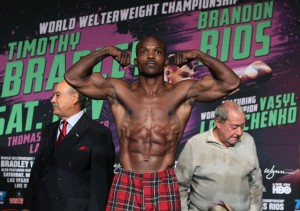
Nov 6, 2015, Las Vegas,Nevada   ---  WBO Welterweight Champion  Timothy "Desert Storm" Bradley Jr. and  former world champion Brandon Rios weigh in for their upcoming world title fight, Saturday, Nov. 7, at the Thomas & Mack Center in Las Vegas on HBO.  --- Photo Credit : Chris Farina - Top Rank (no other credit allowed) copyright 2015
Nov 6, 2015, Las Vegas,Nevada — WBO Welterweight Champion Timothy “Desert Storm” Bradley Jr. and former world champion Brandon Rios weigh in for their upcoming world title fight, Saturday, Nov. 7, at the Thomas & Mack Center in Las Vegas on HBO.
— Photo Credit : Chris Farina – Top Rank (no other credit allowed) copyright 2015

Timothy Bradley, a genuine personality in a business often defined by a feint, has a chance to eliminate any questions about an item on his record. He doesn’t have to correct it. A victory over Manny Pacquiao on June 9, 2012 is there and always will be.

No asterisk included.

No apology either.

But the questions, like echoes, are still there from the crazy controversy that raged for weeks after the scorecards awarded him a split decision over Pacquiao. To this day, there aren’t many people who think Bradley won. There are times when it sounds as though Bradley isn’t convinced either.

In a conference call this week, he dropped another hint that says he still has some doubts. In talking about his third fight with Pacquiao on April 9 at Las Vegas MGM Grand, he talked about the bout almost as though it was a chance to beat Pacquiao for the first time.

“It is an opportunity for my kids to talk about years from now with their classmates – that their father beat Manny Pacquiao,’’ he said.

Actually, his kids can say that to their classmates now, but probably not without most of the school shouting them down with the same heated argument that tormented Bradley and his family for too long.

Perhaps, his comment was just a slip. He was answering a question about whether he was weary of fighting Pacquiao.

No, he said, he welcomed a third chance. Then, he hinted at what virtually everyone has believed since those scorecards were announced nearly four years ago. Bradley has never been able to carry off a feint for too long. His genuine nature won’t let him. But it’s more than even that.

There’s a sense that he wants to eliminate some of the questions still in the public mind and perhaps in his own. A victory on April 9 might do that.

“Everyone has their own opinion regarding the first fight,’’ he said. “How ever way you want to look at it, it was a very close fight. The second fight, Pacquiao definitely won that fight hands down.’’

Bradley goes into the third fight with a different trainer in Teddy Atlas and his wife Monica as his manager. He promises Pacquiao will be encountering a much different fighter than the he saw in 2012 and again in a rematch decision over Bradley on April 12, 2014.

“This time around I have a new guy — Teddy Atlas — a guy who analyzes fighters for a living,’’ Bradley said. “That’s what he does — he’s an analyst and a trainer. The approach this time is going to be a lot different and I will be looking to exploit Pacquiao’s weaknesses.’’

The weaknesses have been there, brought on by erosion in speed and perhaps a more cautious nature that is summed by Pacquiao’s failure to score a knockout since 2009.

Pacquiao isn’t the same guy. Then again, neither is Bradley.

In Bradley, however, the most intriguing change might simply be his health. He got injured in each of the first two bouts. In 2012, he won the fight. But the winner was in a wheelchair at the post-fight conference with a fractured left foot and a sprained right ankle. In 2014, the muscle mass in his right calf sustained tears in two places.

It begs a question: What would have happened in the first two if Bradley’s legs had not betrayed him? Of course, there’s another question: Is he just prone to leg injuries and about to suffer another one or three?

But Bradley is confident his legs will carry him to a victory that this nobody will question this time.

He says he was over-trained and under-fed for the first two fights. Under former trainer Joel Diaz, he say he did too much running when he wasn’t in the gym. He also was a vegan. Beans and no beef are a diet without a combo for a fighter in training.

Between the steaks, Bradley says “we don’t run on off days anymore. We don’t do any of that stuff. Everything now just feels like it’s all down to a science the way Teddy’s got this thing orchestrated.”

Orchestrated, perhaps, in a genuine attempt to remove some lingering doubts that are a matter of record.


At The Crossroads: Benavidez looking at ways to re-ignite career

By Norm Frauenheim
jose_benavidez_signing_100114_001
Jose Benavidez Jr. is considering several options, including a move up in weight, in an attempt to re-ignite a career that has stalled since Top Rank thought about putting him in against Terence Crawford, yet decided on Hank Lundy.

Benavidez, unbeaten (24-0, 16 KOs) at 140 pounds, was considered a leading possibility for Crawford, who on Feb. 27 blew away Lundy in a fifth-round stoppage on HBO in The Theater at New York’s Madison Square Garden.

But Benavidez didn’t look good in scoring a unanimous decision on Dec. 12 over unknown Sidney Siqueira of Brazil on a Univision card in Tucson that featured emerging featherweight Oscar Valdez in a sensational victory.

The crowd booed Benavidez, whose rope-a-dope tactics are not popular. He said he had the flu. At the weigh-in, he was 152.4 pounds, 4.4 heavier than the contracted 148 for a non-title fight. Between rounds, he struggled to breathe.

It’s not clear whether that performance knocked the Phoenix fighter out of consideration for Crawford, whom he called out repeatedly before the Tucson card. But Benavidez didn’t regret the decision to fight, despite the flu.

“No, not at all’’ his father, trainer and manager, Jose Benavidez Sr. said from Hill Street Boxing in Los Angeles where he is training his younger son, David Benavidez, for an appearance on the Chris Algieri-Errol Spence Jr. card on April 16 at Barclays Center in Brooklyn. “I mean, he was in the co-main event. In that kind of situation, you’re never right. Imagine the reaction if we had canceled out.

“At the same time, I knew he could beat the guy. It was a big risk. We knew he’d win. But we also knew he wouldn’t look good. But the crowd thought he should of stopped him. I thought he should have stopped, too. But he was sick.’’

The best that can be said is that Benavidez emerged from difficult night with his unbeaten record intact. Still, one of boxing’s brightest prospects six years ago faces an uncertain future. He no longer has the WBA’s interim 140-pound belt, according to his father. He took it from Mauricio Herrera about sixteen months ago in a decision as controversial as any in 2014.

After defending it once in a 12th-round stoppage of Jorge Paez Jr. last May, the WBA ordered a mandatory for the acronym’s regular belt against Italian Michele di Rocco (40-1-1, 18 KOs), an Italian. That’s when Benavidez found out what interim really means.

“They stripped him,’’ the senior Benavidez said. “It’s kind of ridiculous what they wanted. They wanted us to go fight over there. They wanted us to fight for very little money. Then, they wanted us to pay the sanctioning fee. It didn’t make sense.

“I mean, we were trying to fight Crawford, or Jessie Vargas, or Viktor Postol. Those fights make sense.’’

Dollars, too.

Now, common sense says it’s time for the 5-foot-11 Benavidez to move up to welterweight. He’ll be 24 years old on May 15.

“I think we go to 147 and stay there, unless something big breaks like Crawford, or Postol, or something like that,’’ Benavidez Sr. said. “He’s still young. The body hasn’t really changed much. He could definitely make 140 for a big opportunity. If not, we’ll just stay at 147.

“But I do think he needs big fights. So many of these guys he’s been fighting, there’s just no motivation.’’

Nothing has been scheduled, yet. However, Benavidez is expected to resume training with brother David next week in Los Angeles.

“We want to fight, but I don’t what’s going to happen,’’ his father said. “We’re just going to stay focused and try to regroup. Hopefully something comes up. You never know.’’


Planting Time: How about a Canelo-GGG guarantee next to that olive tree?

By Norm Frauenheim-
Saul Alvarez
World Boxing Council President Mauricio Sulaiman says an olive tree will be planted amid the neon surrounding Las Vegas’ new T-Mobile Arena during the week of the Canelo Alvarez-Amir Khan fight on May 7.

The tree, Sulaiman says, will be a symbol of peace and unity. It’s a nice idea. But few would confuse boxing with peace or unity. It’s about imminent violence. It’s why we watch.

It’s why we watch Donald Trump, too. Trump’s sneers, profanity and insults are straight out of a boxing news conference. That shouldn’t be a surprise. Trump learned the schtick as a business partner with Don King during the days when Mike Tyson fought in Atlantic City.

Are those debates getting huge ratings because people want to hear what Ted Cruz and John Kasich say? Didn’t think so. The network could sell the debates, pay-per-view, because Trump’s rhetoric heightens the drama, if not the sense that his over-the-top talk threatens to a degenerate into a real brawl.

Trump even went so far as to defend his manhood on Fox Thursday night. It was his response to Marco Rubio’s crack about his small hands. He sounded a lot like Tyson once did. Tyson has grown up since then. Too bad Trump hasn’t. Come to think of it, Trump could learn a lot from Tyson, who is lot more statesman-like these days than the presidential candidate with more insults than answers.

Trouble is, we all seem to be living in Trump’s world. After all, Trump’s angry rhetoric is the real reason Sulaiman said he plans to plant that olive tree. Everybody with something to say and sell is on the Trump bandwagon for the number of hits the mere mention of him generates in social media.

Even Oscar De La Hoya tossed out the Trump name during a Canelo-Khan press tour that stopped in London, New York and Los Angeles. De La Hoya says he actually decided to put together Canelo-versus-Khan – Catholic-versus-Muslim – while watching Trump channel Don Rickles during one of those debates. It’s a good story. It’s better marketing, a sure way to generate hits and tweets. Maybe a few olives, too.

Here’s one request of Sulaiman: Next to that tree, plant a guarantee that there will be an immediate Canelo-Gennady Golovkin fight if – as expected – Canelo beats Khan.

A lot of things were said during the Canelo-Khan tour. But when the inevitable question about Canelo-GGG was asked, the answer was always — and only — an assurance that it would happen. No specifics and no real time frame were included. Maybe, an olive tree represents a peaceful counter to Trump.

But boxing needs more than an olive branch. It needs Canelo-GGG. Without it, there won’t be much to harvest in its immediate future.


The Lundy List? Terence Crawford motivated to join a much bigger one

By Norm Frauenheim-
hank-lundy_harney
A pound-for-pound debate without a mention of Terence Crawford isn’t much of a conversation. At least, he doesn’t think so. Does Crawford belong?

“Of course,’’ he said. “I feel like I’m already in that conversation.’’

Maybe.

Hank Lundy has some of his own ideas. Turns out, Crawford wouldn’t even make the top three on Lundy’s list.

“No, he’s not the best guy I’ve fight,’’ Lundy said.

Lundy went on to say a lot of things. On the Lundy list, Crawford would rank behind Viktor Postol, Ajose Olusegun, and maybe Dannie Williams.

Lundy might have found a few other names to rank ahead of Crawford if only he had had more time to hold court on his portion of a conference call this week

If he’s as good a fighter as he is a talker, Crawford (27-0, 19 KOs) is in trouble Saturday night (10 p.m. ET/PT) in an HBO-televised junior-welterweight bout in The Theater at New York’s Madison Square Garden.

But the guess in this corner is that Lundy has only managed to talk himself into trouble while also giving Crawford a big chance on a very big stage. An impressive victory over Lundy (26-5-1, 13 KOs) would get Crawford off the fringes of a debate currently dominated by flyweight Roman Gonzalez, middleweight Gennady Golovkin and light-heavyweight Sergey Kovalev.

“It’s hard to rank myself against guys who are in different weight classes,’’ Crawford said. “They would never be my opponent. They are either too big or too small. They do good in their weight division and I do good in mine.’’

So good, in fact, that you can make a pretty good argument that Manny Pacquiao bypassed him for Timothy Bradley for the same reasons that middleweight belt-holders have ducked Golovkin for so long. The risk is too big.

If true, the unbeaten Crawford is left with the motivation to be as impressive as possible. Wittingly or not, Lundy’s talk might have sparked some emotional flint not yet seen in the somewhat stoic fighter from the Midwest.

“I don’t know what’s going on in that boy’s head,’’ Crawford said. “Come Saturday there’s not going to be much talking to do.’’

Crawford conceded that there was some disappointment at not getting the chance to face Pacquiao, who says he’s retiring after the Bradley bout on April 9.

“I wouldn’t say it was a letdown but I wouldn’t say it was exciting,’’ Crawford said the Pacquiao decision. “When they told me the names, they then told me Lundy. He and I had been going back and forth on Twitter for a long time. Now I just want to shut him up.

“He has said a couple of things that upset me, but nothing that has made me change my game plan or fight different than I would normally fight. I am going to go in there and fight my fight. Do what I have to do to get the job done.’’

Then, maybe, Crawford can say thanks to Lundy and hello to a more accepted place in an ever-evolving argument.


Jessie Magdaleno stays unbeaten in renewed pursuit of a world title

By Norm Frauenheim-
J.Magdaleno_Castaneda _140215_001a
PHOENIX – Jessie Magdaleno jumped onto the ring post and gestured at his waist as if to say he needs a belt.

A world title belt.

His record, at least, says Magdaleno is good fit for at least a shot at one. He ‘s unbeaten. The important O on the right side of his ledger is still there after a seventh round stoppage of Filipino Rey Perez in SoloBoxeo televised bout Saturday night at Celebrity Theatre.

“I want a shot at a world title,’’ Magdaleno (23-0, 17 KOs) said after stopping Perez (20-8, 5 KOs) with a body shot at 2:51 of the seventh round. “I think it’s time.’’

If it is, it’s arrived in part because Magdaleno is going to his future. He has reunited with trainer Joel Diaz and perhaps reunited with goal that a couple years ago appeared to be a good bet.

In the first half of the televised doubleheader, Phoenix featherweight Carlos Castro (15-0, 6 KOs) needed his agile feet, long jab and toughness to win a six-round unanimous decision over rugged Rafael Reyes (6-6, 5 KOs).

Reyes employed every trick in the book – and some not in the book – in an attempt to draw Castro into brawl. Often, he succeeded by holding and landing blows right at the belt line of Castro’s trunks.

The referee never ruled that any punch was a low blow. But in the third and fourth rounds, a few were low enough to slow down Castro, who in the fifth and sixth kept his distance. The crowd booed. But Castro got the last laugh. The last cheer, too. To win, he did what he had to.
Best Of The Undercard

Best of the Undercard
Phoenix light-heavyweight Trevor McCumby entered the ring to Johnny Cash’s Folsom Prison Blues. He had Superman’s logo on his socks. He had it all, leaving poor James Freeman with no chance and only Boogie written across the back of his trunks.

Sure enough, it was Boogie down not long after the last lyric in Cash’s memorable song. McCumby (22-0, 17 KOs) walked all over Freeman (9-8, 7 KOs), dropping the Texan to his knees in the first round and stopping him at 1:48 of the second with a right hand followed by a thudding combination.
The Rest

The Rest
Phoenix junior-welterweight Luis Olivares (10-0, 7 KOs) picked up where stable mate McCumby left off, scoring a first-round knockout with a liver shot that dropped Mexican Omar Garcia (4-2-, 1 KO) onto the ring’s apron, where he stayed until the evident pain subsided.

Phoenix super-bantamweight Paul Romero (7-0, 1 KO) entertained the customers in a near-capacity crowd, scoring a unanimous decision over a bloodied Jaime Gutierrez (5-11) of Mexico.

In a back-and-forth battle of Phoenix flyweights, Luis Espinoza (2-0) scored a first-round knockdown and then relied on a punishing body shots that left red welts on Luis Guerrero’s waistline and a loss by unanimous decision on his record (0-2).

A sure sign of a well-matched card is a good swing bout and that’s what the crowd got from Houston super-featherweight Jesse Garcia (2-0, 2 KOs), who was losing when he threw a lightning-bolt of a left for a third-round stoppage of Derick Bartlemay (0-2) of Eugene, Ore.


The It Factor: For Felix Verdejo, it means a title shot

By Norm Frauenheim-
Felix Verdejo
A blueprint of the next great fighter would look a lot like Felix Verdejo. Fast hands, agile feet, power and a long, lanky body that will easily grow into bigger weight classes and multi-division titles.

But there’s more.

“The it factor,’’ Top Rank President Todd duBoef says.

Assign whatever value you want to it. The intangible usually means charisma, which can’t be found on any tale of the tape. In this era of analytic-engineered major-league baseball rosters and NBA teams, an element without a reliable measurement might mean it can fool you just as surely as a fragile chin.

In Verdejo, however, it looks real. Feels real, so real that the young Puerto Rican moves into the next step of a process that Top Rank believes is bound for stardom.

Sometime in 2016, Verdejo hopes to fight for a world-title belt that is a symbol of a fighter moving on from prospect to world class.

“I don’t have a specific opponent in mind… I just want to fight for a championship,’’ Verdejo (19-0, 14 KOs) said Thursday through a translator during a conference call for his first appearance in the New Year on a HBO-televised card Feb. 27 against William Silva (23-0, 14 KOs) in The Theater at New York’s Madison Square Garden.

Verdejo’s fight against Silva on the undercard of Terence Crawford-Hank Lundy is intriguing on several levels. Silva was an accomplished amateur and, like Verdejo, is unbeaten as a pro.

The Brazilian lightweight is also listed at 6 feet 1, which makes him the tallest foe Verdejo has faced since turning pro after the 2012 Olympics. More important, perhaps, it represents a further test of Verdejo’s left hand. He was sidelined for six months last year after undergoing surgery to have bone spurs removed.

There were no problems with the left in a mid-December wipeout of Josenilson Dos Santos in Puerto Rico. Then again, Verdejo didn’t really have to use the left. He landed a perfect right that resulted in a second-round stoppage.

“Everything, thanks to God, is fine with the hand,’’ he said Thursday.

Confidence that he’ll succeed against Silva is enough for Top Rank to think about the rest of 2016. He’s already scheduled for a bout on April 16, probably in Puerto Rico where he’s close with his mentor and hero, Felix Trinidad.

Trinidad, Verdejo says, “teaches me how to act inside and outside of the ring.’’

Depending on the champions and their willingness to fight him, duBoef estimates Verdejo might get a title shot in six to 10 months.

For now, the WBO lightweight title is the preferred target. The UK’s Terry Flanagan holds the belt sanctioned by an acronym based in Puerto Rico. Flanagan, ranked No. 5 by The Ring, is scheduled for a title defense against Derry Mathews on March 13 in Liverpool. The bout has already been postponed twice, first in December and then a few weeks ago. First Flanagan said he needed more time off. Then, he said suffered an injury to his left foot.

Somehow and at some point, a shot at a major belt will be there for the emerging Verdejo. Against Silva, he is making his sixth appearance in New York. He’s already popular in New York’s huge Puerto Rican community, which is looking for a star to succeed Miguel Cotto as a centerpiece to its Puerto Rican Day celebration in June.

“Fans in New York should look forward to seeing me fight for a long time,’’ said Verdejo, whose it factor also means he knows how to talk to the customers.


Solo Boxeo, ShoBox to feature AZ fighters

By Norm Frauenheim
J.Magdaleno_Castaneda _140215_001a
A busy stretch for Arizona boxing continues this weekend with appearances on Showtime’s ShoBox in Atlantic City Friday and on UniMas’ Solo Boxeo at Celebrity Theatre in Phoenix Saturday.

Super-bantamweight Jesse Magdaleno (22-0, 16 KOs) of Las Vegas headlines the UniMas card (11 p.m. ET/PT) in a scheduled 10-rounder against Filipino Rey Perez (20-7, 5 KOs).

The seven-fight card, a Top Rank and Iron Boy co-promotion, also is scheduled to include light-heavyweight Trevor McCumby (21-0, 16 KOs) and super-bantamweight Carlos Castro (14-0, 6 KOs), both of Phoenix.

First bell is scheduled for 6 p.m. (MST).

On ShoBox (10 p.m. ET/PT) unbeaten Adam Lopez (14-0, 7 KOs), a former Phoenix fighter now of San Antonio, faces Mario Munoz (16-0-1, 10 KOs) at Adrian Phillips Ballroom in Atlantic City’s Boardwalk Hall.

On Tuesday, Phoenix bantamweight Alexis Santiago (21-3-1, 8 KOs), of Mayweather Promotions, got things started on Fox Sports with a unanimous decision over Erik Ruiz (15-5, 6 KOs) of Mexico.


GGG’s waiting game has gone on too long

By Norm Frauenheim-
Gennady Golovkin
Gennady Golovkin is the pound for-pound champion in waiting. Emphasis on the waiting.

No telling when that wait will end. But it got a predictable, yet tiresome extension with the announcement last week that Canelo Alvarez will fight Amir Khan on May 7.

Golovkin has little choice but to stay busy, prepared and hopeful for a shot at Canelo later in the year, perhaps September. GGG management looked up and down the list of options and was left with an April 23 bout against Dominic Wade, who landed the mandatory shot at GGG’s middleweight title when the IBF’s No. 1-rated Tureano Johnson withdrew because of a shoulder injury.

Never heard of Wade? Didn’t think so. Then again, Johnson, of the Bahamas, isn’t exactly a name that generates a buzz. More like: Who’s he?

It’s all-too-familiar and thoroughly unfair to GGG, who is spending his prime in the waiting room. He’ll be 34 on April 8, 15 days before his pound-for-pound skill figures to make a wreck out of Wade.

There’s nobody to blame but a business ruled by the so-called A-side, B-side equation that, in the end, often adds up to rubbish.

Canelo is making GGG wait because he can. Canelo is projected to be the sport’s next pay-per-view star. The evidence of that was in the 900,000 buys he generated in his victory over Miguel Cotto in November. GGG can only counter with the 150,000 PPV number he posted in his last outing, a stoppage of David Lemieux in October.

The difference gives Canelo 750,000 reasons he can tell GGG to wait, wait all over again. Publically, at least, each side of the promotional and management equation has assured a skeptical fan base that Canelo-GGG will happen. A possible date, Sept. 17, and even a place, the Dallas Cowboys NFL Stadium, have been reported.

But there are doubts. Canelo’s decision to face Khan raises questions about whether he really wants to fight a true 160 pounder. He’ll fight Khan, a junior-welterweight just a few years ago, at the familiar 155-pound catch-weight for the WBC title he took from Cotto.

Canelo is called the lineal middleweight champion. Trace the title from Sergio Martinez to Cotto and Canelo, and, yeah, it’s lineal. The catch, however, is how that line of succession has been corrupted by the weight. Canelo might be the lineal champ, but GGG is the real one.

The unresolved issue is whether Canelo will come off the 155-pound marker and agree to fight GGG at the traditional 160.

Even if he does the expected and overwhelms Khan, there still won’t be a fight against a true middleweight contender on Canelo’s resume. If Canelo struggles to beat Khan, then what? If he loses, GGG management might regret the day that Andre Ward decided to go up to light-heavy in anticipation of a potential pound-for-pound confrontation with Sergey Kovalev.

Canelo’s bargaining power has been met with some early moves from GGG’s K2 brain trust. In Wade, Tom Loeffler created potential leverage, which could lead to a very big middleweight fight in its own right if the Canelo possibility falls apart. Wade’s promoter is Al Haymon, who also happens to promote Daniel Jacobs.

Jacobs is coming off his stunning, first-round stoppage of Peter Quillin for a piece of the middleweight title.

“From our side, there wouldn’t be any obstacles to making that fight,” Loeffler told The Ring’s Mitch Abramson.

Call it a warning shot and an acknowledgement that GGG can’t wait much longer.


Surprise, Surprise: Canelo-Khan might include many

Canelo_Alvarez
The Canelo Alvarez -Amir Khan bout on May 7 has been cheered, booed, hyped, ridiculed, praised and trashed in the days since Oscar De La Hoya announced the stunning deal this week.

Reactions pretty much cover the proverbial waterfront. For the promoter, that qualifies as a promotional triumph. Lots of opinions generate a lively debate. The bigger the argument, the bigger the box office.

In large part, De La Hoya was able to create so much attention on the bout because he had kept it quiet. There wasn’t a peep from the twitter crowd about whether it might, should or could happen. Not a whisper. Nada.

The absence of even a single rumor already ranks as the Upset of the Year. It’s a bigger upset than a Khan victory would be.

For now, surprise is the only consensus about a bout that matches the bigger Canelo against the smaller, yet faster Khan. If boxing is the circus everybody says it is, there has to be an unpredictable twist, a wild ride, somewhere along the midway.

At its bottom line, however, Canelo-Khan is more than that. For Canelo, it’s a concession that he’s still not a true middleweight, despite his WBC version of the 160-pound title he took in a decision over an undersized Miguel Cotto in September.

In the wake of his victory over Cotto, there was some thinking that Canelo would face a legit middleweight, instead of another blow-up welterweight and/or junior-welter, in his attempt to get ready for Gennady Golovkin.

Against Khan, however, the 25-yar-old Canelo will again be at his favorite catch-weight, 155 pounds, at the formal weigh-in. Those close to him in Mexico say that weight is his comfort zone. It represents a milestone in training. It’s a sign that his conditioning is right. At 155, he knows he’s ready

It also means GGG, the consensus middleweight champ, will have to wait, perhaps until early 2017 for a showdown with Canelo, who in the meantime figures get a big payday while heightening his international celebrity against a name fighter from the UK, boxing’s liveliest market.

Is it fair to argue that Canelo blows away Khan in short order? Of course. Canelo, who opened as nearly a 4-to-1 favorite, might out-weigh Khan, a junior-welterweight just a few years ago, by twenty pounds at opening bell. By now, the fragility of Khan’s chin isn’t exactly a secret. Neither is his willingness to trade punches.

When the first big one lands, Khan’s caution has often been the first thing to go. That leaves him with only his instinct, which is to brawl. Next to go, his consciousness. The heavy-handed Canelo is at his lethal best against a fighter willing to stand in front of him.

At 29, however, the intriguing question is whether Khan has matured enough to know his weaknesses. He’s no dummy. He has the foot speed to stay out of range of Canelo’s power, especially over the first six rounds. If he can retain his wits and adhere to his fight plan, he might be able to pull off a stunner on the scorecards.

It’s hard to imagine Canelo chasing an agile Khan around the ring. Canelo has the clop-clop-clop footwork of a Clydesdale. Khan’s fast feet and faster hands could leave Canelo looking as confused as he did in a 2013 loss to Floyd Mayweather, Jr.

Can it happen? Could Khan actually win? Probably not. Then again, did anybody think a week ago that there was any chance he’d ever fight Canelo?


Pascal hits Kovalev with an accusation as old as boxing

By Norm Frauenheim-
Kovalev & Pascal Weigh-InCasino de Montreal
Boxing’s ugly history repeated itself, warts and all, with Jean Pascal calling Sergey Kovalev a racist in the final news conference before their rematch Saturday night at Montreal’s Bell Centre.

I’m not sure what to make of it. The cynical side of the scarred business suggests that Pascal’s accusation is just another way of marketing a tough sell in his hometown.

Late Thursday, seats in every corner of the building, other than the pricey ones at ringside were available on the Bell Centre’s website.

Pascal, who has been calling Kovalev a racist since the light-heavyweight fight (HBO 9:45 p.m. ET/PT) was announced, raised the volume by several octaves with a performance that included bananas and a near brawl with Kovalev’s African-American trainer, John David Jackson. If Pascal was looking for twitter hits and website headlines, he got them.

Kovalev, an unbeaten Russian and a pound-for-pound contender, left himself open to the charge last April when he posed for a photo with a child in a T-shirt adorned with a boxer topped by a gorilla’s head. At the bottom of the photo, Kovalev wrote a caption that took aim at Adonis Stevenson, who like Pascal is a Quebec light-heavyweight of Haitian descent.

It says: “Adonis looks great!!!’’

It’s stupid.

Kovalev, long frustrated by the inability to land a fight with Stevenson, apologized. In this polarized era, however, apologies aren’t believed. They don’t last long either. But that photo isn’t going anywhere. It’s only a few keystrokes away for any rival who wants to use it as evidence to support an allegation.

In words and tone, Kovalev (28-0-1, 25 KOs) suggests that Pascal (30-3-1, 17 KOs) is calling him a racist out of fear or in an attempt at gamesmanship. If it’s the latter, Pascal is making a terrible mistake.

Kovalev is not easily distracted. The photo was dumb. The caption was dumber. But nobody has detected anything dumb in the way Kovalev fights. He is as poised as he is ruthless.

Bernard Hopkins, one of the game’s wise men, knew that instinctively throughout the all the hype before their 2014 fight. He didn’t do any of his trademark trash-talk, a Hopkins art form. He had read Kovalev well enough to know it wouldn’t work. Nothing did. Kovalev won a crushing decision and Hopkins, who was widely criticized for calling Joe Calzaghe “a white boy,” praised him in its aftermath.

It’s also noteworthy that Hopkins defended Kovalev after the photo appeared. Hopkins was quoted as saying he didn’t believe the Russian was racist. However, he also said that Kovalev would regret it.

Regret, race and, yes, racism have been part of the boxing narrative for as long as there has been an opening bell. It produced The Great White Hope more than a century ago in a segregated society’s desperate attempt to find a white heavyweight who could beat Jack Johnson.

To this day, Mexican fans chant “Guero.” Loosely translated, that means White Boy. Those fans will chant it, in singsong fashion, at almost any fighter of any color without a chance and/or the willingness to brawl. A racist slur? Depends on the listener. From this white face in a ringside seat, it’s merely a genuine expression from a crowd with a tribal-title loyalty for a fighter it knows like a neighbor.

In 1975, Muhammad Ali mocked Joe Frazier with a toy, a rubber gorilla that he tied onto a string and playfully battered around during a news conference before he beat Frazier in the Philippines.

“It’s going to be a Thrilla In Manila when I kill that Gorilla,’’ Ali said then.

Ali probably cringes now, which is what Pascal and Kovalev will probably do years from now.


Baby Steps: Jarrell Miller takes a big one

Jarrell Miller
TUCSON — Sometimes, even babies have to grow up.

Jarrell Miller, who calls himself Big Baby, began to gain some grown-up experience Friday night in a test of will and ability to go beyond a few rounds.

Maybe it was an initial step, but Big Baby began to walk with a seventh-round stoppage of a tough Donovan Dennis at Casino Del Sol on an entertaining card that included middleweight Rob Brant’s fourth-round knockout of DeCarlo Perez.

“For his development, this was important,’’ Miller promoter Dimitriy Salita said.

Good for his future, too.

Mostly, kept Miller (16-0-1, 14 KOs) in the conversation heavyweight conversation after Tyson Fury’s upset of Wladimir Klitschko in November. It’s a scrum, a crowd of possibilities and wannabes.

Miller, who has a mouth that matches the big in his nickname, thinks he knows whom the wannabes are. Just ask him. From Deontay Wilder to Charles Martin, he’ll name just about everybody in the division. It doesn’t matter that Wilder retained his WBC title last Saturday with an impressive stoppage in New York. It doesn’t mater that Martin got a vacant IBF title on the same Brooklyn card when his opponent suffered a knee injury.

“I’d spank Charles Martin,’’ Miller said before winning a minor title sanctioned by the World Boxing Association.

“If Charles Martin and Deontay Wilder still have a belt when I get there, then I’ll knock their heads off. I’m looking to get a title shot at the end of the year.’’

By the end of the year, any thing could happen, of course. Salita has his own vision for what could happen.

“In ten to 15 months, Tyson Fury,’’ Salita said. “Could you imagine that?’’
Let’s just say that the news conferences would be loud. Very, very loud.

For now, however, Miller has other business at the top of his agenda.
“He still has to build his brand,’’ Salita said.

There were moments Friday night when it looked as if Miller might have to rebuild it. In the earl seconds, it looked as if he would fulfill his promise of a second-round knockout. He dropped Dennis (13-3-1, 11 KOs) twice in the opening round. Dennis walked back to his corner, looking dazed and as if he would not be able to answer the bell for the second round. But he did.

Midway through the second, he somehow found the energy and courage to go back at the 274-pound Miller, who outweighed him by more than 50 pounds. He raked Miler to the body with successive shots and then with a couple of looping hooks.

Miller looked surprised. He had never gone beyond six rounds. But by the fourth, there were signs that he knows that he had to lose some of the Baby’s inexperience. Maybe, the Baby fat will follow in a subsequent fight.
But he dug down and slowly exerted his power. Late in the sixth, Dennis, bleeding from the nose and mouth, began to look tired. Late in the seven it was over. First, Miler landed a left-right combo that put him back onto the canvas. Then, Miller followed with succession of blows for which there defense from Dennis. Referee Tony Zaino ended it 2:31 of the round, a baby step for a heavyweight with big plans.

The stoppages continued with Brant’s impressive KO of Perez in a dynamic victory for a minor 10-pound title sponsored by the WBA. After dropping Perez (16-4-1, 5 KOs) in the third round, Brant (19-0, 12 KOs) uncorked a right hand that launched Perez and sent him diving through the middle of the ropes like human missile.

“I was shocked to see him go down like that,’’ Brant said. “Even when you hit someone really well, you don’t expect them to go out like that. I was watching him and thinking ‘I don’t think he’s going to get up.’ ‘’

BEST OF THE UNDERCARD
Brant might have been saying what Bakhtiyar Eyubov was saying after the first fight on the Showtime telecast. Never heard of Eyubov? He’s new to the American market. But junior-welterweight from Kazahkstan doesn figure to stay unknown for long.

Eyubov entered the ring wearing a white hat that looked like it could have come off the end of a mop. He smiled. He danced. He did a lot of things. But, mostly, he punched.

Eyubov put the show into Showtime before and after the fight. But for the two-plus rounds between his ring entrance and his celebration, there was power, a calling card that will make Eyubov hard to ignore harder to beat.
Jared Robinson (16-3-1, 7 KOs) had no chance.

Eyubov knocked him down 15 seconds after the opening bell. He would have been down a second time in the opening round if not for ropes that kept him upright . Early in the second, Eyubov sent to the canvas again. At 56 seconds of the third, it was over by TKO. But there was nothing technical about it. It was slaughter.

It was time for Eyubov to put the hat back on. It’s what Kazaks wear, his cornermen said. It was time to dance, a traditional Kazak dance.

Kazak power, too.

“GGG II,’’ said Salita, who looks at Eyubov and think about Gennady Golovkin.

NOTES FROM THE UNDERCARD
Demond Brock and Samuel Teah had to be separated Thursday at the weigh-in, but there was no separating the two 24 hours later when the hostilities resumed on the untelevised portion of the show.

At least, not on the scorecards.

Brock appeared to get the best of the quicker Teah, walking him down throughout eight rounds. In the closing moments, Brock (10-3-1, 3 KOs), of New Orleans, hurt Teah (7-2-1, 3 KOs) of Philadelphia, with an arsenal of rights and body shots.

But when the cards were announced, one favored Teah, 77-75. One favored Brock, 78-74. The third was even, 75-75. It was a draw. Boos said the crowd saw something else.

Another contentious weigh-in? This one screamed for a rematch.

THE REST

Featherweight Keenan Carbajal (9-2-1, 5 KOs), wearing white-and-red trunks that once identified the Phoenix family’s Hall of Fame junior-flyweight Michael Carbajal, survived a bruising fifth round for an unpopular majority
decision over hometown brawler Thomas Herrera (4-16-1, 1 KO).

Tucson junior-welterweight Carlos Cordova (1-0) had too much height, too much reach, too much of everything in overwhelming David Courtney (0-1), a Phoenix fighter who was on the canvas three times in the second and finished
at 1:55 of the round.

Tucson junior welterweight Alfonso Olvera (6-2, 3 KOs) left Colbert Lozoya’s face in misshapen mess of bruises, scoring a fourth-round TKO of the overmatched EL Paso fighter (7-12, 1 KO).


Farewell or Fight On? Pacquiao discovers that it’s hard to say goodbye

By Norm Frauenheim-
May Pac PC 3
There is no good way to say goodbye to boxing. Manny Pacquiao is trying to. At campaign stops in New York and Los Angeles this week, he said repeatedly that his fight with Timothy Bradley on April 9 would be his last.

In a political season full of Trump, Palin, Cruz and Hillary, however, few believe the soft-spoken Filipino Congressman, who also happens to be running for one of 24 seats in his country’s Senate. His promoter, Bob Arum, doesn’t. His trainer, Freddie Roach, doesn’t. His Filipino constituency doesn’t want

The prevailing skepticism is rooted in precedent. Boxers come back as often as politicians break promises. In Bill Dwyre’s ongoing series for Top Rank on the second Pacquiao-Bradley rematch, the retired Los Angeles Times sport editor quotes Arum on just the latest example.

Brandon Rios retired at a news conference in the immediate aftermath of his one-sided loss to Bradley last November. Arum immediately applauded his announcement.

“Half-an-hour later,’’ Arum said, Rios “unretired.’’

The entertaining anecdote is as true a guide as any on what to expect — or not expect — from Pacquiao or anybody else in a business where scar tissue is the only sure thing.

But it’s an awkward way to sell a fight.

The guess here is that Pacquiao believes what he is saying, just as surely as Rios did with a decision that sounded heartfelt at the time. But there are all kinds of reasons and scenarios that could change Pacquiao’s mind.

To wit:

§ If he wins, he has a title to defend and chance at more money to finance further campaigns.

§ If he loses, his reputation is at stake. Careers end in defeat all the time. But a loss might be tougher for a politician whose clout with the voters is built on how he won them over. His political career was launched by what he did within the ropes. A pound-for-pound ranking was the only poll he ever needed. The ring was his bully pulpit.

Either scenario comes with reasons to think his career continues beyond his third fight with Bradley at Las Vegas’ MGM Grand.

Meanwhile, Arum is confronted with the tough task of selling a bout that Pacquiao calls his farewell-fight, which is an oxymoron, if there ever was one. You fight to stick around. Throwing in the towel is one way of saying farewell.

A lot of fans feel as if they said farewell to Pacquiao, the fighter, on that December night in 2012 when he landed on the canvas, face-first, from a right hand delivered by Juan Manuel Marquez.

That might have been as good a time as any to say goodbye, except for that opportunity at a huge payday against Floyd Mayweather Jr. Good business sense dictated he continue, despite pressure to quit from family and friends.

Pacquiao stuck around, collecting what was reported to be between $160 and $180 million. It was worth it. It made him a very rich man. But it looks as if the May loss to Mayweather was just one more bout in the inevitable decline of a fighter in his mid-to-late 30s. He’s back now. He says he has recovered from surgery to the right-shoulder, which he said was injured in training, yet wasn’t disclosed until after the dull, controversial loss to Mayweather.

Then, there’s Mayweather, of course. He says he’s retired. But nobody believes him, either. The prevailing speculation since Mayweather’s promised career-ender –a September victory over Andre Berto — is that he’ll be back.

As different as they are, it turns out that Pacquiao and Mayweather have one thing in common. In a business with no term limits, it’s hard to say so long.


Miller says he’s the Big future in the heavyweight division

By Norm Frauenheim
Jarrell Miller
He calls himself Big Baby. But don’t let the nickname fool you. This baby doesn’t cry. Jerrell Miller only boasts.

Miller (15-0-1, 13 KOs) hopes to back up those noisy boasts Friday on ShoBox (Showtime 10:35 p.m. ET/PT) at Casino del Sol in Tucson against Donovan Dennis (12-2, 10 KOs) on a card that feature middleweight prospect Rob Brant (18-0, 11 KOs) against DeCarlo Perez (15-3-1, 5 KOs).

Miller, of Brooklyn, is fighting to get noticed in the scrum of heavyweights that has gathered in the wake Tyson Fury’s stunning upset of longtime king Wldimir Klitschko last month.

The first to score a winning ticket was Charles Martin, who won a vacant IBF title last Saturday when his opponent, Vyacheslav Glazkov, went down with a knee injury in the third round of a bout on a Brooklyn card that included WBC champion Deontay Wilder’s stoppage of Artur Spizlka.

Now, it’s Miller turn to make a statement that Martin didn’t.

In Friday night’s main event, Brant, of Minnesota, makes his second straight ShoBox appearance after a tough, majority decision over Louis Rose up the road in Phoenix.

“It’s a New Year, but I don’t go into it with any kind of timetable,’’ said Brant, a former national Golden Gloves champion. “I just need to win and let the wins take care of everything else.”


Happy Birthday: In a week full of legendary ones, the heavyweights seek a rebirth of their own

By Norm Frauenheim
Deontay Wilder
Six days after George Foreman’s birthday, four days after Joe Frazier’s birthday and the day before Muhammad Ali’s birthday, the heavyweight division will attempt another rebirth Saturday in Brooklyn with Deontay Wilder in a title defense on a Showtime-televised card that includes a bout for a vacant version of another acronym-sanctioned championship.

Birthdays or astrology or coincidence might suggest that January is a promising time for the heavyweights. But the only chart that matters is the ongoing one that says the division has been receding faster than a glacier.

It hasn’t exactly vanished. Wilder (35-0, 34 KOs), who defends his WBC title against mostly-unknown Spzilka (20-1, 15 KOs), shows promise with great athleticism and intriguing power. There are moments when he looks like a big version of Thomas Hearns.

He figures to beat Spizlka, an unknown Pole who has even less experience than he does. Spizlka decided to take up boxing on the urge of a promoter who saw him in soccer brawl outside of a Polish nightclub in 2008.

Nevertheless, Wilder’s relative inexperience leaves skepticism, impossible to dismiss. Despite an Olympic bronze medal at the 2008 Beijing Games, he’s a newcomer. The 30-year-old Wilder didn’t start boxing until he was 20.

It makes you wonder how he would do against Russian Alexander Povetkin (a 2004 gold medalist at the Athens Olympics) or Luis Ortiz, who learned his way around the ring in Cuba’s amateur system. Povetkin and Ortiz were schooled in the game’s subtleties at an age when skill becomes instinct.

The unbeaten Wilder likes to say that potential rivals have to enter “the athletic department.’’ Fair enough. He’s stronger and more agile than most. But instinct is critical, especially in the face of heavyweight power that can stop a fight within fractions of a single second. It’s there when a big shot short-circuits the ability to think. We’ve yet to see whether Wilder can react in that brief, yet critical moment of adversity.

Yet, Wilder still appears to be the one heavyweight who can restore attention on the division in an era about to unfold – ready or not — in the wake of Tyson Fury’s November upset of Wladimir Klitschko.

Klitschko’s heavyweight reign, almost a decade long, was a run of reliability. Predictability, too. But it eliminated a critical element. There were no rivalries. There was only Klitschko.

Rivalry creates interest. Draws an audience, too. That’s the great lesson of Ali, Frazier and Foreman, each also an Olympic gold medalist. Ali turns 74 on Sunday. Foreman was 67 on Jan. 10. The late Frazier would have been 72 on Jan. 12. Their birthdays are worth celebrating. They represent chapters in a time still unequaled.

Ali-Frazier became a historical reference point for every rivalry in and out of sports since their trilogy (1971, 1974 and 1975). Larry Bird and Magic Johnson were the NBA’s Ali-Frazier. The Yankees and Red Sox were baseball’s Ali-Frazier. Roger Federer and Rafael Nadal were tennis’ Ali-Frazier.

By its very nature, rivalries come easy in boxing. It’s the one-on-one drama, which in part was re-created by Magic and Bird. During the Ali era, there was more than one, mostly because of his charisma, salesmanship, brinkmanship and mouth. The Floyd Mayweather model rules today’s business. To wit: The most money for the smallest risk.

It enriched Mayweather, yet left longtime fans and new customers frustrated. The public demand got whipped up into a lotto-like froth for Mayweather-Pacquiao. But Mayweather’s fight was a dud. The rivalry, past its prime, was a figment of social media’s imagination.

But Ali’s rivalries were real because of his willingness to take repeated risks. During the last couple of decades, film and song have memorialized Ali’s 1974 victory over Foreman in Zaire. Over time, that one fight has gained as much historical significance as Ali-Frazier.

Can it ever happen again? Doubtful. But mid-January is as good a time to try as any.


Post Klitschko: Crowd gathers in Fury aftermath

By Norm Frauenheim
Tyson Fury
It’s hard to know whether the search for the next great heavyweight will ever end. Generation after generation, from baby boomer to millennial, it goes on. And on.

I’m not sure it will ever produce much more than nostalgia, but it looks as if we’re about to embark on a part of the expedition that will reveal whether there is only history and nothing else after Wladimir Klitschko.

It’s premature to declare an end to the Klitschko era. It also unfair to Klitschko, whose steady reign at the top of the fabled division for nearly a decade suggests he might make all those declarations look foolish in a rematch of his November loss to Tyson Fury.

Nevertheless, the biggest upset of last year and just about any other year left inescapable evidence that Klitschko’s suffocating grip on the heavyweights is finally gone, even if he regains his titles against the thoroughly unpredictable Fury. Klitschko looked like an old monument. Moved like one, too. According to CompuBox, he landed about five punches a round. That’s more than a stat. It’s a symptom, a sign of age. He’ll be 40 on March 25.

Potential rivals in a younger generation have noticed. Klitschko looks like wounded prey and they’ve begun to circle.

“It’s our time now,’’ said 29-year-old Charles Martin, who faces Vyacheslav Glazkov on Jan. 16 at Brooklyn’s Barclays Center for an IBF title stripped from Fury in the immediate aftermath of his upset of Klitschko.

Martin went on to say that he wants everything that Klitschko had in terms of belts and presumably money. His reported purse for Fury was $18 million.

“Yeah, I want it all,’’ Martin added during a Wednesday conference call that also included Deontay Wilder, who is the biggest star on Showtime-televised card.

Wilder, who defends his WBC belt against Poland’s Artur Szpilka, has emerged as perhaps the most marketable rival to Klitschko. He’s media friendly. He’s American. He has a big punch, although there are still questions about whether he can withstand similar power. There’s another wrinkle, too. He worked as a Klitschko sparring partner a few years ago.

“I was disappointed that Klitschko didn’t show up,’’ said Wilder, who also might have been disappointed that Fury had the good timing or dumb luck to be in the ring when Klitschko was as vulnerable as he’s been in many years. “Something was missing. That wasn’t what we’re used to seeing.’’

The unbeaten Wilder said he’ll wait for the Fury rematch to see if the old Klitschko is still there, still able to rule boxing most historic division. It was also clear, however, Wilder sees himself as the heir apparent, regardless of Fury’s victory.

“I’m looking forward to being the undisputed heavyweight champion of the world,’’ said Wilder, who doesn’t have to go far to hear the same thing from a division suddenly crowded with promises and perhaps potential enough to make it relevant again.


Howard Davis Jr.: Boxing loses the friendly face of a bygone day

By Norm Frauenheim
Howard Davis Jr.
A difficult year got a lot tougher in its final week. Howard Davis Jr. died.

Davis’ death Wednesday after a battle with lung cancer was confirmed Thursday, New Year’s Eve and a sober reason to mourn the loss of a fighter who was the symbolic face of better days.

For younger generations, Davis might not mean a whole lot. Truth is, he was forgettable as a pro, which is the only part of the business that gets much attention anymore.

He was a journeyman-like 36-6-1 and was 0-3 in fights for major titles. He lost a unanimous decision in 1980 to Scotland’s Jim Watt in Glasgow for the IBF’s lightweight belt. The cards went against him in a 1984 split-decision loss to Puerto Rican Hall of Famer Edwin Rosario in San Juan, also for the IBF’s 135-pound version of the title. Buddy McGirt knocked him out at New York’s Felt Forum in the first round of a 1988 bout for the IBF’s 140-pound crown.

The pro record prevents him from induction to the International Boxing Hall of Fame. But he belongs there – just as surely Cuban heavyweight Teofilio Stevenson does – in some category for what he did and meant to the Olympics, an international event if there ever was one.

Sylvester Stallone is a Hall of Famer because of what his Rocky role did for the game. Yo, if Stallone is in the Hall, there’s got to be some room in there for Davis and Stevenson.

Davis, who died at home in Florida at 59, came from an era when Americans still watched and cared about Olympic boxing. He was on the fabled 1976 team, the best ever in U.S. history and the genesis of what would become the 1980s, a heyday in the pro game.

In hindsight, we remember the ’76 Olympics for Sugar Ray Leonard, who went on to one of the greatest pro careers in history.

In the public imagination, Leonard’s brilliance as a pro seemed to heighten his status as the star of that American team.

Forgotten, however, is that Leonard wasn’t even voted the most outstanding boxer of those Games. Davis, the gold medalist at 132 pounds, was.

He got a trophy called the Val Barker Award. For the record, Barker was the UK’s amateur heavyweight champion in 1891, five years before the modern Olympics began in 1896. I didn’t know who Barker was. I’m not sure anybody does, not even the winners.

It would be unfair to Barker’s descendants to ask that the Award be re-named for Davis. But it is fair to ask that the International Olympic Committee and/or USOC somehow remember Davis with an award in his name. Nobody has exemplified the Barker exemplifies more than Davis.

Three days before his first Olympic bout, his mom, Catherine, died from a heart attack. That part of the story and more has always made me think of Davis as the true face of that ‘76 team.

He fought without an agenda or an eye on what a gold medal might be worth to him as pro. At the sound of an opening bell, it was only clear that he fought because he loved it. At ringside, Howard Cosell noticed. The iconic broadcaster marveled at a dance highlighted by the choreographed balance between hand speed and footwork. Cosell compared him to Ali.

In Davis, there was a genuine expression of joy that has somehow been extinguished in the chase for money. Yet, he was nobody’s fool, either.

“Europeans take a lot of punches,’’ he told Sports Illustrated in 1976. “They get cut and looking ugly is just part of the day’s work. But I don’t want to be ugly. I’m not crazy.’’

Wasn’t angry, either.

Even after a disappointing pro career, there were few complaints. Even after the shock of being diagnosed with cancer last summer, he vowed to fight on. He seemed to say it as though he was looking forward to making cancer miss. It didn’t. Rest In Peace, Howard Davis Jr. I wouldn’t have been a fan without you.


Money, money, money: $igns of an empty 2015

By Norm Frauenheim
Floyd Mayweather
Bankers, Floyd Mayweather Jr., Manny Pacquiao, a handful of promoters and network executives can celebrate a year about to enter the books. Money ruled, which means it was Mayweather’s year. He fulfilled his nickname. Got most of the money, too.

But good for the business?

No way.

By definition, prizefighting is a simple enough formula. To wit: Get the biggest prize for the smallest risk. In 2015, Mayweather played that one out better than anyone ever has. As the year ends, there continues to be unconfirmed reports that receipts for his revenue-record setting victory over Pacquiao on May 2 are still being counted. Numbers are all over the place.

We read that his final purse is $220 million, then $260 million, which would rank the money for his 12 rounds of work somewhere between the Los Angeles Dodgers ($291 million) and the New York Yankees ($223 million) at the top of baseball’s last list of reported payrolls.

Hard to know what to believe. But there he is, in Dubai one day, in a new Bugati the next and always ready to make it rain by stuffing his bags with disposable cash.

Mayweather has gone from the top of the pound-for-pound list to being the face of the one percent. Let somebody a lot smarter than a boxing writer be the judge of that. But give Mayweather credit, not that he needs it. He might not have been TBE in the ring. But he ranks as The Best Earner in history and that figures to be undisputed for a while.

In the wake of a winner-take-all model that enriched him, however, there are consequences that could confront the game with a steep price in 2016 and beyond. HBO’s Jim Lampley said it best in the wake of his dull decision over Pacquiao, whose role as the junior partner in the money grab earned him north of $150 million.

Lampley called it a cynical exercise.

It was. As the year ends, coffers are filled, yet there’s an empty feeling about what was really accomplished. Does anybody other than Mayweather think the game is better for the exercise? Didn’t think so.

A sign of that emptiness is in the year-end ritual of voting for the various awards. Fighter of the Year is the biggie. But it’s a tough choice this time. On this ballot, the dreaded No Award, always a contender in a lot of categories, is an option. Yeah, Tyson Fury beat Wladimir Klitschko, but I’d cast a vote for Donald Trump before I’d vote for an okay heavyweight who reserves most of the fury for his insults.

The guess here is that Nicaraguan flyweight Roman Gonzalez wins, but his likely election looks to be more of a concession to a brilliant career (44-0, 38 KOs) ignored until HBO finally decided to pair him up with middleweight Gennady Golovkin in a couple of telecasts

An astonishing and worrisome aspect to the Gonzalez phenomenon goes back to where this column starts. Follow the money. In 2015, Gonzalez became the lightest ever to ascend to No. 1 in The Ring’s pound-for-pound rankings. He succeeded Mayweather after Mayweather’s announced retirement following a victory in September over Andre Berto.

The dollars, however, didn’t follow Gonzalez’ climb up the pound-for-pound scale. During his reign at No. 1, Mayweather earned a minimum of $32-million a fight through his six-fight deal with Showtime. In Gonzalez’ October stoppage of Brian Viloria in his second HBO appearance and in the immediate aftermath of his introduction as the pound-for-pound No. 1, he earned a career-high $250,000. Mayweather stuffs more than that into one of those carry-ons.

For Gonzalez, the pound-for-pound title represents little more than an honorarium. The Grand Canyon-like disparity on the pay scale, however, includes a more troubling aspect. It represents a lack of investment in lighter weights that have often sustained the business during periods of transition and/or trouble. HBO’s interest in Gonzalez is promising. Perhaps, it’s the beginning of an investment.

But the long-term trend is not good. Consider this: In the two-plus decades since junior-flyweights Michael Carbajal and Humberto Gonzalez earned $1-million purses for fighting each other three times in 1993 and 1994, there’s been no raise in pay for the little guys, who in some ways are to boxing what the working middle class is to an economy. There are no good undercards without them. Yet, they’re getting paid a lot less now than they did a few generations ago.

In stature and impact, they are so small that they often don’t seem to matter. But it’s the little things that often reveal a lot about a business and these days they appear to be troublesome fly in a problematic ointment.


Possibilities: Nicholas Walters just another one as Top Rank moves into a New Year

By Norm Frauenheim-
Nicholas Walters
Top Rank’s December agenda has been about finding new stars, resurrecting a couple of old ones and creating business possibilities in 2016, the beginning of what could be the post-Manny Pacquiao era.

As of Thursday, the promotional company was still waiting to hear on whether Pacquiao will fight Terence Crawford or Timothy Bradley or some name we’ve yet to hear. The repeated postponements make you wonder whether the Filipino Congressman has some other running mate, — or alternate plan — in mind for what is believed to be his April farewell.

But, as it must, the business moves forward, especially at a time when the changing-of-the-guard is moving at a rapid rate. There is heavyweight Wladimir Klitschko’s loss to Tyson Fury. There are continuing assurances from those close to Floyd Mayweather Jr. that he is happily retired and has no desire to come back.

It’s a game looking to re-load.

Over the last month, Top Rank has strung together – week after week, night after night– reasons to be optimistic about the New Year.

First, there was unbeaten junior welterweight and 2012 Olympian Jose Ramirez in a gritty decision on Dec. 5.

Then, there was lightweight Felix Verdejo, Puerto Rico’s heir apparent to Miguel Cotto, in a definitive second-round stoppage on Dec.11 on a San Juan card that included former Fighter of the Year Nonito Donaire in tough, yet back in the 122-pound title mix with a rugged decision.

The following night in Tucson, two-time Mexican Olympian Oscar Valdez was back in his boyhood home with a dramatic third-round stoppage that stamped him as legitimate contender.

The fourth item in Top Rank’s run-up to next year is now in the dangerous hands of Nicholas Walters, who like Donaire is trying to re-capture the momentum he had in October 2014 after a powerful stoppage that sent Donaire’s career spinning into recession.

Walters’ task Saturday night in Verona, N.Y., on HBO After Dark (10:15 p.m./ET/PT) looms as the toughest against Jason Sosa at 130 pounds, four heavier than the featherweight mandatory he failed to make in relinquishing his title in June before beating Miguel Marriaga. Walters won a decision over Marriaga, but it was forgettable, so much so that he was too, despite an unbeaten record (26-0, 21 KOs).

“Looking to fight the big fights,’’ Walters said Thursday during a conference call.

He hopes for three or four of them in 2016, including perhaps one against Ukrainian prodigy Vasyl Lomachenko.

First, however, there is Sosa (18-1-3, 14 KOs), a Camden, N.J., fighter who remains a relative unknown despite a run of 17-straight victories, including 13 successive stoppages, since 2012. Sosa, who had only three amateur fights and lost two of them, appears to be a late bloomer. His relative anonymity in terms of international rankings and network appearances is among his greatest assets.

“Anytime you don’t know much about a fighter, that’s a dangerous fighter,’’ said Walters, a wise man.

The buzz is about Sosa’s power. At 27, it looks as if he has learned how to use it in every lethal way. That, perhaps, helps explain why 13 of his 14 stoppages have come over the tail end of 17-fight run during the last four years.

His promoter, Philadelphia Russell Peltz, believes that Walters has never felt a punch with the kind whack Sosa can deliver. Peltz also argues that Walters’ unbeaten record and world-class pedigree can be overrated.

“There are undefeated fighters on every street corner and that means they haven’t fought anybody,’’ Peltz said.

However, Walters, a smart and entertaining Jamaican, enters the ring Saturday understanding the stakes and determined to get fans talking about him again. He’s pursuing a big stoppage.

“Knockout of the Year,’’ he says.

Then, he says he can pursue opportunities at junior-lightweight (130) and featherweight (126).

“It’s not like I was at 128, or 129 the last time,’’ Walters said. “I was at 127. I can make 126. There are a lot of possibilities at 130. In 2016, anything is possible.’’

More so, it seems, than in any recent year


Valdez storms into world-title contention with third-round stoppage

TUCSON, Ariz. – Oscar Valdez came to his boyhood home looking for a victory that would prove he belongs.

Mission accomplished.

Valdez left no doubt about his world-class credentials Saturday night with a beautiful left hook, a signature shot, that stopped Filipino Ernie Sanchez and put the two-time Mexican Olympian at the table of title contenders.

“A sweet shot,’’ Valdez (18-0, 16 KOs) said after a third-round TKO that brought Tucson Community Center crowd of about 3,000 to its feet.

Valdez went on to say he would fight any of the 126-pound champions. That’s a long list. An impressive one, too. For now, it’s probably led by Leo Santa Cruz. But a showdown with Santa Cruz probably would be tough, if not impossible, to put together. Bob Arum promotes Valdez. Santa Cruz is an Al Haymon fighter. Friendly, they’re not.

Arum also said he doesn’t want to put Valdez into a tough fight with Vasyl Lomachenko, whom he also promotes. Lomachenko beat Valdez as an amateur at the 2009 World Championships. For now, at least, Lomachenko-Valdez appears to be a fight that the public can only imagine. Not now, but maybe later.

His immediate pursuit of a major title might take him to different weight class. Junior feather? Junior-lightweight?

Wherever it takes him, it was clear Saturday that he won’t be denied for long. His compact, active style and power will crash a lot of doors.

He dropped the brave Sanchez (15-7-1, 6 KOs) with a short shot that possessed power that, he said, traveled from his knuckle all the way up to his elbow.

Somehow, Sanchez got up. But his feet were unsteady. His eyes were vacant. He stumbled one way. Then, another. He was out on his feet. Referee Wes Melton rushed in with a timely stoppage at 59 seconds of the round.

The crowd erupted into cheers for Valdez.

For Jose Benavidez Jr, however, there were only boos in what was a tale of two performances on one card. It was also a defining example of what fans want to see. It starts with knockouts. It ends with them.

Benavidez won, scoring a unanimous decision over Sidney Siqueira. He remained unbeaten (24-0, 16 KOs). He didn’t lose anything, other than some popularity.

During the late rounds and after the scores were announced, the crowd booed. It expected dominance from the Phoenix fighter, a WBA junior-welterweight champion. It didn’t get it, at least not until the 10th and final round when Benavidez dropped Siqueira with a right to the body and sent crashing into a neutral corner with a left.

“The crowd doesn’t win fights,’’ Benavidez said.

But it does pay the bills.

Benavidez, who said he battled the flu a week ago and was more than four pounds heavier than the contracted weight on Friday, looked less than sharp.

“I was definitely not 100 percent,’’ said the Phoenix fighter, who agreed to pay Siqueira $2,000 for coming in heavier than the mandated 148 pounds. “I don’t want to make excuses. I also understand that the crowd didn’t understand I’d been sick for the last week. I felt fast, but I just didn’t have my usual power.

“If I had been my usual self, I would have knocked out this guy in three to four rounds.

Benavidez came away with the victory, scoring a unanimous decision. There was no doubt in the 100-90, 99-91, 100-90 scores, all one-sided and in favor of Benavidez, whose title was not at stake

But questions were attached to it. You could hear them in the boos from fans restless for the stoppage that Valdez would later deliver. Sigueira was undersized and unknown. He had fought and lost a bout for a lightweight title in his native Brazil in his last outing.

“ It was learning experience,’’ said Benavidez, who hopes to use the lessons in his next bout.
He was asked if he still hoped reigning Fighter of the Year Terence Crawford.

“Absolutely,’’ he said.

He didn’t lose any confidence either.

On The Undercard

Super-middleweight prospect Jesse Hart (19-0, 16 KOs) of Philadelphia started the show with a quick finish. In an empty arena, Andrik Saralegui of Tijuana was one of the few people to take a seat. Actually, Saralegui (19-4, 15 KOs) was put there, first by an immediate blitz of about five punches from Hart and then an uppercut to the body that ended it 54 seconds after opening bell.

Brazilian middleweight Esquiva Falcao (12-0, 9 KOs), a silver medalist the London Olympics, encountered some early trouble with Hector Munoz’ early aggressiveness. But a Falcao left knocked down Munoz (22-13-1, 14 KOs), a well-traveled Albuquerque fighter.. In the fourth, a quick succession of Falcao punches landed, prompting Melton to stop it at 2:26 of the round.

Super-lightweight Luis Ramos (25-3, 10 KOs) was introduced as the wrong fighter by the ring announcer in the initial intros. The announcer got it corrected. Then, Ramos, of Santa Ana, Calif., made sure there was no mistaken identity in asserting himself with power in both hands for a one-sided decision over Moises Delgadillo (17-13-2, 8 KOs) of Guadalajara.

Phoenix featherweight Carlos Castro (14-0, 6 KOs) employed a precise and painful body shot, landing a short left that sent Sergio Najera (10-23-2, 4 KOs) of Tijuana into agony, onto the canvas and done for the night in a TKO at 1:28 of the third round.


Benavidez to pay Brazilian foe $2,000 for missing weight

By Norm Frauenheim-
jose_benavidez_signing_100114_001
TUCSON, Ariz. – Jose Benavidez Jr. agreed to pay unknown Brazilian Sidney Siqueira $2,000 Friday after he was more than four pounds heavier than the contracted weight for a featured bout Saturday on Unimas’ Solo Boxeo series.

The fighters’ corner men and officials from the Arizona State Boxing & MMA Commission met a couple of times in a busy ballroom during the weigh-in at the Tucson Community Center, finally striking an agreement that saved the bout from getting scratched from a card featuring featherweight prospect Oscar Valdez (17-0, 15 KOs) against Filipino Ernie Sanchez (15-6-1, 6 KOs).

Valdez, a two-time Mexican Olympian when went to grade school in Tucson, was at 127.6 pounds. Sanchez was 127.4 for a 10-round bout on a card scheduled to begin at 7 p.m. (MST)

The $2,000 will come out of Benavidez purse, estimated to be $10,000, according to his father and trainer, Jose Benavidez, Sr., who said the contract mandated that neither be heavier than 148 at the formal weigh-in.

“The fight is on,’’ said the senior Benavidez, who said his son couldn’t make the weight because of the flu. “He got sick. But we knew this fight was coming and we felt it was important.’’

Benavidez (23-0 16 KOs), who holds a WBA junior-welterweight title, tipped the scale at 152.4 pounds. Siqueira (21-9-1, 13 KOs), who last fought at 135 pounds, was 145.6.

“I got sick about a week ago,’’ said Benavidez, whose 140-pound title won’t be at stake. “When I got sick, I was at about 154. But I had to eat while I was trying to get over the flu. That’s why I couldn’t get down to 148.

Benavidez is lobbying for a shot at reigning Fighter of the Year Terence Crawford, a junior-welterweight who is still on Manny Pacquiao’s short list for what is supposed to be the Filipino Congressman’s final fight in April. Pacquiao also is considering Timothy Bradley. He was supposed to announce his choice Friday night, but he postponed the decision.

Meanwhile, Benavidez, of Phoenix, called out Crawford during a media workout Thursday in Tucson.

“I want Crawford,’’ he said. “Let’s make it happen. I’m undefeated, young and ready. Let’s see if he accepts the challenge.’’


Back to the Roots: Oscar Valdez goes home before moving on to New Year

By Norm Frauenheim-
Oscar Valdez
Oscar Valdez, one of the brightest reasons to be optimistic about boxing’s prospects in 2016, re-introduces himself Saturday to Tucson, a city that never really got a chance to know him when he first answered an opening bell.

A lot has happened since Valdez was just another restless 8-year-old who wandered into one of southern Arizona’s many gyms as if it were a playground.

Who knew that few hours of running across a mat, bouncing off ropes and toying with a speed bag would lead to two Olympics, a perfect pro record (17-0, 15 KOs) and a chance at big-time money?

It has.

In the years since leaving Tucson for Nogales on the Mexican side of the border, the 24-year-old Valdez fought at the Beijing and London Olympics, won a bronze medal in the 2009 World Championships and returns to where it all began amid a buzz about what he might do next year.

The featherweight’s Unimas-televised bout against Filipino Ernie Sanchez (15-6-1, 6 KOs) at the Tucson Community Center (first bell/7 p.m. MST) on a card including Phoenix junior-welterweight Jose Benavidez Jr. in a non-title fight is a significant step in the process from prospect to potential stardom. Valdez figures to win. The key is in how.

If he can follow up on his sensational fifth-round stoppage of ex-contender Chris Avalos last September in Las Vegas, he creates further momentum for a world-title shot in 2016.

“I am really looking forward to this fight,” said Valdez, whose mom, Gloria Fierro, still lives in Tucson. “I will have family, friends and people who have supported me since the start of my boxing career. I do feel like I am coming home and want to give them all a great fight.

“I’m ready to close out the year with a great performance.’’

Like any young prospect, Valdez is hopeful and confident he’ll get a chance to fulfill the dream he has had since he first started racing around those Tucson gyms. But he’s also patient. If the prospect stage is an apprenticeship, Valdez is approaching it like the student he was so long ago at the Manzo Elementary classrooms, which are just few city blocks from the ring where he’ll fight Saturday night.

“Of course, I’m ready for world champions, but I want to finish this year first and then, whatever comes, I’ll gladly take on,’’ said a student in a tone that also says he paid attention at Manzo and in the gym.

NOTES: Weigh-in for the Top Rank/Iron Boy promoted card is scheduled for Friday at 4 p.m. (MST) at Tucson
Community Center’s Apache Room. …Benavidez (23-0, 17 KOs) has a WBA 140-pound title, but it won’t be at stake against Brazilian Sidney Siqueira (26-10-1, 17 KOs). The bout is scheduled to be at welterweight (147). Siqueira lost a 10-round decision for Brazil’s lightweight (135) title in August, his last outing. …Phoenix Hall of Famer Michael Carbajal is scheduled to make his debut as a pro trainer on the undercard. He’ll be in the corner for Phoenix flyweight Johnny Tejerina, who is making pro debut. Carbajal has an old-school legend at the top of a list of trainers he most admires. “Eddie Futch,’’ he said.


AZ Triple: Abel Ramos’ ShoBox bout makes him one of three Arizona fighters in TV spotlight

By Norm Frauenheim-
shobox_image1
In another sign of Arizona’s rebounding market, Phoenix welterweight Abel Ramos is one of three fighters from the state who will appear in bouts televised nationally this weekend.

Ramos (14-0-2, 9 KOs) faces prospect Regis Prograis (15-0, 12 KOs) Friday night in the main event of a Houston card televised by Showtime’s ShoBox (10 p.m. ET/PT).

On Saturday, featherweight prospect and two-time Mexican Olympian Oscar Valdez, who grew up in Tucson, and Phoenix junior-welterweight Jose Benavidez Jr. will be featured on a Tucson card televised by Unimas’ Solo Boxeo (11 p.m. ET/PT).

“I couldn’t be more ready or happy with my preparation going into Friday’s fight against Regis,’’ said Ramos, who is coming off a victory in September at Celebrity Theatre in Phoenix. “This is my first fight with DiBella Entertainment and I am already headlining on ShoBox. I think that is a testament to what they see in me and the talent that I have.’’

“…We are expecting a tough fight, the best Regis Prograis has to offer. We expect him to be very active and throw a ton of punches, and that’s what we have prepared for all camp long. I don’t know exactly how the fight ends, but I am winning it, there is no doubt about it.’’


Welcome to the A-Side: Canelo has the perks and a lesson on how to use them

By Norm Frauenheim

Miguel Cotto vs Canelo Alvarez PPV Weigh-in   11-20-2015 WBC Middleweight Title  Miguel Cotto 153.5 vs. Canelo Alvarez 155 photo Credit: WILL HART
Miguel Cotto vs Canelo Alvarez
PPV Weigh-in 11-20-2015
WBC Middleweight Title
Miguel Cotto 153.5 vs. Canelo Alvarez 155
photo Credit: WILL HART

Canelo Alvarez showed he learned a lot from Floyd Mayweather Jr. in a painful loss that, among other things, taught him how to use power that comes with being the so-called A-side.

It’s hard to know where talks are headed for a Canelo-Gennady Golovkin fight, the biggest on boxing’s board of possibilities. But there are signs that Canelo will make demands, including a problematic one about a 155-pound catch weight.

Why? Because he can.

If and when the respective parties get to the table, we’ll know HBO’s pay-per-view numbers from Canelo-Cotto. At midweek after the Nov. 21 bout, it was reportedly tracking at about 900,000. That’s a long way from the 1.5 million that Canelo promoter Oscar De La Hoya had projected. But it’s still very good.

It adds up to leverage, all on Canelo’s side of the table. In Golovkin’s only PPV venture – an Oct. 17 victory over David Lemieux, the PPV number was reported to be 150,000.

The difference between 900,000 and 150,000 adds up to 750,000 reasons for Canelo to get his way, in much the same manner that Mayweather did. Mayweather bragged about the perks and power he had. Like it or not, he used them, too.

Canelo might not brag about his newfound role on the A-side. But he’d be fool not to make full use of them.

There already have been a few preliminaries. GGG’s representative, Tom Loeffler of K2 Promotions, went to Canelo’s post-fight party and congratulated the World Boxing Council’s new middleweight champ Saturday after his unanimous decision over Miguel Cotto at Las Vegas’ Mandalay Bay.

“Gennady thought it was great performance by Canelo,’’ said Loeffler, who said GGG was in the arena for the fight.

If GGG-Canelo were to happen in May, Golovkin, first or second in pound-for-pound ratings, would be favored. With the victory over Cotto, Canelo has climbed into the debate’s top 10, but he’s in the second five.

It’s a sign, perhaps, that the 25-year-old Mexican, who won the WBC’s 160-pound title at a 155-pound catch weight, still needs more experience at middleweight.

Truth is, he has yet to face a real middleweight with first-class skill. Cotto has the skills, but he’s never been a middleweight, despite the WBC title stripped from him because he didn’t pay the sanctioning fee.

At 153.5 pounds, Cotto was half-a-pound under the junior-middleweight limit at the weigh-in. At opening bell, his trainer, Freddie Roach, said he was at 159, one pound under the middleweight limit.

As it should, GGG’s corner argues that Canelo is more of a light-heavyweight than a middleweight at fight time. He was at 170 to 175 pounds against Cotto, says GGG trainer Abel Sanchez. That’s a guesstimate, because declined at step on HBO’s scale the night of the fight. But it’s reasonable.

For now, however, the 155 mark on the day before the bout is a sure sign that Canelo is ready. Rafael Mendoza, his former advisor and manager, said that if he is a pound or two lighter, it’s a sign he weakened himself in a battle to make weight.

A pound or two heavier than 155 pounds, and he figures to be sluggish, according to Mendoza, a Hall of Famer. Canelo doesn’t have foot speed anyway. If he hits the 155 mark, however, it’s a sign that he’s in shape to move his upper body and head throughout 12 rounds. He did that, effectively and consistently against Cotto.

In the immediate aftermath of his victory of over Cotto, Canelo said he’s willing to fight GGG, yet he sidestepped the question about a 155-pound catch weight. He might have been waiting to hear the pay-per-view. That’s when he’ll really know how much power he has as boxing’s new A-sider.


Canelo wins one-sided decision over Cotto

Miguel Cotto vs Canelo Alvarez PPV Weigh-in 11-20-2015 WBC Middleweight Title Miguel Cotto 153.5 vs. Canelo Alvarez 155 photo Credit: WILL HART
Miguel Cotto vs Canelo Alvarez
PPV Weigh-in 11-20-2015
WBC Middleweight Title
Miguel Cotto 153.5 vs. Canelo Alvarez 155
photo Credit: WILL HART

LAS VEGAS -Canelo Alvarez and Miguel Cotto promised a lot. Expected a lot. One promise was fulfilled. Alvarez delivered on a vow to himself and his country.

“This is for all Mexicans’’ he said in a tone that was accented by a sense of relief.

Yeah, Alvarez beat Cotto Saturday night and claimed a vacant World Boxing Council middleweight title that been stripped from Cotto, who refused to pay the sanctioning fee.

But it was decisive on only the scorecards. The judges were unanimous. Burt Clements scored it 118-110. Dave Moretti had it 119-109. On John McKaie’s card, it was 117-111. All for Canelo.

But the Mexican fought the last round as though he wasn’t sure how it would go. Mexican fans in the Mandalaly Bay crowd appeared to hold their collective breath before Michael Buffer prepared to announce the scores. After Buffer did, they broke into celebratory song, but it too had a tone of relief.

There was uncertainty. Cotto made sure of it with a varied attack, agile footwork and a resilient ability to elude and often absorb Canelo’s powerful uppercuts and combinations. Where there was relief in Canelo’s tone, there was a look of anger in Cotto, who left the ring without talking to HB O, which scored the bout for Canelo, 117-111.

“He was tough,’’ said Canelo (46-1-1), 32 KOs), who collected $5 million, $10 million less than Cotto’s $15 million “He is a great champion.”

If you just judged the bout by the one-sided scores, however, Cotto was a chump.

“We thought the fight was a lot closer than the scorecards showed,,’’ Cotto trainer Freddie Roach said. “Miguel’s defense was terrific all night.’

Cotto went to his dressing room. Jay Z of Roc Nation, Cotto’s promotional company, was there and congratulated him.

For Cotto, it wasn’t immediately clear what he would do next. Fight again? retire?

For Canelo, the immediate question is whether he will defend the WBC title in in a mandatory against Gennady Golovkin

“I’m not afraid of any fighter,’’ said Canelo, who has it all, yet wasn’t sure of it until it was all over.

Vargas wins wild bout, scoring TKO for super-featherweight title

There was skill. There was will. In the end, there was Francisco Vargas.

   Vargas (23-0-1, 17 KOs) overcame a nasty cut beneath his right eye, a knockdown in the fourth round and a moment in the eighth  when he looked beaten. In a triumph of resilience, Vargas found the energy to unleash a wild succession of powerful blows to score a ninth-round TKO over an equally-resilient Takashi Miura (29-3-2, 22 KOs) Saturday night for the WBC’s super-featherweight title on the Miguel Cotto-Canelo card at Mandalay Bay.
   Vargas  caught Miura with a left uppercut, a left hook and right-left combo. Miura stumbled and fell. He scrambled onto unsteady feet and held his hands up as if to say he was okay. He wasn’t. He held on, almost hugging Vargas and looking almost unconscious. A violent succession of blows from Vargas followed. That’s when referee Tony Weeks ended it, a TKO at 1:31 of the ninth.
   Miura also was knocked down by a left and short ring in the first. But he quickly recovered and began to take control of the bout with power in both hands. A straight right followed by a piston-like jab knocked down Vargas, of Mexico City, in the fourth

Same Old Yawns: Ringondeaux wins a dull decision

Trouble sleeping? Take a few rounds of Guillermo Rigondeaux.

    There’s not much different about boxing’s version of sleep medication. Rigondeaux has a new contract with Roc Nation and another chance at enlivening his career. Yet,  everything else about the two Olympic gold-medalist is the same. Still Rigondull.
The Cuban (16-0 10 KOs) induced boos before slumber Saturday on the HBO telecast of Miguel Cotto-Canelo Alvarez in a unanimously dull decision over Filipino junior-featherweight Drian Francisco (28-4-1, 22 KOs). He scored all the points with a minimalist style that limits punches and earning power.


The television lights went on, yet there wasn’t much to illuminate.

   Ronny Rios of Santa Ana, Calif., and Puerto Rican Jayson Velez fought through a featherweight bout that was hard to score and hard to like Saturday night in the first HBO-televised bout on the Miguel Cotto-Canelo Alvarez card at Mandalay Bay. In the end, Rios (25-1, 10 KOs)  prevailed, winning 97-92, 96-93, 95-94 decision over Velez (23-0-1, 16 KOs). Rios’ superior quickness and aggressiveness allowed to him to throw — and land — more punches.


All of the power belonged to Puerto Rican lightweight Albert Machado. All of the chances, too.

  Tyrone Luckey, of Long Branch, NJ, was simply in the way. Luckey had no chance and none of the good fortune his name might suggestSaturday. Machado (12-0, 10 KOs) dropped Luckey (8-5-2, 6 KOs) early the the first round and a again with right hook, late in the first. Just like that, its was over — Machado a TKO winner at 2:44 of the first round of the fourth bout on the Miguel Cotto-Canelo Alvarez card. at Mandalay Bay.

Martinez races to a unanimous decision in third bout on Cotto-Canelo card

Puerto Rican junior-bantamweight Jose Martinez got booed. Got the win, too.

  Martinez (16-11 KOs) kept his distance for the final minutes of an eight-round bout after engaging in punishing, inside exchanges with Oscar Mojica (8-1, 1 KOs), of Dallas throughout the first seven rounds of the third bout on the Miguel Cotto-Canelo Alvarez card Saturday night at Mandalay Bay.
   Martinez’ elusive tactic was a down payment on ensuring victory. Boos were part of the price. Martinez ran, ran all the way into a unanimous decision over a frustrated Mojica.

Chinese heavyweight overcomes knockdown to win second bout on Cotto-Canelo card

-It says Big Bang on the back of Chinese heavyweight Zhang Zhilei’s trunks.He survived one Saturday.

Zhilei (6-0, 3 KOs) got dropped onto his nickname, yet emerged with a unanimous decision over Juan Goode (6-3, 5 KOs) in the second bout on the Miguel Cotto-Canelo Alvarez card at Mandalay Bay. Goode, of Taylor, Mich., landed a huge right in the fourth round, but that wasn’t enough for him to overcome the points advantage held by Zhilei, who won 38-37 on all three scorecards.
Cotto-Canelo show opens with first-round stoppage
The show started quickly. It was a first-round stoppage. If you weren’t paying attention, you would have missed it.
  Turns out, only a handful of ushers missed this one. Nobody else was in a building full of only echoes and empty seats when San Antonio super-featherweight  Hector Tanajara Jr. (4-0, 3 KOs) landed a straight right hand that put Mexican Jose Fabian Naranjo on his knees 2:10after the opening bell of the first fight on Saturday’s Miguel Cotto-Canelo Alvarez card at Mandalay Bay. Naranjo stayed on the canvas, looking as though he never saw th punch either.


Ramirez wins uneventful decision in bout that ends with a Tim Bradley-Jessie Vargas scuffle

Gilberto Ramirez
LAS VEGAS – It was mandatory performance for a mandatory shot at a title. That’s another way of saying Gilberto Ramirez did what he had to.

Ramirez (33-0, 24 KOs) landed most of the punches and was the aggressor Friday night throughout a 100-90, 99-91, 100-90 decision over Gevorg Khatchikian (23-2, 11 KOs) that earned the unbeaten Mexican a mandatory shot at the WBO’s 168-pound title and kept him alive as a future opponent for Gennady Golovkin.

Golovkin, who is in Vegas for Saturday night Miguel Cotto-Canelo Alvarez showdown, was in The Cosmopolitan crowd. He had planned to attend. After long day of autographs and media appearances, however, GGG decided to tyo rest in hotel suite, a GGG representative said.

Turns out, he didn’t miss much. Ramirez won a bout that didn’t included much in the way of fireworks. The real drama happened after the fight. Welterweight champion Tim Bradley, a ringside analyst for truTV, and Jessie Vargas had to be separated. Vargas has long wanted a rematch with Bradley, who is coming off a victory over Brandon Rios.

There was more drama in the Bradley-Vargas scuffle than in Ramirez-Khatchikian.

“I tried to knocked him out,’’ said Ramirez, who hopes to face the winner of the Arthur Abraham-Martin Murray bout for Abraham’s title Saturday in Germany. “But he was more elusive than we saw on the tapes.’

Khatchikian’s unorthodox style seemed to baffle Ramirez in the early rounds. He dropped his heads. He danced in, then out and often with his undefended face right in front of the more conventional Ramirez. He often appeared to be a easy target. But he wasn’t.

There was a deceptive elusiveness to what Khatchikian did. It was if he were setting a trap for Ramirez, who seemed to take the bait at east a couple of times.

Trouble is, Khatchikian didn’t have enough power to capitalize.
In the third, the super-middleweight from The Netherlands staggered him with a short right as the Mexican stepped inside. But he couldn’t drop him. In the seventh, Khatchikian rocked Ramirez again, this time with a succession of uppercuts. Stll, there wasn’t enough sting in any one of them. Raimrez remained upright and unhurt.


Hear The Buzz: It was off the scale for Cotto-Canelo

By Norm Frauenheim-
cotto3
LAS VEGAS – Measuring interest in a fight isn’t exactly a science. It’s more a haphazard adventure. Either a so-called buzz is there, or it isn’t. For a couple of days, media prospectors were sifting though all the events surrounding Miguel Cotto-Canelo Alvarez, searching for one.

For days, not much was there. Echoes instead of real noise created doubt about the pay-per-view hopes and suspicions about fans staying away from Mandalay Bay Saturday night because of skepticism left over from the Floyd Mayweather-Manny Pacquiao mess in May.

But the empty echoes were suddenly gone Friday. Instead, there was a buzz that filled three ballrooms from crowds of fans who waited in line for three to four hours to watch the Cotto-Canelo weigh-in.

The buzz was off-the-scale amid sudden optimism about pay-per-view numbers for an HBO telecast (6 p.m. PT/9 p.m. ET) that Golden Boy promoter Oscar De La Hoya has said could approach 1.5 million.

That expectation might still be too high. But a buzzing crowd at the weigh-in indicated that a very good PPV audience is likely. Latino fans – Puerto Rican for Cotto (40-4, 33 KOs) and Mexican for Canelo (45-1-1, 32 KOs) – jammed one ballroom for the live weigh-in and two adjacent ballrooms to watch the telecast.

Both made the catch-weight, 155 pounds, for a 160-pound, middleweight title that the WBC stripped from Cotto on Monday after he refused to pay the $300,000 sanctioning fee. A sculpted Canelo was right at the agreed-upon weight. Cotto was at 153.5, which is a half-pound lighter than the junior-middleweight limit. This is a middleweight fight in name only. But it doesn’t matter.

The anticipation is real for a classic, cut straight out of the rich tradition of the Mexican-Puerto Rican history.

“They are here because they think they are about see a war,’’ De La Hoya said.

The war parallel is little tired and probably too much, especially these days with all that is going in France and Syria. But boxing without hyperbole is a fight without a buzz. Nobody would care.

At the weigh-in, the roar said — again and again — that a lot people care intensely about one fight that might take the business beyond Pacquiao-Mayweather.

The weigh-in included at least one disappointing moment. Unbeaten Randy Caballero was at 123.5, or 5.5 pounds too heavy for the 118-mandtaory in a scheduled defense of his IBF bantamweight title against the UK”s Lee Haskins. About an hour after the weigh-in, the Nevada State Athletic Commission said that the title fight had been cancelled.

Did it matter? No, not at all. If there were any complaints, you couldn’t hear them. You could hear only that buzz.