Emanuel Steward: He’s gone, but his voice will always be in somebody’s corner

There’s an empty corner in boxing’s battered soul today. There’s always a couple. But none looks quite so large and profoundly sad as the one left by Emanuel Steward’s death Thursday. Gone is his dignity. Gone is his poise. Gone is a gentleman.

I want to say the void will never be filled. But I can’t. Steward won’t let me. Wladimir Klitschko said Wednesday, a day before Steward’s death was confirmed, that his trainer’s “spirit” is always there.

“I can always hear his voice,’’ Klitschko said when asked how he would react without Steward in his corner against Mariusz Wach in Hamburg, Germany for a November 10 bout televised by EPIX.

It’s a voice still heard, because it was without the histrionics associated with a business so noisy that it often sounds as if it includes only extremes and screamers. Steward was never one of those. In his optimistic eyes, you could see calm in the storm. Throw chaos at Steward, and he’d give you that wry smile and a way to conquer it.

I first met him in Phoenix, where his daughter was a student at Arizona State University. He brought Thomas Hearns and Lennox Lewis to train there. He promoted there. For a while, he operated Kronk West, an extension of his fabled Detroit gym, in Tucson.

One of his longtime friends, Steve Eisner, lived in Phoenix. Eisner, a promoter, was one of those storybook characters that only boxing can produce and Damon Runyon could portray. Steward was forever loyal to Eisner, who died in 2003. He was living in Detroit when Steward won a national Golden Gloves title as an 18-year-old bantamweight in 1963. Eisner urged him to go pro. Eisner wanted to manage him. But Steward resisted. Instead, he paid his bills with work as an electrical lineman and followed his voice by coaching, first at Joe Louis’ old gym – Brewster Recreational Center — and then at his own, Kronk.

Eisner was always convinced that Steward would have been a world champion in his own right. As a trainer, however, Steward left a more significant legacy with a list of 41 world champions, starting with Hilmer Kenty in 1980 and one which continues with Klitschko.

Throughout his 68 years, Steward did much more. There was ringside commentary for HBO. He was solid in the role, but that tuxedo never seemed to fit. He belonged in a fighter’s colors with a towel over a shoulder and a bucket in one hand. His familiar presence in a corner was comforting. Despite cliched criticism and tired calls for boxing to be abolished, it always said to me that that the game was in good shape.

That corner, I believe, captures how he wants to be remembered. He was a natural trainer, and there are never enough of them. Had he grown up in a different place or another time, he might have been a great military man. He understood how to wage combat without emotions that lead to panic. He was in the fight business, yet he was able to stay above the dust-ups – the fray — that always comes with it. That’s not easy to do.

I last saw him during the week before Tim Bradley’s controversial victory over Manny Pacquiao on June 9 at Las Vegas’ MGM Grand. I was writing in the press tent. He came up behind me, grabbed me and gave me a hug. He talked about Eisner. Talked about Bradley and Pacquiao. Talked about boxing. I don’t know if he knew then that he was ill. Speculation about his health began to circulate before Sergio Martinez beat Julio Cesar Chavez Jr. on Sept. 15, also in Vegas. He wasn’t there. The talk was ominous. He was in the hospital then and had told those close to him not to reveal his dire condition.

It’s outrageous that some media ghouls chose to pursue the story without regard for his family, which wasn’t allowed to mourn in the peace provided by privacy. The pain was evident early Thursday in denials to death reports that included no confirmation from anybody in the Steward family. It would have been nice if that segment of the media had respected Steward the way he had respected them. But my anger at that crowd is tempered by Steward’s voice. Media are just part of the fray. Stay above it and the media’s pathetic rivalries.

Only the fight matters. Remember that. And remember Steward’s instinctive optimism. It’ll tell you that voids are meant to be filled and fights are there to be won. Thanks, Emanuel.


Holyfield celebrates a birthday and a place on one list of all-time heavyweights


Happy Birthday, Evander Holyfield.

A couple of lifetimes have been jammed into your half-century of heavyweight titles, improbable comebacks, surprises and disappointments. You lost your money and even a piece of your ear, but never your defiant pride.

You lost in a classic to Riddick Bowe and you were there as an eye witness on the night that the Fan Man dropped into the ring like the 82nd Airborne Division on the night of the rematch at Las Vegas’ Caesars Palace.

You saw Mike Tyson for the bully he was and then slayed the beast when few thought anybody could. Tyson’s only counter was to tear off a piece of your ear in a rematch that spawned chaos throughout the MGM Grand and the streets surrounding the Vegas casino.

You were fearless, yet flawed.

Within the ropes, your mix of tactical skill and instinctive poise was often brilliant.

Outside of the ropes, your contradictions as a preacher with many wives and children were exasperating.

The critics gathered, calling you a hypocrite and then demanding that you retire. But you stood up to all of it, just as you stood up to Tyson, in your characteristically quiet manner. That’s why I say Happy Birthday. Few live life on their own terms, but at 50 you have, no matter how terrible the cost.

I’m not sure you’ll stay retired. Every time you have to pay alimony — $3,000 a month — and a reported $500,000 in child support, there will be the temptation to step through ropes one more time for a bout that will allow some shameless promoter to cash in on your name. My wish is that you stay retired. I hope it is yours as well. But that’s your business.

In retirement, it will be left to history to decide where you belong among the great heavyweights. About that, I have no doubts. As a four-time heavyweight champ and – for now – America’s last great heavyweight, you belong in the all-time top 10.

Here’s an informal list that will always be subject to debate and revision. Over the years, however, I suspect Holyfield will be always be there for the tenacity, technical proficiency and resiliency that have yet to be fully appreciated.

1. – Joe Louis. Great speed, power and furious combinations created the heavyweight who has been transformed into a historical figure for his rematch victory over Germany’s Max Schmeling in a 1938 bout symbolic of an imminent world war.

2. – Muhammad Ali. Few have ever possessed better foot work, which was matched by fast hands and a mouth that has roared down through decades since he changed his name and a lot minds during the 1960s and early 70s.

3. – Jack Johnson. The early 1900s were a very different time, but Johnson’s defense and some modern training would have made him the equal of anyone in any time. He went unbeaten for a decade. His place in history is secure. Without him, there would have been no “Great White Hope.’’

4. – George Foreman. He won a heavyweight title in 1994 when he was 45, in part because of the skills and sheer power he possessed as a younger man. He lost to Ali in the famed “Rumble in the Jungle.’’ But there were very few who could withstand the concussive force he had in both hands.

5. – Joe Frazier. His relentless pressure made him dangerous for anybody who dared stand in front of him, including Ali, who lost the first fight in a series that has become the standard for any great rivalry.

6. — Lennox Lewis. Size, speed and power made him virtually unbeatable and when he was on top of his game throughout the 1990s and during the first few years in the new millennium. Sometimes, however, his focus seemed to wander. When it did, he left his vulnerable chin open to a knockout shot.

7. – Evander Holyfield.

8. – Jack Dempsey. He would relentlessly attack and was quick to capitalize on any weakness he exposed during the 1920s. In a modern parallel, Dempsey has been compared to Roberto Duran, who was inexhaustible and unstoppable during his days as perhaps the greatest lightweight of all time.

9. – Larry Holmes. He was as great a tactician in the 1970s as there has ever been in the heavyweight division. His jab serves as a model.

10.– Rocky Marciano. He swarmed opponents in the 1950s with a brawling style hard to beat. Or in his case, impossible to beat. There’s a debate about whether his unbeaten record (49-0) was compiled against fighters past their prime. It also eliminates a key yardstick: How would he have responded to a loss? In a sport built on adversity, that’s a key. It helps us judge Holyfield, who came back from defeat more than once. Still, it keeps Marciano on this list.


Donaire stops Nishioka, but can’t stop the boos


CARSON, Calif. – Surgery isn’t pretty. But sometimes it’s necessary.

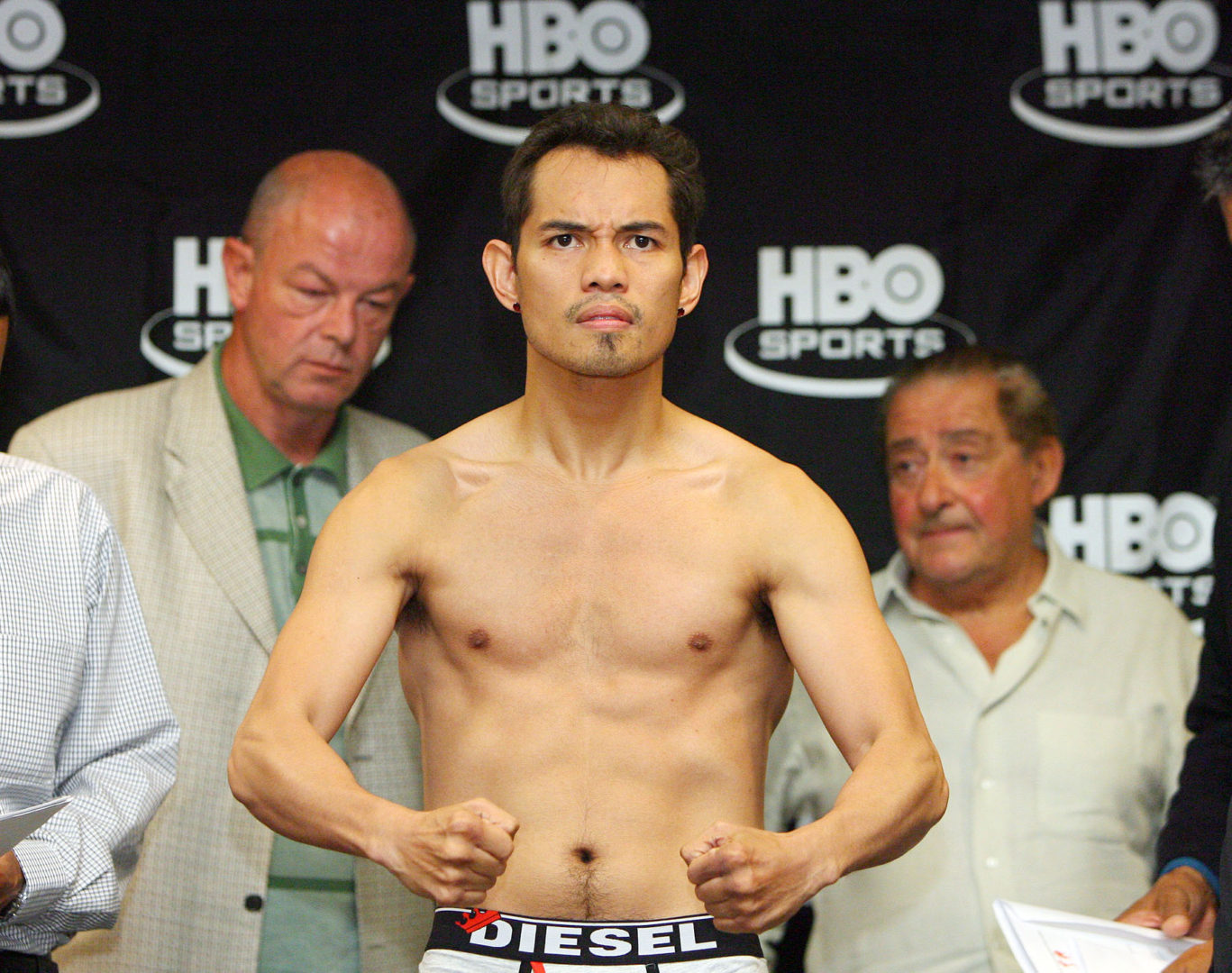
It was Saturday night for Nonito Donaire in a well-crafted, yet careful ninth-round stoppage of Toshiaki Nishioka in a super-bantamweight bout booed by a Home Depot Center crowd that had just witnessed some Fight of the Year drama in Brandon Rios’ victory over Mike Alvarado.

There was no way Donaire and Nishioka could put together a satisfying encore. Who could?

Then again, there also aren’t many times when a fighter with world-class credentials lands only 49 punches. That was Nishioka’s total, according to Compubox, which broke it down to 23 jabs and 26 power punches. Rios and Alvarado landed more punches in their walk from the dressing room for opening bell.

Nishioka, a 122-pound fighter from Japan with an accomplished resume, looked listless and perhaps a little surprised. From the beginning, he looked confused. He tried to avoid instead of engage Donaire. Fewer punches magnified the ones that did land, especially from Donaire.

“Nonito is a surgeon,’’ Donaire (30-1, 19 KOs) said.

In the sixth, the Doctor was in.

Donaire delivered a left- uppercut that dropped Nishioka (39-5-3, 24 KOs). Donaire said he hurt his left hand sometime in the middle of the fight. After the sixth, he said he had to rely on his right.

No problem. In the ninth, he dropped Nishioka and the curtain with a straight right. Referee Raul Caiz called it at 1:54 of the round.

“I’ve never seen a fighter with that kind of speed,’’ Nishioka said.

For Donaire, it’s hard to know what’s next. He wants to fight Abner Mares. But Donaire is a Top Rank fighter and Mares is promoted by Golden Boy. Peace on earth has a better chance than a Golden Boy-Top Rank alliance.

Then again, maybe a good surgeon can mend the promotional rift that stands in the way of the only 122-pound fight anybody wants to see. Dr. Donaire can hope.

Rios wins TKO on a night when he and Alvarado deliver

They hoped for Arturo Gatti-Micky Ward. They talked about Jose Luis Castillo-Diego Corrales. They promised a lot.

Brandon Rios and Mike Alvarado delivered.

In their own way.

First, there were punches. Then, there were counters. Then, there were chants. Then, there was astonishment. Never was there an interruption, until Rios suddenly found energy where everybody else had begun to see signs of potential fatigue. They weren’t looking in the right place.

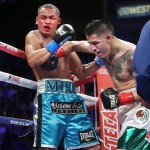
But it was there, somewhere inside Rios (31-0-1, 22 KOs), who marshaled his energies Saturday night for a dramatic seventh-round TKO of Alvarado (33-1, 23 KOs) in what might be the Fight of this Year and few other years.

Rios, of Oxnard, Calif., caught Alvarado with an overhand right. The punch seemed to land on Alvarado’s left temple. He appeared dazed. He slumped against the ropes. That was an invitation the instinctively aggressive Rios could not resist. He swarmed Alvarado at a rate that the Compubox computer at ringside must have had a hard time counting. The punches were hard to see. Alavardo surely couldn’t

Appearing defenseless, referee Pat Russell called it at 1:57 of the round, awarding Rios a TKO and perhaps a shot at the Manny Pacquiao-Juan Manuel Marquez rematch on Dec. 8.

“I knew the overhand right would do it,’’ Rios said, who had a slight bruise under his right eye.

Rios, fighting for the first time at junior-welterweight, waited for his chance to land it while enduring one cracking uppercut after another from Alvarado. After six rounds, the bout was tied, 57-57, on each of the cards held by judges Max Deluca and Zach Young. On James Je Kin’s card, Rios led, 58-57.

Alvarado, of Denver, was showing Rios a shoulder and rolling it in a defensive tactic. Amid a relentless body attack, Alvarado finally abandoned the tactic. That was the beginning of the end to a drama that had a capacity crowd of more than 7,000 at the Home Depot Center on its collective feet and roaring its approval.

Rios listened and broke into a smile that said:

“I told you so.’’

Never, he said, was there a moment when he thought Alvarado might have gained the momentum and begun to do enough to win.

“Hell, no,’’ he said to a question thrown at him by HBO Max Kellerman moments after he was declared the victory.

Hell, yes, was the response from an audience that knew Rios and Alvarado had been to hell and back. And, hell yes, everybody was happy to have been along for the ride.


Benavidez rocked, yet survives to win unanimous decision

There’s always been one question about Jose Benavidez Jr.

Could he take a punch?

That punch landed Saturday.

For one fight, at least, Benavidez had an answer. He could take one. He could endure, at least long enough to remain unbeaten in his brief career.

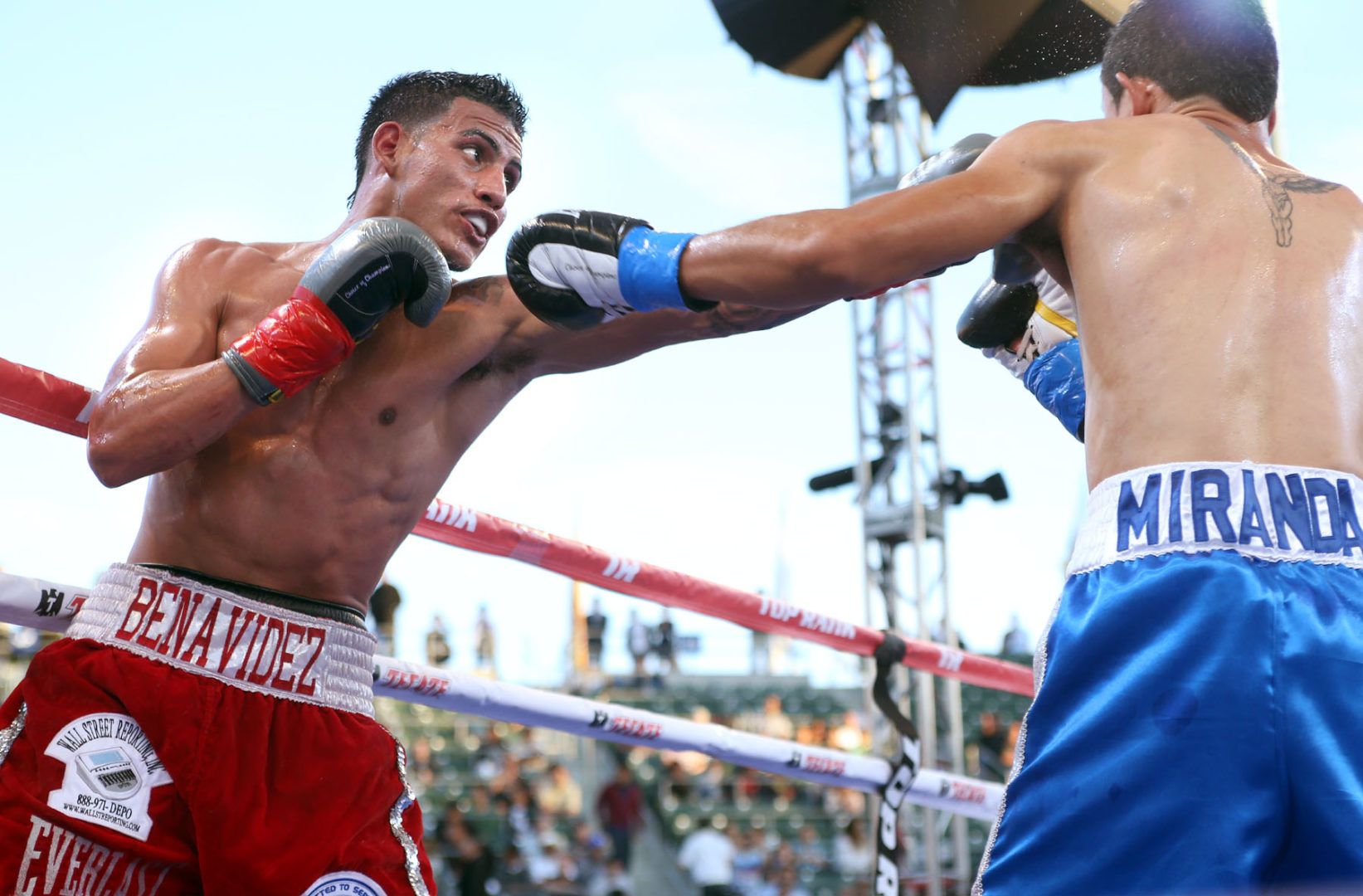
Benavidez (17-0, 13 KOs), a junior-welterweight from Phoenix, was rocked by a left hook from Pavel Miranda (19-8-1, 10 KOs) of Tijuana with about 45 seconds left in an eight-round fight. Dazed and unsteady, Benavidez stumbled across the canvas at an outdoor ring at Home Depot Center, yet managed to hold on to victory by unanimous decision and his status as an unbeaten prospect.

If Miranda’s hook had landed earlier, or if he had followed up with another punch, or had the fight been scheduled for 10 rounds, the story might be very different. Benavidez might be anguishing over his first defeat.

Those are questions that the 20-year-old Benavidez will now have to confront and answer against better, more powerful opponents. There’s never a definitive answer. There are only lessons and more fights, many more of both for Benavidez, who relied on his jab to claim a victory that was nearly taken from him during the bout’s desperate last moments.

The Best
Light-heavyweight Trevor McCumby only enhanced the likelihood he’ll be offered a Top Rank contract this week with his seventh stoppage in seven victories. McCumby, a Chicago native who trains in Phoenix and Oxnard, Calif., at Robert Garcia’s gym, was never challenged in a first-round demolition of Mexican Eliseo Durazo (4-4, 1 KO).

The Rest

Lightweight Javier Garcia (8-2-1, 7 KOs) of Oxnard, Calif., knocked down Jose Roman (14-0-1, 11 KOs) in the first round. Roman, of Garden Grove, Calif., returned the favor in the second. But the ringside physician had the final say. He stopped the fight after the third because of a cut sustained by Garcia, although it appeared the wound was cause by a punch. The fight was declared a technical draw.

Featherweight Evgeny Gradovich (14-0, 7 KOs) calls himself the “Mexician Russan.’’ He needed Mexican tactics and toughness to score a unanimous decision over Jose Angel Beranza (36-25-2, 27 KOs) in a brawling, give-and-take eight-rounder.

Miami super-middleweight Ronald Ellis (4-0, 3 KOs) came into the ring wearing sunglasses. He took them off, fought for four rounds, put them back on, stepped out of the ring and into the sunshine with a unanimous decision over Denver’s Katrell Straus (2-3, 1 KO). Easy as that.

A super-featherweight bout between Mexican Cesar Garcia (6-12-1, 1 KO) and Saul Rodriguez (6-0-1, 5 KOs) was ruled technical draw. The ringside physician stopped it after two rounds because of bloody cut suffered by Garcia in an apparent head butt.

Top Rank signs Mexican Olympian
Top Rank announced Saturday that it has signed Mexican Olympian Oscar Valdez. Valdez, a two-time Olympian, lost to eventual silver medalist John Joe Nevin of Ireland at bantamweight during the London Games in August. Valdez, 22, grew up in Nogales, which is a town on the border with Arizona.

Photos by Chris Farina / Top Rank


Growing Up: Benavidez gets serious by getting rid of an expensive toy.


CARSON, Calif. – If maturity is measured in knowing what to keep and what to shed, there is some good news in Jose Benavidez Jr.’s transformation from prospect to pro.

Benavidez got rid of an expensive toy, a Maserati, as though it were an excess pound.

“It was costing me too much to insure and too much to maintain,’’ said Benavidez, whose insurance premium on the high-performance sport car was $1,500-a-month. “I’ve got more important things to do.’’

Did you just hear a loud sigh of relief? No need to get your ears checked. It came from dad, Jose Benavidez Sr. who a year ago worried about his son’s purchase of the high-performance sports car. It attracted too much attention. Dad worried that fans might begin to think that his son was more interested in expensive toys than hard work. No worries. None at all.

“Oh yeah, it’s a good sign,’’ the senior Benavidez said. “To me, it means he’s figuring it out. He’s getting serious. Sometimes, I have to get on him about some things. But he is starting to get it.’’

Benavidez (16-0, 13 KOs) is still about seven months away from a birthday that will turn him into a 21-year-old adult. Yet, his wisdom often belies his years. He is quick to say he still has much to learn and many to fight.

“I’ve got a lot of work to do, a whole lot,’’ said the Phoenix prospect, who goes back on the job Saturday night at the Home Depot Center against Pavel Miranda (19-7-1, 10 KOs) of Tijuana on the undercard of two HBO-featured fights, junior-welterweights Mike Alvarado (33-0, 23 KOs) of Denver against Brandon Rios (30-0-1, 21 KOs) Oxnard, Calif., and super-bantamweights Nonito Donaire (29-1,18 KOs) of the Philippines against Japan’s Toshiaki Nishioki (39-4-3, 24 KOs) of Japan.

At a formal weigh-in Friday in a crowded hotel ballroom in nearby Manhattan Beach, Donaire was at 121.6 pounds and Nishioka 121.8, both under the 122-pound limit for their title fight. Meanwhile, Rios, unable to make the 135-pound mandatory at lightweight in his last couple of outings, had no trouble at junior-welter. He was at the limit, 140. Alvarado tipped the scales at 139.8.

Miranda was at 144.2 pounds and Benavidez 143.4 for a bout scheduled for eight rounds and officially classified as super-lightweight. In another sign of Benavidez’ ongoing maturity, however he is closer to becoming a welterweight than a junior-welter.

“Anymore, I walk around at 160-pounds,’’ Benavidez said. “At some point, I’ll be a welterweight.’’

That official jump might not happen until sometime next year.

“If we could fight for a youth title or something like that, 140 pounds wouldn’t be a problem,’’ Benavidez Sr. said.

If Benavidez wins as expected against Miranda, he could be ticketed for a bout on the Dec. 8 card featuring the third rematch between Manny Pacquiao and Juan Manuel Marquez at Las Vegas’ MGM Grand.

“But he’s got to be ready for everybody now,’’ Benavidez manager Steve Feder said. “Every young guy out there wants to be the one to upset Jose Benavidez Jr. He’s become a target.’’

But not a flashy one.

NOTES: The Carson card also includes a light-heavyweight bout between light-heavyweight Trevor McCumby (6-0, 6 KOs) against Eliseo Durazo (4-3, 1 KO). McCumby has the look of a prospect. He has been training in Phoenix and at Robert Garcia’s gym in Oxnard. Another big McCumby win Saturday night might lead to a Top Rank contract next week.

And the card had yet to sell out Friday, but there was a buzz at a weigh-in crowded with more Japanese media than American for a main event featuring Nishioka, who grew up in Nagasaki and trains in Tokyo.


Donaire finished with experiments and ready to re-empower himself


Boxing’s equivalent of lighting in a bottle was captured by Nonito Donaire nearly two years ago when he knocked out accomplished Fernando Montiel within two rounds of a stunning statement that transformed him into a pound-for-pound contender.

Everything since then has been like time in a high school class. Donaire studied, did his homework and roadwork. Yet, he yearned for that bold stroke of reality that still has fans and media talking about him.

“The last three fights were experimental,’’ Donaire said in a conference call. “This fight, we are going back to boxing and being unexpected. We relied on the power in the last three fights. But this fight we will come out throwing lots of punches.’’

In a statement that sounds a lot like a bid to re-insert himself into the pound-for-debate amid doubts about whether Manny Pacquiao can beat Juan Manuel Marquez in a third rematch and only silence from Floyd Mayweather Jr., Donaire promised to reaffirm his credentials in a significant test Saturday night against another accomplished foe, Toshiaki Nishioka of Japan.

It’s another step up for Donaire (29-1, 18 KOs), whose version of the super-bantamweight titles – the International Boxing Federation and World Boxing Organization – will be at stake in an HBO-televised bout from the Home Depot Center in Carson, Calif. In beating Montiel in February, 2011, Donaire stopped an acknowledged master of tactical skill. The proof was in Montiel’s record, then 44-2-2 with 35 KOs.

Flip the calendar forward, jump up in weight and you’re looking at Nishioka, whose record (39-4-3, 25 KOs) adds up to mastery of a division, 122 pounds, that he has quietly ruled since 2004.

“This is a fight Nonito has wanted for a very long time,’’ said manager Cameron Dunkin, who sounded as if he worried Donaire might regret that his wish was granted.

A Donaire advantage appears to be his age. At 29, he should be stepping into his prime. At 36, Nishioka is probably a step beyond his. There is also Nishioka’s recent inactivity. He hasn’t fought since a unanimous decision over skillful Rafael Marquez a year ago.

“We don’t want to take any chances at all,’’ said Donaire, who this year has fought twice at 122 pounds and won both, beating Jeffrey Mathebula and Wilfredo Vazquez Jr. by decisions. “I believe when we are at this level and at this age and even if he hasn’t fought in a while, he can be very dangerous.’’

A potential disadvantage for Donaire is the absence of trainer Robert Garcia for much of his camp. The busy Garcia was also working with Brandon Rios, who faces Mike Alvarado in a junior-welterweight clash that has potential to upstage Donaire-Nishioka.

Nishioka’s advantage rests in experience and smarts. He hasn’t been stopped once and that was in 1995 in only his second pro bout. If Donaire is trying to re-energize his pound-for-pound claim with emphasis – meaning a knockout, he might have picked the wrong guy.

“Sometimes, you don’t get the results that people look for,’’ Donaire said. “ People expect a lot from me. We have been trying to change things up to get different results. Against Nishioka we can’t let our guard down and going back to the old Nonito Donaire style of fighting smart.

“When it comes, it comes. But the proper game plan will show my power, which is what I was known for – lightning fast counters that were knocking people out because they never saw it coming.

“No matter how tough you are, if you don’t see where it’s coming from, you don’t expect it and it will knock you down.’’

And maybe knock him squarely back into pound-for-pound talk.


Rios looks at Alvarado and sees a chance at a Ward-Gatti remake


The nickname is Bam Bam. Bold and Bolder might be more appropriate for Brandon Rios, who isn’t afraid of promises or punishment.

Rios’ confrontation with Mike Alvarado on Oct. 13 at Carson, Calif., is generating buzz about a possible Fight of the Year. But Rios raised the bar, or at least the blood lust, for a junior-welterweight bout that could upstage the main event, Nonito Donaire versus Toshiaki Nishioka.

“A Micky Ward-Arturo Gatti kind of fight,’’ Rios said Thursday during a conference call.

For bruises, danger and drama, Ward-Gatti is the modern standard. It’s not the sort of fight that Floyd Mayweather Jr. or Andre Ward would seek. They see themselves as scientists who try to balance their craft with a sweet balance of offense and defense. Their philosophy has been heard for as long as there has been an opening bell. They live by one credo: Hit and not get hit. Delete the not from that formula and add as many hits as possible, and you’ve got a pretty good idea at what Rios hopes to inflict and perhaps endure.

That stretch of canvas between the ropes is no checker board for Rios, who is moving up in weight, to 140 pounds, after a controversial failure to make the lightweight limit, 135. He has no patience for what he calls “little chess games.’’

When Rios looks at the unbeaten Alvarado, he could be looking into a mirror. He sees a similar style and the same stubborn streak of pride that demands, if not welcomes, a walk though harm’s way.

“It’s going to be a bloody, massacre fight,’’ said Rios, who told trainer Robert Garcia that he has been dreaming about a chance to do battle in a fight that would be the equal of Gatti-Ward. “I’ve been telling Robert since I started as a professional I’ve been waiting for that type of fight and hopefully this is that fight.’’

Whether that chance will be there in an outdoor ring above the Home Depot Center’s tennis court, however, depends on Alvarado. Alvarado’s trainer, Henry Delgado, left it open-ended as to whether Rios will encounter the Alvarado he expects.

Fans and media have yet to see Alvarado’s boxing skill, Delgado says. His instincts draw him into exchanges from which there is no retreat.

“He makes it tougher than it has to be, because he’s a warrior,’’ Delgado said. “But we’ve got some surprises coming. We have options, lots of options.’’

Options are often forgotten after the first big punch lands, of course. That’s when even the most seasoned fighter reverts to what he knows and does best.

“He looks to come forward; I like to come forward,’’ said Rios, who says there’s nothing new about a heavier weight which he believes makes him stronger and able to hit with the power of a welterweight. “I don’t change my style.’’

Or his hopes of realizing a dream that many avoid like a nightmare.

Tyson can’t escape 20-year-old controversy
New Zealand’s withdrawal of Mike Tyson’s request to enter the country because of his conviction for raping Desiree Washington is just another sad chapter in a 20-year-old controversy.

Tyson, who was scheduled to speak at series of events in New Zealand, has long denied that he committed the crime. Legal experts, including Harvard professor Alan Dershowitz, criticized the 1992 Indianapolis trial and Tyson’s legal defense.

In 2001, Tyson underwent a lie-detector test in Phoenix, where he was living at the time. According to test results acquired by The Arizona Republic, Tyson was truthful when he said he did not rape Washington. But the conviction will always be on his record. Fair or not, it also will always be there for people seeking to make political capital out of it, no matter what he says or they believe.

AZ Notes
Unbeaten Phoenix prospect Jose Benavidez Jr. (16-0, 13 KOs) has a change in opponents for his undercard appearance on Donaire- Nishioka undercard on Oct. 13. Benavidez now is scheduled to face Pavel Miranda (17-7-1, 7 KOs) of Tijuana, Mexico.

Iron Boy Promotions of Phoenix is back at Celebrity Theatre Saturday, Oct. 6, with a card full of young fighters, including Phoenix super-bantamweight Emilio Garcia (6-0-1) against Jensen Ramirez (2-1-1) of Tucson. Opening bell is scheduled for 6 p.m.


Talk of Pacquiao-Mayweather doesn’t matter if the old Manny doesn’t show up against Marquez


Talk about Manny Pacquiao-Floyd Mayweather Jr. is back like a bad hangover. Everybody seems to have an interpretation, if not a prediction, in the wake of a settlement to Pacquiao’s defamation suit and his offer to give Mayweather the lion’s share in a 55-45 split.

It’s as if Pacquiao’s rematch with Juan Manuel Marquez in their fourth meeting on Dec. 8 doesn’t matter. Maybe, it doesn’t, which is good reason for Marquez to worry about Robbery IV. The public and media fixation on Pacquiao-Mayweather won’t go away and perhaps won’t let anything stand in its way

That said, there’s been a shift in public sentiment and in Pacquiao himself. Combine the two, and only Marquez matters – or should – in any talk about Pacquiao-Mayweather. If Pacquiao loses, the Filipino Congressman becomes a full time politician. He has talked about leaving the ring. Marquez could hasten that departure.

Pacquiao trainer Freddie Roach is concerned on a couple of levels.

First, there’s sympathy for Marquez and his argument that he was robbed in the narrow decisions, split and majority, that went against him in the first and second rematches. Scorecards can be like ballots. They’re subjective.

“I think we go into the fight three to four rounds down already,’’ Roach said about the Marquez bout when it was still being negotiated a couple of days before he worked Julio Cesar Chavez Jr.’s loss to Sergio Martinez on Sept. 15 at Las Vegas’ Thomas & Mack Center.

That means Pacquaio has to win by knockout. That would be a first. Marquez, who has six losses, has never been stopped. Given the narrow 36 rounds that already have transpired and Pacquiao’s record of no stoppages in five fights since a 2009 TKO of Miguel Cotto, Pacquiao by KO is a very tall order.

Roach says the task in camp at the Wild Card Gym will be to rediscover Pacquiao’s old aggression, which has withered for reasons that aren’t clear.

Compassion, perhaps the born-again expression of Pacquiao’s return to a Catholic lifestyle, has lessened the ferocity for which there was no refuge for so many of his fallen foes, Roach says. It was evident in 2010 when Pacquiao almost begged referee Laurence Cole to stop what he wouldn’t in a brutal decision over Antonio Margarito at Cowboys Stadium in Arlington, Tex.

Then again, it wasn’t enough in 2004 when Pacquiao, then at his ferocious best, knocked down Marquez three times in the first round, but never out during the next 11 in a bout that ended in a draw.

Roach says Pacquiao’s physical skills are as sharp as ever, although there seemed to be a missing gear in the hand speed throughout his controversial loss by decision to Timothy Bradley on June 9. From Erik Morales to Oscar De La Hoya, Pacquiao threw punches at a rate that overwhelmed. Against Bradley, that rate proved pedestrian.

But Roach is convinced that those hands will move at a ruthless rate if Pacquiao’s heart still has the streak of larceny needed in a brutal business.

Will it?

“I don’t know,’’ Roach said. “That’s the challenge.’’

The only one.


It’s time for Chavez Jr. to test positive for some maturity


Is anybody surprised that Julio Cesar Chavez, Jr., tested positive for marijuana?

Didn’t think so.

News of the test in the wake of Chavez’ loss by one-sided decision Saturday night to Sergio Martinez at Las Vegas’ Thomas & Mack Center is just more of the same in an exasperating pattern of behavior from a man-child who won’t grow up.

Already, Chavez’ enablers are trying to muddy up the issue by arguing that pot is as much a performance-enhancer as a bacon-cheeseburger. It should be legal, they say. It’s already legal in some places. Smoke it for therapy. Smoke it as a sleep aid. Soon, Barack Obama and Bill Clinton will be tossed into all that smoke. The current president inhaled it and a former one said he didn’t. Blah-blah-blah

So what’s the problem?

It’s not the pot. It’s the irresponsibility.

If Chavez, Jr., smoked a joint after a fight that included an epic 12th round, that’s his choice. But the positive test indicates he was indulging when he wasn’t training throughout a haphazard camp, which included weird hours and sessions when apparently his road work was limited to a few laps around the couch in his Vegas’ living room.

Instead of fulfilling his obligations with some sweat equity, it looks as if the former middleweight champ was getting stoned. That was irresponsible to trainer Freddie Roach, who sometimes would be summoned to supervise a workout at midnight or 3 a.m. It was a breach of what Top Rank and fans expected him to do.

Chavez has been allowed to skate from accountability throughout his young life because of his name. He’s the son of Mexico’s beloved Julio Cesar Chavez, Father Legend. If there’s a burden in carrying on the name, it includes favors that have postponed maturity.

More troubling and perhaps ominous, he hasn’t learned from his father’s mistakes. In addition to a durable chin, there are signs that the 26-year-old Chavez inherited dangerous habits that led his dad into substance-abuse and rehab. Chavez Jr. talked about his dad’s problems a couple days before the Martinez bout. In a forthright manner, he talked about fears his dad would die. He called the experience “horrible.’’ But he didn’t call it a lesson.

It’s not as if Chavez Jr. didn’t know he would be tested. His history dictated that he, perhaps more than any fighter, would be. In 2009, he was suspended for seven months after testing positive for a diuretic. In January, he was arrested for DUI. In June, Andy Lee trainer Emanuel Steward questioned the legitimacy of a test that Chavez underwent before he beat Lee in El Paso.

By now, Chavez knows the rules. If he had trouble sleeping, he should have used something else other than pot to help him get his rest. Marijuana is still on the banned list. It’s fair to argue whether it should be. But that’s an argument for another day.

Today, the argument is only about Chavez Jr. In a Don’t Worry, Be Happy style, he’s likable. He has potential. But that’s all he’ll ever have if the people around him continue to postpone the battle to mature. For now, it’s the only fight that matters.


No Obit Here: Dueling cards throw a combo that the doomsayers can’t counter

LAS VEGAS – Two major cards separated by a short ride looked like an accident about to happen. Look again. Sergio Martinez-Julio Cesar Chavez Jr. at Thomas & Mack Center and Canelo Alvarez-Josesito Lopez at the MGM Grand were a lot of things. It was a good night to wear a sombrero. It was a long night in line for a cab and a longer line at the bar.

It was one shot of Pancho Villa, a shot of Peron, another shot of soccer and endless shots of tequila. Above all, it was thoroughly Vegas, at least Vegas before the recession. It was also boxing at its best, which also means some of its worst. Nothing can be so irresistible and so distasteful at the same time.

But there it was Saturday night, a double shot and 180 proof of what is so compelling about a sport that just won’t die no matter how hard it tries to kill itself.

It was impossible to see the depth of its unique resiliency Saturday. I tried. But there was just too much to see. My night started at the MGM Grand. It ended at Thomas & Mack with a brilliant victory by Sergio Martinez, who survived a wild 12th-round comeback from Julio Cesar Chavez, Jr.

My cab driver predicted the winner. But not the drama.

“Martinez by knockout,’’ the driver said beneath an old cowboy hat that he had to have been wearing 25 years ago when he collected fares from fans who watched Sugar Ray Leonard, Marvin, Hagler, Robert Duran and Thomas Hearns.

But it was Chavez who almost won by knockout. Chavez sent Martinez spinning down and onto the canvas in the 12th round, immediately conjuring up memories of how his dad, Julio Cesar Legend, beat Meldrick Taylor with two seconds left so long ago.

An encore for the Chavez family didn’t happen, not even on a weekend celebrating Mexican Independence. Chavez blamed himself after losing a unanimous decision. He said he started his stubborn assault too late. Martinez, a proud Argentine, also put himself in harm’s way when he didn’t have to. In the end, however, Martinez wouldn’t let Chavez steal a victory or the middleweight title he had ensured himself on the scorecards. Argue with Chavez’ early rounds. Argue with Martinez’ last round.

But don’t argue with the climactic finish. A record crowd of 19,187 at Thomas & Mack loved it. Mexicans and Argentines, alike, cheered loudly, filling the old basketball arena with chants that echoed down the aisles and through time.

Boxing isn’t back. It never left.

Not long after leaving the MGM Grand, super-middleweight champion Canelo Alvarez scored a fifth-round KO of Josesito Lopez in a bout that was probably more significant for the number of people in the seats than it was for the victory. The undersized Lopez was overmatched. Canelo had been favored by odds as big as 14-1. Yet, a capacity crowd of 14,275 at the MGM Grand Garden Arena showed up. There’s been a nasty debate between Golden Boy Promotions and rival Top Rank about how many tickets were sold and at what price. Yet on a night when Canelo was a laughable favorite in a Golden Boy promotion up against Top Rank’s intriguing Martinez-Chavez Jr. showdown, Canelo filled the seats.

“That underlines just how big an attraction Canelo is,’’ Golden Boy CEO Richard Schaefer said.

It underlines much more than that. Two cards within a couple of miles of each other drew a total of 33,462 fans. That’s no accident.


Paul Williams feels good, remains confident


LAS VEGAS – A motorcycle accident took away Paul Williams’ legs, but not his confidence.

It was there, as evident as ever Friday when he came out of an elevator at the MGM Grand before the weigh-in for the Showtime-televised junior-welterweight fight between Canelo Alvarez and Josesito Lopez Saturday night.

Williams was in a wheelchair. But he made it sound as if that chair was a temporary vehicle until that day when he believes he will recover, perhaps enough to even fight again.

“I feel good,’’ Williams said. “This is a small thing for a giant.’’

Williams is in Las Vegas for a fight that was supposed to include him against Canelo before the accident in Atlanta left him paralyzed. In his brief comments to 15 Rounds and Lance Pugmire of the Los Angeles Times, it wasn’t clear what his condition was.

But his confidence was unmistakable. Williams has faith that he will walk again in a path that might even take him up those steps, through the ropes and into the ring for another opening bell.

“I think I can come back,’’ Williams said. “Give it two or three years. I’ll come back.’’

If Williams had been Canelo’s opponent instead of the undersized Lopez in a Golden Boy-promoted bout, there’s speculation that rival Top Rank would have moved Saturday night’s other fight, Sergio Martinez-versus-Julio Cesar Chavez Jr. for the middleweight at Thomas & Mack Center, to a different date, possibly Oct. 6.

The consensus is that Williams-Canelo would have been more competitive and marketable than Canelo-Lopez.

Weights from the MGM

About 90 minutes before the Martinez-Chavez weigh-in, Canelo and Lopez stepped on the scales. Canelo looked solid at 154 pounds, the junior-middleweight limit. Lopez looked a little soft at 153, his heaviest ever.

“I’m not as weak as I look,’’ Lopez joked a day before the weigh-in. “I just look skinny.’’

At opening bell, Lopez expects Canelo to be at 170, which would mean about a 10-pound advantage for the favored Mexican, who holds the World Boxing Council’s version of the title.

Notes, Quotes

· Golden Boy announced a sellout Friday for the Canelo-Lopez featured card. Within minutes of the announcement, tickets were still available on Ticketmaster.

· Jose Benavidez Jr., an unbeaten junior-welterweight prospect from Phoenix, has been added to the Top Rank card featuring Nonito Donaire versus Toshiaki Nishioka at Carson, Calif., on Oct. 13. Benavidez is expected to fight Raul Tovar.


Bad Business? Martinez-Chavez, Canelo-Lopez might add up to something good


LAS VEGAS – News conferences came like a one-two punch Wednesday and Thursday for dueling promotions Saturday night featuring Sergio Martinez-versus-Julio Cesar Chavez Jr. at Thomas & Mack Center and Canelo Alvarez-Josesito Lopez at the MGM Grand.

It’s been a rhetorical food fight, boxing’s version of Republicans and Democrats after back-to-back conventions. First, it’s Top Rank to the bully pulpit. Then, it’s Golden Boy’s turn. It’s Home Box Office- versus-Showtime. Ego-against-ego. An insult-fest. But should it be?

After widespread criticism for scheduling two major cards on the same night and amid all the ongoing negativity, there’s a chance at some numbers that might put a surprising spin on the business. Attendance at each could provide a powerful counter to an epitaph so often repeated, yet never proven.

If boxing is really dying, then a lot of people – maybe more than 30,000 at two venues within a couple miles of each other – have yet to hear the news.

There’s plenty of debate about box-office numbers promised by Golden Boy for Alvarez-Lopez in a 154-pound bout televised by Showtime. Golden Boy President Oscar De La Hoya said Thursday at the Canelo-Lopez news conference that 13,000 tickets had been sold.

“We are expecting a sellout,’’ De La Hoya said of a weekend celebrating Mexican Independence.

Top Rank doesn’t believe it. On the surprise meter, that ranks somewhere between zero and yawn. If the situation was reversed – and it will be one day, Golden Boy wouldn’t believe it either. Remember, Republicans and Democrats trust each other more than Top Rank and Golden Boy do.

For Martinez-Chavez, Jr., in a HBO pay-per-view bout for the middleweight title, Top Rank already has a sellout, 19,186, a boxing record at Thomas & Mack. Even if a sellout is announced for Alvarez-Lopez, there will be suggestions that Golden Boy gave away tickets to get there.

As of Thursday, it wasn’t clear what number Golden Boy needed for a sellout. Seating capacity at The MGM Grand Garden Arena has been 14,800. But Golden Boy CEO Richard Schaefer said 2,000 seats can be added before Saturday’s opening bell. If there’s time to construct the addition and the seats are filled, the crowd would be announced at 16,800. Add the Thomas & Mack sellout, and the total would be 35,186.

“That would tell you a lot about the sport,’’ Schaefer said.

With apologies to Mark Twain, t would tell you that all those dire warnings of imminent death are greatly exaggerated.

It might also tell you what could happen if Golden Boy and Top Rank made peace and did business together. But that’s another story, if not a miracle. It didn’t sound as if peace were even a remote possibility Thursday. The irony is that the fighters were the diplomats. Canelo and Lopez praised each other. The only real trash talk came from Keith Kizer, the Nevada State Athletic Commission’s executive.

In an apparent reference to the controversy over the judging of Tim Bradley’s decision over Manny Pacquiao in June at the MGM Grand, Kizer seemed to take exception at HBO’s criticism of judges Duane Ford, CJ Ross and Jerry Roth.

“There was another fight here in June, but some of the veterans at ringside that felt badly that night won’t feel so bad this time, because HBO, (Jim) Lampley and (Harold) Lederman won’t be there,’’ Kizer said. “I like the Showtime announcers much better.’’

Kizer’s shot followed one at Showtime from Top Rank’s Bob Arum.

“Half the people who’ve got Showtime don’t know they have it,’’ Arum said.

Shot, counter-shot. The beat goes on.

But if predictions are fulfilled and the numbers add up Saturday night, there won’t be an argument about whether the business still has a heartbeat.


Father Legend has some lessons for Julio Cesar Chavez Jr.


LAS VEGAS – There was a time when the son couldn’t mention his father’s name. It was too painful. Legends don’t die. But dads do.

It was 2010. Julio Cesar Chavez Jr. watched substance-abuse wash away the immortality that Mexicans have attached to his famous dad, Julio Cesar Chavez Jr.

“I kept thinking this guy is going to die,’’ Chavez Jr. said Wednesday to handful of reporters after a formal news conference for his middleweight title fight Saturday night against Sergio Martinez at Thomas & Mack Center. “He’s going to die. I got used to thinking about it.’’

Dad changed his son’s mind, but only after the end so feared by his son ominously appeared one day in Tijuana. Julio Sr. said he didn’t feel well. His son recalls that he sought medical help. His father was sedated and then rushed to rehab.

Twenty-six months later, Julio Cesar Chavez Sr. sat Wednesday – clean, sober and proud — near his son just days before the family business continues against Martinez in an HBO pay-per-view bout.

“Right now, our relationship is good,’’ said Chavez Jr., about a 2-to-1 underdog in betting odds posted late Wednesday. “It can withstand the disagreements we have.’’

The relationship has healed so much that the son can now often joke about a dad who doesn’t often like to be the intended target of any sort of mockery. Julio Chavez Sr. has been in gym with his son and trainer Freddie Roach. But Chavez says he listens only to Roach. The son is a smart guy. He knows that old lesson about dads, even Hall of Fame Fathers. They don’t belong in their son’s corners.

“Freddie is the last word,’’ Chavez Jr. said. “Sometimes, my dad will run to my corner and say something. I’ll tell him: ‘Work the corner or get the hell out.’ ‘’

Dad always gets the message, Julio Jr. said.

At least, he does now.

A couple of years ago, he wasn’t certain. His father, he says, would come home early in the morning after a night of drinking.

“He would come home, sometimes at 5 a.m. and sometimes on the day I’d fight, sit down and start talking, while I was trying to sleep’’ he said. “He’d just talk and talk, talk for three and four hours.’’

About what?

“Not sure,’’ Chavez said. “About everything.’’

In the couple of years since his dad underwent rehab, Julio Jr., once dismissed as a lazy rich kid, began to mature as a fighter under Roach’s steady guidance. His training schedule might be quirky. Roach said he often trains in the early morning hours. Workouts can start at 1 a.m. and end 4 a.m. But the work is serious, Roach said.

In part, Julio Jr. appears to have inherited some his dad’s toughness. There’s the durable chin. There are also the body punches. Both made a Hall of Famer out of his stubborn dad.

“That’s why I feel sorry for Sergio Martinez,’’ Bob Arum, Julio Jr.’s promoter, said Wednesday during the news conference. “He’s going to take body shots like he’s never felt before.’’

But there can also be dangers in what a son inherits from his dad. For Julio Jr., it is a lifestyle that put his dad in rehab. A warning sign was there in January when The Ring’s Lem Satterfield reported that Julio Jr. was charged with DUI within a couple of weeks of his victory over Marco Antonio Rubio.

It was a lesson then.

It’s a lesson now, especially for a family business that needs to remember them if it hopes to fight on.


Fight For The Future: With Ward-Dawson, Martinez-Chavez and Canelo-Lopez, it’s underway

It’s hard to know whether September’s promise is a new dawn or just a familiar set of oncoming headlights in another head-on collision with a demise predicted and heightened by August’s doom and gloom.

No matter how you look at Andre Ward-versus-Chad Dawson Saturday in Oakland, Calif., and a dueling Las Vegas’ twin bill on Sept. 15 featuring Sergio Martinez-Julio Cesar Chavez Jr. at Thomas & Mack Center and Canelo Alvarez-Josesito Lopez at the MGM Grand, however, it is hard not to see potential for a comeback that is a boxing specialty. No business does it better.


Reliable resiliency is there in a shifting alignment that offers a way out of the never-never land of talk and only talk about Floyd Mayweather and Manny Pacquiao. Yeah-yeah, it could still happen. But a generation of lost fans doesn’t care anymore. The good news is that there is always a new one. In part, chances at winning over generation-next rest in what happens with fighters poised to succeed Pacquiao and Mayweather.

For now, the intriguing battle is for No. 2 spot in the pound-for-pound debate. The fading Pacquiao, second on most lists behind Mayweather, is in jeopardy of falling to third or even fourth after evidence of decline in his last two fights, controversial decisions over Juan Manuel Marquez and Timothy Bradley.

“Me, I believe I’m No. 2 at this moment,’’ Martinez said Wednesday in a conference call for his showdown with Chavez Jr. in a HBO pay-per-view bout for the middleweight title.

A better argument might come from Ward, if he remains unbeaten (25-0, 13 KOs) Saturday in a HBO-televised bout against light-heavy champion Dawson (30-1 17 KOs), who agreed to come down in weight for a 168-pound fight in Ward’s hometown. Mayweather stays at No. 1 because of his perfect record (43-0, 26 KOs). Martinez can’t make that claim. Even if he beats Chavez Jr., there are still losses to Antonio Margarito and Paul Williams and two draws on his resume (49-2-2, 28 KOs).

Predictably perhaps, the more circumspect Ward isn’t as bold about his place in the pound-for-pound debate as Martinez, who has become more outspoken in an escalating exchange of trash talk with Chavez Jr.

For the most part, Ward’s attention isn’t easily diverted by anything beyond the challenge immediately in front of him. That means the dangerous Dawson. Everything else is just talk that would take him away from the task at becoming an equal of fighters he admires, including Mayweather and Sugar Ray Leonard.

“They’re masters,’’ Ward said. “I’m trying to be a master.’’

The guess is that Ward will never quit trying. The goal will be there for as long as he is fighting. It’s a motivational piece to a Ward persona that in a couple of years could put him at the top of the pound-for-pound crowd.

Even in the build-up for Dawson, he seemed to look for something that would drive him to knock out slights, imagined or real. Dawson’s camp praises him. But the skeptical Ward deflects it.

“I think they’re giving us some superficial credit because they have to,’’ he said. “…To listen to them tell it, they have every advantage in the book. I think they’ll discover that isn’t the case.’’

Ward’s insightful trainer, Virgil Hunter, had his own spin.

“Our advantage is being at a disadvantage in their eyes,’’ Hunter said.

If there’s a disadvantage during the next nine days, it is expected to be in betting odds against Chavez Jr. and Dawson. But even those are slim. Spring an upset, and one or both will suddenly leap to the front of a line in the fight for spots at the pay window long occupied by Pacquiao and Mayweather.

Bob Arum, Chavez Jr.’s promoter, said an earlier opportunity for big money against Martinez was resisted precisely for the moment that will transpire on Sept. 15.

“We could have taken a chance against Martinez a year ago,’’ Arum said. “If he wins – and we believe he will, he will become an attraction on the level of Pacquiao, Mayweather.’’

Meanwhile, a hint at Mayweather’s immediate future could unfold at the Canelo-Lopez fight at the MGM Grand. Canelo keeps talking about how he wants to fight Mayweather. His representatives at Golden Boy Promotions have advised caution. At least, Golden Boy President Oscar De La Hoya did on May 5 in the wake of Canelo’s victory over Shane Mosley. But an impressive victory over a smaller Lopez on Showtime might sweep aside concern that Canelo is getting ahead of himself.

If Mayweather decides he wants to fight the popular Mexican redhead now instead of later, there’ll be no waiting.

Another future will have arrived.


Golovkin attempts the next step in an American adventure started by Jirov


What’s known about Kazakhstan by a U.S. audience that gets most of its news from late-night comedians probably comes from the film, Borat, a so-called mock-u-mentary. If Gennady Golovkin has his way however, his homeland will be remembered for its boxing more than jokes about potassium and clean prostitutes. It won’t be easy. Perceptions are as durable as a memorable punch line. But maybe — just maybe — Golovkin has a chance. The journey from a Central Asian nation as faraway as a remote planet for geographically-challenged Americans has already been attempted. Vassiliy Jirov did it a decade before Borat landed in American theaters..

Jirov arrived in the U.S., upset Antonio Tarver at the 1996 Olympics, won a gold medal for Kazakhstan, was awarded the Val Barker trophy for being the best boxer at the Atlanta Games, learned English, got an Arizona driver’s license and lost in 2003 to James Toney in one of the best fights during the last decade. Jirov never got a rematch with Toney. He never got a shot at the money that might have been there in a bout with Roy Jones Jr. Big dollars eluded him. So, too, did many of the dollars owed him for fights he won and contracts he signed.

No, the American dream wasn’t there for Jirov, who is the first of what has become a Kazakhstan tradition for great Olympic boxers. But he served as a pathfinder, a guide perhaps for Golovkin (23-0, 20 KOs), who introduces himself to the U.S. Saturday night against Poland’s Grzegorz Proksa (28-1, 21 KOs) in Verona, N.Y., at Turning Stone Casino in a middleweight title fight televised by HBO’s Boxing After Dark.

“They’ve talked,” said trainer Abel Sanchez, who once worked Terry Norris’ corner, yet says Golovkin is the best he has ever trained. “Gennady says Vassiliy just told him to be himself. Every fighter is different. He told Gennady to use his own strengths.”

Jirov, who lives in Phoenix and works as a trainer in the city’s many gyms, said he didn’t try to advise Golovkin on what and what not to do during their first meeting about two years ago.

“My experience is not anybody else’s,” said Jirov, whose Barker Award in 1996 was followed by two more for Kazakhstan with welterweight Bakhtiyar Arkyev in 2004 and Serik Sapiyev, also a welterweight, at the London Games a couple of weeks ago. “My experience was a good one. I’m happy with what happened. I’m happy that Gennady is trying. I like anybody who tries something new. That’s what creates opportunities.

“From talking to him, I really think he has very good chance of being very good as a pro in this country. With his power and skill, his potential in this country is great. He’s smart, very smart.”

He also has at least a couple of advantages that Jirov did not.

One is the weight class.

“A key difference, I think, is that Gennady is a middleweight and Vassiliy fought mostly as a cruiserweight,” Sanchez said.

Jirov was at his best in a lost division. There’s a reason fighters like David Haye are quick to to move up and out. No matter what the passport says, nobody pays much attention to the snoozerweights. For Jirov, that meant an even more difficult task at becoming known in the American market. He was always most comfortable at 190 pounds. A move to heavyweight, a business decision, led to mixed results with a TKO loss to Michael Moorer and a strange fight in 2004 with Joe Mesi, who won a decision, yet suffered a dangerous head injury — reported bleeding on the brain. The Mesi bout cemented Jirov’s fate. He wasn’t known by many fans, yet was feared by every potential rival. On the reward scale, Jirov wasn’t worth the risk.

Golovkin, the World Boxing Association’s 160-pound champion, is employed at a much more marketable weight. He also is working in a world-wired era. Although he lacks the name recognition of the known Americans, Mexicans and at least one Filipino, he fights for the first time in the U.S. with the internet and social media as an introduction. Digital hype has preceded him. Jirov didn’t have that advantage. Of course, Golovkin has to fulfill the promise.

“Gennady understands that the American public wants knockouts,” Sanchez says. “Whichever round it is, they want to see a knockout.”

Intriguing knockout power is evident both in anecdotes from Golovkin’s training camp and his record. Twenty knockouts in 23 victories add up to a hint of power that is hard to resist for even a casual fan. Golovkin is worth a look. But Jirov had plenty of marketable power himself. A missing element in Jirov’s marketing plan was an interim step. Golovkin has taken it. Instead of jumping straight into the American market in the transition from amateur to pro, the 30-year-old silver medalist from the 2004 Olympics first created a European market for himself. He moved to Germany and pounded out an unbeaten record impossible to ignore in any language and on any continent.

Can Golovkin take that next step with an entertaining style that will make him known, feared and worth the risk for familiar names always seeking the biggest reward?

“I really hope so,” said Jirov, who deserves a thank-you if Golovkin completes what he began 16 years ago.


A few entries for August’s empty scorecard


The dog days of August, an unexpected offseason, is full of more idle speculation than medal winners among the American men at the London Olympics. There’s little to celebrate and much to anticipate before it starts all over again next month. A busy September includes one night — the 15th — with two good cards: HBO’s telecast of Sergio Martinez-Julio Cesar Chavez Jr. at Las Vegas’ Thomas & Mack Center and the Showtime telecast of Canelo Alvarez-Josesito Lopez down the street at the MGM Grand. A couple of miles of Vegas neon will separate the two. After a barren August, an embarrassment of riches awaits. Or maybe just embarrassment. Until then, it’s just a guessing game.

A few more guesses:

Manny Pacquiao. Further uncertainty is about the only way to interpret his latest decision. Reports about him moving his next bout from Nov. 10 to Dec. 1 seem to say he doesn’t really know what he wants. Advisor Michael Koncz says the new date is a political necessity. It eliminates a potential interruption of training by allowing Pacquiao time in October to refile his candidacy for re-election to the Filipino Congress, according to Koncz, who was quoted as saying he has to be in the Philippines to file the documents. But Filipino media reports that he does not have to be there. He can mail in the documentation, according to the reports. The contradictions only muddy uncertain waters. Just who does he plan to fight? Reported options are Juan Manuel Marquez, Miguel Cotto and Timothy Bradley. There would be a lot less uncertainty about Pacquiao if he had announced the opponent along with the new date. As it is, there are questions about whether retirement is another option.

Floyd Mayweather Jr. It’s been three weeks since he walked out of a Las Vegas jail after serving about two months for domestic violence. There’s still no word on what his plans are. Pacquiao doesn’t seem to be among them, at least not during the final months in 2012. Keep an eye on Twitter, Mayweather’s favorite way to communicate. Also keep an eye on Canelo-Lopez. It’s not the biggest fight on Sept 15. Martinez-Chavez is. But Golden Boy Promotions has dropped hints that Canelo might be Mayweather’s next opponent if Lopez doesn’t score an encore of his upset of Victor Ortiz.

50 Cent. Keep another eye on the rapper whose birth name, Curtis Jackson, is included on the promotional license that sets him up as a potential rival to Golden Boy and Top Rank. He might have some very different ideas about who Mayweather, his friend and confidante, should fight next.

Juan Manuel Marquez. He plans to write a book. At least three of the chapters figure to be about how he says he got
robbed against Pacquiao, who won two disputed decisions after a draw against the tactically-skilled Mexican. A fourth chapter looks doubtful, if only because the proven risk isn’t worth an iffy reward for Pacquiao

Ricky Hatton. Yeah-yeah, we read the rumors about a Hatton comeback, possibly against Paulie Malignaggi. Can another Oscar De La Hoya rumor be far behind?

Andre Ward and Chad Dawson. It looks like the best of September. Martinez-Chavez Jr. is getting most of the attention, which also means all of the expectations. Those might be very hard to fulfill. Ward-Dawson on Sept. 8 in Oakland, Calif., isn’t surrounded by all of the hype, in part because neither fighter engages in much braggadocio. But the fight, an All-American bout, might introduce a new argument to a pound-for-pound debate grown stale by the unresolved blather about when or whether Pacquiao and Mayweather will fight. Ward-Dawson “sells itself,” Ward told the media Thursday in hometown Oakland. It does.

Gennady Golovkin. Never heard of him? That’s a question Golovkin, an unbeaten middleweight and Olympic silver medalist from Kazakhstan, hopes to quit hearing in the U.S. sometime after he fights for the first time in America on Sept. 1 when he kicks off next month’s schedule on HBO After Dark against Grsegorz Proksa at Turning Stone Resort in Verona, N.Y. “We’ve made it clear we’ll fight anybody in the middleweight division,” Tom Loeffler of K2-Promotions said of Golovkin. In a month that includes middleweight Chavez Jr. and Martinez, Golovkin needs to make his American debut a memorable one.

Devon Alexander and Randall Bailey. Showtime and HBO will stage a preliminary Sept. 8 to their Sept. 15th duel for viewers. That’s when Showtime will televise the Bailey-Alexander welterweight at Las Vegas’ Hard Rock Hotel and Casino on the same night as HBO’s telecast of Ward-Dawson. Alexander-Bailey has the makings of a classic boxer-puncher confrontation. Bailey already is making it fun. Bailey, who says his one-punch KO power makes him the last of a kind, has little patience for Alexander’s speed and boxing skill. “Everybody gets hit with that right hand,” Bailey said during a conference call. “Question is, when you get hit with that right, what are you gonna do?”

In September, at least, we’ll get the chance to find out.


A Few Good Men: The nominees for a tough American job

USA Boxing’s search for a national coach might be as futile as winning an Olympic medal. After the American men came home from the London Games without even a bronze and about as much respect, the proposed job hunt looks like mission impossible. Then again, it can’t get any worse. If the sell-high-and-buy-low strategy applies, there might be an opportunity lurking in the mess.

Anybody who dares take the job, however, faces a big challenge in trying to convince young Americans that Olympic boxing is even worth it anymore. For the last couple of decades, the best have been moving away in an exodus that kept the American men off the medal stand for the first time ever. The 15-year-old who watched the 2012 debacle could not have seen a reason to try in 2016.

Only a competent cornerman with the right name has a chance at rebuilding an American franchise. By the right name, we’re talking about a resume that includes professional champions, some celebrity and credibility that comes with being a teacher. If Olympic boxing trashes computer scoring for pro-style cards and the international ruling body (AIBA) doesn’t become another pro acronym, there’s much to gain for somebody willing to assume the risk.

Three nominations:
Freddie Roach. Can we try this again? Please. Roach was never given much of a chance at helping the 2012 team as a consultant because of American coaches jealous of their turf. Then, there was turmoil that led to a staff shuffle just months before opening ceremonies. Roach’s busy schedule with Manny Pacquiao and Julio Cesar Chavez, Jr., looms as a problem. But give him the funds to hire a staff this year, and he could have time to develop medalists four years from now. As the best trainer of his generation, he’s known to emerging prospects who hope to forge pro careers. Roach’s name recognition and clout could go a long way in re-establishing an Olympic medal as a steppingstone to the pros. After all the confusion over his role with the 2012 team, Roach also knows what’s wrong. Only a real boxing guy can fix it.

Emanuel Steward. Steward was the American choice to coach the 2004 team at the Athens Games until politics knocked him out of the job. Turns out, it was a sign of what would happen eight years later in London. Steward wanted the 2004 Americans to re-emphasize KO power. HIs old-school idea was to take the judging out of the equation. Given the bizarre decisions made by key-punch operators posing as judges at every Olympics since 1992, what could make more sense? Even if computer scoring is trashed in favor of a 10-point-must system, decisive power is the answer. Power also retains the element demanded by young Americans, who want to learn how to deliver it as they prepare to go pro. Like Roach, Steward has a busy schedule, including ringside analysis for Home Box Office and corner work with Ukrainian Wladimir Klitschko and Irishman Andy Lee. He has become something of an ambassador for boxing. Steward in the job would mean the Americans are serious, which they were not in London. Subjective judges, whether punching a computer pad or writing on a scorecard, notice those kind of things

Teddy Atlas. He’s a lot less diplomatic in his talk and opinions than either Roach or Steward. But maybe that hard-nosed approach is what’s needed. Atlas’ uncompromising commentary for NBC in London left no doubt about what he thinks of USA Boxing, AIBA and international judging. All of those bureaucrats and officials heard it the way Michael Moorer heard it from Atlas, then Moorer’s trainer, during a 1994 loss to George Foreman for a heavyweight title. Atlas couldn’t stand what he was witnessing.

It’s time to hire somebody who won’t stand for what happened to American boxers in London.

Notes, Quotes
Timothy Bradley chose the wrong word, but had the right idea when he told The Desert Sun that “a lot of people on that side are scared” about Pacquiao fighting him on Nov. 10 at Las Vegas MGM Grand in what would be an immediate rematch of his controversial victory by split decision on June 9. A better word than scared? How about worried? Juan Manuel Marquez and Miguel Cotto are Pacquiao’s other options. Pacquiao’s corner should be worried about any of the three. Unless there’s a reversal in the evident erosion of hand speed, Pacquiao is vulnerable.

And Chavez Jr. weighed 176 pounds 30 days before his middleweight showdown against Sergio Martinez on Sept. 15 at Las Vegas’ Thomas & Mack Center, according to news reports from Chavez’ training camp. Reaction: What do you want to bet that Chavez is 180-plus at opening bell, 24 hours after the formal weigh-in?


Staying Home: Jose Benavidez Jr. is happy he went to the pros instead of London


It’s hard not to think about Jose Benavidez Jr. while watching the sad and inevitable demise of American boxing at the London Olympics. In another time, Benavidez would have been there. But today that time looks lost in the collapse of an American tradition. For nearly a century, the American men dominated the medal count. In London, they couldn’t count one. They were shut out for the first time ever.

Some of the best Americans just don’t go anymore. Pick the reason: Disarray in USA Boxing or computer-based scoring system, or coaching, or 24 years of controversy since Roy Jones Jr. and Michael Carbajal were robbed of gold at the infamous 1988 Games, or all of the above.

“It’s just not the way it used to be anymore,’’ said Benavidez, 20, an unbeaten junior-welterweight prospect from Phoenix who was projected to be a star for the 2012 U.S. team before he signed with Top Rank as a 17-year-old. “A lot of guys just go pro. That gold medal isn’t worth what it used to be.’’

The computer-scoring, Benavidez says, is the biggest reason he went pro.

“I decided I didn’t want to continue boxing as an amateur because of that system,’’ said Benavidez (16-0, 13 KOs), who on Nov. 4 fought in Las Vegas instead of London, winning a fourth-round stoppage over Javier Loya. “It’s just throw- throw-throw, throw as many punches as fast as you can. But sometimes, you might land two shots and they won’t score them. It was just frustrating, real hard to understand.

“All along, I’d been taught to fight like a pro. I like to take more time, set up my shots. It just made more sense to go straight to the pros when Top Rank made me that offer. I don’t have any regrets. None at all.’’

Benavidez knows all about the long run of Olympic controversy, which continued in London with a referee who was expelled from the Games after he failed to rule a single knockdown in a round when the same fighter was on the canvas six times. But the controversies are older than he is. Benavidez wasn’t even born when Jones and Carabjal, also of Phoenix, lost at the Seoul Games in controversial scoring by judges who were linked to suspected bribes in the subsequent disclosure of old East German secret police files.

Still, the uninterrupted controversies have devalued the gold medal once so important in launching a pro career. For the best American amateurs, it also has created a culture in which the Olympics are no longer a priority.

Before the 2004 Olympics, I recall an interview with Rafael Valenzuela, then a terrific amateur with the kind of hand speed that might have been able to score with keypad punchers posing as judges. Valenzuela, a Phoenix featherweight, represented the U.S. in the 2003 World Championships in Thailand. In the ready room before a preliminary bout, Valenzuela said a Cuban looked at him and told him:

“You’re an American. Why did you Americans even come here? You’re going to get screwed.’’

Valenzuela came home and quickly went pro.

USA Boxing has a lot of work to do and perhaps a few good ideas about how to rebuild its Olympic fortunes. One plan includes a permanent national coach, instead of the patchwork collection of coaches. The revolving door continued to cripple American chances in London with the April dismissal of Joe Zanders and the late hiring of his replacement, 2004 coach Basheer Abdullah, who wasn’t allowed to work any American corner in London reportedly because he worked with a pro.

Lost in the shuffle was Freddie Roach, the Hall of Fame trainer who amid much fanfare had offered to work as a consultant, yet ultimately was rebuffed. Roach worked with a few of the Americans. Yet, Roach never made it to London.

No wonder the Americans looked confused. From day-to-day and perhaps from round-to-round, they didn’t know who would be in their corner. A permanent national coach might be a good step. But that coach will have to change a culture in which an Olympic medal has mattered less and less. After London, it doesn’t matter at all.

QUOTES, ANECDOTES

· There’s been a lot of talk about sending pros in a bid to re-assert American dominance in the same way USA basketball did in 1992 with the Dream Team. Even a roster including America’s best pros, however, might have had a tough time in London. “Most of our pros would lose, because they don’t understand that scoring system,’’ Roach said. Muhammad Ali, now an Olympic icon and a light-heavyweight gold medalist in 1960, might have had a tough time winning if the computer had been at ringside for the Rome Games.

· In terms of media perception, America’s failure to medal is devastating. But mainstream media in the U.S. doesn’t care about boxing anyway. No American medal figures to have no impact on the pro game. Here’s why: Mexico didn’t win a medal either. Medal hopeful Oscar Valdez, a bantamweight from Nogales on the other side of the border from Arizona, was eliminated, 19-13, by Ireland’s John Joe Nevin. Mexico is the world’s best boxing country. Without Mexican fighters and fans, the pro game wouldn’t be the same. For boxing’s most important audience, the medal count doesn’t count.

Photo by Stephanie Trapp


What resurrection? Robbery still the story of Olympic boxing

We were hoping for a rebirth. Instead, we got another robbery.

On a day when I had hoped to write that three-time heavyweight gold medalist Teofilo Stevenson was a greater Olympian than swimmer Michael Phelps, boxing continued to trash its own legends and any chance at credibility with a referee and judges who didn’t even bother to wear ski masks in the attempted heist Wednesday of Japan’s Satoshi Shimizu at the London Games.

No reason to hide. The undisguised spree has gone on, without interruption and without an apology, since 1988. That’s when judges in Seoul robbed Roy Jones Jr. of a gold medal that went to South Korea’s Park Si Hun. The theft was subsequently proven when the judges’ fingerprints were found throughout files kept by East Germany’s old secret police.

Yet, the Seoul scandal was allowed to stand. Jones never got the medal he rightfully won and Olympic boxing never got the message that it was time to clean up its act. Instead of gold, the International Olympic Committee gave Jones a conciliatory trinket. The IOC awarded him something called an Olympic Order, which didn’t include an order for the judges to pose for mug shots.

It was outrageous 24 years ago, yet as current as Twitter Wednesday while watching Shimizu knock down Magomed Abdulhamidov of Azerbaijan six times in the third round. Somehow, referee Ishanguly Meretnyyazov of Turkmenistan missed all six. It was as if Meretnyyazov thought that Abdulhamidov had slipped on a wet London sidewalk. The bout should have ended there, a stoppage as clear cut as any.

But no, oh-no.

Not only did Meretnyyazov fail. The scorecards, compiled by computer operators posing as judges, did too. Abdulhamidov won a 20-17 decision. The Japanese protested. The decision was reversed. Meretnyyazov was banned from working the rest of the 2012 Games. Boxing’s ruling cartel, AIBA, fired an international technical official.

Yet, no action was reported against the judges. For all we know, they are still there for the next round of outrage between now and the gold-medal bouts on August 11 and 12. With some of the usual suspects still in place, a BBC story about money for medals has re-emerged. In September, the BBC reported that Azerbaijan, host for the World Championships last fall, loaned AIBA $10 million. The payback was reported to be two gold medals for Azerbaijan.

There was an investigation, conducted by AIBA. Surprise, surprise, the cartel dismissed the BBC report. At this point, it’s hard to know where the IOC is in all of this. Then again, it’s hard to know where the acronym was more than two decades ago in the aftermath of a Seoul scandal that still makes Olympic boxing look as if the ring is surrounded by yellow crime tape instead of those traditional ropes. If history is a guide, the IOC is MIA.

There’s an argument that it’s time to just drop boxing from the Olympic program. On the politically-incorrect scale, however, the 2012 introduction of the women makes elimination unlikely. Major endorsement money and media attention for American Marlen Esparza might make it impossible.

The real problem might come from the boxers themselves. The London controversy is fueled by suspicions that the referee and judges acted together in an attempt to fulfill a reported loan that, if accurate, will surely mean that good boxers, like fans, will stay away. In an interview with Jones for the August issue of The Ring, I asked him if he would have fought in the Olympics today.

“If I saw what I went through, I’d say: ‘Hell no, I won’t go,’ ’’ the former pound-for-pound champ said. “No way. You invest too much of your time and yourself to take that chance. I mean not only can they cheat you. They’ll stick to it if they do.’’

Before long, they might have only themselves to stick it to.


London is the first round in boxing’s fight to resurrect itself

Boxing attempts to become more than just Olympic history in London during the next couple of weeks in a fight to reclaim an identity that just hasn’t been the same since the Seoul scandal in 1988.

Muhammad Ali, a 1960 gold medalist, is in London like royalty. He is attached to the Olympics like a sixth ring, a ceremonial symbol of what they were and boxing was. But Roy Jones Jr. is the current symbol of what the Olympics have become for a sport that has fallen off the marquee and into the margins in the 24 years since gold was stolen from the former pound-for-pound king.

In a story for the August edition of The Ring, Jones confirmed what I have always believed. To

wit: Boxing’s long decline – in the Olympics and pros – began on that infamous afternoon in Seoul when judges robbed him of light-middleweight gold with a decision unequalled in outrage.

It happened before the internet and long before the immediate anger at Timothy Bradley’s split decision over Manny Pacquiao in June. Imagine if twitter had been around when Jones was left with silver and judges were suspected to have collected some.

The tweets, digital graffiti, might have been enough for Olympic officialdom to finally banish a sport it has never much liked anyway. As it was, the ringside corruption, confirmed in the subsequent disclosure of East Germany’s secret-police files, was enough to push boxing into a medal sport seemingly on perpetual probation. Squeamish officials tolerate it, mostly because they have to. Even the poorest nations in the third world can send a boxer to London. But countries without swimming pools can’t compete with Michael Phelps.

With boxing shoved out of the Olympic limelight and away from the NBC cameras, however, the pro ranks were robbed of a significant step in development and marketing.

“At the time, I didn’t really realize what had happened,’’ Jones told me in an interview for The Ring. “What I didn’t realize was how much it hurt boxing. The reason I say that is because, truthfully, the Olympics was where boxing kind of gets a little jump start.’’

http://ringtv.craveonline.com/images/toc/ring_aug12_contents.pdf

That jump start is gone, Jones says, because of 1988 and the subsequent move to computerized scoring. There’s no way to correct what happened in Seoul. But there are lessons. An intriguing step will come after London when computerized scoring will end. At the 2016 Games in Rio de Janeiro, boxing will go back to traditional scorecards instead of computer operators who act as judges by punching a button as way to count the punches they see land.

Jones welcomes the move, although it reopens the possibility of the 1988 scoring in one of the greatest scandals in Olympic history. Nevertheless, it’s a step that Jones says will regenerate Olympic interest in amateurs who have a chance at pro careers.

There’s also been talk about bringing pros into the Olympics. Who knows, maybe, Floyd Mayweather Jr., can turn the bronze he won in 1996 into gold in 2016?

However, George Foreman, a 1968 gold medalist at the Mexico City Games, doesn’t like the prospect of pros at the Olympics.

“The Olympics have always been a chance for a nobody to become somebody,’’ said Foreman, a former heavyweight champ who is The Ring’s super-heavyweight on a Dream Team, an all-time American Olympic roster. “For me, other things were probable. But the gold medal? It was impossible. For me, that was the beginning.’’

Foreman is convinced that, in time, boxing will find the young fighter who will resurrect an Olympic sport known for him, Sugar Ray Leonard, Oscar De La Hoya, Floyd Patterson, Jones, Andre Ward and a light-heavyweight named Cassius Clay, now known simply as Ali.

“We don’t even know who he is yet,’’ Foreman said. “But he’s out there. Look at what Michael Phelps has done for swimming. More than 30 years after Mark Spitz, he turned it in the sport people want to see. It only takes one person. Nothing is wrong with Olympic boxing.’’

Nothing but a comeback.

Notes, Anecdotes
· Trainer Freddie Roach, already busy training Julio Cesar Chavez Jr. for his Sept.15 middleweight clash with Sergio Martinez at Las Vegas Thomas & Mack Center, has no plans to be in London for Olympic boxing. He worked with some of the American s as a consultant to the U.S. team. But that was before a late shuffle in the U.S. coaching staff.

· Golden Boy Promotions CEO Richard Schaefer is already in London. If he can sign some of the best prospects, he hopes to introduce them to the pro ranks on an Oct. 14 card, a Sunday, at Las Vegas’ Mandalay Bay. On Oct. 13, Schaefer has plans for a card that might include junior-featherweight champion Abner Mares, also at Mandalay.

· Just wondering: Could NBC’s renewed deal for pro boxing lead to more network coverage of Olympic boxing? After years of seeing more ribbon-waving girls in rhythmic gymnastics than boxers, any boxing coverage at all would be a lot.


Reasons on a scorecard that a fallen Khan can come back


Amir Khan, who wears lightning bolts on his dark trunks, is a lightning rod for controversy, especially in the week after Danny Garcia stopped him in the fourth round of an upset that few foresaw.

The attention on Khan is unfair to Garcia, but that’s built into a modern star system created and sustained by social media. Khan, a designated star since the 2004 Olympics, knows how to use it. Garcia, a relative newcomer with an annoying trash-talker for a dad, does not.

Stardom looms for the unbeaten Garcia.

It’s not quite so clear for Khan.

But here is a scorecard, a guide of sorts, on what Khan should do and not do:

Retire: Ridiculous. Fellow Brit Carl Froch said he was misquoted by the BBC. Whatever Froch said or didn’t say, it’s safe to assume Froch would have a more damning comment if the 25-year-old Khan did in fact retire. There’s another way to describe a young fighter who retires a few years from his prime. He’s called a quitter. Khan is not. He proved that by fighting back after the third-round knockdown and getting up from a knockdown early in the fourth.

The chin: Golden Boy promoters insist that Khan proved he could withstand power in 2010 when he survived Marcos Maidana’s crushing blows in the 10th round. But the Maidana fight created a dangerous illusion that Khan could take a big punch. Khan believed it. That’s why he decided to brawl in the fourth against Garcia, who dropped him twice in the round. Remember, Maidana’s punches landed late. Garcia’s biggest punch landed early – in the third. If it hadn’t ended in the fourth, it would have in the fifth or sixth or seventh. Khan fought as if he thought Maidana had inoculated him from having a weak chin. No, he just needs to know he must use superior skills to protect it with his reach, jab and feet. A fragile chin, which Khan leaves high and exposed, is not a career-ender. From Floyd Patterson to Lennox Lewis, history is full of fighters who have learned to fight despite it and perhaps succeed because of it.

Freddie Roach: Don’t fire him. UK media are full of stories about Khan hiring a new trainer who can teach defense. Roach is known for emphasizing offense. Hard to blame him. A little more offense from Manny Pacquiao might have resulted in a stoppage that would have averted the flap over his split-decision loss to Timothy Bradley. It’s an insult to say Roach can’t teach defense. Boxing isn’t football. Offense and defense aren’t played by different squads and coached by different coordinators. They are inseparable. Khan just has to suspend a confidence bordering on arrogance and remember to execute a Roach plan with tactics defending the chin while augmenting the offense.

Time: There is still plenty of it left. It’s too easy of think of Khan as much older, perhaps because he’s been a star since the Athens Olympics when he was a 17-year silver medalist. He is still maturing. In a couple of years, Pacquiao will probably be a full-time Filipino politician. A couple of more fights are left in Pacquiao’s career. Pacquiao’s retirement would mean more time for, say, a rematch with Garcia.

Quotes, Anecdotes
· A sign of Khan’s over-confidence can be found in what was missing in his contract with Garcia. It didn’t include a rematch clause. A loss to Garcia never seemed to be even a remote possibility to Khan, who in pre-fight interviews often talked about fighting Floyd Mayweather Jr. in December.

· Several possibilities have been mentioned for Garcia’s next bout, including Zab Judah and Paulie Malignaggi. A rematch with Khan was eliminated by Garcia’s dad, Angel, who in pre-fight exchanges insulted Khan’s Pakistani roots. “Why should we give him a rematch when he didn’t give us any respect?’’ Angel said.

AZ Notes
Phoenix super-bantamweight Alexis Santiago (11-2-1, 5 KOs), nicknamed Beaver, is scheduled Friday night for an 8-rounder in Santa Ynez, Calif., against Roman Morales (10-0, 6 KOs) of San Ardo, Calif., on a ShoBox-televised card featuring former World Boxing Association lightweight champ Miguel Acosta (29-5-2, 23 KOs) of Argentina against Armenian Art Hovhannisyan (14-0-2, 8 KOs).


A solution for the Sept. 15 conflict: Move Canelo-Lopez to Sept. 14 at the MGM Grand


You know the cliché. It’s trotted out after nearly every controversial decision. Yeah-yeah, reasonable people can disagree. Trouble is, that’s all they ever seem to do in boxing.

As the business approaches a potential fiscal cliff of its own making on Sept. 15, however, there’s an opportunity for reasonable minds to actually work in behalf of the customers who just seem to be in the way of promoters hell-bent on destroying each other with dueling cards — the Golden Boy-promoted Canelo Alvarez-Josesito Lopez at Las Vegas’ MGM Grand and Top Rank’s Julio Cesar-Chavez Jr.-Sergio Martinez just a fast-break away at Thomas & Mack Center.

Here’s a way out of the conflict: The Grand Garden Arena at the MGM Grand is available Friday night, Sept. 14.

How hard would it be to re-schedule Alvarez-Lopez from Sept. 15 to Sept. 14 as a way to kick off a weekend celebration of Mexican Independence on Sunday, Sept. 16? First, Canelo-Lopez on Friday. Then, Chavez- Martinez on Saturday. Finally, Mana, a concert featuring the popular Mexican rock band scheduled for Sunday at the Grand Garden Arena.

The weekend-long fiesta sounds simple enough. Perhaps too simple. It hasn’t been suggested, at least not by the reasonable people who only know how to disagree. The topic dominated conversation before and after Danny Garcia’s stunning fourth-round stoppage of Amir Khan last Saturday at Mandalay Bay. From bar-tenders to serious fans, it was the same question: How come nobody is talking about making that move?

Above-all, it’s a win-win for fans, regardless of whether they prefer Canelo or Chavez Jr. They’ll have a chance to see each fight live, rather than being forced to pick one instead of the other. For the respective television networks, it’s a chance at attracting the biggest possible audience. Showtime will carry Canelo-Lopez. HBO plans a pay-per-view telecast of Chavez Jr.-Martinez for the middleweight title. If on the same night, each figures to lose some of its audience.

Then, there’s the MGM Grand and Wynn-Las Vegas, which will be the hotel site for news conferences and other pre-fight events in its role as a sponsor of Chavez-Martinez. All customers can’t be at both places at the same time.

There has been a suggestion that maybe one main event can be scheduled a few hours before the other. To wit: On Sept. 15, schedule Canelo-Lopez for 5:30 p.m. and Chavez Jr.-Martinez for 8:15 p.m. But that is fraught with potential headaches. Logistically, there might be an impossible crush to get a cab and rush hour-like traffic on the short road from one parking lot to the other. There’s also talk that Televisa, the Mexican network aligned to Canelo, wants the fight only at night instead of late-afternoon or early evening.

Even if that one doesn’t work, there’s still a way out of the dilemma. But so far a possible solution has been ignored and reason set aside for a winner-take-all confrontation that Golden Boy and Top Rank are promoting more than any fight and at any cost, even to themselves.


Garcia stops Khan in stunner


LAS VEGAS – Danny Garcia calls himself Swift. Now we know why. He was swift to emerge from anonymity. He was swift to impose himself on the junior-welterweight ranks. And he was so swift to dispose of heavily-favored Amir Khan Saturday night that it might take Khan awhile to understand what happened.

Garcia appeared to be outclassed for three rounds by the speed in Khan’s hands and feet when suddenly Khan was down and looking as if he had been trampled. One looping left from Garcia seemed to catch Khan between his jaw and neck dropped him as if he were a pedestrian hit by a speeding truck.

Khan got up, but his eyes looked as hollow as his future.

The inevitable end was there, in those eyes and like that nickname on Garcia’s trunks and robe. It was swift. In the fourth, it was over. Khan was finished, a TKO loser at 2:28 of the round at Mandalay Bay. A wobbling Khan ran into straight a right that put him back on to the canvas early in the fourth. Late in the round, two Garcia rights, a double shot, proved to Khan’s last call. Again, Khan managed to get up. But referee Kenny Bayless looked at him once, looked at him again, asked him a question and said no more.

“Maybe, they made the right decision,’’ Khan (26-3, 18 KOs) said.

No maybes about it.

Khan said his mind was clear and that he was ready to fight on as he had against Marcos Maidana in the in the 2010 Fight of the Year. But his advantage was gone. Garcia (24-0, 15 KOs), bloodied over his right eye in the second round, had proven what Breidis Prescott exposed in a first-round KO of Khan in 2008. It’s called a suspect chin. It’s not suspect anymore. It’s forever stamped as fragile.

“I always knew I was going to win this,’’ said Garcia, who was about a 4-to-1 underdog and an 8-to-1 shot to win by knockout. “I needed a great fighter in front of me to show how great a fighter I was.’’

There were doubts about Garcia’s credentials, which now includes the World Boxing Association’s version of the 140-pound title to go along with the World Boxing Council’s belt. He beat a fading Erick Morales. But the wear-and-tear on the aging Morales left questions about that victory.

“I hit him with the same shot that I hit Morales with,’’ said Gracia, who collected $540,000, $410,000 less than Khan’s $950,000. “That shows how good a fighter Morales still is.’’

And, maybe, how great a fighter Garcia is about to be.

On The Undercard
The Best: Puerto Rican lightweight Abner Cotto (14-0, 6 KOs), Miguel Cotto’s nephew, showed he understands the family business with an eighth-round stoppage of Mexican Juan Manuel Montiel (7-6-3, 2 KOs).

Cotto rocked Montiel with a blinding succession of punches along the ropes. Dazed and already flat-footed, Montiel looked as if were ready to surrender. Referee Jay Nady didn’t give him the chance. Nady ended it 1:03 of the eighth.

The rest: Super-middleweight Fernando Guerrero (24-1, 18 KOs) scored a knockdown in the second round and points through the next eight for a unanimous decision over Jose Medina (17-11-1, 7 KOs) of Tifton, NH; Toronto junior-middleweight Phil Lo Greco (24-0, 13 KOs) needed more time to walk to the ring than he needed to stop Brandon Hoskins (16-2-1, 8 KOs), a Missouri fighter who was knocked down twice and beaten by TKO 86 seconds after the opening bell; super-middleweight J. Leon Love (12-0, 7 KOs) of Dearborn Heights, Mich., scored two knockdowns in the first round and then relied on an accurate jab for a unanimous decision over Joseph De Los Santos (10-1-3, 4 KOs) of Puerto Rico; Orlando junior-middleweight Daquan Arnett (5-0, 3 KOs) had a short night, scoring a second-round KO of Eddie Cordova (3-3-1, 1 KO) of Clearfield, Utah; Jamie Kavanaugh (11-0-1, 5 K0s), an Irish lightweight training at Freddie Roach’s Wild Card Gym in Hollywood, Calif., scored a unanimous decision over Paul Velarde of Orange, Calif.


Khan, Garcia are light on the scale in a weigh-in light on the buzz


LAS VEGAS – Amir Khan and Danny Garcia were light on the scale Friday at a weigh-in that included all of the usual poses and promises, yet little of the buzz that puts some drama into the pre-fight ritual.

A crowd of a few hundred watched Khan and Garcia weigh in at 139 pounds, one under the limit for their junior-welterweight bout Saturday at Mandalay Bay. From Garcia’s potential emergence to Khan’s bid to re-assert his claim on stardom after a controversial loss, the ingredients for an interesting fight are there. But there are questions about whether many paying customers will be.

Ticket sales have been slow, according to sources at the box office. Barring a good walk-up during the hours before opening bell, a small crowd would raise familiar questions about Khan’s marketability in the United States. He’s a British fighter of Pakistani descent. Some of his fans were there Friday, dressed in T-shirts that said Khan’s Army. But it was a small army.

In part, there’s been a dilution of interest in his bout with Garcia in the UK because of the heavyweight brawl Saturday between Dereck Chisora and David Haye in London. Much of the UK media stayed home for Chisora-Haye instead of traveling to Las Vegas for Khan’s first fight since his controversial loss to Lamont Peterson in Washington D.C.

Then, there’s Garcia (23-0, 14 KOs), a Philadelphia fighter who is still relatively unknown, even in his own country. His dad and trainer, Angel, has been trash-talking non-stop in an evident attempt to gain some notoriety for his 24-year-old son. But if early ticket sales are an indication, the public hasn’t been paying attention. What’s more, the bookies aren’t impressed with Angel Garcia’s braggadocio. Khan (26-2, 18 KOs) was about a 5-to-1 favorite on Friday. That means he is expected to win the HBO-televised bout easily.

“I will knock Danny Garcia out,’’ Khan said. “ I will take the world titles home. I know Danny didn’t train as hard as me. I promise I will knock him out. That is the only way.’’

Khan said it with the conviction of fighter who knows he must be sensational in his bid to eliminate questions that have lingered since his mixed performance against Peterson, who was forced out of rematch by a positive test for a synthetic testosterone.

Khan also had a message for Garcia’s dad, who has said he has never seen a good fighter of Pakistani descent.

“I cannot wait until after the fight when we stand here and I have knocked your son out,’’ Khan said. “He is going to see what a Pakistani-British fighter can do. I cannot wait to get in there.’’

Angel Garcia couldn’t wait to deliver a rhetorical counter.

“This fight is going to show the world who is the boss,’’ Angel said. “Danny is the boss. Khan has never faced a Latino like Danny. This is Latino blood. A nation. We are going to show the world who is the boss.”

Well, a fraction of the world anyway.


Learning from defeat? Khan can


A zero on the right side of a rare won-lost ledger can be a doughnut hole full of illusions. It’s hard to confront and harder to learn from something that amounts to nothing. Amir Khan doesn’t have that problem.

There’s opportunity on that side of the equation for Khan, who is coming off a loss to Lamont Peterson in a decision as controversial as any, including the latest twitter-driven flap over the split scorecards favoring Tim Bradley over Manny Pacquiao. Without returning to the grassy knoll full of lousy decisions and subsequent suspicions, let’s just say that Khan has another chance to define himself in the way great fighters always have.

They are remembered for their victories, but they are measured by how they respond to the adversity that comes with a loss, no matter how controversial. Defeat is the great divide between good and great. Khan (26-2, 18 KOs) won’t make the leap in one night Saturday against the unbeaten and untested Danny Garcia (23-0, 14 KOs) in a HBO-televised bout at Las Vegas’ Mandalay Bay.

But Khan can re-assert his potential, eliminate doubt left in the wake of the Peterson performance and show that he is ready to move on, from junior-welterweight to welter. Don’t expect him to send any thank-you notes to Peterson, who was forced to withdraw from a scheduled rematch because of a positive test for synthetic testosterone. Without Peterson and the timing of the loss last December in Washington D.C., Khan might not have been forced to acknowledge and presumably correct mistakes that could have set him for more significant trouble later one.

“At times, we got lazy and stuff,’’ Khan said in a conference call. “We weren’t feeling the effects of his punches, so we just stood there and took punches that we shouldn’t have taken. I think we were too brave really. That’s why I knew in the rematch I was not going to do what I did in the first fight and make the silly mistakes I did make. There are some things that we did in the fight that I shouldn’t have done.

“Also, outside of the ring there were a few things in training camp I did that I’ll never do again. I’ve changed them around and I feel like a totally different fighter now.

“It was a great learning curve for me, the Peterson fight, because it made me realize that, ‘Look, I need to do things and I have to be more professional and I can’t do this and I can’t do that.’

“Sometimes, it’s a good wake up call.’’

A willingness to change has already been evident in Khan’s camp, which was interrupted by news of Peterson’s positive test and the announcement he would fight Garcia instead. Khan fired conditioning coach Alex Ariza and hired Ruben Tabares.

“Yeah, we’ve changed from Alex to Ruben Tabares and it was just a change I needed because it’s always good to have a change and work on new things,’’ said Khan, whose chin has been suspect ever since his first loss – a first-round KO to Breidis Prescott in 2008 . “There are a few things in camp I changed and I didn’t change. It was a big wake up call for me after the Peterson fight and there were a few things I could change. This was one of the things that changed.’’

Tabares, he says, has forced him to re-focus by altering routines.

“It’s a new challenge, as well, which kind of drives me and I think that’s what young fighters need because you can get bored doing the same thing.’’

In dumping Ariza, Khan did what Pacquiao, his stable mate at trainer Freddie Roach’s Wild Card Gym, would not. Tension between Arizona and Roach muddied the waters before the Bradley fight.

On HBO’s 24/7, Roach said Ariza would not be in the corner. Then, however, Pacquiao stepped in and said that Ariza would be there. Pacquiao, a Filipino Congressman, often acts like that politician who wants to please all of the people all of the time. The impossibility of that task is no secret, especially in the contentious boxing business. The controversial Ariza was in Pacquiao’s corner on June 9, but there was still speculation about lingering tension between him, Roach and cutman Miguel Diaz. Ariza repeatedly insulted Diaz after the Diaz-trained Marcos Maidana lost to Khan in the 2010 Fight of the Year.

Unlike Pacquiao, Khan eliminated any chance of Ariza becoming an issue against Garcia or presumably anybody else. It’s a sign that he has moved on in perhaps one small, yet significant step toward crossing that great divide.

QUICK HITS
· The U.S. economy is headed for a fiscal cliff on Jan. 1 if politicians can’t agree. By then, the boxing business will already have driven off its own fiscal cliff if the Top Rank-promoted Sergio Martinez-Julio Cesar Chavez Jr. fight at Thomas & Mack Center and Golden Boy’s Canelo Alvarez-Josesito Lopez bout go off on the same night, Sept. 15, in the same city, Las Vegas.

· Any odds on who will outweigh whom by more on Sept 15? Chavez, a 160-pound champion has been entering the ring at 180 pounds and more at opening bell. Lopez, who has never been at more than 144 pounds, is facing a junior-middleweight (154) in Canelo.


Comeback Map: Look for signs to see if Pavlik is ready for the next step


Kelly Pavlik is somewhere in the middle of that comeback story few can resist, especially in a business with a soft spot in its battered heart for an attempt as perilous as it is compelling. It’s impossible to know where it will end. It’s also impossible to ignore.

A sign of its destination will be there Saturday night on HBO’s Boxing After Dark in a Pavlik bout against an unknown, who for now is best known for wearing a T-shirt that mocks his own anonymity. Who Is Will Rosinsky?, says the shirt worn by an entertaining super-middleweight from New York with the same name.

Lose to Rosinsky (16-1, 9 KOs), and Pavlik (39-2, 34 KOs) might as well open up a T-shirt shop. The guess is that he won’t. Rosinsky is just the third step in Pavlik’s fight to come back from a messy bout with alcohol and subsequent erratic behavior, including an abrupt withdrawal from a fight last year with Darryl Cunningham, reportedly because he was unhappy with a purse worth more than $50,000. Had he beat Cunningham, he was in line for $1.35 million against Lucian Bute.

“I know there are some things Kelly wants to accomplish on this comeback, and we do call it a comeback because of all the changes that he made,’’ said manager Cameron Dunkin, who stood by Pavlik through all of the turmoil.

In the wake of two stays at the Betty Ford Clinic, Pavlik left old temptations and former trainer Jack Loew home in Youngstown. Then, he moved to Oxnard, Calif., and into Robert Garcia’s busy gym.

“The move out here to Oxnard was the best move I could make,’’ Pavlik said during a conference call about 10 days before facing Rosinsky on a Carson, Calif., card that includes Nonito Donaire (28-1, 18 KOs) against South African super-bantamweight Jeffrey Mathebula (26-3-2, 14 KOs). “I didn’t think I was ever going to get this opportunity again if I stayed back home training. We had to make that move.’’

It’s one among many in a plan that puts routine back into a lifestyle gone awry. Pavlik, who beat Scott Sigmon on June 8 in Las Vegas, is fighting Saturday for the second time within a month. Staying busy means a couple of things: There’s the patient re-discovery of fundamentals. And there’s staying sober. Sobriety is a difficult question, yet also inevitable after all the headlines about what went wrong after a loss to Bernard Hopkins in 2008.

Pavlik doesn’t like the question. Hard to blame him. But publicity has made it inevitable and perhaps turned it into just another opponent for the former middleweight champ in what might be his last chance.

“Right now I am in training,’’ Pavlik said when asked what he knew was coming. “You see people mentioning the last couple of incidents. But that is a three-year-old question. I will talk about my fight coming up and the opponent I am fighting.’’

Move on. It’s all he can do.

A sign of progress was there, in tone and words, when he talked about his victory over Sigmon. Before the seventh-round stoppage, it looked as if Pavlik got tired. But it wasn’t fatigue that kept the fight going a couple rounds after some at ringside thought it should have ended. It was fun.

“I wasn’t tired,” Pavlik said. “I was having a little bit of fun in that fight with Sigmund. I kind of made it look that way and that was my fault. Robert kept telling me: ‘Keep your distance, keep your distance.’ If he had some power to threaten me or keep me on my toes I wouldn’t have fought that way. But he didn’t have anything. I was enjoying what I was doing in there.’’

A rediscovery of simple joy in an old craft might be an intangible, yet it is no less significant than the re-application of a consistent jab and skillful defense. Pavlik is glad to be back and ambitious for a return to the big stage he once occupied.

“I am ready for the big fight now,’’ said Pavlik, who hopes his horizon after Rosinsky opens up to include Carl Froch or Bute or even pound-for-pound contender Andre Ward. “…Ward impressed me the most. He won the Super Six hands down and his overall boxing is good. I would love to fight him because he is the man. But he’s got a fight with (Chad) Dawson right now (Sept. 8). Froch, I would love to fight. Bute, also.

“There are a lot of opportunities out there.’’

And each a reason to hope that this comeback ends the way it was intended.

AZ Notes
In his first fight since a unanimous decision over Josh Sosa on May 26 in Tucson, Phoenix junior-welterweight prospect Jose Benavidez Jr. (15-0, 12 KOs) is scheduled for an Aug. 4 bout at Las Vegas’ Texas Station against Raul Tovar (10-5-1, 4 KOs) of Mission, Tex.

However, Benavidez’ opponent might change. Tovar has a July 13 bout scheduled against emerging Chris Algieri (14-0, 7 KOs) in Huntington, N.Y. An injury could force Tovar to withdraw. Benavidez was somewhat tentative in May in his first bout since surgery on his right wrist. Top Rank wants to ensure that his hands stay healthy with the right gloves and proper taping. Then, it hopes to step up the level of competition with tougher opponents.


Looking ahead: The next pound-for-pound generation


The furor surrounding Tim Bradley’s victory over Manny Pacquiao is more of the same in a tiresome, if not redundant, succession of lousy decisions. But there was not much argument about Pacquiao, who has been robbed more by time than judges.

Speed, especially in hands once as lethal as lightning, is gone. That suggests more controversy on the scorecards for his remaining fights, be they against Bradley or Juan Manuel Marquez or Miguel Cotto.

The big tease, Pacquiao-Floyd Mayweather Jr., is now full of more potential controversy than drama, simply because both are in decline. What Pacquiao has lost in his hands, Mayweather has lost in his feet. A better bet than a Pacquiao-Mayweather fight later this year, or early next year, or in any year is that Mayweather and Pacquiao won’t be No. 1 and No. 2, respectively, in Forbes’ 2013 ranking of the world’s highest-earning athletes.

In the rush to find crooks, or conspiracies, or fault with the failing vision of aging judges, there’s still a simple solution as fundamental and reliable as a jab. Who’s next? Stardom’s successor is out there. Retirement is on the horizon for the current pound-for-pound generation that includes Mayweather, Pacquiao, Cotto, Marquez, the Wladimir-and-Vitali Klitschko empire and Bernard Hopkins.

What will that pound-for-pound crowd look like a couple of years from now? Here’s a guess from No. 1 to No. 10.

1 –Andre Ward. The reigning super-middleweight possesses classic skill, poise and surprising toughness. Everything, it seems, but a large fan base. In a media session before the June 9 craziness over Bradley’s split decision over Pacquiao, Ward said “give it time.” It’ll happen, he said. Give him the right opponent, too. An insightful friend says the right foe might be Julio Cesar Chavez Jr., who is growing into Ward’s weight class. Chavez also has his dad’s legendary name and the Mexican audience, which might like what it sees in Ward when introduced to him.

2 – Nonito Donaire. He has been riding a crest of popularity since his crushing knock out of Fernando Montiel last year. There have been some mixed performances since then, perhaps brought on by a promotional controversy. Now that he’s back and apparently comfortable with Top Rank, he figures to regain the dramatic edge he had against Montiel. “He might be the best pound-for-pound fighter there is,’’ manager Cameron Dunkin said of Donaire’s 122-pound bout on July 7 against South African Jeffrey Mathebula in Carson, Calif. “In my opinion, he is. Five, six, seven titles? Who knows?’’

3 — Sergio Martinez. The Argentine middleweight often looks beatable, but the former soccer player’s unusual style has made fools of nearly everybody who has tried. The junior Chavez is expected to try on Sept. 15 at Las Vegas’ MGM Grand. It’s a defining bout for Martinez, mostly because Chavez is beginning to define himself with some toughness that few thought he had. If Martinez beats Chavez, he’ll have to move up in weight and onto another defining step against Carl Froch, Arthur Abraham and even Ward.

4 – Chavez Jr. and junior-middleweight Saul “Canelo’ Alvarez. We could break this tie if Top Rank, Chavez’ promoter, and Golden Boy, Canelo’s promoter, could sit down at the same table, break bread and agree on a date and weight. Then again, we’d probably get only a food fight. Too bad. Canelo’s combinations against Chavez’ emerging toughness would be a beauty.

6 – Abner Mares. If you’re sick of hearing about Pacquiao-Mayweather and Chavez-Canelo, prepare for more indigestion. At the lighter weights, there’s not a fight the public wants more than Mares-versus-Donaire. It could be the best rivalry in the lighter divisions since Michael Carbajal-Humberto Gonzalez. Without an end to the Top Rank-Golden Boy food fight, however, it won’t happen. Mares is a Golden Boy fighter and its first prospect to win a major title. Donaire is promoted by Top Rank. Mares has many of the qualities that makes Ward so intriguing. He’s smart, tough and skilled.

7 – Adrien Broner. What’s not to like about the unbeaten junior-lightweight from Cincinnati? He has speed in his hands and feet. He’s also a lot of fun. He likes to talk almost as much as he likes to fight. The showmanship includes a brush that might be worth some endorsement money if and when he moves to lightweight and junior-welterweight in search of name opponents and bigger victories.

8 — Chad Dawson. His bout on Sept. 8 with Ward will say something about his staying power, although the light-heavyweight will be at disadvantage in Oakland, Calif. – Ward’s hometown — and at Ward’s weight – 168 pounds instead of 175. A close loss wouldn’t keep him off this list, however. His future still might be at heavyweight, where the search for the next great American continues. Yeah, it might be former Michigan State linebacker Seth Mitchell. A couple of years from now, however, it could be the more experienced Dawson.

9 – Amir Khan. The UK junior-welterweight has as much to prove as he has potential. His split-decision loss in December to Lamont Peterson in Washington, D.C., was every bit as bad as the one that went against Pacquiao in the loss to Bradley. But it also left doubts about whether Khan is as good as he looked in victories over Marcos Maidana and Zab Judah. We’ll know more on July 14 against young Danny Garcia at Las Vegas’ Mandalay Bay. The athletic Khan is smart and knows how to market himself. If one punch exposes a suspect chin, however, he could quickly fall to the canvas and off this list.

10 – Bradley. It would be interesting see him in a Pacquiao rematch with healthy ankles. He injured both – a sprain to the right and damaged ligaments in the left — early in the June 9 bout. With both ankles intact, the result might be the same, but without the controversy.


No chance: Trying to judge the state of the game after a crazy few weeks

From Duane Ford to Forbes, the rapid succession of headlines during the last few weeks is either a shotgun blast that adds up to chaos tipping further into anarchy or business generating more interest and money than it has in decades. Maybe, there’s a little bit of both, meaning the face of the game is as fractured – and familiar — as ever.

The good, the bad and the bizarre have collected in a notebook full of opinions and not much else. If you want something definitive, go see a judge as long as his name isn’t Duane Ford.

Here are some of the news items and a reaction to each:

NEWS ITEM: Inmate Floyd Mayweather Jr. and Filipino Congressman Manny Pacquiao are first and second, respectively, on the Forbes’ list of the richest 100 athletes from June 2011 through June 2012. Mayweather, a guest of Nevada’s Clark County Detention Center for the next couple of months, earned $85 million. Pacquiao earned $62 million.

Reaction: The boxer-topped list is a 1-2 punch that makes a mockery out of the know-nothing tweeters and talk-show hosts, who argue that boxing is dying. But it’s not a sign of a healthy business, either. Only two other boxers are ranked – heavyweight Wladimir Klitschko tied at No. 24 with $28 million and junior-middleweight Miguel Cotto at No. 75 with $19 million. Contrast that with the NFL, which starts with Denver quarterback Peyton Manning at No. 10 with $42 million. Thirty NFL players are among the top 100. The depth of NFL wealth is the mark of sustainability. Boxing’s winner-take-all model is not.

News Item: In a video review, the World Boxing Organization announces that a panel of five judges scored unanimously in favor of Manny Pacquiao instead of Timothy Bradley, who got the official victory in a split-decision stunner on June 9 when Duane Ford and CJ Ross scored it for Bradley, 115-113, and Jerry Roth scored it for Pacquiao by the same score. The WBO disclosed the scores — 118-110, 117-111, 117-111, 116-112 and 115-113, all for Pacquiao – but not the judges’ names.

Reaction: No names? Come on. Since the controversy erupted, there has been a demand for transparency. For the sake of credibility, the WBO could at least identify the judges who were on that panel. For all anybody knows, it could have been Manny, Moe, Jack and a couple of shock absorbers.

News Item: Senator John McCain, a Republican from Arizona, and Harry Reid the Senate’s majority leader and a Democrat from Nevada, seize upon the Bradley-Pacquiao furor, questions the scoring and re-introduce an attempt to establish a federal commission.

Reaction: Reid owed Pacquiao favor. The Filipino politician campaigned for him in a tough run to retain his seat in 2010. Meanwhile, chances at a federal commission aren’t as good as an unlikely Mayweather-Pacquiao fight. It — the federal commission, not the Mayweather-Pacquiao fight — was proposed about a decade ago. It’ll still be there, the next time the good senators can’t resist a chance at grandstanding.

News Item: Bob Arum’s Top Rank and Oscar De La Hoya’s Golden Boy Promotions each have fights scheduled on the same night, Sept. 15, with a couple of miles of each other in Las Vegas. If Victor Ortiz beats Josesito Lopez Saturday night at Staples Center in Los Angeles, Golden Boy plans to match him against Saul “Canelo’’ Alvarez at the MGM Grand on a Showtime pay-per-view card. On the same night, Arum plans to have Julio Cesar Chavez Jr. face Sergio Martinez at Thomas & Mack Center in an HBO pay-per-view event.

Reaction: This potential escalation in the feud between the game’s two biggest promoters is a lot more dangerous than controversy surrounding the Pacquiao-Bradley decision. The guess is that the networks, Showtime and HBO, will intervene and one of the bouts will be moved, perhaps to Oct. 6. A solution would be to have Chavez-versus-Canelo in a Mexican rivalry on a weekend celebrating Mexico’s Independence Day. But that would be too easy and not much has been lately.

AZ Notes
Popular Arizona super-bantamweight Emilio Garcia (6-0-1, 1 KO), who now has veteran trainer Chuck McGregor in his corner, expects his next fight to happen on Aug. 27 at Celebrity Theatre in Phoenix on an Iron Boy Promotions card, which put together a successful show on June 16.


Pacquiao-Mayweather: Pacquiao wins this week’s round on the public-opinion scorecards


Judges have been tough during the last week on the only two fighters the general public knows.

First, three judges score against Manny Pacquiao in a split decision met by unanimous outrage. Then, Melissa Saragosa, a Las Vegas justice of the peace, hands down a judgment denying Mayweather’s motion to finish his 87-day sentence at home instead of jail, the Big Boy Mansion instead of the Big House.

A controversial boxing decision and an attempt to escape jail time might be as comparable as Pacquiao’s suite at Las Vegas’ Mandalay Bay and Mayweather’s lonely cell at Nevada’s Clark County Detention Center. There weren’t any mints on Mayweather’s pillow to console him on the night after Saragosa said no Wednesday to his attorney’s emergency filing 10 days into his sentence for domestic abuse.

Nevertheless, I can’t help but think that the way each behaved in the face of recent adversity says something about how they are perceived — at least this week — by all of those judges in the court of public opinion.

Pacquiao won.

Mayweather lost.

Pacquiao exhibited Ernest Hemingway’s definition of courage – grace under pressure. While saying he thought he won, Pacquiao also said he did his best. His best, he said Saturday night, just wasn’t good enough for the judges. Accept it, use it as motivation and move on.

A couple of days later, Mayweather’s attorney files a motion that makes him sound like Paris Hilton. He has to drink tap water instead of bottled water. The jailhouse menu doesn’t include any of the meals his personal chef prepares. What did Mayweather expect? Twenty-four-hour room service?

It’s impossible to really know how Mayweather would have reacted to the split-decision that went against Pacquiao in his loss to Timothy Bradley. But it’s fair to wonder. The guess in this corner is that he would have raged into the night with bursts of profanity and perhaps tears. We’ve seen both, especially in his up-and-down relationship with Larry Merchant of Home Box Office, which will replay the controversial fight Saturday night as part of a telecast featuring the Julio Cesar Chavez Jr.- Andy Lee bout in El Paso, Tex.

There’s a lot to like about Mayweather. In early May, it looked as if he was winning his fight with Pacquiao in the court of public opinion, which might be the only place we’ll ever see them fight.

He beat Miguel Cotto in an admirable, bruising confrontation. He apologized to Merchant and conducted a civil interview in the middle of the ring after the bout. Mayweather looked and acted like a grown-up. At the time, Pacquiao’s reputation was taking a beating for issues involving taxes and customs at home in the Philippines.

After the last week, however, it’s hard to know whether Pacquiao or Mayweather is the overall leader in the court of public opinion, which might be the only way to decide who deserves to be the pound-for-pound champ. You be the judge.

NOTES, QUOTES
For the record: In a freelance gig for the New York Times, I quit scoring Pacquiao-Bradley after seven rounds. I had Pacquiao leading, six rounds to one. I thought it was over. I started writing a story about a Pacquiao victory. Rookie mistake. After deleting the lead and re-writing in Usain Bolt time, I watched a replay. I scored it 116-112, — eight rounds to four – for Pacquiao.

Just when you think you’ve seen it all: Bradley, tough and admirable, has to be the first fighter to show up at a post-fight news conference as a winner in a wheelchair. He suffered injuries to both ankles in the early rounds while scrambling to get away from a lethal left thrown by Pacquiao, who emerged from the fight unmarked. Those Pacquiao lefts might be boxing’s version of basketball’s ankle-breaking moves.

AZ NOTES
Junior-welterweight Azriel Paez (2-0) is featured in the main event Saturday night at Celebrity Theatre in Phoenix against Michael Salcido (1-3) of Eloy, Ariz. Paez’ dad is the entertaining ex-featherweight champ Jorge Paez, who is expected to be at ringside. Roger Mayweather, Floyd’s trainer and uncle, also is expected to work the corner for fighters he trains in Las Vegas.

The card is scheduled for 10 fights, including David Benavidez — the younger brother of unbeaten Phoenix junior-welterweight prospect Jose Benavidez Jr. — in one of two amateur bouts. First bell is scheduled for 7 p.m.


The heavy: Pacquiao heavier than ever at weigh-in for Bradley


LAS VEGAS – Manny Pacquiao is a heavy favorite. Heavier than ever.

Pacquiao was at 147 pounds, a career high, at the official weigh-in Friday for his welterweight fight Saturday night at the MGM Grand with a chiseled Tim Bradley, who looked bigger across the shoulders, yet was a pound lighter at 146.

It’s impossible to know whether Pacquiao’s weight was by design or just the result of a late snack.

“It just means he ate breakfast and ate lunch,’’ Pacquiao promoter Bob Arum said. “That’s all it means.’’

In the never-ending rounds of gamesmanship in the hours before opening bell, however, one pound is worth tons of speculation. Perhaps, Pacquiao (54-3-2, 38 KOs) intends to augment his power in an attempt to score an early stoppage of Bradley (28-0, 12 KOs). Maybe, Pacquiao is out of shape. Maybe, the white socks he wore on to the scale accounted for that pound. Before anybody calls Jenny Craig, maybe it’s all just 16 ounces of hot air.

Whatever the theory, the famed Filipino Congressman was two pounds heavier than at weigh-ins for Shane Mosley last May and Joshua Clottey in March, 2010. He was at 145 pounds both times. For Antonio Margarito in November, he was at 144.6.

“I’m happy,’’ said Pacquiao, who in his last appearance at the MGM Grand talked about “a not so happy fight” after his controversial decision over Juan Manuel Marquez last November.

Pacquiao, often enigmatic, can be hard to read before any opening bell. For those who like to interpret body language – and there are plenty of those up and down the Vegas Strip, there’s talk that Pacquiao is headed for a defeat, despite 4-to-1 betting odds that favor him over Bradley.

HBO commentator and Hall of Fame trainer Emanuel Steward is one who expects an upset. He is picking Bradley, who will be fighting as a welterweight for only the second time in his career. Steward likes Bradley’s smarts, overall competence and ability to adjust.

“He is tough, tough, tough and, unlike a lot of guys Manny has fought, he’s his own man,’’ Steward said. “He thinks for himself.’’’

Pacquiao’s has had trouble against fighters who think and adjust from round to round. Just go back to November. In Pacquiao’s last fight, Marquez, a thinking man’s fighter, threw subtle change-ups at Pacquiao, an instinctive fighter who is at his devastating best once he is allowed to establish a rhythm. Marquez’ adjustments and counters forced Pacquiao to hesitate just long enough to keep him out of his comfort zone.

But if he’s worried, it wasn’t apparent when he flashed a friendly smile at Bradley during the stare-down in the ritual pose for the cameras after the weigh-in. Bradley wore the mask of an angry man. He urged the Pacquiao fans in the reported crowd of 4,000 to boo, please, boo some more. Bradley bounced his glistening head at Pacquiao menacingly, almost as if it will be a weapon, which is what it has been in many of his fights.

“I’m ready for war,’’ he said. “It don’t matter, these boos. I’ve been here before.’’

Truth is, however, Bradley really hasn’t. His bid to upset Pacquiao, the World Boxing Organization’s welterweight champion, is his first appearance on a major stage. His inexperience is a factor in the odds stacked against him. His inexperience also means he is a relatively anonymous. He has none of the star power possessed by Floyd Mayweather, Jr., or Miguel Cotto, or even Marquez. That might explain a somewhat subdued scene for the weigh-in. The crowd actually did the wave, which is often a sign of boredom in baseball or football. It also might explain why there were still about 1,500 tickets available late Thursday.

Doesn’t matter, Bradley said. At opening bell, only two people will count anyway, he said.

“That’s when I’m going to prove all these people wrong,’’ he said. “I’m going to shock the world, baby.’’

Pacquiao was asked why Bradley appeared to be so angry.

“I don’t know,’’ he said, almost laughing.

Then, Pacquiao pressed his hands together and looked up in an expression of his born-again faith. Bradley has called his training camp “hell,’’ as if that is where he intends to take Pacquiao throughout a scheduled 12 rounds. Pacquiao called his camp “heaven.’’ Maybe, that’s why he prayed at the weigh-in. He prays he’ll still be there late Saturday night.


Pacquiao plans to do a lateral dance away from any chance of a Bradley head-butt


LAS VEGAS – Timothy Bradley says he has worked hard to eliminate the head-butt from his attack Saturday night in bid to upset Manny Pacquiao at the MGM Grand.

Not to worry, says Manny Pacquiao trainer Freddie Roach.

Roach said it won’t happen if Pacquiao remembers to do what he has practiced throughout endless hours of training for the welterweight bout.

“Lateral movement,’’ Roach said.

There’s a scenario that the fight will end in controversy if a Bradley head butt bloodies Pacquiao enough to force a stoppage. A scar is evident above Pacquiao’s right eye from a cut suffered in his last fight, a controversial decision over Juan Manuel Marquez in November. Pacquiao got 28 stitches for that one.

Bradley, who often leads with his head, vows to upset Pacquiao, about a 4-to-1 favorite. But he said he doesn’t want controversy to tarnish the victory. That’s why he says he has worked to eliminate the head butt, however unintentional.

Notes, Quotes, Anecdotes
· Bradley’s dad, Ray, recalls when he knew son was a fighter. It was 1998 in Los Angeles. His son was a 12-year-old amateur, fighting one of the best amateurs of that timer, Jesus Gonzales of Phoenix. Ray Bradley said his son bloodied the nose of Gonzales, who then as an amateur beat Andre Ward. Ward hasn’t lost since. Bradley saw the blood and continued to batter Gonzales nose, his dad said.

· Yuriorkis Gamboa is expected to be at the fight Saturday night, a Top Rank promotion. Gamboa is being sued by Top Rank for breach of contract. There were reports he would jump to Floyd Mayweather’s promotional company after his failure to appear at news conferences led to the cancellation of an April fight with Brandon Rios. It’s not clear whether Gamboa’s appearance at Pacquiao-Bradley means he’s back on good terms with Top Rank.

Photo by Chris Farina / Top Rank