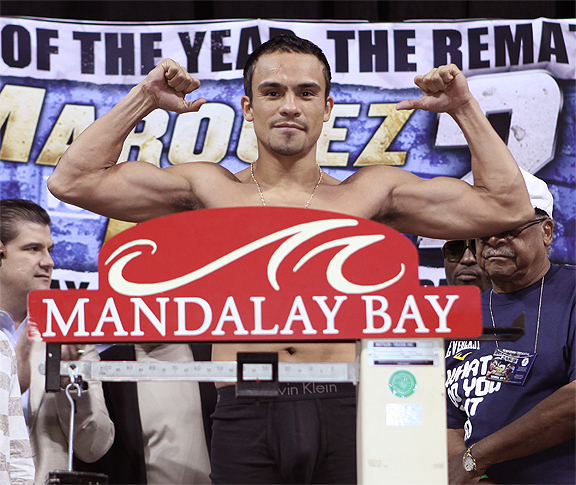
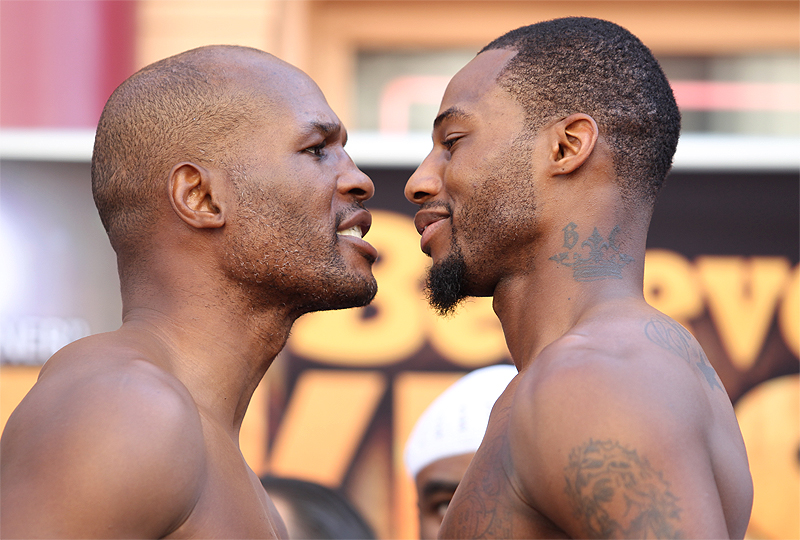
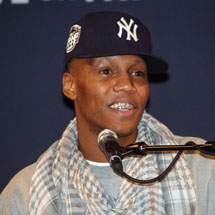
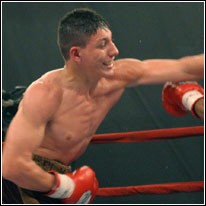
Who’s lying? Mayweather and Ortiz exchange words before they plan to trade punches

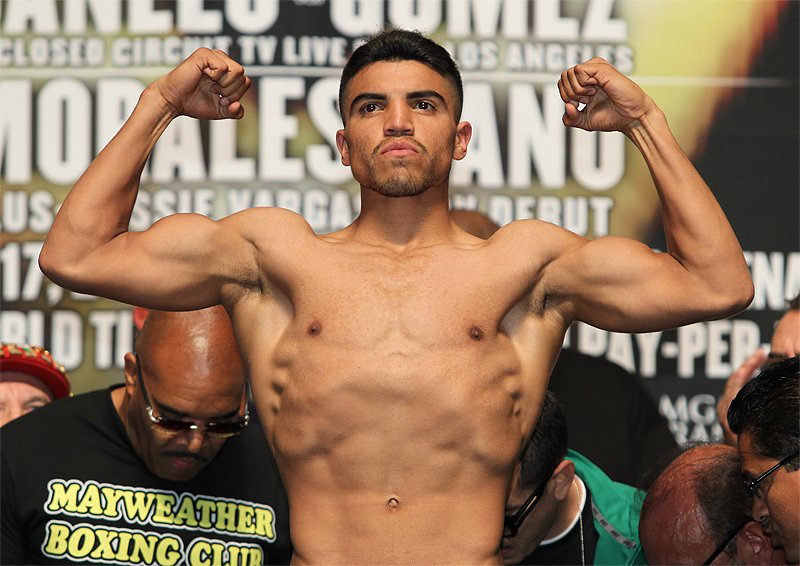
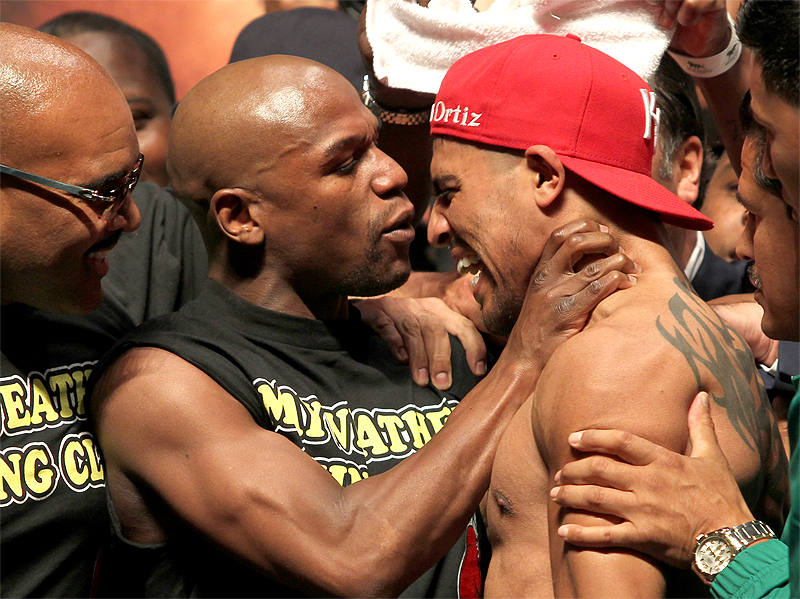
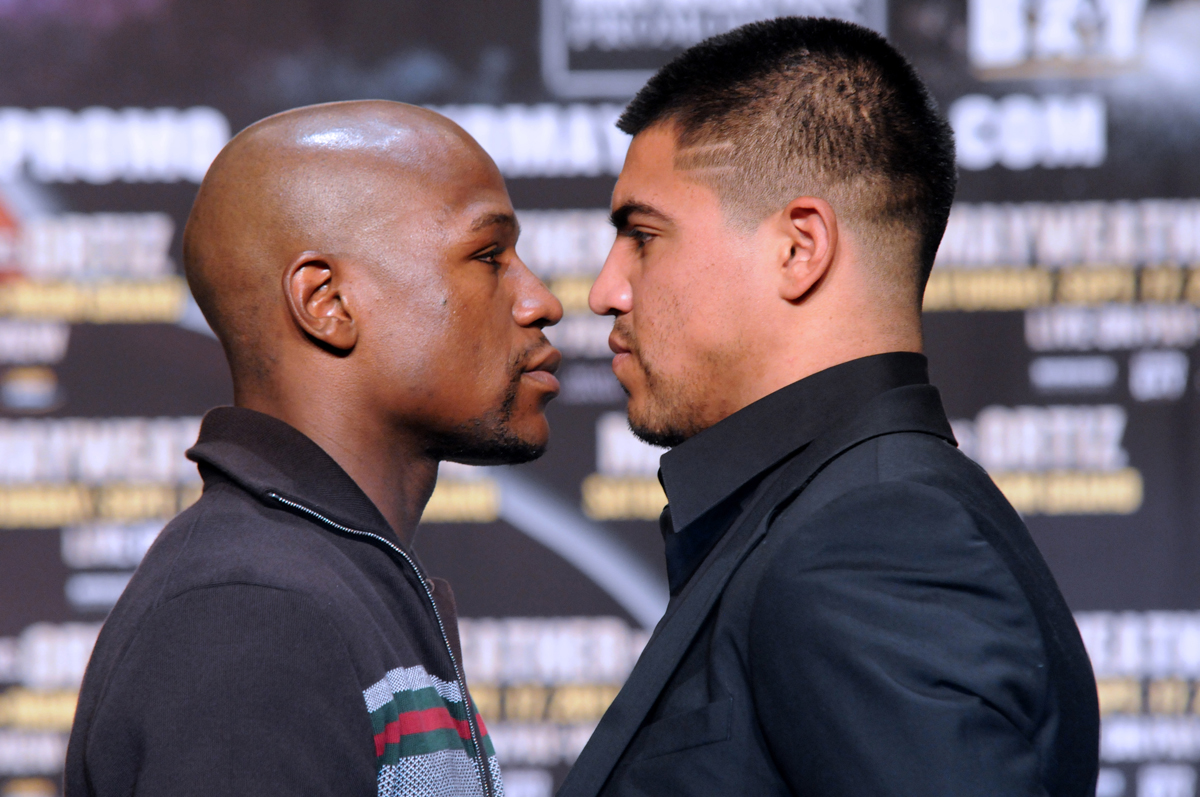
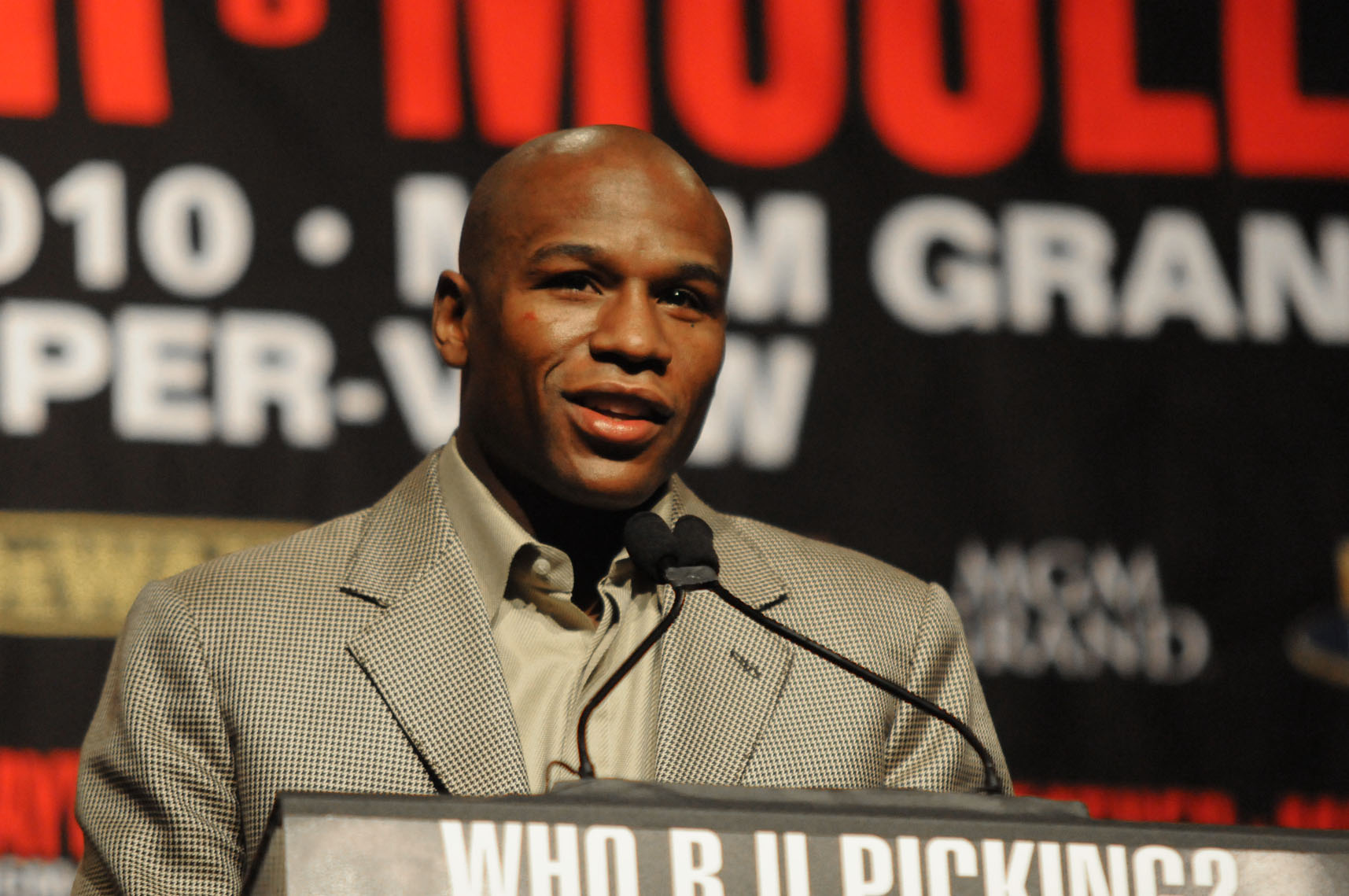
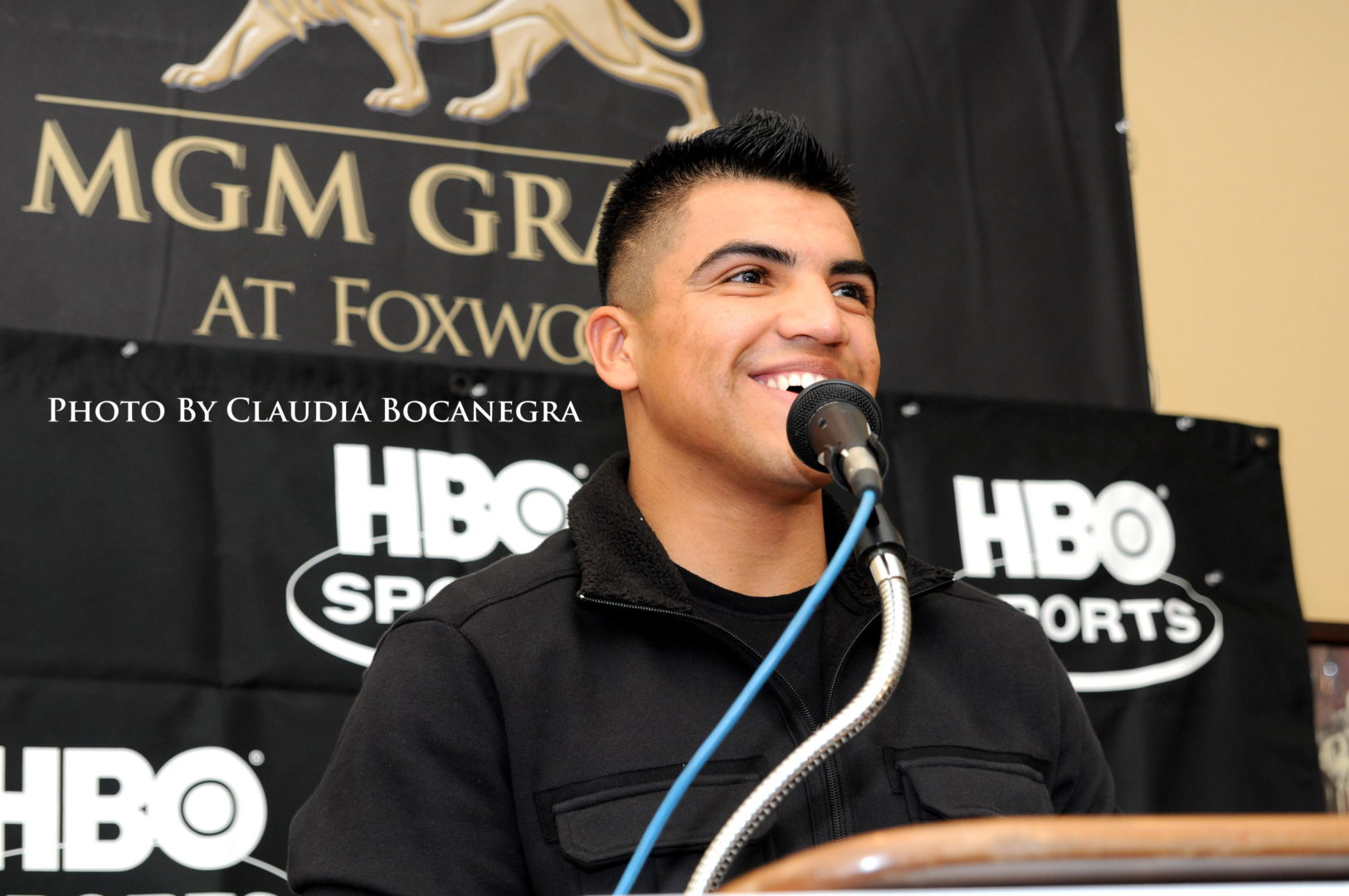
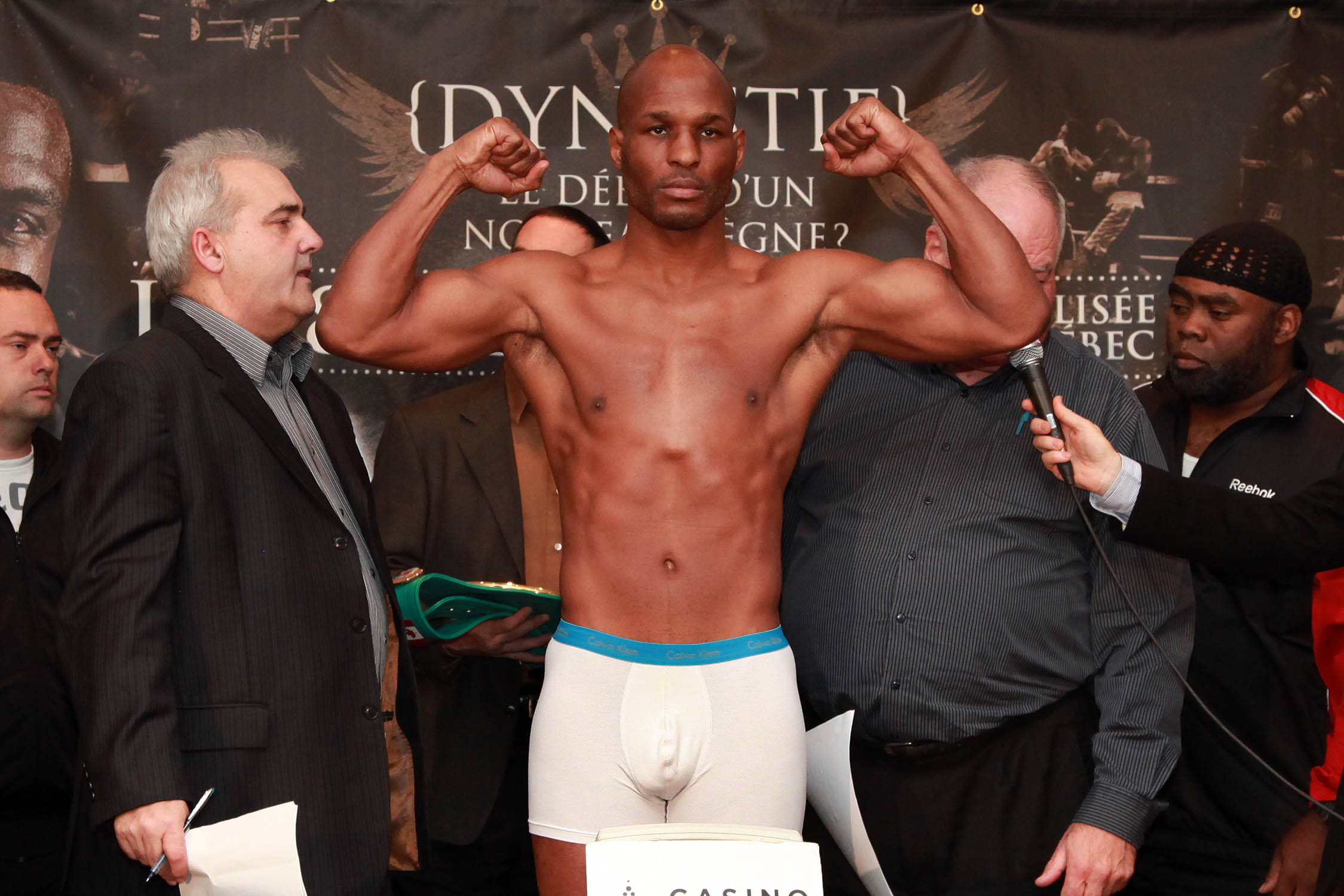
LAS VEGAS – The news conference Wednesday included a meal and two mouthfuls of a lot more from Floyd Mayweather Jr. and Victor Ortiz. Who ate whose lunch? Doesn’t matter. There are no scorecards at a formal news conference. No winners either.

There was just an over-indulgence of promises and pontification to go along with the indigestion a few days before Mayweather and Ortiz break bread and maybe each other’s noses Saturday night at the MGM Grand.

At the top of the menu, there was a Mayweather allegation that Ortiz has been lying about how his father abandoned him when he was a kid in Kansas.

“I know the real truth,’’ Mayweather said of a story that has been told for years and re-told in HBO’s poignant portrayal of Ortiz in the 24/7 series. “His father didn’t leave. No, he didn’t leave. He went to high school in California. I’ve done my homework.

“But it’s good for TV.’’

Mayweather wouldn’t disclose his source, but it is believed to be Robert Garcia, Ortiz’ former trainer and the brother of his current trainer, Danny. The Garcia brothers, neighbors in Oxnard, Calif., don’t talk to each other. Apparently, Ortiz also doesn’t talk to Robert any more after an unhappy split.

“I understand,’’ Ortiz said after Mayweather delivered the line like a thespian at the MGM Grand’s Hollywood Theatre.”It’s a tactic.’’

Ortiz dismissed it as small piece, another imaginary pawn, in the mind games that Mayweather has learned how to play as well as anybody. Ortiz said it didn’t affect him.

“I’m a tree stump,’’ Ortiz said. “Things like that don’t bother me.’’

If it does, Ortiz is in trouble. The gamesmanship figures to continue. Mayweather has invited Robert Garcia and lightweight champion Brandon Rios to the welterweight fight. Rios, who is trained by Robert Garcia, claims he used to get the best of Ortiz when they were young amateurs at a gym in Garden City, Kan. Ortiz might even see his estranged trainer and his old rival staring at him after he steps through the ropes and waits for opening bell during the introductions. Mayweather plans to have both with him when he enters the ring.

In questioning the credibility of a story that has come to define Ortiz and his sudden popularity, Mayweather seemed to be testing his ability to deal with everything that comes and goes on boxing’s biggest stage. Mayweather has been there often. Ortiz has not. For Mayweather, the fight always begins the day that the contract is signed. His rips are rhetorical probes in an attempt to find weaknesses in Ortiz.

On Wednesday, however, it was hard to judge whether Mayweather had found any or even one in Ortiz, who was relaxed as ever. Ortiz even initiated a few of the exchanges. In his formal address to the media from the podium, he turned to the unbeaten Mayweather (41-0, 25 KOs), who was sitting to his right.

“I sense a little bit of nervousness in this area, right here,’’ said Ortiz, who holds the World Boxing Council’s version of the 147-pound title. “I’m going to teach what it is to have that one on your record. Hey, I’ve already got two.’’

Mayweather couldn’t resist. He interrupted Ortiz (29-2-2, 22 KOs), yelling:

“You got two draws, too.’’

Ortiz wouldn’t back down in an exchange that might have been preview of fight that both will end in a knockout.

“Somebody is scared,’’ Ortiz countered. “I’m going to put you on your ass, I promise.’’

An Ortiz victory of any kind would be a surprise. As of late Wednesday, betting odds at Las Vegas books heavily favored Mayweather at about 5 1/2 –to-1. If the news conference was a sign, however, more surprise could be imminent. For the first time that anybody can recall, Mayweather was called a dirty fighter. Over his 16-year career, he’s been called a lot of things, but never that. Enter Danny Garcia, who delivered the charge from the bully pulpit during the news conference.

“Please, fight a clean fight,’’ Garcia said as he turned toward Mayweather. “Don’t turn your back. Don’t hold.’’

Don’t waste your time, Mayweather countered in his turn at the pulpit.

“The trainer called me a dirty fighter,’’ Mayweather said. “When has boxing ever been a clean sport? It’s a sport when you’re trying to hurt the other guy.

“How can it be clean?”

No answer for that one from Garcia, or the media, or even Ortiz. Call the news conference a draw. Hopefully, the fight won’t be.


For everything you want to know, just look at Mayweather’s 0


There are almost as many interpretations of the zero on the losing side of Floyd Mayweather Jr.’s ledger as there are victories in the column that betting odds say is about to go from 41 to 42. That 0 is a blank canvas. What adds up to nothing can amount to anything, maybe everything about Mayweather.

On one level, it’s baffling. Only in boxing can unbeaten mean unproven. Yet on another level, a fighter’s ability and character have always been measured in terms of how he deals with defeat. From Sugar Ray Robinson to Muhammad Ali, a loss makes them human and the comeback makes them great. Other than Rocky Marciano, those are the terms in the fine print that go into the creation of a legend.

I’ve said this before and I’ll say it again: Without a loss, it’s just hard to know what to make of Mayweather. Perhaps, that’s unfair. Perhaps, it’s just a sign that there aren’t any great fighters these days, but don’t tell that to Manny Pacquiao. The suspicion is that Pacquiao-Mayweather hasn’t happened, simply because Mayweather is protecting that zero.

True?

False?

How about: Who knows?

That’s the only conclusion I got out of a conference call this week with Mayweather in the build-up to his Sept. 17 bout at Las Vegas’ MGM Grand with Victor Ortiz, who is enjoying a spike in popularity because he came back from lingering doubts left in the wake of a 2009 loss to Marcos Maidana.

Mayweather was his quick-silver self, which means he was entertaining, insightful, over-the-top cocky and annoying all at once. The zero said it all. We know zip about him.

He thanked the media. No kidding. Then, he turned his rhetorical venom on to his surrogate whipping boy, Oscar De La Hoya, while praising De La Hoya’s promotional CEO, Richard Schaefer.

“Can’t even call it Golden Boy Promotions anymore,’’ Mayweather said after ripping De La Hoya for talking about drugs, drinking and wearing women’s underwear in a recent Univision interview. “Got to call it Richard Schaefer Promotions.’’

Meanwhile, he sent up some more red flags about whether the left-handed Ortiz was in fact a step toward finally agreeing to a deal with Pacquiao, also a southpaw, for the only fight which interests casual fans, which means most people.

“If you’re the best, take the test,’’ Mayweather said in one of several references to the drug-testing demand that was the sticking point in the last round of abortive negotiations.

Mayweather repeated charges that could lead to a rocky start of renewed talks.

“It’s okay for (Pacquiao) to go from 105 (pounds) to 154 and he gets knockouts and they say: ‘You know what? It’ all natural,’ ‘’ he said. “But if I went from 147 to heavyweight and was knocking out heavyweights, would that be all natural? That’s what you got to ask yourself at the end of the day.’’

Mayweather compared himself to some of the best in his favorite pastime, basketball. Like LeBron James, Kobe Bryant, Michael Jordan and Magic Johnson, Mayweather said he was well-known and considered a future professional star even when he was a high-school teenager. But Pacquiao, he said, came from nowhere.

“Suddenly at 25, he’s this good,’’ Mayweather said of the Filipino. “Come on.’’

Mayweather’s pointed questions were often offset by either common sense or a genuine sense that he cares. Remember, this is the same Mayweather who paid for Genaro Hernandez’ funeral in June. Hernandez helped launch Mayweather’s career in 1998 when Mayweather knocked him out in the eighth round.

“Hernandez gave me my first real opportunity,’’ Mayweather said during the conference call.

He said other things, both insightful and heartfelt.

On his notorious nickname, Money: “My health is more important than money.’’

When asked about possible distractions, he talked about alleged altercations, including one in which he was reported to have poked a security guard in the face.

“I don’t know no one who pokes somebody in the face when they’ve got a gun on them,’’ Mayweather said.

Anybody who has covered Mayweather through his long career has encountered this unexpected side to him. The man has money and moods. Yet in brief encounters away from a dysfunctional crowd that seems to egg on a personality that revels in being boxing’s bad boy, he can be a nice guy.

His legal problems include domestic abuse charges involving an ex-girlfriend, Josie Harris, also the mother of his children. In talking about that allegation, Mayweather talked about the night in 2006 when he beat Zab Judah. A brawl erupted, involving Judah, Yoel Judah, Zab’s dad and trainer, and Roger Mayweather, Floyd’s uncle-and-trainer.

Floyd Mayweather stood to one side, peaceful and under control in a ring where the violence threatened to become a riot.

The Mayweather of that night stands in sharp contrast to the one we often hear and the one we sometimes read about in stories that include a booking photo.

They don’t add up, just like that zero.


Victor Ortiz is many things, but insecure isn’t one of them


He’s either a surfer who happens to fight or a fighter who happens to be a surfer, snowboarder, golfer and tri-athlete. I have no idea. I’m not always sure Victor Ortiz does either. But Ortiz doesn’t waste time agonizing over perceptions about who he is or should be. He’ll leave the self-analysis to the media or perhaps Floyd Mayweather Jr.

“I have fun with this thing called life,’’ Ortiz said. “Apparently, that’s a sin in boxing. But I don’t care.’’

It was a comment, one of many, made by Ortiz Wednesday in a fascinating conference call that included a glimpse at layers to a personality that lacks only insecurity. The pieces don’t always seem to fit. To wit: The newly-minted welterweight champion calls himself “Vicious,” yet recalls he was repelled at the initial sight of fighters beating up on each other when he walked into a gym as a kid in Garden City, Kan., for the first time.

Contradictions make the man. They also make him interesting in a many-sided, yet distinct style that is defiant, humble, world-weary, child-like, cocky, funny, angry and always genuine. It’s the genuine part, I think, that fans have seen and seized upon since the dramatic resurrection of his career in a victory in April over Andre Berto and the ongoing build-up to Mayweather on Sept. 17 at Las Vegas’ MGM Grand.

The public likes him. So, too, does most of the media, at least for now. His relationship with the media ranks as one of the prime contradictions. His frustration with damning criticism started with his loss to Marcos Maidana and multiplied like a contagion in a regrettable case of piling on until he beat Berto.

I can’t blame him for not forgiving and forgetting the clichéd rips that always questioned his heart, yet ignored the story about how he had raised a brother after he was abandoned by his parents. Ortiz’ story is about heart, always on his sleeve and maybe too much of it.

On Wednesday, he talked about a visit seven months ago with his mom, Manuela, who left him when he was 7.

“I don’t really know her,’’ said Ortiz, whose dad, Victor, left him six years later. “But it seems like she’s a sweetheart. I forgave her for everything.’’

The media missed that heart, instead defining it by what it didn’t see saw in his 2009 loss to Maidana and his draw with Lamont Peterson in December.

Lingering bitterness flared Wednesday when Ortiz was asked about his move up to welterweight from junior-welter. He said he never had trouble making 140 pounds, despite what had been reported. Then, it became evident his only trouble was with the media.

“Of course, the media is very negative,’’ he said. “They sit around all day, feeling sorry for themselves.’’

The contradiction – an irony — is that Ortiz’ found the media to be his greatest ally before Berto. It gave him a cause, deepened a hunger to prove everybody wrong. It’s a trick older than even Bernard Hopkins, who has never let a slight, real or imagined, go unused in stoking the motivational fires.

The sudden surge in Ortiz’ popularity looms as problematic against Mayweather, who at last report was a 6-1 betting favorite. The bad guy has become a lifetime role for Mayweather. It was clear he was rehearsing for it once again in an ugly rant at his dad, Floyd Sr., in the first segment of HBO’s 24/7. By opening bell, Ortiz will play the good guy, an overwhelming fan favorite but not a favorite to win. He will have to guard against the public’s evident affection for him. If he allows himself to be seduced by it, motivation to score a stunning upset might be diminished.

Ortiz talks as if he knows that. Rather than popularity, he nurtures his lifetime role as underdog.

“For guys like me, this is not supposed to happen, not in a million years,’’ he said. “But I don’t believe in statistics. I’m trying to make my own statistic.’’

Just one would set some history on Sept. 17 if he could beat Mayweather. In 41 fights, nobody has. Ortiz is sure that he can.

“Cause Floyd is overdue,’’ Ortiz said. “He should not be a 147-pounder. I’m going to show him that. I never have thought he was that great, not even when I was a kid. …He’s in trouble.’’

Growing up, he said, favorites included his promoter, Oscar De la Hoya, Shane Mosley and Zab Judah.

But Mayweather?

“Not impressed,’’ Ortiz said.

Not even his 41-0 record?

“Forty-one fighters, none of them were me,’’ said Ortiz, who in a couple of weeks will step into a ring and a moment that will say a lot more about him than the media or even he can.

AZ Notes
· Phoenix prospect Jose Benavidez Jr., a junior-welterweight who continues to generate headlines in sparring with Mercito Gesta and Mosley at Freddie Roach’s Wild Card Gym in Los Angeles, has a scheduled opponent, 31-year-old Angel Rios, for a six-rounder on Sept. 17 at BlueWater Resort & Casino in Parker, Ariz. But Rios, of New York, also is scheduled for a bout on Sept.10 card featuring Yuriorkis Gamboa and Daniel Ponce de Leon in Atlantic City. If Rios (9-6, 6 KOs) is the foe, the 19-year-old Benavidez (12-0, 11 KOs) will encounter another fighter with experience against world-class opposition. Rios’ losses include one in 2001 to former lightweight champion Nate Campbell and another in 2003 to former super-featherweight champ Mike Anchondo.

· Alma Carrasco Canez enters the busy promotional market in Phoenix with a card Friday night featuring hometown super-bantamweight Alexis Santiago (9-1-1, 3 KOs) against Steven Johnson (7-3, 4 KOs) of Saint Joseph, MO. The card, at El Zaribah Shriners Auditorium, is scheduled for eight bouts. First bell is scheduled for 6 p.m. (PST).


Atlas is good behind the microphone, but better in a corner

Conference calls are a necessary task, perhaps, which also means they are often stuck between ho-hum and hum-drum on the interest meter. But then along comes Teddy Atlas. This Atlas doesn’t just shrug when asked a question. Word-for-word – and there were a lot of them Wednesday, Atlas knocked out the mundane with insight, a little schtick, genuine opinion and some real news.

Listening to Atlas from Alexander Povetkin’s camp in Russia made me think of Emanuel Steward when he is talking about Wladimir Klitschko or Miguel Cotto. Both are terrific commentators, Atlas for ESPN2’s Friday Night Fights and Steward for Home Box Office. But I find myself listening more attentively when they are back in a corner, back where they belong. Talk is like that old line about opinions. You know it. I’m sitting on one as I write this. Everybody has one. But few, very few, have the instinct, or patience, or smarts, or guts to be a real trainer.

The sport, I think, suffers when an Atlas or Steward spends more time behind a microphone than in a corner. I understand why they do it. The money is good. The headaches and hangers-on aren’t there in the maddening abundance that has to make them feel more like a circus-master than a teacher.

“The main difference is nobody can talk back to me on the microphone,’’ Atlas joked as he discussed Povetkin’s chances Saturday at the World Boxing Association’s vacant heavyweight title against Ruslan Chagaev in an EPIX-telecast fight from Germany. “I kind of like that.’’

Another thing to like is the absence of a commitment to a fighter and all of the complex emotions attached to it. There’s no risk.

“You don’t have to worry about who wins,’’ Atlas said. “Now, I’m in a position where, unfortunately, I do have to worry.’’

But the potential reward in victory and even in the process is huge. It’s also something that the rest of us don’t experience, or even attempt. It’s a lot safer to just comment and move on, insulated and anonymous.

It’s fair to guess that Atlas, like Steward, is back in a corner because that risk is there. They need it to stay sharp and credible for that microphone. But I’m also guessing they are lured back just because they love their craft, which starts with teaching. True teachers are hard to find. They may leave for a while to consult or commentate. But the best ones always complete the circle, finding their way back to a classroom or a corner.

Atlas touched on it when explaining his reasons for working with Povetkin under less than optimal circumstances, including a camp that lasted only 33 days.

“The thing I love is being in the gym teaching, being in the gym where nobody bothers you and you’re able to get into a kid,’’ Atlas said “You’re able to get his full, undivided attention, his belief, his trust and you’re able to improve that kid. You’re able to get him to think things he might not have thought and get him to try things he might not have tried.

“… I mean almost like — without being too ridiculous — almost like a parent. You’re watching your kid develop a little bit and that part is still beautiful and it’s pure. It’s the essence of boxing, watching somebody get better, watching somebody become more complete as a fighter, even as a person. They’re more sure of themselves.

“That’s still great. I just wish that could be bottled and there could be a fence put around it and all of the other stuff could be kept out. But you know what? That doesn’t happen because you’re dealing with life and you’re dealing with all of the other things that will come with anything.’’

Some of those things intruded on the game’s essence this time around. Atlas had announced on ESPN that he wouldn’t be with Povetkin because of a disagreement over where he would train. Because of his ESPN commitments, Atlas wanted him in New Jersey. But Povetkin, or at least people in his camp, decided to stay close to home. Atlas was mystified and more than a little frustrated.

“I told them to get their ass over here,’’ said Atlas, who said Povetkin wasn’t in the best condition when he arrived in Russia.

Atlas said that he even had the agreement written into his contract with Povetkin.

“I mean I did ask: ‘Why aren’t you keeping your commitment?’ ‘’ Atlas said. “I did say: ‘You had a commitment to come over here. We agreed to it. We even put it in the contract.’ ”

Bottom line: Atlas could have stayed at home, stayed within the comfort zone behind that microphone. But he didn’t, all because of the student, Povetkin, who looked as if he might have to fight for a title without a real trainer there to guide him.

“They called me up and said the press was asking: ‘Who is your trainer, who is your trainer?’ ‘’ Atlas said. “Nobody was answering except Povetkin and Povetkin said, ‘My trainer is only one person, Teddy Atlas.’ ‘’

Atlas realized that, for whatever reason or agenda, the fighter wasn’t getting all the information he needed from those around him.

“You didn’t have to be Columbo to figure that out,’’ he said.
In the end, the teacher couldn’t abandon the student in need, even if a contract said he could. Here was a fighter, he said, facing his biggest moment to date, yet his advisors had made no arrangements for another trainer.
“They called me up and said the press was asking: ‘Who is your trainer, who is your trainer?’ ‘’ Atlas said. “Nobody was answering except Povetkin and Povetkin said: ‘My trainer is only one person, Teddy Atlas.’

“Right there when I heard that, it just affected me from a human standpoint.’’

When Atlas boarded his flight for Russia, he began to think about the abbreviated camp. He even began to think like a pilot perilously low on fuel.

“I felt like I was throwing chairs and things we didn’t need out of the plane to make the flight lighter,’’ he said of adjustments brought on by a lack of time. “I mean there were days I had to make choices. No bag work today; I couldn’t do this work today.’’

Without a full eight weeks, Atlas has misgivings.

“It’s frightening to me because I’m in the chair of responsibility now,’’ he said. “I have made that choice, so at this point, I’m going to do everything I can to represent myself and this kid the best I can.
“I’ve been to church more than I normally go.’’

Say a prayer. Povetkin might not have one this time around. Later on, he could if Atlas continues to sit in that risky chair. He can already talk with the best of them. The conference call’s transcript is proof of that. But the best of them can’t train, not the way he can.

QUOTES, ANECDOTES
· Alfonso Gomez isn’t given much of a chance against Mexican star Saul “Canelo’’ Alvarez on Sept. 17 at Los Angeles’ Staples Center on the same night that Victor Ortiz faces Floyd Mayweather Jr. at Las Vegas’ MGM Grand. In pursuit of is first world title, but Gomez wouldn’t have it any other way. “My first try was against Miguel Cotto,’’ said Gomez, who was stopped by the Puerto Rican in 2008. This is another try against another superstar, Canelo. To get a world title, there are other ways to do it against lesser guys.’’

· An early yardstick of who is bigger in Mexico, Canelo or Julio Cesar Chavez Jr., will come on Sept.17. Chavez fights Ronald Hearns in Culiacan on the same night. The unflappable Canelo doesn’t care. “He has his fans; I have my fans,’’ Canelo said Wednesday in a conference call.’’

AZ NOTES
· Another promoter is helping to resurrect the Phoenix market, moribund for the last few years. Promoter Alma Canez has scheduled eight-to-nine fights for a card featuring young, local fighters for Friday, Sept. 2nd at the El Zaribah Auditorium. Popular bantamweight Alexis Santiago faces Steve Johnson in a six-rounder.

· Fifteen days later on Sept. 17, 19-year-old junior-welterweight prospect Jose Benavidez Jr., the face of Arizona’s re-emerging market, goes back to work in Parker at BlueWater Resort & Casino. It will be Benavidez’ second successive fight in his home state since controversy over the Arizona immigration law, SB1070, kept him on the road.


A known ref is a bad ref, but where was Agbeko when he needed to retaliate?

Referees know they have done a good job if nobody remembers their name. Poor Russell Mora. Mora lost his anonymity and gained some infamy for his work, or lack of it, in Abner Mares’ majority decision over Joseph Agbeko.

By now, the controversy has been played and re-played, analyzed and re-analyzed, ad infinitum in the days since Mares threw repeated low blows, was warned five times, yet never penalized by Mora, the fight’s biggest loser Saturday at Las Vegas’ Hard Rock Hotel & Casino. Another review of the tarnished fight for the International Boxing Federation’s title in Showtime’s bantamweight tournament would be just another low blow.

But I couldn’t help but wonder, perhaps marvel, at the relative lack of controversy about referees in a sport full of noisy arguments about virtually everything else. Other than a cop on streets that might as well be the front lines in a tough neighborhood, there can’t be a job much more challenging than that of a fight referee. Controlled violence is an oxymoron if there ever was one. But even anarchy has rules, and it’s up to the referee to enforce them. Mora didn’t.

In an internet court full of opinion and not much accountability, Mora has been charged with incompetence, bias and a whole raft of other misdeeds. Take your pick. But it is a multiple-choice question without a proven answer. There are plenty of other questions

For one, there was no response from Agbeko when it was clear that the rules would not be enforced. Retaliation for an uncalled low-blow is about as fundamental as a jab. If Agbeko had thrown just one, he might have been able to restore order and his chances. He didn’t.

I can only wonder what he and his corner were doing, or not doing, while Mora repeatedly missed the obvious. It also makes me wonder whether no response from Agbeko is a flaw that would lead to another loss if a rematch within 120 days, as ordered by the IBF, in fact happens. On Anarchy Street, it is always wise to be skeptical about whether any order will ever be carried out.

Curious, too, is the absence of pre-fight controversy that actually might have helped avoid the Mora flap. Yahoo’s Kevin Iole reported Monday that Dana Jamison, operations director for Agbeko promoter Don King, objected to Mora. According to Iole’s story, King said he got a call from somebody who told him that Mora was “a Golden Boy referee.’’ Mares is a Golden Boy Promotions fighter. The Nevada State Athletic Commission reportedly heard the complaint, but did not assign a different ref.

Would Mora have acted differently if news of Jamison’s objection had been disclosed? Maybe not. But I can’t help but recall Bernard Hopkins well-publicized threat to withdraw from his 2007 rematch with Robert Allen in tuneup for is victory over Oscar De La Hoya, now Golden Boy’s president. Hopkins objected to the assignment of referee Joe Cortez, arguing that Cortez might have bias against him. Hopkins was worried that Cortez, a Puerto Rican, might have grudge against Hopkins, who ripped Puerto Rico before his upset of Felix Trinidad in 2001.

Hopkins, now a Golden Boy fighter, has never been afraid of throwing the race card. And, yeah, he’s also never been shy about grandstanding. The fight went off with Cortez as the ref. Cortez’ work was never an issue. Hopkins was a much better fighter than Allen and proved throughout every round of unanimous decision.

Had the fight been close, however, Hopkins’ objection might have served as some insurance against any chance that Cortez would have swung the scorecards in favor of Allen. As only he can, Hopkins broadcast his concerns to the court of public opinion, meaning fans and state regulators were watching Cortez’ every move.

None of this is to say that Nevada or any other state commission should seek approval from camps about a ref’s assignment. That would open the proverbial Pandora’s Box to a whole host of suspicions about influence peddling. But it is in the best interest for a promoter, manager, trainer or the fighter himself to make their objections know before, not after, opening bell.

Quotes, anecdotes
· Despite his surprising performance against Marcos Maidana in April, Erik Morales, a loser in five of his last eight fights, still had to defend himself in a conference call Wednesday that also included his next opponent, Lucas Matthysse, on the undercard of Floyd Mayweather Jr.-versus-Victor Ortiz on Sept. 17 at Las Vegas’ MGM Grand. Morales was asked: Why still fight? “Not only can I say it; I can do it’’ said Morales, who has been at it for nearly two decades. “I also love proving people wrong.’’

· Matthysse, an Argentine, returns to the United States after suffering two controversial losses by split decision in the U.S. – Zab Judah in New Jersey and Devon Alexander in Missouri. “Everybody knows that those two losses were bad decisions,’’ he said. “I was robbed in those fights.’’

AZ Notes
· Just guessing, but Jesus Gonzales’ chances at fighting Kelly Pavlik might have improved after Pavlik angered Top Rank by abruptly withdrawing from his last bout in frustration over a proposed purse against Lucian Bute. Before long, Pavlik might have to turn to Gonzales to get a fight. There were reports about slow ticket sales among Pavlik’s disaffected fan base in Youngstown, Ohio. Pavlik-Gonzales might be a better draw in Phoenix, where Gonzales is still popular.

· Former World Boxing Organization heavyweight champ Sergei Liakhovich (25-3, 16 KOs), a Scottsdale resident, packs his bags for Germany Saturday for a fight at saving his career on Aug. 27 against Robert Helenius (15-0, 10 KOs) in a bout televised by EPIX. Liakhovich is back with trainer Kenny Weldon, who was with him when he won the WBO title against Lamon Brewster and lost it to Shannon Briggs in the last second of the last round of his first defense. “Kenny and I are on the same page,’’ Liakhovich said.


AZ casino says no more Bare-Knuckle boxing, but Commission Association is still angry and still has questions

The Fort McDowell Yavapai Nation told the Association of Boxing Commissions (ABC) that it will not host another Bare-Knuckle fight promoted by FelKO, which last Friday staged the controversial bout featuring Bobby Gunn at its casino on Native American land not subject to the Arizona State Boxing & MMA Commission’s jurisdiction.

In an apparent response to an ABC press release Wednesday that condemned the event as “perhaps, criminal,’’ Fort McDowell Director of Marketing Tom McGill wrote Association Vice President Gregory Sirb that “there will not be any more Bare Knuckle Boxing events provided by FelKO Promotions.

In a letter acquired by 15 Rounds from the ABC, McKee also wrote that no “financial compensation was paid to the boxers from FMC (Fort McDowell Casino) so it was not a professional event. FelKO Promotions did not pay anything either.’’

ABC President Tim Lueckenhoff does not believe that the fighters were not paid.

“There is no way I could imagine that either fighter is going to fight for free after being paid in the past,’’ Lueckenhoff told 15 Rounds Thursday in an e-mail. “It is hogwash!’’

Gunn, who won a third-round stoppage over a Chris Stewart, is a well-known pro who fought for cruiserweight titles, including the International Boxing Federation’s version two years ago in a loss to Tomasz Adamek.

If no money was paid, it would have been an amateur event, which means it would not be subject to state regulation. Then, however, Lueckenhoff said it still would have to be regulated by USA Boxing.

If true, Lueckenhoff said, “this must be sanctioned by USA Boxing.’’

Before the bout last week, Dave Feldman of FelKO said he expected controversy. He said he also understood the safety concerns initially expressed by the Arizona Commission.

Dennis O’Connell, Arizona’s executive director, said he would never have allowed the event. In a news release last week, the state’s regulatory agency stated that bare-knuckle bouts “have serious health and safety implications.’’

The ABC called it “abhorrent, barbaric, egregious.” The national association said the bout also was “in contravention of a multitude of federal, state, and tribal boxing laws and regulations.’’

The ABC questions whether the Fort McDowell Yavapai Nation has in fact a working commission. In 2008, Fort McDowell terminated a relationship it had with the Arizona commission, which had supervised pro cards on the reservation as part of a compact that it continues to have with casinos on Native American property.

The ABC promised to investigate “with the possibility of a referral to the U.S. Attorney’s Office toward the ends of barring any such activity in the future, instituting a criminal prosecution, or both.’’

Feldman said last week that he plans further Bare-Knuckle bouts. He said he has spoken to people in other states interested in bringing back an era in boxing that vanished more than a century ago. Feldman declined to identify either the people or the states.


Bare-knuckle bout in Arizona stirs up opposition as promoter promises enhanced safeguards

Promoters for a bare-knuckle fight featuring former cruiserweight contender Bobby Gunn Friday night at a casino on Native American land near Phoenix are promising enhanced safety measures for a controversial bout that the Arizona State Boxing & MMA Commission would cancel if it had the power to do so.

“Absolutely, we would not allow it,’’ Commission Executive Director Dennis O’Connell said of the bout at the Fort McDowell Yavapai Nation, which is not subject to regulation by the state agency that oversees boxing and mixed martial arts.

Dave Feldman of FelKO Promotions said he understands the Commission’s objection.

“I respect their opinion 100 percent,’’ Feldman said. “I’d be a fool, otherwise. That’s why we’re taking all of these safety precautions.’’

Feldman said plans for the Gunn fight against MMA fighter Chris Thompson include two referees instead of one. The bout, the main event on the card (first bell/8 p.m., PST), is scheduled for ten 90-second rounds. Although the knuckles will be bare, Feldman said wrists and other parts of the hands will be taped. He also said additional medical personnel will be at ringside.

Cuts are the biggest fear, Feldman said. Rules have been modified to allow each cut-man an additional 30 seconds to stop the bleeding.

“Safety is paramount,’’ said Feldman, who says he has researched a bygone version of a street sport that has been not been conducted under official rules or with public approval for more than a century, or probably since 1889 when John L. Sullivan reportedly knocked out John Kilrain in the 75th round in Mississippi.

Feldman said the Gunn-Thompson bout will be regulated by the Fort McDowell Yavapai Nation. However, the Tribe is not a current member of the national Association of Boxing Commissions (ABC). It has not been since September of 2008, O’Connell said from the ABC’s annual convention in Washington, D.C.

In 2008, Fort McDowell also terminated a working relationship with the state Commission, which had regulated a few pro cards on the Yavapai reservation as part of a state-wide compact that includes other Arizona tribes.

In 2008, a Phoenix police officer, Barry Scott died on Sept. 16 four days after a bout on a FelKO promoted card at Fort McDowell featuring cops-versus-firemen. It was not regulated because the fighters were amateurs. Hunter, who wore gloves and headgear, died of suspected head trauma that might have been inflicted during heavy sparring while training.

With increasing interest in mixed martial arts, Feldman believes there might be a future for bare-knuckle boxing. However, he expects controversy and admits he is uncertain about what might happen.

“We’ll see,’’ said Feldman, who said he already has plans for more bare-knuckle boxing, perhaps in other states.

O’Connell said opposition to the bout was expressed in opening remarks at the ABC convention’s first day in Washington, D.C.

The Commission also sent out a press release, dated July 29 and headlined:

State Boxing Commission Not Involved in Upcoming Bare-Knuckle Bout at Fort McDowell.

In the second of only three paragraphs, the Commission’s release said:

“Bare-knuckle matches or bouts have serious health and safety implications for participating contestants. For that reason, Arizona laws and regulations governing boxing and mixed martial arts require the use of approved gloves. A bare-knuckle bout would never be sanctioned by the Arizona State Boxing and Mixed Martial Arts Commission, nor any other state or tribal commission that is a member of the National Association of Boxing Commissions.”


Pavlik’s fight to get back on top starts with the battle to beat back distractions


Distractions are an ally or an annoyance or a dirty word. Manny Pacquiao can’t get enough of them. Floyd Mayweather, Jr. sneers at them, then moves on to the next one. Kelly Pavlik doesn’t know what to do with them. Not yet, anyway

For Pavlik, learning how to manage them, or at least live with them, might be his greatest challenge, bigger even than an Aug. 6 tune-up against left-handed Darryl Cunningham in a super-middleweight battle to reassert himself at his profession’s highest level in a projected fight with Canadian Lucian Bute, also a left-hander.

News about Pavlik for the last year has mostly been about a lifestyle gone awry and a stretch in rehab. A difficult personal trial is hard enough without media attention. With it, the challenge threatens to become a succession of exaggerated cheap shots that can knock out a career, or at least leave a promising one short of fulfillment.

Pavlik’s fight against Cunningham in front of neighbors and the nosy in hometown Youngstown, Ohio, will happen on Showtime’s ShoBox within a few weeks of news about a reported altercation with his brother. According to various reports, they had been drinking. Even if drinking had not been mentioned, the public would have assumed it anyway.

“There’s nothing you can do about that stuff,’’ Pavlik said at the end of a national conference call Wednesday. “Ninety percent of Americans get into fights with siblings. I can’t get into a shoving match with mine. It is what it is.’’

In what is perhaps a good sign in the process of learning how to manage the inevitable, Pavlik sounded philosophical. There were times before his last fight and first one after release from rehab in May when he got exasperated, then annoyed, at repeated questions about the experience.

“Got a new thing I throw out there now: ‘Who cares?’ ‘’ he said when confronted by the question Wednesday. “I just can’t worry about pressure from the public or what people are going to say.

“…I’m going to be Kelly Pavlik.’’

That might be easier to say than do. I get the sense that Pavlik is still stunned to discover how fickle success and celebrity can be. In his early rise to the top of the middleweight ranks, he came across as a nice guy with a blue-collar approach and personality. He was gritty and genuine. Still is. That’s why I’ll be cheering for him, although I wonder if everybody in the Youngstown crowd at Covelli Center will be.

“You know what, I’m not sure,’’ Pavlik said when asked whether he expected a lot of support from a big crowd of hometown fans. “I’m hoping they are. Word is, it’s going pretty good right now. There’s a lot of people still saying they’re going to get their tickets. Mainly, you expect a walk-up crowd in Youngstown. That’s one of the big things, too.

“I’m going to do my thing. I’m going to put on a great show. I’m going to fight as hard as I can. Whatever happens — my true fans, and I’m sure there’s a lot — they’ll be in for a real treat.”

They will be and many also will be back, but only if Pavlik begins to beat back distractions in a compelling comeback that could be as gritty as it is genuine.

Quotes, anecdotes
· A noted publicist, on Zab Judah saying he thought he was getting “a standing eight-count’’ while on all fours after Amir Khan dropped him with a borderline shot on the trunk’s belt: “He must have been talking about a crawling count.’’

· Memo to Tim Bradley: Find the trash can into which Riddick Bowe dumped the World Boxing Council’s heavyweight title belt in 1992. That’s where the 140-pound belt stripped from you this week by WBC President Jose Sulaiman belongs.

AZ notes
· Pavlik (37-2, 32 KOs) said he is fighting Cunningham (23-2, 10 KOs) because is a left-hander, who will help him get ready for Bute. Pavlik didn’t mention Jesus Gonzales (27-1, 14 KOs), also left-handed and his sparring partner before a loss to Sergio Martinez. Gonzales, who is fighting to get in to the 168-pound title mix after a two-year hiatus, plans to continue his Phoenix comeback this fall.

· Thunderstorms tore off the roof of a popular gym, KO Boxing, in south Phoenix a few days ago. Phoenix promoter Michelle Rosado and Phoenix bantamweight Emilio Garcia are seeking donations to rebuild the gym, which is located on some of the city’s meanest streets. An ongoing rebirth of the Arizona market continues in September, first on Sept. 2 with an Alma Carrasco Canez-promoted card at El Zaribah Shriners in Phoenix and then on Sept. 17 with card in Parker at BlueWater Resort & Casino with unbeaten Top Rank prospect Jose Benavidez, Jr., an unbeaten junior-welterweight, in a featured fight. Benavidez, a Phoenix native, is back in trainer Freddie Roach’s Wild Card Gym in Hollywood, Calif.


Khan’s body shot gets an argument and victory over Judah


LAS VEGAS – It was a career on the borderline. Zab Judah always walked it. Amir Khan knocked him off of it Saturday night with a body punch. There will be controversy about the punch. Legal? Illegal? Below-the-belt? Right on it?

Review the video. Go ahead and argue. Judah surely will. He always has. Judah and controversy are a combination, if not a tiresome redundancy. There’s no way to separate them. Perhaps, Judah is an older, wiser man.

Perhaps, Judah has changed. There’s no doubt that Khan has. He changes and changes a little bit for the better almost every time he steps through ropes for a significant fight. He confounded Judah seconds after the opening bell, moving in-and-out foot and landing precise jabs as he circled to his right.

Judah, whose right eye was slightly hurt in an apparent collision in the first round, appeared confused, then weary. He began to drop his right hand, leaving himself wide open to Khan combos that were sure to come. They didn’t, only because of body shot in the fifth round that put Judah on his hands-and-knees before he started arguing.

Judah bent over after he was rocked by a right hand. As he held on, Khan threw another right to the body. At first, it looked as if it might have been below the belt.

But repeated reviews from different angles of video at the Mandalay Bay Events Center appeared to show that the punch landed right on Judah’s belt, gold above his black trunks. At 2:47 of the round, referee Vic Drakulich counted out Judah, a loser by knockout. Other than the ensuing controversy, there was nothing technical about it.

“The shot when he went down was clean on the belt,’’ said Khan, who earned a minimum of 1.07 million and added Judah’s IBF junior-welterweight belt to his WBA title “If the fight had gone a few more rounds, I would have knocked him out with a clean shot. I knew he was hurt. It was only a matter of time.’’

At ringside, a theory quickly began to circulate about whether Judah simply went down to avoid the beating that seemed to be inevitable. His post-fight comments only seemed to support that speculation.

“I thought it was a low blow,’’ said Judah, who collect a minimum of $500,000. “I thought the referee was trying to give me a standing 8-count. I didn’t understand.’’

Yeah, it is hard to understand how Judah thought he could get a standing eight count when he was on hands, knees, an occasional elbow and never his feet.

On the back of Judah’s belt, there was this inscription: Godspeed.

Should have been goodbye.

On the undercard
The Best: It was another chapter in an ongoing comeback for Texas middleweight James Kirkland (29-1, 26 KOs), who scored his second successive stoppage by putting an overwhelmed Alexis Hlores (15-3-2, 11 KOs) onto his knees at 28 seconds of the second. Kirkland, who is fighting to restore his earlier promise after a stretch in prison, scored a first-round KO after he got knocked out in April.

The Rest: Unbeaten Peter Quillen (25-0, 19 KOs) threw chocolate kisses at the crowd and the corner for Jason LeHoullier (21-6-1, 8 KOs) of Dover, NH, threw in the towel at 1:38 of the fifth after the Brooklyn middleweight nicknamed Kid Chocolate punished him wit body shots and uppprcuts;

featherweight Gary Russell (17-0, 10 KOs) of Capitol Heights, MD, put some more polish on an already bright future by scoring one knockdown and winning all eight rounds in a one-sided decision over Eric Estrada (9-2, 3 KOs) of Chicago;

Philadelphia heavyweight Bryant Jennings (9-0, 4 KOs) was stronger and faster throughout six rounds for a unanimous decision over Theron Johnson (5-6, 1 KO) of Chicago;

lightweight Jamie Kavanaugh (8-0, 3 KOs) of Hollywood, Calif., won a six-round unanimous decision over Marcos Herrera (6-6-1, 2 KOs) of Arvada, Calif.;

Brooklyn super-middleweight Josiah Judah (10-1-1, 2 KOs) scored a six-round majority decision over Rafal Jastrzebski (4-7-1, 1 KOs) of Poland;

junior-lightweight Ronny Rios (15-0, 7 KOs) of Santa Ana, Calif., moved in a hurry and finished Noe Lopez (8-9, 5 KOs) in a hurry, stopping the Mexican at 1:12 of the first round.


Hopkins talks Calzaghe rematch, but is Joe listening?


LAS VEGAS – Bernard Hopkins tried to stir up some interest Saturday in a rematch with Joe Calzaghe by mentioning the possibility and then telling UK reporters to speak to Calzaghe about it.

Hopkins suggested a rematch was in order when UK reporters told him that Calzaghe was in Las Vegas to watch fellow Brit Amir Khan fight Zab Judah.

“You’ll have something to write about on Sunday,’’ he cracked at the UK reporters who were at Mandalay Bay for a breakfast roundtable.

Hopkins (52-5-2, 32 KOs) has always believed he was robbed of a victory in a 2008 split decision that went to Calzaghe, now 39 and retired. Controversy preceded the fight when Hopkins told Calzaghe that he’d never let “white boy” beat him.

“I won that fight,’’ said the 46-year-old Hopkins, who faces Chad Dawson (30-1, 17 KOs) on Oct. 15 in defense of the light-heavyweight title he won against Jean Pascal in a victory that made him the oldest ever to claim a major title. “I think I lost that fight when I called light-skinned. I think that changed the way people looked at that fight.’’

It was not known early Saturday if Calzaghe was interested. He has never indicated one way or another whether he has even considered a comeback.

“He retired because he knew the world wanted to see a Hopkins-Calzaghe rematch,’’ Hopkins said. “Joe knew the pressure would be too much.’’

Hopkins, who always has a lot to say, also offered to fight UK heavyweight David Haye, who balmed his embarrassing loss Wladimir Klitschko on a broken toe

“Hey, I’ll fight David Haye tomorrow,’’ Hopkins said. “I’ll spot him 20 pounds.’’

Hopkins thought Haye had blamed the loss on a busted big toe. When told it was a small toe, Hopkins said:

“OK, I’ll spot him 50.’’

Hopkins (52-5-2, 32 KO) lost his light heavyweight belt to Calzaghe in April 2008 by split decision in a bowling shoe ugly fight that was debated by many but is regarded fondly by few. After that win, Calzaghe (who was already the super middleweight champion) fought just once more, beating the shell of Roy Jones Jr in November 2008 in a pay-per-view bomb in Madison Square Garden.

Calzaghe then retired with a record of 46-0 (32 KO), but it’s a record many still don’t consider truly great, despite the Welshman having never lost a fight. Now 39 years old, Calzaghe has made no serious indication that he’s looking to return to the ring, but there has been mild speculation since he retired. The biggest headlines he’s made in his time out of the ring came, unfortunately, when he admitted to cocaine usage. He also appeared on the reality show contest “Strictly Come Dancing.”


Predictable weigh-in precedes unpredictable Khan-Judah fight


LAS VEGAS – The scale might as well have been a stage. The weigh-in played out as though it had been written and rehearsed. It was a non-event. The fight doesn’t figure to be.

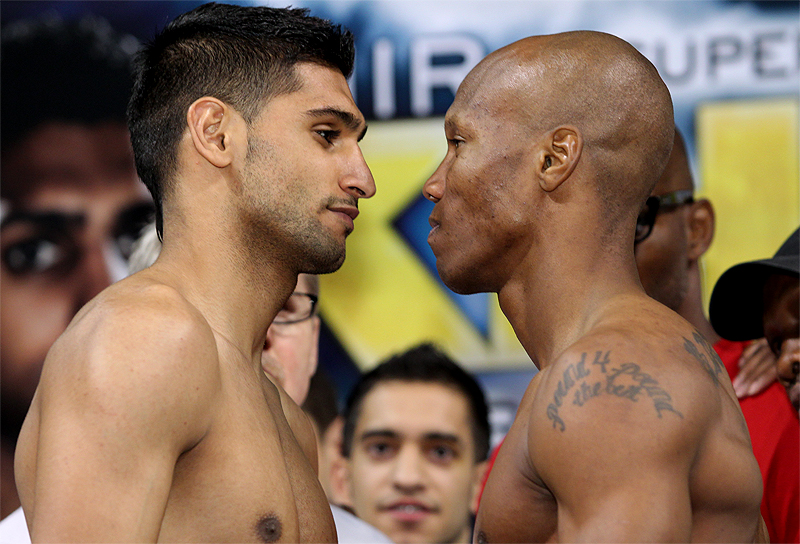
Amir Khan and Zab Judah each weighed 140 pounds – the junior-welterweight limit, posed like body-builders and smiled politely at each other Friday in front of a quiet crowd of about 300 at Mandalay Bay.

Unscripted drama is supposed to supplant the predictable Saturday in the Khan-Judah clash for two pieces of the junior-welterweight title, also at Mandalay Bay, in an HBO-televised bout. There are no guarantees. Never are.

But talk suggests that a dramatic twist is possible. It’s up to Judah (41-6, 28 KOs), who is at crossroads that includes only two paths. Win, and he is on the road to a rebirth. Lose, and his career is on the exit ramp. When the fight was announced in June, it looked as if Judah was already hurtling down the ramp to nowhere. But his intriguing talent, quick hands and fast feet, is still there, which means he still has a real chance.

One scenario has Judah, the International Boxing Federation’s champion, aggressive early in search of the suspected weakness in Khan’s chin. By the middle rounds, a swift left uppercut might find it for an upset of Khan (25-1, 17 KOs) in a stunning stoppage.

Here’s one reason: Judah is more capable of setting up a precise punch than Marcos Maidana, whose wild whirlwind of punches lacked tactical design, yet were enough to almost stop Khan in a memorable 10th round last December. Here’s another: Khan looked vulnerable to a left uppercut in his last outing, a decision over Paul McCloskey, who lacked the power to do any real damage.

That might be Judah’s best, perhaps only chance if there is anything to believe in a second scenario that circulated Friday during the formal weigh-in. If the fight goes into the later rounds, the guess is that Khan, the World Boxing Associations champ, will survive and prevail.

Here’s one reason: Judah is known for meltdowns. The longer the fight goes, the better the chance at another one. Here’s another: Khan’s mastery of tactical skill means he is built for the long haul, which means his best chances rest between the eighth and 12th rounds.

Rest of the weigh-in for an eight-fight card scheduled to begin at 2:30 p.m. (PST):

10-round middleweight fight: Peter Quillin (24-0, 18 KOs) of Brooklyn, NY, 161 pounds; Jason Lehoullier (21-5-1, 8 KOs) of Dover, NH, 161 pounds.

Eight-round featherweight: Gary Russell (16-0, 10 KOs) of Capitol Heights, MD, 126 pounds; Eric Estrada (9-1, 3 KOs) of Chicago, 128.

Six-round heavyweight: Bryant Jennings (8-0, 4 KOs) of Philadelphia, 221; Theron Johnson (5-5, 1 KOs) of Chicago, 231.

Eight-round middleweight: James Kirkland (28-1, 25 KOs) of Austin, TX, 157.5; Alexis Hloros (15-3-2, 11 KOs), Mt. Clemens, MI, 157.5.

Eight-round junior-lightweight: Ronny Rios (14-0, 6 KOs) of Santa Ana, CA, 129; Noe Lopez (8-8, 5 KOs) of Mexico, 130.

Six-round super-middleweight: Josiah Judah, (9-1-1, 2 KOs) of Brooklyn, NY, 163; Rafal Jastrzebski (4-6-1, 1 KO) of Poland, 166.

Six-round lightweight: Jamie Kavanaugh (7-0, 3 KOs) of Hollywood, CA, 135.5; Marcos Herrera (6-5-1, 2 KOs) Arvada, CO, 135.5.


Last Chance: Judah promises he’ll knock out the past and Amir Khan


Zab Judah speaks like a preacher these days. He has to believe, even if few in the gambling congregation do anymore. The proverbial last stand sometimes brings out the prophet in a man. Against Amir Khan Saturday night at Las Vegas’ Mandalay Bay, that’s where Judah finds himself.

“Zab Judah will be the winner; Zab Judah will be the winner,’’ he said in a conference-call refrain. “I promise you.’’

Promise has always been the issue with Judah. It’s been unfulfilled throughout a series of misadventures ever since his unmistakable talent launched him so rapidly that stardom must have seemed like an entitlement. It never is, of course. Losses to Kostya Tszyu, Floyd Mayweather Jr., Miguel Cotto, Joshua Clottey, Carlos Baldomir and Cory Spinks are lessons that fast hands and agile feet won’t win if not accompanied by maturity.

Maturity is about the only thing slow to develop in Judah (41-6, 28 KOs), now 33 and a Christian living in Sin City. Doubt lingers about whether enough of it is there even now. That accounts for the 5-to-1 odds favoring Khan (25-1, 17 KOs) in the junior-welterweight bout for two pieces of the 140-pound title.

Other than a gritty and poised performance in 2007 against a Cotto then at his best, Judah has never shown anything that says he can contain his emotions — maintain his composure — at the moment of inevitable adversity in a big fight.

That label was affixed to his reputation in 2001 against Tszyu, who looked as if he were about to be overwhelmed by the swift Judah in the first round. In the second, Judah’s confidence got the best of him. He mocked Tszyu by shaking his hips. Judah dropped his hands. Then, Tszyu dropped him with a right. Judah stumbled around, picked up and threw his stool like an angry bar patron at last call and futilely went after referee Jay Nady. Ten-year-old images are unfair perhaps. But in the age of YouTube, they endure. Judah has been stumbling through his career ever since.

A mini-riot erupted during the 2006 bout against Mayweather, who looked across the ring and apparently didn’t see a security guard. Mayweather was the only one to display any poise, which in hindsight looks like a huge upset after his reported and repeated altercations with rent-a-cops. Mayweather moved into a neutral corner and calmly waited out the storm. For Judah, there was a six-month suspension and a $75,000 fine.
Days of suspension, fines and rage are behind him, he swears.

“I’m more focused on my career and my family,’’ Judah said. “I’m at a great place in life right now.’’
Changes in lifestyle, he says, are complemented by a more purposeful approach to business. A boyhood hero, retired defensive wizard Pernell Whitaker, is his trainer instead of his dad, Yoel. Fathers as trainers have always been problematic. Emotions get confused and in the way. With Whitaker, that dangerous potential is gone. Whitaker says Judah has become a more scientific boxer, which means more deliberate skill and less of the undisciplined emotion.

There’s also Victor Conte, whose infamous past includes Balco, Barry Bonds and performance enhancers. Conte has moved into boxing in an attempt to rebuild his reputation as a nutritionist and conditioning coach. Neither the family physician nor my auto mechanic has any idea what hypoxic training is. If Conte’s new-world methods had anything to do with Nonito Donaire’s stunning, second-round stoppage of Fernando Montiel last February, however, Khan has reason to worry.

Judah believes that Khan, the World Boxing Association’s champion, will enter the ring Saturday with a strategy based on what he saw in his many meltdowns.

“The old Judah,’’ said the International Boxing Federation’s champ, who figures to test Khan’s questionable chin early and often with an uppercut. “But after the first round, I think we’ll come back to the corner and say: ‘Guys, I don’t think this is the Zab Judah we prepared for.’ ‘’

But it isn’t the first round. It never has been for Judah. It’s what happens later. I can’t help but wonder how Judah would have reacted last December if it had been him instead of Khan in a wicked 10th round. The poised Khan held on instead of panicking or overreacting in the face of a withering assault from Marcos Maidana. Maidana’s repeated punches left Khan looking as if he were precariously balanced on a tight rope. But he stayed upright and held on to win by decision.

I’m not sure Judah would have kept his wits about him. He never has.

Yet, he has a chance against Khan. Judah is called a live dog. That means he’s a cornered one. There are no more chances if he loses in one more an attempt to prove he has grown beyond his reputation and grown up into the fighter everybody thought he would be.

AZ market on the mend
The Arizona market, dormant for the last two years, is staging one of boxing’s biggest comebacks these days.

There are two cards in the state Friday — one (first bell/7:30 p.m.) staged by longtime and legendary promoter Don Chargin at Tucson’s Casino del Sol and the other (first bell/7:30 p.m.) by Michelle Rosado of Face II Face Events in Phoenix at Madison Events Center.

The Arizona State Boxing Commission, strapped by budget cuts and suddenly busier than ever, will only regulate the Phoenix card, which will feature young Phoenix fighters, including bantamweight Emilio Garcia (2-0-1).

Chargin’s card will be regulated by the Pascua Yaqui, which owns and operates Casino del Sol. Without the tribe’s regulation, the two probably would have been scheduled on different dates. The Commission doesn’t have the personnel to work two on the same night.

There are several reasons for the boxing resurrection in Arizona, which has been home to six cards during the last four months. Controversy over the state’s tough immigration bill, SB 1070, has lessened since last year.

The biggest factor, however, is simply in the documents needed by Mexican fighters. For a couple of years, Mexican nationals were forced to get work visas instead of a tourist visa. Work visas are harder and more expensive to acquire

About a year ago, the state determined that Mexicans could again fight in Arizona with a tourist visa. That re-opened the market in a border-state with a rich boxing tradition.

Chargin has always been fond of Arizona. Over the years, the Hall of Fame promoter has staged several cards at Casino del Sol’s spacious outdoor arena.

“My wife and I used to say that Casino del Sol was our favorite place,’’ said Chargin, who lost his beloved wife, Lorraine, in April 2010.

Chargin, who will feature unbeaten super-bantamweight Christopher Martin (22-0, 6 KOs) of San Diego against Mexican Jose Silveria (12-3, 4 KOs), isn’t surprised by the state’s comeback. There are too many boxing gyms throughout Phoenix and Tucson to keep it down for long. A lively gym culture ensures that a boxing market will always be there.

“They’ve tried and tried and tried to kill it, but they can’t,’’ Chargin said.

AZ NOTES, QUOTES
• There are initial talks for Phoenix super-middleweight Jesus Gonzales’ third fight in his hometown, probably in the fall. Gonzales’ promotional company, Fanbase, approached Fernando Vargas about fighting Gonzales. Vargas has talked about a comeback, but his initial price was too high. Darin Schmick of Fanbase said Vargas asked for $2.5 million and a percentage of the gate. Big money might have been Vargas’ way of saying he’s not serious about a comeback. Schmick said he is still willing to talk to Vargas about the proposed fight. But a deal probably means Vargas would have to subtract a few figures from the seven he wants

• Junior-welterweight prospect Jose Benavidez Jr. is scheduled for his next bout in Parker, Ariz., at BlueWater Resort & Casino on a Sept. 17 card that will also feature Filipino Mercito Gesta. The date conflicts with Mayweather’s comeback against Victor Ortiz at Las Vegas’ MGM Grand on Sept. 17. Promoters for the Parker card, Top Rank and Showdown, talked about moving the date. October 1 was a possibility. But the promoters stayed with Sept. 17, in part because of contractual obligations.


Keeping score: New Jersey suspensions are timely, but a word or three short of being complete


If it isn’t the biggest upset in many years, New Jersey’s suspension of the three scorekeepers in the decision given to Paul Williams and stolen from Erislandy Lara is a stunner that is laudable for its immediacy, yet incomplete in its scope, language and accountability.

To wit: It is hard to judge, which is something Al Bennett, Hilton Whitaker and Don Givens were not able to do on cards that must have made Lara feel like a bank teller with a note from a guy in a ski-mask.

In a letter Wednesday to Lara’s reps at Golden Boy Promotions and Williams promoter Dan Goossen, New Jersey Commissioner Aaron Davis told them of the indefinite suspensions after a review that did not turn up “evidence of bias, fraud, corruption or incapacity.’’

For now, we’ll have to take New Jersey’s word on the first three. But incapacity? It can mean a lot of things. Presumably, New Jersey meant to say that the scorekeepers were capable enough to know which end of a pencil to use.

But “being incapable” is part of Merriam-Webster’s primary definition. Synonyms include inability, incompetence and ineptitude. The three scorekeepers were all of that in scoring a majority decision Saturday for Williams in an Atlantic City bout dominated by Lara, who from opening bell through the 12th repeatedly rocked Williams by landing 49 percent of his power punches.

Davis’ letter, which included an apology, said New Jersey was “unsatisfied” by the scoring. But “unsatisfied’’ is not a satisfactory explanation for New Jersey’s assignment of three scorekeepers to a high-profile, HBO-televised bout. Bennett, Givens and Whitaker will have to undergo further training before they are issued another scorecard, according to Davis’ letter. Left unexplained is what kind of training they underwent in the first place.

A lot already has been said about their relative lack of experience. It’s been reported that Bennett, who scored it a 114-114 draw, had never worked a title fight televised by HBO or Showtime. OK, but does that explain how not one of the threesome knew that Lara was winning? Bennett was closer to reality than either Whitaker (115-114) or Givens (116-114), but all three might as well have been watching waves from a seat on the boardwalk instead of a one-sided fight from a perch at ringside.

The training, assignment and identity of judges has always been a murky process — different from state-to-state, nation-to-nation. HBO does a good job in providing some details about their respective records, including scores in significant fights. Yet, there are still nights when the three judges might as well be Manny, Moe and Jack.

Who are these guys?

For Williams-Lara, it looks as if the New Jersey State Athletic Control Board had no clue. It’s no surprise that Bennett, Givens and Whitaker didn’t either.

REMEMBERING KIMBALL
I couldn’t help watching the Lara-Williams controversy without thinking about what George Kimball would have written. It would have been uniquely his and his alone. Through the terrible toll of cancer, Kimball never lost his ability to express outrage or be outraged. I suspect it kept him alive long after doctors told him he had six months to live in 2005 when he was diagnosed with a death sentence. Kimball, who died on July 6, just loved a good fight.

Kimball was a fellow Army brat. I went to more high schools than he did. But he had more of everything else.

He became a mentor for me and then a friend during two weeks in Athens for the 2004 Olympics. During the preliminary rounds of boxing at a rundown gym in a lousy Athens neighborhood, I bet him 50 Euros that the U.S. wouldn’t win a single medal. Kimball, then a Boston Herald columnist, looked at me like the fool I was, took the American field and collected the 50 Euros on the night Andre Dirrell won bronze, two nights before Andre Ward won gold.

As I paid him off, he gave me a shrewd, amused look – pure Kimball.

“Why don’t you pay me after we get back to the Olympic Village?’’ he said. “That way, I won’t get robbed while we try to get out of this place.’’

For anybody who loves great writing from irreplaceable characters, his death robs us all.

AZ NOTES, ANECDOTES
· The Arizona market, dormant for the last few years, continues to heat up. On Friday, July 22, two cards are scheduled, one in Phoenix and one in Tucson. Longtime promoter Don Chargin is in Tucson at Casino del Sol with a card scheduled for seven fights and featuring super-bantamweight Christopher Martin (22-0-2, 6 KOs) of San Diego against Mexican Jose Silviera (12-3, 4 KOs). In Phoenix, Michele Rosado of Face II Face Events is at Madison Events Center with a card that includes two bantamweight bouts, featuring Emilio Garcia in one and Alexis Santiago in the other. If a large, noisy crowd at a Phoenix news conference Wednesday is a sign, both are becoming local attractions.

· Phoenix super-middleweight Jesus Gonzales, entertaining and gutsy in an ESPN2 victory last Friday, got six stitches for a cut over one eye suffered in an apparent heat butt with Francisco Sierra. Gonzales is expected to fight again in Phoenix sometime in the fall. Another fall fight is also expected for 19-year-old Phoenix prospect Jose Benavidez, Jr., who pushed his junior-welterweight record to 12-0 in his hometown debut six weeks ago. Benavidez fought with injuries to both hands in his last victory. The hands have healed. He’s back in the gym.


Jesus Gonzales’ return to the scene of his lone loss is bloody sweet


PHOENIX – There was blood this time instead of tears.

Bloody sweet.

Phoenix super-middleweight Jesus Gonzales tasted victory Friday night in the only place he ever lost with a unanimous decision over Francisco Sierra at U.S. Airways Center in a back-and-forth bout that in some ways summed up a Gonzales career first paved with promise, then frustration and now resilience.

Gonzales won a minor title, the North American Boxing Federation’s version of the 168-pound title. But there was nothing minor about the triumph. It was personal. It was about confronting old fears, coming back to a building that in his nightmares had come to haunt him. US Airways was where fear and Jose Luis Zertuche beat him in 2005.

Six years ago, perhaps, Sierra could have done the same thing as Zertuche. In the fifth round, Sierra threw a winging right hand that dropped Gonzales onto the mat and into a spot that seemed to say history was about to repeat itself. It didn’t.

“There was no way I was going to get knocked out,’’ Gonzales (27-1, 14 KOs) said after winning in front of an estimated crowd of 5,000 fans. “No way. The last time, I was here I just panicked. But this time, I was poised instead of panicked. I got hit, yeah. But I wasn’t going to lose. I just wasn’t.
“That knockdown was a wake-up call.’’

And maybe, just maybe, a new beginning for Gonzales.

“I’m back,’’ said Gonzales, who spent two years out of the ring and working at odd jobs, including late nights of loading trucks at Target and walking school hallways at midnight as a security guard.

Yet, even a happy Gonzales conceded there’s still a lot of work to be done. His defensive shortcomings, noted by ESPN2 commentators before opening bell, were not as evident against Sierra. Yet, they were there long enough for the Mexican to knock him down.

In the early rounds, Gonzales displayed agile head movement and footwork in a vigilant effort to elude the power possessed by Sierra (24-4-1, 22 KOs), who could not win the NABF title because he failed to make weight Thursday.

On the official scale, Sierra, who was fined $2,400, was 175 pounds. Gonzales, who weighed in at 167 and said he was at 175 on Friday, guessed that Sierra was at 190 at opening bell. Overweight might have meant out-of-shape. In a tactical attempt to test that theory, Gonzales went to the body early and often with his powerful left hand. It worked. In the fourth, Gonzales scored a knock down with body shot that sent Sierra stumbling and then to his knees.

That’s when Gonzales’ well-known shortcomings appeared. In the fifth, a seemingly confident Gonzales seemed to forget what he had practiced in the gym. His head and feet stopped moving. Sierra immediately capitalized, landing a right that put Gonzales on his back and left his nose bloodied. That single shot serves as a warning for Gonzales, who has said he would like to fight Kelly Pavlik. Pavlik’s right is one of the best at any weight.

Sierra’s right possessed just enough power to remind Gonzales to stay vigilant. Over the last five rounds, Gonzales did, despite a head butt that left a deep cut near the corner of his left eye. After getting up in the fifth, he gathered his wits in the sixth and got back to the brutal business of body-to-head combinations that eventually — perhaps inevitably — wore out Sierra, who took the fight on late notice.

“I don’t have to call anybody out,’’ said the 26-year-old Gonzales, who says he’ll fight three-to-four more years in pursuit of major title. “Everybody saw what happened tonight. I’m just going to keep on working, keep on doing what I do.’’

But there’s a big difference now. He’ll do it without panicking.

Best of the undercard: If Emanuel Lucero’s parents ever warned him to be careful about what he asked for, he didn’t listen. Lucero asked and Yaundale Evans delivered, fourfold.

Lucero (26-7-1. 14 KOs) asked Evans not to run during pre-fight news conference. Evans (15-0, 11 KOs) didn’t, winning a sixth-round TKO and dropping Lucero four times — once in the first, again in the second and twice in the sixth – in a super-featherweight bout.

“I don’t think he knew I had that kind of power,’’ said Evans, a Cleveland prospect who is promoted by Roy Jones Jr.

Biggest punch: Canadian junior-middleweight Janks Trotter (5-0-1, 5 KOs) threw one that could have qualified him for the Home Run contest Monday in festivities leading up to the major-league All-Star Game Tuesday at Chase Field, a couple of blocks down the street for US Airways Center.

In winning a rematch of a technical draw, Trotter threw a right hand that launched Arturo Crespin of New Mexico into mid-air at 25 seconds of the second round. The bottom of Crespin’s shoes could be seen from a ringside seat. Crespin (6-2-1, 2 KOs) fell face first on to the canvas. He had to be helped up. It was several minutes before he could walk under his own power.

Some of the rest: Super-middleweight Jose Gonzalez, a former national amateur champion in Mexico , is struggling in his pro apprenticeship. He has yet to win, losing a decision to Kevin Riding-In (3-2) of Zuni, N.M., just weeks after getting a draw in his debut.


Gonzales’ foe fails to make weight, takes himself out of contention for NABF title

PHOENIX – Mexican super-middleweight Francisco Sierra can’t win the North American Boxing Federation’s 168-pound title against Jesus Gonzales of Phoenix in an ESPN2-televised bout Friday night, because he failed to make weight Thursday.

Sierra stepped on a digital scale twice, weighing 176.5 pounds the first time and 175 an hour later after a 30-minute run through Phoenix streets with the temperature at about 107 degrees.

Gonzales didn’t hesitate about going forward with the fight at U.S. Airways Center despite Sierra’s weight.
“I’ve fought heavier guys before,’’ said Gonzales, who was at 167 pounds. “We’re going to fight.’’

Gonzales will win the NABF title if he beats Sierra, who agreed to the fight on July 1 after the original opponent, Henry Buchanan, withdrew. It will remain vacant if Sierra wins.

Sierra agreed to pay a 20 percent fine, according to Gonzales promoter Darin Schmick of Fan Base. The 20 percent — $2,400 from Sierra’s $12,000 purse – will go to Gonzales (26-1, 14 KOs).

Talks continued late Thursday between Schmick and Sierra’s management about another weigh-in before Friday’s opening bell at 6 p.m. (PST). In the Gonzales corner, there was concern that Sierra (24-3-1, 22 KOs) might step into the ring as blown-up cruiserweight, 190 pounds, which could mean added leverage to some proven power. Sierra has 22 stoppages in 28 bouts.

“The extra weight also might mean he’s just out of shape,’’ Gonzales said. “I’m ready for whatever. The show must go on.’’


Gonzales fighting to reclaim the promise that an Ernie had


PHOENIX – Jesus Gonzales wears a Fifties’ style hat that is everywhere these days. Old-school is new-century chic. Everybody has a hat and a Twitter account. But Gonzales has been wearing the hat for as long as anybody in Phoenix has known him, which means his hometown still calls him Ernie.

“Yeah, I’m a lot more of an Ernie than a Jesus,’’ Gonzales said not long after he began his pro career in 2003 as Jesus instead of the Ernie who had promoters and managers buzzing about a powerful, promising amateur nearly a decade ago.

Then, Top Rank’s idea was to re-name Gonzales in an attempt to better sell him to Mexican and Mexican-American fans. But a stage name never changed the identity. Gonzales, now a super-middleweight, has always been the friendly, approachable personality you would expect an Ernie to be. It’s who he is. It’s who his 4-year-old son is. He didn’t name him Jesus, Jr. He’s Ernie III.

“If Ernie The Third was here right now, he’d be racing around this place, playing, saying hello to everybody and just having fun,’’ Gonzales (26-1, 14 KOs) said at US Airways Center where he faces Francisco Sierra (24-3-1, 22 KOs) Friday night in an ESPN2-televised bout.

If fathers are like their sons, Gonzales, now 26, still has lot of the kid in him. There have been tough days, moments inside and outside of the ring that he wishes he could re-do. Through it all, however, Gonzales is still that kid, just having some fun.

A lot of hyped prospects collect as many grudges as they do scars in careers that go awry. But there’s no chip on Gonzales’ shoulder. There’s only that hat. Let somebody else be angry. Gonzales moves forward with undiluted optimism rare in a cynical business, yet as undiminished as the power in a left-hand that accounts for his nickname, El Martillo — The Hammer.

The temptation is to say that Gonzales is just naïve. But there’s something refreshing about a fighter who hasn’t let the game’s unforgiving criticism drive him into bitterness. For a couple of years, he couldn’t get a fight because of management problems and old stories about interference from his father, another Ernie, who is no longer his trainer.

He wound up doing whatever he could to support his growing family. Another child is on the way. He loaded trucks for Target at midnight. He worked late-night shifts as a security guard. In tough times, he saw people stuck in the same place he was.

“I did whatever I could to make a little money,’’ he said.

He vowed that if he ever got back into a position where he could help, he would. Since he launched his Phoenix comeback with a victory in March, that’s what he’s been doing. He has worked with underprivileged school kids and spent time with cancer patients. The Phoenix City Council honored him for work in the community.

“I’ve been in a position where nobody would help me,’’ Gonzales said as he stood in front of a wall covered by posters full of cheers done in crayon by school kids. “I can’t give anybody money, cause I don’t have any money. But I can give them my support.’’

Gonzales, a people person, is back in the fight to become a people’s champ, which seemed to be his destiny when he signed with Top Rank. If anything, his renewed attempt at recapturing an Ernie’s promise will be at least as difficult as it was when the name changed and Jesus’ hopes unraveled.

He returns to the scene of his lone loss Friday at US Airways Center against an opponent, Sierra, who took the fight on short notice when Henry Buchanan of Maryland backed out late last week. In some ways, the place and the opponent bring Gonzales back to the beginning of the end. He was stopped in eight rounds by Jose Luis Zertuche in 2005.

It’s difficult to judge Sierra. The Mexican failed to make the contracted 168 pounds Thursday, meaning he can’t win the North American Boxing Federation’s vacant title. Only Gonzales can. Sierra was heavy in two trips to the scale – 176.5 pounds the first time and 175 an hour later. He reportedly had been training for a fight later in July in Mexico. He agreed to the Gonzales bout only last Friday. It’s hard to know if Sierra is ready.

Nonetheless, his record says he’s dangerous. He beat former champion Jose Luis Lopez and lost to Edison Miranda. Twenty-two knockouts in 28 fights add up to fight-stopping, career-ending power. If Sierra is ready, he looms as Gonzales’ toughest challenge since Zertuche.

What’s more, the ESPN2 cameras will be there. Gonzales fell off the national radar after the Zertuche loss. Against Sierra, he has a chance to re-introduce himself and perhaps get in line for a shot at even bigger prize.

Gonzales is known for being the last fighter to beat reigning super-middleweight Andre Ward. It happened in the amateur ranks. Gonzales hasn’t forgotten and – for a while at least – neither had Ward. A couple of years ago, Ward was quoted as saying he wanted to avenge the loss to Gonzales. Ward has bigger fish to fry these days. First, there is Carl Froch for the Super-Six Tournament title.

For Gonzales, perhaps there’s a better chance at a fight against Kelly Pavlik, who is trying to get back into the mix after a stint in rehab.

“Pavlik makes some sense,’’ said Gonzales promoter Darin Schmick, whose Fan Base card includes lightweight Emanuel Lucero (26-6-1, 14 KOs) against Roy Jones-promoted Yaundale Evans (14-0, 10 KOs) on a seven-fight card scheduled to begin at 5 p.m. (PST).

Gonzales sparred with Pavlik before Pavlik was beaten in 2010 by Sergio Martinez in a crushing defeat. According to Gonzales, he injured Pavlik’s rib cage.

“I spent three weeks with him in camp,’’ Gonzales says. “If we fought, he knows how it would go. I don’t think he’d take a chance against me. I think Pavlik wants big money in a world title fight. But we’ll see. Right now, I’ve got Sierra that’s more than enough to worry about. I’ll just keep on working, doing what I do.’’

Doing what an Ernie would do.


Shuffle means new foe, bigger risk for Jesus Gonzales


PHOENIX – A taller opponent and a potentially bigger risk confronts Phoenix super-middleweight Jesus Gonzales, who faces Francisco Sierra of Mexico instead of Henry Buchanan of Maryland Friday night at U.S. Airways Center in an ESPN2-televised fight for the North American Boxing Federation’s version of the 168-pound title.

“Buchanan was too cowardly to get on the plane, come on out here and fight,’’ said Gonzales (26-1, 14 KOs), a one-time Top Rank prospect who is fighting to re-start his career in a hometown comeback.

It’s not exactly clear whether Buchanan (20-2, 13 KOs) wanted more money or was out of condition or just didn’t want to fight the heavy-handed Gonzales. Darin Schmick of Fan Base Promotions suspects it was about money.

“Basically, he was trying to do an old-fashioned shakedown,’’ said Schmick, a Canadian who is trying to resurrect Phoenix boxing, a dormant market for the last few years.

Sierra (24-3, 22 KOs) took the fight on short notice, a shuffle that means the 5-foot-10 Gonzales will be the shorter opponent instead of the taller one. Sierra is 6-1; Buchanan is 5-8. It also could mean a more challenging night for Gonzales. Sierra, who beat former champion Jose Luis Lopez in 2010 and was knocked out by Edison Miranda in 2009, is considered slow, but he possesses fight-stopping power.

“He likes to bang,’’ Gonzales said Wednesday at a news conference for a seven-fight card scheduled to begin at 5 p.m. (PST). “He’s a little more dangerous, but that’s what I’ve been training for.’’

The bout, scheduled for 12 rounds, also represents Gonzales’ return to the only place he ever lost as a pro. He was stopped in eight rounds by Jose Luis Zertuche on a 2005 card at U.S. Airways Center, the NBA home for the Phoenix Suns. Gonzales’ career never recovered from that lone defeat.

“I’ve got to make up for what happened the last time I was here,’’ said Gonzales, who was at about 170 pounds about 24 hours before the official weigh-in Thursday at 4 p.m. (PST), also at U.S. Airways Center.


There’s plenty of opportunity in Haye’s trashing of Klitschko


For years, Wladimir Klitschko has been the solitary chess master against a field full of guys who should be playing checkers. He’s been winning with a stoic efficiency that earns polite applause, yet without any of the passion that captures the public imagination.

Maybe, David Haye, a joker on Klitschko’s familiar board of squares, can change that Saturday on HBO at Imtech Arena in Hamburg, Germany. There’s a theory that Haye has been winning the psychological rounds, the fight before the fight. It’s as if he hired Bernard Hopkins to be a consultant.

Haye’s insults, choreographed to be as outrageous as possible, have ringside psychologists reading the body language and interpreting the words for signs of anger in Klitschko (55-3, 49 KOs). An angry Klitschko might result in mistakes that could turn him into a beatable Klitschko, whose many advantages include a powerful jab, size and friendly German fans.

Haye’s tactical gamesmanship is a reasonable, perhaps necessary, weapon in a plan to lure Klitschko away from strengths and into an exchange designed to expose a brittle chin to quick hands that could score a dramatic upset. Still, it’s hard to tell whether Klitschko’s anger is just some gamesmanship of his own. Nobody has ever questioned Dr. Klitschko’s smarts.

Klitschko, who has a PhD in philosophy and sports science, has to have a pretty good read on what Haye (25-1, 23 KOs) is trying to do. It ain’t academic. It’s been all street, including a cartoonist’s rendering of Wladimir and brother Vitali’s severed heads bleeding across a T-shirt. Haye has even gone Hitler on Klitschko. He tweeted a link to Downfall, a film about Hitler’s final days. Maybe, Haye’s parade to the ring will include a few goose-steps. There’s nothing he won’t do to offend, offend and offend again.

Trouble is, Haye probably has turned Germany into a bigger fan of Klitschko than he already is. I’m not sure Klitschko will ever express the kind of emotion that becomes a bond between some fighters and their countrymen in other corners of the world. The Filipinos identify with Manny Pacquiao. Mexicans looked at Julio Cesar Chavez and saw themselves. Klitschko, a Ukrainian, looks like the stoic face of an Eastern European edifice. He is as hard to know as he is to appreciate during the weakest era in the heavyweight division.

For the last several years, we’ve watched Klitschko to applaud his skill. But Haye, as unlikely a business partner as there has ever been, has created an opportunity for him to become somebody he has never been.
“If you keep winning, something is going to come up,’’ Klitschko trainer Emanuel Steward said nearly a year ago when asked what or who will propel the heavyweight champion into a legacy of his own.

Then, Steward said it would be Haye, who has willingly and perhaps unwittingly transformed himself into a bad guy. For Klitschko, it means chance to be cheered like a hero instead of applauded like an artist. It means a place in heavyweight history.

NOTES, QUOTES
· Floyd Mayweather Jr. said this week in New York that he never accused Pacquiao of using performance-enhancers. “I’ve never said that Manny Pacquiao was taking steroids, I never said he was taking enhancement drugs,” Mayweather said during a news conference for his Sept. 17 fight with Victor Ortiz. Huh? So what was Mayweather trying to say last September in his infamous YouTube rant? That’s when he said: “I’m gonna fight the Pacman when he’s off the power pellets.” What he meant by power and/or pellets figures to be a question he’d have to answer under oath if he shows up for a deposition in the defamation suit filed against him by Pacquiao. So far, he hasn’t. A district court judge this week denied Mayweather’s appeal for an order to prevent a court-ordered deposition.

· Memo to the International Boxing Hall of Fame: Put broadcaster Nick Charles on the next ballot for induction. Charles, who died June 25 after a long battle with cancer, earned a spot alongside journalists already in the Hall. It’s been a tough few weeks for boxing. In addition to Genaro Hernandez and Charles, the game lost former Hopkins trainer Bouie Fisher and former junior-welterweight champ Billy Costello. Fisher was 83; Costello 55.

· A sign of a boxing resurrection in Phoenix will include television cameras on July 8 for super-middleweight Jesus Gonzales (26-1, 14 KOs) against Henry Buchanan (20-2, 13 KOs) in a ring near the center of the floor at the Suns home, US Airways Center. ESPN2 will be there.

· And a sure sign you’re getting old: Happy Birthday, Mike Tyson. He turned 45 Thursday.


Alexander hopes to use lessons in a fight to recreate The Great expectations


Hype, inevitable as it is dangerous, accompanies Devon Alexander into the ring Saturday against Lucas Mattysse as ally or enemy.

Alexander (21-1, 13 KOs) can use it the way Victor Ortiz did against Andre Berto. For Ortiz, hype became a motivational resource that dramatically restored public credibility and personal confidence. Or Alexander can allow it to intimidate and metastasize, a paralyzing foe powerful enough to leave LeBron James a quarter short and empty every time.

Mattysse’s proven power makes him dangerous, yet it’s hard to believe he would be considered much of a threat if Alexander was not coming off his first defeat. A loss in January to Timothy Bradley tagged Alexander with the kind of criticism that haunted Ortiz after losing to Marcos Maidana, like Mattysse (28-1, 26 KOs) an Argentine junior-welterweight.

Like Ortiz in the wake of Maidana, Alexander’s character was questioned for an apparent surrender in a 10th-round technical decision brought on by a cut Alexander suffered in a head butt.

“People want to criticize everything you do,’’ said Alexander, who went on to say that Manny Pacquiao, Floyd Mayweather Jr. and Barack Obama face criticism. “It’s part of the territory. I didn’t read anything after the fight. I just stayed to myself. I knew there was going to be criticism. I just stayed away from it and blocked it all out. I know what I’m capable of doing in the ring and it only motivated me to get back in the gym and get back on top. So it didn’t affect me at all.’’

But criticism comes from all angles and from just about anywhere. One day, it’s on the internet. The next day, it’s in a question during a conference call. It’s there, everywhere, meaning it’s impossible to ignore and a mistake not to use. Eventually, Ortiz did.

During a conference call about 10 days before Saturday’s HBO-televised bout in St. Louis, both Alexander and his trainer, Kevin Cunningham, sounded as if they have acknowledged the questions and taken ownership of the implied lessons.

“I lay the blame on Devon and me and that’s where it should be laid,’’ Cunningham said “When you don’t go out and do what you’re capable of doing, you are going to get criticized. I accept the criticism, he accepts the criticism and we accept full responsibility for coming up short in a great opportunity that was before us.

“But I’m telling you we won’t come up short on June 25, and I believe this fight is going to be a lot tougher fight than the Bradley fight.

Hype portraying Alexander as boxing’s next legend was a factor in the loss to Bradley. It either deluded him, or allowed him to grow so overconfident he cut corners. Whatever it was, he promises there will be no repeat.

“It was all me and what I didn’t do,’’ Alexander said. “…I have to stay focused, no matter how high the stakes are or how low the stakes are. You have to stay focused and follow the game plan.’’

A plan that also includes judicious use of everything there, even the hype.

NOTES, QUOTES
• While wondering whether Mayweather will ever fight Pacquiao and if Mexicans will one day witness Saul “Canelo” Alvarez-versus-Julio Cesar Chavez Jr., here’s a question: How is it that fellow Argentines Matthysse and Maidana, both junior-welterweights, have never fought? Matthysse-Maidana sounds as if would do big business at soccer stadium in Buenos Aires.

• With temperatures reaching 110-degrees, the Phoenix market continues to heat up with two cards in July. A couple of weeks after Phoenix super-middleweight Jesus Gonzales (26-1, 14 KOs) faces Henry Buchanan (20-2, 13 KOs) of Maryland at the Suns downtown home at US Airways Center on July 8, former light-heavyweight Rico Hoye makes a comeback at heavyweight at Madison Event Center on July 22 on a card promoted by Michelle Rosado of Face II Face Events.

• And German Felix Sturm has no second thoughts about fighting in the U.S. Sturm hasn’t fought in the U.S. since he was robbed of a decision over Oscar De La Hoya in 2004 at Las Vegas’ MGM Grand. “No, I’m ready,’’ Sturm said.” I’m always ready to come back to the U.S. …I’m not scared to come back there.’’ Sturm (35-2-1, 15 KOs) defends his World Boxing Association version of the 160-pound title Saturday against Matthew Macklin (28-2, 19 KOs) Saturday in a Cologne bout televised by EPIX.


Real questions loom as Alvarez moves beyond the red hair and into range


Introductions were fun, yet cosmetic. Saul Alvarez knows that.

“People won’t follow you just because of the red hair,’’ said Alvarez, the red-headed Pied Piper for a new generation of Mexicans looking for the nation’s next big star.

The search for substance — grit that will be there even after the red goes gray — takes an early, yet significant turn Saturday night in Alvarez’ first defense of his World Boxing Council junior-middleweight title against Ryan Rhodes at Vicente Fernandez’ rodeo arena on the singer’s ranch near Guadalajara.

Alvarez rapid rise is little bit like the nickname, Canelo, which has been attached to him like one of his freckles. Cinnamon is a good condiment to have around for special occasions. But it’s not dinner. Where’s the beef? No single, definitive answer figures to come out of the bout against Rhodes. It is just the beginning of one.

Against undersized Matthew Hatton there was only an opportunity for Alvarez (36-0-1, 26 KOs) to win his first major title. He did, winning a decision. His inability to stop Hatton, however, put the substance question at the top of the menu.

“I’m nothing like Mathew Hatton,’’ Rhodes (45-4, 31 KOs) said in a conference call when confronted by questions that implied a similarity between the UK fighters.

Reasons are plentiful to think Rhodes has no chance. He has never fought in the United States, much less Mexico. Without a knockout, it’s hard to see how Rhodes can score an upset in Alvarez hometown.

“It is a little bit of an issue, but I believe I’m mature enough to handle it,’’ the 34-year-old Rhodes said.

Maybe big enough, too.

On the scale, at least, Rhodes won’t be at a disadvantage. He’s been at or near the 154-pound weight throughout his 16-year career. For Hatton, Alvarez failed to make the catch weight, 150 pounds. He was nearly two pounds heavier than the negotiated mandatory. At fight time, Hatton, a welterweight, was probably two divisions lighter than Alvarez, who looked like a middleweight.

Against Rhodes, Alvarez won’t have that hefty advantage. Rhodes, listed as a lefthander yet able to switch, promises to have equal power, which offers an intriguing glimpse at how Alvarez will respond. Alvarez’ debut in the U.S. against Jose Miguel Cotto in May 2010 introduced the question that will be there at opening bell Saturday on HBO’s Boxing After Dark. Cotto, a welterweight, had Alvarez in trouble in the second round.

Alvarez survived. He went on to win a ninth-round TKO, but the victory planted the question: What might have happened if those second-round punches had been delivered by a bigger man?

Against Rhodes, an answer looms in perhaps the first of many that will determine whether Alvarez is more than just another carrot top.

Where’s the Sulaiman protest?

While the Fernandez arena was being prepared for Saturday night’s bout, the legendary Mexican singer was in Phoenix last weekend for a show. He also was target of demonstrators opposed to Arizona’s controversial immigration legislation, SB 1070. Protesters chanted and sang outside of US Airways Center while Fernandez performed within the NBA arena.

Immigrant activists are asking for an Arizona boycott until the legislation is revoked. No word on whether WBC chieftan Jose Sulaiman plans to suspend Fernandez from singing. Sulaiman issued a ban on Mexicans fighting in Arizona. He threatened to suspend three who fought in Tucson last summer.

If Sulaiman was serious about his over-the-top decree, he’d demonstrate outside of the Fernandez arena Saturday. But there are no sanctioning fees in protest songs. Instead, Sulaiman figures to be at ringside, singing Fernandez praises while collecting the WBC cut for its sanction of the title fight.
Notes, quotes

· The Phoenix City Council honoured super-middleweight Jesus Gonzales Tuesday in a proclamation that cited his community involvement with kids and the needy during the last several weeks. Gonzales has participated in fund raisers, spoken to kids and just been the overall good guy everybody has known since he undertook his Phoenix comeback with a victory in late March. Gonzales (26-1, 14 KOs) faces Henry Buchanan (20-2, 13 KOs) of Maryland on July 8 at US Airways Center.

· And the unforgettable Roberto Duran celebrated a milestone Thursday. He turned 60. He has always been among boxing’s most compelling and entertaining personalities. A few years ago, he told me and 15 rounds colleague Bart Barry that he might still be fighting if not for injuries sustained in an auto accident in Argentina. Duran recalls the moment when he knew he wouldn’t fight anymore. He woke up and saw a circular light, the kind often seen in the ceiling of a hospital room. But Duran thought he had already passed on, into the after-life. “I saw the light and started yelling, “I made it, I made it,’ ‘’ Duran said. “Then, a hand grabbed my arm. It was a patient in the next bed. The guy tells me: ‘Not yet, not yet.’ ‘’ Have a Happy, Roberto.

Microsoft Bolsters Digital Advertising Solutions Via Acquisition of ScreenTonic

Wireless News May 7, 2007

Wireless News 05-07-2007 Microsoft Bolsters Digital Advertising Solutions Via Acquisition of ScreenTonic

Microsoft has agreed to acquire ScreenTonic SA, a Europe-based mobile advertising company, in a move that combines the breadth of Microsoft Digital Advertising Solutions offerings with the mobile expertise and industry relationships of ScreenTonic to help advertisers reach a global audience of mobile users.

ScreenTonic’s mobile solutions provide advertisers with a complete range of ad formats, from display to text, as well as ad management and reporting capabilities, while serving the needs of mobile operators and independent publishers equally. ScreenTonic will continue to operate out of its current headquarters in Paris.

Financial details of the acquisition were not disclosed.

The acquisition of ScreenTonic, in addition to Microsoft’s work with industry groups such as the Mobile Marketing Association and the Interactive Advertising Bureau, will be an extension of Microsoft’s commitment to connect advertisers with their target audiences at home, at work and on the go across multiple digital devices such as PCs, Xbox video game systems and mobile phones. see here microsoft office online

“The mobile Internet is an extraordinary vehicle for brands to connect with their target audiences, because devices like cell phones enable interaction to take place virtually anywhere or anytime,” said Steve Berkowitz, senior vice president of the Online Services Group at Microsoft. “The acquisition of ScreenTonic will be part of our long-term strategy to deliver ad experiences that map to the environment. Together, we will be able to provide relevant ads where consumers are, when they are actively engaged and communicating.” see here microsoft office online

Berkowitz said it is important for Microsoft to deliver ad experiences that are mutually beneficial to publishers, mobile operators and consumers alike. ScreenTonic has relationships with some of the largest mobile operators in Belgium, France and the U.K.

“Mobile advertising is expected to experience tremendous growth over the next five years,” said Didier Kuhn, CEO and co-founder of ScreenTonic. “We are very excited to expand our presence in this exciting marketplace with Microsoft. We’re confident that the combined strengths, services expertise and talent of our companies will deliver a great experience for advertisers, publishers and mobile operators alike.”

Microsoft Digital Advertising Solutions encompasses a set of global advertising products and services designed to effectively connect advertisers with their target audiences across multiple digital lifestyle touch points. Advertisers can actively engage with a global audience of more than 465 million unique users per month across the MSN network, as well as millions more consumers through Windows Live, Xbox LIVE, Microsoft Office Online and Live Search.

((Comments on this story may be sent to newsdesk@10meters.com))


Benavidez a knockout in his Phoenix homecoming

PHOENIX — The right wrist was hurting. The left knuckle was bruised. The fight was painful. But the homecoming was sweet. Jose Benavidez Jr. made sure of it.

Benavidez (12-0, 11 KOs) overcame injuries to both hands and turned his hometown pro debut into a knockout, a fourth-round stoppage Saturday night of well-traveled Corey Alarcon (14-18-1, 4 KOs) at Wild Horse Pass Hotel & Casino.

“I actually met with my doctor a couple of weeks ago about the injury to my right wrist and he told me that maybe I should postpone this fight,’’ Benavidez said. “I told him ‘No way.’

“I’ve been waiting too long for this.’’

Benavidez said he had not been able to use his right hand in training at all since he suffered an apparent strain to the wrist in a victory in early May on the undercard of Manny Pacquiao’s unanimous decision over Shane Mosley in Las Vegas.

“I didn’t throw it at all tonight,’’ Benavidez said.

Actually, he threw it at least once. Once was enough. A right hand behind Benavidez’ stinging, precise jab knocked down Alarcon, of Denver, for a second time in the fourth. Seconds later, referee Bobby Ferrara had seen enough after Alarcon stumbled backwards. Ferrara stopped it, a TKO, at 1:02 of the round.

The big knuckle on Benavidez left hand was scarred and swollen perhaps because that was the only hand he could throw throughout training. He relied on it for three-plus rounds, with shots that echoed throughout the small theater-like arena and rocked Alarcon’s head repeatedly. No telling what the 19-year-old Benavidez could have done – and might do – with two good hands.

Top Rank matchmaker Bruce Trampler was happy with what he saw in the junior-welterweight prospect, who signed with Bob Arum’s promotional company as a 17-year-old.

“We wanted to see what Jose could do when he was under some real pressure,’’ Trampler said. “This was his homecoming. I thought he was little tight in the dressing room before opening bell. But, yeah, I think he delivered. I really do.’’

Trampler said he will wait a few days, perhaps as long as a week, to see how Benavidez’ hands are before Top Rank thinks about time, place and opponent for his next bout.

Best of the undercard: Call it a draw. Phoenix super-bantamweights Emilio Garcia (2-0-1, 1 KOs) and Alexis Santiago (8-0-1, 2 KOs), emerging rivals, each fought their way to unanimous decisions, Garcia beating Buddy Holly look-alike Eric Henson (0-1) of Albuquerque in a four-rounder and Santiago over Carlos Luque (2-7) of Mexico in a six-rounder.

Garcia displayed resilience after scoring a couple of knockdowns with a succession of body punches in the first round. Santiago had to adjust and rely on his agile footwork in the face of stubborn pressure from a bloodied Luque.

Garcia-versus-Santiago is inevitable in a can’t-miss fight for a Phoenix promoter trying to sell tickets.

The rest: Phoenix junior-middleweight Juanito Gonzalez (2-0, 1 KO) won a unanimous decision over Mexican Moses Alvizo (0-3); New Orleans middleweight Justin Williams (3-3-1, 2 KOs) upset Mexican Jovan Munoz (12-2, 5 KOs) in a third-round stoppage; and Mexican lightweight Oscar Meza (22-4, 18 KOs) won a third TKO over mismatched Kelly Wright (4-8) of St. Louis.


Benavidez ready for Alarcon tonight in Phoenix

PHOENIX — Junior-welterweight prospect Jose Benavidez Jr. looked at the scale and saw a familiar number Friday at the formal weigh-in for his homecoming Saturday night against Corey Alarcon at Wild Horse Pass Hotel and Casino in suburban Chandler.

Benavidez (11-0, 10 KOs) was at the junior welterweight limit, 140 pounds, for six-round bout that had been scheduled for 143 to 144 pounds.

“A big suprise,” said the 19-year-old Benavidez, who will fight for the first time as a pro in his home state after signing with Top Rank as a 17-year-old. “I expected to be at 144. That’s what happens when you give up soda pop.”

Benavidez gave up soft drinks as part of a renewed commitment to boxing in the wake of a disappointing victory by decision in January. It was the first fight that was decided on the scorecards instead of by stoppage for the lanky, athletic Benavidez.

Alarcon (14-17-1, 4 KOs) was at 144.5 pounds. An Arizona State Boxing Commission official said it will license Alarcon, an experienced Denver fighter who came off a 60-day suspension on June 1. Alarcon lost a TKO in his last bout. The suspension was automatic. The 33-year-old Alarcon’s record includes losses to Julio Cesar Chavez, Jr. and Rocky Juarez. He also won a bout against Victor Ortiz by disqualification.

FULL WEIGHTS BY PHIL SOTO

6 RDS Welterweight
Jose Benavidez (11-0, 10KOs) 140 lbs
VS
Corey Alarcon (14-17-1 4 KOs) 144.5 lbs

6 RDS Lightweight
Oscar Meza (21-4-3 17KOs) 139.5 lbs
Vs
Kelly Wright (4-7). 139.5 lbs

6 RDS Middleweight
Jovan Munoz ( 11-1-1 4KOs) 160 lbs
Vs
Justin Williams (2-3 1 1KO) 160 lbs

4RDS Light Middleweight
Juan Gonzales (1-0 1KO) 152.5 lbs
Vs
Moses Alvizo (0-2 ) 150 lbs

4RDS Super Bantamweight
Emilo Garcia (1-0-1 1KO) 123.5 lbs
Vs
Eric Henson – Debut 123.5 lbs

4RDS Super Bantamweight
Alexis Santiago (7-0-1 2KOs) 122 lbs
Vs
Carlos Luque (2-6 ) 123 lbs


Coming home: Benavidez confident he can

PHOENIX – It’s a line as old as a jab. It’s about going home. It says that you can’t. But Jose Benavidez, Jr., can look around and know that he can.

Benavidez was there a few days ago, surrounded by bags that Mike Tyson, Julio Cesar Chavez, Kostya Tszyu and Floyd Mayweather Jr. used to hit. Central Boxing’s rebuilt walls are covered by aging posters that recall fights involving Tyson, Chavez, Tszyu, Mayweather and others.

They’ve passed through, moved on. Tyson, Chavez and Tszyu will be inducted Sunday to the Boxing Hall of Fame in Canastota, N.Y. The old gym near Arizona’s state capitol has always been a good training stop. But never home, at least not until Benavidez (11-0, 10 KOs).

Benavidez grew up there, learned how to throw a long, quick jab there. One day, he might become its identity. A clue at his chances should begin to unfold Saturday night when he finally makes his home-state as a pro at Wild Horse Pass Hotel and Casino in Chandler, a Phoenix suburb, Saturday night, against well-traveled Corey Alarcon (14-17-1 4 KOs), a 33-year-old veteran from Denver who expects to be licensed Friday by the Arizona State Boxing Commission at a formal weigh-in.

“It’s been something like three years since I’ve even fought in my hometown and that’s when I was an amateur,’’ said Benavidez, who will appear in his first main event on a seven-fight card scheduled to begin at 8 p.m. (PST). “I’ve been wanting to do this for such a long time.’’

There was lot of attention on Benavidez after he first joined Top Rank as a 17-year-old junior-welterweight prospect. YouTube video of him sparring with Amir Kahn at famed trainer Freddie Roach’s Wild Card Gym in Los Angeles got a lot of people talking. Then, there were quick and efficient stoppages in his first few fights. For a young talent, nothing goes awry in the early days.

But Benavidez has been at a plateau lately. First, he left the Wild Card amid internet speculation about problems between Benavidez trainer-and-dad, Jose Sr., and Roach, who is already busy with Manny Pacquiao, Khan and Julio Cesar Chavez, Jr.

“No, that was just people talking, making stuff up,’’ Benavidez said. “I still talk to Freddie Roach. We’re friendly. The last time I talked to him he told me to use more lateral movement and throw more punches from angles.’’

Whatever happened at Roach’s Wild Card Gym, Benavidez and his dad came home, confronted by adjustments. There was some disappointment in February with Benavidez’ first fight that didn’t end with him winning by stoppage. Instead, he scored a six-round, unanimous decision over Fernando Rodriquez on Jan. 22.

In that frustration, however, there was renewed commitment. Benavidez, still only 19, changed his diet. No more soda pop.

“No more trouble making weight either,’’ said Benavidez, a junior-welterweight who has agreed to fight the 33-year-old Alarcon at 143-144 pounds in a bout scheduled for six rounds.

No more doubts about where he belongs either.

First, there is the task of establishing his Phoenix identity. His pro debut in his hometown was delayed by controversy over Arizona’s immigration legislation, SB 1070. A Phoenix card featuring Benavidez a year ago was canceled when TV-Azteca, a Mexican network, and beer sponsor Tecate told Top Rank that they didn’t want to do business in the state.

But Benavidez knew that eventually business would bring him home. In California, Nevada and Texas, Phoenix was always there in red stitching on the waistband of his trunks

“During the next couple of years, I see us fighting six, seven times a year with maybe two a year in Phoenix,’’ said Jose Sr., who foresees his son reaching his prime as a junior middleweight. “Coming home to fight is kind of a new stage in his career.’’

Inevitable, too.


Ortiz means more $$ for Money Mayweather, but don’t bet on the Pacquiao possibility


Floyd Mayweather Jr.-versus-Victor Ortiz: Tune-up or tease?

The tune-up, of course, is a widely-held interpretation of Mayweather’s Twitter-delivered announcement that he’ll fight Ortiz on Sept. 17. Mayweather can’t go to the corner convenience store without speculation about whether he’s closer to fighting Manny Pacquiao.

The Ortiz bout is full of reasons to guess Mayweather is once again moving in that direction. Top among them is that Ortiz is a left-hander, making him the perfect vehicle for a test flight before a showdown with the left-handed Filipino Congressman.

I’d like to believe it. I really would. But the guess here is that Mayweather is more interested in a payday than Pacquiao.

Anybody who calls himself Money needs a lot of it to live up to the nickname. By the time Mayweather answers an opening bell against Ortiz, 17 months will have come and gone since he collected a guaranteed $22.5 million for a decision over Shane Mosley.

His bills over that time are only a guesstimate, but if a reported $3.4 million debt to the Internal Revenue Service and betting slips are the fire, lots of cash has been going up in smoke. Mayweather proudly displayed a winning wager for $37,725.75 on a NBA bet in the last tweet that got him any attention. I didn’t see any losing slips in his tweet Tuesday about Ortiz. But I’m betting they are there.

Add to that, there are undisclosed legal bills. He faces four felonies and four misdemeanor charges for an alleged domestic abuse incident with his former girlfriend and mother of his kids. A preliminary hearing in Las Vegas is scheduled for Oct. 20.

Then, there are two misdemeanor assault charges for alleged incidents with security guards. One case is scheduled for trial on Sept.1, also in Las Vegas.

In Ortiz, the shrewd Mayweather has again calculated that he can earn the most money for the least risk. Ortiz won over a lot of fans with his gritty victory Andre Berto. Ortiz is an emerging star, which means he’ll generate pay-for-view business. But he looks to be a fight or two away from being able to contend with the accomplished Mayweather. If Berto could find openings to knock down Ortiz twice, the precise Mayweather figures to find many.

Ortiz will have some apparent advantages, including Mayweather’s long layoff and potential distractions that will force him to divide time and energy between court and gym.

Then, there’s age. At 24, Ortiz is 10 years younger than the 34-year-old Mayweather. Ortiz also won’t surrender any of the size that left Juan Manuel Marquez with no chance in a loss to Mayweather, who looked as if he was at least 160 pounds when he entered the ring after refusing to step on the scales for HBO. Ortiz was reported to be at 165 pounds on the night he beat Berto in a welterweight bout.

Yeah, Ortiz has a few chances. But his skills have yet to mature into the kind of threat that can upset the clever and careful Mayweather.

There’s speculation that Mayweather won’t fight Pacquiao until, or if, the Filipino gets old. Turn that theory upside down, and you might have a reason for facing Ortiz now: Mayweather is fighting Ortiz before he gets better.

If talk about Pacquiao helps sell the fight and thereby generate a bigger cut of the pay-per-view revenue, Mayweather won’t stop it. He’ll play along in another tease that will keep him out of debt and undefeated.
Remembering Genaro Hernandez

Genaro Hernandez lost his fight to cancer Tuesday with the quiet dignity and unshakeable courage that characterized him in and out of the ring.

“He was so damn brave,’’ said longtime publicist Bill Caplan, who accompanied Hernandez, nicknamed Chicanito, on eight trips to and from Houston for treatment during the last few years. “The cancer was in submission, but on the fifth or sixth trip to Houston it was back. Gernaro never complained. Never.
“Through it all, he was as gutsy as he ever was in the ring.’’

Caplan remembered Hernandez’ fight with Azumah Nelson in 1997 in Corpus Christi, Tex. Hernandez was leading on the scorecards when he was hit in the throat after the bell ending the seventh round. Referee Laurence Cole threatened to disqualify Nelson, who held the World Boxing Council’s super-featherweight title.

“If Genaro had stayed on the canvas, he would have won the fight,’’ Caplan recalled. “But he told Cole that he didn’t want Nelson to lose that way. He asked that the fight continue. Cole said OK. Genaro won a split decision.

“I’ve seen a lot of things, but never anything that noble.’’

Caplan started sobbing. He couldn’t say anything more. He didn’t have to.

Funeral services are scheduled for Monday, 11 a.m. (PST), at Resurrection Church, 3324 Opal Street in East Los Angeles. Hernandez was 45.

NOTES ON A SCORECARD
· Mike Tyson, Julio Cesar Chavez and Kostya Tszyu will be formally inducted to the Boxing Hall of Fame Sunday in Canastota, N.Y. Here’s hoping the ceremonies will include a Genaro Hernandez memorial.

· Instead of Jobing.com, an NHL Arena, in Glendale, Ariz., super-middleweight Jesus Gonzales’ next fight, scheduled for July 8 against Henry Buchanan (20-2, 13 KOs) of Maryland, has been moved to U.S. Airways Center, the Suns home, in downtown Phoenix. That means Gonzales (26-1, 14 KOs) returns to the scene of his only defeat, a loss by eighth-round stoppage to Jose Luis Zertuche in 2005. Gonzales has long wanted to avenge the loss to Zertuche. It doesn’t look as if he’ll get that chance, but he can alter a record in the only place he’s never been a winner.


Benavidez gets an opponent for hometown debut


PHOENIX – Phoenix junior-welterweight prospect Jose Benavidez Jr. learned Wednesday that he is scheduled to fight well-traveled Corey Alarcon Saturday night at Chandler’s Wild Horse Pass Hotel & Casino in Benavidez’ home-state debut as a pro.

“He’s the most experienced guy I’ve been in against, no doubt,’’ said the unbeaten Benavidez (11-0, 10 KOs), who turned 19 a few weeks ago.

The 33-year-old Alarcon (14-17-1, 4 KOs) still has to be licensed by the Arizona State Boxing Commission. The official weigh-in is scheduled for Friday at 5 p.m. (PST) at Native New Yorker in Westgate Center in Glendale.

Alarcon, who suffered stoppages in his last two bouts, isn’t new to Phoenix. He lost a second-round TKO to Julio Cesar Chavez Jr. in 2005 on a night when Chavez’ legendary dad saw his career end in a loss to Nebraska car salesman Grover Wiley at U.S. Airways Center.

Alarcon’s experience also includes a 2001 loss to Rocky Juarez and a 2005 victory by disqualification over Victor Ortiz, who was declared the loser after he knocked down Alarcon for a second time while the referee was trying to separate them.

Benavidez, considered the best Arizona prospect since Hall of Famer Michael Carbajal and super-middleweight Jesus Gonzales, has been anxious to fight at home since Top Rank signed him as a 17-year-old. His professional debut in Arizona was canceled a year ago because of controversy over the state’s immigration legislation, SB1070.

Benavidez and Alarcon have agreed to fight at 143-144 pounds in a six-round main event on a seven-fight card scheduled to begin at 8 p.m. (PST), according to Gerry Truax of Showdown Promotions.

Photo by Chris Farina / Top Rank


In trying to create some of his own history, Chavez, Jr., stays in the family business


Julio Cesar Chavez, Jr., says he wants to create his own history, which means he will try to re-write a chapter as old as any in the family business.

Fathers fight so their sons don’t have to. Name the profession and you’ll probably find some version of that collective wisdom, passed down from one scarred generation to the next. My dad was a career soldier, a veteran of combat in World War II, Vietnam and conflicts in between.

He fought, survived and left me with a comfortable life. Yet, there was always this tug, the wonder at what the old man had done and endured. Should I have followed him into harm’s way? For me, it’s a question without an answer. I can only say thanks, dad.

For Chavez (42-0-1, 30 KOs), however, there is the determined pursuit of more than just mere speculation. The answer remains unpredictable. The only sure answer is danger, although maybe not against light-hitting German Sebastian Zbik (30-0, 10 KOs) Saturday night at Los Angeles’ Staples Center in an HBO-televised bout for the World Boxing Council’s version of the middleweight title.

But it will surely be there if Sergio Martinez or Miguel Cotto is next for Junior. I admire him for the attempt, especially under the crushing inheritance of a name that is royalty in Mexico. His dad, J.C. Superstar, was – still is — the battered face of an often angry fighter who was easy to like only in the ring.

The dad’s unblinking eyes, dark as flint, provide a glimpse at a heart of larceny. Translation: Julio Cesar Chavez, Sr., would steal the other guy’s heart and often did. Junior didn’t inherit that look, which is one part generous and another part world-weary, unlike his dad’s mix of contempt and single-minded purpose.

Junior’s father grew up seeing only an incoming punch. Thanks to how his dad countered, Junior saw wealth, comfort and – above all – options. Yet, he chose the difficult, perhaps impossible, path.

“To me, it is something that I love to do,’’ said Chavez, who hopes to become Mexico’s first middleweight with a major title. “I grew up in boxing. All my life, I saw how good boxing was to my father and I always wanted to be part of it, somehow, some way.

“I want to make a name for myself. I am very hungry to do something in this world, to be someone in this world and I think boxing has given me the opportunity to do so. I am just as hungry as any other guy and I want to win a world title just like any other boxer.’’

Junior’s relationship with his legendary dad has been complicated. In addition to impossible yet inescapable expectations that come with the name, there have been his father’s substance-abuse problems.

It’s no secret that the senior Julio has been in-and-out of rehab in Guadalajara. A couple of years ago, Top Rank promoter Bob Arum didn’t even mention the dad when introducing Junior at an undercard news conference for a Las Vegas card featuring Manny Pacquiao.

The omission wasn’t a mistake. It was intended, Arum said then. The son, apparently exasperated that his dad had fallen off the wagon, didn’t want to talk about him a couple of days before a fight. It looks as if father and son have moved on since then and found new ground on which to rebuild a fractured relationship.

“People are human and everything happens for a reason,’’ Junior said in a conference call. “I saw a lot of things with my father in my lifetime and obviously I think I am prepared to handle anything that comes my way. I am also human and you never know what is going to happen. You just try to do the best you can, not only in the ring but in your life.’’

Above all, repaired relationship is a chance to move beyond history and toward a story that the son hopes is his. It’s a sign that Junior is step closer to maturity. There’s also trainer Freddie Roach, a teacher who is turning into a father-like figure himself. Junior enters the ring with Roach in his corner for the third time. Initial results were promising with a victory over John Duddy last June. They were less so with a ho-hum performance in a decision over Billy Lyell in January.

“I actually expect a much better performance,’’ Roach said when asked about the victory over Duddy. “We had a much better training camp for this fight. We had great sparring.’’

In Junior, Roach says he sees an attentive student who knows the ring as if he had grown up in it. Delete the if. Junior did grow up in it. Growing up in it, however, is different than conquering it.

Despite the three ropes, four corners, two stools and canvas, he grew up in a place dictated by his dad’s defiant toughness. He can make it his, but only with his style and personality, both of which are a fight with Martinez or Cotto from maturing into an identity that makes him his own man.

Only then can we quit calling him Junior.

LATE LOOK AT THE TAPE
Showtime sent a preview to the media of a moment before the 10th-round of Shane Mosley’s loss to Pacquiao. The network plans to show it Saturday before the Super Six tournament semi-final between Carl Froch and Glen Johnson in Atlantic City.

In it, Mosley wants to quit, which is what he essentially did anyway after he was knocked down in the third. He pleads with trainer Naazim Richardson to throw in the towel, saying he can’t move. Richardson won’t let him. Richardson urges him on.

There are questions about whether Richardson or the Nevada State Athletic Commission should have stopped it at that point. A stoppage would have done the fans a favor. In the end, however, Richardson did Mosley a favor. At least, Mosley can point to his record and say that he didn’t quit on the stool.

NOTES, QUOTES
· Golden Boy’s apology to Pacquiao for allegedly linking him to performance-enhancing drugs marks an end to the defamation suit that was at the root of the rancorous split with Top Rank. It’s a relief, but not much of a surprise. Top Rank and Golden Boy were leaving too much money on the table with fights left undone by the feud. That said, the truce is also a message to Floyd Mayweather, Jr., who along with his uncle and dad are still being sued. The promoters are moving forward and perhaps beyond the Mayweather-Pacquiao possibility, which has held the business hostage.

· There’s a buzz building in Phoenix about 19-year-old junior-middleweight Juanito Gonzalez, who turned his pro debut on May 28 in Parker, Ariz., into some quick work with a first-round TKO of Anthony Garcia (0-1), also of Phoenix. Garcia is scheduled to fight on a June 11 card featuring junior-welterweight prospect Jose Benavidez (11-0, 10 KOs) in his home-state debut as a pro at Wild Horse Pass Hotel & Casino in suburban Chandler.

Photo by Chris Farina / Top Rank


Froch’s genuine confidence targets two: Glen Johnson, then Andre Ward


Confidence, too often a bully’s mask or manufactured by insecurity, can sometimes be genuine. Thanks, Carl Froch. From Froch, it sounds like the real thing.

The British super-middleweight spoke during an international conference call Wednesday about his Super Six semifinal on June 4 against Glen Johnson with the self-assured tone of somebody certain of his destination. The scheduled 12 rounds on Showtime might prove to be bumpy, but Froch made it sound as if his victory was one segment in a longer trip. So buckle-up and enjoy the flight.

I’m not sure that Johnson won’t have plenty to say about where all of this is headed. For about 30 minutes, however, Froch had me convinced that it would end with him against Andre Ward in the finale of the longest tournament since the Thirty Years War.

The inevitable question was Ward, who already has secured his spot in the championship of the 168-pound tourney with his victory over Arthur Abraham. Froch could have passed on the question, of course. But he didn’t. I suspect the taciturn Ward would have, saying he would not think beyond the task at hand. But if the long view includes a destination that Froch sees as inevitable, hesitation could be interpreted as doubt. Froch has none.

“He’s got some skills,’’ Froch said, almost as if he knew he would be asked about Ward. “He’s an Olympic gold medalist, but having that doesn’t win world titles all the time and we’ve seen that recently. These top amateurs don’t always make top pros.

“He’s obviously won some great fights and he beat Mikkel Kessler. …But other than that, if you look at his record, I haven’t been too impressed with him as far as who he’s fought or how he’s won. Ward’s definitely a threat and someone I have to take seriously.

“But I know I can beat Ward. One thing he’s lacking is punching power. And that’s a big factor.”

Between him and Ward, there is Johnson, although Froch would have preferred Kessler, who accounts for his only loss.

“I would have rather fought Mikkel Kessler just purely for the revenge,” Froch said. “I’m a warrior myself. It’s a big thing for me to have lost that fight against Mikkel Kessler, because I’m serious about this business and that blemish on my record. I’d love to get that corrected before I retire. Someday after I hang them up, I want to be able to say I lost that decision to Kessler, but I won it back, that I avenged that defeat.’’

Froch voiced some deserved respect for Johnson, whom he called a war horse. At 42, however, Froch believes Johnson, a veteran light-heavyweight, will weaken himself in the battle to make weight.

“Going down to super-middle at his age is brutal,’’ Froch said.

Froch’s confidence also is rooted in a Johnson style that he believes will suit him. Johnson, he says, will be there, in front of him.

“The one thing about Glen Johnson is I don’t think I’ll have to go looking for him,’’ Froch said. “ I don’t think he’s going to be on his back foot looking to jab and pick me off. He doesn’t have the speed or the skill to match me. So, he’s going to come straight ahead.

“…I don’t think it would be wise for him to sit in front of me for too long. If he walks into me, he’s going to be taking on some shots. We’ll see how much the referee thinks he can take. It’s going to be brutal, if he keeps walking forward and taking shots.’’

Johnson scoffs at what Froch says of his style. Johnson says he is no Arthur Abraham, whom Froch defeated in the Super Six quarterfinals.

“People seem to think Abraham and I have a similar style,’’ he said. “We don’t. It’s not a valid comparison. That tells me that Carl Froch is not doing his homework. He’s in for a world of hurt.’’

Johnson also finds motivation in any talk about his age.

“I actually get excited when people mention my age, focus on my age,’’ Johnson said. “That means they are not focused on my skills and what I bring to the table.”

Johnson watched 46-year-old Bernard Hopkins win one against age with his historical victory for a light-heavyweight title in a unanimous decision over Jean Pascal. If Hopkins is Daddy Time Sr., Johnson has to be Father Time Jr.

For now.

If the Froch clock strikes with the inevitability he promises, that Jr. will soon turn into a Former.

Moving plans
Talks about moving Phoenix super-middleweight Jesus Gonzales’ next fight, rescheduled for July 8, against Henry Buchanan (20-2, 13 KOs), to the Coyotes’ NHL home, Jobbing.com Arena, in Glendale, Ariz., are underway. Gonzales’ second bout in a hometown comeback had been set for early June at Celebrity Theatre in central Phoenix. But the date was rescheduled, in part because Gonzales (26-1, 14 KOs) needed more healing time for a cut suffered in a victory over Dhafir Smith on May 18.

The likely move to Jobbing.com might be the first of many for boxing as arena operators and the cities that own them scramble to fill dates that could be left vacant by NFL and NBA work stoppages.

Glendale has been embroiled in a protracted and expensive battle to keep the Coyotes from leaving for Canada. The Phoenix suburb faces an even deeper financial hit if the Cardinals don’t play at nearby University of Phoenix Stadium because of the ongoing standoff between NFL owners and players, who are arguing about lot more money than Manny Pacquiao has ever made.

If NFL millionaires can’t agree on how to divvy up billions, there’s been talk that the Miguel Cotto-Antonio Margarito rematch could wind up at one of the league’s empty arenas, possibly Giants Stadium.
Notes, Quotes

· Any thoughts about a Margarito-Cotto rematch were on hold because Margarito had yet to heal from the nasty eye injury suffered in the one-sided loss to Pacquiao in Dallas last November. But hopes for a sequel to Margarito’s stunning upset of Cotto in 2008 were revived on May 19 when Margarito underwent cataract surgery.

· Just a guess, but former Eagles and current Redskins quarterback Donovan McNabb probably wasn’t one of the 1.8 million who watched the HBO telecast of Hopkins-Pascal.

· Watching the sad spectacle of Roy Jones Jr. suffering a devastating, dangerous knockout at the unknown hands of Denis Lebedev in Moscow left me wondering when we’ll hear about plans for Jones-versus-Evander Holyfield.

· Surprising news about Oscar De La Hoya in rehab is an indication that maybe there was something to rumors he was considering a comeback. There had to be frustration in discovering he just couldn’t fight anymore. De La Hoya might have tried to drown his disappointment in substance abuse. He isn’t the first and won’t be the last, but he has already scored a victory in acknowledging the problem. Here’s wishing him the best.


Healthy dose of defiance has always been the key ingredient in the Hopkins diet


Bernard Hopkins’ diet apparently has never included a single potato chip or one of George Foreman’s cheeseburgers. Meanwhile, Jean Pascal sounds as if he has his own suspicions about what might be in the Hopkins diet. I’m only certain of one ingredient that Hopkins consumes morning, noon, night and every hour in between.

It’s defiance, a Hopkins’ preservative.

Hopkins finds it everywhere in his quest for the ages. Pascal seems to be a nice enough guy, but he unwittingly provided Hopkins with just enough of that age-old element when he suggested some sort of enhanced drug testing before their light-heavyweight rematch in an HBO televised bout fight Saturday night at Montreal’s Bell Centre. For Pascal, it was the rhetorical equivalent of Michael Moorer walking into a Foreman punch on that long-ago night when Foreman, then 45, became the oldest man to win a heavyweight championship.

Pascal gave Hopkins just enough of that defiant anger to prove them all wrong all over again. Hopkins finds it, manufactures it, anyway. But Pascal just made it a lot easier for Hopkins to seize on slights, imagined or real, which have driven him to maintain discipline that, at 46, could make him the oldest ever to claim a major title.

Hopkins has a chance at history, in part because he understands that a fight begins on the day it is announced. He has worked that psychological angle tirelessly, shamelessly and more effectively than anyone throughout a career that spans at least a couple of generations. Pascal, a Haitian-turned Canadian, was on a grade-school playground at about the time that Hopkins turned the trash-talk trade into a tactic. He was a 5-year-old when Hopkins made his pro debut in 1988. In other words, Pascal has only a learner’s permit in a game that Hopkins has long been a master

Ever since Pascal suggested drug- testing and Hopkins countered angrily in a predictably over-the-top tone, Pascal has been back-pedaling. A big step backward came during a conference call a week ago.
“I don’t think Bernard’s cheating,’’ said Pascal, who escaped 12 rounds against Hopkins with a majority-draw last December. “I said that at the press conference.’’

Then, Pascal said he told Hopkins: “Bernard, I know you’re a clean fighter.”

According to Pascal, Hopkins responded by saying: “Who am I to ask him that?”

Pascal says he wasn’t trying to offend Hopkins.

“I wasn’t going to be disrespectful,’’ he said. “ I just wanted to make sure that the fans’ voices were heard, to let them know that we participate in a clean sport. That’s it.’’

But in going politically-correct, Pascal’s implication was that the fans’ voices have included questions about performance-enhancing drugs. It’s slippery slope. Excellence in any sport these days includes questions about PEDs. From Tiger Woods to Manny Pacquiao, everybody hears them. Hopkins is hardly immune.

But for Pascal to raise the question just isn’t smart, especially when Hopkins is standing there. Above all, it just says that Pascal doesn’t know much about his opponent’s calculating, predatory nature. Hopkins’ vitriolic hyperbole included this shameless sales pitch: “Don’t be surprised if I kill him.’’

Weeks later, Pascal laughed at that one. He also dismissed the possibility of a defamation lawsuit from Hopkins, who implied that might be on the agenda after Saturday night’s closing bell.

“That just makes me laugh, because if he wants to sue me, I will file a complaint because he said he’s going to kill me,’’ Pascal said. “… He’s trying to make me quiet. But, that won’t work. I’m going to bark like a dog.’’
That’s exactly what Hopkins wants to hear.

Joe Calzaghe had it right. In December of 2007, Calzaghe quietly stood by and watched Hopkins taunt him as “a white boy” in a crowded press room in Las Vegas. A few months later, Calzaghe proceeded to beat him on the scorecards. Calzaghe didn’t leave many opportunities for Hopkins to nurture the defiance that has sustained him.

The talented Pascal, still a student, must not have been paying attention. He’ll pay for that inattention. The backpedaling that started in a conference call will continue in the later rounds Saturday night. Look for Hopkins to win a unanimous decision in a defiant, record-setting victory that will whip a younger man and – for now – the oldest one of all, Father Time.


In the Mosley aftermath, Pacquiao-Marquez would be a tough sell


Fight fans, an endangered species, will applaud if Golden Boy Promotions does not match Top Rank’s offer to Juan Manuel Marquez, thereby ensuring a Marquez-Manny Pacquiao trilogy. For Pacquiao, it makes sense, which is another way of saying that Floyd Mayweather Jr. never does. It’s also fair to Marquez, whose draw and controversial loss by split decision in two bouts with Pacquiao provide him claiming rights on a third shot at the Filipino Congressman

But this is boxing, which is to say that common sense and fair play are about as endangered as those fans. CBS/Showtime is interested only in the potential numbers. Before Paquiao’s one-sided decision over Shane Mosley, they looked promising. In the aftermath, not so much.

The fine print in sportscaster James Brown’s apology for pre-fight hype about a rejuvenated Mosley has to include a warning that the network won’t be so quick to buy into any Pacquiao opponent other than Mayweather.

That pretty much leaves the business exactly where it was before Bob Arum dumped HBO and pay-per-view’s gilded cage for what Arum calls terrestrial television. Whatever it is, it’s still subterranean for boxing.

Marquez, a consummate pro, is well-known in Mexico. Yet his popularity lags behind emerging star Saul “Canelo” Alvarez and Julio Cesar Chavez, Jr, the crown prince of Mexican boxing. Marquez has neither Alvarez’ red hair nor Chavez’ legendary name. He only fights with a style that has given Pacquiao fits. But ask the so-called casual U.S. fan about him and they’re likely to answer with a question: Juan Manuel Who?

During the week before Mosley failed to deliver on the promised drama at Las Vegas MGM Grand, there were sources close to Pacquiao who said Marquez worried the Filipino more than any fighter. For Pacquiao, Marquez might be what Ken Norton was to Muhammad Ali. There’s always somebody out there who can beat you. In Marquez, Pacquiao has an opponent who specializes in counter-punching and has figured out how to time his counters with uncanny precision.

A couple of days before opening bell last Saturday, Mosley trainer Naazim Richardson said he had detected a vulnerability in a Pacquiao assault that includes a high volume of punches from unusual angles. The secret might be in the geometry. If there is form or function or repetition to any one of Pacquiao’s angles, there might be an opportunity to time a counter. Richardson could have seen it, but Mosley couldn’t capitalize because he lacked either the will or had lost the ability or a combination of both.

Perhaps, Marquez and trainer Nacho Beristain saw the flaw before Richardson or anyone else. They were able to implement an effective counter when Marquez was younger and fighting Pacquiao at a lighter weight, first at 126 pounds in 2004 and again at 130 in 2008. But youth and weight are the issues.

If Golden Boy passes on the right to match Top Rank’s offer, Marquez-Pacquiao III is projected for Nov. 12, or more than three months after Marquez turns 38. If a bigger Mosley at 39 had no chance against Pacquiao, it’s fair to wonder whether a smaller Marquez at 38 would fare much better.

Then there’s the weight, potentially a bigger issue. The agreement calls for a fight at 144 pounds. It’s called a catch weight, but it could be a gotcha clause.

Pacquiao, who has the legs of a middleweight, has become more and more comfortable at 140-plus pounds since he moved up the scale for his stunning stoppage of Oscar De La Hoya in 2008. He was at 142 for De La Hoya, 144 ½ for Antonio Margarito, 145 ¾ for Joshua Clottey, 144 for Miguel Cotto and 145 for Mosley.

Compare that to Marquez, whose experience at more than 140 pounds is limited to Floyd Mayweather Jr. in September 2009. That’s when the Mexican was 142 pounds and looked about as mobile as a 1965 Chevy, stripped of its tires and left to rust on cinder blocks. Marquez’ one-sided loss by decision to Mayweather was as devoid of drama as Mosley’s weary walkabout against Pacquiao.

A fight? Maybe.

Yeah, Marquez could make it a good one.

But the toughest fight figures to be the sales pitch.

Back at home
Jose Benavidez Jr. was the featured attraction Wednesday at a news conference for his pro debut in his hometown, Phoenix, on June 11 at Wild Horse Casino in suburban Chandler. Arizona’s immigration controversy has kept Benavidez on the road since Top Rank signed him as a 17 year-old.

“It’s been like three years since I fought in front of family and friends,’’ said Benavidez, who is 12-0 as a junior-welterweight after a fifth-round stoppage of James Hope on the Pacquiao-Mosley undercard.

Benavidez’ long-awaited homecoming represents a second stage in his development. It’s a chance for him to create a hometown identity. For the last couple of years, he’s been a fighter without one, although he has been wearing Phoenix on his waistband of his trunk since he turned pro.

Benavidez, who will be 19 when he makes his homecoming, says he still has a lot to learn. On the Pacquiao-Mosley undercard, he sometimes stood too upright, although his jab continued to work with punishing proficiency. The lanky, athletic Benavidez often looks as if he has some of the same physical components of the late Diego Corrales.

“He was my favorite fighter,’’ said Benavidez, who was kid when he saw Corrales for the first time in a loss to Mayweather. “It’s just an honor to even hear my name mentioned in any comparison to Corrales.’’
Notes, Quotes

• Bernard Hopkins has never been afraid to throw race into the argument. But a slur directed at former Eagles quarterback Donovan McNabb, now of the Redskins, is offensive. Hopkins attacked McNabb’s upbringing in suburban Chicago. “He’s got a suntan, that’s all,’’ Hopkins told reporters at his Philadelphia gym while selling his May 21 rematch with Jean Pascal in Montreal. I guess that means Hopkins must not think much of Barack Obama either. President Obama grew up privileged in Honolulu where he went to Punahou, an expensive, predominantly-white prep school. Hopkins’ slur reminds me of Fernando Vargas, who insulted De La Hoya’s roots by saying he failed to fight with the courage of a true Mexican. Ridiculous.

• Andre Ward, who might become a potential Hopkins opponent if he wins the Super Six tournament, figures to beat Arthur Abraham in the 168-pound semifinal in Carson, Calif., in a Showtime-televised bout. Ward likes to say he stays motivated by slights, real or imagined. There might some unspoken motivation for him against Abraham, who hurt his friend and 2004 Olympic teammate, Andrew Dirrell, in March 2010. That’s when Abraham hit and hurt Dirrell when Dirrell was down. Dirrell, who won the bout via disqualification, hasn’t fought since.

• And here’s another fight I guess we’ll never see because of the Top Rank-Golden Boy feud: Heavyweight and former Michigan State linebacker Seth Mitchell against Baltimore Ravens safety and former North Dame star Tommy Zbikowski. Zbikowski is a Top Rank fighter. Mitchell, scheduled for a bout Friday night against Evans Quinn in Primm, Nev., is with Golden Boy. Zbikowski-Mitchell would be a natural on the night before a Michigan State-Notre Dame game.

Photo by Chris Farina / Top Rank


Boos for Mosley as Pacquiao makes it look easy in a one-sided decision


LAS VEGAS – For Manny Pacquiao, there is only more waiting and more speculating about Floyd Mayweather, Jr. For Shane Mosley, there are boos.

Other than hype and some good rock-and-roll in the fighter’s parade to the ring before opening bell, not much else happened Saturday night at the MGM Grand. Then again, it was exactly what many had expected when the welterweight fight was announced four months ago.

It was a mismatch. Pacquiao was too good. Mosley was shot. The decision was more than unanimous. It was Pacquiao in a rout on scorecards that couldn’t add up the potential damage to Mosley’s reputation. On Glenn Trowbridges’ card, it was 119-108. Dave Moretti scored it 120-108. On Duane Ford’s card, it was 120-107. Mosley must have got points for tripping while he backpedaled, hopefully into retirement.

Mosley came into the ring with his knockout promise put into pounding lyrics by LL Cool J. But the rapper might have had a better chance at a stoppage. Pacquiao followed with Eye of The Tiger. He didn’t need the eye. He need some Tiger balm for cramps in his left leg that trainer Freddie Roach said limited his ability to land a knockout punch.

There were a lot of misses Saturday, other than perhaps the driver who rear-ended Pacquiao’s vehicle in a reported minor mishap while he was returning from a mid-day church service. As it turned out, Pacquiao’s vehicle wound up with more damage than he did.

“I wasn’t going to take risks,’’ said Mosley, whose only chance at an upset seemed to be in taking a least a few.

The first round was hard to judge. Perhaps, it was even, because both Pacquiao and Mosley were equally cautious. Pacquiao landed a couple shots to the body. Mosley scored with a right hand and an uppercut. If there was a surprise, it was Pacquiao’s immediate aggressiveness.

Conventional wisdom seemed to dictate that the Filipino Congressman would wait for a few rounds, first to avoid Mosley’s power and then to test his 39-year old legs. But nothing about Pacquaio has ever been conventional. If the opening round was a scouting mission, it was successful. Pacquiao quickly detected an opportunity, a Mosley vulnerability.

Pacquaio almost seemed to leap off his stool to begin the second round. The Pac-man pace, an exhausting race for fallen challengers, was underway. It quickly produced a left-right combination from Pacquiao and there was a sting-of-things-to-come in a foreboding look from Mosley.

In the third, the sting turned deadly. A Pacquiao left dropped Mosley and left those same eyes spinning like errant dice on the nearby tables in the MGM casino. In the face of Pacquiao’s relentless pursuit, Mosley had thrown it into reverse in an attempt to survive. He did so, but there will be price to pay in terms of reputation from a public that expected a desperate last stand.

Wary and weary, Mosley pulled himself up and off the canvas like a man a lot closer to retirement than his prime. He wasn’t the younger fighter he had promised to be. Instead, he was the shell of the Hall of Famer many had suspected he was. Broken promises mean consequences and for Mosley that meant the booing had begun. It continued through the fourth, fifth and sixth rounds, when Mosley said he suffered a blister on one foot.

In the eighth, there were finally some cheers. A couple of Mosley rights rocked Pacquiao, who said he began to suffer leg cramps in the fourth. In the 10th, Mosley was credited with a knockdown by referee Kenny Bayless. But on a night when Mosley didn’t deserve much, he didn’t deserve that either. He stepped on Pacquiao’s right foot while pushing the Filipino down with his left hand.

“He is fast and strong,” said Pacquiao, a politician and diplomat who was expected to collect more than $20 million for a forgettable bout that included a $6 million guarantee for Mosley.

But Mosley isn’t Mayweather, who is the only fighter on this planet that anybody other than Juan Manuel Marquez wants to see in the ring against Pacquiao.

“I leave it up to my promoters,’’ Pacquiao said. “But I’m satisfied with my career, with what I’ve done, no matter what happens with Mayweather.’’

Pacquiao has said that before and might again. On this night, however, there was not much else he could say.


Jorge Arce’s nickname is Trevieso. It means Mischievious

. The mischief continues.

Arce (57-6-2, 44 KOs) stunned a younger Wilfredo Vazquez (20-1-1, 17KOs), forcing him to surrender his WBO super-bantamweight title in the 12th and final round Saturday night at the MGM Grand.

The 31-year-old Arce looked as if he was in trouble after suffering a knockdown from a Vazquez left in the final second of the fourth round. Both Arce’s energy and mischief looked as if they had been exhausted. But plenty of both was left in an Arce career that found new life.

Early in the 11th, Arce knocked Vazquez into the ropes, hurting him with a lunging right hand. At the end of the round, Vazquez’ corner men helped the stumbling and dazed Puerto Rican to his corner. But they couldn’t save him. After 55 seconds of a sustained fury in undefended blows from Arce, Vazquez’ corner stepped onto the ring’s apron, stopping a fight, that was a majority draw on the scorecards after the 11th.


Mike Alvarado (30-0, 22 KOs) continued to put himself back into the middle of the junior-welterweight debate. At least, there won’t be much debate from Ray Narh (25-2, 21 KOs). In the first fight on Showtime’s pay-per-view telecast, Narh quit after three rounds of punishment from Alvarado, a Denver fighter who has the city’s 303 area code tattooed across his chest.


The Showtime telecast was about to begin, but the network first had to wait for Filipino flyweight Rodel Model to finish. He almost didn’t. Model (28-5-2, 21 KOs) held on for a majority decision over Javier Gallo (17-4-1, 9 KOs) of Tijuana. It looked as if Model would win by a stoppage in the fifth. But he began to tire over the next five rounds. Judge C.J. Ross scored it a draw, 95-95. But it was one-sided on the other two cards. Both Lisa Giampa and Jerry Roth scored it, 98-92, for Mayol.


It was Jose Benavidez Jr.’s turn in the third fight on the non-televised portion of the Showtime card. Benavidez (11-0, 10 KOs), an 18-year-old junior-welterweight from Phoenix, scored a fifth-round TKO of James Hope (6-8-1, 4 KOs) of Rock Hill, S.C. Benavidez, scheduled for his hometown debut on June 11, landed head-rocking combos throughout the first four rounds, yet was not able to knock down Hope, whose nickname could have been “No.” In the fifth, a couple of undefended body shots were enough for referee Russell Mora to end it at 1:43 of the round.

In the second fight, Canadian junior-welterweight Pier Oliver Cote (16-0, 11 KOs) got in some target practice en route to a fourth-round technical knockout of Aristeo Ambriz (15-2-1,8 KOs of Azusa, Calif. Ambriz was virtually finished in the third when a right hand from Cote dropped him, leaving stretched across the canvas like a blanket. In the fourth, referee Tony Weeks stepped in for a predictable, merciful stoppage.

The biggest crowd at MGM’s Grand Garden Arena was in the ring several hours before Manny Pacquiao and Shane Mosley were supposed to take center stage Saturday.

Karl Dargan, Randy Arrellin and referee Vic Drakulich were there, surrounded by ropes and rows of empty seats.

In the end, the place belonged to only Dargan.

The unbeaten Philadelphia lightweight (9-0, 4 KOs) won a unanimous decision over Arrellin (8-5, 4 KOs) in the opening bout on the Pacquiao-Mosley card. With Mosley trainer Naazim Richardson in his corner, Dargan employed his superior reach and power to win all of the rounds on two scorecards and five of six on the third.

Richardson’s work day started early. It began before even the arrival of Mosley or Pacquiao, who reportedly was involved in an auto mishap after leaving church service in Vegas hours before the card.
Arce dethrones Vazquez Jr in a war

Photos by Chris Farina / Top Rank