Roach will try to restore America’s Olympic gold in 2012


LAS VEGAS – Freddie Roach will try to put America’s Olympic boxing back on the gold standard.
USA Boxing and Roach announced Saturday morning that the Hall of Fame trainer will help select and train the U.S. team for the 2012 London Games.

“It’s a little embarrassing for America right now,’’ Roach said about 12 hours before working Manny Pacquiao’s corner in a welterweight title fight against Shane Mosley at the MGM Grand. “We’ve got to change that. We’ve got to bring some gold back to this country.’’

U.S. boxers failed to win gold at the 2008 Olympics in Beijing. The Americans left China with one medal, a bronze by heavyweight Deontay Wilder. The last American gold medalist was unbeaten super-middleweight Andre Ward at the 2004 Athens Olympics.

Roach was offered $75,000 to work with the U.S. team, according to his agent Nick Khan. But Roach gave the money back to the United States Olympic Committee, Khan said.

The Roach-USA Boxing partnership will include Olympic training at Roach’s Wild Card Gym in Los Angeles. Roach is expected to share the training duties with U.S. National coach Joe Zanders.

Over the last three Olympics, the U.S. team has been plagued by politics and turmoil, including interference from fathers and personal coaches. The American fighters listened more to them than they did to coaches on American staff. Roach said he will attempt to work with everybody.

“I want everybody to learn and maybe I can learn something,’’ said Roach, who plans to travel to amateur tournament whenever possible.

Roach said he was first approached by Pacquiao about coaching the Filipino team for the London Games.
“But I’m an American,’’ Roach said. “I asked to work with the American team.’’


Nothing off the scale yet, but drama awaits if Mosley’s power can rewrite a story that favors Pacquiao


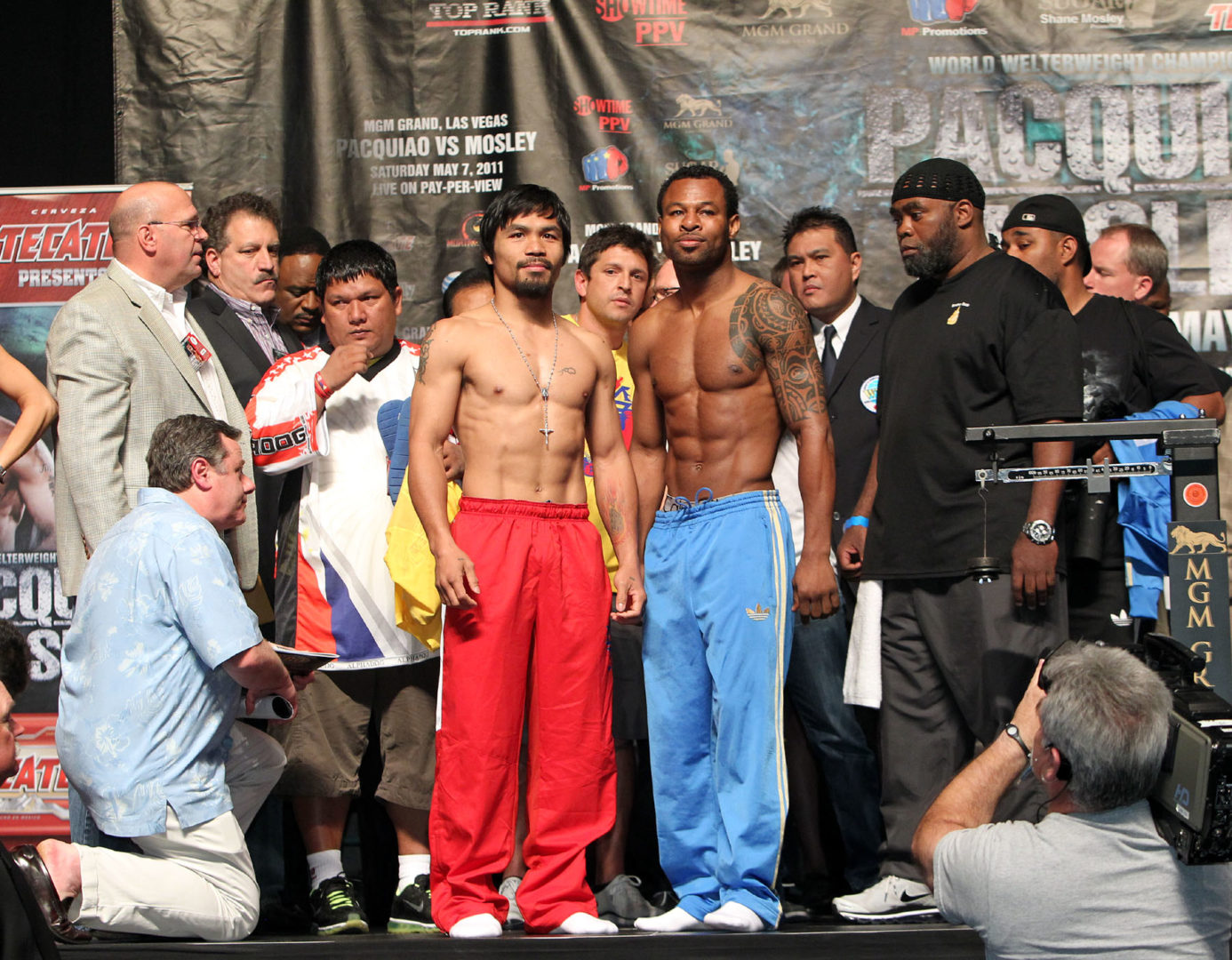
LAS VEGAS – The scales tipped in favor of Shane Mosley by three pounds. The noise meter favored Manny Pacquiao by untold decibels, all deafening. The odds grow, but never really change. They always add up to Pacquiao.

From news conferences to introductions to the official weigh-in, all of the preliminary rituals have gone as expected, almost as if they have been rehearsed and the roles pre-determined. But Pacquiao-Mosley Saturday night in Showtime-televised fight at the MGM Grand isn’t a movie script or a Broadway play.

It’s a fistfight, which means the real chance at drama lurks in the unforeseen. Maybe, it’s there in Mosley’s power or Pacquaio’s aggressiveness, or a twisted knee, or twist of fate.

But if there’s a buzz for this welterweight clash, there also are things that make you stop and wonder at a betting line that has grown faster than the national debt. It was 6 ½-to-1 on Wednesday, 8-to-1 on Thursday and 9-1 on Friday, all for Pacquiao. If you believe the line, Congressman Pacquiao (53-3-2. 38 KOs) is about to win in a landslide, or at least bury Mosley (46-6-1-1, 39 KOs) in one.

It’s been abundantly clear for weeks that Mosley (46-6-1-1, 39 KOs) doesn’t believe in any of it. If anything, he’s bemused by it when the media asks and perhaps motivated by it when the camera crews aren’t around.

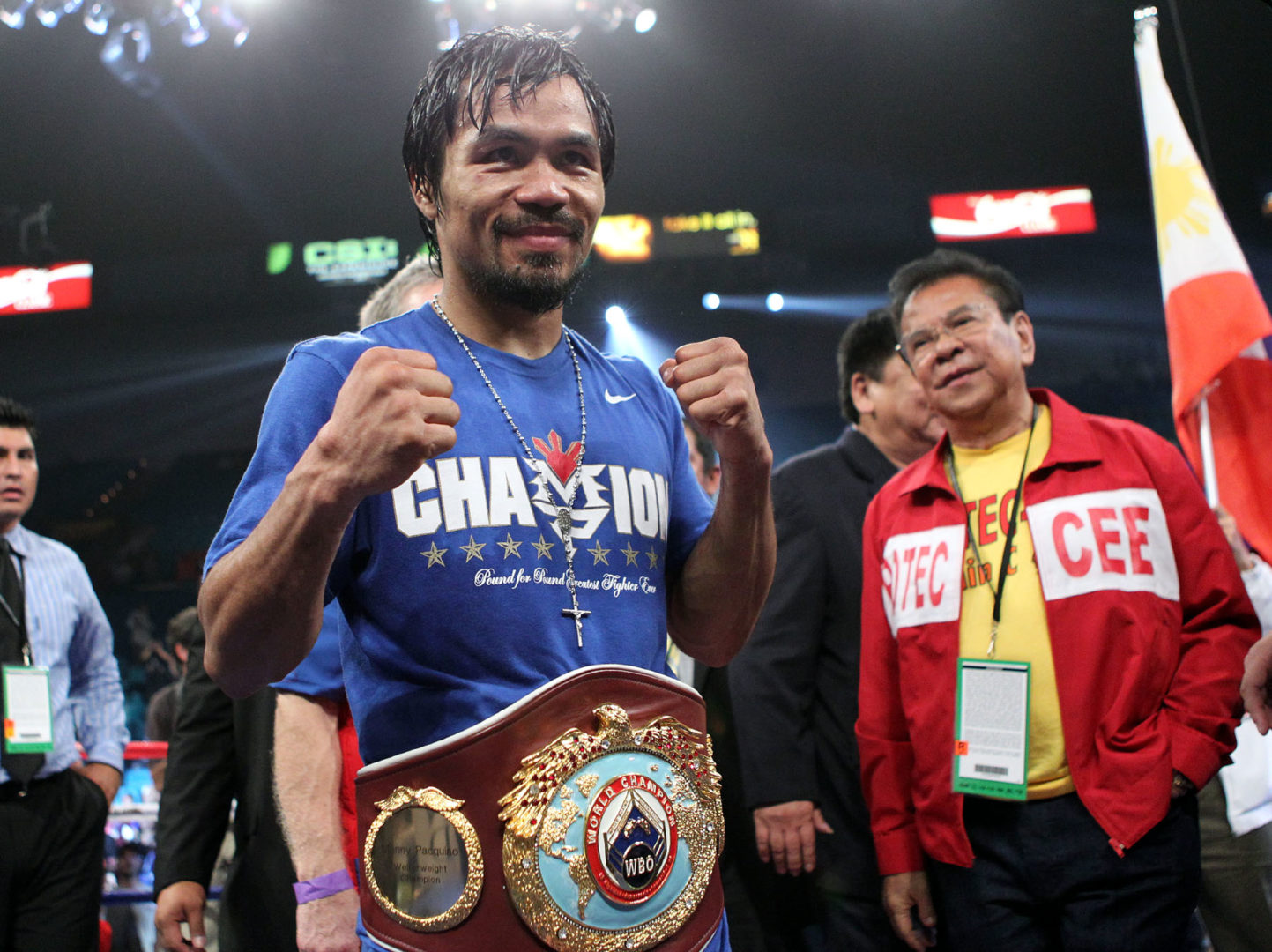
“I’m confident I’m going to win,’’ Mosley told broadcaster James Brown and a crowd of about 6,000 after he was at 147 pounds, the welterweight limit, three more than Pacquiao, who was at 144 after he stripped off a bright yellow shirt emblazoned by a red heart.

A reason for his confidence is rooted in what Pacquiao himself has done. For at least the last couple of fights, distractions have followed Pacquiao the way an entourage used to collect around Mike Tyson. But those distractions have been pushed into the background in training for Mosley. Pacquiao put them aside, almost as if he knew he knew he couldn’t let them get in the way of a fighter who looms as a much bigger challenge than Antonio Margarito or Joshua Clottey ever did.

A refocused Pacquiao can be interpreted in a number of ways. Call it concern. Call it worry. Call it the look of an athlete who is happy to be away from the daily grind of duties in the Filipino Congress. Whatever the interpretation, it is surely the look of a fighter who knows he can’t take his eye off the threat about to face him at the MGM Grand.

In the end, the 39-year-old Mosley might prove to be too old or too shopworn to do any more than just stand. He might not have enough left in his legs to move out of harm’s way, which is sure to be there early, or late, or throughout the scheduled 12 rounds against Pacquiao.

In his last two fights, there was precious little of the Mosley remembered by fans. He couldn’t follow up on a right hand that rocked Floyd Mayweather, Jr., in the second round a year ago. He looked tired and sloppy in winning a decision over Sergio Mora in September.

But the Mora fight was misleading, Pacquiao trainer Freddie Roach said. It was a bad match for Mosley.

“A bad choice,’’ Roach said. “Shane looks bad against runners and that’s what Sergio Mora did. It made Shane look like he’s shot and I don’t think he is.’’

But the one-sided odds are a sure indication that the betting public thinks otherwise. Mosley’s hair is growing as gray as Barack Obama’s. It’s a good look for a president or an AARP member, but not a fighter.
Meanwhile, the crowd’s cheers at the weigh-in said something else. Overwhelmingly, they were for Pacquiao, who is expected to collect between $20 and $25 million. Mosley stands to earn about a quarter of that. Pacquiao is riding a cresting wave of popularity. A pop icon, he also aspires to be the Filipino president one day, or at least his promoter, Bob Arum, thinks so.

But Pacquiao won’t be playing politics Saturday night. He’ll be more than a politician. Arum, who promoted Muhammad Ali, calls him the best fighter he has ever seen. With punching power and accuracy in both hands, Arum compares Pacquiao to major-league pitcher who can throw with both his right and left.

“He’d be pretty damn good,’’ Arum said.

He also doesn’t exist.

Not yet, anyway.

Notes, Quotes
Roach trained rock-and-roller John Mellencamp’s son to an Indiana Golden Gloves title. Roach’s compensation for about a month of work probably didn’t include all of those interest-bearing zeroes he gets from a Pacquiao fight. Still, it was valuable. “A Fender guitar with Mellencamp’s autograph on it,’’ Roach said. “Got it in the mail. It’s on my wall.’’

Pacquiao’s gambling isn’t a secret, especially in the Philippines. Pacquiao likes to bet and bet big. Roach recalls a fight in 2000 against Nadel Hussein in The Philippines. Pacquiao, then a junior-featherweight, bet his entire purse that he’d win a first-round stoppage. He won the fight, but lost the bet in scoring a 10th-round TKO.

Rest of the weights for Showtime’s pay-per-view telecast: Former middleweight champ Kelly Pavlik (36-2, 32 KOs) was at 170 pounds for his super-middleweight bout against Texan Alfonso Lopez (21-0, 16 KOs), who was at 169; Super-bantamweight champ Wilfredo Vazquez (20-0-1, 17 KOs) was at 122 for his WBO title fight against Jorge Arce (55-6-2, 43 KOs) also 122 pounds; and unbeaten Denver super-lightweight Mike Alvarado (29-0, 21 KOs) was at 139 pound for his bout against New Yorker Ray Narh (25-1, 21 KOs), who was at 140.

Photo by Chris Farina/ Top Rank


Odds for Pacquiao say one thing, but Mosley trainer Naazim Richardson says a lot more


LAS VEGAS – Manny Pacquiao has angles. Naazim Richardson has analogies.

Those analogies might not be enough to counter the endless geometry of power and accuracy in Pacquiao’s array of punches. But they are endlessly entertaining and powerful in their own right. Listen to Richardson long enough, and those one-sided odds against Shane Mosley begin to sound like funny money, a counterfeit come-on.

Of course, trainers are supposed to say that their fighters can win. It’s in their job description. It is their job. But Richardson makes you believe that maybe, just maybe, Mosley really will win Saturday night at the MGM Grand.

Richardson speaks with the unblinking conviction of a preacher and the common-sense perception of a street-corner philosopher. Fools beware. Richardson doesn’t suffer them lightly, if at all. He only asks for a chance, which might be his way of demanding respect for his fighter. There was a moment Thursday when it appeared that the requisite respect wasn’t there during a media roundtable that Brother Naazim turned into his pulpit at the busy MGM Grand’s Media Center.

Somebody wanted to know how surprised Richardson would be at a Pacquiao victory. The suggestion was that Mosley had no chance, not one at all. For a moment filled with potential for a spontaneous burst of angry frustration, Richardson paused. It came and went, like flash.

“Had to stop for a second there,’’ Richardson said as he exhaled. “The street was about to come rolling out of me.’’

For a man in the business of exerting control over a violent game with tactics designed to give his fighter every possible advantage, a fit of temper would have been uncharacteristic. Anger won’t beat Pacquiao. Poise and a patient, calculated delivery of Mosley’s proven power might.

Richardson has seen, studied and felt the impact of Mosley’s power.

“I keep asking everybody if they’ve ever been hit by Shane Mosley,’’ Richardson said. “I have. I’ve worn the pads. I’ve felt those punches.’’

Richardson is convinced that Mosley’s power can dictate a change in Pacquiao’s style. Richardson has a theory that Pacquiao’s inexhaustible energy has a way of scoring points because it is such an eye-catcher. The judges, like the crowd and the television audience, can’t take their eyes off of him. It was a style, Richardson said, that Sugar Ray Leonard used to his advantage in his 1987 decision over Marvin Hagler.

“I’ve always said that Leonard was masterful in the way he got everybody, including the judges, to just watch him,’’ Richardson said. “Nobody, including the judges, paid any attention to Hagler.

“That’s what Pacquiao does. With his energy and that head bouncing up and down, everybody just watches him. That’s what Shane is going to have to do: He’s have to take away some of that energy.’’

The suggestion is that a Mosley punch or combination in the early rounds will do exactly that, although a cracking right in the second round a year ago wobbled Floyd Mayweather Jr., yet still was not enough for a Mosley victory.

But the Pacquiao and Mayweather styles are as different as the Marines and Coast Guard. Pacquiao attacks; Mayweather defends. Pacquiao’s offensive style and mindset mean he is open to a counter. Richardson says he has studied Pacquiao throughout his career and detected a flaw that he believes could result in a Mosley victory

“I’ve seen something pop up in the tapes,’’ said Richardson, who wouldn’t be more specific. “It’s like one of those things you see when you’re in school. You know, you’re sitting there, the teacher asks a question and you’re still sitting there without an answer. Then, somebody gives you the answer and you think: ‘Damn, why didn’t already think of that?’

“It’s that simple.’’

Simple is not synonymous with easy, however. If it were easy, Richardson probably wouldn’t be in any fighter’s corner. His relationship with Mosley first had to be tested before he knew it would be effective. It was before Molsey upset of Antonio Margarito in January, 2009

“I felt like me and Shane could work together when we had that first dispute,’’ Richardson said. “You know, it’s like that girlfriend. Everything is great until you leave the toilet seat up for the first time.

“The first dispute with Shane was when I started wrapping his hands. Shane wants to fight like it was back in the bare-knuckle days. I’d wrap with the stuff and he’d say: ‘Too much, I like to feel it.’

“I had to tell him: You’re fighting a monster, a guy who is hard to knock out. You got to protect those hands.

“We talked. We worked it out.’’

About two-and-a-half years later, Mosley is confronted by a bigger challenge in Pacquiao, yet still daunting. Few gave Mosley a chance against Margarito, who was coming off a huge upset of Miguel Cotto.
“Right now, Shane looks just like he did before Margarito. The same confidence, he’s doing the same things.’’

If he same things include a Mosley victory Saturday night, it won’t be just another Richardson analogy. It’ll be amazing.

NOTES, QUOTES
• A Top Rank-promoted card featuring Las Vegas featherweight Jesse Magdaleno (3-0) against Jonathan Alcantara (4-3-2) of Novato, Calif., will begin at 5 p.m. (PST) at Las Vegas’ Mandalay Bay. ESPN’s telecast of the card, scheduled for seven fights, will begin at 7 p.m. Chicago light-heavyweight Mike Lee (4-0, 3 KOs), a Notre Dame grad, faces Gilbert Gastelum (0-1) of Tucson.

• Former middleweight champion Kelly Pavlik appeared Thursday at a news conference for the Pacquiao-Mosley undercard Saturday night. Pavlik (36-2, 32 KOs) faces super-middleweight Alfonso Lopez (21-0, 16 KOs) in his first bout since undergoing rehab for alcohol problems. “The story has already been; everything has been told,’’ said Pavlik, who only wanted talk about Lopez

• Lopez wore a black cowboy hat. He must have bought in his hometown, Cut & Shoot, Tex.

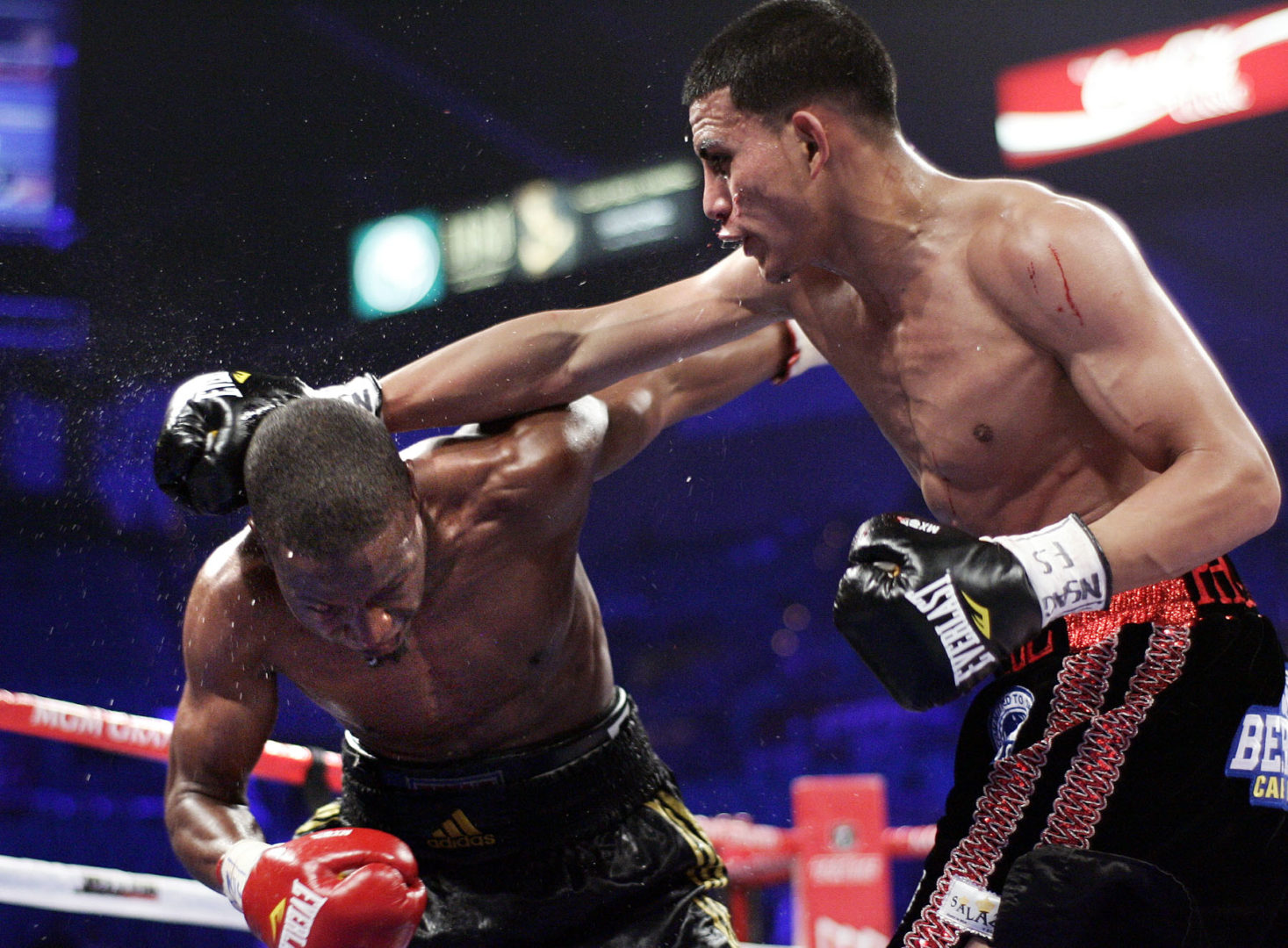
• Phoenix prospect Jose Benavidez, Jr. (10-0, 9 KOs) appears on the Pacquiao-Mosley undercard in a junior-welterweight bout against James Hope (6-7-1, 4 KOs) of Rock Hill, S.C. It is Benavidez’ last fight before he is scheduled for hometown pro debut on June 11 at Wild Horse Pass Casino in suburban Phoenix. A card featuring Benavidez in Phoenix last summer was cancelled because of controversy over Arizona’s proposed immigration legislation.

• And Top Rank’s Bob Arum couldn’t resist a shot Thursday during the undercard news conference at rival Oscar De La Hoya’s Golden Boy Promotions and its banker-turned CEO Richard Schaefer. In introducing Felix “Tutu” Zabala, promoter for junior-featherweight champion Wilfredo Vazquez, Arum said Zabala was an example of old-school promoters who “don’t steal other fighters.’’ Arum and Zabala have a deal to co-promote Vazquez, who faces Jorge Arce. Both Zabala and Arum have been in court against Golden Boy, Zabala over the contract rights to Saul “Canelo” Alvarez and Arum over rights to Nonito Donaire.

Photo by Chris Farina / Top Rank


Pacquiao sounds like a political heavyweight in last stop before his campaign against Mosley


LAS VEGAS – Filipino Congressman Manny Pacquiao will never jump up the boxing scale to heavyweight, but he is beginning to sound as if he might try to make a run at that title in the political ring.

A boxing news conference sounded a little bit like a presidential campaign Wednesday when Pacquiao talked about plans to fight poverty with more evident passion than he did about a welterweight fight Saturday night against Shane Mosley at the MGM Grand.

“All of my life, I’ve had to fight,’’ said Pacquiao, who has eight titles, all in different weight classes. “As a child, I had to fight for food. But the biggest fight of my life is the end of poverty in my country.’’

Pacquiao, still in campaign mode, said he will wear yellow gloves Saturday night and urged a sellout crowd to also wear yellow. For him and his countrymen, it’s the color of unity. Former Filipino President Corazon Aquino wore yellow. It was the color that identified the opposition that chased ex-Filipino strongman Ferdinand Marcos out of office in 1986.

Now, it’s a look at what Pacquiao might be planning for a whirlwind of a life that is always moving forward and at a furious, fearless pace with more angles than punches. On Wednesday, he even sang the title of his recent release, Sometimes When We Touch, at Dan Hill, who is other half of the duet in the recorded melody. There were no babies to kiss. But give him time. Someday, there may even be some broken campaign promises.

Thus far, there have been none, although Mosley hopes to change that with an upset that would send The Philippines into dark mourning. On the betting board up and down the Strip, that doesn’t look likely.

Late Thursday, Mosley was about a 6 1/2-to-1 underdog. If this were politics, Mosley would be Donald Trump. Comedian Seth Meyers said he was surprised to hear that Trump might runs for President as a Republican. Meyers thought Trump was running as joke. Despite odds that are hard to figure, however, this isn’t politics. Mosley is no joke, not even at late comedian Jack Benny’s forever age, 39

“We’re not talking about an ordinary guy,’’ Mosley trainer Naazim Richardson said in the wise voice that is always accented with common sense.

Richardson argues that Pacquiao hasn’t been hit with the mix of power and experience possessed by Mosley, whose 32-0 record, including 30 knockouts, at 135 pounds makes him one of the great lightweights of all time.

“Put a Shetland Pony in there and when Shane hits it, he’s going to wobble it,’’ Richardson said.

The secret to Pacquiao are the thick legs of a bigger man, if not a Shetland Pony. But that’s another story for another day. What is increasingly evident is some newfound focus in Pacquiao on the immediate challenge. He will always multi-task, as he did Wednesday at the news conference/political campaign that included Las Vegas Mayor Oscar Goodman and his wife, Carolyn, who is running for the office her husband is about to vacate.

Unlike some of his recent training camps, this one is not about how or if a distracted Pacquiao might lose. Last November, there were more stories about Pacquiao’s distractions than there were about Antonio Margarito. Pacquiao left Margarito battered and badly injured in taking a one-sided-decision.

The reported distractions never mattered and perhaps Pacquiao knew that they wouldn’t. Margarito just wasn’t fast enough to be a threat. If Pacquiao’s reported attention to training over the last two months is any indication, Mosley is.

“From Day One, he told me this is not an easy fight,’’ said Pacquiao trainer Freddie Roach, who already has said he wants the Filipino idol to be the first to knock out Mosley. “I think this is the best training camp we’ve ever had. Manny is in the best shape he’s ever been in. He has to be. He’s fighting an experienced, crafty guy.’’

Pacquiao said he is as concerned about Mosley as he was about Oscar De La Hoya in 2008.De La Hoya quit after eight rounds against Pacquiao, who exhausted him with relentless energy and a nonstop barrage of punches. De La Hoya never had a chance. Pacquiao’s newfound dedication might mean Mosley won’t have one either. Then again, Mosley beat De La Hoya twice. Unlike Pacquiao, Mosley stopped Margarito.

“Mosley knocked him out …he has that advantage,’’ said Pacquiao, who is smart enough to know that timing dictates that Saturday night’s fight is next and dangerous enough to may be the biggest one he’ll face before he tries to knock out poverty.


Pacquiao looking to knock out Mosley and maybe Mayweather’s argument


Knockout talk is pretty standard stuff in the build-up for any fight, especially one that Manny Pacquiao and Shane Mosley have transformed into an event. But it has a different tone this time around, because Pacquiao trainer Freddie Roach hopes a stoppage will either lure Floyd Mayweather Jr. into the ring or provide Pacquiao an edge in an argument for the ages if the much-discussed fight never happens.

“ It would be incredible for Manny to be the first one to stop him and just prove to the world how much better he is than that guy that couldn’t stop him,’’ Roach said Wednesday during a conference call when asked about the chances at a knockout of the durable Mosley on May 7 at Las Vegas MGM Grand.

Not that anybody had to ask, but that guy, of course, is Mayweather, who on Thursday had a preliminary hearing on felony and misdemeanor charges from alleged domestic violence delayed in Las Vegas until July 29.

Translation: The Pacquiao-Mayweather fight isn’t any more likely today than it was a year ago when Mayweather was terrific and resourceful in surviving a rocky second round, yet characteristically cautious in settling for a one-sided decision over Mosley.

For now, Pacquiao has only the fights that can help him build his case while the prosecution for Nevada’s Clark County its own. Common opponents are poor comparisons, made unreliable by time, circumstances and styles. But Mayweather leaves the Filipino Congressman without options or even much of a clue as to what he intends to do.

“It’s hard to judge him,’’ Pacquiao said when asked if he thought Mayweather feared him. “I don’t know what the reason is. I really don’t have an idea. I can’t say something. We don’t know, so it’s hard to judge him.”

Instead, Pacquiao does what he always has done. He moves forward. There is a sense that he already is at work on the finishing touches to a legacy that would be incomplete without Mayweather, yet still as brilliant as any.

News broke in Mexico that Juan Manuel Marquez already has a Top Rank offer to fight Pacquiao for a third time sometime in the fall. Top Rank’s Bob Arum was annoyed at the Marquez questions. He dismissed them twice, first Tuesday in a conference call with Mosley and again on Wednesday.

But it only would be a surprise if Marquez had not been approached by Top Rank. Marquez, who has a draw with Pacquiao and a controversial loss by decision to the Filipino, represents a chance for Pacquiao to eliminate lingering doubts about his ability to beat the accomplished Mexican. It also is another opportunity to further build his case in the potential debate about whether he was better than Mayweather, who outweighed Marquez and dominated him for 12 rounds, yet again settled for a decision in September, 2009.

If Pacquiao could somehow be the first to knock out Mosley and the first to stop Marquez, he would win the debate no matter what Mayweather does or doesn’t do. It’s a risk, first and foremost in terms of the motivation it provides Mosley, who is a better bet to win by stoppage than Pacquiao, especially within the first three to four rounds.

Another cracking right in the early rounds might accomplish for Mosley what eluded him against Mayweather. It might finish Pacquiao in another spring stunner during boxing’s season of upsets, especially if the 39-year-old Mosley can summon up a will, way and maybe a big left hand. Against a stumbling Mayweather, Mosley was curiously unable to capitalize.

The guess here is that Mosley won’t squander that kind of an advantage again. If he does, Pacquiao will be on his way to a significant victory and perhaps a stoppage that could win an argument, which on Thursday looked more likely than a Mayweather fight.

NOTES, QUOTES
• Insightful Al Bernstein offered an intriguing possibility that could surprise Pacquiao. During a Showtime conference call Thursday, Bernstein said Mosley might unleash a potent left that has been dormant lately. “The left-hand,’’ Bernstein said. “I think that’s the secret.’’

• Boxing’s best, hidden on premium networks and pay-per-view for years, goes back to prime time for the first time in generations Saturday night when the third episode in Showtime’s Fight Camp 360, an inside look at Pacquiao-Mosley, will air on CBS at 8 p.m., Eastern and Pacific. There were mixed reviews for the first two episodes. The third figures to attract the biggest audience, meaning there is motivation for Showtime to make it the best of the four.

Photo by Chris Farina / Top Rank


Lopez, like Ortiz, has opportunity in defeat


Victor Ortiz’ personal triumph in his dramatic upset of Andre Berto re-affirms an increasingly forgotten fundamental. Defeat is important. It’s an opportunity, one that now confronts Juan Manuel Lopez.

Lopez finds himself where Ortiz was nearly two years ago. With his stunning loss to Orlando Salido Saturday, Lopez has fallen from the undefeated ranks, an insulated niche, and into the harsh, unforgiving light that forces a fighter to question himself and endure further questions from everybody else. It’s a final chapter for many, the first in a newborn stardom for a few and perhaps one that Floyd Mayweather Jr. just wants to sidestep.

Unbeaten only means untested. Rocky Marciano retired at 49-0, but it’s hard to find him among history’s top 10 in any all-time ranking.

From this corner’s perspective, defeat is an inescapable rite of passage for fighters with the highest aspirations. It’s also what keeps the public interested. It’s no coincidence that the reported audience of 1.5 million for Ortiz’ welterweight decision over Berto in a unanimous counter to doubts about his courage was HBO’s biggest of the year. The irresistible drama attracted a crowd that gathered for a glimpse at whether there was enough within Ortiz to overcome. There was. He did.

Your turn, JuanMa.

The guess here is that the likable Lopez can and will. It won’t be easy. The Ortiz experience is the freshest example of that. Anguish and anger stood in the way of Ortiz after the 2009 surrender to Marcos Maidana.

Unlike Ortiz, few doubt Lopez’ will. But there are plenty of questions about the featherweight’s commitment. He got too comfortable, perhaps softened and deluded about an illusion of invincibility that comes with an unbeaten record. By now, his marital problems and inattention to training, including a trip to the Philippines for Manny Pacquiao’s birthday party, are well-documented. There also was some arrogance. In a conference call before the Salido loss, Lopez called himself the favorite of Puerto Rican fans.

“With all due respect to Miguel Cotto and Ivan Calderon, both great champions, I feel I am the most popular boxer in Puerto Rico,’’ Lopez said a days before Salido’s eighth-round stoppage forced a reassessment of that claim.

Lopez first step would appear to be a rematch with Salido. There had been plenty of talk with boxing circles about a Lopez showdown with Yuriorkis Gamboa. But promoter Bob Arum pushed aside that possibility until, he said, somebody showed him the money. If Lopez can mature into the committed fighter he is expected to be, that money and perhaps more will be there.

A key to Lopez’ predicted stardom is his personality. Fan-friendly, Arum said. Some, probably many, of those fans might not be as friendly as they had been. But that’s a good thing if Lopez forges himself into the fighter they have always expected.

Those fans will renew that friendship, strengthen it as never before, if Lopez answers their criticism the way Ortiz did.

Ex-Phoenix fighter killed in police shooting
In a sad story, a onetime promising light-heavyweight was killed by Phoenix police early Monday. Robert Charlez, 40, was shot to death while sitting outside of a fence on a freeway overpass. According to police, officers asked Charlez to come down from a bridge across I-10.

Officers shot when Charlez advanced on them with what police said was an article of clothing wrapped around his right hand. According to police, Charlez said he had a gun. A police spokesman told Phoenix media that Charlez “had a simulated weapon in his hand at the time of the shooting.” But it wasn’t clear whether there was a gun or a knife in Charlez’ right hand. According to The Arizona Republic, the police spokesman did not say what the object was.

Charlez’ right hand was powerful. In 1992-93, Charlez scored six knockouts, winning seven fights and losing one, before getting into trouble with the law.

“A good fighter and a nice guy,’’ said Phoenix cornerman Dominic DiGuiseppe, who worked with Charlez at former trainer Willy Borchert’s old gym in west Phoenix.

Notes, quotes, anecdotes
• A NABF title will be at stake and perhaps represent another step toward a shot at a major title for Phoenix super-middleweight Jesus Gonzales (26-1, 14 KOs) on June 4 in front of a hometown crowd at Celebrity Theatre against Henry Buchanan (20-2, 13 KOs).
• And Shane Mosley talks as if he will be facing a much smaller task in Manny Pacquiao on May 7 at Las Vegas’ MGM Grand. “Lately, I’ve been dealing with bigger guys, monsters,’’ Mosley told Lance Pugmire of the Los Angeles Times during a media day at his training camp. “To have a guy with a smaller frame in front of me this time, he doesn’t intimidate me at all.” Mosley might want to take a second look at Pacquiao. Pacquiao has the legs of a much bigger man. Those legs look like a couple of tree trunks. They are the source of his speed, balance and power.


There’s plenty of heart, but maybe not enough focus for Ortiz to beat Berto


It’s popular these days to rip Victor Ortiz. It’s also a little too easy, perhaps because his quick mix of honesty and anger create a convenient target. The heart is always there, on Ortiz’ sleeve and never hidden beneath layers and loopholes. But it’s the heart that’s under attack. The critics say Ortiz doesn’t have one.

In our playground full of clichés, heart has been confused with courage. For anybody who forgot or just didn’t know, Ortiz, battered as a child in a broken home, became the legal guardian for a younger brother. That’s heart, the kind that many of our celebrated winners could use a lot more of.

Photo by Claudia Bocanegra

So, please, don’t question Ortiz’ heart. It’s proven. But you can question his focus. That’s the issue Saturday night in his welterweight date with unbeaten Andre Berto in a HBO bout at The Foxwoods in Connecticut. Talented and powerful, Ortiz’ resume is tarnished with two fights that leave questions about whether he can fight, adjust and endure long enough to prevail in the face of a tough challenge

He didn’t against Marcos Maidana, whom he knocked down three times before his infamous surrender in the sixth about a year-and-half ago at Staples Center in Los Angeles. About 18 months later in a troublesome moment that led critics to recall his loss to Maidana, he seemed to settle for a majority draw in December after knocking down Lamont Peterson twice in the third in Las Vegas.

In the immediate aftermath of both, Ortiz didn’t sound or appear frustrated. Only after an unrelenting tide of media criticism did he react in anger.

“I felt like a piece of gum on the bottom of someone’s shoes,’’ he said in February during a news conference in New York. “So, I said to myself: ‘It’s my turn.’

“I’m going in against some tough opposition. Andre Berto is no chump. But now I’m hungry. I’m tired of people saying I have no heart or no balls. At the end of the day, I’m not scared of getting in the ring or challenging anyone.’’

But there’s more to the task than having the courage to make that walk from the dressing room, through the crowd, up the steps, under the ropes and into harm’s way. There’s finishing the job and that’s what Ortiz has yet to do in a defining fashion. Berto gives him that opportunity.

Ortiz is armed with powerful motivation. The media have piled on, putting a massive chip on his shoulder. As motivation, it figures to drive him and make him very dangerous during the first three to four rounds. But then what?

The guess here is that Berto will be careful early and still around later. Once the anger is gone as an emotional weapon, Ortiz will have to rely and re-fashion his evident talent with adjustments. He’ll have to think his way through adversity. I don’t think he will, simply because he has yet to show that he can. Still, a part of me will be cheering for him because of the media criticism arrayed against him.

His honesty, that heart, makes him a likable underdog at a career crossroads that could either propel him to real stardom or make him as forgettable as that chewed-up piece of gum.


Benavidez scheduled for another hometown debut a year after Arizona’s immigration controversy forced him to stay away

PHOENIX –About a year after controversy over immigration legislation forced the cancellation of Jose Benavidez Jr.’s hometown debut as a pro, the Arizona prospect has another chance to fight in his home state for the first time on June 11 at Wild Horse Pass at Gila River in suburban Chandler.

Gerry Truax of Showdown Promotions requested approval of the date Monday at a meeting of the Arizona State Boxing Commission for a card scheduled to feature Benavidez (10-0, 9 KOs), a Top Rank fighter who also is scheduled for a bout on the Manny Pacquiao-Shane Mosley undercard on May 7 at Las Vegas’ MGM Grand.

Top Rank matchmaker Bruce Trampler said a couple of months ago that he had the go-ahead to seek a site and date for Benavidez to fight in Arizona. Before the immigration controversy forced him to stay on the road, Benavidez’ homecoming was scheduled for last July 17, also at Wild Horse and also on a card promoted by Showdown, which represents Antonio Margarito.

“We’ve been waiting for a long, long time to fight,’’ said father-and-trainer Jose Benavidez, Sr., whose 18-year-old son is considered Arizona’s best prospect since Jesus Gonzales and Hall of Famer Michael Carbajal. “I can’t tell you how happy we are at this opportunity. It’s really important, I think, to build a hometown identity.

“My son has been fighting in Las Vegas and Texas and just about everywhere but here at home.

Everywhere we go, everybody knows him, more than they know him here. It’s time to come home.’’

Showdown’s request for Commission approval of the June 11 date coincided with a federal appeal court’s refusal to lift a stay on the toughest parts of the controversial Arizona law, SB1070. The 9th U.S. Court in San Francisco on Monday rejected Arizona Gov. Jan Brewer’s appeal. Among other things, SB1070 would require police to check on an immigrant’s legal status during routine traffic stops.

Benavidez’ homecoming last July was canceled when Top Rank’s Bob Arum said he was told by TV Azteca and beer sponsor Tecate that they did not want to do business in Arizona. At the height of the controversy, World Boxing Council chief Jose Sulaiman issued a directive from his Mexico City office in which he banned Mexican fighters from bouts in Arizona. When two Mexicans fought on a Don Chargin-promoted card in Tucson last August, Sulaiman threatened to suspend both in their home country.

While watching Benavidez spar in February, Trampler said he was given clearance to schedule a hometown fight for the Phoenix prospect because the controversy had begun to subside.

Benavidez, who has been fighting as a junior-welterweight, has been training in Phoenix for the last several months after leaving trainer Freddie Roach’s Wild Card Gym in Los Angeles. He signed as a 17-year-old, whose potential for stardom began to spread far and fast through YouTube clips of his sparring sessions with Amir Khan.

In other business heard by the Arizona commission Monday, Fanbase Promotions requested approval of a Phoenix card at Celebrity Theatre, featuring Gonzales (26-1, 14 KOs) against Henry Buchanan (20-2, 13 KOs) of Capitol Heights, Md., in a super-middleweight bout at Celebrity Theatre. Gonzales (24-20-7, 4 KOs) made his hometown comeback on March 18 with a unanimous decision over Dhafir Smith (24-20-7, 4 KOs) of Philadelphia, also at Celebrity.


Maidana hopes to corner his potential in a bid to beat a big name in Morales


Intrigue is attached to Marcos Maidana-Erik Morales, perhaps for debatable reasons in a fight that might be determined more by what each fighter can’t do rather than what they can.

By now, fears for Morales’ well-being are well-documented. Rival promoters, trainers and media have talked about their concerns, which – right or wrong – have helped sell the junior-welterweight fight Saturday night Las Vegas’ MGM Grand on an HBO pay-per-view card. A heightened sense of danger never fails to attract a crowd.

Morales is quick to say that he picked Maidana, who in fact was the first option after Juan Manuel Marquez said no. Nevertheless, Morales, who is about a year into his comeback, looks at Maidana and sees vulnerabilities.

I suspect that Morales is looking at the powerful son of an Argentine gaucho with the sharp eye of the insightful trainer he could be and should be. Maidana’s loaded war chest includes everything but a GPS. There aren’t many smart bombs in there.

Maidana says referee Joe Cortez allowed Amir Khan to survive a ferocious 10th round in Maidana’s loss on Dec. 11 in the Fight of the Year. He won’t have Cortez to blame Saturday night. Tony Weeks has the assignment.

But the referee could have been Barney Fife for all that it mattered against the courageous Khan. Maidana had only himself to blame. He simply didn’t know how to set up a fight-ending combination. Maidana’s last trainer, Miguel Diaz, suggested exactly that when he called the Argentine’s tactics in pursuit of the wounded Khan “disorganized.’’

Maidana’s lack of tactical focus, surely detected by Morales, appears to be the cumulative result of never one trainer long enough in his corner to direct, discipline and refine all of his evident talent. After 18 months with Diaz, he left the experienced corner man following the loss to Khan.

“I feel that I reached a point with Miguel where I wasn’t advancing anymore,’’ Maidana said. “I think that’s what happened to me in the Khan fight. I felt that I needed a change.’’

The change was supposed to include Nacho Beristain, Marquez’ longtime trainer in Mexico City.

“I was there in Mexico,’’ Maidana said. “I traveled to Mexico. We had an agreement. I was supposed to train with Beristain. As soon as I touched down in Mexico, Beristain informed us that he wasn’t going to be able to work with us, that Marquez pretty much prevented him from working with him, that Marquez made a comment that possibly down the line there could be a fight with Maidana.

“I think maybe he just got jealous and he didn’t want me to train with him.’’

Maybe.

A string of maybes in any corner often adds up to an incomplete fighter, a beatable one. I’m not sure Morales, now 34 and back after losing four straight before an abbreviated retirement, still has the physical wherewithal to beat him. The best of his Hall of Fame career appears to have been left in the ring against Marco Antonio Barrera and Manny Pacquiao.

Uncertainty in Maidana’s corner, however, creates a hedge, a reason to wonder whether Morales can in fact pull it off. Angered at Beristain’s sudden about-face, Maidana hired an able and experienced Rudy Perez. But there is no way to know whether the two can forge a working relationship within a few weeks. The corner shuffle had to cause some early confusion in Maidana’s approach to training camp.

“Yes, of course, I was upset,’’ Maidana said. “I was very upset. That’s something that’s very unprofessional. I was upset about it. But at the end of the day, there’s other trainers at the same level, if not better than Beristain. I think I found that in Rudy Perez. But, yes, I think it would bother anybody.’’
Bothered long enough perhaps for Morales to do what few think he can anymore.

“Look, he’s only been with Rudy Perez for a little bit of time,’’ Morales said. “It’s only been a few weeks. …It’s very clear to me what type of fighter I’m going to face. It’s going to be the same old Maidana. I don’t think that Rudy Perez can be a miracle worker.’’

The biggest miracle for Maidana might be a long-term trainer. Without one, his promising career might be remembered as disorganized, a puzzle full of unfulfilled potential.


Fear not, Morales says about the danger some see in his fight with Maidana

Erik Morales has heard questions loaded with suggestions that he is damaged and in danger of permanent disability or worse when Marcos Maidana’s power figures to land with probability dictated by a record that includes 10 first-round knockouts and stoppages in 87.1 percent of his 31 fights.

Fear not, Morales says.

“I feel good,’’ Morales said this week at the end of a conference call 11 days before his April 9 date with Maidana at Las Vegas’ MGM Grand. “I feel calm.’’

The questions, he says, are coming from his former promoter, Fernando Beltran.

“It is a matter of revenge, because I am not with him anymore,’’ Morales said through an interpreter, Golden Boy Promotions matchmaker Eric Gomez. “I know Fernando Beltran is causing these problems.’’

At 33, Morales is still at an age when many are at the end of their prime, which means they are still capable in mind and body. Like so many Mexican fighters, however, it’s not the age so much as the record. They are kids, teenagers, when they begin a trade so often mastered in a perilous exchange built on the ability to set up a punch by enduring two, three and four. Morales was 16 when he answered his first pro bell, one of 57.

“I know I have been in some wars,’’ Morales said in a matter-of-fact tone with a comment that also is a matter-of-record, yet cuts both ways.

For him, the experience represents well-practiced skill, the knowhow to avoid power long enough to counter it and transform it into an advantage. But those wars aren’t video games. They come with a physical price, each tagged with the same question: How much is left? I have no doubt that Beltran is asking, again and again.

He wouldn’t be the first former promoter to do so and he won’t be the last. Maybe, he is motivated by reasons other than concern. Maybe not. But Beltran also is asking only what so many others have. Morales’ four fights, all defeats, before he left the sport after losing to David Diaz in 2008 were full of troubling signs. Two of them were to the undisputed best, Manny Pacquiao.

It was the second loss to Pacquiao in 2006 that left a moment impossible to forget. Morales was down in the third and final round. He looked up at his father and trainer, who urged him to get up and continue. Morales waved him off with a gloved right hand. It was as if he was saying good bye. No, no more. For one of the toughest fighters of his generation, it was a concession that his best days were over.

Perhaps, a flicker of what he once was will be there for what would be a significant upset of Maidana.

“I’m not old,’’ said Morales, who won three comeback fights in Mexico last year. “I just decided, at 30 years old, to take a little break.’’

In Maidana, Morales sees a flawed fighter. At 28, Morales would have beat him, no doubt. Five years later, however, there are doubts about whether the toll he paid in speed and reflexes against Pacquiao and Marco Antonio Barrera left him with enough to match the knowhow, especially when Madaina’s shotgun style of power is unleashed. It’s one thing to know how to get out of the way. Doing it, however, is something altogether different.

According to Gomez, Morales passed a battery of medical tests in Mexico, including one administered in Mexico City by the same neurosurgeon who reportedly put a plate in Barrera’s skull in 1997 to correct a congenital condition, one not related to boxing.

What’s more, Morales believes he is stronger perhaps healthier than ever, in part because he doesn’t have to break himself down to make junior-welterweight, 140 pounds. At his featherweight prime, Morales often would step onto the scale at the official weigh-in looking as if he had starved himself. He was always as gaunt as a refugee. If you saw him a couple of months and several meals later, he was hard to recognize.

Maybe, the fears have been overstated. I can’t help but think of Evander Holyfield in 1996 before his first fight with Mike Tyson. From promoter to bookie to fan, the prevailing talk was that Holyfield was damaged. Few thought he could win. The better chance was that he would suffer serious injury.

Holyfield won.

Maybe, Morales will too.

In the meantime, however, I can’t help but wonder about the questions and worry about the result.


Mayweather says 100 million things, but one bet says he’ll have to fight Pacquiao


It’s hard to know what Manny Pacquiao thinks about all the mixed signals coming from Floyd Mayweather Jr. these days.

First, Pacquiao promoter Bob Arum tells the Filipino media that Mayweather wanted $100 million in undisclosed talks for the biggest fight nobody has yet to see.

Then, Mayweather brags on twitter by displaying a winning ticket for $37,272.75 on a bet that the Atlanta Hawks wouldn’t outscore the Chicago Bulls by six or more points in the second half.

If accurate, Arum is 100 million times right in interpreting Mayweather’s demand as just another way of saying — no, hell no — he won’t fight.

But the winning ticket from Las Vegas’ M Resort looks like another good bet that Mayweather is going to need more than a nickname to pay his bills. He calls himself Money, but he won’t have much of it if gambling is a habit and criminal lawyers are a necessity.

Let’s just say that it’s safe to assume Mayweather isn’t tweeting anything that ever looks like a losing ticket. For anybody who has invested part of a paycheck at a Vegas’ book, it is also a good bet that the losers outnumber the winners.

Does Pacquiao even care? If he doesn’t, then there are 100 million more reasons to believe the long-awaited showdown will happen only in a video game. Pacquiao already is well into his second career as a politician. As the public and media grow weary of the continuing speculation, Pacquiao appears to already have moved on and beyond.

Sometimes, however, money – or the urgent need for some – creates big fights. There continues to be talk that Shane Mosley, who faces Pacquiao on May 7 at Las Vegas’ MGM Grand, has to fight to pay for his divorce. That price is as cynical as it is steep. It is also dangerous. But it has always been there.

Mayweather, who faces eight criminal charges for an alleged incident involving a former girlfriend, has countless ways of saying he won’t do this and he might do that. It’d be no surprise if he soon denies that Arum’s latest story about negotiations that heretofore had gone unreported. It would be a lot harder for him to deny that he wants $100 million.

But Mayweather’s words don’t really matter. It’s what he shows us. The latest offering is several zeroes short of what his nickname claims and one reason to think that Pacquiao-Mayweather will happen.

NOTES, QUOTES
· The best hope for a resurrected heavyweight division is an NFL work stoppage that lasts, say, a couple of years. Baltimore Ravens safety Tommy Zbikowski, who fights Saturday night in Atlantic City on the Yuriorkis Gamboa-Jorge Solis undercard, is as skilled and athletic a prospect as there is on the side of the world that does not include a Klitschko. Zbikowski is evidence that America’s best heavyweights are in the NFL. “Yeah, it might be true,’’ said Zbikowski, who says Ravens defensive lineman Haloti Ngata could be a great one. “The Klitschkos are the best right now and they’ve been the best for a long time. Just because they’re in Europe doesn’t mean there are not great heavyweights. I think a lot of the American heavyweights right now are playing football. Boxing is honestly one of the most athletic things you can do. To be a good boxer, you have to be very athletic. Right now, you’re seeing the top athletes go to college to get an education. I think if you have boxing back at the collegiate level, you might have some more American heavyweights.”

· And another shot in the Golden Boy-Top Rank feud could be fired next week. Golden Boy CEO Richard Schaefer said Wednesday that he is planning to meet with Juan Manuel Marquez. There is rampant speculation that Marquez will jump from Golden Boy to Top Rank. That might be the only way he gets a second rematch with Pacquiao. “We don’t know what Márquez’s plan or plans are,’’ Schaefer said during a conference call for an April 9 card topped by Erik Morales-Marcos Maidana and will include Robert Guerrero, Michael Katsidis and James Kirkland at Las Vegas’ MGM Grand. “I am actually scheduled to meet with him next week in Mexico and see what he is planning on doing.’’


Gonzales celebrates homecoming with a 12-round victory


PHOENIX – Familiar echoes filled the building. Jesus Gonzales was back.

Back at work.

Gonzales returned Friday to his hometown in an attempt to restart a career that began with him tagged as a big-time prospect. The tag is gone. Some of the skills are rusty. But the second chapter is underway with a victory. Little else mattered to a near-capacity in the 2,600-seat Celebrity Theatre.

Gonzales (26-1, 14 KOs) could do no wrong for a lively crowd that chanted his nickname and cheered his unanimous decision over Dhafir Smith (24-20-7, 4 KOs) for the International Boxing Federation’s North American super-middleweight title.

“I got work to do,’’ said Gonzales, who is called El Martillo, Spanish for The Hammer. “I know that. But, man, it just feels good to be back in the ring.’’

For most of 12 rounds, Gonzales’ powerful left hand hammered Dhafir of Philadelphia. Gonzales was credited with a knockdown in the third. But Dhafir called it a slip. Whatever it was, it would not have mattered. Gonzales, who collected $3,500, won all but two rounds on the 15rounds scorecard, although he also suffered a cut over his right eye in the 10th by a left hand from Dhafir, who beat former and faded champion Jeff Lacy in his last bout.

“Just a bad night,’’ said Dhafir, who earned $7,500. “But, man, that was not a knockdown in the 10th.’’

“My jab wasn’t the way it needs to be,’’ said Gonzales, who needed six-to-10 stitches for the cut. “I’ll go back into the gym and work on that for sure.’’

On the undercard there was confusion and controversy. Canadian junior-middleweight Janks Trotter (4-0-1) fought to a technical draw with Arturo Crespin (6-1-1) of New Mexico The six-round fight was stopped after the second because Crespin suffered a cut caused by a head butt, although Trotter argued that a pitch, a left hand, cut Crespin.

Trotter went into the ring with a shuffled corner. Michael Carbajal had been training him at the Ninth Street Gym in Phoenix, but did not work the corner because the Phoenix Hall of Famer had been drinking. The Arizona State Boxing Commission was notified of the change by Fanbase Promotions before the card began. Carbajal, 43, has been struggling with drinking problems since he retired from the ring in 1999.

Carbajal, who was honored for his career at intermission, sat a table near ringside. During the fight, he was agitated by what he saw. It looked as if he was about to leave his ringside seat for a seat in Trotter’s corner. But he stayed put at the urging of friends who were with him.

Rest of the card: California welterweight Ricky Duenas (8-1) won a majority decision over Eddie Brooks (9-3) of Phoenix; Phoenix light-heavyweight Roberto Yong (1-2) scored a unanimous decision over Nelson Lopez of Reno; and cruiserweights Carlos Reyes (4-3-1) of Superior, Ariz., and Billy Schmidt (1-0-2) fought to a draw.

PACIFIC’S BASEBALL CONTEST AGAINST CAL KICKS OFF BARNES AND NOBLE’S SUMMER READING PROGRAM. web site barnes and noble coupon code

States News Service May 24, 2010 Stockton, Ca. — The following information was released by the University of the Pacific:

Barnes and Noble Booksellers is joining forces with Pacific Athletics to kick off the Barnes and Noble annual summer reading program. During the Tigers’ final homestand of 2010, all school-aged children through sixth grade in attendance at Pacific baseball games on May 25, May 28 and May 29 will receive a Barnes and Noble “Passport to Summer Reading” to help get them on their way to participating in the Summer Reading Program. In addition, Clifford “The Big Red Dog” will make an appearance at the May 25 game vs. California.

The Barnes and Noble Summer Reading Program allows children in grades pre-K through the sixth grade the ability to earn a free book from Barnes and Noble by reading and documenting eight books that they read during the summer on their Passport to Summer Reading. The program runs from May 25 through September 7.

The partnership between the Barnes and Noble and both Pacific Athletics and the California Cougars will help expand the reading program to as many school age children as possible in San Joaquin County.

“We are very excited about our continued partnership with Barnes and Noble. From last year’s Holiday Book Drive to this past January’s Time out for Literacy Basketball Game vs. UC Davis, Pacific and Barnes and Noble have worked hand-in-hand to help increase literacy and bring the joy of reading to thousands of children in San Joaquin County,” said Georgia Kovich-Lee, Director of Athletic Marketing for the University of the Pacific. website barnes and noble coupon code

All three game times are slated for 6 p.m. at Pacific’s Klein Family Field.

For additional information on these and other Barnes and Noble events in San Joaquin County, contact Lee Neves, Community Relations Manager, at (209) 472-1676.


Jesus Gonzales is back at work in the only job he has ever wanted


PHOENIX – You won’t find the hours loading trucks, or the nights as a security guard, or the days as a temporary Census employee anywhere in Jesus Gonzales’ fight-by-fight record. You won’t find many losses, either.

“I did whatever I could to bring in some money,’’ said the once-beaten Gonzales, a one-time prospect and full-time dad who goes back to work at the only job he has ever wanted Friday night at Celebrity Theatre in a homecoming against Dhafir Smith of Philadelphia.

It’s not the career that Gonzales had envisioned in 2003 when Top Rank signed him to a contract that included a $250,000 bonus.

Then, he was compared to Oscar De La Hoya. Then, he seemed destined to succeed and even surpass Michael Carbajal’s Hall of Fame impact on the Phoenix boxing market. Then, it seemed as if nothing could get in his way.

Now, we know that a lot has.

“It’s been a rocky road,’’ Gonzales said. “Yeah, real rocky.’’

But it’s not over, at least not if Gonzales (25-1, 14 KOs) can prevail at 168 pounds against Smith (24-19-7, 4 KOs), a more experienced super-middleweight who beat former and faded champion Jeff Lacy in his last outing.

The bout, Gonzales’ first at home in about four years, represents an initial step in an attempt to recapture the promise he displayed as an amateur about a decade ago.

Before Emanuel Steward quit as the U.S. Olympic coach before the 2004 Athens Games, he said Gonzales would be America’s best bet for a gold medal. Gonzales, who decided to forego the Olympics, had beaten Andre Berto and Alfredo Angulo. He also beat Andre Ward, America’s lone gold medalist in Athens. In fact, Gonzales is the last one to beat Ward, an unbeaten pro and the Super Six super-middleweight favorite who has said he would like to avenge that loss in a rematch.

For a while, it looked as if his amateur accomplishments and early promise as a pro would be only memories, stories he could tell could tell his 4-year-old son, Ernie III. But then he began to realize he had not been forgotten

When he was loading trucks at Target and working security at Metro Tech High School, he would hear his nickname, El Martillo, Spanish for The Hammer.

“All the time,’’ said Gonzales, who fights as Jesus but is known simply as Ernie by friends and family. “People would stop for a second, look and say ‘Hey, Martillo, is that you?’’

At 26, Gonzalez is near or at his physical prime. That means undiminished power. For anybody who had forgotten about it, Gonzales delivered a stinging reminder in November in Calgary against Jason Naugler, also a former Top Rank prospect. He won a second-round stoppage, leaving Naugler with broken ribs.
But that power, Gonzales says, is now only one of his weapons. The difference, he says, is in when and how he uses it. Another difference is the absence of his father, also Ernie, in his corner. One of the issues with Top Rank was Gonzales’ dad. Father and son are still close. But trainers from the Busted Knuckles Gym in north Phoenix will be in the corner Friday night. Ernie Sr., will be nearby, but in a seat at ringside.
In Calgary, Gonzales’ corner was manned by longtime friend Rafael Valenzuela, a high-school classmate and featherweight whose string of bad luck continues. Valenzuela, who was disqualified in his last fight, was scheduled for the Friday card. But his bout fell through when his opponent failed to make weight Thursday at Carbajal’s Ninth Street Gym.

“Rafael is a good trainer, a real good trainer,’’ Gonzales said. “So is my dad. But one of the things I learned is that you can’t have family in your corner. It just gets confusing. I know that now. If there’s one thing I could do over, I wouldn’t be as hard-headed as I was when I was younger. I thought I knew it all. I should have listened to those Top Rank guys. They’ve been there. They know about the business. They can put you in position to win. You can learn from them. ’’

Gonzales says a key part of his newfound learning curve is happening within the ropes.

“It’s about boxing, all about boxing skills,’’ said Gonzales, who eight years ago would abandon tactics in an erratic bull-rush that inevitably left him open for a career-changing loss an 8th-round TKO, to Jose Luis Zertuche in 2005. “I’ve learned a lot in a lot ways since then. Now it’s time for me to give this career one more big push.

After Top Rank dropped him in the wake of Zertuche, he moved to Houston to train with Kenny Weldon. He went 8-0, but his career went nowhere.

“There were good guys there, but they just didn’t have any pull,’’ Gonzales said.

He thought he was in line for a mandatory shot at a minor title held by Julio Cesar Chavez, Jr., a Top Rank fighter.

“But Top Rank wouldn’t talk about it, wouldn’t talk at all’’ said Gonzales, who fights Smith Friday for the International Boxing Federation’s vacant version of the North American 168-pound title.

A minor IBF championship is significant only for the possible ranking attached to it. Gonzales’ new promoter, Canadian Darin Schmick of Fanbase Promotions, says that if Gonzales wins, he could get ranked among the super-middleweight’s second five.

“We’ve calculated No. 6 or No. 7,’’ said Schmick, who has signed Gonzales to a five-fight deal. “But this a tough fight and Jesus has to win.’’

Nobody knows that better than Gonzales. Once was enough to tell him what can happen if he doesn’t.

NOTES
· Schmick said Wednesday at a news conference that he has talked to Top Rank about including Phoenix prospect Jose Benavidez Jr. on a Fanbase card in April. Benavidez, an unbeaten junior-welterweight, fights Friday in Tijuana. He has yet to fight in his hometown. Top Rank had scheduled him for a bout in Phoenix last year. But the card was canceled because of the controversy over Arizona’s immigration legislation, SB 1070.

· Another reason to appreciate the Klitschko brothers came from Vitali Wednesday during a call promoting his fight in Germany Saturday night for the WBC heavyweight title against Cuban Odlanier Solis. The bout will be televised by EPIX, a new entry in the boxing broadcast game. Vitali talked about the ongoing catastrophe in Japan. Explosions and reports of a potential meltdown at a Japanese power plant reminds him of the 1986 Chernobyl disaster. “My father was there,’’ said Vitali, a Ukrainian. “I know how big this tragedy is. I want to support Japan’s people. I want to support the people who are fighting right now against this tragedy. And we definitely will make a donation from this fight to support Japan. I know how hard it is. I know how dangerous. It touched my family.


Cotto’s anger at Mayorga might have been expressed by what he didn’t do


Miguel Cotto has always given us many reasons to like him. He provided another one Wednesday in the build-up for his super-welterweight fight Saturday night with noisemaker Ricardo Mayorga.

Cotto refused to indulge in the silly ritual of posing — nose-to-nose, eyeball-to-eyeball, and don’t-dare-blink – for the gallery of cameras at the mid-week news conference at Las Vegas’ MGM Grand.

Take a bow, Miguel. Boxing needs a lot more of your class, poise and toughness.

There are various reports as to why Cotto said no to a tired piece of theater that would be amusing if it weren’t such a cliché. Mayorga is called crazy by anybody close to him, including his promoter, Don King, who knows something about crazy. Perhaps, Top Rank just told Cotto not to play a role in a scripted scene that could turn into a stupid brawl. Works for me.

But I also suspect that Cotto might be angry, rightfully so, at the homophobic insults that Mayorga always spews at any opponent days before opening bell. This time, Mayorga has joked about how he will beat Cotto into retirement and into a job working for Ricky Martin, the Puerto Rican singer who told Oprah that he’s gay.

“I have spoken to Ricky Martin’s camp and they say they have an opening for him,’’ Mayorga said in a conference call. Mayorga has repeated the insult in different words and an escalating tone, ad nauseam. Surprise, surprise. Trouble is, he did so again Wednesday with Cotto’s mother in the audience. Go ahead and insult Cotto, the quiet gentleman. But be careful of those insults when mom is around.

In declining to join the Mayorga circus, Cotto might have been making a stoic gesture, a signal that he intends to keep the fury bottled and brewing until opening bell. I’m not sure Cotto needs to. Mayorga has natural power, but doesn’t know how to deliver it. To wit: Mayorga has more manners than skill.

“If he has better skills than me, I haven’t seen them,’’ Cotto said in a comment that qualifies as a huge understatement. Before Mayorga’s mouth turned into an open sewer, the bout appeared to be a steppingstone for Cotto in his bid to avenge his stunning loss to Antonio Margarito in 2008.

What’s more, Mayorga-Cotto appeared to be part of a bigger story that includes promoter Bob Arum’s move to Showtime and CBS. There’s also Arum’s old-school partnership with King in an alliance that might finally lead to a Manny Pacquiao-Floyd Maywather Jr. fight.

Then, however, Cotto put an unexpected twist into the plot. In saying no to the posed face-off, it was if he had decided he would not be the straight man for an opponent who talks, talks and talks until he sounds like a fool. Cotto’s cool, stubborn demeanor suggests he is a serious man who doesn’t suffer fools gladly.

The guess here is that he will gladly make a fool suffer Saturday night

Photo by Claudia Bocanegra


Carbajal’s personal fight takes him into a corner on March 18 in a bid to become a trainer

A promotional attempt at resurrecting the Phoenix boxing market will start at the roots of some of the city’s better days with Hall of Famer Michael Carbajal in the corner as the trainer for Canadian junior-middleweight Janks Trotter on a March 18 card featuring super-middleweight Jesus Gonzales in a homecoming against Dhafir Smith at Celebrity Theatre.

“It’s an opportunity,’’ said Carbajal, who wants to rebuild his life as a trainer after an estimated $2 million in assets were taken from him in a fraudulent scheme that led to a conviction and 54-month prison sentence for his brother, Danny. “It’s up to me, but this could lead to something.’’

Darin Schmick of Fanbase Promotions reached out to Carbajal not long after he decided to stage five cards in Phoenix after Gonzales fought and won two months ago in Calgary, Schmick’s hometown.

Schmick had long been acquainted with Phoenix, the city’s busy gym scene and its rich boxing history, which is featured by Carbajal’s unique and turbulent story.

“Mention Phoenix and you think of Michael,’’ said Schmick, who has matched Trotter 4-0, 4 KOs) against Arturo Crespin (6-1, 2 KOs) of New Mexico. “I know things have been tough for him lately. But we also know he can help Trent and we feel like we can help him at the same time.’’

Schmick’s promotional schedule includes a news conference and official weigh-in next week at the Ninth Street Gym, an old church where Carbajal trained for an unprecedented career as 108-pounder and the first in the lightest weight classes to fight for a $1 million purse.

The Carbajal angle is just one part of Phoenix theme. Gonzales, a leading prospect in 2003, returns after controversy and a loss, his only defeat in 26 fights, to Jose Luis Zertuche in 2005. After the loss – an eighth-round stoppage, Top Rank dropped him.

“At 26, he is still a young man with a 25-1 record,’’ Schmick said of Gonzales, who won a second-round stoppage over Jason Naugler in Calgary on Nov. 12. “He’s also a terrific story.’’

In the 28-year-old Smith (24-19-7, 4 KOs), Gonzales faces an experienced fighter whose record includes a unanimous decision over former Jeff Lacy on Dec. 11 and a 2007 loss by sixth-round stoppage to current super-middleweight champ Andre Ward.


Arum, King rediscover each other and create new rivalry in a bid to recreate boxing


If there is ever another remake of The Sunshine Boys, Bob Arum and Don King can play themselves. They are classics, as cantankerous as Walter Matthau and as charming as George Burns.

After a 30-year promotional war followed by an undeclared armistice lasting five years, Arum and King are friends. They argue that they always have been.

“Of course,’’ Arum said Thursday in a conference call.

King did what he often does. He interrupted. Yet, he also agreed with his old rival, calling him a freedom fighter and almost nominating him for a Medal of Honor. For emphasis, King screamed in mock disbelief at a question that suggested there was a time when things between them were less than friendly.

“What are you talking about? … What in the hell you talking about?’’ King bellowed, which is a redundancy for anybody who has listened to him for decades.

Arum was once so exasperated at the redundant bellowing that he ordered a member of his Top Rank staff to unplug King’s microphone midway through “Veeeeeva” and “Puertoooo Reee-coooo” after Puerto Rican Felix Trinidad beat the Arum-promoted Oscar De La Hoya at Las Vegas’ Mandalay Bay in 1999.

That might have been the only time that Arum subtracted an octave or two from King’s delivery, although King probably didn’t notice. On a noise-meter showdown between a state-of the-art megaphone and King, bet your ear plugs on King every time.

Arum and King, both 79 and going on 80, are co-promoters of the Miguel Cotto-Ricardo Mayorga fight in a March 12 bout that is part of a bigger story involving the renewed partnership of old rivals, an old feud with De La Hoya’s Golden Boy Promotions and new television deal with CBS and subsidiary Showtime.

Unmistakable nostalgia is attached to Arum and King, who represent a different time and a better era for boxing. They are re-introducing themselves to a new generation that knows them as if they were The Rat Pack, pre-Tweet and Before-Facebook. The good old days always look better in the rear-view mirror, probably because the tough times are so easy to forget. Arum and King needed each other to make their fame and fortune. They are forever linked, like Ali and Frazier.

Now, King and Arum are together, like a couple of aging veterans who battled each other from opposite sides of a bitter front in a long-ago war. They survived and now they are comrades. The rivalry defined them, gave them a reason to get up and resume the battle. But there was antagonism. There had to be. Without it, there can be no rivalry.

Both King and Arum mentioned it repeatedly Thursday, as if they missed it.

“Don made me a better promoter,’’ said Arum, who whose off-and-on partnership started with the second Muhammad Ali-Joe Frazier rematch 1975, an Ali victory in Manila

Acrimony?

Sure, King said.

If a fight needed some, King said “we gave it a little taste.’’

More of it, in fact, than anything that has fueled Arum’s cold war with De La Hoya, who has replaced King as Arum’s rival and reason to get up for another day of battle. Despite all of the insults Arum throws at De La Hoya, there’s still nothing that rivals the Marvin Hagler-Sugar Ray Leonard fight. That’s when Arum tried to have King thrown out of the ring before Leonard’s victory. They laughed about it Thursday. But nobody was laughing in 1987.

I suspect a lot of the trouble between De La Hoya and Arum is rooted in the inevitable clash between generations. It’s as old as sons rebelling against dads. In turning De La Hoya into the most marketable fighter of his generation, Arum taught him tricks of the trade. De La Hoya and his chief executive, Richard Schaefer, are using them in a bid to turn Saul “Canelo’’ Alvarez into star, a process that continues Saturday night at the Honda Center in Anaheim where a bigger, stronger Alvarez fights Matthew Hatton.

Arum and King dismissed – mocked — De La Hoya Thursday.

“Is he a promoter?’’ Arum said when asked about De La Hoya.

Said King: “I didn’t know who you were talking about.’’

The attack on De La Hoya is more than just generational. It’s business. Arum says he can put together the Manny Pacquiao-Floyd Mayweather Jr. fight if King goes to work for Mayweather. He blames the twice-failed negotiations for a fight last year on Mayweather’s Golden Boy representation, although he also has blamed other factors, including Mayweather’s apparent fear of risking his unbeaten record.

King kept open the possibility Thursday that he might represent Mayweather if and when there’s another round of talks for a Pacquiao showdown. Speaking from his home Palm Beach, Fla., King said that Mayweather also was in south Florida. Mayweather has a home in Miami.

“Just so happens Mayweather is here now,’’ King said. “I don’t know if anything is going to happen.’’

For now, an Arum-King remake is a happening, big enough for an old school rivalry and maybe big enough for a fight that could rival one from any era.


A few thoughts while wondering whether Pacquiao was one of Mayweather’s birthday wishes


A few leftovers while wondering whether 34-year-old Floyd Mayweather Jr.’s birthday wish Thursday included a bout with Manny Pacquiao sometime before he turns 35:

· Nonito Donaire’s second-round stoppage of Fernando Montiel Saturday provided a badly needed shot of drama in a sport desperate for some. It also has Donaire rapidly climbing the pound-for-pound ladder, although this corner still has fellow Filipino Manny Pacquiao at No. 1 and Mayweather at No. 2. At No. 3, it’s either Donaire or Sergio Martinez. I’d still like to see Donaire in another 12-round bout full of adversity and adjustments.

· Donaire’s relationship with Victor Conte resulted in questions as tiresome as they were predictable. Conte’s well-documented role with Balco, Barry Bonds, performance enhancers and his 2005 prison sentence are impossible to ignore. Donaire began to get exasperated with the repeated questions. Yet, nobody asked Donaire to undergo random testing, the Mayweather demand that derailed talks for a fight with Pacquiao, who has no relationship with Conte..

· Ricardo Mayorga might test Miguel Cotto for a couple of rounds, but the real significance of the fight on March 12 is Top Rank promoter Bob Arum’s move away from HBO and to Showtime/ CBS. The March 12 bout is a test run for the Showtime telecast of Pacquiao-Shane Mosley on May 7. Before the Donaire stunner over Montiel, Arum repeated his hope that the Showtime/ CBS deal will re-introduce boxing to a larger audience, instead of one that sees it only on premium TV. But he has no illusions. He has to convince CBS executives that sponsors will buy boxing. It doesn’t matter whether they like boxing, he said. “It’s all about the Benjamins,’’ said Arum, who is betting he can deliver a lot of the $100s between now and May 7.

· Delivering the sales pitch: In a bid to deliver sponsors to CBS, Top Rank has hired Lucia McKelvey, IMG’s former vice president for Golf Development & Sales. IMG represents Tiger Woods.

· Antonio Margarito was in Las Vegas for Donaire-Montiel. If Cotto – as expected – prevails against Mayorga, there’s been talk of a summer rematch of Margarito’s 2008 upset of Cotto. But one look at Margarito says that might be too soon. His face bears the marks of the brutal beating he took from Pacquiao in November. A fracture to his right orbital bone still appears to be healing. If there is a rematch, it looks as if Margarito would be wise to wait until at least the end of the year.

· HBO showed a terrific premiere of Runnin’ Rebels of UNLV a week ago, the Friday night before Donaire-Montiel. UNLV basketball in the 1980s and early 1990s was as big an attraction in Vegas under former coach Jerry Tarkanian as any major fight. In some ways, UNLV took a page out of the boxing book. The Rebels played the bad guys in a good-versus-evil drama that is missing in today’s edition of college basketball.

· It’s hard to believe that the first black heavyweight champ, Jack Johnson, still hasn’t been granted a posthumous pardon. More than a century ago, Johnson did time for a violation of the Mann Act, which made it illegal to transport women across state lines for so-called immoral purposes. After all, how hard is it for Barack Obama or any other president to put pen to paper? Arizona Senator John McCain and New York Representative Peter King have renewed a legislative attempt that has been in the works longer than talk about Pacquiao-Mayweather.


Donaire stops Montiel in second-round stunner

LAS VEGAS –He called himself No. 2 on the Filipino ticket, but Nonito Donaire was No. 1 in the ring Saturday night. As a bantamweight, he is all by himself. A guessing game will soon ensue about how long he will stay at 118 pounds. Bigger things await Donaire.

Within seven minutes, however, General Santos City in The Philippines emerged on the boxing map like no other piece of modern real estate. It is more than Manny Pacquiao’s hometown. Donaire was born there, too.
There must be some punch in the water.

Donaire threw a huge one to stop the accomplished Fernando Montiel in the second round of a bout for two pieces of the bantamweight title. Montiel missed with a right. Donaire countered with a left, which traveled in an orbit-like loop and landed on Montiel’s chin with the impact of a baseball bat.

“I’m very surprised he got up,’’ said Donaire (26-1, 18 KOs), who earned $350,000, $100,000 more than Montiel’s purse.

Montiel (44-3-2, 34 KOs), who lost the World Boxing Council and World Boxing Organization versions of the title, went down as if he had been dropped onto the canvas from a diving board. The Mexican landed on his back in a flop. His legs twitched one way, then another. His arms and upper body moved, almost as if he were trying to regain control of nerve endings that connected him to consciousness. He did, long enough to get up and onto his feet. He stumbled in a futile attempt to re-gain his balance.

Referee Russell Mora must have thought that he had. Mora signaled for the fight to continue.

It did for a maybe a couple of seconds. Donaire threw a couple of punches that quickly indicated Montiel was defenseless. Mora ended it, calling it a TKO at 2:25 of the second.

But there was nothing technical about a knockout that makes Donaire the world’s best bantamweight, a future contender in the featherweight divisions, a rising factor in the pound-for-pound debate and the second-best fighter from General Santos City.

Mike Jones and Jesus Soto-Karass got it right the second time around.

The controversy of Jones victory by majority decision in November was swept away Saturday night at Mandalay Bay with poise Jones and guts by Soto-Karass.

Jones (24-0, 18 KOs) won another decision. But this one was unanimous on the scorecards and unanimous for its brilliance. Duane Ford scored it 115-113, Robert Hoyle 116-112 and Ricardo Ocasio 117-111, for Jones. The crowd roared in approval for both.

Cuts near each eye in the third seemed to put Soto-Karass (24-6-3, 16 KOs) in early jeopardy. Before the fourth, it looked as if Nevada State Athletic Commission executive director Keith Kizer and one of the four ringside physicians were about to stop a bout, scheduled for 12 rounds on a card featured by Nonito Donaire’s second-round stoppage of Fernando Montiel for two pieces of the bantamweight title.

Blood poured from a cut near the outside of Soto-Karass’ left eye. That one was caused by a head butt. There was more blood flowing from another cut near the outside of his right eye. It looked as if a Jones’ punch caused that one. Blood flowed like tears. But Soto-Karass wasn’t crying.

If anything, he appeared energized, emboldened by his wounds. He could taste the sense of urgency. He jumped off his stool and raced at Jones throughout the fourth, gesturing at him as if he were inviting him inside for a closer look at the carnage. Jones played it smart.

He stayed away, backed away, from the dangerous, courageous Soto-Karass. While Soto-Karass saw less and less. Jones could see what was happening. He waited with patience and enough quickness to score with range and precision.

In the ninth, a long Jones punch opened up another cut on the inside of Soto-Karass’ left eye. By then, it was only a matter of time before the end, before Jones celebrated a victory and everybody else celebrated a great fight.

Four hours before Nonito Donaire and Fernando Montiel entered the Mandalay Bay ring, the card began in a chilly and empty arena Saturday with Denver junior-welterweight Mike Alvarado (29-0, 21 KOs) in a bid to restore his chances at being a contender in the crowded 140-pound division after a stretch in jail on a parole violation.

Alvarado, who did time on a domestic violence charge and driving offenses, needed some work. He got four rounds. Alvarado’s tune-up turned into target practice against Englishman Dean Harrison (16-5, 5 KOs), a TKO loser who was left bloodied, beaten and unable to continue after the fourth of a scheduled eight.

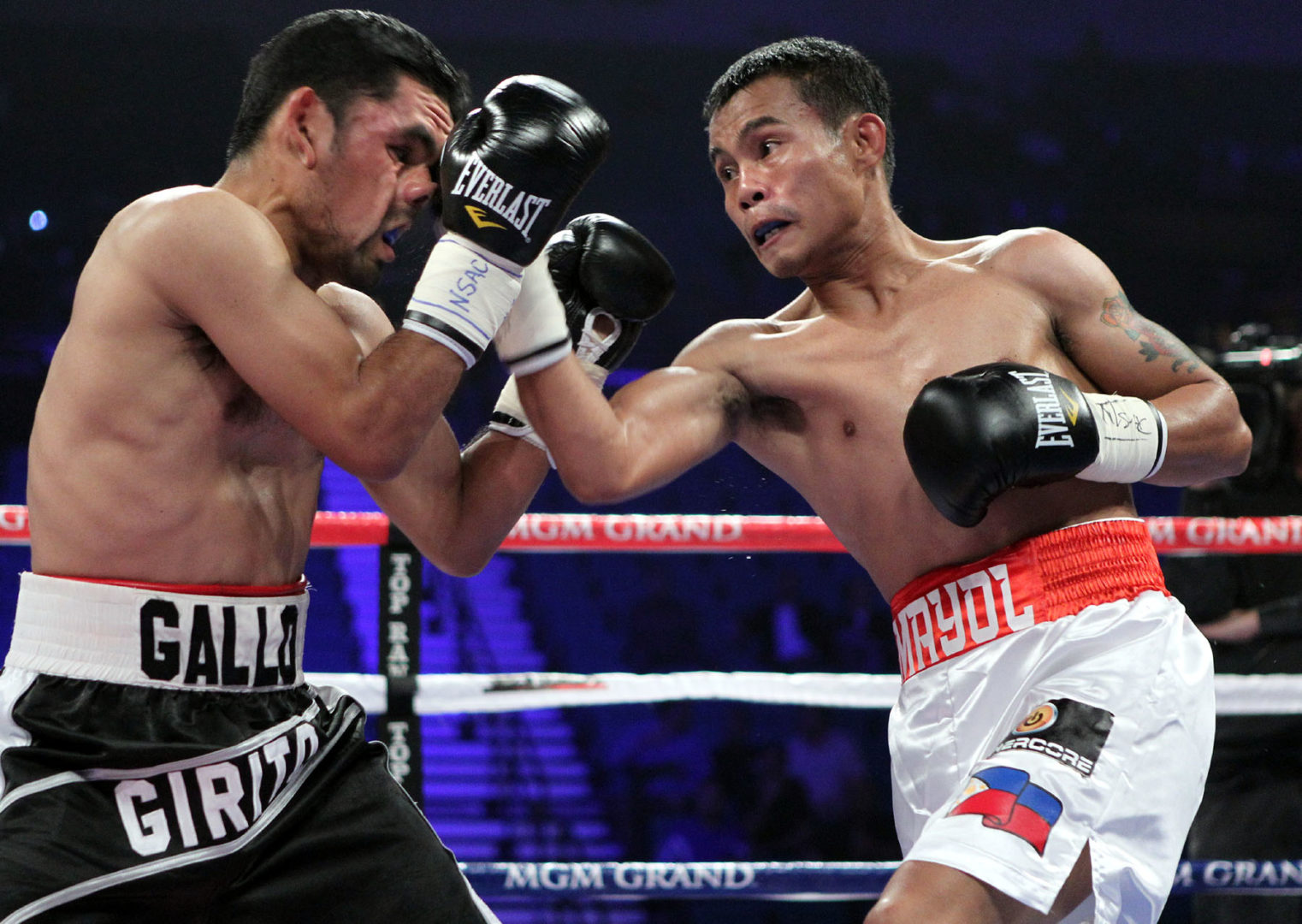
The undercard’s best: Welterweight Mark Melligen (21-2, 14 KOs), who had the Filipino flag on his trunks and Filipino fans in his corner, didn’t disappoint his countrymen with a unanimous decision over Mexican Gabriel Martinez (27-2-1, 14 KOs), who staged a ninth-round rally that was too late to save him from a one-sided loss on the scorecards.

The worst: Dallas lightweight Jose Hernandez (10-4-1, 4 KOs) had the fans screaming Si Se Puede, Si Se Puede. Either the judges don’t speak Spanish or they didn’t hear a chant that means Yes We Can, Yes We Can. Hernandez’ bid for an upset of unbeaten Mickey Bey of Cleveland (16-0-1, 8 KOs) fell a few points short. CJ Ross and Glenn Trowbridge scored it even, 76-76, each. Lisa Giampa gave it to Bey, 78-74, for a majority draw booed by a majority of the fans.

The rest: Welterweight prospect Yordenis Ugas (6-0, 3 KOs), a Cuban bronze medalist at the 2008 Olympics, continued his apprenticeship with a unanimous decision over a Sacramento opponent, Carlos Musquez (3-3-4, 3 KOs), who rocked Ugas in the opening round, yet did little throughout the next five.


Donaire, Montiel make weight in late date with the scale


LAS VEGAS – There was no discrepancy on the official scale, but there was one about the timing Friday before Nonito Donaire and Fernando Montiel weighed the mandatory 118 pounds for their bantamweight showdown Saturday night at Mandalay Bay.

There was talk that Montiel was annoyed that the weigh-in was delayed for about 25 minutes. Montiel’s representatives said Donaire was about a half-pound heavy when he tested the scale before the weigh-in was scheduled to happen in front of media and fans at a bar on the casino floor. The delay gave Donaire time to make weight, they said.

Donaire is listed at 5 feet -7, or three inches taller than 5-4 Montiel.

Donaire (25-1, 17 KOs), who is fighting for only the second time at 118, looks as if he could comfortably add weight and fight at a super-bantam (122) or featherweight (126). A move up in weight appears to be the plan for Donaire, a Filipino native who was born in General Santos City, also Manny Pacquiao’s hometown.

Montiel (44-2-2, 34 KOs), who holds the World Boxing Council and World Boxing Organization titles, has been campaigning at 118 since late 2008. His experience at the weight is thought to be a significant advantage, although Donaire was a 3-1 betting favorite late Friday.

Meanwhile, Jesus Soto-Karass was 146 pounds, one under the welterweight’s mandatory 147, for his rematch against Mike Jones. Jones, who won a majority decision over Soto-Karass in November at Cowboys Stadium in Arlington, Tex., was 147.


Pacquiao comparisons might be a tougher foe for Donaire than Montiel


Nonito Donaire faces expectations that are growing into a challenge more dangerous than even Fernando Montiel. The next Manny Pacquaio? The next bantamweight champion should be enough, but it isn’t for an audience and nation that apparently thinks Donaire will be the next Filipino boxer to visit the White House.

The next syndrome has undercut countless other careers. The next John Wooden never had a chance. Unfortunate Roger Maris could never be the next Babe Ruth. But here’s Donaire, a good fighter, already being asked to satisfy the Filipino appetite for another Pacquiao. There will only be one, especially after Pacquiao’s visit with President Obama further cemented a unique ascendancy to stardom attained by few.

Donaire (25-1, 17 KOs) can beat the accomplished Montiel. He is still this corner’s pick by decision. Donaire’s recent victories, including a fourth-round dismantling of Volodymyr Sydorenko, are full of signs that indicate he is a fighter just entering his prime. Donaire is bigger than Montiel. Younger than Montiel. He looks more like a featherweight than a bantamweight.

But doubts have increased with each headline calling him the next this and the next that. There are a lot of longtime ringsiders who think Donaire only will be Montiel’s next knockout victim. For Donaire, the coincidence of Pacquiao’s visit with President Obama a few days before opening bell Saturday night at Las Vegas’ Mandalay Bay only heightens the pressure on him to do what is impossible.

At Thursday’s news conference, Montiel had the benefit of lessons from a country that already has learned from the perils of searching for the next Julio Cesar Chavez. In Mexico, there will only be one Chavez.

“No one’s ever going to be Julio Cesar Chavez,’’ said Montiel (44-2-2, 34 KOs), who wants to become the first Mexican to win titles in four weight classes. “No one is ever going to come close to that.”

For Montiel, that acknowledgement allows him to be himself. For Donaire, there’s a lingering question about whether all of the attention on Pacquiao will be a distraction — a feint that takes his focus off the danger in front of him. There’s some irony in that. Pacquiao’s last fight was preceded by swirling stories about distractions that were supposed to have been his undoing against Antonio Margarito. Pacquiao conquered them and Margarito.

“I will be very happy if Nonito Donaire continues to win and beats all the top fighters and reaches the prominent position he is capable of,’’ promoter Bob Arum said.

But, Arum warned, Muhammad Ali couldn’t be cloned.

“You couldn’t duplicate Sugar Ray Leonard,” Arum said. “You can’t duplicate. But you forge your own story and that’s what Nonito is in the process of doing.

“It remains to be seen whether it resonates as much as Pacquiao or Leonard or one of these other guys.
“He is trying to create a great story for himself.’’

If Donaire’s story is about anybody else Saturday night, he’ll have to create a comeback.


Montiel’s promises for a new style might be the wake-up call needed to kick-start 2011


There’s a new wrinkle to a line that has echoed throughout boxing for as long as gyms have been full of the familiar rhythms from a speed bag. Yeah, styles make fights. That one fits like an old glove. But styles do more than that. They create audiences, which these days are more interested in fighters willing to risk a record instead of protecting one. Fernando Montiel has figured that out. At least, it sounds as if he has.

He returns to the United States for the first time in a year and to HBO for the first time since 2006 on Feb. 19 in an intriguing a bantamweight clash against Nonito Donaire at Las Vegas Mandalay Bay. About five years ago, Montiel was told he would never appear on HBO again. A split-decision loss to Jhonny Gonzalez was one thing. Another was a performance that included no compelling reason for anybody to think they’d like to see him an encore.

“That fight against Gonzalez, I think, was a question of styles,’’ Montiel said during a conference call Tuesday. “We just couldn’t get together. His style and my style could never match that night. It was a difficult fight for both of us and we each wanted to show something and it wasn’t possible.

“After the fight, I heard the criticism and thought I needed to do something about it. I did. I changed my style, became more aggressive. I wanted to give people a better show, a better fight. I think I have done that. My style is better and it has shown in my fights. Now I get another opportunity on HBO and I’m not going to mess it up.’’

Any change in style is problematic. It’s not as if Montiel (44-2-2, 34 KOs) or any other fighter can walk into a gym and order up a few alterations. He’s not visiting a tailor. Style is about personality, habit and instinct. All three will likely be tested by Donaire (25-1, 17 KOs), who isn’t a Filipino Congressman, yet often moves with the speed of the only one who is known in places other than the Pacific nation.

A Manny Pacquiao-like punch from Donaire, who like the Congressman was born in General Santos City, could quickly force Montiel into a comfort zone full of old habits, yet forgettable to the audience he hopes to create.

That won’t happen, promises the 31-year-old Mexican who is popular in his own country, yet mostly unknown in the United States. Montiel, who has held major titles at three weights – flyweight, super-fly and bantam, believes he re-fashioned himself in 2010, possibly as a dramatic finisher with four victories, all by stoppage. The key to re-opening the door to HBO was a fourth-round TKO of Hozumi Hasegawa in Tokyo last April.

Montiel also seems to understand that the timing of the Donaire bout is critical. A couple of weeks after Tim Bradley’s victory over Devon Alexander in front of a few customers and thousands of empty seats at the Silverdome in Pontiac, Mich., fans are still yawning. Montiel-Donaire is a chance to wake them up with a bout that promoter Bob Arum says has Fight of the Year potential.

“You have to fight smart, but I am here to entertain too,’’ Montiel said. “I want people to go in there and say that is a fight that they will remember for a long time. If we need to break into a war, let’s do a war if that’s what needs to be done. But it is certainly not going to be a boring fight.

“For sure, I am ready to risk getting knocked down and getting back up and knocking him down and him getting back up. I want it to be a great fight so everybody can remember.”

Memorable enough for a rematch, Montiel said.

“Maybe, two or three,” he said.

Maybe.

But after the Silverdome sleeper, one would be enough.


Headlines and counters while waiting for something Super after the Stupor


While hoping for a Super Bowl that doesn’t turn into the stupor left by Tim Bradley and Devon Alexander in a fight preceded by the same advertising adjective, some headlines and counters:

News item: An estimated 16,000 tickets are sold within about three hours for the Manny Pacquiao-Shane Mosley fight on May 7 at Las Vegas’ MGM Grand.

Reaction: Promoters Gary Shaw and Don King couldn’t give away that many tickets in 16 days or 16 months for Bradley’s technical decision over Alexander at the Silverdome in Pontiac, Mich., where the estimates were like the empty seats. They were all over the place. There are no reports on the number of paying customers. Let’s just say that the Silverdome’s box office has collected more dollars for its drive-in movie business last spring and summer.

News item: Bradley is expected to sign with Bob Arum or Oscar De La Hoya’s Golden Boy Promotions after his deal with Shaw expires, reportedly in May.

Reaction: If it’s Arum, don’t expect Bradley to fight for 140-pound supremacy with Golden Boy-promoted Amir Khan. If it’s Golden Boy, don’t expect a Bradley fight against the Arum-promoted Pacquiao.

News item: Bradley says he wants to fight Floyd Mayweather Jr.

Reaction: Get in line. Las Vegas and Nevada’s Clark County already have a couple of mandatories against Mayweather, including a trial on misdemeanor battery, rescheduled for April 25, and a hearing on March 10 for felony domestic abuse.

News item: Bradley says he wants to fight Pacquiao.

Reaction: Break the head-butt habit. It’s a pattern that continued with Alexander badly cut over his right eye, first from a Bradley head-butt in the third and again in the end, the 10th Pacquiao hasn’t lost since 2005 when a fifth-round clash of heads with Erik Morales left him badly cut, also above his right eye. Pacquiao was clearly bothered by blood streaming from the wound for the rest of the 12-round bout, which Morales won with a unanimous decision. Pacquiao might think twice about the threat of a bloody encore if he thinks Bradley can’t break the habit.

News item: HBO will honor its $1.25 million guarantee to Alexander with a possible fight against Marcos Maidana.

Reaction: Save the money, Devon, because it figures to be your last big payday. If the powerful Maidana is in shape, he will win by a crushing knockout, which narrowly eluded him in a scorecard loss to Khan.

News item: Khan fires conditioning coach Alex Ariza, who says he has yet to be paid for his work before a Fight of the Year victory over Maidana in December.

Reaction: Maidana trainer Miguel Diaz, who called Ariza “a fraud,’’ is laughing.

News item: Evander Holyfield’s fight with Brian Nielsen is postponed from March 5 to May 7 because of a Holyfield cut suffered on Jan. 22 in a bout with Sherman Williams.

Reaction: Huh? Holyfield fought Williams? He is scheduled to fight Nielsen, who hasn’t fought in nearly a decade? Holyfield-Nielsen has been re-scheduled for May 7? Won’t everybody be watching Pacquiao against Mosley then? Holyfield-Nielsen in Copenhagen? Not the Silverdome? Must be a night for drive-in movies.

News item: Pacquiao is already 2-0 at Cowboys Stadium, which means he has competed there two more times than the Pittsburgh Steelers and Green Bay Packers.

Reaction: Pacquiao will get some company in that unbeaten column. Steelers, 27-24.


Urgency in a poll is all the motivation Arum needs for bold move to CBS


Bob Arum’s bold move from HBO to CBS and cable subsidiary Showtime is all about numbers. CBS has a lot more of them, more than four times as many, than HBO. But there is another number, pathetically small, that is huge in significance and sums up the move’s urgency.

At about the same time that news of Arum’s deal with CBS/Showtime for rights to Manny Pacquiao-Shane Mosley on May 7 leaked last week, there was a Harris poll of American fans and their preferences in 2010.

Boxing was the favorite of one percent of those polled, right there alongside horse racing, women’s tennis and swimming. You can get more than one percent for a certificate-of-deposit at a bank these days. There’s just not much interest out there. If there is a trend in the Harris poll, the direction is ominous. It points to zero, which adds up to business no more.

Boxing trailed men’s tennis, track-and-field, men’s golf and bowling by one percent on a list topped by the powerful NFL at 31 percent. Golf, down two percent from 2009, figures to regain fans if Tiger Woods wins another major and stays away from waitresses at Denny’s. As long as there is a Michael Phelps, swimming can look forward to a percentage boost in 2012. As long as there is nicotine and standing pins, bowling will inhale and get its usual two.

With doubts about whether Pacquiao will ever fight Floyd Mayweather, Jr., however, boxing has nowhere to go. Nowhere but down, that is.

In 2010, boxing declined by one percent from the two percent it polled in 2009 and 2008. One more percent and it will fall to ground zero, alongside women’s basketball, golf and soccer. Women’s pro and college basketball, at least, has the NBA and Title IX to keep it afloat. But boxing has no sugar daddy. It only has its fans. The Harris poll indicates they are heading to the exits.

The poll also adds up to a message that screams for a new way to do business. Or else. Arum has heard it. Arum’s motivation for the move has been linked to several sources, according to various news stories and blogs. Discontent with HBO and the premium network’s relationship with Arum’s bitter rival, Oscar De La Hoya, is said to be one. I don’t know if it is. I also don’t care. It doesn’t matter.

Only boxing’s dire condition matters. Arum, the businessman, is moving toward CBS because its reach, 115 million households, represents marketing potential that HBO’s 28 million can’t match. There’s also the Latin population, the fastest growing demographic in the U.S.

Through CBS, Arum hopes to communicate with a larger and growing audience. In Pacquiao, he has international celebrity as a face for an attraction that might attract sponsors, introduce other fighters to a public that doesn’t know them from a lamppost and maybe – just maybe – return boxing to free-per-view.

In the process, Arum’s move might re-energize Pacquiao with motivation to fight on, even if that doesn’t mean Mayweather. I’m not sure if anything can heal Top Rank’s rift with De La Hoya’s Golden Boy Promotions. But 115 million households instead of 28 million could create pressure from a public that wants good fights instead of a tired feud.

In announcing the deal, Arum told reporters that he thinks it will get everybody in the business to do things differently.

If they don’t, they won’t be doing business at all.
A good decision for the future

Phoenix junior-welterweight Jose Benavidez, Jr. (10-0, 9 KOs) fought to a decision for the first time Saturday in Las Vegas in a six-round victory over Fernando Rodriguez (5-2, 3 KOs) of Dallas.

“It was a good fight for him,’’ said Phoenix Hall of Famer Michael Carbajal, who was at ringside to watch the 18-year-old Benavidez for the first time. “You’re not going to learn anything by knocking everybody out. That was the kind of fight he can learn from.’’

Carbajal, who posed for photos with Benavidez, liked what he saw.

“He really has potential,’’ Carbajal said. “If he keeps working, keeps learning, he has a chance to really do something.’’ Benavidez, who no longer has famed trainer Freddie Roach in his corner, was bruised in the fight, the toughest in his young career. His father and trainer, Jose Benavidez Sr., said training had been plagued by problems, including the flu. Benavidez still suffered from flu-like symptoms about 10 days before opening bell.

Jose, Sr., said he and his son had a heart-to-heart talk about the difficult bout and what it means. Benavidez’ immediate future might include his first bout in his hometown.

Top Rank matchmaker Bruce Trampler said he is looking for dates and a Phoenix site for Benavidez hometown debut. He was scheduled to fight in the Phoenix area last year, but the bout was canceled because TV Azteca and sponsor Tecate did not want to do business in Arizona amid controversy surrounding immigration legislation, SB 1070. Trampler said TV Azteca and Tecate have given him clearance to do a Benavidez fight in the state. The controversy has subsided, Trampler said.

“He is just anxious to go back to work as if he was starting a new career,’’ the senior Benavidez said. “He knows he is at new level now. It’s going to get tougher.’’


On the economic map, Motown and American boxing are in the same spot


Symbols have been attached to the Timothy Bradley-Devon Alexander fight, so many in fact that they might outnumber the tickets sold for the junior-welterweight bout at the Silverdome, a blimp-like arena in Pontiac, Mich., that for years has been full of only empty seats and hot air.

Conflicting and perhaps premature projections promise only more empties and air. Even with a good walk-up before opening bell on Jan. 29, there will still be a lot of both.

Ten-to-fifteen thousand seats are for sale in an arena once big enough for two crowds of more than 93,000 each for Pope John Paul II and Wrestlemania in 1987. Promoters Don King and Gary Shaw said the plan always has been to set up the arena for a fraction of its current capacity, now said to be 70,000. That’s a lot of curtains.

The dismal projections are unfortunate, mostly because they have become a story that takes away from a bout, as significant as it is intriguing, between two unbeaten fighters, both African-Americans.

When the site was first announced, Shaw told reporters that he wanted to stage the fight in a city with a big African-American population. Atlanta or Detroit, he said.

Detroit, Motown, sounded good then. It might have been, if the town was Detroit instead of Pontiac, a dateline and troublesome symbol in itself. A new Pontiac is harder to find than a good American heavyweight these days. There are none. General Motors quit making the car in 2009.

For symbolism, Alexander-Bradley belongs about 30 miles away, in Detroit, at Joe Louis Arena, which was named for an iconic and African-American heavyweight who made his historic impact before Jackie Robinson broke major-league baseball’s color line and Muhammad Ali opened his mouth.

These days, The Joe is a hockey arena, home for the Detroit Red Wings. On the night of Alexander-Bradley, the Red Wings won’t be there, but college hockey will be with Michigan-versus-Michigan State.

I’m not sure whether there was an alternate date at The Joe or on HBO’s schedule. I’m also not sure whether any arena anywhere was willing to pay the $500,000 site fee that Shaw and King reportedly got from the Silverdome. That dollar sign might have been the biggest symbol at play.

Even if Alexander-Bradley had wound up at The Joe on a different date, it might not have mattered. Last March, Arthur Abraham’s disqualification in the Super Six bout against Andre Dirrell, a native of Flint, Mich., at The Joe drew a disappointing crowd, reportedly about 5,000.

Predictably, Shaw expressed frustration at criticism of the site during a conference call Tuesday.

“First, let’s wait until January 29 and find out how many people are in there,’’ said Shaw, Bradley’s promoter. “No. 2, I put on the greatest fight of the decade, (Diego) Corrales vs. (Jose Luis) Castillo and we didn’t sell even 2,000 tickets. I never heard anyone say that it wasn’t a fight that was extraordinary.

“We have two great undefeated American fighters and we went to a place we thought was befitting. We never set if for 70,000 – the set-up was always going to be between 10,000 and 15,000. Those that came to the press conference saw how it would be mapped out. The Silverdome was well-prepared and did a great job.

“There should be compliments to the new owner of the stadium who wants to do more boxing and is willing to take the risk to bring big-time boxing back to the Detroit area. I think it’s a terrific place to do the fight. I’m not sorry and Don’s not sorry. We are doing something for that economy. We are bringing HBO, which is going to shine a big spotlight on that economy.

“Everybody claimed a couple years ago the U.S. automobile industry was dead. If you’d all bought stock in those companies, you would be rich today.’’

Please, promoters aren’t in the business of propping up any economy other than their own.

Yet, Bradley-Alexander is a worthy fight, mostly because it has a chance to stimulate interest in boxing’s battered model of an American game.

In terms of philosophy, this one has a chance to be a game-changer. American fighters have become increasingly protective of their unbeaten records – the so-called 0, which both Alexander (21-0, 13 KOs) and Bradley possess (26-0, 11 KOs).

Greatness in boxing is often measured in large part by how a fighter comes back from defeat. Rocky Marciano is known for retiring unbeaten, but is his name at the top of any all-time, pound-for-pound lists?

King said a lot of things during Tuesday’s conference call.

“Ticket sales will not determine the greatness of this fight,’’ King said.

Yeah, and I’ll be the next chairman of GM.

But he did say something that could help boxing recapture some of the fan interest that has eroded precipitously since last year’s second round of abortive talks for Manny Pacquiao-Floyd Mayweather Jr.

The winner, King said, will be a superstar.

“But the loser will be a star, too,’’ said King, who echoed a comment from Bradley 10 days ago when the multi-skilled junior-welterweight said big fights were more important to him than the play-it-safe desire to protect the 0 and only the 0.

If Bradley-Alexander can help alter thinking behind a zero-sum game, it will be remembered as a winner, regardless of the zip code.

“We can spotlight this hard-hit economy,’’ said King, who talked about Motown as if it were boxing.

On the economic GPS, they’re in the same place.


Looking for hope and finding some in an Arizona gym

PHOENIX – The calls have been coming from everywhere, from old friends and family. What the hell is wrong with Arizona?

I’m not sure how to answer that one, how to explain the damage done, the anguish felt in a state that has been home for more than 30 years. There simply is no explanation for the Tucson tragedy last Saturday that left six dead and 13 injured, including Congresswoman Gabrielle Giffords. I only know that it is another piece in a jagged puzzle. Unfortunately, it fits, fits like a sharp piece of broken glass. The puzzle? It’s still there.
Maybe, this is what anarchy is supposed to look like.

I don’t know. I’ll let somebody smarter, somebody from MSNBC or Fox News, figure that one out. After the toxic, still unresolved controversy about immigration and political campaigns full of fear-mongering lies about headless bodies buried in the desert, it’s hard to be optimistic about Arizona, where there must be something foul in what little water we do have. Maybe, friend and 15 Rounds colleague Bart Barry was right with his poignant column several months ago. He definitively answered the question with a moving van. He got the hell out, left Arizona and its state of fear, for San Antonio.

During the last few days, there have been moments when I wished I had been a stowaway, a refugee, from this state known for the Grand Canyon, also a metaphor for Arizona’s deep divisions between white and brown, Anglo and Latino, Spanish and Inglés.

But on Thursday I found a reason not to look for a new area code. I found some optimism. I found it in a gym. There was Jose Benavidez, Jr., sparring in a ring set up in old storeroom behind a patchwork of shops on hardscrabble west Van Buren Street in a Phoenix neighborhood where Spanglish is spoken.

The junior-welterweight prospect is home after about a year in Los Angeles at the Wild Card Gym with famed trainer Freddie Roach. Benavidez and his father, Jose Sr., split with Roach for reasons that aren’t exactly clear. There has been speculation about problems between Roach and Benavidez, Sr. Not true, say father and son. Roach has been busy with Manny Pacquiao, Amir Khan and Julio Cesar Chavez Jr. The split with Roach was mutual, both say. The prospect and the trainer are still friends, they say.

Above all, the son is simply happy to be back. Forget author Thomas Wolfe’s defining line about not being able to go home again For Benavidez, home has been changed dramatically by the immigration debate raging over SB 1070. There also is proposed legislation that would overturn the 14th Amendment and deny citizenship to so-called anchor babies, those born to parents in the U.S. illegally.

If there had been no birthright citizenship before 2008, there would have been no Henry Cejudo at the Beijing Games. Cejudo, who grew up in Phoenix and has trained with Benavidez, was one of the best stories at the last Olympics. His gold-medal in freestyle wrestling was captured forever in a photo of him racing across the mat with the American flag flying off his shoulders like superman’s cape. Cejudo, who will return to wrestling in a bid for more Olympic gold after going 2-0 as an amateur boxer, was born in Los Angeles to former illegal immigrants. If Arizona legislators succeed, they could eliminate the next Cejudo, the next American victory. But that’s another story for another time.

For now, it’s about Benavidez and his hopes for the kind of fan base that is loyal, unique and often can define a fighter. Think of Michael Carbajal. He would have been a terrific junior-flyweight anywhere. If he had not generated a large following in Arizona, however, he would not have emerged as somebody special, a Hall of Famer. Benavidez is still a fighter without that identity, a man without a country. Throughout nine pro bouts, the unbeaten Benavidez has yet to fight in his home state, much less his hometown. Top Rank plans for his Phoenix debut last summer were scuttled when TV Azteca and sponsor Tecate decided they didn’t want to do business in Arizona because of SB 1070.

Benavidez and his father even had anti-SB 1070 T-shirts made. They had had planned to wear them at a bout in Chicago, but the shirts were lost before opening bell of a first-round knockout of Ronnie Peterson. Benavidez said he still plans to wear one, possibly at his next fight Jan. 22 at Texas Station Casino in Las Vegas against Francisco Rodriquez (5-1) of Dallas. If not Vegas, maybe he’ll wear one in Phoenix. Top Rank matchmaker Bruce Trampler said he has clearance from TV Azteca to proceed with plans for a Benavidez bout in Arizona.

The controversy has subsided, Trampler said.

“We’re actively looking to do a fight here that would highlight Benavidez,’’ Trampler said Thursday as he watched the 140-pound prospect spar.

The renewed plans must sound like Home, Sweet Home to Benavidez. Throughout nine bouts on the road, he has worn Phoenix on his trunks like a varsity letter. His loyalty is there to see. And hear.

“This is my home, and of course that’s not going to change,’’ Benavidez said. “I was raised here. If I ever become famous, I want to bring that Arizona part of me with me. It’s going to happen. Everything, I guess, happens for a reason. My friends and my family tell me just to have patience. They know who I am, where I’m from. They always tell me how proud they are when they see the Phoenix, Arizona, on my trunks.’’

Benavidez’ tone was that of somebody who wanted to fight instead of flee despite the dispiriting succession of events that have kept his home state in turmoil and now tragedy. As I listened to the 18-year-old Benavidez, I couldn’t help but think of another Mexican-American and fellow Arizonan.

He is 20-year Daniel Hernandez, a University of Arizona sophomore who rushed to Rep. Gifford’s side seconds after she was shot through the head. He stopped the bleeding, perhaps long enough to save her life. At a memorial Thursday at Arizona’s McKale Center, Hernandez said he wasn’t a hero. Instead, he talked about a moment that he said would eliminate divisions and unite Arizona.

I hope he is right. I only know for sure that Hernandez will be my answer for the next out-of-state call with questions about my home. Hernandez is one reason to believe that Arizona can begin to pick up the pieces and start over. Benavidez is another.


Blame is everywhere, even on a ballot, for no Pacquiao-Marquez rematch


As criticism of Bob Arum’s decision to go with Shane Mosley instead of Juan Manuel Marquez for Manny Pacquiao’s next fight on May 7 lingers like a Holiday hangover, there’s a ballot that unwittingly supports Arum’s controversial move.

Marquez isn’t among the nominees for 2010 Fighter of the Year, the most prestigious prize among those that the Boxing Writers Association of America presents every year after a January vote. Pacquiao, Filipino Congressman and international celebrity, is there and should be. So, too, are Wladimir Klitschko, Sergio Martinez, Giovani Segura and Andre Ward.

Marquez’ absence is an omission that Arum can mock, seize and spin into a sales pitch for Mosley-Pacquiao, which has been battered from pillar-to-post by condemnations from everybody who has ripped the Top Rank boss for letting his feud with Golden Boy Promotions get in the way of a Marquez-Pacquiao rematch.

If the writers don’t include Marquez at the top of their ticket, why would the public buy one? All along, Arum has said that Marquez is not known by the casual, so-called crossover customer, who apparently couldn’t pick him out of a lineup that includes Joshua Clottey, Antonio Margarito and a couple of lampposts.

Arum’s argument about Marquez sounds like a rhetorical feint, if not an insult to Mexico’s many fans, who aren’t casual about their country’s best fighters. Besides, Pacquiao’s international stardom is such that I’m beginning to think he could draw a crowd against one of the lampposts, which might prove to be more durable than the faded Mosley.

There are plenty of reasons for Marquez’ absence from the ballot. Plenty of blame, too. Start here. Start with me. I didn’t nominate him, mostly because I overlooked him all over again and also because I would not vote for him even if he were a 2010 nominee. My vote is for Martinez, the likely winner for his rocket-like rise to prominence with a victory over Kelly Pavlik and dramatic knockout of Paul Williams.

Hindsight and December hot debate about Pacquiao against Mosley instead of Marquez, however, forced me to re-think the ballot. Instead of Klitschko or Ward or even Segura, Marquez should have been one of the five nominees.

Klitschko retained his heavyweight control of the Euro zone with victories over Samuel Peter and Eddie Chambers. He figured to win both.

In opponent shuffles that have plagued the 168-pound division’s Super Six, Ward beat Sakio Bika and over-matched Allan Green. No surprise there either.

Segura, a Mexican junior-flyweight, proved to be as much of a surprise as he is unknown. In 2010, Segura went 4-0, adding the World Boxing Organization’s 108-pound title to the World Boxing Association’s version in a run that included a stunner – a stoppage of Puerto Rican Ivan Calderon in a bout nominated for Fight of the Year.

OK, keep Segura on the ballot. Instead, subtract Klitschko or Ward and add Marquez, who came back from a one-sided loss in late 2009 to a bigger Floyd Mayweather Jr. with victories in 2010 over Juan Diaz and Michael Katsidis.

In July, Marquez won a unanimous decision over Diaz in a rematch of a Marquez victory, a ninth-round stoppage, in the 2009 Fight of the Year. In November, a dramatic ninth-round TKO of Katsidis is on the 2010 ballot for Fight of the Year. If a victory in a fight voted as the best in one year followed by another win in a fight nominated to be the best in the next year doesn’t add up to some consideration for Fighter of this Year, what does?

Even if he doesn’t win the vote, his nomination represents a measure of respect that has been withheld, perhaps because of his consistency. The 34-year-old Marquez, who fought Pacquiao to a draw before losing a controversial split-decision to the Filipino, has been practicing it for so long that there is nothing new about his tactical brilliance. It’s expected, meaning that – yawn – it’s assumed and easy to forget.

Too easy.

I forgot about Marquez and so did my colleagues. The BWAA selected Pacquiao as Fighter of the Decade, which makes Marquez the Most Unappreciated Fighter of those same 10 years. If we can’t put Marquez on the ballot, it’s hard to rip Arum for not making the rematch in a rivalry that is a third leg short of being a decisive trilogy.


A few picks, but no promises, for 2011


Predictions are a lot like contract clauses, which is to say they are hard to fulfill. They fall apart faster than Jean Pascal. So don’t take them seriously, especially after a problematic 2010 left a fractured web of further trouble in 2011. But here goes anyway,15 predictions for every round in a New Year:

· Floyd Mayweather Jr. will only fight security guards and only if they undergo Olympic-style drug-testing.

· Filipino Congressman Manny Pacquiao thinks about becoming his own security guard, but decides he has better things to do. He writes and proposes legislation; raises funds for his presidential campaign; asks Freddie Roach to be his running mate; asks Bob Arum to be his Secretary of Defense; studies for a couple of movie roles; plays point guard, power forward, shooting guard, center, small forward and sixth man; negotiates for ownership of an NBA franchise; tries to sing; puts off singing lessons; speaks to the United Nations; writes his autobiography; visits Barack Obama; hosts a talk show and assures the faithful that he isn’t distracted. What, Manny, worry? He stops Shane Mosley within nine rounds on May 7.

· For a couple of rounds, Mosley looks better than expected. He pushes the Manny congregation to the edge of despair with an early knockdown of Pacquiao. A red-faced Arum can be heard screaming at Todd DuBoef, telling him to arrange an immediate rematch with either Joshua Clottey or Antonio Margarito. But like the T–Shirt says: Manny Knows. Translation: No worries. Wear and tear from a long career, combined with Pacquiao’s inexhaustible energy and speed, sap Mosley, turning him into the burned-out shell he was against Sergio Mora.

· Miguel Cotto gets in the last word against Ricardo Mayorga, everybody’s first choice for a tune-up, and then moves onto some unfinished business against Margarito. Cotto avenges his 2008 loss to Margarito. Cotto never mentions whether he suspects that Margarito wore the altered hand wraps that led to his license revocation after they were discovered loss to Mosley. He doesn’t have to. A one-sided victory says it all.

· The Arum-Oscar De La Hoya feud continues, also a safe for prediction for 2012, 2013, 2014, 2015 and beyond, say, until sometime after Pacquiao’s term as the Filipino president ends.

· Pascal says he doesn’t do rematches, even though Bernard Hopkins earned one in a majority draw and a contract clause entitles Chad Dawson to one. Pascal doesn’t do late rounds either, a habit which would doom him in another go-round with either Hopkins or Dawson, who figures to be smarter and much tougher with trainer Emanuel Steward.

· Juan Manuel Marquez beats Andre Berto and again asks for a second rematch with Pacquiao. Arum, already in a never-ending battle with Marquez promoter De La Hoya, is running short on reasons to avoid Marquez. But Arum re-opens a forgotten front. He tells Marquez to dump trainer Nacho Beristain, who has been a forgotten in the ongoing saga. Beristain walked out of a news conference amid an exchange of obscenities after Pacquiao won a disputed decision in their last bout. Years ago, Beristain ended his relationship with Arum after an angry breakdown in negotiations.

· Sylvester Stallone opens and concludes his acceptance speech in June for induction to the International Boxing Hall of Fame by saying “Yo.’’

· Mike Tyson tells the Hall of Fame audience in June that he doesn’t really belong in the Hall, but he has already been there in photos and memorabilia for several years anyway. Tyson’s induction, a worthy one despite the controversy surrounding him throughout his career, only makes it official.

· The Hall announces plans for a Hollywood wing. Mark Wahlberg is nominated for spot in Hall alongside Stallone for his starring role in The Fighter. Some critics continue to call The Fighter the best film ever about boxing. They must have never seen When We Were Kings, the poignant story about Muhammad Ali’s 1974 victory over George Foreman in Zaire. It’s a documentary, which means the drama is real in a sport that is so often its own screenplay.

· Evander Holyfield doesn’t retire. Hopkins, Antonio Tarver and Glen Johnson don’t either.

· Beyond his boxing prime and a mixed-martial bust, James Toney has nowhere to go. He becomes a pro wrestler.

· Saul “Canelo” Alvarez calls out Julio Cesar Chavez Jr. Canelo tells him: “Let’s fight at Azteca Stadium and see if we can do what your daddy did.’’ Chavez’ father, the legendary Julio Sr. and another 2011 Hall of Fame inductee, drew a record crowd of 132,247 to the Mexico City stadium for his 1993 victory over Greg Haugen..

· Amir Khan unifies the junior-welterweight title and begins talks about moving up in weight and class, possibly against Cotto.

· The heavyweights get a new name, the Euros, overrated and devalued.


Say goodbye and good riddance to 2010

It will be remembered for what didn’t happen instead of what did and for a self-proclaimed face of the game seen more often in a booking photo than the ring.

To 2010:

Bah, Humbug.

Manny Pacquiao-Floyd Mayweather Jr. didn’t happen in March, didn’t happen in November and might have its best chance at happening in virtual reality. Look for the video game in neighborhood stores, maybe next Christmas. With legal trouble multiplying for Mayweather and his future subject to a jury’s unpredictable deliberations in a domestic-abuse trial scheduled for Jan. 24, he only will be fighting to stay out of jail, at least in the near term.

There is a cynical temptation to say that Mayweather’s legal bills are the only way to ensure a fight that has become the real face of a business that can’t get its divided house in order. He’ll need the money. Whatever finally happens, abortive negotiations throughout a futile year have set the stage for more trouble in 2011, which is already clouded by Holiday condemnations for promoter Bob Arum’s decision to go forward with Pacquaio against a faded Shane Mosley on May 7 instead of worthy Juan Manuel Marquez.

If Pacquiao-Mayweather doesn’t come off later in 2011, it will be more of the same. If it does, cynics and conspiracy theorists will spin damning speculation. You can hear it now. If Mayweather is acquitted or gets probation, blogs and talk shows will be full of suggestions about how the casino industry and politicians pressured the prosecution into a deal for a fight that could be a stimulus that Vegas needs in a wager to lift itself out of recession,

At the intersection of Sin City and boxing, there is suspicion at every turn.

Reasons for optimism have been lost, trampled, in the attention to do just one fight. Blame Arum. Blame Oscar De La Hoya. Blame the he-said, she-said feud between De La Hoya and Arum. Blame the media, which pursues page views and internet hits like Arum and De La Hoya chase money, which means mentioning Pacquiao and Mayweather, Mayweather and Pacquiao gratuitously, ad nauseam and all too often at the expense of everybody else.

In November and early December, there was a chance to salvage 2010 with a string of terrific fights. There was a banquet from which to pick Fight of the Year contenders, one after another. The pick in this corner is Humberto Soto’s victory over Urbano Antillon on Dec. 4 in Anaheim, Calif. But there is no argument with Amir Khan’s gritty stand against Marcos Maidana on Dec. 11 or Juan Manuel Marquez’ comeback drama against Michael Katsidis on Nov. 27. For emphasis, there was a knockout on Nov. 20 as good as any from Sergio Martinez, the likely Fighter of the Year whose left hand in the second round sent Paul Williams crashing to the canvas like a demolished building.

But there was a disturbing sign at all of those memorable fights. Attendance was down. On good nights, crowds of maybe 5,000 showed up. For Khan-Maidana in Vegas, there were reports of ticket upgrades and giveaways.

Even beneath the big top in a ring above the 50-yard-line and below the Jerrytron on the Dallas Cowboys home field at Texas Stadium on Nov. 13, there was a crowd that failed to fulfill Arum’s expectations for Pacquiao’s dismantling of Antonio Margarito. Arum predicted more than 60,000. But the announced crowd was 40,154. Of that, paid attendance was 30,437, according to the Texas Department of Licensing and Regulation. Even with 9,717 comps, Pacquiao-Margarito fell about one-third short of Arum’s projections. On Wall Street, that would lead to a huge sell-off.

In recession-plagued Vegas, economic woes are a reasonable explanation for slow sales especially for two cards, Marquez-Katsidis and Khan-Maidana, without an American in the main event.

The Pacquiao-Margarito shortfall is harder to explain, especially with Pacquiao’s international stardom at the top of a card against a well-known Mexican, Margarito, in a city with a big Mexican and Mexican-American population. Also, Texas is reported to be one of the few states on solid economic footing. So what gives? In this era of HD television and screens that are getting cheaper by the day, there’s good reason to stay home and watch.

Nevertheless, there’s a theory that the live gate is still a good indicator of whether a fight is attracting so-called crossover fans. They’ll shed their ambivalence about boxing and show up in person to see more than a fight. They want to experience it as well. That they weren’t there in the expected numbers adds up to a problematic 2011.

One guess is that they stayed home, went to a concert or out to dinner, because of Pacquiao-Mayweather talks that went nowhere once, then twice. See ya.

There’s been lot of talk that boxing is finally making matches that matter. True enough. Soto-Antillon, Khan-Maidana, Marquez-Katsidis, Martinez-Williams, Juan Manuel Lopez’ victory over Rafael Marquez and even Bernard Hopkins controversial majority draw with Jean Pascal are all evidence of that. Those were good fights, some great,

But the crossover crowd had lost interest in the empty aftermath of talk about nothing. For the casual fan, it’s hard to believe that any fight can be a good one if the best one can’t be put together. If customers can’t get what they most want, they’ll move on, no matter what else is in stock.

This is the season to talk about awards, about who is worthy and who’s not. But 2010 will be remembered for America’s empty seats, which are beginning to look like a prize you can’t even give away anymore.


The unabridged Hopkins faces a last stand at adding another chapter to a long book


A conference call with Bernard Hopkins is a lot like his career. It goes on forever, which is one way of saying he has been at it longer than anybody ever imagined.

The unabridged Hopkins added volumes in a call last week and plans to deliver on the filibuster’s promises Saturday in Quebec City with another defiant stand against time and Jean Pascal.

“Walking away because of my age would be a disservice to what I bring to boxing,’’ said Hopkins, who has already made history and wants to make more by becoming the oldest ever to win a major title, the World Boxing Council’s light-heavyweight crown.

Not talking, instead of walking, would be the bigger disservice. It’s hard to know what Hopkins can still do as a fighter. Let’s just say that it would have been a service to boxing if he had not fought and beaten Roy Jones, Jr., in his last outing. Hopkins-Jones was bad enough to be irrelevant, which is something that Hopkins-Pascal is definitely not.

I suspect nobody knows that better than Hopkins, who at 45 and within a month of turning 46 will be 38 days older on Saturday than George Foreman was when he beat Michael Moorer for a heavyweight title in 1994. In beating a younger man, there was newfound respect, relevance and pop-like stardom for Foreman among generations that knew him more for a hamburger grill than Muhammad Ali.

Hopkins likes to talk about going old-school. In taking on a fighter near his prime, however, Hopkins isn’t pursuing anything old, or even nostalgic. He’s battling to stay current, determined to prove he still belongs in the middle of the ring instead of in a commentator’s seat at ringside, wearing a tux and an ear-piece.

In part, that means pressure, which has always been there for Hopkins, yet inevitably builds with the time he has so famously been able to manage but will never stop.

“Even if I lose, I’m still young,’’ said Pascal, who is defending the WBC title for the first time. “I can do it again. But Bernard, if he loses, that’s going to be the end. This is it for him.

“He is going out there with all pressure. Even if I’m the champion, it doesn’t matter because he’s the legend. He’s got the legacy. He has to back it up, his history.’’

He also has to back up his words. He is as good at that as just about anybody. The conference call stand-up is one way. He talks, talks and talks, forcing himself to live up to all he says. It’s self-imposed, perhaps. It’s a little bit like former Indiana Pacers shooter Reggie Miller. He needed Spike Lee as an antagonist, as motivation. Lee was always there, in a prime seat in the NBA playoffs, to heighten Miller’s energy and focus.

In conference calls, Hopkins finds his audience of antagonists. Real or imagined, one thing is always certain: The more there are, the better.

“I must say, the naysayers, I thank them because they have been a big part of me proving that I can do it,’’ said Hopkins, who went on to say “thank you, thank you, thank you.’’

I don’t count myself as a Hopkins naysayer, although I’m sure he’d argue right now. I like him, mostly for what he says. Yeah, there is some recklessness in his words. His racial remarks often come off as gratuitous, especially if it is just seen in print.

In person, Hopkins mixes outrage with comedy and uses a tone that says he is willing to talk about it. He has long been condemned by some colleagues for screaming at Joe Calzaghe that he would never let “a white boy beat him.’’ But he made the remark seconds after he told British writers that the “UK has better health care than America. Then again, you all drink a hell of a lot more than we do.’’

Much of what Hopkins does is theater, pure shtick.

But his date with Pascal appears to be serious. It is taking on the dramatic look of a potential last stand. Can he beat the younger man? Sure. But I don’t see how. I don’t think he has even a fraction of the hand speed possessed by the quick Pascal.

Then again, I’ve always been wrong about Hopkins. I picked Felix Trinidad in 2001. Hopkins won. I picked Kelly Pavlik in September, 2008. Hopkins won. The judges gave Joe Calzaghe a victory by split decision in April, 2008. On my card, Hopkins and Calzaghe fought to a draw.

I might be wrong all over again. But another conference call would be good consolation.

“When it’s over with, who else are you going to ask a question for two seconds and get a 10-minute answer?’’ said Hopkins, who was only wrong about the 10 minutes.

More like 60.


Khan survives Maidana storm


LAS VEGAS – LAS VEGAS – Amir Khan’s date with stardom is still there. But for one night it had to wait. Survival got in the way and perhaps forged a stronger possibility that Khan will indeed be the next big thing in boxing.

First, however, he had to prove he could endure.

Khan (24-1, 17 KOs) did so Saturday night in front of an announced Mandalay Bay crowd of 4,600 against volatile Marcos Maidana (29-2, 27 KOs), the son of an Argentine gaucho who was as wild and dangerous as an angry stallion.

Maidana suffered a first-round knockdown from a body punch, a Khan left that he never saw. He was penalized a point by referee Joe Cortez in the fifth for throwing an elbow. In every round, he threw punches that sometimes left Khan looking dazed and often left at the perilous edge of defeat.
Khan danced away, ducked, countered and desperately held on to victory. He won a decision that was unanimous in name only and narrow in fact.

Judges Jerry Roth and C.J. Ross scored it for Britain’s 140-pound champion, 114-111 each. On Glenn Trowbridge’s card, it was even closer — Khan by a mere point, 113-112.

Immediate emotion after the final bell was evident in some frustration expressed by Maidana’s corner, which to a man was convinced that they had been robbed of victory.

“I thought I did enough in the later rounds to win,’’ Maidana said.

An unidentified member of Maidana’s corner rushed into the ring and appeared to go after Cortez.
He couldn’t get to him, unlike Maidana, who repeatedly got to Khan.

For Kahn, however, part the victory as in a newfound ability to withstand the most powerful puncher in the division. His ability to take a punch has been an apparent weakness since he was stopped within a minute by by Breidis Prescott.

“I’ve got a chin,’’ Khan said. “I was hurt, but I came back stronger.’’

Strong enough perhaps to become the star that everybody believes he can be.

The assumption was that Victor Ortiz was fighting for a chance at a rematch with Marcos Maidana.

Think again.

First, Ortiz might have to settle for a rematch with Lamont Peterson.

Ortiz’ priorities and perhaps career were shuffled with a majority draw Saturday night with Peterson at Mandalay Bay in a junior-welterweight steppingstone before Maidana’s bid at an upset of Amir Khan.

Two judges scored, Dave Moretti and Patricia Morse Jarman, scored it 94-94. On judge Robert Hoyle’s card, it was 95-93 for Peterson.

Ortiz (28-2-2, 22 KOs) was left with the tie, an ambivalent mark on his resume, after scoring two knockdowns in the third round. Slowly, Peterson (28-1-1, 14 KOs) came back with series of punches that lacked power, yet were on target.

“I fell like crap,’’ said Ortiz, whose career was stalled when he was knocked out in 2009 by Maidana. “I thought I pulled it off. He doesn’t hit that hard. But, you know, bleep happens.’’

But there was more than just bleep. There were precise Peterson punches from the seventh round through the 10th. He repeatedly sent sweat flying off Ortiz’ face and head with lefts, rights and just about anything else he threw. Peterson landed 111 punches to 95 by Ortiz, according to PunchStats.

It said Mr. Nice Guy on the green waistband of Jacob Thornton’s trunks.

No argument there.

Thornton (2-2), a super-lightweight from St. Louis, was nice enough to go to his knees in the opening seconds of a first-round loss to Jamie Kavanaugh (4-0, 2 KOs) of Los Angeles.

Forty-four seconds after opening bell for the third fight Saturday on the card featuring Amir Khan-Marcos Maidana at Mandalay Bay, Kavanaugh’s opening assault left Thornton kneeling. It looked as if he were begging for a stoppage.

Junior-welterweight Sharif Bogere (18-0, 11 KOs), an African living in Las Vegas, had the look of a lion. The face of one adorned the front and back of his black trunks. A woman in lion’s costume accompanied him into the ring in the fifth fight on the Khan-Maidana card. Chris Fernandez ( 19-11-1, 11 KOs) of Salt Lake City was prey. Boegere, blood streaming from cuts near both eyes, mauled him for eight rounds, winning a unanimous decision.

Referee Jay Nady granted Thornton’s apparent wish, stopping the fight as though it had been scheduled to last only within the span of two NBA shot clocks.

In the card’s second bout, super-bantamweight Randy Caballero (6-0, 4 KOs) of Coachella, Calif., got a predictable victory and some necessary work in a four-round unanimous decision over Robert Guillen (5-9-3, 1 KO), a tough Phoenix fighter who was knocked down in the opening round.

The show opened in front of few fans and fewer chances for Arizona middleweight Gustavo Medina (1-3-1), who had no defense and even less offense in a third-round loss by TKO to rangy Venezuelan Alfonso Blanco (2-0, 1 KO).

The fourth bout on the Khan-Maidana card was a cross-town battle, two junior-welterweights from Las Vegas. Unbeaten Jessie Vargas (13-0, 7 KOs) prevailed. With Floyd Mayweather Jr. advisor Leonard Ellerbe in his corner, Vargas scored an eight-round, unanimous decision over Ramon Montano (17-9-2, 2 KOs).

Junior-welterweight Sharif Bogere (18-0, 11 KOs), an African living in Las Vegas, had the look of a lion. The face of one adorned the front and back of his black trunks. A woman in lion’s costume accompanied him into the ring in the fifth fight on the Khan-Maidana card. Chris Fernandez ( 19-11-1, 11 KOs) of Salt Lake City was prey. Boegere, blood streaming from cuts near both eyes, mauled him for eight rounds, winning a unanimous decision.

Heavyweight Seth Mitchell (20-0-1, 14 KOs) won the card’s sixth bout. But he didn’t celebrate. At least, not immediately. The ex-Michigan State linebacker was disappointed that Taurus Sykes (25-7-1, 7 KOs) of Brooklyn quit. Not long after a Mitchell left dropped him early in the fifth, Sykes went down again from what appeared to be a grazing punch. Mitchell urged him to get up. Sykes wouldn’t. He stayed down, a KO loser, at 1:42 of the fifth. Mitchell waved his gloves at him in disgust. Then, he celebrated.

In the end, only a white towel was defense against New York welterweight Joan Guzman (31-0-1, 18 KOs). Jason Davis’ corner threw it in surrender at 29 seconds of the second after the intimidated Canadian (11-8-1, 3 KOs) was unable to cope with the powerful Guzman, who dropped him in the opening round with a low blow in the card’s seventh fight and the last one before junior welterweight Victor Ortiz and Lamont Peterson clashed in the co-main event.