Mayweather says he’s the savior, but Naazim Richardson is already on the job

In simply doing his job, Naazim Richardson already has done more to clean up boxing than any grandstanding proclamation from Floyd Mayweather Jr., who has anointed himself as the game’s undisputed savior with Olympic-style drug-tests that apparently happen as often as conference calls before his May 1 showdown with Shane Mosley at Las Vegas’ MGM Grand.

If not for Richardson’s due diligence before Mosley’s last victory more than a year ago, Antonio Margarito might have continued to fight with hand wraps described as everything from irregular to criminal. Whatever they are called, there would be no debate and perhaps no movement for regulatory change in how wraps are applied and provided if not for Richardson. His instinctive eye for detail is about survival, which he learned on the street and practices in a corner. Ropes don’t confine the task. It doesn’t begin or end with an opening or closing bell. It’s just the job, which is as challenging as ever for Richardson in preparing for a May Day that Mosley says will belong to him.

As Richardson proved before Mosley’s stoppage of Margarito more than 15 months ago in Los Angeles, fights often turn on what happens before they ever begin. It’s a lesson not lost on the heavily-favored Mayweather, who launches his sharp-edged rhetoric like artillery-fire long before the fighters invade the ring. Mayweather is at it again. He wonders if Mosley already is feeling pressure.

Why else, he says, would he suddenly show with a Polynesian-style tattoo across one shoulder.

“Why would someone wait until they are 38 years old to get a tattoo?’’ Mayweather said Wednesday during a media day while working out in Las Vegas.

Crank up the volume. Mayweather, trainer-and-uncle Roger and father Floyd Sr. are just getting started.

“Hysteria,’’ Richardson says of the predictable storm of expletives and insults.

That’s a good description. It’s also been a good weapon for Mayweather, a cautious, clever and unbeaten fighter who waits on the other guy to make a mistake. If his jab and defense don’t create one, maybe anger from a well-timed insult will. From day-to-day through the next two-plus weeks, the detail-oriented Richardson will try to guard against exactly that.

“I will keep him focused on the task at hand and not let him get caught up in the Mayweather hysteria,’’ Richardson said at Mosley’s media day Monday in Los Angeles.

Easier said than done, perhaps, simply because the Mayweathers will say whatever they can for as long as they can in a noisy attempt to find a chink in Mosley’s psychological armor. If there is a silencer, however, it might be Richardson. Listen to him and you get the idea that specifics matter. Noise doesn’t.

During a conference call Tuesday that included Roger Mayweather and some contentious give-and-take about drug testing, Richardson: “If you asked me to respond to everything Roger is saying. I wouldn’t have time to train my athlete.’’

Richardson’s stubborn adherence to detail — and only detail — looms as an effective counter to the many distractions inevitable in any fight against Mayweather. One important detail is character. It’s a lot more subjective than, say, a problem in an opponent’s hand wraps. But it is there, fundamental to the job and getting it right. In Mayweather, he sees a fighter who loves to talk and uses negotiations, media days and conference calls as if they were the early rounds. In Mosley, he sees somebody who just wants to fight.

“I respect Shane and I love his approach as an athlete, how he does his job and takes it on,’’ Richardson said when asked if Mosley conceded too much at the bargaining table when he agreed to random drug testing and a rematch clause for Mayweather. “But I tell him to his face: I think he is a poor negotiator. He wants to fight so bad he doesn’t care. He’d let Roger be one of the judges.
“Shane would agree to it. He just wants to fight.’’

The trainer went on to say that Mosley would agree to fight with one hand tied behind his back. He was exaggerating. Kind of. It couldn’t happen. Richardson. Who has Mosley’s back, wouldn’t let it happen any more than he would have let Margarito fight armed in altered hand wraps.


Pavlik anxious to rally after a long recession


Nobody has to tell Kelly Pavlik about The Great Recession. He lived it. His career declined like the economy from late 2008 through 2009. It’s hard to say whether projections from so-called business experts are bearish or just more bull. But at least Pavlik has a chance in hand, now healthy, to restore fundamental confidence in an attempt to forget the last 18 months and perhaps re-create a promising future.

Pavlik’s first fight in 2010, a Home Box Office-televised date on April 17 against Sergio Martinez in Atlantic City, is being called the most important middleweight fight in several years by promoter Bob Arum.

Important means it is an indicator about whether it is time to re-invest in Pavlik, whose future was knocked sideways in October, 2008 by Bernard Hopkins and almost knocked out a few months later by a dangerous infection on the middle knuckle on the index finger of his left hand. The infection and maybe Hopkins are gone. But some of the questions aren’t. Pavlik knows that. He has the scars he can see. But professional maturity is often about dealing with the unseen. Second-guessing and unfounded speculation leave their own scars.

“Flak,’’ Pavlik said Thursday during a conference call in a matter-of-fact tone that also seemed to say that he has come to terms with it

Flak is the price of stardom these days and perhaps in any day. Manny Pacquiao has had to endure it in rumors about performance-enhancers that were planted by Floyd Mayweather Sr. and have continued in the wake of negotiations for a March fight that fell apart when Floyd Jr. demanded Olympic-style drug testing. Hopkins is dealing with it all over again from critics and allies urging his retirement after a messy victory over Roy Jones, Jr. Pick the star and you’ll find the flak. Like big money, it’s part of the guarantee.

Along Pavlik’s career path, it may have landed early. But his apparent understanding of it is a good sign for a business that could use him.

“If the flak is going to be there, there’s nothing I can do,’’ said Pavlik, who questioned the quality of opposition Arthur Abraham beat for the International Boxing Federation’s version of the middleweight title before his super-middleweight loss by disqualification to Andre Dirrell. “Abraham got the middleweight world title by vacancy. He didn’t fight nobody to win the world title. Who did Arthur Abraham defend his title against? Why didn’t he get the flak?’’

In Martinez, Pavlik hopes rumors about his willingness to fight Williams.

“Next to Williams, Martinez is the toughest guy out there,’’ Pavlik said

Still, Martinez doesn’t register much on marquee, the marketing scale that measures name-recognition. He also doesn’t represent the career-defining fight that seemed to be Pavlik’s destiny after knocking out Jermain Taylor three years ago. Nonetheless, Martinez is there, in his way and dangerous enough to crush him beneath a burden that will collapse if Pavlik can’t prove he is as good as everybody thought he was before his recession. In December, Martinez lost a debatable decision to Paul Williams, whom Pavlik was supposed to fight before MRSA — a virulent staph infection — put him in the hospital.

“I thought he won the fight,’’ said Pavlik, who went on to say that Martinez’s impressive performance also some weaknesses. ‘I was impressed, but I wasn’t impressed.’’

Martinez left himself open to punches that Pavlik intends to land. However, there are questions – big ones in that collective burden of proof – about Pavlik’s hand speed and ability to deal with punches thrown from angles. They’ve been there since Hopkins upset him at heavier weight, 175 pounds instead of 160.

“From mind-to-fist, I just couldn’t let it go,” said Pavlik, who said he wasn’t feeling well on the night of his only loss in 37 bouts. “It was just a bad fight. Nothing we could do about it. I was lethargic.’’

If Pavlik wins, the guess is that he will finally face Williams in a bout that has been talked about for a while. It might not be quite the showdown it might have been, however, because Williams was disappointing against Martinez.

If not Williams, Arum hinted at what might await Pavlik if he beats Martinez and, in the process, is impressive enough to eliminate the doubts. Pavlik’s future, Arum said, might be at 168 pounds, the super-middleweight division that currently is being decided by the on-again, off-again World Classic Tournament. People are bigger and so are the real middleweights, Arum said. The best, he says are working as super-middleweights, which could mean the emerging Americans, Andre Ward and Dirrell, are in Pavlik’s future.

“After he cleans up the middleweights, then he moves up,’’ Arum said of a post-recession path through flak and now fertile for the beginning of a Pavlik renewal.

Fathers know best
Jack Mosley, Shane’s dad, and Floyd Maywather Sr, Floyd’ Jr.’s father, held court in conference call last week about their son’s welterweight clash on May 1 at Las Vegas MGM Grand in the year’s most anticipated fight.

Floyd Sr. made a lot of noise. Jack Mosley made a lot of sense. That was predictable, unlike the fight.

Jack Mosley says his son’s superior punching power gives him.

Shane, he said, is “fast enough to hit Floyd over-and-over again. That will be a problem for Floyd.’’
Floyd Sr. laughed. Floyd Jr., he said, has superior brain power.

“Shane’s not smart,’’ said Floyd Sr., who believes his son is the more complete fighter.

Floyd Sr. also was no impressed with Shane Mosley stoppage of Antonio Margarito more than a year ago in Los Angeles.

“Margarito was a walking mummy,’’ Floyd Sr. said not long after suggesting that Shane Mosley was a dummy

Notes, anecdotes
· Andre Berto will fight for himself and a cause Saturday in south Florida against Carlos Quintana. Proceeds will go to Haiti’s efforts to rebuild from the February earthquake, which forced Berto to withdraw from a bout with Mosley. Berto has family in Haiti. Money is designated for Project Medishare, a health-care fund. Berto, has been active in trying to help Haitians, also has a Dynasty Foundation in his name at www.AndreBerto.com.

· Margarito isn’t helping himself in the court of public opinion by not accepting some accountability for gauze described irregular by his attorney Daniel Petrocelli and rock-like by others before he was forced to re-wrap hands in the loss to Mosley in Los Angeles. Margarito, who returns to the ring on May 8 in Mexico and hopes to be re-licensed in the United States, again said Tuesday at a news conference in Los Angeles that he had no idea disgraced trainer Javier Capitello had inserted an illegal pad The media will never buy the repeated claim that he had no clue. Writers know that fighters treat their hands the way a master carpenter cares for his tools. They protect their hands so much that some won’t even engage in a simple handshake. Some of the media will never believe him. But a campaign to restore Margarito’s reputation can gain some traction, if he at least says he’s sorry. If he didn’t know, he should have.

· And I can’t help but think of Mike Tyson while watching Tiger Woods at The Masters. It isn’t about golf as much as it is a Tyson-like spectacle. Late in his career, Tyson wasn’t about boxing either. The media would gather at ringside, waiting for an accident to happen. Now, that media are in Augusta, waiting for another one.


Margarito’s attorney punches back, says the loaded-gloves stories are “completely false”

Attorney Daniel Pertocelli dismissed reports that Antonio Margarito’s gloves were loaded with a rock-like substance before he was ordered to re-wrap his hands before a loss to Shane Mosley more than a year ago in Los Angeles.

“Completely false,’’ Petrocelli said Monday in a conference call that included Top Rank’s Bob Arum, who is promoting Margarito’s return to the ring in Mexico on May 8.

Arum said he scheduled the conference call in an attempt to correct conclusions that he says were based on “misinformation” about circumstances that led to a one-year revocation of Margarito’s license by the California State Athletic Commission.

Margarito, who has been free to re-apply for a license in the United States since February, is scheduled to appear at a news conference Tuesday at the Millennium Biltmore Hotel in Los Angeles.

Petrocelli said an “irregularity” was discovered in the gauze above one knuckle in the wraps when Mosley trainer Nazim Richardson asked for a closer look before opening bell of a welterweight fight on Jan 24 at Staples Center. The California commission conducted a forensic test of the wraps, said Petrocelli, who said he was not allowed to have different experts conduct a second test.

The California test turned up traces of calcium and sulfur, according to Petrocelli, who said both substances can be found in hand creams.

Pertocelli also dismissed talk that Margarito used similar wraps in the summer of 2008 in an upset of Miguel Cotto in Las Vegas. He called the speculation a “myth.”

California and Nevada rules are different, said Petrocelli, who won a wrongful death judgment in 1997 against O.J. Simpson in civil court. In California, trainers are allowed to bring their own wraps. Nevada provides the wraps. Javier Capitello, Margarito’s trainer for Mosley, also had his license revoked for 12 months. Robert Garcia of Oxnard, Calif., is Margarito’s current trainer.

Margarito has said consistently that he did not know Capetillo had wrapped his hands illegally. In an interview with 15 Rounds on March 11 in a lobby of a Dallas-area hotel before Manny Pacquiao’s victory over Joshua Clottey on March 13 at Cowboys Stadium; Margarito said; “I did nothing wrong.’’

Petrocelli said he is trying to clear Margarito’s name with an appeal in the California courts. He expects a ruling sometime this year. Meanwhile, Arum plans to apply for license in the U.S. after Margarito’s May 8 bout against Roberto Garcia in Aguascalientes.

“His next fight will be in the United States,’’ said Arum, who was unable to get Margarito licensed in Texas in time for him to fight on the Pacquiao-Clottey undercard.


Merkerson might be Jones’ only defense against Hopkins

It’s easy to be outraged. It’s easy to be sad. It’s even easy not to care at all. But nothing will be easy Saturday night for Alton Merkerson, whom Roy Jones Jr. calls “coach” with the kind of affection a kid has for mom and dad.

Other than the piece of square canvas that Jones and Bernard Hopkins will contest, no spot at the Mandalay Bay Events Center in Las Vegas figures to be as difficult as the corner Merkerson will occupy.

Concern for Jones, more than confidence in his chances, has been the flashing red light, the warning sign, throughout talk preceding a rematch of a 1993 fight. Merkerson has heard it, acknowledges it and repeats it.

“My concern is the same concern that everybody else has,’’ said Merkerson, whose 22-year-old friendship with Jones started when he as an assistant U.S. Olympic coach at the infamous Seoul Games in 1988 when Jones was robbed of a gold medal.

Despite acquiring a Nevada license after passing a battery of tests that included a brain scan, the 41-year-old Jones steps through the ropes against the older, yet-seemingly ageless Hopkins, 45, stamped with anecdotal evidence that he is damaged enough to be in serious peril.

The medical tests have been criticized on at least two fronts:

· Either they failed to account for three stoppages in six years that indicate Jones has lost the reflexes he needs to defend himself.

· Or, they have been diagnosed as business as usual. To wit: Las Vegas’ struggling casino industry needs the action.

Whether it’s one or both or none of the above, the controversy has shifted the focus onto whether Jones should be fighting at all in the rematch of a forgotten bout, a Jones victory that happened when Manny Pacquiao and Floyd Mayweather, Jr. were teenagers.

The talk might prove to be a timely diversion for Jones, who has promised to knock out the heavily-favored Hopkins in what would be an upset and a role reversal. Instead of Jones, the worry would be for Hopkins. On a night not long after April Fools Day and a few hours before Easter, it’s hard to say what will happen. But the controversy is a certainty and it raises questions about whether it will influence Merkerson and perhaps referee Tony Weeks.

At the first sight of trouble, will Merkerson be quick to throw in the towel? Or Weeks quick to stop it?

Merkerson’s loyalty for Jones is as evident as it is admirable. Some trainers express their concern for a fighter in apparent decline by leaving the corner altogether. But Merkerson is always there for Jones, almost like a concerned parent.

“Yes, it’s getting close to the time where Bernard and Roy are going to give this thing up because you can’t do it forever,” Merkerson said in a conference call. “But right now, from a medical standpoint, he’s fine. I stick with Roy, and I’ve been with him for 20 years, and I’m going to continue to be with him.

“I’m not afraid to stop a fight. If in fact he was getting punished and didn’t get caught with one shot clean, I would stop the fight, and that’s what another young, inexperienced trainer probably wouldn’t do just to worry about their credibility and what people say about them. But it’s not going to be long before we give it up and do some other things, but Roy is fine right now.”

Right now is just one punch from forever wrong, however

That’s true for anybody who answers an opening bell, not just Jones or Hopkins or some other forty-something fighter. The repeated concern for Jones is that age has turned his reflexes into stone. He has become a stationary target for that disabling blow. For years, he fought with his hands down, yet his instincts, anticipation and unrivalled speed kept dancing in, out and always mere inches from harm. Through 12 rounds, the only sure bet is that those hands will fall and leave him defenseless.

Quickness might vanish, but habits rarely do.

Jones argues that Australian Danny Green’s hands were wrapped illegally before Jones suffered a first-round stoppage last December. Maybe, they were. But Jones’ protest misses the point the way punches missed him so long ago. Alter or unaltered, the relatively-unknown Green quickly and easily hit somebody that nobody could a decade ago.

Worried? You bet. There is no easy way out of that. In the end, Merkerson might be Jones’ only defense.

NOTES, ANECDOTES
· There was only one class act last Saturday in another stage of the super-middleweight tournament. It was delivered by Andre Dirrell, who was accused of acting when a desperate Arthur Abraham teed off with shot to the jaw with Dirrell on one knee after slipping on ice in Abraham’s corner. A disqualification of Abraham resulted in a victory for Dirrell, who was leading on the scorecards. The DQ was incomplete. Abraham should have been suspended. Now, it looks as if Dirrell will fight Andrew Ward, his 2004 Olympic teammate. Ward-Dirrell would re-ignite interest in the on-again, off-again tournament.

· Jose Benavidez Jr., a junior-welter-weight prospect from Phoenix, has an opponent for his fourth pro fight on April 10 at the Hard Rock in Las Vegas on a Top Rank card televised by Fox Sports Espanol. Expect Benavidez to go 4-0 against Scott Paul (5-4) of Ontario, Canada. The 17-year old Benavidez turns 18 on May 15.

· Is there an AARP convention scheduled for Las Vegas next week? Eight days after Jones-Hopkins, 47-year-old Evander Holyfield is scheduled to fight 41-year-old Francois Botha at Thomas & Mack Center. That adds up to two main events with an average age of 43-plus years.

King Hussein’s stance poses dilemma for US policy

The Boston Globe (Boston, MA) February 10, 1991 | Mary Curtius, Globe Staff NEWS ANALYSIS WASHINGTON — The administration faces a dilemma as it struggles to deal with its longtime friend King Hussein of Jordan: It cannot live with him and it fears it cannot live without him.

King Hussein’s bitter denouncement Wednesday of the US-led coalition fighting Iraq for waging what he described as a war against all Arabs deepened a well of anger toward him on Capitol Hill.

Shocked by the speech and alarmed by Congress’ response, Secretary of State James A. Baker 3d recommended to President Bush that the administration announce it is reviewing aid to Jordan. At the same time, Baker cautioned Congress during testimony Wednesday and Thursday that alternatives to King Hussein leading Jordan, do not present “a pretty picture.” That is the essence of the problem facing the administration. It is counting on King Hussein to resume his posture as a moderate to help stabilize the region after the war. But it cannot continue to shelter him from the wrath of Congress and Arab members of the coalition if he appears to act on Saddam Hussein’s behalf by inciting the Arab world against the West and its Arab partners. site feed the king

Baker hopes the aid review announcement will both defuse congressional anger and send a signal to King Hussein that he has gone too far. Baker does not want to cut off aid, senior officials said. However, they acknowledge that anti-Jordanian sentiment may snowball in Congress. Even in the administration, supporters of King Hussein have a harder time making their case for the king as a force for moderation.

Margaret Tutwiler, the State Department spokeswoman, announced the aid review Thursday night. On Friday, she said that none of the aid already committed to Jordan for 1991 has been released, nor will it be until the review is completed. In addition, the department is reviewing 1992’s military and economic aid, Tutwiler said.

Administration officials said that some in Washington argue that King Hussein has gone too far and must be punished. Other officials say that cutting off Jordan will feed the king’s belief that the administration is trying to drive him from the throne.

The king’s supporters say his anti-American rhetoric must be tolerated in the hope of reviving an Arab-Israeli peace process after the war. In Washington’s view, the Palestine Liberation Organization has counted itself out of any direct participation in negotiations by openly aligning with Saddam Hussein.

That leaves King Hussein as the most likely candidate, with Jordan’s population believed to be more than 60 percent Palestinian, to head a Jordanian-Palestinian delegation to talks with Israel.

Supporters argue that King Hussein needs to appease a citizenry that is more enthusiastic about Saddam Hussein than any other population in the region, and urge patience with him while he rides out the passions unleashed by the war.

The administration has to ask itself: “Is there a Jordan without {King} Hussein?” said Professor Michael Hudson, director of Georgetown’s Arab Studies Center. “If {King} Hussein goes, does that become the trigger for Israel’s expulsion of Palestinians in the territories to Jordan? Does it usher in an Islamic fundamentalist regime? Do Palestinians take over? Do the Syrians move down or the Saudis move in?” Each alternative, Hudson said, is unattractive for the administration as it ponders the region’s fate after the war. see here feed the king

Hudson said he believed King Hussein was moved “by genuine moral outrage” to denounce what allied bombing is doing to Iraq.

“It is not just a question of tactics, or of pragmatism,” Hudson said. “People very close to him believe that Bush’s `new world order’ translated into the Middle East is a crusade really to prop up the old order. King Hussein sees the war against Iraq as a blow to Arab culture, civilization and dignity. He fears the political repercussions of what the Americans are doing and he may think that his long-term survival may depend on his having been on the side of popular opinion during this war, not damned as one of the collaborators who participated in the destruction of Iraq.” But the king’s detractors argue that in appeasing his people, King Hussein has crossed the line from neutrality to open support for Iraq. If he continues down that path, these advisers argue, the administration will not be able to persuade Congress to offer financial support to Jordan, particularly not if King Hussein makes more anti-American speeches after a ground war begins and American casualties rise.

King Hussein’s detractors aruge that his days may be numbered. By declaring himself with Iraq, King Hussein has destroyed the careful political balancing act that made him valuable, over the years, to the Persian Gulf states, the Palestine Liberation Organization, the Syrians and even the Israelis.

King Hussein now has isolated himself almost totally from Saudi Arabia, the nation that provided most of Jordan’s essential foreign aid after 1979. He has also alienated the Kuwaitis and other gulf states that in the past provided both aid to Jordan and places for his rapidly growing population to work. He has alienated President Hafez Assad of Syria and President Hosni Mubarak of Egypt, whose troops have joined the coalition forces arrayed again Iraq.

King Hussein’s detractors argue that he may emerge from the war to find himself more dependent than ever on Palestinian nationalists and Islamic fundamentalists. Both groups are gaining political power in Jordan as a result of the their fervent support for Iraq.

Analysts fear King Hussein will be pushed by radicals to adopt policies toward Israel and the West that will make it impossible for him to serve as the political buffer he has been for more than two decades.

Both sides are watching Jordan closely, and listening carefully to the king’s statements on the war, as the time for a ground war approaches and fears in Washington mount of a backlash in the Arab street against the assault on Iraq.

Mary Curtius, Globe Staff


Hopkins-Jones rematch is a lesson for Pacquiao and Mayweather


It is fascinating to listen to Bernard Hopkins and Roy Jones Jr. They might not belong on a pound-for-pound list these days, but word-for-word they could challenge Charles Barkley. In the interview game, Hopkins and Jones are as good as anybody.

They provided an insightful double-feature a couple of days ago in a conference call about an April 3 fight. Their rematch at Las Vegas’ Mandalay Bay has generated everything from outrage to concern. The mixed response from media and fans is at least predictable and perhaps inevitable whenever legends closer to Hall of Fame induction than their primes prepare to fight.

A couple of examples:

Jones, as wise as he once was quick, acknowledged he is aware of fears some have for his well-being.

“I take my hat off to them,’’ said Jones, 41, who has been stopped three times in the last six years. “I thank them for being concerned about me, because that’s a great thing.’’

Then, there was Hopkins, funny, controversial and just as wise.

“This is not some clown reality-show where two wrestlers, two boxers, two old entertainers, two old singers square off,’’ said Hopkins, 45, who is favored to avenge a 1993 loss by decision to Jones. “This is the real deal.’’

I suspect the call will prove to be better than the fight.

It also is important for a lesson left unsaid, yet current and perilous if ignored by the best-and brightest in today’s generation. I hope Manny Pacquiao and Floyd Mayweather, Jr., were – are — listening. The Jones-Hopkins rematch should have happened a decade ago. Pacquiao-Mayweather should have happened on March 13.

For each should-have, the circumstances are different. But Jones and Hopkins can’t redo the specifics — an unresolved dispute over money – that led to a breakdown of a rich, relevant rematch that might have led to another.

“I was the undisputed middleweight and he was the undisputed light-heavyweight,’’ Hopkins said. “It would have been great.’’

It could have been one or two for the books.

But Hopkins, Jones and the sport were robbed of that opportunity by financial percentages that today are forgettable, if not petty. The real loss, perhaps, was in a percentage of fans. Nobody remembers the first fight on a dreary night at RFK Stadium in Washington D.C. on the undercard of a main event featuring a Riddick Bowe stoppage of Jesse Ferguson.

“I still remember Larry Merchant saying that if the wind wasn’t blowing in the stadium, everybody would have gone to sleep,’’ Hopkins said.

Many of them did during the years when Jones and Hopkins matured into the best of their trade. Nearly 10 years ago, they were the fight the public wanted, yet didn’t get. It would have been a rematch only in name. In fact, it would have been an awakening for a public and media increasingly turned off by boxing.

Since then, the sport has repeatedly attempted to resurrect itself. There are promising signs, but the state of the game returns to the critical list if Pacquiao-Mayweather follows the path of the Hopkins-Jones rematch.

Throughout the conference call Wednesday, I couldn’t help but imagine another call, 10 years from now, with Mayweather and Pacquiao, both forty-something and both trying to sell their first fight in 2020 with awkward explanations about why they didn’t fight in 2010.

The issue has been Mayweather’s demand and Pacquiao rejection of Olympic-style drug testing. In a few months, it might be about money, especially if Mayweather beats Shane Mosley on May 1 in front of a bigger pay-per-view audience than the announced 700,000 for Pacquiao’s victory over Joshua Clottey.

There are projections of three million for Mayweather-Mosley. Even if it is half of that at 1.5 million, Mayweather could return to the bargaining table with an argument that he deserves the lion’s share, instead of the 50-50 which had been agreed upon before talks broke down over random blood tests.

Ten years from now, that and who-knows-what-else could be hard to explain. But the lesson is there, thanks to Hopkins and Jones, whose fight is all about timing. It’s the wrong time for them, but still the right one for Pacquiao and Mayweather.

NOTES, QUOTES
· Andre Dirrell might be poised for stardom. He has tough challenge in the super-middleweight tournament Saturday against Arthur Abraham on Showtime. But Dirrell, who grew up in Flint, Mich., will have a hometown crowd and plenty of motivation against the rugged Abraham in Detroit. Dirrell, who is anxious to prove he was robbed by a decision in a loss to Carl Froch in his last outing, is versatile enough to upset Abraham.

· The annual Celebrity Fight Night, Muhammad Ali’s fund-raiser for research in the battle against Parkinson’s, raised $5 million Saturday night in Phoenix. In 16 years, the event has raised $65 million.

· Top Rank is keeping Jose Benavidez, a 17-year-old junior-welterweight from Phoenix, busy. After pushing his record to 3-0 in Dallas on March 12 — the night before Pacquiao’s victory over Clottey at Cowboys Stadium, Benavidez is scheduled for a fight on April 10 against an undetermined opponent at The Hard Rock in Las Vegas.
· And as a Golden Boy partner, Hopkins is also a promoter, but he didn’t have anything to do with the promotional label for the fight with Jones. It’s called The Rivals. “I would have named it Personal,’’ said Hopkins, who says his anger for Jones is real.


Olympic-style drug testing sounds good, but can it last?


To say that Olympic-style drug testing is the right thing to do is the equivalent of a beauty-pageant contestant saying she believes in world peace. Between believing in it and doing it, however, there are arguments about procedure, ego and potential rancor, otherwise known as devils in the details. If it was so obvious and so righteous, we already would have seen Manny Pacquiao-Floyd Mayweather, Jr.

We haven’t, of course.

I couldn’t help but wonder if we ever will after listening to Mayweather advisor Leonard Ellerbe, Golden Boy Promotions CEO Richard Schaefer, Shane Mosley attorney Judd Burstein and Travis Tygart of the U.S. Anti-Doping Agency (USADA) talk Thursday in a conference call about an agreement for blood-testing before the Mayweather-Mosley fight on May 1 at Las Vegas’ MGM Grand.

USADA officials met with both fighters and their camps last weekend. According to a Golden Boy release, the random testing can begin on Monday.

“If you’re clean, you have no reason not to be part of this program,’’ Tygart said. “In fact, you demand it.’’

Fact is, however, demand for the procedure, from sport to sport, is not exactly universal. Perhaps it was just coincidence, but as Tygart talked, World Anti-Doping Agency President John Fahey took some pointed shots Thursday at Major League Baseball and the Players Association. In a story from Montreal, Fahey urged baseball to do what Mayweather and Mosley will, Mark McGuire didn’t and Pacquiao wouldn’t.

In boxing, the blood-testing demand has only been heard from Mayweather, whose insistence killed the deal for a March 13 bout with Pacquiao, the Filipino icon who just said no to the comprehensive process and instead battered Joshua Clottey around like a blocking dummy last Saturday at Cowboys Stadium.

There’s a part of me that wants to admire Mayweather. It’s the same part that wants to agree with Ellerbe when he says that Mayweather is exercising some overdue leadership in a forever fractured business.

“Obviously with Floyd being the face of boxing, he wanted to clean up the sport,’’ Ellerbe said

I’m not sure what kind of face Tygart’s lieutenants will see when they show up, unannounced with test tubes and needles in hand, at the Big Boy Mansion in Las Vegas for a random test. The face of boxing might look at them as though they were Filipino journalists and throw them out onto the Strip. There’s another part of me that is wary of Mayweather, whose many faces can make him as hard to read as he is to hit.

To wit: Weight-gate. Before he humiliated Juan Manuel Marquez in a one-sided September decision, he willingly paid him $600,000 — $300,000 per pound – for being two over the catch-weight in their contract.

Then, he refused to step on Home Box Office’s unofficial scale the next night before opening bell. When asked why, he said it was nobody’s business.

Perhaps, it is an apples-to-oranges comparison, but the weight flap provides a glimpse at Mayweather’s unpredictable nature. He has taken the high-ground with the blood-testing demand. But the demand is nothing more than a beauty contestant’s prayer for world peace if he isn’t compliant with a process that Olympic athletes have called inconvenient, if not intrusive.

USADA enforcement power is another issue altogether. If an Olympic athlete tests positive for a banned performance-enhancer, the penalty can be a suspension for as long as two years. That punishment is part of an agreement with the International Olympic Committee. In boxing, however, the sport still is regulated by state commissions, which for Mosley-Mayweather means Nevada.

The Nevada State Athletic Commission has the power to license fighters. It also has the final say-so in whether to revoke or suspend a license. USADA can poke, prod, draw and recommend. But it can’t suspend. Mayweather’s blood-testing demand looms as another argument for a federal commission, which Arizona Senator John McCain has tried to put into place for years.

According to news reports this week, the New York State Athletic Commission will consider Olympic-style testing after a study by its medical board. Ellerbe said he hopes the New York study will create momentum that will result in more vigilant testing in other states.

Mosley-Mayweather, Tygart says, “shows it is affordable at the right level. I always say it (a sport) can’t afford not to do it.’’

With legislative budgets in crisis during a lousy economy, however, chances of uniform blood testing from state-to-state appear slim.

Maybe, the fighters themselves can change that, although the nature of the beast is conflict, which precludes cooperation and fosters suspicion that whatever is done or said — including Mayweather’s blood-testing demand in the abortive Pacquiao talks — is driven by a personal agenda.

Nevertheless, Mosley, more than Mayweather, could be the real face of that movement. By now, it’s no secret that Mosley was tied to the BALCO scandal. He said he inadvertently took performance enhancers before a victory is 2003 over Oscar De La Hoya. He has a defamation suit against BALCO founder Victor Conte, who says he knowingly took performance-enhancers. Burstein says Mosley was misled.

“Shane would not be doing this is if there were any doubt in his mind that he is a clean athlete,’’ Burstein said.

Let’s just say that Mayweather gets Mosley and then other fighters to join him in a chorus for blood-testing. Maybe, then it works. Mosley has said he would fight Pacquiao without the testing he will undergo before and after the Mayweather bout. But let’s say that Mosley changes his mind. Let’s say he, like Mayweather, demands that blood-testing would have to continue against Pacquiao.

Something tells me we’ve already said too much for Pacquiao and his promoter, Bob Arum. In Dallas, Arum already has plans for Pacquiao to fight Edwin Valero, or Marquez, or even Antonio Margarito, who can re-apply for a license revoked in California more than a year ago for tampered hand-wraps.

In a prepared release Thursday, Mayweather and Mosley asked other fighters to follow them

But it sounded as if Arum had something else to say, something like:
See ya.’

NOTES, QUOTES
· In talking to the media a week ago in Dallas for the first time since his gloves were found to be loaded with a plaster-like substance before a loss to Mosley in January, 2009, Margarito took an initial step toward convincing the public that he deserves a second chance in the United States. But he needs to say more. Again, Margarito said that he didn’t know disgraced trainer Javier Capetillo had tampered with the wraps. Okay, but he also needs to say “Sorry, I should have known.’’
· After a long absence, boxing might return to Phoenix under the Showdown Promotions banner, which also represents Margarito. Showdown has reserved two dates, July 17 and July 31, at Wild Horse Pass Casino in the Phoenix suburbs.
· The more Top Rank watches 17-year-old Jose Benavidez Jr., a junior-welterweight from Phoenix, the more it sees an emerging star. Benavidez is 3-0, including a third-round stoppage of Bobby Hill on March 12 in Dallas on the eve of Pacquiao’s decision over a passive Clottey. Although hard to judge, Benavidez’ performance was solid. More significant, perhaps, there were young fans surrounding him after the bout. They stood in line to get his autograph. He has charisma, which is almost as fundamental to stardom as a jab.
· And Arum, on whether Pacquiao would have enough time to continue his boxing career if he wins a seat in the Filipino Congress: “If Filipino Congressmen are the same as U.S. Congressmen, they sit around and do nothing most of the year. So why wouldn’t he be able to fight?’’

Photo by Chris Farina /Top Rank


No knockout for Pacquiao, but Cowboys Stadium scores one instead

ARLINGTON, Tex. – Manny Pacquiao trainer Freddie Roach promised a stoppage. Pacquiao couldn’t deliver. He didn’t have to. The building did it for him.

Cowboys Stadium’s star-power was the show stopper Saturday night in Pacquiao’s unanimous decision over Joshua Clottey.

From former Cowboys quarterback Troy Aikman among celebrities at ringside to a blue-collar crowd paying $8.50 for a bottle of domestic beer in the cheap seats, it was also a show that demanded a rematch. Not with Clottey.

But with the building.

“Of course,’’ said Reyna Aldrete, a Filipina-American and nurse in the Dallas area who showed up at Cowboys Stadium with a poster that included a red heart next to one name, Manny. “Who wouldn’t want to come back here?

Aldrete, one of many in pro-Pacquiao crowd, was also one of many who witnessed her first event at Cowboys Stadium. NFL games are expensive, even more expensive than a beer. In Pacquiao, she saw reason to return. A reason an encore.

A couple of hours before the first televised fight, Irish middleweight John Duddy’s split decision over Mexican Michael Medina, there were more ushers and beer vendors than customers. On the 11,250 square feet of high definition viewing on a screen nicknamed the “Jerrytron,” most of the seats looked the same: Virtually empty.

They didn’t stay that way for long.

Like anticipation for the main event, the crowd first grew slowly, then steadily. Suddenly, it looked as if it was big enough to be another municipality between Dallas and Fort Worth. Call it “Jonestown,” another local nickname for an NFL arena identified by the Cowboys’ celebrity owner, Jerry Jones.

The expectation was 45,000. At opening bell for Mexican lightweight Humberto Soto’s unanimous decision over Chicago’s David Diaz in the last fight before the main event, you didn’t need high-definition to see more people in more seats than Jones and promoter Bob Arum had envisioned. The crowd was reported to be 50,994 before Clottey and Pacquiao ever stepped through the ropes. That makes it the third biggest U.S. crowd to ever watch a fight in an enclosed arena.

The boxing record is 63,350 at the New Orleans Super Dome for Muhammad Ali’s victory over Leon Spinks in a 1978 rematch. A crowd of 58,891 at San Antonio’s Alamodome in 1993 for the Julio Cesar Chavez-Pernell Whitaker draw is second on the list. Pacquiao-Clottey might not be on any list if the roof had been opened at Cowboys Stadium. The crowd was less than half of the127,000 at Mexico City’s Azteca Stadium for a Chavez’ victory over Greg Haugen. It also was less than half of about 108,000 at Cowboys Stadium a few weeks ago for the NBA All-Star Game.

Seats in the upper deck at Cowboys Stadium were never made available for Pacquiao-Cotto. They were hidden, almost imperceptibly, by a dark curtain.

But there were more than just empties behind those curtains. There was potential, hidden for one night, but there and waiting if Pacquiao and Floyd Mayweather, Jr.,fight. If they ever do, it might finally raise the curtain on a boxing renewal that has been forgotten as often as it has been forecast.

The forecast was there in Pacquiao’s familiar, yet enigmatic smile, as he paraded into the ring to the pounding beat of Eye Of The Tiger. When the crowd wasn’t chanting his name, it must have been smiling with him at the sight of a future that for one night was as bright as that screen 40 feet above the ring.

By the seventh round, there was some impatience. There were scattered boos at a fight that not even Pacquiao’s whirlwind pace could alter because of the stubborn, durable Clottey, who is hard to hurt and won’t be rushed. His defense, upraised gloves, hid his face the way those curtains hid the upper deck. It didn’t make him popular. But he was never the star anyway.

Pacquiao was. The chants and cheers resumed for him in the 10th, 11th and 12th rounds. In the end, it was his victory and his stadium, “Mannytown.”

For the boxing business, it could have been something more. It was in the building.


Clottey’s comedy corner turns weigh-in into laugh-in


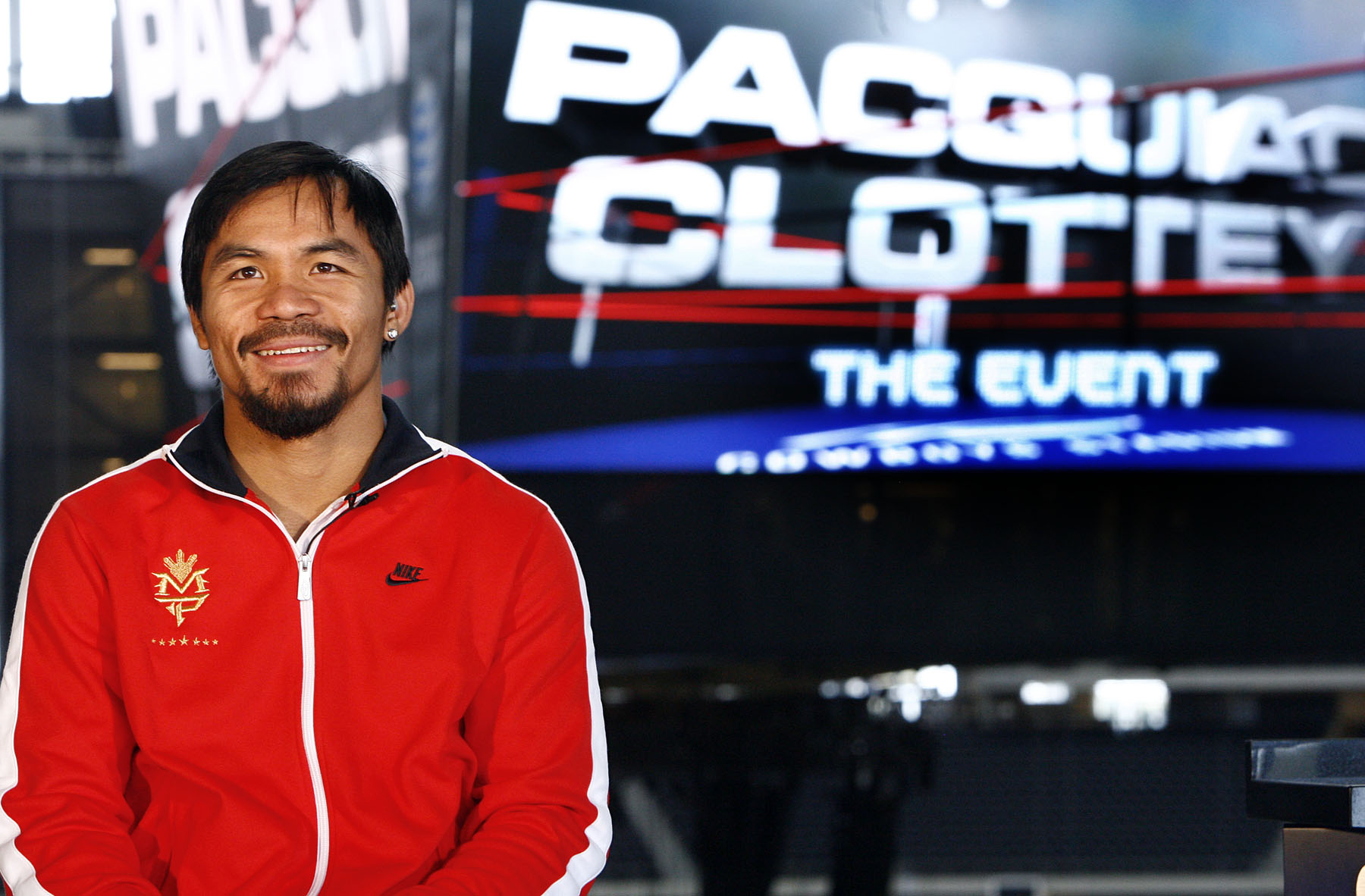
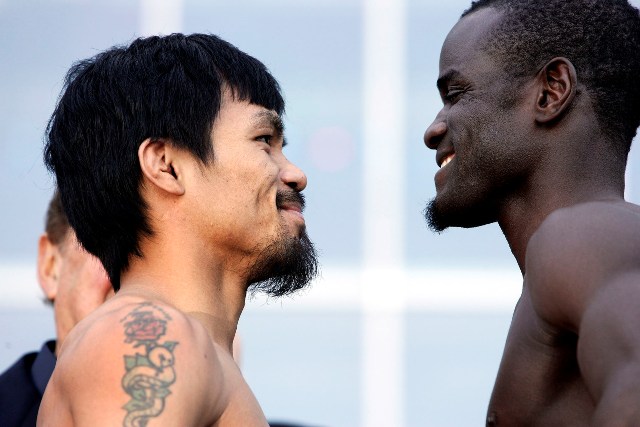
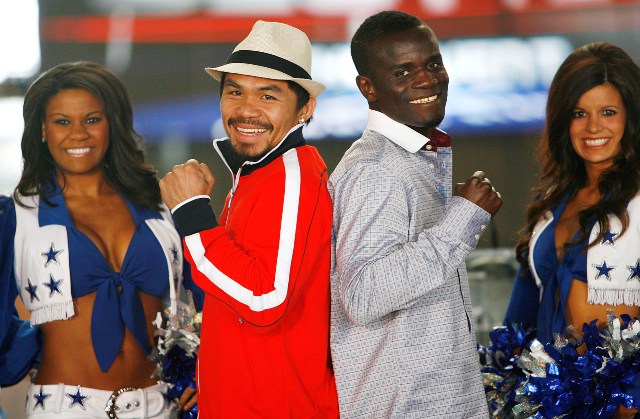
ARLINGTON, Tex. – Manny Pacquiao and Joshua Clottey tried to play it straight when they were asked to pose. The stare-down is supposed to be serious stuff. One blink signals fear. But Pacquiao and Clottey laughed like kids at play. They couldn’t stop laughing.

A weigh-in, a well-rehearsed ritual, can be funny. One in front of Cowboys Stadium Friday was more laugh-in than weigh-in. Pacquiao (50-3-2, 38 KOs) and Clottey (35-3, 21 KOs) made the welterweight limit, Clottey at 147 pounds and Pacquiao at 145 ¾, for their fight Saturday night at the $1.2 billion arena.

After they stepped off the official scale, they must have laughed off another quarter pound or two. The Clottey camp played the straight man, the tomato can. Pacquiao trainer Freddie Roach delivered the punch lines.

Clottey camper Gjin Gjini, owner of John’s Gym in New York, leaned over and told Roach that if the corners were fighting, Clottey’s corner would win in a beat-down. It was the equivalent of one kid telling another kid: My dad can whip your dad. No wonder they were laughing.

“He tells me that if the corners were fighting, we’d get beat up,’’ said Roach, who didn’t recall Ginji’s name and referred to him only as “the Albanian.”

At 50, Roach is well-past his best days as a brawling featherweight. Nevertheless, he has managed to become a target for insults from opposing corners. Floyd Mayweather, Sr., spouted dismissive poetry and few other things at Roach before Pacquiao knocked out Ricky Hatton. Joe Santiago took his rhetorical shots at Roach before Pacquiao’s stoppage of Miguel Cotto.

“When Manny fights Floyd Mayweather Jr., no telling what will happen between me and Roger Mayweather,’’ Roach said of Floyd’s uncle and trainer, also a former fighter. “Roger really doesn’t like me.’’

Anger at Roach from opposing camps might just be rooted in Pacquiao’s recent run of dominance. Nobody has been able to beat the Filipino, who was heavier than he has ever been at an official weigh-in. The Pacquiao reign isn’t expected to change against Clottey in a ring above the 50-yard line and beneath the biggest and brightest high-definition screen in this video universe and maybe a few others.

An undercurrent of rancor between the Clottey camp and Roach starts with Lenny DeJesus, who moved into Clottey’s corner as the lead trainer when Godwin Kotey of Ghana could not get a U.S. visa in time to travel to Dallas.

DeJesus was Pacquiao’s cutman. His role ended in 2005 after the Filipino’s loss to Erik Morales. It also was the last time Pacquiao lost. That fight represents some important history. DeJesus hopes it repeats itself. Roach has been making sure that it won’t. Pacquiao was badly cut over the left eye in the fifth round by head butt. DeJesus couldn’t stop the bleeding. Pacquiao, bothered by a river blood the flowed over and into his eye, couldn’t see well enough to stop Morales. Pacquiao lost a decision. DeJesus lost his job.

With Clottey, DeJesus has an opportunity at revenge with a durable fighter whose best weapon might be a head butt. A clash of heads against Cotto in June almost allowed Clottey to escape New York’s Madison Square Garden with a major upset instead of a loss by split decision.

“We won’t be there for that to happen,’’ Roach said of the head-butt possibility. “We’re at perfect fighting weight.”

Roach paused and added:

“We’re where we want to be.’’

Pacquiao has been for a while. That’s no joke.

Photo by Chris Farina / Top Rank


Margarito in Texas with a plan and a familiar denial


GRAPEVINE, Tex. – Antonio Margarito had hoped to fight Saturday night in Texas. He won’t. But he did show up Thursday night at the official hotel for the Manny Pacquiao-Joshua Clottey fight Saturday night and talked about his comeback in Mexico, his hopes for a fight in the United States and said again that he never knew his ex-trainer tried to load his gloves with a plaster-like substance before a loss to Shane Mosley.

“It was not my fault,’’ Margarito told 15 Rounds in a crowded lobby at the Gaylord Texan when asked about the glove controversy. “It is something my trainer did wrong.’’

Margarito’s license in California was revoked after his former trainer, Javier Capetillo, told the California State Athletic Commission that he inadvertently placed pieces of a plaster-like substance in his hand wraps. The substance was found when Mosley trainer Nazim Richardson asked Capetillo to re-wrap the hands before a bout at the Staples Center in Los Angeles in January, 2008.

Margarito’s license was revoked for a year. He was able to re-apply on Feb. 11. Promoter Bob Arum had planned for him to fight on the Pacquiao-Clottey undercard. Arum said there wasn’t enough time to complete the process. Margarito can apply anywhere, but there has been public pressure for him to first re-apply in California.

“I’m letting my attorneys handle that,’’ the Spanish-speaking Margarito said through an interpreter.

Meanwhile, Margarito, who has reunited with trainer Robert Garcia, said there is nothing he can do about public suspicions that he had to know his gloves were loaded.

“I can only go into the ring,’’ he said. “Only in the ring. That’s where the truth is.’’

Margarito said he is planning to be at Cowboys Stadium Saturday night because he hopes to fight Pacquiao, a heavy favorite over Clottey. There already is speculation that Arum will make a Pacquiao-Margarito fight if another round of talks for Pacquiao-Floyd Mayweather, Jr. unravel a second time.

Margarito, who said he been training in Tijuana for a May 8 comeback in Mexico against Carson Jones, also said he would agree to a rematch with Miguel Cotto, whom he beat badly in July, 2008 in Las Vegas.

“Just name the time and the place,’’ he said. “Anytime, anywhere.’’

Photo by Chris Farina/ Top Rank


Pacquiao-Clottey is all about location, location, location


ARLINGTON, Tex. – It’s all about the building. Cowboys Stadium is the main event. It sits there, below a flight path to a Dallas-Fort Worth runway, rising toward the Texas sky like a giant tent. It’s the big top, a technical marvel that sometimes sounds as if it could be a ride at Disney World.

Next stop:

Manny Pacquiao-versus-Joshua Clottey.

How a Filipino, Pacquiao and an African, Clottey, wound up in the featured event at a state-of-the-art home for America’s Team is either baffling, or just another American import, or a terrific story about diversity. Take your pick. But the fight Saturday night in a ring on the 50-yard-line is unmistakably about location, location, location for a lost sport always trying to find its way back into the mainstream.

For one night at least, Cowboys Stadium looms as a symbol of boxing’s aspirations. Promoter Bob Arum, who has seen just about everything, hasn’t witnessed anything quite like it in the many years since Muhammad Ali’s victory over Cleveland Williams in 1966 at Houston’s space-age Astrodome.

“Since the Astrodome, I have never been in a situation when the venue plays as big a role as the fighters,’’ Arum said.

If Pacquiao wins as predicted, the stadium could become the star.

“Whatever works,’’ Arum said.

What’s at work in the Dallas Metroplex is a potential shift in how boxing markets itself. Over at least the last decade, it has become a casino sport. That means Las Vegas and high-rollers in ringside seats. The rest of the crowd is in the anonymous pay-per-view audience, unheard and known only by a number.

In Dallas, there’s not much talk about the pay-per-view numbers for Pacquiao-Clottey. The guess is between 750,000 and 1,000,000 for the HBO telecast. Good, but not great and probably a long way from the pay-per-view audience expected for the Floyd Mayweather-Shane Mosley showdown on May 1 at Las Vegas’ MGM Grand.
But who’s counting. Only one thing matters here: In moving a bout
with the sport’s biggest international star in Pacquiao from Vegas to an untapped boxing market, it looks as if Arum is reaching out to a new audience with some old-fashioned salesmanship. He’s beginning to go door-to-door, or at least town-to-town.

“Bringing fights to the people,’’ said Arum, who in Pacquiao has a candidate for the Filipino Congress in a campaign that started with a party called the People’s Champ Movement.

The idea is as old as any entertainer hitting the road. If a live crowd likes what it hears or sees, there’s a good chance many in the audience will buy a CD or T-shirt or poster. With a big Mexican and Mexican-American population, Dallas is a good place to find some new pay-per-view customers. After Dallas, Arum moves on to Miguel Cotto-Yuri Foreman at the new Yankee Stadium in New York where he hopes to re-awaken some of history’s legends, including Joe Louis’ rematch victory over Max Schmeling at old Yankee Stadium in a 1938 bout that has become part of the American fabric. Then, the itinerary could include a stop in south Florida at Land Shark Stadium, the Miami Dolphins home.

“You get stale, doing the same thing over and over, going back to casinos to put on these big events,’’ Arum said.

Stale would have been just fine if the showdown had been Pacquiao-Mayweather at the MGM Grand. In fact, a poll probably would have shown a public overwhelmingly in favor of stale. But the Pacquiao-Mayweather possibility fell apart over Mayweather’s demands for Olympic-style blood-testing. Arum traded in stale for intriguing. Will it work? Maybe not.

If Pacquiao is somehow upset by, say, a Clottey head butt and suffers his first loss since a head butt bloodied him in 2005 against Erik Morales, Arum might get nostalgic about stale old days. If Pacquiao prevails, however, there is an opportunity for boxing to re-invent itself all over again.

In Cowboys owner Jerry Jones, Arum appears to have found a kindred spirit. Jones knows that atmosphere is a key to the entertainment art form. If the customers have a good time, they will either be back in line for a ticket or buy the next pay-per-view. It’s no secret that the best advertising is word of mouth. Jones says that only seven percent of NFL fans have ever seen a game in an NFL stadium. But the rest of the country has heard from that seven percent. They have tuned in and turned the NFL into the modern American pastime.

Jones, who says he boxed as an amateur as a 10-year-old at the Boys Club in Little Rock, Ark., is a longtime fan. He remembers days when Roberto Duran and Sugar Ray Leonard fought in Montreal and then in New Orleans. He traveled to Las Vegas to watch Leonard and Marvin Hagler and Thomas Hearns.

“I’ve always thought boxing needs more exposure,’’ Jones said.

In Las Vegas, Jones entry into the sport must looks like a threat, a hostile takeover. Jones bid $25 million, which would have been a record site fee, for Mayweather-Pacquiao. But that possibility was headed to Vegas’ MGM Grand even before talks unraveled

“I wanted that fight, between those two guys, worse than my next breath,’’ Jones said.

Up and down the Vegas Strip, casino executives are holding their breath at what he might try next, especially if Pacquiao-Clottey is a success.

“But I think this is good and not a negative for Las Vegas to have a great fight in front of thousands of people,’’ Jones said in what might prove to be a new look at Sin City’s best-known marketing campaign.

What stays in Vegas isn’t always good for Vegas.

Or boxing.

Photo by Chris Farina / Top Rank


Political game is the wrong ring for Pacquiao to prove he is special


It’s hard to know when Manny Pacquiao got interested in politics. Maybe, it happened at about the time he added a right to his left. It’s also hard to understand why. But Pacquiao is serious, even after he lost by a reported 37,000-to-38,000 votes in his last and only run in 2007 for an anonymous seat in the Filipino Congress.

Maybe, Pacquiao just hates to lose. Ask Eric Morales, who discovered just how much he detests defeat after Morales’ initial victory was followed by two devastating losses to the motivated Filipino. Three years ago, Pacquiao’s political ambitions looked like a lark. Between fights, politics was like shooting hoops and singing. It was something to do. But by now, we know he’ll never be in the NBA or play Carnegie Hall.

But Congress is beginning to look about as good as a victory over Joshua Clottey on March 13 at Cowboys Stadium in the Dallas metroplex.

Thirteen days after Pacquiao is expected to sack Clottey like a linebacker in a blitz of a poorly-defended quarterback, he will be back on the campaign trail. He is running in a different district, Sarangani instead of General Santos City. There is different opponent. By all accounts, there also will a different result.

This time, Pacquiao is expected to prevail against Roy Chiongbian. I’m tempted to send Chiongbian a campaign contribution, although he apparently doesn’t need one. Chiongbian is reported to be a billionaire, which makes him even richer than Pacquiao, who has become a multi-millionaire in a string of rich fights, including a 2008 upset of Oscar De La Hoya.

Let’s just say that I’m a member of the Filipino party that reportedly cheered when Pacquiao lost in 2007 to incumbent Darlene Antonino-Custodio.

Memo to would-be Congressman Pacquiao: The Philippines need another politician about as much as Imelda Marcos needed another pair of shoes. A Congressional seat will always be there. A chance at enduring stardom as a fighter will not.

Yet, the quixotic seriousness of Pacquiao’s political pursuit is unmistakable, both in a conference call and in subsequent media reports. If a congressional seat forces him out of the ring and eliminates any renewed possibility of a showdown with Floyd Mayweather, Jr, Pacquiao seemed to say:

So be it.

“I don’t need to fight him,’’ Pacquiao said in a conference call when asked about negotiations that failed when Mayweather demanded Olympic-style blood testing. “What I believe is Floyd Mayweather is not ready at this time to fight with me. That’s why he makes the reasons to cancel the fight. I feel bad and disappointment because he is accusing me of using drugs or whatever and trying to ruin my name in boxing. People know I have been successful through God and hard work.

““I don’t really need Floyd Mayweather because what I have achieved in boxing is good enough for me and people know that by comparing my achievements in boxing to his achievements.’’

Pacquiao promoter Bob Arum and trainer Freddie Roach are skeptical that the Filipino whirlwind will leave one ring and enter another. But neither rules it out either.

In the gym, Roach said he has witnessed some ferocious flashes of anger at Mayweather. The frustration is rare for Pacquiao, who walks into the ring with a shy, somewhat enigmatic smile on a face that always seems to say he doesn’t dislike anybody. But Mayweather altered that with demands that imply Pacquiao abuses performance-enhancers.

“Sometimes, when Manny is shadowboxing, he will show me how Mayweather fights and how he will take care of the problem,’’ Roach said. “ I’ve never seen Manny do that before. He was trying to ruin our reputation with those allegations, so we do want to fight him and we do want to knock him out.’’

But, yeah, Roach says, the Clottey fight could be his last if Mayweather continues to make the drug-testing demands without an approved process from a state Commission, or if Shane Mosley upsets Mayweather on May 1, or if a victory at the ballot box takes Pacquiao out of the gym and into office for good.

If, if and if.

The biggest one could be what Pacquiao might have been. Arum, Roach and much of the media have been saying that Pacquiao is poised to become something special, meaning he is about to occupy the same orbit as Henry Armstrong, Sugar Ray Robinson and Muhammad Ali. But as an active Congressman and a retired fighter, anything special would be speculative. Pacquiao is good. Make that great. He will be in the Hall of Fame. But he is still a fight with Mayweather, or maybe a Mosley, from being special

Then, there is the potential for cynicism. If Pacquiao leaves boxing for politics, I can already hear the Mayweathers — Floyd Jr., Floyd Sr. and Roger. All together now:

“See, I told you so.”

Pacquiao has undergone and passed every required drug test. If a Commission tells him there are new rules, I believe he will agree to a more rigorous process. Fair or not, it is the only way he can definitively answer a question that the Mayweather chorus raised. There are a variety of interpretations as to the motivation for the Mayweather demand. Maybe, he was trying to bully Pacquiao by trying to dictate terms. Maybe, Mayweather was trying to get out of the fight. Maybe, it was gamesmanship.

But there’s only way to answer and it’s not from a seat in the Filipino Congress.

WHAT PROBLEM?
Vic Darchinyan (33-2-1, 27 KOs) is sick of hearing about a rematch of his loss to Nonito Donaire. Still, he was asked about it repeatedly this week before the defense of super-flyweight titles on Showtime Saturday against Mexican Rodrigo Guerrero (13-1-1, 9 KOs) at Agua Caliente Casino in Rancho Mirage, Calif.

Darchinyan, knocked out by a Donaire three years ago, has dismissed the rematch possibility by saying he is moving up in weight.

Funny, but that’s the same thing Donaire said last month before his third-round stoppage of Manuel Vargas in Las Vegas. Then, Donaire said it was “now or never,” because he was moving up to bantam and featherweight.

On the scale, Darchinyan and Donaire are heading in the same direction, which should also include a rematch.

NOTES, QUOTES FROM THE SUPER SIX
· Arthur Abraham almost made it sound as if Jamaican sprinter Usian Bolt was a sparring partner in training for Andre Dirrell at Detroit in a Super Six Classic bout on March 27, which was rescheduled from March 6 because of a back injury suffered by Dirrell. “I have sparring partners who run,’’ Abraham said from Germany during a conference call Thursday.

· Dirrell is out of the tournament if he loses because of a controversial loss by split decision to Carl Froch in his last bout. “I call it a do-or-die situation,’’ said Dirrell, who believes he was robbed on the scorecards against Froch. He also said Froch engaged in “dirty tactics” that took him out of his fight plan.

· Promoter Gary Shaw predicts that Dirrell will be the first to beat Abraham, an Armenian who speaks German and hopes to become an American star. Shaw said that Abraham, the tournament’s leader in points with three, is more comfortable at middleweight, 160 pounds. That, Shaw said, is one reason he beat Jermain Taylor, also more comfortable at 160. At 168 pounds, Dirrell has an advantage, he said. “The bigger and faster man always wins,’’ Shaw said. “In this fight — although I have a world of respect for Arthur Abraham for his record, his style, his abilities and his demeanor — I believe Andre Dirrell will win and possibly stop Abraham.’’

Photo by Chris Cozzone/ Top Rank


He’s not Mayweather, but Joshua Clottey might be good enough


Timing and circumstances haven’t been kind to Joshua Clottey. He isn’t Floyd Mayweather, Jr., the welterweight everybody wanted to see against Manny Pacquiao on March 13.

Instead, Clottey has been cast as the substitute, which to a cynical public only means he isn’t Mayweather and he doesn’t have a chance against Pacquiao on a night when Cowboys Stadium in the Dallas metroplex might be the biggest attraction.

If he doesn’t feel like last season’s Detroit Lions or St. Louis Rams, then Clottey knows what it is to have been one of those replacement players in the last NFL work stoppage. In 1987, none of those guys belonged there and that’s exactly what you hear and read these days about Clottey. Pacquiao is supposed to kick him around like the soccer ball Clottey used to chase as a kid in Ghana.

Fair? I don’t think so. Then again, I’ve been wrong about these things before. I actually thought Juan Manuel Marquez was skilled, smart and tough enough to challenge Mayweather. After watching Mayweather humble Marquez through 12 one-sided rounds in September, I wondered if I had been kicked in the head one too many times.

Nevertheless, I like Clottey, perhaps not enough to pick him over Pacquiao, especially without a familiar trainer in his corner. He split with Kwame Asante after his loss by split decision in June to Miguel Cotto over a reported disagreement over money. Then, Godwin Kotay, also of Ghana, was denied a U.S. visa. Instead of Asante or Kotay, cut-man Lenny DeJesus will take the lead in Clottey’s corner.

In front a potential crowd of 45,000 and against Pacquiao’s varied skills and dangerous power, an unfamiliar face in the corner looms as a problem, especially when – not if – Clottey is in trouble.

Still, Clottey’s size, strength and durability are enough to make it difficult for Pacquiao, whose motivation could have taken a hit when an agreement to fight Mayweather fell apart because of demands that the Filipino icon undergo Olympic-style blood-testing for performance-enhancers.

Pacquiao also will jump directly into a rough-and-tumble political campaign in the Philippines after the fight.

In part, the public’s lack of any respect for Clottey might be a spillover from disgust at the abortive negotiations for Pacquiao-Mayweather. Fans and media are still angry. What they have forgotten, however, is just how close Clottey came to an upset of Cotto in front of the Puerto Rican’s loyal New York fans at Madison Square Garden.

“I did not lose the Cotto fight,’’ Clottey said Thursday during a conference call from his training camp in Fort Lauderdale, Fla.

Maybe not.

But Clottey also didn’t do enough in the last couple of rounds to convince anybody at ringside that he deserved more than a draw. That, like the victory he still thinks he deserves, eluded him. Clottey has been criticized for not throwing enough punches, which could quickly leave him with a deficit on the scorecards against Pacquiao’s whirlwind pace. But he is confident he can make his power count.

“I am not a flyweight,’’ Clottey said during the conference call, which will be followed by one Friday with Pacquiao. “I’m not a bantamweight. I’m a welterweight. I throw punches that connect.’’

As a natural welterweight, unlike the smaller Pacquiao (5-foot-6 ½), the 5–8 Clottey might have enough leverage to inflict some damage. Before Pacquiao’s 12th-round stoppage of Cotto in November, the Filipino’s trainer, Freddie Roach, said Clottey’s punches almost made Cotto quit during the ninth round.

“The more I play it over, the more I realize how competitive this is and that nobody with any certainty can predict the result,’’ said Top Rank’s Bob Arum, who promotes both fighters. “Everybody knows how Manny Pacquiao fights. Everybody knows the angles from which he throws punches.

“And everybody knows that Joshua Clottey is a tremendous defensive fighter and can put a real hurt on an opponent. And everybody knows that Joshua Clottey is the bigger man and Manny is the smaller man. There is talk about Manny going up in weight. But he really hasn’t. He couldn’t make 130 pounds anymore, He fought at 135. He was 138 when he fought (and knocked out) Ricky Hatton.

Now, he goes into the ring at 142 or 143 pounds on the scale and that’s not because he’s putting on weight. That’s because he has breakfast and lunch before the weigh-in. If he had to, he’d still make 135 pounds. So, the idea that he’s a big man is just not true.

“Joshua has the size. He’s the natural welterweight. Manny Pacquiao isn’t. That’s the intrigue in this fight.’’

The intrigue, at least, doesn’t include more of the noisy debate about blood-testing for performance-enhancers. Clottey, ever the gentleman, said he did not and would not demand the Olympic-style testing that Mayweather says he and every one of his future opponents, including Shane Mosley on May 1, will undergo.

“No, I don’t want to do that, because I respect him so much,’’ Clottey said. “He is a very nice guy. I feel comfortable around him. He’s respectful of everybody. I don’t think Manny Pacquiao did that thing. I trust him.”

If only, Clottey could enjoy some of that same trust. He’s not Mayweather. But, trust me, he’s a better fighter than people think.


If Margarito wants a license, he needs to show up and explain himself


Anybody seen Antonio Margarito lately? Anybody heard from him? There have been more Tiger Woods sightings during the last three months than there have been of Margarito in more than a year. Margarito has vanished, almost as if he’s in hiding.

In the court of public opinion, it’s a bad idea, especially if he ever hopes to be licensed in the United States again. Fair or not, there is talk he is hiding because there is something to hide.
Out of sight, but not of mind.

Questions continue about why, not whether, his gloves were loaded 13 months ago before a loss to Shane Mosley in Los Angeles. Some people want him to apologize. I just want to hear an explanation, straight and unvarnished, from Margarito. He needs attorney Daniel Petrocelli for the legalese required in appearances before the California State Athletic Commission or the Texas Department of Licensing and Regulation or some other bureaucracy.

But legal arguments won’t erase deep-seated skepticism about his claim that he had no idea disgraced ex-trainer Javier Capitello put some plaster-like substance into wraps that would turn gloves into weapons of mass destruction. Nobody who has ever worn gloves believes that one. Nobody who has ever worn shoes believes it either. I’ve said it before and I’ll say it again: If there’s a rock in your shoe, you know it.

I have no idea how Margarito would answer the questions. Until he does, however, it’s impossible for me to say that he should be re-licensed. If he can’t stand up and argue for himself, how can anybody argue for him?

He didn’t fight anywhere for a year. That was the idea when California revoked his license on Feb. 10, 2009. He did what he had to. He did the time. But the process is incomplete without an explanation that may – or may not – serve as the final punctuation in this ongoing controversy.

Top Rank’s plans for him to fight on the March 13 card featuring Manny Pacquiao and Joshua Clottey at Cowboys Stadium in Dallas were dropped because of pressure on Texas not to grant him a license. It just wasn’t going to happen.

His Texas application is still pending, but it doesn’t figure to go anywhere until he first re-applies in California. Even if he does that, there will be controversy that only he can address. If – as tentatively planned — Margarito fights on May 8 in Mexico, it would only be a further complication. Regulators in California or Nevada or Texas or Arizona probably would see the move as another way to duck the questions. He’s being doing a lot of that.

During the week before Pacquiao’s victory in November over Miguel Cotto in Las Vegas, he was scheduled to make an appearance at a nearby shopping mall. I and couple of other sportswriters jumped into a car and rushed out to meet him. He had been there. But by the time we arrived, he had vanished, which is what will happen to Margarito’s career if he doesn’t show up and practice some accountability.

Between Cotto’s victory over Clottey in June and his loss to Pacquiao, there had been a lot of talk about a Cotto-Margarito rematch. To this day, nobody knows whether Margarito’s gloves were similarly armed, locked and loaded in his stunning beat-down of Cotto.

But talk of a rematch, like Margarito, has vanished. Cotto told the English-speaking press that he would be interested in rematch. Then, he was quoted in the Spanish-speaking press as saying there was no way he would help Margarito make money.

Let’s just say that Cotto has his own suspicions.

Until we hear from Margarito, that’s all anybody has.

NOTES, QUOTES
· High school senior Jose Benavidez, a junior-welterweight from Phoenix, continued to impress by scoring two knockdowns in first-round stoppage of John Michael Vega Saturday night on the undercard of super-flyweight Nonito Donaire’s third-round KO of Manuel Vargas at the Las Vegas Hilton. Benavidez’ next fight is scheduled for the Pacquiao-Clottey weekend. He could appear on the undercard at Cowboys Stadium. But the place probably would be empty for bout early on the card. Instead, Benavidez (2-0, 2 KOs), who has Pacquiao trainer Freddie Roach in his corner, might fight on a Dallas card Friday night in smaller room where people would see him. And remember him.
· Olympic swimmer Michael Phelps, who won a record eight gold medals at the Beijing Olympics, has added some boxing drills to his training regimen. He’s not the first. Swimmer Gary Hall Jr., a 10-time medalist over three Olympics, put on gloves and hit the heavy bags for years. Hall, who taught heavyweight Earnie Shavers’ kids how to swim, was a fight fan. Hall, a sprinter, said the regimen helped strengthen his muscles and improved his reaction time off the starting blocks.


More anguish for Carbajal as his inmate brother threatens to evict their mom

Michael Carbajal, who was always willing to fight anybody for as long as it took, is now in a fight he could never have imagined, few would ever believe and yet continues like a haunting nightmare.

It has been nearly two years since his brother, Danny, was sentenced to 54 months in prison for fraud and forgery after working as the trainer, manager and financial advisor for Michael, whose punches and blood earned more than $7 million in a Hall of Fame career as unique as any in a cruel business as old as Cain and Abel.

There was no healing on Feb. 21, 2008 when Danny was marched out of Maricopa County Superior Court in Phoenix and transported to the Arizona State Prison in Florence. There is no statute of limitations on betrayal. But at least it seemed as if it was over in a way that would allow Michael Carbajal to move on and repair a fractured life. It isn’t.

Michael now is fighting to save his mother, Mary, from an attempt by Danny to have her evicted from her Phoenix home, where she has lived for the last 15 years. Michael’s attorney, Ty Taber, said the home was purchased with money from the junior-flyweight’s purse in a 1990 victory for his first major championship, the International Boxing Federation’s title, which he took from Thailand’s Muangchai Kittikasem at old Veterans Memorial Coliseum in a Phoenix bout televised nationally by ABC.

“It’s unbelievable to me,’’ said Taber, a Phoenix attorney who was in the crowd for Carbajal’s dramatic seventh-round stoppage of Kittikasem two decades ago in a bout that was the first real sign of unprecedented stardom for one of boxing’s little guys. “Poor Michael. I mean, Danny thinks he has a big financial empire that he is manipulating from prison, where he sits, rotting away.

“I can’t believe he is doing this to his own mother.’’

In a letter dated Feb. 4, 2010 and addressed to Mary Carbajal, Danny’s attorney, Jonathan Dessaules, threatens eviction if she has not moved out by March 8. Other than to say that the letter spoke for itself, Dessaules, of Phoenix, had no comment.

“This is the lowest you can go,’’ said Michael, who called his oldest brother “a disgrace” after Phoenix reporter Paul Rubin broke the news in a chilling story, headlined Brother’s Keeper, for the Nov. 1, 2007 edition of the New Times.

Michael’s emotions ranged from angry to tearful as he sat on the steps in front of his Ninth Street Gym, once a church. Where the congregation once sat, there’s a ring. On a stage, there are heavy bags where the preacher once stood at the bully pulpit. Today, the only chorus is in the rhythms of a speed bag. But for Michael, it’s a place of faith, maybe more now than ever.

With help from friend and companion Laura Hall, Michael’s commitment to his mom, to what he knows and who he knows has been deepened by a personal trial, a breach of trust, brought on by a brother he never thought he would have to question.

“Yeah, he fooled you,’’ Michael said. “But he fooled me more than anybody.’’

The more that Michael looks around and reflects on his career, he sees reasons to believe that the trust once thought to be fundamental between brothers was always a fraud. For years, Danny said there was no legal contract between the two. There was no need, the brothers always said.
“We were family,’’ Michael said. “Danny always said it and I trusted that.’’

But Michael said he found an old document at the Court of Records a few days ago after he got news of the letter to his mom, now 78. It’s a managerial contract, said Michael, who said it was drawn up in October, 1988, or within weeks of his silver medal at the Seoul Olympics. He said it includes his signature.

“But I never signed my name to a contract with Danny,’’ Michael said. “I never saw that contract.’’

Trust in his brother was there, even during the first few years after Michael’s career ended in 1999. At his induction to the Boxing Hall of Fame at Canastota, N.Y., in June, 2005, Michael tearfully called Danny the world’s greatest trainer. By then, however, questions were beginning to emerge in the wake of the unsolved murder of Danny’s estranged wife Sally. Sally, who was in the crowd with Danny at the Seoul Olympics and at ringside for Michael’s pro career, was killed along with companion Gerry Best five years ago.

Danny was sentenced after pleading guilty to three felonies based on the theft — hundreds of thousand dollars was the reported estimate – from accounts and property held by Sally. Danny’s daughters, Josephine and Celia pleaded guilty to conspiring with their dad and against Sally, their mom. Neither was sentenced to jail.

In the threat to evict Mary Carbajal, now 78, from the home purchased for her after husband Manuel died in 1993, Michael is convinced he sees another damning stitch in a scheme, which was a word used by Judge Andrew Klein when he sentenced Danny.

“Greed and a pattern of wrongdoing spread out over three years,’’ Klein said.

In the Feb. 5 letter, it says that Mary Carbajal “admitted in sworn testimony” that Danny is the home’s owner of record. The letter also says: “You also do not pay any rent for your occupancy. Our client, therefore, has decided to terminate the occupancy…’’

In 2007, Michael filed legal documents, saying that he is the lawful owner of the home purchased for his mom, as well as other property in Phoenix. Mary Carbajal’s testimony is based on a lawsuit that she and Michael filed in another case involving life insurance. Danny is alleged to have bought policies, transferred them into his own name and then cashed them out.

“Your own mom, man,’’ Michael said. “How do you do something like this to a mom?’’

Michael looked off in the distance and then across Fillmore Street as if he was searching for an explanation. He saw an empty lot. A few weeds and no words.

The, a couple of grade-school girls, one on a bicycle, stopped in front of the gym. They looked at Michael smiled, looked up at the entrance and then back at Michael.

“Is it haunted in there?’’ one of the girls asked. “We hear there might be ghosts in there. Tell us, but don’t scare us.’’

Nah, he said.

“There are only good ghosts in there and they hang out in the basement,’’ said Michael, who then turned around and went inside, smiling and perhaps knowing that ghosts couldn’t haunt him the way a brother has.

NOTES, QUOTES
· One of the best in today’s generation of little guys, super-flyweight champ Nonito Donaire, faces a new opponent Saturday night at the Las Vegas Hilton in the featured bout on pay-per-view television. The original opponent had to suddenly withdraw a couple of days ago because of an eye problem. Instead of Gerson Guerrero, Donaire (22-1, 14 KOs) faces the unknown in Manuel Vargas (26-4-1, 11 KOs). Sometimes, the unknown is more dangerous than anything. “But it forces to you think, be spontaneous,’’ Donaire said Thursday in a conference call. “I’ll have to be aware and ready to make quick adjustments.’’

· Promoter Bob Arum mentioned that the Las Vegas Hilton was the site of Leon Spinks’ upset of Muhammad Ali in 1978. More fitting perhaps, it also was the Vegas hotel for Top Rank’s promotion of Carbajal’s signature fight, a seventh-round stoppage of Humberto Gonzalez in the first bout of their trilogy. Donaire is the star on a card featuring Filipino and Latin fighters in the lighter weight classes.

· More Donaire: He is a target for some trash talk from Vic Darchinyan, who is anxious for a rematch in an attempt to avenge his loss by knockout in 2007 to the likeable Filipino-American. “He’s like a little chihuahua, just barking and barking and barking,’’ said Donaire, who added that he soon will move up in weight to bantam, then feather. “For me, it is now or never for super-flyweight.’’
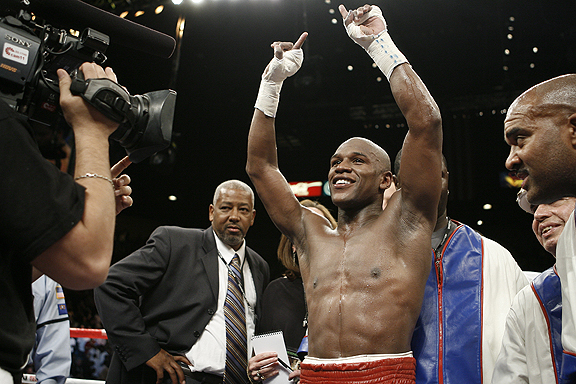

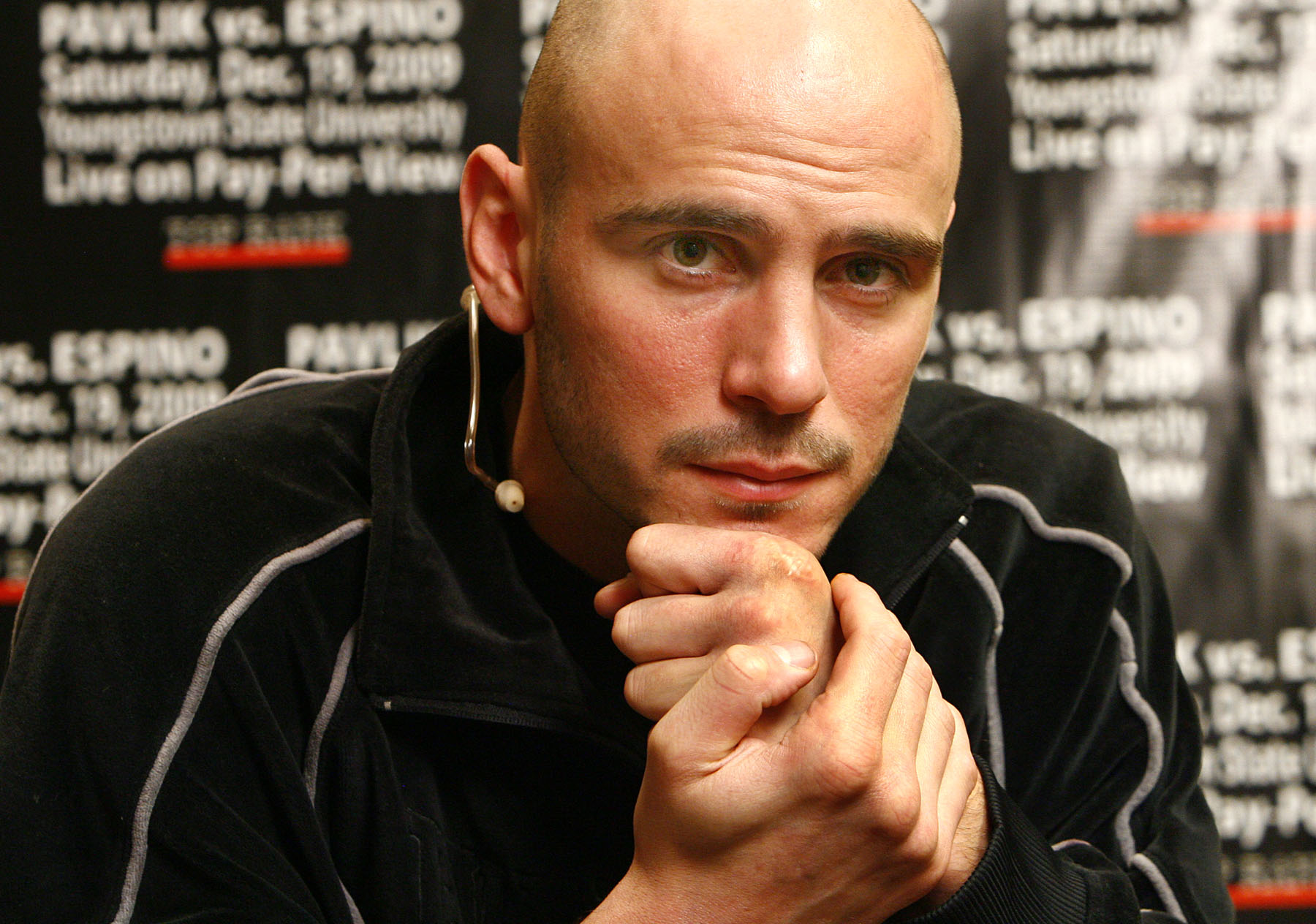
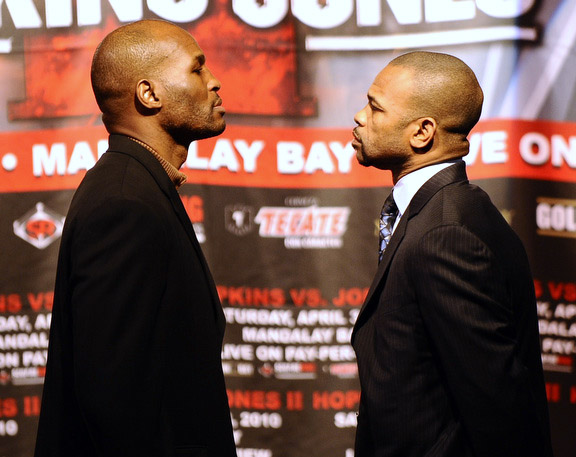
Whew, Mayweather signs to fight Mosley, but angst still there


Anxiety gave way to relief Wednesday when it was announced that Floyd Mayweather, Jr., had finally signed for a May 1 fight with Shane Mosley, whose promotional point man, Golden Boy CEO Richard Schaefer, sounded as though the wait for Mayweather’s signature was a little bit like anticipating a dental appointment.

As it turns out, it was routine, a mere formality. Let’s just hope it stays that way until opening bell at Las Vegas’ MGM Grand for a May Day of a fight that won’t generate as much money as Mayweather-Manny Pacquiao would have, but promises to be as good, if not better.

The temptation is to say thanks to Mayweather for a convincing counter to everybody who parrots Bob Arum’s criticism that he is afraid of any threat to his unbeaten record. Well, Mosley, a natural welterweight, is that threat, bigger on a tale of the tape than Pacquiao, a relative newcomer to 147 pounds.

But you can never be sure with Mayweather. Schaefer’s angst, reflected in various news reports, sums up the uncertainty about a fighter with wonderful talents, yet as hard to pin down as he is to hit. Mayweather’s unpredictability is good for HBO’s 24/7, but exasperating for everybody else, including media quick to report that Mayweather had not signed only four days after the agreement — complete with Mosley’s signature — was announced.

The delay, not matter how brief, was enough to make everybody wonder what Mayweather was up to now. Plenty of skepticism is left in the messy wake of failed negotiations for a Mayweather-Pacquiao fight, which won’t happen on March 13 because Pacquiao said no to Mayweather’s demand for random, Olympic-style blood-testing. Everybody has been blamed, which only means that nobody’s reputation escapes unscathed.

Mayweather and Mosley now are scheduled to be in south Florida Sunday for the Super Bowl Sunday. It’s an interesting setting. Mayweather-Pacquiao had been called boxing’s Super Bowl. Peyton Manning and Drew Brees will never have to explain why the Colts and Saints couldn’t agree to a game. I’m not sure Mayweather will be able to explain why he couldn’t agree on a fight with Pacquiao. But it is safe say he will hear the questions and I’m sure he will blame Pacquiao, although familiar trash-talk might be punctuated with caution because of a defamation lawsuit.

Mistrust is everywhere. Mayweather-Mosley represents a real chance to move on. But it won’t be easy. In just a few days, the familiar jitters were there with questions about when – indeed, if — Mayweather would sign. The abortive talks for Mayweather-Pacquiao are just the latest reason.

In September, there was weight-gate before, during and after Mayweather’s unanimous decision over Juan Manuel Marquez. At 146 pounds on the day before the fight, Mayweather failed to meet the catch weight, 144, and willingly wrote a check for $600,000 — $300,000 for each excess pound – to Marquez.

From a ringside seat the next night, Mayweather often looked like a middleweight, especially when his back was to me. I can’t help but think it was no coincidence that he refused to step on unofficial scales for HBO not long before opening bell. After the one-sided fight, he dissed anybody who wanted to know how he heavy he was.

There are some things Mayweather just doesn’t want anybody to know. No wonder Schaefer and many in the media were nervous.

Here’s a suggestion: Andre Berto withdrew from a bout on Jan 30 with Mosley because of concern for family caught in the Haitian earthquake. Tell Berto to stay in the gym. You never know.

NOTES, QUOTES

· According to various reports, Mayweather and Mosley will undergo Olympic-style drug testing. Given Mayweather’s demand in talks for Pacquiao, he will have to insist on the procedure from now on. For Mosley, it’s a significant step. He was linked to performance-enhancers years ago in testimony to a grand jury investigating Balco. What’s not clear is who will conduct the tests. The Nevada State Athletic Commission? The U.S. Anti-Doping Agency? And who will pay for the tests? The fighters? The promoters? The lousy economy would seem to preclude any state commission from taking on the expense.

· News from the World Boxing Association says it will investigate Beibut Shumenov’s controversial split decision over Gabriel Campillo for the light-heavyweight championship on Jan. 29 at the Hard Rock in Las Vegas. While the acronym is at it, how about a few questions asking how a fighter, Shumenov, with only 10 pro bouts could even qualify for a shot at so-called major title?

· Intriguing Jose Benavidez, a 17-year-old junior-welterweight from Phoenix, is scheduled for his second pro fight on Feb. 13 against an unannounced foe at the Las Vegas Hilton on a card, Latin Fury 13/Pinoy Power 3, featuring super-flyweight Nonito Donaire (22-1, 14 KOs) against Gerson Guerrero (43-8, 26 KOs). There’s been some hope that Benavidez could help resurrect a Phoenix market, mostly dormant since Arizona began to enforce tough immigration laws. “I’d really love to fight in Phoenix,’’ Benavidez said. “Hey, it’s my hometown.’’

· And kudos to Chad Dawson, Guillermo Rigondeaux and Top Rank for promises to help in the Haiti relief. Dawson said he has started Champions Challenge. He has invested $5,000 of his money has asked other champs to match it. Rigondeaux, a two-time Olympic gold medalist from Cuba, says he will donate his purse from a fight Friday night against Adolfo Landeros in Fort Lauderdale, Fla., to the Children of Haiti Fund. Top Rank announced it is setting aside a percentage of ticket receipts for the earthquake victims.


Shumenov wins WBA Light Heavyweight crown on controverisal decision over Campillo

LAS VEGAS – Beibut Shumenov, a lawyer in Kazakhstan, had a plan. Gabriel Campillo, a boxer from a country known best for fighting bulls, had the power. Put them together and you might have a good light-heavyweight. As it is, Bernard Hopkins and Chad Dawson don’t have much to worry about.

The plan prevailed.

Shumenov won a split decision Friday night and took the World Boxing Association’s version of the title from Campillo in a rematch that had a different winner, yet some of the same controversy from last August’s majority in Kazakhstan. Campillo won that one, although Shumenov has been arguing about it ever since.

This time, it is Campillo’s turn to argue.

“I got robbed and I want it investigated,’’ Campillo said as he stood in the middle of the ring at the Hard Rock Hotel & Casino while his angry trainer, Sergio Martinez, had to be restrained from taking the bout into some extra-curricular rounds.

It safe to say that the left-hander from Spain won’t be getting any legal advice from Shumenov, who was bloodied, yet nimble enough to jump through enough loopholes to escape with a decision. Shumemov (9-1, 6 KOs) won 115-113 on Jerry Roth’s card. Judge Patricia Morse Jarman scored it 117-111 for the Kazakhstani attorney. On Levi Martinez’ card, it was 117-111 for Campillo (19-3, 5 KOS), who also suffered a cut over his left eye.

“I’m not surprised by the decision,’’ Shumenov said. “I thought I won.’’

There was plenty to argue about. After the opening couple of rounds, Campillo’s superior power appeared to be the ruling factor. Shumenov, often looking dazed, began to back away. If nothing else the argument figures to continue until the two fight for a third time. No matter what happens, there doesn’t figure to be much of an argument about who doesn’t belong at the top of the light-heavyweight division. Shumenov and Campillo don’t.

In time, may be. At least, that was the suggestion from Shumenov, who had former David Tua trainer Kevin Barry in his corner for the first time.

“The difference is that I have the best trainer in boxing,’’ said Shumenov, whose company co-promoted the card with Oscar De La Hoya’s company, Golden Boy. “He gave me all the directions to win this fight.’’

Directions good enough for two judges, anyway.

On the undercard:

The 10th lesson plan in junior-middleweight prospect Erislandy Lara’s education got off to a slow start, grew rocky and ended with him scoring a 10th-round TKO of Grady Brewer in the first televised fight on Fox Sports Net. Early on, Lara (10-0, 6 KOs) a former Cuban amateur, looked flat-footed and one-dimensional. He tried to set up his best punch, a straight left. In the fifth, Brewer (26-12, 15 KOs), who won The Contender in 2006, delivered some of his own reality television with rights that stunned Lara. But a head butt badly bloodied Brewer over the left eye in the sixth. Brewer never seemed to recover. He was dropped by a left late in the 10th. Referee Tony weeks stopped it 16 seconds before the closing bell.

The card’s first fight ended in front of a lot empty seats. Anybody looking for their seat would not have seen it anyway, because of a quick body shot from Gayrat Ahmedov (13-0-1, 9 KOs), a cruiserweight from Uzbekistan. Sixty-five seconds after the opening bell, Ahmedov landed a short left that dropped Harley Kilfian (8-4, 7 KOs), a Wisconsin cruiserweight who crashed onto the canvas like a wrecked motorcycle.

The body work continued in the second bout, thanks to another fighter from Uzbekistan, junior-middleweight Ravshan Hudaynazarov (10-, 9 KOs), who threw a left that sent Kenyan Shadrack Kipruot (10-13, 7 KOs) backpedaling onto the seat of his trunks and unable to continue in a TKO defeat at 1:26 of the third.

Eloy Perez beat the stroke of midnight and David Rodela.

With late Friday just a few minutes from turning into early Saturday, super-feather weight Perez (16-0-1, 4 KOs) of Salinas, Calif., battled through 10 bruising rounds for a unanimous decision over David Rodela (14-2-3, 6 KOs) in the final fight on a card that featured Beibut Shumenov’s split decision over Gabriel Campillo for a piece of the light-heavyweight title.

Rest of the undercard:
Las Vegas welterweight Jessie Vargas (8-0, 3 KOs) won a four-round unanimous decision over Rickey McKinney (3-2, 2 KOs) of Baton Rouge, La.

Featherweight Ronny Rios of Santa Ana, Calif., stayed unbeaten (9-0, 4 KOs) with a six-round unanimous decision over Wilshaun Boxley (5-4, 3 KOs) of Coons Rapids, Minn.

And a long night proved to be a short one for junior-welterweight Carlos Molina (10-0, 6 KOs), who needed only 54 seconds to score a first-round knockout of Tyler Ziolowski (12-11, 6 KOs) of St. Joseph, Mo.


MAYWEATHER – MOSLEY IS ON!!!


LAS VEGAS — Shane Mosley has signed to fight Floyd Mayweather Jr. on May 1 at the MGM Grand, Mosley attorney Judd Burstein said Friday night while sitting at ringside after Beibut Shumenov took the World Boxing Association’s light-heavyweight title with a split decision over Gabriel Campillo at the Hard Rock Hotel & Casino.

Mayweather has yet to sign, but his advisor Leonard Ellerbe said he expects him to.

Burstein also said that Mosley will be willing to undergo Olympic-style blood-testing. Burstein was linked to performance-enhancing drugs in testimony to a grand-jury that investigated Balco. Mosley was listed as a Balco client.

“We’ve agreed to anything as long as Floyd is doing it,” Burstein said.

Talks for a Mayweather-Manny Pacquiao fight on March 13 broke down when Mayweather demanded that Pacquiao undergo Olympic-style blood-testing. Pacquiao refused and instead will fight Joshua Clottey on March 13 at the Cowboys Stadium in Dallas.


A corner has always been where Kevin Barry’s heart and home are

It’s not exactly a comeback. Kevin Barry never really left. Home has always been in a corner, no matter how obscure. It’s just that the lights are beginning to brighten again for Barry at a post that has cornered a special place in his heart.

“Boxing is the love of my life,’’ Barry said.

That life, like marriage, tested Barry with familiar controversies, starting with his 1984 Olympic silver medal won in a disqualification of eventual heavyweight champ Evander Holyfield and including a split with David Tua in the courts of his native New Zealand.

Barry wasn’t sure he ever wanted to venture back toward the biggest stage, which in boxing can be as upside-down as the Down-Under in his homeland. In fact, he needed some convincing. But he’s glad he listened to a persuasive Beibut Shumenov (8-1, 6 KOs), a light-heavyweight from Kazakhstan who will have Barry in his corner Friday night in a Fox-televised rematch of his disputed loss by majority decision to World Boxing Association champion Gabriel Campillo (19-2, 6 KOs) of Spain at the Hard Rock in Las Vegas.

Initially, Barry wasn’t interested. He was content and busy in Las Vegas, training kick boxers, mixed-martial-arts fighters, kids who hope to box and old guys who think they still can. But Shumenov, also a Las Vegas resident, proved to be irresistible, perhaps because Barry saw some of himself in a 26-year-old fighter who decided to go pro three years after fighting for Kazakhstan at the 2004 Olympics.

“I actually had him work with a few young fighters of my own some time ago,’’ said Barry, who grew up in the in Christchurch on New Zealand’s south island and has been living in Las Vegas since 2004. “So I saw him early on. I saw the strength, the power, the hand speed. He had all the makings of a good fighter. He’s a real physical specimen. Very quick. Very explosive.’’

Also very smart and very sure of what he wants, Barry says.

“Over the last couple of months that I’ve spent with him, I found out so much more about the man,’’ Barry said. “He is so disciplined. He really lives the life of a professional athlete.’’

It’s a commitment that might have been forged during his years away from boxing, a sabbatical that also explains his record of only nine fights. The self-managed Shumenov worked as a businessman in Kazakhstan after the 2004 Games, Barry said.

“I’m not sure a lot of people know, but he is a lawyer in Kazakhstan,’’ Barry said. “He’s very intelligent. It’s really a privilege to work with somebody who has actually got something in the top six inches. You’re not having to beat it into him, day in and day out. He makes small adjustments. He does his homework. He corrects flaws. He’s a pleasure to work with.’’

Still, it’s early. Bright lights can blind with self-imposed, often unforeseen pressures. Then, there’s always that one, unseen punch that can scramble the top six inches of the best and the brightest.

“Of course, when the lights go on and the bell sounds on live TV, sometimes things change,’’ Barry says.

In 1984, they changed for Barry. Barry never got a chance to fight for the light-heavyweight’s gold medal. Silver was the color of consolation. Holyfield was repeatedly warned for hitting on the break. When the referee yelled break, Holyfield landed a flurry of combinations that put Barry on the canvas, knocked out and out of the gold-medal bout. That was the end of Barry’s career, at least inside the ropes. Twenty-six years later, the 50-year-old trainer has no regrets.

In some ways, he says his unique moment in Olympic history led to friendships and created opportunities that continue to this day.

He became friendly with Holyfield, although he is saddened that the ex-champion continues to fight. Holyfield’s bout with Frans Botha in Uganda, scheduled for Feb. 20, was canceled Thursday because the promised money came with no guarantees. There are reports that it will be re-scheduled, possibly for March 6 in Miami.

“It’s sad,’’ said Barry, who believes Holyfield is damaging his legacy. “He’s fighting, but as a shadow of the great fighter he was. That’s the sad part.’’

In the controversy immediately following the 1984 Olympics, there was an offer that might have made a difference in Barry’s life. A Barry-Holyfield rematch as pros was discussed. But the deal never came together, Barry said. He went home to New Zealand where, he said, “there wasn’t a lot of love for Americans’’ because of the Olympic controversy.

Meanwhile, pro boxing just wasn’t an opportunity in New Zealand in 1984. Eight years later, that changed with David Tua, a bronze medalist at the 1992 Barcelona Games. Tua was washing dishes in an Auckland restaurant when Barry decided to approach him with an offer.

“In my day, that just wasn’t there, not in New Zealand,’’ said Barry, who added that he lacked power, yet was quick and had a terrific jab. “Then, there wasn’t anybody who could put together a professional package to make it work.’’

Tua’s power and entertaining Down-Under persona became an immediate hit in the U.S. that was punctuated by explosive stoppages of John Ruiz and Michael Moorer. But he fell short of a major title in disappointing performance against Lennox Lewis. Barry and Tua were together for 12 years before they headed to divorce court in messy proceedings that lasted six years. The case was finally resolved in October.

“In the position I was, I had pretty much given up at getting back to the highest level in boxing,’’ Barry said. “Even so, things had gotten a lot better. But then this happened with Beibut. I feel extraordinarily privileged. It’s rejuvenated my life. I just feel very lucky.’’

Lucky enough, perhaps, to also be in the corner for his first fighter with a major title, the only thing missing in the home his heart has always occupied.

NOTES, QUOTES

· Phoenix 17-year-old Jose Benavidez Jr., 1-0 after winning a stoppage a couple of weeks ago in Las Vegas, was back in his hometown a week ago after an impressive debut in his 10-fight deal with Top Rank. As a high school senior, he still needs time and bouts to prove he is a true prospect. But he already has captured the imagination of a Phoenix community that hasn’t had real boxing star since Hall of Famer Michael Carbajal. Kids stood in line at Central Boxing for nearly two hours just to get an autograph from Benavidez, who resumed training in Los Angeles at Freddie Roach’s Wild Card Gym in anticipation of a possible appearance on the Manny-Pacquiao-Joshua Clottey undercard March 13 in Dallas.

· If he could do it over, Pacquiao probably would never have posed like a body-builder in those photos that are all over the internet. One look and it’s hard not to think about Floyd Mayweather Sr.’s allegations about performance enhancers.

· And speaking of second thoughts, Wizard guards Gilbert Arenas and Javaris Crittenton flashed guns in a NBA locker room for a Washington franchise which used to be called the Bullets.


Shaq’s good idea could be a slam-dunk for boxing if it fights for Berto


Shaquille O’Neal has a good idea and now boxing needs a few good men to do what Kobe Bryant and LeBron James won’t. Fight for Haiti.

With noisy rancor and none of the humor that punctuates the late-night feuding between Jay Leno and David Letterman, the public is turned off by everything said and alleged in the abortive negotiations for a Manny Pacquiao-Floyd Mayweather fight. But a chance to come together behind a good cause and for one of its own, Andre Berto, is there with the tragic earthquake that has left Port-au-Prince looking like prehistoric rubble.

O’Neal suggests that the NBA’s richest celebrities compete in the slam-dunk contest at the next All-Star Game. He wants to give half of the proceeds to Haiti. But apparently Bryant and James have decided they would rather save their legs instead of the Haitians. They said no to O’Neal’s proposal, according to various news reports. But the idea is, well, a slam dunk.

A couple of cards, one put together by Top Rank and the other by Golden Boy Promotions, with a percentage of proceeds from each for Haitian relief would say that Bob Arum, Richard Schaefer, Oscar De La Hoya, Pacquiao, Mayweather and all of the other usual suspects can actually agree on something bigger than a personal agenda.

The lead had already been taken by Berto, the World Boxing Council’s welterweight champion who set aside the biggest opportunity in his career and withdrew from a Jan. 30 bout with Sugar Shane Mosley at Las Vegas’ Mandalay Bay. Instead, Berto is headed to Haiti, his homeland, where at least eight in his family are reportedly dead. His sister, Naomi, her daughter and his niece, Jessica, are homeless.

“I have seen the pain in my parents’ eyes as they attempt to understand what has happened to our homeland,’’ Berto said in a statement. “…As a result of this disaster, I am mentally and physically exhausted, and I have no choice but to withdraw.’’

In a business so characterized by decisions dictated only by me-me-me, Berto’s selfless act stands out, especially in the immediate wake of the blame-game played out in the Pacquiao-Mayweather talks.

Against Mosley, Berto, who lives in Florida and was the only boxer on the Haitian Olympic team at the 2004 Athens Games, finally had his chance at becoming a player at the welterweight table. Upset Mosley, and there was a spot in line against Pacquiao and maybe Mayweather. Fight a competitive bout, and there might have been a rich rematch and even bigger riches against the biggest names in the sport.

But there is a bigger fight, Berto’s only fight. Boxing should help him fight it and in the process help itself.

NOTES, ANECDOTES

· Already, there are headlines saying that Mayweather-Mosley is almost a done deal for sometime in early May. Please, there were headlines that said the same thing about Pacquiao-Mayweather before their March 13 deal was done in. I won’t believe Mayweather is fighting until I see him in the ring with gloves on, robe off and answering an opening bell.

· If Joshua Clottey doesn’t make the Pacquiao corner nervous, he should. The March 13 date in a ring on a NFL field at the Dallas Cowboys palace has the potential to further remind everybody that they blew a chance at boxing’s Super Bowl, Pacquiao-Mayweather. Clottey is as durable as anybody in the welterweight division. He has been reminded that he was passive in the late rounds of a narrow loss to Miguel Cotto so often that he’s not likely to repeat that error. Then, there’s Pacquiao, whose motivation might have taken ht when the Mayweather talks unraveled. Pacquiao also might be looking ahead to a campaign for a Congressional seat in the Philippines. Elements for a major upset are in place.


Consistency about blood testing looms as a mandatory for Mayweather


There’s been plenty of speculation about whom Floyd Mayweather Jr. could or should fight in the wake of abortive talks for a showdown with Manny Pacquiao, yet no talk about whether Mayweather will continue to demand Olympic-style blood-testing.

Let’s just say that the demand is a mandatory defense.

Without it, Pacquiao, Bob Arum, Freddie Roach and a gallery full of critics have a compelling reason to say that blood-testing was a just a ruse that allowed Mayweather to sidestep a threat to his unbeaten record from the Filipino, who now faces a dangerous date against Joshua Clottey on March 13 in Dallas. With it, Mayweather can claim a measure of consistency that says the demand was not just a convenient feint.

It’s fair to argue that Mayweather and Golden Boy Promotions CEO Richard Schaefer asked for comprehensive blood-testing at the wrong time and in the wrong venue. First, they should have introduced the idea to the Nevada State Athletic Commission, the regulatory agency for a fight that had been planned for March 13 at Las Vegas’ MGM Grand.

Pacquiao, Arum and Roach still might have said no-no-no, but they would have had to scream their complaints to a body that is supposed to regulate and not negotiate.

At the very least, the demand was confrontational in talks ruled, first and foremost, by egos easily insulted, usually suspicious and always seeking an edge. If Mayweather doesn’t stand by the demand in possible negotiations for a fight with Timothy Bradley or Paulie Malignaggi or Paul Williams, then it looks as if he were singling out Pacquiao despite the Filipino’s clean record of tests in Nevada, California and Texas.

Drug tests for a boxing license in Nevada or any other state are as outdated as a pay-phone. Then again, so are other tests, which always seems to be a split-second late or a home run short of the latest in performance-enhancing technology.

Mark McGwire finally admitted the obvious a few days ago when he said he used steroids. Gee, ya think. The biggest headline in that news story should have been McGwire’s stated belief that he thinks the performance-enhancers didn’t help him hit those record-setting 70 homers in 1998. Maybe, he thinks that only the ball was juiced. Dick Pound, a former president of the World Anti- Doping Agency, ripped major-league baseball. Arum had suggested that baseball oversee testing for Pacquiao-Mayweather instead of the U.S. Anti-Doping Agency.

“What has emerged in the whole baseball mess is that drug use is widespread and that even the best players are involved – and still MLB is whistling past the graveyard,’’ Pound said in an e-mail quoted by the Associated Press. “If you notice, McGwire talks about steroids and HGH (and many other doping substances). These MLB positions are not indicators of a real attempt to solve the drug use problem in baseball.’’

Pound didn’t mention boxing. Then again, he also didn’t mention Marion Jones, who went to jail for lying under oath about performance-enhancers, yet never tested positive for one after the sprinter won five medals at the Sydney Olympics.

There is no reliable test. But there is consistency and that’s the only way for Mayweather to defend himself, no matter who he fights. If he and Bradley or Malignaggi or Williams or whoever take the blood-tests, it will be that much harder for Pacquiao to just say no. Without that consistency, Mayweather will be left with only a hidden agenda.

A month for champs

Muhammad Ali turns 68 Sunday. Ali plans to celebrate in his hometown, Louisville, before returning next week to his residence in Phoenix.

Speaking of birthdays, there are many to celebrate in January. Ali’s old bitter rival, Joe Frazier, turned 66 on Tuesday, Jan. 12. Another Ali rival, George Foreman, turned 61 last Sunday, Jan. 10. Bernard Hopkins is 45 today, Friday, Jan. 15.

Notes, quotes, anecdotes

· A potential prospect, Jose Benavidez, a 17-year-old junior-welterweight from Phoenix, gets his first pro tests Saturday night in Las Vegas against Steve Cox (1-0) of Independence, Mo., on a Top Rank card featuring junior-middleweight Vanes Martiroysan versus Kassim Ouma at the Hard Rock. Benavidez, a national Golden Gloves champion, got some YouTube attention for the way he handled himself against Amir Kahn in sparring a couple of months ago at Roach’s Wild Card Gym in Los Angeles.

· News item: James Toney, a former quarterback, is trying to talk his way into a UFC bout and former NFL running back, Herschel Walker has been training for mixed-martial arts. Reaction: A Toney-Walker date in a cage can’t be too far away.


After the Pacquiao-Mayweather talks fail, boxing looks for survival and sees Viloria


Relief might be best thing about the apparent end Wednesday of the Manny Pacquiao-Floyd Mayweather negotiations. Maybe, we won’t have to hear about them, any of them, for at least a while.

If interest is measured by hits that rank daily stories on internet sites, readership of blow-by-blow accounts of the talks was crashing faster than Arizona real estate anyway. It looked as if a potential pay-per-view audience or two full of casual fans got sick of the dizzy on-again, off-again silliness and had moved on sometime before the legal suits and mediators arrived like ambulances too late to an accident. No telling when those fans will be back, if ever.

Meanwhile, the battered game also has to move on and sustain itself until another opportunity can be squandered. Despite the doom-and-gloom, it can. It always has. Resiliency was really the story of 2009. Alexis Arguello, Vernon Forrest and Arturo Gatti died. Oscar De La Hoya retired amid predictions that the business was finally finished. Still, there was a resurrection in November with talk of the good old days before and after Pacquiao’s victory over Miguel Cotto

Now, that boxing begins a New Year in the same old place – which is to say nowhere at all, it is also back with a chance to do what it always does. It survives. That well-practiced habit could resume with anyone. From here to Kelly Pavlik, Brian Viloria looks as if he is a good beginning. Viloria (26-2, 15 KOs) is in the right place, right time, against Colombian Carlos Tamara (20-4, 14 KOs) in Manila Saturday (January 23rd), Friday (January 22nd) in the United States. He also has been on a path that personifies the dependable resiliency in a craft so fragile, yet so durable.

Not so long ago, Viloria also thought he was done.

“It took a lot of soul-searching,’’ said Viloria, who will defend the International Boxing Federation’s junior-flyweight title on Solar Entertainment, a Filipino-based company, in a pay-per-view card scheduled to begin at 7 p.m. Friday in Los Angeles (10 p.m. in New York).

Viloria’s soul began to become conflicted after he put Ruben Contreras in critical condition with a head injury in 2005 at Los Angeles’ Staples Center.

“I don’t want to say that it was just one event,’’ said Viloria, who visited Contreras at the hospital and saw him later at ringside for one of his subsequent bouts. “There were a lot of things happening within my life.’’

So many that Viloria didn’t recognize himself, or at least the fighter who seemed to be on the express elevator to ring riches and renown not long after the 2000 Games in Sydney. But boxing isn’t supposed to be easy. Real conflict, in a ring and within the soul, never is. Know that, and you’ll understand that unbeaten might be just another way of saying untested. Viloria is neither. He has been beaten, first by Omar Romero in 2006 and then by Edgar Sosa in 2007, and then tested by his own doubts.

“To be great, I think you just have to battle with yourself a lot more,’’ said Viloria, a Filipino-American who grew up near Pearl Harbor on the Hawaiian island of Oahu. “I think it is more of an issue with yourself than it is an opponent. With those fights, I found myself as more of an enemy, an obstacle to conquer, than my opponent.

“I know my talents, my abilities. It was me, battling me.’’

It is battle that never quite ends. But Viloria understands it now more than ever, first because of some long talks with friends and family in Hawaii and in Los Angeles with manager Gary Gittelsohn.

“To be frank, I was pushing him to make a decision to go in a different direction,’’ said Gittelsohn, who calls Viloria “a Renaissance Man,’’ for his many interests, which includes everything from broadcasting to music. “I knew he had God-given skills as a fighter. But we know this business and we know that economic opportunities for a 108-pound fighter, even a world champ, are limited. So, if you don’t bank it early and fast and efficiently, I didn’t want this kid just knocking around. There are too many of those stories in this sport.’’

The heart-to-heart, Gittelsohn said, came at a time when Viloria had been dismissed, “written off..” During a nine-month hiatus after the Sosa loss, however, Viloria said he just felt incomplete.

“I felt like I needed some closure, some things that I still had to do as a fighter,’’ he said.

But that meant a tough price. Gittelsohn told Viloria that he had to start over. In January of 2008, he did in a scheduled eight-rounder in an outdoor ring on grounds in Alameda, Calif., that usually were occupied by shoppers at a swap meet. The booths were closed. Had they been open, Viloria could have bought an umbrella, if not a boat. He could have used one, maybe both. It rained enough to fill a spit bucket.

“He had to be carried to the ring so he wouldn’t get his shoes soaked,’’ Gittelsohn said. “It was surreal.’’

By then, however, Viloria was ready for any kind of storm.

“Gary warned me that I had to take a step back, that it wasn’t going to be easy,’’ said Viloria, who won a decision over Jose Garcia Bernal. “He told me I had to get out of the comfort zone. Sure enough, I walked out into the pouring rain. It was 45, 50 degrees in January. But I just said: ‘OK, if this is what I have to do. I’ll do it.’

“I just threw all of my accomplishments and ego out of the window and went back to Square One.’’

The rain fell like a baptism, washing away the doubts and leaving only the commitment that Viloria always knew was there. Since then, he has won seven straight fights, including perhaps his finest victory, a knockout of Ulises Solis. The 11th-round stoppage last April resurrected the possibility that maybe Viloria could be the next Michael Carbajal, the former junior-flyweight champion from Phoenix and a Hall of Famer who is the biggest American name in the history of boxing’s little guys.

“Carbajal is the first big name in my weight class,’’ said Viloria, who worked as a ringside analyst for Solar during Pacquiao’s victory over Cotto. “When I think of Michael, I think of really big shoes to fill.’’

Carbajal emerged because he had rival, a business partner, in Chiquita Gonzalez. Gonzalez, a popular junior-flyweight from Mexico City fighter, won two narrow decisions in rematches of a trilogy that started in 1993 with a dramatic knockout delivered by Carbajal, who was the first in the lightest weight classes to collect a $1 million purse.

Viloria still has to win in Manila next weekend. If he does, Gittelsohn foresees a similar rivalry with Puerto Rican Ivan Calderon. There already were preliminary discussions last June after Calderon suffered a cut in head butt that led to a draw with Rodel Mayol on the undercard of Cotto’s victory over Joshua Clottey in New York.

With damage left in the wake of the failed Pacquiao-Mayweather negotiations, the Carbajal parallel is intriguing on another level. Carbajal has often been called a pioneer, because he created opportunities for fighters in forgotten weight classes. More significant, he awakened promoters to an untapped market. Carbajal’s emergence, unlikely as it was timely, coincided with ex-heavyweight champ Mike Tyson’s 3-year prison sentence on a 1992 rape conviction.

Boxing then, like now, was reeling. But it survived and eventually recreated itself with fans and fighters once ignored. That story is more than just familiar. It might be repeating itself in Viloria’s resiliency.


Here’s one resolution for a New Year: Pacquiao-Mayweather before 2011


“When archaeologists discover the missing arms of Venus de Milo, they will find she was wearing boxing gloves.”
— John Barrymore

The late Barrymore, a great American actor more than 70 years ago, is long gone, but he could have been speaking about the Manny Pacquiao-Floyd Mayweather negotiations, which have been putting more nausea into ad nauseam with each passing day. It’s hard to know whether to laugh, cry, scream or just ask for the barf bag.

I’ve done all of that and more since the talks spun out of control and into a familiar gutter. There are no winners here, other than perhaps Dallas Cowboys owner Jerry Jones and Arizona Senator John McCain.

Jones must be relieved that nobody dragged him into it by accepting his $25-million offer to stage the fight at Cowboys Stadium. McCain has to be happy he didn’t follow up on a reported suggestion that he become an arbitrator. The escalating Pacquiao-Mayweather blood feud makes the health-care debate sound like kumbaya. There’s no peace here. Only a piece of you-know-what.

How the talks, seemingly so smooth in the early stages, turned into such a stinking mess is probably not a surprise if placed within boxing’s usual context, which is older than Barrymore’s defining line and probably at least as ancient as the marble in the de Milo statue. But Pacquiao-Mayweather looked as if it were a chance to move on and beyond a frayed way of doing business.

That said, the business still beckons with enough potential money to say that it also wouldn’t be a surprise if the fight was signed, sealed and delivered in a sudden announcement next week. With a reported potential of $40 million for each side, it’s hard, perhaps impossible, to walk away. In the end, nobody is making a compromise. There is only one thing they’re making: Money, money, money.

But the process won’t make new fans out of a public leery of a sport that never seems to get out of its own way. Michael Katz, who is to fight-writing what Barrymore was to acting, would write that the only thing killing boxing is boxing. Nothing has changed and, oh yeah, Happy New Year.

Pacquiao’s defamation suit, filed Wednesday in U.S. District Court in Las Vegas, against Mayweather Jr., Mayweather Sr., Roger Mayweather, Oscar De La Hoya and Golden Boy Promotions CEO Richard Schaefer could only insert more vitriol into rancor that began with the Mayweather camp’s demand for Olympic-style blood testing. That’s one interpretation among many, too many.

Who knows? Both sides were quick to say that the lawsuit doesn’t necessarily kill the fight. Okay, then maybe it is just another step in the negotiations. To wit: The Pacquiao camp says it will drop the lawsuit if Mayweather backs off on the demand for random testing, especially unannounced tests within 30 days of opening bell, which had been scheduled for March 13. Then again, maybe the lawsuit is a real expression of Pacquiao’s anger at how he believes he has been smeared by the blood-testing demand, which includes at least an implication he is using HGH.

Pacquiao’s drug-testing resume is spotless in Nevada. But the state’s Athletic Commission doesn’t conduct the comprehensive, random tests done by the U.S. Anti-Doping Agency. Oh yeah, USADA has been another issue. The Mayweather camp wanted it to conduct the tests. No way, said the Pacquiao promoter Bob Arum, who has said urine testing is sufficient. But physicians have said repeatedly that only random blood tests can detect HGH.

Credibility? That’s hard to detect anywhere.

The Mayweather demands are undercut on several fronts. Schaefer said no to blood testing for Shane Mosley, a former BALCO client, amid plans for a fight in 2008 against Zab Judah. According to reports of testimony to a grand-jury investigation, Mosley said he unknowingly used the clear, the cream and EPO, which were Performance Enhancing Drugs readily available in BALCO’s PED dispenser. Yet, Schaefer said Mosley had never tested positive in tests conducted by the Nevada State Athletic Commission. Hence, Schaefer said, it was wrong to treat him as a cheater.

“We are not going to do other tests than the Nevada commission requires,’’ Schaefer said in an Associated Press story. “The fact is Shane is not a cheater and he does not need to be treated like one.”

Why should Pacquiao be treated any differently?

Then, there’s Pacquiao who has reportedly said he doesn’t like needles, yet has tattoos that prove he has been needled often. Pacquiao’s anger at suspicions inherent to Mayweather’s demands is understandable. But those same suspicions are also the price of athletic fame these days. Even if Pacquiao pursues the lawsuit and wins, he will have to live with questions he can’t knock out. Olympic swimmer Dara Torres underwent a battery of random tests at her own request when she decided to make a comeback as a 40-year-old mom. She passed them all. Yet, suspicions are still there.

Olympic-style testing, no matter what acronym conducts them, is random and more thorough than anything done by a boxing commission. But the prevailing assumption is that athletes are always a masking agent ahead of any technology.

Mayweather has to know that, too, and he has used it in what some say is an early attempt at gamesmanship. Then again, there are others who say that Mayweather is simply hiding behind the demand in an attempt to delay the fight until May or September. The theory is that Mayweather has decided he wants a tune-up.

An extra helping of skepticism is needed for anything done by Mayweather. He likes to talk about a level playing field and transparency, yet he was happy to pay Juan Manuel Marquez $600,000 — $300,000 a pound – for being two over the contracted weight in September. Then, he refused an HBO request to step on an unofficial scale on the night before his one-sided decision over Marquez. So much for transparency.

In hindsight, you can only wonder why everybody talked and acted as though the March 13 fight was a done deal when there wasn’t a contract with Mayweather’s signature on it. There’s another New Year’s resolution in there somewhere.

But maybe this flap is a good thing. Initially, Pacquiao trainer Freddie Roach balked at March 13. It was too early, he said. Pacquiao still needed time to recover from his bruising victory over Miguel Cotto in November. And, yeah, maybe Mayweather really does need a tune-up. And, maybe, a fight later in 2010 will lead to some history in the ring and a rich rematch. More important, maybe it represents an opportunity for Nevada and other state boxing commissions to upgrade the testing process, especially for the biggest fights.

But, please, quit all the rancorous maybes and get the fight done. If there are only lawsuits and screaming arguments, only archaeologists will find the game, buried with de Milo’s long, lost arms.

Photo By Chris Farina/Top Rank