Still Learning: Canelo plans on delivering another lesson

By Norm Frauenheim-

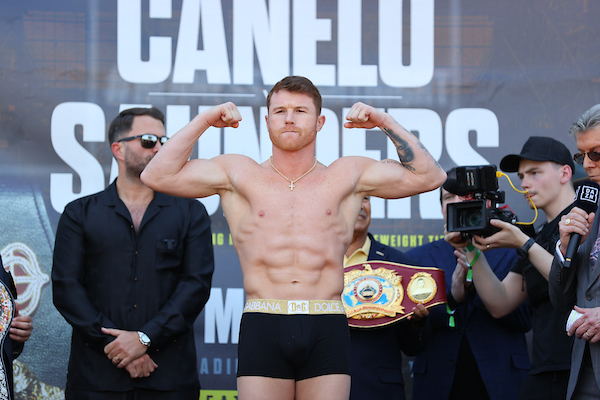
Canelo Alvarez’ evolution continues, proceeding incrementally with stubborn attention to detail. He never quits learning, which helps to explain why he never quits improving.

It also explains why he’s a 7-to-1 favorite over unbeaten Billy Joe Saunders Saturday (DAZN/8 pm ET, 5 pm PT) in a bid to win another piece of the super-middleweight title on the Dallas Cowboys homefield in Arlington, Tex.

A few years ago, those odds wouldn’t have been so one-sided. Then, Canelo (55-1-2, 37 KOs) looked to be vulnerable to the slick sort of skillset possessed by the left-handed Saunders (30-0, 14 KOs).

There were moments when Canelo looked confused in a unanimous decision over Austin Trout in 2013. About a year later, he escaped with a split-decision over Erislandy Lara. In between Trout and Lara, there was a one-sided loss delivered by the masterful Floyd Mayweather Jr.

Lessons, each and every one, for the student in Canelo.

His career has unfolded like one long lesson-plan. Potential for some new move or tactic is always there. For Saunders, it’s reason to be wary. For everybody else, it’s something to respect. Canelo learns and never forgets.

He introduced some head movement a few fights ago. Now, he has begun to master the head games that precede any significant fight. In terms of public interest, Canelo-Saunders looks to be a biggie.

A crowd of more than 60,000 is projected, which would break the Texas-sized record of 59,995 at San Antonio’s Alamodome for the controversial Pernell Whitaker-Julio Cesar Chavez draw in September 1993.

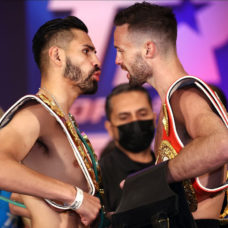
For the last week, it’s been evident that Saunders has tried to distract Canelo. That’s hard to do. In the eight years since Mayweather, only Gennadiy Golovkin has managed to rattle the impenetrable calm that seems to surround Canelo like a fortress. There were words at news conferences and shoving at the weigh-in before their 2018 rematch.

Saunders tried to land a psychological punch. He and his father, Tom Saunders, issued a series of complaints. They grumbled that Eddie Hearn, Saunders longtime promoter, was favoring Canelo. They complained about the assignment of judges. Not one is from the UK, Saunders’ home country. Not one is from Mexico, Canelo’s home country, either.

On and on, it went.

Finally, Saunders complained about the size of the ring, saying he wouldn’t fight in one measuring 18-feet-by-18 feet. Hearn said he assured him that the ring would be 20-by-20. Saunders, who might need every available inch of canvas to elude Canelo, demanded 24-by-24. He and his dad also threatened to withdraw if the demand wasn’t met.

Hearn countered: How about 22-by-22? OK, Saunders said. But this tale of the tape still needed Canelo’s approval.

No problem, Canelo said.

From a man known for his lethal counter-punching, it was brilliant. Ring size wasn’t ever the real issue, anyway. Guess here: This fight could be in a ring as big as an aircraft carrier. Canelo will beat Saunders.

In a fight before the fight, Canelo ended the head games, quickly and quietly, this time with some smart head movement.

He disarmed Saunders, who was left with nothing else to say. It looks as if Canelo’s life-long lesson plan included a course in psychology. He aced that one too.


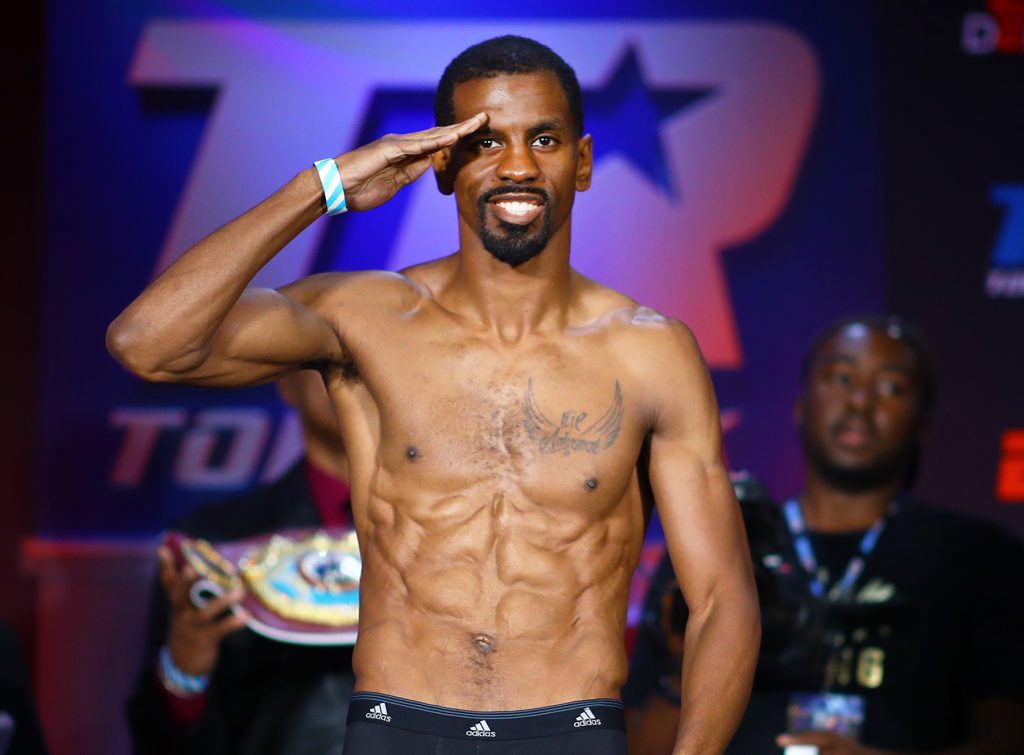
Healed and Healthy, Jesse Hart Eyes Edgar Berlanga In June Return 

By Kyle Kinder-

Just after midnight on January 13, 2020, in the center of the boxing ring inside the Hard Rock’s Etess Arena in Atlantic City, Jesse Hart (26-3, 21KO) stood shoulder to shoulder with referee Harvey Dock, awaiting the verdict of his ten round light heavyweight clash against Joe Smith Jr.  Moments later, dinging from the ringside bell echoed through the arena and public address announcer Jimmy Lennon Jr. read the judge’s scorecards: 97-92 Smith, 95-94 Hart, 98-91 Smith. 

The split-decision loss capped what had been a frustrating night for Hart, who was hoping to build momentum after scoring a unanimous decision over Sullivan Barrera in his prior outing.  But any immediate feelings of disappointment quickly gave way to concern. 

In the leadup to the Smith match, during training camp, Hart injured his right hand.  He thought he’d be able to fight through the pain, but in round two, after landing a short, awkwardly placed punch, Hart’s injury went from tolerable to severe.  Reluctant and unable to let his right hand go for the final seven-plus rounds, Hart tried to rely on his legs to evade the bigger, plodding Smith.  But it was to no avail.  A post-fight medical evaluation revealed damaged ligaments and a torn tendon, injuries that Hart was told were potentially “career ending.”

“I had one hand, I had to use my legs, I had to use my other attributes and my athleticism came into play,” Hart said about the Smith fight.  “When I have one hand, how am I going to stand in there and trade with a big puncher like Joe Smith, who is a bigger man than me?…People always say don’t make excuses, but that’s just the truth.”  He added, “With one hand, he was just too strong and I couldn’t hold him off with one hand.”

Eager to put the Smith fight in his rearview and fix his right hand, Hart braced for a major operation that would put him out of commission for a few months.  However, due to COVID-19, he wasn’t able to schedule his operation, which fell into the category of “elective surgery”, until June 5th, almost five months after his fight with Smith. 

During various post-surgery doctor visits, Hart sought clearance to resume training, but was continually rebuffed.  So for the last eight-plus months, heeding the advice of his doctors, Hart took it easy. 

“I’ve been really trying to let my hand heal, spending time with my family, my son and my daughter, and just trying to regain focus,” said Hart.  “It took major surgery and a long healing process, being patient, not wanting to punch….but I’m back to 100%, I feel a lot better.” 

Once Hart was finally greenlit to lace up his gloves again, he decided it best to part ways with head trainer Fred Jenkins.  Hart now hones his craft in North Philadelphia’s Philly 1 on 1 Boxing Gym, where he linked up with Boze Ennis, father of unbeaten welterweight phenom, Jaron “Boots” Ennis.  

“I recently made that switch and I’m starting to get comfortable with Boze and we’re starting to work real good,” Hart said.  He went on to state that while things didn’t necessarily get stale with Jenkins, Boze is “fresher.” 

With a healed right hand and new trainer at the helm, Hart now has his sights set on a potential June 12 matchup in Las Vegas against ultra-hyped super middleweight KO artist, Edgar Berlanga (17-0, 16KO).

“I think he’s a good puncher and over time he’ll develop, but I don’t think much of him,” Hart said of Berlanga. “I don’t think he’s ready for a guy of my caliber.  When Bob [Arum] said he wanted to do that, I literally jumped at that chance.  This is definitely a big fight for me, I won’t lie.  It’s definitely a big risk taking fight for me….I’m taking a gamble, but I know this kid can’t beat me and he won’t beat me in June.”

Hart’s only two losses at super middleweight have come in the form of razor-thin defeats in world title bouts against Gilberto “Zurdo” Ramirez.  Dropping back down to super middleweight from light heavyweight is a welcome change for Hart, who feels he does his best work at 168.

“I’m naturally a super middleweight….I talked to my mother and my mother said she thought I was too big.  She was saying, ‘You’re light Jesse, why are you fighting these big guys?’  She wasn’t always involved in my career, but she was saying the guys at 175 were too big, and my dad was saying that too…but now that I’m back here I feel comfortable.”

As of a week ago, Hart and Berlanga now have a common opponent on their resume in Demond Nicholson.  Nicholson was stopped by Hart in the seventh round of their 2018 contest, but went the distance in an eight round contest against Berlanga, becoming the only Berlanga opponent to make it out of round one in the process.

With regards to the Berlanga-Nicholson fight, Hart said, “Styles make fights.  He didn’t stop Demond Nicholson, but he did knock him down (four times).  I think Berlanga showed he had power, but I don’t think he showed smarts, I don’t think he showed skills, and I don’t think he showed athleticism.  He was getting hit a lot.”

Ever the boxing historian, Hart thinks a potential Berlanga fight would play out like another Philadelphia vs. Puerto Rico battle: Bernard Hopkins v Felix Trinidad.

“You saw what happened with Bernard Hopkins and Tito Trinidad,” the presumed underdog Hart, said. “He didn’t care that the whole Garden was against him.  He went in there and did his job and got Tito out of there.  It’s going to play out like that.  If this fight gets made, it will be a hell of a fight, but I got me stopping him in eight rounds.  I got both of my hands, I’m living right, I’m healthy, there’s no way this thing goes eight rounds June 12.”


FOLLOW RUIZ JR. – ARREOLA LIVE

Follow all the action as former heavyweight champion Andy Ruiz Jr. Battles Chris Arreola in a Heavyweight showdown. Also on the card is Sebastian Fundora battles Jorge Cota; Abel Ramos fights Omar Figueroa Jr. and Jesus Ramos takes on Javier Molina on the Pay-Per-View Portion

NO BROWSER REFRESH NEEDED; THE PAGE WILL UPDATE AUTOMATICALLY

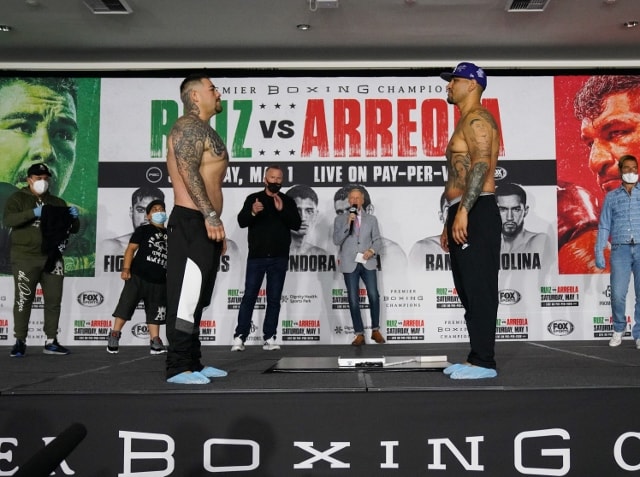
12-Rounds-Heavyweights-Andy Ruiz Jr. (33-2, 22 KOs) vs Chris Arreola (38-6-1, 33 KOs)
ROUND 1 2 3 4 5 6 7 8 9 10 11 12 TOTAL
Ruiz Jr.* 10 8 10 10 10 10 10 10 10 10 10 10 118
Arreola 9 10 9 9 9 9 9 9 9 9 9 9 109

Round 1: Good right from Arreola…Hard right from Ruiz..Combination..
Round 2 Good combination from Ruiz….RIGHT AND DOWN GOES RUIZ..Hard right from Arreola
Round 3 Big right from Arreola…Hard left…left from Arreola…Good hook..Right drives Arreola back…Uppercut from Ruiz..Right from Arreola
Round 4 Left hook and right from Ruiz…Right hand and hook
Round 5  Arreola lands a right.  3 Hooks from Ruiz..Left hook
Round 6 Combination from Ruiz Pop’s Arreola’s head back..Hook..3 punch combination..Hard combination…Good body shot..Hard jab…Blood from Bridge of Arreola’s nose
Round 7 Stiff Jab from Ruiz…Left hook..Good jab to the body
Round 8 Good hook from Ruiz…Arreola looks like he could have hurt his shoulder
Round 9 Hard body  from Arreola…Combination from Ruiz…hard right to the body
Round 10  Big Hook from Ruiz…Good right to the body…Right to the body..hard jab to the body..
Round 11 Uppercut from Ruiz…Hard hook…Arreola shoulder hurt again..Cuffing right from Ruiz….Good right
Round 12 Jab from Ruiz…3 punch combination..Right…Big hook and right hand…Body shot..

117-110, 118-109 TWICE FOR ANDY RUIZ JR.

12 Rounds–Welterweights–Omar Figueroa Jr. (28-1-1, 19 KOs) vs Abel Ramos (26-4-2, 20 KOs)
ROUND 1 2 3 4 5 6 7 8 9 10 11 12 TOTAL
Figueroa Jr.                          
Ramos                          

12 Rounds–Super Welterweights Sebastian Fundora (16-0-1, 11 KOs) vs Jorge Cota (30-4, 27 KOs)
ROUND 1 2 3 4 5 6 7 8 9 10 11 12 TOTAL
Fundora                           
Cota                          

Round 1:

10 Rounds–Welterweights–Jesus Ramos (15-0, 14 KOs) vs Javier Molina (22-3, 9 KOs)
ROUND 1 2 3 4 5 6 7 8 9 10 11 12 TOTAL
Ramos                          
Molina                          

12 ROUNDS–WBAMIDDLEWEIGHT TITLE–ERISLANDY LARA (27-3-3, 15 KOS) VS THOMAS LAMANNA (30-4-1, 12 KOS)
ROUND 1 2 3 4 5 6 7 8 9 10 11 12 TOTAL
LARA KO                        
LAMANNA                          

[/su_table]

Round 1: Hard left from Lara..another…Quick left..HUGE LEFT AND DOWN GOES LAMANNA….FIGHT OVER

12 ROUNDS–WBA INTERIM FEATHERWEIGHT TITLE–EDUARDO RAMIREZ (24-3-3, 11 KOS) VS ISSAC AVELAR (17-2, 10 KOS)
ROUND 1 2 3 4 5 6 7 8 9 10 11 12 TOTAL
RAMIREZ 10 10 TKO                   20
AVELAR 9 9                     18

Round 1 Jab from Avelar; Right Hook from Ramirez…jab

Round 2 Nice counter from Avelar; Good Counter from Ramirez…Jab..left.3 shots…2 counters from Avelar..Good left from Ramirez..

Round 3 BIG RIGHT AND DOWN GOES AVELAR…HARD RIGHT ROCKS AVELAR…FIGHT OVER


No Heavyweight Rumor: Ruiz-Arreola, Parker-Chisora are for real

By Norm Frauenheim-

The heavyweight division, once revered, has been reduced to a rumor. Only Tyson Fury-Anthony Joshua seems to matter, despite mounting doubts about reported negotiations full of promises and short on specifics.

Joshua promoter Eddie Hearn says it will happen this summer.

Fury co-promoter Frank Warren says it won’t.

That’s where it started months ago.

That’s where it still is, although there’s a growing chorus of frustration from Fury and his American promoter Bob Arum, whose skepticism about a $150 million offer from Saudi Arabia was evident in multiple media reports this week.

A deal hinges on whether the money is really there. A deal – date and place – has yet to be announced, hence deepening suspicions that the offer is bupkis, just more dust in a Haboob.

Meanwhile, Fury has taken to social media and Hearn is his target. Fury, whose trash talk is as deadly as his jab, is ripping Hearn, saying that the UK promoter has cozied up to Canelo Alvarez in the Mexican’s title fight against UK super-middleweight Billy Joe Saunders on May 8 in Arlington, Tex.

For the May fight, at least, Hearn is the promoter of record for both. But Fury is questioning his allegiances, which means Hearn is probably as popular as a piñata back home in Britain.

Such is that state of the heavyweights, a flagship as rudderless as ever. Yet, chaos at the top hasn’t silenced it.

Andy Ruiz Jr. and Chris Arreola, Joe Parker and Derek Chisora will do what Fury and Joshua may — may not — do.

They’re fighting Saturday, Ruiz (33-2, 22 KOs) versus Arreola (38-6-1, 33 KOs) in Carson, Calif., on Fox pay-per-view (9 pm ET/6 pm PT) and Parker (28-2, 21 KOs) against Chisora (32-10, 23 KOs) in Manchester, England, on Sky Sports Box Office.

Both fights are interesting. Both are linked. Both Ruiz and Parker are ex-champions.

Ruiz, the first heavyweight champ of Mexican descent, is the most memorable for his stunning stoppage of Joshua at New York’s Madison Square Garden in June 2019. He’s also the most forgettable for his messy loss in a rematch six months later in Saudi Arabia.

Ruiz blamed the scorecard defeat on lousy conditioning. He was about 30 pounds heavier than he is expected to be Saturday in his first bout with Canelo trainer Eddy Reynoso. Ruiz described the defeat as a kind of “self-death’’ during a news conference Wednesday.

“I killed the old Andy and am reborn with the new Andy,” he said.

It was a good line from Ruiz who looked to be re-energized if not resurrected. At 31, Ruiz still has a chance to be a player at heavyweight if –as expected – he beats the 40-year-old Arreola.  Perhaps, a Parker rematch awaits Ruiz, who emerged as a contender in a narrow loss – majority decision – to Parker for a vacant World Boxing Organization title in 2016 in Auckland, Parker’s hometown.

At least, it’s real instead of rumor. No telling what happens to the Fury-Joshua possibility.

Put it this way: Fury expects to take a day off from his training regimen in Las Vegas Saturday. He plans to be in Louisville at Churchill Downs for the Kentucky Derby. The 20-horse field includes a horse named for him after his stoppage of Deontay Wilder in a rematch in February 2020.It’s beginning to look as if the horse, King Fury, a 20-to-1 longshot, has a better chance of winning the Derby than Joshua-Fury has at happening anytime soon.


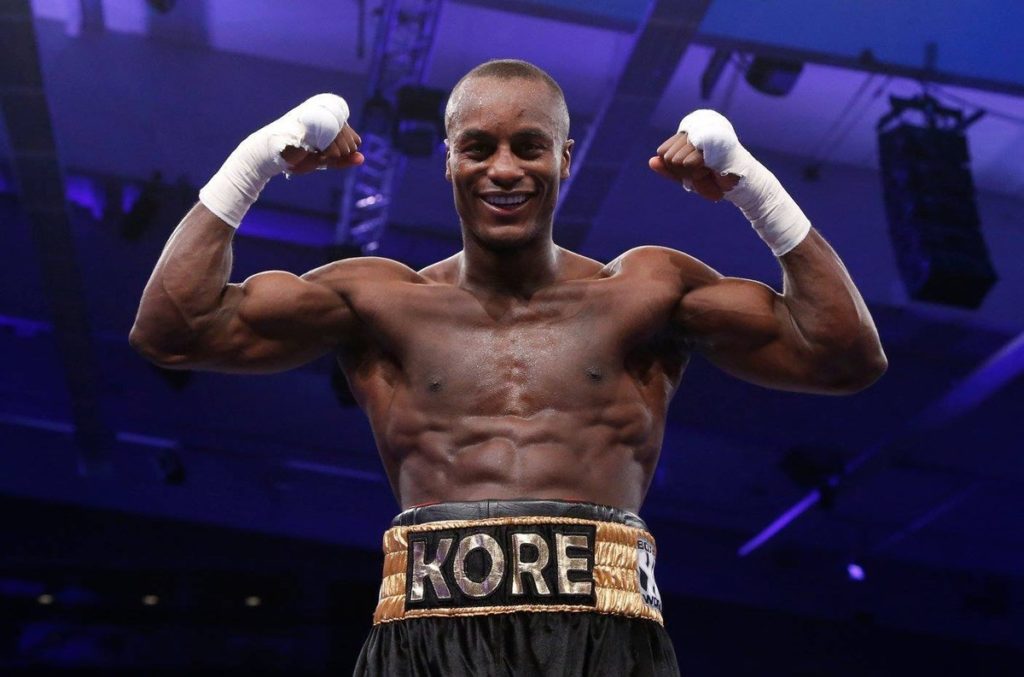
Sometimes Down, Never Out: Landry Kore’s Journey To And Through The Sweet Science

By Kyle Kinder-

In late spring 2013, having spent his last eight months training with the Danish military, Landry Kore was mentally preparing for deployment to Afghanistan.  Then he answered a life-altering phone call.

The voice at the other end of the line was a familiar one; that of former Danish Olympic boxer and Kore’s old amateur coach, Brian Lentz.  Lentz told Kore about a tryout in Copenhagen being staged by European boxing promotional giants, brothers Kalle and Nisse Sauerland.  The Sauerland’s were scouring Denmark seeking to bolster their roster of talent, which at the time included the country’s top ranked prizefighter, Patrick Nielsen.  

Kore, a former Danish Amateur National Champion, was hesitant.  He was a soldier now.  

He told Lentz, “Listen, I haven’t done any boxing training in eight months.”

But his ex-coach insisted.  “He told me, just come and put your name out there,” Kore recalled. “He convinced me to take a leave for the weekend and go to the audition.”

When Kore arrived at the gym, he quickly grasped the magnitude of the opportunity at hand.

“There were television cameras and newspapers.  Patrick Nielsen was there and [former world super middleweight champion] Mikkel Kessler…there were over 100 people there,” Kore said.   

The fighters, a mix of amateurs and professionals, were asked to workout at various stations.  They performed cardio exercises, smacked speed bags, and pounded heavy bags.  Once boxers completed the circuit of drills they were divided into groups by weight and made to spar in a mini tournament.  Those who impressed during their sparring sessions advanced to the next round, while those who underwhelmed were free to head home. Despite not gloving up for over half a year, Kore, along with three others, progressed to the final round.

Knowing this round-robin style of sparring matches were his last opportunity to impress Team Sauerland, Kore dug deep.  A mix of skilled boxing, ring IQ, and military-induced stamina resulted in Kore dominating all three of his opponents.  Within weeks he was presented with his first professional boxing contract.

But as eager as he was to put pen to paper, Kore first needed to be relieved of his military obligations.

“In Denmark you don’t just go into the Army,” Kore explained.  “I had to go through a selection of 400 people, and I think they accepted around 40.  So they invested in me for eight months.”

He continued, “I had to speak with my captain and say look this is what’s going on right now.  I told him I dreamed about being a professional boxer, but I also somehow got away from that dream, but this opportunity just came to me.”

Kore was prepared for rejection, ready to swallow the bitterest of pills.  Fortunately, he would never have to. 

“You know what, don’t worry about it, I’ll figure something and you can leave,” Kore remembers his captain telling him.  “Today I’m even still friends with him on LinkedIn, he’s been supporting [my career].”

As unconventional a path to professional boxing as Kore’s was, his journey to the sport itself was just as unlikely.

Born in Abidjan, Ivory Coast in 1989, Kore spent his first decade of life surrounded by family and friends, living a normal Ivorian childhood.  When he turned 11 he left for Denmark to reunite with his father, who was living in Copenhagen.  

Shortly after, Kore’s life took a cruel and tragic turn.  About six months after leaving the Ivory Coast, Kore’s mother passed away.  Less than a year later, his father kicked him out of the house.  

“I ended up in a foster home,” Kore recalled.  “It was quite stressful, leaving Africa and all my family, coming to Europe, expecting to live with my father and he put me on the street.”

In foster care, Kore became close with a 16 year-old boy, three years older than him at the time.

“Living with him, he became my brother, even though he was a different skin color than me,” Kore said.  “And one day he came home and said he had an issue with some guy from school.” 

They knew their new rival was a boxer, so naturally Kore and his foster brother headed to the local boxing gym, figuring they’d be able get their licks in a responsible manner, without fear of repercussions.

“I had no idea what boxing was at that point,” Kore admitted.  “We got to the gym and we kept asking to spar.  The coach was like, ‘No, you cannot spar with this guy, but you can get some of the younger fighters who are the same age as you.’ I thought, man they can’t do anything to me, but I actually got my ass kicked.”

Kore continued, “After we went to the gym again, eventually we even forgot the beef we had [with their rival].  But I really fell in love with the sport.  At that time, with all the things happening in my life, coming up to Denmark with my father, and the only person there that I know throwing me out on the street…I felt like boxing was a place where I can find refuge.”

Oh, and the head boxing trainer at the gym Kore happened to stumble into?  None other than former world super feather champion Jimmy Bredahl.  

“He became something of a father figure for me,” Kore said of Bredahl.  

Kore fell in love with boxing at a vulnerable time in his life and the love was mutual.  But like all relationships, Kore and boxing have had their ups and downs.

Months after inking his deal with Sauerland, Kore turned professional in April 2014, earning a four-round unanimous decision victory 28 fight veteran Nikola Matic.  He scored his first knockout five months later against the Czech Republic’s Michal Vosyka.

Four fights and four wins later, Kore and Sauerland parted ways in late 2015.  The following year saw Kore, fighting at middleweight, decisioned veteran Andreas Reimer before brawling with Poland’s Bartolomiej Grafka in a fight that resulted in a no contest.

Without the backing of a well-oiled promotional machine, Kore traveled across the Atlantic for the first time in his career in 2017 and fought his eighth professional bout on a Christy Martin promoted card in Charlotte, North Carolina where he scored an easy KO1 over Richmond’s Travis Davidson.  In his next bout, Kore knocked out Armenian Armen Ypremyan to claim the IBO Mediterranean Middleweight Title for his first taste of alphabet hardware.  

Promoter-less, Kore signed with a German management team in 2018 and began splitting time between Copenhagen and Karlsruhe, Germany.  It’s at the Mach1 Gym in Karlsruhe where Kore practices his craft under the tutelage of top-rated German trainer Dominik Junge.  

After going 1-0-1 in 2019, Kore hoped 2020 would be the year he’d create big waves in the middleweight waters, with a personal goal of cracking the top ten of an alphabet ranking. 

After penning a new contract with an upstart Danish promotional company, Kore’s 2020 began with a bang when he KO’d Frenchman Idaas Redjdal in late February.  Then the COVID-19 pandemic thrust the world into disarray.  Uncertainty ruled the day and Kore and his new team had little control over when his next contest would be.

“They said March, then in May, June, July,” Kore said.  “During all this time at some point, my body said you need to relax.  I was training too much, overtraining.  I was training for a fight and then about a week or two before a fight the Danish government said no events….so I had to stop training.”

Kore eventually eased off the gas and split with his Danish promoters.  In March 2021 Kore made a curious, but calculated career move for someone with only one fight in America and inked a deal with California-based promoter Shane Shapiro and his promotional company, No Limit Mindset. 

Junge and Shapiro had a prior relationship, and Kore was impressed with the way the young promoter had managed the career of Turkish-German super middleweight Cem Kilic.  A few phone calls later, Kore was convinced that signing with No Limit Mindset was the right decision for his career.

“When I spoke with Shane, the whole vibe, the energy, it was completely different,” Kore said glowingly.  

With his promotional situation straightened out, Kore, who hasn’t fought in 14 months, has his sights set on returning to the ring as soon as possible.

“Shane is planning something for the end of May or June,” Kore said.  “He really wants me to get in the ring, but there have been so many things in Germany, the restrictions and lockdowns, not even allowing professional athletes to train.” 

The 31 year-old Kore continued, “It doesn’t really matter where the fight is, I just want to have progression in my career.  The goal is to climb the rankings and get into the top ten.  This is what I want, this is what I dream of, this is what I’m willing to do everything for.  If the fights are in the US, then let’s go.” 

Currently, Boxrec.com rates Kore, whose record stands at 11-0-1 with 6 kayos, as Denmark’s top-ranked male boxer.  He admits that at present, though, the state of the country’s female fight game is a bit healthier than the men’s.

“Right now the female fighters are doing pretty good, but the males…the young guys are still prospects,” Kore said.  “The promoters just need to keep these young guys busy.  It looks like maybe one or two more years before it looks like anything.”

While a younger generation of Danish fighters may be a few years away from earning legitimate contender status, Kore knows he’s knocking on that door.  

He anticipates he’ll return to the ring with a “comeback fight” against a modest level of competition.  After that, he believes just one or two wins against “next-level” competition will catapult him into a top ten ranking and position him for a crack at a world title.  That’s the roadmap to glory that Kore has laid out in his mind.  With Shapiro and Junge in his corner, Kore believes he now has the right team around him to help him fulfill his dreams. 

Time and again, whether in life or in the ring, Kore has shown an extraordinary ability to overcome adversity.  He may get knocked down, but you can’t count him out.  Only a fool would doubt him.
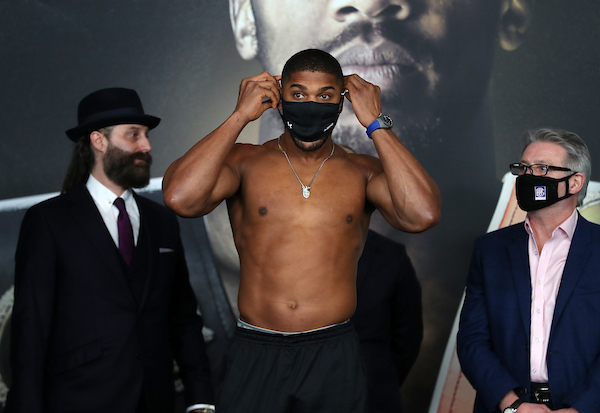


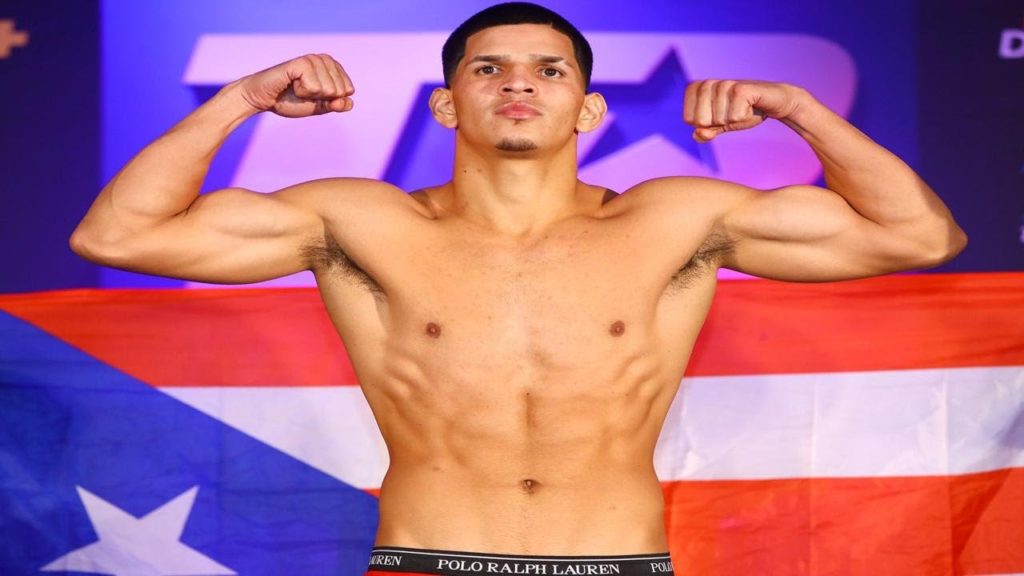
Proven Power: Berlanga’s dilemma is to prove there’s more

By Norm Frauenheim-

It’s a powerful introduction. Edgar Berlanga’s intro is memorable because of power for which there’s been no time for a counter.

Hello-goodbye. That’s about how long it has taken in Berlanga’s 16 fights, all of which have ended within the first round.

Berlanga is also generating a predictable buzz, a welcome one in a business drifting toward a carnival featuring You Tube wannabes and aging legends trying to squeeze a few more dollars out of their fading name-recognition.

Jake Paul, Logan Paul, Peter, Paul and Mary. Who cares? Plenty do, it turns out. You-Tuber Jake Paul’s one-round skit in a win over Ben Askren last Saturday reportedly drew a pay-per-view audience estimated between 1.2 and 1.6 million. Canelo Alvarez must be jealous.

Yes, there’s money in virtual power, an irresistible illusion for gamers and an opportunity for anyone seeking a quick buck.

But Berlanga’s power is real, sustainable if he can prove that there’s something more. The task continues this Saturday (ESPN, 10 pm ET/7 pm PT) against Demond Nicholson (23-3-1, 20 KOs) in a super-middleweight fight on a card featured by Emanuel Navarrete’s featherweight title defense against Christopher Diaz in Kissimmee, Fla.

Berlanga-Nicholson is scheduled for eight rounds, not that seven of them – second through the eighth – will matter. Berlanga’s professional apprenticeship suggests they will not. Therein, however, is the dilemma for a 23-year-old Puerto Rican who grew up in Brooklyn.

He goes into the bout with hype surrounding the first-round KO streak. Can he make it 17 straight? But his development hinges on what he can do beyond the first. He’s a fighter hoping for a career that goes the distance. At some point, he’s got to prove that he can with skills not yet seen. Until he does, he remains a prospect.

Berlanga knows what awaits him. He’s heard the questions at the heart of the dilemma.

“Everybody’s always like, ‘Oh, how he’s gonna do when he goes to the second?’ ‘’ he said Tuesday during a zoom session with the media. “At the end of the day, listen man, I’ve been boxing for 16 years.

“You know, I got all the experience in the world. I’ve been all over the world. I’ve sparred and I’ve got the most experience I could as an amateur, and even just sparring and everything, you know. So, for me to go into the second round, I know everybody out there will make it seem bigger than what it is.’’

From this corner, going into the second round would represent a second step in his promising career. A graduation, of sorts. The power is proven. But feared power can be fickle.

To wit: Deontay Wilder. No fighter in today’s generation was more celebrated or feared for his power than Wilder, whose 32 stoppages include 20 in the first round. Wilder grew certain that the power in his right hand would always prevail.

There were doubts, however, skepticism about whether he had a jab, footwork or any of the other skills he’d eventually need. Tyson Fury proved he did not in a seventh-round stoppage of a heavyweight rematch in February 2020.

Wilder went on to blame the loss on armor in a costume he wore into the ring, on a spiked water bottle and who-knows-what-all. What he didn’t blame was the one-dimensional belief in his power.

It proved to be more feint than faith.

A powerful lesson.


One last interview with the boxing writer by the boxing writer

By Bart Barry (For the final time)–

Editor’s note: After 16 years of boxing writing, Bart Barry now retires.  As we’ve allowed him a space for interviewing himself about the craft each year of the last five, we believe this is the best way for him to explain his departure.

BB: Promise our readers this isn’t about current events.

BB: It surely is not.  It isn’t about exhaustion, either.  It’s about logistics.  A simple lack of electricity for the foreseeable future.

BB: In these United States of America in the year 2021?

BB: No more USA.  By this time next week, as you know, we’ll be fully relocated to a very small, mostly indigenous town in the mountains of Mexico’s southernmost state.  There’s not yet reliable electricity there – no internet, no way to watch fights, no WiFi for miles.

BB: No sense in the hoopsjumping needed?

BB: None.  This has been a fantastic run with wonderful people and asking more would evince greed.  We’re taught, as contemporary Americans, maybe contemporary humans, even –

BB: Cut the prepositions.

BB: – there’s no easing the wrists while there’s milk yet to be wrung.  Thank you, no.  When coincidence intervenes and gives you a chance to be grateful and leave gracefully, there’s no inquisition.

BB: This won’t be a grievance-filled greatest-hits piece?

BB: No, certainly not.

BB: Why now?

BB: Blood pressure and cryptocurrency.  Last Thanksgiving, after an impressive bit of lockdown weightgain and a right miserable stretch at the day job –

BB: Data analytics?

BB: At a large bank, yes.

BB: Carry on.

BB: A trip to the dentist uncovered dangerously high blood pressure.  It was serious enough for me to write letters to my wife, daughter and son, last testaments more than wills, that discovered for me I hadn’t one more item on the to-do list.  Helping my wife build a house in the mountains of her home country was the last goal I had.  From there, in other words, there was only existing.

BB: Without regrets.

BB: There was a place to live, now, and 25 years of frustration and bad timing in the stock market finally hit with Ether cryptocurrency.

BB: Something we wrote about a few years ago.

BB: In part, yes.  I was enchanted by its frictionlessness back then.  And decentralization.

BB: Not any more?

BB: Now it’s more about an unfinished thought I have that combines lots of complexity reasoning and cooperation and the enduring failure of economics –

BB: Its illusion of precision.

BB: That there’s immense value out there, outside what the U.S. dollar captures.  Vaporware built on dog memes, intrinsically, is no more absurd than green pieces of paper with dead men’s faces on them.  Supporting the former, wethinks, makes more sense than dying for the latter.

BB: Sounds partially finished, anyway.

BB: It’s a thought I can see out the window and across the street.  I want to hold it.  But it’s much farther than my arm can stretch.

BB: Do you think there’s any chance you’ll grasp it if you stop writing?

BB: No, I do not.  I am OK with that.

BB: Isn’t that complacent?

BB: It may be, yes.  I can accept that.  The compulsion, the gnawing sense I have a talent I’ve not justified, is gone now.

BB: What will you miss about this?

BB: The people.  Being ringside.  The routine.

BB: That’s all?

BB: This is harder than expected.

BB: We’re already retired.

BB: I think so, yes.  When a fighter announces his retirement immediately after losing, we know, he retired during training camp.

BB: Now we’ve just wasted 70 minutes looking for a picture of you and Norm (Frauenheim) and Roberto Duran from 2006.

BB: Turns out, that’s my favorite memory in 16 years of writing about our beloved sport.  It happened so early, too.  It was a midday press conference at a Phoenix hotel.  Duran was part of a shortlived outfit called DRL Promotions.  There was a different press conference for the Coyotes hockey club or something, too, that same afternoon.  So nobody showed up.  Except for Arizona boxing’s one legendary writer and Manos de Piedra.  Norm interviewed him, and I translated, and I recall thinking, in the moment, the experience exceeded all expectations I had when I started writing about the sport.

BB: Gratitude, in other words.

BB: Yes.  In real-time.  That’s good as life gets.

BB: Other memories to recount?

BB: Don’t want to do that.  I’ll forget some and feel I’ve offended someone.

BB: OK, what’s the hardest you laughed at ringside?

BB: Tom (Hauser) recounted some absurd tale to me about a fan approaching Steve Albert on the street and telling him how much he loved his work, only to be surprised to learn Albert was on TV.  I still laugh at that sometimes.  I don’t know why it remains so funny – probably Tom’s delivery.

BB: Best fight you covered from ringside?

BB: Would have to be Vazquez-Marquez 3 in Carson, Calif., wouldn’t it?

BB: Sure.

BB: Or Marquez-Diaz 1 in Houston.  Sitting between Doug (Fischer) and Steve (Kim), two guys whose work at MaxBoxing inspired so many of us, and thinking Nacho would have to stop the fight to save Marquez from himself.

BB: What about Margarito-Cotto 1?

BB: That was sensational, but the memory got sullied later.  Marquez-Pacquiao 4 is another candidate.

BB: Marquez turns up a lot.

BB: I guess he’s the fighter I most wanted a prizefighter to be.  The synonym for me.  Though Izzy Vazquez is the person I most wanted a prizefighter to be.

BB: No heavyweights for the casuals?

BB: I didn’t cover a great era.  Or even a very good one.  The current guys are entertaining, I guess, but you can’t set them beside Pacquiao or Marquez.

BB: There was Briggs-Liakhovich at Bank One Ballpark.

BB: Yes there was.

BB: How shall we end?

BB: I was read by writers I admire – my greatest accomplishment.

BB: Some ending gratitude?

BB: To Bob Benedetti, my first editor and publisher; to John Raygoza, for creating 15rounds.com and taking me with him to Desert Diamond Casino; to Phil Soto and Lee Samuels, for my first credential; to Tom Hauser for inviting me to write a book with him; to Norm Frauenheim for being a genuine and wonderful mentor; and finally, to Marc Abrams, without whom none of these last 15 years could’ve happened.

*

To acquire the only signed first draft of this last column, as an NFT, click here.


Fury-Joshua: Still waiting to hear on the when and where

By Norm Frauenheim-

Tyson Fury is in Las Vegas this week, but is he tuning up his vocal chords or his jab?

It’s hard to know, given the ongoing talk about the when and where surrounding a fight with Anthony Joshua for the undisputed heavyweight title.

Daily headlines have become a tease, a rhetorical fan dance promising something big, very big, yet delivering little, very little.

Maybe, this is the week. At least, that’s what Joshua promoter Eddie Hearn promised a few days ago. Hearn talked about the end of week, which presumably would mean now.

But timetables are like glass jaws. They are there to be broken, especially in a business often ruled by Fury-co-promoter Bob Arum’s old comment: “Yesterday I was lying, today I’m telling the truth.” A line to set your clock by, if there ever was one.

So, if Friday and Saturday pass without something specific about the when and where of Fury-Joshua, the dance goes on. By now, just about everywhere has been mentioned. Saudi Arabia, the United States, China, Qatar, Singapore, Dubai and the UK have all been teased by Hearn.

“Both sides have approved the site offer that they want to go with, and now we’re just finalizing the site deal and we’re in a great place,’’ Hearn told Behind The Gloves after reportedly speaking Tuesday with Fury after he arrived in Vegas to begin training.

Yet, Hearn’s comment was notable for what it still lacked. No place, no date. Speculation has the fight going to Saudi Arabia. Speculation has it happening on July 24. But more speculation only spawns more skepticism

Last Tuesday appeared to be leverage, a drop-dead date. That’s the day Fury said he needed to know something specific about what would be the first in a two-fight deal.

“We have to go to Monday, Tuesday by the latest,’’ Fury said, also to Behind The Gloves, last weekend. “If I don’t know anything by Tuesday, I’m just going to move on, because it’s been a long time in the making.’’

More to the point, it’s been a long time since Fury has fought. Nearly 14 months have come and gone since he stopped Deontay Wilder. If the idle time hasn’t left rust, it has created an impatience in Fury, whose earning potential is at its peak. He’s 32.  

Fury’s father says it’s time, past-time, for his son to fight. If not a summer-date against Joshua, John Fury suggested a tune-up for the heavyweight champ who likes to sing before and after bouts. Bye-Bye, Miss American Pie, he sang to the media during a post-fight news conference after he fought Wilder to a draw in their 2018 fight.

“We will fight anyway, with or without AJ (Joshua),” John Fury told Sky Sports. “We have made this quite clear.’’

Only a place and date could make it any clearer.


Joe Smith Jr. and a triumphant tiring

By Bart Barry-

Saturday on ESPN in an entertaining and honest title fight at an Oklahoma casino New York light heavyweight Joe Smith Jr. majority-decisioned Russia’s Maxim Vlasov by fair scores that would have been just as fair and exactly opposite had they happened in Russia.  Neither man claimed the other’s consciousness, which means no crying for the loser, and announcement of the official cards got called correctly, comically and tragically “the big reveal”.  Smith got what he long desired and got it by winning the championship rounds.

There was a relative dissipation, though, by Smith in the pre-championship rounds, relative and relatable.  A deflation of sorts, when the taut covering, be it tattooed skin or shiny plastic (I’m thinking of the inflatable bop bags kids punch), has less air protruding it and goes some slack.

That’s what the corner of an attrition guy like Smith fears most.  Not that he’ll lose energy and get frustrated and make that frustration new energy; that he’ll lose energy and make a treaty with it, lose his defiance, find a resignation, and revel silent counterintuitively in his own helplessness.  Like Oscar De La Hoya pleading with Manny Pacquiao to throw a punch to cut the lights and spare him conscious humiliation.

There’s some wallowing in the Smith biography, doubt not, lest his trainer’d not’ve been so emphatic round the time Andre Ward made note of Smith’s body language.  Lunchpail, hardhat, selfindulgence – they are of a piece, or so say their dinercounters and bartops.  There’s nothing particularly heroic about rising at the same time each day and going to work.  The impediments, the sore back and sprained ankle and tendinitis in the elbow, dash in heroic seasonings.  It makes the next generation of men consciouser of these obstacles, seeing them celebrated in their dads’ overcomings.  The weight of the world and the system and all that.  Balance it just right, take on so much weight – and ensure some poet sings on it – and prevail, that is heroic.  Take on a bit too much, get forward bowed, and you make the infinite rolls of broken men.

For Joe Smith’s good from here till the end he needed to be able to be a titlist.  It’s why the judges’ decision took on outsized import to his corner.  Smith had done enough to win and little enough to lose, but being able to be called champ in a meaningful way, not in the cliched ways promoters and handlers and superfans address everyone who’s worn gloves, that was in the offing after 36 minutes of punching Saturday.  Smith got what he wanted – a well deserved new identity, something our beloved sport owed him for curtaining the B-Hop show years after its curdling.  

Smith is absolutely the best light heavyweight in his country and just as absolutely not the world’s best light heavyweight.  There’s a chance a good fight might be made between Smith and The Ring’s number-3 175-pounder, Sergey Kovalev, another man whose deflation has been public and obvious, but no chance Smith’s handlers should want for him to make any unification efforts with the division’s currently belted Russians.

Smith is in the glow of his greatest night as a prizefighter, his longsought triumph, the apogee of a bluecollar epic, a win for every everyman, so there’ll be no talking him into retirement, even if the time might be ironically right.  He knows he physically doesn’t have everything he did a few years ago.  But he has experience, now, and adulation, especially from strangers, and those things convince a man he’s better than ever, 20-percent at least for his new hardware, and capable of blinding others with status.  But Russians can be brutally oblivious of American status.

When your talent is what you are and the energy that manifests it begins to dissipate there are so very many reasons to say it is not what happens.  Do not discount resentment in those reasons, a general sense others have gotten more with less than you, that even though your product isn’t what it was in your obscure years there are backwages owed, and all those who ignored what you did when you were young and energetic owe you a retirement.  There’s a sweetness in obscurity, though, a private joy in being unappreciated for the right reasons that often proves more durable than an acclaim that comes for the wrong.

To jumble metaphors more than a little, that sweetness is the siren song for a fighter that his handlers lash him to a mast, any mast – be it sparring or roadwork or larger purses – to prevent his tasting.  You owe it to the less-fortunate to make the most of your talent, they say, and that most is a thing insatiable till you’re knocked the fuck out the ring by a younger, stronger man.

Bart Barry can be reached via Twitter @bartbarry


FOLLOW SMITH JR.- VLASOV LIVE

Follow all the action as Joe Smith Jr. takes on Maxim Vlasov for the vacant WBO Light Heavyweight title.  The action kicks off at 10 PM ET with a Heavyweight fight featuring Efe Ajagba and Brian Howard.

NO BROWSER REFRESH NEEDED; THE PAGE WILL UPDATE AUTOMATICALLY

12-ROUNDS–WBO LIGHT HEAVYWEIGHT TITLE–JOE SMITH JR. (26-3, 21 KOS) VS MAXIM VLASOV (45-3, 26 KOS)
ROUND 1 2 3 4 5 6 7 8 9 10 11 12 TOTAL
SMITH JR  9 10 9 10 10 10 10 10 9 9 10 9 115
VLASOV 10 9 10 10 9 9 9 9 10 10 9 10 114

Round 1: Right from Vlasov…Another right

Round 2 Good right from Smith..Smith cut over his right eye…Right from Vlasov..3 body shots from Smith

Round 3 Left to body from Smith…Right from Valsov..Combination

Round 4 Right from Vlasov..Left hook from Smith

Round 5 Right from Smith…Right from Vlasov..Good right

Round 6 Good body shot from Vlasov..Body shot from Smith…Right from Vlasov…Blood from Mouth of Vlasov…Right from Smith..

Round 7 Hard right hurts Vlasov..2 rights to the body..another body shot..Hard right..Left from Vlasov

Round 8 Hard combination from Smith..Right to body by Vlasov

Round 9 Series of headshots from Vlasov

Round 10 Right from Vlasov..Lead right..Right from Smith

Round 11 Good body shot from Smith…Short right from Vlasov..Body shot from Smith

Round 12 Right from Smith..Combination from Vlasov

114-114; 115-113 115-112 FOR SMITH

10 Rounds–Heavyweights–Efe Ajagba (14-0, 11 KOs) vs Brian Howard (15-4, 12 KOs)
ROUND 1 2 3 4 5 6 7 8 9 10 11 12 TOTAL
Ajagba 10 10 KO 10
Howard 9 9 9

Round 1  Big right from Ajgaba
Round 2 Jab and right from Ajagba
Round 3 HOWARD LANDS A HUGE RIGHT…DOWN GOES HOWARD…FIGHT OVER


Still On The Job: Joe Smith gets second shot at first title

By Norm Frauenheim

He’s the Common Man with a common name. There are 4,791 people named Joe Smith, according to a web site that keeps track of these things for everybody who needs to know. It’s an anonymous name, common enough to be an alias.

Go ahead, tell somebody you’re Joe Smith. Sure, you are.

But this isn’t a common Joe Smith. He has been fighting to separate himself from the everyman tag that was attached to him since 2016 when he followed a first-round stoppage of Andrzej Fonfara with a KO that knocked Hall of Famer Bernard Hopkins out the ring.

He showed uncommon power then. He has shown uncommon determination since then, with five fights, winning three and losing two to Sullivan Barrera and then to Dmitry Bivol.

He lost to Barrera in his first fight after the stunner over Hopkins. He lost a one-sided decision to Bivol in his only shot at a significant light-heavyweight title in 2019.

The Bivol loss might have been a sign it’s time to return to the union hall and go back to work as a laborer in Long Island, N.Y. It would have been the common thing to do. But Smith continued to fight, beating contenders Jesse Hart and Eleider Alvarez.

Smith (26-3, 21 KOs), perhaps a late-bloomer in a tough craft, still had some work to do. Namely, a job without a major title is a job still undone.

He’s back for a second shot, this time for the World Boxing Organization’s version of the 175-pound title against former cruiserweight Maxim Vlasov (45-3, 26 KOs) Saturday (ESPN, 10:00 pm ET/7 pm PT) in Tulsa, Okla., in a bout re-scheduled after Vlasov tested positive for COVID in February

“Becoming world champion and hearing the words, ‘and new!’ it’s going to be an amazing feeling,’’ Smith said this week before his bid for the WBO’s vacant crown. “This is everything I have been working for since I was 15 years old.”

About five years have come and gone since Smith did to Hopkins what nobody ever could. He’s 31 years old. He’s married. His sudden prominence in the wake of crashing Hopkins’ retirement party has also created options. The former laborer now has his own company, Team Smith Tree Service. He’s still a working man. A working man’s fighter, too. That’s still a big part of his story, still one of the best in boxing.

An irony perhaps is that he’s pursuing a belt and there may be nothing more common than that in boxing these days. There might be more belts than Joe Smiths. But this Smith might be in a position to claim one more belt if – as expected – he beats Vlasov, who enters the ring within a couple of months of his positive test for the virus.

It looks as if the Smith-Vlasov winner would set up a light-heavyweight biggie against Artur Beterbiev, who holds two pieces to the light-heavyweight puzzle. Beterbiev is considered the best in the division.

Beterbiev scored a 10th-round stoppage of Adam Deines on Mar. 20 in Moscow. But it was a mandatory defense, which is another way of saying it was forgettable. The mostly-unknown Deines had no chance.

Guess here, the determined Smith would. Call it common sense.


The redemption enviable

By Bart Barry-

Saturday afternoon on ESPN+ in a match from Dubai junior lightweight titlist Jamel “Semper Fi” Herring beat-up Northern Ireland’s Carl “The Jackal” Frampton, a former titlist in three divisions.  It was the finest win of Herring’s career and an unexpectedly convincing one.

Two times in as many months the 130-pound division has yielded the event glorious as any in a prizefighter’s career: The betting underdog winning a title match by knockout.  You’re the real thing once you’ve done that, regardless what comes before or after.  It does not happen often and happens even less often with household names.  Sometimes it happens in a wild upset but more often it happens when a man challenges himself with stiffest competition.  Betting odds speak to that competition, and knockouts speak to decisiveness.

Herring left no more doubt Saturday than Oscar Valdez did in February.  If Herring was not up against a man in his prime, like Valdez, neither is Herring a man in his prime – though primer, much, than he was in September.

A couple weeks ago Russian heavyweight Alexander Povetkin, a recent COVID patient, looked disbalanced and awful, unrecovered from the virus more than partially.  It recalled Herring’s performance against Jonathan Oquendo, the sort of performance that made a veteran handicapper like Frampton try and pick what 130-pound fruit he espied lowest the ground.  Herring’s second title defense, against Oquendo, was ugly an affair as a title match might be.  Herring was off-balance in the opening instants against Oquendo the same way Povetkin stutterswam from Dillian Whyte on Gibraltar.  If the men’s similar balance issues aren’t correlated to their similar COVID issues, it’s a whale of a coincidence.

That’s the bad news.  Here’s some good: Herring looked like a new man Saturday, which means COVID long-haulers need only haul so long.  Herring looked better not merely in the obvious way of fighting much better against a much better man but also, and more importantly, in his willingness.  Herring wanted to fight Frampton in a way he surely did not want a fight with Oquendo.  Frampton was, is, Oquendo’s superior, thoroughly.  That Herring wanted to trade with Frampton, holstering his jab enough to set Frampton a table for eating uppercuts, said nothing so much as: Herring is fully recovered from COVID.

So different was Saturday’s alpha predator that I revisited my column in September to ensure it was the same guy about whom Timothy Bradley said “real eyes real-ize” – disgusted and honest as Bradley was about Herring’s closedeye attempts to end that contest prematurely.  Herring took the initiative from Frampton exactly the way he surrendered it against Oquendo.

Frampton looked outclassed most of the opening rounds.  But he was undissuaded for having watched film of Herring’s last tilt.  If he might parry the jab and slip the cross and get close enough to Herring to hook an arm and clock-in, he assumed, a European ref, even one imported to the desert, would offer Herring no early breaks.  Frampton fought the exact fight that would have won him a midrounds stoppage against September’s Semper Fi.

Saturday’s Semper Fi was a different thing altogether.  In round 5, as Frampton began to remove some initiative from Herring’s grasp Herring kissed him with a lefthand Frampton’ll not soon forget.  It hamstrung The Jackal.  Less than a round later it was an uppercut that cut Frampton’s lights for a second or so.  The Northern Irishman rose bravely, yes, as Americans have come to expect from overmatched European champs.  But whatever courage Frampton showed quickly succumbed to Herring’s cruel plans.

By the time Frampton’s corner cancelled his whupping Frampton was wondering what took them so long.  He spun from the confrontation a bit expectantly, didn’t he?  Not to worry, as Frampton’s relief at the white feather got dutifully overshadowed by Herring and his handlers’ joy.  As it should be.  A titlist comes in a fight as a betting underdog and summons the white towel from his opponent’s corner, he’s deserving of what joy our beloved sport can bestow.

Herring acted fully redeemed Saturday.  So did boxing.  Didn’t it feel great to have a meaningful fight end decisively well before midnight?

Saturday’s event put promoter Top Rank in an enviable position, one it mustn’t squander.  It now has two of the 130-pound division’s three titlists, along with Shakur Stevenson and Vasyl Lomachenko.  Those are the makings of a wondrous four-man, single-elimination tourney sure to crown the defacto champion of the division.

It gets better.  The third titlist in the division is arguably its best and most exciting prizefighter, Gervonta “Tank” Davis, who finds himself in a set of circumstances Bud Crawford would surely recognize.  And therein lies the better part.  Soon enough Davis should demand of PBC what Crawford regularly demands of Top Rank.  When Davis does, we can hope, PBC will offer Crawford a shot at its best welterweights in exchange for Top Rank’s offering Davis some of its best junior lightweights.

Bart Barry can be reached via Twitter @bartbarry


Location, Location, Location: Shopping for new ring real estate

By Norm Frauenheim

History is easy to advertise. It’s harder to make. But some history is part of the promise attached to what otherwise would be just another title bout for another acronym-sponsored belt if not for location, location, location.

Jamel Herring and Carl Frampton are fighting in Dubai Saturday.

If it were Las Vegas or any other of boxing’s familiar stops, the fight for Herring’s junior-lightweight belt (ESPN+, 4 pm ET, 1 pm PT) would be interesting in terms of what’s next for a 130-pound division re-energized by Oscar Valdez’ stirring upset of Miguel Berchelt.

But interesting doesn’t qualify as history, or even noteworthy. Let’s just say that Herring-Frampton is a potential ground breaker for what it could do to boxing’s traditional real estate. It’s the first title fight ever in Dubai.

“I don’t have any doubts with the fight happening in Dubai because I’m a U.S. Marine.,’’ said Herring, a veteran of two combat tours in Iraq, including the battle of Fallujah in 2005. ”I’ve fought everywhere, in terms of the battlefield or in the ring.’’

The difference rests in rules and regs, presumably there to govern what happens in the ring. The violence is supposed to be controlled, unlike the killing fields Herring saw and survived 16 years ago. In part, those rules and regs will be subjected to something of a test run Saturday in Herring’s title defense against Frampton, an oft-injured ex-champ from Belfast.

If all goes well Saturday, the first of a reported two fights between Tyson Fury and Anthony Joshua for the undisputed heavyweight title might be headed to Dubai later this summer. Dubai has been mentioned repeatedly as a possibility for Fury-Joshua, both UK fighters. It’s fair to ask why, in the name of the Queen, would two British heavyweights fight anywhere other than the UK? There’s only one answer. It the same one you’ll get to the question about why the London Bridge is in the Arizona desert (Lake Havasu City).

Money.

Promoters are looking for site fees, which these days have been eroded by restrictions brought on by a Pandemic that is in Year Two and counting. There’s hope that it’ll end soon because of effective vaccines. By fall, there’s optimism that socially-distancing vanishes and seats are filled by paying customers instead of cardboard cutouts.

That’s already the plan in Texas. The state is open for business. The Texas Rangers are hoping for a capacity crowd (40,300) next Monday for their home opener against Toronto Monday at Globe Life Field in Arlington, Tex., Next door at AT&T Stadium, Canelo Alvarez hopes to fight Billy Joe Saunders in front of 70,000 fans on the Dallas Cowboys homefield on May 8. But medical experts worry whether so-called COVID variants will turn the baseball-opener into a super-spreader. It’s anybody’s guess what that might do to crowd expectations for Canelo-Saunders. But the risk is there.

Nevertheless, shopping for the best site-fee continues for what might be the biggest heavyweight fight in years. At Dillian Whyte’s stoppage of Alexander Povetkin last Saturday in Gibraltar, Joshua promoter Eddie Hearn told Boxing Social that he’s hitting the road for the next three weeks, all in search of a country willing to pay a king’s ransom for Fury-Joshua.

Hearn acknowledged there’s talk that the first fight should happen late in the fall. But Hearn insists June or July. Neither Joshua nor Fury can wait much longer, he says. Fury has been idle for more than year. He hasn’t fought since a Feb. 22, 2020 stoppage of Deontay Wilder. Joshua hasn’t fought since a stoppage of Kubrat Pulev last Dec. 12.

Fury, at least, has been idle long enough to reconsider and ask for a tune-up. He has mentioned that possibility. But the push is on, and it’s motivated by the pursuit of a site fee in the Middle East, where there’s money and oil to burn.

The heavyweights have already been there with Joshua avenging a loss to Andy Ruiz with a decision over the Mexican-American on Dec 7, 2019 in Saudi Arabia. It was called Clash On The Dunes, but it was more cash than clash.

Look for the bidding to begin Saturday, with the cash perhaps big enough to buy a piece of history. 


Dillian Whyte is a class act

By Bart Barry-

Saturday on DAZN in a heavyweight rematch for an interim title London’s Dillian “The Body Snatcher” Whyte snatched the remainder of Russian heavyweight Alexander “Sasha” Povetkin’s body and soul in the fifth round.  Symmetrically, round 5 was the same in which Povetkin unzipped Whyte seven months ago.

Whyte had before him the worst imaginable opponent, and he handled it gracefully.  So often, as Americans, we watch British prizefighters on the other side of things, playing the noble loser exactly as Whyte did last August, that it was a bit disorienting to see what a good winner a Brit could be.

For let there be no doubt the most memorable and meaningful thing that happened in the ring shared by Whyte and Povetkin came after their fight ended.  While I can recall plenty of acts of sportsmanship after prizefights – so many, in fact, the acrimonious way Erik Morales and Marco Antonio Barrera treated one another thrice remains exceptional as their matches – I cannot recall seeing a victor do for his vanquished what Whyte did for Povetkin.  It warrants description more than any punch Whyte threw or will throw.

After Povetkin failed to rise in time and woozied his way to a corner where his handlers gathered round him Whyte strode over for a customary embrace.  Povetkin was upright though barely conscious and apparently uninterested.  Whyte shrugged it off, turned his back and walked away.  About right, really, no man still staggering from blows to the head and the humiliation of defeat wants too desperately to be taken in a better man’s arms.

But Whyte didn’t go on a victory lap as expected.  Rather he fetched a stool for Povetkin.  Then he returned to the corner where Povetkin kept up an uninspired search for himself and positioned the stool beneath Povetkin, ensuring he sat squarely.  It held many times what grace Whyte shows when punching.  After that Whyte got a little carried away as a caretaker – “under the spell of his own sincerity”, as Philip Roth once put it – insisting on squirting water on the top of Povetkin’s head, but there’s no faulting him if he believed Povetkin’s handlers weren’t up to the task of protecting or preserving their charge.

Whyte’s fetching of Povetkin’s stool instantly joined in a library of our sport’s elegantest gestures Eddie Futch’s unfurling hand at the end of Thrilla in Manila – beautiful, simple acts contrasted dramatically by the violence preceding them.

Why might Whyte have assumed Povetkin’s corner wasn’t up to the task of caring for Sasha?  Povetkin’s presence in the ring, for starters.  Hospitalized twice for COVID since he coldcocked Whyte in their first match Povetkin looked like he might struggle with a breathalyzer during his ringwalk and couldn’t possibly walk a straight line after a couple minutes of moving round with Whyte.

Not enough is known yet about the lingering effects of COVID, but as aficionados we have witnessed steep declines in prizefighters known to have contracted the virus.  There are few sports whose preparations require quite the cardiovascular regimen boxing does, even in the heavyweight division.  The first time you spar is the closest you come to drowning on a dry surface.  In short order your lungs burn, your legs hollow at the hips and your eyes start to bulge.  None of these things happens during your first at-bat, your first hockey scrimmage or your first soccer practice.  Boxing with perfect lungs is daunting enough.  Boxing with compromised lungs?  Heavens.

Povetkin did not breathe any more laboriously than Whyte did, no, but he behaved like adequate oxygen wasn’t going all the places it should.  He looked worse than nonchalant before the match.  Then he went through round 1 with the footwork of a firsthour foal.  Whyte’s best landed punches ironically made Povetkin more stable.  It was Whyte’s ferocious misses that sent Povetkin splashing about the ropes, wheeling across the purplemat.

Povetkin’s chin was all the man had for defense from the open.  He had much the same offense he’s long had, a pronounced ability to concuss, but now offset by an approaching 42nd birthday and COVID.  Alexander Povetkin did not belong in a prizefighting ring.  Whyte sensed this but could only do so much about it.  He’d been handling Povetkin pretty easily in August, too, before Povetkin lowered their curtain with an uppercut.

Whyte wasn’t shy as he might have been and deserves credit for that.  Whyte might’ve made a longer and uglier night of it jabbing Povetkin and letting Povetkin’s deteriorated everything do the rest, but he went for the ice.  Even so, outside the United Kingdom and its incredible vocabulary for mediocre products, Whyte had won no new fans by stopping a COVID patient.  It’s what made Whyte’s remarkable act of postfight sportsmanship so important to his prospects.

Dillian Whyte is not a great prizefighter or future heavyweight champion; he is a man twice stopped by merely good fighters.  But he is talented enough to catch a rusty Deontay Wilder cold and have a few Yanks cheering him whilst he does.  He’ll not beat Wilder, he’ll not hear the closing bell against Wilder or Tyson Fury, as he already didn’t do with Anthony Joshua, but he’ll deserve one more sizable payday for being such a wonderful ambassador for a sport in need of wonderful ambassadors.

Bart Barry can be reached via Twitter @bartbarry


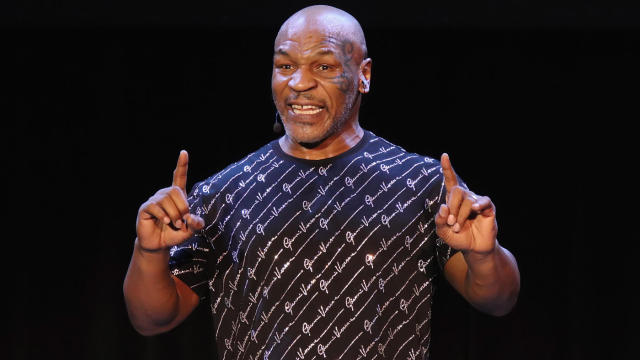
Tyson-Holyfield 3? Yes, no, only Tyson knows

By Norm Frauenheim-

Mike Tyson isn’t back in the news. He never left. He’s there this week with a swift succession of contradictory headlines that would leave you with whiplash if it weren’t for what we already expect from him.

He has more moods than weather has fronts. It’s impossible to forecast what he’ll say or do next. One minute, he’s fighting Evander Holyfield. The next minute, he isn’t.

The best question is to ask whether anybody cares. But the answer only raises more question. Turns out, plenty of people do care and most of them don’t read The Ring

Boxing has run out of crossover fans. But Tyson still has them. They’re there, following TMZ, which broke the latest story. No, TMZ reported Wednesday he won’t fight Holyfield in a May 29 exhibition in Miami despite other reports that, yes, he would.

The week began with news from the Holyfield camp that the fight was off. It continued Tuesday with Tyson saying it was on during an Instagram interview with Haute Living.  Haute Living’s masthead advertises a publication that reports on Lifestyle, Celebrity, Travel and Fashion. No mention of pound-for-pound ratings.

·       Yeah, it’s confusing. Then again, what could be more confusing than plans for a fight between two men, each older than half a century? Tyson is 54; Holyfield is 58. A license to fight isn’t a license to drive. But that’s another story

The story here is Tyson’s celebrity. It’s durable, which is another of way saying you can bank on it. Tyson, the personality, still fascinates. Hence, the headlines in TMZ and Haute Living. Most of their audience would never be interested in the reasons Errol Spence-versus-Terence Crawford hasn’t happened. Come to think of it, they probably have never heard of Spence or Crawford.

But Tyson? Stupid question. Everybody knows Tyson for all the usual reasons, both crazy and compelling. They were there four months ago for his exhibition against Roy Jones Jr. The Triller-staged pay-per-view production on Nov. 28 did numbers that boxing hasn’t done in years. Reportedly, 1.6 million bought the telecast. Reportedly, it generated $80-million in revenue. They weren’t buying to see Jake Paul slam-dunk Nate Robinson like a basketball.

They were buying Tyson.

Still are.

The guess here is that they’ll still get a chance to buy Tyson in a show that might include Holyfield. Might not. Holyfield beat him twice in the 1990s and only lost a piece of his ear. But the show belongs to Tyson no matter who’s in the supporting cast. Even if the rounds are limited to two minutes and the gloves are pillow-sized, there’s a suspicion that Tyson really doesn’t want to fight Holyfield anyway.

Fighting is in Holyfield’s DNA. There’s a good chance he’ll be as serious, mentally and physically, at 58 as he was at 34 in the 1997 Bite Fight. Who knows with Tyson? He’s an entrepreneur at 54 and as unpredictable as ever. He hopes to succeed with his Legends Only League, a concept that defies the clock and how it erodes ankles, arms and athletes.

Tyson might be his league’s only legend, mostly because of his hold on the public imagination. If widespread reports are accurate, it’s strong enough to spawn a planned television series, a biopic starring Jamie Foxx as Tyson.

It sounds crazy, as in crazy money. That’s the only sure thing with Tyson.


Y’all ain’t booing Mighty Mo no more

By Bart Barry-

Saturday in Fort Worth undefeated welterweight prospect Vergil Ortiz made an entertaining match with fellow Texan and former 140-pound titlist Maurice “Mighty Mo” Hooker on DAZN.  The match ended in round 7 when Hooker broke something between his right shoulder and hand, though not his middle finger – whose resilience he later confirmed energetically.  Ortiz was winning when the match ended about exactly the way its 10-1 odds anticipated.

Vergil Ortiz is ready for Terence Crawford.  He is no less likely to beat Crawford in 2021 than he’ll be in 2026.

Bud’s 3 1/2 years at welterweight are an embarrassment for our beloved sport.  Some of it’s Bud’s fault, probably, for pricing himself out of whatever halfassed plans his promoter planned to make for him.  Much of it is Top Rank’s fault for having no viable plan for Crawford at 147 pounds, building no one for him and finding every reason to avoid PBC as a fixed strategy.

Avoiding PBC hasn’t been a bad play for Top Rank these last few years.  But PBC has every other welterweight worth watching, and as one of the world’s two best prizefighters Bud Crawford deserves an opportunity to make at least one superfight in the final year or two of his prime.  He now says he’s moved on from that superfight with Errol Spence, which leaves him alternately courting a semiretired senator in the Philippines and scoffing at a title defense with Ortiz.  Neither option is palatable.  One pays much better than the other, but Manny Pacquiao is way too savvy to fight Crawford without a tuneup or two and incentives aplenty.

Bud was back in Lone Star State to see his stablemate look game but overmatched against Ortiz on Saturday.  At ringside Crawford looked softer than he has in the past.  That is, his smile felt genuine and his laughter too; gone was the dark anger that followed him like a raincloud.  He knows posterity will blame Spence for their non-fight, he knows Pacquiao will be more washed than him if they do fight in the fall or next winter, and he believes, incorrectly, he’s had a first-ballot career.

Just because Bud has been near the top of abstract rankings for a couple years doesn’t mean his reign has been a good one.  If he’s not going to make immediate matches with Ortiz then two of PBC’s top-3 welterweights his best shot at an enduring legacy is moving to 154 pounds, where he can play cleanup with the same poor competition he’s fought at welterweight and get even more credit for it.  Crawford’s unlikely to move seven pounds higher as Canelo is to return to middleweight for a rubbermatch with GGG.

Then Vergil Ortiz is the best option.  Ortiz’s promoter, Golden Boy Promotions, hasn’t a choice these days but to say yes to anything anyone with money offers, and Top Rank has lots of ESPN money to use on a meaningful fight for Terence Crawford.  Ortiz has a very good jab, a gaudy record and unremarkable defense.  Crawford, who’s fought thrice in two years (1-0 against contenders, 2-0 against Brits), should be rusty enough for Ortiz to scare him a bit more than Egidijus Kavaliauskas did 16 months ago.

Ortiz fights in the undissuadable, gladiator-academy style all Robert Garcia’s men favor (except for Robert’s little brother, Mikey, who has too much talent to’ve chosen Robert for non-fraternal reasons).  Ortiz isn’t going to learn nuance under Garcia.  He’s not going to learn much defense either.  Instead he’ll get instruction on walking through punches and ignoring damaged eyes and hitting the other guy hard and whatnot.  His greatest attribute against Crawford will be just how awful Crawford’s competition at welterweight has been (one-legged Jose Benavidez may very well be the greatest welterweight Bud ever fights).

Even grizzled aficionados fall for the all-by-knockout tag.  Fought guys you’ve never heard of? guys in the wrong weightclass? guys with multiple losses? guys coming out of retirement?  Suddenly it doesn’t matter because the wins were all-by-knockout.  There’s plenty of this with Ortiz.  The real tell to listen for is: “But none of those guys had been stopped before in their career!”  That’s when you know a circusbarker, be he promoter or flunky, is pettifogging poor competition.  Maybe Matthew Macklin has lost four times, and maybe there was that unfortunate episode at a lower weightclass seven years ago, but he’s never been knocked-out like that!

Mighty Mo was having none of it Saturday night.  After tasting leather aplenty and taking a knee the round before, Hooker threw a cross in the seventh and broke some part of his hand, and that was that.  Or wait, no it wasn’t.

After refusing to do that b-side thing where you favorably compare the man who just beat you less conclusively at 147 pounds than the guy who unbuttoned you at 140 Hooker explained something about both his hands being broken but one of them popping.  The socially distanced Texas crowd, partisan Ortiz and partisan Latino, booed Hooker, and Hooker, himself a Texan, told them what they could do with themselves.  It was fantastic comical.  He then turned, tossed his middle fingers in the air like smoking pistols, stepped through the ropes onto the apron, and challenged a few thousand of his critics.

Even Bud Crawford had fun with that.

Bart Barry can be reached via Twitter @bartbarry


Benavidez makes weight and statement, but is Canelo watching or listening?

By Norm Frauenheim

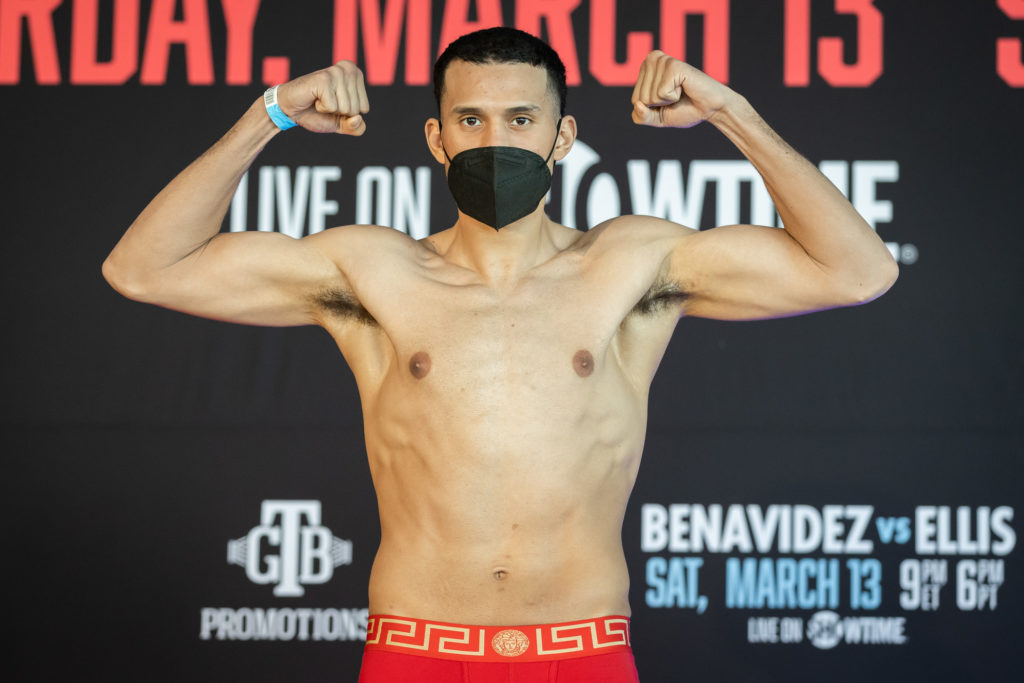
On a couple of scales, David Benavidez has been hard at work. He’s turned up the volume. And he made weight. Both have kept him in the mix, if not the hunt, for the one fight he desperately wants.

If you haven’t heard, he’s pursuing Canelo Alvarez. He has turned the internet into a virtual bully pulpit, jumping from platform to platform, stating and restating his ultimate goal of a fight with Canelo.

No telling whether Canelo is listening, although it would be hard not to. But Canelo has other tasks already on his schedule, including a super-middleweight title date with Billy Joe Saunders on May 8. Then, there are plans for Caleb Plant in a bid to unify the acronyms. Canelo, already known for his stubborn focus on the business at hand, is busy and probably will be for a while.

For Benavidez, that means more of the same. Stay relevant, both on the internet and in the ring. The signs are good that he will. His 11th-round stoppage of Ronald Ellis last Saturday was somewhat lost amid news of Marvin Hagler’s death.

Then, there was attention on Juan Francisco Estrada’s split-decision over Roman Gonzalez. It was a Super Fly classic, worthy of a Curtis Mayfield replay.

Nonetheless, Benavidez was impressive, more perhaps for the victory he scored on the scale than his predictable win over Ellis. He made the mandatory, coming in three-quarters of a pound under 168. Then, he went 10-plus rounds with no sign of the kind of fatigue brought on by an exhausting battle to shed pounds. There was plenty of talk in the wake of a scale fail last August against Roamer Alexis Angulo that he wouldn’t. That he couldn’t. But he would and could.

Light-heavyweight will have to wait.

Yet, it’s problematic how long a wait it’ll be before Benavidez will have to make the jump. He’s 24. He’s listed at 6-feet-and-1/2 inch and looks bigger. Light-heavy is inevitable and he knows it. The question is whether the Phoenix fighter can forestall that inevitability long enough to keep himself in line for Canelo in what would figure to be a mandatory shot at one of the Mexican’s titles. Benavidez lost the WBC version in August when he came three pounds heavier than the limit.

For now, it’s clear that Canelo has no interest in fighting anybody without a title or the right to a mandatory challenge. He talks about history, which means his priority is winning and keeping all of the relevant belts. That means Saunders, who has the WBO version. Then, there’s Plant, who holds the IBF title.  Canelo already has the WBA and WBC pieces to the puzzle, both of which he claimed in a one-sided decision over Callum Smith.

The other question is whether Canelo will even bother with a risky title defense. The aggressive Benavidez looms as risky a challenge as anybody in the division.  Canelo has been known to make risky challengers wait. To wit: Gennadiy Golovkin. GGG is still waiting for a third fight after a controversial draw followed by a debatable loss by majority decision.

Canelo is letting Golovkin grow old. GGG turns 39 on April 8. He might let Benavidez grow out of the division. It’s not clear whether Canelo will move up for a second bid at a 175-pound belt. He stopped Sergey Kovalev for a light-heavyweight title in 2019. Then, he relinquished it. For now, Canelo trainer/manager Eddy Reynoso says he doesn’t want him to fight against a naturally bigger man.

But, weight, like age, changes. Canelo, himself, still might grow into a natural 175-pounder. The real question might be Artur Beterbiev. How good is he? He looked unbeatable in a 10th-round stoppage of Oleksandr Gvozdyk in a light-heavy unification bout in October 2019.

Beterbiev (15-0, 15 KOs) is back Saturday (ESPN/ET 3 pm) in Moscow against Adam Deines (19-1-1, 10 KOs). According to Sports Betting Dime, Beterbiev is a minus-5000 favorite, meaning his chances at winning are at 98.4 percent.

Translation: Beterbiev is all but a lock to look sensational, impressive enough to keep Canelo at super-middleweight for now or forever. Benavidez doesn’t have that option. But he does have fans, enough of them to keep him busy with at least one possibility. Jermall Charlo, an unbeaten middleweight champ, called him out his week.

“Yeah, let’s make that fight happen,” Charlo said on The Last Stand Podcast with Brian Custer.

Charlo called him a “punk.” He promised to knock him out. All music to Benavidez, who has never been afraid of trash talk.

“I give him four rounds, five rounds,’’ Charlo said. “I knock him out in about five rounds, six rounds—no more. He get hit too much. I’m powerful. I’ll explode on him.”

Charlo, like Benavidez, has been chasing Canelo. The idea is that a fight with Benavidez would put the winner in position to finally fulfil that ambition. Both are looking for opportunity. For Benavidez, Charlo is a much better one than a rematch with Anthony Dirrell. Been there, done that.  It also looks to be an easy enough fight to make. Both are linked to PBC (Premier Boxing Champions).

On any scale, it would be one way to stay in line and a better way to move on if Canelo says no.


What we were looking for

By Bart Barry-

Saturday in a DAZN mainevent that went-off 90 minutes too late at American Airlines Center, in a match for The Ring super flyweight title, Mexican “El Gallo” Juan Francisco Estrada split-decisioned Nicaraguan legend Roman “Chocolatito” Gonzalez.  Few were the decisive rounds.  Fewer still were the decisive punches.  It was a wonderful prizefight.  Its ferocity and competitiveness raised both men above themselves.

We saw what we looked for.  It was that sort of match.  The punches were exchanged in a blinding fury, each man catching stiff as he pitched.  Whomever you watched is whomever you thought won.  

It’s like that often with scorekeeping but more so Saturday.  Over and again, unless you fix your eyes on the neutral plane between fighters and follow only what punches penetrate that plane, you naturally favor one man in every exchange.  In an event like Saturday’s, when punches get thrown an average of one every second – with plenty of seconds that feature zero, and therefore many seconds that have simultaneous punching – it is impossible to keep an accurate tally of punches with one set of eyes, much less marry each punch’s effect to its tally.  

It’s why scoring is necessarily subjective and knockouts are how titles must be taken.  That’s why those who rise on their hindlegs about scoring are such bores.

I did not score the fight because I was not ringside.  Pacquiao-Bradley 1 taught me scoring a match on television is a fool’s errand.  Camera angles, replay selection and three incessant voices imposing their groupthink on you and your subconscious make the televised experience wholly unreliable, even if you’re wide awake and sober at midnight.  Who you cheered for Saturday is who you watched, and whomever you watched is who you believe won.

I picked El Gallo.  I watched myself watching Gallo and knew there was nothing objective about my view.  I knew this in part because I absentmindedly put on DAZN’s English-language broadcast, ever inferior to its Spanish alternative, and found myself disagreeing with the commentary the entire match.  They must have been watching Chocolatito – certainly they were openly cheering for him (at times it had the silly feel of late-HBO’s rooting for Bernard Hopkins in his every “historic” moment).  Gallo would counter Chocolatito and move him backwards, and we’d hear how subtle Chocolatito’s movements were.  One guy crowed “Chocolatito is better than ever!”

That’s asinine.  Roman Gonzalez is 5-3 (3 KOs, 1 KO-by) as a super flyweight.  As a minimumweight, junior flyweight and flyweight, Gonzalez was 45-0 (38 KOs).  Chocolatito is many things today – including, with Saturday’s passing of Marvelous Marvin Hagler, one of my two most favorite living prizefighters (Israel Vazquez is the other) – but he sure as hell is not better than ever.  He would tell you that.  He knows that at his prime weight and with his prime power and reflexes he’d not be leaving things open to iffy scoring.

Chocolatito is not a great 115-pound prizefighter.  He knows this because, unlike nearly every one of his generational peers, he knows the feeling of being an alltime great prizefighter.

Both men awoke Sunday proud of their effort.  Both men fought better than they thought they could.  Chocolatito looked outgunned in the opening round and about a weightclass too small.  Gallo Estrada is a fantastic technician, quite possibly one of Mexico’s 25 greatest prizefighters, alltime, but he is not Chocolatito.  That is how Estrada won only by a very close decision Saturday despite fighting best he was able.  There was nothing more he might have done.

Much as we’ve made of what Srisaket Sor Rungvisai did Chocolatito, we mustn’t forget Estrada spent twentysomething more minutes ordering from Rat King’s tasting menu.  Gallo is fresher than Chocolatito but not fresh.

There’s a bit of straining and squinting to appraisals of Saturday’s event.  The best super flyweight in the world fought Friday in Bang Phun, Thailand.  Saturday was an extraordinary competition and payday for two of our beloved sport’s most deserving men, but fair is fair: More than 2,000 punches got thrown, yet neither man stumbled, bled or lost consciousness.  If we didn’t appreciate prime Chocolatito fully as we should we shouldn’t cheapen him telling ourselves he or Gallo or Saturday’s fight were more than they are.

How much do I love Chocolatito?  I felt intense relief when Saturday’s decision went Estrada’s way.  For I spent part of DAZN’s undercard watching Rat King make a BDSM dungeon of Workpoint Studio.  What Sor Rungvisai put on Ekkawit Songnui (50-8-1) Friday was savage as it was nonchalant.  He hurt Songnui like it’s what the man wanted him to do.  After nine minutes Songnui used his safe word.

I was there 3 1/2 years ago when Rat King made StubHub Center pindrop silent (forget not: nearly all of us were there to see Chocolatito avenge his only loss).  I remember keenly the vicarious devastation I felt that night.  I do not wish to revisit it.

Estrada’s decision victory primes perfectly a rubber match with Chocolatito.  That is best for both men.  But if someone must be martyred to Rat King, let it be El Gallo.

Bart Barry can be reached via Twitter @bartbarry


FOLLOW ESTRADA – CHOCOLATITO 2 LIVE

Follow all the action as Juan Francisco Estrada takes on Roman Gonzalez in a much anticipated rematch for the WBA/WBC Super Flyweight titles.  The action begins at 8 PM ET with Two more world title fights featuring the rematch between Jessica McCkaskill and Cecilia Brakehus plus Hiroto Kyoguchi and Axel Vega

NO BROWSER REFRESH NEEDED.  THE PAGE WILL UPDATE AUTOMATICALLY

12 ROUNDS WBA/WBC–SUPER FLYWEIGHT TITLES–JUAN FRANCISCO ESTRADA (41-3, 28 KOS) VS ROMAN GONZALEZ (50-2, 41 KOS)
ROUND 1 2 3 4 5 6 7 8 9 10 11 12 TOTAL
ESTRADA* 10 10 9 9 9 10 10 10 9 10 10 9 115
GONZALEZ 9 9 10 10 10 9 9 10 10 9 9 10 114

Round 1: Body shot from Estrada..Left ..Left from Gonzalez.z..

Round 2 Body shot from Estrada..Body work..Right to the head…Right..Counter right from Gonzalez…Right..left hook from Estrada..

Round 3 Left to body from Estrada..Right from Gonzalez..Right..Left hook from Estrada…Pace picking up…Right from Gonzalez..

Round 4 Right from Gonzalez…Toe to toe action….3 punch combo from Estrada…Hard right from Gonzalez…2 left hooks..Relentless action

Round 5 Right to body from Gonzalez…Big right…Combination..Another combination

Round 6  Combination from Gonzalez…Big Uppercut from Estrada..Body..Right hand and uppercut…Big left…Right from Gonzalez…Left from Estrada.

Round 7 Big Right from Estrada…2 great combinations

Round 8 Nice left hook from Estrada…Left from Gonzalez..

Round 9 Gonzalez lands a combination..Left..Short shot on the inside..Good 1-2..

Round 10 Good left hook from Estrada..Counter right

Round 11 Nice right from Estrada..Counter right..Nice inside right from Gonzalez…

Round 12 Both guys are just throwing punches…Right from Gonzalez..2 more rights

115-113 GONZALEZ; 117-111 ESTRADA; 115-113 ESTRADA

12 ROUNDS–UNDISPUTED WELTERWEIGHT TITLE–JESSICA MCCASKILL (9-2, 3 KOS) VS CECILIA BRAEKHUS (36-1, 9 KOS)
ROUND 1 2 3 4 5 6 7 8 9 10 11 12 TOTAL
MCCASKILL
BRAEKHUS

12 ROUNDS–WBA LIGHT FLYWEIGHT TITLE–HIROTO KYOGUCHI (14-0, 9 KOS) VS AXEL VEGA (14-3-1, 8 KOS)
ROUND 1 2 3 4 5 6 7 8 9 10 11 12 TOTAL
KYOGUCHI
VEGA

Round 1:

8 Rounds–Featherweights–Raymomd Ford  (8-0, 4 KOs) vs Aaron Perez (10-0, 6 KOs)
ROUND 1 2 3 4 5 6 7 8 9 10 11 12 TOTAL
Ford
Perez

8 Rounds–Middleweights–Austin Williams (7-0, 6 KOs) vs Denis Douglin (22-7, 14 KOs)
ROUND 1 2 3 4 5 6 7 8 9 10 11 12 TOTAL
Williams
Douglin


More Than A Little History: Gonzalez, Estrada have a chance at some on a flyweight anniversary

By Norm Frauenheim

Saturday is an anniversary. The calendar repeats itself. Maybe, history will too.

Roman Gonzalez and Juan Francisco Estrada meet in a fight featuring two of the best from boxing’s lightest divisions exactly 28 years since Michael Carbajal and Humberto Gonzalez fought for the first time.

Carbajal and Gonzalez were junior flyweights on March 13, 1993. So-called little guys, 108 pounds each. Combine the two and you’d barely have one heavyweight in today’s sumo-sized weight class.

But the little was gone nearly three decades ago, knocked out by Carbajal and Gonzalez after a bout long-remembered for its big-boy impact. Carbajal got up twice, first in the second and again in the fifth. Gonzalez went down once and stayed down, beaten in the seventh at the Las Vegas Hilton.

It was violent on any scale. It was dramatic on every scale. It set a standard, still there and perhaps still unequalled in any of the divisions at the bottom of the scale.

From 115 pounds and down, there is still a search for another fight that can again re-define the fighters at weights so often overlooked.

Gonzalez and Estrada are called junior-bantamweights or super-flyweights. Pick your acronym. The weight is the same: 115. The pick here is Super Fly, as in Curtis Mayfield.

Here’s hoping somebody plays Mayfield’s classic soundtrack to a 1972 film with the same name when they enter the ring in Dallas (DAZN, 8 p.m. ET/5 p.m. PT).

Both Gonzalez (50-2, 41 KOs) and Estrada (41-3, 28 KOs) have been super at lighter weights. Their bout Saturday is rematch of a fight at 108 pounds, which Gonzalez won by unanimous decision in November 2012 at the Los Angeles Sports Arena. A lot has happened since then. The Sports Arena is gone, torn down in 2016. Gonzalez is 33, no longer 24 and entering his prime. Estrada is 30, no longer 21 and tireless.

Their sequel is a little – perhaps a lot – too late. Carbajal and Gonzalez wasted little time. They fought twice more, both at 108 in 1994, first at The Forum in Inglewood, Calif. and then Mexico City. Neither rematch compared to the original. Gonzalez won both, scoring a split decision at The Forum and a majority decision in Mexico City.

Nevertheless, the first fight left a public appetite for more. The Forum rematch drew a crowd of 15,102. It was full of fight fans and celebrities, including Magic Johnson who had a seat on a floor he so often dominated during his days with the Showtime Lakers.

The second rematch drew a crowd of an estimated 30,000 at an old bullring.

There haven’t been audiences that big for any bout in the light divisions since then or perhaps before then.

Those numbers also added up to purses still never equaled at any of the lightest weights. Carbajal signed for a promised $1 million for the first rematch. The reported seven figures made him the lightest fighter to ever collect the sum. He’s still at the top of that historical pay scale.

That surprises him.

“Then, I thought this was just the beginning of something new,’’ said Carbajal, now 53 and still living on the street in the central Phoenix neighborhood where he grew up.

It is surprising, mostly because of Gonzalez, a masterful tactician with a mixture of great balance and power. He might not have Carbajal’s ferocious power or the tactical skill of the brilliant Ricardo Lopez, the best ever at 105 pounds.

But the Nicaraguan has displayed enough of both.

At junior-fly (108) and flyweight (112), Gonzalez was as complete a fighter as any. It propelled him to the top of the pound-for-pound debate. After Floyd Mayweather’s announced retirement, The Ring made him the lightest ever to be No. 1 in the publication’s 2016 ratings.

Then a flyweight, Gonzalez decided to move up the scale in pursuit of bigger money. He wanted a $1-million payday. He didn’t get it. Instead he got a couple of losses, both to Thailand’s Srisaket Sor Rungvisai at 115 pounds.  

Gonzalez’ biggest payday was $600,000 for a knockout loss to Rungvisai, according to contracts filed with the California State Athletic Commission after Gonzalez defeat, his second straight after a decision loss to Rungvisai, both in 2017.

There are reasons for weight classes. There’s price in not remembering them, too. The undersized Gonzalez paid for the jump. Carbajal stayed at 108 throughout his career.

“I never had to go up,’’ said Carbajal, whose decade-long career would end in 1999 with an 11th-round knockout of Jorge Arce, later a bantamweight and super-bantamweight champion.

The fights came to him, said the Hall of Famer, who had the advantage of being an American whose pro career was preceded by media visibility that came with his Olympic bouts at the 1988 Games.

He got a silver medal after a controversial loss for the gold to a Hungarian who was never heard from again after the Seoul scores were announced. It was a preview of what the world was about to witness – the outright theft of Roy Jones Jr., who lost gold at light-middleweight to a South Korean. Like the Bulgarian, the South Korean never fought again.

Carbajal and Jones came home known and liked by an American audience that saw them perform with poise, despite the adversity. The fix was in, yet they fought on.

It’s been harder to get known — to win over fans — for Gonzalez and Estrada, a Mexican born in Puerto Penasco, a fishing town on the Sea of Cortez about five hours south of Phoenix.

But maybe this is the time. Maybe the calendar is more than just coincidence. It’s a chance to make, if not repeat, more than just a little history.      


A fight that matters is all that matters

By Bart Barry-

Saturday on DAZN in maskless Dallas a match genuinely anticipated by our sport’s genuine aficionados happens for The Ring’s 115-pound championship.  Mexican “El Gallo” Juan Francisco Estrada defends his championship against Nicaraguan Roman “Chocolatito” Gonzalez, The Ring’s number-two super flyweight and former owner of the division (along with flyweight, light flyweight and minimumweight).

If Estrada snatches the initiative from opening bell, seizes it, and refuses to relent, he wins.  Chocolatito is no longer the hunter he was more than eight years ago, and in their first fight he was well neutralized by Estrada.  Go back and watch (if only for the dulcet tones of our own Marc Abrams’ commentary).  The scores can’t be believed, especially the lopsided one, but Estrada’s reaction can be.

After a nigh-hellacious 12th round, when the final clang came, Estrada and his corner very much believed Estrada the victor.  But for round 6, they had a claim on most every round of the 12.  No more of a claim than Chocolatito, the champion, mind you, but a claim.  Round 6 saw Chocolatito take the initiative from Estrada with body punching.  Chocolatito caught Gallo with a threepair of hooks deep, and it took Estrada the rest of the round to round-up his composure and breath.  

But there was no spinning Estrada.  Chocolatito, at his best, spun his opponents, something like the way Manny Pacquiao did, and the sooner he spun you the quicker he owned you.  He didn’t spin Estrada hardly a bit.  Gallo knew what was what against Chocolatito, and fighting before a pleasantly raucous crown in Los Angeles, he knew what his countrymen demanded a prizefighter.  It was a fully professional showing by a man not even ranked in the WBA’s top 10 light flyweights at the time.

There’s an argument Estrada is undefeated since that night in 2012 though not a terribly strong one.  Rat King got him in their first match three years ago but not by much.  Gallo avenged that defeat properly in their rematch 14 months later.  How hard is it to better Rat King in a rematch?  Chocolatito still doesn’t know because he didn’t get close enough to measure for an estimate.

Since Sor Rungvisai stamped an exclamation mark on Chocolatito’s chest in 2017 our Nicaraguan hero has been on a farewell tour of sorts, or so we suspected till Chocolatito took the WBA’s super fly belt from Khalid Yafai a year ago.  If Yafai was not in Chocolatito’s class it was because very few are; Yafai was pretty well accustomed to successful title defenses when he came to Texas and got beat-up by a legend washed-up.  It was a small vindication for Chocolatito, disproving theorists who said 115 pounds were too big and young for him after Rat King.  A small vindication because Chocolatito appears about the least-vindictive of all alltime talents in our beloved sport’s history.  Those wrongheaded theorists who begged Chocolatito to retire after Carson, Calif., anyway did it out of love, not scorn.  

Chocolatito made a rare co-main appearance in October, outclassing a gangly Mexican youngster nicknamed Jiga just before Gallo made that wonderful match with his countryman Carlos Cuadras.  The postcard festivities had a redemption-earned feel to them.  Gallo would finally be granted his long-sought rematch with Chocolatito because he deserved it.  The way a child gets dessert for finishing veggies.

One gets the sense Chocolatito would like to make some more money and Gallo is the best available wage but could take or leave whatever belts are in the offing because he’s had them before and probably doesn’t want the inevitable demand for a rubber match with the rubberizing Rat King, who has Chocolatito’s number then and now and forever.  Saturday’s match is for Gallo and longsuffering aficionados like us.  However uneager Chocolatito may be for a test stiff as Estrada, once the bell rings there’s no one doubting the way Chocolatito will comport himself.

I can’t help feeling a bit about this match the way I felt before the third match between Erik Morales and Marco Antonio Barrera.  That match was very much about Morales’ vindication.  After probably not beating Barrera in their first match and probably not losing to him in their second, Morales, on a six-fight streak and fully migrated to 130 pounds, got his third match with Barrera like a dessert plate.  Barrera, gone through by Pacquiao like wet tissue paper, was believed a very much reduced version of the guy who’d fought El Terrible for 12 rounds at 122 pounds and 12 more at 126.  Morales barely made their new weight for the rubber match and held his right hand cocked high to signal for all it was Barrera’s consciousness he wanted.  Then Barrera broke Morales’ nose with an uppercut and did not return to Morales the initiative.

If Estrada headhunts Saturday in pursuit of a knockout and legacy he may well get his nose broke, too.  If Estrada enters the fight cautiously, looking to outbox the Nicaraguan master, he may never get into a gear high enough to do so.  Estrada has a direct path to beating Chocolatito, but it is not a wide path.

Certainly Chocolatito believes he is Estrada’s superior.  Soon as Chocolatito realizes he is trading punches with the man who across 24 rounds unmanned Srisaket Sor Rungvisai he is likely to relent enough for Estrada to have his vindication.  Dragging Chocolatito to that realization is everything Gallo must do.

I believe he will.  I’ll take Estrada, KO-11.

Bart Barry can be reached via Twitter @bartbarry


Waiting for May: Boxing hopes to get back to business as usual in a month full of maybes

By Norm Frauenheim

May is a month projected to be the new beginning, a comeback from business in a bubble.

First, Canelo Alvarez in a fight for another super-middleweight belt against Billy Joe Saunders May 8 at the Raiders new stadium in Las Vegas. Then, Jose Ramirez and Josh Taylor on May 22 in a junior-welterweight fight for the unified title and perhaps a piece of history.

It’s an ambitious return from killer COVID. It’s a reason, a season, for cautious optimism. Filled seats instead of empty ones, faces instead of cardboard cutouts and real cheers-jeers instead of artificial noise are all part of that light at the end of the proverbial tunnel.

Everybody can get a jab in May, President Biden promises. Hopefully, everybody can begin to watch and hear jabs thrown from seats they purchased. But caution lingers. The pandemic has its own counters, so-called variants, a euphemism for what they really are. They’re mutants, unpredictable and ominous.

So, make that May, as in maybe.

Expect sellouts, yet no capacity crowds. Socially-distancing figures to still be in place in about every locale other than Texas and Florida. But it’s a beginning, the next step back to where we left it.

In effect, boxing, as we knew it, came to an abrupt end on Feb. 22, 2020 in front of a roaring crowd at Las Vegas’ MGM Grand for Tyson Fury’s wild stoppage of Deontay Wilder in a heavyweight rematch. Since then it’s been live streams, Zooms and pay-per-view.

There have been a few lessons too. Start with pay-per-view. Pre-pandemic, it was what every fighter wanted. They wanted to be a PPV fighter. They still do. Teofimo Lopez values that acronym next to his name as much as any acronym-named belt. Post-pandemic, however, PPV might have lost its value.

During the pandemic, PPV simply became another way of saying that no network or advertiser is willing to pay for this schlock. Example: Chris Arreola-Andy Ruiz (FOX) on April 24 is PPV; Ramirez-Taylor (ESPN) is not.

The pandemic turned the PPV model on its head. It’s lousy advertising. Maybe, that changes. But it won’t until the business can figure out how much the landscape has changed.

Back to business, whatever that looks like, will include some new stars and some of the same old suspects. Start with the stars, Lopez and Oscar Valdez.

Lopez won the most significant fight of the Pandemic with his decision over former pound-for-pound king Vasiliy Lomachenko in October. Valdez won the Pandemic’s most dramatic bout with an upset stoppage of feared junior-lightweight Miguel Berchelt a couple of weeks ago.

They were the biggest winners, although Lopez might have created problems for himself in the wake of his game-changing upset of Lomachenko. He is feuding with Top Rank, the promotional entity that lost the purse bid for his lightweight title defense against Australian George Kambosos to Triller, which is coming off its PPV biggie – the Mike Tyson-Roy Jones Jr. exhibition.

Lopez told The Ak and Barak Show on Sirius XM that he might split with Top Rank after two more fights. This is the same Lopez who has said he’s probably moving up the scale, from lightweight to junior-welterweight. He has talked about how wants to fight the winner of Ramirez-Taylor, both Top Rank fighters. He might have a tough time reaching a deal with an ex-promoter, Bob Arum, still angry at losing the purse bid. Words create headlines and consequences.

Meanwhile, Lopez’ fight with Kambosos is interesting, mostly because Kambosos is Manny Pacquiao’s ex-sparring partner. There’s also a caveat. It’s a mandatory, which suffered as much as PPV. Canelo’s third-round stoppage of Avni Ylidirim last Saturday was a mandatory title defense. Caleb’s Plant’s decision over Caleb Truax in January was mandatory. Both were forgettable. Mandatories should be too.

If Lopez beats Kambosos as expected, however, there’s bound to be speculation about a bout with Pacquiao, a small welterweight probably more comfortable at 140 pounds. Pacquiao’s durable celebrity has already attracted a long line of wannabe opponents. Terence Crawford, Ryan Garcia and Conor McGregor have all been rumored.

The latest to put himself in line is Mikey Garcia, who was quoted this week as saying a deal is near. But it’s all speculation until Pacquiao, himself, says something definitive. Until then, I’ll wait to hear from Triller that it will stage another exhibition, a Pacquiao-Floyd Mayweather sequel.

Just kidding. Then again, Maybe not.


Dylan Price Documentary “7 on 7” Drops TODAY on Social Media

Sicklerville, NJ (March 4, 2021) – Today on various social media platforms, a very special and unique documentary series will premiere as Dylan Price “7 on 7” will be available for viewing at 11 am ET

“7 on 7” will chronicle undefeated super flyweight Dylan “The Real Dyl” Price training camp and life as he prepares for his next bout which will take place on Saturday, April 24th (Details to be announced shortly).

“7 on 7” will be a seven part series, with each episode lasting seven minutes.
Each episode will be released over the next seven Friday’s leading up to fight night.

On April 17th, Price (12-0, 9 KOs) of Sicklerville, New Jersey will be competing for an NBA Regional title 

The series can be seen on the following platforms
@dylantherealdylprice on Instagram 
Davin Price Boxing on YoutubeDylan The Real Dyl Price on Facebook


Modelo nuevo de Canelo

By Bart Barry-

Saturday on DAZN super middleweight champion and world’s best prizefighter Saul “Canelo” Alvarez went through WBC mandatory challenger Avni “Turkey Wolf” Yildirim in a few rounds of medium-paced sparring.  The match was not competitive but a necessary part of Canelo’s new approach to our beloved sport.

The Canelo Model is ratified and acceptable.  Roughly it goes like this: Boxing’s biggest draw must make two annual superfights and the rest of his prizefights may be about whatever he thinks makes his two main fights shine.  It’s like the Money May Model, except that by broadcasting his sparring sessions Canelo makes more money for everyone.

Saturday was a broadcasted sparring session with a live gait and concessions and parking tariffs and sanctioning fees and all the usual fixings.  Canelo made far more money for punching Yildirim than he deserved, perhaps, but he also brought a bit of money to Miami Gardens that mightn’t have been there otherwise.  He got Yildirim paid way more than was fair or right, too.

Canelo has found his new home, 168 pounds, and decided to show us exactly how to clean-out a division.  It requires quite a bit more compromise than some might’ve supposed.  One cannot unify a division with superfights alone.  You already know this, but it bears reiteration.  If one tries to unify a division with superfights, he gets stripped of an old belt each time he wins a new one.

The sanctioning bodies, parasitic birds they be, want to lay their eggs in every nest and dip their beaks in every stream.  They make their money conjuring new titles and ratings to bestow on fighters in exchange for a point or two on those fighters’ proximate purses.  The worst thing to happen to any sanctioning body is a unified champion, someone who doesn’t need their trophies and might not pay for them in the future – while spending a year taking selfies with a belt that is generating no new revenue for its bestower.

The general remedy to this problem is to mint new ones.  International, intercontinental, diamond, silver, super, world, interim, gold, youth, and one for every continent and country.  It’s nefarious the way inflation is nefarious and not nearly potent as stripping champions.  Stripping, see, keeps a sanctioning body’s currency valuable in two ways: By not diluting the product and by implying something like quality-control.

Canelo is showing the world what a prizefighter must go through to keep belts.  Avni Yildirim lost a close decision to Anthony Dirrell two years ago in a match stopped early because of an accidental headbutt.  That’s how Turkey Wolf became Canelo’s mandatory challenger.  By losing.  Would Mexico’s WBC have stripped Canelo for leaving Yildirim on the shelf?  Of course not.  But the WBC would have made Canelo pay something extra to defend its belt in his next superfight.  Other sanctioning bodies who see Canelo as the WBC’s guy already want to strip him like Matthew McConaughey; the WBA’s playing along for the time being, but if Canelo doesn’t spar with David Morrell or Fedor Chudinov in 2021 expect “Simply the pioneers” to simply strip him in January.  

Canelo performs a further service for boxing.  By fighting his mandatories during off months, men who’ve worked their ways up through a corrupt system either by dint of talent or by surrounding themselves with equally corrupt handlers, or both, likely both, Canelo shows the enormity of what gulfs separate generational talents like him from everyone else.

Avni Yildirim is much better at fighting than you are or anyone you know is.  Yet he lasted fewer than 10 minutes with a man whose pro debut happened 38 pounds smaller than Yildirim’s.  There wasn’t a moment’s doubt Saturday because Canelo is pure prizefighter.

Canelo doesn’t carry opponents these days.  Not for fun or profit.  He plans to stay oldschool busy this year, too, so he hasn’t a reason to go rounds or knock-off rust or whatever other cliches promoters yip about after their inactive superstars’ bland outings.  He shows his palpable respect for the craft by showing inferiors open contempt.  He walloped Yildirim on Saturday like Turkey Wolf was filled with sand and dangling from a rusty chain, like Yildirim hadn’t any volition of his own.  When Yildirim stayed on his stool after a nineminute, depriving Hard Rock Stadium of its commissioned bloodletting, Canelo didn’t get theatrical.  He thanked his disappointed fans and announced his next match.

Bart Barry can be reached via Twitter @bartbarry


FOLLOW CANELO – YILDIRIM LIVE!!

Follow all of the action as Canelo Alvarez defends the WBA/WBC Super Middleweight titles against Avni Yildirim.  The action kicks off at 7 PM from Miami’s Hard Rod Rock Stadium with appearances from McWilliams Arroyo, Heavyweights Zhelei Zhang and Jerry Forrest plus prospect Diego Pacheco

NO BROWSER REFRESH NEEDED.  THE PAGE WILL UPDATE AUTOMATICALLY

12 ROUNDS–WBA/WBC SUPER MIDDLEWEIGHT TITLES–CANELO ALVAREZ (54-1-2, 36 KOS) VS AVNI YILDIRIM (21-2, 12 KOS)
ROUND 1 2 3 4 5 6 7 8 9 10 11 12 TOTAL
ALVAREZ 10 10 10                   30
YILDIRIM 9 9 8                   26

Round 1: Left hook from Alvarez..2 body shots..

Round 2 Hard uppercut from Alvarez..Left uppercut..Left to the body..Uppercut and right hand..Hard uppercut..hard left hook to the body..body shot,,Left to the body

Round 3 Right from Yildirim..RIGHT AND DOWN GOES YILDIRIM…Hard straight right from Alvarez—-THE FIGHT IS STOPPED IN THE CORNER

12 ROUNDS–WBC INTERIM FLYWEIGHT TITLE–MCWILLIAMS ARROYO (20-4, 15 KOS) VS ABRAHAM RODRIGUEZ (27-2, 13 KOS)
ROUND 1 2 3 4 5 6 7 8 9 10 11 12 TOTAL
ARROYO* 9 10 10 10 TKO               39
RODRIGUEZ 10 9 9 8                 36

Round 1 Counter from Arroyo..Clash of Heads..Right from Rodriguez..Left

Round 2 Chopping right from Arroyo..Left hook from Rodriguez..Jab from Arroyo

Round 3 Nice left hook from Rodriguez..Jab from Arroyo..Body shot..Left hook..Combination

Round 4 Hard uppercut..combination and down goes Rodriguez

Round 5 Huge right from Arroyo...TOWEL COMES IN …FIGHT OVER

10 Rounds–Heavyweights–Zhilei Zhang (22-0, 27 KOs) vs Jerry Forrest (26-4, 20 KOs)
ROUND 1 2 3 4 5 6 7 8 9 10 11 12 TOTAL
Zhang 10 10 10 10 10 9 9 9 8 9     94
Forrest 8 8 8 9 9 10 10 10 10 10     92

Round 1: Right hook from Forrest…Left from Zhang…HUGE LEFT AND DOWN GOES FORREST
Round 2 good action..BIG RIGHT HOOK AND DOWN GOES FORREST
Round 3 LEFT AND DOWN GOES FORREST
Round 4 Zhang Jabbing
Round 5 Zhang working Body
Round 6 Body shot from Forrest
Round 7 Forrest starting to dictate action
Round 8 Big left from Forrest..Body shots from Forrest..Zhang cut over his right eye.
Round 9 Combination from Forrest…ZHANG EDUCTED A POINT FOR HOLDING THE NECK
Round 10 Left from Forrest…Hard combination from Forrest.Big right..Zhang looks hurt..Inside right hook..

8 Rounds–Super Middleweights–Diego Pacheco (10-0, 8 KOs) vs Rodolfo Gomez Jr. (14-4-1, 10 KOs) 
ROUND 1 2 3 4 5 6 7 8 9 10 11 12 TOTAL
Pacheco 9 10 10 10 10 10 10 10         79
Gomez 10 9 10 9 9 9 9 10         75

Round 1 Right from Gomez…Body shot..Nice right from Pacheco
Round 2 Straight from Pacheco..Good body shot..Counter right…Uppercut..Left hook
Round 3 Nice right from Gomez…Right from Pacheco…Nice right from Gomez…Good body shot from Pacheco..Good exchange..
Round 4 Left hook from Pacheco..Left hook followed by a straight right…Left hook from Gomez…Right from Pacheco
Round 5 2 Big rights from Pacheco
Round 6 Counter and straight right from Gomez..Counter right from Pacheco..Uppercut on inside
Round 7 Left uppercut from Pacheco
Round 8

4 Rounds–Super Featherweights–Marc Castro (1-0, 1 KO) vs John Moraga (1-2, 1 KO)
ROUND 1 2 3 4 5 6 7 8 9 10 11 12 TOTAL
Castro* 10 KO                     10
Moraga 8                       8

Round 1 1ST PUNCH AND DOWN GOES MORAGA (Jab)..Right hook to the body
Round 2 Jab from Castro..Right to head and nice left hook..RIGHT HAND AND DOWN GOES MORAGA…BIG UPPERCUT AND DOWN GOES MORAGA AND THE FIGHT IS STOPPED


From Oscar Valdez to Canelo: A learning corner

By Norm Frauenheim

Oscar Valdez was motivated by a chance to shut mouths. He did that, including this one. But his compelling stoppage of Miguel Berchelt was – make that is – more than immediate satisfaction gained from silencing the doubters.

It is validation, enduring proof, of who he is. It was there in a victory loaded with lessons for a cynical business short on patience and poise. Quaint notions, both, but Valdez practices them with faith impossible to break. Fracture his jaw, but not his ethics.

They are why he won, leaving the feared Berchelt face- down on the canvas last Saturday. That patience and poise, instead of purses and pound-for-pound claims, are why we’re still talking about a fight that happened nearly a week ago, almost an era today in the social-media’s accelerated time zone. A good guy won in a timeless way.

Maybe, it takes him into a fight with Shakur Stevenson. Or maybe, Gervonta Davis. Already, the cynics are circling, saying he wouldn’t have much of a chance against either. If that sounds familiar, just look at last week’s headlines and odds. Very few suggested that Valdez had any chance.

But cynics beware. Valdez is the defining face of what it is to overcome. A broken jaw didn’t finish him in the rain against Scott Quigg three years ago. He was carried out on a stretcher, looking very much like a fighter who won what some believed was his last stand.

But only his jaw was broken. Not his resiliency. The jaw healed and left a lesson he used to propel himself to what has become a great story for a sport with too few. He started over in a place and in a corner that allowed him to find himself. In Eddy Reynoso, Valdez found his identity.

It was evident in a couple of fight-turning moments midway through the bout. It was further affirmed in colleague Bart Barry’s brilliant column Monday. http://www.15rounds.com/oscar-eddy-and-the-power-of-powerful-questions/

Both are evolving. But that mutual evolution wasn’t clear until those middle rounds, one that could have taken a nasty turn with Valdez instead of Berchelt face-down in the 10-round. Their mutual understanding of what was happening and what was at stake was the key.

Berchelt survived a shaky fourth and began to exert himself. Signs of Valdez, pre-Quigg, were evident. His face was flushed. He looked as if he were about to sacrifice poise and smarts to an instinct that had taken over so often. He would brawl, which was a sure way to lose.

But he didn’t. Reynoso was there to remind him to remember the plan and resist the temptation. It was timely, advice strategically brilliant because of how it was carefully delivered and then stubbornly executed.

The trainer-fighter relationship is often nothing more than personal chemistry. Think Freddie Roach and Manny Pacquiao. But Reynoso-Valdez looks to be something even more. They’re both students, learning from each other. Teaching each other, too.

Until those moments in the middle rounds of Valdez’ victory for a junior-lightweight title, it was hard to get a solid read on Reynoso. Turns out, that was unfair. He’s best known for Canelo Alvarez, who ranks among the game’s most accomplished fighters.

The assumption was that Canelo would make any trainer look good. Think of Phil Jackson, whose coaching abilities were somehow questioned simply because he had Michael Jordan in Chicago and Kobe Bryant with the Lakers.

Reynoso was a virtual novice when he moved into Canelo’s corner. After Canelo’s lone loss in a one-sided decision to Floyd Mayweather Jr. in 2013, I still remember the great Rafael Mendoza, a Hall of Fame manager, telling me that Canelo would have to learn on his own.

The insightful Mendoza, a former Mexico City sportswriter, had worked with Canelo early in his career. Both lived in Guadalajara. But he split with Canelo, he said, because he wanted Eddy and his father, Chepo, to hire a more experienced trainer.

The Reynosos were there for Canelo in the beginning, but as investors not as trainers. Mendoza, who died in May 2018, wanted a more experienced voice. Not sure who he had in mind, but I’m guessing Mexican legend Nacho Beristain, whom he brought into Humberto Gonzalez’ corner after a 1993 loss to Michael Carbajal. With Beristain, Gonzalez won the next two fights in a junior-flyweight trilogy, beating Carbajal by narrow decisions in both.

We’ll never know how Canelo would have fared with Beristain instead of Eddy Reynoso. By then, Beristain was more of a revered teacher, an authoritarian never to be questioned. But I’m betting Mendoza would be applauding how Eddy Reynoso has transformed himself into the best trainer of the day. He listens, and It’s clear that Valdez and Canelo listen to him.

It’s that intriguing evolution that makes watching worthwhile. I’ll even watch Canelo Saturday against the longest of longshots, 50-to-1 underdog Avni Yildirim, in a super-middleweight title fight (DAZN 8 pm ET/5 pm PT) at the Dolphins stadium in south Florida. However, I wouldn’t watch if not for what was seen in Valdez’ triumph over Berchelt.

The head movement, jab and footwork exhibited by Valdez have been there at an ever-improving rate in Canelo.

They’re still learning.

So, too, are we all.   


Oscar, Eddy and the power of powerful questions

By Bart Barry-

Saturday in Las Vegas undefeated Mexican Oscar Valdez dropped Mexican titlist Miguel “El Alacran” Berchelt, The Ring’s number one super featherweight, thrice and stopped him violently in round 10.  Carcrash violently.  It was a much-anticipated match, broadcast by ESPN and promoted by Top Rank, that saw the underdog win in what was, but for a few rounds in its middle, a rout.

This was the sort of definitive ending to a definitive fight you wish on anyone who signs up for prizefighting and so few attain.  Nothing polemical, nothing squishy, nothing for unperspectivèd pundits to unpack.  A fully realized lefthook that dangled the larger man and champion in a space between his ongoing lightness and a perpetual darkness.

Valdez reacted dramatically, crying-out and making running circles.  Nowhere to put all that emotion.  A complete loosening of a man who appeared so tight for so long.  There was a cultural element to it all, too, that solely a Mexican would understand about another Mexican.

You could feel elation for Valdez even as you felt dread then sympathy for Berchelt even as you felt relief, perhaps, for our beloved sport.  When it gets it right and definitive, there’s nothing like boxing, is there?

There was a moment in the match a quarterhour before Valdez’s lefthook that felt unique.  Immediately after round 6, one that saw Berchelt in the middle of his best four-minute run of the fight, Valdez walked to his corner and had the following exchange with his chief second, Eddy Reynoso:

ER: ¿Cómo te sientes?

OV: Bien.

ER: ¿Cómo lo sientes a él?

OV: Cansado.

(ER: How do you feel?

OV: Good.

ER: How does he feel to you?

OV: Tired.)

It struck me immediately it was the first time I recalled hearing a trainer give so much trust to his charge’s judgment during a prizefight.  Lore and tradition tell us the trainer is a father figure, often saintly, and the fighter is an impetuous child, often ungrateful.  Part of the reason folks went in for and still do go in for the Cus D’Amato mythos, aside from Mike Tyson’s untiring salesmanship, is because tradition so well prepared us for the relationship D’Amato told everyone he had with Tyson and Tyson now tells everyone he had with D’Amato.

If that’s too American, here’s a Mexican version: Nacho Beristáin and the Brothers Marquez.  Before Rafael’s third match with Israel Vazquez, Nacho memorably opined, “If Rafael obeys (me), he will win.”  You can count on your fist the number of times Nacho or Coach Freddy asked Juan Manuel or Manny how the other guy was feeling during their 126 minutes of combat.

I ask you how you’re doing then I tell you how your opponent is doing – that’s the gist of the trainer-fighter dialogue, if the trainer doesn’t begin by telling the fighter, too, how he is feeling.  If, as Oscar Wilde wrote, all bad poetry is sincere, so too is all bad corner advice.

Eddy Reynoso is a new generation of trainer.  He has guided, generally gently, our sport’s alpha predator, Canelo Alvarez, to an unlikely state of constant improvement.  Canelo has taught Reynoso how to run a corner.

Surely Reynoso saw with the rest of us Berchelt’s gathering strength in round 6, even if Reynoso probably didn’t expect Berchelt to be emergent as he was in round 7.  Yet before Reynoso began strategizing and stuffing 10 minutes of instructions in 50 or so seconds, he gathered intelligence from Valdez.  A little of that may’ve been curiosity, Reynoso’s wishing to confirm his own intuition.  More of that, though, was proper coaching.

Reynoso wanted Valdez to hear himself confirm his own intuition.  Do believe had Valdez’s replies been disordered – I feel tired, and he feels strong – Reynoso would have altered his advice accordingly.  That is the mark of a great coach.  Reynoso was wholly present, in the moment with his charge, not lost in a thicket of his own pastround observations.  That’s why Reynoso was able to ask a question that began with the word how.

As generations of legal dramas have taught us, yes-no questions are only about confirming already held assumptions: “You feel fine, right?  And he’s tired, isn’t he?”  Questions of that sort are useless to a coach.  The opposite point on the spectrum – questions that begin with what and allow the speaker to learn about himself – would not have been appropriate in the middle of a confrontation like Saturday’s, either, though they’d be damn potent in a training camp.

We hear so often about a fighter’s need to trust his trainer.  Here is a new direction, call it Sendero Reynoso, by which a trainer learns to trust his fighter.

Valdez’s assessment of Berchelt at Saturday’s midway point mightn’t have been flawless – there’s plenty of machismo in any Mexican prizefighter (machismo for which Reynoso has an automated filter, of course) – but Valdez’s hearing himself say Berchelt was tired absolutely helped Valdez make it through round 7 and begin to change the fight back in round 8.  Which is not to imply Valdez lacked confidence at any moment Saturday.

Confident or not, though, there was a little Margarito-Cotto 1 energy (I know you felt it too) when Berchelt started taking runs at Valdez in rounds 6, 7 and 8.  There was nothing inevitable in round 7, then, about Valdez’s vindication in round 10.

An ending like what Valdez put on Berchelt and every expert who doubted him (I wasn’t asked to offer a prediction but am confident I’d’ve been wrong as everyone else) is what we seek in sport.  Something so decisive, so final, you’ve no choice but to shut-up and nod.  ¡Felicidades, Oscar!

Bart Barry can be reached via Twitter @bartbarry


FOLLOW BERCHELT – VALDEZ LIVE

Follow all the action as Miguel Berchelt defends the WBC Super  featherweight title against former Featherweight champion Oscar Valdez.  the action starts at 10 PM ET with undefeated Super Featherweight Gabriel Flores taking on Jayson Velez

NO BROWSER REFRESH NEEDED.  THE PAGE WILL UPDATE AUTOMATICALLY

12 ROUNDS–WBC SUPER FEATHERWEIGHT TITLE–MIGUEL BERCHELT (38-1, 34 KOS) VS OSCAR VALDEZ (28-0, 22 KOS)
ROUND 1 2 3 4 5 6 7 8 9 10 11 12 TOTAL
BERCHELT 9 9 9 8 9 10 10 9 8 81
VALDEZ* 10 10 10 10 10 9 9 10 10 KO 88

Round 1: Left and right from Valdez

Round 2 Left hook from Berchelt..Jab..Jab from Valdez..Blood from Nose of Berchelt..1-2 from Valdez

Round 3 Jab from Valdez..Jab..

Round 4 Big left hurts Berchelt..Another…Berchelt is wobble..Left AND THE ROPES HOLD UP BERCHELT FOR A 10-COUNT

Round 5 Big left hook from Valdez..Big Right

Round 6 Left from Berchelt..Left hook..Left hook from Valdez..Right..Berchelt landing a combination

Round 7 Left from Berchelt..Hard right hand in the corner..Left hook from Valdez and another..Left hook

Round 8 Jab and left hook from Valdez…Lead Left hook…Left hook

Round 9 Left hook from Valdez..Southpaw jab…LEFT HOOK AND DOWN GOES BERCHELT….Right from Valdrz..sweeping right

Round 10 Big right from Valdez…Straight right down the middle..Snapping jab and hard right…HUGE LEFT AT THE BELL AND DOWN GOES BERCHELT…HE IS KNOCKED OUT COLD

10 Rounds–Jr. Lightweights Gabriel Flores Jr. (19-0, 6 KOs) vs Jayson Velez (29-7-1, 21 KOs)
ROUND 1 2 3 4 5 6 7 8 9 10 11 12 TOTAL
Flores Jr.* 10 10 9 10 10 KO 49
Velez 9 9 10 10 9 47

Round 1 Right from Flores
Round 2 Jab from Flores…Right from Velez..Right..Double jab from Flores
Round 3 Good jab from Flores..Right to body from Velez
Round 4 Left from Velez..Left from Flores..Left hook from Flores..Right to body from Velez..
Round 5 Jab from Flores…Counter left..
Round 6 1-2 from Flores and again…COUNTER LEFT HOOK AND DOWN GOES VELEZ…Big left wobbles Velez….LEFT HOOK AND DOWN GOES FLORES AND THE FIGHT IS OVER


Harm’s Way: Oscar Valdez is back in a familiar place against Miguel Berchelt

By Norm Frauenheim

Harm’s way is often the only way for Oscar Valdez. He has survived there. Prevailed there. Instinct has taken him there in a risky path toward danger and away from a safer route.

Safe, of course, is a relative term. In the ring, there’s no refuge. There’s no real escape, but there is elusiveness in tactics taught by wise trainers and booed by the blood-lust demographic in the boxing crowd.

Therein, rests the dilemma.

And the drama.

Both are there for Valdez (28-0, 22 KOs) Saturday night (ESPN 10pm ET/7pm PT) against a junior-lightweight with a presence that puts a defining face onto harm’s way. A feared face. Miguel Berchelt has size, power, a five-and-a-half-inch advantage in reach and stoppages in each of his last six fights.

In body and spirit, Berchelt (37-1, 33KOs) has the look of somebody built to inflict the pain in what Mike Tyson once called the hurt business. Get in his way and he’ll do the harm.

There’s peril there, possibly as much as Valdez has ever faced in what will be only the third bout at 130 pounds for the former featherweight champion.

It’s enough for the oddsmakers to force Valdez into a new role. For the first time, he’s the underdog. SportsBettingDime makes Berchelt a minus-190 favorite. At other books, the number is at about 4-to-1 and climbing, all in favor of Berchelt, the defending champion. Translation: Nobody gives Valdez much of a chance in the Top Rank bubble at Las Vegas’ MGM Grand.

Even Mexican icon Julio Cesar Chavez is picking Berchelt in what could prove to be another chapter in the Mexican tradition of blood and guts.

“Julio Cesar Chavez says Berchelt will win this fight,’’ said Valdez, who during a Zoom session talked about how he has found motivation in the one-sided odds. “Doesn’t bother me. A great thing about boxing is shutting mouths.’’

The pre-fight promotion includes inevitable parallels to Erik Morales-versus-Marco Antonio Barrera and Israel Vazquez-versus-Rafael Marquez. History sells. Hype does, too.

“The winner, I believe, can be the next superstar in Mexico,’’ said Berchelt, who is anxious to fulfill a dream he has had ever since he was a kid watching the Morales-Barrera trilogy.

History is probably a reach, but the potential for a memorable fight, if not a classic, is there in large part because of what has already been seen from Valdez. There’s been blood. And guts. He’s encountered, if not embraced, adversity. He endured it. And conquered it.

That was never more evident than nearly three years ago on a rainy, chilly night in Carson, Calif.  Beneath a tarp, Valdez fought Scott Quigg, who missed the 126-pound mandatory and was weaponized by several pounds of added leverage at opening bell.

Valdez manager Frank Espinoza advised him not to fight after the scale fail. But Valdez, never one to back away, said no and moved forward, straight into harm’s way. Espinoza saw what could happen.

In the fifth, Quigg broke Valdez’ jaw. For the next seven rounds, Valdez boxed, brawled and bled. After it was all over, the rain washed away footprints and debris from the canvas. Only the stain in the Valdez corner remained from the blood he had spilled, spit up between rounds.

He was the winner. But it was hard to celebrate. Even a smile had to hurt as he was placed on a stretcher and into an ambulance after scoring a decision, a unanimous testament to his courage. The experience, he says now, is a source for confidence.

“The broken jaw made me a better fighter, because I know I can compete when I’m hurt,’’ he said.

Proof of that had been delivered more than once. He fought through pain and a surprising challenge from Filipino Genesis Servania in September, 2017 in Tucson, where the two-time Mexican Olympian went to school and still has family.

In April of that year, he was way ahead on the scorecards against a dangerous challenger, Miguel Marriaga, yet he waved at him in an invitation to brawl in the 11th and 12th rounds. He was doing it for the fans, he said. He wanted to give them a show.

After his jaw healed in the months post Quigg, Valdez changed trainers, leaving Manny Robles for Eddy Reynoso, Canelo Alvarez’ trainer. He’s been with Reynoso for four fights. He has tried to replicate the head movement and defense so evident in Canelo’s ever-evolving style.

Valdez says he has worked at adding more options. Yet even with Reynoso in his corner, he got knocked down by a late sub, Adam Lopez, in 2019. He went on to win a seventh-round TKO.

“Being with Eddy has made me a more complete fighter,’’ Valdez says. “I don’t think people have seen me at my best.’’

Against Berchelt, Valdez says there are options.

“Plan A, Plan B, Plan C,’’ said Valdez, whose Olympic resume includes training in the game’s defensive fundamentals.

He might need all three and a few more. Plan D, E, F and G. Then again, if those plans break like that jaw, Valdez might be at his dangerous best. In his unbeaten run, Valdez has been a little bit like Michael Carbajal, a Hall of Fame junior-flyweight who grew up in Phoenix, about 180 miles north of Nogales, Valdez’ hometown in Mexico.

Carbajal, like Valdez, was at his best when he was hurt. A badly-bloodied and seemingly-beaten Carbajal knocked out Jorge Arce in 1999. Carbajal got up from two knockdowns to knock out Humberto Gonzalez in 1993.

Harm’s way is a dangerous way. For some fighters, however, there’s no other way  


Jo Jo can went went

By Bart Barry-

Saturday on DAZN in a non-title match, the fighting pride of Tajikistan, undefeated super featherweight Shavkatdzhon Rakhimov, settled for a majority draw against California’s Joseph “Jo Jo” Diaz, a former Olympian and IBF titlist, in a California casino.  The match was not spectacular but better than what its weighin portended.

This was to be a redemption thing of some sort for Diaz even before it had to be an even larger redemption thing for Diaz.  It sure wasn’t either.

Long before Friday’s weighin debacle Diaz’s comportment raised questions about his willingness.  Setting aside his skedaddling out the featherweight division without rematching reluctant Gary Russell, there was a contract and general understanding Diaz should give a rematch to Tevin Farmer, the man Diaz won his IBF super featherweight title from 13 months ago.  Diaz, in no hurry to fight Farmer again and promoted by an adrift outfit now without its one revenue generator, allowed COVID-19 considerations to scuttle his rematch and assign an unknown Tajikistani in Farmer’s stead.

Then Diaz missed weight by so much weight he wasn’t allowed to try again.  The culprit?  A missing sauna at Fantasy Springs Casino.  In his postfight interview Diaz used his generation’s version of postmodernist cant, beginning a torrent of excuses with the standard disclaimer: No excuses.  There were the hometown haters trying to make money off his name, and childbirth, and a host venue so unprofessional as to tell Diaz to make weight by making his own sauna in his hotel room.  There were Saturday’s judges, too, who mistook Diaz’s blocking everything thrown at him for landed punches.

Somewhere in this no-excuse-making mishmash, delightfully enough, the large gash to the outside of Diaz’s right eye, opened undoubtedly by a blocked punch, began spurting blood down the angering former titlist’s face.  It wasn’t bleeding quite so steadily as Diaz’s nose had through much of the fight – another victim of a blocked punch.

Diaz’s outrage played authentic as his haircolor and promoter’s every utterance.  Diaz long has felt like an Oscar knockoff.  The rehearsed autobiography, the California roots, the Olympic dreams, the vanity.  With about half the talent.

Saturday Diaz was easily the more talented fighter, still.  Shavkatdzhon Rakhimov holds no secrets.  With Freddie Roach in his corner, too, what secrets he once held are fewer.  Coach Freddie wants his men to hurt the men across from them – “he’s not your friend”.  Roach’s own condition, the product of other men once hurting him, lends a counterintuitive credence to his demands.  If a conditioning coach unscathed by others’ fists implored his charges to hurt other men, it would sound bullying, weekend warrior-ish, silly, in its way, as that Vince Lombardi hologram a couple Sundays ago.  That Roach’s neck is strained and his hands shake with Parkinson’s while he implores a fighter to hurt the man across from him says This is the only way, son, for if there were another way, wouldn’t I be the one to tell you?

That Roach says it doesn’t mean his charges take heed, necessarily, as Rakhimov didn’t in the later rounds Saturday, when either his conditioning failed or his affection for Jo Jo succeeded and Rakhimov relented right about the time the fight was there for his taking.  A life-changing event for Rakhimov?  No, not really.  COVID-19 is a life-changing event.  Winning a sliver of a title from Jo Jo during a pandemic is not.

Besides, if we’re going to concern ourselves with what was squandered Saturday, let’s go back to Jo Jo, where the squandering considerations begin and end.  As everyone knows, Golden Boy Promotions is not in a very good place.  Without Canelo Alvarez the company is a regional promoter with a flaky figurehead.  The contract they have with DAZN, such as it is, relies primarily on DAZN’s current lack of meaningful fights and fighters.  That should persist for some time, helping both parties overlook how little value Golden Boy Promotions brings a broadcaster without Canelo on its roster.

It would be an excellent time for Jo Jo to show his promoter and his promoter’s network he is the next Ryan Garcia.  Instead Jo Jo comes to his first title defense woefully unprepared and goofy as hell in orange coif.  Much more Son of the Legend than Niño de Oro.  Does he get in the ring on a redemption quest, bin all self-preservation and ice an opponent we might later memorialize as “that tough Russian”?  Nope.  He tries for a quarter of each opening round then goes on defense and ekes out a draw, much to his father’s vocal dismay (and has anyone thought to coach trainers on how audible they’ve become to judges?).

Jo Jo can now give Tevin Farmer that rematch, if Farmer still wants it, or Jo Jo can go away.

Bart Barry can be reached via Twitter @bartbarry