Audio: Caleb Truax and Ray Flores on The Abrams Boxing Hour

Marc is joined by IBF super middleweight champion Caleb Truax and Boxing broadcaster Ray Flores on this episode.

Marc is joined by IBF super middleweight champion Caleb Truax and Boxing broadcaster Ray Flores on this episode.
By Bart Barry-

GUADALAJARA, Mexico – This city is 4,500 kilometers southwest of Laval, Quebec. That’s sensible a place as any to start a column like this.
There be nary a Canelo statue to report in the center of this old and noble capital of Jalisco nor a great interest in searching one out. If I wasn’t here to visit San Agustín de Tlajomulco de Zúñiga, birthplace of Cinnamon Alvarez, the redhaired horseman of Jalisco (that’s a halfassed alliteration that works like a pronunciation key: hair and horse and Jalisco all begin with the same general sound), I cared at least enough to google the lineal middleweight champion’s hometown. Then I forgot all about it till an uber took me past a lowend bar called Canelo’s in a spotty neighborhood. A better columnist’d’ve alighted the car and done some investigative stuff but it didn’t fully register till just now when I sat down to write a column tenuously linking Guadalajara and Billy Joe Saunders, and forcing such symmetry, I’ve found, is only fun to do if you admit it first.
Saturday evening Saunders craftily denuded David “. . . ah . . . The Canadian” Lemieux then advised Montreal authorities to file charges of indecent exposure against a man who, it’s naughty to admit, rounds out Gennady Golovkin’s career Top 3 Greatest Challengers list.
The indecent-exposure line is not mine but sprung to mind as I watched Saunders and asked myself where I’d seen such a thing before. Firing sporadically on the fuel of tortas ahogadas (drowned sandwiches) and carne en su jugo (meat in its juice) – the wet food beloved by Tapatíos in this city – my query returned: Cristian Mijares vs. Jorge Arce. On the undercard of Manny Pacquiao’s 2007 Alamodome demolition of Jorge Solis, Mijares took a formidable favorite and stripped him bare at center ring. So bare, in fact, someone from then-promoter Gary Shaw’s outfit, then representing Vic Darchinyan and goading Arce and his promoter Top Rank at every chance, sent a press release pleading for Arce to be arrested in Texas and charged with indecent exposure, which still brings a chuckle.
Maybe boxing was more fun then or maybe I was, but I can’t think of a press release in years combining so tidily the caustic and the clever.
Saunders carried the same panache Saturday as Mijares carried a decade ago; Saunders knew exactly what Lemieux would do next long before Lemieux decided to do exactly what Saunders already knew he’d do. It’s an incredibly dispiriting sensation, that – to realize you’re best chance of striking an opponent is by accident and then to see in his eyes, within an instant, he just heard you think that, too, damn it.
A fighter and trainer with whom I once did some illadvised sparring one time came off a perfect slip of my righthand (“perfect” defined as: moving the least distance possible to make me miss, ensuring with such economy I would expend all the energy required to stop my fist and perversely feel encouraged by how close I’d come to walloping him, the better to break my spirit and body) and pinned his right glove to right temple at least a halfsecond before I knew I was going to waste more resources on a useless hook.
I dropped both hands then and there, spitting the gumshield in my left palm, and said, “How the hell did you know I was going to throw the hook next?”
He shook his head contemptuously and said, “It’s the only thing you could throw.”
He’d taken the few and simple algorithms that composed my offensive arsenal, downloaded their defenses and counters, and not wasted one more cycle on thinking. He would ponder some new ways of punching me hard in the face, I gathered, but he had defense on autopilot.
Imagine his surprise when I later leapt out my crouch and . . . yeah, right. I avenged absolutely nothing that day or any other with him.
Where were we? Oh yes, Saunders and Mijares, Arce and Lemieux.
Saturday’s match was supposed to be a good one. If it was intended as anyone’s showcase by HBO it was Lemieux’s – the better to burnish retroactively GGG’s superlinear power and class. At one point, even, there was an allusion to an assault on Saunders proving Lemieux was ready to rematch his KO-8 with Golovkin, of all risible suggestions. Instead the network lucked its way into a formidable challenger for the winner of Alvarez-Golovkin 2 (Saunders makes a very good fight with Golovkin and a good fight with Canelo) or a spoiler for the network’s legless Danny Jacobs rehabilitation tour (Saunders makes a miraculously dreadful spectacle with The Miracle Man).
What does any of this have to do with Guadalajara or Jalisco or even Mexico? Very little, admittedly.
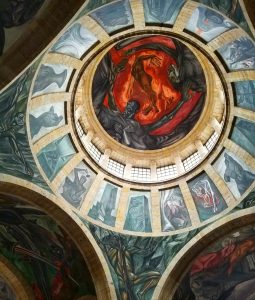
There’s a cosmopolitan quality to this city that now informs my recollection of interviews with Canelo, though. He was unfailingly courteous and professional, if not insightful or imaginative; to interview Canelo was to interview an equal in every way, not a cultural or intellectual inferior, not a superior in some sort of compensatory machismo, either – just a man who did his job very well and anticipated the same from others. There’s a cultural pride in Guadalajara that might be arrogance were the peso exchanging better than $0.05 (US). From the arresting Orozco frescoes in Hospicio Cabañas and Museo de las Artes de la Universidad de Guadalajara (Musa) to the majestic cathedrals and fountains in Zona Centro this city and its inhabitants consider themselves equal to or better than any American or European. I find myself agreeing with their assessment, too, even without a pilgrimage to San Agustín de Tlajomulco de Zúñiga.
Bart Barry can be reached via Twitter @bartbarry
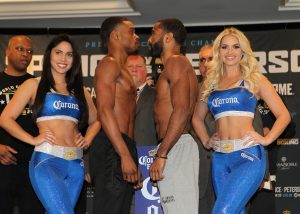
Follow all the action Live from Quebec, Canada as Billy Joe Saunders defends the WBO Middleweight title against David Lemieux. The action begins at 9:40 PM / 2:40 AM in London with a 2 fight undercard featuring middleweight’s Antoine Douglas taking on Gary O’Sullivan as well as Cletus Selding battling Yves Ulysse, Jr. in a junior welterweight fight
NO BROWSER REFRESH NEEDED. THE PAGE WILL UPDATE AUTOMATICALLY
| 12 ROUNDS–WBO MIDDLEWEIGHT TITLE–BILLY JOE SAUNDERS (25-0, 12 KOS) VS DAVID LEMIEUX (38-3, 33 KOS) | |||||||||||||
| ROUND | 1 | 2 | 3 | 4 | 5 | 6 | 7 | 8 | 9 | 10 | 11 | 12 | TOTAL |
| SAUNDERS | 10 | 10 | 9 | 10 | 10 | 10 | 10 | 10 | 10 | 10 | 9 | 9 | 117 |
| LEMIEUX | 9 | 9 | 10 | 9 | 9 | 9 | 9 | 9 | 9 | 9 | 10 | 10 | 111 |
Round 1: Good uppercut from Saunders
Round 2 Saunders jabbing..Hard left
Round 3 Right and left from Lemieux
Round 4 Straight left from Saunders
Round 5 3 jabs from Saunders..Right from Lemieux..Body shot from Saunders..Jab..another jab..
Round 6 Lemieux lands a right to the body..Straight left and 2 jabs from Saunders..quick jab..quick left..Jab and left..
Round 7 Saunders starting to land power shots..Lemieux bleeding from the nose..
Round 8 Good jab and left hand from Saunders…Hard 1-2 and straight left..
Round 9 Straight left from Saunders..3 punch combination..Good Jab..
Round 10 Lemieux lands a left and right..Straight left from Saunders..Hard straight left
Round 11 Jab from Saunders…Lemieux lands a right
Round 12 Right to body from Lemieux…
120-108, 117-111 and 118-110 for BILLY JOE SAUNDERS
Saunders outlanded Lemieux 165-67.
| 10 ROUNDS-MIDDLEWEIGHTS-ANTOINE DOUGLAS (22-1-1, 16 KOS) VS GARY O’SULLIVAN (26-2, 18 KOS) | |||||||||||||
| ROUND | 1 | 2 | 3 | 4 | 5 | 6 | 7 | 8 | 9 | 10 | 11 | 12 | TOTAL |
| DOUGLAS | 10 | 9 | 10 | 10 | 9 | 9 | 57 | ||||||
| O’SULLIVAN* | 9 | 10 | 9 | 10 | 10 | 10 | TKO | 58 | |||||
Round 1 Right from O’Sullivan..3 punch combo from Douglas..another 3 punch combination..Good left hook to the body
Round 2 Good right from Douglas..Good body shot..4 rights from O’Sullivan..Good uppercut from Douglas..
Round 3 Good left from Douglas..Good bosy shot from O’Sullivan..Good hook from Douglas..Good body shot..Good left hook..
Round 4 Good hook from Douglas…Good hook from Douglas..
Round 5 Jab from Douglas..Good left hook..Hard right and body shot from O’Sullivan..Hard right..
Round 6 Right from O’Sullivan..
Round 7 HUGE LEFT AND COMBINATION AND DOWN GOES DOUGLAS..FIGHT STOPPED
O’Sullivan outlanded Douglas 130-108
| 10 ROUNDS-JUNIOR WELTERWEIGHTS–CLETUS SELDIN (21-0, 17 KOS) VS YVES ULYSSE, JR (14-1, 9 KOS) | |||||||||||||
| ROUND | 1 | 2 | 3 | 4 | 5 | 6 | 7 | 8 | 9 | 10 | 11 | 12 | TOTAL |
| SELDIN | 8 | 8 | 8 | 10 | 10 | 9 | 9 | 9 | 9 | 9 | 89 | ||
| ULYSSE | 10 | 10 | 10 | 10 | 9 | 10 | 10 | 10 | 10 | 10 | 99 | ||
Round 1 Roght hand hurts Seldin…RIGHT AND DOWN GOES SELDIN…Good right counter from Ulysse
Round 2 SHORT RIGHT AND DOWN GOES SELDIN
Round 3 Good left hook from Ulysse…HARD COMBINATION AND DOWN GOES SELDIN…SELDIN IS CUT ON HIS FOREHEAD..Good body shot
Round 4
Round 5 Good right from Seldin..
Round 6 Ulysse counters with a right..Right..Seldin lands a right to the body…1-2 from Ulysse
Round 7 Good right from Ulysse..
Round 8 Body shot from Ulysse..3 rights..Right..Left hook and a right
Round 9 Left hook from Ulysse…
Round 10 Ulysse peppering Seldin..Huge right
99-88 on all cards for Ulysse
Ulysse outlanded Seldin 157-42
By Norm Frauenheim-

It’s a move up, on the scale and to the top of the ballot.
Terence Crawford’s bid to own next year opens with a jump to welterweight and a convincing campaign for Fighter of the Year.
Call it a win-win, at least that’s what it looks like from this corner.
After dominating the 140-pound division, Crawford moves up to 147, with his debut at the new weight probably against Jeff Horn, who followed up his controversial stunner over Manny Pacquiao with an 11th-round stoppage of somebody named Gary Corcoran in Brisbane Wednesday.
If the deal gets done for a bout sometime this spring perhaps in Las Vegas, promoter Bob Arum says Horn has a better chance than anybody will ever give him.
Fair enough. Arum warned everybody that Horn had a chance against Pacquiao, too. But Pacquiao looked to be as unprepared as he is over-the-hill.
Crawford is neither. He’s motivated and near his prime in terms of instinct, athleticism and motivation. Add what appears to be a mean streak, and you’ve got a fighter very hard to stop for at least the next year.
I know, I know, there is Vasiliy Lomachenko, who is being marketed as boxing’s cutting edge of newfound creativity.
His complement of footwork and angles is thing of beauty, to be sure. Still, there’s some debate about whether there’s more form than function to what he does.
Maybe, we’ll get better judge of that against the fundamentally efficient Mikey Garcia.We sure didn’t get to see it against Guillermo Rigondeaux, who quit after six rounds Saturday in a hyped bout that proved to underwhelming.
Don’t blame Lomachenko, who did exactly what he had to. This on is on Rigondeaux, the sad-faced Cuban who surrendered for what was reported to be a bruised hand. Rigondeaux surrendered, perhaps because he knew defeat was inevitable.
Net result: It denied Lomchenko the chance to finish a fight that might have embellished his own candidacy for Fighter of the Year.
For now, Lomachenko is still that proverbial work in progress. Meanwhile, he’s as likable for his footwork as he is for his honesty and quick wit. His post-fight take on his name — “No-mas-chenko” — is a classic.
He continues to say he wants to fight Mikey Garcia, despite Garcia’s biter split with Top Rank, still the Ukrainian’s promoter. Lomachenko’s priorities are in order.
He’s the boss. In the end, the promoter is there to get him fights he wants. And in this case, Lomachenko-versus-Garcia is a fight the public wants to see too.
A year from now, Lomachenko’s clear business agenda and evolving ring style could make him Fighter of the Year.
In the here-and now, however, it’s Crawford, who exercised his dominance in a stunning third-round stoppage of Julius Indongo in August. Unlike Rigondeaux, Indongo was never the story in that one. Only Crawford was.
Now, there’s Crawford’s move to welterweight. There are interesting fights for him at 147. But the guess here is that he would beat Keith Thurman. He’d beat Shawn Porter. He’d blow out Pacquiao. Of all the possibilities at welterweight, the best might be the young Errol Spence. But that one looks to be at least a year away, a year after one that will belong to Terence Crawford.

Follow all the action as Jeff Horn makes the 1st defense of the WBO Welterweight title against Gary Corcoran
NO BROWSER REFRESH NEEDLED. THE PAGE WILL UPDATE AUTOMATICALLY
| 12-rounds–WBO Welterweight title–Jeff Horn (17-0-1, 11 KOs) vs Gary Corcoran (17-1, 7 KOs) | |||||||||||||
| ROUND | 1 | 2 | 3 | 4 | 5 | 6 | 7 | 8 | 9 | 10 | 11 | 12 | TOTAL |
| Horn* | 10 | 10 | 10 | 10 | 10 | 9 | 10 | 10 | 9 | 10 | TKO | 98 | |
| Corcoran | 9 | 9 | 9 | 9 | 9 | 10 | 9 | 9 | 10 | 9 | 92 | ||
Round 1 Horn lands a right left to the body..3 punch combination..Jab knocks Corcoran off balance..Right down the middle
Round 2 Good right from Horn..Another right..Right uppercut..Corcoran gets in a glancing shot…Short right..Flush right..
Round 3 3 punch combination from Horn…Corcoran lands a body shot..Left hook from Horn
Round 4 Uppercut on inside from Horn
Round 5 Right from Corcoran…Right uppercut from Horn..Chopping right from Corcoran..1-2 from Horn..
Round 6 Right from Corcoran..Left hook..Blood starting to drip from around the left eye of Horn..Blood from around the right eye of Corcoran..
Round 7 Horn lands a jab and right uppercut..Short left hook on the inside..Jab..
Round 8 Left to body from Horn…Combination..Right..
Round 9 Horn now bleeding around the right eye
Round 10 Hard right from Horn..Blood around the left eye of Corcoran
Round 11 Doctor looking at Corcoran’s left eye..Straight right and right uppercut from Horn..Combination..REFEREE BENJI ESTEVES STOPS THE FIGHT…TKO WIN FOR JEFF HORN..CORCORAN’S LEFT EYE CUT VERY BAD
By Jimmy Tobin-

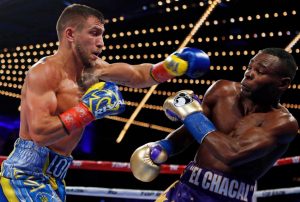
Saturday night at Madison Square Garden Vasyl “Hi-Tech” Lomachenko convinced his fourth consecutive opponent to quit on his stool. His victim this time, fellow two-time Olympic gold medalist, Guillermo “El Chacal” Rigondeaux, retired with an injured left hand after the sixth round. What more need be said about the action, lopsided, clinical, predictable as it was?
Much will be made of Rigondeaux’s decision in the aftermath: some will wonder how a fist that seemed never to land could have been damaged, or why trainer Pedro Diaz seemed so ready to act on Rigondeaux’s cue to end the affair. Ringside, Tim Bradley, as honest and polite and warring a prizefighter as we have seen in recent years, voiced such skepticism when Rigondeaux, halfway through the fight but at the threshold of humiliation, chose to preserve a career he says he may pursue no further.
Rigondeaux is a proud man, indeed his disregard for audiences is proof of that; he is also a fighter at heart, something he confirmed in climbing off the canvas to butcher Hisashi Amagasa and in his utter and arrogant defusing of Nonito Donaire. For this, perhaps, his professed injury deserves a courteous ear. But every second of every minute of every round Saturday belonged to Lomachenko, and who could better appreciate that dominance, and the bruising mischief it wrought, than Rigondeaux? Perhaps for the first time in a boxing ring, Rigondeaux was without answers, and that hopelessness, made all the more real by the taunts and mockery that have become part of Lomachenko’s signature, was likely more than he could bear.
Now a 37-year-old (and injured?) persona non grata, Rigondeaux chose to walk away from what was likely his last chance at glory and the remuneration it brings. Yes, Lomachenko held every advantage; size, youth, activity aside, he is simply better than Rigondeaux and employs an ideal style for disrupting the Cuban’s measured violence. The fight Rigondeaux had lobbied so long for was finally his, however, and he revealed how much that opportunity meant to him. Offer whatever apologies for Rigondeaux you like, boxers are held to a higher standard because they have earned that honor, and in capitulating as he did, Rigondeaux showed that however brilliant a fighter he is, barring something remarkable and out of tune with the tenor of his career, greatness will elude him.
Did it also confound and abuse him on this night? Well, not yet. Lomachenko is not yet a great fighter. He has the makings of one, certainly, but dominance alone does not establish greatness—at least not in an eleven fight career that features more losses (one) than it does great opponents. That lone loss, to Orlando Salido, is too frequently glossed over to be forgotten. Yet Lomachenko is no longer the naive and inexperienced fighter that fell for Salido’s dirty charms, and the next man who hangs a defeat on the Ukrainian will accomplish something greater than Salido did. Unlike Rigondeaux, Lomachenko will end his career remembered for more than his amateur achievements.
Still, there is something missing from Lomachenko, or, more charitably, if not from him then at least from his fights. That something was on display this weekend, though.
You could find it in the ring in Hialeah, Florida, where light heavyweight neverender, Jean Pascal, took his first (and hopefully only) leave of the sport knocking out aspiring Ahmed Elbiali. Plenty pulped over the past few years, Pascal nevertheless faced yet another undefeated fighter in Elbiali—his fifth in his last six fights. And as he has done for years, Pascal drew a line in the sand behind which he lobbed one grenade after another, wagering on his ammunition outlasting his opponent.
It was there in the Copper Box Arena in England, where +5000 underdog Caleb Truax won the IBF super middleweight title from James DeGale. No meager feat that: taking a title on the cards on a champion’s turf, but there was Truax giving his best performance in his biggest moment and being rightly rewarded for it. That title came with a bullseye, and Truax, who understandably dropped to his knees as his name was read, now wears both happily.
So too, could you find it in the Mandalay Bay Resort and Casino in Las Vegas, where Miguel Roman extended his career at the expense of Orlando Salido, who bid us farewell with yet another self-immolating performance. Salido’s career ends the way it began, with a TKO loss, but what he managed in the sixty fights in between is what defines him. If a less-than-great fighter can have a great career, then Salido had one; if there is a question about Salido the fighter he left unanswered it has yet to be spoken. Like Rigondeaux, Salido too decided he had had enough, wilting finally under Roman’s bodywork and the slow bleed of a career remarkable for its brutality. But boxing forgives the bold (which is why any outcome other than Saturday’s would have been better for Rigondeaux), and Salido earned that soft spot on the canvas.
Pascal, Truax, Salido—Lomachenko is better than all of them by some margin. And yet these three each provided something more intimate, more vulnerable, and in their own way more endearing than Lomachenko’s perfection. Lomachenko is math not literature; the application of formulas not passion.
The implied request here is for moments of genuine peril for Lomachenko, the type of request last directed toward Floyd Mayweather Jr., whose fights also felt scripted in their dominance. It is because of comparisons like this that the goalposts are continuously moved on Lomachenko, and so they should be considering how close he was to them from the start, how easily he has triumphed since his stumble against Salido (because, again, that happened). But this is proof he is great, you say? Fine. Those goalposts, move them again and again and again.
By Bart Barry-

Saturday on ESPN Ukrainian super featherweight champion Vasyl “Hi-Tech” Lomachenko made undefeated Cuban super bantamweight champion Guillermo “The Jackal” Rigondeaux quit after six rounds. On HBO Mexican journeyman Miguel “Mickey” Roman beat to a crumple Mexican journeyman and former champion Orlando “Siri” Salido. ESPN’s match comprised two fighters with four Olympic gold medals. HBO’s comprised two fighters with 25 professional losses. While any aficionado might’ve predicted which match would be more entertaining, few of us predicted exactly how much more entertaining Roman-Salido’d be than Lomachenko-Rigondeaux.
Saturday’s mainevents hadn’t a unifying thread that springs to mind but Salido, HBO’s counterprogramming ace, representing the one loss on Lomachenko’s record. It’s a proper loss, too, no matter how a commentator and ring announcer now revise it.
No sooner do we threaten to start a new era in which undefeated ledgers are not all there is to a fighter’s dossier but we try to unblemish Lomachenko’s record retroactively – else we’ll compromise what words like “otherworldly” we now include in the subtitle of his brochure. This straining for symmetry is what happens when we see ourselves as storytellers, not journalists, a point of ongoing and massive struggle for television as a medium.
Television was built on images that flicker to mesmerize and entertain. When this wasn’t enough to grow revenues television endeavored to get serious and journalistic and in a small corner of itself did so successfully enough subgenres got born. But television is too topical to be sober or intellectual as the written word – with its frowzy dressers, doughy faces, hard drinkers and thousandhours spent in front of library stacks instead of mirrors – and television knows this about itself and too knows it’s not glorious or beautiful as cinema or it wouldn’t have to sell its every fifth minute to advertisers. Television is best when it tries to be a little of both, more intellectual than cinema, more fun than print.
Television is frankly awful when it tries to lecture. There were some moments of it Saturday.
Something about Lomachenko, starting with his silly nickname, makes aspiring Homers of every speedreader and street philosopher; the mean feat of making smaller men quit fighting in frustration ascends to the historic when Lomachenko does it. Much of this, again, is his topicality; Lomachenko’s promoter, Bob Arum, knows better than any man alive if you can get your guy in front of a camera against weak opposition television’s salesmanship reliably fills every vacuum in realtime; commentary crews involuntarily enter a hyperbole duel with one another, earnestly wanting to be able to say theirs was the first to perform a historic inventory of this historic figure’s every historic quality. Some writers sometimes do this, too, especially those who hope to make it to television someday, but writing polices its own – as it did for centuries before television’s invention – dealing in credibility more than ratings.
Something about the very nature of words makes it harder to write “Lomachenko may someday be considered greater than Muhammad Ali” than it is to say it.
If there’s some tension between a pursuit of truth and a fun experience, television has to err on the fun side of things, selling the experience in a way print does not: nobody, after all, in 30 years will say he remembers the first time he read about Lomachenko, while plenty of folks now hope to have occasion to say they remember the first time they saw him. There are plenty of smart professionals in television, of course, and after thinking a bit on the proposition they realize the risk to credibility of calling every fighter the next Ali, Marciano or Robinson (or Pernell Whitaker) is dwarfed by the reward of being the first to recognize a future legend.
“Predicting,” as they say, “10 of the next two great champions.”
At the risk of losing a reader or two, I can happily report I found Miguel Roman’s victory multiples more compelling than Lomachenko’s. Wait, get back here, you two; I watched Lomachenko-Rigondeaux live, not Roman-Salido. If I wasn’t nearly first on the Rigondeaux bandwagon I did cover from ringside his sixth, ninth and 10th prizefights and recognized, with the help of a local San Antonio trainer, his multitude of talents. I wasn’t ringside for his defining win against Nonito Donaire (I was at a Natalie Merchant concert in Fort Worth, instead, and do not regret it a little) but was thrilled with the result, annoyed as I was by the hyperbole by then accrued to Donaire.
Since then I’ve been unimpressed by Rigondeaux as the rest of you. But he did do Saturday what we ask prizefighters to do once they’ve declared themselves too-feared to find opponents in their proper weightclasses. And the result was predictable. Fruity as his comportment often is, Lomachenko gives refreshingly honest postfight analyses, and his saying a corner quittage by an undersized man did not rate was my favorite thing Lomachenko did Saturday.
There’s no need to rehash the action because, over and again, it’s awfully easy to look sensational and do outlandish against a man once you know he can’t hurt you, which is why Canelo and GGG made none of the highlights against each other in September they make against smaller men.
Anyway it would be malpractice to commit any more space to that unexceptional and unsatisfying fare after a weekend when Miguel Roman retired Orlando Salido in a gorgeous attritioning of Salido’s noble spirit. Each man planned to retire if he lost, and neither man said so beforehand, which compares most favorably with the lucrative twofight sendoff HBO and Miguel Cotto just threw Miguel Cotto, no?
Roman probably won’t win his next fight without he barefoots another pathway of hot coals, which is fortunate for us and unfortunate for him. After what Roman just did to Salido at 130 pounds, with a different marketing team and promoter and momentum he might otherwise be allowed to make shortfilms about his reflexes and do otherworldly things against a bantamweight.
Bart Barry can be reached via Twitter @bartbarry
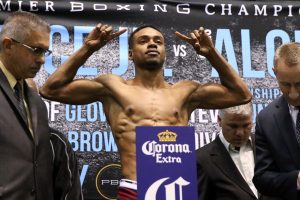
Follow all the action as Vasyl Lomachenko takes on Guillermo Rigondeaux for the WBO Junior Lightweight world championship in a 1st time battle of double Olympic Gold Medal winners from the Theater in Madison Square Garden. The action kicks off at 9 PM Et / 6 PM PT / 4 AM in Ukraine with a 3 fight undercard featuring Michael Conlan battling Luis Fernando Molina; Christopher Diaz taking on Bryant Cruz; Olympic Silver Medal Winner Shakur Stevenson fighting Oscar Mendoza.
NO BROWSER REFRESH NEEDED; THE PAGE WILL UPDATE AUTOMATICALLY
| 12 Rounds–WBO Junior Lightweight title; Vasyl Lomachenko (9-1, 7 KOs) vs Guillermo Rigondeaux (17-0, 11 KOs) | |||||||||||||
| ROUND | 1 | 2 | 3 | 4 | 5 | 6 | 7 | 8 | 9 | 10 | 11 | 12 | TOTAL |
| Lomachenko | 10 | 10 | 10 | 10 | 10 | 10 | 60 | ||||||
| Rigondeaux | 9 | 9 | 9 | 9 | 9 | 8 | 53 | ||||||
Round 1: Left from Lomachanko..Left to body from Rigondeaux…Jab from Lomachenko
Round 2 Left and right from Lomanchenko..Jab..Right hook..Straight left..Hard jab
Round 3 Lomachenko lands 2 shots..Uppercut and another left..
Round 4 Jab and quick 3 punch combination from Lomachenko…3 punch combo..Hard jab
Round 5 Lomachenko just tapping Rigondeaux..Rigondeaux warned for holding..Counter left from Rigondeaux..
Round 6 Left from Lomanchenko..4 punches to the head while Rigondeaux is bending..RIGONDEAUX DOCKED A POINT FOR HOLDING…Hard left from Lomachenko...RIGONDEAUX QUITS IN THE CORNER…FIGHT IS OVER
Round 7
| 6 Rounds-Featherweights–Michael Conlan (4-0, 4 KOs) vs Luis Fernando Molina (4-3-1, 1 KO) | |||||||||||||
| ROUND | 1 | 2 | 3 | 4 | 5 | 6 | 7 | 8 | 9 | 10 | 11 | 12 | TOTAL |
| Conlan | 10 | 10 | 10 | 10 | 10 | 60 | |||||||
| Molina | 9 | 9 | 9 | 9 | 9 | 54 | |||||||
Round 1 Uppercut from Conlan
Round 2 Good left from Conlan…Jab..
Round 3 Right hook from Conlan..Combination..Left to body..Right hook and jab…Conlan switching..
Round 4 Left to body from Conlan..Right from Molina…Combination from Conlan
Round 5 Conlan flicks a left….Hard straight left..Counter right hook..2 body shots..
Round 6 Straight left from distance by Conlan..Body combination
| 10 Rounds–Jr. Lightweights–Christopher Diaz (21-0, 13 KOs) vs Bryant Cruz (18-2, 9 KOs) | |||||||||||||
| ROUND | 1 | 2 | 3 | 4 | 5 | 6 | 7 | 8 | 9 | 10 | 11 | 12 | TOTAL |
| Diaz* | 10 | 10 | TKO | 20 | |||||||||
| Cruz | 8 | 7 | 15 | ||||||||||
Round 1: BIG RIGHT AND DOWN GOES CRUZ…Right from Cruz..
Round 2 Diaz landed a left to the body…Hard riGHT AND DOWN GOES CRUZ..6 HUGE PUNCHES AND DOWN FO GOES CRUZ
Round 3 LEFT HOOK WOBBLES AND DROPS CRUZ…FIGHT STOPPED
| 6- Rounds–Featherweights–Shakur Stevenson (3-0, 1 KO) vs Oscar Mendoza ( 4-2, 1 KO) | |||||||||||||
| ROUND | 1 | 2 | 3 | 4 | 5 | 6 | 7 | 8 | 9 | 10 | 11 | 12 | TOTAL |
| Stevenson* | 10 | TKO | 10 | ||||||||||
| Mendoza | 9 | 9 | |||||||||||
Round 1 Straight left from Stevenson..Straight left to body..Hard left to the head..
Round 2 Hard combination from Stevenson..Combo to head..HARD STRAIGHT LEFT AND THE FIGHT IS STOPPED
By Norm Frauenheim-

Boxing loves comebacks and it looks as if a business always reported to be dying might be poised to make another one.
The perennial patient still has a pulse, thanks this time to Vasiliy Lomachenko-Guillermo Rigondeaux Saturday in a year-ender that follows some promising television numbers.
Last Saturday, Miguel Cotto said goodbye after getting upset by Sadam Ali in a so-called retirement fight. Retirement fights are a bad idea. Terrible advertising, too. But people watched anyway with a HBO audience that peaked at 1,012, 000, according to ratings released this week.
That is boxing’s second-highest rating for premium cable in 2017. It came a week after a peak audience of 900,000 watched the HBO telecast of Sergey Kovalev’s comeback from successive losses to Andre Ward with a stoppage of Vyacheslav Shabranskyy.
Both fights were thoroughly forgettable. But the solid numbers are significant for what they suggest. To wit: Maybe, there’s still a potential audience out there, perhaps re-energized by a move away from pay-per-view and maybe intrigued by a new generation of fighters.
A better look at whether the sport is poised to make another resurrection will play out Saturday in Lomachenko-Rigondeaux on ESPN (9 p.m. ET/6 p.m. PT). The 130-pound bout in The Theater at Madison Square Garden sold out two months ago.
It’s been generating talk for weeks, although it’s been hard to know just who and how many are doing all the talking. The bout, the first ever between a couple of two-time Olympic gold medalists, looks as if it could be a gem. At least, it does for the sport’s usual crowd, said by some to be a shrinking demographic.
When the intriguing fight was announced, there was skepticism about whether a Ukrainian-versus-a-Cuban could ever be much of an attraction for an American audience.
Tactically, Lomachenko-Rigondeaux is loaded with all the elements of a potential classic. It’s old-school Sweet Science, imminent art on canvas. But lots of fans like their fights in a cage these days. Within those old ropes? Still, hard to say.
Lomachenko’s innovative approach to an old and scarred craft against a seemingly ageless Cuban schooled in fundamentals is a clash between new and old. It’s timeless. It also sets the stage for a New Year, meaning new names and fresh faces instead of just more retirement fights.
From this corner, it’s interesting, even fascinating on many levels. But the real question rests in how many are interested. How many are fascinated? How many boxing fans are there? The last couple of weeks add up to reasons to guess there might be more than believed.
The guess here is that the bigger and younger Lomachenko wins a unanimous decision over the 37-year-old Rigondeaux, who is jumping up two weight classes, from 122 to 130.
But the bigger decision will rest in ratings for a fight that will say a lot about the state of the game.
By Jimmy Tobin-

There are worse ways to retire. In a sport that rarely bids its fraternity a kindly farewell, Miguel Cotto, who dropped a unanimous decision to Sadam Ali at Madison Square Garden Saturday night, left boxing via an earnest and entertaining prizefight before an adoring crowd at an iconic venue. Cotto should consider himself fortunate and move permanently into life after boxing. The fiercely polarizing fighter was not great, lest we dilute the meaning of the word, and barring that same dilution, he did not have a great career, but he had a proper one, and those too are cherished as they are rare.
To be remembered at our best is a courtesy we all want but infrequently extend. This is especially so in the case of Cotto, who, usually for reasons impossible to articulate without the use of this or that slur, an incoherent grunt of nationalistic programming, or much, much idle time, has long been characterized by his least redeeming qualities. Such a characterization ignores much of who he was. A parallel can be discerned between Cotto’s fights and the arc of his career: in each, he begins deliberately, aggressively, and in both, he fades late, the whispers of preservation growing into something undeniable and commanding. Yet how frequently people disregard the beginning.
There is an urge to romanticize our athletes; we interpret favorably, accentuate virtues, diminish and dismiss flaws until these people are who we want. And once the first truth is bent, the easier it is to hang further charms on it. Cotto benefitted from this refashioning; the man best suited to fill the void left by Felix Trinidad could expect to. If there is anything the age of identity politics has taught us, however, it is that the reverse is also true. It is surprisingly easy to tear someone down, having one fault however tenuously beget another and another until the truth is obscured. And if you were looking for that one fault, the thread to unravel Cotto’s career, you could find it, though never in the effort he put forth between ropes.
No, what turned so many off Cotto was his disregard for the proprieties of his trade. There was a time when this behavior seemed like the work of a man looking for retribution. Cotto, once obedient to promoter Top Rank, suffered brutal beatings at the hands of Antonio Margarito and Manny Pacquiao. Believing himself the victim of something nefarious in the first case, exploitative (and possibly nefarious) in the second, it was reasonable to think Cotto, by then a powerbroker among fighters, might exact his vengeance on the sport.
Years later this interpretation feels wrong. It implies Cotto understood that there was something untoward about demanding catchweights, refusing to conduct interviews after losses, treating promoters like employees, and that these tactics were the intended means of revenge. But payback was never part of Cotto’s calculus. He simply understood his place in the sport, the leverage he wielded, and acted accordingly: seeking every advantage, and gaining most of them. Cotto was not a warrior—he was a mercenary. That mercenary conduct ran counter to the selectively invoked nobility of the “manly art” and Cotto’s reputation suffered for it. Granted, this is not much by way of a defense of Cotto’s conduct, but then, it is far more than he would ever care to offer.
If it is a defense of Cotto that you want you need only ask yourself how he managed to achieve his industry leverage. The answer to that question forces you to examine the part of his career so strangely ignored: he made every fight the public could ask of him with the exception of one. Cotto, after giving Sergio Martinez a gold watch beating, perhaps should have fought Gennady Golovkin. Instead, he fought Saul Alvarez. Cotto was only ever going to make one of those fights because he was going to lose both. Forgive him then, for giving boxing’s most devoted supporters the fight they wanted.
But he lost so many of those signature fights, you say, as though this is only a criticism, as though there is not a rare compliment to be drawn from it. A greater attraction than he was a fighter, Cotto could have taken fewer risks than he did. Yet as Carlos Acevedo pointed out last week, he consistently imperiled himself, and in doing so left boxing better for his presence. His record shows losses to Margarito, Pacquiao, Alvarez, Floyd Mayweather Jr., Austin Trout, and Ali, and some dubious victories like his decisions over Shane Mosley and Joshua Clottey. Yet all but the Trout fight were worthy of your attention, and since one man cannot a compelling fight make, Cotto deserves credit for his part in that bloody bestowal. To ignore what he gave boxing with his fists, with his blood, or to consider his behavior beyond the ropes of comparable value to his conduct within them, is to take a jaundiced view of his career and deny the man what he earned.
What he earned over 16 years is all he deserves; no more, of course, but certainly no less. Whether he deserves a place in Canastota is a question that is only important if the answer matters to Cotto. Assuming it does, assume he’ll like the answer, and that plenty of people won’t.
By Bart Barry-

Saturday HBO said goodbye to Puerto Rican junior middleweight Miguel Cotto who lost a close but fair decision to New York’s Sadam Ali who made the very most of an event that had nothing to do with him. Cotto gave an honest effort and accepted his loss graciously after a large, adoring New York City crowd cheered him loudly while a small, adoring commentary crew cheered him vigorously. If it wasn’t an exact metaphor for Cotto’s career it was an acceptable one.
Cotto represents, in my mind, a blank canvas, a good fighting style and excellent publicity. He successfully juxtaposed, in the final marketing blitz of his career, the masculine trait of taciturnity and the hottest feminine color on the spectrum. By saying little as possible and still less of substance he offended no prospective pay-per-viewer, and after Felix Trinidad’s retirement and Juanma Lopez’s renowned dissipation, Cotto monopolized the minds of Puerto Rican aficionados and lucratively sold many tickets at the boxoffice of Madison Square Garden – that wildly celebrated concrete cylinder in Manhattan.
A thin, nearly diaphanous film of martyrdom covers Cotto in many an aficionado’s mind; the Antonio Margarito who beat him to a pulp probably did so with something extra on his knuckles, and the Manny Pacquiao who also beat him to a pulp probably did so with something extra in his blood. Everything else in Cotto’s career went almost tediously according to form, while the poor timing that left him ruined by Margarito and Pacquiao – both in their absolute physical primes when they pulped him – turned to favorable. He lost to Floyd Mayweather, who overpaid him in a scramble to get a prison sentence delayed (or suspended altogether), and he beat Sergio Martinez, who may either have been fighting him on one broken leg or fighting him on two broken legs. Cotto cashed himself out against Saul Alvarez, losing by exactly the scores any disinterested aficionado would’ve predicted, then 20 months later decided there was more cash out there and bamboozled HBO into a twofight farewell tour.
Really the only surprising results on Cotto’s resume are his losses to Austin Trout and Sadam Ali, and maybe his decisioning Shane Mosley a decade ago. The Mosley decision was very thin indeed but fair. Too, to be fair, the brutality of what Cotto did to little Paulie Malignaggi on that tiny pillowy canvas 11 1/2 years ago remains deeply memorable.
Cotto was moved patiently and perfectly by promoter Top Rank until he was fed to Margarito in a match Top Rank surely expected to be remarkable but probably expected Cotto to win. Cotto’s dramatic, and almost sudden, transformation in that match from arrogant master to quailing prey lends credence to the Margarito-handwraps conspiracy in the minds of any who were ringside; it’s difficult to believe an athlete in his 33rd prizefight might so underestimate an opponent’s legal ammunition as we’re asked to believe Cotto underestimated Margarito’s. Margarito did nothing novel, and yet Cotto, in his 13th world title fight, a veteran of 148 amateur bouts, ran completely out of ideas midway through a fight he had dominated? It’s not impossible, or particularly probable.
When I think of Cotto my mind plays a man acquitting himself honorably while being beaten up. I was ringside at the aforementioned Margarito assault, which was an incredible experience at the time, and I was ringside when Pacquiao diminished further a diminished Cotto. That marked the end of my imagining Cotto an historic talent.
Between those beatings, luck more than intention put me ringside at Cotto’s honest match with Joshua Clottey, which happened in New York the night after colleague, mentor and friend Norm Frauenheim accepted his muchdeserved Fleischer award. When I think of Cotto, too, I think of the beauty of Central Park, sharing a cab in Las Vegas with former colleague Mike Swann, spending time with friend and mentor Tom Hauser – that is, many of the best associations I have with Miguel Cotto fights I attended have nothing to do with Miguel Cotto. Hence the blank canvas.
Were I Puerto Rican or even Latino, I might complement my happy memories of Cotto fights with a bit of my own identity, perhaps, making those fights and their fighter still more essential.
Oh, and I have another amusing memory of Cotto (that also has little to do with him): At a promotional breakfast the morning of Pacquiao-Bradley 2 two roomsful of us gathered to hear Cotto say very little about his upcoming match with Sergio Martinez, and for arriving late and wearing an inappropriate purple Kangol I got consigned to the backroom, where I met the wonderful British writer Gareth Davies, who arrived even later and was also too colorful, then Davies and his entitled mien corralled Cotto to our table, where Davies opened the interview by propping Cotto’s magenta Crocs on his lap and taking pictures of them.
Cotto’s eyes and face by then betrayed a vulnerability Cotto was honest enough not to cover with effects of any kind; a look in Cotto’s eyes for a glance got you a swirl of indifference and violence, but if you lingered there for another beat or two you saw a man who genuinely wanted to be left alone: Of course I’m not afraid of you, but why would you make me say it?
HBO’s farewell to Cotto on Saturday was typically overwrought, a chance for the reliably prissy to turn dramatic and grave, but felt sincere insomuch as HBO does not wish to bankroll Cotto’s career any longer – not for a predictable rematch with Canelo, not for a bloodletting with Gennady Golovkin, and certainly not for a comeback at age 40.
Bart Barry can be reached via Twitter @bartbarry
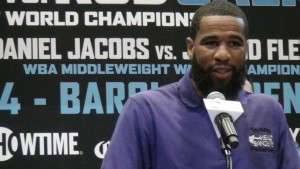
Follow all the action as Miguel Cotto rides off into the sunset as he defends the WBO Super Welterweight title against Sadam Ali. The action begins at 9 PM ET / 6 PM PT with two more world title bouts as Angel Acosta takes on Juan Alejo for the Interim WBO Jr. Flyweight title and Rey Vargas defends the WBC Super Bantamweight title against Oscar Negrete.
NO BROWSER REFRESH NEEDED. THE PAGE WILL UPDATE AUTOMATICALLY
| 12 ROUNDS–WBO SUPER WELTERWEIGHT TITLE–MIGUEL COTTO (41-5, 33 KOS) VS SADAM ALI (25-1, 14 KOS) | |||||||||||||
| ROUND | 1 | 2 | 3 | 4 | 5 | 6 | 7 | 8 | 9 | 10 | 11 | 12 | TOTAL |
| COTTO | 10 | 9 | 9 | 9 | 10 | 10 | 10 | 10 | 10 | 9 | 9 | 9 | 114 |
| ALI | 9 | 10 | 10 | 10 | 9 | 9 | 9 | 9 | 9 | 10 | 10 | 10 | 114 |
Round 1: Cotto going to the body..Right to body from Ali…Jab from Cotto..Right from Ali..Jab from Cotto..Jab and left hook
Round 2 Left from Cotto..Right from Ali..Left from Coto…Big right buckles Cotto..Left hook..Jab from Cotto..Right..ALi gets in a right..Left from Cotto
Round 3 left hook from Ali..Right..Right…Right from Cotto..Left from Ali
Round 4 Left hook buckles Cotto..Left from Cotto..Hard combination from Ali..Jab from Cotto..Counter right..
Round 5 Right from Cotto..Jab…Double jab,,Right from Ali
Round 6 Cotto lands a right to the body…Left hook to head..Left..Right drives Ali back..Combination to body..Hard combination in corner..
Round 7 Ali lands a right from the outside..Smacking left hook..Double jab from Cotto..Left on ropes..Hard left to body..
Round 8 Cotto working on the ropes..right from Ali..Jab from Cotto..left hook.another left hook grazed the head..
Round 9 Right and left from Cotto..
Round 10 Ali lands a hard right…Right over the top..Left hook from Cotto..Jab..Left hook from Ali..Another good left hook..Counter left hook
Round 11 Left hook from Ali..Right from Cotto..left hook from Ali..Thunderous left hook knockos out Cotto’s Mouthpiece..
Round 12 Lead right from Ali….Good right…3 punch combination..Left hook
115-113; 116-112; 115-113 FOR SADAM ALI
| 12 ROUNDS–WBC SUPER BANTAMWEIGHT TITLE–REY VARGAS (30-0, 22 KOS) VS OSCAR NEGRETE (17-0, 7 KOS) | |||||||||||||
| ROUND | 1 | 2 | 3 | 4 | 5 | 6 | 7 | 8 | 9 | 10 | 11 | 12 | TOTAL |
| VARGAS | 10 | 10 | 10 | 10 | 10 | 10 | 9 | 10 | 10 | 10 | 10 | 10 | 119 |
| NEGRETE | 9 | 9 | 9 | 9 | 9 | 9 | 10 | 9 | 9 | 9 | 9 | 9 | 109 |
Round 1 Vargas working the body
Round 2 Vargas continues to work the body with both hands
Round 3..Wicked right to headc from Vargas…Follows up with a left and right
Round Vargas continues to dictate tghe pace with his height
Round 5 Right from Vargas
Round 6 Trading combinations..Left upper cut from Vargas..Combination..Right from Negrete..Left from Vargas..Left to side of head
Round 7 Left to body from Vargas..Negrete lands a left…Hard right..Vargas cut over right eye
Round 8 Right from Vargas..Hard left to the body…Doctor checking the cut over left eye now..Negrete going after Vargas swinging wildly..3 punch combo from Vargas..Right from Negrete..Left to body from Vargas..
Round 9 Doctor checks left eye again..Big left rocks Negrete,,,Hard rights from Vargas..3 punch combination
Round 10 Vargas jabbing..Uppercut on the inside..Left hook from outside..Right from Negrete..Uppercut from Vargas..Left to body
Round 11 Right to body from Vargas..
Round 12 Right from Negrete..Left to body from Negrete..Left to body..Straught right from Negrete,,Vargas lands left to the body
120-108 and 119-109 twice FOR REY VARGAS
| 12 ROUNDS–WBO JUNIOR FLYWEIGHT TITLE–ANGEL ACOSTA (16-1, 16 KOS) VS JUAN ALEJO (25-4-1, 15 KOS) | |||||||||||||
| ROUND | 1 | 2 | 3 | 4 | 5 | 6 | 7 | 8 | 9 | 10 | 11 | 12 | TOTAL |
| ACOSTA* | 10 | 10 | 10 | 10 | 10 | 10 | TKO | 60 | |||||
| ALEJO | 9 | 9 | 9 | 9 | 9 | 9 | 54 | ||||||
Round 1: Alejo lands a right to body..Jab from Acosta..2 left to the body..Left to body from Acosta…
Round 2 Right and left uppercut from Acosta..Right over top from Alejo..Hard body shot on ropes from Acosta..Straight right
Round 3 Hard right and jab from Acosta
Round 4 Straight right from Acosta..Right..Right..Acosta working body on ropes..Big right from Alejo..Left..
Round 5 Acosta lands hard body shots on the ropes..Counter straight right..Acosta gets in a left
Round 6 Left from Alejo…Acosta jabs to the body..Hard right to the body..Big flurry on the ropes..
Round 10 ACOST LANDS A HARD RIGHT AND DOWN GOES ALEJO..THE FIGHT IS OVER AT 1:33
By Norm Frauenheim-

It’s historical for the continuum that Vasily Lomachenko and Guillermo Rigondeaux represent. Four gold, two each, at four Olympics over 12 years, from 2000 to 2012, are many years, medals and miles, stretching from Sydney, to Athens, then Beijing and finally London.
That they would meet in New York in The Theater at fabled Madison Square Garden on Dec. 9 almost looks like destiny. It’s not, of course. In boxing, only scars are. Still, their path to a 130-pound, ESPN-televised bout from opposite ends of the globe and very different cultures is a big part of the story.
In one corner, there’s Lomachenko, a Ukrainian whose Baryshnikov-like footwork and many-angled style reminds promoter Bob Arum of Ali, and we’re not talking about Sadam. Then, there’s Rigondeaux, a Cuban whose sad, weathered face is the look of a man who appears to be older than his listed 37and yet he glides across the canvas with the foot-and-hand speed of someone much younger.
“What you’re looking at here are two schools of boxing, Cuban and Eastern European,’’ Arum said this week in a conference call.
But who would ever guessed that the better, more marketable, boxer would have come out of the Euro classroom? Seventeen years ago when Rigondeaux won the first of two golds as an Olympic bantamweight at the Sydney Games, the Cubans were as dominant as they were feared. Rigondeaux, the only fighter still active from the medalists at Sydney, wasn’t even the best Cuban of that time. Heavyweight Felix Savon was. Savon won a third gold medal and had everyone buzzing about how he could be the next Ali if not for a regimented Cuban system.
The thinking then was that Cuba’s amateur boxers could one day transform America’s capitalistic version of the craft the way Cubans have impacted the major league baseball. Thus far, however, the Cuban boxers have only struggled, unlike the emerging fighters from Ukraine, Russia and Kazakhstan.
How come? Best guess is that the collapse of the old Soviet Union forced fighters to re-invent themselves and what they had to do to make a living. It was a lesson in individuality and a realistic understanding of what the prize in prizefighting really means. From Gennady Golovkin to Sergey Kovalev, they learned how to fight for money instead of medals. The cutting edge of that evolution is Lomachenko, whose advertised creativity has begun to capture the imagination of North American fans.
Time is a significant difference. Perhaps, the only one. There’s been a whole new generation of fighters since the collapse of the Berlin Wall in 1989 The robotic fighters of the old Soviet system are gone, supplanted first by Golovkin, then Kovalev and finally Lomachenko, who won gold at featherweight in 2008 and gold at lightweight in 2012. In time, maybe the same thing will happen with the Cubans.
For now, Rigondeaux still seems stuck in the old mindset of eluding punches and landing as many as possible for points. The idea is to limit the risk, impress the judges and protect whatever scorecard advantage there is in the late rounds. It wins, but it doesn’t sell.
Arum believes that the clever Lomachenko’s aggressiveness will not allow Rigondeaux to “pile up points” early, thereby preventing him from “stinking it up” late. Maybe, but be forewarned. Junior-middleweight Erislandy Lara, an old Rigondeaux teammate on the Cuban national team, “stunk it up” on Oct 14 in a unanimous decision over Terrell Gausha at Barclays Center in Brooklyn. It was bad enough for fans to exit the building while Lara circled, circled and circled some more in the closing moments of the main event.
A different Rigondeaux is another possibility. Maybe, he sheds that Cuban mindset with dynamic skillset that seems to be there in the lightning-like hands that always look as if they are capable of adding punishment to the points. That would be a surprise. Then again, the journey to Dec. 9 has been full of surprises.

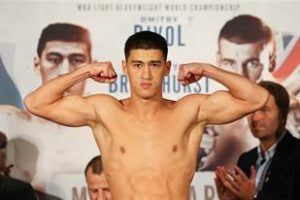
New York, NY: On Saturday at Madison Square Garden, World of Boxing hosted a media roundtable withWBA Light Heavyweight World Champion Dmitry Bivol (12-0, 10 KOs). Bivol, the 26-year old from St. Petersburg, Russia by way of Kyrgystan, Moldova and Korea, charmed the media who came out to see him, many of whom met the young champ for the first time.
The wide-ranging conversation touched on Dmitry’s childhood in Kyrgystan, his Korean heritage, how we got into boxing, and the current state of the light heavyweight division.
On the light heavyweight division and his place in it, Bivol said, “number one is vacant. I’m not sure who exactly is the best. Maybe we’ll have a chance to figure it out.” He later continued, “I’m very happy for Andre Ward because I’m very happy for all the athletes that finish their careers on a successful note. But, of course, I’m upset that my division lost a really important opponent for me. Judging by the last couple fights of Andre Ward, he could definitely have stayed for a couple more and showed more fun battles for his fans.”
Bivol was asked how he would approach fighting on HBO and when he might fight two-time light heavyweight champion Sergey Kovalev. He replied, “It’s a hard question. It depends on my opponents just as much as it depends on me. If I keep showing very good fighting against all the different opponents, then hopefully the American people would be just as happy to see me as they are to see Kovalev.”
When asked if it’s true that he prefers knocking out his opponents, Bivol said, “I don’t necessarily like knockouts, but the crowd likes knockouts. They buy tickets, they come to see boxing because they like knockouts. They like to see blood, they like to see war. So, I like to fight so people are satisfied with buying my tickets and seeing my fights.”
Unlike many fighters, Dmitry did not get into boxing as a way of getting out of street fighting. He explained, “I was a huge fan of Jackie Chan growing up, so I kind of got into boxing because I wanted to do the same kind of stuff as Jackie Chan.”
The New York reporters were eager to know if Bivol had dreamed of one day fighting at “The Mecca of Boxing.” Dmitry said that, as an amateur, “it was my coach’s dream that his student would be fighting in the biggest boxing arena in the world, specifically Madison Square Garden, and I’m hoping that this will happen.”
It was also announced that World of Boxing will partner with Main Events on Bivol’s next fight, which will take place in the United States. World of Boxing is working with HBO Executive Vice President Peter Nelson to pick a date for the world champion’s second title defense. Andrey Ryabinsky of World of Boxing said, “In the first quarter of next year, we plan to organize a fight for Dmitry Bivol in the USA. We hope that we will be able to negotiate a deal with one of the top opponents in the division. Dmitry is ready to fight the best and has been asking for a top-rated opponent.” Bivol’s manager, Vadim Kornilov, added, “We are very excited with the way Dmitry’s career has progressed and are looking forward to his next appearance in the US, possibly in the legendary Madison Square Garden arena!” When asked about working with a US promoter, Bivol stated, “World of Boxing is partnering with Main Events. I’m happy with that.” Main Events CEO Kathy Duva adds, “Dmitry has the potential to be a big star here in America and on HBO. I look forward to showing World of Boxing, Dmitry, and Vadim what we can do!”
As it was Dmitry’s first time at Madison Square Garden, after the media roundtable he received a VIP tour of the facility, then sat ringside for the Kovalev-Shabranskyy event, promoted by Main Events and Krusher Promotions in association with Golden Boy Promotions and Shuan Boxing Promotions.
Bivol with his manager, Vadim Kornilov
In the main event, two-time light heavyweight world champion Sergey Kovalev defeated Vyacheslav Shabranskyy to reclaim the WBO Light Heavyweight Title. In the co-feature, Sullivan Barrera topped Felix Valera in a contest to determine Bivol’s mandatory challenger.
After the event, Bivol tweeted that he would like to meet Sullivan Barrera in the ring:
“I have not changed my mind about Barrera – he’s a technical fighter with a hard punch. I would very much like to go out against him in the ring. For me it will be a serious experience, a serious challenge, a good chance to see a spectacular fight for boxing fans #BarreraValera”
By Bart Barry-

Saturday Russian light heavyweight Sergey “Krusher” Kovalev laid waste to an otherwise-anonymous Ukrainian named Vyacheslav “Two YYs” Shabranskyy in the sort of woeful mismatch managers schedule immediately after their former champions get conclusively whupped but don’t traditionally expect to see televised. Especially on HBO. Seeing Kovalev bully another hopeless opponent, though, did nothing nearly so much as remind aficionados of Andre Ward’s greatness in moving up a weightclass and roughtrading Kovalev in June.
The weekend after Thanksgiving hopes to become a Krusher Kovalev turkey-giveaway tradition at HBO. Four years ago Kovalev krushed someone named Ismayl Sillah as part of the Stevenson-Kovalev marketing campaign that got Adonis Stevenson an absurd reward-to-risk ratio over at Showtime and got Kovalev a bunch of wellpaying placeholder matches and fruity modifiers – “most-feared”, “sociopathic”, “dominating”, and so forth – interspersed with chasing old man B-Hop round the ring and Kovalev’s recent reckoning with a great fighter in his prime, which, again, didn’t go swell for Krusher.
Before Thanksgiving weekend was about c-level cards and a-side rehab on HBO, well well before, several regimes before, 13 years before, someone had the chutzpah to put the third match of the remarkable Marco Antonio Barrera and Erik Morales trilogy on the same weekend in Las Vegas. What one can’t help but sense when he revisits that fight is the honesty of it all. Even matchmaking, complementary skillsets (Barrera’s lefthook, Morales’s rightcross), genuine animosity, two superlative practitioners driven to lunacy by one another’s fists. It’s the disbelief the men retained even after 24 rounds together – what makes it different from, though not better than, Vazquez-Marquez: By the third time Israel Vazquez traded blows with Rafael Marquez (the greatest trilogy of my lifetime thus far) the men respected one another deeply, whereas Barrera and Morales spent their 25th round together treating one another like latereplacement pugs.
Morales came in the fight outweighing himself and with right yellowglove high and cocked, intending to stiffen Barrera more quickly than Manny Pacquiao’d turned the feat a year earlier. Barrera, meanwhile, proud as any man who’s been gloved, saw Morales only as HBO’s “puto campeón” – what he called Morales after their first fight, a pejorative subsequently scrubbed from replays – and despised Morales further for his intended cherrypicking of Barrera’s weakened self. Morales knew he could cut Barrera’s lights with a proper right, and Barrera knew Morales couldn’t cut his lights in a lifetime of trying. That leavened the match further; two rational actors harmonizing their ways to an irrational conclusion, two men thinking an act inevitable when for at least one actor it was impossible.
Then Barrera knuckleclipped Morales’s aquiline nose with a left uppercut crunchy enough to make El Terrible breathe mouthly the duration. Asked afterwards about his broken nose Morales said he didn’t remember it happening because it didn’t matter.
As Barrera’s fortunes rose after he got decisioned by Morales in their first match, Feb. 2000, undressing Naseem Hamed 14 months later in a 36-minute denuding that remains the genre’s standard a decade and a half hence, Morales’s fortunes rose after he got decisioned a second time by Barrera (in what probably was the only correct scorekeeping result of the trilogy): Fewer than four months after his rubbermatch with Barrera, El Terrible decisioned Manny Pacquiao. Reflect on that as you finish digesting what hyperbolic gravy HBO ladled over the Kovalev turkey Saturday: Morales went directly from the completion of one historic trilogy, losing to Barrera, to the commencement of another, beating Pacquiao.
Did we know how lucky we were? Hard to say. I recall thinking Morales was a once-in-a-lifetime athlete, as was Pacquiao, obviously, at the time he decisioned Pacquiao, but as I’d just begun writing about our beloved sport I didn’t know quite how unique Morales was.
If you don’t task yourself with 1,000 weekly words about boxing its dead periods are not so acute. If pressed I might be able to name unaided a dozen prizefights I recall between Barrera-Morales 1 and 3 (some of that time I spent residing in Mexico where there was a walking-range sportsbar that televised every fight) but I have no recollection of what I had to think about when no fights were happening like I do now. That’s part of the reason I have an opinion about Saturday’s fare. It’s not the sort of thing I’d opine about without this column, which you surely inferred from the majority of this column’s being written about a wellworn something, that happened in 2004, and you inferred it because by virtue of your even reading this you’re helping sustain my enduring pride (and gratitude) about how much smarter my reader is than what lessdiscerning peers congregate round more popular writers’ reports (and you can know who you are like this: If you think the last part of this runon sentence is about you, it is).
Saturday’s HBO card and next Saturday’s card and nextnext Saturday’s card have the feel of a kid hustling to clean up his room when mom threatens to suspend his allowance. It’s not what he wants to be doing with his Saturday night, but he does want to stay in good graces however poorly he’s behaved since his last allowance, and if he can get it done fast and vigorously enough he can point to his effort at least: Cancel your subscription if you want to, Mom, if your mind was already made-up, fine, but don’t say it’s because I didn’t try – I gave you five boxing telecasts in six weeks at the end of 2017!
It’s a fair point, and as aficionados are nearly irrational about boxing as moms’re about their sons, it should serve to retain the 600,000 of us faithful souls who reliably watch things weak as Saturday’s card.
Bart Barry can be reached via Twitter @bartbarry
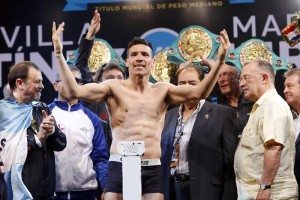
Follow all the action as Sergey Kovalev looks to regain the WBO Light Heavyweight title against Vyacheslav Shabranskyy. The action begins at 10 PM ET / 7 PM PT with Junior Lightweight contest between former world champions Jason Sosa and Yuriorkis Gamboa followed by a Light Heavyweight fight between Sullivan Barrera and Felix Valera
THE PAGE WILL UPDATE AUTOMATICALLY. NO BROWSER REFRESH NEEDED
| 12-Rounds–WBO Light Heavyweight title–Sergey Kovalev (30-2-1, 26 KOs) vs Vyacheslav Shabranskyy (19-1, 16 KOs) | |||||||||||||
| ROUND | 1 | 2 | 3 | 4 | 5 | 6 | 7 | 8 | 9 | 10 | 11 | 12 | TOTAL |
| Kovalev* | 10 | TKO | 10 | ||||||||||
| Shabranskyy | 7 | 7 | |||||||||||
Round 1: Kovalev lands a right..Good jab.Body shot..Right from Shabranskyy..BIG RIGHT AND DOWN GOES SHABRANSKYY..BIG RIGHT AND DOWN GOES SHABRANSKYY..
Round 2 Hard right from Kovalev..HARD LEFT AND SHABRANSKYY GOES DOWN..Right rocks Shabranskyy..HARD ONSLAUGHT AND THE THE FIGHT IS OVER
| 10-Rounds–Light Heavyweights–Sullivan Barrera (20-1, 14 KOs) vs Felix Valera ( 15-1, 13 KOs) | |||||||||||||
| ROUND | 1 | 2 | 3 | 4 | 5 | 6 | 7 | 8 | 9 | 10 | 11 | 12 | TOTAL |
| Barrera | 9 | 10 | 10 | 10 | 10 | 10 | 10 | 10 | 9 | 10 | 98 | ||
| Valera | 10 | 9 | 9 | 9 | 10 | 8 | 9 | 8 | 9 | 10 | 91 | ||
Round 1 HARD LEFT HOOK AND DOWN GOES BARRERA..RIGHT HAND AND DOWN GOES VALERA
Round 2 Left hook from Valera..Good left hook from Barrera..Valera warned for a low blow..Good right from Barrera..Barrera cut over his left eye..Hard right to body from Barrera..
Round 3 VALERA DEDUCTED A POINT FOR LOW BLOW..Left hook from Valera..Left hook to body from Barrera..
Round 4 Good overhand right from Barrera…Hard right…Right to body..right..
Round 5
Round 6 VALERA DEDUCTED ANOTHER POINT FOR LOW BLOW..Barrera lands a right. Valera lands a left..2 lefts Barrera…Good body shot..Right hand..Straight right to the chin..Hard combination
Round 7 Right from Barrera..Trading body shots..Good right from Barrera..Left uppercut
Round 8 VALERA DEDUCTED ANOTHER POINT FOR LOW BLOWS..Good uppercut from Barrera..
Round 9 BARRERA DEDUCTED A POINT FOR A LOW BLOW..Good left to body and right from Barrera..
Round 10 Big left hook from Valera..Body shot…Barrera lands a body shot..Big left hook
98-88, 97-90, 97-89 for SULLIVAN BARRERA
| 10-Rounds–Jr. Lightweights–Jason Sosa (20-2-4, 15 KOs) vs Yuriorkis Gamboa (27-2, 17 KOs) | |||||||||||||
| ROUND | 1 | 2 | 3 | 4 | 5 | 6 | 7 | 8 | 9 | 10 | 11 | 12 | TOTAL |
| Sosa | 9 | 10 | 10 | 9 | 9 | 9 | 10 | 10 | 10 | 10 | 96 | ||
| Gamboa | 10 | 9 | 10 | 10 | 10 | 10 | 8 | 9 | 9 | 9 | 94 | ||
Round 1 Hard right from Gamboa…Good body shot
Round 2 2 Body shots from Gamboa..Sosa lands a left hook…Cut over Gamboa’s left eye..Good over hand right from Sosa
Round 3
Round 4 Good body shot from Gamboa..
Round 5 Hard right from Gamboa..Good right from Sosa…Right From Gamboa..
Round 6 Left from Gamboa..
Round 7 RIGHT HAND MAKES GAMBOA GLOVE TOUCH CANVAS FOR A KNOCKDOWN..Good left hook from Gamboa..Good right from Sosa..Body shot..
Round 8 Right from Sosa..Left to Body..Left..Right to body
Round 9 Right from Sosa
Round 10 GAMBOA DEDUCTED A POINT FOR HOLDING…
94-94; 95-93; 96-92 for YURIORKIS GAMBOA
By Norm Frauenheim-

Three notable fights over nearly five-and-a-half weeks between now and a New Year are the end of what might be another beginning.
Boxing has been here before, of course. It’s a well-worn crossroads full of too many wrong turns. In the aftermath of Sergey Kovalev’s fight to rediscover the force he was before Andre Ward in a comeback Saturday against Shava Shabranskyy, Miguel Cotto’s farewell in a symbolic retirement versus Sadam Ali on Dec. 2 and Vasyl Lomachenko-Guillermo Rigondeaux in a Dec. 9 bout loaded with potential intrigue, however, there are reasons to think the battered business has a good chance to recreate itself.
Comebacks, goodbyes and emerging faces have always been part of the attraction. It’s all there, concentrated and undiluted, a little bit like a sport once called life in a shot glass.
For Kovalev, it’s an opportunity to overcome, indeed conquer — defeat’s inherent adversity. That used to define the old legends, but defeat has been avoided at all costs in a Floyd Mayweather era built on the optimum implementation of the risk-to-reward ratio. Can Kovalev come back the way those in the pre-Mayweather years did?
The Russian light-heavyweight is a compelling personality, a dynamic mix of danger and emotions hard to hide. He reportedly spent time in a Greek monastery in an effort to reflect on what had happened, who he has been and where he wants to return. He has a new trainer. He’s made changes around him and perhaps within him. Yet, time doesn’t change. He’s 34. Only against Shabranskyy in an HBO-televised fight in New York will we know if he’s just an aging fighter or resurrected fighter with enough time to rebuild his pound-for-pound credentials.
Then, there’s Cotto. It’s hard to know whether Ali has a chance at his first time ever at heavier weight. I’m not sure it matters. But the bout, also in New York, is significant because it represents a passing of the torch, one generation finally stepping aside for a younger one. In 2017, Timothy Bradley retired. Ward retired. It’s not clear what Manny Pacquiao’s plans are. But it’s safe to say they don’t include Terence Crawford. There’s speculation that the Filipino Senator is weary of politics. Instead of a run at the presidency, there’s talk he’d prefer to take a run at Conor McGregor. He might have to get in line behind Oscar De La Hoya on that one. But if Mayweather’s scripted scam against McGregor did anything, it proved that an aging boxer talking about a bout with the UFC star is in effect a retired boxer.
Then, there’s Lomachenko-Rigondeaux, also in New York Not sure what happens in this bout between Olympic gold medalists, Lomachenko of the Ukraine and Rigondeaux of Cuba. It could wind up being a technical bore. Still, the possibilities are fascinating, in part because it’s the last chance for Rigondeaux to do something dramatic with the talent that has been oh-so evident for oh-so long. He’s got crazy skill, yet he has used it only within the disciplined blueprint of Cuba’s famed amateur system. He takes no chances. That wins medals, but not money.
Ten years ago, who would have ever guessed that a Ukrainian would be seen as the world’s most creative boxer? Then, it seemed as if the Cubans would put some new wrinkles into the old art form. From Erislandy Lara to Rigondeaux, they haven’t. The showman has been Lomachenko. Rigondeaux has the physical stuff to show him tricks of his own, but I’m not sure he has the mindset to execute them.
If not, that still brings us to 2018, with even more talk about Lomachenko against Mikey Garcia’s patience, smarts and efficient ability to deliver fundamental power. Either way, it sets up an intriguing end to what has been an interesting beginning.
By Bart Barry-

Contrary to accepted architectural practices, this part of this column generally gets written last. You’re supposed to tell them what you’re going to tell them and then tell them and then, well, whatever, but when you do things like that, with a sliderule and compass, you discover nothing along the way, and if merely imparting knowledge were the point of this exercise it’d’ve ceased years ago. Rather, the purpose of this exercise is discovery. Let’s see how that went.
Thanksgiving: a day that recently as a halfdecade ago felt uniquely American, an optimistic and celebratory if whitewashed day of national gratitude, a day you might cling to if you loved what your country still was when compared to other countries’ less optimistic if more realistic bents. It no longer feels that way to any American, you should know if you’re reading this somewhere other than the United States; those who did not vote for the current leadership of the country are appalled by it and those who did vote for the current leadership did so because they were already appalled. It’s a single point of accord across the land: A great country does not elect Donald Trump its president – the very message stamped on candidate Trump’s campaign headwear.
While gratitude is never the wrong sentiment it feels stilted this year in a way it did not previously; plastic, insincere, Hallmarked, oblivious. A day given to collective gratitude for collective goodfortune is not appropriate in a country where at least 1/3 deeply resents another 1/3, making a country whose collective at best thinks a day of gratitude marks a time for expressing thanks only to the dwindling few in their 1/3 or not at all. There’s little bigeyed, smiling cheer anymore. Even those of us who stake claim to the middle 1/3 of the country, pledging allegiance to no political party or militancy, dealing as best we can always in goodfaith with whomever we encounter on the trail or in the coffeeshop or via Twitter, we feel hunkered down, guarded, generally pessimistic no matter how privately optimistic.
A quick anecdote about the state of our union before clumsily moving on (this wasn’t the direction this column was supposed to go – it was going to comprise recollections from Barrera-Morales 3, actually): In August luck moved me to firstclass on a sevenhour flight from Mexico City to Lima, Peru, and the main reason for wanting firstclass is not the obvious one. Generally any international carrier anymore has more comfortable seats than any American carrier – what happens when the freemarket doesn’t allow a meaningful price increase while shareholders want meaningful stockprice increases – so the size of the seat is not the incentive it might appear. Instead it’s the people one meets in firstclass. Sure, a goodish number are wealthy bores but an even better number are folks whose tickets were purchased by someone other than themselves; persons good enough at the game of navigation that other entities insist on their comfort.
One such person was the guy seated beside me in August. Born and raised in and eventually exiled from Cuba he was a Mexican diplomat in his late 50s or early 60s. We greeted each other amiably at the beginning of the flight, as Latin American custom dictates (in any intimate dining scenario, including a restaurant with strangers, in fact, you ask to be excused from your table by other diners) then settled into whatever amiable ignoring of others frequent travelers frequently do. A couple hours later, though, when I was bored silly by that week’s Mario Vargas Llosa novel and my neighbor asked me if I had a pen he might borrow, we began to converse and discovered in due time we were more entertaining to each other than what books we suffered.
Eventually semicurrent affairs arose – Mexican kidnappings and Colombia’s renaissance and whatever America now represents – and I offered my somewhat simple opinions to this deeply complex man before watching his eyes and realizing with a start: For the first time in my 23 years of Spanish conversations, I am now the crazy one. No more friendly advice about tending to democracy or helpful lectures about the miraculous effects of capitalism; by virtue of who now leads my country, I initially appear unhinged to Latin Americans and have to selfdeprecate my way to credibility if not an even conversational footing.
Note to those of us who travel enough to know otherwise but still occasionally adopt the greatest-country-in-the-world posture when abroad: The gig is up, friends, they know better.
Looks like we’re going for sincerity this year in lieu of uplift.
Nevertheless this Thursday I’ll be grateful for this: Boxing feels like it is in a better place to get to a better place for the first time at least since 2009. Which is not to pretend 2017 was a banner year for our sport because it has not been. But our sport’s congealed algorithm, from paycable-capture to pay-per-view, defrosted this year. Right now only one fighter in any reputable Top 10 list can make his living on pay-per-view, and with promoter Top Rank swornoff the PPV game for the next few years that is unlikely to change. We’ll still get the Canelo show biannually and Mayweather will make whatever inconsequential distractions he makes, but next year you’ll be likelier to discover the world’s best prizefighter on freecable than HBO or Showtime. If that’s not progress it is at least novel, and we’ve not seen progress in years anyway.
In 2017 feeling gratitude for the developing effects of a negative feedback loop feels like the best way to go. Happy Thanksgiving to one and all.
Bart Barry can be reached via Twitter @bartbarry
By Norm Frauenheim-

PPV Weigh-in 11-20-2015
WBC Middleweight Title
Miguel Cotto 153.5 vs. Canelo Alvarez 155
photo Credit: WILL HART
His face is the portrait of a fighter. It’s a mix of stoicism and toughness. There’s an unblinking gaze that says he has seen it all. He hasn’t, of course. That’s why Miguel Cotto is retiring. He wants to see more of his family and do more for fellow Puerto Ricans in the devastating wake of Hurricane Maria.
At one level, his retirement after a junior-middleweight bout against Sadam Ali at New York’s Madison Square Garden looks to be a lot like how he fought and how he conducted his career. He appears to be leaving the way he entered: On his own terms.
There’s nothing more temporary than a boxers’ retirement, of course. They’re back more often than the tide. But a Cotto comeback would be surprise, even among ex-fighters who can’t quite resist the temptation to answer just one more opening bell.
The ring is littered, metaphorically and literally, with examples. The best current example: Oscar De La Hoya, Cotto’s promoter. De La Hoya says he believes Cotto’s fight on Dec, 2 versus Ali will be his last.
“Obviously, there’s many reasons why a fighter can choose to come back,’’ De La Hoya said.
Yeah, reasons like Conor McGregor.
De La Hoya made the comment during a conference call Wednesday, a day after he called out McGregor on a radio show. De La Hoya said he had been training in private, yet with singular purpose, in hopes of knocking out the UFC star in two rounds.
I’m guessing we’ll see George Foreman versus Steven Seagal before we see De La Hoya versus McGregor. Then again, I never thought we’d see Floyd Mayweather Jr. versus McGregor, either. From a parachutist named Fan Man landing in the ring like the 82nd Airborne to Mike Tyson’s Bite Fight, boxing has been nothing if not the theater of the crazy. Expect anything.
That said, I agree with De La Hoya about Cotto. I don’t expect a trite, often futile comeback from the first Puerto Rican to win titles at four weights. It just would be unlike him. Through his career from junior-welterweight to middleweight, Cotto wasn’t always media-friendly. He didn’t smile much. Didn’t talk much. Yet, his stubborn silence spoke loudly. To wit: He means what he says.
Throughout Wednesday’s conference call, he talked about having no regrets. He said he walks away in peace. When pushed, he said his favorite fight was in 2005 when he got up from a second-round knockdown to score a seventh-round stoppage of Ricardo Torres.
“The one that put Miguel Cotto on the map,’’ said Cotto, who went on to further secure his place on the marquee with victories over Shane Mosley, Zab Judah and, later, Sergio Martinez.
But the guess here is that his place in public memory will always be for how he beat Antonio Margarito in a wicked rematch in 2011 in New York. It was a bout full of all the elements that make boxing so dangerously compelling. It was about a grudge, payback for what Cotto believed was a loss – an 11th-round stoppage — he suffered in 2008 to Margarito.
In Margarito’s next fight, a loss to Mosley, altered hand wraps were discovered before opening bell. The wraps would have augmented Margarito’s power against Mosley. Altered wraps were suspected in Margarito’s upset of Cotto in their first fight. Three years later, Cotto ended the debate with a punishing 10th-round stoppage of Margarito.
When asked about the Margarito fight, Cotto didn’t say much Wednesday.
“Everybody knows what happened in the first fight,’’ he said.
Enough said.
By Bart Barry-

Saturday at Nassau Coliseum, former home of the New York Islanders, Brooklyn “Miracle Man” Daniel Jacobs decisioned someone named Luis Arias on HBO. Jacobs won easily every round in a mainevent that left both men perfectly unscathed after 36 minutes of ostensible combat. I slept through it.
“Probably fatigue of one sort or another,” I told myself Sunday morning, “or perhaps the pernicious effects of age, but let’s show some professionalism here, kid!”
Then I sat down for the 10 a.m. rebroadcast and fell asleep again. Jacobs iced me in round 3 Saturday night and chloroformed me in round 7 of our rematch. There’s a devastating puncher for you.
Nothing wrong with Jacobs, really. He’s a very good fighter and a decent dude and well liked, most importantly, and’s learning to sell tickets with his new promoter, Eddie Hearn, who certainly does know how to do that – and for a discount on whatever of Jacobs’ purse Al Haymon still gets Hearn ought to offer a semester’s worth of lectures to whichever titular promoters Haymon’s PBC still employs and Golden Boy Promotions, too, who had first rights to Jacobs before the Dmitry Pirog incident and associated miracles (and they’re apparently linked; a novel pretext for Jacobs’ decimation by the Russian now gets unveiled with every fight: not only was Jacobs mourning his grandmother’s passing that weekend in Las Vegas but he also had cancer – though it wouldn’t be diagnosed for another 10 months and two prizefights; with Pirog safely retired there’s no end to a creative revisionism that could yet uncover a retroactive victory in Jacobs’ 2010 TKO-5 loss).
Let’s treat Hearn here for a spot, as certainly he’s the reason we got treated to Saturday’s fare and what Jacobs hagiographies HBO’s queuing for 2018. Hearn is now the most powerful promoter in boxing because Hearn owns promotional rights to the most powerful man in boxing, Anthony Joshua, the world’s undefeated, undisputed and charismatic world heavyweight champion. This year alone Hearn and Joshua have sold about as many tickets to two fights as PBC has sold since its inception. For many reasons, some merited and many not so merited, our beloved sport reliably goes where the heavyweight division directs it. That might read heretical to some youngish fans in emerging markets, assuming as they do little guys like Manny Pacquiao and Floyd Mayweather make the sport go, but it shouldn’t surprise any American who came of age during Mike Tyson’s reign or any European who just finished enduring the Brothers Klitschko’s domination.
Without Wlad and Vitali there is no such thing as K2 Promotions – which means we never meet Tom Loeffler, we probably know very little about Gennady Golovkin, and we sure as hell never take Abel Sanchez seriously. Unable to purse like Showtime these days HBO now endeavors to play a nifty game of promoter capture, seducing Hearn by showcasing (Jacobs’ word, not mine) whosoever Hearn signs to his new stateside label in the hopes Hearn will bring the most powerful man in boxing to HBO someday – though with the Justice Department meddling in the acquisition of HBO’s parent company last week one worries HBO will not be able to purse like Showtime for a while to come.
It’s good to see Jacobs benefit from all this corporation-to-promoter synergy. He has talent galore and he’s genuine in a way that shines through what inane hyperbole gets heaped on him. But all the squinting and barking of all the celebratory broadcasts of his career fail to make him truly special. Greatness is more than an accumulation of mediocrity, after all, and Jacobs’ professional record is a workable synonym for accumulated mediocrity. He blasted the pretender Kid Chocolate, sure, and showed GGG be overrated by any measure, too, but he also failed to do more than make Luis Arias a little nervous in 36 minutes of trying, and then there’s the aforementioned Pirog incident, isn’t there?
Nope, not letting it go, guys, sorry – I was ringside when it happened and stunned by its ferocity. It wasn’t just the exclamationmark ending, either, but the entire affair, bell to waveoff; it’s not the sort of thing that happened to a young Marvelous Marvin Hagler or Bernard Hopkins, and let this be a reminder that if we’re to suspend disbelief and entertain possibilities of Jacobs’ being a special middleweight we need remember there be aficionados old enough to know those guys, to remember them clearly, and hitch a ride on their standard each time we’re told to catch a new bandwagon.
Nobody wants to watch Jacobs go rounds with talkative nobodies like Arias, not on local access, not on free cable, and certainly not on a premium channel. Writing of which, with the exception of September’s wonderful SuperFly card, HBO’s broadcasts now feel stale, boring, behind the curve – same announcers saying the same things about the same graphics.
According to the network’s house scorekeeper Saturday’s showcase fighters won 22 of 23 rounds against their b-sides. That sort of mismatchmaking is tolerable, one supposes, if it’s three Hebrew Hammers – and yes, more of Cletus Seldin, please! – three times an unproven prospect thrashtossing a veteran, and even sort of tolerable if it’s three Big Babies – three times a cutiepie like Jarrell Miller threadbaring a giant – but not tolerable if it’s one time of Daniel Jacobs, a proven talent in his prime, practicing old combinations on a pillowfisted salesman like Arias.
It was personal, all the prefight trash Arias talked, we know, we know, which is one more mark against Jacobs: when he loses himself to beastmode and goes in on a little guy who’s pissed him off, allegedly, Jacobs punches badly if not Wilderly.
In the post-Money Era networks haven’t credibility enough to handpick athletes and storytell them to acclaim. Ten years ago we assumed a man was on HBO for good reason, even when he often wasn’t, and therefore due diligence commanded us get to know him, which is how we still recall silly facts like Andre Berto fought for Team Haiti in the Olympics. Those days ended with Mayweather-Pacquiao. We watched Jacobs fight Arias on Saturday because Jacobs acquitted himself surprisingly well against Golovkin in March, not because Jacobs survived cancer, and some of us, though no one writing this column, even may’ve watched yet another reheated retelling of Jacobs’ story in the last few weeks, but again, only because Jacobs made an entertaining fight in March.
Bart Barry can be reached via Twitter @bartbarry
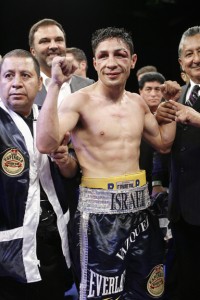
By Norm Frauenheim-

It’s hard to know what Sergey Kovalev knows about Thanksgiving, a uniquely American holiday. But he fights a couple days after Turkey day and if the Nov. 25 bout goes as expected, he’ll come away with a pretty good understanding.
Bolshoe spasibo
That’s Russian for thanks very much. Thanks, Google.
How ever it is pronounced, the guess here is that Kovalev will say it as often as the rest of us eat Turkey sandwiches in the hours and days after the last piece of pumpkin pie.
A victory over Vyacheslav Shabrankskyy in The Theater at New York’s Madison Square Garden in an HBO televised bout will allow Kovalev to hit the reset button and, moreover, forget about a 13-month stretch of controversy and frustration over two losses to Andre Ward.
First, he lost a decision to Ward last November in a bout most people thought he won. Then, he lost an eighth-round stoppage to Ward in a June rematch that was controversial for low blows, what the referee did or didn’t do and who he was or wasn’t.
Then, Ward retired and, by the way, bolshoe spasibo for that. There would have only been a lot of indigestion with a trilogy, mostly for Kovalev, still a compelling light heavyweight who continues to be ranked No. 5 in The Ring’s pound-for-pound edition.
“Right now, I feel all bad things are gone from my mind,’’ Kovalev said this week in a conference call. “Right now I concentrate, and I focus for the future of my boxing career. I’m ready to be again a world champion and collect my belts if somebody will be ready to unify the title.’’
It’s hard to imagine Kovalev thanking Ward in a language that doesn’t include some well-chosen obscenities. But Ward’s retirement did mean he vacated a title, the WBO’s version of the 175-pound belt, that will go the Kovalev- Shabrankskyy winner. That figures to be Kovalev, unless the guy he didn’t recognize in the Ward rematch shows up for opening bell for Shabranskyy. He said he wasn’t himself in the rematch.
Some of that can be blamed on Ward, who took away Kovalev’s deadly jab with his inside tactics while also eliminating some of his leverage by getting underneath him in an effective inside assault. It was as frustrating as it was maddening and it seemed to drain Kovalev’s energy, if not passion, for the task immediately in front of him.
Kovalev said he has adjusted. He has a new trainer, Arbor Tursunpulatov, instead of John David Jackson.
“I’m happy to work right now with my new coach,’’ Kovalev said. “He’s doing a great job and we understand each other because we speak and understand one language. We understand each other and I feel comfortable.’’
He also says he has eliminated the distractions. Distractions are supposed to be an American or maybe Filipino kind of thing. Think of Floyd Mayweather Jr. with bales of cash and a garage full of high-end cars, or Manny Pacquiao with karaoke. Trips back to Russia, however, appeared to knock Kovalev off his regimen, especially in the months before a long-awaited showdown with Ward, who retired unbeaten and at the top of the pound-for-pound debate.
“When I’m doing boxing, I should do boxing,’’ said Kovalev, who also discovered that an American author, Thomas Wolfe, might have been right when he said you can never go home. “Not another business or a lot of flights to come back and forth to Russia to spend free time. Because when I’m in Russia, I don’t have the time, like for locals and doing the boxing. Just a lot of meetings, a lot of businesses, a lot of wrong things.
“I mean, not sport at all. But right now, I’m here in America, and started a new chapter in my boxing career.’’
One victory beyond Ward might put Kovalev back on track to achieving the singular prominence that seemed to be within reach of his dangerous hands.
His promoter, Kathy Duva, thinks so.
“The first fight, I will say for the rest of my life, he didn’t lose,’’ Duva said of Ward-Kovalev 1. “The second one, he was fighting the referee and the fighter, but he lost to the No. 1 fighter in the world. That’s not coming back. You don’t fall too far when you’re that close with a guy who is that good. Ward has a style that is just very, very hard to beat, especially when he’s getting help.
“My feeling about this is that Sergey is must-see TV. Sergey is still one of the most compelling, exciting fighters in the world. Having lost a debatable decision or a debatable stoppage shouldn’t really derail somebody’s career all that much.
“And as things turned out, Sergey is in a position right now to, not only be right back on top, but to be right back on top of one of the most exciting and perhaps the deepest division in boxing.’’
A surprise, as things turn out, and a reason to say Bolshoe spasibo.
By Bart Barry-

Late Thursday night on one of ESPN’s innumerable affiliates Dominican journeyman Juan Carlos Abregu beat up Mexican journeyman Jesus Soto Karass. The match would prove a good offramp for Soto Karass if he let it, but surely we know he probably will not.
Whenever I think of Soto Karass I think of Antonio Margarito, the star of the Siete Mares stable to which Soto Karass belonged for much of his career. Soto Karass was his own man, of course, but he was a poor-man’s Margarito to most of us. His career went as experts initially predicted Margarito’s would go – maybe wrangle an upset or two against overhyped contenders but certainly never attain a championship of his own. It speaks to luck th’t Margarito’s style, and perhaps his handwraps, found their perfect matches in Margarito’s physical prime while Soto Karass’ did not come till he was acceleratingly treadworn. Soto Karass was all attrition every time, and if you think that made him noteworthy on undercards comprising mostly fellow Mexicans, you’ve not attended many such undercards.
I was ringside for seven Soto Karass fights but not one time to see him fight. The first time I covered him, May 2006 in Fountain Hills, Ariz., he was 11-3-1 and drew with Manuel Gomez (28-10-1) in what must’ve been a “Solo Boxeo de Miller” main, but none of us was there to see those guys – local prospect Jesus Gonzales sold the tickets, Urbano Antillon went directly through Soto Karass’ older brother Jose Luis in the comain, and Mike Alvarado and Giovani Segura filledout the undercard in their eighth and ninth prizefights respectively. Antillon is the only fighter I remember that night.
Thirteen months later I was beside a ring in the parking lot of a Tucson nightclub when Soto Karass retired “Cool” Vince Phillips – the man who once stopped Kostya Tszyu and Mickey Ward two months apart in 1997 (guys used to fight that often men of that quality) – but that night I was more interested in seeing Mike Alvarado again. What I remember from that parkinglot was watching Telefutura’s Bernardo Osuna improvise an entire opening bit off a few lines scribbled on an index card taped to the bottom of his camera, and watching a broken Phillips beg for a postfight interview to announce his retirement in English on a Spanish-language broadcast that ran out of time and didn’t let him, which meant Phillips fought again and lost again, this time in Russia, 11 months later.
The first time I covered Soto Karass in a mainevent came in July 2008 at Hard Rock Casino in Las Vegas on the eve of Margarito-Cotto 1, and I remember no boxing from that weekend except Margarito’s bludgeoning of Cotto. Writing of Cotto, the next time I covered a Soto Karass match from ringside he was down the marquee, losing to Alfonso Gomez in the co-co-main of Pacquiao-Cotto, and more to the point in the enviable position of following “Son of the Legend” Julio Cesar Chavez Jr.’s decisioning Troy Rowland (result subsequently changed). I vaguely recall being impressed by Gomez a bit, and I verily recall the childlike enthusiasm we all had in the pressroom immediately after Pacquiao ragtagged Cotto: Manny’s going to fight Floyd next!
Instead Manny fought Joshua next in Cowboys Stadium, and when Manny returned to Texas in November 2010 to fight Margarito, himself returning from banishment, Soto Karass got sneaked-past by an undefeated Mike Jones, and I have a slight recollection of feeling disappointed for Soto Karass. Too, I was in Las Vegas the night Soto Karass got iced by Marcos Maidana, but I was with every other aficionado at Thomas & Mack to see Sergio Martinez barely escape Son of the Legend, not partaking of the Canelo sideshow at MGM Grand.
And I’m proud to say I was ringside for Soto Karass’ biggest and probably final victory when he got off the bluemat in round 11 to stop Andre Berto at AT&T Center in my adopted hometown of San Antonio. That was an attrition lover’s feast – as Soto Karass willed his way through Berto just after Omar Figueroa and Nihito Arakawa fortituded one another relentlessly for 36 minutes. Five months later, in December 2013, Soto Karass returned to Alamo City and got stopped by Keith Thurman at Alamodome in a comain whose memory was steamcleaned by what Maidana did to Adrien Broner immediately thereafter. Since then Soto Karass is 0-4-1 (2 KOs), though with two memorable showings against Yoshihiro Kamegai.
Thursday night Soto Karass was nearly returned whence he started, fighting on an afterthought Golden Boy Promotions card in the ballroom of an Arizona casino – though it bears mention the match was being judged by Roger Woods, formerly his state’s best matchmaker, and had Soto Karass gotten to the final bell at least one scorecard would’ve proved unimpeachable. The match did not get to the final bell, Soto Karass did not get there, falling overknee forward onto a right uppercut in round 8 then getting dropped. Soto Karass rose unconsciously, proof such things are habitforming, nodded to his cornermen he was continuing, then raised his hands unbidden overhead to assure the ref he was able. The end came pretty quickly after that and ugly.
One suspects such an end be too symmetrical for Soto Karass to retire. Thursday was a 10-rounder. Next year’ll likely see him lose an eightrounder and so forth till the purses become too tiny to bother.
Bart Barry can be reached via Twitter @bartbarry
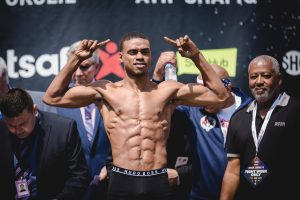
Follow all the action as WBC Heavyweight champion Deontay Wilder defends his crown against Bermane Stiverne from Barclays Center in Brooklyn, NY The action begins at 9 PM ET / 6 PM PT with a 12 round battle for the IBF Junior Welterweight title between Sergey Lipinets and Akihiro Kondo. The co-feature will be an intriguing Welterweight fight between former world champion Shawn Porter and Adrian Granados.
NO BROWSER REFRESH NEEDED. THE PAGE WILL UPDATE AUTOMATICALLY.
| 12 Rounds–WBC Heavyweight Title–Deontay Wilder (38-0, 37 KOs) vs Bermane Stiverne (25-2-1, 21 KOs) | |||||||||||||
| ROUND | 1 | 2 | 3 | 4 | 5 | 6 | 7 | 8 | 9 | 10 | 11 | 12 | TOTAL |
| Wilder* | TKO | ||||||||||||
| Stiverne | |||||||||||||
Round 1: Wilder comes out jabbing…Jab..BIG RIGHT AND DOWN GOES STIVERNE..HUGE RIGHT AND DOWN GOES STIVERNE..HUGE COMBINATION…DOWN GOES STIVERNE..HES OUT AND THE FIGHT IS OVER
| 12-Rounds–Welterweights–Shawn Porter (27-2-1, 17 KOs) vs Adrian Granados (18-5-2, 11 KOs) | |||||||||||||
| ROUND | 1 | 2 | 3 | 4 | 5 | 6 | 7 | 8 | 9 | 10 | 11 | 12 | TOTAL |
| Porter | 10 | 10 | 10 | 10 | 10 | 10 | 10 | 10 | 10 | 10 | 9 | 10 | 119 |
| Granados | 9 | 9 | 9 | 9 | 10 | 9 | 9 | 9 | 9 | 9 | 10 | 9 | 110 |
Round 1 Left from Porter..Left..Uppercut and left hook from Granados..Jab from Porter..Granados cut under left eye..Jab from Porter..Big right
Round 2: 4 left hooks from Porter..Nice counter right Granados,,,short left from Porter..Left from Granados..Right..Counter left hook..Left uppercut from Porter,,Granados countering..Right from Porter at the bell.
Round 3 Porter landing on the ropes..Guys are connecting inside..3 hard lefts from Porter..left driving Porter back
Round 4: Good left hook from Porter..Counter left from Granados..Jab..Left hook to body from Porter..Porter mauling and connecting on the ropes..Good right from Granados..
Round 5 Left hook from Porter..Good exchange..Nice right from Granados..Right from Porter..Uppercut from Granados…right..Counter left from Porter..
Round 6 Big right from Granados..Right from Porter..Nice right..Porter working the body on the ropes..Porter chasing Granados around the ring
Round 7 Nice combination from Porter..Right Hand..3 punch combination..Porter landing on ropes..Good right from Granados..
Round 8 Left from Granados..Double jab from Porter..
Round 9 Porter lands a left on the ropes..Left staggers Granados..Right from Granados..
Round 10 Exchanging on the ropes..left hook from Porter..right uppercut..Left hook and jab..Granados lands a left.
Round 11 Good right from Granados..
Round 12 Nice eight from Porter..Jab from Granados..
117-111 on all 3 card for Shawn Porter
| 12-Rounds-IBF Jr. Welterweight Title–Sergey Lipinets (12-0, 10 KOs) vs Akihiro Kondo (29-6-2, 16 KOs) | |||||||||||||
| ROUND | 1 | 2 | 3 | 4 | 5 | 6 | 7 | 8 | 9 | 10 | 11 | 12 | TOTAL |
| Lipinets | 10 | 10 | 10 | 10 | 10 | 10 | 10 | 10 | 9 | 10 | 10 | 9 | 118 |
| Kondo | 9 | 9 | 9 | 9 | 9 | 9 | 9 | 9 | 10 | 9 | 9 | 10 | 110 |
Round 1: Lipinets lands a right..Body shot..Kondo lands a combination..right to body from Lipinets..Jab
Round 2: Body shot from Kondo..Working on the ropes…Lipinets counters..Right from Kondo..Left hook from Lipinets..Right uppercut from Kondo..1-2 from Lipinets…Blood from the nose of Kondo
Round 3 Both guys working the body..Left uppercut from Lipinets..Counter right from Kondo..Jab to body from Lipinets..Short right..Kondo lands a left to the body..Jab from Lipinets..Left to body from Kono..
Round 4 Double left hook to body from Lipinets..right and left hook..Kondo lands a chopping right..Jab..Lipinets lands a left to the body..Kondo lands a left..Left hook to body
Round 5 Body shot from Lipinets..1-2 combination..Hard right rocks Lipinets..Sweeping left from Lipinets..
Round 6 Left from Lipinets…Jab to head..Lipinets cut on his hairline due to accidental headbutt
Round 7 Right hand and left from Lipinets..Hard combination from Kondo..Right from Lipinets..
Round 8 Kondo lands a jab..Good right from Lioinets..Nice right uppercut..Hard right from Kondo..
Round 9: Right from Kondo..Uppercut on inside..
Round 10: Jab from Lipinets..Lead right..Double jab..Jab
Round 11 Right and left from Lipinets..Body..Jab..
Round 12 Left from Kondo..Double jab..Right from Kondo
118-110; 117-111 twice for SERGEY LIPINETS

Follow all the action as Dmitry Bivol defends the WBA Light Heavyweight championship against Trent Broadhurst. The action begins from Monte Carlo at 5:45 ET/ 2:45 PT/10:45 in Monte Carlo/12:45 AM in Russia/ 8:45 AM in Australia
NO BROWSER REFRESH NEEDED.
| 12 Rounds–WBA Light Heavyweight Title–Dmitry Bivol (11-0, 9 KOs) vs Trent Broadhurst (20-1, 12 KOs) | |||||||||||||
| ROUND | 1 | 2 | 3 | 4 | 5 | 6 | 7 | 8 | 9 | 10 | 11 | 12 | TOTAL |
| Bivol* | TKO | ||||||||||||
| Broadhurst | |||||||||||||
Round 1: Straight right from Broadhurst…RIGHT HAND AND DOWN GOES BROADHURST..Quick left hook..Lead Right..HARD RIGHT AND DOWN GOES BROADHURST…FIGHT IS OVER
By Norm Frauenheim-

TUCSON, Ariz. – It was a tough way to say goodbye, so tough that Jesus Soto Karass might want to try it all over again.
Juan Carlos Abreu knocked out any chance that Soto Karass might have had at celebrating a farewell with a victory Thursday night in an ESPN-televised fight at Casino Del Sol.
Abreu delivered a couple of huge lefts, dropping Soto Karass twice in the eighth round and nearly sending him through the ropes, if not into retirement, with the second knockdown in a powerful TKO of the popular Mexican.
For Abreu (20-3-1, 19 KOs), the victory gave him some hope to think that maybe he can still be a welterweight contender. For Soto Karass (28-13-4, 18 KOs), the crushing defeat looked like just another reason to walk away from his 16-plus years throwing – and taking — punches
But Soto Karass wasn’t ready say farewell. After he got up from the crushing finish at 1:07 of the eighth, he stood on the ring’s bottom rope and waved at the crowd almost as if he had won. It wasn’t a gesture of farewell. He was saying thanks.
“Thanks to my fans,’’ said Soto Karass, who wasn’t sure about retirement before opening bell.
He wasn’t sure after referee Rocky Burke had ended it , either
“I will sit down with my manager and my family, talk to them, then decide.’’
It was clear to Soto Karass that his Mexican fans haven’t given up on him. Maybe that’s because he never gives up, at keast not in the ring. It was evident in the early going that it would only be a matter of time before the stronger, more mobile Abreu would catch Soto Karass, who as a boxer is as pedestrian as he is fearless. He just kept moving forward.
“I just got caught, really caught by a punch from a guy who can really punch,’’ he said.
The finishing blows might have come earlier. However, Abreu, a Dominican, said he hurt his right hand in the second round. He said planned to have a physician examine the hand to determine whether he sustained a serious injury.
He said the pain made him cautious from the third round through the seventh. There were moments in the sixth and again in the seventh when it looked as if Soto Karass would simply try to wait him out, perhaps wear him out. In the eighth, the stubbornly persistent Soto Karass walked into the only good hand Abreu still had. Then, it landed once and then a second time, finishing a fight, if not a career.
In the co-main event, junior-lightweight prospect Ryan Garcia (12-0, 11 KOs) came into the ring to classical music. Garcia, of Victorville, Calif., wore black-and-white shorts that could of come out of the 1950s. They were black-and-white. They also were made in honor of the late Jake LaMotta, whose Raging Bull nickname was stitched across the back of the trunks alongside 1922-2017, the years of LaMotta’s birth and death.
It was an old-school look. It was an old-school win, too. Garcia’s power stole the show, overwhelming an overmatched Cesar Valenzuela (14-6-1, 5 KOs). A Garcia left, traveling at blinding speed, knocked down Valenzuela in the first round. Another finished him late in third of a bout referee Tony Zaino ended in the final second of the round.
In the telecast’s opening bout, the judges’ scores made it look easy. It wasn’t. Prospect Hector Tanajara Jr. (11-0, 4 KOs), a Robert Garcia-trained junior-lightweight, endured head-rocking shots and stubborn aggressiveness from Mexican Jesus Serrano (17-5-2, 12 KOs) for eight rugged rounds. In the end, Tanajara relied on his superior reach and bigger body, winning a unanimous decision that was a lot closer than the 80-72, 79-73, 80-72 scorecards.
Best of the Undercard
There were some questionable blows and some real ones. There was a lot of everything. And Mexican German Meraz has seen just about everything. Meraz’ documented record includes 105 fights. Yet he entered the ring with only one draw. Now he’s got two.
Meraz (58-45-2, 35 KOs), of Agua Prieta, danced, smiled, landed punches and took few, yet all of it was only enough for a majority draw with Los Angeles featherweight Rafael Gramajo (9-1-2, 2 KOs) in a wild fight that ended with him ahead on one card, 58-56, and 57-57 on the other two.
The Rest
California bantamweight Cesar Diaz, poised and precise, also improved on a perfect record (6-0, 6 KOs) with a stoppage of Pedro Melo (17-17-2, 8 KOs), a Tijuana fighter who surrendered at 1:10 of the fifth round an injury to his left shoulder.
Junior-welterweight Christopher Gonzalez (1-0), a national amateur champion from Tucson, threw a short hook for what was ruled a second-round knockdown of Jesus Arevalo (2-2) of Sierra Vista, Ariz., and went on to win a unanimous decision in his pro debut.
By Jimmy Tobin-

Anthony Joshua retained his heavyweight hardware with a tenth-round stoppage of typically game Carlos Takam at the near-bursting Principality Stadium in Cardiff, Wales Saturday night. A right hand wobbled Takam at a time when he was as much a threat to Joshua’s unblemished knockout streak as Joshua was to Takam’s senses, and referee Phil Edwards, understanding which of the threatened most needed protecting, waived off the action. God save the King!…or at least preserve him.
Joshua rallying from an early knockdown to chop down Wladimir Klitschko six months ago this was not, and the discrepancy between the quality of that fight and expectations for Saturday’s is likely a force-multiplier for any disappointment with Joshua-Takam. Takam would not make any harrowing inquiries of the heavyweight future, for however sturdy, fit, even crafty by modern heavyweight standards he may be, he was still only a replacement for mandatory challenger Kubrat Pulev (who might make a compelling fight against Takam but would meet a similar fate against Joshua).
Yet in an era where a fighter can have developmental fights even after winning multiple titles, and where every stern challenge provides license for at least one unwatchable one, Takam was as good a replacement opponent as you will see. The Cameroonian went ten attritional rounds with the finest version of Alexander Povetkin chemistry could concoct, and it was Takam who first scuffed some of the sheen off Joseph Parker (validating him in the process). Without pressure from a sanctioning body, promoter Eddie Hearn might have tried to get away with a lesser opponent: after all, not one of the 75,000 or so devotees in Principality Stadium bought a ticket to watch Pulev, no one was there to catch an in-person glimpse of Takam. Joshua could have fought most anyone and the crowd would have left happy provided his opponent was riveted to the canvas.
But Takam can, and came to, fight. Joshua looked ponderous at times trying to corner Takam, and betrayed his frustration at this by too often loading up—and subsequently missing—when he was in range. The headbutt that crashed into and broke Joshua’s nose in the second round only compounded his troubles. Still, he dropped Takam in the fourth, cut him over both eyes, and however convenient the stoppage, was never remotely in danger of losing. Joshua should learn from this fight; expect his body punches (something he used to great effect against Klitschko) to figure more prominently in the future, for trainer Robert McCracken to remind Joshua that a 250-pound man with technique and intentions befitting his calling need prioritize landing clean punches—and trust their ensuing effect. And, as there is craft beyond the margins of sportsmanship worth learning, one also expects Joshua to treat the next opponent who repeatedly-accidentally leads with his head to an equally malicious response.
Joshua’s struggles, minimal as they were, serve as a reminder that however uninspiring the opponent, however suspicious the stoppage, Saturday’s fight was no formality. Indeed, finding anything suspicious at all about the stoppage only confirms this—no one would decry a premature ending to a pointless endeavor. Takam pushed Joshua a bit, revealed something of him, and fights that reveal tend to be entertaining. Admittedly, this may stretch the criteria for what constitutes entertainment and were you to pass entirely on watching what appeared very much like a foregone conclusion, you will find no objection here.
But the point about revelation is important: because any expectations that Tyson Fury’s dethroning of Klitschko two years ago would liberate the division, would result in matchups of refreshing novelty and quality, died quickly. The only heavyweight fight of any genuine intrigue since was Joshua-Klitschko, (which was phenomenal). Fury, the supposed liberator, cannot get himself in the ring, Deontay Wilder continues to suffer (benefit?) from drug testing, while Luis Ortiz only suffers from it; all of which speaks to how many of those aforementioned matchups of refreshing novelty have actually been made. (And while we’re at it, how about that bloody process of elimination establishing the cruiserweight pecking order looming as an unforgiving point of comparison?)
Joshua’s future then, promises more Takams than even forty-something-year-old Klitschkos—all the better if the challengers-in-perpetuity can make him sweat. Let them make a complete fighter of him, and confirm this creation with a few thrills along the way.
So Joshua will probably not clean out a division begging for such treatment anytime soon: mandatory defenses and the rest of the stifling rigmarole that keeps boxing forever in its own way will see to that. Should he fight two to three times a year, however, splitting those fights between tedious defenses and the challenges even his critics crave, then the division is in good hands. Oh, it’s mostly still a wreck, photographs of Tyson Fury with his shirt off, gifs of Deontay Wilder, and a handful of drug tests will tell you that. Still, if you find yourself in the food court of a mall streaming a Joshua fight on your phone, know that he is the rare heavyweight that warrants such efforts.
By Bart Barry-

Saturday in an enormous Welsh rugby stadium heavyweight world champion Anthony Joshua beat Franco-Cameroonian Carlos Takam by a round-10 referee stoppage whose referee itched to stoppage it from just about the opening bell. Faced with such odds on short notice Takam made a fine showing for himself, and Joshua didn’t do badly either.
All three men did their jobs Saturday in Great Britain. Joshua sold a whole lot of tickets and punched a gatekeeper often enough to please ticketbuyers. Takam kept the gate, fighting like a proud man who knew victory was likely as a miracle and th’t short of a miracle a dignified showing’d further his career further than alternative approaches (Deontay Wilder’s nowhere near crazy as he swings and knows better than to cross the pond and get chloroformed by a fighter who knows how; Takam’s got a handsome 2018 payday awaiting him in Alabama). And referee Phil Edwards delivered the stoppage everyone wanted to preserve Joshua’s 100-percent knockout ratio – even going so far as to leave a white towel hanging off the cornerpost midway through the match, lest the Takam corner miss its cue.
With Wladimir Klitschko retired it’s exhibition matches far as the eye can see for Joshua, and so a new sort of judging criterion is required for American fans who can’t warm to Joshua much more than we warmed to Klitschko. Helpfully Europeans fill stadiums with an inexplicable enthusiasm that is nearly infectious. One needn’t be a publicist or promoter to have a rooting interest in the health of our beloved sport’s ecosystem; the optics of 78,000 folks in a stadium in Wales to see a prizefight, or even half that, something no American prizefighter can give us, makes a spectacle enough to prompt popish coverage enough to spark a few American kids’ enthusiasm enough to lure them off a popwarner field or littleleague diamond into a boxing gym, which American boxing needs quite desperately, kids who learn to box instead of men who wash out their preferred sports then give boxing a try after they’re a decade too old to move better than mechanically.
Writing of mechanical movement and Klitschko and Joshua, it’s Joshua’s movement that allures in a way Klitschko’s never did or even approached doing. Whatever his record Wladimir Klitschko generally fought like a skittish robot programmed to call on three offensive scripts that went jab.jab.jab.jab or jab.jab.jab.hook or jab.jab.hook.cross. Everything else Klitschko did in a fight, leaping backwards and setting his chin 60 inches behind his left fist and armswrapping and alternately chesting shorter opponents’ foreheads or pattycaking their lead hands, was done to preclude combat; once he had a much smaller man properly attritioned Klitschko would use these tactics tactically and maybe even offensively but they were not born of aggression.
Where Klitschko often moved in championship prizefights like a scared giant Joshua moves like a fighter – like he wants to measure accurately his gifts, tangible and otherwise, not collect meaningless defenses like a statistician then sue posterity with accumulated evidence. Joshua steps with the jab, pistonstroking it outwards from his chest. By keeping the leadhand home Joshua does these two things among others: He gives an opponent a running start at him Klitschko would never allow, and he generates more force. In other words Joshua sacrifices a quotient of his safety to endanger his opponent more fully; that’s the proposition of a fighter who has immense athleticism, as opposed to an immense athlete who happens to fight.
Early in Saturday’s contest Joshua did something else interesting: He measurejabbed over his shorter opponent’s head. Knowing Takam’s only realistic chance at progress was lowrushing charges Joshua encouraged Takam to get lower still, the better to impale Takam on an uppercut. This approach proved unwise risktaking by Joshua as Takam had seasoning enough with taller opponents to navigate his way round and inside and drive his head square into Joshua’s nose, which bracejolts you with pain no matter who you are.
It brought an unlikely association with Chris Byrd, of all past heavyweights, and an infighting drill he once mentioned and some of us tried – the tire drill. This meant setting a truck tire on the floor between two men and having them spar with one foot in it. Tire drill favored the shorter man, or at least the lower man, as head collisions were inevitable and you wanted the top of your head being the point of impact, rather than your chin or nose. A couple of us got to bleeding very quickly, and a trainer cancelled the tire drill hundreds of hours of practice before any of us could do a passable Chris Byrd.
Broken nose or otherwise Joshua spent the rounds after he got bracejolted by Takam’s head punching Takam very hard. Joshua throws his punches very well, and he commits to them, snapping his hips at the target. Critics of Joshua, including one Bronze Bomber, tweeted on his stamina. At no moment was Joshua in danger of losing a round much less the match, though, so how bad might his stamina be? Joshua likely carries too much muscle in the ring – and how he attained and maintains that muscle, you can bet, will be the primary reason Deontay Wilder chooses to say he’s choosing not to fight Joshua, loudly hiding from Joshua behind VADA approval the way Floyd Mayweather hid from Manny Pacquiao with USADA, and probably just as disingenuously – but in this current era of heavyweights no opponent is going to stay so busy Joshua can’t keep up.
After all, how many aficionados can even name 10 heavyweights these days? I’m going to try: Joshua, Wilder, Povetkin, Takam . . .
Bart Barry can be reached via Twitter @bartbarry
Follow all the action as undefeated Anthony Joshua defends the WBA/IBF World Heavyweight title against late replacement Carlos Takam from Cardiff, Wales. The action begins at 5 PM ET/2 PM PT/ 10 PM in Cardiff.
NO BROWSER REFRESH NEEDED. THE PAGE WILL UPDATE AUTOMATICALLY
| 12-ROUNDS–IBF/WBA HEAVYWEIGHT TITLES–ANTHONY JOSHUA (19-0, 19 KOS) VS CARLOS TAKAM (35-3-1, 27 KOS) | |||||||||||||
| ROUND | 1 | 2 | 3 | 4 | 5 | 6 | 7 | 8 | 9 | 10 | 11 | 12 | TOTAL |
| Joshua* | 10 | 10 | 10 | 10 | 10 | 10 | 10 | 10 | 10 | TKO | 90 | ||
| Takam | 10 | 9 | 9 | 8 | 9 | 9 | 9 | 9 | 9 | 81 | |||
Round 1: Nothing happened. feeling out round
Round 2 Accidental clash of heads…Uppercut from Joshua..Sweeping left backs up Takam..Left hook from Takam..Blood from the nose of Joshua..Jab from Takam..Jab from Joahua..
Round 3 Right from Joshua..Nice right from Takam..Right from Joshua…Uppercut.
Round 4 4 punch combination from Joshua..Right to head..Right from Takam..2 rights from Joshua..Takam cut over his right eye..Combination from Joshua..COUNTER LEFT AND TAKAM’S GLOVES TOUCHES THE CANVAS..Combination by Joshua
Round 5 Good jab from Takam..Left hook from Joshua..Doctor checking the cut..Jab from Joshua..Jab..Left hook..Hard left..God combo from Takam
Round 6 Right to head from Joshua..Body shot from Takam..Jab from Joshua
Round 7 Right from Takam..Right..Roght from Joshua..Left hook..Right uppercut
Round 8 Jab from Joshua..Body shot/left hook..Right..Takam bleeding over both eyes…
Round 9: Doctor checking Takam’s eyes…Counter right from Takam after Joshua landed 2 jabs..Hook from Takam..Jab to body from Joshua..Left hook
Round 10 Right from Joshua..Hard left and right..HARD RIGHT AND THE FIGHT IS STOPPED
By Norm Frauenheim-

Nobody needs to announce “let’s get ready to negotiate’’ before Saturday’s Carlos Takam-Anthony Joshua fight in the UK and the Bermane Stiverne-Deontay Wilder follow-up on Nov. 4 in Brooklyn.
Talks – and the talking – for a Joshua-Wilder showdown are already underway with the kind of edgy trash that always says a biggie is on the table.
Still, the heavyweight bouts on back-to-back Saturdays can propel the negotiations, or even knock them off the table altogether.
The latter appears unlikely. Neither Joshua nor Wilder looks as though they are facing much difficulty against late subs for the original opponents – Takam for a Kubrat Pulev out with an injury and Stiverne for a Luis Ortiz disqualified for a positive PED test.
Still, upset is always a looming threat in the wake of a sudden shuffle in opponents. The fear is that the respective belt holders – in this case Joshua and Wilder – will suffer an emotional letdown and left without little in the way of motivation. After weeks of training for what one foe does, each suddenly has to shift focus. For the unwary, that can lead to an unprepared fighter.
Meanwhile, for the sub, there’s always an advantage. It’s a cliché to say that they have nothing to lose. But it’s a cliché because it has been exactly the reason for so many of history’s upsets.
Don’t bet on history repeating itself. But don’t blame promoters or even fans for fretting about an upset that could be bad for business. Yep, Lou DiBella, promoter for the the Wilder-Stiverne rematch at Barclays Center, is nervous. Sure, he can be accused of trying to insert some suspense into a fight that doesn’t appear to have much. He’s got to sell tickets and the Showtime telecast, after all.
In Wilder, however, he also has a fighter who isn’t exactly happy about the business or his career, which has gone sideways twice because positive drug tests. Wilder, who is likable because he’s genuine, openly wondered during a conference call Tuesday about whether he would be “better off” doing something else. He said he’d retire if he loses to Stiverne, whom he beat in a 2015 decision.
“It just saddens me,’’ Wilder said. “Man, it just saddens me. It makes me reevaluate my career. It almost made me lose the love of boxing for a little bit as well, too, because of certain things and activities that has been known in this sport with these guys avoiding or wanting to get on bad substances when they know they’re not supposed to be taking it in the first place.
“That’s the thing about it. You take it in the first place, and you make up excuses, and then the blame is pointed at me. It’s starting to sicken me.
“I don’t want to feel this way about boxing because I was once in love with it. It’s starting to make me rethink my career.’’
Second thoughts within a couple of weeks of a bout that could set up a career-defining fight add up to a red flag – a reason to worry.
“In my mind, this is an extremely dangerous fight,’’ DiBella said. “He has been preparing for a career-defining fight against Luis Ortiz — an unorthodox left-handed puncher — a guy that he was really mentally revved up to fight. Instead, he’s winding up with a rematch of a fight against Bermane Stiverne — a guy that’s been in this kind of situation before who’s a legitimate, dangerous heavyweight contender.
“Frankly, in this situation, Bermane Stiverne has absolutely nothing to lose. And he must feel like this is Christmas Day. He was already preparing for a large, right-handed opponent in (Dominic) Breazeale. He was going to be on that same card. It’s now switched over to a fight that you have to think maybe Deontay is a little bit deflated to be forced to fight. But Bermane is the mandatory contender, and that’s the fight that’s going to happen.’’
Amid it all, there is a back-and-forth discussion between Wilder’s camp and Joshua’s camp about a fight that some say could happen in 2018. Wilder is already saying he wants $7 million. Joshua promoter Eddie Hearn countered, saying that there was as much a chance of that as there was of Hearn augmenting his genitals. No telling where the tale of the tape is going on this one.
If the back-back weekend bouts go as expected, the respective crowds and Showtime’s television ratings for each will have a lot of say-so at the table. In terms of box-office, Joshua is already huge. His victory over Wladimir Klitschko at London’s Wembley Stadium in April drew a reported crowd of 90,000. The Takam bout (2 p.m. PT/5 p.m. ET) at Principality Stadium in Cardiff, Wales, is expected to draw between 75,000 and 80,000.
“Wilder hasn’t had any memorable fights,’’ said Joshua, whose ring cred was established when he got up from a sixth-round knockdown to stop Klitschko.
For Wilder, the memorable has only been a frustrating string of cancellations and substitutions. There’s also been fair criticism of his fundamental skill set, despite an unbeaten record fashioned by a right hand thrown with Thomas Hearns-like leverage.
Wilder says he’ll be watching Joshua-Takam Saturday, a week before he has to attend to his own business.
“The ultimate goal is get to Joshua,’’ he said.
Ultimately, it’s the only way to replace those doubts with a chance at something worthy of being memorable.
By Bart Barry-

Early Sunday morning on ESPN2 a fight for a middleweight title of some sort featured Japan’s Ryota Murata and Franco-Cameroonian Hassan N’Dam in a rematch of N’Dam’s evidently damnable decision victory over Murata in May. This match was another installment of promoter Top Rank’s fledgling union with ESPN, and if the union’s premier match, Manny Pacquiao versus Jeff Horn, happened on a Saturday during primetime, Murata-N’Dam’s happening on a Sunday during predawn felt right, too, when N’Dam and/or his corner surrendered to Murata’s mechanical attack just before round 8 could begin.
As sports and the shortsighted greed of their managers get moved by television from entertaining contests to mere entertainment assets – some combination of superhero movies and reality-television series, something increasingly interchangeable with professional wrestling – obedience to narrative becomes important as authenticity of spectacle. Murata seems to be wrapped in a narrative driven by promotional desires to monetize what Pan-Asian interest Manny Pacquiao catalyzed.
The opening three rounds of Sunday morning’s contest, as an example, saw him confront N’Dam’s ineffective aggressiveness with what one might call effective inaggressiveness, doing not particularly much while preventing particularly much from being done to him. Somehow those rounds were supposed to be autoawarded to Murata, with the chastening and rare event of a twojudge suspension after the first N’Dam-Murata fight ensuring no close round should go to anyone but Murata. Well, OK.
What professional wrestling began – and, lo, there are plenty of us still alive who remember serious debate about whether those results were rigged – and professional basketball followed is now a growing part of professional football and hockey. While the timing and nature of NBA foul calls have been suspect for at least 25 years, the NFL’s and NHL’s separate pursuits of suspenseful endings now court a similar disbelief in their fanbases, a disbelief deliciously undermined by the use of instant replay.
At least a halfdozen infractions occur away from the ball on every single down of a football game. Only the most egregious get called in the first two or three quarters of games. Forever this has served the continuity and flow of the game; if you call every infraction you turn football into fútbol, with its comely diving and unmanly theatrics, and nobody wants that. But now it serves an additional and different purpose: Increasing the number of choices an intentional official has for intervention in games’ decisive plays by increasing the probability more fouls are committed by players whose transgressions have gone unnoticed for most of the game (and most of the history of the game).
Fans react with indignity if yellow flags begin to fly on nearly every play of the final two minutes of close or closing games, but then a telecast can helpfully switch to a plethora of camera angles and replays to prove that, yes, the defensive end did in fact contact the tightend’s jersey for a twosecond or so, and since rules are rules no matter how much it hurts to admit – defensive holding! Since no replays are available for the other dozen times the same thing happened in the first half, uncalled, and since suspense is necessarily high, we’re told it was a mental error by the penalized player, understandable if intolerable, and we accept it as a tariff charged us for having one unbelievable finish after another unbelievable finish after another unbelievable finish, to include the most unbelievable comeback in Super Bowl history.
And that word and its many pronunciations, UN-believable / unbeLIEVable / Un. Be. Liev-able, and its durability, may just be more than what witlessness jocks-cum-commentators generate across the universe of athletics. Perhaps the commentators are selected by name and excitability, but the fans aren’t, or at least not exclusively so – lots of intelligent people watch football and hockey and basketball and tolerate the soundtrack of unbelievables because the word fits well how their collective subconscious reacts to most of those unbelievable plays and outcomes. They are in fact not believable.
Boxing and baseball, for being caught rigging results at least a halfcentury before other sports got in on it, have relied more on narrative and performance-enhancing drugs for their ratings this era. Creative nonfiction, though, can only be so creative before it becomes fiction. Much of HBO’s 24/7 series tightroped its way through this for 10 years, planning spontaneity and scripting improvisation, while Showtime’s (Emmy-winning) All Access novelas with Floyd Mayweather captured the surreality of Money’s lifestyle by being themselves surreal. A comparatively tiny few of us criticized this conversion of bloodsport to infomercial, and journalism to entertainment vehicle, while industries far and wide fixated on what effective marketing this brand of storytelling happened to make, until it became so pervasive th’t today one feels like a prig for making a point of its deep inauthenticity (in his madcap scramble for 1,000 weekly words).
That same creeping sort of feeling happened Sunday morning as Murata knuckleraked N’Dam’s brainstem and pistonstroked his chin to an unsatisfying corner stoppage: This guy isn’t that good, is he, and nowhere near what they’re telling me he is. Since ESPN’s lead boxing commentator pledges fealty to none but the voices in his own head, one suspects the Murata manufacture will go more Shimingly than Golovkinly, as it were; Teddy means a hell of a lot less to ESPN than Jim and Max and Roy mean to HBO, and he’s accordingly more apt to betray his network’s prewritten narrative.
Such is the risk Top Rank took when it departed its symbiotic if suddenly miserly HBO host for a network that broadcasts Top Rank stars as time allows (Sunday morning at 7:15 during football season). Still, Top Rank and Murata are wise to take this finagled timeslot on a new network – especially when one considers how Murata’d likely fare against HBO’s GGG, Canelo or Miracle Man.
Bart Barry can be reached via Twitter @bartbarry