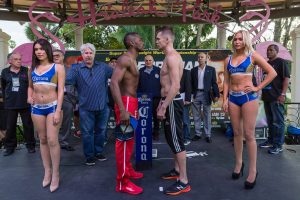
FOLLOW EASTER – CRUZ LIVE!!!

Follow all the action as Robert Easter, Jr defends the IBF Lightweight championship against Luis Cruz.  The action starts at 9 PM with the WBA Bantamweight title fight between Rau’she Warren and Zhanat Zhakiyanov.

NO BROWSER REFRESH NEEDED.  THE PAGE WILL UPDATE AUTOMATICALLY 

12-Rounds-IBF Lightweight title–Robert Easter, Jr (18-0, 14 KO’s) vs Luis Cruz (22-4, 16 KO’s) 
ROUND 1 2 3 4 5 6 7 8 9 10 11 12 TOTAL
 Easter  10  10 10   10  9  10  10 10   10  10 10  10   119
 Cruz  9  9  9  9  10  9  9  9  8 8  8 106

Round 1: Easter lands a right..

Round 2 Easter lands a body shot…Nice hook..

Round 3 Combination from Easter

Round 4 Body shot for Easteghtr

Round 5 Good body shot from Easter…2 lead lefts from Cruz

Round 6 Nice left from Easter…Body shots..Big right…Double left,.

Round 7 Good combination from Easter…Hard body punches..

Round 8 Easter jabbing

Round 9 Easter working and landing on the ropes

Round 10 RIGHT HAND AND DOWN GOES CRUZ….Cruz on the ropes trying throw back…Bog hooks from Easter..

Round 11 Body shot from Easter…BIG RIGHT HAND AND DOWN GOES CRUZ

Round 12 Easter opening up on Cruz…Big right…HUGE RIGHT AND DOWN GOES CRUZ…

119-106, 118-107 and 117-108 FOR ROBERT EASTER JR.

12 Rounds–WBA Bantamweight Title–Rau’she Warren (14-1, 4 KO’s) vs Zhanat Zhakyanov (26-1, 18 KO’s) 
ROUND 1 2 3 4 5 6 7 8 9 10 11 12 TOTAL
 Warren 10  10   9  10 10   9  9  10 113
 Zhakyanov  7  9  10 10  10   9  10  10  10  9  10 113

Round 1 Nice combination from Warren..Big uppercut…Hard combination hurts Zhakiyanov…COMBINATION AND DOWN HE GOES…HARD RIGHT HOOK AND DOWN GOES ZHAKIYANOV AGAIN

Round 2 Uppercut from Warren

Round 3 Uppercut from Zhakiyanov…3 more uppercuts..Big right hand and Warren goes down.  They call it a slip..Big right from Zhakiyanov

Round 4 Left from Zhakiyanov…Blood from nose of Warren..Nice uppercut from Zhakiyanov…Body shot from Warren..Right from Zhakiyanov

Round 5 Zhakiyanov lands a right..lead right

Round 6 Warren boxing and moving

Round 7 Good body work from Warren..Good left..Uppercut

Round 8 Uppercut from Zhakiyanov …Counter left from warren..2 rights from Zhakiyanov…2 more rights

Round 9 Zhakiyanov landing on the ropes

Round 10 Right from Zhakiyanov..Counter from Warren..Zhakiyanov lands an uppercut

Round 11 Nice hook from Warren..Body shot…

Round 12 Right from Zhakiyanov

115-111 Warren…115-111 Zhakiyanov…116-110 Zhakiyanov

10 rounds–Middleweights–Terrell Gausha (19-0, 9 KO’s) vs Luis Hernandez (15-3, 8 KO’s)
ROUND 1 2 3 4 5 6 7 8 9 10 11 12 TOTAL
Gausha  10  10  10 10   10  10 10   10 10       98
Hernandez  9  9 10   9  9  9  9     91

Round 1 Good jab and body shot from Gausha…3 rights

Round 2 Big right from Gausha..Left hook..

Round 3:  BIG RIGHT AND DOWN GOES GAUSHA..1-2 from Gausha..Hernandez laughing

Round 4 Combination from Gausha..Good right hand..

Round 5 Nice uppercut from Gausha..quick 1-2..2 right hands..2 uppercuts..Hernandez trying to fight back

Round 6 Hard right from Gausha..6 punch combination..Big uppercut..

Round 7 2 LOW BLOWS BY HERNANDEZ AND HE IS DEDUCTED A POINT

Round 8 Combination from Gausha..Big right

Round 9 Uppercut from Gausha..

Round 10 Gausha lands a big right and right uppercut

98-90 twice and 97-91 for TERRELL GAUSHA


Power Player: Mikey Garcia’s big KO lights up his career

By Norm Frauenheim-

Power speaks for itself. Find it, and a fighter doesn’t need words. He already has the singular answer for nearly every question. Just ask Mikey Garcia.

With one frightening flash of power a couple of weeks ago, Garcia ignited an interest in him that hadn’t really been there until he left Dejan Zlaticanin on his back, as lifeless as a flat board, under the ring ropes at Las Vegas MGM Grand.

Just like that, Garcia was somebody he had never been. He was scary, scary good.

The cognoscenti had always appreciated him for his tactical skill and evident smarts. Amid boxing’s chaos and carnage, Garcia was an example of an art form seldom seen in a scarred game sometimes called the sweet science. But an if or two were also attached to him.

He was too much the craftsman, a precise artist who could paint by the numbers as effectively as anyone. It was art all right, yet without the edgy anticipation that it could all end with one broad brush. Art is good in a museum, but it doesn’t do well on pay-per-view.

Garcia transformed himself from very good to potential stardom with a signature knockout of Zlaticanin in what had been considered a risky fight on the undercard of Leo Santa Cruz’ rematch victory over Carl Frampton.

Santa Cruz-Frampton was an entertaining bout, good enough to probably make a third one inevitable. A couple of days after, however, it had come and gone. But there is still talk about Garcia, whose knockout of Zlaticanin might be the biggest at the MGM Grand since Manny Pacquiao lifted Ricky Hatton off his feet and dropped him onto the canvas in a lifeless heap for several long moments in May 2009. Power has its own momentum, too.

There are stories and questions all over social media about who and what are next for Garcia, who won his third title in a third weight class in only his second bout since more than two years on the shelf during a contract dispute with Top Rank.

“I could get back very, very soon,’’ said Garcia, who is already back in top the 10 of the various pound-for-pound rankings. “I don’t want to wait.’’

Nobody else wants to wait either. Hopefully, he’ll get a chance this summer to unite the 135-pound title against the winner of Anthony Crolla’s challenge on March 25 of Jorge Linares, The Ring and WBA champion. There are also possibilities against WBO champ Terry Flanagan and Robert Easter Jr., the IBF’s belt holder.

But all of it sounds like a prelude to what could be one game’s next mega fight. Terence Crawford, the current champ at 140, has been speculated.

The other, Vasyl Lomachenko, is even more intriguing. In terms of style, Garcia-Lomachenko always has loomed as a chess match between two the game’s re-eminent masters. Garcia’s newfound power introduces a whole new element.

“I would definitely take on a challenge like that if he comes up to 135,’’ Garcia said after his victory over Zlaticanin. “He’s still at 130. If he decides to move up, we’ll talk. But it’s not up to me. It’s up to him to move up.’’

The good news is that Lomachenko is already thinking about a move to 135, according to his promoter, Bob Arum, who told ringtv.com Tuesday that he expects the two-time Olympic gold medalist to make the jump by the end of this year.

That begs another question. Would Arum, also Crawford’s promoter, be willing to do business with Garcia after the prolonged contract dispute? More good news. Arum told the Las Vegas Review-Journal last week that, yeah, he would.

“If the fight makes sense, then why not?” Arum said. “Whatever happened between Garcia and us is in the past. The one thing I have learned is to never hold grudges. If a fight with Lomachenko or Crawford makes sense, and if there’s a market for that fight, we would be open to it.”

Power is about business, too.


Mastery vs. flow, and a little Mikey Garcia too

By Bart Barry-

For a decade now when you ask a contemporary prizefighter or even just a kid in the gym eight years from turning pro if ever to name his favorite fighter, what he hears you ask is: Who among active fighters do people say made the most money in his last match? Since talk of a-sides and pay-per-view buys has replaced in many cases arguments about chin density or fistic mass the answer your query receives shouldn’t surprise you – even as a slowfooted Mexican kid says Floyd instead of Chocolatito.

Been thinking muchly on competence these last few weeks and as there’s no prizefighting of particular note this month or next month or the month after it’s good an idea as any to treat because it feels increasingly fleeting and comes with increasingly fewer reminders. A fetish has become of “flow” in some circles like psychology and neurology – fields reliably comprising a ratio of two scientists for every 1,000 gurus – and while it’s an interesting idea (“the mental state of operation in which a person performing an activity is fully immersed in a feeling of energized focus, full involvement, and enjoyment in the process of the activity,” according to Wikipedia) its most zealous adherents see in it a shortcut more than a performance enhancer. They do not achieve flow via mastery but flow in lieu of mastery, bumping from one unverifiable accomplishment like fluency in a language no one round them speaks to another like deejaying, without suffering the inconvenience of fundamentals.

Since these trends are pendular a fit argument can be made sometime in the last decade society fetishized certifications and reductionism too far and now the pendulum swings its way back, but there’s more to it than one pendulum. There is a shifting-criteria idea, too, gaining momentum – alternative facts from the American political right and grade inflation from the left – wherein standards are moved to meet subjective ideals instead of objective values. Here comes the concerning part: If you eschew expertise and ignore those who protect the canon, as it were, you do no lasting damage and likely enrich yourself in the process (pop musicians); if you pursue expertise while others weaken the canon little damage is done to anything but your savings account, as you commit personal resources to accomplishments less valuable than before (poets); but if you eschew expertise while others refine the definition of expertise in your favor you achieve influence.

Since this still purports to be a column about boxing we’ll use the example of Floyd “Money” Mayweather. For a goodish amount of time aficionados cared deeply about competitive spectacles and nothing for purses. With the advent of closed-circuit- and pay-per-view-type viewing experiences the number of aficionados willing to pay for a match contributed to a formula for evaluating its appeal, and reporters duly recorded it and later wrote novelty round it – how many dollars/second, for instance, Mike Tyson make in his match with Michael Spinks. It was never the primary criterion, though, till “records” began to fall and fighters other than heavyweights, Oscar De La Hoya being the first to come to mind, began to set those records. But even recently as De La Hoya’s match with Felix Trinidad aficionados cared far more about the match’s deserving winner than who made how much, and for all his accumulated wealth De La Hoya, who had genuine prizefighting expertise, really did fight prime versions of men who could beat him.

But the erosion was underway. Mayweather, who also had genuine prizefighting expertise, changed his nickname to Money and went about selling his undefeated record in place of competitive spectacles, which mattered little at first because those who protect the canon saw it as an amusing aberration and trusted aficionados’ perspective on Floyd would ever weigh his handicapping opponents against what revenues he generated to ensure he did not become more than an amusing aberration. But then circumstances began to converge, and a dearth of prizefighting expertise among prospects decimated the ranks of aficionados – which meant no one was left to guard the canon even while hustlerish things like purse size replaced expertise. This is how you get an Adrien “About Billions” Broner whose blinding handspeed, flow, in fact blinded observers to his abysmal footwork and defense, mastery, and merged with an evolving marketplace view like: the quality of a prizefighter is proportionate to the size of his purse.

A partial antidote to this is Mikey Garcia – partial, not full, because he lost years of his career to a fixation on purse size – who just untied Dejan Zlaticanin a couple Saturdays ago and reasserted his mastery of timing and space while so doing. Garcia is much better at the prizefighting craft than all but a handful of his contemporaries, most of whom are foreign-born and foreign-schooled. Garcia is of a prizefighting family: his handspeed remains a complement to his expertise not its replacement. To see Garcia from ringside, not unlike seeing Andre Ward, is to witness, in a word, competence, and while that may no longer ensure the wealth it brought even a generation ago it still pays quite well or at least better than poetry does.

Bart Barry can be reached via Twitter @bartbarry


Borrego stops Mendez in 1

Jose Miguel Borrego stopped Tomas Mendez in the first round of their scheduled 10-round welterweight bout.

Borrego dropped Mendez with a body shot and the fight was over at 2:25.

Borrego of Aguas Caliantes, MX is now 11-0 with 10 knockouts. Mendez of Santo Domingo, DR is now 23-9.


Heavyweight Tales: Povetkin a mystery wrapped in mess

By Norm Fraienheim-

Anthony Joshua and Wladimir Klitschko arrived in New York this week for a timely news conference that helped deflect attention on the bizarre circumstances that continue to unfold in the wake of Alexander Povetkin’s positive test for a banned substance in December.

The prospect of Joshua-Klitschko on April 29 in front of a projected crowd of 90,000 at London’s Wembley Stadium offers some hope in what looks like the most compelling heavyweight fight in years. The flip side is Povetkin, a mystery wrapped in a mess.

Two days after Joshua and Klitschko met the media at Madison Garden, there were reports from Russia that Povetkin’s B-sample came up positive for the PED that forced a cancellation of his Dec. 17 bout against Bermane Stiverne for the World Boxing Council’s interim belt in Ekaterinburg, Russia.

It’s hard to know what to make of the early reports from Russia. Donald Trump might believe them. Without some confirmation from The Associated Press or some other mainstream outlet, however, it’s wise to be skeptical. The test of the B-sample was conducted in Los Angeles. The original test was reportedly done on Dec. 6, presumably in Russia.

I tend to believe initial stories abut the B- sample, which confirmed that there were traces of Ostarine, a steroid, in Povetkin’s A-sample. Here’s why: Quotes defending Povetkin and questioning the integrity of the testing process from promoter Andrey Ryabinsky and a Russian lawmaker were included in reports about the B-sample.

It was as if they knew what the result would be.

Ryabinksy said Povetkin came up clean in “alternative tests” conducted in Lausanne. Somehow, this sounds like those “alternative facts” that Trump staffer Kellyanne Conway introduced to today’s Orwellian rhetoric.

Then, there was a reported lawmaker and chairman of a sports committee, Mikhail Degtyaryov, who was quoted as saying: “The provocation against Povetkin exposed the fragility and weakness of the anti-doping system.’’

The Russian lawmaker didn’t mention that other system, state-sanctioned doping, which The New York Times exposed in May 2016. Not even Vladimir Putin could completely deny that report. It resulted in a partial ban of the Russian track-and-field team at last summer’s Rio Olympics. Ramifications continue.

On the same day that there were reports from Russia about Povetin’s B-sample, Reuters reported that the International Olympic Committee stripped the Russian women of the 400-meter relay silver medal from the 2012 Olympics after Antonina Krivoshapka’s B-sample came up dirty.
https://sports.yahoo.com/news/ioc-sanctions-three-athletes-anti-doping-breaches-092922488–oly.html

It’s impossible to separate Povetkin, a 2004 Olympic gold medalist, from the rest of Russia’s sports system. I don’t know him. I’ve never met him. I liked his boxing skills and he might have beaten Deontay Wilder in Moscow last May. But that one got cancelled, too, when Povetkin tested positive for meldonium.

Regardless of whether he gets sanctioned or suspended, the best guess is that Povetkin will simply fade from the scene, forgotten amid all the attention on Joshua and Klitschko. The game will move on.

The question is whether Wilder can regain the momentum he had before the cancellation. It cost Wilder a reported $4.5 million and a lot more. In an effort to stay busy, he fought and beat Chris Arreola in July, but he suffered costly injuries to his right hand and biceps.

He’ll test the hand and arm in a Feb. 25 return against former football player Gerald Washington, who replaced Poland’s Andrzej Wawrzyk. Wawrzyk got bumped off the card because – yeah, you guessed it – he came up dirty in drug testing.

It’s fair to wonder whether Wilder would have beaten Povetkin in a Moscow victory big enough to put him first in line for Joshua. Could it have been Wilder at New York’s news conference instead of Klitschko? We’ll never know. Then again, we’ll never know a lot of things in a world growing curiouser and curiouser.


Thinking about Oxnard and Omaha

By Jimmy Tobin-

Saturday night, at the MGM Grand in Las Vegas, lightweight, Mikey Garcia, participated in his first significant fight in three years, facing Montenegrin sparkplug, Dejan Zlaticanin. Having positioned himself to ladle a helping from the Waddell and Reed pot, Garcia returned finally to the only vocation that was ever going to provide him the lifestyle he desired. And, as he had before he left, Garcia looked masterful, dispatching Zlaticanin with a violence and efficiency that reminded witnesses what Garcia is capable of and what frightening consequences prizefighters tempt.

Boxers who forfeit a portion of their primes to out-of-the-ring considerations face a unique peril upon return: their sport does not pass them by so much as it lies in wait. Provided it is against an opponent of some merit, returning to the ring after a prolonged absence brings very real concerns. For Garcia, those concerns regarded not only ring rust—which he may not have shed entirely in an underwhelming tune up last July—but also issues of style. When offensively ablaze, Zlaticanin employs a volume that breaks icy opponents. But while the pressure fighter may be the boxer’s theoretical kryptonite, the abyss in class between Garcia and Zlaticanin, an abyss that figured immediately, made such abstractions moot.

It was, in many ways, a typical Garcia performance. With the opening bell, Zlaticanin entered into a fight not only with an opponent who could—and would—leave him senseless, but with his own frustration. The question for Zlaticanin was whether he could refrain from making mistakes against an opponent who invites them. And if Zlaticanin could not, could he at least survive those mistakes once made.

The third round brought answers. At a loss for how to kickstart his offense, Zlaticanin, chin extended over his front foot, lunged a desperate cross at Garcia, and suffered the uppercut Garcia had been waiting to whip. Spun from the blow, Zlaticanin teetered woozily into a right hook so vicious it not only sealed the win for Garcia but put his victory celebration on hold.

As he has throughout his career, Garcia forced an opponent to make a mistake—and then ruined him for it. Perhaps forced is the wrong word, though, because what Garcia really does is ensnare you in a battle of wills, demanding you choose between losing a dull decision and risking a strategy more likely to see you victimized than victorious.

He is then, anything but the typical Mexican fighter: if there is any of the attritionist’s mentality in him he has yet to show it. Indeed, Garcia is so measured in his approach that he can even bore; his fights are more impressive than exciting. That tempered violence could be a product of Garcia being trained by his brother Robert (a former fighter), and the fraternal concerns such a partnership might entail. Garcia’s wiring is likely another factor, as is the fact that he was born and raised in the US, away from the psychology of Mexico proper.

But were his last name Williams, were he born in Baltimore instead of Oxnard, into a fan base dwindling instead of eternal, one wonders how Garcia would be perceived. What would Garcia’s people say about his win over Orlando Salido, where, his nose broken by a headbutt, Garcia opted to take the win the foul afforded him rather than confirm his machismo? How would they judge Garcia’s refusal to accept a catchweight against the ghost of Juan Manuel Lopez, only to come in overweight himself, gaining an unfair advantage against an opponent who was getting sparked regardless? There are even examples of Mexican fighters with styles similar to Garcia struggling to capture the hearts of their people. Consider the cooler welcome that met a young Juan Manuel Marquez, how appreciation of him lagged behind that of countrymen Erik Morales and Marco Antonio Barrera until Marquez became less perfect, more aggressive, until he had to defend the pride of a country from a rampaging nemesis.

Garcia has suffered little criticism for his conduct, he knows none of Marquez’ early troubles, and yet the hope is that things stop going so smoothly for him. There is little intrigue in yet another supremely talented fighter—and Garcia is most certainly that—merely reaffirming the obvious twice a year. The destruction of Zlaticanin proved that Garcia remains the nightmare proposition he was before his self-imposed hiatus. No one at lightweight is fighter enough to solve Garcia, and he is unlikely to find much trouble among the premier boxing champions at junior welterweight either. And if that is being naive, better to be so in support of Garcia than in support of those men with the opportunity but not the chance to beat him.

So how good is Garcia? And do he and his team care to answer that question? Because the fighter to pose it is out there. You know who he is, as do the Garcia’s. The Garcia’s also know, as anyone who follows the sport does, just how well-insulated the family’s fighting pride is from this threat. (What is less clear, though far more interesting, is whether that awareness figured at all in the departure from Top Rank).

Of course, the obvious fight to make for Garcia is likely to one day number among the casualties of boxing’s fractured landscape. But should he ever get the itch to really prove himself, he will to do so with Oxnard and Omaha in the stands.


ENCORE PRESENTATION OF SANTA CRUZ-FRAMPTON II, GARCIA-ZLATICANIN SHOWTIME CHAMPIONSHIP BOXING® DOUBLEHEADER TO AIR TONIGHT AT 10 P.M. ET/PT ON SHOWTIME EXTREME®


An encore presentation of Saturday’s explosive rematch between Leo Santa Cruz and Carl Frampton, as well as Mikey Garcia’s breakthrough return to boxing’s elite, will air tonight/Monday at 10 p.m. ET/PT on SHOWTIME EXTREME.

Santa Cruz exacted revenge on his rival to win back his WBA Featherweight Crown at MGM Grand in Las Vegas in an early Fight of the Year candidate that has fans, media and the fighters themselves clamoring for a rubber match. VIDEO: http://s.sho.com/2jDj48u

In Saturday’s co-main event, Garcia, who languished in boxing exile for 30 months before returning last July, stamped his return to boxing’s elite with a definitive knockout of defending WBC Lightweight Champ Dejan Zlaticanin. The rousing victory over the universally avoided and previously unbeaten Zlaticanin crowned Garcia a three-division titlist, and perhaps a pound-for-pound great. VIDEO: http://s.sho.com/2kGcUC9

The SHOWTIME CHAMPIONSHIP BOXING telecast is also available via SHOWTIME ON DEMAND® and SHOWTIME ANYTIME®.

The event was promoted by Ringstar Sports in association with Cyclone Promotions and TGB Promotions and was sponsored by Corona La Cerveza Mas Fina.


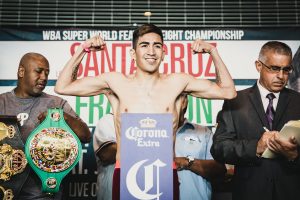
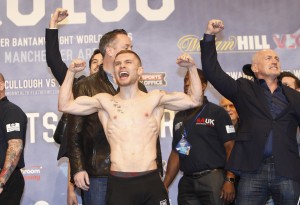
Belfast West: Frampton’s fans jam the weigh-in for Santa Cruz rematch

By Norm Frauenheim

LAS VEGAS – The dateline is accurate. But the feeling was something else. More like Belfast.

Carl Frampton’s fans, Framptonistas, were there, transforming a weigh-in Friday at the MGM Grand Garden Arena for a featherweight rematch Saturday with Leo Santa Cruz into a scene that resembled a Belfast pub at last call.

There are some conflicting numbers about just how many Belfast fans traveled the 4,896 miles to Las Vegas. One estimate put them at 4,000. There’s another one at 5,000. There’s a third at 5,500. Whatever it is, it had to surprise Santa Cruz, a Los Angeles resident who thought – perhaps hoped — he would be the crowd favorite.

Santa Cruz wasn’t in Brooklyn last July when Northern Irish fans jammed Barclays Center for Frampton’s victory by majority decision. If the weigh-in was any indication, Frampton is at home just about anywhere. Where ever he fights, Belfast follows.

There was no difference on the scale. Both featherweights were at 125 pounds. But on any scale that measures noise, Frampton was the deafening favorite. There were flags, chants, beer, beer and more beer. Did we mention beer?

A personal memory: A couple of years ago, I traveled to Belfast. After touring the city’s turbulent history and the wall that symbolizes what it citizens call “The Troubles,’’ I checked into a downtown hotel.

Some time in the early morning, I awakened by the sound of trash cans. After long night at a pub, some kids were kicking them down the street like soccer balls and screaming: “I’m effing Irish, so do something about it.’’

Those kids are here. Will it matter? Frampton (23-0, 14 KOs) is a slight favorite in the Showtime televised bout (telecast begins at 10 p.m. EST/7 p.m. PST). Any edge might tip it one way or the other. For Santa Cruz (32-1-1, 18 KOs), that could have meant a more favorable crowd. Without that, he’ll have to count on his father and trainer, Jose, who has recovered from the cancer that kept out of the corner last summer.

“It’s going to be another great fight, another hard fight,’’ Santa Cruz said moments after he stepped off the scale. “But we’re going to win.’’

The crowd booed.

Selby-Barros bout off the card

Lee Selby’s defense of his IBF featherweight title was cancelled because challenger Jonathan Barros failed to get licensed by the Nevada State Athletic Commission. The cancellation was announced during the weigh-in. No details were provided. According to various reports, Barros failed the physical, which includes eye and blood tests.

“I’m terribly sorry,’’ Selby, a Welshman, said. “I’m almost in tears.’’

Mikey Garcia makes weight for tough test

Mikey Garcia’s lightweight title is at risk against emerging Dejan Zlaticanin. Both were at 134.5 pounds Friday.

“I didn’t want to cherry-pick opponents,’’ Garcia (35-0, 29 KOs) said. “I want to fight the best guys out there and he’s one of them.’’

Zlaticanin (18-0, 11 KOs) of tiny Montenegro is unknown among fans. But he promises that will change.

“After Saturday, you won’t have a problem pronouncing my name.’’ he said.


Family Fight: Frampton and Santa Cruz fighting each other for the only thing that really matters

By Norm Frauenheim-

FRAMPTON-QUIGG IBF/WBA SUPER BANTAMWEIGHT UNIFICATION TITLE FIGHT
WEIGH IN
MANCHESTER ARENA,MANCHESTER
PIC;LAWRENCE LUSTIG
IBF CHAMPION CARL FRAMPTON AND WBA CHAMPION SCOTT QUIGG WEIGH IN

LAS VEGAS – The styles are different. Their neighborhoods are on different sides of the globe. But they fight for the same reason.

Family, Leo Santa Cruz said as he looked at Carl Frampton Thursday during a new conference for their featherweight rematch at the MGM Grand.

“He fights for his family,’’ Santa Cruz said. “I fight for mine. When you do that, you do it from your heart. That’s why this fight will be so good, better even than the first one.’’

It’s a sequel notable in part for what it is absent. There’s no malice in the build-up. Mutual respect can be hard to market. In social media clogged by angry words and noisy insults, it’s hard to get noticed these days. After a while, Conor McGregor and Donald Trump start to sound like the same guy. There’s always another insult. But there’s never a fight. Not a real fight, anyway.

But there will be one, another one, Saturday night between two fighters who seem to like each other almost much as they like to fight. Frampton and Santa Cruz will enter the ring for the Showtime-televised bout tied together by respect for each other and the craft they‘ve learned – Santa Cruz from his dad and Frampton from a Northern Irish heritage exemplified by his manager, Barry McGuigan.

The stakes have never been higher for either. For Frampton, it’s a chance for a Belfast kid to stake a claim on bigger money and international celebrity. For Santa Cruz, it’s a fight he hopes to win for a dad and trainer, Jose, who has beaten cancer. In the end, it’s family business for both.

Stakes means expectations — pressure, and perhaps more of that confronts Santa Cruz than it does Frampton, the favorite after his victory by majority decision in Brooklyn last July. Santa Cruz suffered his first loss without his ailing dad in the corner. There’s always a question about how a fighter reacts to his first loss. For Santa Cruz, his first fight after his only defeat includes his father, who sat next to him wearing a black cowboy hat during Thursday’s news conference. They looked inseparable, son-and-father, a relationship determined to re-prove itself as a winning combination.

Santa Cruz conceded he would have to do some things differently in the rematch. He said his roots as a Mexican fighter often lead him into a brawling style, all designed to please fans.

“This time, I have to use distance and my reach,’’ said the 5-foot7 ½-inch Santa Cruz, who holds a seven-inch advantage in reach over the 5-5 Frampton. “It’s important to go out and be smart.’’

But Frampton doesn’t foresee too much that Santa Cruz can change from the first 12-rounds.

“I think this fight can’t be much different than the last one,’’ said Frampton, a thinking man’ fighters who has stayed unbeaten with fast hands and unerring instinct to make the right adjustment at precisely the right moment in close bouts.

In part, Frampton has the edge in betting odds and perhaps confidence because there’s pressure on Santa Cruz to make the first adjustment.

“Leo Santa Cruz has lost his first fight,’’ Frampton trainer Shane McGuigan said. “I feel like he he’ll have to make the first adjustment.’’

The suggestion is that Frampton will have a counter. He always has. But the guess is that there will be more than just one. Otherwise, there’d be no reason for a rematch between a couple of craftsmen who know that each will need plenty of counters to continue that fight for family.


Life is brutal but beautiful: R.A. the Rugged Man’s performance compulsion

By Bart Barry-

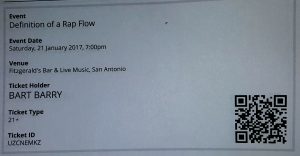
SAN ANTONIO – Saturday at a livemusic venue called Fitzgerald’s sometime round midnight underground hip-hop artist R.A. the Rugged Man (R.A. Thorburn) took the stage before an audience of perhaps 300 people and scaled his performance for 20,000, which came expected to anyone in attendance: there was no chance Thorburn’d give less than everything to a show whatever its size. About two hours later and 30 minutes past lastcall and 15 minutes past closing Thorburn continued to perform, playing his fifth or sixth “one more song” of the night.

Like most anyone reading this column I discovered Thorburn through his roughtrade undressing of Floyd Mayweather in a 2009 interview. Curiosity about a guy who knew Floyd’s mind and spirit well as Floyd got me to listen to a few samples from a musical genre I loved until 1992 then abandoned completely. Thorburn’s talent arrived like a flash of light, unmistakable, and I pledged to see him in the crucible of a live performance if ever the opportunity arose.

It did Saturday and so did this observation: Never has a performer needed the stage more than Thorburn does. What happened at the end of his concert betrayed a compulsion more than a desire to entertain; his numerous appeals – “If y’all make some noise, I’ll do one more song” over and over again – were pleas much more than demands or even statements; it was a glare inside the psyche of a man doing the one thing that holds him together, manifesting a need for his audience’s energy and kindness, affirmation of a potent and unusually physical sort, in a charming-to-the-edge-of-disconcerting way.

It is no secret the sorry financial state of the music industry – and notice you never hear talk of a sculpture industry or a literary industry – but slightly more of an insight to see musicians’ necessary return to performance art, vending concert experiences in lieu of studio experiences, as the exclusive future direction for those who hope to make a living at the craft, but what three hours of undercard performances showed Saturday is contemporary hip-hop artists either don’t know this or lack the tools for it. What one sees in the coming generation of rappers is weakness, simple stagefright, hoping to disguise itself as a personal journey towards higher consciousness. From the hunched shoulders and swallowed syllables to a common retreat from the stagefront edge, complementing sundry cliches about day-one this and haters and enemies that, these aspirants resemble nothing so much as a oneway series of emails from a dating profile:

Message 1: Whatup bae this is Hier Konshuznezz the Unlimitid 1. im one of a kind so im kinda the one. Hit me up if you down. Holla!

Message 2: lol this thing on? im talkin at you gurl

Message 3: HELLO! Holla!

Message 4: u think ur 2 good for me bitch?

Message 5: can we jus start over? im sorry for using that word in my last. im not that kinda guy. i have so much pain in me. i understand if you dont want to talk to me. Sorry. Bye.

Then Thorburn takes the stage and the tenor changes. He and his apprentices are large and imposing in a way that’d be menacing were they not smiling at themselves and the audience, had they not the presence and ironical knack that once composed basic stagecraft but now’s a rarity: Their exaggerated gestures are enormous, they reclaim the stage’s front edge from the audience the way competent trainers teach their charges (King of the Mountain: You imagine the center of the canvas as the base of a mountain against which you set your backfoot, and which you do not forfeit), they make eyecontact with their audiencemembers and project to the backwall, they use their bodies as instruments. Then Thorburn in his desperation to connect pulls strangers onstage with him and bangs against them like props and urges them to be irresponsible, and when this doesn’t suffice Thorburn climbs offstage and moves through his audience colliding with them, telling them to collide with him, offering them something they will not forget instead of something “unforgettable”:

The audience is no longer 100 strong the houselights are on brightly the bar is clean and Thorburn starts to clear the stage by telling audiencemembers to dive in the waiting arms of, well, perhaps two or three others and some splatter and others get caught and still Thorburn does not relent, starting a fourth one-more song or fifth. Then he climbs offstage a final time and tells everyone to follow him to the door for pictures and handshakes, where he remains.

Last week by way of coincidence I read Geoff Dyer’s wonderful “But Beautiful: A book about jazz” that does what all Dyer’s books do which is defy classification between fiction and non- before concluding with an essay about what happened to jazz as popular music: It stopped being about improvisation and began being about technical mastery and thereby receded from our country’s predominant artform to a niche notch on the FM dial and a catalog of deceased household names. This is where underground hip-hop now heads. Its need to distinguish itself from what cloying slop fills arenas is understandable, admirable: Keepers of the Public Enemy flame, as it were, artists proudly inspired by Kane, G Rap, Erick and Parrish, and Rakim, not Kanye West and Nipsey Hussle, but this distinction brings about a display of technical mastery that is nigh unlistenable.

Like Coltrane throttling his sax the velociraptor speedspitting feats exemplified best by A-F-R-O, Thorburn’s 18-year-old prodigy protege, go from astounding to tedious in less than a song – you admire his linguistic capacity to know and use so many words that rhyme while being so unable to decipher what he’s saying you’re unsure if he’s rhyming words or making sounds but trust he’s rhyming words until you ask yourself why you should have to trust this about something that ostensibly happens in your native language.

Oh well. It’s still stagecraft. It’s still part of the Rugged Man experience. If it’s art for art’s sake that’s not a bad way to go out.

*

Editor’s note: Next week this column will take a deserved sabbatical and return on Feb. 6.

*

Bart Barry can be reached via Twitter @bartbarry


Rematch To Rivalry? Frampton-Santa Cruz II might be that fight

By Norm Frauenheim-

FRAMPTON-QUIGG IBF/WBA SUPER BANTAMWEIGHT UNIFICATION TITLE FIGHTWEIGH IN MANCHESTER ARENA,MANCHESTERPIC;LAWRENCE LUSTIGIBF CHAMPION CARL FRAMPTON AND WBA CHAMPION SCOTT QUIGG WEIGH IN

Carl Frampton and Leo Santa Cruz fight on Jan. 28 for a second time, early in a year that might be remembered for compelling sequels that create enduring rivalries.
From personal adversity to heightening stakes, all the elements are there.

Frampton begins 2017 as the game’s most decorated boxer. From The Ring to ESPN, he’s the consensus Fighter of the Year. He’s the emerging star, unbeaten and among the world’s best featherweights after his narrow victory, a majority decision over Santa Cruz on July 30 at Brooklyn’s Barclays Center.

“I would like a rivalry, where in 20, 30 years from now, people remember it,’’ Frampton told Mark Kriegel on Showtime’s digital series, THE REVEAL. “You always need a dance partner, and Leo Santa Cruz could be mine.”

That suggests a trilogy, which probably would mean a Santa Cruz victory in a dramatic rematch at Las Vegas’ MGM Grand, site for a memorable rematch at featherweight won by Marco Antonio Barrera in a unanimous decision over Erik Morales on June 22, 2002 in the second step of their history-making trilogy.

Frampton, of course, has other ideas, all supported by a 23-0 record replete with examples of toughness and smarts. Bottom line:
The Belfast featherweight knows how to win.

His ascent to stardom might come with heightened expectations from his Northern Irish fans, but I get the sense he looks at pressure the same way Charles Barkley did. When the former NBA Most Valuable Player was with the Phoenix Suns, I once asked him about pressure and he told me: Pressure is for tires.

Apply that bit of philosophical punditry to Frampton, and you’ve got a fighter not easily distracted. There’s only the task directly in front of him, and that happens to be somebody he has already seen throughout a hard-fought 12 rounds.

The intriguing question is whether the Santa Cruz he encounters in late January will be different than the one he saw last summer. Santa Cruz has come through a personal trial. His beloved dad and trainer, Jose, was battling cancer before the July fight.

“It was hard, it was hard to train, to concentrate,’’ Santa Cruz told Kriegel. “I still went to the gym and trained, (but) I didn’t train as hard. I didn’t train as the other fights because my dad wasn’t there. My dad was going to chemo, he was going to radiation…I thought to myself, maybe tomorrow he won’t wake up.”

After the narrow defeat – his first in 34 bouts, Santa Cruz apologized.

“I told my dad, sorry,’’ Santa Cruz said during THE REVEAL interview. “I’m sorry we didn’t get the win and that I disappointed you. My dad told me, ‘that’s all right. You didn’t disappoint anybody. We’re going to get him in the rematch.’ ”

During a conference call Thursday, Jose Santa Cruz said he was back and healthy.

“I have been here for this entire camp,’’ Jose said. “It has been great with training and sparring. I believe me not being present for the last camp affected him.”

That potential difference is just one compelling reason for a rematch and maybe a rivalry.


Joshua vs Klitschko preview

By Michael Serra-

On April 29th at Wembley Stadium, Anthony Joshua defends his IBF heavyweight championship against former champion Wladimir Klitchsko.

The general consensus is that Joshua despite winning the title, is largely untested, and still has lots more to learn! Question marks loom over the champion.
In recent performances Joshua has at times looked a tad crude for better use of the word and in winning the title last April, had very little to beat in the champion Charles Martin whom contented himself by taking the count and making no attempt whatsoever to get up and continue.

Last time out Joshua looked a lot more mature, better defensively and looked much better but in all fairness, Eric Molina provided very little and soon folded once Joshua landed, yet again it told us nothing and proved little more than a routine defence for the likeable Hertfordshire man!

Klitchsko hasn’t boxed since losing to Tyson Fury back in November 2015! That night he seemed out of sorts, letting the Mancunian spoil and grab his way through a lackluster twelve rounds.
This is a typical match up of the changing of the guard, the old lion versus the young lion.

This is definitely what the American’s would call ‘a pick em’ while Joshua has youth on his side, Klitchsko has experience.

Joshua’s best chance of victory is going to be by the short route, he has what we call the proverbial punchers chance, and if he can land clean enough he may well be with in a chance of stopping the Ukranian.

Remember back in 2003 when Wladimir defended his WBO title against Corrie Sanders! This is I feel Joshua’s best chance of victory, however if Klitchsko get’s into a rhythm and starts to work that left jab of his, then the Englishman could be in for a long and painful evening.

I’m going to stick my chin out here and go for a stoppage in favour of Joshua, I feel ring rust and father time won’t help and I feel Johshua hits as hard if not harder than Sanders! And that was almost 14 years ago! Joshua for me in six rounds!

For ticket details please visit www.matchroomboxing.com


The Becoming: Jack Draws with Degale

By Jimmy Tobin-

It was easy to look past the character being interviewed; rare are the moments when much of interest ever issues from that mouth; easier still to ignore the antagonist conducting the interview, wholly unfit as he is to speak to men almost invariably his better. Behind this charade stood the fighter, silent, sullen, like a child toeing the ground in earshot of a conversation about him that he is not allowed to participate in. When finally allowed to speak, like so many of his fraternity he offered a cliché, but one that because of its veracity boasted some charm.

“I’ll fight anyone.”

Saturday night, at Barclays Center in Brooklyn, Badou Jack did not fight just anyone. For the fourth fight in a row, Jack fought a man capable of beating him, and not in the empty sense that says anything can happen in a prizefight—those who follow boxing understand how often matchmaking pares the potential for the unexpected down to mere theory, empty promise, tease. His opponent, James DeGale, a former Olympic gold medalist and fellow owner of a super middleweight trinket, fought Jack on mostly even terms leading to mostly even scores of 114-112 for DeGale, and 113-113 twice.

This was the second consecutive draw for Jack, who was unable to turn back a chemically enhanced Lucian Bute last April. But these draws, however bitter, are not the past Jack need bury. No, that past was etched into his ledger in 2014, when a then-undefeated Jack was splayed in the first round by a right hand from Derek Edwards. For many, it was a moment of a delicious schadenfreude: a member of Floyd Mayweather’s Money Team humiliated in a nationally televised showcase. Jack, yet too irrelevant to warrant such animosity, was vilified, his unmaking celebrated, by people who had desired a Mayweather failure for so long they were willing to accept a vicarious one.

If any of that ill will persists, Jack is undeserving of it. He is not his promoter, he is not his advisor, and he is not typical in the derogatory sense anyone who has grown frustrated with boxing understands. “The Ripper” rehabilitated himself by beating fighters who did not simply assuage his pride but actually confirmed his merit. He did not, like too many fighters of privilege earned or otherwise, secure victories primarily through matchmaking, but by steeling himself against greater challenges and answering the call of the moment.

Jack imperiled himself again against DeGale, the fighter of greater pedigree, the southpaw with a handful of tricks and some understanding—though not a mastery—of how to employ them. Degale dropped Jack in the first round with a lead left hand; and that auspicious start carried over through the early rounds while Jack parsed the frivolities of DeGale’s style, the empty threats in his movement, in all the hitting and not hitting and moving. Over the second half of the fight, however, when it became just that, Jack revealed who he has become since a lazy jab against Edwards cost him his daylights. Jack left DeGale looking like a man jumped into a gang. He rocketed DeGale’s mouthguard, and even a tooth, out of his mouth, setting up this facial reconstruction with a committed body attack. In the twelfth, punctuating the swing of control, Jack dropped Degale with an uppercut.

This second half surge (attributable in part to DeGale’s limitations and to the quality of the matchup), was improbable considering Jack’s struggle with the scale. Typically, a weight-drained fighter’s performance resembles a tractor pull: an explosive start is followed by a quick and steady exhaustion before the finish line. That Jack was able to improve as the fight wore on bodes well for his prospects at light heavyweight, where he is headed despite the appeal of a rematch with DeGale.

Could he make 168 pounds again, most everyone would expect him to pursue his satisfaction against DeGale. Certainly, the weight is the defining factor in his leaving a Degale rematch on the table. But there is also a sense that Jack is willing to leave another bitter moment in the past because he knows greater challenges await. No one will hold a draw with DeGale against him, nor should they, since perhaps the most pronounced takeaway from those twelve rounds (and many that preceded them) is that regardless of the outcome Jack guarantees action, and the moments that birth and sustain that reputation very often outshine the results.

Like all volume fighters, Jack will have to be mindful of the power that awaits him at light heavyweight: the element of attrition in his style he will always tempt disaster against opponents who need but one clean look. Nor can you, whatever your promotional or network allegiance, ascend to the top of that division without sharing the ring with a fighter known primarily for relieving men of their senses. But Jack, the fighter who professes a willingness to fight anybody and has the daring to make good on his words, has earned the right to worry about his future. His past—or at least the moment in it that once defined him—should hound him no longer.


Son of the Legend to be Cinnamoned: Alvarez-Chavez is on

By Bart Barry-

Friday brought what announcement boxing craves – a superfight! And here it is: May 6 at T-Mobile Arena in Las Vegas Mexican cinnamonweight champion Saul “Canelo” Alvarez will trade hands with Mexican chavezweight champion Julio “Son of the Legend” Chavez Jr. at the celebrityweight limit of 164 1/2 pounds. What we know of boxing contracts assures us even this loopiest of catchweights remains open to negotiation till opening bell – and without mandatory-minimum sentencing there’s good a chance of Chavez weighing over 200 pounds on May 5 as under 165 – and so as to ensure competitive bidding there are still threats of returning to the stadium where the Dallas Cowboys play, whatever it’s currently called, but if you’re a Mexican national booking his Cinco de Mayo vacation plans anywhere but Nevada, eres un payaso.

The obvious temptation is to go full misplaced aggression on this fight and use it as a convenient metaphor for what plagues our oncebeloved sport as if such metaphors composed a paucity, and of course for those GGG fans who long for a fight that justifies their ardor by legitimizing their guy last week’s announcement brought more ire – which says lots about the chances they honestly give a post-Pirog Daniel “Miracle Man” Jacobs, and the word ‘honestly’ must be emphasized because the promotional center of boxing is about to pretend Jacobs is a daunting foe, maybe even dangerous as David Lemieux – but Cinnamon versus Son of the Legend is an actually intriguing prizefight in spite of itself. It’s not what boxing needs, but who in the hell even knows what that is anymore? Boxing’s woes now need remedies prescribed in years, not fights, so it’s way outside the point to accuse any fight anylonger of not benefiting the sport that, were it not for certain broadcasters’ bespoke budgets, would soon find itself remanded to UFC undercards in the U.S.

This fight will sell hugely among Mexicans largely because it is so exclusively Mexican – it has nothing to do with WBC titles (though one gets giddy imagining what sanctioning ploys Consejo Mundial de Boxeo has planned) or official records or contrived gravity and legacy; it will feature two Mexicans who at least partially resent one another’s acclaim in the sense one man’s acclaim taxes the other’s revenue in the finite if inelastic Mexican boxing marketplace. From an aficionado’s perspective this fight made much more sense when this column prescribed it six years ago but from a promoter’s perspective it’s good a time as any.

Chavez ate himself hastily away from Canelo before HBO succeeded in making Canelo the draw he is now – HBO’s interest in Canelo began with the network’s stint as “an Oscar De La Hoya-search company that populates its undercards with Al Haymon-managed trial balloons” until Haymon bought Showtime and now HBO’s interest in Canelo is some combination of wanting exclusivity with the last guy in the sport who moves the pay-per-view needle and selfinterested altruism: without HBO as a partner Golden Boy Promotions probably wouldn’t see fiscal 2018 and then HBO would be stuck broadcasting solely Top Rank cards and every single product of the former Soviet Union’s amateur program.

Which brings us limping towards Son of the Legend whose career and life were shortened by his 2012 match with middleweight champion Sergio Martinez. Never a picture of discipline before Maravilla calmly, crisply, cooly diddled his cranium hundreds of times Chavez Jr. lost his remaining impetus thereafter and snuck through the next two years and two sizable paychecks beating on Brian Vera before changing his manager and promoter and advisor and getting bitchmade by a limited Pole named Andrzej Fonfara. Rumors of Chavez’s reform persist as ever, but making fights in El Paso and Monterrey as Chavez has done for the last two years has convinced no one Chavez is on the fruitful side of his career, and therefore the time is now for making a fight that proves nothing, but again, so what?

It’s no insight to say Golden Boy Promotions cannot afford to get Canelo beat; Cinnamon is nowhere near frightened of Gennady Golovkin as Oscar De La Hoya is since Canelo is not using his fortune to supplement more than a car collection and some houses while De La Hoya is using Canelo to subsidize a whole lot more. There’s no chance De La Hoya or HBO thinks Chavez can beat Canelo, but Chavez can beat Canelo, and Mexicans know this because whatever fuzziness Chavez’s lifestyle has brought his fighting trim the fact remains Chavez took Martinez to the quivering precipice of a knockout, and that Martinez was better in every way than Canelo.

The Maravilla whose career Chavez effectively razed in 90 seconds was creative and mobile and talented as any fighter Canelo has faced including the Floyd Mayweather who embarrassed him in 2013. And Chavez came a punch from snatching Martinez’s consciousness with nothing but size and will; he measured the physical disparity between a man who walks the earth at 210 pounds and starves to 160 and a man who had to eat his way up from 154 and invested in it by being hit relentlessly for 34 minutes simply for a chance to spend one minute whacking that smaller man with impunity.

Canelo is naturally larger than Martinez but not nearly large as Chavez, and if Canelo plans to stand in the pocket and counterpunch with Chavez he will get hit. No evidence has surfaced Canelo’s whiskers aren’t stiff but 36 minutes with Chavez should moisten them for Golovkin (unless Canelo can sue revenue projections for another year of PPV showcases), and therein lies the delicious irony of this money grab: In seeking one last enormous payday for Canelo before his reckoning with Golovkin the Cinnamon handlers ensure their man’s eventual middleweight-unification match will be a cashout.

Bart Barry can be reached via Twitter @bartbarry


FOLLOW JACK – DEGALE LIVE FROM RINGSIDE

Follow all the action as Badou Jack takes on James DeGale in a super middleweight unification bout.  The action begins at 9:30 PM ET / 6:30 PT with a IBF Junior Lightweight title bout between Jose Pedraza and Gervonta Davis.

NO BROWSER REFRESH NEEDED

12-rounds IBF/WBC Super Middleweight Title–Badou Jack (20-1-2, 12 KO’s) vs James DeGale (23-1, 14 KO’s) 
ROUND 1 2 3 4 5 6 7 8 9 10 11 12 TOTAL
 Jack   10  10  9 10   9  9  10 111
 DeGale  10  9  10  10  10  9  10  9  10  10  10 115

Round 1 Degale trying to push the pace…STRAIGHT LEFT AND DOWN GOES JACK..

Round 2 Right from Jack..Right..Combination from DeGale

Round 3 Right hook from DeGale…Jack jabs to body..Right..Good right…Combination from DeGale..Left and right from Jack..Combination inside from DeGale..

Round 4 Hard uppercut from DeGale..Combination..Combination…Jack sneaks in a right..Right hook from DeGale

Round 5 Pushing left from DeGale..Right from Jack followed by a combination..Left from, DeGale and n uppercut..good right hook..Left from Jack his referee Arthur Mercante

Round 6 Body shot from DeGale..Jack landed hard shots on the ropes..Jab…Hard combination from DeGale

Round 7 Jack buckles DeGale with a right..Right hook from DeGale…Left from DeGale…

Round 8 Hard right rocks DeGale..right…DeGale face bleeding..Body shots from Jack,..left inside..DeGale trying to fight back…Uppercut from DeGale..

Round 9 Right hook from DeGale..uppercut..Right from Jack..Right hook from DeGale..Right from Jack..Hard combination from Jack..

Round 10 Body combination from DeGale..Head combination on ropes from Jack..Trading in middle of ring..Good 4 punch combination from Degale..2 rights from Jack…

Round 11 Hard long right from Jack..Right from DeGale..Body work from Jack..DeGale comes back with a combination….another quick combination..

Round 12 Right hook from DeGale..Body shot from Jack…HARD COUNTER RIGHT AND DOWN GOES DEGALE…Jack all over DeGale…DeGale bleeding bad from his right eye,,Big shots from Jack..Hard right from DeGale at the bell

114-112 DeGale…113-113 on 2 cards,,,,,MAJORITY DRAW

12 -Rounds IBF Junior Lightweight Title Jose Pedraza (22-0, 12 KO’s) vs Gervonta Davis (16-0, 15 KO’s)
ROUND 1 2 3 4 5 6 7 8 9 10 11 12 TOTAL
 Pedraza  9  9  9  10  10  9             56
 Davis  10  10  10  10  9  10              59

Round 1 Davis jabs to the body..Overhand left…Hard combination…Hard right hook…Pedraza taking it well..Right hook..

Round 2 Pedraza trying to jab…Body shot and combination from Davis

Round 3 Quick right hook from Davis..Left over the top..Popping jab…Straight left..Jab from Pedraza…Pedraza bleeding from the nose

Round 4 Body shot from Pedraza..Ripping body shot from Davis..Left over the top..Good body shot from Pedraza

Round 5 Hard combination from Pedraza..Body shots..5 punch combiantion..Davis talking trash..he lands a combination of his own

Round 6 Pedraza lands a left…hard left from Davis…Body shot hurts Pedraza..Thundding left..4 massive head shots from Davis..

Round 7 Doctor checking Pedraza…Right hook from Davis..Back left hurts Pedraza..Vicious uppercut and LEFT AND DOWN GOES PEDRAZA…HE GETS UP AND THE FIGHT IS STOPPED


FOLLOW LARA – FOREMAN LIVE

Follow all the action as Erislandy Lara defends the WBA Super Welterweight title against Yuri Foreman.  The action kicks off at 9 PM ET / 6 PM PT with a super middleweight clash between former world champion Anthony Dirrell battling Norbert Nemespati.

THE PAGE WILL UPDATE AUTOMATICALLY…NO BROWSER REFRESH NEEDED

12 ROUNDS–WBA SUPER WELTERWEIGHT TITLE–ERISLANDY LARA (23-2-2, 13 KO’S) VS YURI FOREMAN (34-2, 10 KO’S)
ROUND 1 2 3 4 5 6 7 8 9 10 11 12 TOTAL
 LARA*  10  10 10   KO                  30
 FOREMAN  9  9                    26

Round 1: Lara lands a straight left

Round 2 Good straight left from Lara

Round 3 Double jab from Lara..LARA SCORES A KNOCKDOWN

ROUND 4 LARA LANDS A HUGE UPPERCUT, DOWN GOES FOREMAN…HE CANT GET UP IS COUNTED OUT

 10-ROUNDS-SUPER MIDDLEWEIGHTS–ANTHONY DIRRELL (29-1-1, 23 KO’S) VS NORBERT NEMESPATI (24-4, 17 KO’s)
ROUND 1 2 3 4 5 6 7 8 9 10 11 12 TOTAL
 Dirrell*  10 10  10 10   10 10  TKO            60
 Nemespati  9  9  9  9  9  9              54

Round 1 Left hook from Dirrell…

Round 2 Dirrell coming forward..Combination from Nemespati..Couple big shots from Dirrell..Dirrell landing on the ropes

Round 3 Dirrell has a bloody nose..Body shot from Dirrell..another one

Round 4 Jab-Hook combination…Big right from Dirrell…Dirrell taking charge

Round 5 Dirrell lands a leaping left

Round 6 Good right from Dirrell…and another….FIGHT STOPPED BY NEMESPATI’S CORNER


First Bell: DeGale-Jack is the opener in boxing’s fight to get off the deck

By Norm Frauenheim-

The James DeGale-Badou Jack fight Saturday night is a good bout and perhaps the first step in an attempt to hit the reset button after a sobering 2016.

It’s no secret that there wasn’t much to celebrate in the bygone year. It’s hard to know if the business has hit bottom and can finally embark on a long recovery.

But at least that old calendar can be tossed and replaced with one that includes inevitable hopes for a renewal.

DeGale-Jack at Brooklyn’s Barclays Center in a Showtime-televised 168-pound fight represents a beginning in a January that includes a terrific rematch of featherweight Carl Frampton’s decision over Leo Santa Cruz on the 28th.

A chance at gaining some momentum is there. The question is whether that’s enough to bring back some of the fans who raced for the exits in something of an exodus during the 20 months after Floyd Mayweather’s disappointing decision over Manny Pacquiao in May 2015.

It’s impossible to overstate the damage done by Mayweather-Pacquiao. Other than time, it’s not clear what can repair it. Just follow the money, always a reliable guide.

Forbes released a list on Tuesday, a projection of boxing’s top moneymakers in 2017. From one to 10, they are:

Canelo Alvarez, Andre Ward, Gennady Golovkin, Sergey Kovalev, Pacquiao, Wladimir Klitschko tied at sixth with Anthony Joshua, Keith Thurman, Deontay Wilder, Terence Crawford and Vasyl Lomachenko.

Alvarez is at the top because he reigns as the game’s biggest draw based in part on a reported pay-per-view audience of 300,000 for his knockout of Liam Smith in September at Cowboys Stadium. There’s also promoter Oscar De La Hoya’s promise that Canelo will finally fight Golovkin next September.

For now, Canelo-GGG is seen as the bout that will put boxing back at one million on the PPV scale. The number means more than money. It represents relevancy.

In the larger sports market, boxing has been sliding toward irrelevancy at a perilous rate. Again, follow the money.

In Forbes’ last ranking of the world’s top 100 athletes for earnings from June 2015 to June 2016, three boxers were included – Mayweather at No. 16 with $44 million, Pacquiao at No. 63 with $24 million and Canelo at No. 92 with $21.5 million.

The retired Mayweather, No. 1 in three of Forbes’ last four lists, is there, mostly for the $32 million he collected for his last fight, a victory over Andre Berto in September 2015.

Pacquiao got $20 million for his rematch victory over Timothy Bradley in April 2016. Canelo cracked the top 100 for his purses against Miguel Cotto in November 2015 and Amir Khan in May 2016.

Here’s the question: Will any boxer be among the next 100 on the 2017 list Forbes is expected to release in June?

Doubtful. A blockbuster would have to happen during the next six months.

Joshua-Klitschko on April 29 at London’s Wembley Stadium? Maybe. The emerging Joshua figures to beat an aging Klitschko, but he might be a year away from entering the Forbes’ rankings.

A possible Canelo-Julio Cesar Chavez Jr. fight in early May? It would be a moneymaker, especially among Mexican and Mexican-American fans. But it is way past due and would fall short of being Forbes’ worthy.

The best chance at restoring the relevancy defined by money appears to be in the June 2018 list, which would account for the promised GGG-Canelo showdown.

But even that hinges on bringing fans back into an increasingly empty tent. From this corner, the public appetite for a good fight is still keen.

But boxing has failed to provide it, hence all of the silly talk about Mayweather versus Conor McGregor, the mixed-martial arts megaphone who was at No. 85 on Forbes’ last list with $22 million.

If Mayweather-McGregor ever really happens, I’ll begin to believe some of those boxing obits. Mayweather-versus-McGregor would be a damning confirmation that boxing can no longer provide fights that the market place wants and will always want.

For now, the key is to show that the business can still deliver. That brings us back to the beginning, back to DeGale-Jack Saturday night in what could be the first fight in a much bigger one.


Haye vs Bellew

By Michael Serra

Month after next, Eddie Hearn’s Matchroom outfit put on what many feel will be one of the most explosive of meetings to take place in a British ring in many a year!

Liverpool’s Tony Bellew whose the proud possessor of the WBC’s cruiserweight crown is moving up to heavy to take on former World cruiser and WBA heavy king David Haye in a battle of punchers.

Londoner Haye first boxed at heavy way back in 2006, though many will argue it was in 2008 when he stopped Monte Barret, his first win at heavy saw him stop West Ham’s Garry Delaney in emphatic fashion!
Bellew at the time was still boxing amateur and did indeed box himself as a heavy winning an ABA title, though as a pro, Bellew has never boxed at heavy, mainly campaigning in the light heavy and cruiser divisions, with mixed success.

Bellew’s first World title chance came at 175 against Welshman and fierce rival Nathan Cleverley, before succumbing to a points defeat, Bellew bounced back and had a crack at the WBC king Adonis Stevenson before getting stopped in a brave effort, with that the scouser moved up to cruiser where after a series of lukewarm performances got Bellew a crack at the vacant title, in which despite finding himself on the deck in the opener, came back to stop and win the WBC title, an impressive stoppage last time out of number 1 challenger BJ Flores in front of a certain ringside guest, no prizes for guessing!

Bellew after the destruction, made no secret of his dislike has he attempted to rush at Haye, whom calmly smiled at the rampaging champion! Screaming obscenities from the ring, Bellew kept calling the handsome Londoner Sponge Bob Square pants, a character from a children’s programme from over here in England.
There and then the fight had been has good as made, at the hastily arranged press conference, things got a little out of hand has the two giving the usual photo shoot with the typical staredown! Haye took a swing at Bellew, however it was more handbags than anything!

An interesting conversation took place has promoter Eddie Hearn and Haye began to trade insults, while Bellew just sat quietly….not for too much longer though!

This is a fight that many will deem as a fight that won’t see the final gong, both possess explosive power, though Bellew is if you like largely untested at heavy, some believe Bellew may have the proverbial punchers chance, while the general consensues and smart money lies with Haye!

Bellew is in a win win situation, if he loses, he will have cashed in on a massive payday, plus he will still be WBC cruiserweight champion, on the other hand Haye if he should lose has no where to go, if he wins then he possibly won’t get the credit and the school of thought will be that he only beat up a beefed up cruiser, yet again, he will get a payday and then the possibility of a World title chance may well loom! For ticket details please visit matchroom.com


Killing pay-per-view: An (unauthorized) oral history

By Bart Barry-

Twenty months after a fight that put boxing pay-per-view in a death spiral, Floyd Mayweather and Manny Pacquiao – along with their handlers and hangerson – did not reflect in their own words on the way their match ruined boxing. But here’s imagining they did.

FLOYD MAYWEATHER: Blood, sweat and tears. Hardwork and dedication. Forty-nine tried, 49 failed. You wanna see the check I got? It’s over here (motioning to a 30-foot x 45-foot hanging print of himself showing the media a check at his postfight press conference).

LEONARD ELLERBE (CEO, Mayweather Promotions): I took that pic and we got it mounted by AllPosters.com.

BOB ARUM (CEO, Top Rank): We knew what Mayweather was. We promoted him for years. An exceptional talent and just a rotten human being. We had to watch his fight with Oscar (De La Hoya) and his fight with Canelo (Alvarez), and they made all this money. And we created Oscar too. And we get nothing? Something had to be done.

MANNY PACQUIAO: I fight for the people. Especially the poor people. Seriously. Manny Pacquiao loves everyone. The fight was not happy. My shoulder hurt.

FREDDIE ROACH (Pacquiao’s trainer): After Marquez nearly killed Manny, I thought there was no way the Floyd fight would happen. I talked to Bob (Arum) and asked him if he was going to fire me. Bob said, “Maybe. Maybe not. We’ll get Manny a few heavy bags. We’ll put him in exotic places, maybe do a Bradley rematch. You just keep saying Floyd’s an easy fight. This could work.”

LA-Z THE SCRIBE (Editor in chief, FloydDaGOAT.com): Yeah, after Marquez obliterated him, I got a call from Money. He’s all, “That piss-drinker just cost me a billion!” I was the first to tweet it.

RICHARD SCHAEFER (former CEO, Golden Boy Promotions): You know, when I hear people saying Mayweather-Pacquiao ruined pay-per-view, it actually makes me kind of mad. I had a big part in ruining boxing, and a big part of that success was pay-per-view. We also got Andre Berto overpaid, over and over. It’s easy to give Ken (Hershman) and Stephen (Espinoza) all the credit today. But I’m proud of the work Ross (Greenburg) and I did to make most of that possible.

KEN HERSHMAN (former President, HBO Sports): I wish I hadn’t left Showtime. We did some really good things over there on a shoestring.

ROSS GREENBERG (former President, HBO Sports): I don’t miss anything about boxing.

STEPHEN ESPINOZA (General Manager, Showtime Sports): I miss working with Richard.

SCHAEFER: Please tell Stephen I’m back in boxing!

FLOYD MAYWEATHER SR. (Mayweather’s trainer): Listen, man, I told you I don’t know. Floyd and I allegedly wasn’t on speaking terms at that moment.

ROGER MAYWEATHER (Floyd’s former trainer): I told them motherf–kers it was a dumb idea. Shopping for a turkey? My nephew told me to do it. Them charges got dropped, OK?

PACQUIAO: They make me give the blood too much. If my shoulder happy, I win. Give me a rematch, Floyd. And half.

MAYWEATHER: VADA, ADA, USADA, DABA, DABA. All’s I know is when my dad says that power-pellet stuff all them years ago, some of you thought Manny could beat me. Then the fight happens, and it ain’t close – you tell me, ya dummies.

BRUCE TRAMPLER (Matchmaker, Top Rank): Was I surprised by the result? What do you think?

JAY Z (Founder, ROC NATION Sports): Floyd can’t read. Fifty can’t flow. Arum’s getting old. Al (Haymon) doesn’t answer calls. I’m a hustler. I told my people to find the biggest draws and sign them. Well, Dre (Andre Ward) got no charisma, and Miguel (Cotto) is ancient. I’m leaking a fortune in the fight game already. I need a word that rhymes with ‘divestiture’.

ARUM: Look, Manny’s a pragmatist. He knows there needs to be a chance of his getting killed at this point to sell his fights anywhere but the Phillipines, or he can take less money. He doesn’t want to get killed, right? The silver lining in all this is it led to our finding a continent where he hasn’t fought yet – Australia! Right now, we’re saying there’s interest on all the networks, but in a few months we’re going to decide to put it on our website again.

ELLERBE: We’re back on pay-per-view. We’re doing a three-rounder soon between two of the largest stars in the hip-hop universe. Our production company did that video of Girl Collection already. It broke the internet. Floyd’s the smartest businessman in the world.

ESPINOZA: I can’t believe we won an Emmy for a commercial either. But that’s Floyd!

AL HAYMON (Mayweather’s adviser): …

SAM WATSON (Haymon’s assistant): Be sure and thank Al Haymon for this interview opportunity.

ARUM: We knew things were going sideways when Floyd had to announce the fight with his cell phone. We covered our bases by leaking the imminent announcement to a number of journalists in case Floyd’s battery died. That kickoff press conference looked like a junior-high dance. And Machiavelli (Al Haymon) didn’t help anything by doing what he did.

ROACH: I’d never seen anything like that fight week in Vegas. I hope Manny gets the rematch (grinning widely); I think we’ll win easily next time.

OSCAR DE LA HOYA (Founder, Golden Boy Promotions): Everything I built in all my pay-per-view fights? They ruined it. We didn’t make a dime. Now K2 (Gennady Golovkin’s promoter) wants us to get Canelo knocked-out for less than I made fighting Felix Sturm. ¡Felix pinche Sturm, imagínate! We’re rebuilding right now, old school. But we need Canelo. Maybe a rematch with Floyd would sell? We’d take a fight with Manny too. Let’s stop talking about GGG.

MIGUEL COTTO (former middleweight world champion): Miguel Cotto fight next month against somebody. Pay-per-view. Miguel Cotto no promote fight because Miguel Cotto has guarantee purse.

MAYWEATHER: I killed boxing (laughing). Told ya!

Bart Barry can be reached via Twitter @bartbarry


Rematch or retirement? Ward keeps all options on the table

By Norm Frauenheim

Andre Ward has talked retirement not just once, but at least twice, since his controversial victory over Sergey Kovalev. It sounds like some early posturing in negotiations that began the moment the news conference commenced in the wake of the 114-113 scores that favored Ward in November.

This time, Ward dropped the possibility in an interview with Rolling Stone. Never take anything off the table. Ward hasn’t. Retirement represents the nuclear option. Push that button and there’s no rematch.

It puts pressure on Kovalev, who was predictably unhappy with the decision and wasted no time in exercising the rematch clause in his side of the contract. That clause gives Kovalev some legal and financial leverage, but only if Ward continues to fight.

If he retires, that rematch clause wouldn’t buy that proverbial cup of coffee, much less a refill.

“I really just got to take my time right now because I really don’t have to fight anymore,” Ward told Rolling Stone.

He went on to say that he wanted to be “sure that every decision that I make and every fight that I take is the right situation because if it’s not, I don’t know if it makes sense to continue on.’’

Translation: Back off Kovalev.

Ward repeatedly suggested that he would continue to fight and even said there he had personal reasons to consider a rematch with the smart and dangerous Kovalev, who must have spent the Holidays wondering why he let Ward off the hook after knocking him down in the second round.

“You have to entertain [a rematch] and I would love to put my stats on in such a way that there isn’t a conversation about who won and who lost,” Ward said.

Then, he added: “Proving something to people is a tricky thing to get involved in. If we did the rematch it would be more just to silence Kovalev and silence his team and to just put a stamp on the rivalry we had.’’

There’s a strong suggestion in those words that Ward would like to silence more than just Kovalev and the Russian’s corner. There are also the fans and media who argued that Ward got an early Christmas gift.

His immense pride compels him to prove his critics wrong. It always has. I was there, at the Athens Games in 2004, when he was the last American man to win Olympic boxing gold on a day when nobody gave him a chance.

The U.S. men’s Olympic program was a mess then and has been ever since. But Ward rose above it all, the last American man to stand stop the medal stand’s summit. He didn’t lose in Athens and he hasn’t lost as an amateur or a pro since 1997.

To this day, Ward and his trainer, Virgil Hunter, talk about losing to Ernie Gonzales and John Revish as if it happened yesterday. He was 13 or 14 years old, yet he remembers the scorecards, the judges and the lessons. Those long-ago defeats are at the heart, the beginning, of what still drives Ward.

He finds a way. There’s an ongoing debate – as reasonable as it is noisy – about whether Ward’s way was good enough for a victory over Kovalev. Only a rematch for the light-heavyweight title and perhaps pound-for supremacy will settle that. The good news is that Ward knows that, mostly because nobody will let him forget about it. A rematch gives him another chance to say he was right the first time around.

Still, the negotiations are problematic for a couple of reasons. Above all, the money just doesn’t appear to be there anymore. Ward-Kovalev was a pay-per-view loser, generating a reported 160,000 buys, or nearly half of modest expectations.

Would promoters even try to go the pay-per-view route again? In boxing’s current business climate, can either Ward or Kovalev get a raise in a rematch? Ward collected a $5 million purse. Kovalev was guaranteed $2 million. How much money would be in the total purse for a rematch? How would it be split?

Ward told Rolling Stone that “it’s not about the money anymore.’’

I’m not sure it ever has been. It’s been about that pride. It motivates him to fight again in an answer to his critics. In part, it’s measured by his percentage of the total purse.

Offend that pride, however, and he’s shown that he’s willing to walk. He fought only once over nearly three years at the peak of his prime in large part because of a legal dispute with late promoter Dan Goossen.

Retirement? Not likely. Not at 32 and not with a chance to extend his unbeaten record, including a shot at an undisputed claim on the top spot in the pound-for-pound debate. Then, of course, there are all of those critics. Ward has another chance to do what he’s been doing all of his life:

Answer them.


The Fight Game in 2017 redux

By Bart Barry-

Apropos of an article about Western languages’ overuse of nouns when compared to Eastern languages’ preference for verbs I dove in the archives last week and happened on my younger, more-optimistic self (while undeciding the matter of nouns and verbs as inconclusive). Bubbling with sincerity and enthusiasm in 2007 I wrote this column about where I imagined we should be sometime between Sunday and Dec. 31.

I still like that guy. I like this guy better, but far as 10-years-past selves go, that Bart Barry wasn’t bad if a bit too eager to please. We’ll get round to what happened to him and all of us, but first a personal-finance riddle:

Q: What’s the quickest way to become a millionaire?

A: Start as a billionaire and invest in strip clubs.

Some Money May levity to kick-off 2017 because he’s still retired and, one hopes, will remain that way for another year – as each year of retirement increases substantially the probability of his remaining retired into perpetuity. He’s still one of the world’s two best fighters, too, which is a counterintuitively good thing: So long as Money May believes people like me believe he can beat anyone between 135 and 155 pounds he will remain retired because he is our beloved sport’s predominant hypothetical predator – the one prizefighter no man in history would wish to confront in imaginary combat. The great ones make it look easy and not only did Money May hypothetically beat prime versions of everyone from Sugar Ray Leonard to Muhammad Ali but he taught a generation of messageboard aficionados how to dominate vicariously Money May’s hypothetical matches:

Im the GOAT cuz Floyds GOAT cuz you dont now bout SRR but i KNOW bout Floyd, lol

All this is a meandering and surprisingly bitter – it should be noted – explanation for my 2007 prediction being so terrible, and looking back those radio bits were fun too because answering questions is very much easier than crafting them. What seemed to derail things catastrophically for our sport was the event that happened a couple months before I wrote that cursed column, and I might have guessed better. The advent of HBO’s “24/7” program as a promotional vehicle for Mayweather-De La Hoya marked a shift for premium cable from selfinterested broadcaster to promoter. It was shortsighted greed – the first and obvious answer any time someone asks “What happened to America?”; the novelty of what appeared to be unscripted happenings in the lives of Oscar and Floyd generated tens of millions of additional dollars in PPV revenue, and whenever windfalls like that happen rest assured the television industry will celebrate them with awards and critical acclaim, and it did.

As a buyer of content television is reliably more interested in outcomes than print media, which is why broadcasters’ friends and familiars get credentialed nearer ringside than writers do – HBO or Showtime may risk $1 million in licensing fees while a newspaper risks a reporter’s plane ticket and per diem. Television probably wasn’t destined for objectivity regardless but buying content ensures a conflict of interest television neverminds as it borrows print media’s sheen of objectivity and predominantly makes infomercials to show between commercials. Premium cable once was different for having subscribers and not having commercials, and while television was still an entertainment medium, not a journalistic one, premium cable felt more serious. Parking its cameras in the Big Boy Mansion for Money May’s many many takes of his many many renditions of his wholly wholly unoriginal speech about blood and sweat and hard work and young lions began premium cable down a cannibalizing eight-year path to Mayweather-Pacquiao and the end of interest in boxing for a generation.

It made sense because it made dollars, etcetera, but the gyms were emptying while sundry revenue records were decimated and smashed and obliterated and and and. If my imaginary 12-year-old American heavyweight did make his way in a gymnasium in 2007 his trainer was elsewhere by 2010 or 2011 because his gym was empty, and if it was too late for my prospect to learn football or basketball it was a good time to find a part-time job. Nobody at school talked about boxing anyway unless Mayweather or Pacquiao was on SportsCenter promoting placeholder shams while they threatened one another until they finally did fight one another, and who that wanted to become a prizefighter in 2007 found his interest rekindled by that spectacle?

Boxing got back on terrestrial airwaves a year later but ratings indicate my prospective American heavyweight was anywhere but in front of a PBC broadcast when that day happened. Broadcasters transformed themselves so successfully to promoters it was no wonder a promoter decided to become a broadcaster, and still the ruse goes on though alongside the squareroot of its previous enthusiasm and promise. Eventually the heavyweight division did give us its surprise champion a little ahead of schedule, of course, but an obese gypsy from England was hardly the “kid’s hidden grace and power” I prescribed.

As we begin the fabled year of 2017, then, there are two tacks to take – honesty or something else. Honesty says: Nothing went right in the second half of my 10-year prediction and boxing engendered more welldeserved pessimism in 2016 than any year of its predecessor decade.

Something else says: I was exactly right, and his name is Deontay “The Bronze Bomber” Wilder!

Stop laughing.

Bart Barry can be reached via Twitter @bartbarry


FOLLOW UFC 207 (NUNES – ROUSEY) LIVE

Follow all the action as Amanda Nunes defends the UFC Bantamweight title against the come-backing Ronda Rousey.  The action kicks off at 8 PM ET / 5 PM PT that will feature another world title bout when Dominick Cruz defends his Bantamweight title against Cody Garbrandt in a grudge match.

NO BROWSER REFRESH NEEDED..PAGE WILL UPDATE AUTOMATICALLY 

5-Rounds–UFC BANTAMWEIGHT TITLE–Amanda Nunes (13-4) vs Ronda Rousey (12-1)
ROUND 1 2 3 4 5 TOTAL
 Nunes  KO
 Rousey

Round 1 Nunes destroying Rousey with punches ALL OVER THE CAGE..ROUSEY IN SERIOUS TROUBLE ASND SHE IS HURT…FIGHT OVER IN 48 SECONDS


5-Rounds–UFC BANTAMWEIGHT TITLE–Dominick Cruz (22-1) VS #5 Cody Garbrandt (10-0)
ROUND 1 2 3 4 5 TOTAL
 Cruz  9  9  9  9  9  45
 Garbrandt  10  10  10  10  10 50

Round 1 Cruz gets in a right..Garbrandt lands 2 more rights..and another..Good leg kick from Cruz..Garbrandt gets in a kick to the body and a leg kick..Good right…right and left from Cruz..Takedown from Garbrandt..

Round 2 Good right from Cruz..Combination from Garbrandt..Right stuns Garbrandt..Counter right from Garbrandt..Kick to the body..left hook..Kick to the body and good combination..kick to body and counter right

Round 3 Garbrandt scores with a right and left..Cruz cut over left eye (Headbutt)  ..Right from Garbrandt..Hard left..Good right from Cruz..Big right from Garbrandt..Inside leg kick from Cruz..Big knee hurts Cruz…Jab from Garbrandt..Left and right uppercut from Cruz..Right from Garbrandt..Kick from Cruz..Granrandt counters..Good left from Cruz

Round 4 Good kick from Cruz…Garbrandt counters..Big right drops at Cruz…he points at Cruz and Cruz gets up..Big left from Cruz..Straight from Garbrandt..Big right drops Cruz again.. and again from a right hand…

Round 5 Kick from Garbrandt…right..Right from Cruz..

48-46 Twice and 48-47 for THE NEW CHAMPION–CODY GARBRANDT

BANTAMWEIGHTS–#1 TJ Dillashaw (14-3) vs #2 John Lineker (29-7)
ROUND 1 2 3 TOTAL
Dillashaw  10  10  10  30
Lineker  9  9  9 27

Round 1 Lineker catches a head kick..Good takedown by Dillashaw…Step in right hand..Inside kick

Round 2 Good takedown from Dillashaw…Dillashaw  has Lineker on the ground..Dillashaw landing hammer strikes on the ground..Continuing to hammer Lineker..Dillashaw lands 9 elbows and punches..Lineker taking a lot of punishment

Round 3 Front kick to the chest by Dillashaw..Takedown..Landing punches from behind..Dillashaw has Lineker in a calf crank..Body shot from Lineker..Overhand left..body

30-26 on all cards for Dillashaw

WELTERWEIGHTS–#9 Dong Hyun Kim (21-3-1-1) vs #12 Tarec Saffiedine (16-5)
ROUND 1 2 3 TOTAL
 Kim  9  9  9 27
Saffiedine  10  10  10  30

Round 1: Early exchange..Saffiedine has Kim’s back standing.Knee to the head by Saffiedine..Good right..Good right..Kick to the head..Knee…trip..

Round 2 Saffiedine lands a knee..Body kick..Good right from Kim..Nice kick and knee from Saffiedine..

Round 3  Big uppercut from Kim, kick from Saffiedine..Elbow..Good body kick..and a knee..knee.

30-27 SAFFIEDINE…29-28 KIM. TWICE…SPLIT DECISION

FLYWEIGHTS–#12 Louis Smolka (11-2) vs #13 Ray Borg (9-2)
ROUND 1 2 3 TOTAL
Smolka  9  9  9 27
 Borg  10  10 10   30

Round 1: Smolka jabbing..Borg gets a takedown..Borg dropping elbows…Smolka bleeding from his right eye..Takedown from Borg..Full mount…Borg has the left arm..2 hard shots with Smolka on the ground

Round 2 Borg lands a strong leg kick and a right hand..Takedown from Borg..Borg lands a big punch while Smolka on the ground…

Round 3 Borg gets the back of Smolka..Borg has a front choke on Smolka..Spinning elbow

30-27 and 30-26 twice for Ray Borg

WELTERWEIGHTS–#8 Johny Hendricks (17-5) vs #8 Neil Magny
ROUND 1 2 3 TOTAL
Hendricks  9  10  10  29
Magny  10  9  9 28

Round 1:Left from Hendricks..Hendricks has Magny on his back,,Magny has Hendricks in a sitting triangle..Magny striking in the triangle

Round 2 Hendricks takes down Magny.

Round 3 Hendricks gets another takedown…Knee by Magny..Hendicks lifts Magny up and gets a takedown..Magny has a triangle from his back

29-28 on all cards for Magny

MIDDLEWEIGHThS–Antonio Carlos Junior (7-2-1) vs Marvin Vettori (11-2)
ROUND 1 2 3 TOTAL
Junior  10  9  10 29
Vettori  9  10  9  28

Round 1: Venttori gets poked in the eye…Nenttori pokes Junior in the eye..Junior lands a kick..take down

Round 2 Venttori has Junior down and in a Guillotine..Ground and pound

Round 3 Junior gets a takedown..Kick to the head…Takedown..left hand and a knee

29-28 on all 3 cards for Junior

WELTERWEIGHTS–Mike Pyle (27-12-1) vs Alex Garcia (13-3)
ROUND 1 2 3 TOTAL
Pyle
Garcia  KO 

Round 1: Good kick from Garcia..Exchanging jabs...HUGE OVER HAND RIGHT KNOCKS PYLE OUT

WELTERWEIGHTS–Brandon Thatch (11-4) vs Niko Price (8-0) 
ROUND 1 2 3 TOTAL
Thatch
Price*  CHOKE

Round 1 Good inside leg kick for Thatch..Thatch has Price in a choke..Price ecscapes..Price has a arm triangle..Price has Thatch in a rear naked choke…THATCH TAPS FROM AN ARM TRIANGLE


Mourning a tough year and hoping for a better one

By Norm Frauenheim-

One year ends and another begins in a couple of days amid regrets and grief from the last 12 months and a wellspring of hope for something better in 2017.

It’s been a year to mourn, remembered mostly for who and what boxing lost. Legends are gone. Goodbye, Muhammad Ali, Aaron Pryor and Howard Bingham.

Their deaths are powerful symbols of an era that has passed. The business long sustained itself on Ali, Bingham’s poignant photographs of him and great fighters who followed in a generation personified in part by Pryor.

Where does it go from here? Who knows? At 85, former Ali promoter Bob Arum is optimistic. Throughout the last year, Arum’s consistent theme was the sports’ international look and reach.

The business has always been international, of course. History’s great moments have played out all over the globe. There was Africa for Ali’s epic victory over George Foreman in the Rumble in the Jungle. There was Manila for Ali’s rematch in a triumph of courage, will and skill over the late Joe Frazier.

But the fighters were American. That’s what has changed. Today, they are from Kazakhstan, Russia and Ukraine. Gennady Golovkin, Sergey Kovalev and Vasyl Lomachenko are as skilled as anyone in today’s generation.

But can they draw? Does anybody in the American audience care? Ratings and pay-per-view numbers from 2016 say no.

Home Box Office’s PPV number, a reported 160,000, for Andre Ward’s controversial scorecard victory over Kovalev in November was a disappointment, even in the face of modest expectations.

The light-heavyweight fight was thought to be the biggest in a year made barren by further, frustrating delays in a Canelo Alvarez-Golovkin showdown.

Ward was the American end of the marketing equation. He was the last American to win an Olympic gold medal. He’s unbeaten and he was moving up in weight after dominating the super-middleweight division. Yet, not even his resume moved the meter.

Perhaps, it will in 2017 in a rematch mandated by a contract clause already exercised by Kovalev. Perhaps, it’ll be the second step in a trilogy. Fundamentals for a rivalry are in place. Yet, questions about whether either Ward or Kovalev can ever draw an audience linger.

Maybe, the problem rests in the pay-per-view business model, which collapsed after Floyd Mayweather Jr. and Manny Pacquiao squeezed every last dollar out of it in their dud of a bout in May 2015.

Boxing isn’t dying, but pay-per-view might be. Junior-welterweight Terence Crawford, emerging welterweight Errol Spence and the return of lightweight Mikey Garcia are just three reasons to think there’s still some life in the American end of the business.

Meanwhile, most of next year’s business figures to get done in the UK.

From Belfast featherweight Carl Frampton and his Jan. 28 rematch of a victory over Leo Santa Cruz in Las Vegas to heavyweight future Anthony Joshua and his April 29 Wembley Stadium showdown with Wladimir Klitschko, the UK has the stars and an audience that wants to see them.
UK fans also travel.

They were there in Vegas, for Ricky Hatton, first against Mayweather and then Pacquiao. For Frampton-Santa Cruz II, they’ll be back, but this time with an unquenchable thirst for Guinness. Imagine the UK crowd that would follow Joshua to Vegas.

Arum is right. Potential for a huge rebound is there.

But a few things have to happen. First and foremost, there’s Golovkin-Canelo, which Canelo promoter Oscar De La Hoya promises will happen in September. Then, there’s Ward-Kovalev II, perhaps sometime in late spring or early summer. Above all, there has to be a way that GGG, Kovalev and Lomachenko can be transformed into names that fans know and personalities with whom they can identify.

Without all three, it’ll be hard to have a Happy New Year.


2016: A Year Spent Fighting Over Nothing

By Jimmy Tobin

Were Malcolm Gladwell’s 10,000-hour theory more true than useful, this year would have seen many of boxing’s devotees fall just a few days short of becoming world class negotiators. Falling short of being world class is something not uncommon in boxing these days, despite publicists, promoters, trainers, and networks doing their absolute best to convince you that being one of the best anything in 2016 is qualification for being one of the best ever, and so there is a nice, deserving symmetry there.

While this second, propagandistic component makes sense—people who profit from boxing are compelled, rather easily, to telling fractional truths and whole lies about it—the first is harder to understand. Why the preoccupation with boxing negotiations? The simple answer is that in recent years there have been fewer and fewer barriers to information and more platforms for bantering about it. Why wouldn’t someone presented with a free and accessible opportunity to pursue an interest avail himself of it?

Except that is not what happened over the past year, where the motives for immersing oneself in the ins-and-outs of inking fights had very little to do with learning. No, the motivation this year—assuming, perhaps generously, that what transpired was not born primarily of so many having so little else to do—was rooted in prosecution and defense.

Nowhere was this clearer than in the (inevitably) failed negotiations for a Gennady-Golovkin-Saul Alvarez fight (Oh, and is that order of names, okay? Because even such minutiae matter when held aloft by the swaying arms of acolytes). Whatever the reasons, Golovkin and Alvarez—who each fought twice in 2016, finding among their four hapless opponents two welterweights to ragdoll—could not make the fight Golovkin wanted more than any other, the fight Alvarez professed no fear of.

Apologists for Alvarez had their reasons at the ready, all complimentary of the Mexican fighter who professed to “not fuck around” before ditching the title Golovkin was the mandatory for and spending his year fucking around with the chin of a twice-flattened welterweight and the flanks of someone called “Beefy”. And yet to focus on Alvarez’ conduct, his supporters will tell you, is to take your eyes off the real culprit, off Golovkin, who, according to sources as credible as they need to be for the purpose of supporting a doctrine presented as an argument, declined the opportunity he professed to so deeply covet.

What truth there is to any of these accounts is, as with too many things in boxing, mostly a matter of opinion. Like Gladwell’s theory, much of this grist derives its value not from its veracity but from its usefulness in pushing forth an idea, perhaps that Team Alvarez is staying his execution, or that Team Golovkin’s difficulty securing fights is their own doing.

That the fight, the event actually worth talking about does not happen gets lost somehow in the discussion about who is more to blame for it not happening, with the answer to that question of guilt reflecting little more than allegiances pledged long ago. Some consolation that is.

It would be bad enough if people could find the negotiations of a fight more interesting than the fight itself. Except it’s not about interest at all, not in the eyes of those devoted to fighters, even to promoters. Instead, they interpret in boxing’s failure to make fights something other than failure, finding instead hypothetical victories for fighters whose meaningful victories are delivered only by their fists and promotional outfits who should be judged by their ability to deliver intriguing fights.

Strangely, the response to failed negotiations is not a collective shoulder turn on all parties involved. Granted this response is extreme, but at least it is sensical: why support entertainers who disregard your requests for entertainment? Isn’t responding in disgust better than making excuses and attributing blame and doing so with a fervor typically found in support of the action? That these excuses come adorned in whatever information and misinformation those in the know actually care to reveal hardly makes them any better. Given the traction this blaming and absolving gains, making the fights people actually want to see seems almost counter-intuitive: if people find satisfaction in arguing about why fights are not made, if they are going to direct their hostilities at differing opinion rather than at the people perpetually kicking the chair away, why make fights?

The trendy retort here is to say that boxing is a business and that understanding its complexities both allows and demands a more nuanced response to disappointment than turning away. And there is some truth to that, as boxing requires among other things a tolerance for rigmarole and an appreciation for peculiarities that fly in the face of competition (like the fact that, however odd it may sound, rarely is matching two men at the height of their powers a priority). That is hardly a justification, however: boxing can be both a business and entertaining and to simply lower the first characteristic like a gavel on the discussion is to justify the status quo.

It should come as little surprise that if those drawn to boxing for reasons beyond a violent spectacle were to determine the sport’s fate it would look very much like it did in 2016.


2016: Bidding an unpersuasive adieu

By Bart Barry

SAN ANTONIO – There’s a perfect park not far from the downtown area here, in fact it may well be considered the downtown area, and it’s called Walker Ranch Historic Landmark because something historic happened or was anyway commemorated here but it’s not entirely important this history – as we learn via immersion daily and will soon learn at an accelerating rate history is barely more factual than fiction and converges upon it for its first, say, 100 years and then the two become interchangeable in a euphemism like “legend” – not important, certainly, as the convergence in this park of a colorful new playground and airplanes passing overhead almost continually. There’s an urgency to the sound as these planes pass, and both adults and their children invariably toss their eyes upwards with each arrival, the children with wonder and the adults with longing and both with awe at the crafts’ immensity. No persuasion required.

What this has to do with boxing in 2016 as this year concludes is nothing in particular but perhaps something in general: The casualty of persuasiveness. It may never have existed and it may well be I just noticed it this year, eyes drawn to aircrafts floating noisily over a park, but the old rhetorical methods we learned in school’ve gone wanting officially. Perhaps none of us was ever persuasive and perhaps none of us was ever persuaded, perhaps most of us simply believed what our parents believed or its exact opposite, rarely anything in between, then went egghunting for corroborating events we converted from coincidences to facts through repetition and some loose consensus loosely perceived, but it became more obvious this year as publications and broadcasts played their congregations’ greatest hits for their congregations and those few who did try to persuade were so bad at it.

Fact-checkers became quite nearly annoying to me in 2016 as the liars they refuted, as the liars were sometimes creative while their opponents were as often torpid bullies – doing the same work of God or Truth or Morality as every other halfwrought loon (though none, thankfully, in this park on a Christmas afternoon). Or perhaps an awakening introspection brought more of us to saying “I don’t believe that” – a wonderful mechanism for disarming both liars and fact-checkers alike by making the liar reveal his sources and the fact-checker declare you an idiot and go away – in lieu of saying “That’s not true,” a bullfighter’s red cape of a phrase that makes both liars and fact-checkers charge.

There is a diminishing feedback mechanism to great fights and great fighters that requires a witness to share his experience sincerely with others who may not have witnessed them, and that feedback is akin to a mirrored sincerity wherein an audience measures the witness’s honesty and returns it as an interest the witness is free to mistake for conversion, while a performer’s dishonesty reveals itself in a moment and if others humor him because they are polite or drunk they are no nearer convinced and only the performer is fooled. This is broadcasters’ metronomic use of words like “great” and “unbelievable” to tell halfinterested and quartersober viewers they live in historic times. Conversely your great aunt probably doesn’t care how suspensefully the Martinez-Chavez fight ended but she finds your enthusiasm sincere and therefore attractive enough to share with her Wednesday bookclub whatever details she remembers from her nephew’s account of a trip to Las Vegas sometime in 2012.

Not this year, or at least not nearly so much this year. Boxing is further outside the public consciousness as 2016 concludes than it was as 2015 concluded than it was as 2014 concluded than it was as 2013 . . . and boxing budgets now reflect it mercilessly, with HBO effectively putting promoters on ESPN’s old pay-to-play model (under the auspices of pay-per-view), Showtime husbanding its resources, and Premier Boxing Champions – well, does PBC even still exist? An essential fight happened in the final quarter of 2016, the sort of who’s-number-one fare for which aficionados claimed to clamor from 2009-2015, when Andre Ward controversially decisioned Sergey Kovalev, and nearly no one cared and still fewer care today no matter how much we reiterate there was controversy.

What was the best fight of 2016? None springs to mind. Who was the best fighter in 2016? No one springs to mind. That’s a large part of the point: Wherever my interest in our oncebeloved sport has gone I still have to find a weekly subject to fashion 900 words about, and yet when I look back at 2016 and ask myself to which fights I cared enough to travel, for the first time in 11 years my answer is none, and when I ask myself what fights I regret I didn’t travel to my answer is still none.

Oh, but you see, so-n-so versus so-n-so was epic. I don’t believe that. But if you study his record you’ll see so-n-so is actually becoming a great fighter. I don’t believe that. We’re lucky to have Abel Sanchez. I really don’t believe that.

A resolution for 2017: Don’t talk yourself into doing the job of promotion or legacy for others – if the greatness of a fight or fighter doesn’t hit you with the bolt of a jet passing overhead, simply say “I don’t believe that” and proceed merrily along.

Bart Barry can be reached via Twitter @bartbarry


No Lie: No polygraph needed to ban boxing in Russia

By Norm Frauenheim–

Alexander Povetkin and everybody in his camp were scheduled to undergo a polygraph this week, according to promoter Andrei Ryabinksy, who in media reports from Russia insists he is determined to get the truth and nothing but the truth about the positive drug test that scuttled the WBC title fight with Bermane Stiverne in Ekaterinburg last Saturday.

No kidding.

I’m not sure who will be conducting the test. But to whoever is at the controls: A question or 15, please, about why Povetkin was allowed to fight Frenchman Johann Duhaupas, who was there as if the promotion knew that Povetkin would test positive and Stiverne would just say nyet.

The whole sequence of events is beyond believable. If not so dangerous, it would be laughable. Somewhere in media reports from Russia, it was reported that “regulators” allowed Povetkin to fight despite the Russian heavyweight’s positive test for Ostarine, a banned supplement reported to be a steroid.

There’s nothing – nada – on who the regulators might have been. Vladimir Putin’s relatives? Russian hackers freelancing after exposing Hillary Clinton’s E-mails? AA couple of hamsters? All week long, I’ve been waiting for the polygraph results. Maybe we’ll have to wait on something from Wiki-Leaks.

Ryabinsky was quoted as saying that Ostarine can come from tainted meat. Yeah, maybe, although the recent positive test were related to tainted meat were for clenbuterol from cattle injected with the substance in Mexico.

Whatever the substance and its source, Povetkin should not have been allowed to fight, period. It was his second positive test for a banned performance-enhancer. He tested positive for meldonium, scuttling a fight with Doentay Wilder last May in Moscow. His ban was dropped because of a technicality and perhaps because of some influence from the case involving tennis star Maria Sharapova, whose two-year ban for the same drug was reduced to 15 months.

The substance and why he tested positive demands an investigation, which the World Boxing Council has promised. But the bigger issue is just why Povetkin went on to fight a stand-in. From here, there is no good answer. We don’t need a polygraph. We need a ban on title fights in Russia.


Decades Under the Influence: Joe Smith Jr. Retires Bernard Hopkins

By Jimmy Tobin-

Saturday night, at The Forum in Inglewood, California, Bernard Hopkins tempted boxing’s unwritten rules for the last time. Inviolable as they are, those rules made an example of him. Hopkins’ farewell fight ended with the 51-year-old where he planned to be: beyond the ropes, surrounded by his supporters, the object of every fixed gaze in the arena. Except he reached that position courtesy of union construction worker, Joe Smith Jr., who hammered Hopkins through the ropes and onto the floor below, handing “The Executioner” his first stoppage loss in his very last fight.

Retrospectives aplenty are promised in the coming weeks, and Hopkins’ career is rich enough that sifting through his past for celebratory moments presents a unique challenge. Every fighter has such moments—Smith himself, despite being a relative unknown last year, now has two—but unlike so many of his contemporaries, with Hopkins it is selecting from abundance, not scarcity, that provides the challenge.

Reference to his protracted dismantling of Felix Trinidad—a flawless performance with few rivals since—will figure prominently, as will his humbling of self-proclaimed “Legend Killer” Antonio Tarver, so completely embarrassed by Hopkins that night he was reduced to asking trainer Buddy McGirt for ways to simply survive. Perhaps Hopkins’ one-armed destruction of Antwun Echols will also be romanticized and retold. More recently there is this: in 2014, Hopkins, at age 49, lost a unanimous decision to Sergey Kovalev in the fight that ratified the Russian. It speaks poorly of the division that a win over a man near fifty could serve such a purpose, though it is testament to Hopkins’ mystique that in his career’s third decade he remained a standard for more than longevity.

Even the version of him that fought Kovalev did not step through the ropes in Inglewood, however. And if Hopkins should choose to fight on he will do so knowing that the ring no longer welcomes him. Smith put Hopkins on borrowed time with a short right hand early, and what followed was all-too-inevitable. Hopkins lost the fight, his aura of indestructibility, and some of his dignity to a fighter who would not have ferreted a round from him in his prime.

The headbutt that opened a cut over Smith’s left eye seemed barely to register with the Long Island fighter, nor did the lead right hands that Hopkins bounced off his head once or twice a round. Kovalev suffered perplexing moments against Hopkins, Jean Pascal seemed to mentally unravel when Hopkins employed his intimidation tactics. Smith, however, perhaps because he knew there was but one path to victory for him, knew that, having interpreted the effect of his blows, that path was the only one he would need, betrayed not a tremor in his resolve. He simply followed the aged fighter around the ring, kept Hopkins at the end of his punches, and swung with the express purpose of bagging a trophy kill.

That says something about Smith, about how he will comport himself—if not fare—against the better opponents he has now earned the right to face. But it also speaks to how little Hopkins, his body softer, beard grayer, had left. Smith crossed his feet in pursuit, yet Hopkins had not the legs to escape him; Smith telegraphed his punches, yet all Hopkins could do was steel himself against their effect. Take nothing away from Smith, who did what a professional fighter should to an opponent who had little business sharing the ring with him. If Hopkins does not belong in the ring with Smith, however, he certainly does not belong in a ring in a prime television slot on a premium network. That has been the truth for years, given Hopkins’ spoiling tactics, his preservatory style, and there is no longer sufficient argument to suggest otherwise.

The image of Hopkins careening through the ropes, sent there by the fists of a man with “The Future” emblazoned on the front of his trunks is lasting. So too was Hopkins’ response. A survivor par excellence, Hopkins’ interpretation of his final departure from the ring is both untenable and predictable. Asked about the action that precipitated his trip through the ropes, Hopkins suggested Smith shoved him out of the ring, so frustrated was he by Hopkins’ right hand, elusiveness, and body work. No manipulation of the facts can support such an interpretation: Smith knocked Hopkins senseless with a right and did not stop punching until Hopkins had fallen out of reach. When Hopkins came to he was in no shape to continue, and he knew it; knew too that the insult visited upon him exceeded his injuries. So he fabricated a story absurd even by the standards of a man concussed. To witness how deeply wounded Hopkins was by the outcome of the fight is to understand that he will cling forever to this revisionist history—and do so knowing full well the truth.

The truth is Bernard Hopkins took a professional prizefight in his fifties, miscalculated, and was treated as any fighter in his fifties should be, less boxing become so talentless that even a man half a century old can mock its ranks with his presence. It was a humiliating defeat, one that will haunt Hopkins not only for its result but for what that result confirms: the even he must bend to the rules.


Not-missing Bernard Hopkins already

By Bart Barry-

Saturday at a 1/3-full Forum in Inglewood, Calif., handpicked American light heavyweight opponent Joe Smith retired Bernard Hopkins just before Hopkins’ 52nd birthday, on HBO, by rendering Hopkins unfit to continue their match in the eighth round. Smith beat on Hopkins throughout the fight, regardless of what narrative twists HBO replays tried to impart, and even taunted “The Executioner” by switching to southpaw when he wasn’t otherwise winging righthands fearlessly – exactly the way a man should do against someone twice his age. Hopkins invented an alternate ending to his KO-by, of course, and HBO let him, of course, but the good news nevertheless was twofold: Smith won the right way, and Hopkins is now retired.

That Smith knocked Hopkins clean out the ring with a left hook brought from aficionados more gasps of relief than horror, knowing as we all did how many times Hopkins had used threats of retirement and elastic conceptions of ending his career his way – and who’s going to deny a legend that! – to promote fights no fan asked for, or at least didn’t ask for in any way measurable by boxoffice receipts. From his flattened spot on the concrete outside the ring Hopkins rose, in a show of indomitable will and tactical cunning and immortal somethingorother, and began to harangue nearby officials about an illegal push that injured his ankle and was nothing like either the left hook that put him through the ropes or the left hook that put him geometrically nearer to spectators than he was to Joe Smith, suing posterity (and any other eligible parties) for a palatable outcome.

“Bernard is a difficult person to deal with,” said the late-Bouie Fisher in 2005, after Hopkins fired him. “He wants all the glory, he wants all the credit, he wants all the money. It’s all about him, him, him.”

What few dared mention during his career and no one will mention now that it finally ended is how much more Hopkins frightened the boxing media than actual boxers, how much more writers and broadcasters discussed Hopkins’ predation than other fighters did. Hopkins was by no means a media creation, for he was a self-creation first and foremost, but he was a media confirmation, filibustering as he did every interview with very little lucidity but a whole lot of autobiography and portentously delivered cliches before closing his monologues with an allusion to Graterford Penitentiary, his nearly inevitable exclamation point. He intimidated the hell out of journalists. Exploiting in his subjects some combination of privilege-induced guilt and physical inferiority Hopkins discomfited his media opponents early in interviews then talked in circles about himself until he was certain “legend” or “one of a kind” or “unbelievable” would make its way in whatever his subject soon wrote or said about him.

But few actually liked being round the guy. Plenty of writers admired him and felt honored by his meandering answers to their stock questions – as if a quarterhour soliloquy from Hopkins somehow burnished with genius an inquiry like “Talk to me about training, Champ” – but none came away from an experience with Hopkins enduringly proud of the way he comported himself while in Hopkins’ presence. That was all part of the Hopkins schtick, er mystique, exploiting others’ fears – a task at which Hopkins never failed, except in his matches with Jermain Taylor, Joe Calzaghe, Chad Dawson and Joe Smith.

“(Hopkins) thinks he can intimidate me because he’s been to prison for robbery,” said Calzaghe before beating Hopkins in 2008. “So you burgled somebody, you brave boy. That makes you a thug, not a fighter. It makes you an idiot.”

Before anyone says there are too many incredibly good moments in Hopkins’ career to approach a summary of the great man in fewer than three volumes he might admit there were a historic number of insipid moments in that storied career as well. For every Felix Trinidad there was a Morrade Hakkar, for every Antonio Tarver there was a Carl Daniels, for every Kelly Pavlik there was an Enrique Ornelas; when Hopkins wasn’t neutralizing a much larger or younger opponent he was nigh unwatchable.

Honesty is ever more believable than even masterful insincerity, and so: I esteemed Hopkins highly as any fighter in the world the night he beat Tito till Papa Trinidad personally intervened and I was pleasantly surprised by his activity and effect against Tarver in the first “final” match of Hopkins’ career (lest we forget the retirement angle was used to hoodwink HBO into broadcasting Hopkins-Tarver in lieu of Cotto-Malignaggi, 10 1/2 years ago) and I was impressed if dismayed by how easily Hopkins unmanned Pavlik in 2008, but all that was done happening eight years ago and since then I’ve mostly felt exploited by the entire Hopkins hustle: danger / legend / Graterford / danger / legend / legend / danger / Graterford / Graterford / legend.

If there be a genius for confrontation Hopkins has it, the sort of exquisite intuition only to be found in one who hones his expertise by treating every single interaction in every day of his life as a confrontation, through four decades, but it’s not a pleasant place to visit even vicariously and I sure as hell wouldn’t want to live there or have B-Hop as a neighbor. No, I will not miss Bernard Hopkins, but I’m glad in Joe Smith he’s given us a compelling opponent for Sergey Kovalev while Andre Ward avoids that rematch.

Bart Barry can be reached via Twitter @bartbarry


FOLLOW HOPKINS – SMITH, JR. LIVE

Follow all the action as the legendary Bernard Hopkins wraps up his Hall of Fame career when he takes on Joe Smith, Jr. in a light heavyweight bout from the Forum in Inglewood, California.  The action kicks off at 10PM ET / 7 PM PT with a cruiserweight title fight between Oleksandr Usyk and Thabiso Mchunu.  That will be followed by a featherweight contest between Joseph Diaz, Jr. and Horacio Garcia

NO BROWSER REFRESH NEEDED

12 Rounds–Light Heavyweights–Bernard Hopkins (55-7-2, 32 KO’s) vs Joe Smith, Jr. (22-1, 18 KO’s) 
ROUND 1 2 3 4 5 6 7 8 9 10 11 12 TOTAL
 Hopkins  9 10  10   9  9 10            66
 Smith  10 10   10  10            67

Round 1: Right wobbles Hopkins…Left from Smith..Good body shot..

Round 2 Smith lands 2 body shot…Smith bleeding from the head (Headbutt)..Hopkins lands a right..

Round 3 Uppercut by Smith…Right from Hopkins..Good body shot..

Round 4 Good right from Hopkins..Left hook to the body and left from Smith..Left hook from Hopkins..Left hook and good right from Hopkins..(Smith outlanding Hopkins 38-29)

Round 5 2 hard rights from Hopkins..Big left hook to body from Smith..Good right from Hopkins..Left hook..Good body shot and big right from Smith..Good jab,,

Round 6 Smith lands a right

Round 7 Hopkins lands a combination

Round 8 RIGHT HAND KNOCKS HOPKINS OUT OF THE RING—FIGHT IS OVER

10 Rounds Featherweights–Joseph Diaz, Jr. (22-0, 13 KO’s) vs Horacio Garcia (30-1-1, 21 KO’s)
ROUND 1 2 3 4 5 6 7 8 9 10 11 12 TOTAL
 Diaz 10  10   10  10  10 10   10 10   10  9      99
 Garcia  9  9  10  9  9  9  9  9  9  10     92

Round 1: Garcia landing early..Straight left from Diaz..Good body shot..

Round 2:  Diaz lands a body shot…Good counter combo

Round 3

Round 4 2 hard rights by Garcia..Good body shot by Diaz..Good left..Hard left..body shot..straight left..

Round 5 Straight left from Diaz

Round 6 Diaz landing combinations to the head

Round 7 2 lefts from Diaz..Good combination..Good left hand lead..left to the body..Good body shot

Round 8 Diaz landing combinations

Round 9 Diaz lands right to the body..Left to the head..Combination..Good left

Round 10 Garcia lands a right..Good right to the body…Hard body shot and straight left from Diaz..Overhand right from Garcia..

100-90 ON ALL CARDS FOR JOSEPH DIAZ, JR.

12 Rounds–WBO Cruiserweight title–Oleksandr Usyk (10-0, 9 KO’s) vs Thabiso Mchunu (17-2, 11 KO’s)
ROUND 1 2 3 4 5 6 7 8 9 10 11 12 TOTAL
Usyk  9  9  10  10  10  9  10          76
 Mchunu  10 10   10  9  9  8 10   10          76

Round 1: Good hook from Mchunu..

Round 2 Jab from Mchunu..Mchunu landed 17 punches; Usyk 15 through 2 rounds

Round 3 Mchunu works the body..Hook from Usyk..Right from Mchunu..

Round 4 Usyk starting to open up…Counter left from Mchunu..

Round 5 Hard right from Usyk…Hard 1-2

Round 6 Right hook from Usyk..Hard 5 punch combination..Left hurts Mchunu..Left from Mchunu..COMBINATION AND DOWN GOES MCHUNU..

Round 7:  quick uppercut from Mchunu..Counter left

Round 8 Usyk lands a left and right to head…2 counters from Mchunu…Usyk lands a left…Mchunu lands a right (Usyk outlanding Mchunu 133-67)

Round 9 Good body work by Usyk…STRAIGHT LEFT AND DOWN GOES MCHUNU..2 good counters by Mchunu..Osyk lands a big left..Body shot from Mchunu…LEFT TO TOP OF HEAD AND DOWN GOES MCHUNU…FIGHT STOPPED


From common to special, the fight never ends for Bernard Hopkins

By Norm Frauenheim-

Shtick is often strategy and sometimes dangerous. Bernard Hopkins knows that, perhaps better than anybody. He’s been using it like a survival skill throughout an uncommon career that has always been about being ready for fights waged in all of their various forms, from brutal to subtle.

Hopkins was at it, all over again, during a news conference Wednesday a few days before what he says will be his last bout within the ropes Saturday night against Joe Smith Jr. at The Forum in Inglewood, Calif.

Hopkins (55-7-2, 32 KOs) sat on one side of the dais, looking like a hawk searching for an opening – rhetorical prey – to appear. Sure enough, there it was.

Smith (22-1, 18 KOs), a laborer with an active union card from New York’s Local 66, was called the common man in an introduction from his promoter Joe DeGuardia. Smith is a good story. But this was Hopkins’ moment. His stage. Smith’s story was Hopkins’ opportunity.

The best fighters can turn a foe’s strength into a weakness and that’s what Hopkins tried to do nearly three days before opening bell to his planned finale in an HBO-televised light-heavyweight bout (10 p.m. ET/PT).

“I listen to what people say,’’ Hopkins said in his turn at the bully pulpit. “I listen to words, because words give you some kind of blueprint on what a person is thinking. What he’s about.

“How articulate, or whatever, it’s not fully judging, but it gives you some type of platform to work with. Joe DeGuardia said ‘common.’ ‘’

Hopkins went on to say he is not.

In a theatrical gesture, he looked directly at Smith and then delivered words that he has so often used as psychological blows – punches before the opening bell.

“Special,” Hopkins said as he pointed to himself.

Then, he paused, almost as if he had rehearsed it.

“Common,” he then said, pointing at Smith.

Smith, a common man with a common name, never blinked. He must of felt like a prop, albeit a dangerous one if the power he exhibited in his June stoppage of Andrzej Fonfara is any sign.

It wasn’t as if Smith could have done or said much. Hopkins was on a roll.

“Common man, special man,” Hopkins repeated. “Which one you want?

“I want the special.’’

He has been, in large part because of the defiance that has driven him since the day he walked out of Graterford Prison after serving five years on a robbery conviction. Then, he was going to follow the common path of an ex-con. When he was released, warden Buddy Rush told him he’d be back in six months. Hopkins promised he wouldn’t. Turns out, that was the first in a lifetime full of fulfilled promises. Rush heard what sportswriters, promoters, lawyers and fans have been hearing from him ever since.

Hopkins’ life has been about doing what everybody says he can’t. There were 20 successful defenses of the middleweight title. There was the victory over Felix Trinidad. And another one over Kelly Pavlik. Nobody beats Father Time. Then again, no 49-year-old has ever held a world-title belt, either. Now 51, Hopkins will challenge Father Time once more against the 27-year-old Smith.

For anybody else in the post-50 crowd, the task would just be foolish. But Hopkins has made it special, because of his cunning and – also his clever mastery of every aspect of what it takes to be a fighter.

But there’s another element, too. He understands what it is to be common. His common touch is part of his charm. Writers who have been around him throughout his long career know he remembers names and faces. Then, he’ll always be remembered for carrying that Costco card, which is a lot more familiar to the common man than one of Floyd Mayweather’s Jr.’s Bugattis ever will be.

He keeps his common roots close to him, almost as if they were a touchstone of motivation. Hopkins’ identity as an inmate is a number he never forgets.

“He’s from the Union, I’m from the Union of the State Correctional Facility of Gratersford,” Hopkins said, talking to Smith. “I never bought silk underwear, but let me tell you what I did keep in my pocket. It’s called a Y-4145 prison I.D. card with my picture on it.’’

He went on to say that the prison I.D card reminds him of who he was, who he is and why he fights.

“You can always be common, it’s so easy to be common,” said a special fighter, who has taken the commonplace to a place never envisioned.