“Detract from what?”: Charlo Derails Williams

By Jimmy Tobin–

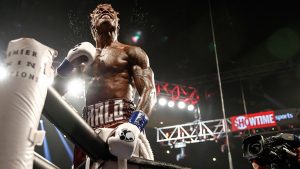
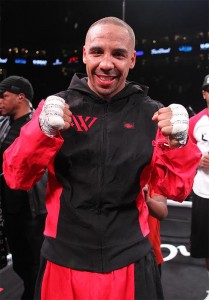
Saturday night, at the USC Galen Center in Los Angeles, California, Jermall Charlo defended his sliver of the super welterweight championship by fifth round TKO. The victory came at the expense of earnest but overmatched Julian Williams, who, provided the opportunity to make good on a year of bold proclamations, delivered a belligerent moment or two where it actually mattered, before leaving the ring with his head barely attached.

What Charlo-Williams offered, what aficionados are offered too infrequently, is an evenly matched prizefight on a premium network; a fight where the winner is in doubt both before the opening bell, and frequently enough during the fight to imbue not only the exchanges but those tense moments of inaction with a drama so often absent from the inevitable. Never mind that both fighters were undefeated—an undefeated record is as much a masking agent as an indicator of merit. And never mind that Charlo held a title, given that he won that belt over a man in his forties, and first defended it against someone named Wilky Campfort. What mattered is that within minutes of them keeping no company but each other, Charlo and Williams recognized the quality of opponent before them and were concerned but unbowed by that knowledge.

There is no moment in the fight more significant than the one that saw Charlo roll Williams’ right hand and counter it with an uppercut. That punch, the beginning of the end, set Williams’ head at an angle almost perpendicular to his neck and drove him so forcibly to the canvas he nearly bounced up to his knees and elbows. Williams played off its affect as best he could, bringing to mind fellow Philadelphian, Eric Harding, who, ruined by Antonio Tarver’s left hand, offered the utterance, “I’m from Philadelphia” as justification for fighting on. Fight on Williams would, but only until Charlo, swinging not to prompt the referee’s mercy but to leave Williams in a heap, tumbled him to the canvas once more.

Whatever blows they exchanged prior, including the Charlo jab that floored Williams with in the second round, and the counter crosses Williams chased Charlo’s jab back with, were evidence enough that both men understood what tools might serve them best against each other and that none of those tactics would come free of charge. It was a fight fought evenly until, in a flash, one man could fight no longer, and since what matters most always transpires between the ropes, Charlo’s landing his decapitator is the defining moment of the night.

And yet, it may not be what he is remembered for. At least not entirely.

In the aftermath, Charlo, still burning, refused to accept Williams’ congratulations, a move that drove the crowd to boo him for his lack of grace. Asked by foremost expert in classlessness, Jim Grey, whether his poor sportsmanship might detract from his victory, Charlo responded: “Detract from what? I knocked him out?”

It is a fair question to ask, however unpopular it may have been to a crowd that responded to Charlo’s asking it like it should have been issued a trigger warning.

Williams, who became Charlo’s mandatory in March, dogged him for nearly year, calling Charlo out and promising to take his title. His bandwagon—strangely full for a fighter who, beyond being accessible on social media and having an appealing moniker, had done little to justify many of the absurd claims made about his ability—also got in on the act from bathrooms, bus stops, and bar stools across the country. That ten-month keyboard assault fueled Charlo, who remained at 154 pounds only to shut Williams’ mouth. That he made good on that opportunity hardly means he need be friendly to his tormentor afterward, and if that does not fit into some romantic notion of how a man who is stripped near naked and sent out to leave another unconscious should act, so what?

The challenge the Charlo twins always faced, quite understandably, was that they were near indistinguishable from one another; a problem exacerbated by the absence of star power in their division and the fact that neither had a signature moment in the ring. But that is no longer the case. Jermall is now the Charlo brother who turned “J-Rock” to rubble and then reveled in it with zero regard for decorum.

Had Charlo responded more graciously people might have felt better about enjoying the spectacle of one man beating another to the ground with his fists. But if one of the goals a fighter has is to leave the crowd wanting to see him again, that approach would have done less for Charlo than his heel turn. And proof of that is that days later, people are not still talking about how Charlo planked Williams: they are talking about how Charlo planked Williams then acted like a goon, and whether such behavior did him a disservice or otherwise. True, Charlo will squander all that buzz if his next fight is unremarkable, but his behavior Saturday with fist and microphone in his face make that fight worthy of anticipation.

Sergey Kovalev can attribute much of his popularity to his maliciousness, so too can Terence Crawford, who interestingly enough, was considered a bore until his mean streak became an undeniable fixture in his performances. Perhaps Charlo too has this uncomfortable yet alluring quality about himself, and all that was needed was a night of genuine enmity to usher it forth. If so, may he harbor such ill will toward all of his coming opponents.


Victory laps and laps: Crawford closes questionful Molina

By Bart Barry-

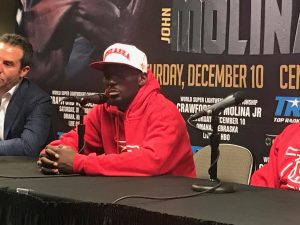
Saturday in Omaha junior welterweight Nebraskan Terence “Bud” Crawford (29-0) spiralsnuffed Californian John Molina (29-6) in the eighth round of their match for Crawford’s 140-pound championship for which only Crawford was eligible. The fight happened on Crawford’s network, HBO, but not along his network’s pay-per-view branch because of how quickly receipts from Bud’s PPV debut got tallied in July – as HBO’s search for someone to rediscover its millionth (or 500,000th) buyer continues along: Not Gennady, nor Terence, nor Andre and Sergey.

Rarely do a prizefighter’s trunks do the work of premonition but Molina’s did with uncanny precision at CenturyLink Center. Molina and his cornermen all wore a garish ensemble covered in question marks of varying shapes and positions, like Halloween store runway models doing The Riddler. There were ?s and ¿s everywhere to ensure no semblance of certainty and that’s how Molina fought, outquestioned and unanswered from the opening bell till he hit the canvas in round 8. Every question about the fight’s quality, beginning with those raised at the Friday weighin when Molina missed weight aggressively, persisted and persist.

Everyone already knew Bud Crawford was special – after all, no one who wasn’t special’d be allowed to fight John Molina on HBO in Nebraska – and nothing Molina brought Saturday undermined anyone’s opinion of Crawford, even if it didn’t genuinely enhance it either. On the roster of happenings that make a fighter lessen in his prime, certainly, poor competition is well well below inactivity, but poor competition still makes the list, and a perusal of Crawford’s opponents since his signature win 30 months ago against Yuriorkis Gamboa should induce a tremor of concern to his handlers. He’s selling tickets in Omaha and that’s great and he’s staying active and that’s still better but he’s staying active against whomever his promoter can get at Black Friday rates and that’s not the same as improving: It’s brand management more than career management.

But there weren’t any cracks in Crawford’s game Saturday, were there?

There were a few, actually, yes.

The main one is his increasingly vaunted footwork, and having your footwork noticed by pundits and commentators and casual fans, come to think of it, might be an alarm every fighter should set going forward – though while we’re treating footwork referee Mark Nelson garners mention of his own as, in the busyness of his inexplicable but unceasing half orbits round the combatants, Nelson spends an absurd amount of time directly behind one fighter or the other, where he can see nothing just before he gets bumped into.

Fighter footwork fascinations go like this: The sort of hyperbolic character who fetishizes handspeed and footwork never praised Juan Manuel Marquez like he celebrated Erislandy Lara – while Marquez’s footwork, Marquez’s everything, was much much better; the type of fan who dizzied himself with glee as Amir Khan dizzied himself with jumping jacks from corner to corner to corner can’t often be found on Twitter hashtagging Roman Gonzalez’s footwork – which is, like everything else Chocolatito does in a prizefighting ring, nigh perfect. Once a fighter’s footwork becomes exaggerated enough for some people to start talking about it, in other words, it’s probably gone from a bit much to a mark of inefficiency to a cause for concern.

But you see Bud Crawford can switch from orthodox to southpaw!

Well gee golly.

Such switching is often a mark of anxiety, a means of stating loudly to one’s opponent you cannot figure him out, and Crawford knows this – which is why he began orthodox till he figured out Molina, which took about a round, and then Crawford went southpaw and stayed that way because Molina held no mysteries and Crawford sells tickets in the Midwest in some part by not being a frilly dude. Crawford used his footwork as a southpaw mostly to keep himself from getting hit by Molina until Molina figured this out, sort of, and started lead-hand corralling (clotheslining really) Crawford about the seventh round, at which point Bud came to a quick realization the show needed closing because however obviously confused Molina was he wasn’t so properly dissuaded as to stop whacking Crawford when given the chance.

Crawford is starting to take three steps where he need only take one, and it’s a mark of his recent competition more than carelessness: Against an equal you worry about fatigue and conserve motion by parrying a cross with your shoulder or ducking a hook, but when you haven’t a fear in the cornfields about what capacity for violence the man across from you bears, you get too cute by half and make disco circles in lieu of L-steps.

When he wants to be, Crawford is among the sport’s best closers, and his triple right hook – head, body, head – thrown after his initial hesitation brought Molina’s left glove off his cheek, was gorgeous a finish as any aficionado has a right to demand. Molina crumpled, and Mark Nelson crumpled on top of him, and one of Top Rank’s guys in a Cowboys jersey somehow decided he needed to be the first to congratulate the victor – which was both unseemly and uncharacteristic of a Top Rank employee. Alas.

Whosoever will Bud fight next? Preferably Manny Pacquiao before he retires again or at least someone whom Antonio DeMarco didn’t stop in 44 seconds 51 months ago.

Bart Barry can be reached via Twitter @bartbarry


Busy Saturday and two big questions precede 2017

By Norm Frauenheim-

The end is near for another forgettable year, memorable mostly for fights that didn’t happen and a controversy still raging over the one that did.

Yeah, 2016 was lousy, yet the year’s final month is a sure sign of a heartbeat despite the usual obituaries. Year-end diagnosis: Boxing isn’t dead, but pay-per-view might be.

A sure sign that the scarred patient is still kicking unfolds throughout a Saturday with five cards on three networks from time zones on all sides of the international dateline.

There’s heavyweight contender Joseph Parker-versus-Andy Ruiz Jr. in Auckland on HBO, tape delay. Featherweights Abner Mares and Jesus Cuellar meet on Showtime in Los Angeles. Unbeaten junior-welterweight Terence Crawford is at home in Omaha against John Molina Jr. on HBO. Anthony Joshua, the projected face of a resurrected heavyweight division, faces Eric Molina in the UK on Showtime. Julio Cesar Chavez Jr., now 30, is back, back all over again, against German Dominik Britsch on beIN in Mexico.

The sun never sets on the pro ring. Not yet, anyway.

Each of the cards helps set the table for a New Year, hopefully a better one. A year from now, however, it looks as if only two things will determine how we’ll look back at 2017:

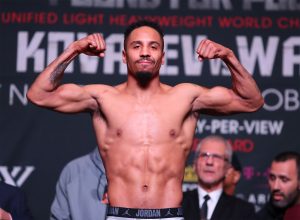
· An immediate rematch of Andre Ward’s controversial decision over Sergey Kovalev for the light-heavyweight title.

· Gennady Golovkin-versus-Canelo Alvarez for the middleweight title.

Both have to happen. If they don’t, we may be hearing last rites instead of reading tired obits. Kathy Duva of Main Events, Kovalev’s promoter, exercised the rematch clause within minutes after Ward was declared the winner, 114-113, on all three scorecards on Nov. 19 at Las Vegas’ T-Mobile Arena.

Meanwhile, Oscar De La Hoya of Golden Boy, Canelo’s promoter, has promised repeatedly that the long-awaited showdown with GGG will happen in September.

But this is boxing, which means caveat emptor is attached to every promise and rematch clause. With less than a month left in the year, we’ve yet to hear Ward’s management even acknowledge that the reported rematch clause is in place.

It’s clear that Ward’s management is keeping options open, perhaps for an immediate bout against somebody other than Kovalev. The Russian would have to agree, but only at a steep price. It’s called step-aside money.

In this case, it would be stepping all over public expectations for a quick sequel, if not an immediate resolution to the noisy debate over the scoring. The business — still reeling from 2015’s Floyd Mayweather Jr.-Manny Pacquiao dud — can’t afford a postponement. A 2016 full of frustration over no Canelo-GGG bout is symptomatic of an impatient fan base that won’t tolerate much more delay.

Canelo is working his way back from a right-thumb injury sustained in a stoppage of the UK’s Liam Smith in September. Projections are that Canelo will fight again, perhaps some time in early 2017. Will the junior-middleweight champion need one fight, or two, against a true 160-pounder before GGG? Will the thumb hold up?

In most years, small questions. But the answers loom large, larger than ever in a critical 2017.


An honest prizefight: Gassiev decisions Lebedev in Moscow

By Bart Barry-
murat-gassiev
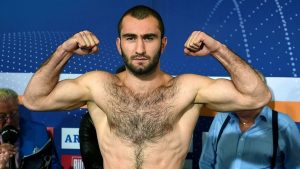
Saturday in Moscow Russian cruiserweight champion Denis Lebedev lost his title by split decision to Russian Murat Gassiev by scores that were at best wide and at worst wrong: 114-113, 112-116, 111-116. Gassiev dropped Lebedev in round 5 and fought ably in most every other but did not appear to punch enough to depart Khodynka Ice Palace with Gassiev’s jewelry.

It was an honest prizefight between two men who knew how to do it and went about the labor of bludgeoning one another quite a bit differently: the southpaw champion, shorter and thicker, moved at times nervously but generally effectively and squaredup to turn his left cross to a hook round Gassiev’s guard, and the orthodox challenger, tall and coiled, landed far fewer clean punches but absorbed his opponent’s blows more indifferently and benefitted from a bodyshot knockdown in the middle rounds that gave two ringside judges liberty to weigh his work generously. It was an honest viewing experience for American audiences, too, because it came effectively bereft of biography – though the cornermen, the once-quotable Coach Freddie and enduringly obnoxious Abel Sanchez, surely biased some American eyes somewhat.

But that doesn’t explain the judging and for once it’s good not to bother autopsying scorecards for improper interest. On the Russian broadcast it did not appear Gassiev did sufficient to unstrap the champion but the acoustics of a YouTube feature from the other side of the world might be suspect so one never errs giving ringside sounds and those who experience them benefits of scorekeeping doubts – for the sake of one’s own peace of mind or at least solace. Lebedev was indeed busier throughout and controlled no fewer than eight of the match’s opening nine minutes then got caught a while after that with a left hook to the liver, a quite odd thing for a southpaw to collect, and dropped without a standard halfsecond’s delay as if he knew how badly things’d go when the liver’s report reached his brain and wanted to get in position for it, and the tenor of the judging if not the action being judged shifted dramatically, or else Gassiev’s punches simply sounded that much more ferocious at ringside than they looked on video. The widest scorecard came from an American judge in Moscow watching two Russians trade hands, and one hopes therefore he didn’t bring a rooting interest to a card that otherwise felt lopsided, though the IBF sure flew him a long way to that ringside seat.

If Gassiev won fairly he did so by punching much harder than the champion because it sure as hell wasn’t Gassiev’s defense, pedestrian, or head movement, scarecrowlike, that brought his W and new title. The idea of that title is worth a revisit because it addresses the way fights are scored and the way aficionados think fights ought be scored, and they’re not the same.

Barring a decisive act the man being watched more by a judge during a round will win that round from that judge. None of us, that is, watches impartially enough to keep his eyes fixed on the floating cube of space between two combatants, following each fist across the cube’s threshold and judging its effect from there; each of us begins each round watching one of the two fighters and why we watch that fighter is a plethora of subjective things like identity and empathy and psychological goingson we couldn’t catalog exhaustively if we had unlimited time and inclination. Yet we dive headlong at the most obvious considerations when judging judges, which is fine actually because in large part it’s what judges sign up for.

Somewhere round here is the genesis of the idea a challenger must beat a champion more decisively than a champion must beat a challenger – not because any judge’s scorecard (that isn’t prefilled anyway) is prefilled with a handicap for the challenger but because, by virtue of the precious metal he wears round his waist when he steps through the ropes, a champion brings a presence scorekeepers’ eyes find irresistibly shiny – the champion is the default object on which a judge’s eyes fix. Nobody said it had to be like that in the beginning; it turned out like that often enough to become probable and then men who trained challengers decided it was an apt tool to tell their charges in camp the champ would be entitled to every close point, and soon enough those challengers became champs themselves and decided such entitlement, while unofficial, was a binding rule. One of them probably said that much in an interview once long ago, and drunken fanatics have been loudly quoting him ever since.

If members of the Sergey Kovalev camp didn’t cite this rule directly or publicly after their charge’s narrow loss to Andre Ward a few Saturdays back they surely alluded to it privately and attributed to bias an outcome decided by American judges’ susceptibility to a jingoism that overwhelmed the subconscious bias Kovalev’s waistwear should’ve brought. Perhaps. But Saturday a Russian champion did about as much to defend his title in Russia as Kovalev did in America and got the same sort of result though he lost by a greater margin in his home country than Kovalev did in Ward’s home country.

And that returns us ever and again to there being but one way to win a prizefight objectively and that is by knockout. The rest is noisy twaddle.

Bart Barry can be reached via Twitter @bartbarry


Valdivia decisions Garcia

Danny Valdivia remained undefeated with a 8-round unanimous decision over Aaron Garica in a super welterweight bout.

In round two, Valdivia dropped Garcia with a right. Valdivia dropped Garcia in round three with a quick right.

In round eight, Valdivia scored a 3rd knockdown with a combination that was punctuated by a right to the head.

Valdivia, 152 lbs of Tulac, CA won by scores of 78-70 and 77-71 twice and is now 13-0. Garciam 152 1/2 lbs of Guadalajara, MX is 15-7-1.

Quilisto Madera won a six round unanimous decision over Joe Louie Lopez in a super middleweight bout.

In round five, Madera dropped Lopez with a right hand. Lopez was bleeding bad under his left eye.

Madera, 165 1/4 lbs of Stockton, CA won by scores of 59-53 on all cards and is now 5-0. Lopez, 165 lbs of Fresno, CA is 8-2.


Just say no to more talk of Mayweather-McGregor

By Norm Frauenheim-
Floyd Mayweather
Talk, talk and more talk about Floyd Mayweather Jr.-versus-Conor McGregor continue to light up social media these days with no end – or relief – in sight.

Not sure who to blame, but the tirelessly talkative McGregor appears to be doing what Mayweather mastered in marketing himself and then landing a huge Showtime contract that led to about a $220-million payday against Manny Pacquiao.

McGregor could generate international attention for getting a driver’s license these days. Essentially, that’s what the UFC’s mega-mouth did in acquiring a boxing license in California. It cost him 60 bucks. He had to fill out a four-page form and pass a physical. It was quick, simple and nobody asked him to parallel-park.

In no time, Twitter, Facebook, websites and even mainstream media exploded all over again with speculation about a McGregor bout with Mayweather. Stock the shelves with antacid, because there’s going to be a lot more of this stuff.

Chances appear to be slim-to-none that the bout would — could — happen. McGregor is under contract to the UFC. Meanwhile, Mayweather continues to send out mixed messages about whether he wants to come back.

If McGregor tries to get out of his UFC contract in pursuit of a Mayweather bout, a long and tangled legal battle is likely. Mayweather, who is one victory short of 50-0, has a lot of things, but time isn’t one of them. He’ll be 40 on Feb. 24.

I doubt it will happen. But I’m old, more than old enough not be included in the emerging generation of MMA fans. I also suspect that my doubts reflect an opinion shared by many in the aging crowd of fellow boxing fans. To wit: I hope it doesn’t happen. Could it? In an era when a presidential campaign is won with tweetstorms, anything can.

There’s momentum in the internet fascination. Betting odds were even posted by Westgate in Las Vegas Thursday. If the bout went from mythical to fact, Mayweather would be a 25-1 favorite in what would be a boxing match against McGregor, who began as an amateur boxer as a 12-year-old in Dublin.

Translation: Nobody thinks McGregor would have any kind of chance at all. So why is social media still buzzing about it?

There are all kinds of reasons, including a compelling one offered by Mayweather Promotions CEO Leonard Ellerbe. Ellerbe told ESPN’s Dan Rafael that people are talking about it because of race. McGregor is Irish and white, Mayweather is African-American and boxing has a long racial history defined by The Great White Hope.

If Ellerbe is right – and I think he is, the racial component will only fuel further talk about the bout. More talk means more of the one thing that could make it happen: Money, which also happens to be Mayweather’s nickname and motivation. Speculated numbers have been all over the place. They’ve also been uniformly big, anywhere from $800 million to a billion.

That would pay a lot of McGregor’s legal bills and might be enough to lure Mayweather back through the ropes. Then, however, the global bubble of anticipation would quickly deflate. Remember the mix of disappointment and outrage over Mayweather’s decision over Pacquiao in May, 2015? Multiply that, again and again.

There’s also precedence for what might happen. Classic boxing matches between a boxer and MMA fighter have been a mixed-martial-arts mess. I sat through one in Phoenix, Ariz., last March.

That’s when aging Roy Jones Jr. scored a second-round stoppage in a made-for-pay-per-view event over a guy named Vyron Phillips, who had been fighting MMA and had experience as an amateur boxer.

Phillips got a boxing license from the Arizona State Boxing and MMA Commission, but he had no business in a ring within punching range of a boxing legend way past his prime. The event was a joke, an embarrassment not worth repeating, especially on a global stage that could be a billion times more embarrassing.


Better than never (if barely): On Vasyl Lomachenko-Nicholas Walters

By Jimmy Tobin-
Lomachenko
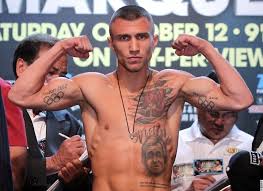
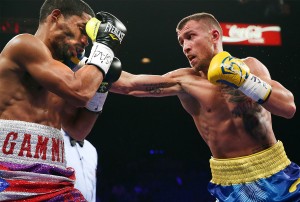
Saturday night, at the Cosmopolitan in Las Vegas, junior lightweight, Vasyl Lomachenko, made a quitter of Nicholas Walters in one of the most anticipated fights of last year. Walters found reasons enough in seven rounds of exposure to Lomachenko to suffer the fallout of an ignominious defeat rather than be further toyed with or worse.

Quietly ended a rivalry that would have provided greater drama had it played out at featherweight, where Walters—yet to lose a title on the scale, yet to suffer a draw a lightweight, still brimming with confidence from running roughshod over the worn and washed tributes offered to his mystique—was his most imposing. Perhaps too, had Walters not spent eleven months doing anything but fighting, doing whatever it was that made ominous the pictures of him as the weigh-in loomed, he would have mustered a better showing. Alas.

To conjure up a charitable narrative on Walter’s behalf seems like primarily the work of those embittered by the result (a Lomachenko victory even before a Walters loss). But what might they say?

Faced with a fighter near impossible to hit, it could be that Walters turned his back on his opponent, on his promoter, on a fight he never cared to participate in. Perhaps when Lomachenko unfurled his full arsenal, when he spun and struck Walters to dizzying effect in the seventh round, it was then that Walters decided that, while willing to endure 12 futile rounds he would not suffer another like the last. Maybe pride brought him to tell referee, Tony Weeks, he had no interest in fighting on, so humiliated was he by the prospect of being reduced to a sparring partner, a mere tool for practice.

Any one of these explanations is in keeping with a telling moment at the end of the fifth round. Lomachenko stood still in the center of the ring, and Walters, rather than seize the opportunity to walk Lomachenko down merely mirrored his opponent; when he did move, his first step was backward, away from Lomachenko, away, really, from any regard for the fight’s outcome. As the bell sounded to end the round, Walters simply shrugged his shoulders.

Walters had his reasons for quitting and so too will he have his consequences. The comeback trail for a fighter complicit in his defeat, a trail that already features less money and fewer television dates, is unlikely to be understanding let alone forgiving; nor, for that matter, is the collective pile-on that is the viewing public.

Underlying all of these interpretations of Walter’s conduct is Lomachenko, a generational talent, if not yet a great fighter. Fittingly, he went about his business last night in trunks and gloves patterned in a style resembling the work of pop artist, Roy Lichtenstein, who once said, “Art doesn’t transform. It plain forms.” Lomachenko is not transforming, altering, or changing his legacy so much as forming it in accordance with the ambition and talent he is endowed with. He is not held to the standards of a fighter with eight professional bouts because that would be an insult to him. And yet, it is important to keep that number in mind, because in that short span of time he has already beaten Gary Russell Jr., Rocky Martinez, and now Walters, which, while not the stuff of legend, is a feat unrivalled by any of his peers when they had less than ten fights. Even Lomachenko’s loss to Orlando Salido, which despite Salido’s manipulation of sportsmanship ended with the iron-willed Mexican on the brink, looks good.

It is not always a question of whether you win but how you do that matters, however. And while Walters must own some of the blame for the lack of fireworks Saturday night, Lomachenko’s performance was less riveting than his unmaking of Russell or his destruction of Martinez. And yet it was vintage Lomachenko (for better or worse).

Again Lomachenko erased the line between defense and offense as only he does: where punches are followed by defensive maneuvers that position him for further offense and so forth, all at the expense of opponents who are spun like flies in a spider’s web as the fatal bite closes in. Walters cocked his vaunted right hand repeatedly in the early rounds, but rarely threw it, nor did he stalk Lomachenko as he had even the most dangerous fighters he’d faced. He did not have to. Instead, Lomachenko brought the fight to Walters—and when that fight become its most intense, Walters capitulated. Here then, is the transformative element in Lomachenko’s work, best found on the bodies—in their wounds, in their language—of his opponents. Still, there are further transformations that need to take place for Lomachenko to monetize his talent.

Lomachenko’s mastery leaves some wanting more. Perhaps it is the incremental and protracted way he works, starting first with range and defense before incorporating his more hurtful—and compelling—elements of his game. Indeed, there is at least a moment or two in most all of Lomachenko’s fights where it is fair to ask why he is still fighting. He looks near flawless when he is shifting on opponents, slashing at them from improbable angles, but perhaps a little less precision, and a little more recklessness and savagery, would help him better resonate with the public. He is not a defensive fighter—his defense is a conduit for his offense—but his calculated attack understandably leaves the bloodthirsty cold.

There is a solution to his problem that requires Lomachenko make no stylistic concessions, however, one that could entrench him in a collective consciousness that extends well beyond the dwindling ranks of those who still turn to the ring for entertainment: seek out those fighters who fight with a passion you reserve only for your preparation, those fighters who carry both the hopes of a nation and a cultural obligation—and cut those men to ribbons.


Oopsie doopsie

By Bart Barry-
Lomachenko_Rodriguez_150502_001a
Saturday in Las Vegas the runnerup for 2016’s most-anticipated fight featured undefeated Jamaican Nicholas “Axe Man” Walters getting stripped bare in a super featherweight title match by once-defeated Ukrainian Vasyl Lomachenko. Walters decided quitting after seven rounds of being felled not once somehow blazed a nobler trail than absorbing a beating certain to multiply and deepen. Well. Unpleasant as things must’ve been for Walters he made the wrong decision and should expect in the future white feathers in lieu of television contracts.

Styles break fights, and if one compares the reality of Lomachenko-Walters to the fantasy so many aficionados entertained about it Saturday’s fare fairly well serves as the largest disappointment of 2016 – which, as disappointments go, is like being the captain of an all-star team. The boxer-slugger matchup, as Joe Frazier teaches us in “Boxing with the Pros”, ever favors the boxer, but even so, that was a bit much.

Anyone who’s not been ringside at a Walters fight before Saturday no doubt now entertains suspicions Walters was a Top Rank invention of (typically brilliant) matchmaking, a properly manufactured frame with which to hang the promoter’s latest masterpiece, but that’s inaccurate for once; Walters was special in an especially concussive way when he arrived in 2013. I was ringside for Walters’ American debut, a 3 1/2-round hatcheting of Mexican Alberto Garza in Corpus Christi, Texas, and it left a mark. I recall clearly but three emotions from the fights that night: Thankfulness San Antonio’s Steve Hall did not perish in his encounter with Alex Saucedo, amusement Vic Darchinyan outboxed Nonito Donaire for eight rounds, and holy mackerel that guy with the wooden axe can crack! Very few fighters at the championship level have gamechanging power not because very few guys at the championship level hit hard but because everyone at the championship level hits hard, and subsequently fighters don’t make it to the championship level without they can absorb stiff shots. Walters didn’t just hit his opponent with a stroke that shocked Garza but observed Garza’s fright with no shock of his own – Walters waded into what panic emanated from Garza without malevolence: “I’m supposed to cause that.”

Four months later I was ringside when Lomachenko’s debut in a championship fight did not go nearly so impressively against Mexican Orlando Salido in San Antonio’s Alamodome. Salido missed weight by a couple or three weightclasses, if memory serves, and fouled Lomachenko compulsively but as we’d been promised by Lomachenko’s promoters some combination of the greatest amateur in boxing history and the greatest professional to come in boxing history most of us succumbed to schadenfreude and were at least amused by the spectacle of a 12-loss grinder decisioning the future of boxing – not amused as we’d been 90 days before when Chino ravished About Billions, but still.

First impressions and all that: I fully expected Lomachenko-Walters to be intense and intensely memorable and wanted very much to see what the future of boxing did with his introduction to the Axe Man’s blade. We’ll never know, will we, as Lomachenko so wildly outclassed the Axe Man the few punches Walters nearly landed were thrown with so little resolve as to be pittypats had they landed and whiteflags otherwise.

Does that make Lomachenko the most skilled fighter in the world? Hell no, actually, it doesn’t; give the minimumweight equivalent of Siri Salido 10 extralegal pounds and all the fouls he can muster and he’d still not win three rounds against Roman Gonzalez in 100 minutes of trying, much less decision him on scorecards that are just. Lomachenko is an innovator and a supremely talented fighter, yes, but Chocolatito is perfect – and they’re not quite the same thing.

Watching Lomachenko dance and pepper, shake and grind Saturday recalled no one to mind so much as Sergio Martinez, another southpaw innovator who got beaten early in his career by a Mexican grinder. Lomachenko circles tighter and does everything a bit tighter than Maravilla did but he doesn’t hit so hard or he’d have copterforked the Jamaican long before Walters quit since there’s no confusing the Axe Man for the Punisher. While we’re on the subject of Walter’s stooljob, a couple lessons learned: First, when a guy attends a weighin with a marijuana leaf on his getup, no matter his nationality, don’t be shocked if he mills like a pothead; and second, remember always what makes sluggers vulnerable to boxers is the fragility of sluggers’ psyches – they get discouraged much quicker and more deeply than boxers or volume punchers do.

For all his abundance of showcased skill Lomachenko’s not too exciting, alas, no matter how much one interrogates instant replays and immerses himself in the audio of whatever promotional lunacy Lomachenko’s American cable network now amplifies about any prizefighter from the former Soviet Union. Unlike the rest of the Eastern Bloc fighters HBO has peddled aggressively at us seemingly since the Berlin Wall fell, though, Lomachenko is promoted by an outfit that knows how and occasionally asks its charges to take risks commensurate with the fortunes HBO is wont to invest in marketable personalities.

Saturday Lomachenko looked enormous at 130 pounds and shouldn’t have any trouble rising in weight to much bigger fights with Top Rank’s much bigger fighters, or they can give us a rematch with Salido on pay-per-view and see if that goes.

Bart Barry can be reached via Twitter @bartbarry


FOLLOW LOMACHENKO – WALTERS LIVE!!!

Lomachenko

Follow all the action as Vasyl Lomachenko defends the WBO Super Featherweight title against Nicholas Walters.  The action begins at 10:35 ET / 5:35 AM in Ukraine / 10:35 in Jamaica

NO BROWSER REFRESH NEEDED

12 Rounds–WBO Super Featherweight Title–Vasul Lomachenko (6-1, 4 KO’s) Vs. Nicholas Walters (26-0-1, 21 KO’s) 
ROUND 1 2 3 4 5 6 7 8 9 10 11 12 TOTAL
 Lomachenko  10 10   10  10  10  10  10            70
 Walters  9  9  9  9  9  9  9           63

Round 1: Lomachenko lands a left and right

Round 2 Jab and quick lefts from Lomachenko..Good right from Walters..Straight left from Lomachenko…2 good jabs from Walters…Good left from Lomanchenko and another..

Round 3 Quick left inside from Lomachenko..Body shot from Walters..4 punch combination from Lomachenko

Round 4 Walters lands a left hook…Lomachenko counters twice…Body shot…Good hook from Walters

Round 5 Left to body by Lomanchenko…

Round 6 Good body shot from Walters..Right hook from Lomanchemko..Good body shot from Walters..Combibation from Lomanchenko…Lomachenko outlanding Walters 84-44

Round 7 Good body shot from Walters..Good left..Good left hook from Walters….WALTERS QUITS ON THE STOOL


From The East To The Beast: Lomachenko might be the best

By Norm Frauenheim-
Lomachenko
The evolution of boxing’s surprising new generation – fighters from the old Soviet Union – continues Saturday with Vasyl Lomachenko, who many believe will be the best of them, if not one of the best ever.

In the lead-up to the Lomachenko-Nicholas Walters bout at The Cosmopolitan in Las Vegas, his promoter, Bob Arum, compares the Ukrainian to Muhammad Ali.

Being called the next anything can create some problematic expectations. To wit: There’s never been another John Wooden or Jack Nicklaus and the NBA is still looking for the next Michael Jordan.

But, it’s fair to argue, that there’s never been anyone in any sport quite like Ali. In the arena of history’s icons, Ali is the greatest ever. On the boxing canvas, he’s Michelangelo. Whether there’s a Sistine Chapel in Lomachenko’s creative hands is anybody’s guess. After all, the two-time Olympic gold medalist has only seven pro bouts (6-1, 4 KOs).

But Arum is absolutely right about one thing: Lomachenko is fascinating to watch. Arum has seen them all. First of all and above all, Ali.

The promoter, who turns 85 on Dec. 8, celebrates his 2,000th card Saturday night. That amounts to boxing every night for nearly five-and-half years. Arum thought he had seen all the angles until he saw Lomachenko, who has been creating some new dimensions in boxing’;s traditional geometry

He possesses a bewildering array of punching angles augmented by hand speed and clever footwork. Ali?

We’ll only know more about that one in the face of further adversity, perhaps in an HBO-televised bout (10:35 p.m. ET/PT) against a dangerous Walters (26-0-1, 21 KOs) who has frightening power.

Lomachenko has already encountered some of that in a loss to a stubborn and brawling Orlando Salido. Salido might have taught him a career-full of lessons during one long night in March 2014. Lomachenko is no dummy. The guess here is that he will be cautious early and creative late for a stoppage in the final couple of rounds over a tiring Walters.

A successful defense of his WBO junior-lightweight belt might propel him to an immediate jump in class, perhaps to a 2017 bout at 140 pounds against Manny Pacquaio. I would also like to see a bout with Mikey Garcia, although that one could be difficult to put together because of Garcia’s split with Top Rank.

Nevertheless, Lomachenko against the tactically skilled and always-poised Garcia would loom as an intriguing match-up and another test of what Arum foresees for the Ukrainian.

For now, Lomachenko ranks No. 3 on this list of fighters from the old Soviet bloc making an impact in the U.S. Middleweight Gennady Golovkin is still no. 1. Light-heavyweight Sergey Kovalev is No. 2, despite his controversial loss to Andre Ward last Saturday.

If fans angry at Ward’s one-point victory on each of the judges’ card had a vote, Kovalev might in fact be No. 1. Despite the noisy controversy, however, it still goes down as a loss for Kovalev, who seemed to let the clever Ward off the hook after the Russian scored a second-round knockdown.

For Lomachenko, that’s an opportunity to become No. 2 on what might just be an early list of all that Arum thinks he’ll achieve.


At least the respect was deserved: On Sergey Kovalev-Andre Ward

By Jimmy Tobin-
sergey-kovalev
Saturday night at the T-Mobile Arena in Las Vegas, Nevada, light heavyweights Sergey Kovalev and Andre Ward provided a proper prizefight for those weary of a year blighted with fights of little consequence and even less intrigue, of diluted titles both real and fantastic. To the surprise of many—including Ward, if anything can be read into the expression he wore as the victor was announced—and the disgust of plenty, Ward was awarded the victory by the narrowest of margins: 114-113 on all three cards.

The outcome is likely to be debated long after Ward and Kovalev have put the fight behind them; and for the most tenaciously outraged, perhaps even after the rematch—which there almost certainly will be—has provided some vindication. Because the explanation for Ward sweeping the last six rounds on two judges’ cards and picking up five of those six on a third, is near impossible to find in what transpired in the ring. This is not to imply judging corruption, only a sort of laziness, the judge’s fallacy that reasons that since Fighter A is no longer having the same success he had in the early rounds Fighter B must be winning. While it is true that Ward adjusted to Kovalev, and those adjustments got Ward back in the fight, the case that they won it for him was made most forcefully by people other than the “Son of God.”

Of course, a Kovalev victory in the rematch would not retroactively correct any perceived error in the scoring of the first fight; a clear, decisive (deserved?) second victory for Ward would not make his first any less controversial; nor, for that matter, should anyone expect anything more definitive in the sequel. If this is unsatisfying it is perhaps helpful to remember that, whatever your feelings on the outcome, the only nemesis either fighter has managed to find he found in the ring Saturday; and the animus they showed each other was born of respect.

Respect is something grudgingly given to Ward, who can be supercilious beyond the ropes, tedious between them, and until last night, was so far removed from a win worthy of comment he might well have been forgotten had HBO not paid so dearly for his services. But he is a great fighter—to suggest otherwise is to concede that Kovalev could struggle with anything less. Are you willing to make that suggestion?

When Kovalev sent Ward to his knees with a right hand in the second round, it seemed very much like the whispers of Ward’s decline had been right. And yet over the next ten rounds, things became more difficult for Kovalev—not easier.

Proof of this shift bore out in the clinches. Unhinged by Kovalev’s power, Ward’s early wrestling was preservative, which was telling considering his ability to work inside the clinch—and outside the margins of sportsmanship—figured to be his most glaring advantage. But as he calibrated his own offense to that of Kovalev’s, Ward turned the clinches in his favor. Working with his head on Kovalev’s shoulder, hitting while Kovalev wrestled and always delivering the last punch, Ward taxed the monster before him. That Ward managed as much while brandishing zero threat of a right hand, that he ostensibly defused a bomb with only his left, warrants praise that should not be denied him.

The effect of this inside work was nevertheless exaggerated by Max Kellerman, who approached each round like a 49er panning through the action looking only for those bits of it that allowed him to preserve a set narrative about Ward’s greatness. Kellerman also tried to dismiss the effect of Kovalev’s punches, as if his ability to force Ward to repeatedly retreat and reset was somehow inferior to the punches Kovalev calmly walked through. The commentary team’s efforts to guide rather than describe reached its low point during an absurd discussion about winning moments, as if the winner of a round could be determined by dividing each round into 360 or so moments and tallying, without any regard for quality, who earned more.

For those disgusted by Kovalev suffering so unconvincing a first loss there is this: the fight revealed that people will never see in Ward what they do not want to see and confirmed that there is more to Kovalev than the rhetoric about him suggests. Prior to the fight, it seemed plausible that his inability to put away Bernard Hopkins, a much older, slower, version of Ward, boded poorly for Kovalev’s chances. But he was better against Ward than he was against Hopkins because the moment demanded as much. As he did against Hopkins, Kovalev scored an early knockdown, and again, that knockdown came because an opponent underestimated his quickness. Unlike Hopkins, however, Ward fought to win, not stay upright, and when the outcome of the fight was thrown into doubt Kovalev responded with the type of comportment he need never have shown against the likes of Cedric Agnew and Blake Caparello. He is more than his puncher’s reputation reflects, and he out-boxed the boxer even if he could not overcome the judges.

Prior to Saturday night, Kovalev and Ward occupied somewhat tenuous positions in a sport that in lieu of quality matchups, devolves further and further into a mere cult of personality. Ward was preserved by a reputation that persisted despite his not engaging in a fight worth mentioning since 2012. But his effort Saturday night, if not the way it was awarded, provides little reason to further a grudge against him. Kovalev’s best win was a decision over a man half a century old, but if Kovalev is for you an overhyped product of HBO’s infatuation with Eastern Europeans, his disputed loss to Ward undermines your claim. Perhaps any new animus directed at them too, will be born of respect.


A triumph of sorts: Ward decisions Kovalev barely or not at all

By Bart Barry-
Andre Ward
Saturday at T-Mobile Arena in Las Vegas undefeated American light heavyweight Andre “SOG” Ward decisioned unanimously and narrowly undefeated Russian Sergey “Krusher” Kovalev by three scores of 114-113. Kovalev hurt Ward in round 1, dropped him in round 2 and sent him racing backwards in round 12, but in between Ward may have, conceivably, possibly, theoretically, landed exactly the number of enough punches to prevail on a fair scorecard.

First things first: I picked Andre Ward to win by late TKO. I watched the fight with four other Americans, all of whom picked Ward to win, and the five of us composed three distinct ethnicities. None of us thought Ward won before the decision got read, but one of us, having suffered the card’s preposterous co-main, advised the group to gird itself for a questionable decision in the main. That’s what we got. And we all felt a touch queasy when the judges’ scores were read.

At some point during the match one of HBO’s prissy broadcasters calculated Ward’s margin for error was zero. True as that statement sounded those judges scoring for Ward enjoyed a still narrower margin, didn’t they? If you bulged your jaw and squinted you probably could get a Ward scorecard after 36 minutes but even a moment’s absentmindedness’d’ve skewed it all to hell. But the judges played fair and turned in varying rounds of favoritism, and frankly things ringside are demonstrably different from things triplefiltered by the HBO lens – and our own Norm Frauenheim, more credible than a combination of Nevada judges and Harold Lederman, multiplied by ten, scored it for Ward 114-113 from ringside, so acceptance is appropriate.

Such a wise course’d feel appreciably better, though, were it not for that left hook to the liver Kovalev placed in the final minutes of round 12, the one that dropped Ward’s right elbow and sent him retreating – not feinting, not trapsetting, not resting: retreating – during the moments he was scheduled by friend and foe alike to trade his life for a knockout.

Ward won the benefit of ringside scorekeepers’ doubts by enduring then overcoming more pain and humiliation in the opening six minutes of Saturday’s match than he collected in the whole of yesteryears’ Super Six tournament. In round 1 a Kovalev jab buckled Ward and made him do the eye dance of widenblink widenblink while Kovalev enjoyed the view. In round 2 Ward drove his face in a sawedoff cross that, had Kovalev had time and space to turn it over, likely would’ve stopped the show then and there.

Then the bell rang for round 3 and Krusher seemed to mistake Ward for Bernard Hopkins, deciding he might hurt Ward whenever the impulse struck him and anyway let’s save some feet and force for the championship rounds. From there Ward got better every round and Kovalev did not, and while that still didn’t win Ward the match necessarily it did create objective space enough in scorers’ minds to fill with subjective considerations of patriotism and activity and heroism and such.

The difference in physicality was pronounced as possible; for those of us who recognize the futility of battling interested audio and video elements in pursuit of an accurate home scorecard, for those of us who no longer bother, in other words, with scoring fights on television, there’s a subjective criterion that serves just as well and requires a fraction the effort: Who appears the larger man? In the final 30 seconds of round 2 Kovalev appeared several weightclasses larger than Ward the way a 150-pound man appears several weightclasses larger than a 135-pound eighth grader. However much one cheered Kovalev after the knockdown it was hard not to feel sympathy for Ward – that’s how much bigger and more effective Kovalev appeared. But then.

Recently director Oliver Stone’s series “The Untold History of the United States” landed on Netflix, and whatever it intends to do or fails to do and however much it may tend toward agitprop it succeeds in encouraging Americans raised during the cold war to imagine Soviets and their leaders like decent and selfinterested folks no different from Americans. That sentiment returned to mind again and again during Saturday’s fifth and sixth and seventh rounds; however much the Krusher marketing plan relied on menace, in a pitched confrontation Kovalev was much more athlete than psychopath; butted and tackled and scored against, Kovalev expressed betrayal, not rage – whither fairplay, comrades?

The damage Kovalev did Ward nevertheless shortened SOG’s career while it revealed the American’s profound willfulness, even if things didn’t conclude conclusively as aficionados hoped. The untenable space between Ward’s fights of the last four years coupled with their dismal lack of competitiveness did nothing to prepare Ward for what he saw in Saturday’s opening rounds. Ward did not improvise so much as endure and believe; he used his entire body to offset Kovalev’s physical advantages while investing fully in his corner’s faith Kovalev’s advantages would diminish with time. They did, too, reducing the Russian’s offensiveness while doing nothing to soften his beard; the few times Ward’s punches did more than dissuade or marginally disrupt Kovalev’s rhythm those punches were to various parts of Kovalev’s body and not his head.

There should be a rematch, and for once the party most likely to benefit from such a happening is the entity most empowered to make it happen: HBO. If the network shows continuing backbone with Ward and tells him there’ll be no victory lap till a decisive victory then tells him too to tell his people to go to Showtime and fight Adonis Stevenson if they think that’ll pay better and not come back, there’s a good chance aficionados can have the rematch we deserve. Or we can have another four years of explaining how complicated such things are and see if there’s anybody left to buy the rematch in 2020.

Bart Barry can be reached via Twitter @bartbarry


FOLLOW KOVALEV – WARD LIVE!!!

kovalev_ward_weigh-in

Follow all the action as Sergey Kovalev defends the IBF/WBA/WBO Light Heavyweight championships against fellow undefeated Andre Ward.  The action kicks off at 9 PM ET / 6 PM PT / 5 AM Sunday in Russia.  The action kicks off with a 3 fight undercard featuring Curtis Stevens taking on James De La Rosa in a middleweight bout; Isaac Chilemba fighting Oleksandr Gvozdyk in a light heavyweight bout and Maurice Hooker taking on former world champion Darleys Perez in a junior welterweight bout


NO BROWSER REFRESH NEEDED…THE PAGE WILL UPDATE AUTOMATICALLY

12-rounds–IBF/WBA/WBO Light Heavyweight titles–Sergey Kovalev (30-0, 26 KO’s) vs Andre Ward (30-0, 15 KO’s)
ROUND 1 2 3 4 5 6 7 8 9 10 11 12 TOTAL
Kovalev 10   10  9 10   10  9  9 10   10  9 10  115
Ward  8  10  9  10 10   10 10   9 10   9 113

Round 1 Quick right from Ward and left to body…Hard jab drives Ward back…Hard right..Jab

Round 2 Jab from Ward…Left from Kovalev and another..right..Hard right..HUGE RIGHT AND DOWN GOES WARD,.Big right from

Round 3 Good jab from Ward..quick left,,,

Round 4 Kovalev lands a jab

Round 5 Good body shot from Ward,,Hook from Kovalev..Good jab from Ward..body shots in the clinch..Jab from Kovalv..Good right from Ward and jab,,

Round 6 Jab to body from Ward…Good right from Kovalev..Another right..Right..Body shot from Ward and another..

Round 7 Jab from Ward..hard jab ..another good jab…Kovalev lands a left..Right from Ward

Round 8 Good hook from Ward..Kovalev lands a jab..Right hand from ward..body from Ward

Round 9  Combo from Kovalev..Right from Ward,,,Hard right to body..Hard right..Straight right..Hard right from Kovalev..Combination from Kovalev…Hard right from Ward,

Round 10 Kovalev lands a hard counter..Hard right from Ward…Right from Kovalev..Hard right..Left from Ward..Kovalev belleding from nose…Hard right.

Round 11 Solid left hook from Ward..2 rights from Kovalev..Body and head from Ward..Kovalev lands a left..Good jab from Ward..

Round 12 Good left hook from Ward..Good hook from Kovalev..Body shot from Ward..Good body shot from Kovalev,..Jab..

114-113 on all cards…..FOR….WARD

PUNCHES:  Kovalev     Ward

10-rounds–Junior Welterweights–Maurice Hooker (21-0-2, 16 KO’s) vs Darleys Perez (33-2-1, 21 KO’s)
ROUND 1 2 3 4 5 6 7 8 9 10 11 12 TOTAL
Hooker 10   9  9 10   9     93
Perez  10  10  10 10   10  10  10  10 10   10      100

Round 1 Right from Perez and left from Hooker…Left hook from Perez

Round 2 Good left from Hooker..Good right from Perez

Round 3 Hard right wobbles Hooker..

Round 4 Perez lands a right to the head

Round 5

Round 6 Looping right from Perez..

Round 7 Body shot from Perez…

Round 8 2 rights from Perez

Round 9 Good right from Perez…Left hook from Hooker..Left from Perez

Round 10 Hard right from Hooker…Left hook to the body..Good jab from Perez..2 shots from Perez..Right Hand.

97-93 PEREZ; 97-93 HOOKER…95-95 DRAW

PUNCHES:  Hooker 104-485    Perez 146-413

 10 Runds–Light Heavyweights–Isaac Chilemba (24-4-2, 10 KO’s) vs Oleksand Gvozdyk (11-0, 9 KO’s)
ROUND 1 2 3 4 5 6 7 8 9 10 11 12 TOTAL
 Chilemba  10  10  9  9 10          75
 Gvozdyk  10 10  10  10   9  10  10  9         78

Round 1

Round 2 Body shot from Gvozdyk

Round 3 3 punch combo from Gvozdyk…quick left hook and another

Round 4 Quick left hook by Gvozdyk..Gvozdyl unloads a big combination on the ropes..Chilemba bleeding from the nose..Left hook from Chilemba..Good right hand to the body..Good right over the top..Gvozdyk lands a perfect uppercut..2 good body shots from Chilemba..

Round 5 Good right from Chilemba..uppercut..Good bidy shot..Gvozdyk lands a left to the head..

Round 6 Good left from Gvozdyk…Jab..left…Hard right to thehead..

Round 7 Gvozdyk pressuring

R0und 8 Right shakes Gvozdyk up..Hard right to head and body..CHILEMBA CANT CONTINUE AFTER THE ROUND IS COMPLETE

10 Rounds–Middleweights–Curtis Stevens (28-5, 21 KO’s) vs James De La Rosa (23-4, 13 KO’s)
ROUND 1 2 3 4 5 6 7 8 9 10 11 12 TOTAL
 Stevens 10   10 10  9  9 10  10  10      96
De La Rosa  8  9  9 10   10  10  9  9  9  9     92

Round 1 Big lefts hurts De La Rosa..Right…Working in the corner..LEFT AND DOWN GOES DE LA ROSA…

Round 2 De La Rosa cut over left eye..Hard combination on the ropes By Stevens..De La Rosa pumping jab..

Round 3 Stevens landing hard body shots..Great exchange..Big left hook and hard right from Stevens..Big left hook..Good uppercut from De la Rosa..Left hook from Stevens..Hard left to body from De la Rosa..

Round 4 De La Rosa landing jabs in the corner…Body shot from Stevens…

Round 5 Stevens lands a body shot…De La Rosa lands some jabs a right

Round 6 Hard right from De La Rosa..

Round 7 Good Straight right from Stevens…

Round 8 1 POINT DEDUCTED FROM STEVENS FOR A LOW BLOW…Counter right from Stevens.

Round 9 Stevens has a hurt left hand…Right to body from Stevens

Round 10 Good right from Stevens..Right over the top…right to the body…

Punches:  Stevens  148-457   De La Rosa 123-672

98-90; 96-92 TWICE FOR CURTIS STEVENS


Kovalev-Ward: Fighting for a classic and an audience

By Norm Frauenheim-
Sergey Kovalev
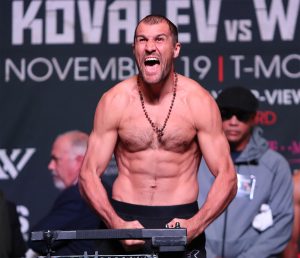
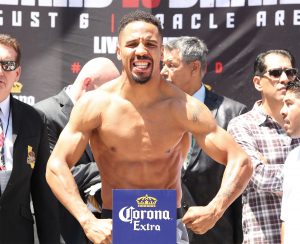
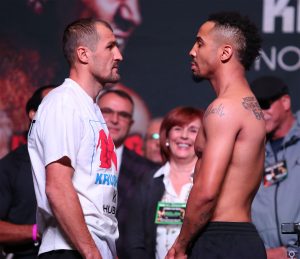
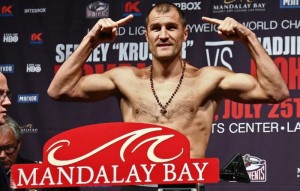
LAS VEGAS – On the scale, there was no difference. Not even a fraction of an ounce separated the two. It was 175 pounds even for each in a weigh-in that seems to reflect how tough it is to pick between Sergey Kovalev and Andre Ward.

The betting odds are almost as even as the scale was Friday for the light-heavyweight bout scheduled for Saturday night at T-Mobile Arena and HBO’s pay-per-view television. Talk in the press room tips one way, then another, favoring Kovalev at one moment and Ward the next.

It’s a fight that looks to be as close as possible. Each has 30 victories. Each has never lost. As advertised, it also should have a heavy impact on the pound-for-pound debate. The winner figures to get No. 1 recognition in the first bout between unbeaten fighters ranked among the top five in The Ring’s pound-for pound ratings since Felix Trinidad’s upset of Oscar De La Hoya in 1999.

The only real question is whether anybody really cares. Ticket sales have been slow. Seats at all prices were available Friday. Less than two years since Floyd Mayweather and Manny Pacquiao disappointed a record 4.6 million PPV customers, the boxing pay-per-view business has been in the toilet. Kovalev-Ward promoter would be happy – make that ecstatic – with 300,000 buys.

It’s anybody’s guess what a reasonable PPV expectation might have been in the heady days before Mayweather-Pacquiao. Kovalev-Ward has all the elements that would have made it a solid attraction. Maybe there would have been 500,000 PPV buys in the bout’s history, knockout power in Kovalev’s right hand and tactical skill in Ward’s overall ring IQ. It’s puncher versus boxer. It could be a classic.

For now, however, it might be fight that a lot of people wished they had had seen. That might represent a new beginning for a battered business. A great fight might lead to a rematch, a renewed appetite and perhaps a recovery. In the here and now, however, Kovalev (30-0-1, 26 KOs) and Ward (30-0, 15 KOs) can only take care of the immediate task that awaits them at opening bell.

The close nature of the bout has led to each camp trying to get an edge, which means there has been a lot of talk over the last few days.

“I think it’s simple,’’ Ward said moments after he stepped off the scale. “He doesn’t like me. I don’t like him. This will be my best performance of all time. I’m not leaving Las Vegas without those belts.’’

The belts – an acronym collection that includes the IBF, WBO and WBA light-heavyweight titles – belong to Kovalev, a Russian whom Ward has repeatedly called a bully.

“I’m not going to disappoint you,’’ said Kovalev, an unknown amateur in Russia whose steady rise began in North Carolina five years after Ward got big headlines for winning America’s last boxing gold medal at the 2004 Olympics.

In many ways, it’s an unusual fight. To wit: The purses are upside-down. Kovalev, the champion, is getting $2 million or less than half the challenger’s purse. Ward is getting $5 million.

“The challenger gets a boat load of money, but the champion don’t,’’ said Ward trainer Virgil Hunter, who has had a lot to say throughout press conferences and even weigh-ins. “I don’t understand it. Maybe, it’s not true. But it bothers me.’’

Over the last couple of weeks, Hunter has spent a lot of time confronting Kovalev trainer John David Jackson, questioning his credibility and even his readiness on the eve of the bout. As Kovalev and Ward posed after stepping off the scale, Hunter started in on Jackson in an exchange that proved to be the weigh-in’s only fireworks.

He told Jackson that Kovalev looked “a little dry,” suggesting that the Russian might have weakened himself in battle to make weight. Jackson replied, saying that Hunter isn’t taking the punches.

“Ward will,’’ Jackson told him.

Enough said.


Andre Ward never forgets the lessons from losses long ago

By Norm Frauenheim-
Andre Ward
LAS VEGAS – Andre Ward has done nothing but win for as long as just about anybody can remember. In fact, it’s been so long since a Ward loss that it takes a little research – or maybe an archaeologist – to figure out exactly when it happened. How it happened.

For a while, Ward’s loss happened he was 13 years old to Ernie Gonzales, who went on to fight to 29 pro bouts as Jesus. After some checking through amateur records, however, that has been corrected. The last loss, also as a 13-year-old, was in fact to John Revish, a former Louisiana junior-welterweight, Ward said.

Amateur records can sometimes as hard to verify as UFO sightings. But you get the idea. Ward’s combined record, pro and amateur, is otherworldly. Over almost two decades, the 32-year-old light-heavyweight hasn’t lost.

The 2004 Olympic gold medalist says he is 125-5 as an amateur. Add that to the 30-0 pro mark he’ll risk Saturday night against Sergey Kovalev at T-Mobil Arena in an HBO pay-per-view bout, and he is 155-5 as a fighter. Modern translation: He’s an adult who doesn’t lose, perhaps because of what he learned against Revish and Gonzalez. Lessons learned as a kid have stayed with Ward the mature fighter. To this day, he and his trainer, Virgil Hunter, recalls the defeats as though they happened yesterday.

“I remember how it felt and I remember telling myself that I won’t let it happen again,’’ Ward said Thursday before a formal news conference at the MGM Grand.

There’s an ongoing guessing game that Kovalev’s long powerful right will do enough damage to pound out a memory that Ward has so agilely, so smartly eluded for so very long. But don’t bet on it.

Gonzales, for one, wouldn’t. The former Phoenix fighter picks Ward to win by unanimous decision. These days, Gonzales, a one-time prospect who went 27-2 with 14 KOs as a middleweight, works with kids in a Houston gym when he isn’t driving a truck to support his family, which includes two sons, 9 and 5. He has watched Ward ever since he won a split decision over him in a controversial bout in Ontario, Calif., a few generations ago.

“I didn’t know who he was then, but I had begun to hear about him,’’ said Gonzales, who says the bout was fought at 139 pounds. “To get to Ward, I had to beat Timothy Bradley.’’

Yeah, that Timothy Bradley.

“Hey, I beat everybody,’’ said Gonzales, whose pro career ended in a crushing knockout loss to Adonis Stevenson in 2012 in Montreal.

Gonzales recalls winning a 3-2 decision. Instead of computer scoring, the bout he said was determined by five ringside judges. To this day, Ward and his trainer, Virgil Hunter, dispute the loss, almost as if it is as controversial today as it was a couple of decades ago.

“Ernie’s mom was one of the judges,’’ Hunter said Thursday.

But Gonzales remembers something else. He recalls a winning strategy. He said Ward was just learning how to use a counter punch.

“I kept my left hand out there and moved my back foot backwards, almost a full foot back,’’ Gonzales said. “He just couldn’t get to to me. But what I remember mostly is that he was a real nice guy. After the fight, we ran into each at the concession stand and he bought me a hot dog.’’

Gonzales looks at today’s Ward and sees a fighter who he believes can thoroughly frustrate Kovalev.

“To me, he’s a lot like Floyd Mayweather,’’ said Gonzales, who was a Mayweather sparring partner for Mayweather’s victory over Robert Guerrero in May, 2013. “It’s just really hard to predict what he’s going to do.’’

It’s only easy to predict that he won’t forget.


Ward, Kovalev and the enchanting unknown

By Bart Barry–
Andre Ward Post Fight
Here’s what’s going to happen Saturday at T-Mobile Arena in Las Vegas on HBO pay-per-view: American Andre “SOG” Ward will fight Russian Sergey “Krusher” Kovalev for the light-heavyweight championship of the world. Ward will verb, Kovalev will verb, and adjective noun will fight adverb until Noun has won a bloody, brutal noun.

In our new postfactual world what matters indeed more than everything else is what one witnesses with his own senses and experiences with her own emotions, and that courts the most attractive element of this fight: Aficionados do not, for once in years and years, have any certainty who will win a pay-per-view main event and have a chance to experience catharsis. Let us rejoice in that before we project a myriad of unrelated grievances on this combat spectacle. It’s OK to rejoice for once, really it is, without fixating on what is known or insisted by others.

Here, I’ll go first: I didn’t see Andre Ward grow up in a biracial home, and therefore don’t much care that it happened; I did not experience the Nagasakis-worth of radiation dumped in Lake Karachay, 100 km northwest of Sergey Kovalev’s hometown, and therefore don’t care much that it happened; I care deeply about what each man will do to the other with his fists and very little about why.

Is that a loss of empathy? No it is not. Empathy is a connection with another creature one experiences genuinely and spontaneously in the presence of that other creature; one does not successfully plan empathy; whatever sadness one feels for a stranger on social media is sympathy, not empathy, and thus open to entire industries committed to its manufacture and monetization. Such pitches are all a way of gaming others’ emotions, and one of the many admirable things about both these men is how little they’ve sold autobiography and identity in lieu of violence. Recently we’ve got more identity from them than before but that is attributable to a couple things: 1. Dreadful competition – since a tremendous stoppage of Chad Dawson four years ago Ward’s resume is, in a word, embarrassing; since making a signature win of a 50-year-old in 2014 Kovalev mostly has marked time and cashed checks – and 2. Floyd Mayweather taught HBO and the rest of the boxing industry this is how fights are sold (some department at Time Warner, we can be sure, has metrics and models, polling in effect, that prove this – and we now know how much more trustworthy big data is than intuition, don’t we?).

No aficionado is going to buy Saturday’s match because of post-Soviet food shortages or drug addiction in Oakland but, one theory goes, if we can get enough sentimentality in the eyes of casual sportsfans perhaps we can flush from his burrow that millionth pay-per-viewer who went underground the morning of May 3, 2015, and anyway aficionados aren’t going anywhere – which is true so long as you don’t keep count or, better yet, don’t publish the count (expect those Pacquiao-Vargas numbers right about the time we get the Cotto-Malignaggi tally).

The best Ward beats the best Kovalev every time they fight from now till their 50th birthdays, but will the best Ward be there to swap hands with Kovalev or will Ward’s weightgain and aforementioned competition send somebody less in the ring? Not if Ward has any say about it, one assumes, and Ward does but perhaps not so much as he and his trainer believe. Ward fetishizes control the way Mayweather did, for much the same reasons, though Ward’s control appears more self-directed than Mayweather’s, which often manifested itself in the way he handicapped and selected opponents – there’s no way in this life or the next Mayweather, in Ward’s position, would have acquiesced to a prime Kovalev.

So long as Ward is in control of himself in the ring Saturday Kovalev has very little chance of doing enough to win this fight. And there just isn’t enough unpredictable in Kovalev to believe otherwise will happen; he outworked old Bernard in every round, sure, but he didn’t hurt him and didn’t surprise him and that’s a problem because while there is no reason to believe Hopkins is a better prizefighter than Ward – greater, yes, but not better – there’s plenty of reason to believe Ward is 19 years younger than Hopkins. That matter of age is important because it speaks to activity, and relentlessness is the reason most intelligently given by those intelligent folks who believe Kovalev may beat Ward.

There’s an argument to be made for Kovalev’s power, too, perhaps, but reports of Kovalev hitting proportionally harder at 175 pounds than Mikkel Kessler or Carl Froch or Allan Green or Arthur Abraham hit at 168 do not feel credible, and Ward took shots from each of those guys and didn’t buckle a bit, so this old adage will favor SOG: Fighters gain weight on their chins more than their fists. Kovalev is sound and mean but not particularly imaginative and he’ll need to show imagination when Ward gets on his chest and wrestles him and fouls him and puts him in an honest-to-goodness fight.

Does Kovalev have the means, the will and fortitude and energy, to react courageously and violently to Ward’s provocation? Yes, and then some. That reaction will be part of Ward’s plan, though, and what happens next is what makes this the most compelling fight of 2016.

I think Ward pieces him up, KO-12.

Bart Barry can be reached via Twitter @bartbarry



Ward-Kovalev: Different roads lead to the same place

By Norm Frauenheim-
Andre Ward
Only the records are similar, almost identical. Unbeaten on one resume. Unbeaten on the other. But that’s where the similarities end.

Sergey Kovalev (30-0-1, 26 KOs) and Andre Ward (30-0, 15 KOs) come from different sides of the globe, grew up speaking different languages and eating different foods.

Then, there are their respective career paths. They began at opposite ends of the professional spectrum in a journey that will put them in the same dangerous place, a ring at Las Vegas’ T-Mobile Arena on Nov. 19, in a fight more intriguing than any over the last year-and-a-half.

Ward has the Olympic pedigree, gold in 2004 and the last American man to fight his way on to the medal stand’s top pedestal. When Ward was winning gold, Kovalev was virtually unknown, even at home in Russia.

Ward had fame before he answered his first bell as a pro. Kovalev toiled in anonymity, first in Russia, then North Carolina before anybody in the U.S. could pronounce his name. Now, these light-heavyweights are fighting on equal terms for perhaps the top spot in the pound-for pound debate.

“There’s no A-side and no B-side,’’ Kovalev promoter Kathy Duva of Main Events said this week during a conference call. “It’s two great fighters fighting each other. Sergey holds the titles right now, Ward has held titles in the past. Ward is a legendary fighter; Sergey is trying to become one. …There are certain fights that defy that A-side/B-side description and I think this is one of them.”

Ward, a slight favorite when the bout was announced, is considered the boxer. Kovalev is seen as the puncher. But their assigned roles in an anticipated classic are too simplistic. Both are blessed with ring intelligence as well as an ability to know when and how to adjust.

Kovalev gets the edge in power because he has the better knockout ratio and long, precise right hand as lethal as any in the business. Ward has the edge in boxing skill, in part because he a switch-hitter who seamlessly switches from left to right and back again. Show Ward a style, and he’ll adjust quickly and with chameleon-like subtlety.

The fight is fascinating, because of the psychology. It’s a thinking man’s fight and Kovalev thinks he has the edge.

“For me this is a mental fight,’’ he said. “It’s not who is stronger, but who is smarter and brings best skills into the ring and who is mentally stronger.’’

It’s an old game, one that Ward has played often.

“Mentally, it’s honestly the same to me,’’ he said. “Obviously, there’s a lot at stake and it’s a different challenge moving up in weight, pay-per-view, all of those things make it a little bit different. Whether it’s Alexander Brand or Sergey Kovalev, I approach every situation the same way. I wouldn’t be able to get to this level and stay at this level if I checked in and checked out.

“It’s the same dedication and it’s the same work. For me it’s about trying to be the best in sport where there’s little room for error. I understand that every time I step into the ring and leads to me making sure I prepare accordingly.’’

But the HBO pay-per-view bout ranks as a potential favorite among thinking fight fans because of that anticipated moment, or moments full adjustments and counter adjustments. To wit: Puncher becomes boxer; boxer becomes puncher.

Duva suggests that Kovalev might have an edge because of his life experience in an industrial corner of Russia

“I’ve seen Sergey demonstrate his mental toughness time and time again,’’ she said. “He’s been through more adversity in his life than most fighters have ever even contemplated. I’m aware that Ward has faced adversity, but I never heard Sergey talk about how boxing is a sacrifice, where we frequently hear from Ward about how it is. Sergey’s attitude towards boxing has always been, ‘Oh wow, this is a great opportunity and I’m so happy I’m doing it.’

“I know he has tough times and there’s days at the gym where he probably doesn’t feel that way. But his attitude has always been about loving his work, and loving what he’s doing. He can’t wait for the fight to start. He works hard because he wants to be the best. It’s not just his mental toughness, it’s his mental attitude, I think it’s very positive and I think that’s the thing that carries him.

“That and the chip on his shoulder. That has been there forever. Just wanting to prove he’s the best. You take that combination of work ethic, and chip on his shoulder and focus like a laser, and then loving what he’s doing. Sometimes, when he gets in the ring, he looks like he’s about to have a steak. That’s the kind of look on his face. I think that’s part of what makes it so much fun to watch him.”

The counter is Ward’s life experience, told for the first time in a poignant HBO documentary. Ward lost his dad.

“This is the first time that I really, really opened up,’’ he said. “From my standpoint, I’m a private person, Number One. Number Two, I’ve always wanted to respect my mom and dad. My dad was a dying addict. My mother is doing well right now and I’ve always seen the rags to riches, the kids that come from the ghetto, and I didn’t want to come into the game with that type of story preceding me.

“I wanted it to be about who I was as a person, about my talent, my ability. Then I felt like at the right time I’ll start to open up about it. It took twelve years. I’ve been a professional for almost twelve years now and it kind of got me going, where I just started to feel content with myself. I feel like my supporters and my fans know me and know part of my story. But I felt it was important to open up and pull back the curtain and let them know it hasn’t always been easy.’’

No, it hasn’t. Not for either fighter. Both have been tested and tempered by different kinds of adversity that has brought them to a time and place that might be defining.
Attachments area


Playing out the Pacquiao hand

By Bart Barry-
Pacquiao_trains_150422_001a
Saturday on UNLV’s campus or thereabouts Filipino senator Manny Pacquiao unanimously decisioned American welterweight titlist Jessie Vargas in a good match that proved Pacquiao’s fighting class has not dissipated fast as the welterweight division’s. Vargas was a top-10 guy at 147 pounds whom Pacquiao beat conclusively without exerting more than 45 seconds of any round, the same way Pacquiao conclusively beat Timothy Bradley, a top-5 guy at 147 pounds, in April.

Pacman’s fighting capacities have not diminished nearly quick as American interest in his capacities – as represented by purse guarantees – have: His reflexes and savagery are down about 20-percent from where they were before Mayweather while his Saturday purse guarantee was about 20-percent of what it was before Mayweather. Of course an 80-percent paycut from $20 million still makes Pacquiao what American conservatives call a “job creator” and Pacquiao at 80-percent remains very much better than other titlists in the welterweight division though nothing close to enough to beat Floyd Mayweather till Money’s 45th birthday.

Pity that Manny cannot be remanded to a cryogenic lab till 2021, then, especially if greed and desperation force a rematch of the Fight to Ruin Boxing which they will if Manny and his promoter have any say because Manny’s promoter has nary a better option – whatever talent Bud Crawford has, whatever doggedness Timothy Bradley maintains, neither guy has more than a city much less a state much less a country much less a global region he captivates or might monetize.

The preamble of the moment, the consensus throatclearing, goes something like: Pacquiao, while not nearly the man he was in his prime, is still very good. That’s about half right. Pacquiao actually is much nearer the man he was in his prime than we say he is; what has changed is our perception – our memories and our expectations and our tolerance and ourselves generally.

That’s a bold statement, Mr. Barry, are you being dumbly controversial to court traffic in the spirit of contemporary politics?

Yes! actually no. I watched the Russian rebroadcast of Pacquiao-Vargas on Sunday morning (pro tip: putting the words ““???? ???” in front of your YouTube search criteria for most any match gets you an early rebroadcast without perception-skewing commentary to suffer) and then, ready for a mindbending trip through the fourth dimension, I called up Pacquiao-Morales 1, a match Pacquiao lost, sure, but a Pacquiao 11 1/2 years younger and 15 pounds smaller and presumably quicker than today’s iteration. What I expected was the nonlinear thing that happens when you juxtapose any heavyweight title match of the 1990s with a Wlad Klitschko fight – wait, you mean heavyweights once fought with bent knees and courage? (OK, that’s not fair: Klitschko fought his courage most every title defense) – but that’s not what I got.

Pacquiao was more explosive and frankly weirder back in 2005 but he didn’t have fractionally the wiles he has today, and yes, that’s allowing for the feral qualitative disparity between Erik Morales and Jessie Vargas. Pacquiao’s head movement is perhaps the largest difference between then and now and that’s a tribute to Pacquiao’s latterday conditioning. Head movement is rarely a matter of moving one’s head; effective head movement is at least pendulous upperbody movement but best when born of the feet and knees and thighs. Eleven years ago Pacquiao windshield-wipered his hands back and forth in lieu of moving his head and Morales hit him often and hard with the Mexican’s worldclass jab.

Part of what doomed Vargas, aside from trying to do what Juan Manuel Marquez did without understanding why Marquez thought to do it and therefore a hundred microscopic adjustments of both physique and character Marquez learned to make (ain’t nothing like the real thing, Jes-sie) was Vargas’ inability to jab at uncertainty after Pacquiao snatched his confidence in round 2. Nearly no one can jab confidently at uncertainty – if there were anything natural about it the double-end bag’d not exist – and Pacquiao’s creation and maintenance of defensive uncertainty (offensively he’s been a wildcard his whole life) is one sure source of his longevity.

And even at 80-percent Pacquiao is fast in an elite way today’s fighters are not. There are quick hands aplenty out there, Showtime Sports, formerly known as The PBC, now bursts with them, but that’s different from being fast in a way that instantly closes space as Pacquiao does in yards, not inches. While Pacquiao had seen a few dozen Vargases in his career, Saturday it was clear in the match’s second half Vargas’d not before seen a Pacquiao, and some combination of fatigue and inactive offensive imagination and hyperactive defensive imagination (anxiety about consequences) kept Vargas’ hands at home while Senator Pacquiao, ever a vote-counter, did barely more than he needed do to win each round.

Never again will Pacquiao be quick to the breach as he was the night Marquez pistonstroked him, in part because every opponent now chants “jab-feint / leapback / jab / cross” through every trainingcamp, in part because Pacquiao no longer thrills quite so much at the fray, and in part because there’s no need. Today Senator Pacquiao resides in a curious yet lucrative space: He’s good enough, still, to unify the welterweight division and not nearly good enough to win more than two rounds against Mayweather.

At least it’s lucrative.

Bart Barry can be reach via Twitter @bartbarry


Motivational Chip? Vargas might have one in quest to upset Pacquiao

By Norm Frauenheim-
Vargas_DeMarco_weighin_141121_002a
LAS VEGAS – There was enough room on Jessie Vargas’ shoulder for a world title belt when he faced Manny Pacquiao in the nose-nose, eye-to-eye ritual for cameras Friday after the formal weigh-in for their welterweight bout Saturday at Thomas & Mack.

Apparently, that chip didn’t get in the way.

That proverbial chip — and all the motivation it is supposed to represent – has been among the many story lines leading up to Top Rank’s pay-per-view card (6 p.m. PT/9 p.m. ET). Vargas has been friendly enough. The bigger the media, the friendlier he became. He seldom betrayed any sign he might be angry at being the so-called B-side despite his ownership of the WBO title.

But it’s there, Vargas trainer Dewey Cooper said.

“He’s kind of pissed at you all,’’ Cooper said to reporters during a roundtable session. “I’m trying to keep him clam about all of this.’’

Mission accomplished, at least through the last days and final few hours before opening bell to the scheduled 12 rounder. Vargas has kept his emotions in check, saying the expected.

“I feel great,’’ Vargas (27-1, 10 KOs) said after stepping off the scale at 146.5, nearly two pounds heavier than Pacquiao, (58-6-2, 38 KOs) who was at 144.8. “My motivation is to prove I’m the best in the division. Pacquiao is a legend. Fighters who have beaten him become legends. I plan to be a legend.’’

Odds say otherwise. They were at 7-1 in favor of a Pacquaio victory Friday in the crowded sports book at the Wynn, the host hotel. The one-sided line suggests a blowout victory for Pacquiao, a Filipino senator who hopes to add a major boxing championship to his political title.

Pacquiao’s historical pursuit and his international celebrity are irresistible for the media. In prefight interviews, there’s also a sense that Pacquaio’s energy and instincts have somehow been reborn. He’s been thoughtful and often funny. His English has never been better. In part, that’s because the Filipino Senate conducts its business in English. He has had to speak it and write it every day since he won a Senatorial seat in May.

That and more mean it has been easy to overlook Vargas. Maybe, too easy. But that’s nothing new for Vargas, who is a decade younger and four inches taller than Pacquiao. He’s made a career out of being overlooked.

In an impressive stoppage of Sadam Ali last March at the D.C. Armory in Washington, Cooper said Vargas didn’t get any respect. Didn’t get a dressing room either.

“We were out in a hallway, near the door,’’ Cooper said. “We were brought in as a sacrificial lamb.’’

But the lamb walked out of that hallway with a title he won with power few thought he had. The question is whether any of that power will be able to slow down and perhaps even stop Pacquiao. The, there’s a question whether Vargas might have a bit too much motivation. He is promising to be aggressive from the beginning. Pacquiao welcomes that prospect. So does Pacquiao trainer Freddie Roach.

“If he comes too aggressively, he gets knocked out early, maybe in four or five rounds,’’ said Roach, who says Pacquiao is more motivated for a stoppage than ever in part because of the media reporting repeatedly that he hasn’t scored one since 2009.

Timothy Bradley, who will be at ringside as an analyst for the pay-per-view telecast, has fought both. He believes Pacquiao’s overall speed will be too much for Vargas. He picked the Filipino to win. But he also says that Vargas’ is very tough.

And maybe motivated just enough.

Best of the undercard: WBO featherweight champion Oscar Valdez Jr. (21-0, 18 KOs), of Tucson and Nogales, Mexico, makes his first title defense against Japan’s Hiroshige Osawa. Valdez (21-0, 18 KOs) weighed 125.25 pounds. Osawa (30-3-4. 19 KOs) was also at 125.25.

In the immediate wake of Valdez’ victory for the WBO title in July, Top Rank had tentative plans to stage the two-time Mexican Olympian’s first defense in Tucson, where he went to school. His mom also still lives in the southern Arizona city. But Arum opted to put him on the pay-per-view card. Arum said this week that he still plans for a Valdez bout in Tucson, perhaps next year when he is expected to fight at least four times.

In another undercard bout, Nonito Donaire (37-3, 24 KOs) faces Jessie Magdaleno (23-0, 17 KOs) in a junior-featherweight bout. Donaire weighed 121.8 pounds. Magdaleno was 121.1. Donaire has talked about moving back up to featherweight. If he beats Magdaleno and Donaire beats Osawa, Donaire-Valdez is a possibility.


Oscar Valdez Jr. poised for the next step in his plan to be a longtime champ

By Norm Frauenheim-
Oscar Valdez
LAS VEGAS – There’s fusion in cooking, music and sometimes fighters. The best of them are often a product of attaining that perfect mix. It’s deliberate, yet looks natural when complete. It’s a process that is beginning to look a lot like Oscar Valdez Jr.

Valdez already has a major title. But his WBO featherweight belt is just the beginning, one ingredient in the evolving face of a new champion who intends to be around a lot longer than an interim title.

“The thing is not to became a world champion, but to stick around as one,’’ Valdez said Thursday at The Wynn during at a news conference for his first title defense on the Manny Pacquiao-Jessie Vargas pay-per-view card at Thomas & Mack on Saturday (6 p.m. PT/9 p.m. ET).

Valdez is facing an unknown Japanese featherweight, Hiroshige Osawa, who is a WBO-ranked contender fighting in the United States for the first time. Osawa doesn’t appear to be much of a risk to take the title Valdez won in a powerful second-round stoppage of Argentina’s Matias Rueda in July.

But don’t say that to Valdez, who grew up in Tucson and in Nogales on the Mexican side of the border with Arizona. Valdez learned two languages, a couple of cultures and respect for both of them. He looks at Osawa and sees an equal.

“The more I see of him and the way he keeps coming at you, the more I realize he’s a tough opponent,’’ Valdez said.

It would be no surprise if Valdez (21-0, 18 KOs) sees Osawa (30-3-4, 19 KOs) flat on his back sometime early in a scheduled 12 rounder. But it would have been a huge surprise if Valdez had been anything but respectful in interviews before opening bell. He’s as disciplined with his manners as he is with his punches.

“A dedicated, serious young man,’’ his promoter, Bob Arum, said.

A powerful one, too.

His power has quickly caught the attention of the best at 126 pounds. It’s even surprised him.

“To be honest, it has,’’ said Valdez, a two-time Mexican Olympian. “I knew I had some power, but not this kind.’’

The power is reflected in stoppages in all but three of his 21 bouts. Valdez says his father, Oscar Sr., told him that the power is the result of his speed. That speed comes from an unlikely place. His dad told him that it comes from the water.

“We’re swimmers,’’ Valdez said. “When I was a kid, I swam competitively for a few years before I began to spend more time boxing in the gym. I was never big enough to be a competitive swimmer anyway.’’

Yet, he and his father believe his speed is a byproduct of his days in the pool.
Fast hands and fast feet complement each other in a increasingly fluid style that over the last few last bouts appears to flow from round to round and over one opponent after another.

Who’s next? Maybe Nonito Donaire. Donaire is on the undercard Saturday against Jessie Magdaleno, who is managed by Valdez manager Frank Espinoza. If Donaire beats Magdaleno at 122 pounds, he has talked about moving back up to 126, possibly in a bid for Valdez’ title.

“I’m looking for Jessie to win,’’ Espinoza said. “I’ll have a better plan after Saturday night.’’

An alternate plan might be as intriguing as any. Arum is talking to Al Haymon, which means the PBC’s stable of great featherweights – Carl Frampton, Leo Santa Cruz, Lee Selby, Abner Mares and Jesus Cuellar – might be on Valdez’ horizon. Mares faces Cuellar on Dec. 10 in Los Angeles.

“I’d love that fight (Mares),’’ said Espinoza, who managed Mares before he jumped to Haymon. “It would be a great LA fight. But for now, I want to keep Oscar as busy as possible. He really loves to fight. We hope to have him back fighting in March.’’


Pacquiao says he has given away half of his boxing income

By Norm Frauenheim-
Pacquiao_Wildcard_150423_004a
LAS VEGAS – Two-hundred-and-fifty million dollars mean all kinds of things. A quick check with Google will deliver a list of hedge finds, tax evasion, lawsuits, Donald Trump, luxury condos, good bets, lousy bets and maybe Floyd Mayweather Jr. posing next to an open suitcase full of cash.

It’s all there, except for Manny Pacquiao’s generosity. It’s mostly been a story about anecdotes. He builds homes for Filipinos. He buys a fleet of new boats for a coastal town’s fishermen. His promoter, Top Rank’s Bob Arum, has called him the Pacific nation’s one-man social welfare system.

For the first time, however, maybe a number can be attached next to an inexhaustible generosity from a guy who never seems to stop fighting or giving. Best estimate: $250 million.

“Every income I receive in boxing, almost half of it goes to the less fortunate,’’ Pacquiao said Wednesday before a formal news conference at The Wynn for his pay-per-view bout against WBO welterweight champion Jessie Vargas at Thomas & Mack Saturday night (6 p.m. PT/9 p.m. ET).

Pacquiao’s career income for purses and endorsements is at $500 million after his April victory over Timothy Bradley, according to Forbes. Half of that adds up to a lot homes, fishing boats and meals for Filipinos who need them. It also amounts to some – make that a lot – of political clout for the fighter who was elected to the Filipino Senate in May.

As a Senator, Pacquiao’s duties include membership on 15 committees, two of which he chairs, according to Arum. His life as a full-time Senator resumes on Tuesday, just a few days after at least one more fight as a full-time boxer. The question of whether he continues with full-time roles in both the political and boxing rings looms over his bout with Vargas.

“I’m sure he’s going to be known as a great Senator,’’ Vargas said during the news conference in a comment that said he intended to end the Filipino’s greatness in boxing.

Without boxing, it’s unlikely that Pacquiao could continue to give away the kind of money that is funding the current construction of 1,000 houses in Sarangani Province. All of the money for the land, homes and labor is coming out of Pacquiao’s pocket. That’s just the latest example of Pacquiao, a people’s champ in more than just one way.

“I don’t like politics,’’ he said. “I hate politics. After each fight, half of my income goes to the poor.

“But I don’t like to announce it.’’

He doesn’t like to brag, either. Not when he can give.


Boxing: Bernard Hopkins Farewell Fight

Bernard Hopkins
Bernard Hopkins is scheduled to step into the ring one final time on December 17th. The 51-year-old boxing legend will face Joe Smith Jr. in a light heavyweight bout at the Forum in Inglewood, California. Hopkins is a shoo-in for the Boxing Hall of Fame five years after he retires. Here is a look back at the career of The Executioner.

Convict Turned Fighter
Hopkins began his boxing career in 1988 after he was released from prison. He served four and a half years for armed robbery, and it was in prison where he discovered his boxing ability. He immediately turned pro after his release, and he lost his first pro fight to Clinton Mitchell. The loss really discouraged him, and it would be 16 months before he would fight again.

First Win
Hopkins bounced back to win his second fight at middleweight, beating Greg Paige on February 22, 1990. This victory kicked off an incredible run for Hopkins. He won 22 straight fights to shoot up the middleweight rankings. This led to his first big fight, a matchup with Roy Jones, Jr. for the IBF Middleweight title on May 22, 1993. Hopkins lost in a unanimous decision.

Gaining the Middleweight Title
Later that year, Hopkins again fought for the IBF Middleweight title. This fight was against Segundo Mercado in Quito, Ecuador. Hopkins suffered from altitude sickness in the fight and was almost knocked out before he came back to earn a draw. The two met again on April 29, 1995, and Hopkins scored a TKO against Mercado to claim the title.

Middleweight Unification Fight
On September 29, 2001, Hopkins fought Felix Trinidad in a match to unify the various middleweight belts. Hopkins was an underdog in the fight for the first time in years, and he actually bet $100,000 on himself to win. Hopkins thoroughly outclassed Trinidad, knocking him out in the 12th round to shock the boxing world. This victory made Hopkins the first undisputed middleweight champion since Marvin Hagler held all the belts in 1987.

Hopkins vs. De La Hoya
The biggest fight of Hopkins’ career came on September 8, 2004 against Oscar De La Hoya. This was a huge payday for Hopkins, earning him $10 million. He knocked out De La Hoya with a vicious left hook to the body. The fight made them friends. Soon after, De La Hoya would invite to Hopkins to become his business partner in Golden Boy Productions.

Hopkins ended up successfully defending the middleweight title 20 times, which is a record. His eventually lost the title championship in a split decision against Jermain Taylor on July 16, 2005. He has fought sporadically over the last decade with most of his fights at light heavyweight.

No Easy Contest
Hopkins is a fighter who seeks out challenges. He is not going to ride off into the sunset against a patsy. His opponent Smith is a tough Irishman who has a 22-1 record with 18 knockouts. Hopkins wants to go out with a bang, saying his aim is to knock Smith out. With so much knockout power in this fight, it should be an exciting contest that ends with one fighter being counted out.


Manny Pacquiao: Overstaying the welcome

By Bart Barry-
Pacquiao_reporters_150428_002a
Saturday at Thomas & Mack Center in Las Vegas, Filipino former world champion and current senator Manny Pacquiao matches himself with American welterweight Jessie Vargas in a pay-per-view fight televised by promoter Top Rank. Pacquiao retired in April after decisioning Timothy Bradley in their third match but returns seven months later because that was always the plan. Vargas lost to Bradley a month after Pacquiao lost to Mayweather in 2015 but recently stopped Sadam Ali and got chosen for Saturday’s fight because that flash of power in March is expected to prove anomalous – if Pacquiao or Top Rank thought there were any way Vargas’d stretch Pacquiao this fight would not happen.

There isn’t much to be done but write about this spectacle however undeserving. In bygone years the hungerstrike we experienced these last howsoever many months would induce an appetite coiled as a spring and ready to leap towards a million buys after a month of promotional coverage under the auspices of reportage, but no more. There are but two types of boxing coverage that survive today in the United States: the financially selfinterested and the quixotic.

They’re easily identified. Positive coverage of Pacquiao-Vargas is financially selfinterested, the line between publicist and reporter gone to the publicists, and quixotic coverage, those who cover the sport from habit or nostalgia, is not positive. No American without financial selfinterest understood Pacquiao’s retirement and even less his comeback from that faux retirement – since declaring Pacquiao’s third match with Timothy Bradley in April the last time Pacquiao would fight did little to promote the match and according to Pacquiao’s promoter Bob Arum did not begin to offset the damage done the fight’s marketing by Pacquiao’s strongly worded reiteration of his strongly held beliefs about others’ sexual orientations or the lasting damage done the sport by Pacquiao’s terrible 2015 match with Floyd Mayweather.

Yes, the shoulder match. No one has forgiven Pacquiao for that halfassed performance, nor should he, but most of us have forgotten it – until Pacquiao decides to promote his match with Vargas by telling us he’s healed and ready for a second serving of Money. It’s the wrong message because it makes some of what few consumers remain interested enough in our sport to purchase a match from a promoter’s website reconsider that purchase for fear their support might launch another yearslong buildup to another terrible superfight no one asks for anymore, and Richard Schaefer just began a comeback of his own, too, in case more nostalgic dissonance were craved (incredibly he says fans approached him at fights and told him the sport needs him).

*

COMMERCIAL BREAK
Boxing’s only eight-time world champion and sitting senator returns Saturday in a match you can purchase through his promoter’s website because, in a historic show of ungratefulness, HBO and Showtime and all the terrestrial networks on which Pacquiao was possibly rumored potentially to fight for the last eight years declined to pay retail prices for what worn and defective merchandise they’re now offered.

Camera-phone footage indicates the Senator is in the best shape of his life.

“Manny’s in the best shape of his life,” reported Coach Freddie from training camp. “I know I’ve said this each of his last 12 fights, or more, but this time? The best. Unbelievable.”

*

Pacquiao looked quite good against Timothy Bradley seven months ago, better than Jessie Vargas did, but just because Vargas lost the Pacquiao sweepstakes 19 months ago does not mean Vargas lost the Pacquiao sweepstakes. Vargas did after all clip Bradley at the end of their match and may very well have . . . if only the referee . . . in an unprecedented act of interference . . . the very integrity of the sport . . . and probably deserved to win by knockout, something Vargas’ promoter was not at liberty to disclose while selling Pacquiao-Bradley 3, but now after a closer look thinks all aficionados should revisit.

Talk of Pacquiao’s milling with someone who might beat him like Terence Crawford and make Pacquiao actually retire succumbed this summer to sobriety and brought us limping to Saturday’s spectacle, possibly a tuneup for Pacquiao’s future match with middleweight champion Gennady Golovkin, a rich promotional subplot given how much press Golovkin’s trainer receives for threatening the world’s best light heavyweights while trashtalking a junior middleweight and actually fighting a welterweight.

Pacquiao press releases now include airlines and flight numbers in the hopes of materializing an enormous crowd at LAX, something worthy of promotional footage on SportsCenter, alas. The American fight scene to which Pacquiao returns for Saturday’s fight is worse than the one he visited in the spring but more apparently awful to Pacquiao because, one assumes, Pacquiao’s previous purse guarantees were voided by his retirement and the dearth of interest the Pacquiao brand now generates among cable-network executives – before one considers what American consumers now know of politics in the Philippines complemented by our own fatigue with domestic politics. One begins to wonder if promoting Pacquiao as a successful Filipino politician still is the sage tact it once appeared.

Or perhaps all this is superfluous because nobody is about to discover Manny Pacquiao; those of us interested in Pacquiao enough to purchase Saturday’s fight, or heaven help us travel to it, know Pacquiao well enough to know how steadily his capacities have eroded since that 2012 encounter with the Marquez spearchisel and aren’t any longer candidates for a Pacman conversion. We know with Pacquiao we are either at the beginning or the middle part of the embarrassing stage many great prizefighters end their careers with. However extraordinary Pacquiao was in ascent, his descent is all too ordinary.

Bart Barry can be reached via Twitter @bartbarry


A Senator’s Fight: Pacquiao hopes to add Champ to his political title

Pacquiao_workout_150428_001a
By Norm Frauenheim-
They call him Senator these days. The hope is that they can call him Senator Champ in about 10 days. Manny Pacquiao is seeking what is believed to be an unprecedented combo.

Senators get called a lot of things and as — Donald Trump keeps proving at an ad nauseam pace – most are a lot more insulting than honorable. But even a Filipino version Trump might have to use the double honorific when addressing Pacquiao if he beats Jessie Vargas on Nov. 5 at Las Vegas’ Thomas & Mack for the WBO’s welterweight title.

Titles of every kind are nothing new to Pacquiao, who has already been a Filipino Congressman. He also jumped from Command Sergeant Major to Lieutenant Colonel in his nation’s military reserve.

The leap in rank from enlisted to officer had to have been something of a battlefield promotion. Pacquiao’s battlefield has always been the ring. Eight world titles on that front have been the storyline and the propellant in his phenomenal rise from impoverished street kid to high political office.

It’s hard to even hazard a guess as to where it will all lead. There have been times when even the Filipino presidency has been mentioned as a Pacquiao possibility. For now, it’s just safe say it depends on how the 37-year-old Pacquiao fares against an improving Vargas, who is a decade younger and appears to be more dangerous than the 9-to-1 odds against him suggest.

Throughout the buildup for a pay-per-view fight that Top Rank will telecast, much of the talk has been about Pacquiao’s job as one of 24 Filipino Senators. The questions are there, of course, because there is nobody in any Senate like Pacquiao.

“Manny has always been a busy person but because of the Senate he seems to be a lot more serious than anything else he has done,’’ Pacquiao trainer Freddie Roach said during a conference call this week when asked about how training went while their camp was still in the Philippines. “He is in Senate sessions on some nights until 7:30 or 8:00 at night and, when he is done, we go right to the gym.’’

There was no distraction, Pacquiao said when repeatedly asked the inevitable question. There was only time management and the discipline to sustain it.

“The most difficult part of training in the past has always been when I do a bad job of managing my time,’’ Pacquiao said. “This time I managed my time and disciplined myself from going to my work to my training and that’s what I did in the Philippines. I don’t have any time to spend with my friends – just time for hard work.’’

The real answer, of course, won’t be there until opening bell. That’s when we’ll know if a full-time Senator can still be a full-time fighter.

To be sure, Pacquiao has been busy with a legislative agenda and issues that have confronted his country.

“Right now I am pushing for the establishment of a boxing commission in the Philippines,’’ he said.

He added that he is “also sponsoring the restoration of the death penalty.”

Then, there is the Philippines new president, Rodrigo Duterte, who has begun to generate some Trump-like controversy. Duterte told U.S. President Barack Obama that he “could go to hell” after Obama’s criticism of his push for draconian penalties for drug pushers.

Duterte also went to China and Japan, saying he wants to split with the U.S., a longtime ally. Then, Pacquiao landed in Los Angeles for the final stretch of training. Yeah, that question was inevitable, too.

“He has clarified everything about the relationship between the United States and the Philippines and it is a healthy relationship,’’ Pacquiao said when asked about Duterte early in the conference call. “We all respect his statement and he clarified it already.

“The bond between the United States and the Philippines is one of longstanding and there is a great kinship between the people of our two countries.’’

Pacquiao’s career has always been about multi-tasking. But tasks outside of the ring have gotten a lot bigger since the days when basketball and karaoke were the potential distractions.

He’s older now, which means wisdom and more discipline, yet also potential erosion in the physical qualities that have made the legend. We know about the power outage. He hasn’t scored a stoppage since 2009. That might be because he’s at 147 pounds instead of a more natural 140. But time is an inescapable factor.

He is a young Senator. But is he an old fighter? Against Vargas, we’ll find out.


Chocolatito City, part 5

By Bart Barry-
Roman Gonzalez (640x360)
In Tokyo on Sept. 5, 2014, Roman Gonzalez became the second Nicaraguan prizefighter to become a three-division world champion, putting him deservedly beside his late mentor Alexis Arguello, and it brought more emotion than he appeared to expect. Gonzalez marked the achievement and defense of his other world titles with understated celebrations but not in Tokyo. His third championship won, his blue gloves folded on his raised brown forehead, Gonzalez wandered in circles sobbing.

By early 2014 Chocolatito’s postfight comportment had begun to manifest nothing quite so much as gratitude, perhaps life’s most universally attractive quality because it confidently expresses something akin to humility but better: However much I deserve, I’ve received slightly more, and I’m aware it didn’t have to be like that. Maybe Chocolatito’s gratitude began with his religious devotion – by now he wore “Dios Te Ama (God Loves You)” on the back of his every pair of trunks – or perhaps a simple, rational accounting led him to recognize he was given superior athleticism and a mentor like El Flaco Explosivo, both exceptional and exceptionally available, but his sense of atonement certainly came from his deep religiosity and began showing itself in the way he treated opponents immediately after bludgeoning them with a talent God gave him to hurt other men deeply and permanently.

If Chocolatito’s calculus did not figure how much more permanently he would hurt opponents at higher weightclasses, men whose thicker necks and larger bodies absorbed more concussive force while their brains did not, he intuited it and began to clean his opponents’ faces and look after their wellbeings more firmly in 2014, instructing the trainers of the men he felled where to apply icepacks and how to look after their charges. There was nothing unprofessionally merciful about what Chocolatito did while a fight was on, though; he realized combat with larger men brought disproportionately more peril, especially when they were hurt, and he finished them with his same quickness as before and increased ferocity. But he saw in the men’s sudden imbalance and brokenspiritedness how much dangerously further these larger men’s bodies and wills took them after their brains wanted no more. Too confident to doubt his power as he fought larger opponents Chocolatito kept a private tally of how harshly he must treat these larger men – the greater sums of fully leveraged, completely pronated, precisely placed punches he now delivered them.

Because his purity of technique went nowhere. Properly grown in his new 112-pound division, trim and light once more, Chocolatito began fights with uppercuts to the head as diversions from what hooks he planned for the body to sap what strength kept the hands highly protective till they dropped and others’ unconsciousnesses went irresistibly to his hooks and crosses. He didn’t mind missing in his new weightclass either – a return to indifference: So long as a punch was balanced properly and executed with intent it mattered little if it landed because it cost even less to stop it and cocked its successor anyway and that one’d land.

Gonzalez needed to throw every punch wickedly in his new division, a lesson processed in Chocolatito’s six-round February beating of Mexican Juan “El Loquito” Kantun in Chiapas and three-round April leathering of Filipino Juan Purisima in Japan, because his handlers knew he was a generational talent they didn’t intend to fiddle in a nostalgia quest for unification, belt-collecting or purse-aggrandizement: Chocolatito’s first title fight at flyweight was against the division’s best man, Japan’s Akira Yaegashi, for The Ring’s flyweight championship, in Tokyo.

Yaegashi was larger than Chocolatito and stronger and more physical and forced the Nicaraguan backwards with jabs in the first round. Chocolatito retreated and counterpunched but didn’t run, and guarded against Yaegashi’s invitational traps and lowered hands and ropesward stumbles. In round three Yaegashi opened a hook off his cross, 2-3, and Chocolatito’s 3 was shorter and corkscrewed the champion to the mat. Yaegashi rose undissuaded and less chastened and continued a spectacle whose violence befit its world-championship occasion. Five rounds of combat did little to soften the Japanese and Chocolatito met in round 9 a belligerence nearer Yaegashi’s very best than he faced till then. The desperation with which Yaegashi opened the ninth belied his resources and betrayed his hopelessness, and 39 prizefights and thousands more hours of sparring and their tens of thousands of lessons in completing patterns, all, told Chocolatito th’t Yaegashi was on his way out and there was nothing to be done now but throw punches to the head to raise the guard then throw punches to the body to lower the guard then throw punches to the head till either the referee’s forbearance or Yaegashi’s consciousness lost attrition’s race, and it was a tie when Yaegashi dropped from physical failure and concussion.

Chocolatito needed a signature win no more than Leo Tolstoy needed a signature story – such talents don’t define themselves like that – but he had one just the same against a larger man who made him make creative choices like ending combinations with a jab, youth-boxing style, and so in 2014 Gonzalez was the world’s best prizefighter even while the world argued about great fighters well past their primes and good fighters lollygagging through their primes. Chocolatito returned to Japan two months later for his first flyweight title defense and fourth match of 2014 and wrecked Filipino Rocky Fuentes in six rounds then brought his championship home to Managua and began 2015 by roughly disciplining Mexican journeyman Valentin Leon for 6 1/2 minutes.

After that, things serendipitous happened for Gonzalez and HBO and aficionados. Y’all know the rest of the Chocolatito story from here.

Bart Barry can be reached via Twitter @bartbarry


Requiem for a Great White Hope

By Norm Fraueneheim-
donald-trump
The third Donald Trump-Hillary Clinton debate, the only fight worth watching throughout a barren October full of cancelled and postponed bouts, was anther example of how closely politics and boxing are linked by language, tone and turmoil.

History, too.

The more I watched Trump, the more I thought of a Great White Hope. He’s just another one and – if the polls are accurate – he’ll go the way of James J. Jeffries and Jerry Quarry.

Jeffries, the original White Hope, quit in the 15th-round against Jack Johnson on July 4, 1910, in Reno, Nev. Then, there was Jeffries’ successor, Jerry Quarry, who was saddled with an unwanted title in losing to Muhammad Ali in Ali’s 1970 comeback from a suspension for refusing to be drafted during the Viet Nam War.

Over more than a century, The Great White Hope has become a piece of Americana, memorialized in a Broadway play, later a film and then part of a Ken Burns documentary, Unforgivable Blackness, for PBS.

It’s an old story. A current one, too.

It was all there, all over again, Wednesday in the face of Trump, who had tried to cast doubt about Barack Obama’s right to be president by questioning his birthplace and now confronts Hillary Clinton for the political arena’s heavyweight title.

Trump turned each of the debates into a boxing new conference. It’s as if he learned the art of insult, confrontation and chaos during his days as an Atlantic City casino owner in business with Don King and Bob Arum.

Arum, by the way, had tickets to the debate at Las Vegas’ Thomas & Mack Center, according to ringtv.com. Hope he got good seats. Arum, a Clinton supporter, says Trump still owes him $2.5 million for Evander Holyfield’s 1991 decision over George Foreman.

The fact that Trump and Hillary came to Vegas for the last faceoff in their trilogy couldn’t have been more appropriate.

It’s where Mike Tyson took a piece of Evander Holyfield’s ear. It’s where a parachutist named Fan Man dropped into an outdoor ring like the 82nd Airborne midway through a Holyfield-Riddick Bowe bout. It is a where rigged – one of Trump’s favorite words – is another way of saying buyer beware to every customer entering one of The Strip’s casinos.

It’s where boxing and politics met all over again, with pundits using words created by boxing writers.

The media, pre and post-debate, were full of head fakes and body blows and KOs. Pre-debate, I listened to MSNBC’s Chris Matthews, who sounded more like Michael Buffer than sober pundit. Matthews pounded the hype drum, saying everything but “Let’s Get Ready To Rumble.’’

After the debate, the various networks included moderators and guests who had to shout above crowds that shouted and chanted like rival fans at post-fight news conferences.

I heard Fox News’ Sean Hannity, who sounded a lot like Trump’s Towel Boy. Hannity’s analysis favoring Trump reminded me of former ringside judge C.J. Ross, infamous for one card that favored Timothy Bradley in a controversial decision over Manny Pacquiao in their first fight and another that scored Floyd Mayweather’s one-sided victory over Canelo Alvarez as a draw.

I’m not sure what Matthews was hyping. I’m not sure what in the hell Hannity heard or saw. But I am certain that I had witnessed another Great White Hope still on the wrong side of history.


Chocolatito City, part 4

BY Bart Barry-
roman_gonzalez
Roman Gonzalez made the sixth and final defense of his light flyweight title on Nov. 17, 2012, at Los Angeles’ Sports Arena against Mexican Juan Francisco “El Gallo” Estrada, a defense difficult enough to be Chocolatito’s last at that weight one way or another. Gonzalez had by then grown too large to make 108 pounds effectively and very nearly gave away too many opening rounds to decision Estrada – who since losing to Gonzalez has gone 8-0 (4 KOs) and beaten Brian Viloria and stopped Giovani Segura and iced Hernan Marquez.

The unfailing benefit for the aficionado of watching a great fighter make matches against increasingly larger foes is the adjustments the great fighter necessarily makes because what works against a man smaller than you often fails against a man larger than you and very few professional athletes grow into new physiques immediately or properly. Exceptional in a host of other ways, in 2013 Gonzalez would prove himself every bit susceptible to this rule as another athlete.

When Chocolatito completed his light flyweight reign against El Gallo Estrada it was a pitched contest either man might’ve won by decision but Gonzalez won in some part for being champion – the fighter even impartial judges unconsciously watch more closely. Estrada chose a world title fight to make his 108-pound debut having made each of his career’s preceding 27 prizefights between 112 and 119 pounds and the advantage of size Estrada enjoyed was not lost on Chocolatito who had formed a habit – neither yet good nor bad – of alternately hanging his left hook and bringing it home lazily, relying on head movement to duck the rightcrosses his opponents never failed to throw. And when he didn’t respect an opponent’s power Chocolatito often let the triggered rightcross catch some of his left ear or crown, especially if an opponent’s partial contact would compromise that man’s balance or defensive positioning. (Later Chocolatito would leave his hook high and extended in an opponent’s chest-shoulder crook to reduce the other man’s leverage via range and impetus via jarring – as the opponent’s right shoulder invariably drove into his own face Chocolatito’s left glove.)

What Chocolatito learned against Rooster Estrada, though, were the perils of his casual approach against a man larger than him and necessarily accustomed to contact from men larger than Chocolatito, too. After throwing nary a punch in the opening 2 1/2 minutes of their tilt Chocolatito peppered Estrada with a left hook and a right cross that offered the Mexican a taste of the Nicaraguan’s punch but where previous opponents retreated hastily from such a sample The Rooster didn’t mind it enough to relent, or very much at all. TV Azteca’s commentating crew that included a legend named Chavez and a genius named Barrera performed ably its role of Mexican partisan, of course, and awarded Estrada each of the first four rounds but only a Nicaraguan, or an American judge named Druxman, could argue Chocolatito merited more than one of those opening four “episodios” – as Latin broadcasters call them.

The one early criticism the Mexican broadcasters did have for their countryman told: Where Chocolatito’s footwork was light and efficient, Estrada’s was busy, almost nervous. It was what wasted energy Mexican prizefighters abhor and did abhor openly, noticing Chocolatito took steps to move his opponent while Estrada took steps to settle himself. But it was a tiny detail till the later rounds when both men whacked one another and both men considered taking backwards steps and both men told themselves not to, and Estrada did anyway a few more times than Chocolatito. The decision got read unanimously in Chocolatito’s favor, then the feasting began.

Six months later Chocolatito nearly lost the diminutive “ito” from his nickname and became Chocolatón by gaining 8 1/4 pounds for a homecoming match with unheralded Colombian flyweight Ronald Barrera whom Gonzalez stopped quickly and looked pretty good while he did.

Four months after that and about four pounds lighter, once more in Managua, Chocolatito looked bad against an inexperienced Mexican flyweight named Francisco Rodriguez Jr. who was too inexperienced to know how pure and perfect his opponent was supposed to be and didn’t fight like he was against a talent rarefied as Chocolatito’s. Rodriguez saw a soft man in front of him struggling with balance and being surprised by that struggle with balance and punched Chocolatito a whole lot more than experience and competition anticipated he should. Chocolatito outweighed himself and when his left-hook leads missed he folded over his front knee like he hadn’t before. Class told eventually and Gonzalez’d’ve ground Rodriguez to his component parts but not nearly soon as the official line – Gonzalez TKO 7 – indicates: Nicaraguan referee Onofre Ramirez’s stoppage was so premature the voice of Nicaraguan boxing chanted “¡Se lo precipitó! ¡Se lo precipitó! ¡Se lo precipitó! (He rushed it!)”

Fairly and undoubtedly dubious about Gonzalez’s hometown preparatory rituals Chocolatito’s promoter Teiken wisely returned him to Japan and a journeyman opponent, Mexican Oscar Blanquet, for Gonzalez’s final match of 2013, a year after the Gallo Estrada ordeal. Against an opponent on a two-fight losing streak Gonzalez looked grimly determined but returned to form of a sort in walking through Blanquet before four minutes were up – but grim for the first time. At the match’s end Gonzalez was dignified, not joyful. Happiness had left his eyes but so had sluggishness left his legs, and Chocolatito was almost grown sufficiently into a flyweight’s body to challenge for a world title in a third weightclass.

Bart Barry can be reached via Twitter @bartbarry
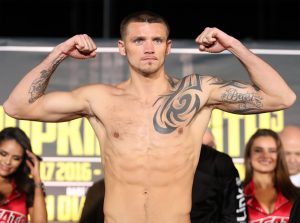


Opening Salvo: WBC takes first step in PED fight

By Norm Frauenheim-
wbc
The World Boxing Council’s rankings, once considered a joke, emerged this week with potential to be a serious weapon in the long and often futile fight against performance-enhancing drugs.

Twenty-five fighters ranked among the 15 in each of the WBC’s 17 weight classes were dropped for not enrolling in the Clean Boxing Program, which was introduced in early May.

It’s a little early for sweeping judgments, but the first real step in implementation of the VADA-administered program says the announcement at Las Vegas’ MGM Grand before Canelo Alvarez’ stoppage of Amir Khan on May 7 was more than just another empty news conference.

From top to bottom, the list of fighters dropped from the October rankings included well known and unknown.

There was Khan and ex-heavyweight champ David Haye and former light-heavy beltholder Jean Pascal.

There were also junior-flyweight Angel Acosta and strawweight Janiel Rivera. Never heard of them? Neither have I.

Point is, the list went beyond the names sure to generate a few headlines. It appeared to be comprehensive, an important symbol in what WBC President Mauricio Sulaiman and VADA President Dr. Margaret Goodman have said they hope to do. To wit: They intend to rid the sport of PEDS as best they can.

Initially, I was as skeptical of their plan as I have been of any acronym’s ratings. Nothing has been as troublesome as PEDs. It’s a swamp, infested with lies that have been repeated for at least four decades. Enter at your own risk.

From the old East Germans to Ben Johnson, Lance Armstrong, A-Rod and now the Russians, it has evolved into what looks like a mess without a solution. I had begun to think like so many others: Go ahead and make it legal. Use at your own risk.

That’s cynical, but a lot of pragmatic thinking is. I’m still uncertain about whether Sulaiman and Dr. Goodman can succeed. History is as irreversible as that proverbial ship. After moving in only one way for so long, it’s hard to turn around.

But I admire their beginning. It looks to be deliberate and disciplined. And cautious. Nobody is running to the media, shouting insults and allegations while pointing to all the telltale signs about who’s using and who isn’t. It as if everybody at ringside thinks a press credential is a medical degree.

Most of the time, I’d be annoyed about prepared statements and little else. Too often, that’s just a sign of somebody with something to hide. But the history of PEDs and chaotic tenor of the debate has left only a trail of suspicions, contempt and not much else

The assumption is that nothing works. I suspect that many of those dropped from the WBC’s rankings for not enrolling in the start-up of a program subjecting them to year-round testing was rooted in exactly that kind of thinking. They ignored it as if it were just another telemarketer. But this week they got an early warning. Maybe serious, too.


Chocolatito City, part 3

By Bart Barry-
Roman Gonzalez (640x360)
Round the time of Roman Gonzalez’s 28th prizefight – a March 19, 2011 decision defense of his second world title in a light flyweight beating of Mexican Manuel “El Chango” Vargas in Mexico – Chocolatito picked up a modifier suddenly persistent in use by comentaristas whether Nicaraguan or Mexican: Elegante.

How apt.

Chocolatito’s physique, the wingspan and unobstructive chest complemented by shoulders fit for a 150-pound man on any downtown sidewalk in North America and tapered midsection set on powerful legs all supporting a noticeably handsome face on a head whose top did not gain the uppermost rope of every ringpost, made one consider he might be special before his athleticism proved it, his long arms never improperly stretched out their centered frame.

To see Gonzalez advance on an opponent in his slight crouch both legs bent, a line of symmetry crotch to lowered chin, brings the quintessence of every hope every trainer has ever for every charge his first day in the gym when told to put his left fist forward with his left foot – no, not your right; no, it doesn’t matter what’s comfortable; no, no, I don’t care how your cousin showed you; yes exactly, because you’re right handed; no, no, not . . . get your hands up; listen kid, you’re not gonna come in here and reinvent boxing – and makes that trainer smile like he forgot he could at our beloved sport so badly stained by a halfdecade’s waiting for Mayweather-Pacquiao. It’s that sensation more than others one feels when he sees the opening rounds of Gonzalez’s match with El Chango Vargas: “Finally, someone I can tell others to watch, this, the little guy in the blue and white, you see that? it’s perfect, it’s exactly how you’re supposed to do it.”

Too much later got made of Gonzalez’s temperament outside the ring his religiosity and philanthropy and general goodness because too much is always made of everything in America’s vending of athletes – a pathological greed tells us to tell others one can have it all and be all to every and be meaningful to meaningless people if their lives’ meaning might temporarily be derived from buying our product which is such a bargain we’re practically giving it away – but the Nicaraguans saw it at once as one of their own and the Mexicans saw it soon as Gonzalez began dashing their best little men. Gonzalez’s temperament was unusual for a man who made his living concussing other men depicting no malice no rage nothing to imbalance while stopping never to admire his craftsmanship or effect just continuing to twirl his hips and whirl his fists sans intent of any kind till there was the other man’s face, behold! a bloody lumpen mess.

Twenty months by then passed since the violent death of Chocolatito’s mentor, Alexis Arguello known uniquely simply as “Alexi” in Nicaraguan broadcasts, by Arguello’s own hand or someone else’s and those who suspected someone else’s suspected nothing so ghoulish might be done Nicaragua’s greatest ambassador without consent from President Daniel Ortega, running for reelection in 2011. Whether by personal passion or health insurance for his family Chocolatito went in the ring wearing a white cotton “I (heart) Sandinista National Liberation Front” t-shirt each match of that campaign season – setting American viewers of a certain age to wonder whatever did happen to those Contras and Iranians and Ollie North?

Chocolatito elevated his opponents even while he razed them and then toweled a red gash over one eye (Omar Salado) or helped lift the ruined to his stool (Omar Soto) after framing an act of ceaseless heroism for El Chango Vargas in the Mexican state of Puebla, once more at 7,000 feet higher altitude than Gonzalez’s native Managua and it told, as the Mexican’s jaw looked surely broken in round two but he didn’t relent for a halfhour more and didn’t take an iota’s fraction off a single punch he thrust at Chocolatito in a barely noted show of valor so extreme Hollywood’d make 90 minutes and a love story of it, were Vargas an American heavyweight. Instead it was a 108-pound Nicaraguan versus a 108-pound Mexican in San Pedro Cholula and both men, “Little Chocolate” Gonzalez and “Monkey” Vargas, wore the same classic-red Reyes gloves and did ringwalks to each other’s music and caredn’t a whit for what pomposity happened in American ringwalks and ringwear that same year.

Even Chocolatito’s American debut was unfrilled in the fall when after brutalizing and decisioning the Mexican Vargas in Mexico and brutalizing plainly the Mexican Salado in Mexico Chocolatito iced the overweight Mexican Soto in Las Vegas on a night that deservedly belonged to an Argentine middleweight in Atlantic City broadcasted by HBO, the American cable network that recently and fortunately decided to make a promotional celebration of Gonzalez. Fighting on a Top Rank card for Teiken Promotions Chocolatito went in deep and savage with “El Lobito” Soto who barely made flyweight for his junior-flyweight scrap in which Gonzalez proved himself right formidable at the next weightclass when he alpenhorned Soto to the blue mat with a left uppercut that made “The Little Wolf” submissive.

That year Nicaragua again ratified the Sandinistas with Comandante Daniel’s reelection and Gonzalez boxed Vargas gorgeously, spun Salado expertly, stretched Soto frighteningly – while Floyd suckered Vicious Vic, and Manny sparred Shane and robbed Juan Manuel.

Bart Barry can be reached via Twitter @bartbarry


Olympic investigation is worthy of a Conlan encore

By Norm Frauenheim–
michael-conlan
One obscene gesture continues to sum up the state of Olympic boxing.

No matter what the amateur acronym does in the wake of another scandal-plagued Games and still another investigation, Michael Conlan’s one-finger salute will define it for as long as it is allowed to rule an Olympic sport as ancient as it is legendary.

AIBA announced Thursday that the 36 referees and judges, who worked the Rio Games, are under suspension pending an investigation, according to Reuters.

No applause necessary. A Conlan encore is the appropriate response.

I’m not sure how many times Olympic boxing has investigated itself since Roy Jones Jr. got jobbed in the Seoul Hold-Up in 1988. Let’s just say that the fox has been running this hen house for so long that nobody seems to care anymore. There have always been rumblings that the Acronym-In-Chief, the IOC, might just ban boxing altogether.

But has anybody heard from the IOC about this latest boxing controversy? Didn’t think so.

The IOC silence speaks volumes. For the boxing abolitionists in the IOC’s comfortable suites, the sport has already been doing a pretty good job at eliminating itself. Conlan’s damning gesture after the Belfast bantamweight’s controversial loss in the quarterfinals last August might also be another way of saying goodbye. NBC did exactly that several years ago.

According to a statement published by Reuters, AIBA determined that “a small number of decisions under debate indicated that further reforms in the AIBA R&J (referee and judging) procedures were necessary.’’

The statement added that “the results of the investigation, currently underway, will allow AIBA to fully assess what action needs to be taken.’’

I guess the statement means we should all be relieved that a remedial process is underway. Yet, somehow, this sounds a little bit like Donald Trump promising he’ll release his tax documents after an audit is complete. Yeah, and that check is in the mail, too.

We already know where the boxing process has been. After the 2000 Sydney Games, amateur boxing announced that referee Stanislav Kirasnov had been suspended for four years for his questionable work in a controversial decision that cost American Rocky Juarez the gold medal.

Yet, Kirasnov was back, working international tournaments, long before the scheduled end of the announced suspension. Not much ever seems to change, other than the fighters themselves. Conlan has moved on. But that doesn’t mean his condemnation of AIBA has gone away.

As it turns out, his gesture might have been worth as much as a gold medal. He signed with Top Rank in a deal that resulted in a lot of publicity for him and promoter Bob Arum.

Both appeared in photos, each flashing that upraised finger, a gesture appropriate for what happened all over again in Rio and for the investigation that was announced Thursday.