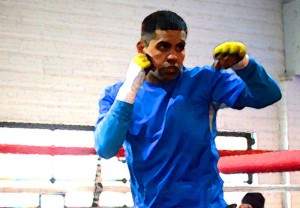
Tuneup II: Ward controls Barrera

By Bart Barry-
Andre Ward Post Fight
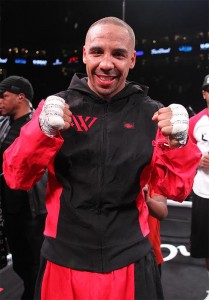
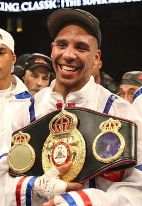
Saturday in Oakland former undisputed super middleweight champion and current number-one ranked contender for the HBO light heavyweight championship Andre Ward completely decisioned undefeated Cuban Sullivan Barrera. Despite controlling every minute of the match Ward displayed enough vulnerability to whet hopeful aficionados’ imaginations something dangerous and competitive might happen in the late fall if Ward has the stones to risk life and limb in a match with Sergey “Second Most Feared Fighter on HBO” Kovalev.

It was a typical Andre Ward fight comprising technical precision and relying on its opponent’s craft to provide emotion. Barrera had some craft but mostly strongman assertiveness. As Ward boxes most every opponent the same, a manifestation of his obsessive control, there weren’t many surprises after the first three minutes passed. While the mammalian mind specializes in pattern recognition, the human mind specializes in pattern completion, recognizing patterns with less data than other species – abstraction, that is – and so there was nary a human who watched round 1 of Saturday’s match and didn’t intuit about exactly where it was going in the next 33 minutes, and that was where it went.

That marks Ward at once an extraordinary craftsman and substandard entertainer. But his entertainment value is evidently others’ concern – though neither of his copromoters, Roc Nation Sports and Home Box Office Sports, seems fractionally good at its craft as Ward is at his. For the best part of his professional career Ward has understood his status as American boxing’s last and probably final Olympic gold medalist and the weight of that metal, ignoring any who endeavored to move him anydirection he did not choose himself. Ward is a bright dude, too, and that precluded others’ convincing him their direction for him was his own direction.

If and when Ward chooses to redeem HBO’s matchmaking by matching himself with the network’s light heavyweight champion it will be on terms that do not appear favorable to anyone but Ward, and this will happen because Ward doesn’t need the fight because his selfworth is too well established to bend very much. Kovalev will bend in negotiations, one assumes, because he probably wants the Ward fight more than Ward does. Kovalev doesn’t need the fight, but he does want it; Ward seems neither to need nor want to fight Kovalev.

Having emptied a once-exceptional 168-pound division and failed to lure Gennady “He’ll fight anyone between 154 and 168 pounds!” Golovkin to fight him at super middleweight, Ward now tentatively, carefully, controllingly moves himself to 175, requiring three tuneups to ascend seven pounds, a tuneup-per-pound mark unlikely to be surpassed until Cinnamon Alvarez’s eventual ascent to 160. And that’s not a criticism of Ward either. He knows it’s HBO’s credibility, not his, that requires a 2016 match with Kovalev, and he knows, too, the only equalizer Kovalev has in that fight is size. So Ward patiently acclimates himself to the new weightclass, caring very little for what arbitrary timelines a broadcaster sets, gradually and decisively removing the sole advantage the network’s light heavyweight champion has.

If one draws up a chart of things Kovalev has more than Ward, it probably stops here: 1. Size, 2. Right cross. Notice meanness and ferocity didn’t make the list. Kovalev might have psychopathy going for him, but he is no more ornery in a fight than Ward is and not nearly so adept at fouling. Ward has approximately twice Kovalev’s craft and can effectively fight while moving in three times as many directions as Kovalev, who does incredibly well while moving forward and moving forward. Ward will tangle him and frustrate him in a way Bernard Hopkins was too old to do and no one else’s had the chops to try.

Early Saturday Ward reviewed Barrera’s physicality and class and decided it was better to slip punches and keep distance than go shopping inside. He’ll decide otherwise against Kovalev, planting his shoulders in the Russian’s chest and his head all over the Russian’s face, yes he will. Kovalev will make the bully’s choice and endeavor to outmuscle Ward, and Ward will have him. Ward is good an infighter as we’ve seen in a generation, and the secret of that goodness is his footwork; Ward churns his hips and feet where others stand still and wrestle above the waist. There are lots of ways Ward can prepare for Kovalev and not one way Kovalev can prepare for Ward, and one senses nobody who knows that in Kovalev’s circle will tell the Russian, making the proper assumption th’t refitting Kovalev at this point is a fool’s errand; go forward with full confidence, Sergey, or don’t go.

Talk of Ward’s rust or slippage, too, is irrelevant. Ward has been sharp enough to control every opponent he’s faced since his 13th birthday, and that will be true of Kovalev or Ward will not make the fight. Ward takes through all his life the confidence and distrust Floyd Mayweather brought in the prizefighting ring; where Mayweather played the buffoon in promotions then got real serious when the bell rang, Ward stays real serious.

Immediately before and after the dullest spectacles of his career Bernard Hopkins warned us how much we’d miss him when he was gone. He’s been gone for nearly a year and a half, and he isn’t missed – in large part because we still have Ward. There is neither another Andre Ward in the pipeline nor even much of a pipeline: In the end we may miss Ward more even than Hopkins assured us we’d miss Hopkins.

Bart Barry can be reached via Twitter @bartbarry


Andre Ward begins another chapter in trying to turn Olympic gold into PPV gold

By Norm Frauenheim-
andre-ward
Nearly twelve years have come and gone since Andre Ward won America’s last Olympic gold medal in boxing, yet there’s a sense he’s still unknown among casual fans who know all about Floyd Mayweather Jr., know a little about Manny Pacquiao and remember Mike Tyson.

Mayweather sells cash and controversy. Pacquiao sells a naïve smile, his role as a man-of-the-Filipino people and some controversy of his own lately with comments about same-sex marriage. Tyson sold fear.

For them, it has been a business model, a way to unlock the pay-per-view vault. Through design or just dumb luck, they figured out how to achieve the kind of celebrity that makes them more than a boxer and puts them on a list a lot more valuable than any rating. Dollar-for-dollar or pound-for-pound? Any bets on where Ward would rather be ranked? Forbes or The Ring?

But he’s never been on Forbes’ annual list of the highest earning athletes, despite his pound-for-pound credentials, mostly because he’s never been a pay-per-view headliner.

Perhaps, that’s because of inactivity brought on by injuries and a promotional lawsuit, or stubborn pride, or just his unerring competency over a couple decades. He hasn’t lost a fight since he was 12 years old. Mistakes attract attention, especially these days, and Ward (28-0, 15 KOs) just doesn’t make many on either side of the ropes. He’s hard to know. Harder to beat.

Now 32 and the clock ticking on his prime, he embarks on a stage of his career defined by a last chance to become the pay-per-view star that everyone thought he would be after he stepped off the medal stand at the Athens Games.

It begins Saturday in hometown Oakland on HBO (9:45 pm ET/PT) in his debut at light-heavyweight against former Cuban amateur Sullivan Barrera (17-0, 12 KOs), whose record and size suggests his welcome to 175 pounds could be a tough one.

“We did not pick him because he’s a soft touch,’’ Ward said at a media workout. “We picked him because he was going to get me ready and show me what this weight class is all about. If you look at my career, there’s a place for tune-ups, which I haven’t had a lot of. You want to fight the best and if you aren’t fighting the best, you want to fight the No. 1 contender. That’s what we’re doing.’’

What Ward is doing is testing his readiness for Sergey Kovalev, the feared holder of most of the light-heavyweight belts and a Russian fighting to get his own foothold in America’s PPV market. Kovalev, who is expected to be ringside at Oracle Arena, and Ward have an agreement to fight, perhaps in November and presumably on HBO’s pay-per-view.

It’s a projected fight that has fans more interested in combinations than celebrity drooling in anticipation. With the Canelo Alvarez-Gennady Golovkin possibility looking as if it will be placed in a Mayweather-Pacquiao-like delay because of Canelo’s continuing insistence on a 155-pound catch-weight, Ward-Kovalev is the biggest fight out there.

The question is just how big it could be. Hints at an answer will be in how Ward does against Barrera, whose promoter, Main Events, also promotes Kovalev. Ward’s singular brilliance has been absent from the ring’s stage, in part because of injuries that are surely causing some sleepless nights at HBO, Main Events and his own promoter, Roc Nation.

He fought and beat Carl Froch at 168 pounds in 2011 with a hand that was broken in two places during sparring. Surgery on his right shoulder forced the cancellation of a planned bout with Kelly Pavlik in 2013. A knee injury forced him off the PPV card featuring Canelo’s victory over Miguel Cotto on Nov. 21.

His history of injuries and his introduction to 175 pounds against someone with 12 stoppages in 17 fights add up to a reason for concern. The guess here is that his command of the ring and versatile skillset will be too much for the tough Barrera. Ward wins.

But he needs to do more than just that. He needs to emerge unscathed and able to fight on in a way that will remind fans of where he has been.

And where he is going.


Beibut Shumenov targeting Lebedev-Ramirez cruiserweight Unification title fight winner

Beibut Shumenov
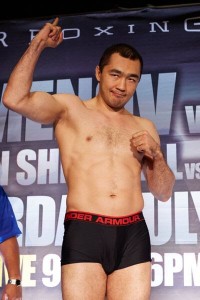
LAS VEGAS (March 22, 2016) – World Boxing Association (WBA) Interim Cruiserweight World champion Beibut Shumenov (16-2, 10 KOs) is targeting the May 21st unification title winner between WBA titlist Denis Lebedev (28-2, 21 KOs) and International Boxing Federation (IBF) champion Victor Emilio “El Tyson de Abasto” Ramirez (22-2-1, 17 KOs).

When Shumenov defeated B.J. Flores (31-1-1, 20 KOs) last July in Las Vegas, the former WBA light heavyweight champion became WBA Interim champion as well as its No. 1 mandatory contender.

Lebedev, however, hasn’t fought a mandatory fight since last April 10 in which he won a 12-round decision over then Interim WBA champion Youri Kalenga. Lebedev made a voluntary tittle offense last November, stopping Lateef Kayode in the eighth round.

Shumenov will be back in the ring next month (April), full details forthcoming, and then he will challenge the Lebedev-Ramirez winner within 90/120 days of their outcome.

“I’m looking forward to having the opportunity to fight the Lebedev-Ramirez winner because it’s always been my goal to unify the titles,” Shumenov explained. “Lebedev has always been my target. Ramirez is the other fighter I’ve really wanted to fight and my manager tried to make a fight between us, too.

“I’ve been in the gym since my last fight, training hard to perfect my skills. Now, I am a completely different fighter since I fought last July. My team is extremely happy and confident that I can beat all of the other world cruiserweight champions.”

Last December, Shumenov was scheduled to defend his Interim WBA crown against two-time world cruiserweight champion Krzyesztof “Diablo” Wlodarczyk (50-3-1, 36 KOs), but a serious medical issue concerning a family member forced Shumenov to withdraw from the aforementioned fight.

“The opportunity to fight the winner of Lebedev/Ramirez in a big unification fight just came about this year and I didn’t have that option back when I agreed to initially fight Wlodarczyk back in December and I was unable to foresee what would happen to my family personally,” 32-year-old Shumenov said. “I have no problem fighting Wlodarczyk in the future, but only after I fight the Lebedev-Ramirez unification winner. In addition, at any time, I have no problem fighting WBA No. 2-ranked Yunier Dorticos.

“Right now, I’m at my fighting prime yet still improving, training with my coach, Ismael Salas. I want to show the world my skills before I get too old. Literally, I’m ready to fight tomorrow and I’ve been ready for months. I’ll be back in the ring next month and then I’ll get my shot at the Lebedev-Ramirez winner.”

Fans may friend Beibut Shumenov on his Facebook Fan Page at www.facebook.com/BeibutShumenov.


Crumbling infrastructure, Mile High Mike, The Baby Bull, and Izzy

By Bart Barry-
Mike Alvarado
HOUSTON – In the good times there was a lameness to this city that didn’t make the brochures; places closed early, nothing opened Sundays, and when folks told you how proud they were of their city it felt strained. That lameness has been replaced by a sort of anger that happens to cities that once boomed then stopped booming then stopped telling others how much they were booming (salesmen necessarily being the most oblivious of rejection) and then resigned themselves to settling in, and whose transplants now look about and realize they didn’t want to live here in the first place.

We were gathered in this city, just the same, for an eight-match Top Rank card that featured the returns of hometowner Juan Diaz and Colorado’s Mike Alvarado, and both men won by knockout, but only one of them, Diaz, should continue fighting.

No one ever told me he moved to Houston and loved it. There was money here, though, and that money calmed the slight uneasiness one feels when he’s uprooted himself for something that isn’t quite-quite. Two years ago crude oil was trading over $100 per barrel. Today it is heaving to return to $40. This city’s humor rises and falls with those prices, and right now its humor is lower than it has been anytime in the last decade – except last month; oil is up $10 since then, and it’s springtime after all, so how about them green shoots?

The boom times are not reflective times, and what a city does with its wealth while it booms sets a floor of sorts for where it goes when it busts (except in prolonged cases like Detroit, the one ever-busting American city of the last halfcentury). This city did some Texas tackiness, big hair and sparkly things, sure, though nothing that approached Dallas’ scale, and its skyline remains alluring, but it neglected wholly its infrastructure. With all the money that sloshed about, one wonders, and did wonder, why are its surface streets barely fit for urban attack vehicles (ah, the Hummer – enduring symbol of a different bust: Phoenix housing market) and otherwise unfit for any sensible car?

Back when Austin, this state’s capital, was actually weird – not “keep Austin weird” weird – it got by with a hippy sensibility like: we’re all in this together, so yield the right of way when you know I can’t see round the tree at the intersection. Houston’s eroding infrastructure is making it weirder every day, though without any sensibility but greed to bind its citizenry; in Houston, now, you drive like a maniac because some primal intuition tells you you’re safer that way, and you are – because when you’re moving faster than the loons on either side, you regain half your attention by no longer needing a rearview mirror.

Arena Theatre was a fine, if well-hidden, venue to watch a fight Saturday, and only a sucker paid for better than the cheapest seat, since there wasn’t a distant view in the entire bowl, and the ring sat up shiny in the venue’s very center. Heard in the Top Rank section: “Small rings make for great matchmakers.” The ring was tiny; no one larger than a middleweight set foot in it during the card’s eight matches, and everyone looked large.

There’s a slapdash South American-mercado feel to much Spanish-language television, the don Francisco style of having the host perform commercials onstage during a show, and it interrupted the pleasure of Saturday’s card, some. Television owns boxing, of course, the programming director tells the commission when it may ring the opening bell, but the delays of a show performed for Spanish-language television are, even by the known standard, a touch gratuitous. Seated a few rows behind the UniMás commentary team with a clear view of their monitors, one sees the main event is being delayed by week-old commercials advertising the co-main event that already went off; it’s a sloppy, sales-blitz mentality wherein the host sees himself as an emcee, not a journalist, and his target demographic meanwhile slumps its shoulders and trudges back to the beerline.

Saturday’s crowd was the usual mix of hometown fight figures and familiars and friends and hangerson, and local businessmen reveling in others’ danger. A lawfirm gathered in the row behind me, and when they weren’t hellbent on outnamedropping one another, they were admonishing the fighters to “punch him in the neck” or “knock his head off” or “finish him”! And so.

Mile High Mike looked exactly the same Saturday as he did the last time you saw him, and that’s a problem, obviously, because the last time you saw him he was stopped by a limited fighter, albeit a former champion, and this time he plied his wares against a lighthitter with 10 knockouts and six losses in 25 matches. Eventually Alvarado bludgeoned him down with wild righthands, but Mile High Mike and his rehabby salespitch, “I’ve been fighting my demons as much as my opponents,” are through with major championship prizefighting.

The Baby Bull looked about the same, too, and that’s a really good thing. Never the bearer of a pinup physique, Juan Diaz still weighs and fights the exact same way at 32 as he did at 22. He does not set on any punch so he does not have concussive power, but he doesn’t need it: Because he’s somehow stayed in the same weightclass, where his chin is proven, and because he possesses more belief in his own conditioning than just about anyone in the game today, and because there’s exactly no chance of another Nate Campbell or Juan Manuel Marquez or even Paulie Malignaggi showing up at lightweight in the next five years, Diaz will make a competitive and fun title match with anyone he fights.

It was good to see Juan Diaz do so well in front of his friends and family.

The best sight of all, though, was Israel Vazquez, the color guy on the UniMás broadcast team, being as unassuming in retirement as ever he was vicious in the ring. The fans queued up for photos with him, and Izzy lost himself in their adoration, requiring several times the program director to scold him for nearly missing cues. Vazquez’s delta – violence in combat to gentleness in society – is the greatest I’ve seen in our sport that has so very few happy endings, and how properly joyful it makes me to think Israel might be one of them.

Bart Barry can be reached via Twitter @bartbarry


Differences: Bradley vows they will add up to a win without doubts in Pacquiao rematch

By Norm Frauenheim-

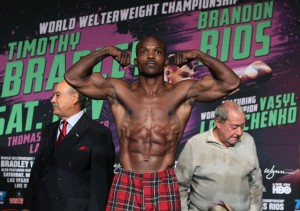
Nov 6, 2015, Las Vegas,Nevada   ---  WBO Welterweight Champion  Timothy "Desert Storm" Bradley Jr. and  former world champion Brandon Rios weigh in for their upcoming world title fight, Saturday, Nov. 7, at the Thomas & Mack Center in Las Vegas on HBO.  --- Photo Credit : Chris Farina - Top Rank (no other credit allowed) copyright 2015
Nov 6, 2015, Las Vegas,Nevada — WBO Welterweight Champion Timothy “Desert Storm” Bradley Jr. and former world champion Brandon Rios weigh in for their upcoming world title fight, Saturday, Nov. 7, at the Thomas & Mack Center in Las Vegas on HBO.
— Photo Credit : Chris Farina – Top Rank (no other credit allowed) copyright 2015

Timothy Bradley, a genuine personality in a business often defined by a feint, has a chance to eliminate any questions about an item on his record. He doesn’t have to correct it. A victory over Manny Pacquiao on June 9, 2012 is there and always will be.

No asterisk included.

No apology either.

But the questions, like echoes, are still there from the crazy controversy that raged for weeks after the scorecards awarded him a split decision over Pacquiao. To this day, there aren’t many people who think Bradley won. There are times when it sounds as though Bradley isn’t convinced either.

In a conference call this week, he dropped another hint that says he still has some doubts. In talking about his third fight with Pacquiao on April 9 at Las Vegas MGM Grand, he talked about the bout almost as though it was a chance to beat Pacquiao for the first time.

“It is an opportunity for my kids to talk about years from now with their classmates – that their father beat Manny Pacquiao,’’ he said.

Actually, his kids can say that to their classmates now, but probably not without most of the school shouting them down with the same heated argument that tormented Bradley and his family for too long.

Perhaps, his comment was just a slip. He was answering a question about whether he was weary of fighting Pacquiao.

No, he said, he welcomed a third chance. Then, he hinted at what virtually everyone has believed since those scorecards were announced nearly four years ago. Bradley has never been able to carry off a feint for too long. His genuine nature won’t let him. But it’s more than even that.

There’s a sense that he wants to eliminate some of the questions still in the public mind and perhaps in his own. A victory on April 9 might do that.

“Everyone has their own opinion regarding the first fight,’’ he said. “How ever way you want to look at it, it was a very close fight. The second fight, Pacquiao definitely won that fight hands down.’’

Bradley goes into the third fight with a different trainer in Teddy Atlas and his wife Monica as his manager. He promises Pacquiao will be encountering a much different fighter than the he saw in 2012 and again in a rematch decision over Bradley on April 12, 2014.

“This time around I have a new guy — Teddy Atlas — a guy who analyzes fighters for a living,’’ Bradley said. “That’s what he does — he’s an analyst and a trainer. The approach this time is going to be a lot different and I will be looking to exploit Pacquiao’s weaknesses.’’

The weaknesses have been there, brought on by erosion in speed and perhaps a more cautious nature that is summed by Pacquiao’s failure to score a knockout since 2009.

Pacquiao isn’t the same guy. Then again, neither is Bradley.

In Bradley, however, the most intriguing change might simply be his health. He got injured in each of the first two bouts. In 2012, he won the fight. But the winner was in a wheelchair at the post-fight conference with a fractured left foot and a sprained right ankle. In 2014, the muscle mass in his right calf sustained tears in two places.

It begs a question: What would have happened in the first two if Bradley’s legs had not betrayed him? Of course, there’s another question: Is he just prone to leg injuries and about to suffer another one or three?

But Bradley is confident his legs will carry him to a victory that this nobody will question this time.

He says he was over-trained and under-fed for the first two fights. Under former trainer Joel Diaz, he say he did too much running when he wasn’t in the gym. He also was a vegan. Beans and no beef are a diet without a combo for a fighter in training.

Between the steaks, Bradley says “we don’t run on off days anymore. We don’t do any of that stuff. Everything now just feels like it’s all down to a science the way Teddy’s got this thing orchestrated.”

Orchestrated, perhaps, in a genuine attempt to remove some lingering doubts that are a matter of record.


Nostalgia touring Houston

By Bart Barry-
Juan Diaz
Saturday at Arena Theatre in Houston, Juan “Baby Bull” Diaz and “Mile High” Mike Alvarado will return to prizefighting on an UniMás telecast. Diaz will fight a Mexican lightweight named Fernando Garcia, and Alvarado will fight a Mexican welterweight named Saul Corral. Garcia and Corral appear to be statement-type opponents; Diaz and Alvarado will either use such men to make flattering statements about their futures by dominating them, or there will be statements made by others about overdue retirements.

I’ll be there because I did not expect to be ringside again for a fight featuring either man, let alone both, and I do not expect to have such a chance again, and I wish our sport comprised more men like Diaz and Alvarado once were.

I have been ringside for four of Juan Diaz’s last six fights, and while I did not realize it till time came to write this column, in retrospect, I’m glad it’s been that way. I knew little about the Baby Bull when I sat ringside for his 2006 match against Fernando Angulo at Chase Field, but his activity was infectious, and his selfbelief exceptional for a fluffy lightstriker. Volume punchers, men like Diaz and Timothy Bradley, are compelling fighters because of their limitations, because their offenses are more pesky than concussive, unlike sluggers’, and their defenses are steady applications of offense with a dusting of head movement, unlike boxers’.

There are few fighters whose style I enjoy more than Diaz’s – and one of those few is Juan Manuel Marquez, the man whose style ruined Diaz in one of the very best matches I’ve covered from ringside. That match happened in Houston more than seven years ago, a fact that dates this column sympathetically or ruthlessly whatever one’s philosophy of time, and it marked an apogee of sorts for Marquez, a moment of lightweight supremacy just before his own greed and his promoter’s greed and guilelessness got him humiliated in a sparring match with the world’s best welterweight, Floyd Mayweather. (The lesson from that match: Tossing boulders at altitude and drinking your own piss, training in the naturalest way possible in other words, is dimwitted; a year or so later, Juan Manuel contacted Memo and things got supernatural for his second campaign at welter.)

By the time Diaz fought Marquez the first time, in a Toyota Center that was full and loud, he was no longer undefeated, having been beaten by Nate Campbell in a Don King-special event conducted in a Quintana Roo bullring, the culmination of a weird promotional relationship initiated in 2006 when King, realizing he’d never sellout a Phoenix baseball stadium with a Belarusian and Shannon Briggs, heard a Latino ticketseller named Diaz might be about to sign a contract with Golden Boy Promotions, and finding Diaz’s pen dangled cautiously over his new Golden Boy contract, King slipped a King contract in its stead.

Diaz and King were not a sensible match, and eventually Diaz was with Golden Boy Promotions, and through fifteen minutes appeared ready to devour Marquez at Toyota Center. Those of us ringside fretted openly about the cost of Marquez’s pride; Diaz did not strike hard enough to unseam Marquez with one punch or 20, and as Marquez looked old and worn and Diaz appeared much the larger man, we verily worried something tragic might befall Marquez before the 12th round concluded.

Goodness, but we were wrong. Marquez made of Diaz his most gorgeous finish (until the Pacquiao icing years later), stubbornly wagering his straight punches would best Diaz’s crooked ones no matter their quantitative disparity. Diaz fell prey to the uppercut like every volume puncher must, tallying shots on Marquez so feverishly he neglected to notice his weight fully spilled overknee, and Marquez, his era’s master closer, brought Diaz’s unconsciousness with a customary precision and lack of ruth.

Their rematch was a dud fought in a soulless casino while the Vegas economy experienced gravity in a vacuum. And with that the Baby Bull was finished with boxing and ready to become a lawyer. Initially I didn’t care when he returned because it felt, like most of our sport’s comebacks, a fated mix of betrayal and desperation.

Writing of which, “Mile High” Mike will be in Saturday’s co-main, his first ringside sighting since the autohumiliation he perpetrated on himself and his fellow Coloradoans 14 months ago in his second rematch with Brandon Rios. The standard ploy, changing trainers and promising rededication, was not going to be enough for Alvarado to sell his return, and so he attended rehab and got married.

Promoter Top Rank forgives Alvarado his numerous transgressions because Alvarado atones properly; Alvarado has fought five times since 2012, when his career was reresurrected after legal issues aplenty, and what fights were not with Rios were with the aforementioned Marquez and Ruslan Provodnikov – five consecutive fights with any combination of Provodnikov and Rios and Marquez exceeds in peril the product of every 2015 PBC main event multiplied by 50, and so Alvarado gets forgiven. The beating Alvarado took from Provodnikov in 2013 was mansized and vigorous; it was the only time I recall seeing at ringside a defending champion wince in the first round of a title fight, as Alvarado did after several of Provodnikov’s facinorous blows befell him.

I’m an unapologetic fan of Diaz and Alvarado both; I’ve traveled to Nevada and Colorado to see prime versions of the men and consider those trips time and resources well-consumed. Neither is good enough, anymore, for me to leave the state of Texas to see, but either is worth the 200-mile drive to Houston, and the two of them together, a treat. This nostalgia tour continues along happily.

Bart Barry can be reached via Twitter @bartbarry


At The Crossroads: Benavidez looking at ways to re-ignite career

By Norm Frauenheim
jose_benavidez_signing_100114_001
Jose Benavidez Jr. is considering several options, including a move up in weight, in an attempt to re-ignite a career that has stalled since Top Rank thought about putting him in against Terence Crawford, yet decided on Hank Lundy.

Benavidez, unbeaten (24-0, 16 KOs) at 140 pounds, was considered a leading possibility for Crawford, who on Feb. 27 blew away Lundy in a fifth-round stoppage on HBO in The Theater at New York’s Madison Square Garden.

But Benavidez didn’t look good in scoring a unanimous decision on Dec. 12 over unknown Sidney Siqueira of Brazil on a Univision card in Tucson that featured emerging featherweight Oscar Valdez in a sensational victory.

The crowd booed Benavidez, whose rope-a-dope tactics are not popular. He said he had the flu. At the weigh-in, he was 152.4 pounds, 4.4 heavier than the contracted 148 for a non-title fight. Between rounds, he struggled to breathe.

It’s not clear whether that performance knocked the Phoenix fighter out of consideration for Crawford, whom he called out repeatedly before the Tucson card. But Benavidez didn’t regret the decision to fight, despite the flu.

“No, not at all’’ his father, trainer and manager, Jose Benavidez Sr. said from Hill Street Boxing in Los Angeles where he is training his younger son, David Benavidez, for an appearance on the Chris Algieri-Errol Spence Jr. card on April 16 at Barclays Center in Brooklyn. “I mean, he was in the co-main event. In that kind of situation, you’re never right. Imagine the reaction if we had canceled out.

“At the same time, I knew he could beat the guy. It was a big risk. We knew he’d win. But we also knew he wouldn’t look good. But the crowd thought he should of stopped him. I thought he should have stopped, too. But he was sick.’’

The best that can be said is that Benavidez emerged from difficult night with his unbeaten record intact. Still, one of boxing’s brightest prospects six years ago faces an uncertain future. He no longer has the WBA’s interim 140-pound belt, according to his father. He took it from Mauricio Herrera about sixteen months ago in a decision as controversial as any in 2014.

After defending it once in a 12th-round stoppage of Jorge Paez Jr. last May, the WBA ordered a mandatory for the acronym’s regular belt against Italian Michele di Rocco (40-1-1, 18 KOs), an Italian. That’s when Benavidez found out what interim really means.

“They stripped him,’’ the senior Benavidez said. “It’s kind of ridiculous what they wanted. They wanted us to go fight over there. They wanted us to fight for very little money. Then, they wanted us to pay the sanctioning fee. It didn’t make sense.

“I mean, we were trying to fight Crawford, or Jessie Vargas, or Viktor Postol. Those fights make sense.’’

Dollars, too.

Now, common sense says it’s time for the 5-foot-11 Benavidez to move up to welterweight. He’ll be 24 years old on May 15.

“I think we go to 147 and stay there, unless something big breaks like Crawford, or Postol, or something like that,’’ Benavidez Sr. said. “He’s still young. The body hasn’t really changed much. He could definitely make 140 for a big opportunity. If not, we’ll just stay at 147.

“But I do think he needs big fights. So many of these guys he’s been fighting, there’s just no motivation.’’

Nothing has been scheduled, yet. However, Benavidez is expected to resume training with brother David next week in Los Angeles.

“We want to fight, but I don’t what’s going to happen,’’ his father said. “We’re just going to stay focused and try to regroup. Hopefully something comes up. You never know.’’


How HBO’s statement helps explain Donald Trump’s popularity

By Bart Barry
Pacquiao_Mayweather_weighin_150501_001a
Wednesday HBO released a statement about Manny Pacquiao’s weeks-old statement about the prizefighter’s interpretation of the Bible’s anticipation of the current LGBTQ platform. There is rarely a reason to interrogate press releases from cable networks, but this one seemed portentous: One opened the email thinking HBO, in an incredible expression of solidarity with oppressed persons everywhere, had announced its refusal to condone Pacquiao’s hate speech by cancelling its distribution of the Filipino’s match with Timothy Bradley in April.

Well, no, actually – of course not. Instead, in a manifestation of what groupthink imbecility corporations reduce themselves to whenever trying to accomplish anything different from revenue (like moral judgements), the network decided to condemn Pacquiao’s sincerely held, sincerely stated and sincerely reiterated beliefs by implying, in the insincerest way possible, the network’s endorsement of Pacquiao would continue unabated because of its “obligation to both fighters” – only a network far less scrupulous than HBO, in other words, might punish Bradley for Pacquiao’s ignorance.

But why bother? why now? what could this accomplish? Answer: To illustrate tidily how Donald Trump is, in March, nearer to becoming our 45th President in November than any contemplative person in January imagined he would be.

It’s the insincerity of the HBO statement that rankles, and since HBO is a media company, it should be instructive for us, the large percentage of the country that cannot grasp whence Donald Trump’s popularity derives, to contrast the event of HBO’s statement with the event of Trump’s ascent. Trump embellishes most everything, exaggerates his own record, obfuscates, and often says things he knows are not true, but he never appears insincere. His appeal is his sincerity – his zealous belief in his own greatness; anything might be said in service to it – and his supporters are not the idiots we think they are.

For a few presidential cycles now, the dog-whistle metaphor has been fashionable, likening the insincere and euphemistic bits politicians say to a sound humans cannot hear but puppies can. Probably this sort of analogy first achieved acclaim with Ronald Reagan’s laudable/infamous (depending on one’s region and political bent) States’ Rights speech in Mississippi 36 years ago, a speech that winked at Southern segregationists while giving its speaker all sorts of deniability.

If employing rhetorical irony is saying something that means more than merely the denotative sum of its words, being cynical often is saying something that means nearly the opposite of its literal contents – “all natural ingredients” for instance – and cynicism is inferring from another’s rhetoric its opposite. While the crafters of dog-whistle statements would defend them as irony, Shakespeare’s own mechanics, they rely on the cynicism of their audiences, which in its own tawdry way attributes more talent and imagination to these audiences’ members than outsiders generally do.

What Trump practices is not dog-whistle so much as dog-tail; in all of nature, there are few things as decisively honest as a dog’s tail. A dog does not wag its tail ironically, a dog does not eat food it dislikes then whip its tail sarcastically about, a dog may misunderstand, and a dog may stand bemused by human indecision, but a dog’s tail ever tells the truth. What Trump’s supporters watch is his tail; when he is speaking in circles, when he is contradicting himself, when he is insulting his opponents, when he is effusively praising himself, his supporters ask only one question: Does he believe this? Their support for him as a candidate, not his platform or ideas that are alternately threadbare and frightening and frighteningly threadbare, are proportionate to how enthusiastically his supporters see his tail wagging and subsequently how enthusiastically their own tails wag back.

Well what have we here? This column has now done the unthinkable, likening humans to animals, the sort of ruse that got the congressman from Sarangani Province summarily scolded by blogs across the fruited plane, disowned by an apparel manufacturer notorious for its international labor practices, and called “insensitive, offensive and deplorable” by HBO.

Really, you say, your own tail beginning to stir, a broadcaster stated something that honestly about one of its assets?

Well, no, actually – of course not. Manny is none of these things to HBO on the eve of a broadcasting event with revenue expectations in the millions of dollars; his “recent comments”, you see, those are the insensitive and offensive and deplorable things, not the beloved lad nicknamed Pacman who once eradicated world poverty with yellow gloves (to pick the one ludicrous Pacquiao prefight storyline for which HBO is not responsible).

Saturday after results from the Republican primaries came in, Trump opened the floor to media inquiries by saying, “I would love to take a couple questions from these dishonest people.” It’s no wonder his supporters howled and cheered; much as members of the media may hold them in contempt, much as they may coin ironical terms like “low information” and “poorly educated” as descriptors, Trump supporters hate members of the media all the more, and their surging hatred now sloshes over every abstract and arbitrary barrier, from decency to integrity to education to partisanship.

Trump’s contempt is genuine; he considers his opponents beneath him, and he hates the dishonesty of an electoral/press cycle in which the candidates who purchase the most advertising traditionally receive the most coverage from a media that calls itself independent, unbiased, objective, and fair and balanced. The sole way to disabuse Trump’s supporters of their fervor is to prove in some playful and offhanded manner their man is inauthentic.

That feat, though, would require both authentic spokesmen and media outlets capable of recognizing and disseminating authentic commentary.

Bart Barry can be reached via Twitter @bartbarry


Planting Time: How about a Canelo-GGG guarantee next to that olive tree?

By Norm Frauenheim-
Saul Alvarez
World Boxing Council President Mauricio Sulaiman says an olive tree will be planted amid the neon surrounding Las Vegas’ new T-Mobile Arena during the week of the Canelo Alvarez-Amir Khan fight on May 7.

The tree, Sulaiman says, will be a symbol of peace and unity. It’s a nice idea. But few would confuse boxing with peace or unity. It’s about imminent violence. It’s why we watch.

It’s why we watch Donald Trump, too. Trump’s sneers, profanity and insults are straight out of a boxing news conference. That shouldn’t be a surprise. Trump learned the schtick as a business partner with Don King during the days when Mike Tyson fought in Atlantic City.

Are those debates getting huge ratings because people want to hear what Ted Cruz and John Kasich say? Didn’t think so. The network could sell the debates, pay-per-view, because Trump’s rhetoric heightens the drama, if not the sense that his over-the-top talk threatens to a degenerate into a real brawl.

Trump even went so far as to defend his manhood on Fox Thursday night. It was his response to Marco Rubio’s crack about his small hands. He sounded a lot like Tyson once did. Tyson has grown up since then. Too bad Trump hasn’t. Come to think of it, Trump could learn a lot from Tyson, who is lot more statesman-like these days than the presidential candidate with more insults than answers.

Trouble is, we all seem to be living in Trump’s world. After all, Trump’s angry rhetoric is the real reason Sulaiman said he plans to plant that olive tree. Everybody with something to say and sell is on the Trump bandwagon for the number of hits the mere mention of him generates in social media.

Even Oscar De La Hoya tossed out the Trump name during a Canelo-Khan press tour that stopped in London, New York and Los Angeles. De La Hoya says he actually decided to put together Canelo-versus-Khan – Catholic-versus-Muslim – while watching Trump channel Don Rickles during one of those debates. It’s a good story. It’s better marketing, a sure way to generate hits and tweets. Maybe a few olives, too.

Here’s one request of Sulaiman: Next to that tree, plant a guarantee that there will be an immediate Canelo-Gennady Golovkin fight if – as expected – Canelo beats Khan.

A lot of things were said during the Canelo-Khan tour. But when the inevitable question about Canelo-GGG was asked, the answer was always — and only — an assurance that it would happen. No specifics and no real time frame were included. Maybe, an olive tree represents a peaceful counter to Trump.

But boxing needs more than an olive branch. It needs Canelo-GGG. Without it, there won’t be much to harvest in its immediate future.


JULIAN WILLIAMS VS. MARCELLO MATANO FINAL PRESS CONFERENCE QUOTES

Julian Williams
BETHLEHEM, PA. (March 3, 2016) – Undefeated top contender Julian “J-Rock” Williams and Italy’s Marcello Matano went face-to-face for the first time Thursday at the final press conference before they meet with the IBF’s No. 1 spot at 154-pounds on the line this Saturday, March 5 live on SHOWTIME® (10 p.m. ET/PT) from Sands Bethlehem Events Center in Bethlehem, Pa.

Saturday’s SHOWTIME BOXING: SPECIAL EDITION® tripleheader features middleweight matchups between rising contender Antoine Douglas and Avtandil Khurtsidze and exciting Detroit prospect Tony Harrison against former title challenger Fernando Guerrero.

Tickets for the live event, which is promoted by King’s Promotions, are priced at $108, $83 and $58, not including applicable service charges and taxes and are on sale now. Tickets are available HERE at www.ticketmaster.com. To charge by phone call Ticketmaster at (800) 745-3000.

Here is what the fighters had to say Thursday:

JULIAN WILLIAMS

“I want to thank Matano and his team for coming all the way over here. We’ve had a difficult time getting opponents for different reasons, but I’m excited to headline this stacked card.

“When I win this fight I’ll be able to accomplish my dream of being a world champion. It’s one step closer.

“I’m going to attack the head and body as much as I can. I’ve got enough film on him to see what he’s got. He’s pretty solid. He got better each time out. But those guys in Italy don’t have the skills that I have. I think he’s going to bring it for as long as he can handle it.

“He’s an awkward fighter. He’s definitely a boxer and he can be a little skittish in the ring. I know I’ve fought the better competition and I’ve trained my hardest for this.

“I’m ready to make a statement. I’m not worried about a knockout. However the win comes, it’s great. I’m just looking to win and beat him down.

“I’m expecting a good Philadelphia crowd to be out here supporting me. Ninety percent of my career I’ve been on the West Coast and other places. But now fighting in front of my hometown fans, there’s nothing better. It’s perfect.”

MARCELLO MATANO

“I feel very good. I’ve been here since Friday so I have gotten used to the time zone difference and I’m ready to fight. My American experience is just starting and I’m looking forward to it.

“It’s been a hard two months of training for this fight. This is by far the most important fight of my career so I’ve trained even harder than I usually do.

“I know that Julian Williams is a top-notch athlete and that he is coming to give his best, just like I am. It’s going to be an exciting fight because we both want to get to the top.

“I can adapt myself to any opponent. I can be a boxer or I can be a brawler. But in my heart, I am a warrior and I will come forward all fight. I am coming to leave that ring victorious.

“This is a dream come true to come here to the United States. I’ve always worked hard and it’s gotten me here. I will put all of my heart into the ring on Saturday night.”

ANTOINE DOUGLAS

“You can always look forward to an action-packed fight when I step into the ring. I have an admirable opponent who I know is coming to fight.

“I’ve grown into this role and into who I am. If you asked me earlier in my career, I would have never thought I’d be here. This is great and it comes from all the hard work I’ve put in over the years.

“You will see my growth Saturday night in the ring. I plan on being victorious. The work I put in won’t let me be any less than that. I’m looking forward to the action.

“I have a very strong opponent and I think it will make for a more exciting fight than Sam Soliman.

“I just always have to be prepared for whatever is thrown at me. This is boxing – there are no guarantees. We just have to be prepared for everything and do our best.

“The styles of Soliman and Khurtsidze are completely different, but we always base our offense and defense off a fighting at range and working the jab. I’m not going in blind – I’ve faced opponents who come forward. We’ll be ready for him and ready to make the adjustments in the ring.

“A win on Saturday will definitely put me in a position for a title shot. We just take it day-by-day. It’s not about looking at future opponents. We take each step successfully and see where it puts us.”

AVTANDIL KHURTSIDZE

“I’m very happy to be here and I’m grateful for the opportunity. I’m fighting a very strong fighter. Once I step into the ring I’m expecting a good challenge and I can’t wait for Saturday night.

“Everything in training went well. We’ve trained really hard and we’re ready for Saturday night.

“Douglas is a good fighter. He’s a good boxer and he has a good left hook. But none of that means anything until you get in the ring.

“Once I step into the ring, I will bring 100 percent. I am not going to stop swinging until Douglas goes down.”

FERNANDO GUERRERO

“We’re ready to fight. We had a great training camp and there’s not too much to say. It’s warrior time.

“I’ve been through my ups and downs, but I’m still here and I’m not going anywhere. This is for my whole nation, everyone in the Dominican Republic who is watching. You have to step in that ring for something.

“This isn’t a game. This is the only sport that you cannot play. I’m going to make this one of those fights that will be one of the best of the year. It will either be the best knockout or the best fight of the year. This is going to be memorable.

“This is the kind of opponent who will bring out the best of me. Everybody has to watch out for me. I’m coming to make a statement on Saturday.”

Friday, March 4

6:00 p.m. OFFICIAL WEIGH-IN – OPEN TO THE PUBLIC!
Location: Vision Bar (Located inside Sands Bethlehem Events Center)
77 Sands Blvd.; Bethlehem, PA 18015
5:00 p.m. – Media arrival
6:00 p.m. – Fighters to scales

Saturday, March 5

5:30 p.m. SANDS BETHLEHEM EVENTS CENTER DOORS OPEN
Location: 77 Sands Blvd.; Bethlehem, PA 18015

6:45 p.m. FIRST BOUT

10:00 p.m. SHOWTIME BOXING: SPECIAL EDITION BROADCAST BEGINS

CREDENTIAL DISTRIBUTION
Fight night credentials can be picked up on Saturday, March 5 from 5:00 p.m. – 10:00 p.m. at the Backstage Entrance. Proper personal photo ID (Driver’s license or passport) is required for credential pick-up.

Tickets for the live event, which is promoted by King’s Promotions, are priced at $108, $83 and $58, not including applicable service charges and taxes and are on sale now. Tickets are available HERE at www.ticketmaster.com. To charge by phone call Ticketmaster at (800) 745-3000.

For more information visit www.SHO.com/Sports and www.sandseventcenter.com, follow on Twitter @SHOSports, @JRockBoxing, @Action_Douglas, @IAmBoxing, @FernandoDomini, @TheSBEC and @Swanson_Comm or become a fan on Facebook at www.Facebook.com/SHOSports

Expectations met: Crawford stops Lundy

By Bart Barry-
Terence Crawford
Saturday in New York City, undefeated Nebraska junior welterweight Terence “Bud” Crawford, an HBO fighter, put the sixth blemish on Philadelphian Hank Lundy’s ledger via TKO in round 5. Though Crawford’s assault did not take Lundy’s consciousness, it took his spirit, much as was anticipated by their records and all who watched. Crawford is aware there is an unseemly dearth of viable opponents for him, with the men who might’ve played challengers in bygone eras currently being overpaid by the PBC to behave like titlists, and he properly beats them to submission. If Crawford is not creating new aficionados, he is at least ensuring no more aficionados depart our sport on his watch.

Once televised boxing became predictable, we moved our commentaries to new subjects, and many concerned judges and their disagreeable tallies and referees and their improper stoppages, ever early or late, and point deductions, ever too much or too little, and if it isn’t an apt substitute for writing especially well about great spectacles, our unfortunate choice is partly palliated by the quality of the spectacles: It is no more possible to write greatly about a mediocre subject than stitch a great suit from burlap. Saturday’s match was not mediocre fabric, quite, it was in its punchcount and intent about good, though certainly not great, and what precluded its mediocrity, or eventual and desperately required salvation from mediocrity, was a choice its referee made in the closing moments of round 3.

Steve Willis, whose trademark enthusiasm is appearing ever more frequently during televised mainevents, chose not to act at the end of the third round, and it redeemed almost immediately a match that was strolling, and feinting and flexing, its way towards mediocrity. With a halfminute remaining in the round, Hank Lundy tried valiantly to close distance by swinging wildly and folding forward, and once Crawford began to set his weight on the back of Lundy’s neck in mammals’ universal manner of establishing dominance over another, Lundy flashed his torso leftwards then upwards, jamming the top of his head exactly where Crawford did not want it: against his chin. Crawford covered Lundy’s head with both blue gloves, and a leveraging match ensued with Lundy in the manifestly favorable position of having a lower center of gravity.

It has become an unspoken clause of sorts, call it the Mayweather Rule, that a fight’s promotional a-side shall not be discomfited by anything but a perfectly clean punch. While the b-side can be forearmed, elbowed, clinched, suffocated and occasionally butted, the a-side must not lose his title on anything but unspotted punching with the middle knuckle of his opponent’s fist – all other tactics must be treated as infractions and subjected to intense audiovisual scrutiny.

Referee Willis eschewed the Mayweather Rule, very much the way Tony Weeks got the Mayweather Rule ratified in 2014 (when, after allowing Marcos Maidana to strike Floyd Mayweather without Mayweather’s express permission a few too many times, in a fight, Weeks found himself quietly barred from officiating Mayweather matches evermore), and an actual fight began, allaying what fears aficionados developed after seeing the usually composed Crawford behave brashly during fightweek media events. Crawford is no one’s bitch, and he responded to Lundy’s aggression exactly as a champion should do: he clubbed his challenger nearly unconscious in the next five minutes.

Before that, though, Crawford found himself forced, via Lundy’s appropriate activity and Willis’ more appropriate inactivity, to grab hold of Lundy and wrestle him away. What was Willis doing meanwhile? HBO viewers will never know; blessedly Willis was removed enough from the combatants the frame did not contain him through much of it.

Crawford got Lundy off him and began to give Lundy what Lundy wanted and needed: less space to close. This is the sort of choice Crawford makes that makes him a better entertainer than his stylistically similar peers across the dial on the PBC. Crawford had the size and reflexes to discourage Lundy with space; however many inches taller Crawford actually is, he must’ve looked a foot taller and a meter farther away to Lundy than he was in Saturday’s first 2 1/2 rounds. Crawford, were he a PBC prospect, would have gone on feinting and flexing and scowling and leaping inrange long enough to pushoff a chest jab, and then leaping out of space, over and over, hoping Lundy might fatigue enough to make a sustained attack perfectly safe, and even then perhaps not chancing it. Crawford must know this; it would be impossible to watch boxing in the last decade, much less practice it at such a level, without noticing men of good reflexes no longer need to get struck in order to make their first million; so long as you purport to ferocity and make c-level opponents look bad, boxing needn’t be a fullcontact sport for you.

Crawford has the excellent fortune of being a Top Rank fighter, not a PBC asset; he is developed by the same experts who crafted Floyd Mayweather and Manny Pacquiao and Oscar De La Hoya, and they didn’t develop those men by tolerating a pacifistic approach to combat (unbeknownst to most of the Money Team, in his first eight fights young Mayweather was compared to Mike Tyson). Crawford is a finisher, the way Top Rank expects its fighters to be; the rare case of a Top Rank fighter not being a born finisher, Tim Bradley for instance, is marked by that man’s willingness to undergo hellacious tests regularly. Not every match must end in a knockout, but boxing’s dwindled fanbase is through with talented athletes moving cautiously for a halfhour then suing posterity for scorecard points – particularly after making fraudulent prefight promises during press conferences and other promotional perfunctories.

Crawford expects to knock his opponents rigid, and he knows his promoter expects the same. If there are moments in his matches Crawford wonders about his professional choice to practice his brutal profession quite so brutally, he draws reinforcement from pride and expectations. Crawford is a very proud man, and his corner and promoter have very high expectations.

A good bit of punching, a restrained ref, and a decisive ending; if Saturday was not boxing’s best, it was a pleasant distance from its worst.

Bart Barry can be reached via Twitter @bartbarry


Abalos hangs on to decision Alcoba

Claudio Abalos held on to take a 12-round unanimous decision over Noe Gonzalez Alcoba in a Middleweight bout at Club Social y Deportivo El Porvenir in Buenos Aires, Argentina.

Abalos scored knockdowns in round’s two and six but was down twice in the final frame, but he built a lead and won by scores of  116-107 twice and 115-108.

Abalos is now 30-14-3.  Alcoba is 30-5.

Elias Vallejos won a 6-round unanimous decision over Segundo Semteno in a Welterweight bout.

In round four, Senteno was deducted a point for a low blow.

Vallejos won by scores of 60-53 twice and 60-54 and is now 19-5-1.  Senteno is 8-7-1,

Ramon Sena stopped Cristian Gramajo in round three of a scheduled 6-round Welterweight bout.

In round two, Sena dropped Gramajo with a right hand.  After taking a few punches in round three, Gramajo’s corer stopped the bout.

Sena is 21-15-2 with 12 knockouts.  Gramajo is 17-3-1.

German Peralta and Maximilliano Brizuela battled to a 4-round draw in a Middleweight bout.

Scores were 38.5-38.5 on all cards.

Peralta is 3-1-4.  Brizuela is 2-1-2.


FOLLOW CRAWFORD – LUNDY LIVE FROM RINGSIDE


Terence Crawford


Follow all the action LIVE  from Ringside at the Theatre at Madison Square Garden as Terence Crawford defends the WBO Jr. Welterweight title against Hank Lundy.  The action begins at 10 PM ET /7 PM PT with a Lightweight contest between future star Fleix Verdejo taking on William Silva in a battle of undefeated Lightweights.

THE PAGE WILL REFRESH EVERY 60 SECONDS AUTOMATICALLY 

12 Rounds WBO Jr. Welterweight title, Terence Crawford (27-0, 19 Ko’s) vs Hank Lundy (26-5-1, 13 KO’s)
ROUND 1 2 3 4 5 6 7 8 9 10 11 12 TOTAL
Crawford  9  10  10  10  39
Lundy  10  10  9  9 38

Round 1 Lundy lands a left..Jab from Crawford..

Round 2

Round 3 Crawford lands a left from distance…Hard jab from Lundy…Left from Crawford..Jab..

Round 4 Crawford gets in a left..inside right..Lundy cut above right eye…

Round 5 Lundy gets in a right hook..Straight left hurts Lundy…BIG LEFT IN CORNER AND DOWN GOES LUNDY…crawford ALL OVER LUNDY AND ANOTHER STRAIGHT LEFT ROCKS LUNDY AND THE FIGHT IS OVER


10 Rounds Lightweights–Felix Verdejo (19-0, 14 KO’s) vs William Silva (23-0, 14 KO’s)
ROUND 1 2 3 4 5 6 7 8 9 10 11 12 TOTAL
Verdejo 9 10  10  10 10 10 10  10 9 10 98
Silva 10  9  9 9  9  9  9  9  10  9  92

Round 1 Silva gets in a left..

Round 2 Verdejo lands a right over the top…Left to body…1-2

Round 3 Combination from Verdejo

Round 4 Verdejo lands a jab

Round 5 Good left hook by Verdejo…Right over the top..

Round 6 Verdejo lands a right to the body…Verdejo warned for a low blow…right from Verdejo

Round 7 Verdejo jabbing

Round 8 Verdejo lands a right to the body…

Round 9 Right from Verdejo..Right from Silva…Left hook..

Round 10 Right from Verdejo…2 hard left hooks

100-90 twice and 99-91 for VERDEJO


The Lundy List? Terence Crawford motivated to join a much bigger one

By Norm Frauenheim-
hank-lundy_harney
A pound-for-pound debate without a mention of Terence Crawford isn’t much of a conversation. At least, he doesn’t think so. Does Crawford belong?

“Of course,’’ he said. “I feel like I’m already in that conversation.’’

Maybe.

Hank Lundy has some of his own ideas. Turns out, Crawford wouldn’t even make the top three on Lundy’s list.

“No, he’s not the best guy I’ve fight,’’ Lundy said.

Lundy went on to say a lot of things. On the Lundy list, Crawford would rank behind Viktor Postol, Ajose Olusegun, and maybe Dannie Williams.

Lundy might have found a few other names to rank ahead of Crawford if only he had had more time to hold court on his portion of a conference call this week

If he’s as good a fighter as he is a talker, Crawford (27-0, 19 KOs) is in trouble Saturday night (10 p.m. ET/PT) in an HBO-televised junior-welterweight bout in The Theater at New York’s Madison Square Garden.

But the guess in this corner is that Lundy has only managed to talk himself into trouble while also giving Crawford a big chance on a very big stage. An impressive victory over Lundy (26-5-1, 13 KOs) would get Crawford off the fringes of a debate currently dominated by flyweight Roman Gonzalez, middleweight Gennady Golovkin and light-heavyweight Sergey Kovalev.

“It’s hard to rank myself against guys who are in different weight classes,’’ Crawford said. “They would never be my opponent. They are either too big or too small. They do good in their weight division and I do good in mine.’’

So good, in fact, that you can make a pretty good argument that Manny Pacquiao bypassed him for Timothy Bradley for the same reasons that middleweight belt-holders have ducked Golovkin for so long. The risk is too big.

If true, the unbeaten Crawford is left with the motivation to be as impressive as possible. Wittingly or not, Lundy’s talk might have sparked some emotional flint not yet seen in the somewhat stoic fighter from the Midwest.

“I don’t know what’s going on in that boy’s head,’’ Crawford said. “Come Saturday there’s not going to be much talking to do.’’

Crawford conceded that there was some disappointment at not getting the chance to face Pacquiao, who says he’s retiring after the Bradley bout on April 9.

“I wouldn’t say it was a letdown but I wouldn’t say it was exciting,’’ Crawford said the Pacquiao decision. “When they told me the names, they then told me Lundy. He and I had been going back and forth on Twitter for a long time. Now I just want to shut him up.

“He has said a couple of things that upset me, but nothing that has made me change my game plan or fight different than I would normally fight. I am going to go in there and fight my fight. Do what I have to do to get the job done.’’

Then, maybe, Crawford can say thanks to Lundy and hello to a more accepted place in an ever-evolving argument.


Column without end, part 13

By Bart Barry-
7aee28c4-a8f4-4664-a0df-9bab4185b065
Editor’s note: For part 12, please click here.

*

SAN ANTONIO – Very good artists inspire imitation – why so much boxing writing of the 1970s and 1980s looks like stepped-on Hemingway – but great artists inspire others to pursue their craft regardless where it leads. Thursday evening in this city’s irreplaceable McNay Art Museum, as part of a celebration of local artists, painter Stefani Job Spears gave a talk about her abstract paintings and the glorying in color complements and fractals that charges her process that creates them.

And layers – she spoke quite a lot about layers. Many of her watercolors have a hundred layers to them, each layer equal parts mathematically insignificant and aesthetically essential, and this layering effect was one she discovered, in part, by making colored paper, a process through which the fibers in pulp are blended by crushing. Layers consume Spears’ recent work as they consume every artist’s work, often in a proportionality with the artist’s seriousness.

What plagues Spears’ work, or would were she not adamantly opposed to such a plaguing, is what plagues all who obsessively pursue layers: a lack of tension, which resolves itself as muddiness in visual arts and noisiness in music and nervously linked anecdotes in writing. The most painful part: Artistic tension follows a balloon’s model – it is generally greatest, with metaphors stretched to shiny, the instant before it deflates with a pop. Artists abandon works eventually after this deflation happens though never soon enough; they set out to reconcile the sudden lack of tension by rebuilding, relayering, repiling, but such conscientiousness seldom wins the day because the composition grows only looser as the colors muddle, and all the while, crueler still, their memory of the gorgeous tension their works comprised, the wrenching into existence their creation celebrated, now overdyes each forwards gaze they cast at their suddenly unsatisfactory and worsening piece.

How does one know when to stop layering? There are two paths that both reduce, eventually, to luck – for the greatest works of art ever evince chance as much as another quality, and the greatest artists never evince any emotion more than gratitude, profound thankfulness for their fortune – and those paths are: 1. Luck, and 2. Feedback properly observed. The works that endure best, that receive the highest appraisals centuries after their births, are those that impress us as relying least on chance, though there’s a good chance this is our misperception more than any actuality their creators would recognize.

Miguel de Cervantes, we assume, had no chance of getting lucky for two books and 700 pages of Don Quijote, and this is close to true as we’re likely to come. But the genesis of his idea, to take histories purporting to nonfiction and have them drive a reader to a portrayal of delusion – and again, friends, this question is the reason the book endures: Was Quijote delusional, or by inventing a character publicly addled enough for others to play along with him, for their own amusement, did Quijote accomplish a life very near his ideal of one? – probably arrived in a seed owed to good fortune, and besides, anyone who has read or reread El Quijote in English or Spanish can attest to something nearly objective like: If Cervantes got unlucky on hundreds of those pages, so unlucky in his first book, in fact, he spent a couple lucky sentences in book two making fun of his own terrible writing, it is not untoward to suggest his best sentences, too, owed some to chance.

Enough with the tautologies; luck is luck, yes, and? – take us to feedback (which is the feedback). That is what Stefani Job Spears was about in her Thursday discussion when she said she did not allow a work to muddy itself beyond repair, and she did not allow her students to allow their works to muddy themselves beyond repair. She believes and teaches a work must be wrestled back from that muddy brink, and it’s a wonderful technique that saves future works while appearing to save present ones. Knowing one may not abandon a work whose canvas has popped, oozing its tension from electric orange to beige to mahogany, see, makes an artist err just to the restrained side of his next work; the anxiety that leads him to continue adding layers, to continue pursuing a beautiful truth, finds itself moderated by a cultivated anxiety about what destruction one last layer might bring, and here is where a tension begets another tension that amplifies the tension created by two other tensions, and these iterated tensions make a work that endures.

To those who might rebut “Works fail all the time – look at this column,” Spears’ process counterargues: Completed works fail, yes, but a work cannot be a failure till it is completed, and considering works incomplete until they succeed remedies that indeed (a spirally argument more than a circular one). And this brings us to the essence of the approach: Works must only be completed in order to achieve acclaim or revenue; an artist who finds his life’s highest fulfillment in creation’s very process needn’t ever declare a work completed, and therefore mustn’t ever concede failure, even while the ecstatic tension of his creating, feedback’s feedback, continues its accumulation.

Until this column ends, it does not fail.

Bart Barry can be reached via Twitter @bartbarry


The It Factor: For Felix Verdejo, it means a title shot

By Norm Frauenheim-
Felix Verdejo
A blueprint of the next great fighter would look a lot like Felix Verdejo. Fast hands, agile feet, power and a long, lanky body that will easily grow into bigger weight classes and multi-division titles.

But there’s more.

“The it factor,’’ Top Rank President Todd duBoef says.

Assign whatever value you want to it. The intangible usually means charisma, which can’t be found on any tale of the tape. In this era of analytic-engineered major-league baseball rosters and NBA teams, an element without a reliable measurement might mean it can fool you just as surely as a fragile chin.

In Verdejo, however, it looks real. Feels real, so real that the young Puerto Rican moves into the next step of a process that Top Rank believes is bound for stardom.

Sometime in 2016, Verdejo hopes to fight for a world-title belt that is a symbol of a fighter moving on from prospect to world class.

“I don’t have a specific opponent in mind… I just want to fight for a championship,’’ Verdejo (19-0, 14 KOs) said Thursday through a translator during a conference call for his first appearance in the New Year on a HBO-televised card Feb. 27 against William Silva (23-0, 14 KOs) in The Theater at New York’s Madison Square Garden.

Verdejo’s fight against Silva on the undercard of Terence Crawford-Hank Lundy is intriguing on several levels. Silva was an accomplished amateur and, like Verdejo, is unbeaten as a pro.

The Brazilian lightweight is also listed at 6 feet 1, which makes him the tallest foe Verdejo has faced since turning pro after the 2012 Olympics. More important, perhaps, it represents a further test of Verdejo’s left hand. He was sidelined for six months last year after undergoing surgery to have bone spurs removed.

There were no problems with the left in a mid-December wipeout of Josenilson Dos Santos in Puerto Rico. Then again, Verdejo didn’t really have to use the left. He landed a perfect right that resulted in a second-round stoppage.

“Everything, thanks to God, is fine with the hand,’’ he said Thursday.

Confidence that he’ll succeed against Silva is enough for Top Rank to think about the rest of 2016. He’s already scheduled for a bout on April 16, probably in Puerto Rico where he’s close with his mentor and hero, Felix Trinidad.

Trinidad, Verdejo says, “teaches me how to act inside and outside of the ring.’’

Depending on the champions and their willingness to fight him, duBoef estimates Verdejo might get a title shot in six to 10 months.

For now, the WBO lightweight title is the preferred target. The UK’s Terry Flanagan holds the belt sanctioned by an acronym based in Puerto Rico. Flanagan, ranked No. 5 by The Ring, is scheduled for a title defense against Derry Mathews on March 13 in Liverpool. The bout has already been postponed twice, first in December and then a few weeks ago. First Flanagan said he needed more time off. Then, he said suffered an injury to his left foot.

Somehow and at some point, a shot at a major belt will be there for the emerging Verdejo. Against Silva, he is making his sixth appearance in New York. He’s already popular in New York’s huge Puerto Rican community, which is looking for a star to succeed Miguel Cotto as a centerpiece to its Puerto Rican Day celebration in June.

“Fans in New York should look forward to seeing me fight for a long time,’’ said Verdejo, whose it factor also means he knows how to talk to the customers.


Solo Boxeo, ShoBox to feature AZ fighters

By Norm Frauenheim
J.Magdaleno_Castaneda _140215_001a
A busy stretch for Arizona boxing continues this weekend with appearances on Showtime’s ShoBox in Atlantic City Friday and on UniMas’ Solo Boxeo at Celebrity Theatre in Phoenix Saturday.

Super-bantamweight Jesse Magdaleno (22-0, 16 KOs) of Las Vegas headlines the UniMas card (11 p.m. ET/PT) in a scheduled 10-rounder against Filipino Rey Perez (20-7, 5 KOs).

The seven-fight card, a Top Rank and Iron Boy co-promotion, also is scheduled to include light-heavyweight Trevor McCumby (21-0, 16 KOs) and super-bantamweight Carlos Castro (14-0, 6 KOs), both of Phoenix.

First bell is scheduled for 6 p.m. (MST).

On ShoBox (10 p.m. ET/PT) unbeaten Adam Lopez (14-0, 7 KOs), a former Phoenix fighter now of San Antonio, faces Mario Munoz (16-0-1, 10 KOs) at Adrian Phillips Ballroom in Atlantic City’s Boardwalk Hall.

On Tuesday, Phoenix bantamweight Alexis Santiago (21-3-1, 8 KOs), of Mayweather Promotions, got things started on Fox Sports with a unanimous decision over Erik Ruiz (15-5, 6 KOs) of Mexico.


Nostalgia of a sort: Saucedo decisions Booth on UniMás

By Bart Barry-

December 15, 2012, Houston,Texas ---  Welterweight Alex Saucedo remains undefeated at 7-0 after stopping Eddie Cordova in the 3rd round , Saturday, at Toyota Center from Houston,Texas. --- Photo Credit : Chris Farina - Top Rank (no other credit allowed) copyright 2012
December 15, 2012, Houston,Texas — Welterweight Alex Saucedo remains undefeated at 7-0 after stopping Eddie Cordova in the 3rd round , Saturday, at Toyota Center from Houston,Texas. — Photo Credit : Chris Farina – Top Rank (no other credit allowed) copyright 2012

Saturday in California welterweight Oklahoman Alex “El Cholo” Saucedo decisioned Florida’s Clarence Booth by inappropriately wide scores of 79-73, 79-73, 78-74. I watched the 11th hour fight on a Univision app Googlecasted to a television; the stream split and spilled, the buffering was routinely inadequate, and Tecate’s black eagle unfailingly annoyed. The experience, however, was not just a pleasure on its own: it was a reminder of how much better boxing can be and not long ago was.

Back when I found our sport intriguing enough to cover many fightcards and travel a dozen times a year at personal expense, I sat ringside for eight of Alex Saucedo’s first 12 prizefights, and it was an undulatory ride that trended progressively upwards till it was hard-down by March 2014. Initially Saucedo seemed Top Rank’s exact replacement for Antonio Margarito, a rangy Mexican welterweight with a chin and joy for combat, though thrice as polished. And he was merely 17 years-old when we saw him begin his career in Houston (on a card that featured Son of the Legend’s unbuttoning Peter Manfredo).

Though a Chihuahuense by birth, Saucedo fought and still fights out of Oklahoma City, which is the sort of place you’re more likely to recruit a rehab opponent for Son of the Legend than find a future Mexican champion, but like other elements of the Saucedo story, that was an enchanting anomaly until it wasn’t – until it became painfully apparent Saucedo’s exposure to worldclass teaching, training and sparring was wanting in Sooner State. For Saucedo’s match two years ago at Alamodome, the last time I watched him from ringside, the card on which Son of the Legend decisioned Bryan Vera and Orlando Salido fouled Vasyl Lomachenko’s first title match, an old guy named Gilbert Venegas, four deep in the concluding 11-loss streak of a 12-20-4 career, found himself an imported sacrifice for El Cholo – who missed weight by more than a pound and set to clanging what alarms sound when a prodigy begins to disappoint those who’ve invested reputations in him.

That wasn’t me, quite – though I’d sneaked Saucedo on a 2012 list of The Ring’s best prospects after only his seventh prizefight – but it was Top Rank matchmaker Bruce Trampler, an actual legend of his craft previously interested enough in Saucedo to journey all the way to Corpus Christi, Tex., to attend the Oklahoman’s second match. Trampler’s face is not an easy read at ringside, but he seemed duly underwhelmed by Saucedo’s decisioning of Venegas that night at Alamodome, and he might have said explicitly that were an HBO employee named Peter Nelson not in the immediate vicinity.

That year, 2014, became a lost year of sorts for Saucedo, and boxing itself – probably why few noticed one of Top Rank’s prospects, a kid who at age 18 had opened an HBO broadcast for Nonito Donaire, was gone almost entirely missing. Saucedo fought five opponents in 2014, sporting an aggregate record of 56-58-4, and showed little more than a granitic chin he allowed other men to test too often.

The way Top Rank handled Saucedo’s career in 2015 gives fine an example as any the difference between a professional outfit and whoever runs the PBC, an outfit with more money than talent that likely would have gone full-promotional with Saucedo, feeding him increasingly worse competition for increasingly more money till even Keith Thurman started to snicker at Saucedo’s announced opponents. Instead Top Rank put Saucedo in four 2015 matches against opponents with an aggregate record of 69-28-5 and without a losing tally among them, veterans who did not respect a 20-year-old, men who possessed power and craft and intent enough to ice Saucedo unless he improved his defense or demonstrated an incredible chin.

Based on Saturday’s episode, Saucedo did the latter more than the former; his defense is marginally better, yes, and his chin is really quite excellent. Clarence Booth was just the opponent for Saucedo, too, a man who, bursting with musculature and ferocity, looked considerably more menacing than opponents would report – Booth has only stopped two of the last seven men to test his power – and made Saucedo make decisions some of us stopped believing he was capable of making.

“Solo Boxeo Tecate” looked excellent, and it was wonderful to see Israel Vazquez (a rare prizefighter who, in honor of Valentine’s Day, was “one that got away” from Trampler and Top Rank), a man among the noblest of our beloved sport’s noble practitioners, offering commentary. The whole thing brought nostalgia of a sort: I remember this! I remember traveling to Tucson to cover fights like these! I remember Lupe Contreras’ goofy delivery of his “más macho” tagline! I remember Bernardo Osuno adlibbing through Friday night cards! I remember caring enough about boxing to find Spanish-language streams because there were actual consequences for the men who fought on Telefutura and for the sport itself!

Writing a fight report can be simple stuff, simpler even than a conference-call report; yes there are nonlinear elements to it, but the rounds do, after all, arrive in sequence, and few who read fight reports do so for any reason more than: They can’t help themselves. It said a lot to me about me I’d come to find things like PBC or UniMás dreary enough to go through the trouble of writing on subjects farfetched as Catalonian architects or Colombian sculptures, or rewriting entire columns from bygone years.

Well, the times have changed: I now live in Texas, where the main event of a UniMás card doesn’t happen till 11 PM, three hours later than “Solo Boxeo de Miller” sent its Friday mainevents off in Phoenix, and the roster of meaningful challengers for rising prospects is fractionally thick as it was even a decade ago, and current attendance in local gyms assures that situation will worsen. But Saturday’s card was good fun, for once, and that must be counted.

Bart Barry can be reached via Twitter @bartbarry

Photo By Chris Farina / Top Rank


GGG’s waiting game has gone on too long

By Norm Frauenheim-
Gennady Golovkin
Gennady Golovkin is the pound for-pound champion in waiting. Emphasis on the waiting.

No telling when that wait will end. But it got a predictable, yet tiresome extension with the announcement last week that Canelo Alvarez will fight Amir Khan on May 7.

Golovkin has little choice but to stay busy, prepared and hopeful for a shot at Canelo later in the year, perhaps September. GGG management looked up and down the list of options and was left with an April 23 bout against Dominic Wade, who landed the mandatory shot at GGG’s middleweight title when the IBF’s No. 1-rated Tureano Johnson withdrew because of a shoulder injury.

Never heard of Wade? Didn’t think so. Then again, Johnson, of the Bahamas, isn’t exactly a name that generates a buzz. More like: Who’s he?

It’s all-too-familiar and thoroughly unfair to GGG, who is spending his prime in the waiting room. He’ll be 34 on April 8, 15 days before his pound-for-pound skill figures to make a wreck out of Wade.

There’s nobody to blame but a business ruled by the so-called A-side, B-side equation that, in the end, often adds up to rubbish.

Canelo is making GGG wait because he can. Canelo is projected to be the sport’s next pay-per-view star. The evidence of that was in the 900,000 buys he generated in his victory over Miguel Cotto in November. GGG can only counter with the 150,000 PPV number he posted in his last outing, a stoppage of David Lemieux in October.

The difference gives Canelo 750,000 reasons he can tell GGG to wait, wait all over again. Publically, at least, each side of the promotional and management equation has assured a skeptical fan base that Canelo-GGG will happen. A possible date, Sept. 17, and even a place, the Dallas Cowboys NFL Stadium, have been reported.

But there are doubts. Canelo’s decision to face Khan raises questions about whether he really wants to fight a true 160 pounder. He’ll fight Khan, a junior-welterweight just a few years ago, at the familiar 155-pound catch-weight for the WBC title he took from Cotto.

Canelo is called the lineal middleweight champion. Trace the title from Sergio Martinez to Cotto and Canelo, and, yeah, it’s lineal. The catch, however, is how that line of succession has been corrupted by the weight. Canelo might be the lineal champ, but GGG is the real one.

The unresolved issue is whether Canelo will come off the 155-pound marker and agree to fight GGG at the traditional 160.

Even if he does the expected and overwhelms Khan, there still won’t be a fight against a true middleweight contender on Canelo’s resume. If Canelo struggles to beat Khan, then what? If he loses, GGG management might regret the day that Andre Ward decided to go up to light-heavy in anticipation of a potential pound-for-pound confrontation with Sergey Kovalev.

Canelo’s bargaining power has been met with some early moves from GGG’s K2 brain trust. In Wade, Tom Loeffler created potential leverage, which could lead to a very big middleweight fight in its own right if the Canelo possibility falls apart. Wade’s promoter is Al Haymon, who also happens to promote Daniel Jacobs.

Jacobs is coming off his stunning, first-round stoppage of Peter Quillin for a piece of the middleweight title.

“From our side, there wouldn’t be any obstacles to making that fight,” Loeffler told The Ring’s Mitch Abramson.

Call it a warning shot and an acknowledgement that GGG can’t wait much longer.


To the contrary: In celebration of Oscar and Bob’s competitiveness

By Bart Barry-
Oscar De La Hoya (640x360)
About 5 1/2 years ago, I wrote a column that treated Oscar De La Hoya and Todd DuBoef’s tactical use of candor and celebration of the free market and called it “In celebration of Oscar’s candor.” Today I rewrite it.

*

When Golden Boy Promotions’ Richard Schaefer revels in the free market’s amorality or Oscar De La Hoya discusses the defensive liabilities of any man he’s fought, put your smartphone down and immerse yourself in their wisdom. When they reverse roles, when De La Hoya gives you a stocktip or Schaefer talks combat, return to Facebook – unless you need a subject for your Monday column or a chance to opine generally about capitalism.

“We need to sign all the talent and get all the TV dates,” De La Hoya said last week to Broadcasting & Cable. “Then you can have your own agenda and have a schedule for the fans and the sport.”

While De La Hoya neglected to preclude that statement with a proper disclaimer – “as my friend Richard always tells me” – prizefighting’s most oleaginous figure was likely in the room with De La Hoya or else revising the interview’s first draft immediately afterward. In the few years since he began to conduct the orchestrations of Golden Boy Promotions, Schaefer has shown himself a shrewd strategist and singularly unlikable man. He thinks bigger than what small-potatoes promoters he occasionally mocks, seeing in their lack of national scope a want of desire, a want of ambition, a want, honestly put, of greed.

American English differs from Romance languages in its celebration of the word ambition – where a Peruvian called ambicioso would be properly insulted, inferring from the adjective he is naturally endowed with talents befitting a lower station than his aspirations’, any American called ambitious by a guidance counselor or prospective mate feels a burst of affirmation. Schaefer comes from a Swiss tradition that is neither American English nor Romance language, but he sees his success and others’ failures through a very American lens.

It is fair to imagine De La Hoya, a product of East Los Angeles and son of Mexican immigrants, enjoyed in his youth the company of exactly as many successful businessmen as young Schaefer befriended prospective prizefighters. They are anomalies to one another, then, and this benefits Schaefer more than De La Hoya.

De La Hoya’s path to success evinces an incredible combination of talent and luck. Fighters talented as De La Hoya are uncommon but do exist. None of them became the Golden Boy, though; to begin where De La Hoya began and arrive where De La Hoya arrived is probable as lightning hitting a lottery winner. To begin as a banker in Switzerland and arrive where De La Hoya found Schaefer is no rarity whatever. But De La Hoya probably doesn’t know this, and Schaefer, like all ambitious finance folks, is great with autobiographical musings of catastrophes overcome, extraordinary individual know-how, and foilings of what plotters would otherwise foil him.

It must rile Top Rank’s Todd DuBoef here and there to consider how insincere Schaefer is and how much money DuBoef’s stepdad, Bob Arum, failed to reap from De La Hoya’s 2007 match with Floyd Mayweather (another former Top Rank fighter). Not long ago, DuBoef floated an idea he called “brand of boxing” – a postmodern construct that celebrated postcompetitiveness. Unlike his stepdad, who wagers his credibility on three or four different fightcards annually and excavates rough jewels from mines in bad neighborhoods to present matchmaker Bruce Trampler for inspection, cutting and polishing, DuBoef occupies a time and land where prizefighting makes lots of money for the fortunate few who steer its enormous cash barge down an extraordinarily wide revenue river.

DuBoef prefers to maneuver round competitor islands and other nuisances, creating a television-production crew and handling pay-per-view cards in-house, where his stepdad prefers to go through them or over them or in any event at them.

“In boxing, virtually all of the publicity is keyed to a specific fight and, on a few occasions, to a specific fighter,” DuBoef said in June, lamenting boxing’s enduring competitive zealotry.

DuBoef’s model is nearer Schaefer’s model than Arum’s, and both Schaefer and DuBoef, faithful disciples of a system that coincidentally enriched them and assured them their riches evinced merit, not the luck of birthplace or parentage, likely wonder why Arum must do everything with such redness of tooth and claw, why he must be in constant and violent rivalry with some unfortunate or other to do his job effectively.

Bet De La Hoya understands.

While Arum’s success in life was perhaps more preordained than De La Hoya’s, the success of Arum as a boxing promoter was not. De La Hoya made combat with his athletic equals, men both interested in and capable of rendering him unconscious. Arum matched intellect, legal acumen and energy with his promotional equals, men both interested in and capable of his company’s ruination – including a once-a-century hustler like Don King. De La Hoya and Arum know lack and reflexivity; both men know the extraordinary effort, risktaking and luck required to attain momentum from a standing start, and they know how momentum feeds upon itself and moves money in hyperactive ways. Schaefer and DuBoef know a history of the modern free market and take as an article of faith it will reward those who respect it or love it praise it or whatever.

Schaefer’s future in boxing without De La Hoya, if ever they parted, would be but marginally less certain than DuBoef’s without Arum.

Bart Barry can be reached via Twitter @bartbarry


Surprise, Surprise: Canelo-Khan might include many

Canelo_Alvarez
The Canelo Alvarez -Amir Khan bout on May 7 has been cheered, booed, hyped, ridiculed, praised and trashed in the days since Oscar De La Hoya announced the stunning deal this week.

Reactions pretty much cover the proverbial waterfront. For the promoter, that qualifies as a promotional triumph. Lots of opinions generate a lively debate. The bigger the argument, the bigger the box office.

In large part, De La Hoya was able to create so much attention on the bout because he had kept it quiet. There wasn’t a peep from the twitter crowd about whether it might, should or could happen. Not a whisper. Nada.

The absence of even a single rumor already ranks as the Upset of the Year. It’s a bigger upset than a Khan victory would be.

For now, surprise is the only consensus about a bout that matches the bigger Canelo against the smaller, yet faster Khan. If boxing is the circus everybody says it is, there has to be an unpredictable twist, a wild ride, somewhere along the midway.

At its bottom line, however, Canelo-Khan is more than that. For Canelo, it’s a concession that he’s still not a true middleweight, despite his WBC version of the 160-pound title he took in a decision over an undersized Miguel Cotto in September.

In the wake of his victory over Cotto, there was some thinking that Canelo would face a legit middleweight, instead of another blow-up welterweight and/or junior-welter, in his attempt to get ready for Gennady Golovkin.

Against Khan, however, the 25-yar-old Canelo will again be at his favorite catch-weight, 155 pounds, at the formal weigh-in. Those close to him in Mexico say that weight is his comfort zone. It represents a milestone in training. It’s a sign that his conditioning is right. At 155, he knows he’s ready

It also means GGG, the consensus middleweight champ, will have to wait, perhaps until early 2017 for a showdown with Canelo, who in the meantime figures get a big payday while heightening his international celebrity against a name fighter from the UK, boxing’s liveliest market.

Is it fair to argue that Canelo blows away Khan in short order? Of course. Canelo, who opened as nearly a 4-to-1 favorite, might out-weigh Khan, a junior-welterweight just a few years ago, by twenty pounds at opening bell. By now, the fragility of Khan’s chin isn’t exactly a secret. Neither is his willingness to trade punches.

When the first big one lands, Khan’s caution has often been the first thing to go. That leaves him with only his instinct, which is to brawl. Next to go, his consciousness. The heavy-handed Canelo is at his lethal best against a fighter willing to stand in front of him.

At 29, however, the intriguing question is whether Khan has matured enough to know his weaknesses. He’s no dummy. He has the foot speed to stay out of range of Canelo’s power, especially over the first six rounds. If he can retain his wits and adhere to his fight plan, he might be able to pull off a stunner on the scorecards.

It’s hard to imagine Canelo chasing an agile Khan around the ring. Canelo has the clop-clop-clop footwork of a Clydesdale. Khan’s fast feet and faster hands could leave Canelo looking as confused as he did in a 2013 loss to Floyd Mayweather, Jr.

Can it happen? Could Khan actually win? Probably not. Then again, did anybody think a week ago that there was any chance he’d ever fight Canelo?


Kovalev krushes Koach Freddie, et al

By Bart Barry-
Sergey Kovalev
Saturday at Montreal’s Bell Centre, Russian light heavyweight champion Sergey “Krusher” Kovalev beat Haitian-Canadian Jean Pascal till Pascal’s corner told its charge to remain seated at the end of round 7. While the match was at no point competitive, while it was the rematch of a 2015 match that was not competitive, it was not that much less competitive in the seventh round than the sixth or the fifth or the fourth. The reason for the stoppage, apparently, was what disproportionate pleasure Kovalev began to derive from wounding the man across from him. During a sporting event.

Sergey Kovalev is a very good prizefighter in a decent division in a tired and tiring and tiresome era – and unfortunately for him and his copromoters, Main Events and HBO, no magical number of iterations will someday make him a great prizefighter (in the sense of Floyd Mayweather or Manny Pacquiao or Juan Manuel Marquez). A certain number of prizefighters get elected to the hall of fame each year, though, and boxing’s fabric is diaphanous and thinning, and so, sometime in the next 15 years, Kovalev’s immortality will gain purchase of a sort, with youngsters backing and filling our memories of his good fights with numbers and metaphors to prove his greatness.

It’s all in the game, sure, but howsoever will “Legendary Nights: Kovalev Krushes Pascal Twice” weather a scheduling error that sets it beside “Legendary Nights: The Tale of Hagler vs. Hearns”?

Better, probably, than Freddie Roach’s reputation will suffer Pacquiao’s first retirement a few months from now. Coach Freddie was back in promoter mode last week, casting colorful quotes at bored writers in the buildup to a rematch of a first match that was not competitive, assuring those gathered the improvement he wrought with Pascal was not subtle. But it was exactly that, as Pascal demonstrated by enduring Kovalev’s fury for 63 seconds less than he did 10 months ago. Coach Freddie’s solace is found here: The version of Pascal who sneaked past a lad named Yunieski Gonzalez in July was fated for a fiveround stoppage Saturday in Montreal, and the small, but enormous, stylistic details, that were overhauls, performed by Coach Freddie kept Pascal conscious if barely competitive for an extra six minutes of abuse.

Pascal has a great physique and a handsome face, both improvements made by Roach, and a penchant for winging wide punches and stumbling over his own aggressiveness – also wrinkles, pleats really, Coach Freddie ironed in. Unconvinced? Coach Freddie is going to overhaul that last sentence, a strategic revision about which he says, “Every writer is different in a job like this, but making Barry’s sentence better is kind of easy because there are so many mistakes.”

Let’s have a look:

Pascal has a tremendous physique and a striking face, both improvements made by Roach, and a tendency to wing punches wide and stumble over his own aggression – also wrinkles Coach Freddie folded in.

There you have it. Editor of the year.

With or without Roach, Pascal now returns to the toughman circuit to which Englishman Carl Froch remanded him seven years ago and whence Chad Dawson and Bernard Hopkins drafted him in 2010. Pascal is the sort of dark brute our nightmares convince us to favor in confrontations with wafers like Froch or Kovalev, but Pascal’s menace, much like Adonis Stevenson’s, is a cultivated superficiality, an amplifier of North American stereotypes more than a genuine bit of danger.

Froch was not menacing; Froch was a craftsman, a man who obsessed over manly comportment, found its purest manifestation in prizefighting, and obsessed over prizefighting. Froch wanted to be a great prizefighter and didn’t particularly care what pathway might get him there. Kovalev is a different thing entirely.

Were he not bludgeoning men with his fists, Kovalev would’ve done things vile enough to someone like Liam Neeson and his family for the subtext of “Taken” to have been Inspired by true events. Trainer emeritus Don Turner once used a telling word to describe Kovalev: mean. From Matthew the college professor or Sarah the barista, a word like that describing a professional fighter does not register, but from a man whose livelihood derives in large part from midwifing a will-to-cruelty in other men, the word is potent. The word manifests itself in the deadness of Kovalev’s countenance when he attacks – a predatory lack of empathy. Kovalev is more an athletic psychopath, more Sonny Liston, than an athlete who suspends his conscience to steal another man’s consciousness.

After Pascal’s corner waved the white towel Saturday, Kovalev fumbled a bit with the straightening of his Krusher kap, and it sent the mind to no coordinate sharper than Juan Manuel Marquez a minute after he snatched the animating force from Manny Pacquiao – mounting the turnbuckle a length from Pacquiao’s stillmotionless body, and ensuring his bill was just so for the cameras. Marquez’s willingness to kill another man in the ring, though, was tempered slightly by a very deep Mexican prizefighting tradition, a decree from the elders like: Thou shalt not. Russian boxing, an amateur-only affair till the 1990s, a sportsman’s endeavor performed with pillowy gloves and headgear till Kovalev was at least 10 years-old, has no such tether for its current practitioners.

Which means Andre Ward’s undefeated record, nay his life, is in jeopardy! Not so fast.

Kovalev is a very good 175-pound prizefighter. Andre Ward is a great 168-pound prizefighter. If Ward is not quite mean as Kovalev, he’s resentful as hell, distrustful, and unafraid to lead with his head or hit a man low if the moment warrants it. For all his menace and horror of intention, Kovalev barely dented a 50-year-old Bernard Hopkins in 36 minutes of trying. Anyone who thinks Kovalev is going to krush a 31-year-old version of Hopkins needs to start muting his HBO telecasts.

Bart Barry can be reached via Twitter @bartbarry


Barboza Jr. stops Cannon in one

Arnold Barboza Jr. scored a first round stoppage over Robbie Cannon in a scheduled six round welterweight bout.

the onslaught had blood coming from Cannon’s nose in the first minute. The fight was stopped at 2:59 of the opening frame when Barboza landed a hard 1-2 combination that sent Cannon Back.

Barboza, 143 1/4 lbs of South El Monte, CA is 10-0 with four knockouts. Cannon, 140 1/4 lbs of Festus, MO is 15-12-2.


Pascal hits Kovalev with an accusation as old as boxing

By Norm Frauenheim-
Kovalev & Pascal Weigh-InCasino de Montreal
Boxing’s ugly history repeated itself, warts and all, with Jean Pascal calling Sergey Kovalev a racist in the final news conference before their rematch Saturday night at Montreal’s Bell Centre.

I’m not sure what to make of it. The cynical side of the scarred business suggests that Pascal’s accusation is just another way of marketing a tough sell in his hometown.

Late Thursday, seats in every corner of the building, other than the pricey ones at ringside were available on the Bell Centre’s website.

Pascal, who has been calling Kovalev a racist since the light-heavyweight fight (HBO 9:45 p.m. ET/PT) was announced, raised the volume by several octaves with a performance that included bananas and a near brawl with Kovalev’s African-American trainer, John David Jackson. If Pascal was looking for twitter hits and website headlines, he got them.

Kovalev, an unbeaten Russian and a pound-for-pound contender, left himself open to the charge last April when he posed for a photo with a child in a T-shirt adorned with a boxer topped by a gorilla’s head. At the bottom of the photo, Kovalev wrote a caption that took aim at Adonis Stevenson, who like Pascal is a Quebec light-heavyweight of Haitian descent.

It says: “Adonis looks great!!!’’

It’s stupid.

Kovalev, long frustrated by the inability to land a fight with Stevenson, apologized. In this polarized era, however, apologies aren’t believed. They don’t last long either. But that photo isn’t going anywhere. It’s only a few keystrokes away for any rival who wants to use it as evidence to support an allegation.

In words and tone, Kovalev (28-0-1, 25 KOs) suggests that Pascal (30-3-1, 17 KOs) is calling him a racist out of fear or in an attempt at gamesmanship. If it’s the latter, Pascal is making a terrible mistake.

Kovalev is not easily distracted. The photo was dumb. The caption was dumber. But nobody has detected anything dumb in the way Kovalev fights. He is as poised as he is ruthless.

Bernard Hopkins, one of the game’s wise men, knew that instinctively throughout the all the hype before their 2014 fight. He didn’t do any of his trademark trash-talk, a Hopkins art form. He had read Kovalev well enough to know it wouldn’t work. Nothing did. Kovalev won a crushing decision and Hopkins, who was widely criticized for calling Joe Calzaghe “a white boy,” praised him in its aftermath.

It’s also noteworthy that Hopkins defended Kovalev after the photo appeared. Hopkins was quoted as saying he didn’t believe the Russian was racist. However, he also said that Kovalev would regret it.

Regret, race and, yes, racism have been part of the boxing narrative for as long as there has been an opening bell. It produced The Great White Hope more than a century ago in a segregated society’s desperate attempt to find a white heavyweight who could beat Jack Johnson.

To this day, Mexican fans chant “Guero.” Loosely translated, that means White Boy. Those fans will chant it, in singsong fashion, at almost any fighter of any color without a chance and/or the willingness to brawl. A racist slur? Depends on the listener. From this white face in a ringside seat, it’s merely a genuine expression from a crowd with a tribal-title loyalty for a fighter it knows like a neighbor.

In 1975, Muhammad Ali mocked Joe Frazier with a toy, a rubber gorilla that he tied onto a string and playfully battered around during a news conference before he beat Frazier in the Philippines.

“It’s going to be a Thrilla In Manila when I kill that Gorilla,’’ Ali said then.

Ali probably cringes now, which is what Pascal and Kovalev will probably do years from now.


Garcia decisions Guerrero in front of exciting legend Floyd Mayweather

By Bart Barry-
Danny Garcia
Saturday at Staples Center, Philadelphia welterweight Danny “Swift” Garcia decisioned Californian Robert “The Ghost” Guerrero by unanimous if narrow scores of 116-112. Both men adhered to sound strategies, and the spectacle was entertaining, benefitting as it did from a televised undercard stuffed with b-side quitters (jaw, tongue, hand, elbow). The match’s result enabled a hotly anticipated event of some sort in the fall, and the captain of The Money Team, Floyd “Money” Mayweather, himself, presided over about 2/3 of the main event from ringside, providing one member of the telecast an incredible opportunity for autographs.

The PBC’s struggles with authenticity continued unabated. Garcia-Guerrero, a fair and competitive fight conducted at a level three above most PBC fare, nevertheless felt somehow inauthentic – as if the combatants were in 20-ounce gloves.

Before prizefighting was scripted, back when Richard Schaefer lacked the managerial acumen to do what Al Haymon successfully did last year, Danny Garcia made a pair of matches with Mexican Erik “El Terrible” Morales, and whatever their druthers, Golden Boy executives stood by while Garcia twice beat their guy. The first fight happened in Houston, and Morales, six fights in an illadvised comeback, missed weight widely, got dropped in round 11, but nevertheless did unexpected things enough for Golden Boy to try again for their chance to promote Morales as a legendary champion (not long after Top Rank’s promotion of former Golden Boy partner Marco Antonio Barrera fizzed to its end). Garcia corkscrewed Morales in the canvas during the rematch, one that placed a blemish of unseriousness on both Golden Boy’s and New York’s PED Police badges, and that ended Morales’ career on a note sour as the meat that contaminated the many drug tests he failed till he passed one.

However obviously Golden Boy wanted a Morales victory, however comically they stretched rules in efforts that failed, the Garcia-Morales fights never felt inauthentic the way Saturday’s did, the way PBC cards ever seem to. The rounds went by – and this may speak to an interest in either fighter that does not endure – and little happened to excite viewers, and this may be an offsetting sort of reaction viewers have to the potent inauthenticity of PBC commentators, as if, in search of a mental sort of homeostasis while watching a PBC card, viewers turn down the credulousness settings on their HDTVs – or it might be something quite different actually: their eyes fatigued by squinting to see whatever the hell the commentary crew is on about through the undercard, PBC viewers’ gazes glaze during the main event and their minds go off to graze on nostalgic happenings of yesteryear, be they Garcia’s starching Amir Khan or Guerrero’s icing Martin Honorio.

It was that 2007 fight, right there, a Guerrero co-main in Tucson that preceded Juan Manuel Marquez’s undressing of Rocky Juarez, that brought a stitch of annoyance to Saturday’s viewing, when one of the commentators who was not a fighter continued to stress the talent disparity between Garcia and Guerrero. Talent was simply the wrong word, though exactly the word one might choose if he didn’t know who Guerrero was till a series of music videos preceding “The Ghost’s” 2013 match with Floyd Mayweather (who was in the building Saturday, who was in the building Saturday, who was in the building Saturday).

Before Guerrero became a popup ad for Christ and cancer survivorship, he was a very good, if somewhat overhyped, flyweight, and that is worth reiterating because it belies the apparent disparity in talent Guerrero suffered across from a career junior welterweight like Garcia: At 126 pounds, Guerrero put men to sleep faster than Garcia did at 140. Guerrero turned from boxer-puncher to brawler as he climbed weightclasses because it improved the probability of his consciousness at the ends of welterweight matches.

That was strikingly apparent Saturday, as Garcia graciously ceded large amounts of ring estate for a possibility of putting Guerrero at the end of a righthand lead. At distance, Guerrero had nothing but chin to match Garcia’s fist, and both men knew it. Guerrero was solely successful inside Garcia’s punches; if there were a miscalculation in the match, it was not Guerrero’s but Garcia’s – “Swift” overestimated the devastation his crosses and hooks would wreak when they did land and came within a round or two of needing the very homerun for which he kept swinging.

Fighters gain weight on their chins more than their fists, generally, and Garcia, while still possessed of concussive pop at 147, is not the same puncher he was at 140, a debilitation offset mostly by the experience he acquired fighting championship-caliber men in his pre-PBC years. Whatever Keith Thurman, now as much a salesman as a prizefighter, opines of his own power, the chance of his blasting Garcia before Garcia blasts him is long indeed – not because Thurman lacks talent for the trick but because, unlike Garcia who fought real men in real matches as a real underdog before the PBC pardoned him from doing very much of that, Thurman went from prospect to PBC without proving he has the wiles for unfastening another champion.

Guerrero marked a genuine challenge for Thurman, an opponent that required Thurman’s best to win a safe decision. For Garcia, Guerrero was a showcase opponent of sorts, a knownguy Garcia never worried might beat him, a Money Team-made celebrity Garcia would either look spectacular smashing to pieces or else decision without worry. Guerrero brought more violence than anticipated, and Garcia appeared grateful for it, appreciative of the reminder their 36th minute together gave him: A promotional b-side in a rigged affair who nevertheless believes he will win and fights like it – I remember that feeling!

Bart Barry can be reached via Twitter @bartbarry


FOLLOW GARCIA – GUERRERO LIVE

Danny Garcia

Follow all the action LIVE  as Danny Garcia and Robert Guerrero fight for the vacant WBC Welterweight title.  The action begins at 8 PM ET / 5 PM PT with a Heavyweight attraction of former U.S. Olympian Dominic Breazeale knockout Amir Mansour that will be followed by a Welterweight fight between Sammy Vasquez Jr. and Aron Martinez

Page will refresh automatically

12 Rounds WBC Welterweight title–Danny Garcia (31-0, 18 KO’s) vs Robert Guerrero (33-3-1, 18 KO’s)
ROUND 1 2 3 4 5 6 7 8 9 10 11 12 TOTAL
Garcia 9 10  10  10  10  10  10  10  10 10  10  9 118
Guerrero 10  9  9  9  9  9  9  9  9  10  9  10  111

RoundGuerrero putting the pressure on..Straight left to body

Round 2 Quick left from Garcia…right..left hook..

Round 3 Body shot from Guerrero..right..Nice left hook..Right to the body…

Round 4 Guerrero working on inside..Garcia lands a body shot..right to body…left..1-2…Uppercut from Guerrero..

Round 5 Long left from Guerrero..Right from Garcia..Garcia starting to swell under his right eye..Straight right from Garcia..looping right…

Round 6 Uppercut and right from Garcia…Left …Quick right…Right to chin..quick left hook..lead right..2 big rights and left at the bell

Round 7 Big right from Garcia..right…

Round 8 Right from Garcia at the bell

Round 9 Straight right from Garcia..left hook..big left hook..Lead right…sneaky right

DANNY GARCIA WINS ON ALL CARDS 116-112

Round 10

Round 11 Big right from Garcia..Body work and left hook to head..Guerrero lands a left..nice flurry from Garcia..Good uppercut..

Round 12 Left hook from Garcia…straight left from Guerrero..left..Good action to close it out

12 Rounds Welterweights Sammy Vasquez Jr. (20-0, 14 KO’s) vs Aaron Martinez (20-4-1, 4 KO’s)
ROUND 1 2 3 4 5 6 7 8 9 10 11 12 TOTAL
Vasquez 10 10  10  10  10  10  60
Martinez  9  9  9  10  9 9 55

Round 1 Straight left to body from Vasquez..

Round 2 Combination from Vasquez…Vasquez lands in the corner..Martinez telling Vasquez to come on…

Round 3 Left from Vasquez

Round 4 Right hook from Vasquez..Right from Martinez..

Round 5 Vasquez being aggressive

Round 6 Vasquez lands a left….MARTINEZ QUITS IN CORNER


10 Rounds Heavyweights Dominic Breazeale (16-0, 14 KO’s) vs Amir Mansour (22-1-1, 16 KO’s)
ROUND 1 2 3 4 5 6 7 8 9 10 11 12 TOTAL
Breazeale  9  9 8 10  9  45
Mansour  10  10 10  9  10  49

Round 1 Mansour comes out swinging…Jab to the body…Breazeale lands a right..Mansour lands a hard left..Left to body

Round 2 Right and left from Brezeale…Hard left hurts Breazeale…Hard right hooks rock Breazeale

ROUND 3 BIG RIGHT HOOK TO TOP OF HEAD AND DOWN GOES BREAZELE…Hard jab…right hook..Big uppercut from Breazeale

ROUND 4 Mansour jabs to the body..Right from Breazeale…Jab

Round 5 Huge right from Mansour…Right…Body work..double right hook…right hook..Right from Breazeale..Straight left from Mansour..

ROUND 6 MANSOUR DOESNT GET OUT OF CORNER…FIGHT STOPPED


Farewell or Fight On? Pacquiao discovers that it’s hard to say goodbye

By Norm Frauenheim-
May Pac PC 3
There is no good way to say goodbye to boxing. Manny Pacquiao is trying to. At campaign stops in New York and Los Angeles this week, he said repeatedly that his fight with Timothy Bradley on April 9 would be his last.

In a political season full of Trump, Palin, Cruz and Hillary, however, few believe the soft-spoken Filipino Congressman, who also happens to be running for one of 24 seats in his country’s Senate. His promoter, Bob Arum, doesn’t. His trainer, Freddie Roach, doesn’t. His Filipino constituency doesn’t want

The prevailing skepticism is rooted in precedent. Boxers come back as often as politicians break promises. In Bill Dwyre’s ongoing series for Top Rank on the second Pacquiao-Bradley rematch, the retired Los Angeles Times sport editor quotes Arum on just the latest example.

Brandon Rios retired at a news conference in the immediate aftermath of his one-sided loss to Bradley last November. Arum immediately applauded his announcement.

“Half-an-hour later,’’ Arum said, Rios “unretired.’’

The entertaining anecdote is as true a guide as any on what to expect — or not expect — from Pacquiao or anybody else in a business where scar tissue is the only sure thing.

But it’s an awkward way to sell a fight.

The guess here is that Pacquiao believes what he is saying, just as surely as Rios did with a decision that sounded heartfelt at the time. But there are all kinds of reasons and scenarios that could change Pacquiao’s mind.

To wit:

§ If he wins, he has a title to defend and chance at more money to finance further campaigns.

§ If he loses, his reputation is at stake. Careers end in defeat all the time. But a loss might be tougher for a politician whose clout with the voters is built on how he won them over. His political career was launched by what he did within the ropes. A pound-for-pound ranking was the only poll he ever needed. The ring was his bully pulpit.

Either scenario comes with reasons to think his career continues beyond his third fight with Bradley at Las Vegas’ MGM Grand.

Meanwhile, Arum is confronted with the tough task of selling a bout that Pacquiao calls his farewell-fight, which is an oxymoron, if there ever was one. You fight to stick around. Throwing in the towel is one way of saying farewell.

A lot of fans feel as if they said farewell to Pacquiao, the fighter, on that December night in 2012 when he landed on the canvas, face-first, from a right hand delivered by Juan Manuel Marquez.

That might have been as good a time as any to say goodbye, except for that opportunity at a huge payday against Floyd Mayweather Jr. Good business sense dictated he continue, despite pressure to quit from family and friends.

Pacquiao stuck around, collecting what was reported to be between $160 and $180 million. It was worth it. It made him a very rich man. But it looks as if the May loss to Mayweather was just one more bout in the inevitable decline of a fighter in his mid-to-late 30s. He’s back now. He says he has recovered from surgery to the right-shoulder, which he said was injured in training, yet wasn’t disclosed until after the dull, controversial loss to Mayweather.

Then, there’s Mayweather, of course. He says he’s retired. But nobody believes him, either. The prevailing speculation since Mayweather’s promised career-ender –a September victory over Andre Berto — is that he’ll be back.

As different as they are, it turns out that Pacquiao and Mayweather have one thing in common. In a business with no term limits, it’s hard to say so long.


Miller says he’s the Big future in the heavyweight division

By Norm Frauenheim
Jarrell Miller
He calls himself Big Baby. But don’t let the nickname fool you. This baby doesn’t cry. Jerrell Miller only boasts.

Miller (15-0-1, 13 KOs) hopes to back up those noisy boasts Friday on ShoBox (Showtime 10:35 p.m. ET/PT) at Casino del Sol in Tucson against Donovan Dennis (12-2, 10 KOs) on a card that feature middleweight prospect Rob Brant (18-0, 11 KOs) against DeCarlo Perez (15-3-1, 5 KOs).

Miller, of Brooklyn, is fighting to get noticed in the scrum of heavyweights that has gathered in the wake Tyson Fury’s stunning upset of longtime king Wldimir Klitschko last month.

The first to score a winning ticket was Charles Martin, who won a vacant IBF title last Saturday when his opponent, Vyacheslav Glazkov, went down with a knee injury in the third round of a bout on a Brooklyn card that included WBC champion Deontay Wilder’s stoppage of Artur Spizlka.

Now, it’s Miller turn to make a statement that Martin didn’t.

In Friday night’s main event, Brant, of Minnesota, makes his second straight ShoBox appearance after a tough, majority decision over Louis Rose up the road in Phoenix.

“It’s a New Year, but I don’t go into it with any kind of timetable,’’ said Brant, a former national Golden Gloves champion. “I just need to win and let the wins take care of everything else.”


On beauty and boxing: New York Times edition

By Bart Barry-
Mago 206
Recently the New York Times published a column on beauty by David Brooks and a long-form piece on boxing by Dan Barry. Brooks’ column marked a sincere effort to celebrate a thing its author freely concedes he does not understand. Barry’s investigation marked a sincere effort to demonize a thing its author thinks he understands. One challenges its readers, and the other “challenges” its readers.

As Barry set out to write his literary synthesis of Thomas Hauser’s 2013 investigative report, one senses, he did it with an editor’s silent incantation – “What is the angle here?” – drumming through his head. A tragedy happened, and that means a villain, or villains, and the more villains, the less any one villain deserves empathy, who has time for that when villains lurk round every paragraph, and that means going hard-down on whichever villain, full-literary, award-winning, drilling to the “truth” – however superficial that particular truth might be, however much of a caricature you must make of a nobody or two to get that truth through your editor’s filters.

In Barry’s case, the villain is a villainous inspector endangering a prizefighter, his home state’s reputation, and the sanctity of sport itself, all in the petty pursuit of handwraps (he uses as a fundraising tool for former prizefighters). One hopes the first angle for this story was an irony like: An inspector trying to raise money for impoverished prizefighters inadvertently minted another impoverished prizefighter. That first angle might not have suffered an editor’s skepticism, though: These barbarians believe in saving them after they destroy them?! Subsequent reporting, too – interviewing men Hauser’s story already gave a mirror with which to study themselves for two years – revealed, much as Hauser already had, that the language barrier, Russian-to-English, likely precluded Abdusalamov’s words from tripping an inspector’s alarms, no matter his attentiveness.

As Barry re-reported, Abdusalamov’s stating his face hurt carried fractionally the conditional impact of his stating his head hurt. A light headache is expected by any athlete who exerts like that for 30 minutes, much less an athlete struck repeatedly to the skull, and as boxers are of the sturdiest stock if a fighter tells an inspector his head hurts, he’s describing a perilous abnormality, and a chain of actions gets triggered. When those actions do not get triggered, later interviews with medical professionals tend to reveal nothing so much as the extraordinary self-aggrandizement of someone who attends medical school. The hypotheticals are invariably rich and the mistakes of others who are not them invariably inexcusable: Every second counts!, everything might have been different!, were it my hospital . . ., it reminds me of someone I saved!, they did what?

A few years ago, the least-pleasant writing assignment I’ve endured sent me to fetch the likeliest cause of Frankie Leal’s 2013 death, asking if it could have been avoided. The question itself is an angle-beggar: Every event in a human life is not equal parts impossible and inevitable, and you need to decide which this event was and prove it. I interviewed a host of experts, lost most of my admiration for the field of neurology – the delta between its certainty and expertise being absurd – and concluded Leal’s death was equal parts impossible and inevitable, and if anyone were to blame it was Leal himself (a verdict and sentence, both, Leal would have accepted).

Last week Carlos Acevedo provided a review of Barry’s piece that included this insight: “That an underclass pursuit as barbaric as boxing can still exist in 2016 in a country known for its exceptionalism and for meritocracy is a shock to progressives who, like Marxists, view prizefighting as the exploitation of the destitute for the frivolous benefit of the bourgeoisie. But in the streets where gunshots echo in perpetuity, where drug gangs rule corners in daylight and moonlight alike, where unemployment is a scourge and in which prison terms are more common than college degrees, risk is a relative concept.”

Notice the empathy, notice the dexterity, notice the tolerance for ambiguity. Among Acevedo’s advantages over Barry are these: Talent, and softer editing – Acevedo didn’t have to compose his story before he wrote it and then watch anxiously as his boss changed his prose and then changed those changes.

Whatever David Brooks’ stature as a writer, he is remarkably adept at navigating editors and getting his occasionally angle-less columns published with charming ambiguity. His Jan. 15 column has something like an angle – he favors beauty over economists – but it allows a wide enough band for agreement as to have no angle at all. He also addresses something like physical intelligence, a form of beauty often misclassified as athleticism – that linear measurement of times and spaces, adored equally by scouts, geeks and other men enchanted by being right.

Because of the way it punishes errors, more viciously than another sport, boxing uncovers its practitioners’ physical intelligence in a way no IQ test or SAT ever measured a brain. It engenders intimacy, too: A man will forget his sexual partners before he forgets his sparring partners. Much to the chagrin of those who would ban it, boxing reveals what man senses even when he cannot prove it: This world is an unpredictable and often violent place for all who occupy it. Boxing is ugly and vital, and often its vitality grows in proportion to its ugliness.

And boxing buries its undertakers.

Bart Barry can be reached via Twitter @bartbarry


FOLLOW WILDER – SZPILKA LIVE FROM RINGSIDE

WILDER VS SZPILKA-WEIGH IN-01152015-9746

Follow all the action LIVE  from Ringside as Deontay Wilder defends the WBC Heavyweight title against Artur Szpilka.  The action begins at 10 PM ET / 7 PM PT / 4 AM in Warsaw and  5 AM in Kiev with a battle for the IBF Heavyweight title between undefeated fighters Charles Martin and Vyachelsav Glazkov

Page will refresh automatically

12 Rounds WBC Heavyweight Title Deontay Wilder (35-0, 34 KO’s) vs Artuz Szpilka (20-1, 15 KO’s)
ROUND 1 2 3 4 5 6 7 8 9 10 11 12 TOTAL
Wilder 10  9 9  10  9  9  10  10  76
Szpilka  9  10  10 9 10  10  9  9 76

Round 1 Wilder gets in a jab..Jab..

Round 2 Szpilka gets in a left..Jab from Wilder..Counter right from Szpilka..Left..left..

Round 3 Szpilka gets in a left on ropes..left..left..Counter left from Wilder..Counter right..

Round 4 Jab from Wilder..Jab…right..Hard right..1-2;

Round 5 Szpilka gets in 2 jabs..Right from WIlder///Left from Szpilka..Hard right from Wilder..

Round 6 Right hook from Szpilka…Right from Wilder..right hook from Szpilka…

Round 7 Big right from Wilder..Right..3 punch combo on ropes..Big right..Combo from Szpilka..left..

Round 8 Jab from Wilder..Left from Szpilka…Right from Wilder

Round 9 Counter left from Wilder to top of head..Right..COUNTER RIGHT AND DOWN GOES SZPILKA AND HE IS KNOCKED OUT

12 Rounds IBF Heavyweight title Vyacheslav Glazkov (21-0-1, 13 KO’s) vs Charles Martin (22-0-1, 20 KO’s)
ROUND 1 2 3 4 5 6 7 8 9 10 11 12 TOTAL
Glazkov  9  9  9
Martin 10 10  10

Round 1 Martin lands a straight left…

Round 3 Martin lands a LEFT AND DOWN GOES GLAZKOV…THE FIGHT IS OVER