To the contrary: In celebration of Oscar and Bob’s competitiveness

By Bart Barry-
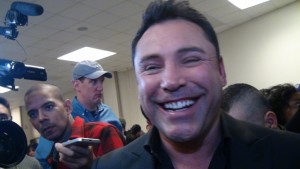
Oscar De La Hoya (640x360)
About 5 1/2 years ago, I wrote a column that treated Oscar De La Hoya and Todd DuBoef’s tactical use of candor and celebration of the free market and called it “In celebration of Oscar’s candor.” Today I rewrite it.

*

When Golden Boy Promotions’ Richard Schaefer revels in the free market’s amorality or Oscar De La Hoya discusses the defensive liabilities of any man he’s fought, put your smartphone down and immerse yourself in their wisdom. When they reverse roles, when De La Hoya gives you a stocktip or Schaefer talks combat, return to Facebook – unless you need a subject for your Monday column or a chance to opine generally about capitalism.

“We need to sign all the talent and get all the TV dates,” De La Hoya said last week to Broadcasting & Cable. “Then you can have your own agenda and have a schedule for the fans and the sport.”

While De La Hoya neglected to preclude that statement with a proper disclaimer – “as my friend Richard always tells me” – prizefighting’s most oleaginous figure was likely in the room with De La Hoya or else revising the interview’s first draft immediately afterward. In the few years since he began to conduct the orchestrations of Golden Boy Promotions, Schaefer has shown himself a shrewd strategist and singularly unlikable man. He thinks bigger than what small-potatoes promoters he occasionally mocks, seeing in their lack of national scope a want of desire, a want of ambition, a want, honestly put, of greed.

American English differs from Romance languages in its celebration of the word ambition – where a Peruvian called ambicioso would be properly insulted, inferring from the adjective he is naturally endowed with talents befitting a lower station than his aspirations’, any American called ambitious by a guidance counselor or prospective mate feels a burst of affirmation. Schaefer comes from a Swiss tradition that is neither American English nor Romance language, but he sees his success and others’ failures through a very American lens.

It is fair to imagine De La Hoya, a product of East Los Angeles and son of Mexican immigrants, enjoyed in his youth the company of exactly as many successful businessmen as young Schaefer befriended prospective prizefighters. They are anomalies to one another, then, and this benefits Schaefer more than De La Hoya.

De La Hoya’s path to success evinces an incredible combination of talent and luck. Fighters talented as De La Hoya are uncommon but do exist. None of them became the Golden Boy, though; to begin where De La Hoya began and arrive where De La Hoya arrived is probable as lightning hitting a lottery winner. To begin as a banker in Switzerland and arrive where De La Hoya found Schaefer is no rarity whatever. But De La Hoya probably doesn’t know this, and Schaefer, like all ambitious finance folks, is great with autobiographical musings of catastrophes overcome, extraordinary individual know-how, and foilings of what plotters would otherwise foil him.

It must rile Top Rank’s Todd DuBoef here and there to consider how insincere Schaefer is and how much money DuBoef’s stepdad, Bob Arum, failed to reap from De La Hoya’s 2007 match with Floyd Mayweather (another former Top Rank fighter). Not long ago, DuBoef floated an idea he called “brand of boxing” – a postmodern construct that celebrated postcompetitiveness. Unlike his stepdad, who wagers his credibility on three or four different fightcards annually and excavates rough jewels from mines in bad neighborhoods to present matchmaker Bruce Trampler for inspection, cutting and polishing, DuBoef occupies a time and land where prizefighting makes lots of money for the fortunate few who steer its enormous cash barge down an extraordinarily wide revenue river.

DuBoef prefers to maneuver round competitor islands and other nuisances, creating a television-production crew and handling pay-per-view cards in-house, where his stepdad prefers to go through them or over them or in any event at them.

“In boxing, virtually all of the publicity is keyed to a specific fight and, on a few occasions, to a specific fighter,” DuBoef said in June, lamenting boxing’s enduring competitive zealotry.

DuBoef’s model is nearer Schaefer’s model than Arum’s, and both Schaefer and DuBoef, faithful disciples of a system that coincidentally enriched them and assured them their riches evinced merit, not the luck of birthplace or parentage, likely wonder why Arum must do everything with such redness of tooth and claw, why he must be in constant and violent rivalry with some unfortunate or other to do his job effectively.

Bet De La Hoya understands.

While Arum’s success in life was perhaps more preordained than De La Hoya’s, the success of Arum as a boxing promoter was not. De La Hoya made combat with his athletic equals, men both interested in and capable of rendering him unconscious. Arum matched intellect, legal acumen and energy with his promotional equals, men both interested in and capable of his company’s ruination – including a once-a-century hustler like Don King. De La Hoya and Arum know lack and reflexivity; both men know the extraordinary effort, risktaking and luck required to attain momentum from a standing start, and they know how momentum feeds upon itself and moves money in hyperactive ways. Schaefer and DuBoef know a history of the modern free market and take as an article of faith it will reward those who respect it or love it praise it or whatever.

Schaefer’s future in boxing without De La Hoya, if ever they parted, would be but marginally less certain than DuBoef’s without Arum.

Bart Barry can be reached via Twitter @bartbarry
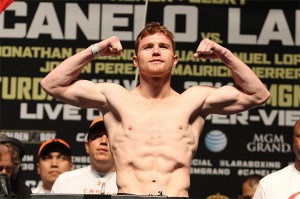


Surprise, Surprise: Canelo-Khan might include many

Canelo_Alvarez
The Canelo Alvarez -Amir Khan bout on May 7 has been cheered, booed, hyped, ridiculed, praised and trashed in the days since Oscar De La Hoya announced the stunning deal this week.

Reactions pretty much cover the proverbial waterfront. For the promoter, that qualifies as a promotional triumph. Lots of opinions generate a lively debate. The bigger the argument, the bigger the box office.

In large part, De La Hoya was able to create so much attention on the bout because he had kept it quiet. There wasn’t a peep from the twitter crowd about whether it might, should or could happen. Not a whisper. Nada.

The absence of even a single rumor already ranks as the Upset of the Year. It’s a bigger upset than a Khan victory would be.

For now, surprise is the only consensus about a bout that matches the bigger Canelo against the smaller, yet faster Khan. If boxing is the circus everybody says it is, there has to be an unpredictable twist, a wild ride, somewhere along the midway.

At its bottom line, however, Canelo-Khan is more than that. For Canelo, it’s a concession that he’s still not a true middleweight, despite his WBC version of the 160-pound title he took in a decision over an undersized Miguel Cotto in September.

In the wake of his victory over Cotto, there was some thinking that Canelo would face a legit middleweight, instead of another blow-up welterweight and/or junior-welter, in his attempt to get ready for Gennady Golovkin.

Against Khan, however, the 25-yar-old Canelo will again be at his favorite catch-weight, 155 pounds, at the formal weigh-in. Those close to him in Mexico say that weight is his comfort zone. It represents a milestone in training. It’s a sign that his conditioning is right. At 155, he knows he’s ready

It also means GGG, the consensus middleweight champ, will have to wait, perhaps until early 2017 for a showdown with Canelo, who in the meantime figures get a big payday while heightening his international celebrity against a name fighter from the UK, boxing’s liveliest market.

Is it fair to argue that Canelo blows away Khan in short order? Of course. Canelo, who opened as nearly a 4-to-1 favorite, might out-weigh Khan, a junior-welterweight just a few years ago, by twenty pounds at opening bell. By now, the fragility of Khan’s chin isn’t exactly a secret. Neither is his willingness to trade punches.

When the first big one lands, Khan’s caution has often been the first thing to go. That leaves him with only his instinct, which is to brawl. Next to go, his consciousness. The heavy-handed Canelo is at his lethal best against a fighter willing to stand in front of him.

At 29, however, the intriguing question is whether Khan has matured enough to know his weaknesses. He’s no dummy. He has the foot speed to stay out of range of Canelo’s power, especially over the first six rounds. If he can retain his wits and adhere to his fight plan, he might be able to pull off a stunner on the scorecards.

It’s hard to imagine Canelo chasing an agile Khan around the ring. Canelo has the clop-clop-clop footwork of a Clydesdale. Khan’s fast feet and faster hands could leave Canelo looking as confused as he did in a 2013 loss to Floyd Mayweather, Jr.

Can it happen? Could Khan actually win? Probably not. Then again, did anybody think a week ago that there was any chance he’d ever fight Canelo?


Kovalev krushes Koach Freddie, et al

By Bart Barry-
Sergey Kovalev
Saturday at Montreal’s Bell Centre, Russian light heavyweight champion Sergey “Krusher” Kovalev beat Haitian-Canadian Jean Pascal till Pascal’s corner told its charge to remain seated at the end of round 7. While the match was at no point competitive, while it was the rematch of a 2015 match that was not competitive, it was not that much less competitive in the seventh round than the sixth or the fifth or the fourth. The reason for the stoppage, apparently, was what disproportionate pleasure Kovalev began to derive from wounding the man across from him. During a sporting event.

Sergey Kovalev is a very good prizefighter in a decent division in a tired and tiring and tiresome era – and unfortunately for him and his copromoters, Main Events and HBO, no magical number of iterations will someday make him a great prizefighter (in the sense of Floyd Mayweather or Manny Pacquiao or Juan Manuel Marquez). A certain number of prizefighters get elected to the hall of fame each year, though, and boxing’s fabric is diaphanous and thinning, and so, sometime in the next 15 years, Kovalev’s immortality will gain purchase of a sort, with youngsters backing and filling our memories of his good fights with numbers and metaphors to prove his greatness.

It’s all in the game, sure, but howsoever will “Legendary Nights: Kovalev Krushes Pascal Twice” weather a scheduling error that sets it beside “Legendary Nights: The Tale of Hagler vs. Hearns”?

Better, probably, than Freddie Roach’s reputation will suffer Pacquiao’s first retirement a few months from now. Coach Freddie was back in promoter mode last week, casting colorful quotes at bored writers in the buildup to a rematch of a first match that was not competitive, assuring those gathered the improvement he wrought with Pascal was not subtle. But it was exactly that, as Pascal demonstrated by enduring Kovalev’s fury for 63 seconds less than he did 10 months ago. Coach Freddie’s solace is found here: The version of Pascal who sneaked past a lad named Yunieski Gonzalez in July was fated for a fiveround stoppage Saturday in Montreal, and the small, but enormous, stylistic details, that were overhauls, performed by Coach Freddie kept Pascal conscious if barely competitive for an extra six minutes of abuse.

Pascal has a great physique and a handsome face, both improvements made by Roach, and a penchant for winging wide punches and stumbling over his own aggressiveness – also wrinkles, pleats really, Coach Freddie ironed in. Unconvinced? Coach Freddie is going to overhaul that last sentence, a strategic revision about which he says, “Every writer is different in a job like this, but making Barry’s sentence better is kind of easy because there are so many mistakes.”

Let’s have a look:

Pascal has a tremendous physique and a striking face, both improvements made by Roach, and a tendency to wing punches wide and stumble over his own aggression – also wrinkles Coach Freddie folded in.

There you have it. Editor of the year.

With or without Roach, Pascal now returns to the toughman circuit to which Englishman Carl Froch remanded him seven years ago and whence Chad Dawson and Bernard Hopkins drafted him in 2010. Pascal is the sort of dark brute our nightmares convince us to favor in confrontations with wafers like Froch or Kovalev, but Pascal’s menace, much like Adonis Stevenson’s, is a cultivated superficiality, an amplifier of North American stereotypes more than a genuine bit of danger.

Froch was not menacing; Froch was a craftsman, a man who obsessed over manly comportment, found its purest manifestation in prizefighting, and obsessed over prizefighting. Froch wanted to be a great prizefighter and didn’t particularly care what pathway might get him there. Kovalev is a different thing entirely.

Were he not bludgeoning men with his fists, Kovalev would’ve done things vile enough to someone like Liam Neeson and his family for the subtext of “Taken” to have been Inspired by true events. Trainer emeritus Don Turner once used a telling word to describe Kovalev: mean. From Matthew the college professor or Sarah the barista, a word like that describing a professional fighter does not register, but from a man whose livelihood derives in large part from midwifing a will-to-cruelty in other men, the word is potent. The word manifests itself in the deadness of Kovalev’s countenance when he attacks – a predatory lack of empathy. Kovalev is more an athletic psychopath, more Sonny Liston, than an athlete who suspends his conscience to steal another man’s consciousness.

After Pascal’s corner waved the white towel Saturday, Kovalev fumbled a bit with the straightening of his Krusher kap, and it sent the mind to no coordinate sharper than Juan Manuel Marquez a minute after he snatched the animating force from Manny Pacquiao – mounting the turnbuckle a length from Pacquiao’s stillmotionless body, and ensuring his bill was just so for the cameras. Marquez’s willingness to kill another man in the ring, though, was tempered slightly by a very deep Mexican prizefighting tradition, a decree from the elders like: Thou shalt not. Russian boxing, an amateur-only affair till the 1990s, a sportsman’s endeavor performed with pillowy gloves and headgear till Kovalev was at least 10 years-old, has no such tether for its current practitioners.

Which means Andre Ward’s undefeated record, nay his life, is in jeopardy! Not so fast.

Kovalev is a very good 175-pound prizefighter. Andre Ward is a great 168-pound prizefighter. If Ward is not quite mean as Kovalev, he’s resentful as hell, distrustful, and unafraid to lead with his head or hit a man low if the moment warrants it. For all his menace and horror of intention, Kovalev barely dented a 50-year-old Bernard Hopkins in 36 minutes of trying. Anyone who thinks Kovalev is going to krush a 31-year-old version of Hopkins needs to start muting his HBO telecasts.

Bart Barry can be reached via Twitter @bartbarry
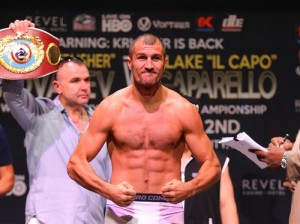


Barboza Jr. stops Cannon in one

Arnold Barboza Jr. scored a first round stoppage over Robbie Cannon in a scheduled six round welterweight bout.

the onslaught had blood coming from Cannon’s nose in the first minute. The fight was stopped at 2:59 of the opening frame when Barboza landed a hard 1-2 combination that sent Cannon Back.

Barboza, 143 1/4 lbs of South El Monte, CA is 10-0 with four knockouts. Cannon, 140 1/4 lbs of Festus, MO is 15-12-2.


Pascal hits Kovalev with an accusation as old as boxing

By Norm Frauenheim-
Kovalev & Pascal Weigh-InCasino de Montreal
Boxing’s ugly history repeated itself, warts and all, with Jean Pascal calling Sergey Kovalev a racist in the final news conference before their rematch Saturday night at Montreal’s Bell Centre.

I’m not sure what to make of it. The cynical side of the scarred business suggests that Pascal’s accusation is just another way of marketing a tough sell in his hometown.

Late Thursday, seats in every corner of the building, other than the pricey ones at ringside were available on the Bell Centre’s website.

Pascal, who has been calling Kovalev a racist since the light-heavyweight fight (HBO 9:45 p.m. ET/PT) was announced, raised the volume by several octaves with a performance that included bananas and a near brawl with Kovalev’s African-American trainer, John David Jackson. If Pascal was looking for twitter hits and website headlines, he got them.

Kovalev, an unbeaten Russian and a pound-for-pound contender, left himself open to the charge last April when he posed for a photo with a child in a T-shirt adorned with a boxer topped by a gorilla’s head. At the bottom of the photo, Kovalev wrote a caption that took aim at Adonis Stevenson, who like Pascal is a Quebec light-heavyweight of Haitian descent.

It says: “Adonis looks great!!!’’

It’s stupid.

Kovalev, long frustrated by the inability to land a fight with Stevenson, apologized. In this polarized era, however, apologies aren’t believed. They don’t last long either. But that photo isn’t going anywhere. It’s only a few keystrokes away for any rival who wants to use it as evidence to support an allegation.

In words and tone, Kovalev (28-0-1, 25 KOs) suggests that Pascal (30-3-1, 17 KOs) is calling him a racist out of fear or in an attempt at gamesmanship. If it’s the latter, Pascal is making a terrible mistake.

Kovalev is not easily distracted. The photo was dumb. The caption was dumber. But nobody has detected anything dumb in the way Kovalev fights. He is as poised as he is ruthless.

Bernard Hopkins, one of the game’s wise men, knew that instinctively throughout the all the hype before their 2014 fight. He didn’t do any of his trademark trash-talk, a Hopkins art form. He had read Kovalev well enough to know it wouldn’t work. Nothing did. Kovalev won a crushing decision and Hopkins, who was widely criticized for calling Joe Calzaghe “a white boy,” praised him in its aftermath.

It’s also noteworthy that Hopkins defended Kovalev after the photo appeared. Hopkins was quoted as saying he didn’t believe the Russian was racist. However, he also said that Kovalev would regret it.

Regret, race and, yes, racism have been part of the boxing narrative for as long as there has been an opening bell. It produced The Great White Hope more than a century ago in a segregated society’s desperate attempt to find a white heavyweight who could beat Jack Johnson.

To this day, Mexican fans chant “Guero.” Loosely translated, that means White Boy. Those fans will chant it, in singsong fashion, at almost any fighter of any color without a chance and/or the willingness to brawl. A racist slur? Depends on the listener. From this white face in a ringside seat, it’s merely a genuine expression from a crowd with a tribal-title loyalty for a fighter it knows like a neighbor.

In 1975, Muhammad Ali mocked Joe Frazier with a toy, a rubber gorilla that he tied onto a string and playfully battered around during a news conference before he beat Frazier in the Philippines.

“It’s going to be a Thrilla In Manila when I kill that Gorilla,’’ Ali said then.

Ali probably cringes now, which is what Pascal and Kovalev will probably do years from now.


Garcia decisions Guerrero in front of exciting legend Floyd Mayweather

By Bart Barry-
Danny Garcia
Saturday at Staples Center, Philadelphia welterweight Danny “Swift” Garcia decisioned Californian Robert “The Ghost” Guerrero by unanimous if narrow scores of 116-112. Both men adhered to sound strategies, and the spectacle was entertaining, benefitting as it did from a televised undercard stuffed with b-side quitters (jaw, tongue, hand, elbow). The match’s result enabled a hotly anticipated event of some sort in the fall, and the captain of The Money Team, Floyd “Money” Mayweather, himself, presided over about 2/3 of the main event from ringside, providing one member of the telecast an incredible opportunity for autographs.

The PBC’s struggles with authenticity continued unabated. Garcia-Guerrero, a fair and competitive fight conducted at a level three above most PBC fare, nevertheless felt somehow inauthentic – as if the combatants were in 20-ounce gloves.

Before prizefighting was scripted, back when Richard Schaefer lacked the managerial acumen to do what Al Haymon successfully did last year, Danny Garcia made a pair of matches with Mexican Erik “El Terrible” Morales, and whatever their druthers, Golden Boy executives stood by while Garcia twice beat their guy. The first fight happened in Houston, and Morales, six fights in an illadvised comeback, missed weight widely, got dropped in round 11, but nevertheless did unexpected things enough for Golden Boy to try again for their chance to promote Morales as a legendary champion (not long after Top Rank’s promotion of former Golden Boy partner Marco Antonio Barrera fizzed to its end). Garcia corkscrewed Morales in the canvas during the rematch, one that placed a blemish of unseriousness on both Golden Boy’s and New York’s PED Police badges, and that ended Morales’ career on a note sour as the meat that contaminated the many drug tests he failed till he passed one.

However obviously Golden Boy wanted a Morales victory, however comically they stretched rules in efforts that failed, the Garcia-Morales fights never felt inauthentic the way Saturday’s did, the way PBC cards ever seem to. The rounds went by – and this may speak to an interest in either fighter that does not endure – and little happened to excite viewers, and this may be an offsetting sort of reaction viewers have to the potent inauthenticity of PBC commentators, as if, in search of a mental sort of homeostasis while watching a PBC card, viewers turn down the credulousness settings on their HDTVs – or it might be something quite different actually: their eyes fatigued by squinting to see whatever the hell the commentary crew is on about through the undercard, PBC viewers’ gazes glaze during the main event and their minds go off to graze on nostalgic happenings of yesteryear, be they Garcia’s starching Amir Khan or Guerrero’s icing Martin Honorio.

It was that 2007 fight, right there, a Guerrero co-main in Tucson that preceded Juan Manuel Marquez’s undressing of Rocky Juarez, that brought a stitch of annoyance to Saturday’s viewing, when one of the commentators who was not a fighter continued to stress the talent disparity between Garcia and Guerrero. Talent was simply the wrong word, though exactly the word one might choose if he didn’t know who Guerrero was till a series of music videos preceding “The Ghost’s” 2013 match with Floyd Mayweather (who was in the building Saturday, who was in the building Saturday, who was in the building Saturday).

Before Guerrero became a popup ad for Christ and cancer survivorship, he was a very good, if somewhat overhyped, flyweight, and that is worth reiterating because it belies the apparent disparity in talent Guerrero suffered across from a career junior welterweight like Garcia: At 126 pounds, Guerrero put men to sleep faster than Garcia did at 140. Guerrero turned from boxer-puncher to brawler as he climbed weightclasses because it improved the probability of his consciousness at the ends of welterweight matches.

That was strikingly apparent Saturday, as Garcia graciously ceded large amounts of ring estate for a possibility of putting Guerrero at the end of a righthand lead. At distance, Guerrero had nothing but chin to match Garcia’s fist, and both men knew it. Guerrero was solely successful inside Garcia’s punches; if there were a miscalculation in the match, it was not Guerrero’s but Garcia’s – “Swift” overestimated the devastation his crosses and hooks would wreak when they did land and came within a round or two of needing the very homerun for which he kept swinging.

Fighters gain weight on their chins more than their fists, generally, and Garcia, while still possessed of concussive pop at 147, is not the same puncher he was at 140, a debilitation offset mostly by the experience he acquired fighting championship-caliber men in his pre-PBC years. Whatever Keith Thurman, now as much a salesman as a prizefighter, opines of his own power, the chance of his blasting Garcia before Garcia blasts him is long indeed – not because Thurman lacks talent for the trick but because, unlike Garcia who fought real men in real matches as a real underdog before the PBC pardoned him from doing very much of that, Thurman went from prospect to PBC without proving he has the wiles for unfastening another champion.

Guerrero marked a genuine challenge for Thurman, an opponent that required Thurman’s best to win a safe decision. For Garcia, Guerrero was a showcase opponent of sorts, a knownguy Garcia never worried might beat him, a Money Team-made celebrity Garcia would either look spectacular smashing to pieces or else decision without worry. Guerrero brought more violence than anticipated, and Garcia appeared grateful for it, appreciative of the reminder their 36th minute together gave him: A promotional b-side in a rigged affair who nevertheless believes he will win and fights like it – I remember that feeling!

Bart Barry can be reached via Twitter @bartbarry
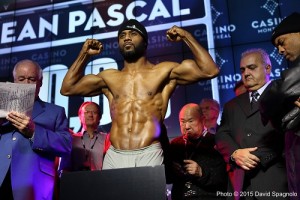


FOLLOW GARCIA – GUERRERO LIVE

Danny Garcia

Follow all the action LIVE  as Danny Garcia and Robert Guerrero fight for the vacant WBC Welterweight title.  The action begins at 8 PM ET / 5 PM PT with a Heavyweight attraction of former U.S. Olympian Dominic Breazeale knockout Amir Mansour that will be followed by a Welterweight fight between Sammy Vasquez Jr. and Aron Martinez

Page will refresh automatically

12 Rounds WBC Welterweight title–Danny Garcia (31-0, 18 KO’s) vs Robert Guerrero (33-3-1, 18 KO’s)
ROUND 1 2 3 4 5 6 7 8 9 10 11 12 TOTAL
Garcia 9 10  10  10  10  10  10  10  10 10  10  9 118
Guerrero 10  9  9  9  9  9  9  9  9  10  9  10  111

Round 1 Guerrero putting the pressure on..Straight left to body

Round 2 Quick left from Garcia…right..left hook..

Round 3 Body shot from Guerrero..right..Nice left hook..Right to the body…

Round 4 Guerrero working on inside..Garcia lands a body shot..right to body…left..1-2…Uppercut from Guerrero..

Round 5 Long left from Guerrero..Right from Garcia..Garcia starting to swell under his right eye..Straight right from Garcia..looping right…

Round 6 Uppercut and right from Garcia…Left …Quick right…Right to chin..quick left hook..lead right..2 big rights and left at the bell

Round 7 Big right from Garcia..right…

Round 8 Right from Garcia at the bell

Round 9 Straight right from Garcia..left hook..big left hook..Lead right…sneaky right

DANNY GARCIA WINS ON ALL CARDS 116-112

Round 10

Round 11 Big right from Garcia..Body work and left hook to head..Guerrero lands a left..nice flurry from Garcia..Good uppercut..

Round 12 Left hook from Garcia…straight left from Guerrero..left..Good action to close it out

12 Rounds Welterweights Sammy Vasquez Jr. (20-0, 14 KO’s) vs Aaron Martinez (20-4-1, 4 KO’s)
ROUND 1 2 3 4 5 6 7 8 9 10 11 12 TOTAL
Vasquez 10 10  10  10  10  10  60
Martinez  9  9  9  10  9 9 55

Round 1 Straight left to body from Vasquez..

Round 2 Combination from Vasquez…Vasquez lands in the corner..Martinez telling Vasquez to come on…

Round 3 Left from Vasquez

Round 4 Right hook from Vasquez..Right from Martinez..

Round 5 Vasquez being aggressive

Round 6 Vasquez lands a left….MARTINEZ QUITS IN CORNER


10 Rounds Heavyweights Dominic Breazeale (16-0, 14 KO’s) vs Amir Mansour (22-1-1, 16 KO’s)
ROUND 1 2 3 4 5 6 7 8 9 10 11 12 TOTAL
Breazeale  9  9 8 10  9  45
Mansour  10  10 10  9  10  49

Round 1 Mansour comes out swinging…Jab to the body…Breazeale lands a right..Mansour lands a hard left..Left to body

Round 2 Right and left from Brezeale…Hard left hurts Breazeale…Hard right hooks rock Breazeale

ROUND 3 BIG RIGHT HOOK TO TOP OF HEAD AND DOWN GOES BREAZELE…Hard jab…right hook..Big uppercut from Breazeale

ROUND 4 Mansour jabs to the body..Right from Breazeale…Jab

Round 5 Huge right from Mansour…Right…Body work..double right hook…right hook..Right from Breazeale..Straight left from Mansour..

ROUND 6 MANSOUR DOESNT GET OUT OF CORNER…FIGHT STOPPED


Farewell or Fight On? Pacquiao discovers that it’s hard to say goodbye

By Norm Frauenheim-
May Pac PC 3
There is no good way to say goodbye to boxing. Manny Pacquiao is trying to. At campaign stops in New York and Los Angeles this week, he said repeatedly that his fight with Timothy Bradley on April 9 would be his last.

In a political season full of Trump, Palin, Cruz and Hillary, however, few believe the soft-spoken Filipino Congressman, who also happens to be running for one of 24 seats in his country’s Senate. His promoter, Bob Arum, doesn’t. His trainer, Freddie Roach, doesn’t. His Filipino constituency doesn’t want

The prevailing skepticism is rooted in precedent. Boxers come back as often as politicians break promises. In Bill Dwyre’s ongoing series for Top Rank on the second Pacquiao-Bradley rematch, the retired Los Angeles Times sport editor quotes Arum on just the latest example.

Brandon Rios retired at a news conference in the immediate aftermath of his one-sided loss to Bradley last November. Arum immediately applauded his announcement.

“Half-an-hour later,’’ Arum said, Rios “unretired.’’

The entertaining anecdote is as true a guide as any on what to expect — or not expect — from Pacquiao or anybody else in a business where scar tissue is the only sure thing.

But it’s an awkward way to sell a fight.

The guess here is that Pacquiao believes what he is saying, just as surely as Rios did with a decision that sounded heartfelt at the time. But there are all kinds of reasons and scenarios that could change Pacquiao’s mind.

To wit:

§ If he wins, he has a title to defend and chance at more money to finance further campaigns.

§ If he loses, his reputation is at stake. Careers end in defeat all the time. But a loss might be tougher for a politician whose clout with the voters is built on how he won them over. His political career was launched by what he did within the ropes. A pound-for-pound ranking was the only poll he ever needed. The ring was his bully pulpit.

Either scenario comes with reasons to think his career continues beyond his third fight with Bradley at Las Vegas’ MGM Grand.

Meanwhile, Arum is confronted with the tough task of selling a bout that Pacquiao calls his farewell-fight, which is an oxymoron, if there ever was one. You fight to stick around. Throwing in the towel is one way of saying farewell.

A lot of fans feel as if they said farewell to Pacquiao, the fighter, on that December night in 2012 when he landed on the canvas, face-first, from a right hand delivered by Juan Manuel Marquez.

That might have been as good a time as any to say goodbye, except for that opportunity at a huge payday against Floyd Mayweather Jr. Good business sense dictated he continue, despite pressure to quit from family and friends.

Pacquiao stuck around, collecting what was reported to be between $160 and $180 million. It was worth it. It made him a very rich man. But it looks as if the May loss to Mayweather was just one more bout in the inevitable decline of a fighter in his mid-to-late 30s. He’s back now. He says he has recovered from surgery to the right-shoulder, which he said was injured in training, yet wasn’t disclosed until after the dull, controversial loss to Mayweather.

Then, there’s Mayweather, of course. He says he’s retired. But nobody believes him, either. The prevailing speculation since Mayweather’s promised career-ender –a September victory over Andre Berto — is that he’ll be back.

As different as they are, it turns out that Pacquiao and Mayweather have one thing in common. In a business with no term limits, it’s hard to say so long.


Miller says he’s the Big future in the heavyweight division

By Norm Frauenheim
Jarrell Miller
He calls himself Big Baby. But don’t let the nickname fool you. This baby doesn’t cry. Jerrell Miller only boasts.

Miller (15-0-1, 13 KOs) hopes to back up those noisy boasts Friday on ShoBox (Showtime 10:35 p.m. ET/PT) at Casino del Sol in Tucson against Donovan Dennis (12-2, 10 KOs) on a card that feature middleweight prospect Rob Brant (18-0, 11 KOs) against DeCarlo Perez (15-3-1, 5 KOs).

Miller, of Brooklyn, is fighting to get noticed in the scrum of heavyweights that has gathered in the wake Tyson Fury’s stunning upset of longtime king Wldimir Klitschko last month.

The first to score a winning ticket was Charles Martin, who won a vacant IBF title last Saturday when his opponent, Vyacheslav Glazkov, went down with a knee injury in the third round of a bout on a Brooklyn card that included WBC champion Deontay Wilder’s stoppage of Artur Spizlka.

Now, it’s Miller turn to make a statement that Martin didn’t.

In Friday night’s main event, Brant, of Minnesota, makes his second straight ShoBox appearance after a tough, majority decision over Louis Rose up the road in Phoenix.

“It’s a New Year, but I don’t go into it with any kind of timetable,’’ said Brant, a former national Golden Gloves champion. “I just need to win and let the wins take care of everything else.”


On beauty and boxing: New York Times edition

By Bart Barry-
Mago 206
Recently the New York Times published a column on beauty by David Brooks and a long-form piece on boxing by Dan Barry. Brooks’ column marked a sincere effort to celebrate a thing its author freely concedes he does not understand. Barry’s investigation marked a sincere effort to demonize a thing its author thinks he understands. One challenges its readers, and the other “challenges” its readers.

As Barry set out to write his literary synthesis of Thomas Hauser’s 2013 investigative report, one senses, he did it with an editor’s silent incantation – “What is the angle here?” – drumming through his head. A tragedy happened, and that means a villain, or villains, and the more villains, the less any one villain deserves empathy, who has time for that when villains lurk round every paragraph, and that means going hard-down on whichever villain, full-literary, award-winning, drilling to the “truth” – however superficial that particular truth might be, however much of a caricature you must make of a nobody or two to get that truth through your editor’s filters.

In Barry’s case, the villain is a villainous inspector endangering a prizefighter, his home state’s reputation, and the sanctity of sport itself, all in the petty pursuit of handwraps (he uses as a fundraising tool for former prizefighters). One hopes the first angle for this story was an irony like: An inspector trying to raise money for impoverished prizefighters inadvertently minted another impoverished prizefighter. That first angle might not have suffered an editor’s skepticism, though: These barbarians believe in saving them after they destroy them?! Subsequent reporting, too – interviewing men Hauser’s story already gave a mirror with which to study themselves for two years – revealed, much as Hauser already had, that the language barrier, Russian-to-English, likely precluded Abdusalamov’s words from tripping an inspector’s alarms, no matter his attentiveness.

As Barry re-reported, Abdusalamov’s stating his face hurt carried fractionally the conditional impact of his stating his head hurt. A light headache is expected by any athlete who exerts like that for 30 minutes, much less an athlete struck repeatedly to the skull, and as boxers are of the sturdiest stock if a fighter tells an inspector his head hurts, he’s describing a perilous abnormality, and a chain of actions gets triggered. When those actions do not get triggered, later interviews with medical professionals tend to reveal nothing so much as the extraordinary self-aggrandizement of someone who attends medical school. The hypotheticals are invariably rich and the mistakes of others who are not them invariably inexcusable: Every second counts!, everything might have been different!, were it my hospital . . ., it reminds me of someone I saved!, they did what?

A few years ago, the least-pleasant writing assignment I’ve endured sent me to fetch the likeliest cause of Frankie Leal’s 2013 death, asking if it could have been avoided. The question itself is an angle-beggar: Every event in a human life is not equal parts impossible and inevitable, and you need to decide which this event was and prove it. I interviewed a host of experts, lost most of my admiration for the field of neurology – the delta between its certainty and expertise being absurd – and concluded Leal’s death was equal parts impossible and inevitable, and if anyone were to blame it was Leal himself (a verdict and sentence, both, Leal would have accepted).

Last week Carlos Acevedo provided a review of Barry’s piece that included this insight: “That an underclass pursuit as barbaric as boxing can still exist in 2016 in a country known for its exceptionalism and for meritocracy is a shock to progressives who, like Marxists, view prizefighting as the exploitation of the destitute for the frivolous benefit of the bourgeoisie. But in the streets where gunshots echo in perpetuity, where drug gangs rule corners in daylight and moonlight alike, where unemployment is a scourge and in which prison terms are more common than college degrees, risk is a relative concept.”

Notice the empathy, notice the dexterity, notice the tolerance for ambiguity. Among Acevedo’s advantages over Barry are these: Talent, and softer editing – Acevedo didn’t have to compose his story before he wrote it and then watch anxiously as his boss changed his prose and then changed those changes.

Whatever David Brooks’ stature as a writer, he is remarkably adept at navigating editors and getting his occasionally angle-less columns published with charming ambiguity. His Jan. 15 column has something like an angle – he favors beauty over economists – but it allows a wide enough band for agreement as to have no angle at all. He also addresses something like physical intelligence, a form of beauty often misclassified as athleticism – that linear measurement of times and spaces, adored equally by scouts, geeks and other men enchanted by being right.

Because of the way it punishes errors, more viciously than another sport, boxing uncovers its practitioners’ physical intelligence in a way no IQ test or SAT ever measured a brain. It engenders intimacy, too: A man will forget his sexual partners before he forgets his sparring partners. Much to the chagrin of those who would ban it, boxing reveals what man senses even when he cannot prove it: This world is an unpredictable and often violent place for all who occupy it. Boxing is ugly and vital, and often its vitality grows in proportion to its ugliness.

And boxing buries its undertakers.

Bart Barry can be reached via Twitter @bartbarry
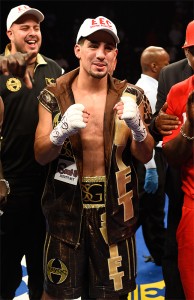


FOLLOW WILDER – SZPILKA LIVE FROM RINGSIDE

WILDER VS SZPILKA-WEIGH IN-01152015-9746

Follow all the action LIVE  from Ringside as Deontay Wilder defends the WBC Heavyweight title against Artur Szpilka.  The action begins at 10 PM ET / 7 PM PT / 4 AM in Warsaw and  5 AM in Kiev with a battle for the IBF Heavyweight title between undefeated fighters Charles Martin and Vyachelsav Glazkov

Page will refresh automatically

12 Rounds WBC Heavyweight Title Deontay Wilder (35-0, 34 KO’s) vs Artuz Szpilka (20-1, 15 KO’s)
ROUND 1 2 3 4 5 6 7 8 9 10 11 12 TOTAL
Wilder 10  9 9  10  9  9  10  10  76
Szpilka  9  10  10 9 10  10  9  9 76

Round 1 Wilder gets in a jab..Jab..

Round 2 Szpilka gets in a left..Jab from Wilder..Counter right from Szpilka..Left..left..

Round 3 Szpilka gets in a left on ropes..left..left..Counter left from Wilder..Counter right..

Round 4 Jab from Wilder..Jab…right..Hard right..1-2;

Round 5 Szpilka gets in 2 jabs..Right from WIlder///Left from Szpilka..Hard right from Wilder..

Round 6 Right hook from Szpilka…Right from Wilder..right hook from Szpilka…

Round 7 Big right from Wilder..Right..3 punch combo on ropes..Big right..Combo from Szpilka..left..

Round 8 Jab from Wilder..Left from Szpilka…Right from Wilder

Round 9 Counter left from Wilder to top of head..Right..COUNTER RIGHT AND DOWN GOES SZPILKA AND HE IS KNOCKED OUT

12 Rounds IBF Heavyweight title Vyacheslav Glazkov (21-0-1, 13 KO’s) vs Charles Martin (22-0-1, 20 KO’s)
ROUND 1 2 3 4 5 6 7 8 9 10 11 12 TOTAL
Glazkov  9  9  9
Martin 10 10  10

Round 1 Martin lands a straight left…

Round 3 Martin lands a LEFT AND DOWN GOES GLAZKOV…THE FIGHT IS OVER


Happy Birthday: In a week full of legendary ones, the heavyweights seek a rebirth of their own

By Norm Frauenheim
Deontay Wilder
Six days after George Foreman’s birthday, four days after Joe Frazier’s birthday and the day before Muhammad Ali’s birthday, the heavyweight division will attempt another rebirth Saturday in Brooklyn with Deontay Wilder in a title defense on a Showtime-televised card that includes a bout for a vacant version of another acronym-sanctioned championship.

Birthdays or astrology or coincidence might suggest that January is a promising time for the heavyweights. But the only chart that matters is the ongoing one that says the division has been receding faster than a glacier.

It hasn’t exactly vanished. Wilder (35-0, 34 KOs), who defends his WBC title against mostly-unknown Spzilka (20-1, 15 KOs), shows promise with great athleticism and intriguing power. There are moments when he looks like a big version of Thomas Hearns.

He figures to beat Spizlka, an unknown Pole who has even less experience than he does. Spizlka decided to take up boxing on the urge of a promoter who saw him in soccer brawl outside of a Polish nightclub in 2008.

Nevertheless, Wilder’s relative inexperience leaves skepticism, impossible to dismiss. Despite an Olympic bronze medal at the 2008 Beijing Games, he’s a newcomer. The 30-year-old Wilder didn’t start boxing until he was 20.

It makes you wonder how he would do against Russian Alexander Povetkin (a 2004 gold medalist at the Athens Olympics) or Luis Ortiz, who learned his way around the ring in Cuba’s amateur system. Povetkin and Ortiz were schooled in the game’s subtleties at an age when skill becomes instinct.

The unbeaten Wilder likes to say that potential rivals have to enter “the athletic department.’’ Fair enough. He’s stronger and more agile than most. But instinct is critical, especially in the face of heavyweight power that can stop a fight within fractions of a single second. It’s there when a big shot short-circuits the ability to think. We’ve yet to see whether Wilder can react in that brief, yet critical moment of adversity.

Yet, Wilder still appears to be the one heavyweight who can restore attention on the division in an era about to unfold – ready or not — in the wake of Tyson Fury’s November upset of Wladimir Klitschko.

Klitschko’s heavyweight reign, almost a decade long, was a run of reliability. Predictability, too. But it eliminated a critical element. There were no rivalries. There was only Klitschko.

Rivalry creates interest. Draws an audience, too. That’s the great lesson of Ali, Frazier and Foreman, each also an Olympic gold medalist. Ali turns 74 on Sunday. Foreman was 67 on Jan. 10. The late Frazier would have been 72 on Jan. 12. Their birthdays are worth celebrating. They represent chapters in a time still unequaled.

Ali-Frazier became a historical reference point for every rivalry in and out of sports since their trilogy (1971, 1974 and 1975). Larry Bird and Magic Johnson were the NBA’s Ali-Frazier. The Yankees and Red Sox were baseball’s Ali-Frazier. Roger Federer and Rafael Nadal were tennis’ Ali-Frazier.

By its very nature, rivalries come easy in boxing. It’s the one-on-one drama, which in part was re-created by Magic and Bird. During the Ali era, there was more than one, mostly because of his charisma, salesmanship, brinkmanship and mouth. The Floyd Mayweather model rules today’s business. To wit: The most money for the smallest risk.

It enriched Mayweather, yet left longtime fans and new customers frustrated. The public demand got whipped up into a lotto-like froth for Mayweather-Pacquiao. But Mayweather’s fight was a dud. The rivalry, past its prime, was a figment of social media’s imagination.

But Ali’s rivalries were real because of his willingness to take repeated risks. During the last couple of decades, film and song have memorialized Ali’s 1974 victory over Foreman in Zaire. Over time, that one fight has gained as much historical significance as Ali-Frazier.

Can it ever happen again? Doubtful. But mid-January is as good a time to try as any.


To the contrary: Marco Antonio Barrera’s polemical decisions

By Bart Barry-
marco_antonio_barrera_3
In only its second week, 2016 promises a paucity of suitable subjects to rival its predecessor. Rather than write 52 columns without end, we begin a new series called “To the contrary” – in which I will select some column from my archives and rewrite it, expressing a different, if not wholly opposite, opinion in celebration of subjectivity.

*

About 9 1/2 years ago, I wrote a preview of Marco Antonio Barrera’s rematch with Rocky Juarez and called it “No polemical decisions.” Today I rewrite it.

*

At a recent dinner after a Celebrity Theatre card with the creator of this site, John Raygoza, the subject of a charismatic local cruiserweight’s intellect got broached.

“He’s a smart guy,” said John.

“No,” I said, “he’s a smart fighter. Out in the rest of the world, there are lots of smart guys.”

What the hell does this have to do with Saturday’s rematch in Las Vegas between Mexican Marco Antonio Barrera and Texan Rocky Juarez, a mulligan for May’s match, one for which Barrera was ill-prepared when Juarez, a short-notice replacement, very well may have beaten him on any honest scorecard in California? Admittedly little, though it might have a goodish amount to do with Barrera, or at least our perception of him.

Back to that in a moment. First, a few reasons why Juarez might fare worse in his rematch with Barrera than he did in their first encounter. Juarez hasn’t a championship speed in his gearbox. We saw it in last year’s loss to Humberto Soto. And if ever Juarez’s ambition takes him in the ring with another master like Juan Manuel Marquez or Chris John, we’ll see it there too. Juarez surprised Barrera in May with the rude force of his youth, pouncing on the 65-fight veteran and thoroughly discomfiting him. But if Barrera is perhaps a smart fighter more than a smart guy, he is nevertheless an incredibly smart fighter.

“No me gustan las decisiones polémicas,” said Barrera, when asked why he granted Juarez an immediate rematch.

While “polemical” was a curious choice of words, it signaled Barrera’s decisiveness of craft more than his precision, quickness or relaxation with the Spanish language. Better put: Barrera will not be surprised twice by Juarez’s youthful exuberance. To win a decision that is not polemical against Juarez, Barrera will have to thwart Juarez, dis-couraging him from first bell.

Who better to complete a pattern like that, match to rematch, than Marco Antonio Barrera?

Since Barrera’s 2001 masterpiece against Naseem “The Prince” Hamed, the doctoral dissertation he gave the precocious undergrad Hamed, a roaming exploration of everything from self-defense to balance to concussive leverage to a textured and personal experience with a turnbuckle’s cover, Barrera has been considered by some aficionados, this one especially, more than a smart prizefighter. We considered him a smart guy

But isn’t this always the way with eloquence? In a postmodern haze of admiration, that our own cant might someday be admired by other postmodernists, we find ourselves enraptured by the words another man chooses, excited by our own imagining of him crouched over a dictionary improving himself with a rapacity like ours.

Some persons’ eloquences are a paragon of willfulness and discipline, perhaps, but most of us evince nonlinear systems’ sensitivity to initial conditions more than our own striving. A human’s capacity to grow from a pair of microscopic cells to an NBA center, after all, is nonlinearity’s calling card. And the initial conditions?

Homes in which our native languages are spoken well by the adults we hear speaking before we know what language is, before we have even a concept of “we” to assign letters to – these form the initial conditions that, subjected to hundreds of millions of iterations, eventually form a capacity with sounds and letters we are told is eloquence.

Barrera grew up in the relative luxury of Mexico City with parents who spoke the language well. His accent is upper-middleclass, his confidence appreciable Has he strived to improve his use of the language? Possibly. Did he have a considerable head start on peers raised in homes where Spanish was spoken less eloquently? Certainly. Does he feel a touch of contempt when he hears them speak? Probably.

Along with what close, and fairly unfair, decisions their first two fights brought, Barrera’s eloquence and evident breeding offended the sensibilities of nemesis Erik Morales, a tijuanense Barrera once derisively called an “Indian,” enkindling a rivalry outside the ring detrimental to the men as what they’ve now done to one another during 108 minutes of sanctioned violence together.

In their public exchanges, Barrera has contented himself to play the diplomat, leaving Morales, and tacitly encouraging him, to play the role of resentful savage. Barrera’s charm, an eloquence that occasionally strays from detached insight to gilded emptiness, got displayed yet again in Tucson a few months back when, as Golden Boy Promotions’ designated partner, Barrera was ringside at Desert Diamond Casino.

Asked if he might someday welcome an induction to boxing’s hall of fame alongside his rival Morales, the way Michael Carbajal recently accompanied Humberto Gonzalez, Barrera paused then replied:

“For our part, there is nothing against Morales. I have always said that he is a great champion. It does not displease me that we are mentioned together.”

It was pure Barrera – eloquent and disingenuous to the last.

Bart Barry can be reached via Twitter @bartbarry


Post Klitschko: Crowd gathers in Fury aftermath

By Norm Frauenheim
Tyson Fury
It’s hard to know whether the search for the next great heavyweight will ever end. Generation after generation, from baby boomer to millennial, it goes on. And on.

I’m not sure it will ever produce much more than nostalgia, but it looks as if we’re about to embark on a part of the expedition that will reveal whether there is only history and nothing else after Wladimir Klitschko.

It’s premature to declare an end to the Klitschko era. It also unfair to Klitschko, whose steady reign at the top of the fabled division for nearly a decade suggests he might make all those declarations look foolish in a rematch of his November loss to Tyson Fury.

Nevertheless, the biggest upset of last year and just about any other year left inescapable evidence that Klitschko’s suffocating grip on the heavyweights is finally gone, even if he regains his titles against the thoroughly unpredictable Fury. Klitschko looked like an old monument. Moved like one, too. According to CompuBox, he landed about five punches a round. That’s more than a stat. It’s a symptom, a sign of age. He’ll be 40 on March 25.

Potential rivals in a younger generation have noticed. Klitschko looks like wounded prey and they’ve begun to circle.

“It’s our time now,’’ said 29-year-old Charles Martin, who faces Vyacheslav Glazkov on Jan. 16 at Brooklyn’s Barclays Center for an IBF title stripped from Fury in the immediate aftermath of his upset of Klitschko.

Martin went on to say that he wants everything that Klitschko had in terms of belts and presumably money. His reported purse for Fury was $18 million.

“Yeah, I want it all,’’ Martin added during a Wednesday conference call that also included Deontay Wilder, who is the biggest star on Showtime-televised card.

Wilder, who defends his WBC belt against Poland’s Artur Szpilka, has emerged as perhaps the most marketable rival to Klitschko. He’s media friendly. He’s American. He has a big punch, although there are still questions about whether he can withstand similar power. There’s another wrinkle, too. He worked as a Klitschko sparring partner a few years ago.

“I was disappointed that Klitschko didn’t show up,’’ said Wilder, who also might have been disappointed that Fury had the good timing or dumb luck to be in the ring when Klitschko was as vulnerable as he’s been in many years. “Something was missing. That wasn’t what we’re used to seeing.’’

The unbeaten Wilder said he’ll wait for the Fury rematch to see if the old Klitschko is still there, still able to rule boxing most historic division. It was also clear, however, Wilder sees himself as the heir apparent, regardless of Fury’s victory.

“I’m looking forward to being the undisputed heavyweight champion of the world,’’ said Wilder, who doesn’t have to go far to hear the same thing from a division suddenly crowded with promises and perhaps potential enough to make it relevant again.


Portrait of 2015’s best knockout, part 2

By Bart Barry-
2015-12-27 19.35.28
Editor’s note: For part 1, please click here.

*

The May morning of 2015’s knockout of the year, the Saturday Mexican Saul “Canelo” Alvarez spearchiseled Texan James “Mandingo Warrior” Kirkland in Houston, no one was certain just yet how debasing for the sport of prizefighting 2015 would be, how mercenary, how joyless, but the previous weekend’s fare served notice to all aficionados, and the worst part, too: Mayweather-Pacquiao was what we asked for, demanded, allowed the sport to suspend itself in pursuit of, for five years that did nothing so much as hollow-out the fanbase by loitering in Las Vegas while more gymnasiums shuttered and fewer American boys explored boxing as more than a cynic’s plan-c moneymaking ruse, a trashtalking musicvideo to film after flunking football and basketball.

In March, Oscar De La Hoya promised Canelo Alvarez as a savior for the sport, and everyone applied the ironist’s filter, instantly and properly, hearing: Canelo Alvarez is the man the Golden Boy hopes will save his struggling brand. It was lost on no one how instrumental De La Hoya and “his” “promotional company” were to Money May’s ascent during the seven years De La Hoya vainly searched for someone, beginning with himself, to humble Floyd Mayweather; instrumental, in fact, is not strong enough – during the partnership years, Golden Boy Promotions was the fulcrum in Al Haymon’s lever, making De La Hoya and his former friend Richard Schaefer mechanically essential to a movement that, in 2015, changed its name from “HBO” or “Showtime” to Premier Boxing Champions, PBC, and began appearing on the same terrestrial television networks promoter Bob Arum convinced aficionados should be boxing’s rightful place (about a decade after Arum first moved boxing from terrestrial television, of course).

Very few pundits realized when Canelo fought Kirkland what an existential crisis the PBC presented, with its hostility to independent media and indifference to competitive matchmaking, and only marginally more recognize it today – choosing, symmetrically, to save such a collective revelation for the very moment their powerlessness to alter it achieves fullness and perfection (with writer David Avila a noble exception).

*

The May morning of 2015’s knockout of the year, the Saturday Mexican Saul “Canelo” Alvarez spearchiseled Texan James “Mandingo Warrior” Kirkland in Houston, brought merely one concern about a tardy arrival at the ballpark: There mightn’t be time for socializing and reminiscing with writers Kelsey McCarson, a fellow Texan, and David Greisman – not a fellow Texan but doing his level best that week to be one.

My fears were misplaced. The endless and uninspired undercard offered plenty of time for chatting and sharing a photo on the grass roamed by Astros outfielders. Seated directly in front of me, too, was Welshman Anson Wainwright, once a contributor to this very site and today a regular contributor to The Ring’s always engrossing “Best I Faced” series.

The ranks have thinned since my first visit to pressrow in 2004, and in the next five years the PBC’s subversion of media access will end either the PBC or pressrow, but wherever more than a halfdozen writers are gathered at a Texas fightcard, good health and good humor shall remain the rule.

*

The May morning of 2015’s knockout of the year, the Saturday Mexican Saul “Canelo” Alvarez spearchiseled Texan James “Mandingo Warrior” Kirkland in Houston, anyone who told you he was sure what to expect from Kirkland was embellishing the case a bit. Kirkland had done his preparations with San Antonio’s Rick Morones, instead of Austin’s Ann Wolfe, and while it likely made no difference to the outcome – Canelo is simply a higher level fighter than Kirkland, whatever Kirkland’s conditioning – it was not the plan in March when the Canelo-Kirkland presstour made its way to Alamo City’s historic Aztec Theatre and a pleasant and plump Kirkland confidently and ominously reported his manager was in negotiations with Ms. Wolfe.

Kirkland is a known entity in San Antonio, not quite a legend but one remembered in local gyms for having manstrength even as a boy. Kirkland was the right person to make Canelo look spectacular, a lie-detector type, rough and unrelenting, one to establish quickly the difference in caliber between a champion like Canelo and a local attraction.

Canelo had not before had a man of Kirkland’s class run across the ring at him on first bell and begin hurling punches without regard for anyone’s safety, but he managed the incident as if he had, and many times. That poise is a large reason Gennady Golovkin apologists, those who’ve amplified the Golovkin-camp line for three years, the risible assertion GGG, despite never fighting anywhere but middleweight, is ready to fight any man between 154 pounds and 168, strongly prefer 2016’s superfight happen at 160.

If that fight happens, this much will be made immediately clear: While Canelo Alvarez has fought at least one man considerably better than Golovkin, and maybe several, GGG’s reign of terror at middleweight has yet to include anyone close to Canelo’s talent.

*

The May morning of 2015’s knockout of the year, the Saturday Mexican Saul “Canelo” Alvarez spearchiseled Texan James “Mandingo Warrior” Kirkland in Houston, the 200-mile eastwards drive got justified by both men’s reputations and the increasingly unfortunate realization Canelo Alvarez will be the Mexican prizefighter most remembered in our current era – despite his technical inferiority to each member of our last era’s Mexican triumvirate: Juan Manuel Marquez, Marco Antonio Barrera and Erik Morales.

Because of Mexican television rights and other complexities, including their standard-issue dark heads of hair, the best fighters of the last era accomplished fractionally much celebrity in their homeland as Canelo did before his 25th birthday. Canelo cannot be blamed for that. He’s squandered no opportunities, whatever his limitations of speed and power, and he remains a prompt and courteous interview even when he does not need to be. He has far surpassed his only realistic competition for Mexico’s heart, “Son of the Legend” Julio Cesar Chavez Jr., and he’s done it with discipline and class.

Any aficionado seated ringside for Canelo-Kirkland and knowledgeable of Mexican prizefighting history – practically a redundancy, that – left the experience balancing a sentiment like this: An era of Mexican prizefighting could do better than having Canelo Alvarez as its standard bearer, yes, but it could also do much worse.

Bart Barry can be reached via Twitter @bartbarry


Howard Davis Jr.: Boxing loses the friendly face of a bygone day

By Norm Frauenheim
Howard Davis Jr.
A difficult year got a lot tougher in its final week. Howard Davis Jr. died.

Davis’ death Wednesday after a battle with lung cancer was confirmed Thursday, New Year’s Eve and a sober reason to mourn the loss of a fighter who was the symbolic face of better days.

For younger generations, Davis might not mean a whole lot. Truth is, he was forgettable as a pro, which is the only part of the business that gets much attention anymore.

He was a journeyman-like 36-6-1 and was 0-3 in fights for major titles. He lost a unanimous decision in 1980 to Scotland’s Jim Watt in Glasgow for the IBF’s lightweight belt. The cards went against him in a 1984 split-decision loss to Puerto Rican Hall of Famer Edwin Rosario in San Juan, also for the IBF’s 135-pound version of the title. Buddy McGirt knocked him out at New York’s Felt Forum in the first round of a 1988 bout for the IBF’s 140-pound crown.

The pro record prevents him from induction to the International Boxing Hall of Fame. But he belongs there – just as surely Cuban heavyweight Teofilio Stevenson does – in some category for what he did and meant to the Olympics, an international event if there ever was one.

Sylvester Stallone is a Hall of Famer because of what his Rocky role did for the game. Yo, if Stallone is in the Hall, there’s got to be some room in there for Davis and Stevenson.

Davis, who died at home in Florida at 59, came from an era when Americans still watched and cared about Olympic boxing. He was on the fabled 1976 team, the best ever in U.S. history and the genesis of what would become the 1980s, a heyday in the pro game.

In hindsight, we remember the ’76 Olympics for Sugar Ray Leonard, who went on to one of the greatest pro careers in history.

In the public imagination, Leonard’s brilliance as a pro seemed to heighten his status as the star of that American team.

Forgotten, however, is that Leonard wasn’t even voted the most outstanding boxer of those Games. Davis, the gold medalist at 132 pounds, was.

He got a trophy called the Val Barker Award. For the record, Barker was the UK’s amateur heavyweight champion in 1891, five years before the modern Olympics began in 1896. I didn’t know who Barker was. I’m not sure anybody does, not even the winners.

It would be unfair to Barker’s descendants to ask that the Award be re-named for Davis. But it is fair to ask that the International Olympic Committee and/or USOC somehow remember Davis with an award in his name. Nobody has exemplified the Barker exemplifies more than Davis.

Three days before his first Olympic bout, his mom, Catherine, died from a heart attack. That part of the story and more has always made me think of Davis as the true face of that ‘76 team.

He fought without an agenda or an eye on what a gold medal might be worth to him as pro. At the sound of an opening bell, it was only clear that he fought because he loved it. At ringside, Howard Cosell noticed. The iconic broadcaster marveled at a dance highlighted by the choreographed balance between hand speed and footwork. Cosell compared him to Ali.

In Davis, there was a genuine expression of joy that has somehow been extinguished in the chase for money. Yet, he was nobody’s fool, either.

“Europeans take a lot of punches,’’ he told Sports Illustrated in 1976. “They get cut and looking ugly is just part of the day’s work. But I don’t want to be ugly. I’m not crazy.’’

Wasn’t angry, either.

Even after a disappointing pro career, there were few complaints. Even after the shock of being diagnosed with cancer last summer, he vowed to fight on. He seemed to say it as though he was looking forward to making cancer miss. It didn’t. Rest In Peace, Howard Davis Jr. I wouldn’t have been a fan without you.


Portrait of 2015’s best knockout, part 1

By Bart Barry–
2015-12-27 19.35.28
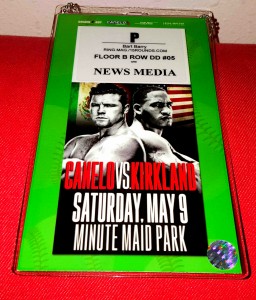
The May morning of 2015’s knockout of the year, the Saturday Mexican Saul “Canelo” Alvarez spearchiseled Texan James “Mandingo Warrior” Kirkland in Houston, catalyzed no thoughts of making the 150-minute eastwards trek from Alamo City to Minute Maid Park, home of Major League Baseball’s Astros, a stadium with a functional train in left field in homage to its location on the hallowed grounds of a hundred-year-old station. The stadium, celebrating its fourth and surely not final appellation, was christened “Enron Field” 15 years ago – back when energy arbitrage, electronically creating shortages and satisfying them at usurious prices, eGouging as it were, appeared to Wall Street like the industry to make America great again.

The usual credentials hassle handled by fightweek intervention from a powerful editor, a man so respected I was seated onfield under the opening of the opening rooftop, I celebrated my newly unprecedented access by not beginning the 2 1/2-hour drive from San Antonio till after the opening bell of an eight-hour fightcard rang on its cavernous park.

There was an enormous Chinese heavyweight on the undercard, a 7-foot and 280-pound Dong, he may even have been co-main, but he was so dreadful, and what followed was so excellent, the enormous Dong barely got written to the hard drive.

San Antonio promoter Mike Battah, the man who put more than 40,000 folks in Alamodome for Alvarez-Trout, invariably expected a better turnout for Alvarez-FellowTexan than he got, but blessings be rained upon him, he was deep in the PBC fold before the year was out, anyway, scared neither by public uninterest nor oversized venues (he rented AT&T Center for NBC’s December PBC broadcast).

Kirkland swarmed Alvarez at the opening bell, acquitting himself more savagely than insiders feared he mightn’t – so often veteran aggressors choose matches like these to apply singleply boxing skills, making the young champion hunt instead of defend – and Alvarez demonstrated composure appropriate to his record more than age.

Canelo iced Kirkland spectacularly before 31,000 Texans in round 3.

There’s a presence about Alvarez – these things begin with selfbelief and color in the details later – that speaks to a pair of ideas at first not apparently kin: mythology and confidence.

*

The May morning of 2015’s knockout of the year, the Saturday Mexican Saul “Canelo” Alvarez spearchiseled Texan James “Mandingo Warrior” Kirkland in Houston, was not facinorous humid as feared when the match got announced, in fact, for as long as it took to open the rooftop, blow papers about, wet the bluemat, and close the rooftop, the May breeze off the Gulf was not facinorous at all.

In lieu of a mediacenter vending machine, the promoter gave each writer a giftcertificate to a ballpark vendor, and the balance bought an astrodog and cola, or nachos and change. The match happened a week after The Fight Boxing May Never Forgive, a legacymaking bore between Floyd Mayweather and Manny Pacquiao, a humiliating affair for all but one man and his advisor, and a humbling affair for the compliant media in attendance – men who knew the match would suck but didn’t dare opine so publicly lest their unassigned fightweek access remain unassigned come fightday.

Perhaps Kirkland was handpicked an opponent for Alvarez as critics insisted he was, but surely the tricky Austin Trout and dreadful Erislandy Lara were not, and Alvarez made fisticuffs with them willingly as he did with the Texan Mandingo.

What Alvarez came in boxing knowing still better than his promoter Oscar De La Hoya, who knew it rather well himself, is th’t we do not believe myths because they are true; myths become true when we believe them. Alvarez came to America believing his own myth, and excepting only his disgraceful showing against Money May, Alvarez, in both the opponents he’s selected and the way he’s undone them, has satisfied the requirements of his post.

*

The May morning of 2015’s knockout of the year, the Saturday Mexican Saul “Canelo” Alvarez spearchiseled Texan James “Mandingo Warrior” Kirkland in Houston, there was some question if Kirkland’s ferocity mightn’t give Alvarez a momentary fright, but it didn’t, whatever Kirkland claimed after the match about a brief exchange in the first round. Kirkland’s conditioning was a certainty to no one, his relationship with mentor Ann Wolfe switched to Off for the biggest event in Kirkland’s unpredictable career, and the opening minute allowed those with eyes to see an inferential chance they’d not miss:

Kirkland conditioned himself for a savage 10-minute assault and a dramatic conclusion, his hand raised or chest chinpinned, and the match’s conclusion was not surprising as its style.

Alvarez did not grindout Kirkland, keepaway jabbing till the Texan was soft. Alvarez clipped him with a hook, clipped him with an uppercut, and iced him with a telegraphed righthand he framed for photographers by exaggeratedly feinting low, halfjabbing Kirkland to the body and watching his sternum. Kirkland dropped everything, realized he’d been hoodwinked, and started a hopeless lefthook in time to complete the aesthetics, winning Canelo 2015’s best knockout by compliantly screwtopping himself ropes to canvas.

***

Editor’s note: Part 2 will be posted next Monday.


Money, money, money: $igns of an empty 2015

By Norm Frauenheim
Floyd Mayweather
Bankers, Floyd Mayweather Jr., Manny Pacquiao, a handful of promoters and network executives can celebrate a year about to enter the books. Money ruled, which means it was Mayweather’s year. He fulfilled his nickname. Got most of the money, too.

But good for the business?

No way.

By definition, prizefighting is a simple enough formula. To wit: Get the biggest prize for the smallest risk. In 2015, Mayweather played that one out better than anyone ever has. As the year ends, there continues to be unconfirmed reports that receipts for his revenue-record setting victory over Pacquiao on May 2 are still being counted. Numbers are all over the place.

We read that his final purse is $220 million, then $260 million, which would rank the money for his 12 rounds of work somewhere between the Los Angeles Dodgers ($291 million) and the New York Yankees ($223 million) at the top of baseball’s last list of reported payrolls.

Hard to know what to believe. But there he is, in Dubai one day, in a new Bugati the next and always ready to make it rain by stuffing his bags with disposable cash.

Mayweather has gone from the top of the pound-for-pound list to being the face of the one percent. Let somebody a lot smarter than a boxing writer be the judge of that. But give Mayweather credit, not that he needs it. He might not have been TBE in the ring. But he ranks as The Best Earner in history and that figures to be undisputed for a while.

In the wake of a winner-take-all model that enriched him, however, there are consequences that could confront the game with a steep price in 2016 and beyond. HBO’s Jim Lampley said it best in the wake of his dull decision over Pacquiao, whose role as the junior partner in the money grab earned him north of $150 million.

Lampley called it a cynical exercise.

It was. As the year ends, coffers are filled, yet there’s an empty feeling about what was really accomplished. Does anybody other than Mayweather think the game is better for the exercise? Didn’t think so.

A sign of that emptiness is in the year-end ritual of voting for the various awards. Fighter of the Year is the biggie. But it’s a tough choice this time. On this ballot, the dreaded No Award, always a contender in a lot of categories, is an option. Yeah, Tyson Fury beat Wladimir Klitschko, but I’d cast a vote for Donald Trump before I’d vote for an okay heavyweight who reserves most of the fury for his insults.

The guess here is that Nicaraguan flyweight Roman Gonzalez wins, but his likely election looks to be more of a concession to a brilliant career (44-0, 38 KOs) ignored until HBO finally decided to pair him up with middleweight Gennady Golovkin in a couple of telecasts

An astonishing and worrisome aspect to the Gonzalez phenomenon goes back to where this column starts. Follow the money. In 2015, Gonzalez became the lightest ever to ascend to No. 1 in The Ring’s pound-for-pound rankings. He succeeded Mayweather after Mayweather’s announced retirement following a victory in September over Andre Berto.

The dollars, however, didn’t follow Gonzalez’ climb up the pound-for-pound scale. During his reign at No. 1, Mayweather earned a minimum of $32-million a fight through his six-fight deal with Showtime. In Gonzalez’ October stoppage of Brian Viloria in his second HBO appearance and in the immediate aftermath of his introduction as the pound-for-pound No. 1, he earned a career-high $250,000. Mayweather stuffs more than that into one of those carry-ons.

For Gonzalez, the pound-for-pound title represents little more than an honorarium. The Grand Canyon-like disparity on the pay scale, however, includes a more troubling aspect. It represents a lack of investment in lighter weights that have often sustained the business during periods of transition and/or trouble. HBO’s interest in Gonzalez is promising. Perhaps, it’s the beginning of an investment.

But the long-term trend is not good. Consider this: In the two-plus decades since junior-flyweights Michael Carbajal and Humberto Gonzalez earned $1-million purses for fighting each other three times in 1993 and 1994, there’s been no raise in pay for the little guys, who in some ways are to boxing what the working middle class is to an economy. There are no good undercards without them. Yet, they’re getting paid a lot less now than they did a few generations ago.

In stature and impact, they are so small that they often don’t seem to matter. But it’s the little things that often reveal a lot about a business and these days they appear to be troublesome fly in a problematic ointment.


Chasing heavyweights

By Bart Barry
Luis Ortiz
Among the very few benefits of the PBC’s 2015 emergence is this: We now know clarity in prizefighting’s flagship division – heavyweight, according to legend – assures the longterm health of our beloved sport exactly not at all. Having a unified heavyweight champion for the last few years did nothing to defend us from what existential threats attacked in 2015.

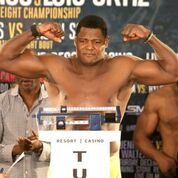
That means Saturday’s match between Cuban Luis Ortiz, who, despite growing to 6-foot-4 in the world’s best amateur-boxing program, we’re told by his trainer, confronts more hardships than a Thomas Hardy heroine, and American Bryant Jennings was inconsequential as it was entertaining. Ain’t nothing wrong with that.

Last week I watched Chasing Tyson, an ESPN documentary that concludes with Tyson concluding Evander Holyfield is among the five greatest heavyweights of all time, or top three. There’s a touch of selfaggrandizement in that, and everything Tyson says, but Tyson’s rather substantial point is not missed: Holyfield is underrated. Possibly. He made quite a lump of cash for a man who didn’t get his due, and as a boxer-puncher who migrated from cruiserweight, he was not destined for what raucousness attended Tyson’s ascent and reign and descent and clutch of nostalgia tours (San Antonio’s performance of Undisputed Truth, despite HBO’s sponsorship, was cancelled for lack of ticketbuyers).

It was a nostalgia tour of my own that put me before the documentary: The late eighties and early nineties were the time I enjoyed boxing most for understanding its business least. Young prizefighting fans, or sportsfans generally, likely cannot imagine this, but there was an epoch when you knew almost nothing about your favorite prizefighter but his record and tapemeasurements – just like you knew almost nothing about your favorite Major Leaguer that wasn’t oppositeside his photo on a small piece of cardboard.

Memorizing purse sizes and opponents-avoided and broadcasting networks, these things, seemingly so essential today, were not what a young aficionado did. Probably a few kids incorporated perceived pieces of their favorites’ personalities in their identities, but mostly it was not a fulltime endeavor, or if it was you outgrew it. While the five minutes given to sports on your local nightly newscast gave you a fight result, accompanied by still photos or drawings from ringside, you didn’t learn anything definite about a heavyweight title fight till Sports Illustrated arrived the following Thursday.

What about Tyson on HBO? Cable didn’t even come to our town till Tyson’s reign was underway, and there was no way my father was going to pay more for a movie channel than the network broadcasting Red Sox and Bruins games.

A goodish amount of the superfights of the Tyson era, then, happened in one’s imagination before he got a tape of the fight in his family’s VCR a month later, and if I might be forgiven the blasphemy, I’m fairly certain that in maintaining this substantially greater distance between athlete and fan, things were healthier, less intimate, less urgent. If your favorite lost, you talked about it for a day or two, the novelty dissipated, and life marched right along.

What struck most about Chasing Tyson, and here is where we meander back to current events, was how sensationally more athletic those guys were than the beasts who lumber about at the end of the Klitschko Era. Persons who like to know things, who fetishize the number of data they carry about in their heads – a metric dated brutally by the billions of things any five-yearold with an internet connection can now “know” in a halfminute of searching – multiply height and reach and weight and quickly conclude today’s heavyweights are the most dominating that have peopled prizefighting’s purpled plains.

Nonsense. Watch the speed and craft shown by Evander Holyfield and Riddick Bowe, and know the James “Buster” Douglas who fought Tyson in Tokyo would race through most of the top heavyweights today, regardless of their height and reach advantages, and Douglas is as much a trivia question now as he was a punchline back then.

That is not to detract, quite, from Saturday’s HBO fare, a main event that saw Ortiz win the proper way, knocking the stuffing out of Jennings, another American in the athlete-cum-fighter line, a man who tried his hands and feet at lots of other sports till he was too old to make money at them then began boxing at age 24 (where he eventually lost the 2009 Golden Gloves title to a heavyweight now calling himself Cam F. Awesome [who’s actually a breathing synonym for “composure” in a fight]).

Ortiz is better schooled than Americans because he came of age in an excellent system, learning from men who fed their families by teaching boxing, not hobbyist dads holding stopwatches and yelling “give me ten more!” under the auspices of discipline or conditioning, or vicariousness. When he flows, Ortiz sort of resembles a prizefighter from any weightclass other than heavy, and that is high praise indeed.

A thought experiment that bears repetition: Imagine Wladimir Klitschko reduced by a foot and 100 pounds and set across from a prime Juan Manuel Marquez or Manny Pacquiao. For how many rounds would Marquez or Pacquiao toy with him before dropping the black curtain – two? three? There was a time, the one captured in Chasing Tyson, when heavyweights were very large versions of middleweights, when you might imagine a Holyfield or Tyson, shrunken by some inches and 50 or so pounds, stresstesting Floyd Mayweather’s defensive wiles to Emergency. Contrarily, for a snicker imagine one of today’s heavyweight titlists, Deontay Wilder, six inches and 60 pounds smaller and set across from Andre Ward. Then keep the mirth rolling by imagining a 112-pound man with Tyson Fury’s toolkit pitted against Roman Gonzalez.

Let us have no more loose talk about today’s heavyweight prizefighters belonging on pound-for-pound lists, whatever gaudy win streaks they enjoy. They are genetic lottery winners, each and every, and that’s enough – we don’t have to call them great at boxing, too.

Bart Barry can be reached via Twitter @bartbarry


FOLLOW ORTIZ – JENNINGS LIVE

Ortiz_Jennings weigh in

Follow all the action as Luis Ortiz battles Bryant Jennings for the WBA Interim Heavyweight title.  The action begins at 10:15 PM ET / 7:15 PT with a Super Featherweight bout between former world champion Nicholas Walters and Jason Sosa

Page will refresh automatically

12 Rounds WBA Interim Heavyweight title–Luis Ortiz  (23-0 20 KO’s) vs Bryant Jennings (19-1, 10 KO’s)
ROUND 1 2 3 4 5 6 7 8 9 10 11 12 TOTAL
Ortiz 10 9  9  9  10 10  57
Jennings  9  10 10  10  9  9  57

Round 1 Ortiz working the body…Straight left hurts Jennings..Big left hurts Jennings again..Jennings wobbling..God body shot..

Round 2 Jennings lands a combination..right..Uppercut from Ortiz..Uppercut from Jennings..

Round 3  Big left hurts Jennings..Combination from Jennings…

Round 4 Ortiz lands a left…2 Uppercuts from Jennings

Round 5 hard uppercut from Ortiz

Round 6 Combination for Ortiz

Round 7 Body shots from Jennings..Straight right from Jennings..HUGE UPPERCUT AND DOWN GOES JENNINGS..BIG RIGHT AND JENNINGS STUMBLES INTO THE ROPES..ONE MORE SHOT AND THE FIGHT IS STOPPED


..2 uppercuts from Jennings

10 Rounds Super Featherweights–Nicholas Walters (26-0, 21 KO’s) vs Jason Sosa (18-1-3, 14 KO’s)
ROUND 1 2 3 4 5 6 7 8 9 10 11 12 TOTAL
Walters 10 10  10  10  9  10 10  10 9  10 98
Sosa  9  9  9  9  10  10  9  9  10  9  93

Round 1 Good left hook to body from Walters..Left to body..Hard body..left to body and right from Sosas..Right from Walters

Round 2 Hard left from Walters..Right..left to body..Uppercut..Uppercut..Sosa lands a right uppercut..Good body shot

Round 3 Walters lands a jab

Round 4 Walters lands an uppercut on the inside

Round 5 Hard right wobbles Sosa..2 rights and uppercut from Sosa..Hard body shot from Walters..

Round 6

Round 7 Hard body shot from Walters..Vicious left hook to the body

Round 8 Walters lands a right down the middle

Round 9 2 hard rights from Sosa..right on the inside..Walters lands a body shot..Hard right and left hook from Sosa

Round 10 Right lead from Walters…

96-94 Sosa, 95-95 on 2 cards….DRAW

Punches:  Walters: 281-622    Sosa: 168-873


FOLLOW LEE – SAUNDERS LIVE

Saunders_Lee

Follow all the action as Andy Lee defends the WBO Middleweight title against undefeated Billy Joe Saunders.  The action kicks off at 5 PM ET / 10 PM in Manchester, England

Page will refresh automatically

12 Rounds WBO Middleweight title–Andy Lee (34-2-1, 24 KO’s) vs Billy Joe Saunders(22-0, 12 KO’s)
ROUND 1 2 3 4 5 6 7 8 9 10 11 12 TOTAL
Lee 9  9  7 10  10  10  9  9  10  9  10  10 112
Saunders 10 10 10  9  9  9 10  10  9  10 9  9 114

Round 1 Saunders lands a left..Left from Lee…Good right from Saunders..

Round 2 Body shot from Saunders…Good left from Lee..Saunders answers back..Good right

Round 3 Good jab from Lee..Good left…HUGE COUNTER RIGHT AND DOWN GOES LEE….BIG RIGHT AND DOWN GOES LEE AGAIN…Saunders all over Lee…Lee trying to hold on and fight back

Round 4 Good left from Lee..Good jab

Round 5 Good jab from Lee..Big left from Saunders..Counter from Lee..

Round 6 Nice jab from Saunders…Left from Lee..Nice right to the body..Jab from Saunders..

Round 7 Left from Saunders..Good jab from Lee..Swelling around the right eye of Lee…Jab from Saunders..Jab..2 Jabs from Lee

Round 8 Good jab from Saunders…

Round 9 Good left from lee..Good Jab..Jab..Jab from Saunders..

Round 10 Jab from Saunders…Jab to head and body..Right from Lee..both land rights..Saunders lands a jab..2 jabs from Lee

Round 11 Counter right from Lee..2 jabs..Good left..Good right from Saunders..Right hook from lee..

Round 12 Lee lands 2 body shots…

113-113; 114-112 and 115-111 For THE NEW WBO MIDDLEWEIGHT CHAMPION, BILLY JOE SAUNDERS


FOLLOW BARTHELEMY – SHAFIKOV LIVE

rances-barthelemyFollow all the action as Rances Barthelemy and Denis Shafikov vie for the vacant IBF Lightweight title.  The action begins at 9 PM ET with a 3 fight undercard that will feature an IBF Cruiserweight elimination bout between undefeated fighters Isiah Thomas and Murat Gassiev


Page will refresh automatically

12 Rounds IBF Lightweight title–Rances Barthelemy (23-0 13 KO’s) vs Denis Shafikov (36-1-1, 19 KO’s)
ROUND 1 2 3 4 5 6 7 8 9 10 11 12 TOTAL
Barthelemy 9 10  9  9 10 9 10  10 10  10  10  10 116
Shafikov 10 9  10  10  10 10  9  9  9  9  9 10 114

Round 1 Shafikov lands a left

Round 2 Barthelemy scoring..Trading lefts..Left from Barthelemy

Round 3 Shafikov lands a right

Round 4 Shafikov working the body…combination..2 lefts and an uppercut

Round 5

Round 6 Both guys working inside..Shafikov’s punches a little harder

Round 7 Blood from right side of Shafikov’s face

Round 8 3 rights from Shafikov…combination from Barthelemy..Hard left..Left..Sahfikov’s eye is starting ti bleed bad..Doctor looking at the cut

Round 9 Barthelemy lands a combination

Round 10 Straight left from Barthelemy

Round 11 Barthelemy lands a left to the head and body..left

Round 12

119-109, 116-112 twice for BARTHELEMY

12-roundsCruiserweights–Isiah Thomas (15-0, 6 KO’s) vs Murat Gassiev  (22-0, 16 KO’s)
ROUND 1 2 3 4 5 6 7 8 9 10 11 12 TOTAL
Thomas  10 10 9  29
Gassiev  9  9 10  28

Round 1 Left from Thomas

Round 2 Rght from Gasiev..Short right from Thomas..Straight left..

Round 3 Thomas lands a left.. 2 big rights from Gassiev at the bell—THE FIGHT IS STOPPED DUE TO THE PUNCH BEING AFTER THE BELL AND THOMAS COULD NOT CONTINUE

10-rounds–Lightweights–Gervonta Davis (13-0, 12KO’s) vs Luis Sanchez (17-4-1, 5 KO’s)
ROUND 1 2 3 4 5 6 7 8 9 10 11 12 TOTAL
Davis 10  10 10  9  10  10  9  10 78
Sanchez 10  9  9  10  9  9 10 8  74

Round 1

Round 2 Davis lands a left to the body

Round 3 Good exchange with both landing..Hard left from Davis..2 more lefts..Left uppercut from Sanchez..Combination and left from Davis..2 more lefts…Sanchez a little wobbly

Round 4 Left uppercut from Sanchez…

Round 5 Hook from Davis…2 lefts

Round 6 Davis lands a couple jabs..

Round 7 Nice right from Sanchez..Jab from Davis..

Round 8 2 Head clashes…LEFT UPPERCUT AND DOWN GOES SANCHEZ…Hard left staggers Sanchez..

Round 9 Davis lands a jab..HUGE LEFT UPPERCUT AND DOWN GOES SANCHEZ AND THE FIGHT IS OVER


8-rounds–Super Welterweights–Chris Pearson (13-0, 12 KO’s) vs Eric Walker (11-0, 6 KO’s)
ROUND 1 2 3 4 5 6 7 8 9 10 11 12 TOTAL
Pearson  9 9 10  9  10  9 9  10 75
Walker 10 10  9  10  9  10  10  10 78

Round 1 Right from Walker..

Round 2 Uppercut from Pearson..Walker working the body..Pearson swelling on the right side of his face,,

Round 3 Left from Pearson..Good combination..Right..2 shots from Walker..

Round 4 Huge right hand rocks Pearson..Pearson is hurt..Walker battering Pearson..Pearson comes back and lands a left

Round 5 Right from Walker..Pearson landing big hooks…Big right from Walker..

Round 6 Combination from Walker…Big left from Pearson..

Round 7 2 uppercuts from Walker…Good left..Short right from Pearson..

Round 8

79-71, 80-72 and 78-74 for Eric Walker


Statement on Glazkov-Martin IBF Heavyweight Title Fight

Vyacheslav Glazkov
Springfield, New Jersey: Today the IBF held a purse bid for the upcoming battle between Vyacheslav “Czar” Glazkov (21-0-1, 13 KOs) and Charles Martin (22-0-1, 20 KOs) for the vacant IBF Heavyweight World Title at their offices in Springfield, NJ, which Warriors Boxing won. The much-anticipated fight will take place on January 16, 2016 at the Barclays Center in Brooklyn, New York. The winning bid was $1,238,000 and the IBF has ordered that the split will be 65-35 in favor of Glazkov.

Glazkov won the #1 position in the IBF when he defeated Steve Cunningham back in March so the 31-year old from Lugansk, Ukraine is excited to finally get his shot at the IBF belt in his first world title fight. He said, “I am looking forward to getting back in the ring and finally getting my opportunity to fight for a world title. I want to thank everyone who helped me get to this place in my career.”

Main Events’ CEO Kathy Duva added, “We are thrilled that Czar is getting his world title fight right away and in our own backyard! The turn around is quick, but both fighters will have the same amount of time to prepare so it’s fair. On top of fighting for his first world title,Glazkov is going to get more money for this fight than we were offered for any other fight and we won’t be tied to any future options. This is a great deal for everyone involved.”

Duva co-promotes Glazkov with Kirill Pchelnikov of Pushka Promotions. Pushka and Main Events put in a bid today but Pchelnikov remarked, “It does not matter we didn’t win the purse bid and it doesn’t matter where the fight will be. Maybe next time we will be able to take Glazkov to fight in Russia when he is champion!”

FOLLOW US:
www.mainevents.com
Twitter: @main_events
Facebook: facebook.com/MainEventsBoxing
Instagram: @Main_Events


Possibilities: Nicholas Walters just another one as Top Rank moves into a New Year

By Norm Frauenheim-
Nicholas Walters
Top Rank’s December agenda has been about finding new stars, resurrecting a couple of old ones and creating business possibilities in 2016, the beginning of what could be the post-Manny Pacquiao era.

As of Thursday, the promotional company was still waiting to hear on whether Pacquiao will fight Terence Crawford or Timothy Bradley or some name we’ve yet to hear. The repeated postponements make you wonder whether the Filipino Congressman has some other running mate, — or alternate plan — in mind for what is believed to be his April farewell.

But, as it must, the business moves forward, especially at a time when the changing-of-the-guard is moving at a rapid rate. There is heavyweight Wladimir Klitschko’s loss to Tyson Fury. There are continuing assurances from those close to Floyd Mayweather Jr. that he is happily retired and has no desire to come back.

It’s a game looking to re-load.

Over the last month, Top Rank has strung together – week after week, night after night– reasons to be optimistic about the New Year.

First, there was unbeaten junior welterweight and 2012 Olympian Jose Ramirez in a gritty decision on Dec. 5.

Then, there was lightweight Felix Verdejo, Puerto Rico’s heir apparent to Miguel Cotto, in a definitive second-round stoppage on Dec.11 on a San Juan card that included former Fighter of the Year Nonito Donaire in tough, yet back in the 122-pound title mix with a rugged decision.

The following night in Tucson, two-time Mexican Olympian Oscar Valdez was back in his boyhood home with a dramatic third-round stoppage that stamped him as legitimate contender.

The fourth item in Top Rank’s run-up to next year is now in the dangerous hands of Nicholas Walters, who like Donaire is trying to re-capture the momentum he had in October 2014 after a powerful stoppage that sent Donaire’s career spinning into recession.

Walters’ task Saturday night in Verona, N.Y., on HBO After Dark (10:15 p.m./ET/PT) looms as the toughest against Jason Sosa at 130 pounds, four heavier than the featherweight mandatory he failed to make in relinquishing his title in June before beating Miguel Marriaga. Walters won a decision over Marriaga, but it was forgettable, so much so that he was too, despite an unbeaten record (26-0, 21 KOs).

“Looking to fight the big fights,’’ Walters said Thursday during a conference call.

He hopes for three or four of them in 2016, including perhaps one against Ukrainian prodigy Vasyl Lomachenko.

First, however, there is Sosa (18-1-3, 14 KOs), a Camden, N.J., fighter who remains a relative unknown despite a run of 17-straight victories, including 13 successive stoppages, since 2012. Sosa, who had only three amateur fights and lost two of them, appears to be a late bloomer. His relative anonymity in terms of international rankings and network appearances is among his greatest assets.

“Anytime you don’t know much about a fighter, that’s a dangerous fighter,’’ said Walters, a wise man.

The buzz is about Sosa’s power. At 27, it looks as if he has learned how to use it in every lethal way. That, perhaps, helps explain why 13 of his 14 stoppages have come over the tail end of 17-fight run during the last four years.

His promoter, Philadelphia Russell Peltz, believes that Walters has never felt a punch with the kind whack Sosa can deliver. Peltz also argues that Walters’ unbeaten record and world-class pedigree can be overrated.

“There are undefeated fighters on every street corner and that means they haven’t fought anybody,’’ Peltz said.

However, Walters, a smart and entertaining Jamaican, enters the ring Saturday understanding the stakes and determined to get fans talking about him again. He’s pursuing a big stoppage.

“Knockout of the Year,’’ he says.

Then, he says he can pursue opportunities at junior-lightweight (130) and featherweight (126).

“It’s not like I was at 128, or 129 the last time,’’ Walters said. “I was at 127. I can make 126. There are a lot of possibilities at 130. In 2016, anything is possible.’’

More so, it seems, than in any recent year


A first-person mosaic of a first PBC experience (from the suite, not pressrow)

By Bart Barry-
Chris Arreola
SAN ANTONIO – From a suite at AT&T Center, home of the fivetime worldchampion Spurs, boxing looks like nothing so much as the jiggling tattoos on Chris Arreola’s back.

The media section far below is three tables deep. Behind it are another seven or eight rows of seats of tickets sold as ringside, or more likely given away to valued sponsors of the promoters’ primary businesses. Three press tables deep for a card in an arena whose capacity exceeds by 2,000 MGM Grand’s. Few media tables as there are, the majority of those situated in the media section bear the nervous salesy look of the publicist, the favordoer, the tweetdeck profiler.

Omar Figueroa’s imperfections are heavier than his weight. The seriousness of his craft is the imperfection most notable – increasingly notable as the seasoning of his opponents increases. Figueroa is a high-school dropout’s Juan Diaz, or Juan Diaz if he’d spent 11th grade goofing round with his buddies at allnight diners instead of studying for midterms. Diaz hit no harder but committed more fully, and that commitment improved his balance, and Diaz, notetaking at the classroom’s front, not penning poetry to lasses in the back, understood where his feet belonged and where his shoulders best complemented those feet.

Figueroa has no meaningful jab – a bit like sending a young poet in the world without he memorizes the alphabet. Because Figueroa did not learn to jab, he makes a nervous sort of waggle with his cross, when he’s orthodox, and then he crossesover, rightfoot behind righthand, and finds himself a southpaw – discovers, really; it doesn’t look altogether premeditated – and begins waggling his now-southpaw jab, squares his feet, and hopes to harass an opponent to enervation.

Antonio DeMarco, battered six years ago by Edwin Valero, razed simply by Adrien Broner in 2012, and plying his craft more than three years removed from a victory over anyone you know, is decisioned by Figueroa on Saturday, yes – outbusied but not beaten down. DeMarco, in fact, bears the relaxed countenance throughout of an old mechanic; he knows his role, knows his wage, and knows his craft too well to let a bursting valve spray him with harmfulness. There isn’t a moment DeMarco experiences peril during Figueroa’s 36 minutes of assault.

The match is not suspenseful. Behind me, the suite fills with spirited and lubricated realty talk – the roomful of alpha gorillas sorting out what’s what in homepricing, homebuilding, tiling, carpeting, and expiring childsupport garnishments. It’s a pleasant distraction, frankly; theirs is the perfect comportment for a match that hasn’t 30 seconds’ suspense, and it makes me wish such conversations were allowed on pressrow, the sacred gathering spot for a species uncannily aware of its coming extinction.

There’s nothing serious about our sport as a PBC presentation. It is staged. The production quality in the arena is fantastic; a team of graphic artists and video specialists (and venture capitalists) in search of a subject. The digital glistening of a yellow lightsource hitting a reflective black surface, over and over and over, distracts my eye during rounds in which everyone knows what will happen.

The official attendance number comes in above 5,000. From a suite above every occupied seat – the upperdecks wear black curtains, as does the back quarter of AT&T Center’s 18,581 seats – my guess is 3,500. The suite’s salesman estimates 10,000, and the suite’s veteran trainer says 2,000. The official number is inflated, then, but not garish. Attendance figures are guidelines, but public gatherings are relative and reflexive things; performers affect and reflect congregants’ collective enthusiasm as something often called “energy” – which is decent a contemporary catchall as any. The energy of AT&T Center is measurable in flickers so few and slight they get tallied by hand. Despite diverse musical interludes, plenty of flashing indicators, and a backlighting stage that glows enormous, the South Texas crowd, one likely comprising someone who knows someone who boxes or boxed, in every occupied seat, is not roused.

The walkout bout outdoes itself. Even before US Olympian Terrell Gausha, who is decidedly awful, decisions a helpless lad named Said El Harrack, the arena is emptied. If there are 300 persons still within AT&T Center by the third round of Gausha-El Harrack, it’s only because arena staff’s hourly, not salaried.

I arrived at 7:09 PM, 21 minutes before NBC took the air, and there were hot music and cool lights and no boxing and less interest. Confirmation bias is possible: If the PBC survives, I forecast, it will be as a made-for-television spectacle conducted in venues no more authentic than Hollywood backlots. PBC contractors will compose what press there is – a great seat, and $50 for a night of Facebooking – the 2,000 seats visible by cameras will contain rafflewinners and gymrats and locally stationed military, and two undefeated fighters will not be matched.

“The reason NBC is here is because now everybody wants in boxing,” says a guy from suiteback.

The statement pierces the area’s otherwise cacophonous and sincere speechmaking about estate commissions and bargain rates for squarefeet of tile, and it does so with a sincerity of its own: If prizefighting means more to you than entertainment, if it is a fever that defines some part of your identity, the PBC’s timebuying is not ineffective. You derive affirmation from your sport’s presence on network television; your coworkers still ignore your passion, sure, but the PBC at least makes them channelsurf round it, which is greater mind than they’ve paid boxing since the 1980s.

Bart Barry can be reached via Twitter @bartbarry
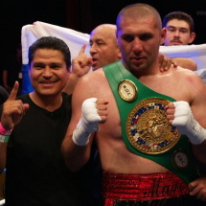


Benavidez to pay Brazilian foe $2,000 for missing weight

By Norm Frauenheim-
jose_benavidez_signing_100114_001
TUCSON, Ariz. – Jose Benavidez Jr. agreed to pay unknown Brazilian Sidney Siqueira $2,000 Friday after he was more than four pounds heavier than the contracted weight for a featured bout Saturday on Unimas’ Solo Boxeo series.

The fighters’ corner men and officials from the Arizona State Boxing & MMA Commission met a couple of times in a busy ballroom during the weigh-in at the Tucson Community Center, finally striking an agreement that saved the bout from getting scratched from a card featuring featherweight prospect Oscar Valdez (17-0, 15 KOs) against Filipino Ernie Sanchez (15-6-1, 6 KOs).

Valdez, a two-time Mexican Olympian when went to grade school in Tucson, was at 127.6 pounds. Sanchez was 127.4 for a 10-round bout on a card scheduled to begin at 7 p.m. (MST)

The $2,000 will come out of Benavidez purse, estimated to be $10,000, according to his father and trainer, Jose Benavidez, Sr., who said the contract mandated that neither be heavier than 148 at the formal weigh-in.

“The fight is on,’’ said the senior Benavidez, who said his son couldn’t make the weight because of the flu. “He got sick. But we knew this fight was coming and we felt it was important.’’

Benavidez (23-0 16 KOs), who holds a WBA junior-welterweight title, tipped the scale at 152.4 pounds. Siqueira (21-9-1, 13 KOs), who last fought at 135 pounds, was 145.6.

“I got sick about a week ago,’’ said Benavidez, whose 140-pound title won’t be at stake. “When I got sick, I was at about 154. But I had to eat while I was trying to get over the flu. That’s why I couldn’t get down to 148.

Benavidez is lobbying for a shot at reigning Fighter of the Year Terence Crawford, a junior-welterweight who is still on Manny Pacquiao’s short list for what is supposed to be the Filipino Congressman’s final fight in April. Pacquiao also is considering Timothy Bradley. He was supposed to announce his choice Friday night, but he postponed the decision.

Meanwhile, Benavidez, of Phoenix, called out Crawford during a media workout Thursday in Tucson.

“I want Crawford,’’ he said. “Let’s make it happen. I’m undefeated, young and ready. Let’s see if he accepts the challenge.’’


Back to the Roots: Oscar Valdez goes home before moving on to New Year

By Norm Frauenheim-
Oscar Valdez
Oscar Valdez, one of the brightest reasons to be optimistic about boxing’s prospects in 2016, re-introduces himself Saturday to Tucson, a city that never really got a chance to know him when he first answered an opening bell.

A lot has happened since Valdez was just another restless 8-year-old who wandered into one of southern Arizona’s many gyms as if it were a playground.

Who knew that few hours of running across a mat, bouncing off ropes and toying with a speed bag would lead to two Olympics, a perfect pro record (17-0, 15 KOs) and a chance at big-time money?

It has.

In the years since leaving Tucson for Nogales on the Mexican side of the border, the 24-year-old Valdez fought at the Beijing and London Olympics, won a bronze medal in the 2009 World Championships and returns to where it all began amid a buzz about what he might do next year.

The featherweight’s Unimas-televised bout against Filipino Ernie Sanchez (15-6-1, 6 KOs) at the Tucson Community Center (first bell/7 p.m. MST) on a card including Phoenix junior-welterweight Jose Benavidez Jr. in a non-title fight is a significant step in the process from prospect to potential stardom. Valdez figures to win. The key is in how.

If he can follow up on his sensational fifth-round stoppage of ex-contender Chris Avalos last September in Las Vegas, he creates further momentum for a world-title shot in 2016.

“I am really looking forward to this fight,” said Valdez, whose mom, Gloria Fierro, still lives in Tucson. “I will have family, friends and people who have supported me since the start of my boxing career. I do feel like I am coming home and want to give them all a great fight.

“I’m ready to close out the year with a great performance.’’

Like any young prospect, Valdez is hopeful and confident he’ll get a chance to fulfill the dream he has had since he first started racing around those Tucson gyms. But he’s also patient. If the prospect stage is an apprenticeship, Valdez is approaching it like the student he was so long ago at the Manzo Elementary classrooms, which are just few city blocks from the ring where he’ll fight Saturday night.

“Of course, I’m ready for world champions, but I want to finish this year first and then, whatever comes, I’ll gladly take on,’’ said a student in a tone that also says he paid attention at Manzo and in the gym.

NOTES: Weigh-in for the Top Rank/Iron Boy promoted card is scheduled for Friday at 4 p.m. (MST) at Tucson
Community Center’s Apache Room. …Benavidez (23-0, 17 KOs) has a WBA 140-pound title, but it won’t be at stake against Brazilian Sidney Siqueira (26-10-1, 17 KOs). The bout is scheduled to be at welterweight (147). Siqueira lost a 10-round decision for Brazil’s lightweight (135) title in August, his last outing. …Phoenix Hall of Famer Michael Carbajal is scheduled to make his debut as a pro trainer on the undercard. He’ll be in the corner for Phoenix flyweight Johnny Tejerina, who is making pro debut. Carbajal has an old-school legend at the top of a list of trainers he most admires. “Eddie Futch,’’ he said.


AZ Triple: Abel Ramos’ ShoBox bout makes him one of three Arizona fighters in TV spotlight

By Norm Frauenheim-
shobox_image1
In another sign of Arizona’s rebounding market, Phoenix welterweight Abel Ramos is one of three fighters from the state who will appear in bouts televised nationally this weekend.

Ramos (14-0-2, 9 KOs) faces prospect Regis Prograis (15-0, 12 KOs) Friday night in the main event of a Houston card televised by Showtime’s ShoBox (10 p.m. ET/PT).

On Saturday, featherweight prospect and two-time Mexican Olympian Oscar Valdez, who grew up in Tucson, and Phoenix junior-welterweight Jose Benavidez Jr. will be featured on a Tucson card televised by Unimas’ Solo Boxeo (11 p.m. ET/PT).

“I couldn’t be more ready or happy with my preparation going into Friday’s fight against Regis,’’ said Ramos, who is coming off a victory in September at Celebrity Theatre in Phoenix. “This is my first fight with DiBella Entertainment and I am already headlining on ShoBox. I think that is a testament to what they see in me and the talent that I have.’’

“…We are expecting a tough fight, the best Regis Prograis has to offer. We expect him to be very active and throw a ton of punches, and that’s what we have prepared for all camp long. I don’t know exactly how the fight ends, but I am winning it, there is no doubt about it.’’


MASTERNAK: BELLEW’S TRASH TALK WON’T WORK ON ME

HBO Boxing After Dark Weigh-In: Adonis Stevenson vs Tony Bellew
Mateusz Masternak aims to prove he is ready to rule the World by beating Tony Bellew and reclaiming the European Cruiserweight title on Saturday (December 12) at The O2 in London, live on Sky Sports Box Office.

The Polish puncher is currently enjoying a new lease of life since teaming up with renowned German coach Ulli Wegner, as evident from his WBA Intercontinental title winning performance against Carlos Nascimento in September, and now, the 28 year old believes the time is right for him to make his mark at elite-level starting with a statement win against Bellew.

“Of course this is an important fight for me,” said Masternak. “This is a chance for me to test myself against one of the best fighters in the division and prove to everybody that I’m ready to fight for the World title.

“Bellew is a World-class opponent and I know it will be a tough test. He can punch, he can box and he always fights with a lot of heart, but his style suits me well, and my team and I have chosen the perfect game plan to beat him. I will be like his shadow – staying one-step and one-punch ahead of him at all times. If he thinks this will be an easy fight, he is mistaken.

“The European title is very important and prestigious belt, and now that I’m older and have more experience, I appreciate its value much more. This is a fight I have to win. I will give it my all and not stop until my hand is raised. I believe this will be the fight of the night, and once it’s over, everyone will know the name Mateusz Masternak.”

Ahead of their Cruiserweight clash, Masternak has warned Bellew not to attempt any trash talking, advising the 33 year-old to ‘save his strength’ for the ring.

“I’ve seen Bellew try to intimidate his opponents before but I’m sure he’s clever enough not to attempt this with me,” says ‘The Master’. “This sort of empty aggression and trash talking has no effect on me. Instead of trying to fight me at the press conference or the weigh-in, Bellew should save his strength, because he will need it in the ring!”

Masternak’s clash with Bellew is part of a huge night of action at The O2, topped by Anthony Joshua MBE taking on bitter rival Dillian Whyte for the British and Commonwealth Heavyweight titles.

Chris Eubank Jr and Spike O’Sullivan meet in a final eliminator for the WBA World Middleweight title, Kevin Mitchell meets Ismael Barroso for the WBA Interim Lightweight title with the winner facing newly crowned WBA supremo Anthony Crolla, Josh Warrington defend his WBC International Featherweight title against Jorge Sanchez, Joshua’s fellow Olympic gold medal hero Luke Campbell MBE defends his WBC International Lightweight title against Yvan Mendy and Paulie Malignaggi challenges Gianluca Branco for the European Welterweight title.

Anthony Joshua vs. Dillian Whyte is SOLD-OUT – visit http://www.stubhub.co.uk/matchroom-boxing-tickets/ to get your hands on tickets.

StubHub is the official ticket partner and marketplace of Matchroom Boxing and Anthony Joshua MBE.


We begin the Peter Nelson Era

Peter Nelson
“Mechanism-based approaches are generally dangerous. The problem is that the goal of such studies is mimicry rather than true understanding, and these studies can easily degenerate into the writing of programs that do no more than mimic in unenlightening ways aspects of human performance.” – David Marr, Vision

Tuesday morning the announcement came Peter Nelson will be the new leader of HBO Sports, an outfit that still represents the most prestigious, if no longer the most powerful, influence in boxing. Nelson first accomplished prominence in our sport as a writer and aspiring Freddie Roach biographer. He is smart, scrupulous and navigationally adept. His promotion was expected.

What, then, could the passage above be about? David Marr was a brash psychology professor at the Massachusetts Institute of Technology who, before his 35th birthday, had as many original ideas about the visual component of machine learning as the artificial-intelligence community has spawned in its 35 years since. Marr fearfully anticipated exactly what has happened: Instead of programming machines to teach themselves, technicians would make machines faster, program them with existing knowledge, and convince the laity machines were self-taught.

Two questions: Is Nelson’s professional success a product of true understanding or mimicry? And will it make a difference, either way, in his new role?

Reading Tuesday’s reports of Nelson’s promotion was unpredictably dreary work. They were mostly copy+paste jobs with written-round commentary, weblog style, and nearly no reporting that wasn’t provided by HBO itself. There were a few exceptions to this – childishly exuberant ones.

Nothing new, one says, perhaps rightly, though a tiny alarm might ring for this: Peter Nelson was a writer, and he communicates with writers, and reads them, and often pays them mind. Boxing is generally populated, or was anyway, by greedy eccentrics, men whose theories are selfaggrandizing and whose stories are entertaining as they are embellished. Nelson found partial refuge from this world in men who purported to what journalism survived in 2011 when Nelson, who’d already been a part of HBO’s selfcoverage machine, officially joined the network.

He was not hired by his boss, who left the network in 2013, or the man he now replaces; he was hired by a man who outranked both, which must’ve been a touch awkward for those involved. Nelson now reports to the man who hired him four years ago, completing a (insert cosmic modifier here) ascent that ends the Hershman Era in the same low key that defined it.

Stretching as it did to create a celebratory tone, HBO’s press release mentioned Nelson’s youth and education and a tiny increase in 2015 viewership that, one is to infer somehow, happened in correlation with the network’s featuring Gennady Golovkin and Roman Gonzalez on pay-per-view in the fall. Golovkin and Gonzalez are now HBO fighters because of Nelson’s spearheading sagacity. Golovkin and Gonzalez attracted a tiny number of pay-per-viewers in October because the previous regime was wanting, and those men are now replaced. If it doesn’t make sense particularly, it’s not supposed to; television is a flexible and fun medium about hot emotion, not sobriety.

This is the spot in a column where a writer is supposed to tap his brakes, mention the brilliance of some television folks, toss in a silly garnish about educational television, and assume an authoritative air about a medium, television, he neither understands nor takes very seriously – all in the hopes of ongoing mediacenter access to celebrity analysts, at least, and a job of his own in television someday, at most. It’s not a sensible tack for a few reasons, and the largest is this: Television is an ecosystem that knows its own, intuiting tiny markers, sending and receiving honest signals, and it knows most writers are not its kind.

It marked Nelson immediately as its kind, though, and that may bode well for the Nelson Era at HBO Sports.

At a certain level in any corporation, promotions are political happenings – the inexperienced lament this, believing as they do in what hagiographic and entrepreneurial biographies of entrepreneurs they see in bookstore windows as they walk to the cinema – and the experienced do not lament this, knowing as they do how very little actually happens above a certain paygrade. If Nelson is not now in that paygrade, he’s just below it. You read it in the sincerity of his language about collaboration; he genuinely believes the folks he now manages are uniquely talented and his job is to help them succeed. Nothing wrong with that, any talented person would cherish a boss with such qualities, but it’s altogether more political than visionary, isn’t it?

Enter Bill Simmons, a man who, if he will or will not report to Nelson, surely was not hired by Nelson. Simmons’ talents are marked by journalistic achievement more than political acumen; in telling a truth about the NFL commissioner he set a spotlight’s glare on the incestuous and interests-conflicted relationship shared by Simmons’ former employer, ESPN, and the league it pretends to cover in an objective way, and that got his employment publicly terminated and his creation, Grantland.com, vindictively dismantled.

HBO has long wanted for journalistic integrity, and a Simmons-Nelson collaboration can bring that by making Simmons something of an on-air ombudsman: Borrowing the technology with which flattering tweets are shined below the action on various networks, HBO should try a Simmons chat window somewhere on the screen during its boxing telecasts. If we’re honest, there’s nothing about Soviet-bloc fighters annihilating 20-1 underdogs that cries out for an unofficial scorekeeper anyway – how many different ways can Harold Lederman say “120 to 108, Jim!”? – and since there’s no reason to forecast any end to mismatches in the next few years, why not put Simmons in the Lederman seat and let him describe what the rest of us are already thinking? Simmons wouldn’t even need to be sarcastic or critical: When a match is awful as we already know it is, his use of, say, “. . .”, in lieu of an actual commentary, would turn the trick just fine.

Enough with the helpful suggestions. Boxing is rather diminished from what it was when Peter Nelson joined HBO. Nelson’s career already evinces navigational expertise above all. There will be no catastrophic mistakes in the Nelson Era, which means the era may well be a long one. Let us hope it navigates our beloved sport to a more fruitful place.

Bart Barry can be reached via Twitter @bartbarry