Canelo-Cotto: Slightly more than an eliminator for the HBO middleweight championship

By Bart Barry-
Canelo_Alvarez
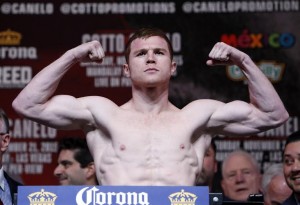
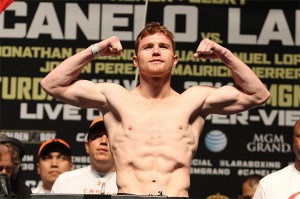
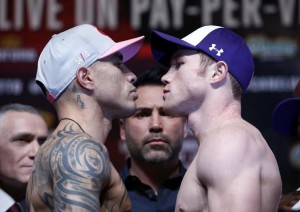
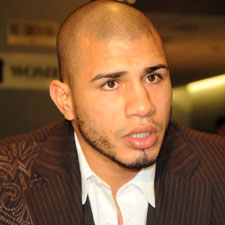
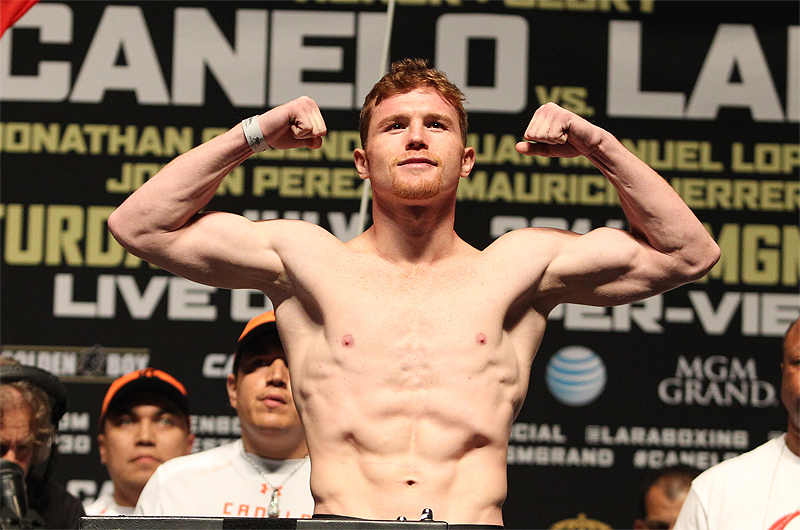
Saturday at Mandalay Bay, Puerto Rican middleweight champion Miguel Cotto will swap blows with Mexican junior middleweight Saul “Canelo” Alvarez in a main event that should mark 2015’s best pay-per-view match. The broadcast will happen on pay-HBO, a network whose commentators surely will invoke, in tones alternately awestruck and threatening, the name of the Kazakh fighter who holds the HBO middleweight title, reminding viewers Canelo-Cotto happens at a catchweight, 155 pounds, and that its unlucky winner will have fewer than two weeks to savor his victory before a Mexican sanctioning organization promises to strip that fighter of its belt and award the garish green tchotchke to HBO’s undisputed middleweight champion – as if the WBC ever would strip Canelo Alvarez.

The best outcome for aficionados is a Saturday match so even, violent, and robust, fans rise in a single, stentorian voice to demand a Cinco de Mayo rematch. The best outcome for HBO’s champion and at least one of his copromoters, of course, is that one man, probably Canelo, wins lopsidedly and then, in hotblood, gets goaded by Max to say he wants to fight the HBO middleweight champion next.

Among the many things about Latino prizefighters that should enchant aficionados, there’s this: An apparent obliviousness of American media manias. A man like Saul Alvarez lives in a selfsufficient country where, whatever his handlers might say when a contract gets signed, he doesn’t think about HBO or the opinions of its commentary crew or, best of all, its current exuberance for fighters from the former Soviet Union. However it gets broadcasted, the Saturday match between Alvarez and Cotto is not an elimination bout for a chance to face HBO’s middleweight champion; Canelo-Cotto is a prizefight in which each man will face an opponent many, many times better than anyone the HBO middleweight champion of the world has fought.

The winner of Canelo-Cotto, HBO tells us in a chorus with its champion’s official promoter, will have some arbitrarily chosen span of time before the winner has to declare he will face HBO’s middleweight champion or else risk ongoing banishment from HBO’s Gatti List and Fight Game List. Banishment from both lists ripples banishments across social media as a force multiplier, including possible banishments from the ESPN list, Pinterest, a number of influential Twitter polls, and a carefully chosen plethora of whatever apps teenage girls mindlessly refresh at Starbucks. The stakes aren’t merely high for the Mexican and the Puerto Rican, in other words: They’re nigh insurmountable.

Fortunately for both Canelo and Cotto, neither of them cares a jot for the subjective hierarchies that consume an everdwindling number of impoverished wouldbe aficionados who instead came of age in the List Era . . .

We now interrupt this hopeless column to hear from Saturday’s promoter and participants:

“Miguel, you have had an illustrious career, you are one of the marquee names in Puerto Rican fight history, you have fought a number of great fighters, you are one of my favorite fighters – one of the fighters I most enjoy hearing myself talk about, a fighter I can say dynamic, crushing, extraordinary, phenomenal things about – you are a Puerto Rican and a champion, Miguel, how do you feel about our certainty you will lose to the HBO middleweight champion, a man who began his career 20 pounds heavier than you began yours, if ever you find within yourself a fraction the courage required to fight him?”

“Miguel Cotto does not care about HBO middleweight champion.”

“Canelo, when people like me think about Mexican fighters, we think of names like Miguel Hidalgo y Costilla, Salvador Sanchez, Pancho Villa, Finito Lopez, the Aztec emperor Cuauhtémoc, Julio Cesar Chavez Jr., Subcomandante Insurgente Marcos – I can go on but I won’t because what I want to know, and what I think we’ve convinced others they want us to know, is this: Do you have trouble sleeping at night when you think about agreeing in principle to fight the HBO middleweight champion within 15 days of your possible victory over Miguel Cotto?”

“No, no, para nada. Lo que los comentaristas de HBO dicen sobre su campeón no me importa. Vivo en México, y ni sé quienes son – ni quien eres tú.”

. . . when mankind’s understandable if wholly absurd desire to impose order on an unpredictable and violent world married itself to a simplified form of written expression, the list, that required no transitional sentences, no spiraling thoughts, and considerably less craft than its predecessor forms.

Saturday’s match is not likely to disappoint. Canelo is best when his adversary attacks him, and Cotto knows he is best when attacking intelligently, stepping forward in an offensive flow. What both Cotto and Coach Freddie know is that if the match becomes a contest of offensive improvisation, where each man’s conditioning allows him to engage the other intelligently and at a comfortable pace, Cotto will have more depths from which to fetch, more opponent tricks he’s solved, more tricks he’s introduced to opponents, all of it, than Canelo will have. It’s not experience’s quantity so much as its quality – the fencer’s jab Cotto used against Shane Mosley in 2007, as an example, is an offensive adaptation of which Canelo, in 47 prizefights, has yet to prove himself capable. All other likely developments favor Canelo. He is younger, bigger, more physical, and most importantly, possessed of a right uppercut onto which Cotto will almost certainly drop himself.

This match will fulfill violent expectations – with Cotto lasting slightly longer than his detractors expect but considerably shorter than his supporters hope. I’ll take Canelo, TKO-10.

Bart Barry can be reached via Twitter @bartbarry


Mayweather might be retired, but he’s still in headlines that rob Canelo-Cotto of attention

By Norm Frauenheim
Floyd Mayweather
Floyd Mayweather Jr. must love all the attention he’s getting this week. He’s retired – or so he says – and yet he’s still generating the kind of controversy that would inevitably erupt during the week before one of his fights. Oscar De La Hoya and Adrien Broner have gone Ronda Rousey on him.

It’s hard to figure, other than to say it’s just another chapter in social media’s voracious need for content. Say what you want about Mayweather, but he is TBE at using and maintaining his prominence in social-media.

His mastery of all the digital platforms propelled him to the GDP-like purse he collected for the pay-per-view blockbuster in a victory over Manny Pacquiao that will be remembered more for the number of tweets than the number of punches.

Broner’s profane rant on YouTube isn’t exactly a surprise. It’s also a redundancy to use profane and rant next to Broner’s name. Sorry for that. Still, it’s almost comical to see Broner — angry at Mayweather’s criticism of his October victory over Khabib Allakhverdiev — go off on his ex-hero. Broner did everything but flush TMT T-shirts and TBE caps down the same toilet that was a receptacle for some of his cash a few years ago. Maybe, that’s the sequel.

The surprise was De La Hoya’s letter in the latest issue of Playboy. It was honest. It was forthright. It was funny. De La Hoya summed up what so many are thinking: The business is better off without Mayweather. But why now? Why publish the dismissive farewell to Mayweather at the very time De La Hoya is promoting a Canelo Alvarez-Miguel Cotto on Nov. 21 at Las Vegas’ Mandalay Bay.

De La Hoya has a fight that has the potential to say a lot more to Mayweather than any letter in Playboy could ever say. It’s a real chance for the business to get beyond the deflating hangover that still lingers from the public dismay over Mayweather-Pacquiao. Perhaps, the timing is just a result of the magazine’s publishing schedule. Deadlines can do things that writers don’t intend. It would have bee nice if De La Hoya had simply written: Mayweather? Who’s he? But that would not have been enough for Playboy, which is seeking a different kind of content these days. The magazine announced it wouldn’t publish nude photos anymore. About 10 days before Canelo-Cotto, however, I’d prefer a centerfold to De La Hoya’s letter.

Once the headlines subside, perhaps the business will be better for De La Hoya’s rhetorical swipe at his old rival. And, maybe, this is the opening salvo in a promotional rivalry that could evolve into the modern version of Bob Arum-versus-Don King. Arum-King was as entertaining and intense as anything that happened within the ring. It helped fuel the 1980s, one of the game’s best eras.

For now, however, I can only think that Mayweather has won another one. Inside and outside the ropes, he has always been able to dictate pace, style and timing. He’s doing it again. We’re talking about him when we should be talking about Canelo-Cotto.


Benavidez back in the fight to stay busy while he hopes for a shot at Crawford

jose_benavidez_signing_100114_001
Jose Benavidez Jr. fights for titles. Fights to stay unbeaten.

Fights to stay busy, too.

He’s been pretty good at the first two, but staying busy has eluded him at an age when the young junior-welterweight needs fights like a talented student needs consistent challenges on a long lesson plan.

The 23-year-old Benavidez (23-0, 16 KOs) hopes to eliminate that problematic idle time, beginning on Dec. 12 in Tucson when he fights for only the second time since winning a controversial decision over Mauricio Herrera for a WBA interim title on Dec. 13, 2014, in Las Vegas.

“I was supposed to fight in November, but it didn’t happen,’’ Benavidez said Thursday before a Top Rank news conference in Tucson announcing a Unimas-televised card that will also feature emerging featherweight Oscar Valdez. “I was supposed to fight a couple of times.’’

Both times, Benavidez was mentioned as a possibility for Terence Crawford, the 2014 Fighter of the Year. But Crawford bypassed Benavidez, winning both — first in March over Thomas Dulorme in his 140-pound debut and then Dierry Jean in October.

Benavidez is still a possibility for Crawford. Top Rank’s Bob Arum mentioned him again during the weigh-in last
Friday for Timothy Bradley’s victory over Brandon Rios In Las Vegas.

“I’d love to fight Crawford, absolutely’’ said Benavidez, who in May scored a 12th-round stoppage of Jorge Paez Jr. in Phoenix, Benavidez’ hometown.

It looks as if Benavidez is an alternate for Crawford. Manny Pacquiao is reportedly interested in career ending fight against either Crawford or Bradley. If the Filipino opts for Bradley, Benavidez might the next man up for Crawford. Viktor Postol is another Benavidez possibility.

“Anybody, I’ll fight anybody,’’ said Benavidez, who title will not be at stake on Dec. 12 when he is scheduled to fight Brazilian Sidney Siqueira (26-10-1, 17 KOs), perhaps at a catch weight between 140 and 150 pounds.

Meanwhile, Benavidez is staying busy. He has too. Boxing is the family business. He’ll be with his brother, David, (10-0, 9 KOs), an 18-year-old light-heavyweight who fights Mexican Felipe Romero (19-9-1, 13 KOs) Saturday night on ShoBox card (Showtime 10:45 p.m. ET/PT) at Las Vegas’ Hard Rock.

“Oh, yeah, I have to be there for my brother,’’ Benavidez said. “We train together. Always have. He keeps me ready. We spar and, man, he beats the bleeping bleep out of me.’’

Nothing bleeping busier than a sibling rivalry.


Back to the Beginning: Oscar Valdez returns to his Tucson roots

By Norm Frauenheim
Oscar Valdez
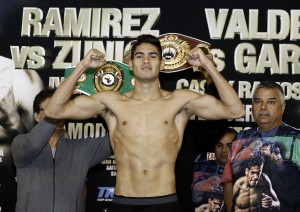
Featherweight Oscar Valdez moves seamlessly between English and Spanish. He needs no interpreter for what he’s saying and what he’s doing. From amateur to pro, he understands where he’s been and where he intends to go.

Another step in that process takes place on Dec. 12 in a city he knows.

Tucson is a beginning for the two-time Mexican Olympian.

“It’s really where I began to box,’’ Valdez (17-0, 15 KOs) said Thursday before a Top Rank news conference at Tucson Community Center where he faces Filipino Ernie Sanchez on a Unimas-televised card in an arena just a few city blocks from where he went to school, Manzo Elementary “I was 8-years-old. My dad would take me to these gyms. Then, me and my friends would go to gyms around town and I’d tell them that one day I’d be a professional boxer. That’s kind of how all of this got started.’’

After grade school, Valdez moved to Nogales, a Mexican border town, and continued to work on what began in Tucson. Today, a kid’s dream is reality. It has taken Valdez, now 24, to Beijing for the 2008 Olympics and London for the 2012 Games. It has taken him from prospect to potential contender in a division as competitive as any. It has brought him back to the beginning, Tucson, where his mom, Gloria Fierro, still lives.

It looks as if the Tucson bout might be his last before he steps up to world class. His first challenge for a major title could happen in 2016. Valdez has been mentioned as a possibility for Top Rank prodigy Vasyl Lomachenko. For now, however, he’s still the student, which means another lesson plan against Sanchez (15-6-1, 6 KOs), who is from General Santos City, Manny Pacquiao’s hometown.

“Whenever Top Ranks tells me, I’ll be ready,’’ said Valdez, who lost to Lomachenko in the 2009 World Championships in Milan, Italy. “Hopefully, it will be next year.’’


Bradley, Atlas and Rios: What’s a good metaphor for embellishment?

By Bart Barry
Pacquiao_Bradley_weighin_140411_007a
Saturday in a Thomas & Mack Arena that was not sold out, American welterweight Timothy “Desert Storm” Bradley and his new trainer, Teddy Atlas, combined to retire American Brandon “Bam Bam” Rios after dropping him twice, in round 9. The fight happened on HBO, a network that completed its three-year and 180-degree perspective-pivot on Bradley by celebrating Bradley’s new choice of trainer and Bradley’s new trainer with the enthusiasm of a rookie talent recruiter selling a prospect to Google.

Yes, the makeover is exaggerated, but let us play along for a couple reasons like: Tim’s a good guy, and we don’t have much of a choice because we’re going to be fed a Bradley-Atlas-union feast long after we push ourselves back from the table, hands waving in sated, otiose resistance.

If there’s a gigantic difference between the marketing of the Bradley-Atlas relationship and the Miguel Cotto-Freddie Roach relationship, it is not apparent. Both trainer narratives brought electrical charges to stalled products: Cotto, having been decisioned by Floyd Mayweather and Austin Trout, was out of the pay-per-view business unless something more than cosmetic might be done. A few more tattoos, a lot more hotpink, a goofy boy friend’s weightloss, an unknown handler from Cuba, improved English – these were insubstantial product improvements when set against knockout losses to Antonio Margarito and Manny Pacquiao and a two-fight losing streak. Enter Coach Freddie: what chemistry! what trust! what rediscovery of the left hook! my goodness!

Those enhancements, along with an opponent on the downside of a six-loss career, and the new and improved product was done with infomercials and ready to ship. Cotto then blazed through the tissuepaper of Sergio Martinez’s knee(s), became the linear middleweight champion of the world and perfected his pronunciation of an English phrase he learned early in ESL tutelage: “A-side.” (The ‘SL’ in ESL may be inaccurate, we now learn: the nurses in the Rhode Island hospital where apparently El Gran Campeón Puertorriqueño was born surely brought English to the young man’s ears early.) All the Cotto product relaunch lacked was a mandatory title defense against a hopeless opponent, a chance to remind viewers Cotto reminded them of anyone from Mike Tyson to Benny Leonard, old timers, in other words, who reminded us of the old Miguel Cotto – neither the guy who took a knee against Margarito nor the guy pulped by Pacquiao but the warrior who cracked Paulie Malignaggi’s face – and Daniel “Real Deal” Geale strode on the set in June.

That match brought the hundredth or so chance for viewers to squint for insights at a fight whose outcome not one aficionado doubted. Anymore, an engaged aficionado, an endangered mammal whose ranks continue thinning as its hungerstrikers perish from malnourishment, gets encouraged by broadcasters to watch fights the way an NFL scout investigates combines or a Major Leaguer stares at his radar gun. Since the matchmaking and broadcasting are universally ironic – in the rhetorical sense of meaning other than what they state – aficionados, uniquely endowed with the talent and opportunities for cynicism, cynically derive from results whatever they expect to see.

It would be tragic if it were not, in its way, an intriguing adaptation: As if lifelong basketball fans deprived of watching their favorite NBA teams play one another derived, instead, fantasy basketball teams assembled according to height and vertical leap and whatever glowing commentary Charles Barkley had about players, and then set these fantasy teams loose on high school playgrounds, where they regularly mauled their teenage opponents, leaving the financially interested broadcasters of these contests to say of LeBron James dunking over a 5-foot-3 schoolboy freshman, “Looking at that dominant performance by James, one immediately thinks of Dr. J in the 1983 finals against the Lakers!”

Would such a derivative league survive? Doubtlessly it would. Would it thrive? Doubtlessly it wouldn’t.

None of this describes, quite, what happened Saturday, so much as it describes what might happen in Bradley’s next match, which will not be against Canelo Alvarez, of all absurd suggestions. Bradley beat down Rios more effectively than anticipated. But here we go again: Was Bradley disproportionately improved, or was Rios, career property of promoter Top Rank and its peerless matchmaking, disproportionately spent before the bell?

A quick memory might be instructive. The first time I interviewed Bob Arum, in 2004, I asked him if Top Rank could select a prospect on one criterion alone, what that criterion would be.

“Does he dissipate between fights?” said Arum immediately.

Setting aside how much smarter that answer is than what Richard Schaefer or any of Al Haymon’s subsequent puppets might say, it underlines boldly how closely Top Rank considers its fighters between matches, which is a roundabout way of imparting how unsurprised Top Rank likely was by how helpless Brandon Rios looked Saturday. That is not an indictment of Timothy Bradley or his new trainer. It really isn’t. They prepared for a much larger version of the Brandon Rios who, in 2011, blitzed both Miguel Acosta and Urbano Antillon, surely, and Bradley did in fact look better.

It’s a partial indictment, though, of the silliness that happened during the telecast, the spiraling embellishment that seems modern broadcasting’s default reaction to the predictable unevenness of uneven contests. Couched in the false humility of the conditional tense – could it be? would it have been? were it possible . . . – the intended seeding of the idea finds its roots and caretaking in whatever follows the humblefeint, slipping right past the viewer’s lowered guard. It’s not meanspirited mischief, no, but neither is it disinterested.

Bart Barry can be reached via Twitter @bartbarry


FOLLOW BRADLEY – RIOS LIVE FROM RINGSIDE

Nov 6, 2015, Las Vegas,Nevada --- WBO Welterweight Champion Timothy "Desert Storm" Bradley Jr. and former world champion Brandon Rios weigh in for their upcoming world title fight, Saturday, Nov. 7, at the Thomas & Mack Center in Las Vegas on HBO. --- Photo Credit : Chris Farina - Top Rank (no other credit allowed) copyright 2015

Follow all the action Live as Timothy Bradley defends the WBO Welterweight title against Brandon Rios.  The action begins at 9:30 PM et / 6:30 OM PT as Vasyl Lomachenko defends the WBO Featherweight title against Romulo Koaschia–AUTOMATIC BROWSER REFRESH

12 rounds–WBO Welterweight championship–Timothy Bradley (32-1-1, 12 KO’s) vs Brandon Rios (33-2-1, 24 KO’s) 
ROUND 1 2 3 4 5 6 7 8 9 10 11 12 TOTAL
Bradley 10  10  10  10 10  10  10  10 80
Rios 9 9 9  9  9  9  9  9  72

Round 1 : 2 hard body shots from Bradley..Hard jab..4 left hooks…Braldey looking MUCH quicker…Big left hook from Bradley…Another hard sweeping left hook

Round 2 Rios trying to crowd Bradley..Big right from Bradley..Left from Rios..Bradley working the body..Trading shots on the ropes..Left from Rios,,,

Round 3.Left from Bradley…

Round 5 Bradley rocks Rios twice…

Round 6. Uppercut from Rios…Double left from Bradley

Round 7 Bradley sneaks in a right…Body shot from Rios..left from Bradley..double jab..

Round 8 Hard right from Bradley sets off a 5 punch combination…Good right to the body..Jab,,straight right…

Round 9 Left from Bradley..body shot..good left..Bradley hitting and moving well..Body/Head combo with the left,,…LEFT HOOK AND DOWN GOES RIOS…MORE BODY SHOTS –DOWN GOES RIOS AND THE FIGHT IS OVER


12-rounds WBO Featherweight totle–Vasyl Lomachenko vs Romulo Koasicha
ROUND 1 2 3 4 5 6 7 8 9 10 11 12 TOTAL
Lomachenko 10  10 10 10  10  10  10  10 10 90
Koasicha  9  9  9  9  9  9  9  9 9 81

Round 1 Lomachenko gets in a left..Jab  from Koasicha..right hook from Loamachenko.

Round 2 Straight left from Lomachenko..Combination from Koasicha..3 punches from Lomachenko..Hard right hook..straight left to the body…

Round 3 Lomachenko gets in a left to the body…Solid combination…Straight left snaps Koaschia’s head back..Right from Koasicha//Uppercut from Loamecnko…hard 4 punch combination..2 solid right hooks..

Round 4 Uppercut on inside from Lomachenko…Koasicha fires back with a left hook…Left uppercut from Lomachenko and another..a 3rd that was followed by a right hook..head combo..Straight left and right

Round 5 Lomachenko lands a combo on the ropes..jab..right hook..straight left…Lomachenko mocking Koasicha..Food right hook in the ropes…2 left hooks…Koasicha gets in a right…

Round 6 Right hook from Lomachenko..Right from Koasicha..Right hook from Lomachenko..Right hook and right to the body

Round 7 Lomachenko flicks the jab and comes behind with a right…ripping uppercut..Koasicha starting to swell around the right eye…Ripping left…right to head…left to bodyKoasicha lands a combo..Big left from Lomachenko..Big right hook to he head…

Round 8 Lomachenko lands a left and right hook..straight left..hard right hook..Koasicha gets in a small combination..

Round 9 Uppercut from Loamchenko..and another..Straight left,,,Koasicha lands a right..right uppercut..

Round 10 Lomachenko goes to the body…left to the body hurts Koasicha...HARD LEFT TO THE BODY AND DOWN GOES KOASICHA….HE STAYS DOWN FOR THE 10 COUNT


Atlas In His Corner: Reborn Bradley promises “a whole new animal”

By Norm Frauenhim–
Timothy Bradley
A corner is Teddy Atlas’ bully pulpit. He once sat on Michael Moorer’s stool after a round midway through a 1994 bout with Evander Holyfield. Moorer looked down at Atlas in disbelief. At the start of the next round, however, Moorer believed.

Believed enough to win a narrow decision and a heavyweight title.

The dramatic gesture is always there, an over-the-top move perhaps, yet a tactic played as well as any by Atlas. It doesn’t always work. The relationship between trainer and fighter is all about chemistry, a periodic table of personality traits and emotional elements. Sometimes, it just blows up.

Will it work between Atlas and Timothy Bradley? It’ll have to. There’s no chance to test it. Or if there was, Atlas and Bradley decided to forgo it and instead chose to march straight into harm’s way Saturday night at Las Vegas’ Thomas & Mack Center against Brandon Rios, whose stubborn pressure and relentless energy are bound to subject the new found union to stress that can break it.

Atlas and Bradley said all the right things Wednesday in a conference call before their formal arrival at The Wynn, the home casino for the HBO-televised bout (9:30 p.m. ET/PT). Atlas preached and Bradley talked with the conviction of a welterweight who has been resurrected to be better than ever.

“A whole different animal,’’ said Bradley, who about two months ago split with Joel Diaz, his only pro trainer before he called Atlas.

Bradley, always likable and credible, was convincing. But a fair judgment awaits an opening bell and that first big punch.

“He’s going to tell you after the fight,’’ Rios trainer Robert Garcia said.

The deal between Bradley and Atlas is an acknowledgement of that reality. The two have a fight-to-fight agreement. There’s nothing long-term, not for them or – for that matter – Rios, who concedes his career is at the make-or-break stage.

Betting odds suggest that Atlas and Bradley will be together for more than just one training camp. When the fight was announced, Bradley was about a 5-to-1 favorite. The guess is that his overall skill will prevail against Rios, whom Bradley calls one-dimensional.

The question, however, is whether Bradley has seen his best days. He survived Ruslan Provodnikov’s concussive punches in the 2013 Fight of the Year. But at what price? Signs of possible wear and tear were there when he got wobbled in the final seconds of a one-sided decision over Jessie Vargas in his last outing.

But was that just a careless moment or another in a long succession of big punches at the end of Bradley’s career? Undisciplined or vulnerable? From Atlas’ perspective, it’s just been matter of absorbing too many big blows.

Atlas, ever the preacher, calls them mortal sins. Too many of them, and Bradley’s money-making days will be condemned to a premature end.

“He has to quit taking those big shots, quit committing those mortal sins,’’ said Atlas, the ESPN analyst who says he agreed to work with Bradley in part because the 32-year-old welterweight still wants to learn. “We can live with the menial ones.’’


Rios Weighs In: Says he ready for Bradley after flushing two tenths to make 147

By Norm Frauenheim
Pacquiao_Bradley_weighin_140411_007a
LAS VEGAS – Two tenths of a pound aren’t much, but they were enough to make a weigh-in last an hour longer than it should have Friday.

Brandon Rios stepped on the scale once, stripped off his shorts behind a strategically placed sheet and stepped on the scale again. Once, twice, shorts on, shorts off and he was still two-tenths heavier than the 147-pound mandatory for his welterweight bout Saturday night against Timothy Bradley at Thomas & Mack Center.

For the next 60 minutes, Rios found a bathroom, stood around a hallway outside of a ballroom at The Wynn and then headed back to the scale. Once, twice, shorts on, shorts off and this time the two tenths were gone, presumably flushed from the proceedings.

Actually, Rios said he could have saved everybody a lot of time had he been allowed an extra minute or two. In so many words and more than a few expletives, he said he was trying to get rid of the two-tenths when he was called off the stool and onto the scale.

“There was no drama,’’ Rios said. “I’m ready.’’

Rios’ face looked a little drawn after the weigh-in, which included Vasyl Lomachenko (4-1, 2 KOs) and Romulo Koasicha (25-4, 15 KOs) both at 125.6 pounds for a WBO featherweight title fight. He’s no stranger to off and on the scale controversies. As a lightweight, he missed weight twice. The move up to welter was supposed to make things easier.

But Rios has never been about easy.

On himself or anybody else.

With his career at a crossroads, Rios (33-2-1, 24 KOs) is expected to make things difficult for the favored Bradley (32-1-1, 12 KOs) in an HBO-televised bout (9:30 p.m. ET/PT) that was officially sanctioned as a World Boxing Organization title fight.

His tireless pressure figures to test Bradley, who was at a business-like 146 pounds. For Bradley, the bout is his first with trainer Teddy Atlas. Bradley had spent his entire pro career with Joel Diaz. They knew each other instinctively, almost like father and son. What happens when Rios lands his first big punch? How will Bradley respond to adversity when he sees a different face, Atlas instead of Diaz, in his corner?

That looms as the bout’s key question. If Bradley has the right answer, Rios will wind up flushing a lot more than just two-tenths.


Hershman, Bradley and Rios: Finally an honest prizefight

By Bart Barry–
Timothy Bradley
Saturday at UNLV’s Thomas & Mack Center, American welterweights Timothy Bradley and Brandon Rios will compete for a world title of some sort and, more importantly, for a chance to be their division’s premier b-side attraction – as friend and colleague Norm Frauenheim insightfully put it Friday. While neither guy sees himself as a gatekeeper – Bradley, in fact, has a loose argument for IBHOF induction someday – no one in the sport sees either guy as the world’s best welterweight, though, again, Bradley has a loose argument for that distinction too.

But finally, an honest prizefight. It has been that long, so long in fact this one almost misses us gazing desperately towards Canelo-Cotto while wondering how to compose a eulogy for Ken Hersman’s career at HBO. There has been, and will continue to be, a want of eulogizing for Hershman because, frankly, we’re not qualified to pen eulogies, little as most of us have minded his career at HBO. Consider this, then, an impressionistic portrait by a writer too uninterested to check dates and figures.

Hershman came to HBO sometime after Timothy Bradley and Devon Alexander made a disappointment of a match in Pontiac Silverdome, then auditioning for world’s largest empty refrigerator, a disastrous show so poorly attended the HBO broadcast trucks, like the one racing at you in those intro cartoons, parked in the middle of the floor, and even by stuffing the fight in a back corner and closingoff the mezzanine, they still couldn’t make the arena look more than 1/10 full because it wasn’t 1/15 full. Legend has it a few HBO VIPs showed up for that disaster, and after recovering from frostbite set about a plot to fire the man who lost Manny Pacquiao to Showtime for a night (the one in which Pacquiao eradicated world poverty by wearing yellow gloves, historians will recall).

Uninspired to do more than rebuild slowly and cheaply, HBO hired Showtime’s guy, who had fought a marvelous insurgency in the preceding years and made Showtime the destination network for serious fans while HBO lazily tended its starsystem. Maligned as it was by misfortune and miscreants, Hershman’s Super Six tournament was a wonderful thing whose ultimate winners, Andre Ward and Ken Hershman and Carl Froch, did quite well for themselves immediately afterwards. Froch is now retired, Hershman is about to be retired, and Ward continues a halfassed comeback from semiretirment – so nothing, as the saying goes, is permanent.

But whatever innovative spirit Hershman had at Showtime, not an innovative thing was done during his time at HBO, unless discovering Eurasia 20 years after the Soviet Union’s collapse should be called revolutionary. Hershman fired Al Haymon and his lackey Richard Schaefer and Schaefer’s spokesman, Oscar De La Hoya, in a move more memorable for spite than creativity: Hersman did not clear away dead underbrush from the calendar, allowing bold, suppressed ideas to spring forth, so much as he avenged his predecessor and sent Haymon to a much wealthier benefactor with whose capital Haymon, a vindictive pacifist, has smothered boxing to critical condition. Hershman is not to blame for Haymon’s ascent; Haymon is a force of nature, where men like Hershman, and the guy who replaced him at Showtime, are lawerly bureaucrats, not entrepreneurs.

Perhaps HBO’s culture is to blame, in part, while we’re introspecting. Fighters, not fights, drive HBO’s starsystem, a philosophy that manifests itself as a panicked paralysis whenever anointed stars like Nonito Donaire get outclassed by men whose superior skills somehow elude HBO’s staff of talentscouts and matchmakers. Whoever replaces Hershman should move first to acquire a professional matchmaker or two – boxing guys, outsiders who drink too much and dress like slobs, not television guys, not aspiring runway models, not writers-cum-publicists, not lawyers from Harvard or Yale, but men with real contacts lists, real shortnotice talent, real chemistry with prizefighters of all skill levels, and decades, not months, of experience – and enable him- or herself to dictate intelligent terms to serious outfits like Top Rank and Main Events and K2, treating them as suppliers, not partners.

There’s a shortage of talent in prizefighting at this time, and HBO’s next generation of broadcasters should realize this and not hardsell us on historic championship runs like Wladimir Klitschko’s or Gennady Golovkin’s – runs even casual fans know are meaningless. Whoever replaces Hershman, s/he should dictate terms in the negotiation, request a bold budget, request increased latitude, request a brand new team, pause to accept whatever’s offered and not act merely thrilled to be picked. A person who does this likely will find s/he doesn’t jibe with HBO’s current culture and turn down the job. A few incidents like that and perhaps the culture will see a need to change, maybe even deciding our sport is not worth the hassle that broadcasting it brings. Boxing will find a way to struggle along, regardless.

Whatever hassles soon get brought, know this: Bradley-Rios deserves your viewership. These are two honest prizefighters who are, for once, evenly matched. Neither belongs at welterweight: Bradley moved up to make more money, and Rios moved up because his offseason diet makes weighing 135 pounds or 140 impossible. Both are worn by experience, both were fed to Manny Pacquiao for different reasons, and Bradley proved to be the considerably less-digestible dish. Bradley decisioned Pacquiao, and many have not forgiven him for it, despite his acquiescent performance in their rematch. Rios lost to Pacquiao more predictably and lopsidedly than anyone save Chris Algieri. Bradley is a better athlete and a better fighter than Rios, but then, so was Mike Alvarado a better athlete and better fighter than Rios, and Rios beat him down twice.

Bradley has a new trainer, the philosopher poet Teddy Atlas, but what Bradley needed and probably still needs is a technician who tells him to lower his chin and move his head, not a motivational speaker who steels his resolve in a crisis. Bradley manages crises better than anyone currently plying the craft; he needs help navigating round them, not navigating through them.

Still, I’ll take Bradley, SD-12, in an excellent and honest prizefight.

Bart Barry can be reached via Twitter @bartbarry


Bradley-Rios: A great fight to be first on the B-side

By Norm Frauenheim-
Pacquiao_Bradley_weighin_140411_008a
It’s still very much a puzzle, yet the face of boxing in the post Floyd Mayweather-Manny Pacquiao era is falling together, piece by haphazard piece, in a process that continues on November 7 with Timothy Bradley-versus-Brandon Rios at Las Vegas’ Thomas & Mack Center.

At a gut level, Bradley-Rios is the best since the search began in the wake of Mayweather’s possible retirement and Pacquiao’s announcement that he’ll fight in April for the last time. Truth is, it doesn’t matter if either or both ever fight again. As the business bids an overdue goodbye, the business re-sets the table while Mayweather re-stocks the garage with Bugatis and Congressman Pacquiao campaigns for a seat in the Filipino Senate.

Over the last few weeks, middleweight Gennady Golovkin and flyweight Roman Gonzales did what they had to in New York. Junior-welterweight Terence Crawford held up his end of the bargain in Omaha. All three looked spectacular in scoring stoppages over opponents few will remember for long.

Did anyone expect anything less? Without that mandatory spectacular, there would have been a lot of gloom-and-doom anguish about what’s next. So far, Golovkin, Gonzalez and Crawford are. The Miguel Cotto-Canelo Alvarez 155-pound winner on Nov. 21 will join them.

But there is no business without a B-side, and the first of those will emerge from Bradley-Rios, a 147-pound fight with high stakes and loaded with stories on all sides. It’s intriguing because both are fighting to stay in line for a major payday. Unlike any other of the aforementioned fights, however, this one is hard to pick.

Rios is fighting for the first time in nearly a year. In his last outing, he scored a stoppage last January of rival Mike Alvarado. But the victory was hard to judge, mostly because Alvarado wasn’t in great condition and seemingly distracted.

Over the idle months, Rios grew impatient. He’s restless and sounds as if he can’t wait to expend some pent-up energy. Or is that frustration? It’s just a guess, but the layoff might have been a blessing in disguise for a 29-year-old welterweight who loves to brawl. It saved him for what promises to be more rounds of attrition in a career full of it. Rios knows no other way. It’s risky. It’s also why fans love him.

Then, there’s Bradley, one of the game’s acknowledged good guys, yet also surrounded by surprising questions. He dumped his only pro trainer Joel Diaz, for Teddy Atlas. It’s a move that makes you wonder how he’ll react with a new face and voice in his corner.

Often, it takes time to develop a personal chemistry between fighter and trainer. Adversity is the only true test. But there’ll be no test drive, not against Rios, an instinctive brawler. Bradley has shown he can withstand the punishing attack promised by Rios. He survived Ruslan Provodnikov in the 2013 Fight of the Year.

But Diaz was there for Provodnikov. If the Rios fight turns into a battle similar to the Provodnikov bout, how would Bradley react stagger between desperate late rounds when he see Atlas instead of Diaz. Who knows?

At 32 and in the last stages of his career, the move to Atlas appears to be a business decision, crafted in part by Bradley’s wife and manager, Monica, who – in an ever-thickening plot — replaced Cameron Dunkin. Dunkin? You guessed it. He is Rios’ manager.

In Atlas, Bradley has a longtime corner man and a successful ESPN ringside analyst. Bradley is trying to move into the broadcasting end of the business himself. He’s working as fledgling analyst for truTV. In Atlas, there are worldwide contacts and world-class experience. But there’s no guarantee of familiarity achieved only amid the chaos of a wild fight.

For now, a wild one is the only good bet.


Disorder to diminishing returns: Terence Crawford and boxing’s downward spiral

By Bart Barry-
Terence Crawford
Saturday in Omaha’s CenturyLink Center, in what was probably another attendance record of some prepositional sort – in October, against a French speaker, after a Texas fight, under the rules of the WBO, within the American Midwest, without a doubt, beyond expectations – Nebraska junior welterweight Terence Crawford razed Haitian-Canadian Dierry Jean in 10 rounds. Before Jean was able to retrieve his check from the scorer’s table with a shrug, talk turned to Crawford’s next opponent: Manny Pacquiao, in his first last match, in April, on pay-per-view! And the shrugging commenced.

Anybody see Terence Crawford repeating as Fighter of the Year for 2015?

They can’t all be good twelvemonths, and to be fair, the exceptionality of Crawford’s 2014 was impossible in 2015, known forevermore in boxing annals as the year 0 AH (After Haymon), but Crawford, or at least his handlers at Top Rank, the incredible shrinking promoter, might have put in an effort slightly more inspired than what 2015 shined. There was the compulsory migration to a new weightclass, junior welterweight, that might’ve impressed if Crawford’dn’t already fought a better junior welterweight, Breidis Prescott, on no notice, in 2013 (2 BH). Then there was the inexplicable University of Texas venue in Arlington, on a campus even UT alumni needed to google, and a typically tough, hopeless opponent.

Saturday’s match, an achievement-award homecoming tilt, a way for Omahans to thank a fellow Nebraskan for excelling at some sport other than football, happened against a man not even fightweek festivities bothered embellishing. He was Dierry Jean, the Haitian-born Canadian smuggled out of Montreal to rehab Lamont Peterson in 1 BH, after Lamont got spincycled by Lucas Matthysse, just before Lucas got handled by Danny Garcia. Whatever the ratings boards say of Jean, and no, I don’t care enough to check, intuition says he’s roughly half the opponent someone of Crawford’s talent and pedigree should be confronting in his third match at 140 pounds, on HBO.

So bring on the Pacman!

That’s actually an uncharacteristically interesting fight if it happens in 1 AH, which it likely will not, because honestly, how often does anything genuinely interesting still happen in our oncebeloved sport? Faded as Pacquiao is, a return to 140 pounds – where he fought only once, stiffening Ricky Hatton in 6 BH – might quicken his movements some and make a fight entertaining enough to disarm the righteous rage aficionados feel about the performance, and postfight gracelessness, Manny and Coach Freddie staged against Floyd Mayweather in May. Disarm is perhaps a verb too far: Boxing is just beginning to experience the first sensations of the injury it suffered from The Fight to Save Boxing.

If the pay-per-view numbers are to be believed, and they never ever are, Mayweather took a 90-percent haircut, Pacquiao-to-Berto, and Gennady “Our Next Superstar” Golovkin didn’t do even half Mayweather’s new number, despite allegedly breaking Madison Square Garden attendance records not even the Empire State though to track till GGG’s invasion. The official model is probably broken, and adherence to it – basic cable to premium cable to PPV – almost assuredly will frustrate any who obstinately power towards it.

Bob Arum is not to blame. His legacy as a legendary promoter is assured by the company and fighters he built and the enduring changes he wrought (how do you think boxing got off free TV in the first place?), and he’s been semiretired, anyway, since Juan Manuel Marquez dangled Manny Pacquiao between life and death in 3 BH. What has happened to Top Rank since then is a descent that now accelerates.

There’s a chance all living systems follow the same spiraling pattern, and if they don’t, certainly boxing’s television model has: Disorder –> Negative Feedback (diminishing returns) –> Order –> Positive Feedback (increasing returns) –> Disorder.

The consolidation of broadcasting from many to few imposed an orderly system for exponentially increasing the revenues generated by select men like Mike Tyson and Oscar De La Hoya and Floyd Mayweather and Manny Pacquiao. This increased revenue summoned new agents, like Al Haymon, and disproportionately empowered a few men to move the sport according to their whims. And the more whimsically they behaved, the more revenue they generated till the order disintegrated in the spectacle of a network, HBO, despite having invested extraordinary resources in the promotion of two fighters, Mayweather and Pacquiao, being powerless to make them face one another.

The Fight to Save Boxing was not the beginning of disorder so much as its highest manifestation: A match no expert believed would please its consumers found the largest paying audience assembled in our sport’s history. What 30 years of splintering titles and feuding promoters and deteriorating talent pools could not do to obliterate boxing’s fanbase – decimate, yes, but not obliterate – May 2 did in less than an hour.

Aficionados’ hostility now makes them casual fans whose indifference ensures diminishing returns for every organism in the boxing ecosystem. Opponents of the truly talented are no longer talented enough to improve them, and the truly talented’s skills subsequently erode till they bore their audiences away or lose in matchmaking mishaps. Suddenly boxing is ubiquitous on free television, the last era’s Promised Land, and yet nobody cares at all. The negative feedback has begun in earnest, and while human technology ever has an acceleratory effect on its spirals, the last cycle took decades to complete and this one is barely begun.

Prizefighting, in the sense of men paying to watch other men bludgeon one another to unconsciousness, will endure, but prizefighting, in the sense of a match generating $500 million again, is finished for years, definitely, for decades, probably, and for a lifetime, possibly.

Bart Barry can be reached via Twitter @bartbarry


Follow Crawford – Jean Live

Terence Crawford

Dierry Jean


Follow all the action as WBO Jr. Welterweight champion Terence Crawford defends against Dierry Jean.  The action begins at 9:30 PM ET / 8:30 CT

Page will refresh automatically

12 Rounds WBO Jr. Welterweight championship–Terence Crawford (26-0, 18 KO’s) vs Dierry Jean (29-1, 20 KO’s)
ROUND 1 2 3 4 5 6 7 8 9 10 11 12 TOTAL
Crawford*  10  10  9  10 10 10 10  9  10  TKO 88
Jean  8  9  10 9  9 9  9  10  8  81

Round 1 Hard right from Jean..Crawford switches southpaw..Crawford lands a jab and straight right..HARD RIGHT AND DOWN GOES JEAN JUST BEFORE THE BELL.

Round 2 Right hook wobbles Jean

Round 3 Good exchange with Jean trying to land the right

Round 4 Straight left from Crawford…

Round 5 Hard left from Crawford drives Jean into the corner..

Round 6 Body shot from Crawford..Right from Jean..Combination from Crawford..Right uppercut..

Round 7 Crawford lands a left…right..left and right at the bell

Round 8 Hard right from Jean..another hard right..

Round 9 Hard right to body from Crawford..Straight left buckles Jean…Left to TOP OF HEAD AND DOWN GOES JEAN..Blood from right eye of Jean

Round 10 2 right hooks to head from Crawford…hard left and right..Jean in trouble..Hard body shots..Good right from Jean..BIG LEFT AND RIGHT…JEAN FALLS INTO THE ROPES AND THE FIGHT IS STOPPED


Homeless to Unknown: This unknown Rose is fighting for a future he didn’t have

By Norm Frauenheim–
Louis Rose
He calls himself Unknown. For unknown Louis Rose, it’s a nickname and a lot more. It sums up where’s he been and maybe provides the motivation for where he hopes to go.

He used to spend his nights sleeping in an old car.

For eight months, he says, that was home.

No address there. Not much of a future, either.

But futile dreams from restless hours on an eroded front seat of a rusting car are gone.

These days, Rose is risking real dreams as a middleweight without amateur experience against plenty of tough challenges, including Friday night against unbeaten prospect and 2010 national Golden Gloves champion Rob Brant at Celebrity Theatre in Phoenix in Showtime’s ShoBox: The Next Generation (10:30 p.m. ET/PT).

The non-televised portion of the card – a Greg Cohen, Roy Jones Jr. and Iron Boy joint promotion – is scheduled to begin at 6 p.m. (PT).

Rose’s chances? Not good. In Brant, he faces a fighter with an amateur pedigree similar to that Ievgen Khytrov, a former Olympian and a Ukrainian prodigy who knocked him out in the first round of a bout in Tulsa last November.

Brant (17-0, 11 KOs) is thought to be among the best in that new generation ShoBox advertises. The 25-year-old fighter from Saint Paul, Minn., had a reported amateur record of 101-22. That means he’s well-versed in all the fundamentals, finesse and tricks.

Rose isn’t. He grew up trying to figure out where he’d find his next meal. There are some lasting lessons in learning that kind of footwork, too. Lately, Rose (13-2-1, 5 KOs) has displayed some instinctive resiliency, perhaps a byproduct of his homeless days.

He came back from the devastating loss to Khytrov with a stubborn display of athleticism. In two bouts, both in Arizona, he scored stoppages of then-unbeaten Milorad Zizic in March and Andrew Hernandez in August.

In both, he fought as if he knew what was at stake. He battled to keep an optimistic future intact, which is a long way from the dead-end he saw every time he woke up from those long nights in that old car.

Rose, 26, turned to boxing when there wasn’t much else. He didn’t know his dad. He didn’t know much about his family. One day, he walked into a Long Beach gym, looking to work off some anger. He decided he’d rather hit a bag or a sparring partner instead of an old steering wheel. That’s when he ran into Panayotis Carabatsos, a former Greek amateur and today the owner of a popular Los Angeles restaurant.

Carabatsos liked what he saw. He offered to train Rose. Eventually, the relationship grew from that of trainer and fighter. Rose moved in. He almost became a son for Carabatsos and his wife, Hanah.

Before long, Rose began to adopt some of the Greek culture. That’s evident today. His robe is split into two colors, American on one side and Greek on the other.
It is just one part of an evolving identity, which might allow him to one day become The Great Unknown.


Chaotic beauty

By Bart Barry-
Roman Gonzalez
“The only way to predict (the result) after a given number of iterations is to actually perform them. This is the ‘hell’ of chaos. There is no shortcut way to predict the future of a chaotic system. Yet it is completely deterministic. If one begins with the same growth rate and start value and does the same number of iterations, the result is always the same.” – Michael McGuire, An Eye for Fractals

Saturday in the co-main event of a Gennady Golovkin fightcard that should not have been on pay-per-view, Nicaraguan master Roman “Chocolatito” Gonzalez defeated by TKO American flyweight Brian “Hawaiian Punch” Viloria. It was, as always, an honor to watch Chocolatito.

There is a joy in seeing Roman Gonzalez ply his craft that serves as a point of personal nostalgia more than glee; it’s a reminder that brings sadness, now, of how much more we cared about prizefighting even five years ago – when there were stakes, when every match wasn’t settled in the contract, when the opening bell rang on a championship match and the promoters and matchmakers and commentators had at least a sprinkle of doubt what might transpire.

Are there upsets today? Supposedly. But they almost universally originate in acts of matchmaking incompetence, which is fairly the opposite of how one supposes they should: Neglecting his homework, a matchmaker imports an unknown commodity from afar and watches in horror as the unknown commodity exceeds expectations, and then reacts in horror as the promoter-friendly judges do not “stay bought” – in Simon Cameron’s memorable phrase. Saturday the favorites on the telecast won at least 90-percent of the rounds, and more than 95-percent of the minutes. Bereft of moments for insight, the commentating crew meandered to its likeliest spot, selfreference and salesy exuberance, violating, as it did, an olden days’ formula that goes: Wisdom = Insights / Words.

But let them not turn you against Chocolatito. Freed from the penitentiary in which Richard Schaefer and Chuck Giampa once held it, “The Ring” magazine ratings panel now recognizes Chocolatito and Andre Ward as, pound-for-pound, the world’s two best fighters, ensuring Gennady Golovkin someday will have to fulfill all those promises we used to hear about his fighting at 168 pounds, if aficionados are to recognize him as the world’s best fighter. Golovkin will not beat Ward, and it’s good to see the ratings panelists recognize that, both conditionally and historically; however many b-level, 8-1 underdogs Golovkin bionically razes, however many junior middleweights abdicate titles to avoid him, however strainedly commentary crews liken his rise to Marvelous Marvin Hagler’s or Manny Pacquiao’s, Golovkin will remain a talented athlete whose supporters looked upon an accumulation of mediocrity and called it great, sometimes absurdly, sometimes soberly, sometimes even with eyes wetted.

It does not behoove Golovkin to continue fighting immediately after Chocolatito; a better promotional programmer would separate them with some heavyweights, a cleansing of the excellence palate, as it were, to make Golovkin look more fluid and faster than he does every time he comes onstage moments after Chocolatito. It is not a talent river forded in the time it takes to sing a national anthem, even if it is America’s, a song somehow far more inflatable than any other country’s; Golovkin looks stiff after a half hour with Chocolatito, and that is not a pointed criticism of Golovkin: he’s simply outmatched the way Golovkin’s opponent was Saturday night.

David Lemieux had power, we were assured relentlessly, and that was the equalizer. In an imaginary match with Chocolatito, Golovkin, we’d be told, has immeasurable power advantages, the sound and ferocity of his punches convincing even the lamest of the laity. One-punch-knockout power, grows the canard, even as Golovkin needs hundreds more punches to stop opponents as his quality of opposition migrates north from level C. Golovkin was technically superior to Lemieux as Chocolatito is technically superior to Golovkin, who does do a number of things very, very well.

Chocolatitio does simply everything very, very well. There is a pure chaos to the combinations Chocolatito throws at an opponent; they are fully sensitive to their starting points, self-referential, and unpredictable. Because he routinely fights men who can hurt him – “every punch hurts me,” Chocolatito said after Saturday’s victory – he throws rebalancing punches more often than Golovkin does (or needs to). Chocolatito has the defensive responsibility of a young Juan Manuel Marquez and the offensive prowess of an old Juan Manuel Marquez and none of the Mexican’s deep contempt.

A perfect combination has no end point, as the old saw has it, because every punch flows frictionlessly to its counterpart: The jab positions the hips for the cross that cocks the lead shoulder for the hook that sets the back hip for an uppercut that places the lead hand for the hook that brings an overhand right that forces an up jab that positions the hips, and so forth. Chocolatito’s conditioning is right, of course, but it is famous because of the mechanical purity of his combinations and how very little energy is lost to the friction of missing and reversing and getting hit in unacceptable ways.

One such unacceptable way was the left hook Viloria landed Saturday in the match’s final round, a punch to the fabled button that frightened Chocolatito with both its instant pain and arriving consequences, and yet, what poise. Chocolatito lowered his right guard, tucked his chin and began to spin and breathe, enduring the misery long as his recovery required. Then he stopped Viloria.

We have yet to see such poise from Golovkin because we have never seen him challenged because, we’re told, he has no equal in the world, man or beast. Such claims are often made. They never survive posterity.

Bart Barry can be reached via Twitter @bartbarry


FOLLOW GOLOVKIN – LEMIEUX LIVE FROM RINGSIDE

Golovkin_Lemieux weigh in

Follow all the action as Gennaady Golovkin takes on David Lemieix battle for the WBA/WBC Interim and IBF Middleweight titles.  The action kicks off at 9 PM ET / 6 PM PT with a 3 fight undercard featuring Roman Gonzalez defending the WBC Flyweight title against Brian Viloria; Luis Ortiz and Matias Vidondo for the WBA Interim Heavyweight title as well as Taureano Johnson taking on Eamonn O’Kane in an IBF Middleweight elimination bout.

Page will refresh automatically

12 Rounds WBA/WBC Interim/IBF Middleweight titles–Gennady Golovkin (33-0, 30 KO’s) vs David Lemieux (34-2, 31 KO’s)
ROUND 1 2 3 4 5 6 7 8 9 10 11 12 TOTAL
Golovkin  10 10  10 10 10  10 10  70
Lemieux 9  9  9  9 8 9  9 62

Round 1 Golovkin controlling with the jab..Hard right over the top..

Round 2 Hard left hook and right from GGG….Right..Hard jab..Big right…Hard combination staggers Lemieux..

Round 3 GGG lands a jab..Right from Lemieux..Bg left hook from GGG…Body head combo..

Round 4 Double jab from Lemieux…Huge left from GGG rocks Lemieux…Big flurry on the ropes..

round 5  Lemieux lands a nice combo…BIG RIGHT AND DOWN GOES LEMIUEX

Round 6 Hard right from GGG..Left hook from Lemiuex…GGG landing some hard power shots…Big left from Lenieux…GGG lands an uppercut

Round 7 Lemieux face becoming bloody..Doctor checking bloody nose..2 hard rights from GGG…he is dominating

Round 8 Hard left to the bODY RIGHT TO THE HEAD…2 MORE PUNCHES AND THE FIGHT IS STOPPED…TKO FOR GENNADY GOLOVKIN

12-rounds–WBC Flyweight title–Roman Gonzalez (43-0, 37 KO’s) vs Brian Viloria (36-4, 22 KO’s)
ROUND 1 2 3 4 5 6 7 8 9 10 11 12 TOTAL
Gonzalez  10 9  10 10  10  10 10 9  78
Viloria 9 10  8  9  9 9 9 10 73

Round 1 Right from Viloria…uppercut from Gonzalez..Right from Viloria..Hard uppercut and right from Gonzalez

Round 2 Right to body from Viloria..Left to body from Gonzalez…Uppercut from Viloria..Double left hook

Round 3 COUNTER RIGHT AND DOWN GOES VILORIA..Wicked 5 punch combo…4 more shots to the head..2 left to the body from Viloria…4 hard shots rock Viloria..

Round 4 Good right from Viloria…Hard straight from Gonzalez..5 punch combination..Viloria answers with combo…Trading left hooks

Round 5 Right from Gonzalez…Right over the top..Right inside..left to body from Viloria…Left from Gonzalez…Viloria working body..Right from Gonzalez

Round 6 Right from Gonzalez..right to body from Viloria..Body shot…Gonzalez nice body head combo..uppercuts on the inside…3 more flush uppercuts..

Round 7 bodyshot/uppercut combo from Gonzalez..right over the top 3 more rights..

Round 8 Right to body from Viloria..2 left hooks..hard uppercut on inside from Gonzalez..Viloria’s face is swelling bad..2 lefts and right…Viloria backpeddling…Nice 3 punch combo from Viloria..

Round 9 Left to body from Viloria..3 rights to th head from Gonzalez..Body combo THAT SETS OFF A BIG FLURRY ON THE ROPES AND THE FIGHT IS STOPPED…TKO GONZALEZ

12 Rounds–WBA Interim Heavyweight Title–Luis Ortiz (22-0, 19 KO’s) vs Matias Ariel Vidondo (20-1-1, 18 KO’s)
ROUND 1 2 3 4 5 6 7 8 9 10 11 12 TOTAL
Ortiz 10  10  ko  20
Vidondo 9  8  17

Round 1 Ortiz stalkin

Round 2 BIG LEFT AND DOWN GOES VIDONDO

ROUND 3 HARD LEFT AND DOWN GOES VIDONDO FACE FIRST AND THE FIGHT IS OVER

12 Rounds–IBF Middleweight Eliminator–Taureano Johnson (18-1, 13 KO’s) vs Eamonn O’Kane (14-1-1, 5 KO’s)
ROUND 1 2 3 4 5 6 7 8 9 10 11 12 TOTAL
Johnson 10  10 10 10  9  10  10 10 10  10 9  9 117
O’Kane 7 9 9 9  10  9 9  9 10  9  10  10 110

Round 1 Fight starts in close..Johnson lands to the body..Hard left buckles O’Kane..DOUBLE RIGHT HOOK AND DOWN GOES O’Kane..aNOTHER RIGHT HOOK AND DOWN GOES O’KANE…

ROUND 2 Johnson rips O’Kane with 3 hard rights…Inside left..2 chopping rights….right

Round 3 Left from O’Kane..right from Johnson..Hard left from O’Kane..Combo to the head…trading rights…Left to body from Johnson…Hard uppercut from Johnson…Double right from Johnson..left to body…solid right

Round 4 Left to the body from Johnson…straight left..double right from Johnson..Uppercut…

Round 5 3 punch comb from O’Kane..right to the body

Round 6 Right from O’Kane..O’Kane trying to work inside…uppercut and left from Johnson..Body shot

Round 7 Johnson rocks O’Kane with several rights

Round 8 Right from O’Kane..O’Kane bleeding from the forehead…

Round 9 Left from Johnson..O’Kane lands 2 shots…Right from Johnson

Round 10 Right from Johnson

Round 11 3 rights from O’Kane…

Round 12 O’Kane pressing…right from O’Kane…

Johnson wins 119-107, 118-108 and 117-109


Follow Kono-Kameda; Fonfara – Cleverly LIVE round by round

Nathan Cleverly
Follow all the action as Light Heavyweights Nathan Cleverly and Andrzej Fonfara engage in a 12-round Bout.  The action kicks off at 9 PM ET with a WBA Super Flyweight title bout between Kohei Kono and Koki Kameda

Page will refresh automatically

12 Rounds Light Heavyweights–Andrzej Fonfara (27-3, 16 KO’s) vs Nathan Cleverly (29-2, 15 KO’s)
ROUND 1 2 3 4 5 6 7 8 9 10 11 12 TOTAL
Fonfara 9  9  10 10  9  9 10 10  9  10 10 9 114
Cleverly 10  10  10 10 10 10 9 9  10  9  9 10 117

Round 1 Fonfara starting fast..Good combination from Cleverly..Uppercut snaps back Fonfara’s head..

Round 2 Nice combination from Cleverly..Uppercut..combination..Combiation..

Round 3 Great action on the inside

Round 4 Nice uppercut from Cleverly…Little right from Fonfara..

Round 5 Good right from Cleverly..

Round 6 Nice left from Cleverly..Body shot and left hook..Fonfara lands 2 big shots at the bell

Round 7 Fonfara lands an uppercut..Cleverly bleeding from the nose..

Round 8 Fonfara landing heavy shots

Round 9 Cleverly lands 8 in a row

Round 10 The fighters have broken the compubox record for Punches landed and thrown for a Light heavyweight bout

Round 11 

Round 12 Big right from Cleverly

115-113, 116-112 twice for Fonfara

RECORD BREAKING PUNCH STATS

474- 1413 for Fonfara; Cleverly was   462- 1111

12-rounds WBA Super Flyweight Title–Kohei Kono (30-8-1, 13 KO’s) vs Koki Kameda (33-1, 18 KO’s)
ROUND 1 2 3 4 5 6 7 8 9 10 11 12 TOTAL
Kono 10  10 10  10  9  10 10  10 8  10  10 10 117
Kameda 10  8 8  9  10  9  9  9  10  10  9  9 110

Round 1

Round 2 Left from Kameda..Kono seems hurt..Kono takes a knee from a low blow..BIG RIGHT AND DOWN GOES KAMEDA…

Round 3 KamedA DEDUCTED A POINT FOR  LOW BLOWS.  KAMEDA DEDUCTED ANOTHER POINT FOR A LOW BLOW

Round 4 Rights from Kono

Round 5 Flurry from Kameda..Left

Round 6 Kono lands Insert shortcodea hard right

Round 7 Kameda is cut on the right eyelid..

Round 8 Kono lands a couple of rights and an uppercut

Round 9 KONO deducted a point for holding Kameda’s head down.  Big right from Kono

Round 10 Trading combinations on the inside

Round 11 Right drives Kameda back

Round 12 Kono lands 2 rights..

115-109, 116-108, 113-111 for KONO

Kono landed 362-1039 punches; Kameda    317-769


ROUND 1 2 3 4 5 6 7 8 9 10 11 12 TOTAL


ROUND 1 2 3 4 5 6 7 8 9 10 11 12 TOTAL


ROUND 1 2 3 4 5 6 7 8 9 10 11 12 TOTAL


Carbajal to Gonzalez: The flyweights continue to evolve

By Norm Frauenheim–
Roman Gonzalez
Roman Gonzalez and Michael Carbajal are separated by twenty years and linked by history.

Saturday that link between two fighters from different generations will come to a rare crossroads, a coincidence, yet still a significant snapshot about where boxing has been and where it’s going.

Gonzalez represents the fulfillment of what Carbajal began. In 1993, Carbajal introduced the possibility that flyweights can be a big part of the business. That’s when the Phoenix Hall of Famer was No. 4 in The Ring’s pound-for-pound ratings, then the highest ever for a fighter in the lightest divisions.

More than two decades later, Gonzalez has a chance to connect the dots — complete what Carbajal started — at New York’s Madison Square Garden against Brian Viloria Saturday on an HBO pay-per-view card (6 p.m. PT/9 p.m. ET) that includes middleweight Gennady Golovkin-versus David Lemieux.

The 28-year-old Gonzalez, an unbeaten Nicaraguan (43-0, 37 KOs) goes into the compelling bout ranked No. 1 by The Ring and other media, including ESPN.

“He should be No. 1,’’ Carbajal, now 48, said. “He deserves to be there.’’

Ironically, yet somehow appropriately, Carbajal won’t get a chance to see the bout live. He’s busy.

At about the time Gonzalez climbs through the ropes for his bout Saturday night with Viloria (36-4, 22 KOs), Carbajal will be working a corner for Johnny Tijerina in a featherweight debut at Celebrity Theatre near downtown Phoenix on a UniMas-televised card featuring Las Vegas super-bantamweight Jessie Magadaleno (21-0, 15 KOs) against Filipino Vergel Nebran (14-9-1, 9 KOs).

On both sides of the ropes, business just wouldn’t be the same anymore without the little guys.

Carbajal, the current trainer, has a key question about Gonzalez, one shared by many.

“What happens when his chin gets tested by some real power?’’ he asks.

Nobody really knows, simply because Gonzalez has been so dominant. Against Viloria, there’s a pretty good chance at an answer.

Although he’s been erratic throughout his career, Viloria, a Filipino-American from Hawaii, possesses proven power. If optimistic reports from his training camp are accurate, he intends to target that untested chin early and often. That, of course, raises a couple of other questions.
To wit:
· Will Viloria be able to land a big blow against the skilled Nicaraguan?

· In setting up a big punch, there’s a good chance Viloria leaves himself open to Gonzalez’ own brand of lethal power. Can he withstand a big Gonzalez counter?

In Roman Gonzalez, Hall of Fame manager and advisor Rafael Mendoza of Guadalajara sees some of Carbajal and some of Carbajal’s great rival, Humberto “Chiquita” Gonzalez. Carbajal and Chiquita collected purses still unequalled in the flyweight divisions with a memorable trilogy.

“Roman is not as fast as Carbajal, but he has some of that speed and some of the quickness,’’ Mendoza said. “He is not as powerful as Chiquita, but he has some of that power. He’s kind of a mix of both.’’

Perhaps a historical mix, potent enough to make him the pound-for-pound No. 1 and keep him there.


Devon Alexander hopes to put some fun back into his career

By Norm Frauenheim-
devon-alexander-5
GLENDALE, Ariz. – Devon Alexander promises speed, quickness and some new found power.

Mostly, he promises to have fun.

It’s the fun, he says, that has gone missing in the latter stages of a career that includes world titles at 140 and 147 pounds.

“I’m going to be loose, quick and with just enough power, and I’ll be that guy who boxes because he loves it,’’ said Alexander (26-3, 14 KOs), who was at 146.9 pounds Tuesday for an ESPN-televised welterweight bout against Aron Martinez on a Premier Boxing Champions card (6 p.m. PT/9 p.m. ET) at Gila River Arena.

Martinez weighed 147.1 pounds. In a bout for the IBF’s featherweight title, champion Lee Selby was 125.8 pounds and Fernando Montiel 125.6.

Alexander said he has re-discovered that love for his craft during some difficult soul-searching in the 10 months since his last bout, a spirit-crushing loss to Amir Khan.

The Martinez bout, Alexander says, represents the first step in his fight to get back into the elite mix.

“I don’t want to be remembered as a guy who should have been better,’’ Alexander said. “I believe in my skills. When they’re right, nobody can beat me.’’

But a confident Martinez (19-4-1, 4 KOs) believes he can force Alexander into another sober re-evaluation of his career. Martinez, a Mexican living and training in Los Angeles, foresees an upset of Alexander. He says he will accomplish what was denied him against Robert Guerrero. Martinez lost a debatable split decision to Guerrero in June.

“Everybody I talk to tells me I beat Robert Guerrero,’’ Martinez said. “I knocked him down. I’ve got power that people underestimate.’’

But Alexander says Martinez doesn’t have enough to beat him.

“His Plan A won’t work,’’ Alexander said. “He’ll go to Plan B and then Plan C. They won’t work either.’’


Selby ready to introduce himself to U.S. market against Montiel

Lee-Selby
PHOENIX, Ariz. – Lee Selby isn’t shy about where he thinks he belongs on the Premier Boxing Champions long list of talented featherweights.

He raises the index finger on his potent right hand when asked how he would rank himself in a deep pool that includes Leo Santa Cruz, Abner Mares and Carl Frampton.

But the confident gesture is more of a prediction than a current assessment.

“Numero Uno,’’ the Wales fighter said, joking in a UK accent after a brief workout at Central Boxing before his Wednesday bout with Fernando Montiel at Gila River Arena in Glendale, Ariz. “See, I’m learning my Spanish, too.

“I rank myself amongst them. They are the fights I want to be in. I want to be in the big fights, see how good I am.’’

For now, the Wales fighter and IBF champion is just trying to introduce himself to the American market against the experienced and well-traveled Montiel of Mexico on an ESPN-televised card (6 p.m.PT/9pm ET) featuring former welterweight champion Devon Alexander (26-3, 14 KOs) against Aron Martinez (19-4-1, 4 KOs).

The weigh-in is scheduled for Tuesday at 2 p.m. (PT) at Gila River Arena.. It’s open to the public.

“I myself chose a formidable foe, a former three-weight world champion,’’ said Selby, who will defend the title
he won in a technical decision over Evgeny Gradovich last May in London. “If I beat a guy like him, look good on free television, it should change my profile overnight.’’

A profile, perhaps, that could lead to a bout with Santa Cruz, who put himself at the head of Al Haymon ‘s126-pound class with a dramatic decision over Mares at Los Angeles’ Staples Center on August 29.

“At the moment, my name, my profile, is not big in America, if at all’’ said Selby, who trained for his U.S. debut in Los Angeles. “So, I have a lot work to do on that. A lot of it depends on who the opponent is. But the fights are on free TV. Everybody gets to see me. It’s not like pay-per-view. So, if I look good, it could happen fairly rapidly.’’


Promotional marching from GGG to TBE

By Bart Barry
Gennady Golovkin
I didn’t get through the first five minutes of “Face Off: Golovkin / Lemieux.” It’s not because the format is awful, though it is, and it’s not because all five characters are dull, though they are, but because the language barrier, this time, made the willfulness of HBO’s promotional lugging too much to watch comfortably. Everyone was there to satisfy a contractual obligation to market Gennady Golovkin, and they performed it with all the inspiration of a salaried sales staff chorus-chanting “this product sells itself” for 12 minutes.

It was a now-standard part of prefight festivities, and the fight getting previewed by commentator Max Kellerman was Saturday’s title match between “two middleweight destroyers” – Kazakhstan’s Gennady “GGG” Golovkin and David “The Dangerous, Rising, Action Star out of Canada” Lemieux.

A professional writer should be persuasive, and since most contemporary sportsfans are persuaded by yelling, either indignant vibration or vindicated combustion, it behooves someone writing a column like this to be convicted, and if not to be convicted, to fake conviction (with adverbs). This column will fail, then, by that standard; you, dear reader, are paying for certainty, but this column, for once, will give you exactly what you paid for.

I remain unconvinced by the Golovkin opus, and it is an opus, a model harmony of moving and generally selfinterested pieces – fighter, trainer, promoter, publicist, network – conjuring from superficially hopeless materials a pay-per-view concert in Madison Square Garden. A man born to America’s sworn enemy, learning nearly no English during his extended residence in the United States, beginning his title reign five years too old to achieve a Top 50 consideration, and having fought not one all-time-good fighter during his middleweight reign, will be fighting on pay-HBO an opponent dismissed by aficionados four years ago, after getting washed-and-worn by Marco Antonio Rubio (yes, the same) and decisioned by someone named Joachim Alcine (the only win for Alcine during an eight-match downward swirl).

I’ll be damned if it doesn’t feel good to see someone who looks like me finally winning a fight, though!

That is likely the reason the rules of ascent are suspended for Golovkin by normally sober people. From the earliest moments of Golovkin’s rise, this has felt especially manufactured to me. My first Golovkin experience happened three Junes ago in Las Vegas at a media breakfast the morning before Timothy Bradley decisioned Manny Pacquiao. A goodish number of us gathered at Wolfgang Puck’s, and the excellent publicist Bernie Bahrmasel was our host – and I mention Bernie by name because only Golovkin himself has done more for Golovkin’s career.

I knew nothing about Golovkin but was ringside when Golovkin’s HBO-debut opponent, “Disappeared” Dmitry Pirog, put in some miraculous 2010 work on a guy named Danny Jacobs (yes, the same), and I respected the opinions of the other writers gathered at the breakfast tables, and I was hungry. Golovkin did not speak nine English words that morning – his trainer, Abel Sanchez, fed him some answers and then began to answer questions himself, and then the delightful Rick Reeno suddenly burst in as a Russian interpreter – and yet, veteran writers, excellent craftsmen whose words you’ve read and admired, performed genuine acts of inquiry on Golovkin. I left early and on my way out said to a man whose perspective I admire, “That may be the dumbest thing I’ve yet seen.”

“What? No,” went his reply, “I think Golovkin’s for real.”

It was a reply heard from a lot of guys back in the media room, and I began to think: Pre-work was done here.

It’s late 2015, now, and I wish more than anything about Golovkin’s ascent that he’d had the chance to fight Pirog. I have no idea how the match might have gone had Pirog not withdrawn with a back injury that apparently never healed, but it would have introduced me to Golovkin the way a fighter should be introduced. Instead, Golovkin went right through a shortnotice nobody from Poland, Grzegorz Proska, yanking the chain of his own 1-3 swirl unto retirement, and the fuse was lighted on a giant stick of hyperbole. Months later, Golovkin, at age 29, became a young Mike Tyson by stopping a 21-5 junior middleweight, on the first flush of his own 0-5 swirl, and the Golovkin myth became a mania. Rumors of gym-war feats began to materialize, and by the time Juan Manuel Marquez spearchiseled Manny Pacquiao that December, the name Golovkin was being intoned in Las Vegas fight conversations like Batman at Comic Con.

And of course, nobody had the balls to fight Golovkin, boxing’s most feared fighter, except men of historic courage like Osumanu Adama and Daniel Geale and Willie Monroe Jr.

Golovkin, a pleasant guy and excellent technician, has done nothing in a prizefight that aesthetically justifies a pay-per-view appearance against anyone less than Andre Ward, and David Lemieux is way less than Ward, but pay-per-view is where he’ll be Saturday because, we’ll be told, it’s what the market will bear, because we seem not to have learned a thing by watching Al Haymon use market dynamics to decimate our beloved sport in 2015. The number is fixed, 300,000 buys establishes Golovkin as a superstar, and 300,000 buys will be got if Time Warner Cable itself has to make the purchases.

The most any aficionado can hope from Golovkin-Lemieux is a moment or two examining enough to teach us something we don’t know already about Golovkin – perhaps his recent defensive lapses were not choreographed as they say; maybe a man who needed a half hour to stop Martin Murray actually does not hit harder than Sonny Liston – and that is all. David Lemieux is a b-level talent even in this risible era, and Golovkin’s chloroforming him will argue greatness no more loudly than Floyd Mayweather’s decisioning Robert Guerrero did.

TBE, GGG – I guess it’s all marketing to me.

Bart Barry can be reached via Twitter @bartbarry


Devon Alexander, Lee Selby top PBC card in AZ’s biggest show since Chavez loss in 2005

By Norm Frauenheim-
Devon Alexander
Arizona’s dramatic, often controversial and thoroughly unpredictable boxing market is back and open for business Wednesday with a Premier Boxing Champions (PBC) card at Glendale’s Gila River Arena that is the biggest in the state since Julio Cesar Chavez’ career ended in a 2005 loss to an Omaha car salesman.

Chavez’ experience in Arizona doesn’t sum up the state’s boxing history. Nothing really could. But Chavez, the greatest champion in a long line of Mexican legends, is a good sign that – from A to Z – most anything can happen and often does. Chavez won everywhere but AZ.

He was 0-2 in the state, losing a sixth-round TKO to Kostya Tszyu in 2000 and retiring for good on the stool after five rounds against Grover Wiley in 2005.

Then, there’s Tzsyu, who beat Sharmba Mitchell in a third-round stoppage in 2004 at the same Glendale arena in what was then seen as a potential steppingstone to a big-money bout with Oscar De La Hoya. In his next fight, Tszyu lost a 2005 stunner to Ricky Hatton in Manchester, England. Tszyu never fought again. Who knew?

Strange things happen in AZ.

Good things, too.

Home grown junior-flyweight Michael Carbajal, a forerunner to current flyweight and pound-for- king Roman Gonzalez, came off some of Phoenix’s toughest streets and fought his way into the Hall of Fame during the 1990s. Late legend Salvador Sanchez, boxing’s version of James Dean, won his first major title at old Veterans Memorial Coliseum in downtown Phoenix, scoring a 13th-round stoppage of Danny Lopez in February 1980 for the WBC version of the featherweight crown.

It’s the good that Devon Alexander (26-3, 14 KOs), a welterweight from St. Louis, seeks Wednesday in the ESPN-televised main event (6 pm. PT/9 p.m. ET) at the NHL arena next door to the Arizona Cardinals stadium.

It’s a chance for Alexander, a former champ at 147 and 140 pounds, to get his career back on track since a loss last December to Amir Khan. But it doesn’t look as if that will be as easy as it might appear. His opponent, Aaron Martinez (19-4-1, 4 KOs) of Los Angeles has lost his last two, but there’s a good argument he got robbed in split decision loss to the accomplished Robert Guerrero in June.

In another televised bout, IBF featherweight champ Lee Selby (21-1, 8 KOs) of Wales makes his U.S. debut against Mexican technician Fernando Montiel (54-4-2, 39 KOs). Montiel’s resume makes him an intriguing opponent for Selby, who joins Leo Santa Cruz, Abner Mares and Carl Frampton on Al Haymon’s featherweight roster. Nonito Donaire launched his career, putting himself into the pound-for-pound conversation with a sensational stoppage of Montiel in 2011.

The PBC undercard, a joint promotion with Phoenix-based Ring Pros, includes Ukranian lightweight prospect Ivan Redkach (18-1, 14 KOs) against Mexican Erick Martinez (11-2-1, 5 KOs). The non-televised part of the card is scheduled to begin at 3 p.m.

The PBC show is the first of three televised cards in AZ during the next two-and-a-half weeks.

On Oct. 17, Top Rank and Phoenix-based Iron Boy will co-promote a UniMas show at Celebrity Theatre in Phoenix featuring Las Vegas featherweight Jessie Magdaleno (21-0, 15 KOs) against Filipino Vergel Nebran (14-9-1, 9 KOs).

The following Friday (Oct. 23) also at Celebrity, Iron Boy and Roy Jones Jr. will co-promote a Sho-Box-televised card featuring unbeaten Minnesota middleweight Rob Brant (17-0, 11 KOs) against Louis Rose (13-2-1, 5 KOs), of Lynwood, Calif.


Frozen machinery

By Bart Barry-
Postol KO Matthysse
Saturday at StubHub Center in Carson, Calif., undefeated Ukrainian junior welterweight Viktor “The Iceman” Postol stopped favored Argentine Lucas “The Machine” Matthysse at the end of the 10th round of their vacant-title match on HBO. It was good to see a favorite lose a match in 2015, of course, but it was unfortunate to see it happen to Matthysse – who remains a fighter’s fighter even after quitting against Postol.

A few years back, an interesting correspondence with a remarkable Buenos Aires writer named Osvaldo Príncipi included this about Matthysse:

“In everyday life, he is a man who looks to go unnoticed. . . . He seeks anonymity and life in a small city. He’s recently divorced, and that bothers him. . . . He doesn’t like to speak with anyone he doesn’t know. . . . But he knows the bottom of every letter of the boxing trade.”

That correspondence happened, partially, because Matthysse wouldn’t speak to me for a 2,000-word Lucas Matthysse cover feature in the magazine his promoter owns. It was nothing personal, I gathered; Matthysse is obstinately unavailable.

Television is about myth making, and Lucas Matthysse is not. He is unamerican – in the provincial sense of United States as America; Matthysse is, after all, completely American – as anyone currently plying the craft of prizefighting. From Patagonia, a famously harsh climate of wind, temperature volatility, and wind, Matthysse is a professional athlete in a sense similar to the Brothers Klitschko: he understands the requirements of his craft and does not understand boxing as a metaphor for biological or biblical struggle; Matthysse’s profession is violence, yes, but he feels no more compelled to die in the ring than you feel compelled to die in a cubicle. Saturday, when Matthysse felt injured, ever different from feeling hurt, he quit his job the same way you might quit over an unreasonable business partner or thwarting boss. Rest assured he feels no remorse about it.

Could he have continued? Absolutely. He could have risen at the count of 2, if he so chose. He also could have rolled on his back, rubbed his eye a dozen times, risen and run out the clock till his corner stopped the match, or if he were Kermit Cintron, alternately catapulted himself out the ring or nagged-back at the officious Jack Reiss about an unseen headbutt. He did none of these things because, frankly, he is indifferent to your opinion of him. He is a fighter, not an entertainer, and however boxing regards him – it’s impossible, in this era of a thousand belts, to elect to the IBHOF a fighter who went 0-2 in world title fights – he has fulfilled his obligation to fans often enough that 7,000 Southern Californians showed up for his match with a Ukrainian spoiler known to very few.

Of course he was Ukrainian. He was on HBO, and it’s increasingly difficult to find a match on Comrade Hershman’s network that doesn’t feature a man from the former Soviet Bloc. Some of that is justified – especially if the Soviets keep winning – and most of it is Al Haymon, having overthrown the previous HBO regime in what history will call the Berto Putsch, signing every b-side stiff HBO might have otherwise paid Gary Shaw and Lou DiBella to deliver.

Viktor Postol is a gangly foreigner with a displeasing style who nevertheless won the right way Saturday, and that’s that. His style is awful enough that, were he from anywhere in the Western Hemisphere, he’d have been an essential component in the PBC’s Corpus Christi strategy months ago. Instead he wrestled a shopworn Argentine into something like submission.

A fighter like Matthysse can handle about anything in a boxing ring, so long as he’s allowed to enjoy the rejuvenating act of sinking his knuckles in another man’s flesh. Postol denied him that miller’s chance, and Matthysse wilted. Unable to find time or space where he expected it, or even might tolerate it, Matthysse became mentally fatigued – the mind nearly always quitting first in such confrontations. Rising off his stool to hunt a man he couldn’t find and was tired of stalking, Matthysse probably thought about not-getting a rematch with Danny Garcia, not-getting the benefit of scoring doubts against Zab Judah or Devon Alexander, and what logistics would would cook the carrots of a Manny Pacquiao match his promoter Oscar De La Hoya began to sell last week.

Postol’s trainer, Freddie Roach, certainly saw that. He told his charge Matthysse was ready to go, the Argentine’s exhaustion causing hopelessness causing sloppiness, spilling his chin over his front knee as short aggressors are wont to do against tall defenders; all Postol had to do was aim his punch where Matthysse’s head would drop and let Matthysse do the rest. And Matthysse did the rest.

There’s the pain of torn flesh or cramped muscles or wheezing breathlessness, and then there’s injury. Injury is a nonnegotiable signal sent to the central nervous system. One doesn’t make his living in athletics without knowing the difference.

Did Matthysse feel something injurious as the crackle of a snapping bone? No, likely not. Matthysse felt a pain that registered unfamiliar to a memory that comprises thousands of hours of combat, and that sensation, seasoned by a preceding quarter-hour’s hopelessness, brought Matthysse across surrender’s threshold.

Writing of which, Golden Boy Promotions, never adept at developing talent, recently signed Matthysse, a 33-year-old fighter, to a five-year contract of some sort, there’s almost no chance Matthysse will complete. The Argentine cannot beat Postol at 140 pounds, and the power he relies on will not travel seven pounds to welterweight. He may well win Fight of the Year for his April match with Ruslan Provodnikov – as there haven’t been five good main events in 2015 – an award entitling Matthysse to a gainful rematch, or there’s always the other roster members of the abattoir circuit – Brandon Rios, Mike Alvarado, Marcos Maidana, Josesito Lopez, Diego Chavez, increasingly Timothy Bradley – Matthysse could fight anytime in Carson, Calif.

The Machine’s days as an elite draw or pay-per-view potentiality, though, ended Saturday when Postol put an exclamation point on a sentence cowritten by Danny Garcia and Ruslan Provodnikov.

Bart Barry can be reached via Twitter @bartbarry


New Face of the Game? For now, it looks like uncertainty

By Norm Frauenheim–
Gennady Golovkin
It’s been nearly three weeks since the boxing business was left to wonder whether Floyd Mayweather Jr. is really retired or already plotting a comeback.

Who knows? Better yet, who cares?

The bet here is that he’ll hint at a comeback throughout the next year and maybe longer just to prolong the guessing game. Above all, he loves to be in control of everything around him. Those hints, dropped at the right time and in the right place, are just another way of exerting that control.

For the rest of the business, however, the real task rests in how it proceeds in an attempt to redefine itself.

At this point, the GPS is a mix of conflicting signals. There’s some good news, of course. To wit: Adrien Broner (30-2, 22 KOs) — who tries to re-start his erratic career Saturday in hometown Cincinnati against Khabib Allakhverdiev (19-1, 9 KOs) in a Showtime bout — still isn’t talking to the mainstream media.

Hard to say whether Broner’s silence will last longer than Mayweather’s retirement or vice versa. Maybe, both are permanent. We can hope. Then again, odds against that Daily Double are higher than Andre Berto’s chances were against Mayweather on Sept. 12.

The big question is this: Who becomes the face of the battered game?

It’s beginning to look as if reigning heavyweight Wladimir Klitschko is getting closer to the end of ihs brilliant, yet unappreciated career. That much was evident last week when his bout with Tyson Fury was abruptly shelved by a calf injury sustained in training.

Meanwhile, Deontay Wilder’s status as Klitschko’s heir-apparent looked to be a little shaky last Saturday in a late-round TKO against Johann Duhaupas, a Frenchman who could have been Charles De Gaulle for all anybody knew. Or cared.

Turns out, not many cared. Wilder won, but the ratings for the NBC telecast were down in an ongoing ratings decline for Premier Boxing Champions (PBC) shows.

Above all, the business looks to be at an uncertain crossroads. But potential clarity looms, first at New York’s Madison Square Garden on Oct. 17 when middleweight Gennady Golovkin appears in his first pay-per-view bout against David Lemieux on an HBO card that also includes Mayweather’s pound-for-successor, Nicaraguan flyweight Roman Gonzalez against Brian Viloria.

The guess in this corner is that Golovkin blows away Lemieux in the mid-to-late rounds after the wild-swinging Lemieux exhausts himself in a furious and futile attempt to score a huge upset in the early going.

Lemieux is fun, but the Canadian just doesn’t have enough skill to hang with the unbeaten GGG.

The true mid-October test rests in how Golovkin does in the PPV market. Does anybody other than hardcore fight fans know the middleweight from Kazakhstan? We’ll see. If the PPV numbers are more than 300,000, it’ll be a pretty good jumping-off point for the next stage in GGG’s career.

Then, there’s Nov. 21 at Las Vegas’ Mandalay Bay in an old-school revival of the Mexican-Puerto Rican rivalry with Mexico’s Canelo Avarez against Puerto Rico’s Miguel Cotto.

It promises to be a big money maker for all involved –fighters, promoters and HBO. It also could set the stage for a bout between GGG and the Canelo-Cotto winner in what would be another biggie and another reason to forget tired talk about what Mayweather will, or won’t, do.


In real time: Wilder bludgeons Duhaupas

By Bart Barry–
Deontay Wilder

Saturday in Birmingham, Alabamian heavyweight Deontay Wilder brought la ruine to Frenchman Johann Duhaupas, stopping him in round 11. What follows is a transcript of my thoughts during the match:

Wilder is so tall. The Alabama fans seem uncertain when to cheer. What to do, what to do: Rush Wilder to the Klitschko cashout quickly, knowing any top-10 heavyweight might end the Wilder fantasy before you liquorstore that winning ticket, or continue googling “big tough guy France Sweden Belgium Netherlands Norway Ireland Scotland Switzerland” and see how enduringly gullible Alabamians are? Probably the first time attending a fight for most of them. Like American tourists watching the gold-medal hockey game, Canada vs. USA, in a Puerto Vallarta bar. The French guy is stretching in the corner like a nervous plumper in the weightroom his first day, that odd, shoulders-like-scissors thing they do just before their buddy makes them move weight with muscles that have nothing to do with shoulders or scissors. Wilder is tall and tall. But if human cognition is about pattern completion, not pattern recognition, that works as a decent model for explaining how machine learning stalled so long ago. Like so many guys in this dreadful era, Wilder can attack or defend, but his transition between the two requires a hanging, empty space wherein his brain audibly changes settings. Maybe, like that British art essayist posited about the appeal of Edvard Munch’s paintings, what people like most about Wilder is an abiding belief that, if they were tall and violent, they, too, could be WBC heavyweight champions. Could Klitschko stop Wilder in one round? one minute? The Frenchman is actually touching Wilder here. But if Wilder can hold on to the belt, maybe post a decision win against Alexander Povetkin – goodness, that feels unlikely – and then cashout against Klitschko in another three years, when Klitschko is too old to hurt him too badly? The thing about entropy is that most calculations treat its potential, not its existence. How does Wilder not break his right hand lashing it on the tops of guys heads? Too facile a metaphor, that one. NBC has conceded the entire cable model with this well-functioning app; why would anyone pay for cable now that live sports look this good? Wilder’s defense is that he’s tall. There he goes whipping rights and lefts. Most of his offense, too. Bless Wilder’s heart for not having a plan b, or even a plan a+1/2; he’s going to wing those punches, and if the opponent’s guard or head gets in the way, all the better, a direct hit to the chin is quite unlikely, but there’s something attractive about his singlemindedness. Wilder is confident. When aficionados preamble through a Wilder speech like “He may never be great, but”, it’s sensible as a 5-foot-6 45-year-old who hasn’t played basketball since junior-high gym class saying, “I may never make it to the NBA, but”. An American Olympic medalist who is good looking, athletic and 6-foot-7: it sounds so compelling, doesn’t it? Think what a boost Vitali got from losing to Lennox Lewis. And yet, by and large, Wilder is considered a fraud by aficionados. That loss changed the world’s view of the Klitschkos. Wilder’s confidence is a function of his being undefeated. He has the same Olympic medal as Floyd Mayweather, and he saw Vasyl Lomachenko win gold that same week, so he knows what good boxing looks like enough to know he isn’t it. All that was then required of Wlad was surviving Samuel Peter, barely, and the Klitschko legend blossomed – in Europe at least. In defense of the PBC, if Main Events had an Alabamian fighting before a hometown crowd, wouldn’t we be making greater allowances – talking about competitiveness and sturdy matchmaking with unknown European jewels like this Frenchman? If human actions are governed by mental processes additional to self-interest, if something like, say, altruism actually fires and clears the action threshold, what does that do for empathy? Is empathy even possible when we add more than self-interest to our analyses of strangers’ behaviors? Must be the inauthenticity thing again. The screen splash, at least, read “title holder”, not champion, and that feels like an altruistic concession to aficionados. This person across from me is not crying because she’s sad; she’s crying because, in causing me to look at her she averts my stare from a different woman at the bar, one she knows to have filed a paternity case against a different guy she met at a different bar, all the while signalling with her tears a willingness to accept the apology just offered by the woman, her sister maybe, seated beside her – is there any way, even with so much detail, one might empathize with her? “Duhaupas bomaye!” – leave it to @JohnPaulFutbol. Wilder’s secret to healthy hands is never landing with the same knuckle twice. His inaccuracy is his self-preservation, the way someone who doesn’t know how to type, no matter how many thousands of hours he spends at a keyboard, never develops carpal tunnel syndrome; his incompetence at doing something the proper way protects him from what ailments befall competent performers. A ratings victory. Watching a heavyweight title match at a bar on my cellphone: that feels apt – viewing on a mobile device with a tiny screen only because it’s convenient.

Bart Barry can be reached via Twitter @bartbarry


Who Are These Guys? Heavyweights still a puzzle

By Norm Frauenheim–
Tyson Fury
It’s hard to now what to make of the heavyweights anymore.

Sometimes, they look as if they’re nearly extinct, vanishing faster than starving polar bears in the melting arctic. Sometimes, they appear to be a symbolic corner of nostalgia, gone from the here-and-now and consigned to the black-and-white clips relevant only to the documentary filmmaker.

Then, there are days when they just look like a crazy collection of wackos. Throw a net over all of them. Tyson Fury showed up at a news conference Wednesday in London for his October 24 bout with Wladimir Klitschko in a Batman costume. Fury, who often behaves as if he’s a better fit for a strait jacket, leaped over a table to tackle some joker dressed as The Joker. The grown-up in the room, the ever-sober Klitschko, looked as if he didn’t know whether to laugh or cry.

“Sometimes, I wonder what’s going on with these guys,’’ said Klitschko, a PhD who a day later diagnosed Fury as a bipolar psycho-path. “It’s weird.’’

Yeah, it sure is.

The heavyweight division has been in a state of crisis ever since Mike Tyson, the real fury, was diagnosed as bipolar. Tyson is happy and sane these days. He’s a voice of reason. But the heavyweights continue to be a cartoon show. At their best, they are the Euro League, ruled from Moscow to London by Klitschko.

A pound-for-pound debate in the wake of Floyd Mayweather Jr.’s announced retirement reflects the confusion about whether heavyweights are relevant anywhere, anymore

Flyweight Roman Gonzalez is No. 1 in the latest pound-for-pound ratings published by The Ring and ESPN. Meanwhile, The Ring ranks Klitschko No. 6. ESPN has him at No. 8. There’s a pretty good argument that, at the very least, he deserves to be among the top five.

After all, he hasn’t lost since April, 2004 to Lamon Brewster. He has defended the title 18 successive times. But he’s been at the top of the division for so long that his dominance is judged by the quality of his opposition and time. Like a longtime politician in the polls, he is losing votes in both categories.

For more than a decade, his opponents have had virtually no chance against his size, jab and unerring implementation of tactical skill. They’ve been the jokers. Not him. But without a real challenge over such a long stretch, there’s a parallel erosion in respect for him. Then, there’s his age, perhaps a bigger issue. He’s 39. From round to round, the critics are looking for what opponents can’t find. Have his reflexes begun to betray him?

Maybe, Fury will discover that they have, although the guess here is that his emotions will distract him and leave him open to a succession of fight-ending combinations from a patient and poised Klitschko.

Then, there’s the Deontay Wilder possibility. Wilder (34-0, 33 KOs), who faces unknown Frenchman Johann Duhaupas (32-2, 20 KOs) Saturday in Birmingham on NBC (8:30 pm ET/5:30 pm PT) is the latest in a long string of Great American Hopes.

Wilder, of Tuscaloosa, Ala., has the WBC piece of the title. He likes to talk and brings some charisma to the cameras and the ring. There’s a lot to like. The temptation is to say that Wilder will help restore relevance, credibility and some sanity to the old heavyweight edifice. But Wilder’s relative inexperience is reason to be cautious about whether he in fact is ready for Klitschko or even Alexander Povetkin, perhaps next year.

“The heavyweights are definitely coming back,’’ Wilder said in a conference call. “I’m just excited to be a part of it. Not only just me, but we have a lot of other guys in the heavyweight division.

“…Our time has come around and it’s very important because everybody always dwells on the past and back-in-the-day. They can’t get past back-in-the-day. Today is a new day. It’s a new era of boxing, it’s a new era of heavyweights and they have to get comfortable with what’s going on in your generation, you know?

“Past generations, that was the past. You have to move forward.’’

And beyond The Jokers.


Column without end, part 12

By Bart Barry–
2015-08-17 14.10.49 (360x640)
Editor’s note: For part 11, please click here.

*

“Paradoxically, it is in the core administrative and entertainment districts of European cities, be it Frankfurt or Barcelona, where urban marginality makes its presence felt. Its pervasive occupation of the busiest streets and public transportation nodal points is a survival strategy destined to be present, so that they can receive public attention or private business, whether it be welfare assistance, a drug transaction, a prostitution deal, or the customary police attention.” – Manuel Castells, The Rise of the Network Society

There is an interesting and advisable thing that happens to one’s view of what manufactured boisterousness accompanies most prizefighters when he considers it more a survivor’s adaptation than an anxious person’s nervous tick: It becomes nearly admirable, not merely tolerable. Most interpretations of outsized dress and behavior pass a moral calculation on their subjects, one that posits a victory of others is in feral fiesta – as though the subject’s involuntary participation in life’s voracious zerosum competition for resources caused him loudly to remind the vanquished who their champion was. But what if such appearance and behavior are better explained as a rational adaptation made by a person who realizes, from an early age, while some forms of attention are perilous, invisibility is most perilous of all?

Looked at that way, the PBC’s partial sanitation of its fighters represents yet another way this venture-capitalized boxing experiment may not succeed in the long term. It is a symptom of the same malady, which is inauthenticity. What is much worse than seeing a caricature like Adrien Broner, gold teeth sparkling and exaggerated self-regard broadcasting, in a brutal affair with Marcos Maidana, is seeing a partially subdued Broner whacking away at someone who hasn’t a chance to beat him (though Broner’s want of ring generalship makes him a lesser example of such mismatchmaking than most of his a-side coworkers).

Writing of which, the upcoming fight schedule is abysmal. Prizefighting is become a pursuit drained of its spontaneity. What limited suspense remains is the suspense born of a question whether the favorite will keepaway his way to a dull decision, or apply himself and take his hopeless opponent’s consciousness, or in taking the defenseless man’s consciousness, render him a candidate for emergency medical treatment right on the blue mat itself. It is one thing to see two evenly matched athletes war to an attrition that leaves one ruined evermore. It is something else entirely when that sort of thing results from matchmaking that ensures nothing competitive happens from the opening bell.

The PBC deserves much of the culpability for this current schedule, yes, but it is not alone. Aside from Saul Alvarez’s match with Miguel Cotto, and perhaps Timothy Bradley’s match with Brandon Rios, is there a single upcoming main event this fall in which the b-side’s trainer or manager, even, expects his charge to compete? (And if you’re thinking David Lemieux right now, you’re one of those folks an American circusbarker once said is born every minute).

Back to boxing as metaphor, then, and the small network that governs prizefighting and employs what complexity all networks do. The prizefighting network comprises nodes that act on the structure that contains them, changing the structure in variable ways that force all other nodes to make changes that also change the structure that contains all of them: A variable number of variables influencing other variables in varying ways at variable rates. The prizefighting network, today, is more interesting than the fights it promotes, and that is not an aesthetically favorable development.

What the PBC understands that its predecessors, and its predecessors’ collective adherence to American anticompetitive laws, too, didn’t is this: capital rewards stability more than democracy or parity or vitality – three things our oncebeloved sport had so very much more of in decades past. The PBC, by making a league of itself like the NFL or NBA, presently succeeds in suspending the free-agent model that has governed prizefighting for as long as anyone can remember: Free agents promoting free agents managed by free agents. Television, boxing’s detriment and enabler, makes possible this gambit.

A few years ago Top Rank’s wholly outmatched leader Todd duBoef feinted at an idea he called the “brand of boxing” – a vision ever doomed by labor concerns no promoter wanted to tackle (as the NFL both knows and increasingly learns anew). Apparently the PBC’s Al Haymon, at least, was listening; while duBoef and Oscar De La Hoya played what can best be described as an HBO-capture game, pleading with boxing’s largest benefactor for a monogamous relationship, Haymon set out to seduce numerous other television networks the American way – with borrowed money.

If Haymon’s ploy works it will be because he thought so much larger and moved so much quicker than his competitors (think what a big deal Bob Arum made about Pacquiao-Mosley infomercials appearing on CBS in 2011, while just 4 1/2 years later, Haymon now casually employs NBC and ESPN as his distributors). There are a few erroneous assumptions in Haymon’s model – specifically fighter talent (deteriorating, not constant) and domestic interest in the sport (deteriorating at a rate that is accelerating, not constant) – but at least one of those might be overcome by treating HBO and the promoters it employs as a farm league to develop tomorrow’s Eurasian fighters for PBC contracts. Or maybe that, too, is smallminded imagining.

What the PBC lacks in fighter development it could remedy with an acquisition of Top Rank, and what the PBC lacks in a public face it could remedy with an acquisition of Golden Boy Promotions. Realizing this, or perhaps not yet, both Top Rank and Golden Boy Promotions are now engaged in legal battles with the PBC that are, almost definitely, existential struggles for all three entities. For the next year or so, the competition and cooperation between the promotional nodes of the prizefighting network will be more dramatic and suspenseful than that network’s actual products. As consumers, we, too, shall adapt . . .

Bart Barry can be reached via Twitter @bartbarry


Mayweather’s low PPV number is a sign that retirement is the only option.

By Norm Frauenheim-
Floyd Mayweather
Reports of low pay-per-view sales for the Floyd Mayweather Jr.-Andre Berto fight are more predictable than Mayweather’s victory.

Berto, after all, had a better chance at landing the proverbial lucky punch on Sept. 12 than a casual customer had at spending $74.95 for a high-definition telecast of a bout already defined as one sided by style, records and odds.

The only surprise at the reported numbers – anywhere from 400,000 to 550,000 – is that they were bigger than expected. At least, they were in this corner.

All the aforementioned reasons for not buying the Showtime production worked against a promotion that also was battling unprecedented pre-fight hype for Mayweather-Manny Pacquiao and a lingering hangover from that May 2 disappointment.

There’s more, however. The public, I suspect, is just sick-and-tired of Mayweather. Sick of seeing him pack his bags full of cash. Sick of his Ferraris and Bugatis. Sick of the TMT caps. Sick of the TBE T-shirts. Sick of the soap-opera string of controversies that this time around include Thomas Hauser’s story of a banned IV on the eve of the Pacquiao bout. Sick of the boring fights, too, although those bouts almost became an afterthought amid all of the other stuff generated by Mayweather’s money and lifestyle.

The Mayweather story, perhaps, is like any other. It has run its course. The media, especially the social wing, has moved onto other celebrities who can be targeted and exhausted from every angle, legit to twisted to wrong.

All of that is just another reason to think Mayweather is serious about retirement. Few believe him. But Mayweather has been more of a celebrity than a fighter since his 2007 victory over Oscar De La Hoya. He made more money than anybody in any sport not because of his evident athletic skill. He did it by being a celebrity who happened to be a terrific boxer. You can’t be either for too long. Sure, maybe, Mayweather comes back because he’s bored, or he needs to pay his legal fees. Maybe.

But what would his comeback be worth? Consider the Berto fight, which he vows was his last in a 49-0 career. He collected $32 million. Presumably, there was plenty still left in the bank from the Mayweather-Pacquiao GDP-like revenue to cover that paycheck.

But could he ever collect $32-mill in the ring again? The reported PPV for the Berto bout is reason to think he can’t. When Mayweather picked Berto, the guess here is that there was an underlying assumption his celebrity would sell the show. It didn’t.

For the guy who calls himself Money because he’s defined by it, there’s a message in numbers that are a little bit like the odds favoring him against Berto. Retirement with no chance at a comeback is the overwhelming choice.


Good riddance, Floyd

By Bart Barry
Floyd Mayweather

Saturday at MGM Grand Garden Arena, American Floyd Mayweather decisioned American Andre Berto in a historically awful match Mayweather promised will be his last. By the late rounds, Berto, as near to an infinity-to-one underdog as pay-per-view has yet uncovered, compromised Mayweather’s attention span long enough to strike him cleanly perhaps a half-dozen times, and that was that. Berto called the fight “great” immediately after Mayweather called himself “great” immediately after another Las Vegas crowd booed itself hoarse through another final round of another Mayweather fight.

As he said himself after the absurd session with Berto: Floyd Mayweather is the best ever, just like Jim Gray – the man Showtime employs to hector punchdrunk fighters. Hell, in honor of the moment, we should go a bit further: Floyd Mayweather is bester than Jim Gray – who’s not even average. In fact, in a competition between the two record holders, Floyd for being the nth fighter to win 49 fights in a row and Gray for being the first interviewer realtime-bounced from World Series coverage for being a jackass, it’s not unreasonable to declare Floyd altogether bestest.

Repeatedly in that postfight flirtation, Mayweather referred to his records, plural, as opposed to his record, 49-0, which is his record the same as tens of thousands of fighters have their records, 0-1 or 27-3 or 173-19-6 (108 KOs) – Sugar Ray Robinson’s, for whatever it’s worth, which is probably quite little to The Money Team, no matter Robinson’s having well more than twice as many knockouts as The Best Ever has victories – and that might have prompted Gray to ask Floyd about his other records, but never mind. Floyd has boxing records, plural, in the equivocating, prepositional, SportsCenter-sense of the word: Floyd retires as the greatest fighter, to call Las Vegas home, after relocating from Michigan, while fighting in the last 25 years, after having been taught by his father, during a troubled childhood, before winning an Olympic bronze medal, without having beaten a single great fighter in his prime.

Someday, after Floyd is forgotten, a thing that will happen with lightning rapidity in the next decade, an enterprising young sportswriter in the year 2050 or so will decide a biography of Floyd is just the thing – and by then biographies will probably be virtualreality videogames in which the reader lives the subject’s life for a day or two – and he’ll marvel at his great good fortune at being the first man to have an idea like committing some years of his life to preserving the official record of a flamboyant American athlete who wore a gaudy cap with “TBE” on it (and whose father wore a Canadian-themed “TMT” hat in his corner during the final match of his career for reasons that, however unknown and unimaginable, somehow feel wonderful). What that ambitious young author will find on digifiche at his local bibliotech is a lack of quality writing about Mayweather that is disproportionate to Mayweather’s record.

“Surely,” he’ll think, “a black man beating everybody he fought and making hundreds of millions of dollars while calling himself ‘Money’ must’ve inspired soaring prose and an insight or two about the human condition.”

Actually, no. Actually, no, not at all. There were, are, plenty of excellent writers plying the craft during Mayweather’s career, but not one of them would call anything he wrote about Mayweather his life’s best work. The passion talented writers feel for Mayweather is akin to the passion Mayweather feels when seeing a new zero on the end of his savings-account balance: a jolt of energy followed by thoughts about more substantial things.

For there is something insubstantial about Mayweather and his record and his legacy and the current incarnation of the sport he now leaves. When I endeavor to think about memorable moments from his career – as I hope, after this column, to honor his retirement by never writing about him again – very little comes to mind. I thought about it Saturday night, and had an idea, and now it is Sunday morning, and I cannot remember even that idea. Let’s go freestyle and see if it comes: He bought some cars and won some bets and didn’t knock-out anyone but Victor Ortiz and said the same thing over and over and over and – wait, yes, now I recall.

It was during his award-winning (another record!) autodocureality-thing he did for Showtime during one of his forgettable promotions, and no matter how much money he flashed or slogans he shouted or hangerson he fluffed, always, in seemingly every scene, there was someone, and quite often most everyone, asleep in the peripherary. There would be Floyd, racing hither and yon round his Big Boy Mansion, riding his Big Boy Elevator, bouncing on his Big Boy Sofa, ordering his Big Boy Burger, courting Big Boy Bieber, and inevitably, someone in the shot would be acting sleepy. You can’t buy a personality, the subtitles read, and evidently Floyd hasn’t one.

I remember this too: I interviewed Floyd once – after waiting hours in the South Texas heat for Floyd to bless us, each journalist was allowed to ask Him one question – and when I asked about the epidemic of African-American incarceration by a for-profit prison system, Floyd told me he likes to focus on the positive because it’s not a black-and-white thing. It wasn’t just a thoughtless answer to the question I actually asked him; it was a witless answer to whatever voice played in Floyd’s head while I spoke. My interview with The Best Ever ranks about 93rd or so – give or take where Saturday’s match lands on an entertainment spectrum for anyone who’s been paying to watch boxing since Mayweather turned pro.

Since Floyd Mayweather asked the public to rank him immediately after his final match, here goes: Top 10 talent, Top 25 accomplishments. The end.

Bart Barry can be reached via Twitter @bartbarry


FOLLOW MAYWEATHER – BERTO ROUND BY ROUND

Mayweather_Berto Weigh InFollow all the action as Floyd Mayweather fights in his final fight of his career against Andre Berto.  The action kicks off at 6:30 PM ET / 3:30 PM PT with a 4 fight undercard that will feature 2 world title bouts

Page will refresh automatically

12 Rounds WBA/WBC Welterweight title–Floyd Mayweather (48-0, 26 KO’s) vs Andre Berto (30-3, 23 KO’s)
ROUND 1 2 3 4 5 6 7 8 9 10 11 12 TOTAL
MAYWEATHER 10 9  10  10  10  10  9  10  10  10  10  10 118
BERTO 9 10 9  9  9  9 10 9 9 10  9  9 111

Round 1 Mayweather suing the left..lead left hook.

Round 2 Right from Berto..

Round 3 Mayweather landing rights to body..Double jab from Berto

Round 4 Jab from Berto..Lead left from Mayweather..body..Hard right..

Round 5 Counter right from Berto..Right from Mayweather..

Round 6 Good counter left from Berto…Hard body shots from Mayweather..left uppercurt…right hand..

Round 7 Right uppercut in inside from Mayweather..Berto works the body with the left hook..Left from Berto..

Round 8 Mayweather lands a left uppercut…terrific combination..1-2..Counter left from Berto…

Round 9 Berto jabs to the body…Right over top from Mayweather…

Round 10 Both guys are talking to each other..

Round 11 Lead left hook from Mayweather,,good uppercut..Nice combination…

Round 12 2 huge uppercuts on the inside from Mayweather,,counter right..jab to the body…right over the op…left uppercut…

117-111, 118-110 and 120-108

Punch Stats

Mayweather  232 of 410    Berto 83 of 495

12-rounds WBO Jr. Lightweight title–Roman Martinez (29-2-2, 17 KO’s) vs Orlando Salido (42-13-2, 29 KO’s)
ROUND 1 2 3 4 5 6 7 8 9 10 11 12 TOTAL
Martinez  10 9 10  10  9 9 9 9  9  9 9 10 112
Salido 9  10  9 9 10 10 10  10  10  10  10 9 116

Round 1 Uppercut on inside from Martinez..Salido lands a combination…Combination from Martinez

Round 2 Hard right from Salido..combination..

Round 3 Right FROM SALIDO AND RULED A KNOCKDOWN..Jab from Martinez…LEFT AND DOWN GOES SALIDO..Big right from Martinez

Round 4 Huge right buckles Salido..Counter right from Salido..

Round 5 Hard right from Salido and a left hook..Jab from Martinez..

Round 6 terrific action…Salido pressing

Round 7 Jab from Salido..another jab..hook…

Round 8 Hard right from salido..

Round 9 Right from Martinez..Right from Salido on the inside..uppercut in the inside..Martinez lands a right..Hard combination by Salido…Hard combination,..

Round 10 Martinez landing hard shots in the counter…counter left hook and right from Salido..terrific exchange..

Round 11 Big right from Salido

Round 12 great infighting..Martinez lands a left hook….

115-113 Martinez, 115-113 Salido, 114-114—-DRAW

Punches Martinez: 189- 691    Salido 285- 1037

12-rounds–WBC Super Middleweight title–Badou Jack (19-1-1, 12 KO’s) vs George Groves (21-2, 16 KO’s)
ROUND 1 2 3 4 5 6 7 8 9 10 11 12 TOTAL
Jack**  10 9  10 9  10 9 10  9  10  10  10  9 115
Groves 8 10 9  10 10  10 10 10  9 9 9 10  114

Round 1: Jack lands a jab..Double left hook and right from Groves..right..Good right…HUGE RIGHT AND DOWN Goes groves…

Round 2 Jack lands a jab..combination from Groves..Body and right..Combination from Jack…Counter from Groves..

Round 3 Body shot from Goves…Trading jabs…1-2 from Jack..

Round 4 Groves lands a right over the top..right uppercut

Round 5 Right from Jack..Good right from Groves..

Round 6 1-2 from Jack..Jab and right from Groves..another right..

Round 7 Body shot from Jack…Hard right from Groves

Round 8 Hard right from Groves

Round 9 Good right from Jack…

Round 10 Groves lands a jab that buckles Jack..Sharp right from Jack..

Round 11 Left to the body from Jack..left hook to the jaw..

Round 12 Body work from Jack…Groves lands a right…trading good rights..Groves lands a hard right that sets off a great exchange

114-113 Groves; 115-112 Jack; 116-111 Jack

Punch stats: Jack 210- 506    Groves 154- 721

10-rounds–Jr. Lightweights–Jhonny Gonzalez (58-9, 49 KO’s) vs Jonathan Oquendo (25-4, 16 KO’s)
ROUND 1 2 3 4 5 6 7 8 9 10 11 12 TOTAL
Gonzalez  10  8  10 9 9  9 10 10 9 10  94
Oquendo  8  10 9 10  10 10 9 9 10  10 95

Round 1: Uppercut by Gonzalez..BIG UPPEERCUT AND DOWN GOES OQUENDO…

Round 2 Right uppercut from Gonzalez…3 punch combination…Blood over the right eye of Gonzalez..right from Oquendo…HUGE RIGHT AND DOWN GOES GONZALEZ…Big left staggers Gonzalez…

Round 3 Good body work from Gonzalez..Straight right from Oquendo..Left hook…Combination from Gonzalez..Oquendo switches southpaw..Body shot from Oquendo..

Round 4 Combination from Oquendo..left hook..Jab to the body..left hook..right

Round 5 Left to body from Oquendo

Round 6: Overhand right from Oquendo..Triple Jab…Good right from Gonzalez..Nice Left

Round 7 Left hook from Gonzalez..Jab..Oquendo working the body…Gonzalez lands a hard right..

Round 8: Gonzalez cut over left eye from accidental headbutt…Left and right from Gonzalez..Jab…Jab from Oquendo drives Gonzalez to the corner..

Round 9 Doctor looking at cuts on Gonzalez…

Round 10 

94-94; 95-93 and 98-90 for Oquendo

Punch stats:  Gonzales –139 of 502    Oquendo: 100 of 455


10 Rounds–Jr Middleweights–Vanes Martirosyan (35-2-1, 21 KO’s) vs Ishe Smith (27-7, 12 KO’s)
ROUND 1 2 3 4 5 6 7 8 9 10 11 12 TOTAL
Martirosyan ** 9 10  10 10  9 9  9  10 9  9  MD 94
Smith  10  9  8 9  10  10 10  8  10  10 94

Round 1: Good left from Smith

Round 2  Jab from Martiroysan…Combination..Right to the body..Counter left from Smith

Round 3:  2 shots to the body from Martirosyan..Left from Smith..Counter left..RiGHT FROM MARTIROSYAN AND RULED A KNOCKDOWN

Round 4:  Jab from Martirsyan…right…right to body from Smith,,,Nice right from Martirosyan..

Round 5:  Good combination from Smith..Good uppercut..Good combination..right lead..3 punch combination..counter right…

Round 6:  Good combination..right to body and left to the head..Body…Combination..

Round 7: Smith lanleft to head and left uppercut..lands a left..right

Round 8: Huge LEFT AND DOWN GOES SMITH

Round 9 Nice combination from Smith..good left to body and head..Swelling under the right eye of Martirosyan..Left..

Round 10  Good right from Smith

95-95; 97-91 two times Martirosyan


IV report injects controversy into Mayweather-Berto

By Norm Frauenheim-
Floyd Mayweather
Reports of Floyd Mayweather Jr.’s intravenous injection for possible dehydration on the day before his victory over Manny Pacquiao is clouding his potential farewell fight against Andre Berto Saturday with controversy amid questions about fairness, transparency and the procedures employed by the drug-testing bureaucracy.

In an explosive story posted by SB Nation before Wednesday’s Mayweather-Berto news conference at Las Vegas’ MGM Grand, author Thomas Hauser, also a Home Box Office employee, reported that Mayweather underwent a banned IV after the weigh-in for the May 2 fight.

The reported substance, saline and vitamins, is legal, according to World Doping Agency (WADA) rules, which are followed by the U.S. Anti-Doping Agency (USADA). USADA conducted the Mayweather-Pacquiao testing. But the method is illegal. According to WADA guidelines, an IV can mask a banned substance.

In a statement Thursday, Mayweather denied any wrongdoing, saying he “did not commit any violations of the Nevada or USADA drug testing guidelines.”

But the current controversy continues amid questions about USADA’s timing in its approval of Mayweather’s IV. According to USADA’s contract with Mayweather and Pacquiao, an exemption for IV use could be granted for therapeutic reasons. USADA discovered Mayweather had used an IV when it visited him for a test at his Las Vegas home after the May 1 weigh-in.

According to Hauser’s report, however, Mayweather did not formally apply for the exemption until May 19, 17 days after the fight. USADA granted him the exemption on the next day, May 20, 19 days after he underwent the IV.

“Although Mr. Mayweather’s application was not approved until after his fight with Mr. Pacquiao and all tests results were reported, Mr. Mayweather did disclose the infusion to USADA in advance of the IV being administered to him,’’ USADA said Thursday in a statement.

The reports about documents dated after the fact come in the wake of condemnations for the way Pacquiao disclosed an injury to his right shoulder at the news conference immediately after losing a one-sided decision to Mayweather on May 2 in a fight that generated record revenues.

According to Pacquiao, manager/adviser Michael Koncz and Top Rank promoter Bob Arum, Pacquiao asked for an exemption for an injection of Toradol, a pain-killer. The Nevada State Athletic Commission denied the request, saying it was not done “in a timely manner.’’

Thus far, however, it’s not clear how – or even if – USADA and the Nevada commission communicate.

Bob Bennett, executive director of the Nevada Commission, told the media on Thursday that only the Commission can grant exemptions. USADA did not inform the Commission of Mayweather’s IV until three days after the fight, he said.

Pacquiao’s representatives said they had told USADA that they wanted an injection of Toradol for the ailing shoulder before opening bell. When the Commission learned about the planned injection, it intervened, saying it had not been formally notified.

Pacquiao blamed the shoulder injury for his sub-par-performance. He had the shoulder in a sling when he met Filipino media in his Las Vegas hotel suite the morning after and underwent surgery about a week later.

Lawsuits across the nation were filed after Mayweather-Pacquiao. The plaintiffs allege that the bout was fraudulent. They are seeking damages and class-action status. Allegations already include a failure to disclose Pacquiao’s shoulder injury. Controversy over Mayweather’s IV might become another one.