Good riddance, Floyd

By Bart Barry
Floyd Mayweather

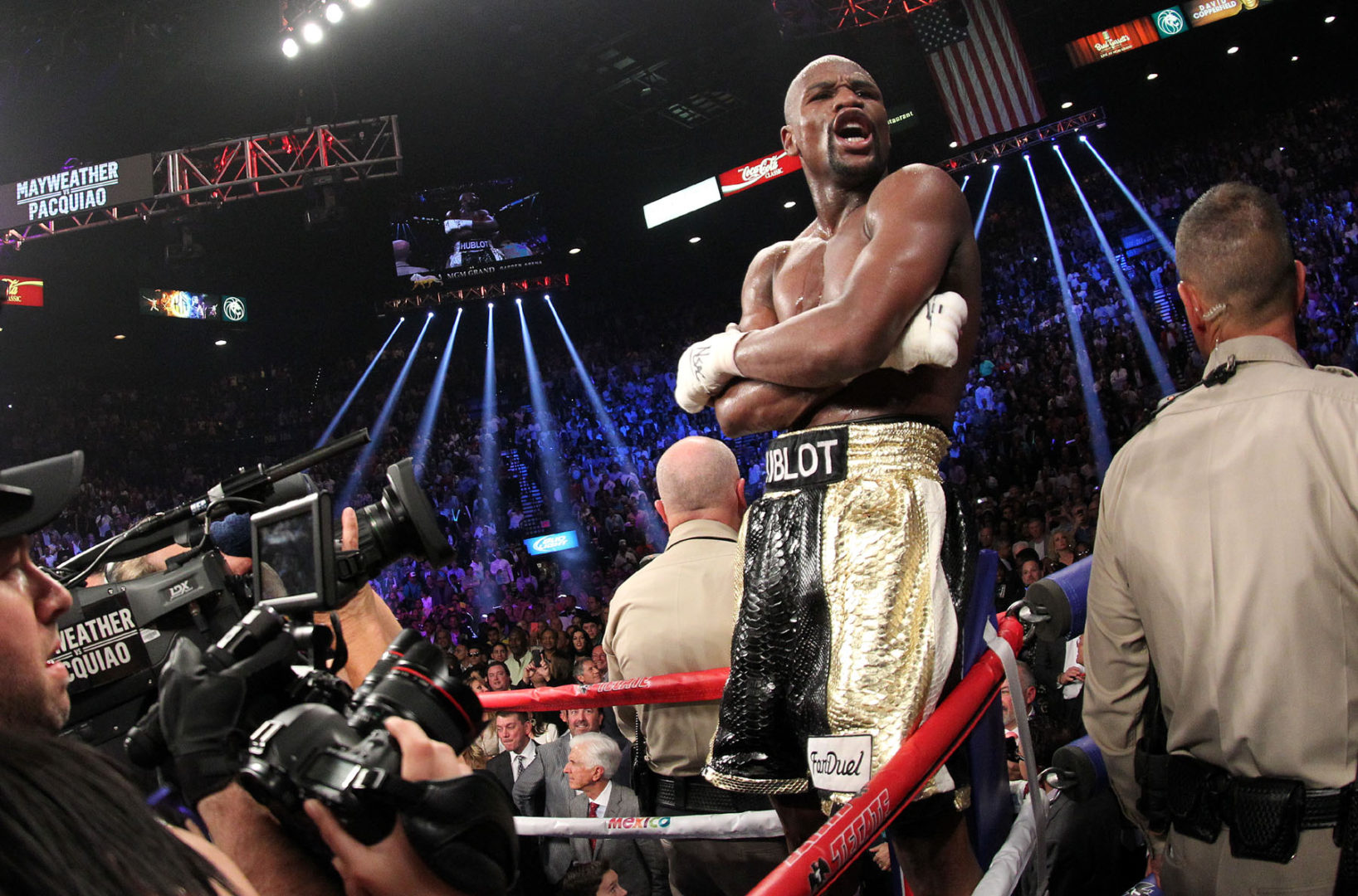
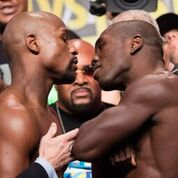
Saturday at MGM Grand Garden Arena, American Floyd Mayweather decisioned American Andre Berto in a historically awful match Mayweather promised will be his last. By the late rounds, Berto, as near to an infinity-to-one underdog as pay-per-view has yet uncovered, compromised Mayweather’s attention span long enough to strike him cleanly perhaps a half-dozen times, and that was that. Berto called the fight “great” immediately after Mayweather called himself “great” immediately after another Las Vegas crowd booed itself hoarse through another final round of another Mayweather fight.

As he said himself after the absurd session with Berto: Floyd Mayweather is the best ever, just like Jim Gray – the man Showtime employs to hector punchdrunk fighters. Hell, in honor of the moment, we should go a bit further: Floyd Mayweather is bester than Jim Gray – who’s not even average. In fact, in a competition between the two record holders, Floyd for being the nth fighter to win 49 fights in a row and Gray for being the first interviewer realtime-bounced from World Series coverage for being a jackass, it’s not unreasonable to declare Floyd altogether bestest.

Repeatedly in that postfight flirtation, Mayweather referred to his records, plural, as opposed to his record, 49-0, which is his record the same as tens of thousands of fighters have their records, 0-1 or 27-3 or 173-19-6 (108 KOs) – Sugar Ray Robinson’s, for whatever it’s worth, which is probably quite little to The Money Team, no matter Robinson’s having well more than twice as many knockouts as The Best Ever has victories – and that might have prompted Gray to ask Floyd about his other records, but never mind. Floyd has boxing records, plural, in the equivocating, prepositional, SportsCenter-sense of the word: Floyd retires as the greatest fighter, to call Las Vegas home, after relocating from Michigan, while fighting in the last 25 years, after having been taught by his father, during a troubled childhood, before winning an Olympic bronze medal, without having beaten a single great fighter in his prime.

Someday, after Floyd is forgotten, a thing that will happen with lightning rapidity in the next decade, an enterprising young sportswriter in the year 2050 or so will decide a biography of Floyd is just the thing – and by then biographies will probably be virtualreality videogames in which the reader lives the subject’s life for a day or two – and he’ll marvel at his great good fortune at being the first man to have an idea like committing some years of his life to preserving the official record of a flamboyant American athlete who wore a gaudy cap with “TBE” on it (and whose father wore a Canadian-themed “TMT” hat in his corner during the final match of his career for reasons that, however unknown and unimaginable, somehow feel wonderful). What that ambitious young author will find on digifiche at his local bibliotech is a lack of quality writing about Mayweather that is disproportionate to Mayweather’s record.

“Surely,” he’ll think, “a black man beating everybody he fought and making hundreds of millions of dollars while calling himself ‘Money’ must’ve inspired soaring prose and an insight or two about the human condition.”

Actually, no. Actually, no, not at all. There were, are, plenty of excellent writers plying the craft during Mayweather’s career, but not one of them would call anything he wrote about Mayweather his life’s best work. The passion talented writers feel for Mayweather is akin to the passion Mayweather feels when seeing a new zero on the end of his savings-account balance: a jolt of energy followed by thoughts about more substantial things.

For there is something insubstantial about Mayweather and his record and his legacy and the current incarnation of the sport he now leaves. When I endeavor to think about memorable moments from his career – as I hope, after this column, to honor his retirement by never writing about him again – very little comes to mind. I thought about it Saturday night, and had an idea, and now it is Sunday morning, and I cannot remember even that idea. Let’s go freestyle and see if it comes: He bought some cars and won some bets and didn’t knock-out anyone but Victor Ortiz and said the same thing over and over and over and – wait, yes, now I recall.

It was during his award-winning (another record!) autodocureality-thing he did for Showtime during one of his forgettable promotions, and no matter how much money he flashed or slogans he shouted or hangerson he fluffed, always, in seemingly every scene, there was someone, and quite often most everyone, asleep in the peripherary. There would be Floyd, racing hither and yon round his Big Boy Mansion, riding his Big Boy Elevator, bouncing on his Big Boy Sofa, ordering his Big Boy Burger, courting Big Boy Bieber, and inevitably, someone in the shot would be acting sleepy. You can’t buy a personality, the subtitles read, and evidently Floyd hasn’t one.

I remember this too: I interviewed Floyd once – after waiting hours in the South Texas heat for Floyd to bless us, each journalist was allowed to ask Him one question – and when I asked about the epidemic of African-American incarceration by a for-profit prison system, Floyd told me he likes to focus on the positive because it’s not a black-and-white thing. It wasn’t just a thoughtless answer to the question I actually asked him; it was a witless answer to whatever voice played in Floyd’s head while I spoke. My interview with The Best Ever ranks about 93rd or so – give or take where Saturday’s match lands on an entertainment spectrum for anyone who’s been paying to watch boxing since Mayweather turned pro.

Since Floyd Mayweather asked the public to rank him immediately after his final match, here goes: Top 10 talent, Top 25 accomplishments. The end.

Bart Barry can be reached via Twitter @bartbarry


FOLLOW MAYWEATHER – BERTO ROUND BY ROUND

Mayweather_Berto Weigh InFollow all the action as Floyd Mayweather fights in his final fight of his career against Andre Berto.  The action kicks off at 6:30 PM ET / 3:30 PM PT with a 4 fight undercard that will feature 2 world title bouts

Page will refresh automatically

12 Rounds WBA/WBC Welterweight title–Floyd Mayweather (48-0, 26 KO’s) vs Andre Berto (30-3, 23 KO’s)
ROUND 1 2 3 4 5 6 7 8 9 10 11 12 TOTAL
MAYWEATHER 10 9  10  10  10  10  9  10  10  10  10  10 118
BERTO 9 10 9  9  9  9 10 9 9 10  9  9 111

Round 1 Mayweather suing the left..lead left hook.

Round 2 Right from Berto..

Round 3 Mayweather landing rights to body..Double jab from Berto

Round 4 Jab from Berto..Lead left from Mayweather..body..Hard right..

Round 5 Counter right from Berto..Right from Mayweather..

Round 6 Good counter left from Berto…Hard body shots from Mayweather..left uppercurt…right hand..

Round 7 Right uppercut in inside from Mayweather..Berto works the body with the left hook..Left from Berto..

Round 8 Mayweather lands a left uppercut…terrific combination..1-2..Counter left from Berto…

Round 9 Berto jabs to the body…Right over top from Mayweather…

Round 10 Both guys are talking to each other..

Round 11 Lead left hook from Mayweather,,good uppercut..Nice combination…

Round 12 2 huge uppercuts on the inside from Mayweather,,counter right..jab to the body…right over the op…left uppercut…

117-111, 118-110 and 120-108

Punch Stats

Mayweather  232 of 410    Berto 83 of 495

12-rounds WBO Jr. Lightweight title–Roman Martinez (29-2-2, 17 KO’s) vs Orlando Salido (42-13-2, 29 KO’s)
ROUND 1 2 3 4 5 6 7 8 9 10 11 12 TOTAL
Martinez  10 9 10  10  9 9 9 9  9  9 9 10 112
Salido 9  10  9 9 10 10 10  10  10  10  10 9 116

Round 1 Uppercut on inside from Martinez..Salido lands a combination…Combination from Martinez

Round 2 Hard right from Salido..combination..

Round 3 Right FROM SALIDO AND RULED A KNOCKDOWN..Jab from Martinez…LEFT AND DOWN GOES SALIDO..Big right from Martinez

Round 4 Huge right buckles Salido..Counter right from Salido..

Round 5 Hard right from Salido and a left hook..Jab from Martinez..

Round 6 terrific action…Salido pressing

Round 7 Jab from Salido..another jab..hook…

Round 8 Hard right from salido..

Round 9 Right from Martinez..Right from Salido on the inside..uppercut in the inside..Martinez lands a right..Hard combination by Salido…Hard combination,..

Round 10 Martinez landing hard shots in the counter…counter left hook and right from Salido..terrific exchange..

Round 11 Big right from Salido

Round 12 great infighting..Martinez lands a left hook….

115-113 Martinez, 115-113 Salido, 114-114—-DRAW

Punches Martinez: 189- 691    Salido 285- 1037

12-rounds–WBC Super Middleweight title–Badou Jack (19-1-1, 12 KO’s) vs George Groves (21-2, 16 KO’s)
ROUND 1 2 3 4 5 6 7 8 9 10 11 12 TOTAL
Jack**  10 9  10 9  10 9 10  9  10  10  10  9 115
Groves 8 10 9  10 10  10 10 10  9 9 9 10  114

Round 1: Jack lands a jab..Double left hook and right from Groves..right..Good right…HUGE RIGHT AND DOWN Goes groves…

Round 2 Jack lands a jab..combination from Groves..Body and right..Combination from Jack…Counter from Groves..

Round 3 Body shot from Goves…Trading jabs…1-2 from Jack..

Round 4 Groves lands a right over the top..right uppercut

Round 5 Right from Jack..Good right from Groves..

Round 6 1-2 from Jack..Jab and right from Groves..another right..

Round 7 Body shot from Jack…Hard right from Groves

Round 8 Hard right from Groves

Round 9 Good right from Jack…

Round 10 Groves lands a jab that buckles Jack..Sharp right from Jack..

Round 11 Left to the body from Jack..left hook to the jaw..

Round 12 Body work from Jack…Groves lands a right…trading good rights..Groves lands a hard right that sets off a great exchange

114-113 Groves; 115-112 Jack; 116-111 Jack

Punch stats: Jack 210- 506    Groves 154- 721

10-rounds–Jr. Lightweights–Jhonny Gonzalez (58-9, 49 KO’s) vs Jonathan Oquendo (25-4, 16 KO’s)
ROUND 1 2 3 4 5 6 7 8 9 10 11 12 TOTAL
Gonzalez  10  8  10 9 9  9 10 10 9 10  94
Oquendo  8  10 9 10  10 10 9 9 10  10 95

Round 1: Uppercut by Gonzalez..BIG UPPEERCUT AND DOWN GOES OQUENDO…

Round 2 Right uppercut from Gonzalez…3 punch combination…Blood over the right eye of Gonzalez..right from Oquendo…HUGE RIGHT AND DOWN GOES GONZALEZ…Big left staggers Gonzalez…

Round 3 Good body work from Gonzalez..Straight right from Oquendo..Left hook…Combination from Gonzalez..Oquendo switches southpaw..Body shot from Oquendo..

Round 4 Combination from Oquendo..left hook..Jab to the body..left hook..right

Round 5 Left to body from Oquendo

Round 6: Overhand right from Oquendo..Triple Jab…Good right from Gonzalez..Nice Left

Round 7 Left hook from Gonzalez..Jab..Oquendo working the body…Gonzalez lands a hard right..

Round 8: Gonzalez cut over left eye from accidental headbutt…Left and right from Gonzalez..Jab…Jab from Oquendo drives Gonzalez to the corner..

Round 9 Doctor looking at cuts on Gonzalez…

Round 10 

94-94; 95-93 and 98-90 for Oquendo

Punch stats:  Gonzales –139 of 502    Oquendo: 100 of 455


10 Rounds–Jr Middleweights–Vanes Martirosyan (35-2-1, 21 KO’s) vs Ishe Smith (27-7, 12 KO’s)
ROUND 1 2 3 4 5 6 7 8 9 10 11 12 TOTAL
Martirosyan ** 9 10  10 10  9 9  9  10 9  9  MD 94
Smith  10  9  8 9  10  10 10  8  10  10 94

Round 1: Good left from Smith

Round 2  Jab from Martiroysan…Combination..Right to the body..Counter left from Smith

Round 3:  2 shots to the body from Martirosyan..Left from Smith..Counter left..RiGHT FROM MARTIROSYAN AND RULED A KNOCKDOWN

Round 4:  Jab from Martirsyan…right…right to body from Smith,,,Nice right from Martirosyan..

Round 5:  Good combination from Smith..Good uppercut..Good combination..right lead..3 punch combination..counter right…

Round 6:  Good combination..right to body and left to the head..Body…Combination..

Round 7: Smith lanleft to head and left uppercut..lands a left..right

Round 8: Huge LEFT AND DOWN GOES SMITH

Round 9 Nice combination from Smith..good left to body and head..Swelling under the right eye of Martirosyan..Left..

Round 10  Good right from Smith

95-95; 97-91 two times Martirosyan


IV report injects controversy into Mayweather-Berto

By Norm Frauenheim-
Floyd Mayweather
Reports of Floyd Mayweather Jr.’s intravenous injection for possible dehydration on the day before his victory over Manny Pacquiao is clouding his potential farewell fight against Andre Berto Saturday with controversy amid questions about fairness, transparency and the procedures employed by the drug-testing bureaucracy.

In an explosive story posted by SB Nation before Wednesday’s Mayweather-Berto news conference at Las Vegas’ MGM Grand, author Thomas Hauser, also a Home Box Office employee, reported that Mayweather underwent a banned IV after the weigh-in for the May 2 fight.

The reported substance, saline and vitamins, is legal, according to World Doping Agency (WADA) rules, which are followed by the U.S. Anti-Doping Agency (USADA). USADA conducted the Mayweather-Pacquiao testing. But the method is illegal. According to WADA guidelines, an IV can mask a banned substance.

In a statement Thursday, Mayweather denied any wrongdoing, saying he “did not commit any violations of the Nevada or USADA drug testing guidelines.”

But the current controversy continues amid questions about USADA’s timing in its approval of Mayweather’s IV. According to USADA’s contract with Mayweather and Pacquiao, an exemption for IV use could be granted for therapeutic reasons. USADA discovered Mayweather had used an IV when it visited him for a test at his Las Vegas home after the May 1 weigh-in.

According to Hauser’s report, however, Mayweather did not formally apply for the exemption until May 19, 17 days after the fight. USADA granted him the exemption on the next day, May 20, 19 days after he underwent the IV.

“Although Mr. Mayweather’s application was not approved until after his fight with Mr. Pacquiao and all tests results were reported, Mr. Mayweather did disclose the infusion to USADA in advance of the IV being administered to him,’’ USADA said Thursday in a statement.

The reports about documents dated after the fact come in the wake of condemnations for the way Pacquiao disclosed an injury to his right shoulder at the news conference immediately after losing a one-sided decision to Mayweather on May 2 in a fight that generated record revenues.

According to Pacquiao, manager/adviser Michael Koncz and Top Rank promoter Bob Arum, Pacquiao asked for an exemption for an injection of Toradol, a pain-killer. The Nevada State Athletic Commission denied the request, saying it was not done “in a timely manner.’’

Thus far, however, it’s not clear how – or even if – USADA and the Nevada commission communicate.

Bob Bennett, executive director of the Nevada Commission, told the media on Thursday that only the Commission can grant exemptions. USADA did not inform the Commission of Mayweather’s IV until three days after the fight, he said.

Pacquiao’s representatives said they had told USADA that they wanted an injection of Toradol for the ailing shoulder before opening bell. When the Commission learned about the planned injection, it intervened, saying it had not been formally notified.

Pacquiao blamed the shoulder injury for his sub-par-performance. He had the shoulder in a sling when he met Filipino media in his Las Vegas hotel suite the morning after and underwent surgery about a week later.

Lawsuits across the nation were filed after Mayweather-Pacquiao. The plaintiffs allege that the bout was fraudulent. They are seeking damages and class-action status. Allegations already include a failure to disclose Pacquiao’s shoulder injury. Controversy over Mayweather’s IV might become another one.


Mayweather-Berto: Nobody cares

By Bart Barry–
Floyd Mayweather
Just in time for Mexican Independence Day weekend comes a showdown to warm cada corazon mexicano: Floyd Mayweather, an American from Michigan, versus Andre Berto, an American from Florida who fought for Team Haiti in the Games of the XXVIII Olympiad. Mayweather-Berto lacks an ethnic angle, yes, but it is fully bereft of aesthetic interests, promising in its awfulness to be an apt farewell to Mayweather, who has scheduled his next retirement for Sept. 13.

Saturday is the final fight of Floyd Mayweather’s career, and I know it’s this week because I just brought up BoxRec and checked; so little has appeared on Twitter, my exclusive source for boxing coverage, I read a book about architecture in the last seven days and visited an art museum in Austin, to prepare for another boxing column about anything but boxing, since vilifying the efforts of the PBC anymore feels lazy but a weekly writing habit is, as my friend and colleague Norm Frauenheim long ago put it, good discipline. It brings presence, and that is ever a subject worth treating.

As Mayweather finishes his career, or says he’s about to, he turns a trick few before him have: He leaves the sport noticeably worse than he found it. He has not loved the sport for about a decade, one calculates, and he leaves the sport at least a decade from hopefulness. Whether Manny Pacquiao’s legion of Filipino converts will stick around after Pacquiao retires for his first time is doubtful, but this is not: No one who came to boxing because of Floyd Mayweather will remain a moment after he leaves.

The PBC, an outfit whose leader achieved credibility in boxing through his association with Mayweather, has improved exactly none of its charges and will not either; Mayweather is the last Mayweather because the PBC assures no one who approaches his talent will again encounter sufficient coaching or matchmaking to improve him. For whatever else he became, Floyd was a fighter raised by fighters before he was a self-aggrandizing buffoon. Today’s PBC prospects begin as athletes and become self-aggrandizing buffoons at high speed, often accelerating at a rate that denies them even summercamps as fighters.

Some words now about Mayweather’s moral deficiencies, or more appropriately, the words of others fixated on Mayweather’s moral deficiencies. Floyd Mayweather makes his living by striking other halfnaked men with his fists. Has it been so long since Charles Barkley wisely declared he was not a role model that we’re back to demanding character of athletes, even those who hammer other men’s faces (and most especially when awareness of oneself can be raised by raising awareness of Mayweather’s misbehavior)? As Jimmy Tobin, an excellent writer and thinker on and off Twitter, mentioned recently, the bandwagon for Mayweather-Berto is apparently so slight moral grandstanders feel unsafe chancing a spot on it like they did in May, lest they slip into obscurity’s cruel morass, their very important message ignored by the good people who tsk loudly at reality TV.

There’s something both reactionary and juvenile about adults’ heartfelt opinions concerning Mayweather’s domestic-abuse convictions. Americans really don’t care, and before anyone takes to his hind legs to rebut that assertion, he should ask himself how much boycotting of the Mayweather product has been done in the name of Floyd’s convictions. There’s probably nothing serendipitous or causal about the growth shared between Floyd’s checking account and criminal acts, but in the face of all evidence, arguing Mayweather’s criminality helped him amass his fortune is strikingly more reasonable than saying it was a hindrance.

And again, so what? Mayweather changed his nickname from an aesthetic concern, “Pretty Boy”, to an amoral one, “Money”, and made himself an American icon – at least in the 15 minutes’ sense of the word – reducing his dreadful promotions to shopping sprees and his dreadful prizefights to more-dreadful prizefights, and still we participated because, well, we were told his talent and fights were historic happenings. Floyd’s perspective on morality was better than his detractors’, ultimately, because it was born of the one place in his life where he was above-average, much less exceptional: the prizefighting ring – where one’s improvisations are judged instantly and one’s errors are exploited milliseconds after their detection. There is, in other words, no time in a prizefight for the obnoxious moralizing that attends coverage of Mayweather between his matches; in a prizefighting ring, life’s Prediction –> Feedback loop reduces itself to a crystalline form like this: Too many predictions make you oblivious of feedback, and then you’re unconscious, and too much reliance on feedback makes you a heavybag, and then you’re unconscious.

Mayweather’s crude antagonism of those who resent his fortune will undo his fortune soon enough, as everyone knows, and then what will linger are the aesthetic judgments adults should have levied against him all along: Floyd’s promotional schtick is, like his fighting style, insipid. No entertainer in sports history has made more money boring more people than Mayweather. Saturday’s match with Andre Berto, a man who is 0-2 against men Mayweather has already humiliated, and 0-1 (1 KO) against a man, Jesus Soto Karass, not even Mayweather had the chutzpah to make an opponent, promises to be truly awful.

In this, his next last fight, Floyd’s professionalism and pride, ironically, stand as the best arguments against making a pay-per-view purchase: Floyd is far too good to lose to Andre Berto by accident and far too proud to throw the match on purpose.

Bart Barry can be reached via Twitter @bartbarry


A reason to think Mayweather is serious about retirement

By Norm Frauenheim–
Pacquiao_Mayweather_150502_003a
Floyd Mayweather Jr, likes to gamble. If the winning tickets he posts are any indication, he’s pretty good at it, too. But life after boxing isn’t a NFL wager. It comes with more risk than just a point spread.

That why all bets are off, despite a guessing game about whether he’ll continue to fight after he is expected to equal Rocky Mariano’s 49-0 mark with a victory on Sept. 12 over Andre Berto, who is trying to achieve some history himself in an attempt at becoming the next Buster Douglas – a 50-to-1 shot before beating Mike Tyson.

Few believe Mayweather when he says the Berto fight will be his last. Mayweather invites the skepticism. After all, he already has come out of retirement once after a 2007 stoppage of Ricky Hatton. Besides, there’s always been reason for healthy skepticism at just about anything Mayweather says. He’s as clever with a feint at a news conference as he is in the ring.

But I’m beginning to change my mind about his promise to walk away. Could he change his mind? Could he retire and come back? Of course.

Could he be playing another game? Maybe. Could retirement be a business tactic? Retire as a free agent and then let the networks bid, bid and bid some more for one more fight at a brand new MGM AEG Arena in Las Vegas? That’s cynical, but as plausible as the money grab was in his May 2 victory over Manny Pacquiao.

But as the Berto bout approaches, there’s a growing sense that Mayweather isn’t kidding. In the here-and-now, the bet is that his heart is telling him to retire. Within the ropes, he’s never been a gambler anyway. He adheres to the fundamental that commands a great fighter to hit and not get hit. He has done that as well as anybody in history. He has said repeatedly that’s why he’s still fighting. Who could argue?

But time has a way of slowing reflexes and altering odds. The longer he fights, the more likely it becomes that a damaging punch lands. Leaving the sport with faculties intact has always been Priority One for Mayweather. When he was younger, he used to say that punishment “ain’t cool.’’ An older Mayweather is using different words these days, but saying the same thing.

“I think my health is more important,’’ he said in a world-weary tone Wednesday during a conference call. “You stay around anything too long, anything can happen. I’m not really worried about losing. But I want to have a sharp mind.

“You can make a lot of money, but you still want to be able to walk, talk and have a sharp mind.’’

The money — more money than any athlete has ever earned in a single event – is already there. According to most reports, Mayweather collected at last $220 million for his victory over Pacquiao. In May, that was more than the New York Yankees payroll. The Yankees opened the 2015 season with a payroll of $214, 248, 571, according to the Associated Press. Of the 30 MLB teams, only the Dodgers payroll was bigger than Mayweather’s purse for one night of work.

That’s his legacy. That’s his TBE (The Best Ever). That’s also why he’s sincere about retirement. Why risk what he’s earned? A smart gambler knows that’s a bad bet.


Violent middlings: Santa Cruz decisions Mares

By Bart Barry-
leo-santa-cruz
Saturday on ESPN in a PBC main event that happened at Staples Center, Leo Santa Cruz decisioned Abner Mares. The fight was heavy with volume and light with quality, as the fighters winged blows in a blur of shoulder striking, head clashing and guard peppering. It was not a great fight but easily the PBC’s greatest fight.

There was an immediate association that happened in my mind as the bell rang on Saturday’s main event – an association strained through the Battle of Los Angeles idiocy and fact nether Mares nor Santa Cruz is very good – and it was one of small Mexican pugilists plying their wares before a gritty, blue-collar-Mexican crowd in Southern California. Where did I feel this before? It was ringside in Carson, Calif., 7 1/2 years ago, when Israel Vazquez and Rafael Marquez made the third fight of what might be called a “natural trilogy” the way a natural hat trick happens when a hockey player scores three goals in a row without another puck from another stick going in the net; Vazquez and Marquez fought each other three times in 12 months, finishing their trilogy with their very best fight. Saturday’s match did not suffer the comparison gladly.

There is something second-rate about our sport now. There has not been a better or more justifiably anticipated main event broadcasted by the PBC yet, and yet. From the opening bell of a fight that felt more like 114-114 than 117-111, the scorecard two judges and the PBC’s Teddy Atlas happened to have, Mares demonstrated he was the fighter of greater range, while Santa Cruz proved he was taller. That was it, really. Santa Cruz, the telecast told our lying eyes, was much busier and more accurate, and yet it did not feel that way. Perhaps it was expectations rendering us victims yet again.

Years ago, if any PBC viewer remembers, Santa Cruz was our next Antonio Margarito. What Shane Mosley discovered about Margarito no one before him quite had was this: Margarito could not fight going backwards and wasn’t particularly astute, either, with an opponent on his chest, in his kitchen, smoking, as the late Joe Frazier perfectly had it, where he lived. Margarito had a crossover move, bringing his right foot along with his right hand along with his right foot, closing his opponent’s front shoulder, then opening him up with a fully leveraged left hook. One who waits for Santa Cruz to perform a similar feat of footwork will grow old with anticipation.

Santa Cruz is tall and busy. He might learn to do something with his right uppercut – a few more of those Saturday might’ve shortened Mares’ evening considerably – but he has not yet, and he has not improved at all, much as the PBC telecast assured us he has. Atlas, despite his dogged repetition of every insight six and seven times, detected immediately the bizarre habit Santa Cruz has of shaking his right hand like it’s broken. He telegraphs punches, somewhat, but expresses anxiety more so. It’s the sort of habit a fighter can form in the boredom of padwork or bagwork, and it’s not Santa Cruz’s fault. But where the hell are his trainers? Do they think it’s charming or marketable or a habit they might monetize like Canelo’s fiery coif?

Atlas’ insistence Mares should be doing something with Santa Cruz’s tell, though, was a bit misplaced. Santa Cruz still had his twitching hand in a position from which he might block a left hook, especially one hurled by a fighter having to cross as much terrain to his chin as Mares did. Mares used Santa Cruz’s nervousness properly; don’t get hit with the hand he’s shaking at me.

Mares fought a better match, altogether, than two judges believed. That Santa Cruz walked to the ring accompanied by the son of manager Al Haymon’s henchbuffoon indicated Mares would need a knockout to win, and Mares, to his credit, went looking for one, insisting from the opening second of the match Santa Cruz was not in his class as a fighter. That was true, yes, but Mares, at 126 pounds, is eight pounds from his best division, and he didn’t have a punch, left hook or righthand counter, that much as dented Santa Cruz.

Just because Mares can no longer make bantamweight by no means makes him a featherweight. But Mares was the gamer man Saturday. He fired back when fired upon, he reacted better to being struck, he did not retreat unless strategy, as opposed to doubt, mandated it. Mares was much better at 118, too, than Santa Cruz is at 126.

Which was still not that good. Mares won a close but fair decision over Vic Darchinyan three years after Nonito Donaire iced the Armenian and a year after Joseph Agbeko decisioned him. Darchinyan, past his prime and a weightclass or two too heavy, nevertheless gave Mares a stern test. Mares then sneaked past Agbeko, fouling him repeatedly, and when he won their rematch, and Showtime needed a house fighter from Golden Boy Promotions to anoint, Mares was launched as a shooting duper superstar. Which he was not fit to be. Soon enough, an ancient Jhonny Gonzalez put the lie to the Mares machine, and if Gonzalez’s left hand didn’t do it, Mares’ shameless avoidance of a rematch with the belligerent old Mexican sure has.

People boo Mares, and they’re right to, but thinking lowly of Mares does not, through some law of transitivity, consign one to opining highly of Santa Cruz. That’s the bad news. The worse news is, able now to abscond with a reputation, if not a particularly meaningful piece of WBA hardware, Santa Cruz has no incentive to do anything more than make semiannual PBC defenses of his new title, his skillset deteriorating steadily until the day Al Haymon signs Guillermo Rigondeaux and harsh reality, wearing dark Cuban knuckles, raps upon Santa Cruz’s hardly won Los Angeles door.

Bart Barry can be reached via Twitter @bartbarry


FOLLOW SANTA CRUZ – MARES LIVE!!

leo-santa-cruz
Follow all the action as Featherweights Leo Santa Cruz and Abner Mares engage in long awaited 12-round bout for the WBA Featherweight Super Championship. The action begins at 10 PM ET / 7 PM PT with a Interim WBC Super Bantamweight title bout between Hugo Ruiz and Julio Ceja.

NO NEED TO REFRESH…WILL UPDATE EVERY 60 SECONDS

12 ROUNDS–WBA FEATHERWEIGHT SUPER TITLE–LEO SANTA CRUZ (30-0-1, 17 KO’S) VS ABNER MARES (29-1-1, 15 KO’S)

Round 1 Mares lands a uppercut…Mares coming out hard..Good right..left to body…santa Cruz lands a body shot…Mares to the body..lead right..chopping right..left to body and right uppercut..10-9 Mares

Round 2 Great exchange om the ropes..Great exchange on the inside…20-19 Mares

Round 3 Mares lands a combination..Santa Cruz lands a right..Mares cut on the forehead due to an accidental headbutt..30-28 Mares

Round 4 Santa Cruz bleeding from around left eye…40-37 Mares

Round 5 Right from Santa Cruz..Short right...49-47 Mares

Round 6 1-2 from Santa Cruz…combination..58-57 Mares

Round 7 Left from Santa Cruz..Good exchange..another great exchange..Santa Cruz lands a lead right..Good right from Mares..another great flurry at the end of the round..67-67

Round 8 Lead right from Santa Cruz..Right uppercut…uppercut and left..77-76 Santa Cruz

Round 9 Swelling around left eye of Santa Cruz..Tremendous action at the end of the round..86-86

Round 10 Blood around the right eye of Mares..2 good rights from Santa Cruz..Left from Mares..Long right from Santa Cruz..96-95 Santa Cruz

Round 11 Right from Santa Cruz..Good combination…106-104 Santa Cruz

Round 12 Santa Cruz lands a right on the ropes..uppercut..right as Mares comes in..Good exhange in last 29 seconds…116-113 Santa Cruz

117-111 Santa Cruz….114-114….117-111 Santa Cruz

12 ROUNDS–WBC INTERIM SUPER BANTAMWEIGHT TITLE–HUGO RUIZ (35-2, 31 KO’S) VS JULIO CEJA (29-1, 26 KO’S)

ROUND 1 Ceja gets in a left hook..Good uppercut from Ruiz…10-9 Ruiz

Round 2 20-19 Ruiz

Round 3 Ruiz lands a right uppercut…Ceja gets in a chopping right…left to body..left..left to body…Ruiz lands a left…BIG LEFT HOOK AND DOWN GOES CEJA.. 2 huge rights from Ruiz..30-27 Ruiz

Round 4 Right from Ruiz..40-36 Ruiz

Round 5 CEJA LANDS A HUGE LEFT HOOK AND DOWN GOES RUIZ….RUIZ IN TROUBLE..TAKING HUGE SHOTS ON THE ROPES AND THE FIGHT IS STOPPED TKO 5 FOR JULIO CEJA


Back To The Future: Mares promises to be himself in a city he calls his town

By Norm Frauenheim-
Abner Mares
It starts with the look. Leo Santa Cruz has a generous smile that moms love. Abner Mares has the uncompromising eyes of a man with a stubborn point of view and readiness to fight for it. It’s a reflection of how different they are.

It’s also an intriguing look at how these unlikely business partners are linked in featherweight fight for turf and credibility Saturday night in a PBC-promoted bout at Staples Center in Los Angeles.

“My town,’’ says Mares, who was born in Mexico and grew up on the dangerous streets of LA’s Hawaiian Gardens.

It’s an unproven claim, of course. Santa Cruz , who was also born in Mexico, has his own claim. He lives in LA, too. In terms of Los Angeles’ fabled boxing real estate, it really hasn’t belonged to anybody since Oscar De La Hoya’s best days. It’s no coincidence perhaps that De La Hoya’s statue stands next to statues of Magic Johnson and Wayne Gretzky on the sidewalk outside of Staples.

It is there as a reminder that there’s still plenty at stake in a fight that some complain should have happened a couple of years ago. Fair enough. Boxing’s balkanized politics got in the way. De La Hoya once promoted both. But his only role Saturday night will be as that statue and all that it represents. Mares and Santa Cruz jumped to all Al Haymon’s venture. They moved on and into the looming showdown (ESPN 10 p.m. ET/7 p.m. PT) that has always seemed inevitable.

“I can’t really think about all of that anymore,’’ said Mares, a businessman who dismissed presidential candidate Donald Trump’s recent rip at Mexican immigrants by saying he has made millions and paid taxes in the US.. “I can’t think about why it didn’t happen earlier. I only know that it’s here and I only know that I have to take care of business.’’

For both, there’s a further burden of proof. There are questions about whether a string of forgettable opponents has dulled the Santa Cruz skillset.

“I have been leaning how to get better all of the time,’’ said Santa Cruz (30-0-1, 17 KOs), who has a significant three-inch advantage in reach. “I can box. But the brawler can come out in me too. ‘’

For Mares, there are questions about whether there are lingering effects from the stunning knockout he suffered at the hands of Jhonny Gonzalez in 2013. Mares (29-1-1, 15 KOs) has won three straight since then, but there were moments in each when he appeared tentative.

“I’m past my loss,’’ said Mares, a three-time champ who also said he has faced tougher opponents than Santa Cruz. “I’ here to make a statement: Abner Mares is back. I’m looking forward to a fourth world title. I’m looking forward to making history in this sport.’’

And maybe in his town.


Column without end, part 11

By Bart Barry
bart image
Editor’s note: For part 10, please click here.

*

BOGOTA, Colombia – This Andean city hasn’t Medellin’s organization or courtesy but a more amiable climate and what inherent formality nations’ capitals enjoy by default. The distance from here to Medellin, Colombia’s second most-populous city, is about 400 km, a distance whose impossibility of terrain is best illustrated like this: You can fly there in 30 minutes of airtime or drive there in about 480 minutes. The cities’ populations regard one another more like motorists than aeronauts, each describing the residents of the other city the way a Californian might describe a Russian, not an Arizonan.

Colombians are known for their eloquence, which may be why nearly every Colombian one encounters, however briefly, fancies himself a Spanish professor, correcting tiny details of pronunciation and grammar other native speakers, whether Mexican or Argentine or even Spanish, cordially overlook. That quickness to correct, though, betrays pride more than arrogance; no one’s face illuminates more grandly when hearing a stranger’s high appraisal of his country than a Colombian’s.

For nearly two decades synonymous with every ill effect of the narcotics trade, today Colombia, far surpassed in reports of narcoterrorism by Mexico, experiences an overdo cultural renaissance sure to be followed in time by what tourism tracks rumors of inexpensive exotica – something Colombia does excessively well. Nothing holds constant in a complex adaptive system, of course, so Colombia’s rebirth will eventually bring maturity and stagnation and perhaps a mortal return to whence it came, sure, but in the interim it merits celebration for what it is in the present, and that is a lovely, hospitable place to visit. And anyone who reviews the history of South America, 1510-1810, the singular depravity of the Spanish conquest, realizes without delay how miraculous are tranquil moments like the ones Colombia currently enjoys.

Touristland, the world over, is the same place: “La zona roja” in Medellin could be Las Vegas could be Puerto Vallarta. Time in Touristland, a place of ennui nearly always removed from the messy vitality of its city’s heart, if not its base, renews nothing so much as one’s commitment to not-travel where he is not conversant in the language of its people.

Whether via an iPhone app or a stereotypical and incessantly repeated plea for “anyone here speak English”, persons who travel to places whose languages they do not speak miss much of the most-edifying part of travel, and that is navigation. When you do not speak the language you go where the authorities direct you, whether those authorities are guides or signs or tourist-friendly maps. You make inane requests of locals for “someplace no tourists ever go” – as if any sane local would send a tourist to foul somewhere he goes to escape tourists. There is a visual part of travel that can be satisfied without speaking any language but English – museums and natural artifacts and monuments and such – and those shouldn’t be discounted, but the people and their quirks and their personal versions of their countries’ histories, every bit fallible as your opinion of your country’s history, are where the greatest riches are mined. These riches, too, include the natives’ true opinions of your country, not the cliched “ees bery nice, my fren” spouted mindlessly at customers, but the sort of attentive criticism that provides what contrasts compose the meaningful stock of a durable identity, often far removed from fragile patriotic delusions.

We don’t know what we don’t know, and few things are more futile than chancing the argument above: Those who travel the world with U.S. passports and a command of only English do so under the conviction they are seeing the highlights of each place they visit – nine countries in eight days! – and that conviction is both unshakeable and leavened by their financial means, invariably greater than many of their countrymen’s, as well as a large majority of Americans unfit to challenge them for being bereft of even a current passport. But this is a column that may opine as it wishes; if you have a dissenting opinion on the matter, a witty and original thought you feel compelled to share, write your own column.

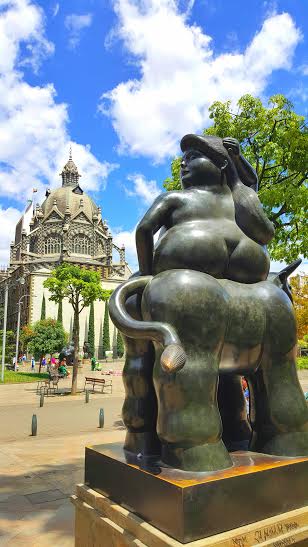
About the museums in Colombia: native son Fernando Botero dominates the original works both at Museo Botero in this city and Museo de Antioquia in Medellin, as he should. To create original art after 1950, many painters abandoned form, using instead muscular color and abstraction. Botero did not. Instead, he took common subjects, many borrowed from historic pieces by everyone from Leonardo to Matisse, and made them voluptuous to make them sensuous. He complemented these voluminous subjects with the brilliant greens and oranges one encounters everywhere he looks in these mountainous cities of extraordinary biodiversity.

The irony is that Botero’s exaggerated forms are the most part of what the world imagines Colombians’ physiques to be. In Bogota and Medellin, two cities where daily commutes happen on foot and require a half hour’s climb to nearly any residential spot, this is not at all the case. Pound-for-pound, the “Rolos” and “Paisas” are some of the fittest folks you’ll encounter anywhere, their diets unpolluted by corn syrup, their lungs expanded by high altitudes, and their lower bodies sculpted by daily acts of ascent and descent. One does not encounter many handicap ramps or elevators, either, so one subsequently encounters octogenarians stomping right past him as he scales this city’s Calle 11, lungs screaming for more or at least thicker air . . .

*

Editor’s note: For part 12, please click here.

*

Bart Barry can be reached via Twitter @bartbarry


Benavidez back at work, hopes for fight in November or December

By Norm Frauenheim–
jose_benavidez_signing_100114_001
Jose Benavidez Jr., the WBA’s interim junior welterweight champion, is back at work, hoping to fight one more time this year.

“November or December,’’ said his father and trainer, Jose Benavidez Sr. whose unbeaten son resumed training last week at the Benavidez gym in downtown Phoenix.

Top Rank, Benavidez’ promoter, has yet to put together its schedule for the year’s final two months. Any chance that Benavidez might fight Terence Crawford was eliminated this week.

Crawford, the Boxing Writers Association’s reigning Fighter of the Year, will face Dierry Jean on Oct. 24 in Omaha, Crawford’s hometown. Crawford-Dierry will be formally announced on Monday.

Top Rank’s Bob Arum mentioned Benavidez as a Crawford possibility a couple of months ago. Benavidez was also a leading possibility for Crawford in Crawford’s 140-pound debut last April. Instead, Crawford fought Thomas Dulorme, stopping him within six rounds in Arlington, Tex.

It looks as if Crawford is being groomed for a 2016 shot at Manny Pacquiao, if in fact Pacquiao’s resurrection from shoulder surgery happens without any setbacks.

For Benavidez (23-0, 16 KOs), it means he only knows whom he won’t be fighting. Top Rank likes what it has seen recently in the 23-year-old, who scored a 12th -round stoppage of Jorge Paez Jr. in May at Phoenix’s US Airways Center in the only defense of a title he won in a controversial decision over Mauricio Herrera last December.

Plenty of names at both 140 and 147 are in the rumor mill, including Brandon Rios, who is restless and anxious to resume his career after his only fight this year – a victory over Mike Alvarado in January.

Thus far, Herrera has shown no interest in a rematch. But Herrera might run out of options. Antonio Orozco, who beat Emmanuel Taylor on the card that featured Benavidez’ stoppage of Paez, has also been mentioned. However, Orozco has an October 3 date again Humberto Soto at StubHub Center in Carson, Calif.
“Jose has always said he’ll fight anybody,’’ his father said. “He won’t walk away from any fight.’’


Shopping List: From August to November, boxing is a buyer’s market

By Norm Frauenheim-
Abner Mares
The table is set. From late August to November, from late summer to late fall, there’s a boxing schedule worth celebrating.

The harvest starts with Abner Mares-Leo Santa Cruz on August 29 at Los Angeles’ Staples center.

It continues with Floyd Mayweather Jr.-Andre Berto on Sept. 12 at Las Vegas’ MGM Grand in a historical mismatch, yet another reason for the Mayweather haters to hope that the improbable finally happens.

Then, there’s Gennady Golovkin-David Lemieux on Oct. 17 at New York’s Madison Square Garden on a card that looms as a test of GGG’s pay-per-view marketability and includes the game’s best-kept secret, flyweight Roman Gonzalez, against Brian Viloria.

Finally, there’s the biggie, Canelo Alvarez-Miguel Cotto, on Nov. 21 at Las Vegas’ Mandalay Bay in a bout loaded with history that does not figure to include a mismatch.

Happy Thanksgiving.

The menu’s biggest question, perhaps, is how to rate them, or perhaps price them. In announcing Cotto-Canelo for the middleweight title Thursday, Canelo promoter Oscar De La Hoya was quoted as saying the PPV price for the HBO telecast won’t be $100.

That was a crack directed at the sticker-shock tag for the high-def telecast of Mayweather’s dull decision over Manny Pacquiao May 2.
Left unsaid, however, was whether the PPV tag for Canelo-Cotto would be similar to the price ($64.95 for HD/$54.95 for the regular telecast) of Showtime’s production of Mayweather-Berto.

There was a lot of talk about a backlash after the Mayweather-Pacquiao disappointment. Big live gates and good television ratings for subsequent bouts – Canelo’s stoppage of James Kirkland in Houston, for instance – say that the fans will still watch.

This fall’s rich variety of options, however, might make the customers a lot more discerning about how they spend their Holiday dollars.

In part, the price tag fro Canelo-Cotto appears to hinge on whether Andre Ward winds up on the card. There’s talk that he might in a bout that would create further momentum for a 2016 showdown between Ward and light-heavyweight Sergey Kovalev, the most interesting man in boxing today. It’s no coincidence that Kovalev’s next fight is scheduled for Nov. 28 in Moscow.

Meanwhile, we’re still waiting to hear the PPV tag for the HBO telecast of GGG-Lemieux. The initial guess here was that the bout might draw 300,000 buys if priced at $50. If the live gate’s pre-sale at MSG is an indication, however, that might be a little conservative.

A record of more than 6,000 tickets was sold. GGG interest is growing. But the real test of his popularity rests in PPV sales, which in turn depends on price, price, price.

Best option of all might be the first one. Mares-Santa Cruz for a featherweight title is on ESPN. No PPV investment at all. On a couple of levels, it’s the most intriguing of the four. It looms as the best PBC bout since Al Haymon launched his series in March.

Mares and Santa Cruz have been rivals for almost as long as anybody has known them. The fight also is a test of
the thinking that goes into Mayweather’s claim, The Best Ever, which will continue two weeks after Mares-Santa Cruz in his pursuit of a 49-0 record against Berto.

For Mayweather, TBE means an unbeaten career. For others, however, TBE is defined by adversity. That means defeat. Dealing with it. Overcoming it. Muhammad Ali did. Sugar Ray Robinson did. Without it, they might not be remembered as legends.

Santa Cruz is unbeaten and mostly unchallenged, especially over the last couple of years against over matched opponents. Mares is 4-0 after a suffering a crushing first-round knock out at the hands of Jhonny Gonzalez in 2013.

Mares has often appeared tentative since the KO. Meanwhile, Santa Cruz has simply appeared unstoppable. Has Mares forged some newfound toughness in the couple of years since his lone loss? Can Santa Cruz counter adversity he hasn’t seen?
We’re about to find out over a three-month run with options and answers.


Column without end, part 10

By Bart Barry-
2015-08-09 12.30.33 (510x800)
Editor’s note: For part nine, please click here.

*

These columns are written to spiral outwards from their centers organically as possible, structures from the fabled building blocks of letters that make words that make sentences that make paragraphs, searching as they do for what architect Robert Venturi called “richness of meaning rather than clarity of meaning” in his masterwork Complexity and Contradiction in Architecture.

In that same work, Venturi expressed a preference for “messy vitality over obvious unity,” adopting, among other essentialities, nature’s by-no-means-inevitable preference for variety – imposing, as nature does, a restriction of infertility on the product of any inter-species mating nature does not favor, preventing in as amoral a process as possible the emergence of a single-species world. Remember that next time PBC machinations have you down; equilibrium is an illusion one is able to create and sustain only by tampering with the variable t (time) in whatever schoolboy formulations one chooses to impose on a world in which every one of however many cells perpetually moves at the speed of electricity.

Whatever designs Al Haymon may have, the software loop that guides every organism, Prediction –> Feedback (every 300 or so milliseconds), ensures any model that holds anything constant necessarily fails or kills its subject to succeed. To apply numerical certainty to any complex adaptive system, one must create a complex adaptive system that comprises almost solely variables, and that almost fully undermines the elegance of applying numerical certainty, doesn’t it?

Or as John H. Holland, a University of Michigan professor of psychology and electrical engineering and computer science, elegantly puts it in his book Hidden Order: “The sheer number of interactions – hundreds of millions of neurons, each undergoing thousands of simultaneous interactions in thousandths of a second – takes us well beyond any of our experience with machines. The most sophisticated computer, in comparison, seems little more than an automated abacus.”

When one considers even the least-thoughtful human mind, likely pinging its environment for simple feedback about its physical state three times every second, one comes to nearly 200,000 unique “thoughts” every waking day, which comes to about 4 billion such events in an average human life of having not a single independent thought. Do something of volition simple as weekly grocery shopping, and you’re loping towards a trillion pretty quickly, and at that point linear mathematics’ description of your life is nearer to meaningless than astounding.

For the sake of embracing what is unfathomable, apply this model to a prizefighter training himself to counter an opponent’s left hook to the body, blocked by his right elbow, with a right uppercut. The feedback from the opponent’s left hook cannot wait, potentially, 299 milliseconds in its standard loop; it must come instantly, which means the mind must monitor at all times how many receptors sending signals across how many passageways? Go just one step further and realize this: Neurons and the signals they send are not binary (so there’ll be no mere squaring of whatever unthinkable number you come to); they occur in ranges that cross thresholds.

A+B=C, yes, but sometimes C=(A+B)*1,000. And then what? “More thoughts per human life than the number of seconds in the history of the known universe”? That’s not helpful; when your model says one complex organism is, in 75 years of life, able to do something more than a measure of a 15-billion-year-old system, your model, fundamentally, is describing a state that does not resemble anything like the “reality” the rest of us create from our 200,000 daily bits of feedback. That’s not a condemnation of conventional math or science, either; it is a concession to something Albert Einstein knew about Newtonian physics and John von Neumann knew about linear mathematics: They are agreed-upon vocabularies much as they are factual descriptions.

We know almost nothing, and technology, with its acceleratory effect, makes this ever more apparent, causing us anxiously to backbend towards nature in what Irish economist W. Bryan Arthur, in his wonderful book The Nature of Technology, captures tidily like this: “Our deepest hope as humans lies in technology; but our deepest trust lies in nature.”

And that brings us spiraling back to the Catalan master Antoni Gaudí and La Sagrada Familia basilica, the master’s masterpiece, a one-off form of architecture that appears, in many of its thousands of unique spots, to have inverted nature’s process, adapting function from a search for beauty rather than creating beauty from functional adaptations. Gaudí reveled in the natural complexity of fractals and superadjacency, the gorgeous simplicity of a shape repeated till it is a snail’s shell then repeated in concrete till it is a spire. In predictive obeisance to a later observation made by American physicist Philip Anderson – “The ability to reduce everything to simple fundamental laws does not imply the ability to start from those laws and reconstruct the universe” – Gaudí began from the beauty of his finished shape and worked backwards to its function.

Gaudí’s mind, like Shakespeare’s or Cervantes’, is no likelier to recur tomorrow than it was yesterday or today.

As complex adaptive systems that both comprise and compose other complex adaptive systems, our lives are constructed from countless events, every one of which is equal parts impossible and inevitable.

*

Author’s note: Anyone interested in the interdisciplinary approach taken by the men cited above is enthusiastically encouraged to read M. Mitchell Waldrop’s Complexity: The Emerging Science at the Edge of Order and Chaos.

*

Author’s note note: This column will not appear next week, allowing its author to pursue messy vitality in Colombia.

*

Editor’s note: For part 11, please click here.

*

Bart Barry can be reached via Twitter @bartbarry


Hate the Fight? Berto bout is just more money in Mayweather’s business plan

By Norm Frauenheim-
Floyd Mayweather
Floyd Mayweather Jr., whose real legacy is money, hears the anger from media and fans unhappy at his decision to fight Andre Berto.

“I’ve been getting backlash,’’ Mayweather said Thursday at a Los Angeles news conference announcing the pay-per-view bout on Sept. 12 at Las Vegas’ MGM Grand. “He’s been getting backlash.

“No one is forced to buy the fight. I appreciate it, but no one is forced to buy the fight.’’

True enough.

The real test of Mayweather’s legacy figures to be in his ability to sell a fight that has been panned from public pillar to public post since it was first rumored a few weeks ago.

Showtime’s PPV price — $64.95 for the regular telecast and $74.95 for high-def – is cheaper than the sticker-shock shelling felt by wallets turned-inside-out from the $89.95/$99.95 cost of watching Mayweather-Manny Pacquiao.

But it’s still a long way from the free-TV that was considered by CBS executives. Showtime executive vice president Stephen Espinoza confirmed that possibility Thursday.

It didn’t happen, Espinoza said on a shosports live stream before the formal news conference, because there just wasn’t enough time to sell the advertising.

“Wasn’t practical,’’ Espinoza said.

That begs a practical question about whether there are enough PPV customers to cover even a fraction of Mayweather’s guarantee, which figures to be at least $30 million.

Early indications are that Berto, a 40-to-1 underdog in initial odds posted at the MGM Grand, has a better chance at winning.

That said, don’t ever underestimate Mayweather’s salesmanship. Berto gives him a chance to sell in the style that has made him the world’s highest-earning athlete in a sport so often deemed bankrupt.

His haters have made him rich and they figure to be there at least one more time for a chance, no matter how slim, to see him finally lose. As a business plan, perhaps it’s perverse. But it works.

“This is an intriguing match-up,’’ said Mayweather, his own promoter, matchmaker, baker and candlestick-maker. “I don’t want anyone to say, ‘Damn, I missed that fight.’ ‘’

Part of the sales pitch is history, including a chance to equal Rocky Marciano’s 49-0 record. That much was evident Thursday. Leonard Ellerbe, CEO of Mayweather Promotions, said that Sept. 12 would be the last chance to see a fighter who has claimed to be The Best Ever. His records will never be broken, Ellerbe said.

Safe to say, his record for earning more than $200 million in a single fight – the dull decision over Pacquiao – will be very hard to break.

Mayweather has been able to generate revenue like nobody in history. Maybe, it will continue beyond Berto and into a quest for 50-0 at a new Las Vegas arena scheduled to open next spring. Maybe.

“Number 49, this is it,’’ Mayweather said after the formal news conference when asked about whether he might change his mind. “I’ve had a remarkable career. I can go out at 48-0 and be happy.’’
Rich and unpopular, too.


Brooklyn’s magic castle awash in swift tides or so Rosie said

By Bart Barry-
Danny Garcia
Saturday in Brooklyn, Philadelphia welterweight Danny “Swift” Garcia laid waste to the remnants of Brooklyn’s Paulie “Magic Man” Malignaggi in a PBC main event distributed by ESPN, home of Rosie “Amazingly Knowledgeable” Perez and Teddy “The Sandcastle” Atlas. It was not a particularly suspenseful affair, an absence of suspense being the one flaw in the PBC’s revolutionary new Inevitable Outcomes matchmaking model, but it worked just fine as a vehicle for saying goodbye to Malignaggi and hello to Garcia – the newest monster in PBC’s welterweight stable.

Garcia is an excellent fighter whose recent aversion to worldclass opposition does not wholly subvert his pre-PBC accomplishments. After going-in tough as any fighter in the world, 2011-2013, Garcia has paused to let his PBC coworkers catch up, and it’s not his fault those coworkers, having accomplished fractionally so much, have paused in synchrony.

Whatever one opines of the PBC or Al Haymon, it’s hard to fault Garcia or Malignaggi for their employment with the promotional/managerial/booking agency. Neither guy was exactly fast-tracked by other meaningful promotional entities at any time in his career. Garcia was actively cheered against by his then-promoter Oscar De La Hoya in fights against Erik Morales, Amir Khan and Lucas Matthysse, and before that Malignaggi was used by Top Rank like a subterranean detonation site in his 2006 humbling by Miguel Cotto, a pay-per-view main event that featured a ring barely larger than a Rikers Island isolation cell and a canvas spongier than what nurses might’ve used to bathe Malignaggi during his subsequent hospital stay. Whatever it might have required for Malignaggi to keep Cotto away from him nine years ago, Malignaggi didn’t have an ounce of it, and after Cotto shattered Malignaggi’s face he went to work peppergrinding the pieces. Hard as it was to like Malignaggi before that night, it was nearly impossible to believe he deserved everything Cotto did to him.

Though it was never quite clear what ingredient of Malignaggi’s showing against Cotto would go better in a mix with other elite competition, Malignaggi’s enduring appeal to New Yorkers kept him drawing crowds enough to get him another chance, one in which he managed to outbox a granitechinned South African named Lovemore Ndou and attain the IBF’s junior-welterweight title. So long as Ricky Hatton could touch 140 pounds at least 15 minutes of each year, though, nobody in the world, not even in the IBF, thought Malignaggi was the premier junior welterweight, and so, when Malignaggi had his rematch with Ndou it was on Hatton’s undercard in Manchester, and it was memorable only for Malignaggi’s airheaded idea to wear Alien braids in the ring, braids his corner had to shear from his air head, midfight.

Unsurprisingly, Hatton stopped Malignaggi on the next card they shared, and then Texan Juan Diaz decisioned Malignaggi in Texas, exactly the way Malignaggi said he would, and, well, that was an outrage. A Texan in the White House had only recently presided over the ruination of world’s economy, tempers were not subdued, and when Malignaggi whined to HBO’s cameras afterward – he’d lost the fight on two fair scorecards so he fixated on the outlier – digital outrage ensued. This was during a bumbling transitional period for American media: Having rolled its eyes at reporting on the internet for a decade, it took seriously the world wide web long enough for the rest of the country to begin rolling its eyes at reporting on the internet – a reaction that continues as unabated, today, as the slideshows that catalyze it.

The outrage over Paulie’s robbery brought a rematch in Chicago, since HBO didn’t know what to do with its investment in Malignaggi or Diaz, and Malignaggi’s vindicating unanimous decision over Diaz got him warmed-up and fed to Amir Kahn five months later in a match whose delicious absurdity retains its tanginess even, lo, these five years since it happened. Malignaggi was 0-2 (2 KOs) against excellent fighters, and 1-2 against good ones, and if he’d been from anywhere but the media capital of the world, he’d have been lucky to get a chance on ESPN’s “Friday Night Fights” – where commentator laureate Teddy Atlas doubtless would have crafted and repeated and repeated a semicoherent metaphor about relocating sandcastles on a disappearing beach, long before Saturday’s spoken-word performance. Because caricatures of Yankee fans apparently are underrepresented in prizefighting, though, Malignaggi merely upgraded promoters, from a then-Golden Boy Promotions- and now-PBC-puppet promoter to the genuine article, Richard Schaefer, who helped him get a welterweight title to lose to Adrien Broner but also a commentating job with Showtime, a then-Golden Boy Promotions- and now-PBC-puppet programmer.

Malignaggi is a bright guy, and so he surely maintained no illusions about the purpose of his last two assignments, though even he must’ve been a little taken aback by the ferocity with which Shawn Porter hornworked him in 2014. The purpose of Saturday’s appearance was to welcome Danny Garcia to the welterweight division with a knockout win over a savvy veteran, and Malignaggi satisfied the requirement ably as a grinning hostess at a Yelp-reviewed eatery in gentrified Brooklyn – it’s still early, but unless Luis Collazo jealously returns to the canvas within 27 days, there’s a fair chance Malignaggi could win August’s PBC Employee of the Month.

Whatever buffoonery Malignaggi has performed while self-promoting on social media or at media events created for social media, he is an excellent commentator and knowledgeable interview. To make a robust living as a prizefighter whose hands, even when healthy, were not very good at punching, Malignaggi had to see details better fighters missed; this made him, again, the rarest of professional athletes-cum-commentators: one whose expertise extends beyond himself. He had a very good career and will not be missed in a prizefighting ring.

Bart Barry can be reached via Twitter @bartbarry


FOLLOW GARCIA – MALIGNAGGI LIVE FROM RINGSIDE

Garcia_Malignaggi
Follow all the action LIVE from Barclays Center as former world champions Danny Garcia and and Paulie Malignaggi get it on in a 12-round Welterweight bout. The action begins at 9 PM ET with a Middleweight world title bout between Daniel Jacobs and Sergio Mora

12 ROUNDS–WELTERWEIGHTS–DANNY GARCIA (30-0, 17 KO’S) VS PAULIE MALIGNAGGI (33-6, 7 KO’S)

ROUND 1 Left from Garcia..Straight right..10-9 Garcia

Round 2 Left from Garcia..Jab from Malignaggi..Counter right from Garcia..Malignaggi lands cmbo to the body..19-19

Round 3 Left from Garcia..Combination on the ropes..MALIGNAGGI CUT OVER RIGHT EYE..29-28 Garcia

Round 4 Malignaggi lands a left to the body..Straight right..Left from Malignaggi..Combinatiom from Garcia at end of round..39-37 Garcia

Round 5 Jab from Malignaggi..Jab from Garcia..right and jab from Maligaggi..Right from Garcia..48-47 Garcia

Round 6 Right over the top from Garcia..Jab from Malignaggi..Left and right from Garcia..58-56 Garcia

Round 7 Right from Garcia..Counter right from Malignaggi..combinaton finished with a right from Maliganggi,..67-66 Garcia

Round 8 Counter right from Malignaggi..Hard right to the body from Garcia,,,right and left..Hard left hook to the head..Big right,,77-75 Garcia

Round 9 Hard jab from Garcia..Hard 3 punch combination..Follow combination and referee Arthur mercante jr stops the fight

12 ROUNDS–WBA MIDDLEWEIGHT CHAMPIONSHIP–DANIEL JACOBS (29-1, 26 KO’S) VS SERGIO MORA (28-3-2, 9 KO’S)

Round 1 BIG RIGHT AND DOWN GOES MORA..HUGE LEFT FROM MORA AND DOWN GOES JACOBS..Jacobs lands a right..Body shot from Mora…Right from Jacobs…10-9 Jacobs

Round 2 Right from from Jacobs..COMBINATION AND DOWN GOES MORA…MORA HURT HIS FOOT AND THE FIGHT IS OVER

8-ROUNDS–JR. MIDDLEWEIGHTS–PRICHARD COLON (14-0, 11 KO’S) VS MICHAEL FINNEY (12-3-1, 10 KO’S)

Round 1 Body shots from Colon..Combinations to the head…10-9 Colon

Round 2 Colon lands a left to the body…exchanging right. HUGE RIGHT FOLLOWED UP BY A BIG COMBINATIONS DROPS FINNEY AND THE FIGHT IS OVER


Kovalev emerging as the potential cornerstone to a Four Kings sequel

By Norm Fraiebheim–
Sergey Kovalev
Sergey Kovalev’s stoppage of Nadjib Mohammedi last Saturday in Las Vegas marked a six-year anniversary of his first fight in North America. It was a beginning then. In some ways, it still is.

As the Russian learns English, we begin to learn more about him. At times, he’s as blunt as the Russian hammer.

Ask him about Adonis Stevenson, and his response is profane. He looks as if he’s about to take off a shoe and bang it on a table the way Nikita Khrushchev did at the United Nations in 1960.

He looks at ex-trainer Abel Sanchez with a glare that reminds you of news photos of a Putin-Obama stare down. Then, he breaks into a smile that, so far, has been interpreted as either predatory, or goofy, or good-natured.

Who is this guy? Yakov Smirnoff, the Russian comedian? Ivan Drago, the arrogant character in Rocky IV? Or both?

Hard to say right now. But that’s the intriguing part of Kovalev’s ongoing introduction, a journey that started with a first-round stoppage on July 25, 2009 of somebody named Daniel Chavez in Greensboro, N.C, to a third-round knockout in a light-heavyweight title defense on July 25, 2015 at Mandalay Bay.

With apologies to Dos Equis, Kovalev has become the most interesting man in boxing.

It’s based on what we’ve seen. His unbeaten record is built around a swift right hand that is as long as it is lethal. Then, there’s what most of us didn’t see. His record includes Roman Simakov, who died three days after Kovalev stopped him within seven rounds of a December, 2011 bout in Russia.

There’s reason to fear him. There’s reason to like him.

There are reasons to watch him.

Putting together the evident pieces of stardom, however, is about finding the right business partners, all at the right time. Kovalev promoter Kathy Duva sees the potential for an era comparable to the 1980s when Sugar Ray Leonard, Marvin Hagler, Roberto Duran and Thomas Hearns staged a four-way middleweight rivalry as legendary as any in boxing’s star-crossed history.

George Kimball wrote about it in his terrific book, Four Kings: Leonard, Hagler, Hearns, Duran and the Last Great Era of Boxing.

Duva thinks she might already have three sides to a potential sequel. There’s super-middleweight Andre Ward. Duva believes Ward-Kovalev is likely, probably next year perhaps at 172-pound catch weight.

Then, there’s Gennady Golovkin. In ongoing talks with Ward’s management, Duva says she’s been told that it wants Ward to fight Golovkin before Kovalev.

There’s already been speculation about Golovkin-Kovalev, despite the weight difference. GGG is a middleweight (160 pounds), and a small one at that. Kovalev is a natural 175 pounder. If Ward and GGG can agree on a catch weight, however, it’s not a stretch to think that a deal on weight can be made for GGG-Kovalev.

But who completes the square circle? Who’s the fourth rival? Thus far, it looks as if Stevenson doesn’t want to risk his piece of light-heavyweight title. That’s why Kovalev has repeatedly calls him a piece of bleep. Earlier this week, Stevenson announced he would fight somebody named Tommy Karpency. I guess Andre Berto is busy.

The Stevenson possibility is further complicated by his professional relationship. He’s with Al Haymon’s PBC. Given their rocky history, a joint venture between Duva and Haymon is unlikely. She sued him. The case never got to court. It was dropped when Bernard Hopkins agreed to fight Kovalev, who went on to win a one-sided decision last November.

She has offered Artur Beterbiev a Nov. 28 fight against Kovalev in Moscow. It’s a natural. Beterbiev, an emerging light-heavyweight and former Olympian, beat Kovalev when they were Russian amateurs.

The problem is Haymon. He has a contract with Beterbiev. Duva sent the offer to Beterbiev promoter Yvon Michel of Montreal. Duva expects some kind of answer next week.
The search continues. A chance at boxing’s next great era depends on it.


The disappointment of BJ Flores

By Bart Barry-
bj20flores
“Potential remains potent if unused.” – James Wood, “Late Bloom”

Saturday in a small theater at Palms Casino in Las Vegas, in a PBC main event televised by NBCSN, 31-year-old Kazakh cruiserweight Beibut Shumenov decisioned 36-year-old American BJ Flores by three scores of 116-112. The match was made under a single expectation: Flores will decimate Shumenov, persuading the PBC’s naive viewership he is a power-punching terror we can soon anoint PBC cruiserweight champion. That expectation was disappointed.

The fight was not a fun one to watch, though no frequent purveyor of PBC events will derive any more insight from that statement than he derived joy from Saturday’s broadcast. The telecast was poor, the commentary banal, the interviews borrowed from the pages of American Cheerleader, and the violence slight. The hardest punches by far missed by far, as the preanointed winner found a prey nothing like what he’d been promised, and the fleetfooted prey found exactly the complacent predator of his quiet preparations.

Beibut Shumenov also found the best way for an underdog to win a PBC main event: Move up so far in weight – 25 pounds in this case – you are promised to be knocked cold, and then don’t get knocked cold.

Did Shumenov get the benefit of most doubts from Saturday’s judges? Sure did. Confident as the outfit was in a Flores knockout, the PBC neither bothered flying its fighters to business-friendly locales nor imported sympathetic judges to Las Vegas. Hell, they didn’t even script their commentators’ post-introduction thoughts, resulting in Sugar Ray Leonard waving the wrong pom-poms and ratifying Steve Farhood’s unofficial scorecard, one that concurred with the official cards.

After the match, Flores rightly insisted his countenance was incredibly unmarked for a man who’d been beaten for the majority of a 36-minute confrontation. That insistence betrayed the entirety of Flores’ strategy for Shumenov: We will both stand more or less still and slug one another, and since I’ve fought as high as 218 pounds, and you’ve fought as low as 174, physics will be our judge long before those three folks at ringside. Though Flores is much more of a boxer-puncher than a purebred slugger – a major reason for his youthful conversion from heavyweight to cruiserweight – he expected to stand immediately across from a much smaller man and blast him to unconsciousness.

Flores expected to undo Shumenov very much the way Shumenov undid Tamas Kovacs in 2013, a Shumenov performance at Alamodome that was simply belligerent, one in which Shumenov’s punches were spiteful as they were fast or accurate. Bernard Hopkins, who was ringside that night in San Antonio, saw an immobile man with disproportionate confidence in his power, and wagered instantly the man’s psyche was fragile: sluggers, as men who believe deeply in their natural abilities to bring instant order to a boxing ring, no flirtation, no foreplay, no reciprocity, are boxing’s least-secure souls; their universes unravel with an acceleration unknown to the universes of volume punchers or boxers. Hopkins razed Shumenov’s identity quickly in their 2014 match, disarming him then practicing on him, and sent Shumenov right out of sluggership and the light heavyweight division.

Shumenov deserves immense credit for making that relocation; the move from flyweight to bantamweight can be done by having dessert with dinner next week, while the distance from light heavyweight to cruiserweight is vast. Though it is obviously unfair for a 201-pound man to toe the line against a Klitschko, it is nearly as hopeless for a light heavyweight to move to cruiser. Today’s heavyweights are generally gargantuan and plodding; you’d hate to be hit by one and probably shouldn’t be. Cruiserweight, though, is where the fantastic athletes who wash-out of other contact sports tend to gather. At heavyweight, you meet the former collegiate linebacker who’d rather eat his way to 250 than starve his way to 199; at cruiserweight, you meet that guy’s more-disciplined teammate – just as strong, just as athletic, and a lot faster.

That was, is, BJ Flores. But things haven’t gone according to plan.

However much I prefer other fighters’ styles, BJ is my favorite person I’ve met in 11 years of covering our beloved sport (Israel Vazquez is a close second). There is a self-deprecating streak in BJ that does not translate to television, where he appears too assured, too fidgety, and sometimes too glib. He has it all figured out and is not reticent about saying so. When that sort of self-assurance pits itself against the best prizefighters in the world and wins more often than it loses, you get Carl Froch. When it goes 31-1 without once challenging for a world title, you get more resentment from fans and pundits than you deserve.

Whatever his fighting spirit, BJ is too smart to be a great prizefighter, too filled with the sort of curiosity that seeks sympathetic angles, elegant solutions to the ugly problem of swapping blows for income; if he can get things organized properly, BJ seems to believe, he’ll be recognized as a world champion without having to beat any world champions. This mentality manifests itself in various ways and did so, Saturday: so long as he was way out of Shumenov’s range, Flores hurled rights with abandon, but a single counter from Shumenov set BJ’s quick mind to calculating risks and probabilities, in an untimely search for an elegant solution to the problem of rendering Shumenov unconscious without a proportionate amount of peril.

Flores has every tangible quality needed to be a great prizefighter. The fact he will come to his 37th birthday without once challenging a world champion, though, subverts most of it. That was not a fun sentence to write.

Bart Barry can be reached via Twitter @bartbarry


A Kovalev smile means the Russian is ready to fight

By Norm Frauenheim-
Sergey Kovalev
LAS VEGAS – It starts with a smile. It’s there because Sergey Kovalev genuinely enjoys what he does. Then again, so does a crocodile.

That smile was perhaps a hint at what many expect Saturday. Kovalev turned his head away from Nadjib Mohammadi during the ritual stare-down after a formal weigh-in Friday at Mandalay Bay.

After tipping the scales at 174.5 pounds, Kovalev (27-0-1, 24 KOs) looked at the crowd, flashing that grin with teeth that could make a Great White blink. It’s hard to know what Nadjib Mohammedi (37-3, 23 KOs) thought during a moment when he looked a little bit like prey.

Mohammedi, who was at 173 pounds, is given no chance in a light-heavyweight bout televised by HBO (10 pm ET/PT). That’s probably not fair to a tough fighter who might have a significant advantage in his corner. Abel Sanchez, Kovalev’s ex-trainer, is Mohammedi’s current trainer. But will that, or anything else, make a difference? Few believe it will go the full 12 rounds.

Consider this: On a wagering sheet at the Mandalay Bay’s sports book, there’s a proposition that has Kovalev at minus-2200 to win by knockout. In other words, you’ve got to put up $2,200 to win $100.

“Where’s the closest ATM?’’ a wise guy in the media room said. “That sounds like an easy way to pick up a quick $100.’’

Maybe.

But all of that could change at opening bell. Above all, Mohammedi has absolutely nothing to lose. Sanchez is quick to remind everybody that Mike Tyson was a lopsided favorite to beat Buster Douglas in Tokyo. Huge upsets happen, all right

On Friday, however, all of the talk was about Kovalev and what was next for the Russian with the predatory smile. One scenario has him fighting Jean Pascal next in a rematch if Pascal gets past Yuniesky Gonzalez, a tough-looking Cuban, who escaped Cuba on small boat crowded with refugees in 2009.

Then, there’s the projected showdown that has already begun to capture the public’s imagination: Kovalev-versus-Andre Ward. It sounds as if it’s inevitable. Kovalev promoter Kathy Duva of Main Events says talks are ongoing.

“In fact, those talks have been better than most,’’ she said this week.

There’s speculation that it might happen next year, perhaps after there’s some clarity about when Floyd Mayweather Jr. will in fact retire. Kovalev-Ward could be sold as the fight that will determine Mayweather’s successor at the top of the pound-for-pound debate.

All of the talk has made Kovalev-Mohammedi look like a steppingstone for a legend in the making. That, the lopsided odds and a rival PBC promotion featuring BJ Flores-versus Beibut Shumenov in Vegas The Palms are probably having a lousy impact on ticket sales, although Duva said there has been an uptick during the last couple of days.

But ticket sales, talk about who’s next and speculation about what’s next didn’t seem to matter much to Kovalev. Only an imminent opening bell does. That’s always a reason to smile.


Opposite corner: Kovalev’s former trainer looks for ways to score an upset

By Norm Frauenheim-
Serhey Kovalev
LAS VEGAS – Imagine trying to demolish what you once designed. It sounds awkward and it probably is if you’re an architect suddenly hired to bring down a building you constructed.

But boxing isn’t architecture. It’s about changing roles and changing sides. One day, you’re drawing up the blueprint. The next day, you’re swinging the wrecking ball.

So it is for Abel Sanchez, who finds himself in the opposite corner Saturday night at the Mandalay Bay Events Center in an attempt to bring down a feared fighter he helped create.

Sergey Kovalev was just another Russian in 2010 when Sanchez became his trainer.

Then, Sanchez didn’t exactly foresee himself in Nadjib Mohammedi’s corner as the mastermind in an attempted plot to derail Kovalev’s swift emergence as a potential successor to the pound-for-pound throne soon to be vacated by Floyd Mayweather Jr.

He was only certain that Kovalev would become a star.

“I told him, I told him he would be where he is right now,’’ Sanchez said Thursday after a news conference for the light-heavyweight bout (HB0, 10 p.m. ET/PT).

For eight fights between October, 2010 and December, 2011, Sanchez trained Kovalev. Kovalev won all eight by stoppage. Only in hindsight is it evident that Kovalev was then beginning to discover an identity now summed by his nickname, Krusher. He’s been the real wrecking ball. Everybody, even Bernard Hopkins, has been crushed by lethal power complemented by unshakable poise.

Sanchez knew he had a future champion in his gym. But he also knew he had to make tough choice. Middleweight champ Gennady Golovkin was there, too.

“Sometimes, we make choices that maybe we are forced to make,’’ Sanchez said.

What happened after that decision, however, is a matter of some debate. It also appears to be at the heart of a simmering rivalry.

Stories about sparring sessions between Golovkin and Kovalev began to circulate. Sanchez told the media that GGG once knocked down Kovalev. He also was quoted as saying that he thought Golovkin had a higher ring IQ than Kovalev.

The comments had to get back to Kovalev, who is getting to know English as well as he knows his way around the ring. Translation: Very little escapes him.

When asked about Sanchez during an international conference call, Kovalev said:

“Who is this Abel? I don’t know any Abel.’’

Kovalev didn’t have to say anything more. It’s clear he intends to show that Sanchez made the wrong choice in 2011.

“I want to show in this fight just who I really am,’’ said Kovalev (27-0-1, 24 KOs), who sounds as if he is motivated by what he believes was a sub-par performance in an eighth-round round stoppage of Jean Pascal in March.

Betting odds indicate that Mohammedi (37-3, 23 KOs), a Frenchman of Algerian descent, has no chance no matter what motivates Kovalev or who is in his corner

Mohammedi is a 33-to-1 underdog, according to odds posted on a sheet at the Mandalay Sports book late Thursday. The line is surprisingly lopsided, so much so that Mohammedi has nothing to lose. If it goes the distance, he probably earns another good payday.

“When I’m told we have no chance, that means we have every chance,’’ Mohammedi co-manager Vince Caruso said.

Best guess: Mohammedi’s best chance rests in what Sanchez knows about Kovalev. Sanchez was giving no hints Thursday as to what Mohammedi’s game plan might be. No surprise there. Instead, he praised Kovalev for the progress he’s made under trainer John David Jackson.

“He evolved,’’ Sanchez said. “He’s a world champion now. I think guys, when they become world champions, get better anyway. They have something to protect. They have something they don’t want to lose. They work harder.

“He’s a much better fighter because of all of those things and because he’s got a very good coach in John David.’’

A personal rivalry is an expected element, said Sanchez, who has been working corners long enough to know that emotion can turn an ordinary fight into great one.

“He has a very competitive nature,’’ Sanchez said. “He knows that one day he might fight another one of my guys. He might fight Golovkin, if it ever gets to that point.

“It’s professional competitiveness that sometimes gets mistaken for animosity. During the news conference, he looked over at me and I winked at him. He kind of acknowledged me.

“But you know what? It’s not personal. This is business, just business.’’

A business full of unexpected corners.


Greatness willed: A farewell to Carl Froch

By Bart Barry-
Carl Froch
Last week British super middleweight Carl “The Cobra” Froch announced his retirement, ending an unusually fine contemporary prizefighting career on an unusually high note. Froch’s final instant in a prizefight was his best – spearchiseling George Groves in a full Wembley Stadium on May 31, 2014 – and if Froch needed 14 months to be certain that was so, it’s altogether forgivable.

We like best the athletes to whom we relate best, superficially, profoundly, however – those men who exhibit qualities we like in ourselves but more so. To love Froch, one didn’t have to be an arrogant bastard reveling in expressions of masculinity, no. But it sure did help.

My favorite moment of Carl Froch’s career came not in a fight but a chat with fellow Brit George Groves, whom Froch stopped twice, and came in the leadup to their aforementioned, and in Froch’s case aforereiterated and aforereiterated, rematch. It wasn’t any one word or phrase or look or gesture, the second half of their chat was rich with too many, but rather the way Froch looked inside at himself, a posture he adopts often – for no one is as enchanted by the thought of Carl Froch as Carl Froch – and followed a process like: Perhaps this guy does know something about me that eludes me, maybe I am not everything I believe I am. No, wait, what could I believe – not imagine, but actually believe – I am that I am not? I stand by my belief, I am as I say I am, and I’ll hear no more dissent.

Froch bent where Groves was rigid, Froch examined himself from Groves’ seat, considered himself in an unfamiliar light, then invested his conclusion – he’s wrong about me, and I’m right – with even greater force. Then Froch imposed himself on George Groves, and before 80,000 of his countrymen, a lamplike number summoning its genie no matter how often Froch rubs it, Froch struck Groves with the best punch of his career, reducing Groves from petulant rival to beginner origami.

In an instant Froch had a chance to end his career at its highest moment, something nearly no boxer has done in our sport’s deep history, and one feared he mighn’t – that what he calls the “fighting machine” he makes himself into might cause a sloppy thing with Julio Cesar Chavez Jr., ever a sloppy thing, or a decision loss to Gennady Golovkin (if Golovkin could take Froch’s power in the later rounds, something Golovkin’s resume does nothing to assure). Instead, Froch looked inside at himself once more, projecting the relentlessness and brutality and boredom and doubt of a championship-caliber training camp, and realized there was little in life he desired less than another experience like that.

Boxing has so very few happy endings it should fill aficionados with gratitude much as any other emotion th’t Froch left our sport with wealth and wits, accomplishment and vindication.

The third time I saw Froch fight, his painfully forgettable tilt with PBC prototype Andre Dirrell – 10 parts athlete for every one part fighter – I wrote, “(Froch) really wants to fight even if he often seems not to know how.” That desire to fight, to lower his head and swim forward winging wide punches at a rate proportionate to his fatigue, was what made Froch unique, in large part because it actually worked.

Men who have never fought, who’ve not clenched their hands in fists and punched men square in the face, often beseech others in a fight to race forward with lunatic aggression, consequences to the wind. For reasons psychology understands well as biology, though, a man in a fair fight is more frightened of having his reputation harmed than his person; embarrassment concerns him more than pain. Only fighters who’ve planned to race forward wildly, and prepared themselves for the feat, can turn the trick in hot blood. All the rest of us stall, our frustration steering us towards paralysis, to a point where we approach targethood and view another man’s aggression, another man’s attempt at our unconsciousness, that is, favorably, almost thankfully – like Oscar De La Hoya silently beseeching Manny Pacquiao to knock him out because such an end would be multiples more honorable than quitting in full consciousness like De La Hoya did in his final instant as a prizefighter.

Froch was one man who did what the inexperienced ask every prizefighter to do: No matter how tired he was, Froch pressed forward wildly, not hopelessly, in a bid to take confrontations wholly out of the organized athletic realm and into something more primal. Subsequently, even Froch’s losses ended nobly. Review his 11th round with Andre Ward, when the eventual winner of the Super Six tournament – on a once-excellent network that no longer fears embarrassment – and one of this generation’s great fighters, Ward, desperately clinches, his mouth wide open, his knees softened. The final three minutes of Froch’s only other career loss, when he got decisioned narrowly in 2010 by Mikkel Kessler during the same Super Six, a loss Froch avenged just as narrowly in 2013, are a symphony of blood and violence and will, both men leaking from deep cuts over their eyes, neither man appearing to care who gets rendered unconscious so long as someone does.

During the 3 1/2-year prime of his prizefighting career, Froch went 7-2 (2 KOs) against Jean Pascal, Jermain Taylor, Andre Dirrell, Mikkel Kessler, Arthur Abraham, Glen Johnson, Andre Ward and Lucian Bute. No man with Carl Froch’s talent did more great fighting, no contemporary prizefighter, in other words, wrung more from his natural ability. The Nottinghamshire Cobra will be missed sorely.

Bart Barry can be reached via Twitter @bartbarry


International Language: Kovalev speaks one that everybody understands

By Norm Frauenheim-
Sergey Kovalev
Sergey Kovalev is new to English. It’s a second language for the light-heavyweight who grew up speaking Russian.
Occasionally he’ll ask manager Egis Klimas to translate. Sometimes, a phrase or cliché will confuse him. But don’t let that fool you. He’s learning English grammar and some of its common slurs as thoroughly as he once learned his way around a ring. Kovalev is already more fluent in English than Vladimir Putin.

A new language is an acquired skill, mastered by work and study. By now, it is evident Kovalev isn’t afraid of either. But there’s more to this process than just diligence. Like his dangerous complement of heavy hands and unnerving poise, he possesses an instinctive ability to communicate. No matter the language or how it’s delivered, his words connect like his punches.

No translation was necessary during an hour-long conference call this week for his title defense against Nadjib Mohammedi on July 25 at Las Vegas’ Mandalay Bay in an HBO-televised bout. There was no BS. Amend that. Subtract the bull and leave the remaining four letters for Kovalev’s ongoing description of Adonis Stevenson, who has the WBC-version of the title.

Stevenson is a piece of bleep, Kovalev — sounding very American — said of the Canadian, who he says continues to duck him.

About everything else, however, he was simple and direct in a way increasingly foreign in a business so prone to euphemistic double-speak.

“A lot of fighters are making business, but not making boxing,’’ said Kovalev, an emerging pound-for-pound contender and a prohibitive favorite over Mohammedi, Frenchman of Algerian descent. “On my left hand, I can count who are the real fighters in boxing: Gennady Golovkin, Miguel Cotto and Keith Thurman and I don’t remember more. Maybe me.’’

During a tiresome few weeks full of guessing about what Floyd Mayweather Jr. will or won’t do on Sept. 12, Kovalev’s pointed comment stood in contrast — as stark as it was a relief.

There have been mounting reports that Mayweather might fight Andre Berto in the sixth and final bout on his Showtime contract. Speculation is that it’ll be offered on free-TV, Showtime’s CBS flagship, instead of pay-per-view. According to some of the reports, a Mayweather bout on free-TV will be sold as a remedy to public anger still there from many in a record audience who spent $100 for the dull PPV telecast of Mayweather-Manny Pacquiao.

Berto a remedy? Please. Berto is 3-3 over his last six bouts. If that’s a remedy, give me shot a hemlock, Mayweather against anybody other than Thurman or Amir Khan only threatens to further alienate fans. They already believe they were played for suckers throughout the Mayweather-Pacquiao hype.

Before Berto’s name emerged, Mayweather advisor Leonard Ellerbe dismissed Thurman as a possibility. Ellerbe said Thurman wasn’t at Mayweather’s level. Berto isn’t at Thurman’s level. Who knows if Berto and Mayweather will fight? But if they do, it is just one more reason to suspect another shakedown is in the works, perhaps for Mayweather’s free-agent finale in a 50th bout.

In Kovalev, at least, there’s a sense he’s building his career patiently, all in a big-money attempt to fight Andre Ward. Kovalev-Ward looms as a fight that could be everything Mayweather-Pacquiao wasn’t. Early talk about it indicates real interest instead of the cynicism so prevalent in the wake of the Mayweather-Pacquiao money grab on May 2.

“We have been talking to Andrew Ward’s people all week,’’ said Kovalev promoter Kathy Duva, who expects the fight sometime next year. “We all agree the fight is going to happen.’’
In any language, that sounds good.


Luis Collazo: PBC Employee of the Month

By Bart Barry-
Collazo Cut
Saturday at a local coffee shop I watched the PBC main event I’d already covered five days before it happened (I was off by about 3 1/2 rounds in my report). I watched on my phone as Florida welterweight Keith Thurman “knocked-out” Luis Collazo with an accidental headbutt of slow-developing effect. For the record, and since some writers are enkindled by the thought a single dollar mightn’t go to the corporations it belongs to, I did not watch a pirated stream of the PBC broadcast: I used my mother’s username and password on the WatchESPN app.

Thurman’s reaction was indeed more surprising than his victory. Thurman was going to win, regardless, and so, even if his postfight celebration was charged by relief, it also should have been tempered by a question even smartphone viewers had to ask: What the hell did Keith Thurman do to win?

Collazo, a victim of questionable decisions in previous title bouts, with Ricky Hatton and Andre Berto, took things entirely out of the judges’ unsteady hands, Saturday. Having jeopardized the scripted outcome with a body shot in round 5, after 14 minutes of skittish jousting with Thurman from a safe distance – even had they fencing foils – Collazo chose soberly his words for the ringside physician and got himself awarded a knockout loss after round 6. A loss is a loss except when it’s a partial victory, which is exactly what Saturday’s antics will become in three weeks when Luis Collazo wins the PBC’s July Employee of the Month award for his competent if not creative Saturday delivery.

My interest in this bout was minimal, knowing as we all did its preordained outcome. The enterprising and imaginative among us will tell ourselves the entire canonization of boxing’s next really really big and huge star, Keith Thurman – a telegenic man who cries on command in barbershops while his girlish locks are hardened into warrior braids – got jeopardized towards the end of the otherwise unwatchable fifth round, Saturday, when Thurman got jackknifed by a Collazo left cross to the body, but the whole enterprise of imagining how the predetermined winner might lose is quixotic, we should admit.

In this sense, boxing is no longer entertaining as professional wrestling – wherein the winner is predetermined but at least unknown to the audience. In this sense, boxing is more noble than wrestling: the PBC broadcast tells you who will win the main event in a prefight Sesame Street feature and does not deviate by subjecting its docile viewers to steel-chair hijinx or implausible disqualifications that allow the champ to retain his title.

Well, OK, point taken, but there are no steel chairs.

Let us now pause to consider the feat boxing’s next supernova incredible star performed by getting bent in half by a lefthand thrown from a southpaw. Ever ask yourself why nearly every body-shot stoppage you’ve seen comes from an orthodox puncher’s left hook (including the crossover lefthand with which southpaw Gerry Penalosa stopped Jhonny Gonzalez eight years ago)? It’s because the angle of delivery for a left cross is all wrong; the punch is too straight to find the magical, quartersize spot between the right rib and hipbone where the liver – a vital organ – peeks through a window known as “the button.” There’s an upwards twist of the left knuckles required to hit the button, too, and a southpaw’s left cross, like all crosses, finds the knuckles descending, not ascending, upon impact.

However, then, did Collazo, a man who has knocked-out considerably fewer than half his opponents, knock boxing’s next solarsystem supergiant across the visiblepain threshold? With Thurman’s help, mostly. Thurman landed his liver on Collazo’s fist about much as Collazo landed the middle knuckle of his left hand on Thurman’s liver.

But wait, you may be thinking, I thought Thurman’s defensive liabilities found their limit in the way he floats his chin whenever he throws!

First of all, dearest PBC viewer, you weren’t supposed to notice that. And second of all, what are you talking about? Keith Thurman proved he has a champion’s heart, Saturday, like the PBC broadcast told you.

A note, then, about PBC broadcasting crews: Universally they have the journalistic integrity of Billy Mays pitching GatorBlade bug bazookas at 3 AM. Their commentary works more like a celebrity endorsement of a related product – Tiger Woods swinging a Nike driver, say – than even an approximate description of what happens in the boxing ring. They each have their cultivated schtick – Sugar Ray Leonard’s smooth vacuousness; Teddy Atlas’ metaphor-strangling outrage – but none of them offers commentary to invite even the softest inference of disloyalty by their owner, Al Haymon, if ever he should watch a PBC telecast.

Writers make the increasingly necessary if enduringly ignoble transition from reporters to publicists, yes, but rarely on the pages where their journalism resides. No sooner does a writer imply his endorsement of a commercial product than his readers barnstorm the comments section with reprimanding words about conflicted interests. That boxing television, conversely, has made the transition so frictionlessly from broadcaster to publicist should help aficionados retrofit their views of the entire medium.

Here, let me get you started: When the HBO crew assured me Manny Pacquiao won nearly every minute of his 2012 fight with Timothy Bradley, supplementing its commentary with creatively chosen between-rounds-replay clips and a wildly inaccurate unofficial scorecard, did I consider as fully as perhaps I should the network’s disproportionate interest in the very outcome it described? Here’s a little more help: No, you probably didn’t.

The kicker, as it were, is that today HBO, whatever its adorable crush on Eastern Bloc fighters, stands as the last column of journalistic integrity in boxing television: It is the only American network to treat Al Haymon as an executive instead of an owner.

Over and again, the PBC concept will not end well. If it succeeds, within three years it will have used monopolistic powers to craft a rigged-outcomes product that is neither violent as MMA nor well-scripted as professional wrestling (or the NBA playoffs). If it fails, it already will have decimated the ranks of aficionados and the writers who serve them.

Ridicule Luis Collazo all you want, but he’ll always have his PBC Employee of the Month certificate. What will you have?

Bart Barry can be reached via Twitter @bartbarry


FOLLOW THURMAN – COLLAZO LIVE

Keith Thurman
Follow all the action as Keith Thurman defends the WBA Welterweight title against Luis Collazo. The action kicks off at 9 PM Eastern with a Jr. Middleweight bout between undefeatd Tony Harrison and Willie Nelson.

12 Rounds–WBA Welterweight Title–Keith Thurman (25-0, 21 KO’s) vs Luis Collazo (36-6, 19 KO’s)

Round 1 not much…10-10

Round 2 Thurmans lands a combination in ropes.left and right..left to body…20-19 Thurman

Round 3Thurman landsa combination…exchange in the corner,counter from Thurman…Swelling under left eye of Collazo…30-28 Thurman

Round 4 Combination from Thurman..Jab from Collazo..2 rights to the body from Thurman..40-37 Thurman

Round 5 Thurman lands big barrage to start round…Right..Right..Collazo lands a huge body shot and hurts Thurman…Thurman holding on...49-47 Thurman

Round 6 Short left from Collazo..short right from Thurman..left from collazo..Collazo cut from over roght eye…Right Thurman..59-56 Thurman

Round 7 Sharp right from Thurman..69-65 Thurman

Round 8 The fight is stopped in the corner due to a cut.

10 ROUNDS–JR. MIDDLEWEIGHTS–TONY HARRISON (21-0, 18 KO’S) VS WILLIE NELSON (23-2-1, 13 KO’S)

Round 1 Jab from Nelson..Left…10-9 Nelson

Round 2 Nelson lands a left to the body..Right on inside and jab from Harrison..Body shot…2 left hooks…Good action 19-19

Round 3 Harrison jabbing…jab..29-28 Harrison

Round 4 39-38 Harrison

Round 5 Harrison working off the jab…49-47 Harrison

Round 6 Right to body and right to head from Harrison..59-56 Harrison

Round 7 Jab from Nelson…68-66 Harrison

Round 8 Good left from Nelson…Harrison lands a right…Left from Harrison..Jab...78-75 Harrison

Round 9 Jab from Nelson..right..BIG RIGHT AND DOWN GOES HARRISON…HARRISON GETS TO HIS FEET BUT IS WOBBLY AND THE FIGHT IS STOPPED


Benavidez still hoping for Crawford fight

By Norm Frauenheim
jose_benavidez_signing_100114_001
Jose Benavidez Jr. would welcome a chance to fight emerging star Terence Crawford, who is expected to make his second appearance at junior welterweight in the fall.

“We want that fight,’’ Benavidez’ father and trainer, Jose Benavidez Sr., said Thursday while planning for his son’s return to the gym next week..

Benavidez’ dad echoed comments made by his son, who talked about his hopes for a Crawford bout before a 12th-round stoppage of Jorge Paez Jr. in Phoenix on May 15.

That’s when Top Rank told 15 Rounds that Benavidez had been a possibility for Crawford’s debut at 140 pounds last spring. In the end, however, Puerto Rican Thomas Dulorme, instead of Benavidez, fought Crawford, who scored three knockdowns in winning a sixth-round TKO for the WBO’s version of the title on April 18 in his only bout this year.

Benavidez, an unbeaten 23-year-old from Phoenix, holds the WBA’s interim belt, which he won in a controversial decision over Mauricio Herrera in December and retained in a first defense against Paez Jr.

Benavidez’ chances at a bout with Crawford appear more likely now than they did April, because Top Rank wants to keep the Boxing Writers reigning Fighter of the Year busy while waiting to hear how Manny Pacquiao’s rehab from shoulder surgery is – or isn’t — progressing.

The unbeaten Crawford is a leading contender to succeed Floyd Mayweather Jr. as the game’s biggest star. He’s a nominee for 2014 Fighter of the Year Wednesday night at the ESPYs.

“Time will tell,’’ Crawford said Monday during a video chat with fans and media. “Right now, I’m just being patient with my career.’’

Against Benavidez (23-0, 16 KOs), Crawford (26-0, 18 KOs) would likely be a big favorite.

“That’s okay,’’ Benavidez Sr. said. “Herrera was a big favorite, too. Junior is going to be a big underdog for now, because he hasn’t really convinced people.’’

Herrera, his Southern California fans and many in the media remain convinced that the 116-112, 117-111, 116-112 scorecards in favor of Benavidez on Dec. 13 at Las Vegas’ Cosmopolitan were a rip-off, perhaps the biggest in 2014.

In the bout’s immediate aftermath, Herrera said he wanted a rematch. Benavidez said he’d give him one. But talk of a rematch quickly died. Instead, Herrera fights Hank Lundy Saturday in a final bell for the historic Sports Arena in Los Angeles.

Then, there was Jessie Vargas. Over the last 12 months, Benavidez has said repeatedly that he wanted Vargas. After a controversial finish to a one-sided loss to Timothy Bradley on June 27 in Carson, Calif., it’s not clear where Vargas goes next.

The bout was stopped seven seconds before the closing bell, just seconds after Vargas rocked Bradley with an overhand right. But the stoppage was a mistake. Referee Pat Russell thought he had heard the bell. The fight went to the cards.

Vargas is asking the California commission to declare the bout a no-contest. That might be one step in pursuing a rematch

“It just kind of looks like our only fight is Crawford,’’ Benavidez said. “It’s what we’re we’re hoping for. We’re excited about the chance.’’


Bad, yes, but probably not bad enough: Thurman stops Collazo in 11

By Bart Barry
Keith Thurman
TAMPA, Fla. – Saturday in University of South Florida’s acclaimed Sundome, Florida welterweight Keith “One Time” Thurman stopped Brooklyn’s Luis Collazo in the 11th round of PBC’s insipid ESPN debut. Official attendance in the hauntingly quiet arena was announced at: “A lot, I mean, look around.”

Thurman’s victory was not without controversy. After failing to land a clean punch on Collazo through several, 90-second durations of their fight, Thurman came alive at the midway point of the penultimate round, striking Collazo flush with a number of punches at the very instant late-sub referee Laurence Cole, caught texting on his phone in a neutral corner several times in round 5, offered the fight his undivided attention. Thurman was ahead 100-90 on all three official scorecards at the time, as expected.

The purpose of this fight was twofold: 1. Build the Thurman brand, and 1. Fill a reserved ESPN television date, and 2. Drop a Thurman ball in the Mayweather Opponent Draft Lottery, and 2. Preclude future lawsuits against the event’s advisor and hedge fund from alleging University of South Florida fell prey to a venue-squatting saltern to keep its coveted Sundome from being reserved by a regional California promoter who once used rumors of his own intention to fight in September to preclude a rival promotional outfit from using a Mexican Independence Day weekend he later filled with Marco Antonio Barrera and Robbie Peden (this column should not be used in the text of any future lawsuits that allege the Florida State Boxing Commission was complicit in a plot to bump Bengali songbird Shreya Ghoshal from her Saturday date to a performance on July 25).

As stated by the promoter of record, who, frankly, could be any one of four or five nameless entities that rent their licenses to advisor Al Haymon – who, it should be noted, deftly navigates the unenforced Ali Act by calling himself neither a manager nor a promoter: “Keith (Thurman) does not hate Shreya Ghoshal. That’s patently ridiculous. I wouldn’t rent my promoter’s license to his advisor if he did! Without getting into the specifics of ethnicities, I could basically be a Bengali – all other things being equal.”

To bring further clarity, and with any luck an end to the manufacture of this particular controversy, immediately after stopping the hapless Collazo, Thurman declared: “Dude, I love the Bengals. Some of my buddies are from Cincy. I’m gonna even get tiger trunks for my next fight.”

Collazo did his job smartly, Saturday, committed wholly to giving a one-time exciting young prospect his third dull decision since December, but Collazo’s effort to stretch Thurman into what “tepid, Gulf bathwater, coming all the way up to your shoulders” he promised before Saturday’s match was thwarted much by Thurman and the silent Sundome crowd as by the third man in the ring. Collazo, once boldly informed by a veteran San Antonio Express-News boxing scribe his 2013 victory over Alan Sanchez was “honestly, the dullest fight I think I’ve ever seen,” was circumspect about Saturday’s early stoppage.

“I’ll be back,” Collazo said. “Set your alarms and wake-up calls. I’ll be back.”

Before any more social-media outrage attends Saturday’s stoppage, #ColeAgainAgain, with citations of video evidence that shows Thurman landing merely four unanswered punches on Collazo before the match was called-off, one must consider the wording in the PBC’s recently leaked hedge-fund prospectus: “A fight can be stopped at the onset of any punch combination that sees the designated opponent (subsequently called B-SIDE) struck by any number of punches disproportionate to the mean of punches previously established in no more than three (3) rounds.”

Keith “One Time” Thurman, to the halfway point of Saturday’s 11th round, justified his cognomen, averaging about one punch landed per combination thrown in rounds 8 and 9 and 10, making his jab-jab-hook-cross combination at 1:27 of round 11 a 400-percent increase in violent activity over the established mean, validating Cole’s hurling of himself between the combatants. That Collazo did not show any outward signs of peril is both interesting and entirely beside the point, as boxing’s wounds often occur internally, long, long before they show outward manifestations.

At Friday’s weighin, Collazo trainer Willie Vargas promised: “We’re going to to hit Thurman ‘one time’ for every tattoo on Luis’ body.” Asked about his giddy forecast at Saturday’s postfight presser, Vargas replied, “I don’t know. Maybe we did. Who was counting?”

Postfight talk both inside and outside Sundome returned to a familiar question, one that sank in Tampa’s oppressively heavy air all week: Did Thurman look bad enough to get a September fight with Floyd Mayweather?

“Oh man, Keith, you looked terrible!” shouted a Haymon hypeman at the ESPN cameras just before Saturday’s official time was read. “Man, you looked awful!”

Mayweather pal Leonard Ellerbe, attending the match in behalf of his sponsor, showed customary sobriety in his assessment of any future Mayweather opponent.

“It was boring, and nobody knows why the ref stopped it,” said Ellerbe. “(But) terrible enough to fight ‘Money’ in the final match before his next retirement after he breaks that record? I really don’t know about that. Even with the competition he’s been fed, Keith’s skills are not eroded like we’d hoped.

“He can still punch a bit, can’t he?”

Bart Barry can be reached via Twitter @bartbarry


The Real Fight of the Century: Lawsuits multiply as Haymon and the game enter the legal ring

By Norm Frauenheim–
Al-Haymon
Lawsuits against Al Haymon aren’t surprising. More like inevitable. Haymon had to know they were coming. They’re just part of doing business. The last two suits, however, are different and perhaps more dangerous to Haymon’s PBC plans because of who and what they target.

The Oscar De La Hoya anti-trust suit filed in May and Bob Arum’s follow-up this week put Haymon’s financial backing, the Waddell & Reed investment firm, in the legal crosshairs.

Haymon, an economics major at Harvard, must know that controversy makes investors nervous. Two anti-trust suits that name Waddell & Reed of Overland, Kan., as a co-defendant has to make Haymon just as nervous.

Here’s why: On June 10, the Wall Street Journal reported that investors were bailing out of Waddell & Reed mutual funds. They’re called “go anywhere” funds, according to the newspaper, which reported that they act a lot like hedge funds. Instead of insurance and other places thought to be safe, dollars go into stocks, precious metals and other volatile instruments. Over the last 12 months, many of those investors withdrew $12.5 billion from Waddell & Reed, according to the Journal.

Reports are that Haymon got $425 million from Waddell & Reed for his PBC venture, which includes buying television slots for cards on NBC, CBS, Spike, ESPN and Fox. In a Los Angeles filing for Arum’s Top Rank, Daniel Petrocelli called it a scheme.

”Al Haymon and Waddell & Reed are engaged in a sophisticated scheme to gain control of the boxing industry,” said Petrocelli, a high-profile attorney who won a wrongful death suit against O.J. Simpson in 1997. ”As the lawsuit explains in detail, they are violating federal law, defying state regulators and absorbing significant short-term losses to drive legitimate operators out of the business.”

Haymon is as publicity shy as a hedge-fund operator. He doesn’t speak to the media. Nevertheless, there was a response from his attorneys. It was prompt, a signal that the lawsuits are serious.

Kramer, Levin, Naftalis and Frankel, a New York firm, countered Top Rank’s lawsuit Wednesday with a statement:

“The lawsuit filed today (Wednesday) by Bob Arum and Top Rank is entirely without merit and is a cynical attempt by boxing’s old guard to use the courts to undermine the accessibility, credibility and exposure of boxing that the sport so desperately needs.

“The Premier Boxing Champions series makes boxing free again, by bringing championship boxing to free TV, with a fighter-first promise and a commitment to the fans to restore boxing to the luster of its heyday. The continued success of this effort will far outlast this baseless lawsuit.”

There’s plenty of hypocrisy on all sides in the looming court battle. That might just be another way of saying it’s boxing all over again. In both suits, violations of the Muhammad Ali Act are alleged. The biggest involves a prohibition of a law prohibiting managers from acting as promoters. The allegation is that Haymon, often called an advisor, has been both manager and promoter for his roster of about 200 fighters.

Let the court decide whether there is, in fact, anything to the allegation. But a jury, politicians and law enforcement might be confused as to why there’s never been a conviction – bupkus, nada – in the history of the Ali Act. Promoters, managers and sanctioning bodies have ignored it since Arizona Senator John McCain managed to get it passed in 2000.

For 15 years, it hasn’t been enforced. It’s been virtually forgotten. Mention the Ali Act in a Las Vegas media work room before a big fight these days and you’re bound to hear someone say: “Oh yeah, who’s playing The Champ?’’

When it was passed, major promoters basically told the feds to butt out. Then, they went back to business as usual. Now, they’ve dusted off the dormant legislation in an attempt to bring down a new and dangerous rival. Maybe, De La Hoya and Arum will succeed.

If they do, however, they might want to be careful about what they wish for. In their respective suits, they accuse Haymon of trying to interfere with their right to conduct business.

They allege that Lucas Matthysse’s decision over Ruslan Provodnikov on April 18 in a potential Fight of the Year was moved out of Los Angeles to Verona, N.Y., casino because PBC reserved the bigger LA venues for the same date. After PBC forced the move, it canceled the bookings.

It’s an allegation that says Haymon is capable of retaliation. If the lawsuits scare off even more Waddell & Reed investors, it might be all he has at the end of a dangerous game with few winners and a steep price to be paid by everyone.


Delayed meritocracy: Kings of the Mic and Timothy Bradley

By Bart Barry-
Timothy Bradley
DALLAS – Four miles southeast of this city’s downtown center stands Gexa Energy Pavilion, a 20,000-seat outdoor amphitheater whose stage Friday hosted a deep roster of pioneers in a musical genre then-known as rap – as in Sugarhill Gang’s “Rapper’s Delight” – and now known as hip-hop. For those enchanted by the seedling genre in its great years, 1985-1992, Friday was an ecstasy of nostalgia and enduring craftsmanship.

Would that welterweight Timothy Bradley’s decision victory over Jessie Vargas Saturday night in Carson, Calif., kindled such praise, but when a referee marks the first interview conducted after a sporting event of any kind, one can safely assume that event disappointed spectators. So it went with Bradley-Vargas 1, a middling affair until the final moments, when Bradley ran himself into a Vargas righthand, got buckled, staggered a bit, held on, and made it to referee Pat Russell’s chosen stopping place, which as everyone now has been told a dozen times and as many different ways, was not on the 3:00 mark.

The idea Bradley – who pedaled himself unconsciously through about 11 rounds with Ruslan Provodnikov, and managed to remain conscious, too, for a combined 36 rounds across from Manny Pacquiao and Juan Manuel Marquez – was but one blow from being stopped by a career junior welterweight with nine knockouts in 26 prizefights, in his debut at 147 pounds, is quite nearly absurd. But as neither HBO nor promoter Top Rank has an idea what to do with Bradley, still, a rematch birthed by a controversy inspired by true events is the best idea currently in the offing. One no longer pities Bradley quite deeply as he did in the aftermath of the Provodnikov match, when Bradley dutifully shortened his own life with a heroic apology for decisioning Pacquiao and thereby sabotaging in 2012 (until Marquez did it perfectly six months later, and Top Rank subsequently and effortfully resurrected Pacquiao) the Fight to Save Boxing, which did quite the opposite this May.

Bradley is not a welterweight, whatever says the thickening of his physique, and his lack of welterweight power manifests itself in two obvious ways. Firstly, in seven matches, Bradley has yet to knock-out, or even knock-down, anyone as a welterweight – despite hurling himself awkwardly enough at every opponent to ruin feet and ankles, and perform what could only be called a contortionist feat on the blue mat against Provodnikov th’t yogis, to this day, cannot replicate. And secondly, that Bradley loses his balance so often, and badly, by overcommitting to punches that barely dent or mark the men he strikes flush with them.

The move that causes Bradley the most trouble is his orphan-the-children righthand that, when it misses, finds him fully crossed-over and pointedly aware of how precariously he’s mispositioned himself. Generally, after the righthand misses, Bradley sets his eyes on the tops of his own shoes, hopes not to get hit, returns his weight to his left foot (now his back foot), and quickly uncrosses his legs. He’s an elite athlete, even among what elite athletes make their livings in prizefighting, and that athleticism, once a fundamental hindrance, most likely, a hindrance to his adoption of boxing fundamentals, is now what allows him to do well as he does.

Jessie Vargas, too, exceeded expectations, Saturday, offering a competitive opponent to Bradley, and making the final minute of the fight more interesting than its 35 predecessors. Vargas certainly did not win, and were there a feasible or even novel opponent for Bradley, victory over Vargas would be declared and boxing would move on without a rematch at the end of the year, but as there is not, Unfinished will become Business’s modifier, and a more-tentative Timothy Bradley will outbox Vargas by wide margins whenever the rematch happens.

There was a two-year stretch in which I attended three-of-four Bradley matches, in Las Vegas, and yet it didn’t cross my mind to attend Saturday’s tilt. Why not? Two reasons, again: Firstly, Timothy Bradley, while remaining a model citizen and fighter boxing would be well-advised to replicate a few hundred times, is not always enthralling to watch, and the higher his weight climbs, the more apparent this becomes. And secondly, there was Big Daddy Kane and Melle Mel and Sugarhill Gang and Doug E. Fresh and Whodini and LL Cool J – “Kings of the Mic” – to see in this city, Friday.

The term “classic hip-hop” appears now to encompass the genuinely talented part of Friday’s show, while the less-talented part of Friday’s show, Bone Thugs-n-Harmony, is from a later era discovered by trailblazers who, despite their collective greatness as performers, proved no better at spotting talent than Shane Mosley during his brief time as a Golden Boy Promotions partner. There was not a single oath spoken, sung or rapped in the opening four hours of Friday’s show, and then Bone Thugs-n-Harmony began its sloppy, pointless set, and one couldn’t escape from vulgarity – the word motherf**ker fairly creaking under the weight of a performance it now had to shoulder.

That is not some priggish commentary about family values, either; it’s an aesthetic criticism.

Today, consumers of hip-hop expect, proudly demand even, lyrics written between and a first- and third-grade reading level. It was not that way in the beginning. Big Daddy Kane’s lyrics resonate almost 30 years after one first hears them, and so do LL Cool J’s. The songs Public Enemy released before 1992 are more relevant to current events, 25 years later, than 90-percent of the garbage hip-hop has become since the fateful year Dr. Dre released “The Chronic.”

“Oh, but you don’t understand ‘the industry’ and ‘the branding’ and ‘what’s hot’ and . . .” – just stop it; no man wants to hear another man talk like a teenage girl.

In the short run, little in life finds its governance in a meritocracy, and the long run, by its very nature, rarely gets survived by what artists it promotes. May some sense of that continue to bring solace to both Timothy Bradley and Big Daddy Kane.

Bart Barry can be reached via Twitter @bartbarry


Kovalev deflects talk about Ward, calls Stevenson a piece of bleep

By Norm Frauenheim-
Sergey Kovalev
CARSON, Calif. – Light-heavyweight champion Sergey Kovalev said he didn’t watch Andre Ward’s comeback victory over Paul Smith and instead concentrated on his July 25 title defense against Nadjib Mohammedi.

“Empty talk right now,’’ Kovalev said Saturday during an hour-long session with reporters before a card featuring Timothy Bradley-Jessie Vargas at StubHub Center.

The internet is on fire with speculation about a Ward-Kovalev fight in the wake of Ward’s ninth-round stoppage of Smith on June 20 in Oakland, Calif.

The unbeaten Ward, a ringside analyst for HBO Saturday night, is still deliberating about whether he’ll move to light-heavy or stay at super-middleweight. He fought Smith at a catch-weight, 172 pounds. The guessing game is that Ward is moving toward a big-money showdown against either Kovalev or middleweight champion Gennady Golovkin.

Kovalev manager Egis Klimas said he did watch Ward’s comeback, his first bout in about 19 months.

“He’s interesting,’’ Klimas said. “He’s a different kind of fighter. A very good fighter.’’

Klimas also foresees a Ward-Kovalev showdown, which he says would be “the biggest fight for Sergey.’’

Meanwhile, Kovalev, who faces Mohammedi in a mandatory defense at Las Vegas Mandalay Bay, had plenty to say about Adonis Stevenson, who holds the WBC’s version of the light-heavyweight title.

Kovalev, who is training in nearby Big Bear, continued to call Stevenson a piece of excrement.

“Because he’s running from me,’’ Kovalev said.


Bradley back at StubHub and recalls “a war grounds”

By Norm Frauenheim-
Pacquiao_Bradley_finalPC_140409_005a
CARSON, Calif. – Timothy Bradley returns to a place that gave him headache. A career-defining victory, too.

This time, he plans to leave without the headache and only a victory over Jessie Vargas Saturday night (6:45 pm PST/9:45 pm EST on HBO) in a welterweight bout he hopes will hit the-re-set button for bigger things in his resilient career.

Still, Bradley can’t help but look around at the SubHub Center and wince at what he remembers of March 16, 2013 against Ruslan Provodnikov.

“Horrific,’’ Bradley said.

That was the night Bradley suffered a concussion, yet somehow survived to win a decision over Provodnikov in the 2013 Fight of the Year.

Ever since, Bradley has called the outdoor ring at StubHub “the War-Grounds.’’ Calling it a Center just doesn’t do justice to the battle that transpired more than two years ago.

Bradley isn’t seeking an encore. Who would? A solid decision over Vargas, a newcomer to the welterweight division’s elite ranks, would be enough and perhaps lead to bigger fights for bigger money at even a bigger weight. Bradley has even talked about middleweight champion Gennady Golovkin.

“I was small 140-pounder,’’ said Bradley, who was 146.4 pounds Friday at the weigh-in for the 147-pound bout. “I’m a small 147-pounder. I’d be a small 154-pounder. But, like I’ve been saying all along, I’ll fight anybody.’’

For now, that somebody is Vargas, who is finally getting the big fight he’s been seeking. Vargas, who has a four-inch advantage in reach, also was 146.4 pounds Friday.

The card, HBO’s Boxing 1000th telecast, will also feature super-featherweight prospect Oscar Valdez in his first appearance on the premium network. Valdez (15-0, 14 KOs), a two-time Mexican Olympian who went to school in Tucson, was 127.4 pounds Friday. He faces fellow Mexican Ruben Tamayo (25-5-4, 17 KOs). In his first trip to the scale Tamayo was 129, a pound over the contracted weight, 128. An hour later, Tamayo weighed 128.


Timothy Bradley flushes the anger

By Norm Frauenheim
Pacquiao_Bradley_weighin_140411_007a
Timothy Bradley doesn’t stay angry for too long. Maybe that’s because he’s a nice guy. Or maybe he just doesn’t have time for it. But he doesn’t let it metastasize into a career-killing grudge. That’s for a long line of angry young men in a business full of more grudges than catch-weight clauses.

So it wasn’t exactly a surprise Thursday when Bradley let his rant Tuesday at Jesse Vargas and trainer Erik Morales pass like a summer storm. The good guy in Bradley is impossible to suppress and it was there at a news conference for his Saturday bout with Vargas at the Stub Hub Center in Carson, Calif.

“I have nothing against this team,’’ Bradley (29-1-1, 11 KOs) said as he looked at Vargas and Morales a couple days before HBO Boxing reaches a milestone with its 1000th telecast. “What happened two days ago on that rant – I was just getting out of my car.

“I’m hungry. I’m tired. I gotta take a piss, and I hear someone is saying some negative things about my name. When I went on that rant, I was angry at the time.

“But there’s no disrespect. There’s no bad blood. I respect everybody on the dais – Jessie Vargas and Erik Morales, the great Hall of Fame fighter, Erik Morales.’’

Those are the kind of comments that have come to define Bradley, a promising ringside analyst. He’s a people person with common problems, including a bad day. He’s different only because he fights for a living.

Yet, he’s still approachable in a way that allows they pubic to identify with him. You almost feel as if you could knock on his door to ask if you could borrow his lawn mower. Try that with Floyd Mayweather Jr, who probably doesn’t have a mower, at least not one made by Ferrari.

Bradley went into his rant when he arrived at the fight’s hotel. It quickly exploded on the net, mostly because it was so out of character. It was also hard to figure. What precipitated it?

After promising to whip Vargas’ bleeping posterior, he threatened to do the same to Morales, the former featherweight great and Vargas new trainer. Morales, a former champion at four different weights, replaced Roy Jones Jr.

“I’ll come back and beat his behind if he comes out of retirement,’’ said Bradley, a favorite in his first bout since sustaining a debatable draw in December against Diego Chaves. “Whatever weight. We could fight at a catch-weight. It don’t matter. You want to fight at 200? It doesn’t matter. I’m going to whip your ass next. If you want to talk, you can say whatever you want to say.’’

Huh?

It was never clear what, if anything, Morales said. There was some suspicion that maybe it was just a ploy to sell a fight between two good guys. And, sure enough, Top Rank don’t waste any time sending out video of the rant, far and wide. The other suspicion was that Bradley was grasping for motivation against Vargas (26-0, (KOs), who is unbeaten yet a newcomer to the welterweight division’s elite.

Nope, nope and nope.

Turns out, Bradley only had to go to the men’s room.