Harrison stops Munguia in two!!

Harrison_Munguia
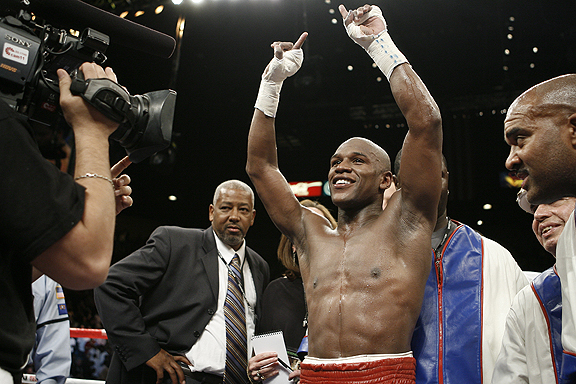
Tony Harrison remained perfect by stopping overmatched Pablo Munguia in round three of a scheduled 10-round Jr. Middleweight bout at the Mohegan Sun in Uncansville, Connecticut.

In round two, Harrison sent Munguia to the canvas with a perfectly timed right hand. Harrison jumped all over Munguia in round three and the bout was stopped at 11 seconds of round three.

Harrison, 154 3/4 lbs of Detroit is now 21-0 with 18 knockouts. Munguia, 153 lbs of Mexico is now 20-7.

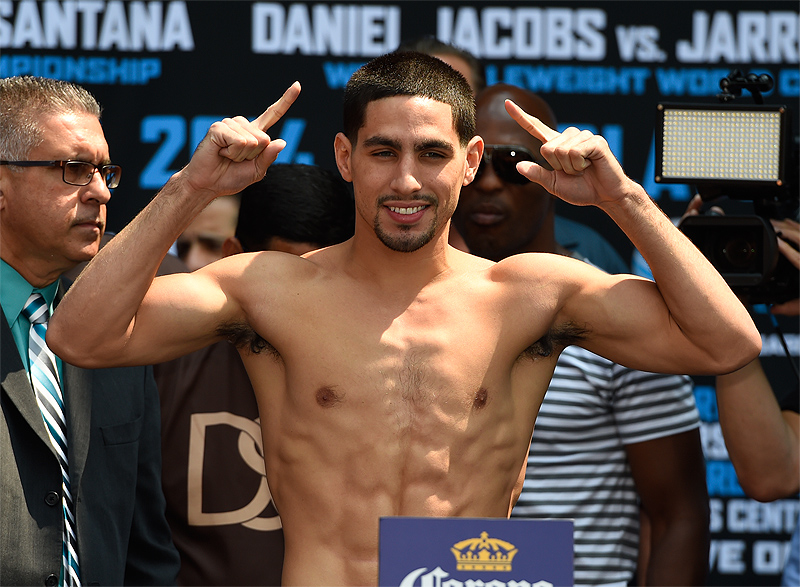
Danny Aquino scored a mionor upset by taking a split decision over previously undefeated Ryan Kielczweski in a back and forth Featherweight bout.

Aquino of Meridian, CT won two cards 78-74 while Kielczweski took a card 78-74.

Aquino is now 17-2. Kielczweski is now 22-1.

Tevin Farmer won a 8-round unanimous decision over Angel Luna in a Jr. Lightweight bout.

Farmer, 130 lbs of Philadelphia won by scores of 80-72, 79-73 and 79-73 and is now 19-4-1. Luna, 128 1/2 lbs is now 11-1-1.


The Real Story: It’s in what Mayweather and Pacquiao aren’t saying

By Norm Frauenheim–
Floyd Mayweather 2
The curtain has come down on media day, a big-fight ritual that like so much in boxing is an interpretative art.

Floyd Mayweather Jr., Manny Pacquiao and the people surrounding them said a whole lot at their respective camps in Las Vegas and Los Angeles.

But it was what they didn’t say that mattered.

To wit: Mayweather continued to call Pacquiao reckless. Mayweather, of course, is not, which he says is the biggest reason for his longevity as the world’s highest-earning athlete.

What Mayweather didn’t say Tuesday in Las Vegas is that Pacquiao’s recklessness represents the biggest threat to his unbeaten legacy on May 2 at the MGM Grand.

Pacquiao has been at his best when reckless. He was a reckless whirlwind in rematches against Erik Morales and again against Oscar De La Hoya, Ricky Hatton and Antonio Margarito.

He could pull it off then, simply because he had the energy and power to sustain a blinding rate of punches from countless angles created by feet that moved tirelessly and in concert with what his hands were doing.

But is that energy and power still there? The right hand that Juan Manuel Marquez timed so perfectly on Dec. 8, 2012 in a crushing stoppage of the Filipino is a sure sign that they are diminished, or at least not in the abundance that one made him so dangerous.

Recklessness is a powerful weapon with the right complements. Without them, it’s just a weakness bound to appear as it did in a fight Pacquiao was winning until the sixth round when the recklessness was suddenly there.

Unlike his memorable victories over De La Hoya, Pacquiao was left standing, almost flat-footed, with his hands down and chin exposed. Marquez capitalized with a perfectly placed right.

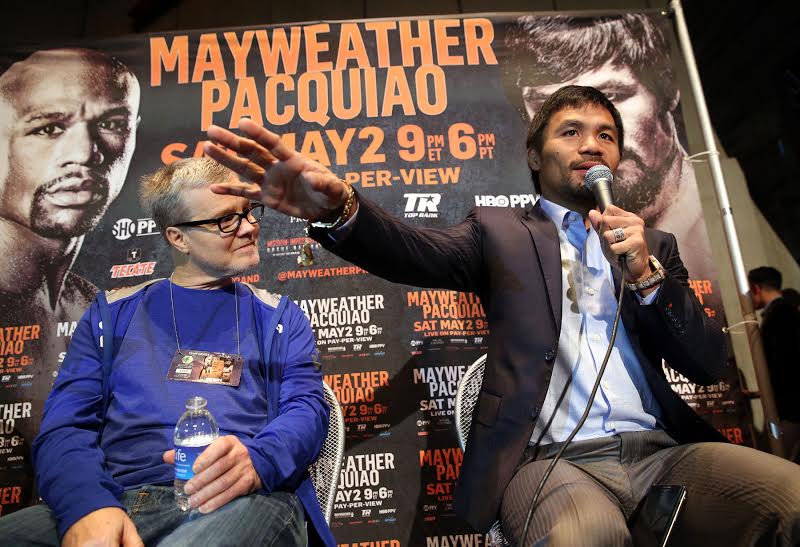
At Pacquiao’s media day in Los Angeles Wednesday, there was talk that he had learned from that one moment. The repeated promise: It would not happen again.

“He’ll attack, but not be careless,’’ Pacquiao advisor Michael Koncz said during live-stream coverage from trainer Freddie Roach’s Wild Card Gym in Hollywood.

Here’s what Koncz didn’t say: Can Pacquiao really attack without being careless?

The guess here is no, he can’t. The younger Pacquiao was inexhaustible and able to turn his streak of recklessness into an unstoppable force. There was simply no counter.

Mayweather never said that much during his session with media in a tent in a strip-mall parking lot outside of his gym. He would only call Pacquiao a future Hall of Famer.

But, he said, “I don’t know if he can make adjustments like I can.’’

Here’s what he didn’t say: At some point, he expects the Pacquiao attack to subside. Relentless will give way to only the reckless.

Maybe, Mayweather will drain some of Pacquiao’s energy with straight right hands. Or, maybe, the bigger Mayweather will lean on him, tie him up, tire him out.

But Mayweather’s quiet confidence throughout the build-up for the much-hyped fight seems to say he expects the moment to be there. That’s when he’ll adjust and perhaps land a perfectly- timed right that will say it all.


Eye Of The Storm: Mayweather is cool and calm as Pacquiao fight approaches

By Norm Frauenheim–
Floyd Mayweather
LAS VEGAS — On a day when powerful winds kicked up clouds of dust that obscured The Strip’s skyline like a dirty fog, only one thing was predictable:

Floyd Mayweather Jr. was late.

Everything else, especially Mayweather, was unexpectedly low-key Tuesday. Maybe, that shouldn’t qualify as a surprise. What else can possibly be said about his long-awaited fight with Manny Pacquiao on May 2 at the MGM Grand.

A crowd that stood in a parking lot outside of his gym in a strip mall summed it up. David Hasselhoff posed for photos. Every high-end car or stretch limo had people standing on chairs, garbage cans and scrambling up light poles for a better view of a fighter who was scheduled to appear at his media day.

There was one false alarm after another. Finally, there he was, about 90 minutes late. It didn’t matter. This crowd would have waited through the night and perhaps through a cyclone. Truth is, it has been waiting for him to fight Pacquiao for about five years now. What’s a little bit of lost sleep and dust in the wind?

“Everything in life is about timing,’’ Mayweather said in a tent that rattled around in a storm that blew across the Nevada desert. “I don’t regret anything. The timing is right. Before I wasn’t as big. But I’ve been getting bigger and bigger and not just inside the sport of boxing.’’

The potential adds up to something bigger than ever. Mayweather’s minimum is $100 million. Pacquiao is guaranteed $60 million. Since the welterweight bout was announced on Feb. 20, projections have multiplied at an astonishing rate. Now, there’s a chance that Mayweather could collect $180 million and Pacquiao $100 million.

Let the numbers do the bragging. Mayweather doesn’t have to.

He teased Pacquiao, but never said anything remotely offensive or even outrageous. When asked if he was surprised at how much bigger he was than Pacquiao when he stood next to the 5-foot-6 ½ Filipino at a news conference in Los Angeles, the 5-8 Mayweather smiled and said:

Nah,’’ he said. “He wears a lift in his shoes, so he looks a little taller than he really is.’’

He also said that this one fight would not define him or his legacy, which he believes will improve to 48-0.

“It’s just one fight for me,’’ Mayweather said. “If just this one fight defines my legacy, I wouldn’t have had to fight all of those other fights.’’

Mayweather also said he did not believe that the Pacquiao fight will be remembered mostly for his masterful defensive skill.

“When it is said and done, when the book is written, they won’t say Floyd Mayweather was a defensive wizard,’’ he said. “They’ll say he was a winner.’’

Still a winner at 38 years old, he said, because the natural counter-puncher fights with a different style than the aggressive Pacquiao.

“He’s a very, very reckless fighter,’’ Mayweather said. “I can’t say for sure, but I probably wouldn’t have lasted this long if I had been as reckless as him.’’

NOTES: There still was no official word Tuesday on how much tickets will cost before most of them wind up on the secondary market at an inflated price. But Mayweather advisor Leonard Ellerbe promised that the news is forthcoming. “This week, this week,’’ Ellerbe said. …The Nevada State Athletic Commission is expected to announce the referee and judges at a scheduled meeting next Tuesday. …Junior-featherweight champion Leo Santa Cruz worked out for the media at Mayweather’s gym Tuesday. Santa Cruz is on the PPV portion of the undercard. But his opponent has yet to be determined. Whoever it is, Santa Cruz promised to be ready for what he hopes is a steppingstone for a showdown with Abner Mares.


Without Premier: Bud, Rocky and Machine

By Bart Barry–
Terence Crawford
Saturday brings a cleansing of the palate, doesn’t it, a reminder of a painfully missed time when you watched boxing because you couldn’t imagine a better use of your energy – not because you felt obligated, as a longtime fan, to support your sport’s return to public airwaves because, apparently, leaving public airwaves was what doomed our sport, even while its return to public airwaves appears far more damning now than its absence did even five years ago.

The word is relief. That is what this weekend brings, a chance to return to the dated ideal of a promoter making real fights because he is accountable to scribe critics. There’s redundancy there, yes, redundancy worth visiting for a spell. Criticism does not exist on television, only in print. The ephemeral, emotional, silly nature of television lends itself directly to promotion, to publicity, to fads, to effects that draw the eye, distract the eye, capitalize on the plague of man’s anxiety: television’s energy, like a teenage girl’s, derives its potency from a fear something better is happening in her absence. Television attracts its audience with a promise that its absence assures regret, and then, its audience drawn, television busies itself with imparting the essential nature of the spectacle, this very moment, the most or greatest of its kind, however absurd the statistics it needs cite, until the apogee of its program’s arc passes, and then it returns to promising the next spectacle cannot stand to be missed by anyone who does not want the crunching anxiety of its absence, and so on.

Elders called it the “boob tube” and did not miss. What now happens to our sport on network television is both potent and inevitable, and every print journalist that covers it cannibalizes what remains of our craft – in a bent more concessionary than saboteur.

Saturday, blessedly, brings no more slickly produced mediocrity from the imagination of an otherworldly figure, a manager advisor who, it may well turn out, hates the sport of boxing to his very marrow, like we’ve grown accustomed to treating in what serious tones we once reserved for actual championship contests conducted by actual champions, and that is not a criticism of Danny Garcia who, for all the middlingness that has attended his last 13 months in the game, a series of spectacles gaudy as his trunks, did things the right, hard way, way back when his promoter wanted him to lose every time he laced up gloves to stretch a fat old legend and a virginal amateur prodigy representing some coveted demographic or other.

Saturday’s co-main event from Arlington, Texas, may not be much of a fight, ultimately, but it will feature 2014’s best fighter plying his wares away from his beloved Nebraska. It is a return of sorts for Terence Crawford to the place he first asserted himself on the undercard of an ill-conceived crowning ceremony for Mikey Garcia, if you remember him, a 2013 Dallas spectacle for which Garcia did not bother acknowledging the weight limit, iced Juan Manuel Lopez, and looked decidedly second-rate when set against the warmup act: Crawford doing everything right. Saturday’s telecast will follow Crawford, the world’s best lightweight, with the world’s most entertaining junior welterweights, Argentine Lucas Matthysse and Russian Ruslan Provodnikov, in the sort of fight that will meet even exalted expectations for violence while being shorter than anticipated, very much the way Brandon Rios’ first tilt with Mike Alvarado did.

Good as Matthysse is, there is a real likelihood he’s not sturdy as Provodnikov; Matthysse has shown greater fragility in his best fights than Provodnikov has. The Russian will go directly at Matthysse, who will return fists with what rage and resentment he can still muster, and each man will endeavor to break his opponent’s spirit without a consideration for his own well-being, exactly the sort of contest the word “fight” still connotes to anyone not associated with the business of shiny-packaged prizefighting, nothing sanitized or Premier about it, serving the primal purpose boxing fulfills if it is worth considering, and no, generally it is not worth considering anymore, not with fractionally the frequency its consideration merited even a few years back, whatever television tells you.

The contemporary sportsfan, hoodwinked by men with MBAs and laptops, believes he should play manager, himself, to express best his affection for what athletes please him best: It’s OK my favorite athlete is not very good at his chosen profession, see, because he’s the best today, and television tells me the best today is the best of all time, and never mind that, cretin, because my athlete is much richer than yesterday’s best athlete who, regardless of what readily available video may suggest, could never beat my favorite athlete because he didn’t have swagger. This is a welcomed infantilization of American sportsfans, or perhaps it’s an international trend – heaven knows soccer fans are no beacons of adulthood – to distract potential customers with what’s sparkly, and it’s enjoying an excellent run.

Terence Crawford should be watched and enjoyed Saturday because he is legitimate talent properly cultivated by promoter Top Rank who builds fighters very much better than anyone else, and Provodnikov and Matthysse should be watched because of the honesty they represent and the perspective such honesty lends the poverty of its peers’ performances. From Siberia and Patagonia, respectively, Provodnikov and Matthysse exhibit a sort of strength that must be bred in men over millennia of sober struggle against a vicious and arbitrary world that endeavors at every turn to eliminate them. Neither man expects another man can hurt him – not uncommon among males in their physical primes. That neither Provodnikov nor Matthysse cares for the probability another man can hurt him, though, that neither man – even unto unconsciousness – has an algorithm for processing instant evidence to the contrary, that, is what makes them special.

Their match, too, will be special. I’ll take Provodnikov, KO-9.

Bart Barry can be reached via Twitter @bartbarry


FOLLOW GARCIA – PETERSON; LEE-QUILLIN LIVE FROM RINGSIDE

Danny Garcia
Follow all the action live as it happens from Barclays Center as world champions Danny Garcia and Lamont Peterson square off in a welterweight contest. The action begins with a middlweight fight between WBO champion Andy Lee and Peter Quillin. The action begins at 8:30 PM ET / 5:30 PT.

12 ROUNDS–WELTERWEIGHTS–DANNY GARCIA (29-0, 17 KO’S) VS LAMONT PETERSON (33-2-1, 17 KO’S)

Round 1 Good straight from Garcia..right..counter right..10-9 Garcia

Round 2 Garcia lands a combination..left..20-18 Garcia..

Round 3 Garcia forcing action..30-27 Garcia

Round 4 Garcia lands a right…40-36 Garcia.

Round 5 Garcia lands a right..Good right..Peterson gets in a right..50-45 Garcia

Round 6 Garcia lands a left to the body..3 punch combo..straight right..Counter left from Peterson..60-54 Garcia

Round 7 Garcia lands a right to the body…2 more hard shots…Peterson lands a combination on the inside..70-63 Garcia

Round 8 Good right from Garcia..Hard body shots from Peterson..hard right…79-73 Garcia

Round 9 Garcia lands a right..Good right from Peterson..4 punch combo from Garcia..Big right..Good right from Peterson and another…Hard right from garcia at the bell….89-82 Garcia

Round 10 Peterson sneaks in a right hand..left hook..98-92 Garcia

Round 11 Garcia lands a right to the body and head..jab from peterson..wicked right..2 hard rights..107-102 Garcia

Round 12 Big right from Peterson..big left…great action down the stretch…116-112 Garcia

114-114…..115-113 twice Garcia

12 ROUNDS MIDDLEWEIGHTS–ANDY LEE (34-2, 24 KO’S) VS PETER QUILLIN (31-0, 22 KO’S)

ROUND 1 Counter right from Lee…Qullin landed a right..HUGE RIGHT AND DOWN GOES LEE…Big Left hook…10-8 Quillin

Round 2 Qullin lands a right..great exchange…20-17 Quillin

Round 3 They are trading hard shots..Quillin lands a big right…BIG RIGHT AND DOWN GOES LEE..Straight left from Lee. Lee bleeding from the left eye..Left from Lee…30-25 Quillin

Round 4 Lee lands a jab..39-35 Quillin

Round 5 Hard left hook by Quilin sets off a furious exchange..49-44 Quillin

Round 6 Lee lands a coundter right hook…58-54 Quillin

Round 7 Sneaky left from Lee..Left from Quillin..BIG RIGHT HOOK AND DOWN GOES QUILLIN..66-64 Quillin

Round 8 Quillin lands a hard right..76-73 Quillin

Round 9 Left from Quillin..Right hook from Lee..straight left..Jab from Quillin..85-83 Quillin

Round 10 2 hard rights from Quillin..Straight left from Lee..Straight left..left from Quillin..95-92 Quillin

Round 11 Right from Quillin..105-101 Quillin

Round 12 Quillin lands a right..straight left from Lee…Solid right from Quillin..115-110 Quillin

113-112 Quillin…..113-112 Lee…113-113 A SPLIT DRAW


Forget Redemption: Garcia-Peterson is about recognition

By Norm Frauenheim-
Danny Garcia
Danny Garcia and Lamont Peterson are quick to say they aren’t fighting for redemption Saturday night at Barclays in Brooklyn.

Fair enough. It’s called prize fighting. Going into the ring for redemption is little bit like going to the bank to pray. There’s a pretty good chance you’ll leave broke.

“I don’t see this as redemption,’’ Garcia (29-0, 17 KOs) said of the first bout after a forgettable year for both fighters. “This is a great match-up.’’

Potentially, it is in a 143-pound fight that will also provide an early, yet significant, look at whether Al Haymon’s PBC (Premier Boxing Champions) can sustain its initial success in its second appearance on NBC (8:30 pm ET/ 5:30 pm PST).

“For me, there’s no redemption, either,’’ Peterson (33-2-1, 17 KOs) said. “No redemption for me. What’s in the past is in the past.’’

But the problem is what lurks in that immediate past. In 2014, both fought. Both won. But the buzz was gone.

Garcia, an emerging star in 2013, escaped with a split decision over Mauricio Herrera and a stopped an over-matched Rod Salka. Peterson, coming off a scary knockout loss to Lucas Matthysse in 2013, beat Dierry Jean and Edgar Santana.

Go ahead and trash the redemption angle, but the task Saturday night is to re-awaken interest in each and perhaps re-introduce them as potential players for whatever happens post-Floyd Mayweather Jr.-Manny Pacquiao on May 2.

Neither would – or even could – talk much about whether they might be fighting for a chance at the winner.

“I’m not worried about fighting Floyd Mayweather at all,’’ said Peterson, who has a full beard and some wisdom to go with it. “That’s a long shot from here. He maybe has one more fight after this. So, I won’t hold my breath on that. Not worried about it.’’

For the most part, Garcia said the same thing, although he it was clear that the Mayweather-Pacquiao possibility interested him a lot more than redemption.

“At the end of the day, it’s always a fighter’s dream to fight Manny Pacquiao or Floyd Mayweather,’’ Garcia said. “Everybody wants to fight the best fight. So maybe in the future, of course.’’

The 143-pound catch weight is a clear sign that they’re positioning themselves for a shot at the 147-pound winner between Mayweather and Pacquiao.

But catch-weights are boxing’s version of a catch-22. It’s a dilemma without an escape clause. It was done at the urging of Garcia, who at 27 is having a tougher time getting to the junior-welterweight limit of 140.

The catch-weight means neither Garcia nor Peterson will risk their titles. Garcia has the WBC and WBA belts. Peterson has the IBF version. It also means they won’t have to pay a sanctioning fee to any of the acronyms, which show up with a Mardi Gras-like belt in one hand and bill in the other.

But it also means criticism. Ruslan Provodnikov promoter Artie Pelullo took a shot at the catch-weight. In another fight with Mayweather-Pacquiao implications, Provodnikov meets Lucas Matthysse on April 18 in Verona, N.Y., on HBO in a junior-welterweight bout with no title at stake and no catch-weight in the contract.

“They don’t want to have anything at risk,’’ Pelullo said of Garcia-Peterson. “It’s a dangerous fight for both guys, but not like Provodnikov and Matthysse.

“They’re putting it all on the line, because they’re still fighting 12 rounds. It’s 140 pounds. There is no title, because we don’t have one. I’m telling you both kids would put there title out (there) if they had (to).’’

But Garcia and Peterson don’t have to. Their task is to re-build their public profile. If nobody knows them, those titles are beyond redemption anyway.


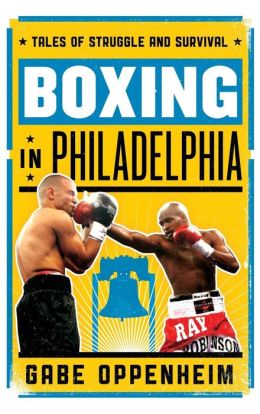
Gabe Oppenheim, and one of the last good books about boxing

By Bart Barry–
Philly Book
“If you’re gonna write about boxing, you need facts and grittiness and maybe even some awkward bad writing. It can’t be perfect. It can’t be ethereal. It can’t be self-contained. It can’t be its own art. It has to be bled into by the fighting itself.

“But only the defeat is permanent in boxing. And I guess the point of the book is to ask, could it really ever be any other way?

“Again and again and again and again and again and again and again.

“Until you can’t ask it anymore because you’re fucking tired of it.”

So states Gabe Oppenheim in the introduction of his book “Boxing in Philadelphia” (Rowman & Littlefield; $45.00), and if he fails to meet that standard it is only for a lack of awkwardness in his “bad writing” – an element his book noticeably lacks. Oppenheim treats boxing often as a metaphor, as writers often do with boxing, but Oppenheim does it on boxing’s terms, more fairly, more roughly, than most writers who treat boxing – as opposed to boxers who later try their bruised hands with sentences – in an effective way that feels like he wrote the first drafts too smoothly then went back and scuffed them with truth.

Oppenheim alludes to something like this, as well, in his introduction:

“It’s not just that boxers grows suspicious when a clearly out-of-place white college student tries to enter their gym to talk to them; it’s that I, too, grow suspicious of myself, not wanting to take advantage of anyone, to exploit people’s real lives.”

There’s wisdom in that sentence, written well about a form of suspicion that confronts anyone empathetic enough to write well and arrogant enough to choose boxing for a subject. We all go through it initially – in the olden days, many were assigned a boxing beat by an editor at a newspaper that no longer exists (replaced by Associated Press stories, and slideshows), and had that as an exculpating reason for wandering in a gym where they clearly did not belong – because anyone who does not go through it does not write well about our sport, regardless of readership size or class.

My pathway through suspicion was headgear and gloves, being just athletic and large enough to prevent permanent damage, and a shortcut like this: Once a man has put his knuckles on you, he trusts you because he knows you’re available for him to do it again if need be, and he knows he didn’t give you more than 2/3 of his power, whatever your closed eye and bleeding mouth say of it.

Oppenheim’s pathway through suspicion was an aged former trainer, Mr. Pat, and many, many hours. After the quality of the prose and the depth of admiration the author feels for his subjects, commitment is what resonates most about this book. To write a book like this about lesser-known figures in a lesser city requires much, much more than would a book about Joe Frazier and Bernard Hopkins’ favorite Philly cheesesteak spot or Oscar De La Hoya’s escape from East Los Angeles; those men’s stories are well-trod and research material is ample, and researching – now known as googling – is far easier than confronting the rejection of a fighter’s suspicion or a trainer’s unreturned phone calls or a possemember’s idiotic snickering.

Oppenheim faced these discomfiting forms of rejection and wrote about them, most clearly in his treatment of Meldrick Taylor, the Olympic gold medalist who came a fabled two seconds from beating Mexican Julio Cesar Chavez in his prime – something no man officially did (though of course we know how that Pernell Whitaker fight actually went, three years after Chavez broke Taylor). Taylor’s sorry condition is well known today, and both he and those close to him are understandably reticent about it, a matter Oppenheim writes creatively round, drawing instead connective tissue between Taylor and the then-decaying city that raised him.

“‘Awtheysaynottoomanykidouttometheywrotebadthingsaboutme –
‘theamanamesaidIwaswashedup,’ Taylor slurs and mumbles without pause,” writes Oppenheim, in an innovative attempt at drawing a literary map of punch-drunkenness.

Oppenheim also follows closely the careers of two contemporary Philadelphia prospects, Teon Kennedy and Mike Jones, both of whose careers effectively ended on a Manny Pacquiao undercard, June 9, 2012, when Guillermo Rigondeaux dropped Kennedy five times in as many rounds, and Randall Bailey brought 15,000 spectators to a collective start by stretching Jones with a chastening right uppercut.

“It’s an inevitable fact about most jobs that increased success leads to increased stability,” Oppenheim writes about the trajectories Kennedy’s and Jones’ careers followed. “In boxing, on the other hand, success breeds irregularity.”

Oppenheim notes with a touch of irony the fighting city of Philadelphia’s two celebrated prospects, Jones and Kennedy, did not emerge as champions the way Danny Garcia – not exactly Puerto Rican, not quite Philly – somehow managed to do. There’s something touchingly Philadelphian about that development, too; as anyone who’s attended a sporting contest of any kind in Philly can tell you, those folks love to make a lot of noise when they’re completely wrong.

“Boxing in Philadelphia” ends on a slightly false note of optimism about both the city and the fight game. While Philadelphia tries to replicate other cities’ purported urban renaissances – think: hipster lofts in abandoned warehouses – boxing now accelerates towards a day, arriving before 2020, when its sole promoter owns the media that covers his events; if boxing thrives again, it will be as professional wrestling in gloves. And on that day, Oppenheim’s book will be deservedly considered one of the last good books written about our sport.

Bart Barry can be reached via Twitter @bartbarry


Provodnikov-Matthysse: A Corrales-Castillo sequel?

By Norm Frauenheim
Provodnikov Arrives
It’s a fight that really doesn’t need much in the way of explanation or analysis. Strip away all of the subtlety and finesse, and you’re left with Ruslan Provodnikov-Lucas Matthysse, a collision waiting to happen. Maybe an accident, too.

But that’s the attraction. Power, the ability to deliver it and a willingness to risk it, exerts it own kind of drama.

It’s why we watch. An irresistible mix of fear, brinkmanship, inexhaustible persistence and even some foolish courage are among the intoxicating possibilities that will be there when the junior-welterweights clash on April 18 at the Turning Stone Resort & Casino in Verona, N.Y., in an HBO-televised bout.

“I believe it’s going to be Corrales-Castillo I,’’ said Provodnikov promoter Artie Pelullo, who during a conference call Monday foresaw potential for a fight the equal of Diego Corrales’ wild 10th-round TKO of Jose Luis Castillo in 2005.

From this corner, Castillo-Corrales I still ranks as the best fight in this century and one of the best in any. But a price was paid.

Castillo was never quite the same, although his career continued with a loss to Ricky Hatton 2007 and even a TKO loss Provodnikov last November.

Corrales fought three more times, losing all three, including a fourth-round KO in a rematch with Castillo. Corrales died on a motorcycle on May 7, 2007, exactly two years to the day after that first Castillo fight nearly a decade ago.

I’m not convinced that either Provodnikov or Matthysse has the varied skill set that made Corrales and Castillo such dangerous lightweights.

They might surprise me. They might change my mind. If they do, however, Provodnikov-Matthysse won’t fulfill explosive expectations. The buzz isn’t there because they’re known for a defensive feint or the shoulder roll. It’s all about the power. Who has more of it? Who can land it? Who can withstand it?

Castillo was 0-2 against Floyd Mayweather, Jr., but Castillo challenged the pound-for-pound king as much as anybody, especially in the first fight, a 2002 decision.

Castillo and Corrales could do many things. In the end, however, they did what Provodnikov and Matthysse are expected to. They tested each other’s will with unadulterated power that made their confrontation more about surviving than winning.

There will be some new opportunities for the Provodnikov-Matthysse winner. Don’t be surprised if there’s talk about a fight with the Manny Pacquiao-Mayweather winner on May 2. Amend that: Be very surprised if there isn’t talk about that possibility.

But this one isn’t about talk. It isn’t even about victory. Not really. It’s about survival. It’s why we’ll watch.


Gary Russell Jr, and the end of cable sports journalism

By Bart Barry–
Gary Russell Jr
Saturday, Showtime’s preternaturally gifted Gary Russell Jr., an Al Haymon fighter, knocked-out the hardest puncher in Mexican history, Jhonny Gonzalez, on Showtime, a Haymon-affiliated network, to seize from Gonzalez the Showtime featherweight title Gonzalez took from Showtime’s Abner Mares a few years back. Whatever the depth of boxing’s featherweight division, and whatever Russell’s postfight protestations, Showtime’s featherweight division now finds itself bereft of fitting challengers for Russell’s crown – and Showtime viewers are admonished, therefore, to raise Russell’s fragile left hand against every hypothetical opponent from here to Nicholas Walters.

Unfortunately there is nothing new or more hyperbolic to say of Showtime’s Gary Russell Jr. than was already said by HBO’s crew 4 1/2 years and nine fights ago. Back then Russell’s membership on USA Boxing’s woeful 2008 Olympic team was viewed with greater skepticism than it is today; time and Deontay Wilder’s semisuccess, and the still-worse showing by USA Boxing in 2012, all, made shouting “2008 Olympian” somehow more positive Saturday on Showtime than it did when Russell began underachieving on HBO, who honored what remained, then, of its journalistic integrity by noting Russell did not even compete in the 2008 Olympic Games.

While it would be impossible to mark the day on which HBO completed its transition from broadcaster to promoter, historians might find riches worth mining in a review of a Boxing After Dark telecast on Sept. 3, 2011, one that featured an Andre Berto-rehab assignment in its main event and Gary Russell Jr.’s HBO debut in an eight-rounder on its undercard:

“Gary Russell Jr. is an ex-cep-tional talent!” cheered Max Kellerman before the opening bell even rang. “I think, Roy (Jones), he’s a gold-medal-caliber talent.”

“I hear his hands are almost as fast as mine used to be,” Jones answered, rhetorically, with what autobiographical modesty marked his every broadcast. “He’s got to be a gold-medal talent.”

In round 2 Kellerman strayed dangerously close to insubordination when, in an attempt to define Russell as both a supreme offensive force and a supreme defensive one, he ran afoul of Jones’ definition of a “boxer” – which Jones promptly made indistinguishable from other styles, specifically the difference between a “boxer” and a “boxer!”

“Signs of a great fighter, son,” added Jones in round 4. “Great hand-speed. Great power. Great defense. (Russell) has the total package.”

Comically, Kellerman then explained the hardest challenge to come for Russell’s people would be resisting temptations to move Russell too fast – since he was so outclassing the guys a lesser prospect would face at this point in his career. Caught under the spell of his own salesmanship, then, Kellerman asked Jones if room even remained for Russell to improve.

As the end of the fight neared, and Russell had failed even marginally to imperil someone named Leonilo Miranda, Kellerman looked ahead rosily:

“It’s not so much of a stretch to imagine (Russell) and Nonito Donaire in the winners bracket of a super fight at 130 pounds – two, three years down the line.”

Almost.

Four and a half years down the line, Russell finally won a title from an ancient Jhonny Gonzalez on the same day Donaire steamrolled someone named William Prado, off-television, somewhere in the Philippines.

While Russell seems like a good guy with talent, and certainly his managerial shop has produced lesser items in recent years, the fact remains no one should be excited about Russell, and excepting only those who are paid to act excited about Russell, no one genuinely is. Russell landed one great punch Saturday, a counter whose power derived mostly from Gonzalez’s sloppy aggression in the closing instants of round 3, and the rest of the stoppage came via Russell’s venomous flailing in round 4, Gonzalez’s despondency, and referee Tony Weeks’ mercy.

When Russell lacks power, generally, it is because he is afflicted with something like front-foot-itis, a condition that plagued the 2008 U.S. Olympic Team. Russell often loads weight on his front foot as an anxious habit more than a strategic consideration, in a vestigial tick from his time in USA Boxing, when all the sweet science was reduced to reflexes and conditioning. Trained by men who idolized Roy Jones Jr., in 2008 Team USA believed in leaning forward, triggering an opponent’s jab, and then yanking back on one’s chin and weight while snapping a counter hook at one’s trapped opponent. Of course, when these counter hooks did not land, or got simply blocked, there was nothing for the American Olympian to do but retreat, bounce, and reset his weight over his front foot.

The medal count that year confirmed the approach’s sagacity.

Saturday’s most interesting revelation, though, came in the celebration of Jhonny Gonzalez’s now-extraordinary power, a concussive force he did not have until his first-round elimination of Showtime’s Abner Mares in 2013. Before then, Gonzalez was another sturdy Mexican, whose career and life, likely, were shortened by Israel Vazquez in 2006.

I was ringside for five Gonzalez fights, in Jhonny’s actual prime, and not once do I recall anyone talking about his historic power. He had good technique and made entertaining fights, and had a great nickname, “Jhonny”, but if anyone had said at the time Gonzalez packed more relative power than, say, Rafael Marquez – an assertion Showtime implied by implying trainer Nacho Beristain labeled Gonzalez as Beristain’s hardest-hitting champion ever – he’d have been laughed right off the writers’ table at Desert Diamond Casino.

The game certainly has changed. Back then, a cable network like Showtime would call an advisor like Al Haymon a “power broker.” Today, they call him “Boss.”

Bart Barry can be reached via Twitter @bartbarry


Adonis Answer: Stevenson fights to ignore the Kovalev question

By Norm Frauenheim–
Adonis Stevenson
It’s the question Adonis Stevenson can’t shake. It’s there when he wakes up and sits down for breakfast. It’s there when he goes to the corner store. When he looks in the rear view mirror, there it is:

What about Sergey Kovalev?

It was asked again, again and ad nauseam Wednesday during a conference call that included Sakio Bika. At least, I think it included Bika.

Stevenson fights Bika in Quebec City on April 4 in Al Haymon’s first PBC card on CBS, yet Bika was little more than a mere prop during the telephone Q-and-A.

In fact, the Kovalev question ended the call. An exasperated Kevin Cunningham, Bika’s trainer, had heard enough.

“You guys have done it for me,’’ Cunningham said. “This is getting my fighter fired up. This call has been about Stevenson fighting Kovalev. I don’t even know if Sakio is on the call.

“Everyone keeps asking about Kovalev-Stevenson.

“What the bleep are we even doing here? Why are we here? This call is over for us.’’

Bika (32-6-3, 21 KOs) figures to be a lot tougher then a dial tone. Stevenson’s maturity will be tested in part by his ability to ignore the Kovalev buzz and focus on the challenge in front of him.

He promised to do exactly that. But, remember, this was a conference call.

“There’s so much talk about that,’’ Stevenson (25-1, 21 KOs) said. “But I’m very focused on Bika. He’s the one in my face now.’’

A grown-up evaluation of the Bika fight and its potential significance for Stevenson came from his trainer, Javan Hill, a student of the late Emanuel Steward.

“For the growth of Adonis, this very important,’’ Hill said. “It’s an opportunity for Adonis to go maybe 12 rounds or into the later rounds. This is a test, a chance for him to grow and become a superstar.’’

Hill’s comment is little bit surprising because of Stevenson’s age. He’s 37. But he’s late to the game because of a troubled youth. The light-heavyweight spent four years in prison. He didn’t make his pro debut until 2006. He might lack some of the instinct acquired by fighters who grow up within the ropes. Nevertheless, his power is almost scary. It’s what Steward noticed right away.

“Emanuel always used to say: ‘Knockouts sell, knockouts sell,’ ‘’ he said of Steward, who began to turn Stevenson into a star before he died in 2012. “I always go into the ring thinking knockout first.’’

That aggressiveness, a natural byproduct of his power, leads straight back to the question that – with apologies to Cunningham – has been around ever since it looked as if Kovalev and Stevenson would fight on HBO late last year.

Didn’t happen, of course. Stevenson jumped to Haymon and Showtime. But Kovalev continued on his relentless path, beating Bernard Hopkins in a victory that earned him pound-for pound-credentials.

All the while, Stevenson languished, scoring forgettable victories over Dmitry Sukhotsky and Andrzej Fonfara. But he and Kovalev remained on their collision course, mostly because Kovalev looks unstoppable and Stevenson has Haymon’s influence.

But is Stevenson a mature enough fighter to handle Kovalev, who is as poised as he is dangerous. Kovalev thinks through adversity, which was evident in his eighth-round TKO of Jean Pascal on March 14.

There are questions about what, if anything, Stevenson will do if somebody takes away his power. He’s gone 12 rounds twice and 10 rounds once, but not against anybody with Kovalev’s smarts.

In the tough, forward-charging Bika, Hill hopes to see some of those smarts in Stevenson. If he doesn’t, don’t be surprised if there’s another conference call a lot like the last one.


Column without end, part 7

By Bart Barry–
unnamed (787x1024)
Editor’s note: For part 6, please click here.

*

BURNET, Texas – We begin here, again, with a thought experiment of sorts, before hiking to a roadside memorial in the state Terence Crawford will visit next month, honoring Catalan masterpieces the whole way:

A tiger bursts through your door in the next instant. You react, in less than a second, far less than a second, the identical way I react, your father reacts, your worst enemy reacts. Ponder for a moment the miracle of that: Your mind takes whatever binary-like signals your eyes send it, unscrambles them in an image, queries its database – not equal to a purple balloon, not equal to a canister of whipped cream, not equal to a passenger train, not equal to an overfed chipmunk – identifies imminent peril, as opposed to banal inconvenience or pending ecstasy, and sends a non-negotiable signal to your central nervous system. In merely thousandths of a second.

Is it any wonder an entity so preternaturally capable as your mind will find tedious whatever repetitive tasks you feed it for 40 hours this week?

It wasn’t till the last fifth of my Saturday hike I came upon the sign above. What strikes hardest is its longing for connection, for touching a person who no longer exists, for having a tiny but permanent portal into the excruciating immediacy of one’s loss – to oblige one to visit what likely is a death site, beside, as it is, a winding rural highway with both a 55 mph speed limit and orange cautionary signs spaced unevenly, every half mile or so, advising of turns and bends in a plethora of alternately squiggly lines, and counseling motorists to reduce their speed by as much as 25 mph from the limit. Consider that: a roadway with a speed limit of 55 th’t one shouldn’t drive faster than 30.

There was unexpected innovation at the makeshift memorial, too; the plastic-crystal crucifix back-left of the altar had a small solar panel to collect sunrays during daylight and illuminate a cross-shaped skeleton within its structure at night. It speaks to the care that birthed the creation, the surrender its keeper gave to it: “I have lost my son. I shall take as much time as this requires. It may not be perfect, but what remained of me will be emptied in this when it is finished.”

I came upon the memorial in the fourth hour of a seven-mile hike through Inks Lake State Park’s enchanting stretch of pink granite, dark water and gnarly pecan trees, a hike that, as is its purpose, was an exploration of presence, acceleration and something that attempts to approximate the ancient Greek concept of kairos – a time, in the sense of a decisive moment, that brings a sensation of timelessness. The Greeks were no closer to understanding the phenomenon of the human mind than we are today, but they were wise enough to confess, through their juxtaposition of kronos and kairos, measurable time and something effectively infinite, th’t there was something they could paw-at and stumble upon and sense, or imagine, but never master for being unmeasurable and uncontrollable.

There are few serious belief systems that do not include the existence of something the human mind cannot measure consciously – in the sense of being able to report upon – and the factions of this belief, factions that rarely make war on one another (wars happen between people of same factions, ironically), appear to reduce to: Those who believe timelessness resides outside the human mind, in a deified form, and those who believe the mind invents it. Both are forms of faith, if we’re being honest, and the non-believer is often flummoxed by an inventory of all he perceives followed by something like “meaningless and chaotic, really?” as the believer is confounded by an assertion, Bishop Berkeley’s practically, you never awoke last night and everything you are perceiving at this moment, to include a “boxing” column telling you about timelessness and hiking in Texas, written by a person who never existed outside your imagination, is but a dream.

Oh where were we? Terrance “Bud” Crawford, that’s right.

As some of you may already know, and I am happy to confess I did not until Sunday morning, last year’s BWAA Fighter of the Year is coming to Texas in a month’s time, fighting on a University of Texas campus in Arlington on April 18. Crawford is one of the few fighters plying the craft today who merits travel – which distinguishes him completely from the man who will share headlines on the digital continuum that same evening, “Son of the Legend” Julio Cesar Chavez Jr. It is not enough to impart I will drive more than four hours northwards to honor Crawford’s spirit and achievement; I would not watch Chavez’s next fight if it were being push-streamed by 15rounds.com to a phone cradled in the cleavage of my favorite porn actress.

What does any of this have to do with the Catalan master Antoni Gaudi? A pursuit of beauty in the form of spires, columns if you will, leavened by an ecstatic willingness to fail so long as one gets it true – not right, no, not right: True. What art does that makes it functional as meditation or prayer or alpine skiing or fighting or even hiking in Inks Lake State Park is allow its participants a brief interaction with their sense of timelessness, a blessed respite from our learned accountancy of the seconds-hand on Life’s clock . . .

*

Editor’s note: For part eight, please click here.

*

Bart Barry can be reached via Twitter @bartbarry


Hernandez decisions Casillas

Alejandro Hernandez won a 10-round majority decision over Martin Casillas in a Bantamweight bout Auditorio Blackberry in Mexico City, Distrito Federal, Mexico.

Hernandez, 118 lbs won by scores of 98-92 and 97-93 twice to raise his record to 29-11-2. Casillas, 118 lbs is now 15-5.

Gabriel Acosta remained perfect by scoring a 3rd round stoppage over Luis Delgadillo in a scheduled six-round Bantamweight bout.

Delgadillo dropped Acosta in round one from a right hand. Acosta scored two knockdowns in round three. The first coming from a left to the head while the finisher was a hard right flush on the jaw.

Acosta, 118 lbs is 7-0 with 3 knockouts. Delgadillo, 118 lbs is 0-2.


Junior to Senior: Only a grown-up Chavez can win this fight

By Norm Frauenheim–
Chavez_Lee_120612_001A
Boxing was never meant to be the family business. Fathers fight so their sons don’t have to. That sounds like a sensible plan, or at least a good way to avoid scars, concussions and everything else that comes from a livelihood in the ring.

But it’s never been one that could be applied to Julio Cesar Chavez and the son known simply as Junior.

It seems as if Junior just can’t escape his given name or the legend it means to Mexico. There have been times when it looked as if he might just walk away from his role as the heir-apparent.

But he hasn’t, not even amid boos for his two performances against Bryan Vera, or his country-club training camp for Sergio Martinez, or his late-night meals, or fondness for the substance that leads to the munchies.

Through it all, he always seems to follow that path up the steps, through the ropes and onto the unforgiving canvas that defined his dad. Julio Cesar Chavez Jr. will be back there again on April 18 at the StubHub Center in Carson Calif., at a 172-pound catch-weight against a top 10 light-heavyweight, Andzrej Fonfara.

“It feels great to get back,’’ Junior said during a conference call Wednesday.

Great, yet never more problematic than now.

There’s the dangerous Fonfara, who has enough skill and power to make him regret his return. It’s his first fight in 13 months. Since losing a piece of the middleweight title to Martrinez in a bout one-sided for 11 rounds and wild in the 12th, Junior has fought only twice, both against Vera, in 2013 and 2014. He has changed management, signing with advisor Al Haymon. Promoter Bob Arum is suing, alleging that he still owes him fight.

He’s also got a new trainer in Joe Goossen and will make his debut on Showtime after years on HBO. Changes abound. Question is: Has he?

His comeback against Fonfara is intriguing because it’s a chance to see if boxing’s Peter Pan has finally grown up. Throughout his career, enablers have surrounded him. Then, there were the fans, always there with an excuse for every misstep.

If he couldn’t make weight, a new one was negotiated. If he decided he wanted to train at his Las Vegas condo at 2 a.m. and do his road work around the couch instead of on the street, his former trainer, Freddie Roach, would be there.

But Arum and Roach are gone. So, too, are many of the Mexican fans. They have either given up on him in exasperation or moved on and into the Canelo Alvarez’ camp.

Against Fonfara, there will be none of the usual excuses or loopholes that have always been there like a silver spoon. Junior will have to behave and perhaps fight like Senior more then he ever has.

As always, dad will be there. He was even on the conference call.

“I did not want this fight for my son,’’ Julio Cesar Chavez said. “Fonfara is very strong. But Julio wants to show how good he is.”

How mature he is too.


Many great fights on the Horizon

Floyd Mayweather
Alot has been made about the five-years-in the making fight between Floyd Mayweather and Manny Pacquiao that will take place on May 2 in Las Vegas.

But in the six weeks or so and even after, there are many cant miss rubles that will take place on various networks. With all the action, fans can bet on boxing at William Hill.

The action kicks off on March 28 with an intriguing Featherweight battle between WBC Featherweight bout between champion Jhonny Gonzalez (57-8, 48 KO’s) taking on former U.S. Olympian Gary Russell Jr. (25-1, 14 KO’s). In the co-feature of the Showtime televised event will be Jr. Middleweights, Jermell Charlo (25-0, 11 KO’s) and Vanes Martirosyan (35-1-1, 21 KO’s).

On April 4 in Quebec City, recognized Light Heavyweight champion Adonis Stevenson (25-1, 21 KO’s) will defend against former Super Middleweight champion Sakio Bika (32-6-3, 21 KO’s). The fight will be televised on CBS.

On April 11 at Barclays Center an intriguing doubleheader will take place as lineal Super Lightweight champion Danny Garcia (29-0, 17 KO’s) takes on Lamont Peterson (33-2-1, 17 KO’s) in a battle of title holders in a bout that will be fought at a 143-pound catchweight. The co-feature will be an anticipated WBO Middleweight title bout between champion Andy Lee (34-2, 24 KO’s) and former champion Peter Quillin (31-0, 22 KO’s). The two fights will be the next installment of Premiere Boxing Champions on NBC.

April 18 will be a crowded night headlined by the sure fire fight of the year candidate between Ruslan Provodnikov (24-3, 17 KO’s) taking on fellow warrior Lucas Matthysse (36-3, 34 KO’s). That will fight will take place at the Turning Stone Resort Casino in Verona, New York. The televised co-feature on the HBO split site double header will see former Lightweight champion Terence Crawford (25-0, 17 KO’s) taking on Thomas Dulorme (22-1, 14 Ko’s) for the vacant WBO Jr. Welterweight title.

On Showtime that night, Julio Cesar Chavez (48-1-1, 32 KO’s) takes on Andrzej Fonfara (26-3, 15 KO’s) in a Light Heavyweight bout from Carson, California.

Finally on April 25 at Madison Square Garden, World Heavyweight champion Wladimir Klitschko (63-3, 53 KO’s) makes his first defense in the United States in seven years when he defends against undefeated Philadelphian Bryan Jennings (19-0, 10 KO’s) in a bout that will be televised on. HBO.


Of Soviets and athletes

By Bart Barry–
Kovalev & Pascal Weigh-InCasino de Montreal
SAN ANTONIO – If you’re reading this column, it is highly probable you watched on HBO Russian Sergey “Krusher” Kovalev’s Saturday reduction of Jean Pascal from a ferocious spectacle of athleticism to a man stumbling across the canvas like an enthusiastic toddler determined to crawl no longer. There’s also a fair chance you watched Thursday’s HBO Latino undercard, one that featured Ukrainian Vyacheslav Shabranskyy violently dismantling Fabiano Pena, in this city’s Freeman Coliseum.

The matches had a symmetry that was unmissable: The fighter initially taught by men raised in the Soviet system threw with better precision and more proper conviction every punch in the boxing lexicon than the more-athletic man across from him. Both Pascal and Pena were undone methodically – right cross to the head, left hook to the body, right uppercut to the head, right hook to the body, left hook to the head, left jab to the head, left jab to the body, right cross to the head – with attacks that predicted their targets’ movements in a way the targets could not hope to predict their attackers’, and both Pascal and Pena reacted the same way: launching blind haymakers that did little but intensify the luridity of the beatings they were to receive.

Shabranskyy caused Pena to quit on his stool after five rounds. Kovalev made decent men ask how Pascal was allowed from his stool for the eighth.

There is a stiff-leggedness to the attack of fighters taught by men raised in the Soviet system, and it makes them temporarily vulnerable when attacking more-athletic prizefighters. It is why former-Soviet fighters pulverize opponents, grinding their wills like pepper across the ring’s blue leaf, rather than blitzing them and bringing unconsciousness in a lone punch.

For all the hyperbole that attends Kazakh Gennady Golovkin’s knockout ratio – one part quality of opposition for every two parts quality of punching – Golovkin is nothing like Mike Tyson was. Golovkin’s knockouts are pulverizations, not detonations. Sergey Kovalev’s knockouts come the same way, and if the day ever comes Golovkin confronts an opponent even half as good as a 49-year-old Bernard Hopkins, one like Andre Ward, expect no knockout victories for GGG.

The Soviet system, though created for amateur events, relies on deriving power nearly as much from the motion of another man’s body as the torque from one’s own punches. What is now noted with increased frequency is that Kovalev punches on-time more than hard; he runs you into punches and sets his knuckles on you at the very moment they will devastate most. Almost nothing like this is taught in American boxing.

The American style is one that hopes to reduce an opponent to a heavybag, somehow, on which combinations may be exhibited. It is a style with fewer dimensions than the Soviet system’s, in part because it is a style that relies more heavily on athleticism. What makes Americans like Bernard Hopkins or Floyd Mayweather or Andre Ward great as they are is not their athleticism but a transitional capacity, defense to offense, that is a product of diverting themselves for thousands of hours across from men they were able to solve and create upon, and that they had creative impulses, much more than a product of great teaching (the reason their teachers never manage to build, from scratch, similar successes – at least with nothing like the frequency of, say, Mexican Nacho Beristain).

There is an excellent ESPN documentary, “30 for 30: Of Miracles and Men,” recently released to Netflix and treating the Soviet hockey team that lost to Team USA in 1980, and the extraordinary approach to hockey the Soviets created in an incredibly short time. Just as the Soviet boxing approach relied on an opponent’s improvement of one’s punches, the Soviet hockey system fixated on the activities of the four men who did not have the puck, not the one who did. The Soviets took hockey, most selfless of North American professional sports, and without even knowing quite how North Americans played the game, created a transcendent form of selflessness – with an obvious assist from communism – in which every man on the ice felt as much euphoria at the scoring of a goal as the man from whose stick the puck was shot.

Such a holistic approach is not possible in a contract system that pays every player according to his individual contributions – it’s why your eyes roll when an athlete sets a career mark for points or home runs or touchdowns and then risibly tells the camera getting a win in game 9 of the nearly endless season was more important to him – because, to borrow from Vince Lombardi, if individual achievement isn’t everything in professional sports, why keep stats? With players signed to non-negotiable 25-year contracts in a system that would banish a sports agent to the gulag, the Soviets were able to create a system in which the team organism provided not just sustenance to its components but also identity.

This system, of course, suffocated its participants, too, and appears more romantic to a Western individual today, probably, than any survivor of the Soviet system in Eastern Europe – but it remains nevertheless instructive as an alternate approach to a somewhat calcified system. Certainly the NHL game, once a forum that emphasized the imposition of one’s will, with slapshots and physicality, more than finesse, with crisp passing and offensive intricacy, looks considerably more Soviet in 2015, a quarter-century after the Soviet Union’s collapse, than it did in 1975.

It is worth pondering, then, if the recent success of former-Soviet fighters – and its brazen promotion by HBO – will not help American boxing improve from its current emphasis on conditioning and athleticism to a more-holistic emphasis on melding enough with one’s opponent to make him a co-conspirator in his own demise – in a way better captured by the verb to swirl than to disrupt.

Bart Barry can be reached via Twitter @bartbarry


On The Stage: Mayweather-Pacquiao a fight between different personalities

By Norm Frauenheim–
Floyd Mayweather
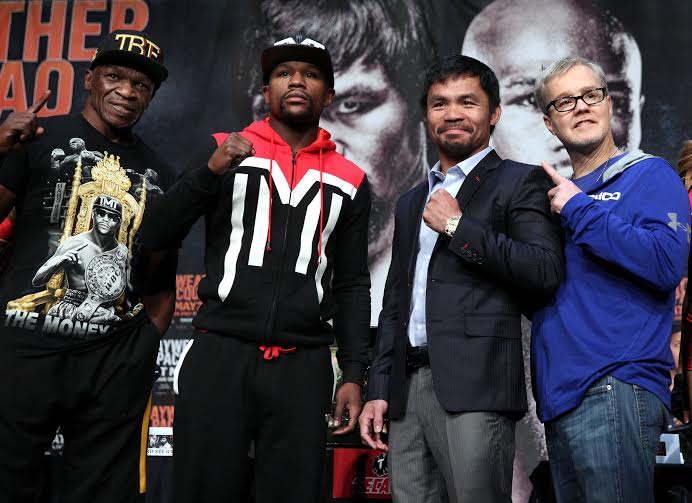
Floyd Mayweather Jr. and Manny Pacquiao stood side-by-side in what was the third time they have ever been seen within a few feet of each other. They looked uncomfortable, almost awkward.

Mayweather raised his right hand and pointed his index finger toward the ceiling as if to remind anyone in the theatre and the heavens that he – and only he – is No. 1.

Pacquiao raised a left hand that was clenched into a fist that seemed to say he intends to pound some humility into Mayweather and his lofty claim.

Their fight on May 2 at Las Vegas’ MGM Grand is about a lot of things, of course. There’s legacy and celebrity, business and bragging rights. All of it is attached to an unprecedented bottom line.

But there’s something else. In watching the HBO/Showtime live feed Wednesday of a news conference- turned-show biz, two very different personalities stood on that stage at the Nokia Theatre in downtown Los Angeles. It set ups an intriguing collision, one that promises personal drama in a fight past its physical prime.

It’s a modern version of The Prince-versus-The Pauper. They have been rehearsing their respective roles for as long as they have been answering an opening bell. For each, it’s as much of an identity as a role.

There’s The Prince, the ostentatious Mayweather, who likes to flash his money and brag about his A-side power.

“When you get to this level, making nine figures for 36 minutes of work, you have to be a winner,” Mayweather told reporters in a Q-and-A session before he lived onto the Nokia’s stage.

Then, there’s The Pauper, the born-again Pacquiao, who is known to give away his money to fellow Filipinos still trapped in the third-world squalor that was once his home.

“God,’’ Pacquiao said in an interview with HBO. “I want people to know that he can raise someone from nothing to something. That’s me.’’

Those are comments that say Mayweather and Pacquiao believe in different things.

Maybe, that difference will mean nothing in the welterweight fight.

Maybe, it’s just as simple as Mayweather’s five-inch advantage in reach, which was so apparent Wednesday when they stood warily next to each other at center stage and in front of the world’s cameras.

Still, it’s part of the pre-fight psychology. Pacquiao says he’s very comfortable as the underdog. He’s at the sort end of 2-to-1 betting odds. The underdog has been is best role since he arrived at the Freddie Roach’s Wild Card Gym from the Philippines. It was a key to his motivation beating Erik Morales after losing to him in their first fight.

He understands loss and how to deal with it, although Mayweather suggested Wednesday that defeat will be a weakness for Pacquaio.

“One thing I do know about in any sport is that if you lose, it’s in your mind,’’ Mayweather told Showtime. “If you lose twice, it’s in your mind. All my life, I’ve fought be winner.’’

It’s no coincidence that Mayweather is unbeaten at 47-0. Staying that way has been a key motivation and defines one of his nicknames, TBE, The Best Ever. There’s even a theory that a loss would destroy his confidence. A masterful defensive tactician, he fights not to lose.

Flip the coin and you’ve got Pacquaio, whose 64-fight record includes five defeats — two over his last five. He understands defeat, which can be a component in knowing how to win.

It depends on the personality, which in the end might be remembered long after all that money gets spent.


Premieres

By Bart Barry–
Canelo_Alvarez
SAN ANTONIO – Tuesday at Aztec Theater, the oldest theater in this old city, Saul “Canelo” Alvarez and James Kirkland announced their May 9 fight in Houston. Saturday at MGM Grand in Las Vegas, Keith Thurman decisioned Robert Guerrero. In between those two middling affairs, Showtime announced plans to honor its televised trilogy of Israel Vazquez and Rafael Marquez – a trilogy unlikely to be matched in quality or ferocity even by a 2025 highlight reel called “Premier Boxing Champions: The First 10 Years.”

What Alvarez and Thurman have in common is above-average talent and a poor era; they are b-level fighters elevated to millions-dollar purses through some balance of mediocre opposition and needy fans. Alvarez is better tested and more beloved and unlikely to improve, while Thurman is more athletic, even while his power has moved with inverse proportionality to his opposition. What Vazquez and Marquez were, and made together, is another thing entirely.

There’s an inauthenticity to the televised experience, today, that wasn’t nearly so pronounced a part of our sport in previous decades. Boxing writers’ lamentations about television are well-noted and quite old, of course, and this isn’t intended to be so much another tired protest of the inevitable as a commentary on what’s worsened.

Boxing long preserved a griminess, a degree of filth, other sports lost generations before; boxing retained a sense of the unexpected in a way that made other sports appear overwrought and scripted. There was ever a touch of irony to this – with spectators accusing boxing results of being fixed, which they often were, even while phantom rules violations in the NBA and NFL influenced just as dramatically who became those sports’ champions. Television was a guest at boxing events, or at least telecasts felt like they were conducted by guests; proper boxing matches had a sense of inevitability to them, an implication this grievance would be settled, regardless of witness, at this time, on this evening, and television cameras just happened to be there.

Saturday’s NBC debut, instead, had other sports’ feel: We are here because television invited us, and do you know how great is the reach of public airwaves? and have you seen our incredible commentating team? and would you please have a listen to our soundtrack? If it did not feel quite scripted, it neither felt like a collection of brawls that were going to happen even if television cameras went dark. Aficionados are noticeably insecure about public acceptance of our sport, too, and that marked social-media depictions of a few good rounds in an otherwise poor night of NBC boxing with the usual trimming: Don’t you see, everybody, this is why you should love boxing as much as we do!

Tuesday’s press conference, or media event, as they’re now called since “press” – derived from printing press – no longer has any meaningful place at these clubland mashups where seats labeled Deadline Media get occupied early by women with enormous promotional posters and boys with eager black sharpies, and the deejay stands both closer to fighters and with a better chance of interrogating them than anyone carrying something antiquated as a notebook or pen, had promoters beseeching the partisan-Mexican South Texas crowd to show the world Texans were the very best fans by driving 200 miles to Houston in May to purchase the promoters’ product. Oscar De La Hoya was there, looking jittery as he’s appeared since warming up to fire Richard Schaefer (who must’ve watched Saturday’s NBC telecast and realized, much like HBO’s Kery Davis before him, he was disposable to Al Haymon as print media is), and of course Saul Alvarez and James Kirkland were there too.

Evermore, De La Hoya appears a refreshingly outdated model; he likes or appreciates the press and adheres to the olden-day rules of being unbothered by gliding through 20 minutes of frictionless inquiries so long as his inquisitors are equally unbothered by 20 minutes of countlessly refried cliches. There was a time De La Hoya was unique in the sport for his lack of sincerity. De La Hoya is no more sincere today than he was then, but our beloved sport now plumbs such depths of insincerity a De La Hoya sighting has all the charm of a throwback jersey; at least Oscar cares enough to smile and wave and remind us he was a great fighter who did fight other great fighters.

As an antidote to all that, last week Showtime announced it would commemorate the best trilogy to improve is airwaves, when it replayed Israel Vazquez versus Rafael Marquez. There appears nowhere on our horizon the likelihood of another such trilogy. The quality and violence of the combat shared between those two Mexican prizefighters, their willingness to avenge both defeats and victories, at a withering pace – they fought three times in 363 days (just after Vazquez stopped Jhonny Gonzalez in a particularly brutal affair) – is so far from what we have now it is barely believable Vazquez-Marquez 3 happened only seven years ago.

Then, as now, many in our ranks were discontent with boxing’s trajectory. Try not to imagine how bad things will need to go for us someday to look back longingly at Thurman-Guerrero.

Bart Barry can be reached via Twitter @bartbarry


Follow Thurman – Guerrero; Broner – Molina LIVE

Keith Thurman
Follow all the action as Keith Thurman defends the WBA Welterweight title against Robert Guerrero. The action kicks off at 8:30 PM / 5:30 PM PT as Adrien Broner battles John Molina in a Jr. Welterweight bout.

12 Rounds–WBA Welterweight Title–Keith Thurman (24-0, 21 KO’s) vs Robert Guerrero (31-2-1, 18 KO’s)

Round 1 Thurman lands a combination..Right from Guerrero…Right to body from Thurman..right..right to body..10-9 Thurman

Round 2 Thurman lands a uppercut..Hard body shot…Hard right…20-18 Thurman

Round 3 Guerrero lands a left..Right from Thurman..Right from Guerrero…29-28 Thurman

Round 4 Thurman has a bumo over his left eye from an accidental headbutt..Combination from Thurman…right hand//another right..39-37 Thurman

Round 5 Right from Thurman..counter right..Guerrero lands a body punch and a right..49-47 Thurman

Round 6 Left from Guerrero…right and left from Thurman…right…Right from Thurman..left..Big right..Left…59-56 Thurman

Round 7 Thurmna lands a right…body shot..69-65 Thurman

Round 8 Guerrero lands a combination..Right from Thurman..right..right..79-74 Thurman

Round 9 BIG RIGHT AND DOWN GOES GUERRERO…GUERRERO IS CUT VERY BADLY AROUND THE LEFT EYE,,,Thurman unloading in the corner…89-82 Thurman

Round 10 Thurman lands a right…Guerrero lands a left,…Strong right from Thurman…Body shots from Guerrero…Hard combo from Thurman on the ropes…Great action on the ropes..99-91 Thurman

Round 11 Combination from Guerrero on the ropes..Big right from Thurman..108-101 Thurman

Round 12 Hard combination from Guerrero..Big right from Thurman…left from a charging Guerrero..Right from Thurman..117-111 Thurman

120-107, 118-109, 118-108 for Keith Thurman

12 Rounds–Super Lightweights–Adrien Broner (29-1, 22 KO’s) vs John Molina Jr. (27-5, 22 KO’s)

Round 1 Left from Broner..left..10-9 Broner

Round 2 Molina lands a right..Nice combo from Broner..left..20-18 Broner

Round 3 Right from Broner..jab..jab..Right from Molina to the side of the head..Good right..Jab and right from Broner..Molina lands a hard right.Right from Broner…30-27 Broner

Round 4 Broner lands a left..Jab..40-36 Broner

Round 5 Molina lands a right..left hook from Broner..50-46 Broner

Round 6 Combination and uppercut from Broner..2 jabs…combination..good right..60-55 Broner

Round 7 Broner lands a combonation..70-64 Broner

Round 8 Good combination from Broner…80-73 Broner

Round 9 Ref Robert Byrd admonishing both fighters..Body shot from Broner…90-82 Broner

Round 10 Left from Molina..Body shot..Good right from Broner..combination..left from Molina..100-92 Broner

Round 11 110-102 Broner

Round 12 Right from Broner..uppercut…120-111 Broner

120-108 twice and 118-110 for Broner

219-54 for Punches by Broner


Bet on the Future: Haymon, NBC go back to an old model in search of some new stars

By Norm Frauenheim–
keith_thurman
Al Haymon’s Premier Boxing Champions (PBC) begins Saturday on NBC in prime time amid anticipation and some skepticism. It’s risky. It’s gutsy. It’s a lot of things. Above all, it’s necessary.

It’s the first step in an attempt to re-create the game after Manny Pacquiao-Floyd Mayweather Jr. on May 2. Pacquiao has already hinted at retirement. With two fights left on his Showtime contract, Mayweather has also talked about the possibility.

It’s only a question of when. Haymon’s PBC series is a business plan, a path for beyond that imminent inevitability. Without one, boxing is left with fighters who have little, if any, name recognition among casual fans.

“There’s been a lot of buzz about this,’’ Al Michaels, the studio host for Saturday night’s telecast, said Wednesday during a conference call with analyst Sugar Ray Leonard, blow-by-blow announcer Marv Albert and executive producer Sam Flood. “…I’m as curious as anybody to see if this provides a resurrection of sorts for a sport that became a pay-per-view sport and didn’t enable a lot of guys to become particularly well known.

“It’s an opportunity for a lot of these fighters to get in the mainstream, and perhaps help to resurrect the sport.’’

Over the last year, the so-called casual fans have been exiting the pay-per-view audience faster than the PPV inflationary rate.

They know two names and two names only: Pacquaio and Mayweather. Ask them if they know Keith Thurman or Robert Guerrero, and you’ll probably get a blank look. The PBC’s introduction is an opportunity to introduce the compelling Thurman and the blue-collar Guerrero to that audience in a welterweight bout on an NBC telecast (8:30 p.m. ET/5:30 p.m. PT) without the PPV price tag.

Thurman and Guerrero might have been buried on a PPV card or premium network if not for a Haymon plan that showcases them, along with Adrien Broner-versus-John Molina Jr. at Las Vegas’ MGM Grand.

Put Thurman-Guerrero on the Mayweather-Pacquaio PPV card and who would really watch? All the attention — all the air in the room — will be consumed by the Mayweather-Pacquiao anticipation.

If you’ve ever been in the arena for a big PPV event, two guys could be engaged in a Fight of the Year. If the main-event stars are entering the arena at the time, however, all eyes are on them, focused on the video-screen that shows their every step from the limo, down the hallway and into the dressing room.

The ongoing drama within the ropes at that moment is overshadowed and quickly forgotten. It’s not fair, but boxing has never been confused with fairness. It’s theater, which means the undercard is little bit like the supporting cast. Nobody pays to see it.

The PBC series is about making stars, successors to Mayweather and Pacquaio. Without them, the game gets pushed even further from the mainstream. Haymon is making a huge investment on the bet that he can. In addition to NBC, he’s got deals with CBS, Spike TV and Bounce TV. There are plenty of platforms, many stages, for his fighters to test their aspirations and for Haymon to turn a profit.

“Without question these young boxers, these future champions, they are totally aware that more eyes will see them than they receive on pay-per-view,’’ said Leonard, the Hall of Famer and the defining face of the welterweight/middleweight heyday of the late 1970s and ‘80s. “The fact of the matter is that they know it’s all about showing up. This is a huge audition for these boxers. ‘’

The NBC card Saturday night has been called a debut. But it’s not. Not really. It’s more of back-to-the future, back to a business model that was a key component in the creation of Leonard. Leonard became a household name because of the 1976 Montreal Olympics, televised by ABC with Howard Cosell at ringside.

“One of the reasons Ray Leonard became an American icon, was because they could see him,’’ Michaels said. “Turn on Channel 7, Channel 4, whatever it was in those years. That’s what I think boxing was then. Obviously, it’s in a different place right now.

“But if it’s going to be resurrected this is one giant step for doing that.’’

The guess here is that Leonard would have become a major star anyway. He was at the right weight. Welter and middle have rich histories. It was also the right time. From 147 to 160 pounds, there were great rivals in Roberto Duran, Thomas Hearns, Marvin Hagler and Wilfredo Benitez.

Free TV’s power to create stars was never more evident than in some of the lightest divisions. Michael Carbajal might be the best example. The Mexican-American from Phoenix fought at a weight, 108 pounds, that had always been ignored. But NBC paid attention to him in 1988, where he was robbed of gold in the second worst theft of the infamous Seoul Olympics. For outrage, nothing rivals the gold robbed from Roy Jones, Jr.

Carbajal emerged from those Olympics with a compelling story, which was a lot more valuable to him and boxing than a silver medal. He was the first from that U.S. Olympic team to win a major title in an afternoon bout televised by NBC, which also signed him to a 3-fight deal in 1990.

Despite being lighter than a lot of jockeys, those NBC cameras made him look much bigger. Imagine what they could do with flyweight Roman Gonzalez, the Nicaraguan who has been fighting in Japan and is an American star only on YouTube.

There’s never been a bigger star at 108 pounds than Carbajal. Without NBC, would the Hall of Famer been known as a major, pound-for-pound star? Dumb question.

Then again, there’s never been a long-term commitment to boxing on traditional, free-TV networks since then. For Haymon’s PBC, NBC is a beginning, complemented by social media, state-of-the-art technology and big-name broadcasters. But it’s an old model — proven, updated and maybe back at ringside just in time.


Column without end, part 6

By Bart Barry–
unnamed (1024x768)

Editor’s note: For part five, please click here.

*

But how will this influence resolve itself?

Three of the most influential artists of the 20th century – Pablo Picasso and Joan Miro and Salvador Dali – grew up in Catalonia, wandering through Barcelona looking upwards at the architectural masterpieces of Antoni Gaudi, edifices that, in their sublime eccentricities, gave the artists permission. That is perhaps what is most essential in any consideration of influence: Good artists encourage imitation, but the greatest give permission.

Find an aspiring American writer who has read Ernest Hemingway and not endeavored, at once, to ape his style. It rarely succeeds but presents a valuable exercise of sorts for long as it is tried. To read the last 100 or so pages of Leo Tolstoy’s “War and Peace” or Herman Melville’s “Moby Dick”, though, is to attain a permission slip; in his closing philosophical treatise on world history and its actors, an awkward and fully unpredictable turn at the end of a work of fiction, Tolstoy permits his successors to intervene in the course of their narratives wherever creative impulse dictates; in the unorthodox arc of Melville’s whalechase, its steady acceleration till very nearly the last sentence, Melville permits his successors to toy with the shape of what stories they recount, breaking with the linearity young novelists now infer from cinema.

A visit to Museu Picasso de Barcelona shows the importance of influence, of Picasso’s journey as a young artist from wishing to imitate Francisco Goya to interpreting Bartolome Esteban Murillo to his frequent returns, through 50 years, to Diego Velazquez, returns that culminated in his many renditions of Velazquez’s “Las Meninas” – probably the greatest masterpiece of Spain, a country that measures its masterpieces in kilometers. But everywhere within Picasso’s work, finally, is the first influence, Gaudi, and the permission Picasso gathered from wandering among the unpredictable and impractical masterworks of Gaudi – the way Barcelona’s celebration of Gaudi influences, via what permission it gives, any artist who wanders its streets. It is a permission one might interpret like: Pursue beauty, however construed, and worry not where the pursuit takes you.

There is an important influence that happens now in boxing, and it may be better than expected for fighters, while it lasts, and much worse for aficionados. Floyd Mayweather, when he encourages stylistic imitation, leads nowhere friendly for his successors, exactly as Roy Jones and Muhammad Ali did before him, and Mayweather’s influence is large: Spend a year asking young fighters whom their favorite active fighter is, and regardless of your phrasing, those fighters invariably will answer a question like “what contemporary prizefighter who shares your ethnicity or physical attributes have you heard made the most money last year?”

As Ali launched a generation of fighters shuffling sideways with their hands senselessly low, Mayweather now encourages a generation of fighters – most lacking his reflexes, many lacking his chin, all lacking his foundational footwork – to make an ‘L’ with their right elbows and left forearms while tilting sideways. However well it worked as a career extender for Mayweather, once his navigating to higher classes voided what substantial power he showed at lightweight, it is a terrible way to teach a youngster to box on his first day.

Stylistically, then, Mayweather’s influence has not benefitted his successors. Philosophically, though, Mayweather’s influence may be a better one than usually considered. In creating an odious character popular culture alternately finds repugnant and wonderful, in being nimble enough to piss-off Americans with means, anew and afresh every six months, Mayweather has made sums of money disproportionate to what peril attends his prizefights. That a professional fighter found a way to become exceedingly rich for what he does outside the ring more than what he does within it, in a way spectators find perverse as retired fighters find it envious, ensures Mayweather’s influence for many years to come.

No fighter in history has finagled a reward-to-risk ratio like Mayweather’s, and when one considers the age of our sport, that is a feat. Even May 2, the toughest match of Mayweather’s career, is more hypothetical risk, as usual, than real: Whatever miracles mark the career of Manny Pacquiao, this fact remains: In 5 1/2 years as a welterweight, Pacquiao has never knocked-out a 147-pound man (Miguel Cotto was 145 when Pacquiao stopped him in their 12th round together).

The peril that adorns May 2, then, is not physical so much as reputational; is there some way Pacquiao can give Mayweather his first professional loss? That’s something, sure, but it’s disproportionately less than Mayweather’s projected purse should require. Disappointed as most aficionados will be the morning of May 3, when, hungover, they realize they were duped again, this time, more painfully still, duped by a fight they wasted years demanding, there is a small part within most of us that feels sympathy, ugliness really, for the hundreds of fighters we’ve watched sacrifice their wits for $200 a round.

Setting aside empty rhetorical devices like “honor” or “legacy” or “pride” – political words whose employment routinely precedes a sinister manipulation of some sort – what Mayweather has done for himself, and thus far himself alone, is reset the price-to-entertainment balance dramatically in a fighter’s favor. If this were to become a sustainable thing, it would not be the worst development in our sport’s generally sordid history. It will not be a sustainable thing, most likely, regardless of whatever May 2 ends up meaning in the year 2025 (probably very, very little), but it’s a fun exercise, nevertheless, and a doorway to the nature of influence, a thing boxing shares with all arts.

No, Mayweather is not Gaudi – though the late Andy Warhol surely would have delighted himself with portraits of “Money May” – but then, neither was Picasso or Miro or Dali . . .

*

Editor’s note: For part seven, please click here.

*

Bart Barry can be reached via Twitter @bartbarry


Nava retains Super Bantam titles with stoppage of Gomez

Jackie Nava retained the WBA/WBC Super Bantamweight titles with a 6th round stoppage over Mayra Gomez at the Centro De Convenciones in Rosarito, Baja California, Mexico.

Nava landed a huge flurry on the ropes and the fight was stopped at 1:22 of round six.

Nava, 122 lbs is 32-4-3 with 14 knockouts. Gomez is now 16-4.

Luis Nery remained undefeated by scoring a 4th round stoppage over Jether Olivo in a scheduled 10-round Bantamweight bout.

Nery dropped Oliva twice in round two from hard left hands. the fight was stopped after four rounds.

Nery, 117 lbs of Tijuana, Mexico is now 16-0 with 11 knockouts. Olivo, 117 lbs of General Santos City, PHL is now 22-3-2.

Angel Rodriguez won a 6-round unanimous decision over Orestes Pereya in a Super Bantamweight bout.

Rodriguez won by scores of 60-54 , 59-55 and 58-56 and is now 11-1. Pereya is now 13-3.


Clueless: Kovalev has heard from the best, yet Pascal still talks trash

By Norm Frauenheim–
Sergey Kovalev
Jean Pascal is called quick for hands that can put punches together in rapid succession. He’s called quick for graceful feet that are a human version of rapid transit. But a quick thinker? Not so much.

At least, Pascal’s sudden-strike agility in hands and feet was not evident in anything he said Tuesday during a conference call with Sergey Kovalev for a HBO-televised bout on March 14 in Montreal.

Maybe Pascal didn’t get the memo. But if Kovalev is vulnerable, this might the time. He’s coming off the November 9th demolition of Bernard Hopkins in a fight significant because it represents a changing of the guard at the top of the light-heavyweight division, if not the sport itself. He is The Ring’s Fighter of the Year. He’s first-time father.

If there’s a chance at upsetting Kovalev, this is the time. Maybe, the unbeaten Russian is distracted or content. That’s doubtful, but it’s a possible hedge, and Pascal needs every one he can find if he hopes to beat Kovalev. Instead, he only managed to eliminate that possibility with cheap trash talk during a conference call last week that was mostly a disagreement about drug testing.

Pascal rattled the lion’s cage.

Pascal, Kovalev promoter Kathy Duva of Main Events said, “is clueless, quite clueless.’’

Duva was expressing her exasperation at Pascal for the reasons he said no to more stringent testing by the Voluntary Anti-Doping Association.

VADA has no credibility because it tests only boxers, Pascal said repeatedly during a call gone free-for-all.

“We had been approached by the Pascal camp about doing drug testing,’’ said Duva, who argued that Kovalev had the right to dictate the protocol because Kovalev is the defending 175-pound champion. “We agreed to go to the people at VADA. Jean Pascal said he did not agree to VADA. He originally offered to pay for it. He wasn’t going to pay for VADA. We decided that since he didn’t want to pay the lower fee for the much more credible organization, then he must not have been serious about that, so there will be no drug testing.”

Greg Leon, CEO of Jean Pascal Promotions, then stepped into the rhetorical scrum.

“VADA didn’t come into the game until the 11th hour,” Leon said. “I was negotiating with Main Events attorney Patrick English, and we were trying to land in a place that Pascal originally planned on with the protocol he’s had in place since 2013. Out of the two athletes fighting on March 14, only one of them has been tested randomly over 10 times, and that’s Jean Pascal. It’s unfortunate we could not land on a mutual organization, but it is what it is. Main Events shouldn’t be caring what Pascal is spending on a test if he’s willing to pay for all of it.”

According to Leon, Pascal has been tested by the World Anti-Doping Association (WADA) for the last two years.

It’s an argument the figures to go on – and on – until opening bell, mostly because Angel “Memo” Heredia is Pascal’s strength-and-conditioning coach. Heredia, who was involved with disgraced track-and-field Olympian Marion Jones, also works for Juan Manuel Marquez, who has never tested positive, yet has been suspected of PED use ever since he knocked out Manny Pacquiao in the fourth fight.

It would have been interesting to see what would have happened if Main Events had in fact said okay to WADA. Maybe, they should have. Heredia in Pascal’s corner, however, guarantees that he’ll have to deal with the suspicions no matter what happens against Kovalev. He could have eliminated them had he said okay to VADA.

Then again, Duva was right. Pascal has been clueless. Pascal, of Montreal, said a victory would make him TBE in Canada. No world on how much rent he had to pay Floyd Mayweather Jr. for the right to use that acronym. Then, Pascal suggested that the fight against Kovalev would play out like the Rocky sequel that takes Balboa to Russia for a fight against Drago. He referred to a 2011 bout in Russia when Roman Simakov lost a seventh-round TKO to Kovalev. Simakov lapsed into a coma. Three days later, he died.

“This fight reminds me of Rocky IV and I think it’s going to be like a remake,” Pascal said. “You have the North American guy versus the Russian. You’ve got the East versus the West. You’ve got Drago, who killed Apollo Creed in the ring. Sergey Kovalev did the same thing, maybe a couple of years ago.

“I am a huge underdog like Rocky was in the movie. The odds I think are about 4-1, but in this movie I’m not going to be Apollo Creed. I’m going to be the Black Balboa.”

Yo, Jean. Wake up. Kovalev has already faced the best trash-talker in the business. Word-for-word, nobody rivals Hopkins. Kovalev never blinked. There’s a lesson there, but Pascal missed it, because he was too busy with talk that has turned him into a target.


Mayweather-Pacquiao: It’s OK to be happy

By Bart Barry–
Floyd Mayweather
The announcement came sometime Thursday, or maybe Tuesday, the announcement there would be an announcement coming soon from a professional athlete about a future sporting event. It was a reminder how unserious our time is that adults awaited such silliness, but there we were, men who are otherwise grandfathers, fathers, professionals, role models, even, collectively saying, “Whatever the petulant demands, just satisfy them, please, so we can have our event, finally.”

Now we will, May 2 at MGM Grand, when American welterweight Floyd Mayweather fights Filipino Manny Pacquiao.

It’s OK to be happy about this development. Boxing, like perhaps no other sport in the world, makes curmudgeons of its fanbase. All begin by reading bitter men unimpressed by any development in the sport, and all promise themselves they will not become like those men; I’ll stop following it long before I become cynical as those guys, one thinks.

But shortsighted greed – to which boxing’s failures universally reduce – eventually affects in some profound and detrimental way a fighter who enchants a new follower of our sport, and his innocence and hopefulness gradually gives way to distrust and an unseemly pride in knowing things. None of us is immune to this; some of us express more loudly our distaste with what machinations subvert generally our sport and specifically its fighters and fans, but all of us experience it.

Winston Churchill accurately reported about those of us in the States: “You can always count on Americans to do the right thing – after they’ve tried everything else.” Floyd Mayweather, in announcing he will fight Manny Pacquiao five years and two Pacquiao losses after he was supposed to, has satisfied Churchill’s report once more, agreeing to do the right thing, finally, because he is, quite frankly, out of palatable options – after he’s tried everything else.

One imagines CBS CEO Leslie Moonves, who is wealthy where Mayweather is rich, said he was done seeing his child network, Showtime, embarrassed by Mayweather. With each new fight in the Mayweather contract bringing less money than his 2013 match with Mexican Saul Alvarez, the onus on Mayweather to make a larger prefight spectacle grew, until in September Mayweather produced his way to a potsmoking harem and human dogfighting circuit, captured by Moonves’ cameras, then went before a government commission and said it was all fake, edited to inaccuracy by Moonves’ staff.

Whatever it might have cost CBS to break its ill-advised Showtime contract with Mayweather, CBS’ revenues in 2014 were $13.81 billion – that’s 13, followed by 81, followed by seven zeros – which is enough to pay Mayweather $120 million, every fight, for 115 fights, and precluding Mayweather from accelerating the erosion of CBS’ journalistic brand would have been worth whatever pennies it cost the corporation.

For a chuckle, though, do imagine the conversation promoter Bob Arum, age 83, and Moonves, 65, had about what nonfinancial terms of the contract were most important to Mayweather: That he, and no one else, be allowed to announce the fight, via crappy digital image on a social network. Like adults patiently watching a child open birthday presents before they head back to work, Moonves and Arum must have marveled at the euphoria such a trinket brought the little tyke.

Immediately after Mayweather’s historic announcement, the heads of the sports departments at Showtime and HBO held a joint call and bubbled with what enthusiasm generally attends the salvaging of one’s job. “This is the biggest boxing event of all time,” said the president of HBO Sports, in an ahistorical attempt, one hopes, to target the same teenage demographic Mayweather’s announcement did. Or maybe Mayweather insisted on scripting HBO’s announcement, too – he is an executive producer at Showtime, after all – and desperate to return its status from official network of the Soviet Bloc farm leagues to “Heart and Soul of Boxing”, HBO had little choice but do as it was told.

The hyperbole above will be justified in one way, though: Mayweather-Pacquiao will feature prognostications from more and more-uninformed sportsfans than any fight in history. And here’s why: Every time biggest boxing events of all time happened in the past, be they Lewis-Tyson or Frazier-Ali 1 or Louis-Schmeling 2, boxing had at least a small place in America’s consciousness. Persons accidentally saw a fight on “Wide World of Sports” or read about a local kid in the newspaper, at least, before sallying forth with an opinion.

There’s a fair chance last weekend 10 million Americans hatched fully formed opinions, opinions they are now eager to share, having watched no boxing since Lewis beat-down Tyson 13 years ago.

“Money is the best ever, like his hat says . . .”

“Manny fights with a mandate from God . . .”

“It’s like that time at Wrestlemania when Hogan and Savage . . .”

Fact is, this is the second-best time for this fight to happen, from an aficionado’s perspective. The best time, of course, was immediately after Pacquiao dashed through Miguel Cotto, the man Mayweather retired to avoid in 2008, when Mayweather-Pacquiao might have happened in Cowboys Stadium and launched a historic trilogy our grandchildren would talk about. After 2009, Mayweather took six fights intended not to imperil him in the slightest, and he was right five times, until Argentine Marcos Maidana repeatedly hit him with skyhook rights in 2014 and revealed Mayweather is either badly overtraining himself or much older in the legs than his string of sponsored sparring sessions anticipated.

Pacquiao took the opposite route, coincidentally, being chased in 2010 by the monstrous Antonio Margarito – whom Mayweather bought-out a contract to avoid in 2006 – being decisioned by Timothy Bradley and being iced by Juan Manuel Marquez, before making farcical matches in remote places with hopeless underdogs in 2013 and 2014. In other words, Pacquiao might be recuperated enough, and Mayweather might be worn enough, now, to make their May match a good one.

Or maybe not. Vegas knows boxing much better than America at large, and Vegas has Mayweather a comfortable favorite – watching, as Vegas did, the absurd size disparity between Mayweather and Marquez in their 2009 sparring session, and knowing, as Vegas does, Pacquiao is much closer in physical stature to his nemesis Marquez than he is to Mayweather.

Pacquiao will land left crosses on Mayweather, just as Marquez landed right crosses, but will they have any memorable effect? That is a question worth answering that will be answered in May. Rejoice.

Bart Barry can be reached via Twitter @bartbarry


Mayweather-Pacquiao: Negotiations have been the biggest show

By Norm Frauenheim–
Floyd Mayweather
A nervous rash escalated to full-blown panic on social media Thursday when speculation about the Floyd Mayweather Jr.- Manny Pacquaio negotiations reached a new high. Or is that a low?

Whatever it was, the monster got fed, leaving the world atwitter with anxious expectations that at any minute, any second, Mayweather would announce the May 2 fight is a done deal.

As I write this late Thursday, I’m still waiting and wondering why I am. It’s a fool’s errand. But the endless speculation has become a show unto itself. It’s enough to wonder what will happen when it ends with either a real fight or just more futility. If the fight is on, opening bell might not be preceded by as much attention as the talks were.

The fight is five or six years too late. Still, it’s intriguing, still worth a look, although maybe not at a rumored pay-per-view price of $100. But the bout can’t ever live up to the negotiations. Mayweather played it for every tweet and mistaken headline it was worth. The bet here is that the fight would be a letdown.

Mayweather’s feet don’t move at the blinding rate they used to. Marcos Maidana, a wild puncher without precision, got to him repeatedly.

Those same punches from a better tactician would have hurt Mayweather more than they did throughout 24 rounds against Maidana. It’s just one sign that Mayweather would hold, clinch and shoulder-roll as often as possible against Pacquaio.

Then, there’s Pacquaio, whose punches from countless angles overwhelmed Oscar De La Hoya. Pacquiao’s power lifted Ricky Hatton into midair and dropped the Brit onto the canvas like a guy falling off a diving board.

But that fear factor and much of the power are gone. Pacquiao knocked down Chris Algieri six times. But he couldn’t knock him out. Brandon Rios is a sturdy brawler, but he’s no De La Hoya. Rios is hittable. Yet, Pacquiao couldn’t stop him, either. Without a resurrection of that old power, Pacquaio figures to practice caution against Mayweather.

It’s become increasingly evident that neither Mayweather nor Pacquiao is the fighter of five, six years ago. Nevertheless, social media has been ablaze, motivated by their celebrity and the memory of who they were instead who they are. In large part, that’s a pretty good reason to believe that the deal is done and that they’ll fight in May instead of a later date, say September.

If they chose to fight in the interim, there are a lot of emerging faces in a younger generation who might beat them. Against a Keith Thurman or an Amir Khan, they might lose a fight and their share of a total purse reported to be $250 million. If they don’t do it now, they risk throwing away a fortune.

Follow the money. It says the fight is likely, but it’s hard to imagine how it could ever be more exciting than the talks were.


Column without end, part 5

By Bart Barry–
2014-12-09 21.28.22 (768x1024)
Editor’s note: For part 4, please click here.

*

It is a question of competence much as intent.

That is where boxing now stumbles in an exaggerated way that defies expectations more than most things in America do anymore. Whether the larger part of this country was ever competent is a question for fantasy, not history, but it is not uncommon now for the world to accept American incompetence, raising awareness of it till the printing press rolls and the dollars fan out. Today, payoffs are what we do better than we do anything: We shower problems with money till they resolve themselves or drown in our largesse.

Do not mistake that, either, for a form of contemporary competence. It is not. We own the world’s reserve currency because of what the Europeans, Russians and Japanese did to one another in the last century, and what we helped do to them once we finally participated in their carnage. Whatever autohagiographies America’s private sector pens to itself about itself, there is nothing essential being done here, and there hasn’t in 50 years. Most of the technology required to read this column, whether on your phone or laptop or PC, came from the Department of Defense, or at least financing from the Department of Defense – whose primary purpose is to kill others, or threaten to kill others, before others can kill Americans.

Your technology came from the public sector. The shiny, white-plastic cover with a glowing piece of fruit in its middle? That’s the private sector.

Probably this system is unsustainable, but that hardly passes for an indictment. Whenever it ends, our system has already proved more resilient than expected. There’s solace in that.

Most people are bad at most things, and Americans are no different, whatever exceptionalism we attribute to ourselves. We are outfitted with extraordinarily overgrown minds that conjure up 10,000 inane patterns for every workable one, and if you doubt that, and you have a biological impulse to do so, of course, ask yourself what activity in your day might impress another species on Earth. There’s efficient acquisition of food, and reproduction. After that, the list thins.

We invent goals and reward ourselves for their accomplishment, in a way all other creatures must regard with something between amusement and fright. If an announcement were made tomorrow Homo sapiens is a virus devouring its host, not a predator, would it surprise you?

There’s precedent for being bad at most things: The human mind does not abide repetitive tasks. No sooner is the mind asked to concentrate on the same thought more than five or so times, and it wanders elsewhere, pulling any one of the six or seven fully developed cinematic storylines playing at all times on its edges to center stage, and the repetitive task immediately begins to suffer in its execution. It’s a large reason computers fascinate us; even more than their speed, their competence at repetitive tasks strikes us as supernatural. Computers do not have our creativity, and will not, but they have a sort of concentrated presence we struggle to fathom even while watching it.

A moment after we successfully complete some task a half-dozen times, we declare mastery in a quietly triumphant way, fold our hands behind our heads, and begin rummaging about for a new task. Mastery, meanwhile, requires thousands of repetitions, hundreds of hours of aching boredom, and finally informed risk-taking that brings some new efficiency. But who wants to dedicate his life to something trite as all that when he can do badly a thousand trite things every year?

What has happened with Mayweather and Pacquiao negotiations, playing vacuum to the oxygen of interest in our sport, reduces, once more, to competence. The fighters themselves, whatever leverage they fancy they have, are both destined for what punchy bankruptcy awaits men who make a career doing what they do. The heads of participating television networks, whose compensation is, in the contemporary corporate tradition, proportionate to the amount of culpability they will accept in a case of failure – a failure American corporations now dedicate more resources to obfuscating than research or development – have been plainly hoodwinked by the fighters’ handlers and now dodder about, having serious conversations about infomercials and announcing crews.

Realize this, if you realize nothing else: These are the concerns of a cabal looking to trick consumers one time.

Nobody involved in any of this expects a good fight that births a three-part franchise, a historic trilogy that brings a billion dollars to be split four or five ways, for if they did, all of this could have been resolved with a profit-sharing agreement years ago. No, these enervating, incompetent negotiations are about wringing all that can be got from the desiccated towel of American interest in prizefighting. “History repeats itself!” will sing philistines in a chorus that implies this has all happened before and boxing survived it. But history only repeats itself until it doesn’t, and it doesn’t-repeat itself far more frequently than it repeats itself.

There is no reason, then, to be assured boxing will survive the final consequences of 2010-2015. And so, we bear witness . . .

*

Editor’s note: For part six, please click here.

*

Bart Barry can be reached via Twitter @bartbarry


Back To The Future: Douglas-Tyson an escape from today

By Norm Frauenheim-
miketyson
A week-long celebration of the 25-year anniversary of Buster Douglas’ upset of Mike Tyson is a revealing look at where boxing has been and where it is, or perhaps isn’t these days. Nostalgia is a good thing. It’s a personal attachment to dramatic moments in a rich history that the UFC will never have.

But nostalgia is also a refuge and I suspect that’s why there’s been so much of it in the days before Wednesday’s anniversary of a stunner that rivals hockey’s Miracle on Ice and New York Jets quarterback Joe Namath’s upset of the Baltimore Colts in Super Bowl III.

Douglas-Tyson comes with that inevitable question: Where were you? Anywhere is better than the ongoing uncertainty of the Manny Pacquiao-Floyd Mayweather Jr. talks. A trip into the past is as good an escape as any.

For the record, I was in Miami at a silly Slam Dunk Contest that precedes the NBA All-Star Game. I didn’t see a single dunk and I’m sure my newspaper story reflected that. Douglas-Tyson was a pretty good escape on the night it happened, too.

There have been other great upsets, of course. Other fights are remembered with that defining, where-were-you question. My late dad would always tell me about Joe Louis’ first-round knockout of Germany’s Max Schmeling in a 1938 rematch of Schmeling’s 1936 victory. He was in the barracks, in basic training for a much bigger fight.

Louis-Schmeling was the fight that captured the collective imagination of my dad’s generation. It represented his attachment to boxing. For my generation, it’s been Muhammad Ali-Joe Frazier and increasingly, Ali-George Foreman. The 40-year anniversary of Ali’s upset of Foreman in Zaire on Oct. 30, 1974 was celebrated just a few months ago in a wave of nostalgia that, by the way, was also an early escape from a resumption of the Pacquiao-Mayweather talk.

For younger generations, it’s Douglas-Tyson. Douglas’ upset, a 10th stoppage in Tokyo, was so unscripted — so unthinkable — that has become unforgettable. There’s a great anecdote this week in an Associated Press story about Douglas. Legendary AP boxing writer Ed Schuyler landed in Tokyo and was asked at customs how long he would be working in Japan.

“About 90 seconds,’’ Schuyler said.

Schuyler summed it up as only he could. Tyson was the most feared fighter since Sonny Liston. Over time, the magnitude of Douglas’ upset has multiplied simply because Douglas never did anything else. Douglas’ triumph on the night of Feb. 11, 1990 stands alone. In his next fight, he surrendered to Evander Holyfield in a bout that was preceded by reports that Douglas had pizza delivered to him while he sat in a sauna trying to sweat off excess pounds.

Then, it began to look as if Douglas’ victory was an aberration. Tyson was as feared as ever. Even after three-and-a-half years of lousy food and no sparring during three-plus years in prison, Tyson scared the fight out of just about anyone who dared step in the ring with him. Everybody, that is, but Holyfield.

On this list of great upsets over the last 25 years, Holyfield’s 11th-round TKO of Tyson in 1996 before their Infamous Bite Fight in 1997 ranks as a close second to Douglas-Tyson. It was thought that Holyfield was shot. There was even fear for his life.

He had suffered a reported heart condition in a 1994 loss to Michael Moorer. He opened as a 25-to-1 underdog at some of the Las Vegas books. Holyfield wasn’t as big a long shot as Douglas, whose fight with Tyson was off the board at every book but The Mirage. But the opening odds added up to the same conclusion: No chance.

Holyfield did what Douglas had done before him. He didn’t let Tyson bully him. Douglas showed Holyfield that Tyson couldn’t think through adversity. The rest is history, which is a lot more interesting than anything we’ve heard – or not heard – in the here and now.


Column without end, part 4

By Bart Barry–
SagradaFamilia4 (1024x768)
Editor’s note: For part 3, please click here.

*

Another week comes to pass in the decisive erosion of public interest in our sport. Those curious about The Fight to Save Boxing do not migrate elsewhere within – they do not, anymore, find a minimumweight master or junior middleweight from a few towns over and redirect their gazes; they migrate away. Intention in these matters cannot be read easily as action, so there’s this to impart, once more: If manager Al Haymon detested boxing and wished to see it abolished from the public consciousness before the year 2025, would he alter a single act he has taken in the last three years?

Nearly every active fighter worth watching between 140 and 160 pounds, right now, awaits a resolution of some sort on The Fight to Save Boxing – even Mexican Saul “Canelo” Alvarez, who has the youthful defiance and fanbase to do as he wishes, and a promoter with little left to lose, doesn’t dare schedule his next match on a weekend commemorating his people’s successful default on their loan from the French, lest an African American and Filipino prefer Mexicans’ pay-per-view buys for themselves.

Mayweather and Haymon and promoter Bob Arum are empowered by our collective imaginations and very little more. Whatever monetary estimates Haymon or Arum feed the media – giving reporters two or three numbers, and letting those aces decide whether to separate them with ‘+’ or ‘x’ or assign them as exponents – not a penny of that money will make its way to you, so stop caring about it. Without the obfuscating factor of gross sales, which, regardless of what today’s economists tell you, are not the same as gross items produced, the match that now issues ransom notes to an entire industry comprises a past-his-prime welterweight who needed two fights last year to defeat Marcos Maidana conclusively and a past-his-prime welterweight reduced in his last match to fighting a Stony Brook nutritionist in China.

Alvarez and De La Hoya, in other words, should announce Alvarez vs. Austin’s James Kirkland at Alamodome on May 2, already, open the bidding to whichever television network wishes to cover it, knowing Mexican television will do so happily, and give Haymon and Arum and HBO and Showtime an option: Watch their superfight’s revenues subverted by the exodus of boxing’s last reliable fanbase, Mexican – or did you think a man unoriginal as Mayweather covets Cinco de Mayo and El 16 de Septiembre because his schedule as Showtime executive producer is otherwise full? – or pay De La Hoya and Alvarez and Kirkland a large sum of step-aside money. A large sum of very poor previous choices now limits De La Hoya’s mobility, sure, but he works for Alvarez, needing Canelo far far more than Canelo needs him, and however much his foundering company now needs to be peaceful with Arum and Haymon, if De La Hoya loses Canelo, he becomes a regional promoter with a magazine.

Canelo’s chutzpah and self-assurance are not justified by anything he does in the ring, no, but who cares? Mexicans know he’s the best they can do right now, and so does he, and he’s right, and so are they, to be enkindled by an American and a Filipino taking hostage a calendar entry fully meaningless but for what significance Mexicans assign it.

Goodness, this column has veered too deeply into meaninglessness. Woody Allen’s “Vicky Cristina Barcelona”, frankly, is the righteous subject of today’s spire, because it is tangible and excellent, not ephemeral and unneeded, and because it stars Spanish actor Javier Bardem, about whom I’ve written enthusiastically before. Back then, though, I was more confined by convention than I am now; we were only one year into negotiations for Mayweather-Pacquiao, and there was still interest enough in boxing for talented young writers to believe covering our sport might some day provide a sustainably supplemental sort of income, even if the days of making a living from it were expired, and so the sentences were shorter and crisper and often isolated in paragraphs of their own.

That can still be done.

The point of this series, though, is to obey no conventions whatever, a betrayal of the conventional wisdom that betrayed a generation of young sportswriters, and so we return to Javier Bardem and his wonderful portrayal of Juan Antonio, a Catalan painter desperately and violently enamored of Maria Elena, a desperately and violently enchanting Catalan painter played expertly by Spanish actress Penelope Cruz – expertly enough to win an Oscar. So rich is the movie that neither the name of Bardem’s character nor Cruz’s appears in its title – as those names belong to a grounded American tourist, Vicky, played by British actress Rebecca Hall, and seduced first by Juan Antonio, and Cristina, a flighty American tourist played by American actress Scarlett Johansson, and seduced second by Juan Antonio and then Maria Elena. The story’s arc is gentle, its narration relying on the word balmy, its writing excellent, and its acting superb; whatever wealth of ill will some Americans now bring to Woody Allen’s work, it is hard for anyone to watch “Vicky Cristina Barcelona” and not enjoy it.

The title, and its reference to the movie’s third and most important character, is revelatory. Like the city it portrays in beautiful and soft colors, the movie’s title is nonsensical, and the city of Barcelona, cooler than any city more famous, follows no conventions, either, because of its inspiration, Antoni Gaudi.

Perquè el Barcelona és la ciutat de Gaudí . . .

*

Editor’s note: For part 5, please click here.

*

Bart Barry can be reached via Twitter @bartbarry


Have Your Own Movie Star Transformation

By Spencer Bohm-
Boxing Ring
It is not unusual for actors and actresses to transform their normal physical appearance for a specific role. Some, such as Renee Zellweger in Bridget Jones’ Diary, actually gain weight to heighten their credibility as the character. Others have dieted considerably to fit a role or a particular character like Natalie Portman in Black Swan of Christian Bale for, well, almost every role he’s done.

Many have “bulked up” for particular roles. Five recent examples of this type of transformation have been Bradley Cooper, Jake Gyllenhaal, Sylvester Stallone, Mark Wahlberg and Hugh Jackman.

Bradley Cooper for American Sniper

????In order to portray the real-life sniper, Chris Kyle, Bradley Cooper needed to add strength and increase his weight from 185 to 225 pounds. Not only that but he had to look like, and be, actually strong, not just cut in a way the cameras like. For him it meant a grueling two-a-day workout plan (four hours in total) with his trainer Jason Walsh. The main focus was on building a solid foundation on Cooper, this meant deadlifts and squats in the A.M. and traditional weight training in the P.M. using body weight at first and then building up from there. To fuel these intense workouts Cooper claims to have ate every 55 minutes and consumed around 8,000 calories a day. He also

Jake Gyllenhaal in Southpaw

????To be a convincing boxer, Jake Gyllenhaal needed to “muscle up” substantially. In a prior role, he had lost 30 pounds, but now he needed to gain weight, mostly muscle. He also learn to box convincingly. The target was for him to look and move like a real middleweight fighter as opposed to a weight lifter. He spent time training Floyd Mayweather’s gym in Las Vegas and Church Gym in New York so he could not only get fit, but also understand the boxing world better.
??
??The regimen was designed for him to be lean, quick and fast. The twice a day, seven day a week workouts featured, in addition to many rounds in the ring, regular 8 mile runs, pull-ups, core work, and squats. His regimen was so intense that it reportedly cost him a girlfriend.

Sylvester Stallone for the Rocky movies

????Stallone has been training off and on since 1976 for his Rocky and Rambo movies. Most particularly, it was for the Rocky 3 movie when Stallone began to work to seriously to shape up his physique where he got so fit he was down to 2.8% bodyfat. And, at age 60, for the revival of his Rocky role in Rocky Balboa (more details on how to watch all the films here) , he reshaped his body with two very long workouts per day. However he’s quick to warn against pushing your body too far telling Muscle and Fitness “Over the years, my biggest flaw was overtraining. In the gym six days a week, doing more sit-ups at night…my body was in a constant state of breakdown. Now I focus on a variety of exercises, working out three times a week for 90 minutes per session. I really feel good–much stronger than I’ve ever felt, actually. Something’s working.”

????Diet has always been an important part of Stallone’s regime, usually restricting himself to virtually an all-protein diet while in serious training. For average times in his life he claims “I follow a high-protein diet: Anything with a face, that’s what I eat, with something green next to it”.

Mark Wahlberg for The Fighter

????Wahlberg trained to be a boxer for his role as Mickey Ward, a real life fighter. The mission was to make Wahlberg look, move and act like a professional boxer. His workouts were extensive, though geared to improving his boxing skills and, in doing so, to trim down and muscle up for realism. His regimen included two a day workouts, six days a week that featured boxing in the A.M. and a rotation of spot training and basketball.
?
???The boxing workout included sets of shadow boxing, heavy bag, focus pads for aim and combinations, and the speed bag for timing and speed. Shifting to his strength workout, Mark worked on his legs, back and biceps with leg extensions, squats, chin-ups, and various curls and crunches. Next came chest, shoulders and triceps with extensive and crunches.

You Can Do It Too

????All of these actors achieved a goal of improving their bodies for a specific role. These were essentially normal men in reasonable shape who, with motivation and commitment to succeed driven by a contract and career, were able to transform their bodies to achieve their goals. Some of their programs may be considered extreme, but usually because of the limited time to achieve their goals.
?
???You can clearly see the importance that diet plays in all of these mens plans. You can train and workout until the cows come home but if you’re gonna enjoy a few beers and a plate of nachos afterwards you’re back to where you started. Sure, it seems like common sense but you’d be surprised how many people overestimate the number of calories they burn in a workout and overindulge using that false information.

????The one similar vein in all of the workouts is variety and changing things up. This can be trading a lifting session for a long run or swapping your free weights for old fashion body weight. Repeating the same exercises you’ve always done will get you the same results you’ve always gotten. So, if you’re in a rut take a cue from these men and mix things up.


Saucedo stops Flores

Alex Saucedo scored a 3rd round stoppage over Eduardo Flores in a scheduled 8-round Welterweight bout.

The time of the stoppage was 2:05 round three for Saucedo, 145 lbs and is now 17-0 with 12 knockouts. Flores, 146 1/2 lbs is now 20-17-3.

Eduardo Garza won a 4-round unanimous decision over Hector Gutierrez in a Featherweight bout.

Scores were 40-36 on all cards for Garza, 124 1/4 lbs and is now 2-1. Gutierrez, 121 lbs is 2-7.


Back in the USA: Klitschko return is real instead of rumor

By Norm Frauenheim –
wklitschko
Wladimir Klitschko’s return to America coincides with talks that are holding a sport hostage all over again. The heavyweight’s April 25 bout with Bryant Jennings at New York’s Madison Square Garden arrives in time to take attention off the paralysis-by-analysis of you-know-what.

It’s impossible to know what’s happening, or who’s to blame, or if the reported talks are fact, fantasy or futility.

It’s also hard to know whether frustration will lead to further erosion in the pay-per-view numbers if Manny Pacquiao-Floyd Mayweather Jr. does not happen. Renewed speculation and anticipation are symptoms. But of what? An imminent backlash? The cancer is back? Or resiliency in a sport that outlives its obituaries?

There’s no safe answer here, but Klitschko’s appearance Wednesday at a news conference in New York offered hope and certainty to what has otherwise been an exercise in exasperation. The Pacquaio-Mayweather tease could continue for another three weeks and that’s if we’re lucky. The first Mayweather-Marcos Maidana fight last May wasn’t announced until Feb. 24.

The only thing anybody knows for sure at this point is that Mayweather-Pacquiao won’t happen in Australia, which denied Mayweather a visa on Wednesday.

In Klitschko, however, there’s reliability in an intriguing pursuit of what has become today’s most over-used word: Legacy. Mayweather advertises it with TBE, The Best Ever, on shorts and caps. If he never fights Pacquiao, will an asterisk be attached to the acronym?

Meanwhile, Klitschko is fighting for his place in history with a steady, patient career. Too patient, too steady for some. Nevertheless, he is closing in on Joe Louis’ reign of eleven successive years as the heavyweight champ. It’s a record that would allow him to be mentioned alongside others in the TBE debate. There’s more than one and there always will be.

Klitschko knows that his longevity and record (63-3, 53 KOs) are generating comparisons to Louis, Muhammad Ali and Larry Holmes.

“I hear this once in awhile,’’ he said. “…I don’t want to put myself in line with those legends. I respect and love them. I cannot put myself with others. You can do it, but it’s not my job.”

It’s an ambitious job, part political and unmistakably dangerous for a fighter who will be 39 years old on March 25. It’s no coincidence, perhaps, that he’s back in the U.S. for his first fight in seven years. He’s in the country and city that has produced so many of the best moments in the heavyweight division’s fabled history.

“It’s kind of incredible to me to think that I’m coming back now as the champion and still doing this,” he said. “Fortunately, knock on wood, I don’t feel my age. I’ll be 39 by the time we fight but I don’t feel that way. I feel good and I want to show the people here in the U.S. how far I’ve come since I was last here.”

Klitschko’s return to the U.S. market makes business sense, too. There are signs that of renewed interest in American-born heavyweights. The television audience for Alabama-born Deontay Wilder’s one-sided decision over Bermane Stiverne for the WBC’s slice of the title was a hit.

The Showtime-telecast of the bout drew an average audience of 1.24 million, fourth highest in the network’s history of non-PPV bouts. It was a surprise, because half of a crowd announce at about 8,400 at Las Vegas MGM Grand had freebies. But the Nielsen numbers said fans are curious about the outspoken, entertaining Wilder, the last American to win an Olympic medal – bronze in 2008.

It’s a number that says they’ll be back, maybe in larger numbers, for a PPV showdown with Klitschko, who has employed Wilder as a sparring partner.

“We need to do it and we have to do it,” Klitschko said of the Wilder possibility. “There is certainly a reason why I’m back here and why I’m fighting on U.S. television live on U.S. soil. (Wilder) is the most valuable opponent for me to fight and the price is the title that he has.

“The demand is here.”

Klitschko, at least, is taking a real step toward fulfilling it.