For an article about Mike Tyson, click here

By Bart Barry–
miketyson
SAN ANTONIO – This column was supposed to be about a live theatrical performance by Mike Tyson, a review of sorts from ringside by a writer who lives above the historic Majestic Theatre, downtown, and attends most Broadway-musical productions that visit. “Mike Tyson: Undisputed Truth” was scheduled for Saturday night in the Lila Cockrell Theatre, a 2,000-seat venue attached to this city’s large and expanding convention center. A boxing-trainer friend would stop by, and we would amble 10 minutes along the River Walk to the edge of HemisFair Park, home of the Tower of the Americas and the 1968 World’s Fair.

Instead, Thursday night brought an announcement there would be no Mike Tyson. Sluggish ticket sales were cited. It’s no wonder. There aren’t five of us in this city who write regularly about the sport, and few of us knew about Tyson’s performance till Monday evening at Cowboys Dancehall, where Leija-Battah Promotions presented a main event that would prove Rocky Juarez’s last – and yes, these things share a thread.

Between Monday’s card, which Tyson did not attend, and Saturday’s scheduled performance, the excellent and deservedly celebrated musical “Chicago” began a six-show run at Majestic, with the uniquely talented Mexican actress Bianca Marroquin shining in the role of Roxie Hart. To watch Marroquin act and sing and dance, and somehow project subtle gestures hundreds of feet – and this, along with the live nature of stage acting, is what makes it a craft of such greater depth and refinement than anything that happens on a movie set’s 41st take before the tightly cropped frame of an HD camera – was to be blessed with an entirely too-infrequent reminder about talent: It is inarguable.

If ever you find yourself preceding an assertion of some artist’s talent with the words “really” or “actually” you should treat those adverbs as alarms: You don’t mean what you’re about to say, you are not convinced, and you hope to argue your way into a faith in that artist’s talent while stiffening that hope into a conviction by way of others’ affirmation.

On a stage filled with touring professionals, most in the same costume, Marroquin was the figure one’s eyes immediately found, often without seeking her. The foundation of her stage presence – and this is what acting shares with all other arts – happened in the layers with which she entertained. This is something that transcends mere range, which is a flat spectrum that delineates how many distinct characters an actor can portray; Marroquin’s presence was created by the number of emotions she portrayed at the very same time. Much of that is excellent writing, even more of it is a character, Roxie Hart, about to celebrate her 40th year of performance – and what richness the geology of creativity produces in a character subjected to time and pressure by talented actors’ interpretations of her – but the execution of a transcendent performance, finally, belongs to the stage actor alone, an artist talented and textured enough to invent pleasant surprises between scripted lines.

These notes about talent and texture and transcendence refer directly backwards to Houstonian Rocky Juarez, who announced his retirement immediately after losing lopsidedly Monday night on the northeastern outskirts of this city. It is rare, anymore, almost miraculous, unfortunately, that a prizefighter, or any professional athlete, can summarize his career coherently, but Rocky did it over the PA system, Monday, closing a short goodbye speech thusly:

“I had a great run. And I tried, I tried. I love you guys. Thank you.”

“And I tried, I tried” – those words capture perfectly the often-frustrating arc of Juarez’s run as a world-title challenger. In 2005, Juarez lost a very close decision to Humberto Soto for an interim world title. Nine months later, he beat an underprepared Marco Antonio Barrera, only to hear a questionable draw decision announced, only to see it later changed by the California State Athletic Commission to a split-decision for Barrera. Four months after that, Juarez was undressed by Barrera in their rematch. Fourteen months later, Juarez went to Tucson to challenge the master Juan Manuel Marquez for the title Marquez took from Barrera, and Marquez beat him soundly. Fifteen months after that, Juarez drew with Chris John before losing another rematch decision seven months later. A three-year losing streak ensued until Golden Boy Promotions brought Juarez to this city late in 2012 to lose to Antonio Escalante – but Juarez ruined Escalante in eight rounds.

Juarez did not quite have talent enough for a transcendent performance; his silver medal at the 2000 Olympic Games played as his career’s metaphor well as his farewell address captured his profoundly honest efforts as a prizefighter.

Mike Tyson had transcendent talent and only partially squandered it with the many poor choices he made during his adolescence, prizefighting career and retirement. His cancellation of a performance in San Antonio will not be tallied among these – it’s doubtful Tyson even knew he was supposed to be in Texas last week – but it will work as a tidy reminder how ephemeral comebacks in boxing are.

In 2013, HBO put the full might of its marketing programs behind Tyson’s next comeback, stage performer, and boxing writers dutifully wrote ad copy for “Mike Tyson: Undisputed Truth” in time for HBO’s presentation of director Spike Lee’s cinematic adaptation of Tyson’s soliloquy. Tyson, too, was a boxing promoter, we learned, and bringing his charismatic self wrapped in a feelgood bow to that enterprise.

Now it is 2015, and Mike Tyson just cancelled a show because the public has lost interest.

Bart Barry can be reached via Twitter @bartbarry


Mayweather-Pacquiao Summit: Talk elevates chances at the fight to a new peak

By Norm Frauenheim
Floyd Mayweather
Floyd Mayweather Jr. and Manny Pacquiao went one-on-one in an old-school way almost forgotten by all the methods offered by social media. Face-to-face. Imagine that.

What took so long? It’s a fair question, one that they probably will ask themselves if they finally sign a deal to fight. But Twitter didn’t get in the way of their chance meeting in Miami during and after a Milwaukee Bucks-Heat game Tuesday night.

They looked into each other’s eyes instead of simply engaging in an exchange of taunts through various digital platforms that have become today’s stage. It’s mostly about ego and entertainment, Hits and followers are like laughs and applause. Gain them with jokes and insults. But it’s no way to negotiate.

According to various media reports, Mayweather initiated the meeting by approaching Pacquiao at court side. Then, the real business was conducted in Pacquiao’s hotel suite, according to Pacquiao advisor Michael Koncz. Koncz told the Associated Press and www.ringtv.com that Tuesday’s two meetings were the first between the two rivals. That’s astonishing. They didn’t run into each other at the Ferrari dealership?

Boxing is a small community, after all But it’s also tribal. Fighters stay with those they trust. Loyalty is their first commandment. The second, third and fourth, too. So, yeah, it’s not beyond belief that Mayweather and Pacquiao have been avoiding each other like wary rivals circling the same prey.

Cheers to Mayweather for initiating the night’s first meeting and asking for the second one. Cheers, too, to Koncz for seemingly encouraging the personal exchange.

A snowstorm in the Northeast might have put Mayweather and Pacquiao in the same place for one night.

But the coincidence provided an opportunity and Koncz knew it. It was beginning to look as if negotiations for a May 2 showdown were dead on arrival. But that was before Mayweather and Pacquiao looked at each other during an hour-long conversation that they’ve never had. Suddenly, there’s optimism instead of the same old futility.

According to Koncz and Pacquaio promoter Bob Arum, there’s an agreement between the networks, Time Warner’s HBO and CBS’ Showtime. Each would produce a special on its own fighter – HBO with Pacquiao and Showtime with Mayweather.

It still isn’t clear who will do the blow-by-blow account and ringside analysis. But it sounds as if an agreement is in the works.

Would there be renewed hope — if not a real chance — for one if Pacquiao and Mayweather had not met?

No.

It’s not the first time that the fighters themselves have broken what seems to be an impossible deadlock. Still, it’s a reminder that, in the end, there’s some real leverage in their dangerous hands.

For as long as there has been an opening bell, fighters have talked about taking the judges out of a fight. It’s one way of promising a stoppage. It’s another way of eliminating the subjectivity that has always haunted the sport. Controversial decisions are bad for business.

In effect, the Pacquiao-Mayweather summit is an attempt at exactly that: Eliminate the middlemen. Talks between CEOs, promoters, managers, advisers, trainers, broadcasters and conditioning coaches appeared to be going nowhere other than in the way.

In the end, only the talk between unlikely business partners might matter. In the end, only Pacquiao and Mayweather will throw punches at each other. Only they can agree to do so.


With Mile High Mike as my mentor

By Bart Barry-
Mike Alvarado
Ring the bell already, fool.

I’ve written so many great columns in the past. That’s why you read me. And I’m more prepared for this column than any of those. This is the column for not just readers but writers, too, because they know what hard writing looks like. It’s for the readers also, don’t misunderstand, especially readers in the 210, Alamo City – throw up the Spurs sign, y’all!

First time I covered “Mile High” Mike Alvarado, I didn’t listen to my editor, and I got too aggressive, went on and in about what an athlete he is, and then he lost to Brandon Rios, and I found a way of not admitting I was wrong. Real writers call that semantics. Haters call it hypocrisy. Whatevs, dude.

All I know is that it takes a lot to put yourself out there in print every damn Monday for readers to judge you, always with the niggling about three or four disagreeable words of a 1,000, none of the critics able to make a coherent toddler’s thought in 140 characters, not words, characters, but full of advice for a writer who brings it every time his hands bless a keyboard. Real recognize real, though, and real readers know real writers don’t need to read or worry grammartical about, like, because being a writer is something you either got inside you or don’t, and I’m a writer to the bone because I came up round real wordsmiths, eloquent folk, creative types unconstrained by deadlines.

Really, with the deadlines thing again? Fine. Here we go:

Technically my column is due on Sunday nights. Christians, you see, treat Sunday as the day of the Sabbath. My editor is on the East Coast. I’m in the 210 – for life, playa! – and there’s this time difference. And I don’t mean daylight savings, either, OK? So if it’s midnight in Alamo City, then it’s not midnight on the East Coast. Simple mistake. I’m sure lots of writers make it.

All I know is this: I’m a writer, I make sentences from words, paragraphs from sentences, pages from paragraphs, and sometimes runon sentences when prepositional phrases get mixed in later and forget to correct them, in there, go back, and I’m not saying I’m perfect because nobody’s perfect, and y’all can’t judge me.

Mail in this column like I don’t give a, um, dickens? Not me:

When even the noblest fighters begin to . . . nah. When a fighter who once frequently boasted he’d not been felled, amateurs or pros, in . . . whatever. It’s a new thing, this punching effect, and as luck would have it, being concussed can compromise ocular . . . next time. To sabotage the rudimentary how-many-fingers quiz, yell out an even multiple – seeing double! – evinces a brain unscrambled enough to know its times-tables, and reveals a bit of the roguish . . . later.

No, well going? Probably should an have outline tried. thought Even a few moments private of or. Something to who loyally my readers show came to this with the page expectation, right wrong under, write hard I could, as true, and prepared work to be all that it takes day, what! I’m a little unhappy for myself with. My editor is with for myself for way unhappy me. This very is badly. see Got it published too SOON. my mom, my sisters, people I came up with, other writers, anybody reading this! peeps in the 210,,

Can I get a word count?

Damn. There’s no way 573 makes 1,000.

*

This column was not my best work. My readers know this wasn’t the real me. They know I’ll return. I’ve got to go back to the usage dictionary. Yes, I’m angry with myself! There, I wrote it. That means y’all better not be mad with this effort or you’ll look like bullies for piling-on a man when he’s down.

Clever, eh?

Wait, I got lots more.

Where were these words, this clarity, when I was supposed to be writing an original commentary in my weekly column?

(Editor’s note: One more nasty, sarcastic or satirical comment about Bart’s writing, and I’ll block you. After what he’s given this column? Show some damn respect!)

One bad column. One column, one, where maybe I was distracted by assembling that Ikea chair I got yesterday. A column where maybe there’s a weighin this afternoon, 20 minutes away, for a Monday night card, and it’s at 1 P.M., and I’ve already got plans for tonight, and so there may not be time to give this column my everything.

I’ll be back. Next Monday. Y’all gonna see. The readers who stand by me, I give them nothing but love from the 210. The doubters ain’t gonna win this one. Hell no, I’m not about to stop writing. I’m a write till the day I die.

There’s nothing else in the world I’m good at. And I’ve got too much free time.

Bart Barry can be reached via Twitter @bartbarry


Pacquiao-Mayweather talks continue, but what’s left to say?

By Norm Frauenheim–
Pacquiao_Algieri_141120_002a
It’s hard to recall when there wasn’t talk about Manny Pacquiao-Floyd Mayweather Jr. Brandon Rios and Mike Alvarado are about to fight for a third time. We’re still talking.

Gas prices fall from $5-a-gallon to less than $2. Cheap talk continues. A German Pope quits the Vatican and a pope from Argentina moves in. Still talking. Maybe praying, too.

It’s almost as if the talk has always been there, embedded in the public conversation. When a time capsule buried in a corner of the Massachusetts State House was opened about a month ago, newspapers were found alongside stuff left by Paul Revere in 1795.

Nobody opened up the old newspapers, which is lot like today’s newspapers. But I would love to see the headlines, just to make sure there was no mention of Pacquiao-Mayweather. I’m pretty sure, too, Revere didn’t shout “the fight is coming, the fight is coming’’ on that midnight ride more than two centuries ago. It just seems like it.

In an era defined by 140 characters, little has a shelf life longer than yesterday’s tweet. But Mayweather-Pacquiao is inexhaustible. It’s a virtual commodity, a little bit like Kim Kardashian’s posterior. It just never goes away, which also makes it hard to know what’s fantasy and what’s not.

The talk is as loud now as it was when it started more than half a decade ago. Other than the volume, however, is any of it real? Or is it just more exasperating buzz in another rhetorical sequel to the same old futility?

I was in Las Vegas last week for Deontay Wilder’s heavyweight decision over Bermane Stiverne at the MGM Grand. It was a good fight and a better story. But all of the talk was about you-know-what. There was more speculation in the media workroom than losing wagers in the casino. It’s happening; it’s not happening.

Anticipation has created a bubble and perhaps boxing’s version of Deflate-gate. There’s a growing sense that the air has begun to go out of the talks.

That said, there’s always another rumor, or maybe a daydream. According to one, the bout could be announced in the grandest style possible, say, during the Seattle-New England Super Bowl on Feb. 1. Buy a 30-second spot of advertising for $4 million and announce the Super Bowl of boxing.

A fanciful reach? Maybe. By now, everything about Pacuiao-Mayweather appears to be a reach. In terms of timing, however, it makes some sense. Pacquiao has said his deadline is the end of January. If he doesn’t get an answer from Mayweather by then, it looks as if he’ll move on, perhaps to a bout with former stable-mate Amir Khan.

Meanwhile, Mayweather loves the big stage and nothing is bigger than the Super Bowl.

He said during a radio interview in Australia that talks were ongoing. But red flags are everywhere. In the same interview from Down Under, Mayweather blamed Pacquiao promoter Bob Arum, his bitter rival, for the apparent stall in the reported negotiations.

There’s also plenty of renewed speculation about a Mayweather rematch with Miguel Cotto, whose talks with Canelo Alvarez for a May 2 bout are off the table. Alvarez promoter Oscar De La Hoya said last Saturday before Wilder-Stiverne that Canelo was looking for a different opponent after Cotto failed to accept an offer by Jan. 16. Now, talk is reportedly ongoing for Canelo-James Kirkland.

Going on, but going where? It’s been nowhere for longer than many can remember, or maybe long enough to just hope that it just goes away.


Deontay Wilder, and an aficionado’s permission slip

By Bart Barry-
Deontay Wilder
Saturday in Las Vegas, undefeated American heavyweight Deontay Wilder saw his 32-fight knockout streak come to a quiet end against Bermane Stiverne. Expected to force a violent conclusion to the match, regardless of victor, Wilder instead cautiously and exhaustedly made his way to the closing bell and won a wide decision, 120-107, 119-108 and 118-109. Stiverne, who wore a title of some sort during his ringwalk, fought like a man trained and conditioned for an entirely different affair than which one his contract mandated.

And American boxing fans, in all our learned helplessness, dutifully expressed pride, surprise and admiration for our new partial titlist in the heavyweight division, saying things like: “I was really impressed with Wilder’s intelligence, prudence and temperament.”

It’s incredible to’ve been reduced to this. There was genuine interest in Wilder’s match with Stiverne, despite a half-full and probably papered MGM Grand Garden Arena, and none of that interest, not an iota of it, reduced to someone’s hankering for a show of intelligence, prudence or temperament. Not a jot. Much as boxing fans were instructed to do in November immediately after a man named “Krusher” imperiled not once a quinquagenarian in 36 minutes of trying, though, Saturday’s match, a frankly dull 12-rounder, caused us to cast about for expressions of marvel at a fight, expected to be violent and shortlived, that heard its final bell.

That result is not incredible or amazing for having such a minority of prognosticators predict it; that result is disappointing in a fundamental way. The reason no one predicted a decision victory was because American fans wanted so badly for someone new to emerge in the heavyweight division, someone American, and Wilder would be that man, decapitating the crafty Stiverne sometime between early in the fight and its opening bell. Instead, American fans’ ardor gets obtunded, once more, to protesting we didn’t expect what we got, though, really, it’s for the better, I mean what did we know, actually, in an odd sort of way, the disciplined, cerebral decision victory was truly much much better for everyone involved than the violent knockout we begged for.

Does any other sport demand from its spectators so much narrative-lugging, forgetfulness and self-loathing?

There is a large difference, though, between being disappointed in Saturday’s fight and being disappointed in Deontay Wilder. I sat ringside in Tucson for Wilder’s sixth and seventh professional matches, first round knockouts of men with a cumulative record of 4-6-2, and had anyone told me – and possibly someone did – Wilder would someday be a titlist in the heavyweight division, I would have scoffed at the suggestion, made a corruption quip, or predicted his matchmaker, whoever that might be, would go in Canastota on a first ballot. Wilder had size, a right hand, and athleticism, but otherwise he was like every other American heavyweight who tries boxing after washing-out of two or three other sports. Wilder was an athlete, ever and again, not a fighter.

That assertion stands, however much Wilder continues to exceed initial expectations. One other thing: Wilder is a charismatic guy you’re right to cheer for.

Before Wilder’s seventh prizefight, a round 1 shellacking of a lad named Travis Allen, colleague and friend Norm Frauenheim agreed to a friendly over/under bet placed at 90 seconds. While I no longer recall which way Norm went, I do recall this: When the official time got read, “one minute and thirty seconds of the first round,” we needed a tiebreaker. It seemed only just to ask Wilder’s opinion. When he visited press row, we sought his counsel, since his knockout came right on our number. Wilder looked down, pondered the question, looked up, shined his infectious smile, and said, “I would have bet the under.”

That a man with such limited boxing experience and skill has parlayed his size and athleticism to a title of some kind, in a way none of thousands of other similar such American heavyweights has managed, is wonderful for Wilder. His personal achievement should be applauded, and Wilder himself should be supported. To pretend Saturday was a victory for our struggling sport, though, is an absurdity.

Let us set our pompoms down once more, too, and reflect on how unseemly the final two minutes of Saturday’s match were when set against the first 30 seconds of postfight celebration. Wilder leaned and clinched and clung and absorbed Stiverne’s ineffective aggressiveness for most of the final 120 seconds of Saturday’s match, doing a successful imitation of a man riding a nag named Exhaustion in circles round Death’s abode. Then the final bell rang, manager Al Haymon’s flunky reported his dancing shoes to the blue mat, and Wilder came alive. As Muhammad Ali rope-a-doped George Foreman in 1974, Deontay Wilder rope-a-doped Showtime viewers in 2015. His fatigue was a ruse! He wasn’t really too weariful to stop Stiverne; he was conserving energy for a ferocious postfight microphone session. In an extraordinary display of incongruence, Wilder, who’d appeared not to take a single Stiverne punch personally in seven minutes, unleashed a wrathful display on Showtime’s innocent and defenseless cameras, whacking his own chest and roaring about his boxing ability, before turning his suddenly ungovernable rage towards press row, where he repeatedly shouted haterswards: “Who can’t box?”

One snickers to think what Wladimir Klitschko – who, on a bad night, wouldn’t need 10 rounds to ice both Stiverne and Wilder – thought of America’s savage new champion of the heavyweight division.

Bart Barry can be reached via Twitter @bartbarry


FOLLOW STIVERNE – WILDER LIVE

Stiverne_Wilder
Follow all the action LIVE from the MGM Grand in Las Vegas as Bermane Stiverne defends the WBC Heavyweight title against undefeated knockout artist Deontay Wilder. The action kicks off at 10 PM ET with a Jr. Welterweight bout between undefeated Amir Imam and Fidel Maldonado Jr. The co-feature will pit undefeated WBC Super Bantamweight champion Leo Santa Cruz and Jesus Ruiz.

12 ROUNDS–WBC HEAVYWEIGHT TITLE–BERMANE STIVERNE (24-1-1, 21 KO’S) VS DEONTAY WILDER (32-0, 32 KO’S)

Round 1 Right from Wilder..1-2..1-2..Left and right from Stiverne..right from Wilder..10-9 Wilder

Round 2 Uppercut from Wilder..Body shot from Stiverne..right from Wilder..right..left hook from Stiverne..left hook from Wilder..left hook from Stiverne ..hard 1-2 from Wilder…Stiverne is hurt…Stiverne falls after the bell and tackles wilder…Stiverne wobbled walking back to the corner.20-18 Wilder

Round 3 Right from Wilder..Good body shots from Stiverne..right from Wilder..30-28 Wilder

Round 4 Body shot from Stiverne..right from Wilder..Stiverne lands a hard left hook..2 hard shts…Body shot from Wilder..good right from Stiverne..jab from Wilder..right from Stiverne…39-38 Wilder

Round 5 1-2 from Wilder..Stiverne lands combo…big right from Wilder…hard 1-2…49-47 Wilder

Round 6 Hard combo from Stiverne..Big left hook.Jab to the body..58-57 Wilder

Round 7 Left right..from Stiverne..right..Jab from Wilder..Big right from Wilder hurts Stiverne..Big uppercut..right from Stiverme…68-66 Wilder

Round 8 Big left and right from Stiverne..right to the bodu…right uppercut..77-76 Wilder

Round 9 Jab from Stiverne…double jab…Jab from Wilder…lead left hook from Stiverne…1-2 from Wilder..jab to the body..jab…87-85 Wilder

Round 10 lead right …left and right from Wilder..left hook..right uppercut from Stiverne…97-94 Wilder

Round 11 jab from Wilder..Stiverne lands a left and right to the body..right to body..left to head…lead right from Wilder..106-104 Wilder

Round 12 2 rights to the body for Stiverne…right to body…uppercut..115-114 Wilder

118-109, 119-108 120-107 for the winner and NEW CHAMPION DEONTAY WILDER

Pucnh stats

Stiverne 110-327 Wilder 227-621

12 ROUNDS–WBC SUPER BANTAMWEIGHT TITLE–LEO SANTA CRUZ (28-0-1, 16 KO’S) VS JESUS RUIZ (32-5-5, 21 KO’S)

Round 1 2 rights from Ruiz..left from Santa Cruz..Right from Ruiz..Jab from Santa Cruz..right uppercut to the jaw..left hook to the body..Ruiz landing body shots…left hook to live from Santa Cruz..right cross..Jab to body from Ruiz..10-9 Santa Cruz

Round 2 Body shot from Ruiz..Goood oody work from both guys..Nice right from Ruiz..Santa Cruz working the body..left hook..uppercut from Ruiz..Santa Cruz lands an uppercut..body from Ruiz..head shot from Santa Cruz..20-19 Santa Cruz

Round 3 Cut over right eye and nostril of Santa Cruz..Right from Santa Cruz..left hook..right uppercut..right..1-2 from Ruiz…Jab from Santa Cruz..right from Ruiz and body shot..Hard combo from Santa Cruz…30-28 Santa Cruz

Round 4 Santa Cruz getting better..2 jabs from Ruiz..Right from Santa Cruz,,,40-37 Santa Cruz

Round 5 Santa Cruz lands a jab..2 left hooks from Ruiz..Santa Cruz lands a right cross..Clubbing left from Ruiz..2 jabs and a right from Santa Cruz..Nice combination (2 head/2 body)..50-46 Santa Cruz

Round 6 Ruiz lands a counter left hook..59-56 Santa Cruz

Round 7 Santa Cruz lands a left hook to the head..left hook to liver…2 left hooks from Ruiz..sweeping right from Santa Cruz..Hard flurry..Shirt right from Ruiz..Stiff left hook from Santa Cruz…69-65 Santa Cruz

Round 8 Big right rocks Ruiz…Santa Cruz landed relentless…Ruiz trying to fight back but Santa CRUZ CONTINUES TO LAND AND REFEREE KENNY BAYLESS STOPS THE FIGHT…

LEO SANTA CRUZ WINS VIA TKO 8

Punch Stats

Santa Cruz 277-641 Ruiz 120-554

10 ROUNDS–SUPER LIGHTWEIGHTS–AMIR IMAM (15-0, 13 KO’S) VS FIDEL MALDONADO JR (19-2, 16 KO’S)

Round 1 Counter left from Maldonado…left to the body..Imam lands a jab…3 lefts…2 good lefts from Maldonado..counter left hook…exchanging body shots..10-9 Maldonado

Round 2 Maldonado lands a jab..good right hook..sweeping right from Imam..Straight left from Maldonado..Jab and right from Imam..BIG RIGHT AND DOWN GOES MALDONADO AT THE BELL…19-18 Imam

Round 3 BIG LEFT AND DOWN GOES IMAM..2 hard rights from Imam…counter left hook..left from Maldonado..left to body…big left buckles Iamm..right hook…BIG RIGHT AND DOWN GOES MALDONADO..2 big LEFTS AND MALDONADO GLOVE HITS THE CANVAS…29-26 IMAM

ROUND 4 Body shot from Imam..straight right..Left hook from Imam…39-35 Imam

Round 5 Left from Maldonado…HUGE LEFT AND DOWN GOES MALDONADO…FIGHT OVER

Punch Stats Imam 87-254 Maldonado 76-242


No Cotto-Canelo: May 2 fight is off the table

By Norm Frauenheim–
Miguel_Cotto
LAS VEGAS – Canelo Alvarez still plans to fight on May 2, but it looks as if he won’t be fighting Miguel Cotto.

In a story first reported by www.boxingscene.com, Canelo promoter Oscar De La Hoya said Saturday that he is looking for alternate opponents after Cotto did not accept an offer Friday night.

“The deadline has passed,’’ De La Hoya told reporters at the MGM Grand after he and David Lemieux talked about the Montreal middleweight’s new multi-year deal with Golden Boy Promotions.

Timothy Bradley is rumored to be a Canelo option. James Kirkland is another.

Negotiations broke down over money, according to De La Hoya. Cotto, the reigning middleweight champion, didn’t get as much as he wanted.

A bout between Canelo, a popular Mexican, and Cotto, a Puerto Rican, would have been another chapter in the rich Mexican-Puerto Rican rivalry. It also was seen as a good way to celebrate Cinco de Mayo, a Mexican holiday and a traditional time for big fights.

Floyd Mayweather Jr. has said he wants to fight Manny Pacquiao on May 2. Pacquiao representatives have said the Filipino has agreed to terms. However, there’s been no response from Mayweather and — as of Saturday – still no agreement.

Cotto-Mayweather has been speculated if Pacquiao-Mayweather breaks down. There’s also a financial motivation for a Mayweather-Canelo rematch. Mayweather’s decision over Canelo in 2013 set revenue records.


Wilder and Stiverne in a fight to prove there’s still life in the heavyweight division

By Norm Frauenheim
deontay-wilder
LAS VEGAS – The heavyweights undergo more study than a species near extinction. That means everybody has a theory or maybe an autopsy.

They’re either vanishing faster than Arctic ice, or they’ve moved to Germany, or they’re NFL linebackers, or they’ve been eliminated and forgotten by Wladimir Klitschko’s consummate skill.

Take your pick.

None-of-the-above is the hope held by promoters and Showtime for the Deontay Wilder-Bermane Stiverne bout Saturday night at the MGM Grand. Picking the fight’s winner is a tough call, which is also a damning reflection of a division that has fallen from prominence.

Stiverne is said to have more experience at a higher level, but it’s really not enough to proclaim him a clear-cut favorite over Wilder, a former Klitschko sparring partner who has a record of proven power yet doubts about his opposition and chin.

It’s safe to say that neither Stiverne nor Wilder strikes much fear in the Klitschko empire. Wladimir will be happy to fight, either. In a business still consumed by talk about whether welterweights Manny Pacquiao and Floyd Mayweather Jr will ever fight, however, there’s unmistakable hope that Stiverne and Wilder will deliver the kind of drama that gets people talking.

The heavyweights have been here before. Too many times. Promoters are calling Stiverne-Wilder a Return To Glory. From Michael Grant through Shannon Briggs, however, it’s been a deadly succession of reasons to forget the heavyweights. More like a requiem than a return.

On Muhammad Ali’s 73rd birthday, however, maybe Stiverne and Wilder can stage the beginnings of a resurrection. The records are there. Stiverne, who holds the WBC belt, is 24-1-1 with 21 KOs, including a solid stoppage last May in a rematch with Chris Arreola, pronounced Orreo-la by promoter Don King. Wilder is 32-0, all by stoppage within four rounds.

Then there’s some edgy talk. Both have played their roles, uttering insults and often in a tone that says they mean it. Just listen to Stiverne. Before Wilder, he was as quotable as a doorknob. Now he has plenty to say.

The words continued after the weigh-in Friday when he looked a little soft at 239 pounds, a half-pound lighter than he was for Arreola. Wilder was 20 pounds lighter at 219.

At Thursday’s news conference, Wilder said a prayer he had written. To Stiverne’s ears, however, it sounded blasphemous.

“An insult to God,’’ Stiverne said. “That prayer was disrespectful.’’

Perhaps that was Stiverne’s way of saying Wilder has no prayer at taking the WBC’s green strap.

“This green belt is staying right here in this green hotel,’’ Stiverne said of the shade that gives the MGM Grand its distinctive look.

Stiverne also said that he detected something less than confidence in Wilder eyes during another nose-to-nose pose for the cameras. After a few seconds, Wilder broke it off, turned and walked to the back of the stage.

“One thing you got to know,’’ Stiverne said. “Eyes don’t lie. I could see it all in his eyes. He ain’t ready for this thing.’’

Then again, Stiverne has to look up to look into Wilder’s eyes. At 6-feet 6 ½, Wilder is four-and-a-half inches taller than the 6-2 Stiverne. Wilder’s advantage in height, according to some analysts, represents a stylistic problem for Stiverne.

If Wilder employs his long jab, Stiverne will have to work his way inside. But that’s when he could run into the huge right hand that Wilder has used to stop 32 straight opponents. But Stiverne has promised he knows a way to win, a way that he says will make everybody forget about Wilder.

“We’ll have to see,’’ Wilder said. “But I’m sure the People’s Champ, soon to be the world’s champ, will be around for a long time.’’

Maybe the heavyweights will be too.

NOTES: Wilder will collect $1 million, $90,000 more than Stiverne’s $910,000 minimum, according to contracts filed with the Nevada State Athletic Commission.

Junior featherweight champion Leo Santa Cruz (28-0-1, 16 KOs) was at 122 pounds at Friday weigh-in. His unknown challenger, Mexican Jesus Ruiz (32-5-5, 21 KOs), was at 121.5. Santa Cruz is guaranteed $750,000. Ruiz will collect $50,000.

Emerging welterweights Amir Imam (15-0, 13 KOs) of Fort Lauderdale, Fla., and Fidel Maldonado Jr. (19-2, 16 KOs) of Albuquerque meet in 10 rounder in Showtime’s first bout. Imam was 140 pounds at Friday’s weigh-in. Maldonado was at 139.

Oscar De La Hoya’s Golden Boy Promotions has already begun to re-build a roster that lost several prominent fighters in the settlement with his former CEO, Richard Schaefer. Golden Boy announced Friday that it has signed middleweight David Lemieux, who was impressive on HBO in December with a stoppage of Gabe Rosado. De La Hoya and Lemieux are scheduled to meet with media Saturday.


King of the Podium: Don King back in his element at heavyweight news conference

By Norm Frauenheim
Don King
LAS VEGAS — At times, it was bizarre. At times, downright goofy. It was also long-winded, sometimes dull. Yet, it was also unpredictable, often entertaining and controversial enough to keep everybody interested.

Welcome to a boxing news conference that has begun to vanish, especially the heavyweight variety. But it was back Thursday, which is another of way saying the bully pulpit witnessed the return of Don King, malaprops and all. He’s an octogenarian, but there’s still a boom in those 83-year-old vocal chords.

For King, talking is like breathing. He exhales strange references, twisted metaphors and unexpected references the way the rest of the world exhales oxygen. Pretty much all of the time. It lasted for at least two hours at the MGM Grand.

Deontay Wilder and Bermane Stiverne were supposed to be the featured performers. After all, they fight for the WBC’s version of the heavyweight title Saturday night in a Showtime-televised bout. Wilder, of Alabama, and Stiverne, a Haitian, played their roles in what was a performance art.

“I’m gonna put the Haitian on vacation,’’ said Wilder, who is as good at the rhyming game as King.

But most of the rest of the show belonged to King, who wore a familiar denim jacket covered in flags, sequins and who-knows-what-all. He talked about former Army General and CIA director David Patreaus, who has been accused of telling classified secrets to a woman in an alleged affair

“Send a national, American hero to jail for a mistake so many people make?’’ King said. “That don’t send out a good message. Pray for Prateaus.’’

Pray, too, King said, for Nevada Senator Harry Reid, who hurt himself on a treadmill.

“Falling off treadmills and things, that’s really disasterly,’’ said King, who also found time to wish Golden Boy Promotions vice president Bernard Hopkins a happy 50th birthday. “Pray for Harry Reid.’’

Pray, too, for those of us who were trying to figure out what King would address next. Global warming? Islamic terrorism? Obama care? At some point, however, the immediate task at hand had to move front and center. Trying to sell a heavyweight fight these days isn’t easy, especially amid talk and only talk about whether welterweights Manny Pacquiao and Floyd Mayweather Jr will fight on May 2.

But King hasn’t lost his voice, or his salesmanship, or his ability to counter trash talk with a quip of his own. King promotes Stiverne.

During Wilder’s turn at the podium, he turned to King and said:

“I heard, Don, that if there’s a chance of your guy winning, they’re going to get rid of you,’’ said Wilder, who went on to suggest that Stiverne would sign with Mayweather Promotions.

Wilder’s source? Connect the dots: Wilder’s advisor is power broker Al Haymon, whose No. 1 client is Mayweather.

“Don’t feel bad when you lose,’’ King said to Wilder when he returned to the podium and began a long-winded intro of Stiverne. “I know you think it’s your time, but there’s going to be an interruption for refreshments.’’

The interruption, King promised, would be Stiverne. The guess is that Stiverne will also be the refreshment. We tried to ask King about that, but he was already off and running with some speech about George W. Bush. Or was that Jeb Bush? Maybe both. But you get the idea.

The unflappable Stiverne did his best to answer the rumor posed by Wilder.

Stiverne stood at the podium, turned to King, shook his hand and called him ”my promoter, who I’m staying with. Now, you’ve heard it.’’

We heard a few other things, too.

Wilder’s 32-0 record includes an astonishing 32 stoppages, all within four rounds.

“I’m going to keep your record clean, cause you ain’t getting past four rounds,’’ Stiverne (24-1-1, 21 KOs) said to Wilder. “And that’s a ridiculous suit you’re wearing.’’

The rhetoric intensified. Wilder called Stiverne “a tourist with a belt.” Stiverne promised Wilder that he’s “gonna get hurt, hurt bad.’’

After the talking was done, they posed in a news-conference ritual. They stood there, eye-to-unblinking eye, for several minutes. The stare-down ended only when both were pushed away in opposite directions. Then, the talking resumed.

“Heh-heh-heh,’’ King chuckled.

A man, who has seen it all, was happy to see it all over again.


Column without end, part 3

By Bart Barry-
2014-12-09 21.23.59
Editor’s note: For part 2, please click here.

*

MARFA, Texas – This city sits in a little known region of our country called “Big Bend” for the curve the Rio Grande takes. There is a national park that boasts Texas’ most challenging and beloved hiking trail to the top of the Chisos Mountains, but the basin of the Chisos is a 2 1/2 hour drive, despite being only three towns over. Texas is secluded or lonely, depending what one makes of solitude, and rugged.

Marfa is the town 20th century minimalist sculptor Donald Judd chose for the creation and display of his work. While he divided his time between Texas and New York, he prized the light and vastness of the American Southwest, and today Marfa is both a town and a Judd museum of sorts.

Donald Judd was more than indifferent to art museums; he was hostile to them. He recognized the de facto mediocrity of anything done by a committee, an arrangement in which, by definition, consensus is more important than quality – where the lowliest members win by filibuster, and the one or two talented members either acquiesce from exhaustion or resign immediately. Judd did not trust either the curatorial process, and he sure as hell did not trust the light in which his works would be displayed.

Judd’s academic work at Columbia University was in philosophy, not art, and his promiscuity of literary taste – he read both widely and deeply – gave him an iconoclastic bent not appreciated by the artistic community, which in its tastes and associations reliably followed and follows the academy’s definition for diversity: People who look different and think the same. Judd, contrarily, understood the scandalous diversity of unfettered human thought. He read in English, Spanish and German, one notes from the volumes on the pinewood shelves he had made for his library, and perhaps a dialect of sorts, too: Catalan.

There was in Mr. Judd’s library a disproportionate emphasis on Barcelona, City of Gaudi.

Judd wrote widely, more than 600 articles of artistic criticism, and made acquiantenceships and often friendships with his subjects. He called his own forays in painting “sophomoric” and soon abandoned the medium altogether, moving from painting’s illusion of three-dimensionality to the actual third dimension via mixed media and the minimalist sculptures for which he would gain recognition and celebrity and a fortune.

Judd was right not to trust museums. Seen in museums, held in isolation from their comrades, hung on a wall among complicated paintings or stood on a floor among other busy creations, Judd’s simple shapes and flawless lines can look ironic, lazy and dull. Seen within edifices he selected for their light and spatial properties, seen in other words, in the exact single spot on earth Judd intended his works to be seen, Judd’s minimalist sculptures are another thing altogether. They glow. One looks forward to each new roomful of them. Bathed in natural light that descends at the artist’s chosen angle, these metal boxes and fibonacci progressions invigorate the spirit with their perfection.

Judd did not make mistakes, and in this way, like his works, he was unnatural in his creative process. Every room among the many properties Judd acquired in this small Texas town – population 2,500, 200 miles east of El Paso, 400 miles west of San Antonio – whether a studio or gallery or architectural workspace, contains somewhere a bed, as if to conquer nature’s most subversive tactic: fatigue.

Judd broke with a foundation he created over touring works of his he felt were permanently installed and not to be moved. He believed passionately an artist is responsible for the space in which his pieces are seen as he is responsible for the quality of the pieces themselves. It is maniacal, probably, but it is also great – and when given the choice between sublime experiences born of mania and mediocre experiences born of soundness, one should choose the former, or choose to stay in his hotel room watching television (the latter).

Juan Manuel Marquez – that is who came to mind as I stood in Judd’s library, squinting to see if there might be a column to make of the experience. Marquez, because summoning in cold blood an offensive precision and perfection of attack is not natural – whereas flinching and feinting and desperately endeavoring to avoid an attack from man or beast is exceedingly natural, however efficiently performed. And also the creation of a specific space in which one might exhibit his work, a space that shapes the art made for it, over time, more than any single work in the space itself, and this idea of Judd’s is large and flexible enough to comprise everything from an airplane-hangar-cum-museum to a prizefighting career to a single prizefight to a column ostensibly dedicated to prizefighting’s celebration: Take as much care with creating a space for your work as your work itself.

No one who comes to Marfa or visits Chinati Foundation comes away from the experience thinking: If only Judd had cared a little more, this would be perfect. Notice, too, no commentator questions the precision of Marquez’s punch placement or where he chooses to invest his offensive output in the early parts of a prizefight, creating, as it were, a space in which his finishing blows might find greatest effect – because “Dinamita” is a historic closer.

And as this space, too, continues to grow in directions senseless as they are satisfying, each contribution must find its own way . . .

*

Editor’s note: For Part 4, click here.

*

Bart Barry can be reached via Twitter @bartbarry


GGG Rx: Golovkin is the relief to boxing’s never-never land

By Norm Frauenheim–
Gennady Golovkin
Gennady Golovkin’s stop in Los Angeles Wednesday at the end of an international tour for his Feb. 21 bout with Martin Murray in Monaco was an anti-dote, timely relief from speculation about what’s happening or not happening in negotiations for Manny Pacquiao-Floyd Mayweather Jr. and Canelo Alvarez-Miguel Cotto.

Boxing is stuck in never-never land these days, but at least there’s Golovkin, who brings a clear sense of purpose and direction to what he’s doing.

Some of the best-known names continue to avoid him with a litany of tired excuses. The latest, Peter Quillin, said Golovkin just isn’t a draw. Huh? Didn’t he just sell out the Stub Hub Center in Carson, Calif., for his quick stoppage of Marco Antonio Rubio? Quillin wishes he could draw crowds like GGG.

But with that unflappable, what-me-worry grin, Golovkin moves forward, telling a news conference that he plans to fight four times in 2015. The Murray bout is intriguing and perhaps Golovkin’s toughest to date.

Murray knocked down Sergio Martinez and lost a 12-round decision to the then middleweight champ in Buenos Aires. The durable Murray promises to test GGG. But the guess here is that Golovkin wins in the late rounds for a 19th successive stoppage.

Then what? Some familiar names were mentioned Wednesday. Golovkin trainer Abel Sanchez continues to talk about Julio Cesar Chavez Jr. Chavez, he says, has a style that would produce a dynamically dramatic bout with Golovkin. But Chavez’ contract problems with Top Rank could put him on the legal shelf for a while.

Here’s another idea: Go straight to Canelo Alvarez, the popular Mexican who is moving up weight for a shot at Cotto’s 160-pound title. Canelo has said he’s willing to fight Golovkin. Representatives for Canelo and Cotto are reportedly close to a deal for a May 2 bout, another potential classic in the great Mexican-Puerto Rican rivalry.

There was talk that the agreement would be announced Tuesday. Tuesday came and went with no news. As of Thursday, there was still nothing. A snag? Breakdown? Maybe not. But you never know.

If talks stall, Golovkin should let Golden Boy Promotions know that he’s willing and available for the May 2 date that Canelo wants, no matter happens with Mayweather-Pacquiao and Mayyweather’s attempt to take ownership of the Cinco de Mayo celebration. Mayweather, who calls the prized date Cinco de Mayweather, showed up at a Pacer-Lakers game on Jan. 5 at Staples Center in Los Angeles decked out in Mexican colors.

It was his way of courting Mexican fans. But it could backfire. Mayweather in the green, white and red might be seen as trespassing on Mexico’s historical turf. Meanwhile, Mexican fans already have begun to embrace Golovkin. Before GGG’s victory over Rubio in October, some of those same fans arrived at the Stub Hub Center wearing T-shirts that said: “Mexicans for Golovkin.’’

If Canelo-Golovkin gets done and Canelo wins, then a Golovkin bout could be negotiated for the September date that celebrates Mexican Independence. Mayweather wants to own that date, too. Golovkin could help Canelo in his fight to re-claim it.


Portrait of HBO’s most-viewed fight of 2014, part 2

By Bart Barry-
2014-12-28 11.07.18
Editor’s note: For part 1, please click here.

*

The week that began in February, ended in March and became the pinnacle of HBO boxing’s viewership feats in 2014 did not fool any of its participants or witnesses and still hasn’t. The ratings phenom who is Julio Cesar Chavez Jr. is not phenomenal at all when his numbers are put against nearly any other televised athletic competition, and his rematch with Bryan Vera in March was treated with contempt by most aficionados who treated it at all.

Then there was its choice of venue, a city in Texas – most despised of all boxing states by pundits who do not reside here. Chavez returned to Texas, place of lost drug tests and delayed weighins and scorekeepers decried by Paulie Malignaggi, to ensure he was given benefits of the doubt California and Nevada occasionally show dereliction in granting Son of the Legend, but this time he didn’t much need them.

There was a doubt in no one’s mind but Vera’s and maybe Ronnie Shields’ that a semiserious Chavez would beat Vera convincingly, and what suspense remained after the weighin expired with Chavez’s tardy arrival at the arena, as there were rising doubts at ringside he would bother being in his dressing room at his HBO- or commission-appointed time. Chavez does not care a whit about American television; he knows the herculean efforts made to keep him off premium-cable airwaves during the early part of his career, he knows his ratings happen in spite of HBO’s coverage of him and not because of it, he knows fully half his American audience watches solely in the hopes his ass gets beaten nearly to death, and he knows 90 percent of the other half of his viewers do so out of abiding loyalty to the Legend, not Son of.

Chavez Jr. is a millionaire despite his worst efforts, and he is just aware enough to be tickled by it. If you need a reason to like the kid, try this: He’s made absurdity his business partner.

*

The week that began in February, ended in March and became the pinnacle of HBO boxing’s viewership feats in 2014 gave the IABWA an occasion for its first meeting of the year. The association, such as it is, was born of Kelsey McCarson’s perennial rejection by the BWAA’s membership committee, and it was born of camaraderie, not protest; the folks who run the BWAA are for the most part good and decent, and Kelsey is good and decent, and if the two sides ever had aligned it would have been happier for both but much sadder for Kelsey’s followers on Twitter who so enjoy Kelsey’s satirical criticisms of the true boxing writers association.

We are all better and funnier than our public faces, and this holds particularly true for boxing writers – a group of talented and often hurt people describing other talented and hurt people hurting people.

There may be no better place than ringside, whether in Michigan or Colorado or Arizona, but in San Antonio, the next best place is McNay Art Museum, The McNay, where I took my friend and houseguest David Greisman hours before Chavez-Vera 2. David liked the pieces by Picasso, Matisse, Renoir and Mondrian well enough, but none of them resonated with him quite nearly like lines from his beloved E. E. Cummings do.

*

The week that began in February, ended in March and became the pinnacle of HBO boxing’s viewership feats in 2014 saw more of Russian light heavyweight titlist Sergey Kovalev than one anticipated. He was at a Doubletree mixer with promoters and managers and HBO handlers, he was at a special-access dinner at A—-r, he was ringside at Alamodome, and he was at Mi Tierra restaurant after Chavez finished beating Vera. He wore a full beard and showed a Russian interpretation of a trait once attributed to American President Richard Nixon: His smile and his face did not appear to be in the same place at the same time.

Kovalev sold menace, mostly, and the more menacing for failing to be in any coherent way friendly while publicly playing a friendly person. That he was later unable to beat Bernard Hopkins to unconsciousness tarnished his menacing image more than anyone now admits and few will realize for the next two or three years of relentless HBO promotion, and the contortions Kovalev’s absence of menace in November bent aficionados into would be amusing were they not tragic:

“No, no, a knockout, what? No! I wanted to see Kovalev cautiously outpoint a man about to turn 50. I wasn’t sure he could do it, and man, when he did, it made my year!”

Right, guys.

*

The week that began in February, ended in March and became the pinnacle of HBO boxing’s viewership feats in 2014 was seen by most who gathered round the Alamodome for the Friday weighin as the starter’s pistol for another decent year to come. Had you asked any of them if they believed the next evening’s match would be viewed by more HBO subscribers than another, to a person, they would have chuckled or said no or chuckled and said no. It was a testament to 2014’s overarching badness that in almost 300 days of trying, HBO made not one, more-enticing offering to its subscribers than Chavez-Vera 2.

The incongruent wardrobe of my return to television beneath a shower of ferocious South Texas sunlight brought to mind an old Chris Rock bit about a Sir Mix-A-Lot video in which the rapper wears a mink coat at a Seattle carwash where everyone else dances in bikinis. But never mind that.

People look to experts for authority. I was authoritative.

And just about perfectly wrong from beginning to end.

Bart Barry can be reached via Twitter @bartbarry


A few wishes for a New Year

By Norm Frauenheim-
Deontay Wilder
The New Year gets a quick start, which is another way of saying there’s an early chance to forget about an old – a very old – year summed up by declining pay-per-view numbers.

The message in the PPV trend is unmistakable. The customers want to see something different or they’ll pay to see something else altogether.

Attention on 2015 begins on Jan. 17 at an end of the scale that has been forgotten in the United States. Remember the heavyweights? Deontay Wilder and Bermane Stiverne at Las Vegas’ MGM Grand might re-inject some interest in the Klitschko Division.

For while, at least, Wilder-Stiverne might quiet the ceaseless noise about a welterweight fight that never seems to happen.

More on that later on a 2015 scorecard, a checklist, that includes a few other wishes:

ü Waldimir Klitschko against the Wilder-Stiverne winner in a bout that would get some media attention in the U.S. It also would be a chance for Klitschko to gain some respect and perhaps enhance his place in heavyweight history.

ü No more talk from or about Manny Pacquiao-Floyd Mayweather Jr. Just fight, please. There are better bouts out there, but a dysfunctional game needs this one just to prove to an eroding fan base that it can still do business.

ü Pacquiao versus Terence Crawford at 140 pounds. If Pacquiao-Mayweather continues to produce only rhetoric and no fight, Crawford could end the talk. Crawford, a leading contender for Fighter of Year, is in his prime and as capable of beating Pacquiao as an aging Mayweather is.

ü A quote from Al Haymon

ü A real fight, instead of a one-sided blowout, between fighters represented by Haymon, who didn’t do anything for his matchmaking/promotional reputation with the Danny Garcia-Rod Salka schlock in August.

ü After an idle 2014, Andre Ward back in the ring, in a fight against somebody, anybody.

ü Gennady Golovkin versus Andy Lee, whose dramatic stoppage of Matt Korobov for the WBO’s middleweight belt transformed him into an intriguing GGG possibility. Maybe one who won’t avoid him, too.

ü A bout in the U.S. for breakout star Roman Gonzalez, the unbeaten Nicaraguan flyweight and pound-for-pound contender who hasn’t appeared in the American market since November, 2012.

ü Roman Gonzalez versus Naoya Inoue, who made a late run at Fighter of the Year with his stunning second-round KO of Omar Narvaez for a 115-pound belt. Inoue, a former 108-pound champion and two-time titlist with only eight pro bouts, skipped 112 altogether, perhaps because that weight class belongs to Gonzalez.

ü No more references to a Mayweather sweepstakes for opponents who are at the short end of a winner-take-all business model, boxing’s wealth gap. For two fights, Marcos Maidana got about $6 million. Mayweather’s minimum for both added up to $64 million. Maidana got less than 10 percent of the total. That’s a lousy tip.

ü A re-appearance of master tactician Mikey Garcia, unbeaten and an ex-junior-lightweight champ who hasn’t fought in almost a year. It’ll be 12 months since we saw him in the ring on Jan 25 in a victory over Juan Carlos Burgos in New York.

ü An end without a bout to the sad story of former undisputed middleweight champion Jermain Taylor, who suffered a brain bleed in 2009 and now faces a trial in Arkansas on charges of shooting a cousin. Every time Taylor answers another opening bell, it’s scary.


Portrait of HBO’s most-viewed fight of 2014, part 1

By Bart Barry-
2014-12-28 11.07.18
The week that began in February, ended in March and became the pinnacle of HBO boxing’s viewership feats in 2014 began on a Thursday with dinner at La Gloria restaurant in the Pearl Brewery complex of the northern part of downtown San Antonio, a dinner that marked the first of the year’s biannual meetings of the Irish-American Boxing Writers Association and concluded with a trip to the airport to retrieve a perennial winner of awards from the Boxing Writers Association of America.

Those 7,323 of us gathered at cavernous old Alamodome on March 1 were wholly unaware we were witnessing HBO history when Mexican “Son of the Legend” Julio Cesar Chavez Jr. beat up Austin’s Bryan Vera in a super middleweight match legally conducted below the 168-pound limit, but we were. It was that rarest-of-all historic event: One forgotten entirely for nine months by its witnesses. Not until HBO announced a few weeks back no boxing broadcast of this lamentable year surpassed in viewership Chavez’s sole match of 2014 did we, its witnesses, realize our great good fortune.

Those who might otherwise conflate the words historic and historical, take note: Chavez Jr.-Vera 2 was historic because every time Son of the Legend dons the gloves, something “famous or important in history, or potentially so” – and do mind that last clause – happens, and it was historical because HBO’s announcing not one of its boxing broadcasts in the final 297 days of the year had more viewers marked on HBO’s enduring record that Chavez Jr.-Vera 2 was indeed “of or concerning history.”

Forget not, either, this historic and historical broadcast featured Mexican Orlando Salido’s relentless assault on the protective cup of an undefeated Ukrainian, Vasyl Lomachenko, who, it turned out, was fighting for a title in only his second professional match that was actually his eighth.

There was a prefight promoter meet-and-greet followed by a special-access dinner that Friday, too, with Sergey Kovalev, the Russian light heavyweight who would decision while barely imperiling a 49 5/6-year-old Bernard Hopkins in November.

Friday’s weigh-in, the most suspenseful part of Chavez-Vera 2, found a hardworking friend of mine, and co-founder of the IABWA, who now has more readers on Bleacher Report than all my other hardworking friends put together, Kelsey McCarson, filming a preview of Saturday’s matches, a preview I happily participated in, looking stupendous enough to gain international acclaim as a boxing fashionista.

And yet, the best part of the weekend that brought HBO’s most-viewed boxing broadcast of 2014 was my houseguest and fellow Monday columnist, and perennial BWAA-award recipient, David Greisman.

*

The week that began in February, ended in March and became the pinnacle of HBO boxing’s viewership feats in 2014 personally marked an enduring departure from considering seriously coverage of our beloved sport, though that marking went initially unmarked.

It was born of lost access: Nine years, 450 weekly columns, 83 ringside fight reports, 28 articles for The Ring magazine and website, and nine writing awards from the BWAA, all, were replaced in 2014 by a simpleton’s rating system that sat me far enough from the ring to make accurate reporting impossible, hundreds of feet farther from the ring than ever I had been previously, including my first credential in 2005, when my readership comprised fewer than 10 friends and familiars. The nature of boxing credentials, ever impenetrably arbitrary, met in 2014 the budding trend of diminishing ringside seats and an automaton’s reliance on site-traffic ratings – which might begin a meritocracy if such things were not open to such naked manipulation, #PacquiaoWillFightMayweather – and brought our sport ever closer to the promoters’ nirvana of promoters’ employees exclusively covering promoters’ events, with a definition for promoters expanded to include cable-television networks, as it should be evermore.

There were fairminded concerns for Bryan Vera’s health, when the remarkably unserious Chavez who nevertheless missed Vera with hardly one punch in their first match arrived at Friday’s weighin for their rematch a half pound below a limit he ate right through in 2013, but those concerns were only slightly well-placed. Trainer Ronnie Shields praised himself for revising mightily the style Vera arrived in Shields’ Houston with – and Vera’s own postfight allusions to needing to become a smarter fighter did not belie Shields’ praise for Shields’ work – but Vera’s defense was porous, still, in San Antonio, porous as it was in California months before, though Vera’s pride and chin were stout as ever, thankfully for aficionados who did not wish to see Vera’s candle snuffed by Chavez.

Coincidentally, the wisest act I took the entire weekend was snuffing in a booth at The Esquire a Friday evening PED debate between David and Kelsey, rescuing Kelsey’s wife and me from hours more of a topic no more likely to find resolution in 2014 than it was in 2013 or 2012 or 2011 or 2010.

*

The week that began in February, ended in March and became the pinnacle of HBO boxing’s viewership feats in 2014 marked the beginning of the end of Son of the Legend’s affiliation with promoter Top Rank, though no one imagined it possible in San Antonio.

Instead, gathered members of the media were fed a report Chavez Jr. was offered by Bob Arum, earlier on fightday, a match with Kazakh middleweight titlist, and HBO junior middleweight and middleweight and super middleweight champion, Gennady “GGG” Golovkin. Chavez, who has sparred enough with Golovkin to know two things – Golovkin would likely win a decision, and Golovkin’s made-for/by-television power is unlikely to travel to 168 pounds with him – chose to request via his new manager a pay increase, promptly and publicly and loudly rejected by Arum, before Chavez signed with his other new manager, Al Haymon.

At the Kovalev meet-and-greet before the special-access Kovalev dinner, I handed the Russian’s Russian manager a copy of an issue of The Ring magazine that featured my 1,800-word treatment of his fighter, and he regarded it with as much interest as a lion looking at buttered popcorn.

***

Editor’s note: Part 2 will be posted next Monday.

***

Bart Barry can be reached via Twitter @bartbarry


A forgettable 2014 ends amid hopes for a better year

By Norm Frauenheim
Pacquiao_Algieri_141123_001a
It’s a year that will be remembered for what didn’t happen. There was still no Manny Pacquaio-Floyd Mayweather Jr., despite the resumption of tired talk. Andre Ward, in his prime and perhaps the sport’s greatest pure talent, didn’t fight at all.

Take 2014, put it in a hefty bag and bury it where nobody can ever find it. Please. It’s been a forgettable year.

“Fans are fed up,’’ Oscar De La Hoya said during a media round-table before Amir Khan’s victory over Devon Alexander on Dec. 13.

Declining pay-per-view numbers are proof of what De La Hoya said. Fans, who made Mayweather the highest earning athlete in the world, are headed for the exits. They’ve already forgotten 2014. The question is whether they’ve forgotten the sport, too. We’ll find out in 2015.

It was a lousy year, but it did produce resiliency that has always been there. Comebacks define boxing. Terence Crawford, Sergey Kovalev, Gennady Golovkin, Roman Gonzalez and Nicholas Walters are the leading names in what might be the beginning of another one. They displayed poise, power, skill and charisma throughout a year that ends with Pacquaio-Mayweather talk still dominating blogs and twitter.

It’s impossible to know whether Pacquiao-Mayweather will ever happen. It’s also reasonable to wonder why anybody should even care anymore. The good news is this: There’s a lengthening line of fighters who look as if they could beat either. Behind Crawford and Golovkin, there was a resurrected Khan and an emerging Keith Thurman.

A year from now, maybe we’ll wonder why we continued to even mention Mayweather-Pacquiao. Maybe, the troubled business can move beyond futile speculation that is more a symbol of what’s wrong than right.

If it happens, a look back at 2014 will include the seeds of the rebirth. Here’s a quick look back at what was right and what might make 2015 memorable:

Man of the Year: Bernard Hopkins. A fighter nearly 50-years-old did what a younger Mayweather and a younger Pacquiao have not. He took a huge risk, a chance against the feared Kovalev. He took a beating, too, in what stands as a tough lesson from a wise elder in how to do business.

Fighter of the Year: The collective (no pun intended) face of the fighter from the former Soviet Union. Without Kovalev, Golovkin, Wladimir Klitschko, Vasyl Lomachenko, Ruslan Provodnikov and others, the future would look a lot more uncertain than it does already.

Comeback of the Year: De La Hoya. He re-opened doors and renewed hopes for again doing business across promotional lines when the Golden Boy Promotions chief approached Bob Arum in a peace offering. It’s still not exactly clear how it will all shake out, especially when it comes to messy questions about who has legal contracts with which fighters. Golden Boy or Al Haymon? But De La Hoya’s initiative is a potential beginning.

Promoter of the Year: Kathy Duva. She had the courage to stand up to Haymon and then the Main Events chief staged Kovalev’s one-sided victory over Bernard Hopkins in a bout that represents a game changer, a model for a New Year and a way out of a very old one.


Column without end, part 2

By Bart Barry-
2014-12-09 21.17.38 (480x640)
Editor’s note: Part 1 can be found here.

*

Every kid under the age of 25 on the Metro de Madrid has Sergio Martinez’s haircut, and while none is likely imitating Martinez so much as imitating Martinez’s influences, whoever they are, an hour on the Madrid metro – with aspiring supermodels, male and female, all practicing their vacuous look, that unique fixture of Homo sapiens, the ability to will oneself into a countenance that appears too stupid to formulate an emotion even – reminds any interested onlooker boxing could have done many times worse than we did with Martinez. He may not be missed, but we should still be grateful we had him.

That brings us, somehow, to Muhammad Ali, a man who at 72 was admitted recently to an undisclosed hospital to be treated for pneumonia. No worries, says Ali’s spokesman – as apparently Ali’s malady was caught early, and besides, how serious can pneumonia be? For a man who has suffered Ali’s afflictions, pneumonia is quite serious indeed, and aficionados should expect Sunday’s rosey prognosis to worsen steadily in the days to come, and if not this time round than certainly in the next year or so.

This will not be pleasant. In the days or weeks or months to come, expect every man with a right hand he can raise and make in the shape of a fist to come forward, in as public a manner as possible, to tell us his affiliation with “The Champ.” The tributes will be universally embellished and self-important, a million or more tales subtitled “My Time with The Greatest,” without one telling us anything we do not already know about Ali. From this legacy-borrowing stampede, expect one knight to rise on rear legs and make a social-media scene about Ali’s marital infidelities, known and otherwise, and watch with awe as, just that quickly, the myriad of Twitter feminists, female and male, pivot from Cosby Watch to leave their lasting mark, finally, by undermining the world’s memory of an icon.

They’ll not leave a mark because they never really do; their audience’s collective attention span can be measured in minutes, not decades, and some new tragedy or travesty will have their anxiety redirected in a fortnight or less.

What will remain months and years and decades after the souvenir gatherers are gone is Ali’s legacy with us, the dwindling number of persons who care about prizefighting with any measurable frequency, and Ali’s legacy with us will begin with 7-2 (4 KOs), Ali’s record against prime versions of Sonny Liston, Joe Frazier, Ken Norton and George Foreman. Unlike those who might tomorrow sue posterity for greatness when their careers soon conclude, Ali fought four great prizefighters an aggregate of nine times. He made real fights with other great men, yanking his legacy from the hypothetical realm in which today’s largest draw resides, with his empty blather about alphabetized sides and alphabetized titles, dotingly broadcasted via shameless interviews no one believes any longer.

In a different astonishing interview last week, the president of HBO Sports told The Ring he is “thrilled” with his network’s coverage of boxing in 2014. Evidently, it is difficult for him to imagine how his network could do better with our sport in 2015, and well it ought be: Julio Cesar Chavez Jr. versus Bryan Vera II in San Antonio, a Boxing After Dark undercard match in nearly any other year, or a Latin Fury headliner, set a mark of viewership-enormity HBO managed not to surpass in nine subsequent months of trying. Incredibly, not even Gennady Golovkin’s record-breaking performance in Carson, Calif., the one where Golovkin devastated the fragile psyche of that guy who lost to Chavez Jr. in 2012, could unseat “Son of the Legend” from his brink-pink throne, or lift the cannabis wreath from his head.

While Chavez may not fight again for a while – a common benefit of signing with Al Haymon – HBO should hurry its cameras to Verona, NY, next month, as Vera, one half of HBO’s Broadcast of 2014, will be in action with Willie Monroe Jr., and anyone who doubts more “thrilling” things will be in store lacks the imagination to run HBO Sports.

It’s all spires now, friends, and some of them come with crossing bridges: “Son of the Legend” would be continuing his reign of terror over the middleweight division, entering the ring to giggles, proudly wearing round his bunching waist the WBC’s gaudy, cream-of-green strap at catchweights from 170 pounds to 200, today, were it not for Sergio Martinez, who did a favor to whatever seriousness remains about our sport when, in 2012, Martinez stood on his shot knee and fought Chavez off him. We now know Chavez would have whupped the broken Martinez in a rematch, and with a genuine ticketseller and viewerseducer like “Son of the Legend” in its stable, why, HBO might not have shown what noteworthy imagination it has employed discovering Gennady Golovkin.

However poorly the network now broadcasts boxing, it makes good documentaries, for the most part, and last week’s premiere of “Tapia” was not an exception to a record that is no longer quite exceptional as it was. The story of Johnny Tapia is familiar to all aficionados, of course, but “Tapia” is somewhat predictable even for those unfamiliar with his story; the documentary follows an arc one recognizes every step of the way, and the hero’s demise is preordained as his ascent. It is not a causal observation, though, to say the movie’s most intensely watchable parts comprise footage from Tapia’s championship career.

It is quite possible, in fact, the highlights from Tapia’s matches with Danny Romero and Paulie Ayala mark the highest-quality, competitive fighting seen on HBO in 2014 – with all due respect, of course, to Julio Cesar Chavez Jr. . . .

*

Editor’s note: For Part 3, click here.

*

Bart Barry can be reached via Twitter @bartbarry


Scorecard controversy leaves no argument about Benavidez’ career

By Norm Frauenheim
jose_benavidez_signing_100114_001
Controversial decisions and interim titles are little bit like scars. If you haven’t got at least one of them, it’s time for a different line of work. It’s a mixed bag, but it’s a sure a way to measure progress in a chaotic game.

Jose Benavidez Jr. returned to Phoenix from his Dec. 13 victory over Mauricio Herrera in Las Vegas with two of them – a controversial unanimous decision and the World Boxing Association’s interim version of the junior-welterweight title. There were no scars. Not yet anyway. But it’s safe to say that they’ll be there in bigger fights for the unmarked and unbeaten 22-year-old.

His career was launched in one night.

There’s been plenty of reasonable debate about the cards. It continued on web sites and in social media for a couple of days after the 116-112, 117-111, 116-112 scores were announced and then booed. Subsequent attention on Benavidez might not have been there had he stopped Herrera.

In this era of short-attention spans, an extra day or two of tweets and blogs add up to potential marketability. Above all, there’s interest in a rematch. Herrera, who argued his work-rate and body- punching were ignored by the judges, said he wants one.

“If he wants a rematch, sure,’’ Benavidez told 15 Rounds while standing in a ballroom outside of The Cosmopolitan’s arena with the interim belt hanging off his right forearm like a charm bracelet. “He’d be easier to fight.’’

Benavidez said it coolly.

Confidently.

That cool, confident persona was there before opening bell and throughout 12 rounds. Despite doubts about his experience and his ability to go the distance, there was never a word, tone or gesture that said Benavidez ever had a doubt about what would happen or how it would happen.

Even in negotiations for the fight, Benavidez raised some eyebrows when he said no to an offer to fight at a catch-weight – 142 or 143 pounds – in a 10-rounder with no title at stake.

But Benavidez didn’t want an interim step.

He wanted an interim title, the first major belt won by an Arizona fighter since Hall of Fame junior-flyweight Michael Carbajal, who held the WBC and IBF titles before retiring as the WBO champ after a victory over Jorge Arce in 1999.

The day before opening bell, there was another surprise. The 6-foot Benavidez stepped on to the scale at 138.5 pounds, lighter than the shorter Herrera. He looked drawn, refugee hungry. It looked as if he couldn’t last eight rounds, much less 12. Maybe, that’s what he wanted Herrera to think.

Then came the biggest surprise of all. In the opening round, his back was on the ropes and his hands were up in a defensive posture. It was a tactic he used throughout the fight. His father and trainer, Jose Benavidez Sr., kept urging him to get off the ropes and into the center of the ring.

“My dad didn’t want me there, didn’t want me on those ropes,’’ said the junior Benavidez, whose 18-year-old brother, super-middleweight David Benavidez, makes his American debut Saturday night in Phoenix at Celebrity Theatre on a UniMas-televised card (6 p.m. MST) that includes Top Rank prospect Oscar Valdez and heavyweight Andy Ruiz against former champion Sergei Liakhovich. “But I wanted to go 12 rounds. That was important to me. Nobody thought I could do it.’’

He conserved his energy, which allowed him to fight in furious bursts with eye-catching punches, including a jab that is as long and lethal as any. The judges noticed, prompting an argument about whether they were watching at all.

Yes, the punch stats say Herrera outworked Benavidez by a wide margin. He threw 870 punches; Benavidez threw 647. Arguments en behalf of Herrera, however, often exclude accuracy. Benavidez landed 39 percent; Herrera 33 percent.

Stoppages are the result of a punch that lands. Not one that misses. But there are judges whose scoring philosophy favors defense over aggressiveness and vice-versa. It’s not clear-cut and never should be. If Benavidez is as successful as many now expect, he one day will feel as fleeced as Herrera did. Like interim titles, controversy, scars, death and taxes, that’s inevitable.

Against Herrera, however, he displayed an instinctive feel for what, how and when to act. Frustration at the scoring includes complaints that he stole rounds. No doubt bout it. His quick bursts of energy and accuracy won rounds that otherwise might have been even or scored for Herrera. But stealing rounds is a time-honored skill, as fundamental as a jab. Floyd Mayweather Jr. does it. Bernard Hopkins does it.

So does Benavidez, despite his youth and inexperience. Go ahead and argue that Herrera got robbed. Fair enough. But don’t compound the theft by robbing Benavidez of credit for a surprising performance that says this interim champion might be champ for a long time.


The Triumphs and Tribulations of the Rocky Franchise

Rocky Balboa

What is it about the iconic Rocky films starring Sylvester Stallone that makes them so appealing? Why do we find ourselves settling in on the couch to watch one whenever they’re on broadcast television, like a moth to the proverbial flame? Ultimately, was it necessary for the series to be “capped off” by the sometimes questionable last film in the series, Rocky Balboa? The answers to these questions, though mainly steeped in opinionated reflection, have a lot to do with the “underdog scenario,” and the way in which audiences tend to gravitate to these stories; here is an everyday neighborhood figure many of us can relate to, who smashes through the odds against him no matter how large or seemingly unstoppable his opponents appear to be…and that’s always the underlying power behind a feel-good film.

Interestingly enough, the Rocky franchise plays much like a superhero/comic book series in structure: With each passing film, our main character boxes his way through tougher and tougher adversaries, much like a comic book hero does with his rogues gallery of villains, even though it sometimes goes a bit too far with regard to suspension of disbelief (if anyone punched as hard as Dolph Lundgren’s character did in Rocky IV, no one would survive the hit, let alone come back for more). Rocky, the first entry from 1976 directed by John G. Avildsen – who would go on to direct the fifth film to bring the “Philadelphia” theme full circle – introduces us to down-on-his-luck street/club fighter Rocky Balboa, who collects debts for a local loan shark by day and battles local thuggish boxers by night. This original classic introduces us to key players in the remainder of the franchise, including manager and trainer Mickey (Burgess Meredith), girlfriend-turned-wife Adrian (Talia Shire), her unkempt and alcoholic brother Paulie (Burt Young) and heavyweight boxing champion of the world at the time, Apollo Creed (Carl Weathers).

Many die hard Rocky franchise fans, like enthusiasts of any culturally popular series a la Star Wars and Star Trek, tend to categorize their favorite and least-favorite entries based on strength of characters, storylines, plot cohesion and sheer entertainment value; again and again, it’s unanimously felt that 1976’s Rocky remains the most influential and powerful of the series, introducing us to all the characters and setting up the main character’s love/hate relationship with adversary Apollo Creed, further explored in Rocky II. In the original Rocky, we witness with somewhat empathetic eyes Stallone’s punchy – a bit of pun intended – character endure the hardships of being a local, rather unpopular almost-unpaid boxer while being a frowned-upon collector for the local mobster. Yet as the film progresses, we cheer him on as he wins Adrian’s heart, accepts Apollo’s challenge for a match with a local Philadelphia underdog and trains his tail off under Mickey’s supervision. Of course, the concluding boxing match’s draw sets up the inevitable sequel, which Stallone himself would go on to direct.

Rocky II, released two years later and helmed by Stallone, takes a page from Halloween II’s book and becomes a great sequel because of it, picking up exactly where the first film leaves off. Balboa and Creed both suffer from injuries relating to the beating they gave each other at the end of Rocky, and are shown being transported to a local hospital where Creed spews a series of rematch challenges at Rocky. While Rocky doesn’t initially want it and trainer Mickey advises against it due to Balboa’s state of health after the first tussle with Creed, a rematch is set up, with the premise being that Apollo didn’t wholeheartedly agree with the “draw” ruling in their fight.

It’s often believed by enthusiasts of this franchise that once 1982’s Rocky III arrived, the series took a downward turn, mainly because of the almost cartoonish foes our main character was forced to face in the ring. Rocky, in winning the championship belt from Creed, is now living the good life with wife Adrian and their son, as Balboa defends his title in win after win. However, lurking in the shadows is the ridiculously tough Clubber Lang (Mr. T), a brutal fighter that becomes Balboa’s number-one contender for the title and who uses every demeaning trick to lure Rocky into the ring with him – even coming onto Adrian at a statue unveiling ceremony in Philadelphia. As a sort of turning point in the series, Rocky III is remembered for the way in which Balboa loses the title and then wins it back again under unprecedented odds against him, how his once arch nemesis Apollo Creed becomes his trainer and how the main character endures unthinkable pain with the death of his mentor and trainer, Mickey.

By the time Rocky IV rolled around – with Stallone again in the director’s chair – the “plausible plot” element had become out of control, at least to many diehard fans of the now-enduring franchise. Here, our main character faces his most lethal and powerful opponent yet in Dolph Lundgren’s “Ivan Drago,” a hulking machine of a boxer who comes from Russia to engage in a friendly exhibition match against world renowned champ Rocky Balboa. But when ex-champ Apollo Creed sees an opportunity to face Drago first, he seizes it…and pays a big price for his ego-fueled posturing when he is defeated – lethally – by the massive Russian at the MGM Grand in Las Vegas. This sets up the inevitable match between Drago and the physically outmatched Balboa, the two pumped-beyond-belief super athletes duking it out on Christmas in Moscow. Of course, Rocky IV has been heavily criticized for being somewhat beyond believable, what with the unrealistic inhuman blows delivered by Lundgren’s Ivan Drago and the fact that none of them actually kill Balboa in their match, or the way in which Drago receives all sorts of “boosting” chemicals to make him even stronger than he actually is, while Balboa continues to take him on in the ring.

With seemingly nowhere left to go with the plot structures, Rocky V returned the action to the streets of Philadelphia where it all began, reuniting much of the main cast from the original film with its director, and shifting the focus from Rocky being a fighter to him becoming a manager and trainer. Rocky Balboa, meanwhile, felt like an unnecessary bookend to the series by many fans, with Stallone again directing and attempting to create some kind of “closure” that wasn’t really needed; Adrian has passed away and Rocky finds himself visiting her grave every so often, to Paulie’s dismay, who is attempting to put all the pain of the loss behind him. What ultimately feels so odd and out of place about this last Rocky entry (to date) is the way in which the final inevitable fight between a “real” boxing contender and Balboa plays out, for the first time in the franchise, like a genuine pay-per-view event at a Las Vegas resort. Making the situation even more uncomfortable is the way in which Balboa has become so arthritic and downright old, forcing his antics in the ring to appear strangely “off” as he faces his younger, seasoned opponent; this didn’t feel like a Rocky film, at all, but it can be argued this is exactly what Stallone was going for.

Perhaps the most recognized sports underdog story, the Rocky series continues to endure for many reasons and on varying (and a rapidly expanding number of) mediums – including iTunes, DirecTV, and, perhaps the best option for those fanatics out there, MGM’s Rocky Anthology DVD box set, considered to be one of the definitive versions of the collection to own – proving why everyone likes to root for the come-from-behind unlikely favorite.


Column without end, part 1

By Bart Barry–
2014-12-09 21.27.31 (640x480)
BARCELONA – At the metaphorical center of this autonomous place on the Mediterranean Sea, an ostensibly Spanish city much nearer France than Madrid, stands La Sagrada Familia basilica, masterwork of its city’s greatest architect, Antoni Gaudí i Cornet, known the world over as Gaudí, a man whose patronymic bears a curious resemblance to the derisive modifier “gaudy.” His edifice has been under continual construction for 132 years, and today cranes fly hundreds of feet in the air all round its untouchable spires, attesting to a full hardhat crew whose business-hours labor ceases but once monthly, for the sole Catholic mass the basilica hosts.

There appears no coherent plan for the cathedral though construction is slated to complete, supposedly, in 15 years; La Sagrada Familia simply grows higher and more unique and more astounding with each passing generation of Catalans set to work on it – unified by one theme: a pursuit of beauty. If it has proved a wondrous, unpredictable approach to the church’s many columns, it shall prove itself as an idea, here, too, in this single and singular column.

So begins Column without end, a series that shall continue until it doesn’t and shall happen whenever boxing supplies inadequate material or ample material inadequate for sagacious commentary or, frankly, any commentary whatever. There were five or more boxing matches Saturday on two cards in the United States, televised simultaneously once more by America’s two premium cable networks, both cards came from Las Vegas, Twitter reported, and excepting only Timothy Bradley’s characteristically fine effort, none warrants the commentary its network might insist it does.

It never should have entered the charters of HBO or Showtime to develop talent on their airwaves – if promoters are good for anything, and but for Top Rank, they probably are not – it might be the development of fighters, the making of them ready, that is, for a chance on HBO or Showtime. That makes me sound old fashioned, I know, a fossil clinging to some sentimental sediment, some sediment of sentiment, about the the very word “premium” – one that in its adjectival case remains, in dictionaries if not as a modifier for cable networks, denotative of exceptional quality or greater value, but tiresomely often is left by our premium boxing providers as a noun that denotes a prize, bonus, or award given them in the form of an absurdly large monthly bill. Instead, HBO has put itself deeply in the talent-development business, calling its picks for future stars and then making them so, or anyway insisting it has, while Showtime has lost its way altogether.

It is neither channel’s fault boxing gyms are shuttered or shuttering in American cities where they long thrived, but it is both networks’ faults a fraction of one percent of prizefighters have been so grossly enriched by network money they devastated boxing’s ecosystem in a way a generation’s repairs will, or would, not remedy. Ever and again and however often it must be repeated: The consumer’s role is not to justify vendors’ misdeeds, and a boxing aficionado neither should endeavor to justify the era’s two best men not-fighting each other nor waste a moment’s energy absorbing any press release, either by the press or its owners, seeking to explain what boxing historians will rightly conclude was unpardonable, blemishing into perpetuity the legacies of Floyd Mayweather, Bob Arum, Manny Pacquiao, HBO Sports and Showtime. In that order.

If Saturday Amir Khan made himself Mayweather’s likely May opponent, a fight Saul “Canelo” Alvarez would be well-advised to join Miguel Cotto in confronting headon, it excites no one’s soul but Kahn’s, and yet, a select bunch of knowledgeable folks has long asserted Kahn’s style should trouble Mayweather’s more than anyone else’s, including Pacquiao’s. Kahn has no chin, true, but he is deep enough in his career, now, to know that and skir anyone who would test it, as Mayweather’s accuracy could not help but do, and when was the last time an opponent strategized to fight Floyd in flight from the power of “Money”? Kahn’s footwork is skittish, amateurish in a way proportionate to the peril he senses, but Mayweather is well past his physical prime, and if he somehow convinces manager Al Haymon to allow him a fight away from MGM Grand, in London, say, where someone other than Haymon controls the ticket-spraying nozzle on the secondary market, a profoundly unlikely event, Mayweather might not receive by default the scoring of any round in which he is not felled outright, and that could conceivably make for an intriguing three or four rounds relative to contemporary prizefighting’s eroded baseline.

None of this will happen, of course – did Amir Khan just fill Wembley Stadium to decision Devon Alexander? would Mayweather consider making a fight outside the compliant jurisdiction of his handpicked athletic commission? is Justin Bieber enough of a royalist to return to his pal’s side as a pawn on the other side of the pond? – but it cannot be wrong to make a lunge for 15 seconds of SEO celebrity by driving traffic to this column via “Wembley” and “Bieber”, can it?

Oh, enough – this city is too marvelous, funky, offset and unique to burden its dateline with another syllable about any of the prizefighters whose names appear above (except maybe Bradley’s).

La Sagrada Familia basilica, during the sun’s 90-minute descent to the horizon, when its light hits the enormous and numerous expanses of stained glass that adorn the basilica’s facade, and its tons of stone columns suddenly become skybound popsicles, limegreen and watermelonred and orangeorange, is unlike any other place one might experience and the very thing for which a word like “sublime” was coined. When one sees its nearly endless spires from inside, its glorious and absurd crucificial adornment that makes the slain Christ appear in parachute to the altar, and how its glass transforms the metal of its organs’ pipes to iridescence, one experiences gratitude more than another emotion. One becomes thankful he is experiencing it, thankful for what optimism it induces: There may be more experiences like this to come, and I can find them . . .

*

Editor’s note: Part 2 can be found here.

*

Bart Barry can be reached via Twitter @bartbarry


Unlike the Pacquiao-Mayweather riddle, Keith Thurman is a real answer to the real question about who and what is next

By Norm Frauenheim-
Keith Thurman
LAS VEGAS – Boxing’s chessboard is full of potential moves Saturday with dueling cards that include 18 bouts televised by competing networks and each promoted by rivals who are learning how to cooperate.

Look for more lessons than solutions, more possibilities than answers, for a business confronted by declining pay-per-view numbers and no resolution to the tired question about Manny Pacquiao-versus-Floyd Mayweather Jr.

Pacquiao-Mayweather is a riddle without an answer. Yet, it’s always there, taking the air out of the game and, worse, diverting attention from a generation of young fighters who might help everybody forget about what hasn’t happened.

Meet Keith Thurman.

Fight fans know him. So do fighters. But their awareness of him includes emerging fear. Thurman, a welterweight, is beginning to fall into that category occupied by middleweight Gennady Golovkin. He’s somebody to avoid.

Consider this judgment: Oscar De La Hoya was asked Friday to pick between Thurman and Golovkin.

Who’s better?

“Thurman,’’ said De La Hoya, whose Golden Boy entity is promoting the Showtime television card at the MGM Grand that includes Thurman in a co-featured bout before the main event, a possible Mayweather eliminator between Amir Khan (29-3, 19 KOs) and Devon Alexander (26-2, 14 KOs).

Thurman (23-0, 21 KOs), who faces Italy’s Leonard Bundu (31-0-2, 11 KOs), is unlike Golovkin in one key aspect. He isn’t shy.

Thurman might be in a secondary role Saturday night. But he was front-and-center at Friday’s weigh-in.

He mocked Mayweather’s power. Why-oh-why, he asked, should anybody worry about getting knocked out by the so-called pound-for-pound king. Mayweather hasn’t stopped anybody in nearly a generation.

“If anybody should be scared, it’s Floyd Mayweather,’’ said Thurman, who tipped the official scale at 146 pounds during a weigh-in in which everybody made the mandatory except Jose Ramirez (24-3-2, 15 KOs) , the opponent for featherweight Abner Mares (27-1-1, 14 KOs).

Ramirez was three pounds heavier than a catch-weight, 128. He faced a fine if he did not lose the excess pounds. Both Khan and Alexander weighed 147. Thurman’s opponent, Bundu, came in at 146.5.

If Thurman can’t talk his way into a Mayweather bout, he hopes for a chance at Timothy Bradley, who is the star at the top of Bob Arum’s promoted card Saturday at the nearby Cosmopolitan.

Thurman said he wants to be the first to knock out Bradley (31-1, 12 KOs), who faces Argentina’s Diego Chaves (23-2, 19 KOs) in an HBO-televised show.

The forthright Bradley might be the most reliable possibility for Thurman. He says he’ll fight anybody and there’s never been any reason to doubt him. His promoter, Top Rank, however, might have some other ideas. Kell Brook has been mentioned. So, too, has a rematch with Juan Manuel Marquez .

There are, after all, reasons to avoid Thurman. More reasons than even Golovkin, De La Hoya said.

Both possess dangerous power. But De La Hoya says that Thurman possesses an added dimension in his ability to move. Sure, Golovkin is strong.

“Very strong,’’ De La Hoya said. “When Canelo (Alvarez) was sparring him up in Big Bear (Calif.), he said how strong he was. But a lot of fighters are strong. There are ways of beating strong fighters. But one thing about Keith Thurman is that he knows how to move. He has lateral movement. He throws combinations. He thinks in the ring.

“Golovkin is a fighter who has to beat you with his power. He has to. He can’ beat you by moving side-to-side, or going back. The thing about Golovkin – something that I learned from studying him – is that if he moves back, he can’t fight. He can’t fight. He can’t.

“But try and move him back. Good luck.’’

But at least there’s a chance at doing that. Golovkin still represents optimism at creating new business. Same with Thurman. There’s a potential for good luck in both, unlike the Paquiao-Mayweather riddle. By now, we know where that one leads. Still nowhere.

Notes: Jose Benavidez Jr. came in looking hungry at the weigh-in for his first world-class out against Mauricio Herrara on the Bradley-Chaves undercard. The 6-foot Benavidez (21-0, 15 KOs) was 138.5 pounds Friday for the junior welterweight bout. Herrera (21-4, 7 KOs) was 139.5. “I’m ready, more than ready, ’’ said Benavidez, a Phoenix prospect. “ …Irish middleweight Andy Lee (33-2, 23 KOs) tipped the scales at 19.2. Matt Korobov ((24-0, 13 KOs) was 159.4 Korobov-Lee is on the Bradley-Chaves card. …Unpredictable Victor Ortiz was as unpredictable as ever at the weigh-in for his comeback on the Khan-Chaves card. After some verbal taunts from Manuel Perez (21-10-1, 4 KOs), Ortiz (29-5-2, 22 KOs) began to push his welterweight opponent across the stage with the same forehead he used to head-butt Mayweather.


Alexander grateful for a ring that is a refuge from the Ferguson riots

By Norm Frauenheim
Devon Alexander
LAS VEGAS — The ring doesn’t look like much of a refuge. Ropes contain the violence within them. Step inside at your own peril. But Devon Alexander feels more fortunate than ever at his chance to be there Saturday night. It’s his shelter from the storm.

“With all the stuff in Ferguson – the rioting and everything going on, coming here is iike a vacation for me,’’ Alexander said Thursday during a news conference at the MGM Grand before his welterweight bout Saturday night with Amir Khan. “You know, having fun.

“All of that stuff going on back there is crazzzzy. So, I just want to thank everyone.’’

Crazzzzy, all right.

True, too.

Alexander grew up in St. Louis about 15 minutes from Ferguson, which erupted in flames after a grand jury did not indict a policeman for the shooting of 18-year-old Michael Brown.

The podium at a news conference is something of bully pulpit. It’s a chance to express an opinion, sell a point-of-view. But Alexander didn’t go there. He didn’t have to. Instead of more talk and more pontification, Alexander has a chance at something real rather than rhetorical.

He can win one for a community desperately in need of one. A sure sign of that intent was there in a Cardinal-red baseball cap stitched with the white SL initials. Alexander didn’t have to wear his heart on his sleeve. It was on his head.

“I want to bring all the positivity,’’ Alexander said in a conference call a couple of days before arriving in Las Vegas. “I know all of St. Louis is going to be looking at me from the Ferguson situation. They’re looking for something positive to come along with all of the rioting and everything like that.

“This win is going to make them feel like they won, too.’’

It’s an added dimension that dramatically multiplies Alexander’s personal stake in the Showtime-televised bout against the narrowly-favored Khan. For some fighters, that might mean more pressure. But not for Alexander, who grew up amid the real-life pressures of living in an impoverished neighborhood.

“Like I said, this is kind of fun, getting away from all of the madness, danger and rioting,’’ he told 15 Rounds after Thursday’s new conference. “All I have to do is focus on Amir.

“Compared to what’s going on in Ferguson, that’s a cakewalk.’’

Alexander’s trainer, Kevin Cunningham, is an ex-cop who grew up in Ferguson.

“Went to Ferguson Junior High and McCluer High School, which is in Ferguson,’’ Cunningham said in a conference call.

Cunningham didn’t attend Thursday’s news conference, because of slight illness, Golden Boy promoter Oscar De La Hoya said. Cunningham had announced plans to have Michael Brown’s father, Michael Brown Sr., at the fight. But it wasn’t clear Thursday whether he would be able to attend.

“We’ll represent St. Louis the way we always represent St. Louis,’’ Cunningham said Monday.

That means Alexander at his best and no frills attached.

His fight with Khan will be a study in stark contrasts. The UK media reported that Khan will wear designer trunks with 24-karat gold thread woven through the waist band. Off the rack, they’re not. Some reports placed the value at 30,000 pounds. That’s about $50,0000, or $15,000 more than Diego Chaves’ $35,000 purse for his HBO televised bout against Timothy Bradley in another significant welterweight bout Saturday night at The Cosmopolitan

“Where I come from, that’s a lot of money,’’ Alexander said. “It could be spent on something else. It’s not something I’d do. But I’m not flashy guy. I’m a simple man. I just want to show my skills.’’

He let his cap show his heart.


Final Exam: Benavidez faces one in fight to graduate to world class

By Norm Frauenheim
Benavidez_Jr_Miranda_121013_001a
LAS VEGAS – For better or worse, Jose Benavidez Jr.‘s time as a prospect is about to end. It’s his choice. Nobody else’s.

The 22-year-old Benavidez listened to alternate possibilities from Top Rank and his father, yet in the end the 22-year-old decided to take the training wheels off his career for a tough, grown-up test against veteran junior-welterweight Mauricio Herrera Saturday night at The Cosmopolitan in an HBO-televised bout for an interim WBA belt.

Nothing is more interim than a prospect. A moth has a longer shelf life. But a few interim steps were still possible for Benavidez, who signed with Top Rank not long after he won a national Golden Gloves title as a 17-year-old prodigy in 2008.

“I have a lot to prove here,’’ Benavidez said Wednesday during a media workout at the Top Rank Gym. “Everybody says he going to beat me, that he has more experience. But I’m ready to show everybody that I belong here, belong at this level.’’

By any yardstick, however, it’s a big leap. Benavidez (21-0, 15 KOs) has never gone beyond eight rounds. Saturday night’s bout is scheduled for 12, a distance that Herrera (21-4, 7 KOs) knows well. He’s been there in each of his last two fights, winning a majority decision over Johan Perez in July and losing a very debatable one in March to 140-pound champion Danny Garcia in Puerto Rico.

Benavidez could have taken an easier path. He was offered a 10-round bout at a catch weight against the Golden Boy-promoted Herrera.

“Yeah, we were going to fight a 10-rounder at 141, 142,’’ said Benavidez, who will get his first world-class test on a card featured by Timothy Bradley-versus-Diego Chaves. “”We might as well go down two pounds and fight for the title. That’s what I’ve really wanted.’’

Benavidez’ bold confidence is an expression of a maturing fighter and perhaps one who has regained confidence in a problematic right hand that sidelined him a couple of years ago. He underwent surgery to have a bone spur removed from his right wrist a couple of years ago. For at least a couple of fights, the unbeaten he was virtually a one-handed fighter. But that one hand happens to be at the point of a jab as good as any. It allowed him to survive a near knockout in the eighth round of a 2012 bout for a unanimous decision over a tough Pavel Miranda in Carson, Calif.

It’s a jab that figures to score against a tough and resilient Herrera, too. In a 10 rounder, that could have added up to a pivotal difference on the scorecards. But if it goes another two rounds?

“I’ve always trained to go 12 rounds,’’ said Benavidez, who trained for six weeks at nearly 7,000-feet amid the Big Bear ski slopes east of Los Angeles.

The weight also has been no problem, said the lanky Benavidez, who fought as a welterweight in a first-round stoppage of Henry Auraad in Phoenix, his hometown, on July 26.

“I thought 140 might be, but, no, no problem at all,’’ Benavidez said.

Benavidez’ father and trainer, Jose Sr., said he presented all the options to his son.

“I told him about the 10-rounder and catch-weight, but he told me ‘Let’s’ go two more rounds and go after that title,’ ‘’ his dad said. “It’s a chance to fight on HBO. A chance to get known. He thinks it’s a good opportunity and so do I.’’

Benavidez has been at the edge of world-class waters for the last nine months. Top Rank wanted to put him in against Brandon Rios, but HBO balked because he had never gone 10 rounds, much less 12. Benavidez dad said that there was some talk of a fight with Jessie Vargas. But, Jose Sr. said, the Vargas camp said no.

Then, a second opportunity against Rios popped up when there were doubts about whether Chaves, of Argentina, could get a visa in time for the August 2 bout. Chaves got the visa. Got disqualified, too.

“But we wouldn’t have taken that fight anyway,’’ the senior Benavidez said. “HBO called and asked if we were interested. I told them no, because it would have been just one week between fights.’’

But now, father and son say, is the right time.

From Herrera’s perspective, it’s lesson time. During his media session Wednesday, Herrera promised to take Benavidez to school.

“Yeah, he’s been doing a lot talking, saying he wants to make statement and all that,’’ Benavidez said. “But it’s not like I haven’t sparred with great fighters. I sparred with Manny Pacquiao, Amir Khan and Shane Mosley. When I was 15, I sparred with Bradley.

“We’ll see, we’ll see who schools who.’’

Who graduates, too.


Star of Wahlberg TV show to step into the ring against former Super Bowl winner Lee Woodall

Star of the Donnie Wahlberg, Mark Whalberh and Paulie Wahlberg reality show, Handy Nacho Laun will fight former Super Bowl Champion on January 31 at the Marple Sports Areana in Broomall, PA. Proceeds from the event will go to Wish Upon a Hero Foundation.

Tickets can be purchased at webtix.net and proceeds will go to the Wish Upon a Hero Foundation.

Celebrity boxing was created by Damon Feldman a former undefeated professional boxer in 2008. Feldman with his first match featuring Danny Bonaduce and has put on 76 celebrity boxing events including celebrities from Tonya Harding to Jose Canseco as well as rappers Coolio on and on World Xtreme Entertainment is now the companies name. The events are boxing meets pro wrestling meets reality television

Wxent.com better known as 16th minute of fame


Two cards, one common fight for relevancy

By Norm Frauenheim–
Pacquiao_Bradley_weighin_140411_007a
The arenas and networks will be different.

Nearly everything else about dueling cards on Dec. 13 shares a common theme and the same Strip of tourists, vendors, mimes, pickpockets and Las Vegas neon.

From the Top Rank-promoted show featuring Timothy Bradley-Diego Chaves on HBO at The Cosmopolitan to Golden Boy’s Amir Khan-Devon Alexander on Showtime and about half-a-mile from the MGM Grand, it’s a fight for relevancy.

For the fighters.

For their business.

The two cards are one chance to finish a 2014 that saw a steady decline in pay-per-view numbers and even a dip in a non-PPV bout for the HBO telecast of Terence Crawford’s brilliant decision over Raymundo Beltran last Saturday.

Explanations for the trend abound. Main events start too late. Opening bell for Crawford-Beltran was after midnight in the East. It’s hard to generate interest in the American PPV market for fights in China. As of Thursday, there was no official count from HBO on the PPV audience for Manny Pacquiao’s blowout of Chris Algieri. But speculation made it sound as if there was more of the same in a downward spiral

Take your pick for what to blame, who to blame, in 2014. Blame Obamacare, or climate change, or any of the other convenient targets for anything and everything. But let Bradley get to the heart of what ails his livelihood.

“Pay-per-view is not what it used to be, baby,’’ Bradley said Thursday during a conference call. “These fans are catching on. They’re not buying anymore. They’re not buying the fights like they used to buy.

“You know, some of the best fighters in the world can’t even hit the million buys anymore. So, the best fighters got to fight the best in order to accumulate, get, those type of numbers again, man. For boxing, because people love boxing. But they want to see great fights.”

The cards on the second Saturday in December might – just might – be a move in that direction. Although on the same night and in competition for what appears to be a dwindling fan base, there’s real cooperation — instead of just talk — between the promotional entities. For while, it looked as if the Top Rank-Golden Boy feud would last longer than the 30 Years War.

Then, however, Golden Boy’s Oscar De La Hoya reached out to Top Rank’s Bob Arum in May in a move that shook up the game’s assumptions and hierarchy. Nearly eight months later, there’s tangible evidence of a thaw.

On the Bradley-Chaves card, Top Rank junior-welterweight prospect Jose Benavidez Jr. moves into world-class waters for the first time against the Golden Boy-promoted Mauricio Herrera.

Then, there’s Bradley’s trainer Julio Diaz. If the timing is right, Diaz will work Victor Ortiz’ corner in his comeback at the MGM Grand and then make .58-mile trip to The Cosmopolitan for Bradley in his bid to get back into the welterweight division’s championship mix.

It’s fitting, perhaps, that Bradley asked for an end to the feud during a speech at the Boxing Writers Association of America’s annual dinner last May.

“The fact that they’re working together is great,’’ said Bradley, who is coming off a scorecard loss to Manny Pacquiao in a rematch of his hugely controversial decision over the Filipino. “If I had anything to do with it, fantastic. And if I pissed anybody off, I’m proud.’’

Bradley is not exactly in the peace-making business. Like any other fighter, he’s an independent entrepreneur. He’s contract worker. If Top Rank and Golden Boy are on the same page, there are more opportunities for him if he beats Chaves. Only time, however, will determine whether the two can sustain a working relationship.

If so, maybe there would be fight for him against a Khan or Alexander. Kell Brook also as been mentioned.

“I live in the present tense,’’ he said. “I don’t live in the future. I try not to. The thing is, there are still some bridges that need to be crossed. Okay? The Cold War, yeah, they say it’s over, or ‘we’re trying to work together.’ That’s one thing. …I would embrace any of the type of fights that have been mentioned. But there’s still some bridges that have to be crossed. That’s the bottom line.

“Until those things are fixed, hey, I don’t know, I don’t know. But I’m going to stay in my lane. I’m going to do what I do. If these guys want to fight, I’m right here.’’

It’s no secret that Bradley would not be at the top of Khan’s list if – as expected — he beats Alexander. In Khan’s quest to regain relevancy, the UK welterweight hopes to restore his candidacy to be Floyd Mayweather Jr.’s running mate if the been-there, done-that campaign for Pacquiao unravels all over again.

Bradley said Thursday he hopes Pacquiao-Mayweather happens.

“I think it should happen,’’ he said. “I don’t know if it will happen. Right now is the perfect time for it.’’

Bradley predicated that Pacquiao-Mayweather would set the PPV record with 3 million buys. That’s a number, a milestone, that would say the business has won the fight. Relevancy restored.

But is it a bridge too far? In 2015, the answer to that one will be the Story of the Year. Maybe, Fight of the Year, too.

Bradley calls Chaves dirty

More than one headline always comes out of a Bradley conference call. Chaves, disqualified against Brandon Rios in his last bout, is a “dirty fighter,’’ he said.

“Really a dirty fighter,’’ said Bradley, who came to that conclusion after studying video of several Chaves’ bouts.

If Chaves fights dirty, Bradley said he is prepared to counter.

“With stuff of my own,’’ he said. “Everybody knows what that is.’’

Bradley is often accused of his using his bald head as a weapon in intentional butts.

More Bradley: Meat on his vegan bones

Bradley has suspended a strict vegan diet for at least this fight.

“Eating fish, eating beef,’’ said Bradley, who hopes the additional protein will make a difference.


Terence Crawford, and optimists and evangelists

By Bart Barry-
Terence Crawford
Saturday at CenturyLink Center in Omaha, Nebraskan lightweight champion Terence Crawford decisioned Mexican Raymundo Beltran lopsidedly, 119-109 and 118-110 and 119-109, in a match that was not large as its superlatives but demonstrated Crawford should stay at lightweight, which he won’t, Beltran was overrated, which no rater will admit, and Crawford should be 2014’s fighter of the year, an award that instead will go to a Russian who decisioned a 49-year-old last month.

In this, the final month of this, one hell of a dreadful year for our beloved sport, there are clear factions established among aficionados, anymore, and these factions predict with unfortunate accuracy the way each HBO main event will be seen. There are the sturdy optimists, identifiable by their collective disgust, creatively and diversely expressed; and there are the evangelists, using to describe today’s middling fare what words once adorned feats by Marvelous Marvin Hagler and Roberto Duran – and almost always with a financial incentive for imposing such overwrought modifiers.

The sturdy optimists saw Saturday on HBO two mediocre featherweights followed by one good lightweight and one very good lightweight. The sturdy optimists, who are optimistic for their refusal to call a counterfeit the true coin, saw nothing great happen. The evangelists, contrarily, saw the possible future of Puerto Rico prizefighting score a questionable draw with a Russian fighter – and if this year taught us little more, it taught us a former-Soviet-bloc fighter has amazingness as his birthright – followed by a future great with every tool establishing lightweight lineality against a very good contender (who should be champion!) before 12,000 Nebraskans, which is an astounding number when one considers it is 30-percent more fans than Gennady Golovkin’s record breaker of a ticketselling feat comprised in October.

The less written about undefeated Russian featherweight Evgeny Gradovich and undefeated Puerto Rican Jayson Velez’s remaining undefeated against one another, the better – as each man would be better served fighting the other man six more times than getting axed by Jamaican Nicholas Walters, and so let’s just wait for their third rematch before returning to them.

Terence Crawford is much better than most of his peers, both better at fighting than they are and better at interesting the townspeople of his native city in prizefighting, and promoter Top Rank deserves credit for working to build Crawford as an attraction in Omaha, a city not identifiable by anyone as interested in boxing till recently. Crawford’s large ticket sales in his hometown are surprising as the paucity of tickets he would sell in Las Vegas if he took his show on the road, which he oughtn’t do.

Crawford needs offensive-minded opponents to entertain best, and the more offensively basic and defensively suspect such athletic men are when they move forward, the better. Raymundo Beltran, a Mexican who fights out of Arizona and California, often as a sparring partner to the stars, was nearly right for Crawford’s style as Yuriorkis Gamboa was for Crawford’s ascension-making performance in June. Beltran fought gamely but ultimately succumbed to a sparring-partner ethic that makes meaningful effort, and the good work it gives one’s customer, nearly valuable as victory. When Beltran whacked away at Ricky Burns a couple Septembers ago, he used his Mexican suspicion of others’ acclaim to test the Scotsman and find him wanting, before treating Burns like an impostor. Saturday Beltran began with the same Mexican suspicion, one that grows in another man’s hometown, serendipitously enough for Mexican prizefighters and aficionados, to test Crawford, and land what was a jarring righthand in round 3.

But this time the man across from Beltran was a customer, not an impostor, and it remanded Beltran to nine rounds of hard labor and meaningful effort and what satisfaction and acclaim he received immediately afterwards despite losing 10 rounds unanimously. So dismal has boxing become that Crawford’s sporadic efforts to knock-out Beltran in rounds 11 and 12 met with near breathlessness from HBO’s broadcasting crew, as if endeavoring to land the decisive blow on a man whom you’ve outclassed for a solid half hour is a new and abstract form of courageousness. Alas. Evangelists are not culpable for lapses in quality control; their job is enthusiasm, not discernment, and their craft is craftily wording homages and tributes to whomever gets placed before them, not choosing those men.

Now Terence Crawford, who has the skills, potentially, to be a great lightweight but lacks the physical strength to be more than a good junior welterweight and a mediocre welterweight is summoned to 140 pounds, which is unfortunate because he fought Saturday at 153 pounds and did not carry in either fist power enough to stretch a man who began his career at 126. Barring nifty matchmaking, Crawford may well have scored his career’s last meaningful knockout in the very year aficionados happened to get excited about him, a phenomenon becoming too common in prizefighting to be called phenomenal.

It is hard to imagine Sergey Kovalev’s decisioning of a 49-year-old Bernard Hopkins evinces greater merit than Crawford’s three decisive victories over men in the primes of their careers, but as Kovalev’s decisive victory happened in front of more American boxing writers than the aggregate of Crawford’s three victories, well, one needn’t be a pessimist to know which way the nod will go, as the optimists look middle-distance, detached, and the evangelists make sure someone is looking at them for a quiet fist pump.

*

Editor’s note: After a one-week Spanish hiatus, Bart Barry’s column will return on Dec. 15.


Pacquiao-Mayweather has everybody’s vote but the one it needs

By Norm Frauenheim–
Pacquiao_Algieri_141120_002a
Manny Pacquiao has spoken. Freddie Roach has spoken. Bob Arum and Oscar De La Hoya have spoken. They’re still speaking. We’ve yet to hear from the Republicans and Democrats, but even they’d agree. The bandwagon demand for a Pacquaio-Floyd Mayweather Jr. fight is back at the top of the noise meter. It’s as loud as ever. But it’s hard to say whether that means it’s any closer to reality or just back in the same old echo chamber.

Has anybody heard from Mayweather? Hello, Floyd, are you there? Hello, hello?

As of Thursday, there had been no public response from Mayweather, other than an Instagram mocking Pacquiao’s face-down knockout suffered against Juan Manuel Marquez. Zilch, nada, bupkus. It’s impossible to know why. Maybe, Mayweather is talking through back channels, through Al Haymon. That’s the optimistic take. Or maybe he spent Thanksgiving trying to make room for turkey by extracting the foot that has been in his mouth since September when he was ripped for saying that the NFL should not have increased its suspension of Ray Rice from two games to indefinite for a knockout punch of his then fiancé. That’s the cynical take.

The less Mayweather says to the media these days, the better. Over the last three months, the unbeaten Mayweather’s credibility has taken a beating. It continued when he threw Showtime and his own believability under the proverbial bus with comments to the Nevada State Athletic Commission that some segments in All-Access were more entertainment than real, more fiction than fact.

There’s no change at the top of the pound-for-pound debate. Mayweather is the consensus No. 1; Pacquiao is among the top five, depending on the rating. In terms of their public profiles, however, there’s no comparison anymore. Where there’s mistrust in Mayweather, there’s renewed credibility for Paquiao. Before and after his blow out of Chris Algieri, he picked up endorsements with Foot Locker and AirAsia. Mayweather’s endorsements? Zilch, nada, bupkus.

Pacquiao’s commercial success gives him a media presence that Mayweather doesn’t have. That was oh-so evident in the entertaining Foot Locker ad that gave Pacquiao a subtle, yet effective way of talking about the Mayweather fight without mentioning Mayweather himself. It’s safe to say that one annoyed Mayweather, who was frustrated several weeks ago when a Jamaican woman in a London barbershop didn’t recognize him. The guess here is that she probably would recognize Pacquiao. She, like most people, sees more ads than pay-per-view boxing. The endorsements give Pacquiao a bully pulpit. Mayweather has Instagram.

But it’s hard to judge whether the power in Pacquiao’s endorsements and universal support will finally make the fight. This isn’t a democracy. Without Mayweather’s vote, it stays in never-never land.

The best guess here is that Mayweather, the cautious counter-puncher, is waiting on some leverage. As of Thursday, there had still been no reports on HBO’s pay-per-view number from Pacquaio’s six-knockdown demolition of Algieri in Macao. By the way, has anybody ever witnessed six knockdowns in what was supposed to be a major fight? Howard Cosell, remembered for Down Goes Frazier, would have ruptured a vocal chord. But we digress.

Disappointing PPV numbers would give Mayweather a potential edge at the negotiating table. That’s when he might begin talking. A civil claim by his ex-fiance, Shantel Jackson, is another potential factor. In a suit filed by legal gunslinger Gloria Allred, Jackson alleges assault, battery and invasion of privacy. TMZ reported Wednesday that Mayweather’s attorneys filed court documents asking for dismissal of some claims. According to the documents, Mayweather argues he did not violate her right to privacy when he reported through social media that they split because she had an abortion.

A judge has has yet to rule. Safe to say, however, the suit has the potential to be messy, explosive and expensive. There are unsourced reports in the Philippines that Mayweather could be guaranteed $100 million in a Pacquiao fight. A percentage of that speculated number represents a lot of money in an out-of-court settlement or a judgement against Mayweather for a piece of his future earnings.

Come to think of it, it says more than Pacquiao, Roach, Arum, De La Hoya and the media could ever say. It also might explain why Mayweather hasn’t said anything at all.


Full gonzo: Sleeping through Pacquiao-Algieri

By Bart Barry–
Pacquiao_Algieri_141123_001a
FORT WORTH, Texas – The understated perfection of architect Louis I. Kahn’s soft marble masterpiece, Kimbell Art Museum, known round the world as The Kimbell, is so palpable one cannot fathom hoarding its charms, if architectural charms were somehow hoardable, and feels a compulsion to share. Long a fan of friend and mentor Thomas Hauser’s accounts of meals enjoyed between his mother and sundry boxing personalities, I thought to have my own mother, with whom I shared The Kimbell’s charms Saturday, participate in this column in a sort of “Watching Pacquiao-Algieri with Mom” bent. I am evidently incapable with coordinating as this piece shall prove itself with the third-person.

Saturday Manny Pacquiao made an inspired sparring session in gray Macao or Macau, in the same country, China, whose capital is either Peking or Beijing, with Long Island junior welterweight Chris Algieri, a match Pacquiao won by a football-like points spread, dropping Algieri numerous times upon his metalblue trunks and allowing Algieri a chance to win the fight not once. Even before receipts are counted this event should be called plainly what it was for its hundreds of thousands of viewers: a failure.

But I was sound asleep by the time Manny Pacquiao began his long-awaited ringwalk through the cheering throngs of Cotai Arena. My laptop, whose volume I muted for the third undercard scrap, due mostly to my bottomless indifference for the future of Chinese boxing under Freddie Roach’s tutelage, flashed what high-definition images TopRank.tv sent its way, I do not doubt, as my mom, sporadically awake through the main event, later confirmed, in a faux if empathetic enthusiasm for her son’s favorite sport, “Pacquiao won!” But I saw none of it. I do not recall so much as stirring from my hardwon slumber, despite a Friday payment of $59 to Top Rank, to see the event for which I’d paid such a stipend because, truth be told, I paid that stipend for little but plausible deniability to you, dear reader, when I was unable to write intelligibly of the last meaningful fight of 2014, this, the most meaningless year of boxing I’ve yet covered.

And I will not cover three such years in-a-row.

Sometime after midnight, when I awoke to a shinyblue announcement from TopRank.tv my event had ended, I panicked for all of a second. Then my fright subsided, as I realized a column about not-watching Pacquiao-Algieri, at this point, likely would be more entertaining than watching Pacquiao-Algieri proved. Once panic subsided, again instantly since little written about this sport, anymore, would be consequential if you were paying to read it – which, coincidentally, you are not – I found a videostream on YouTube of a guy recording on his cell camera the very same TopRank.tv feed I purchased and used to remedy my hypothetical insomnia, as well as the hypothetical insomnia of my hypothetical children and their hypothetical children and so on for three generations more (if Twitter accounts of Pacquiao-Algieri are believed), and that stream, grainy and skipping, showed me what needed showing, which was very much not much at all.

Mark me down with the other naifs who believed Algieri might have a solution for Pacquiao, long and skittish as Algieri was, able with leftward wheeling as he was, and was a little surprised the Long Islander won nary an exchange, while losing quite a few rounds by more than his gentlemanly one point. Nothing about big-league kickboxing, as it turned out, prepared Algieri for big-league boxing, and what disparate rhythms and sophisticated traps a man of Pacquiao’s extraordinary experience and accomplishments might access in milliseconds in any ringside emergency – nothing of whose sort Algieri managed to create.

Disrupted. That was how Algieri looked on a video stream just as disrupted by whatever guerilla band succeeded several times in hijacking the internet server in whichever agrarian wasteland my anonymous YouTube postfight broadcaster uploaded his stream from; watching a master prizefighter like Juan Manuel Marquez time and occasionally neutralize Pacquiao, watching a fantastic athlete like Timothy Bradley survive Pacquiao’s onslaught after being rendered stationary, both, likely convinced Chris Algieri, who, in a nod to his entire generation thus far, has a greater competence for self-belief than another activity, his athleticism, for being greater than Marquez’s, and his boxing acumen, for being greater than Bradley’s, would help him jigsaw a puzzle Pacquiao couldn’t possibly piece together.

But Algieri and his witling chief second both had it all wrong, as we all now know. Pacquiao, even at this advanced stage of his career, is still a better athlete than Bradley; Pacquiao, even when reduced to savagery, is still nearly good a technician as Marquez (even if his tactics are not transferable or teachable as the Mexican’s). Algieri is not nearly the athlete Bradley is, and no better of a technician, and Algieri is not nearly the technician Marquez is, and no better of an athlete. Algieri is a C+ prizefighter who found a perfect stylistic mesh with Ruslan Provodnikov, a Siberian with A+ power and C- everything else, finagled it to a million-dollar payday and now will recede into supporting roles on HBO and then Showtime and eventually ESPN, however much sorrowful howling or barking or squeaking Algieri’s beloved fellow Stony Brook Seawolves make when they experience their grief at losing a smug nutritionist from the pack.

Oh, what could have been is not, and meanwhile, and frankly, who cares if Pacquiao ever does fight Floyd Mayweather? Regardless how good a match the men subsequently make now, it will serve mostly as a reminder how very much was squandered by all parties in the five-year hellbroth boxing’s powerbrokers began brewing of our beloved sport in the moments that followed Pacquiao’s 2009 stoppage of Miguel Cotto. Lots can change in five years, anyway, and let me provide further proof:

In 2009, like many another boxing writer, I might have reached for the easily grasped and metaphorical cliche of Pacquiao-Algieri putting me to sleep. But it’s now 2014, and my commitment to journalism is deepened. I am a participatory journalist, in the spirit of George Plimpton or Hunter S. Thompson, and Saturday night, as it pertains to the dull affair of Pacquiao-Algieri at least, I went full-gonzo.

Bart Barry can be reached via Twitter @bartbarry
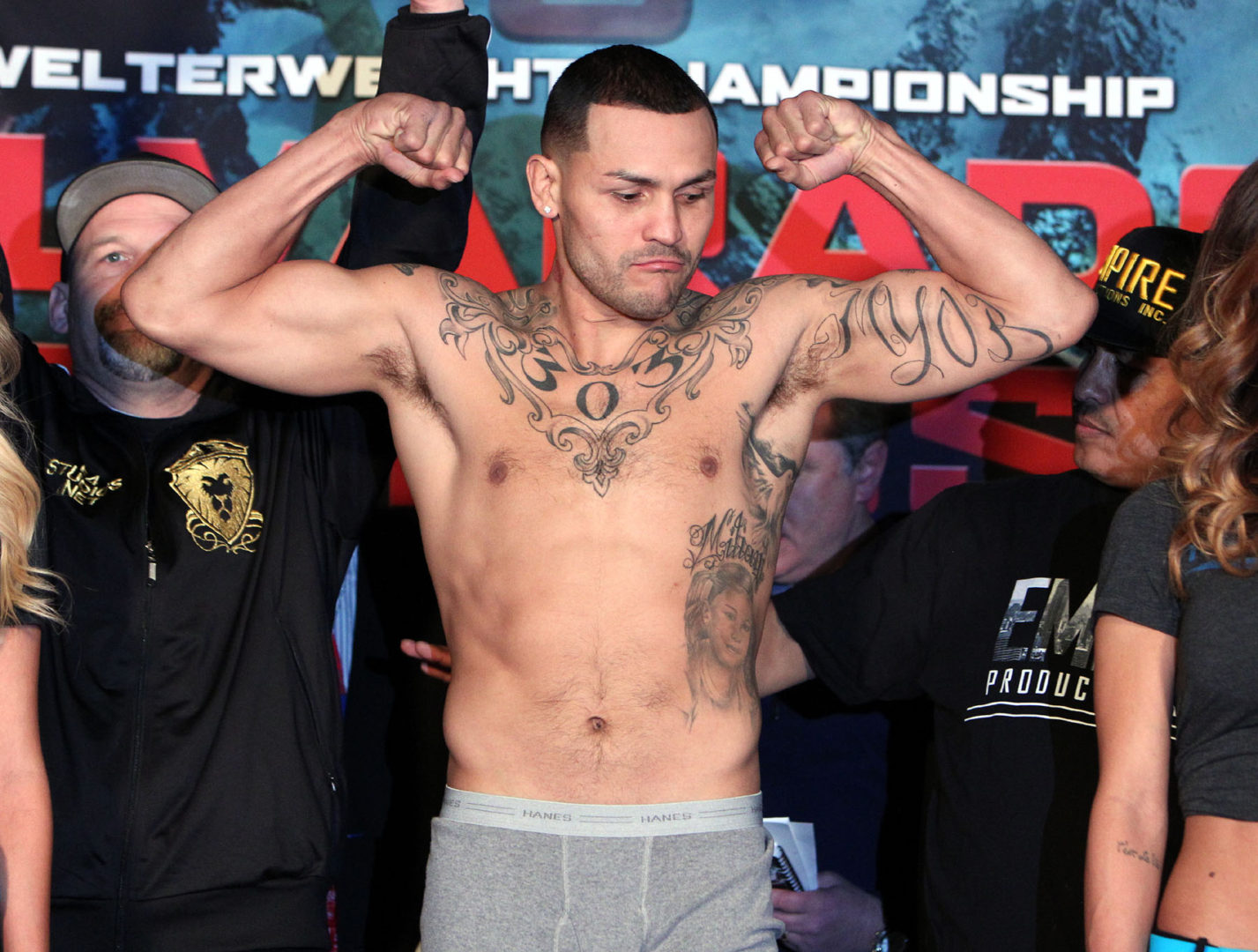


FOLLOW PACQUIO – ALGIERI LIVE FROM RINGSIDE

Pacquiao_Algieri_weighin_141121_001a
Follow all the action live from Ringside as Manny Pacquiao defends the WBO Welterweight title against undefeated WBO Jr. Welterweight champion Chris Algieri. The show begins at 9 PM ET / 6 PM PT / 10 AM in Macau with a three fight undercard that will feature two world title bouts. Jessie Vargas defends the WBA Super Lightweight title against Antonio DeMarco. Vasyl Lomachenko defends the WBO Featherweight title against Chanlatarn Piriyapinyo. Zou Shiming takes on Kwanpichit OnesongchaiGym.

12 ROUNDS–WBO WELTERWEIGHT CHAMPIONSHIP–MANNY PACQUIAO 56-5-2, 38 KO’S) VS CHRIS ALGIERI (20-0, 8 KO’S)

Round 1 Pacquiao lands a couple of body shots and Algieri moves around the ring…10-9 Pacquiao

Round 2 STRAIGHT LEFT AND DOWN GOES ALGIERI..Algieri lands a right..Pacquial lands a left…20=17 Pacquizo

Round 3 Algier lands a right..Straight left from Pacquiao..good combo finished off by a right hook..body/head combo..30-26 Pacquiao

Round 4 Pacquiao beginning to get inside and land quick and effective combinations..40-35 Pacquiao

Round 5 Leadping left from Pacquiao..50–44 Pacquiao

Round 6 PACQUIAO SCORES KNOCKDOWNS WITH LEFt HAND and the 2nd a right hook to head..60-51 Pacquiao

Round 7 Pacquiao landing quick combinations…Algieri lands a left to the body…70-60 Pacquiao

Round 8 Pacquiao controlling the fight..Algieri gets in an occasional jab…80-69 Pacquiao

Round 9 HUGE LEFT AND DOWN GOES ALGIERI…HES HURT…PACQUIAO ALL OVER ALGIER…HE TAKES A KNEE…Pacquio looking for the finish but the bell rings..90-76 Pacquiao

Round 10 LEFT UPPERCUT AND DOWN GOES ALGIERI...100-84

Round 11 Pacquiao dominating and lands a hard left and right...110-93 Pacquiao

Round 12

119-103, 119-103 and 120-102 for Pacquiao

12 ROUNDS–FLYWEIGHTS–ZOU SHIMING (5-0 1 KO) VS KWANPICHIT ONESONGCHAIGYM (27-0-2, 12 KO”S)

Round 1 Shiming lands 1-2..10-9 Shiming

Round 2 Big flurry from Shiming…BIG LEFT HOOK AND DOWN GOES KO..BIG RIGHT AND DOWN GOES KP..Huge flurry on the ropes at the bell...20-16 Shiming

Round 3 Shiming contuing to land combinations..30-25 Shiming

Round 4 KO lands body/head combo..Terrific two way action,,39-35 Shiming

Round 5 Sneaky right from Shiming..Right buckles KO..2 hard rights...49-44 Shiming

Round 6 KO deducted a point for a low blow..COMBINATION AND A SLIP BUT RULED A KNOCKDOWN FOR SHIMING..Combination to head and hard right from Shiming..59-51 Shiming

Round 7 Shiming jumps in with a right…69-60 Shiming

Round 8 KO lands a right..Left from Shiming…right..straight right..Shiming left eye cut and swelling…combination..79-69

Round 9 Shiming boxing and moving…89-78 Shiming

Round 10 Shiming bleeding bad from left eye…KO tags with a hard right that sets off a furious exchange..uppercut from Shiming..right from KO..98-88 Shiming

Round 11 Shiming jumping in with thw right..KO chasing Shiming around the ring..108-97 Shiming

Round 12 Right from Shiming…The get tanGLED UP BUT RULED A KNOCKDOWN FOR SHIMING…118-105 SHIMING

119-106, 119-106, 120-103…ZOU SHIMING

12 Rounds WBO FEATHERWEIGHT TITLE–VASYL LOMACHENKO (2-1, 1 KO) VS CHONLATARN PIRIYAPINYO (51-1, 33 KOS’S)

Round 1 CP lands a right…Lomachenko lands a left to the body..1-2..hard left to the body..boy comboo..10-9 Lomachenko

Round 2 Lomachenko boxing…20-18 Lomachenko

Round 3 Good combinaton on ropes from Lomachenko..hard 3 punch combo…30-27 Lomachenko

Round 4 Right from CP…Lomachenko lands a left to the body..hard right hook..HUGE COMBINATION,,,BIG LEFT AND DOWN GOES CP…40-35 Lomachenko

Round 5 Big counter left from Lomachenko..step around left..50-44 Lomachenko

Round 6Hard combination on ropes..60-53 Lomachenko

Round 7 Good counter right from CP..Hard jab and follow up right from Lomachaneko..70-62 Lomachneko

Round 8 80-72 Lomachenko

Round 9 Lomachenko jabbing..90-81 Lomachenko

Round 10 Uppercut from Lomachenko…Body shot..left..Body shot from CP..right...100-90 Lomachenko

Round 11 Hard left uppercut from Lomachenko..110-99 Lomachenko

Round 12 Lomachenlo landing combo on the ropes..120-109

120-107 on all cards for Lomachenko

12 ROUNDS–WBA SUPER LIGHTWEIGHT TITLE–JESSIE VARGAS (25-0, 9 KO’S) VS ANTOINO DEMARCO (31-3-1, 23 KO’S)

ROUND 1 Straight left from DeMarco…Jab from Vargas..10-9 DeMarco

Round 2 Vargas lands a right…Vargas cut under left eye…19-19

Round 3 Vargas lands a counter right…right..counter right..DeMarco lands a right hook..right to the body..Straight right to body from Demarco..left uppercut…29-28 Vargas

Round 4 Counter left from Vargas..quick right..right to body..combo to head..left to body..hard counter right..right to body…39-37 Vargas

Round 5 2hqrd rights from Vargas..Vragas lands a combo on the ropes..lead right..49-46 Vargas

Round 6 Quick combo from Vargas.right to body..1-2..Combo from DeMarco..counter left from Vargas..59-55 Vargas

Round 7 Right to bidy from DeMarco..1-2…DeMarco bleeding around the right eye..Good exchange..Vargas working body…68-65 Vargas

Round 8 Jab from Vargas..Left from Deamrco..right from Vargas on the ropes..Body shot..3 punch combo..Straight left from DeMarco..left…Hard combo from Vargas….78-74 Vargas

Round 9 Right from Vargas…Hard left from DeMarco rocks Vargas into the corner..Great toe to toe action..hard 1-2 from Demarco..2 good uppercuts..hard left hook from Vargas...87-84 Vargas

Round 10 Left rocks Vargas..right from Vargas..right to body..uppercut from DeMarco..combo from Vargas…97-93 Vargas

Round 11 Jab from Vargas…counter right..107-102 Vargas

Round 12 Jab from Vargas..straight right..4 punch combo..117-111

116-112 on all cards for Vargas


Pacquiao not Algieri’s toughest challenge, says trainer

By Norm Frauenheim–
Pacquiao_Algieri_NYDailyNews_140905_001a
Chris Algieri has had tougher fights than Manny Pacquaio, Algieri trainer Tim Lane said Thursday before Pacquiao trainer Freddie Roach said the Filipino would score a a knockout within three rounds.

From opposite corners, the trainers had widely — wildly too — different views on how things will play out in a 144-pound bout scheduled for midday Sunday in the Chinese gambling mecca of Macao and Saturday night (9
pm EST/6 pm PST) on HBO pay-per-view.

If Lane is right, it’ll be the biggest boxing upset in Asia since Buster Douglas’ 1990 knockout of Mike Tyson in Tokyo. If Roach is right, it’ll be a quick end to what would be Pacquiao’s quickest finish since a third-round stoppage of Erik Morales in 2006 and his first stoppage of any kind since a 12th-round TKO of Miguel Cotto in 2009.

In a conference call from China, there wasn’t much agreement, other than the respective degrees of difficulty. Neither corner is expecting it to be too tough. That wasn’t a surprise from Roach, who all along and in so many ways has been saying that Algieri is overmatched. But it was a surprise from Lane.

Pacquiao is Algieri’s greatest opportunity. But, Lane said in a matter-of-fact tone, Ruslan Provodnikov was a tougher fight.

“What he did to Ruslan, he did with one eye,” Lane said of a June 14 bout in which Algieri got up from two first-round knockdowns and fought with his left eye swollen shut for a stunning split decision over the favored Russian. “I thought he would have a flawless victory against Ruslan. I did not find that to be our toughest challenge. But he wound up getting hurt in the first round. When we were offered the Manny Pacquiao fight, I believed that this was not as tough a fight as Ruslan. Styles make fights. Manny Pacquaio, being a lefty and what he brings to the table, I do not find that to be as challenging as it was with Ruslan.

“So, I believe Chris will dominate Pacquiao more so than he did Ruslan. With two eyes.”

Safe to say, Lane’s bold comment was an eye-opener.

Algieri is at least an 8-to-1 underdog. That’s not quite the 42-to-1 underdog Douglas was nearly a quarter of a century ago. Nevertheless, it still means that Algieri’s chances are thought to be somewhere between slim and none.

“I’m absolutely expecting a KO,” Roach said. “He’s in way over his head.”

Algieri has advantages in height and reach. His educated footwork, Lane said, will allow him to elude Pacquiao’s power, which he launches from countless angles. But Roach said that Algieri has never encountered Pacquiao’s kind of speed.

“Once he gets in the ring, he’ll be shocked,” Roach said. “That’s why it won’t last more than three rounds.”

Pacquiao has beaten fighters bigger than he is. But Lane called them “zombies.” They were tough guys who didn’t know how use their feet in the subtle dance that takes thinking fighters out of harm’s way, Lane said. When asked if would he identify some of the zombies, Lane declined. Then, he was asked if he was talking abut Antonio Margarito, who was bigger than Pacquiao, yet lost a bruising unanimous decision to the Filipino four years ago at Cowboys Stadium in Dallas.

“Yeah, that’s the guy,” Lane said.

Roach’s confidence in an early KO is rooted in what he saw and felt in training. Pacquiao worked harder than he has in years on the heavy bag, Roach said. Renewed energy and power were so evident in sparring that Roach said that he jokingly warned Pacquiao not to stop Algieri too quickly. Talk about a Pacquiao-Floyd Mayweather showdown has been re-ignited in the build-up for the Algieri fight. If Pacquiao scores a quick and impressive KO, would Mayweather back away from the rumored possibility?

“Definitely, definitely,” Roach said.

No matter what’s next, however, Pacquaio might not be able to contain his power. Roach said the Filipino knocked him down with a left hand in training.

“Hit me in the chest,” Roach said.

The power, Roach said, was enough to launch him into a somersault, which also might have been one way to
celebrate an old feeling.


Pacquiao-Algieri: From opposite ends

By Bart Barry
Pacquiao_Algieri_WSJ_140905_001a
Saturday at the Venetian in Macau, Filipino Manny Pacquiao will defend his welterweight title against New Yorker Chris Algieri, a junior welterweight titlist. It is a fight somewhat intriguing because, while few aficionados imagine the match will be close, a number disagree on its likely victor.

Perspective plays a larger role than usual in determining where an aficionado finds himself on the question of Chris Algieri’s chances against Manny Pacquiao, prefight. Looking through one end of the telescope, Algieri is fully outclassed by the prizefighter after whom this era likely will be named, a man who, in going 6-2-1 (3 KOs) against the combination of Marco Antonio Barrera and Erik Morales and Juan Manuel Marquez, each a hall of famer in his prime when he fought Pacquiao, set a mark unrivaled by anyone currently plying the craft.

It is not stated often enough: Manny Pacquiao made nine matches with the best fighters in his and their best weightclasses, and six of them were rematches.

Much of what has transpired in Pacquiao’s career since his second match with Marquez, in 2008, is noteworthy for its remarkable promotion – by Bob Arum and HBO – and matchmaking by Top Rank’s brain trust. Pacquiao has grown his weight and stature by decisioning larger, slower, betterfed men than those whom he blitzed at 126 and 130 pounds. Recently Freddie Roach expressed equal parts awe and annoyance with his charge having gone to welterweight for a special-attraction purse against Oscar De La Hoya at the end of 2008, and then having been returned there nine more times.

Roach is mocking and scornful, edgier than usual, too, when he broaches the issue of Algieri’s advantage over Pacquiao in height and reach, and nutritional scholarship and culinary acumen, perhaps because Roach’s other charge, Ruslan Provodnikov, in losing a narrow decision to Algieri in June, became the New Yorker’s career springboard. Roach refuses to sing along with a promotional chorus that implies Pacquiao is new to fighting men longer than he is; forgotten to many aficionados, though fewer who were ringside at Cowboys Stadium four years ago this week, was the absurd physical superiority Antonio Margarito enjoyed against Pacquiao, the absurd chemical state into which Margarito placed himself with ephedrine and caffeine before making his ringwalk, and the absurd language Pacquiao employed in an abandoned concrete corner of Cowboys Stadium afterwards, saying Margarito hurt him badly enough with a body punch Pacquiao was lucky to have lived.

And no, Pacquiao has never been the same fighter since that match with Margarito. And no, Algieri has nowhere near Margarito’s physicality or championship experience.

The Manny Pacquiao who annihilated Ricky Hatton in 2009 would go through Chris Algieri and every male resident of his dad’s Long Island home in fewer than three rounds. That Pacquiao was, to employ trainer Nacho Beristain’s memorable phrase, “a wildcat” – and an indefatigable one at that. But the Pacquiao we last saw in April is a markedly different creature.

Five years removed from his last knockout victory, two years removed from his last knockout loss, Pacquiao now keeps a running scorecard in his head while he fights, ensuring no motion is wasted once a round is won. He’s still a man only the era’s purest offensive technician, Juan Manuel Marquez, should dare an even-terms exchange with, but he’s no longer a man who preys on timid opponents.

Algieri will be happy to use tactical timidity against Pacquiao, since not-fighting Pacquiao will discomfit Manny considerably. Algieri, as anyone near boxing is well past tired of hearing, is not a typical boxing story – though if he were the product of Harlem homelessness and a stepdad who abused him and a saintly retired cop who ran a gym in the basement of a church where he taught Chris to throw the old one-two, of course, we’d still hear he’s not the typical boxing story. It’s publicist twaddle.

Like most everything about boxing, Algieri’s likability is inversely proportionate to his distance from a ring; when he’s fighting offensive forces like Provodnikov or Pacquiao he’s quite likable, and when he’s appearing on heavily edited HBO infomercials he’s likable enough, and when he’s posting his meals and topless selfies and inspirational bromides on Twitter he is a douchebag – as the kids are saying it these days. What he has that should make him different from other of Pacquiao’s considerably better and consistently vanquished opponents, though, is a sense of entitled superiority Pacquiao may not be able to dent.

Pacquiao glides through life today, looking only forward, in a way few others can or have – though Arnold Schwarzenegger comes to mind as an analogous example. But Algieri still would not trade places with the Filipino. When Algieri says spending time round Pacquiao during their kickoff media tour convinced him he belongs in such company, there’s the faintest hint of disappointment in Algieri’s voice: I thought I would have my identity challenged enough to learn things about myself and others I didn’t already know, but, well, it turned out I was prepared for all this already, and Manny’s a good guy, I like him, and Freddie, too, honestly, even if he doesn’t like me.

Some of that really may be attributable to nutrition; coming of age when and where he did, Algieri’s access to what nutrients grow potent brains was likely greater than young Pacquiao’s and young Roach’s combined. Much of it is classifiable for the time being as luck; how certain experiences order certain person’s lives in unique ways. Little of it is attributable to what hard work and dedication American autobiographers fetishize; notice how infrequently someone like Pacquiao references his own work ethic – for coming from a place where working hard and being dedicated earn you about an extra $1/day.

Pacquiao should win Saturday, and not merely because no judge who wishes to enjoy his Sunday in Macau would score a close round for the New Yorker. Pacquiao should win Saturday, and neither fighter’s current career or life trajectories will be altered by it in the slightest.

Bart Barry can be reach via Twitter @bartbarry