Follow Klitschko – Pulev Live

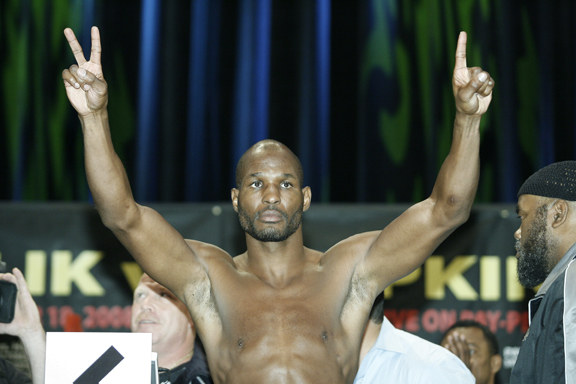
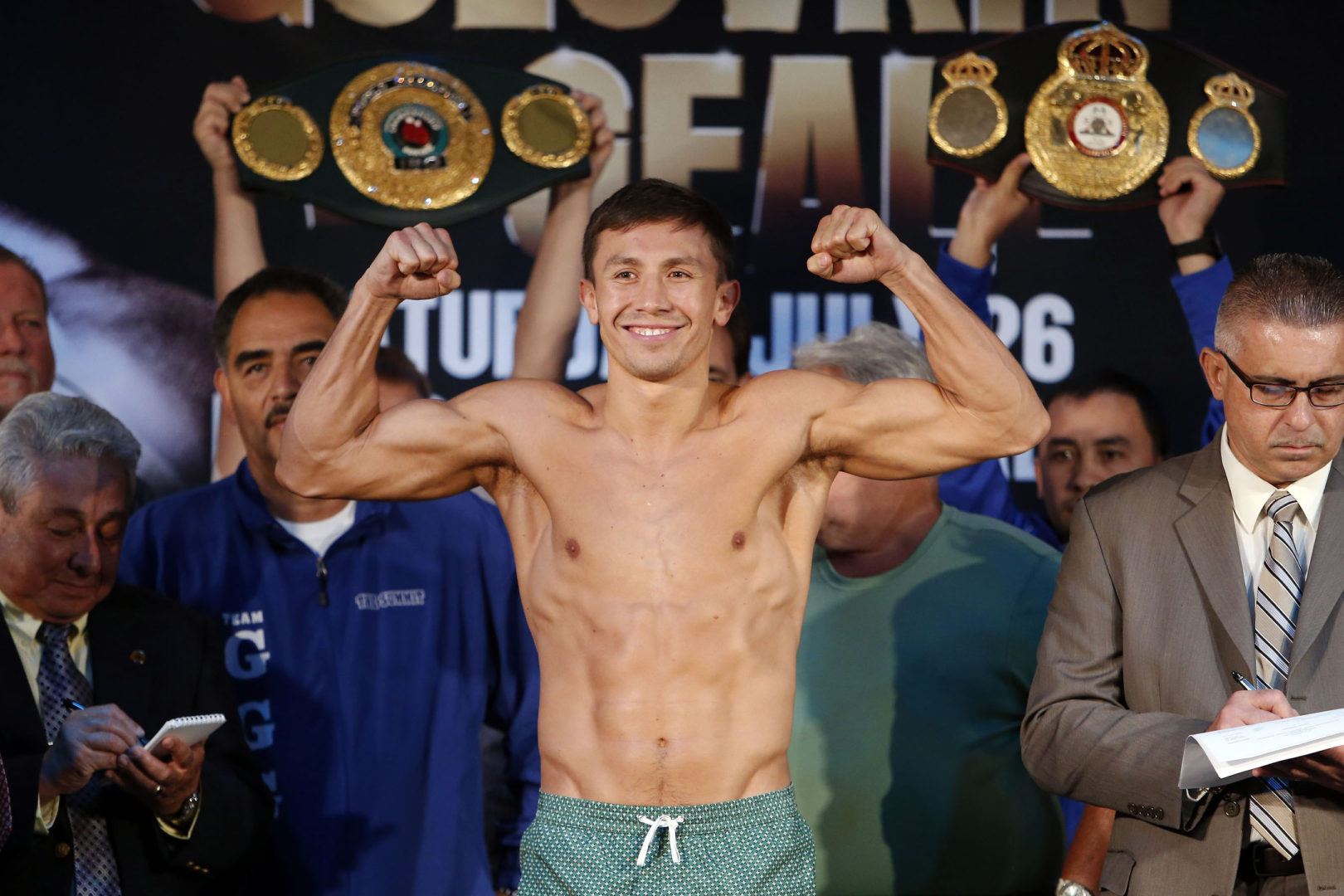
Klitschko_Pulev_weigh in
Follow all the action live from Heavyweight champion Wladimir Klitschko defends his titles against undefeated Kubrat Pulev. The action begins at 4:45 ET / 1:45 PT

12 ROUNDS–WORLD HEAVYWEIGHT CHAMPIONSHIP–WLADIMIR KLITSCHKO (62-3, 52 KOS’S) VS KUBRAT PULEV (20-0, 11 KO’S)

Round 1 HUGE LEFT AND DOWN GOES PULEV…ANOTHER HUGE EFT AND DOWN GOES PULEV..Klitschko lands a right…10-7 Klitschko

Round 2 Pulev lands a jab…right lands for Klitschko..hard left hook..20-16 Klitschko

Round 3 Pulev lands a body shot..Hard right wobbles Pulev..LEFT HOOK AND DOWN GOES PULEV..30-24 Klitschko

Round 4 Pulev lands a left and right…left hook from Klitschko…Left hook40-34 Klitschko

Round 5 Hard right from Klitschko..Hard rght from Kulev..HUGE LEFT FROM KLITSCHKO AND DOWN GOES PULEV AND THE FIGHT IS OVER

Round 5


A Collective Face: Fighter of the Year is the current generation from the old Soviet bloc

By Norm Frauenheim-
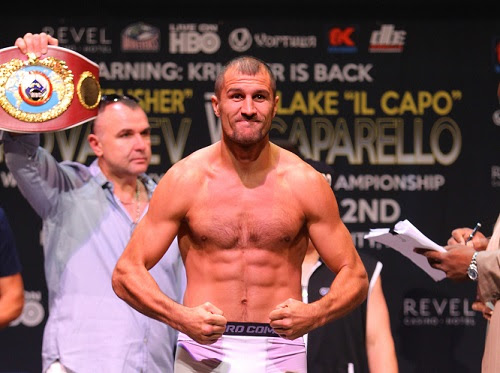
Sergey Kovalev
Sergey Kovalev’s victory over Bernard Hopkins was one thing. His dominance was something else. After awhile, the benefit of hindsight will make Kovalev’s win look predictable. Nobody ever whips the clock, although Hopkins did it longer than anyone ever has. The shutout on the scorecards, however, was a stunning testament to a Kovalev skill set that had been unappreciated as much as it had been unexpected. It meant something else, too.

If there was ever a time and place to say that the ex-Soviet fighter has arrived, it was there, Saturday night in Atlantic City, with Kovalev’s thorough and patient triumph over an acknowledged master. There was an underlying assumption that the clever Hopkins would force Kovalev into an adjustment that would result in a critical mistake. There was a lot of talk about how Kovalev had never been beyond eight rounds. Translation: In the end, he would fight like a Russian. Didn’t happen, mostly because that stereotype no longer exists. For years, Soviet fighters were said to be tough, well-conditioned and powerful. But they were robotic and unable to think on their feet.

Like the Berlin Wall, that stereotype has fallen onto history’s scrapheap, gone for good. By going a full 12 rounds against Hopkins, Kovalev scored a symbolic stoppage of an assumption that might still linger had he knocked out a man just two months shy of his 50th birthday.

Kovalev proved himself to be more than a power puncher. He went the distance for a thorough, light-heavyweight victory over one the smartest guys ever in the ring. Fighters from the old Soviet Union aren’t thinkers? Think again.

Wladimir Klitschko has long been a thinking man’s fighter. For some reason, however, his smarts never captured
the U.S. imagination, perhaps because all of America’s best heavyweights are middle-linebackers and defensive ends these days. But Kovalev’s victory over Hopkins might awaken new found respect for Klitschko, who hopes to extend his eight-and-half-year-long heavyweight reign Saturday against Kubrat Pulev in Germany.

In the days since beating Hopkins, Kovalev has begun to show up in the pound-for-pound debate. P4P is an overrated exercise, to be sure. But it’s noteworthy this week, simply because of who else is already in many of the mythical ratings. In the ESPN edition, Kovalev is a new addition at No. 9. He’s one of three fighters from the old Soviet empire among the top 10. Middleweight Gennady Golovkin, of Kazakhstan, is No. 6. Klitschko, of the Ukraine is No. 8. Three fighters from old the Soviet bloc amount to more than from any other region in the world on a list hat includes two Americans, Floyd Mayweather Jr. at No. 1 and Timothy Bradley at No. 4.

There’s a theory that fighters from the discarded Soviet system are emerging because they now are forced to be creative. Dmitriy Salita, today a promoter and a former welterweight from the Ukraine, once told me that under the Soviet style every step in a fighter’s plan was marked down, rehearsed and memorized. Even the footwork was programmed, Salita said. But with the end of Soviet control, fighters, like entrepreneurs, had to hustle, which meant thinking for themselves. Hence, we have a Kovalev, a Golovkin, a Klistchko and others who one day might be included in the pound-for-pound debate. Featherweight Vasyl Lomachenko is a good possibility.

In 2014, it mean just one thing:

The collective — no pun intended — face of the fighter from the old Soviet Union should be Fighter of the Year.


Kovalev-Hopkins: The fight of 2014

By Bart Barry-
Sergey Kovalev
The most unexpected thing shared by guys who hit hardest is rarely how hard they hit or the speed of their attack. No, what surprises most about those guys is the nimbleness with which they take a backwards step the first three or four times you try to attack and smother them, their balletic willingness to move away from you in a tactical retreat and geometric adjustment that puts you at the end point of their punches. Where it hurts the most.

It was that willingness and ability with a backwards step or two, Saturday night in Atlantic City, that allowed Russian light heavyweight titlist Sergey “The Krusher” Kovalev to toss a shutout at American titlist Bernard “The Alien” Hopkins, in a unification match official scorekeepers had 120-106, 120-107 and 120-107.

Kovalev-Hopkins was, is, our sport’s fight of the year. Not its best fight, no, much nearer its worst, in fact, but the fight that best represented the state of our sport in 2014, the year a man nearing his 50th birthday challenged and imperiled himself more than any of our standard bearers in their primes. Sergey Kovalev, an elite-level fighter, was unable to knock-out Bernard Hopkins, despite trying to do so sporadically in the fight and sustainedly in its closing minutes. Hopkins is extraordinary, yes, but any path to alien extraordinariness is eased when one’s era is so fantastically ordinary.

There is a heaviness and a dullness, an ache more than a pang, about treating Saturday’s light heavyweight unification match. Postfight, the highest tribute paid its winner, a 31-year-old known as “Krusher,” was that he was disciplined in his pursuit of a 49-year-old man, that he did not do anything rash like throw a hundred punches every round or run his fellow titlist into retirement, that he demonstrated prudence in becoming the unified world champion of a storied division. So it goes this year: Prudence against a man Hopkins’ age is a blazon of excellence.

Is that revisionist? Yes, but only slightly. There was a healthy percentage of knowledgeable boxing folks, myself included, who thought Hopkins might beat Kovalev, when Saturday’s opening bell rang. But those ideas disappeared, went wanting in full, fewer than 60 seconds later. Following something like the strategy he followed against Kelly Pavlik, flying at a younger man with an unexpected aggressiveness he expected to have a disruptive effect, Hopkins wheeled and crossed-over, trying to hit Kovalev on his second or third step. But Kovalev was three steps out of Hopkins’ range before Hopkins’ back foot completed its odyssey to front. Hopkins moved – in Larry Merchant’s memorable phrase – like a man “in amber.”

It was a moment of instant sadness. That quickly, the air became full of worry those viewing the match were about to see a man well past his physical prime assaulted to unconsciousness or worse by someone 18 years his junior. Nearly worse still was the possibility a man so exaggeratedly beyond his physical prime might somehow become a unified world champion, through force of wiles, yes, but even more through opponent incompetence.

“I feel bad for watching this, jeez” – that was the first comment I heard after the opening bell, Saturday, in a roomful of knowledgeable boxing people, the majority of whom still attend boxing gyms regularly, and it was said by an astute observer who gave Hopkins a chance to win the match only a minute before.

It was that sort of start for Hopkins. He got dropped by a counter righthand thrown by Kovalev as the Russian hopped backwards in round 1. Hopkins rose and looked at the canvas, a tick of embarrassment more than a try at fooling referee David Fields, a man unknown to viewers as what three judges got assigned to the main event, and concluded the round, and the round after that, with a look that was more frightened than concentrated or studious.

Under John David Jackson’s tutelage, Kovalev took Hopkins’ strategy away from him, by quickly giving Hopkins a thought he’d not seriously had before – I could get hurt very badly tonight – and then using that disruption to keep Hopkins from ever executing anything the way he wished to. There were 10 or 15 seconds, in a fight comprising 2,160 of them, when Hopkins made an offensive maneuver that went according to plan, catching Kovalev with a left hook here and counter right there, but those punches had no effect on Kovalev, save provocation.

When Hopkins got Kovalev with a punch that stung, the Russian went after Hopkins, making him fight at a pace, and with a series of consequences, Hopkins wanted no part of. Kovalev succeeded, mostly, by taking Hopkins more seriously than any opponent Kovalev faced before, by giving Hopkins’ power considerably more leeway than it merited, and by mixing his flurries with enough inactivity that Hopkins never recognized a rhythmic pattern enough to do anything disruptive himself.

The fight’s final round was almost good enough to make folks forget how dreadful its 11 predecessors were, as Hopkins fought to win something much more important to him, by then, than his fight with Kovalev; Hopkins fought the final round to win a right to choose his retirement date. Had Hopkins, whose head got snapped in a bunch of directions by Kovalev’s fists in round 12, been dropped awkwardly or severed from his consciousness long enough to get a doctor in the ring, nothing about Hopkins’ pending retirement would have been voluntary.

Athletic commissions, even those representing poleis desperate for revenue as Atlantic City’s, would have banded together and helped Hopkins out of the sport, on terms other than his own. Journalists, too, might have followed Carlos Acevedo’s admonishment and asked how a PED-free athlete could improve after his 35th birthday in an era dominated by PED-using athletes.

Instead, by fighting fully the most-feared prizefighter in his division, and absorbing dramatically that man’s best punches, Hopkins won for himself a chance to announce his retirement at a leisurely pace. One hopes that pace nevertheless ends before 2014 does.

Bart Barry can be reached via Twitter @bartbarry


Encounter of Another Kind: Hopkins’ many lives get a defining challenge in Kovalev

By Norm Frauenheim-
pavlikhopkinsweighin_hoganphotos_3sm
Bernard Hopkins’ life as street thug, ex-con, Congressional witness, peace-maker, fighter, promoter, pundit, provocateur, butcher, baker and candlestick maker includes different nicknames, a couple of masks and roles only he knows are still within him.

“I’m not human,” Hopkins said in a recent conference call.

But he is.

There’s an endless array of humanity jammed into that one being who over the many years has been called Inmate #Y4145, The Executioner, B-Hop and today The Alien.

It’s what makes him so compelling. So challenging.

He shows us what is humanly possible on either side of those proverbial ropes. He’ll have to do it all over again Saturday night in Atlantic City against Sergey Kovalev in a light heavyweight-fight (HBO 10:45 pm ET/PT) as intriguing as any bout in the last year.

By now, circumstances confronting Hopkins have been documented and over-analyzed. Kovalev’s power and relative youth – he’s 31 – are a couple of factors that some think will finally stop Hopkins’ unprecedented defiance of time’s inevitability. He’ll be 50 in January.

Half-a-century is a long time anywhere. For anybody whose mileage has taken them past that birthday and deposited them in the senior-citizen division, Hopkins’ resilient ability to fight on is science fiction-like.

Hopkins swims as part of his training regimen these days. While watching him in the water during HBO’s pre-fight documentary, I wondered if there was a youth-restoring Cocoon from director Ron Howard’s 1985 Academy Award-winning movie at the bottom of that Philadelphia pool.

It’s alien all right, which explains that silly green mask that Hopkins wears. It’s not because he’s trying to hide a gray beard. He has always understood that boxing is a mix of sport and theater. Maybe, Kovalev will prove to be nothing more than just another vanquished face in his supporting cast. I think not. I predicted a Kovalev victory by decision for The Ring. http://ringtv.craveonline.com/news/362819-who-wins-bernard-hopkins-sergey-kovalev

Then again, I picked Hopkins to lose to Kelly Pavlik in 2008. Maybe, I should start wearing a fool’s mask.

Truth is, Hopkins is already a winner. The fight could get ugly, which might diminish what has already been accomplished. Nevertheless, Hopkins has done what you expect of somebody about to turn 50.

To wit: He’s become role model for a sport that badly needs one.

In stepping up to fight an emerging star and one of the game’s most feared punchers, he has embarrassed pound-for-pound contenders who are more than a couple of decades younger.

Hopkins reminds us – and hopefully them – that building a legacy is serious business. It’s a not a mere logo for a souvenir. Floyd Mayweather Jr.’s pursuit of legacy has begun to look manufactured. His TBE — The Best Ever – is on T-shirts and caps. Wonder if Manny Pacquiao has bought one? For a bonfire, maybe.

The Best Ever is not possible with a fight against the best. That’s what Hopkins is doing in his decision to face Kovalev. The build-up to the bout has included much of what is often attached to a Hopkins fight.

Race became an issue when he told ESPN that the fight is not a cover piece for Sports Illustrated or other major media, because he’s black. Because his last name isn’t Marciano or Stern, he said.

The comments, of course, generated some major-media coverage. It also was nothing new from Hopkins, who once said retired NFL quarterback Donovan McNabb wasn’t “black enough” and told Joe Calzaghe that he could never go back to the projects if he let “a white boy’’ beat him.

Any discussion of race these days is on the wrong side of the politically-correct fence. But when has race not been a part of boxing? It is the sport, after all, that created The Great White Hope, a term still used. Agree with Hopkins. Disagree with him.

But thank him for his honesty. He’ll never be able to mask that or anything else in a life full of evolving lessons about what humans shouldn’t do and what they can be. That’s a victory on any scorecard.


SHOWTIME BOXING TO CLOSE OUT 2014 WITH ADONIS STEVENSON TITLE DEFENSE AGAINST TOP-10 RANKED CONTENDER DMITRY SUKHOTSKIY FRIDAY, DEC. 19 FROM PEPSI COLISEUM IN QUEBEC, CANADA

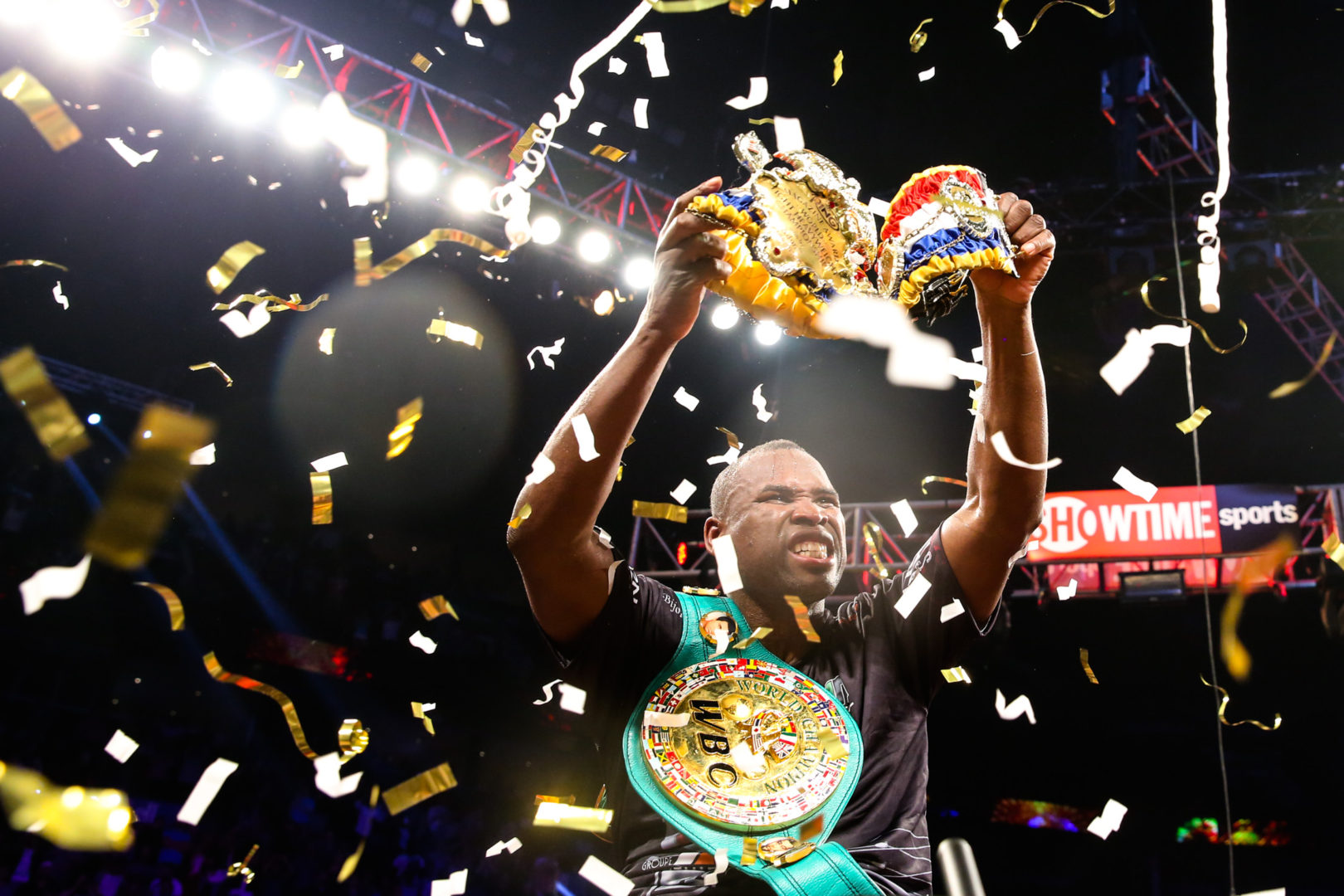
Adonis Stevenson
NEW YORK (Nov. 5, 2014)–-SHOWTIME Sports will close out its 2014 boxing calendar with the return of WBC and The Ring Magazine Light Heavyweight World Champion Adonis “Superman” Stevenson as he defends his title against top-10 ranked Russian challenger Dmitry “The Hunter” Sukhotskiy in the main event of a SHOWTIME BOXING: Special Edition on Friday, Dec. 19, LIVE on SHOWTIME at 9 p.m. ET/PT.

Stevenson will once again headline in his adopted home province of Quebec for his ninth consecutive fight and his fourth world title defense. The showdown will originate from Pepsi Coliseum in Quebec City and is presented by Groupe Yvon Michel (GYM) in association with Mise-O-Jeu and Videotron.

In the co-feature of the stacked quadrupleheader, former world title challenger and super middleweight contender Andre Dirrell (23-1, 16 KOs) will return to SHOWTIME for the first time since appearing in the Super Six World Boxing Classic in 2010. Dirrell will face an opponent to be announced in the super middleweight division.

Once-beaten Kevin Bizier (23-1, 16 KOs) will face the only man to defeat him, fellow welterweight contender Jo Jo Dan (33-2, 18 KOs), in a rematch of their 2013 split-decision showdown. The winner of Bizier-Dan II, a 12-round welterweight bout, will determine the mandatory challenger to IBF Welterweight World Champion Kell Brook.

In the opening bout of the telecast, undefeated light heavyweight contender and two-time Russian Olympian Artur Beterbiev (6-0, 6 KOs) will face fellow unbeaten Jeff Page Jr. (15-0, 10 KOs) in a 10-round 175-pound bout.

The 37-year-old Stevenson (24-1, 20 KOs) is coming off a hard-fought unanimous decision victory against Andrzej Fonfara in his SHOWTIME debut this past May 24 in which the champion was knocked down for just the second time in his career. Stevenson started strong, scoring two early knockdowns of his own and was cruising to an easy win until Fonfara battled back and floored the champ in the ninth round. The two went toe-to-toe from then until the final bell, with Stevenson prevailing with a convincing victory.

Stevenson, one of the most exciting and destructive fighters in boxing, had a breakout year in 2013. He won the WBC crown with a first-round knockout of Chad Dawson and then followed up that performance with two successful title defenses, against Tavoris Cloud and Tony Bellew, to close out one of the most impressive campaigns of the year.

Now, the Haitian-born slugger will face the 33-year-old Sukhotskiy (22-2, 16 KOs), a former world title challenger currently ranked No. 7 by the WBC and WBO, and No. 8 by the WBA. Sukhotskiy challenged for the WBO Light Heavyweight World Championship against then-champ Juergen Braehmer in 2009 and lost in the champ’s hometown in Germany.

Sukhotskiy, who has never been stopped, is currently riding a four-fight winning streak that features three knockouts. He’s just one fight removed from a career-best win, a fifth-round TKO of former world title challenger Eduard Gutknecht, and owns a 2011 second-round TKO over current IBF light heavyweight No. 1 contender Nadjib Mohammedi.

Ranked in the top 15 in all four sanctioning bodies (11th in the IBF), Sukhotskiy has fought in his native Russia for all but three of his professional bouts and has seven knockouts in his last nine fights.

Dirrell, of Flint, Mich., was one of boxing’s fastest-rising contenders entering the innovative Super Six tournament, which matched the top super middleweights in a round-robin tournament to determine the best in the division. Undefeated when he entered the tournament, Dirrell traveled to England in 2009 to challenge then-WBC champ Carl Froch in his hometown, losing a close, disputed 12-round split-decision.

In his next bout in the tournament, Dirrell faced then-unbeaten Arthur Abraham and was winning on all three judges’ scorecards when Abraham was disqualified in the 11th round for punching Dirrell while he was defenseless on the canvas after slipping on the wet surface. The former Olympic Bronze Medalist suffered neurological issues as a result of the punch, withdrew from the tournament and stepped away from boxing for 21 months.

The 31-year-old Dirrell, the older brother of WBC Super Middleweight World Champion Anthony Dirrell, is undefeated since his return to the ring, winning three of his four bouts by knockout. The switch-hitting southpaw has been called one of the most athletically gifted fighters of today. At this point in his career, he is looking to reassert himself as one of the top fighters in the sport.

Quebec’s Bizier, 30, a pro since 2008, was undefeated and the favored fighter heading into his first showdown with fellow contender Dan. The two battled for 12 action-packed rounds with Dan taking a split decision – 116-111, 114-1113 for Dan and 117-110 for Bizier. Dan controlled the early rounds; Bizier the later sessions of a thrilling fight.

Still a top contender at 147 pounds, Bizier has recorded consecutive knockouts in 2014 including his most recent performance, a first-round TKO of Laszlo Fazekas in Montreal this past September. Bizier is ranked No. 6 by the IBF and will get his first shot at a world title if he avenges the loss to Dan.

The 33-year-old Dan was born in Romania and has campaigned for most of his career in Canada. The only blemishes on the southpaw’s record are a pair of close, controversial decision losses to then-undefeated contender Selcuk Aydin – the first in 2010 and the second in 2011 – both in Aydin’s native Turkey.

Dan, whose full name is Ionut Dan Ion, has registered four consecutive wins since the 2011 loss to Aydin and is coming off a fifth-round TKO over Lukasz Janik on the Stevenson-Fonfara undercard in May.. A consensus top-10 fighter, Dan is currently ranked No. 2 in the IBF, No. 6 in the WBC and No. 8 in the WBA.

Beterbiev is fresh off a dominating second-round TKO of former IBF light heavyweight champ Tavoris Cloud on Sept. 27 in Montreal in which he floored the former champion four times in less than 4 minutes. An amateur standout who turned pro in June of 2013 and has campaigned exclusively in Canada, the highly regarded Beterbiev has knocked out all of his professional opponents in four rounds or less.

The 29-year-old Beterbiev, who holds two amateur victories over current WBO Light Heavyweight Champ Sergey Kovalev, is already ranked in the top-10 by the WBO (No. 10) after just six professional fights and 26 rounds of boxing.

The 24-year-old Page, of Andover, Kansas, is a former college linebacker. He turned professional in March 2013 and fought 10 times in nine months, facing limited opposition. Page has registered two consecutive knockouts and is coming off a fifth-round KO of Maxwell Taylor in October.

Tickets, ranging from $25.00 to $250.00, will go on sale next Thursday, Nov. 6, at 10:00 a.m. ET, in the branches of the Pepsi Coliseum in Quebec (418) 691-7211 or 1 (800) 900-7469, online at www.billeteck.com, at GYM (514) 383-0666 or Boxing Club Champion (514) 376-0980.


Mental alignment, Bernard Hopkins and Sergey Kovalev

By Bart Barry–
Bernard Hopkins
SAN MARCOS, Texas – Three miles southwest of Texas State University is a mostly waterless stretch of terrain called Purgatory Creek Natural Area, a verdant place complete with trails named after Dante, Ripheus, Ovid and Beatrice, for those with an Italian literary bent.

Saturday at Boardwalk Hall in the American purgatory of Atlantic City, light heavyweight Bernard Hopkins and Russian Sergey Kovalev will make the most meaningful fight of 2014.

The above sentences are related, though how they are will not be apparent for a while to come.

What also may come is the day boxing makes a concerted – in the sense of coordinated – attempt to win back what fans it lost in the first half of the second decade of this 21st century, a time of fan exodus that began in the early weeks of 2010, the first time the world’s best and second-best practitioners refused to make a contest with one another despite occupying the same weightclass. A day of fans’ collective return to our sport, however, is of no consequence right now because boxing faces a nigh existential crisis this year of aficionado departures.

The casual fans are long gone, shuffling steadily if quietly away under a rainstorm of “good riddance!” from purists who didn’t know any better, and the consequences of their departure and ways they will be missed is not entirely knowable yet but guessable certainly. To indulge a hunt for those consequences, though, is an indulgence indeed in 2014 – the year our sport became so easy to abandon. This is not a crisis that will find remedy from a new television deal or browbeating about boxing’s redounding popularity in Dublin and Dubai and Dunkirk and Dongguan; boxing gyms are empty in all but a few cities in the U.S., a country that once dominated the sport and now anxiously hopes its next Olympic gold medal comes only a dozen years after its last.

This crisis finds illustration of the most ambiguous sort on Saturday, when a 175-pound American who is months from his 50th birthday makes a title-unification match with a talented Russian who is 31 years-old but still young enough to be his opponent’s son.

About a year ago, Sergey Kovalev’s first American trainer, Don Turner, said the difference between Kovalev and Hopkins was the Russian is “mean” where the American is “cunning.” Whatever the efforts at image revision – Snuggly Sergey Bedside with Wife / Speedbag Sergey Ringside with HBO – Kovalev remains the only prizefighter anyone can remember increasing his knockout percentage after causing another man’s death in a boxing ring. He smiles so much in interviews because he’s been told to do so, and because he hasn’t more than a kindergartner’s grasp of English, and because he doesn’t care what you are asking anyway. In a sport comprising exclusively men willing to hurt another man for a paycheck, there’s a good argument to be made Kovalev is the exact last man you’d wish to meet in the dark alley of badness’ proverbs.

And yet, Bernard Hopkins, a man willing to give a safety-first effort to the unlikeliest opponents, initiated a match with Kovalev, at the very moment it appeared Hopkins might have made the same dollars fighting the more limited, if possibly insane, Haitian titlist Adonis Stevenson. In an era of men burnishing their credentials as Most Avoided by avoiding bigger men, Hopkins rushes at them, men like Antonio Tarver, Chad Dawson and Kovalev, all considerably larger on their 30th birthdays than Hopkins was in 1995.

While ever a delight to himself, Hopkins is a blossoming embarrassment for most of his prizefighting countrymen, showing at age 49 a willingness to fail, and be badly injured, few of today’s best American fighters have shown since their bouts got computer-matched in the amateurs. Hopkins is not charming as he thinks he is, nor eloquent, but his willingness to fail in speech – giving answers unknowable to their questions, being open and vulnerable in ways he later pretends were calculated – when married to his extraordinary courage and self-belief, makes him uniquely heroic.

He is uniquely present in a prizefighting ring, too, and this is why he came to mind during a hike along Dante’s rocky Purgatory Creek trail. Undulating coffee-dark paths covered in bleached stones and white shards of much larger bleached stones are unpleasant for any who traverse them but particularly unpleasant for those obdurate enough to traverse them in “barefoot” attire – thin rubber soles and mesh. There’s a trick to it, though: If one concentrates on solely two things as he marches, breathing through his nose and looking no more than a yard before him, accelerating till anxiety and doubt haven’t time nor room, he is able to navigate nearly any surface quickly and painlessly.

It’s a mental-alignment exercise that surpasses self-belief and approaches faith; when the mind’s processor has unfettered access to the input of its eyes and the output and input of its feet, when decisions are rendered so fast they mimic reactions, when every algorithm is executed instantly and its result immediately then forgotten, one is able to move with astounding rapidity and never misstep. (This breathing trick works at excessive speeds in traffic, too, but you didn’t read that here.) It mimics a state athletes often, and often erroneously, call “the zone” because its results surpass what workaday feats can be accomplished with mere concentration – it is instead a form of mindlessness leavened by wisdom enough to keep the mind out its own way.

Hopkins finds this place and disrupts others’ pursuits of it. His reflexes are absurdly well-preserved, yes, but the access he grants himself to a mental database of other men’s physical patterns permits him to find matches so quickly, and unman others so fully, it approaches clairvoyance.

Fatigue can undermine Hopkins’ sense of presence like any other man’s, though, and fatiguing Hopkins is Kovalev’s best chance of winning Saturday. If Kovalev has trained for a 30-round fight and is willing to hit Hopkins anywhere at all a hundred times every round, without discouragement, Kovalev should win. Otherwise, Bernard Hopkins will be Fighter of the Decade, 2010-2020.

Bart Barry can be reached via Twitter @bartbarry


At The Crossroads: Remembering Ali-Foreman

By Norm Frauenheim
Ali Foreman
Drivers pass the Lonnie and Muhammad Ali Pavilion Center near downtown Phoenix all the time. It’s just another building at an intersection full of people en route to and from work, school and the mundane. But on Thursday it was something different.

If you looked up and saw the name that overlooks the traffic from its location at the northeast corner of a busy neighborhood, you were taken back to a day 40 years ago. Call it an intersection of time and place. A crossroads with history.

The anniversary of Ali’s eighth-round stoppage of George Foreman on Oct. 30, 1974 in Zaire has been recalled by those who were there and those who weren’t. My favorite is a column from columnist Jerry Izenberg, who was there.
http://www.nj.com/sports/index.ssf/2014/10/forty_years_ago_muhammad_ali_shocked_george_foreman_and_the_world_in_the_rumble_in_the_jungle_and_i.html

Reading Izenberg made me wish that I had been. Instead, I saw it as rookie sportswriter on closed-circuit in Jacksonville, Fla.
It was captivating then. It still is. It has stayed with us. It is an enduring piece of the public imagination, recalled vividly by those who were there and remembered by those of of us who saw it in black-and-white on tiny screens in dilapidated arenas. I’m not sure that anything in High-Def will ever be remembered the way Ali-Foreman is.

Floyd Mayweather Jr, has made a claim on being The Best Ever with his TBE caps and T-shirts. But will anybody recall his rematch victory over Marcos Maidana 40 years from now? Didn’t think so.

Forty years later, Ali and Foreman are a current lesson in what TBE really means. They were fearless, or at least courageous enough to fight despite countless reasons to be afraid of each other. They were willing to do it on the other side of the world in a locale as unpredictable, potentially volatile and exotic as any. It was a universe away from the MGM Grand, which in hindsight makes it that much more profound.

There was a price and a reward, but it not in the way it might have looked in the immediate aftermath of a right-hand lead that Ali landed in a stoppage heard-round-the-world.

For Ali, the victory ensured him of being the global icon he is today. As you drive past his name on the Pavilion that houses The Muhammad Ali Parkinson Center four decades later, however, you wonder whether the punches he absorbed from one of history’s most powerful heavyweights in in so-called “rope-a-doe” tactic contributed to his condition.

Doctors never link the punches to his Parkinson’s. Yet in the public imagination, the collective mind’s eye, that link is always there. I still remember a moment with the late Joe Frazier. He was in Indianapolis during the 1996 U.S. Olympic Swimming Trials for a lunch that the USOC threw to commemorate the 25th anniversary of his 1971 unanimous decision over Ali at New York’s Madison Square Garden. A film of that fight was playing in the corner of the ballroom. I asked Frazier about Ali’s condition.

“You see that left hand?’’ Frazier said as he pointed at the screen just as his potent left crashed into Ali’s face. “That’s why he is the way he is.’’

It was harsh. It was cruel. It was honest. It was 180-proof, an undiluted mix of what boxing has often been called: Life in a shot glass.

Ali, whose speech has been robbed by the terrible disease, has never complained about what the sport might have done to him. It was something he chose to do. The risk was known then. Today’s medical technology has told us more about the dangers that come with concussions. But even forty years ago, fighters knew they were walking straight into the jaws of potential harm. Ailing fighters have always been there, broken-down evidence of what can happen.

But Ali has used his condition and celebrity to further research into the disease that knocks down anybody it strikes. He and his wife, Lonnie, have devoted their time and energy to battling Parkinson’s at The Barrow Neurological Institute at St. Joseph’s Hospital and Medical Center. He appears at spring-training games or Suns game while staying at his winter home in Phoenix. People gawk at his condition. They talk. But he’s there, as fearless now as he was 40 years ago.

Then, there’s Foreman. The loser 40-years ago has undergone an amazing transformation. In Zaire, he was as intimidating and scary as Mike Tyson once was.

A favorite story comes from Bill Caplan, Foreman’s longtime friend and the best publicist anybody could ever have. Ali arrived in Zaire as the good guy. He was staying at a string of viilas along a river that Zaire President Joseph Mobutu had built for himself.

Foreman played the opposite role. He was the bad guy, which was exemplified by a German Shepherd that reminded people of the dogs they feared when they were under Belgian rule. He had reservations at a Spartan-like military post.

“A stockade with barb-wired fences, guards and everything else,’’ Caplan said.

Caplan recalls that one day Foreman decided to pay promoter Don King a visit at the InterContinental Hotel. But King wasn’t in an ordinary room. When Foreman knocked on the door, he discovered King was in the Presidential Suite.

“George told Don, ‘You’re moving out and I’m moving in,’ “ Caplan said.

King didn’t argue.

He even got rooms at the InterContinental for Foreman’s entourage of 21 people.

Few argued with Foreman in those days. Few argue with him today, but for a different reason. The onetime bad guy has become as likable as anybody. A senior citizen, he’s become the genial grandfather everybody wants to be around. His hamburger grill made him a lot richer than any fight purse ever did. Younger generations remember him more for the grill than they do for heavyweight titles.

In the end, he’s thankful for the chance to have fought Ali, whom he calls a legend bigger than boxing. His loss to Ali put him on the path to who he is today. Ali’s victory turned him into an icon, yet at a steep price

For Ali and Foreman, that day 40 years ago was a personal intersection. Personal, too, for a lot of us who are reminded of it every time we travel through it.


MFAH & GGG: Enduring doubts

By Bart Barry-
Gennady Golovkin
HOUSTON – Saturday this city’s largest art museum previewed for its members a fall exhibition, “Monet and the Seine,” that is unimpressive. Composed of middling efforts by the French Impressionist master, canvases from sundry places, some painted in cottoncandy hues and some deeply indebted to others’ influences and one so pedestrian Monet himself misdated it, this exhibition is wisely hidden across the street from Museum of Fine Arts, Houston’s impressive permanent collection and the much better exhibition space and exhibition, “The Age of Impressionism,” through which the museum began its year.

Very much can be gathered about a master on a bad day, and seeing Monet’s lesser interpretations of his favorite French river serves to emphasize the transcendence of his best treatments of water, and water lilies – confirming his mastery absolutely. The disappointing exhibition and what mood it spawned, though, did, as it happened, mark an appropriate place for contemplating the coverage of Gennady “GGG” Golovkin’s recent victory over Marco Antonio Rubio and inevitable February victory over Martin Murray.

My colleague and friend Norm Frauenheim once wrote: Undefeated is untested. This evaluative approach appealed then and appeals still for a couple reasons: First, it delays declarations of greatness about modern fighters for a very long time indeed, and second, it encourages prizefighters to take increasingly larger risks before they can be called great.

In many senses this city, largest in Texas and fourth-largest in the country, was undefeated in my mind going into the weekend. But with the disappointment of its Monet exhibition, other disappointments began to arrive in the form of questions: Why does such a wealthy metropolis have grass growing in the middle of its surface streets and roads patchy enough to make a drive to its Museum District akin to off-roading? Why do bearded 130-pound boys who drive expensive German automobiles on those unkempt roads initiate collisions with much larger men in supermarkets? How can so many people in the Gulf’s velvety October air be so plainly miserable? Why is nearly every good downtown restaurant closed on Sundays?

Challenges beget defeats. Defeats beget more challenges.

While a heavyweight prizefighter, conceivably, could run through all competition and remain undefeated through a great career – one in particular springs to mind – it is nearly impossible for any smaller man. By remaining in weight classes long since scrubbed by himself or others, a prizefighter may have a profitable career, he may even make it in the hall of fame, but he will not be invited in conversations about all-timers by historians from generations after his own.

This thought came to mind a couple Saturdays ago while watching the Kazakh middleweight titlist Golovkin, whose entire career has happened at 160 pounds, dismantle another challenger, the Mexican Rubio this time, without a prayer of beating him. The straining by Golovkin’s print and television publicists to crown GGG a ticketseller was unseemly. HBO viewers were told of Golovkin’s record sales – in excess of 9,000! – at the former Home Depot Center tennis stadium in Carson, Calif., now named StubHub Center, and incredibly enough, Oscar De La Hoya was trotted out as an also-ran in the breathless comparisons. A little perspective: De La Hoya did not fight in the tennis stadium but rather the immense soccer stadium beside it – you may have seen it as an absence during the telecast, when HBO’s aerial view of the tennis stadium’s beacon revealed a sizable black hole on the left that made the tennis stadium a sparkly boutonniere on the lapel of a dark suit jacket – a venue at which, immediately after his loss to Floyd Mayweather, De La Hoya sold 300-percent as many tickets as Golovkin just did.

While we’re on the subject of De La Hoya, let’s treat briefly the “Golden Boy’s” career as a range of weightclasses to which he’d migrated by the time he was Golovkin’s age: lightweight, junior welterweight, welterweight, junior middleweight, middleweight – representing a 25-pound increase. Say what you will of De La Hoya’s sincerity and business acumen, but he challenged himself a hell of a lot more by his 32nd birthday than Golovkin has. Other comparisons? Sure. Roy Jones Jr. had covered three weight classes by the time he was Golovkin’s age: middleweight, super middleweight and light heavyweight – representing 15 pounds – and fans were so disgusted by Jones’ cashing HBO checks without challenging himself they staged a “Roycott.” Floyd Mayweather Jr., before his 32nd birthday, had gone from junior lightweight to junior middleweight, representing 24 pounds, and aficionados remain furious about the fights he did not make.

It says here if GGG were a flashy black prizefighter or pretty Latino, and not a Central Asian with a face easily confused for a suburban schoolboy’s in America, yesterday’s Roycotters would demand his next match be with the winner of November’s Bernard Hopkins-Sergey Kovalev match, not Martin Murray.

How dare you, sir, imply any of this Golovkin media mania has ethnic underpinnings!

You must be kidding.

Golovkin appears to be an exceptional talent, yes, but his promoters are beginning to protest too much about a dearth of viable opponents. While most of the men who spent their careers at welterweight and junior middleweight are understandably hesitant about being bludgeoned by a larger man for short money, one increasingly wonders what precludes Golovkin from moving to higher weight classes, what precludes his making an exceptional match with, say, super middleweight Carl Froch?

Because Froch, too, is afraid of . . . don’t even complete that sentence. Froch’s willingness to fight is beyond doubt, and if he becomes unwilling to make a match with Golovkin it will be for one reason only: money. This is the sort of problem HBO is uniquely empowered to solve. Instead of showing 1 1/2-percent of American households a 60-to-one mismatch wrapped in a hyperbolic banner about bringing 9,000 (of 16 million) folks in Greater Los Angeles to a tennis stadium, within months of Froch putting nearly nine times that many fans in a London soccer stadium, HBO ought to use what leverage it still has to make Froch an offer he likes, and show us how Golovkin acquits himself in a test.

Bart Barry can be reached via Twitter @bartbarry


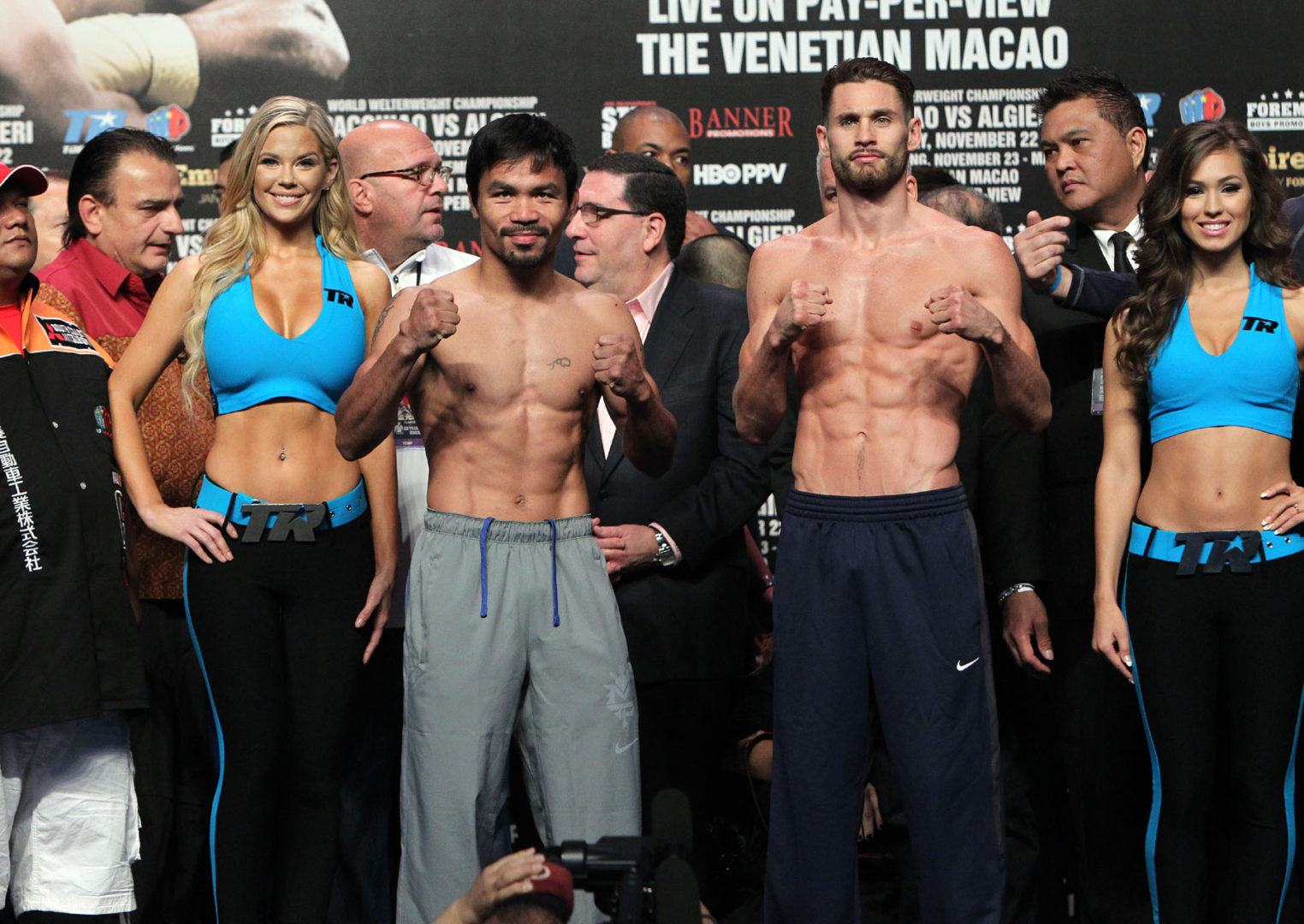
Mind Games: Pacquiao’s sparring partners better than Algieri? Maybe, says Roach

By Norm Frauenheim–
Pacquiao_Algieri_NYDailyNews_140905_002a
Chris Algieri is good enough to fight Manny Pacquaio, but he might not be good enough to beat some of his sparring partners.

That, at least, was Pacquiao trainer Freddie Roach’s suggestion Thursday in a conference call from the Philippines where the Filipino Congressman is training in his hometown, General Santos City, for a Nov. 22 bout with Algieri in Macao.

“We’ve got some great sparring partners …I think some better than our opponent, but we’ll see,’’ Roach said.

The comment from the ever-honest Roach caused a few ripples. It begged for a follow-up and, sure enough, Roach was asked to explain.

“Sometimes, the truth hurts,’’ Roach said later in the call.

In terms of world-class credentials and experience, two of Pacquiao’s sparring partners, ex-welterweight contender Mike Jones and emerging junior-welterweight Viktor Postol, have more on their boxing resumes than Algieri, who jumped to the head of the line with a victory over Ruslan Provodnikov for a dramatic upset that complements a good back story. The New Yorker magazine portrayed the college graduate with two degrees as a real-life Rocky. It’s hard to predict whether that’s the hook that will bring cross-over fans back into the pay- per-view audience, which Pacquaio promoter Bob Arum says could be between 750,000 and 900,000 for the HBO bout.

Algieri brings something different to the table at a time when PPV customers are heading for the exits. There’s been a decline throughout 2014. Maybe, a guy, a virtual unknown a year ago, can reverse that trend. Everybody is a sucker for the guy not believed to have much of a chance. Algieri has already created his own chances by getting up from two knockdowns against the feared Provodnikov. There’s some doubt about whether he could repeat that kind of drama. Against Pacquiao, however, he’ll get that opportunity. It’s intriguing.

But, as Roach suggested, some of that intrigue is tempered by facts. Consider this: If Algieri were fighting Jones or Postol instead of Pacquiao, who would you pick? Jones beat Jesus Soto Karass twice. The unbeaten Postol (26-0) is a ranked contender at 140-pounds. His record includes victories over DeMarcus Corley and Selchuk Aydin. Combine their records, and they’re 52-2. Compare that to Algieri’s 20-0 resume. There is no comparison.

Postol and Jones, Roach said, are in Pacquiao’s camp because of their height. They are taller than Algieri, who is listed at 5-10 and looks down on the shorter Pacquiao in news conference photos. By the way, Pacquiao has been getting ripped for playing basketball in the Filipino league for the team, Kia, he coaches. Pacquaio says he won’t play again until after the fight. On the floor, however, the 5-7 Pacquaio was competing with guys bigger than even Jones and Postol. In terms of competing with much taller rivals, a few minutes on the basketball floor might have helped. But that’s another story.

Algieri’s advantage in height is a factor, especially in his ability to sustain an effective jab. But there’s more to it than that. Postol, a Ukrainian, might be a key to Pacquiao’s readiness. Above all, Algieri is a thinker. That, he says, will be his advantage. Pacquiao has been an instinctive fighter. If he gets on a roll, he’ll roll over anybody. But Algieri has taken a page out of Juan Manuel Marquez’ four-fight book on Pacquiao. Marquez disrupted Pacquiao’s instinctive rhythm. He threw different looks at him, forcing him to stop and adjust. That was just enough for Marquez to finally catch him wide open for the right hand that knocked out the Filipino in their last edition.

“I’ll make him think,’’ Algieri said Oct. 18 during a news conference at StubHub Center in Carson, Calif., before Gennady Golovkin’s knockout of Marco Antonio Rubio.

Postol is also a thinker.

“He makes Manny think and that’s what Algieri will do,’’ Roach said of what might be the real truth as to why a current contender is in Pacquiao’s camp.


Harmonious manhood: Nicholas Walters, Nonito Donaire and Corey Holcomb

By Bart Barry–
Walters_Donaire_141018_003a
HOUSTON – Saturday at Carson, Calif.’s StubHub Center, a great fight venue with a moronic name, Jamaican featherweight Nicholas “Axe Man” Walters hacked former world champion Nonito “Filipino Flash” Donaire to a stump, in the co-main, and stopped him at the end of round 6. It was a case of dessert served before dinner, increasingly common in boxing’s kitchen, as HBO’s main event offered all the competitiveness its 60-to-1 odds promised.

I forewent the trip to California – no fight in which a man hasn’t a chance, not even one that features Gennady “GGG” Golovkin, warrants a flight – and instead sat beside the stage at Houston Improv, where Chicago comedian Corey Holcomb played to a full house.

No regrets here.

“One of the significant fighters, of the last several years, in the lighter weight classes, Nonito Donaire.” That is how HBO commentator Max Kellerman described Donaire a few minutes after the Axe Man felled him without even a “Timber!” Kellerman, straining at his harness not to employ HBO’s stock quotient of hyperbole – Walters, as a Spanish-speaking Jamaican featherweight, is not, after all, nearly so marketable as a middleweight from Kazakhstan – might near as easily been describing his network: “One of the significant broadcasters, of the last few decades, within pay-cable’s limited reach” or prizefighting: “One of the significant sports, of the last 25 years, among Americans’ third-tier diversions.”

It’s instructive how a fighter HBO nearly made its flagship guy just two years ago was now merely significant for a short time among smaller men. It’s an accurate appraisal by Kellerman, exactly right for once; it is both a proper read of what Donaire is and was and, retroactively at least, a proper read of the import HBO’s blessing now carries.

Fortunately for Nicholas Walters, he is not an HBO-blessed fighter. He is a man who chopped his way from Arena Roberto Duran in Panama City, in 2012, to brutal knockout wins over two very good veteran sluggers, Donaire and Vic Darchinyan. What makes Walters’ story special is not that he arrived on American cable fully formed, Gennady Golovkin did that as well, but rather that his full form was tested decisively and immediately: Darchinyan and Donaire represent a quality-of-opponent, in Walters’ two HBO appearances, Golovkin has not approached in thrice that many.

Walters is the son of a prizefighter, and that pedigree tells. Saturday he got overconfident, emboldened so much by his own power he forgot Donaire once separated effortlessly very brave men from their consciousnesses, and he got clipped in round 2 by Donaire’s deservedly celebrated left hook. It hurt Walters and spun him, and had there been another 30 seconds to go in the second, there’s no telling how things might have gone. But given a minute to recuperate, Walters’ incredible conditioning – born of an island, like the Dominican Republic, whose residents’ miraculous feats of athleticism are becoming, ahem, commonplace – Walters resembled no one so much as Floyd Mayweather against Shane Mosely: Hands up, prudence restored, forward marching behind a textbook jab.

Walters’ jab is extraordinarily long, fast, accurate and concussing. Donaire, whose own reflexes are enviable, saw Walters’ jab happening and countered over it successfully in the earliest rounds. By the fourth, though, after he got dropped by the same rear-hand uppercut Walters also dropped Darchinyan with, Donaire couldn’t counter Walters’ jab – because Walters’ jab disrupted Donaire’s equilibrium in a way that obviated reflex. Without a jab or reliable right, Donaire was reduced to his old digs in Left Hook City. Walters anchored his right guard to his cheek, waited for Donaire to put his life behind a left hook, pulled away from that hook, and then dropped an axe blade on Donaire’s left temple. And that was that.

Donaire, now a featherweight, admitted quite frankly afterwards he wanted no part of Walters’ offering, and since he neither wants to be denuded a second time at super bantamweight by Guillermo Rigondeaux, Nonito is effectively retired, even while he sharpens his pencil, arranges his T-square and readies a protractor for his return to boxing’s ubiquitous drawing board. More interesting, though, was a prefight description of Nonito’s reconciliation with Dad, when both men, according to Nonito, were being “alphas,” and Nonito implored himself to be a man, be strong, be a man, before sobbing uncontrollably once his dad departed.

It was a reminder of a certain debility of spirit about Donaire that long made others a little uncomfortable around him: He was a very good athlete who learned to be a fighter, which of course is different from a man who knows only one way. Or perhaps the point is better made as a question: Do you think Sergey Kovalev gives himself silent peptalks about being a man?

There’s a certain harmony a man has when he enjoys being who he is, and it’s a harmony often more noticeable in its absence, in the dissonance, for example, one senses from Donaire. I was reminded of this Saturday as I watched comedian Corey Holcomb ply his craft. There he sat on Houston Improv’s small stage, in an admittedly ridiculous and sparkly outfit he called “when an old (man) tries to dress young,” entirely relaxed, under the spell of himself, being wildly offensive before an evenly mixed crowd of men and women. Holcomb began with jokes about abortion clinics and moved to jokes about other women – “side pieces,” in the vernacular the comic shares with Paulie Malignaggi – and the illegitimate children that often result, whom Holcomb called “side babies.” It was a routine designed to offend, and performed to appear theatrically oblivious of what offense it caused.

As each of Holcomb’s jokes met with equal parts ribald laughter and hateful silence, Holcomb, with wide eyes and an angelic face, mockingly imitated a man who realized he’d just gone too far – and then went much farther still. An hour of watching Holcomb from ringside, as it were, convinces one of nothing so much as the power a man possesses when he withstands the derision of others, when he is intoxicated enough by himself to alter others’ rejections of him.

It is a different sort of fortitude than what Nicholas Walters showed Saturday, but it is of a piece, a harmony, the way Walters and Holcomb’s type of self-belief forces others to harmonize with them.

Bart Barry can be reached via Twitter @bartbarry

Photo by Chris Farina / Top Rank


Heavy Price: Overweight Rubio pays $100,000 for 1.8 pounds

By Norm Frauenheim
Gennady Golovkin
CARSON, Calif. – Marco Antonio Rubio lost money instead of weight in failing to make the 160-pound limit Friday for his attempt to upset favored Gennady Golovkin Saturday at sold-out StubHub Center.

Rubio forfeited $100,000 when he chose not to step on the scale for a second time two hours after he was 1.8 pounds heavier than the middleweight mandatory. It was no sweat for Golvkin, who came in one pound light at 159.

According to contracts filed with the California State Athletic Commission, the $100,000 price for being over-weight will be subtracted from Rubio’s $450,000 purse, which had ranked among the biggest in the Mexican’s long career. Golovkin (30-0, 27 KOs) will collect $900,000. If he loses, his title will be vacated, according to the re-done deal negotiated after the weigh-in.

Rubio trainer Robert Garcia was disappointed, yet not surprised. Despite several attempts at shedding the excess weight, Rubio (59-6-1, 27 KOs) couldn’t do it, said Garcia, who told reporters that his body “just shut down.’’

It’s hard to know what that might mean for Rubio’s chances against the heavy-handed, heavily favored Golovkin in an HBO-televised bout (10 p.m. ET/PT).

In the undercard’s featured bout, featherweights Nonito Donaire (33-2, 21 KOs) and challenger Nicolas Walters (24-0, 20 KOs) made weight, 125.6 pounds apiece.


GGG: Gennady Going Global

By Norm Frauenheim–
Gennady Golovkin (208x138)
CARSON, Calif. — The GGG at the belt of his waistband isn’t much of a secret anymore. But Gennady Gennadyevich Golovkin’s initials might as well be evolving into a marketing acronym. These days, it could be Gennady Going Global.

World class means more than a gaudy piece of tin on a plastic belt worth a lot less than the fee paid to the sanctioning bodies. It also means hitting the road the way Muhammad Ali did when he fought in Manila, Zaire, Ireland and Indonesia. Faraway places are part of the intrigue. More significant, perhaps, they are also part of the challenge. At least, they used to be.

Floyd Mayweather Jr. reigns as boxing current pound-for-pound champ. But when was the last time he answered an opening bell outside of Las Vegas’ MGM Grand? He’s become as much of a regular at the MGM as Cirque du Soleil. His last 10 bouts have been there. Mayweather plays it safe, stays at home mostly because he can.

But Golovkin has been on the move since his days as an amateur in Kazakhstan. There was a 2004 Olympic silver medal in Athens. Then, there were bouts in Germany and Monaco with a stop in Panama before a string of appearances in New York. Stamp-for-stamp, Golovkin’s passport has to be a contender. He must have more frequent-flier miles than a passenger on the old Space Shuttle.

Unlike Mayweather, Golovkin has to travel. The initial challenge was just to indtruduce him to an American audience that would have had hard time finding Kazakhstan on a map. Then, became boxing most-avoided fighter, which might be another way of saying that Mexican stars Julio Cesar Chavez Jr. and Canelo Alavrez won’t fight him in their backyard.

No problem. Golovkin will still go into that backyard anyway, albeit against a lesser Mexican name in Marco Antonio Rubio Saturday night in an HBO-televised about at the Stub Hub Center in Carson, Calif. It’s Golovkin’s first fight in Southern California and its loyal Mexican, Mexican-American fans. That audience, boxing’ most important demographic, makes this stop as significant as any in the wide, wide world of GGG.

If ticket demand is any indication, those fans are as anxious to see him live as he is to win them over. It’s a sellout. It has been for about month. The 8,000-seat outdoor arena has been expanded three times just to fulfill the demand

Make no mistake, the fans aren’t turning out to see Rubio, who is a competent enough challenger with just enough power to make things interesting. No, this is all about Golovkin and his debut in a key boxing market. If Golovkin (30-0, 27 KOs), the WBA’s 160-pound champion, impresses that crowd with another big victory, public pressure will mount on Canelo and Chavez Jr., to finally fight him. It’s just another piece in the marketing puzzle of turning Golovkin into a world-class star, who can’t be avoided anymore.

In part, Golovkin’s bout with Rubio (59-6-1, 51 KOs) has the feel of a political campaign. He’s making the Southern California stop to unleash the power in his hands, shake a few hands, win over the customers with a shy smile and leave them with no doubt about the world-class credentials possessed by a Gennady Going Global.


The Axe Man cometh

By Bart Barry–
Nicholas Walters
Saturday at StubHub Center in Carson, Calif., in a co-main event broadcast by HBO and certain to be more entertaining than what follows it, Jamaican featherweight titlist Nicholas “The Axe Man” Walters will fight “Filipino Flash” Nonito Donaire in a WBA unification match – being that both men already have WBA featherweight titles.

Much as happened two summers ago in Dallas, when Terence Crawford looked decisively the better prizefighter at what was intended by HBO to be a Mikey Garcia showcase, 11 months ago in Corpus Christi, at what was intended to be the first steps on a path to rejuvenation for Nonito Donaire, after the birth of his child got him unswaddled by Guillermo Rigondeaux, the evening’s most impressive performance was not in the main event or even part of HBO’s broadcast. Instead, that night, in a climate that managed, still, to be sticky in November, the man who impressed most at American Bank Center was a Panama-trained Jamaican in his U.S. debut.

Nicholas “Axe Man” Walters did everything a little bit harder than expected, three matches before the main event, from swinging his invisible axe during introductions to punching Mexican Alberto Garza to smiling through his menacing postfight celebration. In a surprise bit of enthusiasm, promoter Bob Arum nodded excitedly on the apron afterward, even calling down to pressrow: “He hits hard!”

That the Axe Man does. He is long for a 126-pounder, too, quite long, and he is both more awkward and more skilled than his occasional gangliness betrays. He turns his punches over with ferocity and the tall man’s advantage of keeping his chin far from perilousness even as he imperils opponents. Vic Darchinyan, a much better technician than once believed, could not swim his way to Walters’ chin in four rounds of trying in May and finally rushed at last resorts and got knocked silly by Walters who, if he catches you turning into a punch, as he caught Darchinyan, has outage power.

Walters is marvelously well schooled, too, in a way subverted by his knockout ratio and his ringside prop, a carvedwood axe; against the southpaw Darchinyan, Walters used the length of his legs still more than the length of his arms to neutralize Darchinyan’s charges, causing Darchinyan’s feet to get tangled on his second and third step, two of every three passes. It was the type of cagey, veteran stuff one does not expect the first time he sees a man in a televised fight, which made it extra enjoyable.

Saturday Walters will fight Nonito Donaire in the co-main of what appears a good card at StubHub Center in Carson, Calif. Donaire is something of a symbol for HBO 3.0, the failed startup that happened after Ross Greenburg was sent looking for other opportunities at Showtime. Before the network realized there were fighters raised in the Soviet system and not named Klitschko, before Gennady Golovkin and Sergey Kovalev carried HBO’s 2014 Fall Calendar, in other words, the network casted about for someone it could prematurely declare great and put in non-pay-per-view showcase matches, and Top Rank happily fed it a prodigal son named Nonito.

Goodness but HBO had to lug this kid about: Nonito loves fashion, Nonito is Filipino – like Manny! – Nonito knocked out “The Raging Bull” with one punch, Nonito is PED free, Nonito is the fighter of the year because Nonito does not take PEDs! Before it all felt like such a dreadful ruse, aficionados stared intently at their screens, ready for Nonito’s greatness to knock them sideways in a flash of (Filipino) light, and instead got Nonito making an unwatchable mess with Argentine survivor Omar Narvaez in 2011, Nonito hurting his hand against Wilfredo Vazquez Jr, Nonito hopping about like an enkindled finch against Jeffrey Mathebula, Nonito dropping Toshiaki “Is Japanese for Cash-Out” Nishioka, and finally Nonito whupping Jorge Arce into his first retirement – to finish 2012.

Declared that year’s best fighter, and in retrospect it should have been a sign of all the badness to come that beating four guys with an aggregate of 14 career losses got a guy declared Fighter of the Year, Donaire talked a whole lot about becoming a father before his April 2013 match with the Cuban master Guillermo Rigondeaux, and then Rigondeaux handled Donaire so thoroughly that, in an instant, the boxing community collectively sighed, congratulated Nonito on fatherhood, and redirected the lot of its premature-greatness rhapsody towards Mikey Garcia.

Whatever came of Mikey anyway, you’re wondering, and the answer shall be revealed someday, one imagines. Why don’t we hear about that kid anymore, you’re also wondering, and that answer can be revealed directly: Gennady “GGG” Golovkin!

With all of Nonito’s charm, though interestingly never a whisper about VADA testing, and none of Mikey’s Oxnardian rebelliousness, Golovkin has supplanted both Nonito and Mikey as the prizefighter most likely to endanger a commentator’s descriptions with hyperbole overdose. And get this: Golovkin is older than both Donaire and Garcia, despite being discovered after them.

Golovkin is also dining on Mexican, Saturday, in HBO’s main event, when Marco Antonio Rubio, a man beaten soundly by “Son of the Legend” Julio Cesar Chavez Jr 32 months ago, will be brought to Golovkin’s table in Carson missing only an apple in his mouth. Far more sporting than anything to come in the ring during the main event will be the straining that goes on at ringside, as HBO’s promotional crew tries to convince viewers Rubio, the very same guy stretched in one round by Kofi Jantuah 10 years ago, has a granitic chin, moments before GGG performs the impossible feat of scoring an eighth-round corner stoppage on the unstoppable Mexican.

Saturday’s broadcast will illustrate elegantly the difference between an athletic contest and a promotional spectacle, with Walters and Donaire providing the former.

Bart Barry can be reached via Twitter @bartbarry

Photo by Chris Farina / Top Rank


Jermain Taylor’s paper crown includes a dangerous future

By Norm Frauenheim-
jermain_taylor
Sad spectacles are little bit like jagged scars. They are always there, an uncomfortable reminder that real estate between the ropes is as bizarre as it is dangerous. Jermain Taylor is another chapter in the never-ending tale of a love-affair with stories that unfold like accidents. They are doomed to fail.

Leave it up to others to judge whether Taylor should have been allowed to fight for the IBF version of the middleweight title, which he won Wednesday night with a unanimous decision over Sam Soliman in an ESPN2-televised bout in Biloxi, Miss.

We know about the brain bleed he suffered in a 2009 loss to Arthur Abraham. We know that he is facing two felony charges for allegedly shooting his cousin on August 26 at his home in suburban Little Rock. We know about the Facebook video in which he waves a gun and says he’ll never “lose to another white boy.’’

I should be outraged. But I’m not. We’ve seen it before.

Joe Mesi, who retired unbeaten, fought seven times after it was reported he had suffered two brain bleeds in a 2003 victory over Vassiliy Jirov. Floyd Mayweather Jr., who hopes to retire unbeaten, was allowed to fight and beat Miguel Cotto in 2012 before going to jail for domestic violence. Bernard Hopkins, 0-2 against Taylor, once raced across a crowded press room, confronted Joe Calzaghe and shouted that he “couldn’t go back to the projects if I let a white boy beat me.” Four months later, Calzaghe, who also retired unbeaten, scored a split-decision over Hopkins.

The story lines are familiar, because of compliant commissions, judges, legal loopholes, acronyms and money. In Taylor, however, they have come together in what looks like a perfect storm. The IBF’s 160-pound championship appears to be nothing more than a paper crown. But it’s a piece in a jagged puzzle put together behind the scenes by Al Haymon, who promised Taylor the title shot. Haymon fulfilled the deal by moving another one of his fighters, the young and dangerous Peter Quillin, into a position to take the title from Taylor, who also faces a mandatory IBF defense against Hassan N’Dam.

The light-hitting and hobbled Soliman was one thing. He’s 40-years-old. He had 11 losses in 55 fights before the loss. What qualified him to be the IBF’s middleweight champ in the first place? All of that, of course, mattered little to Haymon. Soliman added up to an easy target and that’s what Taylor has become. What might be easy for Quillin, however, is dangerous for Taylor.

It’s hard to know what to make of his Facebook video. It’s offensive, but perhaps it’s intended to be in what was a misguided attempt to sell the Soliman fight. He’s waving around a gun within seven weeks after he was arrested and charged with shooting his cousin? That’s not salesmanship. That’s stupid. It makes you wonder what Taylor is thinking, or if he’s thinking at all.

Nevertheless, Taylor is moving through a system that has pushed other star-crossed fighters into the cross-hairs they always seek and that the sport regrets after it’s too late. It’s not clear where Taylor is in the legal process. As of Thursday, there was still no court date. It could be months when he faces the only mandatory that should matter. Throw in a couple of delays, and he’ll be facing the unbeaten Quillin before he faces a jury. He has a better chance with that jury.


Jhonny, El Travieso, and Devil’s River

By Bart Barry–
DevilsRiver (640x480)
DEL RIO, Texas – A few miles south of here begins the Mexican state of Coahuila, and about 40 miles north of here begins Devil’s River State Natural Area, and if you’re wondering which is more hospitable, it is Mexico – by far. There are lovely places whose brochures promise romantic getaways, and then there are mere getaways, places in America where one is likely to be found only by accident and a man on a burro. Devil’s River is the latter.

About 800 miles southwest of here, though decidedly in the same biotic region, Mexican Jhonny “Jhonny” Gonzalez beat down countryman Jorge “El Travieso” Arce, Saturday, causing referee Johnny Callas to wave the match off at 2:43 of round 11, in Arce’s home pueblo of Los Mochis, Sinaloa. Gonzalez, aficionados will recall even if Showtime programmers will not, stretched Showtime-developed titlist Abner Mares in one round, 14 months ago, and evidently got banned from the network for doing so.

Gonzalez-Arce was certain to be a better match than what last brought Arce to American premium cable, when Travieso was served hot to Nonito Donaire 22 months ago on an HBO platter, but Showtime, whose boxing coverage is in a shambles, televised instead another eyesore, this time from a casino in Connecticut, where a slate of shabby Al Haymon-managed fighters were plying their limited wares. Arce, who retired after Donaire iced him in 2012, returned, according to Arce, to win another title in another weight class, and while that might still hold meaning in noble and proud if benighted Mexico, here in the U.S. we measure greatness by a more-sophisticated metric: How many networks have you razed?

Word came last week, on a media shuttle no less, undefeated manager Al “The Annihilator” Haymon, having torn apart HBO in a six-year knockout and having destroyed Showtime in half that mark, has called-out NBC Sports Network, despite its eponymous relationship with a non-cable broadcaster, in a match that promises to include more offensive brilliance from today’s best technician. The Annihilator’s paucity of ruth raises this interesting question: If a pacifist who hated our sport set out to exterminate boxing’s American fanbase, and was willing to spend millions of his own dollars to do it, could that man turn the trick any better than The Annihilator? The match’s outcome is fun, if ultimately futile, for our generation to ponder the way previous generations pondered, say, Muhammad Ali vs. Rocky Marciano.

Meanwhile in Mexico, a country whose broadcasters are still blessedly out of The Annihilator’s reach, or too far below his weightclass, wonderful fighters still conduct wonderful fights, and yes, both Jhonny and El Travieso are wonderful fighters even if their Saturday match was not quite wonderful. Arce who, for being a fighter’s fighter, is more beloved by his opponents than just about anyone fighting today, continues to search for a chance to do to someone else what Michael Carbajal, in “Manitas de Piedra’s” 53rd and final career match, did to Arce 15 years ago. Alas, Arce had his Carbajal moment in 2011 against undefeated super bantamweight titlist Wilfredo Vazquez Jr, but Arce, at age 32, could not take yes for an answer.

Following fellow Mexican Juan Manuel Marquez’s example, Arce has grown himself a Body-by-Memo physique that features the shoulders of a statuesque middleweight and legs of a flyweight, a fitness choice that, for all its rejuvenating enhancements, makes Arce top-heavy as Marquez, causing him to fold over his lead knee whenever he throws in combination. Long known for the brawling style that immortalized him against Hussein Hussein in 2005, Arce actually has never wanted for ring IQ; you don’t get to Las Vegas as a 112-pound Sinaloan with mere toughness, because toughness is guaranteed in Sinaloa, a Mexican state of 2.8 million souls in which there is but one Jorge “El Travieso” Arce.

Toughness is guaranteed by a number of factors that mainly reduce to climate and topography. Once a shallow sea millennia ago, the North American region that ripples out from Sonora Desert comprises some of the Western Hemisphere’s more forbidding terrain. Traipsing towards, then away from, then back towards Devil’s River, Saturday, reminded me of nothing so much as marching barefoot over a rocky beach with a 25-degree incline and cacti needling you every third step. The beauty round such pristine spots is usually called “rugged” – a code word indicating every hour of pleasure must be accompanied by three of unpleasantness. All clichés spring from original truths, and clichés about the West and individualism are no exception; Saturday, 37,000 acres of Devil’s River State Natural Area were inhabited by fewer than a dozen persons, all day, and that ensures hundreds of minutes of solitude for anyone willful enough to wander unaccompanied through the expanse – and another 120 minutes of lacerating solitude for anyone dimwitted enough to misread a map and blaze his own trail through miles of thornbushes.

Jhonny Gonzalez, hailing from Mexico City though born in the more rural state of Hidalgo, is a prizefighter whose ruggedness is tempered by intelligence; Saturday he engaged Arce when the shorter man needed engaging and kept him at range the rest of the match. A man who truly likes to fight and truly knows how, Gonzalez struck Arce with perfectly placed and fully released hooks enough to drop Arce on the blue mat – complemented by a white “Playboy” bunny logo – three times, including a punctuating blow at the end of round 3, when Arce went for the knockout, his or Gonzalez’s, ¡que sea!, exactly as he did against Donaire, with a nearly identical result.

Saturday was a good way for Arce to end his career, as good as he’s likely to get anymore, but as ruggedness is not a synonym for wisdom, El Travieso surely will fight on.

Bart Barry can be found on Twitter @bartbarry


The old theater feels empty without Dan Goossen

By Norm Frauenheim–
Dan-Goossen-says
Dan Goossen’s death this week is a reminder that boxing survives because of the characters who have always understood that theater is as fundamental as a good jab. It’s balancing act that includes just the right mix of salesmanship, comedy, opinion and conviviality.

Goossen is the face of a passing generation that has worked hard to stay in the spotlight. He liked it. The brighter that light, the brighter the sport coat. Goossen’s colorful plumage could make sideline reporter Craig Sager’s blazers look dim. He was colorful because he wanted to be. But it was more than that. He had to be there, beneath a magnifying glare that burns out many and keeps others from ever daring to enter it.

Bob Arum understands the role. Arum never fails to enliven otherwise uneventful news conferences with a blend of jokes and insults that create headlines. Attendance is mandatory. Nothing is sacred when Arum assumes the bully pulpit. Then, there’s Don King. He has faded from the public arena, but there was a time when his malaprops and booming braggadocio were integral to the show and, more often than not, more entertaining than the card. They aren’t there to be believed. Goossen knew that. Arum and King know that. Good theater, after all, includes a lot of fiction.

There’s much to mourn in Goossen’s passing early Monday from liver cancer. He was a master at engineering the successful comeback. I remember James Toney. The media and rival promoters had already assigned Toney to the scrap heap after his career went sideways following a 1994 loss to Roy Jones Jr. Toney was woefully out of shape when he began showing up at gyms and local cards in Phoenix, where I worked for the city’s biggest daily in a forgotten era when newspapers still had fight writers. Toney had signed with Goossen, who proceeded to put together a Phoenix card in 2002 that featured him in a victory over Sione Asipelli. If memory serves, Goossen wore the purple sport coat for that one.

A reason to bring Toney to Phoenix was not without a plan. It was home to Vassiliy Jirov, then considered the world’s best cruiserweight. Goossen and Toney were in Jirov’s backyard to call him out. It worked. In April 2003, Toney scored a dramatic decision in Connecticut over Jirov in a bout the Boxing Writers Association of America voted Fight of the Year. Nobody could take the snoozer out of cruiser, but Goossen managed to with instinct that led to a Toney upset of Evander Holyfield in his next bout.

It was a brilliant one-two promotional punch, But it would not have happened without Goossen’s willingness to wage a public campaign that would have exhausted a career politician. That inexhaustible well of energy went into representing Pete Rose after the gambling scandal and Mister T, who was a bouncer in a Chicago bar when Goossen spotted him and transformed him into an offbeat movie star.

In mourning Goossen, I wonder where the business is headed without him. Can anybody imagine Al Haymon conducting a news conference? Amend that. Can anyone even imagine a Haymon quote in any media outlet? If Haymon is the example of what to expect, the spotlight might as well be a wildfire for the next generation of promoters and managers. They’ll stay away.

The spotlight enforces a level of accountability. An Arum, or a King, or a Goossen might talk, talk and talk around a looming issue or in defense of some indefensible behavior. But they are there. Buyer beware. With Haymon, however, there’s not even a chance for that caveat. The man said to be boxing’s biggest powerbroker is always in the background or in some back room. He doesn’t take questions, hence there are only suspicions.

It’s no way to run a show. Goossen was aways front and center, always in front of the curtain, instead of behind it. The show must go on. Without him, however, you wonder how it will. If it will.


Canelo Alvarez, cable networks, and learned helplessness

By Bart Barry-
Canelo Alvarez
Another game changer happened Tuesday. It came with a series of email announcements and a conference call and probably a press conference, somewhere, too, so big the news this time. It was an official notice Mexican junior middleweight Saul “Canelo” Alvarez changed American cable networks.

If boxing historians return to this announcement someday, it will be to ask themselves why they returned to it.

Each purportedly seismic disruption to boxing’s landscape portends nothing but the worse for aficionados and fighters, boxing’s forgotten tribes, yet in a learned-helplessness sort of way, we ponder plethoras of possibilities and their consequences for our favorite active fighters – the few of us who still have such things. These massive upheavals in boxing began when Manny Pacquiao enjoyed a one-dreadful-night sabbatical from HBO sometime in the last few years, donned yellow gloves to fight world poverty, eradicated world poverty, and returned triumphantly to HBO, where he won a dubious decision over Juan Manuel Marquez, in red gloves, lost a decision to Timothy Bradley, then got dangled by Marquez above the unknowable plane betwixt life and death. Not long after that, another earthquake struck, and Floyd Mayweather and Al Haymon left HBO and took Richard Schaefer with them, during the conveniently forgotten years when Golden Boy Promotions’ Oscar De La Hoya was unavailable for comment.

Actually, all this may have happened in a different order or concurrently, or something, but none of it today is consequential enough to recall its exact sequence.

Tuesday, though, Tuesday! This was the big news boxing needed, when a redhaired Mexican-television creation changed from Showtime to HBO, or well, he returned, actually, to the network that manufactured him as an American attraction, such as he is – have we got an official number for Alvarez-Lara yet? – before he, perhaps unwittingly, changed American networks before his fight with Austin Trout. Why all this emphasis on American television networks? Because Alvarez isn’t beholden to them or De La Hoya or anyone else in this country: Cinnamon takes his orders from Mexican television, or at least he did till Grupo Televisa, Latin America’s largest mass-media company, watched his fight with Floyd Mayweather, realized, whatever else he was, Canelo was not a future legend of Mexican prizefighting, and filed unflattering reports that caused Alvarez to leave that network, too, and shop his services to TV Azteca.

¡O, impetuous youth! Had it not been for the unrelenting coverage, and soap-operatic scripting, of Grupo Televisa, a network powerful enough to get Alvarez an invitation to meet President Enrique Pena Nieto, husband of Angelica Rivera, a retired Televisa soap-opera actress, Alvarez might not have ascended highly as Julio “Baby Face” Garcia. What’s that, you never heard of him? Baby Face Garcia was a Mexican welterweight prodigy with a record of 40-2 (33 KOs) before his 20th birthday. His promoter dissolved into a blob, Garcia affixed that blob on his midsection, and before his 27th birthday Baby Face was an anonymous middleweight losing as often as he won in locales like Guanajuato’s Domo De La Feria and Michoacan’s Auditorio del Bicentenario – neither of which is Spanish for “MGM Grand Garden Arena.”

But Canelo is going to attack Miguel Cotto in the superfight of 2015! Prizefighting has come to this, hasn’t it? A Puerto Rican welterweight beaten to submission by Manny Pacquiao in 2009, decisioned lopsidedly by Mayweather in 2012, decisioned lopsidedly by Trout in 2012, and rejuvenated by the concoction of a new trainer and a broken-legged Argentine in June is about to make next year’s most-anticipated fight with a Mexican who won about 1/36 his match with Mayweather a year ago, beat Alfredo Angulo about convincingly as James De La Rosa just did, and squeezed past Erislandy Lara in an eyesore.

Show that to the rascals who say boxing is dead!

Marco Antonio Barrera told us this would happen, remember. A few months before his career’s penultimate match, a 2010 tilt with Adailton De Jesus in San Antonio, Barrera said the consequences of prizefighting’s being off Mexican public airwaves for a decade, because of one more depredating privatization scheme in the world, were en route and would be profound. Prizefighting off Mexican airwaves drained interest and the talent pool from Mexican gyms. It also coiled the spring of Mexicans’ undying interest in the sport. Once prizefighting returned to Mexico’s public airwaves, the people jubilantly sprung about in search of future greats. Barrera and Erik Morales subsequently attempted unserious comebacks, and Juan Manuel Marquez underwent a historic physical transformation.

TV Azteca, meanwhile, aligned itself with a goofball scion of legend Julio Cesar Chavez, and Televisa lassoed itself a redhaired horseman from Jalisco. HBO made icons of Pacquiao and Mayweather then watched with incompetent disbelief when they refused to fight each other, and Showtime placed its faith in HBO commentators and actually tried to anoint Adrien Broner. Now bereft of ideas, Showtime desperately empowers advisor Al Haymon to decimate its reputation, and HBO turns to a 32-year-old Kazakhstani middleweight whose greatest professional accomplishment, in 10 years of prizefighting, is a third-round stoppage of Daniel Geale – and Marvelous Marvin Hagler retired at age 33.

Like a downtrodden minimum-wage worker told by his millionaire master to be grateful he even has a second job to take public transportation to, though, an aficionado today feels gratitude merely at the news boxing will be televised at all this autumn, and anxiously awaits his next press conference announcement – when he ought to be yanking his cable box directly out the wall.

Bart Barry can be found on Twitter @bartbarry


Game-Changing Day: Canelo celebrates, Mayweather squirms

By Norm Frauenheim
Canelo Alvarez
Canelo Alvarez’s jump to HBO from Showtime isn’t surprising. He follows Bernard Hopkins, who took the first step in a move that altered the business landscape with his decision to fight Sergey Kovalev on November 8. It’s hard to know what will happen next. A prediction is a fool’s exercise, especially with unresolved questions about who and how many fighters are under contract to Golden Boy Promotions and/or Al Haymon. But it’s safe to say it’s been a tough couple of weeks for Floyd Mayweather Jr., who suffered a fat lip on Sept. 13 against Marcos Maidana and then had his credibility trashed in an appearance before the Nevada State Athletic Commission.

The announcement about Canelo’s move to HBO and Mayweather’s appearance in front the of the commission happened on the same, Tuesday. Coincidence? Probably. Still, you have to wonder. This is boxing, after all. It’s a place where coincidence and conspiracy often mean the same thing. Let’s just say that Canelo and HBO celebrated while Mayweather and Showtime squirmed.

There was reason to celebrate the Canelo side of the equation.

It further paved the way for a Canelo-Miguel Cotto fight, probably next year, in a bout as big as any in the tradition of the great Puerto Rican-Mexican rivalry. It resurrected a chance at an all-Mexican showdown between Canelo and Julio Cesar Chavez Jr. showdown, although there are doubts about whether Chavez Jr. will ever get his act together long enough to be a reliable partner in any potential venture. It even generated talk about Canelo-Manny Pacquiao, but that one looks unlikely because of the weight disparity. Canelo is growing out of the 154-pound weight class and Pacquiao is considering a move down the scale, from 147 to a more natural 140.

What it took off the table, however, was just another blow for Mayweather and Showtime on an already difficult day. Forget a Canelo-Mayweather rematch. With two fights left on Mayweather’s landmark deal with Showtime, an encore with Canelo had to be at least a consideration. With 2.2 million pay-per-view customers, Mayweather’s majority decision over Canelo set revenue records. For the fighter who calls himself Money, that was the primary reason to do it one more time. Given ho-hum pay-per-view results for the other three fights on his Showtime contract — fewer than one million PPV for Robert Guerrrero and twice for Maidana, the network would have been happy to go back to the Canelo bank.

It’s hard to know exactly where Mayweather and Showtime go now. In his post-fight news conference after his rematch victory over Maidana, Mayweather suggested that he might take off a year, skipping his resumed May date for a fight next September. With talk about an imminent split between him and promotional partner Leonard Ellerbe, that looks to be as likely as any other possibility. Some quiet time might be the only option for Mayweather. The more he talks, the less believable he becomes. If the emperor has no clothes, the pound-for-pound king has no credibility. He said he had a personal goal of knocking out Maidana in the rematch, yet he danced away from the opportunity in the 12th round. He said he had no relationship with controversial conditioning coach Alex Ariza before opening bell and then Ariza tells Filipino media that he has signed a two-year contract with Mayweather.

At the Nevada hearing, he embarrassed Showtime by saying sequences shown on All-Access were staged. Don’t believe, he said, sequences showing 31-minute rounds of sparring in the so-called Dog House at his Las Vegas gym and of women smoking what was assumed to be marijuana at his home.

“That’s all for the reality show,” Mayweather attorney Shane Emerick told the regulator board. “It does not happen.”

Huh? Reality is the new fantasy, or vice versa, or some thing like that.

Then again, maybe there’s a chance at some good news in the Mayweather mess too. Now, more than ever, he needs Pacquiao to restore his credibility. Question is, does he really care about that? If he doesn’t, he might retire unbeaten, but with a legacy defined by Pacquiao, Antonio Margarito, Kostya Tszyu, Sergio Martinez, Paul Williams and everybody else he didn’t fight.


Travel box and away

By Bart Barry–
Manny Pacquiao
SAN ANTONIO – Saturday night I attended “Jazz’SAlive,” a two-day, free-admission jazz festival in the newly restored Travis Park, which abuts St. Mark’s, the gothic-revival Episcopal church where Lyndon Baines Johnson married Claudia Alta Taylor 80 years ago. As always, the event happened two weeks before the lovely weather arrives, reducing crowds still more than the festival’s recent reduction in marquee names. There are few better places to be present and watch the mind play than a jazz festival, though, and so there I was, sitting on a shinyblack park bench between entrepreneurs and homeless men, reminiscing about how I got here.

And there was boxing. It was Manny Pacquiao against Jorge Solis at Alamodome, in April 2007, a staybusy affair during Pacquiao’s first, and unsuccessful, congressional campaign, that introduced me to a spot thrice as tropical, lush and verdant as I previously considered Texas might be. This town, birthplace of mentor and friend Norm Frauenheim who told me a few weeks before Pacquiao-Solis “you’re going to like that city,” became and remains my favorite place I’ve lived.

If you are reading this, you know fewer than one percent the fights you’ve seen are fights coworkers or uninterested familiars inquired about before they happened. You also know the best fights you’ve seen live are fights those same coworkers and familiars, the sorts of men who would pose for a selfie beside a fighter at a fundraiser, fist raised in an ironical nod to something they saw in an old b&w photo or to irony itself, so meta-ironical the lads, would neither know by name nor endure for what 40 minutes their complete viewing requires on YouTube. But they know you like boxing, and they’ve heard of Floyd Mayweather or Oscar De La Hoya or Mike Tyson or the one guy their dads used to watch back whenever whenever in the living room on Friday or Saturday night, whichever has the hour’s more nostalgic ring, and they wonder if you’re going to be in Vegas Baby! or The Garden or Staples for what they will call The Big Fight.

It happened often enough to me – and the frequency with which one hears these questions is directly proportionate to his dayjob’s figurative distance from prizefighting – I devised an easy way of justifying my travel plans, or at least explaining them away, in two questions: 1. Will it be a good fight? and 2. Is it somewhere I wish to visit? I must be able to answer in the affirmative one of those to consider making the trip, and I must have an immediately apparent conflict to not-make the trip if I answer affirmatively both.

The credentials scrum being what it is on the East Coast, the credentials scrum is often a conflict feasible enough to forego the boundless aggravation of playing tourist in Pennsylvania, New Jersey or New York. Most of the fights to which I have access and believe worthy their travel and expense, then, happen in Las Vegas, naturally, with Southern California placing a distant third behind Texas locales in Houston or Dallas. Las Vegas is not a place I have ever wished to visit, which allows me to judge Vegas superfights dispassionately, which allows me to forgo every Mayweather tilt and what Pacquiao matches are made for revenue and spectacle, not legacy, be they against De La Hoya or Ricky Hatton.

Generally, in a nod to my enduring love of novelty, a city’s best chance of being somewhere I wish to visit is being somewhere I’ve not visited. That brought me to Detroit Metropolitan Airport in Jan. 2011, and a Friday night rave with two young surgeons, too, before Timothy Bradley unmanned Devon Alexander, the man who went on to beat Marcos Maidana so thoroughly Maidana set his mind on an immediate retirement 39 months before he fought Mayweather. It sent me to Oakland two years ago to see Andre Ward ruin Chad Dawson in what may well have been the last meaningful fight of “S.O.G.’s” career. It sent me to Colorado last year to see architect Daniel Libeskind’s groundbreaking Denver Art Museum, its titanium cladding brilliant in the hyper-definition of mile-high air, and the Rocky Mountains, and Ruslan Provodnikov’s lambasting of Mike Alvarado. It brought me here, my adopted hometown in South Texas, 7 1/2 years ago for a Pacquiao fight more easily forgotten than the ease with which Cristian Mijares undressed Jorge Arce on the undercard, and an attorney from the ACLU I met in a coffeeshop across the street from where this is being written.
Boxing was more fun back then; promoters were still crooked and local commissions were still corrupt and managers still maximized purses and minimized risk, because the consumer is a television executive, not a boxing fan, but there was a spirit of chance governing events, a palpable chance an event’s power brokers had sliced things too fine in negotiations and favorites might lose or fall prey to unpredictable things. There was more of the sacred unknown back then, before dryasdust operators like Richard Schaefer and Al Haymon merged and acquired.

Like most things meaningful in life, like most permanent changes, the end of all this fun did not come with a blazon of trumpets or clash of cymbals. Historians will blame the Mayweather-Pacquiao saga, and we’ll go along with them – not because it’s necessarily true but because the culpable parties deserve lasting scorn – though the unwinding was present even before then, it was present the week Pacquiao battered Miguel Cotto in Las Vegas and fired the starter’s pistol on a half-decade of publicly failed negotiations.

What justifies travel is the joy of spontaneity. No spectacle is more spontaneous, less predictable, than what Juan Manuel Marquez did to Pacquiao in 2012 or Julio Cesar Chavez Jr. did to Sergio Martinez a few months before that. No elements of these trips were more memorable than what spontaneous connections formed with former strangers, away from hotel lobbies, away from conference rooms, away from promoters, away from scripted gatherings of all kinds. Away and away.

Bart Barry can be found on Twitter @bartbarry


Lomachenko stops in Phoenix before training at Robert Garcia’s gym for tough title defense in China

By Norm Frauenheim–
Lomachenko
PHOENIX — Vasyl Lomachenko’s pro resume hasn’t quite caught up with his passport. But give him time. The resume was stamped with a major title, the WBO’s featherweight crown, in only his third trip inside a pro ring. No telling how many stamps are in his well-worn passport.

He’s on the road, all over again, as he prepares to go back to China where he won his first Olympic gold medal at the 2008 Beijing Games. Last week, the two-time gold medalist was at home, training in the Ukraine.

This weekend, he’s in Phoenix to visit an old Olympic teammate, light-heavyweight Oleksandr Gvozdyk, a 2012 bronze medalist who hopes to go 3-0 as a pro Saturday night against Lamont Williams on a UniMas-televised card at Celebrity Theatre. Next week, he’s in Oxnard, Calif., to train at Robert Garcia’s gym.

Final stop: Macao on Nov. 22 on a pay-per-view card in the first defense of the title he won in June in a majority decision over Gary Russell in Carson, Calif. A first-time defense for a first-time champion is often a gimme. But Lomachenko, who faced and lost to tough Orlando Salido in his second bout, is not in the habit of accepting handouts.

On a Top Rank card featuring Manny Pacquiao-Chris Algieri, Lomachenko faces a dangerous challenger, who is unknown in West, yet popular in Asia. Ever heard of Chonlatarn Piriyapinyo? Didn’t think so. But here’s an introduction. Piriyapinyo, of Thailand, is 52-1 with 33 knockouts. His lone loss is to one of the few Asian fighters known in the West. He lost a decision in 2012 to Indonesian Chris John, who beat Juan Manuel Marquez in 2006.

“Vasyl wanted to fight another guy with a title,’’ said his manager Egis Klimas, who is also in Phoenix for a card that includes two-time Olympian Egidijus Kavaliauskas (7-0, 6 KOs) of Lithuania in a welterweight bout and Russian welterweight Konstantin Ponomarev (24-0, 12 KOs) in the main against journeyman Cosme River (37-18-3, 26 KOs). “But nobody was available.

“So he went down the list and just asked for the most dangerous guy. For him, it was the guy from Thailand. In his mind, this fight is like a mandatory. He wants these tough fights, because he wants to learn. Then, may we’ll get a shot at (WBC champion) Nonito Donaire or (IBF champ) Evgeny Gradovich.’’

Donaire is scheduled to fight Jamaican Nichols Walters on Oct. 18 in Carson, Calif., on the Gennady Golovkin-Marco Antonio Rubio card. Klimas also manages Gradovich. Meanwhile, there are lessons for perhaps history’s most accomplished amateur. Like stamps in that passport, Lomachenko is trying to acquire as many as he can.

At Friday’s weigh-in Mesa, a Phoenix suburb, Ponomarev was 148.6 pounds and Rivera tipped the scales at 145.6. Gvozdyk, who is trained by Robert Garcia, was 175.2 pounds and Williams (5-5-1, 2 KOs) 175.8. Kavaliauskas, also trained by Garcia, was 147.8 pounds. His opponent, Eduardo Flores (17-14-12 KOs) of Ecuador was 145.6. Phoenix light-heavyweight Trevor McCumby (15-0, 12 KOs) was 173.6 and his opponent, Martin Verdin (20-18-2, 11 KOs) of Louisiana, weighed 176.0.


Splitsville: Mayweather long on drama and short on promises

By Norm Frauenheim–
Floyd Mayweather
Floyd Mayweather Jr. is boxing’s undisputed Drama Diva.

The latest from The Money Team’s long-running soap opera is an apparent split between Mayweather and his longtime advisor and promotional partner Leonard Ellerbe. So much for the team in TMT.

In comments to FightHype.com , Mayweather complained about a breakdown in communication, a lousy ringside seat for his daughter and his disagreement over the decision to put two of his titles, the WBC welterweight and WBA junior-middle, at stake in his decision last Saturday over Marcos Maidana.

Al Haymon will be back, he said. But he made it sound as if everybody else is as expendable as spit in a bucket. A new team might surround him, he said, if he fights in May, although he suggested during the post-fight news conference that he might not fight again until next September.

Blah, blah, blah.

Yeah, Mayweather and Ellerbe might be headed for splitsville. But this is boxing. There are no friends. There are just associates. Mayweather’s primary loyalty is to money and the manager who generates it for him. In Haymon, he trusts. But it’s the money end of the equation that is forcing him to at least talk about changes. Reports of 925,000 for the pay-per-view telecast of the rematch with Maidana were actually better than expected, especially after a week of noisy controversy surrounding his comments about former Baltimore Ravens running back Ray Rice and domestic violence.

It represents a jump of between 25,000 to 75,000 PPV customers. Reports on the first Maidana fight put the PPV number between 850,000 and 900,000.

But better isn’t good.

Showtime, a CBS subsidiary, is paying Mayweather a minimum of $32-million a fight. The contract includes two more fights. Mayweather can count on another $64 million. At that price, the network has a right to expect one million pay-per-view customers per fight. So far, Mayweather has exceeded the one-million mark only once with 2.2 million in his revenue-record setting victory over Canelo Alvarez.

Throughout the week before the Mayweather-Maidana rematch, there were rumblings that CBS President and CEO Les Moonves was pushing for a Mayweather-Manny Pacquiao fight. There was speculation — started by Bob Arum – that there were behind-the-scene talks between HBO and the CBS-owned Showtime about finally putting it together.

When asked about the rumors, Stephen Espinoza, Showtime executive vice president for sports, was cryptic. Espinoza didn’t say no. Didn’t say yes. He joked. But, come on, if you’re the CBS boss and on the hook for another $64 million, you’re demanding Mayweather-Pacquiao.

The real question is whether Mayweather will ever let it happen. He opened the door in the immediate aftermath of his unanimous decision over Maidana, but then began to throw out reasons that it never will. He’s called himself the A side, which means he would demand more than a 50-50 split. A couple of days later, he talks about a split with Ellerbe. It sounds like a feint. Promise a few cosmetic changes, and before you know it, the deal is done and Mayweather’s money is safely in the bank.

But Mayweather’s promises don’t always match up with what he delivers. To wit: He said his goal was to knock out Maidana in the rematch. He had a point to make, he said. He wanted to do it more for himself than even the fans. What happens? In the 12th and final round, he protects his lead on the scorecards by staying away from Maidana. What happened to the point he wanted prove? What happened to the KO? He never even pursued it. That was no goal. It was garbage.

Even his complaints to FightHype.com about the two titles are suspicious. It’s fair to wonder if there was, in fact, a hidden agenda. Putting up the WBA junior-middleweight title alongside his WBC welterweight belt might have been a clever attempt at forcing Maidana to wear 10-ounce, instead of 8 ounce, gloves. The WBA title is 154 pounds, a weight at which both fighters are required to wear 10 ounces. At welterweight, the mandated glove is eight ounces.

A few days before opening bell, there was a potential controversy. Maidana trainer Robert Garcia said 10 ounce gloves were mentioned on a document. He called it a typo. The controversy passed. The fight was contracted to be at welterweight. They fought at eight ounces. At 10 ounces, Maidana would have had less of chance than he had anyway. The 10 ounces might have been a way for Mayweather to avoid the fat lip he sustained.

If the ploy had worked and 10 ounces would have been the weapon of choice, it’s unlikely there would have been a complaint from Mayweather. Mere typo or not, it didn’t work. But it does give Mayweather reason to complain and another reason to make another promise.


Ex-Olympians and Mosley’s son set for Phoenix card Saturday night

By Norm Frauenheim–
Top Rank
Top Rank’s attempt to resurrect a dormant Phoenix market continues Saturday night in a partnership with Iron Boy Promotions in a UniMas-televised card at Celebrity Theatre that includes a couple of ex-Olympians, Shane Mosley’s son and a Russian prospect.

The prospect, welterweight Konstantin Ponomarev (24-0, 12 KOs), faces perhaps his biggest challenge against Mexican Cosme Rivera (37-18-3, 26 KOs), whose well-traveled resume includes a 2005 loss to Zab Judah in a bid for the WBC’s 147-pound title.

Light-heavyweight Oleksandr Gvozdyk (2-0, 1 KO), a bronze medalist for the Ukraine at the 2012 Olympics, will appear in his third pro bout with trainer Robert Garcia in his corner. Egidijus Kavaliauskas (7-0, 6 KO), a two-time Olympian from Lithuania, is scheduled for a welterweight bout.

Shane Mosley Jr. (2-0, 2 KOs) will fight for the third time as a pro as a super-welterweight on an11-bout card. First bell is scheduled for 6 p.m. (PST).

The weigh-in is scheduled for Friday (2 p.m.) at Crescent Crown in Mesa. It is open to the public.


An old Floyd is not the old Floyd

By Bart Barry–
Floyd Mayweather
Saturday at MGM Grand Garden Arena in a rematch few aficionados demanded, fewer still watched, and fewer yet found entertaining as its predecessor, American welterweight and super welterweight titlist Floyd “Money” Mayweather unanimously decisioned Argentine Marcos “El Chino” Maidana. After promising to prove himself to himself, not you, by stretching Maidana, Mayweather finished the fight circling shamelessly away from his limited, winded opponent, citing numbed fingers in his left hand. Maidana, who cares no more if he’s called a dirty fighter than called an Argentine, apparently crushed Floyd’s fingers in his mouth during an eighth-round clinch.

The entire “Mayhem” spectacle was subdued in a way Mayweather fights have not been since the Carlos Baldomir farce of 2006, and one briefly wondered during the ringwalk, when Mayweather was accompanied by his two mountainous bodyguards instead of musical mascots, if early revenue projections might have slashed the budget for Team Money Team; or if perhaps Floyd, having publicly provoked men professionally obligated to take every provocation in petulant and personal a way as possible, couldn’t find a Canadian castrato or Southern stereotype brave enough to accompany him in public; or if, most charitably, Floyd was determined to be determined and have his fate determined by himself alone. The last interpretation is the best interpretation, one hoped and hopes, and Floyd’s stark entrance was a stark reminder how incredibly lonely a boxing ring can be.

One doesn’t get to the championship level of this hurting business without being able to read other mens’ bodies fluently, and Floyd’s capacity for processing every tick and twitch is among his greatest predatory assets. But mirrors are strange things, and Floyd, publicly vulnerable even when he wishes not to be, is no longer reflexive or interested enough to be impenetrable while he penetrates others’ weaknesses. It didn’t take a minute of Saturday’s fight to see Floyd’s legs were, in a word, soggy; though his footwork remained impeccable, he moved round the canvas like it was memory foam over the ring’s plywood base, not an inch of padding. He was skittish as his movements were laborious, and one now wonders what might have happened if an enhanced Maidana answered the opening bell, rushing him disrespectfully as he rushed Adrien Broner 10 months ago.

Floyd was waiting for that, yes, but he was waiting for it their first fight, too, and it made precious little difference. No one likes to be struck in the face, but it hurts Floyd doubly for denting both his face and deep pride at once. Like any champion prizefighter, Floyd’s opening tactic is requesting his opponent’s metaphorical signature on a tacit contract that reads: “You may strike me here and here, but not there.” Floyd is all fighter, and he expects to be hit. On his terms. Maidana, with his skyhook right and his frequently thrown forearms and elbows, violated a contract Floyd had far more accomplished fighters like Oscar De La Hoya and Shane Mosley and Miguel Cotto sign. Worse yet, when Floyd, enkindled by the Argentine caveman’s impertinence, sought to castigate El Chino, he did not at 147 pounds have the power or accuracy to imperil the Argentine and as always had to worry about his brittle right hand in the event he did land it flush on anything but Maidana’s lightswitch.

Every other round, when Floyd’s age and (over)training regimen made him rest, he looked singularly uncomfortable. He was not enjoying himself before or during or after his rematch with Maidana, especially when an unfortunately close shot of his postfight interview showed Floyd’s swollen and misshapen lips quivering involuntarily. Maidana, face clean after 36 minutes of sanctioned assault by Mayweather’s fists as it was during his ringwalk, showed Showtime’s buffoonish inquisitor exactly the respect Jim Gray deserved, irreverently lying to him in Spanish, in a reminder it would be nearly impossible for a Spanish-only Argentine to care less what a c-level American journalist from a b-side American cable network opined of his forthrightness or general mien.

Commentator Paulie Malignaggi was the only one who caught the face-smothering tactic Mayweather employed in order to wedge the fingers of his left hand between Maidana’s eager teeth. Malignaggi caught Mayweather doing it to Maidana the same way Malignaggi caught Mayweather doing it to Saul Alvarez a year ago; being suffocated sucks, and that’s the reason Canelo fired his right fist at Mayweather’s cup and Maidana chomped down.

One foul begets another, this is fighting after all, and much as Maidana’s impertinence flummoxed Mayweather for a minute or so, you knew immediately Floyd would not refuse to fight on so long as referee Kenny Bayless took his stern warning like a good supplicant. Floyd’s point was not made to Maidana – there was no reaching El Chino, after all – but to Bayless who, true to form and expectations, ensured the rematch comprised a ratio of athleticism-to-menace more favorable to Floyd than Tony Weeks’ unforgivably permissible performance did in May.

Provided Manny Pacquiao does not look too good in his upcoming match with Chris Algieri, a probable thing, that, as Algieri has some tools to make Pacquiao’s night a long one, Floyd’s advisor should begin negotiations with Pacquiao’s team, secretly, and use Floyd’s diminished reflexes, and both men’s diminished drawing power, to find something close enough to common ground to get signatures on at least one of Don King’s old blank contracts. Fill it in later, once casual fans find inspiration enough to care again about the last fight they wanted to see, and finally make a match that hasn’t looked this likely to entertain in five years.

Floyd will win – forget not how steadily Pacquiao declined after his night in Cowboys Stadium with Antonio Margarito four years ago – but there’s no shame in admitting this much: There were a few moments during Saturday’s match, when Marcos Maidana feinted an old Floyd Mayweather to the ropes and hit him with everything he threw, we all might have taken Pacquiao, even money.

Bart Barry can be found on Twitter @bartbarry


FOLLOW MAYWEATHER – MAIDANA II LIVE

Mayweather_Maidana II_Weigh In
Follow all the action live as Floyd Mayweather defends two Welterweight world titles plus a Jr. Middleweight world title in a rematch against former world champion Marcos Maidana. The actions off at 7 PM ET / 4 PM PT with a 4 fight undercard featuring Leo Santa Cruz defending his Super Bantamweight title against Manuel Roman. Miguel Vazquez defends his Lightweight title against Mickey Bey. Alfredo Angulo takes on James De La Rosa in a Middleweight bout and the action kicks off with a Jr. Welterweight tussle between John Molina Jr. and former world champion Humberto Soto.

12 ROUNDS WBA/WBC WELTERWEIGHT & WBC SUPER WELTERWEIGHT TITLE–FLOYD MAYWEATHER (46-0, 26 KO’S) VS MARCOS MAIDANA (35-4, 31 KO’S)

Round 1 Mayweather jabbing to the body..Maidana lands a right to the head..Mayweather lands a left..Mayweather moving all over the ring…10-9 Mayweather

Round 2 Maidana throws a 3 punch combo..Mayweather jabbing to the body..Jab from Maidana..Mayweather lands a right and a left hook..lead right..20-18 Mayweather

Round 3 Maidana coming with a combo..Mayweather lands a counter right..counter right..2 more rights..hard right..another hard counter right..Maidana lands a right..jab..Hard right from Mayweather…Maidana lands a hard right at the bell…30-27 Mayweather

Round 4 Maidana is crowding and hitting Mayweather..Right from Mayweather..right…counter right..double jab from Maidana…39-37 Mayweather

Round 5 Jab – right from Mayweather..Counter right from Mayweather..counter right from Maidana…Short left from Mayweather...49-46 Mayweather

Round 6 Counter left from Mayweather..right..59-55 Mayweather…mayweather outlanding Maidana 97-64

Round 7 Maidana lands a right to the body..Mayweather lands a right to the body…body shot..Double jab from Maidana..Mayweather lands 2 rights..69-64 Mayweather

Round 8 Mayweather counters with a right and intiates a clinch as he has been doing for a lot of the fight…Maidana lands a jab and overhand right…Good right from Maywather..Overhand right from Maidana…Good right..Mayweather lands a lead left..Mayweather is claiming he got bit on his hand…Counter left from Mayweather…79-73 Mayweather

Round 9 Counter right from Maidana…Good hook from Mayweather…Counter left hook..Maidana gets in a couple of rights..Jab and right from Mayweather..left,…89-82 Mayweather

Round 10 Right from Maidana..Combination from Mayweather..Maidana throws Mayweather down and MAIDANA IS DOCKED A POINT…Maidana chasing Mayweather in corner…counter right from Mayweather..uppercut..jab..999-90 Mayweather

Round 11 Sharp left from Mayweather…Left to the body..Mayweather lands a low blow..Mayweather lands 2 lefts (Body/head)…Good right to the head..left hook to body and a right…Maidna lands a jab…109-99 Mayweather

Round 12 Mayweather dancing around the ring..Maidana traps Mayweather in corner…118-109 Mayweather

Mayweather 166-326 Maidana 128-572

115-112….116-111….116-111 Floyd Mayweather

12 ROUNDS–WBC SUPER BANTAMWEIGHT TITLE–LEO SANTA CRUZ (27-0-1, 15 KO’S) VS MANUEL ROMAN (17-2-3, 6 KO’S)

ROUND 1 Santa Cruz lands right to the body..Left hook to the body...Santa Cruz 10-9

Round 2 BIG RIGHT AND DOWN GOES ROMAN…ROMAN GETS UP AND 8 BUT ROBERT BYRD STOPS THE FIGHT

12 ROUNDS–IBF LIGHTWEIGHT TITLE–MIGUEL VAZQUEZ (34-3, 13 KO’S) VS MICKEY BEY (20-1-1, 10 KO’S)

Round 1 Sharp left from Vazquez..jab…10-9 Vazquez

Round 2 double jab from Bey…19-19

Round 3 Counter right from Bey..stiff jab..29-28 Bey…Vazquez cut on the right side of his head

Round 4 Counter jab from Bey…Vazquez lands a jab..left..Bey landing on the inside..39-38 Bey

Round 5 Vazquez lands a chopping right//counter left from Bey…49-48 Bey

Round 6 Double jab from Bey…59-57 Bey

Round 7 69-67 Bey

Round 8 Vazquez lands a jab..left from Vazquez..right..78-77 Bey

Round 9 Bey lands a jab..Vazquez lands a left hook..87-87

Round 10 Vazquez lands a jab..97-96 Vazquez

Round 11 107-106 Vazquez

Round 12 Bey lands a left hook..Combination..116-116

Vazquez 89-404 Bey 81-394

115-113 Bey…..115-113 Vazquez….119-109 Bey….Bey the New IBF Lightweight champion

10 ROUNDS–MIDDLEWEIGHTS–ALFREDO ANGULO (22-4, 18 KO’S) VS JAMES DE LA ROSA (22-2, 13 KOS)

ROUND 1 Angulo lands a jab…Body shot…double jab from De la Rosa..Body from Angulo..jab to body..10-9 Angulo

Round 2 Overhand right from De La Rosa..Jab..BIG LEFT AND DROPS ANGULO ON THE ROPES RULED A KNOCKDOWN..19-18 De La Rosa

Round 3 De La Rosa lands a combination..straight left.right…Body, hook and uppercut from Angulo..Counter overhand right from De la Rosa..29-27 De La Rosa

Round 4 1-2 from De La Rosa…Angulo lands a body shot..left to body..left hook..left hook from De La Risa..Right to body from Angulo..left and right…38 37 De la Rosa

Round 5 Combination from De La Rosa..Angulo lands a body shot..4 punch combo from De La Rosa..ANgulo lands a left to the body..nice right..48-46 De La Rosa

Round 6 Combination from De La Rosa..Angulo bleeding around the right eye..De La Rosa lands a combination…2 rights from Angulo…58-55 De La Rosa

Round 7 De la rosa landa an uppercut..Uppercut from Angulo..straight left from de La Rosa..nice right..ANGULO DEDUCTED 1 POINT FOR A LOW BLOW..68-63 De La Rosa

Round 8 De La Rosa landing combination..Angulo lands a counter left hook and straight right..short uppercut..Good right..combination..77-73 De La Rosa

Round 9 Left hook from Angulo..De La Rosa is hurt…86-83 De La Rosa

Round 10 Right from Angulo…Right from De La Rosa..3 punch combo from Angulo..Right and left..left hook..Angulo coming on strong…De La Rosa lands a left..Angulo trying to make 1 last stand…95-93 De La Rosa

98-90, 96-92, 99-89 FOR JAMES DE LA ROSA

10 ROUNDS–JR WELTERWEIGHTS–HUMBERTO SOTO (64-8-2, 35 KO’S) VS JOHN MOLINA JR. (27-4, 22 KO’S)

Round 1 Exchanging hooks..Big right from Soto..left hook..4 punch combination…10-9 Soto

Round 2 Right from Molina…overhand right..good right..right..Molina landing the right from distance..Left hook from Soto..another left hook..Left hook from Molina…good toe to toe action..Soto lands a 1-2..Molina lands a right…19-19

Round 3 Left hook from Soto….2 rights from Molina..Right from Distance..Right from Soto..Bih exchange AFTER the bell…29-29 Molina

Round 4 Molina lands a right..right hand..right..Soto comes back with a left uppercut..Soto backing Molina up..Uppercut from Soto..Body shot..Soto goes down from a Low Blow…38-38

Round 5 Molina lands a right…jab from Molina..Jab from Soto..right….Molina lands an uppercut to the body..Left hook by Soto..Combination…48-47 Soto

Round 6 MOLINA DEDUCTED A POINT FOR A LOW BLOW…2 hooks from Soto..Right from Molina..3 punch combo from Soto..Right from Molina..Hook from Molina..Uppercut from Soto…58-55 Soto

Round 7 Right from Molina..2 right hooks from Soto..Counter right from Molina..Left from Soto..Another Low blow from Molina and Soto goes down…Soto down on canvas in pain AND ANOTHER POINT DEDUCTION..right from Molina..67-64 Soto

Round 8 Left hook from Molina..Jab to body from Soto..right from Molina…3 punch combo from Soto..Left hook from body from Molina…Right to Molina and he goes down from a Low Blow…Big exchange at end of round..77-73 Soto

Round 9 Soto lands a left hook that goes low..Right and left from Soto..Soto lands a left that Molina complains that its low..Left from Molina off the ropes..uppercuts…1-2 from Soto..87-82 Soto

Round 10 Right from Molina..Soto lands a low blow…SOTO IS NOW DEDUCTED A POINT FOR A LOW BLOW..1-2 from Soto..4 punch combo…left hook from Molina…96-91 Soto

Punch stats…Soto 245-587 Molina 181-51

96-91, 95-92 on two cards for Humberto Soto


De La Hoya promises major cards in Vegas that could conflict with Mayweather

By Norm Frauenheim-
Oscar De La Hoya
LAS VEGAS – Oscar De La Hoya got a key to the city Saturday and promised major cards in Vegas around each of the Mexican holidays in May and September.

“I have to thank the great Julio Cesar Chavez, because that man got that tradition started,’’ De La Hoya, president of Golden Boy Promotions, said to fans and politicians while accepting the symbolic key in front of the old sign that welcomes tourists to Vegas. “I promise to continue the tradition.’’

Over the last couple of years, Floyd Mayweather Jr. has moved into those dates. He fought Marcos Maidana in a rematch Saturday night at the MGM Grandin a bout scheduled to be part of the annual celebration of Mexican Independence on Sept. 16. He also has been fighting in early May as part of the Cinco de Mayo party.

A potential conflict looms if De La Hoya fulfills the promise. In an interview after the ceremony under a hot sun in the Nevada desert, he told reporters from 15 Rounds and the Los Angeles Times that he is obligated to schedule fights for Canelo Alvarez on those dates.

De La Hoya, the promoter of record for the Mayweather-Maidana rematch, said he will meet with Canelo on Wednesday to discuss options, which will include possibilities in May. There’s a lot of talk about Canelo-Miguel Cotto in a bout that would rank among the biggest in the great tradition of the Mexican-Puerto Rican rivalry.

“Canelo-Cotto is the biggest fight out there, other than Manny Pacquaio-Mayweather,’’ said De La Hoya, who was a Vegas headliner in May and September throughout his Hall of Fame career.

For years, Pacquiao-Mayweather has only been a lot of futile talk. There’s no reason to believe it will happen next May or ever. There’s speculation that Mayweather might decide to fight Amir Khan next May. Let’s say the choice is between Mayweather-Khan and Cotto-Canelo.

“Who would you pick?” De La Hoya asked.


No off-the-scale mayhem: Mayweather, Maidana all business at the weigh-in

By Norm Frauenheim-
Floyd Mayweather
LAS VEGAS – Floyd Mayweather Jr. and Marcos Maidana were all business Friday at a weigh-in that sounded like a rap concert with speakers that packed more power than some of the fighters on the undercard.

At 146.5 pounds, Mayweather was a half-pound heavier than Maidana and comparatively understated after days full of off-the-scale controversy generated by Mayweather’s comments about former Baltimore Ravens running back Ray Rice and domestic abuse.

If there was potential that Mayweather might be distracted Saturday night at the MGM Grand in the welterweight rematch of his majority decision over Maidana, it wasn’t evident. Mayweather was as cool as the green color on the sweats that he and his entourage wore as the paraded onto the stage.

That green could have meant Money, too. Mayweather is guaranteed $32 million, according to a contract filed with the Nevada State Athletic Commission before the formal weigh-in for Showtime’s pay-per-view card (5 p.m. PST/8p.m. EST). Maidana’s guarantee is $3 million. The $29 million difference might say all you need to know about Maidana’s slim chances. It also explains how big an upset it would be if Maidana landed a punch that would knock out Mayweather’s attempt to retire undefeated.

“I know I can make adjustments,’’ Mayweather (46-0, 26 KOs) said after stepping off the scale and posing for a
ritual, face-to-face photo with Maidana (35-4, 31 KOs) that was quick and didn’t include any insulting or derogatory gestures.

Despite saying his goal was to knock out Maidana, the common wisdom is that Mayweather will try to exert control with patience and trademark precision. His father and trainer, Floyd Mayweather Sr. said he thinks his son was distracted in the May bout, which was preceded by controversy involving his former fiancé, Shantel Jackson, who last week filed suit against Mayweather alleging abusive behavior.

In the early rounds of their first fight, Maidana’s aggressiveness seemed to rattle Mayweather, who suffered a rare cut above his right eye from an apparent head butt in the fourth round. Mayweather, who also talked about knocking out Maidana in May, forgot some fundamentals, according to his dad, who wants his son to rely more on his jab.

“I’m going to take my time and listen to my dad,’’ said Mayweather, whose up-and-down relationship with the senior Floyd has not included too many moments of Father Knows Best.

The biggest news from the weigh-in could be heard in the crowd, estimated to be 8,000. It seemed to favor Maidana, although that might have been the result of noisy fans from his native Argentina. In his parade to the stage and onto the scale, Maidana was serenaded by fans, who sang and chanted, almost as if they were following a bouncing soccer ball.

“I’m here to change history and beat Mayweather,’’ said a thirsty Maidana, who weighed 146-even and looked thirsty as he gulped down a sports drink in an apparent rush to replenish fluid lost in a sauna.

Unlike Mayweather, there’s doubt that Maidana can do anything different in the rematch. Mayweather and his dad accused him of dirty tactics in the first fight. A ringside microphone caught Maidana trainer Robert Garcia urging the Argentine to “fight dirty.’’

It will be interesting to see if Mayweather’s complaints about Maidana’s tactics will affect how referee Kenny Bayless polices the fight. Mayweather was unhappy with referee Tony Weeks’ work in the first bout. He said Weeks let Maidana get away with too much.

“Definitely, I’m going to come out aggressive like I did in the first fight,’’ said Maidana, who enters the encore with as little to lose as he had in the first one.

That might be his biggest advantage.


May-vinci Code is just one of Mayweather’s puzzles

By Norm Frauenheim-
mayweather
LAS VEGAS — Floyd Mayweather Jr. has his “May-vinci Code.” Nobody can crack it, he says. And nobody has. His 46-0 record is perfect proof. But impossible puzzles aren’t always confined by the ropes. Mayweather has his own outside of them. Mayweather wants to be liked, a desire expressed in a press-conference rant Wednesday by his promotional partner Leonard Ellerbe. Stop the hating, Ellerbe, said. But without the haters where’s the money?

Call it the “May-vinci Dilemma.”

Mayweather is who he is — The Money Team and at the top of Forbes’ annual dollar-for-dollar list among the world’s highest-paid athletes — because of the haters who pay for a chance to see him get beat. Perhaps, that’s cynical. But as a business model, it’s little bit like the ring style that has produced that unbeaten record. It works.

At 37, however, there are growing signs that Mayweather is tired of being the bad guy. You can almost see it in his face. Lengthening shadows below his eyes are there, evident even on the promotional posters for his rematch Saturday night with Marcos Maidana at the MGM Grand in the fourth bout on his six-fight deal with Showtime. Maybe, it’s a distracted look. Or, maybe, it’s just middle-age. Or, maybe, its the look of an aging fighter with an eye on retirement.

Mayweather, in fact, talked retirement this week amid the usual tumult of the pre-fight circus.

“A year from now will be my last fight,” said Mayweather, whose current Showtime deal would probably end with a September fight in 2015.

Even the mention of retirement a few days before an opening bell raises a red flag. It’s often interpreted to mean the fighter is looking past the dangerous task at hand, which in this case happens to be the free-swinging, heavy-handed Maidana. Then again, this is Mayweather, who will say just about anything at anytime. To wit: On Tuesday, he sympathized with former Baltimore Ravens running back Ray Rice, who was caught on video knocking out his wife with a vicious left hook. A day later, Mayweather was backtracking, saying he meant no offense and that he didn’t condone what Rice had done.

There’s always some kind of craziness swirling around Mayweather. We wouldn’t recognize him without it. But the retirement possibility is a flashing signal that perhaps he’s grown weary of training, controversy and the ever-present danger of the one punch that could beat him. Could he change his mind? Dumb question. He could decide to return to the ring faster than Michael Phelps was back in world-class waters.

“They may come with a contract or I could stop right now,” Mayweather said the day after he he proclaimed that his last fight will be next year.

If Mayweather does the expected, beats Maidana and wins two more in 2015, there’s a lingering question about whether he would want to extend his career by at least one fight for a chance at a milestone 50-0.

“No, two and one,” he said. “Why not? I could walk away right now.”

First, however, he has to make sure he doesn’t walk into a Maidana punch.
Santa Cruz talks Frampton

Super-bantamweight champion Leo Santa Cruz faces Manuel Roman on the undercard in a featured bout that could be a steppingstone toward a showdown against Carl Frampton, the Northern Ireland sensation who scored a unanimous decision over Koko Martinez last Saturday in front of 16,000 in Belfast. Santa Cruz said he watched the fight. “Frampton really looked great,” Santa Cruz said Thursday after a news conference for Saturday night’s undercard. “Watching him made me want to fight him even more. He has a lot of followers. I have a lot of followers. It think that would make for a great, great fight.”

When asked if he would fight Frampton in Belfast, Santa Cruz said he would leave it up to his management.

“If my management can work it out, if it’s right, I’m willing to go there,” he said.
Another Maidana

Maidana’s brother is on the undercard. Fabian Maidana, a welterweight, hopes to go 3-0 against Jared Teer. “Fabian boxes a little more more than Marcos,” Golden Boy Promotions matchmaker Eric Gomez said. “But he’s still got that big punch.”

Notes
There are reports that former Golden Boy CEO Richard Scheafer is in Vegas for the fight. However, he’s been seen about as often as Al Haymon has been quoted. …Potential controversy came and went with the gloves. According to Maidana trainer Robert Garcia, there was some sort of document that said the fighters would wear 10-ounce, instead of 8 ounce, gloves. It was a typo, Garcia said. In the heavier 10-ounce gloves, the heavy-hitting Maidana’s chances would have gone from slim to none.


Mayweather, Ellerbe fight to quell controversy over comments about Rice

By Norm Frauenheim
mayweather2
LAS VEGAS – Floyd Mayweather Jr. and his promotional partner Leonard Ellerbe tried to put an end to questions about the domestic abuse scandal engulfing former Baltimore Ravens running back Ray Rice Wednesday after the final news conference for his rematch Saturday with Marcos Maidana.

The questions continued the day after Mayweather said he wished Rice “nothing but the best’’ during a session with reporters following his formal arrival Tuesday to the MGM Grand.

“If I offended anyone, I apologize,’’ Mayweather said Wednesday. “I don’t condone what happened.’’

Ellerbe said: “Floyd doesn’t condone this behavior. Period, end of discussion. No more questions about that.’’

Mayweather served two months in jail for a charge related to domestic abuse. He pled guilty to domestic battery in a 2011 incident involving his former girlfriend Josie Harris.

Mayweather’s ex-fiance is suing him. Shantel Jackson filed a lawsuit last week in Los Angeles Superior Court. Jackson, who is represented by feminist attorney Gloria Allred, alleges Mayweather beat and humiliated her.

In news reports of Tuesday’s media session, Mayweather did not criticize Rice, who was indefinitely suspended by the NFL after video obtained by TMZ showed him knocking out his wife, Janay Rice, with a left hook while inside an elevator at an Atlantic City hotel.

“I think there are a lot worse things that go on in other people’s households also,’’ Mayweather was quoted as saying Tuesday. “It’s just not caught on video.”

He also expressed sympathy for Rice, saying: “I know he’s going through a lot right now, because football is his passion, football is his love. It’s no different than me being in the fight game if they told me, ‘Floyd, you have the biggest deal in sports history’ and a couple months later they said, ‘Your deal is taken away from you.’ It’s not really the money it’s the love for the sport, the passion … I know it’s drastic on him and his wife.”

During the news conference, Ellerbe took the media to task for being too critical of the unbeaten Mayweather.

“All of this hating and criticizing needs to stop,’’ said Ellerbe, who argued that a negative press has prevented boxing from reaching crossover fans and gaining the mainstream popularity enjoyed by the NBA . “…We must find a way to acknowledge greatness when we see it. There have been great fighters, but never anybody like Floyd, who has put the whole package together.’’

Mayweather has always been able to ignore distractions, although many of them were of his own making. Three days before opening bell against Maidana, it was hard to know whether the ongoing controversy over Rice would distract him from what some believe could be a dangerous fight. Mayweather’s goal is a stoppage of Maidana.

“A knockout is important,’’ he said. “I want to make a statement. Not a statement to the world, just for myself.’


Mayweather-Maidana 2: Circus of the sagging big top

By Bart Barry–
Mayweather_maidana
Saturday at MGM Grand, over which a 20-story Manny Pacquiao banner likely will not drape, American welterweight Floyd “Money” Mayweather will make a rematch with Argentine Marcos “El Chino” Maidana as part of Mexican Independence Day festivities. Mayweather will seek the definitive victory that eluded him Cinco de Mayo weekend. The fight will happen on Sept. 13 in part because nothing cries ¡Viva México! quite so proudly as an American fighting an Argentine in a casino’s sanitized climes.

Consensus among aficionados is that Mayweather won their first tilt while being beaten upon most satisfactorily, beaten upon in a way that can bend a career trajectory and eventually enable more realistic record comparisons with prizefighters of greater accomplishment. Those who would dissent with official scorecards, though, raise an interesting thought experiment: What if the fight had been scored like Maidana was the prohibitive favorite, not Mayweather, with a full 25-percent anchored to ring generalship?

What is most alarming about the latest installments of Showtime infomercials, alarming at least for the rematch’s box-office revenues, is how, with fewer dramatic scores and gasping narration, and frumpy Warren Buffett in lieu of spacey Roger Mayweather, Floyd is no longer odious at all. He wishes to be. Like an aged magician trying to conjure one more white bunny out the black hat for a birthday party whose kids have seen the trick nine times without promised cake or ice cream, Floyd inadvertently loops back on himself, often in the same clip: I don’t have to talk about how great I am, because I am the greatest and nobody is better than me, because I don’t have to talk about how great I am.

Made to look like a witling on social media by a scorned rapper pal, Floyd can no longer shout smug witticisms at an upturned camera; now YouTubers get Professor Mayweather, fatigued in yellowing light, offering a discourse on how little he cares what anyone says, shortly before securing his yoga mat in a perimeter of hundred-dollar bills. Hip-hop culture, such as it has been for 20 years now, is more synonymous with thespians teaching suburban kids how to appear menacing than anything militant or self-assured, or even clever, and Floyd has long, and oddly, wished to supplant the genuinely macho thing he does for a living with a ruined art form’s hamfisted thuggery. Still, has any public figure in even this meretricious age performed so many hours of heartfelt insecurity as the “Money” documentaries, invented by HBO and aped by Showtime, drive Mayweather to?

A living, breathing antonym for the word contentment, Mayweather has unflinchingly shown how much cannot be bought with so much money. After years of giving neither strippers nor a fiancée nor a harem of ageing women a dot of genuine enthusiasm, in Episode 2 Mayweather spiritlessly drives his squadron of luxury automobiles to his boxing gym – wherein he joyfully watches other men smash one another for the duration of a sadistic, 31-minute round. An embellished $500 million in career earnings, the Big Boy Mansion, an apartment’s worth of footwear, nine employees just to count rope skips, $10 million in sports cars – and the only time the man flashes the feral grin of his true nature is when watching a spectacle men perform round the world, free of charge, outside a hundred thousand bars every Friday night.

Is it any wonder someone grounded as Marcos “El Chino” Maidana does not respect Mayweather? One gathers from watching the men at choreographed “media” events Maidana looks Mayweather’s way and thinks: I’ll never box like him, I’ll never have a fraction his money, but, che, I’m so much happier than he is that, pues, oh well.

Expectations are unusually low for this event – not only does one hear nary a peep from his peers about the fight, but an unknown middleweight vacating a meaningless belt, midweek, stole its headlines, and an incredible Friday morning performance by a different Latin American, Nicaragua’s Roman “Chocolatito” Gonzalez, assured aficionados would have better things to discuss last weekend – and they might yet be missed. The feeling is that Maidana had his best possible fight against Mayweather in May, and Mayweather ultimately made adjustments enough to prevail, and so, whither something finer?

Worse yet, Maidana appears to believe an abundance of desperation was his greatest flaw last time, a belief both his trainer and his trainer’s trainer rushed to disabuse him of, and a pensive Maidana standing unperturbed across from a 37-year-old Mayweather, one whose brittle hands have fairly stiffened but one opponent in 8 1/2 years, make for a pay-per-view spectacle almost certain to leave Mayweather’s endearingly thrifty new advisor Warren Buffett feeling cheated. While referee Kenny Bayless is quite good and generally not officious, he was recently selected to atone for Tony Weeks’ disobedience in May, allowing Maidana to punch Mayweather several times after Mayweather specifically told him not to, and Bayless knows better than to ignore what prefight instructions he’ll be given in Mayweather’s dressing room.

Expect a far more sanitized thing, one that resembles a sporting event more than a fight, immediately after Maidana’s first skyhook righthand caresses the back of Mayweather’s head, Saturday. Barring a delightful surprise, the circus barking will commence round Round 9, comparing Mayweather to whichever great comes to mind, asking in a solemn tone if there’s anyone left for Mayweather to face, without pausing to ask how this legend who needed 24 rounds to win definitively against Marcos Maidana might have done in a Montreal ring with Roberto Duran.

It matters little, alas. Floyd Mayweather is now the ringmaster of boxing’s dilapidated big top.

Bart Barry can be found on Twitter @bartbarry


Read This: 50 Cent should issue a public apology to Mayweather

By Norm Frauenheim–
Floyd Mayweather
Now that Floyd Mayweather Jr. has publicly addressed questions about his reading skills from rapper 50 Cent, here’s another question:

Doesn’t Mayweather deserve a public apology?

It might be foolish to expect one from the musician, promoter and entrepreneur. But 50 Cent’s insult went beyond foolhardy and sunk into obscene depths.

“Making fun of a person because they can’t read is not funny,’’ Mayweather told reporters during a conference call Wednesday, the day after he first addressed the slur at his Las Vegas gym during a media day for his rematch with Marcos Maidana on Sept. 13. “It’s tragic. If I couldn’t read, it would make my accomplishments that much more impressive.’’

It’s hard to turn Mayweather into a sympathetic figure, but 50 Cent managed to do it. From money to attitude, there’s a laundry list full of reasons to dislike Mayweather. His polarizing personality is part of the marketing profile. Take your shots. But don’t mock his — or anybody’s — level of literacy. It’s as much of a no-no as everything else on the isms that dot the out-of-bounds list.

The insult has been kicking around the media ever since 50 Cent promised on August 21 in an Instagram post that he would donate $750,000 to charity if Mayweather could read one page of a Harry Potter novel. Then, the hope in this corner was that it would just vanish. But radio hosts and the twitter mob wouldn’t let it. It could have stayed there, but Mayweather decided to take it on, thoughtfully and fearlessly.

“Would God not let me in Heaven if I didn’t read like a news anchor?’’ asked Mayweather, who went on to say: “Me, myself, I would be perfect at reading if it was how I made a living and how I fed my family, but once again, intelligence and education are two different things.’’

He’s right. Nobody ever questioned whether Jack Johnson or Joe Louis could read. Their hands communicated with power that has lasted a lot longer than words from many authors.

The unanswered question is why 50 Cent did it. After all, the former Mayweather partner continues to say that he still likes Mayweather. He said he cares about him. But mocking a guy’s literacy isn’t exactly an expression of concern. Mayweather’s income says it’s not even accurate.

“Read this $72,276,000.00. God bless,” Mayweather said on his Twitter account.

In the end, Mayweather’s forthright comments about the controversy points the finger at 50 Cent. You’ve got to wonder about his intelligence. Right now, he just looks stupid, which means a public apology would be the smart thing to do.