Catch-weight controversy fades as both Canelo and Lara make the 155 mandatory

By Norm Frauenheim=
Alvarez_Lara_Weigh In
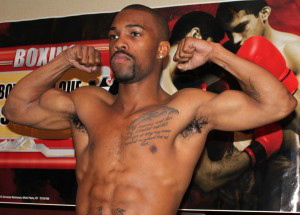
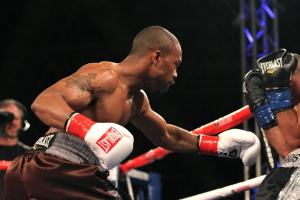
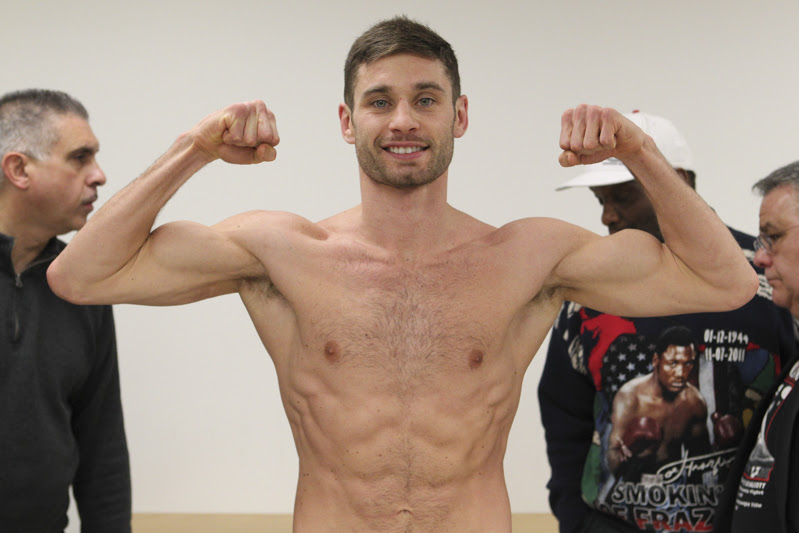
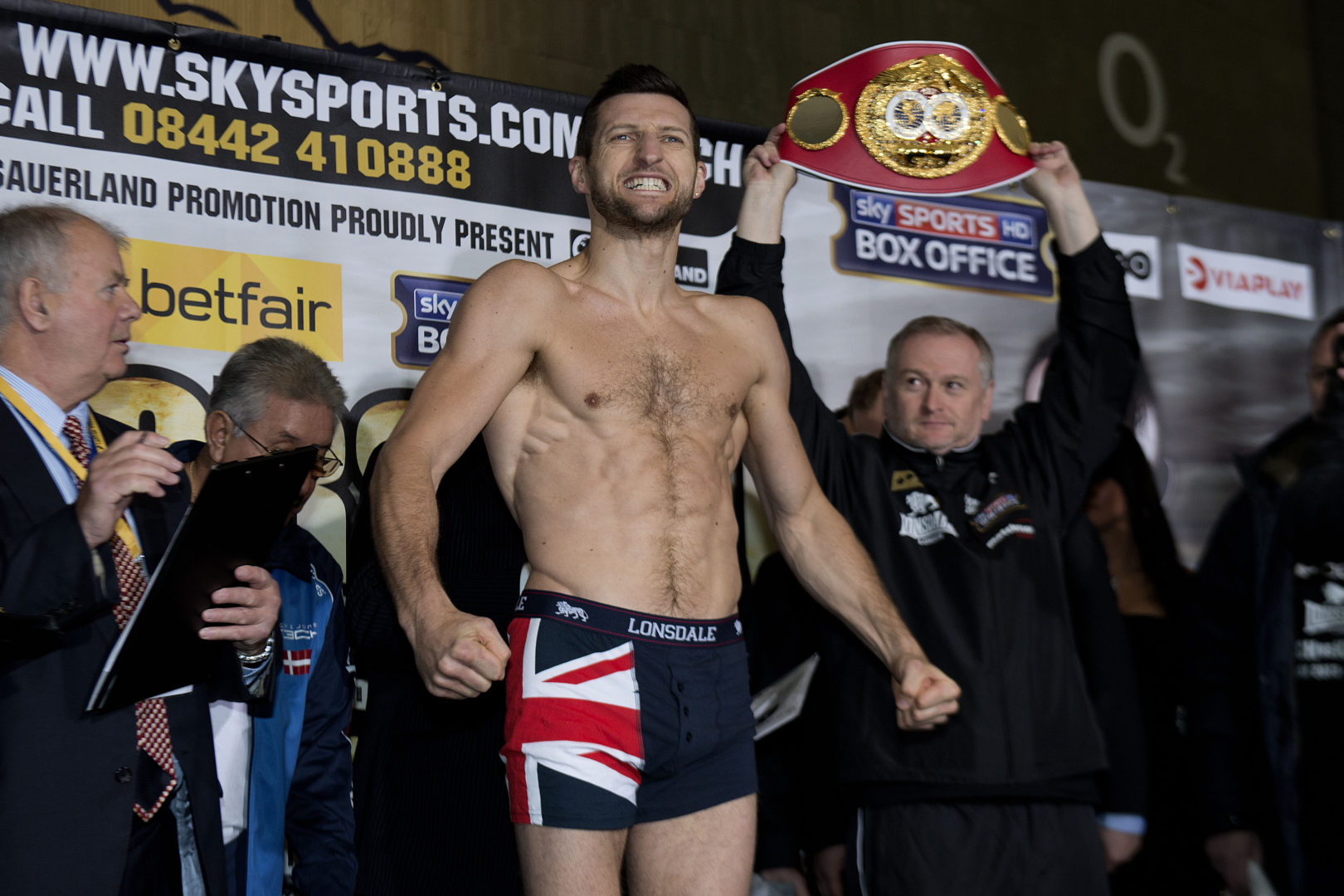
A catch-weight clause in the Canelo Alvarez-Erslandy Lara contract quickly became a forgotten controversy Friday when each fighter weighed in at 155-pounds at the MGM Grand for a Showtime pay-per-view bout Saturday night with a lot hanging in the balance, yet no significant title at stake.

It’s a mystery why a catch-weight was in the deal at all. Canelo demanded it. Lara was angered by it. There was a theory that it was Canelo’s way of saying he couldn’t make the junior-middleweight limit of 154 anymore. Perhaps, it’s a sign he’s moving up in weight to 160 after Lara, the World Boxing Association’s champion.

Or maybe it was just a question of money. Why pay the WBA a sanctioning fee? It would have cost Canelo three percent of his purse. According to contracts filed with the Nevada State Athletic Commission, Canelo is guaranteed $1.5 million, which doesn’t include an undisclosed percentage of Mexican television revenue. At minimum, he would have paid the WBA $45,000.

Whatever the motivation, Canelo (43-1-1, 31 KOs) saved himself and Lara (19-1-2, 12 KOs) some money. Lara’s contract guarantees him $1 million. Lara also walks away from Saturday night’s fight with his title no matter what happens.

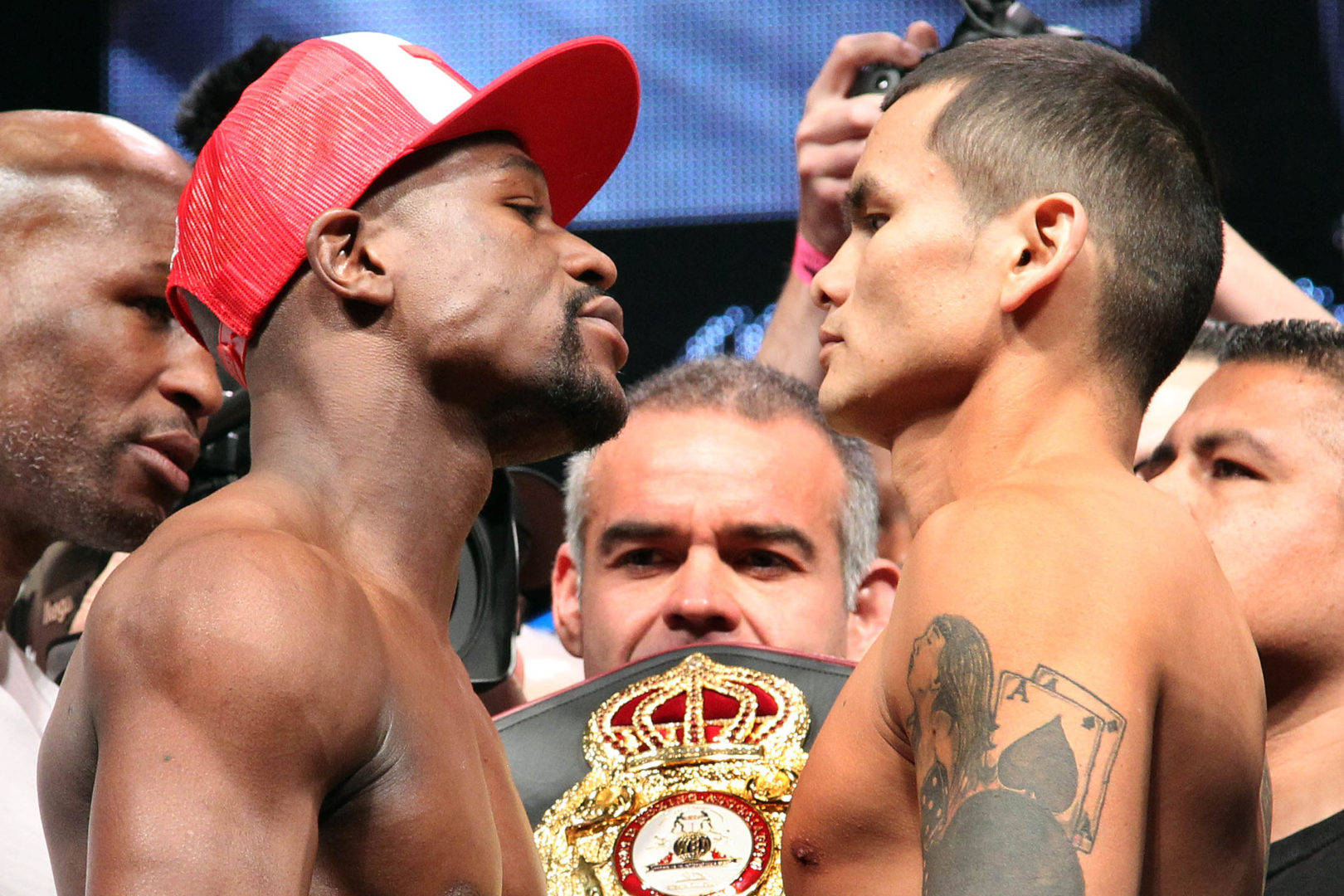
Yet, Lara still looked like an angry young man at Friday’s formal weigh-in. After the fighters stepped off the scale, there was the ritual eye-to-eye, nose-to-nose pose for cameras and fans. Lara, about a 2-to-1 underdog late Friday, rolled his head one way, then another, in Floyd Mayweather-like fashion. It was a menacing bit of theater. But it didn’t seem to affect the ever-unflappable Canelo, who faced Mayweather in the same ritual before his loss to the pound-for-pound king in September. Canelo never blinked then. He didn’t blink Friday.

“I wanted to break his face then,’’ Lara, a Cuban, said in Spanish interpreted by manager Luis DeCubas Jr.

A crowd of about 4,000, dominated by Canelo fans from Mexico, roared its disapproval. Saturday night, Lara said, those fans will change their tone. He seemed to say that in the very least they’ll learn to respect him.

“They will find out exactly what the Cuban school of boxing means,’’ Lara said through DeCubas

But Canelo wasn’t buying into Lara’s school of thought.

“Tomorrow,’’ he said, ‘’we’ll find out who takes who to school.’’

Notes: Abner Mares weighed 126.5 pounds for his comeback in a bout with Jonathan Oquendo Oquendo also weighed 126.5 pounds.. …Ex-WBO featherweight champion Juan Manuel Lopez was at 130-pounds for his junior-light-weight bout against Francisco Vargas, who came in at 129.


In Canelo, De La Hoya can get a glimpse at where he’s been and where he’s headed

By Norm Frauenheim-
Oscar De La Hoya
Oscar De La Hoya often talks about Canelo Alvarez as though he is looking at himself, or maybe at what he had hoped for himself. In the reflection, there are huge aspirations. Maybe some illusions, too. A mirror can bend reality into some funny shapes. Tricks lurk behind the blind spots for anybody susceptible to a feint. Yet, the truth always appears, which is what De La Hoya is about to discover in a critical test of Canelo’s right to be the heir-apparent in a domain long ruled by Floyd Mayweather Jr. and Manny Pacquiao.

Erislandy Lara, who has quick feet and sneaky power, is in the way and dangerous enough to make Canelo’s potential look like false advertising.

For Canelo, the stakes have never been higher than they will be Saturday night at Las Vegas’ MGM Grand in a Showtime pay-per-view bout crisscrossed by plots and subplots. Here’s just one: It’s a fight that could be critical to De La Hoya’s business, Golden Boy Promotions. His company is fighting for relevancy in the wake Richard Schaefer’s resignation as CEO and questions about whether fighters presumed to be with Golden Boy are in fact tied to Al Haymon. Lara is a Haymon fighter. Lara’s tie to Haymon might have been an interesting footnote and nothing more if not for the De La Hoya-Schaefer split. Now, however, it’s a key element that has spawned further plots and garden-variety conspiracy theories. To wit: Was Schaefer setting De La Hoya up for a fall by putting Canelo into the most dangerous fight possible?

Believe what you want about how and why Canelo agreed to face Lara in a junior-middleweight fight perilous to him and De La Hoya. It’s no secret that Canelo is Golden Boy’s most valuable commodity. His drawing power was evident in the record revenues produced in his pay-per-view loss to Mayweather in September. His one-sided loss to Mayweather was predicted and has been written off as a learning experience. Fair enough. But his Pied Piper-like ability to attract fans, especially in his native Mexico, has heightened the fight’s urgency and probably the anxiety for anybody invested in him.

Can he win? Yeah, definitely.

Can he lose? Yeah definitely.

But this isn’t just another pick ’em fight. The potential consequences make this one extraordinary.

De La Hoya’s brilliant career included at least a couple of bouts that confirmed his stardom and propelled him to the big money that he would later collect. Two come to mind.

There was Pernell Whitaker in 1997, five years after De La Hoya’s Olympic gold in Barcelona. At 23-0, De La Hoya had an unblemished record and unmarked face. But he had yet to prove whether he was more than a pretty face. Whitaker represented a critical test. He was 40-1-1 and thought to be the best defensive tactician of his generation. De La Hoya won, claiming a unanimous decision — 116-110 on two cards and 115-111 on the third. But the scoring was ripped, especially by East Coast media which argued that the bout was at least a draw. Many screamed from their ringside seats that Whitaker, of Philadelphia, had been robbed.

Then, there was Ike Quartey in 1999. Quartey, strong and skilled, was 34-0-1 and thought to be the world’s most dangerous welterweight. De La Hoya had won six more times since Whitaker. He was unbeaten, yet still unproven. There were questions about whether he could take much punishment. He could, he did, getting up from a fourth-round knockdown while flooring Quartey twice, once in the sixth and again in the 12th. But the bout was not without controversy. De La Hoya won a split decision, 116-112 and 116-113 on two cards. The third had it for Quartey, 115-114. But disagreement on the cards subsided, allowing De La Hoya to move on, up and into the biggest star of his generation.

Both fights were at Thomas & Mack in Las Vegas, a city where De La Hoya was popular enough to be called the house fighter. It’s a label that Canelo has today.

From this corner, the guess is that Canelo-Lara will resemble De La Hoya-Quartey more than De La Hoya-Whitaker. Canelo’s strength is power. Lara has enough of it to also do some damage. Knockdowns appear inevitable, perhaps decisive in a bout that could be controversial. However, Lara could rely on his quick feet and left-handed style with Whitaker-like defense, although that strategy might backfire just as it did for Whitaker 17 years ago.

From his ringside seat Saturday night, De La Hoya might remember Quartey and Whitaker. He might look at Canelo and recall two difficult victories that were so important to his own career. He might see something else, too. It could look a lot like his future.


Saul Alvarez: The cinnamon reckoning of an American promoter and a Cuban boxer

By Bart Barry-
Canelo Alvarez
Saturday at Las Vegas’ MGM Grand, home of Floyd Mayweather’s entranceway shrine, Mexican Saul “Canelo” Alvarez will make a pay-per-view match with Cuban Erislandy “The American Dream” Lara to determine who will be considered the world’s best junior middleweight until Mayweather returns to the division. Those who consider themselves insiders are, in many cases, expecting an overrated Alvarez to lose to what they believe is an underrated Cuban boxer-puncher.

Were official sportsbook Boxing Betting Odds right about Alvarez?”

Erislandy Lara has gotten extended mileage out of his and trainer Ronnie Shields’ claims of others’ avoidance. He is aesthetically displeasing, often in the very worst way of sloppy retreat, hopping sideways in shows of inefficiency to make Amir Khan’s head shake, while he is possessed of wiles enough to make his unconsciousness in a prizefighting ring unlikely. He approached the dais after Alvarez’s last fight, a sanctioned assault of Alfredo Angulo in March, with the trepidatious look of a man pushed from the wings by a stagehand longer on enthusiasm than prudence. Alvarez fielded him nearly with pity, sensing almost immediately Lara was driven by others, not restrained, confidently patted his shoulder, and told Lara to wait his turn.

Their encounter bore the markings of a nervous little guy in a struggling beard sent on a dare by his gamer buddies to game a supermodel on the arm of the bar’s largest and most masculine presence; the podium was the lass and Lara the nervous suitor. After a quiet and somewhat rambling bit of Cuban Spanish from Lara, Alvarez relieved his command and asked who wanted to see them fight, laughed at most of the room’s silence, then asked two of those who spoke up if they, too, were Cubans. Then Alvarez dismissed Lara, as if empathetically.

Some weeks later, with Alvarez wanting back on pay-per-view soon, and his U.S. promoter privately unraveling towards a soon-to-be-public firing of its CEO, Alvarez-Lara got announced, a match Lara’s true believers believe will justify years of their man’s contending he is the game’s most-avoided prizefighter, a match that may prove an aesthetic disaster, but may not, and will be Alvarez’s to lose – either via brutal stoppage or sympathetic judging by some who know a healthy Las Vegas economy is a burden no Cuban’s popularity should be asked to support.

There will be very few Lara supporters at Saturday’s match because most Lara fans are committed to misanthropy more than boxing. In Lara they see a soulmate spoiler of sorts, a man who makes their contrary impulses dance like disco lights in a kaleidoscope. Alvarez is the sort of person a Lara fan never expected to fight their guy. For having been ushered to stardom via haircolor and Mexican daytime television – and Mexicans’ rapacious desire to claim prizefighting’s best as their own – “Canelo” is the anti-Lara, a man whose image surgepumps lighter fluid on the dull if ever-breathing embers of resentment from which many casual boxing fans, and even some serious ones, draw their animating force.

Not enough is yet known about the fiscal health of Alvarez’s U.S. handler, Golden Boy Promotions, or even if it has been acting legally as Alvarez’s promoter – a Florida courthouse will begin sorting this out in October, when All Star Boxing, headed by one of the more charismatic promoters our sport boasts, Tuto Zabala, sees the fruition of a lawsuit it initiated in 2011 – to comment intelligently on the outfit’s future. There is doubt, though.

While Golden Boy Promotions’ deposed executive Richard Schaefer is arguably the least-charismatic promoter our sport boasts, or boasted anyway, he built a robust company while answering to about as zany a boss as any serious professional ever did. In and out of rehab and surely suffering worse and deeper troubles than ever had their day in the tabloids, Oscar De La Hoya disappeared frequently, appeared sporadically, and rarely said an insightful or particularly coherent thing while in public during much of the last half of Schaefer’s tenure.

Indications are that Schaefer did not represent De La Hoya’s best interests at all times, though a day may come when it is apparent De La Hoya’s best interests were not necessarily the same as his company’s, and while Schaefer auctioned off assets of the corporation, many possibly to manager Al Haymon, they were assets Schaefer nevertheless acquired in the first place, assets that were going to float away regardless of the promoter’s attaining some fees from them in the meantime. Floyd Mayweather may well have been a free agent, in other words, but the buffet of substandard Golden Boy Promotions fighters upon which he feasted, instead of Manny Pacquiao, was no accident and brought Golden Boy Promotions much greater revenues than it would have raised on its own, whatever conditional promises were made to attain them.

How well boxing’s second-best promoter will function in Schaefer’s absence is anyone’s guess. No knowledgeable person expects De La Hoya to have the acumen or attention span to replace Schaefer by himself. One hopes, for our sport’s longterm health, then, De La Hoya is busy interviewing potential replacements, sifting through an impressive stack of impressive resumes, at this very moment.

One hopes, yes, but one does not expect.

Where Top Rank comprises a roster of esteemed professionals and Don King Productions once comprised one of the world’s most relentlessly enormous personalities, Golden Boy Promotions comprised a rightfully famous figurehead and a savvy CEO. It no longer has a savvy CEO.

Despite himself in many cases, De La Hoya was en route to becoming something our sport lacks and truly needs: a happy ending. The tenuous partnership of De La Hoya and Saul “Canelo” Alvarez, tenuously linked, may not be any handicapper’s best place to put his money, but for now, it’s what’s on the quick sheet and deserves at least well-wishes, if not additional investment from fans.

Either way, I’ll take Alvarez, UD-12, in a match that proves Erislandy Lara is not underrated.

Bart Barry can be reached at bart.barrys.email (at) gmail.com


Lara fighting for his version of The Dream against Canelo

By Norm Frauenheim-
002_img_8524_lara_victory
Erislandy Lara, a Cuban defector, calls himself The American Dream. Nothing new about the nickname.

David Reid, a junior-middleweight from Philadelphia, got the same name after winning an improbable gold with a 1996 Olympic knockout of a heavily-favored Cuban at the Atlanta Games. His dream ended quickly and sadly. Reid, who won a WBA title in only his tenth fight, was finished as a pro after 19 bouts (17-2, 7 KOs) in 2001, because of a detached retina and drooping eyelid that led to fears his vision was in jeopardy.

Henry Cejudo, a wrestler from Phoenix and a U.S.-born son of illegal immigrants, was The American Dream in 2008 when he won gold on Beijing’s Olympic mats in a moment as compelling as Michael Phelps’ record-setting eighth gold in the pool.

Different dreams.

Different stories.

It’s hard to know where the Lara edition of The Dream is headed, mostly because his July 12 showdown against Canelo Alvarez at Las Vegas’ MGM Grand in a Showtime pay-per-view bout is tough to pick. Styles make fights and Lara appears to have an edge in that proven category. He possesses the quick footwork and counter-punching precision that Floyd Mayweather Jr. employed in a dominant decision that left Canelo looking bewildered and overmatched last September. However, bouts of inconsistency on Lara’s resume are impossible to ignore. He drew with Carlos Molina in a bout many thought he lost during a 2011 that included a controversial loss by majority decision to Paul Williams. Yet, Lara was more impressive in beating Austin Trout than was Canelo, who escaped from that one with a decision in April, 2013.

More recent and perhaps more problematic was Lara’s 10th-round TKO over Alfredo Angulo in June, 2013. Angulo knocked down Lara twice, first in the fourth round and again in the ninth. In March, Canelo was never in any serious trouble in stopping Angulo, also in the 10th.

Lara survived Angulo’s one-dimensional power. But Canelo is at his best with combinations, which means a follow-up that Angulo couldn’t really deliver. Lara got up twice from one-punch power. But two-fisted power? It’s one question among many in an intriguing match between fighters closer to the prime than the twilight. Golden Boy Promotions is calling it Honor & Glory. Don’t be surprise if there’s Controversy, too. There’s a 155-pound catch-weight, which means Lara’s 154-pound title, the WBA’s interim version, won’t be at stake. The catch-weight clause appears to be an invitation to miss weight altogether. Canelo has played the scale game before. In 2011, he failed to make a 150-pound catch weight for Matthew Hatton, weighing in at 151.8. Against Angulo, the weight was re-negotiated when Canelo realized he couldn’t make the junior-middle limit. It was re-set at 155.

“Canelo can’t make the weight, so he refused to fight for the title,” Lara said through manager and translator Luis DeCubas, Jr., Wednesday during a conference call. “It’s very disrespectful and my motivation to beat him has increased because of it.”

It appears Lara has managed to annoy Canelo at news conferences and through social media. He interrupted Canelo’s post-fight celebration of his victory over Angulo. At the news conference, he taunted Canelo, demanding that fight him. He has called Canelo “a baby.” Much of it sounds orchestrated. Lara is not the free-wheeling trash-talker that fellow Guantanamo native and Cuban defector Joel Casamayor was. Casamayor used every obscenity and probably introduced a few new ones to the book of expletives. Lara appears to be more distant and calculating. Nonetheless, he’s not afraid of controversy. He kept the pot stirring Wednesday with the conference call’s best comeback. He was asked if he owes Canelo a thank-you for the opportunity in a bout that could be career-maker.

“I don’t owe him nothing other than left hands,” he said through DeCubas. “I forced this fight. It wasn’t because Canelo wanted to take this fight. I’ve been after this fight for two years.”

There’s arrogance in that comment.

Fearlessness, too.

Lara already has encountered plenty to fear. His journey from Cuba isn’t unique. Dodgers outfielder Yasiel Puig traveled it in his own way. Lara in another. No matter what the path, peril is there. For Lara, it started in Brazil. He and Cuban teammate Guillermo Rigondeaux tried to defect before the 2007 Pan-American Games. They were caught by Brazilian authorities, who sent them back to Cuba. An angry Fidel Castro banned both from boxing. In 2008, Lara escaped Cuba and fled to Mexico on a boat. Then, he headed to Germany. He made his pro debut in Ankara, Turkey, fought once in Germany and then headed for America. But his Dream sometimes looked unattainable. In 2009, he was not granted a license to fight in Tucson. The Arizona State Boxing Commission said he was not able to get a work visa, then mandated in a state which was about to be embroiled in the 2010 immigration controversy over the SB 1070 legislation.

But he endured. Lara fought through the setbacks, came back from each in a way that could have prepared him for
Canelo. There’s no Dream without comebacks. Against Canelo, Lara might have to pull off another one.


Terence Crawford: Ratified with a smile

By Bart Barry-
Terence Crawford
After nine years of sitting ringside at Top Rank shows – my first media credential came from Lee Samuels, in April 2005 – one flatters himself to think he can discern the difference between a well-built fight and a well-built fighter, noting hallmarks of the promoter’s extraordinary eye for talent and talent for matchmaking in the differences between a well-built fight like Donaire-Montiel and a well-built fighter like Miguel Cotto. In Dallas one year ago to see Mikey Garcia continue his ascent, while actually witnessing its antithesis, I believed the best-built fighter I saw at American Airlines Center was not Garcia but an undefeated kid from Nebraska named Terence Crawford.

Saturday confirmed that opinion and ratified Crawford as one of the world’s two best lightweights (and if a fight’s probable aesthetics should require ambiguity, may it ever do so in the case of Crawford and Miguel Vazquez), when Crawford overcame undefeated Cuban Yuriorkis Gamboa’s initial superiority of reflex and craft to make a first defense of his world title the proper way: TKO-9. At Omaha’s CenturyLink Center, Crawford switched from orthodox to southpaw, socked Gamboa from most every direction, dropped him four times, and commanded referee Genaro Rodriguez’s mercy, in a performance that made aficionados everywhere suddenly invest in the Nebraskan’s fortunes.

Crawford-Gamboa was an excellent fight conducted near the height of boxing’s current powers, though not quite as much as HBO’s hyperbolic commentating crew proclaimed – so thrilled were they to be somewhere new in front of a spectacle competitive. Terence Crawford is a rarity among contemporary prizefighters: A talented fighter able to sell tickets at home though nevertheless willing to travel anywhere and make fight real fights against real fighters. He is a monument to how Top Rank alone can build a fighter when it wishes to, when it takes a nothing-much-to-lose approach and moves him properly, making sterner tests steadily, and giving him a chance to surprise himself and others when his moment comes.

If a prizefighter improves considerably by becoming a champion, Crawford just became better again by defending his belt before a hometown crowd. Whatever collectedness Crawford showed throughout the match and afterwards, however much the ferocity of Gamboa’s attack elevated Crawford’s demeanor in aficionados’ eyes from insipid to poised, there can be no doubt he was surprised and overjoyed by his performance and its result. Watch him immediately after being hoisted on his handler’s shoulders in the traditionally celebratory way; he begins with the menacing glare one sees predominately in staredowns and hip-hop clubs then surrenders his face to a wide and nearly disbelieving grin.

It was, in its way, a metaphor for the transition in demeanor our sport’s fans underwent these last 30 days: After a scowl-inducing opening five months, 2014 righted its course, if it didn’t fully redeem itself, with definitively heroic showings by Carl Froch, Chris Algieri, Vasyl Lomachenko and Terence Crawford, interrupted early by a coronation of sorts for Miguel Cotto, aficionados’ consensus pick for the veteran prizefighter most deserving of one. While a single stretch in a mediocre run would not save a programming regime in a meritocracy, in the current state of premium-cable programming it likely buys those running HBO Sports another year or so.

As if in late-arriving rebuttal to Showtime’s groundbreaking work with Chuck Giampa in 2012, HBO unveiled Saturday its own fan-battle and groggy-cam innovations, the former a feature in which, rather than feign objectivity at the outset, Max and Roy each pick an opposing fighter and comb a match’s every indecisive moment for evidence his fighter took it, while Jim scores their efforts and Steve agrees. Max selects the object of his greater overstatements in bygone fights, and Roy picks whichever guy resembles Roy. Perhaps the fan-battle innovation, then, marks not an innovation but a feedback mechanism: Any time Max tore his eyes from Gamboa’s spellbinding athleticism, Saturday, it meant Crawford did something exceptional, and each time Roy got Gamboa’s name right it was because the Cuban showed much heart, son.

The groggy-cam innovation, though, was exactly that: Effectively as Chuck Giampa once took Showtime viewers inside the mind of a judge so did HBO’s camerawork take subscribers inside the massively concussed brain of a nearly unconscious man in a championship prizefight. Viewers who delighted in HBO’s rope-obstructed shots in the opening rounds had no choice but to concede the close of Saturday’s main event was nigh intoxicating, if not intoxicated. After Gamboa rose from the blue mat and readied himself for his final act of self-immolation in round 9, HBO gave its viewers a jerky Omaha-crowd-as-Pacific-Ocean angle nonsensical as broadcasting a Tiger Woods sudden-death putt from the Goodyear Blimp.

Self-immolation was indeed the phrase that often came to mind while watching Gamboa in Saturday’s final rounds. Gamboa, who has been rendered HBO-camera-like just about every time a fight of his makes television, brought to mind the Mike Tyson whom Evander Holyfield stopped in their first match, though without a chin fractionally reliable as Tyson’s. Just as Holyfield weathered the initial onslaught of Tyson’s reflexive rage and raging reflexes, weathered it to remind Tyson who the physically stronger man was, so did Crawford get too close and then too far in his opening 12 minutes with Gamboa, determining what he might be missing in the Cuban’s all-offense-always style and what the consequences of his carelessness later might bring, before marching forward and imposing himself the way a man should in a confrontation.

Unlike Crawford, Gamboa had no means of countering a force that moved him backwards, asserting once more his claim on contemporary prizefighting’s largest delta between physical ability and ring IQ – that somewhat fuzzy quality one needn’t define precisely before knowing Crawford has much larger stores of it than Gamboa. More enticing, still, is this: Crawford utilized his IQ to make a wager worthy of prizefighting’s master gambler, Juan Manuel Marquez, choosing to absorb Gamboa’s overhand rights, from a southpaw stance, in the hopes of deploying his own arsenal with more devastating effect.

When such hopes find full satisfaction in an arena filled with one’s hometown fans, it’s OK to break character afterwards and smile widely, Terence. You’ve got lots of folks smiling.

Bart Barry can be reached at bart.barrys.email (at) gmail.com


Feud Fallout: Falling pay-per-view numbers are a sign of the times

By Norm Frauneheim-
Miguel Cotto
It’s a season of declining expectations. Miguel Cotto’s dramatic victory over Sergio Martinez represents the third straight time that pay-per-view numbers for a major fight were disappointing. Once might be an aberration. Twice is cause for concern. But three straight? That’s a trend.

The reported number for HBO”s PPV-telecast of Cotto-Martinez on June 7 was 350,000. The projection was 460,000 to 500,000. That follows reports that Floyd Mayweather Jr.’s decision on May 3 over Marcos Maidana fell short of the one-million mark, an expectation built into the Money May nickname. Mayweather has generated more than one million in six fights — Oscar De La Hoya (2.4), Canelo Alvarez (2.2), Cotto (1.5), Shane Mosley (1.4) Victor Ortiz (1.25) and Juan Manuel Marquez (1.06). Against Maidana, the buy-rate was reported to be about 900,000, although Showtime has not announced a number.

The first domino to fall was Manny Pacquiao’s rematch victory over Timothy Bradley on April 12. The HBO telecast did between 750,000 and and 800,000 according to various media sources. Like Mayweather, Pacquiao failed to meet the million milestone that the Filipino has often surpassed. His PPV average was 1.079 million for seven fights between his victory over Oscar De La Hoya on Dec. 6, 2008 and his majority-decision over Marquez on Nov. 12, 2011 in their second rematch.

The 2014 decline has been blamed on a lot of things, all reasonable. There have been too many pay-per-view shows for ho-hum fights, Top Rank’s Bob Arum told ESPN. There was too much competition for eyeballs on the Cotto-Martinez weekend, when the Los Angeles Kings and New York Rangers played for the Stanley Cup and the Triple Crown was at stake in the Belmont, Martinez promoter Lou DiBella said.

Yes and yes.

But the conversation ignores a very big fly in the troublesome ointment.

Sliding numbers are further confirmation that the promotional feud has taken a toll. It appears that the bitter divide between Golden Boy and Top Rank has begun to heal because of De La Hoya’s initiative. He reached out to Arum and promised to renew a working relationship with ex-Golden Boy CEO Richard Schaefer’s sworn enemy. The move was gutsy, yet risky. It led to immediate turbulence at Golden Boy, the company he founded in 2002. Schaefer resigned. Chief Operating Officer Bruce Binkow soon followed. But it’s hard to know what will happen, long-term.

What the PPV numbers say, however, is that the so-called cross-over crowd, the casual boxing fan, has moved on. It’s safe to say that the cross-over fan isn’t interested in the blow-by-blow coverage of insults exchanged by feuding personalities. Nasty divorces, done over and over again, are tired events. Good fights aren’t. The best of the good just hasn’t happened because of a feud that might be healing, but isn’t resolved.

The guess here is that a key clue to Golden Boy’s future will be revealed this fall. On October 13, a lawsuit filed by All-Star Boxing against Golden Boy involving Canelo is scheduled to go to trial in Florida’s Dade County. The allegation is that Golden Boy signed Canelo when he was still under contract to All-Star.

If it was business as usual, the lawsuit might come and go like so many others have. But these are unusual times, even for a sport that has seen it all. The October trial looms as critical. Canelo is the biggest draw in Mexico, boxing’s biggest market. Retaining his promotional rights would appear to be a cornerstone to Golden Boy’s viability. Whatever happens in that Miami courtroom, it’ll have lasting impact throughout.

Until October, however, the business is in limbo. There are some very good fights, the biggest of which is Canelo-versus-Erislandy Lara on July 12 in a Showtime pay-pew-view fight at Las Vegas’ MGM Grand. But will the cross-over fan watch? The first half of 2014 says no.

That cross-over demographic is critical. It’s what turns a good fight into a blockbuster and what makes Mayweather worth the potential $250 million that Showtime invested in him. Thus far, however, that crowd isn’t there anymore.

For now, the NHL, or horse racing, or the World Cup, or a movie looks as if it’s a better investment than pay-per-view boxing. Winning back that fan is the biggest fight, but doing it is a challenge complicated by a sport that has yet to repair itself.


In celebration of 0s that went

By Bart Barry–
RussellbyJimWyatt300
“Looks like in the next year or two, he is going to be a threat for any featherweight champion.”

The quote above belongs to the late Emanuel Steward, an utterance he made about three years ago while watching Gary Russell Jr. decision someone named Eric Estrada, a Chicagoan who then promptly retired with a professional record of 9-2. Russell was 16-0 at the time. Mr. Steward had a penchant for saying most every event, regardless of outcome, had gone “exactly as I thought it would” – though doubtfully even he had a twinkle in his eye sparkly, or smile endearing, enough to say such a thing about Russell’s career.

Saturday in Carson, Calif., in a fine featherweight title fight, Ukrainian Vasyl Lomachenko defeated Maryland’s Gary Russell Jr. by split scores of 116-112, 116-112 and 114-114, giving Russell his first professional defeat and Lomachenko his second professional victory.

Gary Russell Jr. did not deserve a full helping of what derision was heaped on him previously, and he proved as much Saturday. Vasyl Lomachenko deserved at least 2/3 the praise initially heaped on him, too, and he proved as much Saturday. Their fight was excellent, deserving of better treatment than their scorecards engendered, certainly, with both men acquitting themselves about as well as hoped, neither embarrassing himself, and both men’s records now becoming beacons, one hopes, boxing might follow to a better place.

More important for the future of our sport than the milquetoast armistice reached between a promoter and the shell of its rival – review the undercard of Pacquiao-Barrera II for a reminder how well such treaties served aficionados last time – are the losses that adorn the records of both Lomachenko and now Russell, two of the more talented prizefighters in a fantastic division. There’s no sense protecting either anymore, in other words, though the plan for promoter Top Rank seemed never to protect Lomachenko in the first place or else never again to serve him an overweight Mexican veteran in South Texas.

Gary Russell was more than at least one of his predecessors, Andre Berto, and likely more than the other of his predecessors, Adrien Broner – though Broner fought much better opposition en route to being undressed by Marcos Maidana than Berto saw en route to Victor Ortiz, and Russell’s dossier from the last four years makes Berto look Frochian, though Russell is likeable, not odious, so he’ll get forbearance Broner did not (and sell fewer tickets too). In Broner and Berto, aficionados recognized almost immediately profound technical flaws and felt betrayed by a pair of networks that would pretend otherwise, or not know any better despite budgets meriting they should.

With Russell there’s some difference in the sense of betrayal’s origin – there’s a sense poor management has taken a prodigy and made him somewhat ordinary by moving him inappropriately, or not at all, putting altogether too much emphasis on keeping zero down the loss side of his ledger. Russell’s manager, Al Haymon, in other words, may be something of a one-trick pony in his means of developing an attraction, and it’s a trick Floyd Mayweather Jr. taught him. In the case of Berto, the trick was a good one, truthfully: Andre Berto was able to make multiples more money by having his manager hoodwink HBO than his talent held claims on. Broner was not untalented so much as overhyped, forcing his 0 to go earlier than perhaps it needed to – but then network budgets had thinned considerably by the time Broner fought Gavin Rees, thinned anemic beside the halcyon days of Berto locking horns with a guy on a 1-3 tear like Steve Forbes in 2008.

The New Normal, and all that.

Gary Russell was announcing too many fight dates too late in his development with TBA as his opponent, and a goodish amount of the displeasure knowledgeable folks feel for Haymon’s machinations and the effect they’ve taken – precluding fights, not enabling them – got projected on Russell. That should stop now; Russell is not everything we were told he is, neither is Floyd Mayweather or any Haymon-managed fighter, but then, would Haymon be doing his job correctly if any were?

Lomachenko is a solid prizefighter who is fighting a quality of opposition that far outpaces his professional experience and surely speaks to his amateur accomplishments, age, and someone’s avarice – either his, his handlers’, or both, since promoter Bob Arum rarely sounds genuinely prouder than when he says, as he did before Julio Cesar Chavez Jr. fought Sergio Martinez, his company does not put fighters in matches for which they are unready. Lomachenko was unready for Orlando Salido, the Mexican who decisioned him just 3 1/2 months ago in San Antonio, in much the same way Gary Russell was unready for Lomachenko on Saturday. (And yes, there’s something tragicomic about a sport in which a man with a record of 24-0 is unprepared for a man with a record of 1-1, but then, like World Cup fans, fight aficionados love the sweet suffering that accompanies being a malcontent.)

Lomachenko still shows a crazy aversion to others’ body punches, hula-hooping his torso backwards with sincere fright, but he otherwise serves auspicious surprises to opponents, both in his quickness and commitment, that justify most of the confidence he has in himself. And it is to his redounding credit that he complained so little during and after his match with Salido and returned from it so quickly, too.

No longer getting others to fill their dateplanners with a farfetched combination of what potential he showed at 16 and a record built by cheap laborers like Juan Ruiz and Miguel Tamayo, Gary Russell Jr., now, can enjoy the durable sort of esteem that comes from knowing whatever he gets from 24-1 till retirement is earned, forcing him finally to tuck his chin and improve himself in ways the seven fights that directly preceded Saturday’s did not.

Bart Barry can be reached at bart.barrys.email (at) gmail.com


A Look Beyond The Feud: Russell and Lomachenko might provide a glimpse

By Norm Frauenheim-
GaryRussellWins300
Much has been attached to the Golden Boy Promotions card Saturday night at the SubHub Center in Carson, Calif.

Too much.

It’s there mostly because of hope that it represents an initial step beyond the balkanization of a business full of feuding promoters, who get bigger headlines than the fighters do these days. It’s also there because an Al Haymon-represented featherweight, Gary Russell Jr., is fighting Top Rank’s Vasyl Lomachenko in an undercard bout that figures to overshadow the main event, Robert Guerrero-Yoshihiro Kamegai.

“Honestly, it’s a big honor to break the cycle of the Al Haymon and Bob Arum Top Rank and Golden Boy dissent,” Russell said during a conference call. “I think you have these great fighters you know on both sides of the fence that the fans would love to see.”

Against Lomachenko, Russell sees a chance to tear down that fence.

“I think it’s a big breakthrough for me and Lomachenko to be able to be one of the first to actually do it, and hopefully this will open the door for a lot of the other fights that the fans would want to see take place.”

I hope Russell is right. But I’m not optimistic that Manny Pacquiao-Floyd Mayweather Jr., or even Sergey Kovalev-Adonis Stevenson, is any closer because of a Russell-Lomachenko bout that was put together before Richard Schaefer quit his post as Oscar De La Hoya’s CEO. There are still too many unanswered questions. To wit: Who will De La Hoya hire to run Golden Boy’s day-to-day operations? More troubling is continuing uncertainty over who is contracted to Golden Boy and who to Haymon.

Not even Guerrero’s contract status is clear. He tried to split with Golden Boy in January. He was asked about it Tuesday during a conference call and again during a media day.

“It’s … you know, you’ve got to do what you’ve got to do,” said Guerrero, who is back for the first tine since a one-sided loss to Floyd Mayweather Jr. in May, 2013. “I leave that stuff to my management and take care of my business in the ring.”

Instead of opening bell, most of the sport is waiting for an opening argument. That can’t be good for business.

Still, Russell and Lomachenko might put on a show that could embarrass the feuding promoters. A great fight would provide a glimpse at what could be if promotional egos and/or greed stay out of the way. There’s a chance that could happen.

Russell-Loamchenko has elements of a potential classic. Both are storied amateurs. Russell was a prodigy. He won a national Golden Gloves title when he was 16. Lomachenko was a legendary Olympian, a two-time gold medalist (2008 and 2012) for the Ukraine. At 24-0-1, Russell has pro experience. Yet in a curious switch, there are more questions about him than there are about Lomachenko (1-1), who got ahead of himself in his apprenticeship against Orlando Salido in only his second pro bout. Salido has been called a gatekeeper for a reason. He’ll throw the gate at you if he has to. Salido came in overweight and then he roughed up Lomachenko and his Olympic pedigree in winning a split decision. Some say that Russell’s fast hands move at a rate unseen since Meldrick Taylor. Yet, there are doubts about the quality of his opposition. He has never faced anybody with Salido’s willingness to win at any cost.

“Gary Russell is much faster than me” Lomachenko said during his media day. “He’s a very quick, speedy fighter, and I won’t know until we get into the ring how I plan to deal with it. But we’ll find out soon enough. I fought really fast guys in the amateurs. But those were only three-round fights, so I didn’t have time to try and figure out the style of who I was fighting.

“…I got good experience from my two professional fights. I came on the last half of my first fight so I think my stamina and conditioning is good. But every fight is different, so we’ll have to see.”

A great fight might not change the business. Not in the short term anyway. But it’d be nice to see what could be different.


Chris Algieri: Mind over massacre

By Bart Barry-
Chris Algieri
Two Saturdays ago in Manhattan’s Madison Square Garden our sport bade a tempered farewell to former middleweight champion Sergio Martinez, squinting at a hobbled impostor sent hobbling to his stool by Miguel Cotto, even while recalling fondly the innovator who once, as a 154-pounder, stood brazenly, gloves on thighs, before middleweight world champion Kelly Pavlik. Saturday in Brooklyn’s Barclays Center our sport bade a fond hello to New York junior welterweight Chris Algieri, a smartly stylish innovator of his own who just unmanned boxing’s most-feared puncher, Russian Ruslan “Siberian Rocky” Provodnikov, to score 2014’s biggest upset by split-decision scores of 114-112, 114-112 and 109-117.

After weathering a one-punch knockdown and a timeout knee in Saturday’s opening round, Algieri proved himself intelligent and unflappable as a man might be in his world-title-fight debut. Perhaps no tactic employed by Algieri Saturday betrayed the cleverness of his unorthodox craft better than how he repeatedly thrust himself at the ropes each round, performing a feat of balance and leverage that would merit bonus ring-generalship points from judges, were our sport’s scorekeepers reliably able to observe from a mindset more sophisticated than “hit the damn guy!”

A man driven to the ropes by another, the way, say, Mike Alvarado was driven ropesward by Provodnikov in October, generally gets flattened against them, his feet and shoulders squared in tacit agreement his better deserves the largest conceivable target upon which to whale. But Algieri was rarely found in such a helpless posture when his back touched the ropes, ropes against which the New Yorker was rarely trapped by Provodnikov. Instead Algieri’s left leg remained well in front of his right, and his weight shifted dramatically from front to back each time he arrived within a meter of the ropes. He exploded, in other words, backwards to the ropes, employing them much as a slingshot from which he hurled himself forward, either to smother and clinch and counter Provodnikov, or to pivot more quickly away.

It was an innovative and innovatively ballsy way to fight the hardest puncher in the junior welterweight division, a man whose blows temporarily claimed Timothy Bradley’s consciousness any number of times, and in one half hour succeeded at transforming Mike Alvarado from a tatted badboy to a wincing pragmatist – a feat still eluding Colorado’s criminal-justice system in a decade of trying.

Algieri’s achievement was still more impressive when one considers Provodnikov did not have an off night. His head movement under trainer Freddie Roach’s instruction has improved steadily, and his footwork, while perhaps plodding, is nevertheless Mexican-like in its efficiency. Provodnikov was on, Saturday at Barclays Center, and did not appear dismayed or frustrated during the first defense of his WBO title. Both guys made the fights they drew up in camp, both men executed their gameplans, and Algieri was simply the better prizefighter.

He hit Provodnikov with every punch in the boxing lexicon, from uppercut counters to a left-wheeling righthand lead thrown like a jab with more than a tincture of Muhammad Ali. Algieri suspected, and quickly proved, that while the acceleration Provodnikov applies to the mass of a fist is unique among even professional punchers, Provodnikov is not physically stronger than most 140-pound prizefighters, and certainly no stronger than Algieri – part of a riddle of human musculature, flexibility and form that finds a man who can military press his body weight often incapable of hurling a football more than 20 yards using the same deltoids. Bounding off the ropes, time and again, Algieri met Provodnikov in full forward press and stopped the Russian’s momentum, and in some cases drove him backwards – and only one man was in any way able to punch while moving backwards, Saturday, and it decidedly was not the Siberian Rocky.

Every punch Provodnikov landed was ferocious, though, do not doubt; until a man has been ringside while Provodnikov is punching, until he has heard the quantitatively louder sound Provodnikov’s leather makes when it smacks flesh, he cannot appreciate quite how brutal the Russian’s attack is. Better put: Perhaps only those aficionados who have been ringside for a Provodnikov prizefight fathomed judge Max DeLuca’s dissenting 109-117 score, a card to make roseate the cheeks of even professors in the “hit the damn guy!” school of scorekeeping. Rumor is, HBO’s unofficial scorekeeper, too, awarded too many points to Provodnikov, though that faux-pas is pardonable for an entirely different reason: Steve’s job is to ratify whatever Jim and Max shout in his headset through the preceding three minutes; these days, HBO’s unofficial scoring could as easily be done from the production truck.

After the match, Algieri, as cogent a postfight interview as memory retrieves, said only the first left hand Provodnikov landed, the one that unceremoniously dropped the New Yorker on the blue mat in round 1, actually hurt him. That is nearly believable, as unflappable as Algieri appeared while fielding Provodnikov’s other clean punches, even with Algieri’s right eye closed or closing for the fight’s final 33 or so minutes. Or perhaps, in a counterintuitive twist, Algieri’s closed right eye helped him.

As demonstrated two Saturdays ago by Miguel Cotto, Roach-trained fighters are particularly adept at throwing left hooks their opponents do not detect; Sergio Martinez stubbornly believed he could see Cotto’s left-hook lead coming, even though he couldn’t, while Algieri, well aware he could peripherally detect nothing right of his nose, relied instead on what data his left eye recorded of Provodnikov’s shifting weight well before Provodnikov had his hook fully cocked, allowing Algieri to block and duck Provodnikov hooks in a way that looked perfectly magical to casual fans.

For his part, after the match Provodnikov implied Algieri ran away instead of fighting him, a curiously slanderous thing to say of a man whose knuckles just touched one’s head and body some 250 times. Such was the one-eyed Christopher Algieri’s masterful control of space and time, though, that a man who stood within arm’s length of him for a minimum of 300 instants Saturday still openly wondered where the hell Algieri had been during their fight.

Bart Barry can be reached at bart.barrys.email (at) gmail.com


Forbes or Future? Mayweather’s money wins one debate and starts another

By Norm Frauenheim
Floyd Mayweather
Floyd Mayweather Jr.’s top spot on the Forbes’ latest edition of the world’s highest-paid athletes is a counter to the tired argument from the know-nothing crowd that continues to say boxing is dead. It’s also an inconvenient truth for main-stream media. Newspaper editors will probably ignore it. They’re too busy pushing their own agenda, trying to bury the business while killing their own.

Mayweather’s $105 million over the last twelve months is 42 percent of the $250 million Jeff Bezos paid for The Washington Post last year. The newspaper game is a lot closer to its own obit than boxing has ever been.

I’m happy to use Mayweather’s top spot on the popular Forbes list in any argument with former newspaper colleagues who parrot the boxing-is-dead cliche. As a Phoenix resident in a city with a big Mexican-American population and historically a top-10 pay-per-view market, I run into fight fans, now former newspaper subscribers, who are so angry at the absence of coverage that they won’t even wrap a fish in local newsprint anymore. Scoring a point in a debate with no end in sight, however, isn’t exactly an endorsement of the business model represented by Mayweather, who is No. 1 on the magazine’s annual list for the second time in the last three years.

Mayweather’s wages — $1,458,333.33-a-minute for 24 rounds in decisions over Canelo Alvarez and Marcos Maidana — are the result of a Showtime deal that guarantees him most of the spoils. It’s not winner-take-all. Just almost all. Canelo, a Forbes newcomer at No. 66 with $21 million, walked away from his loss to Mayweather in September with $12 million. For him, it was a career-high and a reflection of his popularity in Mexico. But his purse was $61 million less than Mayweather’s final take, $73 million, for a bout that grossed a reported record of $200 million.

The difference was big enough to rank seventh on the Forbes list, just behind golfer Tiger Woods’ $61.2 million and tennis star Roger Federer’s $56.2 million. Couldn’t some of the difference have gone to emerging fighters on the undercard or in the gym? Bottom line, it’s about sustainability. If one fighter sweeps most of the chips off the table, I’m not sure it’s there.

Canelo wound up with about 16.4 percent of what Mayweather got. Canelo got plenty, enough to make him wealthy. Who wouldn’t line up for a chance at that kind of money? Dumb question. Mayweather, himself, says fighters lobby
for a shot at what he calls the “Mayweather sweepstakes.”

Maidana agreed to a guarantee of $1.5 million, also a career-high for the welterweight from Argentina. Mayweather’s minimum was $32 million. In negotiations, Maidana got about 4.7 percent of Mayweather’s payday. Try that one with a New York cabbie. Say, your fare is 20 bucks. Toss the driver a 94-cent gratuity and duck. That’s no sweepstakes. It’s a lousy tip.

Mayweather does it, because he can. That makes him a good businessman. But is it good for the business he dominates? That’s an altogether different question, which begs for an answer or least an investment that will ensure a future instead of another obit.


Adiós, Sergio, con un abrazo fuerte

By Bart Barry–
Sergio Martinez
If we choose to believe all was well with Argentine southpaw Sergio “Maravilla” Martinez’s lower body when the opening bell rang on his match with Puerto Rican Miguel Cotto, Saturday, a match Martinez’s corner ended after nine rounds and a few perfunctory protests from Martinez, a match that ended with Cotto leading by three insurmountable scores of 90-77, we must also believe Martinez didn’t know Miguel Cotto had a left hook he should slip or duck.

Whatever the delta between Martinez’s expectations and Cotto’s actual speed and power, and whatever exaggerated praise we’re now prompted to give trainer Freddie Roach by the network that gave us “On Freddie Roach,” Martinez did not successfully evade 10-percent of the left hooks Cotto hurled his way in an opening round that saw the Argentine driven to the blue mat thrice. It is impossible to believe Martinez is that dumb. His handlers, though, seem to believe we are.

Saturday Sergio Martinez commenced with an apology the final postfight interview he’ll conduct after a world-championship match, offering his regrets to Argentines and Puerto Ricans and whoever else made the trip to Madison Square Garden to see him defend his lineal middleweight world championship against a smaller man who was, himself, considered done with world title fights 4 1/2 years ago. It was an uncommon start to a postfight autopsy. Jermain Taylor, the man who beat Bernard Hopkins twice to become and remain the middleweight world champion Kelly Pavlik beat twice to become and remain the middleweight world champion Sergio Martinez beat four years ago to become the middleweight world champion, certainly did not begin his interview after being stopped by Pavlik in round 7 of their 2007 championship match with an apology.

Martinez’s apology meandered about in the shady terrain between a lamentation all did not go perfectly as needed for him to remain upright and a concession he knowingly participated in, and promoted, a profitable event for which he was unfit. Telling was this: In the moment after Cotto’s first left-hook lead sent Martinez wobblehobbling across the canvas, Cotto looked surprised by the development as Martinez, who began Saturday’s match hopping senselessly leftward, the hybrid of a kangaroo and an Amir Khan, as if to present evidence that, whatever happened henceforward, he was right and right mobile when the match began.

While boxing bookmaking is a fool’s errand, did there even exist a way to calculate prefight the probability Miguel Cotto would open with a 10-6 round? That score, right there, says plenty about Martinez’s fitness to make Saturday’s fight: It says a man was knocked to the canvas three times without a referee much considering waving the match off, which says the knockdowns Cotto scored on Martinez were at least in part like the second knockdown Julio Cesar Chavez Jr. scored on Martinez, improperly ruled a slip, in the 2012 fight that unbuttoned them both.

After Saturday’s first round, the match was little more than a sadist’s ball, as Martinez’s legs were always what made him unique, and without them, with a lead right leg that looked splinted from heel to hamstring, Martinez would be unable to find a rhythm or punch trajectory worth a dash, and would have no anchored force on any punch, or subsequent acceleration on his knuckles, on the odd chance he did land one. After the second knockdown of the first round, when the lineal middleweight champion got muscled to the mat by a man in his middleweight debut, one Cotto made while weighing a few sips of sportsdrink above super welterweight, Martinez’s handsome countenance was the picture of hopelessness. If he was frustrated by the failure of one or both of his knees, he was not appalled – Martinez’s face, Saturday, said “Already?” where his face against Chavez once said “My God!”

There was something nigh fraudulent about the entirety of Cotto-Martinez, beginning with an asinine plot that went from “I must punish Miguel Cotto for not saying thank-you to the barista who served coffee at our first photo shoot” to “I sell more tickets than Sergio Martinez” before arriving at “Max, since we are both bored with this idiocy, may we interview you?” It was a middleweight championship fight contested by men whom former champion Marvelous Marvin Hagler could have beaten in a handicap match, two on one, and Bernard “The Executioner” Hopkins would have undone in one evening’s consecutive matches without ordering Richard Schaefer to fetch his alien getup in between.

But our sport retains its feelings of goodwill for both Martinez and Cotto, and well it might. Even had those who absolutely knew better, from Martinez’s trainer to his promoter to his cable network, told us of Martinez’s true condition, the high probability he’d be unable to evade Cotto for more than a minute or two, few aficionados would have begrudged “Maravilla” a pension fight against Puerto Rico’s only active ticket-seller, in Madison Square Garden the day before National Puerto Rican Day Parade 2014. The fight satisfied all matters of curiosity and suspense, and settled them quickly, and rewarded Cotto for repeatedly making since 2007 what daring matches Floyd Mayweather does not.

And to Martinez it gave a final and robust payday with his dignity diminished but still intact, an amicable goodbye in the tradition he bids farewell to others – “con un abrazo fuerte (with a big hug).”

Bart Barry can be reached at bart.barrys.email (at) gmail.com


FOLLOW MARTINEZ – COTTO LIVE FROM RINGSIDE

Cotto_Martinez Weigh In
Follow all the action Live from Madison Square Garden when Sergio Martinez defends the Middleweight championship of the world against 3-division champion Miguel Cotto. The action begins at 9 PM eastern time with a 3 fight undercard featuring Andy Lee taking on John Jackson, Jorge Melendez battling Javier Maciel and a rematch between Wilfredo Vazquez Jr. and Marvin Sonsona.

12 ROUNDS–WORLD MIDDLEWEIGHT CHAMPIONSHIP–SERGIO MARTINEZ (51-2-2, 28 KO’S) VS MIGUEL COTTO (38-4, 31 KO’S)

Round 1 COTTO KNOCKS MARTINEZ DOWN 3 TIMES…10-6 Cotto

Round 2 Hard lefts from Cotto…Martinez looks shakey...20-15 Cotto

Round 3 Combination from Cotto..3 punch combo from Martinez…Hard right from Cotto..quick right from Cotto….right from Martinez..29-25 Cotto

Round 4 Martinez jabbing..left from Cotto..Left buckles Martinez..good right..Hard left from Martinez..hard left..39-34 Cotto

Round 5 Right from Cotto…Right hook from Martinez..Hard left from Cotto..right and left to head..49-43 Cotto

Round 6 Left gook from Cotto.3 hard shots on the ropes..right hook from Martinez..left hook from Cotto..hard left hook and a body shot…59-52 Cotto

Round 7 Left to body from Martinez…left…2 body shots from Cotto…good cunter right buckles Martinez..hard left hook..Good body work…hard right..Right hook from Martinez at the bell…69-61 Cotto

Round 8 Cotto lands 2 inside..Jab from Martinez..right from Cotto..Hard left hook..Big right from Cotto..79-70 Cotto

Round 9 Straight left from Martinez..Counter right rocks Martinez..big uppercut…landing thudding shots…Jab…MARTINEZ GLOVES TOUCHES CANVAS….89-78 Cotto

Round 10 THE FIGHT IS STOPPED JUST AFTER THE BELL RINGS

10 ROUNDS–SUPER BANTAMWEIGHTS–WILFREDO VAZQUEZ JR (23-3-1, 19 KO’S) VS MARVIN SONSONA (18-1-1, 15 KO’S)

ROUND 1 Sonsona lands a left and down goes VAZQUEZ..10-8 Sonsona

Round 2 Straight left from Sonsona..3 punch combination…20-17 Sonsona

Round 3 Sonsona lands 3 body shots..crisp combo…straight left..30-26 Sonsona

Round 4 Vazquez lands a left to the body..right to head..39-36 Sonsona

Round 5 Good exchange…Vazquez lands a right...48-46 Sonsona

Round 6 Hard combo from Sonsona…Sonsona docked a point for hitting on the breadk…57-55 Sonsona

Round 7 Good combination from Sonsona…67-64 Sonsona

Round 8

SONSONA WNS BY MAJORITY DECISION 96-92 TWICE AND VAZQUEZ WINS A CARD 96-92

10 ROUNDS–JR. MIDDLEWEIGHTS–JORGE MELENDEZ (28-3-1, 26 KO’S) VS JAVIER MACIEL (28-3 ,20 KO’S)

Round 1 Maciel lands 2 rights to the head…10-9 Maciel

Round 2 Melendez working combinations…Good in fighting...19-19

Round 3 Melendez lands a right..right and left..29-28 Melendez

Round 4 Maciel lands an uppercut…Melendez docked a point for a low blow…Good straight right by Melendez..Uppercut from Macial and a hard RIGHT AND DOWN GOES MELENDEZ…38-36 Maciel

Round 5 Maciel landing hard shots on the ropes..Melendez with a 3-punch combination…driving Maciel back..47-46 Maciel

Round 6Hard body shots from Melendez..right to head..body shot…nice right..56-56

Round 7 Right from Melendez..Maciel teeing off on Melendez in the corner..66-65 Maciel

Round 8 Maciel lands 3 to 1 in the corner..right from Melendez…76-74 Maciel

Round 9 Hard right from Maciel..Melendez lands a hard right at the bell…86-84 Maciel

Round 10 Melendez lands a hard right and stuns Maciel…solid right…Macial now coming back…right to the heas…95-94 Maciel

97-91, 96-92 and 94-94 for Maciel

10 ROUNDS–JR MIDDLEWEIGHTS–ANDY LEE (32-2, 22 KO’S) VS JOHN JACKSON (18-1, 15 KO’S)

Round 1 Jackson going to the body…HUGE RIGHT AND DOWN GOES LEE…10-8 Jackson

Round 2 Jackson lands a straight left on the ropes..Jackson lands 2 nice counter rights..20-17

Round 3 Jackson lands a nice right…30-26 Jackson

Round 4 Jackson lands a jab..Lee lands a left to the body..Jackson gets in a body shot..3 rights…Hard left..40-35 Jackson

Round 5 Jackson lands a counter right to the body..Lee gets in a counter left but gets tagged on the ropes and THEN LEE LANDS A PERFECT LEFT AND JACKSON IS KNOCKED OUT


Hall of Fame induction just the opening bell for the biggest fight in De La Hoya’s life

By Norm Frauenheim–
Oscar De La Hoya
Oscar De La Hoya’s induction to the International Boxing Hall of Fame Sunday a few days after the tumult of Richard Schaefer’s resignation as the CEO of his company, Golden Boy Promotions, could be mere coincidence. Could be something else, too. Friendship is the biggest feint of all in a balkanized business defined by shifting alliances and suspicion more abundant than loyalty. The timing of Schaefer’s resignation is just another suspect. Couldn’t it have been scheduled for, say, next Monday? Couldn’t it have been put off until De La Hoya was allowed to enjoy a short afternoon in honor of his long ring career? It’s not as if Schaefer’s departure was a surprise.

Bad timing? Bad manners? Or all of the above? Pick your poison, but it’s awkward, first and foremost. It’s a symptom of real rancor within the messy divide that split De La Hoya and the able executive, who turned his company into a promotional power. It’s also a further sign of what’s next and it’s not pretty. Nasty lawsuits loom. Lawyers figure to collect bigger purses than the fighters. Can it be avoided? Yeah, maybe. But there’s been a certain sense of inevitability about this whole affair. Only a fool would have predicted there’d be no Schaefer-De La Hoya divorce.

It’s hard to know where it goes once the first legal brief gets filed. That’s because De La Hoya has yet to know what’s left of his company. He issued a short statement Wednesday night.

“Golden Boy Promotions is moving ahead on all fronts,” De La Hoya said. “We look forward to continuing and expanding our key position in the boxing world and to providing the public with the very best the sport has to offer.”

Translation: Get back to me after I can figure out who is under contract and who isn’t. That could take a while. In the end, only a court might be able to decide.

Other than junior-middleweight star Canelo Alvarez and former featherweight champion Abner Mares, it’s simply not clear who has a contract with Golden Boy and who has one with Al Haymon. Emerging light-heavyweight Adonis Stevenson thanked Haymon and called him his “manager” after a Showtime-televised victory over Andrzej Fonfara a few weeks ago. Yet, Haymon isn’t licensed as a manager or promoter in any boxing jurisdiction. As far as anybody knows, he only has driver’s license

During a news conference before Floyd Mayweather Jr, Haymon’s celebrity client, beat Marcos Maidana on May 3 at Las Vegas’ MGM Grand , De La Hoya said that he didn’t know who he had under contract.

He doesn’t know because of a wrinkle that only threatens to make the mess a lot messier. While still the Golden Boy CEO, Schaefer was quoted by Yahoo as saying that some fighters were under contract to Golden Boy and some weren’t. The lingering question is why and when Schaefer allowed them to sign with Haymon while fighting under the Golden Boy banner. Did the fighters seemingly aligned with Golden Boy sign with Haymon while De La Hoya was in rehab? Whether Schaefer fulfilled his fiduciary responsibility to Golden Boy is beginning to look like another issue only a court can decide.

Meanwhile, there’s widespread speculation that Schaefer will eventually join Haymon in a formal alliance with Mayweather in a re-constituted rival to Bob Arum’s Top Rank and a further impediment to the chances of Mayweather-Manny Pacquiao ever happening.

“I’m in the fight of my life,” the 41-year-old De La Hoya said a month ago.

It’s a fight that will demand the resiliency, resourcefulness and energy he displayed in two victories over Julio Cesar Chavez, again against Ike Quartey and then Fernando Vargas.

He figures to get help from Arum, who is 82 and still fighting because of the very battles that have exhausted so many others, yet energize him. De La Hoya renewed his relationship with Arum, his original promoter. The move further angered Schaefer, who has vowed to never again work with a tireless personality who has given new meaning, if not life, to the term octogenarian.

At some point, it’s inevitable that Arum and De La Hoya will again do business. That could renew chances of Canelo in a fight against the Arum-promoted Julio Cesar Chavez Jr. in a bout that was such a hot possibility among Mexican fans a few years ago. The weight difference might be an issue. Nevertheless, Gennady Golovkin, a small middleweight, was close to an agreement for a fight with Chavez Jr. The bout fell apart because of a squabble between Chavez and Arum over a contract extension. It had noting to do with weight. If Golovkin can fight Chavez, so can Canelo, who is growing out of the 154-pound division.

An intriguing, perhaps promising byproduct of the De La Hoya-Schaefer split is similar talk about fights that had been dismissed for the last couple of years because of the Golden Boy-Top Rank feud. Pacquiao trainer Freddie Roach is talking about Danny Garcia as a possibility for the Filipino superstar. It still has to be determined whether Garcia is under contact to Golden Boy or Haymon. But at least there’s talk where there was none among disaffected fans weary of a feud that has shut so many doors.

It’s a beginning.

Still, theres no way to know if and when it will ever end.

For now, we can only be certain that Schaefer won’t introduce De La Hoya for his Hall of Fame induction.


Carl Froch: Into the breach

By Bart Barry–
Carl Froch
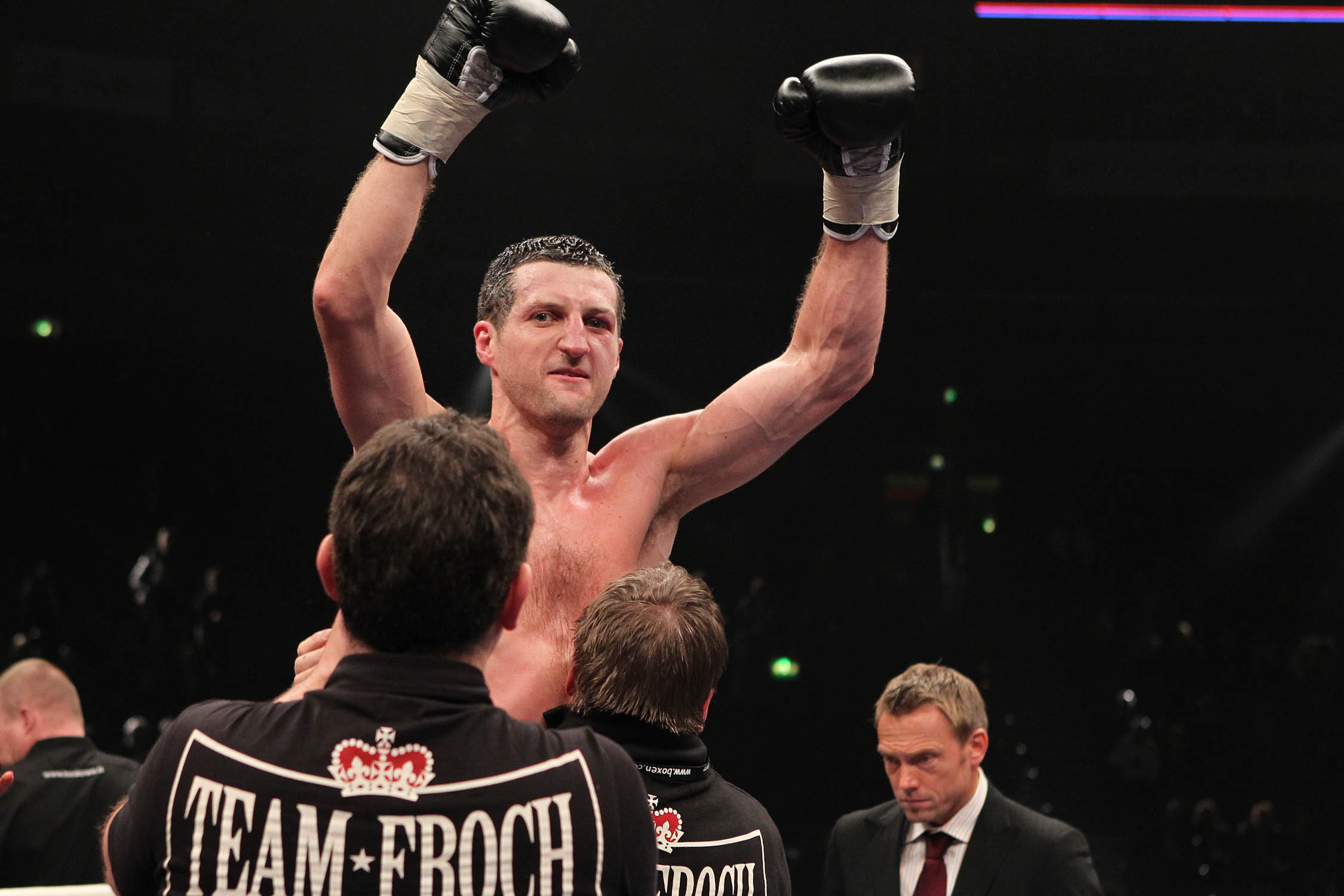
Saturday at London’s Wembley Stadium British super middleweight titlist Carl “The Cobra” Froch stood before 80,000 of his countrymen, and across from a particularly obstinate one named George Groves, and told them to set aside the ample achievements of a career he casually calls “unbelievable” and judge his legacy on one criterion: How he acquitted himself in what 36 minutes followed. And then in the final 20 seconds of round 9, roughly 27 minutes into a pitched rematch, Froch struck Groves with a right cross so pure that in a flash it made Froch the historic sports figure he desperately wishes to be.

Whatever aficionados opined of him Saturday morning or opine of him today, Carl Froch knows what he is about. That attribute distinguishes him much as another. It is what allowed him to take his talent to a place his athleticism did not anticipate, an athleticism that suffered no loneliness, there: Who seeing Froch for the first time across from Andre Dirrell, in their memorably awful 2009 fight, anticipated the run Froch concluded Saturday?

Froch has been for the most part unabashed about conceding his use of a sports psychologist, which is likely not his first psychologist nor his last, and that sort of disinterested observation, reportage and maintenance from another can be quite a boon for an athlete who seeks an advantage of any kind over an athletically superior opponent – especially since many if not most of the men Froch has vanquished since 2008 have been, on paper, or in a gym, or on a track, or anywhere other than a prizefighting ring, superior to him. If Froch’s self-belief is by definition absurd it is nevertheless held deeply enough to be unreachable by any punch or word.

When Froch’s identity, not his shtick but his identity, is challenged – and unlike many an American athlete, Froch is exact in his separation of identity and shtick, knowing where they overlap and where one is devoid of the other, as evidenced by his self-deprecation about using the autobiographical title “international superstar” before his November match with Groves, a touch of self-awareness Floyd Mayweather couldn’t find on Freud’s couch itself – Froch looks upon his inquisitor not with contempt so much as incredulity: If you told Carl Froch his comportment is not the finest example of such in contemporary prizefighting, he’d not give you a look reserved for the enemy so much as a three-headed extraterrestrial.

Because Froch knows what he is about he can be vulnerable in moments that strike unpredictably as his jab, he can kneel before Rachael Cordingley, the model and mother of his children, minutes after the greatest moment in his storied career and sheepishly ask her hand in marriage, and then, sitting mashed on the apron against a man he put in an oxygen mask not a half-hour before, confess even more sheepishly he’d gone and asked his “sneaky question” and that she’d said yes. That vulnerability is what makes his courage and confidence and arrogance still more fascinating, especially when presented to American ears not accustomed to the mother tongue spoken well by athletes.

That fascination came through in Paulie Malignaggi’s voice, Saturday. The man voted by the Boxing Writers Association of America 2013’s best broadcast journalist was part of a three-man Sky Sport’s telecast that offered more insight between rounds than HBO’s four-man crew offered in the month of April, and he was not timid in his praise of Froch, saying Froch had done something exceptional – an observation no doubt aided by Malignaggi’s presence in Wembley Stadium, where, coincidentally, the biggest prizefight of 2014 happened approximately a continent and an ocean away from HBO’s nearest production truck. Malignaggi is a real dude, oftentimes too real, a man whose struggles for an unshakeable identity have happened publicly – who does not remember what befell his coiffure when last Malignaggi graced a British boxing ring? – but a man whose self-belief, too, is more settled than most, and a man who captured with his words and voice what every man who watched Saturday felt: Right now, I wish I was Carl Froch.

It strains one’s imagination to think the man who fought Albert Rybacki in 2008 would be fighting before 80,000 of his countrymen six years later, and it is exactly impossible to imagine that same man in that same situation would land the punch Froch did to take his rematch with Groves, instantly, from competitive scrap to sympathetic spectacle. Who that saw Groves reduced from a man to an accordion in round 9 by Froch’s perfectly leveraged right cross did not for a second or two feel remorse for the cruelty that felled Groves, the unrelenting self-promoter?

It was not Froch’s 3-2 combo, left hook-right cross, that ended Britain’s largest post-war prizefight so perfectly, or at least not just Froch’s combo. No, it was the feint that did it, too, the threatened malice, fortified by what 3-2 combos Froch landed imprecisely in rounds 5 and 6 and 8, that froze all but Groves’ rear guard, allowing Froch to step deeply into Groves’ space and connect flush with the hardest righthand thrown by a Brit since heavyweight Lennox Lewis nearly decapitated Hasim Rahman with the same combination in 2001.

Froch should retire on that perfect punch, and he acknowledged such on Sky Sports’ telecast, conceding nothing he does for the rest of his life will surpass what he did Saturday, but he’s a fighter, all fighter, and that means his retirement timing is necessarily poor as his courage is long, and he’ll come to the late-arriving artificiality of a Las Vegas prizefighting crowd sometime before he’s done and “see my name in lights” – whatever exactly he means by that. If his options comprise a beating of Mexican Julio Cesar Chavez Jr., a rematch with American Andre Ward, or a tilt with unproven Kazakhstani middleweight Gennady Golovkin, Froch ought choose Chavez – allowing Ward the ongoing joy of semiretirement and telling Golovkin first to prove himself at least George Groves’ equal.

It matters little, ultimately, as this truism will persist: If every prizefighter were like Carl Froch, ours would be the world’s most popular sport.

Bart Barry can be reached at bart.barrys.email (at) gmail.com


FOLLOW FROCH – GROVES LIVE

Froch_Groves 2 Weigh InFollow all the action when Carl Froch and George Groves get it on in an highly anticipated Super Middleweight title rematch that will take place in front of over 80,000 fans in Wembley Stadium. The action begins at 4 PM ET / 9 PM in London.

REFRESH EVERY COUPLE MINUTES FOR LIVE UPDATES

12 ROUNDS–WBA/IBF SUPER MIDDLEWEIGHT TITLE–CARL FROCH (32-2, 23 KO’S) VS GEORGE GROVES (19-1, 15 KO’S)

Round 1 Both guys jabbing…Groves lands a jab..Froch lands a jab..right…10-9 Froch

Round 2 Exchange of rights..quicjk left from Groves...19-19

Round 3 Froch lands a hard right…Groves lands a better right..jab to the body..right over the top…2 good left hooks…right..29-28 Groves

Round 4 Right from Groves…Left and right from Groves…good 1-2…1-2…left hook from Froch..left…Froch lands to the body…39-37 Groves
GRound 5 Hard right by Froch..wobbles Groves to the ropes..Groves lands a right..Hard right..Hard body shots from Froch…48-47 Groves

Round 6 Froch lands a right…Froch lands a combo on ropes...57-57

Round 7 Hard left from Groves…another left..Froch lands a flurry of body punches..Good right…67-66 Froch

Round 8 Froch lands a right…Body shots..HARD RIGHT AND DOWN GOES GROVES AND THE FIGHT IS OVER


Business Sense: Froch-Groves at Wembley is a lesson to feuding promoters about how to keep customers from walking away

By Norm Frauenheim
Carl Froch

London’s Wembley Stadium will be the stage Saturday for what figures to be a terrific rematch in the second edition of Carl Froch-versus-George Groves and an even better lesson for what ails the business in North America.

It’s pretty simple, obvious enough to be embarrassing. Give the fans what they want. From New York to Las Vegas and Los Angeles, that market fundamental has been lost, or perhaps ignored for all the tired reasons that have been reported ad nauseam for the last few years.

It’s an era that should be remembered for Manny Pacquiao-Floyd Mayweather Jr. and maybe a rematch or two. Instead, it’s marked by the deadly Top Rank-Golden Boy feud that denied customers what they have wanted the most.

The Wembley crowd is expected to be 80,000, a UK record, for a fight between two very good super-middleweights. Yet, neither Froch nor Groves will ever be Mayweather and Pacquaio, who were and perhaps still are the best of their generation. If Froch and Groves can draw 80,000 to an arena for a grudge match-turned-spectacle, imagine what Mayweather could have done, or perhaps can still do.

Froch-Groves is essentially a UK story full of tension between the two and controversy about a debatable stoppage that allowed Froch to win a ninth-round TKO last November in Manchester. But their rematch is also a snapshot look at what could have – should have – been. The world has wanted Pacquaio-Mayweather.

The good news in Froch-Groves is that it is a sure sign business can thrive if it’s done right, which simply means that the customers are always more important than promotional egos. After all, Froch could have walked away, or hid behind some marketing spin or manufactured social polls in an attempt to fight somebody else. But that would have been running away from what the market demands. That would have been stupid. Froch isn’t. A record crowd is about to thank him.

The bad news, at least in North America, is in declining television numbers for major bouts over the last few months. HBO’s pay-per-view buy rate for Pacquiao’s rematch victory over Timothy Bradley on April 12 at Las Vegas’ MGM Grand was reported to have been between 750,000 and 800,000. Solid, yet short of the million milestone. As of Thursday, there was still no official word on Showtime’s PPV buy rate for Mayweather’s majority decision over Marcos Maidana on May 3, also at the MGM Grand. Fair or not, a slow count means Showtime is no rush to report disappointing numbers, which have been speculated to be about 900,000, also short of the million marker.

Numbers can be twisted into equations that serve just about any agenda. But the last two from Pacquiao and Mayweather point to the same result: Exasperation at no Mayweather-Pacquiao is beginning to add up to fewer customers.

A further red flag was raised Saturday in light-heavyweight Adonis Stevenson’s surprisingly difficult decision over Andrzej Fonfara in a non-PPV bout in Montreal. In his first fight since jumping from HBO to Showtime in late March after signing with advisor Al Haymon, the Stevenson-featured card drew an average audience of 672,000, according to Nielsen. The rating peaked at 800,000 for Stevenson-Fonfara.

Stevenson’s last fight on HBO — a sixth-round stoppage of Tony Bellew in November – drew a reported audience of 1.3 million, also for a non-PPV bout. Some difference was expected, because HBO has a bigger universe (29 million) than Showtime (23 million). But even at the 800,000 peak for the victory over Fonfara, the audience for Stevenson was down by half-a-million.

Forget the marketing spin, which will try to explain away the decline. Like the latest returns from Pacquiao and Mayweather, the Stevenson numbers are rooted in what the customers have been denied. Before Stevenson jumped to Showtime and Haymon, there was momentum for a Stevenson-Sergey Kovalev fight.

Kovalev-Stevenson wasn’t Pacquiao-Mayweather, but it was a good alternative for fans weary of not getting the fights they wanted the most. Just when it looked as if the bout would happen late this year, Stevenson walked away from the blockbuster. A lot of customers joined him.

Many more will walk away from a lot more if feuding promoters don’t pay attention to Froch and Groves to a London primer in basic business sense.


Carl Froch, and the art of unjustifiable self-belief

By Bart Barry-
carl-froch_victory
In a “Gloves Are Off” prefight conversation more entertaining than a highlight reel of every eerily scored “Face Off with Max Kellerman” episode HBO has aired, British super middleweight George Groves, dangling awkwardly in a frame hung by his opponent as a man who makes mysterious predictions profound to him alone, assured Sky Sports host Johnny Nelson of victory this Saturday in his rematch with Carl “The Cobra” Froch:

“I will knock Carl Froch out on May 31st,” said Groves, diverting briefly his eyes from staring in disbelief at Froch. “And I’ll tell you which punch I’m going to do it with – on fight week.”

“Let me guess,” said Froch in a belittling deadpan. “It’s going to be a left or a right.”

It was fine an example as any of Froch’s singularly unflappable comportment in the face of other men’s threatened aggression. Froch’s approach to insulting opponents, prefight, is more devastating for its calm and often eloquent expressions of contempt so deeply set that his heart rate doesn’t quicken even in self-amusement. Like the wrastlers of bygone years, Froch’s self-belief hails from parts unknown. It is the most essential element of what will almost assuredly be our sport’s largest event in 2014 – one made between British fighters by a British promoter in a British stadium by a British cable network, evidence, perhaps, of how much healthier our sport is when kept out American hands – an event that will sell more tickets than the aggregate of Mayweather-Maidana, Mayweather-Alvarez, Mayweather-Guerrero and Mayweather-Cotto.

Froch’s self-belief, an entity that ranges liberally in the large field between confidence and arrogance, was once merely amusing to American aficionados. In his first trip to our continent, Froch came within 14 seconds of losing to a diminished Jermain Taylor. Six months later, in a dreadful start to a wonderful concept, Froch decisioned American Andre Dirrell in the inaugural match of Showtime’s “Super Six” tournament, a snakebitten arrangement that nevertheless got both its creator, Ken Hershman, and its winner, Andre Ward, promoted to HBO, and made an international star of Froch, the colorful runner-up. Froch won a hometown decision of sorts over Dirrell by revealing the American was an athlete, not a fighter, while warming to the idea of a fight even if not knowing how properly to perform one. Froch then lost a close decision to Mikkel Kessler in Denmark, before defeating Arthur Abraham and Glen Johnson – when both were more highly considered than we may remember.

Froch’s stature and confidence grew disproportionately, making him quite likable to strong-character types: For once a man claiming to be more than appearances indicated was more than appearances indicated. Froch has proved many times more than a sum of his parts in a prizefighting ring; his reflexes are good, as is his chin, and he has power enough that no one engages him straight away or else gets iced, but his defense is porous and his footwork is ungainly and his punches’ effect appears to derive more from his belief in their effect than anything resembling effective technique.

He was outfought and given his first defeat in 2011 by Andre Ward, a transcendentally good fighter before his semiretirement as an HBO commentator, but even in that fight it was Froch, not Ward, who appeared stronger in the latter 18 minutes. Then in a twist only American cable television could devise, the winner of Showtime’s super-middleweight tournament, Ward, was unable to fight Showtime’s super-middleweight house fighter, Lucian Bute – for whom crowning a suitable opponent appeared to be the entire point of the tournament. Froch signed-up to fight Bute instead. Froch went through Bute like a roller-coaster train through a pile of shaving cream, stopping the undefeated Romanian in round 5 and denying boxing’s legion of malcontent fans one more match, Ward-Bute, they were never going to get anyway. Six months later, Froch made a homecoming to Nottinghamshire and flattened Yusaf Mack in three rounds. Then he decisioned Mikkel Kessler a year ago in their rematch in London.

Six months after that, Froch took on an undefeated Londoner who’d once acted as his sparring partner, George Groves, in a match so lightly considered in the United States it didn’t land on a network called AWE till a month before opening bell – with neither Showtime, who introduced Froch to American audiences, nor HBO, who finances Andre Ward’s semi-retirement with commentating gigs, bothering to carry it. Had more than a handful of Americans been able to see the match, they’d have seen Froch conclusively outclassed for nearly every minute of the match, getting drilled with righthands, and getting made to look fragile by righthands, in a way few would believe.

Worse yet were Froch’s punches. They appeared, in the opening two or three rounds, like open-handed cuffs. The Cobra looked like nothing so much as a man alternately slapping either end of a large watermelon while staggering drunkenly forward in a head-lowered rage. And that was before Groves put the stopwatch to Froch’s every hung jab, blasting the titlist with even more righthands, blasting him enough not only to drop and wobble him in round 1, to hurt him in a way no one had before, but also to make Froch throw the sort of push-off jab that invites an opponent’s fury and incites aficionados’ contempt. There was contempt everywhere in that ring, and finally it was contempt – that which Froch felt for the usurper Groves – that caused Froch to surge obdurately forward in round 9, catching Groves with clean shots enough to make referee Howard Foster interfere with the match and call-out a TKO victory for Froch.

The fans were displeased as Groves was, though Foster’s comportment was not dishonorable, however the honorable International Boxing Federation ruled shortly after considering what sanctioning fees it might collect for a mandatory rematch. And so we have one, a fight expected to sell 80,000 tickets and fill London’s Wembley Arena for what knowledgeable British commentators are openly calling one of the largest prizefights in the history of their island.

It appears Groves may have Froch’s number in a way reminiscent of Antonio Tarver having Roy Jones’, or in keeping with the sparring partner tradition, in the way Paul Williams had Antonio Margarito’s. Froch has even gone so far as to hint it may be his final prizefight. It won’t be, of course, but it is noteworthy nevertheless as a reminder: Sporting characters original as Froch appear so rarely on American television screens it behooves us to watch and appreciate them whenever we’re granted the access.

Bart Barry can be reached at bart.barrys.email (at) gmail.com


Cotto’s ring skill is still his best social skill in fight with Martinez

By Norm Frauenheim–
Miguel_Cotto
Sergio Martinez probably won’t ever invite Miguel Cotto to a backyard barbecue. Martinez talks as if he just doesn’t like Cotto. Evident tension between the two is an entertaining sidelight to their intriguing fight on June 7 at New York’s Madison Square Garden.

But their middleweight bout is interesting, hard to pick, mostly because it’s really it’s a question of who has the most left at the end of long, Hall of Fame careers.

Martinez looked like an aging NBA player the last time he climbed through the ropes and limped across the canvas on bad knees. The promise is that those knees are healthy and he’s as mobile as ever. Until opening bell, however, it’s fair to wonder how they’ll hold up the first time Martinez pivots to throw a punch or avoid one. It’s also safe to assume that Cotto will test them as early as possible with some lateral movement.

Meanwhile, there’s more scar tissue around Cotto’s eyes than there is on Martinez’ knees. Martinez is bound to test it with a precise jab that could re-open old wounds in an attempt to fulfill his prediction of a stoppage before the ninth round.

Does it matter if they don’t like each other? Not at all. Cotto has always proceeded as if he doesn’t care one whit about whether he’s liked. He’s quiet and disciplined, a man with more ring skill than social skill. He only asks for respect, and that’s something he has throughout a business known more for shifting feuds than real friendship. Cotto repeatedly says he just wants to do his job. With a unique consistency, he has.

During a conference call Thursday, Cotto was asked about Martinez’s annoyance at various issues, including a 159-pound catch weight. Predictably perhaps, Cotto seemed to dismiss the question, saying Martinez should speak to his management if he’s unhappy. Cotto, it seems, was not going to be drawn into a diversionary debate that could disrupt his attention on the task at hand. It was vintage Cotto, always pragmatic and never fooled by a feint.

“If he’s training for only seven or eight rounds, he’s in trouble,’’ Cotto said in a simple counter to Martinez’ promise to score a stoppage within nine.

Cotto also would not let himself be diverted by talk of a legacy, especially in his island home, Puerto Rico. A victory over Martinez would make him the first Puerto Rican to win a title in forth weight class. But he would not rank himself among Puerto Rican legends, including Felix Trinidad and Wilfredo Gomez.

“It’s a personal achievement and a personal matter that I want to win,’’ said Cotto, who will be at middleweight for the first time. “So I’m working toward that. It doesn’t mean that I’m going to be better than Gomez or better than Trinidad or better than the great champions that Puerto Rico has had. But for myself, for Miguel, this will be the biggest accomplishment of my career.’’

The tension between Cotto and Martinez is reported to be rooted in a chance encounter at an ESPN Deportes studio a few years ago. Cotto apparently ignored Martinez, who took it as sign of disrespect. Apocryphal or not, it has set the stage for an element of controversy. That’s never a bad thing to have in HBO’s run-up to a pay-per-view fight. Some personal drama is just another way to sell a fight that Top Rank’s Todd duBoef says has the potential to be the biggest fight that doesn’t include a Manny Pacquiao or Floyd Mayweather Jr.

Cotto trainer Freddie Roach made a few comments that were rooted in the reported issues that divide the two fighters. Roach talked about Martinez making excuses, although the Argentine hasn’t questioned the condition of his knees. The media have.

“I don’t want to hear after the fight that his knees hurt,’’ Roach said.

Roach talked about Cotto attacking Martinez’ with body punches. Although smaller, Roach said the 5-foot-7 Cotto is stronger than the 5-10 Martinez.

Martinez, Roach said, “might be bigger, but he’s not better.’’

In test of what’s left, he’ll only have to be good enough.


Juan Manuel Marquez: The definition of a prizefighter

By Bart Barry–
Marquez_Alvarado_140517_003a
Saturday at the newly reopened Forum in Inglewood, Calif., Mexican “Dinamita” Juan Manuel Marquez and Colorado’s “Mile High” Mike Alvarado engaged in a fight entertaining as any that ends with one guy besting the other by wide, unanimous scores, the way Marquez bested Alvarado. It was an engrossing if ultimately inconsequential tilt that approached today’s premium-cable-prizefight definition of transcendent: The favorite was knocked-down, and genuinely tested, if only for a round or two.

These days, even the threat of such belligerent happenings usually lands a fight on pay-per-view, and an annual calendar of five or six pay-per-view events says all that needs saying about how often competitive, elite-level fights even get threatened.

If you do not love to watch Juan Manual Marquez fight, you do not love boxing. You may have favorites whom you prefer to watch, but if boxing is what you derive your joy from, if boxing is the entity that takes your life into the present tense, that cleansing place, you love watching Marquez in a prizefight. If ethnic considerations or rivalries or the like preclude you from being enchanted by the spectacle of Marquez plying his craft, it evinces no fault of character – boxing just isn’t what you love.

Every punch with Marquez is a personal event, a thing in which he personally invests, whether landing or being landed upon. He is predatory in a way few other men are predatory; he is predatory even by a standard set by those who make their livings hurting other men in sport’s most intimate way. He is a meanspirited perfectionist, a man, one gathers, who has acquaintances more than friends and loves what few others he loves in the perfunctory way Mexican culture demands he love them. In his treatment of opponents, he has an offensive brilliance exceeded only by Mayweather’s defensive mastery, among contemporaries, and in the public personality that boxing has given him, he is Bernard Hopkins sans charisma and verbosity.

He is not surly, quite, but that is a calculation; his surliness and trainer Nacho Beristain’s tutorial surliness once landed them in Tenggarong, Kutai Kartanegara, Indonesia, eight years ago, across from Chris John, for a purse that wouldn’t cover Floyd Mayweather’s weekend earbuds budget. Marquez is now something of a Spanish-television personality, and while he cannot help but be honest when treating matters of his own fights, he otherwise does a passable impersonation of every other ESPN flummery boiler, never anticipating an upcoming fight’s inevitable dullness.

Mike Alvarado understood the stakes Saturday: If he got stretched, he was off premium cable for life; if he could stay conscious for all 36 minutes, regardless of the assault visited upon him by a master pugilist, he had a decent shot of economic realities prompting his promoter to propose him for a last profitable purpling on HBO. But Alvarado did not catch Marquez repeatedly with a jab merely because Marquez, three months from his 41st birthday, has reflexes eroded slowly by time and combat but also because Alvarado is an excellent athlete who’s never had trouble jabbing an opponent effectively.

If Alvarado’s ability to touch Marquez with nearly every jab the Coloradoan tossed Dinamita’s way was not surprising as Marcos Maidana’s recent outjabbing of Floyd Mayweather, it was nevertheless at least as surprising as a training camp strategy that treated Alvarado’s jabbing and Alvarado’s winging right crosses but evidently not Alvarado’s ever mixing those traditionally harmonious elements together. Being generous, one might assume Alvarado’s corner knew their guy would get countered savagely by Marquez if Alvarado threw more than one punch at a time, but irony happened to dictate thusly: Alvarado’s best moments were in the frantic exchanges – as they ever compose Pacquiao’s best moments with Marquez – when Marquez’s pathological need to land an exchange’s final punch left him open in a way no lead punch of any kind from any one ever would find him.

Alvarado dropped Marquez in round 9 and buckled him a few minutes later with counterpunches. Their other, earlier exchanges, though, were a bit more telling: For once, Marquez voluntarily disengaged from sustained volleys, pivoting away and ducking Alvarado’s right hands, in a way he’d not done even against the much larger Mayweather in 2009 or the much faster Pacquiao in 2004, 2008, 2011 or 2012 (or the end of 2014).

No one in boxing, perhaps no other athlete in any sport, discovers better the fissures in another man’s façade than Marquez, or calibrates the circumstances most likely to convert them to suppurating crevices. Whatever permanent damage Ruslan Provodnikov visited on Alvarado’s spirit and brain in October, this remains true: But for the instant at the end of round 8, after Alvarado pulled himself back through the ropes and onto the canvas, rose uncertainly and trudged resignedly forward, an instant that followed a gorgeous right cross from Marquez, an instant that – were it merely 14 instants larger – would have seen Alvarado’s consciousness snatched from him by prizefighting’s greatest closer, Marquez saw a resilience in Alvarado he did not expect to see, a resilience that surely left Marquez’s fists painfully tender on Sunday morning. That the man who, with a single punch, temporarily suspended Pacquiao between the living and the dead could strike Alvarado crisply and precisely and sustainedly for 12 rounds, while leaving him fit to continue in a way he was not against Provodnikov, surely was not lost on promoter Top Rank’s matchmakers.

Provodnikov will see a five-division-catchweight match with Guillermo Rigondeaux before he’ll ever be allowed near Pacquiao.

Which is fine, frankly, because the makeable match that is most desirable today is a fifth Marquez-Pacquiao fight, one that will see the men’s diminished reflexes and enhanced familiarity – and all the contempt that engenders – provide a violent and vengeful spectacle that ends with one of them unconscious, and the other vindicated evermore.

Bart Barry can be reached at bart.barrys.email (at) gmail.com


Back to the Future: Arum’s return to The Forum takes him back to familiar place and time

By Norm Frauenheim–

Bob Arum
Boxing returns to a place Saturday that helped re-define the business in a way that allowed it to move beyond the Sugar Ray Leonard generation and into an era without the heavyweight division as its flagship.

Welcome back to The Forum.

It also was nicknamed the House of Upsets, which might mean trouble for favored Juan Manuel Marquez against Mike Alvarado if contractors didn’t remove that legacy in the $35-million remake of the old arena near LAX.

It’s a good fight, but Top Rank’s return to the building is more intriguing for historical significance and perhaps coincidence.

“This is going to be a great night and a fight that is really important for boxing,’’ said Top Rank’s Bob Arum, who during a conference call also said The Forum was “a venue that helped make boxing as popular as it is today.’’

Note that Arum did not say boxing was as popular as it was the last time it was there. Nobody would. Or could. Arum promoted Muhammad Ali, the most legendary name of all, in a decision over Ken Norton at The Forum in a Sept. 10, 1973 bout that drew 12,417 customers for a live gate of $476,750, a California record that stood for 27 years.
“That was what? Forty-one years ago,’’ Arum joked. “Oh my, I was a thin, young handsome guy. Now, I’m an old fat guy.’’

But the memories are as keen as ever for Arum, who at 82 finds himself confronted by decisions about where to go and what to do. Maybe the answers are in China or with boxers from Kazakhstan, Russia and The Ukraine. It’s hard to know. But it’s becoming abundantly clear that change is on the horizon.

The Manny Pacquiao and Floyd Mayweather Jr. era is near its end. HBO’s pay-per-view numbers for Pacquiao’s rematch victory over Timothy Bradley on April 12 were reported to be between 750,000 and 800,000, down from the 890,000 for their first fight in 2012.

As of Thursday, there was still no news on Showtime’s PPV number for Mayweather’s difficult decision over Marcos Maidana on May 3. However, there were indications that it might not reach the one-million mark, a Mayweather standard.

Barring a Mayweather-Maidana surprise, the numbers, although still strong, are short of expectations. No matter how you add them up, it’s impossible to subtract public exasperation at never getting Mayweather-Pacquiao. Consequences have come home to roost.

If there’s any good news, it’s in boxing’s proven resiliency. The Forum is a symbol of that. From 1968 through 1999, the Forum was an entry point for Mexican and Mexican-American fighters. A fight in The Forum was a good introduction to the American market. With them, there were fans. Ruben Olivares and Carlos Zarate drew bigger crowds than Ali.

Olivares’ fifth-round knockout of Australian Lionel Rose in a 1969 rematch drew 18,408, The Forum’s biggest boxing crowd ever. In 1970, Olivares won a decision over Chuchu Castillo in front of 18,141. In 1977, Carlos Zarate scored a fourth-round stoppage of Alphonso Zarate in front of 13,971. They were little guys, bantamweights.

They got smaller and in the nick of time. Heavyweight Mike Tyson was in prison for rape and Leonard’s career was all but finished in the wake of a loss to Terry Norris when Michael Carbajal and Humberto Gonzalez met at The Forum. They were 108 pounds in a division sometimes called light-flyweight, a redundancy if there ever was one. But their impact at the box-office was big.

A crowd of 10,333 showed up on Feb, 19, 1994 for a Forum rematch of their 2003 Fight of the Year, won by Carbajal, who got up twice to score a seventh-round stoppage at the Las Vegas Hilton.

Gonzalez, who made his name at The Forum after beginning his career at home in Mexico City, won a debatable split decision in the second of three fights between the two. But the real history in their first rematch was in the purse.

Arum paid Carbajal $1 million, which then made him the lightest ever to collect the milestone purse. Carbajal’s victory in the first bout had given him leverage in negotiations. To get the $1 million, however, Arum told him he had to fight Gonzalez at what was then called The Great Western Forum. On the scorecards, Carbajal, who also lost the third fight a narrow decision in Don King-promoted bout in Mexico City, might have paid for that move.

“Michael fought Gonzalez in his living room and then fought him in his kitchen,’’ said ex-Forum broadcaster and fighter Ruben Castillo, who called his friend’s second loss “The Great Western Rip-off.”

At The Forum, however, Arum confirmed what had been evident for many years. There was a new market for fights at weights that promoters had always ignored. There was a new way to do business at a time when one was badly needed. Arum is back in a place he knows and a time he recognizes.


Austin: Gallery Tour and Mandingo Warrior

By Bart Barry–
Kirkland_Tapia_131207_001a
AUSTIN, Texas – Somewhere round here, likely on currently gentrified streets once mean, James “Mandingo Warrior” Kirkland roamed and terrorized sparring partners en route to network-darling status, a falling-out or five with trainer Ann Wolfe, a prison stay, a brutal victory over Alfredo Angulo in 2011, and a brutaler victory over Glen Tapia in December. Where he is right now is a source of speculation, as usual, but this is not: Had he been present in San Antonio last week to announce a fight with Mexican Saul “Canelo” Alvarez at Alamodome, many more San Antonians would have been there as well.

One such San Antonian spent the weekend with Austin locals, instead, in the hopes of finding some evidence of cultural offerings greater than University of Texas’ Blanton Museum of Art and sanitized bars on West 6th Street. He found some, too, good contemporary- and folk-art offerings, and also a reason to reflect on what appears to be one of our sport’s greater missed-ticket-selling opportunities.

This city is not weird so much as haphazard and disorganized, a hippie enclave in a state that, since making a fortuitous discovery dinosaurs once died within its borders, has trended ever more conservative, free-market and likely to conflate luck with merit – convincing its citizenry one’s birth in a resource-rich state is evidence, somehow, of exemplary character or virtue. For every action a reaction: Austin, now enjoying a real-estate boom financed by those scrofulous knaves who brought ruin to sandy states from Florida to California, makes a fetish of embracing its eccentricities, not uncommon to college towns, and planting on its automobiles’ bumpers and townfolk’s t-shirts declarations about keeping itself weird and loving live music.

Ask most who embellish Austin’s merits to catalog this city’s cultural offerings, aside from live music, and they’ll tell you, “Live music!” It’s the sort of exhausting, end-of-boom chatter one encountered in Silicon Valley round 2001, when everyone intended to be a billionaire but no one knew how clicks-from-coffeeshops could be monetized. It’s marginally less cynical here, though, because it is a celebration of culture, such as it is, not capitalism.

To this city’s ever more gentrified climes comes West Austin Studio Tour 2014, a sprawling collection of 241 art galleries and exhibitions, for two weekends, this one and last, and it is, in its seeming disinterest, nearly an opposite of the South by Southwest festival that now makes Austin a destination for the coolest folks from all about our fruited plain. Disinterested because most artists are borrowing corners of their friends’ gallery spaces, have yet to name much less sign their works, and rarely take anything but cash or check. As one local put it: “That’s Austin. We don’t really plan things all the way through. We just sort of get them started and see what happens, you know?”

And there-across spans a bridge from one unplanning gaggle of artists to another: Wednesday afternoon, Oscar De La Hoya, whom business circumstances appear to be pushing from figurehead to manager, visited San Antonio’s historic Mercado district, about 70 miles southwest of here, to announce that the one prizefighter insiders are reasonably certain remains tied to him by promotional contract, Mexican Saul “Canelo” Alvarez, will be fighting Cuban Erislandy Lara in Las Vegas in a couple months, in an event called “Honor and Glory.” De La Hoya, freshly enthusiastic if not yet sincere, announced, in Spanish, the card was about “honor y gloria” before switching to English and explaining that honor is what men fight for, and glory.

It was vacuous and scripted, the way these things ever are – or perhaps it was the South Texas sun breaking unexpectedly through what Weather Channel’s app promised would be a cloudy day – but it sapped one’s humor and acted as a reminder of a question Alamo City insiders often ask ourselves when asked to cheerlead for Canelo: Why not James Kirkland at Alamodome? Surely Mike Battah of Leija-Battah Promotions, the man who risked a large sum of his own capital to bring Alvarez, on short notice, to San Antonio to fight an otherwise unknown New Mexican named Austin Trout 13 months ago, and then made of his opportunity one of the more groundbreakingly excellent promotions of the last decade, putting more than 40,000 people in Alamodome, expected such a debut effort would reap rewards many times greater than schlock like Fidel Maldonado against John Nater on a Monday night in February.

Battah once openly imagined 70,000-person gates for Canelo at Alamodome, regardless of opponent, and must now content himself with renting restaurant plazas on Wednesday afternoons to have the firehaired horseman of Jalisco, diminished in everyone’s eyes, make a few serious poses, promise redemption for all Mexicans from a Cuban, and tell the people of, let’s see, San Antonio, how very much he appreciates their support.

To resume his ascent after the Mayweather debacle in September, Canelo needed to do more than score a referee stoppage over a ruined countryman like Alfredo Angulo, on pay-per-view in March; and if we’re being honest, even if he’d put “El Perro” to sleep in 90 seconds, Canelo would have suffered mightily from an Argentine doing to Floyd Mayweather two months later what Mexicans verily expected Canelo would do. One shudders to think what comes of Oscar De La Hoya’s company if Lara undresses Canelo the way that, say, Winky Wright undressed Felix Trinidad in 2005.

Since, like their statesmen, American boxing promoters cannot be counted on to do the right thing till they’ve tried everything else, one might as well hope, too, that such an outcome would make the fight that makes much more ticket-selling sense than Canelo’s tilt in July will: A match with Austin’s James Kirkland at Alamodome.

Bart Barry can be reached at bart.barrys.email (at) gmail.com


Options? Chavez Jr. running on empty

By Norm Frauenheim–
Chavez_Lee_120612_001A
There are losers aplenty in the wake of the Julio Cesar Chavez Jr.-Gennady Golovkin possibility headed to never-never land, right there alongside the Manny Paquiao-Floyd Mayweather Jr. fantasy. There are the fans, of course. But there’s nothing new about that. Their hopes are always first to take a beating.

They’ll be back.

But you have to wonder whether Chavez Jr. ever will.

An intriguing Chavez-Golovkin fight, which had been scheduled for July 19 at the old Forum in Inglewood, Calif., is off the board because of failed negotiations between Chavez and Top Rank.

Depending on the source, Chavez Jr. said no to a contract extension that Top Rank said it wanted as insurance if the fight failed to make money. According to Yahoo, Chavez manager Billy Keane said Top Rank’s offer for just the Golovkin fight was for 70 percent less than what it offered for a two-fight extension. According to Ringtv.com, Top Rank’s Bob Arum said Chavez Jr. could have made $12 million for two fights in the event of a loss to Golovkin and $17 million if he beat him.

Follow the money, and Chavez Jr doesn’t look good from either side of the table. Fair or not, public perception figures to interpret the failed negotiations as a way for Chavez Jr. to sidestep a fight he couldn’t win against the most feared fighter in the game. Chavez Jr. needed an escape clause and Top Rank gave him one with that two-fight option.

It’s a move that is bound to make Chavez Jr. look bad in the eyes of Mexican fans. Canelo Alvarez readily stepped up and asked for a fight against Erislandy Lara on July 12 at the MGM Grand in Las Vegas. More hype is attached to Golovkin than Lara, but Lara is every bit as dangerous as the middleweight from Kazakhstan. Canelo never looked for a way out against the slickly-skilled Cuban, who presents some of the same challenges that Mayweather did in his one-sided victory over the red-headed Mexican last September.

But the perception will be that Chavez looked for an escape and found one. After all, he always has. At almost every turn, there has been an excuse – a way out. Chavez was allowed to train whenever and wherever he wanted before his loss to Sergio Martinez, which was followed by a positive test for marijuana. He said he couldn’t make weight for Bryan Vera. Then, he was allowed to weigh whatever he wanted before winning a controversial decision over Vera in Carson, Calif. At the end of the buffet table, there was no end to the enablers, including Top Rank.

But even Top Rank appears to have lost its patience with the 28-year-old Chavez. The two-fight option includes an unspoken option to walk away. The guess is that Top Rank won’t shed any tears if he does. Arum went public with his exasperation before Chavez Jr. won a rematch over Vera in San Antonio. By then, it was becoming loud and clear that there was a growing disconnect between Julio Jr. and Mexican fans. Only the name connects the son to his legendary dad. There were boos in Carson, Calif., for the first Vera fight. There was a smaller crowd than expected, about 7,300, at San Antonio’s Alamodome for the rematch.

Even the best trainers of the day opted not to work with him. Freddie Roach left him after the loss to Martinez. Robert Garcia chose not to work with him before the Vera rematch. A year from now, Chavez Jr. might regret turning down Top Rank’s option. It’s beginning to look as if he doesn’t have many left.


Marcos Maidana: Unplanned-for, undissuaded

By Bart Barry–
Marcos Maidana

After their Saturday welterweight match at MGM Grand, American Floyd “Money” Mayweather and Argentine Marcos “El Chino” Maidana proffered a study in contrasts as they made their ways back to their respective dressing rooms beneath the Grand Garden Arena. One man, shiny-faced and unmarked, greeted a swarming mass of exuberant countrymen. The other, shuffling slightly with face partially misshapen and flanked by enormous body guards, smiled perfunctorily at those who wished him well.

Despite prevailing by majority-decision scores, Floyd Mayweather was not the shiny-faced lad with the exuberant fans.

The idea that Mayweather would not win more than five unanimous rounds against Marcos Maidana on Saturday was one that traversed few minds. The large number of folks who attended the fight or purchased it on pay-per-view did so to support a TMT franchise we’ve been told is historic. A much smaller number of buyers invested their entertainment funds in the hopes El Chino would catch Money cold, somehow, and score a Hasim Rahman-like upset. Nobody who spent money on a ticket or telecast envisioned Maidana decisioning, in Las Vegas, the guy whose head is now more ubiquitous at MGM Grand than that golden lion’s. And yet, there were rounds not even a partial observer like judge Burt Clements could find a way to give Mayweather.

The first round is the first that comes to mind; perhaps Maidana did not sprint from his corner recklessly as he bumrushed Adrien Broner in December – and if Saturday’s main event did not restore much glimmer to “About Billions,” it did embolden those critics who quietly wonder if Mexican Saul Alvarez isn’t something of a frecklefaced fraud – but once he found Mayweather was overconfident enough in the shoulder-roll defense to let the ropes stop his backwards lean, Maidana brought the contact to Mayweather in a way no one before him has.

Part of that could be diminished reflex on Mayweather’s part, though only a tiny part of it, while much of it ought be attributed to the Charmin-soft competition Mayweather has served himself since about the time he slipped past Jose Luis Castillo in 2002; those who hit hard enough to imperil Mayweather generally have not been fast enough, and those who are fast enough generally have not hit with sufficient force. Unflappable as he is, and an unaffected demeanor during physical confrontations is Mayweather’s greatest pugilistic asset, Mayweather did not expect to be hit hard on as many different spots of his head for the rest of his career as Maidana delivered him in their second 90 seconds together.

What became suddenly apparent: Nobody in a sparring session with Floyd Mayweather since Money was about 12 years-old has attempted the clockwise-bolo thing Maidana hurled his way; were it not for Maidana’s startlingly effective jab, Mayweather would not have been speaking out of turn about Maidana had he paraphrased what Evander Holyfield once said of John Ruiz – that he was the most technically incompetent opponent he faced as a pro. Maidana solved the shoulder roll not through expertise but by overthrowing his right hand like a circus-strongman hammer; it was a physical impossibility for Mayweather to get his lead shoulder high enough and his torso tilted rightwards far enough to evade a punch that, at its apex, resembled nothing so much as Kareem’s skyhook.

Trainer Robert Garcia deserves all the credit heaped on him for Maidana’s fantastic jab, well-timed and stiff and accurate as it is, but when it comes to Maidana’s sledgefisted right, Garcia has mentored the Argentine no more than a handler who unclips the leash from an attack dog already in full froth. A camera on Garcia’s face in the opening round likely would have revealed a man both surprised and delighted by what surprise in Mayweather’s demeanor and delight in Maidana’s rabidity the landing of that first righthand brought. Mayweather’s surprise was quickly compounded when, soon after Maidana began crashing into him, Money’s go-to defensive ploy, the lead-elbow-to-opponent’s-neck shimmy, received a warning from referee Tony Weeks, whom Mayweather afterwards banished unhesitatingly from ever again officiating the otherwise high-paying exhibition matches Mayweather thought Showtime signed him up for.

There was one other surprise, too, for both Mayweather and aficionados who have followed his career often begrudgingly: The left-hook lead did not work till the championship rounds. There is not an orthodox fighter in memory, and certainly not a Latino one, whom Mayweather has been unable to tag and tag early with his springing left-hook lead; even master Juan Manuel Marquez got flattened by the punch. Maidana’s guard, though, was high and tight to his cheek, and Mayweather got nothing but right glove, when he didn’t miss both wildly and uncharacteristically.

Worse yet for Mayweather’s plans of a painfree evening was how little his potshot right dissuaded Maidana, who viewed it as a hard tariff, but not a barrier to entry like other Mayweather opponents have. Maidana expected to be hit repeatedly. It was in his contract. He hoped, but likely did not expect, to hit Mayweather repeatedly. When he found Mayweather was willing to sell him a stationary target on the ropes for the price of a flush righthand or two, Maidana became an animated buyer.

Mayweather’s best adjustment was the very return-to-fundamentals Paulie Malignaggi counseled any future Maidana opponent to employ, in the April issue of The Ring magazine. Mayweather, gloves high in the fight’s final third, preceded most of his righthands with jabs; in lieu of reinventing boxing, Money May threw straight 1-2s the exact way he learned to do as a seven-year-old in Grand Rapids, Mich., and it worked exactly as his father knew it would. Floyd Mayweather proved Saturday, as he did against Miguel Cotto in 2012, that, at his core, he is all fighter. Even his Friday protest of Maidana’s gloves was, at its inception at least, a legitimate nod to boxing’s history of illegitimate glove-tampering; what alarmed Mayweather first of all was how “broken-in” Maidana’s custom-made gloves felt.

And Sunday morning, undoubtedly, Floyd Mayweather awoke to a feeling of body-wide trauma that has led other accomplished prizefighters to pursue business ventures elsewhere.

Bart Barry can be reached at bart.barrys.email (at) gmail.com


Mayweather escapes with a majority decision over Maidana

By Norm Frauenheim-

Floyd Mayweather

LAS VEGAS – It was supposed to be easy. It wasn’t.

Floyd Mayweather Jr. got the victory that oddsmakers, pundits and just about everybody not from Argentina thought he would. But it was less than dominant. At times, it was just ugly. Marcos Maidana made sure of it in an exhausting, carpet-bomb style of punching that pushed Mayweather onto the ropes and even through the ropes.

There were few moments, it seemed, when Mayweather wasn’t on the ropes, literally and figuratively. Mayweather got the decision. But there was a qualifier. It wasn’t unanimous. It was a majority decision, meaning it fell one judge short of Mayweather’s predicted dominance.

It was a draw, 114-114, on Michael Pernick’s scorecard. Burt Reynolds had it 117-111 and Dave Mortetti 116-112, each for Mayweather. The draw on Pernick’s card opens the door for a debate about just how good the unbeaten Mayweather was in winning his 46th fight and the third in a rich Showtime contract worth a potential $250 million.

“I’d describe this as a tough, competitive fight,’’ said Mayweather (46-0, 25 KOs), who collected at least $32 million. “Normally, I like to box, but I couldn’t.’’

He couldn’t because of the inexhaustible Maidana, who walked forward in a dogged pursuit of the mythical pound-for-pound champion.

After it was all over, Maidana walked and talked like the winner. In some ways, he even looked the winner. He was unmarked, unlike Mayweather, who was left with a cut above his right eye.

“He never hurt me with a punch,’’ said Maidana (35-4, 31 KOs), who was guaranteed $1.5 million. “I thought I won the fight.’’

Maidana seemed to fight as if he were angry. Perhaps, he was, especially after a glove controversy that wasn’t settled until early Saturday. Maidana was not allowed to wear custom-made gloves that bore Argentina’s blue and white colors. The Mayweather camp objected to them, arguing they lacked the requisite padding along the knuckles.

“He doesn’t fight like a man,’’ Maidana said in Spanish translated into English for the MGM Grand’s crowd, which included a lot of jeering fans from Argentina.

Mayweather escaped with the decision by scoring with precise punches in the later rounds. From the seven through the 12th, Maidana couldn’t quite sustain the pace he had at the beginning. That left him open for counter shots and an effective uppercut. Still, Maidana had enough energy to bull-rush Mayweather in the 11th, pushing him half way through the middle ropes.

Mayweather sustained a cut above his right eye late in the fourth.

“I couldn’t see out of the eye for two rounds,’’ Mayweather said.

A left hook from Maidana appeared to cause the wound, although Maidana’s furious pace made it hard to tell exactly what landed. At times, it looked as if Maidana was trying to land just about everything, all at once.

Maidana wasted no time. In the first, the Maidana whirlwind began, dropping shots from countless angles and at a machinegun rate. Everything was a target. Mayweather’s head and hips. Even Mayweather’s left shoulder was under a sustained assault. Mayweather rolls the shoulder in what is his best-known defensive tactic. Early on, however, the roll was rare, if there at all. There was no time to initiate, much less complete the trademark roll. Mayweather was too busy ducking and leaning back on the ropes.

Mayweather didn’t eliminate the possibility of a rematch. Maidana talked as if he deserved one.

“I’m not scared of him,’’ Maidana said. “Why not do the rematch?’’

It might be in the cards.

Amir Khan restores credibility with tactical decision over Collazo

Amir Khan added pounds to his body and hope to his future.

Kahn restored some lost credibility with a poised, tactical decision over Luis Collazo in a welterweight bout Saturday night before the main event featuring Floyd Mayweather and Marcos Maidana at the MGM Grand.

There will always be doubts about Khan’s notoriously fragile chin. Against the rugged Collazo, however, the former junior-welterweight seemed to fight as though he knew he couldn’t leave it exposed. For the most part, he used his quick feet to stay a step away from Collazo.

Byt the 10th round, his superior athleticism just proved to be too much for Collazo. He knocked down Collazo twice in the round. The first knockdown came at the end of a left uppercut as short as it was beautiful.

For Khan, the inescapable question revolved around what was next. Mayweather? Mayweather had bypassed Khan for Maidana.

“Absolutely,’’ Khan (29-3, 19 KOs) said when asked if he wanted to be next in the Mayweather sweepstakes. “Absolutely.’’

In the fourth, Khan’s hand speed exercised some Mayweather-like superiority with a short right hand that knocked Collazo off-balance and onto the seat of his trunks. Seconds later, Khan staggered him. But the tough Collazo (35-6, 18 KOs) is nothing if not resilient. That’s the story of his long career.

The knockdown seemed to embolden him. He stubbornly moved forward in an evident attempt to draw Khan into a brawl. Khan instinctively moved away, almost as if he knew he couldn’t win the kind of street fight Collazo wanted.

But the stubborn Collazo kept moving forward and kept taunting Khan in the late seconds of each successive round. It was if he was trying to wear down Khan, wear off the slick veneer on the Brit’s versatile skill set. In the eighth, it looked as if Collazo might succeed. He was penalized a point for a low blow. For a fleeting moment, Khan looked fatigued. Collazo staggered him with a right. Khan held on and was penalized a point for holding Collazo’s head.

Broner Big Winner on Cards, Big Loser with Fans
Adrien Broner talks about boos as though they were terms of endearment.

He says he loves to hear them.

He must have been happy Saturday night. Boos filled the MGM Grand Garden Arena for how he won and how he talked about it after scoring a unanimous decision over Carlos Molina, a Mexican-American from Norwalk, Calif.

“I’m the Can Man,’’ Broner (28-1, 22 KOs) told Showtime broadcaster Jim Gray at the center of the ring. “I just beat the bleep out of a Mexi-Can.’’

On a night billed as a celebration of Mexico’s Cinco de Mayo holiday, the patrons were angry enough at the slur to collectively kick Broner’s can. They couldn’t. Neither could the resolute Molina (17-2-1, 7 KOs). But somebody else will if Broner continues to fight with more showmanship than skill.

He mocked Molina in the late rounds, he looked at the crowd in almost every round and threw Molina onto the canvas with a wrestling hold in the third round. There wasn’t much time left for punches and, sure, enough he didn’t throw many. He mixed in just enough to collect a points’ victory in a junior-welterweight bout, his first since Marcos Maidana embarrassed him in December.

“It was a sparring session on national television,’’ said Broner, who showed he can insult pay-per-view customers too

Too Much Love for Periban
J’Leon Love’s story is about learning how to survive. Out of the ring. And in it.

It was a lesson Love (18-0, 10 KOs) put to good use against Marco Antonio Periban (20-2-1, 13 Kos) in the first fight of the pay-per-view portion of the Floyd Mayweather Jr.-Marcos Maidana card. Love, a Mayweather-promoted super-middleweight, survived the fifth round.

A straight right from Periban turned Love’s head violently from one side to the other and eventually put him on the canvas. Periban, of Mexico City, fell back and down in the wild round, apparently from over-exerting himself in an attempt to finish Love. But Love would not go away. First, he regained his equilibrium and then the momentum with careful and precise shots from several angles and enough abundance to win a 10-round unanimous decision.

OFF TV: The non-televised portion of the card was consistent, if not exactly perfect. It went six-for-six. Six fights, six stoppages. The sixth came from Las Vegas cruiserweight Andrew Tabiti, who scored a fourth-round TKO of John Shipman (3-2, 2 KOs) of Amarillo, Tex.

Las Vegas super-middleweight Ronald Gavril (9-0, 7 KOs) remained unbeaten with a fourth-round TKO of Tyrell Hendrix (10-4-2, 3 KOs) of Los Angeles.

British middleweight Anthony Ogogo (6-0, 2 KOs) kept the KO streak going. He scored the card’s fourth straight stoppage, finishing Jonuel Tapia (8-5-1, 5 KOs) of Brooklyn, NY, in the third round.

Ashley Theopane (35-6-1, 10 KOs) of Las Vegas employed speed and precision to overcome a bigger Angino Perez (15-5, 13 KOs) for a fourth-round stoppage of the Miami welterweight. Theopane finished the bout with a succession of punches that drove Perez into the ropes.

Lanell Bellows (7-1-1, 6 KOs), a Las Vegas super-middleweight, scored two knockdowns en route to a second-round stoppage of Thomas Gifford (2-2-1, 1 KO), an Arkansas fighter who went down in the second round as though he had been hit by runaway truck.

More than three hours before Showtime’s pay-per-view telecast began, junior-welterweights Ladarius Miller of Memphis and Richard Colas opened the show. Their punches echoed throughout the empty arena. The biggest echo came from Miller (2-0, 1 KO), who scored a third-round TKO of Colas (11-3, 1 KO).

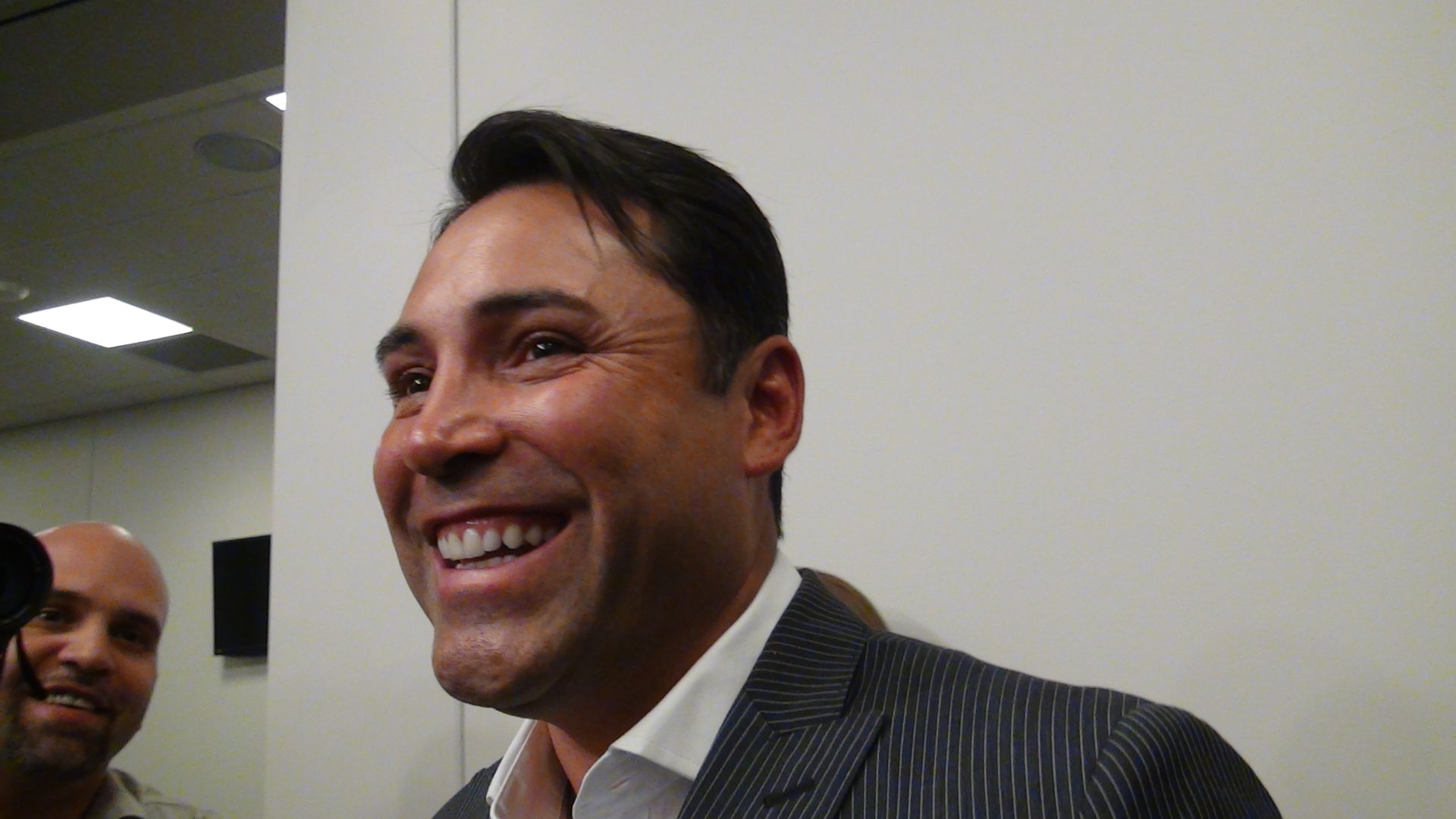

De La Hoya: Nobody is going to fire Richard Schaefer

By Norm Frauenheim

Oscar De La Hoya
LAS VEGAS – Oscar De La Hoya, founder of Golden Boy Promotions, said he is fighting for his company and that he doesn’t want to fire his CEO, Richard Schaefer.

“Look, nobody is going to dismiss Richard,’’ De La Hoya said Saturday during a news conference before the Floyd Mayweather Jr.-Marcos Maidana fight at the MGM Grand. “I don’t want him to leave.’’

But De La Hoya could not be certain that he won’t. He was asked whether the relationship could be healed.

“I don’t know,’’ he said.

De La Hoya conceded that he had alternate plans if he and Schaefer are unable to end a feud that has disrupted their business.

“I have a Plan B, C and D,’’ said De La Hoya, who hired Schaefer, a former Swiss banker to run the promotional company that is named for him. “I found Richard from the banking world to help me out. I can do that again.’’

The De La Hoya-Schaefer feud is marked by disagreement over whether to have any sort of relationship with rival Bob Arum, De La Hoya’s primary promoter throughout his Hall of Fame career. Schaefer has vowed to never do business with Arum again. De La Hoya visited Arum Thursday at the Top Rank promoter’s home in Los Angeles.

De La Hoya said he only wanted “to bury the hatchet” with Arum. He said no business was discussed. However, De La Hoya did not rule out the possibility that business might be discussed if there is another meeting with Arum.

Another issue involves questions about how many fighters are under contract to Mayweather advisor Al Haymon instead of Golden Boy Promotions. Schaefer has developed a close working relationship with Haymon and Mayweather. Schaefer has said that some fighters have contracts with Haymon and not Golden Boy.

“I don’t have the number,’’ De La Hoya said.

De La Hoya said he hoped to talk to Schaefer about the issues that divide them

“Like Richard said, here are a few things we are not agreeing on,’’ he said. “But it’s nothing that can’t be worked out.’’

“I said what I had to say and I stand by those statements,’’ Schaefer said. “Whatever the future holds, hopefully, we can have this resolved within the next couple of weeks.”

It is believed that De La Hoya reached out to Arum as part of his rehab from substance abuse. De La Hoya went into rehab last September before Mayweather’s victory over Canelo Alvarez.

“Bottom line, I was not well,’’ De La Hoya said. I got caught up in stuff. I was down and out. I really was. Right now, I want to be the real Golden Boy. This company is named Golden Boy for a reason. This is the fight of my life right now. I can win. I know I can.’’


FOLLOW MAYWEATHER – MAIDANA LIVE

Mayweather_maidana
Follow all the action live as Floyd Mayweather and Marcos Maidana meet in a WBA/WBC Welterweight unification bout. A big 3-fight undercard will take place beginning at 9 PM ET that will see Former world champions Amir Khan and Luis Collazo squaring off in a Welterweight bout. Former world champion Adrien Broner battles Carlos Molina and the night kicks off with a Super Middleweight elimination bout between J’Leon Love and Marco Antonio Periban

12 ROUNDS–WBA/WBC WELTERWEIGHT TITLE–FLOYD MAYWEATHER (45-0, 26 KO’S) VS MARCOS MAIDANA (35-3, 31 KO’S)

Round 1 Righgoot to body from Maidana…Jab from Mayweather..Maidana lands a left..Mayweather getting hit on the ropes…Mayweather lands a right at the bell…10-9 Maidana

Round 2 Maidana landing shots on the ropes…Mayweather lands 2 hard lead rights..19-19

Round 3 Jab to body from Mayweather..Hard counter right…Hard rights on the ropes from Maidana…Left and right from Mayweather..Lead right…29-28 Mayweather

Round 4 Mayweather lands a good body shot and left hook..Mayweather is cut over right eye…Left to body from Mayweather..39-37 Mayweather

Round 5 Cut caused by headbutt…Right from Maidana…right…Mayweather lands a right..jab..right..Right from Maidana..Body fromMayweather…body/head from Maidana..48-47 Mayweather

Round 6 Right and left from Mayweather…counter right.. Maidana lands a few rights..jab///uppercut from Mayweather..lead left hook..righlt…jab to the body..staright right..right to body from Maidana..right and uppercut…left from Mayweather..58-56 Mayweather

Round 7 Lead left from Mayweather…left to body..2 left hooks…double jab…2 rights..right and 2 lefts from Maidana..68-65 Mayweather

Round 8 Maidana lands 2 over hand right…right from Mayweather..double jab from maidana..right from Mayweather…Jab and right from Maidana..lead left from Maywetaher..chaopping left…lead left and counter left…78-75 Mayweather

Round 9 Mayweather lands a right…left..left from Maidana..lead right and left hook…big right..right and blistering combination…jab…88-84 Mayweather

Round 10 Mayweather lands a jab and right..combination..right to body..jab..Lead right..lead left from Maidana..2 right from Mayweather..good right from Maidana..98-93 Mayweather

Round 11 Mayweather lands a left hook…trading jabs..right from Mayweather..right from Maidana..108-102 Mayweather

Round 12 Left from Maidana..counter combo from Mayweather…Maidana landing hard bod pucnhes..lead right from Mayweather…right…counter right…118-111 Mayweather

114-114; 117-111, 116-112 winner by majority decision Floyd Mayweather

12 ROUNDS WELTERWEIGHTS–AMIR KHAN (28-3, 19 KO’S) VS LUIS COLLAZO (35-5, 18 KO’S)

Round 3 1-2 from Khan…Left from Collazo..Khan gets in a right..Body..30-27 Khan

Round 4..RIGHT TO THE CHIN AND DOWN GOES COLLAZO..Khan landing combiation..Collazo trying to comeback..40-35 Khan

Round 5 Right and left from Khan…Left from Khan..Combo from Collazo..lead left..50-44 Khan

Round 6 Right and left from Khan..Left from Collazo…right from Collazo…Khan lands a straight right…660-53 Khan

Round 7 lead left and jab from Collazo..Hard right from Khan..quick combination..70-62 Khan

Round 8 Collzao docked a point for Low Blows…Big left from Collazo..Khan being warned for holding the head..1-2 from Collazo..lead left from Collazo…point deducted from Khan..right from Khan..78-71 Khan

Round 9 Good combo from both..body and head from Khan..straight right..88-80 Khan

Round 10 Hard left hurts Collazo…right..left..left to jaw..LEFT AND DOWN GOES COLLAZO..HARD COMBINATION AND LEFT AND DOWN GOES COLLAZO..Hard combo on ropes…98-87 Khan

Round 11 Good combo from Collazo..right from Khan..2 jabs..left hook to body and head..good right and left from Collazo..3 jabs from Khan..straight left and uppercut from Collazo..108-96 Khan

Round 12 Low blow from Collazo…118-106 Khan

117-106, 119-104 twice for Amir Khan

10 ROUNDS–SUPER LIGHTWEIGHTS–ADRIEN BRONER (27-1, 22 KO’S) VS CARLOS MOLINA (17-1-1, 7 KO’S)

Round 1 Molina works the body..10-9 Molina

Round 2 Combination from Molina..Broner lands a right behind the jab..Molina lands a left to the body..Good right..20-18 Molina

Round 3 Broner takes down Molina..Molina landing on the ropes..Over hand right and jab from Broner…Left hook from Molina..30-28 Molina

Round 4 Right from Molina..Combination to head from Broner..good body from Boner..Combo from Molina..uppercut from Broner..quick combiantion…39-39 Molina

Round 5 Combinatu…48-48

Round 6 Broner lands a short right…body..58-57 Broner

Round 7 right and left to body from Broner..right to head…right cross..right from Molina..big right and left hook..68-66 Broner

Round 8 Uppercut from Broner..overhand right from Molina..Both landed rights..right from Broner..78-75 Broner

Round 9 Jab From Broner…88-84 Broner

Round 10 Right from Broner..left to body from Molina..left hook from Molina..Jab from Broner..Molina lands a left hook..right from Broner..Good exchange at the bell...98-94 Broner

99-91, 98-92, 100-90 for Adrien Broner

10 ROUNDS–SUPER MIDDLEWEIGHTS–J’LEON LOVE (17-0, 10 KO’S) VS MARCO ANTONIO PERIBAN (20-1-1, 13 KO’S)

Round 1 Periban lands a right to the body..Love lands a jab.right to body..10-9 Love

Round 2 Double jab from Love..Periban right to the body..Periban bleeding from the nose..counter right to body from Love..20-18 Love

Round 3 Periban backing Love on the ropes with a flurry..2 jabs from Love..Periban lands a left to the body…combination..left from Love..jab..Nice combination..Combination..29-28 Love

Round 4 Love lands a jab to the body…5 jabs…39-37 Love

Round 5 Periban lands a combination..Huge Right..hurts Love..love is eating about 25 punches to the face…Love in real trouble..HUGE RIGHT AND LEFT AND LOVE TAKES A KNEE…Love eats a hard right…47-47

Round 6 Jab from Periban..Big left..Jab from Love..right to body from Periban..Good left from Love..body..Cut over left eye of Periban..Love landing an uppercut…Periban looking tired..2 jabs from Love...57-56 Periban

Round 7 Left to body from Love..Left from Periban..67-66 Periban

Round 8 Triple jab from Love..good jab..Counter right from Periban..exchange rights to the body..76-76

Round 9 Body from Periban…2 jabs from Love..Good right from Periban..86-85 Periban

Round 10 double jab from Love…Left to body from Periban….95-95

95-93, 97-92, 96-93 all for J’Leon Love


UPDATE–Glovegate breaks out in controversy before Mayweather-Maidana

By Norm Fraienheim–
Floyd Mayweather

LAS VEGAS – Floyd Mayweather Jr. complained about the lack of padding at the knuckles of Marcos Maidana’s gloves in a controversy that erupted Friday after the weigh-in for their pay-per-view welterweight fight at the MGM Grand.

The Nevada State Athletic Commission ruled that Maidana could not wear the gloves, which were custom made for him by Everlast, Golden Boy Promotions CEO Richard Schaefer said Friday night.

After the Commission’s ruling, negotiations between the respective camps were underway for the kind of gloves that each fighter would wear. Schaefer said the controversy would not put the fight in jeopardy. Mayweather advisor Leonard Ellerbe was quoted as saying there would be no fight if Maidana were allowed to wear the specially-made gloves, which included horsehair for padding and were done in the blue-and-white colors of his home country, Argentina.

“I am absolutely confident that everything will be worked out,’’ Schaefer said. “There will be a fight.’’

Both camps had agreed to wear eight-ounce gloves. However, Mayweather’s management, including Ellerbe and attorney John Hornewer, objected to Maidana’s gloves, complaining that most of padding was at the wrist and not at the knuckles.

“It was like there was one ounce at the knuckles and seven ounces at the wrist,’’ said Elvis Grant, who makes the Grant model that Mayweather plans to wear.

Grant attended the rules meeting. He said Mayweather tried on the Maidana pair that the Argentine planned to wear.

“Floyd said there was no way he’d fight that guy with those gloves on,’’ Grant said.

Maidana is known for his power. With 31 knockouts in 35 fights, he has one of the best KO ratios in boxing.

The glove controversy was just one of many in a week full of them during the build-up for Mayweather-Maidana.

At a weigh-in that sounded like a rap concert, the only excess pounds came from booming speakers loud enough to simulate a small earthquake. The building shook. The scale rocked. The noise was heavy. Only the fighters weren’t.

Both Mayweather and Maidana came in under the 147-pound limit. Mayweather looked bigger and might be much bigger at opening bell, but at 146 pounds he was lighter on the official scale than Maidana, who was at 146-½ for his sixth fight at welterweight.

Mayweather, who had Atlanta rapper 2Chainz in his entourage, appeared calm and confident as ever, despite controversy throughout the week before his third fight in a Showtime contract for a possible six bouts and a potential $250 million.

The week started with Mayweather defending Los Angeles Clippers owner Donald Sterling, whom he called “a nice guy” despite Sterling’s racist comments that resulted in the NBA banning him for life. The controversy continued Thursday when Mayweather posted allegations on his Facebook account that his former fiance, Shantel Jackson, aborted their twins because he is pro-life. The post, taken down later in the day, included a photo of what he said was her sonogram.

Showtime broadcaster Jim Gray asked Mayweather about “distractions” after the pound-for-pound champion stepped off the scale.

“Pressure, I love it,’’ said Mayweather, who also promised to do what he does best.

There doesn’t appear to be much pressure on Mayweather (45-0, 26 KOs) in the bout itself. Odds, which have been as high as 11-to-1, have made him the overwhelming favorite since the fight was announced.

If there’s pressure, it’s in how he wins. At different times and in different words, Mayweather has been close to promising his best performance ever. He has said that doesn’t necessarily mean a stoppage. But fans are interpreting it that way. Consider this: The odds are 6-to-5 for Mayweather by KO. A lot of bettors are putting their money on the 10th-round, which would coincide with Mayweather’s 2007 TKO of Ricky Hatton, who — like Maidana – was a natural 140-pounder fighting as a welterweight. Mayweather by KO in the 10th opened at 12-to-1. Late in the week, it had been bet down to 8-to-1.

Predictably, Maidana (35-3, 31 KOs) has said he is not bothered by the overwhelming odds. What else is he going to say?

“I know he’s going to be much bigger, but because of my style I know I can beat him,’’ said Maidana, who possesses one of the best knockout ratios in boxing, yet could not stop Adrien Broner, a former lightweight, in his upset of him in December.

In some ways, Maidana’s slim chance at a monumental upset is reflected in the wealth gap that separates the two purses. Mayweather’s guarantee is $32 million, according to a contract filed with the Nevada State Athletic Commission. Maidana’s guarantee is $1.5 million, according to the Nevada commission. Maidana is expected to get a percentage of Argentina’s television revenue. Nevertheless, Maidana’s guarantee is a fraction of what Mayweather will pocket no matter what the pay-per-view does.

Form the odds to the respective paychecks, it all adds up to Mayweather, unless — and perhaps only if — Maidana gets lucky. In this city of longshots, he might. But the best bet is that his chances at luck are better with a pair of dice at a Vegas’ table than in the ring against Mayweather.

De La Hoya, Arum meet
According to various reports, Oscar De La Hoya met Thursday with Bob Arum at Arum’s home in Los Angeles in an attempt to end the Golden Boy Promotions-Top Rank feud.

“Our relationship is now totally repaired, whether we do any specific business, we will have a friendly relationship between Todd (DuBoef) and I on our side and Oscar,’’ said Arum, De La Hoya’s primary promoter during his Hall of Fame career “We’ll have a collegial relationship.

“It was a very emotional meeting. We hugged each other. Oscar meant a lot to me, and I meant a lot to him. We had a helluva ride together. It was the right thing to do.”

Arum said the meeting lasted about two-and-a-half hours.

“We had lunch,’’ he said. “It was at our vacation house in Los Angeles. There was a good tenor to our conversation. Todd and I met with Oscar, and reminisced about old times. We talked about how it was crazy that we were at odds. We buried the hatchet, and it as a very productive meeting. We never talked any specific business, ever.”

De La Hoya, founder of Golden Boy, has been feuding with his CEO, Richard Schaefer, who has vowed to never to do business with Arum again. Golden Boy has been working as associate promoter for the Mayweather-Maidana fight.

However, De La Hoya has not attended any of the news conferences. He also was not at Friday’s weigh-in.

Also on the scale
Both Amir Khan (28-3, 19 KOs) and Luis Collazo were at the mandatory, 147-pounds, for their key welterweight fight on the televised card. Khan hopes for an impressive victory that will keep him in line for a shot at Mayweather, perhaps later in the year.

Adrien Broner (27-1, 22 KOs) was at 140 pounds and Carlos Molina at 138 ½ for their junior-welterweight bout. There were boos for Broner, who was happy to hear them. “Keep on booing me,’’ said Broner, who is coming off his loss to Maidana. “I’m going to keep on doing my thing.’’


What Distractions? Glovegate breaks out in controversy before Mayweather-Maidana

By Norm Frauenheim
Floyd_Mayweather
LAS VEGAS – Floyd Mayweather Jr. complained about the lack of padding at the knuckles of Marcos Maidana’s gloves in a controversy that erupted Friday after the weigh-in for their pay-per-view welterweight fight at the MGM Grand.

There are two pairs in question. Both are in light blue, the national color for Argentina, Maidana’s home country.

Mayweather’s corner did not argue with the brand, Everlast. But Mayweather’s management, including advisor Leonard Ellerbe and attorney John Hornewer, demanded during a rules meeting that the Nevada State Athletic Commission prohibit Maidana from wearing either pair. Maidana walked out of the meeting. There was still no resolution to controversy late Friday.

Maidana is known for his power. With 31 knockouts in 35 fights, he has one of the best KO ratios in boxing. Mayweather wears Grant-made gloves.

The glove controversy was just one of many in a week full of them during the build-up for Mayweather-Maidana.

At a weigh-in that sounded like a rap concert, the only excess pounds came from booming speakers loud enough to simulate a small earthquake. The building shook. The scale rocked. The noise was heavy. Only the fighters weren’t.

Both Mayweather and Maidana came in under the 147-pound limit. Mayweather looked bigger and might be much bigger at opening bell, but at 146 pounds he was lighter on the official scale than Maidana, who was at 146-½ for his sixth fight at welterweight.

Mayweather, who had Atlanta rapper 2Chainz in his entourage, appeared calm and confident as ever, despite controversy throughout the week before his third fight in a Showtime contract for a possible six bouts and a potential $250 million.

The week started with Mayweather defending Los Angeles Clippers owner Donald Sterling, whom he called “a nice guy” despite Sterling’s racist comments that resulted in the NBA banning him for life. The controversy continued Thursday when Mayweather posted allegations on his Facebook account that his former fiance, Shantel Jackson, aborted their twins because he is pro-life. The post, taken down later in the day, included a photo of what he said was her sonogram.

Showtime broadcaster Jim Gray asked Mayweather about “distractions” after the pound-for-pound champion stepped off the scale.

“Pressure, I love it,’’ said Mayweather, who also promised to do what he does best.

There doesn’t appear to be much pressure on Mayweather (45-0, 26 KOs) in the bout itself. Odds, which have been as high as 11-to-1, have made him the overwhelming favorite since the fight was announced.

If there’s pressure, it’s in how he wins. At different times and in different words, Mayweather has been close to promising his best performance ever. He has said that doesn’t necessarily mean a stoppage. But fans are interpreting it that way. Consider this: The odds are 6-to-5 for Mayweather by KO. A lot of bettors are putting their money on the 10th-round, which would coincide with Mayweather’s 2007 TKO of Ricky Hatton, who — like Maidana – was a natural 140-pounder fighting as a welterweight. Mayweather by KO in the 10th opened at 12-to-1. Late in the week, it had been bet down to 8-to-1.

Predictably, Maidana (35-3, 31 KOs) has said he is not bothered by the overwhelming odds. What else is he going to say?

“I know he’s going to be much bigger, but because of my style I know I can beat him,’’ said Maidana, who possesses one of the best knockout ratios in boxing, yet could not stop Adrien Broner, a former lightweight, in his upset of him in December.

In some ways, Maidana’s slim chance at a monumental upset is reflected in the wealth gap that separates the two purses. Mayweather’s guarantee is $32 million, according to a contract filed with the Nevada State Athletic Commission. Maidana’s guarantee is $1.5 million, according to the Nevada commission. Maidana is expected to get a percentage of Argentina’s television revenue. Nevertheless, Maidana’s guarantee is a fraction of what Mayweather will pocket no matter what the pay-per-view does.

Form the odds to the respective paychecks, it all adds up to Mayweather, unless — and perhaps only if — Maidana gets lucky. In this city of longshots, he might. But the best bet is that his chances at luck are better with a pair of dice at a Vegas’ table than in the ring against Mayweather.

De La Hoya, Arum meet
According to various reports, Oscar De La Hoya met Thursday with Bob Arum at Arum’s home in Los Angeles in an attempt to end the Golden Boy Promotions-Top Rank feud.

“Our relationship is now totally repaired, whether we do any specific business, we will have a friendly relationship between Todd (DuBoef) and I on our side and Oscar,’’ said Arum, De La Hoya’s primary promoter during his Hall of Fame career “We’ll have a collegial relationship.

“It was a very emotional meeting. We hugged each other. Oscar meant a lot to me, and I meant a lot to him. We had a helluva ride together. It was the right thing to do.”

Arum said the meeting lasted about two-and-a-half hours.

“We had lunch,’’ he said. “It was at our vacation house in Los Angeles. There was a good tenor to our conversation. Todd and I met with Oscar, and reminisced about old times. We talked about how it was crazy that we were at odds. We buried the hatchet, and it as a very productive meeting. We never talked any specific business, ever.”

De La Hoya, founder of Golden Boy, has been feuding with his CEO, Richard Schaefer, who has vowed to never to do business with Arum again. Golden Boy has been working as associate promoter for the Mayweather-Maidana fight.

However, De La Hoya has not attended any of the news conferences. He also was not at Friday’s weigh-in.

Also on the scale
Both Amir Khan (28-3, 19 KOs) and Luis Collazo were at the mandatory, 147-pounds, for their key welterweight fight on the televised card. Khan hopes for an impressive victory that will keep him in line for a shot at Mayweather, perhaps later in the year.

Adrien Broner (27-1, 22 KOs) was at 140 pounds and Carlos Molina at 138 ½ for their junior-welterweight bout. There were boos for Broner, who was happy to hear them. “Keep on booing me,’’ said Broner, who is coming off his loss to Maidana. “I’m going to keep on doing my thing.’’


Schaefer gets some B-Hop support in his rift with De La Hoya

By Norm Frauenheim–
Bernard Hopkins

LAS VEGAS – The Golden Boy Promotions divide between CEO Richard Schaefer and founder Oscar De La Hoya appeared to widen Thursday with comments from Bernard Hopkins, who supports Schaefer’s vow to never to do business with Bob Arum despite De La Hoya’s attempt at renewing a working relationship with the Top Rank promoter.

“We don’t need Bob Arum,’’ Hopkins said after a news conference for the Floyd Mayweather Jr.-Marcos Maidana undercard Saturday night at the MGM Grand.

Hopkins, a Golden Boy vice-president, had a lot more to say. When does he not? But he was careful not to comment on whether there was a chance at healing the De La Hoya-Schaefer rift. He said he has a commercial interest in the company’s future. But he said he wouldn’t talk about their reported differences.

“When I was training for Beibut Shumenov, I’d hear this and I’d hear that,’’ said Hopkins, who won another piece of the light-heavyweight title with a unanimous decision over Shumenov a couple of weeks ago. “I’m not going to comment about things I don’t know about because that makes things worse.’’

But the argument about Arum is no rumor. De La Hoya is on record about wanting to resume business with his former promoter. There’s even talk that he approached Arum with a proposal for a Canelo Alvarez fight against the Arum-promoted Manny Pacquiao. De La Hoya’s attempt to make peace with Arum has been a step in the healing process since his release from rehab.

But Schaefer is also on record about Arum. Business between the two is over, said Schaefer, whose alliance with Mayweather and his advisor, Al Haymon, appears stronger than ever. Forget business. There’s a sense that the Schaefer and Arum couldn’t even be civil to each other.

“There is so much on and off with Top Rank that Richard Schaefer has had with Arum that the relationship will never be patched up,’’ Hopkins said. “Not in this lifetime, I don’t think. It’s not just the name-calling. If it was just the name-calling, I think they could get back together. It’s the lawsuits. Then, it’s ‘we agree,’ and then ‘don’t agree.’ It’s the emotional roller coaster, again and again. I just think it’s become a worn-out soap opera.’’

If the respective positions have hardened on Arum, any chance at peace between Schaefer and De La Hoya are dim and getting dimmer. De La Hoya has not commented on the situation since the week-long build-up for Mayweather-Maidana began on Tuesday. His absence was notable at news conferences Wednesday and again Thursday.

No Golden Boy-Top Rank alliance, of course, means the most-talked-about fight of the last four years will never happen. No real news there. Pacquiao-Mayweather will go the way of Riddick Bowe-Lennox Lewis. Trouble is, the lost opportunity will take a lot of fans with it.

“We blew that opportunity,’’ Hopkins said. “We lost what would have been the Super Bowl of boxing. It’s like not having Ali-Frazier. The moment was there three, four years ago. But I think people have gotten past it.’’

For Hopkins, it was another way of saying it’s time to move on. It’s beginning to look as if Schaefer and De La Hoya will do exactly that.

Mayweather post stirs up controversy
Mayweather created a predictable buzz early Thursday by alleging that his former fiance, Shantel Jackson, aborted their two twins because he is pro-life.

Mayweather posted what he said was a photo of her sonogram on his Facebook account with this message: “The real reason me and Shantel Christine Jackson @missjackson broke up was because she got a abortion, and I’m totally against killing babies. She killed our twin babies.#ShantelJackson#FloydMayweather#TheMoneyTeam#TMT.

The post was taken down later in the day, apparently because of the furor it caused..

Notes: If Amir Khan beats Luis Collazo Saturday night, there’s talk that Khan will get a September shot at Mayweather, a one-sided favorite over Maidana. But Khan said he could not fight in a mid-September bout that coincides with a celebration Mexican Independence (Sept. 16) because of the Muslim observance of Ramadan. Khan is a practicing Muslim. …Adrien Broner took the podium Thursday and said that he was a changed man before his fight with Carlos Molina, his first bout since losing to Maidana in in December. “I’m humble, I don’t trash talk no more,’’ the bearded Broner said. Then, the real Broner appeared. “Get the hell out of here,’’ he said after a pause. “…At the end of the day, we’ve got to get back to business.’’ Yeah, the trash-talking business.


The Show: The news-conference stage belonged to Mayweather

By Norm Frauenheim–
floyd_mayweather_lapc
LAS VEGAS – Showtime executive Stephen Espinoza called Floyd Mayweather Jr. “a show” and Mayweather proved him right throughout a news conference Wednesday with only praise for Marcos Maidana, a rip at promotional rival Bob Arum, a surprising hint that the end of his career might be near, a promise to be better than ever Saturday night and even a further defense of disgraced Los Angeles Clippers owner Donald Sterling.

Mayweather did it all.

Well, almost all.

Mayweather didn’t indulge in anything that even remotely sounded like the trash-talk that identified for so many years.

It’s not as if he didn’t get the opportunity. Maidana concluded his part of the news conference with a closing shot that included an f-bomb for emphasis.

“I don’t give a bleep about him,’’ Maidana said through a translator.

There was no response in kind from Mayweather.

“Lately, Maidana has been making a lot of noise,’’ said Mayweather, who has a $32 million guarantee for Saturday night’s pay-per-view bout. “He’s one of the best fighters. But I am the best.’’

Hard to argue with that. Maidana is a double-digit dog, according to betting odds. Maidana was in a tuxedo Wednesday that made him look like a game-show host. He was all dressed up. But with the odds against him at 11-1 and climbing, he’s got nowhere to go. A lucky shot could land, but Mayweather is known to gamble only on the casino floor.

“He should have knocked out Adrien Broner, a lightweight,’’ Mayweather said of Maidana’s unanimous decision in December over Broner, who was at welterweight for only the second time. “But he didn’t.’’

If there’s going to be a knockout, Mayweather continues to suggest that he’ll be the one to score it.

During the news conference, Mayweather told the audience to be prepared for perhaps his best ever. He even introduced a new acronym. He was wearing a cap with the trademark TMT, The Money Team, when he introduced TBE, The Best Ever.

“I promise you, this will be different than the fight you saw against Canelo (Alvarez)”, said Mayweather, who scored a dominant decision over the red-headed Mexican last September in the second fight of a Showtime deal for a possible six bouts and a potential $250 million.

After the news conference, he was asked if he planned to stop Maidana in what would be his first stoppage since a controversial knockout of Victor Ortiz in 2011. Mayweather hesitated before he answered.

“Looking to win, looking to win very, very impressively,’’ he said.

Mayweather also dangled the possibility that he might retire. With odds indicating a mismatch, perhaps he has to. If the bout is a foregone conclusion, his future isn’t. At least, that’s what he said.

“I really don’t know,’’ Mayweather said when asked whether there would be a fight after Maidana.

Mayweather’s last fight would be history, said advisor Leonard Ellerbe, who knows that the possibility of some history is always a good sales pitch.

The real history for Mayweather appears to be Rocky Marciano’s 49-0 record. If Mayweather (45-0) beats Maidana, he’s three fights from tying that one and four from eclipsing it. He’s unbeaten, he said, because nobody can solve the challenging puzzle he represents at opening bell.

“Still wondering who’s gonna solve the May-Vinci Code,’’ said the pound-for-pound champion, who envisions himself as one day being seen as boxing version of Leonardo Da Vinci.

Mayweather also took a predictable shot at Arum, the Top Rank promoter who was enraged at the MGM Grand’s signage before Manny Pacquiao’s unanimous decision over Timothy Bradley in an April 12 rematch. Advertising for Mayweather-Maidana was everywhere.

“You hear people say bad things about this hotel,’’ Mayweather said after associate promoter Richard Schaefer took his turn at ripping Arum. “But their run is coming to an end.’’

Mayweather also would not join in on the condemnation of Sterling, the Clippers owner who was fined $2.5 million and banned Tuesday by the NBA for life after TMZ aired audio of his racist comments. Mayweather was a Sterling guest at several games.

“I don’t have nothing negative to say about the guy,” Mayweather said Tuesday. “He’s always treated me with the utmost respect. He has always invited me to games, always. And he always says, ‘Floyd, I want you to sit right next to me and my wife.’ ”

Mayweather repeated that sentiment Wednesday.

“He’s a nice guy,’’ Mayweather said. “He never said anything racist to me. If he did what they said he did, it’s up to God to forgive him.