Q & A with Anthony Caramanno

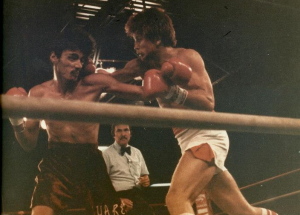
ATLANTIC CITY (JANUARY 19, 2014)–Anthony Caramanno, born and bred in Staten Island, is the only Italian-American to ever win 3 NY Daily News Golden Gloves Championships. After proving his worth in the east coast’s premiere amateur tournament, the 23 year old super-bantamweight is ready to step into the paid ranks, making his pro debut Saturday, January 25th at the Golden Nugget Atlantic City against Bethlehem, Pa’s Michael Varela (0-0).

The fight can be seen LIVE all over the world on www.pandafeed.tv for just $9.99

Portions of the PPV proceeds will go to KO Children’s Malnutrition

KO Children’s Malnutrition will be represented by star of the Real Housewives of New Jersey Rosie Pierri.

To lean more about KO Children’s Malnutrition, Click: Here

Affable and humble, Caramanno was kind enough to answer questions about his background an boxing aspirations.

Q. First of can you tell us a little about yourself:

Caramanno: “I have lived on Staten Island my whole life. It’s a tight-knit community and was a great place to grow up. I went to Farrell High School and also studied business at the College of Staten Island. I played other sports like baseball as a kid, but it seemed like everybody else kept growing and I stayed the same size in my early teens. That’s one of the reasons I took up boxing when I was 14, because boxing has weight divisions.”

Q. You mentioned how Staten Island is a tight knit community. How has that helped you in the amateurs and what do you expect that will translate to your pro career.

Caramanno: “I had so much support in the Golden Gloves from friends and family. They were all in the stands making tons of noise and I really think that pushed me and may have even intimidated my opponents a little. I think that will carry over into the pros. I’ve got about 300 people making the trip down to Atlantic City to watch me.”

Q. Who are your favorite fighters to watch.

Caramanno: Floyd Mayweather Jr. is my absolute favorite. I think my style and his are similar. I try to be patient and look for counters like he does. Also, being Italian-American, I gotta show love for Paulie Malinaggi and his slick style.”

Q. Staten Island has a boxing tradition as strong as any of the 5 Boroughs, but despite the talent of guys like Johnny “Thunder” Vanderosa, “Kid” Gary Strak Jr. and Kevin Rooney, SI has never produced a world boxing champion in any weight class. Do you think you will be the first fighter from your home town to reach that pinnacle?

Caramano: ” I hope to, but my good friend 2012 US Olympian Marcus Browne (8-0), 7 KOs) got a head start on me. If he’s the first, with the help of my my father and my father and trainer, Tommy, I will defiantly be the second. I am proud to be a part of Final Forum Promotions . I believe Sal Musumeci will be able to help realize that dream”

Presented by Sal Musumeci’s Final Forum Promotions, Caramanno vs. Varela is part of a eight bout card headlinded by an 8 round heavyweight match up between Brooklyn’s Derric “El Leon” Rossy (28-7, 14 KOs) and Philadelphia’s Joey “Polish Thunder” Dawejko (8-3, 3 KOs).

In the co-feature, undefeated Heavyweight knockout artist Natu Visinia will take on Jon Bolden of New York City in a scheduled six round bout

Also featured will be undefeated New Jersey prospects: Gabriel Pham of Atlantic City (5-0, 2 KOs), Dave Valykeo of Neptune (3-0), and Ismael “Tito” Garcia (5-0, 3KOs) of Vineland. With former Ecuadorian Olympic heavyweight Yltako Perea and Isiah Seldon (7-1), son of former WBA heavyweight champ Bruce Seldon, rounding out this action packed night of boxing in separate bouts.

Tickets for this outstanding evening of boxing go on sale Friday, January 10th and are $125 for Ringside, $75 for reserved and $50 for general admission. VIP Tables are available and all tickets can be purchased by going to www.ticketmaster.com

Q & A written by Eugene Sirota


Ray Robinson for NABO title headlines boxing Feb. 21 at Dover Downs Hotel & Casino

DOVER, Del. (Jan. 17, 2014) — Dover Downs Hotel & Casino with Champ’s Management announce a championship boxing event on Friday, Feb. 21, in the Rollins Center® at 7 p.m. The headline bout features welterweight “The New” Ray Robinson, of Philadelphia, Pa., fighting for the NABO title. His opponent is yet to be determined.

The undercard features Cornelius Lock, Joey Tiberi, Anthony Miller, John Bowman, David Murray, Milton Santiago, Kyrone Davis (debut).

Tickets are on sale now for $45 – $200 and may be purchased by calling VIP Services at 800-711-5882 or visiting doverdowns.com. Event, times and card are subject to change or cancellation without notice.


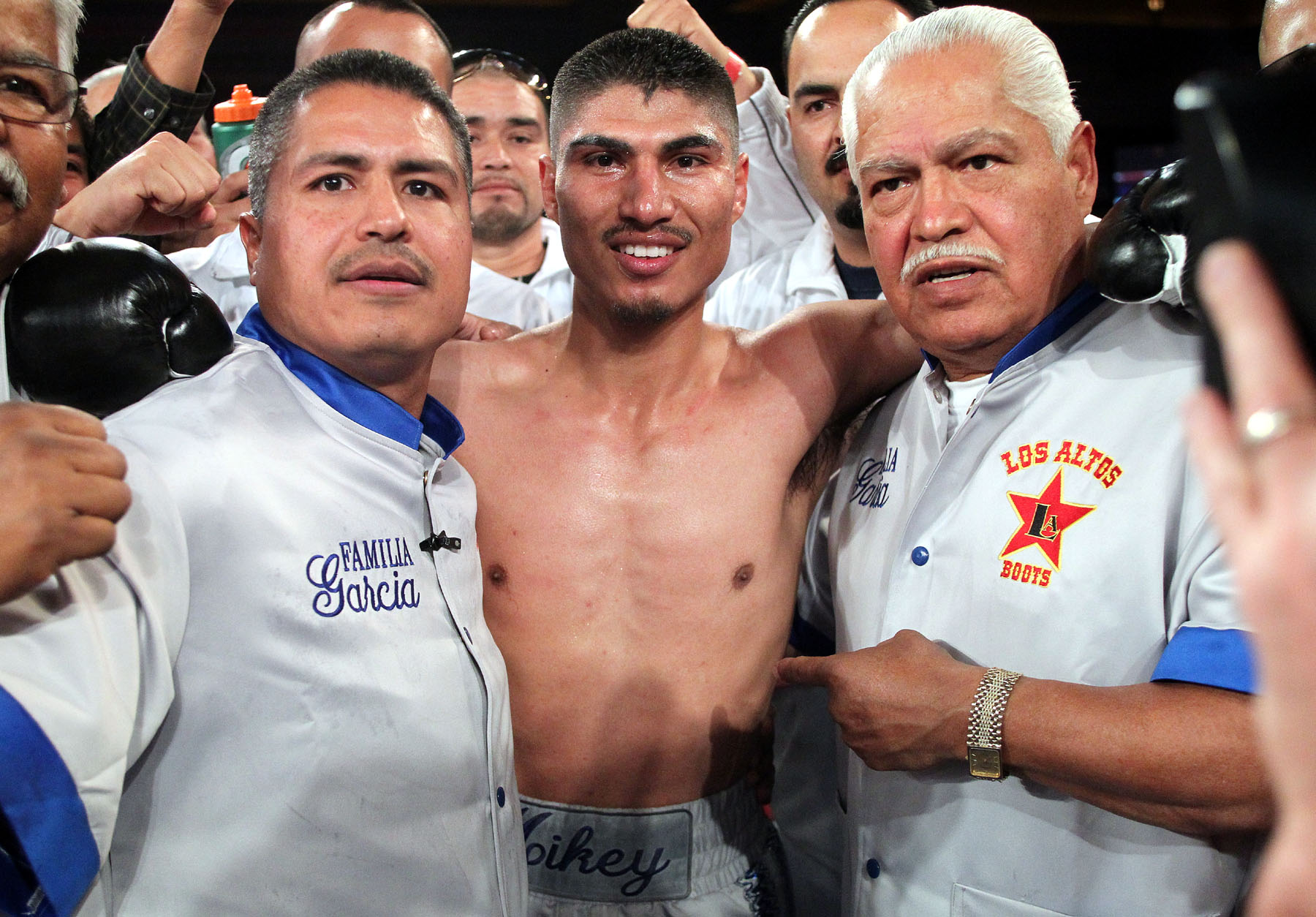
Stars Needed: Mikey Garcia makes the short list

Mikey_Garcia
The best in a new and diverse generation is about to make its claim on future stardom with a wave of new accents and surprising possibilities that could further re-make the face of the game. It used to be as familiar as a cheeseburger and fries. But today it’s more like an international food court.

“A lot is happening in boxing,” Top Rank promoter Bob Arum said Tuesday in a conference call. “And it happens real quick.”

So quickly, in fact, that Arum looks around and sees the American brand facing more challenges than perhaps it ever has, especially from fighters from the former Soviet Union.

Arum’s search for a few good Americans in the New Year starts with Mikey Garcia, who defends his junior-lightweight title in a significant test of his pound-for-pound credentials on January 25 against Juan Carlos Burgos at New York’s Madison Square Garden in an HBO-televised bout.

“Mikey is one of the few American stars in boxing,” Arum said. “We have Mikey and Andre Ward, Floyd Mayweather and Timothy Bradley. There are not many other Americans who qualify as superstars.”

Not everybody is sure that Garcia qualifies for super-stardom. But Arum mentioned him because of the potential he has exhibited over the last two years. The unbeaten Garcia’s thorough skill set looks like a good fit for a place alongside better-known names in bouts that could transform him into a pay-per-view attraction. Garcia-Burgos is not a PPV bout.

In Tuesday’s call, Arum mentioned Manny Pacquiao, one of the biggest PPV draws in the business , as a possibility. That alone is a sure sign that Garcia has arrived. It was the first time his name has been thrown into the Pacquiao mix. At 130 pounds, however, Garcia is still a couple of weight classes lighter than Pacquiao.
Garcia didn’t mention the Filipino by name. But he did say he’d consider a move up in weight.

“We will have to look at the options after this fight,” said Garcia, who was in Macao in November for Pacquaio’s welterweight victory over Oxnard, Calif., stablemate Brandon Rios. “Hopefully, everything turns out well next week and we can move forward with our plans. We’d have to look at the top fighters in the next weight class, and if I do that, I have to grow into the weight class.

“I would like to unify the titles before moving up, but if there is something better at 135 then I will go there. Then I can unify the titles there or move up to 140, if the right fight is there.”

A more immediate option might be Vasyl Lomachenko, the two-time Olympic gold medalist who in October won a major featherweight title in his first and only pro fight.

Lomachenko, a Ukrainian and one of the greatest boxers in Olympic history, is among emerging fighters from the former Soviet empire. He joins Gennady Golovkin, Sergey Kovalev and Ruslan Provodnikov in an Eastern Boxing Bloc that had a profound impact in 2013 and could have an even bigger one in 2014.

Arum said he envisioned Garcia “taking on a lot of these non-Americans in really big fights.”

But, Arum said, “where that takes him, I’m not sure.”

A spot the in pound-for-pound debate sounds like a pretty good place.


Procrastination’s affirmer: Notes from the craft

Bottles
SAN ANTONIO – This week I began painting glass jugs instead of writing. Reading, socializing, Twitter, documentaries, laundry – all of these, it turned out, were not effectively enough keeping me from writing, despite many years of service in the enterprise. A vigorous new distraction came to the fore. The perfect week for it, too; a 2,000-word cover feature due in a few days, novel 8 stalled at 92,000 words, and this column needing to be written, read, colored, shortened, lengthened, and read thrice more.

A local supermarket put its organic apple juice in exquisite glass bottles some months back, bottles so lovely I could not bring myself to refuse them, and so they accumulated on the counter till a visiting friend told me about a YouTube video of a bachelorette party – there’s your muse! – that had colorful acrylics poured and baked in mason jars. Now a lengthy process is hatched, a tidy sum is sunken, and bottles five and six sit drying as these words happen.

“If anything can stop you from writing, let it.” That is about the best advice I’ve yet come across concerning this craft. I read it somewhere and don’t recall who said it, so I’ll put it in quotes and attribute it away from myself. Then I’ll google it and find it was in a book that attributed the quote to “an editor named John Dodds.” It’s advice I occasionally impart and more often credit myself with imparting to younger writers.

It speaks to the compulsion required to do this thing, it speaks to the lack of affirmation, it speaks to how disproportionately longer it takes to write something than it does to read it, and quite often in an inverse sort of proportion to that disproportion; the worst writing, what often takes the longest to endure reading, gets written fastest, which is not nearly tragic, from a writer’s perspective, as that proportion’s inverse and what it says to writers who whale away at their prose, flensing it till nary a transition remains from one idea to the next, then go back over it thrice more, under the auspices of once more, before reading it aloud, sighing, shrugging and filing it – triumph free.

That is not the worst of it usually. The next morning is the worst of it, when the writer first sees his inadequate effort through the eyes of a reader and panics at how terrible it is. A few hours pass, an email or two comes in, if he’s lucky, and he’s able to decide it’s not quite awful as imagined. By midweek, in fact, he’s often forgiven himself, which is good because the idea for next week’s piece is already overdue and the next deadline is bearing down, as it will do. A few weeks later, or anyway at year’s end, the writer returns to that inadequate effort of his, and if he truly worked at it when he wrote it, he is surprised how good it was. That leads inevitably and instantly to a brand new horror: What happened to me? why can’t I write that well anymore? will I ever recover that guy’s vocabulary or insights?

It’s good a time as any to write this column because it’s the time of year members of the Boxing Writers Association of America try to determine what pieces of theirs to submit for the BWAA’s writing contest, and putting aside the legitimacy of any contest that judges art, those writers who do the craft right, those writers admired by their peers, should have to struggle with this choice because they wrote hard as they could every time and didn’t write a few pieces much better than others to target hypothetical judges for contest time.

The other night, haunted by calls I’d not made for that long feature and questions I’d procrastinated preparing for interviews because prepared questions were my trigger for making the calls whose making I dreaded – which, as an aside, is an amateurish mistake, and an idiocy, and thrice the idiocy from any writer who has commented often enough to remember: “I’m always glad I’ve made the call by the time I hang-up” – I closed the dark screen of my laptop, set it on the sofa and found “Deceptive Practice,” a documentary about prestidigitator Ricky Jay, and marveled at his ability and willingness to spend 14 daily hours shuffling a deck of cards. No sooner, though, does a craftsman marvel at another’s compulsion than he begins a spiral of self-loathing at his own comparative half-assery.

A month ago, during fightweek for Maidana-Broner, I had the pleasure of walking home from the Friday weighin with my favorite Monday columnist, and when conversation turned to the nature of column writing, somewhere right about Houston Street & Soledad, we began interrupting one another and completing the other guy’s sentences about the tariff a column like this exacts from its writer. The collapsed marketplace for good writing – how much did you pay to read this? – takes each day more of what remains of the dilettantes, leaving mostly the quixotic and compelled.

This craft is not about having “something to say”; that’s a cliché and simplification made by people who couldn’t do what we do. It’s about other, better things that include this: Euphoria at a process that places a certain chunk of one’s identity in a hermetically sealed compartment that, for its seeker, can be durable a refuge as exists. So let’s end here: I first came across the word “prestidigitator” while reading Henry Miller in 2000, and you’re damn right it felt good finally to use the word in print, and correctly, nearly 14 years later, up in graf 7.

Bart Barry can be reached at bart.barrys.email (at) gmail.com


Trash Talk? Mayweather’s timing says something else

Floyd Mayweather
Never-ending speculation about Floyd Mayweather Jr.-Manny Pacquiao is boxing’s version of Groundhog Day, the 1993 film starring Bill Murray as a weatherman trapped in time, re-living the same day everyday until he gets it right.

Getting it right, of course, means an actual fight. Without one, we’ll only hear more of the same talk. I’d rather be a groundhog. More of the same seemed to be the message in Mayweather’s New Year’s missive in comments to FightHype. He ripped Pacquiao all over again. That’s not exactly news. On the surface, Mayweather made it sound as if there’s no chance that the two would ever agree to a fight.

But the timing was curious. Mayweather’s latest trashing of Pacquiao happened a few days after they actually agreed on something. Both dismissed an un-sourced story that reported they would fight in September.

Mayweather called the report “a lie.” Pacquiao said it was untrue.

Then, Pacquiao told Yahoo’s Filipino correspondent that they could only “talk about a possible fight next year” and only if there’s no new deal with Top Rank. Pacquiao’s Top Rank contract ends at the end of 2014. Within a few days, Mayweather delivered his rant. But why? Why now?

If Mayweather didn’t really want to fight Pacquaio, wouldn’t he’d quit talking about him? Wouldn’t he ignore Pacquiao altogether? If you’re not interested, why mention his name at all? But Mayweather chose that moment to re-ignite a possibility that had been muted throughout most of 2013.

Mayweather, who is as clever a promoter as he is a fighter, understands that the beginning of any fight starts with gaining the upper hand, a psychological edge, even before negotiations begin. He repeated a lot of the same old insults, but his comments were significant in what they indicated. If he’s talking about Pacquiao in any way, he’s probably thinking about a fight everybody still wants to see. Talk is the first step, but maybe a calculated one.

For Mayweather, Pacquiao appears to be something of a straw man anyway. Mayweather’s real target looks to be Bob Arum, Pacquiao’s promoter. Mayweather trashes Pacquiao to get at Arum. Mayweather says there’ll be no fight with Pacquaio as long as he is represented by Arum. It’s as if Mayweather is trying to get Pacquiao to leave Arum. The Filipino has been Top Rank’s biggest money earner for nearly a decade. Top Rank without Pacquiao is a promotional entity without its biggest star. In Mayweather’s bitter rivalry with Arum, that would rank as a significant victory for Mayweather.

There are plenty of reasonable ways to interpret what Mayweather says and doesn’t say, but it’s impossible to separate anything he does form the context of his Showtime contract, a 30-month deal for a possible six fights and a potential $250 million. For that kind of money, you’d think that Showtime would get some say-so. It’s safe to say that Showtime — and its bosses at CBS — would love to have Pacquiao-Mayweather.

On Feb. 19, Mayweather’s landmark deal with Showtime will be two fights and 12 months old. In 2014, let’s assume he fights Amir Khan in May and Marcos Maidana in September. If he wins both, Mayweather would be 47-0, two victories away from equalling Rocky Marciano’s 49-0 milestone.

Over the first six months of 2015, he could maximize the contract’s potential with two more fights, the second of which might be for his legacy against the very fighter he trashed a few days ago. It’s only trash talk if there’s no plan. The timing makes it look as if Mayweather has one.


Portrait of 2013’s most enjoyable week, part 2

MEW2013
Editor’s note: For part 1, please click here.

The seven-day stretch in mid October that began the Saturday Timothy “Desert Storm” Bradley decisioned Juan Manuel “Dinamita” Marquez found contrasting studies of how pain is treated, how humiliation is considered, and how vulnerability is concealed or exploited otherwise. Bradley, capable as any prizefighter of emoting when asked a fair question, showed no vulnerability to Marquez, striking instead an uncharacteristically arrogant mien, one intended to disarm boxing’s apex predator. And it worked insofar as Marquez found nary an opening, geometrical, physical or psychological – nary a fissure in Bradley’s expressive countenance, a dark and intense face on a head he self-deprecatingly calls too large (when not driving it in opponents’ chins or foreheads).

Ruslan Provodnikov and Mike Alvarado both admitted, in a wondrous for rare bit of prefight candor, they were afraid of being badly hurt or killed in a prizefight, the sort of concession Bradley might make privately but Marquez was and ever will be incapable of making – for reasons cultural, traditional and perhaps biological. After Provodnikov laid waste to Alvarado, though, one almost wondered if the Russian possessed actually a fraction the empathy of his prefight demeanor, if he didn’t, at least for a 48-minute stretch a couple times each year, cease seeing men set across from him as fellow sons/brothers/fathers/friends and merely sides of beef that, curiously enough, could be made to emit whimpering sounds when knuckled just right.

*

The seven-day stretch in mid October that began the Saturday Timothy “Desert Storm” Bradley decisioned Juan Manuel “Dinamita” Marquez showed that if one puts away his prejudices and looks often and close enough at art of any kind, from its finest manifestations in Rembrandt or Velazquez to its fallenest manifestations in pornography like Stagliano’s, he finds wonderment and originality, he finds better men than himself treating troubles like his own, and he finds, desperately and essentially, a form of solace.

If Andy Warhol and Fernando Botero had little in common, they had an uncommon sense of color, even for visual artists, to unite them along art’s rocky sort of continuum, and it was a sense of color Warhol quite possibly permitted Botero to use some years later, for as much as the Colombian credits his influences to Pablo Picasso it remains true that Picasso, intellectual always before beautiful and cynical always and always, appears less in the vibrancy of Botero’s paintings than does Pittsburgh’s father of fashion art.

If DAM’s shape was ostentatious, finally, its structure comprised none of the conspicuous consuming that is modern America’s specialty; it was Libeskind’s proper recognition that while largeness of scale assures no greatness, architectural greatness often does desire awesomeness.

*

The seven-day stretch in mid October that began the Saturday Timothy “Desert Storm” Bradley decisioned Juan Manuel “Dinamita” Marquez brought a celebratory air for Provodnikov and Bradley, men who made an incredible spectacle with one another seven months before, bringing them finally the victories both deserved, and with those victories a codification of their status in prizefighting’s impassioned, subjective, weird, hyperbolic ratings, an ongoing appeal to orderliness that proves man must have hierarchy even when he hasn’t an inkling why.

The clarity of Colorado’s air sets its vistas in a visual space that might better be called hyper-definition than high-definition, akin to the early HDTVs with whites that blitzed viewers and induced aching brains if not temporary blindness, and when one exits the western mouth of Eisenhower Tunnel, a blossoming of sun-reflected snowy whiteness after 1 1/2 miles of gray darkness, he wonders aloud if this mightn’t be the sole place in the world a visual experience of such arresting magnitude can happen.

Mike Alvarado, the Coloradoan who lost on his stool against Ruslan Provodnikov that Saturday night in an unlikely suburb north-northwest of Denver, wore open and suppurating facial lacerations to camp for his March rematch with Brandon Rios, lacerations courtesy of a mishap with his flesh and shards of a glass bottle and at least one other man’s rage, and reminded those who followed his career how unlikely a happy ending will be for “Mile High.” A reminder that came once more, two hours after the main event in Broomfield, when I returned to Ramada Denver Midtown, a recently re-acquired and -signaged property, luxurious 30 years and gaggles of property managers ago, where the frontdesk attendant, young, pretty, edgy, pierced – Denverstyle – told me: “Alvarado? I know Mike! My friends partied with him.”

*

The seven-day stretch in mid October that began the Saturday Timothy “Desert Storm” Bradley decisioned Juan Manuel “Dinamita” Marquez made Marquez once more threaten retirement, once more price his way out a lucrative rematch with Manny Pacquiao, once more remind his adorers genius is divisive, not unifying or transferable, and a force that renders a man like Marquez many more times admirable than likable, a man to observe and delight-in but never invite for a beer.

Timothy Bradley ended 2013 finally esteemed like a man with his resume should, regardless of what bigotry aficionados routinely show volume punchers. Ruslan Provodnikov appeared in a California ring across from Bradley in March a wholly unknown entity and finished October as the third piece of a triumvirate of former-Soviet fighters now used to scare disobedient young boxers before bedtime: “GGG”, “Krusher”, “Siberian Rocky”.

Mike Alvarado, finally, found what solace might be had from an adoring hometown, a prudent choice, and a vindicating fulfillment of what natural gifts oddsmakers long had him tragically wasting.

And I had the great good fortune of more time spent within our craft’s fraternity, both in Nevada and Colorado, a fraternity that, at its best, is a mutual-admiration society.

Bart Barry can be reached at bart.barrys.email (at) gmail.com


The 2014 Story of the Year: Pacquiao’s next move

Pacquiao_Rios_131124_003a
A crystal ball is just another glass chin, which is one way of saying New Year predictions have no chance. They’re fun, but they’re also about as likely as Top Rank’s Bob Arum and Golden Boy’s Richard Schaefer wishing each other a Happy in any holiday season. More of the feud appears to be the only sure thing. But it also appears to be headed for a new level of acrimony, perhaps even a make-or-break confrontation, over Manny Pacquiao.

There’s potential for a lot of intriguing stories, but Pacquiao’s Top Rank contract figures to be the biggest in 2014. He has one year left on a deal extended in October 2012 through the end of 2014.

Leave it up to some other self-appointed Nostradamus to predict what Pacquiao will do. His loyalty to Bob Arum has been unshakable since 2006 when he spurned a Golden Boy offer, which reportedly included a suitcase stuffed with a $250,000 in cash. But loyalty is about as fragile as that crystal ball. In some ways, Pacquiao is to boxing what Peyton Manning was to the NFL after the Indianapolis Colts released him following a 2011 season on the injured list. The quarterback eventually signed a landmark deal with the Denver Broncos in March, 2012. Pacquiao’s potential free agency could also transform boxing’s landscape, at least for a while.

Pacquiao enters the final year of his Top Rank contract amid questions. He answered some, but not all, in his one-sided decision over Brandon Rios in November at Macao. Speed was still there. He didn’t appear to have any lingering effects from the crushing knockout he suffered against Juan Manuel Marquez in December, 2012. So far, so good, although Rios’ style proved to be the perfect comeback for Pacquiao’s skill set. The true yardstick for whether he is still the fighter of five years ago won’t be determined until — or if — he faces Marquez or Timothy Bradley in a rematch.

On the business side of the ledger, the bigger question is his drawing power. Pay-per-view reports for his victory over Rios put the Home Box Office audience at between 475,000 and 500,000. It’s a good number for anybody not named Pacquiao or Floyd Mayweather Jr. More on that later. Arum predicted that the pay-per-view number would take a hit. It did, maybe because it was in China and away from the daily pre-fight media coverage in the United States. Again, maybe.

But Arum’s decision to bring Pacquiao back to the U.S., perhaps in April, doesn’t appear to be a coincidence. Without television’s traditional infrastructure and the daily headlines, the PPV number in Pacquiao’s first U.S. fight in more than a year will be a true test. If the PPV number disappoints, it might be a sign that Pacquiao and Top Rank will go their separate ways. If it’s closer to one million, look for Arum to introduce negotiations for another extension.

Thus far, there’s been no news that one is on the table. Pacquiao and Arum agreed to the additional year about 14 1/2 months before the old deal was set to expire at the end of 2013. When it comes to potential free agency, boxing isn’t any different than the NFL, NBA and major-league baseball. There’s plenty of speculation about any athlete, coach or manager entering the final year of a deal. It indicates uncertainty on both sides.

For all sides, money is the bottom line. For Pacquiao, there’s anecdotal evidence that it’s a potential issue There are reported problems with both the Internal Revenue Service and Filipino tax authorities. Perhaps, the stories are overblown. Perhaps, they’ll be settled before the first page in the new calendar is turned. But the ominous smoke is there.

If in fact Pacquiao needs money, the best way to get the most of it is in a fight against Mayweather. No secret there. There’s renewed speculation in an unsourced story about a Mayweather-Pacquiao fight happening in September. It’s about as believable as any other off-the-wall New Year prediction and as likely as Julio Cesar Chavez Jr. ever making weight. But it’s getting attention, which is a sure sign that it’s still the one fight everybody wants to see. Mayweather, of course, has repeatedly insisted he’ll never fight Pacquiao for as long as he is represented by Arum. Mayweather’s latest attack of Pacquiao via social media appears to be a poorly disguised attempt at badgering the Filipino Congressman into making a move.

In part, Mayweather is an example of how the best boxers can evolve as businessmen. Mayweather is now a promoter, an independent entrepreneur aligned with Golden Boy and under contract to Showtime. A better example is Miguel Cotto, who has avoided the bitter feuds and been able to do business with Top Rank, Golden Boy and any other entity in the promotional swamp. By the way, Cotto is friendly with Pacquiao, who beat him in 2009.

Will Pacquiao follow Cotto’s model? Split with Arum? Follow the money to Mayweather for a 2015 fight? Retire after losing to Bradley or Marquez? A New Year offers answers to 2014’s undisputed Story of the Year.


Portrait of 2013’s most enjoyable week, part 1

MEW2013
The seven-day stretch in mid October that began the Saturday Timothy “Desert Storm” Bradley decisioned Juan Manuel “Dinamita” Marquez in Thomas & Mack Center ended with a more brutal stoppage victory over “Mile High” Mike Alvarado at 1stBank Center in Broomfield, Colo., a GPS-defying suburb of Denver, than even sadists anticipated, and transformed Ruslan “Siberian Rocky” Provodnikov into prizefighting’s looniest bogeyman, the sound of whose punches still carry for those at ringside that night an especially unforgettable brand of acoustic menace.

The Bellagio Gallery of Fine Art in Las Vegas featured a display of American pop-star Andy Warhol’s finest Western-themed works, including a pair of Dolly Parton portraits excellent as they are obscure, and Denver Art Museum proved itself an architectural marvel more even than anticipated.

Desert Storm, Dinamita, Siberian Rocky, Mile High, BGFA and DAM – they made Oct. 12-Oct. 19 my favorite week of 2013.

Fightweek has changed for boxing writers, changed dramatically and with dramatic rapidity, from the celebratory sort of thing that began on Monday afternoons and included free room and board at the host casino, to a pay-it-yourself model. It is but one more unpleasant turn for a profession whose best days will not return, though with one ancillary benefit: When a writer is compensated only for what words he produces within an arena, his time is his own when he is without the arena.

Saturday in Las Vegas began with a long-awaited lunch at Wynn’s Botero – a restaurant named after Colombia’s foremost living artist – continued to Bellagio’s Warhol display, crescendoed with three judges’ deciding for Timothy Bradley and concluded with another wonderful postfight meal among mentors and friends.

Friday in Denver began among the confounding angles of Polish architect Daniel Libeskind’s masterwork, DAM’s Frederic C. Hamilton Building, and continued to an overcrowded downtown weighin, where Mike Alvarado’s scale struggles afforded an hour with boxing’s best matchmaker, Bruce Trampler, and matchmaking’s greatest character, Jim Smith, anticipating fantastically a Saturday morning drive westward and Provodnikov’s Saturday night triumph.

*

The seven-day stretch in mid October that began the Saturday Timothy “Desert Storm” Bradley decisioned Juan Manuel “Dinamita” Marquez provided a resilient sort of joy, a kind Bradley might appreciate, joy by way of resilience, followed by the shocking clarity of Colorado light, pristinely dry for being ever cold, and an overwhelming form of violence no prizefighter recognizes as his own till he becomes its prey.

Before Juan Manuel Marquez stormed to his dressing room yet again while boxing’s malcontent knowers filled online forums with certainty, there came an unusual occurrence to ringside in Las Vegas: Silence among writers between the closing bell and reading of scorecards. Some had opinions of who’d won the 12-round contest, but none had anything like television’s certainty.

As Saturday became Sunday, I sat in Zoozacrackers, Wynn’s deli, across from Thomas Hauser and beside Norm Frauenheim, and I gratefully marveled, as I try often to do, at what an unpredictable but absurdly wonderful – and absurd and wonderful – thing is life.

Promoter Bob Arum, too, was surprised by the way Nevada’s judges found for Bradley in a fight that saw more ineffective aggressiveness and inactivity than expected, but like many others he had a job to do between the overstuffed walls of Diego’s Mexican Food & Cantina the following Friday, promoting alongside Banner Promotions’ Art Pelullo at a weighin the fire marshal closed a half hour before Alvarado missed weight by a pound and Provodnikov struck his signature bellowing-most-muscular pose, and Arum’s job hardly comprised an expression of grief for the surly Mexican who flattened Top Rank’s 2013 revenue projections with a single right hand in Las Vegas 11 months before.

Saturday’s main event began with a look of acute squeamishness and pain, an actual wince, from Mike Alvarado, an aptly tatted and troubled representative of Denver’s rugged and weird interior, and ended with Alvarado, many times more intelligent and athletically gifted than his detractors or rap sheet know, broken on his stool and making an unexpected and prudent decision not to defend his 140-pound title from Provodnikov in their match’s championship rounds.

*

The seven-day stretch in mid October that began the Saturday Timothy “Desert Storm” Bradley decisioned Juan Manuel “Dinamita” Marquez marked a vindication for both Bradley and Provodnikov, the Russian who lost a fight-of-the-year decision to Bradley in March while likely reducing Bradley’s future lucidity and life expectancy and proving the Californian as spirited and well-conditioned an athlete as this era will know. Bradley, a man unfairly and ceaselessly maligned for collecting a decision win over Manny Pacquiao 16 months before, received the benefit of most every doubt against Marquez, immobilized by what upper-body musculature absurdly topped Marquez’s 144 1/2-pound physique, surprising Marquez with elusiveness and a counter left hook in their final 15 seconds of belligerence, once that sent Marquez stumbling backwards and Bradley’s gloves prematurely and unadvisedly high in the air.

Enamored as he was of a stalactite-like shape for his titanium-plated edifice at DAM, Daniel Libeskind, one fears, followed contemporary architecture’s tendency to see contemporary art as clutter, detritus detracting from what answers architecture provides light’s riddle – composed of particles or waves? – and made an exhibition hall too exhibitionist to exhibit anything but its own enchantingly crinkled cants.

One needn’t travel 50 miles west of Denver to see vistas unique in all the world, and these vistas begin with Idaho Springs, Colo., a spot placed first on a list of recommended Centennial State destinations by the matchmaker placed first on lists compiled by his peers, and so I went to behold the Rockies and their majestic clarity.

I had watched Mike Alvarado for 7 1/2 years by the time he got brutalized by Ruslan Provodnikov, first covering Alvarado’s own brutalization of Maximo Cuevas in the light of a searing Tucson sun as it set over the empty parking lot of Club Envy in 2006, but not until I saw Alvarado reduced to a frightened target did I realize how much affection I’d developed for him.

And how much I fear news will come of his tragic end before this decade is out.

***

Editor’s note: Part 2 will be posted next Monday.

***

Bart Barry can be reached at bart.barrys.email (at) gmail.com


A 2013 Ballot: Nominees for the good, bad, sad and the ugly

A look-back at 2013 with a nomination, one for every month in the calendar:

Fight of the Year: Timothy Bradley’s decision over Ruslan Provodnikov. In an era when memories last about as long as a tweet, a Fight of the Year is often about timing. To wit: If it happened late in the year, it gets votes becauseit’s still remembered. In part, that tells you how good Bradley-Provodnikov was. Nothing that followed the March classic could surpass it.

Good Guy Award: Bradley. A fractured business could learn from him. He was a target for the social-media cowards who attacked him in the wake of a controversial decision over Manny Pacquiao. It would have been easy to wallow in bitterness. But he didn’t. Bradley emerged as a winner, with two narrow decisions in the ring and a unanimous one out of it.

Statesman of the Year: Vitali Klitschko. The retired heavyweight champion is the courageous face of the opposition party in the Ukraine .

Smartest Guy In The Room: Paulie Malignaggi. Media critic and Showtime analyst, Malignaggi exposed Adrien Broner as flawed in losing a split decision. Marcos Maidana finished the job on Dec. 14, in a dominant decision over Broner, the Upset of the Year.

Three Reasons Not To Believe The Headlines: Broner, Canelo Alvarez and Julio Cesar Chavez Jr. All three were shown to be over-rated, over-hyped and — in Chavez’ case — over-fed. Floyd Mayweather Jr. made Canelo look like Robert Guerrero. Here’s hoping Chavez got a Jenny Craig gift card for Christmas. He never made weight for Bryan Vera. Never intended to. Then, he got an early Christmas in September with a gift-wrapped decision over Vera.

Promoter of the Year: Mayweather. He’s grown into the role. The annoying trash-talk has subsided. He’s transformed himself into a singular pay-per-view franchise. He managed to land a Showtime contract worth a potential $250 million, or the reported price that Amazon owner Jeff Bezos paid for The Washington Post. Mayweather, also a contender for Businessman of the Year, is smart to stay out of the troubled media business. Then again, he already owns Showtime.

Matchmaker of the Year: Canelo was marketed as a threat, but Mayweather knew better. He’s a great judge of talent and danger. To wit Antonio Margarito: Mayweather was smart to never have fought him. It can be argued that the beginning of a Pacquiao decline started with the brutal blows he sustained in beating Margarito in 2010. For all of those pound-for-pound lists, a good guide is a list of those Mayweather won’t fight.

Craziest Quote of the Year: There are always a lot of contenders for this one. In 2013, however, the over-the-top prize belongs to Angel Garcia, one of boxing’s crazy dads who deserves serious Trainer of the Year consideration for his work with son Danny. Before his son beat Argentina junior-welterweight Lucas Matthysse in one of the year’s biggest upsets, Angel Garcia went patriotic: “Everybody wants to have their Argentine flags out, but they forget where they live. We represent the USA. Danny is an American fighter. Background is Puerto Rican and I’m Puerto Rican. They say the American fighters can’t fight. The USA gets no props. The same country that sends the welfare check to you. You get that check and sign it, don’t you? Then, you want to be an Americanito.”

Rest In Peace: Ken Norton, Emile Griffith, Tommy Morrison and Jake Matlala. Norton, a former heavyweight champ who had the style to beat Muhammad Ali, died on Sept. 18. He was 70. Ex-welterweight and middleweight champ Emile Griffith, remembered for a 1961 fight in which Benny Paret died after questioning Griffith’s sexuality, passed on July 23. He was 75, Ex-heavyweight champ Morrison, who denied he had the HIV virus, died on Sept 1. Ex-flyweight champ Matlala, one of Nelson Mandela’s favorite fighters and best known for upsetting Hall of Famer Michael Carbajal, died on Dec. 7. He was 51.

Tragedy of the Year: Frankie Leal. The junior-featherweight died on Oct. 23 at a San Diego hospital, three days after he was knocked out in Cabo San Lucas. He was 26. It was a death that could have been avoided. Leal was a tragedy waiting to happen. He was hospitalized in March 2012 when he was carried out of the ring on a stretcher after Evgeny Gradovich knocked him out in San Antonio.

Move of the Year: China. Top Rank’s Bob Arum has placed a big bet on Macao, the gambling district near Hong Kong. Will it work? Hard to say. As an emerging market, China has no rivals. But whether that market includes boxing is still a great unknown. A sign of that uncertainty was raised when Arum announced that Pacquiao’s next fight would be back in Las Vegas after mixed signals in the reported pay-per-view of audience of about 500,000 for his victory in Macao over Brandon Rios in late November. There’s a lot of potential money in China, but boxing’s proven bucks and reliable infra-structure are still in Vegas.

Trend of the Year: Fighters from the post Soviet Union. They weren’t going to China. Instead, they were moving into the U.S. market. Their collective face is already this corner’s choice for Fighter of the Year. Gennady Golovkin’s emergence, proven by a reported audience of 1.41 million for his last appearance on Home Box Office, is evidence that fighters from Kazakhstan, Russia, Ukraine and Siberia can make it in the U.S. Look for an even bigger impact in 2014 from several, including Siberian welterweight Provodnikov, Russian light-heavyweight Sergey Kovalev, and featherweight Vasyl Lomachenko, a two-time Olympic gold medalist.


Adam Berlin: The struggle of the art

both_members_club_book_cover low res
My introduction to Adam Berlin’s writing came 4 1/2 years ago when he wrote for this site an account of Joshua Clottey’s preparations for a match with Miguel Cotto. I did not complete half Berlin’s piece before emailing our editor and asking him to throw whatever courtship we might at Berlin – a bio, an archive, a picture, whatever – beginning my plea with: “Adam’s a hell of a talented writer.”

After reading the final 18 pages of Berlin’s third novel, “Both Members of the Club” (Texas Review Press; $12.95), I set the book down, smiled and nodded: Told you so.

There’s a tendency in readers’ minds, even the minds of experienced readers, even what minds do the double duty of belonging to a reader and a writer, to treat first-person narrators as autobiographers; one takes the pronoun I, marries it to the author’s back-cover photo and swims along. Adam Berlin’s third novel feels more deeply autobiographical, though, than what tendencies a first-person narrator already encourages, especially when one reads its two predecessors – “Headlock” and “Belmondo Style” – before approaching “Both Members of the Club.”

All three of Berlin’s novels employ the first-person, more immediate than the third-, causing a reader to see Berlin, ageing with remarkable grace through his 14 years since “Headlock,” first as a bar-bouncing former collegiate wrestler named Odessa Rose, body-beautiful and heterosexual as he wishes to be, then as a late-adolescent track runner, nascently gay, named Ben Chiziver. Berlin’s narrator in his third novel, Gabriel, is, like so much in the book, a creation spun from the best elements of his first two works.

Gabriel is an aspiring actor who alludes several times to paid sexual acts performed on men, a model vain and attractive enough to pose nude for aspiring draftsmen in art classes while straight enough to allow jealousy over an evening’s tryst between his best friends, a female artist named Sam and a prospect-cum-journeyman prizefighter named Billy Carlyle, to undo an early lifelong loyalty oath formed by the three in a troublesome placed called Smythe House, a foster home of troubled youth – the reader is left to infer.

In a November interview with fellow boxing writer Lyle Fitzsimmons, Berlin states: “There was a call for short novels for a university-sponsored competition, so I took my 400-page manuscript and . . . I stripped the book down to the required page limit, 120 pages, and sent in the manuscript.” Berlin likens this effort to what stropping a prizefighter does to his body, but it is an analogy perhaps too facile; to remove 70-percent of his bodyweight, the way Berlin had to remove 70-percent of his manuscript, a middleweight would have to begin camp above 500 pounds and cleave entire chunks of flesh from his skeleton.

That is a workable analogy for what Berlin did – “Both Members of the Club” has entire chunks of plot cleaved from its pages – and its author’s cleaving makes Berlin’s third book his best by an appreciable margin. “Headlock” tells its reader too much, in the style of every first novel. “Belmondo Style” allows its reader to infer more and become a co-conspirator with its author. “Both Members of the Club” neither tells its reader more than a 1/3 what its narrator knows nor tells its reader it’s not telling him more.

If a writer can appraise another writer’s work by counting the number of passages he notes, and then setting that passage-count against its page-count, Berlin’s third novel is several times better than his first. There was a gratuitousness to the violence described in “Headlock” and to a lesser extent “Belmondo Style” that Berlin forgoes in “Both Members of the Club,” leading to, among other accomplishments, as good a first-person treatment of what it is like to be in a prizefight, a chopped salad of body parts and euphoria and familiarity and concussion, a reader can encounter.

Berlin showed a talent for excavating horror in his first novel and honed it in his second, with passages like: “I couldn’t move and I knew his hand was under my balls, holding the lighter, the flame going up and up and in. It felt like it was going in. The last thing I remembered was the cold pain. Then I drifted off, numb and spiraling, like I was leaving me behind, running away, but I wasn’t running.”

In Berlin’s third novel, the horror that often precedes a profession of hurting other men is explored, too, but subtly, deftly: “It’s his memory but mine too, mine from his telling, and I see it, see the men finally paying, not like money for me, not like money for Sam, but paying, his father first, the man from the foster home second, Billy giving, Billy beating, adult legs skidding against floor, trying to slide away, crawl away and Billy hitting, hitting, blood so dark, so slippery, so much of it.”

That’s writing, inviting empathy with a clarity achieved through grammatical roughness, which is different from “writing” – the sort of thing “writers” do when they use special effects to obfuscate, to keep secret the limited range of their mastery. Some of Berlin’s best prose in his third novel treats Billy Carlyle’s scars – “Sun through the window polishes the scar tissue above his eye” / “There’s no scar tissue above his eye, his face smooth as potential” – and it’s no wonder, as Billy Carlyle’s story feels more like Berlin’s, even, than his first-person narrator’s does.

The triumphant MFA golden boy of “Headlock” is gone – lost maybe to critical reviews, maybe to a dying industry, maybe to other experiences – and replaced by a guy who attracts you by not-caring if you’re interested, one who doesn’t have to tell you there are things he’s not telling you. Such are the layers and textures time and practice alone provide. Adam Berlin’s “Both Members of the Club” is an achievement.

Bart Barry can be reached at bart.barrys.email (at) gmail.com


2013 Fighter of the Year: It’s a collective

A look back at any year starts with Fighter of the Year. But the 2013 ballot includes an argument against just about every candidate in the conversation. Light-heavyweight Adonis Stevenson is too much of a newcomer. Timothy Bradley’s split decision over Juan Manuel Marquez was debatable. Mikey Garcia’s victory over Orlando Salido was a technical decision, meaning the end wasn’t definitive.

This was a year for many fighters. The collective – no pun intended – face of fighters from the former Soviet Union is this corner’s choice for Fighter of the Year.

Boxing’s resilient ability to re-create itself has always been about different eras identified by fighters from a region or nation, culture or race who have transformed the sport. There have been the African-Americans and Mexicans, the Irish and the Jews.

In 2013, there was middleweight Gennady Golovkin of Kazakhstan, Russian light-heavyweight Sergey Kovalev and Siberian welterweight Ruslan Provodnikov. Their names a few years ago might have been confused with the label on a Vodka bottle. But as the sport enters the New Year, no major promoter is without a fighter from the former Soviet Union. It’s a trend. Major-league baseball wouldn’t be what is today without the Dominican Republic and boxing wouldn’t be what it’ll be tomorrow without the old Eastern Bloc.

In time, Golovkin, or Kovalev, or Provodnikov might be Fighter of the Year in their own right. Between now and that
probable eventuality, however, the trend promises to produce many more names we still can’t pronounce. Vasyl Lomachenko, a Ukrainian featherweight and two-time Olympic gold medalist, is planning to fight for a major title in only his second pro bout since signing with Top Rank.

A Ukrainian super-middleweight named Ievgen Khytrov, who reportedly had about 500 amateur bouts, scored a first-round stoppage in his debut Thursday night in front of sold-out crowd at New York’s Webster Hall just a few weeks after he signed with Dmitry Salita’s company, Star of David Promotions.

America fans are suddenly interested in fighters who were ignored just five years ago, but now are part of a growing number in a group that probably includes more than one Fighter of the Year during the next decade.


The Problem, with schadenfreude

Adrein Broner
SAN ANTONIO – In the weeks to come, it will likely be discovered Adrien Broner suffered from a fatal strain of the deadlywhatever virus in his training camp, did his ringwalk with a right hand broken on the pads in his dressing room, crushed all five of his left knuckles in the first round, suffered invisible lacerations over both eyes in the fourth, and talked through a jaw shattered during round 8. Believe little of it.

Adrien Broner proved merely that he was a fighter in losing to Marcos Maidana at Alamodome on Saturday, a fighter not quite special as Amir Khan – so adjust the seriousness of your reactions accordingly.

If you are reading this column the sensation you have right now, the one you’ve been enjoying for at least 30 hours, is schadenfreude, the pleasure one experiences at another’s misfortune, so perfectly captured in German that English lexicographers decided merely to employ the 19th century’s equivalent of copy+paste. The schadenfreude felt by so many about Broner’s misfortune is evidence not just of “The Problem’s” increasingly odious public persona, a sort of gallivanting idiot defined by the aggrandizement other idiots bestowed on him, but also the lingering suspicion, now confirmed, Broner was two parts media creation for each part talent.

He has reflexes, power, accuracy and considerable upper-body strength, which is another way of calling Broner a great athlete but not a great prizefighter for a number of reasons but chiefly this: He does not have a ring IQ like the great ones, and he is not able to make adjustments like them either. Broner is an imitator, not one who innovates, and not a particularly able one, either – as Broner’s inspiration, Floyd Mayweather Jr., and Mayweather Jr.’s mentor, Floyd Mayweather Sr., must have cringed each of the dozens of times plodding Marcos Maidana touched their self-anointed protégé with left-hook leads, a punch with which Maidana might fell Mayweather once every 10 years, starting in about 10 years.

The genuine misfortune experienced Saturday by Adrien “The Problem” Broner, field commander of “Band Camp,” self-vender “about billions,” brought genuine pleasure to a large number of South Texans, too, men who favor fighters of Mexican origin first, fighters of Latino origin second, and fighters who humble loudmouthed American upstarts always. “El Chino,” so named because of the shape of his eyes more than any genealogical rigor shown by fellow Argentines, was an adopted South Texan for every second of what 36 minutes he battered Broner, largely because he began battering Broner in the fight’s very first seconds and didn’t relent doing so.

Maidana fought Broner exactly the way folks hoped he would, exactly the way noncombatants imagine they would do it if given just 30 seconds with Broner, punching “The Problem” constantly, fouling him whenever he could get away with it, slugging with him like he hated him because he did hate him. The shtick Broner was taught to use in his relentless self-promotion is foreign to a man like Maidana in a way ethnic sensibilities cannot anticipate. The Argentine watched Broner’s crass presentation with about one third the humor Joe Frazier showed Muhammad Ali’s creation of the act, and like Frazier, Maidana proved himself a man possessed of a unique sort of fighting style that does not suffer if marinated in spite.

Maidana was a smarter fighter than Broner prepared for, too. So often when Broner began a rally of any kind, needing two seconds of Maidana inactivity to trigger an assault, Maidana jabbed his gut or head, or rushed him, arms flailing, and kept punching till either a telling blow landed or Broner pushed him off – and no, it was not lost on nearly anyone in Alamodome how much of Broner’s defense, and offense, relied on extending his forearms more than his fists, in one more awkward homage to Mayweather.

Maidana is not a true welterweight, his best days came at 140 pounds, but he is still the hardest-punching and strongest man Broner has faced, the first opponent Broner was unable to impose his physicality upon, though he did try. What few moments Broner succeeded against Maidana came when “The Problem” stomped forward and caused Maidana to move backwards. But there again, Maidana was wilier than scouting reports predicted; “El Chino” often took steps backwards voluntarily, and then followed them with jabs to Broner’s body or left-hook leads to his head, punches Maidana himself probably didn’t think would land, certainly not so flush, but threw more to coil and cock the clubbing overhand right with which he merrily continued to strike the back of Broner’s inanely placed head.

Then there was the well-placed and reciprocal 11th-round humping Maidana gave Broner’s backside, clowning the clown in a way reminiscent of Marco Antonio Barrera’s spiteful driving of a half-nelsoned Naseem Hamed’s face in a turnbuckle after undressing “The Prince” for 34 minutes in 2001. Difference was, much as Barrera disdained Hamed, the Mexican had to content himself with simply outclassing the media creation across from him; Maidana experienced no such lukewarmness of satisfaction, walloping Broner thoroughly as he did, thrusting the top of his head in Broner’s face like a spear in the eighth, hitting him on the break and watching Broner flop on the blue canvas like a third-rate thespian, or a Bernard Hopkins, in the hopes referee Laurence Cole would rescue him from having to fulfill the last four rounds of his contractual obligation. Cole is what he is, but he is also a Texan, and Texans don’t abide gamecocks that strut and plume better than they peck; if Broner expected Cole to disqualify Maidana for fighting dirty it was but one more miscalculation in a night of plenty.

Here is the place one traditionally walks back some inflammatory clause or other, hedging on a character too strong for the moment, but there will be none of that today. The schadenfreude Broner induced in others is now his to bear. The most charitable emotion his current plight inspires is indifference.

Bart Barry can be reached at bart.barrys.email (at) gmail.com


Ariza, Garcia surprised at news that Rios tested positive

SAN ANTONIO – Brandon Rios’ strength-and-conditioning coach Alex Ariza was surprised at a ringtv.com report Friday that Rios tested positive for a banned stimulant after Rios lost a unanimous on Nov. 23 to Manny Pacquiao in China.

“It’s been three weeks, and then, all of a sudden, something like this comes out,’’ Ariza told reporters Friday at the weigh-in for the Adrien Broner-Marcos Maidana card Saturday night at the Alamodome. “He tested four times through the whole camp, and then, nothing. We showed them everything, and we disclosed everything that we were using. They never said anything or complained about it. Now, all of a sudden, this comes out? It just seems a little bizarre to me.”

Rios promoter Bob Arum told ringtv.com that Rios tested positive for dimenthylamylamine, a substance found in controversial over-the-counter supplements.

In the ringtv.com story, Dr. Margaret Goodman of VADA confirmed that Rios tested positive in one of five tests. VADA conducted the testing before and after the welterweight bout in Macao. Goodman told ringtv.com that Pacquiao, also promoted by Arum, passed all five tests.

“It’s some kind of dietary supplement that can be obtained over the counter, so I don’t know any details,’’ said Ariza, who joined Rios after a fallout with Pacquiao trainer Freddie Roach. “Everybody takes stuff that they sell at GNC or at vitamin shops and stuff like that.”

Rios trainer Robert Garcia also was surprised. He said he had never heard of the banned substance.

“I have no idea what it is,’’ said Garcia, also Maidana’s trainer. “We’re dealing with some words that I’ve never heard before.”

Dimenthylamylamine is considered dangerous, according to a warning issued by the Food and Drug Administration. The substance has been linked to fatal heart attacks.

It wasn’t known Friday whether Rios faced any consequences. China’s introduction to pro boxing includes a new commission, but its rules and enforcement powers aren’t clear.


Always On Stage: Broner’s fast-moving act also makes him target

Adrien_Broner_1
SAN ANTONIO – Adrien Broner just wants a little love. Mostly, he loves a stage and that’s where he asked for some Thursday during his turn at the microphone at the final news conference for his second test run at welterweight Saturday night against dangerous Marcos Maidana at the Alamodome.

“With all due respect, I really think everybody should be thanking me,’’ Broner said after introducing his monologue with thanks to all of the usual suspects gathered in a downtown ballroom. “I’m the one putting my life on the line every time I get into that ring.

“I’m the one taking off from sex, although sometimes I probably sneak and cheat.’’

The crowd chuckled, but not because anybody was surprised that Broner doesn’t honor boxing’s old-school ban on sex during training camp. After all, Broner’s flamboyant reputation precedes him. It’s fair to assume he abstains about as often as he is shy.

The laughs were there, simply because Broner is willing to say – and do – almost anything. On the scale of mundane to over-the-line, the laugh-meter often soars into the red zone of outrage. But that’s Broner. It’s why some like him. Why some hate him. By the way, he also thanked the haters Thursday.

It’s hard to know whether all the talk is just shtick or genuine. Maybe, it’s a mix of both. Maybe, it comes from a streak of insecurity. To wit: He talks, talks and talks so he doesn’t have to listen the critics. Or, maybe, it’s a well-rehearsed act designed to attract attention that separates him from the faceless fighters who casual fans will never know. Whatever the motivation, Broner is getting known, gaining notoriety, for his X-rated style of showmanship. But it’s dangerous role. Comedians get booed off the stage all the time. But they don’t get knocked out.

Broner might. At least, some think he might get stopped by Maidana, whose paralyzing brand of power is defined by 31 stoppages in 37 bouts. Nothing about Broner’s noisy reputation will deflect the Maidana punches bound to come his way Saturday night in a Showtime-televised bout. If the taciturn Maidana (34-3, 31 KOs) lands a punch, it could prove to be a very different kind of punch line. It could turn Broner into a joke. But Broner is willing to take that chance. Call him fearless. Call him foolhardy. He’s been called both and a lot more. He just calls himself the next, the heir apparent.

“I’m going to take over boxing when Floyd Mayweather is finished,’’ said Broner (27-0, 22 KOs), a lightweight champion who is making his second appearance at 147 pounds after he escaped on June 22 from his welterweight debut with a split-decision over Paulie Malignaggi.

Those are bold words. Then again, what isn’t from Broner? He is compelled to put on a show, which is exactly what he did at a news conference that included emerging super-bantamweight star Leo Santa Cruz, dangerous welterweight Keith Thurman and former super-middleweight champion Jermain Taylor, who is embarking on another controversial comeback Saturday.

Broner, who said he’ll be the first to stop Maidana, turned everybody into a bit player. He wore a cap emblazoned with his trademark logo, Band Camp, a stable that also includes three-time Olympian Rau’shee Warren, now 16-0 as a bantamweight. His head bobbed up and down, one way and then another. He threw short punches, one after another. He mocked Maidana’s turn at the podium by clapping his hands in a slow, exaggerated manner that needed no interpretation. Come on, man, is that all you’ve got.

When it was his turn, he shuffled and danced across the stage as though he was about to embrace the waiting microphone. He was that restless grade-school kid squirming in his seat at the back of the class.

He couldn’t wait. Couldn’t sit still.

Couldn’t keep quiet either.


Guillermo Rigondeaux: At the start of an audacious run that might prove historic

Rigondeaux_Agbeko _131207_001a
Saturday Cuban world champion Guillermo “The Jackal” Rigondeaux reduced Ghanaian super bantamweight and former bantamweight titlist Joseph King Kong Agbeko, no quotes, to an inactive and pacifistic mess, decisioning the African by extraordinarily unanimous scores of 120-108 (12 rounds to 0), 120-108 (12 rounds to 0) and 120-108 (12 rounds to 0). Agbeko, once the very picture of a volume-punching craftsman adept at stealing others’ wills, got uppercutted by Rigondeaux often enough early enough to throw a metaphoric white towel on the match at its halfway point and leave it there.

It takes a special sort of audacity to deploy an uppercut from range in a championship prizefight. Howsoever one chooses to throw it, the punch must begin with a hand perilously lowered, placing an unusual defensive onus on footwork. It is a punch one is taught never to throw moving forward, an instruction a young fighter needn’t hear more than once – hard enough as it is to switch his feet and body weight correctly to throw the punch even when it is a logical counter and available, like when a volume punching opponent repeatedly sets his chin over his front knee, as every volume puncher is wont to do whether by audacity, carelessness or necessity, and charges the uppercut, head lowered.

The uppercut is a punch rarely thrown accurately by the slower fighter in a match, and even more rarely thrown by slow fighters. When thrown as a back-hand counter, the punch needn’t travel far, relying as it does on the opponent’s weight and leverage – rushing into it and impaling his chin on the point of its middle knuckle – and the effectiveness of its shortened leverage can be taught a young fighter by nearly placing his back elbow on the face of its corresponding hipbone, and moving them as one, ensuring both a proper weight transfer and a necessarily restricted range of motion.

To throw the uppercut with one’s lead hand generally makes an up-jab of it, a narrowed glove whose thumb faces its thrower from trigger to contact, and ought be followed with a cross or something from the back else its thrower will expose himself unjustifiably. But to throw the back-hand uppercut as lead? That requires the audacity of a madman in the moment it is thrown, regardless of its employer’s precision. Juan Manuel Marquez used a right-uppercut lead to snatch the fighting spirit right out Rocky Juarez in their 2007 super featherweight match, sending Juarez dejectedly shuffling to his corner between rounds wondering how slow and classless he had to look to Marquez, during “Dinamita’s” mastery period and well before his reinvention-of-physique, to prompt the Mexican to consider such a lunatic ploy, much less snap his head upwards with it.

It was the very sort of audaciousness Guillermo Rigondeaux used against Joseph King Kong Agbeko, Saturday, in as one-sided a championship match as has seen a 12th round in years. It didn’t begin that way, either, and Agbeko, despite what Rigondeaux reduced him to, and despite his debut at 122 pounds coming in only his second prizefight since losing a rematch to Abner Mares 24 months ago, did not begin timidly as one recalls, either.

Agbeko, as high-class a volume puncher as the sport had in 2009, when he decisioned Vic Darchinyan and got decisioned by Yonnhy Perez – back when Agbeko’s aesthetically daring ringwalks included a gorilla mask, shackles and a blonde keeper, in a nod to the middle name, King Kong, Agbeko claims is written on a Ghanaian birth certificate probably having a different birth year than what “1980” Agbeko also claims – began the open of Saturday’s match in proper form, throwing a righthand lead or two at his southpaw opponent. Almost instantly, or at least instantly enough to overwrite in our memories what time passed before its appearance, Rigondeaux snapped a left uppercut from his southpaw stance, a back-hand uppercut counter, that snatched the fighting spirit from Agbeko with a frightful economy.

This was not a larger or stronger man unbuttoning a lesser man, a spent cutiepie American suddenly confronted by someone who hit harder and was quicker too, but rather an evenly matched champion unraveling a former titlist from Africa, a continent from which no prizefighter ever ran his way to America. Agbeko, the man who unmanned Darchinyan when the “Raging Bull” was finished stretching Mexico’s slickest boxer, Cristian Mijares, and Mexico’s toughest showman, Jorge Arce, three months apart, got stung three times by Rigondeaux in the fight’s second and third minute and spent what 33 minutes followed doing anything he could not to be stung again – and getting stung again and again.

Legend has it Joe Frazier said to a young Marvelous Marvin Hagler, “You have three strikes against you: You’re black, you’re a southpaw, and you’re good.” Aficionados looking for an explanation of fans’ and opponents’ continuing avoidance of Cuban Guillermo Rigondeaux – a man whose ancestors arrived in the Western Hemisphere the same way African Americans’ did – might take Frazier’s three strikes against Hagler and add a fourth: You don’t speak English. Something like this, though not exactly this, is what Rigondeaux alluded to in footage from an HBO prefight interview, Saturday, when he said all was always harder for Cuban fighters, men whose leader made a habit of making international laughingstocks of American leaders for about 50 years, because they did not need to get hit frequently as Mexicans.

Statements like that, actually, should benefit Rigondeaux, fighting as he does in a division populated with other Latinos, and subsequently lots of Mexicans – men whose aggressiveness and stylistic deficiencies mesh perfectly with the Cuban’s extraordinary offensive arsenal. Too, Rigondeaux should benefit from HBO’s patronage and promoter Top Rank’s matchmaking mastery. Provided he follows the course plotted him and stays what greedy impulses plague men, Guillermo Rigondeaux may well be starting the sort of five-year run, 2013-2018, that makes a prizefighter into a legend.

Bart Barry can be reached at bart.barrys.email (at) gmail.com


WEIGHTS FROM BROOKLYN

Zab Judah 146 – Paulie Malignaggi 147
Anthony Dirrell 167.4 – Sakio Bika 166.6
Austin Tout – 153.8 – Erislandy Lara 153.2
Shawn Porter 146.8 – Devon Alexander 146.4


Winning While Losing: Zab Judah wins maturity in an 18-year fight

Zab Judah
Boxing has no time for late bloomers. Old guys, yeah. But the late bloomer is either forgotten, or dismissed for squandering talent, or just an easy victory for an emerging star. Zab Judah is that fighter. He’s that legendary prospect who has matured after his physical skills have passed their prime.

Yet, it’s the maturity that makes him so likable against Paulie Malignaggi Saturday night at the Barclay’s Center in Brooklyn in a Showtime-televised bout (8:00 p.m. ET/5:00 p.m. PT). It’s been a long journey for Judah, who has fought his way back from almost being a cartoon character in a loss to Kostya Tszyu.

In what became a YouTube hit and an early lesson in how social media’s virtual reality can leave real scars, Judah dominated Tszyu in the first round, then mocked him in the second. The clowning opened Judah up to successive rights that left him stumbling across the canvas as though it were a trampoline. Down once. Down again. Enraged by a stoppage, Judah threw a stool and shoved a glove into referee Jay Nady’s neck.

Funny stuff for anybody with a laptop, but it was deadly for a career that should have been near its prime. It was also a temper tantrum from a kid who thought he’d never lose. Judah was 24 then. He’s 36 now. In the 12 years since Tszyu stopped him in his first defeat, he’s won 15, lost seven and learned a lot.

“As everybody can see throughout my career, I hate losing’’ Judah (42-8, 29 KOs) said in a conference call. “Some of my early losses, I kind of went crazy. I’ve learned to control myself over the years, but losing is something that’s not in my arsenal right now. It’s something that we’re not looking forward to doing. We’re looking at progress and moving forward.’’

There’s a sense that Judah, now in his 18th yer as a pro, is still chasing potential that was there as an amateur with a record reported to be 110-5. He still talks as if he has pound-for-pound aspirations. Memories last longer than hand speed.

Malignaggi, a fellow Brooklyn fighter, remembers how he would wait around the gym just to watch Judah spar. For younger amateurs, Judah was going to be the fighter that that they could only dream about. There was even a time when Judah coached Malignaggi, now 33, in a New York amateur tournament.

“I thought he won that fight, from my recollection,’’ Judah said “Even back then as an amateur he had a heart, he was gutsy. He came out, he was very scrappy. I recall that, yeah, we kind of pulled out a lot of champions that year. So yeah, I think that Paulie did win the fight that year.’’

Malignaggi (32-5, 7 KOs) remembers a different result.

“I didn’t win that fight but I lost to a big rival of mine,’’ he said. “But we won the team trophy. Zab was the team coach and we won the team trophy at the Empire State Games.’’

Malignaggi’s fond memory looks to be a reflection of how the public has begun to see Judah. Flawed, yet likeable for the way he has endured and grown up in a place where vulnerabilities are always exposed. To a lesser degree, it’s like the evolution in public perception of Mike Tyson. Once reviled, Tyson has become a personality that fascinates the public because he doesn’t hide.

In that, there’s a fearless nature exhibited by Judah in losing a 2006 decision to Floyd Mayweather Jr., again in an 11th-round TKO loss to Miguel Cotto in 2007 and still again in losing a unanimous decision to Danny Garcia in April. Each was a defeat, which many believe will be how Judah will be remembered.

But also remember this: With each loss, Judah grew up in a personal victory that turned boos into applause.

No defeat in that.


Kovalev the thankless kolumn krusher

Sergey Kovalev
NEW ORLEANS – If this town is not a traditional place for giving thanks, an American ideal rendered ever more vestigial with each year’s business-hours alterations and doorbusting sins, its greed consuming what greed wrought even on the single day generations of Americans once marked with a cessation of their profit motive, it is nevertheless a place where circumstances placed me on Thanksgiving 2013, and so. But expect no turkey leg this or pilgrim that or cranberrying of the other; if this column is stuffed with anything, it will be art and Sergey Kovalev.

For he is the man who stole another HBO show Saturday, in a co-main event match with Ismayl Sillakh that went off in main-event-champion Adonis Stevenson’s adopted and adapted hometown of Quebec, a co-main event match Kovalev made a stage of, ruining a multicultural Ukrainian standard bearer with a conqueror’s zeal and without four minutes of trying.

If you are a person who writes about our beloved sport weekly and needs to hit a word count before filing, you might want to have a backup plan for those three or so weeks every year you write about Sergey “Krusher” Kovalev, because he cares not a whit for carrying an opponent long enough to give you adequate action from which to fashion meaningful commentary. And from what we know of him from what we’ve seen in 2013, he probably would taunt you for missing that word count, given his druthers, or more probably taunt you for fearing you might miss it, and taunt you in a crooked stream of Russlish or Englian utterances till he had you a blubbering, wordless mess.

But if you are better at this craft than most of Kovalev’s recent opponents have been at theirs, you should have a secondary or tertiary tack, a subject to treat like the lineal champion of Kovalev’s light heavyweight division, a man, Adonis “Superman” Stevens, who despite seeming uniquely crazy before any overmatched opponent in a staredown, proves remarkably lucid, sober even, when offered a chance to offer to throw hands with Kovalev – or barring that, at least you should have spent your Thanksgiving in a city dark and conflicted and mysterious as this one.

Some words about the darkness round here: Away from the pissing places for which this city’s Bourbon Street is equal parts famous and notorious is a culturally rich metropolis, quite dark after sunset as if still recovering electricity from Katrina, and layered with a deeply held resentment concealed by a substantial glaze of Southern gentility and grace. The Sydney and Walda Besthoff Sculpture Garden, on the grounds of the wholly underrated New Orleans Museum of Art, is a recovered and teeming and lovely place to spend an afternoon or two, filled as it is with water and works by an international roster of sculptors who recovered contemporary art from wherever American painters like Warhol and Pollack dumped it decades ago.

Sergey Kovalev, meanwhile, dashed through Ismayl Sillakh in round 2 of their Saturday fight like Sillakh, for whose wares we were given the hard sell by Max Kellerman because Roy Jones believed in them enough to promote Sillakh and get himself temporarily recused from the broadcast, was so much wet tissue paper. Kovalev did not appear to hurt Sillakh with any right crosses in the first, but he did appear to think he had, and so, when he threw the same in the second and connected with Sillakh only partially, he then stood in a neutral corner and dictated to the Ukrainian, in Russian, surely not Sillakh’s first language but one that should burst his ears with imperial implication, he would knock him out were the Ukrainian masochistic enough to rise.

And Sillakh did, too, and Kovalev did, too too, fooled by his own power into taking Sillakh’s stability and consciousness with a right cross and crossed over left cross before Sillakh’s crossed eyes, beneath his own crossed feet, before Kovalev could make a suitably sadistic show of it – which one genuinely senses Kovalev genuinely trains to do, nursing not so much hatred of an opponent but appreciation for his own cruelty: I do not be mad at opponent because that making him human. Argentine Lucas Matthysse was celebrated as “The Machine” because of the impersonal way he ruined opponents with a placid mask on his handsome Welsh face. Kovalev is very much more a Krusher, because that cognomen requires a direct object, machines do not, and leads with letters that recall nothing so much as the Kremlin, the architecturally daring capital of the former Soviet Union, an imperial behemoth that krushed resistance from Kyrgyzstan to Ukraine.

Adonis “Superman” Stevenson, the Haitian-born Quebecer who marches to the ring in a Kronk-yellow bellyshirt cape accompanied by the euphonious waves of a John Williams score, stalked, sustained and sapped Tony Bellew in Saturday’s main event, stopping the overmatched Brit with left hands as well-placed, if not -timed, as Kovalev’s right hands in the co-main. But as trainer and writer Joel Stern aptly foretold on Twitter last week: “Kovalev and Stevenson this weekend in a double header that will set up a future Kovalev and Stevenson double header.”

One feels this matchup already headed the way Juanma vs. Gamboa went some moons ago, though without a prickly single-promoter issue to cite; if Stevenson and Kovalev do not fight it will be HBO’s fault for offering Stevenson either too much money to fight others or not enough to fight Kovalev, and one is hard pressed to see how the network should stumble badly enough to land in either those scenarios. If Superman and Krusher do fight, it should create a short classic, one that sees Kovalev stunned almost instantly by a Stevenson left cross and Stevenson beaten unconscious before the fourth round concludes. It is a fight that must be made before the new regime at HBO Sports becomes another old regime at HBO Sports.

Bart Barry can be reached at bart.barrys.email (at) gmail.com


WEIGHTS FROM READING, PA

stare down-1
Travis Kauffman 237 – Jason Barnett 230.6
Frankie De Alba 130.6 – Osnel Charles 133
Rafael Montalvo 146.7 – Evencii Dixon 148.1
Travis Thompson 133.9 – Emil Rodriguez 134.5
Khalib Whittmore 177 – Mark Baltimore 173.4
William Monroe 266.8 – Randy Easton TBA

PROMOTER: Kings Promotions
VENUE: Santander Arena
1ST BELL: 7PM

Photo Credit: James Rose


Taxing Situation: There’s one in every corner for Pacquaio

Pacquiao_Rios weighin_131123_006a
There’s terrible irony in news that the Philippines has frozen Manny Pacquiao’s financial assets and placed a lien on the Filipino Congressman’s home over allegations that he owes $50.2 million in unpaid taxes. Pacquiao fought Brandon Rios in China to avoid U.S. taxes, yet he finds himself in a tax fight at home just a few days after a convincing decision over Rios in Macao.

There’s been a lot of talk about whom Pacquiao will fight next. Juan Manuel Marquez, Timothy Bradley and Ruslan Provodnikov have all been mentioned. No matter where and when the next one happens, however, the taxman could be there in what might be Pacquiao’s toughest and longest fight.

The Filipino Bureau of Internal Revenue’s claim against him is as confusing as the IRS long form. In a prepared statement, Pacquiao promoter Bob Arum said U.S. taxes have been paid for five fights during the two years in question, 2008 and 2009. Under Filipino law, Pacquiao would not be have to pay the Filipino taxes on money already taxed and paid in the U.S., Even there, however, a potential problem has emerged. The U.S. tax rate in 2008 and 2009 was 30 percent. The Filipino rate was 32 percent. In some news reports, Filipino authorities have suggested that Pacquiao might be liable for the two-percent difference.

Arum said that Top Rank will prove that Pacquiao paid his U.S. taxes. Documentation, certified by the IRS, will be made available, Arum said. But you might get on to the Obamacare website before those documents get done. Filipino tax commissioner Kim Henares said she has been waiting for them for two years. Expect this mess to drag on. And on.

Meanwhile, Pacquiao has alleged harassment. Maybe. He’s a politician, after all. Alleging tax evasion has always been one way to attack a political opponent, in the U.S. and everywhere else. If the political version of a low blow is in the mix, however, it only makes things messier than they already appear to be. It also means it will be there, in one form or another, for as long as Pacquiao stays in politics

Politics and money, often inseparable, have become the two-headed distraction that the multi-tasking Pacquaio cannot control. Against Rios, Pacquaio showed he still can fight at a level that can generate more money in a career already estimated to have grossed $300 million. He looks to have a couple of years, three or four more fights, left in the bank. In a somewhat surprising announcement, Arum said Pacquiao will be back in the U.S. for a fight in April.

There had been talk that Pacquiao would never set foot in a U.S. ring again because of President Barack Obama’s 39.6-percent tax rate. Even with that, however, the U.S. still might be the best place to maximize Pacquiao’s income because the pay-per-view infrastructure is in place. In China, it’s not and won’t be for perhaps another year. Pacquiao can’t wait and HBO won’t. In Macao, Pacquiao’s guarantee was $17 million. The guess is that he’ll wind up with about $20 million after he gets his cut of the pay-per-view, still undisclosed. If those projections stand up and the Filipino tax man takes 32 percent, Pacquiao winds up with $13.6 million.

In his loss by a lethal stoppage to Juan Manuel Marquez last December in Las Vegas, Pacquiao grossed about $30 million. At the old IRS rate of 30 percent, he netted $21 million. Under the new rate of 39.6 percent, his net would have been $18.12 million, or $4.52 million more than he was projected to collect in Macao. Follow the money. Arum always does. His Chinese venture looks to be an investment in the future. In time, maybe the money will be there. For now, however, it’s where it’s always been.

At 34, money is probably more important than ever for Pacquiao. He has just a more few opportunities to make the big bucks. Although confusing, the Filipino tax claim only adds a sense of urgency to the final stage in his career. In part, the tax controversy isn’t exactly a surprise. There has been anecdotal evidence for at least year that Pacquiao is under some financial pressure. There have always been stories about Pacquiao’s generosity. Arum openly joked about it. Then, worried about it.

Pacquiao gave it away to poor people on Filipino streets. Then, he spent lavishly on political campaigns for himself and wife Jinkee. In August 2013, he put his Los Angeles home up for sale at $2.7 million. A longtime associate, Wakee Salud, was quoted in Filipino media as saying that Pacquiao was going broke. For now, it’s impossible to know if he is. Or he isn’t. But the tax controversy is a sign that money will motivate him as much as it does Floyd Mayweather Jr., who has the “Money” nickname and more of it than anybody.

Maybe, money will finally make the Mayweather-Pacquiao showdown. Don’t bet on it. But if it ever does, don’t be surprised if the Filipino taxman is there, demanding most, if not all, of Pacquiao’ share in what could be $100-million fight.


Manny Pacquiao as Macau, in Macau

Pacquiao_Rios_131124_005a
Saturday at Venetian Resort in Macau a passable imitation of Filipino welterweight Manny Pacquiao whacked about American Brandon Rios in a passable imitation of a Las Vegas superfight. Pacquiao won 11 rounds unanimously while looking less powerful and less precise – the margins by which he feels comfortable making an opponent miss have widened since December last, understandably – and less joyful than the man who once made prizefighting his enchanting spectacle.

Symmetrically enough, Manny Pacquiao looked like nothing so much as Macau, the knockoff host city of his first pay-per-view event in China. Pacquiao was not new in any way, not the labeling or haircut or faith tradition or commitment to extirpating poverty with yellow gloves; he was not the same-old Pacquiao so much as the same, old Pacquiao – much as Macau is nothing new but a taupe version of the Las Vegas strip, as if the deities of Nevada, Steve Wynn and company, picked the seventh day both for resting and constructing Macau, finding in their original blueprints a need to revise only scale, calculating quite rightly no one in China who’d seen Las Vegas would want anything but Las Vegas, and no one with a choice would pick Macau.

Pacquiao was a labor to watch at times, such a labor in fact Pacquiao’s body language afforded Roy Jones his chance to make a first insightful comment in 2013, remarking that Pacquiao appeared to be enduring his work more than whistling through it as Rios did, whistling even as Pacquiao’s fists whistled into every spot on his face. Pacquiao did not look spectacular Saturday. He fought like a talented guy who needs to fight for a paycheck and may have to for a long time yet, conserving his vigor and casting immediate glances the referee’s way soon as Brandon Rios, given the choice to fight every instant or be hurt quite badly by a man many times his better, hit him with a free hand during clinches.

The moment of Pacquiao’s rebuttal to the first incidence of this was probably the match’s most telling, as the Filipino did not remove himself, bounce enthusiastically, slam his gloves together, raise his hands, smile, then leap in the fray with a historic enthusiasm for combat – at all. Pacquiao affixed a grimace on his face and snapped left crosses from his southpaw stance hard as he possibly could, investing every punch with whatever he knows and everything he senses about the physics of leverage, trying to terminate Rios’ effrontery with something ferocious, concussing and spectacular. It was in some sense Pacquiao’s rendition of Floyd Mayweather’s reaction to being butted by Victor Ortiz.

It was the reaction of a man who now feels most every punch and finds himself forced even by an opponent limited as Rios into moments of empathy instead of so much seemly sympathy it once spilled from the corners of his mouth in gentle smiles for what men he stiffened. In his prime, a prime that is now passed, Pacquiao showed such sympathetic joy – “I’m sorry either of us has to go through this but since we agreed one of us did, it’s fantastic to be me and not you!” – an observer sometimes forgot Pacquiao was in a fight at all.

A sense of joy is what one now misses most during a Pacquiao fight; he is a very good and innovative Filipino southpaw, a Manny Pacquiao imitator still better at the act than those whom promoter Top Rank used to stage during Friday casting calls on Pacquiao weekends, but he shows nary the same enthusiasm or novelty. Today Pacquiao fights like taglines for others’ matches, “Revenge!” or “Something to Prove!” or “This Time It’s Personal!”; gone is the otherworldly quality he shone, the awe he felt others experiencing, the awe he too felt in rare moments of autobiographical reflection.

Pacquiao beat up Rios much the way he beat up Antonio Margarito three years ago in a fight friend and colleague Norm Frauenheim quite insightfully suggests was the one that changed Pacquiao’s trajectory – when has he looked sensational since? – and Frauenheim suggests this because he was with a comparatively small cadre of media at the postfight press conference, somewhere underneath Cowboys Stadium an hour after Jerry Jones said good riddance to boxing, when Pacquiao admitted the body shot Margarito touched him with in the sixth changed things: “I’m lucky to have survived that round.”

Rios won as many unanimous rounds against Pacquiao as Margarito did, and if Rios’ orbital bone is still intact unlike Margarito’s it is likely more attributable to Pacquiao’s diminished power than Rios’ defensive mastery, an approach to self-protection that reduced to his hoping to counter the fifth flush shot in a combination, which required hoping his opponent didn’t get bored with striking him after four clean shots – the way Pacquiao did several times Saturday. Rios was typically defiant after losing 11 rounds on sympathetic scorecards, chiding those who predicted Pacquiao would make a heavybag of him moments after Pacquiao made a heavybag of him.

Pacquiao did nothing Saturday against former 140-pound titlist Brandon Rios to make anyone think he might finally beat Floyd Mayweather, a man who had less trouble with 154-pound titlist Saul Alvarez in September. Instead, to make the sort of money he now expects and probably needs, Pacquiao will have to try his luck in a rematch with Timothy Bradley or his chin in a fifth fight with Juan Manuel Marquez, and if either those matches lands in Macau it’s doubtful anyone in Las Vegas will miss it.

Bart Barry can be reached at bart.barrys.email (at) gmail.com


Pacquiao still boxing’s ambassador before a bout to determine whether he’s still a fighter

Pacquiao_VenetianM&G_131121_002a
While waiting to see if Brandon Rios’ first few punches will show Manny Pacquiao to be a shot fighter, it was nice to see the old Pacquiao personality still intact amid a fracas that had to make some Chinese nostalgic for the days when Chairman Mao banned boxing.

Pacquiao has always been so likable because he gets it when nobody else seems to.

Pacquiao was a peacemaker in public appearances not long after the opposing camps faced off like schoolyard bullies during recess a couple of days ago at the Venetian in Macao. He laughed at it. He asked everybody to forget the grudges and remember that they are engaged in sport. The Filipino Congressman might never be his country’s president. But he’d be a good diplomat. For years, he’s been an ambassador for a sport desperate for one.

Pacquiao wasn’t there for boxing’s latest assault on decorum. Too bad. If he had been, maybe the embarrassing incident, which grew out of a scheduling conflict, might not have played out, ad nauseam, on video that went viral. He might have told trainer Freddie Roach to leave it alone, to let the Rios camp have the gym for a few extra minutes. He might have talked Roach out of confronting Rios trainer Robert Garcia and mostly Alex Ariza, the conditioning coach and provocateur who moved from the Pacquiao corner to the Rios camp with no apologies, yet plenty of insults.

As it was, the racial epithets and vulgar threats made everybody look bad, other than perhaps Rios, who practiced some Switzerland-like neutrality as he stayed busy on an exercise machine while the noisy chaos played out in front of him.

That Rios didn’t get involved is reason to suspect that the drama wasn’t exactly spontaneous. Rios loves a good brawl, doesn’t he? But he remained a bystander, even when Ariza tried to drop-kick Roach. He was just part of an audience for a scuffle that provides an edge to HBO’s 24/7 and a potential boost for the network’s pay-per-view telecast Saturday (9 p.m. ET/6 p.m. PT) from China. During the week of the 50th anniversary of the JFK assassination, that might sound like just another conspiracy theory. But, hey, it makes as much sense as anything else on the grassy knoll.

After all, can somebody please explain why both camps were using the same gym? According to news reports and tourist brochures, the Venetian Macao is the biggest casino in the world. It covers 10,500,000 square feet, which makes it the sixth largest building in the world. That’s big enough to occupy a couple of zip codes. There are 3,000 suites and 1,200,000 square feet of convention space. But there’s no room for a second gym?

The hostility between Roach and Ariza isn’t exactly a secret, yet the shared gym put them on a collision course. When was the last time opposing camps used the same gym in Las Vegas during the week before a big fight at one of casinos on The Strip? It just doesn’t happen, yet for some unexplained reason it did in Macao.

From the Roach side of the confrontation, the flare-up might be a symptom of the unknown. There has to be some anxiety in not knowing whether Pacquiao will display any ill effects from getting knocked out so savagely last December by Juan Manuel Marquez. Roach has revised his prediction. Pacquiao by KO within four rounds instead of six, he said, after watching Pacquiao in training camp. But nobody can say for certain how he will react when that first Rios’ punch lands.

That uncertainty was the theme of a conference call with Roberto Duran, Sugar Ray Leonard, George Foreman and Tim Bradley.

“Rios needs to be very careful because I once was knocked out and I came back and won the title,’’ said Duran, who came back almost as dangerous as ever after Thomas Hearns knocked him out in 1984. “So, by no means can you count Manny Pacquiao out. He is a very dangerous fighter. Brandon Rios needs to be intelligent in the ring, protect himself at all times because he doesn’t know where these hits are coming from. Manny Pacquiao is not finished in my eyes and I still believe he is one of the world’s most dangerous fighters in the world.’’

Leonard, Duran’s old rival, has a different take. He thinks Rios should begin to test Pacquiao immediately in a quick attempt to test his mental state in his first fight since the KO.

“What Brandon Rios needs to do is not let Pacquiao forget about what took place in his last fight,’’ Leonard said. “Rios has to jump right on top of Pacquiao, because what happens is when you get knocked out in the fashion that Pacquiao was knocked out, it becomes like an Achilles heel. But if there is anyone that could block that out, Pacquiao is definitely the guy to do that. This fight depends on whose game plan, who dominates the other, takes control early in the fight.’’

So far, at least, Pacquiao looks to be as cool and confident as ever. The calm within the storm was still there a few days ago. His body language provides an interesting forecast, but not a reliable one for the moment when that storm moves into the ring.


Chicago Middleweight Trinidad Garcia Battles Autism The Best Way He Knows How

Boxing is pain. Chicago middleweight boxer Trinidad Garcia (5-3-3) knew that when he came out of retirement last August. But nothing compared to the pain he felt when his young son Jesiah was diagnosed with autism.

“A year before my son was diagnosed, he was able to talk to me. Can you imagine your son talking to you and then one day at two years old, he just leaves? I haven’t heard my son’s voice since and that was two years ago. When he was diagnosed, it was so hard because, as a father, to not be able to do anything to protect your kid, was the hardest part. I asked myself ‘what did I do? Did I do something wrong?’ That’s how it felt.”

Despite being out of the ring for more than six years, Garcia decided to fight back.

“I went to my son’s old school one day and I noticed they have computers. I said ‘Great you guys have computers. Technology is amazing for kids with Autism.’ I was told they don’t work, unfortunately. The reason I ended up fighting is that I don’t make enough money to buy the school new computers, but I could always box. I knew I could use boxing to raise some money and be able to buy the school some new technology. I came out of retirement last August and ended up buying ten iPads for the school and raising almost $6000.”

Garcia’s first fight back in August resulted in a draw with South Bend, Indiana’s Ramiro Bueno Jr. (2-3-1 1 KO). He will fight a five-round rematch with Bueno on Friday, December 6 at the UIC Pavilion on the undercard of the “World Championship Boxing: Wlodarczyk vs. Fragomeni 3” event, featuring WBC Cruiserweight Champion Krzysztof “Diablo” Wlodarczyk (48-2-1, 34 KOs) of Warsaw, Poland, making the sixth defense of his title against Milan, Italy’s former WBC Cruiserweight Champion Giacobbe “Gabibbo” Fragomeni (31-3-2, 12 KOs) and the return of Chicago’s Polish Prince, Andrzej Fonfara (25-2, 14 KOs) to face Colombian KO artist Samuel Miller (26-7, 23 KOs).

Tickets for “World Championship Boxing: Wlodarczyk vs. Fragomeni 3” are priced at VIP $201, VIP Ringside $151, Ringside $101, Box Mezzanine $76, Reserved Mezzanine $51, and General Admission $31 and can be purchased from Trinidad Garcia, 20% of the value of each ticket sold through Garcia will go to his special cause. Please call 773.946.3315 to purchase.

For this fight, Garcia has a new mission.

“My son was transferred to a special-needs school, Beard Elementary in Chicago, for mostly kids with Autism. When my son started going, I said what can I do? The principal, Manda Lukic, said we want to build a “Sensory” room. Sometimes children with autism freak out. They have meltdowns to the point where they can’t handle it. When you take them to this room, it’s padded and soothes them and brings them down to calmness. So I was like ok, how much? She told me and it’s a significant amount of money. Let me talk to Dominic Pesoli and see what I can do. All my ticket sales and sponsorships will go toward the construction of this room.”

Garcia says he’s getting back in with Bueno because, much like autism, he needs the victory before he can move on.

“I wanted to fight Bueno again because, to me and my camp, we know that we can win the fight. I was off for six years and I also hurt my right elbow in the first round of the fight, so this time with two good arms, I feel I will win easy.”

The 26-year-old also says he’s eternally grateful to his promoter, Dominic Pesoli of 8 Count Productions, for all the support he’s received.

“Dominic is a huge help to me. A year after my son was diagnosed, I lost my job, just like most people in this economy. I saw Dominic was opening up a gym, so I asked him if I could have a job being a trainer. I let him know that with all my son’s therapies, it was going to be hard to get a regular 9 to 5 job. He completely understood and gave me a job and I’m forever grateful for him for that. After about a year of working for him, I talked to him and asked him if I could fight on one of his shows. He hesitated at first, but he understood why I was fighting again, so he gave me an opportunity to be able to raise money for the school. That is just the kind of heart that he has.”

“World Championship Boxing: Wlodarczyk vs. Fragomeni 3” is being presented by Andrew Wasilewski and Piotr Werner of Ulrich Knockout Promotions, Leon Margules of Warriors Boxing and Dominic Pesoli of 8 Count Promotions.

For more information on Beard Elementary School, please visit: www.Beard.cps.k12.il.us.

ABOUT 8 COUNT PRODUCTIONS

8 Count Productions, Home Of The Best In Chicago Boxing, was started by Dominic Pesoli in 1998 and has consistently presented the highest quality professional boxing events in Chicagoland.

Fighters currently under the 8 Count Productions banner include; IBO Light Heavyweight World Champion Andrzej Fonfara, middleweight contender Donovan George, world-class junior welterweight prospect Adrian Granados, super middleweight prospect Paul Littleton, middleweight prospect Viktor Polyakov and welterweight prospect Jaime Herrera.

For more information on 8 Count Productions/Round 3 Productions please visit their new website, www.8countproductions.com.

ABOUT WARRIORS BOXING

Launched in 2003, Warriors Boxing operates under a simple philosophy-bring the best boxers in the world to fight fans, match them in competitive bouts, and in doing so help re-establish the sport of boxing for a new generation.

With a series of successful Pay-Per-View shows and packed houses to it’s credit, the Warriors business model is working wonders in a sport that was sorely in need of the innovation and energy that the company brings to the table.

When it comes down to it though, a promotional company is only as good as the fighters and fights it promotes. Warriors Boxing has delivered on all fronts, with outstanding bouts such as Lara-Molina, Cayo-Peterson, Abraham-Miranda I and II, Miranda-Pavlik, Miranda-Green, Ibragimov-Briggs, Ibragimov-Klitschko, Urango-Hatton, Urango-Bailey, Cayo-Maidana and Ibragimov-Holyfield.

For more information on Warriors Boxing, visit their website at www.WarriorsBoxing.com.


The joy of Andre Ward

wardjansanders206
American super middleweight Andre Ward is the sole prizefighter I routinely review in slow motion, the only active world champion whose subtleties bring a continuing euphoria of discovery to me. Ward is, in his way, our sport’s most unpredictable fighter, and most complicated fighter – or did you think he cleaned out the once-competitive 168-pound division some other way?

Saturday found Ward at Citizens Business Bank Arena somewhere in California, unfastening Edwin Rodriguez, a man who, between the ordeal of his prematurely born children and voluntary participation in antidoping tests (whatever his surplus of bacne should otherwise indicate), has enjoyed years on our sport’s good-guy circuit, while fighting nobody. Saturday Rodriguez fought somebody, and even after missing weight by two pounds Friday, Rodriguez lost about 35/36 of the fight, or at best 11/12.

Andre Ward continues to improve, and that brings from the front of one’s mind a retrospective request that sends it on a skittering search for the last time a fighter fractionally as accomplished as Ward improved regularly as Ward does. One wishes to say Manny Pacquiao, from the introduction of “Manila Ice,” the righthand activated for his 2005 match with Erik Morales, an improvement and nickname that introduced many to trainer Freddie Roach’s fresh wit – when he found Shakespeare and lost an entire audience at a prefight press conference, warning Morales: “Beware the ‘Ice’ of March” – but one just as quickly thinks of the Pacquiao who fought his third match with Juan Manuel Marquez six years later, got summarily undressed in rounds 7 through 11, and tactically looked little better than his 2005 self.

Fighters improve in obscurity, like craftsmen of every kind, and obscurity is hard to encounter or embrace once a fighter begins to earn million-dollar purses. What improvements happen, generally, are feats of conditioning that enjoy characteristically dubious origins. Every other time a fighter’s new trainer says adjustments galore have been made, adjustments galore have not been made, even if words galore have been spoken to the fighter and media about adjustments galore, and reversions to form are inevitable.

Ward prides himself on being formless, in a nod to combat-fighting legend Bruce Lee, and one would quickly call that Ward’s greatest strength, if Ward didn’t have so many strengths. Ward does not do any one thing much better than any other thing, but whereas the cliché usually follows that he’s not great at one thing but good at everything, Ward is great at everything. He is Floyd Mayweather if Mayweather had spent the last decade matching himself with men who believed they might beat him. Every Ward opponent believes he can beat Ward, somehow, and that is extraordinary when one watches Saturday’s fight in slow motion – as Edwin Rodriguez is an order of magnitude below Ward’s station and could not have won a clean round against Ward had he missed weight by 20 pounds instead of two.

In a prizefighting ring, even at 168 pounds Andre Ward would beat most American heavyweights quite easily. Are those men physically stronger? Most, yes, but not by nearly so much as we tell ourselves, and Ward’s balance and understanding of his own body and other men’s bodies would quickly offset the physical advantages even much larger men might enjoy when the opening bell rang. What is lost quite often by television but incredibly apparent at ringside is Ward’s superior footwork, especially in clinches; it appeared in this column 14 months ago but warrants repetition: Ward frees his hands with his feet. He churns his feet, which churns his hips, which moves his shoulders and brings his hands out of other men’s grasps, often no matter how tightly they hold.

In this way, Ward is already superior to Mayweather, who utilizes clinches strategically, too, but does not fight out of them – breaks, occasionally, yes, but not clinches – so much as use them to sap an opponent of his poise till a referee’s intervention. When Mayweather is on, every defensive maneuver is a prolonged offensive one, but once Mayweather’s right knuckles start to throb under the leather and foam of his glove, his defensive moves become exactly and strictly that. Ward never finds himself in this position and certainly never gets put there by others. Though Mayweather is many times the fighter – read: the willing participant in a savage spectacle that requires being struck repeatedly to the head as a tariff for striking others more repeatedly – than his newly arrived fans and critics understand, it has been many years since he thrilled in the physical-confrontation element of prizefighting the way Ward does, many years since Mayweather so easily avoided the urge to take another man’s punches personally.

Edwin Rodriguez, introspective enough to realize a lottery ticket was needed to have a chance against Ward, sprinted from his corner at the opening bell Saturday and tried nearly to tackle Ward who dissuaded him both with parrying and with punching. Once the clinches began, Rodriguez struck Ward repeatedly behind the head, and Ward just as repeatedly retaliated and appeared happy to continue retaliating, howsoever worked best, until referee Jack Reiss interfered; it was a treatment of ref-as-annoyance that we rarely see anymore from favorites in prizefights. Much later in the match, after both men received warnings for infractions and lost two penalty points each, Rodriguez caught Ward again on the brainstem, and when Ward withdrew to reset and attack anew, Jack Reiss asked if he was OK, and Ward answered “Yeah” in a way that sounded surprised and annoyed by Reiss’ implication.

If middleweight titlist Gennady Golovkin is fractionally good as his advocates increasingly believe, a day will come when a Ward-Golovkin match will be anticipated by aficionados, if not gangsta rappers, more than Mayweather-Pacquiao was, and Ward and Golovkin will fight, and quite possibly more than once. Ward will win, and when he emerges victorious, he will attain, and eventually be recognized as having attained, a level of greatness for which Floyd Mayweather was ever temperamentally unprepared.

Bart Barry can be reached at bart.barrys.email (at) gmail.com


Weights From Bethlehem, PA

Ronald Cruz 150 Hector Munoz 150.4
Jason Sosa 133.3 Bryne Green 136.3
Darnell Jiles 139.8 Jerome Rodriguez 139.1
Todd Unthank-May 182.8 Kentrell Claiborne 184.9
Terrell James 145.4 Carlo Moore 148
Pablo Sanchez 147.1 Arturo Trujillo 148.3
Nathaniel Rivas 143.6 Johnathan Williams 141.8
Jean Carlos Hernandez 142 Ismael Serrano 141.8

Venue: Sands Casino Resort Bethlehem
Promoter: Peltz Boxing Promotions, Inc., & BAM Boxing
First Bout: 7pm
Tickets: $50 and $75 available at the door


Setting 2014’s Table: Andre Ward gets his turn

wardbeltwinner150
It’s your turn, Andre Ward.

Ward’s comeback Saturday night in Ontario, Calif., against Edwin Rodriquez (HBO 10 p.m. ET/PT) is just the latest in a succession of Saturdays that sets the table for 2014 and perhaps beyond.

It started with Gennady Golovkin’s middleweight stoppage of Curtis Stevens on Nov. 2 in New York, continued with Mikey Garcia’s junior-lightweight knockout of Ramon Martinez on Nov. 9 in Corpus Christi, Tex., continues with Ward-Rodriguez at super-middleweight and reaches a peak on Nov. 23 with Manny Pacquiao-Brandon Rios at welterweight in Macao.

It’s an uninterrupted series at different weights, yet with a common story line that determines who belongs, who doesn’t, who’s hot, who’s shot and maybe somebody who can challenge Floyd Mayweather Jr.’s pound-for-pound supremacy.

Golovkin and Garcia did what they were supposed to. They are newcomers no more. With a mix of tactical skill, power and poise possessed by each, Golovkin and Garcia fought and won like the major players they figure to be in any of next year’s projected bouts.

Now, it’s up to Ward and then Pacquiao. Same goal, yet the roles differ from Golovkin and Garcia. Both Ward and Pacquiao aren’t emerging stars. Instead, they are fighting to prove that they still are one.

Ward, often listed second to Mayweather in the pound-for-pound debate, has enjoyed critical acclaim from the media throughout his unbeaten career, yet the customers aren’t listening. He’s not a draw, perhaps because he’s been sidelined by injuries, or poorly promoted by Dan Goossen, or unappreciated by modern fans who want more blood and bruises than defensive skill.

Ward, who will turn 30 on Feb. 23, faces an unbeaten Rodriguez in his first fight since undergoing surgery on his right shoulder 14 months ago. He tried to end his deal with Goossen, but lost in arbitration. Goossen is still with him. The guess in this corner is that his skill set is too.

But the burden of proof rests with his ability to win and win big against an unbeaten Rodriguez, who has enough power to make it dangerous in the early going. More than a year of inactivity might make Ward a little tentative in the opening rounds.

For Ward, the task is to get back into the conversation and perhaps generate some speculation about a fight with Golovkin. If not Golovkin, there is Julio Cesar Chavez Jr. A fight with Chavez Jr. might awaken Mexico’s loyal fans to Ward’s ability, often subtle, yet a lot easier to appreciate than anything seen lately in the erratic son of the Mexican legend.

Ward needs to create an audience. Pacquiao already has one.

Yet even it is nervous about who will show up on Nov. 23 in a bout that also represents the biggest step in promoter Bob Arum’s attempt to create a Chinese market. The last time we saw Pacquiao, he was face-down and unconscious from a crushing knockout by a right from Juan Manuel Marquez in December.

Pacquiao, trainer Freddie Roach and Arum are saying all of the right things. Knockouts happen. Pacqiao has looked as “brave” as ever in sparring, Roach said in a conference call from General Santos City, Pacquiao’s Filipino hometown, which was not affected by the devastating typhoon that hit other parts of the island nation.

Roach said he expects Pacquiao to knock out Rios within six rounds. But even he conceded he couldn’t be certain how Pacquiao will react until opening bell. Roach has only his own experience as a featherweight and lightweight. But it’s a reason for caution.

“To be honest with you, when I was knocked out for the first time, it changed my whole career, because I was never as brave as Manny,’’ Roach said. “I lost my self-confidence. But Manny is not like me. Manny is a realist and he accepts it. I know everybody doesn’t think the same way. But since he accepts it, it doesn’t bother him.”

If Roach’s confidence isn’t misplaced and the fearless, relentless Pacquiao is back, Roach would like to see a rematch in a fifth fight with Marquez.

“We wanted to fight Marquez but Marquez refused to fight us,’’ Roach said “We want Marquez one more time, yes. That’s the fight we want. Mayweather too, of course.’’

Of course, Mayweather hasn’t said anything about that renewed possibility. There are still a couple of Saturdays to go before he can really address that one.

AZ Notes
· Speaking of comebacks, remember Jose Benavidez Jr.? The unbeaten junior-welterweight (17-0, 13 KOs) from Phoenix is scheduled for his first fight in more than a year Saturday at the AVI Resort & Casino in Laughlin, Nev., on a televised card (Solo Boxeo on UniMas, 11 pm. ET/PT) featured by 140-pound contender Jose Felix (25-0-1, 20 KOs) against Santos Benavides (23-4-1, 17 KOs). Benavidez, who has undergone a couple of surgical procedures on a troublesome right hand, hasn’t fought since October, 2012 when he was rocked late in an 8-round victory by unanimous decision over Pavel Miranda. He’s scheduled for a six-rounder against Mexican Abraham Alvarez (16-4-1, 7 KOs) First bell is scheduled for 6:30 p.m.

· Another Saturday night card (first bell 6 p.m.) is scheduled in Phoenix at Celebrity Theatre. Iron Boy Promotions has eight bouts planned. Phoenix junior-welterweight Juan Garcia (18-3, 7 KOs) is in the main against Rashad Ganaway (14-3-1, 9 KOs).


Nonito Donaire as fighter

Nonito_Donaire
CORPUS CHRISTI, Texas – There is a gorgeousness to the seashore that is difficult to debase, and yet this town nearly does it, lining its bay and neighboring stretches with gray oil rigs, not what cute rockinghorses play acupuncture on the state’s bare terrain, but edifice-like seascrapers that block the horizon in a way sometimes impenetrable. You see them on I-37 South, after two hours’ driving from San Antonio, and you go quickly from wondering when the hell you’re going to get there to worrying you are there. And you are there.

If this steamy spot, humid enough to make you sweat on its seawall even at midnight on November’s second Saturday, is not nearly the tourist-friendly locale its lodging prices anticipate, it is not a bad place at all for a prizefight, and even an apropos venue for the wonderful violence “Filipino Flash” Nonito Donaire and Vic “Raging Bull” Darchinyan visited on one another, Saturday, in a 10-round titleless scrap Donaire won by brutal stoppage in the ninth.

Donaire showed us he is a fighter – that was the thought that came to mind at the end of his rematch with Darchinyan, one that was significantly more competitive than hoped. Donaire was a skittish, super-talented but still skittish, young man when he iced Darchinyan more than six years ago and genuinely shocked the tiny world of aficionados in 2007 by running the so-called Raging Bull into a fit of his own menace, and a gorgeous left hook, that uncovered an unknown vulnerability in Darchinyan.

Donaire was in only his 19th professional match, and Darchinyan (28-0, 21 KOs) was about to make the seventh defense of his IBF flyweight title, four months after mercilessly beating little Victor Burgos to a coma, nine months to the day after blitzing and breaking Donaire’s older brother Glenn in six rounds. Donaire successfully endured 13 1/2 minutes of Darchinyan rage, a surprise to most, then put a counter left hook on Darchinyan, a southpaw in full self-hurl, left hand and body cocked in a defensively indefensible way. When Donaire put that left hand on him with precision and grace he sent the bully of all boxing bullies stumbling drunkenly about, down then up then down then legless then down again, smiting the mean little bastard Darchinyan was, a man whose spirit manifested itself perfectly in the sharp-featured scowl and hatred-contorted grimace he made whenever he punched the hell out of men best as he could.

Darchinyan, then, was a man whose promoter at the time, Gary Shaw, had to remind him to show an iota of decorum while paramedics tried to save Burgos’ life a few feet away, salvage what vital signs remained after Darchinyan finished savaging for 34 1/2 minutes an opponent who looked three weightclasses mismatched for a live-television tragedy that remains, today, an enduring companion for the word “preordained.” When Donaire iced that man, he did boxing, and humanity too, it seemed, a plethora of favors. Darchinyan, a bully to the last, accused officials of conspiring against him with an early stoppage – rather than thank what two sets of ropes twice kept him from careering into snack bars a hundred feet away.

Donaire became instantly an aficionado’s fighter, left his promoter soon thereafter and with Top Rank’s help squandered heaps of goodwill by appearing on “Pinoy Power” pay-per-view telecasts, occupying for a dwindling number of fans the ethnic on-deck circle while Manny Pacquiao was at bat. Donaire came out of hiding in 2011 in a most spectacular way, dropping with gorgeous precision, on HBO, Mexican Fernando Montiel, a prodigy of matchmaking who dropped a lackluster decision to Jhonny Gonzalez in 2006 but reemerged 57 months later as one of the sport’s most-feared men, somehow, just in time to get chloroformed by Donaire in five minutes. And HBO commentators stamped the moment with a hysterical overreaction that is become their trademark, declaring Donaire a prodigy of the first order.

Donaire squandered that goodwill, too, and quickly, with an attempt to leave promoter Top Rank just as its investment in him was about to go in the black. That got Donaire matched on HBO against Omar Narvaez, a Patagonian with no plans to get Montieled and all the wherewithal and toughness to ensure the increasingly prettified Filipino could make nothing of their 36 minutes together, turning in an aesthetic spectacle atrocious enough for a B-Hop execution. Donaire spent 2012 garnering incredible praise for voluntarily submitting to anti-doping tests and blasting through decreasing competition before being conclusively outclassed by Cuban Guillermo Rigondeaux in April – a promotional nightmare from which HBO and Top Rank still stubbornly refuse to awake.

All of which led to Saturday’s spectacle against Vic Darchninyan, Donaire’s second opponent of the year who hadn’t plans to lose to him and may have held him in contempt, too – or in Darchinyan’s case, loudly and plainly held Donaire in contempt in the pit of the Armenian’s charred soul. Along the way, too, too, Darchinyan remembered he once outboxed Mexican Cristian Mijares, then one of our sport’s craftiest wizards, and struck an oddly prudent posture in the opening minutes. But Darchinyan was outfighting and outboxing Donaire through eight rounds, Saturday – at ringside, I had Darchinyan up by three points, and two judges had a wider margin still – when Donaire golfed him with a counter hook he’d set the entirety of his fortune on. After that, he fixed a Darchinyan-like scowl on his mug and pounded the Raging Bull like he’d paid for it.

It was Donaire as fighter, a version we’d not before seen and might not see again, but a sight that wholly justified a five-hour roundtrip from San Antonio to this scruffy seaport.

Bart Barry can be reached at bart.barrys.email (at) gmail.com

Photo By Chris Farina / Top Rank


Loaded Agenda: Everybody has one on Top Rank card full of high stakes

Mikey Garcia (208x138)
Affirmation and reclamation are on a loaded card Saturday night that is intriguing on several levels. There’s much to prove for Mikey Garcia, Nonito Donaire, Vic Darchinyan and even trainer Robert Garcia in Corpus Christi, Tex.

For Mikey Garcia, there’s the chance to affirm his ascendancy at a new weight against a tough Puerto Rican, junior-lightweight champion Ramon Martinez.

For Nonito Donaire, there’s the chance to reclaim his pound-for-pound credentials against old rival Vic Darchinyan, who for his own part is fighting to regain the aura that made him such a feared fighter.

For the busy Robert Garcia, there are a couple of chances to silence a few critics.

If that’s not enough, there’s a sense that the Top Rank card (HBO 9:30 p.m., ET/PT) is a chessboard full of potential moves that could determine who will be in position to claim Manny Pacquiao’s spot at the top of the marquee if he falls against Brandon Rios in a couple of weeks at Macao.

Start with Mikey Garcia. He’s in the main event, because of a promotional blueprint that has him ticketed for big things. Among them, there’s Fighter of the Year, a possibility that was addressed during a conference call Wednesday.

“I don’t look for that,’’ said Garcia, who possesses a tactical mastery and poise rivaled by perhaps only Gennady Golovkin. “That is something every writer and critic will have to decide on their own. I just try to win every fight and it has been a good year for me so far. I want to finish strong and maybe next year will be an even better year for me.’’

If all goes as well as expected against Martinez, indications are that it won’t be long before Garcia jumps to lightweight. He failed to make the featherweight mandatory, 126 pounds, in his last outing. Martinez gives him a chance to claim another acronym-sanctioned title in another weight against a fighter who never been knocked off his feet. His brother and trainer, Robert Garcia, hinted that a move from 130 to 135 is near.

“Moving up in weight – we should not have a problem but it is still not easy, said Robert Garcia, who will also train Donaire before he packs his bags and heads to Macao next week to work Rios’ corner. “It was hard to get down to 128, which was the weight he fought at last time. That was 128, so it wasn’t even the featherweight division and everybody had seen what Mikey went through to make that weight. One-thirty, hopefully he can make that weight but it won’t be that easy.’’

For Donaire, the trip to Corpus Christi comes on the heels of a rapid rise and quicker fall. A year ago, he was just a few months from being voted 2012’s Fight of the Year. Then, he lost to Guillermo Rigondeaux, perhaps 2013’s Upset of the Year. He arrives in south Texas as a new dad and reunited with his father, who will assist Robert Garcia. Donaire’s dad was there, Nonito said, when he was at his fundamental best — a 2007 stoppage of Darchinyan.

Nonito looked at his young son and thought of his dad. If he was starting over, it only made sense to reunite with the father who was there for the beginning.

Darchinyan has his own ideas. He always does. Since his move into the bantamweight ranks, he’s not been the intimidating force he was as a flyweight. But the edge on his confidence is as sharp as ever.

“I think (Nonito) was exposed in his loss to Rigondeaux,’’ Darchinyan said. “He had a good year and was voted Fighter of the Year, but inside me I know – personally he is a good guy — but about skills and power, he should not be pound-for-pound.’’

Never at a loss for words, Darchinyan had more to say.

“I will stalk him,’’ he said. “It is not about him. It is about me. I have more skills and I have more power. If I am motivated against someone – all of my title fights – I am getting prepared for me. I am not getting prepared for my opponent. I am getting prepared for myself. I have prepared mentally. I know everything that he is going to do and I know everything that I am going to do. I just want to come and demolish him, that’s what I want.’’

There wasn’t much response from the soft-spoken Donaire about all that Darchinyan said. He might still be talking.
Donaire has things to do other than just listen to Darchinyan. Things like sleeping and eating. Still, it sets the stage for a fight with plenty at stake for each.

There’s that, too, for Robert Garcia. Garcia, also Marcos Maidana’s trainer for a Dec. 14 clash with Adrien Broner in San Antonio, was asked about Rios’ loss to Mike Alvarado in a March rematch and Donaire’s defeat to Rigondeaux in April.

“Everybody mentions those two losses that we had with Brandon Rios and Nonito Donaire,’’ he said “But nobody mentions that Mikey beat Orlando Salido, the best featherweight in the division at that time and beat him so easy. Nobody mentions Evgeny Gradovich who beat Billy Dib when he was the underdog and we had an upset. And Jesus Cuellar, who became a featherweight champion also. People just don’t want to remember that. Now we have very important fights coming up with Donaire, with Mikey, with Brandon, with Marcos Maidana – those fights are very dangerous.

“We are training to win the fights, not to please the media or the people that like to criticize our team. We are doing it to win, not to be mentioned among the best trainers in the world.

“We do it because we want to win.’’

On a rare night full of multiple opportunities to do just that, it’ll be interesting to see who walks away with the most say-so.


Ulli Wegner extends contract with Team Sauerland until early 2016

Ulli Wegner’s eagerness to succeed has not waned just yet. The 71-year-old signed a contract extension with Team Sauerland on Tuesday, which binds him until early 2016. Wegner lead fighters like Sven Ottke, Markus Beyer, Arthur Abraham, Marco Huck, Yoan Pablo Hernandez and Cecilia Braekhus to world title honors after joining the professional ranks in 1996.

“I want to provide clarity, especially to my prodigies,” said the man who was named German “Trainer of the Year” annually for the last decade. “I want to point the way that I am far from done working as a corner man – I have still a lot to give and will lead them to success.”

“Ulli Wegner not only is a corner stone of our promotion, but a shining light of the whole German boxing scene. I cannot imagine our team without him. We are all happy that he extended his contract,” said Kalle Sauerland.

Wegner currently stays at the German Olympic Center in Kienbaum to prepare IBF Champion Yoan Pablo Hernandez for his mandatory title defense against Alexander Alekseev as well as light heavyweight contender Eduard Gutknecht, who has an IBF Semi-Eliminator lined up against Dmitry Sukhotsky. Both fights will headline a big night of boxing at the brose Arena in Bamberg, Germany on November 23. Tickets can be purchased at www.eventim.de and www.boxen.com.


A new sort of pressure fighter

Gennady Golovkin (208x138)
Saturday on the small stage at Madison Square Garden, before a crowd of 5,000 – in a city of 8.3 million – a throng one euphoric commentator described as both “electric” and “jumping,” Kazakhstani middleweight titlist Gennady “GGG” Golovkin scored a corner stoppage over Brooklyn’s Curtis “Showtime” Stevens at the end of round 8, after dropping Stevens in round 2, and battering him for what 18 minutes followed. It was another fearsome beating administered another barely ranked opponent, by Golovkin, a beating to inspire still more fearless commentary.

One must wonder if Gennady Golovkin’s interpreter tells him what expectations now rest their weight on the boyish Kazakhstani’s juicy deltoids, the hope a television network now kindles that he will be an all-time great, whatever defensive limitations he might have, however late their campaign for his greatness started. If Golovkin is going only on his perception of what is said to him by HBO talent in fighter meetings, in English, a language he does not yet speak coherently – “OK, man, I respect box, I respect everybody,” he said after Saturday’s fight, “I respect everybody athletes, I respect everybody sports, you know, this is a sport for me, first, hey man, going to home just tell your parents just, ‘Hi, I come back, thank you’” – he may not grasp yet the gravity of others’ expectations, of the investment, financial and reputational, boxing’s most powerful network now makes in him. Golovkin likely does not, or he would fight with greater urgency than he showed Saturday against Curtis Stevens, a chinny man he struck nearly 300 times en route to a corner stoppage quite similar to the one he scored on Gabriel Rosado in January.

Golovkin (28-0, 25 KOs) just required 96 seconds longer to bring Stevens to justice than did Marcos Primera (20-28, 13 KOs), a man who has not won a single contest since stopping Stevens more than seven years ago, evidence of nifty matchmaking at least. That Golovkin’s official promoter, K2, has as its figurehead Wladimir Klitschko implies a cautious approach to matching a man whose unofficial promotional company, HBO, finds an extraordinary number of openings every telecast and ring announcement to mention Golovkin’s record-breaking knockout percentage as champion, which would be more meaningful, if not quite meaningful, if Golovkin actually were the middleweight champion, or at least if there were not already a lineal middleweight champion who was not Golovkin and whose reign as champion did not precede Golovkin’s by four months. Or does it violate decorum to mention such a thing in the throes of this, our fourth orGGGy of 2013?

Asked to call-out a postfight opponent, Golovkin wisely chose a limited fellow titlist already promised to another network and a champion already promised to Miguel Cotto. Good boy: when spring of 2014 finds Marco Rubio or Max Bursak on the bill, it will demonstrate only that Golovkin is so feared neither Peter Quillin nor Sergio Martinez had the courage to ply limited wares before Golovkin’s marketplace of pain – an absurdity in the case of Martinez, a man who fought but once at 160 pounds before decisioning the lineal middleweight champion of the world, before spearchiselling a guy, Paul Williams, who held boxing’s Most Avoided title after decisioning that moment’s Most Feared titlist, Antonio Margarito. Much as it may warm this instant to project fear on Martinez’s inactive fighting spirit, it’s not likely a guy who needed 500 punches to stop Rosado and Stevens on their feet makes “Maravilla” sleep fitfully on his leopard-skin satins.

So here’s a callout worth making: Andre Ward. Before we say once more about a guy who this year laid waste to two career 154 pounders, at middleweight, before April Fools’ Day, he will “fight anyone from 154 pounds to 168,” we might at least give him a tryout with Julio Cesar Chavez Jr., whom, it says here, Saturday night’s Golovkin would need 1,200 punches to stop, or else put him directly in the ring with Ward, a prizefighter who, we might remember for the sake of comparison, is 22 months younger than Golovkin.

The year Golovkin captured a silver medal in the Olympics, Ward won gold. And in the 25 months Ward beat Mikkel Kessler, Allan Green, Sakio Bika, Arthur Abraham and Carl Froch, winning the Super Six tournament, Golovkin beat Mikhail Makarov (10-0), Milton Nunez (21-1-1), Nilson Julio Tapia (14-2-1), Kassim Ouma (27-7-1) and Lajuan Simon (23-3-2). For all Golovkin’s prowess in sparring sessions, it is instructive to recall in the moment Golovkin was racing through Simon, Ward was preparing to beat Froch – as proper a juxtaposition of the words “untested” and “tested” as exists in prizefighting from 154 pounds to 168.

Golovkin is entirely effective at beating up men who retreat and nearly as effective at causing their flight. But even Curtis Stevens, whose eyes rolled grotesquely sideways when a Golovkin left hook bounced his head off the blue mat in round 2, was able to neutralize at least temporarily Golovkin’s attack, and place a few decent shots of his own, by muscling forward to a range at which Golovkin does not seem nearly comfortable as he is at middle distance.

Andre Ward is the current best in our sport at getting to an opponent’s chest, discomfiting him, and removing all traces of menace; in a match with Golovkin, Ward would clinch, headbutt, shoulder and infight, and he would snatch the spirit from Golovkin the very way Bernard Hopkins did to Felix Trinidad, at the very moment Trinidad was both more dominating and more tested than Golovkin is now. Or perhaps he would not; perhaps Ward, too, would succumb to Golovkin’s relentless fiststorm, justifying fully half the credit Golovkin enjoys for what fantastical beasts his partisans currently see him hypothetically slaying.

Bart Barry can be reached at bart.barrys.email (at) gmail.com