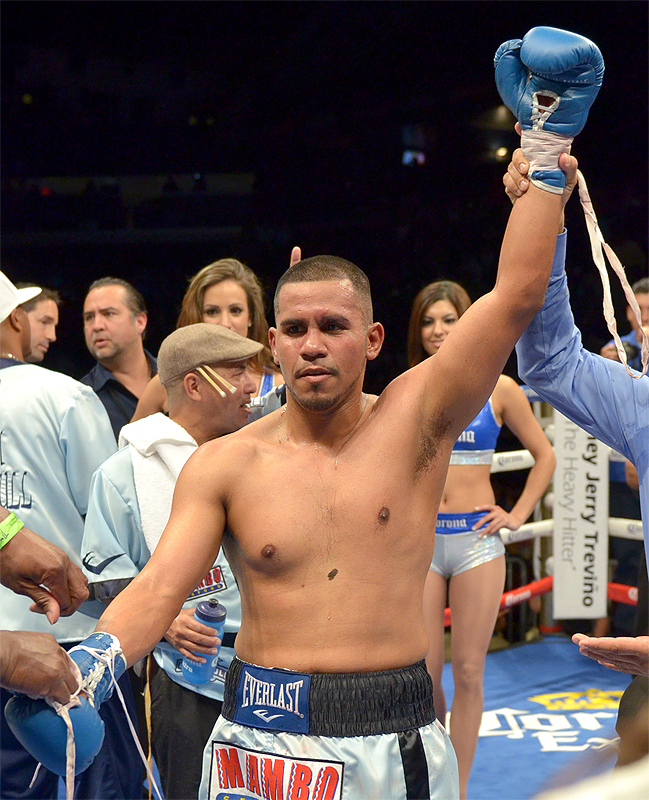
Fighting to grow up: For Julio Cesar Chavez Jr., it’s the biggest one of all

Chavez_Lee_120612_001A
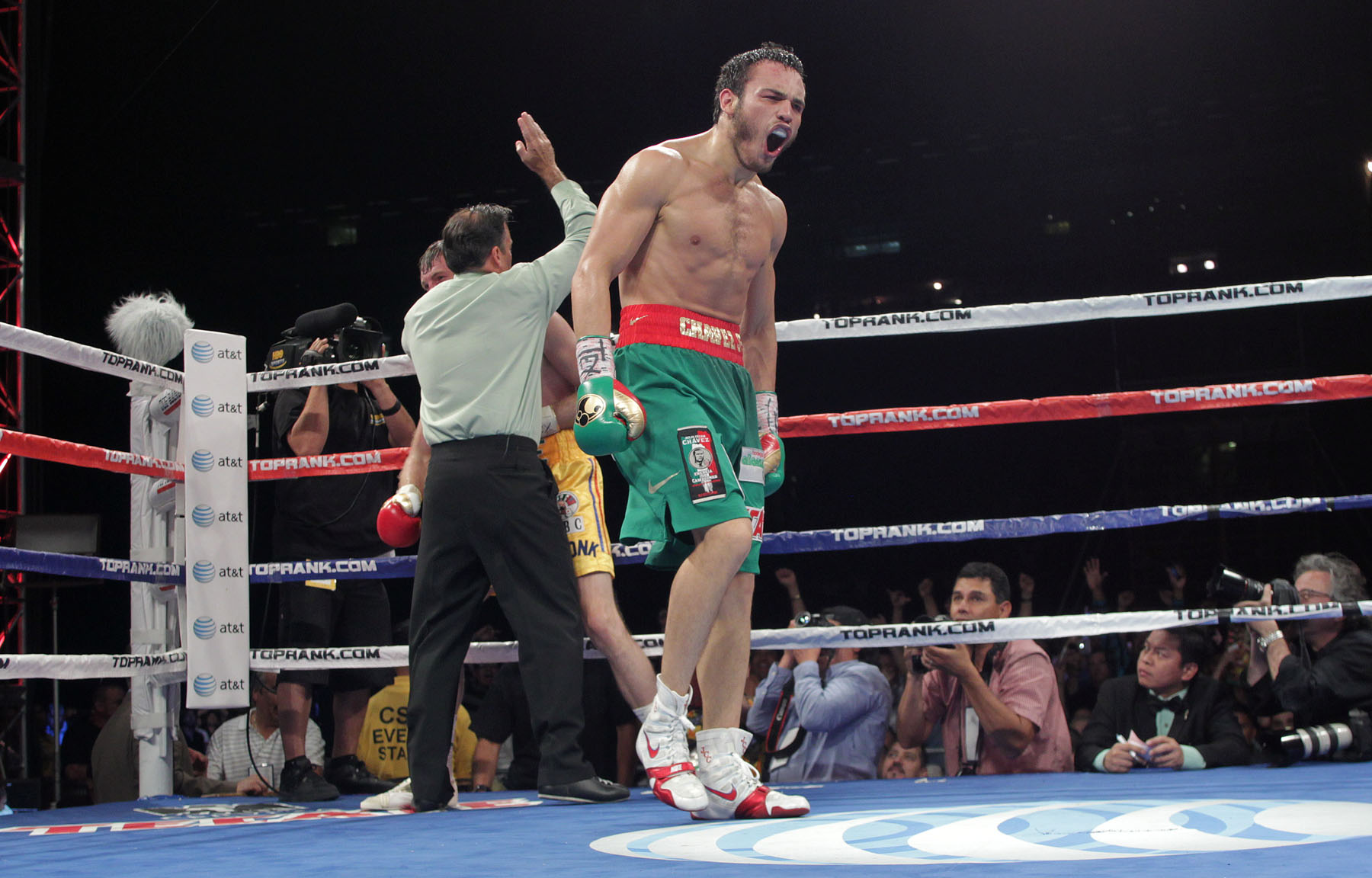
Put a pair of boxing gloves on Peter Pan and you’ve got Julio Cesar Chavez Jr. A man-child, emphasis on the child.

The real fight for Chavez Jr. is whether he ever grows up. It’s a question that has begun to take on urgency as he enters his late 20s after a series of exasperating, often embarrassing missteps that leave doubt about whether he cares about his craft or his dad’s legacy.

Anybody who has met Chavez Jr. (46-1-1, 32 KOs) knows him to be likable. There’s an adolescent charm about him. He’ll make you laugh, unlike his feared dad, the proto-typical hard man whose meltdown stare could make you look over your shoulder in search for a quick exit to safety. Like him or not, Julio Cesar Chavez Sr. was a serious guy. Through 48 fights, his son isn’t.

That might begin to change Saturday night against Bryan Vera (23-6, 14 KOs) at StubHub Center in Carson, Calif., in an HBO-televised bout. But it’ll take more than just one fight for Chavez Jr. to get beyond a reputation that only got worse last September in his loss to Sergio Martinez.

There was his bizarre training camp, conducted mostly at a Las Vegas home in early-morning workouts. Then, there were 11 one-sided rounds, all in favor of Martinez, before a wild 12th that saw Chavez Jr. suddenly wake up with a ferocious knockdown of Martinez. Chavez Jr. nearly stole the fight with a knockout. It made you wonder what he might have accomplished with some real roadwork instead of a few laps around the couch in the living room of that comfortable Vegas’ rental. Then, there was the subsequent news that Chavez Jr. had tested positive for marijuana. Ah-ha, everyone joked. No wonder he didn’t start working out until about 1 a.m., what with the midnight munchies and all.

For his promoter Bob Arum and loyal cadre of Mexican fans, that dramatic 12th is the flash of brilliance that illuminated his potential. It represented what he could be. But maturity is about staying power. And that’s what has yet to be seen from a very nice kid, yet one seemingly without the requisite accountability that comes with being a grown-up pro.

He says the right things. In a conference call Tuesday, Chavez Jr. said he accepted responsibility for his failed drug test, which initially led to a controversial $900,000 fine levied by the Nevada State Athletic Commission. After Arum took the bully pulpit and condemned the size of the fine, it was reduced to $100,000. Even that seems a little high by today’s standards, laws and PEDs. Voters in Colorado and Washington made pot legal in their respective states. It’s not as if Chavez Jr. tested positive for HGH, EPO or some other chemical acronym. A positive test for marijuana doesn’t put him in Lance Armstrong’s league. Pot is about as much a performance-enhancer as a bacon cheeseburger. Still, it was also a sure sign that his mind wasn’t on the fury he was about to encounter against the disciplined Martinez.

With the inevitable question Tuesday about Chavez Jr.’s positive drug-test, Arum was back on the bully pulpit.

“I want to go on record as saying that there is nothing wrong with smoking pot,’’ Arum said. “There is nothing wrong with marijuana.’’

Colorado and Washington voters agree with Arum, always candid and quick to confront an issue. In some ways, perhaps, Arum is expressing how public opinion on pot has changed over the last 10 to 15 years. Bill Clinton didn’t inhale; Barack Obama did. But Arum might regret the timing of this one. He’s got a fighter who needs to grow up.

Chavez Jr. doesn’t need another excuse to train the way he wants, eat what he wants, or smoke a joint whenever he gets the urge. Excuses are enablers, which have proven to be Chavez Jr.’s toughest opponents.

Even for Vera, there are troubling signs of some of the same. Vera is tough, but lacks the talent so often evident in Chavez Jr. Chavez’ struggle to make weight has led to a reported agreement, –173 pounds instead of the junior-middleweight’s 168 — and 10 rounds instead of 12. It looms as another excuse, a way for Chavez to slip through another loophole that has allowed him to avoid accountability and prevented him for reaching his potential.

In the art of match-making, Top Rank has been brilliant with Chavez Jr., who didn’t start with the bedrock of fundamental skill learned over an amateur career. It has moved him carefully and against opponents who have allowed to him to display power and instinct.

Yet, there’s still an unresolved challenge: Himself, his own immaturity.

If he can’t win that one, does Top Rank or anybody else think he has a chance against Gennady Golovkin, or Andre Ward, or even Canelo Alvarez?

Didn’t think so.


Weights From Sands Bethlehem Event Center

Alberto Morales 148 vs. Ronald Cruz 148.1
Jason Sosa 129.2 vs. Tyrone Luckey 130.2
Joey Dawejko 238.5 vs. Kevin Franklin 248
Juan Serrano 138.6 vs. Jerome Rodriguez 141
Billy Marks 297 vs. Dan Pasciolla 234
Arturo Trujillo 145.3 vs. Terrell James143.9
Johnny Portillo 122.1 vs. Chris Diaz 122.4

Venue: Sands Event Center Bethlehem (PA)
Promoter: Peltz Boxing Promotions, Bam Boxing Promotions & Legends of Boxing
First Bout: 8:00 pm


Return of the legend’s son

SAN ANTONIO – There’s a fine barber shop in the basement of the historic Gunter Hotel in the center of this city’s downtown, it’s called Barber Shop and has three barbers and a shoeshiner and a barber’s pole and Playboy magazines, and if its banter isn’t quite of an Ice Cube flick, it’s just as manly and fun. Since every barber shop could use a boxing writer, and since a boxing writer encounters few venues so appreciative of his gifts, I spend a half hour every month giving an editorial review of prizefighting’s calendar, 1974-present.

Austin is 70 miles up I-35 from here, and Austin middleweight Brian Vera, who fights Mexican “Son of the Legend” Julio Cesar Chavez Jr. at StubHub Center in Carson, Calif., Saturday, apparently has an interested relative who frequents the same barber shop. And so, every month for what feels like seven, I’ve been asked when Vera is going to get to fight Chavez, a request for information to which I confess honest ignorance, citing Chavez’s unpredictability and eliciting, without fail, a question like: What the hell is wrong with that kid?

And as I climb in the chair, I tend to say, “Where does one begin?”

Lost in the justifiable concern about Sergio Martinez’s knee after the extraordinary conclusion of his otherwise unmemorable match with Julio Cesar Chavez Jr. 53 weeks ago, the last time Chavez fought, were the lasting effects of the beating Chavez sustained, a beating that included 300 flush shots to the Mexican’s head by a man who knew how to do it with gusto. Chavez has an uncanny flair for midwifing others’ resentment. Even the men whom Chavez defeats, in an original twist, rarely have good things to say about him, a surprising departure from the tradition of saying the guy who beat me is a great champion because, well, I wouldn’t lose to a nobody.

Speaking to Sergio Martinez four months after he and Chavez made one of the more rapturous 90 seconds prizefighting has accomplished, a half of the 12th round nearly unbearable in its suspense and just as nearly the opposite of what Día de Independencia Mexicana ’13 yielded, the Argentine had little good to say about Chavez, a rarity for Martinez, rarely dismissive of his ambassadorial duties.

Martinez implied several times and with uncharacteristic urgency marijuana – the drug for which Chavez tested positive and received an absurdly harsh fine and suspension – was the least of Chavez’s banned-substance affairs, wondering how a man with so little use for weight control or proper camp comportment was so strong after 34 1/2 minutes of collecting five or so concussing shots every minute. That Martinez saw the final 90 seconds of his September match with Chavez as a sum of his own poor choices, misjudgments of time and space and improvisation manifesting themselves as carelessness, was an unsurprising turn for a world champion jealously guarding life’s controllable moments. That Martinez would not cop to a tittle of admiration for a former opponent, too, was unsurprising when that former opponent remained a future opponent. That Martinez would take a lobbed question about a challenger winning a bit of his respect, though, and use it as the doorway into a room of specific accusations and untrammeled resentment was a surprise and a half.

It was a peek at the peaks of what Chavez piques so uniquely among prizefighters that no one empathized even slightly with the abuse he suffered from Martinez’s left hand, which hand rendered Paul Williams instantly unconscious two years before, or wondered where it might leave Chavez’s career. Such is the sentiment Chavez inspires that even today, as a fight that was considered for June and has been moved all round the calendar and western states finally draws near, no one attributes any of Chavez’s camp injuries to anything but sloth. But slothful as Chavez was, imagine such indolence now confronted by a mind that may not be more than 2/3 right, a trainer and dad whose mind cannot possibly be rated that well, and an opponent who rightfully regards this match as a career opportunity, which it might be.

Brian Vera is good enough, as he showed against Andy Lee and Sergio Mora and Serhiy Dzinziruk, to surprise opponents who do not take seriously his limited pressuring style, and he’s also the sort of grinder boxing likes to see matched against those it resents. Vera is the constant, of course, and Chavez is the variable; in the very unlikely case that Saturday’s opening bell finds the same Chavez it found for round 1 in Thomas & Mack Center a year ago, Chavez will handle Vera the way he handled Peter Manfredo and luckless Andy Lee, wearing them down by channeling others’ hatred for him – yes, and again, Chavez knows exactly where he stands with you – and beating on them for royalty’s sake.

This time Chavez will have his dad in his corner, too, where Junior will be able to ignore him more easily than when dad was credentialed by TV Azteca to be ringside and bark maniacal instructions at a son physically incapable of executing more than half them and mentally equipped for perhaps their first tenth, barking directly over former chief second Freddie Roach’s strong preference for a quiet, respectful corner.

What Vera stands to gain by beating Chavez is at least an argument for a larger future payday on HBO, banishing for a moment a thought he could be Rigondeauxn, while Chavez might with a win return to the superfight-cashout sweepstakes, nominating himself for a supporting-actor role in Andre Ward’s 2014 pay-per-view debut, and a chance to don once more his pink briefs and show those tired “24/7” episodes the aplomb with which he carries the Chavez name.

Bart Barry can be reached at bart.barrys.email (at) gmail.com


Ross is gone, but the suspicions won’t go away

LAS VEGAS — C.J. Ross finally got one right. She quit.

News on Wednesday that Ross would not be back, at least for awhile, in a judge’s seat was a surprise only because it wasn’t expected. It should have been. But this is boxing, where there is always an explanation for the inexplicable.

Just the fact that she resigned, probably under pressure from Nevada authorities and politicians, offers a partial explanation for how egregious her 114-114 score was for Floyd Mayweather Jr.’s overwhelming victory over Canelo Alvarez Saturday.

It doesn’t explain everything, of course. And that’s the problem. Suspicions linger because of unusual movement in the betting on a draw. The odds dropped precipitously during the week before opening bell. Two days before the fight, I called a friend and told him odds on a draw at the MGM Grand’s sports book were at 10-to-1.

“Huh,” he said, “I can get it online at 28-to-1.”

By Saturday noon — about eight hours before the fight, odds on a draw had fallen to 8-to-1. Weeks before opening bell, there had been suggestions that a draw was a good bet because it would ensure a rematch. Amid evidence that the fight would set revenue records, there were millions of reasons to do it again. Mayweather’s thorough brilliance against an overmatched Canelo all but ensured that it won’t.

But questions about the Ross card leave suspicions. You could hear it among fans at Las Vegas bars late Saturday. You can read it on twitter and web sites today. For the promoters, the talk is reason to worry. It’s bad for business. Some of the crowd that bought pay-per-view or spent $110 on closed-circuits seats at one of the Las Vegas casinos won’t be back. At least not at those prices..

I’m not saying that Ross got paid-off. I’m not saying she is corrupt. I have no evidence of that. If anything, I just happen to think that Ross is incompetent. Her scorecard in favor of Tim Bradley over Manny Pacquiao is evidence of that. But I am saying suspicions are running rampant. They were more than enough to force her out.

In her statement, Ross made it sound as if she were taking a leave of absence. At 64, however, don’t expect to see her with another official scorecard in hand. In comments to the Las Vegas Review Journal, Nevada State Athletic Commission Chairman Bill Brady said he apologized to Nevada Governor Rick Sandoval for any embarrassment to the state.

Ross had to go, no doubt.

But those suspicions? They’re not going anywhere for a while.


Three worthy performances at “The One”

Danny Garcia
Apropos of something entirely unrelated to “The One,” I spoke with Don Turner last week, a delightful man of gradual delivery and enviable authority, whose words set me to remembering, Saturday, others of his words spoken in 1996 before his charge, Evander Holyfield, undid Mike Tyson: Tyson can punch, but he can’t fight.

While it is wrong to write Argentine Lucas Matthysse can only punch, and a character-measuring abomination to compare Danny Garcia’s father to Turner, it is not improper to guess Angel Garcia’s wager in preparing his son for Saturday’s co-main event victory over Matthysse was not unlike Turner’s wager 17 years ago: Just as soon as he punches you, son, you punch him right back, and see if he freezes.

There are very few hard punchers of any kind, and particularly those who can bring unconsciousness with a single blow, that respond effectively to someone hitting them back; it’s a skill many never cultivate while racing through the professional ranks because each heavy punch of theirs that does land changes the man across from them completely enough to make for power punchers a habit of relaxing and stepping forward to drop a period at the end of their sentence or, just as likely, reread the sentence and enjoy their prose. Manny Pacquiao is an exception to this, and for that he was exceptional: He was a puncher who, if you punched him back as he attacked you, he punched you again, and so it went till he dropped you – as experienced by Juan Manuel Marquez in his second fight with Pacquiao and Miguel Cotto in his only fight with Pacquiao.

Far more common is the reaction Lucas Matthysse showed Danny Garcia, which was an inactivity not entirely dissimilar from what Tyson showed Holyfield whenever they engaged. The secret to stop a force like Matthysse or Tyson (or Gennady Golovkin) is to promise yourself the harder he hits you the faster you will leap at him. It is what Garcia did in Saturday’s meaningful fight – “The One,” as it were – each time Matthysse landed clean, whether with a right cross or left hook; Garcia followed his plan, resolute in a belief that if Matthysse was striking him hard, Matthysse was overcommitted and therefore open to be struck hard.

Each time Garcia did this, Matthysse bore a greater resemblance to Vic Darchinyan, taking a step back and adjusting his trunks and touching his gloves and readying for a next lunging collision, than what great fighters he’d enjoyed a plethora of comparisons to recently – despite completing 9 1/2 years of prizefighting without a world championship (Garcia won a world title in his fifth year, and Floyd Mayweather in his second). The fighting impulse Matthysse forced Garcia to show, yet again, was probably the evening’s most impressive sight, whenever Garcia found terms of engagement equally favorable and engaged Matthysse directly, though just barely.

The evening’s second most impressive sight was Floyd Mayweather, simply put. On the occasions Mexican Saul “Canelo” Alvarez struck Mayweather with a clean punch, and they were infrequent enough to be named and numbered, Mayweather did exactly as he’d done when Mosley buckled him in a rare moment of carelessness and Cotto brought the pugilist out of him in 2012: Mayweather took a traditional fighting stance, hands up, legs bent, and punched the hell out of the Mexican. That Mayweather rarely gets hit anymore makes a generation of casual fans think he cannot withstand contact when he is struck, and that is ridiculous in the strictest sense of the word – worthy of ridicule.

Alvarez’s greatest asset Saturday was not his red hair, though that was how he got the fight years and accomplishments prematurely, but the brittleness of Mayweather’s right hand. Had Mayweather a right fist structurally reliable as Alvarez’s, Mayweather would have stopped Canelo, and Canelo’s promoter six years ago. Which is not to discount wholly Canelo’s performance Saturday, for he did land that crisp lowblow in round 4 and a well-placed shoulder in round 6, but to compliment the inconsolable bent Alvarez showed in Saturday’s postfight press conference. It was the humble posture his performance demanded; no accusing Mayweather of running, no flashing that gorgeous smile and proclaiming a hunger to get back in the gym Monday, no appealing to ethnic loyalty – “nosotros, los mexicanos, sabemos quien realmente ganó” – but a headbent befuddlement fitted to the occasion of his undressing by a man who, despite having only one more prizefight on his resume, was approximately five times the sweet scientist Canelo is.

Here’s an appropriate place, too, for recognizing Paulie Malignaggi’s insightfulness during Saturday’s Showtime broadcast. Malignaggi has become that rarest of professional athletes: a man capable of saying something intelligent about a subject other than himself. Malignaggi caught every nuance of Saturday’s main event confrontation, sometimes speaking over what cloying salesmanship cluttered the evening – like a just purchased car barking at its new owner “how about that handling? you see how bright those headlights are? This is probably the greatest automobile purchase anyone ever made!” – to share, in an instant, what Mayweather did to provoke Alvarez’s lowblow in the fourth and thraw his attack during the other 35:55 of Saturday’s fight, minutes nevertheless more suspenseful than most Mayweather affords, because the man across from Mayweather was very much larger.

A larger opponent is the only way this “Money May” deal remains compelling, and so let us have no more talk of a fight with little Danny Garcia in May. Even casual fans now know no one can outbox Mayweather, no style makes him fight, and in order to get their $74 again Mayweather will have to find himself a middleweight.

Bart Barry can be reached at bart.barrys.email (at) gmail.com


“BIG APPLE BOXING” OFFICIAL WEIGHTS

New York, NY (9/15/13) – All of the fighters for tomorrow night’s SMS Promotions and DiBella Entertainment card at Resorts World Casino in Queens weighed-in earlier today. Below are the official weights for tomorrow night’s card.

10 ROUNDS – JUNIOR LIGHTWEIGHTS
Mark Davis vs. Carlos Vinan
Cleveland, OH Newark, NJ
17-0, 5 KO’s 10-10-5, 2 KO’s
131 lbs. 130 lbs.

4 ROUNDS -SUPER MIDDLEWEIGHTS
Chris Galeano vs. David Rohn
Bronx, NY Villa Park, IL
Pro Debut 1-0
160 lbs. 163 lbs.

4 ROUNDS -JUNIOR WELTERWEIGHTS
Shemuel Pagan vs. Calvin Smith
Brooklyn, NY Prichard, AL
2-0, 1KO 2-4
137 lbs. 135 lbs.

8 ROUNDS – SUPER MIDDLEWEIGHTS
Lamar Russ vs. Latif Mundy
Fayetteville, NC Philadelphia, PA
13-0, 7 KO 10-7, 4 KO’s
162 lbs. 163.4 lbs.

6 ROUNDS – LIGHT HEAVYWEIGHTS
Travis Peterkin vs. Michael Wilmer
Brooklyn, NY Huntington, WV
8-0, 4 KO’s 4-6, 3 KO’s
176 lbs. 175 lbs.

4 ROUNDS -LIGHT HEAVYWEIGHTS
Joseph Williams vs. Joe Powers
Far Rockaway, NY Groton, CT
Pro Debut 1-1
176 lbs. 178.4 lbs.

4 ROUNDS -JUNIOR WELTERWEIGHTS
Ryan Martin vs. Darus Somieri
Chattanooga, TN Roanoke, VA
Pro Debut 0-1
136 lbs. 136 lbs.

Both the Luis Del Valle and Heather Hardy bouts were scratched due to complications with their opponents

DBE

Tickets are currently on sale and are priced at $125, $85, $65 and $45. Tickets are available for purchase by calling Resorts World Casino NYC at (718) 215-2828 or by visiting: http://www.etix.com/ticket/online/venueSearch.jsp?venue_id=9244. Tickets will also be available for purchase tomorrow night at the door.


The crowd weighs-in with numbers that hint at more records for Mayweather-Canelo

Mayweather_Alvarez_Slone
LAS VEGAS – It was more of a scene than a weigh-in. More about the crowd than the scale.

The often mundane ritual of fighters in underwear stepping onto a scale was transformed Friday into a rock-and-roll like event that began about five hours before Floyd Mayweather Jr. and Canelo Alvarez even arrived at the MGM Grand.

Fans wearing red wigs in honor of Canelo’s hair and caps with Mayweather’s TMT logo stood in a line that snaked through the hallway leading into the Grand Garden Arena and between the slot machines on the casino floor. About 90 minutes before the fighters were scheduled to weigh in, the place was jammed. A crowd of 12,200 was waiting. Fans who had hoped to see them were turned away.

It was called the biggest weigh-in crowd in boxing history. There are no numbers to prove it or disprove it. But it’s fair to say that it was unprecedented and a huge sign that the Showtime telecast of the Mayweather-Canelo card Saturday night has a real chance at breaking the pay-per-view record of about 2.5 million, set in Mayweather’s 2007 decision over Oscar De La Hoya.

Only the buzz for Mayweather-Canelo was off-the-scale.

At 150 1/2 pounds, Mayweather was a pound-and-half lighter than the mandated 152 for the junior-middleweight bout. The catch weight was the source of some controversy. It was supposed to have put Canelo at a disadvantage. At least, the Mayweather camp thought so. But if Canelo had any trouble making weight, it wasn’t evident. He coolly tipped the scale at 152 pounds. Not a fraction of an ounce more. If in fact he did struggle and was weakened in the process, it might become evident midway through Saturday night’s fight, scheduled for 12 rounds. On the scale, however, Canelo looked comfortable.

“I was born ready,’’ Canelo said, abandoning his usual Spanish for English in his final words before leaving the stage to chants from a predominantly Mexican crowd.

Experience is supposed to be one of Mayweather’s biggest advantages over the 23-year-old Canelo, who is stepping onto boxing biggest stage for the first time. But as opening bell gets close, Canelo has remained relaxed and confident. Nothing appears to intimidate him, not even Mayweather, who tried.
The 36-year-old Mayweather (44-0, 26 KOs) chewed gum and talked at Canelo (42-0-1. 30 KOs) as the two posed, face-to-face, after stepping off the scale. Mayweather held the World Boxing Council’’s specially-made version of the 154 pound belt, which includes seven pounds of gold. At current gold prices, it’s worth about $150,000.
Mayweather, nicknamed Money, grabbed Canelo’s right arm and shoved the belt toward the Mexican challenger. Mayweather wanted him to hold it. Canelo slapped Mayweather’ hand away and walked off.

Golden Boy Promotions CEO Richard Schaefer said Canelo turned to him and said he doesn’t take orders from Mayweather.

“He told me: ‘I’m not going to do what the guy tells me to,’ ’’ Schaefer said.

The fiercely-independent Bernard Hopkins, who was on stage in his role as a Golden Boy partner, was impressed by Canelo’s move.

“Bernard told me: ‘That’s a veteran move,’ ‘’ Schaefer said.

It’s clear Canelo wants no handouts. If he is going to win gold, he intends earn it. Now, the real question is whether he has enough speed in his feet and hands to do so.

“You know how these kids are,’’ said the favored Mayweather, who continued to be about 5-2 pick Friday afternoon at the MGM Grand’s sports book.

In another much-anticipated fight, Lucas Matthysse (34-2, 32 KOs) and Danny Garcia (26-0. 16 KOs) made weight, 140 pounds each, for their junior-welterweight bout. Garcia had to step onto the scale for a second time. In his first trip to the scale, he was half-pound too heavy, because the scale was rocking.

So was that crowd.

NOTES: Unbeaten super-middleweight Andre Ward, a pound-for-pound contender, was on the weigh-in stage among fighters promoted by Golden Boy and Mayweather. Ward’s presence created a lot of speculation about whether is he still trying to break away from promoter Dan Goossen. Ward went to court in an apparent attempt to break with Goossen. And arbiter ruled in Goossen’s favor. “It’s nothing,’’ Goossen said. “He has a signing in town (Las Vegas) tomorrow (Saturday). So he went to the weigh-in. Andre happens to be a boxing fan. He went there and was brought up on stage. He knows these guys, grew up with them. These are good things, not bad.’


Results from Manchester, NH

MANCHESTER, N.H. (September 12, 2013) – Fighting in his record fifth Fight To Educate (FTE) charity event, popular welterweight Danny “Bhoy” O’Connor (23-1, 7 KOs) turned in a workmanlike performance for his ninth straight victory, recording a unanimous eight-round decision over Texas invader Raul Tover (11-8-1, 4 KOs) in tonight’s main event, at Verizon Wireless Arena in Manchester, New Hampshire.

O’Connor, fighting out of Framingham, Massachusetts, was a 2008 US Olympic Team alternate. The popular Irish-American southpaw, co-promoted by DiBella Entertainment and Warriors Boxing, avenged a loss to Tover in the 2005 National PAL Tournament in Oxnard, California.

Now 5-0 (4 KOs) in the FTE, O’Connor easily won on all three judges’ scorcards: 80-73, 79-37, 79-73.

“As I progress in my career,” the 28-year-old O’Connor said, “further and further along, it’s nice to stop and reflect. I made my pro debut here and fought five times in the Fight To Educate. I know the commission, people of Manchester, even the hotel where we stay and the drive to the arena. I have a sense of security here. Hopefully, I’ll have to chance to fight here again next year, and someday maybe I’ll be lucky enough to bring a world title belt here.

“I’m trying to be the most active fighter in this sport (this was his third fight in less than two months). I don’t want to have to get ready when that big call comes, I want to be ready, so that I’m staying active and living a good lifestyle. I’m gaining experience and need that to realize my goal and personal dream.

“I’d been fighting at 140 pounds since I was 15 and it became too hard. I’m a welterweight now and I feel stronger at 147. I could have fought 15 rounds tonight the way I feel. I hired a fight nutritionist. I felt great at the weigh in, during the fight, and even now.”
Hard-hitting Vermont light middleweight Chris Gilbert (10-0, 7 KOs), fighting in his third consecutive FTE, dropped Anthony “The Candyman” Chase (11-2, 4 KOs) three times in the second round, and finished off the Providence fighter in third with a right uppercut to remain undefeated.

Maine light welterweight Brandon “Cannon” Berry (3-0) remained undefeated the hard way as Jesus Javier Cintron (1-4-2) was disqualified in the round for repeated low blows.

Fight To Educate, presented in part this year by Alrich Cabinet, is a unique charity event that combines a love of sports with the vision of assisting children and seniors in need, who with fundraisers like this could be ‘down for the count.’ During the past 11 years, Fight To Educate has raised more than $500,000 in donations benefitting local New Hampshire non-profit organizations.

Proceeds from the 12th annual Fight To Educate benefitted SEE Science Center (www.see-sciencecenter.org), The Bobby Stephens Fund for Education (www.stepheneducationfund.com), and New Horizons for New Hampshire.

This year’s attending Boxing Legends were Aaron “Hawk” Pryor, Ray “Boom Boom” Mancini and “Dangerous” Dana Rosenblatt.

Results of the amateur matches are below.

All bouts were sanctioned by the New Hampshire Boxing & Wrestling Commission.


Father Knows Best: Angel Garcia says he does

Angel Garcia
LAS VEGAS – It wouldn’t be a big fight card without a crazy dad lurking in somebody’s corner.

Angel Garcia, junior-welterweight champion Danny Garcia’s father and trainer, filled the role Thursday with a noisy stand-up that included God, country, a Latino beat, a couple of comic-book heroes and a condemnation of anybody who doesn’t think his son can beat favored Lucas Matthysse Saturday night at the MGM Grand.

He didn’t comment on Syria. Then again, maybe we just missed that one. After all, there’s only so much time in one news conference and even a good digital recorder has limited space. Let’s just say that as we write this, Angel Garcia is still talking.

“Vegas don’t know nothing,’’ said Angel, who transformed his turn at the podium into a bully pulpit vacant since Ruben Guerrero was there in May before son Robert Guerrero’s loss to Floyd Mayweather Jr. “You don’t know nothing. I know everything.’’

Crazy dads have been part of boxing’s dysfunctional family since at least Floyd Mayweather Sr., who has said little and been notably absent from the stage in the theater leading up to his son’s junior-middleweight fight Saturday night against Canelo Alvarez at the MGM Grand. But if you were expecting some silence with Mayweather Sr. in the background, forget it.

After thanking God, Angel talked about those skeptical of his son’s chances as though they were infidels, or at the very least un-American. He expects a big Latin crowd from Argentina supporting the power-punching Matthysse with Argentine colors, baby-blue and white. Angel Garcia talked about his Latino background. He and his unbeaten son (26-0, 16 KOs) are of Puerto Rican descent. But they are Philadelphia, through and through.

“Danny is an American fighter,’’ Angel said. “He represents the United States, the same country that sends you a welfare check. You sign it, don’t you? Then, you’re an Americanito.’’

Angel promised that the 140-pound titles would remain in his son’s American hands in a bout that might be the most entertaining fight on the Mayweather-Canelo card. There’s been a lot of attention of Matthysse’s knockout ratio. It’s at a head-rocking 86.49 percent. He has 32 stoppages in 36 fights, a record that includes 34 victories and two losses, both by decision. In his last bout, Matthysse generated a lot of attention with crushing third TKO of Lamont Peterson in May.

“His knockout of Lamont Peterson was heard around the world,’’ Golden Boy Promotions CEO Richard Schaefer said.

But Angel Garcia mocked stories about punching power that initially, he said, made Matthysse sound like Superman.

“Then, he knocked out Lamont Peterson and, whoa, Aquaman is back,’’ Angel said.

Matthysse shrugged his shoulders when asked about Angel Garcia’s mix commentary, insults and comedy. It didn’t affect him anyway, he said.

“Not at all, because I don’t understand what he says,’’ Matthysse said in Spanish.

Matthysse, about a 5-2 favorite Thursday afternoon, only promised that he would win. But Angel vowed that his surprising son would not be beaten.

“If he loses, I’ll cut my head off,’’ Angel said.

That might be the only way to silence him.


Who’s The Boss? It sounded a lot like Floyd Mayweather

mayweather2
LAS VEGAS – Floyd Mayweather Jr. and Canelo Alvarez arrived late and stayed late Wednesday at a news conference in a venue that figured to be an appropriate setting. Cirque Du Soleil usually plays at the MGM Grand’s KA Theatre. But boxing’s traditional version of the circus was surprisingly understated.

Mayweather coolly played the CEO role with comments that seemed to say he thinks Alvarez is the junior-partner in a junior-middleweight, pay-per-view fight Saturday night that figures to do some record-setting business.

The 23-year-old Canelo has 42 victories on a 43-fight ledger that includes no losses and one draw. It looks impressive. But Mayweather questioned the quality of opposition. Mayweather made it sound as if the Alvarez record was full of more holes than a block of Swiss cheese. Alvarez beat Matthew Hatton, Ricky’s brother, whom Mayweather beat. Alvarez beat Jose Cotto, Miguel’s brother, whom Mayweather also beat.

“You fight Miguel Cotto’s brother, but you don’t fight Miguel Cotto,’’ Mayweather said in comments after the formal portion of a news conference for pound-for-pound king’s second fight in a Showtime deal worth a potential $250 million. “You fight Ricky Hatton’s brother, but you don’t fight Ricky Hatton.’’

It was a follow-up to Mayweather’s comments at the podium during the formal part of a news conference that started about 40 minutes late.

“If he had faced 42 Mayweathers, he’d be 0-and-42,’’ he said.

Alvarez, who has been as unflappable as he is inexperienced on boxing’s biggest stage, sounded as if he isn’t listening to Mayweather. There were familiar questions about how the 23-year-old redhead will deal with Mayweather’s speed and elusiveness.

“I’m the same,’’ Canelo said. “I’ve got the same qualities.’’

What he won’t have, however, is the same paycheck. Mayweather is guaranteed $41.5 million, a record for one fight, according to several media reports. But there was some dispute Wednesday about Canelo’s purse. Mayweather said Canelo will collect $8 million.

“With no upside,’’ Mayweather said as if he had hired the popular Mexican.

Not true, according to Golden Boy Promotions CEO Richard Schaefer, who said Canelo’s upside is “significant.’’ During the news conference, Schaefer said he talked to Televisa, which will televise the bout in Mexico. He said was told that the network expects the Mexican audience to be between 70 and 80 million.

According to a contract filed with the Nevada State Athletic Commission, Canelo is guaranteed $5 million. But that doesn’t include international revenue. According to various sources and news reports, however, Canelo can expect to earn at least $12 million.


About “The One” and its other co-main

Lucas Matthysse
Saturday boxing fans will congregate for “The One,” a pay-per-view fight card with two co-main events, Argentine junior welterweight Lucas “The Machine” Matthysse versus Philadelphian Danny “Swift” Garcia, and Floyd Mayweather versus Saul Alvarez. Since that questionable prefix “co” was put there by someone else, and since any aficionado can tell you Matthysse-Garcia is much the more interesting fight, here is its preview.

That Lucas Matthysse is unknowable is a development charming as can be, that a fighter of temperament so unsuitable to the day’s discipline of promoting twice to fight once now supplies the entertaining portion of our sport’s largest 2013 event is a hopeful turn. Matthysse is a fighter who effectively hails from parts unknown, an Argentine township, Trelew, named after a colonizing Welshman, of all incongruous things, immigrated to Patagonia 130 years ago. Patagonia’s climes are famously harsh and unknown even to most Argentines, cold temperatures and rough seas and the sort of beating wind that, wherever it occurs round the world, makes the people whose ears it cuffs notably insular.

In a June conversation, Sergio Martinez, Argentina boxing’s singularly gracious ambassador (how many active world champions give 30 minutes to a writer asking questions unconstruable, even tangentially, to themselves?), conceded he was not quite familiar with Patagonia, thinking he could have passed through years before, maybe – but what winds and harshness its climate was about, and what men of almost unmatchable physical strength it birthed! Matthysse is not charismatic like his brother Walter, four years Lucas’ senior; he is timid in a way unaware of its timidity – those who joke about his quietness get a curious glance from him, as if he were certain he misunderstood them, a man who considers being in their presence a concession enough to gregariousness: I am here answering your questions, and I believe you said I am not talkative, but that cannot be correct, because I am here, so perhaps you’ll repeat yourself?

Danny Garcia is more talkative, if less charismatic, but appears nearly quiet by contrast with his buffoonish father who, conceivably, alleviates his son’s obligatory promotional affrays by servicing every hysteria, and the more publicly the more hysterically, with an impulsive bent nuns once exorcised from third graders with rulers. What should be obscured by manufactured story lines – “We are one week from ‘The One,’ and Lucas Matthysse loves his daughter, and Angel Garcia loves his son” – were there not more compelling subjects to treat, like Saul Alvarez’s ginger coif and Floyd Mayweather’s orchidaceous rides, is this: Matthysse and Garcia, both, are prizefighters in the best sense of the term. Both have been doing it a long time, both take seriously the craft, and neither was expected by his promoter to be where he is.

Matthysse was an anonymous Argentine, in 2010, with a likely inflated record that might nevertheless by rubbed against the vessel of Zab “Super” Judah’s latest self-reinvention, Comeback VII, till it flashed a shiny Brooklyn Back in the House! at those who go for such, and when Matthysse pulled Super offscript, dropping him in round 10, American matchmakers put a “*not on my watch” beside the Argentine’s name. Danny Garcia was probably supposed to lose to Nate Campbell and Kendall Holt in 2011, he was certainly supposed to lose to Erik Morales in March 2012, and when that didn’t happen, he was granted a dream chance to present Amir Khan with the WBC’s garish green belt before that esteemed institution could complete an audit of Garcia-Morales I and uncover a contractual clause that read: “The belt will be awarded to Erik Morales on March 24, or left vacant until the belt can be awarded to Erik Morales.”

Garcia promptly proved Khan’s career was fraudulent as Morales’ comeback, a comeback to which Garcia put the lie, drilling Morales on the canvas like a screw in soft pine, before apparently pleading with his advisor Al Haymon, whom he now shares with Matthysse, to spare him the Argentine’s unrelenting cruelty. This narrative, deliciously as it complements Matthysse’s taciturnity with Garcia’s fashion sense, is all wrong because it assumes, in part, Garcia was surprised as everyone else he could drop a trio of Morales, Khan and Judah six times in 30 rounds, but Garcia was not surprised, and do believe he’ll be unsurprised, too, if he does what has proved heretofore impossible: Drop Lucas “The Machine” Matthysse. It’s not impossible, and no longer even feels impossible, when one marries two images in his mind: The force with which Garcia turned his left fist on Morales’ chin in October, and the force with which Matthysse turned his chin onto Lamont Peterson’s left fist in May.

What is most underrated about Garcia, the justifiable underdog in the meaningful match of Saturday’s card, is his sense of timing, his understanding of an opponent’s rhythm and physique. Garcia has self-belief as well and confides in his left hook to the head the way Mickey Ward fancied a left hook to the body. That sort of thing can get a lad spearchiseled by Matthysse, which may well happen anyway but shouldn’t till Garcia somehow lands his reckless/wreckful left hook and subjects Matthysse’s soul to what doubts he makes money giving others. It says here if a knockout is scored in the first two rounds it will be Garcia’s, if a knockout is scored between rounds 3 and 10 the victory will belong to Matthysse, and if Saturday’s best fight somehow makes it to round 11 there is no telling what happens in the six minutes of butchery that follow.

Bart Barry can be reached at bart.barrys.email (at) gmail.com


Don’t tell Canelo he has nothing to lose

Saul Alvarez
There’s a theory that Canelo Alvarez has nothing to lose on Sept. 14 in his long-awaited showdown with Floyd Mayweather Jr. The reasons add up. Canelo is 23. He’s about to collect a career-high purse, expected to be between $10 and $13 million. He’s facing a 36-year-old fighter, whose tactical mastery has finally allowed him to prevail in the debate about who is at the top of the pound-for-pound’s mythical ratings. It’s no myth at all. It’s Mayweather and only Mayweather.

A loss for the young and still-unbeaten Canelo could become a valuable lesson in the ongoing education of a fighter who is beginning to look a lot like the pound-for-pound’s heir apparent.

What’s to lose, especially if a competitive performance from Canelo in a narrow defeat on the scorecards leads to a rich rematch?

Dumb question.

At least, it was when it was asked of Canelo during an international conference call.

“I think I have a lot to lose,’’ he said. “This is a fight that is very important to me. I have a whole lot to lose. I just don’t see it that way.’’

There’s pride in the answer. It’s an intangible. It’s just hard to know whether it gives Canelo more of a chance on his first night ever on boxing’s biggest stage and against a fighter who has ruled that stage like personal property. But it is evident that pride motivates Canelo as much as money moves Mayweather, who has been guaranteed a record-setting $41.5 million for the second bout in a Showtime deal worth a potential $250 million. Pride is there, in the tone of Canelo’s words. It’s also there, beneath all of that attention-grabbing red-hair, in stubborn eyes the color of combustible flint.

Be careful, and Mayweather has been. He seems to know that Canelo, although young, is dangerous. Whatever has passed for trash talk in the build-up for the biggest fight since Mayweather’s victory over Oscar De La Hoya in 2007 hasn’t exactly been outrageous.

If anything, Mayweather seems to have kept his rhetorical powder dry. His sharpest words seem to be more intended for De La Hoya, Canelo’s promoter. Mayweather, a promoter in his own right, has never liked De La Hoya. Don’t look for the two to start exchanging Christmas cards any time soon, if ever. Despite that, Mayweather seems to agree with De La Hoya about one thing: Canelo is just beginning to approach his potential.

“He hasn’t shown one bit of what’s he’s capable of,’’ De La Hoya said. “He hasn’t put it all together, because he hasn’t fought Floyd Mayweather, the best pound-for-pound fighter. Mayweather will bring the best out of him.’’

He might. Then again, Canelo’s pride might exert a pressure all its own and result in chances that Mayweather has always exploited with unerring efficiency. That might be the lesson. It also might be a lot to lose. But damaged pride has never needed stitches. It heals faster than a bloodied face. As an intangible, it is potentially powerful enough to give a Canelo a chance on Sept. 14. And if not then, maybe later in a rich rematch.


About “The One” and its co-main

floyd-mayweather2
On Sept. 14 boxing fans will congregate for “The One,” a pay-per-view fight card with a main event, Floyd “Money” Mayweather versus Saul “Canelo” Alvarez, and a co-main event, Lucas Matthysse versus Danny Garcia. Since that questionable prefix “co” was put there by someone else, and since any aficionado can tell you Matthysse-Garcia is much the more interesting fight, what do you say we save its preview for next week and treat Sept. 14’s other main event now?

There is a temptation whenever one watches Floyd Mayweather on a program he credits himself with executively producing to fixate on the banality of the spectacle, the vapidity of a guy telling you autobiographical details for the 17th time that were boring the first time, 6 1/2 years ago. But such fixation is missing the point if one wishes to understand the spectacle, forgiving, as always, any adult understandably uninterested in understanding the spectacle.

The purpose of the spectacle, and this Mayweather well comprehends, is saturation, a process television does better than its predecessor mediums, a means not unlike what immersion serious foreign-language students subject themselves to, a way of surrounding a person’s associations, and therefore thoughts, with an idea that goes to the very root of what makes a mind human: Sociability. A desire to socialize is what helped our ancestors climb out the trees in which they were cowering from all predators larger and faster and stronger, which were most, and develop an unprecedented form of communication that took them, in record time, to a place of predatory dominance so far beyond their adversaries they locked up the descendants of the creatures that feasted on them, in zoos, for their children’s amusement.

A biological drive to be round others and communicate with them, connecting in some necessary way, is the trait television preys on, flashing images that say nothing so profoundly as: “This is important because everyone is watching it because it is important enough for everyone to watch.” It’s an algorithm even a kindergartner can untwine, doing something because you are doing it, and it works and works so long as television can find its way to your retina, a gambit the ongoing unpleasantness between Time Warner Cable and CBS now cancels.

But wait, Showtime’s got round Time Warner Cable by posting its wholly unoriginal “All Access” program on the internet! Yes, well, that is helping it reach exactly zero new pay-per-viewers, because if you cared enough about “All Access: Mayweather vs. Canelo” to search for it online, your purchase of their Sept. 14 show is already accounted for; you are the 300,000th buyer, not the millionth. Which leaves the promotion with Canelomania in Mexico, real a phenomenon as anything built on television but doubtfully enough to set what records “The One’s” press tour assured.

Canelomania is evidence of television’s power in a way not even Mayweather quite understands; Alvarez is marketed continually, and has been for years, by Grupo Televisa, a media outfit whose affiliates own more than half the television stations in Mexico – for an American to understand Televisa’s power, he’d have to go back to the pre-cable days of three channels in the United States, and then combine a couple. The Televisa script says Alvarez is a midnight-clad villain but an innocent-faced hero, a fireheaded anomaly but an everyman, a taciturn corrupter of other men’s flesh but a caresser of baby’s cheeks, an urbane fashionista but a tamer of beach steeds, a man who dines in a silver microfiber suit and bathes in a ballbearing black bikini bottom – like an OkCupid profile unrestrained by plausibility. He has dated a Televisa reporter, dated Miss Mexico for Televisa, and visited on Televisa with Mexican president Enrique Peña Nieto, the husband of a Televisa actress.

Canelo Alvarez is the Mexican rendition of contemporary American marketing’s best invention: An otherwise unmarked canvas with a unique imprimatura layer – Tiger Woods in 1998, Barack Obama in 2004 – onto which young and old alike can project their own best qualities. Earl Woods, an all-American dad in the very worst sense of those words, helped market his son as a savior; before America’s leader was President Obama he was derisively called “The One” by Republican campaign operatives; and in two Saturdays Saul Alvarez fights in “The One,” a singular event that will either mark Alvarez as boxing’s savior (Mayweather sure wasn’t) or, much more likely, mark him as yet another “one” some country or ethnicity got hoodwinked into projecting its collective pride on for what 36 minutes it took Floyd Mayweather to unknit him.

Is this fight unwatchably predictable as Mayweather’s last? No, decidedly it is not; Alvarez is a legitimately larger prizefighter who throws his right cross early, like one who knows no better, and Mayweather is a man who, Shane Mosley avers, can be caught with a righthand during the five minutes it takes him to secure escape routes and seal an opponent’s every exit. If Alvarez somehow buckles Mayweather the way Mosley did, Money May will have pounced on him a creature sourly distinct from the Sugar Shane he got 40 months ago.

But if the bell rings to begin round 3 and Alvarez has yet to imperil Mayweather, well, you’ll still have the co-main for solace, but not suspense: In his lifetime of fighting both amateurs and professionals, Mayweather has seen everything about Canelo, save his fabulous redbrick hair, at least 50 times, while Canelo has seen the likes of Mayweather not once. Plan accordingly.

Bart Barry can be reached at bart.barrys.email (at) gmail.com


What, me worried? Mayweather isn’t and maybe Canelo should be

Floyd_Mayweather
Canelo Alvarez keeps getting asked about how he will react to Floyd Mayweather Jr.’s trash talk. It’s a question that assumes the inevitable. Not if. But when. Funny thing is, there’s not been much of the Mayweather trash that seemed to type-cast him a couple of years ago.

The live stream of Mayweather’s media day from his Las Vegas gym Wednesday, projected a CEO-like persona. He was cool, calm and self-assured, almost eerily so, about his 152-pound fight on Sept. 14 at Las Vegas’s MGM Grand. Canelo said all of the right things Tuesday at his own media day from Big Bear, Calif. He talked as if he were reading from a tele-prompter. Nothing that Mayweather says, Canelo promised, will bother him.

Maybe not, but a Mayweather without the expected insults might be a reason for Canelo to sweat. Why? Mayweather doesn’t appear to be worried at all about the 23-year-old Mexican who is about to make his first step on to boxing’s biggest stage.

Much has been said about Mayweather’s evolution over the last couple of years, or at least since his infamous outburst at HBO’s Larry Merchant after his controversial stoppage of Victor Ortiz. He’s appears to have grown beyond the spontaneous, emotional outbursts that always seemed to there, just waiting to erupt. Maybe, his well-documented time last summer in jail is a factor. Maybe, it’s the accumulation of years and the wisdom that comes with them. Maybe, it’s because of his Showtime contract and the responsibility that comes with a potential $250 million. By way, that’s what Amazon founder Jeff Bezos paid for The Washington Post a few weeks ago. That might say more about the state of the newspaper biz than it does about Mayweather. But you get the idea. Mayweather is part mogul and part boxer these days. Trash-talk is for kids. He isn’t one anymore.

Nevertheless, profane insults from Mayweather continue to identify him as much as that precise counter. Hence, Canelo gets asked that familiar question. When trash-talk was as inevitable as his next breath, Mayweather often would explode into uninterrupted streams of it when threatened. Blame it on a streak of insecurity, or a big ego, or quick temper. Whatever the diagnosis, it’s probably still there, even if tempered by maturity. Scratch it with a real threat and an outburst figures to follow. In Canelo, there is no threat, or least that’s what Mayweather’s tone and words suggest.

“Am I fighting a guy who is just a pushover?’’ Mayweather said. “I don’t think so.’’

But, he then said in a matter-of-fact tone, Canelo record – 43 fights, 42 victories and one draw – includes opponents he should have knocked out.

“I’m not talking about A or B fighters,’’ said Mayweather, who praised Canelo as a solid boxer-puncher, yet also said that he went the distance against fighters who rated a C or D on his grade scale.

Between getting a fresh shave for his bald head and bites of a chicken diner, Mayweather talked about a lot more. There were jokes, some philosophy and an opinion that Juan Manuel Marquez deserves to be Mexico’s No. 1 fighter instead of the popular Canelo. But you never heard the flurry of expletives that are symptomatic of that one word: Worried.

He’s not.

Maybe, Canelo should be.


ANTOINE DOUGLAS AND DORSETT BARNWELL STAY UNDEFEATED WITH BIG WINS IN VERONA, NY

NUTLEY, NJ (August 28, 2013)—Last Friday night at the Turning Stone Casino Resort in Verona, New York, Middleweight Antoine Douglas and Heavyweight Dorsett Barnwell scored big wins to remain perfect on an ESPN’s Friday Night Fights televised card.

Douglas and Barnwell are promoted by Vito Mielnicki’s GH3 Promotions.

Douglas scored a six round unanimous decision over Edgar Perez while Branwell stopped veteran Marlon Hayes in three rounds.

Douglas of Burke, Virginia is now 9-0 with six knockouts and is coming along nicely.

“The fight went well and I am satisfied going six hard rounds with a durable opponent”, said the twenty year-old.

“Being able to go those rounds confirmed a lot of things for me”

Douglas will be fighting for the eighth time in 2013 when he appears at the Robert Treat Hotel in Newark, New Jersey on September 13th.

Barnwell of Norfolk, Virginia took out Hayes at 2:14 of round three to raise his record to 10-0 with 5 knockouts.

“Hayes did what we expected. He tried to survive”, said Barnwell.

“It was a matter of time before I caught him. He was elusive. He fought Deontay Wilder and it took him four rounds where I got him out of there in three.”

Barnwell, 25 years old was fighting for the second time in 2013 and expects to be back in the ring in mid-September.

GH3 Promotions will be back with 2 shows: September 13th at the Robert Treat Hotel in Newark, NJ and October 25th in Alexandria, VA.


Jhonny and Abner, Leslie and Glenn

Jhonny Gonzalez
Saturday in Carson, Calif., Jhonny Gonzalez floored Abner Mares with a left-hook lead in the third minute of their featherweight title match then stopped Mares at 2:55 of round 1, scoring the sort of delightful upset that makes prizefighting a dasher of corporate plans and the corporate-minded folks that plan them.

Saturday’s plan was to continue a coronation of Mares, the 126-pound Mexican titlist who, in light of Nonito Donaire’s recently razed stature and Guillermo Rigondeaux’s impossible style (he’d handle Mares more easily than he handled Donaire), has run out of what opponents might attract large crowds, and fees from Showtime, a network long supportive of Mares for the good reason that he won its 2011 bantamweight tournament. Mares was valuable to Showtime though more important to Golden Boy because he was a first prizefighter developed by the outfit into a world champion, an accomplishment disproving, in small part, what was rightfully said of the promoter – handsome figurehead, good salesmen, no eye for talent.

There is, in other words, no chance Golden Boy expected its first homegrown world champion to get stretched in fewer than three minutes by a stalking-horse Mexican they promoted in an inaugural Boxing World Cup nearly eight years ago, when Gonzalez stopped Ratanachai Sor Vorapin to win the WBO’s bantamweight title, one Gonzalez defended seven months later against Fernando Montiel, in a rainstorm of boos at a venue then named Home Depot Center. Four months after that Gonzalez made the best fight any American saw live in 2006, a super bantamweight donnybrook with Israel Vazquez, a fight Vazquez won by 10th-round knockout, a fight that, were it not for YouTube, would have won 2006’s fight-of-the-year honors.

A 2007 knockout loss, on a body shot from a southpaw, a nifty bit of crossed-over footwork by one of the two best Filipino fighters Americans have seen, Gerry Penalosa, marked Gonzalez as the sort of man who did not win his biggest fights, which in its way made him pleasantly predictable, pleasant for being predictable, to any matchmaker looking to sell his network a genuine test, from a fabled and ubiquitous “tough Mexican” challenger, for any great young fighter. But Jhonny “Jhonny” Gonzalez did not see his career the way others do.

Gonzalez does not show the same self-deprecation about his craft he does about his name; in a number of interviews at Desert Diamond Casino, just south of Tucson, Ariz., in 2008 and 2007 and 2005, Gonzalez proved himself serious to a point of surliness, a man who believed he was cut from elite cloth and did not cotton to insinuations that first-round knockouts of unremarkable opponents like Leivi Brea were about burnishing a resume bright enough to get him beaten by more talented men on pay television.

The plan for Saturday was to have Showtime commentators walk a circular tightrope like this: While it would be an insult to Jhonny Gonzalez’s legacy to say he’s now what he was in his prime, it would also be an insult, an outrage even, to imply he is anything but the sternest possible test for Mares – a true superstar who just proved himself such by knocking out a man, in Gonzalez, many of us believed had a chance to beat him. That loop, repeated and reversed and reiterated thrice more, is how Saturday was scripted to go when Mares, the young superstar who once ate out of garbage cans and reminds himself he once ate out of garbage cans whenever he considers throwing money away (in garbage cans, one presumes), either scored a remarkable stoppage after round 8 or an incredible stoppage before then.

Instead of another Mares coronation, though, Showtime and Golden Boy must presently put together a rematch their young star must win – or else do it the HBO way, pretending Gonzalez no more beat Mares than Timothy Bradley beat Manny Pacquiao or Rigondeaux beat Donaire, and risk looking equally ridiculous. Writing of HBO, a child of Time Warner, a company that wisely divested itself of Time Warner Cable a few years back, there is Time Warner Cable’s ongoing contractual dispute with CBS, the parent company of Showtime. A goodish number of subscribers who pay Time Warner Cable to watch Showtime programming were sent scrambling for pirated online streams of Saturday’s fight because Time Warner Cable now blocks Showtime channels with a script that begins “The outrageous demands from CBS . . .”

It is the verbiage of businesschildren, not businessmen. Raised in a garishly self-interested generation to believe compromise is ever a synonym for weakness, the leaders of these companies, politicians more than entrepreneurs, and grotesquely overcompensated more than anything, now fail at one thing they are good at, if they are objectively good at something: Making a deal. They interrupt their customers’ service for the good of their customers, they say, and this is true, because their customers are not the witling Americans who purchase their products, but rather what computers daytrade their stocks, an army of machines collectively and absurdly called “shareholders” that sets executive compensation via the ticker symbols TWC and CBS. Any Time Warner employee of any kind itching to defend this system might first answer a simple question – “Why are we no longer called ‘AOL Time Warner’?” – and then familiarize himself with the historical omniscience of this free-market system that once openly guffawed at his company’s expense, and expenses.

Look elsewhere, then, for character, and find Jhonny Gonzalez and Abner Mares’ interaction on Twitter 38 days before their title match. While in training to render one another unconscious on Aug. 24, they had this exchange in their native Spanish on July 17:

Mares: A greeting to my great friend and proximate rival @JOGLEZ who is training hard, the same as I am, to give you all a great fight. #mexico

Gonzalez: @abnermares00 equally, a hug (for you), champion, and we’ll see each other in the ring. Encouragement!

That is what character looks like.

Bart Barry can be reached at bart.barrys.email (at) gmail.com


Opportunity Knocks: Mares can enhance his pound-for-pound credentials against Gonzalez

abner-mares
Abner Mares defies traditional categories, perhaps because he’s nimble enough to switch from one to the other quickly and sometimes seamlessly. Within a single fight, he moves from skill to skill, category to category, like an actor changing costumes.

From brawler to boxer, from puncher to careful tactician, Mares has a variety of roles he employs for every situation. His resourceful versatility isn’t exactly a secret anymore, but that doesn’t make it any less problematic for an opponent who can never be quite sure who and what he is facing from round to round.

That leaves experienced and tough Jhonny Gonzalez with a difficult task Saturday at the StubHub Center in Carson, Calif., in the main event of a Showtime-televised card. Facing Mares is a little bit like playing Russian Roullette. At some point, Mares will find a skill that exploits a weakness.

“You can’t really compare Jhonny to my last opponent,’’ said Mares, who beat Daniel Ponce De Leon in May on the undercard of Floyd Maywetaher Jr.’s victory over Robert Guerrero. “Jhonny is more of a thinker than Ponce, who just came to brawl. I know I have to fight him in a very smart way.’’

If there’s one word that best describes Mares (26-0-1,14 KOs), it’s opportunistic. Sure enough, an intriguing opportunity is on the line for him in a featherweight fight against Gonzalez (54-8, 46 KOs). His promoter, Golden Boy CEO Richard Schaefer, grabbed it and introduced it by arguing that Mares should be ranked No. 2 in the pound-for-pound ratings behind Mayweather.

The pound-for-pound debate is a little bit like a video game. It’s a collection of talking points and not much more. But it matters in terms of public perception. It’s Schaefer’s job to campaign for his fighters. In arguing for Mares, Schaefer has managed to get his name into the debate in a way that that figures to generate interest. Translation: A potential boost in television ratings.

The rest is up to Mares, who has held titles at three weights – 118 pounds, 122 and 126. He figures to beat Gonzalez, but now there’s some pressure on him to win impressively in a bid to further enhance his pound-for-pound credentials.

The opportunity is there because of mounting questions about the presumptive No. 2, super-middleweight Andre Ward, whose position has eroded because of inactivity brought on in part by injuries. Of late, most of the news about Ward has come from an arbitration hearing won by his promoter, Dan Goossen.

Meanwhile, another contender, middleweight champion Sergio Martinez, is on the shelf until next year because of knee and hand injures aggravated in difficult decision over Martin Murray in April. Juan Manuel Marquez is scheduled to resume his career on Oct. 12 against Timothy Bradley in his first bout since his December stoppage of Manny Pacquiao. Inactivity isn’t a loss, but it isn’t much of an argument for any fighter trying to hold onto his pound-for-pound status either.

Contrast that to Mares, who beat Eric Morel and Anselmo Moreno in 2012. If he can follow up his ninth-round TKO of Ponce De Leon with a definitive victory over Gonzalez, he can punctuate his pound-for-pound argument in a way that could be hard to counter.


A relenting pursuit of Juan Diaz’s relentlessness

Juan Diaz
LAREDO, Texas – Saturday at this city’s Energy Arena brought nothing unexpected, and perhaps 1,000 or so spectators, with the red corner going 6-0 (5 KOs), and Houston lightweight Juan “Baby Bull” Diaz winning the second fight of his comeback by a technical knockout that brought two white terrycloths flying in the ring from the corner of Diaz’s Brazilian opponent, Adailton De Jesus, in round 5. Saturday also brought recognition Diaz did not dissipate during his brief consideration of a career in pettifogging instead of prizefighting, and perhaps a wee bit of observational inadequacy too.

Even sitting 15 feet from Diaz and making him one’s sole point of concentration yields few fruitful revelations about the origins of his stamina. The question was got at a number of times from different angles during Diaz’s reign as lightweight champion, and usually, and properly, attributed to the smoothness of his physique, the languid shape and execution of his fatty-wrapped though not-nonexistent musculature – won by hours swimming laps in lieu of pumping reps, a physique naturally warmed by driving a baseball bat in a heavybag rather than snapping bicep-tightening uppercuts at a trainer’s handpads.

Diaz’s footwork is not spectacular, though he is rarely off balance in any way but one customary to volume punchers: weight too far forward, body draped over the left knee. Diaz remains, as ever, a proverbial sucker for the back uppercut, the punch Juan Manuel Marquez finished him with in the second loss of his career, a punch it takes a gambler to throw since it opens his chin to a left hook, a punch Diaz throws nearly well to the head as he throws to the body.

Diaz does that with an untold ferocity; it was the only part of being ringside for his Saturday fight with Adailton De Jesus that carried something unexpected: Diaz does not know he does not possess one-punch stopping power, or at least he fights like a man who does not know. He is instead a man who must apply geology’s study of pressure and time to undo the wills of other men who hurt other men for a living, to snatch their desire to punch him by showing them a different nature, a beast they’ve not seen, one who will not tire and will not stop punching them. While there is not one Diaz punch or even one Diaz combination that makes an opponent wince at the championship level, there is a relentlessness that raises an exasperation the peerless Larry Merchant once captured in a fittingly exasperated voice: What do I have to do to make this guy stop hitting me?

Opponents, and more so bystanders, see Diaz’s flaccid physique, the way his flesh tumbles harmlessly over the black waistband of his babyblue trunks, and suspect whatever viciousness he brings to the opening minutes is mere hot blood, akin to prison-yard fury. It’s not till the 15th minute opponents, and more so bystanders, begin to wonder what detail they missed about this friendly college grad any barroom tough would unhesitatingly accost, how in the holy hell Diaz has not relented one moment, how he could appear so physically unprepared for a craft he is so masterful at.

That’s when many a Diaz opponent makes the worst possible calculation, to try rope-a-doping a smart guy, to begin stopping each of Diaz’s punches with his body rather than slipping or ducking them – because, really, what could be the harm: The Baby Bull famously does not hit hard. The harm is this: by stopping Diaz’s punches for him, doing half his physical work, an opponent reaffirms Diaz’s fighting philosophy relentlessly as Diaz’s punches can be thrown. “This is comfortable,” Diaz thinks, “this feels right, this is like we do in the gym on those days when if they didn’t yell ‘Time!’ a 23-minute round could happen because when I’m in my place, turning into each punch turns me away from the next punch till the motion takes care of itself and I barely know or remember what happened that last half hour.”

Diaz keeps his hands open wide as his battleship-gray gloves allow until the last three or so inches before they crash against an opponent’s body, and at that instant he closes them into fists, providing just enough torque to make another prizefighter know he’s being hit by a prizefighter, not a soft, local-attraction, college-kid-makes-good, slapper, twisting his knuckles in the man’s elbows and shoulders and ears till that man’s capacity for proper defense is pulverized, and Diaz’s knuckles start to taste what’s tastier: ribs, cheeks, chin, liver. Diaz follows every clean punch with another clean punch; he does not pause if a left hook makes another man’s bones momentarily feel like lard on his fist, he does not “take a snapshot” – as promoter Oscar De La Hoya rightly accused Danny Garcia of doing in Diaz’s native Houston against Erik Morales – but instead watches with eyes big the other man’s sternum, a head’s length below the man’s now exposed chin.

What Diaz does to another in a prizefight is an entirely impersonal event, it is a fitness contest with a heavybag that occasionally punches back, and whether that man tires or does not is an afterthought to Diaz who has a tally of fully thrown punches to reach, 600 at least though perhaps 900, before he asks what his opponent is doing. It is a mindlessness mindfully planned that makes Diaz susceptible only to men who are more accurate than he, and derive deeper pleasure from meaningful punches perfectly delivered, and such men are rare.

That is why Adailton De Jesus’ cornermen threw one white towel over the rope just after the midway point of round 5, and when that didn’t make referee Jon Schorle make Diaz relent, they hurled a second towel at Schorle himself, bypassing decorum to demand mercy for their charge.

Bart Barry can be reached at bart.barrys.email (at) gmail.com


Weights from U.S. Cellular Field in Chicago

Andrzej Fonfara 173 vs. Gabriel Campillo 175
IBF Light Heavyweight Title Eliminator

Mike Mollo 226 vs. Artur Szpilka 233
Adrian Granados 140 vs. Mark Salser 138
Paul Littleton 160 vs. Louis Turner 158
Junior Wright 195 vs. Nick Kisner 199
Trinidad Garcia 164 vs. Ramiro Bueno 165
Kristin Gearhart 138 vs. Amanda Cooper 138

Venue: U.S. Cellular Field in Chicago
Promoter: Round 3 Productions, 8 Count Productions, Warriors Boxing and Ulrich Knockout Promotions along with the Illinois Sports Facilities Authority
TV: ESPN2, ESPN Deportes, broadband Spanish-language ESPN Deportes+ and WatchESPN
Tickets: Tickets start at $32 and are available through Ticketmaster (www.Ticketmaster.com, phone, (800-745-3000), The Chicago White Sox (www.whitesox.com) the U.S. Cellular Field Box Office and the 8 Count Productions Office (312-226-5800).


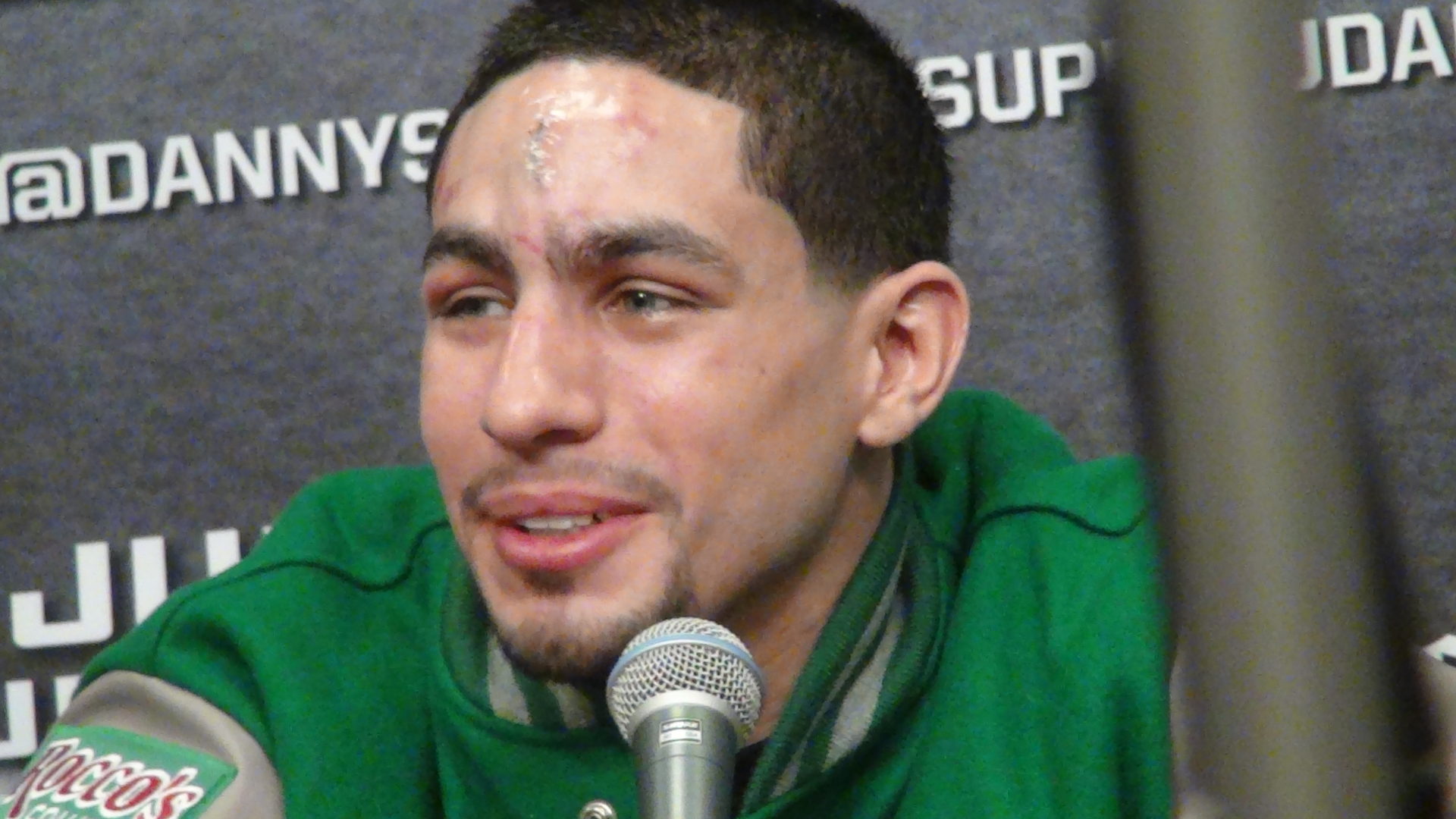
Thanks, but no thanks: Angel Garcia complains about a media gift that figures to motivate son Danny against Matthysse

Danny Garcia
It didn’t take long for Angel Garcia to erupt. He’s complaining to media that his son, Philadelphia junior-welterweight Danny Garcia, isn’t getting a fair shake in coverage of his bout with Lucas Matthysse on the Sept. 14 card featuring Floyd Mayweather Jr.-versus-Canelo Alvarez at Las Vegas’ MGM Grand.

It’s hard to judge whether his apparent anger is real or just an act. There are times when Angel Garcia, his son’s trainer, seems to enjoy throwing a temper tantrum. The more profane, the better. His insults and epithets before his son’s upset of Amir Khan in July, 2012 were enough to wonder whether he’s one of those Philadelphia fans known to boo Santa Claus.

But, come on, Angel Garcia shouldn’t complain about coverage that includes Matthysse on The Ring’s current cover. Angel Garcia, another in the long line of boxing dads behaving badly, should thank the media for a gift that allows him and his son to play the underdog, a role as effective as it is familiar to them. Now that Matthysse has gotten the glossy cover-boy treatment, Angel Garcia has a convenient target and an inexhaustible source of motivation.

Here’s a hunch that The Ring’s cover will show up, pasted onto Danny Garcia’s favorite heavy bag throughout the rest of training camp. It’ll probably make a good dart board when he isn’t training. Angel Garcia might cover the walls in Danny Garcia’s sleeping quarters with Matthysse looking down on him from several angles. Dad wouldn’t want his son to wake up and not be reminded of how badly his honor has been wronged.

It’s an old enough trick to be a cliché, of course. Still, it works. Bernard Hopkins is a master at seizing upon some perceived slight and turning it into controversy that seems to energize him and pay-per-view sales. Politicians use it to demonize their opposition. College football coaches call it bulletin-board material. But it’s the same thing. Alabama is No. 1 again this season, in part because Crimson Tide coach Nick Saban is more frightened of complacency than Georgia or Florida or Texas A&M’s Johnny Football. From Hopkins to Saban, it doesn’t matter whether the enemy is real or a mere straw man. It only matters that there is always some point to prove, some score to settle, some dragon to slay.

Danny Garcia, the grown-up in his relationship with a combustible dad, seems to have an instinctive understanding of the role. He has used it to fashion an undefeated record and ownership of two acronym-sanctioned pieces of the 140-pound title. Yet, he has almost become the understudy, the B-side to Matthysse’ starring role. Garcia addressed it in a matter-of-fact tone Wednesday during a conference call that did not include his dad.

“I’ll defend my titles and I’ll still be champion,’’ Garcia said. “The people who don’t believe, that’s their problem. It’s not supposed to be my time now. But I made it my time.’’

The twice-beaten Matthysse, The Ring’s 140-pound champ, is getting most of the attention and perhaps a nod as the favorite because of a crushing third-round stoppage of Lamont Peterson in May, the Argentine’s last outing. Golden Boy Promotions CEO Richard Schaefer called Matthysse the next Manny Pacquiao. It made you wonder if Garcia was going to be the next Peterson.

A further complication, at least for Angel Garcia, lurked in media reports suggesting that Danny Garcia’s face was frozen in fear at the way Matthysse battered Peterson into submission. From a ringside seat, Garcia witnessed Peterson hit the canvas three times in the violent third.

During Wednesday’s conference call, Leonard Ellerbe of Mayweather Promotions dismissed the idea that Garcia has ever been frightened of Matthysse or anybody else, other than perhaps his dad.

“I know first-hand that Danny has been very, very adamant that he wanted this fight,’’ said Ellerbe, who was privy to conversations with Al Haymon, an advisor to Mayweather and Garcia. “Day-after-day, he was bugging Al Haymon to make that fight. Again, I know first-hand that they (father and son) had been demanding it.

“Besides, there’s no such thing as being scared of each other. Nobody is scared to make money.’’

But sometimes, just a little fear is powerful currency in its own right, especially if it’s a fear of losing. Matthysse was included in Wednesday’s call. But he refrained from saying a provocative word, perhaps because he knows Garcia has gained some emotional momentum in a controversy generated by a dad who has only begun to provoke.


To Laredo for the Baby Bull: Another homage to 2009’s fight of the year

Juan Diaz
SAN ANTONIO – Saturday at Laredo Energy Arena, about 150 miles southwest of here, Houston’s Juan “Baby Bull” Diaz will make a 10-round match with Brazilian Adailton De Jesus, as part of the second fight of a however-many-fight comeback Diaz plans to pursue till peril massively outweighs treasure and he returns to a retirement he apparently did not enjoy in 2011 and 2012. I will be there because Laredo is not too far, Diaz is one of my favorite fighters – in part because of the match he made with Juan Manuel Marquez 4 1/2 years ago – and because Diaz’s new promoter, Top Rank, has not been in Texas nearly as much as hoped this year.

Juan Diaz’s comeback may be sincere and well designed and likely to succeed or it may not, and as there’s no way to tell at this point what it is, Top Rank has chosen for Diaz an opponent who may or may not be serious himself. Adailton De Jesus is a Brazilian lightweight whose talents do not travel particularly well. He was last seen in the United States losing an uncomplicated decision to Marco Antonio Barrera three years ago at Alamodome. That Barrera bore little resemblance to the man who twice decisioned Erik Morales; the Barrera who fought De Jesus returned from a 15-month sabbatical, almost three years after announcing a “retirement” caused by his one-way rematch loss to Manny Pacquiao (a forgettable fight historic only for bringing a cessation to Top Rank and Golden Boy Promotions’ first feud) to investigate how much money Barrera could raise on the nostalgia circuit before he careered into broadcasting full-time.

De Jesus’ career, a venture apparently paused when his first-round knockout of a 14-14-1 opponent in 2011 was nonviolent enough to warrant investigation by Brazilian officials, a knockout that came just three Saturdays after De Jesus was stretched in four rounds by Mexican Humberto Soto in Mexico, was a one marked by losses on the road complemented by resume-builder wins at home. Nothing about the Brazilian lightweight’s 19-month vacation, which will end Saturday in Laredo, indicates a new desire to compete; likely this is a fight made by a matchmaker who spoke to a matchmaker who spoke to a manager – “Adailton always was tough, and Diaz never could punch” – that will get De Jesus a new truck in Sao Paulo and/or VIP passes to the 2016 Olympic Games in Rio.

If the unforeseen comes to pass and De Jesus upsets Diaz, the Brazilian’s team will see if they can’t parlay the victory towards a guaranteed loss in a staybusy fight for Miguel Vazquez or Mike Alvarado or Brandon Rios or whomever Top Rank envisions someday feeding a plate of Baby Bull. Diaz-De Jesus, then, will determine nothing about the lightweight or junior welterweight divisions we do not already know, but it will afford an opportunity to see Diaz in action, which, for a small band of aficionados, is a treat not to be missed.

For a number of reasons Diaz was never popular with the masses as hoped; not as Don King hoped, when, by his own admission in 2006, King slipped a DKP contract over Golden Boy’s, with Diaz’s pen dangling portentously above, to get Diaz on a Liakhovich-Briggs card at Chase Field, when it became apparent nobody in Arizona knew Scottsdale’s Sergei Liakhovich, victimized just Friday on ShoBox, and the reliable Latino revenue stream would need be tapped. But Mexicans never much related with Diaz, a volume puncher with an everyman physique – long, loose muscles framing a midsection that jiggled – who possessed neither knockout power nor a fixation on opponents’ livers.

A couple years and some televised fights later, King got Diaz’s title lost to Nate Campbell in Mexico, which led Diaz, finally, to Golden Boy Promotions, an underappreciated decision over Michael Katsidis and the 2009 fight of the year with Juan Manuel Marquez, a man for whom, posterity now says with a chuckle, Diaz appeared structurally too large at 135 pounds, bulling Marquez for much of the match’s opening 18 minutes before succumbing to the finest counterpunching seen in a generation and being stopped by a gorgeous right uppercut in round 9.

Diaz’s rehabilitation tour did not go as planned; he decisioned Brooklyn’s Paulie Malignaggi in Diaz’s native Houston, and then Malignaggi premiered what can fairly be called his signature postfight speech about boxing’s evilest forces, money and corruption, being allied against a fighter from the economically irrelevant township of New York City. A lackluster rematch with Malignaggi got the “Magic Man” his desired decision, and eight months later got Diaz handed to Marquez in another rematch no one asked for – certainly not Las Vegas, the match’s unfortunate and unfortuned host, enjoying then its second year of 18-percent unemployment – and Diaz feinted at more fighting then said goodbye to attend law school or become a lawyer or some other narrative thread nobody pulls anymore because Diaz is a good guy and it’s unkind to ask if a rising Houston attorney would subject himself to other men’s fists for UniMás (formerly Telefutura) money.

How relevant is any of that to me? Not at all, honestly. Volume punchers are my favorites – whether their names are Juan Diaz, Timothy Bradley or Nihito Arakawa. Some aficionados have justified grievances with volume-punching types – they tend to outpoint the stylists whom purists pride themselves on adoring – and most casual fans hate them even more for neither scoring highlighted knockouts nor having what euphonious names garner from aficionados’ faces the admiring expressions casual fans love to cause at sportsbars. Diaz’s ability to relax in the presence of stronger punchers and stronger men, though, has enchanted me most of his career, and if his retirement did not go as planned, at age 29 he is welcome to keep plying his trade.

Expect me at ringside any time the Baby Bull fights in Texas.

Bart Barry can be reached at bart.barrys.email (at) gmail.com


Pedraza decisions Tolmajyan

Jose Pedraza scored a ten round unanimous decision over Gabriel Tolmajyan in a Super Featherweight bout.

It was a close bout with many close round that favored Pedraza moving in and out and landing quick combinations. Tolmajyan got opportunities in the second half of the fight as Pedraza got more into Tolmajyan’s punching range. Pedraza built up enough of lead to win by 97-93 on all cards.

Pedraza, 129 1/2 lbs is now 14-0. Tolmajan is now 13-3-1.


Is there a next great in American heavyweights? Deontay Wilder gets his chance to say there is

deontay_wilder
The search for a great American heavyweight is turning into a job for archaeologists.

Maybe, Deontay Wilder can begin to drag the endangered division out of antiquity and into modernity Friday night against Sergei Liakhovich in Indio, Calif., at Fantasy Springs Casino in a bout that is part of Showtime’s ShoBox series. A perfect element in Wilder’s unbeaten record makes him worth a look. Twenty-eight stoppages in 28 victories add up to power almost impossible to ignore.

Yet, there’s skepticism. Wilder is preceded by Seth Mitchell and Johnathon Banks in the line to claim the leading role as the next great American. Mitchell generated a lot of excitement a couple of years ago. Even reigning heavyweight Wladimir Klitschko, one of the Euro Zone’s most reliable commodities, saw Mitchell as a potential foe, a business partner in his attempt to re-enter the U.S. market.

Yet, Mitchell got bumped from the head of the class by Banks, of all people. Banks, Wladimir’s trainer, beat Mitchell in a crushing, second round TKO last November. Mitchell came back and won the rematch in June by unanimous decision. But the dull bout didn’t eliminate a lot of the questions about him, Banks and – in turn – Wilder.

Increasingly, it looks as if employment as an American heavyweight is an alternative way to make a living.

If not for a knee injury at Michigan State, Mitchell would probably be an NFL linebacker today. Banks, a student of the late Emanuel Steward, might be a better trainer than fighter. They are heavyweights, in large part because there just aren’t many in the U.S. any more. It’s not their fault. It’s just bad timing. The business has moved on from an era when heavyweights were the so-called flagship division. Thanks to Floyd Mayweather Jr., Manny Pacquiao, Oscar De La Hoya, Canelo Alvarez, Juan Manuel Marquez, Gennady Golovkin, Mikey Garcia, Sergio Martinez and whole host of others, fighters have gotten smaller and revenues bigger since then.

The September 14 clash at 152 pounds between Mayweather and Canelo has a chance to break the pay-per-view record set by Mayweather-De La Hoya in a 2007 junior-middleweight fight. A whole new generation of fans has grown up since Mike Tyson and Evander Holyfield, America’s last great heavyweights. In a way that nobody would have predicted, the game is thriving, thank you very much. Bob Arum’s Top Rank is trying to create a brand new market in China with a junior flyweight, Zou Shiming, who at 108 pounds is lighter by more than half of Wilder’s expected weight Friday night.

There are all kinds of theories about what happened to the American heavyweight. They’re either in the NFL, or in line at the dessert bar. Take your pick, but there’s no doubt they are making a negligible impact on the American side of the business scale.

Skepticism of Wilder is rooted in his relative inexperience. Unlike Mitchell, he has some solid amateur experience. He won a bronze medal, America’s only medal, at the 2008 Beijing Olympics. Still, Wilder is a newcomer. He didn’t start boxing until he was 19 in 2005. Instinctive skill acquired by Holyfield and the Muhammad Ali generation was not part of Wilder’s growing-up process.

While other fighters were learning the trade in their mid-teens, Wilder had other dreams at Tuscaloosa Central High School, not far from the University of Alabama campus. He wanted to be a receiver for the Crimson Tide’s famed football team or a forward for Alabama basketball. The birth of daughter with a spinal condition and academics got in the way. Boxing was the alternative.

Can Wilder turn it into something more than Mitchell or Banks has? Yeah, maybe. Depending on what happens against the 37-year-old Liakhovich (25-5, 16 KOs), a Wilder fight against Mitchell and/or perhaps Banks could be interesting.

Then again, it might provide further evidence about a vanishing bit of Americana that works in a museum, but not as a main event.


Prizefighting, Saunders, damages, vulnerability, graciousness

Most American prizefighters are damaged necessarily, damaged from taking others’ fists and hopes, damaged by youthful experiences that guided them through amateur boxing’s comparative tenderness to a career hurting others. In this era when most Americans who cover prizefighting do so without compensation, it is fair to assume a fair number of us, too, are damaged, and as much as we chose to write about prizefighting because it is one of three sports, with baseball and golf, that reliably lend themselves to good writing, we also got chosen by prizefighting in a way neither golf nor baseball chose us.

Monday was unexpectedly pleasant for me. Summoned for jury duty, my first as a resident of Lone Star State, at the Bexar County Courthouse – an edifice majestic as the county comprises, something one can say for a courthouse in most any Texas county – I sat in an enormous room with crisp air, a delightful rarity in these parts from now till October, and comfortable chairs and sternly polite strangers and wonderfully absent television sets (those are kept in adjoining rooms with walls thick enough to be soundproof).

From eight in the morning till the last jury panel was threatened but not assembled at nearly four in the afternoon, I read George Saunders’ “CivilWarLand in Bad Decline,” a collection of six short stories and one novella that are absurd and violent, primarily, but also imaginative and humorous and the standard to which contemporary American satirists should aspire. A day or so later, I happened on the recently published text of Saunders’ address to Syracuse University’s class of 2013, a speech that could be titled “Try to be Kinder,” and thought it was all too coincidental, or if it wasn’t, well, what was happening in our sport this week that I couldn’t wander off the left/right/left path?

Vulnerability, it seems, is the best place to follow Saunders’ convocational advice, and prizefighting is fine a place as anyone might look for vulnerability – its expression and discovery and expression. So is the writing it inspires, or perhaps more ably put: so are those who write about our sport. There is a disappearing middleground in our craft (I had “business” there at first, but it looked preposterous), like so much of American life, lamentably enough, and we now line up on a side that is either too gracious or not fractionally gracious enough. If as the old saw has it, academic politics are vicious because their stakes are small, boxing-writing’s stakes, tiny by comparison, have brought a proportionate viciousness that is profoundly offputting to the very few persons who still care what we do.

For years I believed this was an unpleasantness blogs wrought – young writers proselytized by misanthropic editors telling them one’s soul, or at least his backbone, was traded for a ringside credential – but now see I was wrong, as increasingly our clan’s comity is undermined by men who should expect to see one another at ringside this year, an actuality that tends to govern tongues and once governed keyboards. “Please don’t bring this pettiness to ringside” – that is what I find myself thinking as I peruse Twitter, an activity that once made every hour’s last five minutes at my dayjob nearly euphoric but now discomfits me more than my dayjob.

Ringside, you see, is a gracious place; it’s where the very voice of Arizona boxing, Norm Frauenheim, spoke to a first-year boxing writer about the craft, for hours at a time, many times, simply because they were sat beside one another and the young writer had questions and questions, and because Frauenheim is the first boxing person I thought of while reading Saunders’ address; ringside is where online boxing-writing’s trailblazer, Doug Fischer, made a point of being friendly and vulnerable with any young writer who introduced himself, and interrupted his own deadline reporting to jog to row’s end and pose for pictures with ticketholders; ringside is where our craft’s most celebrated practitioner, Thomas Hauser, still goes hours before he is due in a main-event fighter’s dressing room, to sit with young writers and impart wisdom about boxing and things that have nothing to do with boxing.

One trip to a Major League Baseball pressbox: that’s what it took to convince me how special ringside was, with its jovial regulars and enthusiastic newcomers and everyone ready to answer standard inquiries from their neighbors, like “Did you get the time on that one?” or “But it was a left hook that started it, no?” That MLB pressbox was, as my host would later call the Associated Press tent at the Beijing Olympics, the unhappiest place on earth, one filled with large suspicions and mean jealousies, reporters shoulder-blocking laptop monitors lest someone with a Visitors badge steal their peerless prose and decide, on second thought, the catch by the centerfielder in the third inning was actually unbelievable, not amazing.

See that, what’s above? It’s ungracious, and were this not a piece, in part, about vulnerability, it’d get struck on rewrite, but it will stand for purposes of illustration. There is no reason not to be gracious to one another, to suspect the other guy is doing his best the same as I am, to forego occasionally the hasty and public rebuttal, safe in the knowledge none of it will be remembered by the damaged people who now anonymously cheer it on.

Damaged is good a word as any for them, for us, a word to invoke empathy from most who read this. A desire to cover prizefighting, men who beat one another for money, percolates upwards from a spring of injury often as a willingness to beat another man for money does. Most of us who write about this sport, and a goodish number of our readers, are damaged, simply, complicatedly, and what good might come of damaging one another further, for free?

Bart Barry can be reached at bart.barrys.email (at) gmail.com


SUPER FLYWEIGHTS ZULINA MUNOZ VS. MARIBEL RAMIREZ TO HEADLINE ON TELEVISA DEPORTES AND FOX DEPORTES THIS SATURDAY, AUGUST 3 FROM TOLUCA, MEXICO

LOS ANGELES, August 2 – The Agustin Millan Gymnasium in Toluca, Mexico will be the scene of one of the most exciting tripleheaders of the summer this Saturday, August 3, as Golden Boy Promotions and Canelo Promotions present three championship bouts on Televisa Deportes and FOX Deportes featuring some of Mexico’s top talent.

In the 10 round main event, Zulina “La Loba” Munoz defends her WBC World Female Super Flyweight Championship in a rematch against fellow Mexico City native Maribel “La Pantera” Ramirez.

Plus, another stellar Mexico City talent, Armando “Cobra” Santos, puts his NABF flyweight title on the line in a 12 round battle against countryman Jorge “Coco” Amador and in the televised 12 round opener, it’s two more proud natives of Mexico City in action, as unbeaten Bruno “Tiburon” Sandoval risks his perfect record against Gustavo Garibay in a USNBC middleweight title fight.

Munoz vs. Ramirez is presented by Golden Boy Promotions and Canelo Promotions and sponsored by Corona. Doors open at 5 p.m. CT and the first fight begins at 6 p.m. CT. The Televisa broadcast will begin at 10:30 p.m. CT in Mexico and FOX Deportes broadcast begins at 10:00 p.m. ET / 7:00 p.m. PT in the United States.

A standout champion from a country producing several world-class female boxers, 25-year-old Zulina Munoz (38-1-2, 25 KO’s) has been in dominant form in recent years, going unbeaten in 24 consecutive fights, a streak stretching back to 2008. Now making the third defense of the title she took against Ramirez in 2012, Munoz is looking for an even more decisive victory this time around.

Tenacious battler Maribel Ramirez (8-5-2, 3 KO’s) came perilously close to snapping Munoz’ win streak and becoming a world champion in 2012, losing by only two points on each of the judges’ scorecards. On Saturday, the 27-year-old known as “La Pantera” gets her shot at redemption in a highly-anticipated rematch.

Nicknamed “Cobra” for his ability to strike from all angles, 25-year-old Armando Santos (11-3, 7 KO’s) has won three straight since a 2011 loss to 20-0 Carlos Cuadras, decisioning Omar Lina and knocking out Edgar Gonzalez and Herald Molina. This weekend, he’ll hope to extend that streak to four.

Mexico City’s Jorge “El Coco” Amador (6-6, 1 KO) is a four year pro looking to get back to his winning ways after a rough three fight stretch. A talented battler willing to box or bang in order to secure victory, the 26-year-old will be fighting as if a world title is on the line against Santos.

Unbeaten Bruno Sandoval (14-0, 12 KO’s) is a shark in the ring, hence his nickname “Tiburon,” and once he gets his opponents in trouble, it’s usually lights out. The WBC USNBC champion since November of 2012, the 22-year-old makes his fourth title defense on Saturday against rugged competitor Gustavo Garibay (8-6, 5 KO’s), an aggressive competitor who always shows up to fight.

For more information, visit www.goldenboypromotions.com, follow on Twitter at www.twitter.com/GoldenBoyBoxing and visit on Facebook at Golden Boy Facebook Page. For more information on Televisa Deportes visit www.TelevisaDeportes.com, become a follower on Twitter at www.twitter.com/TD_Deportes. For more information on FOX Deportes visit www.FOXDeportes.com, become a follower on Twitter at www.twitter.com/FOXDeportes and visit www.facebook.com/FOXDeportes on Facebook.


Legacy: Mayweather, Pacquiao figure to generate debate about what it is and what it isn’t

Floyd_Mayweather
There may never be a Floyd Mayweather Jr.-Manny Pacquiao fight and there’s no reason to review, ad nauseam, all of the things that have made it unlikely. Yet, the two will be linked forever by a debate about an element that defines what they do.

If all goes as predicted on Sept. 14 with Mayweather-Canelo Alvarez in Las Vegas and again on Nov. 23 with Pacquaio-Brandon Rios at Macau in a Vegas re-creation on the Chinese island of Macau, 2013 will end with talk about legacy. What is it? What does it mean? Does it even matter?

It’s a word that gets thrown around often and easily these days, which means it could be about anything and a mouthful of nothing. For all that it matters, legacy could be just another fast-food chain during an era when everybody seems to have a super-sized one.

But Mayweather-Canelo and Pacquiao-Rios have the potential to re-focus the argument, if not re-define the word. Besides, it might be all we have as a way to judge who was the best of his generation.

It breaks down this way:

For Mayweather, the assumption has always been that his legacy hinges on retiring unbeaten. There’s nothing to counter that. He could finish 49-0 if he decides to retire at the conclusion of his Showtime contract.

For Pacquiao, it isn’t an assumption. It’s an urgent bit of reality. He has to beat Rios in a style that says he wasn’t finished at the very second he fell, face-first and lifeless, onto the canvas from Juan Manuel Marquez’ right-handed shot in December. Add to that, Pacquiao is coming off successive losses – first by a controversial decision to Timothy Bradley and then Marquez.

In one of those spontaneous moments of candor that have always made Pacquiao likable, the Filipino Congressman acknowledged that the stakes were high, even daunting.

“I am feeling a little pressure for this fight,’’ Pacquiao said in Macau during a world-wide media tour with enough frequent-flier miles for a free ride on the next trip to an international space station.

The pressure falls more on Pacquiao than Mayweather, mostly because nobody – not even Pacquiao — can be certain about who the Filipino is anymore. Then, there’s Rios, who is as tough as he is wild. The pre-Marquez Pacquiao might have knocked out Rios as surely and dramatically as he did Ricky Hatton in 2009.

But the post-Marquez Pacquiao?

In that gray margin of uncertainty, there’s adversity. Pacquiao has already overcome some in his comeback from a 2005 loss to Erik Morales. He dealt with defeat and conquered the lingering doubt by beating Morales twice in subsequent rematches. But the adversity was never at this level and never in China where he is a key to Top Rank’s designs on a new market.

If Mayweather’s blueprint plays out as intended, we may never know how he deals with defeat. In Canelo, he faces a tough and emerging star. Power in Canelo’s combinations gives him an early chance. But the prevailing guess is that Mayweather is catching him early in his career and few years before his prime. For Canelo, the predicted consolation is a good lesson in a loss, his first. For Mayweather, the fight looks like another step toward an unbeaten career.

Let’s assume all of the early predictions are correct: Mayweather wins a unanimous decision and Pacquiao conquers early uncertainty en route to a definitive victory by late-round stoppage.

Whose legacy counts for more? From this corner, dealing with defeat – coming back from it – is a key to judging a fighter’s career. To wit: Would Muhammad Ali have become the icon he is today had he not had to come back from the 1971 loss to Joe Frazier? Ali’s resilience and character were illuminated in how he subsequently dealt with a crushing loss.

Mayweather has a chance to equal Rocky Marciano’s 49-0 record. He might even surpass it if – as he has hinted – he decides to extend his career by beyond his current Showtime deal. Unbeaten is impossible to ignore. The NFL’s 1972 Miami Dolphins and college basketball’s 1975-76 Indiana Hoosiers are reference points in their own sports.

But adversity, perhaps more than in any other sport, is as much a part of boxing as blood, bruises and scars. It’s part of the drama. Why we watch. A record without a comeback from defeat is somehow incomplete. That explains, in part, why Marciano doesn’t rank higher on all-time pound-for-pound lists.

If Pacquiao deals with the pressures, potential demons and scores a predicted stoppage a couple of months after Mayweather wins a decision, he’ll overtake Mayweather and hold a narrow edge on at least this legacy card. But the devil in the details is a wildcard called Rios, who could make the debate moot and turn Mayweather into the decade’s runaway winner.


Figueroa and Arakawa, humility and volume punching

Omar Figueroa
SAN ANTONIO – I like to think I write quickly, finding words within the readymade template, lede to nut to quote to body, that governs ringside reporting and probably has for centuries. Yet Saturday, as I groped to describe what happened during Andre Berto versus Jesus Soto-Karass, as fine a main event as our sport may see for the rest of 2013, I was entirely alone. Before I was within 300 words of filing, there was nary a soul in AT&T Center’s other 10 rows of particleboard tables.

Turns out, half the writers left after the co-main, and those who stayed did not have editors that wanted more than a line about the walk-out match, and raced back to the media center to reserve a seat at the press conference. Such is the drawing power of Weslaco’s Omar Figueroa in South Texas, and such was the match he made with an indomitable Japanese lightweight named Nihito Arakawa.

Figueroa is every good thing South Texans say about him, but there, too, was Arakawa, all through their 36 minutes of mutual belligerence, cussedly stomping forward, making the volume puncher’s compact with Figueroa who was prepared as possible for a meaningful and violent confrontation but necessarily unprepared for the grotesquerie of Arakawa’s bottomless capacity for absorption, as if punches were an ocean and he was set on the task of patiently mopping the beach and emptying its seawater in a bucket.

That was exactly how futile Arakawa’s task appeared to three judges – a Californian, a Mexican and a Nevadan, no Texans, who scored an intensely fine match 119-107, 118-108, 118-108, grading Arakawa’s performance somewhere between Short Notice and Heavybag – yet Arakawa did not relent. There is a momentum to prizefighting, of course, but it hasn’t nearly the fluidity professional scorekeepers observe at ringside, where every fighter who won the previous round begins the next with a symmetrical lead, and keeps that till his opponent overcomes a judge’s mental inertia with force great enough to convince him something materially different has occurred. Chuck Giampa, deservedly famous for taking Showtime viewers inside the mind of a judge, instructs aficionados, elsewhere and here: There is not an iota of infallibility to be found at ringside, so do not look for it or rage at its unjust absence.

Arakawa’s secret to absorbing punishment is a kin to his having informidable punching power; he does not commit fully to any punch because he’d rather remain within himself, in full self-possession, working to a rhythmic tempo he alone hears, keeping his southpaw hands and feet in motion, right hook and shoulder and left cross and shoulder and left to the body and right to the head, shoulder, shoulder, backwards step, overhand left, backwards stutter, right foot shuffle, shoulder, left hook . . .

Arakawa’s mental resilience is not a matter of making adjustments to an opponent in mid-fight but one of preparation and self-knowledge, of reducing his required thoughts in combat to a simple yes/no question – “Am I comfortable?” – that he can answer even when partially or fully out of his mind. It is not the simpleton’s approach for which it is mistaken, always, by those who’ve not employed it, either for having natural gifts of power or reflex too great to sacrifice, or for having never worn gloves; it is the choice of our sport’s most introspective and intellectually hardy practitioners, an intelligent choice that asks, in all humility: What am I not as good at as another, and how can I reduce his advantages?

Arakawa, blasted repeatedly in the opening six minutes by a South Texas lad with 17 knockouts in 22 fights, a lad yet to meet man or beast capable of absorbing more than a baker’s dozen of his best strikes, a lad, coincidence would smilingly note, who shares a trainer with Timothy Bradley, boxing’s finest practitioner of the very style Arakawa applies pretty damn well himself, a lad who said two Fridays before he would have to strip naked in the breathless heat and pitiless light of a South Texas supermarket parking lot at two o’clock on a July afternoon that if the time came for his mind to blank in an orgy of attrition, like Bradley’s did in March, he prayed not to solicit the white feather, wilting before another man’s greater desire – blasted repeatedly by that lad, Arakawa relaxed, found his comfortable place, and forced his will on Figueroa’s fighting spirit, and Figueroa did not wilt.

But he did tire. As he took the scale Friday afternoon, he looked somewhat drawn, in the tradition of longarmed Mexican prizefighters who bring severity to other men at a weight no fewer than 25 pounds below a physique nature would not begrudge them, and then he missed by a quarter pound, 135 1/4, and had to disrobe entirely. It was an interesting spectacle of modesty and awareness, that. Figueroa, who emphasizes his desire to be a role model to kids in the Rio Grande Valley where Weslaco sits, requested a barricade of blinding towels, a square perimeter of white terrycloth, and then took to the scale, package in hand, cupping his manhood in his right fist, and made weight – disproving one physics-defying myth of Mexican prizefighters: Raising your arms overhead and inhaling will begin a negotiation with gravity that reduces slightly your weight. This curious show of modesty brought a tiny, unexpected touch of further likability that explained why Figueroa was, by far, AT&T Center’s most popular prizefighter.

And that was before Figueroa and Arakawa made a historic show of valor and sportsmanship, elevating one another’s public standing, making even wizened fight scribes grateful.

Bart Barry can be reached at bart.barrys.email (at) gmail.com


Shiming defeats Ortega

Shiming_ortega
Olympic hero Zou Shiming remained perfect by scoring a six round unanimous decision over Jesus Ortega in a Flyweight bout at the Venetian Resort in Macou, China.

Shiming looked better then he did in his pro debut but still has a lot of amateurish traits in his game but it was still good enough to be best on this day as he won by scores of 59-55 on all cards and is now 2-0. Ortega of Mexico i2 3-2.

Estrada_Melindo
Juan Francisco Estrada retained the WBA/WBO Flyweight title with a twelve round unanimous decision over previously undefeated Milan Melindo.

Estrada had a solid first round until he was caught with a nice left hook just seconds before the opening round was over. It was a close fight throughout the middle rounds with the jab of Estrada being the differemce. Melindo came back with some solid flurries. Esrada’s experience of fighting 24 championship rounds with Roman Gonzalez and Brian Viloria proved to be the difference as he cut the left eye of Melindo in round six, scored a knockdown from a hard right hand in round eleven and wobbled the challenger on multiple occasions in the final frame.

Estrada, 111.5 lbs of Mexico won by scores of 118-109, 117-109 and 118-109 ad is now 24-2. Melindo of the Philippines is now 28-1.

Gradovich_Munoz
Evgeny Gradovich made the first defense of the IBF Featherweight title with a 12 round unanimous decision over Mauricio Munoz.

Gradovich controlled the pace with his quick combinations that never allowed Munoz to get into any type of rhythm. Gradovich was very solid and consistent throughout the fight with Gradovich getting stronger as the fight progressed. Gradovich hurt Munoz with a nice combination in round eleven. In round twelve, Gradovich landed a left hand that wobbled Munoz. Munoz’s right eye started to swell badly in the final round as Gradovch cruised down the stretch and won by scores of 119-109, 119-109 and 120-108.

Gradovich, 125 3/4 lbs of Oxnard, CA via Russia is now 17-0. Munoz, 125 3/4 lbs of San Juan, ARG is now 26-4.


Fight Night at the Park 2 heats up at the weigh in!!!

Jersey City, New Jersey’s Patrick “Paddy Boy” Farrell (8-2-1, 4Ko’s) was excited at the opportunity when the main event at Schuetzen Park in North Bergen, New Jersey on Saturday night featuring Juan Rodriguez had to be cancelled due to an injury to his opponent. Veteran matchmaker Diana Rodriguez and Promoter Andre Kut immediately went to the phones, desperately looking for a replacement, but no other suitable fighter would agree to take on “The Beast” on such short notice.

Farrell, “The Fighting Fireman” was proud to step into main event status against upset minded Phillip Triantafillo (2-3, 1KO). However, the six round heavyweight contest almost didn’t happen. Twenty four hours earlier at the weigh in, both fighters stood toe-to-toe for photos after getting off the scales. Triantafillo turned away from something Farrell said and immediately slapped him across the face. Both fighters and their parties had to be separated as a melee almost ensued.

“It took a lot of balls for him to slap me in the face in front of my family,” said Farrell. “I took his best shot without gloves and now he will feel mine in the ring. We are in the hurt business. I am going to knock his teeth out, said an angered Farrell afterward.”

The IWBF World Bantamweight title will be on the line In the ten round women’s co-feature of the evening as “Dha Phenomenal” Nydia Feliciano (6-4-3) of the Bronx, battles it out with dangerous Las Vegas native, Crystal Hoy (5-5-3, 2Ko’s).

Headlining the undercard promoted by Andre Kut’s Kea Boxing Promotions, will be a six round contest featuring undefeated Mine Hill, New Jersey middleweight Anthony Gangemi (4-0, 3Ko’s) against Pittsburgh, PA’s Justin Johnson (5-4-4).

The weights for what is turning out to be an explosive night of boxing are as follows:

Patrick Farrell 214.4 vs. Phillip Triantafillo 232
Nydia Feliciano 117 vs. Crystal Hoy 118
Vacant IWBF World Welterweight title
Anthony Gangemi 146.6 vs. Justin Johnson 145.4
Anthony Jones 158.8 vs. Adrien Armstrong 160
Tyrell Wright 194.6 vs. Eric George 195.6
Dwayne Holman Jr. 139.4 vs. Dion Richardson 138

Venue: Schuetzen Park
Promoter: KEA Boxing Promotions


Burgos Survives Amidu Scare

BurgosAmidu300LINCOLN, CALIFORNIA – In a great action fight, Yakubu Amidu rose to the occasion against the world class Juan Carlos Burgos, forcing a split decision draw in the ESPN2 Friday Night Fights main event outdoors at the Thunder Valley Casino Resort on Friday night.

Fighting out of his weight class, Burgos (30-1-2, 20 KOs) of Tijuana, Baja California, Mexico found a willing and ready short notice opponent in the hard-charging lightweight Amidu (20-4-2, 18 KOs) of Los Angeles, California by way of Accra, Ghana. In what was designed as a showcase, Burgos and has team have to feel a little relieved that they left the ring with a draw after twelve sometimes hellacious rounds.

Amidu, 133, took a couple rounds to get warmed up and it may have cost him the decision. Burgos, 134, did not land too many telling blows through two stanzas, but he was carrying the action while Amidu kept a high guard and attempted to time with counters.

Amidu got going in round three as he timed his first of many clean left hand counters off of a Burgos body shot. The rangier Burgos could not keep Amidu at a distance as the Ghanaian continued to press forward and land lefts as the round progressed. Amidu continued to press the action in the fourth. Burgos got a brief reprieve from the attack when referee Ed Collantes called time when Amidu landed low.

Burgos stemmed some of Amidu’s momentum in round five as both men landed in some heated exchanges. Amidu may have edged the round after gaining the lead in another exchange as the round came to a close. Though the fight was fairly even, there was a sense that Burgos was in some danger midway through the bout.

The sun was still burning everything alive in the amphitheater in rounds six and seven, but the action did cool briefly. Amidu may have taken the sixth on ring generalship alone, as he pressed Burgos, the WBO #2 ranked super featherweight, from bell to bell.

Burgos regained a footing in the fight in round eight, as he was able to box and move out of danger. Even when Amidu forced Burgos to the ropes, the Mexican managed to do the majority of the landing. Burgos continued the momentum through the first two minutes of round nine. However, in the last sixty seconds Amidu forced Burgos back against the strands, bringing the crowd to their feet.

Just when Burgos needed a big round, he managed to conjure one up in the eleventh. The seemingly indestructible Amidu finally buckled after Burgos landed a clean right hand. With Amidu reeling momentarily, Burgos landed another clean right that forced the relentless Accra native to take a rare backward step.

Burgos started well in the twelfth, but Amidu refused to allow the fight to end without charging back with another rally. Amidu, smelling a career-best win and major upset, pressed forward and punished Burgos against the ropes as the fight came to a close.

After twelve hard-fought rounds, none of the three official scorers came close to an agreement on a winner. Burgos took one card 116-112, while Amidu took one by the same tally. A 114-114 card sewed up the draw. Neither fighter claimed the vacant WBO Intercontinental Lightweight title which was at stake.

“I felt the difference in weight class,” admitted Burgos after the bout, “and I am going to go back to 130-pounds, where I feel more comfortable.”

Amidu, though disappointed by the draw verdict, was happy the crowd on hand seemed to favor him in the fight. “I’m just going to keep on going,” added the Vince Vaughn-managed Amidu, who now becomes an attractive opponent for any of the up-and-coming lightweights.

In the opening bout of the evening and the televised co-feature, Miguel Gonzalez (22-3, 16 KOs) of Cleveland, Ohio survived the 107 degree heat and scored a body shot stoppage of Josenilson Dos Santos (26-2, 16 KOs) of Santana de Parnaíba, Sao Paulo, Brazil.

The shorter Gonzalez, 136, managed to keep his head right at the chest of the lanky Dos Santos, 135, all fight. Dos Santos, who entered the bout as the WBO #13 ranked super featherweight, found it hard to land much of anything clean and never made Gonzalez pay for coming into range.

The fight turned into mauling affair after a few rounds. Dos Santos was cautioned for using his head several times beginning in the fourth, a round in which he was eventually penalized for holding. Gonzalez began a concentrated body effort in round six, which would lay the ground work for the stoppage two rounds later.

With Dos Santos wearing down under the hot ring lights at the start of the eighth, Gonzalez kept the pressure up and eventually landed a combination to the body the sent the Brazilian in retreat. One last shot that landed towards the back of Dos Santos expedited his fall to the canvas. With Dos Santos not showing any signs that he could beat the count, referee Dan Collins waved off the contest at 2:27 of the eighth.

After the bout, Gonzalez expressed interest in renewing a rivalry with an old amateur adversary and current world ranked contender. “I want the best and at 135 I want a gentleman by the name of Terrance Crawford,” announced Gonzalez immediately after the win. “He knows about [me] and I’m ready for him. There’s some history and I just want to get at him again and continue where I left off.”

In the first bout after television went off air, Razvan Cojanu (7-1, 3 KOs) of Los Angeles by way of Voinesti, Dambovita, Romania avenged his only career defeat with a four-round majority decision over trial horse Alvaro Morales (6-14-7) of Las Vegas, Nevada.

The comparatively slow pace of heavyweight action after the main event thriller left the crowd wanting, but Cojanu, 281, did what he set out to do in a way erasing the defeat he had suffered in his professional debut in 2011. Morales, 306, was the plodder he was expected to be, but he managed to win two rounds on one card. Scores read 38-38 and 40-36 twice for Cojanu.

Taras Shelestyuk (5-0, 3 KOs) of Los Angeles by way of Sumy, Sumy Oblast, Ukraine continued his steady rise with a well-boxed four-round unanimous decision over a game Adam Ealoms (3-4-3, 1 KO) of Bryan, Texas.

Shelestyuk, 148, was just a class above the willing Ealoms, 148.5. Midway through the fight it was apparent a knockout may not be in the cards. The 2012 Olympic bronze medalist Shelestyuk seemed satisfied enough showing off his excellent boxing skills as he cruised to the decision. Scores read 40-36 across the board.

In his U.S. debut, unbeaten Fedor Papazov (12-0, 8 KOs) of Tuapse, Krasnodar Krai, Russia scored two knockdowns en route to a six-round unanimous decision over the always determined Joaquin Chavez (4-8-2, 2 KOs) of Los Angeles.

Papazov, 135, looked to be on his way to a potentially short night after dropping Chavez, 136.6, with a short right hand in the opening round. Chavez, known for his durability – even when matched against top prospects – got himself together and battled back. However, Papazov was just too skilled and scored another knockdown off a right hand midway through the fight. In the end, the cards read 59-54 and 59-53 twice for the former amateur standout Papazov.

The second to last walkout bout featured some good back-and-forth as Jarrod Tennant (1-0) of Los Angeles claimed a split decision in his pro debut over Brandon Adams (0-1) of Stockton, California. Tennant, 150, was a bit busier than was Adams, 149, though neither fighter ever had their opponent in any sort of trouble. Adams claimed one card 39-37. Tennant took the other two by the scores of 40-36 and 39-37.

In the final bout of the night, 6’9” giant Justin Goslee (2-0, 2 KOs) of Los Angeles remained unbeaten on a freak injury suffered by his opponent Kosetatino Sinoti (0-3) of Long Beach, California. The much shorter Sinoti, 229, came out firing and landed in the opening moments of the round. Goslee, 315.4, did not seem too bothered by the blows, but he was not really landing anything in retort. The two heavyweights threw at the same time and a loud pop echoed throughout the venue. Sinoti went down in a heap and writhed in pain on the mat, leaving referee Dan Collins no choice but to call off the bout without a count. Apparently one of Sinoti’s legs collided with Goslee, whose large frame probably felt like a brick wall. Medics attended to Sinoti and removed him from the ring on a stretcher before loading him into an ambulance.

Mario Ortega Jr. can be reached at ortega15rds@lycos.com or on Twitter @MarioG280.