Shiming defeats Ortega

Shiming_ortega
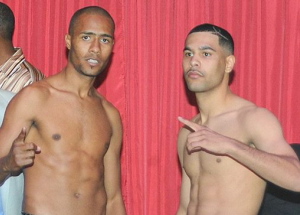
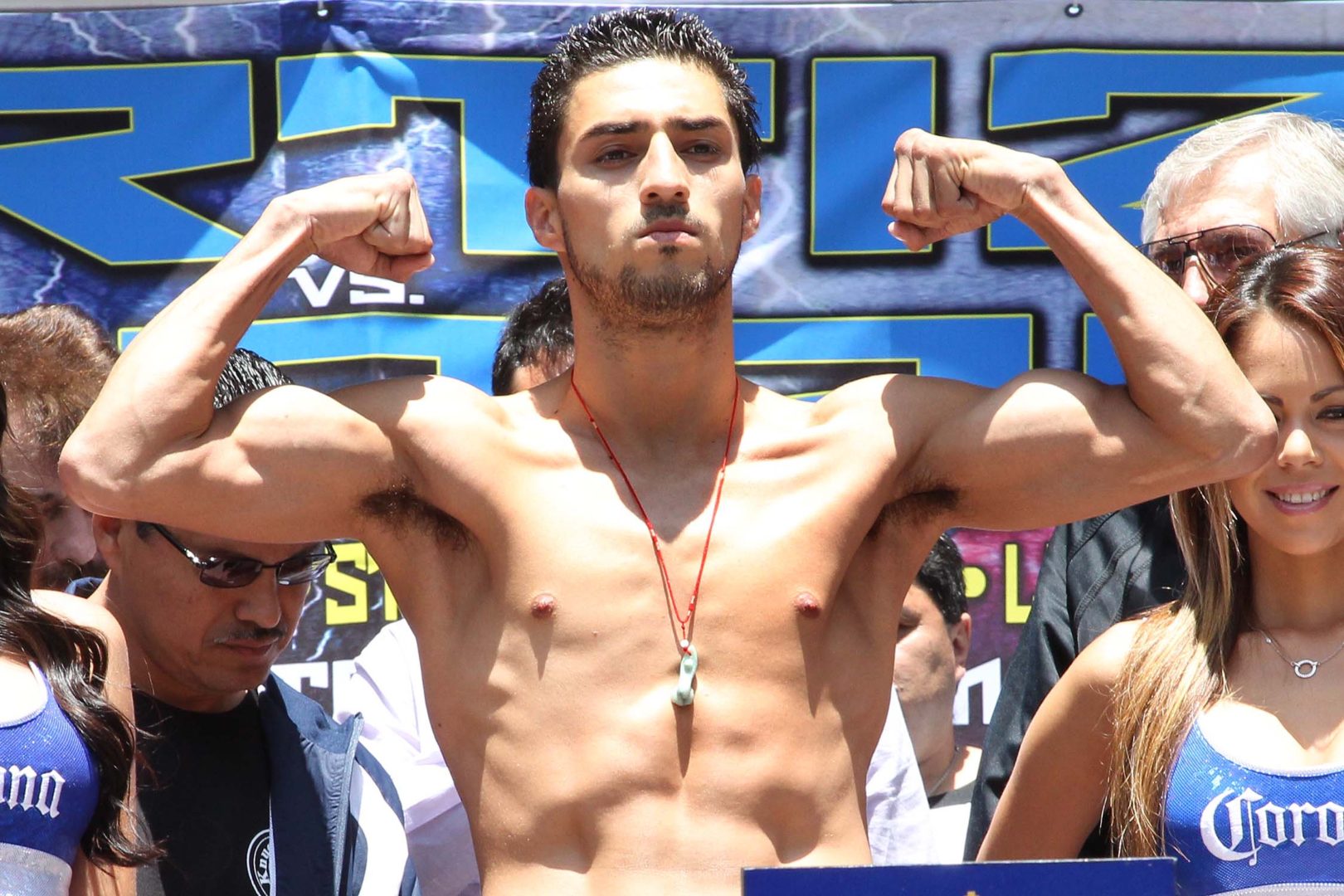
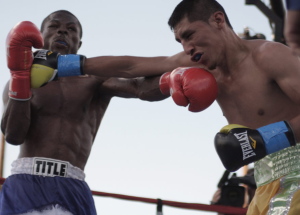
Olympic hero Zou Shiming remained perfect by scoring a six round unanimous decision over Jesus Ortega in a Flyweight bout at the Venetian Resort in Macou, China.

Shiming looked better then he did in his pro debut but still has a lot of amateurish traits in his game but it was still good enough to be best on this day as he won by scores of 59-55 on all cards and is now 2-0. Ortega of Mexico i2 3-2.

Estrada_Melindo
Juan Francisco Estrada retained the WBA/WBO Flyweight title with a twelve round unanimous decision over previously undefeated Milan Melindo.

Estrada had a solid first round until he was caught with a nice left hook just seconds before the opening round was over. It was a close fight throughout the middle rounds with the jab of Estrada being the differemce. Melindo came back with some solid flurries. Esrada’s experience of fighting 24 championship rounds with Roman Gonzalez and Brian Viloria proved to be the difference as he cut the left eye of Melindo in round six, scored a knockdown from a hard right hand in round eleven and wobbled the challenger on multiple occasions in the final frame.

Estrada, 111.5 lbs of Mexico won by scores of 118-109, 117-109 and 118-109 ad is now 24-2. Melindo of the Philippines is now 28-1.

Gradovich_Munoz
Evgeny Gradovich made the first defense of the IBF Featherweight title with a 12 round unanimous decision over Mauricio Munoz.

Gradovich controlled the pace with his quick combinations that never allowed Munoz to get into any type of rhythm. Gradovich was very solid and consistent throughout the fight with Gradovich getting stronger as the fight progressed. Gradovich hurt Munoz with a nice combination in round eleven. In round twelve, Gradovich landed a left hand that wobbled Munoz. Munoz’s right eye started to swell badly in the final round as Gradovch cruised down the stretch and won by scores of 119-109, 119-109 and 120-108.

Gradovich, 125 3/4 lbs of Oxnard, CA via Russia is now 17-0. Munoz, 125 3/4 lbs of San Juan, ARG is now 26-4.


Fight Night at the Park 2 heats up at the weigh in!!!

Jersey City, New Jersey’s Patrick “Paddy Boy” Farrell (8-2-1, 4Ko’s) was excited at the opportunity when the main event at Schuetzen Park in North Bergen, New Jersey on Saturday night featuring Juan Rodriguez had to be cancelled due to an injury to his opponent. Veteran matchmaker Diana Rodriguez and Promoter Andre Kut immediately went to the phones, desperately looking for a replacement, but no other suitable fighter would agree to take on “The Beast” on such short notice.

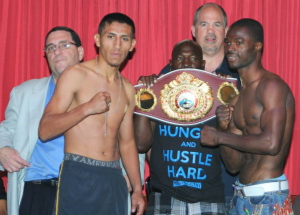
Farrell, “The Fighting Fireman” was proud to step into main event status against upset minded Phillip Triantafillo (2-3, 1KO). However, the six round heavyweight contest almost didn’t happen. Twenty four hours earlier at the weigh in, both fighters stood toe-to-toe for photos after getting off the scales. Triantafillo turned away from something Farrell said and immediately slapped him across the face. Both fighters and their parties had to be separated as a melee almost ensued.

“It took a lot of balls for him to slap me in the face in front of my family,” said Farrell. “I took his best shot without gloves and now he will feel mine in the ring. We are in the hurt business. I am going to knock his teeth out, said an angered Farrell afterward.”

The IWBF World Bantamweight title will be on the line In the ten round women’s co-feature of the evening as “Dha Phenomenal” Nydia Feliciano (6-4-3) of the Bronx, battles it out with dangerous Las Vegas native, Crystal Hoy (5-5-3, 2Ko’s).

Headlining the undercard promoted by Andre Kut’s Kea Boxing Promotions, will be a six round contest featuring undefeated Mine Hill, New Jersey middleweight Anthony Gangemi (4-0, 3Ko’s) against Pittsburgh, PA’s Justin Johnson (5-4-4).

The weights for what is turning out to be an explosive night of boxing are as follows:

Patrick Farrell 214.4 vs. Phillip Triantafillo 232
Nydia Feliciano 117 vs. Crystal Hoy 118
Vacant IWBF World Welterweight title
Anthony Gangemi 146.6 vs. Justin Johnson 145.4
Anthony Jones 158.8 vs. Adrien Armstrong 160
Tyrell Wright 194.6 vs. Eric George 195.6
Dwayne Holman Jr. 139.4 vs. Dion Richardson 138

Venue: Schuetzen Park
Promoter: KEA Boxing Promotions


Burgos Survives Amidu Scare

BurgosAmidu300LINCOLN, CALIFORNIA – In a great action fight, Yakubu Amidu rose to the occasion against the world class Juan Carlos Burgos, forcing a split decision draw in the ESPN2 Friday Night Fights main event outdoors at the Thunder Valley Casino Resort on Friday night.

Fighting out of his weight class, Burgos (30-1-2, 20 KOs) of Tijuana, Baja California, Mexico found a willing and ready short notice opponent in the hard-charging lightweight Amidu (20-4-2, 18 KOs) of Los Angeles, California by way of Accra, Ghana. In what was designed as a showcase, Burgos and has team have to feel a little relieved that they left the ring with a draw after twelve sometimes hellacious rounds.

Amidu, 133, took a couple rounds to get warmed up and it may have cost him the decision. Burgos, 134, did not land too many telling blows through two stanzas, but he was carrying the action while Amidu kept a high guard and attempted to time with counters.

Amidu got going in round three as he timed his first of many clean left hand counters off of a Burgos body shot. The rangier Burgos could not keep Amidu at a distance as the Ghanaian continued to press forward and land lefts as the round progressed. Amidu continued to press the action in the fourth. Burgos got a brief reprieve from the attack when referee Ed Collantes called time when Amidu landed low.

Burgos stemmed some of Amidu’s momentum in round five as both men landed in some heated exchanges. Amidu may have edged the round after gaining the lead in another exchange as the round came to a close. Though the fight was fairly even, there was a sense that Burgos was in some danger midway through the bout.

The sun was still burning everything alive in the amphitheater in rounds six and seven, but the action did cool briefly. Amidu may have taken the sixth on ring generalship alone, as he pressed Burgos, the WBO #2 ranked super featherweight, from bell to bell.

Burgos regained a footing in the fight in round eight, as he was able to box and move out of danger. Even when Amidu forced Burgos to the ropes, the Mexican managed to do the majority of the landing. Burgos continued the momentum through the first two minutes of round nine. However, in the last sixty seconds Amidu forced Burgos back against the strands, bringing the crowd to their feet.

Just when Burgos needed a big round, he managed to conjure one up in the eleventh. The seemingly indestructible Amidu finally buckled after Burgos landed a clean right hand. With Amidu reeling momentarily, Burgos landed another clean right that forced the relentless Accra native to take a rare backward step.

Burgos started well in the twelfth, but Amidu refused to allow the fight to end without charging back with another rally. Amidu, smelling a career-best win and major upset, pressed forward and punished Burgos against the ropes as the fight came to a close.

After twelve hard-fought rounds, none of the three official scorers came close to an agreement on a winner. Burgos took one card 116-112, while Amidu took one by the same tally. A 114-114 card sewed up the draw. Neither fighter claimed the vacant WBO Intercontinental Lightweight title which was at stake.

“I felt the difference in weight class,” admitted Burgos after the bout, “and I am going to go back to 130-pounds, where I feel more comfortable.”

Amidu, though disappointed by the draw verdict, was happy the crowd on hand seemed to favor him in the fight. “I’m just going to keep on going,” added the Vince Vaughn-managed Amidu, who now becomes an attractive opponent for any of the up-and-coming lightweights.

In the opening bout of the evening and the televised co-feature, Miguel Gonzalez (22-3, 16 KOs) of Cleveland, Ohio survived the 107 degree heat and scored a body shot stoppage of Josenilson Dos Santos (26-2, 16 KOs) of Santana de Parnaíba, Sao Paulo, Brazil.

The shorter Gonzalez, 136, managed to keep his head right at the chest of the lanky Dos Santos, 135, all fight. Dos Santos, who entered the bout as the WBO #13 ranked super featherweight, found it hard to land much of anything clean and never made Gonzalez pay for coming into range.

The fight turned into mauling affair after a few rounds. Dos Santos was cautioned for using his head several times beginning in the fourth, a round in which he was eventually penalized for holding. Gonzalez began a concentrated body effort in round six, which would lay the ground work for the stoppage two rounds later.

With Dos Santos wearing down under the hot ring lights at the start of the eighth, Gonzalez kept the pressure up and eventually landed a combination to the body the sent the Brazilian in retreat. One last shot that landed towards the back of Dos Santos expedited his fall to the canvas. With Dos Santos not showing any signs that he could beat the count, referee Dan Collins waved off the contest at 2:27 of the eighth.

After the bout, Gonzalez expressed interest in renewing a rivalry with an old amateur adversary and current world ranked contender. “I want the best and at 135 I want a gentleman by the name of Terrance Crawford,” announced Gonzalez immediately after the win. “He knows about [me] and I’m ready for him. There’s some history and I just want to get at him again and continue where I left off.”

In the first bout after television went off air, Razvan Cojanu (7-1, 3 KOs) of Los Angeles by way of Voinesti, Dambovita, Romania avenged his only career defeat with a four-round majority decision over trial horse Alvaro Morales (6-14-7) of Las Vegas, Nevada.

The comparatively slow pace of heavyweight action after the main event thriller left the crowd wanting, but Cojanu, 281, did what he set out to do in a way erasing the defeat he had suffered in his professional debut in 2011. Morales, 306, was the plodder he was expected to be, but he managed to win two rounds on one card. Scores read 38-38 and 40-36 twice for Cojanu.

Taras Shelestyuk (5-0, 3 KOs) of Los Angeles by way of Sumy, Sumy Oblast, Ukraine continued his steady rise with a well-boxed four-round unanimous decision over a game Adam Ealoms (3-4-3, 1 KO) of Bryan, Texas.

Shelestyuk, 148, was just a class above the willing Ealoms, 148.5. Midway through the fight it was apparent a knockout may not be in the cards. The 2012 Olympic bronze medalist Shelestyuk seemed satisfied enough showing off his excellent boxing skills as he cruised to the decision. Scores read 40-36 across the board.

In his U.S. debut, unbeaten Fedor Papazov (12-0, 8 KOs) of Tuapse, Krasnodar Krai, Russia scored two knockdowns en route to a six-round unanimous decision over the always determined Joaquin Chavez (4-8-2, 2 KOs) of Los Angeles.

Papazov, 135, looked to be on his way to a potentially short night after dropping Chavez, 136.6, with a short right hand in the opening round. Chavez, known for his durability – even when matched against top prospects – got himself together and battled back. However, Papazov was just too skilled and scored another knockdown off a right hand midway through the fight. In the end, the cards read 59-54 and 59-53 twice for the former amateur standout Papazov.

The second to last walkout bout featured some good back-and-forth as Jarrod Tennant (1-0) of Los Angeles claimed a split decision in his pro debut over Brandon Adams (0-1) of Stockton, California. Tennant, 150, was a bit busier than was Adams, 149, though neither fighter ever had their opponent in any sort of trouble. Adams claimed one card 39-37. Tennant took the other two by the scores of 40-36 and 39-37.

In the final bout of the night, 6’9” giant Justin Goslee (2-0, 2 KOs) of Los Angeles remained unbeaten on a freak injury suffered by his opponent Kosetatino Sinoti (0-3) of Long Beach, California. The much shorter Sinoti, 229, came out firing and landed in the opening moments of the round. Goslee, 315.4, did not seem too bothered by the blows, but he was not really landing anything in retort. The two heavyweights threw at the same time and a loud pop echoed throughout the venue. Sinoti went down in a heap and writhed in pain on the mat, leaving referee Dan Collins no choice but to call off the bout without a count. Apparently one of Sinoti’s legs collided with Goslee, whose large frame probably felt like a brick wall. Medics attended to Sinoti and removed him from the ring on a stretcher before loading him into an ambulance.

Mario Ortega Jr. can be reached at ortega15rds@lycos.com or on Twitter @MarioG280.


PED Culture: It’s no lie, Ryan Braun is an example for boxers who call themselves prize fighters

The furor over major league baseball’s suspension of Ryan – or is that Lyin’? – Braun of the Milwaukee Brewers in the never-ending and ever-widening PED scandal already includes a reported link to one boxer, Yuriorkis Gamboa. Would anybody be surprised if more fighters are mentioned?

Didn’t think so.

Fighters figure to be a footnote to an unfolding story about celebrity athletes whose ability to lie has to be among those things that get enhanced in the bums’ rush to run faster, fly higher, hit harder and get richer.

Enough already has been said about haphazard testing by state commissions. What’s more, there’s still no resolution to controversy about whether the procedure should be outsourced to vigilant agencies that know what to test for and how to test for it. Put it this way: If Lance Armstrong were a boxer, his reign as the pound-for-pound champion would have lasted longer than his Tour de France reign.

But testing technology and protocol don’t really matter. Major-league baseball, after all, is supposed to a have a rigorous, state-of-the-art procedure in place. But did it stop the PED plague? Within a couple of years after Braun tested positive and had a potential suspension overturned by a weekend delay in the specimen’s delivery to authorities, he was back, knocking at the door to Biogensis, a south Florida clinic that advertised anti-aging, yet was simply trying to recreate Balco.

Despite a litany of denials offered beneath a slick veneer that politicians would envy, Braun was cheating all over again, according to a Miami New Times story based on records kept by the Biogensis owner, Anthony Bosch. Braun couldn’t talk his way out of it this time this time. He knew he had been caught.

He accepted his 65-game suspension this week by hiding behind a prepared statement. He had to hide somewhere. It would have been hard to mask a smirk that had to have been there. Braun got away with another one. After all, the Brewers still owe the 2011 National League’s Most Valuable Player more than $100-million dollars on a contract signed two years ago.

Follow the money and the crooked bottom line tells you that PEDs are an investment. A young fighter doesn’t need directions to follow Braun’s path. There will be some accusations, fines and suspensions along the way. But a good fighter who hopes to become great enough to warrant a fraction of Braun’s contracted wealth won’t hesitate to reach for them. Braun is hardly a role model, but he is an example of how it pays to cheat.

It’s safe to assume that PEDs put Braun in a position to land a contract that will make him rich for the rest of his life. If you took a poll of young prize fighters in a dangerous game ruled by the risk-to-reward ratio, how many would say they’d do the same thing? The Biogensis story might tell us that most of them would. PEDs are just the method. But don’t blame the chemistry. Blame the culture.

AZ NOTES
Spotted at ringside: Jose Benavidez Jr. The prospect, unbeaten at junior-welterweight, took a break from his return to the gym on July 20 for a well-matched, entertaining card staged by Iron Boy Promotions at Celebrity Theatre in Phoenix.

Benavidez has been inactive since he was nearly knocked out in the final round of a victory by unanimous decision last October in Carson, Calif. He has since undergone a second surgery to his right hand. He had a pin placed in the small finger.

“It feels fine,’’ Benavidez said as he held up the problematic hand. “I’ve been working and it’s strong. I’ve been working for about three weeks now. I just really want to get back into the ring. How long has it been? Eight, nine months? Whatever it’s been, I just want to get back in there.’’


Burgos Back at Work

Burgos-AmiduLINCOLN, CALIFORNIA – Regarded by many as an uncrowned super featherweight champion, Juan Carlos Burgos aims to put the disappointment of a controversial draw with Rocky Martinez in January in his rearview with an impressive showing against replacement opponent Yakubu Amidu in the ESPN2 Friday Night Fights main event emanating from the Thunder Valley Casino Resort tomorrow night.

Burgos (30-1-1, 20 KOs) of Tijuana, Baja California, Mexico was outright robbed according to many aficionados who witnessed his challenge of Martinez’ WBO title on HBO back in January. In what in retrospect became perhaps the first of many odd collections of scores this calendar year, Judge Tony Paolillo had the fight 116-112 Burgos, but was overruled by Waleska Roldan’s puzzling 117-111 tally for Martinez and the even card of John Signorile, 114-114.

Originally Burgos was scheduled to meet former title challenger Daulis Prescott, but the latter had to pull out with kidney stones. On less than two weeks notice, Banner Promotions managed to secure the rugged Amidu (20-4-1, 18 KOs) of Los Angeles, California by way of Accra, Ghana as a replacement for the twelve-round bout. The WBO Intercontinental Lightweight title is at stake, which virtually guarantees the winner a world ranking at 135-pounds.

The Vince Vaughn-managed Amidu provided a stiff test for lightweight contender Ji-Hoon Kim last January on ESPN2, losing a ten-round decision in an action fight. The WBO #2 ranked super featherweight Burgos has never fought above 135-pounds before and would not have tomorrow night had Prescott remained the opponent. Though it was not the original plan, a win Friday allows Burgos’ team the option to seek a meaningful fight at 135- or 130. Burgos weighed-in at 134, while Amidu came in at 133.

DosSantos-GonzalezIn the televised co-feature, WBO #13 ranked 130-pounder Josenilson Dos Santos fights out of his native Brazil for only the third time as a professional, taking on Miguel Gonzalez (21-3, 15 KOs) of Cleveland, Ohio in a ten-round lightweight bout.

Dos Santos (26-1, 16 KOs) of Santana de Parnaíba, Sao Paulo, Brazil suffered his lone defeat to title challenger Diego Magdaleno back in 2009. Since Dos Santos has gone 12-0 all in Brazil. Gonzalez is coming in off of a fairly wide unanimous decision over faded former champion Miguel Acosta. Dos Santos scaled 135, while Gonzalez made 136-pounds.

In a four-round light middleweight swing bout, 2012 Ukrainian Olympian Taras Shelestyuk looks to continue his undefeated run against Bryan, Texas’ Adam Ealoms (3-3-3, 1 KO).

Shelestyuk (4-0, 3 KOs) of Los Angeles by way of Sumy, Sumy Oblast, Ukraine advanced to the semi-finals at the Summer Games in London last year before turning professional in the United States under the promotional umbrella of Banner Promotions in March. The southpaw Ealoms has three professional defeats, but the combined record of those opponents was 18-0-1 entering those contests. Shelestyuk scaled 148-pounds Thursday, while Ealoms came in at 148.5.

In the second swing bout, 6’9” heavyweight monster Justin Goslee (1-0, 1 KO) of Los Angeles takes on Kosetatino Sinoti (0-2) of Long Beach, California in a four-rounder. Sinoti, no small man himself, will be staring up at an opponent about nine inches taller for the first and likely last time of his career.

Goslee, a novice boxer based on his limited amateur experience, pummeled his debut adversary, but failed to halt his attack even after scoring knockdowns. Hopefully for Sinoti’s sake, Goslee, nicknamed “Big Daddy Kane,” will adhere to the rules of the ring a little more closely in his second outing. Goslee weighed-in at 315.4-pounds, while Sinoti tipped 229.

Former amateur standout Fedor Papazov (11-0, 8 KOs) of Tuapse, Krasnodar Krai, Russia makes his U.S. debut against better-than-his-record journeyman Joaquin Chavez (4-7-2, 2 KOs) of Los Angeles in a six-round lightweight bout.

Papazov was a veteran of numerous Russian National and European Union Championships before turning professional in his native Russia back in 2009. Chavez has taken on some of the top up-and-coming lightweights and junior welterweights of the West Coast with varying success, but has continually provided quality opposition each time out. Papazov weighed-in at 135-pounds, with Chavez coming in at 136.6.

Los Angeles’ Jarrod Tennant will make his professional debut against Brandon Adams (0-1) of Stockton, California in a four-round light middleweight bout. Tennant was a late addition to the card after several others fell out against Adams. The Stockton native drew a very tough assignment for his pro debut in May in the aforementioned Taras Shelestyuk. Now Adams, who scaled 149, gets a second try for win number one against an opponent that likely has over 100 less bouts of amateur experience than did Shelestyuk. Tennant weighed in at 150-pounds.

In a rematch over two years in the making, 6’7 ½” heavyweight Razvan Cojanu (6-1, 3 KOs) of Los Angeles by way of Voinesti, Dambovita, Romania looks to avenge the lone loss of his career against veteran spoiler Alvaro Morales (6-13-7) of Las Vegas, Nevada in a four-round bout.

Cojanu entered his debut in 2011 having represented Romania at the 2008 Beijing Olympics, but it was the less than body beautiful Morales that walked out of the Planet Hollywood Resort & Casino the majority decision victor that night. In the two-plus years since, Morales has gone 0-4-2 including bouts against three previously unbeaten foes, one of which was heavyweight contender Malik Scott. Cojanu, a frequent training mate of legendary James Toney, weighed in at 281-pounds, while Morales scaled 306.

Tickets for the event, promoted by Banner Promotions and Thompson Boxing Promotions, are available online at Ticketmaster.com.

Quick Weigh-in Results:

WBO Intercontinental Lightweight Championship, 12 rounds
Burgos 134
Amidu 133

Lightweights, 10 Rounds
Dos Santos 135
Gonzalez 136

Light Middleweights, 4 Rounds
Shelestyuk 148
Ealoms 148.5

Heavyweights, 4 Rounds
Goslee 315.4
Sinoti 229

Lightweights, 6 Rounds
Papazov 135
Chavez 136.6

Light Middleweights, 4 Rounds
Adams 149
Tennant 150

Heavyweights, 4 Rounds
Morales 306
Cojanu 281

Photos by Erik Killin

Mario Ortega Jr. can be reached at ortega15rds@lycos.com or on Twitter @MarioG280.


ANDRE BERTO vs. JESUS SOTO KARASS KNOCKOUT KINGS II FINAL PRESS CONFERENCE QUOTES

Berto_OrtizPresser_0996_WMRZ
OSCAR DE LA HOYA, President of Golden Boy Promotions

“I want to acknowledge a person that is doing a tremendous job in bringing boxing back to the masses, that is Stephen Espinoza, SHOWTIME is bringing you the best fights and the best fighters.

“San Antonio really knows how to stand behind the sport of boxing and support boxing and Saturday’s event is going to be no exception. This is going to be a tremendous lineup.

“These are the KNOCKOUT KINGS for a reason, you have explosive fighters from top to bottom, fighters who understand what hard work is all about, fighters who go out there and fight for the fans, for the public and for the recognition of being called a “KNOCKOUT KING”.

“We are looking forward to bring the big names in the sport of boxing. Why? “Because San Antonio knows these big names.

“These Argentinian fighters like Lucas Matthysse, Sergio Martinez and Marcos Maidana are the kind of fighters that can pack a punch, they throw punches with tremendous power.

“Diego Chaves is a champion for a reason and he’s fighting, in my eyes, one of the best top three in the welterweight division, Keith “One Time” Thurman. It’s going to be an amazing fight.

“Don’t let these two fighters fool you [Figueroa and Arakawa]. You know young look.

“Figueroa has been blowing everybody out of the water with his work ethic, with relentlessness up and down the ring. He’s the kind of fighter that knows what he wants and knows what to do to get it.

“In this main event you have two warriors, two fighters that put everything on the line, their heart on the line.

ANDRE BERTO, Former Two-Time Welterweight World Champion

“There’s really not much to say, these guys had said it all.

“I’m in tremendous shape, I’m focused. I’m going to put on a hell of a performance.

“I’m just going to go in there and be me. I’m not worried about the title of the show, I’m not worried about his record. I’m just going to go in there and get the win.

“I am in great shape and I have everything to bring to the table. I have the speed, I have the power. I have the explosiveness and I’m going out there and do what I know how to do.

“I’ve known Virgil (Hunter) since I was 13 so it’s not like he’s a stranger to me. Everything’s been flowing pretty well and it’s been a great situation for me.

“The show is called Knockout Kings but no matter how it goes, I know it’s going to be exciting. You’re definitely going to see a lot of speed, a lot of power and a lot of explosiveness, it’s going to be an exciting show.

“It’s going to be a hell of a fight; I’m in shape. I’m in good spirits. I’m focused and I know Soto Karass is ready too.”

JESUS SOTO KARASS, Veteran Welterweight Contender

“My preparation has been great. My team knows what Berto brings. He’s an ex-champion. We know that he’s a quality fighter and he’s tough. But that’s why we train for this.

“The losses you see on my record, I wasn’t taking it serious. But, believe me, we’re taking Andre Berto very serious. Not only have I matured personally but I’ve matured in the ring. The preparation has been very good. We know we have a tough opponent, but we’re here and we’re prepared to win.

“Every fight I come with a different plan. We have a plan for Andre Berto. We have a Plan A, a Plan B, it doesn’t matter; we’ll be ready for him.

“My only prediction is it’s going to be a war. I’m going to leave my heart in there. If I have to die in the ring I will.

“Out of the ring we’re friends, but inside the ring it’s another thing. I don’t have anything against Andre Berto but once we get in the ring I’m looking to knock him out.

“I want everyone to help, help me with breast cancer awareness. We have a raffle going on – it’s $10 to buy a ticket and you can win the gloves and the trunks that I wear in the ring. Let’s go knockout cancer as well.

“The reason I support Susan G. Komen is because of Oscar De La Hoya. It really touched my heart that Oscar lost his mother, Cecilia, to cancer. So being a boxer I felt like I would join that fight to knock out breast cancer.

“I’m ready; I’m only a pound-and-a-half away. I can’t wait until tomorrow so I can get on the scale and go eat.”

OMAR FIGUEROA, Undefeated Rising Star & WBC Lightweight Contender

“This is it, this is seventeen years of work. This is why every boxers starts, what every boxer dreams of. This is it. The goal is the green belt, that’s the one, that’s the best one. That’s the one we all want.

“This is a great opportunity, this is what we have been working so hard for.

“I want to thank my opponent’s team for having agreed to this fight, he’s ranked number one and that’s what we wanted.

“We don’t take anybody lightly. We are ready, we know that a fight can take many directions with every step you take in the ring, so we are ready.

“I’m excited to be on this card. It’s really an honor to fight in the KNOCKOUT KINGS because is one thing to be considered a fighter and another one to be considered a knockout artist.

“I’m fighting with great knockout artist such as Keith Thurman, Berto, Chaves and Arakawa and all these are great fighters

“We are the backbone [of boxing] because we fight to knock someone out, we try to provide the fans with the most excitement we can and we go in there ready for war.”

NIHITO ARAKAWA, WBC Interim Lightweight World Championship Contender

“I’m happy to have this chance at my first world title. That gives me extra motivation to win this fight.

“I don’t think I can win by points. I have to knock him out – I think that’s my only chance to walk out of here with a world title.

“My nickname is “Baby Faced Sniper,” but when I saw Omar Figueroa it looks like he’s a little bit more baby faced than I am. So I want to give him my nickname “Baby Faced Sniper.”

“I’ve prepared for this world title chance for my entire life and I know Omar has prepared for this as well. We’re both going to fight as hard as we can to get that first world title. I know I want it and I know he wants it, so it’s going to be an exciting fight.”

DIEGO CHAVES
, WBA Interim Welterweight World Champion

“We know we have a tough opponent, we have very similar records, neither of us can lose concentration during the fight because it can end with only one punch that’s why we are very well prepared and we know we can take the win.

“I know Keith is a good fighter, but I hope he’s ready because I’m going to show him and the world why I’m a world champion and why this belt is coming back with me to Argentina.

“He may be undefeated, but he’s never faced anyone like me.

“I’ve been training hard, very hard. We are looking forward to a great fight, and we are confident the we’ll come out victorious.

“It’s going to be a war. I’m not going to leave my belt in the judges’ hands- I plan on taking care of Thurman on my own.”

KEITH THURMAN, WBA World Championship Welterweight Contender

“It’s a tremendous fight. I’m 20-0 with 18 knockouts; Chaves is 22-0 with 18 knockouts. You don’t see this very often with young fighters.

“But I’m the kind of fighter that’s knocking on everybody’s door. Everybody in the welterweight division will soon know about Keith “One Time” Thurman. We’re moving up one step at a time and we’re going to step over Diego on Saturday night, guaranteed.

“The KO bonus has nothing to do with the way I fight. My motto is already KOs for life and the nickname “One Time.” I do my best to get the fighter out of there because if we don’t have to do the distance then that, to me, is a job well done.

“We’re always looking for that knockout; we’re always looking for that one punch that can change the fight around. That’s just me, that’s just “One Time.” That knockout bonus is just another check waiting.

“I definitely don’t think he’s faced anyone like me. That’s why I’m confident. I believe he’s been spoon-fed his entire career. A lot of people say the fighters I’ve fought knew I was favored, but they were still world-class fighters and I dominated them each and every round. And I plan on dominating Diego Chaves every round Saturday night.

“Knockout Kings II – this event has that title for a reason. I guarantee you’ll get your moneys’ worth.”

ANTHONY DIRRELL, Light Heavyweight Contender

“I battled cancer and it didn’t hold me down. I’m still here and I’m ready.

“Coming up this Saturday, I’ll win with by knockout. ”

ANTHONY HANSHAW,
Light Heavyweight Contender

“It doesn’t matter what happened when I fought his brother. The fact that I lost to Andre just gives me extra motivation. When I fought Andre, I wasn’t in shape at all. But I’m in some of the best shape of my career to fight Anthony. I had a great camp and I’m ready to give him the first loss of his career.”

JESSE JAMES LEIJA, Former World Champion & Boxing Legend

“I want to thank the Susan G. Komen Beast Cancer Foundation – you are important in every one of our lives because we all have moms. But that’s not to say that men can’t get breast cancer as well.

“I want to thank Golden Boy Promotions for giving us the opportunity to put on the type of fights that we’ve been bringing to San Antonio.

“I also want to thank SHOWTIME. I won my first world title on SHOWTIME and fought several times on the network, so it’s not just a thing for me to say that I’m proud to be them. It means a lot more than just face value; it’s what in my heart because they’ve been with me for several years.

“We’re still recovering from the Canelo-Trout fight and now we’re bringing Knockout Kings II where we have three world title fights and I don’t know who is going to win. Will the fights go the distance? Probably not when you have these types of punchers. Who’s going to win the fights? I have no idea. Am I going to be in the front row? You bet.

“I’ve watched these guys on TV and I’m awed by the type of power that they have. Omar – I call him ‘Mini Mike Tyson’ – I hope he gives us two rounds so we can really appreciate the power that he has.”

MIKE BATTAH, President of Leija & Battah Promotions

“I want to thank Oscar De La Hoya, SHOWTIME and James, my partner, for putting this all together. It’s been a building process, but we’re building, we’re getting there and we’re excited.

“I would like to thank Jesus Soto Karass for helping raise money for breast cancer awareness. Please ask the public to give $10 to the Susan G. Komen Breast Cancer Foundation. We’re excited to help out and hope that we can raise money for this great charity.”

GREG ALVAREZ, Combative Sports Administrator, Texas Department of Licensing and Regulation

“I just want thank everybody who came here today, the fans and those who has spread the word around town. I want to say thank you to Mike and Jesse for making my life easier and making my life happier by bringing all these big fights to San Antonio.”

ABOUT “KNOCKOUT KINGS II”
“Knockout Kings II,” featuring former Two-Time Welterweight World Champion Andre Berto facing tough Mexican veteran contender Jesus Soto Karass in a 12-round main event for the vacant NABF Welterweight Championship, takes place Saturday, July 27 at the AT&T Center in San Antonio, Texas. The event is promoted by Golden Boy Promotions and Leija & Battah Promotions and sponsored by Corona and AT&T. In the 12-round co-featured attractions, Weslaco, Texas’ undefeated rising star Omar Figueroa Jr. squares off against Japan’s Nihito Arakawa for the vacant WBC Interim Lightweight World Championship in a fight promoted in association with Teiken Promotions and undefeated power-puncher Diego Chaves faces fellow unbeaten knockout artist Keith Thurman for Chaves’ WBA Interim Welterweight World Championship in a fight promoted in association with KO International. The tripleheader will be broadcast live on SHOWTIME® at 9:00 p.m. ET/PT and will be available in Spanish via second audio programming (SAP). Preliminary fights will air on SHOWTIME EXTREME® at 7:00 p.m. ET/PT (delayed on the West Coast).

Tickets priced at $200, $100, $50, $25 and $10, plus applicable taxes, fees and services charges, are on sale now and are available for purchase at the AT&T Center box office, online at www.ticketmaster.com at www.ticketmaster.com and ATTCenter.com all Ticketmaster locations, by calling (800) 745-3000 or through Leija & Battah Promotions by calling (210) 979-3302 or emailing m@leijabattahpromo.com.


Omar Figueroa, “Knockout Kings II” and the Rio Grande Valley

Omar Figueroa
SAN ANTONIO – The promotional posters for “Knockout Kings II” that arrived in some writers’ inboxes these last few weeks were different from the original posters that featured Haitian-American Andre Berto and Mexican Jesus Soto-Karass, the men who will fight in the main event Saturday at AT&T Center. The new posters featured Texan Omar “Panterita” Figueroa, who will fight Japan’s Nihito Arakawa for the WBC’s interim lightweight title and have to sell more tickets than Berto, Soto-Karass and Arakawa, combined, for Leija-Battah Promotions’ first post-Canelo event to succeed at the box office.

“(Arakawa) is going to be tough,” Figueroa said Friday morning. “Usually Japanese fighters are a lot like Mexicans in the fact that that they fight with a lot of pride, a lot of heart. There’s no quit in them either. I’m preparing for a good 12 rounds, hopefully . . . I mean, hopefully, it doesn’t go that long.”

There has been a gradual but pronounced shift away from the main-event fighters and towards Figueroa, as it appears circumstances have confirmed what was long known about Saturday’s headliner, Andre Berto: He does not sell tickets. Berto makes interesting fights when he is matched with someone who can beat him, a scenario to which he was rarely treated during his deservedly maligned HBO tenure. Berto was no more the next Floyd Mayweather than Victor Ortiz was the next Oscar De La Hoya, despite programmers’ hopes, though both men were close enough in appearance to make network executives believe otherwise. Now on Showtime, Berto is in the precarious place where his next loss may be his last televised loss.

He is aware of this, or aware as Berto can be; at the announcement press conference in this city’s famed Mi Tierra restaurant in May, Berto mentioned coming close to a Mayweather fight twice, against Ortiz and then Robert Guerrero, losing both tryouts, and being determined not to lose a third. How enthusiastic anyone might be about a Mayweather-Berto fight is dubious, else Golden Boy Promotions would not have announced Matthysse-Garcia, a casting call for Mayweather’s next opponent, as its Sept. 14 co-main, last week. Since Berto is not an introspective lad, though, it’s best for all parties to have him believe Saturday’s fight is to win the Mayweather lottery. There is something about the way Berto claps that bears watching as a metaphor, or insight into his connection with fans: He doesn’t mirthfully slap his hands together but rather does a two-fisted, right-pinky-knuckle-to-left-index-knuckle touch, that says: I am too cool for all this.

Omar Figueroa is the draw upon which Saturday’s gate relies. Berto’s opponent, Jesus Soto-Karass, is the fabled tough Mexican, of course, but Mexicans are quite familiar with him subsequently, and will never see him as more than Antonio Margarito’s limited stablemate. And while the third Knockout King, Florida’s Keith Thurman, might become a draw someday, he’s not known well enough to sell tickets in Texas against a welterweight who’s only once fought outside Argentina.

Figueroa is from Weslaco in the Rio Grande Valley, a four-hour drive south of San Antonio, a city in South Texas (so is the awesomeness of Lone Star State: “South” Texas begins 250 miles north of Texas’ southern border) – a place known by Texans as “The Valley” and home to more than a million persons who are Texans by both birth and generations. More than 80-percent of them share ethnic origins with the Mexicans just a few miles south of Figueroa’s Weslaco, but most of them have been in the United States, or at least Texas – whether during its time as a Confederate state, its own republic or part of Mexico – longer than your family has.

“Honestly, I do not know, but I’m glad they do,” Figueroa said, when asked why fellow Valley residents drive four to five hours to see his matches. “We’re mainly Mexicans in the Valley, and Mexicans, we have such a passion for everything we do.

“It’s a mutual thing. They support me, and I put on my best face when it comes to fighting.”

Figueroa’s fans are Texans in the very core of their being, and Texans support their own, especially when their own looks as they do and fights ferociously as Figueroa does.

“I go in there to just punish my opponent as much as possible, in the sense that the knockout will kind of, sort of, come – sooner or later?” Figueroa said. “That’s our plan, I guess.”

“Panterita” – the affectionate diminutive of the Spanish word for panther – has power in both hands and a willingness to engage in attrition fighting, the kind both Mexicans and Texans thrill to. Figueroa is trained by Joel Diaz in Indio, Calif., where Timothy Bradley shares his camp.

“Bradley, whom I have the pleasure of working with, has a lot of heart and a lot of brains,” Figueroa said, then addressed his campmate’s March showing against Ruslan Provodnikov. “If I’m ever in one of those – in that circumstance? – I hope that I react the same way, that I don’t cower and quit. I don’t know if anyone else, except for the Mexicans, those types of fighters who live to fight fights like that, would have put up with that sort of punishment and try to keep the fight going.

“It was just an amazing feat for a human being to take those kinds of punches and fight on.”

Bradley is the name Figueroa mentions first and solely when asked for prizefighters he models himself after; he hopes to react to semi-consciousness in the mindless and miraculous way Bradley does, and while he does not admit to seeking such a chance, one detects in his voice a sense he would not mind it. If somehow Nihito Arakawa takes Figueroa to that state, endures the Texan’s attack without wilting then catches him on the way in, and Figueroa fights his way through it, comporting himself with even some of Bradley’s honor, on national television, South Texas will have its new draw, and Leija-Battah Promotions will have still more of what leverage it has already earned.

Bart Barry can be reached at bart.barrys.email (at) gmail.com


Matthysse-Garcia: An addition for the Mayweather-Canelo card and a plan for the future

Lucas Matthysse
The announcement Thursday that Lucas-Matthysse and Danny Garcia will fight on the Floyd-Mayweather Jr.-Canelo Alvarez undercard on Sept. 14 is a further sign that the fractured business is moving beyond the usual chaos with a real plan.

Imagine that.

For just about as long as anybody can recall, good fights came together by happenstance, coincidence or dumb luck. But Matthysse-Garcia makes the September card at Las Vegas’ MGM Grand look like a blueprint on what the Golden Boy-Showtime alliance hopes to do in 2014. Mayweather’s contract with Showtime is worth a possible $250 million if he fights five more times. The beginning, Mayweather’s one-sided decision in May over Robert Guerrero, was just the tune-up. With Canelo, Mayweather enters the meat-and-potatoes of the deal.

He’s favored to beat Canelo. The guess here is that Canelo will lose, yet earn a shot at a rematch in a close fight on the scorecards. It’s safe to guess that Showtime is hoping for the same thing. Pay-per-view revenue, a projected record-setter, adds up to a lot of reasons for an encore. It’s a gamble, of course. One big punch can demolish any blueprint, but few expect Canelo to deliver one against the clever, ever elusive Mayweather.

The one-punch danger looms larger for Top Rank, Golden Boy’s bitter rival, in Manny Pacquiao’s comeback against Brandon Rios on Nov. 23 in Macao. Before Pacquiao was knocked out by Juan Manuel Marquez in December, Rios looked as if he might go the way of Ricky Hatton, who in 2009 was stopped by the Filipino Congressman by one of the biggest punches in the last decade.

But that was before a Marquez right landed like a wrecking ball. Now, Pacquiao, also beaten in a controversial decision in 2012 by Tim Bradley, appears vulnerable. A Pacquiao victory looks critical to Top Rank’s hope of success in China.

If Rios finishes what Bradley and Marquez started with an upset of Pacquiao, Top Rank isn’t left with many options. In Matthysse-Garcia, Golden Boy has at least one, if not a couple.

The winner figures to move to the front of the line for a shot at Mayweather, assuming he beats Canelo. Even if Canelo scores an upset, there’s a Mexican and Mexican-American audience that will follow the redhead in even greater numbers. If Pacquiao gets beat, he probably retires and – for a while – takes the Asian market with him.

From now until Sept. 14, it’s safe to say that Mayweather and Canelo won’t talk about Matthysse-Garcia in a junior-welterweight bout with Fight of the Year potential. But Matthysse-Garcia wouldn’t be on the card if that wasn’t a possibility. Canelo was supposed to have fought Austin Trout on the Mayweather-Guerrero card for the same reason.

He moved off the card and fought in San Antonio, beating Trout before a crowd of nearly 40,000. Above all, it was a statement of Canelo’s ability to be a star in his own right. He gained leverage in negotiations. In terms of Sept. 14, however, it doesn’t matter. He’s still fighting Mayweather and he would have, regardless of whether he had beaten Trout in Las Vegas, San Antonio or Guadalajara.

Meanwhile, Matthysse’ unmistakable power gives him an edge over Garcia, who has some defensive liabilities. He can get hit. Just one from Matthysse possesses fight-stopping voltage. That was seen in stunning fashion in Matthysse’s third-round stoppage of Lamont Peterson on May 18 in Atlantic City.

That’s when Golden Boy CEO Richard Schaefer called Matthysse the “new Manny Pacquiao.”

The old one never figured to be in the Golden Boy plan anyway.

AZ Notes
Iron Boy Promotions will stage its eighth card Saturday night at Celebrity Theatre in Phoenix. Lightweight Juan Garcia (18-3, 7 KO) is scheduled for the main event on a 14-fight card. First bell is scheduled for 6 p.m. (PST).


AJOSE-LUNDY MEET AT CROSSROADS ON ESPN FRIDAY NIGHT FIGHTS

hank-lundy_harney
New York, NY (7/16/13) – There comes a point in almost every fighter’s career when they have to face a crossroads. This Friday night, in the main event of ESPN’s Friday Night Fights, WBC #3-rated junior welterweight Olusegun Ajose (31-1, 14KO’s) and longtime lightweight contender “Hammerin'” Hank Lundy (22-3-1, 11KO’s) will face just that when the two square off in their 10-round junior welterweight showdown. The bout, promoted by DiBella Entertainment in association with Gary Shaw Productions and Classic Entertainment & Sports, will carry heavy implications for the two pugilists’ respective careers. The winner puts himself in a very good position in the talent-laden 140lb. division, while the loser sees his career fall deep into jeopardy.

“This fight means a lot to me and is very important for my career,” said Ajose. “I want my name to be amongst the elite of the 140lb. division.”

“This fight means a lot. I just came off two recent losses that I thought I won-especially the one in Ukraine,” said Lundy. “I really beat that guy [Viktor Postol], but I didn’t get a fair shake. For this fight, I’m going to go in there and show the world that this isn’t the last of Hammerin’ Hank. I’m a force at 140 now.”

Lundy continued, “I’m looking to prove that Hammerin’ Hank is one of the elite fighters in the world. Everyone knows [Olusegun] from taking a beating against Matthysse. I’ve already been in the top 10 in the world and this will be the second time once I beat this guy. I’m a world-class fighter and a soon-to-be world-class champion. I’m going in there to give it my all.”

In his only defeat as a professional, Ajose was stopped in a high intensity shootout with interim WBC light welterweight champion, and one of boxing’s pound-for-pound most devastating punchers, Lucas Matthysse. Ajose and Matthysse went to war from the opening bell before Ajose was finally stopped in the 10th round of their 12-round championship battle. The bout was viewed as one of the most exciting of 2012, and while Ajose came up on the losing end, his stock certainly rose. Now, Ajose knows a win over the proven Lundy will put himself back in line for another crack at the coveted world championship.

“I know that Lundy is a good and skillful boxer and he is very tough. He always comes to fight and I do not expect an easy fight. That being said though, I know that I will come out victorious on Friday night. If I need to go to war to win this fight then I will do just that. If I need to box, then I can do that too. Whatever I have to do to win this fight I will do. I want to prove to everyone that I am a better fighter than what people saw against Matthysse.”

While Ajose is confident going into this matchup and dreams of bigger and better things to come in his career, he is certainly not making the mistake of looking past his foe.

“I have my eyes set on Lundy right now and no one else. If I want to move forward in my career, I must win on Friday night. After Friday, I will talk about what is next for me, but without a win, there is no next and that is why I am taking this fight so seriously.”
Lundy echoed similar sentiments regarding the importance of this fight, but he did admit to having one particular fighter in his sites.

“It’s a do-or-die fight and I’m letting everything hang out on Friday. I’m going to come in there and put on a show and get a win against a guy ranked [No. 3] in the WBC. It’ll be real big to come in there and handle business. That puts me in the No. 2 or No. 3 spot and gives me a chance to fight for a title.

“I’ll give props where props are due. I respect Danny Garcia. We’re both Philadelphia guys, but if I win, I want Matthysse. Everyone is running from the big bad wolf. Hammerin’ Hank won’t run from no one. Let’s fight. Then I’ll go from there and fight the champ.”

The entire card is promoted by DiBella Entertainment, in association with Gary Shaw Productions, Classic Entertainment & Sports, and Rumble Time Promotions, and sponsored by Corona. Doors open at 6:30 p.m. ET, with the first bout scheduled for 8 p.m. ET. The televised portion of the card will be aired at 10:30 p.m. ET, on ESPN2, ESPN Deportes and WatchESPN. In the televised co-feature bout, undefeated up-and-coming prospects Ryan “The Polish Prince” Kielczweski (16-0, 3KO’s) and Miguel “Mikito” Soto (11-0, 11KO’s) put their unblemished records on the line in an eight-round super featherweight clash.

Tickets, priced at $75 VIP reserved, $45 reserved and $35 for general admission, are currently on sale, and can be purchased by calling 603-898-2311.


“The Good Son” is great stuff

“The Good Son,” an online preview of which I watched Saturday evening, froze two times at its 35-minute mark. The first time I rose from my sofa and casually refreshed the page, thinking little of the inconvenience. But the second time I felt something like anxiety, an actual discontent at the possibility I might not finish the movie, and when relief followed the video stream’s return, it became apparent I was watching something quite a bit better than I was prepared for.

“The Good Son,” a documentary about Ray Mancini and his father and Deuk-Koo Kim and his son, a movie based on Mark Kriegel’s acclaimed 2012 book of the same title, is excellent – better textured than most contemporary documentaries, and considerably more affecting than what “documentaries” HBO and Showtime often use to promote our sport. That is because of Mancini, a man whose physical stature is slighter, and whose humanity is larger, than most likely remember them. One forgets that Mancini, after making the cognomen “Boom Boom” nearly ubiquitous as “Sugar,” was retired before his 25th birthday, after his second loss to Livingstone Bramble, in 1985 – with a nonstarter decision loss to the late Hector Camacho four years later and a hopeless knockout loss to Greg Haugen three years after that.

There is another loss on Mancini’s ledger, of course, and “The Good Son” employs a bit of nimble footwork to avoid it. That loss was Mancini’s first, when he was stopped in the 14th round of his 1981 challenge for the late Alexis Arguello’s WBC lightweight title – when, seven months before becoming WBA lightweight champion, Mancini was shown to be only a very good and inordinately willful fighter and not a talent great as Arguello’s.

A theme of the movie’s second third, one that feels assembled by a publicity team more than its otherwise serious collaborators, goes something like: “Ray ‘Boom Boom’ Mancini had it all and was poised to have it all – and have it all! – if he could just get past one hardscrabble case from South Korea, an anonymous fighter from humble beginnings named Deuk-Koo Kim. But their fight would change everything.” Whatever veracity this claim has gets an assist from Bob Arum, who promoted Mancini and performs with magical authority before the camera, equal parts age and intelligence and presence, informing us that in 1982 this lightweight prodigy from Youngstown, Ohio, was on the precipice of overwhelming every limit of national consciousness previously imposed on prizefighters. This claim is best appreciated in the absence of Mancini’s having been stopped by Arguello in 1981, and in the absence of Arum’s having made even more outlandish claims 25 years later about a different prodigy from Youngstown.

There, if one wishes for criticisms of this documentary, that is about the extent of them. The movie is wonderful, otherwise. There is an appropriately rusty hue to most of the film, especially those parts that deal in Mancini’s hometown, an orange-peel underlayer everywhere; even the faded newspaper clippings feel more reddish amber than yellowish gray.

A reason to watch this movie even if you’ve read the book: An unlikely reunion between Kim’s son, Ji Wan, born months after his father died from wounds suffered in a Las Vegas prizefighting ring, and Mancini, the man whose honest pursuit of a brutal craft caused the death of Ji Wan’s father. There is perhaps more use of the word “closure” than purists will enjoy, but the scenes that fill the final third of “The Good Son” are touching and genuine.

Genuineness is a quality quite routinely sacrificed at the altar of reality; today, everyone is an actor, a person who absorbs lines written by others until he is able to deliver them like his identity depends on it, and all the more passionately with a recording device in the vicinity. Mancini has long pursued and at times enjoyed an acting career, but he appears to have left his craftsmanship elsewhere as he invites the son and fiancée of Deuk-Koo Kim to meet his family and eat at his dinner table.

Ji Wan is there in part to learn about his father through the man who caused his death and in part to forgive Mancini for all that followed – Ji Wan’s paternal grandmother, Deuk-Koo’s mother, committed suicide shortly after her son was removed from his life-support system in a Nevada hospital – but Ji Wan botches the forgiveness line in a way that proves he did not have it read to him for rehearsal in English on the way to the Mancini home. As Mancini sits at the head of his table and tries to say something poignant enough to bring solace, and is unable to, because he was a professional fighter raised by a professional fighter not someone whose first love was timely rhetorical devices, it reminds one of life’s myriad of unfairnesses, beginning with the way Mancini’s image acquired a demonic pall for anyone not already familiar with the jeopardies he and Kim freely chose to confront as prizefighters – the way television worked 30 years ago, and the way boxing was accessible enough for an eight-year old to happen on such a world title fight accidentally, as I recall doing.

All that changed ineradicably enough in short time, and some of it was attributable to the matter – truthful but inaccurate – of Americans watching a man gradually beaten to death on national television one Saturday afternoon in November. Deuk-Koo Kim deserved a better fate than what befell him, certainly, but so did Ray Mancini, and this movie is an excellent reminder of it.

Bart Barry can be reached at bart.barrys.email (at) gmail.com


Jose Benavidez, Jr., back in the gym with hopes of resuming his career

Benavidez_Jr_Miranda_121013_001a
Jose Benavidez, Jr., unbeaten as a junior-welterweight, is expected to test a troublesome right hand next week in sparring at a Phoenix-area gym where he has resumed training in an attempt to restore the promise he displayed as a 17-year-old prospect four years ago.

“Everything is going well, real well,’’ Jose Benavidez, Sr., , his father and trainer, said. “The hand is solid.’’

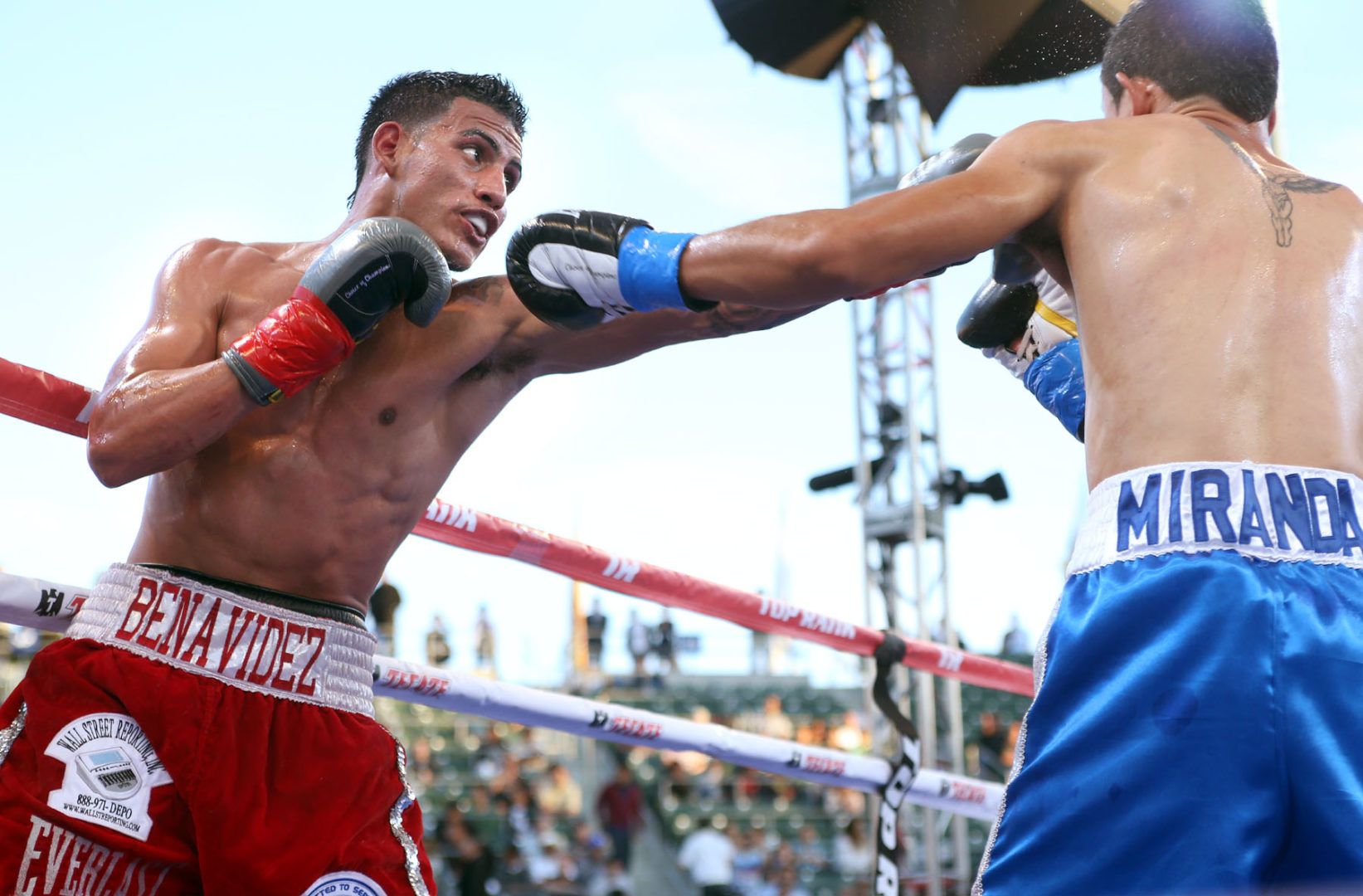
Benavidez (17-0, 13 KOs) left boxing for about 10 months after he won a unanimous decision, yet was badly rocked in an eighth and final round by Pavel Miranda at Carson, Calif., on an October card that featured Brandon Rios’ dramatic stoppage of Mike Alvarado, who in March won a rematch.

A fractured pinkie on his right hand was found after the difficult victory, according to Benavidez Sr. A pin was placed in the finger and the hand was in a cast for two months, he said. Benavidez’ reliance on a precise and powerful jab, his greatest asset, accounted for his 79-73 decision on all three scorecards in the victory over Miranda

“The hand had to heal and I just wanted my son to live a normal life for a while before he decided to come back,’’ the senior Benavidez said. “My son wanted to fight right away. Actually, it was my decision not to fight until he was ready, 100 percent healthy.

“I wanted to see where his head was at, if he still had that hunger. He does. He came to me about two weeks ago and said I’m ready to get back at it. He’s been impressive. Really, I think we’re ahead of where I thought we might be.’’

In at least his last three fights, Benavidez Jr., now 21, fought and won with injuries to his right hand and wrist. He underwent surgery in January 2012. An extra bone in the wrist was causing him pain, according to physicians. According to reports, a laser procedure removed the source of that problem. A damaged tendon also was repaired.

Benavidez, Sr., said Thursday that he has yet to speak to Top Rank about when he might resume his career. First, he said he wants to see how the right hand responds in sparring. Benavidez Sr. said he also is working as his son’s manager. Steven Feder had been the manager for the Phoenix prospect, who is the youngest to ever win a National Golden Gloves title. In early 2009, he was 16 years old when he won at 141 pounds. After he turned 17 that May, Top Rank signed him

There were signs in October that the 5-foot-11 Benavidez had trouble making 140 pounds. His father said he hoped to bring him back at 145 pounds. Then, he said, he could determine whether to continue at junior welter (140) or move up to welter (147).


An evening with The One

Saul Alvarez
SAN ANTONIO – Monday round 6:00 PM a large crowd awkwardly gathered round a stage awkwardly situated in the plaza that precedes Misión San Antonio de Valero, known today as the Alamo, and bent its collective neck in a variety of unnatural directions to catch glimpses of Mexican Saul “Canelo” Alvarez and American Floyd “Money” Mayweather, as they made what had become, with the day’s earlier cancellation of a Phoenix stop, the penultimate destination of a 10-city tour designed to announce “The One” and enrich those gathered onstage – except only One, Alvarez, was actually onstage, while One was, by his much later account, contending with a scheduling cross-up and a delayed flight and a family emergency in Houston.

The temperature was unseasonably cool, and as the media were seated beneath a famously large oak tree left of the stage, the only point of complaint at the open was the extraordinarily tall and robust speaker fewer than six feet from the press seats and given to pitiless eruptions whenever its deejay stopped spinning and welcomed his emcee to the microphone.

“My name is Tattoo Golden Boy Promotions,” the emcee announced, without inflection – too real for a comma – named, anyway, after an act Mayweather has often enjoyed.

Haranguing and Twitter-handling and hyping ensued, beseeching a crowd significantly smaller than announced, and significantly smaller still by the time it crescendoed at 7:53 PM with Mayweather’s arrival, to practice cheering the fighters’ processions along a carpeted ruby walkway. It was a curiously reflexive spectacle: townspeople gathered to be entertained by persons who will charge them to watch boxing on pay-per-view being put through rehearsals for how to act entertained, Monday. Of course, out of pomp’s context, the entire idea of a press conference with fewer than half its media-reserved seats filled, a press conference with a deejay and an emcee, for that matter, was an absurd spectacle nobody doing journalism 25 years ago would have recognized.

Mayweather’s tardy arrival afforded such observations; the hour that passed between Canelo’s terse greeting and Mayweather’s attempt at improvisation stripped the spectacle of its pomp, and therefore context, leaving a mostly bare stage, bored administrative types, a sheepish emcee, a humiliated CEO, a tired but seemingly amused television executive, and two prizefighters of Mexican origin, Alvarez then Oscar De La Hoya, who departed the event right about the time Mayweather’s flight departed Houston. It was De La Hoya, nobly enough, who had the least patience for his former rival’s antics. With no music or deejay onstage but a plethora of live mics, De La Hoya said to one of his employees at 6:39 PM: “He hasn’t even taken off yet?”

With that, a goodish number of those gathered made plans for takeoff. It was De La Hoya’s clearest moment. There is no chance he enjoys being onstage with Mayweather, not after the boorish way Mayweather comported himself on their 2007 press tour, the event that changed “Money’s” moniker and career entirely, and being stuck doing promotional work for Mayweather often leads De La Hoya to offer uncomfortable non sequiturs like: “I have to admit, I do miss the ring. That doesn’t mean I’m coming back. It means Canelo Alvarez is ‘The One’.”

The disjointedness, though, was not really even underway when De La Hoya went out the front entrance, signing autographs and looking both annoyed and apologetic. The disjointedness would come 75 minutes later when Mayweather led a diminished crowd through a few soggy bars of “Hard work! . . . Dedication!” then looked over his left shoulder at the Alamo and asked promoter Richard Schaefer, a Swiss national, to say the place they were gathered, to ensure it was pronounced correctly, before Mayweather rambled through a few lines about his wagering on the Spurs, before he rambled through the same lines again. It is not until one sees Mayweather in person, a 150-pound man with quick eyes and nervous mannerisms, so inept at ad-libbing that he fills time on the microphone telling assistants what great jobs they’re doing, that a person properly appreciates what a transformative power television wields.

Remaining media were invited backstage after a few more “Hard Work!” sing-alongs, and when television was done with its 16 minutes, print journalism got its six, and Mayweather got one serious question about a thing he said on one of Showtime’s infomercials for his May fight with Robert Guerrero – an uncannily insightful moment, when Mayweather talked about his time in jail, saying that while the incarcerated was supposed to be getting rehabilitated, all the incarcerated actually did was get angrier – a question treating the epidemic of young black men today being incarcerated for profit by America’s privatized prison system, and Mayweather’s potentially using his platform to address it. After smiling intermittently through the question, like a chess player watching a witless opponent attempt an unsophisticated trap, the man who sociology professor Michael Eric Dyson once allowed to compare himself to Muhammad Ali, Martin Luther King and Malcolm X explained he didn’t like to see anything as a “black thing” but rather saw his time in jail as evidence of things happening to a person in life, and that it was just a thing he had to get through.

It was a well-rehearsed, publicist-prepared answer for a gotcha question that was not asked – “Aren’t you setting a poor example?” – and a reminder to any parent who might mistakenly forego Charles Barkley’s 20-year-old advice and teach his children modern athletes are heroes: Barkley was both insightful and correct when he declared “I am not a role model,” and Barkley was much closer to being a role model than today’s best prizefighter.

Bart Barry can be reached at bart.barrys.email (at) gmail.com


Gennady Gennadyevich Golovkin: Good, giving and game

Gennady Golovkin
Kazakhstani middleweight titlist Gennady Gennadyevich Golovkin wears his initials and nickname on the waistband of his trunks, often in gold blocks, and inadvertently titillates at least a few ironically minded folks who know whence the term “GGG” originates: Born in the gay community and minted by syndicated columnist Dan Savage, it means “good, giving, and game” – three qualities to which any man might hope a prospective partner aspire.

With his beginner’s command of English, Golovkin almost certainly does not know this, and one hesitates to reveal it for fear of the nickname’s future censorship. It embroiders the youngishly handsome face, statuesque physique and impersonal sadism Golovkin brings in a prizefighting ring too ably to be lost – sprinkling glitter on the complicated texture of prizefighting’s most frightfully entertaining new attraction, an attraction that savagely undid Matthew Macklin in fewer than three rounds Saturday at Foxwoods Resort.

Because artful writing needs no lists, there’s little reason to take what letters form both Golovkin’s initials and a quality valued by sexual subcultures of all orientations, today, and make a bulleted termpaper of them, but here’s this: Golovkin is good in the sense that he is good for prizefighting; as a man with no appreciable promotional allegiance, he is a de facto HBO project and fights whomever the network approves, without much debate, because it gives him what exposure the opening six years of his career wanted and lends the network more credibility than its other staples do, allowing HBO to boast half prizefighting’s most interesting practitioners on cable television right now – with Argentine Lucas Matthysse, the other half, awaiting a Danny Garcia match promised him on Showtime.

Golovkin is giving: He hits with both hands in a way few prizefighters today hit with either hand. Saturday he corralled with his counter jab Macklin, a 33-fight Irishman, or at least a veteran of Irish stock and thus unknown to squeamishness, sending him rightwards, then blasted Macklin with a right cross that sent him leftwards then corralled Macklin again with a left hook that sent him reeling towards the right cross once more, all before Macklin’s unhelpful trainer told him to move away from Golovkin’s right hand, returning Macklin to the very left hand that within 4 1/2 minutes dropped “Mack the Knife” – body oozin’ life – choking, scriggling and grimacing like a man stabbed.

GGG is game as hell, too, because he doesn’t mind milling. In the final moments of his short time in a prizefighting ring with Golovkin, the discomfited moments when, blood dribbling in his left eye and hopelessness enveloping him, Macklin decided it was swing-and-let-swing time, pounding Golovkin with what little other than fear remained in his arsenal, Golovkin became more relaxed in a manner that cannot be faked.

Golovkin’s unkinked face went slacker, a breathing antonym for Paulie Malignaggi’s flicking tongue or Oscar De La Hoya’s nuts-in-my-cheek jawline, and he pursued Macklin with no malice whatever, cursorily tapping Macklin’s guard with a telegraphed right hand – “Good boy, Matthew, leave that right elbow high for Gennady” – before yanking back on his own right shoulder, snapping closed the inside of his left hip, and driving the middle knuckle of his left hand through the geometrical center of Macklin’s exposed liver. It was fleying how Macklin reacted, wincing and plunging leglessly downwards as if what strength Golovkin’s hook left his body was for surds of pain alone.

Golovkin’s reaction indicated the ending was both unexpected and unsurprising; GGG comported himself like a man who went out to fight properly, set his feet in place, defend responsibly, place his punches with leverage and accuracy, and see if the knockout comes – for once a fighter who appeared not to look for the knockout got it effortlessly. That is legerdemain, or its facial equivalent, though, as what makes Golovkin every bit appealing as Matthysse is that he verily does look for the knockout with nearly every punch. It was merely a Golovkin jab 90 seconds after the opening bell that thrust the fight directly out Macklin’s soul.

If there is a possible weakness in Golovkin’s approach to ruining other men it is the energy required a man who throws every punch with ruinous objective; that kind of design frustrated for eight or nine rounds can weary a fighter, and as fatigue makes cowards of all men, someone who was able to deflect fractionally Golovkin’s shots and make Golovkin burn calories for 24 to 27 minutes and encounter the stress of tiring, itself boxing’s most counterintuitively stressful sensation, might come on a fairly average fighter with a stationary head before him, not unlike the man James “Buster” Douglas sent on a mouthpiece-recovery expedition in Tokyo 23 years ago. Who is the man to do that? No middleweight comes to mind.

A prime Sergio Martinez at 154 pounds might have turned the trick, but today’s incarnation has little chance and every right to try. Disregard anything Martinez’s promoter said about that Saturday; he books “Maravilla’s” fights, he doesn’t make them. The wisest course for Martinez is to suggest he’ll be happy to fight in 2014 the winner of a Golovkin-Julio Cesar Chavez Jr. fight; the middleweight champion of the world is in no condition to rematch Chavez right now, much less top whatever that was Saturday – but it’s impossible the winner of GGG-Junior won’t be slightly softer for his participation. Flip in a bad training camp, with a hand injury and a bout with influenza and maybe food poisoning, and, well, one never knows.

Which is to write Sergio Martinez absolutely has earned a chance to ruminate on the matter of GGG for the rest of 2013 and a few months of 2014 before anyone declares Golovkin his better, as that declaration will almost invariably come within 36 minutes of their contesting Martinez’s title, and so, why hurry it?

Bart Barry can be reached at bart.barrys.email (at) gmail.com


Golovkin fights to keep himself in position for bigger business

Gennady Golovkin
GGG is an acronym still searching for some definition. Gennady Gennadyevich Golovkin has an unbeaten record, boxing’s best knockout ratio, Olympic silver, a good back story and a friendly, somewhat enigmatic smile that seems to say: What, me worry?

What he doesn’t have, however, is a defining fight that stands as a milestone on a career path that many believe is unlimited. An HBO-televised bout Saturday against Matthew Macklin (29-4, 20 KOs) is being sold as one that might provide a look at the substance to the advertised potential in Golovkin (26-0, 23 KOs), whose familiar initials adorn his trunks as if they are there to identify a fighter going global.

Golovkin’s passport and resume are stamped world-class. His 2004 Olympic medal for Kazakhstan, his home and family in Germany, his move into the American market, his piece of the middleweight belt and HBO’s interest in him say it many languages all with the same interpretation.

There’s nowhere Golovkin won’t go. And there’s no one he won’t fight.

Yet, the second part of that equation looked problematic about a year ago. Rival promoters and managers looked at him and saw a party crasher. They said they didn’t know who he was. They complained he was unknown to most of the customers. But, truth is, they had seen enough to know that Golovkin’s sudden arrival could alter their plans to cash in. Sergio Martinez promoter Lou DiBella, Macklin’s promoter, reacted to any mention of Golovkin’s name as if it were day-old goulash not long after Martinez’ victory over Julio Cesar Chavez, Jr., in September.

It was DiBella’s way of saying: Let him pay his dues. Martinez paid them in full and perhaps at a price that has brought him to the end of his brilliant career. He suffered injuries in his victory over Chavez and was injured again in a narrow escape in the rain against Martin Murray in Argentina.

But boxing isn’t baseball. There’s no unwritten rule that a promising talent has to spend time in the minors. The guess here is that Golovkin, a little bit like Los Angeles Dodgers rookie Yasiel Puig, has been ready for the big time for a while.

For Golovkin, the good news is that he seems to have taken an important step in perception. If not an equal to Martinez, his name is being dropped as a worthy challenger. There’s been little argument. Macklin could change that with one big punch.

In part, that danger might put pressure on Golovkin. A misstep against Macklin would be a severe setback just at the point when Golovkin’s career is poised to move onto the big stage. The guess in this corner is that Golovkin will prevail with patience and a brand of power that Macklin has yet to experience.

If styles make fights, this one fits Golovkin like a well-worn victory. Macklin brawls, almost by instinct. At some point, that habit will put him within range of power that accounts for Golovkin’s ability to a stop 88.4 percent of his opponents. It would be interesting to see how Golovkin reacts if rocked by Macklin. But don’t be surprised if that doesn’t happen. Golovkin’s knockout percentage masks boxing ability acquired during his long amateur career. He beat Andy Lee and Lucian Bute at the 2003 World Championships. He beat Andre Dirrell at the Athens Olympics. He learned the craft in a lot of places and a lot ways, all impossible to ignore. Will it lead to a showdown with a vulnerable Martinez or a Chavez Jr. trying to resurrect a battered image?

Maybe, although super-middleweight Andre Ward could enter the picture depending on what happens with promoter Dan Goossen. Ward and Goossen went through arbitration, reportedly because Ward wants out of his contract. If Ward breaks from Goossen and signs with Top Rank’s Bob Arum, Ward is one step closer to getting a fight against Chavez Jr. A victory over Chavez would enhance his marketability with Mexican fans, the key demographic in the boxing market.

There are still a lot of moves to be made. But on boxing’s chessboard, Golovkin is finally a major piece. Against Macklin, Golovkin is in a fight to remain one. That makes it a significant bout, if not a dangerous one.

AZ Notes
Floyd Mayweather Jr. and Canelo Alvarez are in Phoenix Tuesday on a 11-city tour for their Sept. 14 fight at Las Vegas’ MGM Grand in a stop that looms as a test of an Arizona market abandoned by major promoters after the 2010 immigration controversy involving SB 1070.

Golden Boy, which is staging the national tour, left the state after a long, successful series of bouts at Desert Diamond Casino south of Tucson. Despite vanishing cards, however, the state’s pay-per-view sales stayed strong, according to sources aligned to promoters and television. The turnout for Tuesday’s tour stop is another test of whether it’s time to re-enter the market.

Tuesday’s tour stop is scheduled for the Herberger Theater at 222 East Monroe Street in downtown Phoenix. Mayweather and Alvarez are scheduled to meet the fans at 11 a.m.


Broner, Malignaggi, and the pleasure of seeing each get hit in the face

Adrien_Broner_1
Saturday in Brooklyn two of prizefighting’s reliably unlikable personalities spent 36 minutes punching one another, much to the delight of those who watched them do it. Cincinnati’s Adrien “The Problem” Broner decisioned Brooklyn’s Paulie “Magic Man” Malignaggi by split scores of 117-111, 115-113 and 113-115 in a match for some welterweight title or other. All the cards were about right, depending on a judge’s preference for accurate counterpunching or jittery busyness, and if the fight was not a historic donnybrook, it was nevertheless a sight much greater than what its belligerents’ prefight antics anticipated.

The match was also the type likely to be closer on television than at ringside, where punch quality can be heard, making Broner’s significantly harder punches substantially more influential on judges – a species into whose minds Chuck Giampa once tantalizingly led us. As Malignaggi is a television fighter in numerous senses of the word now, it was also a fight close enough to make him bellow about a conspiracy, á la his antics in Texas four years ago, and convince the tiny minority of aficionados who are his partisans the entirety of prizefighting’s socioeconomic system would be stacked against a fighter from the tiny hamlet of New York City. The decision was correct, just the same; Broner fought better than Malignaggi, according to any creditable definition of the verb “to fight.”

It’s not until you settle into viewing a match contested by two persons for whom you feel no affection whatever that you understand what an appeal such spectacles hold. The only wish many aficionados had for Saturday’s main event was that it continue indefinitely; so long as Malignaggi had enough energy to sting Broner, or stall his attack long enough to embarrass him with his quicker wit and tongue, or at least prevent himself from being beheaded by a left-hook counter, the spectacle could have proceeded for another hour or two without the television audience asking for its end. The fight was entertaining in the way a fight can be when its observers care not a whit who wins or loses so long as both men get hit in the face often as possible.

Malignaggi has never been likable to a fraction so many people as have been told he’s likable to everyone but them; Paulie is a neighborhood hero with the great fortune of being from a neighborhood in NYC. Were someone with a squeaky voice, sideways cap atop ghoulishly dyed hair and career knockout ratio below 20 percent from anywhere else in the country, nay the world, he’d have been forgotten after Miguel Cotto victimized him in 2006. So few good boxers come from such a great media market, however, we’ll never be rid of Malignaggi till he is rid of gloves, which is a shame because he’s already a more enjoyable commentator than ever he was a fighter.

Cotto is a good place to look at what boxing has in Broner. Some seven years ago, when Malignaggi was 25 years-old and undefeated, Cotto dropped him in round 2, shattered his orbital bone and beat him savagely enough not one of the three official judges in Madison Square Garden was able to give a majority of rounds to the hometown fighter. And if memory serves, the infrastructure of Malignaggi’s face was too fully sabotaged for him to uncap a signature postfight speech like Saturday’s.

Broner, in other words, did not do nearly well against Malignaggi as Cotto did, and while there are plenty of reasons for this – and Broner’s leaping two weight classes mustn’t be forgotten, and should be praised – it still says something about the state of today’s game. There is more hyperbole about Broner now than there was about Cotto then, despite their having the same number of prizefights at the time of their confrontations with Malignaggi, who is decidedly not the cocksure fighter he was when he threw hands with Cotto. Broner, boxing tells itself, is the future of the sport, and with a heavyweight division that does not belong on American television, what choice does anyone have but to believe it?

Broner is very good, and this era is shaping up to be pretty poor. The divisiveness between the sport’s only relevant promoters, now each with the vacuum seal of its own network to ensure undesired realities do not interfere with licensing fees, has wrought little good. This era will pass and be recalled for its passing of the pay-per-view standard from one well-managed American cherrypicker to the next, and be forgotten quicker than even skeptics right now believe.

Malignaggi did remind future Broner opponents of something noted before: So long as you are punching Broner, he is not punching you. In the opening minute of round 4, Malignaggi proved this decisively by throwing some 15 unanswered punches at The Problem. Barely half of them landed, and only two, a right cross that followed a left hook, were meaningful, but what made Malignaggi’s punch reel interesting is how defensive it made Broner. After Malignaggi landed three or four tapping jabs on Broner’s lead shoulder, elbows and gloves, Broner prepared to throw a well-leveraged potshot counter, but then Malignaggi leaped back on his chest and threw his best combination of the night, and all Broner did was lean farther back before jackknifing forward to a position from which it was impossible to punch.

Broner’s calculus, that Malignaggi could not sustain the panicky rate of his fidgety assault for 36 minutes, was a fair one, and Malignaggi, in a workable eulogy for his career, faded constantly enough in the first 150 seconds of each round to let close ones, such as the ninth and 11th, get stolen from him in their final sixths.

Afterwards, Broner and Malignaggi showed their few supporters why the rest of us so enjoy seeing both of them get struck in the face.

Bart Barry can be reached at bart.barrys.email (at) gmail.com


Heavyweight Calm: Nothing insulting about the Banks-Mitchell rematch

Jonathon_Banks
They may find Jimmy Hoffa before America finds another great heavyweight. It’s almost redundant to call the search futile. Yet it continues Saturday, mostly because Seth Mitchell and Johnathon Banks are good guys. They respect each other, their craft and their audience.

Thank you, gentlemen, for a rematch that serves as a refuge from a main event preceded by the indulgent trash talk that Adrien Broner has spewed without shame or end in the build-up to his welterweight debut against Paulie Malignaggi at Barclays Center in Brooklyn.

The temptation is to boycott Broner. Not because he figures to win. His talent speaks for itself. It’s just all the speaking Broner promises to do after the victory. Anyway, I’ll watch him fight, but skip Showtime’s post-fight interview.

“To each his own,’’ said Mitchell, a former Michigan State linebacker who picked up some of dipolomacy’s finer points while majoring in football and criminal justice. “I’m big a fan of both of them. Adrien Broner and me have a personal relationship. I know Paul Malignaggi but not on a personal relationship level. Both of them are helluva fighters. I can’t speak on how they feel about their fight. That’s just what they do. To each his own. But I know I’m looking forward to a good fight.’’

Banks agreed when asked about rhetoric that has taken on a garbage-like tone in pre-fight proceedings for Broner-Malignaggi.

“Well, it’s almost the same thing that Mitchell said: To each his own,’’ said Banks, who inherited some of the calm-in-the storm poise from his late teacher, trainer and father-figure, Emanuel Steward. “This is their personalities, and I think no matter what, when you have two fighters, you must show their personalities. These guys’ fans, they’re talkers. It’s what they do. It’s their personalities. So, that’s what they’re doing.’’

Mitchell and Banks agree on a lot. It’s as if they understand instinctively that they’re partners in a business that dictates they fight each other. It’s not personal. It’s just punches.

Banks displayed superior instinct for those punches in a surprising second-round stoppage of Mitchell last June. It was a sign, perhaps, of what will happen again Saturday in a sequel postponed in February because Banks fractured a thumb in training. Banks grew up in boxing at Detroit’s Kronk Gym. He moves around the ring like its home. Mitchell is a newcomer. If not for a knee injury at Michigan State, he might be an NFL linebacker today.

But their respective personalities create a compelling rematch. Mitchell understands that he’s still a student. In Banks, he lost to a fighter who also learned the trainer’s trade from one of history’s all-timers in Steward. Banks, who succeeded Steward as Wladimir Klitschko’s trainer, is a teacher.

Their rematch is about how much the student learned in a loss to the teacher.

“I just have to go out there and show you what I’ve learned from that fight, what Johnathon Banks has taught me from that fight,’’ Mitchell said.

Banks, who said he has two different and distinct roles, says he won’t be working as the teacher in the rematch.
“I wear two different hats,’’ Banks said “I wear a training hat and a fighter’s hat. When it’s time for me to prepare for my fight, the training hat goes off and the fighter hat comes on. So, the two don’t connect with one another.’’

They don’t insult anyone either, which on Saturday night’s card stands as pretty good lesson for everyone.


Garcia, Lopez, Bearden and resilience

GarciaLopezBearden
DALLAS – Thirty five miles due west of American Airlines Arena, where Oxnard’s Mikey Garcia unpicked Puerto Rican Juan Manuel Lopez Saturday, there is a bold and colorful exhibition of 20th century American artist Romare Bearden’s work. It is called “A Black Odyssey.” Its collages and cut-paper works are vibrant depictions of acts that were necessarily intimate, vile and lunatic, acts captured in historic prose by Homer. That such acts led to such words led to such visual art is a testament of sorts to the species’ resilience.

Our startling recuperative powers felt like a theme last weekend. To see Garcia on Friday and the discomfort the sight of him caused others, specifically his octogenarian promoter Bob Arum, a man who, for all his reassuring words publicly uttered during and after Garcia jeopardized his fight with Lopez, did not even look at Garcia when he returned from an hour of admitting there was no way to lose what two pounds stretched between his desiccated body and the featherweight limit, to see Garcia’s wretched demeanor, a combination of shame and shame weakened, like the rest of him, by hunger, was to wonder how such a man would summon reserves enough to rise from bed the next day – much less make violence with a former world champion in the evening.

Yet there was Garcia 33 hours later, a transformed man, or at least a returned one, a person reassured enough to stand directly in front of another world class fighter and do everything with a confidence that is Garcia’s most noticeable quality at ringside. Order was restored by a man who feels orderly, a man who absorbs others’ teachings and heeds others’ carefully worded observations and places his right cross elegantly.

There is an ecosystem in boxing, fragile as it is small, one that relies on a premium network providing meaningful programming to its audience, in the form of championship fights, one that relies on fighters arranging their calendars such that on the day or three of every year they perform they are at or very near their top physical capabilities, or else willing to be victimized by men who are, and all that was imperiled by Garcia’s weighing 128 pounds Friday afternoon.

When Arum shuffled to the podium and declared the title fight cancelled and then departed nearly alone while his matchmakers and publicists continued to speak to HBO programmers and others, it was a reminder, too, of how little about the prizefighting industry we know or get told. This was not lost on the media; few of what could be called reporters remained after the initial weights were read and Mikey Garcia strode on the sunbleached walkway outside American Airlines Arena.

The Romare Bearden exhibition in Fort Worth is the sort of pleasant surprise in which the Amon Carter Museum of American Art specializes. Southernmost destination in a triangular mall that features better known collections at The Modern and The Kimbell, Amon Carter, for being committed to American art alone, finds itself liberated to make original exhibitions – like bright construction-paper collages of black figures reenacting Odysseus’ homewards journey – its larger neighbors might not. If there are parts of the Bearden exhibition that remain partially inexplicable, Bearden’s talent for shape and color and narrative remains uncompromised. And when such expressive colors as Bearden’s are juxtaposed with Homer’s uniquely pitiless descriptions, blood brought by steel and leaked always in a wine-dark sea, one is startled such art came of such depredations, that our species recuperated enough to make visually pleasing depictions of something described in “The Iliad” thusly:

The famous spearman struck behind his skull,
just at the neck-cord the razor spear slicing
straight up through the jaws, cutting away the tongue –
he sank in the dust, teeth clenching the cold bronze.

The Bearden exhibition was a fair way to prepare oneself for what he expected to happen later to Juan Manuel Lopez and did happen to him. Juanma, once the future of promoter Top Rank’s stable and celebrated as Mikey Garcia is celebrated now – though with a larger and more reliably rabid following, especially when endorsed continually and publicly by Felix Trinidad, as Juanma was and fellow Puerto Rican Miguel Cotto was not – was there to be felled and sacrificed in the erection of a new flawless promotional creation, though ultimately not free of flaws as hoped or promised.

Juanma Lopez, once accurately described by an insider as “a world-class dissipater,” nevertheless made the contracted weights for his fights, whatever had to be done – which is not to accuse of lollygagging Garcia, a man who complained of his eyes being too poorly lubricated Friday to blink without discomfort.

In black bugeye shades and a pumpkin skull cap and saddle jacket, there was Juanma at ringside Saturday, two hours before the opening bell would ring on the last meaningful match of a career that would be excellent by most other standards – there to escort his wife to her ringside seat and sit beside her through preliminary bouts. It is an interesting thing these Puerto Rican fighters do, for Cotto does it as well: Wander through an arena’s worth of people hours before a gladiatorial spectacle that anticipates their consciousness sacrificed, or another’s, or worse.

It is a reminder they are sportsmen, craftsman at something that is beastly, more than warriors. Their perspective is a healthier one than the Mexicans with whom they form our sport’s best rivalry.

Bart Barry can be reached at bart.barrys.email (at) gmail.com


Weights from Dallas

Oscar Valdez 127.5 – Gil Garcia 128
Vanes Martirosyan 154.75 – Ryan Davis 157.5


Adrien Broner brushes past the obvious

Adrien_Broner_1
Adrien Broner has used his favorite theatrical prop to comb his hair and stroke his ego, but has yet employed it to brush up on his manners and consistency.

In a wild conference call that included an interruption from Paulie Malignaggi, Broner was asked about fighting Floyd Mayweather Jr. Who doesn’t get that question these days? With the kind of money Mayweather generates, I’m surprised somebody didn’t pick a winner in the Los Angeles Dodgers-Arizona Diamondbacks brawl Tuesday night and then asked whether Mayweather was next. I’m picking Yasiel Puig. But we digress.

Broner channeled his best Greg Poppovich, the San Antonio Spurs taciturn coach, and said:

“Next question.’’

Next what?

“Next question.’’

Okay.

Trouble is, Broner then referred to Mayweather during the rest of a Q-and-A session that didn’t include Malignaggi’s heated promise to beat the bleep out of him on June 22 at Barclays Centre in Brooklyn.

After looking out over the boxing landscape, Broner says he sees only Mayweather and himself. Malignaggi, of course, is next. But Broner made it sound as if Malignaggi will be about as challenging as Al Bernstein or Larry Merchant might be.

“He’s a good talker,’’ Broner said. “He’s got some great talent. He’s a great commentator.’’

The dismissive suggestion is that Broner will force Malignaggi into retirement and into a fulltime gig alongside Showtime’s Bernstein at ringside, where he is proving to be an insightful analyst. To his credit, Malignaggi has other ideas. If you don’t believe him, then remember this: In 2012, he traveled to The Ukraine to fight an unbeaten somebody named Vyacheslav Senchenko. It wasn’t who. It was where. Everybody assumed that a loss was packed into Malignaggi’s luggage. But he won a ninth-round TKO in Senchenko’s home country. To wit: Malignaggi can surprise you.

It’s impossible to know whether Broner will take that important caveat into the ring. At 23, he’s young. His abundant talent has allowed to him roll along untested. He is, after all, called the next Mayweather.

A sure sign of his plans, however, rests in the weight. Broner is jumping a division — from lightweight (135 pounds) past junior-welterweight (140) and straight to welter (147). It’s no coincidence that welter is Mayweather’s weight and probably will be throughout the rest of his 30-month Showtime contract, which could be worth $250 million dollars if he fights four more times after facing Canelo Alvarez on Sept. 14.

It’s also no coincidence that Broner said during the conference call that he “will rule’’ boxing in about a year. If Broner beats Malignaggi and Mayweather fulfills expectations with a victory over Alvarez, you won’t need a scale to see the possibilities. Mayweather-Broner is there.

Golden Boy Promotions CEO Richard Schaefer suggested Saturday after Marcos Maidana’s dramatic stoppage of Josesito Lopez in a welterweight bout at Carson, Calif., that Maidana’s next fight might be against the Malignaggi-Broner winner.

“I didn’t see it,’’ said Broner, who – we’re guessing — was too busy brushing his hair to watch last Saturday’s Showtime telecast. “I heard he got a victory. Maidana is Maidana.’’

Yeah, and Money is money. Mayweather has the nickname and most of the currency. He is the fighter Broner has to face if he really hopes to transform that silly brush into boxing’s ruling crown

Next question.

Canelo-Mayweather stop a step in AZ re-emergence?

The Phoenix addition to a list of 11 cities on the promotional tour for the Mayweather-Alvarez fight on Sept. 14 is confirmation of what everybody within the boxing industry has always known. Phoenix and Arizona have always been an important boxing market, yet the city and state suffered because of the immigration controversy surrounding SB 1070.

Golden Boy Promotions staged many of its early cards in southern Arizona, but withdrew from the state when Mexican fighters were ordered to have work visas instead of tourist visas. That rule was changed a couple of years ago. Mexican boxers can again fight in the state with a tourist visa, which are easier and less expensive to acquire.

But then the controversy over SB 1070 erupted, forcing the cancellation in 2010 of at least one card in Phoenix that would have featured Top Rank prospect Jose Benavidez Jr. At the time, Mexican advertisers did not want their names attached to a card in the state.

Through it all, Phoenix and the rest of Arizona continued to generate big pay-per-view numbers for HBO and Showtime, especially on cards involving Mexican and Mexican-American fighters. Phoenix has been a top 10 market for about as long as there has been pay-per-view, according to promoters and various network officials.


In Heavy Training for his Upcoming Fight, Don ‘Da Bomb’ George Takes Time out to Congratulate His Friend, Adonis Stevenson

Chicago-based middleweight contender Donovan “Da Bomb” George wishes to congratulate his friend and former opponent Adonis Stevenson for his WBC Light Heavyweight title-winning KO1 over Chad Dawson last Saturday.

George and Stevenson became friends while sparring at Detroit’s Kronk Gym, after the two met in a fight in October 2012 (won by Stevenson after 12 tough rounds).

“I’m very happy for Adonis,” said George (24-3-2, 21 KOs), who is currently in heavy preparations for his upcoming ESPN Friday Night Fights-televised 10-round co-main event against Caleb Truax on Friday, June 21 in Minneapolis, Minnesota.

After absorbing Stevenson’s best shots, George says he wasn’t surprised by Dawson’s spectacular exit just 1:16 in the first round at the Bell Center in Montreal.

“He hits like a heavyweight. I was hurt for a month after our 12-round war. There aren’t many fighters who can take his punches and stay upright.”

George’s promoter, Leon Margules of Warriors Boxing, says the Dawson fight not only made a statement about Stevenson and his abilities, but about Donovan George as well.

“This is only going to be his third fight at the weight class, but Donovan is a natural middleweight, always has been” said Margules, “and he took Stevenson’s power for 12 tough rounds and kept coming. Stevenson just crushed one of the world’s best 175-lb fighters with that power. So what does that say about the toughness of Don George? Here’s a middleweight who went to war and took everything a beast like Stevenson could throw and barely blinked. It says a lot about what Donovan brings to the table, especially now that he’s at middleweight and fighting much smaller guys. Not only is his punching power incredible for a middleweight, his chin is as well.”

George says that with every fight, he’s growing more and more comfortable shedding the extra eight pounds to make middleweight and is ready for anyone in the division, including Julio Cesar Chavez Jr.

“I’m unstoppable at this weight. Chavez Jr., let’s do this any time. Even at a catchweight if you want. Bring it on. If I can go 12 rounds with the light heavyweight champion of the world, one of the hardest punchers in boxing, I’m going to walk right through any middleweight.”

For his next fight, George says he will try and walk in his friend and now-world champion’s footsteps. “Just like Adonis did, I’m going to make a major statement on the 21st. I will be going for the spectacular knockout.”

###

George vs. Truax will be held on Friday, June 21, at the Minneapolis Convention Center and televised live on ESPN Friday Night Fights. It will be presented by Seconds Out Promotions and Warriors Boxing.

Tickets to Friday Night Fights at the Convention Center start at $35 and can be purchased through www.sofights.com.

In addition to George vs. Truax, seven more fights are scheduled in support of the 12-round main event featuring Cuba’s IBF #2-rated Rances “Kid Blast” Barthelemy (18-0, 11 KO) taking on Thailand’s IBF #5-rated Fahsai “Mountain Boy” Sakkreerin (39-3-1, 21 KO).

An eight-round crosstown battle will highlight the night’s undercard, as St Paul’s Jeremy “Lights Out” McLaurin (10-5, 5 KOs) will face St Paul’s Tony “2Sharp” Lee (7-1, 3 KOs) for the vacant Minnesota State Lightweight Championship.

Local bragging rights will be on the line for these two local scrappers, so expect fireworks. McLaurin has been in with the better opposition in his career, while Lee has fewer losses.

Also scheduled is an eight-round junior middleweight scrap between “Sir” Charles Meier (7-2, 3 KOs) of Coon Rapids, MN and Tyler Hultin (5-1-2, 3 KOs) of Fergus Falls, MN and a four-round junior middleweight contest between Gavin Quinn (1-0) of Circle Pines, MN and Kenneth Glenn (2-0, 1 KOs) of Minneapolis.

Several fighters will make their professional boxing debuts that night, including a four-round junior middleweight match-up of pro debuters between LeWayne Hardiman of Las Vegas and Dustin Petron of Rosemount, MN; a four-round heavyweight bout featuring the pro debut of Pat Quinn from St Paul, MN against John Schimon (0-1) of Minneapolis; and a four-round lightweight tilt between Milwaukee’s pro debuting Adrian Martinez and Kurtis Erhorn (0-1) of Grand Rapids, MN.


At The Crossroads: Lopez, Maidana fight for relevancy

Josesito_Lopez
Josesito Lopez has a nickname that is a mixed blessing. He’s called the Riverside Rocky because he came from nowhere. If the nickname sticks, however, so does the nowhere.

Lopez’ fight to knock out a future full of forgettable sequels as the designated opponent in somebody else’s tune-up starts Saturday in a Showtime-televised bout from Carson, Calif., against Marcos Maidana, who doesn’t have the nickname, yet is confronted by the same challenge.

It’s what makes their welterweight bout intriguing. Both are at the crossroads. A variety of things creates a Fight of the Year possibility. But a reliable place to start is at that familiar intersection. Lose, and you’re irrelevant. Win, and you still matter. Options are clear. Stakes are high.

“It’s a very important fight,’’ said Maidana (33-3, 30 KOs) who trained at Robert Garcia’s gym in Oxnard Calif., instead of at home in Argentina for a fight in an outdoor ring at StubHub Center, the former Home Depot Center. “It’s one of the most important fights of my career. Yes, I’ve fought some big names in the past. But this is what’s in front of me. This is the next fight and I have to get past this to be considered for bigger fights and to keep moving up the ladder.’’

Bigger fights at Maidana’s weight lead to a single biggie. Follow the money. Floyd Mayweather, Jr., is at the top of that ladder. For now, Mayweather is busy with a Sept. 14 bout against Canelo Alvarez. If Mayweather does the expected and beats Canelo, he still has four possible bouts on his Showtime contract, worth a potential $250 million. The Maidana-Lopez winner presumably stays in the pool of potential candidates for a shot at career-making payday. It’s no coincidence that Maidana mentioned Mayweather during a conference call.

“Yes, I did say Mayweather,’’ Maidana said through an interpreter.

Lopez didn’t. Then again, he didn’t really have to. The possibility almost goes without saying for any welterweight trying to stay relevant in boxing richest sweepstakes.

“I think we’re two of the toughest fighters at 147 so definitely a victory here would put us near the top, and get us in line to fight some of the best in the world,’’ said Lopez (30-5, 18 KOs), a former junior-welterweight (140). “So, who wins is very important.’’

The fight to stay in line for a chance at Mayweather is the biggest thing that ties Lopez and Madiana together. But not the only thing. Lopez is 28; Maidana is 29. A couple of days separate their birthdays. Maidana was born on July 17 and Lopez on July 19. If a rematch becomes necessary, maybe they could do it on July 18 in 2014.

Each also arrived like Sylvester Stallone’s character in Rocky against the same opponent: Victor Ortiz. Ortiz was supposed to beat then unknown Maidana in June 2009. But Ortiz lost for the first time in a stunner. In what was then supposed to be an Ortiz tune-up for a Canelo showdown last year, Ortiz faced an equally-unknown Lopez. But Ortiz lost a ninth-round stoppage and was left with a fractured jaw that has left questions about whether he’ll ever fight again.

Maidana has gone 7-2 since Ortiz, losing a dramatic decision to Amir Khan in the 2010 Fight of the Year and another decision to Devon Alexander. Lopez is 0-1 after a bout in which he played the role of an opponent in a loss at 154 pounds to Canelo, who scored three knockdowns in winning a fifth-round TKO over the former 140-pounder at Las Vegas’ MGM Grand.

“He had no business in that division,’’ said Maidana, whose feared punching power looms as a critical advantage over Lopez.

He didn’t. Still, Lopez profited in the mismatch with his biggest paycheck, $212,500, according to contracts filed with the Nevada State Athletic Commission. Now, Lopez hopes the experience at a heavier weight against the heavy-handed Canelo will pay off with a victory that could generate bigger fights and further dividends.

“I wouldn’t say the move to 154 was a great decision, but I have no regrets on taking that fight,’’ Lopez said. “I fought one of the best fighters out there. I lost, but it helped me. I think that moving up to154 probably helped me. Now, I feel a little bit better and feel more comfortable at 147.

“I’ve been molded in to 147.”

Molded and perhaps ready to move on.


Her vengeance unassured

She sets her left foot slightly in front of her right and tries to keep them a shoulders’ width apart, whatever that means, and counts her punches as they leave her shoulder instead of listening for them like her brother does. They don’t sound much but remind her others might be listening, listening and watching.

“How many rounds you got left on the bag?” a guy in a yellow Under Armour shirt asks, and he looks away as she answers.

“Two?” she says, and he walks away. “Coach said I could –”

“Whatever, it’s cool,” he says. “That’s the lucky bag. There are others. As you were.”

Impersonal questions feel like achievements and feel good to answer as nobody. Hers is a morbid futility, more than her other morbidity, because nothing about her new regimen is hopeful to anyone but her, or perhaps not her either, and certainly to no one who does not know what fuel she finds in betrayal, timeless betrayal, and the timelessness of betrayal’s catalyzing force.

It was fuel enough to fuel her intake of fuel till she weighed quite nearly 400 pounds or maybe more had there been a scale available to mark her, but there wasn’t, so her brother, moved back to mom’s by a disgruntled ex, used their mechanical scale and marked how far beneath the dial’s last score, 290 in bold black, she spun the red metal needle, and it was probably 103 but as he knew his sister was unable to see beneath herself, and as he wanted her to find momentum during the first month when anything done with her body might shrink it, he told her it was 110, which weighed her a symmetrical 400 pounds. It invested her first week with the hope of a 10-pound loss, one miraculous enough to return anyone for a month to the lunglike haze of the city gym where an amateur program thrives even as the city’s retired champion gets the kids when they turn pro.

She knows the guys at the gym who didn’t know her family thought her younger brother, born in 1996 and only three years her junior, was actually her son, so different were their appearances, so ageing was the flesh that made the distinguishing contours of her brown face float between her forehead and chin like the yolk of a fried egg, she was too aware, but she appreciated their treating her like nobody after the first shocked glances and customary leers. No cruelty, despite their cruel ages. That was a gentle surprise till her brother explained the code of truthtelling required once a person slipped beneath the delimiting bungee cord that separated the gym’s spectators from boxers: “Be honest, if you’re going to fight anyway.”

A year of eating after the guy nobody believed was interested in her was interested in her for a week, long enough to get it, and then uninterested as everyone imagined him, what few people knew they were together at all – and those few included her mother, who surely knew the tally when he came to retrieve her daughter for their date but didn’t caution her daughter because she wanted experience and that had to begin with an experience.

Now her mother wonders at the silence she showed the events of that week, and the 51 that followed as she sat on their sofa and said only cursorily encouraging things, as she sits in the spectator area and sees her daughter’s want of coordination and oxygen, exerting on the heavybag in an awful impression of the gym’s better athletes, brokenwrist slaps beneath an uneven face of coffee grounds sprinkled on sandpaper and splotched now with a fire-engine red, angry as her new gloves, ones her mother bought at the secondhand store as a reward for her daughter’s initiative in losing a miraculous 11 pounds that first week in the gym when her daughter wore the same black sweatpants and black cotton shirt from Wal-Mart, where they stocked XXXXL in the men’s section, five days in a row, walking each night to the laundry room of the small Southtown apartment complex with a roll of quarters her mother bought on her lunchbreak that Monday to ensure no foreseeable obstacle lay on her daughter’s path.

She swats the bag with hapless hooks, knocking on a door hung sideways, and fixates on her hunger, on the enormously empty sensation and impossibility of what one reward could reliably compensate for the acid now in her shoulders and wrists, and the cramps on the bottoms of her feet caused by tennis sneakers, from a smaller time and biting mad about it. She tries to count her breaths like she heard an old guy say to one of the pros, something about getting him with a hook on the inhale, whatever that could mean.

Her brother helps pull the stiff gloves off her small hands, and she replaces them, squeaking, in their black mesh packaging then unwinds her stretchy pink wraps and drops them in a small gearbag from her brother. She turns three quarters of the way from the bench and sidles to her mother, her ride, in the spectator area, careful not to face the enormous shadowboxing mirror opposite the bench where her brother put the gearbag. Her mother shows stoicism instead of bubbly encouragement, as her son exhorted, but still quietly tells her daughter at this rate she can’t imagine where she’ll be in a month, and the thought stops there because neither is sure she’ll return tomorrow.

Bart Barry can be reached at bart.barrys.email (at) gmail.com


GETHIN ON THE BRINK OF A WORLD TITLE SHOT

GETHIN ON THE BRINK OF A WORLD TITLE SHOT

Gethin v Diaz in an IBF World title eliminator tonight at 8pm

Martin Gethin
Walsall hardman Martin Gethin faces what is unquestionably the biggest fight of his career tonight from 8pm LIVE on BoxNation as he faces Panama City’s former World title challenger Ammeth Diaz in an IBF World Lightweight title eliminator. The winner gets a chance at IBF top dog Miguel Vazquez, and Gethin will have the backing of a passionate home crowd in Walsall Town Hall.

There’s a tasty domestic bout on the undercard as cruiserweight rivals Neil Dawson and Chris Keane face off for the Vacant WBO International Cruiserweight title.

And if you tune in at 6.30pm, you can catch a repeat of our pre-fight documentary BoxNation Meets Martin Gethin as we go behind the scenes once again!

BEHIND ENEMY LINES JUST GETS BIGGER AND BETTER!

Chisora v Scott, O’Sullivan v Saunders, Frampton and Butler to star on July 20th show

Headlined by the enigmatic Dereck Chisora, who faces undefeated American Malik Scott, this bumper Wembley Arena show will also feature Irish sensation Carl Frampton making his BoxNation debut and a genuine 50/50 fight between two unbeaten champions, Ireland’s Gary O’Sullivan and Hatfield hotshot Billy Joe Saunders.

And a jam-packed undercard features some of Britain’s brightest up and comers, including British and Commonwealth Super-Flyweight champion Paul Butler, Frank Buglioni, Tom Baker v John Dignum, Mitchell Smith and many, many more!

It’s your channel. Be a part of it. Are you in?


Risk-to-Reward: Mayweather has Canelo in his calculations

Floyd_Mayweather
Floyd Mayweather Jr.’s brilliant career and shrewd mastery of the risk-to-reward ratio are no coincidence. Mayweather has put himself into history’s pound-for-pound debate and at the top of a pay scale dominated by playmakers, quarterbacks and pitchers because he knows who to fight. And when.

Canelo Alvarez on September 14 at Las Vegas’ MGM Grand is mostly a money move, motivated by disappointing pay-per-view numbers for his one-sided decision over Robert Guerrero on May 4. Reports from various media put the PPV buy rate at 875,000, despite a Showtime prediction that it would exceed one million.

If accurate, that means Showtime sustained a $12 million loss, according to Forbes. Mayweather got his $32.5 million, but probably not much more than that for his first Showtime fight in a contract worth a possible $250 million.

After just one fight in a 30-month deal for as many as six bouts, Showtime and Mayweather are partners, joined at the wallet. Showtime, a CBS subsidiary, wants to recoup losses, probably as fast as possible. And Mayweather, closer to retirement than his prime, wants to max out his income potential.

Canelo serves both masters, especially on a date that coincides with Mexico’s celebration of its independence. Canelo might not be Mexico’s best fighter. That honor still belongs to Juan Manuel Marquez. But the 38,000 fans Canelo drew to San Antonio’s Alamodome in April for his victory over Austin Trout make him the biggest draw among Mexican and Mexican-American fans, the demographic that sustains the boxing business. Canelo sells.

But September 14, announced by Mayweather on Twitter Wednesday night, isn’t only about money. If dollars were the sole motivation, we already would have seen Mayweather-versus-Manny Pacquiao. We haven’t, for reasons repeated into mind-numbing redundancy. No reason to repeat them here. Fifty-million dollars were said to be the potential payday for each during those futile talks. Fifty-million is said to be Mayweather’s potential for Canelo, whose share has yet to be reported.

Why Canelo and not Pacquiao? In calculating risk-to-reward, the guess is that Mayweather has detected flaws that make Canelo easier to beat now than Pacquiao was a couple of years ago.

Much has been made of Canelo’s maturing skillset in his unanimous decision over the left-handed Trout. However, the scorecards – 118-109, 116-111 and 115-112 – might have papered over Canelo’s weaknesses with too wide a margin.

Yes, he displayed newfound head movement. Yet, he often lunged awkwardly in attempting to land against the quick Trout, who is slick, yet possesses none of Mayweather’s calculated precision. Lunge against Mayweather, and Canelo is bound to feel the right hand that landed at will against Guerrero.

Then, there’s the foot speed. Canelo often appears flat-footed, which is what Mayweather said of Guerrero before a bout that is beginning to look like a tune-up. Mayweather has none of the foot speed he had a decade ago, but he still has a lot more than anything displayed by Canelo.

Also, there are signs of fatigue. Against Trout, Canelo appeared to tire late in the sixth round and throughout the seventh. The 36-year-old Mayweather is still able to conserve energy with carefully-orchestrated tactics. That could prove problematic for Canelo, especially late in a 12 round bout.

A lot has been made about a catch-weight, 152 pounds. It might only be cosmetic. But if there’s an effect, it’s only to Canelo, a junior-middleweight (154) who will have to work a little harder to make the mandatory for Mayweather, a natural welterweight.

At opening bell, there’s talk that Canelo could be 170, or 15 to 20 pounds heavier than Mayweather. Maybe, although Mayweather looked to be at least 160 in September 2009 when he easily beat Marquez, who collected an additional $600,000 when Mayweather was two pounds heavier than the contract’s catch-weight, 144. We’ll never know how heavy Mayweather was that night. He refused to step on the scale for HBO not long before entering the ring. But it’s safe to assume Mayweather will be heavy enough on the night of September 14.

The risk appears to be Canelo’s power. The heavy-handed red-head is dangerous, especially with effective combinations. A danger-sign for Mayweather was in the facial bruises suffered when he beat Miguel Cotto in May, 2012 at 154 pounds.

A key might be Canelo’s age. He’ll turn 23 on July 18. Youth, perhaps, will lead him into harm’s way with awkward lunges into Mayweather’s right hand with bursts of energy that will leave him fatigued. But the victory over Trout included evidence that Canelo is on a learning path toward his prime. How fast? Hard to say. But a maturing Canelo means a more dangerous one. Mayweather’s decision might be as simple as the calendar: Fight Canelo now before he gets better and Mayweather only gets older.

A loss to Mayweather in September would hurt, but hardly devastate the young Mexican. A loss is a good lesson and even a yardstick for true greatness in boxing, which more than any sport is about overcoming adversity attached to defeat. Would Muhammad Ali be the legend he is today if he had not come back from a loss to Joe Frazier? Defeat appears to be a chapter Mayweather plans to avoid.

Then again, there’s always the possibility of a rematch, or another opportunity for him, Canelo and Showtime to ride the revenue steam. But that’s another story for another day, perhaps waiting to be told on September 14.


Risk-to-Reward: Mayweather has Canelo in his calculations

Floyd Mayweather Jr.’s brilliant career and shrewd mastery of the risk-to-reward ratio are no coincidence. Mayweather has put himself into history’s pound-for-pound debate and at the top of a pay scale dominated by playmakers, quarterbacks and pitchers because he knows who to fight. And when.

Canelo Alvarez on September 14 at Las Vegas’ MGM Grand is mostly a money move, motivated by disappointing pay-per-view numbers for his one-sided decision over Robert Guerrero on May 4. Reports from various media put the PPV buy rate at 875,000, despite a Showtime prediction that it would exceed one million.

If accurate, that means Showtime sustained a $12 million loss, according to Forbes. Mayweather got his $32.5 million, but probably not much more than that for his first Showtime fight in a contract worth a possible $250 million.

After just one fight in a 30-month deal for as many as six bouts, Showtime and Mayweather are partners, joined at the wallet. Showtime, a CBS subsidiary, wants to recoup losses, probably as fast as possible. And Mayweather, closer to retirement than his prime, wants to max out his income potential.

Canelo serves both masters, especially on a date that coincides with Mexico’s celebration of its independence. Canelo might not be Mexico’s best fighter. That honor still belongs to Juan Manuel Marquez. But the 38,000 fans Canelo drew to San Antonio’s Alamodome in April for his victory over Austin Trout make him the biggest draw among Mexican and Mexican-American fans, the demographic that sustains the boxing business. Canelo sells.

But September 14, announced by Mayweather on Twitter Wednesday night, isn’t only about money. If dollars were the sole motivation, we already would have seen Mayweather-versus-Manny Pacquiao. We haven’t, for reasons repeated into mind-numbing redundancy. No reason to repeat them here. Fifty-million dollars were said to be the potential payday for each during those futile talks. Fifty-million is said to be Mayweather’s potential for Canelo, whose share has yet to be reported.

Why Canelo and not Pacquiao? In calculating risk-to-reward, the guess is that Mayweather has detected flaws that make Canelo easier to beat now than Pacquiao was a couple of years ago.

Much has been made of Canelo’s maturing skillset in his unanimous decision over the left-handed Trout. However, the scorecards – 118-109, 116-111 and 115-112 – might have papered over Canelo’s weaknesses with too wide a margin.

Yes, he displayed newfound head movement. Yet, he often lunged awkwardly in attempting to land against the quick Trout, who is slick, yet possesses none of Mayweather’s calculated precision. Lunge against Mayweather, and Canelo is bound to feel the right hand that landed at will against Guerrero.

Then, there’s the foot speed. Canelo often appears flat-footed, which is what Mayweather said of Guerrero before a bout that is beginning to look like a tune-up. Mayweather has none of the foot speed he had a decade ago, but he still has a lot more than anything displayed by Canelo.

Also, there are signs of fatigue. Against Trout, Canelo appeared to tire late in the sixth round and throughout the seventh. The 36-year-old Mayweather is still able to conserve energy with carefully-orchestrated tactics. That could prove problematic for Canelo, especially late in a 12 round bout.

A lot has been made about a catch-weight, 152 pounds. It might only be cosmetic. But if there’s an effect, it’s only to Canelo, a junior-middleweight (154) who will have to work a little harder to make the mandatory for Mayweather, a natural welterweight.

At opening bell, there’s talk that Canelo could be 170, or 15 to 20 pounds heavier than Mayweather. Maybe, although Mayweather looked to be at least 160 in September 2009 when he easily beat Marquez, who collected an additional $600,000 when Mayweather was two pounds heavier than the contract’s catch-weight, 144. We’ll never know how heavy Mayweather was that night. He refused to step on the scale for HBO not long before entering the ring. But it’s safe to assume Mayweather will be heavy enough on the night of September 14.

The risk appears to be Canelo’s power. The heavy-handed red-head is dangerous, especially with effective combinations. A danger-sign for Mayweather was in the facial bruises suffered when he beat Miguel Cotto in May, 2012 at 154 pounds.

A key might be Canelo’s age. He’ll turn 23 on July 18. Youth, perhaps, will lead him into harm’s way with awkward lunges into Mayweather’s right hand with bursts of energy that will leave him fatigued. But the victory over Trout included evidence that Canelo is on a learning path toward his prime. How fast? Hard to say. But a maturing Canelo means a more dangerous one. Mayweather’s decision might be as simple as the calendar: Fight Canelo now before he gets better and Mayweather only gets older.

A loss to Mayweather in September would hurt, but hardly devastate the young Mexican. A loss is a good lesson and even a yardstick for true greatness in boxing, which more than any sport is about overcoming adversity attached to defeat. Would Muhammad Ali be the legend he is today if he had not come back from a loss to Joe Frazier? Defeat appears to be a chapter Mayweather plans to avoid.

Then again, there’s always the possibility of a rematch, or another opportunity for him, Canelo and Showtime to ride the revenue steam. But that’s another story for another day, perhaps waiting to be told on September 14.


Froch and Kessler, gentlemen and consensus

Kessler Froch Weigh in
In round 6 of their super middleweight match, Saturday, Englishman Carl “The Cobra” Froch and Dane Mikkel “Viking Warrior” Kessler briefly got separated by the ref after a Kessler blow struck well beneath Froch’s cranberry-satin belt line. Froch shook it out, dangling his right foot off the mat till he was rearranged enough to resume, and then the two men came together and Kessler belly-piped Froch with a 2-3 combo that was Kessler’s best of their match’s first half.

Froch, practiced as any prizefighter at showing an opponent no spiritual weakness while showing sundry technical weaknesses in a uniquely shameless way, tucked his hearth-bottom chin, took the blows, and fought back without spite or regard for personal safety – the way a gentleman is expected to do. London’s aficionados applauded raucously, the scrap continued apace, and Froch had his satisfaction, prevailing in a rematch with Kessler by unanimous decision.

There is something absurd about Carl Froch’s self-belief, and the absurder element of it is its contagiousness, an infectious impulse so potent others catch it and assign Froch many times more effectiveness than his attacks merit, a reflexive thing that confirms itself while denying reason. The affliction of Froch’s self-belief does not noy cautious and naturally suspicious technicians like Andre Ward, a man likely to believe the most potent thing about any opponent for 10 minutes, but someone like Mikkel Kessler, a man with little cause for caution who nevertheless finds his attack bilked, time and again, by the force of Froch’s absurd self-belief and its awkward manifestation – so awkward an attentive spectator must sometimes ask: Where does The Cobra practice such moves?

It’s a proper question because you cannot toss yourself at the handpads the way Froch tosses himself at an opponent, and no one would shadowbox with such raveled feet or twisted torso, and you cannot make a heavybag elusive as Froch can make an opponent; it is as if, in camp, Froch begins swimming at a line of double-end bags, punching, missing, bracing, absorbing, eluding, biting, countering, pivoting, blocking, tasting, and pirouetting, before he arrives at the rusted pipe of their frame, touches it with a spin, then swims home, getting as well as he gives, and ending each lap with an avouching nod. Pity poor Mikkel Kessler, then, for showing any vulnerability to a man capable of such random violence and indefatigable self-belief.

Their second fight, though, was very much closer than one official judge and one unofficial judge had it. Rounds 3, 4 and 5 could probably have gone either way, with two of them perhaps belonging to Kessler. Rounds 9 and 10 were good, even affairs. When five rounds of 12 were that close, there is no reason for one man to win a fight 118-110, unless a judge is scoring crowd noise, and if she is doing that, how much better is she than a decibel meter?

Lost in the cacophony about Froch’s chin was a point open to be made about Kessler’s: He caught the entirety of the fight’s unpredictable punches and the final counter in every exchange, an absurdly confident Froch punctuation mark at the end of every paragraph, and yet Kessler did not buckle as he did in their first match. He got shuffled round the ring, and his head got jammed backwards more than advisable, but he was never in danger of being stopped, and if anyone wintled from a punch, it was Froch in round 11, when the Cobra sprang into a rightcross counter and staggered ropesward immediately after.

Froch-Kessler II was a gentleman’s fight in gentlemanliness’ birthplace, an agreement between two chums to make a hellacious scrap, dirty as it need be, entertain those gathered, and embrace at the close. There was a tender moment when, after hugging the man he verily believed he’d beaten, and while still buzzing from what blows the man sloshed his brain with, Froch held Kessler’s handsome pink face between his black gloves and asked several times if his friend were all right. It was a thing Europeans have to show us how to do; our best Americans take themselves too seriously, and therefore every punch too personally, to fight so hard or show such affection immediately afterwards; and Latin America’s finest, usually Mexicans, keep score of grievances too proficiently and with much too much granularity, in their fetish for vengeance, to hope for a foe’s health while their own remains compromised.

The world does not await a rematch between Andre Ward and Carl Froch, a rematch the victor seems to want more than the vanquished; Froch alluded to Ward’s spoiler style and how incapable it often proves of uplifting observers’ spirits, Ward replied no fighter ever prefers a style than solves his own, and both men were correct. After ignoring the super middleweight division and its deserving champion for years, HBO now appears to have wagered its future on Ward’s charisma, a characteristically wrongheaded bet and typical overcorrection by a network whose commentating crew regularly swings like a tardy pendulum between proofs and disproofs of its prefight narrative, and prizes consensus more than interesting people do.

Ward convincingly defeated Froch 17 1/2 months ago by accumulating a large points lead, conserving strength, and finishing hungrily – but if Ward won the second half of their fight on an unbiased scorecard, it wasn’t by much. Which is a thing that should be said about Froch’s Saturday victory over Kessler. Froch-Kessler III will be more enjoyable for all involved than Ward-Froch II.

Bart Barry can be reached at bart.barrys.email (at) gmail.com


Back in the Debate: Ward’s skillful snub of the WBC re-ignites pound-for-pound campaign

WardWins300
Andre Ward kept himself in the pound-for-pound debate with smarts evident all over again this week when he trashed the World Boxing Council with skillful subtlety.

In saying no to a meaningless belt in a prepared statement Monday, Ward saved himself some future sanctioning fees and was rewarded with applause for a demonstration that represented no risk to him. Taking a stand against the WBC these days is little bit like saying you’re opposed to dirty water. Who isn’t?

Besides, what is a WBC Super Middleweight World Champion Emeritus Title anyway? Just a redundancy? Or a gold watch? Retired professors have titles that include emeritus. The unbeaten Ward is neither retired nor emeritus.

Ward is active, which was the real point to a move that was the rhetorical equivalent of former heavyweight champ Riddick Bowe dumping a WBC pea-soup green belt into a garbage can in 1992.

Pound-for-pound ratings are political. A debate, first-and-foremost. There’s not much chance that Floyd Mayweather Jr. will ever face Ward. With Mayweather at welterweight and Ward at super-middle, more than 20 pounds separate them. For now, fans and Showtime will just be happy if Mayweather agrees to fight Canelo Alvarez. To stay in the debate, however, you have to remind everybody you’re still in the game. Inactivity is a sure way to drift out of mind and out of contention.

Shoulder surgery in January limited Ward to only one fight – a victory over Chad Dawson more than eight months ago – since beating Carl Froch in December, 2011. If not emeritus, Ward wasn’t exactly active. Now, he plans to resume his career in September. The timing of his statement to the WBC coincides with his appearance Saturday in London as a ringside analyst for HBO’s telecast of the Froch-Mikkel Kessler rematch. He’s back in the headlines, back in the hunt and poised to re-assert himself in a race with Mayweather for pound-for-pound supremacy.

It’s still not clear who Ward will fight in September. But he has said he eventually wants Julio Cesar Chavez Jr., expected to face Brian Vera on August 3 in Mexico City. Chavez promoter Bob Arum also says he foresees a bout with Ward.

It would be a biggie for both. For Chavez, it’s a chance to resurrect his reputation after haphazard training and a one-sided loss to Sergio Martinez exasperated Mexican fans hoping for a second-coming of his legendary dad. For Ward, it’s a chance to win over Mexican fans, the demographic that can turn a good fighter into a pay-per-view star. To wit: Manny Pacquiao. Without Erik Morales, Marco Antonio Barrera and Juan Manuel Marquez, Pacquiao would not have blown up into a worldwide phenomenon.

A Chavez fight in August eliminates a September bout against Ward, although it’s fun to wonder whether Arum might be tempted. If the promoter could talk Chavez out of Vera in August and ask him to go straight to Ward on Sept. 14, he might have a fight that would compete with any Mayweather bout not involving Canelo.

Let’s say there’s a repeat of the Top Rank-Golden Boy rivalry played out last September in Las Vegas with Martinez-Chavez at Thomas & Mack Center and Canelo’s victory over Josesito Lopez at the MGM Grand. Which one would you watch? HBO’s Chavez-Ward at Thomas & Mack or Showtime’s Mayweather-Devon Alexander at the MGM Grand?

It’s speculative. Even mythical. Then again, so is the pound-for-pound debate, which Ward brought back by getting back into the headlines.


Argenis Mendez in England for training camp to Prepare for 1st IBF super featherweight title defense

DEERFIELD BEACH, Fla. (February 26, 2013) – International Boxing Federation (IBF) super featherweight champion Argenis “The Thunderstorm” Mendez (21-2-, 10 KOs) has arrived in England and joined his trainer, Lee Beard, to prepare for his first title defense.

Mendez, a 2004 Dominican Republic Olympian now living in Miami, captured the IBF crown this past March in a rematch, destroying defending champion Juan Carlos Salgado in four rounds.

“We’re going to England to begin preparation for our first title defense,” Mendez said before departing Florida. “We trained there in the UK before I defeated Salgado and the result was the best. We will be in England for about 45 days with my main trainer, Lee Beard, and other members of our championship team. We will meet to establish a training and nutrition plan to have me in great physical condition right through the night of my next fight. We are dedicated to reaching our goal to retain my title. The only way we know how to achieve success is to continue working hard.”

Mendez is scheduled to defend his crown in the middle of July against an opponent to be determined. “My job is to be ready to fight when my promoter tells me who, when and where,” added Mendez, who is rated No. 3 in the world by The Ring Magazine. “We had to make many sacrifices to get this world title. There are many good fighters out there at 130 pounds for me to face. If any world-class super featherweight thinks he can beat me, talk to your promoter, and let’s make that fight. We only want to fight the best.

“I tell all boxing fans that I’m not an arrogant athlete. I believe in God and family, and give thanks for what I have with humility. However, I also want to tell everyone out there that we are ready to enter the ring with the any of the best 130-pounders in the world like Roman ‘Rocky’ Martinez, Ricky Burns, Takashi Uchiyama, or Mikey Garcia. These are the fights that boxing fans really want to see, so let’s give them the very best fight.”

Mendez and his countryman, two-time world champion Joan “Little Tyson” Guzman (33-1-1, 20 KOs), are the undisputed leaders of Team Acquinity Sports, which has developed a strong stable of fighters that includes high-level Latino prospects in various weight classes such as (Dominicans) Ed “The Lion” Paredes (32-3-1, 21 KOs), Claudio “The Matrix” Marrero (14-0, 11 KOs), Juan Carlos Payano (13-0, 7 KOs), Lenin Castillo 8-0, 5 KOs) and 2008 Olympic gold medalist Felix Diaz (12-0, 6 KOs), as well as (Cubans) Humberto “El Don” Savigne (11-1, 8 KOs), Glendy “The Guantanamo Giant” Hernandez (9-0, 8 KOs), 2008 Olympic silver medalist Yudel Jhonson (13-1, 8 KOs), Alexei “The Hurricane” Collado (15-0, 14 KOs) and 2008 Olympian Robert Alfonso (1-0). The newest addition is Mexican warrior Moises “El Chucky” Flores (18-0, 13 KOs).

Other top Acquinity Sports fighters include American-born fighters Hylon “Kid Cosmo” Williams Jr. (16-1, 3 KOs), Isiah Thomas (12-0, 6 KOs) and Dominique “3D” Dolton (13-0, 7 KOs).

“Our team consists of a lot of young people who, very soon, will be fighting on the big stage against great rivals in divisions ranging from 122-pounds to heavyweight,” Rivalta noted.

Go online to www.AquniitySports.com for additional information about Mendez or any of his stable-mates. Follow Acquinity Sports on Twitter @AcquinitySports, or friend is at Facebook.com/AcquinitySports.


The Machinery of enthusiasm

Lucas Matthysse
“Yes, right,” said Argentine Lucas Matthysse in Spanish, Saturday, when asked if he next wished to fight junior welterweight champion Danny Garcia. “For that reason, I am thankful to Golden Boy and Al Haymon. They are going to get me that fight, and I know that it is going to be like that.”

Hear the difference in tone? It is not a translation trick but the firmness of a man expressing a proper understanding of power’s proper balance. Having undone Lamont Peterson in fewer than three rounds at Boardwalk Hall, Matthysse did not plead with his promoter to fulfill a contract tortured by an attorney from English to Latin and back, nor did he bend his knee in supplication to a manager or television exec. Matthysse instead gave a polite order to his American promoter, manager and network in the clear language of one genuinely empowered: Thank you in advance.

What you feel about Lucas “The Machine” Matthysse today is a thing to take measure of, perhaps record in a diary, and use as your standard to come, because what you feel is genuine enthusiasm, the euphoria of discovery, a sensation of hopefulness one gets when he realizes the world is a more original, entertaining place than previously surmised. The optimism comes from a place of promise: If this discovery happened, there was a wondrous thing out there I knew nothing about, which means there are other wondrous things out there I know nothing about, wondrous things I necessarily know nothing about knowing nothing about, and life might put them in my way, and what better reason to answer tomorrow’s alarmclock?

Everyone appears to realize the epiphany of Matthysse except Matthysse, and why would he? He is the person he expects himself to be, courteously indifferent and trancedly unbothered by what details modern fight fans think need admiring – entrance music, posse count, apparel sponsorships, purse sizes, management choices.

Ah, management choices; one of the more enchanting things about Matthysse is how he tells Jim Gray whatever he wishes after a fight because Gray works for Richard Schaefer who works for Al Haymon who works for Lucas Matthysse. For once a Haymon-managed fighter did not begin by thanking Haymon and God, reconfigurable in many fighters’ minds, but directed a man whom he pays as an employee. It is sensed, and quivers every brink-pink strand of their free-market pom-poms, while manifesting itself most deliciously in the spectacle of Schaefer arresting Gray’s microphone to whoop like an apprentice hype-man at a freestyle battle.

There is a financial component to this, of course; Matthysse understands what fellow Argentine Sergio Martinez, too, understands: He now needs his promotional team fractionally much as they need him. But there is also a cultural component one sees in other Latino phenoms like Saul “Canelo” Alvarez: They originate in lands where their country’s best athletes amassed incredible stores of celebrity and wealth in a sport, soccer (fútbol [whatever]), unbroadcasted by American networks. Alvarez visited with Mexican president Enrique Peña Nieto last month. Martinez’s last kickoff press conference was emceed by Argentine president Cristina Kirchner. To empathize with how such experiences might affect these men, an American can answer this question: After a meeting with Barack Obama, how seriously would I take a promoter promising I might, with his help, someday, if I’m incredibly lucky, make it to the prestigious airwaves of Showtime?

There will ever be a place for a handsome guy with knockout power in both hands, a place in our sport, a place in general sports lore, a place in popular culture at large, and even if Matthysse somehow does not know this, he necessarily senses it, and if he feels any compulsion whatever, and perhaps he does not, it is a compulsion to verily pain the man across from him, as he did in quick time against Lamont Peterson, Saturday.

Much could be deduced from the final instants of round 1, when Matthysse landed a leaping lefthook lead that imparted to Peterson such significance all athleticism fled Peterson’s legs in the minute that followed, a minute after this moment: At the bell Matthysse watched Peterson take his first steps towards the corner, with a predator’s facade, placid to a point of complacency, one not often seen since Juan Manuel Marquez studied Juan Diaz at the close of every round in Houston – like a disinterested curator pondering a work’s craquelure. “The Machine” confirmed about Peterson what Matthysse enters every fight suspecting of every opponent: He is fragile.

Matthysse then waited a few minutes before timing Peterson’s jab, using the twitch of Peterson’s left shoulder as a trigger, and spear-chiseling him with a right cross that drained the match of any suspense save: How badly will Lucas hurt Lamont?

Both men started left hooks in the middle of round 3, and while Matthysse’s arrived earlier by a piece of a second, the difference in the punches’ effects was anticipated by their hips, not their fists: Matthysse squared his feet and completed a 180-degree hip turn before his punch struck. Peterson threw his punch more correctly – short, balanced, fist pronated – and it made Matthysse’s eyes widen for a moment, which is now a solacing detail Peterson might find on replay, since Peterson was, by the time Matthysse reacted, dropping canvasward in the unresisting way unique to the freshly unconscious.

Welcome to boxing’s new pleasure, then, a comely man who unwreathes other men with a dispassionate glaze on his eyes that he rinses with tears at the mention of his daughter’s name on an American television channel he cares rather little about.

Bart Barry can be reached at bart.barrys.email (at) gmail.com


Mayweather’s spot on top of money list hinges on a projection

Floyd_Mayweather
Floyd Mayweather Jr.’s No.1 spot on another list of highest-paid athletes is attached to a key word: Projected.

Sports Illustrated projects Mayweather to be No. 1 in 2013 among America’s top-earning athletes on the magazine’s Fortunate 50 list at $90 million if he fights in September and adds an undisclosed percentage of pay-per-view receipts to his guarantee, which was $32.5 million for his decision over Robert Guerrero on May 4.

For now, we only have Mayweather’s promise to fight in September in what would be his second bout in a Showtime deal worth a potential $250 million for six bouts over 30 months. He hasn’t fought twice within one year since 2007.

There’s talk about Canelo Alvarez. However, a September opponent still remains undetermined. If it’s Danny Garcia or Devon Alexander instead of Canelo and his Mexican fans, pay-per-view numbers don’t figure to do much better than they did for Mayweather-Guerrero. The PPV count exceeded one million for that one, according to Showtime. That’s a good number if you don’t have to pay Mayweather’s minimum wage, $32.5 million. If you do, you start talking about Canelo as often as possible. Showtime has.

Even without any pay-per-view boost to his pay, Mayweather still would lead the SI list with two fights in 2013 worth $66 million, nearly $10 million more than the Miami Heat’s LeBron James. The NBA MVP is a distant second at $56,545,000.

Argue all you want about whether Mayweather or Andre Ward is No.1 in the pound-for-pound ratings. On the dollar-for-dollar lists, Mayweather, No 1 on Forbes’ world-wide list last June, is undisputed.

Even if he doesn’t fight in September, he would be seventh on the SI list at $32.5 million, behind injured Chicago Bulls playmaker Derrick Rose at $33,403,000 and ahead of Denver Broncos quarterback Peyton Manning at $31 million.

It’s astonishing, especially for an athlete who spent two months in jail last summer on domestic-abuse charges. Unlike every other athlete among the top 10, Mayweather doesn’t collect a projected dime from an endorsement. Thirty-nin million dollars in endorsements account from more than 50 percent of James’ money.

The absence of any endorsement money might go a long way toward explaining Mayweather’s behavior in the build-up to the Guerrero walk-over.
Mayweather, known for outrageous trash-talk, barely uttered a single profanity. Perhaps, he was trying to tell corporate America that he could sell its wares and not offend potential customers. Money, the motivator, might be more than just Mayweather’s nickname.

On another level, it’s hard to know what Mayweather’s status as the world’s top-earning athlete says about boxing. The money is a sure sign of life in a sport so often deemed dead. But it’s not necessarily a sign of health either. Mayweather is the only boxer on an SI list that includes 25 from major-league baseball, 13 from the NBA and eight from the NFL.

One athlete isn’t sport. Nobody is going to buy the pay-per-view to watch Mayweather shadow-box. In the end, a winner-take-all equation eventually leaves nothing, nothing-at-all.

AZ NOTES
Iron Boy Promotions will stage its seventh card Friday night in Phoenix at Celebrity Theatre. Opening bell is scheduled for 6 p.m. (PST). Ten pro bouts and five amateur are on the card. Bantamweight Francisco C. De Vaca is donating his purse to the Arizona chapter of the Breast Cancer Society.