Argenis Mendez in England for training camp to Prepare for 1st IBF super featherweight title defense

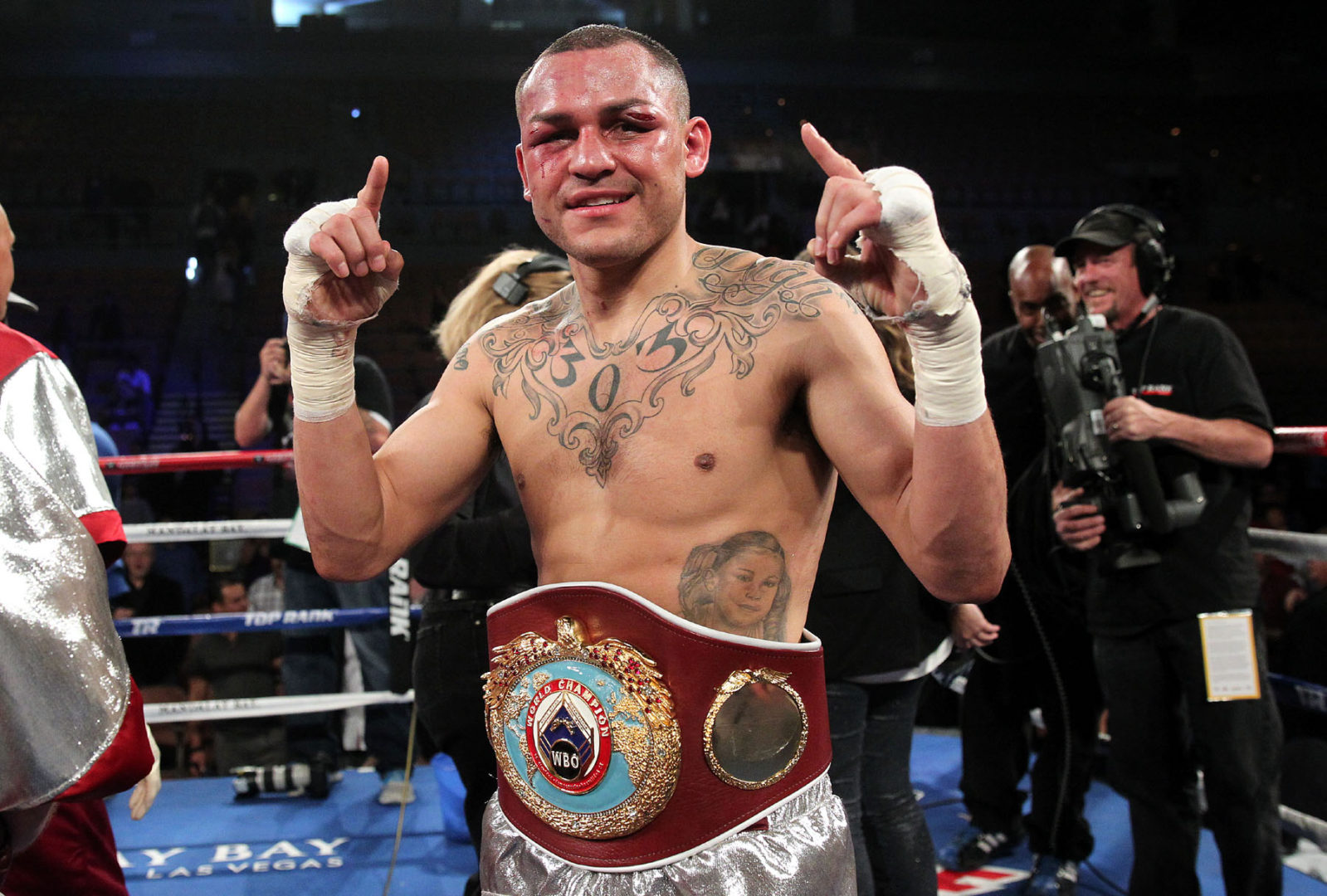
DEERFIELD BEACH, Fla. (February 26, 2013) – International Boxing Federation (IBF) super featherweight champion Argenis “The Thunderstorm” Mendez (21-2-, 10 KOs) has arrived in England and joined his trainer, Lee Beard, to prepare for his first title defense.

Mendez, a 2004 Dominican Republic Olympian now living in Miami, captured the IBF crown this past March in a rematch, destroying defending champion Juan Carlos Salgado in four rounds.

“We’re going to England to begin preparation for our first title defense,” Mendez said before departing Florida. “We trained there in the UK before I defeated Salgado and the result was the best. We will be in England for about 45 days with my main trainer, Lee Beard, and other members of our championship team. We will meet to establish a training and nutrition plan to have me in great physical condition right through the night of my next fight. We are dedicated to reaching our goal to retain my title. The only way we know how to achieve success is to continue working hard.”

Mendez is scheduled to defend his crown in the middle of July against an opponent to be determined. “My job is to be ready to fight when my promoter tells me who, when and where,” added Mendez, who is rated No. 3 in the world by The Ring Magazine. “We had to make many sacrifices to get this world title. There are many good fighters out there at 130 pounds for me to face. If any world-class super featherweight thinks he can beat me, talk to your promoter, and let’s make that fight. We only want to fight the best.

“I tell all boxing fans that I’m not an arrogant athlete. I believe in God and family, and give thanks for what I have with humility. However, I also want to tell everyone out there that we are ready to enter the ring with the any of the best 130-pounders in the world like Roman ‘Rocky’ Martinez, Ricky Burns, Takashi Uchiyama, or Mikey Garcia. These are the fights that boxing fans really want to see, so let’s give them the very best fight.”

Mendez and his countryman, two-time world champion Joan “Little Tyson” Guzman (33-1-1, 20 KOs), are the undisputed leaders of Team Acquinity Sports, which has developed a strong stable of fighters that includes high-level Latino prospects in various weight classes such as (Dominicans) Ed “The Lion” Paredes (32-3-1, 21 KOs), Claudio “The Matrix” Marrero (14-0, 11 KOs), Juan Carlos Payano (13-0, 7 KOs), Lenin Castillo 8-0, 5 KOs) and 2008 Olympic gold medalist Felix Diaz (12-0, 6 KOs), as well as (Cubans) Humberto “El Don” Savigne (11-1, 8 KOs), Glendy “The Guantanamo Giant” Hernandez (9-0, 8 KOs), 2008 Olympic silver medalist Yudel Jhonson (13-1, 8 KOs), Alexei “The Hurricane” Collado (15-0, 14 KOs) and 2008 Olympian Robert Alfonso (1-0). The newest addition is Mexican warrior Moises “El Chucky” Flores (18-0, 13 KOs).

Other top Acquinity Sports fighters include American-born fighters Hylon “Kid Cosmo” Williams Jr. (16-1, 3 KOs), Isiah Thomas (12-0, 6 KOs) and Dominique “3D” Dolton (13-0, 7 KOs).

“Our team consists of a lot of young people who, very soon, will be fighting on the big stage against great rivals in divisions ranging from 122-pounds to heavyweight,” Rivalta noted.

Go online to www.AquniitySports.com for additional information about Mendez or any of his stable-mates. Follow Acquinity Sports on Twitter @AcquinitySports, or friend is at Facebook.com/AcquinitySports.


The Machinery of enthusiasm

Lucas Matthysse
“Yes, right,” said Argentine Lucas Matthysse in Spanish, Saturday, when asked if he next wished to fight junior welterweight champion Danny Garcia. “For that reason, I am thankful to Golden Boy and Al Haymon. They are going to get me that fight, and I know that it is going to be like that.”

Hear the difference in tone? It is not a translation trick but the firmness of a man expressing a proper understanding of power’s proper balance. Having undone Lamont Peterson in fewer than three rounds at Boardwalk Hall, Matthysse did not plead with his promoter to fulfill a contract tortured by an attorney from English to Latin and back, nor did he bend his knee in supplication to a manager or television exec. Matthysse instead gave a polite order to his American promoter, manager and network in the clear language of one genuinely empowered: Thank you in advance.

What you feel about Lucas “The Machine” Matthysse today is a thing to take measure of, perhaps record in a diary, and use as your standard to come, because what you feel is genuine enthusiasm, the euphoria of discovery, a sensation of hopefulness one gets when he realizes the world is a more original, entertaining place than previously surmised. The optimism comes from a place of promise: If this discovery happened, there was a wondrous thing out there I knew nothing about, which means there are other wondrous things out there I know nothing about, wondrous things I necessarily know nothing about knowing nothing about, and life might put them in my way, and what better reason to answer tomorrow’s alarmclock?

Everyone appears to realize the epiphany of Matthysse except Matthysse, and why would he? He is the person he expects himself to be, courteously indifferent and trancedly unbothered by what details modern fight fans think need admiring – entrance music, posse count, apparel sponsorships, purse sizes, management choices.

Ah, management choices; one of the more enchanting things about Matthysse is how he tells Jim Gray whatever he wishes after a fight because Gray works for Richard Schaefer who works for Al Haymon who works for Lucas Matthysse. For once a Haymon-managed fighter did not begin by thanking Haymon and God, reconfigurable in many fighters’ minds, but directed a man whom he pays as an employee. It is sensed, and quivers every brink-pink strand of their free-market pom-poms, while manifesting itself most deliciously in the spectacle of Schaefer arresting Gray’s microphone to whoop like an apprentice hype-man at a freestyle battle.

There is a financial component to this, of course; Matthysse understands what fellow Argentine Sergio Martinez, too, understands: He now needs his promotional team fractionally much as they need him. But there is also a cultural component one sees in other Latino phenoms like Saul “Canelo” Alvarez: They originate in lands where their country’s best athletes amassed incredible stores of celebrity and wealth in a sport, soccer (fútbol [whatever]), unbroadcasted by American networks. Alvarez visited with Mexican president Enrique Peña Nieto last month. Martinez’s last kickoff press conference was emceed by Argentine president Cristina Kirchner. To empathize with how such experiences might affect these men, an American can answer this question: After a meeting with Barack Obama, how seriously would I take a promoter promising I might, with his help, someday, if I’m incredibly lucky, make it to the prestigious airwaves of Showtime?

There will ever be a place for a handsome guy with knockout power in both hands, a place in our sport, a place in general sports lore, a place in popular culture at large, and even if Matthysse somehow does not know this, he necessarily senses it, and if he feels any compulsion whatever, and perhaps he does not, it is a compulsion to verily pain the man across from him, as he did in quick time against Lamont Peterson, Saturday.

Much could be deduced from the final instants of round 1, when Matthysse landed a leaping lefthook lead that imparted to Peterson such significance all athleticism fled Peterson’s legs in the minute that followed, a minute after this moment: At the bell Matthysse watched Peterson take his first steps towards the corner, with a predator’s facade, placid to a point of complacency, one not often seen since Juan Manuel Marquez studied Juan Diaz at the close of every round in Houston – like a disinterested curator pondering a work’s craquelure. “The Machine” confirmed about Peterson what Matthysse enters every fight suspecting of every opponent: He is fragile.

Matthysse then waited a few minutes before timing Peterson’s jab, using the twitch of Peterson’s left shoulder as a trigger, and spear-chiseling him with a right cross that drained the match of any suspense save: How badly will Lucas hurt Lamont?

Both men started left hooks in the middle of round 3, and while Matthysse’s arrived earlier by a piece of a second, the difference in the punches’ effects was anticipated by their hips, not their fists: Matthysse squared his feet and completed a 180-degree hip turn before his punch struck. Peterson threw his punch more correctly – short, balanced, fist pronated – and it made Matthysse’s eyes widen for a moment, which is now a solacing detail Peterson might find on replay, since Peterson was, by the time Matthysse reacted, dropping canvasward in the unresisting way unique to the freshly unconscious.

Welcome to boxing’s new pleasure, then, a comely man who unwreathes other men with a dispassionate glaze on his eyes that he rinses with tears at the mention of his daughter’s name on an American television channel he cares rather little about.

Bart Barry can be reached at bart.barrys.email (at) gmail.com


Mayweather’s spot on top of money list hinges on a projection

Floyd_Mayweather
Floyd Mayweather Jr.’s No.1 spot on another list of highest-paid athletes is attached to a key word: Projected.

Sports Illustrated projects Mayweather to be No. 1 in 2013 among America’s top-earning athletes on the magazine’s Fortunate 50 list at $90 million if he fights in September and adds an undisclosed percentage of pay-per-view receipts to his guarantee, which was $32.5 million for his decision over Robert Guerrero on May 4.

For now, we only have Mayweather’s promise to fight in September in what would be his second bout in a Showtime deal worth a potential $250 million for six bouts over 30 months. He hasn’t fought twice within one year since 2007.

There’s talk about Canelo Alvarez. However, a September opponent still remains undetermined. If it’s Danny Garcia or Devon Alexander instead of Canelo and his Mexican fans, pay-per-view numbers don’t figure to do much better than they did for Mayweather-Guerrero. The PPV count exceeded one million for that one, according to Showtime. That’s a good number if you don’t have to pay Mayweather’s minimum wage, $32.5 million. If you do, you start talking about Canelo as often as possible. Showtime has.

Even without any pay-per-view boost to his pay, Mayweather still would lead the SI list with two fights in 2013 worth $66 million, nearly $10 million more than the Miami Heat’s LeBron James. The NBA MVP is a distant second at $56,545,000.

Argue all you want about whether Mayweather or Andre Ward is No.1 in the pound-for-pound ratings. On the dollar-for-dollar lists, Mayweather, No 1 on Forbes’ world-wide list last June, is undisputed.

Even if he doesn’t fight in September, he would be seventh on the SI list at $32.5 million, behind injured Chicago Bulls playmaker Derrick Rose at $33,403,000 and ahead of Denver Broncos quarterback Peyton Manning at $31 million.

It’s astonishing, especially for an athlete who spent two months in jail last summer on domestic-abuse charges. Unlike every other athlete among the top 10, Mayweather doesn’t collect a projected dime from an endorsement. Thirty-nin million dollars in endorsements account from more than 50 percent of James’ money.

The absence of any endorsement money might go a long way toward explaining Mayweather’s behavior in the build-up to the Guerrero walk-over.
Mayweather, known for outrageous trash-talk, barely uttered a single profanity. Perhaps, he was trying to tell corporate America that he could sell its wares and not offend potential customers. Money, the motivator, might be more than just Mayweather’s nickname.

On another level, it’s hard to know what Mayweather’s status as the world’s top-earning athlete says about boxing. The money is a sure sign of life in a sport so often deemed dead. But it’s not necessarily a sign of health either. Mayweather is the only boxer on an SI list that includes 25 from major-league baseball, 13 from the NBA and eight from the NFL.

One athlete isn’t sport. Nobody is going to buy the pay-per-view to watch Mayweather shadow-box. In the end, a winner-take-all equation eventually leaves nothing, nothing-at-all.

AZ NOTES
Iron Boy Promotions will stage its seventh card Friday night in Phoenix at Celebrity Theatre. Opening bell is scheduled for 6 p.m. (PST). Ten pro bouts and five amateur are on the card. Bantamweight Francisco C. De Vaca is donating his purse to the Arizona chapter of the Breast Cancer Society.


MADDALONE KNOCKOUT CAPS STAR BOXING’S SOLD OUT ROCKIN FIGHTS 8

Huntington, NY (May 12, 2013) Joe DeGuardia’s Star Boxing returned to professional boxing’s Long Island home, The Paramount in Huntington, New York on Saturday night with another installment of their sold-out Rockin Fights series.

“This was our eighth event at The Paramount and the fans who continually turn out in droves, each time packing the house, have really made this a special place for professional boxing” said DeGuardia.

In the main event, longtime heavyweight contender Vinny Maddalone had the Long Island faithful on their feet cheering on his third round knockout of previously undefeated Richard Carmack of Kansas City, Missouri.

With crunching hooks to the body and power shots to the head throughout the first two rounds, Maddalone, 37-8-0 (27KO’s), earned the stoppage, drilling the beefy Carmack, 12-1-0 (10KO’s), to the canvas in the third round as referee Tony Chiaranto called a halt to the proceedings at the 2:57 mark.

“This was a terrific performance for Vinny and we’re looking to a bigger fight in the division in the coming months” said DeGuardia.

In the eight round light heavyweight co-main event, Buffalo, New York’s Lionell Thompson scored an upset over the returning Yathomas Riley of Augusta, Georgia. A hotly contested battle over the course of the bout, although it appeared Riley may have had a shot of winning the close rounds, Thompson, 14-2-0 (9KO’s) was declared the winner by scores of 77-75 twice and 79-73.

Returning to the ring from a three-year absence following a wrongful incarceration on a murder charge, Riley, 8-1-0 (6KO’s) suffered his first defeat as he couldn’t shake the 3 year ring rust.

Headlining the undercard, touted Huntington prospect Alan Gotay improved to 5-0-0 (2KO’s) with a thrilling performance over Brooklyn’s Bryan Acaba, earning the stoppage at the 1:58 mark of the sixth round in their lightweight bout in a fantastic fight. The valiant but outgunned Acaba fell to 3-4-0 (2KO’s) in the fight which saw celebrity guest LL Cool J enthusiastically cheering the efforts of both boxers.

Hicksville’s junior welterweight newcomer Anthony Karperis got back on the winning track with a sharp looking four round decision over Carlos Nieves of the Bronx.

Dropping Nieves in the fourth from a hard overhand right,
Karperis, 4-1-0 (2KO”s) was declared the winner by scores of 40-35 on all three cards. It was another exciting fight on the great card.

Pro debuting Dave Meloni of Westbury, New York, had a rough start to his pro career as he was dropped and stopped in the first round by Brooklyn’s Soumana Abdoulaye. Giving Meloni a chance to recover from an early knockdown, referee Eddie Claudio stopped the featherweight bout at the 1:54 mark of the opening stanza. Abdoulaye’s record moved to 2-6-0 (1KO).

Opening the show in a four round middleweight bout, Uniondale’s Marcus Beckford and Carlos Lopez of the Bronx fought to a crowd pleasing, action filled majority draw. Scores were 39-37 for Beckford and 38-38 on the other two cards. Beckford now 0-0-2 and Lopez 0-1-1.

ABOUT STAR BOXING:

Star Boxing Inc. celebrated its 20th Anniversary in 2012. Star Boxing has worked to produce some of the most exciting and memorable boxing events in recent history. Star has continued to work with and develop a number of very exciting world champions, world rated contenders and young prospects. Star has consistently brought credibility, integrity, and exciting fights to the boxing industry. For more information on Star Boxing, visit their official website at www.StarBoxing.com and follow them on Twitter @ Star Boxing and Facebook at Star Boxing.

ABOUT THE PARAMOUNT:

Opened September 30, 2011 this 1,555 capacity live entertainment venue located in downtown Huntington, Long Island, features concerts, boxing, comedy, community and other special events. Booked by Live Nation, the Paramount has hosted over 150 events in its first year of operation and quickly established itself as the premier music venue on Long Island. Some recent acts to take the stage include Pitbull, Taking Back Sunday, The Pixies, Elvis Costello, Warren Haynes, Willie Nelson, Brand New, Goo Goo Dolls, Primus, Marilyn Manson, Korn, The Wanted, The Script, Panic! At the Disco and many, more.

ABOUT THE FOX HOLLOW:

Nestled upon 8 private acres of Long Island’s north shore is the Fox Hollow which features a state of the art event venue, fine dining restaurant and an all-suite luxury boutique hotel. Owned & operated by the Scotto Brothers, their Above & Beyond philosophy in providing each & every guest with superior services and amenities is paramount. Visit the Fox Hollow online at www.TheFoxHollow.com & www.TheInnAtFoxHollow.com


Un-forgiving Lamont Peterson

Lamont_Peterson
To return to aficionados’ better graces, Saturday Lamont Peterson must perform a stern act of contrition at Boardwalk Hall in Atlantic City, one from which his career is unlikely to emerge intact: a visit to the crucible Argentine Lucas Matthysse makes of a prizefighting ring, a place of penance whence no prizefighter returns undamaged.

What Peterson confronted when he faced Kendall Holt in February is not nearly what will confront him Saturday. Matthysse has none of Holt’s regard for personal safety; Holt possess a certain frailty, like all power punchers, a certain possibility of discouragement that seems untroubling to Matthysse – who luxuriates in knowing that no matter the result, so long as he applies himself relentlessly, his admirers, both male and female, will applaud him because his opponent will be hurt. A scroll through Matthysse’s BoxRec entry since 2009 is instructive: “Castaneda down three times” / “Judah down in rd 10” / “Corley down twice in the 5th, once in the 6th and 3 times in each of the 7th and 8th rounds” / “Alexander down once in rd 4” / “Soto down once at the end of rd 5” . . . and those don’t include what five other prizefights Matthysse ended prematurely.

Lamont Peterson, a man whose persona was fabricated upon making people feel good about him (and in self-interest’s anfractuous way, good about themselves by projection), a man whose career was resurrected after he won cleanly perhaps two rounds, though officially even fewer unanimously, against Timothy Bradley 3 1/2 years ago, resurrected after a draw with flighty Victor Ortiz in 2010 and a surprise decision victory over fragile Amir Khan in 2011, has fought but once in 18 months.

This is because Peterson’s confirmatory B sample came back positive one year ago last week for a banned substance later obfuscated as a non-enhancing form of “bioidentical testosterone derived from soy” by a doctor in the medical-research hotbed of Las Vegas, where Peterson went to be diagnosed with hypogonadism, a condition that caused the testosterone levels of this muscular, fully bearded professional athlete to be so perilously low it “literally shocked” his esteemed physician. Peterson has been forgiven mostly by fans and certainly by the IBF, whose junior welterweight belt he will not defend Saturday, for a pretty simple reason: Fans don’t care about the use of PEDs because fans are paying to be entertained, and athletes who use PEDs are more entertaining than athletes who do not.

There is a parallel to be draughted, a parallel worthy of much greater investigation than it will receive here and now, between the painters of the Renaissance and the athletes of today. In his formative work, “Secret Knowledge,” a book whose study would replace entire art-history departments were academia a meritocracy, British artist David Hockney asserts the historic progression that painting undertook before and during the Renaissance was a technological leap first of all. Beginning most evidently with Jan Van Eyck’s 1434 depiction of a golden chandelier in “The Arnolfini Wedding,” painters employed lenses, which took nature’s camera effect – one first commented on by the ancient Greeks – and projected subjects’ likenesses on a screen, from which they could be traced, a practice that continued uninterrupted until, about 400 years later, chemistry replaced the artist’s hand with a process that became known as photography.

When a person visits, say, National Gallery of Ireland and beholds Caravaggio’s seminal 1602 work, “The Taking of Christ,” and proclaims to her peers, why, it looks just like a photograph!, she doubtfully knows how very right she is. Caravaggio, like Van Eyck before him, and Velazquez and Vermeer after him, fulfilled a demand for realism made by his patrons: the most realistic image wins, and the means of accomplishing such realism should be protected assiduously as the trade secret it is. As Hockney returned to the masterpieces of the last half-millennium and scrutinized them with the improved eye of a skeptic, so might sports fans return to the accomplishments of the last 30 years at least – the records that were set, the feats of theretofore impossible athleticism now routinely accomplished – and assume guilt, always, contrary to what generous impulses they otherwise assign themselves.

Boxing fans were for the most part angry at Peterson for getting caught, if we’re being honest: They wanted a rematch, and Peterson’s carelessness got that rematch cancelled. Sportswriters, meanwhile, were more enraged by the false piety of the spectacle – from the promoter’s self-aggrandizement to the Peterson camp’s ludicrous explanation to the way Peterson’s positive results aged the florid prose with which writers adorned the story of upstanding Lamont, brother Anthony and trainer Barry. Lance Armstrong, now famous for cycling, taught the unscrupulous world of professional athletics how to put the First Amendment on ice with well-placed lawsuits – and that was before every contributor had to “agree to indemnify and hold harmless” his publisher. Telling a reader his hero was a product of chemistry more than work ethic was ever thankless, long before writers were legally liable, as individuals, for doing so.

While it was possible for master painters to take the lessons taught them by lenses and evolve beyond them – Rembrandt and Velazquez certainly did, and Vermeer used them creatively enough to make their obvious use an artform of its own – such is not and will never be possible for athletes, men whose talents are eclipsed by years at the same ages others’ talents are enhanced by them. Lamont Peterson will not return to the form he showed in training camp a year ago, or probably the form he showed against Amir Khan, or probably the form he showed against Timothy Bradley, such as it was, when he fights Lucas Matthysse.

This is a fine turn for all but a handful of Saturday viewers, as the rest of us would like nothing better than ghoulishly to indulge what sadistic impulses delight at others’ subjections to pain – and all the better if a sense of justice can be invoked.

Bart Barry can be reached at bart.barrys.email (at) gmail.com


Canelo scores biggest win in Mayweather’s decision over Guerrero

Saul Alvarez
Canelo Alvarez emerges as the biggest winner from Floyd Mayweather Jr.’s predictable and perhaps necessary victory over Robert Guerrero. Argue you all you want about the merits of Mayweather’s dominance. Get over it. Doesn’t matter. Besides, what did anyone really expect?

If dollars are the most reliable path in boxing or any other business, it was no surprise. Follow the purses. According to contracts filed with the Nevada State Athletic Commission, Mayweather’s guarantee was $32.5 million. Guerrero’s was $3 million.
Mayweather’s compensation was 10.83 times more than Guerrero’s paycheck. That’s a long way from the widening gap that separates CEO from employee in today’s America. According to various sources, that number is bigger by 350 to 354 times, or more canyon than gap.

No matter how it’s calculated, here’s the bottom line: Guerrero did what he was hired to do. He was virtually Mayweather’s employee. He might as well have come into the ring on May 4 at Las Vegas’ MGM Grand wearing one of those caps that say TMT, the Mayweather logo that stands for The Money Team.

Guerrero clocked in at opening bell and clocked out after 12 rounds of work. He allowed Mayweather to shake off some rust and re-establish a working relationship with his dad, Floyd Sr., who is back as his trainer. Above all, Guerrero was a vehicle for Mayweather to test his readiness for a Showtime contract worth $250 million if he fights five more times over the next 30 months. So far, so good.

But the tune-up Mayweather needed left a potential problem. Guerrero is everything that Alvarez is not. Alvarez continues to emerge as a Mayweather equal at the box office with proven drawing power absent on May 4. As of Thursday, pay-per-view numbers had yet to be released. If – as rumored – they fall short of expectations, Alvarez’ importance to Showtime’s deal with Mayweather grows.

Even if the numbers are better than speculated, Alvarez-Mayweather is the fight Showtime must have if the deal is to succeed. Alvarez, of Guadalajara, is the red-head Pied Piper for Mexican fans. He brings the Mexican audience. No demographic is more important in boxing. Mayweather seemed to forget that on May 4 when he tried to appropriate the popular Cinco de Mayo holiday for himself. On fight posters, the celebratory weekend was called May Day.

In 2007, Mayweather wore a sombrero and Mexican colors into the ring before a split-decision on May 5 over Oscar de la Hoya. That might have been a little over the top, but it worked because it acknowledged an audience that has helped him make all that Money. His tip of the sombrero was noticed then. Six years later, I can’t help but think there’s annoyance at suddenly seeing his signature on the same weekend that is Mexican history.

In a savvy move, Alvarez displayed business smarts usually associated with Mayweather when he decided not to fight on the May 4 card, because he couldn’t be guaranteed a Mayweather fight on September 14. Instead, he moved into the main event in a victory on April 20 over Austin Trout in San Antonio. A crowd of nearly 40,000 showed up at the Alamodome. Ticket prices were cheaper than they were in Vegas for Mayweather-Guerrero. But would 40,000 have shown up for Mayweather-Guerrero in San Antonio?

It’s impossible to say what the pay-per-view audience would have been on May 4 if Alvarez had been on the card. But it’s fair to assume they would have been better than whatever the official tally winds up being. Talks for Alvarez-Mayweather reportedly are already underway. At this point, the proposed financial split is anybody’s guess. But here’s a good one: Alvarez won’t fight for $3 million. Multiply Guerrero’s guarantee five times, add a substantial percentage of the Mexican television revenue to Alvarez’ purse and you might get a deal.

We say might, because it’s hard to know how Mayweather will react. He has a history of dictating terms, a factor in the abortive talks for a fight with Manny Pacquiao. If Home Box Office had signed a Showtime-like deal with Mayweather, HBO might still be counting its losses. An HBO deal with Mayweather would have needed Pacquiao then as much as Showtime needs Alvarez now.

Time could be pushing Mayweather to an Alvarez fight sooner than anyone might have expected. At 36, Mayweather is probably a step or two beyond his prime. He said after beating Guerrero that he is five fights from retirement. His best chance might be now instead of later against the 22-year-old Alvarez, who is still approaching his prime.
Meanwhile, the ambitious Alvarez might pay for some youthful impatience. He continues to lobby for Mayweather. Alvarez fights at 154 pounds. Mayweather, comfortable at welterweight, could demand a fight at 147, forcing him into a diet and regimen that could weaken him. There are warnings that Alvarez is getting ahead of himself. Friends and associates are telling him to fight Miguel Cotto first. They are asking him to wait.

But time, money, Mexican fans, Canelo’s ambitions and his emerging role as a make-or-break component in Showtime’s deal with Mayweather are creating momentum hard to stop.


Huck vs. Afolabi III: First presser gets heated!

There is definitely no love lost. Britain´s Ola Afolabi (19-2-4, 9 KOs) did
say he would hug and shake hands with his opponent Marco Huck (35-2-1, 25
KOs) after their WBO Title Fight on June 8 at the Max-Schmeling-Halle in
Berlin, Germany ? but the attending members of the press were not really
convinced after the pair´s previous war of words during Monday?s press
conference.

Before Afolabi started his attempt to calm things down, current WBO
Cruiserweight Champion Marco ?Captain? Huck and the Interims Titlist were
involved in a heated exchange of words. The first one to trade verbal blows
was the 28-year-old German. ?Afolabi is starting to get on my nerves. I beat
him in December 2009. After I fought Alexander Povetkin for the WBA
Heavyweight Crown, it was difficult for me to find the right motivation for
my rematch with Afolabi in May last year. However, I believe that I actually
won that bout, even though it was scored as a majority draw. That won?t
happen again. I will win in my own backyard. We won?t be playing cat and
mouse anymore. This will be a war ? I won?t be holding back.?

That was the cue for Afolabi to start his own rant. ?Huck shouldn?t be able
to call himself world champion anymore. In my opinion, he lost on three
previous occasions. He lost against Lebedev, he lost against me and also
against Arslan. He should only be able to call himself German Champion or
Champion of Berlin,? said the 33-year-old. The Brit stated that he is
planning to humiliate Huck in front of his own fans. ?I would be ready to
take him on this weekend.? Then Afolabi directed his next words directly
towards Huck. ?Everybody knows that I have always been a good technician,
but now my fitness level is also excellent. I will seriously hurt you come
June 8. You will need a wheelchair after the fight,? said the Los Angeles
based cruiserweight.

It is obvious that there is a lot of tension in the air, also partially due
to the duel between the two most popular and respected coaches of German
boxing. Once again Ulli Wegner (Huck´s coach) and Fritz Sdunek (works with
Afolabi) will stand in opposite corners.

Tickets for the big fight night at the Max-Schmeling-Halle in Berlin Germany
on June 8 are available at www.eventim.de and www.boxen.com.


A Mayday in September

Saturday heavyweight world champion Wladimir Klitschko knocked out a 240-pound Italian named Francesco Pianeta, and few in the United States without an internet connection saw it, and many fewer cared, because there is no interest in Klitschko; because he is dominant his fights are too predictable. Some hours later, in a fight many more Americans knew and cared about, Floyd Mayweather dominated challenger Robert Guerrero in predictable a match as fans have paid extra to see since Mayweather’s last.

In his first event since beating Miguel Cotto a year ago by slightly more lopsided scores than he beat Guerrero, Mayweather allowed Guerrero, and pay-per viewers, six minutes of hope the fight would be entertaining and Guerrero could be competitive, and then, his paycheck cleared, Mayweather snatched all hope away, strolling to a unanimous decision and promising, as he does every year, to fight again soon – early, this time, as September.

The worst blow the Mayweather brand could sustain would be an increase in its namesake’s activity. His admirers ask to see more of him because it is the reasonable request any admirer makes any object of his affection, a request that relies upon a humility that goes: I am not observant enough to capture all your colors and luminosity on first sight and must look and look again and more closely till I have cataloged the entirety of your charms.

But the prefight Mayweather documentaries, saturating and interchangeable, revealed this: The more time you spend round Mayweather, the duller he gets. Have you ever seen so many people nodding-off, catching naps or crashed on couches, while the subject of a documentary – a subject worthy of a documentary, rather – is awake and performing? Showtime featured four or five documentaries on Mayweather, or perhaps they were two, or 47 (it’s impossible for an average mind to keep them separate), that held a revelation and a question: First, everyone falls asleep after a couple hours in Mayweather’s presence, and second, did a 36-year-old really just write his name on the steamed window of a shower door?

A Mayweather event is more spectacle than combat, more fashion art than fine art, and absolutely worth the 70 annual dollars that has become its tariff. But who that has $140 of disposable income – as opposed to money borrowed from mom – would pay it to watch the spectacle twice? It is a question Showtime unadvisedly will answer if given its druthers, one Mayweather is probably too wise to answer. An all-time great handicapper of challengers, Mayweather is too knowledgeable about boxing to find his prizefights entertaining enough to watch twice.

Were he able regularly to end his matches with violence, like he ended Ricky Hatton or even Victor Ortiz, tip the highlight-reel maker, as it were, instead of doffing his cap at B+ opponents postfight, he could work at Manny Pacquiao’s previous rate, or at least try his (right) hand at it. Therein lies the problem: Mayweather’s best punch is the potshot right – a demonstrated susceptibility to which will land you a fight with Mayweather quickest of all – but that hand is brittle a weapon as there is in our beloved sport.

A man does not strike another easily with one punch as Mayweather began to do to Guerrero with righthands in round 3 and then stop unless his hand is fragile or he wishes to carry his opponent. While either is possible when a salesman like Mayweather makes a fight with an opponent pedestrian as Guerrero, probability favors Mayweather’s history of hand problems, though Mayweather detractors are cautioned not to become hopeful about the future: His fight with Carlos Baldomir showed “Money” is still less entertaining in a one-handed fight.

Saturday’s match followed Mayweather’s three-part design; there were the studying rounds followed by the potshotting rounds followed by the uppercutting rounds. Guerrero was a relevance during the first part; Mayweather tied him up and tasted his counters and drew the perimeter in which he might creatively roam for the next half hour. After the second round, Guerrero was a target, interchangeable with Shane Mosley or Oscar De La Hoya.

Mayweather confounded Guerrero by hitting him with righthands from everywhere, hard, accurate, stinging punches Guerrero likely fancied himself walking through in training camp without fancying how impossibly far away Mayweather would be by the time Guerrero’s neurons registered the punch, without fathoming Mayweather’s head and foot would follow directly behind his glove, on a plane so confoundingly low to Guerrero’s left-cross counter they might well have been attached.

Then Guerrero was too confused to hurt Mayweather by any one punch he landed, every punch now thrown from a tentative mien that asked over and again “Is this an opening or a trap?” – then once Guerrero realized it was an opening and tried to repeat the punch, the opening was gone. To hurt Mayweather, as Mosely did, you must put all your confidence behind a punch that exploits an actual opening; it is boxing’s rarest occurrence because you are hoping, not exploiting, in the opening rounds, and by the time you are familiar enough with Mayweather’s rhythm and patterns to see an actual opening, you no longer have confidence enough to make a dent.

Part three of the Mayweather design was to drop a then-desperate Guerrero on right uppercuts the way Andre Berto did. This final phase failed only because Mayweather lacked the commitment to throw his evidently damaged right hand with the force required to position it properly for greeting Guerrero’s downrushing chin.

Mayweather is in danger now of becoming Wladimir Klitschko. He is a fighter too dominant for his own good who may be about to learn it is disproportionately easier to filch $70/year from American consumers than $140. Mayweather’s next fight will open at odds even with those that say it will not do a million buys.

Bart Barry can be reached at bart.barrys.email (at) gmail.com


No More Rehearsals: Mayweather-Guerrero fight to say it all

floyd-mayweather2
LAS VEGAS – It was a weigh-in noteworthy for what didn’t happen. Ruben Guerrero behaved himself. Sort of.

Expectations for a brawl before opening bell weren’t fulfilled Friday in a pre-fight ritual that went off almost as if it had been rehearsed. Robert Guerrero was at 147 pounds, the welterweight limit, and Floyd Mayweather Jr. was one pound under at 146 for a bout on Showtime’s pay-per-view television Saturday night at the MGM Grand.

Escalating trash talk had set the stage for one of those confrontations that often send weigh-ins spinning into some unregulated violence. Ruben Guerrero, Robert’s dad and trainer, fueled much of it with insults that went viral Wednesday when he repeatedly mocked Mayweather and his jail sentence last summer for domestic abuse.

If the insults bothered Mayweather, however, there were no signs of it when he took his turn on the scale. He smiled at a noisy crowd of a few thousand fans. He blew kisses at them as he walked onto the stage. Mayweather has been CEO cool and calm, almost eerily so, throughout the buildup for his first bout since his last fight, a victory over Miguel Cotto a year ago.

There’s been a lot of amateur psychology floating around, suggesting that Mayweather (43-0, 26 KOs) is a different person. Even his dad and lead trainer, Floyd Mayweather Sr., has said jail changed his son. Maybe.

In the pre-fight proceedings for Guerrero (31-1-1, 18 KOs), he’s been more careful with what he says and how he says it. If anything, he relinquished his trash-talk title to Guerrero’s dad, Ruben, who was watched by vigilant Golden Boy Promotion officials throughout the weigh-in. They didn’t want an ugly incident.

The stare-down after both stepped off the scale lasted about a minute. It ended when Golden Boy matchmaker Eric Gomez pulled Guerrero away. In bit of a surprise, Robert appeared to be more animated than anybody, even his dad. He was asked about what he was thinking while looking into Mayweather’s unblinking eyes.

“Thinking about getting down, that’s what I was thinking about,’’ Guerrero said with an edge of excitement in his tone. “Got to beat him down. Got to take full advantage of it.’’

There’s been speculation that Guerrero might get overwhelmed in his first experience on boxing’s biggest and richest stage. According to contracts filed with the Nevada State Athletic Commission, Mayweather is guaranteed $32 million for his first fight under a Showtime deal worth a potential $250 million if he fights six times over the next 30 months. Guerrero will get $3 million.

Maybe, that helps explain his father’s antics. Dad has been diverting some of the attention and subsequent pressure onto himself and away from his son. Maybe.

Both fighters enter the ring with their own back stories. Guerrero has his wife, Casey, and his role in her fight against leukemia. He also has his faith, an element that stands in contrast to Mayweather’s flamboyant lifestyle, summed up by his nickname, Money. Yet, controversy also is part of Guerrero’s tale of the tape. He’s facing gun possession charges in New York, for allegedly trying to bring a weapon onto a flight in checked baggage.

Mayweather’s crazy family is never from his story. His dad, often estranged, is back in his son’s corner. As of late Monday, it still had not been determined whether Roger Mayweather, his uncle, would work the corner with Floyd Sr. Roger has diabetes. Floyd Jr. said at times it affects his uncle’s vision. The only certainty Friday was that Floyd Sr., would run the corner. A reunion between father and dad has been an element to the Mayweather story for Guerrero. It’s as if Floyd Jr. is using the bout as way to repair a dysfunctional relationship.

At opening bell, however, there will be only Floyd Mayweather Jr. and Robert Guerrero.

“He’s flat-footed,’’ said Mayweather, who also has called Guerrero a hypocrite for talking about his faith. “He fights like a grappler.’’

In Mayweather, however, Guerrero sees a 36-year-old fighter who appeared to have lost his foot speed in a bruising victory over Cotto. Mayweather likes to say that there’s no blueprint on how to beat him. Nobody has. But Guerrero, a left-hander, doesn’t believe it. He has spent a career humbling his skeptics and his faith tells him he can do it again.

“Not just to humble Floyd, but to humble the boxing world,’’ Guerrero said. “You get a lot of people out there that think Floyd’s like a god, the way he acts, the way he lives, the way he spends money, the way he boasts about stuff. You get everybody thinking that he’s unstoppable, that nobody could beat him. That with Floyd, there’s no blueprint to beat him. You can’t break him down. But you know what? Being a big believer in God, there’s a blueprint for everybody.”


Awkward Neutrality: Manager Espinoza has both fighters, but no options to cheer or boo

LAS VEGAS – Frank Espinoza isn’t from Switzerland, but the manager might wish he was in the Alpine nation known for neutrality Saturday night instead of a ringside seat at the MGM Grand.

Espinoza won’t be able cheer.

Or boo.

Espinoza will be hamstrung from one corner to the other, tied down by contractual obligations and personal loyalty to both Abner Mares and Daniel Ponce De Leon in a featherweight fight on Showtime’s pay-per-view card featuring Floyd Mayweather Jr. against Robert Guerrero.

“It’s a very awkward situation,” Espinoza said. “I’ll be in the ring prior to the fight, but I won’t walk with either of them or visit either in their dressing rooms. I’m as neutral as I can be.

“I’m close to both of the guys. I love them like my own sons. I just want them to both come out healthy. I’m not happy they’ll be punching each other.”

In other words, Ponce De Leon said, the fight could be harder on Espinoza, a longtime Los Angeles manager, than either of the fighters.

Neither Ponce De Leon nor Mares dared to guess who Espinoza was picking or even how their mutual manager thought the fight might end.

“He’s picking a trilogy,’’ Mares joked.

Espinoza will have the winner, Ponce De Leon said.

“He’s going to keep one champion in the company,’’ said Ponce De Leon, who holds the World Boxing Council’s version of the 126-pound title. “And it’s going to be me.’’

Mares and Ponce De Leon promised that the scorecards won’t be even. But their paychecks are. In a sure sign that Espinoza isn’t playing favorites, he negotiated $375,000 for each in a Golden Boy Promotions bout initially proposed for April 20 at Home Depot Center in Carson, Calif.

“They’re fighters, but they’re both businessmen, and they both wanted to fight,” Espinoza said. “Fighting on this platform, Cinco de Mayo, millions of people watching two warriors, showcasing their talent. There’s no losers.

“Boxing needs the best fighting the best. I know I could’ve gone a different direction. But I got them the most money they could get from a fight now. I did my job as a manager.”

Espinoza is not the first to manage fighters in the same bout. After all, boxing has seen it all, done it all ad nauseam. A parachutist – Fan Man – dropped into the ring like the 82nd Airborne Division during the middle of an Evander Holyfield-Riddick Bowe rematch. Mike Tyson dined on a Holyfield ear.

But this time history doesn’t figure to repeat itself. Espinoza doesn’t have to be told about the Carlos Zarate-Alfonso Zamora Jr. bantamweight fight in April, 1977 at The Forum in Inglewood, Calif.

Manager-trainer Arturo Hernandez worked for both Zarate and Zamora Jr. But neutrality had more holes in it than Swiss cheese for Hernandez. He played favorites. He worked the corner for Zarate, who won a fourth-round knockout. But Zarate’s victory and Hernandez’ role in it enraged Zamora’s father, who was in his son’s corner.

It’s hard to see exactly what happened in some old video on You Tube. Let’s just say that Alfonso Zamora Sr. went Ruben Guerrero, Robert’s father and trainer who became a breakout star Wednesday with insults gone viral of Mayweather during a formal news conference.

Zamora Sr. walked across the ring and kicked below – way below – the belt line, according to a couple of ringside observers, Hall of Fame promoter Don Chargin and longtime publicist Bill Caplan, who still wince when recalling a moment more than 36 years ago. Let’s just say it was beyond a low blow. It was obscene.

And, Espinoza said, Zamora Sr. kicked “more than once.’’

Neutrality, no matter how difficult, figures to be a lot less painful.


Martinez and Datsyuk: The erosion of reflex in great figures of preparedness and grit

Sergio_Martinez
DALLAS – The career of middleweight champion Sergio Martinez will not end any better than our sport ends its every practitioner’s career, and that is an unfortunate revelation made obvious Saturday, when the Argentine Martinez made a homecoming title defense against Englishman Martin Murray and won a unanimous decision narrower than what its three rainswept judges, surrounded in a soccer stadium by 40,000 Argentines, tallied. The decision was not controversial because the decision was really not the point at all.

This was an exhibition, a career retrospective of Martinez’s works, and if it was rougher than planned for the homecoming champion, a scrap more than a celebration, it will not appear that way in the official record, which reads Martinez UD-12 Murray.

There is a level of introspection to Sergio Martinez that is rare among professional athletes in general and prizefighters in particular, perhaps because Martinez did not come to acclaim until he was well in his 30s, which is to impart Sergio Martinez knew himself, what he was and what he thought of what he was, before others could tell him what he was and what they thought of what he thought of what he was. There is a composure to Martinez, an affability, a willingness to show vulnerability – yes, that is the differentiating word: vulnerability – rare among professional athletes and all but impossible among prizefighters.

I spoke to him in January, nearer his penultimate fight than Saturday’s, and he was willing to describe, in surprising detail and self-deprecation, what discomfortingly intense moments ended his September match with Julio Cesar Chavez Jr. He treated rage-at-self and what drunkenness comes from sipping a homebrew of fatigue and abuse, and the revelatory fact nothing at the end went as he prepared it to go. Immediately after that I borrowed Thomas Hauser’s advice and asked Martinez what question he would ask those who ask him questions, his interviewers, if given the chance.

His answer was unique and personal: “What is the key to finding inspiration to write?” He spoke of what travails he encountered working on his first book, the hours cum days cum weeks of a blank page followed unexpectedly by a visit from the muse at three in the morning. Readers of this column will be unsurprised by how I answered: You must be willing to write garbage, Sergio, to keep your fingers flurrying on the keys, knowing your first draft is likely to be schlock anyway, and so why belabor it?

Saturday I was not in Buenos Aires, or Brooklyn, but rather at the final professional hockey game of the 2013 season in Lone Star State, this city’s Stars against the Detroit Red Wings, and I was not there to see either team or even the game of hockey, particularly, one I played through my adolescence, but rather an individual who plays the game close to perfectly as I have seen done: Pavel Datsyuk. His connection to Martinez is that Martinez is the professional athlete Datsyuk just edges on my list of favorite professional athletes. There is no one in any sport I appreciate more than Datsyuk.

I did not watch Saturday’s game, consequential as it was for the Red Wings franchise, but Pavel Datsyuk. When he was on the ice I followed him to the exclusion of the puck, and when he was not on the ice I was distracted, like other Texans, by campy fan-appreciation giveaways, shapely ice girls in lycra bottoms and a themeless potpourri of loud music. Datsyuk’s skating skills are now quietly eroded by knee surgeries; it is why he conserves energy by making large Cs more than large strides, more and more. His warmup stretching routine is novel for all the contortions it comprises, and his pregame skate was noteworthy for the number of times he lost edges, and the way he stood apart from the rest of the team, making passes to invisible marks on the boards, as his teammates swooped round him. While others collected pucks to fire at the Red Wings goalies – at them, not by them, by design – Datsyuk stood in innocuous places on the ice, passing the puck between the skates of his teammates to private spots on the boards.

Datsyuk is known in the league as “The Magician” for the innovative way he handles the puck, but that is missing the point of his greatness, which is a preparedness leavened by grit; no one makes it to the NHL without he can do things with a rubber disk and blacktaped blade of wood others appreciate in direct proportion to what hours they’ve practiced the same – which is altogether different from impressing naïfs and dilettantes, or Texans – but Datsyuk’s greatness is found in his individual battles with other men put on earth, they believe, only to play hockey. He defeats these men by being as good from either side of the puck, forehand or back, as no one before him has.

Martinez, for an enchanted stretch, bore a similarity to this. He stood before larger men and discouraged them, dis-couraged them, by causing their professionally aimed shots to miss by fractions of acceptable spaces in ways they could not predict. Martinez no longer has this capacity – as Martin Murray proved often, Saturday, but most especially in round 6, when Martinez invited Murray to discourage himself by missing Martinez repeatedly, and Murray repeatedly did not miss. Martinez hasn’t the technical perfection to perform adequately against larger men now that his reflexes have been taken by those larger men and what repairs to his body they’ve made necessary.

Saturday’s postfight happenings brought word Martinez will not return till April 2014. Better to call it a career, now, having filled a venue with his countrymen in a way no American prizefighter has done in decades.

Bart Barry can be reached at bart.barrys.email (at) gmail.com


Sergio Martinez: Middleweight champ an undisputed celebrity in Argentina

Martinez_Chavez_Jr_120915_005a
In city where almost every other street seems to be named Peron or Evita, promoter Lou DiBella saw a middleweight’s name on cabs, buses and billboards. On DiBella’s trip from the airport to his hotel in Buenos Aires, there it was, again and again.

Sergio Martinez.

Welcome home.

“He’s really like a rock star here,’’ DiBella said.

It’s been eleven years since Martinez last fought in Argentina, a beautiful country with a star-crossed history and boxing tradition undergoing a revival because of those who left to fight elsewhere.

Martinez (50-2-2, 28 KOs) returns Saturday night on HBO (8:30 pm ET/PT) against Martin Murray (25-0-1, 11 KOs) after more than a decade abroad. He lived and trained in Madrid. He fought in the UK. He made a pound-for-pound name in the United States. It was a journey of discovery, a personal quest. Martinez found what he believed was always there on his horizon.

He grew up in Quilmes, south of downtown Buenos Aires in a town known for a brewery, soccer and poverty. He tried soccer. It would have been hard not to. Google Quilmes. Then, look up the list of notable people from the town of about 240,000. Almost all of them are soccer players.

He also dreamed of racing on the international bicycling circuit. But that ended when a prized bike was stolen when he was 15. That theft was part of an upbringing – mean streets, Argentina style – that prepared Martinez for what he would later forge into an instinct within a fighter ranked among the world’s top four, including Floyd Mayweather Jr., Andre Ward and Juan Manuel Marquez. Martinez, the son of a laborer, grew up around neighborhood bullies. He learned how to confront them. Fight them. Identify them.

Over the last four years, you could watch Martinez and detect an unshakable sense of self and confidence in what he can do. He engaged Julio Cesar Chavez Jr. in a wild punching duel in the 12th round last September. It looked like a foolish gamble then. He had an insurmountable lead on the scorecards. But he did it anyway, perhaps because he knew he could survive as he always has. It was an amazing three minutes that seemed to sum up the gutsy nature of a fighter with an unorthodox style.

Don’t look for the insecurities that lead to trash talk. You won’t find them. Don’t look for the complacency that leads to unexpected losses. It’s not there. If it had, it would have appeared and ended Martinez’ ambitions long before anybody in the U.S. of even Argentina knew who he was. He paid his dues, so often that there is widespread respect for him in his homeland. In the wake of his triumph over Chavez Jr., Martinez met Argentina’s president, Cristina Kirchner. When was the last time a U.S. fighter was invited to the White House?

“Sergio is hands down the greatest fighter I have ever promoted,” DiBella said during a conference call not long after he arrived Wednesday in Buenos Aires. “Not only because he is a terrific talent. Not only because he is at the top of the pound-for-pound list, right up there with Floyd Mayweather, but also because of the type of man he is. He is a good human being. He has a great sense of social consciousness. He’s back in his homeland where he’s waited for this opportunity, to fight again in Argentina for many, many years.

“You’re getting a chance to see a Hall of Fame fighter, who, in my mind, is one of the best middleweights who ever lived, and one of the two great middleweights in the history of Argentina.

“You can mention Sergio Martinez in the same sentence as Carlos Monzon at this point and you’re not doing any injustice to Monzon.’’

Over time, Martinez will get the appreciation he deserves. But time also poses a potential problem. He’s 38. According to longtime advisor Sampson Lewkowicz, he promised is dad that he would not fight past 40. He’s also coming off knee surgery for an injury suffered against Chavez Jr. Murray, a tough inside fighter managed by Ricky Hatton, is bound to test that right knee with pressure that will force Martinez to employ lateral movement.

There are also potential distractions. Martinez has fought in Buenos Aires, but never as a hometown hero who has captivated a nation. There were signs of it in September when a small crowd of fans waving the powder blue-and-white Argentine flag celebrated his victory over Chavez by dancing on the floor at Las Vegas Thomas & Mack Center. But that crowd figures to be just a tiny fraction of the 40,000 expected Saturday night at an outdoor soccer stadium.

Martinez is grateful for the attention.

But he promises not to be deluded by it.

“This is not going to be an easy fight, because Murray has lots to gain and little to lose,” he said. “Today, I see Murray in the same situation that I was in four years ago, and it takes a lot of hunger for glory to get here. I have nothing but respect for him.”

Respect for a craft and a country where the lessons began.


Video: Zab Judah media roundtable


Cinnamon selling Cinnamon

saulalvarez150
SAN ANTONIO – Mexican Saul “Canelo” Alvarez is a better fighter than he appears on television, which is an ironical development given how desperately two television broadcasters, one in the U.S., one in Mexico, now crave his success. He is also better with fans and interviewers, more comfortable, more himself, if no better looking, than many stoic Mexican champions are. These are fine, important things, since Saturday at Alamodome ensured he is our sport’s future, being, as he is, the best young representative from boxing’s most reliable fanbase.

One didn’t need to be a Canelo partisan to see him win a close, clear victory over New Mexico’s Austin Trout in their junior middleweight title-unification match, Saturday, a victory judges unanimously saw Alvarez’s way: 115-112, 116-111 and 118-109. My scorecard concurred, 115-114, marking rounds 5, 6, 8, 10 and 12 for Trout, rounds 1 and 4 even, and rounds 2, 3, 7, 9 and 11 for Alvarez – with round 7 going 10-8 in his favor. Additionally, I marked with an asterisk rounds 2, 3, 5, 11 and 12, as those close enough to engender goodfaith debate.

All calculus aside, my sense of the fight at ringside was that Alvarez was its winner, the man who most successfully manifested what the verb “to fight” both connotes and denotes. What is not adequately transmitted about Alvarez by television – why, once more, attending fights bests watching them through self-interested and -deluding filters – is the ferocity of his attack. He has none of the workaday commitment his countrymen typically apply to their punches, blows that hurt for being efficiently leveraged by professional fighters whose bodyweights are properly balanced over feet that are flat.

Alvarez punches to hurt his opponent in a personal way; he wants every blow to tell with a wince or whimper or welt from or on its recipient – and Alvarez flies his body at another’s in a flash of violence quickly as he returns it to a more observant mien. He sells-out with his right hand; from the opening of Saturday’s fight, long before he had Trout’s measure or any expectation he’d not be countered and then imperiled by Trout’s counter, Alvarez threw righthands recklessly, whether as straight crosses or looping hybrid hooks, while Trout threw a fleeing jab, one meant as a tasting, sampling thing, something from which he could hurriedly extract himself when it did not land – and it did not land, not fractionally often as anyone, especially Trout, thought it would.

If Alvarez’s ferocity was the evening’s best surprise, his elusiveness was runner-up. It was striking how few of Trout’s strikes got closer than near him. In the kaleidoscope of lights and colors and angles and commentary that is a televised prizefight, much of what appears a clean punch verily is not. From my ringside notes, about a round scored for Trout: “Round 5: Trout is being outclassed by Canelo. In that round Canelo didn’t land enough to win, but Trout didn’t land hardly anything either. Trout cannot seem to find Canelo.”

Thursday night Austin Trout visited San Fernando Gymnasium, downtown, for a light workout. He was very good at what he did but not great. He did mitts work at a pedestrian rate, not hitting particularly hard, not committing particularly full, not catching the center of the mitt with more than two-thirds his punches. Were he a baseball pitcher, Trout would barely miss corners, get behind in counts, and then serve a juicy fastball over the plate.

He was gracious, of course, gracious as the reputation that preceded him: After 40 minutes of shadowboxing, mitts and skipping rope, his handlers had the San Fernando faithful – mostly local boxers and their families (the workout was not public or announced) – line up at the base of the steps, make their ways to the ring, and have their pictures taken with the champ. Trout had a smile or hug or softly said pleasantry for each, even if not one bore a resemblance to him, even if every one planned to cheer Alvarez’s passionate pursuit of his unconsciousness in 48 hours.

Trout is not special as Alvarez, and that would be so even if Trout had somehow finagled a decision Saturday. When I glanced at the tally of my scorecard, I was glad to see Alvarez was the victor, because that is how the fight felt from ringside. Alvarez made the consequential choices in the fight, whether the choices that preceded his hurled righthands, or the choice to retreat to the ropes and audition for a Mayweather fight unlikely to materialize.

Or perhaps it was not an audition at all but evidence of his fatigue; it is a sapping strategy Alvarez applied Saturday, harder than pressure fighting, for its backward steps, harder than defensive boxing, for the contractions that happen an instant before throwing righthands and the exertion of stopping them when they miss. Alvarez relaxes much as possible for his style of combat, one wishing to inflict pain with every blow, he throws three punches – jab, cross and right uppercut – more efficiently than his peers, but still he gets visibly fatigued at regular intervals of a 36-minute fight, giving an opponent at least six of them through inactivity.

I have now borne eyewitness to Canelo Mania, yes, but I still do not understand it; Alvarez feels more like a 20,000-seat prizefighter than the nearly 40,000 he filled at Alamodome. He is a more suspenseful fighter in person than he appears on television, though, and more than a novel complexion, much more, which assuages a fear serious people had about him. If he is our sport’s future, he is not a bad future to have.

Bart Barry can be reached at bart.barrys.email (at) gmail.com


Weights for “Fight Night at the Horseshoe”

HITZ BOXING FIGHT NIGHT AT THE HORSESHOE

April 20, 2013 — HORSESHOE CASINO, HAMMOND, IN

RED CORNER

BLUE CORNER

Olusegun Ajose

London, UK by way of Lagos,
Nigeria

30-1, 14KOs
141 lbs.
Light Welterweights–8 Rounds
vs

Rynell Griffin

New Orleans, LA

6-14, 2KOs

142

Chad McKinney
Chicago, IL
1-0
146 lbs.
Welterweights — 4 Rounds
vs

Nick Ramirez
Rockford, IL
1-0, 1KOs
149 lbs.

Trent Titsworth
Omaha, NE
Veteran of 20 fights
142 lbs.
Light Welterweights — 6 Rounds
vs

Antonio Canas
Chicago, IL
6-1, 3KOs
143 lbs.

Justin Gauthier
Baraga, MI
0-1
146 lbs.
Welterweights — 4 Round
vs

Roy Navarro
Chicago, IL
Pro Debut
144 lbs.

Darnell Wilson
Takoma Park, MD
24-16-3, 20 KOs
232 lbs.
Heavyweights — 8 Rounds

MAIN EVENT
vs

Andrey Fedosov
Shuya Russia
32-2, 18 KOs
222 lbs.

Corey McCants
Cincinnati, OH
Veteran of 12 fights
136 lbs.
Light Welterweights — 4 Rounds
vs

Russell Fiore
Chicago, IL
7-2, 6 KOs
135 lbs.

Fred Bowen
Jackson, TN
0-1
129 lbs.
Super Flyweights — 4 Rounds
vs

Fidel Navarrete
Chicago, IL
Pro Debut
124 lbs.

Reggie Nash
Grand Rapids, MI
Veteran of 41 fights
138 lbs.
Lightweights — 4 Rounds
vs

Frankie Scalise
Chicago, IL
5-1, 5 KOs
136 lbs.

Harvey Kilfian
Menominee, WI
10-12, 8 KOs
191 lbs.
Cruiserweights — 6 Rounds
CO-FEATURE
vs

Dimar Ortuz
Chicago, IL
8-0, 5 KOs
196 lbs.

Khuzaymah Al Nubu
Fostoria, OH
0-3
238 lbs.
Heavyweights — 4 Rounds
vs

Nick Asberry
Waukegan, IL
Pro Debut
239 lbs.

Media credential requests for Hitz Boxing presents: “Fight Night at the Horseshoe” on Saturday, April 20, must be emailed to jvmoore@gestaltonline.com by 1:00 PM on Saturday, April 20.

For full consideration, please include the full name of each person you are applying for, as well as media affiliation, telephone and working email address.

Please also indicate if you are a photographer or a reporter.

Please be sure to include a working email address, as bounced confirmation emails will result in removal from consideration.

Since its debut in 1991, Hitz Boxing has been the Midwest’s leading boxing promoter. Led by Bobby Hitz, who boasted a 21-4 record with 18 KO’s as a boxer, Hitz Boxing is the longest running boxing promoter in the Chicago area dating back to the bi-monthly boxing series the “Ramada Rumble,” held at the former Rosemont Ramada Inn. The organization currently promotes the wildly popular “Fight Night at the Horseshoe” at the Horseshoe Casino in Hammond, IN and is the subject of “Hitz Boxing,” a reality show airing on YouTube which has amassed over 4 million views. Over the years the organization has produced matches that have included some of the top names in boxing such as James Toney, Antonio Tarver, Montell Griffin, Iran Barkley, Andrew Golota and “Fast Fres Oquendo.

The $500 million Horseshoe Casino, a Caesars Entertainment Corporation property, just 20 minutes from downtown Chicago is the premier entertainment and gambling destination in Chicagoland. Where legendary gaming lives on, Horseshoe boasts more than 350,000 square feet with over 3,000 slot machines, over 100 table games, one of the largest poker rooms in the Midwest, and more. The Venue at Horseshoe Casino is proud to offer the ultimate concert and entertainment destination and premier experience in a flexible space that can hold up to 3,300 guests. Dining elegance is not overlooked and guests can choose from a variety of dining options including; Jack Binion’s Steak House which overlooks Lake Michigan and winner of the 2009, 2010, 2011 Wine Spectator Award of Excellence and the May 2012 OpenTable Diners’ Choice award, around-the-globe variety at the Village Square Buffet, and a taste of Chicago at Benny’s Pub and Eatery.

For more information, please visit: www.chicagohorseshoe.com.

Must be 21 years or older to gamble or attend events at The Venue. Know When To Stop Before You Start® Gambling Problem? Call 1-800-9WITH-IT © 2012 Caesars License Company, LLC.


Fort: This Fight Will Be My Introduction

They call St. Paul, Minnesota, junior middleweight Cerresso Fort (16-0-1, 11 KOs) “Sir” because of his cordial nature. He’s a very nice young man.

But heading into the biggest fight of his life tonight, Fort knows it is now time to earn the respect of the boxing world by being anything but polite against Virgin Islands slugger John “Dah Rock” Jackson (15-1, 14 KOs).

The two will meet tonight (Friday, April 19) at the Tropicana Showroom in the Tropicana Casino & Resort in Atlantic City and live across the country on ESPN Friday Night Fights (10:30 p.m. ET on ESPN2 HD, ESPN Deportes and WatchESPN and later televised Saturday April 20, at 2:30 a.m. on ESPNEWS).

The exciting eight-round match-up will serve as the main supporting bout to Javier “El Abejon” Fortuna (21-0, 15 KOs) defending his interim WBA World featherweight title against Sinaloa, Mexico’s Miguel “Mikol” Zamudio (25-1-1, 13 KOs) in the main event.

“I give a lot of respect, I was raised well by my grandmother, but I know it’s time for me to go out and get my respect now. That’s what this performance against Jackson will be about. It’ll be my introduction to the boxing world.”

Fort, a former accomplished amateur and cousin to highly touted prospect Gary Russell Jr., says he’s got a surprise for Jackson, the hard-punching son of former champion Julian Jackson.

“I’ve got power too. He’s going to feel it. I call myself a puncher/boxer. He’s either going to have to throw in the towel or get knocked out because I’m here to show the world what I can do. I didn’t have a famous father in boxing. I have a lot of will built in me. I used to run six miles a day to get to the gym. I made me who I am. I didn’t have any help from anyone famous.”

Fort spends his off-time working at the boxing gym he’s partly owns called Element Boxing and Fitness in St. Paul, training children and adults.

“The dream is to be world champion someday. That’s why I’m in it. And after this fight, all the fans will know who I am. People inside boxing have known who I am for years because of my amateur career, but now the fans around the world are going to see what I can do!”

###

This event is presented by Sampson Boxing.

In another featured bout Ghana’s Emmanuel Lartei Lartey (14-0-1, 7 KOs) will take on the Dominican Republic’s Jonathan Batista (13-0, 6 KOs) in a six/eight-round welterweight battle of undefeateds.

On the undercard, undefeated Anthony Young (7-0, 3 KOs) of Atlantic City will face St. Clair, Pennsylvania’s Rafael Montalvo (2-3, 2 KOs) in a four-round welterweight clash and Brooklyn, New York’s Dean Burrell (6-1, 5 KOs) will face Durham, North Carolina’s Vernon Alston (5-4, 5 Kos).

Tickets for “Fortuna vs. Zamudio” are available at all Ticketmaster outlets, Ticketmaster.com, by calling 1-800-745-3000 or at the Tropicana box office on fight night.

On fight night, doors open at 7:00 (approx.) and the action starts at 8:00. The Tropicana Casino & Resort is located at 2831 Boardwalk in Atlantic City.


Mayweather-Guerrero: A fight for grown-ups

Floyd_Mayweather
LAS VEGAS –Floyd Mayweather Jr. and Robert Guerrero played a lot of roles on back-to-back days facing small mobs armed with cameras, cell phones, and familiar questions. Media days, they’re called. Pack poise and patience. Mayweather and Guerrero brought plenty of both to a task as much a part of the pre-fight ritual as a weigh-in.

There weren’t many hints at what might happen between the welterweights on May 4 at the MGM Grand. A better clue might have been found in a fortune cookie at one of the restaurants that surround the Mayweather Boxing Club in a strip mall that looks like a Vegas re-creation of Beijing’s Forbidden City.

But one role played by each was bigger than all of the rest. Mayweather Jr. and Guerrero were the grown-ups in the room. Somebody has to be, right? It’s an old line heard in every family. It was there, first on Tuesday with Guerrero and again on Wednesday with Mayweather.

Guerrero’s dad and trainer, Ruben, mocked the way his Mayweather counterparts, dad Floyd Sr. and uncle Roger, hold the mitts.

“Patty-cake, patty cake,’’ Ruben said in a dance played to the beat of insults. “They’re a bunch of clowns, a bunch of clowns.’’

Ruben’s circus routine was the flip side to what his son had just done.

Robert talked about dedicating the Mayweather fight to the battle against the blood cancer that threatened wife Casey’s life. He has attached his name to an organization, Be The Match, which connects patients with a donor for life-saving bone marrow. Guerrero even addressed a question about the gun controversy, which has followed him since he was arrested in New York after declaring he had a hand weapon in a lock-box in checked baggage. There are no distractions, said Guerrero, who faces a court date on May 14.

The incident, he said, was behind him “as soon as I got on the plane. …But it’s this: I like to hunt. I’m an outdoors man. I like to hunt and fish.’’

In commitment to a cause and in terms of accountability, Guerrero did the grown-up thing.

The next day, it was Floyd Jr.’s turn. The Mayweathers have become a reality-TV remake of the 1970’s sit-com, All in the Family. The Mayweathers without some dysfunction would be the Bunkers without Archie. In part, it’s why we watch.

A sign of it was there Wednesday when Floyd Sr. showed up. With Roger sitting a few feet away, Floyd Sr., once estranged from his son, talked about his relationship with his brother since Floyd Jr. decided that the two would work his corner.

“So-so,’’ said Floyd Sr., who also asked a handful of reporters to tell Golden Boy Promotions CEO Richard Schaefer to set up a parking-lot fight with Ruben Guerrero. “The only thing I’m saying is this: Sometimes, he comes to the gym and we don’t even speak. I’ll sit right there and he walks right past me. We’re family, man. Speak. That’s what I do. When I come in, I got manners and very good manners. When somebody come by you and you don’t speak? I mean come on, man. It ain’t cool, whether it’s family or just another person.’’

As Floyd Sr., talked, his son interrupted some workout drills, leaned over the ropes and lectured his dad. Floyd Jr. sounded like a stern father.

“We talked about that,’’ Floyd Jr. said to his dad in a pointed warning about off-the-cuff sessions with reporters, even on a day when everything was supposed to be on the record. “It’s about the fighters.’’

There’s talk that Floyd Jr. has displayed some new found maturity since his release from jail after nearly a three-month stretch for domestic abuse last summer. Even Floyd Sr. has noticed.

“He’s more disciplined,’’ Floyd Sr. said. “I’m sure jail had a lot to do with it. When he was in jail, he had lot of time to think about a lot of things.’’

Despite their well-chronicled blow-ups, Floyd Jr. has always thought about his father. At the 1996 Olympics in Atlanta, Floyd Jr. agonized about his dad, who was in federal prison for drug-trafficking. He said he wrote then-President Bill Clinton, asking that his dad be pardoned. He begged the media to help him. He was a 19-year-old kid desperate to be with his father. Seventeen years later, the 36-year-old man, a father himself, has finally re-united with him, although the roles are reversed. The son has become the family’s patriarch

“My dad is a wizard,’’ he said Wednesday in the final interview after an evening full of them.

Part of that wizardry might be in learning how to work and live with his brother, whose struggle with diabetes led to the reunion with his son. There’s a sense that Floyd Jr. will demand that the two get along. It as if the son from a broken family is determined to make everything whole.

“We’ve got trainer No. 1, which is my dad,’’ he said. “We’ve got trainer No. 2, which is my uncle.’’

It’s easy to pick a winner on May 4. A grown-up is a sure thing.


LIVE VIDEO: MAYWEATHER MEDIA WORKOUT


Live streaming by Ustream


Canelo (-Trout), and (Natalie) Merchant, and grace

Saul Alvarez
FORT WORTH, Texas – The hardest part about this thing we do is not, as novelist Philip Roth once put it, that everything must be written about, but that everything can be. Such a thought visited, Saturday, while sitting near a stage on which Natalie Merchant performed. I forwent a trip to New York City and a boxing-writers dinner and a prizefight, Guillermo Rigondeaux versus Nonito Donaire, that interested me, to see Merchant, tickets to whose concert I purchased months before Donaire fought Jorge Arce in Houston.

Nothing about the previous week’s trip to Ireland haunted me much as this concert did, because I pledged before boarding an Aer Lingus flight nothing about Ireland would find its way in this column. With the year’s largest consequential fight thus far, Mexican Saul “Canelo” Alvarez versus New Mexican Austin “No Doubt” Trout, happening Saturday at Alamodome in San Antonio, though, connections had to be made because that is how columns work, and the connection between Merchant and Alvarez was, and is, grace.

Grace is not a word one freely associates with Mexican prizefighters, or prizefighters of any ethnicity, but in the swirl of impressions that happened Saturday in the Bass Performance Hall of this underestimated city’s Symphony Orchestra, “grace” was the very word that came to mind because of what happened at the press conference announcing Canelo vs. Trout one month ago at Alamodome, San Antonio’s signature edifice that will hold more than 30,000 people Saturday because Alvarez is that popular and Texas, frankly, is the one American state so interested in our sport.

After the usual things were said in the usual way by the usual people – one of the wonders of streaming video: today, no editor expects deadline coverage of such banality – there were side interviews ready to commence for television and television and television, and a local reporter or two, adjusting in no way the hands of what clock tells us what media matters. Before those loopy questions might be asked loopingly, to be televised in loops, though, Alvarez, dressed in a shiny battleship-gray suit and matching tie on synthetic black background, was brought to the stagefront’s extended tongue, to greet admirers for a moment or two of that spirited miming known as Connection with the Fans. But Alvarez began to sign anything handed him with any implement handed him, and while promoter Oscar De La Hoya shyly flapped a wing fans-ward, from a studiously selected perch 15 feet back of the scavengers, Alvarez signed and signed.

Thrice that I counted, Alvarez was asked to stop signing things and attend to the promotionally essential matter of television cameras. And thrice that I counted, he dismissed the request with hardly an acknowledgement – “You want me to be a ticket-seller in los estados unidos, ¿no?” – inconveniencing himself with not two syllables of explanation. Before he finished signing gloves and shirts and posters and programs and hats, numerous items for numerous folks, to tell television cameras he feels strong and is excited to be in, let’s see, San Antonio?, yes, San Antonio, he smilingly saluted the hoi polloi, hundreds strong, smaller and browner and towing a child or two, kept from him by a flat aluminum barricade, promising to sign their items, too, before he left.

What special effects Alvarez brings are natural, meaning authentic, and he appears to realize it: To date, his red hair and freckled complexion have distinguished him most from the large ranks of his countrymen’s prizefighters; Juan Manuel Marquez, for example, still could not sell 30,000 tickets in San Antonio three weeks before opening bell – and no, meritocracy has nothing to do with this, and yes, every ticket is sold: The Alamodome box office had nary an offering Friday morning. And meritocracy returns us to Saturday’s concert.

Natalie Merchant was the lead vocalist for 10,000 Maniacs before her 18th birthday, and possessed two platinum and four gold records before she turned 30, and has grown increasingly obscure since. She will turn 50 this year; her hair is timberwolf grey, not silver, her flat, once-almost-pretty features are overripe, and despite her confessed efforts she has acquired a pound of girth for every year since the 1992 MTV Unplugged performance that likely marked the last time anyone reading this saw or thought of her, if then. She was more effortful, Saturday, than her writing and singing imply; there were more clenched fists, more appeals for audience patience, and more autobiographical exposition than even her best song, “Tell Yourself” – one at whose singing she failed thrice, turning her back to the audience and sobbing, finally – anticipates.

Thirty minutes before, she found a very young boy in the audience, there with his mother and dressed in a dark suit not unlike Canelo’s, and gave him a signed copy of her book of collected children’s poetry, asking if this were his first concert, and when he said it was, Merchant offered:

“You will be proud to be able to say this was your first concert. In 25 years, a whole lot of people are going to be pretending Justin Bieber was not their first concert, and you won’t have to.”

It said much about how Merchant views her place in the canon of popular music, and it has some application to Canelo Alvarez for this obvious reason: He is the nearest thing prizefighting now has to Justin Bieber. His popularity dwarfs his achievement. His popularity dwarfs his potential for achievement, too; if we’re being honest, there is exactly no chance Alvarez will retire more accomplished than Juan Manuel Marquez, but he may outgross him many times over.

Today Saturday’s fight is not about Austin Trout at all, which is why this column has not been either. It says here, though, by the reading of the judges’ last scorecard this weekend, most accounts will treat Trout in the bitter way boxing’s habitués increasingly do everything: “Another robbery!” “Texas-sized Larceny!” “Someone Been Fishin’ in Trout’s Pond!”

I’ll take Alvarez, then, SD-12, in a fight honest hands score for Trout, 8-3-1.

Bart Barry can be reached at bart.barrys.email (at) gmail.com


Braekhus, St. John ready – Nordic Fight Night weights from Frederikshavn

Here are the weights ahead of tomorrow´s Nordic Fight Night in Frederikshavn, Denmark.

WBA, WBC & WBO Female Welterweight Title
Cecilia Braekhus: 65,6 kg
Mia St. John: 63,6 kg

WBC Silver International Cruiserweight Title
Mateusz Masternak: 89,3 kg
Sean Corbin: 89,5 kg

WBC Youth World & WBO Youth Intercontinental Light Heavyweight Title
Erik Skoglund: 78,5 kg
Luke Blackledge: 79,1 kg


Jackie Robinson’s story is incomplete without a Jack Johnson pardon

Release this weekend of the film 42, Jackie Robinson’s story, is just another reason to wonder why Jack Johnson hasn’t been pardoned.

The movie is about a different time, a segregated America, when Robinson crossed baseball’s color line with the Dodgers in 1947. Reviews are mixed. But there’s no argument about the film’s value as history.

If 42 is a historical lesson, however, Johnson is history unresolved.

Perhaps it’ll take a modern-day Branch Rickey to get Barack Obama’s signature on a presidential pardon urged by Congress in a resolution asking that the first African-American heavyweight champ be cleared of a 1913 conviction.

As hard as it is to hear epithets and insults hurled at Robinson in 42, it’s even harder to explain why Johnson has never been pardoned for a so-called crime. Johnson was known to date white women. He was convicted by an all-white jury for violating a law, the Mann Act, which made it illegal to transport white women across state lines for “immoral purposes.” He spent a year in prison.

Obama had a chance in 2009 to sign the pardon, which has been pursued since 2004 by Arizona Senator John McCain, a former boxer at the Naval Academy whose stubborn tenacity says he never threw in the towel during his Midshipman days.

Department of Justice officials overseeing pardons said then that the process better serves the living. Tell that to Johnson’s great grand kids, many of whom still live in his hometown, Galveston, where they gathered March 31 for what would have been his 135th birthday. They sent a video to Obama, asking for the pardon. Their ancestor’s story is still very much alive, as it is for all of his descendants, who in a historical context include Robinson.

Late tennis great Arthur Ashe once called Johnson the most important African-American athlete in history. There was no bigger event, Ashe said, than Johnson’s victory in 1910 over Jim Jeffries, the original Great White Hope.

“I can just imagine that here I am – black,’’ Ashe told Charles Fountain, a journalism professor at Northeastern University, in a 1988 interview. “Maybe sitting around a pot-bellied stove somewhere in the rural South. And hearing that Jack Johnson has just won the heavyweight championship. I’ve got to feel 10-feet tall. And let’s say that I’m 70 years old. What can I think of in my life that would have made me feel 10-feet tall? There’s nothing to name. This is it.

“Here is the black man going up against the white man. And the black man not only came out ahead. He pulverized him. In public. And destroyed a myth that had been held, maybe for centuries. Maybe since slavery began.”

What Johnson did and his heavyweight successor, Joe Louis, continued in 1938 with a rematch victory over Nazi Germany’s Max Schmeling are monuments in the timeline that leads to Robinson. Robinson was the lone individual whose courage, poise and inexhaustible patience allowed him to confront an American establishment then ruled by a tradition of segregation. He changed minds. Johnson let him know that he could.

There’s also a film about Johnson, a Public Broadcasting Service documentary aired in 2004 and directed by Ken Burns, who has has lobbied for a pardon. The film’s title: Unforgivable Blackness: The Rise and Fall of Jack Johnson.

Still unforgivable.

And unfathomable.


From Carbajal to Zou Shiming: Light on the scale, heavy on history

Bob Arum is relying on a little guy, Zou Shiming, this weekend in Macau where money beckons and China’s untapped market awaits. It’s bold. It’s smart. It’s also not new.

Arum gambled on a little guy for the first time 25 years ago in Michael Carbajal, who in a different time and different hemisphere unlocked a new market.

Then, Mike Tyson and the heavyweights were going away. The sport was in transition, meaning it was searching for a new way to do business. It did, but at an unlikely end of the scale.

There was no money to be made at 108 and 112 pounds. Not then and often not in the years since Carbajal’s Hall of Fame career. Light-flyweights – a redundancy if there ever was one – and flyweights had a better chance at a paycheck if they replaced gloves with saddles and joined the jockey division. But Carbajal proved that one wrong early in his pro career by drawing crowds that suddenly appeared almost like spontaneous combustion.

Arum, who was talked into signing Carbajal after the 1988 Olympics by Richie Sandoval, discovered a market, primarily Mexican and Mexican-American, interested in the little guys. It has been paying dividends for years at weights – bantam, feather and super-feather – once relegated to forgotten spots on undercards. Manny Pacquiao, a former light-flyweight, became a sensation and a world-wide celebrity at feather.

Arum didn’t know what he had then. Nobody did. But the guess here is that the Carbajal experience tells him Zou Shiming can leave a global footprint that outweighs and outlasts traditional expectations from a weight never known to rock the pay scale.

From what he has seen of Zou Shiming, Carbajal is skeptical. He questions whether the Chinese fighter has enough power to make an impact as a pro.

“I don’t think he’s got the power he needs to win a world title,’’ Carbajal said as he sat on the front steps of his 9th Street Gym in an old Phoenix neighborhood where he was born. “He’s got to have that power, that’s all.’’

It’s fair skepticism, repeated often before Zou Shiming’s pro debut Saturday at 112 pounds against Eleazar Valenzuela (2-1-2, 1 KO) of Mexico. The card also includes World Boxing Association/World Boxing Organization flyweight champion Brian Viloria (32-3, 19 KOs) against Juan Francisco Estrada (22-2, 17 KOs) and WBO junior-lightweight champ Ramon Martinez (26-1-2, 16 KOs) against Diego Magdaleno (23-0, 9 KOs). Former heavyweight champ George Foreman, Larry Merchant and Tim Ryan will be at ringside for HBO2 at The Venetian-Macao for a telecast scheduled to air in the U.S. on Saturday, 2 p.m. (ET/PT).

The power question is familiar. It’s asked about most Olympians. Carbajal, a 1998 silver medalist, had to answer it in the initial stage of his pro career. Success in the amateurs, and especially the Olympics, is dictated by almost everything but power.

Shiming’s Olympic achievements are historical. Shiming, who won China’s first boxing medal – bronze – in 2004, won gold in 2008 and 2012 in the same weight class that Carbajal got silver in a controversial decision during the Seoul Games where the ring ropes might as well have been yellow crime tape. That’s where some scorecard alchemy turned Roy Jones Jr.’s gold into silver in a robbery witnessed by a world-wide audience.

Top Rank hired Freddie Roach to teach a pro, power-friendly style to Shiming, who spent more than a decade perfecting an amateur tactic suited best for a computer-based scoring system employed in the wake of the Jones scandal.

“Freddie has taught me a lot – including how to launch power from my legs, how I can give my opponent body shots,’’ Shiming said through a Top Rank publicist during news conferences in Macau and at Roach’s Wild Card Gym in Hollywood, Calif.. “A lot of things. He’s made me more skilled.

“In training camp with Freddie, I have to avoid as many power punches from my sparring partner as I can. I constantly need to remind myself this is not Olympic-style games. This is real. This is professional boxing.’’

A potential complication is Shiming’s age. He’s 31, which is old for fighters in the lightest divisions. Only the fly in the weight class is said to have a shorter shelf life. Carbajal was 32 in his memorable finale, an 11th-round stoppage of Jorge Arce, then 20, in a Tijuana bullring in September, 1999.

In part, Shiming’s age is a reason he appears to be on the fast-track.

“Shiming is going to be a world champion in a short time, possibly inside one year,’’ Roach said. “And I think he can do it in fewer fights than Leon Spinks, another Olympic gold medalist.’’

Spinks upset Muhammad Ali by split decision in February, 1978, his eighth pro fight after the 1976 Montreal Games.

“I think Zou can do it in his sixth professional fight, if not sooner,’’ Roach said.

It’s no coincidence that Viloria, a late-bloomer, is on Saturday’s card. He looms as a potential big name for Shiming in Arum’s plan to create a boxing market in a country where there was none not long ago. Arum was already a longtime promoter when boxing was still illegal in China. Chairman Mao was no fan.

In Shiming, however, there’s a well-known face with medals and credibility. China’s emerging generations know him. Maybe, they’ll follow him in a sport that their parents were ordered to avoid.

“As big a night as it is for me, it’s an even bigger night for the sport of boxing and boxing in China,’’ he said.

If Zou Shiming can pull it off, he might even convince Michael Carbajal with some history that will remind him that sometimes little guys can come up very big.


Tickets on Sale Today for April 19 Friday Night Fights in Atlantic City

Fortuna206
Tickets start at $40 and go on sale today (Tuesday, April 2) at 5 pm ET for the Friday, April 19, 2013, “Fortuna vs. Zamudio”, a night of world-championship professional boxing being presented by Sampson Boxing at the Tropicana Casino & Resort in Atlantic City and live on ESPN Friday Night Fights.

In the night’s main event, La Romana, Dominican Republic’s dynamic Javier “El Abejon” Fortuna (21-0, 15 KOs) will defend his interim WBA World featherweight title against Sinaloa, Mexico’s Miguel “Mikol” Zamudio (25-1-1, 13 KOs) in an intriguing 12-round clash.

This will be the first title defense for the always exciting Fortuna, who won the crown last December against Ireland’s Patrick Hyland via 12-round decision.

Also scheduled for televised battle are St. Thomas, Virgin Islands’ promising, once-beaten John “Dah Rock” Jackson (15-1, 14 KOs) and St. Paul, Minnesota’s undefeated “Sir” Cerresso Fort (16-0-1, 11 KOs), who will lock up in a six-round junior middleweight war.

Completing the televised tripleheader will be Ghana’s Emmanuel Lartei Lartey (14-0-1, 7 KOs) taking on the Dominican Republic’s Jonathan Batista (13-0, 6 KOs) in a six/eight-round welterweight battle of undefeateds.

Sampson Boxing President, Sampson Lewkowicz, says he’s excited to be bringing an event like this to the Tropicana.

“This is going to be a great show. We have a world-championship fight in the main event between a Dominican and a Mexican, so that will be very exciting and the two supporting bouts are between top up-and-coming fighters. It’s a terrific night of boxing and I’m very happy to be able to bring it to a world-class casino like the Tropicana.”

After 5 pm today, tickets for “Fortuna vs. Zamudio” will be available at all Ticketmaster outlets, Ticketmaster.com, by calling 1-800-745-3000 or at the Tropicana box office on fight night.

Four other bouts featuring local favorites are also scheduled and will be announced shortly. On fight night, doors open @ 6:30 pm and the first fight is at 7:00. The Tropicana Casino & Resort is located at 2831 Boardwalk in Atlantic City.


Alvarado-Rios III: Onwards to Mile High City

Alvarado_wins
Shortly after prevailing by an unlikely decision in his rematch with California’s Brandon Rios, Colorado’s “Mile High” Mike Alvarado told Rios, a man in the throes of a disorderly, hyperactive, inattentive reaction to his career’s first loss, their third match, a rubber match clumsily promised already by one insatiable bit player, must happen in Alvarado’s hometown – since their first match was made in Rios’ homestate and their rematch was made on a neutral field in Las Vegas. Rios concurred because it is an excellent idea.

Ideas, in the form of pattern adjustments and round-robbing, were in abundance from Alvarado, Saturday, as he decisioned Brandon Rios by unanimous scores of 115-113, 115-113 and 114-113 at Mandalay Bay. My scorecard concurred, 115-114, marking rounds 1, 3, 4, 8, 10 and 12 for Alvarado, rounds 6 and 9 even, and rounds 2, 5, 7 and 11 for Rios – with round 2 going 10-8 in the Californian’s favor.

Mike Alvarado is a better athlete than Brandon Rios, which is not to imply Rios is not a good athlete, because one does not go fractionally far as Rios has in professional athletics without athleticism aplenty. But Alvarado is an especially good athlete: a person who understands the grammar of body movement, where one places a conjunctive foot to move an adverbial shoulder while revising the sentences of another man’s body.

Alvarado was able to make Rios look, at times, formulaic. Rios had an algorithm of maneuvers to apply, and when his IF statement did not yield an expected result he looped through it again, hoping to execute his THEN, having written no ELSE. In round 2, the punch Rios did not expect to flatten Alvarado, his jab – “¡Mucho pinche jab!” as Robert Garcia would succinctly beseech – set Alvarado on drunken pins. The moment held all the cancelled anticipation anticipated by what holes lightened Alvarado’s face and neck: This was a cashout affair because Alvarado was not nearly recovered from their first match, and finance alone returned him to a ring with Rios so near his last undoing.

But in less than a round, Alvarado struck Rios with a force that very much surprised Rios, who registered and moved with Alvarado’s right fist, before catching it in such a ripe spot that instantly nothing behaved below his waist as it should. While Rios grins reflexively and widely at pain – a valuable tick at the championship level, where contests can swing on the discouragement wrought in another man by imperviousness to his assault – there was no grin goofy or inappropriate enough to cover what Rios’ locked-picked-locked-picked knees showed Alvarado and the judges. Those knees told Alvarado he possessed the power to delay Rios for instants enough to prevent the suffocating, drowning feeling Rios’ pressure requires to succeed.

What Alvarado did with those instants makes him a better athlete, though not a better fighter, than Brandon Rios. Alvarado found space between the moments, and in that space he made creative physical choices greater than Rios’. He threw punches at varying speeds and levels of force, knowing Rios would parry a gradually uncoiling left with the same exertion he showed a fully committed right. Therein lay the adjustment no one believed Alvarado had time, discipline or cunning to complete: He kept his left hand much higher than he’d done in October, and he replied to Rios’ right with a right of his own.

Alvarado’s strategy posited two things about the righthand Rios used to ice him in their first match: One, if Alvarado could take even 30 percent off it, whether through compromised trajectory or partial deflection, he could withstand its impact; and two, the instant after Rios felt the knuckles of his right fist sink in Alvarado was the moment he was least careful about returning his head to safety. Alvarado absorbed Rios’ right then matched it right back, and he did it from the opening round. If Alvarado was no longer macho enough to trade uncovered righthands with Rios, no longer anxious to play naked lumberjack at the “Bam Bam” tree, he graduated from training camp convinced a lightweight titlist in his second career match at 140 pounds, whatever his Cro-Magnon reputation, could not play sponge to 40 or so such punches in a half hour.

Alvarado was right and Rios relented enough, which is to say barely. Once Rios considered braking –evident each time Alvarado skipped at Rios with a bowled uppercut Rios blocked every time but did not charge through – Alvarado was able to practice accomplished salesmanship, fleeing Rios for the opening 150 seconds of rounds 9 and 10, before landing punches enough to convince all three judges Alvarado took those decisively important scoring rounds, rounds Rios will return to, on tape and in memory, when he makes a case to himself Alvarado did not win their rematch. There was this irony in Rios’ reaction to those late, round, and late-round, punches from Alvarado: Rios’ greatest defensive strength, an incredible plasticity born of fantastic composure, caused his pliant neck to let its top snack backwards, crediting Alvarado’s clean shots with more force than they merited.

Still, the fight was very close, and while none of the three cards was wrong, Duane Ford’s tally, 114-113, was probably rightest of all.

Remember when Top Rank’s rematch between Miguel Cotto and Antonio Margarito was jeopardized for Madison Square Garden by Margarito’s blindness? The venue that topped the promoter’s list of replacements – or was rumored to replace it before Cotto’s understandable reticence made Bob Arum disconnect his own conference call – was Denver’s Pepsi Center. Denver has long boasted one of boxing’s beloved matchmakers, Don Smith, and now boasts one of its beloved fighters, Mike Alvarado. Pepsi Center for Alvarado-Rios III is a lovely idea.

***

Author’s note: This column will take next week off, returning April 15.

Bart Barry can be reached at bart.barrys.email (at) gmail.com


Bradley says he’s fine after undergoing concussion tests in Las Vegas

Timothy Bradley
LAS VEGAS – Timothy Bradley on Friday said physicians told him he was fine after undergoing tests for a possible concussion at the Cleveland Clinic’s Lou Ruvo Center for Brain Health.

“I’m good,’’ said Bradley, an unbeaten welterweight who worried that he might have suffered a concussion on March 16 in his unanimous decision over Ruslan Provodnikov at Carson, Calif., in an early contender for 2013 Fight of the Year.

Bradley, who was at the weigh-in Friday for the Brandon Rios-Mike Alvarado rematch Saturday night at Mandalay Bay, underwent tests at the Las Vegas clinic where neurologists are conducting a long-term study on possible brain trauma in combat sports. The study has included 103 boxers and 135 MMA fighters.

In a couple of months, Bradley said he hopes to hear about possibilities for his next fight. He also said he intends to stay at 147 pounds.

Bradley picks Rios to beat Alvarado, who lost a seventh-round stoppage in their first fight on Oct. 13, also in Carson, Calif.

“He’s got that dog in him,’’ Bradley said. “If Alvarado stays 100 percent focused, he can win. But, yeah, I’m picking Rios. He’s a problem. If I fought him, I’d just box all night.’’


All In A Brawl: Rios and Alvarado make weight and have fun

Rios_Alvarado weighin_130329_001a
LAS VEGAS – Boxing is Brandon Rios’ playground. Show him a ring. Take him to a weigh-in. Doesn’t matter. He’s like a kid at recess. Friday was the weigh-in for his junior-welterweight encore with Mike Alvarado Saturday night at Mandalay Bay.

Rios jumped on the scale almost as if it were an empty seat on a merry-go-round. He came up a fraction of a pound too heavy, perhaps because of a jarring impact or just an abundance of enthusiasm.

No problem. Rios stepped behind a beach towel, stripped off his shorts and took another turn at the scale. This time, he was perfect — 140 pounds-even. Not a whisper of an ounce less or more. Alvarado also weighed 140.0.

Rios (31-0-1, 22 KOs) smiled, perhaps at the prospect of the bruising brawl he has promised in an HBO-televised rematch of his seventh-round stoppage of Alvarado (33-1, 23 KOs) on October 13 in Carson, Calif. Or, maybe, he heard from a handful of Alvarado fans in the weigh-in crowd. Taunts have to be a favorite on the Rios play list. They are his marching music.

“I love it when you guys talk bleep, just love it’’ said Rios, a 4-to-1 favorite who according to contracts filed with the Nevada State Athletic Commission will collect $1 million Saturday. Alvarado’s purse is $650,000.

Rios loves it almost as much as a brawl. Whether more brawling will be enough for another victory over Alvarado is one reason for the rematch, of course. There’s that and Juan Manuel Marquez’ upset of Manny Pacquiao in December.

Rios had been in line for a rich shot at Pacquiao until Marquez’ right hand got in the way, dropping the Filipino Congressman on to the canvas, face-first. Marquez altered a lot of promotional plans, but didn’t really seem to change anything about Rios, who fights to have fun.


Rios-Alvarado: More resumption than rematch

Rios_Alvarado_121013_001a
Brandon Rios-Mike Alvarado II Saturday night at Las Vegas’ Mandalay Bay might be more of a continuation than it is a rematch. At least, all of the talk seems to promise a resumption of a brawl in Carson, Calif., that ended more than five months ago in a seventh-round TKO victory for Rios.

Make no mistake, Rios and Alvarado might still be fighting if Pat Russell had not ended a bout lacking in subtlety and skillful adjustments, yet spellbinding for its undisguised ferocity. There was some debate then about whether Russell’s stoppage at 1:57 of the seventh was premature. From this seat in Carson, it looked to be well-timed and wise. Moments before Russell intervened, a dazed Alvarado fell forward and into Rios’ chest. Instinct probably would have kept Alvarado on his feet, but only at the price of more punishment.

Nevertheless, Alvarado and his trainer/manager, Henry Delgado, argued then that he should have been allowed to continue. Had the fight gone the distance, it could have wound up as a draw. It was 57-57 on two scorecards. Rios led on the third, 58-56.

In the buildup for Saturday’s HBO-televised fight, Alvarado has repeated the argument, in part because of what he saw in Tim Bradley’s epic decision on March 16 over Ruslan Provodnikov, also in Carson. Russell let that one continue, despite evident signs that Bradley was in real trouble during the early rounds. Even Bradley said he thought he had suffered concussions.

“I thought Bradley got a good opportunity to prove himself, show that heart,’’ Alvarado said during a conference call. “He was knocked out on his feet pretty much. I thought the referee was fair, the more I saw it.’’

Translation: Alvarado is asking for the same chance that Bradley got. Given Russell’s apparent inconsistency, it’s a fair argument. But boxing is only a debate club during news conferences. For those of us fortunate enough to be in ringside seats, we’re only in danger of adding pounds to our ever-expanding cheeseburger bellies during the pre-fight meal.

A tough fight means heightened danger. It also means a tough call is likely. Referee Tony Weeks might have the toughest job of all Saturday night. Rios-Alvarado has taken on a predictable tone. Some blood lust is baked into the expectations. It’s hard to see how the Rios-Alvarado resumption will differ from the style witnessed on Oct. 13. By their own admission, Rios and Alvarado aren’t sweet scientists.

“We have the same type of style,’’ Rios said. “We both go and fight each other. We try to get the job done the only way we know how. We can try to change it up in the gym. But once the bell rings and we get hit, we go back to do doing what we know how to do. That’s the warrior mentality that comes out of us.

“Mike Alvarado is Mike Alvarado. Brandon Rios is Brandon Rios.’

There’s speculation that the prospect for more of the same will be altered by adjustments from Alvarado, who is believed to be more athletic because of his wrestling background. Alvarado has even hinted at possible adjustments. But that might be a pre-fight ploy in an attempt to keep Rios guessing.

“You can always train differently to try to change things up, but I think our styles and the way we approach the ring, it is automatically going to turn into that kind of fight,’’ Alvarado said during the conference call on March 21. “They are the styles we have. We are both warriors. We just fight and whoever comes out on top, that’s just the way it’s going to go.’’

Alvarado apparently got into an unscheduled brawl sometime in early February. Cuts on his right cheek and down the right side of his neck are visible in the video, Road to Rios-Alvarado II.

“It hasn’t hindered me,’’ said Alvarado, who said the cuts are no reason to worry. “It was just a little accident. I was just at the wrong place at the wrong time and it was a little accident.’’

What’s expected Saturday night will be no accident. But it’ll look like one, another one in a chapter that could have fans asking for even more.

What was he thinking? Guerrero wasn’t

It’s a good thing there’s no reliable test for stupidity. Boxing would come up positive every time. The latest example: Robert Guerrero’s arrest Thursday for trying to check baggage that included a handgun onto a flight in New York.

Remember Plaxico Burress? Guess not. Burress, then a New York Giants receiver, wound up doing nearly two years in jail on a 2009 weapons charge in New York. And he shot himself.

Circumstances look to be a lot different. Burress’ gun was concealed and loaded. According to reports, Guerrero informed the airline that he had a hand gun, unloaded and locked in a safe box, according to a joint statement Thursday from Team Guerrero, Golden Boy Promotions and Mayweather Promotions. Guerrero has a California license for the weapon, according to the statement.

Given the national debate over gun control, however, Guerrero could face trouble in New York, where gun laws are more stringent than anywhere else in the U.S. New York Mayor Michael Bloomberg is a vocal proponent of banning guns. If New York is looking to make an example out of someone, Guerrero is in the political cross-hairs. He was all over the New York media during the last few days. His fight on May 4 against Floyd Mayweather Jr. at Las Vegas’ MGM Grand is already in the headlines.

Even if his arrest and arraignment on firearm charges don’t jeopardize the fight, he will have to deal with unwanted distractions He was booked on a flight for Las Vegas, where he had planned to get back into the gym as soon as possible. He was released on his own recognizance, according to the joint statement. His next court appearance is scheduled for May 14, 10 days after the fight.

Mayweather is enough of a problem. He asked for that one. Now, Guerrero has a complicated one that he could have avoided.


Undefeated Lightweight Angelo ‘La Cobra’ Santana To Meet Carlos ‘El Profeta’ Cardenas For the WBA Interim Lightweight Championship On April 12 At T. I. In Las Vegas

LAS VEGAS—Undefeated lightweight Angelo “La Cobra” Santana (14-0, 11 KOs), from Miami, Fla., will face Carlos Cardenas (20-6-1, 13 KOs), from Barinas, Venezuela, for the World Boxing Association interim lightweight championship, and undefeated super lightweight prospect Amir “Young Master” Imam (8-0, 7 KOs), from Albany, N.Y., meets Jeremy “Hollywood” Bryan (16-2, 7 KOs), from Paterson, N.J., in the co-feature on Friday, April 12 at Treasure Island Resort & Casino in Las Vegas.

The ShoBox: The New Generation doubleheader will be televised live on SHOWTIME beginning at 10 p.m. ET/PT (delayed on the West Coast). It will take place in the Treasure Island Ballroom and is promoted by Don King Productions in association with Treasure Island.

Tickets to the event—all priced at $100 each, plus tax and fees—are on sale now and can be purchased through the Treasure Island box office or by calling (866) 712-9308 or (702) 894-7723. Doors open at 3 p.m. PT, and a full undercard will be presented prior to the televised matches.

The 12-round world championship fight will be the first for both Santana and Cardenas, The WBA’s No. 3- and No. 4-ranked contenders, respectively. Santana, a 24-year-old southpaw, was a two-time national champion in Cuba before defecting to Miami to follow his dreams of winning a boxing title. Blessed with heavy hands, he has stopped his last seven opponents in five rounds or less.

In a sensational performance, Santana served notice that he was a force to be reckoned with by registering a third-round technical knockout out over world-class contender Justin Savi on June 23, 2012, at the Seminole Hard Rock in Hollywood, Fla.

Santana won his last fight on ShoBox with a scintillating fifth-round knockout on Nov. 16 over previously undefeated Johnny Garcia—who gained attention in early 2012 by out-pointing Cuban prospect Yordenis Ugas. Santana scored three knockdowns, one in the first and two in the fifth. He finished Garcia in an ESPN.com Knockout of the Year candidate with a picturesque right-left combination.

Cardenas is a tough Venezuelan who campaigned at super featherweight until last year. He was a two-time WBC Continental Americas champion as well as a WBC FECARBOX regional champion.

At 28, he possesses an age and experience edge over Santana. While this will be the first 12-round match for Santana, Cardenas will be making his seventh appearance in a 12-round fight.

Promoter Don King sees similarities between boxers, civil rights pioneers and the American dream.

“I have named the event Fight For Freedom …The Dream Lives On in dedication to all the Freedom Fighters and trail blazers who fought for a better America,” King said. “My boxer Angelo Santana risked his life on a raft from Cuba with 27 others, braving the hazards of the ocean and inclement weather to arrive in the Land of the Free and Home of the Brave. The Dream lives on.”

“On the night of this fight, it will be exactly 31 years since we lost the inimitable and incomparable ‘Brown Bomber’ Joe Louis. I remember a memorial we had at Caesars Palace with me and Frank Sinatra on behalf of the great champion of freedom and the boxing world. Remember what Joe said during World War II: ‘We can’t lose because God is on our side.’ The Dream lives on.

“I recently saw that Warner Bros. will launch their new movie “42” on the night of our fight. Branch Rickey broke the color barrier in Major League Baseball on April 15, 1947, and now Jackie Robinson is an American hero. The Dream lives on.

“Martin Luther King Jr. said, ‘An injustice anywhere is a threat to justice everywhere. An assassin took him from us on April 4, 1968. They killed the body, but his Dream lives on as evidenced by the fact that 45 years later we have an African American President in the White House. I must add to that a quote from Frederic Douglass: ‘Those who profess to favor freedom, and yet deprecate agitation, are men who want crops without plowing up the ground. They want rain without thunder and lightening.’”

King also wanted to thank Treasure Island Resort & Casino owner Phil Ruffin for hosting the event.

“Phil Ruffin is another great American and businessman personified. I love Phil and I believe he and Angelo Santana will make history in a night remembered for Angelo’s great performance.”

The eight-round ShoBox co-feature showcases two very accomplished amateurs that are gaining notice as professionals. Imam, 22, will be facing his toughest opponent to date in the more experienced Bryan, 27.

The fast-handed power-punching Imam, a 2011 U.S. Olympic alternate, has won all but one of his fights by knockout. Since winning a four-round decision in his pro debut on Nov. 5, 2011, Imam has won seven fights in a row by knockout, all inside four rounds.

Bryan was a National Golden Gloves Champion and national under-19 champion who notched wins over current WBA/WBC 140-pound world champion Danny Garcia and former world-title challenger John Molina in the amateurs. Bryan, a pro since November 2007, is coming off the biggest win of his career, an eight-round unanimous decision over former European champion Yuri Romanov on Jan. 4 in Miami.

In the top non-televised undercard bout, Ryan “The Irish Outlaw” Coyne (21-0, 9 KOs), from St. Louis, and Marcus Oliveira (24-0-1, 19 KOs), from Lawrence, Kan., will collide in a battle of unbeatens in a WBA light heavyweight elimination bout. The two were to have met on the undercard of Bernard Hopkins vs. Tavoris Cloud on March 9 before Coyne suffered a cut during training that resulted in a postponement.

The winner of Coyne vs. Oliveira, scheduled for 12 rounds, will become the No. 1-ranked light heavyweight by the WBA and the mandatory challenger to its champion, Beibut Shumenov.

Coyne gained attention while campaigning as a cruiserweight when he was chosen to participate in the fourth season of The Contender. He made it to the semi-finals before suffering an accidental headbutt that forced him to leave the competition. In his final fight at cruiserweight, Coyne captured the World Boxing Council United States Championship with a unanimous decision over the previously undefeated David McNemar on June 25, 2011.

Coyne is 3-0 since moving down to the 175-pound limit in October 2011.

Oliveira has shown considerable power by winning 19 of his 25 matches by knockout, a 76% knockout ratio. He scored a pair of third-round knockouts in fights against his most notable opponents: former cruiserweight world champion Kelvin “Concrete” Davis in 2008 and Antwun Echols on Jan. 28, 2012.

About Treasure Island
Treasure Island on the Las Vegas Strip is a privately owned hotel and casino and stands alone as the only major Strip property to claim that unique market position. Boasting nearly 3,000 guest rooms, Treasure Island is a world-class destination for headline entertainment, the enchanting Sirens of TI nightly outdoor show and Mystère, the classic Cirque du Soleil performance that combines the powerful athleticism, high-energy acrobatics and inspiring imagery that have become the company’s hallmark. Upscale and casual dining choices, hip nightspots and indulgent spa and shopping experiences further complement the one-of-a-kind Treasure Island guest experience. For information visit www.treasureisland.com, https://www.facebook.com/TIvegas or follow the property on Twitter @TIVegas.

About Don King Productions

Don King Productions has promoted over 600 world championship fights with nearly 100 individual boxers having been paid $1 million or more. DKP also holds the distinction of having promoted several of the largest pay-per-view events in history, as gauged by total buys, including: Holyfield vs. Tyson II, 1.99 million buys, June 1997; Tyson vs. Holyfield I, 1.6 million buys, November 1996; and Tyson vs. McNeeley, 1.58 million buys, August 1995.

DKP has promoted or co-promoted 10 of the top 25 highest-grossing live gates in the history of the state of Nevada including: Holyfield vs. Lewis II, paid attendance: 17,078, gross: $16,860,300 (NOTE: Also second-highest live-gate gross for any event in the history of the world.), date: Nov. 13, 1999; Holyfield vs. Tyson II, paid attendance: 16,279, gross: $14,277,200, date: June 28, 1997; Holyfield vs. Tyson I, paid attendance: 16,103, gross: $14,150,700, date: Nov. 9, 1996; and Tyson vs. McNeeley, paid attendance: 16,113, gross: $13,965,600, date: Aug. 19, 1995.


Rios-Alvarado II: A deposit in Cash-out City

Rios_Alvarado_121013_001a
Saturday, California’s Brandon “Bam Bam” Rios will make a rematch with Colorado’s “Mile High” Mike Alvarado of the second-best fight of 2012, a relentless engagement Rios won in round 7 when California referee Pat Russell ruled Alvarado was too defenseless to continue at Carson, Calif.’s Home Depot Center in October. Rios-Alvarado II will happen at Mandalay Bay in Las Vegas.

There is a feel of the cash-out to this rematch. It is too soon for Mike Alvarado to review his October mistakes, imagine theoretical corrections, apply theory to his gym routines, bend and memorize his muscles to new positions, then practice these new positions till they bore him. There is not time enough for an athlete who was not stopped brutally in his last fight to do this or time enough for an athlete of sound mind and body to do it, and so imagine for a moment how inadequately timed is Alvarado – who was solved conclusively by Rios in the middle part of their sixth round together barely five months ago and was then wounded in February in what Alvarado’s manager told Rick Reeno was a minor affair, calling what HBO’s camera made look like the shimmering claw-work of a mountain lion on Alvarado’s right cheek, chin and neck, “just a few scratches.”

Such abrasions are not likely to impede Alvarado, Saturday – however perilously close to vital parts of his neck Alvarado’s wounds happened, a fighter with a properly tucked chin shouldn’t have those wounds reopened by another man’s leathered fists – but it is unlikely Alvarado has been able to focus on much more than how those marks sting when perspiration glides its salt-depositing way across them.

Colorado boxing is a realm unto itself; there have not been many world champions from the Centennial State, but one of boxing’s most colorful and well-liked characters, matchmaker Don Smith, resides up that way and one afternoon recounted stories aplenty – liberally punctuating them with his delightfully autobiographical clause, “it is alleged” – of what happened in a place where regulations were wanting: bareknuckle scraps, toughman competitions, tag-team boxing. Out of remnants from that brannigan emerged a prodigious wrestler-cum-boxer named Mike Alvarado, nine years ago.

Alvarado is considered a toughman of his own now, a complement to Brandon Rios’ prehistoric fighting style, but he was not that when he began, and he was not that when promoter Top Rank had him featured on Telefutura years ago. Today, large holes in his résumé, face and neck betray Alvarado’s penchant for unsanctioned combat, which is why the cash-out comes, though without much of the nefariousness the term often connotes. Alvarado knows where his career is at this moment, and exactly how unlikely a Las Vegas main event, broadcast by HBO, was, 20 months ago when he won an IBF Latino title on a Denver softball field adjacent to a functioning railway.

Local shows like that one offer narrow vistas and few escape routes. Smalltown cards in the West are caldrons of reinvention and assumed identities, places where full rosters of flunkies nobody has ever heard of stomp their ways to VIP seats from harried local promoters whose favorite phrase is “Never heard of him!” Commission officials, overdressed and ubiquitous till a call for judgment or actionable information goes out, preen in the provincial authority common to small provinces. The packs that prey near ringside look nothing like what one sees in Las Vegas; however much his attendance at Marquez-Pacquiao IV may have enchanted Mitt Romney, if he gained fifty pounds of fat, three pounds of ink, a pound of beard, and a Harley-Davidson jacket, he still would not make it far enough to be wanded by an offduty cop at such a card’s improvised entrance, much less to his unfolded aluminum chair, beige or grey, with its same seat number handprinted on at least three other VIP tickets.

One does not come out an environment like this and ask for a tuneup or postponement, which is why Alvarado did not ask for either, and neither probably would have been granted him by a sage promoter with no way of knowing how free or healthy Alvarado might be in June. Saturday’s fight is unlikely to be good as its predecessor, which saw Rios undertake a brutal 17-minute apprenticeship from which he emerged with coordinates for a hellish spot heavyweight Ray Mercer once coined “Righthand City” – right before depositing Tommy “The Duke” Morrison there for an unforgettable 1991 exile.

Rios knows Alvarado has no workable solution for his right hand, and Rios knows Alvarado knows it as well, and that should bring the suspenseful round or three that opens their rematch Saturday, when Rios tries to cut Alvarado’s consciousness in two minutes and finds Alvarado, for whatever haplessness he showed in rounds 6 and 7 of their first fight, remains dangerous as any man Rios has fought, until he is softened by a hundred or more punches. One hopes Alvarado spent training camp fixated on other men’s right shoulders and thoughts of Rios’ right deltoid as it twitches the instant before he launches a right cross, or, better still, that Alvarado abandoned his low-lead-hand approach totally – though that seems too rich an account for Hope to settle.

It would be a wonderful thing for Alvarado and prizefighting if Rios were careless enough to hurl himself square on an Alvarado counter, early, wonderful for the spectacle that would ensue and the possibility these savages would make a rubber match, but probability does not favor it. So I’ll take Rios, KO-6, while wishing both men only the very best.

Bart Barry can be reached at bart.barrys.email (at) gmail.com


Mares and Donaire are the biggest losers in HBO’s no to Golden Boy

abner-mares
It’s hard to imagine how many more times the deck chairs on the Titanic can be re-arranged, but boxing did it ad nauseam this week when Home Box Office slammed the door on doing any more business with Golden Boy Promotions.

If it has really changed anything, please wake me up.

It’s not as if Golden Boy and Top Rank were sending each other cards with best wishes during the Holidays, any holiday. It was a balkanized business before HBO told Golden Boy to drop dead. It still is. But there are a couple of losers, who can’t be too encouraged by a move that seems to harden each side of a feud with no apparent end.

Fans don’t like it. But they get over it. If it’s a good fight, they’ll watch if it on HBO, Showtime or in a parking lot. We’re not talking about Floyd Mayweather Jr. and Manny Pacquiao, either. They had their chances and each, in their own way, managed to back away from the money, or the risk, or the demands for drug testing, or all-of-the-above.

But Nonito Donaire, of Top Rank, and Abner Mares, of Golden Boy, haven’t fought for wages that even approach the kind of money banked by Mayweather and Pacquiao. Unlike fans, they also don’t have a lifetime time to wait around for an opportunity at a career-defining fight.

They’ve been fighting at weights ranging from 116 through 122 pounds. If history is any guide, that adds up to a short shelf life. Mares (25-0-1, 13 KOs) is 27. Donaire (31-1, 20 KOs) is 30.

They want to fight each other. They, more than any other fighter in today generation, have asked their promoters to get it done. But the promoters seem to have put their own egos and agendas ahead of their best interests. Who is working for whom here?

Mares and Donaire could, perhaps should, shout a little louder about what they want, what their careers demand. But would Showtime, HBO, Golden Boy or Top Rank even listen? They’re too busy shouting at each other.

Anybody for the parking lot?