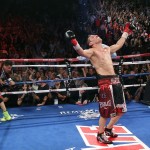
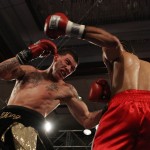
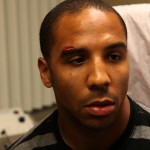
Remembering (for) Timothy Bradley

Timothy Bradley
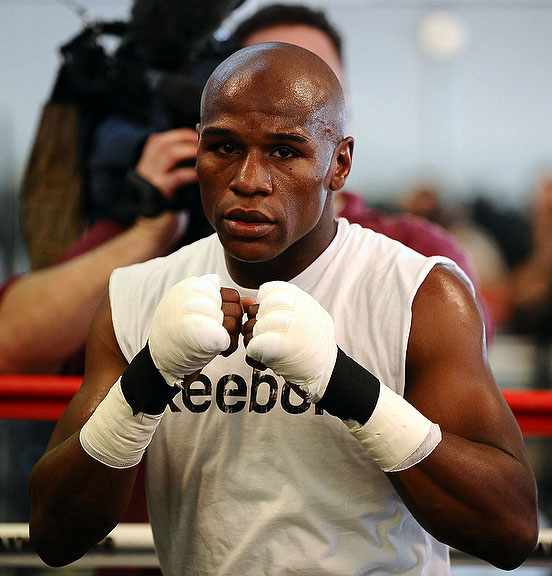
American welterweight Timothy Bradley was knocked-out at 2:33 of round 1 by Russian Ruslan Provodnikov, Saturday at Home Depot Center in Carson, Calif. Bradley began a right cross at the moment Provodnikov did, and while Bradley’s grazed harmlessly past, Provodnikov’s struck flush. Bradley buckled, fell forward, clutched Provodnikov round the yellow letters on the seat of his trunks, then fell to his knees and black gloves. Bradley rose, backpedaled, fell, rolled over, and rose again with the lunatic smile a man wears when no signal his brain sends down the spinal cord is obeyed by his lower body.

If consciousness is an awareness by the mind of itself and the world, Bradley was not conscious for most of the 33 minutes of fighting that followed. But in what variable moments of consciousness he experienced, Bradley sent communiques enough to the learned muscles of his body to decision Provodnikov by unanimous scores of 114-113, 114-113 and 115-112 and retain the WBO welterweight belt he took from Manny Pacquiao in June. Treated to valorous a display as an athlete can make, the sparse Home Depot Center crowd booed loudly the judges’ deciding in favor of the champion.

And there was Timothy Bradley, bouncing in his corner before the decision, trying to make a spirited sight of his readiness and fitness, showing Provodnikov he was not tired but anxious to come out and make war in the final round, except that the final round had come and gone minutes before, and Bradley seemed to have no idea of it. He was not in his right mind. If you told Bradley on Sunday morning he fought valiantly, did his level best, but finally got knocked-out by a well-fisted Russian who wore him to a nub at the end, Bradley would have had to go find his belt, if he even remembered where he put it, to be sure you were wrong.

Bradley is frailer than his detractors know. In 2011, I spoke with him in the Southwest hangar of the Detroit Metro Airport seven hours after he beat Devon Alexander, and the first thought I had as he shuffled anonymously along the gleaming tile hallway, taking tiny steps, no entourage in tow, his left eye shuttered, his face small and dark, was: “God, he looks fragile.”

The same could be said of him as he sat in a wheelchair beneath the MGM Grand dais last year after going more rounds with Manny Pacquiao than Oscar De La Hoya did, or Ricky Hatton did, or Miguel Cotto did – this must not be forgotten – and after the greatest moment of his career, one an entire industry then conspired ghoulishly to snatch from him. The same could be said of Bradley on Saturday night as he stood wideyed and confused, genuineness and goodness still shining through concussion’s miasma, and admitted he did not recall what he said three seconds before.

Timothy Bradley gives more than he has to every fight; he is ill-equipped for the combat he makes. He is a man with one knockout victory in six years who went for the knockout repeatedly, Saturday, against an opponent who’d rendered him senseless in their first three minutes together. Ruslan Provodnikov showed Bradley’s large flaws: He does not move his head until he is on an opponent’s chest, his balance is often not good as he believes, and his power at welterweight is a fraction his confidence in it. Bradley fights rather like what he is: a man whose teachers believed conditioning was more important than defense.

In the final 15 seconds of round 6, Bradley and Provodnikov threw 56 punches at one another, in as feral a display of desire and conditioning as can be seen in a prizefighting ring. Provodnikov threw many of his punches head-down and landed many more than Bradley did, head-up. Bradley needed to see Provodnikov to punch him, and that was difficult with his eyes scattering like brown marbles in sockets of polished obsidian. Provodnikov knew without having to look where Bradley’s chin would be, which allowed him, at various remarkable moments Saturday, to move his head well out of Bradley’s range as he put his wonderfully leveraged right fist in the geometrical center of Bradley’s face.

But promoter Top Rank is not yet rid of its Bradley problem, and Bradley’s flowering resentment, and how history will judge its catalyst, is to be a problem indeed. When Bradley went down in the final seconds of round 1 then got up, fell backwards, and landed on his shoulder at an angle obtuse enough to separate it, I thought of what Top Rank’s peerless matchmaker once said after an early undercard match when a local favorite got dropped by an unknown: “Nothing surprises me.” Provodnikov did exactly what was expected of him, and if he did not permanently alter the trajectory of Bradley’s career, Saturday, he likely will in the rematch Bradley will have to make long before he is given the payday he was promised if he beat Pacquiao, which he did.

We booed Bradley afterwards, again, in his home state this time, despite his making combat for a half hour his brain was too scrambled to record – booed him because three professional judges agreed he won another close fight. Bradley may forgive us, though he should not, but he will not forget, and he should not. He is a greater man than he is a fighter, and he deserves better judges than what we are.

Bart Barry can be reached at bart.barrys.email (at) gmail.com


Provodnikov Takes Bradley to the Limit in Fight of the Year Candidate

Bradley vs. ProvodnikovCARSON, CALIFORNIA – Timothy Bradley Jr. was taken to the limit over twelve rounds by Ruslan Provodnikov in the HBO-televised main event at the Home Depot Center on Saturday night, but managed to escape with his WBO 147-pound title in tact with a debatable twelve-round unanimous decision.

Bradley and Provodnikov wasted no time, opting to stand and trade shortly after the opening bell. In the midst of an exchange, Provodnikov (22-2, 15 KOs) of Beryozovo, Yugra, Russia beat Bradley (30-0, 12 KOs) of Palm Springs, California to the punch with a short right hand. The punch downed Bradley, but referee Pat Russell ruled the fall a slip. Bradley began to pop back up, but fell back down again, a clear sign that he was legitimately hurt.

The second round picked up where the first round left off, as the two engaged in more wild exchanges. Bradley, still feeling the effects of the first round, was getting the worse of it as one combination sent him into the ropes, nearly scoring a knockdown again.

The fight took a turn in the third, as Provodnikov punched himself out after his incredible output in the first two rounds. Bradley wisely fell back on his jab and took the third by keeping the drained Provodnikov off balance at arms length. Bradley continued to potshot at range, effectively sewing up the fourth to miraculously even up the fight after four.

Bradley was drawn back into some wild exchanging in the fifth, but did so a bit more intelligently and cautiously. The balance worked as Bradley clearly claimed his third round in a row after being taken to the brink of a stoppage.

The fight took another turn in the sixth. After Bradley boxed well enough for two-and-one-half minutes, Provodnikov came out of nowhere and cleaned Bradley’s clock again with a left hand. Bradley moved from one corner to the ropes on the other side of the ring, but Provodnikov followed him, throwing every step of the way. Bradley fought back, but it just gave the challenger more openings to exploit as the bell sounded.

Both fighters took off the seventh round, which all three official scorers would give to Bradley. The champion boxed just enough to take round eight as well to somewhat sneakily move ahead in the fight 77-75 on all three cards.

Provodnikov was able to sucker Bradley back into firefight in spurts during the ninth, but champion did not cave in and swing for the fences like in the opening two rounds. Feeling confident after a solid ninth, Bradley was flashy with his combinations in the tenth, but did not commit to his punches like earlier in the fight. Though he landed less, this writer felt Provodnikov edged the tenth with his few power shots. However all three official scorers wound up giving the round to Bradley.

With the fight slipping away, Provodnikov came on again in the eleventh, clearly landing the more effective blows. Bradley spent too much time circling and moving, while Provodnikov landed clean blows. Though it looked to be a clear Provodnikov round, official scorer Raul Caiz Sr. would end up giving the eleventh to Bradley.

Reportedly told by his trainer Freddie Roach he needed a knockout to win, Provodnikov aimed to do just that as he came out for the twelfth and final round. As was the case nearly every time Provodnikov had Bradley in the trouble, the damage would came in the last half minute of the twelfth. After a sustained barrage, Provodnikov would finally down Bradley with a short right hand. Obviously hurt, Bradley managed to get out of the round and force the fight to the cards. Judges Jerry Cantu and Marty Denkin handed in cards of 114-113 for Bradley, while Caiz Sr. had it a puzzling 115-112 for the champion.

Boos would drown out the cheers for Bradley as the decision was read before the Home Depot Center crowd, a response the champion did not deserve after such a valiant battle. Bradley’s quest for respect was a hot topic heading into Saturday’s contest, given the fashion in which he attained victory over Manny Pacquiao last year. Unfortunately for Bradley, it appears that quest continues after another hard-fought, but controversial victory

VargasOmotosoFight300In a battle of unbeatens, Jessie Vargas (22-0, 9 KOs) of Las Vegas, Nevada came away with a wider than deserved unanimous decision over Wale Omotoso (23-1, 19 KOs) of Hollywood, California by way of Lagos, Lagos State, Nigeria in the televised co-feature.

After a methodical first round, Omotoso, 146.8, began to find his openings with great frequency in round two. Vargas, 146.6, decided to fight fire with fire much to his detriment in round three. After a solid exchange, a borderline body shot dropped Vargas early in the stanza. Vargas came back firing, but it was Omotoso that look better in the exchanges.

As the fight moved to the fourth, Vargas and “Lucky Boy” continued to exchange, but it was Omotoso that was landing the cleaner, harder shots. Although Omotoso was wide with many of his swings, he continued to catch Vargas on the end of many telling blows. However, by the end of the fourth, Vargas sprang to life, which led into the fifth, unquestionably his best round.

Vargas caught Omotoso early in the fifth with a solid right. “Lucky Boy” mocked Vargas with a dance, but another right followed which clearly stunned Omotoso. Vargas saw the change and pounced on his foe. Vargas landed as Omotoso retreated to different corners of the ring, before finally running out of gas as the round came to an end.

The fight climaxed in the fifth, as the pace dropped of dramatically beginning in the sixth.
Vargas may have held a slight edge in two or three of the following three rounds, but there was little to choose from as the output of both sank. Omotoso came on again to start the tenth. Vargas attempted to stem the tide, but really had little on his punches as the fight winded down.

In a fight that could reasonably have gone either way by a point or two, Vargas was awarded the bout by the shockingly wide scores of 97-92 and 96-93 twice. With the win, the WBA #5/WBC #9/IBF #15 ranked Vargas claimed the minor WBC Continental Americas Welterweight title while likely improving upon his world rankings.

In the last bout before HBO went on the air, Oscar Valdez (3-0, 3 KOs) of Tucson, Arizona by way of Nogales, Sonora, Mexico stopped tough as nails Carlos Iguera Gonzalez (1-3) of Los Angeles, California with a series of unanswered blows.

The durable Iguera Gonzalez, 128, had been beaten twice before, but never beaten down the way he was by the former amateur star Valdez, 128, at the Home Depot Center tonight. Valdez punished him from round one, getting the better of every exchange. Finally in the third a wicked left hook slumped Iguera Gonzalez against the ropes, with the ensuing combination forcing referee Tony Crebs hand. Time of the stoppage was 58 seconds of round four.

Ruiz_Greer_130316_001a
Fast-handed heavyweight Andy Ruiz Jr. (18-0, 12 KOs) of Imperial, California by way of Mexicali, Baja California, Mexico downed Midwest journeyman Matthew Greer (15-10, 13 KOs) of Saint Louis, Missouri three times in the first to force a mandatory stoppage.

Ruiz, 246, attacked the large body of Greer, 240, which created the opening for a right high on the head for the first knockdown. Soon after action resumed, Ruiz landed a left to the body that put down Greer for the second time. Greer continued to fade as a light shove forced him down and ate some time from the clock, but not enough. Another cuffing right high on the head, dropped Greer for the third and final time, prompting referee Jack Reiss to wave off the bout at 2:53 of the first.

Emerging local prospect Gabino Saenz (9-0-1, 7 KOs) of Indio, California excited his Southern California fan base with a horrific second-round stoppage of Cesar Valenzuela (3-2-1, 1 KO) of Phoenix, Arizona.

After a rough-and-tumble first, Saenz, 126, came out determined in the second round, eventually landing a left that rocked Valenzuela, 125. The Arizona resident attempted to hold on and regain his legs, but found himself on the canvas from a Saenz flurry capped by an overhand right. Shortly after action resumed, Saenz uncorked a short right that sent Valenzuela’s jaw one way and his body the other. Referee Tony Crebs immediately waved it off at 2:02 of round two. Thankfully Valenzuela was able to leave the ring under his own power.

In a brutal shocker, journeyman southpaw Victor Sanchez (4-5-1, 1 KO) of Houston, Texas starched one-time prospect Ramon Valadez (11-4, 6 KOs) East Los Angeles, California inside of one round. Sanchez, 127, dropped Valadez, 126.8, with a left hand midway through the first. Valadez was never able to regain his legs and was eventually stopped on his feet as a combination separated him from his senses along the ropes. Referee Jack Reiss leaped in to stop the contest at 2:39 of the first round.

Touted prospect Jesse Magdaleno (14-0, 10 KOs) of Las Vegas kept busy against a warm body, scoring three knockdowns en route to a third-round stoppage over Carlos Fulgencio (19-10-1, 12 KOs) of Santo Domingo de Guzman, Dominican Republic.

Fulgencio, 123.6, offered little resilience against the quick-handed Magdaleno, 123.4, who kicked off his 2013 campaign in style. Magdaleno dropped Fulgencio in the first with a right hook, again with his right in the second and ended matters in the third with a right uppercut. Referee Tony Crebs immediately waved off the bout when Fulgencio went down for the third time without a count. Time of the stoppage was 45 seconds of the third round. Fulgencio has now dropped five straight.

In the curtain raiser, decorated former amateur star Egidijus Kavaliauskas (1-0) of Oxnard, California by way of Kaunas, Lithuania employed a withering body attack en route to a four-round unanimous decision over a game Eridanni Leon Quintero (0-1) of Inglewood, California.

Kavaliauskas, 150.2, managed to routinely force Leon Quintero, 150.6, to the ropes while finding his foe’s ribs an open target. Kavaliauskas, whose stellar amateur career was highlighted by representing Lithuania at the 2008 and 2012 Olympic Games, looked more like an experienced veteran rather than a fighter making his pro debut. All three judges scored the bout a shutout, 40-36, for Kavaliauskas.

Photos by Chris Farina/Top Rank

Mario Ortega Jr. can be reached via e-mail at ortega15rds@lycos.com or you can follow him on Twitter @MarioG280


Bradley Still Fighting for Respect

Bradley vs. ProvonikovMANHATTAN BEACH, CALIFORNIA — Long compared to the sometimes underappreciated Marvelous Marvin Hagler, Timothy Bradley Jr. finds himself in a position the middleweight great would have had a chance to sympathize with had he gotten the nod over Sugar Ray Leonard in 1987. Given the edge in scoring over beloved superstar Manny Pacquiao last year, Bradley felt the wrath of the Filipino fans and pundits alike. Despite what should have been a career-changing win, Bradley still has something to prove as he takes on determined challenger Ruslan Provodnikov in the HBO-televised main event tonight emanating from the Home Depot Center in Carson, California. Fighters weighed-in Friday at the Manhattan Beach Marriott.

Bradley (29-0, 12 KOs) of Palm Springs, California will be competing as a welterweight for just the third time in the last six years as he makes the first defense of the WBO 147-pound title he claimed from Pacquiao last June. Bradley was slow to recover from injures sustained in that bout and opted to sit out the winter before accepting the challenge of Provodnikov tonight.

A career 140-pounder himself, Provodnikov (22-1, 15 KOs) of Beryozovo, Yugra, Russia vacated his various world rankings at light welterweight to take tonight’s bout and now finds himself the WBO #3 ranked welterweight. Provodnikov worked his way into this opportunity by stringing together a five-fight win streak since his lone defeat to Mauricio Herrera back in 2011. Provodnikov and Bradley both weighed in at 146.6-pounds.

In an intriguing co-feature, one of two undefeated welterweight prospects will graduate to world contender as Jessie Vargas (21-0, 9 KOs) of Las Vegas, Nevada takes on Wale Omotoso (23-0, 19 KOs) of Hollywood, California by way of Lagos, Lagos State, Nigeria in a ten-rounder with the minor WBC Continental Americas Welterweight title at stake.

Vargas, who scaled 146.6, has hardly been tested in his four fights since a close decision win over eventual titlist Josesito Lopez in September of 2011. Based out of the Wild Card Gym, Omotoso came in at 146.8-pounds. Despite his glossy record, Omotoso remains an unproven commodity, but a win over Vargas would go a long way in changing that perception.

In off-TV undercard action, Andy Ruiz Jr. (17-0, 11 KOs) of Imperial, California by way of Mexicali, Baja California, Mexico takes on journeyman Matthew Greer (15-9, 13 KOs) of Saint Louis, Missouri in an eight-round heavyweight bout. Ruiz, who comes in off of an impressive third-round shellacking of Elijah McCall, scaled 246-pounds. Greer, who opened his year on the losing end of a second-round stoppage against Deontay Wilder, weighed in at 240-pounds.

Well regarded prospect Jesse Magdaleno (13-0, 9 KOs) of Las Vegas looks to remain busy against Carlos Fulgencio (19-9-1, 12 KOs) of Santo Domingo de Guzman, Dominican Republic in an eight-round featherweight bout. Magdaleno, the younger brother of world ranked Diego Magdaleno, scaled 123.4-pounds, while Fulgencio made 123.6.

Oscar Valdez (2-0, 2 KOs) of Tucson, Arizona by way of Nogales, Sonora, Mexico will take on Carlos Iguera Gonzalez (1-2) of Los Angeles, California in a six-round super featherweight bout. Valdez’ original opponent Jose Morales came in way over the contracted limit at 137.8-pounds. Iguera Gonzalez was scheduled to fight unbeaten Victor Pasillas, but Gonzalez himself came in overweight. Pasillas weighed in at 124.6, but turned down the fight when Iguera Gonzalez came in at 128. Top Rank quickly matched Iguera Gonzalez with Valdez, who also happened to be 128-pounds, saving the spot the promising wunderkind.

Popular super bantamweight prospect Gabino Saenz (8-0-1, 6 KOs) of Indio, California makes his 2013 debut against Cesar Valenzuela (3-1-1, 1 KO) of Phoenix, Arizona in a six-round bout. Fighting as a featherweight tonight, Saenz weighed in at 126-pounds.
Valenzuela, who got off the deck to score a stoppage last time out, weighed in at 125-pounds.

Aiming to get back on the winning track after two straight defeats, Ramon Valadez (11-3, 6 KOs) East Los Angeles, California gets a softer touch in Victor Sanchez (3-5-1) of Houston, Texas in a bout scheduled for six. Valadez, whose recent losses came against fighters with a combined 24-1-2 record, weighed in at 126.8-pounds. Similarly Sanchez, who came in at 127-pounds, is 0 for his last two against fighters with a combined 28-1-1 record.

International amateur standout Egidijus Kavaliauskas of Oxnard, California by way of Kaunas, Lithuania will take on late replacement Eridanni Leon Quintero of Inglewood, California in a pairing of fighters making their professional debuts. Kavaliauskas weighed in at 150.2, while Leon Quintero made 150.6-pounds.

Tickets for the event, promoted by Top Rank, are available online at Ticketmaster.com.

Quick Weigh-in Results:

WBO Welterweight Championship, 12 Rounds
Bradley Jr. 146.6
Provodnikov 146.6

WBC Continental Americas Welterweight Championship, 10 Rounds
Vargas 146.6
Omotoso 146.8

Heavyweights, 8 Rounds
Ruiz Jr. 246
Greer 240

Featherweights, 8 Rounds
Magdaleno 123.4
Fulgencio 123.6

Super Featherweights, 6 Rounds
Valdez 128
Iguera Gonzalez 128

Featherweights, 6 Rounds
Saenz 126
Valenzuela 125

Featherweights, 6 Rounds
Valadez 126.8
Sanchez 127

Light Middleweights, 4 Rounds
Kavaliauskas 150.2
Leon Quintero 150.6

Photo by Chris Farina/Top Rank

Mario Ortega Jr. can be reached at ortega15rds@lycos.com.


The Right Corner: Freddie Roach still occupies it

Pacquiao_LAX_arrival_120505_004a
Losses are as inevitable as scars. If you don’t have some of both, you probably haven’t done much. Or learned much. Freddie Roach, fulltime trainer and street-corner philosopher, has them, accepts them. Maybe even values them.

“Part of life in boxing is losing,’’ Roach said.

The other part to that equation is what Roach hopes to accomplish Saturday night in Ruslan Provodnikov’s bid to upset Timothy Bradley in an HBO-televised fight at Carson, Calif. Victory is a cure-all that eliminates the noisy contagion so symptomatic of defeat. Lose a few and the cheap shots begin to circle like pests in search of a free lunch

Roach has heard them. His own string of high-profile losses in 2012 attracted them. Amir Khan fell to Danny Garcia. Julio Cesar Chavez Jr. lost every round but the 12th to Sergio Martinez. Then, Manny Pacquiao dropped face-first onto the canvas from a Juan Manuel Marquez right hand that landed like a wrecking ball. Even the one fight that seemed to be a lock for Pacquiao, went the other way on the scorecards and – inevitably — against Roach. Bradley got a split decision.

Is there no end to this losing streak? Hard to tell. But the tone has changed. Whispers about Roach went public. Roach even heard them on a conference call from Bradley trainer Joel Diaz.

“Freddie Roach is not my concern,’’ Diaz said. “My concern is the fighter.’’

Diaz could have stopped right there. But he didn’t. If Roach isn’t Diaz’ concern, he wasted a lot of conference-call time ripping him.

“Freddie Roach was just a name that was created,’’ Diaz said. “I think, Freddie Roach lost the love of the sport. He created a name and it’s out there, but he doesn’t have passion for the sport that he had a few years ago.

“I’ve seen it in the last Marquez fight. I’ve seen it in the fight before, the third fight with Marquez. Freddie Roach is the least of my concern for any fight. I just focus on the fighter. Freddie Roach is always trying to play mind games. Freddie says Tim is going to run. That is just Freddie playing mind games. They don’t know how we are going to fight. He is trying to get under Tim’s skin. At the end of the day, Tim is going to be a winner, and that’s what matters.’’

Whew, no telling what Diaz would say about somebody who does concern him.

In a sure sign that there’s been no erosion in Roach’s wisdom, he didn’t accept the invitation to indulge in some tired trash talk. He’s kept his attention on his Russian welterweight, which is where it should be.

“I could tell him where to go but he doesn’t know me,’’ Roach said “He doesn’t know what I do every day. He doesn’t see me in the gym working with these fighters. I know he’s just saying it to get under my skin. I have a game plan and the right fighters to carry that game plan through. On the 16th (Saturday), we’ll see who’s the better coach or who’s the better man.’’

It’s no secret that trainers are only as good as their fighters. It’s the same with coaches. Phil Jackson without Michael Jordan and Kobe Bryant would have been just been another guy holding a clipboard on an NBA bench. Roach knows that. Diaz might learn that.

“It’s not about the trainers,’’ Roach said. “My fighter is the one who’s going to win the fight, not me. Whatever he says, I don’t care. I don’t have time to be mad at someone. I don’t read anything he says. I just don’t have time for that.’’

Roach doesn’t buy into the redemption angle. But a slice of it is there for the winner. It’s the element that injects some intrigue into Bradley- Provodnikov. A Provodnikov victory means Roach can begin to get beyond 2012. A Bradley win means Bradley can move beyond a victory so controversial that it turned him into a virtual loser.

Of the two, however, the stakes are bigger for Bradley (29-0, 12 KOs). A loss to Provodnikov (22-1, 12 KOs) would only confirm what the public believed about his split-decision in June over Pacquiao in his last fight. It was a coincidental gift created by incompetent scoring.

“Most of the public in the world knew Pacquiao won,’’ said Roach, who didn’t need to be reminded that two judges and Bradley were not part of that consensus. “Just three people and Bradley’s trainer thought Bradley won. So, you have four guys against the world. We’re not worried about that.’’

I’m not sure Provodnikov can beat Bradley. But Roach won the conference call.

AZ NOTES
Two-time Mexican Olympian Oscar Valdez (3-0, 2 KOs) makes his fourth pro appearance Saturday is in a junior featherweight six rounder against Jose Morales (6-4, 1 KO) in a junior-featherweight on the Bradley-Provodnikov card.

Valdez, who fought in the 2008 Beijing and 2012 London Games, has family in Tucson. He grew up in Nogales on the Mexican side of the border with Arizona.
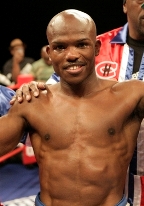
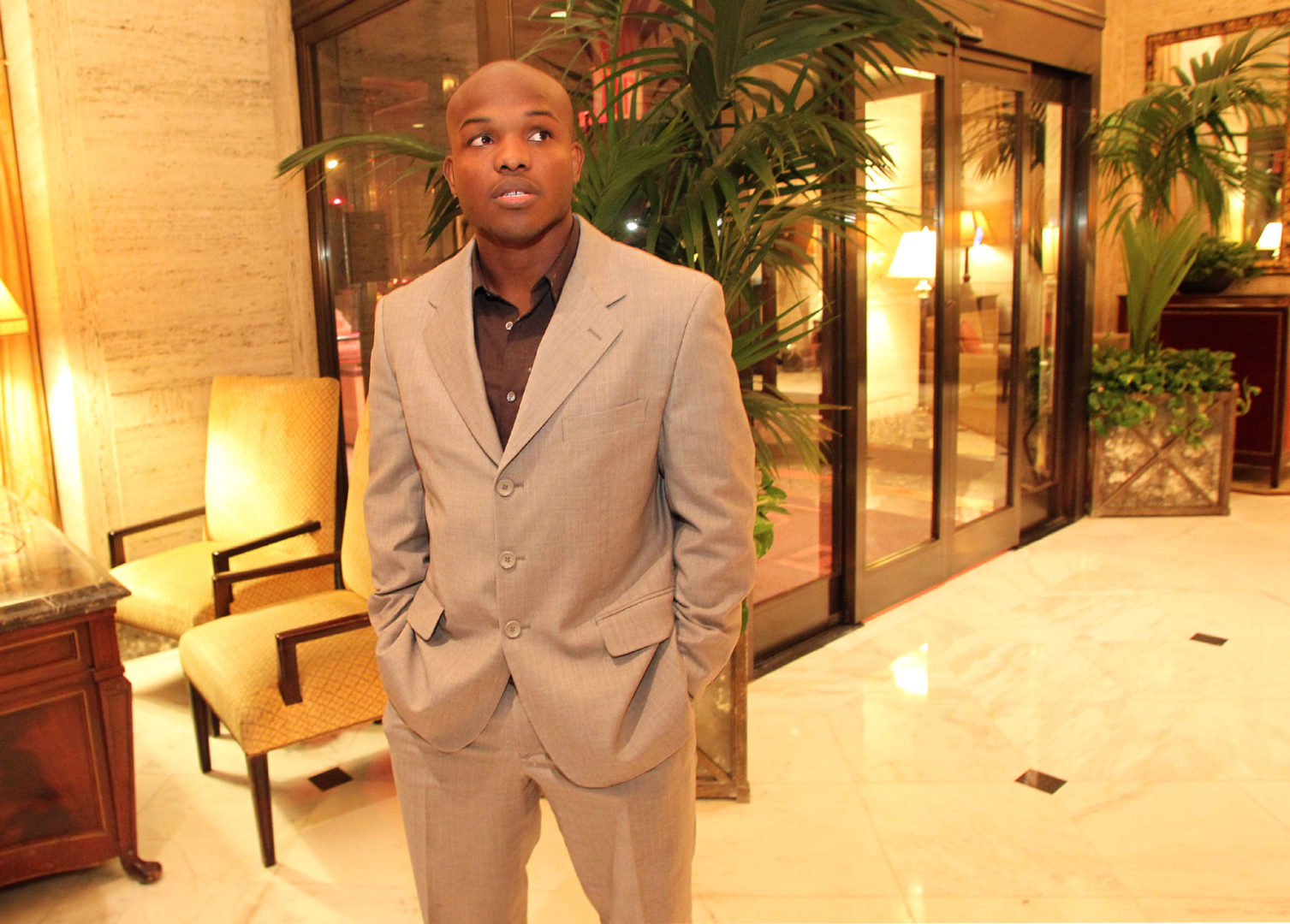

What will they say about what we said about Timothy Bradley?

Timothy-Bradley
Saturday Timothy Bradley, inactive since decisioning Manny Pacquiao nine months ago, will return from exile to defend against Russia’s Ruslan Provodnikov the burnt-maroon WBO welterweight belt Bradley took from Pacquiao in June. Provodnikov, with three more knockouts in his 23 prizefights than Bradley has in 29, might well be the wrong style for Bradley, slugger to volume puncher, but wrong styles is where Bradley has found himself since inciting the wrath of a public still naïve enough in 2012 to believe Pacquiao, if he could just keep getting decisions, might meet Floyd Mayweather in the Fight to Save Boxing.

Bradley has appeared on a conference call and a television show recently, as part of his promotional duties, and done a fairly good imitation of the late Joe Frazier declaring forgiveness for Muhammad Ali – which is to say Bradley is unconvincing when he says he is done thinking about what happened to him, and his career, and his family, after he decisioned Pacquiao. He isn’t, and he should not be.

What will they say about what we said about Timothy Bradley? That’s a question to ask ourselves the next time television convinces us to pile on the performance of an athlete like Bradley, the next time we are drafted like pawns in a network’s or promoter’s army of self-interest and profitability, the next time we are convinced something like our proper identities is staked on how well we proclaim the favored man in a superfight was wronged by public servants with nothing to gain by his wronging.

“There is a difference when you view it live and when you view it on TV,” Bradley said on Tuesday’s conference call. “Completely different.”

Completely right. One needn’t bore into the untrustworthy properties of projected images – though one is welcome to, if it will help – to understand how very different, how very unreal, the experience of watching a fight on television is, with its jiggering cameras, close no far no close no from the back oops he moved to the front no not the ref show the face no back up back up change the angle, and its self-interested commentators and self-referential, and self-reverential, scoring and wildly distorting choice of replays.

Each time television must choose between more realistic and more entertaining, it chooses the latter, yet its celebrants assure themselves it chooses the former – till in a crescendo of absurdity they demand actual participants and actual observers actually present at an actual event, not an image projected through myriad filters, review the filtered projection to find truth. If only Van Eyck and Leonardo could see this spectacle, the way the lenses they used for making glorious illusions have supplanted persons’ faith in eyewitnesses, how heartily they would chuckle.

Some bored postgrad might someday arrange an experiment like this: Project a piece of gray slate on a high-definition television and ask a subject seated in a dark, empty, silent room whether the color is nearer blue or purple, and record his answer. Then set headphones on his ears and ask him again after exposing him to this:

“Big blue everywhere! Blue, blue, blue. Another big blue! This is a historic show of blueness.”

“Now I know a few people out there might be saying ‘purple,’ but I just don’t see it.”

“Reminds me of some of the blues I use. Some of them blue-on-blues, son!”

“I have it scored: blue, blue, blue. Look, it’s a pure blue. Not a sky blue or a robin’s egg blue. It’s as blue as the bluest blue you’ll ever see. Three to nothing – all blue!”

It was the week that followed Bradley’s decisioning Pacquiao in June historians will find offensive. The way the proudest moment of a good man’s career was whitewashed by an entire industry, shouting down dissenters and boarding a promoter’s self-profiting vehicle beneath a streaming banner that read: “No need for a rematch, because we already know who really won!” Bradley is right not to forgive them, he is right to admit his devilish side still finds schadenfreude in Juan Manuel Marquez’s unequivocal leveling of Pacquiao six months later.

Bradley is what they used to call “good people”; he is dignified, serious, friendly and confident. He did not fight his best that night against Pacquiao, and he would win a rematch – which is why none was offered, or will be – because Pacquiao would be watched with different sets of eyes, this time noticing his footwork was sloppy and tangled as he swam over and around Bradley and connected solidly with fewer than one in five punches, a sloppiness made manifest by diminished reflexes, a diminishment that later made openings enough to make Marquez, the master gambler, bet his eternal soul on a right hand no amount of promotional prestidigitation can now undo.

There’s a dramatic documentary here for ESPN to produce in 10 or 15 years, one that will say that although Pacquiao clearly lost the second half of his third fight with Marquez, folks still wanted to believe they saw him do things he simply did not do against Bradley, projecting an image of the man who blitzed Marco Antonio Barrera and Erik Morales onto the one across from Tim Bradley seven months after Marquez asked stylistic questions Pacquiao could no longer answer.

“What they did to my son was wrong,” Ray Bradley, Tim’s father, will intone in a deep, stern voice. “He was undefeated, 28 and 0, and the worst he did was make a close fight with the world’s number one? They had no right.”

Bart Barry can be reached at bart.barrys.email (at) gmail.com


Crazy Comeback: Bradley looking for a win that won’t turn him into a loser

Bradley_NY_arrival_120222_003a
Nothing on Tim Bradley’s resume says his March 16 fight against Ruslan Provodnikov in Carson, Calif., should be called a comeback. He’s unbeaten. He’s got a title. He’s a good citizen. He never retired. Comebacks are for fighters coming off a loss, or rehab, or bankruptcy, or a jail sentence

But here he is, a good guy transformed into a villain in a comeback as bizarre as the scorecards that gave him a victory over Manny Pacquiao in June yet somehow turned him into something he isn’t.

“I don’t get any credit after the Pacquiao fight, whatsoever,’’ Bradley (29-0, 12 KOs) said Tuesday in a conference call. “People talk about me, my style, that I’m boring. Some people talk about my wife, my kids. People sent me death threats after the fight because I won undeservingly. I should have given the belt back.

“A lot of different things went on. I can talk all day about things that people said about me. But it doesn’t matter. None of these people are going to get in the ring with me. People can say whatever they want. It is a free country. So, I am going to say whatever I want, when I want to say it and how I want to say it.

“Those people don’t know me at all. If you get to know me, if you know what I go through, how I train and you still talk crap about me, then you have the problem. No one knows what I go through to prepare for my fights. People need to sell papers I guess.

“I am the nicest guy you will ever meet on the street. Ever.’’

The judges’ scoring in his split-decision over Pacquiao in a welterweight bout has been called the worst. Ever.

But that gives boxing too much credit. Let’s face it, the undisputed title for the worst decision ever is a dead heat in a very crowded field.

The way the public and much of the business treated Bradley, however, was the worst. Ever.

Internet vigilantes, all armed with anonymity, smeared Bradley with impunity and without giving his performance a second look. Did Bradley lose? Yeah, I think so. He suffered foot and ankle injuries. But can anybody remember another bout when the winner showed up at the post-fight news conference in a wheel chair? Didn’t think so. That’s how bizarre the entire night was.

But don’t blame Bradley. He didn’t score the fight. He fought and fought well. Review the tapes and you’ll see how he made Pacquiao look like a fighter in decline. Bradley exposed Pacquiao’s eroding hand speed and provided a preview of what would follow: Juan Manuel Marquez’ knockout of the Filipino in December. For that, Bradley deserves credit, if not a rematch. Instead, he gets death threats from people who aren’t fans. They’re gangsters. Sadly, there are a lot of them

“The result of the Pacquiao-Bradley fight was a very tough result for everybody in the sport and very tough for a lot of people,’’ said Top Rank President Todd DuBoef, who says Bob Arum’s promotional company has made peace with Bradley and his wife, Monica. “Fortunately Tim, Monica and myself have been able to communicate. There was no handbook for what the result of the fight was. No one knew how to handle it.

“We had death threats, Tim had death threats. It was a very spirited blogosphere campaign that we all got sucked into. Fortunately we have a healthy relationship moving forward. We are looking to keep him active and making the biggest fights we can for him.’’

Here’s hoping he wins them in a way that makes him Comeback Fighter of the Year.

Olympic Debut
American Olympic heavyweight Michael Hunter is scheduled to make his pro debut Saturday night on an Iron Boy Promotions card at Celebrity Theatre in Phoenix. Chad Davis (4-10), a Phoenix cruiserweight and heavyweight, is Hunter’s scheduled opponent.

Hunter lost in the opening round at the 2012 London Games to a Russian, Artur Beterbiyev, the 2009 World Amateur champion. Hunter led, 8-7, going into the final round. The Olympic preliminary ended, 10-10, but the decision went to Beterbiyev on a tie-breaking vote from the judges.

The Hunter-Davis bout, a four rounder, is one of 14 fights – 10 pro and four amateur – on a card scheduled to begin at 6 p.m. (MST).

Photo by Chris Farina / Top Rank


Canelo is coming. Is this city ready?

OLLU
SAN ANTONIO – While there is no promotional formula for rising from small and local shows to large and national ones, there is perhaps a timeline: suddenly. The incremental approach that works well in most of life’s worthwhile doings does not work nearly so well in prizefighting promotion, as so many other good ideas do not work nearly so well in prizefighting promotion – wherein shortsightedness rarely finds its match in anything but cupidity. “Go large, be bold, and expect to lose” is probably good a slogan as any, and Leija-Battah Promotions certainly understands those first two.

Saturday at Our Lady of the Lake University, Leija-Battah Promotions held its final sparring session before a championship match it will make, both as promoter and challenger, on April 20, when Mexican Saul “Canelo” Alvarez fights New Mexican Austin “No Doubt” Trout at Alamodome, in the biggest consequential fight of the first half of 2013.

Is this city ready? That is a question Saturday answered incompletely. The main event certainly was not ready, or anything local promoters had control over. Golden Boy Promotions was to blame for Omar Figueroa unmanning someone named Henry Aurad in a few punches, but only insofar as a promoter overextended with television dates and fighters can be. There’s an underexplored conundrum here, one that having too large a stable, usually required by too many television commitments, can bring. It’s a thing storied matchmaker Don Chargin shared: You run out of opponents. When you have too many good fighters and they must be kept active against fighters other than your other good fighters, when your responsibility is to build fighters, not fights, appropriate opposition goes missing.

Golden Boy Promotions now finds itself often putting men like Henry Aurad on television. Top Rank, in its overstocked past, did this lots, too, but Top Rank has stropped itself in the last four months – one is tempted to hear the starter’s pistol the night Juan Manuel Marquez recalled Top Rank’s signature brand though the downsizing began months earlier – and is on the verge of having its least-active Q1 in memory.

Our Lady of the Lake University’s gymnasium was filled Saturday. OLLU is a small, old, lovely place a couple miles west – just to the Mexican side – of this city’s downtown. Any town has its ethnic enclaves, and while this one is probably the most Mexican of our country’s largest, the west side of San Antonio is even more Mexican than other parts with their enclaves of Chicanos or African-Americans or German-Americans.

Founded nearly 120 years ago by the Sisters of the Congregation of Divine Providence, a French order of Catholic nuns, OLLU is a school with a campus that is small but precious and home of its city’s most picturesque steeple, reminding students, or boxing aficionados as the case may be, their host is not secular. Catholicism is arguably a cultural artifact for Mexicans more than a religious one; the reevaluation of the Church the Irish, among others, now undergo is a thing Mexicans underwent in the late 1920s, when President Plutarco Elias Calles fired what might euphemistically be called a starter’s pistol of his own. Mexican Catholicism is a rich and irreverent species of Catholicism; its cultural tendency towards faith is leavened by a deeper indigenous recollection of how the faith was delivered by steel-bearing Spaniards the new God mysteriously chose as His emissaries.

OLLU is a local-knowledge spot Leija-Battah Promotions chose for a small show because it is a local promoter that understands the city in which it promotes because it is run by residents of the city. This month marks a year since Jesse James Leija, still a trainer and former prizefighter much more than a promoter, and Mike Battah, a local businessman, formed Leija-Battah Promotions and presented a Top Rank show that featured Kelly Pavlik in a corner of Alamodome called Illusions Theater.

Other shows followed, and while announced gates were encouraging, other elements were not. After Alamodome, there was a show at a dancehall followed by a pro-am at Alamodome, followed by a Freeman Coliseum show and a late-December card in an assembly hall. Throughout, there were rumblings of Leija-Battah wanting to bring Saul “Canelo” Alvarez to San Antonio. When Saturday’s show got announced in January with Henry Aurad in the main event of a card at a university wellness and activity center, though, well.

Then last week brought news Canelo was in fact en route, and not as a showcase talent against a designated opponent – the way Manny Pacquiao visited this city in 2007 and Julio Cesar Chavez Jr. came in 2010 and 2012 – but in a legitimate title-unification match against a fellow champ with good a chance of winning as losing, if every scorecard were in an honest hand. Alvarez will fight Trout on the third evening of Fiesta, this city’s annual and colorful 10-day celebration of Texas independence – contextualized regularly by San Antonians as “our Mardi Gras,” which means plenty, from a live-gate perspective, when one considers Alamo City has about 400 percent New Orleans’ population.

Will Alvarez-Trout break the record set at Alamodome by Pernell Whitaker and Julio Cesar Chavez Sr. 20 years ago this September? No, but an attendance number above 25,000 is not out of the question. And when did those words last appear in a sentence about American-venue boxing outside Lone Star State?

Bart Barry can be reached at bart.barrys.email (at) gmail.com


Canelo-gram: Canelo sends message to Mayweather that he’s a star in his own right

saulalvarez150
Opponents are like employees to Floyd Mayweather Jr. He talks as if he hires and fires them in his role as boxer, promoter, matchmaker and candlestick maker. But before Mayweather could tell Canelo Alvarez how much his purse would be and what would floors he’d have to sweep to earn it, Alvarez told him to take this job and shove it.

In a sure sign that Canelo has arrived as a star in his own right, he decided not to fight on the May 4 undercard of Mayweather’s bout against Robert Guerrero at Las Vegas’ MGM Grand.

According to various reports, Canelo’s bout against Austin Trout was moved to April 20 in San Antonio because Mayweather would not guarantee him that he’s next, the second act in Mayweather’s new Showtime deal.

Speculation still has Canelo-Mayweather happening on Sept. 14. Part of that, however, had included an assumption that Canelo would appear on the May 4 undercard as part of Mayweather’s supporting cast. But when Mayweather said no to the guarantee, Canelo made other plans.

Somebody more unsure of his credentials and unproven as an attraction might have accepted the denial and quietly resigned himself to a preliminary role. After all, Mayweather’s claim on power has been emboldened by a Showtime contract that, according to some reports, could be worth $250 million. A fraction of Mayweather’s potential income from Showtime could fund a nice retirement. Why offend him?

But Canelo’s move off Mayweather’s card and onto his own indicates that the Mexican junior-middleweight has begun to see himself as an equal. The guess from this corner is that’s how he will negotiate. To wit: Canelo will demand a lot more money that Victor Ortiz and Guerrero ever did. Forget all the predictable trash talk after contracts are safely signed. Guerrero, like Ortiz, is happy for the opportunity.

Unlike any proposed opponent other than Manny Pacquiao on the list of Mayweather possibilities, Canelo has drawing power. He proved at home in Mexico. He confirmed it on Sept. 15 with a record rating for Showtime in a victory over Josesito Lopez at the MGM Grand on the same night that Sergio Martinez beat Julio Cesar Chavez Jr. at Las Vegas’ Thomas & Mack Center on an HBO pay-per-view telecast.

Mayweather has said often and in so many words that he has no equal. In the ring, maybe he doesn’t. But it will be interesting to see if Canelo’s box-office power makes negotiations as futile as they were with Pacquiao. Mayweather likes to dictate more than negotiate. But Mayweather also endangers potential revenue stream for himself and Showtime if he ignores Canelo and the big Mexican audience that he brings to the table.

After his upset of Miguel Cotto, Trout might prove to be a bigger challenge to Canelo than expected. If Canelo prevails, however, the television numbers will be the biggest factor to emerge from April 20.

If they continue to multiply, Mayweather might have to deal with a dangerous business partner, instead of just another carefully-chosen employee.


Icy catharsis: “A fight is a fight”

CalatravaBridge
DALLAS – While the aficionados who peruse this column were dutifully enduring a first collaboration of Mayweather Promotions and Showtime, Saturday, one that worked better as prophesy than entertainment, after they’d already endured a week of contemplating another network switch certain to change the world once more – this time Floyd Mayweather following Manny Pacquiao to Showtime, or have we forgotten? – I was at American Airlines Center to see a hockey game between the Dallas Stars and San Jose Sharks.

The game was not very good, just as Mayweather’s May 4 welterweight fight with 2009 featherweight titlist Robert Guerrero will not be, but it did hold a moment at 8:21 of period 2, an instant of mutual malice satisfactorily resolved, that reminded me how rarely prizefighting brings such catharses anymore. The moment featured a face Mayweather flashes when he throws a punch with which he means to hurt, a contorted countenance that reminds you he is a fighter, a face both Sharks forward Joe Thornton and Stars forward Jamie Benn flashed as their fists and bodies crashed together, and that is what I will treat here.

Saturday’s epiphany: Ferocity of spectacle is what I have missed – a confrontation taken personally, the desire to hurt another man overcoming any fear of being embarrassed before 18,000 strangers. Thornton and Benn’s squaring-off brought a unique drama caused by two quite large professional athletes, neither of whom fights for a living but both of whom know how because one would not otherwise make his living the way they do. It held a tension most every prizefight will lack in 2013: Someone could be badly hurt quite suddenly, and neither man seems to care.

It was a ferocious face Joe Thornton wore as he went after Benn. Thornton, in his prime, now passed, was talented a player as the league had; at 6-foot-4, he moved as a much smaller man, with what balance and grace is expected of a centerman, though with four inches and 20 pounds more than tradition wears at the position. But his desire was questioned in Boston, where he was first pick of the 1997 draft, and then San Jose, where he has been captain for years.

Thornton’s is a finesse game of imaginative passing and awareness of the ice surface, done with what can feel like a complacent smirk; despite 328 career goals, he does not shoot often enough, and despite weighing at least 230 pounds – 235 according to Dropyourgloves.com – he rarely runs his body hard into another’s. In skates and full equipment Saturday, though, Thornton was a 6-foot-7, 240-pound man, nearly a Klitschko brother, under a burst of what sudden rage both Klitschkos avoid with a craftsman’s determination.

I was in row H, seven from the glass, in the zone where hostilities initiated. While any sport is best appreciated by its former practitioners, hockey is more decisively this way than others; because of its speed, and because of how poorly American cameramen, raised on football or baseball or basketball, anticipate plays, ever trailing the action or overcorrecting initial tardinesses, hockey – as separate from the bloodiest elements of its reputation – is rarely appreciated properly by those who’ve not played it. That is seldom a problem above the snow line, and never a problem in Canada, but things can get dicey in Texas.

Skating past, Benn speared Thornton in the groin, the soft fleshy part of the inner thigh where there is no protection, and Thornton reciprocated by chopping the blade of his stick precisely on the inch or so of Benn’s forearm that lay unprotected by the top glove and bottom elbow pad. A wrinkle happened across the ice, a surge in the game’s electrical grid; while most eyes in American Airlines Center followed the puck 20 feet away, those who played the game looked at Thornton and Benn in the instant before Thornton dropped his left glove and Benn shouted, “Let’s go!”

Thornton gently maneuvered one of the Stars defenseman out his way and began checking tape on his right wrist, to ensure his elbow pad did not slide downwards and soften any blow he landed. Benn glided backwards, ungloved hands at his side. The combatants began a large circle, the crowd took its feet with a ghoulish and shouted glee, and the officials backed away to allow space for a resolution. Thornton and Benn negotiated an agreement to remove their helmets, promising neither would break his hand on anything but the other’s bared skull.

Chinstraps undone and hats demurely removed and ceremoniously placed on the ice, the men raised their uncovered knuckles, squared up, circled once, Thornton took a deep breath, and they leaped at each other. The moment was packed to bursting with what chaotic rage the word “fight” should conjure. On a frictionless surface, each moved at the other much faster than two prizefighters would do.

“A fight is a fight” – those were what words happened in my mind. Whatever else these men were – masters in the balletic discipline of balancing on four razor’s edges at 25 miles per hour, careful teammates, loyal friends, fathers, sons – they were savages in the moment, rushing at one another in nearly formless rage, faces honestly contorted by the evil of wanting to hurt another man very badly. These were not, it must be reiterated, goons or enforcers putting on a rally-the-boys spectacle for violence-lusting Texans; these were skill players (Benn had a goal and an assist Saturday) under the spell of a genuine fury, the sort a man feels when he is wronged to requiring satisfaction.

The fight quickly devolved into the exhausting place hockey fights do, with Thornton holding Benn’s jersey with his left fist, yanking him into the jab, and landing a considerable right cross or two to Benn’s left temple – punches that pained both Sunday morning. Benn found Thornton with a right hand as well before both spun to their stockinged kneepads. By prizefighting standards, it was a mere brawl, a donnybrook, a wild-swinging matter of personal grievance with only fractional punching skill employed, which is what brought a catharsis prizefighting will too often lack in 2013.

Bart Barry can be reached at bart.barrys.email (at) gmail.com


Money or History: Mayweather’s Showtime deal will define him

floyd-mayweather
Floyd Mayweather Jr.’s jump Tuesday from HBO to Showtime and parent network CBS is a move that will reveal whether he’s more about money or his place in history.

There’s still a lot we don’t know about the deal, but it’s safe to say it will further enrich the fighter with a nickname, Money, that thus far defines him. Forbes is reporting that the 30-month contract could be worth $250 million if he fights as many as six times. On Forbes’ last annual list of top-earning athletes, Mayweather was No.1 with $85 million for two fights – victories over Victor Ortiz and Miguel Cotto.

Barring a string of undisclosed losses at Vegas books, Mayweather doesn’t need the money. What he does need, however, are fights that will substantiate his claim on being the best ever, better than even Sugar Ray Robinson, Muhammad Ali, Joe Louis and Sugar Ray Leonard.

According to several reports, the contract includes a Showtime guarantee of Mayweather’s purses, no matter what the pay-per-view numbers are. It’s not clear if that guarantee is for the full amount, or a percentage. Six fights over the next two-and-a-half years also look unlikely. Mayweather has fought only four times over the last five years. But let’s say he does. And let’s say Showtime guarantees 100 percent of each purse. That’s about $41.66 million-a-fight.

Given Mayweather’s history, there’s danger in that kind of an agreement. He’s a counter puncher in the ring and by nature. Other than NBA and NFL wagers, he’s not known for taking chances. The smallest risk for the biggest reward has always been Mayweather’s formula. With a guarantee already in his pocket, it would be his nature — and human nature — to just protect his undefeated record (43-0, 26 KOs) against opponents who aren’t much of a threat.

If he fights all six times and wins each, he could end the Showtime deal with a victory that equals Rocky Marciano’s 49-0 record. Then, there’s the chance at history, 50-0, and a new network deal as rich, or richer, than the current one.

A lot can, and will, happen between now and then. There’s potential injury. There’s age. Mayweather turns 36 on Sunday. He’ll be 38 when the Showtime contract expires. In his last bout, a unanimous decision over Cotto in May, Mayweather looked as if he had lost some foot speed. The fading Cotto landed punches that left swelling and bruises on a Mayweather face that usually emerges unmarked.

If Mayweather is serious about making history, the damage done by Cotto is a sign that now is the time for him to do it. His Showtime contract opens on May 4 against Robert Guerrero at Las Vegas’ MGM Grand. The surprising Guerrero has turned himself into a credible opponent, but not one with much of a chance against Mayweather. Book makers give him no chance at all. Opening odds against Guerrero were about 11-to-1. History will remember this one only if Guerrero wins.

But we’ll give Mayweather a pass. After a long layoff and nearly three months in jail for domestic abuse, a tune-up is reasonable, especially against somebody as tough and resourceful as Guerrero. Then, however, the test of whether he’s in it for money or history will begin to unfold and ultimately be determined by whom he fights. His career has been built on a record that lacks the rivalries and comebacks that created a Robinson, Ali, Louis and Leonard. All of them encountered adversity and defeat, but each came back in a way that cemented their place among the legends.

A new deal offers Mayweather five chances to cement his own.

Here are the five:

Sergio Martinez. The middleweight champion has said he’s willing to fight Mayweather at 154 pounds. But Mayweather likes to brag that, from 140 to 160 pounds, he can beat anybody. At 160, Mayweather would have a chance to do exactly that.

Manny Pacquiao. Please, already. We’ve been talking about it ad nauseam. Even if Pacquiao’s best is behind him, the fight needs to happen. If it doesn’t, a hole in the Mayweather resume will always be there.

Canelo Alvarez. There’s talk that Mayweather-Alvarez will happen in September. For Mayweather, the sooner, the better. Mayweather’s eroding foot speed might leave him vulnerable to effective combinations from the young Alvarez, who is only going to get better.

Brandon Rios. Mayweather has avoided fighters who are tougher than they are talented. Rios loves to take two, three, four and five punches just to throw one. It’s a dangerous exchange. But there’s no history without one.

Gennady Golovkin. Golovkin needs more name recognition. At least, that’s the theory. During the last year, the middleweight from Kazakhstan has been getting more and more media attention. At least, we know how to spell his last name, even if Martinez promoter Lou DiBella doesn’t want to hear it. For now Golovkin falls into the “Most Avoided” category. That means he’s feared, which also means he’s somebody Mayweather should fight.

But it all depends on what he does with that Showtime contract. Pose, bet and brag about it? Or invest it in a legacy?


Here’s The Problem

Adrien_Broner_1
This is how Saturday ended after Adrien “The Problem” Broner defeated Gavin Rees by corner stoppage in the fifth round.

Max Kellerman: “You beat the hell out of him, would you like to see, and comment, some?”
The Problem: “I mean, everybody knows sex sells. I’m pretty. I want to keep seeing myself on TV.”

Max Kellerman: “And then in round 5?”
The Problem: “Man, I cooked him. He was underwater like a neckbone.”

Max Kellerman: “What’s your best shot?”
The Problem: “Um, my best shot is when I take a picture. Somebody take a picture of me.”

Very good writing happened last week, with Adrien Broner as its subject. Much of it, though, thinned as it progressed, both gaining and losing animus as it applied itself to the chore of Broner’s excavation. Some of it craftily ended with a shrug, other of it marched towards a preordained conclusion, a tariff for what exhaustive access brought an exhausted broadcast, Saturday, once Broner finally did the one thing he is good at, which is fighting. His prefight appearances on camera betrayed a boredom with his own shtick, a boredom arrived at him prematurely as forehead wrinkles. His previous events were preceded and succeeded, immediately, by a self-consumption that betrayed either lunacy or immaturity. If it was lunacy, “The Problem” is cured; if it was immaturity, he is now aged. Broner is not fascinated by Broner any longer – which is one attribute of Floyd Mayweather’s, a genuinely childlike enthusiasm at his own voice amplifying clichés, Broner has not borrowed.

It is not possible a person adept at interpreting the rhythms of other men’s physiques as Broner is does not sense his inquisitors’ growing boredom, and the audience boredom it anticipates. Sycophants’ overwrought mirth convinces no one, finally, and sends natural showmen to the reservoir of their own emotions. But in this sense Broner is akin to the retreaded recording characters hip-hop cynically grinded out after Dr. Dre’s solo album in 1992, guys who rapped, effectively, about how much they wanted to be like other, better guys, rappers passable in the compulsory round – rims, guns, hoes – but bereft of material for the freestyle round, the meaningful one, and ignorant of how much stock even the naivest listener placed in an element of discovery.

Broner, too, confronts an audience conundrum hip-hop’s now-anonymous laggards did not. The Mayweather shtick of which Broner is already tired was not created for aficionados; it was invented years later to capture a millionth pay-per viewer. Mayweather already had aficionados’ esteem, begrudging as it was – for retiring in only his 18th prizefight Genaro Hernandez, for dropping Diego Corrales five times, for granting Jose Luis Castillo an immediate rematch – when he later invented “Money May,” a rapacious character designed to capture revenue by fulfilling stereotypes to provoke strong reactions, beggaring what shallow plots action movies provide.

Aficionados do not go for this. They generally compose an older, smarter set enchanted by violent competition, not special effects. They make ethnic identifications but care little for biography because their identities are settled, and because they’ve been force-fed the same “boxing saved him from the streets” script often enough to know fewer than one in a 100 kids from the streets can fight a lick – rendering such biographical tidbits useless to someone thoughtfully hoping to understanding an athlete whose prowess he admires.

Mayweather had a supporting cast Broner does not yet have; a crazy dad, a crazier uncle, charismatic and accomplished opponents like Oscar De La Hoya and Ricky Hatton, and an innovative set of producers at HBO who knew more about creating documentaries than they didn’t know about boxing. Broner has a hairbrush.

He also has a hell of an idea what he is doing in a boxing ring, and while he is not quite the beast he appeared across from tiny Gavin Rees, he is good a fighter as the world has under 147 pounds. He changes men, professional fighting men, from aggressors to targets. By round 4, Saturday, he made Rees do the very thing Antonio Demarco did in his own fourth round with Broner in November: Nervously rest his head someplace Broner’s right fist couldn’t help but find it. As noticed by analyst Lee Wylie, whose deconstructions of boxing’s language are consistently excellent, Broner’s left hook, whether leading or checking, is now among the most formidable punches in prizefighting. It makes rugged men look for refuge inside it – Demarco set his head against Broner’s right glove, Rees occasionally tried Broner’s left elbow – which is the place Broner wants them, and from which he snuffs their fighting spirits.

There is nothing Broner does so well as fight, and he should stop permitting others to ask him to do more than that. Broner is now told, by folks too inexperienced to know better, he should capture aficionados with a formula invented for casual fans, to whose heights a prizefighter does not build without a sturdy and committed foundation. Thoughtless as his detractors may imagine him, Broner does sense this. The very reflex that tells him to rock away from an opponent’s right hand in the first round but step into the same punch in the fourth is one that told him to end things Saturday just as Max Kellerman crashed their postfight interview into a monitor of highlighted knockdowns. Everything about Kellerman’s comportment told Broner the episode was a flop, and better to end it. He didn’t, and discomfited sighs everywhere else were the result.

It is time for an imagined slight of some kind to make Broner stop talking. The best thing Mayweather did after the way he finished the FaceLube spokesman, in 2011, was refuse to talk about it, subsequently bending a sucker punch into a dark bit of strategizing. To the myriad of things Broner borrows from Mayweather, he should now add silence.

Bart Barry can be reached at bart.barrys.email (at) gmail.com


Romero decisions Lopez to win vacant 122 lb crown

Jonathan Romero scored twelve round split decision over Alejandro Lopez to capture the vacant IBF Super Bantamweight title in Tijuana, Mexico

It was a good action fight with Lopez being docked a point in round twelve from a low blow.

Scores were 116-111 and 115-112 for Romero, 122 lbs of Cali, COL and is now 23-0. Lopez, 122 lbs of Tijuana, MX won a card at 115-112 and is now 24-3.

Alejandro Gonzalez Jr. scored a second round stoppage over Hanzel Martinez in round two of a scheduled ten round fight featuring unbeaten Batamweights.

Gonzalez landed a hard left hook that dropped Martinez in the second frame. Martinez staggered to his feet and the fight was waved off at forty-one seconds of round two.

Gonzalez, 118 lbs of Guadalajara, MX is now 16-0-2 with 11 knockouts. Martinez, 118 lbs of Tijuana, MX is the broter in law of Antonio Margarito is now 19-1.


Camera Clause: Mora will fight Jesus Gonzales, but only on TV

sergio_mora_image
Los Angeles middleweight Sergio Mora has agreed to fight Jesus Gonzales on April 19 in Phoenix, Gonzales’ hometown, but only if the bout is televised.

No television, no fight, Mora said Thursday night.

“We’ve settled on the money, the weight, the date and place,’’ Mora said. “But I don’t want to go into the other guy’s town, get robbed and it’s not on TV.’’

As of Thursday, there was no television deal for the bout at a still undetermined location in Phoenix.

Mora (23-3-2, 7 KOs) said he hoped to hear within a few days as to whether Fan Base Promotions of Calgary, Canada, has a television deal. Fan Base promoted a Gonzales victory over Francisco Sierra in July 2011 at US Airways Center in a bout televised by ESPN2. An estimated crowd of 5,000 turned out to see Gonzales (27-2, 14 KOs), a former prospect who continues to be popular in Phoenix. Some argue that the live gate was hurt by an early start dictated by the ESPN schedule. The card at the downtown Phoenix arena began at about 5 p.m. on a work day.

There’s no guarantee that television coverage eliminate hometown bias in the judges and/or referee.

“I just want to make sure that the boxers, people in the business and fans know what happened,’’ Mora said.

Mora says he was robbed twice on the scorecards in losses to Brian Vera, a Texas middleweight. A split decision favored Vera in Fort Worth in 2011. Vera got a majority decision in San Antonio in August. Both were telecast by Telefutura. Mora argues he won both. The video won’t reverse either defeat.

“But it’s always there, if you want to see who really won,’’ Mora said.

Gonzales, who plans to be back at 160 pounds after fighting at super-middleweight, is already planning to train in Las Vegas. Jeff Mayweather will work as his trainer.

“I’ll be in training camp next week, in Las Vegas with Jeff,’’ said Gonzales, who hasn’t fought since emerging Adonis Stevenson knocked him out in a devastating first-round stoppage in Montreal a year ago. “I think Mora is a smart fighter, so I really have to be in top shape and sharp, because his goal is to try and make me look bad. I think this fight will put me back in a great position in my career.’’

Mora is also restless for a fight he hopes will re-ignite his career.

“It’s been a long layoff,’’ said Mora, who got a draw in 2010 with Shane Mosley, then a fading legend. “After that big knockout, I think that this would just be another fight for him. Nobody has ever beaten me decisively. I need a win that will put me back on track.’’

And on TV.


Prodigy and mastery in a postmodern world

BofACenter
HOUSTON – At this city’s Museum of Fine Arts is a historic exhibition called “Portrait of Spain” that is historic, in part, because of the decimated Spanish economy that encouraged Museo Nacional del Prado to begin lending to American museums a trove of masterworks created for 17th century royalty and expected not to leave their homeland. While the reason to attend such an exhibition is to see, outside Madrid, six-foot-high works by Diego Velazquez, an artist Spain would argue remains the world’s greatest portraitist, the Velazquez works may not be the exhibition’s most awesome.

In our sport’s cancelled first quarter of 2013, it appears a better pursuit to examine our recollections of masterworks abstractly and apply what abstractions result than try the intellectual’s feat of elevating lesser events and their participants to prove it can be done. Let us consider, then, prodigy, like Adrien Broner’s and Floyd Mayweather’s, and prodigy-cum-mastery, like Muhammad Ali’s, in an age marked by its postmodernism – an architectural example of which, this city’s RepublicBank Center, adorns the page.

It is the embroidery on the stockings one is most likely to miss, whether gazing briefly at Antonio De Pereda’s “The relief of Genoa by the second Marquis of Santa Cruz” or studying it for hours at MFAH’s current exhibition. Of the many colorful figures in the enormous work (it is 9 1/2 feet high and 12 feet wide), six wear stockings that are visible and feature embroidery. It is a detail that belies the age of its artist – for Pereda was only 24 when he created it. In the masterpiece’s center, where the doge’s red velvet gown reflects the marquis’ steel breastplate that is itself reflective of the doge’s gown, one finds evidence of what tricks Pereda already knew, tricks enough to be invited to contribute to a Hall of Realms that would feature Velazquez himself. Pereda probably never surpassed, in four decades of trying, what he did at age 24.

Therein lies a lesson about prodigy: It is wrong to assume about it a steady rate of acceleration, though we invariably do – “If he is capable of this at such a young age, imagine what the future holds!” Prodigy rarely works like that. While most every master, of whatever craft, begins as a prodigy, very few prodigies grow to become masters, and more frustratingly still, many of them fail even to surpass their later-arriving peers whose rate of acceleration is both lower and more constant.

HBO’s Max Kellerman alluded to something like this during the telecast of Adrien Broner’s last match, an eight-round going-through of Antonio Demarco in November; most of the signature matches in a master’s career happen well past his physical prime, as the prime is a perishable thing. The greatest Muhammad Ali the world saw, according to Howard Cosell, was the 24-year-old who stopped Cleveland Williams in three rounds in a now-defunct concept called Astrodome that stands, still, six miles south of where this is written, and yet, who that recounts the achievements of Ali’s career thinks to include that Williams fight in his first 10 citations?

There is not yet evidence Adrien Broner’s talent may not be a prodigious one that grows into mastery, and no such evidence is expected Saturday when he defends his lightweight title against Gavin Rees, a 32-year-old Welshman making his maiden voyage across the pond for his 40th prizefight – which is another way of imparting that Rees is a designated opponent for Broner. Expect dancing and showmanship from Broner and zealous overselling by HBO who, in case it went unnoticed, has no real pay-per-view fixture to replace what revenue is now lost to Manny Pacquiao and will be lost soon to Floyd Mayweather.

Broner promotes himself as an eventual replacement for Mayweather, and while that is possible, it is unlikely, as Broner, who has most of Mayweather’s talent and maturity, is about to be asked to support an economy at a much, much younger age than Mayweather was when he assumed half the burden from Oscar De La Hoya and shared it four years with Pacquiao. The mistakes Mayweather made between his 24th birthday (Broner’s will come in July) and his fight with De La Hoya were many and also comparatively unnoticed because Mayweather’s then-promoter, Top Rank, had other assets in its portfolio, including De La Hoya himself. Broner, managed by Al Haymon and sublet to Golden Boy Promotions, hasn’t the same luxury of obscurity Mayweather had – and everything one needs to know about Broner’s emotional IQ can be learned by asking “The Problem” if he thinks obscurity and luxury may coexist.

There is worse news for those who would profit by Broner’s ascendency, though, and it is the judgment on imitation passed by this, our postmodern age. If one seeks to be a blatant imitation of another, he’d best do it ironically – à la Hector Camacho Jr. – and even then expect harsh reviews and, more importantly to anyone who’d try such a gambit, diminished returns. Postmodernism, as an aesthetic philosophy, allows junk to be praised so long as it is original but shows little mercy to others’ ideas reworked even carefully or faithfully.

There appears little that is careful or particularly faithful in Broner’s rework of Mayweather’s invention, and so, unless one thinks a talking hairbrush on free social media is the way to a million pay-per viewers, it is time to hope someone discovers originality within Broner by subjecting his prodigious talent to transcendent competition – which Broner, through no fault of his own, will not find at 135 pounds or even 140, if we’re being honest.

Unbeknownst to them, a growing number of people’s future paychecks depend on Broner’s willingness to do something startling, like leap from lightweight to welterweight, right now, while he is in his prime, that fleeting thing.

Bart Barry can be reached at bart.barrys.email (at) gmail.com.


Life as art: Tyson’s best role is himself in Law & Order: SVU

miketyson
Makeup hid the facial tattoo, but there’s no disguise for Mike Tyson.

Never will be.

Tyson’s guest appearance Wednesday night on Law & Order: SVU has been called competent by television critics, who know a lot more about the performing arts than anybody in a ringside seat. Tyson plays Reggie Rhodes, a death-row inmate and victim of multiple child rapes.

Tyson’s role is complicated and controversial, mostly because of his rape conviction in 1992. From this ringside seat, there’s nothing new about that. He’s always been complicated and controversial, regardless of whether that role has him between the ropes, on stage, or in prison.

Like boxing promoters, that’s what Law & Order: SVU was selling. Complications and controversy attract an audience. No secret in that formula. Tyson wears both better than ever. Like the Maori tattoo he got in 2003, they look as if they’ve always been there

When NBC announced the episode a few months ago, there were predictable condemnations and a Change.org petition with more than 15,000 signatures demanding that Tyson be removed from the cast. No chance of that. Promoters and producers, alike, understand the value of publicity, controversial or not.

No matter what you believe about Tyson, his new found life on stage is as fascinating as his former one was in the ring. It’s also another contradiction among many in a personality that is predator, prey and everything in between. Tyson can’t act. He just plays himself. Few do it so well. It’s the genuine in him, I think, that makes him so compelling.

In the Rhodes role, Tyson appears in the prison garb he has worn and looks out from behind the bars he has seen. Early in the show, the predator’s anger flashes when he tells detective Fin Tutuola, played by Ice-T, to get the hell away from him. The prey’s vulnerability is there when he tells an attorney and detective about growing up as an abused kid. In the end, he hugs the attorney and a detective who saved him from the executioner’s needle. Within an hour, it’s Tyson in a shot glass, 180 proof.

There are some subtle touches. The Rhodes character is an inmate in an Ohio prison, which is the state where Tyson’s former promoter, Don King, served almost four years on a manslaughter charge committed in Cleveland during the 1960s. The Rhodes character was convicted for a murder in Cleveland, King’s hometown.

Since Tyson’s release in 1995 after three years in an Indiana prison for rape, he has always said he was innocent of the crime. Believe what you want about his conviction. I have no way of knowing what happened on that night in Indianapolis with Desiree Washington.

I do know this: As a writer for The Arizona Republic, I reported in 2001 that Tyson underwent a polygraph in Phoenix that showed he was being truthful when he said he did not commit rape. At the time, he was being investigated for sexual assault in Big Bear, Calif., where he had been training for a victory over Brian Nielsen in Denmark.

According to a transcript of a polygraph conducted on Aug. 8 of 2001, Tyson answered four key questions. Three asked whether the alleged victim was forced into sex, whether she was harmed and whether she was restrained. Tyson answered no to each. In the fourth question, he was asked whether the sex was consensual. Yes, he said.

On the polygraph chart, Tyson scored +24. According to a scale devised at the University of Utah, he needed a +6 to be truthful. A -6 would have judged him a liar.

About 10 days after the polygraph, the San Bernardino (Calif.) County Attorney’s Office dropped the investigation of an incident alleged to have happened in Big Bear in mid-July.

Then, there is Harvard law professor Alan Dershowitz, who cast doubt on Tyson’s 1992 conviction in his 2004 book, America On Trial, Inside The Legal Battles That Transformed Our Nation.

Dershowitz writes that evidence was withheld from the jury. Meanwhile, the jury also heard evidence that Dershowitz says was false. The professor also writes that three witnesses were not allowed to testify. He argues that their testimony would have kept Tyson out of a jail.

If this sounds familiar, it is. Wednesday’s fictional plot includes withheld evidence and altered evidence in a rigged process that resulted in the death penalty for Tyson’s character.

Coincidence? Maybe.

But Tyson’s life has always imitated art.


Quiet time

On a bench beside the black metal steps to an elevated ring sits a semitransparent and well-gnawed gumshield with a lemon-yellow frontispiece and several layers of blood and slobber that film its ridges. It balances too perfectly atop a bloodstained handtowel atop a mildewed t-shirt.

“What’s this, Fortino?” says a tall Mexican with a black goatee, prickly but straight, and a gentle handshake.

“Quinteros left it,” says the manager.

“Quinteros?” says the tall Mexican. “It’s not his, is it?”

The manager’s smooth brown face, taupe in the basement’s dim light, unfolds in a smile. “It’s Quinteros’. He left everything – mouthguard, shirt, headgear – and took off.”

“It was his turn, eh?”

“Seth made a little altar on the bench.”

“Pinche Seth.”

*

“Do you think nine pounds is too much?” he asks the older guy sitting next to him on the periwinkle paint of the wooden bench, its ankle-level scars splintered and glowing yellow.

“That’s not so much the way to think about it, I don’t think,” the older guy says, still in his navy sweatshirt from the trip southwards, his white Everlast boots coffee brown on the edges where the outsides of his feet sometimes fold over their treads. “Nine pounds for me would be, what, three-, four-percent difference?”

He hopes the lovely boy doesn’t do the arithmetic and learn how much he weighs, or shame him for lowballing.

“But for me, it’s a much bigger difference?” the younger guy says.

“Isn’t it?”

“I sparred with a guy who was 117 earlier.”

“How’d it go?”

“I felt slow. He felt big.”

“That how much he weighed?” the older guy says, and he looks at the kid’s thick dark hair and delicate features and wants to ask why he puts himself through it. “What’re you at?”

“A hundred this afternoon.”

“Why’re you jumping rope six rounds after your workout?”

“You think I should?”

“I think you should pick up 12 pounds for next year’s Gloves,” the older guy says. “Or lobby that writer guy to lobby for a men’s light flyweight.”

*

“You know Saturday’s my birthday?” the kid says, trotting over to fist bump the gym’s oldest practitioner, a writer nobody at the gym reads but the manager abides because while he never wins trophies for the gym he brings souvenirs from Vegas, and makes fun of himself.

“How old?” the writer says.

“I’ll be ten.”

“Perfect for the 2020 Olympics, I tell him,” says the kid’s dad, who once trained under Joe Souza but is now the age of the writer. “Where are those going to be held?”

The writer shrugs.

“I’ll be ten,” the kid says, and he studies the writer.

“Hey, man,” the writer says, and he pokes Manny Pacquiao’s face on the kid’s black t-shirt. “I already got you your present.”

“I’m having cake, here, Friday,” the kid says.

“He’s lobbying for another t-shirt,” the writer says to the kid’s dad, and both men laugh.

“So much for the surprise party,” the kid’s dad says, and he self-consciously plucks the black cotton twill of his polo shirt off his belly. “Try keeping a secret round here.”

*

“So I told him, ‘Padre, we need a big cooler for beer,’” says a man who walks with a cane, cannot raise either hand above his head, and supervises whenever Fortino goes upstairs to watch gals do roller derby. “Once Padre got us that, we had no trouble getting Special Forces in to protect us.”

“The fog of war, huh?” says a tall Puerto Rican trainer, a handsome barber who does saintly work with kids on weeknights after nine hours of cutting heads till six.

“Not yet, not yet,” says the assistant manager, and he chuckles theatrically. “That was ’65. It wasn’t too bad yet.”

“Hold on, I gotta take this,” the trainer says, and he raises a blackberry to his ear and uh-huhs till lowering the phone and glaring at its face.

“Lady troubles?” the assistant manager says. “Oh man, after the war, I started with the city, this is before SAWS –”

“A mugroso barcode reader,” says the Puerto Rican. “My wife found a sticker on the floormat of the ride last week. It says nothing about nothing, right? Just a barcode.”

“Uh huh,” says the assistant manager. “Uh oh.”

“My wife’s friend, like some forensics master, tells her they make apps that read’em. My wife downloads the stupid app, and it’s for flowers.”

*

“What’s up with southpaw?” says a portly Texan who will start with USAA’s mortgage department in March.

“Just trying it out,” says an 18 year-old, Jesus, whose worried grandmother paid for his move from Santa Paula, Calif., in December. “The left isn’t there, but the right hook, man?”

“Excellent?”

“Excellent!”

“If I could do what you do standing regular –”

“But you can’t,” Jesus says. “So leave it to the ones who can.”

Both laugh.

“I like to consider myself as ambidextrous,” says Jesus.

“You spar southpaw yet?”

“Next week.”

“We’ll see if Life considers you ‘as ambidextrous,’ then.”

*

“I’m proud of you, mija,” says the gym’s oldest trainer to a voluptuous Mexican girl in a shaved head, olive sports bra and black sweatpants. “That’s what you got to do every night here.”

“Thanks, Coach,” she says. “I no getting tired.”

“Because you’re using the big muscles.”

“It felt much more hard.”

“Remember that on the hook, OK,” he says, and he rises from the back steps where his charge sits, a brown roll of flesh above the band of her sweats. “Picture like your hitting the bag with the inside of your left hip, first.”

“I go now?”

“Yes, mija,” he says. “Everything OK with your tía?”

“Más o menos,” she says, and she raises her right hand, thumb over pinky, pinky over thumb. “She feels it.”

The old trainer rises after she’s gone, straightens his black ball cap – “Army Strong” in shiny gold script – slaps a wrinkle off the right thigh of his slate-grey slacks, and raises his right hand.

“Taking off?” calls the manager.

“Have a good night, Fortino.”

Bart Barry can be reached at bartbarrys.email (at) gmail.com


PED: Performance Enhancing Dangers for a sport that already has too many

Undercard PC_121206_006a
Yuriorkis Gamboa’s name in a Miami New Times story this week about an anti-aging clinic that allegedly supplied performance enhancers isn’t exactly a surprise. Names and suspicions are part of any game these days. Expect more. Many more.

Other than the notable exception of super-bantamweight and Fighter of the Year Nonito Donaire, just about everybody is a suspected PED user. Sure, it’s unfair.

But Lance Armstrong’s two-part series in Oprah’s confessional explains why. Armstrong provides a twisted rationale for all the users with his cynical definition of cheating. If everybody is doing it, it’s not cheating, said Armstrong, who said he consulted a dictionary. It’s just a level playing field, said Armstrong, who apparently forgot to look up ethical.

Travis Tygart of the U.S. Anti-Doping Agency responded by telling CBS’ 60 Minutes that clean athletes know what cheating is. They know that it’s breaking the rules, Tygart said. But do they? Do they really?

I can’t help but think that Armstrong’s sad example is convincing more young athletes than Tygart’s argument is. It’s especially problematic in boxing, increasingly international and forever chaotic. In the United States, commissions don’t have the budgets or expertise to test for the sophisticated variety of PEDS that the Miami New Times reported was available at Biogenisis. The story also included baseball stars Alex Rodriguez of the New York Yankees and Melky Cabrera of the San Francisco Giants. If baseball players are still using despite reports about an effort to end the steroid era, what does that say about boxing? It means heightened suspicions, although there’s reason to think the public doesn’t care much anymore.

As suspicions grow, however, there’s a rush to find the next best thing in the PED arms’ race. With every shooting, more guns are sold. That’s not a level playing field.

At least, it’s not in boxing.

It’s a dangerous one and will probably continue to be until there’s a tragedy that forces somebody outside of the sport to do what nobody within it will. For a sport always in a fight to survive, that might be the biggest danger of all.

AZ Notes
· An exhibition of the Irish side to boxing history opened Thursday in Phoenix at the McClelland Irish Library on Central Avenue, just a few miles of roadwork from Central Boxing and Hall of Famer Michael Carbajal’s Ninth Street Gym. The traveling exhibit, “The Fighting Irishmen: Celebrating Celtic Prizefighters 1820-Present,” includes more than 1,000 pieces of memorabilia valued at more than $340,000. It includes Muhammad Ali’s gloves, robes, bags and photos. Ali, a Phoenix resident during the winter, traces his Irish roots to a great grandfather. The exhibit is scheduled to be in Phoenix through May.

· Likable Jesus Gonzales, a one-time prospect from Phoenix, hopes to get his career back on track against Sergio Mora. Talks have been underway with Gonzales promoter Darin Schmick of Calgary, said Gonzales (27-2, 14 KOs), who hasn’t fought since Adonis Stevenson stopped him in the first round of a super-middleweight bout a year ago in Montreal. “Darin says everything is looking good for April,’’ said Gonzales, who plans to move back down the scale to middleweight. “Nothing confirmed, but it’s still exciting. If it happens, it will be in Phoenix, but the venue hasn’t been picked either. I’m training for the fight and I’m optimistic about the fight happening.’’ Mora (23-3-2, 7 KOs) is coming off a draw with Brian Vera last August in San Antonio.


Post-abstract realism: Fernando Botero and Lucas Matthysse

Botero
The opening minute of Saturday’s main event on Showtime, Argentine junior welterweight titlist Lucas Matthysse versus American Mike Dallas, showed such a disparity of speed, the Argentine in black so much slower than the American in silver, one could be forgiven sliding from the edge of his chair to its back – the better for observing 12 rounds of violence. But 86 seconds later Matthysse knocked Dallas inanimate with a right hand, and whatever other thoughts traffic in a cluttered mind got canceled as if they were Dallas’ own cache.

Surely none were what thoughts filled Dallas’ mind immediately before the blue glove on Matthysse’s right fist did, but in case any doubts persist, here is onesuch that happened during Matthysse’s ringwalk: Can the works of South American artist Fernando Botero improve our understanding of South American prizefighter Lucas Mathysse?

In the tears he wept immediately after knocking-out Mike Dallas at 2:26 of round 1, Matthysse betrayed a set of emotions more complicated than what American sports fans usually must decipher. They were not anything like the clichéd tears-of-joy from which millions of Americans will drink Sunday, immediately following the Super Bowl, when any one of 20 or 30 cameras will keep chasing athletes’ countenances till someone on the winning team is found to emote for America, and “put in perspective” for us how profoundly meaningful these 21 weeks of games and thousands of hours of commercials have been.

In Matthysse’s tears was something nearer ambivalence; the act of rendering another man unconscious is cathartic, but if catharses comprised joy alone, we’d call them joyful outbursts and not catharses. Matthysse’s authenticity was particularly telling when set against his interviewer’s callousness and cynicism. Matthysse ingested an amino-acid pill of some kind before his round of work with Dallas, and admitted to washing it down with (yerba) mate – a South American tea made from dried leaves and considered the national drink of Argentina – assuring his interviewer it was the same concoction he took before every fight, failing nary a drug test along the way.

Matthysse’s answer, and the way it disarmed the requisite postfight controversy on which this interviewer now bases his career, such as it is, brought a palpable deflation to what followed, even as what followed was an examination of the human condition that is the very reason a sport brutal and grotesque as ours shows the endurance it does. Imagine what might have come of an inquiry simple as: “What other than victory is making you cry, Lucas?” Or would the minute-long detour such complexity might bring hinder too overtly Showtime’s next promotional skit?

When he is considered at all by American museum-goers, Colombian artist Fernando Botero is treated as a descendent of 20th-century Mexicans – Rivera’s shapes, Kahlo’s colors – with a flair for Warhol’s poster-making digestibility, and a bent for depicting obesity. It is a facile analysis, of course, but it does the trick for persons generally less interested in looking at art than being seen looking at art. Botero, conversely, began by doing something that almost could be called a caricature of what Pablo Picasso saw while standing before Diego Velazquez: “The purpose of my style is to exalt the volumes, not only because that enlarges the area in which I can apply more color, but also because it conveys the sensuality, the exuberance, the profusion of the form I am searching for.”

Botero did it, though, without Picasso’s willingness to exploit others’ gifts for irony – for saying “oh yes, I see so many bulls’ faces hidden in ‘Guernica’!” while meaning something quite the opposite. In his own words, Botero is after sensuality and exuberance, of colored voluptuousness before sexuality, and he discovered that compressing his subjects, making them squatter – though rarely fatter – allowed him to make what Nobel Laureate Mario Vargas Llosa calls Botero’s “sumptuous abundance.”

A South American compressing forms and making exuberance is exactly what happened Saturday. What Matthysse threw at Dallas was a standard enough counter – catch the jab, release the right hand over it – but Matthysse’s power compressed the form and made it something else entirely. There was composition there, as well; it was a more educated move than Matthysse’s detractors, who see wild swings and little head movement, credit him with. A moment after being hit by Dallas’ first double jab, which arrived almost too quickly, Matthysse posited Dallas was not returning his left fist to his chin before throwing the second punch. Matthysse, then, considerably slower of hand than Dallas, did not need to punch with Dallas so much as place his right hand in the space between Dallas’ two jabs. He did that, and Dallas went stiff and landed on his face and stayed there.

In his essay “A Painter of Lost and Angry Pictures” curator David Elliott writes: “If Botero has often been intent on emphasizing the aesthetic attributes of his works, these cannot be isolated from their content which, while avoiding sentimentality or nostalgia, is often intensely emotional.”

And so it is for Matthysse as well. As he showed after rendering Mike Dallas unconscious, Matthysse is not machine-like as his supporters believe. He is, in his way, sumptuous; there is a vulnerability to him, be it in his body art or absence of postfight machismo, that reaches women before it reaches men – or didn’t you hear the pitch of cheers for Matthysse as he made his way to the ring? Matthysse, like his countryman and occasional sparring partner Sergio Martinez, is an entirely more complicated animal than the profitably cardboard figures of obliging American athletes. The difference between a South American like Matthysse and an American like, say, Adrien Broner is the difference between a Botero and a Warhol.

***

Author’s note: Special thanks to Art Services International, whose excellent collection of essays in its catalog “The Baroque World of Fernando Botero” proved helpful.

Bart Barry can be reached at bart.barrys.email (at) gmail.com


The Good Fight: Jacobs beats cancer, calls out bullies and obesity

daniel-jacobs
Billy Lyell might have a better chance than bullies and obesity.

Danny Jacobs will fight them all in an ongoing battle that puts some real meaning back into that cliché about going the distance. There’s little on either side of the ropes that Jacobs won’t fight.

Jacobs whipped cancer. He defied doctors who told him he’d never fight again when a tumor was found locked around his spine. It left him partially paralyzed. It could have choked the life out of him. It didn’t. Instead, it has awakened in Jacobs a stubborn willingness to fight anybody, anything.

“I feel like I was meant to do this,’’ Jacobs said Thursday in a conference call that included confirmation he will face Lyell, of Youngstown, Ohio, on Feb 9 at Brooklyn’s Barclays Center in his third bout since he was diagnosed with cancer in May, 2011.

Jacobs’ quest to resurrect his career as a promising middleweight coincides with causes he feels compelled to pursue. He’s calling out bullies who terrorize kids with taunts and threats. He’s calling out the fast-food diets that lead to obesity and ill health.

“I’ve always been a giving kind of person,’’ said Jacobs, who has created a foundation, Get In The Ring, to fight battles he saw so many lose while growing up in Brooklyn’s Brownsville neighborhood. “Obesity was one of those things that nobody in the neighborhood could get past. You need money to buy good food. The people in my neighborhood are poor. They buy the food that they can make last. But it isn’t nutritious. If I can help change that, I’d love to.’’

Then, there are the bullies. Like so many kids, Jacobs was one of their targets. He learned how to stand up to them by going to a gym, where he discovered he had real athletic talent. But few do. He says he reads about scared kids who commit suicide. He’s seen them. He knows them.

“I want to create a program that teaches kids that words can’t hurt them,’’ said Jacobs, whose foundation will also include the ongoing fight against cancer.

It was his own diagnosis that motivated Jacobs to take on his causes with real action instead of mere words.

“I didn’t have health insurance, so I saw how difficult it is for so many people,’’ said Jacobs, who in October scored a first-round stoppage of Josh Luteran in his first bout since surgery and followed up with a fifth-round stoppage of Chris Fitzpatrick on Dec. 1. “I decided that if I could ever help, I would.’’

The remarkable resumption of his boxing career puts a spotlight on the bigger fight to help his community. He was subjected to radiation treatment 25 times over a two-month span. He underwent a nine-hour procedure to remove a walnut-size tumor. In less than two years, he’s back in the ring, where he says he feels as healthy as he ever has. It’s no wonder he has a new nickname. Before the diagnosis, he was called The Golden Child. Now, he’s The Miracle Man.

“I am completely 100 percent,’’ said Jacobs (24-1, 21 KOs), who will fight Lyell (24-11, 5 KOs) on a Showtime-televised card featuring Danny Garcia against Zab Judah. “The cancer is gone. My back feels strong. Absolutely, I feel like things have turned a complete 360 for me.’’

Before the diagnosis, Jacob’s promising career took a hit with a loss in July, 2010 to Dmitry Pirog, who stopped him in fifth-round stunner in Las Vegas. First, there were doubts. Then, there was cancer. In whipping the disease, Jacobs is confident that anything is possible.

By the end of 2013, he hopes to put himself back in contention.

“After a couple of more fights, I definitely would like to be in a fight against the top 10, if not the top 15,’’ said Jacobs, who said he would like avenge the loss to Pirog in a rematch. “I feel like the rust is out.’’

He knows the cancer is.


Garcia and Golovkin: The mysteries continue

Mikey Garcia (208x138)
We came to the moment for which we assembled, Saturday, the telling collection of intervals, two predecessors succeeded by the aptly named championship rounds, the young contender, having had the bridge of his nose crushed by the top of the other man’s head, would have to beat back the old champ, making him quit or at least relent enough to bring a satisfyingly definitive conclusion. Instead, his test sheet confidently filled, our prodigy strode to the room’s front and handed it to the proctor, and the proctor nodded sagely, took the crisp leaf from the student, turned, slipped it in the shredder beside his desk, and said: “That’s an A, champ!”

American Mikey Garcia dropped Mexican Orlando Salido four times in the opening four rounds of their Saturday fight for Salido’s WBO featherweight title – tempting, briefly, a line like “Trampler KO-4.” Noticeably, Garcia did not drop Salido again after round 4, though he staggered him a few times, notably in the sixth, after which, at the halfway point of the match, Garcia’s trainer and older brother, Robert, beseeched his charge to knock Salido out before any shenanigans ensued. A couple rounds later, shenanigans ensued when Salido landed a long right hand then brought his head crashing into Garcia’s relocated nose, breaking it. A ringside physician was hastily summoned and convinced noses are not broken in prizefighting, and the match was complicitly waived-off, giving Garcia a technical decision, Salido’s maroon belt and enough exculpation to keep an asterisk out of his biography – even if the young man never protested.

Likely, Mikey Garcia would have passed Salido’s inquisition well enough, but then, likelier still, Sergio Martinez would have made a quite different spectacle from the one he made in his final 90 seconds with Julio Cesar Chavez Jr. in September, no? The pair of minutes that followed Salido’s splintering Garcia’s cartilage, belaboring his breathing for what was to come and at least fraying the edges of Garcia’s composure, held in them a chance to learn everything left to know about Garcia, but instead left aficionados ignorant of Garcia’s capacity for adversity as we were when the night began.

Saturday’s main event also did nothing to help televised boxing’s mounting credibility problem. Without Larry Merchant to check enthusiasms any longer, HBO’s journalistic role has succumbed to its promotional one, and Showtime – whose Al Bernstein has nearly Merchant’s credibility but whose dissent is a negative thing (it is found in what he doesn’t say about a fight or fighter) – has rapturously embraced the role of “in association with” promoting.

This was what Saturday’s co-main brought on HBO, when, instead of forcing guest commentator Andre Ward to say what he doubtlessly noticed with wide eyes – that limited little Gabriel Rosado couldn’t miss Gennady Godzilla Golovkin with right uppercuts, as many as four in a row – viewers were treated to “middleweight Mike Tyson” comparisons, as if Rosado were a fraction of the light middleweight Michael Spinks was a light heavyweight, as if Tyson needed a corner stoppage after 20 1/2 minutes to finish Spinks rather than 91 seconds. Or is that analogy too much? It is too much, alas, and perhaps less appropriate than Shakespeare, so we’ll have some:

“As on the finger of a thronèd queen
The basest jewel will be well esteemed,
So are those errors that in thee are seen
To truths translated and for true things deemed.”

It is a sense that now overcomes viewers of the showcase events that have in the past composed an unseemly number of HBO matches: Regardless of what the a-side guy does, it will be celebrated. When Mikey Garcia (or Floyd Mayweather) retreats to the ropes, lands a potshot, clinches, and begins canvassing the canvas for a referee, it is at best evidence of the opponent’s inability to get anything done, and at worst a slightly boring but tolerable bit of strategizing by a master boxer. Which is fine, probably, so long as violent endings or accomplished opponents are en route.

But as Golovkin nears his 31st birthday, the best name on his resume remains Kassim Ouma, 2-5 in the 4 1/2 years before Golovkin got him; and while Garcia was probably going to beat Salido comfortably and possibly going to stop him, well. There was nothing to celebrate Saturday, and it does future celebrations no favors to force a celebration over what proved unsatisfying. These things need to happen organically, lest we get cases like Andre Berto or Victor Ortiz or James Kirkland, which seem, somehow, to check fans’ future enthusiasm fractionally much as they multiply their inevitable discontent.

Mikey Garcia is absolutely one of boxing’s best prospective attractions, and Golovkin is almost as likely the beast he appears in the gyms of Big Bear, Calif. But until Garcia is made uncomfortable by an opponent, or allowed, as the case may be, to continue with an opponent whose foul tactics render him uncomfortable, should anyone be sure? And while Golovkin probably is the robotic tenderizer of men’s flesh he appeared while walloping a 154-pounder with five losses – a man, it may be helpful to remember, whom Alfredo Angulo finished in less than a third of Golovkin’s time, at junior middleweight – must the coronation commence already, because it behooves ratings at boxing’s flagship network to manufacture and market new faces to viewers?

No and no – those are the answers, but since no one likes a scold, here’s a better note: Saturday’s three-fight card from New York was an excellent matchmaking start to HBO’s 2013, bereft of what cynicism we’ve seen from the network in bygone days; the main event featured two fighters from one promoter, yes, but Salido was universally believed a stern test for Garcia and proved to be, or would have. Neither fighter in the co-main belonged to the main-event’s promoter, and that too was excellent. There is quality control afoot at HBO, and since the on-air talent is going to sell instead of report to viewers whatever happens in front of them, this is something welcome as it is overdue.

Bart Barry can be reached at bart.barrys.email (at) gmail.com


Weights from Newark–FIGHT LIVE ON GFL.TV

Michael Anderson 146 Emmanuel Lartei Lartey 145.5

Derek Webster 164 Darnell Boone 164.5

Ty Yab Beale 246.5 Aaron Kinch 267

Peter Reyes 158 Oscar Pagan 159

Shakir Aquel Dunn 147 Tobias Molina 144

Anthony Jones 157 Issa Coulibaly 161

Maurice Amaro 173 Abdellah Smith 176

Venue: Robert Treat Hotel

Promoter: All Out Promotions


Arum’s old words say it all for days defined by Armstrong and Te’o

First, Lance Armstrong. Now, Manti Te’o.

The hoax is in, or at least it has become America’s favorite pastime.

How it applies to boxing is anybody’s guess. You would think it would be there often and in all the usual ways. But it isn’t.

It was astonishing to look at Yahoo’s list of history’s top 10 hoaxes and not see a single entry for boxing. For a second, I thought somebody from the World Boxing Council must have put that ranking together. But, no, not a single mention, not one phantom punch or even David Haye’s toe.

Maybe, boxing is beyond repair, the original hoax. Certainly, that’s how most of America’s sports editors treat it. They ignore it, despite an emerging Latin demographic that likes it and would read about it. Instead, those newspaper editors let more readers flee while providing a running account of Armstrong’s every word in Oprah’s confessional. Then, there’s Te’o with his bizarre tale about a fictional girlfriend whom he met or didn’t meet before she died. Please, pass me a PED.

It’s become a sad game of liar’s poker with lots of players and no winners. The more it unfolds, the more I think about Bob Arum, an outspoken man always ahead of his time and probably very happy to be there in these tawdry times. He summed it up years ago:

“Yesterday I was lying. Today, I’m telling you the truth.”

Arum said it in 1981. He has had the comment thrown back in his face ever since. Yet, those old words have never been more current. I keep waiting for Armstrong to tell Oprah the same thing. I expect Te’o’s prepared statement to include them in a footnote, if not the headline.

For athletes in every sport, the days of Armstrong and Te’o will further erode trust. In boxing, there’s never been much of that anyway. Still, there’s been increasing mistrust about illegal drugs. At ringside and in back rooms, the talk spares no one. The assumption is that everybody is using. The accusatory finger has been pointed at Juan Manuel Marquez and Manny Pacquiao. But they aren’t alone. PEDS are like gloves. If you wear them, you’re probably using them.

It’s not fair. But fair is a little bit like the truth these days. It’s gone like yesterday.

Notes, Anecdotes

The first big card of 2013 Saturday night at New York’s Madison Square Garden looms as a potential step toward stardom for featherweight Mikey Garcia and further introduction of Kazakstani middleweight Gennady Golovkin to the U.S. market. Garcia faces a giant killer in Orlando Salido, who twice dimmed Juan Manuel Lopez’ star. Golovkin is in against a tough and determined Gabriel Rosado. A couple of picks: Garcia by unanimous decision; Golovkin by TKO.

Floyd Mayweather Jr. seems more like a South Beach kind of guy. A court side seat for LeBron James and the Miami Heat is is his style. But he showed up Monday in downtown Phoenix at US Airways Center for Kevin Durant and the Oklahoma City Thunder’s blowout of the Suns. There was no news as to why he was in Phoenix, where he trained about a decade ago at Central Boxing, a downtown gym and onetime training camp for Mike Tyson. Mayweather’ s first fight since his release from jail in August has yet to be announced. It looks as if he’ll fight Robert Guerrero on May 4. Phoenx is home to Athletes Performance, which is known for its work in helping pros in every sport improve their strength and conditioning.


Golovkin and Garcia, showcases and trial horses

mikeygarcialontchi150
The June day Manny Pacquiao lost to Timothy Bradley began with a media breakfast in the airy, open interior of Wolfgang Puck Bar and Grill at MGM Grand, where the company generally outpaces the fare and certainly did that morning. Most of the writers you know were there, along with Harold Lederman and other HBO employees. All were gathered to meet a touted middleweight from Kazakhstan scheduled to fight a Russian, Dmitry Pirog, returning from a banishment he gained in 2010 by unmanning Danny “Golden Child” Jacobs.

Gennady Golovkin’s English that morning was limited mainly to “nice” and “happy” and a disarming smile he directed at his trainer, Abel Sanchez, who said several times his charge brought historic gifts of power and class. And experienced, serious writers, elders of the craft, did not joke about Golovkin’s bemusing interview either, serious as they were about what sources said about him.

Saturday Golovkin will make his second appearance on HBO, and his fifth defense of the WBA’s middleweight belt, against Philadelphia junior middleweight Gabriel Rosado, on a card they share with Mikey Garcia and Orlando Salido who will make a battle for the WBO featherweight title that makes even xerostomic curmudgeons salivate. Of the four fighters, Golovkin must win in a surprisingly spectacular way, which will be tricky because expectations of him are quite high. There’ll be no fooling aficionados this time, in other words, no trotting-out a short-notice Pole with an unpronounceable first name like Grzegorz Proksa then feigning shock or delight when Golovkin brings ruin to a very difficult opponent you’d never heard of.

Aficionados have heard of Gabriel Rosado, have seen him fight, and know he was knocked sideways by Alfredo Angulo 3 1/2 years ago at 154 pounds. Rosado benefits from geography, excellent promotion and doing the right thing, challenging for a middleweight title at 160 pounds, but none of those convinces anyone worth convincing he is more than a showcase opponent for Golovkin.

Golovkin is apparently boxing’s new most-avoided fighter, which is another way of saying his talent in the ring is disproportionate to his talent in the box office. Other fighters who wore this moniker – Antonio Margarito and Paul Williams – proved much less fearsome once they found a way to sell tickets, or in Williams’ case, HBO purses. Golovkin is rather friendly if not yet eloquent, but unlike Latino fighters about which the same can be said, Golovkin suffers a want of Kazakhstani journalists and ticket-buying enclaves; he may soon win fans with merit, but he is unlikely to do so with ethnic interest, or else his HBO debut in September would have been in New York, NY – like Saturday’s card – not Verona, NY.

Golovkin has HBO’s interest, though, and that is often more lucrative than interesting boxing fans. Golovkin’s debut on the network featured at times embarrassingly effusive praise from the usual suspects, abetted by fans’ general ignorance of who Proksa was. There will be no like abetment with Rosado, who has fought on NBC Sports Network, and whose limitations are well catalogued. That is why Golovkin must do better than look good, win an eventual stoppage or hope HBO’s promotional machinery can overwhelm viewers; Golovkin must do something that startles a universal consensus into declaring whoever wins Martinez-Chavez II must face him next.

Mikey Garcia will be under less performance pressure Saturday, if by performance pressure one means a need to be entertaining, not merely victorious. Garcia can afford to follow an adage-cum-cliché that goes “Win tonight, look good next time” because there is no known way to beat Orlando Salido without getting hit by him. Garcia, invincible looking till his last performance, has defense that is not impregnable and speed that is not invisible and can be both hit and defended. But that’s about the most that can be done with him, and one is made wretched by its doing. Salido can be hit, he is especially vulnerable to left hooks as he throws them, but he also tosses a blindman’s overhand right developed, in his career’s 53 prizefights, to punish the whimsy of fellow Latinos ether lazy to bring their jabs home or premature to cock their hooks.

The promotional idea Saturday is to test Garcia and get him a first world title. Garcia is ready; he may even have been ready more than two years ago when he undid Cornelius Lock at Laredo Energy Arena in an IBF featherweight eliminator. He will be tested in a new and thorough way by Salido, unless Salido’s two fights with Juan Manuel Lopez, and rigorous schedule, have aged him more than expected, which is possible. Promoter Top Rank would not have made this match with Salido – one of its signature trial horses – if it did not think Garcia was ready, but how much of that readiness is attributable to Garcia’s prowess and how much to Salido’s reduction remains to be seen.

Salido knows his role, or at least fights like a man who suspects his role and resents it. Every gainfully employed trial horse believes he can win; Salido is an uncommon case of one who does win, or at least scares the hell out of what thoroughbreds he races. Salido does a lot of things wrong, like touch his gloves before attacks, but Garcia will find striking Salido is the easiest part of fighting him. What happens when Salido soldiers through those strikes to blast Garcia with shots of his own will read for us Garcia’s fortune.

Saturday Golovkin will probably make the more spectacular fight, he has the opponent for it, but if Garcia is able to stop Salido, he will have redoubled aficionados’ belief in his potential in a way Golovkin’s opponent will almost certainly forbid the Kazakhstani from doing.

Bart Barry can be reached at bart.barrys.email (at) gmail.com


MIKEY GARCIA MEDIA WORKOUT QUOTES

Mikey_Garcia
RIVERSIDE, CALIF. (January 11, 2013) — Undefeated No. 1 featherweight contender MIKEY GARCIA, his co-trainers Eduardo and Robert Garcia and manager Cameron Dunkin, hosted a Riverside, California Media Workout on Thursday.

A native of Oxnard, Calif. and a graduate of the Ventura County Police Academy, Garcia is in his final week of training camp before he heads east to “The Mecca of Boxing,” Madison Square Garden, where he will challenge World Boxing Organization (WBO) featherweight champion Orlando “Siri” Salido (39-11-2, 27 KOs), of Ciudad Obregon, Sonora, México. The Salido vs. Garcia world title fight will headline a championship tripleheader which will be televised live on HBO Boxing After Dark®, Saturday, January 19, at 9:45 p.m. ET/PT.

Here is what Garcia had to say:

“It has been a very intense training camp because we know that this is the most important fight of my career.

“I believe I have the skills and the strength to beat Orlando Salido, but I know that I have to be very smart and very patient in the ring.

“Orlando Salido is the best featherweight champion in the world and he has earned the right to be called that. He is very strong and very experienced and this will be the toughest test of my career, but I am ready for it.

“I have been waiting to fight for a world championship for awhile and I am ready for the challenge. I now have the experience and the skill to face the best fighters at featherweight and I will prove it.

“I love going to New York for this fight. New York has always been a great fight town and I had a great experience there when I fought there last year. It’s a great place to fight and a great place to win my first world championship.

“Looking forward to a great fight and to giving the fans my best effort possible. I know that is about winning but also about giving the fans their money’s worth.”

*******************

Garcia (30-0, 26 KOs) returns to the ring having won 14 of his past 15 bouts by knockout. Considered to be one of boxing’s top young prospects, Garcia, 24, had a career-best year in 2011, knocking out previously undefeated contender Matt Remillard in the 10th round in March to capture his NABF and NABO title belts. He followed that with four-round knockout title defense victories of Rafael Guzman and Juan Carlos Martinez in June and October, respectively. Guzman and Martinez had a combined record of 47-14-1 when they fought Garcia. Last year, he continued his winning ways, knocking out one-time world title challenger Bernabe Concepcion and former world champion Mauricio Pastrana, in the seventh and second rounds, respectively. In his last fight , on November 10, Garcia knocked out former WBA featherweight champion Jonathan Barros in the eighth round. Garcia is trained by his father Eduardo Garcia and co-managed by his brother, 2012 Trainer of the Year Robert Garcia, the former IBF junior lightweight champion.

Promoted by Top Rank® and K2 Promotions, in association with Tecate and Madison Square Garden, remaining tickets, priced at $200, $100, $50 and $25, are currently available for purchase at the Madison Square Garden Box Office, all Ticketmaster outlets, Ticketmaster charge by phone (866-858-0008) and online at www.ticketmaster.com or www.thegarden.com.

For fight updates go to www.toprank.com or www.hbo.com/boxing.


Name Game: Broner plans to beat them without knowing them

Adrien_Broner_1
Adrien Broner calls himself The Problem. He had one Thursday. He couldn’t remember his opponent’s name. Or, at least, he chose not to, perhaps because confidence has never been a Broner problem.

“Gavin, Davin,’’ said Broner, who during an international conference call also called his newest challenger Ted. “I really don’t know his name.’’

Might not have to either.

For the record, Broner faces a Welshman named Gavin Rees on Feb 16 in an HBO-televised bout from Atlantic City, N.J. In a fight for Broner’s 135-pound title, Rees might prove to be just another marker on what many believe is a fast track to stardom for the fast-talking lightweight from Cincinnati.

Broner has no doubts about that. No surprise there. Call Broner whatever you like. If it’s cocky, you’ll never be wrong. During Thursday’s call, there was a question from the UK about whether that confidence was arrogance.

“No, it’s not,’’ Broner (25-0, 21 KOs) said. “It’s just the truth. I want to be known as the best guy who has ever laced up a pair of boxing gloves.

“That’s my goal.’’

Broner said it as though that goal is just matter of time. Gavin, Davin, Ted, Manny, Moe & Jack are just guys in the way of what the 23-year-old foresees. With his mix of speed, power and elusiveness, he has been called the next Floyd Mayweather Jr. He and Mayweather are friendly. He’s been seen hanging with Mayweather in Las Vegas. There’s already talk about Broner fighting on the undercard of a Mayweather return projected for May 4, possibly against Robert Guerrero.

“Anything is possible,’’ said Broner, who hold the World Boxing Council’s version of the lightweight championship. “I don’t get hit that much. My fights don’t last that long.’’

Yeah, he said, there’s a “great possibility” he will fight on a card featuring Mayweather’s first bout since his release from jail.

The assumption is that Rees won’t leave Broner with a painful reminder of who he is. Rees, whose brief reign as a junior-welterweight titlist ended in 2008 with a loss to Andreas Kotelnik, promised an upset. Who in a conference call doesn’t? But Rees (37-1-1, 18 KOs) did so with a flourish

“After I knock him out, I’ll brush his hair for him,’’ Rees said in a mocking reference to the hair brush that has become a theatrical prop for Broner, who climbs into the ring as though it were a stage.

Much of what Broner does is playful. He enjoys the spotlight. He reminds reporters that they have his phone number. He’s having fun, yet there’s an understanding that he’s just one big punch away from being turned into a fool. Not knowing your opponent, he concedes, might not be wise.

“The fact that I don’t know him makes even more dangerous,’’ he said.

Nevertheless, Broner has yet to see danger he can’t conquer and won’t court.

“I don’t need to get acquainted with anything he brings,” Broner said of Gavin or Davin. “Whatever he brings I’m going to be ready for. Like I said before, I don’t watch tape on fighters. I don’t study their best moves. I don’t study their best punch. At the end of the day, if you’ve got your best move or your best punch, all of it means nothing if you can’t land a shot.’’

AZ NOTES

Phoenix super-bantamweight Emilio Colon-Garcia is scheduled to begin the New Year with his first bout since a victory last May on Jan. 18 on a Michelle Rosado-promoted card at the Arizona Event Center in Mesa. The card represents a return of boxing to the Phoenix suburb, once home for late junior-welterweight Scott Walker, best known for an upset that ended Alexis Arguello’s comeback. The eight-fight card is scheduled to begin at 7:30 p.m.


Reading Burke, thinking about Martinez-Chavez

Martinez_Chavez_Jr_120915_005a
“The passion caused by the great and sublime in nature, when those causes operate most powerfully, is Astonishment; and astonishment is that state of the soul, in which all its motions are suspended, with some degree of horror.” – Edmund Burke, “A Philosophical Enquiry into the Origin of Our Ideas of the Sublime and Beautiful, Part Two,” 1757

It is the horror that concerns me. Horror, after all, is what the 18th-century Irishman uniquely identified – an ingredient of astonishment that might otherwise escape us. Horror is what I unknowingly wished to get at the morning after Argentine Sergio Martinez nearly succumbed to his 12th-round sacking by Mexican Julio Cesar Chavez Jr., Sept. 15 at University of Nevada, Las Vegas’ Thomas & Mack Center: “a burst of something so chemically pure the body hates it, an intensity unendurable for more than a few seconds.”

That was the sensation I experienced in the final 90 seconds, or at least the moment of those seconds that started when Martinez, the world’s middleweight champion, collapsed between the ropes, straightened himself, then got pounded rightwards to the mat. There was a sensation of horror, a sensation that something torturous was afoot, and that its consequences would resonate. Without a rooting interest per se (it was my seventh Chavez fight, having first interviewed him in the concourse of America West Arena seven years before; it was my first Martinez fight, having first enjoyed a conversation with him in July, one that treated, in part, Martinez’s delight with John Kennedy Toole’s novel “A Confederacy of Dunces” and its relish of absurdity), I was decidedly more horrified by Chavez’s felling Martinez midway through their final round than any of the 300 flush blows with which Martinez’s black leather striped Chavez’s face and body.

Chavez was not the match’s thinker, not by any stretch, and perhaps that’s why. Throughout, Chavez concerned himself only with striking or blocking while trusting pedigree to guide him through a geometry of the ring others need years to master but Chavez absorbed as a boy spying on his dominant father; Chavez was not setting traps, disproving theories or making inquiries of any Martinez attribute save weakness. Martinez, meanwhile, analyzed every set of Chavez stimuli at every moment, checking it against its immediate predecessor and its forming template, a means of combat more enervating for a person of Chavez’s temperament than even the Argentine’s relentlessly pumping legs and bobbing, uncovered chin would be for someone of Chavez’s flaccid conditioning.

There were several things that happened in round 10, the gravity of whose consequences went at first unnoticed: An accidental banging of heads to which Chavez reacted theatrically and Martinez more subtlety, and when Chavez pushed the back of Martinez’s neck till he dropped him on all fours. I recorded both in my notes but didn’t assign either sufficient import. The headbutt opened a gash inside Martinez’s scalp line, and if it did that, it dazed him, too, setting his magnificent brain misfiring. But the way Martinez had to lift himself from the mat was more significant still: It revealed his fatigue.

There is something naturally stressful about being chased by a larger man, especially one intellectually incapable of dissuasion or discouragement, but each movement Martinez’s legs made till that instant they’d made through training camp, and their fatigue was a slow-mounting thing. Rising from his knees, though, put Martinez’s legs in a unique enough position to shock him with how much strength had fled, and his jaw dropped in a large O that remained through the explosive finish.

“But pain is always inflicted by a power in some way superior, because we never submit to pain willingly. So that strength, violence, pain, and terror, are ideas that rush in upon the mind together.”

Here again Burke instructs us. However devastating Martinez’s blows to Chavez’s head were, no matter their longterm consequences, Chavez’s punches were more dramatic to behold, because they more evidently pained the smaller man, causing a submission Martinez did not expect, did not in any conscious way allow for – more macho than his rivals know – but, in empathy, must have imagined. There was an imposition of will in the final round, when Chavez succeeded, mostly, in brutalizing a man 15 or so pounds smaller, and it followed the moment Martinez came off his stool in misplaced triumph, gloves raised as if the ordeal were over, and Chavez lumbered off his stool like a man not even keeping a tally of lashes, rounds or punches – a tormentor in his own timezone, one devoid of urgency, a man who a round earlier had to silence his ferocious father’s barking from behind by saying over his left shoulder, “ya, ya, ya (enough, enough, enough).” For paternal prodding and its impatience with spectacle, actually, were all that agitated Chavez the whole evening.

“Beauty in distress is much the most affecting beauty.”

In Part Three of his classical treatment of aesthetics, Burke explored the linguistic ploy every culture uses of making the beautiful diminutive and the ugly large. Chavez, in the moment of the 12th round he spun Martinez for a second time to his knees and elbows on the mat, remains ogre-like in my mind, careless, insatiable, enormous, ugly. Martinez, I see, reduced to tininess, preciousness – enfeebled and distressed. He would swell to normal size a half minute later, with the paddled apron’s signal of 10 seconds, but those moments of Martinez’s diminishment and fragility hold within them, for me, the door to another chamber of prizefighting’s palatial appeal.

Bart Barry can be reached at bart.barrys.email (at) gmail.com


New Year, new hopes start with Golovkin-Rosado

rosado_roman_6102rra
An encore of a year loaded with explosive signs of renewal might be a tall order, but chances of one in 2013 are there on the calendar’s opening page with the New Year’s first marquee card featuring Gennady Golovkin in a Home Box Office bout against tough Gabriel Rosado on Jan. 19 at New York’s Madison Square Garden.

Last year will be remembered for the Juan Manuel Marquez punch that knocked out Manny Pacquiao in early December. There’s a lot of talk about Marquez-Pacquiao V. No surprise there. Who wouldn’t want to see another one? But it’s a fight that figures to stand alone. It’s already a classic, probably because no encore is possible. That right hand from Marquez might represent goodbye to a rich era memorable more for what happened than what didn’t in all the futile speculation about Pacquiao-Floyd Mayweather Jr. Time to move on, or at least take a closer look at those who might carry the business into the next era.

Golovkin has the look of somebody who can.

Golovkin’s 2012 was a season of introducing himself to the U.S. market after years of learning and refining his craft in Europe. In Germany, the Kazakhstani middleweight was a name. In 2012, he became a marketable face. In 2013, the guess is that he will take another step in a process. If last year was an introduction, the New Year promises to be one in which he becomes the fighter everybody avoids. By everybody, we mean Sergio Martinez, Andre Ward and anybody else who would have much to lose against Golovkin. On the risk-and-reward scale, Golovkin is still too much of a gamble. But that scale can change with fights and media.

Golovkin isn’t wasting any time. His potential signature on 2013 begins in the New Year’s first month and on the network that looks for stars and creates them. If Golovkin remains unbeaten and HBO’s interest stays in place, it won’t be long before the reward outweighs the risk enough to attract Ward or Martinez into one of the biggest fights since, say, Marquez-Pacquiao IV.

For Golovkin, the immediate task is Rosado, who also has much to gain on Jan. 19. The guess here is that Rosado will challenge Golovkin for a few rounds. But Golovkin’s overall skill set will prove to be too much for Rosado, who has campaigned mostly at 154 pounds. Golovkin was prepared to fight at a catch weight, 158. Rosado said no. The contract was subsequently amended. They’ll fight at the traditional 160. I’m not sure two pounds make much difference, but they were worth their weight in terms of publicity and what they said about both fighters.

Golovkin has always said he’s willing to fight at almost any weight. Two pounds were a concession to Rosado and a confirmation of Golovkin’s willingness to move up and down scale. Rosado’s demand for 160 indicates an old-school determination to do things without gamesmanship as tired as it is annoying.

“I don’t want any excuses,’’ Rosado said Wednesday in a news release.

That’s as good a resolution as any for a new generation that in a New Year has a chance to pick up where last year ended.

ANECDOTES FROM OUTSIDE THE ROPES
· In a sure sign that Jose Canseco has fallen off the financial cliff and can’t get up, the former baseball slugger and steroid accuser/user says he wants to fight Shaquille O’Neal in an MMA bout sometime in 2013.

· By most accounts, the Latin vote was a key to President Barack Obama’s re-election in November. Can’t help but think that the emerging American demographic was also a reason for last year’s rebound in the boxing business, which included a return to NBC and CBS.

· Ray Lewis is retiring after 17 years as a Baltimore Ravens linebacker. Lewis was often mentioned as an example of what’s happened to the heavyweight division. To wit: America’s best heavyweights are all playing in the NFL these days. Lewis might have been a great American heavyweight. But we’re hoping that means he doesn’t announce a comeback in a few months.

AZ NOTES
Michelle Rosado of Phoenix returns to the promotional ring on Friday, Jan. 18 at the Arizona Event Center in Mesa with a card scheduled to include popular super-bantamweight Emilio Colon-Garcia. First bell is scheduled for 7:30 p.m.


Portrait of 2012’s most excellent week, part 2

MostExcellent
Editor’s note: For part 1, please click here.

***

The moment Mexican Juan Manuel Marquez took Filipino Manny Pacquiao’s consciousness with a right cross on Dec. 8, chemistry was everywhere, and that won’t be forgotten. Arguments that it wasn’t, explanations that rely on genetics or diets or work ethics, begin their analyses, necessarily, in recent training camps – like a biography whose first page treats this morning’s breakfast.

To see little Juan Manuel Marquez, aged 36, running in the green mountains of Mexico, jerking volcanic rocks overhead and imbibing his own amber urine before a “welterweight” match with Floyd Mayweather in 2009 allowed no doubt of Marquez’s dedication, however much his physique resembled cinnamon candlewax more than sandstone. Whence Marquez’s enhanced build, at age 39, then: new genes? a switch from beef to chickpeas? better form on the military press? The change is a chemical one. That is not the indictment of Marquez’s character it may appear; many disinterested observers believe whatever science Marquez employed in his fourth fight with Pacquiao was science employed against Marquez in at least their last three. If a natural athlete fought a chemically enhanced one on even terms then switched to a regimen of chemicals, in other words, KO-6 is exactly the result oddsmakers might predict.

A week later, Donaire unveiled in Houston, conversely, the sort of long body athletes wore a generation ago. Donaire was finely conditioned, fit, and his natural reflexes were sensational, but he did not have what bodybuilders call vascularity – crinkled veins protruding in many places but most tellingly along the center of the biceps.

How much sports fans care about the PED debate, though, is best measured by an inverse of their enthusiasm for the NFL, in which 300-pound players have improved their presence 53,200-percent since 1970.

*

The moment Mexican Juan Manuel Marquez took Filipino Manny Pacquiao’s consciousness with a right cross on Dec. 8, Marquez made a generation of Mexican fans hopeful again, after it’d watched its best figures undone by Pacquiao, an offensive force whose historic ferocity was belied by its happy manifestation – smiles en route to the ring, jaunty bounces during attack, gloves thrust encouragingly above the head whenever any opponent scored him.

Marquez did to Pacquiao what no one else was able: Make him ignore trainer Freddie Roach. Once Marquez felled him with that sweeping right hand in round 3, he had Pacquiao in a place of carelessness, mindlessness even, where, so long as Marquez could withstand what rage he ignited, Pacquiao was bound to make mistakes both men knew he made bounding in, mistakes Roach was powerless to forbid. Even after Pacquiao’s best round, the fifth, Roach portentously, uncharacteristically, shouted over the chaotic din of his charge’s corner: “Manny, move your head!” If instead Roach had shouted on his way up the stairs in the last second of the sixth “Juan, my guy doesn’t move his head,” it could have been no clearer to Marquez, a predator already crooking his right elbow at just the angle to stick a middle knuckle square on Pacquiao’s face.

Donaire and Arce, six days later, smiled and laughed and hugged one another through their weighin. Ethnic pedigrees assured the folks gathered before a black-canvas backdrop at PlazAmericas Mall Saturday’s fight would be violent, but there was so little contempt to display, or hide, it was one more reminder how different was the rivalry at green-and-gold MGM Grand the week before.

*

The moment Mexican Juan Manuel Marquez took Filipino Manny Pacquiao’s consciousness with a right cross on Dec. 8 was a reminder, too, that Marquez traveled to the Philippines after their second fight to interrupt those islands’ celebration of their hero’s triumph and plead with Pacquiao for a rubber match. When that match did not come, Marquez made 2009’s fight of the year against Juan Diaz in Houston’s Toyota Center.

That was a reminder of the unfriendly terrain Marquez trod to become his country’s most celebrated prizefighter, what obscurity the generation’s greatest counterpuncher endured while his fellow countrymen, Erik Morales and Marco Antonio Barrera, made their country’s most famous trilogy. The way Marquez solved Pacquiao all by himself from the seat of his white and red-striped trunks in 2004, frantically querying a database of openings and counters for some arrangement resembling the Filipino’s unorthodox attack enough to let the experimentation begin, experimentation that would evolve from hooking at the shoulder to ducking the left cross to skipping out of range to countering, finally – experimentation Marquez performed alone because, while Nacho Beristain could tell him what punch to throw and why, he could not tell Marquez when to throw it because at the championship level boxing moves too fast, with consequences too wicked, to trust any perception but one’s own.

After he retired Arce a week after Marquez left aficionados wondering if Pacquiao would fight another day, Donaire did what he could to remind folks he’d brought Filipinos solace. He had, after all, stretched a Mexican. But that Mexican was not Marquez, and he was not Pacquiao.

*

The moment Mexican Juan Manuel Marquez took Filipino Manny Pacquiao’s consciousness with a right cross on Dec. 8, Marquez brought vindication to himself, of course, but also to Mexican and Mexican-American fathers in the U.S. who told their kids, no matter the success of Pacquiao’s southpaw attack or the celebrity of Mayweather’s low lead hand, Marquez’s was the form they must emulate. He was not fast as those other guys, just as they weren’t, but he was perfect. His quiet mastery of a grim craft held within it, too, insights about their immigrant culture, just as what spite he showed men he combated imparted forgotten details about the conquest of New Spain.

This will be the year Nonito Donaire is remembered for escaping the long shadow of Manny Pacquiao, both for what Donaire did, and for the way Marquez shortened that shadow in Las Vegas.

For hosting our sport’s best fight and best fighter, in two different cities, the week that began Dec. 8 was 2012’s most excellent.

Bart Barry can be reached at bart.barrys.email (at) gmail.com


Portrait of 2012’s most excellent week, part 1

MostExcellent
The moment Mexican Juan Manuel Marquez took Filipino Manny Pacquiao’s consciousness with a right cross on Dec. 8 brought a series of instants affecting as can be experienced in professional sport. One of those instants brought a deep, royal blue sense of Marquez’s vindication, reminiscent in its way of Antonio Margarito’s victory over Miguel Cotto at MGM Grand in 2008. Reminiscent, conjecture says, in a few ways.

There was a difference between the two moments, though, a difference uncaptured by television, that boasting, refracting medium that lies to congregants flatteringly enough they later find no irony in remanding events’ eyewitnesses to tapes of what television told them to see. Television, that extraordinary phenomenon, continues to affect boxing more than it covers it.

The difference between Marquez and Margarito lay in their reactions. Margarito, who had longer to process Cotto’s demise, was euphoric, dropping to his knees, blessing himself, spinning joyfully in his cornermen’s arms. Marquez was not surprised as anyone else. He’d the benefit of feeling the punch on his right knuckle, of course, but it was not entirely that. He was not containing a euphoria as he paced with his black gloves on the red waistband of his trunks, inching nearer Pacquiao to admire what he’d done, or when he ran across the ring – to a neutral corner, mind you – and mounted a turnbuckle to savor his vindication; he was acting out a conqueror’s script.

What happened on television was a single camera that showed Pacquiao regaining consciousness sooner than what happened at ringside, where split screens above the ring showed Marquez fixated on a proper celebration, ensuring his white Rexona sponsor’s cap was straightened, while Pacquiao’s wife sobbed, silently screamed and tried to swim to her facedown husband, promoter Bob Arum consoling her while looking inconsolable. It happened much slower at ringside; there was no one shouting about keystones or anticipating fifth fights: there was confusion marinated in fright, tempered by a need to record what transpired.

But memory is a funny thing, and what I remember best from those moments is Marquez’s unflinching seizure of them, while the Filipino journalist on my right worried Pacquiao might never stir. It was a confirmation of this: Were Marquez offered a choice in the last moment of the sixth round, told if he threw that right hand it might kill Pacquiao but if he didn’t he might lose another close decision, Marquez would throw the punch. Whatever other prizefighters tell you about themselves during promotions, know this: A willingness to kill in the ring makes Marquez unique.

Six days later in Houston, the mood was much lighter. It was the weighin for an inconsequential coronation: a crowning of Filipino Nonito Donaire as 2012’s fighter of the year, and a crowning payday for Mexican Jorge Arce. Donaire was a safer athlete to cover than Marquez.

Arce did some chemical experimentation in camp to make his upper body more muscular, in the laboratory of Marquez’s own scientist, but at worse, one suspected, the enhanced physique might extend Arce’s consciousness a round. The left hook Donaire doused Arce’s spirit with at Toyota Center was comparatively merciful. Arce went down, but there was little fright, as one sensed Donaire would drop on his knees and administer CPR if his friend were in genuine peril.

Somehow, strangely, illogically, knowing a man rendered another unconscious in an act of temporarily suspended affection, as Donaire did Arce, made it feel safer than what congealed indifference Marquez showed Pacquiao’s plight in Las Vegas.

*

The moment Mexican Juan Manuel Marquez took Filipino Manny Pacquiao’s consciousness with a right cross on Dec. 8 made their tetralogy a unique event in boxing history. In its asymmetry – Pacquiao dropped Marquez five times but will be remembered as the rivalry’s collapsed form on the blue mat – and its excellence, it entered our sport’s annals as something that may be approached or someday bettered but never matched: a rivalry whose first three fights were excellent enough to merit a fourth but inferior to the fourth.

What happened in the seven days that began Dec. 8th was unique and excellent, too, in this way: The fight of the year and the fighter of the year happened in a week together but 1,500 miles apart. Marquez-Pacquiao IV will be remembered as 2012’s best fight because of its superior composition of three elements, violence and craft and consequence – the winner was covered in his own blood when he made his opponent sleep with the same counter right hand he landed the round before, spinning Pacquiao sideways in the fifth, and with that right hand in round 6 Marquez brought the conclusion of an era.

Nonito Donaire will be declared 2012’s best prizefighter because of a superior composition of these three elements: Activity, craft and consequence. Donaire fought twice as often as his peers, and he fought actual opponents in actual weight classes, gaming none of them with the scale, and by subjecting himself to VADA testing he put the lie to most athletes’ claims and exerted pressure on everyone including his own team.

*

The moment Mexican Juan Manuel Marquez took Filipino Manny Pacquiao’s consciousness with a right cross on Dec. 8, Marquez had been the slower man in the fourth fight as he’d been in the first and second and third. He was able to offset Pacquiao’s unique attack with “inteligencia” – a word Marquez uttered in every interview he conducted after their second fight before their third after their third and before their fourth.

Marquez and his trainer Nacho Beristain welcomed the more conventional Pacquiao they saw in fight three; so long as Pacquiao’s punches came from familiar angles, no matter their speed or forcefulness, Marquez and Beristain did not fear them for the same reason a major league hitter does not fear a 120-mph fastball twice thrown over the plate at belt level. One doesn’t get in the major leagues without being able to hit a fastball, no matter its velocity, and one doesn’t get out of a Mexico City gym without being able to sustain any punch he sees coming.

The scariest moment of Dec. 8, then, was not the Pacquiao left hand that knocked Marquez onto the knuckles of his left glove but instead the crazily executed, left-foot-off-the-mat, right-hand chop Pacquiao landed a few seconds after he put Marquez on the canvas. That was the punch that stiffened Marquez’s right leg and sent him in frantic retreat till the ropes’ touching his back made him swing at Pacquiao savagely because that is what Marquez does when cornered.

After the fight there was an odd little moment when Marquez and Beristain, no sore winners they, alternately led the MGM Grand media center in a rendition of “Happy Birthday” for Bob Arum and a heartfelt hug for the elderly promoter and rival whom Beristain flatly accused of ruining the sport while they shared a Mandalay Bay dais after Pacquiao-Marquez II in 2008.

Arum’s appearance, six days later, at a Houston mall, where he briefly posed for pictures with Donaire and Arce, was perfunctory – like everyone else’s.

***

Editor’s note: Part 2 will be posted Wednesday.

***

Bart Barry can be reached at bart.barrys.email (at) gmail.com


VIDEO: ARUM: MARQUEZ – PACQUIAO WILL HAPPEN

Bob Arum — Manny Pacquaio Rematch With Juan Marquez Will Happen
– Watch More
Celebrity Videos
or
Subscribe