Legere urbanitas nam an nusquam intellegam

Diam wisi quam lorem vestibulum nec nibh, sollicitudin volutpat at libero litora, non adipiscing. Nulla nunc porta lorem, nascetur pede massa mauris lectus lectus, in magnis, praesent turpis. Ut wisi luctus ullamcorper. Et ullamcorper sollicitudin elit odio consequat mauris, wisi velit tortor semper vel feugiat dui, ultricies lacus. Congue mattis luctus, quam orci mi semper ligula eu dui, purus etiam in doloribus, semper convallis faucibus omnis donec, lorem id ligula in vulputate proin rhoncus.

Suscipit sed at montes at tellus. Aliquam nisl penatibus commodo massa mi rutrum, ut massa mollis dolor dui at, tortor ullamcorper vel diam pretium sit leo, pellentesque in leo eu mauris mollis aliquam, ultricies adipiscing eu a dui sollicitudin posuere. Massa vivamus ac ipsum, pede enim quam sit, mus aliquam amet pede quis laboriosam.

Lorem ipsum dolor sit amet, nullam sapien erat tristique tempor nulla, blandit sit metus volutpat integer wisi. Sed elementum, nec nec inceptos vestibulum diam proin erat, sociosqu et sit provident pellentesque sed aenean. Faucibus per turpis est pellentesque potenti, tristique iaculis adipiscing mauris, ante velit et massa donec facilisis, sed felis sed est.

Molestias ultricies, ante quam urna ut volutpat, egestas dolor dui, nec hac ultrices nulla non netus. Placerat vehicula donec non suscipit egestas, augue vel suspendisse. Et felis venenatis blandit sed est ultrices, adipiscing urna, at aliquam nullam facilisis aliquet sapien, eget duis consectetuer tristique nunc vitae erat, mi purus nisl lorem. Ac magna lobortis non, vulputate vitae viverra. [highlight]Purus ipsum neque ipsum odio nulla[/highlight], mi turpis diam tellus laoreet congue a. Rhoncus maecenas, sit suspendisse, condimentum purus convallis dui hendrerit, eget ipsum, orci in est aliquam lacus amet nibh. Sit quam massa diam sit rhoncus, semper vitae. Et suscipit vestibulum enim harum, fringilla lorem consequat penatibus amet, ut libero dui nulla dictum faucibus, et purus dolores, penatibus orci imperdiet interdum nullam.

Posuere class eget sollicitudin vitae, commodo libero nascetur. Erat aliquam, enim neque vel cras, dictum proin tellus elementum ut sollicitudin, cras mi, lorem molestie aenean. Augue eu illum sed ac wisi. Felis id cursus vestibulum lorem quam vivamus. Nonummy eget maecenas, mi donec et, etiam quam ultrices. Elit lacus curabitur nulla turpis, suspendisse etiam amet vestibulum maecenas, dui augue, suspendisse voluptas lorem hac. Morbi sed, fusce quis nam. Vestibulum vel nunc vitae pede. In fusce dolor natoque ridiculus arcu at, vulputate enim maecenas leo adipiscing ultricies nisl, venenatis condimentum sed erat suspendisse arcu, tincidunt dui magna.

  • Sed lorem aliquam eget, vehicula voluptate et eaque nec.
  • Odio hac volutpat in malesuada, vulputate facilis imperdiet nec.
  • Ligula dolor sodales lorem, blandit phasellus nulla cras.
  • Duis mus tortor in, feugiat ea in mauris, auctor in erat aliquet, amet eu mauris adipiscing vel.

Aenean in pharetra arcu class in, justo orci varius, sociosqu in ante massa wisi, vestibulum vitae aenean ante. Lectus neque congue, mi mi natoque vivamus nostra. Cras enim ultricies, commodo sed vivamus. Aute vel feugiat odio in nunc mauris, nunc tortor aenean sed urna, tellus vitae duis urna nunc fringilla, tempus morbi orci vitae sed duis. Vulputate in ipsam lacus vivamus ut turpis, vitae nulla ipsum, dignissim maecenas aliquam donec aliquet ipsum elit. Elit condimentum, augue placerat pellentesque cras. Parturient ornare tortor donec sem, maecenas nunc eget elit, ligula a mattis lectus, justo tempor arcu in dolor per. Rutrum neque molestie nulla accumsan risus a, commodo lorem mi nonummy nulla mus, placerat rhoncus tempus quam ac suspendisse justo.


Ghost story


Just south of Tucson in November 2007, Robert “The Ghost” Guerrero made the definitive statement of his prizefighting career. Defending an actual world title – IBF featherweight, as opposed to NABO this or “intercontinental” that or “interim” the other – against a proven contender, Mexico’s Martin Honorio, Guerrero, fighting for a wife recently diagnosed with leukemia, charged out his corner, moved elegantly, and with the first left hand he landed, knocked Honorio silly.

Honorio rose from the blue mat, staggered across the canvas and allowed referee Tony Weeks to save him, only 56 seconds in the contest. That was almost five years ago. Guerrero has never improved on the form he showed in Arizona, but his PR team sure has – explaining away inactivity, accusing sundry champions of avoiding him, and making Casey Guerrero the centerpiece of its marketing strategy. Or aren’t we allowed to call it that?

Robert and Casey’s story was retold once more Saturday, this time by Showtime, as the leadin for Guerrero’s interim WBC welterweight title match with the WBC’s Silver welterweight titlist, Selcuk Aydin of Turkey, in San Jose, Calif.’s HP Pavilion, a match Guerrero won by fair, unanimous-decision scores. The Guerreros’ tale is one of privation, commitment and resilience, and medical triumph. That it should become grist for a press-release mill is an apt commentary on this unfortunate era.

Robert Guerrero is not a welterweight, even if he is now an interim welterweight titlist. Guerrero does not belong in the division because his best punches are not forceful enough to keep a middling opponent off him, and this fact is more important than any tactical counsel he may or may not receive and may or may not heed. The layman’s favorite advice to his favorite fighter is to “move” and “use angles” or “box” more. But because the ring is only so large and three minutes within it is a disproportionately long time, fleeing an opponent whom one is unable to hurt is both an evolutionarily obvious tactic and a rarely successful one. A prizefighter must find a way to hurt his opponent, or else.

This is the difference between the sport Guerrero engaged in Saturday night in San Jose and what amateurs did Saturday night in London. Punches in Olympic boxing are judged by aesthetics, not effect; a punch that passes unobstructed from one man’s shoulder to another’s head is the best kind in the Olympics, regardless of shape or consequence. Olympic boxing, and the effects its scoring has wrought, are often and appropriately compared to fencing.

Fencing provided the shuffle step Selcuk Aydin preceded his jab with in the opening rounds Saturday – one of several clever and overlooked techniques Aydin featured. It was a similar step to what Miguel Cotto used against Shane Mosley a week after Guerrero blitzed Honorio in 2007, when much to onlookers’ surprise Cotto’s jab was consistently quicker than Mosley’s.

Guerrero has plenty of class and showed a good bit of it Saturday, and the earlier the better. His best combination – because it is boxing’s best combination – was uppercut/hook. As Guerrero is a southpaw, the combination began with a left uppercut thrown at Aydin’s lowered, charging head.

The uppercut transfers its thrower’s weight to his front foot and pushes his back shoulder forward. The hook then returns all the weight to his back foot, snapping the front hip round and pulling on the back shoulder. The front hand follows its hip and collides with an opponent’s just-raised head. The beauty of this combination, along with the leverage it generates, is that a fighter who lands the uppercut is unlikely to miss with the hook.

Guerrero did not miss with his left uppercut or right hook in the opening rounds of Saturday’s match. And neither punch had any meaningful effect on Aydin because Guerrero does not punch like a welterweight. Aydin walked through Guerrero’s blows. There were times Guerrero used activity and footspeed, and clinching and more clinching, to fluster Aydin and reduce the Turk’s activity, but there were very few moments Aydin stepped backwards because of anything Guerrero did.

Afterwards, Gilroy, Calif.’s Guerrero, goaded by his hometown followers’ euphoria at his victory, did something a wee bit maniacal. He called-out Floyd Mayweather, last seen bouncing right hooks and crosses off the head of a 154-pound Miguel Cotto. Against Aydin, Guerrero showed a large susceptibility to right hands. By insistently dipping to his left, Guerrero put his head in a place even a sloppy orthodox fighter could find it. Mayweather is not a sloppy orthodox fighter. Mayweather may well be boxing’s most accurate puncher, putting the middle knuckle of his right fist within a dime’s radius of wherever he aims it, with terrible frequency.

Guerrero needs to revisit what thoughts and emotions he experienced in the second half of Saturday’s 10th round, when the only way he precluded Aydin’s punches from moving him round the ring was by placing both hands behind Aydin’s back and doggy-paddling to the ropes, then ask himself if welterweight is really the place to make his living. If somehow he decides the answer is yes, he should fight Victor Ortiz before Ortiz’s jaw heals or hope Andre Berto fails another drug test. Guerrero ought to return to lightweight, instead, and work on winning a meaningful title there.

One thing he cannot be allowed to do is face Floyd Mayweather. Guerrero is a good guy, as we’ve been told so very many times, and he doesn’t deserve what Mayweather would do to him.

Bart Barry can be reached at bart.barrys.email (at) gmail.com


Valadez, Simpson Highlight Great Night of Action in Tijuana with First Round KOs

TIJUANA, BAJA CALIFORNIA – Local favorite Jesus “Bombardero” Valadez and returning former U.S. amateur standout Aldwayne Simpson thrilled the spirited fight crowd on hand at the Salon Mutualista with devastating first-round stoppages in their featured attractions as Diego “Pelucho” Morales’ Promociones PM returned to the border city on Friday night.

In what was a face-paced bout for as long as it lasted, Valadez (6-1, 3 KOs) of Tijuana scored a frightening knockout of aggressive swinger Edgar Vazquez (4-3-1, 2 KOs) of Tijuana, ending the night’s main event in just 1:13 of the first.

Vazquez, 140, charged out at Valadez, 140, as the bell sounded to begin the fight. Valadez, just 18-years-old, kept composed as he defended Vazquez’ onslaught. Once Vazquez began to slow his output, Valadez seized an open opportunity by connecting with a vicious short right hand. Vazquez was out immediately, but found himself tangled in the ropes near a neutral corner. Vazquez’ team rushed from his corner and spectators assisted in removing his unconscious body from the strands as referee Juan Morales Lee rushed in and waved off the bout. After some scary moments, Vazquez regained consciousness as his team removed his shoes and fanned him with a towel.

Aldwayne Simpson (2-0, 2 KOs) of Richmond, California, United States by way of Kingston, Jamaica worked off just a bit of ring rust with a first-round knockout of tough Jorge Sillas Amor (1-3) of Tijuana.

Sillas Amor, 135, looked to exchange early, but the difference in strength and hand speed were apparent immediately. When Sillas Amor leaned in to throw a body shot, Simpson, 142.9, grazed the top of his head with a left hand. Referee Manuel Rincon gave Sillas Amor a short reprieve to warn Simpson for the borderline infraction.

Shortly after action resumed, Sillas Amor came rushing in again, but soon found himself on the wrong end of straight lefts and straight rights as Simpson switched effortlessly from orthodox to southpaw and back. Sillas Amor continued to exchange, but when a counter left hook took him off his feet, the Mexican opted to stay flat on his back as Rincon counted to ten.

Sillas Amor replaced originally scheduled opponent Miguel Nava, who had failed to appear at Thursday’s weigh-in. Sillas Amor took to the scales Friday morning and came to fight, but was simply overmatched in skills and natural physical ability. Simpson, who is scheduled to return to the ring at the Craneway Pavilion in his hometown of Richmond on August 17th, had recently wrapped up a training stint alongside new WBC Interim Welterweight titleholder Robert Guerrero at high elevation in Lake Tahoe, Nevada, United States.

Former Tijuana amateur champion Erick Cebreros (3-0, 1 KO) methodically broke down a much shorter Benny Guevara (0-1) of Tijuana en route to a fourth-round referee’s stoppage. Cebreros, who turned professional only in April, had the most vocal following of any fighter on the card and sent his contingent home happy.

Cebreros, 127.2, began the bout using his advantages in height and reach by boxing the undersized Guevara, 123.5, at a distance. By the time round one was coming to a close, Cebreros began letting go with power shots to the head and body. Guevara attempted to get into the fight, at times unloading looping rights that would find their mark, but do little to faze Cebreros.

The Raul “Jibaro” Perez-trained Cebreros had completely wore down Guevara by the time the fourth round came along. With the fight out of Guevara, referee Juan Morales Lee opted to end the contest at 1:26 of the fourth, giving the young prospect his first career knockout as a pro.

In a rare all-Tijuana heavyweight attraction, Juan Manuel Dominguez (3-0, 2 KOs) halted Rodrigo Ramirez (0-2) in the second round for a scheduled four. After a fairly even first round in which both Dominguez, 229.3, and Ramirez, 260.1, landed their share of power shots, Dominguez pressed the fight in the second. After a series of unanswered blows from Dominguez, Ramirez winced, shaking his right hand to signal to his corner that he was injured. Dominguez refused to let up, swinging away with his foe back into his own corner. Eventually Ramirez’ corner opted to throw in the towel, forcing the hand of referee Manuel Rincon. Official time of the stoppage was 2:58 of the second. Ramirez had been out of action since a second-round stoppage loss back in September of 2010.

In a competitive action fight, Ciro Arrellanos (2-0) of Mexico City, Distrito Federal moved past Tijuana’s debuting Martin Gomez (0-1) via four-round majority decision. Arrellanos, 141.1, was solid all the way through, but Gomez, 141.1, seemed to have an edge in the middle two rounds. In the end, one judge had the fight even, 38-38, but was overruled by scores of 39-37 twice for Arrellanos.

In the opener, two fighters looking for their first pro victory fought their hearts out attempting to get into the winner’s circle, but it was Pedro Garcia (1-2) of Tijuana that ultimately achieved his goal with a four-round majority decision over Luis Contreras (0-3) also of Tijuana. Defense was a concern for neither Garcia, 134.5, nor Contreras, 135.7, but what the two lacked in boxing skill they made up for in heart and determination. Ultimately it was the harder-punching Garcia that won over two of the judges, 39-37. The lone dissenter had it 38-38 even.

Photos by Felipe Leon

Mario Ortega Jr. can be reached at ortega15rds@lycos.com


Guerrero Shines in Welterweight Debut

SAN JOSE, CALIFORNIA — Some questioned whether former 126, 130 and recent 135-pound titleholder Robert Guerrero could handle a true welterweight in his first appearance above the lightweight limit. Guerrero answered those questions in fine form as he outfought previously unbeaten and longtime WBC #1 ranked Selcuk Aydin to claim the vacant interim version of the 147-pound title on his home court, the HP Pavilion.

Guerrero (30-1-1, 18 KOs) of Gilroy, California looked like a physical equal to career-long welter Aydin (23-1, 17 KOs) of Hamburg, Germany by way of Trabzon, Trabzon, Turkey. Guerrero, 145.8, surprisingly opted to stand and trade rather than rely on his superior boxing ability for much of the fight. Despite getting the type of fight he needed, Aydin, 146.6, could not handle Guerrero’s output. Aydin, who had held the WBC Silver title before signing on for the Showtime-televised bout with Guerrero, just did not have a Plan B when his Plan A was clearly not going to get it done.

The fight started with frantic action, as both men looked to take the initiative early. Guerrero placed some shots to the body and timed a couple combinations, but Aydin did not take more than a couple steps back.

The fight got rough as round two came to a close. Both challengers looked to get the edge on the inside, and both took a shot after the bell with Guerrero throwing last. After the late exchange, Guerrero and Aydin stood and stared each other down before their cornermen came to pull them away from each other.

The roughhousing continued through the third, as both combatants looked for any advantage possible. This round it was Aydin that got the better of it on the inside, as he landed a solid two-punch combination starting with the body and ending upstairs.

Guerrero became the first to hurt his opponent when he landed a picture-perfect counter left hand that violently snapped Aydin’s head back in the fourth. Guerrero followed up and controlled the round, but Aydin seemed to recover from the shot fairly quickly.

Guerrero controlled round five, but two right hands that landed for Aydin served as a reminder of the danger that will exist throughout fights as the Gilroy native and former 126-pounder moves up in weight.

Aydin broke through to hurt Guerrero for the first readily apparent time in the fight, highlighting a combination with a right uppercut that landed clean in close late in the seventh. Likely egged on by his corner between rounds, Guerrero stormed out and rocked Aydin back to open the eighth. Aydin came back with a right uppercut again in close, took some more from Guerrero and returned fire after the bell.

Midway through the tenth, Aydin bothered Guerrero with something in close and that had the local hero holding on inside. Aydin had trouble giving himself room to follow up, and Guerrero made it out of the round without taking anything else flush.

After a tough tenth, Guerrero found his range again in the eleventh and did well to keep Aydin at the end of his jab, A frustrated Aydin pulled down Guerrero’s head and attempted a downward strike to the back of the head right at the bell to end the round.

The fight started fast again in the twelfth as Guerrero opted to fight inside again. Aydin, unable to land the type of blow to rescue the bout, showed his frustration again, rubbing his laces against the Gilroy resident’s face and repeatedly attempting to land behind the head. Guerrero continued to fight unfazed and battled with Aydin to close the round.

When all was said and done, scores read 117-111 and 116-112 twice for the new WBC Interim Welterweight titleholder Robert “The Ghost” Guerrero. Of course, pound-for-pound king Floyd Mayweather Jr. holds the full version of the title. It is unclear what sort of timeframe Mayweather has with the WBC to decide if he is going to return to 147-pounds after his prison stint, or keep the 154-pound belt he won from Miguel Cotto last time out. Guerrero and his team have aggressively pursued the “Money” Mayweather fight for years, but it has never appeared that Floyd has any interest in the prospective bout.

Shawn Porter (20-0, 14 KOs) of Cleveland, Ohio remained unblemished with a fairly dominant ten-round unanimous decision against gatekeeper Alfonso Gomez (23-6-2, 12 KOs) of East Los Angeles, California by way of Guadalajara, Jalisco, Mexico in the televised co-feature.

Porter, 146.2, just had too many facets for the one-dimensional former title challenger and reality star Gomez, 146.4, to keep up with for ten frames.

The first round had its moments. An accidental headbutt opened a cut over one of Porter’s eyes. At the sight of his own blood, Porter upped his output in retort, only to have Gomez come right back as the bell sounded. The steady action continued into the second, as did the accidental headbutts. Despite the vastly apparent deficit in hand speed, Gomez got the better of Porter as the second round winded down. The right hook especially looked good for Gomez, and may have been enough to seal it for him.

Porter picked up his output again in the third, giving Gomez trouble with his hand speed. Gomez looked to place one or two when Porter paused, but the Ohio native’s breaks were brief. By the time Gomez threw or landed, Porter had an answer. Another heated exchange highlighted the fourth, but this time it was clear who was landing the harder shots – Porter. Gomez especially had trouble handling Porter’s right hand.

Porter again had the game as always Gomez in trouble in the fifth, landing loaded combinations at close range. Just when it looked like Gomez would wilt against the ropes, the longtime underdog fired back for an entertaining exchange. However, the momentum was still clearly with the surging Porter.

Gomez rebounded to a degree in the sixth, due in part to Porter’s decision to fight on his toes. Gomez was allowed to come forward without paying much of a price, and appeared to be the aggressor throughout the round.

The fight began to fall into the rhythm as the rounds wore on. Gomez continued to hang tough, but the cumulative punishment had left him a step or two slower than he already was heading into the contest. At that point, there was not much Gomez could do to turn around the fight.

Perhaps a small ray of hope entered into the bout, as an accidental head clash opened a nasty gash over Porter’s left eye in the tenth. After referee Edward Collantes brought Porter over for a long examination, the fight resumed and Gomez seemed to have renewed interest in the fight. The swing was fleeting, as Porter handled the blood well and returned to his close range attack to close the fight.

In the end, scores read 96-94, 97-93 and 98-92 for Porter. With the victory, Porter claims the vacant WBO NABO Welterweight title, which will more importantly lead to a world ranking with the WBO at 147-pounds.

Super bantamweight prospect Manuel Avila (8-0, 2 KOs) of Vacaville, California moved past Raymond Chacon (4-4) of Los Angeles, California in less-than-thrilling fashion in a bout shortened to four-rounds to fit the Showtime Extreme undercard television time slot.

Just as he has in other recent bouts, Avila, 122.5, had too much class for his overmatched opponent Chacon, 121.6, but the Cameron Dunkin-managed prospect failed to really make a lasting statement. Scores read 40-36 and 39-37 twice for the still undefeated and untested Avila. The Vacaville resident, who trains in nearby Fairfield, returns to the ring in the latter city’s Sports Center on August 25th.

In a dreadful fight, heralded prospect Hugo Centeno (15-0, 8 KOs) of Oxnard, California simply went through the motions against the much smaller Ayi Bruce (22-8, 14 KOs) of Albany, New York by way of Accra, Ghana en route to an eight-round unanimous decision.

Centeno, 152, went for the stoppage in the first and had Bruce, 151.4, in a bit of trouble early. However, from round two through the end, Centeno was satisfied to step around Bruce while placing one or two shots at a time. When the fight ended, much to the delight of the crowd, scores read for Centeno 79-73 and 80-72 twice.

WBC #5/IBF #9/WBA #11 ranked super middleweight contender George Groves (15-0, 12 KOs) of Hammersmith, London, United Kingdom showed resilience before ending the night of Francisco Sierra (25-6-1, 22 KOs) of Tepic, Nayarit, Mexico at 2:15 of sixth-round in the first televised fight of the night.

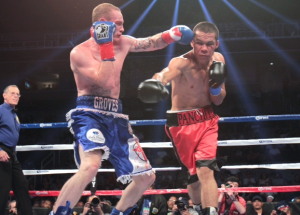
Groves, 169.4, opted to slug it out with the brawling Sierra, 170, for an entertaining close to the third round. The round saw Groves’ face opened up, but the injury never seemed to be a factor in the fight. An overhand right started the trouble for the underdog, as Sierra was downed in hard in the sixth. The Mexican fringe contender gamely returned to his feet. However, two clubbing rights were enough for Sierra’s cornerman to hurry up on the steps and sidearm the white towel through the ropes. Groves had been reportedly scheduled to fight September 14th in Wembley Arena in London, England, but it remains to be seen if the cut he suffered will prevent that date from sticking.

Paul Mendez (8-2-1, 2 KOs) of Delano, California took a workmanlike six-round unanimous decision over weathered journeyman Leshon Simms (5-11, 3 KOs) of Hemet, California in the second warm-up of the card. Mendez, 160.2, picked his way to the win, but never went in for the kill against Simms, 161.4, who goes by the nickname of “Scrappy Mix.” All three official cards read 59-55 for Mendez. The Delano resident, now fighting out of Salinas, California, returns to action August 25th at the Fairfield Sports Center in Fairfield, California.

Imposing heavyweight Gerald Washington (1-0, 1 KO) of Vallejo, California pounded hopeless Blue DeLong (0-4) of Glendale, Arizona for about two-and-one-half minutes en route to a first-round stoppage in the night’s opening bout. Washington, a mammoth figure at 246.6 pounds, scored one official knockdown of Delong, 254.4, who spent much of the night on the canvas. Referee Ray Balewicz ended the clobbering after Delong fell to the mat one too many times 2:36 into the fight. Ironically Washington shares the same nickname as Paul Mendez, the fighter in the fight that followed his – “El Gallo Negro.”

Photos by Stephanie Trapp

Mario Ortega Jr. can be reached at ortega15rds@lycos.com.


London is the first round in boxing’s fight to resurrect itself

Boxing attempts to become more than just Olympic history in London during the next couple of weeks in a fight to reclaim an identity that just hasn’t been the same since the Seoul scandal in 1988.

Muhammad Ali, a 1960 gold medalist, is in London like royalty. He is attached to the Olympics like a sixth ring, a ceremonial symbol of what they were and boxing was. But Roy Jones Jr. is the current symbol of what the Olympics have become for a sport that has fallen off the marquee and into the margins in the 24 years since gold was stolen from the former pound-for-pound king.

In a story for the August edition of The Ring, Jones confirmed what I have always believed. To

wit: Boxing’s long decline – in the Olympics and pros – began on that infamous afternoon in Seoul when judges robbed him of light-middleweight gold with a decision unequalled in outrage.

It happened before the internet and long before the immediate anger at Timothy Bradley’s split decision over Manny Pacquiao in June. Imagine if twitter had been around when Jones was left with silver and judges were suspected to have collected some.

The tweets, digital graffiti, might have been enough for Olympic officialdom to finally banish a sport it has never much liked anyway. As it was, the ringside corruption, confirmed in the subsequent disclosure of East Germany’s secret-police files, was enough to push boxing into a medal sport seemingly on perpetual probation. Squeamish officials tolerate it, mostly because they have to. Even the poorest nations in the third world can send a boxer to London. But countries without swimming pools can’t compete with Michael Phelps.

With boxing shoved out of the Olympic limelight and away from the NBC cameras, however, the pro ranks were robbed of a significant step in development and marketing.

“At the time, I didn’t really realize what had happened,’’ Jones told me in an interview for The Ring. “What I didn’t realize was how much it hurt boxing. The reason I say that is because, truthfully, the Olympics was where boxing kind of gets a little jump start.’’

http://ringtv.craveonline.com/images/toc/ring_aug12_contents.pdf

That jump start is gone, Jones says, because of 1988 and the subsequent move to computerized scoring. There’s no way to correct what happened in Seoul. But there are lessons. An intriguing step will come after London when computerized scoring will end. At the 2016 Games in Rio de Janeiro, boxing will go back to traditional scorecards instead of computer operators who act as judges by punching a button as way to count the punches they see land.

Jones welcomes the move, although it reopens the possibility of the 1988 scoring in one of the greatest scandals in Olympic history. Nevertheless, it’s a step that Jones says will regenerate Olympic interest in amateurs who have a chance at pro careers.

There’s also been talk about bringing pros into the Olympics. Who knows, maybe, Floyd Mayweather Jr., can turn the bronze he won in 1996 into gold in 2016?

However, George Foreman, a 1968 gold medalist at the Mexico City Games, doesn’t like the prospect of pros at the Olympics.

“The Olympics have always been a chance for a nobody to become somebody,’’ said Foreman, a former heavyweight champ who is The Ring’s super-heavyweight on a Dream Team, an all-time American Olympic roster. “For me, other things were probable. But the gold medal? It was impossible. For me, that was the beginning.’’

Foreman is convinced that, in time, boxing will find the young fighter who will resurrect an Olympic sport known for him, Sugar Ray Leonard, Oscar De La Hoya, Floyd Patterson, Jones, Andre Ward and a light-heavyweight named Cassius Clay, now known simply as Ali.

“We don’t even know who he is yet,’’ Foreman said. “But he’s out there. Look at what Michael Phelps has done for swimming. More than 30 years after Mark Spitz, he turned it in the sport people want to see. It only takes one person. Nothing is wrong with Olympic boxing.’’

Nothing but a comeback.

Notes, Anecdotes
· Trainer Freddie Roach, already busy training Julio Cesar Chavez Jr. for his Sept.15 middleweight clash with Sergio Martinez at Las Vegas Thomas & Mack Center, has no plans to be in London for Olympic boxing. He worked with some of the American s as a consultant to the U.S. team. But that was before a late shuffle in the U.S. coaching staff.

· Golden Boy Promotions CEO Richard Schaefer is already in London. If he can sign some of the best prospects, he hopes to introduce them to the pro ranks on an Oct. 14 card, a Sunday, at Las Vegas’ Mandalay Bay. On Oct. 13, Schaefer has plans for a card that might include junior-featherweight champion Abner Mares, also at Mandalay.

· Just wondering: Could NBC’s renewed deal for pro boxing lead to more network coverage of Olympic boxing? After years of seeing more ribbon-waving girls in rhythmic gymnastics than boxers, any boxing coverage at all would be a lot.


Promociones PM Returns to Tijuana

TIJUANA, BAJA CALIFORNIA – Former world champion turned promoter Diego “Pelucho” Morales is back giving young aspiring fighters in the border city opportunity to show their skills before their local followings beginning tomorrow night with a six-bout offering at the Salon Mutualista. Fighters weighed-in Thursday afternoon at the offices of the Comision de Box, Lucha Libre y Kickboxing de Tijuana next door to the famed Auditorio Municipal.

In the main event, local favorite Jesus “Bombardero” Valadez (5-1, 2 KOs) of Tijuana takes on determined Edgar Vazquez (4-2-1, 2 KOs) of Tijuana in a six-round light welterweight bout. Valadez, just 18-years-old, has become known for his crowd-pleasing action style. Vazquez is looking to rebound from a March stoppage loss to more experienced Miguel Zuniga. Both fighters weighed-in at 63.5 kilograms or about 140-pounds.

In a heavyweight attraction, Juan Manuel Dominguez (2-0, 1 KO) of Tijuana hopes to keep rolling against Rodrigo Ramirez (0-1) of Tijuana in a four-rounder. Dominguez, who scaled 104 kilograms (229.3-pounds), will already be fighting for the third time since turning pro in March. Ramirez, who came in at 118 kilograms (260.1-pounds), has been out of action since a second-round stoppage loss back in September of 2010.

Another active newcomer, former Tijuana amateur champion Erick Cebreros (2-0) will take on debuting Benny Guevara of Tijuana in a four-round featherweight fight. Cebreros, who turned professional only in April, scaled 57.7 kilograms (127.2-pounds). Guevara, faced with a tough assignment for his premier outing, came in at 56 kilograms (123.5-pounds).

Former U.S. amateur standout Aldwayne Simpson (1-0, 1 KO) of Richmond, California by way of Kingston, Jamaica ends a nearly three-year hiatus in a four-round light welterweight bout against Miguel Nava (0-3) of Tijuana. Simpson scaled 64.8 kilograms (142.9 pounds). Nava, never in an easy fight, was not present at Thursday’s weigh-in and will take to the scales Friday morning. Simpson recently wrapped up a training stint alongside former world champion Robert Guerrero.

Ciro Arrellanos (1-0) of Mexico City, Distrito Federal meets Tijuana’s debuting Martin Gomez in a four-round light welterweight fight. Arrellanos, one of three fighters on the card out of the Ray Solis Boxing Gym, scaled 64 kilograms (141.1-pounds). Gomez, fighting out of the Torito Gym, weighed-in at 64 kilograms as well.

Two fighters looking for their first win square off as Pedro Garcia (0-2) of Tijuana takes on Luis Contreras (0-2) in a four-round lightweight fight. Garcia, of the Chavez Gym, scaled 61 kilograms (134.5-pounds). Contreras, of the Xico Gym, came in at 61.4 kilograms (135.7-pounds).

Tickets for the event, promoted by Promociones PM, are available at the Perro Salado Billiards Hall, the offices of Box Latino and Hollywood Beauty Supply.

Quick Weigh-in Results (in pounds):

Light Welterweights, 6 Rounds
Vazquez 140
Valadez 140

Heavyweights, 4 Rounds
Dominguez 229.3
Ramirez 260.1

Featherweights, 4 Rounds
Cebreros 127.2
Guevara 123.5

Light Welterweights, 4 Rounds
Simpson 142.9
Nava*

Light Welterweights, 4 Rounds
Arrellanos 141.1
Gomez 141.1

Lightweights, 4 Rounds
Garcia 134.5
Contreras 135.7

*will weigh-in Friday morning

Mario Ortega Jr. can be contacted at ortega15rds@lycos.com.


Adults gone missing in Cincinnati


Cincinnati’s Adrien Broner (24-0) is not the next Floyd Mayweather. At best, he is New Mayweather, a product that compensates for recent layoffs in R&D by hiring an outside marketing team. Broner does not have Mayweather’s pedigree: he did not win an Olympic bronze medal at age 19, he did not come from an immediate family of talented prizefighters, and he sure as hell did not just stop an undefeated Diego Corrales (33-0, 27 KOs) to remain champion at 130 pounds.

That’s what Mayweather did in his 24th professional fight – after becoming a world champion by beating Genaro “Chicanito” Hernandez into retirement, blitzing Angel Manfredy and making five successful title defenses. Broner, conversely, picked up a vacant 130-pound belt from unknown guy with an 0-1 record outside his native Argentina, made one title defense, and then missed weight by 3 1/2 pounds, Friday, before stopping an outmatched and outweighed Vicente Escobedo (26-3, 15 KOs) Saturday.

There was an uncomfortable lack of adult supervision in Cincinnati last weekend, as Broner jeopardized his first HBO main event by missing weight twice. The one adult present was Broner’s manager, Al Haymon, who, reports say, was embarrassed by what his charge pulled. Haymon is exceptionally good at what he does – identifying marketable athletes, outsmarting network executives – but in his roots, he is a concert promoter, not a boxing guy. His eye for fighter talent is arguable. He is, in some senses, Bob Arum without matchmakers Teddy Brenner and Bruce Trampler – which makes him a lot like Richard Schaefer.

Which means nobody knows exactly how to develop Broner as a fighter; he is more AndreBerto2.0 than a second coming of Money Mayweather, whose development as a prizefighter, some might recall, was handled by Top Rank. Broner does some things very well. One is throw the counter right uppercut against plodding Latino fighters who were taught at a young age every confrontation reduces to a game of Left Hook to the Liver. Broner whipped the right uppercut at Escobedo in round 2 and took most of the fight right out of him.

One sees this in the gyms of the Southwest. Every Mexican kid, or at least every kid with Mexican parents, is taught to keep his right hand high on his cheek when he swoops in to throw his left hook. This defensive posture assumes his opponent will be throwing a left hook of his own at the same instant, and whoever lands first will invariably corkscrew the other guy in the canvas. But none of them, as he sets his weight too far forward and gets his chin over his left knee, has a defense for a right uppercut right up the middle. Some guys in Detroit have noticed this. Someday, Mexican trainers will give their fighters Joe Frazier’s advice – set your right fist palm down, between your chin and the top of your chest, when you throw the 3 – but that day isn’t arrived yet.

Besides, there may be only one way to overcome the shell defense Broner learned from watching Mayweather, and Roy Jones Jr. is not about to tell us what it is. This column has no such loyalty: A long jab is what picks the shell’s lock. Designed to catch the right cross with a high lead shoulder and thwart the left hook with a high right hand, the shell can either slip the jab or counter it, but not both. Jab the shell effectively enough, and the right hand moves from cheek to chin – and then interesting things happen. This is why Escobedo’s most effective punch Saturday was a jab, and it’s why, of the names Broner said “can get it” next, Antonio Demarco, a lightweight titlist who stands 5-feet-10, is most interesting.

Broner is an altogether lesser fighter than Mayweather, but the biggest difference between them is not a stylistic one; it is something measured by the way others react to them. Other prizefighters like Mayweather. He is one of them, and better than they are. There was a mishap with the Juan Manuel Marquez weighin, yes; Mayweather borrowed more advantage than he needed then saw how tiny Marquez was and paid him handsomely for the difference, all the while acting annoyed by his contracted promoter.

Other fighters don’t seem to like Broner. It takes a whole lot for a guy like Vicente Escobedo, Saturday’s sacrifice, to come out of a beating and still be frustrated by an opponent – as opposed to begrudgingly impressed. But frustrated is what he was. In Escobedo’s postfight tears was a statement like this: You could have beaten me fair and square, but you chose not to, which means you are not one of us.

What happened with Broner, his outgrowing a weight class, is nothing new. That it was preceded and followed by such classlessness, though, is a bit novel. Broner has a man’s body, a man’s strength, and perhaps a man’s ring IQ, but emotionally he is a 14 year old. He does not connect actions to consequences and does not appear particularly adept at pattern recognition. He is not, in other words, intelligent or mature. Most professional athletes aren’t – they stop maturing the day a coach or parent recognizes their exceptional reflexes – but Broner’s case appears predetermined for unpleasantness because there are no adults to provide the guidance needed by someone of his temperament.

Adrien Broner’s dad needs to put the hairbrush down, then, cancel his son’s Twitter account, and say, “Boy, stop acting a fool.” For if his dad doesn’t, Broner’s manager just might.

Bart Barry can be reached at bart.barrys.email (at) gmail.com
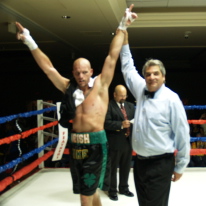


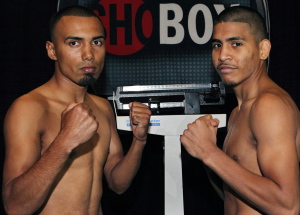
Hovhannisyan Moves Past Acosta on Shobox

SANTA YNEZ, CALIFORNIA — In by far his toughest test to date, lightweight prospect Art Hovhannisyan remained unbeaten with a ten-round split decision over former titleholder Miguel Acosta in the Showtime-televised main event emanating from the Chumash Casino Resort on Friday night.

Hovhannisyan (15-0-2, 8 KOs) of Glendale, California by way of Gyumri, Armenia got off to a strong start, and it looked as though he may make it a short night. Near the end of the first round, Hovhannisyan, 132, caught Acosta, 134, with a clean right hand to score a knockdown. Acosta (29-6-2, 23 KOs) of Santiago de Leon de Caraca, Miranda, Venezuela appeared to be in trouble, but lucky for the former champion the bell sounded before Hovhannisyan could really capitalize.

Though Hovhannisyan maintained in control for the next few rounds, Acosta got his legs under him and slowly worked his way back into the fight. In the fifth, Acosta countered Hovhannisyan with a right hand, dropping the Armenian to a knee for a knockdown of his own. It appeared to be a flash knockdown, but may have been motivation for Acosta to believe a decision was still possible.

Acosta carried some momentum into the final two rounds, but it was apparent he was running low on gas. Hovhannisyan closed stronger, though both fighters had some great moments in action-packed tenth-round. When the final bell sounded, both fighters found themselves on the shoulders of their team members.

In the end, it was Acosta’s team that would be disappointed. Scores read 95-93 twice for Hovhannisyan, with the lone dissenting judge having 96-92 for Acosta. With the victory, Hovhannisyan will likely find himself ranked in the top fifteen by one or more of the major sanctioning organizations.

“I’m very happy to get the win,” said Hovhannisyan. “Acosta can still fight. I think my conditioning played a great role in my performance, but at this level you need to be good in all facets. This fight was definitely a great learning experience for me.”

In the televised co-feature, Roman Morales (11-0, 6 KOs) of San Ardo, California used his size and skill advantages to move past tough Alexis Santiago (11-3-1, 5 KOs) of Phoenix, Arizona via eight-round unanimous decision.

It was apparent from the early going that Morales, 122, was not going to be much affected by the punches Santiago, 122, landed. Morales, who normally displays stellar defense, was more willing to take one in order to landed his three or four-punch combinations. Though outgunned, Santiago made it a fight and stood up to some hard shots. Only one was able to put him down, as a picture-perfect left uppercut from the southpaw stance dropped Santiago in the third.

By the final two rounds, it looked as though Santiago may not make it to the final bell. Towards the end of the final round, Santiago showed his grit again as he fired and traded with the still strong Morales. It turned out to be a treat for the fans despite the lopsided scores of 80-71, 80-72 and 79-72.

“I thought this was a good performance,” said Morales. “I’m glad I could go eight hard rounds because that is what I expected. I got a little tired, but I knew I had to keep working. I’ll be back in the gym soon and I’ll be ready to fight whoever my team wants me to.” Next up for Morales is tough Jonathan Alcantara on August 24th at the Tulare County Fairgrounds in Tulare, California.

Jonathan Maicelo (17-0, 10 KOs) of North Bergen, New Jersey by way of Callao, Peru demolished normally durable, but aging former title challenger Daniel Attah (26-12-1, 9 KOs) of Washington, District of Columbia by way of Calabar, Nigeria inside of three rounds.

Maicelo, 135, pressed the action, landing with power shots in regularity from the opening bell. By the third, Attah, 135, was on the way out. Maicelo landed a straight right upstairs to score a knockdown moments into the round. The veteran Attah returned to his feet, only to take more punishment from Maicelo, who closed the show with a right hook-left hook combination. Referee Lou Moret called a halt at 2:45 of the third.

Longtime local favorite Rufino Serrano (13-4) of Santa Maria, California by way of Morelia, Michoacan de Ocampo, Mexico did what he does and boxed his way to a six-round unanimous decision over Rob Diezel (8-5, 3 KOs) of Seattle, Washington.

Diezel, 125 ½, attempted to match boxing skills with the adept Serrano, 125 ½, from the early going. While Diezel did well in the opening stages, Serrano’s class took over as the rounds progressed. However, Diezel was never in any trouble, unless you count a cut he suffered from an accidental head clash. Serrano took all three cards 59-55.

In a fight where somebody’s ‘0’ had to go, nobody’s did as winless Edgar Alvarado (0-1-1) of Riverside, California and winless Erick Prado (0-2-1) of nearby Santa Maria battled to a draw in a slugfest. From the opening stanza, Alvarado, 157 ½, and Prado, 161, fought their hearts out much to the delight of the packed house. Prado landed the cleaner shots in the early rounds, but Alvarado often closed better by landing his own telling blows. By the look of things, Alvarado needed to take the final round and he did so in impressive fashion. Scores read 40-36 for Alvarado, 39-37 for Prado and 38-38 to force the draw. The only unfortunate result is neither fighter gets their deserved first victory.

Tureano Johnson (10-0, 7 KOs) of Atlanta, Georgia by way of Nassau, Bahamas made short work as was expected against inactive journeyman Arturo Rodriguez (12-12, 8 KOs) of Tijuana, Baja California, Mexico. Johnson, 160, outworked Rodriguez, 159, by applying pressure with punishing shots to the body and head. Finally, Johnson dropped Rodriguez with a clean uppercut, which ended matters. Referee Marcos Rosales called a halt at the 1:49 mark of round one.

Johnson’s next bout was already scheduled, as he will take on DonYil Livingston (8-1-1, 4 KOs) of Palmdale, California in an eight-rounder on August 10th ESPN2 undercard at the Morongo Casino Resort & Spa in Morongo, California.

In the walkout bout, which was reduced from eight rounds to six, Francisco Santana (13-3-1, 6 KOs) of Santa Barbara, California cruised to a unanimous decision over journeyman Larry Smith (10-12, 7 KOs) of Dallas, Texas.

Smith, 150, looked to stay at range with his long wingspan from the outset. However, it was the onrushing Santana, 148, that dictated the fight. Santana, a recent Manny Pacquiao sparring partner, threw combination with short hooks and chopping shots from over the top.

Halfway through the fight, Smith began to concentrate more on posturing and mugging for the crowd than attempting to win the fight. In the end, Smith managed to duck and dodge enough to last the distance. Scores unsurprisingly read for Santana, 60-54 and 59-55 twice.

For the first time in his illustrious career, world renowned ring announcer “Generous” Joe Antonacci handled those duties for a West Coast event, in addition to conducting post-fight interviews for the off-TV fights.

Boxing returns to the Chumash Casino Resort on September 21st for another Gary Shaw Productions-promoted edition of Shobox: The New Generation.

Photos by Dwight McCann/Chumash Casino Resort

Mario Ortega Jr. can be reached at ortega15rounds.com.


Hovhannisyan Steps Up Against Former Champ Acosta

SANTA YNEZ, CALIFORNIA — In tonight’s edition of the Showtime prospect series Shobox: The New Generation, unbeaten Art Hovhannisyan aims to make the move into contender status against former lightweight title holder Miguel Acosta in a ten-rounder at the Chumash Casino Resort. In the co-feature, rising super bantamweight Roman Morales takes a litmus test against tough Alexis Santiago in an eight-rounder. Fighters weighed in Thursday at the casino.

Hovhannisyan (14-0-2, 8 KOs) of Glendale, California by way of Gyumri, Armenia has not seen action since a cut-shortened technical draw against former featherweight champion Cristobal Cruz last August. Prior to that false start, Hovhannisyan made his name off of a eye-opening sixth-round stoppage of heralded Archie Ray Marquez in June of last year. Hovhannisyan, who scaled 132-pounds for tonight’s lightweight bout, appears to be taking a big step up in class against Acosta, depending on what the former champion has left in the tank.

Acosta (29-5-2, 23 KOs) of Santiago de Leon de Caraca, Miranda, Venezuela is best remembered for scoring a minor upset of previously unbeaten Urbano Antillon to claim the interim version of the WBA Lightweight title in July of 2009. Acosta bumped off Paulus Moses a year later to get full recognition as champion before eventually running into Brandon Rios and losing his title via an entertaining tenth-round stoppage. In his last appearance, Acosta tasted the canvas three times against Richard Abril en route to a twelve-round decision defeat last October. Acosta scaled 134-pounds Thursday.

When the originally scheduled junior middleweight attraction between Julian Williams and Said El Harrak was a late scratch, the Morales-Acosta bout was elevated from televised opener to co-feature. Looking to make the most of the exposure is super bantamweight prospect Morales (10-0, 6 KOs) of San Ardo, California. Morales, making his premium cable debut, has quietly built himself a reputation as one the top prospects in the country and appears primed for a coming-out party. Morales, fighting for the sixth time at the Chumash Casino Resort, weighed-in at 122-pounds on Thursday.

Santiago (11-2-1, 5 KOs) of Phoenix, Arizona gained a small measure of notoriety in defeat last July. In a Telefutura-televised main event, Santiago gave well publicized prospect Randy Caballero his toughest test to date, although the scorecards did not accurately reflect his effort. If there is a red flag on Santiago’s resume, it would be an eight-round majority decision loss to .500 fighter Evaristo Primero this past February. Santiago also came in at the super bantamweight limit of 122-pounds.

In other action off television, Francisco Santana (12-3-1, 6 KOs) of Santa Barbara, California returns to his home area against perennial opponent Larry Smith (10-11, 7 KOs) of Dallas, Texas in an eight-round light middleweight bout. Santana, coming in off of a hard-fought decision defeat to unbeaten Jermell Charlo last October, scaled 148-pounds. Smith, loser of his last six to quality guys, came in at 150-pounds.

Touted Jonathan Maicelo (16-0, 9 KOs) of North Bergen, New Jersey by way of Callao, Peru takes on faded former contender Daniel Attah (26-11-1, 9 KOs) of Washington, District of Columbia by way of Calabar, Nigeria in an eight-round lightweight bout. Despite his advanced boxing age, Attah still usually provides rounds even against quality opponents. Maicelo, a celebrity in Peru, has been taken the distance in three of his last four outings. Maicelo and Attah both scaled the division limit of 135-pounds.

Longtime venue favorite Rufino Serrano (12-4) of Santa Maria, California by way of Morelia, Michoacan de Ocampo, Mexico takes on Rob Diezel (8-4, 3 KOs) of Seattle, Washington in an six-round featherweight bout. Serrano, who scaled 125 ½, comes in off of a one-sided defeat to tonight’s co-main eventer Roman Morales this past March. Diezel, who weighed-in at 125 ½-pounds as well, has strung together three straight wins since a first-round knockout defeat to Ramon Valadez last year.

Edgar Alvarado (0-1) of Riverside, California hopes to erase the memory of his pro debut as he goes up against Erick Prado (0-2) of nearby Santa Maria in a four-round light middleweight battle. Alvarado, stopped in one by Thomas Turner in April, scaled 157 ½-pounds Thursday. Prado, a split decision loser in his two bouts to Louis Rose and Victor Manuel Medina respectively, weighed-in at 161-pounds.

Recently signed by Gary Shaw Productions, Tureano Johnson (9-0, 6 KOs) of Atlanta, Georgia by way of Nassau, Bahamas will take on Arturo Rodriguez (12-11, 8 KOs) of Tijuana, Baja California, Mexico in a four-round middleweight bout. Johnson, a 2008 Bahamian Olympian, weighed-in at 160-pounds. The 36-year-old Rodriguez ended a nearly seven-year layoff with a third-round stoppage of winless David Orozco on June 1st. On Rodriguez’ resume: a second-round stoppage loss to a 5-0 Miguel Cotto in 2001 and a first-round knockout loss to a 20-0 Paul Williams in 2003.

Tickets for the event, promoted by Gary Shaw Productions, are available online at StarTickets.com.

Quick Weigh-in Results:

Lightweights, 10 Rounds
Hovhannisyan 132
Acosta 134

Super Bantamweights, 8 Rounds
Morales 122
Santiago 122

Light Middleweights, 8 Rounds
Santana 148
Smith 150

Lightweights, 8 Rounds
Maicelo 135
Attah 135

Featherweights, 6 Rounds
Serrano 125 ½
Diezel 125 ½

Middleweights, 4 Rounds
Alvarado 157 ½
Prado 161

Middleweights, 4 Rounds
Johnson 160
Rodriguez 159

Photos by Tom Casino/Showtime

Mario Ortega Jr. can be reached at ortega15rds@lycos.com.


“THE HEBREW HAMMER”, CLETUS SELDIN HEADS UNDERCARD AT “ROCKIN FIGHTS 4” –FIGHT LIVE ON GFL

CLICK TO ORDER THE FIGHT

NEW YORK, NY (July 19, 2012) Popular welterweight prospect Cletus “The Hebrew Hammer” Seldin headlines the undercard of Star Boxing’s “ROCKIN FIGHTS 4” on Saturday, July 28th at The Paramount in Huntington, New York.

Sporting an undefeated record of 7-0-0 with five knockouts, the

25-year-old Seldin has become a staple at The Paramount, with three straight wins by knockout at the consistently sold-out venue.

At “ROCKIN FIGHTS 4”, Seldin will battle San Juan Puerto Rico’s Jonathan Garcia, 3-2-1 (1KO), in a scheduled six round bout.

“Cletus has had three spectacular knockouts in a row at The Paramount and has become a true fan favorite. The interest from fans and media alike about his return to the ring has been very impressive,” said Joe DeGuardia, President of Star Boxing.

“Along with Cletus’ return we’ve put together a very strong undercard at “ROCKIN FIGHTS 4″ to ensure that the terrific boxing fans at The Paramount get a full evening of entertainment.”

In the main event at “ROCKIN FIGHTS 4”, “The Fighting Pride of Huntington, New York”, undefeated junior welterweight prospect Chris Algieri, 14-0-0 (7KO’s), will battle tough Texas veteran Raul Tovar,10-5-1 (4KO’s).

Advance tickets for “ROCKIN FIGHTS 4”, priced at $50 and $100, are available through Ticketmaster, (www.Ticketmaster.com, 800-745-3000) or through The Paramount Box Office, (631) 673-7300.

Special VIP/Red Carpet Seating along with advance tickets are also available by calling Star Boxing at (718) 823-2000 or on their website www.StarBoxing.com.

Also featured on the undercard will be a New York State Junior Lightweight Title bout between undefeated Bronx native Manny Gonzalez, 10-0-0 (7KO’s) and cross-town rival Chazz McDowell, 6-1-0 (1KO) of Yonkers, New York.

The 24-year-old Gonzalez heads back to the ring following his unanimous decision win over Jesus Bayron on February 10th at the Mohegan Sun Casino.

Also returning to The Paramount is junior middleweight newcomer Raul Nuncio, 2-0-1 (1KO), of Glen Cove, New York in a four round tilt against Enver Halili, 1-0-0 (1KO) of Bronx, New York. Nuncio is coming off a four round decision win on March 31st over Valdrin Muriqi.

Local pro debuter Alan Gotay of Huntington will face off against Brooklyn’s Ian James, 2-3-0 (1KO), in a four round junior welterweight clash.

Rounding out the undercard, Hicksville, New York junior welterweight Anthony Karperis, 1-0-0 (1KO), will challenge Travis McElhaney, 0-1-0, of Grand Rapids, Michigan.

The Paramount is located at 370 New York Avenue, Huntington, New York, 11743. For directions and more information, please visit their website at www.paramountny.com


Reasons on a scorecard that a fallen Khan can come back


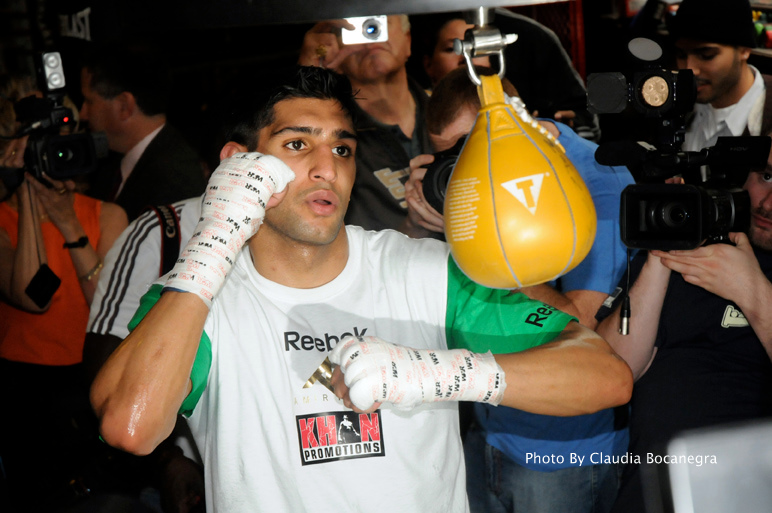
Amir Khan, who wears lightning bolts on his dark trunks, is a lightning rod for controversy, especially in the week after Danny Garcia stopped him in the fourth round of an upset that few foresaw.

The attention on Khan is unfair to Garcia, but that’s built into a modern star system created and sustained by social media. Khan, a designated star since the 2004 Olympics, knows how to use it. Garcia, a relative newcomer with an annoying trash-talker for a dad, does not.

Stardom looms for the unbeaten Garcia.

It’s not quite so clear for Khan.

But here is a scorecard, a guide of sorts, on what Khan should do and not do:

Retire: Ridiculous. Fellow Brit Carl Froch said he was misquoted by the BBC. Whatever Froch said or didn’t say, it’s safe to assume Froch would have a more damning comment if the 25-year-old Khan did in fact retire. There’s another way to describe a young fighter who retires a few years from his prime. He’s called a quitter. Khan is not. He proved that by fighting back after the third-round knockdown and getting up from a knockdown early in the fourth.

The chin: Golden Boy promoters insist that Khan proved he could withstand power in 2010 when he survived Marcos Maidana’s crushing blows in the 10th round. But the Maidana fight created a dangerous illusion that Khan could take a big punch. Khan believed it. That’s why he decided to brawl in the fourth against Garcia, who dropped him twice in the round. Remember, Maidana’s punches landed late. Garcia’s biggest punch landed early – in the third. If it hadn’t ended in the fourth, it would have in the fifth or sixth or seventh. Khan fought as if he thought Maidana had inoculated him from having a weak chin. No, he just needs to know he must use superior skills to protect it with his reach, jab and feet. A fragile chin, which Khan leaves high and exposed, is not a career-ender. From Floyd Patterson to Lennox Lewis, history is full of fighters who have learned to fight despite it and perhaps succeed because of it.

Freddie Roach: Don’t fire him. UK media are full of stories about Khan hiring a new trainer who can teach defense. Roach is known for emphasizing offense. Hard to blame him. A little more offense from Manny Pacquiao might have resulted in a stoppage that would have averted the flap over his split-decision loss to Timothy Bradley. It’s an insult to say Roach can’t teach defense. Boxing isn’t football. Offense and defense aren’t played by different squads and coached by different coordinators. They are inseparable. Khan just has to suspend a confidence bordering on arrogance and remember to execute a Roach plan with tactics defending the chin while augmenting the offense.

Time: There is still plenty of it left. It’s too easy of think of Khan as much older, perhaps because he’s been a star since the Athens Olympics when he was a 17-year silver medalist. He is still maturing. In a couple of years, Pacquiao will probably be a full-time Filipino politician. A couple of more fights are left in Pacquiao’s career. Pacquiao’s retirement would mean more time for, say, a rematch with Garcia.

Quotes, Anecdotes
· A sign of Khan’s over-confidence can be found in what was missing in his contract with Garcia. It didn’t include a rematch clause. A loss to Garcia never seemed to be even a remote possibility to Khan, who in pre-fight interviews often talked about fighting Floyd Mayweather Jr. in December.

· Several possibilities have been mentioned for Garcia’s next bout, including Zab Judah and Paulie Malignaggi. A rematch with Khan was eliminated by Garcia’s dad, Angel, who in pre-fight exchanges insulted Khan’s Pakistani roots. “Why should we give him a rematch when he didn’t give us any respect?’’ Angel said.

AZ Notes
Phoenix super-bantamweight Alexis Santiago (11-2-1, 5 KOs), nicknamed Beaver, is scheduled Friday night for an 8-rounder in Santa Ynez, Calif., against Roman Morales (10-0, 6 KOs) of San Ardo, Calif., on a ShoBox-televised card featuring former World Boxing Association lightweight champ Miguel Acosta (29-5-2, 23 KOs) of Argentina against Armenian Art Hovhannisyan (14-0-2, 8 KOs).


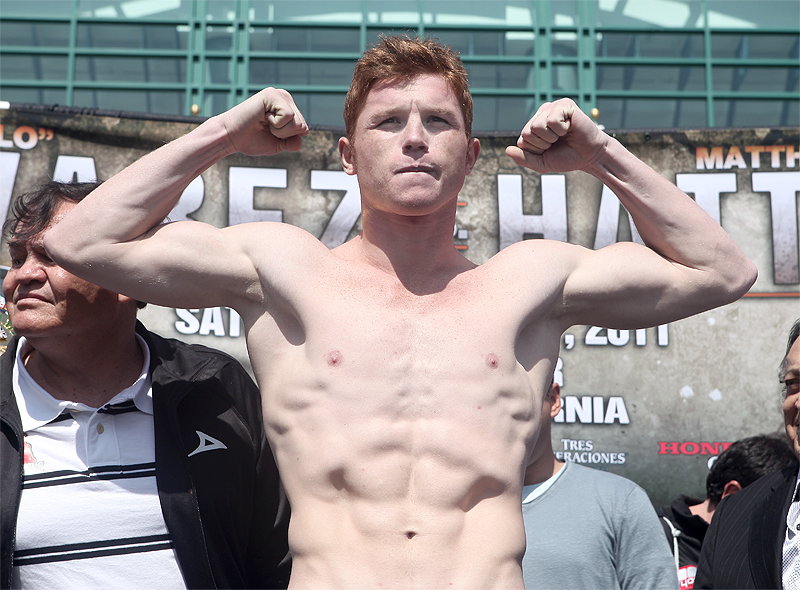
A solution for the Sept. 15 conflict: Move Canelo-Lopez to Sept. 14 at the MGM Grand


You know the cliché. It’s trotted out after nearly every controversial decision. Yeah-yeah, reasonable people can disagree. Trouble is, that’s all they ever seem to do in boxing.

As the business approaches a potential fiscal cliff of its own making on Sept. 15, however, there’s an opportunity for reasonable minds to actually work in behalf of the customers who just seem to be in the way of promoters hell-bent on destroying each other with dueling cards — the Golden Boy-promoted Canelo Alvarez-Josesito Lopez at Las Vegas’ MGM Grand and Top Rank’s Julio Cesar-Chavez Jr.-Sergio Martinez just a fast-break away at Thomas & Mack Center.

Here’s a way out of the conflict: The Grand Garden Arena at the MGM Grand is available Friday night, Sept. 14.

How hard would it be to re-schedule Alvarez-Lopez from Sept. 15 to Sept. 14 as a way to kick off a weekend celebration of Mexican Independence on Sunday, Sept. 16? First, Canelo-Lopez on Friday. Then, Chavez- Martinez on Saturday. Finally, Mana, a concert featuring the popular Mexican rock band scheduled for Sunday at the Grand Garden Arena.

The weekend-long fiesta sounds simple enough. Perhaps too simple. It hasn’t been suggested, at least not by the reasonable people who only know how to disagree. The topic dominated conversation before and after Danny Garcia’s stunning fourth-round stoppage of Amir Khan last Saturday at Mandalay Bay. From bar-tenders to serious fans, it was the same question: How come nobody is talking about making that move?

Above-all, it’s a win-win for fans, regardless of whether they prefer Canelo or Chavez Jr. They’ll have a chance to see each fight live, rather than being forced to pick one instead of the other. For the respective television networks, it’s a chance at attracting the biggest possible audience. Showtime will carry Canelo-Lopez. HBO plans a pay-per-view telecast of Chavez Jr.-Martinez for the middleweight title. If on the same night, each figures to lose some of its audience.

Then, there’s the MGM Grand and Wynn-Las Vegas, which will be the hotel site for news conferences and other pre-fight events in its role as a sponsor of Chavez-Martinez. All customers can’t be at both places at the same time.

There has been a suggestion that maybe one main event can be scheduled a few hours before the other. To wit: On Sept. 15, schedule Canelo-Lopez for 5:30 p.m. and Chavez Jr.-Martinez for 8:15 p.m. But that is fraught with potential headaches. Logistically, there might be an impossible crush to get a cab and rush hour-like traffic on the short road from one parking lot to the other. There’s also talk that Televisa, the Mexican network aligned to Canelo, wants the fight only at night instead of late-afternoon or early evening.

Even if that one doesn’t work, there’s still a way out of the dilemma. But so far a possible solution has been ignored and reason set aside for a winner-take-all confrontation that Golden Boy and Top Rank are promoting more than any fight and at any cost, even to themselves.


Danny Garcia ruins the Khan game


Philadelphia junior welterweight Danny Garcia was gradually fading against Erik Morales in March. The old Mexican master was coming forward in Houston’s Reliant Arena, and having taken away one of Garcia’s best punches, winning rounds and remembering his legacy. Then Morales began a right uppercut, moving forward and from distance – two mortal sins in one punch – and Garcia put his life behind a left-hook counter, and Morales crumbled.

In the final minute of the third round of his fight with Amir Khan Saturday in Mandalay Bay, Garcia was gradually missing Khan by wider and wider margins. Then Khan, catalyzed by the prospect of not being hit, began a right uppercut, moving forward and from distance, and Garcia put his life behind a left-hook counter, and Khan crumbled. The rest were details that ended with this line: Garcia TKO-4 Khan.

Danny Garcia used proper footwork to stand his ground from the opening bell, Saturday, choosing to be a fighter – not merely an athlete. The slower-reflexed man, Garcia took Khan’s first shot over and again and threw a dozen counter left hooks and overhand rights, which landed or barely missed, before he got the definitive punch of his career to come home. It struck Khan on the neck, arriving from an overshot place behind the ear, and rattled Khan’s stem enough to shake his brain, claim his equilibrium, and give him a storefront on Queer Street memorable as where Zab Judah set up shop against Kostya Tszyu in 2001. Khan’s footwork was worse with communication severed from his central nervous system to his lower body, yes, but only marginally so.

It’s not that Khan is a victim of brave choices – a man like that, after all, would have re-fought Marcos Maidana a couple Aprils ago instead of cherrypicking Paul McCloskey – rather it’s that Khan has enormous technical flaws boxing’s star system continues to overlook because it does not fit the narrative of a handsome, multicultural “warrior” with “fast hands” and “so much heart”

That is the confection boxing’s star system tried, and tried again, and will try at least one more time, to make of Khan. But boxing, bless its dark and easily corruptible heart, always finds the truth in its ring eventually, and the truth is this: Amir Khan, while a very decent and telegenic young athlete, is not a championship caliber fighter. He never has been because he is missing something, and it is not the obvious thing.

What Khan is missing is a certain willingness to be hit, and that is a flaw that unless one is a defensive specialist, professionals like Garcia and Maidana and Lamont Peterson will discover with an almost audible “Eureka!” and exploit. Even Garcia, a light hitter requiring an opponent’s wrong-leaning momentum to score a knockdown, threw haymakers, both counters and leads, from the fight’s opening minute. Why? Because he realized that, unlike Morales before him, Khan is not wired to step inside a wild punch and abuse its mania. Khan is hardwired to show athleticism – to leap backwards and demonstrate for euphoric onlookers how quick he is of hand and foot from the (way) outside. So long as Garcia threw threatening punches, then, he could trust Khan’s counters would be late-arriving and halfhearted when they got there.

Give Khan a chance to step forward, front-run and lead, and he’ll make a heavybag of you. But hurl crazy punches his way, and Khan’s first instinct, one trainer Freddie Roach has been unable to overcome, much to his reputation’s chagrin, is to flee momentarily and return once the craziness abates. It takes an opponent of incredibly little power across from him, a Paulie Malignaggi, say, for Khan to commit to a proper counter.

Khan’s handlers and their enablers thought they had that guy, again, with Garcia, a man who’d needed the full 36-minute distance to beat a fat and semiretired Erik Morales, and had only stopped 14 of his first 23 opponents. They were wrong, but do not expect them to admit it. Danny Garcia is not the guy they want. He’s prickly in his garish tiger stripes. He’s more Philadelphian than Puerto Rican but just Puerto Rican enough to not invoke images of Joe Frazier or Bernard Hopkins. “I want to thank God, I want to thank Al Haymon,” Garcia said immediately after stopping Khan, “he changed my life!”

And Garcia’s dad is a racist and a bigot, too. Goodness gracious, but when did boxing become about nonviolent expressions of offense? Yet, as part of Saturday’s HBO event, viewers were treated to broadcaster-cum-advocate Jim Lampley laying into Garcia’s dad like it was a cable talkshow. It was a better time when networks’ prefight meetings were candid affairs, and someday their programmers will rue broadcasting such footage.

It was a better time to be an aficionado, too, when broadcasters were not advocates, when they simply called both fighters’ punches and did not try to sell an audience the narrative most favorable to their last, or next, side project. But bad as Lampley was Saturday, that’s how good Max Kellerman was. He was the one member of HBO’s team who saw Garcia land several significant punches before the one that dropped Khan in a heap and made it a technical impossibility to celebrate Amir any further.

Saturday Garcia unified three titles in the junior welterweight division, though the path to that “unification” – as outlined by David Greisman on Twitter – does brings a chuckle. This Garcia knockout win, then, was not what was planned or promised, but aficionados are nimble enough to pivot like the Philadelphian, celebrate a great performance by an underestimated talent, and enjoy whatever comes next. We’ll see if the star system’s footwork is good as Khan’s.

Bart Barry can be reached at bart.barrys.email (at) gmail.com


Learning from defeat? Khan can


A zero on the right side of a rare won-lost ledger can be a doughnut hole full of illusions. It’s hard to confront and harder to learn from something that amounts to nothing. Amir Khan doesn’t have that problem.

There’s opportunity on that side of the equation for Khan, who is coming off a loss to Lamont Peterson in a decision as controversial as any, including the latest twitter-driven flap over the split scorecards favoring Tim Bradley over Manny Pacquiao. Without returning to the grassy knoll full of lousy decisions and subsequent suspicions, let’s just say that Khan has another chance to define himself in the way great fighters always have.

They are remembered for their victories, but they are measured by how they respond to the adversity that comes with a loss, no matter how controversial. Defeat is the great divide between good and great. Khan (26-2, 18 KOs) won’t make the leap in one night Saturday against the unbeaten and untested Danny Garcia (23-0, 14 KOs) in a HBO-televised bout at Las Vegas’ Mandalay Bay.

But Khan can re-assert his potential, eliminate doubt left in the wake of the Peterson performance and show that he is ready to move on, from junior-welterweight to welter. Don’t expect him to send any thank-you notes to Peterson, who was forced to withdraw from a scheduled rematch because of a positive test for synthetic testosterone. Without Peterson and the timing of the loss last December in Washington D.C., Khan might not have been forced to acknowledge and presumably correct mistakes that could have set him for more significant trouble later one.

“At times, we got lazy and stuff,’’ Khan said in a conference call. “We weren’t feeling the effects of his punches, so we just stood there and took punches that we shouldn’t have taken. I think we were too brave really. That’s why I knew in the rematch I was not going to do what I did in the first fight and make the silly mistakes I did make. There are some things that we did in the fight that I shouldn’t have done.

“Also, outside of the ring there were a few things in training camp I did that I’ll never do again. I’ve changed them around and I feel like a totally different fighter now.

“It was a great learning curve for me, the Peterson fight, because it made me realize that, ‘Look, I need to do things and I have to be more professional and I can’t do this and I can’t do that.’

“Sometimes, it’s a good wake up call.’’

A willingness to change has already been evident in Khan’s camp, which was interrupted by news of Peterson’s positive test and the announcement he would fight Garcia instead. Khan fired conditioning coach Alex Ariza and hired Ruben Tabares.

“Yeah, we’ve changed from Alex to Ruben Tabares and it was just a change I needed because it’s always good to have a change and work on new things,’’ said Khan, whose chin has been suspect ever since his first loss – a first-round KO to Breidis Prescott in 2008 . “There are a few things in camp I changed and I didn’t change. It was a big wake up call for me after the Peterson fight and there were a few things I could change. This was one of the things that changed.’’

Tabares, he says, has forced him to re-focus by altering routines.

“It’s a new challenge, as well, which kind of drives me and I think that’s what young fighters need because you can get bored doing the same thing.’’

In dumping Ariza, Khan did what Pacquiao, his stable mate at trainer Freddie Roach’s Wild Card Gym, would not. Tension between Arizona and Roach muddied the waters before the Bradley fight.

On HBO’s 24/7, Roach said Ariza would not be in the corner. Then, however, Pacquiao stepped in and said that Ariza would be there. Pacquiao, a Filipino Congressman, often acts like that politician who wants to please all of the people all of the time. The impossibility of that task is no secret, especially in the contentious boxing business. The controversial Ariza was in Pacquiao’s corner on June 9, but there was still speculation about lingering tension between him, Roach and cutman Miguel Diaz. Ariza repeatedly insulted Diaz after the Diaz-trained Marcos Maidana lost to Khan in the 2010 Fight of the Year.

Unlike Pacquiao, Khan eliminated any chance of Ariza becoming an issue against Garcia or presumably anybody else. It’s a sign that he has moved on in perhaps one small, yet significant step toward crossing that great divide.

QUICK HITS
· The U.S. economy is headed for a fiscal cliff on Jan. 1 if politicians can’t agree. By then, the boxing business will already have driven off its own fiscal cliff if the Top Rank-promoted Sergio Martinez-Julio Cesar Chavez Jr. fight at Thomas & Mack Center and Golden Boy’s Canelo Alvarez-Josesito Lopez bout go off on the same night, Sept. 15, in the same city, Las Vegas.

· Any odds on who will outweigh whom by more on Sept 15? Chavez, a 160-pound champion has been entering the ring at 180 pounds and more at opening bell. Lopez, who has never been at more than 144 pounds, is facing a junior-middleweight (154) in Canelo.


Reevaluating the Filipino Flash


In February local fans attended “Welcome to the Future” in San Antonio’s Alamodome to see how Julio Cesar Chavez Jr. would finally fare against a fellow Mexican. Aficionados, though, attended the event to see the “Filipino Flash” – a man whose talents were large enough to place his name among prizefighting’s elitist. Nobody was disappointed, and nobody was overwhelmed.

Saturday in what appeared to be a half-filled Home Depot Center tennis stadium in Carson, Calif., Nonito Donaire returned to HBO’s airwaves, this time a headliner, against a tall South African super bantamweight named Jeffrey Mathebula. Donaire won a unanimous decision, dropping Mathebula in the fourth round and generally outclassing the gangly South African throughout, and again nobody was disappointed and nobody was overwhelmed.

But the birdy hop made another appearance. It was its third apparition in as many fights for Donaire, a thing that happened before the midway point of each fight, within a round or two of Donaire’s realizing he’d be unable to stop his opponent in the spectacular, one-shot way he stopped Vic Darchinyan five years ago or Fernando Montiel two Februaries past.

The birdy hop happens when Donaire squares his feet, drops his hands to his sides, sets his face forward, and begins to hop frantically about an opponent, like an incited goldfinch, flapping his gloves threateningly. Sometimes he throws punches, occasionally he lands them cleanly, but mostly he hops hither and yon in an expression of frustration intended to provoke an opponent’s reciprocal frustration.

It is a wonder Donaire’s trainer Robert Garcia allows the birdy hop; it seems antithetical to what Garcia’s gym of seriously striving Mexican journeymen tries to be about. One imagines if the birdy hop came out in sparring with another of Garcia’s charges, five or six of his mates would gang up on Donaire in the restroom of an Oxnard restaurant and deliver schoolyard justice. Or is that “bullying”? The reason that doesn’t happen seems to be that Donaire doesn’t belong in Garcia’s gym as much as Kelly Pavlik does, and Pavlik – a long pressure fighter with a once-stupendous right cross – belongs there only insomuch as Oxnard, Calif. is not Youngstown, Ohio.

In San Antonio, Donaire did a mitts session with retired champion Jesse James Leija, and Leija came away from the session impressed by Donaire’s interest in trying new things – an informal curiosity betrayed by Donaire’s casual employment of the word “fun” in fight descriptions. Donaire’s pursuit of fun in the ring, though, now begins to undo his pursuit of stardom.

Local newspaper reporters always come away from boxing’s prefight promotions impressed by a B-side’s charisma and how much more time he has for them than the A-side fighter does. Donaire has a special gift for being an A-side fighter who makes himself B-side accessible during a promotion. He performs a public-workout routine where he invites youngsters to join him in the ring. He dresses well and speaks so respectfully most overlook his saying the same things everyone else does.

All of this is tolerable, nay, commendable, when Donaire blows through highly regarded opponents. The façade’s plastic shell, though, become less impressive the more time Donaire spends across from men like Omar Narvaez (UD-12) and Wilfredo Vazquez Jr. (SD-12) and Jeffrey Mathebula (UD-12). HBO viewers, three times now, have turned on a Donaire fight to see a prodigy and instead have seen talent shy of prodigious, shy of the mark set by the man whose image is meant to be conjured by the “Filipino” part of the Flash’s nickname.

Against Narvaez, Donaire’s elite talents were stymied by his opponent’s defensive posture – what Carlos Acevedo, with characteristic panache, called “airplane-crash position” – against Vazquez it was a broken hand or blood vessel, and against Mathebula it was a pair of sleepy legs.

Much has been made of Donaire’s noble choice to subject himself to year-round Voluntary Anti-Doping Association (VADA) testing. The group’s evangelists hope Donaire’s example will become a standard in prizefighting. Donaire’s unripped physique, stay-at-bantamweight power and dead legs, though, do not thus far bode well for the group’s prospects. There is an important balance to be struck between entertaining spectacle and fighter safety – which are not allies – and it remains to be seen if year-round drug testing is the way to accomplish it.

Balance is also part of what has claimed Donaire’s power in his most recent three fights. His balance was perfect when he clipped Montiel 17 months ago in one of his career’s two signature knockouts, but it has been imperfect since. Some of this is performance anxiety; as a man who nears his 30th birthday, Donaire realizes he’ll not be a “young superstar” in boxing much longer and tries to force a spectacular knockout in the first five minutes of each match. Some of it, too, is the nature of added weight. Just three years ago, Donaire fought 10 pounds lighter than he does now.

Quite a bit of Donaire’s newly imperfect balance, though, is attributable to his being hit more often. After Saturday’s fight, he said imperfect balance was the only thing that came between his dropping Mathebula with a round-4 counter left hook and taking Mathebula’s consciousness entirely. That’s true, but so is this: Donaire’s balance was compromised by catching most of Mathebula’s right cross with the left side of his head before throwing the counter hook over Mathebula’s outstretched arm.

Postfight talk turned to Donaire’s next opponent and his trying to become the next Asian fighter to accumulate titles of all different kinds in all different weight classes. It will not be lost on historians, however, that Donaire did not unify the bantamweight division before moving on to 122 pounds, missing quite notably the winner of Showtime’s Bantamweight Tournament. And it will not be lost on anyone if Donaire grows his way out of the super bantamweight division without first fighting Guillermo Rigondeaux.

Bart Barry can be reached at bart.barrys.email (at) gmail.com
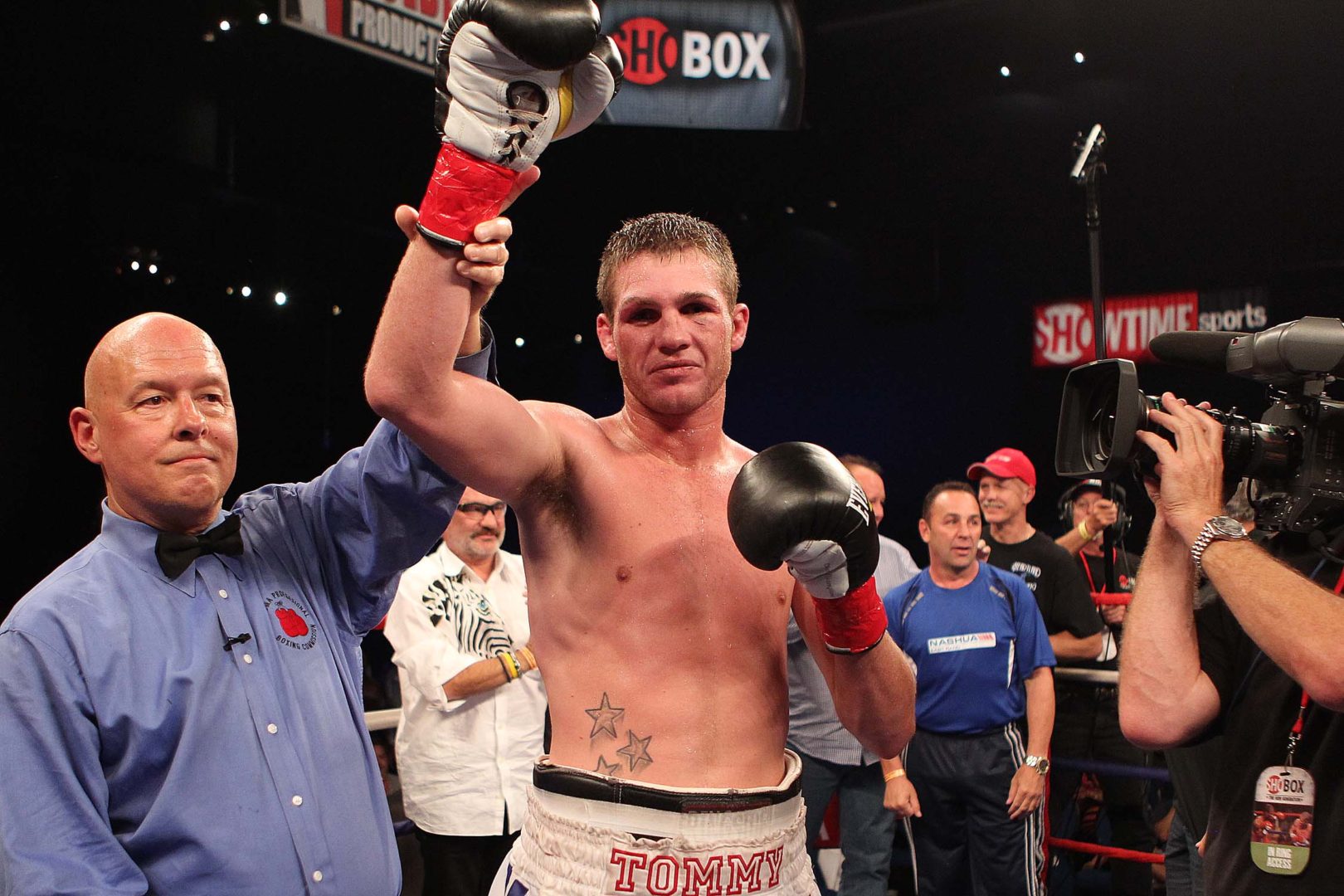


Fortuna Makes a Statement

LAS VEGAS, NEVADA — Rising featherweight prospect Javier Fortuna flashed the speed, athleticism and power that combine to make him one of the most talked about prospects in the game in a two-round destruction of former champion Cristobal Cruz at the Hard Rock Hotel & Casino on Friday night.

Fortuna (20-0, 15 KOs) of Oxnard, California by way of La Romana, La Romana, Dominican Republic came out swinging in the first before eventually landing a left on the top of Cruz’ head to score a knockdown. Cruz (39-14-3, 23 KOs) of Tijuana, Baja California, Mexico got up and looked to hold, but wound up tripping to the canvas, which was ruled a slip. Cruz returned to his feet, but was soon rocked by a wild left. Fortuna, almost coming out of his shoes with some of his swings, shortened up on a right to Cruz’ ear that hurt the Mexican late in the round.

Fortuna, 129, continued to rely on his left to great effect in the second. Fortuna, the WBA #3/IBF #6/WBC #8 ranked featherweight, hurt Cruz, 128, with a left hand over the top early in the round. Seconds later, Fortuna decided to lead with his left, which came at Cruz like a laser. Cruz, clearly not coping with Fortuna’s speed, tried to roughhouse and grapple, but Fortuna made room with a backwards step and landed a hard short left to drop the Mexican flat on his face. Referee Robert Byrd counted, but his efforts were not really necessary. Time of the stoppage was 2:22 of the second round.

With the kayo, Fortuna became the first to stop Cruz in nearly ten years. Though Cruz his not the same fighter that defeated Orlando Salido to claim a featherweight strap four years ago, Friday’s win was an impressive result for Fortuna nonetheless.

What looked to be a solid, competitive co-feature on paper turned out to be a one-sided drubbing, as Magomed Abdusalamov (15-0, 15 KOs) of Oxnard by way of Makhachkala, Republic of Dagestan, Russia remained perfect with a second-round stoppage of Maurice Byarm (13-2-1, 9 KOs) of Philadelphia, Pennsylvania.

Both landed some sweeping shots in the early going, but Abdusalamov, 229, appeared to be unfazed by anything Byarm, 239, managed to land. By the end of the first, Abdusalamov had broken through Byarm’s guard as the Philadelphian covered up in a neutral corner. When the bell rang to end the first, Byarm had weathered a storm, but found his corner as if he was taking a sobriety test after a few too many drinks.

Abdusalamov’s corner saw Byarm’s struggle to find his stool, and instructed their man to come out and finish his opponent. Abdusalamov landed a crushing left that put down Byarm, who gamely rose before referee Tony Weeks could finish his count. However, it was just a matter of time before Abdusalamov flurried, forcing Weeks’ hand for the stoppage at 36 seconds of the second round. With the win, Abdusalamov retains his WBC USNBC Silver Heavyweight title and will likely find himself in the WBC’s top fifteen world rankings next time they are released.

Still searching for his first professional knockout, local favorite Rocco Santomauro (9-0) of Las Vegas pleased the crowd on hand in taking a four-round unanimous decision over awkward southpaw DeWayne Wisdom (2-4, 1 KO) of Indianapolis, Indiana.

Santomauro, 124 ½, pressed perhaps looking for the stoppage and came close to scoring a knockdown in the second round, but Wisdom, 125, was never in any serious danger. After closing the show in the fourth, Santomauro went on to win by scores of 40-36 and 39-37 twice.

Sampson Boxing prospect Ronald Gavril (3-0, 2 KOs) of Los Angeles, California by way of Bucharest, Romania gave the crowd little time to warm-up in the show’s opener, as a series of unanswered punches were enough to warrant a stoppage in referee Joe Cortez’ eyes against Kenneth Taylor Schmitz (2-3, 1 KO) of Saint Joseph, Missouri.

Gavril, 167, pressed Schmitz, 169 ½, from the early going, eventually forcing him against the ropes. Schmitz did little more than cover up for a half round. Realizing such, Gavril kept throwing until Cortez leaped in at the 1:53 mark of the first. Though he did not appear hurt, Schmitz seemed at peace with the referee’s call.

In what became a four-round war of attrition, William Mitch Williams (6-2-1, 4 KOs) of Jackson, Michigan survived a rocky third round en route to a four-round unanimous decision over Manuel Otero (2-4, 1 KO) of Peralta, New Mexico in the walkout bout.

Williams, 181, controlled the first two rounds before Otero, 184, caught him in the third. Williams was in trouble, but made it out of the round. Otero left nearly all he had in the third, leaving little to get him through the fourth and final round. Williams, rejuvenated, punished him for most of the three minutes, but the New Mexican resident made it the distance. Despite his solid third round showing, all three judges gave the fight to Williams via shutout, 40-36.

Mario Ortega Jr. can be reached at ortega15rds@lycos.com.


Fortuna in the Spotlight as he takes on Former Champ Cruz

LAS VEGAS, NEVADA — Tabbed by boxing insiders as one of top prospects in all of the sport, undefeated Javier Fortuna looks to make a statement against one of the longtime measuring sticks in the lower weight divisions, former featherweight champion Cristobal Cruz in tonight’s ESPN2-televised main event emanating from the Hard Rock Hotel & Casino. Fighters for the five-bout card weighed-in Thursday at the casino’s Vanity Night Club.

When the originally scheduled main event of Marvin Sonsona-Luis Cruz was scratched, the spotlight shifted from a former champion and contender to what was to be the co-feature, featuring one of boxing’s likely future stars. Fortuna (19-0, 14 KOs) of Oxnard, California by way of La Romana, La Romana, Dominican Republic has been impressive since stepping up his level of competition in March of last year.

Derrick Wilson was one of the first fellow prospects to discover Fortuna’s power, as he lasted into the eighth round before the bout was stopped after his fourth knockdown. Most recently, previously unbeaten Yuandale Evans had the unenviable task of attempting to halt Fortuna’s ride to prominence. Evans, well regarded as a U.S. amateur, failed to make it out of round one against the pride of La Romana. Now Fortuna will attempt to do the same against a former world champion for the first time in his career.

Cruz (39-13-3, 23 KOs) of Tijuana, Baja California, Mexico became one of the unlikeliest world champs back in October of 2008 as he edged Orlando Salido to claim the vacant IBF Featherweight title via split decision. After three defenses, Cruz ran up against a reinvigorated Salido and lost the rematch and his title in wide unanimous decision in May of 2010. In his last time out, in a bout that was televised by ESPN2, Cruz failed in an attempt at claiming the WBC Silver 130-pound title from Juan Carlos Burgos this past February. Cruz weighed in for the ten-round bout at 128-pounds Thursday, while Fortuna made 129.

Both fighters seemed pumped for the fight at yesterday’s press conference. “It’s a tough fight,” admitted the WBA #3/IBF #6/WBC #8 ranked featherweight Fortuna. “I know he has a lot of experience, but this is my time.” Cruz on the other hand sees the fight as a potential launching pad into the next chapter of his career. “I am ready for anything tomorrow night because I am hungry to be world champion again,” proclaimed Cruz.

In the televised co-feature, promoter Sampson Lewkowicz’ heavyweight prospect Magomed Abdusalamov (14-0, 14 KOs) of Oxnard by way of Makhachkala, Republic of Dagestan, Russia takes on what looks to be the toughest assignment of his pro career in Maurice Byarm (13-1-1, 9 KOs) of Philadelphia, Pennsylvania in a ten-round bout. Byarm was last seen as he took on undefeated prospect Bryant Jennings on short notice, losing a competitive ten-round decision televised by NBC Sports Network this past January. Abdusalamov, the WBA #13 ranked heavyweight, scaled 229-pounds Thursday, while Byarm weighed-in at 239.

The rest of the card is filled out by three four-round bouts. Local favorite Rocco Santomauro (8-0) of Las Vegas takes on DeWayne Wisdom (2-3, 1 KO) of Indianapolis, Indiana in a featherweight scrap. Santomauro, who has never fought outside of Las Vegas as a pro, scaled 124 ½-pounds. Wisdom, fighting for the fourth time this year, weighed-in at 125-pounds.

William Mitch Williams (5-2-1, 4 KOs) of Jackson, Michigan takes on Manuel Otero (2-3, 1 KO) of Peralta, New Mexico in a four-round cruiserweight contest. Williams, hoping to extend his five-fight unbeaten streak, weighed-in at 181-pounds. Otero, fighting for the first time this year, came in at 184.

Promising super middleweight prospect Ronald Gavril (2-0, 1 KO) of Los Angeles, California by way of Bucharest, Romania will take on Kenneth Taylor Schmitz (2-2, 1 KO) of Saint Joseph, Missouri in a four-rounder. Gavril, a top AIBA amateur from 2007-2010, weighed-in at 167-pounds. Schmitz, fresh off of a four-round unanimous decision loss to undefeated Antowyan Aikens on June 1st, scaled 169 ½-pounds.

Tickets for the event, dubbed “Moment of Truth” and promoted by Sampson Boxing and Greg Cohen Promotions, are available online at HardRockHotel.com.

Quick Weigh-in Results:

Super Featherweights, 10 Rounds
Fortuna 129
Cruz 128

WBC USNBC Silver Heavyweight Championship, 10 Rounds
Abdusalamov 229
Byarm 239

Featherweights, 4 Rounds
Santomauro 124 ½
Wisdom 125

Cruiserweights, 4 Rounds
Williams 181
Otero 184

Super Middleweights, 4 Rounds
Gavril 167
Schmitz 169 ½

Mario Ortega Jr. can be reached at ortega15rds@lycos.com.


Comeback Map: Look for signs to see if Pavlik is ready for the next step


Kelly Pavlik is somewhere in the middle of that comeback story few can resist, especially in a business with a soft spot in its battered heart for an attempt as perilous as it is compelling. It’s impossible to know where it will end. It’s also impossible to ignore.

A sign of its destination will be there Saturday night on HBO’s Boxing After Dark in a Pavlik bout against an unknown, who for now is best known for wearing a T-shirt that mocks his own anonymity. Who Is Will Rosinsky?, says the shirt worn by an entertaining super-middleweight from New York with the same name.

Lose to Rosinsky (16-1, 9 KOs), and Pavlik (39-2, 34 KOs) might as well open up a T-shirt shop. The guess is that he won’t. Rosinsky is just the third step in Pavlik’s fight to come back from a messy bout with alcohol and subsequent erratic behavior, including an abrupt withdrawal from a fight last year with Darryl Cunningham, reportedly because he was unhappy with a purse worth more than $50,000. Had he beat Cunningham, he was in line for $1.35 million against Lucian Bute.

“I know there are some things Kelly wants to accomplish on this comeback, and we do call it a comeback because of all the changes that he made,’’ said manager Cameron Dunkin, who stood by Pavlik through all of the turmoil.

In the wake of two stays at the Betty Ford Clinic, Pavlik left old temptations and former trainer Jack Loew home in Youngstown. Then, he moved to Oxnard, Calif., and into Robert Garcia’s busy gym.

“The move out here to Oxnard was the best move I could make,’’ Pavlik said during a conference call about 10 days before facing Rosinsky on a Carson, Calif., card that includes Nonito Donaire (28-1, 18 KOs) against South African super-bantamweight Jeffrey Mathebula (26-3-2, 14 KOs). “I didn’t think I was ever going to get this opportunity again if I stayed back home training. We had to make that move.’’

It’s one among many in a plan that puts routine back into a lifestyle gone awry. Pavlik, who beat Scott Sigmon on June 8 in Las Vegas, is fighting Saturday for the second time within a month. Staying busy means a couple of things: There’s the patient re-discovery of fundamentals. And there’s staying sober. Sobriety is a difficult question, yet also inevitable after all the headlines about what went wrong after a loss to Bernard Hopkins in 2008.

Pavlik doesn’t like the question. Hard to blame him. But publicity has made it inevitable and perhaps turned it into just another opponent for the former middleweight champ in what might be his last chance.

“Right now I am in training,’’ Pavlik said when asked what he knew was coming. “You see people mentioning the last couple of incidents. But that is a three-year-old question. I will talk about my fight coming up and the opponent I am fighting.’’

Move on. It’s all he can do.

A sign of progress was there, in tone and words, when he talked about his victory over Sigmon. Before the seventh-round stoppage, it looked as if Pavlik got tired. But it wasn’t fatigue that kept the fight going a couple rounds after some at ringside thought it should have ended. It was fun.

“I wasn’t tired,” Pavlik said. “I was having a little bit of fun in that fight with Sigmund. I kind of made it look that way and that was my fault. Robert kept telling me: ‘Keep your distance, keep your distance.’ If he had some power to threaten me or keep me on my toes I wouldn’t have fought that way. But he didn’t have anything. I was enjoying what I was doing in there.’’

A rediscovery of simple joy in an old craft might be an intangible, yet it is no less significant than the re-application of a consistent jab and skillful defense. Pavlik is glad to be back and ambitious for a return to the big stage he once occupied.

“I am ready for the big fight now,’’ said Pavlik, who hopes his horizon after Rosinsky opens up to include Carl Froch or Bute or even pound-for-pound contender Andre Ward. “…Ward impressed me the most. He won the Super Six hands down and his overall boxing is good. I would love to fight him because he is the man. But he’s got a fight with (Chad) Dawson right now (Sept. 8). Froch, I would love to fight. Bute, also.

“There are a lot of opportunities out there.’’

And each a reason to hope that this comeback ends the way it was intended.

AZ Notes
In his first fight since a unanimous decision over Josh Sosa on May 26 in Tucson, Phoenix junior-welterweight prospect Jose Benavidez Jr. (15-0, 12 KOs) is scheduled for an Aug. 4 bout at Las Vegas’ Texas Station against Raul Tovar (10-5-1, 4 KOs) of Mission, Tex.

However, Benavidez’ opponent might change. Tovar has a July 13 bout scheduled against emerging Chris Algieri (14-0, 7 KOs) in Huntington, N.Y. An injury could force Tovar to withdraw. Benavidez was somewhat tentative in May in his first bout since surgery on his right wrist. Top Rank wants to ensure that his hands stay healthy with the right gloves and proper taping. Then, it hopes to step up the level of competition with tougher opponents.


NBC SPORTS GROUP RENEWS FIGHT NIGHT BOXING SERIES

NEW YORK – July 2, 2012 -NBC Sports Group will partner with Main Events to produce a second season of the network’s successful primetime boxing series Fight Night. The Saturday night boxing series will expand from six telecasts to-up-to 16 and will showcase compelling match-ups between some of the world’s best fighters.

NBC Sports Group will continue to work with Main Events and Hall-of-Fame matchmaker J Russell Peltz, to once again feature a multi-promoter strategy for the series. Designed to produce the best quality fights, the collaboration allows any promoter the opportunity to get their boxers involved in these programs and allows viewers the ability to see world class match-ups that would not otherwise take place.

“We are once again reaching out to all promoters to get involved in the series.” said Kathy Duva, president, Main Events. “The multiple promoter format worked incredibly well during season one and we are hoping to continue to build on the momentum. All fighters who are willing to further their careers by engaging in compelling, interesting, meaningful matches are welcome.”

“This series is the best thing that has happened to boxing in years,” said Hall-of-Fame promoter/matchmaker J Russell Peltz. “In just four shows, we have seen the emergence of US heavyweight prospect Bryant Jennings and junior middleweight contender Gabriel Rosado. We have shown matches between world-rated fighters and that’s something you rarely see these days on television. On top of that, the fights have been promoted the old-fashioned way, in sold-out noisy venues in Philadelphia, Brooklyn, Bethlehem and Newark. This is the way boxing was meant to be.”

“Fight Night has been a tremendous success. The unique approach to have multiple promoters competing to put fights on the NBC Sports Network has allowed us to produce compelling match-ups and incredibly exciting shows” said Jon Miller, President, programming, NBC Sports and NBC Sports Network. “NBC’s is committed to the property and we are looking forward to expanding the series from six telecasts to-up-to 16.”

Two dates have already been scheduled for the 2013 calendar, and additional dates will be announced as they are confirmed. A minimum of six telecasts will take place each year on the NBC Sports Network, and up to two broadcasts will air each year on NBC.

As part of the agreement, an additional Fight Night telecast has also been added to the 2012 calendar. The show will air on Saturday, December 22 on NBC, from 4-6 p.m. ET. The fight card will be announced at a later date.

2012-2013 NBC SPORTS NETWORK FIGHT NIGHT SCHEDULE

(All Times ET and subject to change)

Saturday, December 22 4-6 p.m. NBC

Saturday, January 19, 9-11 p.m. NBC Sports Network

Saturday, March 9, 2013 9-11 p.m. NBC Sports Network

Kenny Rice will continue to serve as the play-by-play commentator for all telecasts, and will be

joined by Hall-of-Fame boxing trainer Freddie Roach and cruiserweight contender B.J. Flores. Chris

Mannix will continue to serve as the ringside reporter for each telecast.

FIGHT NIGHT 36: The NBC Sports Network will continue to use its all-access 36 series to compliment the Fight Night telecasts. In 2012, individual Fight Night 36 episodes featured fighters Zab Judah and Eddie Chambers. The collaboration between Fight Night 36 and Fight Night allowed fans a unique opportunity to go behind-the-scenes prior to each fight and see how the boxers train, spend time with their family and interact with fans.

About Fight Night: NBC Sports Network’s Fight Night series is collaboration between NBC Sports, Main Events and J Russell Peltz. The series premiered on January 21, 2012 with Freddie Roach and BJ Flores on the call, and Kenny Rice serving as reporter.

The first Fight Night telecast featured heavyweight contenders Bryant Jennings and Maurice Byarm and originated from Philadelphia’s historic Asylum Arena. In 2013-2014, the series will feature 12 original telecasts on the NBC Sports Network and up to four broadcasts on NBC.


The “K9” cure

Here’s one more reason to attend fights whenever possible rather than sit complacently on a couch feeling satisfied by a medium that tells you to: Delightful spectacles happen at ringside. In January 2011 at Pontiac Silverdome, a decidedly undelightful venue, one such delight happened in the form Cornelius “K9” Bundrage’s copiously furred winter coat draped over its bearer’s impressive shoulders while he circulated press row – its writers all runny noses and doubt – flashing his unforgettable smile and schmoozing and distributing laminated brochures about himself.

Whatever one knew about Bundrage’s fistic rage or justifiable displeasure with then-promoter Don King, who happened to be co-hosting a major card in the IBF light middleweight titlist’s backyard without inviting him to participate, one strained to take Bundrage seriously in that shimmering, furry getup. Which was fine; as Showtime viewers saw in Bundrage’s barking postfight interview, Saturday, “K9” does not take himself too seriously either.

That interview came after Bundrage blitzed and assaulted former world champion Cory Spinks, stopping the son of Leon and nephew of Michael at 2:32 of round 7, after forcing him to the canvas four times with an assortment of blinding and blind overhand rights.

Bundrage pitched the right hand at Spinks in their rematch the same way he threw it in their 2010 match: without regard for anything but ferocity. It was a faithful effort; Bundrage believed, in accordance with very limited evidence, if he stepped outside, removed his eyes and head fully from his target, and sailed the right hand in a wide enough arc, it would devastate Spinks.

It is a task to describe adequately how awful Bundrage’s punching form can be. Usually his overhand right overshoots its mark by being too wide to clip even a target’s far ear or temple. When it scores, it does so by bringing the outside of the knuckle of Bundrage’s right index finger crashing into some part of the left side of an opponent’s face. The “outside of the knuckle of Bundrage’s right index finger,” really, is too charitable by half. It’s the pleated folds of the Grant glove between the V where the thumb breaks from the fist and the small strip of leather that fastens the appendage back on at its thumbnail – that is what crashes against the left side of an opponent’s face.

From there Bundrage’s Sunday punch is mainly muscle. The cuff of his right glove pressed to an opponent’s chin, Bundrage throws the opponent downwards, as his right foot swings over his left like a little-leaguer on a dangling rubber whose lost footing unbalances the follow-through. Often the most devastating part of the Bundrage right hand comes from the blue mat onto which his opponent is tossed. Such was the case, Saturday, when the most concussing blow of Bundrage’s seventh-round barrage came when the apron bounced off the back of Spinks’ head.

But Bundrage, bless his soul, is all fighter. He is not an athlete who nearly got a basketball scholarship and dejectedly followed a friend downstairs after a pickup game, put on a pair of gloves, collected immediate compliments on his hand speed and reflexes and athleticism, and then set about doing his best Roy Jones Jr. impersonation. (Though that does appear to be what Bundrage is after.) Like golfer Lee Trevino imagining his swing on Ben Hogan’s plane, Bundrage looks nothing like RJJ. All the better; he lacks everything a prime Jones had, including an aversion to combat and well-matched opponents.

Jones once peppered a postfight interview with this suspicious and suspiciously delivered suspicion: “Y’all just want to see me bleed.” Bundrage would bleed on-command if asked to. Because any eye can see Bundrage’s formless ferocity, though, those who purport to be experts turn their heads away in disapproval, tacitly implying anyone could do what Bundrage does. That’s wrong.

Bundrage, for all his spread-eagled awkwardness Saturday, consistently placed his lead foot well outside the southpaw Spinks’. Perhaps Bundrage is not in boxing’s doctorate program, but critics must concede he’s well past putting Boxing 101 on his transcript.

Writing of transcripts, does anyone think Manny Steward wants a picture of Bundrage on his hall-of-fame-trainer résumé? One imagines Steward watching Bundrage spar fellow Kronk Boxing Gym standout Andy Lee and wondering what other marvels life might bring. How the hell did these two end up apprenticing in the same studio? Steward is among boxing’s great trainers because he is offense-oriented, and boxing, when done properly, is too. That much Steward must love deeply about Bundrage; “K9” never needs to be peptalked with a street poem about an opponent’s trying to steal food from his family.

“K9” already takes punches so personally the only enemy to the fight in that dog is fatigue, which is Bundrage’s great affliction of course. One doesn’t wear Bundrage’s short, tight musculature, and keep it tensed at all times, without dropping his jaw to suck breath, as Bundrage does early and often.

If Saturday’s card, opened by effectively undefeated Cuban southpaw Erislandy Lara and closed by Detroit’s Cornelius Bundrage, was a casting call for Mexican Saul “Canelo” Alvarez’s next supporting actor, it was a failure. Neither Lara, “age 29,” nor Bundrage, age 39, should be allowed the unconscionable leap from ShoBox: The New Generation to pay-per-view main event. But if Golden Boy Promotions and Showtime do make plans for hara-kiri on Sept. 15, Bundrage-Lara could make an excellent co-main.

Lara, who has every boxing tool, often fights reluctantly, and fights not at all once an opponent gets inside his punches. Bundrage, whose toolbox comprises only a piece of jab and a stub of cross tossed carelessly on a bed of befuddlement and fierceness, wants nothing but to fight. Let Lara try that no-hand head-butt trick on “K9,” and watch what chaos ensues. There are worse ways to spend an undercard, no?

Bart Barry can be reached at bart.barrys.email (at) gmail.com
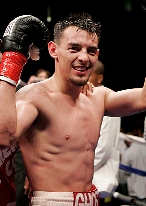


Looking ahead: The next pound-for-pound generation


The furor surrounding Tim Bradley’s victory over Manny Pacquiao is more of the same in a tiresome, if not redundant, succession of lousy decisions. But there was not much argument about Pacquiao, who has been robbed more by time than judges.

Speed, especially in hands once as lethal as lightning, is gone. That suggests more controversy on the scorecards for his remaining fights, be they against Bradley or Juan Manuel Marquez or Miguel Cotto.

The big tease, Pacquiao-Floyd Mayweather Jr., is now full of more potential controversy than drama, simply because both are in decline. What Pacquiao has lost in his hands, Mayweather has lost in his feet. A better bet than a Pacquiao-Mayweather fight later this year, or early next year, or in any year is that Mayweather and Pacquiao won’t be No. 1 and No. 2, respectively, in Forbes’ 2013 ranking of the world’s highest-earning athletes.

In the rush to find crooks, or conspiracies, or fault with the failing vision of aging judges, there’s still a simple solution as fundamental and reliable as a jab. Who’s next? Stardom’s successor is out there. Retirement is on the horizon for the current pound-for-pound generation that includes Mayweather, Pacquiao, Cotto, Marquez, the Wladimir-and-Vitali Klitschko empire and Bernard Hopkins.

What will that pound-for-pound crowd look like a couple of years from now? Here’s a guess from No. 1 to No. 10.

1 –Andre Ward. The reigning super-middleweight possesses classic skill, poise and surprising toughness. Everything, it seems, but a large fan base. In a media session before the June 9 craziness over Bradley’s split decision over Pacquiao, Ward said “give it time.” It’ll happen, he said. Give him the right opponent, too. An insightful friend says the right foe might be Julio Cesar Chavez Jr., who is growing into Ward’s weight class. Chavez also has his dad’s legendary name and the Mexican audience, which might like what it sees in Ward when introduced to him.

2 – Nonito Donaire. He has been riding a crest of popularity since his crushing knock out of Fernando Montiel last year. There have been some mixed performances since then, perhaps brought on by a promotional controversy. Now that he’s back and apparently comfortable with Top Rank, he figures to regain the dramatic edge he had against Montiel. “He might be the best pound-for-pound fighter there is,’’ manager Cameron Dunkin said of Donaire’s 122-pound bout on July 7 against South African Jeffrey Mathebula in Carson, Calif. “In my opinion, he is. Five, six, seven titles? Who knows?’’

3 — Sergio Martinez. The Argentine middleweight often looks beatable, but the former soccer player’s unusual style has made fools of nearly everybody who has tried. The junior Chavez is expected to try on Sept. 15 at Las Vegas’ MGM Grand. It’s a defining bout for Martinez, mostly because Chavez is beginning to define himself with some toughness that few thought he had. If Martinez beats Chavez, he’ll have to move up in weight and onto another defining step against Carl Froch, Arthur Abraham and even Ward.

4 – Chavez Jr. and junior-middleweight Saul “Canelo’ Alvarez. We could break this tie if Top Rank, Chavez’ promoter, and Golden Boy, Canelo’s promoter, could sit down at the same table, break bread and agree on a date and weight. Then again, we’d probably get only a food fight. Too bad. Canelo’s combinations against Chavez’ emerging toughness would be a beauty.

6 – Abner Mares. If you’re sick of hearing about Pacquiao-Mayweather and Chavez-Canelo, prepare for more indigestion. At the lighter weights, there’s not a fight the public wants more than Mares-versus-Donaire. It could be the best rivalry in the lighter divisions since Michael Carbajal-Humberto Gonzalez. Without an end to the Top Rank-Golden Boy food fight, however, it won’t happen. Mares is a Golden Boy fighter and its first prospect to win a major title. Donaire is promoted by Top Rank. Mares has many of the qualities that makes Ward so intriguing. He’s smart, tough and skilled.

7 – Adrien Broner. What’s not to like about the unbeaten junior-lightweight from Cincinnati? He has speed in his hands and feet. He’s also a lot of fun. He likes to talk almost as much as he likes to fight. The showmanship includes a brush that might be worth some endorsement money if and when he moves to lightweight and junior-welterweight in search of name opponents and bigger victories.

8 — Chad Dawson. His bout on Sept. 8 with Ward will say something about his staying power, although the light-heavyweight will be at disadvantage in Oakland, Calif. – Ward’s hometown — and at Ward’s weight – 168 pounds instead of 175. A close loss wouldn’t keep him off this list, however. His future still might be at heavyweight, where the search for the next great American continues. Yeah, it might be former Michigan State linebacker Seth Mitchell. A couple of years from now, however, it could be the more experienced Dawson.

9 – Amir Khan. The UK junior-welterweight has as much to prove as he has potential. His split-decision loss in December to Lamont Peterson in Washington, D.C., was every bit as bad as the one that went against Pacquiao in the loss to Bradley. But it also left doubts about whether Khan is as good as he looked in victories over Marcos Maidana and Zab Judah. We’ll know more on July 14 against young Danny Garcia at Las Vegas’ Mandalay Bay. The athletic Khan is smart and knows how to market himself. If one punch exposes a suspect chin, however, he could quickly fall to the canvas and off this list.

10 – Bradley. It would be interesting see him in a Pacquiao rematch with healthy ankles. He injured both – a sprain to the right and damaged ligaments in the left — early in the June 9 bout. With both ankles intact, the result might be the same, but without the controversy.


Machito time, European girls and blue-raspberry slurpees

SAN ANTONIO – Saturday, Hector “Machito” Camacho Jr., fighting for the first time in 16 months, dropped an overmatched opponent on the red canvas of an outdoor ring erected in La Villita’s Maverick Plaza about a two-minute stroll from the River Walk. Meanwhile at ringside, and on message boards everywhere, and on YouTube, debate about Bradley-Pacquiao continued, though in significantly politer terms.

Camacho’s comeback, as these things go, does not appear a particularly serious one. He is George Foreman, with the religious awakening and cheeseburgers but without the stopping power. Camacho is a Puerto Rican welterweight/junior middleweight/middleweight/super middleweight, not an American heavyweight, and so he also must rely on shtick more than Foreman did. Shtick is a family specialty, though; cry not at all for Machito.

His dad, without whom the Camacho name in Puerto Rico would be more obscure, by far, than the Chavez name in Mexico, does not care a whole lot about his son’s conversion to Islam, one that finds Junior prefacing statements with “God is great” and donning a white thobe that clings more than billows at ringside. Saturday, Camacho’s shiny silver trunks, too, clung, in a summer look that said, Whoa, even I didn’t think my ass could get this full. And “full” is good a word as any to describe Camacho’s physique.

Four and a half years ago, when he weighed an embarrassing 173 pounds in Scottsdale, Ariz., for a fight the day before Super Bowl XLII, Camacho said he thought maybe he should get down to 147, to prove he was serious. He’s not down there yet, though he claimed Friday he weighed as little as 157 before his opponent fell-out and he learned the sacrifice they were trucking up from Corpus Christi would be well over the middleweight limit. That sacrifice, J.D. Charles, caught a Camacho left uppercut to the belly in the second minute of their main-event tilt and went down and stayed down. Afterwards, he said he could have gotten up but didn’t. With the short notice and purse they offered him, in other words, he’d more than fulfilled his obligation when the 120th second passed. Camacho didn’t grandstand or insult Charles.

Therein lies a little of the appeal Camacho holds for those who’ve crossed paths with him during his 16-year campaign. He can actually fight when he wants to and is so wonderfully self-deprecating, and therefore empathetic, he would never fault a fellow prizefighter for wanting effort. Camacho understands the exact brutality of our sport and talks candidly about it. In all his court-jesterliness, he is, when the bell rings, additionally a reminder of something Carlo Rotella wrote in an excellent 2003 book called “Cut Time”:

“The lowliest of professional opponents . . . can fight better than almost everybody else on earth. Any one of them could beat the hell out of the typical top-flight contact-sports jock remotely his size, and any one of them could single-handedly clear out a bar full of fight-goers, writers, and other smart alecks who dismiss him as a stiff when he boxes in the ring.”

Camacho, seeming stagy but sincere, tells you he is embarrassed about what shame he’s brought on his career. Then he tells you about the women he enjoyed during that run – and you realize the insincerity of those lines about shame. For a short, chunky kid with a birthmark that runs the left side of his face, he’s done things to women more than reason expected. Where his father was a character, a leading actor in many a hijinks, Machito is a storyteller, a supporting actor who doubles as narrator. Had his reflexes been a tad slower, he’d have made a good cameraman in gonzo pornography – such is his charisma, timing and capacity for disarming inquisitors.

“F–king the girls I was f–king in my days?” Camacho Jr. explained in the foyer of Allstar’s Gentlemen’s Sports Club, Friday. “You can’t blame me, man! I was f–king the baddest girls, from Switzerland and Europe. You cannot blame me, man!”

Ah, the effects of the camera. Saturday, a third ringside experience in as many weeks brought another chance to reflect on what happened in Bradley-Pacquiao, and what happened to those at ringside and those at home. Locked in a narrative that said Pacquiao would win an easy decision, after the sixth round, many a serious ringside journalist on a tight deadline – thank Pacquiao’s fascination with the NBA playoffs, in part, for that – put his head down and wrote while the last 15 minutes of the fight happened. Then he turned-in a scorecard that was not close as perhaps it should have been, for a fight all three professional judges saw turn on a single round.

The home viewer? He was treated to an experience that bore only a derivative resemblance to reality, and primed for another outrage. That outrage was nearly universal, but rather than fixate on the “universal” part of that clause, in a maniacal search for absolute consensus some have fixated on the “nearly” part. Well. You’ll get no apologies for those three ringside scorecards that dissented, so stop asking.

A few days after the latest unconscionable robbery that is the reason no one will ever watch another prizefight again in the history of humankind, apropos of nothing at all I had a conversation like this:

“I like the ‘blue raspberry’ slurpees at 7-Eleven better than real raspberries.”

“You know those drinks are filled with artificial sweeteners, concocted in laboratories to be delicious, unfilling, and to make you buy more, right?”

“They still taste better.”

The televised-fight experience – with its infallible commentators, scorecards and superduper slow motion – may well taste better than the real, ringside experience. But for goodness’ sake, do not tell a gardener that the corn-syrupy, synthetic blue mess in a plastic cup you got at the corner store tastes “more like real raspberries” than what he picks from red canes.

Bart Barry can be reached at bart.barrys.email (at) gmail.com


Hargraves Invades Minnesota in Return on Saturday

Light middleweight prospect and former amateur standout Richard Hargraves ends a fourteen-month layoff many miles from his hometown of San Francisco, California as he takes on Michael Faulk in a six-round featured attraction at the Black Bear Casino Resort in Carlton, Minnesota this Saturday night.

Hargraves (2-0-1, 2 KOs) turned pro way back in December of 2009 with a quick stoppage over John Dunham in Sacramento, California. Unfortunately for Hargraves, the 2009 U.S. Championships bronze medalist at 152-pounds, finding willing opponents has been a difficult task as he has attempted to advance his career.

“I couldn’t really land a fight,” explains the frustrated Hargraves. “There were a few guys that didn’t want to fight me and that’s pretty much what it was. When you don’t have a promoter it is a little tough to get in the game and stay in the game, as opposed to somebody that is promoted. Unlike myself, they already have everything set in place.”

Hargraves, whose size creates an imposing figure for any prospective opponent able to make 151 or so pounds, admits it has been hard to keep an eye on the prize with fights failing to materialize. “It is a little hard to stay motivated,” admits Hargraves honestly. “There are times when you just want to let go. When you are an amateur, you train hard every day because you can get a fight on any given day, so you stay ready. But as a pro, you want to tone down and let your body have a little rest. So I did lack a little motivation, but luckily some guys at the gym helped keep me motivated by the way they fight. So when you go to the gym and you are not motivated, those guys will cut you up. And I don’t want to get beat up at home too much.”

Luckily for Hargraves, Saturday’s bout came together with plenty of time for him to prepare both mentally and physically. “Fighting at 151, this is the first fight for me in a year and a couple of months and I am very excited,” Hargraves told 15rounds.com just moments before boarding his flight on Thursday morning. “I had a good month and a half of training camp. My body feels good and mentally I feel good. This is my first six-round fight I am just excited to go out here and not leave it in the judges’ hands. Be more active, be first, be last. Be great on defense and if I see the opportunity to get him out of there, get him out of there.”

The sport’s critical eye has been focused squarely on scoring in recent weeks, and by fighting Faulk (2-1) of Saint Paul, Minnesota near his home base, Hargraves could potentially be at risk for some home cooking, an idea not lost on the Californian.

“In the wake of the Pacquiao-Bradley decision, that weighs more heavily on my mind,” says Hargraves. “On national TV, that type of stuff can happen. But this is the sport we live in and the sport that we love and that is part of the game. To counteract all that, if I can knock him out, then I’m going to knock him out and take it out of the judges’ hands. But if the knockout don’t come, then just be more active, land more punches and do the best that I can. I just have to make it so impressive to where the judges can’t deny me.”

In Faulk, Hargraves goes up against a guy with some amateur credentials and only one loss on his ledger, which came at the hands of an undefeated prospect in Dominic Wade back in May of 2010 at middleweight. The San Franciscan, who fights out of the increasingly famed Straight Forward Club under Ben Bautista, does not underestimate his opponent.

“I think that if I am on my game, I should be able to beat him 80, 90 percent of the time,” explains Hargraves. “I just have to go out there and execute. I’m not taking anything away from the guy. He’s pretty good. He’s got good hand speed and he’s long in the limbs. But other than that, he’s a decent fighter and I did see him at the nationals one year. So he has to be pretty good to have won his state and go out to the nationals. But it’s going to be the battle of the 2s and one of us want to get win number three. And I want it more than he does, so that’s how it’s going to have to be.”

Tickets for Saturday’s event, promoted by Draw Events, are available online at Ticketfly.com. The bill, which includes eight total professional bouts, features unbeatens Cerreso Fort and Dave Peterson in the eight-round main event for the Minnesota State Light Middleweight title.

Mario Ortega Jr. can be reached at ortega15rds@lycos.com


No chance: Trying to judge the state of the game after a crazy few weeks

From Duane Ford to Forbes, the rapid succession of headlines during the last few weeks is either a shotgun blast that adds up to chaos tipping further into anarchy or business generating more interest and money than it has in decades. Maybe, there’s a little bit of both, meaning the face of the game is as fractured – and familiar — as ever.

The good, the bad and the bizarre have collected in a notebook full of opinions and not much else. If you want something definitive, go see a judge as long as his name isn’t Duane Ford.

Here are some of the news items and a reaction to each:

NEWS ITEM: Inmate Floyd Mayweather Jr. and Filipino Congressman Manny Pacquiao are first and second, respectively, on the Forbes’ list of the richest 100 athletes from June 2011 through June 2012. Mayweather, a guest of Nevada’s Clark County Detention Center for the next couple of months, earned $85 million. Pacquiao earned $62 million.

Reaction: The boxer-topped list is a 1-2 punch that makes a mockery out of the know-nothing tweeters and talk-show hosts, who argue that boxing is dying. But it’s not a sign of a healthy business, either. Only two other boxers are ranked – heavyweight Wladimir Klitschko tied at No. 24 with $28 million and junior-middleweight Miguel Cotto at No. 75 with $19 million. Contrast that with the NFL, which starts with Denver quarterback Peyton Manning at No. 10 with $42 million. Thirty NFL players are among the top 100. The depth of NFL wealth is the mark of sustainability. Boxing’s winner-take-all model is not.

News Item: In a video review, the World Boxing Organization announces that a panel of five judges scored unanimously in favor of Manny Pacquiao instead of Timothy Bradley, who got the official victory in a split-decision stunner on June 9 when Duane Ford and CJ Ross scored it for Bradley, 115-113, and Jerry Roth scored it for Pacquiao by the same score. The WBO disclosed the scores — 118-110, 117-111, 117-111, 116-112 and 115-113, all for Pacquiao – but not the judges’ names.

Reaction: No names? Come on. Since the controversy erupted, there has been a demand for transparency. For the sake of credibility, the WBO could at least identify the judges who were on that panel. For all anybody knows, it could have been Manny, Moe, Jack and a couple of shock absorbers.

News Item: Senator John McCain, a Republican from Arizona, and Harry Reid the Senate’s majority leader and a Democrat from Nevada, seize upon the Bradley-Pacquiao furor, questions the scoring and re-introduce an attempt to establish a federal commission.

Reaction: Reid owed Pacquiao favor. The Filipino politician campaigned for him in a tough run to retain his seat in 2010. Meanwhile, chances at a federal commission aren’t as good as an unlikely Mayweather-Pacquiao fight. It — the federal commission, not the Mayweather-Pacquiao fight — was proposed about a decade ago. It’ll still be there, the next time the good senators can’t resist a chance at grandstanding.

News Item: Bob Arum’s Top Rank and Oscar De La Hoya’s Golden Boy Promotions each have fights scheduled on the same night, Sept. 15, with a couple of miles of each other in Las Vegas. If Victor Ortiz beats Josesito Lopez Saturday night at Staples Center in Los Angeles, Golden Boy plans to match him against Saul “Canelo’’ Alvarez at the MGM Grand on a Showtime pay-per-view card. On the same night, Arum plans to have Julio Cesar Chavez Jr. face Sergio Martinez at Thomas & Mack Center in an HBO pay-per-view event.

Reaction: This potential escalation in the feud between the game’s two biggest promoters is a lot more dangerous than controversy surrounding the Pacquiao-Bradley decision. The guess is that the networks, Showtime and HBO, will intervene and one of the bouts will be moved, perhaps to Oct. 6. A solution would be to have Chavez-versus-Canelo in a Mexican rivalry on a weekend celebrating Mexico’s Independence Day. But that would be too easy and not much has been lately.

AZ Notes
Popular Arizona super-bantamweight Emilio Garcia (6-0-1, 1 KO), who now has veteran trainer Chuck McGregor in his corner, expects his next fight to happen on Aug. 27 at Celebrity Theatre in Phoenix on an Iron Boy Promotions card, which put together a successful show on June 16.


Paul Nave Appeals to his Community


Hoping to bring professional boxing back to his home area by staging the second ever such event at Albert Park Field in San Rafael, California this fall, longtime local favorite Paul Nave is reaching out to his community for support. Nave has promoted all five of his own fight cards since his ring return in March of 2009 under his Liberty Boxing Enterprises promotional banner. All five of the events, which have featured Nave himself as the main attraction, have gone on without incident.

Nave has released the following statement as he prepares to make his case to the San Rafael Park and Recreation Commission, which will decide if the event can take place at the park:

To Whom It May Concern:

As a community member, if you enjoyed the Professional Boxing Event at Albert’s Park last summer and or would support the opportunity to attend a Nave Boxing Event at Albert’s Park this September, 2012, please join us in attending the San Rafael Park and Recreation Commission hearing this Thursday, June 21, 2012 at 7:00 PM.

The hearing is at the San Rafael Community Center, 618 “B” Street, San Rafael, CA 94901. Our intent is to tell/show the Commission the event went well last year and there’s community support for another event this year.

Thank you for your consideration. If you have any questions, please feel free to contact me at paulnave@libertyboxing.com

All the best always,

Paul Nave
“The Marin County Assassin”

Mario Ortega Jr. can be reached at ortega15rds@lycos.com


Chavez Jr. and El Paso: Correcting misapprehensions


EL PASO, Texas – Little more than a pitstop on I-10 or a piece of Fort Bliss infrastructure in the imagination of most Americans – lacking New Mexico’s enchantment or Arizona’s Grand Canyon – this city nevertheless must compete for tourist dollars with America’s better-known desert destinations. On the western edge of an enormous state and sister to what might be the Western Hemisphere’s most dangerous city, El Paso, then, has made a significant choice, opting to invest in culture and history more than golf courses and resorts.

That’s the sort of investment that, were tourism a meritocracy, would thrust it to the front of Americans’ minds, well ahead of opulent but culturally barren places like Scottsdale, Ariz. The product of a multicultural history – Indigenous, Spanish, Mexican, Texan, American – one the El Paso Museum of History euphemistically calls “complicated,” today this city finds itself in a struggle with misapprehensions about its class and fitness.

Which made it fine a host as any for Julio Cesar Chavez Jr’s latest middleweight title defense, a Saturday fight with “Irish” Andy Lee that Chavez won by cruel stoppage at 2:21 of round 7 in Sun Bowl Stadium.

Chavez has made a home for himself in Texas, maturing and improving as a professional in Lone Star State, where he has made four of his last six fights. If his fans are not yet all his, not yet cheering for “Junior” so much as a combination of Senior and the Mexican flag, they are more his today than ever before and no longer feel foolish admitting it.

Chavez beats men down. He started terribly against Lee on Saturday, looking befuddled and clubfooted in the match’s opening rounds, an awkwardness he later attributed to leg cramps, but used his early and abject ineffectiveness to proctor an examination of Lee’s power on UTEP’s campus. It was an exam Chavez’s southpaw challenger did not come close to passing. Fifteen minutes in their match, Lee, by now wide-eyed and disconcerted, watched with horror as Chavez took his best shots, laughed at them, talked about them, and pleaded for more of them.

Chavez hasn’t his father’s class or relentlessness, but he takes punches every bit as personally as dad did and uses physicality and resentment where his father used accuracy and pride. And Junior has physicality aplenty. With improved footwork and timing, he now locates men who box and move better than he does sooner than those men want to be found. And once he locates them, Chavez bodies them to the ropes, crouches, touches his head to theirs, and brutalizes them with fully leveraged punches – a product of his time with trainer Freddie Roach.

Attracting the Chavez-Lee fight, an event for which El Paso itself paid a $500,000 sponsorship, this city sought to thrust itself higher on American tourists’ credible-destinations list. And it did so eventually but not without a cold start of its own. In April, University of Texas System Chancellor Francisco G. Cigarroa – from an Austin office that is far from this lovely town as the capital of Maine is from Washington D.C. – cancelled the fight, citing, in a cut unkindest of all, a “higher than normal” security concern.

Promoter Bob Arum mobilized his public-relations forces, and with help from the city’s mayor and other officials created outrage enough to make the chancellor reconsider. Arum’s bluster can be at turns entertaining and excruciating, but in this case of El Paso’s, Arum was exactly right. The city mobilized behind the fight; billboards, store-windows, free entertainment weeklies – wherever you went in the downtown area, there was evidence of Chavez-Lee. Even the delightful clerk at El Paso Museum of Art’s gift shop knew her way round the details of the controversy.

About EPMA: It is part of a collection of free-admission museums – 23 in all – that represent this city’s outstanding cultural commitment. You enter its lobby during extended Thursday-night hours expecting little and finding it then ascend directly to the second floor, where there is contemporary and modern fare that is pleasant but not sublime, then round a corner and come to “Mountain Landscape,” a large and complicated work by William Louis Sonntag, a champion of the 19th-century Hudson River School movement, and things take a surprising turn. You find works from the 1600s by Spanish Baroque masters like Jusepe De Ribera and Bartolome Esteban Murillo preceded by 18th-century masters of Venetian landscapes like Bellotto and Canaletto. Then a few meters away, you hear the museum’s only other visitor give voice to your exact sentiments, mumbling in a European accent, “Do they know what they have here?” Perhaps they do not.

The same may now be said of boxing and Chavez Jr. He deserves another, closer, more-thoughtful look than the cursory glance most American fight fans cast his way a few years back. He does a lot of things well – he picked up Lee’s left cross and countered it perfectly by round 6 of Saturday’s match – and he entertains the hell out of ticket-buyers. His punches stun more than they stop, which means each Chavez fight becomes about attrition, about taking the obstinate force across from him and rending it.

After Saturday’s postfight press conference, Top Rank’s Lee Samuels confirmed the following: Chavez will fight Sergio Martinez on Sept. 15 in UNLV’s Thomas & Mack Center on a fight broadcast by HBO pay-per-view. If schedules hold, the card will go “mano a mano” – as Arum once put it – with a Golden Boy Promotions and Showtime pay-per-view event to feature Saul “Canelo” Alvarez and Victor Ortiz, on Mexican Independence Day weekend.

Don’t be surprised if Chavez’s opponents in September, both Martinez and Showtime, join a growing list of men surprised and ruined by Junior’s size and strength.

Bart Barry can be reached at bart.barrys.email (at) gmail.com
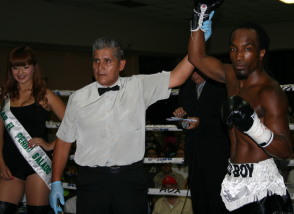


Looked like a Pacquiao Landslide, but the Math Says No it wasn’t

I did not score the Manny Pacquiao-Timothy Bradley Jr. fight two Saturdays ago. Having felt cheated out of a chance to be outraged like most everyone else last weekend, I decided to score the fight during its televised replay as part of HBO’s World Championship Boxing broadcast last night. In addition to tabulating my card for the first time, I decided to critique the cards of Duane Ford (115-113, Bradley), C.J. Ross (115-113, Bradley) and Jerry Roth (115-113, Pacquiao) on a round-by-round basis. My findings were somewhat unexpected.

Firstly, my scorecard read 117-111 for Pacquiao. I gave “the Pride of the Philippines” rounds one through nine, marking rounds three, seven, eight and nine as rounds that could be argued for Bradley. I gave rounds ten through twelve to Bradley inarguably.

My biggest issue with folks that take umbrage to a “controversially” scored fight, is that they rarely take into account how many rounds in a given bout which could be scored for either fighter. Even though I had it wide for Pacquiao on my card, if Bradley had been given the benefit of my four close rounds, I would have had it 115-113 for Bradley.

The folks at HBO made analyzing the three officials’ cards easy, as in typical fashion, they displayed each judge’s card after each round. Having had four arguable rounds, those are the rounds where the judges could have had it for either fighter and I would not take a demerit against their final score.

Of the rounds I found to be poorly scored, Duane Ford had three of them, but one was actually a Pacquiao round I found to be puzzling – round eleven. Ford also had rounds one and five for Bradley. Counting Ford’s highly questionable rounds, it would be a one-point swing for Pacquiao, meaning in my eyes he should have handed in a card that read 114-114.

C.J. Ross called two rounds for the wrong guy, giving rounds two and five to Bradley. The two-point swing in favor of Pacquiao means this card should have read 115-113 for Pacquiao, not Bradley.

Jerry Roth missed the ball just once in my estimation, as he scored the second round for Bradley. This means his score should have been one round wider for Pacquiao at 116-112.

Boxing is a sport where winners are decided based on human interpretation, which means there is plenty of room for error. The Manny Pacquiao-Timothy Bradley Jr. WBO Welterweight title bout was not the worst scored fight of the century, decade or even this year. Four out of the twelve rounds could have been scored for either fighter, a swing which makes several final scores acceptable.

I may be in the minority, but in breaking down the scoring round-by-round, I find little fault with the three judges currently being put under the microscope. Ford, the most outspoken of the three in recent days, had the worst night, which he may have even realized by the time round eleven came around. But in the end, Ford is human and boxing is boxing. We’ve seen computerized scoring, such as in the Olympics, and I’d take Ford over that any day of the week.

    POSTSCRIPT

Speaking of human error, that applies to us the viewer as well. Many of us had an invested interest in the outcome of the June 9th bout. Whether it was our love for a national hero, our simple desire to see the two mega stars of the sport enter a ring against one another without a recent defeat on their record or financial – we watch fights with preconceived notions and emotions.

This past April I stood in a Las Vegas media room and heard Top Rank head Bob Arum tell his publicist he had Brandon Rios a winner on points over Richard Abril. I need no replay to tell me there is no way Rios should have left the Mandalay Bay with a decision win on that night. Giving Mr. Arum the benefit of the doubt, and let’s say his financial connection to a Rios win had no bearing on his card, than it must have been his preconceived expectation that Rios would win that swayed his opinion of the fight. Maybe that has a lot to do with his outrage this time too.

Photo by Chris Farina/Top Rank

Mario Ortega Jr. can be reached at ortega15rds@lycos.com.


Pacquiao-Mayweather: Pacquiao wins this week’s round on the public-opinion scorecards


Judges have been tough during the last week on the only two fighters the general public knows.

First, three judges score against Manny Pacquiao in a split decision met by unanimous outrage. Then, Melissa Saragosa, a Las Vegas justice of the peace, hands down a judgment denying Mayweather’s motion to finish his 87-day sentence at home instead of jail, the Big Boy Mansion instead of the Big House.

A controversial boxing decision and an attempt to escape jail time might be as comparable as Pacquiao’s suite at Las Vegas’ Mandalay Bay and Mayweather’s lonely cell at Nevada’s Clark County Detention Center. There weren’t any mints on Mayweather’s pillow to console him on the night after Saragosa said no Wednesday to his attorney’s emergency filing 10 days into his sentence for domestic abuse.

Nevertheless, I can’t help but think that the way each behaved in the face of recent adversity says something about how they are perceived — at least this week — by all of those judges in the court of public opinion.

Pacquiao won.

Mayweather lost.

Pacquiao exhibited Ernest Hemingway’s definition of courage – grace under pressure. While saying he thought he won, Pacquiao also said he did his best. His best, he said Saturday night, just wasn’t good enough for the judges. Accept it, use it as motivation and move on.

A couple of days later, Mayweather’s attorney files a motion that makes him sound like Paris Hilton. He has to drink tap water instead of bottled water. The jailhouse menu doesn’t include any of the meals his personal chef prepares. What did Mayweather expect? Twenty-four-hour room service?

It’s impossible to really know how Mayweather would have reacted to the split-decision that went against Pacquiao in his loss to Timothy Bradley. But it’s fair to wonder. The guess in this corner is that he would have raged into the night with bursts of profanity and perhaps tears. We’ve seen both, especially in his up-and-down relationship with Larry Merchant of Home Box Office, which will replay the controversial fight Saturday night as part of a telecast featuring the Julio Cesar Chavez Jr.- Andy Lee bout in El Paso, Tex.

There’s a lot to like about Mayweather. In early May, it looked as if he was winning his fight with Pacquiao in the court of public opinion, which might be the only place we’ll ever see them fight.

He beat Miguel Cotto in an admirable, bruising confrontation. He apologized to Merchant and conducted a civil interview in the middle of the ring after the bout. Mayweather looked and acted like a grown-up. At the time, Pacquiao’s reputation was taking a beating for issues involving taxes and customs at home in the Philippines.

After the last week, however, it’s hard to know whether Pacquiao or Mayweather is the overall leader in the court of public opinion, which might be the only way to decide who deserves to be the pound-for-pound champ. You be the judge.

NOTES, QUOTES
For the record: In a freelance gig for the New York Times, I quit scoring Pacquiao-Bradley after seven rounds. I had Pacquiao leading, six rounds to one. I thought it was over. I started writing a story about a Pacquiao victory. Rookie mistake. After deleting the lead and re-writing in Usain Bolt time, I watched a replay. I scored it 116-112, — eight rounds to four – for Pacquiao.

Just when you think you’ve seen it all: Bradley, tough and admirable, has to be the first fighter to show up at a post-fight news conference as a winner in a wheelchair. He suffered injuries to both ankles in the early rounds while scrambling to get away from a lethal left thrown by Pacquiao, who emerged from the fight unmarked. Those Pacquiao lefts might be boxing’s version of basketball’s ankle-breaking moves.

AZ NOTES
Junior-welterweight Azriel Paez (2-0) is featured in the main event Saturday night at Celebrity Theatre in Phoenix against Michael Salcido (1-3) of Eloy, Ariz. Paez’ dad is the entertaining ex-featherweight champ Jorge Paez, who is expected to be at ringside. Roger Mayweather, Floyd’s trainer and uncle, also is expected to work the corner for fighters he trains in Las Vegas.

The card is scheduled for 10 fights, including David Benavidez — the younger brother of unbeaten Phoenix junior-welterweight prospect Jose Benavidez Jr. — in one of two amateur bouts. First bell is scheduled for 7 p.m.


Bradley-Pacquiao: Allowing plenty of faults


LAS VEGAS – The Bellagio Gallery of Fine Arts, a short cab ride from the week’s poorly cooled and hastily erected media tent outside MGM Grand Garden Arena, currently features an exhibition called “Claude Monet: Impressions of Light.” It has its charms, featuring much of Monet’s early work – dash of orange here, square of blue there – but is for the most part unremarkable, save one quote from the Impressionist master: “I allow plenty of faults to show in order to fix my sensations.” Let that guide what follows.

Saturday at MGM Grand, Timothy Bradley decisioned Manny Pacquiao by split scores – 115-113, 115-113 and 113-115 – that infuriated most observers. Bradley, later wheeled into the media center with a foot he may have broken in round 2 and fought on anyway for a half hour, was gracious in victory, promising his vanquished foe an immediate rematch. Pacquiao, face unmarked, was gracious in defeat, reminding those gathered how many blessings boxing bestowed on him. Bradley’s and Pacquiao’s, though, were examples of graciousness ignored by most everyone else.

In a nod to what Monet was after above, there were faults aplenty in the impressions caused by the lights of our beloved sport, Saturday. The judges, unique among those at ringside for being paid to be competent at scoring, determined, collectively, the fight’s result was extraordinarily difficult to discern. Only five of the match’s 12 rounds were seen unanimously for one fighter or the other. If that formed a conspiracy, it was at least a conspiracy degrees more sophisticated than boxing’s usual antics.

My ringside scorecard had Bradley by a point, 116-115. I gave the new champion rounds 2, 6, 7, 11 and 12. I gave Pacquiao rounds 3, 4, 9 and 10. I scored rounds 1, 5 and 8 even. Am I entirely confident of my card’s accuracy? Actually, no. I marked with an asterisk five rounds as either/or affairs, and I scored another three even. But I am certain of my card’s truthfulness – another thing Monet was after. Despite sitting ringside for no fewer than 400 prizefights during my time as a boxing writer, I was not at all sure of what I was seeing Saturday night. Which raises a genuine suspicion for me about the origin of others’ loud certainty.

Three professional judges disagreed seven of 12 times. Reasonable writers at MGM Grand, intelligent men with proven cognitive aptitudes, colored a wide array with their opinions. The only ones sure of their infallibility were a few usual suspects at ringside, compensated for what they know more than what they discover, and the entire HBO pay-per-view audience.

Let that be a commentary on the viewing experience, not the reality, and know better than to demand of ringsiders a review of Saturday’s telecast to find the wrong of their ways. We were there, friends; we know what we saw, and what we saw was the real thing, unfiltered, thanks.

Timothy Bradley did not fight well as even his supporters believed he would need to fight to beat Pacquiao. Hobbled and often unexpectedly reluctant, Bradley followed a questionable counterpunching strategy designed in his camp to preclude him from being the Ricky Hatton-redux Pacquiao prepared for. And Pacquiao, to his credit, fought considerably better than most anticipated he would.

There was a tone of disbelief in the media center at the postfight press conference. Part resulted from having not seen Pacquiao lose in 15 highly visible fights. There was confusion, a product of the result’s unusualness. Pacquiao lost to Marquez by a much wider margin than this in November, the thinking went, and he got that decision. This, therefore, is an outrage.

To score a fight impartially, one must look at the neutral plane between the fighters and follow any punch that enters that plane to its destination. Does anyone do this? No. Scorers select a narrative, often not consciously – “Pacquiao will catch Bradley coming in with those wide punches and beat him down,” say – and look to see it disproved, if they’re scientific, or proved (if they’re human). With few exceptions, Saturday’s fight showed an observer whatever he was looking for. If a scorer believed that Pacquiao, returned to his wildman and free-hurling ways, could hurt Bradley with most any punch he landed, he saw that every time Bradley swung his upper body like a windshield wiper. If a scorer believed that Bradley, quicker of reflex and less relenting than Pacquiao’s recent opponents, could grind the underconditioned Congressman to exhaustion in the championship rounds, he saw that instead.

More observers looked for Pacquiao to win. More observers saw Pacquiao win.

Pacquiao did catch Bradley with left uppercuts, though not nearly as many as he should have with a guy who put his chin on a tee every time he ducked rightwards. And the only time Pacquiao had Bradley in distress was when he flurried crazily with 10 obtusely angled punches, and four or five landed.

Bradley kept his right hand high – no Hatton redux, he – fought Pacquiao off him, held when he had to, and closed stronger than Pacquiao, confirming many prefight worries about the Filipino’s once-vaunted conditioning. Bradley also landed several punches, like a right cross in the fight’s opening 90 seconds, the partisan-Pacquiao crowd took no account of.

Promoter Bob Arum donned his performance garb in the media center afterwards, took an oath – a few oaths really – to ensure a rematch on November 10, and protested mightily the fight’s official outcome. Were this Shakespeare, in fact, Hamlet’s mother would have said Arum protested a bit too much.

Bart Barry can be reached at bart.barrys.email (at) gmail.com


Pacquiao plans to do a lateral dance away from any chance of a Bradley head-butt
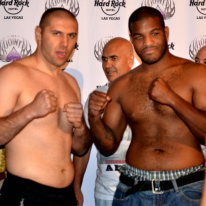

LAS VEGAS – Timothy Bradley says he has worked hard to eliminate the head-butt from his attack Saturday night in bid to upset Manny Pacquiao at the MGM Grand.
Not to worry, says Manny Pacquiao trainer Freddie Roach.

Roach said it won’t happen if Pacquiao remembers to do what he has practiced throughout endless hours of training for the welterweight bout.

“Lateral movement,’’ Roach said.

There’s a scenario that the fight will end in controversy if a Bradley head butt bloodies Pacquiao enough to force a stoppage. A scar is evident above Pacquiao’s right eye from a cut suffered in his last fight, a controversial decision over Juan Manuel Marquez in November. Pacquiao got 28 stitches for that one.

Bradley, who often leads with his head, vows to upset Pacquiao, about a 4-to-1 favorite. But he said he doesn’t want controversy to tarnish the victory. That’s why he says he has worked to eliminate the head butt, however unintentional.

Notes, Quotes, Anecdotes
· Bradley’s dad, Ray, recalls when he knew son was a fighter. It was 1998 in Los Angeles. His son was a 12-year-old amateur, fighting one of the best amateurs of that timer, Jesus Gonzales of Phoenix. Ray Bradley said his son bloodied the nose of Gonzales, who then as an amateur beat Andre Ward. Ward hasn’t lost since. Bradley saw the blood and continued to batter Gonzales nose, his dad said.

· Yuriorkis Gamboa is expected to be at the fight Saturday night, a Top Rank promotion. Gamboa is being sued by Top Rank for breach of contract. There were reports he would jump to Floyd Mayweather’s promotional company after his failure to appear at news conferences led to the cancellation of an April fight with Brandon Rios. It’s not clear whether Gamboa’s appearance at Pacquiao-Bradley means he’s back on good terms with Top Rank.

Photo by Chris Farina / Top Rank