Frazier mourned, but Marquez and Pacquaio honor him with another trilogy

LAS VEGAS – The bell echoed mournfully throughout the MGM Grand Garden Arena. It was boxing’s haunting version of Taps for an old soldier. That’s what Joe Frazier really was. He was the soldier with scars from old battles, yet an undiminished memory that reminded him of who he was and often what he still wanted to be.

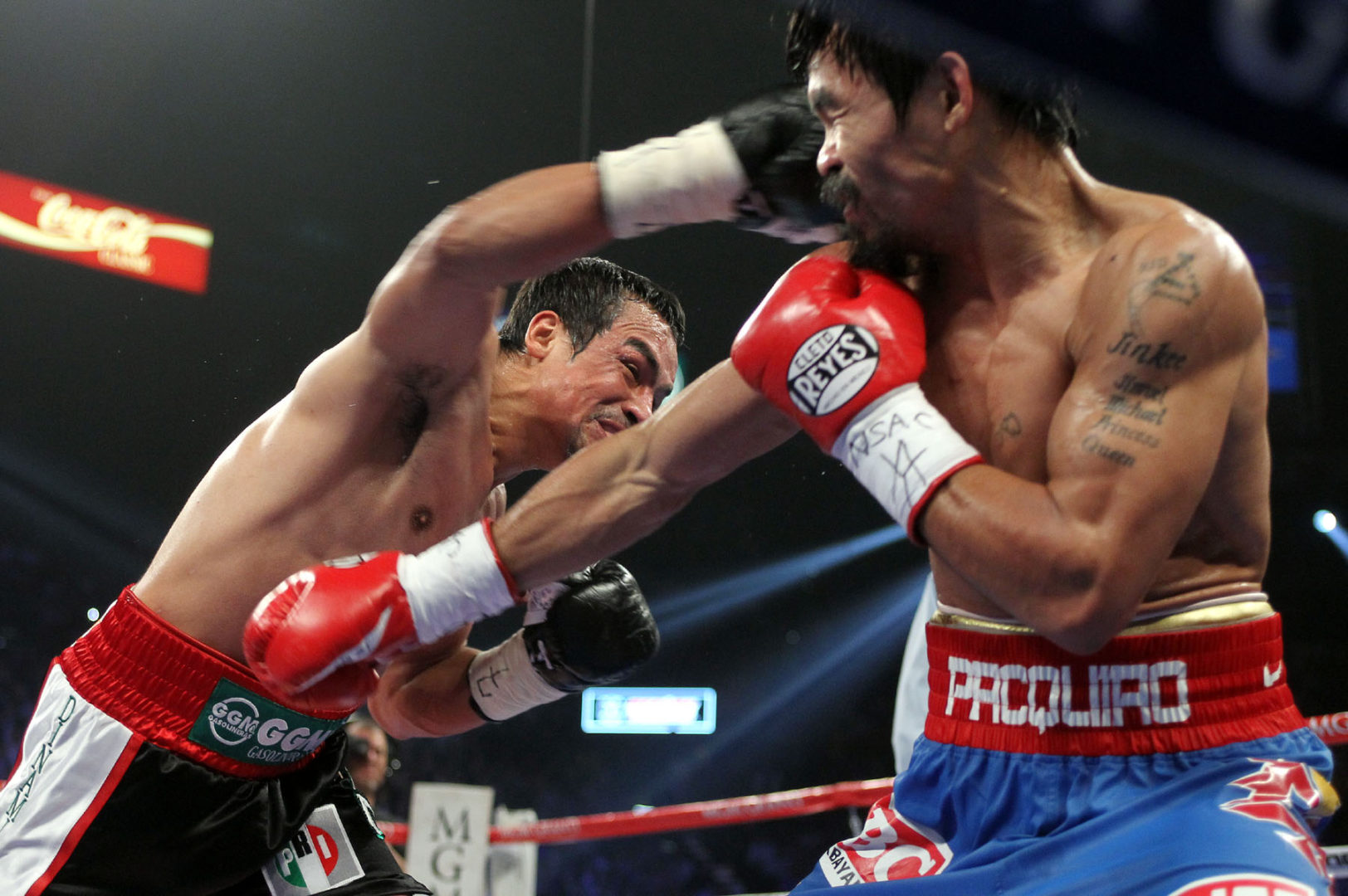
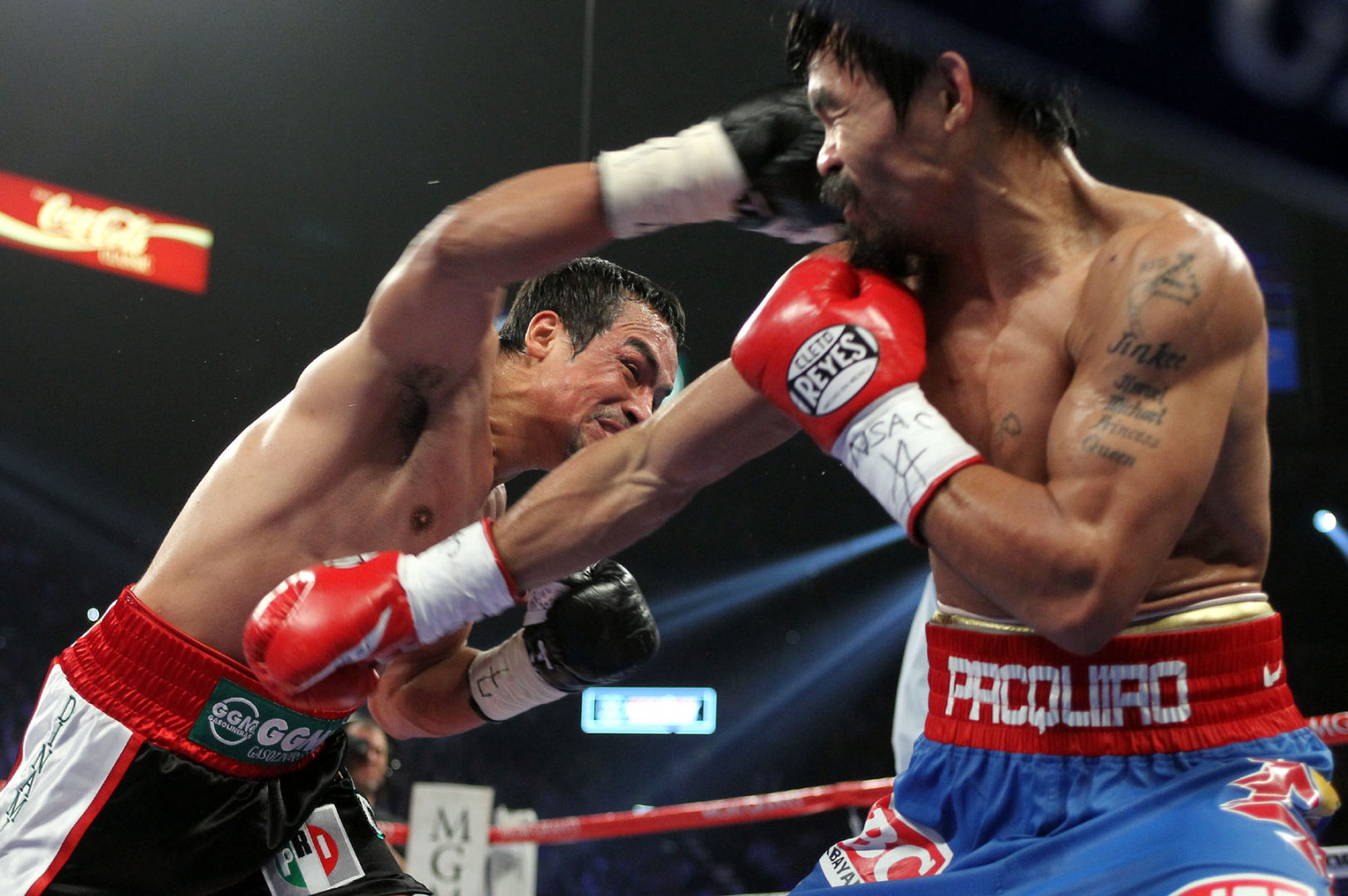
Frazier always wanted to fight on. That was appropriate on a night when Manny Pacquiao and Juan Manuel Marquez fought on and on, from round to riveting round in the third chapter Saturday of a trilogy that ended in a way that demanded more than three.

Frazier always wanted a fourth fight against Ali. Maybe, Marquez will get his fourth after losing a majority decision loudly booed by the crowd of more than 16,000, yet probably cheered by Floyd Mayweather Jr.

On a night when he was an overwhelming favorite, Pacquiao’s mixed performance probably improved chances that Mayweather will finally say yes to the one fight few ever thought would happen, although Pacquiao promoter Bob Arum said he will try to put together Pacquiao-Marquez IV for May 2012. Pacquiao didn’t look as if he would be much of a threat to Mayweather. At least, he didn’t against Marquez, whom Mayweather beat easily.

But that’s another story for another day. Whatever happens, Marquez and Pacquiao honored Frazier as much as those 10 bells mourned his passing. They would not retreat from the stubborn ferocity that has marked their rivalry through three different weight classes and eight long years. After three fights, there’s still an argument about who is the better fighter. It’s an argument that Frazier never quit making, even though he had lost two of three to Muhammad Ali. Neither Arum nor Don King could ever put together a fourth Frazier-Ali fight.

If Frazier had been in the crowd, it’s safe to say he probably would have been cheering for Marquez. He would have identified with the determined Mexican, whose tactical skill lands punches yet has been no match for Pacquiao’s charisma and celebrity.

For Frazier, there was always that impossible fight against Ali’s own celebrity. It was the one thing for which had absolutely no counter. But who did?

There were others who tried. One sat quietly in the Grand Garden Arena crowd. Earnie Shavers arrived about an hour before opening bell. He was surrounded by fans rushing to their seats. Nobody recognized him. Shavers was just another forgotten contender from a generation of heavyweights known for an Ali who needed Frazier, George Foreman, Ken Norton and even an Acorn to help him define his time.

Shavers was nicknamed the Acorn. Not because he ate them. He looked like one. He also had enough power to crack one wide open with single punch. Ali knew that. Shavers nearly stopped him on what could have been a fateful night for him, for Ali and perhaps even Frazier.

But Shavers couldn’t do what Frazier did once in three fights, the first in his trilogy. He beat Ali.

“A good man, Joe was a really good man,’’ Shavers said as he walked through the turnstiles and for the third chapter in another trilogy four decades and so many punches after the one that has become a standard, the reference point for what a rivalry should be.

And on a night when he was remembered, Joe Frazier was also a really good lesson about how great history never dies. It just gives us another trilogy.


No surprises yet as Marquez tries to spring one on Pacquiao

LAS VEGAS – Nothing other than perhaps the crowd was bigger than expected.

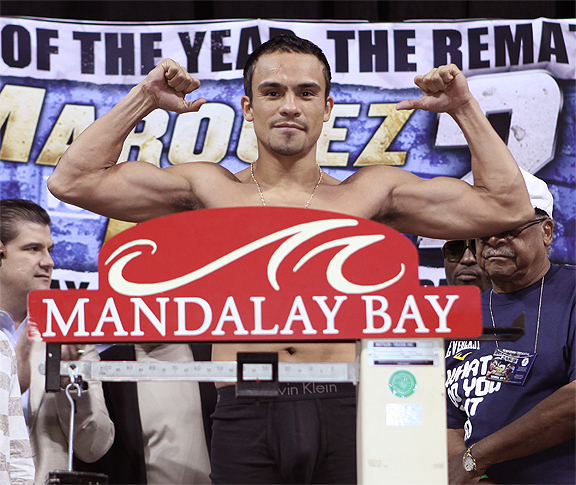
Middle-aged men wrapped in the Mexican tri-color, moms with babies napping in strollers and kids of every age stood in line for more than six hours to watch Manny Pacquiao and Juan Manuel Marquez step on and off a scale Friday in the formal weigh-in for the third chapter to their trilogy Saturday at the MGM Grand.

There were no surprises. Both Pacquiao and Marquez were lighter than the 144-pound limit. At 142, Marquez looked bigger than what the scale showed, yet was still two pounds lighter than the contracted weight and one pound lighter than Pacquiao, who at 141 looked like the same fighter who has conquered everyone and everything in front of him for the last few years.

If a surprise is forthcoming, it will have to be sprung by Marquez, whose reconstructed upper-body had yet to convince gamblers that he has a chance. Odds about an hour after the weigh-in Friday favored Pacquiao by an astonishing number, 10-to-1. The third Pacquiao-Marquez fight, an HBO pay-per-view bout, was scheduled because there were lingering questions about the first two, a draw and Pacquiao victory by split decision.

But the betting public doesn’t have any questions. Follow the money. It says that the first two fights don’t matter anymore. Perhaps, that’s because Marquez (52-5-1, 38 KOs) looked so ponderous in his only other fight at a weight heavier than 140 in his one-sided loss to Floyd Mayweather Jr. Or, perhaps, it’s because Pacquiao (53-3-2, 38 KOs) has looked so dominant over his last few fights. Or, perhaps, it’s the difference in age. At 38, Marquez could be a few birthdays beyond his prime. At 32, Pacquiao is still there.

“The betting line doesn’t bother me,’’ Marquez said. “I respect the audience. I respect the people who make the betting lines. It’s good for me. It’s going to be a surprise.’’

It would be a shock to Pacquiao’s fellow Filipinos, who dominated the crowd of about 5,500 at the weigh-in. They cheered their Congressman’s every move. For a while, it sounded as if the weigh-in site at one end of the MGM Grand Garden Arena could have been another Filipino province. They waved Filipino flags and mocked Floyd Mayweather Jr. with T-shirts that referred to the long-running soap opera of failed negotiations by saying: Run Floyd.

In the halls outside of the Grand Garden Arena, it was Manny mania, Manny all the time. There was Pacquiao perfume for sale. You can smell like a Congressman, too. There was Pacquiao Produce. Eat broccoli, carrots, cauliflower, and you can make weight, too.

Before stepping onto the scale, a large image of the Manilla Bulletin newspaper’s front page was displayed above the stage. In one huge headline, it asked: Pacquiao For President?

Apparently, a victory over Marquez is a foregone conclusion. Pacquiao trainer Freddie Roach often talks almost as if it is. He believes that Marquez’ heavily-muscled upper-body will eventually work against the resilient Mexican, who worked with a controversial strength coach named Angel Heredia when he admitted to a grand jury during the BALCO case that he had supplied performance enhancers to Olympic medallists Marion Jones and Tim Montgomery.

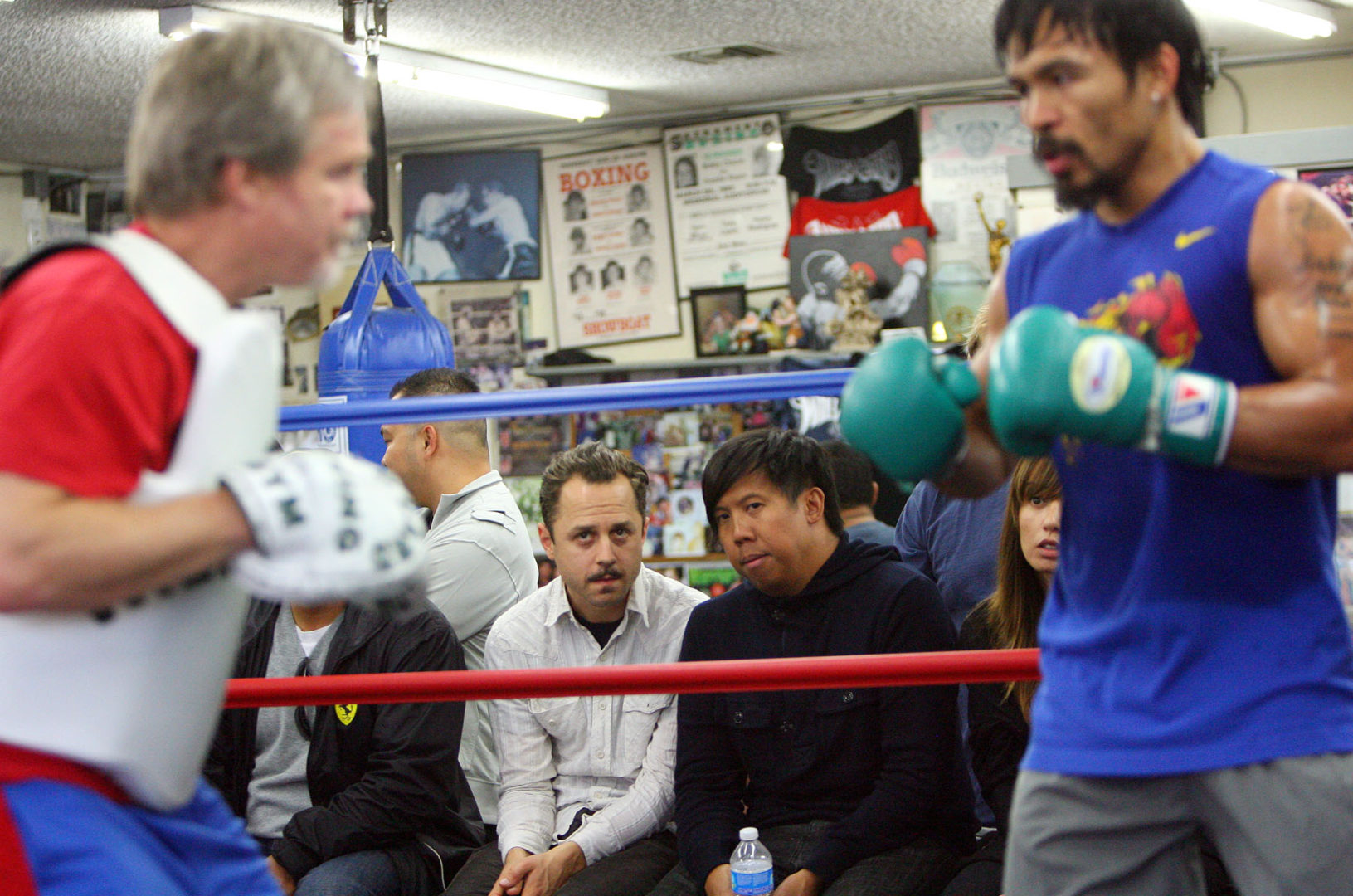
Roach’s argument is that Marquez has sacrificed speed and his ability to counter, his most effective weapon. He also has said that Pacquiao’s acquisition of a powerful right provides a punch and balance that Marquez never saw in the first two bouts, when the Filipino was essentially a one-handed – left-handed – fighter.

Pacquiao, Roach said, also has his own point to prove. He was insulted by Marquez T-shirts at a Filipino press tour that proclaimed that he, not Pacquiao, had really won those first two fights.

“Respect is the most important thing for me, the most important thing for both of us,’’ Pacquiao said.

For each, there is a version of respect at stake in Chapter III.


Benavidez witnesses a lesson in not what to do during undercard news conference for Pacquiao-Marquez


LAS VEGAS – Jose Benavidez Jr.’s days as a prospect means time as an understudy. There was a lot to study Thursday. At the top of the lesson plan, there were examples of what-to-do, what-not-to-do at a news conference that ended in a profane, trash-talking exchange between Tim Bradley and Joel Casamayor.

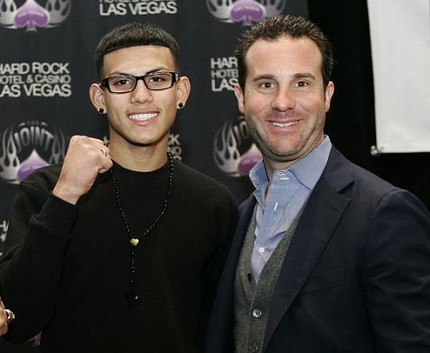
“it’s crazy, I’m just not that kind of person, not someone who wants to be talking back and forth,’’ said Benavidez (13-0, 12 KOs), a Phoenix junior-welterweight who faces Puerto Rican Sammy Santana (4-4-2, 0 KOs) in a scheduled six-rounder on a Manny Pacquiao-Juan Manuel Marquez undercard that includes Casamayor and Bradley for the World Boxing Organization’s junior-welterweight title. “I’d just rather stay quiet, show what I can do in the ring. I just don’t think people like hear all of that stuff.’’

Whether anybody wanted it or not, they got an earful Thursday. It started with Casamayor, who ordered Bradley to sit down. He ordered once, twice, three times. Casamayor was just getting started. When Bradley refused, Casamayor, a black man from Cuba, screamed a racial epithet, the N-word, at Bradley, an African-American. Even in a sport where almost anything goes, it crossed a line.

The 19-year-old Benavidez witnessed from a seat in the second row on a makeshift stage in a ballroom at the MGM Grand. One day, that could be him. Top Rank is betting he will be a star. He is perhaps their most prized prospect. If he fulfills those expectations, it is all but inevitable that he will face one the trash-talkers of his time in face-to-face encounter.

“Hopefully, I will be a world champion and get an opportunity like that,’’ he said. “When I was an amateur, I had some moments like that. I wear glasses, so guys would get in my face. But it doesn’t really faze me much. It just actually motivates me more to show what I’ve got.

“But it’s lesson. Oh yeah, a good lesson.’’

Benavidez’ most significant lessons of late have been in sparring at the trainer Freddie Roach’s Wild Card Gym in Hollywood with Amir Khan. Benavidez said he has spent a lot of time working on his jab and body punches. Meanwhile, he’s in no hurry. He likes being a student.

“It’s important not to rush things, because if I do, if I don’t learn all this basics, I won’t ever be that world champion anyway,’’ said Benavidez, the student who often sounds like a teacher.

AZ NOTES
· After Saturday at the MGM Grand, Benavidez’ next fight is expected to be in February. Day and place have yet to be determined.

· Boxing will be a Thanksgiving appetizer in Phoenix on Nov. 23. A card promoted by Iron Boy and Estrella is scheduled for El Zaribah Shriners Auditorium at 552 North 40th Street. Super-bantamweight Alexis Santiago is scheduled for the main event on card scheduled to begin at 7 p.m.


No time for Mayweather: Pacquiao trainer Freddie Roach rips Ellerbe and gets ready for Marquez

LAS VEGAS – Floyd Mayweather Jr. calls Leonard Ellerbe his advisor, but Manny Pacquiao trainer Freddie Roach calls him a go-fer, whom he likens to Pacquiao’s longtime friend and assistant trainer, Restituto Fernandez, nicknamed Buboy.

“Who’s Leonard Ellerbe?’’ Roach said Thursday during a roundtable with the trainers in the build-up to Saturday’s third fight between Pacquiao and Juan Manuel Marquez at the MGM Grand. “He’s the go-fer guy. He’s Buboy. Where’s Floyd Mayweather?’’

Translation: Roach didn’t believe Ellerbe last week when he said that there’s a good chance the long-awaited Pacquiao-Mayweather fight will happen on May 5.

Roach called Ellerbe’s comment a big tease. Actually, Roach used more colorful language than that. But you get the idea. For Roach, there’s no fight until he sees Mayweather, hands taped and gloves on, step through the ropes and answer an opening bell.

In what ranks as a mild surprise, Roach’s rhetorical slap at Ellerbe was one of the few references this week to the Mayweather-Pacquiao possibility, which has dominated — ad nauseam — the boxing conversation for the last couple of years. Perhaps, talk about Mayweather has subsided because a few people are beginning to give Marquez a real chance in this second rematch.

Marquez’ confidence is as evident as his rebuilt upper-body, which has sparked controversial speculation about his strength coach, Angel Hernandez, who went by a different name, Angel Heredia, when he admitted in testimony involving BALCO that he supplied performance-enhancers to Olympic track-and-field medallists Marion Jones and Tim Montgomery.

Marquez believes he was robbed of victory in a 2004 draw and a 2008 loss by split decision in the first two bouts. He has the style to beat Pacquiao, he says. But style can be fickle. It’s in the eyes of the beholder, or in his case the judges. Style also changes. Neither Pacquiao nor Marquez is the same fighter either was three years ago. But the basics are still there, says Marquez trainer Nacho Beristain. It’s in their personalities.

“Pacquiao is a guy who comes to fight,’’ said Beristain, who didn’t say – and didn’t have to – that Mayweather would not engage him in the kind of the battle he prefers in a 2009 loss. “In Pacquiao, he has found a guy with a willingness to fight.’’

But Roach is confident Marquez will regret what he encounters this time, in part because he has added weight and in part because he angered Pacquiao with T-shirts at a media stop in the Philippines proclaiming that he won the first two bouts.

“Manny has been a little meaner to his sparring partners,’’ Roach said. “He didn’t take well to those T-shirts Marquez wore to the Philippines. He won’t say anything. But I can tell by his work ethic that he has a little more fire in him.’’

In adding muscle, Roach believes Marquez is sacrificing quickness and abandoning his best weapon, the counter-punch.

“You don’t add muscle to counter-punch,’’ said Roach, who forecasts that Marquez will pursue an early stoppage. “He feels he wants to exchange with Manny. I would’ve gone back the other way, back to the counter-punches that gave Manny trouble.’’

A lot already has been said about Pacquiao’s acquisition of a powerful right hand since his last meeting with Marquez when he relied on his left.

“His right hand is my baby,’’ Roach said. “I said I’ll only be satisfied if it is as good as his left. And it is.’’

Another difference, perhaps more subtle, might be critical. It’s in Pacquiao’s feet. In his last few fights, he has moved across the canvas, at times almost like a spinning top.

“Manny’s footwork is the key to the fight,’’ Roach said. “He has improved immensely with his footwork. Thing is, you don’t whether he’s coming or going. He’s hard to judge.’’

Hard to beat, too, although Marquez has other ideas.


Marquez’ coach has many names, but he isn’t hiding behind any of them or anywhere else


LAS VEGAS – Juan Manuel Marquez’ strength coach has been called controversial. He’s been called a couple of other things too, including two different last names, once Heredia and now Hernandez. He’s always been Angel, yet with a devil in his past. He testified during the BALCO scandal that he supplied performance enhancers to Olympic track-and-field medalists.

The guess was that he was hiding behind an alias.

But guess what? He wasn’t hiding at all Wednesday. Hernandez or Heredia or none of the above was front and center at the most public of places, a formal news conference at the MGM Grand for the third Marquez fight with Manny Pacquiao Saturday night.

Marquez even introduced him, or at least thanked him.

“Memo Hernandez” Marquez called him as stood at the podium and gestured toward the strength coach’s seat near the stage and suddenly in the spotlight.

Memo to everybody else: Marquez is forthright and open about working with the coach of many names and controversies. Perhaps, it’s an attempt to erase the speculative cloud about whether something more than pumping iron went into the bodywork that has re-defined his appearance. The Marquez camp is acting as if it has nothing to hide. It’s the smart move, but that doesn’t necessarily mean the speculation will subside. It never does. Ask Lance Armstrong.

“I want to make clear I have done a clean preparation for this fight, like I always have done,’’ Marquez said in Spanish translated into English by his promoter, Fernando Beltran.

In terms of integrity, Marquez’ record is unquestioned. But circumstances have created an almost inescapable web. Boxing fans and conspiracy theorists are almost one and the same. Without conspiracies, the game’s history just wouldn’t be what it is.

The contracted weight for Saturday is 144 pounds. Marquez has been at more than 140 pounds only once and that was in a one-sided loss by decision to a bigger Floyd Mayweather Jr. in 2009. He says he trained the wrong way to get ready for the jump up in weight. It left him sluggish. He then fought at 133 pounds, 134 and 138 in victories over Juan Diaz, Michael Katsidis and Likar Ramos.

Then, the work began for Pacquiao, who took a split decision from him at 130 pounds in 2008 and fought him to a draw at 126 in 2004. Marquez said he would train differently for the third fight against Pacquiao, his second attempt at fighting at a weight north of 140. Enter Hernandez, who was Heredia when he testified that he gave performance enhancers to Marion Jones and Tim Montgomery.

The controversy erupted when Victor Conte, who went to prison for his role in the BALCO, spotted him on HBO’s 24/7. In a tweet, Conte, who works with Nonito Donaire and Andre Berto, revealed that Hernandez had another name and links to the scandal.

Hernandez, who has a degree from Texas A&M, said Wednesday that he is suing Conte for defamation. He also ripped Conte, calling him a hypocrite.

“The guy has not only been convicted,’’ Hernandez said. “He’s a liar. It’s obvious he’s jealous. Because I’m part of boxing today, I guess he feels I’m competition again. His athletes could wind up being mine. He’s always been jealous.’’

Hernandez theorized that his college degree might a reason for that jealousy.

“He doesn’t have a degree,’’ Hernandez said.

Marquez said the strength training designed by Hernandez has involved weight-lifting, but in variety of ways and at changing weights. The idea is to retain his quickness while adding power.

Hard to do, says Pacquiao. Maybe impossible, says Pacquiao’s surprised trainer, Freddie Roach.

“I thought he’d come in at 135 and use his speed and counter-punching against Manny,’’ Roach said. “They moved in a different direction by getting bigger.”

If he has added muscle and sacrificed speed, Roach suggests Marquez will be in trouble against Pacquiao, who has added a potent right hand to power that dropped Marquez three times in the opening round of their first fight.

“I don’t think he’s going to be able to get up from this Manny Pacquiao punch,” Roach said.

A one-punch knockout from Pacquiao might be the only answer to any of the drug questions floating around in the dwindling days before opening bell. But Marquez, an astonishing 7-to-1 underdog late Wednesday, says it won’t happen, in large part because of the work he did with Hernandez. Or is that Heredia?

“My name is this,’’ Hernandez said as he tried to explain the name game in HBO 24/7. “My name is very long. My first name is Angel. I have a middle name, which is Guillermo. But in Mexico, they use ‘Memo,’ which is my nickname. Heredia, for some people, it’s very difficult for them to catch up.

“You can ask anybody here in the media sometimes they call me Heredia. Dr. Heredia. For some reason, I told you guys Hernandez, and it was easier for you guys to write it down.”

Next time, we’ll write it down with a pencil that comes with a very eraser at the opposite end. You never know when it’s going to change.


Pacquiao-Marquez III: Growing intrigue


LAS VEGAS (Nov. 11) – After ripping his shirt neckline to bellybutton and tossing its remains to a group of aghast Filipino fans, Mexican Juan Manuel Marquez mounted the MGM Grand scale Friday and weighed in at the welterweight limit. Marquez’s musculature was grotesque enough to make Manny Pacquiao’s strength and conditioning coach, Alex Ariza, plead for an immediate ruling from “anyone who knows anyone with the USADA, great God!”

Now be honest. If you are a boxing fan sitting on the fence about his investment in Saturday’s Pacquiao-Marquez III pay-per-view, would a spectacle like that make you more or less inclined to buy the match? It’s a rhetorical question, frankly, for at least three reasons we’ll treat in a moment.

Tuesday brought news that a man in the Marquez camp – one known as Angel Hernandez and Angel Heredia and a few other friendly cognomens – 10 years ago provided performance-enhancing drugs to disgraced American Olympian Marion Jones. This revelation raised the possibility Marquez, a lightweight world champion who looked awful in a welterweight fight against Floyd Mayweather in 2009, had found someone to help him take advantage of Pacquiao’s skittishness round blood-testing needles, as it were.

Despite a temptation to bask in what irony the Pacquiao camp’s refusal to do blood testing may have wrought, we’re well-advised to dismiss the hypothetical weigh-in explored above.

Firstly, Marquez has been a man of integrity in our sport, one of its genuine shining lights, for a long time. He deserves every benefit of the doubt, no matter the rippling, back double biceps pose he hits on Friday’s scale.

Secondly, for all the reactionary dudgeon about PEDs sportswriters have heaped on the public in the last decade, fans, as a general rule, could not care less. We now know at least one of the stars of the Boston Red Sox 2004 World Series team was ingesting any PED he could get in his body, and yet, to this day, have you heard one Bostonian say “Boy, do I regret our snapping that curse!”?

Better yet, despite what we now know about Sammy Sosa’s historic run, have you ever heard a Chicagoan say “You know, when I think back to what happened in 2003, the possibility we might have won a World Series with the help of a PED-using athlete, I’m certainly glad we didn’t get out of the NLCS”?

Thirdly, promoter Bob Arum assured us Wednesday in two different conference calls that if, in the year 2011, we’re still fixated on steroids, why, we’re idiots.

“Many of you are really behind the times,” Arum said. “The conditioners who know what they are doing wouldn’t touch steroids because they are not as effective as the natural substances and the sophisticated training methods now used.”

There are lots of appropriate rebuttals to such a statement. A reader named Joel Stern offered an excellent one on Twitter: “I expect baseball players to start hitting 70 home runs a year again next year once they adopt (Arum’s) modern training methods.”

This year’s leading slugger belted 43 home runs. In 2001, Barry Bonds hit 73. That’s the difference between “the natural substances and the sophisticated training methods now used,” and steroids.

And before anyone offers up a loony rebuttal that boxing trainers have discovered some secret the rest of the sports world knows nothing about, he should visit a boxing gym. Eating ice chips, rubbing one’s body with Albolene and training in a garbage bag is the way most boxers still make weight in 2011. From such a laboratory next year’s Nobel Laureate in chemistry is not likely to emerge.

Tuesday’s news, though, can only help Pacquiao-Marquez III’s pay-per-view buy rate. The most commonly cited reason for not planning to buy the rubber match is that it will not be competitive because Pacquiao has beaten up natural welterweights while Marquez is not even as big as his lightweight opponents. The specter of Marquez being unnaturally large will help the fight sell because it will restore some hope to Marquez’s fans their guy has a chance.

He does. Marquez will always present a challenge to Pacquiao because Marquez has high ring intelligence and knows Pacquiao well. Pacquiao’s left cross, thrown from a southpaw stance, is his difference maker. But Marquez neutralizes that punch by doing two things other Pacquiao opponents do not: He hooks to Pacquiao’s lead shoulder, and he ducks down and to the right.

As an orthodox fighter, Marquez has few opportunities to hurt Pacquiao with left hooks to the head or body. The angles are all wrong. What Marquez has determined, though, is that a hard left hook to Pacquiao’s right shoulder spins Pacquiao leftwards, which takes away the balance upon which Pacquiao’s left cross relies. By the time Pacquiao gets resettled and launches the left cross, Marquez has time to find it and duck beneath it, sending Pacquiao over his left shoulder.

One other thing to consider is what happened when Marco Antonio Barrera made his third match with Erik Morales. Barrera had been summarily undone by Pacquiao a year before. Morales, meanwhile, was on a six-fight win streak and the larger man. As Barrera later said about their 2004 rubber match, “(Morales) came to bury me.”

Morales wanted to knock Barrera out so badly, though, that he eschewed good boxing. He held his right hand high and cocked, with no thought of defense. Barrera caught Morales with an uppercut in the fourth round and outboxed him the rest of the night, winning a majority decision.

Could Pacquiao be outboxed by Marquez? Sure. It has happened twice already. Can Marquez survive Pacquiao’s maniacal onslaught? Yes. That happened twice before, too.

But it says here it won’t be enough, again. Marquez will probably make it to the final bell, and Pacquiao will follow his corner’s instructions – something Morales never did – and win a comfortable decision.

I’ll take Pacquiao: UD-12, then – unless Marquez splits his seams at Friday’s weigh-in.

Bart Barry can be reached via Twitter @bartbarry

Trailers let parents take kids for a bike ride.

Omaha World-Herald (Omaha, NE) April 24, 2007 Byline: Michael O’Connor Apr. 24–Think of them as rickshaws for little kids — with mom or dad providing the horsepower. Bike trailers have been around for years, but Omaha cycling shops say they’ve been selling more in recent years. The Bike Rack, for example, says sales increased by more than 20 percent last year over the previous year. One reason sales are up is newer features such as quick-release wheels that make the carts easier to pack in your car or van. And more parents are catching the bike bug and want to hit the trails. Rather than hiring a baby sitter, they’re hitching up trailers and taking their kids along for the ride.

Dan Sitzman, who lives in central Omaha, said his 3-year-old daughter loves the cart. He rides the Keystone Trail and stops at parks along the way so his daughter can get out and play. “This is our time to get away,” he said. The trailers provide room for one child or a pair. Prices range from less than $100 to more than $400, depending on brand, size and features. Some of the newer trailers are easier to fold up, said Kelly Smith, a manager of the Bike Rack, 14510 Eagle Run Drive. That helps when it’s time to store them in the basement or garage. And if you like to run and ride, there are more models that convert into jogging strollers such as those made by Burley, Croozer and In-Step. At Scheels All Sports in the Village Pointe shopping center, prices for such carts range from $250 to $400, said Anthony Gall, who’s in charge of bike accessories. Nancy Line bought a bike trailer for her family this spring. Her family lives near 153rd and Fort Streets, about three miles from a park. Walking to the park would be too much of a hike, but with the bike trailer it’s a quick trip. She straps her 3-year-old son and 1-year-old daughter in the trailer and they’re off. The kids weren’t thrilled with the trailer on the first try. It took them a while to get used to wearing a helmet and being strapped in the small trailer. But soon they couldn’t wait to go for a ride. So what’s it’s like pulling two kids behind you? Not bad, Line said. The trailers have big tires, which helps them roll along without a lot of effort, she said. “It’s really smooth,” she said. Greg Marzullo, president of the Omaha Pedalers Bicycle Club, said he’s spotted more of the trailers. He thinks more parents are realizing that the trailers are safer than the child bike seats that attach to the frame of the parent’s bike. go to web site bike trailer this web site bike trailer

With those bike seats, the child sits right behind the parent. If the parent’s bike goes down, the kid goes with it. The hitch that connects a trailer to the parent’s bike has a swivel. If the parent’s bike falls over, the trailers are designed to stay upright. Line said the trailers are a great option for parents looking for a way to get the family outside. Her kids think the ride to the park is an adventure. “They feel like they’re going on a journey,” she said.

Distributed by McClatchy-Tribune Business News.


Marquez makes an offer Pacquiao can’t refuse


A contentious conference call full of questions about Juan Manuel Marquez’ hiring of a controversial strength coach linked to performance-enhancers included an offer that represents an opportunity for Manny Pacquiao.

“Whatever testing they want to do, blood or Olympic, I am ready to do it,’’ Marquez said. “We’ll do it, no problem, as long as he does it too.’’

Memo to Pacquiao: Say yes. Call the U.S. Anti-Doping Agency. Schedule the test.

It’s hard to know if Marquez was serious or just bluffing Wednesday when — in an exasperated tone – he made the comment after another question about how he met Angel Hernandez and what he knew about his past, which includes testimony during the BALCO case that he provided PEDs to disgraced Olympic sprinter Marion Jones and Tim Montgomery when he had a different name, Angel Heredia.

It almost sounded as if Marquez just wanted to move beyond the controversy and back to the day-to-day business of preparing for his second rematch with Pacquiao on Nov. 12 at Las Vegas’ MGM Grand. Can’t blame him, but the questions won’t go away easily, in part because of Hernandez or Heredia or whatever his name is this week. An alias, if that’s what it is, is a way to hide. At least, BALCO founder Victor Conte, who unlike Heredia-Hernandez did time in prison, didn’t change his name to Vinnie Barbarino before he started working for Nonito Donaire and Andre Berto.

In the short-term, an Olympic-style test would alleviate some of the suspicions that threaten to erode anticipation for a third fight expected to settle the debate about whether a draw and a split-decision for Pacquiao should have been scored in favor of Marquez.

In the long-term, it would eliminate any further debate about whether Pacquiao has agreed to the tests demanded by Floyd Mayweather Jr. Negotiations for Mayweather-Pacquiao fell apart in late 2009 over the issue. According to Pacquiao promoter Bob Arum, Pacquiao has agreed to random testing.

“Manny Pacquiao has said for two years that he will accept Olympic style testing, so that question is absolute nonsense,” said Arum, also exasperated at continuing talk about an issue that wouldn’t matter much if Marquez upsets the Filipino.

Nevertheless, Mayweather advisor Leonard Ellerbe told ESPN.com that the fight might happen on May 5. Drug-testing has been resolved, said Ellerbe, whose timing was interpreted by the Pacquiao camp as a grandstanding attempt to take away attention from the Marquez rematch.

But Mayweather, himself, has had more elusive moves for questions about Pacquiao’s reported agreement to random testing than Angel Heredia-Hernandez has names. During a news conference after his controversial stoppage of Victor Ortiz, Mayweather simply ignored them.

Now, however, there’s a chance to eliminate more of the same old talk with a test. Take it, Manny.

An awkward reunion
Friends aren’t supposed to fight, but that’s what super-middleweights Lucian Bute and Glen Johnson will do Saturday night at Quebec City’s Pepsi Center in a Showtime-televised bout. They grew to like each while sparring.

“When Glen and Lucian would spar, everyone in the gym would stop training to watch them fight,’’ Bute trainer Stephan Larouche said. “I thought, ‘If this is a sparring session, what would a fight be like?’ Saturday, we all get to find out.”

It’s intriguing on several levels. If Bute and Johnson can put aside their friendship for maybe as long as 12 rounds, it could be a heck of fight.

AZ Notes
Junior-welterweight prospect Jose Benavidez, Jr. (13-0, 12 KOs) of Phoenix returns to boxing’s biggest stage on the Pacquiao-Marquez undercard. He is scheduled to face Gary Bergeron (12-8, 7 KOs), a Louisiana fighter who has lost his last three. The agile, talented Benavidez should be ready.

He has been sparring with Amir Khan, who faces Lamont Peterson on Dec. 10 in Washington D.C. Sparring sessions with Khan a couple of years ago helped Benavidez gain some quick fame a couple years ago when they were seen on YouTube.


Winks, daggers and exasperation


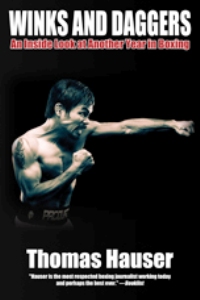
In his latest collection of boxing writing, “Winks and Daggers” (The University of Arkansas Press; $24.95), Thomas Hauser provides his signature, last-word treatment of nine fights from 2010. Of those nine events, only three happen after June. That absence of coverage, the lack of eventfulness it reports, might just be the best metaphor in Hauser’s new book.

Last year was likely better than this year, but the outsized hope that greeted 2010 made it a disappointment. That is, 2010 began with serious talk of Floyd Mayweather and Manny Pacquiao making a historic match in Cowboys Stadium; 2011 began in frozen and defunct Pontiac, Mich., with Timothy Bradley and Devon Alexander accidentally fouling one another.

Hauser was not in Michigan 10 months ago, wisely enough, but he was in Texas, New Jersey, New York and Nevada in 2010. “Winks and Dagger” opens with a ringside and dressing-room account of the Manny Pacquiao versus Joshua Clottey event that happened in March 2010 at Cowboys Stadium, a happening about which promoter Bob Arum said, “This is going to be one of the biggest events in the history of boxing.”

Well. Today, future prizefighting events in Cowboys Stadium warrant nary a consideration. Hauser does boxing historians a favor by putting promotional statements made by men like Arum and Golden Boy Promotions’ Richard Schaefer on the public record. It is important that such proclamations be held to account.

Arum’s words about boxing’s debut in Cowboys Stadium were indeed hyperbolic but not nearly far-flung as they appear today. They have not aged well because boxing has not aged well. In February 2010, our sport was generally disappointed that negotiations for a Mayweather-Pacquiao fight had collapsed but still hopeful the fight would be made in the fall, with Cowboys Stadium set to break domestic attendance records.

Reading the opening 100 pages of “Winks and Daggers” brings a feeling near nostalgia. No longer would major prizefighting be seen in casino settings only by moneyed hotel guests but enjoyed instead by the masses in stadiums! Hauser captures this hopefulness well, a hopefulness that endured through May when Floyd Mayweather made his consolation bout with Shane Mosley.

Later in “Winks and Daggers,” Hauser writes of the PED controversy that ruined Mayweather-Pacquiao negotiations and also of Mayweather’s bizarre behavior during the lead-up to Pacquiao’s November 2010 match with Antonio Margarito. There’s an urgency even in the title of Hauser’s “Floyd Mayweather Jr: When is Enough?” piece; Hauser writes at Mayweather more than about him, with a ferocity usually reserved for HBO Sports executives.

Much of Hauser’s ferocity toward Mayweather has now been replaced by indifference. Hauser recently led a treatment of Mayweather’s latest match by reporting:

“There came a time about a month ago when I tuned out Mayweather vs. Victor Ortiz. I didn’t read the conference-call transcripts. I didn’t go to Las Vegas for the fight. I didn’t buy the pay-per-view.”

That is Mayweather’s loss, not Hauser’s.

The writing in “Winks and Daggers” is customarily crisp. In what is probably his finest treatment of 2010, Hauser journeys to San Antonio to cover Julio Cesar Chavez Jr. versus John Duddy in what turned out to be Duddy’s final fight. Duddy is one of Hauser’s favorite subjects, and there’s something delightful and unexpected about the way Duddy as a subject brings Hauser’s prose alive. All the other Hauser marks – unique anecdotes, exhaustive sourcing, experimentally placed semicolons – can be found in Hauser’s other eight fight treatments, of course, from Yankee Stadium to Madison Square Garden to Boardwalk Hall, but some of his wittiest writing concerns Alamodome, and Judge Jurgen Langos’ scoring of Chavez Jr.-Duddy in June 2010:

“The most charitable explanation for Langos’s scorecard is that Jurgen was tired after his long trip from Germany and might have had trouble concentrating on the fight. State athletic commissions in the United States should make a point of sparing him the burden of similar trips in the future.”

Finally, there is Hauser’s sharp criticism of what can now be called the former regime at HBO Sports. Along with Steve Kim, Hauser has written insightful and important analyses of HBO Sports for years. Hauser’s 2010 contribution, “HBO and the State of Boxing,” is no exception.

Hauser’s methods of prying open the inner workings of HBO have been criticized occasionally by other writers but none so persuasive as Tim Starks, whose writing about Hauser’s use of anonymous sources has offered an ongoing, good-faith critique. In its way, such criticism is an honor; Starks chooses Hauser because of his stature.

In an excellent book about reporters on the campaign trail of 1972, “The Boys on the Bus,” Timothy Crouse offers two ideas about covering President Nixon that might be instructive here:

“Conjecture was a necessary tool in cracking the secretiveness of the Nixon Administration” . . . “the press needed some new form of journalism to deal with the obscurantism and dissimulation of the White House.”

“Secretiveness”, “obscurantism” and “dissimulation” are prevalent enough in boxing that they’d make a good title for Hauser’s 2011 collection. Very few honorable persons in our beloved sport speak uncomfortable truths on the record. Internet writing about boxing, for all its flaws, has likely flourished because, in its comfort with anonymity and conjecture, it is possibly the very “new form of journalism” Crouse called for.

Hauser’s writing, in other words, consistently beats the hell out of traditional media sources that disseminate publicists’ inflated claims as fact.

As for internet writing about boxing today, disinterested funding is gone. Most independent sites’ dwindling revenue comes from promotional companies’ advertisements. One promotional company owns a prominent site. Hauser himself has published pieces on a different promoter’s site in 2011.

Boxing may not be a dying sport, but sometimes it’s hard to imagine how it would look different if it were.

Bart Barry can be reached via Twitter @bartbarry


Bradley leaves the critics and moves on in a way that might finally pay


Timothy Bradley has lived with criticism, but hasn’t been able to make a living off of it. It’s a subtle distinction, perhaps. But it’s a lesson that Bradley accepted and then spun into simple wisdom that led him away from Gary Shaw to Top Rank.

“Criticism doesn’t pay the bills,” Bradley said.

A shot at Manny Pacquiao would. That’s not necessarily where his new deal with Top Rank’s Bob Arum will take him. But go ahead and connect the dots. A lot of people already have. Bradley has a better chance at Manny money now than he ever had while his career languished in Shaw’s never-never limbo.

Bradley’s fight against left-handed Joel Casamayor on the Pacquiao-Juan Manuel Marquez undercard on Nov. 12 at Las Vegas’ MGM Grand puts him in line, another possibility for the left-handed Pacquiao if chances at finally securing a date with Floyd Mayweather Jr. fall apart all over again.

Despite all of the inevitable questions about Mayweather, Arum said there has been no talk about Pacquiao’s plan after the third chapter in his trilogy with Marquez, who has posed more problems for him than anybody in his rise to stardom.

“As to whom Manny fights, that’s ultimately a decision made by Manny,’’ Arum said Thursday during a conference call with Bradley. “Do I make recommendations, proposals? Of course, I do. That’s my job as a promoter. But I have never discussed with Manny about an opponent after Marquez.

“Marquez is a very difficult opponent for Manny, as he proved twice, because of his style. Manny has his hands full, I think, with a new, improved Marquez, who physically looks like a much bigger guy. You know, when Manny fought him the first two times, Marquez wasn’t knocking anybody out. Now, he has a whole string of knockout victories. Obviously, he’s sitting down on his punches. He’s just a very dangerous opponent. So, until after Nov. 12, I don’t know who Manny is going to fight.’’

But the possibilities are there if Mayweather isn’t and Arum doesn’t believe he will be. At least, he didn’t on Wednesday. That’s when Arum told ESPNLosAngeles before a Pacquiao media workout at Freddie Roach’s Wild Card Gym in Hollywood that the Mayweather fight would “never, ever happen.’’

If not, there has to be options. Arum already has mentioned Mike Jones and Brandon Rios. Add Bradley to the list, despite complications. He faces a breach-of-contract suit from Shaw and co-promoter Ken Thompson. Further legal action is said to be a possibility. But attorneys told him and Arum to go ahead and sign.

That’s all he needed to hear. There was frustration, sitting idle for 10 month since a forgettable victory over Devon Alexander in an empty Silverdome near Detroit .There were few prospects and only those critics as company. What’s more, there’s another mouth to fight, a baby daughter, Jada, who was born in July. It was beginning to look as if the Bradley, unbeaten (27-0, 11 KOs) at 140 and 147 pounds, was doomed to spend his prime on the shelf. He had an opportunity at a reported $1.4 million against Amir Khan last summer. Why would he turn down that opportunity when it appeared to be the only one?

Had he fought Khan under his former promotional banner, it might not have widened his appeal, made him better-known. His fight against Alexander was supposed to have been a major step to stardom for Bradley. But it was a fight remembered more for head butts and empty seats in a forgotten arena.

“Top Rank brings that kind of exposure,’’ Bradley said of marketing that he says wasn’t there with Shaw. “A fight with Amir Khan through Top Rank, I think will be huge because you’ve got the top promotional company advertising it, doing what they’re supposed to – spending the money to make money and turning their fighter into a super-star.

“Kicking back and thinking about it, we made the right choice.’’

And maybe some big money.

AZ Notes
· Phoenix super-middleweight Jesus Gonzales is still waiting to hear if he’ll get a shot at Kelly Pavlik, who at last report is moving on to a new trainer and a different lifestyle, Oxnard, Calif., instead of Youngstown. If he can’t land a bout with Pavlik in January, Gonzales says he hopes to fight in December.

· Promoter Michelle Rosado put together an entertaining card of four-rounders in downtown Phoenix a week ago with hometown super-bantamweight Emilio Garcia (4-0-1, 1 KO) fighting behind a precise, body-to-head jab in a unanimous decision over Miguel Armendarez (0-5-1) of Mexico.

· And Hall of Famer Michael Carbajal did not, as expected, face his estranged brother Danny in a Phoenix courtroom last Friday. Carbajal’s attorney told him to stay away from a proceeding that is part of the preparation for a civil trial scheduled to begin Jan. 8. Danny Carbajal got out of prison in July after serving a sentence on fraud charges related to the theft of about $2 million dollars from Michael. Danny Carbajal is representing himself in his brother’s suit to claim ownership of 12 pieces of property that Michael said Danny bought with the money he earned in the ring. The trial will pit brother-against-brother in a divided family. It could get very ugly.


UNBEATEN RONALD CRUZ GOES FOR 15TH WIN IN A ROW AGAINST ADJAHO ON NOV. 19–WATCH LIVE ON GFL


Atlantic City, NJ—Undefeated welterweight Ronald Cruz, of Bethlehem, PA, takes on steel-chinned Anges Adjaho, of Buffalo, NY, in a scheduled eight-round contest on Saturday evening, Nov. 19, at Bally’s Atlantic City.

The Cruz-Adjaho match will serve as the semifinal to the 12-round main event which features Garrett Wilson, of Philadelphia, PA, making the first defense of his United States Boxing Association (USBA) cruiserweight title against Chuck Mussachio, of Wildwood, NJ.

The 25-year-old Cruz (pictured) is coming off an impressive fifth-round knockout over Chris Fernandez, of Salt Lake City, UT, on Sept. 9 at the Asylum Arena in Philadelphia, PA. Cruz was scheduled to box Adjaho that evening, but a wrist injury suffered in training forced Adjaho to withdraw.

Cruz’ win over Fernandez followed a string of knockout victories he registered over Doel Carrasquillo and Manuel Guzman, both of Lancaster, PA, Dillett Frederick, of Fort Myers, FL, and Jeremy Bryan, of Passaic, NJ.
A pro since 2009, Cruz is now 14-0, 11 K0s, and ranked by the United States Boxing Association (USBA) at No. 14 and the North American Boxing Organization (NABO) at No. 13.

“I would fight every month if I could,” said Cruz, whose 28-fight amateur career lasted only 13 months, from July, 2007, to August, 2008. As a pro, he has been just as busy, fighting seven times in 2009, three times in 2010 and four times so far in 2011.

Adjaho, 31, is originally from the Republic of Benin in West Africa. He came to the United States in 2006 after winning African titles at junior lightweight and lightweight.

Online Sports Betting

He has not had it easy here, fighting only the best—Antonio DeMarco, Mark Melligen, Brad Solomon, Shawn Porter and Joel Julio. Since turning pro in 2002, Adjaho is 17-6, 9 K0s. He has been stopped once, by DeMarco in nine rounds, when he had to get down to135 pounds after previously fighting at 142.

ABOUT NOV. 19

The Wilson-Mussachio and Cruz-Adjaho fights top a seven-bout card at Bally’s Atlantic City. First fight is 7.30 pm. Tickets priced at $50 and $75 are on sale at the offices of Peltz Boxing (215-765-0922) and all Ticketmaster outlets (800-745-3000). Tickets also are on sale at www.peltzboxing.com and www.ticketmaster.com. Gofightlive.tv will televise the card on the internet. The card is being promoted by Peltz Boxing Promotions, Inc., in association with Bally’s Atlantic City.


“20-1 odds are too much”

Right on, Roy.

The quote above belongs to HBO analyst Roy Jones, who said those words Saturday in a context far different from how they deserve to be remembered. Jones was selling the HBO audience, pre-fight, on a chance oddsmakers had things all wrong about the main event to come. But the oddsmakers were right, of course.

Saturday, in the latest of what could be a string of sabotaging efforts by the outgoing regime at HBO Sports, Filipino Nonito Donaire decisioned Argentine Omar Narvaez by scores of 120-108, 120-108, 120-108, 120-108, 120-108, 120 . . . in another mismatched event that should not have happened on public airwaves much less a subscription channel. The fight happened in The Theater at Madison Square Garden and moved from curiosity to farce directly after the opening bell.

That was when the discrepancy in the men’s sizes became apparent. There are ways of tricking the public into buying the competitiveness of a match before it goes off, tricks like platform shoes and multiple layers of clothing boxing has long used, but there are no believable lies once men strip to their waists and meet at center ring.

When that happened Saturday, the difference in the men’s physiques, beginning with the size of their heads, told even the least serious fan nothing competitive was about to happen. Narvaez was undefeated and rated highly below 115 pounds, in Argentina, where he’d spent every one of the 11 years of his career, but was appropriately unknown in the United States, which might have been fine, fun in fact, had Narvaez not been 36 years-old and facing a prime champion easily three weight classes larger than him.

Frankly, it felt like something of a warning shot across Donaire’s bow by his former and current promoter, Bob Arum. Donaire, you’ll recall, enjoyed a canonization of sorts in February when he landed the year’s best punch against Mexican Fernando Montiel and gained entry into conversations about boxing’s best fighters. Then Donaire signed a contract with rival promoter Oscar De La Hoya, launching one more Top Rank v. Golden Boy Promotions lawsuit, and got himself benched for eight months.

Donaire returned to Arum’s company a media-friendly prodigal. This was his first match since coming home. Fighting about 3,000 miles east of the Bay Area, where he lives, and 10,000 miles from his birthplace in the Philippines, Donaire defended his 118-pound belt against a 115-pound defensive specialist from South America in a small Manhattan theater.

As New Yorkers in attendance chanted “This is bulls—!” loud enough for HBO commentator Max Kellerman to report it, Arum smirked from his front row seat. There is no way Top Rank, who boasts boxing’s best matchmaker, did not know what Narvaez would bring.

“So you wanted to be the next De La Hoya, kid?” Arum’s smirk seemed to say to Donaire. “Wait till you get a load of what’s said and written about you next week.”

Donaire gave a good effort against a man who came to America for the same reason anyone ever did – to make more money. Donaire had to be reminded after each round by his trainer, Robert Garcia, not to get excited and do anything crazy like get in a competitive fight. Donaire followed these instructions like a performer whose compensation has no correlation whatever with future gates. Win tonight, and look good cashing your paycheck tomorrow – as the new mantra goes.

for his part, narvaez was small. he wished to offend no one. he kept his little hands high. he kept his tiny face tucked behind them. he did not antagonize. he did not hit. he would not be hurt.

DONAIRE WAS ENORMOUS, MEANWHILE.

Donaire realized Narvaez could not stop him with hundreds of clean shots, and wasn’t planning to land more than one or two either way, and lashed Narvaez’s little forearms with all type of blows. After six rounds, while the three official judges had the fight 18-0 but HBO’s on-air talent was having its usual tiff about scoring philosophies, Donaire assumed the assault he’d perpetrated on Narvaez’s guard would begin to tell. When it didn’t, the rest of the night was a bust.

Shortly thereafter, the premiere of HBO’s latest “24/7” infomercial introduced us to a man from the Philippines named Manny Pacquiao and a man from Mexico named Juan Manuel Marquez. Wait, you’ve heard of these guys? Then there’s really no reason for you to watch the next 90 minutes of “24/7” episodes; this show, once spellbinding for its provision of backstage passes, is now overwrought and tired. Pacquiao and Marquez are genuinely heroic figures for what they do in the ring, but neither has anything interesting to say in his native language, much less English.

Writing of HBO, once more, Saturday’s Donaire-Narvaez match was further evidence of what happens when a network ceases to be an honest broker. Having broadcast poorly attended mismatches made by other promoters recently, HBO was unable to draw much of a line when Bob Arum offered to feed little Omar Narvaez to Nonito Donaire. Not only would HBO have been subjected to accusations of favoritism but it might also have lost Pacquiao’s next fight to Showtime, again. It had little choice but to approve Saturday’s mess.

So, right on, Roy: 20-1 odds are indeed too much. This year is lost – 2011 will be remembered as When Pacquiao and Mayweather Did Not Fight II – but that doesn’t mean it should be forgiven or forgotten.

Bart Barry can be reached via Twitter @bartbarry


Donaire is in the right place and time to deliver some relief


It’s a reach to make too much out of one punch. But we can hope, can’t we? I’m talking about Nonito Donaire, whose second-round thunderbolt in February dumped Fernando Montiel into a shaking heap and created an aura about Donaire.

There was more than just power. There was anticipation.

“Before I went in the ring I explained to each and every one of them how it was going to end,’’ Donaire said of a forecast he made in his dressing room.

No lie, Donaire trainer Robert Garcia said.

“He called it,’’ Garcia said during a conference call before Donaire’s bantamweight title defense against Omar Narvaez at the Madison Square Garden Theater in New York. “We’re not making this up or exaggerating. That’s just the way it happened.’’

If one left hook – the biggest punch in what thus far has been a forgettable year – says something about Donaire’s timing, maybe he can deliver some timely relief from a mind-numbing succession of confusion, controversy and disappointment.

Given what’s just happened, it’s reasonable to be skeptical. No, amend that. Fans should remember what Victor Ortiz forgot in September when he was knocked out by Floyd Mayweather Jr. Protect yourselves at all times.

On the scale of things nobody expected, there was Mayweather’s left-right combination at an Ortiz who left his hands at his side and didn’t keep a wary eye on the threat in front of him. What else could happen? Plenty.

Crazy turned bizarre in Los Angeles last Saturday when Chad Dawson’s shoulder did more apparent damage in the second round than any of his punches, dropping Bernard Hopkins, who must have felt like Michael Vick after an encounter with a defensive end.

By now, everybody has their own spin on what happened. From this corner, it still looks as if Dawson’s TKO victory should have been ruled NC, as in No Contest. But the absence of any real discussion in mainstream media indicates apathy, as in WC. Who Cares? Some controversy sells. Mayweather’s stoppage of Ortiz did, in large part because HBO’s Larry Merchant’s wish that he was 50 years younger so he could kick Mayweather’s ass.

But too much controversy creates exasperation, then boredom, the real peril. This is a year that began with Tim Bradley’s technical decision in January over Devon Alexander in an empty Silverdome near chilly, rundown Detroit. It continued with Shane Mosley’s retreat into defeat in May against Manny Pacquiao. Then, there was David Haye stubbing his toe, apparently injured, in a July loss to Wladimir Klitschko and Abner Mares’ majority decision over Joseph Agbeko in an August bout marred by low blows. Haye announced his retirement last week. A lot of fans, all with healthy toes, might join him this week, especially if any of them heard about an insulting post-fight news conference in the wake of the Dawson-Hopkins mess.

Dawson, who says he doesn’t trash-talk, talked nothing else, perhaps because Hopkins was in the hospital for a reported shoulder separation. Dawson mocked Hopkins for claiming to be a gangster. A gangster, Dawson said, would not have quit. Huh? Since when have gangsters been known to be courageous? A gangster would have let his boys, guys in the hallway with hidden nunchucks, continue the fight.

Then, there was a question about whether customers at Staples Center and in HBO’s pay-per-view audience should get their money back.

“Let Bernard take his paycheck and refund everybody,’’ Dawson promoter Gary Shaw said through a predatory grin.

Translation: Suckers.

All of this is a round-a-bout way of getting back to Donaire (26-1, 18 KOs), a likeable Filipino-American. By all accounts, he is expected to score a dominant victory over Narvaez, who has an impressive record (35-0-2, 23 KOs), yet is mostly unknown in the Northern hemisphere. But he is from Argentina, which is enough reason for Donaire to beware. Sergio Martinez, 2010’s Fighter of the Year, is from Argentina. So is Marcos Maidana, who was an unknown Argentine with an impressive record in 2005. Ask Victor Ortiz about him.

“I really believe that Nonito will be a major star,’’ said Top Rank’s Bob Arum, who has reunited with Donaire after a nasty battle eight months ago when Donaire tried to jump to Golden Boy Promotions.

The year needs one desperately. If Donaire’s timing is as good as many think, Saturday in New York is the perfect time and place to begin.

AZ Notes
Phoenix promoter Michelle Rosado stages her third card Friday night at Madison Events Center with eleven bouts, eight pro and three amateur. Super-bantamweight Emilio Garcia-Colon is scheduled for the main event. First bell is scheduled for 7:30 p.m. (PST).

Former Phoenix junior-flyweight Michael Carbajal, a Hall of Famer, expects to see his brother and former trainer Danny Carbajal for the first time since Danny went to prison in 2008 on fraud charges related to the theft of an estimated $2 million. A hearing is scheduled for Friday morning in downtown Phoenix. Michael is suing to recover property purchased by Danny, who was released from prison in July.


Chambers pulls out of Eliminator with Thompson due to back injury


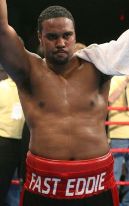
Dan Rafael of espn.com is reporting that IBF number-one ranked Heavyweight “Fast” Eddie Chambers will not be able to compete in next Friday night’s mandated elimination bout with Tony Thompson due to a back injury.

Originally a tripleheader, the show will now feature two televised bouts, with super middleweight prospect Brandon Gonzales (14-0, 10 KOs) facing veteran Ossie Duran (26-8-2, 9 KOs), and 2008 U.S. Olympian Javier Molina (9-0, 4 KOs) against Artemio Reyes (13-1, 11 KOs) in an eight-round junior middleweight bout.

“It’s always disappointing when you have a fight with a lot on the line and one of the fighters gets hurt. There’s nothing you can do about it. It’s part of the sport,” Dan Goossen, who promotes Thompson and Chambers, told ESPN.com on Wednesday. “It’s one of the breaks of the game. I just hate to see Tony Thompson putting all this hard work in and now he’s faced with not fighting next Friday.”

“This has been an ongoing thing and it just caught up to me,” Chambers told ESPN.com. “My back has always been tight and that’s a very stubborn area in your body. But it’s really gotten to me. I was sparring last week and it really got to me.

“I don’t think it was any specific move or punch, but it became unbearable. I just don’t want to get in there with a guy like Tony and half-ass it. You’re asking for either a bad performance or a loss, and I don’t want either of those. It’s unfortunate. I worked really hard, but I’m injured.”

“In camp, my back was tight,” he said. “I would do some rounds and then I couldn’t move. I was going to tough it out, but I just couldn’t perform. My back was tightening up when I was just walking around.”

“If we can’t reschedule the fight, I believe Tony should just become the mandatory because he has performed within the guidelines of the tournament,” Goossen said. “Or we can try to reschedule the fight for later in the year.”

King Cakes: A New Orleans tradition makes its way to Toledo.

The Blade (Toledo, OH) January 17, 2006 Byline: Kathie Smith Jan. 17–King Cakes long associated with Mardi Gras are relatively new to the Midwest. They are more popular the farther south you go, but that may be changing.

“They are catching on more each year,” says Andy Haas of Haas Bakery in Oregon. “The Retail Bakers of America have been trying to promote the cakes.” And Haas Bakery is among the Ohio bakers, including those at The Andersons and Servatii Pastry Shops of Cincinnati, who bake and sell King Cakes to interested Ohioans.

This year, Mr. Haas and his father, Dennis, now semiretired, have been baking and selling King Cakes since Jan. 6, Epiphany. As is the custom, they will sell the cakes throughout the period of Mardi Gras until the day before Ash Wednesday, when the Lenten season begins.

Epiphany is referred to as the 12th day of Christmas or the King’s Day. Twelfth night is the celebrating of the coming of the wise men bearing gifts to the Christ child. It marks the start of the carnival season that runs through Fat Tuesday, which also is known as Shrove Tuesday.

According to one version of King Cake history, French settlers brought this tradition to New Orleans. The cake dates back to the 12th century, when people feasted on round cakes that resembled the modern version. The cakes were eaten on King’s Day and soon the Feast of the Epiphany developed into a major holiday complete with a royal theme celebrated throughout France. Shortly after, a tiny bean was put into the dough before the cake was baked. The bean was eventually replaced by the modern-day plastic baby to symbolize the baby Jesus whom the three kings or wise men were going to see. King Cake is now served throughout the entire carnival season. go to website king cake recipe

In the New Orleans tradition, King Cake consists of a rich dough that is baked and topped with icing and sugar in the traditional Mardi Gras colors – purple (justice), green (faith), and gold (power). The decoration has been called gaudy by some, but it is a much appreciated tradition by those who love it.

Haas bakers also add the yellow, green, and purple beaded necklaces, and plastic coins to the decoration.

Many King Cakes are made plain, but can have fillings. Haas Bakery has lemon and raspberry with cream cheese, apricot, blueberry, cinnamon, and others. The 20-ounce cake costs $13.95 and serves 12 to 15 people; the 40-ounce cake costs $21.95 and serves 24 to 30 people. Mr. Haas recommends that customers order a King Cake in advance, then serve it the day it is baked.

Today many bakers are worried about liability and thus will not put the tiny plastic baby in the cake for fear that a consumer will choke on it. Thus, bakers – including those at Haas – put the plastic toy on top of the cake. go to site king cake recipe

The Andersons bake shops use a cinnamon yeast dough, according to Dianne Shomody, deli and bakery buyer. “It is frosted with white icing and sprinkled with colored sugars – green, purple, and yellow. They throw in a necklace and a plastic baby so the buyer can hide the baby in the King Cake,” she says.

After Feb. 1, King Cakes may be special ordered at The Andersons in the Toledo area 24 to 48 hours in advance. But they will be on the shelf at The Andersons Feb. 24 to March 4. “Our Columbus stores sell them year round,” says Ms. Shomody. “It’s a trend that’s moving north.” King Cakes are very familiar on the Bowling Green State University campus, according to Chef Sonja Kehr of the university’s food operations.

“We often make them from scratch and they are used at various catering events and our retail operation and restaurant,” she says.

New Orleans bakeries have long shipped King Cakes throughout the United States for those longing for a taste of the tradition, writes Linda Stradley in I’ll Have What They’re Having: Legendary Local Cuisine (The Globe Pequot Press, $18.95). Originally objects such as coins, beans, pecans, and peas were hidden inside King Cakes. Wealthy plantation owners in the late 1800s sometimes put a precious stone or jewel in the King Cake.

“The recipient of the plastic baby is ‘crowned’ king or queen for the day and are obligated to host the following year’s party,” she writes. She dates the tradition to the French settlers in New Orleans around 1870. Ms. Stradley includes a New Orleans King Cake recipe in her cookbook iced with Lemon Frosting and sprinkled with colored sugars. She does not use a filling in the recipe.

When The Blade tested the recipe, it produced a “huge” cake. Although it was best when served warm, the leftovers could be used to make great French toast.

Father Dominic Garramone, host of the Public Television series Breaking Bread with Father Dominic and author of the companion cookbooks, developed another version of King Cake.

Noting that King Cake recipes and customs are as diverse as the cultures of the world, he drew his inspiration for the dough from the orange and spices flavors of Spain. He uses a mixture of cardamom and nutmeg in a sweet moist sour cream dough spiked with orange zest. The sweet surprise inside is 11 chocolate-covered almonds evenly distributed throughout the cake. In the 12th piece is a single coin or trinket carefully wrapped in parchment paper.

“This was my own invention,” he said of the chocolate filling in a phone interview from his office at the St. Bede Abbey in Peru, Ill. He also used rapid-rise yeast, which is designed for higher temperatures (120 to 130 degrees) compared to the 110 to 115-degree temperature and instant active dry yeast used by Ms. Stradley in her recipe. He noted that richer doughs like the sour cream dough in his recipe sometimes take longer to rise and that they should always rise in a warm and protected place like the inside of an oven with a pilot light.

Another unique feature is the pull-apart “crown” form made from 12 separate pieces of dough. Use a ring mold to hold the pieces together as they rise into a golden crown in the oven. The cake is brushed with melted butter and sprinkled with sugar. Candied cherries or gumdrop “jewels” are affixed to each point of the crown.

The King Arthur Flour 200th Anniversary Cookbook by Brinna B. Sands (Countryman Press, $24) also has a recipe for Twelfth Night Cake. It is described as a variation of a pound cake (no yeast) that is rich in butter, honey, and eggs. With the honey as an ingredient, the cake bakes more slowly at a lower temperature of 300 degrees. It is baked in a Bundt pan.

Kathie Smith is The Blade’s food editor.

Contact her at:

food@theblade.com or 419-724-6155.

Distributed by Knight Ridder/Tribune Business News.


Future Star Keandre Gibson Signs with Top Rank

Perhaps the next boxing sensation to emerge from St. Louis, light welterweight Keandre Gibson has signed on with manager Repo Ric and world renowned promotional company Top Rank. Gibson, fresh off an impressive nationally televised victory in August, will make his Top Rank debut on October 29th at the WinStar World Casino in Thackerville, Oklahoma against an opponent to be announced.

Gibson (4-0-1, 2 KOs) is thrilled to have the promotional powerhouse behind him as he pursues his lifelong dream of becoming a world champion. “They are the best promotional company in the world right now, so I feel they will give me a lot of help,” says Gibson. “I’m really excited. I feel safe fighting, knowing that I’ve got Top Rank behind me and in the next couple of years, they will help me become a world champion.”

Gibson grew up in a boxing gym, as his father, a former amateur fighter, began training him at the age of seven and put him in his first amateur fight a year later. Among the highlights of his stellar amateur career were a gold medal at the 2005 National Junior Golden Gloves and a bronze at the 2006 Junior Olympic National Championships. Gibson also holds amateur wins over contender Jessie Vargas and prospect Hylon Williams Jr.

“I look at those guys as real good fighters, but I look at myself and I already beat those guys,” says Gibson, looking at the careers of his former amateur opponents. “So I feel like I am past their level really, but I just haven’t had the opportunity to showcase my talents like those guys have had the chance to showcase their talent.”

With Top Rank behind him, Gibson will surely have the opportunity to showcase his talents before the world. As Gibson’s manager is quick to point out, the signing further disproves a label some have given the respected promotional company. “A lot of people think that Top Rank don’t like African-American fighters and that’s bull,” says Repo Ric adamantly. “They are just looking for fighters that will get in there and shine and this kid can shine. He’s very flamboyant and he’s going to do his thing and he’s going to throw a lot of punches. I guarantee he’s landing 75-80 punches a round. He’s going to show Top Rank what he’s got.”

Gibson takes great pride in carrying on the storied fighting tradition of St. Louis, Missouri. “It means a lot to me because the streets of St. Louis are really hard,” explains Gibson. “For me to come out and be successful, growing up on the streets of St. Louis, it means a lot to me. For me to stay motivated and keep boxing, those are big things for me.”

In fact, Gibson credits his environment growing up for helping create his passion for the sport of boxing. “I grew up in a gym that was in the projects,” says Gibson. “There were a lot of kids, and being in the gym with them, made me like it more. It was competitive thing. I always was competitive when I was younger. It was a one-man sport, and I grew to love it.”

Having already taken on two undefeated opponents and fighting in an eight-rounder, in Mexico no less, in just his third pro bout, Gibson has shown a willingness to challenge himself. However, the point of having a solid team is making sure your career is charted out properly.

“He can already fight the best out there,” says Repo. “We are not going to take the best yet, but he can do it. He spars with Devon Alexander and Deandre Latimore. He’s been with them since they grew up together and still today he spars with those guys. I look for him to be up there on that level, because he is on that level already, but he just has five fights. He’s not going to jump up there and try to catch up with them. We are doing do our thing, one step at a time.”

Gibson, with his new team behind him, takes his next step on October 29th.

Tickets for the event, promoted by Top Rank, are available online at WinStarWorldCasino.com.


Welcome, Mr. Hershman, we have lots of work for you

Thursday the indefatigable Lem Satterfield broke news that Ken Hershman will replace Ross Greenburg as President of HBO Sports – a position akin to Commissioner of Boxing. The choice of Hershman was generally and enthusiastically applauded by boxing insiders hither and yon. Hershman, for the innovative way he handled a similar position at Showtime, is well regarded by aficionados.

A quick note about that word above. Anyone who thinks “indefatigable” is not an apt way to describe Satterfield has never been in a media center with him. Even veteran reporters marvel at his volume. Any youngster hoping to become a boxing reporter someday would do well to study Satterfield. If you can work even half as hard as Satterfield does, you’ll be reporting circles round your peers in no time.

Back to Hershman. Within hours of his appointment, some insightful pieces were published online. A few comprised parting shots at the disastrous-for-boxing Greenburg Era, others summarized Hershman’s accomplishments at Showtime – with well-deserved nods to the Super Six World Boxing Classic – and most gave HBO Sports’ new chief some advice.

The best of this came from Kevin Iole, who wrote, “The HBO Sports dogma during the Hershman regime needs to be simple: Fight your way onto the network and fight to remain on the network.”

That’s an easy-to-remember remedy for what ailed the network’s coverage of boxing much of the last decade. For a number of reasons, some indecipherable and most nothing a subscriber should have to worry about, HBO Sports made terrible boxing decisions under Greenburg. Saturday’s Dawson-Hopkins debacle on HBO pay-per-view should stand as a 21-gun salute to the departing Greenburg regime.

Writing of pay-per-view, that seems good a place as any to offer Mr. Hershman a little more advice: Audit pay-per-view receipts for the last three years.

Sept. 19, 2009, Floyd Mayweather fought Juan Manuel Marquez on HBO pay-per-view. Six days later, HBO released a statement proclaiming its event had been purchased by a million buyers. Ludicrously symmetrical numbers like 525,000 cable homes and 475,000 satellite homes added up to a million. Everyone went along with the number because, well, it proved our sport was healthier than any of us would have believed before that number got published.

Sept. 17, Floyd Mayweather fought Victor Ortiz. Thirty days have passed. Pay-per-view results have not yet been published.

Whatever the reason for this, now that we know there’s nothing automated about HBO’s tabulation, we’re afforded a chance to look skeptically backwards at other numbers we’ve been fed. The difference between the 750,000 pay-per-view buys many expected for Mayweather-Marquez and the announced “more than 1 million” is 250,000, which, when multiplied by $50 each, comes to $12.5 million. That’s a princely sum in boxing. But it represents 0.048 percent of the 2009 revenues generated by HBO’s parent company, TimeWarner. That’s not even an accounting error; it’s a nick on a penny.

Mayweather-Marquez, remember, happened when HBO Sports was rather brazenly using Golden Boy Promotions – lead promoter for the fight – as a counterbalance to promoter Bob Arum’s machinations. Arum had Pacquiao, and Golden Boy Promotions was representing Mayweather. Negotiations for the Fight to Save Boxing were not even two months away. Would it have behooved someone to apply creative-accounting techniques to the buy rate for Mayweather-Marquez? Is that something HBO Sports would do?

We don’t know. But it’s one of the first questions Hershman should ask before his tenure begins in January. Starting in Q1, after all, any drop in pay-per-view sales will be his fault. There’s plenty of corporate precedent for this sort of audit; anymore, Wall Street earnings are restated almost as often as they’re stated.

Something else for Hershman to consider came courtesy of an interesting point made by Tim Starks, Thursday. “In fact, it’s fair to wonder,” wrote Starks, “when looking at what comes next for HBO under Hershman: Was Showtime creative because it has had the right personnel, or because it had no choice?”

Starks’ question goes directly to the nature of Hershman’s promotion. Hershman is our sport’s new emperor. He is no longer the leader of an underdog outfit for which aficionados reflexively cheer. His budget has grown considerably. How effectively will he grow with it?

That’s a question two titans of the 1990s, Bill Gates and Newt Gingrich, might help him answer. Gates was the leader of a Microsoft insurgency that challenged IBM’s primacy in what was not yet called IT. Gingrich was the leader of a Republican party that had not held the Speaker’s gavel in the U.S. House of Representatives in 40 years. Neither man made a successful transition from guerilla leader to governor. Gates bullied Netscape and got his company hamstrung by the Department of Justice. Gingrich bullied the president and had to leave the Capitol before Clinton left the White House.

What is charmingly feisty when you are in a minority position becomes off-putting once you assume power. Hershman might combat the corrupting tendency of his new power by silently shrinking his boxing budget. HBO’s documentaries have been for the most part much better than its boxing in the last 10 years, and it might not be a bad idea for Hershman to use this fact to tell the ever-warring factions of boxing advisors, promoters and managers there’s now a much smaller pie for them to gorge on. Since Hershman is intimately familiar with what Showtime can bid for a fight, he might also limit HBO’s future bids to a formula like this: Showtime plus 10 percent.

It is not hard to imagine a more just, if not immediately better, system is coming to our beloved sport. That is cause for rejoicing. Dawson-Hopkins is what bottoms look like, after all, and so we welcome Mr. Hershman to the throne – even while our knives are sharpened.

Bart Barry can be reached via Twitter @bartbarry


If Dawson can figure out who he is, he can figure out how to beat Hopkins


It’s hard to know what to expect from Bernard Hopkins and Chad Dawson. Don’t blame Hopkins for that. After 23 years, we know Hopkins, mostly because he knows himself. He’s comfortable with what and who he has become. But the book on Dawson is an unfinished manuscript, an unresolved mystery. Who is he?

Nobody seems to know, perhaps because he doesn’t.

Dawson has gone through trainers the way Hollywood celebrities go through shrinks. From John Scully, to Eddie Mustafa Muhammad, to Floyd Mayweather Sr., back to Mustafa Muhammad, to Emanuel Steward, and now back to Scully. Only Dr. Phil hasn’t been in the mix.

The confusing map includes many moves, yet no apparent destination. Dawson seems to be searching for an identity more than a trainer.

“Scully is going to make a difference,’’ Dawson said at his media workout in Los Angeles. “The last two or three fights, I haven’t truly been myself.

Maybe, just maybe, Dawson (30-1, 17 KOs) is back at the beginning of what and who he was. If so, yeah, he can spring an upset of Hopkins (52-5-2, 32 KOs), the World Boxing Council’s light-heavyweight champion, Saturday night in an HBO televised bout at Los Angeles’ Staples Center. Everything else adds up to a measurable chance for him. Dawson is 17-years younger than the 46-year-old Hopkins. His hands are fast. His feet are quick. The fight’s promotional label, Believe It Or Not, could take on new meaning. Believe It Or Not, Dawson could win.

But there’s still that uncertainty about whether he has figured out how to truly be himself. Ordinarily, that might not be much of a factor. Dawson’s superior skill set would prevail, has prevailed against everybody but Jean Pascal. But against Hopkins, it matters. Hopkins is the oldest in history to win a major title because of a keen, predatory eye. It’s what allows him to survive against a younger generation with physical skills, but none of his smarts. If at any moment Hopkins senses doubt in Dawson, the fight will belong to the old man.

In a conference call a few weeks ago, Dawson made a startling admission, which in part was his way of trying to explain away his loss to Pascal, whom Hopkins beat in a rematch in his last outing.

“I became a bored fighter,’’ Dawson said. “I got bored.’’

Hopkins has said a lot of things, but he’s never said he was bored. The day he does, I suspect, is the day he’ll announce his retirement. A bored fighter is about to become an ex-fighter, or at least someone who is thinking about doing something else. In the later rounds, I’m guessing Dawson will wish that he was.

Hopkins by unanimous decision.

Moving on up
Nonito Donaire (26-1, 18 KOs) will be at bantamweight for the last on Oct. 22 at New York’s Madison Square Garden against Omar Narvaez (35-0-2, 19 KOs) of Argentina in the first defense of the titles he took from Fernando Montiel last February with a sensational second-round knockout.

“Definitely, this will be my last fight at 118,’’ Donaire said Thursday during a conference call. “122 is something we’re looking forward to.’’

AZ Notes
· Phoenix super-middleweight Jesus Gonzales is waiting to hear if Kelly Pavlik has any interest in a tune-up against him. Gonzales has been saying for months that he wants a shot at Pavlik, who is anxious for a comeback after he abruptly withdrew from a Top Rank card a couple of months ago. Gonzales hopes to hear from Pavlik by Oct. 22.

· Arizona promoter Michelle Rosado continues to re-ignite a dormant market with a card on Oct. 21 at the Madison Event Center in downtown Phoenix. Hometown super-bantamweight Emilio Colon-Garcia (3-0-1) is scheduled for the main event. First bell is scheduled for 7:30 p.m.


He’ll Do It His Way

“And now the time is here, and Dawson faces the final curtain…”

I hope Bernard Hopkins’ once again enters the ring to Artie Rabin’s customized version of “My Way.” Why? Because I like it. It’s an old school song for an old school fighter.

But the song really is irrelevant — other than the fact that I’d much prefer it to some hip-hop song I’ve never heard of. What is relevant, however, is what will happen once Hopkins steps inside the ring, not what happens as he walks toward it.

And once the Philadelphia native steps inside squared circle, he will be staring down Chad Dawson, a counterpart eighteen years his younger.

If Dawson is to win the fight, the key will be the effectiveness of his jab. The long and lanky Dawson must find success with his snapping jab or else the forty-six year old champ will be given no reason to be uncomfortable. With regards to that very jab, I doubt that Dawson will land much cleanly. It’s likely that jab will land on Hopkins’ elbows and forearms more than it does his chin, but he’ll have to be persistent and keep throwing it — it must not be abandoned.

If Dawson does get frustrated and vent that frustration in the form of abandoning his jab in favor of power punches, that would mean the fight is going very very well for the aging champ. There’s no doubt Hopkins will use veteran tricks to throw Dawson off his game and make it a dirty fight — as per usual in a Hopkins bout. I’m sure he’ll try to fight a bit on the inside, rough Dawson up using elbows, forearms, and headbutts – oh my!

It’s par for the course for Hopkins to fight a little dirty. When you face an opponent like BHop, you aren’t just battling the Executioner physically, but you also have to have the mental fortitude to put up with the crafty veteran’s mind games. Jean Pascal failed Professor Hopkins’ psychology test and I’m not all that convinced Dawson will pass with flying colors.

With that said, Dawson is well-rounded boxer in his prime fighting years. Las Vegas sees “Bad” Chad as a -140 favorite, Hopkins a +100 ‘dog.

If you’re a gamblin’ man, this is probably a fight you’ll want to bet — not because there is an obvious play — but because this is one of the rare times in boxing lately where you can actually make money on both sides of the betting aisle. For instance, against Victor Ortiz, Floyd Mayweather was a -500 favorite when the bell sounded; and Manny Pacquiao is a -1000 favorite over Juan Manuel Marquez for their Nov. 12 bout.

So on Saturday night, we’ll find out who the class of the light heavyweight division is. Dawson’s motivation couldn’t be clearer — a chance to win the Ring Magazine light heavyweight title and be recognized as the best light heavyweight on the big blue marble.

For Hopkins, the motivation is a bit different. At forty-six, the future Hall of Famer has accomplished almost all you can in the sport; his last win against Pascal crowned him oldest prizefighter to ever win a championship.

His motivation this fight? To keep his title — to keep it for over two years, in fact. If he does that, he will surpass the Old Mongoose, Archie Moore’s record as the oldest champion (Moore defending his title until he was 48 years old).

“I look forward to making history and breaking the great Mongoose, Archie Moore’s, title defense record at the Light Heavyweight record,” Hopkins said at the New York press conference. “I believe when he was 47 or 48 years old he defended that title. That to me is impressive. I want that title. I want that record. I want that history.”

I don’t know if he’ll get that record, but I do think old man Hopkins gets a step closer to it with a victory on Saturday night. Only father time will tell.

Kyle Kinder can be reached via Twitter.com/KyleKinder


Then the rains came


SAN ANTONIO – The withering aridity that made this city consider water rations has finally broken. The drought is on, many inches of rainfall are still needed in Edwards Aquifer, but local worries now subside as the recharge zone gradually fills.

Would that the same could be said of Alamo City’s championship-prizefighter drought.

Saturday the drought continued – a championless stretch that began 17 years ago when Gabriel Ruelas took Jesse James Leija’s WBC super featherweight belt in MGM Grand – as local contender Raul “Cobrita” Martinez lost a unanimous decision to Rodrigo “Gatito” Guerrero after an accidental head butt opened a gash over Martinez’s right eye in round 6 and brought their IBF super flyweight title fight to a technical decision in Tijuana. Official scores went 59-55, 57-56 and 57-56 for Guerrero.

My scorecard concurred, 48-46. I had rounds 2, 3 and 6 for Guerrero. Rounds 4 and 5 were Martinez’s. Round 3 went 10-8 for Guerrero because he dropped Martinez with a left cross from his southpaw stance.

Wait, what about round 1? Good question. To answer it, we return to the rains.

Saturday marked the first rainy weekend in what felt like ages for South Texans. Artpace San Antonio, a downtown gallery that describes itself as “an international laboratory for the creation and advancement of contemporary art,” hosted its annual Chalk It Up event. Professional artists, dilettantes and students all gathered to adorn the sidewalks of Houston Street with colorful dust. Then, as the old rhyme goes, down came the rains and washed the chalk dust out. Bad timing is all.

If you are a baseball fan, or a connoisseur of delayed Spanish-language boxing broadcasts, you already know San Antonio was not the only Texas city that got wet Saturday. Game 1 of the American League Championship Series saw the Texas Rangers and Detroit Tigers suffer two rain delays in Arlington. On the English-language channel, that meant enduring witty clubhouse banter. On Fox Deportes, it meant cutting to a feed of Guerrero-Martinez two minutes into the first round.

What happened in those opening minutes may be lost to posterity, but it can be extrapolated from the 16 minutes of combat that followed. Raul Martinez was likely the classier boxer, and Rodrigo Guerrero was the better fighter.

Not this digression again? Afraid so.

Martinez is a two-time national amateur champion. He is 28 years-old, and going into Saturday’s fight – a rematch of a split-decision victory over Guerrero in November – his record was 28-1 (16 KOs). Martinez turned pro at age 22, and guided by knowledgeable folks, tore through the table-setters put in his way. Then he faced another world-class talent, in his 25th fight, and Nonito Donaire undid him.

Mexico City’s Rodrigo Guerrero trod an entirely different path to Saturday’s Tijuana arena. He turned pro at age 17 and won only half his opening four matches. His record was a comparatively unimpressive 15-3-1 (10 KOs) coming into his rematch with Martinez.

Martinez is a better athlete than Guerrero. Martinez loves to win. He is enamored of the idea of being a world champion. He has heart and a bit of contempt, too; if you hit him, he’ll hit you back. But Martinez does not love hurting and being hurt by another man.

Guerrero does. Where Martinez’s combinations are scoring devices, Guerrero swings his right fist to hurt you. Switching between southpaw and orthodox, Guerrero chases exchanges with an opponent, and if that means punches stray low or heads collide, well, so is the way of the world. It’s a fight after all.

Martinez would likely beat Guerrero in any three-round amateur bout. But prizefighting is a different thing altogether.

At the end of round 1, a Guerrero punch went low on Martinez. As the bell rang, Martinez doubled over before recuperating quickly enough to walk to his corner. Halfway through the fourth, Martinez struck Guerrero with an equally low blow. Guerrero backed off and signaled for the referee, who did not intervene. Martinez put an effective combination on the distracted Guerrero, and in an instant Guerrero returned to his fighting stance and plotted to punish Martinez.

(It was the antithesis of Victor Ortiz’s reaction to Floyd Mayweather’s left hook a few weeks ago.)

Two rounds later, Martinez’s and Guerrero’s heads collided as they’d done a number of times. Head butts happen when a southpaw fights an orthodox opponent, and they happen, too, when one fighter crosses-over and punches on the second and third step like Martinez did Saturday. The accidental butt damaged Martinez more than Guerrero. And Guerrero’s ripping left uppercuts in the minute that followed pulled apart the skin over Martinez’s right eye further still.

If Martinez had not yet started to fade, he was not gaining pace either. He returned to his corner at the midway point of the fight with his face covered in blood. According to Dr. Jose Luis Hernandez, the ringside physician who stopped the match, Martinez said he could not see out of his right eye, making the doctor’s decision an easy one.

Guerrero’s corner was ecstatic at the stoppage. Their man had won the fight. This would have been true even if the official judges – all three American – had said otherwise. Since the match ended on a cut caused by an accidental foul, not a punch, the judges’ collective opinion had to be heard when Martinez could not continue. The judges got it right.

There was no time for postfight commentary, as the rains in Arlington had stopped by then and the baseball game was about to restart. While we’ll never know what the fighters would have said, it’s a safe bet each man thought he won.

Guerrero and Martinez’s rivalry now stands at 1-1. A rubber match is a fair way to determine the better man and prove decisively whether Martinez belongs in this city’s pantheon of world champions.

Bart Barry can be reached via Twitter @bartbarry


History: Hopkins has some in mind for Dawson and more for himself


Bernard Hopkins will show up in wax next week. It ought to be granite. He’s been indestructible.

Hopkins’ defiance against time and his victories over opponents young enough to be his son continue like the clock that never seems to catch up with him. It will, of course. Nobody knows that better than Hopkins, who was wise enough to say this week in a conference call that he won’t still be fighting when he’s 50, yet he will be there for another opening bell on Oct. 15 against Chad Dawson just three months before he turns 47.

Like the graybeard he is becoming, he was philosophical, at times almost wistful, in a call that preceded his fight at Staples Center in Los Angeles where Ripley’s Believe It Or Not will unveil his wax figure. He couldn’t say when or where he’d answer his last bell.

“Can’t think about winning and retiring at the same time,’’ said Hopkins, who will defend the light-heavyweight title he won in a rematch against Jean Pascal.

But he was thinking about history, which he promised would include another chapter about a victory over the under-achieving, yet dangerous Dawson. In the end, history means a judgment, which is as inescapable as retirement. How will he be remembered?

Within the ropes, there won’t be much argument from anybody other than perhaps Joe Calzaghe. Calzaghe beat him on the scorecards in March, 2008, leaving Hopkins with one of his five losses. Calzaghe retired, unbeaten at 46-0. But 10 years from now, who will be remembered as the better fighter in history’s pound-for-pound debate, Calzaghe or Hopkins? I’ll argue that Hopkins will win that one every time. With no apologies to Floyd Mayweather Jr., Hopkins is the real face of boxing, which is more about conquering adversity than it is an unscarred record. Hopkins’ life is a boxing story, an American story which includes prison and a loss in his first fight.

In perhaps a sure sign that retirement is near, he now has arrived at a stage where he wants to be remembered for more than boxing.

“Boxing is what he did, but boxing is not who he is,’’ Hopkins said.

A healthy serving of self-promotion has always been part of the Hopkins personality. Some are offended by that. Many media colleagues are also offended by his racial comments. There was one last May directed at former Philadelphia Eagles quarterback Donovan McNabb. More notorious, perhaps, was the one he shouted at Calzaghe in the middle of a crowded media room in Las Vegas before Mayweather’s 10th-round TKO of Britain’s Ricky Hatton in December, 2007. He told Calzaghe that he would never let “a white boy” beat him.

I wasn’t there for the McNabb controversy when Hopkins, while training for the Pascal rematch, was reported to have suggested that McNabb, now with the Minnesota Vikings, wasn’t tough enough because he wasn’t black enough. But I was there for the Calzaghe exchange, which was pure theater in the hype leading up to their fight.

In one moment, Hopkins was joking with a circle of British writers, telling them that they had better health care in the UK than the U.S.

“Then again, you all drink a hell of a lot more than we do,’’ Hopkins said.

Then, he spotted Calzaghe. He raced across the MGM Grand’s ballroom, shifted his vocal chords from joking to angry and screamed “the white boy” comment at him. It was all in the setting and tone, yet media reports included none of that context. With only the quote, it appeared to be a racial insult.

In meeting with some media before Amir Khan’s victory over Zab Judah in July, Hopkins talked about how it might have affected the judging in his split-decision loss to Calzaghe

“I lost that fight when I called him light-skinned,’’ Hopkins told a circle of reporters, many of whom were light-skinned.

Be careful of what you read. Hopkins doesn’t take himself that seriously. When he is approaching 60 a decade from now, I’m not sure how he will look at himself. But boxing obviously will be the biggest piece in a fascinating puzzle. Still, priorities always change and it is beginning to look as if Hopkins is too.

Hopkins trained in Philadelphia with Dewey Bozella, who will fight on the Oct. 15 undercard. Bozella was convicted and imprisoned in 1983 for a murder he did not commit. He served 26 years before his conviction was overturned in 2009.

“His life is bigger than the sport …bigger than anything I’ve ever done,’’ said Hopkins, whose record of convictions as a 17-year-old led to a five-year sentence in Pennsylvania’s notorious Graterford Prison. “You don’t get a second life. I went into jail because I did something. I wasn’t innocent. He was innocent.

“That’s a difference, a big difference.’’

A wise one, too, from somebody who hasn’t defied time so much as he used it, evolved with it.

AZ NOTES
· As expected, Phoenix junior-welterweight prospect Jose Benavidez Jr. is scheduled for the Manny Pacquiao-Juan Manuel Marquez undercard on Nov. 12 at Las Vegas MGM Grand. Gary Bergeron (12-8, 7 KOs) of Chalmette, La., is the scheduled opponent. But expect changes. Benavidez (13-0, 12 KOs) does. There were three to four changes before his last victory, a first-round stoppage, on Sept. 17 in Parker, Ariz. Bergeron, loser of his last three fights and 2-6 over his last eight, is also scheduled for a bout on Nov. 11 in Australia, which means he would have to book a seat on the Space Shuttle to get to Vegas in time for opening bell.

· And while Kelly Pavlik considers a tune-up or two in an attempt to get his career back on track, Phoenix super-middleweight Jesus Gonzales continues to lobby for a shot at the former middleweight champ. Gonzales turned 27 on Monday. When asked what he wanted for his birthday, Gonzales said: “A fight with Kelly Pavlik. That’s better than a Grand Slam from Denny’s.’’


Más trabajador que maravilla


Saturday continued the happiest development our sport has seen in years. Sergio “Maravilla” Martinez, a southpaw Argentine who prefers Spain but lives in California, is an accidental champion. A career 147- and 154-pounder who won the middleweight title in his first meaningful middleweight fight, Martinez makes a match with a larger man every time he defends his belts. He gets hit plenty and finishes each defense with a knockout.

He is not running for office in the Philippines. He does not have charges pending against him in Nevada. Martinez is, rather, one boxing story every aficionado should feel a sense of ownership about.

Saturday in Atlantic City, Martinez extended his record as undisputed middleweight champion to 3-0 (3 KOs) by putting in an effort more workmanlike than marvelous and finishing England’s Darren Barker at 1:29 of round 11 in a fight more competitive, and therefore more enjoyable, than predicted.

American writers predicted a whitewash for Martinez because no one knew who Darren Barker was. European fighters often bring sparkling resumes like Barker’s 22-0 mark to American arenas then acquit themselves as well-intentioned frauds. Not so with Barker. Martinez was ahead in the fight at the time Barker crumpled but not by the margin American boxing writers expected. Why not?

Here’s an idea. Sergio Martinez is not a natural middleweight. Every fight he makes at 160 pounds, then, features a man who hits him harder than he spent the first 13 years of his career being hit. Martinez relied on reflexes and elusiveness to acquire the middleweight crown from Kelly Pavlik, after consecutive fights with former welterweight champions Kermit Cintron and Paul Williams. That is worth noting.

Pavlik and the man from whose head he lifted the middleweight crown, Jermain Taylor, both worked their ways through the middleweight ranks, preparing for and fighting the Darren Barkers of the world before getting on national television. Martinez, contrarily, is learning how to be a middleweight after becoming middleweight champion. It’s a joy to watch.

There’s a spontaneity to Martinez fights that should be celebrated. He does things differently and often gets whacked for doing so. He stands before larger men, hands dangling at his hip pockets, and bobs his naked face at them, even as they shuffle to within a foot of him. He waits for them to throw then leaps out the way and counters them, or doesn’t. That’s part of the fun: An orthodox middleweight challenger like Barker – no mystery whatever to a Pavlik or Taylor – had good a chance as any of striking Martinez with meaningful punches.

Before you go to the scorecards against that claim, confirming your own prefight bias the match would not be competitive, revisit what happened in round 4. Barker, that limited Brit with a fraction the champion’s athleticism and pizzazz, splattered Martinez’s nose all over Martinez’s gorgeous face. It was a fine manifestation of an old adage that says the right combination is unlimited for being thrown by a balanced man creating leverage at little expense.

Barker was not busy enough, you say? Probably not. But until the start of round 6 – the first to show Martinez looking better than uncomfortable – Barker was making a decent case to his supporters that he was winning. No, nobody in America or watching HBO’s telecast imagined it, but if you watched the fight in the U.K., tuning in to see an undefeated prospect from London, Barker gave you plenty of reason to score two or three of the opening five rounds for him. Imagine that.

Martinez’s punches started to tell after the fight’s midway point, and his theretofore ineffective aggressiveness acquired quite a bit of effect by round 10 when, adhering to a different teaching adage and finishing a combination with a jab, Martinez staggered Barker. A Martinez right hook to Barker’s guard in the next round proved forceful enough to make Barker tip over and decide against rising. It was an honest ending to an honest effort; Barker didn’t stand at 10 1/2 and pretend he wanted to continue. Barker’d had enough, and Martinez had another well-deserved knockout defense.

Then the fretting began. “Whither this man without a country?” went the lament about Martinez’s lack of marketability. He lives in California but vacations in Spain, and half of Argentina could not pick him out of a fashion-show runway. Even if they could, Martinez’s ineffectual promoter tells us, there just aren’t enough Argentines in America! Well, that settles it, then: Keeping him in front of funereal Atlantic City audiences is the way to go.

Never mind that the late Arturo Gatti’s Italo-Canadian roots did not foreshadow popularity in New Jersey. Forget that Lennox Lewis, an Englishman who fought on Team Canada and considered himself Jamaican, made a fortune fighting in America. Sidestep the fact there are 35 million other Spanish speakers in the United States. Go whole hog on the man-sans-homeland narrative, if you wish, but then answer this question: Why must Martinez fight here?

Sergio Martinez holds the world middleweight title; take his show on the road. He surely would have drawn better in London against an undefeated Englishman than he drew at Boardwalk Hall. We learned Saturday that Martinez – as his own matchmaker – found Barker on Twitter. Martinez ought to fire his manager and promoter. He already trains himself, after all, and that has to be harder than scheduling a date with HBO.

Stories rich as Sergio Martinez’s do not visit our sport often enough. We are fortunate to have him. But he is a small middleweight who nears his 37th birthday. His title defenses will soon combine with their 49 predecessor fights to wear him down. The more people who have a chance to enjoy him before then, the better for our sport.

Bart Barry can be reached via Twitter @bartbarry

photo By Claudia Bocanegra


Another acronym ? Olympic governing body sticks a toe into the alphabet soup

Boxing needs another ruling body like the U.S. needs another downgrade, but if news from the amateur World Championships in Azerbaijan are an indication, Olympic boxing’s administrative acronym (AIBA) is rehearsing for a role on a scrabble board already crowded with the WBC, WBA, IBF and WBO.

First, there was an announcement that AIBA, an International Olympic Committee subsidiary, would investigate a story about bribes for gold medals at the 2012 London Games. The BBC reported that the Azerbaijanis paid $9 million to the World Series of Boxing (WSB), an AIBA subsidiary, to ensure that the former Soviet bloc country would win at least two gold in the London ring.

Then, there was a subsequent story about how each one of Azerbaijan’s nine boxers were seeded among the top eight in their respective weight classes at the World Championships, a qualifier for next summer’s Olympics.

Predictably, the two stories were linked, perhaps more by coincidence than fact. It’s a common practice in a variety of sports to reserve a spot among the top seeds for a host-country’s athletes. Call it a home-court prerogative.

But the allegations, denials, acronyms, subsidiaries and investigations are all too familiar. An interim belt must be in there somewhere.

Olympic boxing has never been able to move beyond the documented fix that robbed Roy Jones Jr. more than two decades ago. Bribery allegations send the sport tumbling back into infamy and the fraud that turned Jones’ gold into silver at the 1988 Seoul Olympics.

In this corner, there always has been a theory that all of boxing has suffered from what happened to Jones so long ago. It robbed the pro ranks of an important developmental stage for prospects who in increasing numbers have since decided to forego the Olympics. Why risk it?

AIBA might be following the trend, or at least the young fighters who generate attention and money. The Swiss-based governing body wants to stick its toe into the alphabet soup with pros in 2016 at the Rio de Janeiro Olympics.

The plan, announced in early August during the U.S. Olympic Trials in Mobile, Ala., would begin with an international schedule for pros in 2013. One year in the proposed program would allow them to augment their income with Olympic medal.

Medals, AIBA President Wi Ching-Kuo of Taiwan said, would help enlighten “the lives and dreams of many boxers.’’

Not so fast, 2012 U.S. Olympic coach Joe Zanders said.

“It’s a little deflating to hear that,’’ Zanders said.

Zanders said the AIBA plan would eliminate an opportunity for young boxers, who often learn their craft in patchwork of rundown gyms in impoverished neighborhoods. Instead, it would favor marketable pros, already rich and well-known.

“What about us?” he asked.

Good question.

“For me, the troubling part is for the poor citizens who have used the Olympics as a step to improve themselves,’’ said Zanders, a longtime amateur coach from Long Beach, Calif., and a 30-year veteran as a youth counselor for the state’s Department of Juvenile Justice. “I guess, we’re going to have find another Greek version of Games for amateurs.’’

But it’s not as if professionalism is new to the Olympics. Pros have been competing in other sports for at least 20 years. U.S. basketball, the so-called Dream Team, is a virtual NBA All-Star team. Track-and-field medallists compete for money on the European circuit. American swimmer Michael Phelps got a $1-million bonus from his sponsor, Speedo, for his seventh of eight gold medals at the 2008 Beijing Games.

Zanders knew that eventually boxing would be next. An initial step was the WSB, a team concept that allows amateurs to get paid and now is a centerpiece to a five-member panel’s investigation of alleged bribery.

Eventually, Zanders knew that boxing would be next.

“I expected it, but I’m just surprised that it happened so quickly,’’ said Zanders, who has famed pro trainer Freddie Roach working with him as a consultant for the 2012 team.

Still, Zanders wonders what has become of the old, perhaps quaint ideal of what it is to be an amateur.
“What makes you an amateur?” he asked.

Speculation about U.S. pros at the Olympics began to circulate many years ago when American teenagers started losing to older, more mature Cubans. It was boys-against-men. Without a desperate escape from the Fidel Castro’s island, however, the Cubans had only the amateurs as an option.

“But this is America,’’ Zanders said. “You can choose to be an amateur for as long as you want. Then again, they’re going to give you a saliva test if you decide to stay an amateur until you’re 34.’’

There’s a different kind of test awaiting AIBA, however, if the controversy continues and the acronym starts collecting sanction fees instead of investigating alleged bribes. It’s called a lie detector.

A Pavlik possibility

It’s no surprise that Kelly Pavlik is desperate to get back into the ring. It was predicted here after he abruptly withdrew from a tune-up last month because he was unhappy with his reported purse for a proposed bout with Lucian Bute.

It also was reported here that Jesus Gonzales, a once-beaten Phoenix super-middleweight, might be a leading possibility for Pavlik’s first fight after the flap.

Gonzales, a Pavlik sparring partner before his loss to Sergio Martinez, was quick to say he was available after hearing ESPN’s report about a chastened Pavlik asking for another chance.

“I think Pavlik is a great fighter,” Jesus Gonzales said in an e-mail. “I know I can beat him and I think he knows it, from sparring with him. I would love to fight him, it would be a great win for me.”l

AZ Notes
· Gonzales continues his good-guy commitment to his hometown with an appearance at a Phoenix car wash for Rick Favela, an ex-Marine and Phoenix city employee who suffered a brain hemorrhage. The fund-raiser is scheduled from 6 a.m. to 3 p.m. at La Barquita Restaurant, 2334 East McDowell Road. Junior-welterweight Jose Benavidez Jr. will also be there.

· And every time I see Jorge Arce win — which has been often lately, I can’t help but think about how good Phoenix Hall of Famer Michael Carbajal really was. As the 34-year-old Arce avenged a loss to Simphiwe Nongqayi with fourth-round stoppage Saturday in Mexicali, I recalled Carbajal, long past his prime, stopping a young Arce in the 11th round of a 1999 fight in Tijuana. It was Carbajal’s last fight.


Take It To The Bank: Derrick Webster In 2012

On Friday October 28, a twenty-nine year old family man from South Jersey will make his eleventh professional appearance inside a boxing ring.

Ninety-nine times out of one hundred, a fighter who fits above billing would be nothing to write home about. But then again, there is only one Derrick “Take It To The Bank” Webster.

Although he committed to the fight game at a relatively late age – “about twenty-one, twenty-two years old” – the 10-0, 6 KO Webster was exposed to boxing as a little kid.

“Tony Thornton, The Postman, he was from Glassboro [New Jersey] and I would always watch him run and train,” Webster recalled. “The funny thing is, though, as a kid, I didn’t have that love I have now for boxing. Boxing is just something I picked up. In a way, I would say boxing chose me, I guess. When I was a kid I would watch it, but I would kind of stay away by it.”

And since that day just less than ten years ago when boxing became an integral part in a young Derrick Webster’s life, the 6’4” light heavyweight from South Jersey has made the most of every opportunity that has presented itself.

“In amateurs I went 38-2 and won the Golden Gloves about eight times — mostly at the novice level,” Webster remembers. “I had the aspirations of making the Olympic team, but I fell short of that. I broke my hand in one of the tournaments, but there was nothing I can do but let it heal up.”

But even as his Olympic dreams were broken along with the bones in his hand, Webster didn’t get discouraged. Rather, he turned his attention to the professional ranks and set his sights on becoming a world champion; a goal that becomes more realistic each time Webster steps through the ropes.

Like most boxers, Webster’s journey as a professional prizefighter hasn’t come without setbacks, however. Besides the broken hand suffered in his amateurs days, Webster’s biggest roadblock in his career has been his ability to secure opponents.

After turning professional in May 2009, Webster made two more appearances inside the ring that same year. With 2010 set to be his breakout year, Webster was only able to scrap twice, once in January and the other in February.

As Webster’s 2010 rolled on without him stepping into the ring for over a ten month time period, he finally linked up with Central-Jersey based promoter, Nedal Abuhumoud, who heads up Nedal Promotions.

Webster describes how the two linked up. “I went down to Trenton to Mugsy’s Gym and was boxing his fighter’s down there. Mugsy [Episcopo] took a real liking to me and my style and we sat down and talked to Nedal,” he said.

Webster went on, “My trainer [Denny Brown] actually knew Nedal, they already had a relationship from the past and he thought it was a good idea to sit down and talk with him. All of 2010 I was always scheduled to fight, but we had a lot of fighter’s pull out of fights and I didn’t fight at all.”

Since linking up with Nedal, Webster has fought with regularity. Since January, Webster has fought five times and is slated to make his sixth appearance on Friday October 28 at Harrah’s in Chester, Pennsylvania – a outdoors fight that was scheduled to take place last weekend, but was postponed until the 28th due to undesirable weather.

“To sign with Nedal now and to be moving the way I am now, he’s made a tremendous impact on my career and everything he told me he was going to do, he’s doing so far. He’s doing a great job promoting me.”

His high-rate of in-ring activity has been just what the 10-0, 6 KO Webster has needed. “I want to stay as busy as possible. I’m not someone who parties or drinks or anything like that so my body is always in excellent shape. I’m always ready to fight.”

Make no mistake, not all fighter’s are ready to go 24/7. Most boxer’s fight, allow time for rest and relaxation, recuperate, and then get back to the gym. But not Webster. He has a constant and underlying motivation that pushes him to the best he can be, to be prepared to fight at all times.

“My motivation is wanting to provide a life for my family and give them things I didn’t have growing up,” Webster said. “I’ve always just been one of those kids that always wanted to strive to have more, I’m not a complacent person. Even if I were to make a million dollars in a fight, I would even try to push more to make more than that. So the motivation really just comes from me wanted to provide and give my family things that I didn’t have.”

And so far, with Nedal Abuhamoud and Denny Brown’s guidance, Webster is navigating rather easily through the super middleweight and light heavyweight waters on the East Coast.

Webster is an impressive physical specimen – 6’4” southpaw with an 80” reach. He’s lean, but solid – pure muscle.

“I have the total package. You’ll find a lot of times fighter’s have speed but no power or power, but no speed. I got speed and power.”

That speed and power caught the eye of Bernard Hopkin’s strength and conditioning coach, Danny Davis, who thought it a good idea to bring in the undefeated Webster in as a sparring partner of Hopkins’ as the 46 year-old future Hall of Famer prepares for his October 15 Pay-Per-View bout against “Bad” Chad Dawson.

His time inside the ropes with Hopkins will prove to be valuable as he continues his pursuit of a world championship.

When describing why he is so unique, Webster said, “boxing’s a thinking man’s game. On top of speed and power, I can box, brawl. If I get you the right way, my aggressiveness can cause a devastating knockout, which a lot of fighter’s have encountered that so far.”

His polished mixture of the above attributes have carried the Glassboro, New Jersey native to his 10-0, 6 KO record so far, and Webster hopes it will bring him a regional title by the end of 2011 or early 2012.

There’s a humble confidence that Webster exudes – one that almost heirs on the side of cockiness, although not intended that way. He just knows that if you come to see him fight, you’re going to see his efforts, his motivation, his working towards accomplishing his goals all on display, inside the ropes.

“I run into a lot of people that say they don’t watch boxing anymore because they say the Hagler’s are gone and the Sugar Ray Leonard’s are gone. They say boxing’s not exciting anymore. That is something I try to bring everytime I step in the ring — that excitement that everybody says is missing. That will to want to come out and see a fighter. I want people to come and see me not because they know me but because they like what I do inside the ring.”

Webster had trouble securing fights in 2010, but he stayed in shape, always fight-ready. This year, 2011, he linked up with Nedal Promotions, a partnership that seems like the gift that keeps on giving. It’s been fight after fight for Webster. He has been able to showcase his talents with regularity, getting more eyeballs on him, more mouths talking about him. But in many 2011 has just been a set-up year – a primary year. The South Jersey southpaw is setting himself up for something much bigger next year.

It’s for this reason that I’ll go on record: Derrick Webster in 2012.

Kyle Kinder can be reached at KyleKinder1@gmail.com or Twitter.com/KyleKinder


James Toney: Aiming to Make History Repeat Itself


It is almost hard to believe it was eight and one half years ago that James Toney last competed at cruiserweight. It was in April of 2003 that Toney, already written off more than once at that point in his career, put an undefeated left hander from Kazakhstan named Vassiliy Jirov on his back en route to a thrilling unanimous decision. Now years later, Toney finds himself in a similar position. Again written off by some, Toney will now venture to Moscow to take on a once-beaten Russian southpaw in Denis Lebedev at cruiserweight in November.

Toney’s win over Jirov earned him the IBF Cruiserweight title, his third major title in as many weight classes, and vaulted him into a fight with Evander Holyfield and eventual Fighter of the Year honors. Prior to the Jirov fight, Toney had been on the outside looking in at the money fights in and around his weight division. It is a parallel that can be drawn again today, which prompted Toney’s move back down in weight.

“My team was consistently trying to get big fights in the heavyweight division,” says Toney (73-6-3, 44 KOs). “But with the Klitschkos, it was never materializing. Everything was going so well [in the gym] and I was feeling so strong, I said if things don’t materialize like we want them to I’m going to jump down to cruiserweight. They came with a fight with this guy Lebedev and I said ‘Let’s make it happen.’”

Originally Toney’s autumn was to have included a mixed rules bout with legendary mixed martial arts figure Ken Shamrock. “The promoter was playing games,” reports Toney. “He didn’t have has much money as he said he did. So the fight is off for the time being. It’s going to happen, but we are not sure when right now.”

For Toney, who plans to continue competing in both boxing and MMA, changing gears back to the sweet science was no problem. “I’m always in the gym,” says Toney. “I’m always doing my boxing training regardless. So it wasn’t a tough situation.”

Lebedev (22-1, 17 KOs) of Chekhov, Russia came to prominence in the cruiserweight division with early round kayos over former titleholder Enzo Maccarinelli and title challenger Alexander Alexeev in 2009 and 2010 respectively. The win over Alexeev earned Lebedev a shot at WBO belt holder Marco Huck last December which resulted in a split decision loss that many felt should have gone his way.

In his one fight since his sole defeat, Lebedev brutally stopped a faded Roy Jones Jr. in the tenth round in Moscow in May. “I saw the last round,” says Toney of the Lebedev-Jones bout. “I wasn’t too impressed. He’s a physical fighter. He did a good job fighting Roy, but I am not Roy Jones. It is what it is.” Toney’s assessment of Lebedev comes solely from that tenth round, as the veteran does not watch tape of his opponents. “The reason I don’t, is because everybody fights me the same way,” says Toney. “Everybody has the same plan for James Toney, which means I need track shoes.”

Like Toney’s last cruiserweight opponent Jirov, Lebedev is a southpaw. Throughout his recent heavyweight run, Toney did not fight one lefthander. It is a fact that fails to worry the future hall of famer. “I love fighting southpaws,” says Toney, who returned from doing a round of press in Russia on Monday. “I’ve fought eleven of them. I’m a southpaw myself and I can switch up if I have to.”

Just as was the case heading into his 2003 bout with Jirov, a win on November 4th at the Khodynka Ice Palace in Moscow, Russia will open the whole world back up for Toney. The options could be plentiful at both cruiserweight and heavyweight. “I’m going to compete at both the heavyweight and cruiserweight divisions,” says Toney. “Nobody has done that, but James Toney is a different person. I’m a different species.”

Toney has designs on making a cruiserweight bout with reigning light heavyweight kingpin Bernard Hopkins. It was a superfight that died on the negotiating table back in 2003 prior to Toney’s fight with Holyfield and before Hopkins switched his focus to making a fight with Oscar De La Hoya. There also remains the possibility that a win over Lebedev could be enough to land Toney his long sought bout with one of the brothers Klitschko, Wladimir or Vitali.

In any event, Toney’s eyes are not on any prize beyond Lebedev yet. “The Klitschkos are garbage,” Toney proclaims. “But I’m not worried about them right now. I’m worried about Denis Lebedev. He’s the number one contender at cruiserweight, so we need to worry about him right now, not the Klitschkos and what they are going to do.”

Another thing that does not worry the former champion is fighting Lebedev on his home turf. “I’ve been overseas many times and I’m not concerned at all, because my hands will do the talking,” says Toney, who last left U.S. soil for a fight way back in October of 1991 for a defense of his middleweight title against Italian Francesco Dell’Aquila in Monte Carlo, Monaco. “They call me “Lights Out,” so it’s time for me to put his lights out. That’s what I plan on doing and I’m going to be successful so there won’t be no controversy.”

It feels like 2003 all over again. In more ways than one, can Toney turn the trick again? Not only can Toney reemerge as a major player in the sport by pulling out the victory, but could it possibly be another Toney-Jirov type classic? “It all depends on Lebedev,” says Toney. “If he comes out like Jirov did, it will be the same type of fight and he’s going to get knocked out too.”

Photo by Jan Sanders/Goossen Tutor Promotions

Mario Ortega Jr. can be reached at ortega15rds@lycos.com.


And when Mayweather and Pacquiao never do fight?


We are where we were 20 months ago. Floyd Mayweather knows he can beat Many Pacquiao, doesn’t understand why the rest of us don’t, and wants every detail just so before he’ll agree to do it. Pacquiao, when he thinks about boxing at all, fears Mayweather less than he feared a half-dozen previous opponents. Promoter Bob Arum wants no part of a Mayweather match. Boxing fans are polarized. Everyone else has moved on.

In frustrating and disillusioning moments such as these, it can be a valuable exercise to imagine the future, 30 years along, and ask yourself if any of this will truly matter.

If Mayweather and Pacquiao never fight, none of this will matter even a little. That’s worth remembering as you look back on two years of Mayweather and Pacquiao fights and imagine two more years of Mayweather and Pacquiao fights.

Probability says neither man will retire. Probability also says they will not fight each other. There will always be something. If the drug-test hurdle is surmounted, it will be a matter of what gloves to use. If there’s a treaty on the gloves, it will be a question of who enters the ring first. And all of this assumes – assumes ridiculously, by the way – that a revenue-sharing agreement could ever be reached between Mayweather Promotions, Top Rank and HBO.

HBO, after all, is more responsible for Mayweather’s ascension in pop culture than even Mayweather is. It has also put its weight behind making a Mayweather-Pacquiao fight before. Forget not: It was an HBO executive who told the MGM Grand media center immediately after 2009’s Pacquiao-Miguel Cotto fight that a Golden Boy Promotions rep had just called and promised negotiations with Top Rank to begin Monday. That was 23 months ago.

While the subject of HBO is up, let’s discuss the rousing finale of the HBO Mayweather-Victor Ortiz movie that premiered Saturday. Along with showing us Ortiz was two parts the guy exposed by Marcos Maidana and one part the monster Andre Berto built, episode 5 of “24/7” provided this: All-access passes make us dumber about boxing, not smarter.

When Mayweather announced he would fight Ortiz, every aficionado said it was easy work for Mayweather. Professional gamblers concurred. Then four, all-access episodes narrowed odds and made aficionados consider a way for Ortiz to win. Most of us didn’t do anything crazy as change our picks, but with the one noble exception of Thomas Hauser, we all wrote previews and watched to see if something unexpected might happen.

Alas, something unexpected and ultimately unsatisfying happens in every Mayweather fight, no? This time it was Mayweather’s exploitation of Ortiz’s fragile brain. Last time it was Mayweather’s exploitation of Shane Mosley’s eroded reflexes. Time before that, it was Mayweather’s exploitation of Juan Manuel Marquez’s slighter frame. There’s always some exploitation.

Mayweather fights are marketed at a very specific type of fan. When a Mayweather fight ends, this sort of guy immediately tells whoever is in earshot that Mayweather reminds him of that time he almost had to throw a beatdown on a guy at the mall. Then this guy goes back into hiding. He threatens to support Graterford Prison’s own Bernard Hopkins, of course, but pay-per-view receipts later prove that threat hollow.

The rest of our sport’s casual fans feel dissatisfied and sort of stupid. They punish what Mayweather did to them with a tool devastating as it is unnoticed: their indifference. That is how it happens, ultimately. It’s a thing Mayweather senses even if he does not know what to call it. But for the 30 minutes he spends in a boxing ring every 18 months, he does not exist in the collective mind of the American mass. It makes him loopy.

Like General George McClellan at the outbreak of Civil War hostilities, Mayweather wants to win his largest battle without having to fight it. He wants us to credit him with beating Pacquiao without he does it. You know what? Most aficionados do assume Mayweather would beat Pacquiao with something between ease and moderate difficulty, but we’ll be damned if we’re going to shout over Mayweather’s inane self-aggrandizement to tell him so.

If this time in boxing is not the Pacquiao Era, in other words, what is it? A mediocre stretch of lumbering European heavyweights and overpriced mismatches that compose either boxing’s final era or an eventually forgotten one. Mayweather is the king, as the saying goes, and boxing is nothing – and that makes Mayweather the king of nothing. If Mayweather never does fight Pacquiao, he won’t be remembered for not-fighting Pacquiao. He won’t be remembered at all.

Some day 30 years from now, some enterprising journalist may do a retrospective on the Greatest Fight that Never Was instead of, say, a feature on women’s figure skating, and what will he treat? Bob Arum will be long gone. Mayweather will be a broke trainer. Pacquiao will be the former president of the Philippines, a man history regards as a better prizefighter than national leader.

Under the poorly lighted staircase of a defunct gym, Mayweather will shout, “You know that I woulda beat that motherf—er!” Those of us still alive will nod and shrug and think about how little it mattered, finally. For a moment, we’ll remember what we were doing back then, remember it the way we remember our aunt’s wedding reception each time we hear Kool and the Gang’s “Celebration” play. And then all of life that has happened to us since will wash back over the moment, and it will be lost.

Mayweather makes veteran journalists wonder why they still bother. He makes young journalists wonder if they should continue bothering. No Mayweather victory is a victory for anyone but Mayweather. Figures like that do not live on as legends; they are either forgotten in time or become cautionary tales.

Bart Barry can be reached via Twitter @bartbarry


Everybody has a good argument, but what would we say if Ortiz had been seriously hurt?


Try as one might, it is impossible to escape the yada yada about Floyd Mayweather Jr., Victor Ortiz, Joe Cortez and Larry Merchant. I’ve tried. Trust me, I’ve tried. Just when you think you’ve heard every argument echo from pillar-to-post, however, there’s another one. There’s no final word, I suspect, simply because there’s some truth in all of them.

Yeah, Ortiz’ head-butting was dirty. Yeah, Mayweather’s punches were legal, yet cheap. Yeah, Ortiz was foolish not to be vigilant with hands up and ready instead of down and helpless. Yeah, it appears Cortez was negligent when he apparently signaled the fight to resume, yet looked the other way when Mayweather threw a left and then the right that knocked out a defenseless Ortiz with one second left in the fourth round. Yeah, Ortiz got what he deserved.

Yeah, Mayweather behaved like a punk when he attacked Merchant’s professionalism with an expletive-laced tantrum at the 80-year-old HBO commentator. And, yeah, Merchant might have crossed a journalistic line when he involved himself in the story by countering that 50 years ago he would have kicked Mayweather’s immature rear.

But there’s one thing I haven’t heard: What would we be saying this week if Ortiz had been carried out on a stretcher? Would the tone of this argument be different if Ortiz was in hospital bed, still unconscious, five days after he was knocked out by a punch he never saw?

Mayweather’s punches have been called un-sportsman-like. No, they weren’t. They were dangerous.

Any punch is, but none more dangerous than one not seen. That inherent danger is the reason for the boxing cliché and commandment about protecting oneself at all times. Ortiz forgot that one. But Mayweather, who unlike Ortiz pays attention to detail, knows about that danger better than anyone in his generation.

He has often said that it is “not cool” to endure punishment. With his brilliant defense, he has eluded the painful damage suffered by so many others in what Mike Tyson called the “hurt business.’’

He knows what that right hand could have inflicted. He’s lucky – we all are – that it didn’t result in the lethal potential that lurked in a punch that could have been thrown when the chaos had cleared. Then, Cortez would have been watching. Then, Ortiz would have no doubts about whether the fight had resumed.

Then, Mayweather would have won without argument.

Mayweather-Ortiz, Part II
Here’s something else I didn’t hear: Instead of attacking Merchant, Mayweather could have used the opportunity to tell fans that he was sorry the fight had to end the way it did. He could have explained that he had to finish it then and there, because of the danger he faced from further head butts from Ortiz. Instead, he storms out of the ring.

For casual fans who don’t know or understand boxing’s ancient code of conduct, Mayweather behaved like a motorist who hits a jaywalker and then angrily says he was within the letter of the law because the guy wasn’t in the crosswalk. OK, but at a gut level it still doesn’t feel right.

AZ NOTES
· After pushing his 140-pound record to 13-0 with 12 knockouts on Sept. 17 in Parker, Ariz., Phoenix prospect Jose Benavidez, Jr., might make his next appearance on the Manny Pacquiao-Juan Manuel Marquez undercard Nov. 12 at Las Vegas’ MGM Grand. The plan is to have Benavidez fight for a junior world title sometime next year.

· Former super-featherweight champion Jesse James Leija showed up Tuesday at Central Boxing, an old gym in downtown Phoenix where he was training hotel-and-motel proprietors for a charity event in Las Vegas. Leija’s take on Mayweather-Ortiz was similar to that of other fighters. Ortiz set himself up for retaliation with the head butts, Leija said. “I was pulling for Victor, but he got what he deserved,’’ Leija said. “Mayweather did what he had to. I would have done it, too.’’


Ruiz Ready for a Challenge


Bantamweight prospect Michael Ruiz Jr. takes a step up in class tomorrow night as he vies for his first professional title against fellow unbeaten Jonathan Arrellano in the eight-round main event at the Doubletree Hotel in Ontario, California. The fight, which will air at a later date on Fox Deportes, takes place at 121-pounds and is for the WBC Youth Intercontinental Super Bantamweight title.

Ruiz (8-0-1, 3 KOs) of Fresno, California was last in the ring in May, scoring a six-round unanimous decision over durable Jonathan Alcantara in Reno, Nevada. In the months since, Ruiz has remained in the gym, readying for whenever he got the call for his next fight. “I am always in the gym, so when they called me for this fight, I was ready for it,” explains Ruiz.

Ruiz’ team had been looking for a chance to make a splash against the next level of opponent when Arrellano came available. “It is a good fight for Mike,” says Ruiz’ father and trainer Michael Ruiz Sr. “This is what we need to showcase what he has against somebody that is undefeated also. [A win] would put him up there on the skill level where other boxers are, where they get more exposed. So it will give Michael the opportunity at more exposure and better his career tremendously.”

For Ruiz’ manager Repo Ric, the fight has a personal aspect. “This will be a big night for me,” explains Repo. “Henry Ramirez, which is the manager of the kid…the way we met was over the phone. He’s cussing me out, I’m cussing him out. He’s saying he can whoop any fighter I got. Well it’s time for that now. Let’s get it on.”

Repo is very familiar with the undefeated Arrellano (9-0-1, 2 KOs) of Ontario. “This guy is a very good fighter,” says Repo. “Actually the way I met the kid, he came up to me at a fight one day said he’d like for me to be a hype man for him. He pulled out his iphone and showed me a video of me coming out of a dressing room talking trash to another fighter. I actually ended up being a hype man for him one fight, so now I am going to go against this kid that really likes me. But its business now, he can like me after the fight. Right now it’s straight business.”

Ruiz, who traveled down Los Angeles to get in some work with Shane Mosley strength and conditioning coach Gustavo Satragni and some ring time at the local gyms, is more than prepared for tomorrow night. “Every fight I go in with the same preparation, always to win and never underestimate anybody,” explains Ruiz. “I am always confident and I always go in with the same mindset. I’ve only seen a couple of his fights, but he’s pretty skilled. He has a jab, good hooks. He sits back a lot. He has good hand movement, good foot movement, but not anything we can’t handle. This fight is like any other fight.”

In against an undefeated fighter, with a title on the line and television cameras rolling, Ruiz understands this is his chance to seize a moment and take a big step forward in his pursuit. “I just want to show people my skills and show what I can do against someone that is supposed to be pretty good,” says Ruiz. “This is an opportunity to show where I am at in my career and where I am going to go in the future.”

Tickets for the event, promoted by Thompson Boxing Promotions, are available online at ThompsonBoxing.com.

Photo by Stephanie Trapp


One man acted like a fighter, and the other did not

If the day ever comes that you spar with a prizefighter, you’ll find yourself defenseless soon enough. Exhausted or confused, you’ll drop your hands or head in a silent plea for leniency. That’s when you’ll see it, no matter the other man’s decency: a click behind his eyes, almost audible, before he hits you to hurt you because you are defenseless in front of him and that is what a prizefighter does.

It is difficult to believe a professional fighter could rise to the titlist level and somehow forget this. Yet that is what Victor Ortiz did Saturday.

The result – his unconsciousness – was no surprise whatever. That is how Ortiz lost his WBC welterweight belt to Floyd Mayweather in MGM Grand at 2:59 of round 4. He stood before a world champion, hands lowered, and expected leniency. Mayweather checked this idiocy with a left hook. Ortiz turned toward the referee and showed incredulity. Then Mayweather took Ortiz’s consciousness with a right cross.

We can return to what oddities preceded this exchange in a bit. But for now, let’s put it here: Saturday night, one man acted like a fighter, and the other did not.

Mayweather did not look invincible in the first moments of his fight with Ortiz. Absent from the ring 16 months, Mayweather lunged with lead right hands that showed an erosion of foot and leg speed. Still, Mayweather knew that if his reflexes were superior to Ortiz’s, which they were, the rest would be details. He landed right-hand leads enough in the opening three minutes to know Ortiz’s only chance of beating him was if Mayweather made a mistake.

If Ortiz had a chance against Mayweather, it came early. As Shane Mosley clipped Mayweather in the opening five minutes of their 2010 fight, so Ortiz needed to clip Mayweather before the second round ended, Saturday. Ortiz did not. He winged wild right hooks from his southpaw stance, punches Mayweather saw easily enough to duck, rock his weight from back foot to front, and pivot away from. The opening bell of round 3 marked the start of hunting season for Mayweather who followed his trainer’s advice and walked Ortiz down.

Some of Ortiz’s subsequent retreat was conscious trap-setting. Most of it, though, was doing as his superior ordered. Ortiz had been hit hard in previous fights by slower and less-accurate punchers than Mayweather. He’d also shown a certain spaceshot-edness, a likelihood of putting his mind in a place far away. HBO may have made boxing fans forget this by hypnotically chanting “big, young, strong welterweight.” But Mayweather was not fooled.

If there were insights to be mined from HBO’s “24/7” infomercials, they were two: 1. Mayweather held Ortiz’s victimized-upbringing story in absolute contempt, and 2. Mayweather heard in Ortiz’s explanation for the Marcos Maidana debacle – that Ortiz didn’t remember any of it and therefore was not responsible for quitting – a set of spoken instructions for how to undo the 24-year old.

Ortiz wrestled Mayweather to the ropes toward the end of the fourth round, in the match’s most competitive moment. For an instant, it seemed possible Mayweather might fixate on how little his opponent’s last punch hurt at the expense of slipping the next. But Mayweather gathered himself and had Ortiz neutralized while the referee meandered over. Ortiz then left his feet in an attempt to spear Mayweather with his head. It was flagrant and vulgar. Even Mayweather didn’t have a proper defense for that, and despite yanking backwards still incurred a cut on his lower lip.

The sort of cut that stings like hell.

The referee began his penalty dance, and Ortiz – temporarily returned to his right mind – ran to hug Mayweather in apology. Mayweather rather graciously accepted the apology, even allowing Ortiz to kiss his cheek without clocking him. But Mayweather was rightfully furious. Then the referee sort of brought the fighters together and sort of indicated the fight was live again. Ortiz walked to Mayweather, hands down, and gave him another hug. Mayweather halfheartedly returned the embrace and did not yet retaliate for Ortiz’s head butt. Once the men were at fighting distance, though, Mayweather snapped a left hook at Ortiz, in an acceptable act of retribution.

At that very moment, a world champion – a Manny Pacquiao or Juan Manuel Marquez – would have acted like one. Marquez would have raised his hands, dropped his chin and circled away; Pacquiao would have leaped at his foe.

Ortiz dropped his hands, arranged a disbelieving look on his face and glanced 60 degrees from his opponent, seeking a score-evening penalty call from the referee whose own gaze was 60 degrees from the fight he was paid to supervise. Only Mayweather’s eyes stayed were they belonged. Then Mayweather put Ortiz’s lights out.

The ending brought a nervous tension Mayweather fights rarely do. For once, it became clear, Mayweather disliked his opponent more than his opponent disliked him. Mayweather saw in Ortiz an insincere usurper – a fraudulent stage prop created by HBO to evoke sympathy – and genuinely did not like the man. When Ortiz added to Mayweather’s estimation with a remarkable act of cheating, Mayweather served Ortiz the comeuppance he believed he deserved.

Only if you believe Mayweather – or believe even Mayweather believes Mayweather – when he says he belongs in a conversation about boxing’s greatest, do you ask a rhetorical question like: Was that any way for Mayweather to win a world title?

Mayweather – destined for jail, bankruptcy, or both in the next 20 years – speaks to fill the air with sounds till he provokes a reaction. Outside the ring, he is a whirligig of poor choices. Entertaining any of his claims says more about you than him.

But in the ring, Floyd Mayweather is a remarkable specimen. He is a fighter, and comported himself like one Saturday. His opponent did not. The better man won – as it should be.

Bart Barry can be reached via Twitter @bartbarry

BRIEFS. web site easton express times

NewsInc May 23, 2011 *Gannett merges USA Today, USA Weekend groups: The editorial team creating the “Your Life” section of USA Today and its affiliated web sites and the news staff that has produced USA Weekend — the Sunday supplement that is distributed by more than 800 newspapers — have been merged, Gannett Co. Inc., the two publications’ owner, announced last week. Charles Gabrielson, the president and publisher of USA Weekend, will continue to supervise sales, marketing and research and affiliate relations, the company said, while Heather Frank, the vice president of consumer media for USA Today, will run the editorial groups. Frank appointed Christine Allegro, who joined USA Today in November, as general manager of the “Your Life” group. Earlier, Allego spent a decade with AOL and before that spent a decade with Where magazine of Washington, D.C. Frank also appointed Nancy Kerr as editor of the “Your Life” group; Kerr joined USA Today earlier this month after 6-3/4 years at WashingtonPost.com, where she was an AME for features. Earlier, Kerr spent 4-1/2 years at AOL, 1-1/4 years at CBS.com and 5-3/4 years at Soap Opera Digest.

*Tribune shareholders must share: Tribune Co.’s bankruptcy judge ruled last week that those who held shares in the publicly traded company before it went public in 2007 must tell the company’s bondholders what they received for their shares during the leveraged buyout. Bondholders, led by Aurelius Capital Management LP, argued the information is material to their plan to attempt to recover as much money as possible from the LBO, as a court examiner last summer opined that at least one part of the LBO was probably a fraudulent conveyance. Lawyers for Aurelius promised to keep the information confidential in any lawsuits they may file, which have a June 4 deadline. Tribune’s buyout ended up saddling the company with an additional $8,000 million in debt and when the company filed for bankruptcy in 2008, it had $13,000 million of debt. Lawyers and accountants believe the company is current worth about $6,750 million. The Delaware federal judge hearing Tribune’s case will rule sometime in June on which of two reorganization plans to adopt, one written by Aurelius and partners and one by Tribune’s management.

*AbitibiBowater posts gain: Foreign currency gains propelled AbitibiBowater Inc., the continent’s largest maker of newsprint, into a first-quarter profit, the Montreal-based company said last week. The paper and forestry-products company said its net income was $C30 million ($US30.6 million), or 31 Canadian cents (32 U.S. cents) per diluted share. But the company said its one-time earnings in the quarter included a $C29 million ($US29.6 million) gain on currency exchange and a $C1 million ($US1.02 million) gain on asset sales. In last year’s first quarter, the company was in bankruptcy and posted a net loss of $C500 million ($US484 million) or $C8.68 ($US8.41) per share. First quarter 2011 newsprint operating income was $C19 million ($US19.4 million), up from last year’s operating loss of $C102 million ($US98.8 million). The company said newsprint prices had increased $C10 ($US10.22) per metric ton (tonnes) since the first of the year, but that newsprint shipments had decreased 97,000 tonnes since the fourth quarter of last year. here easton express times

*Pa. papers protest public-notice kill bill: Pennsylvania legislators hearing testimony on a bill designed to eliminate the requirement that local governments and school districts publish public notices in newspapers — and instead host the information on their own web sites — were told last Thursday that thousands of newspaper employees would lose their jobs and that their would be untold additional costs associated with such a shift. Speaking against the bill were Martin Till, publisher of Advance’s Easton Express-Times, Ernest Schreiber, editor of the Lancaster New Era and Bernard Oravec, publisher of Ogden’s Williamsport Sun-Gazette, reported the Bucks County Courier Times of Levittown, Pa. The paper quoted Till as saying that it’s a “myth” that local governments spends “tens of thousands of dollars with us … it’s just not true.” Also speaking against the bill were representatives of the AARP, the public interest group for people aged 50 and older.

*Sacramento paper lays off 44: McClatchy’s flagship Sacramento Bee reported this morning that it was laying off 44 workers from throughout the operation. The story comes in a month when the newspaper company has said it is cutting a proportionate number of jobs at its other papers: early in the month it said it was cutting “about two dozen” jobs and eliminating “a smaller number of unfilled positions” at its Kansas City Star, 20 jobs at its News & Observer in Raleigh, N.C., about 50 jobs at its Charlotte Observer in South Carolina, 15 jobs at its Lexington Herald-Leader in Kentucky and 45 jobs at its Fort Worth Star-Telegram in Texas. Also this month, the company reported a $2 million loss in its first quarter.


Alvarez stops Gomez to retain Super Welter crown

Saul Alvarez retained the WBC Super Welterweight championship with a sixth round stoppage over Alfonso Gomez at Staples Center in Los Angeles.

Alvarez scored a knockdown at the end of round one with a jab. Gomez then came out to out work Alvarez over the next few round where it looked like Alvarez was only looking to land one shot. Akvarez started to up his work rate in round five.

In round six, Alvarez landed a body shot that sent Gomez back to the ropes. Alvarez landed a flurry of power shots that had the referee stop the fight even though Gomez did not go down/

Alvarez is now 38-0-1 with twenty-eight stoppages. Gomez is 23-5-2


Hoskins Decisions Nave


SAN RAFAEL, CALIFORNIA — The improbable comeback run of Paul Nave, which began in 2009 after a nine plus-year retirement, hit a snag on Friday night, as Brandon Hoskins flew in from Missouri with an unbeaten record and came away with a hard-fought eight-round majority decision at Albert Park Field.

The action was competitive, but it was Hoskins (16-0-1, 8 KOs) of Hannibal, Missouri that came out of the gate faster. While Nave (19-9-2, 8 KOs) of San Anselmo, California looked to time his right hand in the early going, Hoskins did some solid work behind his jab, including two hard right hands.

Hoskins, 143, opened up the second round with two lefts, as Nave, 146 ½, still could not get his timing just right. After Hoskins doubled up on the left again, Nave decided to let loose and rocked Hoskins with a combination to end the frame.

Both fighters had their moments in rounds three and four as it became mainly an inside fight. Hoskins punctuated an even exchange in the third with an eye-catching right over the top. Nave closed the fourth well as he worked his way inside and landed with some short hooks. By the fifth, Nave’s left eye was badly swollen. There would be a decent-sized cut opened up below the eye by round’s end as well.

Just when the fight looked to be heading in one direction, Nave had one of his better rounds in the sixth. The overhand right Nave had trouble timing in the early going was finding its target with better regularity, but Hoskins did well enough to move out of harm’s way before the local favorite could really follow-up. Hoskins stemmed some of Nave’s momentum with the cleaner punching in the seventh.

Knowing he needed to take the eighth in order to have a shot at coming away with the victory, Nave, who turns 51-years-old in less than a week, outworked and outfought the much younger Hoskins in the final round. Nave’s final round performance got the hometown crowd up and cheering, but it would not be enough to pull out the win. One judge had the fight even, 76-76, but was overruled by the other two who had the fight 78-74 and 78-73 for Hoskins.

“I feel awesome. I’m going deer hunting on Sunday and back to work on Monday,” said Hoskins, full-time factory worker, after the fight. “[I began boxing] just to lose weight. Nine years ago I was 185-pounds, so I have come a long way from just losing weight.”

Though he came away with a deserved win, the 24-year-old Hoskins seemed genuinely impressed with his nearly 51-year-old opponent. “I thought he was going to come out like a dog, and that’s what he did,” said Hoskins, who sought Nave’s autograph during the post-fight interview. “I told Craig, ‘If I can’t outbox him and I am going to try and dogfight with him.’ The last round he was mean. I just tried to wrestle with him a little bit.”

After the fight, Nave refused to make any excuses for loss, such as his age or the added distraction of being the promoter of the event. Instead the veteran seemed to have just one regret. “The bummer is I felt fine at the end and that’s not good,” said Nave. “I should have felt exhausted and given it my all, which I did in the final round especially. I should have picked it up a little earlier. It was just one of those days you feel you could have done a little better. I’m not going to blame anything. The better fighter won tonight and you just have to tip your hat to him and give him the credit he deserves.”

Of course the inevitable question after a loss at this stage is whether or not Nave would continue to fight. “I have to take a step back and take a look at it and see what I am going to do,” said Nave. “I’m going to take time to evaluate everything.”

In the co-main event, Lamont Williams (5-1-1, 2 KOs) of Fairfield, California completely turned around a fight that was going against him and scored a third-round stoppage over Brent Urban (7-5-1, 5 KOs) of Burlingame, California.

The first round was even before Urban, 185, caught Williams, 183, in the final seconds, forcing him to backpedal until the end of the round. Urban again stunned Williams with a short right in the second, but in boxing a fight can turn around in an instant, which it did in the third. Out of nowhere, Williams rocked Urban with a clean right and flurried him into the ropes. After a vicious right uppercut, the referee leaped in to stop the fight at 2:26 of the third round.

Making her professional debut before a throng of fans, Marquita Lee (1-0) of Novato, California pounded out a four-round unanimous decision over a game and determined Laura Deanovic (0-3) of San Francisco, California.

Lee, 132, often gave ground in the fight but did well to catch the onrushing Deanovic, 128 ½, with hard shots. Backing to the ropes, Lee rocked Deanovic late in the first with a combination. Undeterred, Deanovic fired back, but she simply did not posses the same type of power as did her opponent. The second and third rounds looked much like the first, with Deanovic pressing the action, but Lee catching her with the harder shots. Deanovic showed her heart and took the fourth round, most notably rocking Lee against the ropes with a combination. All three judges scored the fight in favor of Lee, 39-37.

In a solid action fight, Luis Alfredo Lugo (12-16-1, 5 KOs) of Richmond, California by way of Los Mochis, Sinaloa, Mexico slugged his way to a four-round unanimous decision over Hector Alatorre (16-17, 5 KOs) of Tulare, California.

Alatorre, 146, got off to a good start, as he found Lugo’s body a hittable target early. Lugo, 145, got warm later in the round and returned the favor, working the Tulare resident’s body in the final minute. Action further heated up in the second, with Lugo’s left hook, right uppercut combination standing out. After Lugo outworked Alatorre in the third, both men had their moments in a tit for tat fourth. In the end, all three judges had it a shutout for Lugo, 40-36.

In the free-swinging opener, Jesus Partida (0-0-1) of Redwood City, California tasted the canvas in the fourth but managed to eke out a draw against a determined Denis Madriz (0-0-1) of San Francisco. After almost three frantic minutes, Madriz, 125, appeared to hurt the awkward Partida, 127, with a combination late in the first. Partida came out swinging to begin the second, rushing Madriz with combinations in the early going. Madriz looked to time the southpaw Partida coming in, but was too tentative at times.

After getting outworked for much of the third, Madriz caught Paritda with two well-placed right hands that stunned the Redwood City resident. However, Madriz failed to capitalize on the advantage and it appeared Partida had regained his footing before the end of the round. That was not the case as Madriz dropped Partida in the opening seconds of the fourth. As the round progressed, Partida fought on even terms as Madriz tried to put him down again. Each fighter took a card 38-37, with the third judge scoring the bout even, 38-38, forcing the draw.

Photos by Stephanie Trapp/trappfotos@gmail.com

Mario Ortega Jr. can be reached at ortega15rds@lycos.com.


Mayweather grabs Ortiz by the throat, but Victor smiles instead of chokes


LAS VEGAS – On and off the scale, Floyd Mayweather Jr. and Victor Ortiz played their assigned roles. Ortiz was where he was supposed to be and who he was supposed to be. Then, there was Mayweather, light on the scale, yet heavy in every other way.

The heavily-favored Mayweather attempted to intimidate Ortiz with some heavy-handed tactics Friday before and after he weighed 146.5 pounds in front of lively crowd at the MGM Grand’s Events Center.

Actually, one hand said it all.

Mayweather put his right hand around Ortiz’ throat as the two stood, nose-to-nose, in what was supposed to be the traditional stare-down at the end of the formal weigh-in. Mayweather’s gesture summed up what he believes will happen in the scheduled 12-round bout for the belt, the World Boxing Council’s welterweight title, possessed by Ortiz.

Throughout the build-up, Mayweather (41-0, 25 KOs) has suggested that Ortiz (29-2-2, 22 KOs) will choke.

The 24-year-old Ortiz is a relative newcomer to all of the attention, media, hype, distractions and antics attached to a major fight. The 34-year-old Mayweather isn’t.

Mayweather has been there often throughout a 16-year career without defeat. He often acts as if he owns the big stage. Maybe, that’s why he treated Ortiz with such disdain at the weigh-in. He looked at Ortiz as though he was trespassing. He acted as if he wanted to throw Ortiz out onto the street, if not into a dumpster.

But Ortiz only smiled, before he was at the 147-pound limit and after Mayweather let go of his throat. Ortiz leaped like a kid, threw his hands over his head and flashed the telegenic grin that has captured the camera’s focus and much of the public imagination in the HBO series, 24/7.

“It’s a big joke,’’ Ortiz told a publicist as he left the stage while an estimated crowd of 4,000 roared. “It’s funny.’’

Funny, but not always comedy. The tension surrounding Mayweather always seems to be there, under the surface and dangerous. Both fighters have estranged fathers. Ortiz says his dad abandoned him when he was 7-year-old kid in Kansas. He said he tried to reconnect with his dad, Victor Sr., but failed. He’s moved on. Meanwhile, Mayweather’s relationship with his dad, Floyd Sr., is an ongoing series, also captured ad nauseam on 24/7.

In the latest chapter Mayweather Jr. and Sr. are estranged all over again. The senior Mayweather, who hadn’t been seen since the last blow-up a couple of weeks ago, was spotted on the floor at the weigh-in. A Tweet was attributed to him, although there was skepticism about whether Floyd Sr, even has a Twitter account.

“Can you believe that I ain’t even being invited to the Floyd Mayweather fight tomorrow?” the Tweet said. “The man who he owes everything to isn’t wanted there.”

If the Tweet didn’t come from Floyd Sr., the message has. In so many words, he has said exactly that many times.

There’s no word on whether Floyd Sr. will show up at the fight on his own. If he does, it’s safe to say he’ll watch from some seat far from his son’s corner. Then, there’s the potential for a twist that’s bizarre by even boxing standards. There continues to be speculation that Floyd Jr. has invited Ortiz’ dad to the fight. There’s even been talk that Victor Sr. will be invited to accompany Floyd Jr. into the ring along with former Ortiz trainer Robert Garcia and longtime rival Brandon Rios.

It’s funny only if you like sick comedy.

But Mayweather’s notorious gamesmanship has no limits. His uncle and trainer, Roger Mayweather, was not on the stage for the weigh-in. There wouldn’t have been much room for him anyway. Instead, a large entourage followed Floyd Jr., who paced and chewed gum. After both fighters stepped off the scale, some of the Mayweather followers went to work on Ortiz with taunts and trash talk. Hey, Mayweather can’t do everything.

But Ortiz walked away from the scene looking almost as though he were a fighter with little to lose. That might be his biggest advantage, although he’s confident he can win a title that would not be shared. Only one can be the first to beat Mayweather.

Before the weigh-in, Ortiz got a call from former heavyweight champ George Foreman. Four years ago, Ortiz won a fight in Houston, Foreman’s hometown. After the victory, Ortiz met with Foreman, who gave him a copy of his best-selling book, By George. Inside the cover, Foreman wrote “One day, you’re going to be a champion.’’

Ortiz reminded him of that Friday.

“You were right,’’ he told Foreman.

But now he faces a much tougher task. Against Mayweather, he has to prove that nearly everybody else is wrong.