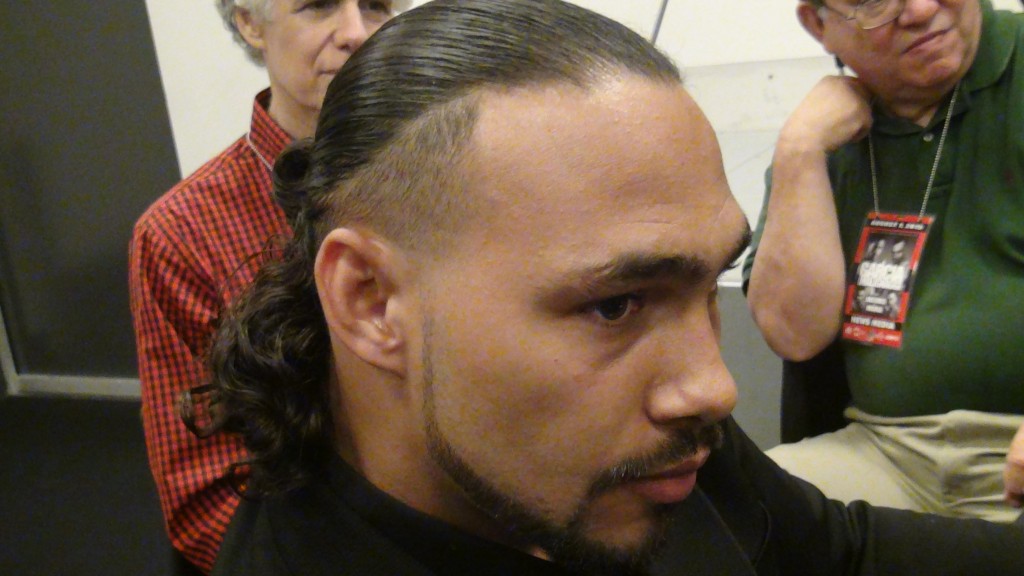
Michael Carbajal goes into the Arizona Sports Hall of Fame

By Norm Frauenheim-

They called him Little Hands of Stone. The impact on Arizona was huge and now forever indelible.

Michael Carbajal, the best fighter in the state’s history and one of the best in the history of lightest divisions in long and colorful sport, will be inducted to the Arizona Sports Hall of Fame Friday at the Scottsdale Plaza Resort.

Carbajal, a former junior-flyweight champion, grew up in downtown Phoenix. He earned to box in a makeshift ring in his backyard. Old hoses were used as ropes. There was dirt instead of canvas. Mostly, there’s was Carbajal’s passion and skill for craft sometimes call The Sweet Science. He still lives in the house that is front of that modest training ground.

It produced an Olympic silver medalist at the 1988 Seoul Games.

It produced the first little guy, a 108-pound fighter, to win a $1 million purse for fight in 1994. From the World Boxing Council to the International Boxing Federation, he won multiple titles in pro career that spanned a decade, 1989-1999, and included 53 fights – 49 victories, 33 by knockouts and four losses.

Along the way, there were chances to move on. At times, there were reasons to move on. There was adversity. But Carbajal always said no. He said he would never leave his community, his home town or home state.  As a fighter, he would always say: “Never quit.” Lots of fighters say that. But they never lived up to the promise. Carbajal lived up to it on both sides of the ropes.

He never quit in the ring or on his vow to stay at home.

Now 52 and already a longtime member of several Hals of Fame, including the international Hall in Canastota, N.Y., Carbajal finally joins the Hall that defines who he is:

An Arizonan.

Carbajal is joined in the 2019 class by late University of Arizona football coach Dick Tomey, former Suns forward Tom Chambers, Olympic swimming medalist Amy Van Dyken-Rouen, Diamondbacks President Derrick Hall and former Northern Arizona University trainer Michael Nesbitt.


Prograis’ rising star runs into a career-defining risk against Josh Taylor

By Norm Frauenheim-

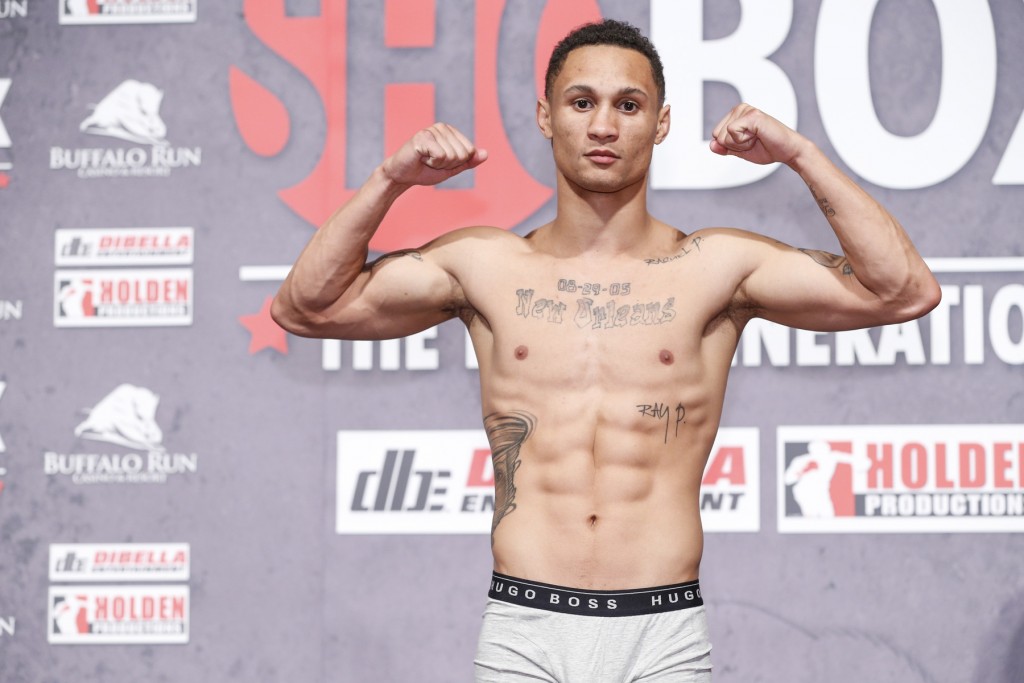
Star power is behind him. Star potential is within him. What looks so close, however, could suddenly become a star-too-far for Regis Prograis, who is a cutting-edge face to boxing’s emerging generation.

Much, if not all, depends on how Prograis tests his evident charisma and versatile skill-set against Josh Taylor Saturday in a bout (DAZN) loaded with career-defining elements.

Prograis, whose management team incudes Mark Wahlberg and filmmaker Peter Berg, has a back story to tell and he knows how to tell it.

He fled New Orleans and the devastation left by Katrina in 2005. Where there weren’t wrecked homes, there was personal chaos. Prograis survived, then thrived. Out of the storm, came the fighter.

The story introduces him. He’s done the rest, scoring 20 stoppages in 24 victories and winning a junior-welterweight belt. No matter the rating, he’s ranked among the top three at 140-pounds alongside Taylor and Jose Ramirez.

Now, he’s on the road in London, where he puts it all at risk against Taylor (15-0 12KOs), a fighter from Scotland’s Edinburgh who is a slight betting underdog yet figures to be a huge crowd favorite at the O2 Arena in southeast London.

Both left-handers, Taylor has advantages in size. At 5-feet-9, Taylor is an inch taller than the 5-8 Prograis. He has a 2 ½-inch edge in reach. In terms of volume, he figures to have all of the decibels from the crowd cheering in his favor.

It’s hard to pick against him.

“I’m quite a bit better than him in every department,’’ Taylor said Thursday at the final news conference.

No argument there. If a pre-fight news conference is the equivalent of a political debate, however, score this one for Prograis.

“He should be able to land a solid, flush punch on me and when that happens, nothing will happen,’’ said Prograis, who is as comfortable in front of the cameras as he is telling stories. “When that happens, things will change. He will realize that I am an iron-man with an iron jaw.

“Once he lands his hardest shot and I look at him with a face of disdain, he will think: ‘Damn, I’m in trouble.’ “

Damn, he might be right.

Taylor argues that Prograis’ unbeaten record is padded with a lot of nobodies and wannbes. He has yet to encounter Taylor’s kind of power, the Scotsman says.

Yet, it’s also evident that Prograis has almost a quick-silver way of adjusting. His mastery of different looks can confuse even a prepared opponent. In so many words, Prograis says Taylor doesn’t know, can’t see, what’s coming.

Prediction: Prograis wins a decision, unanimous, yet close on every scorecard.


I voted for Israel Vazquez simply because he is my favorite prizefighter

By Bart Barry-

Sometime last week or the one before, the ballot
arrived for this year’s International Boxing Hall of Fame election.  It had too many great fighters to choose only
five, but rules are rules.  I don’t
recall the other four I chose.  They
weren’t necessarily four who will get in but borderline candidates I hope to
help.  My fifth vote went without
hesitation to a man whose name appeared alphabetically towards the bottom: Israel
“El Magnifico” Vazquez.

This won’t be a persuasive piece, necessarily, so
much as a light exposition, an examination, a chance to write once more about
my favorite prizefighter.

I didn’t vote for Vazquez to be in the IBHOF
because I believe you should, or should agree that I did.  I won’t list the most-prominent fighter on
this year’s ballot for whom I did not vote because I know his misanthropic fans
and haven’t a desire or reason in the world to hear from them again – and he’s
getting in anyway.  I don’t have
reductionist criteria to which I cling for making decisions about who belongs
in a hall of fame or deserves of-the-year awards because I feel no compulsion
whatever to justify these decisions.  I
watch prizefighting often enough to write a weekly column and trust the rest to
intuition.  I don’t argue about these
things, either; this column is an asymmetrical medium.

There is no one I have covered in this, our
beloved sport whom I admire more than El Magnifico.  Nobody I can think of who gave more of the
best part of himself to our sport, either, making naught but world championship
fights in his prime and losing his career and right eye to the quality of
opposition he faced.  And in a sport of
counterintuitively decent men, too, he’s the most decent I’ve met.

My first Las Vegas card I covered for this site
was Marco Antonio Barrera’s 2006 tutoring of Rocky Juarez, and that night’s
co-comain featured the best fight any American aficionado saw live, much less
in person, that year.  Vazquez came off
the canvas twice and ground Jhonny Gonzalez to dust seven years before Gonzalez
put a stamp on Abner Mares.

Man, could Vazquez grind!  He had innate a sense as any of another man’s
accumulating weakness; he saw with a jeweler’s loupe the first fissures in an
opponent’s will.  Once he saw the
fissures he pressured them unto cracks and pieces and pieces of those pieces,
regardless what counterpunches hit him en route.

He had many plans, too, not just a plan A, which
means he was nothing like the kamikaze some wrongly credited him with being.  He stayed on his stool, after all, in the
first of his three fights with Rafael Marquez. 
He wasn’t able to breathe and said he wouldn’t fight on.  If that keeps him off someone’s defunct Gatti
List, so be it.

What it proves is Vazquez’s volition; it proves
that every time he marched through his era’s best super bantamweights he did so
voluntarily, capable as he was of calling-off the match if the contest became
futile.  Oscar Larios (63-7-1, 39 KOs),
Jhonny Gonzalez (68-11, 55 KOs) and Rafael Marquez (41-9, 37 KOs): Vazquez
fought these men a collective eight times and went 5-3 (4 KOs).  He knocked-out two of them in rematches after
they’d stopped him, and in the case of the third, “Jhonny” Jhonny, he
knocked-out Gonzalez after being dropped by him a twotime.

El Magnifico’s legacy is, of course, his trilogy
with Rafael Marquez.  As aficionados
bemoan the recesses and tuneups granted men like Deontay Wilder and Tyson Fury
and Saul Alvarez and Gennady Golovkin, they’re reminded Vazquez and Marquez
fought one another consecutively in three matches that spanned less than a
year.  Marquez stopped Vazquez in March,
Vazquez stopped Marquez in August, and they made the 2007 fight of the year seven
months later.

It’s the best fight in the best trilogy I’ll ever
cover.

You can confirm all that on YouTube.  What you can’t confirm is how ruined, broken
even, Vazquez was in the postfight pressconference after his victory.  There he was, his face like a powdered
Halloween mask – allwhite but for lipstick circles where his eyes and mouth
should’ve been.  He humbly mumbled his
praise of Marquez through torn, swollen lips and graciously ceded the
microphone to Marquez’s jackass promoter and assistant manager and their braying
about protesting some detail nobody remembers. 
Eleven years later, and that scene still boils.

Sixteen months after Vazquez won 2007’s fight of
the year, good fortune put me at a dinner table with him in New York City,
where the BWAA honored him and my mentor and friend Norm Frauenheim.  Who knows how many surgeries Vazquez’s right
eye had undergone by then.

El Magnifico was there with his wife’s brother,
and before dessert Vazquez’s cuñado loped over to take pictures with what
bedizened models accompanied the evening’s presenters.  Vazquez and I exchanged incredulous glances,
and I told El Magnifico his brother-in-law was gaming every woman with a line
about knowing Israel Vazquez.

“Pero, yo soy Vazquez,” he said, and he motioned
to himself and started laughing.  “I’m
Vazquez!” 

I don’t care if empiricism says there are fighters
more deserving of IBHOF induction.  I
don’t care if someone knows so little about prizefighting that he looks at the 27
losses listed above, or the 5 losses (4 KOs) on Vazquez’s résumé, and scoffs at
someone being dumb enough to vote for Vazquez and admit it in a column.  Frankly, I don’t care if this is the last of
my columns you ever read.

Israel Vazquez epitomizes for me everything that
makes prizefighting worth its writing.

Bart Barry can be reached via Twitter @bartbarry


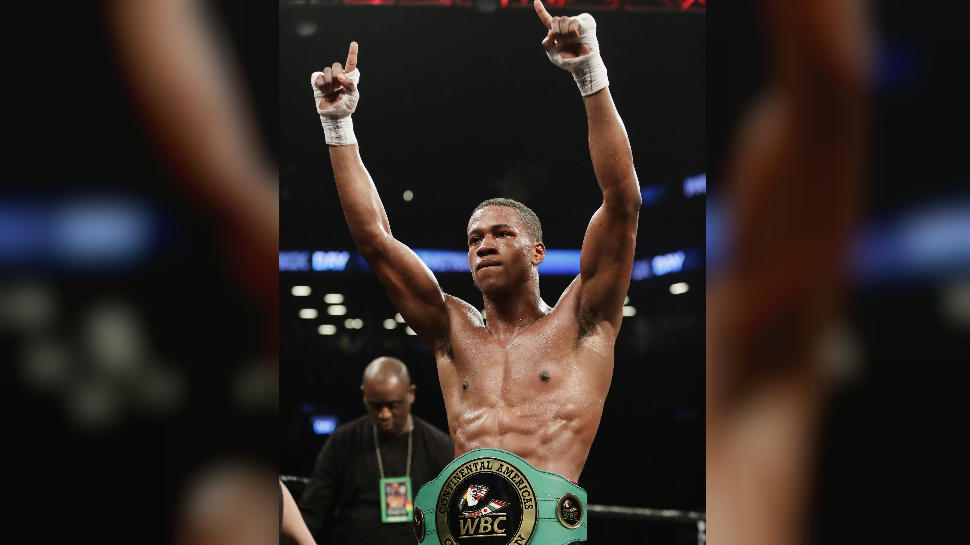
Patrick Day: He’s dead, but not gone for a conflicted game looking for answers

By Norm Frauenheim-

It’s a conflicted sport. That borders on redundancy. Boxing wouldn’t be what it is without conflict. Yet, Patrick Day’s death exposes all of the jagged fault lines that have always been there. Drama and death. What thrills, kills.

It’s all there, hard to explain and now hard to understand. The conflicting emotions from Day’s death four days after suffering traumatic brain injuries in a knockout loss to Charles Conwell figure to haunt the game for a while.

The business moves on. There’s a great fight Friday, Artur Beterbiev-Oleksandr Gvozdyk in Philadelphia. Promoters are calling the light-heavyweight bout (ESPN) a possible Fight of the Year. They’re right. It promises drama. It promises thrills.

Yet, it’s hard to look forward to the looming clash without some trepidation, some anxiety, even some anguish. Cheers will come with concern. Day’s death hangs over the game, leaving troubling questions and a search for answers that might not be there. Yet, the search must happen. Lou DiBella said it best in his statement in the wake of Day’s death Wednesday.

“It becomes very difficult to explain away or justify the dangers of boxing at a time like this,” DiBella said. “This is not a time where edicts or pronouncements are appropriate, or the answers are readily available. It is, however, a time for a call to action. While we don’t have the answers, we certainly know many of the questions, have the means to answer them, and have the opportunity to respond responsibly and accordingly and make boxing safer for all who participate.’’

DiBella, in effect, was making a heartfelt plea. Don’t let Day die in vain. Don’t let Maxim Dadashev and Hugo Santillan die in vain. Both died within days of each other in July. Don’t let Boris Stanchov die in vain. He died of an apparent heart attack during a Sept. 21 fight. 

There are some signs that regulators are trying to make the sport safer for those willing to take the risk, The California State Athletic Commission voted earlier this week to cancel a fight if a fighter is 15 percent above the contracted weight on the day of the bout. It’s believed that wild swings in weight, from the day before to the day of the bout, endanger fighters. Buddy McGirt, Dadashev’s trainer, told www.boxingjunkie.com that weigh-ins should be moved to the day of.

“They should have the weigh-ins the day of the fight,” McGirt said. “Listen, guys don’t fight at their normal weight because they know they have 24 hours to put weight on. Make the weigh-ins the day of the fight. Then you would know that you can’t really dry out and then have an IV and fight five, six hours later.

“I think you’d have less injuries. Say you’re trying to make 140 when you should realistically be at 147. You weigh, say, 143 and think, ‘I can get down to 140.’ But you have to dehydrate yourself, and that’s not good for your body or your brain. I’m not a doctor, but I’m not an idiot either.”

There are other possible safeguards. Day had been knocked down in the fourth and eighth rounds before the fatal blows landed in the 10th. On this scorecard, he was trailing 89-80. He couldn’t win on points. Given, the prior knockdowns, it was safe – emphasis on safe – to assume he wouldn’t be able to win by a late KO. Why not just stop it after the eighth?

It’s just one question, one of many. In Day’s name and for the sake of a conflicted game, answers are imperative.


A new question of geometry: Usyk attritions Witherspoon in heavyweight

By Bart Barry-

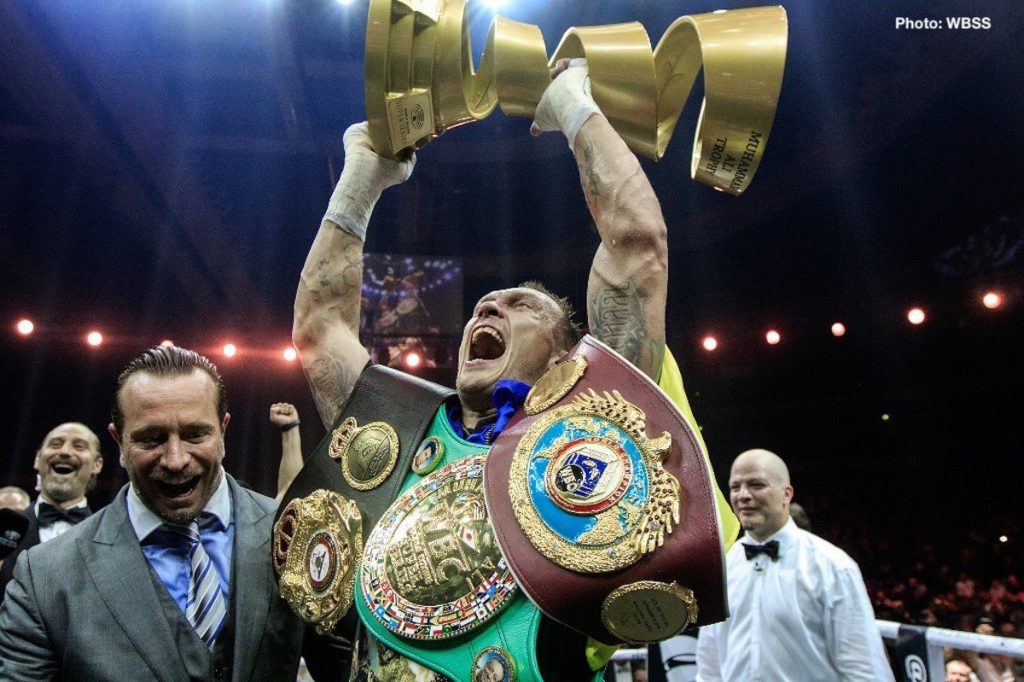
Saturday in Chicago, 2018’s best fighter, Ukrainian
Oleksandr Usyk, made his first-yet heavyweight prizefight against former
American contender Chazz Witherspoon on DAZN, the aficionado’s network.  After a yearlong injury layoff Usyk made
Witherspoon quit after seven rounds in a turn unsurprising as it was
undramatic.

We have seen the best of Usyk.  Years from now, after Usyk is at least a
partially unified heavyweight champion of the world and myriad casuals know him
for it, we can look back at the World Boxing Super Series of 2018 and know we
saw the best version of him, the same way aficionados look at 2006 Manny
Pacquiao and know, whatever his achievements in the 13 years that followed (or
23; hell, he may regularly undress PBC welterweights till he’s 50), Pacquiao never
was better than the 130-pounder who stopped Erik Morales a twotime before decisioning
Juan Manuel Marquez and redecisioning Marco Antonio Barrera.  As Pacquiao scaled heavier, questions arose
about his power and durability and agility but no one ever doubted he was a
better boxer than his new foes at lightweight, junior welterweight,
welterweight and junior middleweight (mind the ‘new’ there; never did Pacquiao
outbox Marquez at any weight).

No one, either, will doubt Usyk is a better boxer
than everyone he faces the rest of his career. 
But can his stamina suffer much harder punches from much larger men? can
Usyk suffer their blows while making them suffer enough to suffer him no more?  Those be exactly the questions Saturday tried
to ask.

Witherspoon, a shortnotice opponent in every sense
of the term, was apt an initial interrogator as boxing’s flagship division had
on offer.  Since power is the last thing
to go, at age 38 Witherspoon, who reliably looks like an A-level guy against
C-level competition and loses just as reliably to every B-level man he faces, needed
to put a few good punches on Usyk, which he did, and absorb a few good punches
from Usyk, which he did, and tell us if Usyk’s move to the weightlimitless
division was foolhardy.

It wasn’t. 
Usyk took punches enough from Witherspoon to prove he can take
heavyweight fire.  And he stopped Witherspoon
faster than 2009 Tony Thompson if slower than 2012 Seth Mitchell. 

Saturday answered every question of power, yes,
but asked a brandnew question of geometry we mightn’t have imagined
otherwise.  The cruiserweights Usyk made
his career undoing were physically narrower, as were the heavyweights Usyk beat
to become an Olympic gold medalist.

It became apparent very quickly Saturday the
precise spinning of Usyk’s signature attack was disrupted by nothing so much as
Witherspoon’s simple girth.  The geometry
was wrong; there was now a need to take a wider step round the opponent, which
meant there was no longer the same space between ring center and ropes or corner.  This made Usyk fight in wider circles,
requiring more skipping than stepping; Usyk was no longer transitioning
balletically from spinning trap to spinning counter to spinning departure so
much as moving defensively sideways or moving offensively straight forward.

And moving straight at a 240-pound man who knows
how to punch is a different thing altogether from moving straight at a
199-pound man.  When a cruiserweight
punching up at you hits your gloves, you expense it to the cost of doing
business at the championship level; when a heavyweight punching level to you or
downwards hits your gloves, it hurts your face and jars your spine.

Usyk is fast and athletic but not so fast and
athletic that a nearing-40 Chazz Witherspoon couldn’t countertouch him with
righthands.  Is that a detail ruinous to
Usyk’s prospects at heavyweight?

No, and the reason why came at the end of
Saturday’s match.  The tale was told in
Witherspoon’s stature and aerobics, not his bleeding mouth.  How open that mouth was and how wilted his
posture, both, indicated what made Usyk unique among cruisers and’ll make him superunique
among heavies.  Usyk is an attrition
hunter who runs his prey to unconsciousness. 
An attrition hunter needn’t fell a beast with a single hurl of the spear
– he need only pain his prey enough to make it flee.  Once it runs, he has it.

Witherspoon sagged on his stool after round 7 like
a sealevel mammoth marched up Mount Everest. 
Thirty seconds into its postround rest Witherspoon’s body had yet to
contemplate recovery, certain as it was about drowning.

What does that say about Usyk’s prospects against
AJ?  Everything.  Men with a third Usyk’s talent and craft collaborate
with Joshua’s massive pecs, delts, traps and bis to fatigue him by midfight.  And Joshua’s June (and December) conqueror,
Andy Ruiz, is nothing so much as a fat cruiserweight loosed on giants who are
basic.

Which brings us to the one genuinely compelling
challenge for Usyk: Deontay Wilder.  Nobody
at cruiserweight hits fractionally so hard as Wilder, but no one at heavyweight
is near so physically narrow as Wilder. 
The geometry of Wilder’s width is all right for Usyk, while the geometry
of Wilder’s height is not.  Neither is
Wilder’s conditioning, which absolutely rivals Usyk’s.  A Wilder-Usyk unification match in 2021 will make
the most-athletic heavyweight prizefight in 25 years.

Bart Barry can be reached via Twitter @bartbarry


Say a prayer for Errol Spence Jr.

By Norm Frauenheim-

It is as unforgiving a business as any. Boxing moves on, always moves on from tragedy. But the game stopped early Thursday morning in Dallas, on a road during the lonely hours after midnight and in the twisted wreckage of what was once a beautiful car.

A beautiful fighter survived just a few weeks after he looked immortal.

Pray for Errol Spence Jr.

He had emerged as a face of a resilient game and it looks as if he might need every bit of that trademark resiliency now. He is coming off the biggest fight of his career into what looks to be the biggest fight of his life. We cheered for him against Shawn Porter throughout 12 rounds of welterweight drama on Sept. 28.

We pray for him now in a collective cry of tweets and thoughts. Porter prays for him. Terence Crawford prays for him.

The news is hopeful. Premier Boxing Champions released a statement, an updated report on his condition fewer than 24 hours after he was rushed to Methodist Dallas Medical Center.

“Spence is awake and responding and his condition is listed as stable,” the PBC statement said. “He did not sustain any broken bones or fractures but has some facial lacerations. He is expected to make a full recovery.

“He is currently resting with his family by his side. They want to thank everyone for their prayers and well wishes and are extremely grateful to the Dallas first responders who rushed to the scene to attend to Errol after the accident and the doctors who are taking care of him at the hospital.”

Exactly what happened is still being pieced together. According to a Dallas police report, Spence, of nearby Desoto, Tex., was driving his white Ferrari at a high speed when the vehicle hit the median and flipped wildly at about 3 a.m, Central Standard Time.

Spence, who reportedly was not wearing a seat belt, was thrown from the car. He was not a boxer then. He was everyman, caught in the cross hairs of time and place, simple physics and scary consequences.

It could’ve been you. Could’ve been me. His fight, our fight, is just starting. Pray that he wins this one.


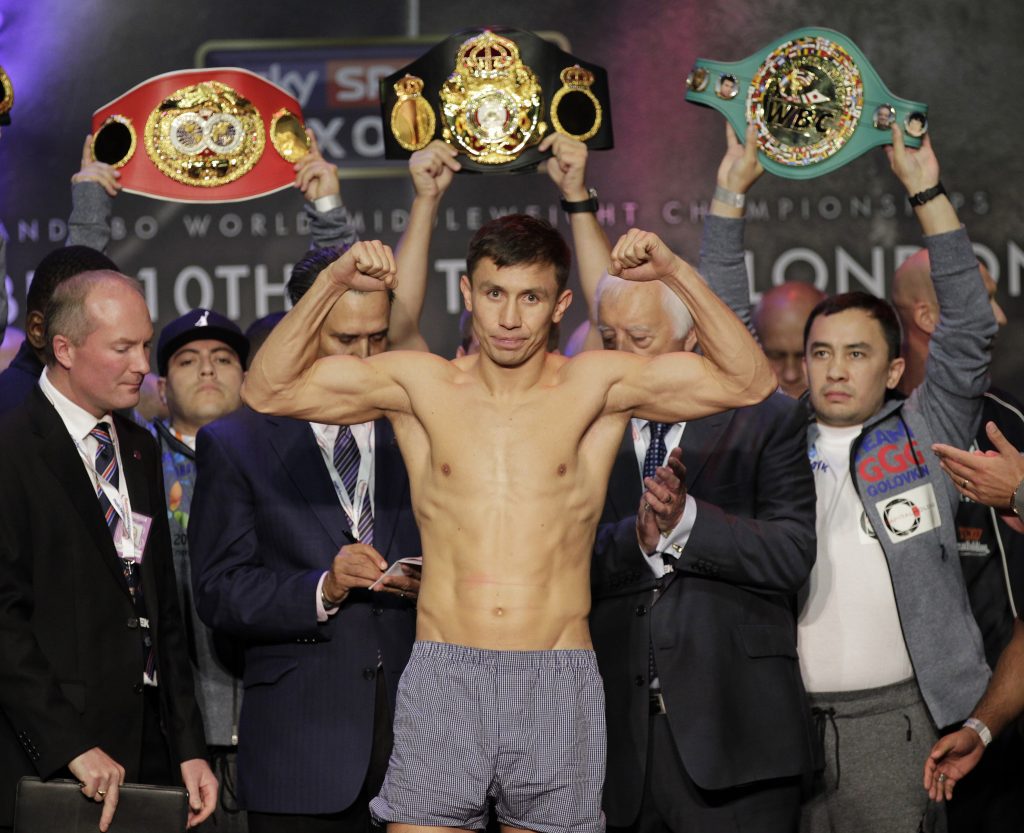
The first underrated performance of the GGG canon

By Bart Barry-

Saturday at Madison Square Garden in a prizefight
broadcast on the aficionado’s network, DAZN, Gennady “GGG” Golovkin (no new ‘i’
needed; we go with birth names, round here) narrowly decisioned Ukrainian Sergiy
“The Technician” Derevyanchenko to retain his HBO Middleweight Championship and
collect an assortment of other belts Canelo Alvarez doesn’t care for.  The match was bloody, rough and suspenseful.

And when it was over and the scorecards were read the
selfstyled Mecca of Boxing booed Golovkin loudly enough to elicit a “c’mon
guys” from boxing’s once-charming malaprop machine.  Then the postfight interview devolved into
the same scattering of the same Google Translate phrases into which every
Golovkin interview devolves, though it wasn’t nearly so amusing this time, was
it, guys?

For this time Golovkin had faced a man his own
size and looked it.  This time Golovkin,
who somehow became The People’s Champion by being unable to stop in 24 rounds a
smaller man who is between 10 and 15 times more popular than he, countered
interesting and relevant questions with his usual dumb phrases, and nobody was enchanted
as before.  All this and more, in a turn
ironic as it was predictable, oversparkled a Golovkin performance that was more
compelling and confirming than its predecessors.

All the booing and dissent served to make and
subvert what was the first underrated performance in Golovkin’s canon. 

From the third round to the closing bell Saturday the
look on Golovkin’s face was exhausted betrayal. 
One doubts Golovkin’s American assimilation comprises cultural awareness
enough to ring an internal alarm like: By jettisoning the handlers who
hoodwinked late-HBO programmers, Comrade Pyotr et al., I put myself in an
unprotected status with a network interested in feeding me to Canelo Alvarez
the way my previous network’s braintrust wanted Canelo fed to me.

Why, that’s madness, you’re now thinking, what
sort of braintrust would wish to see boxing’s one ticketseller from boxing’s one
reliable ticketbuying public mauled by a man from Kazakhstan?

You had to be there.  GGG was a mania.  In 15 years of doing this, the craziest
things I ever heard said by the sanest boxing minds were things uttered about
Golovkin’s prowess.

In this sense, what happened Saturday, what has
happened in four of Golovkin’s last six fights, was a betrayal of sorts to
those men who invested so ferally in the Golovkin legend.  Because each time Golovkin has confronted a
fellow titlist or a proper middleweight recently – notice the ‘or’ there –
Golovkin has looked like much, much less than the most-feared man on the
planet.

Daniel Jacobs, middleweight permacontender, rose
from the canvas 2 1/2 years ago and showed Golovkin’s hypemen how poorly
chopping down a welterweight prepared the middleweight champion for a defense
with an actual middleweight.  Canelo then went 36 minutes with GGG.  Then, as DAZN’s otherwise annoying broadcast
crew reminded us Saturday, Golovkin first got offered a match with Derevyanchenko
but turned it down for a chance to poleax yet another career super welter.  Canelo then went 36 minutes with GGG.  Someone named Steve Rolls got excavated to launch
GGG’s new-network debut.  And then
Saturday happened.  Another career
middleweight. 

There was a particularly disingenuous game GGG fanatics
used to play with the rest of us – a game they learned from The Money
Team.  When you mentioned the HBOGGG tagline
about Golovkin’s readiness, willingness and ability to make war with any
champion between 154 pounds and 168, at those weights, and mentioned your own
annoyance with Golovkin’s only making war on 147- and 154-pound men forcefed to
160 pounds, GGG Nation would start listing titlists at 160 and 168 pounds and
ask you if you didn’t think he could beat them.

Your hypothetical assumption of a hypothetical
Golovkin triumph in a hypothetical fight was proof Golovkin had already beaten
these men, shouldn’t be required to fight them and – this is the richest part –
frightened all these larger men such that Golovkin should only don gloves for
those smaller men brave enough to face him. 
You would try to argue it didn’t matter, really, Golovkin’s ultimate
record against men his own size; you just wanted to see him fight men his own
size before you partook in any GGG Nation naturalization ceremony.

Which is a torturous way of writing this: Golovkin
is not today diminished.  What is
happening to him now is what always would have happened to him.

He hits quite hard but certainly not that much
harder than any other middleweight champion and not nearly hard as the best
super middleweights.  His footwork is
plodding, his punches are often telegraphed, his defense is porous, and his
ring IQ ain’t that high either.  His
vaunted ability to cut-off the ring never was a product of more than his
ability to walk through smaller men’s punches (you should see me cut-off the
ring on my 110-pound wife!).

Saturday Golovkin cut-off Derevyanchenko’s escape
routes often and just as often learned they were traps Derevyanchenko set for
him.  Imagine that.  A prizefighter with a 30-percent lower
knockout ratio than GGG’s, a prizefighter felled in round 1, a prizefighter
bleeding constantly into his right eye, opined so little of GGG’s power he made
strategic retreats to walk Golovkin into counters.  He made Golovkin miss quite a bit too and
bent The People’s Champion in two, too, with a midrounds left hook to the
button.

And Golovkin responded with true heart and
chin.  Two things soft matchmaking and
hard overpromoting deprived us of seeing during Golovkin’s reign of terror as
HBO Middleweight Champion.  That’s the
good news for GGG Nation.

Here’s the bad: Y’all are out of your collective
gourd if you think Canelo “A Side” Alvarez is going to come down from 175
pounds to 160 to redeem Golovkin’s legacy. 
Canelo may well give GGG his badly needed rubber match, but it won’t be
at middleweight.  Eight years and 20
lucrative prizefights later Canelo is going to run a check on that “fight any man
from 154 to 168” credit and see what’s actually in the account.  It says here: Canelo KO-10 is what.

Bart Barry can be reached via Twitter @bartbarry


FOLLOW GOLOVKIN – DEREVYANCHNKO LIVE

Follow all the action as Gennady Golovkin and Sergiy Derevyanchenko vie for the IBF Middleweight Title at Madison Square Garden

THE PAGE WILL UPDATE AUTOMATICALLY.  NO BROWSER REFRESH NEEDED

12-ROUNDS–IBF MIDDLEWEIGHT TITLE–GENNADY GOLOVKIN (39-1-1, 35 KOS) SERGIY DEREVYANCHENKO (13-1, 10 KOS)
ROUND 1 2 3 4 5 6 7 8 9 10 11 12 TOTAL
GOLOVKIN 10 10 9 10 9 9 10 9 9 9 10 10 114
DEREVYANCHENKO 8 9 10 10 10 10 9 10 10 10 9 9 114

Round 1 LEFT AND RIGHT AND DOWN GOES DEREVYANCHENKO..

Round 2 2 straight rights from Derevyanchenko..Left hook to the body from Golovkin..uppercut..Body shot from Derevyanchenko..Lead hook and body shot from Golovkin..Jab from Derevyanchenko..Blood around the right eye of Sergiy–Replays showed from a punch

Round 3 Body shot from Derevyanchnko..Right..Uppercut from Golovkin..Body..Body shot..Hook to head from Derevyanchenko..Jab from Golovkin..Hard right..Good body shots from Derevyanchenko..Right to head..

Round 4 3 punch combo from Golovkin..Body shot from Derevyachenko…Good combination..

Round 5-Cut is ruled from a headbutt…Doctor looking at the cut..jab and right hand from Derevyanchenko..Hard uppercut from Golovkin…Hard body shot hurts Golovkin

Round 6 Right from Derevyanchenko..3 jabs..Body shot..Right to side of the head..Right from Golovkin..Jabs..Right and left hook

Round 7  Good hook from Golovkin..Good jab..Hard right to body..right to body..uppercut..Body shot from Derevyanchenko..Body shot..Hook to the head…Hard right from Golovkin

Round 8 Golovkin jabbing..Right to head from Derevyanchenko..Left from Golovkin..Body shot from Derevyanchenko

Round 9 Good uppercut from Golovkin…Hard right from Derevyanchenko…jab from Golovkin..Jab…Jab and right from Derevyanchenko

Round 10 Big combination from Derevychenko..jab and right hand…Moving Golovkin back..Right from Golovkin…3 punches from Derevyanchenko..Body shot..uppercut..right..Hard combination..

Round 11 Right from Golovkin…Right

Round 12 Body from Derevyanchenko..Right from Golovkin…Uppercut from Golovkin

114-113 , 115-112 FOR GOLOVKIN

10-Rounds–Super Middleweights–Israil Madrimov (3-0, 3 KOs) vs Alejandro Barrera (29-5, 18 KOs)
ROUND 1 2 3 4 5 6 7 8 9 10 11 12 TOTAL
Madrimov* 10 10 9 10 TKO               39
Barrera 8 9 10 9                 36

Round 1 RUNNING LEFT HOOK AND DOWN GOES BARRERA.3 Hard jabs..hard uppercut to the body

Round 2 Madrimov lands a hard right to the body..Exchanging hard rights..Hard right from Madrimov

Round 3 Uppercut from Barrera

Round 4  Good body work from Madrimov

Round 5 Hard left from Madrimov..Pot shotting..Body shot..Another body shot..Hard jab from the southpaw stance..hard hook..big left AND BARRERA IS HURT…FIGHT STOPPED


10-Rounds–Junior Welterweights–Ivan Baranchyk (19-1, 12 KOs) vs Gabriel Bracero (25-3-1, 6 KOs)
ROUND 1 2 3 4 5 6 7 8 9 10 11 12 TOTAL
Baranchyk* 10 10 10 TKO                 30
Bracero 9 9 9                   27

Round 1 Baranchyk lunges in and lands a right..Left hook..Big right..Right to the body

Round 2 Baranchyk lands a left to the body..Hook..body..Hook by Bracero..Counter Right..Left on the ropes..Baranchyk loading up on everything

Round 3 Hard hook to the body from Baranchyk..hard right..Body and head combination..

Round 4 Left hook fro Baranchyn and a hard right that hurts Bracero….Left to BODY AND RIGHT AND DOWN GOES BRACERO…FIGHT STOPPED

12-Rounds–Super Middleweights–Ali Akhmedov (15-0, 11 KOs) vs Andrew Hernandez (20-7-2, 9 KOs)
ROUND 1 2 3 4 5 6 7 8 9 10 11 12 TOTAL
Akhmedov* KO                        
Hernandez                          

Round 1 BIG RIGHT AND DOWN GOES HERNANDEZ..FIGHT STOPPED

8-Rounds–Welterweights–Brian Ceballo (10-0, 5 KOs) vs Ramal Amanov (16-0, 5 KOs)
ROUND 1 2 3 4 5 6 7 8 9 10 11 12 TOTAL
Ceballo* 10 10 TKO                   20
Amanov 9 9                     18

Round 1 Body shot from Ceballo..Right to body

Round 2 1-2 from Ceballo..Good flush right and uppercut..Good combinations on the ropes..Body shot..Nice Body shot..Right to head

Round 3 Straight Right from Ceballo..Counter from Amanov..Right and left to body from Ceballo…FIGHT STOPPED

8-Rounds–Middleweights–Kamil Szeremeta (20-0, 4 KOS) vs Oscar Cortes (27-4, 14 KOs)
  1 2 3 4 5 6 7 8 9 10 11 12 TOTAL
Szeremeta* 10 KO                     10
Cortes 8                       8

Round 1 SzaeremETA LANDS A LEFT HOOK AND DOWN GOES CORTES
Round 2  BIG LEFT AND DOWN GOES CORTES…FIGHT STOPPED…49 seconds


GGG is back for another duel in a bid to reassert his middleweight dominance

By Norm Frauenheim-

The whispers are hard to ignore. Gennadiy Golovkin has surely heard them. He’s changed, they say. A different guy, they say.

But the only thing for certain is what we know from his birth certificate. He’s older, a 37-year -old fighter who intends to silence those whispers and reaffirm what he has always believed.

Pre-Canelo and Post-Canelo, Golovkin has always been a middleweight. It’s the division that defines him. It’s also a division he dominated.

It’s that domination, perhaps, that he intends to re-assert in a tricky bid to reclaim a major 160-pound belt against Sergiy Derevyanchenko Saturday at New York’s Madison Square Garden in a DAZN-streamed bout.

After all of the mind-numbing controversy swirling about Canelo Alvarez’ move up to light-heavyweight in decision to bypass a third fight with Golovkin, GGG says nothing has changed. He says he is back in the gym with the same work ethic and same vigilance.

 “You can’t underestimate your opponent,’’ he said during a conference call. “It’s kind of like a duel. If you underestimate it, it could be your last one.’’

GGG (39-1-1, 35 KOs) is sick of talking about Canelo, who said he was finished with GGG on the day his step-up to 175-pounds against Sergey Kovalev on Nov. 2 was announced. Ask the inevitable and you can almost hear a weary sigh. Hard to blame him. But there’s no escaping the questions

This time, he was asked if he feared that there might be a void in his career if he doesn’t get a third shot at Canelo.

“My biggest opponent is not a particular person,’’ said GGG, who is 0-1-1 against Canelo. “My career is about what I do.

“It just looks like he (Canelo) couldn’t or didn’t want to fight me. Sergey Kovalev was his only option. How can I be disappointed, looking at those people?’’

“I feel great, just like I always have. I always feel like I am a champion. For me, every fight is the same.’’

For now, he can look at what, who is in front of him. Derevyanchenko (13-1, 10 KOs) is a Ukrainian who put himself in the middleweight mix last October with a split-decision loss to Danny Jacobs, also at Madison Square Garden.

He went on to score a unanimous decision over Jack Culcay in April, a few weeks before Canelo scored a one-sided decision over Jacobs on the Cinco de Mayo weekend.

Despite a record that includes only 14 fights (13-1, 10 KOs), Derevyanchenko has the look of a fighter who is just beginning to figure out how good he really is. He’s 33 and a late bloomer.

His promoter, Lou DiBella, thinks the time and place are perfect for Derevyanchenko to spring a major upset.

DiBella believes the whispers. He says GGG is a step beyond his prime.

“At this point in his career, he’s not getting younger, he’s not getting faster, he’s not getting better,’’ DiBella said. “Sergiy Derevyanchenko is an incredible risk to GGG.” 

Prediction: GGG wins a unanimous decision against a tactically-skilled fighter aptly named “The Technician.’’


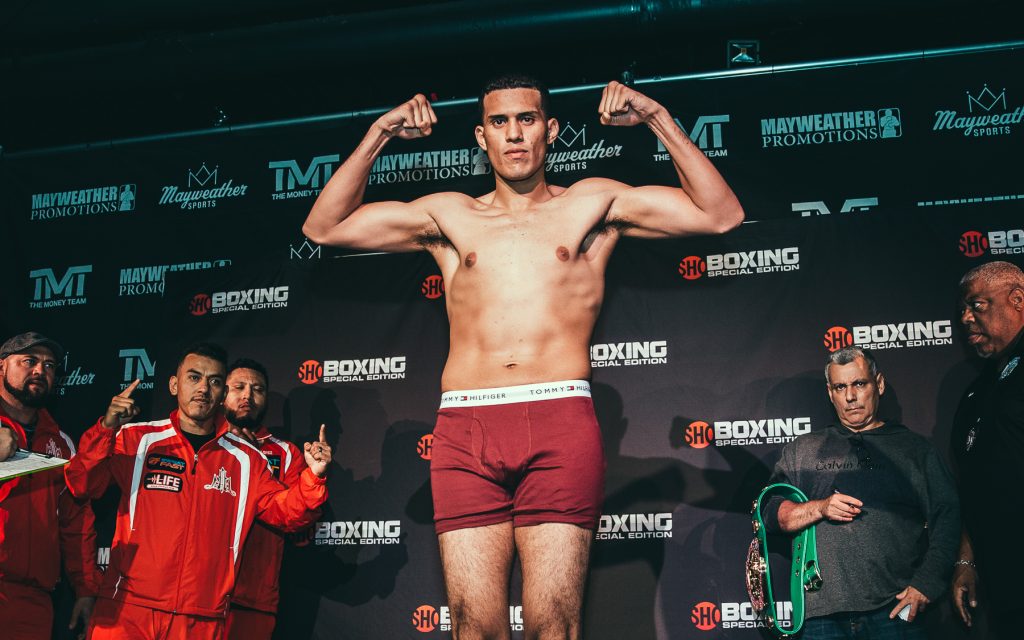
The Truth is . . . Benavidez remained Saturday’s most intriguing talent

By Bart Barry-

Saturday at Staples Center welterweight titlist
Errol “The Truth” Spence split-decisioned “Showtime” Shawn Porter and unified
the WBC and IBF titles in an entertaining tilt that exceeded expectations by a
margin that was not small.  In Saturday’s
comain former super middleweight titlist David “La Bandera Roja” Benavidez
sliced up WBC beltholder Anthony “The Dog” Dirrell, proving once more how
emphatically class tells over time.

If Benavidez indeed proved the most intriguing
talent on the card, Spence-Porter nevertheless exceeded expectations at least wildly
and maybe more than that.

Here’s the main criterion for such an assertion:
When the mainevent began my eyes were fixed on the favorite, but by round 3 my
eyes were fixed on the underdog, on whom they stayed for most of the next 27
minutes of combat.  That is attributable
almost wholly to Porter’s professionalism and savvy but partially, too, to what
matchmaking woes rendered Spence so vulnerable to a fellow welterweight who
knew how to fight.

For large parts of many rounds Spence didn’t have
much of an idea what the hell Porter would do next and was offended by such
unpredictability.  Most of Spence’s recent
foes were predictable or if not predictable so impotent their capricious attacks
meant nil to the champ.  Not Porter.  Showtime Shawn was big enough and committed
enough and schooled enough – in the crucible of meaningful competition – to
discomfit The Truth quite a lot.

Spence did every technical thing better than
Porter and probably hit harder, too, but he did not set the conditions of the
confrontation the way weak opposition recently accustomed him to doing.  Frankly Porter walked through nearly all
Spence’s best shots and was flashed to the canvas by a fully leveraged Spence left
in round 11 but never imperiled.

Spence did not look invincible Saturday.  Most of us predicted a lopsided, dull affair,
and most of us were wrong.  No, Spence is
not great as we thought; yes, Porter is better than we thought.  A blessing upon both men for being
professional enough to show us these things.

The comain went about as planned, with a result
most predicted, but showed David Benavidez, however-youngest and
however-many-timesest champion, remains a work in progress.

Before I go further, let me confess Benavidez
enchants me like no other prizefighter currently.  He doesn’t know how good he is or how bad he
is.  He’s cocksure more than confident;
he’s pretty sure, where men like Hi-Tech and Bud and Canelo are certain.  Sometimes his smile is not congruent to his
mood.  From his physique to his chief
second’s urban-combat-outfitters attire, everything about Benavidez is
fragile.  To watch him closely is to know
the entire Benavidez train could derail at any moment (it may have derailed
even as you read this, or just before, or just after, or just now) with a drug
test or arrest or worse.

But damn, is he fun to watch.  Such nonchalance, such patience, such willingness.  He didn’t do things all that technically well
against Dirrell, Saturday, in part because he never thought he needed to.  He saw Dirrell as a chatty victim from the
bell’s first tone.  He liked the idea of
Dirrell’s courage and loved giving Dirrell a chance to exhibit it: Go on and
show us how brave you are, Dog, while I go smirky sadist on your right eye.

Benavidez is a natural because you cannot teach
his level of relaxation in a prizefight. 
If you doubt this, go back and watch videos of Oscar De La Hoya’s
greatest hits.  Few fighters of the last
generation had De La Hoya’s natural gifts, but the dude never learned to
relax.  There he is, even in his very
best moments, jaw bulging like a cheeky walnut. 
Which is why the worst moments of De La Hoya’s prime were marked by late-rounds
fading.

Which is also why Benavidez, a guy with all the
upperbody musculature of a prepubescent gamer, doesn’t get tired of punching his
statuesque opponents till well after they tire of punching him. 

Then there’s Sampson Lewkowicz – whose presence in
the Benavidez stable is the main thing allowing a weathered, withered observer
like me to dare stake his afición on a project with future heartbreak’s every
hallmark.  Lewkowicz has had his misses,
sure, but he’s also had Manny Pacquiao and Sergio Martinez when no one else
wanted them.  Benavidez already has tried
to break Lewkowicz’s heart a twopair or better, but Lewkowicz was there in Saturday’s
ring, one of few Red Flaggers without a vest on, and it made you hope reason
might continue to prevail upon Benavidez.

Capitalistic sensibilities, on the other hand,
will continue to prevail upon Errol Spence. 
Saturday’s postfight weirdness proves it.  Danny Garcia – seriously?  A year removed from his loss to Shawn Porter
(yes, that Shawn Porter) Swift came down from grooming One Time to challenge The
Truth before our disbelieving eyes. 
Whose idea was this? is Spence that covetous of Garcia’s WBC silver
title?

Spence is an excellent prizefighter who wants to
prove it.  PBC ought to let him.

Bart Barry can be reached via Twitter @bartbarry


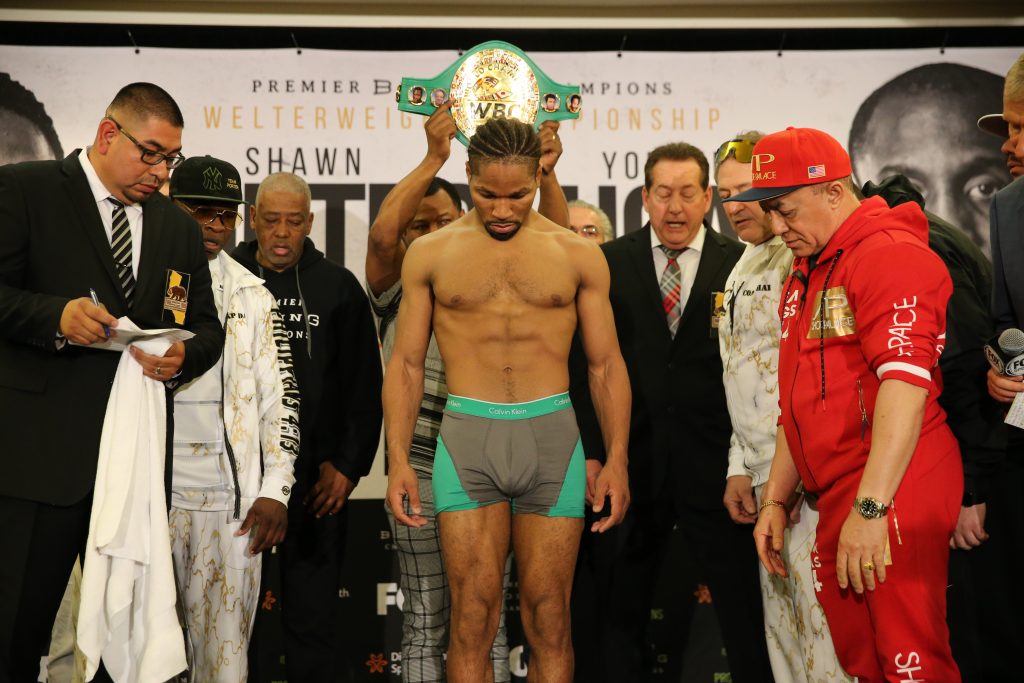
Spence wins split decision over Porter in a unanimous crowd-pleaser

By Norm Frauenheim-

LOS ANGELES — Only the judges disagreed.

There was no debate about the drama that began early and lasted throughout 12 rounds Saturday night in a split decision won by Earl Spence Jr. over Shawn Porter for two pieces of the welterweight title in front of roaring crowd of 16,709 at Staples Center.

Judges Rey Denescon of California and Steve Weisfeld of New Jersey scored it 116-111 for Spence. Larry Hazard, Jr., also of New Jersey saw it different. Hazard scored 115-112 for Porter.

The crowd? It was unanimous. There was no dissent about what a terrific fight was. There was a little bit of everything. Porter made it rough and repeatedly forced Spence to show he had some grit to go along with his reach, power and speed. Spence had poise, a jab and the wherewithal to control the center of the ring at exactly the moments he had to. In the end, Spence also had one quick counter, a left, perfectly timed and placed, to score a knockdown of Porter. It was the key to the fight.

It knocked Porter off balance in the closing moments of the eleventh round. Porter grazed the canvas with a glove. But the touch was like a torch to his chances at an upset.

“I think that knockdown was the difference,” Porter (30-3-1, 17 KOs) said “I couldn’t come back to the corner with my head down after that.”

No, he didn’t. He pursued throughout the 12th round, the bout’s final three minutes. He rocked Spence with a couple of lefts. But there was no way to knock victory out of the bigger man’s powerful grasp.

“Porter was throwing a lot,” said Spence, still unbeaten at 26-0 with 21 KOs. “I wanted to show I was the bigger and stronger welterweight.”

Bigger and stronger, however, doesn’t necessarily mean the best. That’s still up for debate. Spence hopes to further cement his claim at being No. 1 at 147 pounds against Manny Pacquiao. But that still leaves the unresolved question about when or if he’ll ever face the Top Rank-promoted Terence Crawford, who celebrated a birthday Saturday. He’s 32. There are stiil no signs that a Crawford-Spence fight will happen before his next birthday.

“if I can’t get Pacquiao and nothing happens with Terence, maybe Danny Garcia,” said Spence, who collected a $2 million guarantee and could wind with more depending on the pay-pe-view numbers for the Fox telecast..

A sign of what might happen next, perhaps, was there among those who rushed into the ring to congratulate Spence. Danny Garcia was there, perhaps the most prominent face in Spence’s future.

“I’ve told my team, you line them up, I’ll knock them down,” Spence said.

Meanwhile, there was little talk of a rematch, despite a split card scorecards that seemed to dictate a sequel. Porter had no argument with the scoring.

“For me to say it was robbery, no, that ain’t coming form me,” Porter said. “Did you all like the fight?”

Oh, yeah.

In the co-main event, 22-year-old super-middleweight David Benavidez (22-0, 19 KOs) became boxing’s youngest two-time champion, scoring a ninth-roundd soppage of bloodied Anthony Dirrell (33-2-1, 24 KOs). Benvidez claimed the 168-pound title that was stripped from him when he tested positive for cocaine last year

“There are so many emotions coming at me at once, said Benavidez, whose $1 million purse is the biggest collected by an Arizona fighter since Hall of Famer Michael Carbajal, also of Phoenix, cashed a $1 million paycheck for his rematch loss to Humberto “Chiquita” Gonzalez in 1994. “We put so much hard work into this training camp. We left home and were away from everything. But I had the dream to become the youngest two-time super middleweight world champion and I made my dreams come true.

“Everything just fell in place perfectly. From the suspension to all the big fights I’ve been in. All of that helped me out in this fight. I did not make a mistake or open myself up more than I needed to. I worked behind my jab and got the stoppage. Things are going to get better and get tougher and I’m ready for the challenge.”


FOLLOW SPENCE – PORTER LIVE!!

Errol Spence Jr. meets Shawn Porter in a Welterweight Unification Title bout.  There will be two world title bouts that highlight the undercard.  Anthony Dirrell defends the  Super Middleweight Title against former champion David BenavidezMario Barrios and Batyr Akhmedov meet for the WBA Super Lightweight Title.  Josesito Lopez takes on John Molina Jr.

THE PAGE WILL UPDATE AUTOMATICALLY.  NO BROWSER REFRESH NEEDED

12-ROUNDS–IBF/WBC WELTERWEIGHT TITLE–ERROL SPENCE JR. (25-0, 23 KOS) VS SHAWN PORTER (30-3-1, 17 KOS)
ROUND 1 2 3 4 5 6 7 8 9 10 11 12 TOTAL
SPENCE* 10 9 10 9 10 10 9 10 9 10 10 9 115
PORTER 9 10 9 10 9 9 10 9 10 9 8 10 112

Round 1: Porter trying to work on the inside..Left from Porter..Left from Spence..Combination..

Round 2 Good right from Porter…Counter from Spence…Right from Porter..Right..Left from Spence..

Round 3 Left to body from Spence…Jab..Good right from Porter..Left from Spence..Spence warned for low blow…left from Spence

Round 4  2 hard rights from Porter..Good body shot from Spence..Good left..2 lefts from Porter..Bog left…Porter being aggressive..Left hook..Combination..Left from Spence..

Round 5 Counter left from Spence..Counter from Porter..Good left from Spence..Counter..Counter from Porter..Left from Spence..Left..

Round 6 Spence landing hard shots on the ropes..Nice right from Porter..

Round 7 Porter lands a jab..Right..Left to the body..Good left to body from Spence..left uppercut to body..Body shot and combination from Porter..Hard right to the body

Round 8 Good left from Spence..Nice right from Porter…Counter left and right from Spence..

Round 9 Hard uppercut from Porter…Hard right inside…

Round 10  Good body shot from Spence..Hard flurry on the ropes..Good action on the ropes..Spence cut on right eyebrow from accidental Headbutt

Round 11
Good right hook from Spence…LEFT AND DOWN GOES PORTER..Toe to Toe action…Good right from Porter

Round 12 Right from Porter..Left hook from Porter..Big right from Porter..Good right…Both guys standing and throwing in the middle of the ring

221-172 Punches in favor of Spence

116-111 Spence…115-112 Porter….116-111 Spence

12-ROUNDS–WBC SUPER MIDDLEWEIGHT TITLE–ANTHONY DIRRELL (33-1-1, 24 KOS) VS DAVID BENAVIDEZ (21-0, 18 KOS)
ROUND 1 2 3 4 5 6 7 8 9 10 11 12 TOTAL
DIRRELL 10 9 9 10 9 10 9 9 75
BENAVIDEZ* 10 10 10 9 10 9 10 10 TKO 77

Round 1 Right from Benavidez..Right to body from Dirrell

Round 2 Right to body from Dirrell..Right from Benavidez..Straight right from Dirrell..Right…Jab from Benavidez..3 punch combination

Round 3 Counter right from Benavidez…Body/Head combination..Right on the ropes..Hard left

Round 4 Right from Dirrell..Hard combination on the ropes

Round 5 Benavidez lands a 5 punch combination..

Round 6 Body shot from Dirrell..Dirrell cut around his right eye…CUT FROM A PUNCH

Round 7 Doctor looking at the cut…Right from Benavidez..

Round 8 Body shot from Benavidez…2 lefts..left to body..2 hard head shots

Round 9 Jab from Benavidez..4 punch combination…Body shot..Benavidez battering DIRRELL AND THE FIGHT IS STOPPED

12-ROUNDS–WBA SUPER LIGHTWEIGHT TITLE–MARIO BARRIOS (24-0, 16 KOS) VS BATYR AKHMEDOV (7-0, 6 KOS)
ROUND 1 2 3 4 5 6 7 8 9 10 11 12 TOTAL
BARRIOS 10 10 10 10 9 10 9 10 9 9 9 10 115
AKHMEDOV 10 9 9 8 10 9 10 9 10 10 10 8 112

Round 1:Right from Akhmedov..Left uppercut from Barios..

Round 2 Right from Barrios…Left to body from Akhmedov..

Round 3 Right hook from Akhmedov..2 rights from Barrios..Body

Round 4 Barrios lands a straight right…DOUBLE HOOK AND DOWN GOES AKHMEDOV…Right from Barrios..Left from Akhmedov

Round 5 Right from Barrios…Left from Akhmedov..And another

Round 6 Body shot from Akhmedov..Counter right from Barrios..Left

Round 7 Left from Akhmedov..Right to body…Jab…Barrios cut over the left eye

Round 8 Right hook from Akhmedov…Jab from, Barrios..Jab to the body..Jab.Counter right

Round 9 Akhmedov comes forward…Left..Good right from Barrios..

Round 10 Counter left and combination from Akhmedov…left..Good Jab..God straight left..Big left drives Barrios back

Round 11 Double left from Akhmedov…left…Akhmedov pressuring..Another left..

Round 12 INSIDE RIGHT..DOWN GOES AKHMEDOV

114-112, 115-111, 116-111 FOR BARRIOS

10-Rounds–Welterweights–Josesito Lopez (36-8, 19 KOs) vs John Molina Jr. (30-8, 24 KOs)
ROUND 1 2 3 4 5 6 7 8 9 10 11 12 TOTAL
Lopez* 10 10 10 10 9 10 10 TKO 69
Molina 7 9 9 9 10 9 8 61

Round 1 LOPEZ LANDS A RIGHT AND DOWN GOES MOLINA…Right fr4om Molina..Overhand right staggers Molina….BODY SHOT AND DOWN GOES MOLINA..Big right

Round 2 Lopez lands a flush right..2 Rights…Left from Molina..Big right from Lopez..

Round 3 Right from Lopez..

Round 4 Left from Lopez..Hard jab..

Round 5 Right from Molina.Right hand…Right Hand/Left Hook..Right..

Round 6 Hard shots by both guys…Good right from Lopez..

Round 7 Left from Molina..Right from Lopez..DOUBLE LEFT AND RIGHT AND DOWN GOES MOLINA..

Round 8 Big right from Lopez…REFEREE STOPS THE BOUT

10-Rounds–Welterweights–Robert Guerrero (35-6-1, 20 KOs) vs Jerry Thomas (14-1-1, 8 KOs)
ROUND 1 2 3 4 5 6 7 8 9 10 11 12 TOTAL
Guerrero 10 10 10 9 10 10 10 10 9 88
Thomas 9 9 9 10 9 9 9 9 10 84

Round 1  Guerrero working

Round 4 combination from Thomas  Jab from Guerrero

Round 5  Jab from Guerrero  body combination left to the body  uppercut

Round 6 Guerrero lands a left

Round 7 Body work from Guerrero..Straight left..Guerrero outlanding Thomas 74-29

Round 8 Combination from Guerrero…1-2..Straight left..Inside left

Round 9 Thomas pushing the action..Has Guerrero on the ropes

Round 10 Inside right hook from Guerrero..3 Punch combination…Lett from Guerrero

4-Rounds–Super Welterweights–Joey Spencer (8-0, 6 KOs) vs Travis Gambardella (5-0-2, 2 KOs
ROUND 1 2 3 4 5 6 7 8 9 10 11 12 TOTAL
Spencer* 10 10 TKO 20
Gamberdella 7 8 15

Round 1 Spencer lands a left hook..BIG RIGHT DOWN GOES GANBERDELLA…BODY SHOT AND DOWN GOES GAMBERDELLA AGAIN

Round 2  HUGE COMBINATION..LEFT TO BODY AND DOWN GOES GAMBERDELLA..Big live shot…Huge Barrage from Spencer.

Round 3 BIG BARRAGE OF PUNCHES AND THE FIGHT IS STOPPED


Porter will need more than a microphone to beat a bigger Spence

By Norm Frauenheim-

Shawn Porter is good with a microphone. He uses it to analyze. He uses it to comment. Predict and argue, too. He also uses it to deliver a few opening salvos in the opening rounds of the fight before the fight. Psychology always precedes the punches, and that’s where Porter appears to have gained a slight edge over the favored Errol Spence in their welterweight unification fight Saturday night at Los Angeles’ Center.

Porter, a Fox studio analyst when he isn’t in the gym, has spun all the rhetorical angles at Spence, who delivers more ounches from angles than one liners.

It’s been entertaining. It’s also been something of a diversion. It’s hard to tell if any of the talk has had any impact on Spence. He’s tough to read. Tougher to beat. Just ask Mikey Garcia, who came up in weight and appeared to be winning all of the news conference and media appearances. At opening bell in a ring at about the 50 yard line on the Dallas Cowboys home field at AT&T Stadium in Arlington, Tex., last March, however, Garcia never had a chance in losing a one-sided decision. Porter, of course, has an explanation for that. He has said repeatedly that Garcia was a lightweight making a futile jump to welterweight.

“Truth is,” Porter said in repeated play on Spence’s nickname, “is that I’m a real 147-pounder.”

But, truth is, Porter rarely mentions a common foe who sums up the difference between the two: Kell Brook. Porter (30-2-1, 17 KOs) lost to Brook. Spence (25-0, 21 KOs) beat him.

Spence knocked him out in in 2017, scoring an 11th-round stoppage in an eye-opening upset in Sheffield, Brook’s hometown in the UK. Brook was coming off a loss, a fifth-round stoppage, to Gennadiy Golovkin at middleweight at a time when GGG was in his prime. The two-division jump up the scale was too much for Brook. He returned to his natural weight, which he had dominated. But he had no answer for Spence.

About three years earlier in 2014, Porter, a heavy favorite, lost a majority decision to Brook in Carson, Calif. The victory over Porter did for Brook what the victory over Brook did for Spence. Each went from interesting to the most feared welterweights of their day. In terms measured by physical dimensions, Porter will see and then encounter a fighter built a lot like Brook Saturday on Fox PPV. At 5- foot 9, Brook was a big welterweight. At 5-10, Spence is even bigger. Spence also has three more inches in his reach than Brook, 72 to 69.

Truth is, all of those numbers add up to tougher task for Porter, who is listed at 5-7 with a 69 1/2-inch reach. Porter’s argument is that Spence has never had to face the kind of adversity Spence has. Porter has had to fight his way out of trouble. Spence never has. But there’s a reason for that, one as simple of that tale on the tape and a common foe, Brook.

Prediction: Spence wins a unanimous decision.


Canelo moves up the scale and away from GGG, but DAZN money has the final say-so

By Norm Frauenheim-

Canelo Alvarez says and does whatever he wants these days. Money buys that kind of power and Canelo has plenty.

It’s hard to argue with his $365-million contract with DAZN. But money exerts its own price. Makes its own demands.

At some point that money is going to force Canelo to take the fight he says he doesn’t want.

In formally announcing a Nov. 2 bout with Sergey Kovalev at Las Vegas MGM Grand in a risky jump up the scale from middleweight to light-heavy, Canelo said he was finished with Gennadiy Golovkin.

Canelo, who still holds three middleweight belts, said he would go back to 160 pounds no matter what happens against Kovalev in his bid to win a fourth title at a fourth weight.

But, he told reporters at a news conference Wednesday at Los Angles’ Union Station, it won’t be against GGG, who is 0-1-1 against him. Both fights were close, close enough to beg for a third.

But, no, Canelo said.

“We are finished ,’’ he said.

I’d bet $465 million that they’re not. That’s the total DAZN has invested in exactly the bout he now says won’t happen. There is his deal, the lion’s share. There is another $100 million in a contract that GGG signed in the wake of Canelo’s landmark deal.

GGG advisor Tom Loeffler has said GGG signed with DAZN because he saw it as the fastest way to a third fight. But only social media are immediate these days.

From Tyson Fury-Deontay Wilder to GGG-Canelo, there are no quick turnarounds. There’s just the waiting.

But DAZN has time and reason to wait on the one rematch that might allow it the streaming network to cash in on its investment. Demetrius Andrade is an interesting fight, but it doesn’t have the upside that third bout with GGG has. Take it the bank.

Canelo promoter Oscar De La Hoya continues to say the third bout will happen in 2020.

“Oscar says many things that make no sense,’’ Canelo said in a counter that raises some question about where the Canelo-Golden Boy Promotions relationship is headed.

But De La Hoya is right about his one. It makes sense. Lots of cents.


Staying Busy: Navarrete punches renewed meaning into an old concept

By Norm Frauenheim

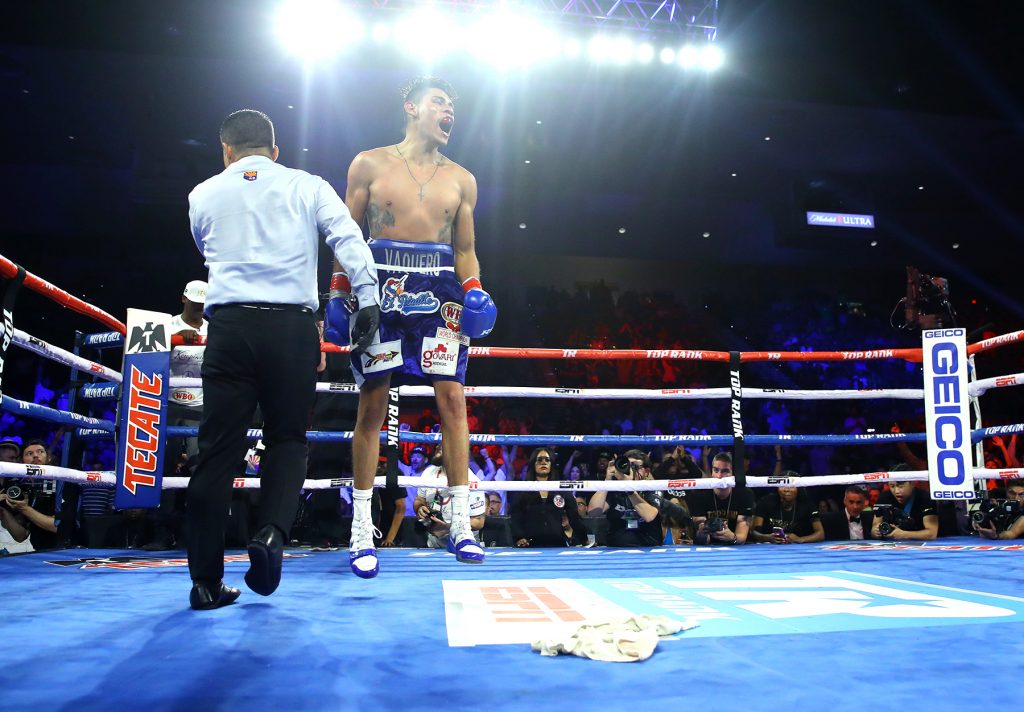
LAS VEGAS – Emanuel Navarrete

Is restoring an old-school definition to a term that has long been part of the boxing glossary.

Busy is today’s way of describing a fighter’s work rate. It’s a simple description for a relentless attack driven by fast feet, faster hands and inexhaustible energy.

Navarrete, a super-bantamweight from Mexico City, is all of those things. Just ask Isaac Dogboe, who got knocked off the fast track to stardom by Navarrete’s tireless assault, first by decision last December and again by an overwhelming stoppage in May.

Within the ropes, Dogboe could do nothing to slow down Navarrete. It’s outside those ropes, however, that Navarrete is making promoters remember what busy also used to mean.

Navarrete is back in the ring Saturday night on the Tyson Fury-Otto Wallin card on ESPN+ for a second title defense within one month. Navarrete, who scored a third-round stoppage of Phoenix fighter Francisco De Vaca on August 17, said yes to Saturday’s bout against Filipino Juan Miguel Elorde without hesitation.

“Your answer came quicker than your punch,’’ Top Rank promoter Bob Arum said to Navarrete Thursday during a news conference for a T-Mobile Arena card that is part of Mexico’s annual celebration of Independence on Sept. 16.

It was also an answer that must have been a trip back, way back, in time for Arum. Arum, 87, was there, in the last century when fighters would answer an opening bell every other month. Compare that to today when twice-a-year is thought to be busy enough.

But the 24-year-old Navarrete (28-1, 24 KOs) is seemingly ready at all times.  Ring rust has no chance against him.

“I just want to tell him I’ll fight in December too,’’ Navarrete said as an interpreter translated his Spanish into English for Arum.

Arum smiled at words that define an ever-ready fighter. Some fight for money, and if it’s big enough they’ll fight as seldom as possible. Why risk a big paycheck?

But at the heart of the craft, there’s passion that keeps a fighter restless and always seeking for a chance to punch in, punch out.   

“If you’re a fighter, you want to fight as much as possible,’’ Arum said. “If he could, this kid could would fight eight times a year.’’

During this week, at least, Navarrete isn’t looking past Saturday against the grandson of a Filipino legend. There’s more than one. Before Manny Pacquiao, there was Flash Elorde, the world’s junior lightweight champion from 1960 through 1967.

Juan Miguel Elorde (28-1, 15 KOs) was born about a year after his famous grandfather died in 1985. The grandson’s first chance at world title is a steep one, especially on a card put together in honor of Mexico’s Independence Day.

“It is my lifetime dream to become a world champion, and I think it is becoming a reality,’’ Elorde said.

Elorde best chance might rest on the tale of the tape. He is an inch taller than Navarrete, who at 5 feet 7 is usually bigger than most in the 122-pound division. But Elorde is also about eight years older than Navarrete, a young man who is as ambitious as he energetic.

Navarrete is seeking to unify the 122-pound belt, before moving up the scale. He foresees himself at junior-welterweight one day. For now, however, another super-bantam belt is on the agenda. Enter Arum, who says unbeaten Rey Vargas, a 122-pound belt holder from Mexico City will be at ringside Saturday.

“Thank you for bringing him,’’ Navarrete said to Arum. “He can see what he will face.’’Probably, sooner than later. 


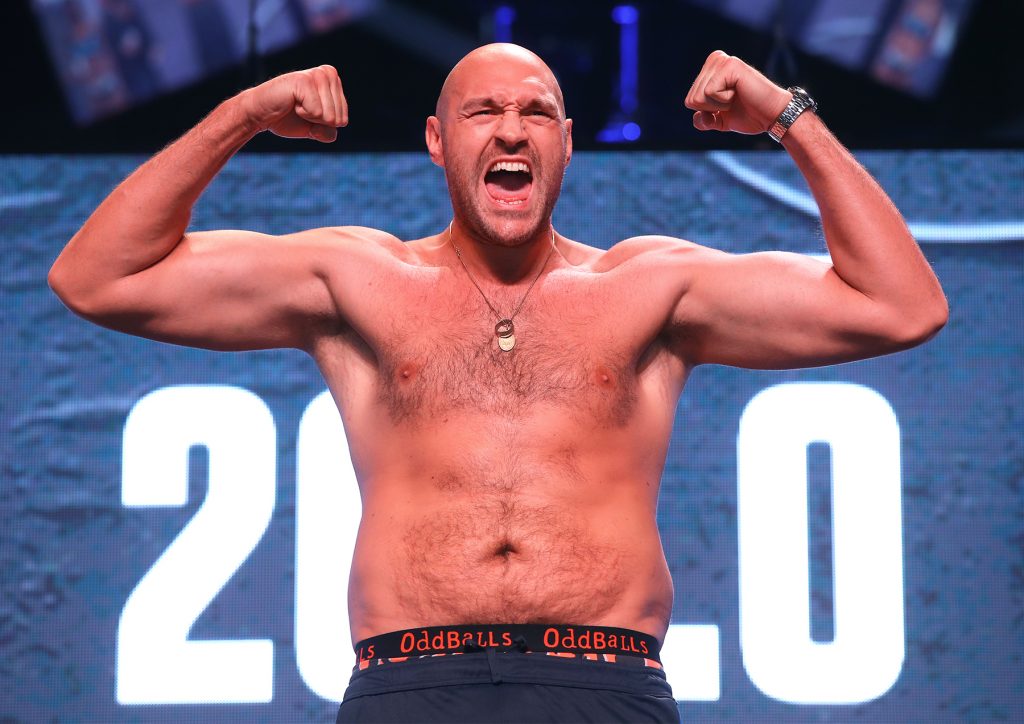
Fury-Wallin fightweek: Thank heavens for Andy Ruiz

By Bart Barry-

Latenight Saturday on ESPN+ lineal heavyweight
champion Tyson Fury will defend his strapless title against an undefeated
28-year-old Swede named Otto Wallin, a man BoxRec’s rankings place squarely
atop the formidable, fourperson Swedish-heavyweight heap (while allowing him to
crack the world’s Top 50 just barely). 
It will be shocking joyful if Wallin featherdusts Fury, and he won’t.

The Fury victory tour continues apace.  He rose from substance abuse to challenge
Deontay Wilder nearly a year ago and rose from Wilder’s wildness to win a
draw.  Those feats and promoter Top
Rank’s feat of finding its way back to a division in which its touch has not
been magical for a decade or two are the reasons we got served the June fight
with Tom Schwarz – ostensibly about a lineal championship (that traces all the
way back to Wlad Klitschko, who beat no one the previous generation considered
great but is brother to a man who gave Lennox Lewis a couple tough rounds). 

Aficionados rightly saw the Schwarz thing for what
it was.  In case they didn’t ESPN, more
camp than champ, saved its greatest enthusiasm for Fury’s ringwalk.

Saturday’s ringwalk better include live dinosaurs
accompanied by the London Symphony Orchestra. 

Less than that mayn’t reinflate the seeping Fury
balloon.  Ratings and press releases and multiplatform
coverage from ESPN will imply something else entirely, of course, but trust
your gut on this, come Sunday morning.

Fury’s style is not conducive to playing the
overdog.  Had he completed his denuding
of Wilder by remaining upright for 36 minutes Fury and his enablers would’ve had
another 18 months of goodwill to tinkle on. 
Alas, “Wilder &” Wilder dropped Fury often enough to dissuade any
loose immediate-rematch chatter from the lineal champ and make Wilder’s standard-loop
claims of being avoided feel a touch credible. 
Wilder’s folks, obviously, are in no real hurry to see their guy tested
again, or they simply do not know what they’re doing – but Luis “El Viejo”
Ortiz is still a more meaningful opponent at 40 1/2 than either of Fury’s recent
foes (if that fight actually happens). 

Which is all a fairly direct route to saying over
and again: Thank heavens for Andy Ruiz!

Ruiz’s stamping CUR on the nearest thing the
heavyweight division had to an undisputed champion is the one gift heavyweight
prizefighting gave us in 2019.  When he
does it again in December he will fairly well cut Fury out of the conversation
altogether.  However much Ruiz’s manager sacrificially
fed him to a rival promoter in June he’s still a PBC asset.  That means when AJ taps out again a few weeks
before Christmas, PBC will have each heavyweight belt except Fury’s imaginary
one.

It will require no imagination whatever for PBC to
host a fullthroated superfight in 2020, crowning a WBC/WBA/IBF/WBO Heavyweight
Champion of the World in a genuinely intriguing unification match between Ruiz
and Wilder.  Fury and Joshua will play
footsie for a year or two about a British-contenders-unite match whose purse
negotiations will not be helped by their post-Brexit economy. 

While the rest of the world forgets who they
are.  ESPN+ will have full coverage of
the negotiations and quite a few features about Tyson’s dad, “Gypsy John”, and
Anthony’s dad, Robert, with the striking, unforeseeable conclusion these men
influenced their sons.  “Not since I
promoted Muhammad Ali . . .” will go many of Bob Arum’s colorful quotes about Fury.

While we’re on about Arum let’s use one of his
best verbs: To dissipate.  About 15 years
ago I had a chance to ask Arum a few questions at a media gathering in a
Phoenix supermarket.  One of those
questions concerned what qualities he looked for in a prizefighter before
signing him, and Arum listed but one: “Does he dissipate between fights?”

If Fury hasn’t dissipated fractionally so much as
expected between fights, interest in his rematch with Wilder sure has.  As goes its flagship division, so goes our
beloved sport.  If there isn’t less
collective interest in boxing in 2019 there most certainly is not more, and
that’s with the full might of late-boom economics driving network acquisitions
and broadcast calendars.

Storm clouds now gather on the American economy’s
horizon, and while a recession may mint a new generation of prospects it’ll do
nil to prod this generation’s fatted calves towards greatness.  Showtime will follow HBO, while Fox follows
DAZN and ESPN to boxing’s destination platform: App Store.  Circus barkers will contrive a new language
of YouTube likes and trailing-month replays, and what few of us still write
regularly about the sport will begin a fifth or sixth search for green shoots while
the BWAA hasn’t a choice but to award boxing’s best tweeters.  Floyd and Manny will make a desperate
cashgrab of a rematch, and the old salts’ll use whatever gaudy revenue number
comes along to do a 27th installment of the Boxing Is Not Dead serial.

Whatevs. 
We’ll always have and must always cherish what Andy Ruiz did to Anthony
Joshua on June 1, 2019.

Bart Barry can be reached via Twitter @bartbarry


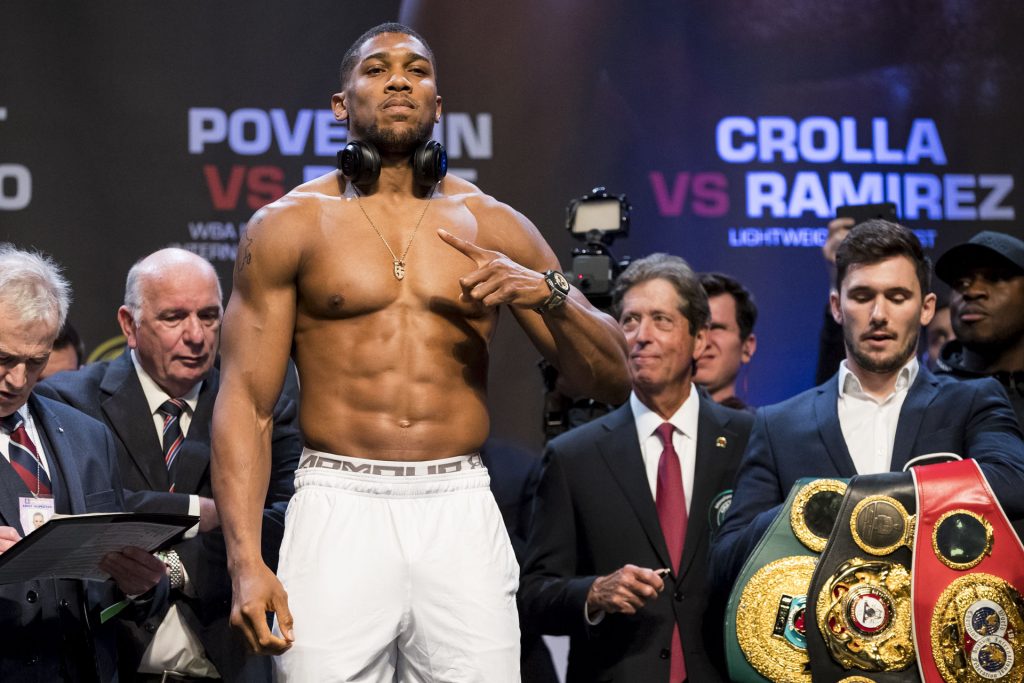
Joshua’s Journey: Search for a road win takes him to Saudi Arabia

By Norm Frauenheim-

Anthony Joshua is unbeaten at home in the UK. He’s winless on the road.

It’s hard to know whether his record serves as much of a roadmap, but it might be a signpost of why he’s headed to Saudi Arabia, a site as unlikely as it is controversial for a heavyweight title fight.

Joshua, 22-0 in the UK and 0-1 on the road, has yet to prove he can fight away from the UK’s adoring fans and media. He even won his Olympic gold medal in 2012 at the London Games.

He could no wrong until he answered his first opening bell on foreign shores where Andy Ruiz Jr.’s fast hands left him looking confused and his fans betrayed throughout a stoppage loss at New York’s Madison Square Garden.

The futile journey to New York June 1 was supposed to represent his first step toward would-wide celebrity. It was designed to raise American awareness of a UK heavyweight who had been sold and packaged as a transformational athlete. All it did, however, was raise a red flag.

It’s not exactly clear what happened in New York to Joshua, who was bewildered by Ruiz combinations throughout six-and half rounds. The bewildering defeat was followed by strange behavior. Joshua celebrated with Ruiz. He smiled like a naive kid who didn’t look as if he exactly knew where he was or why he was there.

“There’s pressure, being an ambassador for boxing, to be bigger than boxing,” Joshua said Thursday in a return to New York in the second stop of a three-city tour for the Saudi Arabian rematch with Ruiz. “That’s my ambition and I have to deal with it.”

Boxing needs another ambassador like it needs a new Don King. A genuine heavyweight champ isn’t created by diplomacy, although some of today’s matchmaking might suggest otherwise. It’s just about skill and will, a couple of ingredients that were missing in Joshua’s last performance.

Whether a sense-of-self shattered in New York can be repaired a half-year later in Saudi Arabia is anybody’s guess. But the journey might be worth the risk. Might be the only option, too.

A lot has been made of the site fee. Saudi Royals reportedly are paying $40 million to Joshua promoter Eddie Hearn for the right to a fight that has been called part of a PR campaign to clean up the country’s image with “sportswashing.” Forty million buys a lot of bone saws.

The trip to Saudi, however, also is an opportunity for Hearn to control much of what can never be controlled in New York. There’s still no clear news on how the fight will be regulated. Or by whom. It’s not even clear how many seats will be available in an arena still under construction.

It’s hard to imagine Joshua’s UK fans will want to travel to a country where they can’t buy a beer. They might just prefer to watch the bout on DAZN at home where they won’t need a ticket or a visa. Then, at least, a stocked refrigerator will be nearby in the event Joshua’s journey fails to produce a victory that says this heavyweight can still travel onto much bigger things.  


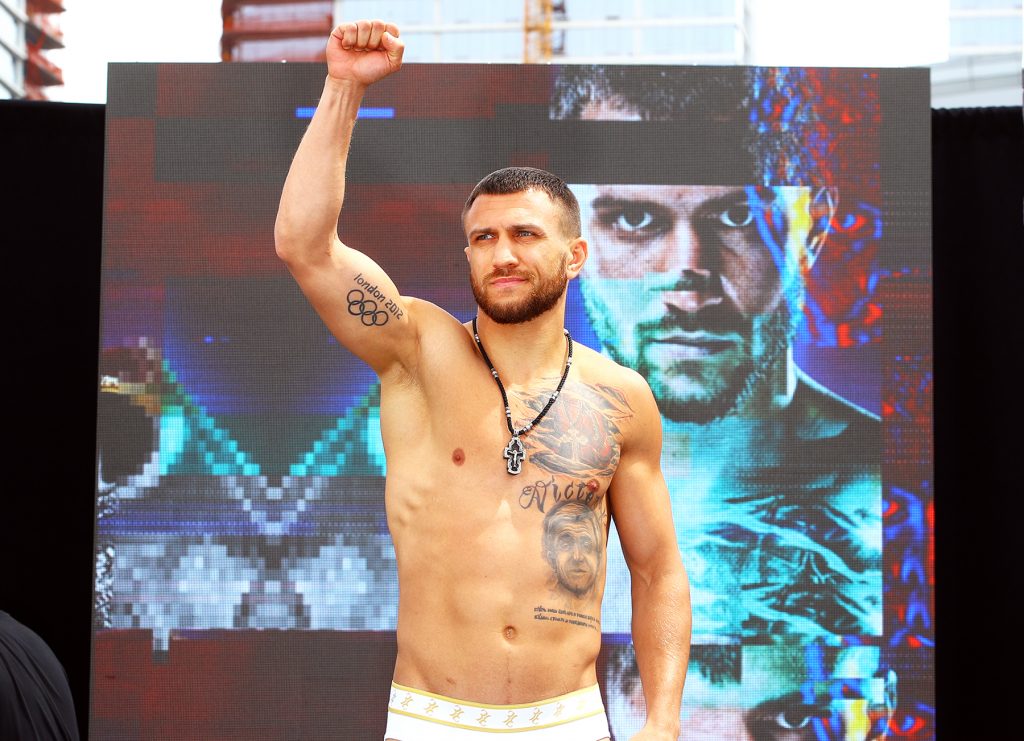
Lumbering tardily onto the Lomawagon

By Bart Barry-

Saturday a Thames riverboat ride east of London, one
of the world’s five best prizefighters, Ukrainian lightweight Vasiliy
Lomachenko, outfought Yorkshire’s Luke Campbell to collect Lomachenko’s third
of four sanctioning-body titles and defend his (much more meaningful) Ring
championship by unanimous decision.  It
was another test passed by Lomachenko, another test administered by a proctor
much stricter than those subs who passed him so flatteringly at the lower
grades.

The inverse logic of things being what it is an
exodus from the Lomachenko bandwagon is probably underway just when the bandstand
ought be overflowing.  As Lomachenko does
things that fulfill what hyperbole greeted his debut six years back, the
hyperbolists, many now out of business with HBO’s welldeserved demise, turn
their miniscule attention spans to new kids who turn sensational feats against
hopeless opposition.

With each Lomachenko title acquisition the
hyperbolists see more wear, less sublimity, more exposure.  These lads yearn for some highlight-ready
stuff like GGG duly delivers whenever matched at middleweight with welters.  Lomachenko tried that route for a spell – the
Rigondeaux debacle – then took the very next offramp.  If the hyperbolists forget it, the historians
shan’t. 

Rather than stay at his natural weight, blast
journeyman for easy money while occasionally preying on a brandname from a
couple divisions below, Lomachenko went above his proper weight and began to
unify titles by beating men who acquired those titles someway or another.

Luke Campbell is by no means boxing’s most-feared
man but he sure as hell wasn’t a cherrypick either.

While the hyperbolists hop off the Loma bandwagon,
I find myself gradually lumbering on.  I
verily enjoyed watching Lomachenko make battle with a man who did not fear him
or have reason to, a man against whom even the most balletic footwork wouldn’t
forego Saturday’s attrition requirement. 
Just as happened in his other three lightweight matches Lomachenko had
to strike Campbell multiples harder to get any English out of him.  Campbell fighting at home before some of our
beloved sport’s best (if often delusional) fans, too, added another inch and
five or so pounds to the Brit’s dossier.

In the midrounds Campbell did something dastardly
stupid if daring: Throw a halfnaked backhand uppercut whilst moving
forward.  That’s not Boxing-101 verboten,
because you don’t get to learn how to throw uppercuts till Boxing 102.  But no sooner do they put you on the gym’s
uppercut sack than they tell you never to throw the punch moving forward.

History has its share of cautionary clips to
explain why, but let Buster Douglas’ halfnaked backhand uppercut lead against
Evander Holyfield suffice.  Campbell’s
wasn’t telegraphed as Douglas’, no, and for that reason Lomachenko’s counter
left didn’t get leveraged fully as Holyfield’s rightcross in 1990, but it was telegraphed
enough, and Lomachenko looked almost euphoric at Campbell’s plunging forward.

Lomachenko’s counter left chastened Campbell and
then Lomachenko’s professionalism nearly ended Campbell’s night.  Knowing his opponent was gone wobblewoozy
Lomachenko went HAM to Campbell’s body and delivered the Brit to his corner
scrunchfaced wincing.  Had the exchange
happened at even super featherweight Campbell’d’ve seen naught of the
championship rounds.

And we’d be hearing Lomachenko is a force of
nature never before seen with gloved fists. 
But because Lomachenko wants posterity to regard him differently from
his generational peers the exchange happened 10 pounds above Lomachenko’s debut
weight, and Campbell, a significantly larger man, had himself another half
fight to strike and be struck by the smaller champion.

This is why we ask fighters who are not
heavyweights to rise through weightclasses and why even history’s best
heavyweights are underrepresented on all-time lists.  The more the consequences of a Lomachenko misstep
grow and the consequences of a Lomachenko punch diminish the less any of us
cares to hear a 15th recital on Lomachenko’s time in the ballroom.

Lomachenko needs all his wiles, these days, to jab
a fellow lightweight in the first four minutes they share, much less mesmerize
Max and Jim.  And since his opponents are
no longer imperiled by his mere reputation, Lomachenko now finds himself
subjected to what elbows and shoulders lighter men hadn’t the wherewithal to
throw.  Campbell spent a fair fraction of
his Saturday night reminding Lomachenko how many questionable acts might be fit
in the foggy chaos of a championship prizefight, borrowing occasionally from
Siri Salido’s forgotten blueprint.

What Lomachenko did Saturday brought no one to
mind so much as Manny Pacquiao.  He’s the
last man we saw climb weightclasses and so dominate their titlists, even if
there was an occasional cherrypick thrown in. 
Pacquiao is also instructive for this reason: What Pacquiao did and
found himself forced to do against other great prizefighters are why Pacquiao
is thrice the legend for all but the last second of what he did in the sixth
round of his fourth fight with Juan Manuel Marquez than he’d be for icing David
Diaz a dozen times.

Lomachenko is not Pacquiao and won’t be – fortune hasn’t
given him the era for it – but he is now admirably earning the premature
plaudits bestowed on him some years back, even if he’s having to do so in
challengers’ arenas on a mobile app.

Bart Barry can be reached via Twitter @bartbarry


Dormant Debate: Lomachenko promises to re-awaken pound-for-pound talk

By Norm Frauenheim

It’s a debate looking for a few good arguments. For the last few months, there haven’t been any. The pound-for-pound title is vacant these days.

Vasiliy Lomachenko hopes to change all of that Saturday in an attempt to knock the dormant out of the old debate in an interesting lightweight title fight against Luke Campbell in London.

Lomachenko has as good a chance as any to re-invigorate talk about who has a leading claim on No. 1. Among a few good men, Lomachenko might be the best.

“I think I’m the best, pound-for-pound,’’ Lomachenko (13-1, 10 KOs) told the UK’s Daily Mail this week during the usual hype before opening bell at O2 Arena (ESPN+, 5 p.m. ET/2 p.m. PT). “Terence Crawford thinks he is. Canelo Alvarez thinks he is.

“For me, Crawford is second, Canelo is third.’’

No argument with Lomachenko’s claim or contenders. From this corner, Japanese bantamweight Naoya Inoue and Dallas welterweight Errol Spence Jr. also belong.

Both are unbeaten and each has a chance later this year to further their own argument – Spence against Shawn Porter on Sept. 28 at Los Angeles’ Staples Center and Inoue against Nonito Donaire on Nov. 7 at Saitama, Japan.

Of the five, Inoue might be in the best position to deliver the most powerful argument. He’ll be in his home country against a clever, yet fading Donaire, a Filipino-American whose name recognition in the United States will further awaken American interest in the intriguing Inoue.

For now, however, the first shot in re-awakening the pound-for-pound debate rests in Lomachenko’s creative hands, which continue to introduce new angles to a brutal geometry sometimes called The Sweet Science.

The guess here is that the resourceful Lomachenko will prevail, but not with the convincing performance he’ll need to win the pound-for-pound debate in 2019.

Above all, Campbell (20-2, 16 KOs) has some skill of his own. He’ll also be in his home country and the city where he won Olympic gold in the 2012 London Games. Above all, he is bigger than Lomachenko, who can be seen looking up at Campbell in photos of the ritual face-off this week.

At 5 feet 7, Lomachenko is two inches shorter than Campbell, who is listed at 5-9. Another key dimension: Campbell has a five-and-a-half advantage in reach over Lomachenko.

Lomachenko is a featherweight fighting two classes above his natural weight. There’s risk in that. It was evident in Lomachenko’s 10th-stoppage of lightweight Jorge Linares. Linares knocked him down in the sixth.

More of the same would not be a surprise in a bout Lomachenko figures to win, yet not without at least one moment that leaves questions about whether he is pound-for-pound’s undisputed No. 1.

It looks as if Lomachenko’s best chance at a performance that sweeps away the doubt is at 126 pounds. But against whom? Mikey Garcia was taken off the pound-for-pound board in his equally-risky jump in weight to welter in a one-sided loss to Spence at AT&T Stadium in March.

Spence’s victory over Garcia marks a beginning of the troubling silence in the pound-for-pound debate, a popular pastime, yet also a significant marker in determining the state of the game.

A vacant pound-for-pound crown is just another empty seat, and there have been too many of those lately. The good news is that no vacant seats are expected at the O2 Saturday. It’s a beginning, perhaps, at filling that vacancy at the top the game. 


Raw good: Estrada stops Beamon in Sonora

By Bart Barry-

Saturday in Hermosillo’s practically named Centro
de Usos Multiples, Sonora’s Juan Francisco “El Gallo” Estrada made a
harder-than-planned first defense of his Ring super flyweight championship
against North Carolina’s Dewayne “Mr. Stop Running” Beamon, on DAZN.  Estrada dropped Beamon twice in round 2 and
punched him till no vim remained in round 9, and Panamanian referee Abdiel
Barragan interceded at the right moment. 
Between rounds 2 and 9, though, Beamon gave Estrada a proper fitness
test.

Estrada is sensational in this way: If you might
employ a hybrid rating system, a blind sampling, that removes size and
ethnicity and purse and broadcaster hyperbole – raw raw, in lieu of rah rah –
he’d be top 5 on any list composed by an honest hand.  He is distinguished by his losses, oldschool
style, much as his wins.

Since 2011 Estrada has lost twice.  His first loss came to Chocolatito Gonzalez
in a fight that helped burnish Gonzalez’s ranking as the world’s best
prizefighter in any weight.  Estrada’s
second loss came to the man who violently stamped the end of Chocolatito’s reign,
Srisaket Sor Rungvisai.  The second loss
narrower than the first, and the first narrower
indeed than scorers had it.  Estrada is
the only Mexican heir in his generation to the master Juan Manuel Marquez;
Estrada somehow fulfilled coach Nacho Beristain’s vision in Sonora, some 2,000
km north of Mexico City, whilst Beristain played celebrity slapntickle with Son
of the Legend and (ghost of) The Golden Boy.

Canelo Alvarez is, of course, Mexico prizefighting’s
greatest financial draw, but despite his admirable pursuit of able competition,
Canelo hasn’t Estrada’s class or mettle. 
After losing to Chocolatito in a world title match at 108 pounds Estrada
fought Brian Viloria for a world title at 112 pounds, five months later, and
won a title Estrada defended five times. 
Then Estrada got outworked by Sor Rungvisai, the man who put Chocolatito
in shavasana pose like a chocolate yogi – not outpunched or stiffened, mind
you, only outworked.  And in April when
the rematch happened with Sor Rungvisai, Estrada went directly at one of our
sport’s hardest punchers and snatched his title.

All of that is a hell of a throatclearing preamble
to writing this: Estrada didn’t look great Saturday against an otherwise-anonymous,
34-year-old Carolinian named Dewayne Beamon (whom the Spanish-language
broadcast assured us gave up promising careers in both basketball [5-foot-5]
and football [114 1/2 pounds] to pursue boxing).  Some of that was Estrada, but more of it was
Beamon. 

Here’s the part that was Estrada.  Making a first world-title defense in his
home state of Sonora since 2015 Estrada found himself subjected to all the
distracting ills of a homecoming – ticket requests, camp visits, interviews
with the local daily.  Those distractions
told in Estrada’s conditioning.  Estrada
would daze Beamon with a counter then unload on him with leads then spend a
bemused next round with his mouth open. 
The oftener that pattern happened, the infrequenter Estrada soldout the
attack.  Often as not after round 4
Estrada didn’t put it on Beamon until or unless Beamon pissed him off.

Beamon, frankly, was too savvy to do that very
often.  If Estrada’s conditioning was
suspect Beamon’s was not.  The Carolinian
trained for a world title challenge in the champ’s hometown and acted like
it.  He absorbed very fine punches from a
very fine prizefighter and didn’t wilt till well offschedule.  Class told eventually, but that eventuality
arrived later than aficionados expected and way way later than Estrada penciled
it in camp.

That tardiness was, in some part, a matter of
class.  Estrada is a masterful
counterpuncher accustomed to landing apex predators on his fists.  Which is to write the force of Beamon’s
attack wasn’t great enough to turn concussively against him – the same way a
hitter might drive an 80 mph fastball to the warning track with the same swing
he’d land a 100 mph fastball in the bleachers. 

Beamon never really got the angle calculated for
his righthand.  While we’re playing with
baseball metaphors, let’s go here: Beamon, accustomed to much lesser hitters,
didn’t hide the ball coming out of his windup. 
However it looked on flatscreen, something Beamon did gave away his
righthand, and Estrada perceived it early every time.  Sometimes Estrada went Mexican with that
perception and ate Beamon’s right glove to emasculate discourage the challenger
a bit.  Most of the time Estrada let the
punch flash over him by the narrowest possible margin.

The two or three times Beamon threw the
telegraphed righthand and neither of the above scenarios played out, the two or
three times Beamon put a sting on Estrada, the champ retaliated swiftly and
disproportionately.

But here’s the thing about Beamon.  He acquitted himself very well in his role of
designated homecoming opponent, giving Estrada far more than his paycheck
anticipated.  Beamon was not going to
decision Estrada in Sonora and he wasn’t going to knock him stiff either, and
if the rest of us knew that during the ringwalk, Beamon surely knew it a
quarterhour before he succumbed.  That
Beamon’s shoulders didn’t sag till round 9 speaks to Beamon’s character and
speaks of it well.  “Mr. Stop Running” –
no, that nickname doesn’t work any more elegantly in Spanish – went in on the
champion, one of the world’s best prizefighters, and got his money’s worth.  A good thing for Beamon, Estrada and the rest
of us.

Bart Barry can be reached via Twitter @bartbarry


Remembering John McCain: Boxing Senator is gone, but Ali Act is still there and in need of an update

By Norm Frauenheim-

Sunday represents a sad anniversary. John McCain, statesman and soldier, died a year ago on August 25 on his Arizona ranch, about 100 miles north of an NHL arena in nearby Phoenix where ESPN was about to televise a fight card.

An opening bell was followed by 10 bells, a mournful memorial for a former amateur fighter who was called “the boxing Senator” by Bob Arum. McCain’s death wasn’t a surprise. His battle with cancer was public. And painful.

Yet, the timing was almost haunting. He died, 81, at about the same time young fighters, kids, on the undercard began to make that long walk from the dressing room to the ring. McCain identified with them. He had been one of them at the Naval Academy.

Later in life, he fought for them, a powerful advocate for young men from tough streets who knew that only their fists would fight for them.

McCain wrote, lobbied and pushed through the Muhammad Ali Act, which was introduced in 1999 and enacted in 2000.

McCain is gone, but the Ali Act is still there. It’s a small part of McCain’s many-sided legacy, seemingly made more powerful 12 months after his death. McCain stands in stark contrast with a president who did not like him and has always been quick to rip him. In life. In death.

The unfathomable depth of Donald Trump’s anger – call it hate – for McCain often makes me wonder why he hasn’t tried to rescind the Ali Act, which includes an attempt to ensure some financial transparency.

After all, Trump pardoned Jack Johnson without ever mentioning McCain or his tireless leadership in pushing for one. Trump, too, learned a trick or two in the boxing business with Don King. King lied about crowds long before Trump ever did. Yet even with Mike Tyson on the marquee, Trump drove his Atlantic City casino into bankruptcy.

Maybe, Trump is just too busy, what with Greenland and all. The sad truth, however, is that the Ali Act just doesn’t matter much. It has never been enforced the way McCain hoped it would.

Early on, it did force promoters to open up their books to fighters, who have a right to know what the gross income is expected to be. They are only negotiating for their fair share of that projected pie. That financial transparency is one reason boxers still make more money than mixed-martial artists get from the UFC, which is not subject to the Ali Act

But everything else about the legislation – conflicts of interest, enhanced safety measures – have been mostly ignored. Like his pursuit of the Johnson pardon, McCain had hoped to further empower the Ali Act with patience and time. But there was never enough interest in it from McCain’s Congressional colleagues. It’s still a law, but it’s little bit like the speed limit. Nobody pays attention to it anymore.

Two deaths in the wake of McCain’s death, however, are reason to re-energize his pursuit of some rhyme, regulation and reason instead of the usual chaos. Two of the kids with whom McCain identified are gone, dead from head trauma suffered in bouts.

First, Russian junior-welterweight Maxim Dadashev died July 23, about four days after fighting in Maryland. Two days later, Argentine junior-welterweight Hugo Santillan died from injuries sustained in a fight in Buenos Aires.

A shocked game moved on, as it always does. The attention quickly turned to what Canelo Alvarez isn’t doing and what Gennadiy Golovkin will do. There’s always another opening bell, which is another way of saying it’s business as usual.

If McCain were still alive, however, it’s fair to say he’d be calling for a thorough investigation in Maryland and an update of the Ali Act. But the Arizona Senator’s voice is long gone. What he left, however, was a blueprint, still a pathway to ensure that death never becomes usual in the boxing business.


Canelo-Golden Boy: Fight with Sergey Kovalev would mean more to fans than an apology

By Norm Frauenheim-

Trouble between Canelo Alvarez and Golden Boy Promotions isn’t exactly a surprise. Seeds and signs of discontent have been circulating for at least a year.

It’s not clear how it will end. For now, Golden Boy is saying all is okay, meaning business as usual will continue despite news a couple of weeks ago that Canelo is unhappy.

That wasn’t a mere rumor. It came from him in a social-media salvo full of frustration at how he said he was kept in the dark by Golden Boy throughout the futility that led to the International Boxing Federation’s move to strip him of its middleweight title.

Canelo wanted answers.

A couple of weeks later, it’s not clear how many he got. There was a reported meeting this week about what to do next, or at least when to do it.

November 2 is the proposed date for Canelo’s next bout, his fourth since signing a $365-million landmark deal with DAZN. Golden Boy president Eric Gomez told ESPN Thursday that the first Saturday in November has been placed on the Nevada State Athletic Commission’s agenda for consideration at its meeting on Tuesday.

But there’s not much else about where or even against whom. There are only the questions.

Demetrius Andrade, who holds the World Boxing Organization’s 160-pound belt, still appears to be the most likely foe. But there’s also persistent talk that Canelo, who has a World Boxing Council “franchise belt” and the World Boxing Association’s title, is still thinking about a jump up to light-heavy for a shot at Sergey Kovalev, who fights Anthony Yarde on Aug. 24 in Russia.

Just a guess, but DAZN executive John Skipper’s preference might be Kovalev. Andrade could be a tougher challenge for Canelo. But Andrade is not as well-known as Kovalev, who generated headlines throughout controversial losses to Andre Ward, first in 2016 and again in 2017.

Kovalev also might be a perfect fit for Canelo in a PR battle to halt the erosion in the Mexican’s popularity. In boxing’s traditional good-versus-evil plot, Kovalev would play the bad guy. He’s a natural.

There are lots of reasons for fans to wonder why they like Canelo. Against Kovalev, however, he’d look good in comparison and perhaps even better in fact if he wins definitively. Winning, however, is the risk. Kovalev has proven to be resilient since Ward.

The Russian is still dangerous. For Canelo, however, there’s more danger to his career and public persona if he doesn’t try to halt a string of controversy that has left fans exasperated.

First, there were negotiations with just about everybody but Gennadiy Golovkin.  Then, there was the announcement that Canelo would forgo his expected bout on Sept. 14, a date that would coincide with Mexico’s annual Independence Day on Sept. 16. Then, there were failed talks with Ukrainian middleweight Sergiy Derevyanchenko and the IBF’s subsequent stripping.

Canelo apologized to the fans in the same message that asked Golden Boy for answers. But fans aren’t very forgiving. Guess here, they want Kovalev, more than an apology or an Andrade.

For a while, at least, a winnable bout at 175-pounds against Kovalev might make fans forget about Golovkin while also re-assuring DAZN that it made a good investment. GGG would still be there, waiting and ready for a third fight. For now, however, GGG is off the board. But Kovalev will be there, if – as expected – he beats Yarde, a UK prospect.

Kovalev and a Canelo victory over the feared Russian also might be the only way Golden Boy and Canelo can start over. It’s a risk, but business-as-usual poses even bigger risks.


Column without end, part 19

By Bart Barry-

Editor’s note: For part 18, please click here

MEXICO CITY – Beautiful is a word I didn’t think to
associate with this city before visiting because I’d not heard anyone call it
that, and so perhaps I’ll be its first.  After
nearly a dozen encounters with its airport I am for a first time without its
airport, in La Condesa neighborhood specifically (11 kilometers west of Romanza
Gym), and nearly enchanted by the city’s beauty.

It is doubtful either the Brothers Marquez, on
their first trip to Romanza, or their mentor and trainer, Nacho Beristain, would
recognize very much of their city that I’ve seen and plan to describe.  This neighborhood is “fifí”; a playfully
derogatory Spanish term, like “spoiled” or “snobbish”, that invests its target
with a pride proportionate to its speaker’s envy.  It is Barcelona much more than Ciudad Juarez
and remarkably devoid of what dust and noise dominates most Latin American
capitals from here to Patagonia.

The people are more courteous, or at least less
numerous, than anticipated.  And about
them, here’s an observational parallel: The populations of Mexico’s two largest
cities mirror the populations of the United States’ two largest cities both in
appearance and mien.  Mexico’s
second-most-populous city, Guadalajara, has the beautiful people – just like Los
Angeles.  Mexico’s most-populous city,
this one, has the ambitious ones – just like New York.  There’s a quicker pace here than in Guadalajara;
one imagines it far easier to move from here than to move to here; if few
passersby could pass by beauty alone in Guadalajara, they come from a place
where no one passes by beauty alone.

This neighborhood is aspirational bohemian (a
redundancy in most cases, that) and traffics in the expected incongruencies of
the combination.  Lots of serious eyeglass
frames and fashion beards complemented by an inexplicable tendency to sit among
familiars and exaggerate to strangers – effectively, to care less about the
opinions of those you see daily than those whom you’ll never see again.  In the Massachusetts of my youth we’d’ve
called most guys here “faggy”, but the slur strikes me as entirely
inappropriate today for more than just the obvious reason.

Thirty-five years ago we called each other by gay
slurs in large part because we didn’t know any gay people, or if we did, we
didn’t know we did – I can confidently state I never called a gay classmate by
a gay slur because, by dint of inexperience and misperception, the guys I
targeted went on to have wives and children. 
We used gay slurs to imply something like fifí – delicate, preoccupied
by others’ judgments, unlikely to mate. 
And therein lies an irony one sees quite a bit in this city but especially
in Nuevo Polanco, with its art collections and homage plazas built by Carlos
Slim.

The only obviously mated folks are the gay
ones.  While their ostensibly
heterosexual peers engage with platonic hugs and fraternal banter, the men who
like men are kissing, the women who like women are holding hands, the only
couples anyone can say with confidence are coupled share the same gender.  It’s delicious ironic for an American raised
in the airhead morality of “family values” th’t in 2019 the only men in our
continent’s largest city secure enough in their masculinity to show public love
are those gazing longingly in other men’s eyes.

Dude, this is getting uncomfortable.  Can we get back to Juan Manuel or Rafael?

I thought of them a bit a few days ago in Papalote
Museo del Niño, this country’s largest children’s museum, as the young guides
doggedly presented their educational wares to father and son alike.  Unlike their lessinspired American
counterparts in San Antonio’s DoSeum, a sister venue with a video feed into
Papalote, coincidentally, Mexican guides do not allow failures in their
exhibitions.  You sit at a table, whether
to assemble from papercups a windtunnel-ready flying saucer or to repair a
deadbolt lock, and you do not leave till your work is complete – lest a guide
less than half your age lecture you on what a poor example you’re setting as a
quitter.  And it works.  You feel triumphant when you eventually win
that teenager’s stern approval.

It made me wonder what Beristain told the Brothers
Marquez during their first week in his gym. 
Did he have to tell them the consequences of their new vocation? did he
have to invest them with the seriousness of their hoped-for craft? was Rafael
already the more physically gifted specimen? was it obvious to Beristain?

At Castillo de Chapultepec the next day I thought
of Marco Antonio Barrera, as I often do. 
Also a chilango – and that’s a loaded term, too, as Ciudad de Mexico is
no longer a federal district but recently a state of its own surrounded by a
state named Mexico in a country named Mexico, though a city-cum-state whose
residents may or may not still call themselves chilangos and probably should be
offended if you were to – Barrera somehow doesn’t belong in a boxing gym, in my
imagining of him.  While Juan Manuel
Marquez labors under Beristain’s tyrannical tutelage in Romanza, Barrera gazes
across his city’s extraordinarily large forest park from the ramparts of Maximilian’s
royal home and relies solely on contempt for opponents to prepare himself.

Did you forget Barrera and Marquez fought 12 years
ago?  I had.  Then it came to me while touring the castle,
in a memory of Barrera’s petulant scowl when he dropped Marquez on his gloves
at the end of round 7, paused for two full beats to line him up, and then
clocked his felled opponent with a right uppercut.  Cold contempt, not rage – an almost comical
contempt.

A beautiful city filled with aspirational
inhabitants incubated contempt, apparently, in one of our beloved sport’s
largest brains.

Bart Barry can be reached via Twitter @bartbarry


On Alert: Death and serious injury heightens concern for fighters’ safety

Two deaths within a few days in late July are part of a dangerous trend for fighters, whose safety was addressed with a sense of growing concern and urgency by officials throughout the sport this week at a convention of the Association of Boxing Commissions.

The Association (ABC) met for five days in Scottsdale, Ariz., for its annual conference in the wake of Russian junior-welterweight Maxim Dadashev’s death on July 23 in Maryland and Argentine Hugo Santillan’s death on July 25 in Buenos Aires from injuries sustained in the ring.

The deaths follow serious injuries suffered by Canadian light-heavyweight Adonis Stevenson, welterweight Zab Judah, Mexican bantamweight Felipe Orucuta and Christian Castillo, the son of former lightweight champion Jose Luis Castillo.

Stevenson, a former 175-pound champion, underwent emergency surgery and was placed in a medically-induced coma following an 11th-round knockout loss to Ukrainian Oleksandr Gvozdyk on Dec. 1 in Quebec City.

Judah, a former champion at 140 and 147 pounds, was hospitalized with bleeding on his brain after an 11th-round KO loss to Cletus Seldin on June 7 in Verona, N.Y.

Orucuta, a two-time challenger for major titles, suffered a brain injury, also on June 7, in a knockout loss to Jonathan Rodriquez in Zihuatanejo, Mexico. He underwent emergency surgery to remove a blood clot.

Stevenson, 41, was able to walk and talk two months after surgery.

Judah, also 41, was “awake, communicating with his family and doctors and making progress,” Star Boxing promoter Joe DeGuardia told ESPN two days after the injury. Judah’s family asked for privacy, DeGuardia said.

Orucuta, 33, was awake and showing signs of improvement last week, according to reports in the Mexican media.

Castillo remained hospitalized late Thursday after suffering an injury last week while sparring for his second pro fight scheduled for last Friday in Tijuana, according to ESPN Deportes. His condition was complicated by pneumonia, according to the report.

“We are all concerned,’’ said World Boxing Council President Mauricio Sulaiman, who attended the ABC convention.

Symposiums on drug testing and safety dominated the convention’s agenda, including one conducted by Sulaiman, whose Mexico City-based organization is monitoring weight with periodic weigh-ins for its champions and leading contenders. Wild fluctuations in weight are believed to be a factor in ring injuries and fatalities.

“Weight is a key,’’ said Sulaiman, whose organization also sponsors VADA – the voluntary drug testing program run by former Nevada ringside physician Dr. Margaret Goodman. “There are many things we have to consider and research. It is a process. There are bad matches. Late substitutions are dangerous There are injuries suffered in the gym. Many things can happen and do.’’

It’s not clear what any regulatory agency or sanctioning body can do, however. Boxing is inherently dangerous, made more dangerous by a lack of uniformity in the regulations that govern it in from country-to-country, state-to-state. Despite the Muhammad Ali Act, there is still no single governing body in the United States.

The Ali Act’s author, Arizona Senator John McCain, died last September. A fan and advocate, McCain was seen as the last real proponent of boxing regulation in government. Without him, there has been little interest or energy to enhance or enforce the Ali Act. This year’s ABC convention honored McCain’s role in boxing. His son, James McCain, was the keynote speaker as the convention concluded its business with a banquet Wednesday night.

`

Still, the ABC has no real authority. It can only advise and educate. It has no real role in an expected investigation of the Dadashev death by the Maryland State Athletic Commission and its executive director, Patrick Pannella

“We will support Patrick in every we can,’’ said Brian Dunn, a Nebraska commissioner who was elected the ABC’s new president this week. Legal advice, whatever we can do. This happens in boxing.’’

Happens too often.


A thrilling act of violence: Ramirez razes Hooker in Texas

By Bart Barry-

Saturday in a junior welterweight title-unification
match broadcast by the aficionado’s network, DAZN, California’s Jose Ramirez stopped
Texan Maurice Hooker midway through a wonderfully compelling fight that ended with
extraordinary abruptness.  Eighteen-and-a-half
minutes in, the men looked equally formidable. 
Eighteen seconds later, Hooker lay collapsed on the whiteropes, a blueshirt
his only protection from Ramirez’s ferocity.

Both men distinguished themselves by daring to
ratify their once-vacant titles. 
Promoters and their matchmakers are too good to be believed, and so the
winner of a vacant title is not credible till he’s fought a fellow titlist.  We now know Ramirez is the real thing.  And we know Hooker is the real thing, too,
though slightly less of that thing than Ramirez.

If neither man was allowed comfort before the
other, a minutely tally’d’ve found Ramirez acting as discomfitter, not
Hooker.  There was the promise of Hooker’s
substantial rightcross to keep Ramirez sober at every charge, a source of
instant anxiety for Ramirez to be sure, but it was a tool Ramirez solved and
dulled in the fight’s opening quarter.  Ramirez
did this with timing and footwork, somethings he doubtlessly learned before joining
trainer Robert Garcia’s stable.

If you have an amateur pedigree – which means
you’ve involuntarily boxed through your youth against every style and ethnicity
– before you pilgrim to Oxnard, Garcia takes your skillful foundation, puts it
in smaller gloves and commands you attack. 
If you haven’t a skillful foundation, Garcia nevertheless puts you in
smaller gloves and commands you attack. 
As we saw in his younger brother’s spring whitewashing contra Errol
Spence, Coach Robert carries no plans B to ringside in his spitbucket; any exam
question whose answer is not “more aggression” gets left blank for later – a generation
later.

Fortunately for Fresno aficionados Jose Ramirez,
an Olympian, brought skills galore to Oxnard when he arrived a year ago.  That meant Garcia’s plan A, more aggression,
was exactly matched to Saturday’s moment. 
It wasn’t necessarily that an Olympian like Ramirez couldn’t stay
outside and win a boxing match with Hooker, that was about a 40/60 proposition,
it was that there was no reason to try it. 
Hooker’s every advantage disintegrated once Ramirez was within his arms’
length of Hooker.  And Ramirez’s
advantages multiplied proportionate to every inch nearer after that.  Hooker knew this, Ramirez knew this.

Hooker outsmarted himself, though, figuring in round
5 he might do a little sabbatical on the ropes and let Ramirez get tired of
punching.  That was the lapse that cost
Hooker his title.  What happened in a
couple seconds in round 6, Hooker’s straightback headpulling that set his chin
on a tee for Ramirez’s left fist and the legs’ jellying and Ramirez’s swift
adaptation and Hooker’s utter defenselessness, all that, came of Hooker’s vanished
judgement the round before.

There are ways to discourage and fatigue volume
punchers like Ramirez, but none of them permits him to put knuckles on
you.  Knuckling you puts that breed of
man in his most comfortable place.  He’s
no longer burning calories at fractionally the rate you think he is, especially
if you’re a rangy puncher accustomed to throwing on your preferred timetable.

Ali rope-a-doped Foreman, remember, not Frazier.  You rope-a-dope a slugger, and he
autodiscourages by failing to harm you the way experience told him he
would.  You rope-a-dope a boxer, and he
retreats to the opposite ropes, and y’all feint at one another till the ref
starts deducting points.  But you
rope-a-dope a volume puncher, and you leave in an ambulance.

Too soon?

Let’s have a treatment of our beloved sport’s
deadly past week, then.  We are expected
to examine our collective conscience at times like these, I know, perform
public acts of expiation, and especially if we write for daily periodicals
whose pacifistic editors tsk-tsk our ways.

Good news, there.  In 2019 none of us writes for daily periodicals.

That means much of last week’s atonement was
habitual more than sincere.  We know this
because it all reduced to a massive shrug from the moral lowground, or else
niggling about pet safety issues – like tiptoeing a matchstick bridge across a
firepit licking.

Here’s an easier calculus for you, the aficionado:
Do you watch fights hoping to see a brainbleed or death?

No, you don’t. 
Then that’s that.  You’re not
obligated to justify yourself further. 
Those who would ban our sport are unserious; if they coulda, they
woulda.  Those who wish to make
prizefighting safer verily miss the point – our sport survives by dint of its
peril; safe prizefighting is oxymoronic. 

Some primal, though enduring (and thus still not vestigial),
human trait requires public acts of violence. 
In this sense the ban-boxing brigade recalls a Chris Rock joke about
needing bullies, because a couple decades of banning bullying in our schools meant
that when an actual bully showed up in the 2016 U.S. presidential election, no
one knew what to do.

Jose Ramirez would know what to do, and for that
matter so would Maurice Hooker, and if watching them punch one another doesn’t
quite tell us what to do it at least reminds us occasions for punching one
another still exist, however many millennia since our ancestors emigrated from their
caves.  There is real violence within
most of us, and it thrills the spirit. 
That isn’t a solution for prizefighters’ deaths and damages or even a
prescription for a solution.  It is an
amoral report of where and what we are – an act of acceptance, not contrition.

*

Editor’s note: This column will be on summer vacation
next week.

*

Bart Barry can be reached via Twitter @bartbarry


WEIGHTS, AND RUNNING ORDER IN DALLAS

First bell – 5pm (all times local)

4 x 3 mins Middleweight contest              
Darius Bagley 159.4lbs    vs            Carlos Dixon 166 ½lbs
Dallas, Texas                                      Dallas, Texas

Followed by

4 x 3 mins Super-Lightweight contest     
Arthur Biyarslanov 140lbs             vs            Solon Staley 139.5lbs
Toronto, Canada                               Columbia, South Carolina

6:00pm                                                                                                

6 x 3 mins Middleweight contest              
Nikita Ababiy 161.4lbs    vs            Yunier Calzada 158 ¾lbs
Brooklyn, New York         Houston, Texas

Followed by

10 x 3 mins Heavyweight contest             
Joey Dawejko 251.4lbs   vs            Rodney Hernandez 261.4lbs
Philadelphia, Pennsylvania                           Modesto, California

Followed by

4 x 3 mins Middleweight contest
Austin Williams 159.8lbs                vs            Jabrandon Harris 164.4lbs
Houston, Texas                 Bryan, Texas

8:00pm                                                                                

10 x 3 mins Vacant WBO NABO and USBA Super-Bantamweight championships  
Tramaine Williams 121.8lbs          vs            Yenifel Vicente 121.8lbs
New Haven, Connecticut              Miami, Florida

Followed by

12 x 3 mins IBF World Super-Featherweight championship           
Tevin Farmer 129.8lbs    vs            Guillaume Frenois 129 ½lbs
Philadelphia, Pennsylvania                           Sainte-Quentin, France

Followed by

12 x 3 mins WBO and WBC World Super-Lightweight championships       
Maurice Hooker 139 ½lbs             vs            Jose Ramirez 139 ½lbs
Dallas, Texas                                      Avenal, California

FLOAT

4 x 3 mins Lightweight contest  
Javier Francisco Martinez 133lbs                vs            Michael Land 130.4lbs
Dallas, Texas                                                      Dallas, Texas


Death And The Ring: Two fighters die in long week that forces fans and media to ask questions that have always troubled a troubled game

By Norm Fraueheim-

Boxing has been called life in a shot glass. From tragedy to triumph, it’s all there all at once, 180-proof. It tests your limits, takes you for a dizzy ride and sometimes leaves you in the gutter.

This week is one of those times.

Two deaths – first Russian junior-welterweight Maksim Dadashev Tuesday from injuries sustained in a fight Friday in Maryland and then Argentine junior-welter Hugo Santillan Thursday after a bout Saturday in Buenos Aires — just days after celebrating a dramatic display of skill, guts, resilience and class in Manny Pacquiao’s split-decision over Keith Thurman leaves a hangover full of troublesome questions. Doubts about why we watch.

I had other plans for this week’s column. There was the 40-year-old Pacquiao and a legacy that continues to make history. There was Errol Spence Jr. and his hopes to maybe fight Pacquiao and his determination to one day face Terence Crawford.

But none of that seemed to matter after the deaths of young fighters known by few of us. Dadashev was 28. Santillan was 23. They were young guys who labored on undercards for small purses and in front of empty seats.

Nobody much cares about them as fighters. But we care about them in death, because, I think, of what it says about us. If the unknowns can die, the great ones can, too. There’s no immortality on either side of the ropes.

In that ever-present danger, there’s drama.

A dilemma, too, and it’s inescapable.

They give – make that gave – it all in game compelling because of what it takes to conquer the fear. Fighters accept that risk. Fans are there to see how they deal with it. Unlike just about any other sport in this universe, there’s no ambivalence about what we’re watching and perhaps why some watch and some won’t.

In another lifetime, I used to cover auto racing, mostly NASCAR in Daytona. Drivers died. I always believed many of the more than 100,000 fans jammed into the Speedway were there just because any race was always a blown tire away from a massive accident.

Death would happen. That was always a danger and, in fact, part of the tension that drew those fans to the track. But it was also a byproduct.

The drivers weren’t there to disable each other.

But boxers are.

There wouldn’t be boxing if not for each fighter’s intent to disable the other. That’s the difference and it’s a dramatic one. It is as honest as it stark, a reason why many people just won’t watch. Boxing’s abolitionists figure to repeat their demand that the sport be outlawed in the wake of this week’s deaths. I can’t argue with them. I can’t agree with them, either. That’s part of the aforementioned dilemma.

Much, perhaps too much, about boxing offends the reasonable people concerned about the long-term damage done to the boxers who do survive. I understand. But I also understand that young men will always fight in the ring or on the street. Unregulated or regulated, they’ll fight with intent and no doubt about the danger.

Over the years, I have learned to sit at ringside for every fight on every undercard, no matter how big the main event. I didn’t know Dadashev. I didn’t know Santillan. But I have watched fighters like them for years and my admiration for their courage has grown during the many rounds before Pacquiao, or Floyd Mayweather, or Canelo Alvarez or Gennady Golovkin.

I’m there because of what might happen, what did happen to Dadashev and Santillan. I’ll be there, at ringside, all over again and I’ll pray I won’t have to write about another ring death. But that’s hoping against hope. Life in boxing’s shot glass means death, too.


That One Time Keith Thurman faced a true champion

By Bart Barry-

Saturday on Fox PPV in a match for the PBC’s
emeritus welterweight championship at MGM Grand undefeated titlist Keith “One
Time” Thurman got dropped and fairly decisioned by a 40-year-old Filipino
senator, Manny Pacquiao, who struggled to call Thurman even “a good fighter” immediately
afterwards.  Not the always gracious
Pacquiao’s fault, that.  Different era,
different priorities, different metrics.

No sooner does one imagine things going
differently in Thurman’s career were he with different management than he
recognizes different management overlooked him, didn’t it?  If manager Al Haymon plucked fruit from the
Olympic tree – some wellseeded like Errol, most misshapen like Rau’Shee and Terrell
– he discovered Thurman differently, howsoever he did it, which is to write
Haymon outbid the likes of Top Rank and affiliates, almost certainly because
they didn’t bid at all. 

Why is this relevant?  Because at the time Thurman turned pro
(nearly 12 years ago) most every great fighter a young aficionado today can
name got developed by Top Rank, starting with “Pretty Boy” Floyd Mayweather,
the patron saint, emphasis on patron, of today’s PBC stable. 

Whither this rehashing?  It crossed my mind muchly during Saturday’s
match, as it certainly crossed Coach Freddie’s mind and “Money” Mayweather’s
mind, too, at ringside.  Accustomed to
what large-pursed, pillow-gloved, athletic-contest exhibitions PBC bubblewraps
its champions in, Thurman hadn’t an inkling what suffering must traditionally
be endured for a man to call himself champion. 
He knows about it now, though.

Over and again one marveled at how alien a figure
Pacquiao cut on the sanitized island called Premier Boxing Champions.  Like an aged tiger parachuted in the middle
of a clover sheep farm populated only by sheep and clover, Pacquiao, red of
tooth and claw, fists wrapped in Mexican horsehair, not foam, thrilled at
violence as his profession’s only point – not an ancillary unpleasantness to be
got through while doing fitnessy things for large paychecks.

Three times the absurdity of it all manifested on
Thurman’s face: When Pacquiao knocked him asswards, when Pacquiao mashed his
nose through his face, when Pacquiao touched him properly on the button.  First was the look of disbelief then the look
of disgusted betrayal then the look of offended fright.  Thurman collected a righthand and dropped
like he’d been tripped then he spit the yucky taste of his own blood at his
corner en route to his stool then he wheeled away, gumshield in glove, selling a
Pacquiao bodyshot like the foulest of things. 
The last was the caketaker; it was the act of a man unable to imagine in
his 30th prizefight such pain might be delivered by a legal blow.

And all this from a version of Pacquiao five years
past its expiration date, a version of Pacquiao unable or unwilling to contest
more than 45 seconds of a round, a version of Pacquiao much more an ideal of
selfdefense than a predator.

There was Thurman, chastened completely by getting
bluematted in round 1, tentatively pawing and countering through much of the
match, while Fox’s contracted narrative-maker tabulated hundreds of “power
punches”, knowing there was a needle he must thread: Hit Pacquiao enough to
score points but not so much as to make him mad.

Then in your mind flashed Juan Manuel Marquez,
sucking his own noseblood through an open mouth and goading, prodding, goading,
goading, prodding, goading Pacquiao till he lured him, after 125 minutes and 58
seconds of misery and conflict and fear, in the master’s trap to end his era in
ecstasy.  How even do you word such a
contrast between the sinewy savage Pacquaio faced Dec. 8, 2012, and the fatted sheep
he’s seen in 2019?  They are not sportsmen
of the same species, surely. 

O, be not so hard on gentleman Keith; after all,
he comported himself nobly in defeat and gives generous interviews and he’s
telegenic and loves his wife.  Fair
points, yes.  If you are going to lose
there are more ignoble ways of doing it, as Adrien Broner reminds us annually.

O, to hell with that.  This is bloodsport, this is men making their
livings hurting other men. 

Pacquiao just reset the hands on the clock of
PBC’s fraud.  Don’t let Pacquiao’s
reluctance to face Errol Spence blind you. 
Spence is an outlier – PBC doesn’t know what to do with him either.  Thurman was PBC’s champion, Thurman won the
PBC welterweight Super Bowl in 2017, two months before PBC even knew what it
had in Spence, Thurman was the coddled prodigy, Thurman represented PBC’s
post-Mayweather future.  And that future just
spent round 10 with his white tail in the air, skittering away from a
40-year-old.

Because decisioning Thurman this late in the day
marks only about the 27th best moment of Pacquaio’s career, Saturday was not
about Pacquiao.  Saturday was a
fullthroated indictment of the P in PBC.

Be glad “The Truth” was ringside to see it, too,
for the future of our beloved sport.  Now
Spence knows, as Mayweather knew, the PBC on FoxTime belt is a participation
trophy, the glassencased product of a minorleague affiliate, a way to bamboozle
venture capitalists and network programmers. 
Spence now knows if he doesn’t make his manager make a match with
Terence Crawford while both men are still prime Spence’s championship lineage
will run through “One Time” and “Swift”, not “Sugar” or “Sugar”, and a
halfdecade from now some young bodysnatcher will properly coin him “The Fiction”
like Spence properly coined another man “Sometimes”.

Bart
Barry can be reached via Twitter @bartbarry


Pacquiao-Thurman: Compelling bout has some legends buzzing

By Norm Frauenheim-

LAS VEGAS – There were three legends and one who wants to be one. They were there to talk about a legend and one who promises to be one.

Manny Pacquiao, already a longtime legend, and Keith Thurman, the man seeking to make his own, are at a compelling crossroads. It’s young lion versus old. It’s legacy versus wannabe. Pacquiao-Thurman Saturday night at the MGM Grand and on Fox pay-per-view television is loaded with all of the elements for a potential classic.

It’s anybody’s guess whether all of those pieces fall together into picture of anticipated drama or simply fall apart. There are lots of questions. Can Pacquaio’s 40-year-old body hold together against a younger and bigger Thurman? Can the 30-year-old Thurman battle through the injuries that have put his once-promising career on hold? Only the moment after an opening bell can provide those answers.

For now, however, there are platy of opinions about a welterweight bout that looms as the biggest fight of the summer, especially in the wake of Wednesday’s announcement that reigning middleweight Canelo Alvarez will postpone his planned Sept. 14 bout because of futile search for a suitable opponent.

For now, at least, there is a good fight that sets up further possibilities at 147 pounds. The PBC path leads to a welterweight unification bout, probably early next year against the Pacquiao-Thurman winner and the Errol Spence Jr.-Shawn Porter winner on Sept. 28 at Staples Center in Los Angeles.

In part, that’s why Porter was there Thursday, part of round-table at the Grand Garden Arena alongside former middleweight champion Winky Wring, and ex Pacquiao foes Marco Antonio Barrera and Erik Morales.

For the record, Porter was one of three who figures he’ll be facing Pacquiao. No reason to ask whether he thinks he’ll beat Spence. He wouldn’t have agreed to the fight if he didn’t think so.

“Pacquiao by decision,’’ said Porter, the World Boxing Council champion who did offer a disclaimer, saying that Thurman’s confidence and power could force the Filipino Senator into retirement.

Morales and Barrera agree with Porter. Barrera picks Pacquiao to win a decision. Morales says the Filipino wins, by knockout or decision. Both faced Pacquiao when he was near or at his prime. Morales fought him three times, winning the first and losing the next two.

“When I beat him, I was at my technical best and that’s what Thurman will have to be if he hopes to have a chance,’’ Morales said.

Pacquiao went 2-0 against Barrera — an 11th-round knockout in 2003 and a unanimous decision in 2007.

“Psychologically, it’s tough to fight Pacquiao, because he keeps that pressure on you,’’ Barrera said.

Only Wright picked Thurman. But that was no surprise. Wright was a mentor a to young Thurman in gyms around the Tampa Bay area, where both grew up. Thurman was there, then a 16-year-old amateur, when Wright stunned Felix Trinidad, scoring a unanimous decision over the heavily-favored Puerto Rican on May 14, 2005, also the MGM Grand.

“Bobble-head night,’’ Thurman said of a bout he remembered for the way Wright’s deadly-accurate jab made Trinidad’s head bounce around as though his head were attached to his body by a spring.

Wright admires Pacquiao. But, he says, not even legends can beat the clock.

‘’Only Father Time is undefeated,’’ he said. “Over the many years and fights, it might take away just a split second from his speed. But that might be enough. How fast is this Manny as opposed to the Manny we knew in the day?’’


This won’t be the One Time we get surprised by Keith Thurman

By Bart Barry-

Saturday on Fox Sports pay-per-view Keith “One Time” Thurman defends his WBA “Super World” welterweight title against Filipino legend Manny Pacquiao in a Las Vegas match with world’s-third-best-welterweight ramifications. That is, whoever wins Saturday will almost certainly deserve a higher ranking than whoever next loses to Errol Spence or Terence Crawford.

When last we saw Pacquiao he was paddlepurpling About Billions Broner en route to a dull pay-extra-to-view decisioning of boxing’s clown pauper, a man whose schtick in the ring and otherwise has gone wanting since. Pacquiao has that effect when he’s right. He delights, sells tickets, makes lots of money and wins easily without employing any of the brandbuilding antics his PBC stablemates require. If he hasn’t made quite Floyd Mayweather’s career earnings he’s come exponents closer than his stablemates, without having to reinvent himself nearly so often. There has been no one like him since his debut in 1995, and that phrase may hold-up still in the year 2050.

Pacquiao went to PBC because promoter Top Rank ran out of highpaying b-fighters to feed him; if Pacquiao didn’t blame his former promoter for the decision that befell him Down Under two years ago, he didn’t forgive the outfit either. He forewent what desperate warnings Bob Arum surely imparted and handicapped properly the other side of the dial: Yes, PBC on FoxTime has Errol Spence to swerve someday but not till I’ve touched that crew for tens of millions of dollars in peril-less sparrings.

By all accounts Pacquiao is way smarter than the berry-appy mascot he plays in prefight previews and postfight pressers; if he didn’t tell PBC to start heavypursing him with Broner it’s simply because he didn’t have to – his new promoter was benighted enough to think Broner might have him. Time to ringup Thurman next, and after that, win or lose or draw, do a cashout dance with Spence, who’s likely to get softened harder by the tactically limited but physically expressive Shawn Porter than Mikey Garcia’d’ve done him in 100 rounds.

All of this assumes Thurman hasn’t the punch or malice to end Pacquiao’s career Saturday. Five years ago, assumptions might’ve been different. Thurman looked to have skills and temperament enough to bend the next era his way. Boy, was that a long time ago.

Six years in the past Thurman looked awesome in San Antonio, twice, and whetted aficionados’ imaginations. Then he effectively took 2014 off. Then he couldn’t ice little Robert Guerrero at the beginning of 2015, which was a problem. Four months later Thurman collected the WBA’s welterweight belt by giving Luis Collazo his seventh career L, and that was that. He squeaked past Shawn Porter in 2016, squeaked past Danny Garcia in 2017, honeymooned and ashrammed in 2018, and squeaked past little Josesito (Little Jose) Lopez in January. It has been a primesquandering historic for One Time.

But now Thurman takes dead aim at an eighth L on Pacquiao’s resume, a feat for which he’ll garner little praise from aficionados but lots of hyperbole from PBC propogandists and a fat check to cash.

“It’s called prizefighting, dummy” – as Money Mayweather once told Shane Mosley. Thurman gets that in a way generations of prizefighters before him did not. Get the cash and get out, posterity be damned. As a fellow man, few among us could blame him. As customers, of course, we’re entitled to an alternative view: If Thurman wants to make his living nonviolently, he can open a yoga studio, something more befitting his recent mien.

But he’d better not plan to play boxing with Pacquiao. Probably Manny will play boxing back with him, doing something that complements the 60-seconds-per-round workrate Pacquiao has perfected since Juan Manuel Marquez showed him absolute darkness interrupted by a single warm light, but maybe not. Pacquiao knew no exertion was worth extra for icing Broner – if Pacquiao even knew who Broner was before their match. But Thurman is PBC’s welterweight champion emeritus, and snatching Thurman’s 0 should mark at least the 30th-greatest accomplishment of Pacquaio’s career, even if it doesn’t crack his Top 25.

Would stretching Pacquiao 6 1/2 years after Marquez did it mark the highlight of Thurman’s career? Yup. Thurman has never shared a ring with anyone whose greatness is the square root of Pacquaio’s.

More than halfway in his 41st year, Pacquiao hasn’t the reflexes he had while racing through prime Mexican legends 14 or 15 years ago, but he recognizes patterns better than he did back then for having seen so many of them so craftily presented. Stylistically, Thurman is bargain-basement-basic beside Erik Morales or Miguel Cotto, much less the aforementioned Mosley, Mayweather or Marquez. Worse yet, Thurman ain’t that much younger than Pacquiao, and if his reflexes haven’t atrophied with age they’ve certainly rusted with inactivity.

Thurman hasn’t the derringdo to make war on Pacquiao, we know, but he has the tools to keepaway his way to a sympathetic decision, and that’s what he’s best suited to do. Thurman probably has pop enough to put Pacquiao in easymoney mode, the way Mayweather did, but Pacquiao won’t believe that till he feels it, which means Thurman may have to fight Pacquiao off him at some point, a point likely to represent the match’s only entertaining half-round – at the midway point of its fifth or sixth. After that, expect drama and suspense to leak gradually from the ring, punctuated by a forget-me-not flurry in the final 30 seconds of the 12th round.

A week from today, we’ll read Pacquiao has nothing left to prove and ought retire and Thurman has so much left to prove and ought use this narrow victory to springboard his way in a ring with Spence or Bud Crawford. Next year, we’ll read about Pacquiao negotiating a farewell war with Spence or Bud Crawford while Thurman demands a rematch with Lopez or Garcia.

This Saturday, anyway, I’ll take Thurman, MD-12, in a close, dull match one Vegas judge has already scored 117-111 for One Time.

Bart Barry can be reached via Twitter @bartbarry