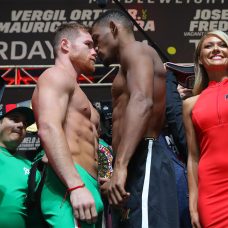
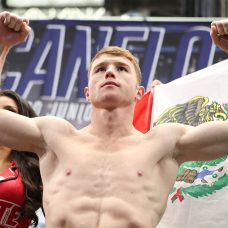
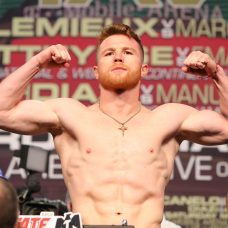
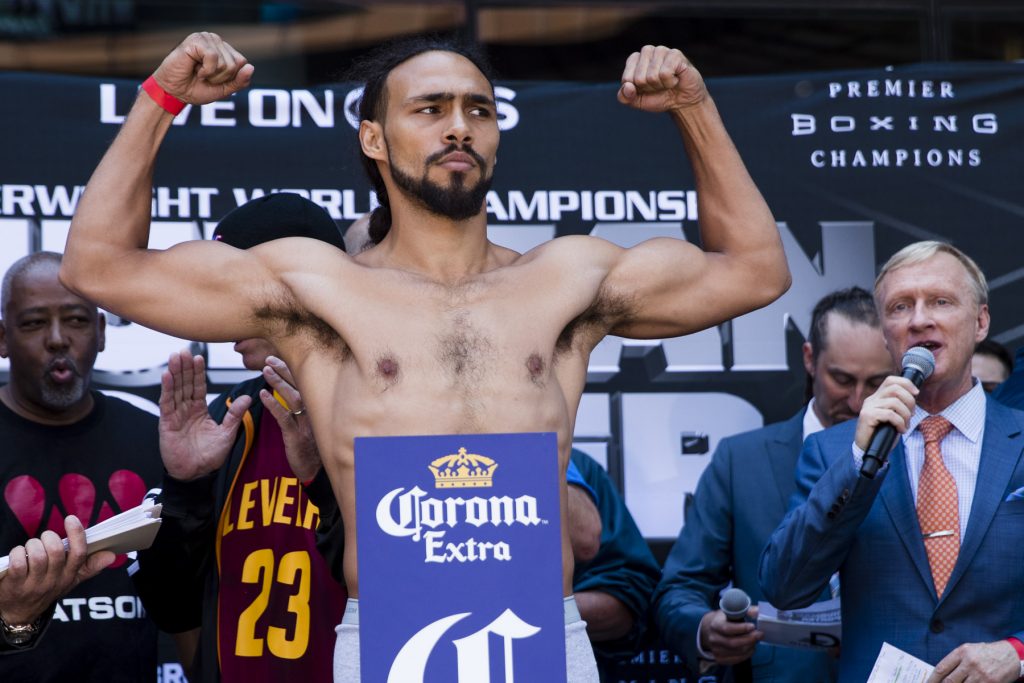
Many-sided Thurman in the role of a lifetime in his fight to unseat Pacquiao
By Norm Frauenheim-

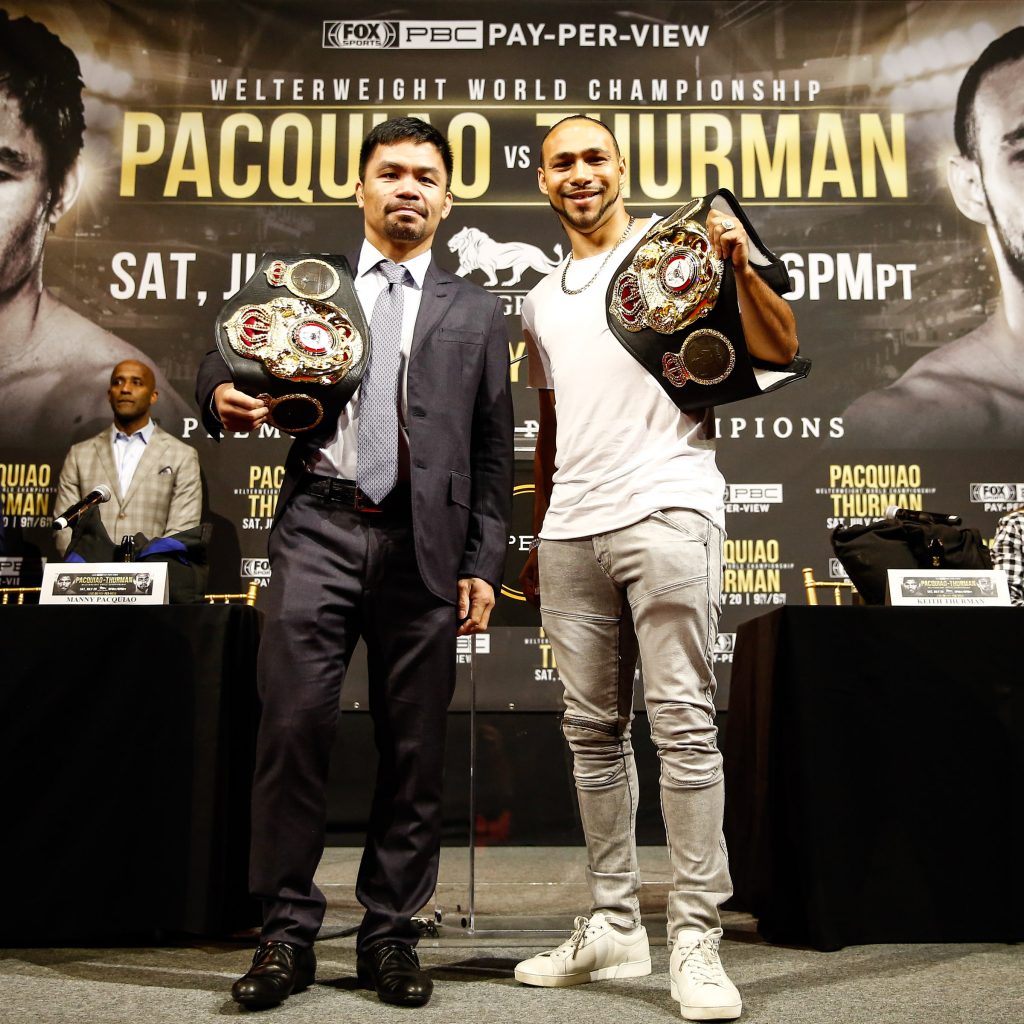
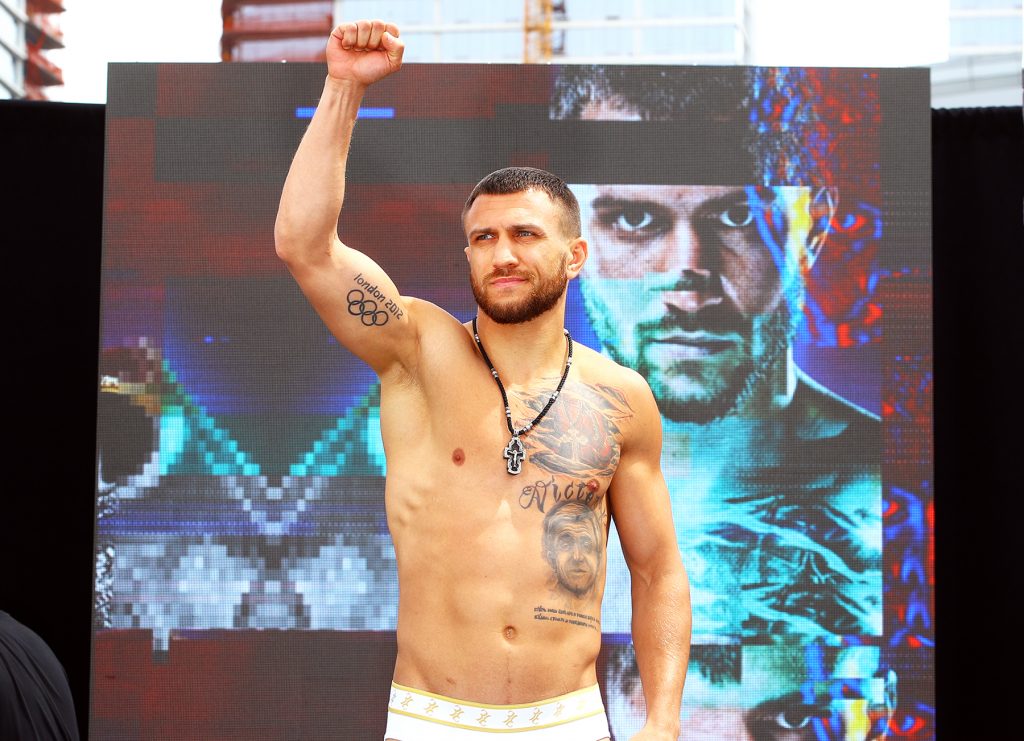
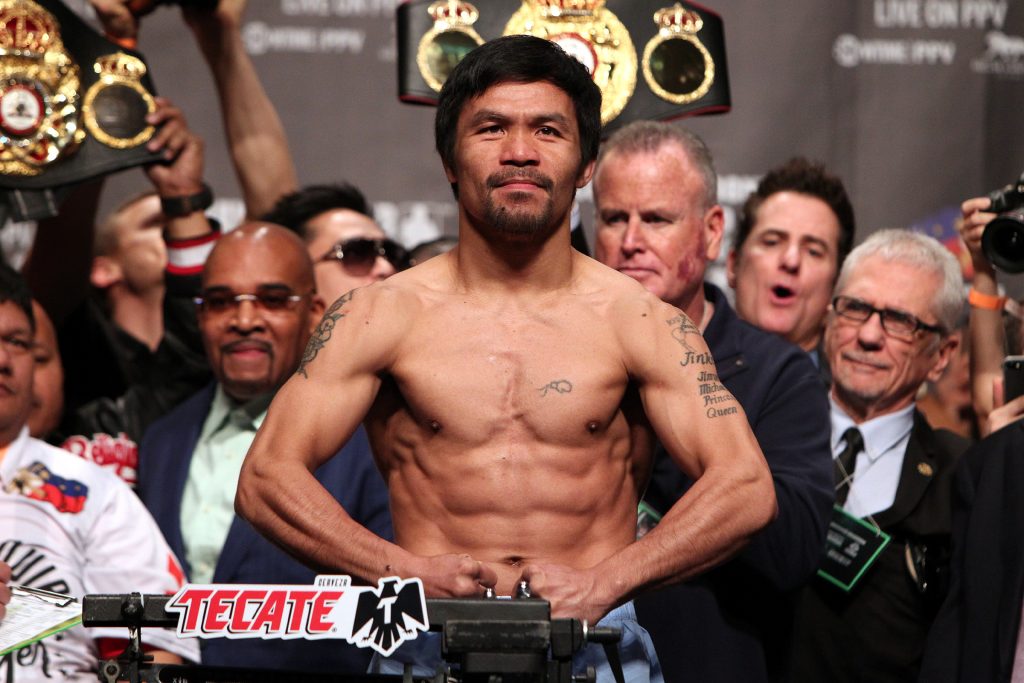
Keith Thurman has lots to say, more than enough for Manny Pacquiao to pick and choose whatever he might need for just the right amount of motivation before their welterweight fight July 20 at Las Vegas MGM Grand.

“Never been more focused,’’ Pacquiao said Wednesday during a media workout at the Wild Card Gym in Los Angeles and again on Thursday during a conference call.

Never more grateful, either.

Pacquiao has heard it all over nearly two decades at the top of a very noisy game. At this point, the Filipino Senator, boxing’s humble elder, knows what to use and what to discard. It doesn’t matter if it’s true. It just matters if it works. Enter Thurman, who is providing a whole menu of rhetorical options.

Want outrage? Thurman can do that. In the early news conferences, he promised to “crucify” Pacquiao, a deeply religious man.

Want cocky? Thurman can do that, too. Throughout subsequent media days and conference calls, he said he had the most complete resume in the welterweight division. Terence Crawford and Errol Spence Jr. are the consensus best at 147 pounds, but they don’t’have the bully pulpit this week or next.

For now, that stage belongs to Thurman, a many-sided personality who is doing his job. Big fights are about salesmanship, and Thurman is delivering it fearlessly and relentlessly. That’s a dangerous combination. But it is endlessly fascinating from a fighter who has also called himself an entrepreneur. He understands risk and roles. He has taken on both in a difficult challenge of Pacquiao, who has always played the good guy.

That’s Pacquiao’s natural role, his only role. Guess here, Thurman knows that and has filled the only role left to him. He knew he was the bad guy the day he signed for the fight. The black hat fits him well. But does it define him? I don’t think so.

“I bring entertainment,’’ Thurman said this week in a conference call. “If I win, I bring entertainment. If I lose, I bring entertainment.’’

If that stretch of canvas between the ropes is theater, Thurman might be the most versatile actor of them all. There’s a fair question as to whether he has as many punches as he has sides to his personality. But his bold salesmanship is bound to attract an audience full of Pacquiao fans who want to see him silenced and another crowd wondering whether he can in fact back it up. For now, it’s a pick-em fight

After it is all over, however, it would be no surprise to see two fighters more alike than different. Many-sided often means inherent contradictions, and there were plenty of those on display in Thurman throughout the build-up for the Fox pay-per-view fight. Thurman practices yoga. There is a spiritual side to him, just like Pacquiao.

There’s a practical side to him.

I asked him last week if he envisioned fighting at 40. He’s 30; Pacquiao is 40.

“Hell, no,” he said. “At 35, I’ll pick up a book and maybe go to college.

“At least now, I can afford a college education.’’

Oh yeah, he’s funny, too.

Mostly, however, there are repeated reasons to believe he really admires Pacquiao, despite all of that over-the-top trash talk. Thurman watched Pacquiao beat Adrien Broner at the MGM Grand in January, his first fight after he turned 40 in December. Thurman had a fight a week later against Josesito Lopez, whom he beat in a so-so performance on Jan 26 in Brooklyn.

But Pacquiao inspired him.

“I went out for a run at 1 a.m. the week before my own fight because of what Manny did,’’ Thurman said. “I was inspired by what I saw in him, by what he wants to do now at 40.’’  

Now, Thurman is in a role to stop who, what inspired him.


Bryant “Goodfella” Perrella Returns Saturday, Hopes To Move Closer To Title Shot

By Kyle Kinder-

On Saturday night at the Armory in Minneapolis, Bryant “Goodfella” Perrella (16-2, 13KO) looks to inch closer to a title shot when he squares off against Domonique Dolton (22-2-1, 13KO) in a ten round clash between two welterweight contenders.

Perrella, a 30 year-old southpaw from Fort Myers, FL, last fought in February when he scored a lopsided unanimous decision over veteran Colombian slugger Breidis Prescott (31-17, 22KO).   But what may have looked to spectators like an easy night’s work for Perrella, was in reality, anything but. “I actually hurt my left hand in the second round so I had to take some steam off the left and use it kind of more as a popping shot, more of a scoring blow,” said the 6’1” Perrella.  “Basically I just stuck to my right hand, moved to my right laterally, and kept using my jab to dominate.”

The Prescott bout came six months after Perrella dropped a majority decision to former WBA World Welterweight title holder Luis Collazo (39-7, 20KO) on Collazo’s home turf in New York.  It was the second career defeat for Perrella, the other coming via stoppage two years prior against former welterweight title challenger Yordenis Ugas (23-4, 11KO). While losses are never part of any fighter’s script, Perrella was intent on extracting the positives from those experiences. 

“You know, that’s kind of how it goes,” he said.  “When you’re striving for something you’re going to have setbacks…or I just call them learning lessons.  It’s brought me to a whole other level as a fighter and a person…it’s made me a tougher individual and better in all aspects.”

Perrella bounced back from both defeats with impressive victories.  

And in a year when boxers with blemished records have snatched titles from previously unbeaten fighters (Tony Harrison, Andrew Cancio, Julian Williams, Andy Ruiz), fighters like Perrella have taken notice.  “It’s motivating to see other guys doing it [fighters with losses capturing titles],” Perrella said. “It gives me more belief in myself that I can do it and will do it as well. You know, that’s what boxing’s all about…it’s a lot more than just the “O”.”

With regards to Saturday’s contest against Detroit’s Dolton, which will be broadcast on FS1 prior to the night’s main event which will feature welterweights Jamal James (25-1, 12KO) and Antonio “Tony” DeMarco (33-7-1, 24KO), Perrella is well aware that his career trajectory will be greatly influenced by the outcome of this fight. He also knows he’s facing a fighter who needs a win as much as he does. 

“Dolton’s been around the block, he’s a known name,” said Perrella.  “I’ve watched some film on him, but not too much. I’m not trying to get caught up in what he may try to do.  I’m just going to go in and do my own thing. But I’ve got a good general idea of the way he fights and the way he’s going to try and go about things.”  

With the stakes as high as ever, Perrella and head trainer Michael Nowling have been working non-stop at Fort Myers’ Syndicate Boxing Club.  

“Camp has been amazing, I feel great,” Perrella said.  “I’ve been working like an animal, so I’m ready to go…I’m just training around the clock like a well oiled machine and I’m ready to go put this car on the raceway.” 

With a cautious eye on the future, he added, “Obviously, after this fight, and I can’t look past Domonique Dolton in any way, but I can see myself being in contention at the very least, if not fighting for a title fight by the end of next year.” 

And with the PBC flush with welterweight titleists under their promotional banner, that’s certainly a possibility.  


Column without end, part 18

By Bart Barry-

Editor’s note: For part 17, please click here

SAN ANTONIO – This city’s McNay Art Museum, which
has figured heavily (for an art museum) in this ostensibly-about-boxing column,
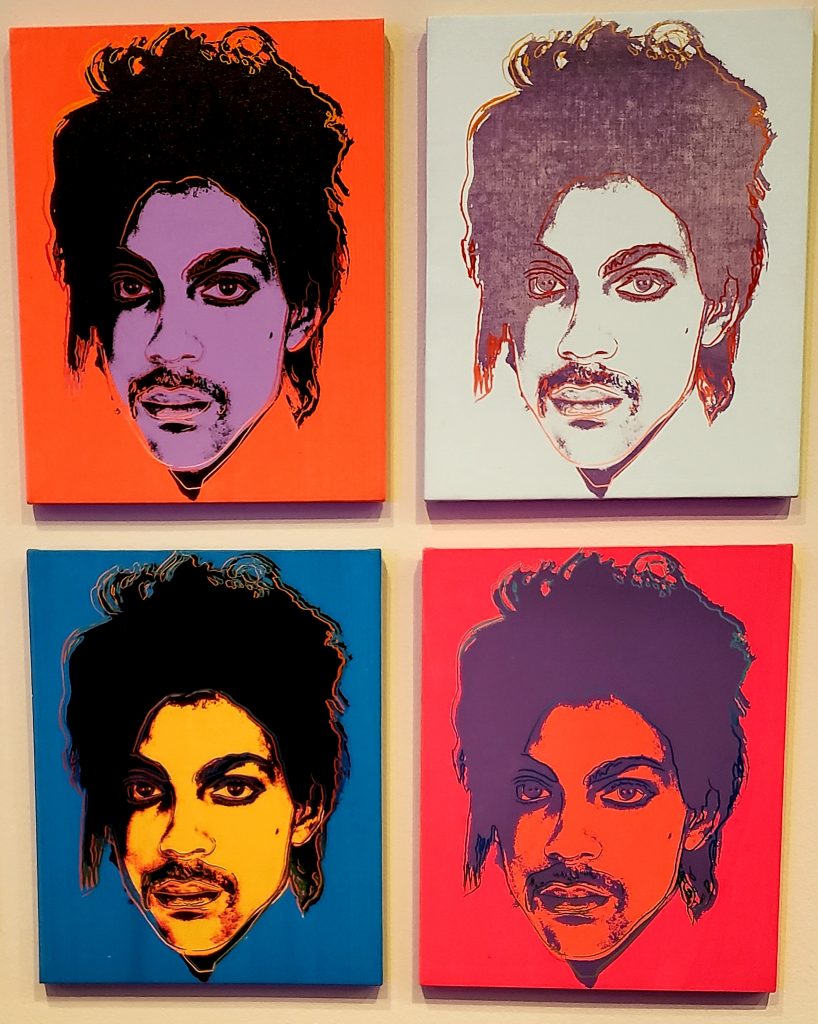
since 2010, recently opened an exhibition, Andy Warhol: Portraits, that appears
to have no tie-in whatever to our beloved sport.  I revisited the exhibition a few hours before
writing this, unable to imagine a suitable subject, and sat so long at a lobby
table afterwards a friendly security guard came over to tell me I looked tired.  Let that temper what you expect of this.

Nearly a decade ago The McNay had a different
Warhol exhibition that opened round about the time “Son of the Legend” Julio
Cesar Chavez Jr. put the wood to “Irish” John Duddy in Alamodome, in what would
be Duddy’s final prizefight.  The editor
of a boxing magazine asked me to pitch him a unique idea for a story –
“anything out of the ordinary” – and I complied with an idea about this Warhol
exhibition, a visual dissection of Warhol’s fascination with celebrity and its
effect, being open in the same city at the same time as boxing’s greatest beneficiary
of celebrity.  The pitch went nowhere, a
destination shared by the story I wrote instead for the magazine, and I made a
column of the idea.

(Actually, a quick search through the archives
reveals barely half of what’s above is accurate; “Andy Warhol: Fame and
Misfortune” opened in February 2012, not June 2010, and since by then Chavez
Jr. had beaten Duddy and Sebastian Zbik and Peter Manfredo, perhaps a story
attributing the whole of Chavez’s fortune to name recognition wasn’t the crackerjack
idea memory recalls.)

Out of the parenthetical but influenced by it: Memory
is many parts imagination, something confirmed by most adult accounts of childhood
that begin “I see myself . . .” as if that’s what children do when, say, riding
a bike – look at themselves, instead of their front tire or whatever terrain it
touches.

If Warhol never directly addressed memory’s inaccuracy,
and perhaps he did somewhere, prolific as he was, he understood part of the
appeal of his portraits to their subjects lay in a capacity for overwriting
memories.  Warhol was a favorite
portraitist of aging celebrities because his minimalist approach to depicting
facial skin removed wrinkles and most blemishes (except for his Dolly Parton
portraits, which are better than the Marilyn Monroe portraits precisely because
Parton’s face had more imperfections). 
Warhol very much made art for life to imitate and prophesied our
contemporary socialmedia obsession in any of his dozens of commentaries about
Americans and fame.

Floyd Mayweather would look good in a Warhol
portrait, methinks.  I happened on a Fox
Sports promotional movie about Manny Pacquiao last week by accident and tried
to see Mayweather through his fans and commentators’ eyes, being removed as we
are now from the relevance of Mayweather’s schtick.  What I looked for was elegance; what little I
recall of his victory over Pacquiao was Pacquaio’s unwillingness to throw
punches and subsequent inability to strike Mayweather, our defensive wizard.  But what I saw instead of elegance was skittishness.  Not during or after Mayweather got hit but
when the prospect of his getting hit happened: Confident-to-flinching-to-confident-to-flinchyflinching.  It was not elegant.

Of course this was a movie to sell us Pacquiao’s
upcoming tilt with Keith Thurman, and it behooves nobody at Fox to concede
Pacquiao is diminished from the man who got whitewashed by Mayweather, a man
who was fractionally potent as the one who dashed through Barrera and Morales
and Marquez.  Still.  In hyperdefinition, Mayweather’s
squinchyfaced pullback looks nigh bitchy.

Warhol would remove that.  If Warhol was not quite enamored of money as
Mayweather claims to be, he was doubly enamored of money’s effect, and Mayweather’s
selfstyled fixation on money might’ve enchanted Warhol with a question like: If
a man who is by no means the world’s best at making money allowed the last 1/3
of his career to be consumed by making money, a man who was the world’s best at
his actual craft, does that make money omnipotent or the man cynical?

This is why I looked tired in the lobby.  A different range of thoughts happened on the
short, slow drive from The McNay to The Pearl, where this column got wrote: Is
the racing line elegant? is the racing line what Henri Matisse was after? is
Matisse better than Warhol, for eliminating pathways to imitation, or is Warhol
better, for spawning generations of imitators? how much should even a column
such as this be dedicated to a concept, the racing line, you understand at best
partially?

The racing line is a way automobiles may go
fastest round curves.  It’s not the
shortest distance, as that would be the inside line, and it’s not a good way to
go at a constant speed.  Rather, it’s
effectively the straightest way to go round a halfcircle – start wide, cut the
apex, end wide – and by being the straightest line it is the route that allows
the earliest moment of maximum acceleration. 
If you regularly take the racing line against fellow motorists on your
local freeway you will pass most of them so long as you do not use cruise
control (which renders the racing line counterproductive).

The racing line is almost elegant the way Warhol
is almost elegant.  Neither the racing
line nor Warhol is elegant as a Matisse line; the racing line and Warhol do
something worth doing more quickly than other approaches.  The racing line kept through a full circuit
is nearer Matisse than Warhol came; Warhol was the racing line through a single
curve, maybe two.  The Matisse line,
though, is the racing line taken through an unknown circuit drawn but a moment
before.

Tire, tiring, tired.

Bart Barry can be reached via Twitter @bartbarry


FOLLOW UFC 239 LIVE (JONES VS SANTOS)

Follow all the action as it happens as Jon Jones defends the UFC Light Heavyweight title against Thiago Santos.  Also Amanda Nunes defends the Bantamweight title against former champion Holly Holm. Jorge Masvidal takes on Ben Askren in a welterweight showdown.  Former middleweight champion Luke Rockhold makes his light heavyweight debut against Jan Blachowicz

THE PAGE WILL UPDATE AUTOMATICALLY. NO BROWSER REFRESH NEEDED

LIGHT HEAVYWEIGHT TITLE–JON JONES (24-1) VS THIAGO SANTOS (21-6)
ROUND 1 2 3 4 5 TOTAL
 JONES 9 10 10 10 9 48
 SANTOS 10 9 9 9 10 47

Round 1: Santos lands a kicks that stumbles Jones..Leg Kick by Jones..Inside leg kick from Santos..Leg Kick..Leg Kick..Leg Kick..Left hand from Santos..

Round 2 Santos lands a kick but hurts his foot and lands a punch..Jab from Jones..Body kick from Santos..Big kick from Jones drops Santos..Left to body from Santos..Head Kick..

Round 3 Good leg kick from Jones…3 shots from Santos..Hard kick drops Santos..Big Knee..Knee to the body..Leg kick..Good leg kick from Santos..Santos is cut on hairline..Good kick from Jones…Kick to the body..Leg kick from Santos..another..

Round 4 Left from Santos..Leg kick from Jones…Leg kick..Inside leg kick from Santos..Body shot from Jones..Santos left leg is hurt but he keeps on fighting..

Round 5 Body kick from Santos..Right hand..Inside leg kick..2 hard kicks and a right hand…Body kick..Body kick from Jones..Left from Santos..

48-47 SANTOS; 48-47 JONES; 48-47 JONES

BANTAMWEIGHT TITLE–AMANDA NUNES (17-4) VS HOLLY HOM (12-4)
ROUND 1 2 3 4 5 TOTAL
NUNES* KO          
HOLM            

Round 1: Holm lands a left..Inside leg kick from Nunes..Knees to the body..Take down by Nunes but Hold gets right back up..Side kick from Holm..Front kick from Nunes..Right hand..Body kick..HUGE KICK TO THE HEAD THAT SENT HOLM DOWN…2 PUNCHES…FIGHT OVER

Welterweights–Jorge Masvidal (33-13) vs Ben Askren (19-0)
ROUND 1 2 3 TOTAL
Masvidal* KO      
Askren        

Round 1 MASVIDAL LANDS A FLYING KNEE AND KNOCKS OUT ASKREN…2 PUNCHES ON THE GROUND AND THE FIGHT IS OVER IN 5 SECONDS…THE FASTEST KNOCKOUT IN UFC HISTORY

Light Heavyweights–Jan Blachowicz (23-8) vs Luke Rockhold (16-4)
ROUND 1 2 3 TOTAL
 Blachowicz* 10 KO   10
 Rockhold 9     9

Round 1: Rockhold lands a front kick and left hand..Rockhold trying to get a front choke..Elbow from Blachowicz..Hard Elbow..Left hand….Left kick from Rockhold..Blachowicz lands 2 leg kicks..Nice right..Blachowicz lands a big kick to back of head at the bell…

Round 2 Rockhold gets drilled with a right..Kick from Blochowicz…BIG LEFT AND DOWN GOES ROCKHOLD…HE IS HURT …2 MORE SHOTS ON THE GROUND AND THE FIGHT IS OVER

Welterweights–Michael Chiesa (15-4) vs Diego Sanchez (29-11)
ROUND 1 2 3 TOTAL
 Chiesa*  10  10  10  30
 Sanchez 9  9  27

Round 1: Sanchez tries to take Chiesa down; Chiesa reverses..Tries for an Armbar..Take down for Chiesa..Chiesa lands some punches from the back..Chiesa has a triangle choke; Sanchez gets out of it..Chiesa lands elbows from the back…Sanchez slips out..

Round 2 Hard uppercut from Chiesa..Elbows on the ground..Body Triangle…Hard punches with on the Ground And Pound..Sanchez gets out of a choke..Spinning take down by Chiesa

Round 3 Chiesa gets Sanchez down..Elbow from Sanchez..Chiesa on Sanchez back

30-26 ON ALL CARDS FOR CHIESA

Featherweight–Gilbert Melendez (22-7) vs Arnold Allen (14-1) 
ROUND 1 2 3 TOTAL
 Melendez 9 9 9 27
Allen 10 10 10 30

Round 1: Allen jabbing..Nice kick..Allen landing sharp punches…Straight left..Elbow from Melendez..Uppercut and body shot from Allen..Straight left

Round 2 Head kick from Allen..Big combination..1-2…Leg Kick..Combinations..Sharp combination..Straight left/Uppercut..Check hook..Body Kick..Straight left to the body.Melendez lands a right..

Round 3 Allen lands a left to the head..Allen takes Melendez down..Good left from Melndez..Leg kick from Allen..Nice straight left..Left from Melendez..Right..Leg kick from Allen..High kick..Good Kick

Bantamweights–Marlon Vera (15-5-1) vs Nohelin Hernandez (10-2)
ROUND 1 2 3 TOTAL
 Vera* 10 SUB   10
 Hernandez  9     9


Round 1: Inside leg kick from Vera..Hernandez legs kicks but Vera catches it..Vera has Hernandez back in a Triangle..Vera has Hernandez in an Armbar..Hernandez reverses and lands some Ground and Pound

Round 2 Great Head kick from Hernandez..Vera lands a hard kick that puts Hernandez on the ground…VERA HAS HERNANDEZ BACK…REAR NAKED CHOKE AND HERNANDEZ TAPS

Strawweights–#6-Claudia Gadelha (16-4) vs #14-Randa Markos (9-6-1)
ROUND 1 2 3 TOTAL
 Gadelha* 10 9 10 29
 Markos 9 10 9 28

Round 1:  Left hook from Gadelha..Counter..Inside leg kick..Left head kick..Nice right..Good exchange..Markos swelling around left eye..Good right from Markos

Round 2 Head kick by Gadelha,,Combination from Markos..Nice Jab…Gadelha lands a left..Knee From Markos..Nice right..Kick from Gadelha..Right uppercut from Markos

Round 3  Uppercut and left from Gadelha..Nice Leg kick from Markos..Counter from Gadelha..Good right

30-27 on ALL CARDS FOR GADELHA

Bantamweights–Song Yadong (13-3) vs #13-Alejandro Perez (21-7-1)
ROUND 1 2 3 TOTAL
 Yadong* KO      
 Perez        

Round 1  HUGE RIGHT HAND BY YADONT LANDS PERFECTLY ONLY THE CHIN AND PEREZ IS BRUTALLY KNOCKED OUT at 2:04

Middleweights-Edmen Shahbazyan (9-0) vs Jack Marshman (23-8)
ROUND 1 2 3 TOTAL
 Shahbazyan* SUB      
 Marshman        

Round 1: Hard standing ground and pound by Shahbazyan..Shabazyan all over MARSHMAN –REAR NAKED CHOKE AND THE FIGHT IS STOPPED AT 1:!2

Welterweight-Chance Recontre (17-3) vs Ismail Naurdiev (18-2)
ROUND 1 2 3 TOTAL
 Recontre* 9 10 10 29
 Naurdiev 10 9 9 28

Round 1: Nice elbow by Naurdiev,,,Nice kick..Rencountre on top of Naurdiev..

Round 2 Rencountre has Naurdiev’s back..Rencountre is landing ground and pound from the back

Round 3 Rencountre keeping Naurdiev on his back 

29-27, 29-28, 30-27 for Rencountre

Bantamweights-Pannie Kianzad (11-4) vs Julia Avila (6-1)
ROUND 1 2 3 TOTAL
 Kianzad 9 10 9 28
 Avila* 10 9 10 29

Round 1: Avila lands 2 high knees..Left hand from Kianzad..High knee From Avila..Elbow lands..Left..Kianzad lands a right..Left hand..Good right hand..Uppercut by Avila drives Pianzad back

Round 2 Avila lands an elbow over the top..Good leg kick from Kianzad..Take down..Right hand..Good right from Avila…Avila is cut over the right eye…Hard right hurts Kianzad..Good combination..Good front Kick..Avila gets the back on the ground.

Round 3 Avila lands a knee to the body…Hard right knocks Kianzad down..Ground and pound..Avila gets Kianzad’s back..Kianzad bleeding from around her right eye

3027, 30-26 twice for Avila


Pacquiao-Thurman: A title fight and battle to regain identity

By Norm Frauenheim-
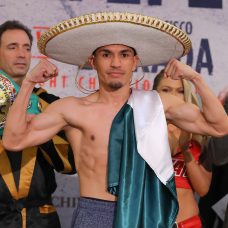
It’s a fight hard to pick, mostly because Manny Pacquiao and Keith Thurman are welterweights fighting to recreate themselves or perhaps re-discover who they were.

The guy who wins the identity crisis wins the fight. That’s one theory, anyway.

Sixteen days before opening bell at Las Vegas’ MGM Grand, there’s only one familiar trait. Pacquiao’s likability is unchanged, un-eroded by time and controversy. His popularity has been evident ever since the Filipino Senator arrived back in Los Angeles a couple of weeks ago for his final stretch of training at the Wild Card Gym.

Social media is full of photos of Pacquiao doing his roadwork on LA streets. Crowds of runners follow him in scenes straight out of Forrest Gump. At a couple of levels, Pacquiao is little bit like the Gump character. The Senator has done it all in an unlikely rise from crushing poverty to international celebrity. But like the Gump film, there’s also that line about a box of chocolates. You never know what you’re going to get.

That sums it up for just about every 40-year-old fighter. Pacquiao is beyond his prime, yet still has muscle memory that can recapture legendary moments. For one night at least, he could be the younger guy. Then again, he could be just another old guy trying to extend his career with one more paycheck. The reviews for Pacquiao’s last two outings have been good.  Power was there in a stoppage of Lucas Matthysse in 2018. Speed was there in a decision over Adrien Broner in January.

But Matthysse was shot, a hollowed-out version of the feared puncher he had been. Broner was there to outrage, insult and entertain. He did all of that and more. He did everything, however, but fight. His punch output barely registered on the CompuBox meter.

Neither Matthysse nor Broner provided enough opposition to really get a fair look at what kind of fighter Pacquiao really is at 40. Maybe, it won’t matter against Thurman, who is called One Time yet has looked Past Time over his last few bouts. Perhaps, injuries and inactivity help explain his forgettable performance against Josesito Lopez.  Or, perhaps, he is exactly the fighter he has appeared to be.

 That said, he is 10 years younger than Pacquiao. He should be at his prime and he promises to be there – or back there – against a middle-aged fighter whose name is still as current as ever. There’s a better chance that the younger man can recapture his edge more readily than the older man. Thurman is still young enough to be the welterweight he has always been projected to be.

For Pacquiao, it’s not that easy. A lot of it just depends on what his aging body feels like when he wakes up on July 20, fight day.

Guess here, the odds will remain even until opening bell. Pacquiao might be a slight favorite, simply because of his enduring popularity. Those guys running behind him in those roadwork photos will bet on him too.

 Meanwhile, don’t be surprised if Thurman attempts to do what a forgotten name did to Pacquiao in Australia a couple of years ago. Remember Jeff Horn? Horn roughed up Pacquiao in a punishing fight in Brisbane in July 2017. Horn won a controversial decision before hometown fans. In Vegas, it is fair to say the scoring would have gone the other way in a decision for Pacquiao, a longtime Vegas favorite.For now, however, Horn’s performance provides a tactical blueprint for Thurman, who like the Aussie can use his strong upper body to tie up, slow down and perhaps beat Pacquiao. It all depends on who shows up.  


A column with a lot of potential

By Bart Barry-

There were recent fights aplenty with which a
grateful boxing writer might fashion a column, and this writer should be
grateful as any, writing weekly columns, as he did, through yesteryear’s summer
famines.  But important as it is to write
well about great fights and the courage that makes them so is how difficult it
is to write well about poor fights and the mismatchmaking that makes them so.

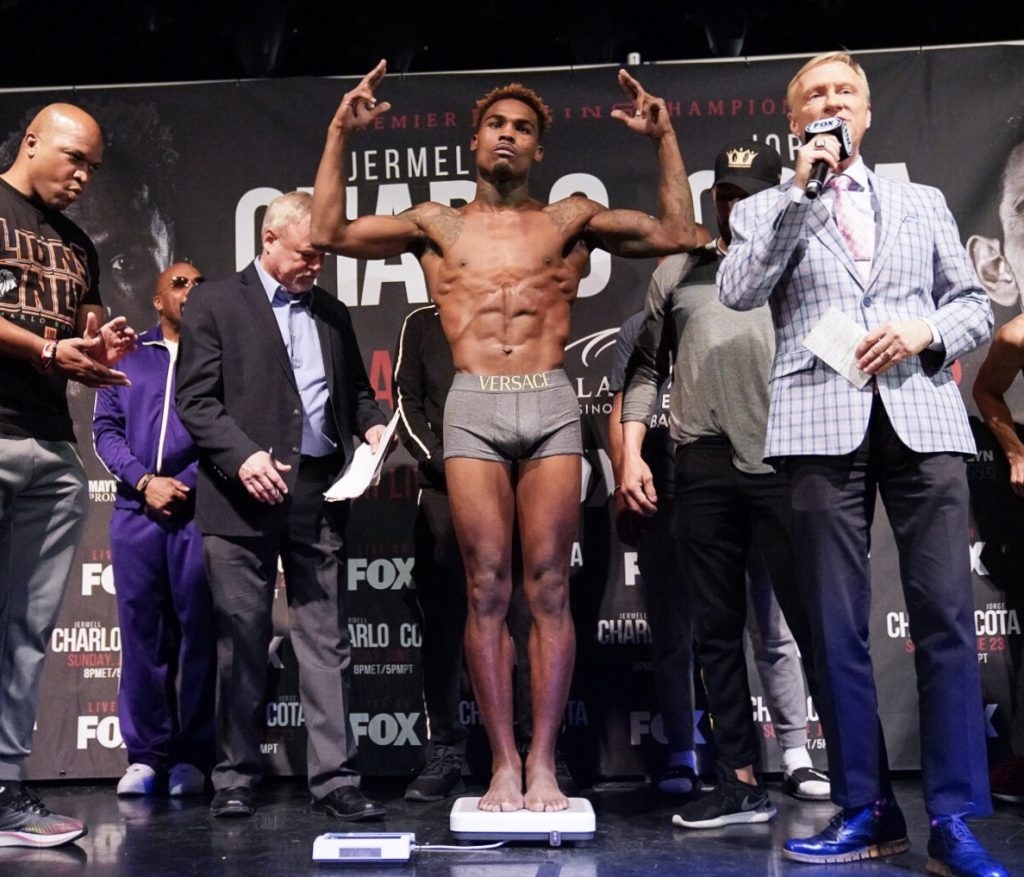
One of the Brothers Charlo iced a two-sentence-Wikipedia
opponent a couple Sundays ago, the other Brother Charlo decisioned a
multi-sentence-Wikipedia opponent Saturday, and Demetrius Andrade kept his
resume spotless by keeping away from a featherfisted Pole.  Surely 80 minutes of prizefighting affords
material enough for 1,000 words of opinion. 
Or surely not.

I plead ignorance from the top.  I don’t know enough about either Charlo to
tell one from the other.  Both fought in the
last calendar week, both were defending a title of some sort because the
Brothers Charlo are PBC veterans enough to be titlists, though I can’t say
which Charlo beat whomever to attain whichever title or if either Charlo has
changed weightclasses anytime recently or really was defending a title
(Editor’s note: Actually, never mind).

Full disclosure: The closest I ever followed a
Charlo fight was when one of them sparred writer Kelsey McCarson for charity.

I expected the Brothers Charlo to be fighting on
Fox these days – didn’t they both do so a while back? – but I couldn’t find either
of them on my local Fox affiliate, and I haven’t had Showtime since December.  I watched their joint postfight
pressconference Saturday night on YouTube and came away feeling like I’d missed
not a thing since losing interest in them many years ago during a Houston
undercard or two.

The usual: Everybody respects us, nobody respects
us, the world is going to respect us; we’ve done so much, we’re just getting
started, wait till you see what’s next; nobody knows us, everybody recognizes
us, the people who know us best don’t know us at all; lions only, lions Only,
Lions Only!  If this were an effort to be
mysterious or conflicted or even controversial it would mean something more
than all it actually means, which is the standard and tired marketing fare of
being all things to all people, this time with a scowl of some sort.  One of the Brothers Charlo implied he
might’ve sold so many more tickets if he’d put himself in a larger venue, which
seemed an odd swipe to take at himself or his promotional partner, the other
Brother Charlo, sitting next to him and apparently in charge of booking.

What everyone realizes by now is the Brothers
Charlo and many of their PBC brethren are hamstrung by management.  They can dominate whomever PBC’s network of
matchmakers conjures up and wear whatever belts complicit sanctioners cobble
together, but they’ll not unify anything or attain universal recognition.

They wear the PBC on ShowFox belt, while an ESPN
champion makes war on his network’s nonentities, and a DAZN champ has a modicum
more respect, or much more respect, for having beaten a known opponent – read:
an opponent whose name you knew before the ESPN or ShowFox pressrelease – sometime
and somewhere in the last two years.

This shouldn’t be read, or at least not precisely,
as an indictment of PBC champions.  Most
of their safetyfirst exhibition title defenses happen before unenthusiastic
crowds and overly enthusiastic television crews, perhaps, but at least they’re
getting paid way more than fairmarket value for their efforts.  DAZN champions, meanwhile, are getting
overpaid, too, but with the very real chance they may be upset, through poor
fortune or tournament whimsy.  ESPN
champions get paid about the least and contend with the anxiety of a mercurial
boss and ingenious matchmaker; keep Bob happy and Bruce’ll get you opponents
that make you better, but make Bob unhappy and Bruce’ll get you beat by
Christmas.

Which all adds up to what?  About half a column, according to the count
in the bottomleft corner of this screen.

Then let’s dive shallowly into Demetrius “Boo Boo”
Andrade, the nearest DAZN has to a Brother Charlo of its own (unless you count
Danny Jacobs, whom you probably shouldn’t count because, after all, Jacobs has
tested himself by narrowly losing to his division’s two best men).

So much potential, that Boo Boo!

Literary critic James Wood once wrote, and I could
swear I once quoted but Google does not confirm, that potential is only potent
so long as it goes unused.  Nobody muses today
about Roberto Duran’s potential as a lightweight or Floyd Mayweather’s
potential as a pay-per-view attraction.  Potential
is what we assign teenage prospects, not 31-year-old middleweight titlists.

Andrade gets this. 
If you were to ask him about his potential this morning, probably he
would take it as the insult it intends and tell you how many tickets he just
sold in Rhode Island of all places.  He
should add but wouldn’t: “It’s 20-percent more tickets than Charlo sold in his
hometown the same night, and Charlo’s hometown is 12 times the size of mine.”

The reason he should add that is the reason he
won’t: Charlo, not Canelo, is whom Andrade should target as his breakthrough
opponent.  Who would win that match?  Nobody knows. 
There are potential-fetishists on either side of the debate.

The proper broadcaster for the match, however, be doubtless
– “ShoBox: The New Generation”.

Bart Barry can be reached via Twitter @bartbarry


A monkey, a flea, and the real meaning of Mexican Style

By Bart Barry-

Friday on a Golden Boy Promotions card that DAZN broadcast from Indio, Calif., super featherweight titlist Andrew “El Chango (The Monkey)” Cancio snipped and slipped the stiches from Puerto Rican Alberto Machado in a rematch of their February upset, shortly after Mexican light flyweight Elwin “La Pulga (The Flea)” Soto attritioned Puerto Rican titlist Angel Acosta early in their 12th round.

What Soto did, and Cancio did again, returned meaning
to what was meant by “Mexican Style” before a Mexican-trained Kazakh and his
promotional apparatus borrowed the term for HBO interviews.  Inherent in the term is an underdog status or,
at very least, an evenly matched contest in which a question of mettle must be
answered.

Fighters who employ Mexican Style generally lack
their opponents’ reach or handspeed or power; Mexican prizefighters do not wish
to get struck in the face any more than any other type of prizefighter does but
find themselves at physical disadvantages, realize getting struck they must,
and repeatedly, to prevail, and choose to continue under disadvantageous terms
until the last remaining variable is will.

Here’s what Mexican Style is not: Brutalizing a
20-to-1 underdog recruited from a lower weightclass and so hopelessly outgunned
you can dominate him without risking your own consciousness even a little.  Now that fighters who employ Mexican Style ply
their crafts on the same network as the fighter who uses a Mexican Style hashtag,
it behooves aficionados to continue our reevaluation of all things late-HBO.

In both matches Friday the Mexican Style fighters
had fewer tools than their opponents, both of whom happened to be Puerto Rican
– a detail more ethnic-rivalry coincidental than otherwise.  Setting aside the controversy that properly
accrued round comain referee Thomas Taylor’s premature stoppage – a surprisingly
favorable outcome for Soto, given how much time Taylor bought Acosta with round
3 warnings – the man with fewer tools in the kit all night was Soto. 

Acosta had reach and size advantages, yes, but
also technical advantages and a dandy uppercut boxing’s lexicon suggests be
just the thing to dissuade an over-the-lead-knee grinder like Soto.  The Flea, then, spent most of a half-hour
getting peppered coarsely by a man who knew how.  Yet Soto didn’t relent.  That relentlessness in the face of
unfavorable happenings is a hell of a lot more Mexican Style than making highlightreel
corner stoppages on feckless featherfists who cut quickly. 

Cancio, too, had the same obvious physical and technical
disadvantages in his rematch with Machado as he did in their first tilt.  The result of Cancio’s first fight, though,
the largest upset of 2019 until Andy Ruiz took Manhattan, emboldened Cancio to
reduce his rematch to a matter of willfulness even sooner than he did their
first time.  Machado wanted absolutely
none of it.  The better boxer with the
better pedigree and the better resume, Machado explained away to himself his
first loss like a matter of fitness; he’d nearly missed weight, starved himself
the day before the weighin, faded early and learned his lesson.

But the lesson Cancio gave was one he didn’t
learn.  Boxing circles round Cancio,
having the requisite fitness to hit him and not be hit by him, never was going
to suffice for Machado.  He needed to
hurt Cancio till The Monkey went physically unable to punch back.

“I’m so much better than this guy” – that’s the
trap into which Mexican Style has lured many a flashy prospect or titlist.  Cancio had Machado deep winded after six
minutes.  A deep winded man hasn’t much
left but will, and Cancio thrilled at such a contest 30 minutes early.  He took his time and lined-up the button shot
then watched Machado crumple, rise to a knee and prep for his facesaving 10 1/2-count.

Again, until the world met Andy Ruiz some weeks
ago, Cancio was boxing’s feel-best story of 2019.  Nothing about Ruiz’s ascent diminishes
Cancio’s (or Elwin Soto’s).  Cancio is a
proper workingclass prizefighter, a man you can decision far more easily than beat.

But while we’ve got Mexican Style in mind and
words to spare, let’s return to Andy Ruiz for a spot.  What he did to Anthony Joshua was Mexican
Style not for its toolbox disadvantage but for its colossal physical
disadvantages.  Joshua was much bigger
and much stronger and hit much harder but knew little of relentlessness.  When the time came for teethmarking the
gumshield Joshua made his escape.

Joshua surely awoke that Sunday morning with an
abiding sense of absurdity like what haunted Machado the day after his first
loss to Cancio.  Joshua, with many times Machado’s
sycophantic entourage, invariably learns as you read this the same sort of
wrong lessons Machado gained.

From Joshua’s hangerson we hear about prefight
concussions and the like, which, while quite possibly true, do nothing to
prepare Joshua for what relentlessness Ruiz will show him in their rematch.  Ruiz now knows Joshua’s a flowerchinned wilter
and the directest route to the mettle question should be Ruiz’s line.  If both men hit the canvas in rematch round
1, Ruiz knows, he’ll defend his title in half the time it took him to acquire
it.

But do you expect anyone is telling Joshua this?  Not when there’s a fortune to be made in
excuse-making: “Lucky punch, champ, he caught you cold, we know that wasn’t the
real AJ, can’t trust New York food, don’t know what the ref was thinking, we
know the truth, you wanted to continue – everybody knows that!”

Expect Ruiz to Mexican Style his way through
Joshua in their rematch the way Cancio just did Machado.

Bart Barry can be reached via Twitter @bartbarry


Fury-Wilder II: Fury is already winning the preliminary rounds

By Norm Frauenheim-
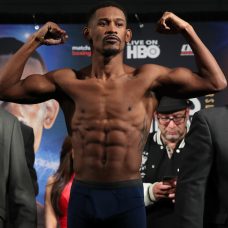
Reviews continue, days after Tyson Fury sang his way to a second-round stoppage over an unknown German in what was more of a Vegas lounge act than a fight.

It was fun. It was boxing’s version of junk food. But I’m not sure what to make of it, other than to say that Fury could be a very good Elvis impersonator if his day job as a heavyweight doesn’t work out.

Above all, it was an introduction, and a successful one in terms of what Fury hopes to accomplish next year.

Put it this way:

Fury is already winning the rematch.

For all that it mattered, Fury could have been fighting Tom Schwarz or Sergeant Schultz. The whole point to the song-and-dance last Saturday at Las Vegas’ MGM Grand was the long-anticipated rematch with Deontay Wilder, projected for some time in 2020’s first quarter.

Psychologically and politically, the rematch has been underway for a while. A lot still has to happen – and not happen – before an opening bell.

Wilder has to beat Luis Ortiz in a rematch tentatively scheduled for September.

Fury has to beat whomever he faces on either Sept. 21 or October 5. Please-please, don’t it let be Jarrell “Big Baby” Miller, who comes off a WBA-mandated suspension on Sept. 19. A positive-PED test got Miller bounced from the Anthony Joshua fight, allowing stand-in Andy Ruiz Jr. to spring an all-time upset on June 1. More on Miller later, hopefully much later.

In the here-and-now, only two heavyweight fights matter: Wilder-Fury and Ruiz-Joshua, both rematches. Most of the current talk is about Wilder-Fury. The attention – and money – invested in Fury is astonishing. ESPN did a two-hour special on Fury before last Saturday fight on ESPN+. Two hours of prime time for fewer than two rounds, or fewer than six minutes of one-sided boxing.

But the media and promotional investment – reported to be $100 million – gives Fury an early edge in the projected sequel, especially if it is in Vegas. Top Rank already is promoting Fury as though he is a Vegas fighter.

It’s a smart and subtle move. The rematch feels like a Vegas fight and you know what they say about Vegas: The House always wins. Imagine if Fury’s had already gained a public foothold in Vegas and the first Wilder-Fury bout had been at the MGM Grand instead of Staples Center in Los Angeles.

Wilder-Fury I remains controversial. It was a draw. Fury out-boxed Wilder for at least eight rounds, but Wilder scored two huge knockdowns in the final rounds, including one in the 12th that saw Fury climb off the canvas like a man climbing out of a coffin.

Judges are supposed to be objective. Some more than others. But they are all human, meaning they are influenced by what they hear and see. Had it been in Vegas and those judges had witnessed a Fury they already knew in his amazing display of resilience in the 12th, the guess here is that scorecards would have been Fury in a narrow decision instead of a draw.

There is every reason to think the rematch will play out in much the same way the first bout did. Fury’s reach, clever versatility and footwork are the same. Wilder’s fight-ending power is the same. It’s still close, very close.

But, for now, Wilder is winning all of the preliminary rounds.


Elbows up, lads: The WBSS delivers us more violence

By Bart Barry-

Saturday at Arena Riga in Latvia in a pair of
prizefights broadcasted by DAZN the World Boxing Super Series arrived at its
cruiserweight-finals pairing violently. 
Two evenly matched matches ended in competitors’ unconsciousness, with a
Cuban clipping an American’s circuits and a Latvian doing somethings awful to a
Pole.

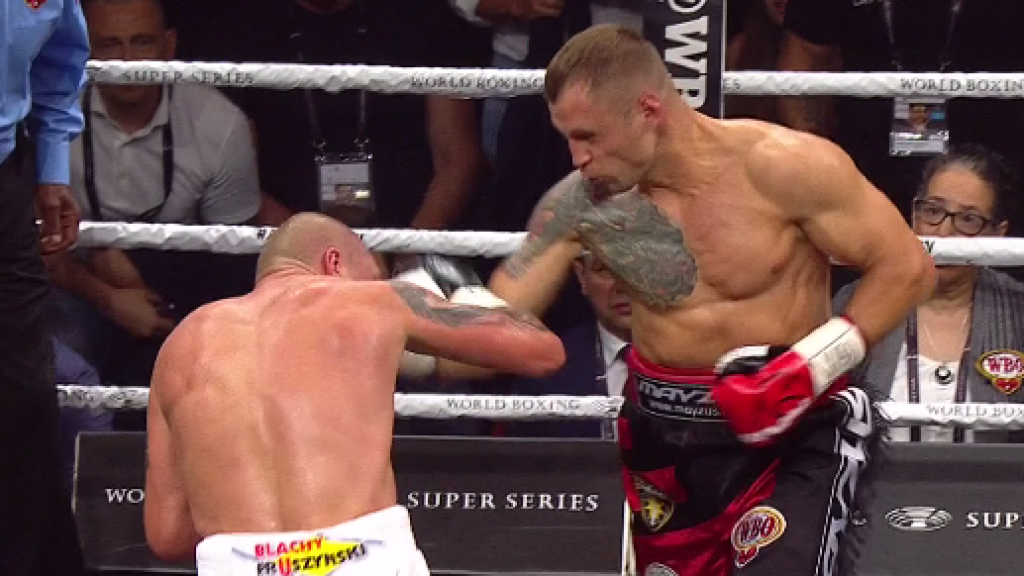
First, Mairis Briedis’ mainevent manhandling of Krzysztof
Glowacki: In an officiating context what transpired was shoddy-cum-catastrophic
and ought result in a pension for Robert Byrd. 
In a prizefighting capacity, though, it was handsome sporting and
something others might try.

We’ve all seen the preamble hundreds of times:
Fighter A overthrows the right cross, and disbalances himself, while Fighter B
ducks the punch and arrives 90-degrees right of square when he resurfaces;
Fighter A protects his brainstem with his right glove, elbow out, while both
men wait for the ref to untangle them. 
Nearly never does Fighter B wing a left hook at the back of Fighter A’s
head.  But in round 2 Glowacki thought it
a capital idea.

Then Briedis showed us promptly why no one does
this by driving his raised right elbow directly through Glowacki’s unguarded
jaw.  Glowacki received the shot, realized
what’d happened and went full soccer-player. 
This, more than the infractions that preceded it, offended Robert Byrd’s
sensibilities, and he slapped Glowacki on the back and demanded he rise to play
audience to Byrd’s deducting a point from the Briedis tally, without anybody,
including Byrd and Glowacki, realizing how ruined Glowacki was.

A charitable read of what followed is the Latvian
crowd’s zealous disapproval of Byrd’s ruling jarred Byrd such that he was unable
to hear the round’s closing bell.  A
realistic read is that Byrd is too old to be refereeing a scrap between
200-pound, non-English speakers, and Briedis’ scorn for Queensberry’s marquess reduced
Byrd to a doddering elder.

Whatever it was, after Briedis dropped Glowacki on
the blackmat a second time, this time with punches, and Glowacki rose, the
round ended and the Latvian bell began to tinkle, insistently if euphoniously, and
Briedis and Glowacki continued to make war while Byrd went to that tranquil,
nostalgic place grandads do after disabling their hearing aids.  The timekeepers stood and waved frantically,
to no avail.  Fact is, had Briedis not
dropped Glowacki at 3:11, causing Byrd to glance the timekeepers’ way for a
10-count, round 2 might still be happening as you read this.  Briefly returned to lucidity, Byrd
acknowledged the round’s end like an NFL ref stopping the playclock, which
sundry folks, including the Glowacki corner – by then approaching its 30th
second on the apron – understood to be Byrd’s waving-off the fight.

In all of Latvia, only Robert Byrd knew what the
hell Robert Byrd was doing.

Both fighters stood in their corners awaiting a
ruling, and not resting, while the 60-second respite ticked by and Byrd pantomimed
his inability to hear the very bell he successfully heard close round 1.  Glowacki’s chief second ran all the way
across the canvas and pantomimed for Byrd a threeminute duration on his
wristwatch.  Byrd scolded the man then
turned and scolded the timekeeper for not ringing loudly enough a bell everyone
else heard.  Glowacki did not receive
time enough to recuperate from Briedis’ elbow (which, quite probably, Byrd
missed altogether and only thought to penalize via inference) and did not
receive time enough to recuperate from his first legal knockdown.

And recovered Glowacki wasn’t when round 3 began
and Briedis made quick work of his remaining consciousness.  Odds are fair Briedis would’ve won one way or
another had all things happened fairly, and frankly a well-leveraged elbow may
be just the remedy for a well-leveraged rabbit punch; legal or not it’s exactly
what the word “fight” conjures in innocent minds.

But the Byrds must be helped into retirement (yes,
Robert’s wife, Adalaide, and yes, that Adalaide Byrd, was an official
scorekeeper for Saturday’s mainevent). 
Over and again, beginning with the prefight instructions, Robert Byrd
played the role of a senior American who comes upon a foreigner and thinks if
he just yells English at him, rather than speaking it, the foreigner will
understand.  Byrd explained to the
fighters, who’ve been hearing “break” their whole fighting lives, that Byrd
wouldn’t wrestle with them and expected an immediate cessation when he called
“stop” – which of course didn’t happen. 
Then Byrd got his branded-for-TV tagline in, and the fight began.  Then the fight turned into one, between two
large men who knew how, becoming no place for a 74-year-old, something one
assumes the WBSS, if not the Nevada Athletic Commission, will remember henceforth.

Before all that, in the comain and fellow
semifinal, Cuban Yuniel Dorticos drycleaned TMT’s Andrew “Beast” Tabiti with a
round-10 right hand that was gorgeous. 
There was something aesthetically piquant about DAZN’s closeup of Tabiti’s
goldtoothed-vampire gumshield as Tabiti’s involuntary breaths went round it
while his Money Team hangerson sheepishly footdragged to his aid.  They were there for the victory party, not
the cleanup, and hadn’t an inkling what to do while their man spent two minutes
rigid.

What now will follow is another excellent WBSS cruiserweight
final that complements its bantamweight and super lightweight finals.  There’s lots more to be written about the
natural power of selforganizing entities, but for now let us marvel once again at
how much better the tournament format serves our interests, as aficionados, than
what promoter-driven swill generally befalls us.

Bart Barry can be reached via Twitter @bartbarry


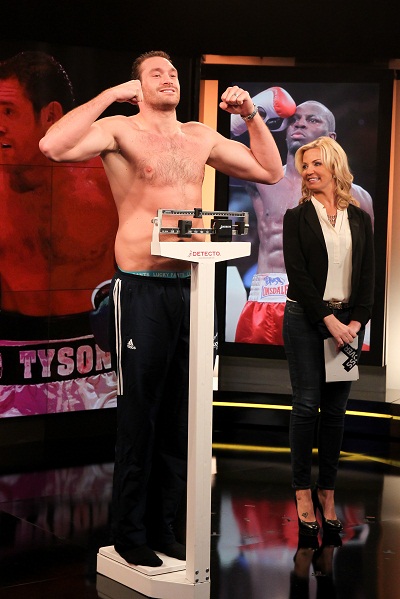
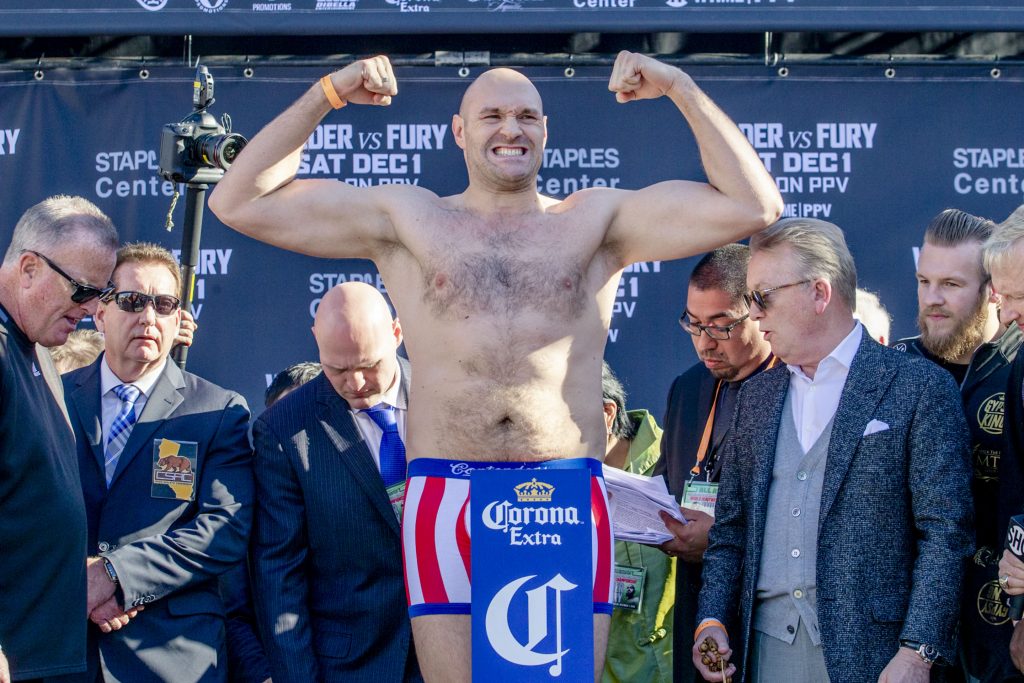
Weigh-in Show: Tyson Fury goes to the scale twice, first for the Commission and then the fans

By Norm Frauenheim-

LAS VEGAS – Show Tyson Fury an empty stage and it won’t stay empty for long. He’ll fill it, all 6-foot-9 of him and a charisma for which there is no tape. No tale, either. But that intangible charisma is there, big enough to fill a stage and a room.

Fury did both Friday for his bout Saturday against German challenger Tom Schwarz for the lineal heavyweight title in an ESPN+ televised fight at the MGM Grand.

He took the stage for a weigh-in re-done for ESPN cameras at a prime-time hour. The real weigh-in – one regulated by the Nevada Commission – had already happened in the morning. The weights were documented and filed by the time Fury stepped onto the scale for what was a little bit like lip-synch.

But the show must go on. So, too, must a showman.

Fury was there for, fulfilling his promise to entertain in first fight in a new deal with ESPN and Top Rank.  A small crowd roared. Fury waved one finger at Schwarz. Maybe, it was his way of saying the fight would last one round. Or that one punch would finish Schwarz. Or that Schwarz didn’t have one chance. Fury is a prohibitive favorite. In the UK, Schwarz is a 12-1 longshot.

Oh yeah, Fury (27-0-1, 19 KOs) was 263 pounds, six-and-a-half pounds heavier than he was for his last fight in a controversial draw with Deontay Wilder in December in Los Angeles. Schwarz (24-0, 16 KOs) was at 245.5 pounds.   


Tyson Fury back at a work on one plan that emerged after he was hit

By Norm Frauenheim-

LAS VEGAS – He is named for a fighter who these days is remembered for some wisdom about how vulnerable a plan can be.

Everybody has one, Mike Tyson said, until he gets hit. Tyson left it open-ended, leaving an implicit suggestion that there was only chaos after one punch lays waste to any plan, no matter how carefully plotted and practiced.

But Tyson Fury, whose dad named him for Mike more for the heavyweight chaos he caused than the wisdom he left, survived the hit without a planned victory, yet with a new plan already as rich as perhaps it will be far-reaching. It came about, maybe because of Fury’s resiliency or instinctive creativity.

He was born to fight.

Born to promote, too.

Fury has done more of the latter than the former in the wake of an astonishing moment last December when he awakened from a lightning bolt of a shot from Deontay Wilder. One moment Fury was face down on a stretch of canvas at Los Angeles Staples Center. A moment later, he was upright, a fighter resurrected and soon a man with a plan that for a few perilous seconds looked as if he were finished.

If you subscribe to his namesake, the new plan is as vulnerable as the old one was. But that’s why Fury (27-0-1, 19 KOs) is about to re-enter the ring Saturday night (ESPN+) against a German challenger, Tom Schwarz (24-0, 16 KOs) at the MGM Grand Garden Arena. 

“I believe the fight with Wilder only helped my profile here in the United States, and here we are again, only a few days away from the biggest fight of my life,” said Fury, whose comeback in the ring marked a longer, more compelling battle with depression, including thoughts of suicide. “I talk about mental health a lot because it’s very important to me. Only 18 months ago, I was in a very, very dark place. I just wanted to prove to people that there is a way back. You can come back from anything. Nothing is impossible, and if you’d seen me a time ago when I was very heavy and very unwell.’’

Fury is back for his first bout since the Wilder drama in an opening step to introduce the UK heavyweight to the American market. He signed rich deal with ESPN and Top Rank’s Bob Arum, who sees some of the same charisma in he saw in Muhammad Ali and George Foreman.

Fury, Arum says, “is a guy people can relate to. He has the ability to capture pubic imagination.’’

Sure enough, Fury has been busy working on exactly that is appearances throughout the last couple of weeks. He showed up early at a news conference Wednesday, presumably just to schmooze. He was shirtless under a wildly-colored sports coat. It was reminiscent of Foreman in the comeback stage of his career. Foreman would show up in hotel lobbies and press rooms, sometimes with a cheeseburger in one hand, always a smile and never speechless. He was impossible to dislike.

So, too.is Fury, nicknamed The Gypsy King for his bare-knuckled heritage as a son of the Irish Travellers. They crisscrossed the UK, a travelling circus. In other words, Fury gets it. He grew up in the family business, which – first and foremost – means show biz.

“Did we entertain you?’’ Fury said in his first words to reporters at the Staples press room after he got up off the canvas like a guy getting out of a coffin last December.

Fury got his answer, chorus-like, from a room full of sportswriters who joined him in singing Bye-Bye, Miss American Pie. It was fun. It was a bite of Foreman’s cheeseburger. And it screamed for an encore, although the sequel is not exactly what had been immediately expected. A Fury-Wilder rematch has been postponed until at least early next year. Wilder said before Andy Ruiz Jr’s upset of Anthony Joshua a couple of weeks ago in New York that a deal was in place.

That poses an inherent risk. Ruiz’ stunner over Joshua at Madison Square Garden is proof of that. Nobody gives Schwarz much of a chance. He is fighting in the United States for the first time. But nobody gave Ruiz a chance either. Again, remember Mike Tyson’s caveat about plans They can come crashing down with one big punch, especially from a heavyweight. In part, that’s what makes the division makes the division so thoroughly unpredictable and dramatic. But it is also the very thing that makes it so risky.

Ruiz’ victory took the Joshua-Wilder showdown off the table, at least for now. Arum called that one “unlikely” in a conference call this week. For now, at least, the Wilder-Fury rematch is the biggest heavyweight fight out there. First, however, Fury has to elude an unforeseen punch from a mostly-unknown German and then Wilder has to avoid the same from the skilled and powerful Luis Ortiz in a September rematch.

Lots of plans. Lots of punches, too.  


An interview with the boxing writer by the boxing writer, 2019

By Bart Barry-

Editor’s note: In what has become an annual
tradition, Bart Barry ran out of ideas for his column.  So we suggested he interview his favorite
subject about his favorite subject, and he acquiesced.  He even used the verb “to acquiesce” in his
reply to our request!

BB: I was watching an interview with Bo Burnham a
couple days ago –

BB: We’ve come a long way from reading interviews
with Richard Ford, haven’t we?

BB: – and he talks about a couple things that
resonated.  One was about feeling
nostalgia for events that’ve yet to happen, and the other is the artist
treating subjects he’s struggling with rather than things he already knows.

BB: Let me guess – that led to thinking how we
might do this with column-writing?

BB: For a few minutes, it did.  Then we came back, yet again, to Harold
Bloom’s old idea about reading in pursuit of a mind more original than your own,
which is a cry for authority.  Satisfying
someone else’s pursuit of authority can hardly begin by not-knowing things.

BB: I inferred from Burnham an unspoken assumption
his learning process is accelerated enough th’t watching him learn a subject can
be entertaining.

BB: I like that. 
Cognition of any adult sort, too, must begin with knowing lots of things.  While nobody wishes to watch a 5,000-hour movie
of a newborn’s journey to his first successful steps, it might indeed amuse to
watch a person who learns quickly use his existing knowledge to learn something
new.

BB: Quite a roundabout way of conceding you don’t
want to write about Gennady (sic) Golovkin.

BB: I added the suffix in there for you.  He’s changed the spelling of his first name.

BB: Part of the first-loss rehabilitation kit.

BB: New trainer, new network, new name, new
weightclass, lots of new tats.

BB:  He
didn’t go full-Cotto, did he?

BB: (Laughing) He really didn’t.  Maybe half-Cotto.

BB: Good riddance to Abel at least.

BB: Abel was part of the packaging.  But HBO was all the packaging.  That’s why I avoided the subject.  I knew it would spin into another acidic
postmortem on the Heart and Soul of Boxing.

BB: Do you feel unheard on this subject?

BB: That’s well-put.  Few things, if anything, look more craven
online than some goofball leading his generic thoughts with “like I’ve been
saying all along” – as if there weren’t a way to verify this if anyone cared to
do.

BB: Is that what’s going on here with GGG?

BB: Could be. 
But it’s late.  The postmortem to
be performed would go something like: Almost everything I believed about
Golovkin’s greatness got told to me by HBO, but during the same time HBO told
me how great Golovkin was HBO steered its storied franchise into a sandbar and
sank, so maybe I should review everything I believed about Golovkin’s greatness
. . .

BB: You say it’s too late for that because nobody
thinks he’s that gullible.

BB: The most anyone might concede is that HBO
introduced him to Golovkin, but he did all the appraising on his own.

BB: And that’s what few evangelists would yet
admit it was a ruse.

BB: Sergio Mora put it succinctly Saturday night: Golovkin
made his legend by annihilating B- and C-level fighters.

BB: That ruse relied, in part, on there being no
available A fighters.

BB: Nobody will fight him!  Nobody will fight him!

BB: Better yet was waiting till Canelo went 12
rounds with him to decide Canelo must be an A-level fighter because he went 12
rounds with him.

BB: A career 154-pounder went 24 rounds with the
most fearsome middleweight since Hagler. 
Who cares about the judging; that argument is sleight-of-hand.  The GGG ruse collapsed when Canelo stood tall
for 72 minutes in front of Golovkin.

BB: Yet we watched Saturday’s sacrifice.

BB: After what Andy Ruiz did, you sort of have to
for a while, no?

BB: Our sport thrives on misanthropy.  No sooner had Ruiz done something perfectly
unexpected but some pundits criticize him and the defenders pile-on.

BB: “Like I’ve been saying all along . . .”

BB: No disinterested party in his right mind
thought Ruiz would win.  So just enjoy
it.  Just laugh at it.  Laugh at anyone who feigns expertise for the
next month or so.  Be happy for
Ruiz.  Be happy for the way the spectacle
razed expertise.  For heaven’s sake,
though, don’t decide now’s a good time to reiterate your own expertise.

BB:  Whither
the state of the craft, our craft?

BB: “Dilettante” – that’s the word.  It’s the perfect word.  And it disarms, too.  No more aesthetic judgements.  The dilettante is not entitled to them.

BB: Are we reading more or less?

BB: Oh much less.

BB: Whither awards?

BB: Thrilled for Kelsey.

BB: The best thing about all these new broadcast platforms
is how little you must think about what you’re going to write, week-to-week.  The defiance of not-writing has dissolved
with that, no?

BB: It has. 
You enjoy watching boxing.  You
enjoy writing.  Howsoever long it has
been –

BB: Fourteen years and change.

BB: – there is no longer any sense of anxiety
about it.  Volunteer Sunday mornings at
the bus station, go home and change into something absurd, drive too fast to
the coffeeshop at The Pearl –

BB: Taking the racing line.

BB: – taking the racing line, yes, and write till
the place closes.  See what happens.  Let the conversations and songs going on
round you flavor whatever comes out.

BB: Do you ever look back?

BB: Not at any of this.  I looked back recently at some of the short
fiction from 2003.

BB: How was it?

BB: Precise. 
It was all rewritten three times. 
That’s the simple mechanics of it.

BB: Want to talk about the publication of that online?

BB: Nope.  It’s
now feasible to publish 100,000 words anonymously.  Fun, too.

BB: Who’s your favorite fighter?

BB: Has to be Usyk.

BB: Not Inoue?

BB: Not yet. 
I’m more likely to miss Usyk’s next fight, though – hell, I’m more
likely to miss my next breath – than Inoue’s.

Bart Barry can be reached via Twitter @bartbarry


GGG: No matter how you spell it, Golovkin re-enters the ring looking for changes and a Canelo trilogy

By Norm Frauenheim-

The name is little bit different. The corner is a lot different. Whether the differences add up to a reinvented fighter are about to be tested, first Saturday at New York’s Madison Square Garden in what looks to be a rehearsal for a third fight in a trilogy that could define a middleweight legacy still known for the GGG signature.

Let’s start with the name. Call him Gennadiy. That’s no typo. There’s an i between the d and y because there always has been, said Golovkin (38-1-1, 34 KOs), the former Gennady who fights Steve Rolls (19-0, 10 KOs) in his first bout (DAZN 9 p.m. ET) since a majority-decision loss to Canelo Alvarez in a rematch last September.

Go ahead and try to connect the dots on why he added the single vowel now and not before the controversial draw and then loss in his rivalry with Canelo. You still wind up with a speculative puzzle. But the guess here is that Golovkin wants to start anew by righting all the wrongs.

First, the name. Then, a third fight with Canelo that he believes will forever prove he should have been judged the winner in each of the first two. Just a matter of correcting the record. For Golovkin, however, that task is accented with some urgency.

He’s 37, which is somewhere between prime time and retirement on a fighter’s career clock. He hits the reset button by — in effect — re-introducing himself with a first name altered with an appropriate I, as if to say:

“I have changed.’’

Maybe, he has.

If so, a key to those changes will come about because of a new corner, Johnathon Banks instead of Abel Sanchez. There was nothing pretty about the split with Sanchez, the longtime GGG trainer who was angry at what he said was an insulting offer after Golovkin signed with DAZN for a reported $100 million. GGG’s lowball might have been his way of moving on. Sanchez’ pride would get in the way of a renewed deal. And it did.

It was painful. But it was boxing. And it was business. In retrospect, it simply looks like a GGG step toward change. It’s clear he’s back in the ring for one reason: A third fight with Canelo.

“One of the reason Gennadiy chose The Zone (DAZN) was that it was the clearest path to a third fight,’’ GGG promoter Tom Loeffler said at news conference introducing Banks on the afternoon before Canelo, DAZN’s marquee client, scored a unanimous decision over Daniel Jacobs on May 4 at Las Vegas’ T-Mobile Arena.

Golovkin sat at the T-Mobile ringside that night and witnessed a dominant Canelo victory over Jacobs that was full of lessons about why change was necessary. Go ahead and argue about the judging in each of their first two fights. Against Jacobs, however, it was clear that Canelo is on a roll. From fight-to-fight, he is getting better by increments. At 28, Canelo is entering his prime. At 37, Golovkin is leaving his

There were signs of stagnancy in his two fights against Canelo. He landed big shots, especially in the first fight. In the second fight, however, Canelo’s newfound upper-body moment was a key to eluding much of GGG’s power. There was an ominous sign in the CompuBox stats. GGG landed only eight body shots in the first fight. He landed only six in the rematch. Over 24 rounds, he’ averaging less than one body punch a round.

If Canelo’s momentum continues at its steamrolling rate and GGG stays at a career plateau, the third fight could be all Canelo. Hence, the GGG changes.

“He’s a big puncher, which in my opinion is why he needs to throw more of them,’’ Banks, a former cruiserweight campion and an Emanuel Steward student, said at the May news conference.

More punches, a lot more, would be the punctuation – dotting the i in Gennadiy – for what might be the most significant change of all.


The funniest men on the planet

By Bart Barry-

Saturday at Madison Square Garden in a fight
broadcast by DAZN, statuesque world heavyweight champion Anthony Joshua and misshapen
challenger Andy Ruiz made quite possibly the funniest spectacle in our beloved sport’s
history.  If you weren’t laughing or at
least smiling you missed one of life’s unique opportunities, and if you were
among others who weren’t laughing with you, why, you must improve your
associations immediately.

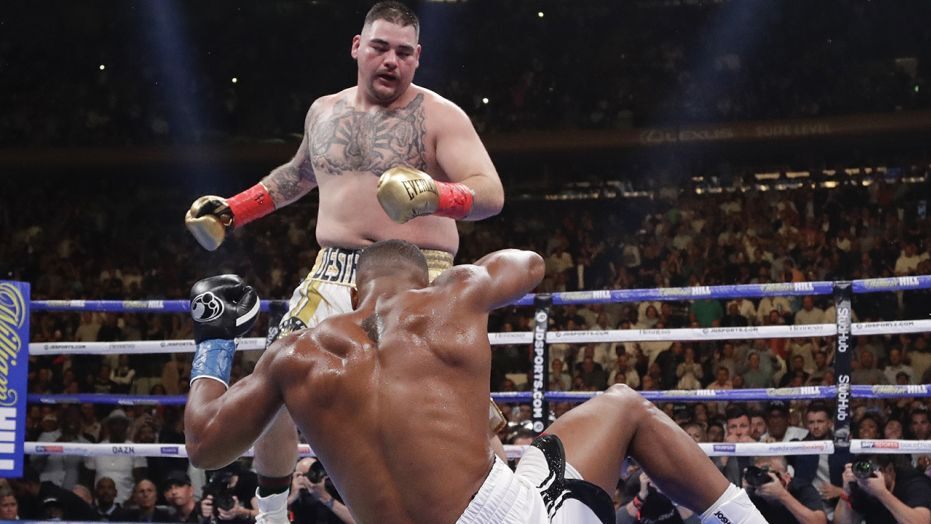
Chubby Andy Ruiz, brought in on short notice for a
ritual humiliation with the baddest man on the planet, razed Joshua a fourtime,
made him a passive round-7 quitter, and humiliated the whole of boxing’s heavyweight
institution.

The moment was ecstatic.  As ringside commentators and scribes readied
their solemnest tones to impart the historic import of what just happened, the
DAZN replays, hyper-definition hyper-slo-mo showed the challenger’s back,
jiggling pornographically, as he put the finishing touches on AJ.  It was a form of visual comedy whose
authenticity someday may be matched but cannot be topped.  It was a sight so wondrous a child couldn’t
miss its absurdity and any right-thinking adult had to enjoy it a hundred times
more for its rarity.

Joshua, to his credit, laughed through the entire
episode; perhaps the absurdity enchanted him, too, or perhaps he was knocked
silly or perhaps longsuffering aficionados called for comeuppance in a single
voice and for once the universe heeded us. 
It was not a joke on Joshua so much as his enablers.  The selfaggrandizing fleshpeddlers and
circusbarkers, the celebrity tourists and their publicists, the vlog buffs and
podcast critics and every dweeb with a calculator app and pay-per-view
prediction, the lot of them, didn’t know enough to laugh – didn’t realize the
moment called for joyful selflessness, for losing oneself not in Ruiz’s triumph
but in our sport’s absurdest moment.

“Honest to God, he’s going to lose to Ruiz.”

“AJ’s going to get caught with a lucky punch?”

“Nope.”

“He’s going to separate his shoulder or sprain his
ankle?”

“Not even close.”

“He’s going to get robbed by Yank judging?”

“Colder.”

“I give up.”

“Fully able to continue, after getting spanked and
sparked by an obese lad over whom he towers, Joshua’s going to spit his
mouthpiece, retreat to a corner and refuse to defend his four titles one second
longer.”

Part of the ecstasy of the moment was its impossible
unpredictability.  Even if a wiseacre or
innocent among us bothered to pick Ruiz on a lark, not even he might’ve
predicted Saturday’s final instants: Joshua’s taking a knee, enduring another
count, rising robotically, retreating to a corner, refusing to toe the line,
telling the referee he wanted to toe the line, reclining further in his corner,
refusing to toe the line, telling the referee he wanted to toe the line,
watching the referee wave hands in front of him, feigning a momentary disgust, resigning
himself, reclining once more.

Joshua’s hardest fight was with disbelief much as Andy
Ruiz.  Told his entire career what a
business he was, how many livelihoods he sustained throughout the kingdom, how
groundbreaking be his brand, AJ waited patiently for some institutional
intervention; his majesty requested a sabbatical in round 7, and only the
grandest act of ingratitude might deny it. 
Then it happened – his request got declined.  As you read this, whether on the day it is
published or 10 years later, Joshua still can’t believe his request for recovery
time got rejected.

Do you have any idea who I am?

It’s funnier still to know, as we all now do, his
request for sabbatical, if granted, wouldn’t have changed anything but the
official time of stoppage.  Joshua was
beaten in round 3, not even a halfminute after dropping Ruiz with a dandy
hook.  Ruiz rose, confused, while
something like the word “inevitable” went through every bystander’s mind at
once.  It was, then, time to train our
eyes on Joshua, the better to observe how quickly he took Ruiz’s consciousness,
compare it in real time with our recollection of what Deontay Wilder did a few
weeks back, and birth a fully formed conclusion on who would win the
hypothetical match between them.

And then in the middle of the sacrifice Saturday’s
scapegoat nipped its highpriest.  Just a
nip, truly, a balance shot but nothing a baddest man on the planet should register.  Then the entire artifice came down in a laughable
heap, rose, then came down again and again. 
We can leave the serious analysis to anyone who still takes any
heavyweight seriously but drop a breadcrumb as we skitter away laughing: Ruiz
nearly broke Joshua in half with a midrounds right cross to his midsection that
dropped the champion’s left guard surely as fatigue dropped the champion’s full
self, and that tells you the wisdom of Joshua’s wanting an immediate rematch.

How damnably fragile be these giants!  Ten punches in his finishing move Joshua was
suffocating, heaving his gorgeous pecks and regal delts, pleading Manhattan
thicken its air.  What the hell kind of
professional fighter finds himself drowning 10 punches in to a fight’s ninth
minute?

It added to the moment’s high mirth, though, it
did.  The fatman’s shimmying pursuit, the
giant’s ridiculous retreat, the most important arena in the history of
important arenas gone muted, the imperial palace reduced to what red sauce and
orange cheese cover an enchilada plate.

The spectacle was relentless fantastic.  The champion tagged and toothless, his mouth
alternating between airsucking ovals and get-this! smirks, the champion’s
boundless selfassurance swapped in a realtime identity crisis (how about that
ridiculous bouncing-n-boxing thing in round 6), and all for our entertainment.  Sport can be no more entertaining than
Saturday’s main event.  If you’re new to
boxing be grateful you’ll have a standard of comparison the rest of your days,
and if you’re old to boxing be grateful you lived long enough to witness the
funniest moment of the modern era.

Bart Barry can be reached via Twitter @bartbarry


FOLLOW JOSHUA – RUIZ LIVE!!

Mandatory Credit: Ed Mulholland/Matchroom Boxing UK

Follow all the action as Anthony Joshua defends the IBF/WBA/WBO heavyweight titles against Andy Ruiz. Before that, beginning at 5:30 PM ET/10 :30 PM UK Time, 5 fights including world title bouts with Callum Smith defending his Super Middleweight belts against Hassan N’Dam and Katie Taylor and Define Persoon for the undisputed Lightweight Title

NO BROWSER REFRESH NEEDED. THE PAGE WILL UPDATE AUTOMATICALLY

12-ROUNDS-IBF/WBA/WBO–HEAVYWEIGHT TITLES-ANTHONY JOSHUA (22-0, 21 KOS) VS ANDY RUIZ JR (32-1, 21 KOS)
ROUND 1 2 3 4 5 6 7 8 9 10 11 12 TOTAL
JOSHUA 10 10 8 10 9 9             56
RUIZ* 9 9 10 10 10 10 TKO           58

Round 1: Right from Ruiz..Joshua lands a jab..Hard Jab

Round 2 Ruiz lands a good right..Right from Joshua…Left Hook..

Round 3 HARD LEFT AND DOWN GOES RUIZ…BIG RIGHT AND DOWN GOES JOSHUA..Hard left by Ruiz…Joshua is hurt..2 BIG RIGHTS AND JOSHUA IS DOWN AGAIN

Round 4  Ruiz lands a right..Hard right from Joshua..

Round 5 Right from Ruiz..Hard jab from Joshua..Right from Ruiz

Round 6 Hard right from Ruiz..Good hook to the body..Hook from Ruiz,,Overhand righ from Ruiz..Right

Round 7 HUGE COMBINATION AND DOWN GOES JOSHUA…COUNTER RIGHT AND DOWN GOES JOSHUA…THE FIGHT IS OVER

12-ROUNDS–WBA SUPER MIDDLEWEIGHT TITLE–CALLUM SMITH (25-0, 19 KOS) VS HASSAN N’DAM (37-3, 21 KOS)
ROUND 1 2 3 4 5 6 7 8 9 10 11 12 TOTAL
SMITH* 10 10 TKO                   20
N’DAM 8 8                     16

Round 1 Good jab from Smith..HARD LEFT AND DOWN GOES N’DAM..

Round 2 LEFT HOOK AND DOWN GOES N’DAM..Good jab from N’Dam

Round 3 Right from N’Dam..Body shot..Right hurts N’Dam..HUGE RIGHT AND DOWN GOES N’DAM…HE GETS UP AND IS WOBBLY..FIGHT IS STOPPED

10-ROUNDS–IBF/WBA/WBC/WBO LIGHTWEIGHT TITLES–KATIE TAYLOR (13-0, 6 KOS) VS DELFINE PERSOON (43-1, 18 KOS)
ROUND 1 2 3 4 5 6 7 8 9 10 11 12 TOTAL
TAYLOR 10 9 9 10 9 10 9 9 10 9     94
PERSOON 9 10 10 9 10 9 10 10 9 10     96

Round 4: Taylor beleeding on Hair line

Round 5 Good left from Persoon..Persoon cut over left eye

Round 6 Left hook from Taylor

Round 7 Good right from Persoon

Round 8 Right from Person..Left hook..Right

Round 9 Good hook from Taylor..

Round 10 Right counter from Taylor..Right from Persoon..Combination..Right from Taylor

95-95; 96-94 twice FOR TAYLOR

Taylor landed 103-410  Persoon was 116-586

10-Rounds-Welterweights–Josh Kelly (9-0, 6 KOs) vs Ray Robinson (24-3-1, 12 KOs)
ROUND 1 2 3 4 5 6 7 8 9 10 11 12 TOTAL
Kelly  10 9 9 9 10 9 9 10 10 10     95
Robinson 9 10 10 10 9 10 10 9 9 9     95

Round 1 Slapping left hook from Kelly..Uppercut

Round 2 Good Jab from Robinson..Left from Kelly..Good right hook from Robinson…Upercut

Round 3 Good body shot from Robinson

Round 4 Body shot from Robinson

Round 5 Right from Robinson..Good action on the inside..Good body shot from Kelly..Straight right

Round 6 Robinson landing good body shots..Good right hook from Kelly..Right from Robinson..Robinson cut over the right eye

Round 7 Good body shot of Robinson..Kelly cut on the left eye..Left from Robinson..Good body shot from Kelly..Right..Left from Robinson..

Round 9 Good right from Kelly..Right..Jab..

Round 10 Left from Robinson..Flurry from Kelly..Straight right..Good body shot from Robinson..Kelly cut around the right eye…Right from Kelly..Uppercut from Robinson..

96-95 for Kelly; 95-95 on 2 cards…DRAW

10-Rounds–Light Heavyweights–Joshua Buatsi (10-0, 8 KOs) vs Marco Antonio Periban (25-4-1, 16 KOs)
ROUND 1 2 3 4 5 6 7 8 9 10 11 12 TOTAL
Buatsi*  10 10 10 TKO                 30
Periban 9 9 9                   27

Round 1:  Buatsi lands a right

Round 2  Left to the chin by Buatsi..Right…Hard body shot

Round 3 Nice left hook by Buatsi..Overhand right..

Round 4 RIGHT HAND AND PERIBAN TAKES A KNEE..Hard right…Big Right from Buatsi..3 BIG RIGHTS AND THE FIGHT IS STOPPED

10-rounds–Super Lightweights–Chris Algieri (23-3, 8 KOs) vs Tommy Coyle (25-4, 12 KOs)
ROUND 1 2 3 4 5 6 7 8 9 10 11 12 TOTAL
Algieri* 9 9 10 10 10 9 10 10         77
Coyle 10 10 9 8 9 10 10 9         75

Round 1: 2 body shots from Coyle

Round 2 Big right hurts Algieri…Left hook..Good Body shot..Uppercut..Algieri lands a left to the body and a jab…

Round 3  Right from Algieri..Body shots..Good body shot

Round 4 Hard combination to body and hurts Coyle…COMBINATION AND DOWN GOES COYLE…

Round 5 Right to head from Algieri…Good right from Coyle..Counter from Algieri..Good counter from Algieri..Body shot from Coyle..

Round 6 Double left hook from Coyle..Jab..Good counter right from Algieri..Left from Coyle..Algieri’s right eye is swollen and he is cut under the left eye.

Round 7 Algieri lands a body shot..Good Jab..Combination drives Coyle to the ropes..Nice Right..Left Hook from Coyle…..COYLE’S CORNER STOPS THE FIGHT AFTER THE ROUND


Heavyweight Blues: Joshua hopes to knock them out in a place synonymous with legends

By Norm Frauenheim-

The heavyweights, bigger than life in fact and fiction, are hard to judge. That’s another way of saying nothing much at all has changed in a division still dormant. It’s been that way for maybe a decade, or perhaps long enough to declare it dead instead of dormant, a kinder yet still deadly diagnosis.

There are always reasons to think it is about to stage some sort of resurrection. There was Anthony Joshua’s stoppage of Wladimir Klitschko in 2017. There was the controversy and compelling drama ofDeontay Wilder’s draw with Tyson Fury in December.

Each was terrific, yet neither bout looks to represent the milestone marking when the old flagship resurfaced with its past glory eventually restored. Battleships just stay on the bottom and rust away.

Yet, the attempt at restoration continues. At least, it does with Joshua’s American debut Saturday night (DAZN 8:30 p.m. ET) against Andy Ruiz Jr. in a place that defines the heavyweight’s golden age. Mention Madison Square Garden and you think of Ali-Frazier. First names not necessary. Ali-Frazier is a universal metaphor for what rivalries do. A sport without one is crickets.

Too bad the heavyweights haven’t had one for at least the aforementioned decade. For a while, you could just blame it on an absence of good heavyweights in the post Mike Tyson-Evander Holyfield-Lennox Lewis era. Cycles are like the tides. They come. They go. This time around, however, an incoming opportunity at rebuilding the division is being squandered.

There was momentum, first with Joshua’s stunner over the dominant Klitschko in London and then the Fury-Wilder draw in Los Angeles. Maybe, some of that momentum can be recaptured with Joshua’s debut in an arena with a name synonymous with the one rivalry to which all rivalries are compared.

 Ali-Frazier is the historical standard.

But boxing fans aren’t asking for history. Just Wilder-versus-Joshua. Or a Fury-Wilder rematch. At this point, one of the two would do. Do just fine.

But, no, now we’re talking about Wilder-Joshua sometime next year. Wasn’t next year what we were talking about last year? Like I said, the heavyweights never change.

“It’s embarrassing,’’ Joshua promoter Eddie Hearn said while talking to the media in New York this week amid the pre-fight hype for the UK heavyweight’s U.S. debut against Ruiz.

Hearn was specifically addressing Wilder’s announcement this week that he had agreed to a rematch with Luis Ortiz in September. Hearn’s hope had been to secure a deal for the Joshua-Wilder showdown later this year.

He foresaw November, a Holiday date to celebrate a heavyweight rebound.

“The main man is Joshua,’’ Hearn told the BBC. “But the fight the world wants to see is Wilder. Unfortunately, he is not giving the public what they want. He is not even talking about that fight.

“Which is frustrating.’’

Check and check.

Embarrassing and frustrating.

That’s not a combo good for fans, promoters, networks or the fighters in a hopelessly balkanized business. In Wilder’s case, it’s also not much of a surprise. Since the Fury draw, he has been talking, talking and talking. He’s also thrown one massive right hand, knocking out Dominic Breazeale with one righteous shot.

For all of the criticism of all he doesn’t do, his right hand is a thing of beauty. It’s a silencer, too. His crazy rant about wanting to add “a body” to his record was virtually silenced by a home-run shot to Breazeale’s chin.

Wilder’s right is a punch to behold. Fear, too, especially if you are Joshua. Remember, Klitschko knocked down Joshua with a right hand. If that right had been thrown by Wilder, Joshua might not have gotten up.

Also, Wilder might have become a better fighter, thanks to 12-rounds against the skilled and resilient Fury. Wilder threw that right against Breazeale with more focused resolve than he has in perhaps any prior bout. We’ll learn more about that in a rematch with Ortiz.

However, Ortiz also is real threat to what Hearn had hoped would finally happen later this year. Ortiz is clever enough to unravel a promoter’s best-laid plans with a skillset versatile enough to win a decision over Wilder. Wilder only escaped a scorecard loss in their first one because of that right hand. It landed late. But it landed.

Meanwhile, Joshua (22-0,21 KOs) has to produce a performance against Ruiz (32-1, 21 KOs) that validates his claim on being the face of the heavyweight division. There was no argument in the immediate aftermath of his victory over Klitschko. But subsequent victories over Carlos Takam, Joseph Parker and AlexanderPovetkin left doubts, questions about whether Joshua had left the best of himself in the ring againstKlitschko, who is rumored to be thinking about a comeback

Joshua can deliver a convincing knockout of those doubts against Ruiz, who took the bout when a positivePED test forced Jerrell Miller out of the bout and into disgrace.

Still, Ruiz is exactly the kind of fighter who can make the winner look very bad. He’s chubby. He’s short. Next to the chiseled Joshua, Ruiz looks like a sagging mattress. But looks are deceiving. Ruiz’ hands are as fast as any in the business. If he were dealing cards, he could make a King look like a deuce. In the ring, he could make a Joshua look like a Joker.

That’s the scenario that Joshua and Hearn need to avoid. They need a quick KO. So, too, does the heavyweight division that has been dormant and done for too long. 


The academy adapts: David Epstein’s “Range”

By Bart Barry-

Tomorrow, “Range: Why Generalists Triumph in a Specialized World” (Riverhead Books) by David Epstein, author of “The Sports Gene”, will become available to the public.  There is but one mention of a boxer in the book, Vasyl Lomachenko, and this happens on page 8.  Because the subject is an interesting one, though, and because its publisher was kind enough to send me a review copy despite my disclosing both this site’s specialized subject matter and my own tiny readership, what follows is a criticism made in good faith.

The longer this book went on, and the deeper I
found myself in it, the less I enjoyed it. 
Not because of some unsettling truth, some grave misreading of myself or
my life’s choices held up to a mirror’s objective gaze; it was because the book
became increasingly repetitive and predictable.

All the usual suspects gather: Tolstoy, Einstein,
van Gogh, Darwin, Edison, Kasparov, Michelangelo, jazz, NASA, U.S. Armed Forces,
biomimicry-driven animal metaphors (foxes, frogs, birds, hedgehogs, darkhorses),
and lots and lots of PhDs.  Little of the
material written about any of these subjects is new or originally interpreted,
which makes their appearances unfortunate – since much of the rest of the book,
parts that don’t detail academic acclaim or retroactively certified greatness, are
quite enjoyable.

“Range’s” most enjoyable character is Frances
Hesselbein, centenarian and accidental CEO, who doesn’t prove the book’s
central theme, which is to be contrary, so much as give the book something
delightful.  Her primary gift, one
assumes, lies in her adaptability, which may make her a generalist or an
oscillating specialist or a fox or a hedgehog, depending where one finds her in
her history and chooses to place her in his thesis.  She is not a tidy package because she is a mammal,
and few such creatures are tidy packages.

But a celebration of mammalian adaptability is
well-trod already (M. Mitchell Waldrop knocked the subject out of the park 27
years ago with “Complexity”), and so a celebration of anti-specialists, people
who aren’t raised to be automaton prodigies like Tiger Woods, composes a highly
anticipated subject in 2019.  Woods
features prominently in the book’s opening, in a well-crafted, turn-the-clichés-around
sort of commentary that actually, and quite surprisingly, suffers in no way
from his unexpected Masters victory a few months ago – a happening that looked
nigh impossible during the time Epstein wrote “Range”.

Woods, of course, is the prototypical,
10,000-hours-to-mastery mold into which a million vicariously thrilled American
fathers have poured their offsprings’ childhoods since 1997 or so.

But watch how that might itself be turned round:

Eldrick had
an overbearing father.  The boy was
forced to play golf all the time because he had a gift, one his father told
business partners would change the world. 
Eldrick succeeded at a shockingly young age.  His course was set.  He would be the world’s greatest golfer and
the world’s richest golfer, the specialist’s specialist.  But after puberty Eldrick realized he had
another calling.  He spent nearly as many
hours practicing seduction techniques as chipping techniques.  He loved to uncover women like he uncovered
his driver (a tiger head sewn by his mother). 
One day the generalist that he loved to be clashed with the specialist the
world expected him to be.  Sponsors fled,
surgeries followed, he lost hundreds of millions of dollars in a divorce
settlement.  But he continued doggedly on
his generalist quest to prove a balding nerd raised at a country club could be
every bit as promiscuous as an NBA power forward or rock musician.  Some successes and many humiliations later, one
quiet spring afternoon in Georgia, Eldrick “Tiger” Woods became only the second
professional golfer ever to win 15 career majors.

*

The money Americans pay self-help authors creates
a gravity nonfiction authors of all stripes now find irresistible.  Subsequently, there’s something a touch too
glib in most American writing.  Every
character finds his life compressed into Forrest Gump’s.  Epstein appears aware of this and often resists
it.  But gravity remains:

“As a final flourish, with just a few hours of
work, a colleague helped (Gunpei Yokoi) program a clock into the display.  LCD screens were already in wristwatches, and
they figured it would give adults an excuse to buy their ‘Game & Watch’,”
Epstein writes about a generalist Nintendo employee.  Just four sentences later, Epstein completes
the epic thusly: “‘Game & Watch’ remained in production eleven years and
sold 43.4 million units.”

In a 100,000-word book, this is about the same as the
Gumpian invention of the smiley-face t-shirt. 

Ah, but this book is supposed to be t-shaped, rogue,
to make manifest its point about sampling numerous disciplines, represented
here as anecdotes, en route to serendipitous, interdisciplinary breakthroughs!

Well, OK. 
But let’s go all the way with our reconsideration of everything and ask
this entirely relevant question: Why bind all of this in a book when there are
more appropriate media available?

It’s because, in an inversion of its inversion,
this book wants the academy’s approval very much.  This thought happened somewhere in the middle
of an Epstein anecdote: “‘Outsider artists’ are the self-taught jazz masters of
visual art, and the originality of their work can be stunning.  In 2018, the National Gallery of Art featured
a full exhibition dedicated to self-taught artists; art history programs at
Stanford, Duke, Yale, and the Art Institute of Chicago now offer seminars in
outsider art.”

The academy approves, see!

But how very mediocre of it, and how perfectly
backwards.

The intended audience for this book, hyper-educated
professionals who fancy themselves rebellious, should be surprised exceptional
things happen for generations without once appearing in textbooks.  Nobody else will be, though, and certainly
nobody who reads often about our beloved sport.

Bart Barry can be reached via Twitter @bartbarry


Dangerous Equation: A Pacquiao victory over Thurman puts the 40-year-old Senator closer to a fight with Errol Spence

By Norm Fraunheim-

He’s been Pac-Man and Congressman. Honorific titles and belted ones are all part of his resume. He been called just about everything, including a few that are four-letters long. Hey, nobody wins them all, and Senator Manny Pacquiao hasn’t. He has heard it all, and some would say done it all.

But an eight-time champion in boxing’s various weight classes and a two-time Filipino office-holder is not finished. His comeback continues July 20 against Keith Thurman. Maybe, we shouldn’t be surprised. Pacquiao’s evident generosity and his day job as a Filipino politician seemingly needs an inexhaustible revenue stream. That means boxing. It’s what he has known for just about as long as he’s been alive.

It fed him when he was a starving teenager fighting for a few pesos on Filipino streets. Then, it made him rich enough to run for office. For a couple of years, he was one of the highest-earning athletes in the world.

Of course, he is back for more and he’ll be there for as long as his dangerous craft produces the kind of money he couldn’t get anywhere else. But here’s reason to fear the second part of that equation.  The bigger the bucks, the bigger danger.

By all accounts, Pacquiao will collect a $20-million guarantee against Thurman in a PBC bout at Las Vegas MGM Grand. That’s more than enough money to convince Pacquiao to seek some more if he beats Thurman. Will he? Maybe. Can he? Definitely. At last check, Pacquiao is a slight underdog to Thurman, who is about a decade younger than the 40-year-old Filipino.

But odds for this welterweight fight are hard to judge, despite Thurman’s bold words.  He has promised to end Pacquiao’s career in much the same way that the Filipino finished Oscar De La Hoya’s long run in a 2008 stunner. Actually, Thurman has done more than promise. He’s gone biblical.

“I know he likes to quote Bible verses,’’ Thurman said to his elder this week during promotional stops in New York and Los Angeles. “So, I’ll let you know:

“He’s getting crucified.’’

Maybe, but don’t bet on it, not after Thurman’s uninspiring performance in winning a majority decision over Josesito Lopez January 26 in his first bout in nearly two years. Maybe, it was just inertia, the so-called rust from extended inactivity.  Still, the bout left question about whether the welterweight called One Time was beyond prime time because of injuries.

To be fair, it’s also hard to judge Pacquiao. He beat Adrien Broner in his last outing January 19. But Broner didn’t throw many more punches than a ring post. He posed and postured. In terms of aggression and willingness to fight, Pacquiao looked good. But Broner offered nothing. It was an exhibition of a Pacquiao still mobile and quick. But it wasn’t a fight.

It’s hard to say what might happen if the “One Time” Thurman shows up. He might connect with Pacquiao’s jaw the way Juan Manuel Marquez did in that stunning 2012 KO.  If so, he might be doing Pacquiao a favor. For now, there’s no sign that Pacquiao will ever get a rematch with a guy closer to his age. Pacquiao keeps mentioning Floyd Mayweather Jr., who beat him in the much-hyped revenue record-setter in 2015.

But Mayweather has not said or done anything that indicates he’s interested. Like him or not, Mayweather is still the smartest guy in the room.   

Without the Mayweather possibility, a Pacquiao victory puts him in line for Errol Spence Jr., the PBC star who scored a dominant decision over pound-for-pound contender Mikey Garcia in March. Spence might not be the world’s most skilled welterweight. From this perspective, the most varied skillset at 147 pounds still rests in Terence Crawford’s dangerous hands. But that’s a different argument for a different day.

There’s no debate about size and power. Spence has more of that than anybody in the division, more than enough to really hurt Pacquiao. It’s not worth the risk, no matter how big the reward. 


WBSS: At long last, something true

By Bart Barry-

Saturday in Scotland the World Boxing Super Series held the final semifinals matches in its bantamweight and super lightweight divisions, and they went even better than hoped. Hometown southpaw Josh “Tartan Tornado” Taylor defanged Russian Ivan “The Beast” Baranchyk, and Japan’s “Monster” Naoya Inoue proved exactly that against Puerto Rican Emmanuel Rodriguez. The fighters’ aggregate record Saturday morning was 69-0 (52 KOs).

This wonderful DAZN combination of excellent performances in authentic prizefights, the rare fusion of excellence and authenticity, is something WBSS, in only its second season, has given us more of than any of its rivals. Not peers, mind you – rivals. Peers would be doing their best to do what WBSS does, which is provide incentive enough to our beloved sport’s abundance of shortsighted agents to make them please both current consumers and would-be consumers (most of whom self-identify as former consumers).

To wit: across the digital spectrum Saturday a former giant in the prizefighting space – forget not, Showtime, when it was lean and innovative a decade ago, gave us the Super Six – appealed to the worst of its remaining viewership by promoting a mismatch with an a-side’s homicidal musings. Likely there’ll be more here about what Deontay Wilder did, in a few weeks, after Anthony Joshua fights, because unless those guys are fighting one another or Tyson Fury, neither of them nor their exploits merits more than half a column anymore.

It’s much easier to be cavalier about boxing’s flagship division the week after a Naoya Inoue fight, isn’t it? He is the very essence of what pound-for-pound was intended to measure when the concept got launched during Sugar Ray Robinson’s era. If you were able to make Inoue and Wilder and Joshua and Fury the same size and fight them in a round tournament the question is not whether Inoue would emerge as winner or even if Inoue would win every match by knockout but whether any of today’s best heavyweights could make it out the first minute with him. The gulf in craft, leverage and reflex is that great.

To attract casual fans, I know, we’re supposed to pretend this is not so, we’re supposed to squint to see something great about today’s heavyweights besides their mass, but it simply cannot be done during WBSS season, when prime world titlists fight one another, one after the other, showing each other respect before and after their confrontations while subjecting one another to relentless violence between the ropes. It makes farcical inauthentic much of the rest of the year’s fare.

Inoue is the world’s best prizefighter right now. Better than Bud, better than Hi-Tech, better than The Truth, better than Canelo. He is making highlight-reel showcase opponents out of world titlists in matches expected by experts to be competitive. I can’t name his promoter, I don’t know his training techniques, I don’t know if he was an Olympian, and if he’s a heartthrob in his native land I don’t know about that either. I don’t know, in other words, any of the flummery publicists pass our ways when it’s time to grow the brand and risking more than words is out of the question.

Here’s what happened Saturday in WBSS’s bantamweight semifinal: Emmanuel Rodriguez, a larger man making the third defense of a title he won on the road, went directly at Inoue the way a champion does when he thinks his challenger is a hypejob. He moved Inoue back, too, and chastened him with a few counters, and the first round was excellent and competitive, exactly as an aficionado, as distinct from a branding fanatic, should wish every round of every fight be. The second round was going competitively, too, until Rodriguez turned a touch too brazenly on a left hook and got spuncycled on the next. After that things got real academic real quick. Inoue went bodysnatching, not headhunting, as a man does when he wants his opponent’s submission more than he wants a YouTube clip, and Rodriguez collapsed for being caved-in.

It was decisive and quick, not sloppy or preordained. It was another chance to be euphoric at the spectacle of boxing done beautifully.

And it wasn’t even Saturday’s main. That came after a moment of mutual admiration between Inoue and his WBSS-finals opponent, Nonito Donaire, now enjoying a career resurrection complete as it is completely unexpected. Donaire’s winding transition from promoter-creation brat to international ambassador concluded prettily with his sincere congratulations to Inoue, a moment of affection and elegance enough to make you proud of your commitment to our sport, enough to make you wonder, however briefly, if Donaire, once considered a prodigy too, mightn’t have a last hook in him, a sink-all-coffins-to-one counter that he starts with Inoue’s a millisecond earlier and a millimeter shorter and makes all Japan inhale sharply.

It’s a farfetched scenario, indeed, though not farfetched as Donaire’s simple presence in the finals; “dear Lord, give me just one chance to throw the hook” – so went Nonito’s prayer at tournament’s start, and now he will have it. A more answerable prayer will have Josh Taylor who, after blackmatting Ivan Baranchyk a twotime in a prizefight proper brutal, looks forward to Regis Prograis in the finals.

There’s no reason to hold the decisive match on neutral ground, Super Six’s largest mistake; return to Glasgow and let Prograis try and stretch the Scotsman in his home gym, knowing if he lets European judges score one of their own he’ll have read to him by a kilted ring announcer three cards prefilled at Friday’s weighin. Same goes for Inoue-Donaire for that matter; let Nonito choose the venue – Inoue’s supporters have the means and willingness to travel wherever their man plies his craft.

O but the WBSS is so much better than everything else.

Bart Barry can be reached via Twitter @bartbarry


Wilder and Wilder: Deontay’s threats to Breazeale hard to hear, hard to excuse

By Norm Frauenheim-

Deontay Wilder has more words than punches.

At last check, the words are rocking the social-media landscape. Wilder has been all over the place this week with talk that has been either condemned by those who hear death threats or dismissed by those who hear just another boxer with a cliched promise to kill an opponent.

Maybe, it has all been more grist for a media mill with an ever-escalating lust for the sensational.

Or, maybe, it’s just stupid.

Or, in perhaps a more cynical take,
it’s just another heated step up in an effort to hype a hard-to-sell fight. In a sport with an orderly business plan, Saturday would have been a rematch of Wilder’s compelling – and controversial — draw with Tyson Fury. Instead, we get Wilder versus Dominic Breazeale. In boxing, that’s called business as usual.

Still, some of what Wilder has said is hard to ignore.

Example:

“This is the only sport where you can kill a man and get paid for it at the same time. It’s legal, so why not use my right to do so?

“His life is on the line for this fight and I do mean his life. I’m still trying to get me a body on my record.”

A boxing license is not a license to kill. Death in the ring happens, sometimes by match-making so horrible as to be criminal and sometimes by licensing of fighters who should never have been cleared medically.

It is life-and-death drama. The fighters understand those stakes. So, too, do fans, who watch to witness their courage and to see them employ feet and hands in a marvelous balance of skill in the face of adversity. They fight to win and get paid. But there is no right to kill, no matter how often that one four-letter word is used and over-used.

Wilder is under huge criticism for what he said, especially from UK fans and retired fighters (Lennox Lewis, Frank Bruno) who thought judges robbed Fury of a decision and the World Boxing Council’s heavyweight title at Los Angeles’ Staples Center last December.

Boxing has pretty much heard it all, of course. Mike Tyson used to talk crazy throughout his days in what he called “the hurt business.’’ After a 1986 victory over Jesse Ferguson, Tyson said he wanted to drive Ferguson’s “(nose) bone up into his brain.” But Tyson didn’t say – never said — he wanted to “put a body on his record.’’

From this corner, it’s hard to explain what Wilder (40-0-1, 39 KOs) did say. Perhaps, that’s because I’m a Wilder fan. I like the guy. His right hand is his only dimension, yet it’s a dimension nobody has been able to counter, much less elude. Guess here, it will land all over again, finishing Breazeale (20-1, 18 KOs) in an early stoppage at Brooklyn’s Barclays Center (Showtime 9 p.m. ET/6 p.m. PT). Increasingly, however, Wilder’s rants from the bully pulpit are baffling.

He gets on a roll, seemingly losing control in an undisciplined torrent of disconnected thoughts and words, sometimes funny and often angry. In a conference call about 10 days ago, Wilder said:

“People are simple-minded. My mindset is different. My mindset is so big that a spaceship can fit in it.’’

That, too, was baffling, perhaps cringe-worthy., But it was harmless, unlike this week’s controversial comment, which is enough to wonder whether that Wilder mindset is just an empty hangar.


Emanuel Navarrete beats the white towel out of Paul Dogboe

By Bart Barry-

Saturday in the comain of an ESPN broadcast from Tucson, Mexican super bantamweight Emanuel Navarrete successfully defended his WBO world title by stopping former WBO super bantamweight titlist Isaac Dogboe in a pretty savage way. Both men were the same men only moreso in their rematch.

There’s something more disquieting about a volume-puncher’s demise, more decisive, something fated like a log being fed in a woodchipper. He rarely has much more than a plan A1 or A2; if plan A was shift-right-throw-left, plan A1 is shift-left-throw-right or jab-jab-hook instead of jab-hook; his primary attack, which is his defense, too, is reliant near entirely on an assertion of will, on a career-defining assumption he can continue longer than his more-talented peers. And the peers are near always more talented because who that had reflexes enough would get hit often as the volume-puncher, and who that had power enough would require such volume? Because the volume-puncher needs hundreds of repetitions to turn his trick he relies, too, on a signature rhythm, and woe betide the volume-puncher whose rhythm gets solved by an opponent.

Since Joe Frazier’s sainted name got invoked in a proper context during Saturday’s broadcast, his case is one worth visiting. He’d not a prayer against George Foreman because volume-punchers haven’t a prayer against true sluggers, and Foreman truly was one. Frazier’d much better than a prayer against Muhammad Ali, a boxer for most intents and purposes, because Frazier’s hit-you-everywhere-at-all-times attack offended Ali’s sensibilities much as his chin. Then came the 14th round of their third fight, their 41st round together (15+12+14 because their 1974 rematch was a 12-round affair for less than the real title), and Ali solved Frazier’s rhythm and movement. And heavyweight prizefighting’s greatest trilogy folded into a vicious target practice trainer Eddie Futch mercifully stopped with a singularly elegant gesture.

No fighter more needs protection from himself than a volume-puncher, as champion-cum-broadcaster Timothy Bradley should and did know. Beneath commentator Joe Tessitore’s hysteria and Andre Ward’s cerebral detachment a close listener heard Bradley’s empathetic fury with how poorly Dogboe’s corner protected its charge and son. Bradley knew well as anyone in the city of Tucson how hopeless was Dogboe’s strategy and how helpless Dogboe was to relent. Bradley, beaten semiconscious for at least half a fight by Ruslan Provodnikov and caught hung over his front knee more than a few times by Manny Pacquiao, registered early and often Dogboe’s masochistic pleas for an uppercut from Navarrete.

Whatever Bradley said, here’s what he silently willed from ringside: Isaac, before you make one more forward step, take your right glove, set it palm-down, and lodge it between your chin and throat, damn it! Dogboe didn’t have this standard maneuver in his quiver because his father proved more conditioning-coach prophet than boxing trainer, and because Dogboe’s title run was too entangled with his father’s proselytizing and NeHo chanting to permit Dogboe seek wisdom elsewhere.

However universal be certain elements of our beloved sport – like: catch the uppercut with an open palm set under your chin – there are others that might should bring pause from a Western pundit like: What in the Sam Hill do I know about the father-son dynamic shared by Ghanaian émigrés to London? And before anyone takes to his hind legs to bray about universal truths, he should ask how many supposedly universal expressions of a father’s love permit a world-title run in prizefighting.

Which leaves us where exactly? It leaves us wondering if Dogboe’s dad should be exiled for malpractice as at least a third of Saturday’s broadcast team insisted, or if perhaps Saturday’s fight got stopped at the right moment.

(Here’s a confession that addresses conviction: I googled “Dogboe hospitalized” immediately after writing that sentence, to ensure it wasn’t already an empirically dumb thought.)

However long looked the odds of a Dogboe comeback eight rounds through Saturday’s comain, they were shorter still than the odds of a 5-foot-2 man from Ghana making $100,000 for 35 minutes of work as a professional athlete in Arizona.

Time and again we return to the ‘t’ in each of life’s algorithms; if you start observation’s stopwatch at the opening bell of a rematch with Emanuel Navarrete, the Mexican who outclassed your son but five months ago, Paul Dogboe looks a sadistic ignoramus for allowing his son enter Saturday’s championship rounds, but what if you start that same stopwatch on his son’s birthday in 1994? If nothing else, you weigh the catalog of theretofore-unbelievable things your son did to bring himself to his rematch for a super bantamweight world title 24 years later. And under that weight, probably, you honor initially his petition to continue fighting.

Let none of the weight of those words diminish in any way Navarrete’s accomplishment. Twice he entered a title fight as its b-side and twice he prevailed, and the second time more prevalently than the first. That makes him the right kind of titlist, and that makes him increasingly unique among his peers. Navarrete did not doubt even momentarily his place in a ring across from Dogboe, wherever his promoter or his promoter’s broadcast partner’s interests lay.

Navarrete was the much larger man and better boxer, and he acted like it, broken right hand or otherwise. He knew Dogboe’s need to make a vacuum of the ring that suffocated any initiative but his own, and he snatched the initiative from Dogboe and did not relinquish it. Brutal as the fight was for Dogboe, it was not gentle on Navarrete, though you’d hardly have guessed it by watching the Mexican.

Aficionados got afforded a tiny peek under Navarrete’s professionalism and decency the moment he dropped Dogboe on the canvas in round 12. Navarrete’s glance at his unmanned foe was conclusive to the edge of contemptuous. Such a glance should delight aficionados about Navarrete’s prospects as champion.

Bart Barry can be reached via Twitter @bartbarry


FOLLOW HURD – WILLIAMS LIVE

Follow all the action as Jarrett Hurd defends the IBF/WBA Junior Middleweights titles against Julian Williams.  The action kicks off at 8 PM ET / 5 PM PT with Matt Korobov meeting Immanuwel Aleem followed by Mario Barrios taking Juan Jose Velasco

NO BROWSER REFRESH NEEDED.  THE PAGE WILL UPDATE AUTOMATICALLY

12-ROUNDS–IBF/WBA SUPER WELTERWEIGHT TITLE–JARRETT HURD (23-0, 16 KO’S) VS JULIAN WILLIAMS (26-1-1, 16 KO’S)
ROUND 1 2 3 4 5 6 7 8 9 10 11 12 TOTAL
HURD 9 8 10 9 10 9 9 9 9 9 10 9 110
WILLIAMS 10 10 9 10 9 10 10 10 10 10 9 10 117

Round 1: Jab from Williams…Hard jab

Round 2 Left inside from Hurd…Left from Williams… Hard right…Hard right…LEFT AND DOWN GOES HURD..Hard flurry on the ropes..

Round 3 Hard left from Williams..Right..Hard uppercut from Hurd..Big left from Williams..Big right from Hurd..Double right

Round 4  Body shot from Hurd..Counter uppercut from Williams..Right uppercut…left..Right and good body shot..

Round 5 Uppercut from Williams..left and right to the head..Right from Hurd..Uppercut..Blood from the lip of Hurd..Big combination

Round 6 Hurd coming out fast…Its a war..Williams swelling under the left eye..Flurry from Hurd..combination from Williams..Big uppercut…uppercut..

Round 7  Jabbing from Williams..Good right..Counter from Hurd..

Round 8 Hard combination from Williams..Hard body shot..Beautiful combination..Body shot from Williams..Hurd cut badly around the right eye

Round 9 Huge uppercut from Williams…Big left..

Round 10 Great body shot from Williams..Big left hook…

Round 11 Hurd lands a right to the head..right to the body..Right and left….Uppercut from Williams..3 punch combination..Left hook from Williams

Round 12 Williams landing some uppercuts…Left hook..uppercut..Hard lands 2 body shots and a right hand..Body shot from Williams..

116-111, 115-112 twice FOR JULIAN WILLIAMS

10-Rounds-Super Lightweights–Mario Barrios (23-0, 15 KO’s) vs Juan Jose Velasco (20-1, 12 KOs) 
ROUND 1 2 3 4 5 6 7 8 9 10 11 12 TOTAL
Barrios* 10 KO 10
Velasco 9 9

Round 1 Body shots from Barrios…

Round 2 BIG RIGHT AND DOWN GOES VELASCO….HE DOESN’T GET UP AND THE FIGHT IS OVER

10-Rounds–Middleweights–Matt Korobov (28-2, 14 KO’s) vs Immanuwel Aleem (18-1-1, 11 KO’s)
ROUND 1 2 3 4 5 6 7 8 9 10 11 12 TOTAL
Korobov 10 10 10 10 10 10 10 10 9 9 98
Aleem 9 9 9 9 9 9 9 9 10 10 92

Round 1 Left from Korobov..

Round 2  Korobov working the body…left

Round 3 Good body shot from Korobov..Counter from Korobov..Counter left hook from Aleem..Right from Korobov

Round 4 Korobov drops Aleem with a left but ruled it came behind the head..Korobov lands a right to the body..left

Round 5 Right hook from Korobov

Round 6 Hard left hurts and cuts Aleem..Hard right..Left

Round 7 1-2 from Korobov..

Round 8 Good left from Korobov (Uppercut)

Round 9 Good left hook from Aleem

Round 10  Body shots from Korobov..Good right from Aleem and another

96-94 ALEEM AND 95-95 TWICE…MAJORITY DRAW


Rematch Test: Berchelt’s rising star depends on how he does in sequel with Vargas

By Norm Frauenheim-

TUCSON – Miguel Berchelt has heard all of the talk. It has him fighting pound-for-pound contender Vasiliy Lomachenko one day. It has him in showdown with Tevin Farmer. There’s speculation of junior-lightweight unification bout. Berchelt’s name is everywhere, a sure sign of an emerging star.

First, however, there’s some immediate business on his agenda.

“Francisco Vargas,” Berchelt said Friday after the formal weigh-in for a an ESPN-televised rematch Saturday at Tucson Arena of his 11th-round stoppage of Vargas in January 2017. “Have to win this one for anything else to matter. Vargas is a good Mexican fighter. It will be another great, great fight between to warriors. I don’t know how it will go. But whatever way it goes, I will be the winner.”

Berchelt is expected to win the sequel. There are even some bold predictions from Berchelt’s camp that an early stoppage looms in what might be the end of Vargas’ career. But Berchelt, himself, is cautious. He remembers the last meeting, a dramatic confrontation that was among the leading contender for Fight of the Year. Berchelt recalls Vargas’ resiliency. He expects to see it again. Vargas, meanwhile, is no mood to back down

Twenty-eight months have come and gone without too many days or even hours when Francisco Vargas hasn’t thought about Berchelt and a rematch.

Berchelt is there when he awakes. Sometimes, he’s there when he sleeps.

“I have thought of nothing else, but him and a chance to fight him again,’’ Vargas said. A chance at redemption — turning nightmare into a dream — has been a lifestyle for Vargas. That chance is finally here. Vargas looked into the eyes of Berchelt Friday for the first time since he lost to the feared junior lightweight in January 2017 in a bout that was a leading contender for Fight of the Year.

Saturday night, Vargas will face him for the second time in an ESPN televised bout (10 pm. ET/7 p.m. PT) at Tucson Arena in an intriguing rematch and perhaps another Fight of the Year contender on a card that also includes a rematch of WBO super-bantamweight Emanuel Navarrete’s upset of Isaac Dogboe in December.

Vargas expects the same blood, guts and drama. Only the result will be different, he vows.

“I did a few different things for this fight,’’ Vargas (25-1-2, 18 KOs) said after both fighters were at the junior-lightweight limit of 130 pounds. Dogboe (20-1, 14 KOs) was at 121.4 pounds and Navarrete (26-1, 22 KOs) at 121.6.

“I have a few different strategies,’’ Vargas continued. “I’m sure he will do different things too. But I’ll be ready. I am ready. I’ve been getting ready ever since the last one.’’

The last one ended with Vargas bloodied and finished in an 11th round stoppage at Fantasy Springs Casino in Indio, Calif. But finished did not mean forgotten. Vargas hired a new trainer, Joel Diaz, and won a couple fights, beating Stephen Smith in December 2017 and Rod Salka in April 2018. He hasn’t fought since.

“I’ve been waiting for the rematch,’’ Vargas, of Mexico City, said.

The long wait has spawned some inevitable speculation about Vargas’ chances in a second go-round against the emerging Berchelt (35-1, 31 KOs), a fellow Mexican who enters the rematch amid talk that one day he will fight pound-for-pound contender Vasiliy Lomachenko.

Berchelt doesn’t expect a changed Vargas.

“He was a very good fighter two years ago and he’s is very good fighter today,’’ Berchelt said. “I don’t know how it will end. But how ever it ends, I will be the winner.’’

Berchelt trainer Alfredo Caballero told Mexican-speaking media that the World Boxing Council’s junior-lightweight champion will finish Vargas career junior-lightweight champion will finish Vargas’ career.

“Those who are talking will have to eat their words,’’ Vargas said. “I am not the fighter they remember from a couple of years ago. My training is much more together. It’s much different. My trainers get it.

“I get it.’’


Royal Rematch: Isaac Dogboe in fight to restore a lost crown

By Norm Frauenheim-

TUCSON – Isaac Dogboe, whose African ancestry is at the root of his Royal Storm nickname, is learning kings don’t last long. They are only targets for ambitious challengers and always vulnerable to unexpected trouble, often self-imposed.

At 24, Dogboe returns to Arizona, still a crown prince coming off his first real lesson in what it is to be an ex-king, a former champion. That ex, he vows, will be gone Saturday night at Tucson Arena.

He intends to eliminate the temporary and restore the current in a rematch of his first defeat, administered thoroughly by a tough and skilled Emanuel Navarette last December.

The loss of Dogboe’s World Boxing Organization’s junior-featherweight title was a stunner for anybody who saw his abundant energy, charisma and power overwhelm Hidenori Otake in a first-round stoppage at Glendale, Ariz., last August.

Then, it looked as if a long reign had begun.

In December, however, it was abruptly ended by Navarette.

Dogboe’s scorecard loss was – and has been – a sobering lesson.

“A quiet humiliation,’’ Dogboe said before a media workout this week in a gym a few miles of desert south of a fabled arena where Sugar Ray Leonard, Salvador Sanchez, George Foreman, Michael Carbajal and Alexis Arguello have fought. Legends have won and lost there. It’s a place where Dogboe hopes to hit the restart button on what he foresees as his own legend.

It’s intriguing, because it won’t be easy. Navrette is the bigger fighter. Much bigger. He has a five-inch advantage in height and one-inch edge in reach. When they pose in the ritual face-off at Friday’s weigh-in, Dogboe will still be looking up at him. But that significant tale on the tape does not add up to the reason Dogboe sees for his only defeat. He sees himself. And five months later he sees a different fighter than the one who lost a unanimous decision at New York’s Madison Square Garden.

“I wasn’t prepared,’’ said Dogboe, whose bout is the first of two rematches on an ESPN telecast (10 pm ET) that will also feature Miguel Berchelt-Francisco Vargas in a junior-lightweight sequel to Berchelt’s 11th-round stoppage in 2017. “Weight was a problem. I had to sit in the sauna and sweat. I just wasn’t myself.’’

There were disruptions – Royal disruptions. Dogboe (20-1, 14 KOs) said he interrupted his training in early November for a chance to meet Prince Charles and Camilla in Accra in his native Ghana. The Royals met on Nov. 3. About a month later – Dec. 8, Navarette beat him. It’s no surprise that Navarette (26-1,22 KOs), of Mexico City, says he’ll do it again.

“The pressure is on him,’’ Navarette said. “If he feels it, I’ll knock him out this time.’’

Navarette had the WBO belt he took from Dogboe slung across one shoulder as he spoke to media and fans from a corner of the old gym in an industrial section of Tucson. When it was Dogboe’s turn in the ring, he seemed to spot Navarette and the belt, the symbolic crown the young prince once had. Dogboe suddenly looked energized. He hit his trainer’s mitts with a power that echoed throughout a place often rocked by fighter jets at nearby Davis-Monthan Air Force Base. For that moment, however, all you could hear was Dogboe’s hands pounding out what sounded like a message from a fighter on his own mission.

“This is about redemption for me,’’ Dogboe said. “I’m ready to go to war.’’


Some Cinnamon dust for boxing’s B+

By Bart Barry-

Saturday in Las Vegas Saul “Canelo” Alvarez further unified his undisputed status as world’s best middleweight by narrowly if unanimously decisioning IBF titlist Daniel Jacobs in DAZN’s second-best mainevent of the last two weekends. Canelo did what Canelo does, and if it isn’t worth the $300 million or so his new broadcaster pays him, it’s still worth more than whatever any of his peers makes.

No, the variable Saturday was not Canelo but Jacobs. And Jacobs was no variable at all, turning in another B+ effort – the average of A talent and C audacity – ensuring more generous paydays and flattering profiles to come.

Let’s see if we can mimic Jacobs’ fighting style for a few words.

*

Seems like a good idea might be to start stepping forward and maybe committing a little more, maybe jabbing, or if you’re already jabbing, maybe, you know, start stepping into it and seeing if the other guy’s head mightn’t move back a little or else try seeing if his whole body might, kind of, start moving back or relenting, or maybe relenting isn’t exactly the right term, since boxers, by the way they usually are, don’t tend to be too relenting, however they sometimes seem at times to be, and so it’s probably right to try remembering it seems hitting the other guy is probably as good of an idea for bringing yourself closer to victory as it is for keeping him from, like, going after you too hard if you don’t want him to, but there are also counterpunches that favor his momentum, so, you know, either way?

(Editor’s note: This is indecisive and awful; you have the words, but for God’s sake, you’re afraid to use your vocabulary and, frankly, you write like a bitch.)

Any man who enters a prizefighting ring and doubts for a moment the malice of his opponent is doomed. When a sense of doom pervades any motion by any fighter, it is a spectacle weak as it is unfortunate, but it is tragic, in addition to weak and unfortunate, when the doomed man has more talent than the man dooming him.

*

Most fighters box best when they are happy, not so much in the sense of euphoric as comfortable. They find rhythm, dare we say flow, and that familiar rhythm frees their hands and feet to respond so instantly to the commands from their central nervous systems as to appear mindless, as to fool both onlookers and fighters towards thinking the hands and feet do the processing for themselves.

Daniel Jacobs is an exception to this. He fights best when he is angry. Some of this might be attributable to the physical weakness and subsequent doubt he experienced when his body turned against itself in the form of cancer. More of it is likely attributable to what Dmitry Pirog did to him nine years ago.

In Jacobs’ case, for whatever reason, there is a deep fear of humiliation, and not until an opponent begins to humiliate Jacobs via his own inaction does Jacobs risk the humiliation of what open aggression might get him stretched. In those retaliatory moments, though, when Jacobs fights from a place of deep offense, when he returns fire in a way that says “how dare you!”, he is fine a middleweight as his generation can boast.

But no sooner does Jacobs restore order than he relents once more, satisfied to look good losing a narrow decision, one close enough to keep the money handle cranking for a rehab match then a rematch, rather than chance a humiliating knockout loss by going for another man’s unconsciousness. There were a few times Saturday Canelo knocked Jacobs backwards and used the resulting space to press his advantage. And Jacobs braked that immediately. Canelo stopped, chastened, collected himself, then looked nearly relieved Jacobs was back in his own head, overthinking what might happen if he went further.

These moments were so different from the moments Jacobs went on offense and shoeshined the pitapat till he got hard countered. Jacobs on his shinebox looked put-upon by the task, almost annoyed, joyless robotic: This is what I must do or my corner will lecture me when I get back home. Canelo bought none of it; he knew Jacobs couldn’t possibly decision him in Las Vegas, and so Jacobs’ shoeshining mattered only insofar as it taught Canelo the downbeat upon which Jacobs might best be sandblasted with a counter hook or uppercut.

If all that came through a DAZN stream to a thousand miles from ringside, do not doubt how obvious it was to both men Saturday.

Canelo is not an alltime great, but he is the best thing we’ve got right now. He challenges himself when he needn’t (imagine, for a moment, how many times GGG would lap the welterweight and super welterweight fields had he Canelo’s contractual guarantees as middleweight champion), and he makes reliably entertaining fights. Not great fights, no, not spectacles of such violence and willfulness spectators openly consider the human condition, but reliably entertaining fights. So it has been with him from the beginning, whether collecting a kneeknocker from the other Miguel Cotto in his American television debut, or knobpulling the Amir Khan slurpee machine, Canelo does just a spot more than his critics think he might – and curses them to endure pundits’ hyperbole till the next Mexican holiday weekend.

Canelo was just audacious enough Saturday to make the official scorecards fair. He fought the best prime middleweight he’d yet to fight, too. Our beloved sport has had better standardbearers than Canelo, but recently it also has had much, much worse.

Bart Barry can be reached via Twitter @bartbarry


FOLLOW CANELO – JACOBS LIVE

Follow all the action as Canelo Alvarez and Daniel Jacobs meet in a middleweight unification bout.  The action starts at 9 PM ET from the T-Mobile Arena with Lamont Roach Jr. taking on Jonathan Oquendo; Joseph Diaz Jr. battling Freddy Fonseca; Vergil Ortiz Jr. fights Mauricio Herrera.

NO BROWSER REFRESH NEEDED.  THE PAGE WILL UPDATE AUTOMATICALLY.

12-ROUNDS–IBF/WBA/WBC/ MIDDLEWEIGHT TITLE–CANELO ALVAREZ (51-1-2, 35 KOS) VS DANIEL JACOBS (35-2, 29 KOS)
ROUND 1 2 3 4 5 6 7 8 9 10 11 12 TOTAL
ALVAREZ 10 10 9 10 10 10 9 9 10 9 10 10 116
JACOBS 9 9 10 9 9 9 10 10 9 10 9 9 112

Round 1: Canelo has a sleeve on his left knee..Hard right by Canelo..Jab from Jacobs to the body..

Round 2 Good jab from Canelo..Jab to the body..Jab..Hook to the body..Jacobs lands a body shot..Body by Canelo..

Round 3 Right to body from Canelo..Combination from Jacobs…Body work..

Round 4 Both warned for hitting back of the head..Hard jab from Canelo..Counter right

Round 5 Counter hook to body from Canelo…Double jab..Canelo outlanding Jacobs 60-43

Round 6  Jab from Canelo..Good right..

Round 7 Canelo trying to up his punch rate..Combination from Jacobs..Hook to body from Alvarez…Hook from Jacobs

Round 8  Uppercut and body shot from JacobsBody..Combination to body..Right from Alvarez..Straight right..Body shot..Good body shot from Jacobs

Round 9 Body shot from Canelo…Body..3 punch combination..Big left from Jacobs..

Round 10 Left from Jacobs..Hard right from Canelo..Left hook..Good right from Jacobs..Right to body and head…Canelo fighting off the ropes..Good body shots from Jacobs..

Round 11 Right from Canelo…Body work from Jacobs..Body shot and right from Alvarez..

Round 12 Jacobs falls after missing a left hook…Good uppercut from Jacobs..Hook and 3 punch combo from Canelo..3 more from Jacobs..Left from Canelo..Uppercut..Body..

Canelo landed 188-466    Jacobs was 131 – 649

115-113 twice and 116-112 for CANELO ALVAREZ

10-Rounds-Welterweights–Vergil Ortiz Jr. (12-0, 12 KOs) vs Mauricio Herrera (24-8, 7 KOs)
ROUND 1 2 3 4 5 6 7 8 9 10 11 12 TOTAL
Ortiz 9 10 19
Herrera 10 8 18

Round 1 Herrera trying to jab

Round 2 Right from Ortiz..Jab..Counter right..Hard right rocks Herrera,,,Hes hurt..RIGHT AND DOWN GOES HERRERA AT THE BELL

Round 3 Wicked left hook from Herrera…HUGE RIGHT AND DOWN GOES HERRERA…FIGHT OVER

12-Rounds–Super Featherweights–Joseph Diaz Jr. (28-1, 14 KOs) vs Freddy Fonseca (26-2-1, 17 KOs)
ROUND 1 2 3 4 5 6 7 8 9 10 11 12 TOTAL
Diaz 10 10 10 10 10 10 60
Fonseca 9 9 9 9 9 8 53

Round 1 Good left from Diaz.  Jab..2 Body shots..Straight left

Round 2 Left from Diaz…

Round 3 Left to body from Diaz…Combination and uppercut..2 lefts..Right hook to body..

Round 4 Diaz boxing well

Round 5 Left from Diaz…Right and left..Right hook

Round 6 Hard 3 punch combination…Hard body shot…Uppercut..Left…..COMBINATION AND DOWN GOES FONSECA

Round 7 Jab from Fonseca…Diaz POUNDING AWAY AND FONSECA’S CORNER THROWS IN THE TOWEL

10-Rounds–Super Feathweights–Lamont Roach Jr. (18-0-1, 7 KOs) vs Jonathan Oquendo (30-5, 19 KOs)
ROUND 1 2 3 4 5 6 7 8 9 10 11 12 TOTAL
Roach 9 10 10 9 10 10 10 10 10 9 97
Oquendo 10 9 9 10 9 10 9 8 9 10 93

Round 1 Roach lands a left hook..Body work…Right from Oquendo…Hard Hook..Blood from nose of Roach

Round 2  Oquendo lands a right..Lead right from Roach..Combination..Right..

Round 3 Right from Oquendo…Body shot..Right from Roach..Right..Good body shot..

Round 4 Good body shot hurts Roach..Right from Roach

Round 5 Left to body from Oquendo..Body shot from Roach..Left..Blood from nose of Roach

Round 6

Round 7 Right from Oquendo..Right from Roach..uppercut

Round 8 OQUENDO DOCKED A POINT FOR A HEADBUTT…Good jab from Oquendo..Hook from Roach..Exchanging body shots..Hooks from Roach

Round 9 Counter right from Roach…Another..Hard hook shook Oquendo..Right..

Round 10 Oquendo lands a body shot..Good right..Left and right from Roach…Good right from Oquendo

97-92 TWICE AND 96-93 FOR LAMONT ROACH JR.


Canelo-Jacobs: Finally, some buzz gets shoved into the fight

By Norm Frauenheim-

LAS VEGAS – A fight in need of a buzz suddenly got some.

Daniel Jacobs literally shoved some buzz into the proceedings at a formal weigh-in Friday for the middleweight-title bout Saturday against favored Canelo Alvarez at T-Mobile Arena.

There’s debate about whether it was spontaneous or planned. There’s also a fair argument about what to call it. On the combat scale, it ranks somewhere between a fracas and a dust-up. A brawl, it was not, although it could have turned into one if the opposing corners had not intervened.

Whatever it was, it woke up a weigh-in crowd of a few thousand fans, who had not heard any trash talk from either camp until the fighters made weight, stepped off the scale and stood in front of each other for the ritual face-to-face showdown.

Jacobs leaned forward. Canelo leaned forward. They were forehead-to-forehead when Jacobs shoved Alvarez. Emotion woke up a napping crowd. Yawns became cheers, then jeers. Canelo angrily pointed at Jacobs. Then, he held up his hands, looking as if he wanted to throw a few bare-knuckled blows more the 24 hours before opening bell. Boxing is nothing if not tribal. Finally, the opposing tribes had something to talk about it. Something to anticipate.

No wonder, Jacobs promoter Eddie Hearn can be seen smiling in the background of all those photos that were immediately posted. It was just the kind of thing that might lead to some new subscriptions to DAZN, the streaming service that will carry the fight (6 p.m. PT/ 9 p.m. ET).

But pushing and threatening gestures were just part of the scene. Angry obscenities followed. There was talk about mothers from each fighter. Let’s just say that neither Jacobs nor Canelo wished the other guy’s mom a Happy Mother’s Day.

“I won’t back down,’’ said Jacobs (35-2, 29 KOs), who was at 160 pounds.

“He’s scared,’’ said Canelo (51-1-2, 35 KOs), who was a half-pound lighter at 159.5

Both said a lot more, of course. And each word was a sure sign that pretense had finally left the building. Violence awaits.

The lingering question is how, or even if, the stormy exchange will affect the outcome. One big punch from either fighter could make the flare-up oh-so forgettable. But there a theory that Jacobs initiated it in an attempt to rattle Canelo. That’s hard to do. If anything, Canelo is unflappable. On the safe side and the dangerous side of the ropes, he is all business. Emotion is there. It was in a brief exchange with Gennady Golovkin at their weigh-in last September. Canelo won that one by a decision narrow enough to be controversial.

After the victory, there is video of Canelo gesturing toward the sound of scattered boos from the crowd. He places a forefinger across his lips. Silence, he says. The victory and the gesture were another reminder that he is fighter always under control. Jacob’s shove looked a little bit like a psychological play, an attempt perhaps to upset Canelo’s trademark poise. Lose control is a sure way of losing the fight.

One thing is certain: the fight began Friday at the weigh-in. For Canelo. For Jacobs. And for fans.


History Lesson: It’s all part of a process for the student in Canelo

By Nprm Frauenheim-

LAS VEGAS – Canelo Alvarez likes to talk about history. But don’t look for the kind forever carved in ancient marble. Canelo’s history is evolving, or at least he hopes it is.

“I’m ready, ready to continue writing history’’ Canelo said this week at a news conference memorable for everything that didn’t happen.

At one level, there was nothing special about the comment. In news conference-speak, it was boilerplate. Yet, it also was a reflection of Canelo, perhaps as pragmatic and patient a fighter as there ever has been.

His steady emergence from a kid better known for hair color than punches to the biggest earner in the game has unfolded, almost like pages in a business plan. To be sure, there has been the unexpected. This is boxing, after all. No fighter goes through a career at the sport’s highest level without stepping on some land mines.

For Canelo, there was a suspension for PEDs. There was discontent among Mexico’s loyal fans for his performance in a one-sided loss to Floyd Mayweather, Jr.

Yet, Canelo has moved through it all, moving forward with steady, almost uninterrupted purpose. The plan has held together. If there is a process to stardom, Canelo has found it. And furthered it. It looks simple. But nothing about landing a punch, much less taking one, is ever easy. By instinct or through experience, Canelo (51-2, 35 KOs) seems to understand that standing still – in the ring and outside of it – always ends up the same way. You get knocked out. Canelo’s career has been a lot like a lesson plan. So far, he’s been an A-student. A few mistakes, but no outright failures.

Now, however, a key test awaits in Daniel Jacobs (35-2, 29 KOs) at T-Mobile Arena Saturday night for the middleweight title and at least $30-million, Canelo’s expected purse for the second fight in his landmark deal with DAZN (6 pm PT/9 pm ET).

Jacobs’ skillset is the very collection of foot speed and movement that has always given Canelo fits. For the sake of argument, throw out the one-sided loss to Mayweather. He gave everybody fits.

For Canelo, the real questions were left by Austin Trout in 2013 and Erislandy Lara in 2014. Canelo won both fights, yet he didn’t look good in either. There is still a lingering argument, often voiced by Lara, that Canelo got a gift on the scorecards.

It is safe to say that Jacobs has probably studied – and re-studied — both the Trout and Lara fights. In a conference call, Jacobs referred to Canelo’s “uneducated feet.’’ He also said that Canelo has trouble against “moving targets.”

Translation: Jacobs thinks Canelo can be beat by quick fighters who know where to place their feet and how to move them. It’s a dance as timeless as it is critical. By now, however, it is also clear that Canelo learns, from fight to fight to fight. Remember, it’s all part of the process.

He’s not the fighter he was in 2013 against Trout and in 2014 against Lara. Canelo has evolved. He continues to evolve. It’s his way of writing history. Against Jacobs, he has a chance to make some more.

Attachments area


A blessed return to competitiveness

By Bart Barry-

After two weeks of exhibitionist fare boxing returned Friday and Saturday to competitive and excellent matches, excellent for being competitive. Or maybe the passive voice delivers better here: Boxing got returned to competitiveness by DAZN. The aficionado’s platform delivered simple, striking excellence Friday, with its broadcast of Mexican Juan Francisco Estrada’s super flyweight rematch with Thailand’s Srisaket Sor Rungvisai. Then the next round of the World Boxing Super Series happened Saturday with two of its semifinal matches, Regis Prograis versus Kiryl Relikh and Nonito Donaire versus Stephon Young.

They were all three of a piece and beautiful for the same reason: They participated in a genuine pursuit of the best available competition by identifying that competition and then going to it.

Friday’s participants had the benefit of having already identified, through their own perseverance and courage, the very best opposition they might face, and then, bless their exceptional spirits, chosen to face each other once more. Saturday’s participants, two of the four anyway, did their level best to identify what men would challenge them properly – with one of the other two a latenotice replacement and the fourth, Donaire, having previously identified such men and done his best against them.

More about that in a bit if space and endurance allow, but back to the main event among main events, back to a fight unlikely to be surpassed the rest of this year. No, Estrada-Sor Rungvisai 2 was not what mindless madness we bestow yearend honorifics upon but rather two of the world’s very best prizefighters in their primes and fighting one another best they were able. More clearly written, even had Errol Spence and Mikey Garcia been the exact same size, they’d not have been able to match Estrada and Sor Rungvisai for quality; Spence lacks Sor Rungvisai’s experience like Garcia lacks Estrada’s complexity.

There is, as a matter of fact, no current prizefighter who has on his resume a man better than the man whom Sor Rungvisai took from prime to pursuing-other-career-opportunities. If you take the best win on the resumes of each of prizefighting’s five best practitioners currently and add all those men all together, they just about equal the Roman “Chocolatito” Gonzalez whom Sor Rungvisai decisioned then slept in a halfyear’s time.

Eight pounds and 6 1/2 years ago Chocolatito put it on Estrada thoroughly, and it made Estrada better – and that makes Estrada exceptional. Friday was about Estrada more than Sor Rungvisai. The man aficionados who know what’s what affectionately call The Rat King showed up and made the sort of fight he makes every time, and if DAZN’s mediocre broadcasting crew didn’t realize how close the fight was it was because their headsets precluded them from hearing punches well as the judges did – as, below a din of babbling groupthink, Sor Rungvisai’s body punches, to which he committed from the very start, made audible confirmations of what tariffs they exacted from Estrada’s awesome initiative. And it was indeed awesome.

Estrada showed Sor Rungvisai the same lack of respect that canvassed Chocolatito in March 2017 then savasana-d him in September that year. After 12 rounds of tasting power from a man who’s much of it as anyone fighting, Estrada went after Sor Rungvisai like he’d no inkling who Sor Rungvisai was. This column is proof you can write about our beloved sport 14 years and think about it in your spare time, too, and still not be very close to explaining how a man does what Estrada did – delusion himself into believing a man who beat a man who beat him, and who also punched him hard and often 14 months ago, is so much less than the sum of those accomplishments he might go after him directly if given another chance.

Estrada fulfilled every definition of courage Friday. With both an outcome and his own health in doubt Estrada chose to go first. Compare that statement to the very best you might say or write about what Terence Crawford did a couple Saturdays ago or Vasiliy Lomachenko did the week before that. Among the world’s best prizefighters, and Estrada is exactly that, the nearest one comes to a man making Estrada’s choices is Saul “Canelo” Alvarez, and we’re not allowed to celebrate him too loudly because he’s both overcompensated and guilty of bodypunching the shine right off yesteryear’s embellishment, the former “most feared” champion now readying to make a June war on Canada’s fourth-best middleweight.

Saturday’s fights were excellent and suffer only if one happens to watch them immediately before or after Estrada-Sor Rungvisai 2. No matter how much they might suffer by comparison, anyway, they are redeemed by the tournament that made them happen, even if that tournament’s masterminds have yet to realize their fights do not belong in American venues or any venues unknown to boxing and farflung as Lafayette, La.

Nonito Donaire, a subject of sympathy through his opening 10 minutes with Ryan Burnett in November, now finds himself the WBSS’ unlikeliest finalist yet, after hooksawing poor Stephon Young in Saturday’s comain. Donaire did not belong in the semifinals but Young belonged there much less, and Donaire played him a 2007 Vic Darchinyan remix to prove it.

The evening’s mainevent and ostensible reason WBSS stubbornly returns to empty Louisiana arenas, Regis “Rougarou” Prograis, beat the joy out a very good Belarusian super lightweight named Kiryl Relikh, causing Relikh and his corner and referee Luis Pabon to conclude as one the match needed concluding at its midway point. On his shield Relikh did not retire, but the result’d’ve doubtfully changed had he tried to do so.

Were this another tired exhibition on premium cable or its cheaper counterparts there’d be plenty of reason to doubt Prograis is good as he looks. But that’s the blessed thing about this WBSS tournament (and the Super Six before it): If Prograis turns out to be peerless it will be from his lessening his every peer.

Bart Barry can be reached via Twitter @bartbarry


Jacobs back in Vegas for a possible Fight of Year after winning the Fight of His Life

By Norm Frauenhenim-

Mandatory Credit: Ed Mulholland/Matchroom Boxing USA

Daniel Jacobs is back in Las Vegas to fight for the first time in nearly a decade. Vegas has changed. But the city hasn’t changed nearly as much as the middleweight who once dreamed about the chance to fight in the main event on boxing’s biggest stage.

The dream is still alive.

So, too, is Jacobs.

He’s back as a cancer survivor.

By now, the Jacobs story is familiar, yet has lost none of its resonance, perhaps more so now than ever as he waits on his May 4 date with Canelo Alvarez at T-Mobile Arena for the unified 160-pound title.

Fighters come back from virtually everything. Adversity provides the drama. There are losses, gun shots, arrests, street brawls, auto accidents and the messy collection of concussions and busted appendages.

Jacobs was ready for all of that. Any prospect is, and Jacobs was as talented and ambitious as anyone in 2010. But he wasn’t ready to fight cancer, not at 23 years old or any other age for that matter.

But there it was in May 2011, 10 months after losing a fifth-round TKO to Dimitry Pirog at Vegas’ Mandalay Bay in July 2010. Just as he was launching a comeback from his first defeat, he got the feared news that has a sense of finality about it.

A cancer diagnosis sounds like a declaration of the end to any career, no matter how promising. There’s no bigger foe, not in the ring anyway. It’s a desperate fight, a lifetime-long fight to stay alive. But how?

After surgery and chemo, Jacobs’ answer was a surprise, at least to everybody at ringside who couldn’t foresee an improbable journey from cancer to contender to champion. It’s a path not often traveled. But Jacobs, the International Boxing Federation’s middleweight champ, has done it, done it all. Some road work would have been seen as a huge victory after he was diagnosed with a rare bone cancer. But there was no way to envision a road that would take him all the way to a reasonable chance at springing a huge upset in what might be Fight of the Year.

Jacobs said he returned to the gym and ultimately the ring – for the first time in October 2012 — because of one of the game’s enduring commandments. To wit: Don’t quit. He used that to fight and beat cancer. There’s an old line: You can’t play boxing. Jacobs is the living personification of that.

With potential stakes as stark as life or death, Jacobs now sounds as if he emerged from the struggle with that no-quit ethic forged into something even stronger.

“I’m a completely different fighter,’’ Jacobs said this week during a conference call when asked what he thought about returning to the city where he sustained his first loss. “I’m also a completely different person, with a mature mind, with a lot more skills, with a lot more mental strength. So, there’s no fear. There’s not a worry whatsoever when it comes to that.

“But it definitely will be sweet — not to avenge a loss that I’ve had before – (but) just to capitalize and be victorious in the fights where people predict it’s either 50/50 or against one of the best fighters in the world.

“For that reason, and for that reason alone, I’m just excited for it.’’

He’s not back in Vegas, he said, to correct — “patch-up anything that happened in the past.’’

The past, he went on to say, “makes you who you are today.”

An Undisputed Survivor.