Showtime announces schedule with lots of promise and one big question

By Norm Frauenheim-

It didn’t exactly resemble the NFL’s release of its annual schedule. Then again, nothing remotely resembles boxing.

Still, Showtime tried to put some order onto the sport’s trademark chaos Wednesday with an orderly news conference full of dates, hopes and fighters dressed like first-round draft picks.

On one level, it worked. It offered a plan and expectations with a calendar-like reliability about what should happen.

From this corner, the best of the promised dates is a featherweight rematch, Leo Santa Cruz against a re-energized Abner Mares on June 9 at Los Angeles’ Staples Center, the setting for the first one — a dramatic Santa Cruz victory by majority decision in 2015.

On another level, Showtime’s announcement was familiar. Remember, this is boxing, meaning the sort of intrigue that is an uncomfortable mix of anticipation and concern.

To wit: Deontay Wilder-Luis Ortiz on March 3 at Brooklyn’s Barclays Center. It’s a key test for Wilder’s heavyweight aspirations and a pivotal step toward a potential blockbuster – Wilder-Anthony Joshua. The worry is that it will never happen because of Ortiz’ PED history. Ortiz was forced to withdraw from a Nov. 4 bout because of a positive test. Instead, Wilder beat an out-of-shape stand-in, Bermane Stiverne. Wilder frets he’ll never see Ortiz in the ring because of another positive test. He should worry. Showtime should, too.

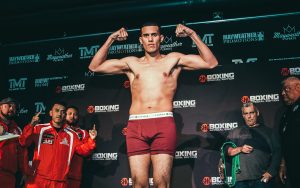
The network’s calendar of nine cards runs through June and opens on Feb. 17 with Phoenix super-middleweight champion David Benavidez in a rematch against Ronald Gavril on Feb. 17 in Las Vegas.

It’s something of a blueprint, something to build on. That means it’s incomplete, in part by design, yet also because of the chaos that is always there.

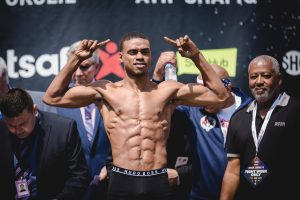
Despite anticipation for Santa Cruz-Mares and the unsettled intrigue surrounding Wilder-Ortiz, there are doubts about a potential fight that has had everybody buzzing in the days since welterweight Errol Spence Jr. put himself squarely in the middle of the pound-for-pound debate with a stoppage of Lamont Peterson.

There’s a lot of talk that Spence is already the world’s best. Not sure about that one. I’d still like to see him in another big bout before putting him ahead of Terence Crawford, Vasiliy Lomachenko and Mike Garcia. But after Saturday his name has to be included in any current pound-for-pound debate.

Forcing Peterson to quit after the seventh round was a display of Spence’s dynamic skillset, yet the victory was hard to judge because of everything Peterson lacked.

Spence, it seems, is one fight away from proving he should be No. 1 in the pound-for-pound debate. A fight against Keith Thurman.

For now, however, it looks as if he might denied that opportunity in a fight later this year. Thurman told reporters Wednesday at the Showtime news conference in New York that it wouldn’t happen in 2018.

On the Showtime schedule, Thurman is scheduled to fight May 19 in his first bout since undergoing elbow surgery last year. For now, there’s only TBA next to Thurman’s name for that date. To Be Announced is not on anybody’s list of contenders. For Thurman, however, it’s a reasonable way to test that elbow.

But then what? Another TBA? Thurman called 2018 “a get-back year’’ Wednesday. If he looks good on May 19, however, there figures to be calls for him to re-consider a late-year showdown with Spence, who has a June 16 date somewhere in hometown Dallas, perhaps in a mandatory title defense against Mexican Carlos Ocampo.

Spence said he is wiling to give Thurman “a pass” in his first bout this year. But it’s not clear if that pass will still be there 10 months from now.

Trouble is, Spence is on the fast-track to stardom. Already, there’s talk about opportunities for him at 154 pounds, which would allow to move up the scale and into a division that Floyd Mayweather Jr. also dominated.

Thurman is understandably careful. He’s been battling injuries. He hurt a shoulder while training in 2014. He hurt his neck in an auto accident in 2016. He will have been idle for more than a year when he finally returns in May.

He’s right. He needs time. If Thurman takes too much of it to get back, however, Spence might be long gone.


Spence rolls in the waiting game

By Jimmy Tobin-

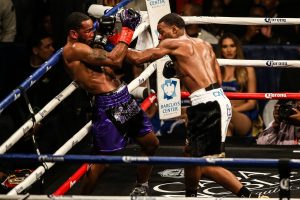
Errol “The Truth” Spence made the first defense of his welterweight trinket at Barclays Center in Brooklyn Saturday night, comprehensively battering Lamont “Havoc” Peterson until Peterson’s trainer Barry Hunter could offer only what he has always offered his fighter: compassion. After seven rounds, with Peterson lost for answers and looking for the one opportunity he dare not request, Hunter waved responsibly his white towel.

So ended what was always going to be an easy first defense for a fighter who wanted anything but. Fights of the magnitude Spence desires (and is there any reason to doubt him?) require the type of opponents PBC practices have long discouraged such opponents from taking. Eight months have passed since Spence travelled to Sheffield and made a repeat capitulant of Kell Brook. That may be an acceptable amount of time to secure a unification fight, something at least with a whiff of intrigue, but it is months too long a wait for a conclusion both arbitrary and foregone. Peterson has a name, yes, is endearing in both style and character, but had done nothing in his career to suggest he might trouble if not the best welterweight on the planet, the best threat to the bearer of that distinction. One fight in two years is hardly sound preparation for such a challenge.

Dogged, fearless as he may be—and he is both in charming amount—Peterson was there to be run over by Spence and run over he was. A slow starter who acclimatizes to opponents behind a wide stance and a high guard is unlikely to prosper against Spence, who works without any consideration for his opponent’s pace. Peterson paid dearly for what he gleaned of Spence’s attack; there was no parsing, no rejoinder, just a man who crumpled further in the rounds he expected to compete in. When Peterson turned up his aggression Spence varied his assault. To his headlong abuse he added a more elusive, mobile, yet no less destructive attack, countering Peterson and cracking him at angles. This wrinkle served as testament to Spence’s versatility and willingness to listen to trainer, Derrick James. These are qualities that will serve Spence when something more daunting than the eye-test awaits.

If there was some solace in watching Peterson teeter ominously under even the punches he blocked it was that Hunter did not wait long to begin the conversation that would end the fight. It says very little about the matchup that that dialogue started as early as it did, but it speaks volumes about what Peterson means to Hunter. And if that is romanticizing the cruelest sport so be it. A sport that is propelled by what-ifs and glorifies sacrifice has room for such idealizing.

Idealizing extends also to who is next for Spence, though perhaps it is too early in the new year to issue loaded questions—especially in this column, which has resolved to gripe less about a sport that can be discarded easily for alternative entertainment, a sport that will always—if not quite frequently—deliver thrills however long the doldrums in between.

Besides, Spence, at least for now, resides in the unique position of being compelling regardless of opponent. Such an assessment is a criticism of his opposition, otherwise the emphasis would not be on what Spence does in the ring but who he does it to. That such a criticism can be issued one fight removed from his breaking Brook speaks to the penalty of inactivity, yes, but also to how very good Spence is. For any other welterweight a win over Brook would make a victory lap tolerable.

Such grace periods should be short-lived, of course, and it is hard to imagine Spence devouring a pablum diet remains compelling for more than another fight or two. But that soft stretch shouldn’t persist any longer than that. Keith Thurman, the object of Spence’s obsession for years, will return to the ring eventually, and Spence will be waiting, unlikely as he is to be unmade by anyone willing (or allowed) to fight him until then. The financial realities of the PBC are such that the Thurman fight should be delayed only as long as it takes for “One Time” to return. Despite his inactivity, Thurman has never shied from taking a stern challenge after a long layoff (so make what you will of any shuffling of his feet where Spence is concerned). If Thurman is more professional boxer than fighter, and there is some evidence that he is, Spence will show it, titles will change hands, and the what-if that really follows Spence will loom greater than before.

Because what it takes to diffuse Spence doesn’t appear to be a semi-active, uninspired pseudo-puncher with the unfortunate habits of both relying on his legs for defense and wilting from body punches. Rather, Spence’s nemesis is more likely to be a fighter who can fight him as a fellow southpaw, one whose power is predicated primarily on accuracy and timing, who can fight coming forward or backing up; a fighter with the intelligence to put himself in the position to win, and the malice to deliver a victory once poised for it. Incredibly, that fighter exists, and he too is running out of suitable opponents. There are significant obstacles between the two, of course, but this is the sport of what-ifs, right?

So fuck it, let’s make it explicit: Errol Spence-Terence Crawford. What if?


Predation, mercy, mercenariness: Spence melts Peterson in Brooklyn

By Bart Barry-

Saturday at Barclays Center welterweight titlist Errol Spence unmanned former junior welterweight titlist Lamont Peterson in a very good fight that was stopped by Peterson’s corner after the seventh round. Spence used well the physics and geometry of combat to attain his career’s first title-defense victory.

The inevitability of that victory happened in round 2 when Peterson jabbed to Spence’s body and Spence parryswatted that jab – a classic no no; you do thousands of reps of abwork so you don’t have to parry or block jabs to the body – then Peterson feinted the same punch about a minute later, watched Spence’s hand drop, blasted Spence with a lead hook, and absolutely nothing happened. When one fighter executes perfectly his tactic and the other fighter hardly notices, the match becomes obviously a mismatch. From there the larger, better, more predatory man beat to soft his challenger until mercy intervened.

One hesitates to celebrate the conclusion of the match much as one may wish. In the generally unoriginal and unabashedly imitative domain of contemporary boxing telecasts one fears the rippling consequences of a writer subsequently embracing a corner stoppage by a decent man – for fear it becomes a thing, as the kids like to put it, a shortcut for selfaggrandizing towelboys before television cameras – but with that preamble in place, let us celebrate it nonetheless.

Whatever popular consensus says, and it appears a universally positive consensus, Barry Hunter has the air of a cool cat, a man’s man, a proper gentleman. Even still, if you watch his jaw and the work it does on his chewing gum as he awaits the right moment to stop Saturday’s match, you see right manifested the internal conflict a man like Hunter prides himself on hiding. He knows what a corner stoppage says to a prizefighter about his corner’s confidence, and he knows what happens to a corner once its fighter knows he no longer has its confidence: Time to move on.

Was Hunter’s evident anxiety about getting fired?

No, of course not.

Such a petty concern appears beneath a man like Hunter. It was more an instant weighing of probabilities: This is the last time Lamont can have me in his corner, which means this is the last time I can protect him from himself, which means either this moment releases him into a harsher boxing world, or this moment retires him. Notice Hunter asked for the round number before he made his decision; one imagines if he’d heard, say, “tenth”, he’d have let Peterson out for another while – Lamont deserves to finish, Lamont finishes strong, Errol’s punches lose steam after nine. But the distance from eighth to twelfth, that quarterhour, was too great, so why attempt the leap partially?

What should not be understated in this dynamic, though, is the precedent of Hunter’s commitment to his man. This wasn’t a mercenary trainer doing a celebrity signon with a shot fighter to get himself a new car and recruiting video before hearing his conscience suddenly clang. This was a man proving in the decisive moment his fighter’s decision to give his faith to him, decades before made, was right and good.

None of that makes Peterson a candidate for the Hall of Fame, even had he decisioned Spence – an absurdity Saturday’s broadcast floated before the opening bell. Torn through in his prime by Timothy Bradley and Lucas Matthysse, neither of whom likely gets in the Hall, Peterson got caught with performance enhancers shortly after his one defining win, a desperately narrow decision over Amir Khan – a guy who’ll only get in Canastota by paying $13.50 at the door. And Peterson’s excuse for needing testosterone other than his own was a decided inanity, especially from the bearded mouth of a man covered in muscles. But something had to be manufactured to sell tickets Saturday, and the “Juvenile Brothers Peterson on the Streets of Washington D.C.” narrative was already dustybare from overuse.

All of this indeed takes from Spence’s victory, but one senses Spence won’t mind, honest as he is. Before the match Spence conceded his status as a prizefighter PBC stablemates avoid shamelessly is both evidence of his professionalism and a source of appropriate frustration. Here’s that concession’s flipside: No outfit in boxing history has consistently paid so generously for meaningless fights as the PBC, even while its fighters aren’t active enough against competition enough to achieve universal acclaim (PBC fighters rarely grace pound-for-pound lists, no matter their talent). Spence is the one redeeming part of Al Haymon’s aggressive Team-USA-signing initiative of 2012, an initiative that offered a first peek at Haymon’s generally woeful eye for talent, and aware of, if courteously silent about, the circumstances that got him his title shot on foreign soil in May.

During or immediately after which Spence sustained an injury that kept him from fighting for the rest of . . . no, that’s not what happened at all.

Immediately following one of the year’s most captivating performances nothing followed immediately for Spence. In fact nothing followed for the rest of 2017 except a halfassed announcement he’d be making a halfassed title defense in January.

While it’s possible Spence wouldn’t’ve gotten a chance to drawnbutter Kell Brook if Spence’d not been with PBC, it’s nigh impossible to imagine a worse outfit to direct the career of a new champion if that new champion wants anyone but an accountant to review his reign. “It’s called prizefighting, ya dummy!” – I know, I know. Maximum reward for minimal risk is the Money way, which became the PBC way, which now becomes the Showtime way. But in that case, let’s show a little solidarity, guys, and have the competent commentary crew at Showtime stop harping on how damn inactive PBC fighters are.

Bart Barry can be reached via Twitter @bartbarry


FOLLOW SPENCE – PETERSON LIVE!!

Follow all the action as Errol Spence, Jr. makes the 1st defense of his IBF Welterweight title when he takes on former two-division champion Lamont Peterson.  The action kicks off at 9 PM ET as Robert Easter, Jr defends the IBF Lightweight title against former junior lightweight champion Javier Fortuna.

NO BROWSER REFRESH NEEDED.  THE PAGE WILL UPDATE AUTOMATICALLY

12 ROUNDS -IBF WELTERWEIGHT TUTLE–ERROL SPENCE, JR (22-0, 19 KOS) VS LAMONT PETERSON (35-3-1, 17 KOS) 
ROUND 1 2 3 4 5 6 7 8 9 10 11 12 TOTAL
 SPENCE 10  10  10   10 10  10             69
 PETERSON  9  9  8 10   9            63

Round 1: Spence working the body…Jab

Round 2 Spence lands a left to the body..Counter right and left hook to the body from Peterson..Right..Right from Spence..Jab and uppercut..uppercut and right to the body..Peterson lands a left hook..Straight left to body from Spence..Jab

Round 3 Spence lands a left to the body..1-2..Flurry..Chopping left..Digging body shot

Round 4 Left from Spence..Left uppercut..Good left..Counter right from Peterson..Spence lands a left uppercut..Short right..2 lefts from Spence..

Round 5 Left hook to body from Peterson..1-2 From Spence..STRAIGHT LEFT AND DOWN GOES PETERSON….2 big lefts..Hard right from Peterson..Left upper and straight left from Peterson..Left from Peterson..Great Round

Round 6  Double jab and straight right from Peterson..Crisp combination from Spence..Left hook from Peterson..left to the body..

Round 7 Doctor checking swelling over Peterson left eye..FIGHT IS STOPPED IN THE CORNER..WINNER ERROL SPENCE JR

 12-ROUNDS–IBF LIGHTWEIGHT TITLE–ROBERT EASTER, JR. (20-0, 14 KOS) VS JAVIER FORTUNA (33-1-1, 23 KOS)
ROUND 1 2 3 4 5 6 7 8 9 10 11 12 TOTAL
 EASTER  9  9 10  10   10  10  10 113
 FORTUNA  10  9  10 10   9 10  10   9  9  10  10  10  116

Round 1 Right hook from Fortuna..Combination..Body

Round 2 Fortuna coming out fast..Warned for holding Easter’s head..FORTUNA GETS A POINT DEDUCTED FOR HITTING BEHIND THE HEAD..Good Exchange..left hook from Easter..Combination from Fortuna..

Round 3 Straight right from Easter..Left hand and right hook from Fortuna..right to Face from Easter..Counter left from Fortuna..

Round 4

Round 5 Easter working the body..Left hook to the body..Left uppercut by Fortuna

Round 6 Big right from Easter..Counter left from Fortuna hurts Easter

Round 7

Round 8 Straight right from Easter..

Round 9 Combination from Easter

Round 10 Good left from Fortuna..Good body work..Left..Fortuna tagging Easter

Round 11 Good body work from Fortuna..Body work and left hook from Easter..Left hook..Left from Fortuna and another..Right from Easter..Body work from Fortuna

Round 12 Counter right from Fortuna..Both guys landing wild punches..Right from Fortuna..Left..Left from Easter..

Easter landed 130-567…..Fortuna  120-487

114-113 for Easter…114-113 Fortuna….115-112 Easter…Easter win via Split Decision


Audio: Lamont Peterson on The Abrams Boxing Hour


David Benavidez promises to knock out the doubts

By Norm Frauenheim-

He’s a prospect and a champion. It’s hard to be both. Perhaps, impossible. But that’s the dilemma for David Benavidez as he begins a new year after winning a piece of the super-middleweight title.

As boxing’s youngest champion with a major belt, the 21-year-old Benavidez says he hopes to unify the 168-pound title. First, however, the fighter who looked like a prodigy 12 months ago has to prove he’s no longer a prospect.

“I have to make a statement,’’ Benavidez said last week in Los Angeles at a news conference for his rematch with Ronald Gavril on February 17 at Las Vegas’ Mandalay Bay “I have to get the knockout.’’

Has to knock out the doubt.

Questions linger since Benavidez won the WBC’s vacant version of the crown on Sept. 8 with a split decision over 31-year-old Ronald Gavril, who brought journeyman-like credentials into the ring, yet repeatedly tested a tiring Benavidez. Gavril, who scored a 12th-round knockdown, appeared to gain confidence. Gavril is nine-and-half years older. Late in the bout, however, it often looked as if pedestrian Gavril knew what he was doing while Benavidez was still trying to learn what to do.

“He’s a young fighter who still has a lot of things to learn,’’ Gavril said. “Right now he’s the champion, but he will have to be ready. This won’t be an easy fight for him. I’m going in there to hurt him.’’

Maybe, adversity in the later rounds last September were moments when Benavidez began to grow up and beyond the apprenticeship stage. Tougher challenges await him at super-middleweight. There’s Gilberto Ramirez, the WBO champion and perhaps the best in the division. There’s Jesse Hart, who lost a dramatic decision to Ramirez in Tucson a couple weeks after Benavidez’ narrow victory over Gavril

“It’s been my dream since I was a little kid to unify titles and that’s what I’m working towards now,’’ Benavidez said. “I want to be one of the best in the history of the weight class and I’m working very hard to accomplish that.

“I’m the youngest super middleweight world champion in history. I’m going to show Gavril why. I’m extremely motivated to look even better than last time and get the knockout.’’

Benavidez, brother of former WBA junior-welterweight belt-holder Jose Benavidez Jr., already is working like a young man with a point or two to prove. The Phoenix native has been sparring light-heavyweight contender Oleksandr Gvozdyk in Oxnard, Calif. He plans to spar with WBA light-heavyweight champion Dmitry Bivol. His father and trainer, Jose Benavidez Sr., has brought an often-controversial Alex Ariza into camp as a conditioning coach. It’s as if David Benavidez wants to be known more for his maturity than his youth. He wore a beard to last week’s news conference.

“The strategy of this fight will be a little bit different,’’ said Benavidez, whose rematch figures to be the best bout on a Showtime-televised card that includes welterweight Danny Garcia against Brandon Rios. “We have some things that we’re planning. But it’s still going to be a war, because I want to be a fan friendly fighter. I’m hoping to steal the show.

“I’m the champion so I feel like I’m in a position to make some great fights in the near future. I want the winner of the World Boxing Super Series 168-pound tournament. I’m honored to be in the same column as the other champions and I can’t wait to get in the ring with them.

“I didn’t overlook Gavril the first time. I knew he was a contender and he came in tough and ready to fight. I know his style now, so I’m going to go to work getting better.’’

It’s the only way to become a grown-up champ.


In lieu of a preview: Revisiting Israel Vazquez vs. Jhonny Gonzalez

By Bart Barry-

It’s the new year. Time for a preview.

Nope.

Some laziness and more wisdom say a preview of what’s to come in this new year in this new column won’t work well because its writer hasn’t a strong feeling about anything that is to come in 2018 and hasn’t even minimal interest in ingesting or digesting or egesting others’ opinions on it. Here’s a better idea.

Let’s revisit Israel Vazquez versus Jhonny Gonzalez as a reminder of just how special “El Magnifico” is.

There’s the longform preview, the bulletpoint preview – apparently how the leader of the free world takes his intelligence briefings – the panelist preview, even on special occasion the poetry preview. It’s what you have to do with a weekly column and no action on the horizon each January and many a June or July; it’s either that or make an agepoorly review of whatever slim fare happens at the top of the year, pretending some historically inconsequential fight or other is a worldbeater certain to be remembered 11 months later during award season but not actually memorable come even March or April.

Such is the chore of making a constant effort at a subject whose quality is inconstant at best. Which brings us more symmetrically than may appear to the subject of today’s nonpreview column.

Ringside at Vazquez-Gonzalez in 2006, the co-comain of my first Vegas fightcard, I never saw the HBO broadcast or heard its soundtrack, believing as I do there’s no replacement for an eyewitness experience and nothing in a video is accurate as being ringside because there’s an intuitive thing that happens when you’re in physical proximity to an event, there’s an intimate sense for the accumulation of moments that belongs to you, not the cameras of a selfinterested broadcaster, that makes what you feel more trustworthy. The trustworthiness of this intuition is doubly thwarted by sayings like “you’d better think twice” and television’s relentless revenuedriven drive to replace the personal experience with itself, culminating for me years ago in the crowning idiocy of television viewers telling ringside reporters to review fight tapes to see what they missed – like aspiring tourists telling residents to watch Netflix to see what their native country is really like.

What perception happened quite quickly in my review of the Vazquez-Gonzalez broadcast, then, was the sobriety of the HBO commentary: Jim, then as now, steered the narrative wherever his cohosts directed it, but Emanuel and Larry were simply quieter than Roy and Max. At match’s end, for instance, when Jim set his mind on setting a blaze of controversy, Emanuel simply said, no, the result would’ve been the same regardless, and the whole thing got extinguished. Even were Roy today cogent as Emanuel then, he’d never get a chance to stay the inertia of his partners’ babbling long enough, and Roy is nowhere near so cogent.

In 2006 it felt like reporting. By 2010 it felt like presenting. And today it feels like selling.

OK, back to what matters.

I don’t know why I waited till 2018 to revisit this match – not in the sense that I don’t know why I chose to watch Israel Vazquez on the second Sunday morning of the year but why, if I’m capable of such an impulse, I don’t do it much more frequently. Before I was enamored of Chocolatito I was enamored of El Magnifico. And his match with Jhonny Gonzalez comprises many of the reasons why.

What Vazquez had that I admire most was physical intelligence; Vazquez thought with his body and thought through his opponents’ bodies better than most, neutralizing other men’s superiority of speed and length by doing things more precisely than they did. Vazquez’s underappreciated technique, too: the way he L-stepped from Gonzalez’s righthand towards his own, calculating as he later did in his revered trilogy with Rafael Marquez that as a Mexican-bred prizefighter he could handle well any fellow Mexican’s lefthook as any fellow Mexican could handle his, and so why trade lefthooks when neither he nor his opponents would withstand a rightcross thrown as counter or combo or lead?

It was a calculation that nearly got him undone by Gonzalez, who dropped him with a lefthook lead twice in the match, first with a balance shot then later with something indeed flusher. Whatever lefthook power be his birthright Vazquez changed decisively Gonzalez’s calculus with his right, though, in a match Gonzalez led prohibitively, 60-52, at its midpoint.

Izzy may have won two minutes of the match’s first 18. Yet there he was at each round’s opening bell, bounding off his stool and hustling to ringcenter, eager to seize some initiative from Gonzalez.

Then Vazquez shortarmed his jabs until he knew they counted, bringing the much longer Gonzalez closer and closer, extending fully only when certain a landed punch might undermine Gonzalez’s fitness more than it improved his perception of what Vazquez was up to. And goodness, but Gonzalez was a proper challenger.

Twenty-four years old and 37 prizefights into a 75-prizefight (and ongoing) career Gonzalez dropped Vazquez with a pair of the lefthooks that later razed Abner Mares in a single round, and each time he did Gonzalez finished the round worse than he started it. And Gonzalez threw those lefthooks with abandon, several times imbalancing himself into pirouettes when they missed. Izzy made him miss oftener than posterity records, too.

When the time came for finishing Vazquez was ever more robotic than predatory, enthusiastically applying a template more than attacking another man. And gracious in victory, always.

Bart Barry can be reached via Twitter @bartbarry


Twelve predictions for every page in a new calendar

By Norm Frauenheim-

Finally, a new calendar with all of the renewed optimism and good humor that goes with it. Twelve predictions, one for every month:

  • Opening bell for the New Year begins on Jan. 20 with an appropriate face. Errol Spence Jr. looks a lot like the future and he’ll provide an interesting preview on Showtime against Lamont Peterson at Barclays Center in a welterweight fight. Spence wins, impressively enough to ignite speculation about a bout with Keith Thurman and even Terence Crawford.
  • Roy Jones Jr. fights for what he says will be his farewell on Feb. 8 in hometown Pensacola. Six weeks later, he announces that he’ll fight one more time.
  • Deontay Wilder gets out-boxed early by Luis Ortiz. Ortiz tires late, drops his hands and gets knocked out by a Wilder right in the 10th. When Ortiz regains consciousness, he realizes he was leading on all three scorecards at the time of the stoppage.
  • Anthony Joshua blows away Joseph Parker in front of another UK soccer-like crowd. Talks for a heavyweight showdown between Joshua and Wilder begin, but stall. Wilder wants a 50-50 split. Joshua demands 60-40. Joshua agrees to fight Tyson Fury instead.
  • Oscar Valdez Jr., gets knocked down by Scott Quiqq on March 10 at StubHub Center, gets up and scores a late-round TKO in another crowd-pleaser from the Mexican featherweight, who gives fans more drama and trainer Manny Robles another gray hair.
  • A Russian tests positive.
  • Adrien Broner gets arrested.
  • Canelo Alvarez shows he doesn’t forget. He learned a lot from his 2013 loss to Floyd Mayweather Jr. He proves he’s still a good student, learning from his 2017 draw with Gennady Golovkin. This time, Canelo scores a unanimous decision over GGG.
  • After Mikey Garcia wins in a dominant performance over Sergey Lipinets on Feb. 10 in San Antonio for a 140-pound title, he goes back to 135 for a stoppage of skilled Jorge Linares. But a much-talked-about showdown with Vasyl Lomachenko looks to be as far away as ever, mostly because Top Rank is still angry with their former client. Top Rank decides to let the Lomachenko-Garcia possibility marinate for another year.
  • A restless Andre Ward decides to attempt a comeback. He is tempted by heavyweight wages. In a test run at cruiser (200 pounds), however, the 6-foot-1 former light-heavyweight champ learns he’s just too small for a division topped by the 6-6 Joshua and 6-7 Wilder. Srisaket Sor Rungvisai, who dethroned Roman Gonzalez in 2017, agrees to a 118-pound bout with Naoya Inoue, known as The Monster in Japan. In the history of the forgotten little guys, the fight ranks among the best ever. At the end of 2018, it’s also a leading contender for Fight of the Year.
  • UFC President Dana White continues to make inroads into boxing. All the while, his relationship with Bob Arum heats up and boils over into an entertaining exchange of one-liners and insults. It’s the best promotional rivalry since Arum-Don King throughout the 1980s and into the 1990s when the business was wildly successful


Mosaic of 2017’s most ambivalent fight, part 2

By Bart Barry-

Editor’s note: For part 1, please click here.

*

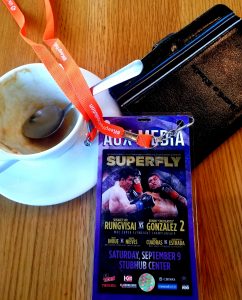
What a younger Roman “Chocolatito” Gonzalez might’ve done with a smaller version of Wisaksil “Srisaket Sor Rungvisai” Wangek, would’ve done, one writes with near certainty, is whack him low, block his early shots then begin spinning him dizzy, making him miss then pivotwalking him into whatever Chocolatito wished throw his way from whatever angle Chocolatito wished throw it, and after Sor Rungvisai collapsed from concussion and exhaustion Chocolatito’d’ve helped him off the canvas onto his stool.

A lesson Santa Monica teaches on a Sunday morning, festive and bright, and a Sunday evening, dark and unfriendlier and a touch despairing, is the atmosphere of a place – its energy or mood or spirit or vibrations or aura or nature or God or light or luck, synonyms likely all – colors reflexively its every inhabitant, no matter how decisively he draws his state of mind and emotion from within: The palpable sense of forward-regret I’ve felt every Sunday evening since grammar school, I realized on Santa Monica Pier, is not mine but a reflection of everyone else’s.

Sor Rungvisai showed no regard whatever for Chocolatito in round 1 and instead trusted the physics of championship prizefighting.

Doug Fischer happened over to say hello sometime during the undercard, and his headwear and demeanor reminded me of Digital Underground’s Shock G, and I told him so (and he replied immediately with a quip about StubHub Center’s generous tailgaters turning him into Humpty Hump) because I knew he’d get the reference and moreso because I was so happy to see him because Doug is one of the most genuine and decent men I’ve met anywhere, and seeing him ringside immediately returns me everytime to 2004 and my Max Boxing subscription and watching Doug and Steve Kim’s weekly show, wondering what it might be like to cover boxing.

For reasons of character (orgullo y ambición) and culture and luck Chocolatito hadn’t a choice but to fight often and ascend weightclasses steadily, and such an ascent, when done honestly, sans handicapping and cherrypicking, brings an inevitable reckoning with physics (their fists be larger than your chin) or time (you haven’t the proper reflexes anymore for hair’s breadth escapes) or both (damn it! this hurts and there’s nothing I can do about it), and while there’s a good chance such a reckoning was exactly what Chocolatito sought there’s also a chance Chocolatito did not quite believe such a reckoning possible.

My September, weighted by legal woes, caused me to keep a halfhourly tally of my thoughts and emotions (thoughts caused, as ever, by emotions), a tally that made me acutely aware of the Santa Monica Pier’s benevolent effect on what vigilance I applied the task of equanimity towards a situation that anyway resolved itself amicably by October.

There’s no such thing as a wholly objective scorecard unless its scorekeeper keeps his eyes ever fixed on the middle plane between the fighters, diverting his gaze to one fighter or the other only when following a punch that pierces that plane, which no scorekeeper does, but years of thinking about such a feat at least led me to an improved awareness of what fighter I favor by watching, and that fighter has been Chocolatito in every minute of his every fight (right up until Sor Rungvisai’s absurd victory somersault after Chocolatito was razed).

Sitting one row in front of me and kind enough to turn and introduce himself was the young and talented writer Sean Nam, and when our fun and winding conversation wound its way to his friend and mentor, Carlos Acevedo, I was pleased to hear myself saying something like this: In the hierarchy of this boxing-writing thing, there is Carlos and everyone else, and the distance between Carlos and everyone else is not small, which is another way of saying: While there are plenty of boxing writers whose work I admire, Carlos’ is the only writing I consistently read and think “I don’t believe I could do this”.

Once he regained his consciousness then his feet Chocolatito wanted to leave the StubHub Center’s ring rapidly as possible but the WBC, whose superflyweight title Sor Rungvisai took from Chocolatito in March and emphatically did not return in September, had to bestow on Chocolatito a finisher medal of some sort, a runner-up trophy for a twoman contest, and Chocolatito wanted no part of it, hanging the souvenir round his knuckles not his neck as he snapped through the ropes and the hell out of the ring.

As early Saturday afternoon included a trip to architect Frank Gehry’s Walt Disney Concert Hall (a familiar to his historic Guggenheim design in Bilbao, Spain, though in stainless steel skin, not titanium) and brunch at the fabulous Redbird, and Sunday afternoon included a trip to The Getty, whose grounds were far greater than their collection, it was not lost on me how much more time I spent on Santa Monica’s gaudy pier than among works of artistic or architectural grandeur, which marks either an inversion of maturity or its transcendence.

The atmosphere at ringside was subdued unto funereal after the main event, as nearly no one traveled from Thailand to see Sor Rungvisai, and the partisan-Nicaraguan crowd that filled the StubHub bowl was already mourning its experience collectively, which made it easy to miss the scale of Sor Rungvisai’s achievement, which later made end-of-year recollections like Jimmy Tobin’s so insightful and satisfying to read.

There was a time I thought often about experience and legacy and decorated a small office with ringside credentials and submitted my work to annual writing contests, but changing life conditions did away with all that three or four years ago, and a halfdozen annual boxing trips, too, and now I realize I was wrong to do away with the boxing trips.

Bart Barry can be reached via Twitter @bartbarry


The Regicide: On Srisaket Sor Rungvisai

By Jimmy Tobin-

He was the opponent that night in March, if not quite in the derogatory sense, where matchmaking calculus eliminates a fighter’s prospects in advance, then at least in terms of billing. He was supposed to fall, by knockout ideally, to play his role in a narrative no less true for it being dressed in the bombast of a network’s company men. But he left the ring a champion.

When super flyweight Srisaket Sor Rungvisai won a majority decision over Roman Gonzalez at Madison Square Garden he did more than play an earnest part in a fight near perfect in its brutality. More? Remarkably, yes, though we should stay there with the sweat, the blood, the attrition for a minute, no?

Unlike any number of Gonzalez’ previous opponents, who found themselves trapped in the line of fire against the finest offensive fighter in the sport, Rungvisai stood irreverently at arms reach. Bolstered by a size advantage that thwarted Gonzalez time and again, and what seemed a fortifying concoction of ignorance and disregard for the man before him, Sor Rungvisai welcomed the fight Gonzalez promised like no opponent has. He brought foul after disruptive foul, drawing first blood via a headbutt and doggedly persisting in his rough work until the seemingly unflappable Gonzalez looked tellingly to the referee for order.

And we should thank him for his belligerence. Because what he demanded of Gonzalez that night was nothing short of self-immolation. And Gonzalez responded. To watch “Chocolatito” in those championship rounds, drained of his blood from headbutts, his zest leaking out with it, chopping his blade dull against a man he could not fell, was to witness the type of performance only great fighters can manage—and even then only once or twice. Sor Rungvisai’s appreciation for that assault, his finding even some joy in all that leather, was awe-inspiring. Gonzalez was his greatest that March night; Sor Rungvisai was the reason he had to be.

Not to be lost in the debate about who deserved to win is the reality that Sor Rungvisai fought a great fighter on near even terms, and that barring some absurd veneration of the undefeated record, what the fighters produced that night trumped easily any assessment of that action by the judges. We do not watch (and rewatch) fights simply to see who wins—we watch to marvel at the journey to that result. The outcome is always secondary to the violence that produced it.

He was the opponent that night in September too, if only until the man he defeated six months prior began his ring walk wearing an uncharacteristically grim visage; until the thirteenth round between them started with the irreverence of the first, and the sixteenth ended unforgettably.

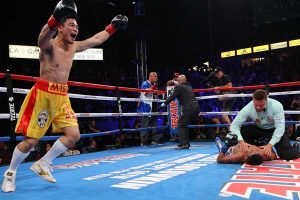
When Srisaket Sor Rungvisai augered Roman Gonzalez into the canvas in the fourth round of their rematch at StubHub Center in Carson, California, he ratified not only his career but that too of Gonzalez, who ended up where his ambition would inevitably lead him—at a point absent of questions either unasked or unanswered. What more could be asked of Sor Rungvisai, for that matter? Come September, the sabers that rattled in protest of the decision in March were as silent as Gonzalez on the canvas. Sor Rungvisai was twice the underdog against Gonzalez and twice emerged with victories. Surely fighters have bucked the odds this way before, but how many of them did so against a fighter like Gonzalez? Were the two to fight again, Sor Rungvisai would be the clear favorite—and the reasons for those odds are why Gonzalez is unlikely to ever consummate the trilogy.

HBO was validated that night as well, if not in the way they intended. And they took note too. In a span of eleven months, Sor Rungvisai will go from twice facing Gonzalez to fighting Juan Francisco Estrada, who, until this year, had given Gonzalez his sternest test, with all three fights televised by HBO.

For too long the pattern has been in place: fighter X is maneuvered by various means into HBO’s interest, he wins a showcase fight or two on the network, is dramatized into a protagonist, and then matched according to the outcome of a script, one that mostly preserves his image lest HBO itself encourage the idea that anything but the best be invited on its airwaves. But that pattern never manifested with Gonzalez, and that is, in part, because what Gonzalez found in Sor Rungvisai was not an opponent, but a nemesis. Which is why it feels near impossible to write about Sor Rungvisai without not only referencing but praising, Gonzalez, ensuring that Sor Rungvisai will forever receive his due. The intimacy of their fights is reflected in how inextricably they are linked: it was Sor Rungvisai that showed Gonzalez where his ambition left his ability behind, and Gonzalez who demanded Sor Rungvisai’s arrival on the world stage be something remarkable. Remarkable, it was.

It is awards season in our sport, an undertaking that often seems more about those who bestow such honors than those who (in most cases, unknowingly) receive them. Admittedly, such a curation extends beyond the interest of this column, which is guilty of consuming rather selfishly (and only conveniently) what violent fare the sport may offer and forgetting much of it soon thereafter. But the year Sor Rungvisai had casts a shadow over the entire sport, it looms as the year’s benchmark for achievement, and more importantly, as a reason to keep watching. So gift him whatever awards you like, if only as a token of appreciation that falls so very short of what he gave us.


Happy New Year? Four reasons to hope for one

By Norm Frauenheim-

A promising year ends, but the promise will go as stale as cheap champagne if fights we talked about in 2017 don’t happen in 2018.

Here are just four on a wish list that will make the New Year one to celebrate or just another one to forget:

Terence Crawford versus Keith Thurman, or Errol Spence, or Shawn Porter, or Kell Brook.

Crawford, the vote here for the Boxing Writers Association Fighter of the Year, jumps from 140 to welterweight in the most intriguing move in a New Year.

After a likely shakedown cruise in his division debut against Australian Jeff Horn, Crawford becomes a threat to anybody at the top of the division.

Guess here: He’s better than anybody at 147 right now. That’s also a reason to be cautious about whether any welterweight fight on this wish list actually happens. Thurman, Porter and perhaps Brook will find ways to avoid the feared Crawford. The biggest bout at welterweight in a long time looks to be Crawford-Spence, but Spence, 27, appears to be a year from his prime. Check back 12 months from now. Crawford-Spence might at the top of the wish list for 2019.

Vasiliy Lomachenko versus Mikey Garcia

I keep hearing all of the reasons why this fight won’t happen. Please, if it doesn’t, it is just a further condemnation of a business still ruled more by ego and grudges than good sense.

Top Rank continues to express resistance to the fight, presumably because it is still angry at the way Garcia left the game’s promotional giant. But the good news – and Garcia’s best friend in all of this – is Lomachenko himself.

Throughout last year, Lomachenko has never backed away from his desire to fight Garcia. Invariably and repeatedly, the fight the forthright Ukrainian says he most wants is Garcia. In an ongoing effort to win over boxing’s key demographic, Lomachenko understands he needs to fight the Mexican-American.

But there’s something else, too. It’s also a fight that has been in the forefront of the public imagination for at least a year. It matches Lomachenko’s many-angled creativity against Garcia’s fundamental efficiency. Make the fight, please.

Anthony Joshua versus Deontay Wilder

If the heavyweight division comes back, it’s a sure sign that the business is back and healthy.

In one corner of the world, heavyweight boxing is rock concert-like show. Joshua and his dramatic victory over Wladimir Klitschko played out before 90,000 at Wembley Stadium in London last April. Can the UK enthusiasm go global? Yeah, it could with Joshua against American Deontay Wilder.

Pieces for Wilder-Joshua later in 2018 are falling into place with talks for Joshua-versus-Joseph Parker and Wilder-versus-Luis Ortiz, both in March. A reason for caution, however, lurks in Wilder-Ortiz. It could undo any chance at Joshua-Wilder.

The clever Ortiz is a threat to Wilder’s unbeaten record in a dangerous fight. Then again, they’re all dangerous for Wilder, who has flaws in his fundamental skillset. Yet, Wilder’s big right hand and overall athleticism are an equalizer that is as powerful as it is unpredictable. Entertaining, too.

Gennady Golovkin versus Canelo Alvarez

The rematch has to happen, right? It ended in a draw in May. It was controversial in some corners. Mostly, it was an unsatisfying end to a bout that had been preceded by a drumbeat of hype that promised definitive drama.

Maybe, there was drama. But there was nothing definitive about it. For Canelo, a rematch is another opportunity to correct mistakes from an uneven performance, one booed by many of his Mexican fans.

For GGG, it’s a chance at delivering some proof. He was angry after the scores to the May draw were announced. He said he won. In a rematch, he can do exactly that.

A reason for caution is that a deal has yet to be done. Neither middleweight has anywhere else to go. GGG and Canelo have unfinished business. Finish it in 2018, or the public just might be finished with them.


Mosaic of 2017’s most ambivalent fight, part 1

By Bart Barry-

We were in Carson, Calif., to celebrate Roman “Chocolatito” Gonzalez for the joy he brought us through a spectacular career predictably obscured in the United States by his tiny stature while properly celebrated in his homeland of Nicaragua, homeland of Alexis Arguello.

Santa Monica is not like Los Angeles, though it is such a joyful place, with its gaudy pier and mix of wealth and homelessness, so unlike my decades’ old and enduring dislike of Los Angeles, it made me reconsider entirely my thoughts of Los Angeles as shallow and stubborn, sunken in envy or frugality or unseemly selfseriousness.

Wisaksil “Srisaket Sor Rungvisai” Wangek, the Thai superfly imposter who stole Chocolatito’s belt in March after prepping for his match with the world’s greatest prizefighter by whupping three consecutive debutants in the second half of 2016, rounding off gently a year of five tussles with opponents whose aggregate record, 15-24 (9 KOs, 19 KOs-by), hardly fitted him for confrontation with Gonzalez (46-0, 38 KOs), actually was no imposter at all and actually didn’t steal from Gonzalez in March but rather took.

Access to prizefights remains this job’s only compensation, which makes 2016’s tack of writing a weekly column and getting credentialed for no fights simply daft, and if the end of 2017 doesn’t see a proper remedy or resolution to make 2018 better still, it reminds this much: There be no better form of compensation for writing about boxing than access to boxing and no better way to rekindle interest either.

Chocolatito got butted oftenly by Sor Rungvisai in their first match and complained about it, too, uncharacteristically, and some of us incorrectly saw it as an abiding fixation on sportsmanship, while more of us saw his complaining as tactical, and only a few of us – including, obviously, Sor Rungvisai – saw it correctly for what it was: an anxious concession to fragility.

It’s not often I converse the duration of a threehour flight with a rowmate but September’s mate was deeply attractive and comfortable, and she said something about Santa Monica reminiscent of something similar a rowmate said on a Peruvian train bound for Ollantaytambo in August: “The best places in the world to visit have a hippie-ish vibe.”

The Friday weighin was too far from LAX to justify what plane-to-gate-to-shuttle-to-rentalcar-to-freeway-to-brakelights stuttershuffle it required of someone flying from Texas on a latemorning fare, and a recollection of that selfsame stuttershuffle unrewardingly performed for Vazquez-Marquez 3’s weighin, nine years before, kept me from eyewitnessing Gonzalez’s unblinkered staredown with the unblinking Sor Rungvisai.

There’s another compensation for this job, come to think of it – the appreciation of one’s peers.

The ugliness and downtime of 2016, with its plethora of PBC matches worse than mere downtime (as Samuel Johnson once said of sailing, “being in a ship is being in a jail, with the chance of being drowned”, so were PBC broadcasts like downtime with a chance of feeling guilty for not watching), afforded, however, a chance to revisit and visit happily dozens of Chocolatito matches that didn’t happen on American airwaves but entertained beautifully on YouTube uploads from Managua, while writing howsoever many parts of an unplanned “Chocolatito City” series whose title borrowed gratefully if inexplicably from Big Daddy Kane’s 1993 medley (which itself borrows a punchline from Muhammad Ali, the man on whom Kane modeled his career).

I remember most fondly about the logistics of September’s trip upgrading my rental to a ridiculous Dodge Challenger, obnoxious American muscle made in the climactic throes of obnoxious American muscle, a car whose Sport mode made the car seemingly no quicker – as any quicker than default mode mightn’t be street legal – but significantly louder, and driving that car, with its surprisingly excellent handling and shockingly good fuel efficiency, all the way from Carson to Malibu to see the sunrise at El Matador State Beach, still marks the wisest thing I’ve yet done on a fight morning, in 12 years of trying.

We were there to see Chocolatito avenge his record’s first blemish, yes, but we were also there for the opportunity of it, if we were honest: it would be wondrous to be ringside for a great card that culminated with a prime Chocolatito wrecking the Thai interloper Sor Rungvisai, but it would be more essential still to be present for a reduced Chocolatito’s mainevent finale in the United States on HBO.

Cliff Rold, a writer I’d not met but whose knowledge I admire, happened over during the undercard and we affirmed for each other our belief Chocolatito’d prevail while addressing the possibility that if we were sure he’d prevail both of us mightn’t’ve made the trip crosscountry to see it – “I hope I’m wrong,” I think I said about the possibility of Sor Rungvisai simply having Chocolatito’s number, “but if I were sure I’m wrong, I’d probably not be here.”

Chocolatito, the gorgeous dervish who enchanted aficionados with his style and craft, a volume puncher with power, a boxer whose defense was his activity and footwork, carried his balance and power upwards to 112 pounds from 104 1/2, what he weighed the day before winning his first title at minimumweight, with what ease and grace only genius reliably shows.

So pleasant and layered were the sensations of Santa Monica I began googling from the pier “hippiest places in each state” and found, in a happy accident, Texas’ consensus choice is San Marcos, not Austin, both nearer San Antonio and more accessible.

What happened in Sor Rungvisai-Gonzalez 2, instantly, as I remember it, was Sor Rungvisai’s every punch moving Chocolatito, especially the ones Chocolatito blocked – the universal sign of a physical mismatch regardless of what the Friday weighin scale opined.

What I didn’t know when I began covering matches from ringside, when I foolishly interpreted my pressrow position as a commentary on my merits as a writer, when I thought credentialing reflected something different from clickcounts or a seat in auxiliary meant you were inadequate as a craftsman, I know now: Enjoy any seat removed from a power outlet – you experience the same fights without the artificial stress of a deadline.

Bart Barry can be reached via Twitter @bartbarry


Forget The Rest: 2017 will be remembered for Joshua-Klitschko

By Norm Fruenheim-

It’s been a year full of lots of things.

Full of it, perhaps, if 2017 will be remembered for the spectacle-over-substance display of Floyd Mayweather Jr. entering the ring in a bandit’s mask for his money grab against Conor McGregor.

That single, most-watched event over the last 12 months was embarrassing for the obscene hype it generated and the gullibility it exposed in the four-plus million pay-per-view customers who paid for the show.

The guess here is that it will be forgotten and never be repeated, although the latter might be hoping for too much.

If it wasn’t exactly a great year, it was a promising one because of Terence Crawford, Vasiliy Lomachenko, Mikey Garcia, Errol Spence, Gennady Golovkin, Canelo Alvarez and the ongoing move away from the pay-per-view business model.

The promise was played out in one terrific fight — Anthony Joshua climbing off the deck for an 11th-round stoppage of Wladimir Klitschko on April 29 in London. It’s Fight of the Year, of course.

There are other nominees, but none are contenders in a 2017 that will forever be known for a fight significant on so many levels.

There was the crowd at London’s Wembley Stadium — 90,000, boxing’s biggest since World War II. It was a classic between heavyweights, a division that had begun to look as old as the newsreel footage of WW II battles.

But there it was, all over again and available on live stream, with the kind of drama that plays well in any era. It was timeless. Klitschko gets up from a fifth-round knockdown. Joshua gets up in the sixth, clearly hurt and yet survives. Klitschko is down again, twice in he eleventh and back on his feet after both before a succession of Joshua punches forces a stoppage.

It was a classic reminder of how good the heavyweights have been and can still be. As we await 2018’s opening bell, there is relevance and some of the aforementioned promise in all of that. Decades and a piece of Evander Holyfield’s ear have come and gone since anybody talked about the heavyweights.

But on the list of fights that fans want to see, Joshua-versus-American Deontay Wilder is right there, alongside Garcia-Lomachenko, a Golovkin-Canelo rematch and Crawford against any of the top-ranked welterweights.

Will it happen? Hard to say. At the negotiating table, Joshua’s popularity among UK fans is as powerful as Canelo’s ability to draw Mexican fans.

A sure sign of that came in a follow-up. In October, a crowd of 78,000 showed up in Cardiff, Wales, for Joshua’s victory over Carlos Takam, who had none of Klitschko’s name recognition.

Joshua has yet to create much of a following in the U.S. If an overrated Ricky Hatton proved anything, however, it’s that UK fans travel. In New York or Las Vegas, he’d be the crowd favorite against Wilder.

First, however, it looks as if a couple of things have to happen. There are ongoing negotiations for Joshua to fight Joseph Parker of New Zealand, perhaps in March. There are also talks for Wilder to finally face Cuban Luis Ortiz, also in March.

Of the two, Wilder faces the biggest danger. The clever Ortiz has enough skill to beat Wilder. It depends on which Ortiz shows up. Wilder’s fundamental skillset has always been questioned. But he has always won, mostly with a right as good as any in many years.

If Wilder’s right hand instead of Klitschko’s had knocked down Joshua in April, the guess here is that the Wembley fight would have ended then and there.

But it has to land, and there’s a question about whether Wilder can do that against Joshua, a 2012 Olympic gold medalist. It’s also a question that includes wilder’s right-handed power, a so-called equalizer as unpredictable as it is dynamic.

As a New Year begins, it’s a talking point, a reason for optimism that wouldn’t be there if not for Joshua-Klitschko, Fight of the Year and the best heavyweight fight in at least a generation.


Audio: Caleb Truax and Ray Flores on The Abrams Boxing Hour


Marc is joined by IBF super middleweight champion Caleb Truax and Boxing broadcaster Ray Flores on this episode.


Horsing around in Jalisco, watching David Lemieux

By Bart Barry-

GUADALAJARA, Mexico – This city is 4,500 kilometers southwest of Laval, Quebec. That’s sensible a place as any to start a column like this.

There be nary a Canelo statue to report in the center of this old and noble capital of Jalisco nor a great interest in searching one out. If I wasn’t here to visit San Agustín de Tlajomulco de Zúñiga, birthplace of Cinnamon Alvarez, the redhaired horseman of Jalisco (that’s a halfassed alliteration that works like a pronunciation key: hair and horse and Jalisco all begin with the same general sound), I cared at least enough to google the lineal middleweight champion’s hometown. Then I forgot all about it till an uber took me past a lowend bar called Canelo’s in a spotty neighborhood. A better columnist’d’ve alighted the car and done some investigative stuff but it didn’t fully register till just now when I sat down to write a column tenuously linking Guadalajara and Billy Joe Saunders, and forcing such symmetry, I’ve found, is only fun to do if you admit it first.

Saturday evening Saunders craftily denuded David “. . . ah . . . The Canadian” Lemieux then advised Montreal authorities to file charges of indecent exposure against a man who, it’s naughty to admit, rounds out Gennady Golovkin’s career Top 3 Greatest Challengers list.

The indecent-exposure line is not mine but sprung to mind as I watched Saunders and asked myself where I’d seen such a thing before. Firing sporadically on the fuel of tortas ahogadas (drowned sandwiches) and carne en su jugo (meat in its juice) – the wet food beloved by Tapatíos in this city – my query returned: Cristian Mijares vs. Jorge Arce. On the undercard of Manny Pacquiao’s 2007 Alamodome demolition of Jorge Solis, Mijares took a formidable favorite and stripped him bare at center ring. So bare, in fact, someone from then-promoter Gary Shaw’s outfit, then representing Vic Darchinyan and goading Arce and his promoter Top Rank at every chance, sent a press release pleading for Arce to be arrested in Texas and charged with indecent exposure, which still brings a chuckle.

Maybe boxing was more fun then or maybe I was, but I can’t think of a press release in years combining so tidily the caustic and the clever.

Saunders carried the same panache Saturday as Mijares carried a decade ago; Saunders knew exactly what Lemieux would do next long before Lemieux decided to do exactly what Saunders already knew he’d do. It’s an incredibly dispiriting sensation, that – to realize you’re best chance of striking an opponent is by accident and then to see in his eyes, within an instant, he just heard you think that, too, damn it.

A fighter and trainer with whom I once did some illadvised sparring one time came off a perfect slip of my righthand (“perfect” defined as: moving the least distance possible to make me miss, ensuring with such economy I would expend all the energy required to stop my fist and perversely feel encouraged by how close I’d come to walloping him, the better to break my spirit and body) and pinned his right glove to right temple at least a halfsecond before I knew I was going to waste more resources on a useless hook.

I dropped both hands then and there, spitting the gumshield in my left palm, and said, “How the hell did you know I was going to throw the hook next?”

He shook his head contemptuously and said, “It’s the only thing you could throw.”

He’d taken the few and simple algorithms that composed my offensive arsenal, downloaded their defenses and counters, and not wasted one more cycle on thinking. He would ponder some new ways of punching me hard in the face, I gathered, but he had defense on autopilot.

Imagine his surprise when I later leapt out my crouch and . . . yeah, right. I avenged absolutely nothing that day or any other with him.

Where were we? Oh yes, Saunders and Mijares, Arce and Lemieux.

Saturday’s match was supposed to be a good one. If it was intended as anyone’s showcase by HBO it was Lemieux’s – the better to burnish retroactively GGG’s superlinear power and class. At one point, even, there was an allusion to an assault on Saunders proving Lemieux was ready to rematch his KO-8 with Golovkin, of all risible suggestions. Instead the network lucked its way into a formidable challenger for the winner of Alvarez-Golovkin 2 (Saunders makes a very good fight with Golovkin and a good fight with Canelo) or a spoiler for the network’s legless Danny Jacobs rehabilitation tour (Saunders makes a miraculously dreadful spectacle with The Miracle Man).

What does any of this have to do with Guadalajara or Jalisco or even Mexico? Very little, admittedly.

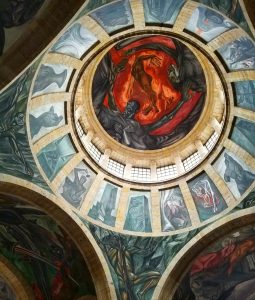
There’s a cosmopolitan quality to this city that now informs my recollection of interviews with Canelo, though. He was unfailingly courteous and professional, if not insightful or imaginative; to interview Canelo was to interview an equal in every way, not a cultural or intellectual inferior, not a superior in some sort of compensatory machismo, either – just a man who did his job very well and anticipated the same from others. There’s a cultural pride in Guadalajara that might be arrogance were the peso exchanging better than $0.05 (US). From the arresting Orozco frescoes in Hospicio Cabañas and Museo de las Artes de la Universidad de Guadalajara (Musa) to the majestic cathedrals and fountains in Zona Centro this city and its inhabitants consider themselves equal to or better than any American or European. I find myself agreeing with their assessment, too, even without a pilgrimage to San Agustín de Tlajomulco de Zúñiga.

Bart Barry can be reached via Twitter @bartbarry


FOLLOW SAUNDERS – LEMIEUX LIVE

Follow all the action Live from Quebec, Canada as Billy Joe Saunders defends the WBO Middleweight title against David Lemieux.  The action begins at 9:40 PM / 2:40 AM in London with a 2 fight undercard featuring middleweight’s Antoine Douglas taking on Gary O’Sullivan as well as Cletus Selding battling Yves Ulysse, Jr. in a junior welterweight fight

NO BROWSER REFRESH NEEDED.  THE PAGE WILL UPDATE AUTOMATICALLY

12 ROUNDS–WBO MIDDLEWEIGHT TITLE–BILLY JOE SAUNDERS (25-0, 12 KOS) VS DAVID LEMIEUX (38-3, 33 KOS) 
ROUND 1 2 3 4 5 6 7 8 9 10 11 12 TOTAL
 SAUNDERS 10   10  10  10  10 10   10  10  10  9 117
 LEMIEUX  9  10  9  9  9  9  9 10  10   111

Round 1: Good uppercut from Saunders

Round 2 Saunders jabbing..Hard left

Round 3 Right and left from Lemieux

Round 4 Straight left from Saunders

Round 5 3 jabs from Saunders..Right from Lemieux..Body shot from Saunders..Jab..another jab..

Round 6 Lemieux lands a right to the body..Straight left and 2 jabs from Saunders..quick jab..quick left..Jab and left..

Round 7  Saunders starting to land power shots..Lemieux bleeding from the nose..

Round 8 Good jab and left hand from Saunders…Hard 1-2 and straight left..

Round 9 Straight left from Saunders..3 punch combination..Good Jab..

Round 10  Lemieux lands a left and right..Straight left from Saunders..Hard straight left

Round 11 Jab  from Saunders…Lemieux lands a right

Round 12 Right to body from Lemieux…

120-108, 117-111 and 118-110 for BILLY JOE SAUNDERS

Saunders outlanded Lemieux 165-67.

10 ROUNDS-MIDDLEWEIGHTS-ANTOINE DOUGLAS (22-1-1, 16 KOS) VS GARY O’SULLIVAN (26-2, 18 KOS) 
ROUND 1 2 3 4 5 6 7 8 9 10 11 12 TOTAL
 DOUGLAS  10  9  10 10               57
 O’SULLIVAN*  9  10  9  10  10  10  TKO           58

Round 1 Right from O’Sullivan..3 punch combo from Douglas..another 3 punch combination..Good left hook to the body

Round 2 Good right from Douglas..Good body shot..4 rights from O’Sullivan..Good uppercut from Douglas..

Round 3 Good left from Douglas..Good bosy shot from O’Sullivan..Good hook from Douglas..Good body shot..Good left hook..

Round 4 Good hook from Douglas…Good hook from Douglas..

Round 5 Jab from Douglas..Good left  hook..Hard right and body shot from O’Sullivan..Hard right..

Round 6 Right from O’Sullivan..

Round 7 HUGE LEFT AND COMBINATION AND DOWN GOES DOUGLAS..FIGHT STOPPED

O’Sullivan outlanded Douglas 130-108

10 ROUNDS-JUNIOR WELTERWEIGHTS–CLETUS SELDIN (21-0, 17 KOS) VS YVES ULYSSE, JR (14-1, 9 KOS) 
ROUND 1 2 3 4 5 6 7 8 9 10 11 12 TOTAL
 SELDIN  8  8  10 10   9  9  9      89
 ULYSSE  10  10 10   10  9  10  10  10 10   10      99

Round 1 Roght hand hurts Seldin…RIGHT AND DOWN GOES SELDIN…Good right counter from Ulysse

Round 2 SHORT RIGHT AND DOWN GOES SELDIN

Round 3 Good left hook from Ulysse…HARD COMBINATION AND DOWN GOES SELDIN…SELDIN IS CUT ON HIS FOREHEAD..Good body shot

Round 4

Round 5 Good right from Seldin..

Round 6 Ulysse counters with a right..Right..Seldin lands a right to the body…1-2 from Ulysse

Round 7 Good right from Ulysse..

Round 8 Body shot from Ulysse..3 rights..Right..Left hook and a right

Round 9 Left hook from Ulysse…

Round 10 Ulysse peppering Seldin..Huge right

99-88 on all cards for Ulysse

Ulysse outlanded Seldin 157-42


On the Move: Crawford’s jump takes him up scale and to the top of the ballot

By Norm Frauenheim-

It’s a move up, on the scale and to the top of the ballot.

Terence Crawford’s bid to own next year opens with a jump to welterweight and a convincing campaign for Fighter of the Year.

Call it a win-win, at least that’s what it looks like from this corner.

After dominating the 140-pound division, Crawford moves up to 147, with his debut at the new weight probably against Jeff Horn, who followed up his controversial stunner over Manny Pacquiao with an 11th-round stoppage of somebody named Gary Corcoran in Brisbane Wednesday.

If the deal gets done for a bout sometime this spring perhaps in Las Vegas, promoter Bob Arum says Horn has a better chance than anybody will ever give him.

Fair enough. Arum warned everybody that Horn had a chance against Pacquiao, too. But Pacquiao looked to be as unprepared as he is over-the-hill.

Crawford is neither. He’s motivated and near his prime in terms of instinct, athleticism and motivation. Add what appears to be a mean streak, and you’ve got a fighter very hard to stop for at least the next year.

I know, I know, there is Vasiliy Lomachenko, who is being marketed as boxing’s cutting edge of newfound creativity.

His complement of footwork and angles is thing of beauty, to be sure. Still, there’s some debate about whether there’s more form than function to what he does.

Maybe, we’ll get better judge of that against the fundamentally efficient Mikey Garcia.We sure didn’t get to see it against Guillermo Rigondeaux, who quit after six rounds Saturday in a hyped bout that proved to underwhelming.

Don’t blame Lomachenko, who did exactly what he had to. This on is on Rigondeaux, the sad-faced Cuban who surrendered for what was reported to be a bruised hand. Rigondeaux surrendered, perhaps because he knew defeat was inevitable.

Net result: It denied Lomchenko the chance to finish a fight that might have embellished his own candidacy for Fighter of the Year.

For now, Lomachenko is still that proverbial work in progress. Meanwhile, he’s as likable for his footwork as he is for his honesty and quick wit. His post-fight take on his name — “No-mas-chenko” — is a classic.

He continues to say he wants to fight Mikey Garcia, despite Garcia’s biter split with Top Rank, still the Ukrainian’s promoter. Lomachenko’s priorities are in order.

He’s the boss. In the end, the promoter is there to get him fights he wants. And in this case, Lomachenko-versus-Garcia is a fight the public wants to see too.

A year from now, Lomachenko’s clear business agenda and evolving ring style could make him Fighter of the Year.

In the here-and now, however, it’s Crawford, who exercised his dominance in a stunning third-round stoppage of Julius Indongo in August. Unlike Rigondeaux, Indongo was never the story in that one. Only Crawford was.

Now, there’s Crawford’s move to welterweight. There are interesting fights for him at 147. But the guess here is that he would beat Keith Thurman. He’d beat Shawn Porter. He’d blow out Pacquiao. Of all the possibilities at welterweight, the best might be the young Errol Spence. But that one looks to be at least a year away, a year after one that will belong to Terence Crawford.


FOLLOW HORN – CORCORAN LIVE!!!

Follow all the action as Jeff Horn makes the 1st defense of the WBO Welterweight title against Gary Corcoran

NO BROWSER REFRESH NEEDLED.  THE PAGE WILL UPDATE AUTOMATICALLY

12-rounds–WBO Welterweight title–Jeff Horn (17-0-1, 11 KOs) vs Gary Corcoran (17-1, 7 KOs) 
ROUND 1 2 3 4 5 6 7 8 9 10 11 12 TOTAL
 Horn*   10 10  10   10  10 10   10  10  TKO    98
 Corcoran  9  9  9  9  10  9  9  10  9      92

Round 1 Horn lands a right left to the body..3 punch combination..Jab knocks Corcoran off balance..Right down the middle

Round 2 Good right from Horn..Another right..Right uppercut..Corcoran gets in a glancing shot…Short right..Flush right..

Round 3 3 punch combination from Horn…Corcoran lands a body shot..Left hook from Horn

Round 4 Uppercut on inside from Horn

Round 5  Right from Corcoran…Right uppercut from Horn..Chopping right from Corcoran..1-2 from Horn..

Round 6 Right from Corcoran..Left hook..Blood starting to drip from around the left eye of Horn..Blood from around the right eye of Corcoran..

Round 7  Horn lands a jab and right uppercut..Short left hook on the inside..Jab..

Round 8 Left to body from Horn…Combination..Right..

Round 9 Horn now bleeding around the right eye

Round 10  Hard right from Horn..Blood around the left eye of Corcoran

Round 11  Doctor looking at Corcoran’s left eye..Straight right and right uppercut from Horn..Combination..REFEREE BENJI ESTEVES STOPS THE FIGHT…TKO WIN FOR JEFF HORN..CORCORAN’S LEFT EYE CUT VERY BAD


What’s not to love about Lomachenko(?)

By Jimmy Tobin-

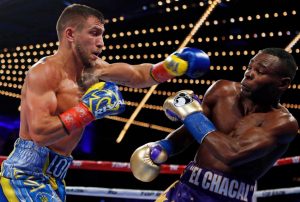
Saturday night at Madison Square Garden Vasyl “Hi-Tech” Lomachenko convinced his fourth consecutive opponent to quit on his stool. His victim this time, fellow two-time Olympic gold medalist, Guillermo “El Chacal” Rigondeaux, retired with an injured left hand after the sixth round. What more need be said about the action, lopsided, clinical, predictable as it was?

Much will be made of Rigondeaux’s decision in the aftermath: some will wonder how a fist that seemed never to land could have been damaged, or why trainer Pedro Diaz seemed so ready to act on Rigondeaux’s cue to end the affair. Ringside, Tim Bradley, as honest and polite and warring a prizefighter as we have seen in recent years, voiced such skepticism when Rigondeaux, halfway through the fight but at the threshold of humiliation, chose to preserve a career he says he may pursue no further.

Rigondeaux is a proud man, indeed his disregard for audiences is proof of that; he is also a fighter at heart, something he confirmed in climbing off the canvas to butcher Hisashi Amagasa and in his utter and arrogant defusing of Nonito Donaire. For this, perhaps, his professed injury deserves a courteous ear. But every second of every minute of every round Saturday belonged to Lomachenko, and who could better appreciate that dominance, and the bruising mischief it wrought, than Rigondeaux? Perhaps for the first time in a boxing ring, Rigondeaux was without answers, and that hopelessness, made all the more real by the taunts and mockery that have become part of Lomachenko’s signature, was likely more than he could bear.

Now a 37-year-old (and injured?) persona non grata, Rigondeaux chose to walk away from what was likely his last chance at glory and the remuneration it brings. Yes, Lomachenko held every advantage; size, youth, activity aside, he is simply better than Rigondeaux and employs an ideal style for disrupting the Cuban’s measured violence. The fight Rigondeaux had lobbied so long for was finally his, however, and he revealed how much that opportunity meant to him. Offer whatever apologies for Rigondeaux you like, boxers are held to a higher standard because they have earned that honor, and in capitulating as he did, Rigondeaux showed that however brilliant a fighter he is, barring something remarkable and out of tune with the tenor of his career, greatness will elude him.

Did it also confound and abuse him on this night? Well, not yet. Lomachenko is not yet a great fighter. He has the makings of one, certainly, but dominance alone does not establish greatness—at least not in an eleven fight career that features more losses (one) than it does great opponents. That lone loss, to Orlando Salido, is too frequently glossed over to be forgotten. Yet Lomachenko is no longer the naive and inexperienced fighter that fell for Salido’s dirty charms, and the next man who hangs a defeat on the Ukrainian will accomplish something greater than Salido did. Unlike Rigondeaux, Lomachenko will end his career remembered for more than his amateur achievements.

Still, there is something missing from Lomachenko, or, more charitably, if not from him then at least from his fights. That something was on display this weekend, though.

You could find it in the ring in Hialeah, Florida, where light heavyweight neverender, Jean Pascal, took his first (and hopefully only) leave of the sport knocking out aspiring Ahmed Elbiali. Plenty pulped over the past few years, Pascal nevertheless faced yet another undefeated fighter in Elbiali—his fifth in his last six fights. And as he has done for years, Pascal drew a line in the sand behind which he lobbed one grenade after another, wagering on his ammunition outlasting his opponent.

It was there in the Copper Box Arena in England, where +5000 underdog Caleb Truax won the IBF super middleweight title from James DeGale. No meager feat that: taking a title on the cards on a champion’s turf, but there was Truax giving his best performance in his biggest moment and being rightly rewarded for it. That title came with a bullseye, and Truax, who understandably dropped to his knees as his name was read, now wears both happily.

So too, could you find it in the Mandalay Bay Resort and Casino in Las Vegas, where Miguel Roman extended his career at the expense of Orlando Salido, who bid us farewell with yet another self-immolating performance. Salido’s career ends the way it began, with a TKO loss, but what he managed in the sixty fights in between is what defines him. If a less-than-great fighter can have a great career, then Salido had one; if there is a question about Salido the fighter he left unanswered it has yet to be spoken. Like Rigondeaux, Salido too decided he had had enough, wilting finally under Roman’s bodywork and the slow bleed of a career remarkable for its brutality. But boxing forgives the bold (which is why any outcome other than Saturday’s would have been better for Rigondeaux), and Salido earned that soft spot on the canvas.

Pascal, Truax, Salido—Lomachenko is better than all of them by some margin. And yet these three each provided something more intimate, more vulnerable, and in their own way more endearing than Lomachenko’s perfection. Lomachenko is math not literature; the application of formulas not passion.

The implied request here is for moments of genuine peril for Lomachenko, the type of request last directed toward Floyd Mayweather Jr., whose fights also felt scripted in their dominance. It is because of comparisons like this that the goalposts are continuously moved on Lomachenko, and so they should be considering how close he was to them from the start, how easily he has triumphed since his stumble against Salido (because, again, that happened). But this is proof he is great, you say? Fine. Those goalposts, move them again and again and again.


A euphoric redefining of the classic fistic catharsis wrought by . . . nah, not really

By Bart Barry-

Saturday on ESPN Ukrainian super featherweight champion Vasyl “Hi-Tech” Lomachenko made undefeated Cuban super bantamweight champion Guillermo “The Jackal” Rigondeaux quit after six rounds. On HBO Mexican journeyman Miguel “Mickey” Roman beat to a crumple Mexican journeyman and former champion Orlando “Siri” Salido. ESPN’s match comprised two fighters with four Olympic gold medals. HBO’s comprised two fighters with 25 professional losses. While any aficionado might’ve predicted which match would be more entertaining, few of us predicted exactly how much more entertaining Roman-Salido’d be than Lomachenko-Rigondeaux.

Saturday’s mainevents hadn’t a unifying thread that springs to mind but Salido, HBO’s counterprogramming ace, representing the one loss on Lomachenko’s record. It’s a proper loss, too, no matter how a commentator and ring announcer now revise it.

No sooner do we threaten to start a new era in which undefeated ledgers are not all there is to a fighter’s dossier but we try to unblemish Lomachenko’s record retroactively – else we’ll compromise what words like “otherworldly” we now include in the subtitle of his brochure. This straining for symmetry is what happens when we see ourselves as storytellers, not journalists, a point of ongoing and massive struggle for television as a medium.

Television was built on images that flicker to mesmerize and entertain. When this wasn’t enough to grow revenues television endeavored to get serious and journalistic and in a small corner of itself did so successfully enough subgenres got born. But television is too topical to be sober or intellectual as the written word – with its frowzy dressers, doughy faces, hard drinkers and thousandhours spent in front of library stacks instead of mirrors – and television knows this about itself and too knows it’s not glorious or beautiful as cinema or it wouldn’t have to sell its every fifth minute to advertisers. Television is best when it tries to be a little of both, more intellectual than cinema, more fun than print.

Television is frankly awful when it tries to lecture. There were some moments of it Saturday.

Something about Lomachenko, starting with his silly nickname, makes aspiring Homers of every speedreader and street philosopher; the mean feat of making smaller men quit fighting in frustration ascends to the historic when Lomachenko does it. Much of this, again, is his topicality; Lomachenko’s promoter, Bob Arum, knows better than any man alive if you can get your guy in front of a camera against weak opposition television’s salesmanship reliably fills every vacuum in realtime; commentary crews involuntarily enter a hyperbole duel with one another, earnestly wanting to be able to say theirs was the first to perform a historic inventory of this historic figure’s every historic quality. Some writers sometimes do this, too, especially those who hope to make it to television someday, but writing polices its own – as it did for centuries before television’s invention – dealing in credibility more than ratings.

Something about the very nature of words makes it harder to write “Lomachenko may someday be considered greater than Muhammad Ali” than it is to say it.

If there’s some tension between a pursuit of truth and a fun experience, television has to err on the fun side of things, selling the experience in a way print does not: nobody, after all, in 30 years will say he remembers the first time he read about Lomachenko, while plenty of folks now hope to have occasion to say they remember the first time they saw him. There are plenty of smart professionals in television, of course, and after thinking a bit on the proposition they realize the risk to credibility of calling every fighter the next Ali, Marciano or Robinson (or Pernell Whitaker) is dwarfed by the reward of being the first to recognize a future legend.

“Predicting,” as they say, “10 of the next two great champions.”

At the risk of losing a reader or two, I can happily report I found Miguel Roman’s victory multiples more compelling than Lomachenko’s. Wait, get back here, you two; I watched Lomachenko-Rigondeaux live, not Roman-Salido. If I wasn’t nearly first on the Rigondeaux bandwagon I did cover from ringside his sixth, ninth and 10th prizefights and recognized, with the help of a local San Antonio trainer, his multitude of talents. I wasn’t ringside for his defining win against Nonito Donaire (I was at a Natalie Merchant concert in Fort Worth, instead, and do not regret it a little) but was thrilled with the result, annoyed as I was by the hyperbole by then accrued to Donaire.

Since then I’ve been unimpressed by Rigondeaux as the rest of you. But he did do Saturday what we ask prizefighters to do once they’ve declared themselves too-feared to find opponents in their proper weightclasses. And the result was predictable. Fruity as his comportment often is, Lomachenko gives refreshingly honest postfight analyses, and his saying a corner quittage by an undersized man did not rate was my favorite thing Lomachenko did Saturday.

There’s no need to rehash the action because, over and again, it’s awfully easy to look sensational and do outlandish against a man once you know he can’t hurt you, which is why Canelo and GGG made none of the highlights against each other in September they make against smaller men.

Anyway it would be malpractice to commit any more space to that unexceptional and unsatisfying fare after a weekend when Miguel Roman retired Orlando Salido in a gorgeous attritioning of Salido’s noble spirit. Each man planned to retire if he lost, and neither man said so beforehand, which compares most favorably with the lucrative twofight sendoff HBO and Miguel Cotto just threw Miguel Cotto, no?

Roman probably won’t win his next fight without he barefoots another pathway of hot coals, which is fortunate for us and unfortunate for him. After what Roman just did to Salido at 130 pounds, with a different marketing team and promoter and momentum he might otherwise be allowed to make shortfilms about his reflexes and do otherworldly things against a bantamweight.

Bart Barry can be reached via Twitter @bartbarry


FOLLOW LOMACHENKO – RIGONDEAUX LIVE FROM RINGSIDE

Follow all the action as Vasyl Lomachenko takes on Guillermo Rigondeaux for the WBO Junior Lightweight world championship in a 1st time battle of double Olympic Gold Medal winners from the Theater in Madison Square Garden.  The action kicks off at 9 PM Et / 6 PM PT / 4 AM in Ukraine with a 3 fight undercard featuring Michael Conlan battling Luis Fernando Molina; Christopher Diaz taking on Bryant Cruz; Olympic Silver Medal Winner Shakur Stevenson fighting Oscar Mendoza.

NO BROWSER REFRESH NEEDED; THE PAGE WILL UPDATE AUTOMATICALLY

12 Rounds–WBO Junior Lightweight title; Vasyl Lomachenko (9-1, 7 KOs) vs Guillermo Rigondeaux (17-0, 11 KOs) 
ROUND 1 2 3 4 5 6 7 8 9 10 11 12 TOTAL
 Lomachenko  10  10  10  10  10 10              60
 Rigondeaux  9  9  9  9  9              53

Round 1: Left from Lomachanko..Left to body from Rigondeaux…Jab from Lomachenko

Round 2  Left and right from Lomanchenko..Jab..Right hook..Straight left..Hard jab

Round 3 Lomachenko lands 2 shots..Uppercut and another left..

Round 4 Jab and quick 3 punch combination from Lomachenko…3 punch combo..Hard jab

Round 5  Lomachenko just tapping Rigondeaux..Rigondeaux warned for holding..Counter left from Rigondeaux..

Round 6 Left from Lomanchenko..4 punches to the head while Rigondeaux is bending..RIGONDEAUX DOCKED A POINT FOR HOLDING…Hard left from Lomachenko...RIGONDEAUX QUITS IN THE CORNER…FIGHT IS OVER

Round 7

6 Rounds-Featherweights–Michael Conlan (4-0, 4 KOs) vs Luis Fernando Molina (4-3-1, 1 KO) 
ROUND 1 2 3 4 5 6 7 8 9 10 11 12 TOTAL
 Conlan  10  10 10  10   10               60 
 Molina  9  9  9  9                54

Round 1 Uppercut from Conlan

Round 2  Good left from Conlan…Jab..

Round 3 Right hook from Conlan..Combination..Left to body..Right hook and jab…Conlan switching..

Round 4 Left to body from Conlan..Right from Molina…Combination from Conlan

Round 5  Conlan flicks a left….Hard straight left..Counter right hook..2 body shots..

Round 6 Straight left from distance by Conlan..Body combination

10 Rounds–Jr. Lightweights–Christopher Diaz (21-0, 13 KOs) vs Bryant Cruz (18-2, 9 KOs) 
ROUND 1 2 3 4 5 6 7 8 9 10 11 12 TOTAL
 Diaz* 10   10 TKO                     20
 Cruz  8  7                      15

Round 1: BIG RIGHT AND DOWN GOES CRUZ…Right from Cruz..

Round 2  Diaz landed a left to the body…Hard riGHT AND DOWN GOES CRUZ..6 HUGE PUNCHES AND DOWN FO GOES CRUZ

Round 3 LEFT HOOK WOBBLES AND DROPS CRUZ…FIGHT STOPPED

6- Rounds–Featherweights–Shakur Stevenson (3-0, 1 KO) vs Oscar Mendoza ( 4-2, 1 KO)
ROUND 1 2 3 4 5 6 7 8 9 10 11 12 TOTAL
 Stevenson*  10   TKO                      10
 Mendoza  9                        9

Round 1 Straight left from Stevenson..Straight left to body..Hard left to the head..

Round 2 Hard combination from Stevenson..Combo to head..HARD STRAIGHT LEFT AND THE FIGHT IS STOPPED


Lomachenko, Rigondeaux to test each other and the state of the game

By Norm Frauenheim-

Boxing loves comebacks and it looks as if a business always reported to be dying might be poised to make another one.

The perennial patient still has a pulse, thanks this time to Vasiliy Lomachenko-Guillermo Rigondeaux Saturday in a year-ender that follows some promising television numbers.

Last Saturday, Miguel Cotto said goodbye after getting upset by Sadam Ali in a so-called retirement fight. Retirement fights are a bad idea. Terrible advertising, too. But people watched anyway with a HBO audience that peaked at 1,012, 000, according to ratings released this week.

That is boxing’s second-highest rating for premium cable in 2017. It came a week after a peak audience of 900,000 watched the HBO telecast of Sergey Kovalev’s comeback from successive losses to Andre Ward with a stoppage of Vyacheslav Shabranskyy.

Both fights were thoroughly forgettable. But the solid numbers are significant for what they suggest. To wit: Maybe, there’s still a potential audience out there, perhaps re-energized by a move away from pay-per-view and maybe intrigued by a new generation of fighters.

A better look at whether the sport is poised to make another resurrection will play out Saturday in Lomachenko-Rigondeaux on ESPN (9 p.m. ET/6 p.m. PT). The 130-pound bout in The Theater at Madison Square Garden sold out two months ago.

It’s been generating talk for weeks, although it’s been hard to know just who and how many are doing all the talking. The bout, the first ever between a couple of two-time Olympic gold medalists, looks as if it could be a gem. At least, it does for the sport’s usual crowd, said by some to be a shrinking demographic.

When the intriguing fight was announced, there was skepticism about whether a Ukrainian-versus-a-Cuban could ever be much of an attraction for an American audience.

Tactically, Lomachenko-Rigondeaux is loaded with all the elements of a potential classic. It’s old-school Sweet Science, imminent art on canvas. But lots of fans like their fights in a cage these days. Within those old ropes? Still, hard to say.

Lomachenko’s innovative approach to an old and scarred craft against a seemingly ageless Cuban schooled in fundamentals is a clash between new and old. It’s timeless. It also sets the stage for a New Year, meaning new names and fresh faces instead of just more retirement fights.

From this corner, it’s interesting, even fascinating on many levels. But the real question rests in how many are interested. How many are fascinated? How many boxing fans are there? The last couple of weeks add up to reasons to guess there might be more than believed.

The guess here is that the bigger and younger Lomachenko wins a unanimous decision over the 37-year-old Rigondeaux, who is jumping up two weight classes, from 122 to 130.

But the bigger decision will rest in ratings for a fight that will say a lot about the state of the game.


Pretty in Pink: On Miguel Cotto

By Jimmy Tobin-

There are worse ways to retire. In a sport that rarely bids its fraternity a kindly farewell, Miguel Cotto, who dropped a unanimous decision to Sadam Ali at Madison Square Garden Saturday night, left boxing via an earnest and entertaining prizefight before an adoring crowd at an iconic venue. Cotto should consider himself fortunate and move permanently into life after boxing. The fiercely polarizing fighter was not great, lest we dilute the meaning of the word, and barring that same dilution, he did not have a great career, but he had a proper one, and those too are cherished as they are rare.

To be remembered at our best is a courtesy we all want but infrequently extend. This is especially so in the case of Cotto, who, usually for reasons impossible to articulate without the use of this or that slur, an incoherent grunt of nationalistic programming, or much, much idle time, has long been characterized by his least redeeming qualities. Such a characterization ignores much of who he was. A parallel can be discerned between Cotto’s fights and the arc of his career: in each, he begins deliberately, aggressively, and in both, he fades late, the whispers of preservation growing into something undeniable and commanding. Yet how frequently people disregard the beginning.

There is an urge to romanticize our athletes; we interpret favorably, accentuate virtues, diminish and dismiss flaws until these people are who we want. And once the first truth is bent, the easier it is to hang further charms on it. Cotto benefitted from this refashioning; the man best suited to fill the void left by Felix Trinidad could expect to. If there is anything the age of identity politics has taught us, however, it is that the reverse is also true. It is surprisingly easy to tear someone down, having one fault however tenuously beget another and another until the truth is obscured. And if you were looking for that one fault, the thread to unravel Cotto’s career, you could find it, though never in the effort he put forth between ropes.

No, what turned so many off Cotto was his disregard for the proprieties of his trade. There was a time when this behavior seemed like the work of a man looking for retribution. Cotto, once obedient to promoter Top Rank, suffered brutal beatings at the hands of Antonio Margarito and Manny Pacquiao. Believing himself the victim of something nefarious in the first case, exploitative (and possibly nefarious) in the second, it was reasonable to think Cotto, by then a powerbroker among fighters, might exact his vengeance on the sport.

Years later this interpretation feels wrong. It implies Cotto understood that there was something untoward about demanding catchweights, refusing to conduct interviews after losses, treating promoters like employees, and that these tactics were the intended means of revenge. But payback was never part of Cotto’s calculus. He simply understood his place in the sport, the leverage he wielded, and acted accordingly: seeking every advantage, and gaining most of them. Cotto was not a warrior—he was a mercenary. That mercenary conduct ran counter to the selectively invoked nobility of the “manly art” and Cotto’s reputation suffered for it. Granted, this is not much by way of a defense of Cotto’s conduct, but then, it is far more than he would ever care to offer.

If it is a defense of Cotto that you want you need only ask yourself how he managed to achieve his industry leverage. The answer to that question forces you to examine the part of his career so strangely ignored: he made every fight the public could ask of him with the exception of one. Cotto, after giving Sergio Martinez a gold watch beating, perhaps should have fought Gennady Golovkin. Instead, he fought Saul Alvarez. Cotto was only ever going to make one of those fights because he was going to lose both. Forgive him then, for giving boxing’s most devoted supporters the fight they wanted.

But he lost so many of those signature fights, you say, as though this is only a criticism, as though there is not a rare compliment to be drawn from it. A greater attraction than he was a fighter, Cotto could have taken fewer risks than he did. Yet as Carlos Acevedo pointed out last week, he consistently imperiled himself, and in doing so left boxing better for his presence. His record shows losses to Margarito, Pacquiao, Alvarez, Floyd Mayweather Jr., Austin Trout, and Ali, and some dubious victories like his decisions over Shane Mosley and Joshua Clottey. Yet all but the Trout fight were worthy of your attention, and since one man cannot a compelling fight make, Cotto deserves credit for his part in that bloody bestowal. To ignore what he gave boxing with his fists, with his blood, or to consider his behavior beyond the ropes of comparable value to his conduct within them, is to take a jaundiced view of his career and deny the man what he earned.

What he earned over 16 years is all he deserves; no more, of course, but certainly no less. Whether he deserves a place in Canastota is a question that is only important if the answer matters to Cotto. Assuming it does, assume he’ll like the answer, and that plenty of people won’t.


Goodbye to Miguel Cotto: A well-publicized and honestly blank canvas

By Bart Barry-

Saturday HBO said goodbye to Puerto Rican junior middleweight Miguel Cotto who lost a close but fair decision to New York’s Sadam Ali who made the very most of an event that had nothing to do with him. Cotto gave an honest effort and accepted his loss graciously after a large, adoring New York City crowd cheered him loudly while a small, adoring commentary crew cheered him vigorously. If it wasn’t an exact metaphor for Cotto’s career it was an acceptable one.

Cotto represents, in my mind, a blank canvas, a good fighting style and excellent publicity. He successfully juxtaposed, in the final marketing blitz of his career, the masculine trait of taciturnity and the hottest feminine color on the spectrum. By saying little as possible and still less of substance he offended no prospective pay-per-viewer, and after Felix Trinidad’s retirement and Juanma Lopez’s renowned dissipation, Cotto monopolized the minds of Puerto Rican aficionados and lucratively sold many tickets at the boxoffice of Madison Square Garden – that wildly celebrated concrete cylinder in Manhattan.

A thin, nearly diaphanous film of martyrdom covers Cotto in many an aficionado’s mind; the Antonio Margarito who beat him to a pulp probably did so with something extra on his knuckles, and the Manny Pacquiao who also beat him to a pulp probably did so with something extra in his blood. Everything else in Cotto’s career went almost tediously according to form, while the poor timing that left him ruined by Margarito and Pacquiao – both in their absolute physical primes when they pulped him – turned to favorable. He lost to Floyd Mayweather, who overpaid him in a scramble to get a prison sentence delayed (or suspended altogether), and he beat Sergio Martinez, who may either have been fighting him on one broken leg or fighting him on two broken legs. Cotto cashed himself out against Saul Alvarez, losing by exactly the scores any disinterested aficionado would’ve predicted, then 20 months later decided there was more cash out there and bamboozled HBO into a twofight farewell tour.

Really the only surprising results on Cotto’s resume are his losses to Austin Trout and Sadam Ali, and maybe his decisioning Shane Mosley a decade ago. The Mosley decision was very thin indeed but fair. Too, to be fair, the brutality of what Cotto did to little Paulie Malignaggi on that tiny pillowy canvas 11 1/2 years ago remains deeply memorable.

Cotto was moved patiently and perfectly by promoter Top Rank until he was fed to Margarito in a match Top Rank surely expected to be remarkable but probably expected Cotto to win. Cotto’s dramatic, and almost sudden, transformation in that match from arrogant master to quailing prey lends credence to the Margarito-handwraps conspiracy in the minds of any who were ringside; it’s difficult to believe an athlete in his 33rd prizefight might so underestimate an opponent’s legal ammunition as we’re asked to believe Cotto underestimated Margarito’s. Margarito did nothing novel, and yet Cotto, in his 13th world title fight, a veteran of 148 amateur bouts, ran completely out of ideas midway through a fight he had dominated? It’s not impossible, or particularly probable.

When I think of Cotto my mind plays a man acquitting himself honorably while being beaten up. I was ringside at the aforementioned Margarito assault, which was an incredible experience at the time, and I was ringside when Pacquiao diminished further a diminished Cotto. That marked the end of my imagining Cotto an historic talent.

Between those beatings, luck more than intention put me ringside at Cotto’s honest match with Joshua Clottey, which happened in New York the night after colleague, mentor and friend Norm Frauenheim accepted his muchdeserved Fleischer award. When I think of Cotto, too, I think of the beauty of Central Park, sharing a cab in Las Vegas with former colleague Mike Swann, spending time with friend and mentor Tom Hauser – that is, many of the best associations I have with Miguel Cotto fights I attended have nothing to do with Miguel Cotto. Hence the blank canvas.

Were I Puerto Rican or even Latino, I might complement my happy memories of Cotto fights with a bit of my own identity, perhaps, making those fights and their fighter still more essential.

Oh, and I have another amusing memory of Cotto (that also has little to do with him): At a promotional breakfast the morning of Pacquiao-Bradley 2 two roomsful of us gathered to hear Cotto say very little about his upcoming match with Sergio Martinez, and for arriving late and wearing an inappropriate purple Kangol I got consigned to the backroom, where I met the wonderful British writer Gareth Davies, who arrived even later and was also too colorful, then Davies and his entitled mien corralled Cotto to our table, where Davies opened the interview by propping Cotto’s magenta Crocs on his lap and taking pictures of them.

Cotto’s eyes and face by then betrayed a vulnerability Cotto was honest enough not to cover with effects of any kind; a look in Cotto’s eyes for a glance got you a swirl of indifference and violence, but if you lingered there for another beat or two you saw a man who genuinely wanted to be left alone: Of course I’m not afraid of you, but why would you make me say it?

HBO’s farewell to Cotto on Saturday was typically overwrought, a chance for the reliably prissy to turn dramatic and grave, but felt sincere insomuch as HBO does not wish to bankroll Cotto’s career any longer – not for a predictable rematch with Canelo, not for a bloodletting with Gennady Golovkin, and certainly not for a comeback at age 40.

Bart Barry can be reached via Twitter @bartbarry


FOLLOW COTTO – ALI LIVE FROM RINGSIDE

Follow all the action as Miguel Cotto rides off into the sunset as he defends the WBO Super Welterweight title against Sadam Ali.  The action begins at 9 PM ET / 6 PM PT with two more world title bouts as Angel Acosta takes on Juan Alejo for the Interim WBO Jr. Flyweight title and Rey Vargas defends the WBC Super Bantamweight title against Oscar Negrete.

NO BROWSER REFRESH NEEDED.  THE PAGE WILL UPDATE AUTOMATICALLY

12 ROUNDS–WBO SUPER WELTERWEIGHT TITLE–MIGUEL COTTO (41-5, 33 KOS) VS SADAM ALI (25-1, 14 KOS) 
ROUND 1 2 3 4 5 6 7 8 9 10 11 12 TOTAL
 COTTO 10   9  9 10  10  10   10  10  9  9  9  114
 ALI 10  10  10  9  9  9  9  9  10  10  10  114

Round 1: Cotto going to the body..Right to body from Ali…Jab from Cotto..Right from Ali..Jab from Cotto..Jab and left hook

Round 2 Left from Cotto..Right from Ali..Left from Coto…Big right buckles Cotto..Left hook..Jab from Cotto..Right..ALi gets in a right..Left from Cotto

Round 3 left hook from Ali..Right..Right…Right from Cotto..Left from Ali

Round 4 Left hook buckles Cotto..Left from Cotto..Hard combination from Ali..Jab from Cotto..Counter right..

Round 5 Right from Cotto..Jab…Double jab,,Right from Ali

Round 6 Cotto lands a right to the body…Left hook to head..Left..Right drives Ali back..Combination to body..Hard combination in corner..

Round 7   Ali lands a right from the outside..Smacking left hook..Double jab from Cotto..Left on ropes..Hard left to body..

Round 8   Cotto working on the ropes..right from Ali..Jab from Cotto..left hook.another left hook grazed the head..

Round 9 Right and left from Cotto..

Round 10 Ali lands a hard right…Right over the top..Left hook from Cotto..Jab..Left hook from Ali..Another good left hook..Counter left hook

Round 11 Left hook from Ali..Right from Cotto..left hook from Ali..Thunderous left hook knockos out Cotto’s Mouthpiece..

Round 12  Lead right from Ali….Good right…3 punch combination..Left hook

115-113; 116-112; 115-113 FOR SADAM ALI

12 ROUNDS–WBC SUPER BANTAMWEIGHT TITLE–REY VARGAS (30-0, 22 KOS) VS OSCAR NEGRETE (17-0, 7 KOS) 
ROUND 1 2 3 4 5 6 7 8 9 10 11 12 TOTAL
 VARGAS 10   10 10   10  10 10   9 10   10 10  10   10  119
 NEGRETE  9  9  9  9  9 10   9  9  9  9  9  109

Round 1  Vargas working the body

Round 2  Vargas continues to work the body with both hands

Round 3..Wicked right to headc from Vargas…Follows up with a left and right

Round  Vargas continues to dictate tghe pace with his height

Round 5 Right from Vargas

Round 6 Trading combinations..Left upper cut from Vargas..Combination..Right from Negrete..Left from Vargas..Left to side of head

Round 7  Left to body from Vargas..Negrete lands a left…Hard right..Vargas cut over right eye

Round 8 Right from Vargas..Hard left to the body…Doctor checking the cut over left eye now..Negrete going after Vargas swinging wildly..3 punch combo from Vargas..Right from Negrete..Left to body from Vargas..

Round 9  Doctor checks left eye again..Big left rocks Negrete,,,Hard rights from Vargas..3 punch combination

Round 10 Vargas jabbing..Uppercut on the inside..Left hook from outside..Right from Negrete..Uppercut from Vargas..Left to body

Round 11 Right to body from Vargas..

Round 12 Right from Negrete..Left to body from Negrete..Left to body..Straught right from Negrete,,Vargas lands left to the body

120-108 and 119-109 twice FOR REY VARGAS

12 ROUNDS–WBO  JUNIOR FLYWEIGHT TITLE–ANGEL  ACOSTA (16-1, 16 KOS) VS JUAN ALEJO (25-4-1, 15 KOS)
ROUND 1 2 3 4 5 6 7 8 9 10 11 12 TOTAL
 ACOSTA* 10  10   10 10  10  10        TKO       60
 ALEJO  9  9  9  9  9  9              54

Round 1: Alejo lands a right to body..Jab from Acosta..2 left to the body..Left to body from Acosta…

Round 2 Right and left uppercut from Acosta..Right over top from Alejo..Hard body shot on ropes from Acosta..Straight right

Round 3  Hard right and jab from Acosta

Round 4 Straight right from Acosta..Right..Right..Acosta working body on ropes..Big right from Alejo..Left..

Round 5 Acosta lands hard body shots on the ropes..Counter straight right..Acosta gets in a left

Round 6 Left from Alejo…Acosta jabs to the body..Hard right to the body..Big flurry on the ropes..

Round 10 ACOST LANDS A HARD RIGHT AND DOWN GOES ALEJO..THE FIGHT IS OVER AT 1:33


Gold Road: This time it’s for money instead of medals

By Norm Frauenheim-

It’s historical for the continuum that Vasily Lomachenko and Guillermo Rigondeaux represent. Four gold, two each, at four Olympics over 12 years, from 2000 to 2012, are many years, medals and miles, stretching from Sydney, to Athens, then Beijing and finally London.

That they would meet in New York in The Theater at fabled Madison Square Garden on Dec. 9 almost looks like destiny. It’s not, of course. In boxing, only scars are. Still, their path to a 130-pound, ESPN-televised bout from opposite ends of the globe and very different cultures is a big part of the story.

In one corner, there’s Lomachenko, a Ukrainian whose Baryshnikov-like footwork and many-angled style reminds promoter Bob Arum of Ali, and we’re not talking about Sadam. Then, there’s Rigondeaux, a Cuban whose sad, weathered face is the look of a man who appears to be older than his listed 37and yet he glides across the canvas with the foot-and-hand speed of someone much younger.

“What you’re looking at here are two schools of boxing, Cuban and Eastern European,’’ Arum said this week in a conference call.

But who would ever guessed that the better, more marketable, boxer would have come out of the Euro classroom? Seventeen years ago when Rigondeaux won the first of two golds as an Olympic bantamweight at the Sydney Games, the Cubans were as dominant as they were feared. Rigondeaux, the only fighter still active from the medalists at Sydney, wasn’t even the best Cuban of that time. Heavyweight Felix Savon was. Savon won a third gold medal and had everyone buzzing about how he could be the next Ali if not for a regimented Cuban system.

The thinking then was that Cuba’s amateur boxers could one day transform America’s capitalistic version of the craft the way Cubans have impacted the major league baseball. Thus far, however, the Cuban boxers have only struggled, unlike the emerging fighters from Ukraine, Russia and Kazakhstan.

How come? Best guess is that the collapse of the old Soviet Union forced fighters to re-invent themselves and what they had to do to make a living. It was a lesson in individuality and a realistic understanding of what the prize in prizefighting really means. From Gennady Golovkin to Sergey Kovalev, they learned how to fight for money instead of medals. The cutting edge of that evolution is Lomachenko, whose advertised creativity has begun to capture the imagination of North American fans.

Time is a significant difference. Perhaps, the only one. There’s been a whole new generation of fighters since the collapse of the Berlin Wall in 1989 The robotic fighters of the old Soviet system are gone, supplanted first by Golovkin, then Kovalev and finally Lomachenko, who won gold at featherweight in 2008 and gold at lightweight in 2012. In time, maybe the same thing will happen with the Cubans.

For now, Rigondeaux still seems stuck in the old mindset of eluding punches and landing as many as possible for points. The idea is to limit the risk, impress the judges and protect whatever scorecard advantage there is in the late rounds. It wins, but it doesn’t sell.

Arum believes that the clever Lomachenko’s aggressiveness will not allow Rigondeaux to “pile up points” early, thereby preventing him from “stinking it up” late. Maybe, but be forewarned. Junior-middleweight Erislandy Lara, an old Rigondeaux teammate on the Cuban national team, “stunk it up” on Oct 14 in a unanimous decision over Terrell Gausha at Barclays Center in Brooklyn. It was bad enough for fans to exit the building while Lara circled, circled and circled some more in the closing moments of the main event.

A different Rigondeaux is another possibility. Maybe, he sheds that Cuban mindset with dynamic skillset that seems to be there in the lightning-like hands that always look as if they are capable of adding punishment to the points. That would be a surprise. Then again, the journey to Dec. 9 has been full of surprises.


Krushing it: Kovalev stuffs us with memories of a better Thanksgiving weekend

By Bart Barry-

Saturday Russian light heavyweight Sergey “Krusher” Kovalev laid waste to an otherwise-anonymous Ukrainian named Vyacheslav “Two YYs” Shabranskyy in the sort of woeful mismatch managers schedule immediately after their former champions get conclusively whupped but don’t traditionally expect to see televised. Especially on HBO. Seeing Kovalev bully another hopeless opponent, though, did nothing nearly so much as remind aficionados of Andre Ward’s greatness in moving up a weightclass and roughtrading Kovalev in June.

The weekend after Thanksgiving hopes to become a Krusher Kovalev turkey-giveaway tradition at HBO. Four years ago Kovalev krushed someone named Ismayl Sillah as part of the Stevenson-Kovalev marketing campaign that got Adonis Stevenson an absurd reward-to-risk ratio over at Showtime and got Kovalev a bunch of wellpaying placeholder matches and fruity modifiers – “most-feared”, “sociopathic”, “dominating”, and so forth – interspersed with chasing old man B-Hop round the ring and Kovalev’s recent reckoning with a great fighter in his prime, which, again, didn’t go swell for Krusher.

Before Thanksgiving weekend was about c-level cards and a-side rehab on HBO, well well before, several regimes before, 13 years before, someone had the chutzpah to put the third match of the remarkable Marco Antonio Barrera and Erik Morales trilogy on the same weekend in Las Vegas. What one can’t help but sense when he revisits that fight is the honesty of it all. Even matchmaking, complementary skillsets (Barrera’s lefthook, Morales’s rightcross), genuine animosity, two superlative practitioners driven to lunacy by one another’s fists. It’s the disbelief the men retained even after 24 rounds together – what makes it different from, though not better than, Vazquez-Marquez: By the third time Israel Vazquez traded blows with Rafael Marquez (the greatest trilogy of my lifetime thus far) the men respected one another deeply, whereas Barrera and Morales spent their 25th round together treating one another like latereplacement pugs.

Morales came in the fight outweighing himself and with right yellowglove high and cocked, intending to stiffen Barrera more quickly than Manny Pacquiao’d turned the feat a year earlier. Barrera, meanwhile, proud as any man who’s been gloved, saw Morales only as HBO’s “puto campeón” – what he called Morales after their first fight, a pejorative subsequently scrubbed from replays – and despised Morales further for his intended cherrypicking of Barrera’s weakened self. Morales knew he could cut Barrera’s lights with a proper right, and Barrera knew Morales couldn’t cut his lights in a lifetime of trying. That leavened the match further; two rational actors harmonizing their ways to an irrational conclusion, two men thinking an act inevitable when for at least one actor it was impossible.

Then Barrera knuckleclipped Morales’s aquiline nose with a left uppercut crunchy enough to make El Terrible breathe mouthly the duration. Asked afterwards about his broken nose Morales said he didn’t remember it happening because it didn’t matter.

As Barrera’s fortunes rose after he got decisioned by Morales in their first match, Feb. 2000, undressing Naseem Hamed 14 months later in a 36-minute denuding that remains the genre’s standard a decade and a half hence, Morales’s fortunes rose after he got decisioned a second time by Barrera (in what probably was the only correct scorekeeping result of the trilogy): Fewer than four months after his rubbermatch with Barrera, El Terrible decisioned Manny Pacquiao. Reflect on that as you finish digesting what hyperbolic gravy HBO ladled over the Kovalev turkey Saturday: Morales went directly from the completion of one historic trilogy, losing to Barrera, to the commencement of another, beating Pacquiao.

Did we know how lucky we were? Hard to say. I recall thinking Morales was a once-in-a-lifetime athlete, as was Pacquiao, obviously, at the time he decisioned Pacquiao, but as I’d just begun writing about our beloved sport I didn’t know quite how unique Morales was.

If you don’t task yourself with 1,000 weekly words about boxing its dead periods are not so acute. If pressed I might be able to name unaided a dozen prizefights I recall between Barrera-Morales 1 and 3 (some of that time I spent residing in Mexico where there was a walking-range sportsbar that televised every fight) but I have no recollection of what I had to think about when no fights were happening like I do now. That’s part of the reason I have an opinion about Saturday’s fare. It’s not the sort of thing I’d opine about without this column, which you surely inferred from the majority of this column’s being written about a wellworn something, that happened in 2004, and you inferred it because by virtue of your even reading this you’re helping sustain my enduring pride (and gratitude) about how much smarter my reader is than what lessdiscerning peers congregate round more popular writers’ reports (and you can know who you are like this: If you think the last part of this runon sentence is about you, it is).

Saturday’s HBO card and next Saturday’s card and nextnext Saturday’s card have the feel of a kid hustling to clean up his room when mom threatens to suspend his allowance. It’s not what he wants to be doing with his Saturday night, but he does want to stay in good graces however poorly he’s behaved since his last allowance, and if he can get it done fast and vigorously enough he can point to his effort at least: Cancel your subscription if you want to, Mom, if your mind was already made-up, fine, but don’t say it’s because I didn’t try – I gave you five boxing telecasts in six weeks at the end of 2017!

It’s a fair point, and as aficionados are nearly irrational about boxing as moms’re about their sons, it should serve to retain the 600,000 of us faithful souls who reliably watch things weak as Saturday’s card.

Bart Barry can be reached via Twitter @bartbarry
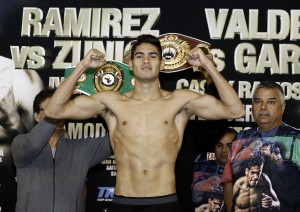


FOLLOW KOVALEV – SHABRANSKYY LIVE!!

Follow all the action as Sergey Kovalev looks to regain the WBO Light Heavyweight title against Vyacheslav Shabranskyy.  The action begins at 10 PM ET / 7 PM PT with Junior Lightweight contest between former world champions Jason Sosa and Yuriorkis Gamboa followed by a Light Heavyweight fight between Sullivan Barrera and Felix Valera

THE PAGE WILL UPDATE AUTOMATICALLY.  NO BROWSER REFRESH NEEDED

12-Rounds–WBO Light Heavyweight title–Sergey Kovalev (30-2-1, 26 KOs) vs Vyacheslav Shabranskyy (19-1, 16 KOs) 
ROUND 1 2 3 4 5 6 7 8 9 10 11 12 TOTAL
 Kovalev*  10  TKO                      10
 Shabranskyy  7                        7

Round 1: Kovalev  lands a right..Good jab.Body shot..Right from Shabranskyy..BIG RIGHT AND DOWN GOES SHABRANSKYY..BIG RIGHT AND DOWN GOES SHABRANSKYY..

Round 2 Hard right from Kovalev..HARD LEFT AND SHABRANSKYY GOES DOWN..Right rocks Shabranskyy..HARD ONSLAUGHT AND THE THE FIGHT IS OVER

10-Rounds–Light Heavyweights–Sullivan Barrera (20-1, 14 KOs) vs Felix Valera ( 15-1, 13 KOs)
ROUND 1 2 3 4 5 6 7 8 9 10 11 12 TOTAL
 Barrera   9 10  10   10  10  10  10 10   10      98
 Valera 10   9  9  10  8  9  8  9 10       91

Round 1 HARD LEFT HOOK AND DOWN GOES BARRERA..RIGHT HAND AND DOWN GOES VALERA

Round 2 Left hook from Valera..Good left hook from Barrera..Valera warned for a low blow..Good right from Barrera..Barrera cut over his left eye..Hard right to body from Barrera..

Round 3 VALERA DEDUCTED A POINT FOR LOW BLOW..Left hook from Valera..Left hook to body from Barrera..

Round 4 Good overhand right from Barrera…Hard right…Right to body..right..

Round 5

Round 6 VALERA DEDUCTED ANOTHER POINT FOR LOW BLOW..Barrera lands a right.  Valera lands a left..2 lefts Barrera…Good body shot..Right hand..Straight right to the chin..Hard combination

Round 7  Right from Barrera..Trading body shots..Good right from Barrera..Left uppercut

Round 8  VALERA DEDUCTED ANOTHER POINT FOR LOW BLOWS..Good uppercut from Barrera..

Round 9 BARRERA DEDUCTED A POINT FOR A LOW BLOW..Good left to body and right from Barrera..

Round 10  Big left hook from Valera..Body shot…Barrera lands a body shot..Big left hook

98-88, 97-90, 97-89 for SULLIVAN BARRERA

10-Rounds–Jr. Lightweights–Jason Sosa (20-2-4, 15 KOs) vs Yuriorkis Gamboa (27-2, 17 KOs) 
ROUND 1 2 3 4 5 6 7 8 9 10 11 12 TOTAL
 Sosa  9  10  10  9  9  9  10  10  10  10      96
 Gamboa  10  9  10 10   10  10  8  9  9  9      94

Round 1 Hard right from Gamboa…Good body shot

Round 2 2 Body shots from Gamboa..Sosa lands a left hook…Cut over Gamboa’s left eye..Good over hand right from Sosa

Round 3

Round 4 Good body shot from Gamboa..

Round 5 Hard right from Gamboa..Good right from Sosa…Right From Gamboa..

Round 6  Left from Gamboa..

Round 7  RIGHT HAND MAKES GAMBOA GLOVE TOUCH CANVAS FOR A KNOCKDOWN..Good left hook from Gamboa..Good right from Sosa..Body shot..

Round 8  Right from Sosa..Left to Body..Left..Right to body

Round 9 Right from Sosa

Round 10 GAMBOA DEDUCTED A POINT FOR HOLDING…

94-94; 95-93; 96-92 for YURIORKIS GAMBOA


End of the Beginning: A New Year looms amid promising signs in 2017

By Norm Frauenheim-

Three notable fights over nearly five-and-a-half weeks between now and a New Year are the end of what might be another beginning.

Boxing has been here before, of course. It’s a well-worn crossroads full of too many wrong turns. In the aftermath of Sergey Kovalev’s fight to rediscover the force he was before Andre Ward in a comeback Saturday against Shava Shabranskyy, Miguel Cotto’s farewell in a symbolic retirement versus Sadam Ali on Dec. 2 and Vasyl Lomachenko-Guillermo Rigondeaux in a Dec. 9 bout loaded with potential intrigue, however, there are reasons to think the battered business has a good chance to recreate itself.

Comebacks, goodbyes and emerging faces have always been part of the attraction. It’s all there, concentrated and undiluted, a little bit like a sport once called life in a shot glass.

For Kovalev, it’s an opportunity to overcome, indeed conquer — defeat’s inherent adversity. That used to define the old legends, but defeat has been avoided at all costs in a Floyd Mayweather era built on the optimum implementation of the risk-to-reward ratio. Can Kovalev come back the way those in the pre-Mayweather years did?

The Russian light-heavyweight is a compelling personality, a dynamic mix of danger and emotions hard to hide. He reportedly spent time in a Greek monastery in an effort to reflect on what had happened, who he has been and where he wants to return. He has a new trainer. He’s made changes around him and perhaps within him. Yet, time doesn’t change. He’s 34. Only against Shabranskyy in an HBO-televised fight in New York will we know if he’s just an aging fighter or resurrected fighter with enough time to rebuild his pound-for-pound credentials.

Then, there’s Cotto. It’s hard to know whether Ali has a chance at his first time ever at heavier weight. I’m not sure it matters. But the bout, also in New York, is significant because it represents a passing of the torch, one generation finally stepping aside for a younger one. In 2017, Timothy Bradley retired. Ward retired. It’s not clear what Manny Pacquiao’s plans are. But it’s safe to say they don’t include Terence Crawford. There’s speculation that the Filipino Senator is weary of politics. Instead of a run at the presidency, there’s talk he’d prefer to take a run at Conor McGregor. He might have to get in line behind Oscar De La Hoya on that one. But if Mayweather’s scripted scam against McGregor did anything, it proved that an aging boxer talking about a bout with the UFC star is in effect a retired boxer.

Then, there’s Lomachenko-Rigondeaux, also in New York Not sure what happens in this bout between Olympic gold medalists, Lomachenko of the Ukraine and Rigondeaux of Cuba. It could wind up being a technical bore. Still, the possibilities are fascinating, in part because it’s the last chance for Rigondeaux to do something dramatic with the talent that has been oh-so evident for oh-so long. He’s got crazy skill, yet he has used it only within the disciplined blueprint of Cuba’s famed amateur system. He takes no chances. That wins medals, but not money.

Ten years ago, who would have ever guessed that a Ukrainian would be seen as the world’s most creative boxer? Then, it seemed as if the Cubans would put some new wrinkles into the old art form. From Erislandy Lara to Rigondeaux, they haven’t. The showman has been Lomachenko. Rigondeaux has the physical stuff to show him tricks of his own, but I’m not sure he has the mindset to execute them.

If not, that still brings us to 2018, with even more talk about Lomachenko against Mikey Garcia’s patience, smarts and efficient ability to deliver fundamental power. Either way, it sets up an intriguing end to what has been an interesting beginning.


Thanksgiving meanderings and musings

By Bart Barry-

Contrary to accepted architectural practices, this part of this column generally gets written last. You’re supposed to tell them what you’re going to tell them and then tell them and then, well, whatever, but when you do things like that, with a sliderule and compass, you discover nothing along the way, and if merely imparting knowledge were the point of this exercise it’d’ve ceased years ago. Rather, the purpose of this exercise is discovery. Let’s see how that went.

Thanksgiving: a day that recently as a halfdecade ago felt uniquely American, an optimistic and celebratory if whitewashed day of national gratitude, a day you might cling to if you loved what your country still was when compared to other countries’ less optimistic if more realistic bents. It no longer feels that way to any American, you should know if you’re reading this somewhere other than the United States; those who did not vote for the current leadership of the country are appalled by it and those who did vote for the current leadership did so because they were already appalled. It’s a single point of accord across the land: A great country does not elect Donald Trump its president – the very message stamped on candidate Trump’s campaign headwear.

While gratitude is never the wrong sentiment it feels stilted this year in a way it did not previously; plastic, insincere, Hallmarked, oblivious. A day given to collective gratitude for collective goodfortune is not appropriate in a country where at least 1/3 deeply resents another 1/3, making a country whose collective at best thinks a day of gratitude marks a time for expressing thanks only to the dwindling few in their 1/3 or not at all. There’s little bigeyed, smiling cheer anymore. Even those of us who stake claim to the middle 1/3 of the country, pledging allegiance to no political party or militancy, dealing as best we can always in goodfaith with whomever we encounter on the trail or in the coffeeshop or via Twitter, we feel hunkered down, guarded, generally pessimistic no matter how privately optimistic.

A quick anecdote about the state of our union before clumsily moving on (this wasn’t the direction this column was supposed to go – it was going to comprise recollections from Barrera-Morales 3, actually): In August luck moved me to firstclass on a sevenhour flight from Mexico City to Lima, Peru, and the main reason for wanting firstclass is not the obvious one. Generally any international carrier anymore has more comfortable seats than any American carrier – what happens when the freemarket doesn’t allow a meaningful price increase while shareholders want meaningful stockprice increases – so the size of the seat is not the incentive it might appear. Instead it’s the people one meets in firstclass. Sure, a goodish number are wealthy bores but an even better number are folks whose tickets were purchased by someone other than themselves; persons good enough at the game of navigation that other entities insist on their comfort.

One such person was the guy seated beside me in August. Born and raised in and eventually exiled from Cuba he was a Mexican diplomat in his late 50s or early 60s. We greeted each other amiably at the beginning of the flight, as Latin American custom dictates (in any intimate dining scenario, including a restaurant with strangers, in fact, you ask to be excused from your table by other diners) then settled into whatever amiable ignoring of others frequent travelers frequently do. A couple hours later, though, when I was bored silly by that week’s Mario Vargas Llosa novel and my neighbor asked me if I had a pen he might borrow, we began to converse and discovered in due time we were more entertaining to each other than what books we suffered.

Eventually semicurrent affairs arose – Mexican kidnappings and Colombia’s renaissance and whatever America now represents – and I offered my somewhat simple opinions to this deeply complex man before watching his eyes and realizing with a start: For the first time in my 23 years of Spanish conversations, I am now the crazy one. No more friendly advice about tending to democracy or helpful lectures about the miraculous effects of capitalism; by virtue of who now leads my country, I initially appear unhinged to Latin Americans and have to selfdeprecate my way to credibility if not an even conversational footing.

Note to those of us who travel enough to know otherwise but still occasionally adopt the greatest-country-in-the-world posture when abroad: The gig is up, friends, they know better.

Looks like we’re going for sincerity this year in lieu of uplift.

Nevertheless this Thursday I’ll be grateful for this: Boxing feels like it is in a better place to get to a better place for the first time at least since 2009. Which is not to pretend 2017 was a banner year for our sport because it has not been. But our sport’s congealed algorithm, from paycable-capture to pay-per-view, defrosted this year. Right now only one fighter in any reputable Top 10 list can make his living on pay-per-view, and with promoter Top Rank swornoff the PPV game for the next few years that is unlikely to change. We’ll still get the Canelo show biannually and Mayweather will make whatever inconsequential distractions he makes, but next year you’ll be likelier to discover the world’s best prizefighter on freecable than HBO or Showtime. If that’s not progress it is at least novel, and we’ve not seen progress in years anyway.

In 2017 feeling gratitude for the developing effects of a negative feedback loop feels like the best way to go. Happy Thanksgiving to one and all.

Bart Barry can be reached via Twitter @bartbarry