Goodbye doesn’t sound like a temporary gesture from Cotto

By Norm Frauenheim-

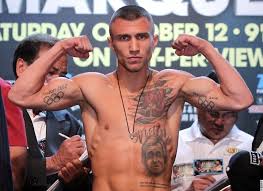
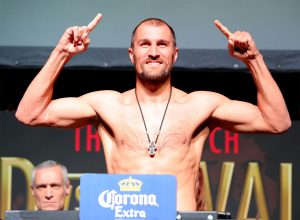
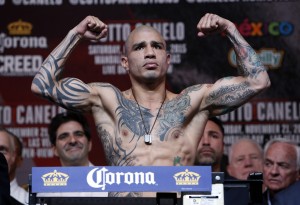
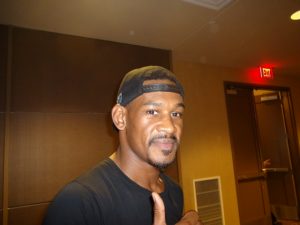
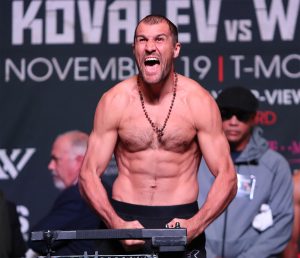
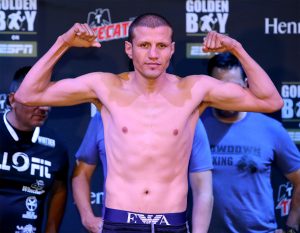
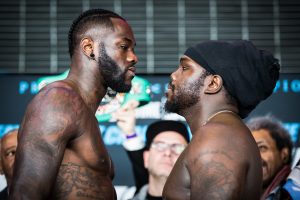
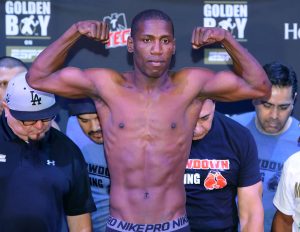
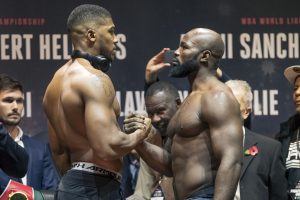
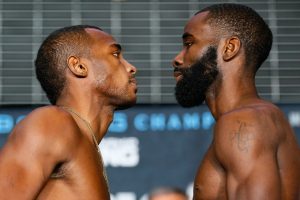
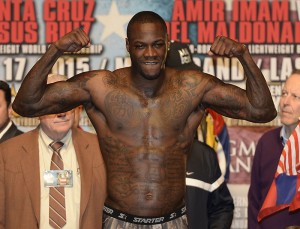
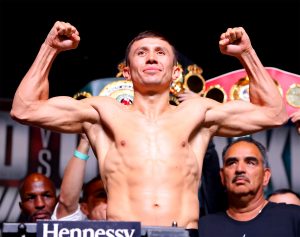
Miguel Cotto vs Canelo Alvarez
PPV Weigh-in 11-20-2015
WBC Middleweight Title
Miguel Cotto 153.5 vs. Canelo Alvarez 155
photo Credit: WILL HART

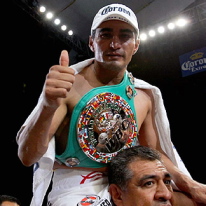
His face is the portrait of a fighter. It’s a mix of stoicism and toughness. There’s an unblinking gaze that says he has seen it all. He hasn’t, of course. That’s why Miguel Cotto is retiring. He wants to see more of his family and do more for fellow Puerto Ricans in the devastating wake of Hurricane Maria.

At one level, his retirement after a junior-middleweight bout against Sadam Ali at New York’s Madison Square Garden looks to be a lot like how he fought and how he conducted his career. He appears to be leaving the way he entered: On his own terms.

There’s nothing more temporary than a boxers’ retirement, of course. They’re back more often than the tide. But a Cotto comeback would be surprise, even among ex-fighters who can’t quite resist the temptation to answer just one more opening bell.

The ring is littered, metaphorically and literally, with examples. The best current example: Oscar De La Hoya, Cotto’s promoter. De La Hoya says he believes Cotto’s fight on Dec, 2 versus Ali will be his last.

“Obviously, there’s many reasons why a fighter can choose to come back,’’ De La Hoya said.

Yeah, reasons like Conor McGregor.

De La Hoya made the comment during a conference call Wednesday, a day after he called out McGregor on a radio show. De La Hoya said he had been training in private, yet with singular purpose, in hopes of knocking out the UFC star in two rounds.

I’m guessing we’ll see George Foreman versus Steven Seagal before we see De La Hoya versus McGregor. Then again, I never thought we’d see Floyd Mayweather Jr. versus McGregor, either. From a parachutist named Fan Man landing in the ring like the 82nd Airborne to Mike Tyson’s Bite Fight, boxing has been nothing if not the theater of the crazy. Expect anything.

That said, I agree with De La Hoya about Cotto. I don’t expect a trite, often futile comeback from the first Puerto Rican to win titles at four weights. It just would be unlike him. Through his career from junior-welterweight to middleweight, Cotto wasn’t always media-friendly. He didn’t smile much. Didn’t talk much. Yet, his stubborn silence spoke loudly. To wit: He means what he says.

Throughout Wednesday’s conference call, he talked about having no regrets. He said he walks away in peace. When pushed, he said his favorite fight was in 2005 when he got up from a second-round knockdown to score a seventh-round stoppage of Ricardo Torres.

“The one that put Miguel Cotto on the map,’’ said Cotto, who went on to further secure his place on the marquee with victories over Shane Mosley, Zab Judah and, later, Sergio Martinez.

But the guess here is that his place in public memory will always be for how he beat Antonio Margarito in a wicked rematch in 2011 in New York. It was a bout full of all the elements that make boxing so dangerously compelling. It was about a grudge, payback for what Cotto believed was a loss – an 11th-round stoppage — he suffered in 2008 to Margarito.

In Margarito’s next fight, a loss to Mosley, altered hand wraps were discovered before opening bell. The wraps would have augmented Margarito’s power against Mosley. Altered wraps were suspected in Margarito’s upset of Cotto in their first fight. Three years later, Cotto ended the debate with a punishing 10th-round stoppage of Margarito.

When asked about the Margarito fight, Cotto didn’t say much Wednesday.

“Everybody knows what happened in the first fight,’’ he said.

Enough said.


Curing insomnia with the Miracle Man

By Bart Barry-

Saturday at Nassau Coliseum, former home of the New York Islanders, Brooklyn “Miracle Man” Daniel Jacobs decisioned someone named Luis Arias on HBO. Jacobs won easily every round in a mainevent that left both men perfectly unscathed after 36 minutes of ostensible combat. I slept through it.

“Probably fatigue of one sort or another,” I told myself Sunday morning, “or perhaps the pernicious effects of age, but let’s show some professionalism here, kid!”

Then I sat down for the 10 a.m. rebroadcast and fell asleep again. Jacobs iced me in round 3 Saturday night and chloroformed me in round 7 of our rematch. There’s a devastating puncher for you.

Nothing wrong with Jacobs, really. He’s a very good fighter and a decent dude and well liked, most importantly, and’s learning to sell tickets with his new promoter, Eddie Hearn, who certainly does know how to do that – and for a discount on whatever of Jacobs’ purse Al Haymon still gets Hearn ought to offer a semester’s worth of lectures to whichever titular promoters Haymon’s PBC still employs and Golden Boy Promotions, too, who had first rights to Jacobs before the Dmitry Pirog incident and associated miracles (and they’re apparently linked; a novel pretext for Jacobs’ decimation by the Russian now gets unveiled with every fight: not only was Jacobs mourning his grandmother’s passing that weekend in Las Vegas but he also had cancer – though it wouldn’t be diagnosed for another 10 months and two prizefights; with Pirog safely retired there’s no end to a creative revisionism that could yet uncover a retroactive victory in Jacobs’ 2010 TKO-5 loss).

Let’s treat Hearn here for a spot, as certainly he’s the reason we got treated to Saturday’s fare and what Jacobs hagiographies HBO’s queuing for 2018. Hearn is now the most powerful promoter in boxing because Hearn owns promotional rights to the most powerful man in boxing, Anthony Joshua, the world’s undefeated, undisputed and charismatic world heavyweight champion. This year alone Hearn and Joshua have sold about as many tickets to two fights as PBC has sold since its inception. For many reasons, some merited and many not so merited, our beloved sport reliably goes where the heavyweight division directs it. That might read heretical to some youngish fans in emerging markets, assuming as they do little guys like Manny Pacquiao and Floyd Mayweather make the sport go, but it shouldn’t surprise any American who came of age during Mike Tyson’s reign or any European who just finished enduring the Brothers Klitschko’s domination.

Without Wlad and Vitali there is no such thing as K2 Promotions – which means we never meet Tom Loeffler, we probably know very little about Gennady Golovkin, and we sure as hell never take Abel Sanchez seriously. Unable to purse like Showtime these days HBO now endeavors to play a nifty game of promoter capture, seducing Hearn by showcasing (Jacobs’ word, not mine) whosoever Hearn signs to his new stateside label in the hopes Hearn will bring the most powerful man in boxing to HBO someday – though with the Justice Department meddling in the acquisition of HBO’s parent company last week one worries HBO will not be able to purse like Showtime for a while to come.

It’s good to see Jacobs benefit from all this corporation-to-promoter synergy. He has talent galore and he’s genuine in a way that shines through what inane hyperbole gets heaped on him. But all the squinting and barking of all the celebratory broadcasts of his career fail to make him truly special. Greatness is more than an accumulation of mediocrity, after all, and Jacobs’ professional record is a workable synonym for accumulated mediocrity. He blasted the pretender Kid Chocolate, sure, and showed GGG be overrated by any measure, too, but he also failed to do more than make Luis Arias a little nervous in 36 minutes of trying, and then there’s the aforementioned Pirog incident, isn’t there?

Nope, not letting it go, guys, sorry – I was ringside when it happened and stunned by its ferocity. It wasn’t just the exclamationmark ending, either, but the entire affair, bell to waveoff; it’s not the sort of thing that happened to a young Marvelous Marvin Hagler or Bernard Hopkins, and let this be a reminder that if we’re to suspend disbelief and entertain possibilities of Jacobs’ being a special middleweight we need remember there be aficionados old enough to know those guys, to remember them clearly, and hitch a ride on their standard each time we’re told to catch a new bandwagon.

Nobody wants to watch Jacobs go rounds with talkative nobodies like Arias, not on local access, not on free cable, and certainly not on a premium channel. Writing of which, with the exception of September’s wonderful SuperFly card, HBO’s broadcasts now feel stale, boring, behind the curve – same announcers saying the same things about the same graphics.

According to the network’s house scorekeeper Saturday’s showcase fighters won 22 of 23 rounds against their b-sides. That sort of mismatchmaking is tolerable, one supposes, if it’s three Hebrew Hammers – and yes, more of Cletus Seldin, please! – three times an unproven prospect thrashtossing a veteran, and even sort of tolerable if it’s three Big Babies – three times a cutiepie like Jarrell Miller threadbaring a giant – but not tolerable if it’s one time of Daniel Jacobs, a proven talent in his prime, practicing old combinations on a pillowfisted salesman like Arias.

It was personal, all the prefight trash Arias talked, we know, we know, which is one more mark against Jacobs: when he loses himself to beastmode and goes in on a little guy who’s pissed him off, allegedly, Jacobs punches badly if not Wilderly.

In the post-Money Era networks haven’t credibility enough to handpick athletes and storytell them to acclaim. Ten years ago we assumed a man was on HBO for good reason, even when he often wasn’t, and therefore due diligence commanded us get to know him, which is how we still recall silly facts like Andre Berto fought for Team Haiti in the Olympics. Those days ended with Mayweather-Pacquiao. We watched Jacobs fight Arias on Saturday because Jacobs acquitted himself surprisingly well against Golovkin in March, not because Jacobs survived cancer, and some of us, though no one writing this column, even may’ve watched yet another reheated retelling of Jacobs’ story in the last few weeks, but again, only because Jacobs made an entertaining fight in March.

Bart Barry can be reached via Twitter @bartbarry


Back In The USA: Kovalev hopes to put a Russian thanks into T-Day

By Norm Frauenheim-

It’s hard to know what Sergey Kovalev knows about Thanksgiving, a uniquely American holiday. But he fights a couple days after Turkey day and if the Nov. 25 bout goes as expected, he’ll come away with a pretty good understanding.

Bolshoe spasibo

That’s Russian for thanks very much. Thanks, Google.

How ever it is pronounced, the guess here is that Kovalev will say it as often as the rest of us eat Turkey sandwiches in the hours and days after the last piece of pumpkin pie.

A victory over Vyacheslav Shabrankskyy in The Theater at New York’s Madison Square Garden in an HBO televised bout will allow Kovalev to hit the reset button and, moreover, forget about a 13-month stretch of controversy and frustration over two losses to Andre Ward.

First, he lost a decision to Ward last November in a bout most people thought he won. Then, he lost an eighth-round stoppage to Ward in a June rematch that was controversial for low blows, what the referee did or didn’t do and who he was or wasn’t.

Then, Ward retired and, by the way, bolshoe spasibo for that. There would have only been a lot of indigestion with a trilogy, mostly for Kovalev, still a compelling light heavyweight who continues to be ranked No. 5 in The Ring’s pound-for-pound edition.

“Right now, I feel all bad things are gone from my mind,’’ Kovalev said this week in a conference call. “Right now I concentrate, and I focus for the future of my boxing career. I’m ready to be again a world champion and collect my belts if somebody will be ready to unify the title.’’

It’s hard to imagine Kovalev thanking Ward in a language that doesn’t include some well-chosen obscenities. But Ward’s retirement did mean he vacated a title, the WBO’s version of the 175-pound belt, that will go the Kovalev- Shabrankskyy winner. That figures to be Kovalev, unless the guy he didn’t recognize in the Ward rematch shows up for opening bell for Shabranskyy. He said he wasn’t himself in the rematch.

Some of that can be blamed on Ward, who took away Kovalev’s deadly jab with his inside tactics while also eliminating some of his leverage by getting underneath him in an effective inside assault. It was as frustrating as it was maddening and it seemed to drain Kovalev’s energy, if not passion, for the task immediately in front of him.

Kovalev said he has adjusted. He has a new trainer, Arbor Tursunpulatov, instead of John David Jackson.

“I’m happy to work right now with my new coach,’’ Kovalev said. “He’s doing a great job and we understand each other because we speak and understand one language. We understand each other and I feel comfortable.’’

He also says he has eliminated the distractions. Distractions are supposed to be an American or maybe Filipino kind of thing. Think of Floyd Mayweather Jr. with bales of cash and a garage full of high-end cars, or Manny Pacquiao with karaoke. Trips back to Russia, however, appeared to knock Kovalev off his regimen, especially in the months before a long-awaited showdown with Ward, who retired unbeaten and at the top of the pound-for-pound debate.

“When I’m doing boxing, I should do boxing,’’ said Kovalev, who also discovered that an American author, Thomas Wolfe, might have been right when he said you can never go home. “Not another business or a lot of flights to come back and forth to Russia to spend free time. Because when I’m in Russia, I don’t have the time, like for locals and doing the boxing. Just a lot of meetings, a lot of businesses, a lot of wrong things.

“I mean, not sport at all. But right now, I’m here in America, and started a new chapter in my boxing career.’’

One victory beyond Ward might put Kovalev back on track to achieving the singular prominence that seemed to be within reach of his dangerous hands.

His promoter, Kathy Duva, thinks so.

“The first fight, I will say for the rest of my life, he didn’t lose,’’ Duva said of Ward-Kovalev 1. “The second one, he was fighting the referee and the fighter, but he lost to the No. 1 fighter in the world. That’s not coming back. You don’t fall too far when you’re that close with a guy who is that good. Ward has a style that is just very, very hard to beat, especially when he’s getting help.

“My feeling about this is that Sergey is must-see TV. Sergey is still one of the most compelling, exciting fighters in the world. Having lost a debatable decision or a debatable stoppage shouldn’t really derail somebody’s career all that much.

“And as things turned out, Sergey is in a position right now to, not only be right back on top, but to be right back on top of one of the most exciting and perhaps the deepest division in boxing.’’

A surprise, as things turn out, and a reason to say Bolshoe spasibo.


Brief, eyewitness accounts from the career of Jesus Soto Karass

By Bart Barry-

Late Thursday night on one of ESPN’s innumerable affiliates Dominican journeyman Juan Carlos Abregu beat up Mexican journeyman Jesus Soto Karass. The match would prove a good offramp for Soto Karass if he let it, but surely we know he probably will not.

Whenever I think of Soto Karass I think of Antonio Margarito, the star of the Siete Mares stable to which Soto Karass belonged for much of his career. Soto Karass was his own man, of course, but he was a poor-man’s Margarito to most of us. His career went as experts initially predicted Margarito’s would go – maybe wrangle an upset or two against overhyped contenders but certainly never attain a championship of his own. It speaks to luck th’t Margarito’s style, and perhaps his handwraps, found their perfect matches in Margarito’s physical prime while Soto Karass’ did not come till he was acceleratingly treadworn. Soto Karass was all attrition every time, and if you think that made him noteworthy on undercards comprising mostly fellow Mexicans, you’ve not attended many such undercards.

I was ringside for seven Soto Karass fights but not one time to see him fight. The first time I covered him, May 2006 in Fountain Hills, Ariz., he was 11-3-1 and drew with Manuel Gomez (28-10-1) in what must’ve been a “Solo Boxeo de Miller” main, but none of us was there to see those guys – local prospect Jesus Gonzales sold the tickets, Urbano Antillon went directly through Soto Karass’ older brother Jose Luis in the comain, and Mike Alvarado and Giovani Segura filledout the undercard in their eighth and ninth prizefights respectively. Antillon is the only fighter I remember that night.

Thirteen months later I was beside a ring in the parking lot of a Tucson nightclub when Soto Karass retired “Cool” Vince Phillips – the man who once stopped Kostya Tszyu and Mickey Ward two months apart in 1997 (guys used to fight that often men of that quality) – but that night I was more interested in seeing Mike Alvarado again. What I remember from that parkinglot was watching Telefutura’s Bernardo Osuna improvise an entire opening bit off a few lines scribbled on an index card taped to the bottom of his camera, and watching a broken Phillips beg for a postfight interview to announce his retirement in English on a Spanish-language broadcast that ran out of time and didn’t let him, which meant Phillips fought again and lost again, this time in Russia, 11 months later.

The first time I covered Soto Karass in a mainevent came in July 2008 at Hard Rock Casino in Las Vegas on the eve of Margarito-Cotto 1, and I remember no boxing from that weekend except Margarito’s bludgeoning of Cotto. Writing of Cotto, the next time I covered a Soto Karass match from ringside he was down the marquee, losing to Alfonso Gomez in the co-co-main of Pacquiao-Cotto, and more to the point in the enviable position of following “Son of the Legend” Julio Cesar Chavez Jr.’s decisioning Troy Rowland (result subsequently changed). I vaguely recall being impressed by Gomez a bit, and I verily recall the childlike enthusiasm we all had in the pressroom immediately after Pacquiao ragtagged Cotto: Manny’s going to fight Floyd next!

Instead Manny fought Joshua next in Cowboys Stadium, and when Manny returned to Texas in November 2010 to fight Margarito, himself returning from banishment, Soto Karass got sneaked-past by an undefeated Mike Jones, and I have a slight recollection of feeling disappointed for Soto Karass. Too, I was in Las Vegas the night Soto Karass got iced by Marcos Maidana, but I was with every other aficionado at Thomas & Mack to see Sergio Martinez barely escape Son of the Legend, not partaking of the Canelo sideshow at MGM Grand.

And I’m proud to say I was ringside for Soto Karass’ biggest and probably final victory when he got off the bluemat in round 11 to stop Andre Berto at AT&T Center in my adopted hometown of San Antonio. That was an attrition lover’s feast – as Soto Karass willed his way through Berto just after Omar Figueroa and Nihito Arakawa fortituded one another relentlessly for 36 minutes. Five months later, in December 2013, Soto Karass returned to Alamo City and got stopped by Keith Thurman at Alamodome in a comain whose memory was steamcleaned by what Maidana did to Adrien Broner immediately thereafter. Since then Soto Karass is 0-4-1 (2 KOs), though with two memorable showings against Yoshihiro Kamegai.

Thursday night Soto Karass was nearly returned whence he started, fighting on an afterthought Golden Boy Promotions card in the ballroom of an Arizona casino – though it bears mention the match was being judged by Roger Woods, formerly his state’s best matchmaker, and had Soto Karass gotten to the final bell at least one scorecard would’ve proved unimpeachable. The match did not get to the final bell, Soto Karass did not get there, falling overknee forward onto a right uppercut in round 8 then getting dropped. Soto Karass rose unconsciously, proof such things are habitforming, nodded to his cornermen he was continuing, then raised his hands unbidden overhead to assure the ref he was able. The end came pretty quickly after that and ugly.

One suspects such an end be too symmetrical for Soto Karass to retire. Thursday was a 10-rounder. Next year’ll likely see him lose an eightrounder and so forth till the purses become too tiny to bother.

Bart Barry can be reached via Twitter @bartbarry


FOLLOW WILDER – STIVERNE 2 LIVE!!

Follow all the action as WBC Heavyweight champion Deontay Wilder defends his crown against Bermane Stiverne from Barclays Center in Brooklyn, NY  The action begins at 9 PM ET / 6 PM PT with a 12 round battle for the IBF Junior Welterweight title between Sergey Lipinets and Akihiro Kondo.  The co-feature will be an intriguing Welterweight fight between former world champion Shawn Porter and Adrian Granados.

NO BROWSER REFRESH NEEDED.  THE PAGE WILL UPDATE AUTOMATICALLY.

12 Rounds–WBC Heavyweight Title–Deontay Wilder (38-0, 37 KOs) vs Bermane Stiverne (25-2-1, 21 KOs) 
ROUND 1 2 3 4 5 6 7 8 9 10 11 12 TOTAL
 Wilder*  TKO                        
 Stiverne                          

Round 1: Wilder comes out jabbing…Jab..BIG RIGHT AND DOWN GOES STIVERNE..HUGE RIGHT AND DOWN GOES STIVERNE..HUGE COMBINATION…DOWN GOES STIVERNE..HES OUT AND THE FIGHT IS OVER

12-Rounds–Welterweights–Shawn Porter (27-2-1, 17 KOs) vs Adrian Granados (18-5-2, 11 KOs) 
ROUND 1 2 3 4 5 6 7 8 9 10 11 12 TOTAL
 Porter 10  10   10  10 10   10 10   10 10   10  10  119
 Granados  9  9  9 10   9 10   9   110

Round 1 Left from Porter..Left..Uppercut and left hook from Granados..Jab from Porter..Granados cut under left eye..Jab from Porter..Big right

Round 2:  4 left hooks from Porter..Nice counter right Granados,,,short left from Porter..Left from Granados..Right..Counter left hook..Left uppercut from Porter,,Granados countering..Right from Porter at the bell.

Round 3 Porter landing on the ropes..Guys are connecting inside..3 hard lefts from Porter..left driving Porter back

Round 4:  Good left hook from Porter..Counter left from Granados..Jab..Left hook to body from Porter..Porter mauling and connecting on the ropes..Good right from Granados..

Round 5 Left hook from Porter..Good exchange..Nice right from Granados..Right from Porter..Uppercut from Granados…right..Counter left from Porter..

Round 6 Big right from Granados..Right from Porter..Nice right..Porter working the body on the ropes..Porter chasing Granados around the ring

Round 7  Nice combination from Porter..Right Hand..3 punch combination..Porter landing on ropes..Good right from Granados..

Round 8 Left from Granados..Double jab from Porter..

Round 9 Porter lands a left on the ropes..Left staggers Granados..Right from Granados..

Round 10 Exchanging on the ropes..left hook from Porter..right uppercut..Left hook and jab..Granados lands a left.

Round 11 Good right from Granados..

Round 12 Nice eight from Porter..Jab from Granados..

117-111 on all 3 card for Shawn Porter

12-Rounds-IBF Jr. Welterweight Title–Sergey Lipinets  (12-0, 10 KOs) vs Akihiro Kondo (29-6-2, 16 KOs)
ROUND 1 2 3 4 5 6 7 8 9 10 11 12 TOTAL
 Lipinets  10 10  10   10 10   10 10  10   9  10  10  118
 Kondo  9  9  9  9  9  9  9  10  9  10 110

Round 1: Lipinets lands a right..Body shot..Kondo lands a combination..right to body from Lipinets..Jab

Round 2:  Body shot from Kondo..Working on the ropes…Lipinets counters..Right from Kondo..Left hook from Lipinets..Right uppercut from Kondo..1-2 from Lipinets…Blood from the nose of Kondo

Round 3 Both guys working the body..Left uppercut from Lipinets..Counter right from Kondo..Jab to body from Lipinets..Short right..Kondo lands a left to the body..Jab from Lipinets..Left to body from Kono..

Round 4 Double left hook to body from Lipinets..right and left hook..Kondo lands a chopping right..Jab..Lipinets lands a left to the body..Kondo lands a left..Left hook to body

Round 5 Body shot from Lipinets..1-2 combination..Hard right rocks Lipinets..Sweeping left from Lipinets..

Round 6 Left from Lipinets…Jab to head..Lipinets cut on his hairline due to accidental headbutt

Round 7 Right hand and left from Lipinets..Hard combination from Kondo..Right from Lipinets..

Round 8 Kondo lands a jab..Good right from Lioinets..Nice right uppercut..Hard right from Kondo..

Round 9:  Right from Kondo..Uppercut on inside..

Round 10:  Jab from Lipinets..Lead right..Double jab..Jab

Round 11 Right and left from Lipinets..Body..Jab..

Round 12 Left from Kondo..Double jab..Right from Kondo

118-110; 117-111 twice for SERGEY LIPINETS


FOLLOW BIVOL – BROADHURST LIVE!!

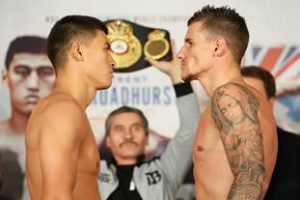
Follow all the action as Dmitry Bivol defends the WBA Light Heavyweight championship against Trent Broadhurst.  The action begins from Monte Carlo at 5:45 ET/ 2:45 PT/10:45 in Monte Carlo/12:45 AM in Russia/ 8:45 AM in Australia

NO BROWSER REFRESH NEEDED.

12 Rounds–WBA Light Heavyweight Title–Dmitry Bivol (11-0, 9 KOs) vs Trent Broadhurst (20-1, 12 KOs)
ROUND 1 2 3 4 5 6 7 8 9 10 11 12 TOTAL
 Bivol*  TKO                        
 Broadhurst                          

Round 1: Straight right from Broadhurst…RIGHT HAND AND DOWN GOES BROADHURST..Quick left hook..Lead Right..HARD RIGHT AND DOWN GOES BROADHURST…FIGHT IS OVER


Soto Karass knocked through the ropes, but not ready to say no more after Abreu’s KO blows

By Norm Frauenheim-

TUCSON, Ariz. – It was a tough way to say goodbye, so tough that Jesus Soto Karass might want to try it all over again.

Juan Carlos Abreu knocked out any chance that Soto Karass might have had at celebrating a farewell with a victory Thursday night in an ESPN-televised fight at Casino Del Sol.

Abreu delivered a couple of huge lefts, dropping Soto Karass twice in the eighth round and nearly sending him through the ropes, if not into retirement, with the second knockdown in a powerful TKO of the popular Mexican.

For Abreu (20-3-1, 19 KOs), the victory gave him some hope to think that maybe he can still be a welterweight contender. For Soto Karass (28-13-4, 18 KOs), the crushing defeat looked like just another reason to walk away from his 16-plus years throwing – and taking — punches

But Soto Karass wasn’t ready say farewell. After he got up from the crushing finish at 1:07 of the eighth, he stood on the ring’s bottom rope and waved at the crowd almost as if he had won. It wasn’t a gesture of farewell. He was saying thanks.

“Thanks to my fans,’’ said Soto Karass, who wasn’t sure about retirement before opening bell.

He wasn’t sure after referee Rocky Burke had ended it , either

“I will sit down with my manager and my family, talk to them, then decide.’’

It was clear to Soto Karass that his Mexican fans haven’t given up on him. Maybe that’s because he never gives up, at keast not in the ring. It was evident in the early going that it would only be a matter of time before the stronger, more mobile Abreu would catch Soto Karass, who as a boxer is as pedestrian as he is fearless. He just kept moving forward.

“I just got caught, really caught by a punch from a guy who can really punch,’’ he said.

The finishing blows might have come earlier. However, Abreu, a Dominican, said he hurt his right hand in the second round. He said planned to have a physician examine the hand to determine whether he sustained a serious injury.

He said the pain made him cautious from the third round through the seventh. There were moments in the sixth and again in the seventh when it looked as if Soto Karass would simply try to wait him out, perhaps wear him out. In the eighth, the stubbornly persistent Soto Karass walked into the only good hand Abreu still had. Then, it landed once and then a second time, finishing a fight, if not a career.

In the co-main event, junior-lightweight prospect Ryan Garcia (12-0, 11 KOs) came into the ring to classical music. Garcia, of Victorville, Calif., wore black-and-white shorts that could of come out of the 1950s. They were black-and-white. They also were made in honor of the late Jake LaMotta, whose Raging Bull nickname was stitched across the back of the trunks alongside 1922-2017, the years of LaMotta’s birth and death.

It was an old-school look. It was an old-school win, too. Garcia’s power stole the show, overwhelming an overmatched Cesar Valenzuela (14-6-1, 5 KOs). A Garcia left, traveling at blinding speed, knocked down Valenzuela in the first round. Another finished him late in third of a bout referee Tony Zaino ended in the final second of the round.

In the telecast’s opening bout, the judges’ scores made it look easy. It wasn’t. Prospect Hector Tanajara Jr. (11-0, 4 KOs), a Robert Garcia-trained junior-lightweight, endured head-rocking shots and stubborn aggressiveness from Mexican Jesus Serrano (17-5-2, 12 KOs) for eight rugged rounds. In the end, Tanajara relied on his superior reach and bigger body, winning a unanimous decision that was a lot closer than the 80-72, 79-73, 80-72 scorecards.

Best of the Undercard

There were some questionable blows and some real ones. There was a lot of everything. And Mexican German Meraz has seen just about everything. Meraz’ documented record includes 105 fights. Yet he entered the ring with only one draw. Now he’s got two.

Meraz (58-45-2, 35 KOs), of Agua Prieta, danced, smiled, landed punches and took few, yet all of it was only enough for a majority draw with Los Angeles featherweight Rafael Gramajo (9-1-2, 2 KOs) in a wild fight that ended with him ahead on one card, 58-56, and 57-57 on the other two.

The Rest

California bantamweight Cesar Diaz, poised and precise, also improved on a perfect record (6-0, 6 KOs) with a stoppage of Pedro Melo (17-17-2, 8 KOs), a Tijuana fighter who surrendered at 1:10 of the fifth round an injury to his left shoulder.

Junior-welterweight Christopher Gonzalez (1-0), a national amateur champion from Tucson, threw a short hook for what was ruled a second-round knockdown of Jesus Arevalo (2-2) of Sierra Vista, Ariz., and went on to win a unanimous decision in his pro debut.


The Big Reveal

By Jimmy Tobin-

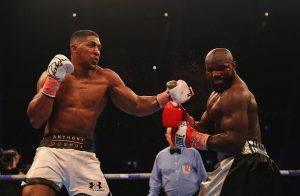
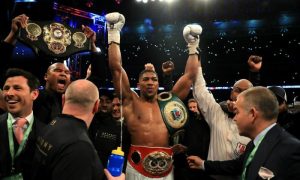
Anthony Joshua retained his heavyweight hardware with a tenth-round stoppage of typically game Carlos Takam at the near-bursting Principality Stadium in Cardiff, Wales Saturday night. A right hand wobbled Takam at a time when he was as much a threat to Joshua’s unblemished knockout streak as Joshua was to Takam’s senses, and referee Phil Edwards, understanding which of the threatened most needed protecting, waived off the action. God save the King!…or at least preserve him.

Joshua rallying from an early knockdown to chop down Wladimir Klitschko six months ago this was not, and the discrepancy between the quality of that fight and expectations for Saturday’s is likely a force-multiplier for any disappointment with Joshua-Takam. Takam would not make any harrowing inquiries of the heavyweight future, for however sturdy, fit, even crafty by modern heavyweight standards he may be, he was still only a replacement for mandatory challenger Kubrat Pulev (who might make a compelling fight against Takam but would meet a similar fate against Joshua).

Yet in an era where a fighter can have developmental fights even after winning multiple titles, and where every stern challenge provides license for at least one unwatchable one, Takam was as good a replacement opponent as you will see. The Cameroonian went ten attritional rounds with the finest version of Alexander Povetkin chemistry could concoct, and it was Takam who first scuffed some of the sheen off Joseph Parker (validating him in the process). Without pressure from a sanctioning body, promoter Eddie Hearn might have tried to get away with a lesser opponent: after all, not one of the 75,000 or so devotees in Principality Stadium bought a ticket to watch Pulev, no one was there to catch an in-person glimpse of Takam. Joshua could have fought most anyone and the crowd would have left happy provided his opponent was riveted to the canvas.

But Takam can, and came to, fight. Joshua looked ponderous at times trying to corner Takam, and betrayed his frustration at this by too often loading up—and subsequently missing—when he was in range. The headbutt that crashed into and broke Joshua’s nose in the second round only compounded his troubles. Still, he dropped Takam in the fourth, cut him over both eyes, and however convenient the stoppage, was never remotely in danger of losing. Joshua should learn from this fight; expect his body punches (something he used to great effect against Klitschko) to figure more prominently in the future, for trainer Robert McCracken to remind Joshua that a 250-pound man with technique and intentions befitting his calling need prioritize landing clean punches—and trust their ensuing effect. And, as there is craft beyond the margins of sportsmanship worth learning, one also expects Joshua to treat the next opponent who repeatedly-accidentally leads with his head to an equally malicious response.

Joshua’s struggles, minimal as they were, serve as a reminder that however uninspiring the opponent, however suspicious the stoppage, Saturday’s fight was no formality. Indeed, finding anything suspicious at all about the stoppage only confirms this—no one would decry a premature ending to a pointless endeavor. Takam pushed Joshua a bit, revealed something of him, and fights that reveal tend to be entertaining. Admittedly, this may stretch the criteria for what constitutes entertainment and were you to pass entirely on watching what appeared very much like a foregone conclusion, you will find no objection here.

But the point about revelation is important: because any expectations that Tyson Fury’s dethroning of Klitschko two years ago would liberate the division, would result in matchups of refreshing novelty and quality, died quickly. The only heavyweight fight of any genuine intrigue since was Joshua-Klitschko, (which was phenomenal). Fury, the supposed liberator, cannot get himself in the ring, Deontay Wilder continues to suffer (benefit?) from drug testing, while Luis Ortiz only suffers from it; all of which speaks to how many of those aforementioned matchups of refreshing novelty have actually been made. (And while we’re at it, how about that bloody process of elimination establishing the cruiserweight pecking order looming as an unforgiving point of comparison?)

Joshua’s future then, promises more Takams than even forty-something-year-old Klitschkos—all the better if the challengers-in-perpetuity can make him sweat. Let them make a complete fighter of him, and confirm this creation with a few thrills along the way.

So Joshua will probably not clean out a division begging for such treatment anytime soon: mandatory defenses and the rest of the stifling rigmarole that keeps boxing forever in its own way will see to that. Should he fight two to three times a year, however, splitting those fights between tedious defenses and the challenges even his critics crave, then the division is in good hands. Oh, it’s mostly still a wreck, photographs of Tyson Fury with his shirt off, gifs of Deontay Wilder, and a handful of drug tests will tell you that. Still, if you find yourself in the food court of a mall streaming a Joshua fight on your phone, know that he is the rare heavyweight that warrants such efforts.


Joshua-Takam-Edwards: A professional showing all round

By Bart Barry-

Saturday in an enormous Welsh rugby stadium heavyweight world champion Anthony Joshua beat Franco-Cameroonian Carlos Takam by a round-10 referee stoppage whose referee itched to stoppage it from just about the opening bell. Faced with such odds on short notice Takam made a fine showing for himself, and Joshua didn’t do badly either.

All three men did their jobs Saturday in Great Britain. Joshua sold a whole lot of tickets and punched a gatekeeper often enough to please ticketbuyers. Takam kept the gate, fighting like a proud man who knew victory was likely as a miracle and th’t short of a miracle a dignified showing’d further his career further than alternative approaches (Deontay Wilder’s nowhere near crazy as he swings and knows better than to cross the pond and get chloroformed by a fighter who knows how; Takam’s got a handsome 2018 payday awaiting him in Alabama). And referee Phil Edwards delivered the stoppage everyone wanted to preserve Joshua’s 100-percent knockout ratio – even going so far as to leave a white towel hanging off the cornerpost midway through the match, lest the Takam corner miss its cue.

With Wladimir Klitschko retired it’s exhibition matches far as the eye can see for Joshua, and so a new sort of judging criterion is required for American fans who can’t warm to Joshua much more than we warmed to Klitschko. Helpfully Europeans fill stadiums with an inexplicable enthusiasm that is nearly infectious. One needn’t be a publicist or promoter to have a rooting interest in the health of our beloved sport’s ecosystem; the optics of 78,000 folks in a stadium in Wales to see a prizefight, or even half that, something no American prizefighter can give us, makes a spectacle enough to prompt popish coverage enough to spark a few American kids’ enthusiasm enough to lure them off a popwarner field or littleleague diamond into a boxing gym, which American boxing needs quite desperately, kids who learn to box instead of men who wash out their preferred sports then give boxing a try after they’re a decade too old to move better than mechanically.

Writing of mechanical movement and Klitschko and Joshua, it’s Joshua’s movement that allures in a way Klitschko’s never did or even approached doing. Whatever his record Wladimir Klitschko generally fought like a skittish robot programmed to call on three offensive scripts that went jab.jab.jab.jab or jab.jab.jab.hook or jab.jab.hook.cross. Everything else Klitschko did in a fight, leaping backwards and setting his chin 60 inches behind his left fist and armswrapping and alternately chesting shorter opponents’ foreheads or pattycaking their lead hands, was done to preclude combat; once he had a much smaller man properly attritioned Klitschko would use these tactics tactically and maybe even offensively but they were not born of aggression.

Where Klitschko often moved in championship prizefights like a scared giant Joshua moves like a fighter – like he wants to measure accurately his gifts, tangible and otherwise, not collect meaningless defenses like a statistician then sue posterity with accumulated evidence. Joshua steps with the jab, pistonstroking it outwards from his chest. By keeping the leadhand home Joshua does these two things among others: He gives an opponent a running start at him Klitschko would never allow, and he generates more force. In other words Joshua sacrifices a quotient of his safety to endanger his opponent more fully; that’s the proposition of a fighter who has immense athleticism, as opposed to an immense athlete who happens to fight.

Early in Saturday’s contest Joshua did something else interesting: He measurejabbed over his shorter opponent’s head. Knowing Takam’s only realistic chance at progress was lowrushing charges Joshua encouraged Takam to get lower still, the better to impale Takam on an uppercut. This approach proved unwise risktaking by Joshua as Takam had seasoning enough with taller opponents to navigate his way round and inside and drive his head square into Joshua’s nose, which bracejolts you with pain no matter who you are.

It brought an unlikely association with Chris Byrd, of all past heavyweights, and an infighting drill he once mentioned and some of us tried – the tire drill. This meant setting a truck tire on the floor between two men and having them spar with one foot in it. Tire drill favored the shorter man, or at least the lower man, as head collisions were inevitable and you wanted the top of your head being the point of impact, rather than your chin or nose. A couple of us got to bleeding very quickly, and a trainer cancelled the tire drill hundreds of hours of practice before any of us could do a passable Chris Byrd.

Broken nose or otherwise Joshua spent the rounds after he got bracejolted by Takam’s head punching Takam very hard. Joshua throws his punches very well, and he commits to them, snapping his hips at the target. Critics of Joshua, including one Bronze Bomber, tweeted on his stamina. At no moment was Joshua in danger of losing a round much less the match, though, so how bad might his stamina be? Joshua likely carries too much muscle in the ring – and how he attained and maintains that muscle, you can bet, will be the primary reason Deontay Wilder chooses to say he’s choosing not to fight Joshua, loudly hiding from Joshua behind VADA approval the way Floyd Mayweather hid from Manny Pacquiao with USADA, and probably just as disingenuously – but in this current era of heavyweights no opponent is going to stay so busy Joshua can’t keep up.

After all, how many aficionados can even name 10 heavyweights these days? I’m going to try: Joshua, Wilder, Povetkin, Takam . . .

Bart Barry can be reached via Twitter @bartbarry


FOLLOW JOSHUA – TAKAM LIVE

Follow all the action as undefeated Anthony Joshua defends the WBA/IBF World Heavyweight title against late replacement Carlos Takam from Cardiff, Wales.  The action begins at 5 PM ET/2 PM PT/ 10 PM in Cardiff.

NO BROWSER REFRESH NEEDED. THE PAGE WILL UPDATE AUTOMATICALLY

12-ROUNDS–IBF/WBA HEAVYWEIGHT TITLES–ANTHONY JOSHUA (19-0, 19 KOS) VS CARLOS TAKAM (35-3-1, 27 KOS) 
ROUND 1 2 3 4 5 6 7 8 9 10 11 12 TOTAL
 Joshua* 10   10 10   10 10  10  10   10  10  TKO     90
 Takam  10  9  9  8  9  9  9  9       81

Round 1: Nothing happened.  feeling out round

Round 2 Accidental clash of heads…Uppercut from Joshua..Sweeping left backs up Takam..Left hook from Takam..Blood from the nose of Joshua..Jab from Takam..Jab from Joahua..

Round 3 Right from Joshua..Nice right from Takam..Right from Joshua…Uppercut.

Round 4  4 punch combination from Joshua..Right to head..Right from Takam..2 rights from Joshua..Takam cut over his right eye..Combination from Joshua..COUNTER LEFT AND TAKAM’S GLOVES TOUCHES THE CANVAS..Combination by Joshua

Round 5 Good jab from Takam..Left hook from Joshua..Doctor checking the cut..Jab from Joshua..Jab..Left hook..Hard left..God combo from Takam

Round 6 Right to head from Joshua..Body shot from Takam..Jab from Joshua

Round 7 Right from Takam..Right..Roght from Joshua..Left hook..Right uppercut

Round 8 Jab from Joshua..Body shot/left hook..Right..Takam bleeding over both eyes…

Round 9: Doctor checking Takam’s eyes…Counter right from Takam after Joshua landed 2 jabs..Hook from Takam..Jab to body from Joshua..Left hook

Round 10 Right from Joshua..Hard left and right..HARD RIGHT AND THE FIGHT IS STOPPED


Let’s Get Ready To Negotiate: Joshua-Wilder on the table with back-to-back bouts

By Norm Frauenheim-

Nobody needs to announce “let’s get ready to negotiate’’ before Saturday’s Carlos Takam-Anthony Joshua fight in the UK and the Bermane Stiverne-Deontay Wilder follow-up on Nov. 4 in Brooklyn.

Talks – and the talking – for a Joshua-Wilder showdown are already underway with the kind of edgy trash that always says a biggie is on the table.

Still, the heavyweight bouts on back-to-back Saturdays can propel the negotiations, or even knock them off the table altogether.

The latter appears unlikely. Neither Joshua nor Wilder looks as though they are facing much difficulty against late subs for the original opponents – Takam for a Kubrat Pulev out with an injury and Stiverne for a Luis Ortiz disqualified for a positive PED test.

Still, upset is always a looming threat in the wake of a sudden shuffle in opponents. The fear is that the respective belt holders – in this case Joshua and Wilder – will suffer an emotional letdown and left without little in the way of motivation. After weeks of training for what one foe does, each suddenly has to shift focus. For the unwary, that can lead to an unprepared fighter.
Meanwhile, for the sub, there’s always an advantage. It’s a cliché to say that they have nothing to lose. But it’s a cliché because it has been exactly the reason for so many of history’s upsets.

Don’t bet on history repeating itself. But don’t blame promoters or even fans for fretting about an upset that could be bad for business. Yep, Lou DiBella, promoter for the the Wilder-Stiverne rematch at Barclays Center, is nervous. Sure, he can be accused of trying to insert some suspense into a fight that doesn’t appear to have much. He’s got to sell tickets and the Showtime telecast, after all.

In Wilder, however, he also has a fighter who isn’t exactly happy about the business or his career, which has gone sideways twice because positive drug tests. Wilder, who is likable because he’s genuine, openly wondered during a conference call Tuesday about whether he would be “better off” doing something else. He said he’d retire if he loses to Stiverne, whom he beat in a 2015 decision.

“It just saddens me,’’ Wilder said. “Man, it just saddens me. It makes me reevaluate my career. It almost made me lose the love of boxing for a little bit as well, too, because of certain things and activities that has been known in this sport with these guys avoiding or wanting to get on bad substances when they know they’re not supposed to be taking it in the first place.

“That’s the thing about it. You take it in the first place, and you make up excuses, and then the blame is pointed at me. It’s starting to sicken me.

“I don’t want to feel this way about boxing because I was once in love with it. It’s starting to make me rethink my career.’’

Second thoughts within a couple of weeks of a bout that could set up a career-defining fight add up to a red flag – a reason to worry.

“In my mind, this is an extremely dangerous fight,’’ DiBella said. “He has been preparing for a career-defining fight against Luis Ortiz — an unorthodox left-handed puncher — a guy that he was really mentally revved up to fight. Instead, he’s winding up with a rematch of a fight against Bermane Stiverne — a guy that’s been in this kind of situation before who’s a legitimate, dangerous heavyweight contender.

“Frankly, in this situation, Bermane Stiverne has absolutely nothing to lose. And he must feel like this is Christmas Day. He was already preparing for a large, right-handed opponent in (Dominic) Breazeale. He was going to be on that same card. It’s now switched over to a fight that you have to think maybe Deontay is a little bit deflated to be forced to fight. But Bermane is the mandatory contender, and that’s the fight that’s going to happen.’’

Amid it all, there is a back-and-forth discussion between Wilder’s camp and Joshua’s camp about a fight that some say could happen in 2018. Wilder is already saying he wants $7 million. Joshua promoter Eddie Hearn countered, saying that there was as much a chance of that as there was of Hearn augmenting his genitals. No telling where the tale of the tape is going on this one.

If the back-back weekend bouts go as expected, the respective crowds and Showtime’s television ratings for each will have a lot of say-so at the table. In terms of box-office, Joshua is already huge. His victory over Wladimir Klitschko at London’s Wembley Stadium in April drew a reported crowd of 90,000. The Takam bout (2 p.m. PT/5 p.m. ET) at Principality Stadium in Cardiff, Wales, is expected to draw between 75,000 and 80,000.

“Wilder hasn’t had any memorable fights,’’ said Joshua, whose ring cred was established when he got up from a sixth-round knockdown to stop Klitschko.

For Wilder, the memorable has only been a frustrating string of cancellations and substitutions. There’s also been fair criticism of his fundamental skill set, despite an unbeaten record fashioned by a right hand thrown with Thomas Hearns-like leverage.

Wilder says he’ll be watching Joshua-Takam Saturday, a week before he has to attend to his own business.

“The ultimate goal is get to Joshua,’’ he said.

Ultimately, it’s the only way to replace those doubts with a chance at something worthy of being memorable.


Trying to give N’Dam about Ryota Murata

By Bart Barry-

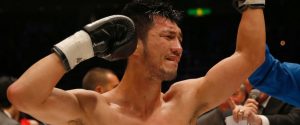
Early Sunday morning on ESPN2 a fight for a middleweight title of some sort featured Japan’s Ryota Murata and Franco-Cameroonian Hassan N’Dam in a rematch of N’Dam’s evidently damnable decision victory over Murata in May. This match was another installment of promoter Top Rank’s fledgling union with ESPN, and if the union’s premier match, Manny Pacquiao versus Jeff Horn, happened on a Saturday during primetime, Murata-N’Dam’s happening on a Sunday during predawn felt right, too, when N’Dam and/or his corner surrendered to Murata’s mechanical attack just before round 8 could begin.

As sports and the shortsighted greed of their managers get moved by television from entertaining contests to mere entertainment assets – some combination of superhero movies and reality-television series, something increasingly interchangeable with professional wrestling – obedience to narrative becomes important as authenticity of spectacle. Murata seems to be wrapped in a narrative driven by promotional desires to monetize what Pan-Asian interest Manny Pacquiao catalyzed.

The opening three rounds of Sunday morning’s contest, as an example, saw him confront N’Dam’s ineffective aggressiveness with what one might call effective inaggressiveness, doing not particularly much while preventing particularly much from being done to him. Somehow those rounds were supposed to be autoawarded to Murata, with the chastening and rare event of a twojudge suspension after the first N’Dam-Murata fight ensuring no close round should go to anyone but Murata. Well, OK.

What professional wrestling began – and, lo, there are plenty of us still alive who remember serious debate about whether those results were rigged – and professional basketball followed is now a growing part of professional football and hockey. While the timing and nature of NBA foul calls have been suspect for at least 25 years, the NFL’s and NHL’s separate pursuits of suspenseful endings now court a similar disbelief in their fanbases, a disbelief deliciously undermined by the use of instant replay.

At least a halfdozen infractions occur away from the ball on every single down of a football game. Only the most egregious get called in the first two or three quarters of games. Forever this has served the continuity and flow of the game; if you call every infraction you turn football into fútbol, with its comely diving and unmanly theatrics, and nobody wants that. But now it serves an additional and different purpose: Increasing the number of choices an intentional official has for intervention in games’ decisive plays by increasing the probability more fouls are committed by players whose transgressions have gone unnoticed for most of the game (and most of the history of the game).

Fans react with indignity if yellow flags begin to fly on nearly every play of the final two minutes of close or closing games, but then a telecast can helpfully switch to a plethora of camera angles and replays to prove that, yes, the defensive end did in fact contact the tightend’s jersey for a twosecond or so, and since rules are rules no matter how much it hurts to admit – defensive holding! Since no replays are available for the other dozen times the same thing happened in the first half, uncalled, and since suspense is necessarily high, we’re told it was a mental error by the penalized player, understandable if intolerable, and we accept it as a tariff charged us for having one unbelievable finish after another unbelievable finish after another unbelievable finish, to include the most unbelievable comeback in Super Bowl history.

And that word and its many pronunciations, UN-believable / unbeLIEVable / Un. Be. Liev-able, and its durability, may just be more than what witlessness jocks-cum-commentators generate across the universe of athletics. Perhaps the commentators are selected by name and excitability, but the fans aren’t, or at least not exclusively so – lots of intelligent people watch football and hockey and basketball and tolerate the soundtrack of unbelievables because the word fits well how their collective subconscious reacts to most of those unbelievable plays and outcomes. They are in fact not believable.

Boxing and baseball, for being caught rigging results at least a halfcentury before other sports got in on it, have relied more on narrative and performance-enhancing drugs for their ratings this era. Creative nonfiction, though, can only be so creative before it becomes fiction. Much of HBO’s 24/7 series tightroped its way through this for 10 years, planning spontaneity and scripting improvisation, while Showtime’s (Emmy-winning) All Access novelas with Floyd Mayweather captured the surreality of Money’s lifestyle by being themselves surreal. A comparatively tiny few of us criticized this conversion of bloodsport to infomercial, and journalism to entertainment vehicle, while industries far and wide fixated on what effective marketing this brand of storytelling happened to make, until it became so pervasive th’t today one feels like a prig for making a point of its deep inauthenticity (in his madcap scramble for 1,000 weekly words).

That same creeping sort of feeling happened Sunday morning as Murata knuckleraked N’Dam’s brainstem and pistonstroked his chin to an unsatisfying corner stoppage: This guy isn’t that good, is he, and nowhere near what they’re telling me he is. Since ESPN’s lead boxing commentator pledges fealty to none but the voices in his own head, one suspects the Murata manufacture will go more Shimingly than Golovkinly, as it were; Teddy means a hell of a lot less to ESPN than Jim and Max and Roy mean to HBO, and he’s accordingly more apt to betray his network’s prewritten narrative.

Such is the risk Top Rank took when it departed its symbiotic if suddenly miserly HBO host for a network that broadcasts Top Rank stars as time allows (Sunday morning at 7:15 during football season). Still, Top Rank and Murata are wise to take this finagled timeslot on a new network – especially when one considers how Murata’d likely fare against HBO’s GGG, Canelo or Miracle Man.

Bart Barry can be reached via Twitter @bartbarry


Hall Of Fame voting: Morales, Vitali Klitschko at the top of the ballot

By Norm Frauenheim-

Erik Morales and Vitali Klitschko are at the head of the 2017 class on the ballot for inductions to the International Boxing Hall of Fame.

Morales, another link in the long line of Mexican greats, should be a lock. From this corner, it would only be a surprise if Morales were not a unanimous choice on ballots due at the end of October.

If he isn’t, voters simply have not looked closely at the ballot or his credentials. Morales won titles at four weights – 122 pounds, 126, 130 and 140. He battled through two memorable trilogies, Marco Antonio Barrera and Manny Pacquiao.

There are nine losses on his 61-fight ledger, but he fought just about everybody. In the end, he stuck around too long and fought at weights too heavy for a fighter who was at his ferocious best as a featherweight.

Vitali Klitschko isn’t the lock that Morales is. At least, not on this ballot. But he was a terrific heavyweight and very much a part of the Wladimir Klitschko reign that would follow after he retired to become mayor of Kiev.

The brothers would never fight each other.
At their best, however, the pick here would be Vitali in a close one. He was tough, smart and resilient, especially in one of only two losses in 2003 to Lennox Lewis in a bout stopped because of cuts.

The rest of the ballot? It’s a tough call. Only three will be inducted. The process asks voters to select five from a list of 32 nominees The best of those include welterweight Donald Curry, light-middleweight Winky Wright, heavyweight Michael Moorer, middleweight Nigel Benn and junior-flyweight Ivan Calderon.

They’re all worthy. Moorer was at his best at 175 pounds. He was 10-0 in light-heavyweight title fights. But he’s remembered mostly for crushing losses to 45-year-old George Foreman and Evander Holyfield.

Benn was a very good middleweight champ best known for upsetting Gerald McClellan in a haunting bout that left McClellan with permanent injuries. He also beat Iran Barkley. But there aren’t many more well-known names on a record that ended in three straight defeats.

On this ballot, the votes go to:

§ Curry, who held titles at 147 and 154 in a career that had him at the top of the pound-for-debate during the mid-1980s.

§ Wright, who might have been the best light-middleweight champ ever in the brief history of a division getting a lot of attention these days.

§ Calderon, a 105 and 108 pound champion in the first decade of the new millennium and the best little guy to answer an opening bell since a couple of other Hall of Famers, Michael Carbajal and Humberto Gonzalez.


Bigmouth Strikes Again

By Jimmy Tobin-

Jermall Charlo, the more aggressive, harder punching of Kevin and Terrie’s twin boys, climbed the ropes of the USC Galen Center in Los Angeles last December and hurled rhetorical questions about his dominance at a crowd reeling still from the spectacle of his worst intentions. Behind him, silent and humbled, Julian Williams gathered whatever of himself Charlo had not forever claimed.

That moment defined not only Jermall but also Jermell, the smoother boxing twin who in the aftermath of his brother’s violent arrival was relegated to being the other Charlo, the one that, whatever his merits and accomplishments, would for the time being be distinguished by accolades either absent and another’s. Frustrating that, as any brother can attest; and that frustration is only exacerbated when the proving grounds are shared. Any fighter would want a moment like the one Jermall enjoyed against Williams, and who amongst us wouldn’t be overjoyed to watch his brother awash in the glory of such a triumph? But surely, Jermell the competitor, the man who his entire life has been measured, sometimes even literally, against his twin, wished he too could be individualized in the crucible.

Saturday night, at Barclay’s Center in Brooklyn, Jermell got his chance. His opponent, undefeated Erickson Lubin, a one-time Olympic medal hopeful who passed on potential gold for real green. Like Williams, Lubin shied not at all from declaring his expectations of victory and had become a trendy upset pick in part because he was Charlo’s opponent. And like Williams, Lubin was left groping his way through the din of broken synaptic dialogue. It took Charlo less than a round to jab Lubin into place for the uppercut that made fools of Lubin’s handlers and, more importantly, made Charlo more than the other brother.

Twinning his brother again, in the aftermath of this defining victory Jermell spoke heatedly of payback, of what rage smoldered behind his prefight silence, how he had yearned for the opportunity to punish Lubin for his insolence. That talk, as it was with Jermall, is being branded by some as classless, as beneath the sport. Very well, let people selectively apply such standards of decency, tenuous moral superiority being the currency of the times. They should know, however, that such criticism leads back to the Charlo interview that birthed it, the context of that interview, and, inevitably, the punch that gave Charlo such license. Rest assured, Charlo would happily have critics trace that origin story for any purpose they like.

What is interesting about both brother’s vitriol is how fabricated it seems. Indeed, it was their silence in the build-up to their biggest wins that is out of place: rarely do fighters, irrationally confident, bulwarked against doubt, concede more than the possibility of attrition (and the nod to their opponents couched therein). Why are the Charlos so incensed by typical cliche? Surely they do not expect men similarly constituted to speak otherwise? Brotherhood is as likely an explanation as any other; that blood bond uniting them against their undoing and demanding that each brother meet the standard set by his kin. It is perhaps this motivation that helps explain why the brothers have similar trajectories of improvement, why their biggest challenges have produced their finest moments.

The counterexample, mind you, is obvious. Given the opportunity the Charlos would relish, the Klitschko brothers avenged one another, each hanging defeats on his sibling’s conqueror. The honor of the family name restored, Wladimir and Vitali seemed mostly drained of animus; their vengeance a sort of debt settlement, more arithmetical than existential. However malicious—and here Vitali made clear a striking sibling difference—there was none of the rage or frenzy that has marked the Charlo’s recent performances. A certain nobility born of perspective characterized the Klitschko’s (though one not without its lapses); one gets the sense they saw themselves always as mere participants in a sport, bloody as that sport may be.

For the Charlos however, everything is personal. Could you imagine either of them outsourcing their vengeance to their brother and finding any satisfaction in get back not wrought of their own hands? Or being as philosophical about a draw as Gennady Golovkin and Saul Alvarez were in what was supposed to be the highest stakes fight on American soil this year? Is it not difficult to envision either brother even touching gloves with an opponent? For years they were twins first, fighters second, a biological gimmick foisted on the public by an entity long reviled. It should come as no surprise then that having arrived as individuals and together they are indifferent to—even incredulous before—demands for decorum. Their conduct has, somewhat ironically, blurred the distinction between the brothers, though the fighting the expectation remains the same for both: ill-will artfully applied. They are the permanently insulted responding in kind, with a dash of injury thrown in for emphasis.

Pride and pridefulness are not for everyone, of course, and even those who persist in their appreciation of a near outlaw sport predicated on exploitation and the quickening of ends can have their delicate sensibilities. But honesty is something most everyone can appreciate. And is there anything more honest in sport than a man motivated by things greater than himself, armed only with his fists, endeavoring to leave every threat to his livelihood, his family, his name, in utter crisis? The Charlos will tell you no, and may not understand any answer to the contrary. May they never change.


Column without end, part 15

By Bart Barry-

Editor’s note: For part 14, please click here.
AUSTIN, Texas – We’ll get to the meat of this column quickly, but first a goodfaith effort to tie loosely what follows to prizefighting, specifically prizefighting broadcasted by Showtime. Long before PBC and the Brothers Charlo – and if you’re now suddenly interested in the latter after Saturday’s showing, read Kelsey McCarson, who’s been keeping well the Charlo beat longer than anyone – Showtime was HBO’s scruffy cousin, in budget, and HBO’s superior, in quality.

Back then, too, this current mess of a column was blueprinted with a T-square on a draftingboard the night before it got written, and often with a background audiotrack of whatever came on Showtime after boxing. One time 10 years ago that background audio featured a guy walking in a dark New York alleyway and talking about why standup comedy only works in places it is terrible to live – the opening of Doug Stanhope’s Showtime special.

Today there are nearly a myriad of talented comedians, and thanks to Netflix, podcasts and other such services, comedians are accessible as they’ve been – Burnham, Burr, Chappelle, CK, Holcomb, O’Neal, Rock, White, to name personal favorites in alphabetical order – but only one has yet struck me as a genius of the form, as a performer original enough to fail for long stretches at a time before hitting so cleanly you find yourself alone in a room, and subsequently impervious to what the late Patrice O’Neal called laughter’s “contagious effect”, struggling for breath, eyes watering. That is, or perhaps was, Doug Stanhope, the end of whose “Beer Hall Putsch” is so caustic and original and layered one is awed by the man’s talent much as he’s offput by Stanhope’s vivid imagery.

Thus I drove for two hours the terrible stretch of I-35 from San Antonio to the capital, unrivaled west of the Mississippi for its aggressiveness, danger and misery, and stood two hours in the lungdamp heat and stench of an outdoor moshpit, Friday, to give thanks more than be entertained. Often as we’re told by cable news the political stakes have never been higher and our quadrennial vote is oh so essential, what’s been true in my lifetime is likely to remain so: Who you vote for every four years in the United States matters not nearly so much as what you do with your creditcard; your franchise is more reliably found in your wallet than any ballotbox.

Or so I believe. And so I reliably buy tickets for live performances expecting little more than a chance to offer anonymous gratitude. Stanhope is still magical but no longer miraculous, and it makes you wonder how much of the magic you now import as an audiencemember and how much of the magic he still exports from thin air.

Friday Stanhope introduced his opener, Jay Whitecotton, as a friend (and later proved it by addressing Whitecotton in the wings throughout the performance) with a short bit that felt more confession than stagecraft: I’ve been drinking since this morning, Stanhope said (or something close), but I just took some Adderall and I can feel it kicking in so I’m going to go review some notes and come out after Jay. There were a couple other references to Adderall and they were instructive for the reason much of Stanhope’s Friday show was more instructive than hilarious – process.

Stanhope’s bits are cobbled from handwritten notes on pink paper, or at least these were what he brought out and began to use after his closer didn’t punch, and they appear bulletpoints of an outline more than the sea of metered legalpad essays Jerry Seinfeld floats in his new Netflix special. Which comes as no surprise. The stakes for Seinfeld are multiples higher than they be for Stanhope. Seinfeld is as many times the professional comedian that Stanhope is as Stanhope is the artist that Seinfeld is. One man continues to build a comedic and financial legacy while the other maniacally pursues a single unforgettable experience. Seinfeld knows; Stanhope discovers.

Stanhope breaks script often, though one suspects less often when he’s off than on. There seemed less improvisation Friday by Stanhope for his being less confident in new material, commenting several times on the choppiness of his delivery and what poor timing he attributed to jetlag and the daily battle his body and mind host between depressants and stimulants.

A personal note about Stanhope’s use of Adderall: I’ve not tried Adderall but spent a fewmonths’ stretch writing under the influence of Modafinil, which promotes a similar sort of synthetic concentration under the auspices of wakefulness. I didn’t stop because of some trite dependency or moral pang; I stopped because it didn’t work in writing for the same reason it does work in Stanhope’s form of comedic improvisation: It takes you deeper in every thought like “thought, a thing one thinks, which is a thing the brain does, or maybe the mind, that collection of billions of selfinterested neurons none of which has interest in thinking but only electrical connectivity, a billion unthinking binary switches that somehow form a thought, whatever that is, like Daniel Dennett’s ‘competence without comprehension’, and don’t listen to neurologists either, that petty and selfaggrandizing lot, till they can zap a piece of fat to see an idea.”

That sort of directionless ferreting usually proves futile in writing, where it proves extraordinarily creative and funny when it meets Stanhope’s timing – a delivery perfected in the crucible of three decades’ stage performances – as he masterfully fills the second and a half his mind needs to burrow another level, with stuttering. But it also proves dark. And 30 years of deepening darkness can come to an unfunny place.

Stanhope knows this but commits to it, choosing his accommodations by one-star reviews, touring in filthy rental vans, reveling in selfdecimation, but also glancing routinely at a chemically dependent crowd that is ageing bitterly, many outpacing their favorite performer, while reflecting back at Stanhope something he no longer appears to find so energizing. Then there’s the internet and the President and just how leathery they’ve made audience sensibilities; robbed of the 1/3 of material touring comedians safely mined from the quarries of national political figures (Trump defies inventive satirizing), comedians have to find weirder social commentaries to make, but that, too, is difficult, since the web makes all intriguing local happenings global events eventually.

An hour with Stanhope previewed the ends of the craft as currently practiced.

Bart Barry can be reached via Twitter @bartbarry


FOLLOW THREE 154 POUND WORLD TITLES LIVE FROM RINGSIDE

Follow all the action Live from ringside at Barclays Center as three world titles in the 154 pound division are contested.  In the main event Erislandy Lara defends the WBA title against undefeated former U.S. Olympian Terrell Gausha.  In the second bout, undefeated world champion Jermell Charlo defends the WBC belt against undefeated Erickson Lubin.  Kicking off the show Undefeated Jarrett Hurd defends his IBF title against former world champion Austin Trout.  The action kicks off at 10 PM ET

NO BROWSER REFRESH NEEDED.  THE PAGE WILL UPDATE AUTOMATICALLY

12 Rounds-WBA Super Welterweight Title–Erislandy Lara (24-4-2, 14 KOs) vs Terrell Gausha (20-0, 9 KOs) 
ROUND 1 2 3 4 5 6 7 8 9 10 11 12 TOTAL
 Lara                          
 Gausha                          

Round 1:

12 Rounds–WBC Super Welterweight Title–Jermell Charlo (29-0, 14 KOs) vs Erickson Lubin (18-0, 13 KOs) 
ROUND 1 2 3 4 5 6 7 8 9 10 11 12 TOTAL
 Charlo KO                         
 Lubin                          

Round 1 Right from Charlo…HUGE RIGHT AND DOWN GOES LUBIN….LUBIN IS STIFF ON THE CANVAS AND THE FIGHT IS OVER

12 Rounds–IBF Junior Middleweight Title–Jarrett Hurd (20-0, 14 KOs) vs Austin Trout (30-3, 17 KOs) 
ROUND 1 2 3 4 5 6 7 8 9 10 11 12 TOTAL
 Hurd*  9  9  9  9 10   10  10  10 10      95
 Trout  10 10  10  10   10  9  9  9     95

Round 1 Left from Hurd..Straight left from Trout..Jab..

Round 2 Hurd lands a right on the ropes..Right from Trout..Uppercut.Uppercut from Hurd..right and left from Trout..Right hook and uppercut..

Round 3 Great exchanges..Trout lands a 3 punch combo..right from Hurd..Right from Trout..Right to body..Right from Hurd..Right

Round 4 Right from Hurd..2 Hard jabs…Body shot from Trout..Hard left..2 more lefts..Straight left..2 hard uppercuts..

Round 5 Straight left from Trout..Hard right rocks Trout..right inside..Uppercut from Trout..2 punch combination..Right from Trout

Round 6 Right from Hurd..Left..Left from Trout..Uppercut from Hurd..Big right hurts Trout..Straight left from Trout

Round 7  Hurd cut around his left eye…Left and right from Hurd..Hard right..Right buckles Trout..Left from Trout..3 Punch combination from Hurd

Round 8 Big right rocks Trout..Hard right..Trading lefts…Left from Trout..Left..Left from Hurd

Round 9 Left from Hurd..Right..Right..Left from Trout..Trout cut under his right eye

Round 10 Jab from Hurd..Uppercut and left from Trout..3 punch combination and a hard left from Hurd…Trout’s eye is shutting….FIGHT STOPPED IN CORNER…TROUT CAN NOT CONTINUE


Nothing junior about 154 anymore

By Norm Frauenheim-

It’s one of those hyphenated divisions once lost amid the proliferation of them. Call it light, Call it junior. But don’t call it forgettable. Not any more, anyway.

The 154-pound weight class, once a stopping point between welter and middle, is making a memorable impact on the scale, never more so perhaps than Saturday night with three intriguing bouts at Brooklyn’s Barclays Center on a Showtime-televised card.

A division first created in 1962 has some of its own legends. There still might be more money at 160 and 147. But increasingly there’s some history to be made 154, too.

“There are just better fights at 154,’’ said Erislandy Lara, who faces an emerging and unbeaten ex-Olympian, Terrell Gausha, for his WBA title on a card that also includes two other 154-pound title fights — Austin Trout-versus-Jarrett Hurd and Jermell Charlo-versus-Erickson Lubin.

Lara concedes that he is looking up the scale – the pay scale, too – at 160 for a rich rematch with Canelo Alvarez or a shot at Gennady Golovkin. But both figure to be busy with their own rematch of a controversial draw last month.

“I have unfinished business that has to be settled,’’ said Lara, who lost a split decision to Canelo at 154 in July 2014. “He knows who the true winner of our fight was, and he doesn’t want to do that fight again.

“…“If you look at Canelo’s record, there are three marks (a loss, split decision and draw). There’s (Floyd) Mayweather, me and Golovkin. Great fighters fix the wrongs on their record, and Canelo and his team will have to do that sooner or later.’’

For now, however, Lara will have to resign himself to the later. At 154, there are plenty of challenges and paychecks.

“154 is much deeper,’’ Lara said.

It is, and it has been for a while. A who’s who of names have at, one point or another, held a 154-pound title. Here’s Hall of Fame sample: Winky Wright, Sugar Ray Leonard, Roberto Duran, Floyd Mayweather, Manny Pacquiao, Thomas Hearns, Oscar De La Hoya, Pernell Whitaker, Felix Trinidad, Wilfredo Benitez and Shane Mosley.

There’s a reason that Wight leads the list. From this corner, Wright’s reign at 154 marks the beginning of an era when the weight became more than just a portal, a stopping point for moving up or even moving out and into retirement.

At 154, Wright was as good as anybody at any weight from March 2004 through May 2005 with successive victories over Shane Mosley and then a win over Trinidad.

If there was a prize at stake for the best performance on Saturday’s Showtime card (7 p.m. PT/10 p.m. ET), it could be named for him. Call it The Winky Trophy For The Wright Stuff. There’s nothing junior or light about 154 anymore.


Mosaic of violent impulses: Enforcers, a dog and an armadillo

By Bart Barry-

Recently my Saturday hike saw a canine companion turn instantly from goldenfleeced cutie to predatory lightning bolt. Still more recently Netflix recommended a very good documentary – “Ice Guardians” – about professional hockey’s enforcers, the players whose tenures in the NHL begin and end with their readiness, willingness and ability to fight. As this remains a column nominally about fighting consider what follows a form of crosstraining, a means of sharpening one’s afición by mulling some ungloved acts of violence.

Kiwi is a three-year-old cocker-spaniel mix who weighs little over 20 pounds and swings widely and acutely between affection and surliness. He is a carnivore, of course, with a taste for Texas barbecue that approaches lunacy: He prefers his ribs dirty, covered in meat, and doesn’t clean them so much as masticate the entire organ – muscle, tendon, cartilage, bone, marrow. When he’s had roast beef he tends to take a small and fluffy blue whale toy and put in much work, throttling it with a series of rapid neck twists, smashing it to the carpet then throttling it some more. It’s not cute or menacing, quite.

The role of enforcer in the NHL is, according to enforcers, entirely distinct from the role of goon – a disparagement used in the game at most all levels for a player whose lack of skill forces him to choose brutality over aesthetic options like passing or shooting or defending cleanly. An enforcer creates a preventative tension on the opposing team’s bench, acting like an insurance policy for his team’s talentful players who subsequently maneuver with the freedom of knowing nothing untoward or particularly physical will befall them. To hear enforcers explain it, their menacing presences govern other teams’ wouldbe scofflaws more certainly than lesser deterrents like suspensions or fines or even lifetime bans do – those deterrents are abstractions, where the threat of a large man’s bare fist racing from your nose to hypothalamus is a deterrent that is objective.

Guadalupe River State Park sits 30 miles due north of San Antonio and has a main entrance used by hikers and campers and bikers and tubers, and a back entrance with a gate that allows hikers alone. The backentrance trail winds through woods and meadows before descending to a river overlook, and it’s nearly always empty enough for Kiwi to gambol without a leash.

There is no type of combat like hockey fighting. Begin with the idea of trying to gain purchase on a frictionless surface. If you punch your target without having a hold of him, physics’ equal and opposite force sends you impotently backwards at the decisive moment. What you have to do, then, is grab hold of his jersey with your lead fist and pull his chin into your jab while cocking your back fist for a blow most concussive you verily do not wish land on his helmet or faceshield. Of course, he’s trying to do the very same, and the trick is tricky enough to turn th’t the NHL sees very few knockouts, even while most every fight ends with a knockdown of some grappling sort. In the good old days, as it were, before fightstraps and other such accoutrements, the goal was to get your opponent’s jersey over his head, extending his arms involuntarily, the better to lash him savagely with right uppercuts. Prizefighting is sportsmanlike and orderly by comparison.

The small armadillo may have been lame or lost or merely careless when it caught Kiwi’s attention. Kiwi, who’d dashed and trotted through a couple miles of rugged Hill Country terrain by then, breathed heavily with his tongue out, the better to scoop air in his throat. Less than a second after the armadillo made some fateful sound I did not hear, Kiwi’s mouth was shut, his ears up, and he bounded off the trail. In a single, silent motion, he rammed the armadillo with the bridge of his snout and knob of his thickboned forehead, putting it on its side, diggerclaws frantically scrambling. Once Kiwi’s lower jaw got in the armadillo’s fleshy underside, the throttling commenced. The sight became natural and horrifying, naturally horrifying, horrifyingly natural.

The biggest surprise “Ice Guardians” holds for anyone who’s played the game at any level above peewee is the surprise its laity commentators describe at their discovery NHL enforcers are actually decent men who are preternaturally loyal to their teammates. Raised in a bubble of superhero flicks and prowrestling villains, one assumes, these professors and doctors imagined psychopathy alone might lead a man to make his living punching other men. It’s an irony initially lost on them a dispassionate psychopath might make the very worst sort of enforcer, detached as he’d be from his teammates’ suffering, hypothetical or actual; whatever their size or temperament, NHL enforcers are generally men empathetic to a fault.

Kiwi’s teeth acted like saws while his neck torqued infinities, one two, then smashed the flailing armadillo on the earth – the way he’d practiced his toy whale for three uneventfully domestic years. Then another ramming to put the armadillo bellyup and another throttle throttle smash. Three altogether till the armadillo’s vital red organs bubbled orange out its chest while its legs went from twitching to ticking, animation dwindled. The job finished in 15 seconds, Kiwi wandered off and left me to end the little creature’s suffering. When Kiwi returned to the armadillo’s warm carcass, having hungrily licked the blood from his teeth and gums, he gazed curiously from the armadillo to me like “What have you done, pal?”

There’s lots of beerdrinking in the NHL, even more in NHL lore, and one imagines nobody better to have a beer with than an NHL enforcer. A paragon of masculinity in a profession that cottons to nothing effeminate, the enforcer speaks softly if directly, laughs loudly and ensures everyone gets home safe. By the time he ascends to the NHL, the enforcer is capable of precise, professional violence – which lets some forget how he was selected years before to become an enforcer. In a sport of Irish tempers and irrational pride, the candidate enforcer showed a lower threshold to offense than his peers and a unique propensity for violence. And a strict adherence to the game’s code: A professional hockey player settles differences with the knuckles of his bare fist, not the lumber in his gloves or the razors on his feet.

By the time we got back to the car, a couple miles and 45 minutes later, Kiwi was bouncing and yipping like usual, tail wagging, licking my chin and panting, returned to his euphoric, playful self.

Bart Barry can be reached via Twitter @bartbarry


Heavyweights still the Ho-Hum division

By Norm Frauenheim-

Wladimir Klitschko retired only two months ago. I’m already starting to miss him.

The more the heavyweights change, the more they stay the same. Sorry for the cliché, but the state of the heavyweight division has become one. It just can’t seem to break out of the mind-numbing cycle that has made it oh-so forgettable.

Klitschko’s retirement in early August was applauded in part because it appeared to open the door for different faces, new opportunity and – above all – renewed drama.

The sense was that the old flagship division would be resurrected. But is anybody really excited about the Deontay Wilder-Bermane Stiverne rematch? Sorry, dumb question. How about Anthony Joshua-Kubrat Pulev? Again, sorry.

Joshua and Wilder are the leading faces in what could be a heavyweight revival. Let’s start with Joshua, who faces Pulev on Oct. 28 in the UK. He has power in his punches and personality. He’s also got some smarts and resilience, both of which he demonstrated in stopping Klitschko in what was the Ukrainian’s final fight in front of a rock-and-roll-like crowd of 90,000 at London’s Wembley Stadium.

The fight last April was terrific. The huge crowd was even better and it probably generated more headlines than the bout itself. It suggests that the heavyweights and perhaps the business were back. Think again. Joshua-versus-Tyson Fury would have been a lot fun. Fury upset Klitschko before Joshua finished him. But the controversial Fury has been under suspension and unwilling to file for a new license with UK regulators. This week, Fury said he would retire. Who knows what he’ll really do?

The only apparent certainty is that Joshua is fighting Pulev, who in 2015 was just another one of those bowling pins that Klitschko knocked out so regularly.

Then, there was the unfortunate shuffle involving the hard-luck Wilder. It is a further sign that the heavyweights have yet to break out of the cycle that has made them irrelevant. At least, Klitschko was worth watching for his astonishing consistency, including a nine-year, seven-month reign as the heavyweight champ.

Without him, we’re left with the familiar disruptions. Wilder’s bout with Luis Ortiz was canceled because Ortiz tested positive for medication he did not disclose.

Ortiz’s management said the medication was for excessively high blood pressure. That begs the question as to why Ortiz has been allowed to fight in the first place. But the medication was also reported to be a masking agent for PEDs, including steroids.

For Wilder, the situation is all-too familiar. His 2016 bout against Russian Alexander Povetkin was canceled when Povetkin tested positive for a PED. Instead, Wilder went on to fight sub Chris Arreola in a fight that left him on the shelf with a torn biceps and an injured hand.

Now, the sub is Stiverne, who agreed this week to the Nov. 4 rematch at Brooklyn’s Barclays Center in a Showtime-televised bout. In Stiverne, Wilder faces a heavyweight whom he beat by unanimous decision in January 2015 for the WBC title. Been there, done that.

Like Joshua, Wilder has a media-friendly personality. He also possesses dramatic power, the best right hand at any weight since perhaps Thomas Hearns. What he lacks is experience. Despite his Olympic bronze medal, he’s late to the game, unlike Joshua, a 2012 gold medalist. Wilder will be 32 years old on Oct. 22. What he desperately needs is experience against skilled fighters, heavyweights like Povetkin, also an Olympic gold medalist, and the clever Ortiz.

But Wilder’s development has stalled by all the junk that seems to plague the heavyweights more than any division in a sport already synonymous with trouble. Wilder’s right hand can knock out anybody. But he has to know how to land it against a heavyweight at a skill level more proficient than Stiverne or Arreola.

“Stiverne will pay for Luis Ortiz screwing up,” Wilder said Thursday.

Maybe, but Wilder might pay a bigger price for not getting the opponent who could prepare him for Joshua and a fight that needs to be great for the sake of a division. And the game.


Column without end, part 14

By Bart Barry-

Editor’s note: For part 13, please click here.

*

CUSCO, Peru – The morning air is crisp here in the Andes, 11,000-foot-altitude crisp, and the sun is bright, 11,000-foot-altitude bright in a way whose rays the locals call “burning, not tanning” and the two cause a unique latemorning event in the small room of this bed and breakfast: The glass of the window is too hot to touch but opening it makes the room uncomfortably cold. That may be the only phenomenon the locals don’t cure with coca-leaf tea. And about that coca plant . . .

Shaking, no, shuddering: Not the way your hand moves after a third cup of coffee but how your body moves on a sudden chill, except not confined to a second or a minute or an afternoon – an involuntary shudder vibrating the body its length till the day divides itself as Nature did before we imposed clocks on Her, just meaningless darkness or meaningless light, no conscious associations. An unscheduled way to spend one’s last day in Peru, but the day after Montaña Machu Picchu’s ascent was scheduled for recuperation, though who knew so much freight might be loaded that word’s stanchions?

Ah coca, the magic miracle plant of Inca lore, potent more as an appetite suppressant and diuretic than anything registerable as a stimulant; it might get you up the mountain embracing absurdity but you don’t attribute it till a fifteenhour passes and a 2,000-foot ascent and (more harrowing) descent gives you nary a hungerspike nor even hunger enough to force down luxury rail fare and while you do wonder at it you figure fatigue reasonably overwhelms hunger till the next day. Sometime that afternoon you realize unwittingly imposing the coldest of turkeys on what now loudly declares itself a chemical dependency was unwise; it might be sunstroke from the descent – an afternoon Andean glare that dashes through SPF 30 like wet tissuepaper – or it might be foodpoisoning (did that alpaca steak taste gamey? compared to what?) but it almost has to be the “tea” you mixed to muddy with green hoja-de-coca dust from the convenience store and an enormous bottle of water with a tiny mouth into which you futilely windfunneled your green dust the night before the climb, a concoction so vile your limeña boothmate spent her ninetyminute beside you on the train from Ollantaytambo to Machu Picchu disbelieving and rhetorically asking if you’d complete your illadvised journey to bottlebottom.

Which you proudly stupidly did before resuming assault on your stunned belly with coca-toffee snacks perfect for suckling all the way up the mountain. Twenty-four hours to the quarterhour later the shuddering begins and does not subside for a thirtyhour till it expertly passes misery’s baton to dysentery’s fay cousin, who makes a host of you for a week.

Nothing recreational or edifying about the climb, either, friends. Thirty degrees unrelenting upwards on narrow ancient stones, every CrossFitter for the last hour telling you in Spanish or English or Dutch or German you are but a tenminute from a top you cannot see until you do and wish you didn’t – so high and steeply above you and covered in colorful North Face attire it resembles an Afghan fighter kite at full pench – then a sideways descent on cramped legs that shows you a sheerness of drop you missed going up, a vista that sets you to spidermanning boulders along the silent drumbeat of a mantra that goes: Legs soft like Bode’s!

A perfect time, evidently, to wonder at how much of language is but courtesy. All of grammar, as it happens. Look at that last fragment of a sentence. “Grammar” is the only word my mind needed to communicate the idea to itself; “all” was assumed since less than all would be more sensation than qualifier; prepositions like “as” and “of” serve purely diplomatic roles, softening and qualifying for another’s benefit; “it” is redundant; “happens” is stylistic fluff not even a frivolous mind would say to itself. In that light most editing reveals itself arbitrary as any other pursuit: You’re telling me you got the gist of things without the decorative prepositional phrase “as it happens” but I know I got my thought’s gist simply with “grammar” and so now we haggle to a compromise we assume acceptable to readers like us.

Lima is neither pretty nor pleasant – a Latin American capital in the harshest sense of the term. A desert with a coastline, dusty and trafficful, unfriendly to locals and visitors alike, still deeply scarred 25 years later. Taxistas and innkeepers, what talkative folks comprise the majority of any solo traveler’s conversations his first day in any city, get blankfaced and silent at first utterance of these unmistakable seven syllables: Sendero Luminoso. The ostensibly Maoist domestic terror organization that put Lima in a shoot-on-sight sundown curfew until its leader, Abimael Guzman, was captured and set in a cage for public viewing – its mention still snatches all animation from limeños’ faces.

When compared to other Latin American places there is an almost militaristic efficiency to Peruvians’ concept of time and its elasticity: Peru uses every hour of the day and night, planes land on the Jorge Chavez tarmac at 0200, trains depart their stations at 0400. But Peru also strikes a visitor as among Latin America’s most enduringly indigenous countries – from Peruvians’ appearances and dress to the successful preservation of Inca culture. Perhaps the Spaniards brought to the Americas more than what pestilence and durable brutality trumpeted their arrival; perhaps, contrary to centuries of Eurocentric scholarship, Spaniards also brought a cultural flimsiness Peru found resistible better than its neighbors did.

Bart Barry can be reached via Twitter @bartbarry


Re-energized pound for-pound debate full of possibilities

By Norm Frauenheim-

Andre Ward’s surprising retirement, Roman Gonzalez’ sad defeat and the scorecard controversy still brewing over the Gennady Golovkin-Canelo Alvarez draw is re-energizing the pound-for-pound debate and generating renewed optimism about a resilient business known for comebacks.

It’s always best to be cautious about whether another comeback is on the horizon. Adelaide Byrd’s crazy card favoring Canelo by a bewildering eight-point margin on Sept. 16 serves as a clear-and-present warning. It reminds me of an old line from Hall of Fame writer Michael Katz. To wit: Only boxing is killing boxing.

Nevertheless, some intriguing elements are beginning to fall into place for some real momentum going into 2018. Even Adelaide’s Byrd-brain card might prove to be a good thing. It all but ensured that there would be a rematch in what looks to be a headline-grabbing rivalry until at least next May and perhaps beyond. There are plenty of reasons to question — even suspect — Byrd’s scoring. But only a rematch can provide an answer. That’s good for business.

So, too, is the slow, yet still painful move away from the pay-per-view business model. The numbers just can’t be believed any more. The buy rate has been corrupted.

The only relevant number in a Guccifer 2.0 era full of Russian hackers, bots, Trump tweets and pirates is the rip-off rate. The move toward bouts on ESPN and Showtime without the PPV tag is already underway. Early indications are that it is working. It has to.

The idea is to introduce young fighters, fighters from Eastern Europe and Central Asia to an emerging audience of young fans armed with cutting-edge tech and seeking new ways to watch. They’re seeking new fighters, too. Ward was good, even great in an old-school kind of way. At 32-0, he has a Hall of Fame resume.

It also fair to wonder whether he won’t be at least tempted to try his luck at heavyweight, a la Roy Jones Jr. But the guess here is that Ward knows he’s just not big enough to contend with Anthony Joshua, 6-foot-6 and 27, or Deontay Wilder, 6-7 and 31. Ward formally notified the acronyms this week that he was vacating his light-heavyweight titles. Now 33, he’ll look around at the younger generation in a year or two and probably decide to stay retired.

Ward’s retirement creates a vacancy – maybe even a breath of fresh air – at the top of the pound-for-pound debate. He was a terrific boxer, subtle and smart. Yet, he was never a big draw, in part because of inactivity brought on by promotional trouble. He also had something of an artistic temperament, meaning that he approached each bout more as a craftsman than a salesman.

He was fun to watch, but you had to know what you were watching. Same with Roman Gonzalez, a master craftsman who is the lightest fighter to ever occupy the pound-for-pound’s top spot. Gonzalez’ fight to draw a big crowd was complicated by the simple fact that he’s a little guy, a flyweight whose ascent up the scale was stopped by successive losses to junior-bantamweight Srisaket Sor Rungvisai.

There’s a reason for weight classes and that was evident in the Gonzalez defeats. Evident, too, was a fighter who seemed to have lost his way, if not his will, in the wake of trainer Arnulfo Obando’s death.

Time, tragedy, simple physics and circumstance have eliminated them from the top of the argument. In their place, there is a youth movement, at least there is in this pound-for-pound edition.

At No. 1: Terence Crawford. He’s slick, quick, instinctive and appears to have a mean streak. He dominated junior welterweight and the guess here is that he will do the same at welter. There are questions about whether he can draw in locales far from his fans in Omaha. On PPV, no. On ESPN, yeah. Without PPV limits, more fans will get a chance to see just how good he is and how much better he’ll soon be.

No. 2: Mikey Garcia. He’s smart and as efficient as any fighter in a long while. I’m not sure the lightweight champion can beat Crawford at a heavier weight (147 pounds) or junor-lightweight Vasily Lomachenko (more on him later) at his own weight, 135. But it looks as if the economical Garcia does what he has to, which might mean we haven’t seen most of what he can do.

No. 3: Lomachenko. He’s part wizard and part Ali. At least, that’s how promoter Bob Arum and others have portrayed him. At 130 pounds, I’m not sure anyone can beat him, but he faces an intriguing Dec. 9 challenge from Guillermo Rigondeaux, anther master craftsman, yet dismissed as boring. Rigondeaux is jumping up in weight, from 122 pounds, to face Lomachenko in an unprecedented bout between double Olympic gold medalists. Can the Cuban beat the Ukrainian? Maybe not, but he has the skillset to challenge him, or at least show somebody else how to beat him.

No. 4: Golovkin and Canelo in a tie. Or was that a draw? If Canelo learns from the debatable draw the way he learned from a loss to Floyd Mayweather, he should win against GGG, who is 35 and will be 36 at opening bell of the projected May rematch.

No. 5: Joshua. Maybe, Joshua belongs in the second five for now. But he is the possible face of the very future that is apparent in autumn of the year before boxing’s potential comeback. He is drawing huge crowds in the UK. Boxing has always been defined by the heavyweights. No real comeback is complete without one and Joshua might be the one.


Year of great retirements

By Bart Barry-

Thursday afternoon Andre Ward announced the conclusion of his excellent career. The retirement feels legitimate because Ward feels legitimate, ungiven to publicity stunts or publicity in general, and the reason he cited – an unwillingness to keep suffering – is a hard one to walk back later: “With my body now two years older, my desire to fight has returned in 2019.”

Ward joins Floyd Mayweather, whose third retirement, one hopes, is his final retirement, Juan Manuel Marquez, Wladimir Klitschko and Timothy Bradley, on a worldclass list of five prizefighters who retired this year.

What follows is a meandering, unstructured series of thoughts and runon sentences about the careers of these men as seen by one aficionado deeply interested in our beloved sport during their best years. This is no final word; even if such a thing existed this wouldn’t be a finalword piece because its author hasn’t the shoulders or stomach to bear the burden of a final assessment to the end of days.

First a clarifying hypothetical question (that I doubt I’ll answer myself as, the more I’ve considered it, the less certain I am, after beginning uncertainly): Pretending all five men didn’t just retire this year but also made their career’s final matches in 2017, only three would be eligible for Hall of Fame induction in 2022 – and so, which two shouldn’t get in? This question is wigglier than it looks. As a member of the Boxing Writers Association of America, which I am (just checked; I honestly didn’t remember if I’d remembered to pay this year’s dues), I am allowed to vote for all five guys – which precludes a hypothetical crisis of conscience. Too, Marquez announced his retirement this year but stopped fighting three years ago and will be on the ballot in 2019, and Bradley will be on the ballot, or should be, in 2021. The question, then, seeks a statistical prediction more than an aesthetic judgement: Not “who would you leave off your list?” so much as “who would mathematics exclude?”

Probably Ward and Bradley. Mayweather was one of the world’s two best fighters for most of an era. Klitschko was the heavyweight champion of the world for a goodish while. And Marquez has nearly as many career prizefights as Ward and Bradley combined. There’s an argument to be made Bradley doesn’t belong in this particular conversation, and fairplay to that, but as this is my meandering, unstructured series of thoughts, and as I have a general weakness for volume punchers and a specific weakness for a prizefighter honest and decent as Bradley, he’s in.

Fine, but after what Ward just did in his rematch with Kovalev, how dare you, sir?

Hold on there. It’s not me – I’d love to leave Klitschko off the list, truly I would – but you can’t fight as many times for a world heavyweight championship as Klitschko did and expect a majority of voters to overlook that because, and this is especially important when we judge recent made-by-television careers in lower weightclasses, the heavyweight champion is the one person in our sport who cannot scale weightclasses in search of better opposition. You can’t hold the heavyweight champion’s era against him if he fought all comers, and for the most part Klitschko did.

That’s not fair? No kidding. Neither is Klitschko’s being 11 inches and 100 pounds bigger than Marquez (before Juan Manuel dedicated himself to the sort of fitness regimen Wlad and brother Vitali followed since the amateurs).

This may be the only time pound-for-pound musings can be amusing: What sort of horror movie would a prime Marquez make with a 130-pound Klitschko?

Good one. Let’s play a touch more. Mayweather did not fight Marquez on terms even resembling even eight years ago but showed enough in their 36 minutes together to imagine 130-pound Mayweather beats the Marquez who snuffs shrunken Klitschko, at least seven times of 10. Prime Bradley sneaked past 40-year-old Marquez in 2013, but 130-pound Bradley probably wouldn’t win two rounds against 30-year-old Marquez. That leaves 130-pound Ward against 130-pound Marquez, and frankly, what a lovely fight!

I’ve chosen Marquez as the axle round which our circle twirls because Marquez is my favorite fighter who retired in 2017. He is also the man I’d least like to encounter in a dark alley. Again, while plenty of fighters I’ve interviewed have expressed a willingness to die in combat Marquez is the only one who’s given me a sense he’s willing to kill in the ring – and that’s neither hyperbole nor metaphor.

Back into the dark alley a bit. Second on that list would be Ward; I saw him sitting in an Oakland hotel lobby the night before he cuberooted Chad Dawson (Ward’s defining fight, along with his manhandling of Mikkel Kessler, till the Kovalev rematch), and dude’s eyes were dead as a mako shark’s. Mayweather’s third on the darkalley test because he’s a bully at heart, and things’d get intentional and sadistic right quick with a man whose temperament and skills could leave a disgusting mess. One doesn’t get the sense either Klitschko or Bradley has been in a dark alley or’d have much interest in fighting there; Bradley’d hit you a couple times then tell you to chill out, and Klitschko’d keep jabbing and bounding backwards till he ran out of alley or the cops showed up.

What Hall of Fame induction actually means to boxers is anyone’s guess; I’ve heard lots of young gymrats want to be champions but never heard one want to be a Hall of Famer – halls of fame have a definite meaning in teamsports they lack in sports like boxing or swimming or golf, whose hallowed edifices serve more as museums.

Bart Barry can be reached via Twitter @bartbarry


FOLLOW LINARES – CAMPBELL LIVE

Follow all the action as Jorge Linares defends the WBA Lightweight title against mandatory challenger Luke Campbell.  The action begins at 10 PM ET / 7 PM PT

NO BROWSER REFRESH NEEDED.  THE PAGE WILL UPDATE AUTOMATICALLY

12-rounds–WBA Lightweight Title–Jorge Linares (42-3, 27 KOs) vs Luke Campbell (17-1, 14 KOs) 
ROUND 1 2 3 4 5 6 7 8 9 10 11 12 TOTAL
 LINARES*  9  10  10  9  10 10   10  10 10   115
 CAMPBELL  10  8  9  10  9  10  9  10  10  9  9  112

Round 1 Right hook from Camobell..Quick jab from Linares…Straight left from Campbell

Round 2: Good exchange..Left hook from Linares..HARD RIGHT AND DOWN GOES CAMPBELL..Campbell cut over his right eye

Round 3 Right from Linares..Body shot from Campbell…Straight right from Linares..Combination

Round 4 Campbell landing to the body…Good uppercut from Linares..Straight right..Good body shot from Campbell

Round 5 Hard right from Linares…Right hook from Campbell…Body shot from Linares..Straight right

Round 6 Hard right from Campbell…Left hook to body from Linares..Combination from Cambell

Round 7 Good left hook and left from Linares..Campbell lands a good jab..Good right from Linares..another right..Hard right hook from Campbell..Straight right from Linares..Good right body shot from Campbell

Round 8 Hard right from Linares…Left from Campbell…1-2..2 body shots…Good left hook from Linares

Round 9  Good hook from Campbell..right from Linares..Good hook from Campbell..Left hook from Linares..Hard left to body from Campbell..

Round 10 Good right hook from Campbell..3 straight rights from Linares..and another..Campbell lands a jab

Round 11 Left to body from Linares..Jab..

Round 12 Good left hook from Linares…

115-113 for Campbell….114-113 for Linares…115-112 for LINARES


Second Home: Oscar Valdez Jr. back in Tucson with another promise

By Norm Frauenheim-

TUCSON, Ariz. – Oscar Valdez Jr. is at home, his second home, with a promise as a priority.

In his last trip to Tucson in 2015, he promised he’d be back with a world title. He delivered on that one, returning with a World Boxing Organization belt that he won in 2016.

But one promise begets another.

“I’m not planning on losing this here,’’ Valdez said, with the belt in one hand, after he stepped off the scale Thursday at 125.8 pounds for his title defense against unknown Filipino Genesis Servania at Tucson Arena on an ESPN-televised card (7:30 p.m. PT/10:30 p.m. ET).

In a third defense of the belt, Valdez (22-0 19 KOs) is expected to win a bout that could set up a showdown with Belfast featherweight Carl Frampton. Frampton just signed with the company that manages Mick Conlan, a Valdez stablemate who faces Kenny Guzman on the Friday undercard.

Despite an unbeaten record (29-0, 12 KOs), not much is known about Servania, who is fighting in the United States for the first time after fighting mostly in the Philippines and Japan. Servania, who weighed in at 125.4 pounds, had one bout in Dubai

“There was a time when Manny Pacquiao wasn’t known, either,’’ said Valdez, who has generated headlines for Friday’s card by his vocal support for The Dreamer and their fight to stay in the United States.

Valdez promoter Bob Arum is offering 500 free tickets to Dreamers – undocumented immigrants brought to the U.S. when they were kids — who show up at the box office with documentation of their immigration status.

“This is insane, the policy that we now have,’’ Arum said a day after he announced the free tickets. “These Dreamer kids are as American as my grandkids. They were raised in this country. They speak English. They go to American schools. The idea that we would send them back to other countries is ludicrous.

“Americans are supposedly held to higher ethical standards than this. I will fight to the last breath in my body for these kids. They belong in the United States, they can contribute to this country and we have to open our hearts to them because they deserve it.

“They came here – does it matter if their parents came legally or illegally? They were kids when they came here and I think every American has the moral obligation to stand up for these dreams.’’

Up and down the card, there is support for what Valdez is saying and Arum is doing en behalf of the Dreamers.

“My people are good people, people who are just fighting to make living,’’ said Gilbert Ramirez, a Mexican who defends his WBO super-middleweight title against Jesse Hart in perhaps the most intriguing bout on the card.

Ramirez (35-0, 24 KOs) was 167.8 pounds Thursday. Hart (22-0. 18 KOs) tipped the scales at 167.6. Conlan (3-0, 3 KOs), an Irish Olympian, was at 126.6 pounds. His opponent, Kenny Guzman (3-0, 1 KO) was at 125.

The untelevised portion of the card begins at 4:30 p.m. (PT). It can be watched on an ESPN app.


Hart-to-Hart: Jesse Hart fighting for title that eluded his dad

By Norm Frauenheim-

TUCSON, Ariz. – Father and son both wore black caps made specially for a mission that has been underway for a couple of generations. War, it said in bright white stitching.

It’s a familiar message, one made famously by Marvin Hagler, who wore it on a red cap before his legendary victory over Thomas Hearns more than three decades ago.

Eugene “Cyclone” Hart and son Jesse Hart borrowed the message, a declaration that this time they intend to bring home a title to hang alongside those caps in the Hart household. There always has been an empty hook in the family closet. A belt is missing

Dad never got the opportunity to fight for one during an era when there were fewer of them.

But that chance is there Friday when Jesse (22-0, 18 KOs) attempts to take the World Boxing Organization’s super-middleweight crown from Gilberto ‘Zurdo” Ramirez (35-0, 24 KOs) in the arena at Tucson Community Center on a ESPN-televised card (7:30 p.m. PT/10:30 pm ET) that features featherweight Oscar Valdez in a WBO title defense against Filipino Genesis Servania.

“He gave me a shot,’’ the 66-year-old Eugene Hart said Wednesday at a news conference in rhetorical tip of that back cap to a 28-year-old son determined to give his dad a title he was denied so long ago.

If there were a rating in a ratings-crazy sport for the best fighters who never got a title shot, Eugene Hart would have to be there. There’s no one he didn’t fight, including Hagler, who won their war in 1976 with an eighth-round stoppage at the old Spectrum in Philadelphia. He was a Philly fighter, which meant ducking anyone was simply out of the question.

He lost to Vito Antuofermo. He got knocked out by Bennie Briscoe. He also fought Briscoe to a draw. He beat Sugar Ray Seales. He lost to Willie “The Worm” Monroe, Bobby “Boogaloo” Watts and Eddie Mustafa Muhammad.

Hart’s 30-9 record, including an astonishing 28 knockouts, is full of legendary names, nicknames and lessons about how much the game has changed. These days, some kind of title — from acronym to interim — would be at stake.

But not in his day. There were only scars and the pride to fight on. Turns out, those scars and pride are lot more memorable than some shiny tin on a cheap plastic strap. But that belt is part of today’s business. You need at least one, and Jesse Hart figures he can fill that vacancy on his resume while also filling that empty corner in his dad’s closet.

“Mentally, I feel like this is the time, my time,’’ he said a couple of days before what might be the best fight on the Top Rank-promoted card. “I’ve never been more ready, never more prepared to do what I have to.

“I’m ready, but I’m calm.’’

Call it the calm before the storm. Jesse Hart stirred up some pre-fight flak with trash talk on his twitter account. He promised to do this, that and who-knows-what-all to Ramirez, a likable soft-spoken Mexican from Mazatlan.

“But that’s business,’’ he says.

In person instead of within 140 characters, Jesse Hart is as likeable as Ramirez.

“I think he’s a good fighter and a fine champion,’’ the good son said while wearing the hat with the three-letter word that suggests he won’t be so polite at opening bell.

In terms of civic pride, Hart has as much to fight for as Ramirez does. For Ramirez, there is the pressure that every Mexican champ has. Mexico’s pride in its fighters has deep roots, including an uncompromising set of demands for courage and sometimes blood.

For Jesse Hart, there’s the Philly tradition, which his father embodies, even without a title. Jesse Hart says that even Bernard Hopkins, the recently retired face of Philly boxing, talked to him about how important Friday night’s fight is.

“I want to be part of those great names,’’ Jesse Hart said just days before a fight about family and Philly and everything that makes them inseparable.


A Dreamer: Oscar Valdez Jr. fighting for a title, friends, family and a grandfather

By Norm Frauenheim-

TUCSON, Ariz. – Oscar Valdez Jr. doesn’t have to look far to see a Dreamer. He sees one in his own reflection in the mirror. He sees one in old friends. New ones, too. He sees one in his trainer Manny Robles. And even in a grandfather.

Valdez, a featherweight with roots on both sides of the border between the United States and Mexico, doesn’t fit today’s legal definition of a Dreamer.

Polarized politics have somehow twisted the term into some thing hard to recognize. Everything is controversial these days, even dreaming. But Valdez doesn’t needs to read the legal fine print to know that he is a Dreamer in every other way that matters.

He’s lived the life. He was born in Nogales, on the Mexican side of the border with Arizona. He moved to Tucson as a kid with his parents.

Years later, he returned to Nogales with his dad. His mom stayed in Tucson. He’s Mexican and American. American and Mexican. He speaks two languages, Spanish and English. He has dual citizenship, U.S. and Mexican. He has family in Tucson and Nogales, Hermosillo and Ohio.

A few weeks ago, the two-time Mexican Olympian heard President Donald Trump rescind the federal program — Deferred Action for Childhood Arrivals (DACA) — that protects young undocumented immigrants from deportation. Then, he watched people his own age and with the same life experience protest in a battle to keep the program intact. He hears himself in their protests. Sees himself in their fight to stay in the only country they have ever known.

“I’m a Dreamer,’’ said Valdez Jr. (22-0, 19 KOs), whose own dream will continue to play out Friday when the WBO champion faces Filipino Genesis Servania (29-0, 12 KOs) at Tucson Convention Center on ESPN (7:30 p.m. PT/10:30 a.m. ET). “I think we’re all Dreamers.’’

In his grandfather Luis Fierro, the grandson sees a dreamer and a dream worth fighting for. Fierro was arrested last month in southern Arizona, reportedly for an old traffic ticket. Immigration and Customs Enforcement agents filed charges that could result in his deportation, according to Valdez, who said Fierro was jailed for about three weeks.

“But we got him out from behind bars,’’ said Valdez, whose trainer, Robles, was born in Mexico and grew up in Los Angeles after arriving in the U.S. from Guadalajara to join his parents as a 6-year-old kid in 1978. “My grandfather will be at the fight Friday night.’’

Valdez promoter Bob Arum, a vocal Trump opponent, hopes 500 Dreamers will be there alongside Fierro. The Top Rank promoter will give tickets to the first 500 Dreamers who show up at the box office with a Federal Employment Authorization card.

“Top Rank wants to make it clear that we stand in solidarity with the Dreamers,’’ Arum said in a statement Monday and repeated in a conference call Tuesday. “We are ashamed of the way they are being treated by the Administration in Washington. Americans are way better than this.’’

A year ago, Valdez found himself in the middle of Arum’s opposition to Trump. He was part of Arum’s “No-Trump Undercard” last November before a main event featuring a Manny Pacquiao victory over Jessie Vargas in Las Vegas.

Then, Valdez was a lot more interested in talking about punches than politics. He still is. But politics are hard to avoid these days, especially when a grandfather gets arrested. Valdez said other members of his family have been affected. They are frightened, said Valdez, who said they didn’t want to be identified. He said he told them OK, that he’d speak for them.

“To me it is a great honor to be able to be a voice that can bring light to this issue and defend those that are in need and don’t have someone that will stand up for them,’ Valdez said. “I have family members that are in danger of being deported over the decisions taken by our government against DACA. I will not stand around and watch silently.

“I completely support this initiative taken by Top Rank and I want everyone to know that we will stand together and we will fight for what is right.’’


Half Steppin’: Canelo, Golovkin fall short of greatness

By Jimmy Tobin-

Saturday night, at the T-Mobile Arena in Las Vegas, Saul “Canelo” Alvarez and Gennady “GGG” Golovkin fought to a most convenient draw. If the fight fell short of expectations (and it did) it is mostly because those expectations, stewing as they had for two years, had become impossible to satisfy without the presence of a ten-count, a capitulatory knee, an urgent physician. Bereft of carnage’s markers, discussion of a bogus scorecard is dominating the aftermath. That is unfortunate, not just in the way those most outraged would have you believe, but because when the sabers rattle about scorecards it means neither fighter was left in a heap. And if that is an oversimplification, go on and rattle your saber about it.

Judge Adelaide Byrd’s 118-110 scorecard is absurd, yes. Should Byrd turn in the same tally with the same action but participants reversed, she would be incompetent. Were she to turn in a different card with that same reversal, she would be corrupt. But Golovkin had 12 rounds to convince two judges of his superiority and couldn’t and Alvarez, yet again, had an unfathomable card in his favor because there is no Golden Boy Promotions without him (in this respect Alvarez is quite right in asserting he is above any need for luck). Neither man is as good as his most passionate supporters or HBO would have you believe, and chopping up those thirty-six minutes into five-second clips that justify your interpretation of the action does nothing to change that. If you wish to harp about a bad card, attend these considerations to your bleating.

The spectacle produced by one of the most intimidating fighters of the decade and the latest Mexican fighting icon was well short on violence. Were there moments where each fighter was hurt? Perhaps, though not so glaringly that one might expect such moments to trigger a sequence culminating in unconsciousness. Golovkin drove home a few signature blows; Alvarez managed to bury this fist or that into Golovkin’s ribs or chin. To say with confidence that either man was hurt, however, required looking closely for evidence, which, considering what the evidence is, should be rather obvious. No, it was a cautious and defensive fight between reputed punchers—did you wait two years for cautious and defensive?

“Cautious and defensive” for Golovkin demands an explanation. Age and the recent improvement in his opponents have tempered Golovkin; the withering body attack that accompanied his arrival to American airwaves has left him seemingly for good. Whatever the reason, a mediocre trainer, a diminished ability to pull the trigger, aversion to the vulnerability bodywork demands against the best, Golovkin has become a headhunter and his two best opponents have benefited mightily as a result. Still, he stalked effectively enough, endlessly enough, that the potential for a stoppage seemed his alone. All the while he was as elusive as a pressure fighter can be, catching just enough of Alvarez’ punches on his guard to nullify one of boxing’s most creative offensive fighters. The subtlety of Golovkin’s defense can be a challenge to appreciate, but his chin, otherworldly as it is, is not what makes him so seemingly indestructible.

Enough about his defense though: it is his capacity for destruction that built the Golovkin mystique, and it was this that Alvarez had to reckon with. Reckon with it he did, (if as little as possible). Sometimes widely, sometimes by but a hair, Alvarez managed to make Golovkin miss punches that have broken lesser opponents. There is a flash to everything Alvarez does in the ring: his combinations are flamboyant, he dispatches spectacularly opponents selected for that purpose, his defense too, has an exaggerated flair. He does not embody the Mexican fighting spirit—there is a striking absence of his culture’s beloved attrition in his game, and too much privilege in his ascension—but he is skilled and professional and connected and those things can take you a long way. He fought Golovkin effectively in spurts, trying, as his promoter once did, to steal three minutes in thirty seconds, a tactic that will serve him so long as he fights for Golden Boy Promotions in Nevada and Texas.

And it served him on this night. If only in a few crucial rounds, Alvarez did what anyone who wants to slow Golovkin’s roll must do: fight back. And while there was a hint of desperation to those flurries—indicative of a fighter trying to fight off rather than fight an opponent—those combinations still stalled Golovkin and brought the crowd to life. Here the advantage of his flashiness cannot be understated. It is easier to appraise Alvarez’ work: his technique is clean, obvious, and it encourages fond assessment thereby.

It would be unfair to reduce Alvarez’ performance to optics, however. Yes, he retreated too often, too obviously to secure a win despite needing to convince but one judge of his superiority. Only one fighter did enough to have his hand raised Saturday, and he left with his belts. But the notion that Alvarez does not belong in a ring with Golovkin is nonsense. Alvarez planted his feet long enough for Golovkin to leave no doubt in the judges’ minds, to live up to his reputation. That he didn’t says something about Alvarez, lest you wish to strip Golovkin of his reputation (and whatever glory Alvarez, whatever victory his supporters, may find in a draw). It says something about Golovkin that Alvarez was anything but bold on a night that demanded it.

And it says too that neither fighter is great. A great fighter would have left no doubt Saturday.


Hagler-Hearns it wasn’t because Hagler and Hearns they ain’t

By Bart Barry-

Saturday in Las Vegas the adverb-adjective noun in the noun preposition adjective noun(s) happened when Kazakhstan’s middleweight champion Gennady “GGG” Golovkin drew with Mexican junior middleweight champion Saul “Canelo” Alvarez in a prizefight that burnished somewhat Canelo’s legacy, not Golovkin’s. One scorecard went for Golovkin, one scorecard went for both, and the one scorecard that went for Canelo was sufficiently wide to stoke outrage and preserve its embers till May’s rematch.

Saturday’s junior middleweight did not deserve to win the decision, and Saturday’s middleweight did not deserve to win the fight by virtue of its going to a decision. A draw was just fine.

I did not score the match because promotion of both fighters’ punching prowess since 2012 assured me there was no conceivable way the detonation scheduled for their opening bell might lead to both remaining upright, much less unscathed, and so why bother with the formality of an incomplete card? Nobody’d care, after all, I had it 3-2 for Canelo when the deadliest puncher in middleweight history put him on a gurney.

Golovkin’s supporters lost Saturday night. Canelo proved himself the better athlete, craftier technician, possibly the harder puncher and decisively the better finisher, while Golovkin proved himself, well, bigger. The ratification catharsis Golovkin fans have anticipated for five years – the night all their grainy camp videos and faith in Abel Sanchez coalesce into a spectacle so feral their hypothetical legend is ratified as something greater – did not happen, and so their catharsis got loosed on a scorekeeper’s card.

If that’s not an admission of defeat, it’ll do till one shows up.

Whatever the scores should’ve been makes exactly no difference because the fight was good enough to merit a rematch and nobody became interested in our beloved sport on the quality of its split decisions. Now’s a decent moment to reiterate that: You didn’t start watching boxing because you heard about its awesome fourheaded scorekeeping criteria; you grew to love boxing on the virtue of its best events needing no judges whatever. Since Saturday’s event needed judges it was less than best and way less than promised.

A sixtymonth campaign of pretending GGG’s knockout ratio against undersized overachievers is somehow historic now devolves into a shouting match over how many points he scored on a junior middleweight whose consciousness he did not imperil and whose ribs he did not crack and whose nose he did not bloody and whose eyes he did not shutter and whose spirit he did not nick, in 36 minutes of trying? How embarrassing. Golovkin is and will remain a B+ middleweight in a D+ era, but let us have no more happy talk of inclusion on lists with Marvelous Marvin Hagler or Carlos Monzon or Harry Greb – however much longer GGG’s reign of terror on former welterweights and super welterweights continues.

Against a heavybag or a smaller man frightened into behaving as one Golovkin is, no doubt, an annihilating presence. In his postfight comments, somewhere between his fifth “Mexican Style” and seventh, Golovkin accused Canelo of not being that sort of heavybag, and he was right. Canelo’s brand of Mexican style has always been offbrand, more Puerto Vallarta than Culiacan, but as the smaller man he was entitled to do something other than stand and trade mindlessly with a man whose only midfight adjustment was to stand and trade mindlessly-er.

And before we get any higher on our hindlegs about that decision it certainly felt like an honest hand could score rounds 1-3 for Canelo and rounds 10-12 for Canelo, and since three plus three still equals six, if disputing Saturday’s draw becomes your new identity, kid, that says not a damn thing about Saturday’s decision but lots of damning things about you.

Canelo’s winning clearly the last two rounds and less clearly the 10th was the most impressive thing either man did Saturday, especially after preceding those rounds with toetouching backstretches courtesy of one factor, Canelo’s carrying into the championship rounds more weight in his upperbody than he’d done previously, and courtesy of a much larger factor – Golovkin’s stiff jabs to the spot on his forehead where the headgear’s patch would sit, the happenings of which jar the spine its length (see also Ali-Patterson, 1965).

From the fifth round through the ninth the geometry of Canelo-Golovkin 1 appeared like nothing so much as Margarito-Cotto 1, right down to the parry-shuffle-set Canelo did while a large, tactically limited man chased him nodding and smiling. At the fight’s exact midpoint, 30 seconds after round 6 ended, Canelo looked towards the ceiling like he hoped it would say round 9, not round 7, then he fought the next six minutes like he wanted merely to weather them. He was quick and experienced enough to see Golovkin’s telegraphed punches as they left the signalhouse and widely avoid the worst of them, but he hadn’t the conditioning to chasten Golovkin’s sloppy delivery with anything worse than taunts – and if neither man exhibits effective aggressiveness it is never improper to reward ineffective aggressiveness, which Golovkin showed every single minute of the fight.

Thus Golovkin’s largest quality lay in his being the larger man; Canelo’s blocking punches thrown by a 160-pound man fatigued him more than blocking a 154-pound man’s punches (yet another reason why GGG’s inability to fight above middleweight will remain a mark against him). I watched the match with an ethnically diverse group of aficionados, the majority of whom have themselves thrown hands, and the consensus as round 10 began was that Canelo was there for the having. But then Canelo delivered the sophomore level of a lecture Danny Jacobs began in Golovkin’s last match: What happens when you try to mincemeat a man who doesn’t fear you.

There was never anything devastating about a single Golovkin punch – but who could forget the early days of the Golovkin manufacture when HBO leaped to liken a round 7 corner stoppage to prime Mike Tyson? – and Canelo established this early then worried about it midway, but by round 11 Canelo knew no single thing Golovkin could do would unconscious him, and so Canelo went for the win while Golovkin stayed at cruising velocity. Which is why Golovkin fans’ rage at one card of Saturday’s acceptable splitdraw decision is disappointment with their guy, masquerading as a stand against injustice.

Just wait till y’all see the scorecards and purses on Cinco de Mayo!

Bart Barry can be reached via Twitter @bartbarry


FOLLOW CANELO – GOLOVKIN LIVE FROM RINGSIDE!!!

Follow all the action as Gennady Golovkin defends the IBF/WBA/WBC/Middleweight titles against Canelo Alvarez in a highly anticipated bout.  The action will begin at 8 PM EST/5 PM PT/7 PM in Guadalajara/6 AM in Kazakhstan with a 3 fight undercard featuring Joseph Diaz Jr. taking on Rafael Rivera.  A battle of undefeated super bantamweights in Randy Caballero battling Diego De La Hoya as well as Ryan Martin battling Francisco Rojo

THE PAGE WILL UPDATE AUTOMATICALLY

12-ROUNDS–IBF/WBA/WBC MIDDLEWEIGHT TITLE–GENNADY GOLOVKIN (37-0, 33 KOS) VS CANELO ALVAREZ (49-1-1, 34 KOS) 
ROUND 1 2 3 4 5 6 7 8 9 10 11 12 TOTAL
 GOLOVKIN  9  9 10  10  10 10   9  9      113
 ALVAREZ  10  10  9  9  9  10 10   10  10      115

Round 1:Golovkin stalking. Alvarez gets in a nice combo to body  pops him with the jab

Round 2. Alvarez landing quick combinations.  Working the body

Round 3. Golovkin becoming more aggressive with his pressure. Lands some solid left hooks

Round 4. Golovkin continues to pressure and land on the ropes. Lands a nice quick hard right

Round 5.  Great Round.  Golovkin landing on the ropes. Canelo shakes off and explodes out with a combination. Golovkin landed a huge right

Round 6. Golovkin looking to ramp up pressure. Alvarez landing some nice combinations

Round 7  Golovkin pressure landing some thuddingbshots. Alvarez mixing in combinations.  Alvarez swelling under left eye

Round 8. Golovkin stuns Alvarez with a left.  Canelo responds nicely with combinations.  He lands a flush uppercut on ropes. Hard right from Golovkin

Round 9. Both guys tiring.  Golovkin still landing harder shots but Canelo gets in a vicious right hand

Round 10. Another terrific Round  Alvarez controlled the early part with hard combination on a tired Golovkin. Golovkin came back but wasn’t enough

Round 11. Alvarez lands a crushing righ5 and did some good body work. Golovkin lands a hard combination

Round 12. Canelo doing terrific work on the inside.  Golovkin doing work.  Great flurry down the stretch

118-110 Canelo.   115-113 Ggg.  114-114.   Draw

12 Rounds–Featherweights–Joseph Diaz, Jr. (24-0, 13 Kos) vs Rafael Rivera (25-0-2, 16 KOs)
ROUND 1 2 3 4 5 6 7 8 9 10 11 12 TOTAL
 Diaz, Jr.  9  10 10   10  9  10  10 10   10  10 10   10  118
 Rivera  10  9  9  9  10  9  9  9  9  9  110

Round 1.  Rivera lands a hard right.  Body shot from Diaz.  Right from Rivera

Round 2.  Right from Diaz.  Right hook.  Right to body from Rivera.  Left. Right hook. Straight left.

Round 3.  Diaz lands a body shot.  Combination to head

Round 4.  Right from Rivera. Left from Diaz.  Hard combination

Round 5. Hard right from Rivera at end of round

Round 6. Body combination from Diaz.  Head combination.  Left to body.

Round 7. Body work from Diaz

Round 8. Body from Diaz

Round 9.  Right hook from Diaz.  Right hook

Round 10.  Right to body from Diaz.  Straight left.  Counter right. Another counter

Round 11. Right to head from Diaz.  Right from Rivera.  Straight left from Diaz left from Diaz.  Right to body from Rivera.

Round 12. Hard counter and straight right from Diaz.  Right hook to body. Combination. Right. Right from Rivera

119-109 twice and 120-108 for Diaz

 10 Rounds–Super Bantamweights–Randy Caballero (24-0, 14 KOs) vs Diego De La Hoya (19-0, 9 KOs)
ROUND 1 2 3 4 5 6 7 8 9 10 11 12 TOTAL
 Caballero                           
 De La Hoya                          

De La Hoya landing harder shots and very aggressive after Caballero came out strong

Round 10.

100-90 &98-92 on 2 cards for De La Hoya

10 ROUNDS LIGHTWEIGHTS–Ryan Martin (19-0, 11 Kos) vs Francisco Rojo (19-2, 12 Kos)
ROUND 1 2 3 4 5 6 7 8 9 10 11 12 TOTAL
 Martin 10   10  9  9 10   10  10  9 10       96
 Rojo  9  9  10  10  10  9  9  10      94

Round 1 right from Rojo…combination from Martin

Round 2. Left from Martin. Left hook..right from Rojo.  Martin jabbing.  Body work.   Combination

Round 3. Rojo working body. Body. Combination from Martin. Right hand…Right from Rojo

Round 4.  Right from Rojo.  Body shot… body shot. Combination from Martin.   Jab from Rojo

Round 5.  Rojo working on ropes.  Hard right from Martin.  Right from Rojo. Left from Rojo.

Round 6.  Right from Martin. Right from Rojo.  Combination on ropes. Combination from Martin. Jab from Martin

Round 7.  Martin lands a body shot. 1-2.  Body shot from Rojo. Combination from Martin. Rojo working body.

Round 8.  Martin warned for low blow. Left from Rojo. Martin warned again.  Good right from Martin. Another right.

Round 9. MARTIN DEDUCTED POINT FOR LOW BLOW.  Combination from Martin. Left gets in for Rojo. Right from Martin

Round 10.  Rojo working on ropes.  Combination from Rojo.  Combination from Martin. 3 punch combination. Body shot from Rojo.  Left. Right

Martin wins by split decision.96-93,95-94. Rojo got a card 98-91


CaneloGolovkin: The Buzz Is Back

By Norm Frauenheim-

LAS VEGAS – Finally, a fight with a buzz.

It was there, loud and clear, Friday in a way that could be heard in the roar and felt in sharp elbows from fans in a restless crowd jostling for a clear view of two men in their underwear standing on a scale.

More than 9,000 jammed an arena at the MGM Grand to witness a ritual, a weigh-in and stare down. No suspense there. But anticipation was off the scale for the long-awaited Gennady Golovkin-Canelo Alvarez fight (HBO pay-per-view/5 p.m. PT, 8 p.m. ET) at T-Mobile Arena.

They were mostly fans with no chance at seeing the fight live. If you’re thinking about buying a ticket on the secondary market, call your banker or head to the corner pawnshop. On Friday, the cheapest seats were going for $700. But the weigh-in was free. Fans began standing in line at sunrise. They waited for five, six hours, to see what had already been expected. The fighters made weight. Surprise, surprise.

In a middleweight bout so even in so many ways, they were — appropriately enough – even on the scale, too. Golovkin 160, Canelo 160. Not an ounce difference between them. Golovkin looked a little taller; Canelo looked a little wider. Six of one; half-dozen of the other.

It’s a pick ‘em fight and the spontaneous roar from the crowd seemed to say it was happy, perhaps relieved, for an opening bell to a bout without a pre-ordained result. Make no mistake, the weigh-in was a spectacle. They all are. But it wasn’t the empty shell that played out on the eve of Floyd Mayweather Jr.’s scripted stoppage of novice boxer Conor McGregor on Aug. 26.

That was about money, and only money. Money is part, and only part, of Canelo-Golovkin. According to contracts filed with the Nevada Athletic Commission Friday, Canelo is guaranteed $5 million and GGG $3 million. With a percentage of pay-per-view buys, both are expected to wind up with a lot more, especially if the PPV number hits 1.5 million.

Whatever the final take, Canelo (47-1-1, 34 KOs) and GGG (37-0, 33 KOs) are guaranteed only a fraction of Mayweather’s $100 million and McGregor’s $30 million. Mayweather and McGregor laughed all the way to the bank. Canelo and GGG will have to fight their way there.

That’s the expectation. Both fighters say they know that and have planned for it. Both promise a fight that some say might rank alongside some of the best in middleweight history. That’s saying a lot. It was Sugar Ray Robinson’s division. It means Hagler-Hearns and Bernard Hopkins.

All kinds of that hype and more have been offered up during the weeks before Saturday’s fight for Golovkin’s title.

Canelo promoter Oscar De La Hoya, who often sounds as though he’s been watching too many old movies, has promised 12 rounds of hell. GGG trainer Abel Sanchez, more understated and perhaps more realistic, said he expected both fighters to get knocked down. GGG has never been off his feet. Never been beaten either.

Canelo has promised a knockout. He repeated the promise Friday. GGG shrugged his shoulders and flashed his What-Me-Worry smile.

“I have been champion long time,’’ the fighter from Kazakhstan said, almost cryptically.

Those fans, that roaring crowd, needed no interpretation. They were buzzing about a fight, the kind of fight they haven’t seen in a long time.