CaneloGolovkin: One loss, many lessons could be a key difference

By Norm Frauenheim-

LAS VEGAS – Canelo Alvarez has something Gennady Golovkin doesn’t want: A loss.

In a time and place when unbeaten often means perfection, defeat is portrayed as more than a blemish. It’s characterized as that fatal flaw. Avoid it at all costs and that’s exactly what Floyd Mayweather Jr. did in a career that made unprecedented money, which defined his identity as much – if not more – than that 0.

But boxing’s elemental drama is rooted in adversity.

How to deal with it.

How to come back from it.

The game’s enduring legends are often built on what they did after defeat. Muhammad Ali might not be remembered and revered without that 1971 loss to Joe Frazier. Sugar Ray Leonard might not be the cornerstone to the legendary ‘80s without that loss to Roberto Duran in 1980.

For Canelo, dealing with defeat is a story that has been unfolding over the four years before his long-awaited middleweight bout (HBO pay-per-view/5pm PT, 8 pm ET) against Golovkin at T-Mobile Arena.

In his first and only loss, Mayweather toyed with him in a humiliation that angered Canelo’s nation of fans, who complained that he didn’t fight like a Mexican.

It was painful then. It was a lesson later. Throughout, it has been an inexhaustible source of motivation for a Mexican whose dark eyes say a lot more about him than his red hair. Like a spark off flint, they flash.

Call it determination, or anger, or more. But its intensity is unmistakable. It’s as if Canelo (49-1-1, 34 KOs) listens to questions, hears the words and looks through all of the rhetoric like a man still seeking to correct the kind of painful loss he never wants to experience again.

Exactly four years after the Mayweather loss on Sept. 14 2013, Canelo trainer Eddy Reynoso and manager Chepo Reynoso sat at a roundtable Thursday in a MGM Grand ballroom with reporters and talked about it.

“Defeat teaches you more,’’ said Eddy Reynoso, who confirmed what everybody has seen in the steady, patient evolution of Canelo.

A young, cocky kid became a serious student. He had to, otherwise he would have been just another forgettable number on the path to the 50-0 that Mayweather will be selling on those T-shirts and caps.

There’s movement in the upper body. There’s a more consistent jab. There are seven straight victories. There’s a sense, too, that nothing will be easy, especially against the accomplished and reigning middleweight champ, GGG (37-0, 33 KOs), who has never lost and never even been off his feet.

“You learn more from defeat, so there is an advantage because it allows you to become a better fighter,’’ Eddy Reynoso said.

Yeah, Chepo Reynoso said.

“As long as it doesn’t happen too many times,’’ he cracked.

Once, of course, is more than enough. But once also might be prove to an unlikely advantage in milestone bout that in the end might be determined by a fighter who has encountered adversity, embraced the lessons, conquered the demons and learned how to use it.


Canelo-GGG: Saying little, promising a lot

By Norm Frauenheim-

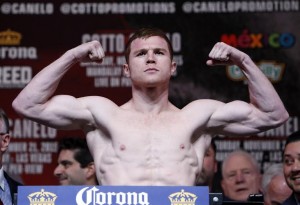
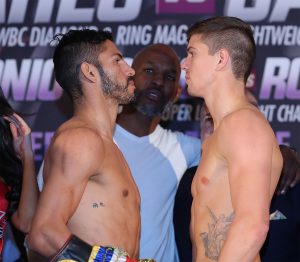
Miguel Cotto vs Canelo Alvarez
PPV Weigh-in 11-20-2015
WBC Middleweight Title
Miguel Cotto 153.5 vs. Canelo Alvarez 155
photo Credit: WILL HART

LAS VEGAS – There’s not much left to say, not that Gennady Golovkin and Canelo Alvarez have ever had a whole lot to say anyway.

Their news conference Wednesday at the MGM Grand was something of a formality in the build-up to their middleweight fight Saturday at T-Mobile Arena. Everybody was polite. There were thanks instead of trash.

On one level, the relative silence was a relief.

Up and down The Strip, there are still echoes of insults Floyd Mayweather Jr. and Conor McGregor exchanged before they met in an August 26 event that included a boxer, a mixed-martial artist and a mixed message.

Mayweather, McGregor and everybody around them might still be talking, if not for all those awkward and yet unanswered questions about what the pay-per-view numbers really were. We don’t know. We may never know.

In Golovkin-Canelo, however, there doesn’t have to be talk – and only talk. Spectacles draw crowds like accidents. But who remembers them? They’re gone faster than a bag of chips and a mild heartburn.

Canelo-GGG is being sold as much more. Substance instead of empty spectacle is the sales pitch for the HBO pay-per-view bout (5 p.m. PT/8 p.m. ET).

“I know it’s going to be a tough fight,’’ said Canelo, the red-headed Mexican who again wore signs of his Irish roots with a full beard that McGregor would have envied. “I know that. I’m prepared for that.’’

Canelo is a man of more punches than words. He doesn’t indulge in overstatement. When he says he is prepared, be forewarned. To wit: Be prepared for a middleweight perhaps as good as any in weight class full of bouts, name and dates that could fill a history book.

There’s no myth in middleweight. No mixed, either. But that’s another story. But there’s always another story about to unfold. At least, Canelo-GGG has that potential. Canelo promoter Oscar De La Hoya says it might be the best since Marvin Hagler-Thomas Hearns.

“Your kids will be talking about Gennady Golovkin-Canelo Alvarez twenty years from now,’’ De La Hoya said.

Unlike his fighter, De La Hoya does indulge in overstatement. As a promoter, that’s part of the job. If Canelo-GGG comes even close to the drama attached to Hearns-Hagler, then the lack of words before opening bell won’t matter.

There will be plenty to say about for many years after.


A Long Short Night for Chocolatito

By Jimmy Tobin-

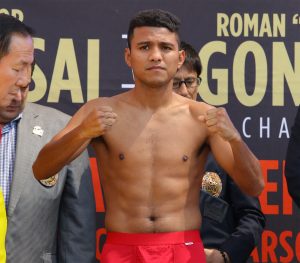
Saturday night, in the main event of HBO’s super flyweight tripleheader from StubHub Center in Carson, California, Wisaksil “Srisaket Sor Rungvisai” Wangek augured Roman “Chocolatito” Gonzalez into the canvas with a right hook so ill-intentioned and unsparing as to make superfluous the ritual tallying of seconds and scores alike. A third fight between Gonzalez’ and his conqueror became superfluous too in the long minutes between Gonzalez’ departure and return to consciousness. Even boxing’s most ambitious man is likely to appreciate the options that reroute him from another opportunity to settle a now lopsided score.

To be sure, Sor Rungvisai would hesitate not at all to share the ring a third time with what was, even a week ago, arguably boxing’s finest practitioner. For he is now Gonzalez’ fighting superior; and while this superiority he owes primarily to his size, vitality, power (attributes one must lobby hard to take credit for) there is more to him than physicality—Gonzalez, of course, has been beating bigger men for years.

What Sor Rungvisai brought was an irreverence both inherent and inherited: he forced an ugly fight with Gonzalez the first time, and having watched the scale of suffering tilt in his favor, set upon Gonzalez with greater fervor the second. After all, Sor Rungvisai too was fighting for vengeance, fighting to silence those who discredited his victory in March, and his performance reflected as much. He did not just dare the greatest offensive fighter of recent years to fight him, Sor Rungvisai demanded it, believing belligerence the key to victory.

And he was right, hence the smirk on Sor Rungvisai’s face when Gonzalez implored referee Tom Taylor to police the headbutts that again figured in the action. This plea told Sor Rungvisai there were questions his opponent could not answer—so he posed them mercilessly and relentlessly and boldly and ushered the Nicaraguan to his undoing. He is deserving then, of the accolades that should attend that unforgettable end.

Could it also be that Gonzalez suffered the fate that he deserved? Consider the bitterness of his first loss to Sor Rungvisai, the frustration born of scorecards, of an outcome taken out of the hands most deserving of delivering it. Consider too, Gonzalez’ understanding of the intimacy of the knockout, for the uncorrupted truth it reveals, that responsibility free of blame—might not a definitive ending then, however chilling, prove more satisfying to him?

Stretched on his back, looking skyward, Gonzalez was shown his ceiling as a fighter, and there is some nobility in that. Sor Rungvisai represented the culmination of a career of staggering ambition: Gonzalez was not finessed onto HBO and fed an army of no-hopers while a makeshift narrative about his greatness was conjured out of mediocrity—he is the genuine article, immune to the red hot revisions aimed to incinerate legacies in the aftermath of defeat. A middling end was never Gonzalez’ fate: the very nature of his career prevented it. He has now lost consecutive fights, yes, but there are no bad losses on his ledger, nor will there be any, given how undeniably Gonzalez has slipped. The signs were there before Sor Rungvisai, and after Sor Rungvisai expectations and evaluations will be forgiving. You are allowed to age when you leave no challenge unmet—and it is respect, not courtesy, that dictates as much.

Yet even if it is too early to eulogize Gonzalez’ career, he looked like no better than the fifth best fighter on the card, which means the division likely moves on without him or at his expense. But it will not do so in anonymity, and for that, Gonzalez deserves much credit. He, along with K2 Promotions, not only prompted the return of the flyweights to HBO’s airwaves he justified it. Yes, HBO now has an army of dragons guarding its gold, and the departure of Top Rank could be a sign that boxing at least as longtime subscribers have come to expect it is not long for the network. But the response to Superfly was strong, the arena sold out, and the action as good as anything HBO has offered in some time.

These are reasons then, to invest in the lower weights, and any pairing of the best of the card’s fighters (Juan Francisco Estrada, Carlos Cuadras, Naoya Inoue and of course, Sor Rungvisai) will meet the lofty expectations Saturday set. HBO may not care to bankroll as obvious a tournament as they could make, not when their stars have opponents comeback, showcase, and stay-busy alike to pay, but it is nearly impossible to imagine them not capitalizing on the very real enthusiasm Gonzalez engendered. And there is an important lesson to be gleaned from that: his career, conducted as if in adherence to a fighting romantic ideal, will leave both Gonzalez and boxing for the better. That so few are prepared to follow his lead only makes that message more endearing.

All of that time Saturday, from the ring to the gurney, the ambulance to the hospital, and yet so few what-ifs to ponder. When people ask him what happened that night in Carson Gonzalez should find some peace in saying, “A better man.” And he should one day, and hopefully, one day soon, say it with a smile.


Chocolatito City razed

By Bart Barry-

SANTA MONICA, Calif. – Onto the mess of rainbows and the Beach Boys and vivacity of this city’s Pier, else the whole effort mightn’t come off: A cleansing be needed because what happened Saturday in the grittier unhappier but still uniquely special climes of Carson, 20 or so miles southsoutheast of here, brought something funereal – a funereality? – disproportionate to its event. It was not merely an a-side got stiffened in the main, an all too infrequent occurrence anymore, but how remarkably few b-side supporters attended, and thus how remarkably quiet got ringside within 15 minutes of Sor Rungvisai-Gonzalez 2’s opening bell.

The compulsories: Thai super flyweight champion Wisaksil “Srisaket Sor Rungvisai” Wangek iced Nicaragua’s Roman “Chocolatito” Gonzalez early in round 4 of their rematch in the tennis stadium at StubHub Center. Chocolatito entered the arena, as much a West Coast mecca for aficionados as Madison Square Garden in the East, with a surge of excitement, a wildflower festival of Nicaraguan flags suddenly flying everywhere round the bowl, but left 45 minutes later on a stretcher in the back of an ambulance, a precautious formality, we’re assured, but possibly more: Nobody liked the way Chocolatito twice crumpled on the bluemat – his arm chickenwinged behind him, knockdown 1, from which he rose with eyes that went startled to incredulous to fearful, shortly before he got put in savasana.

What was understandably lost in Chocolatito’s breaking was Sor Rungvisai’s lonely ecstasy – while commission officials and doctors rushed awkwardly through the ropes to Chocolatito’s disconnected consciousness and indifferent body Sor Rungvisai even more awkwardly performed a victory somersault stageleft. It was the first indication in the six months we’ve known him he knew Roman Gonzalez was anybody at all and beating Gonzalez was a lifechanging feat. And therein lay Sor Rungvisai’s defining advantage. He didn’t appear to care for a moment of his 45 or so minutes of combat with Chocolatito what aficionados opined of Chocolatito or what Chocolatito’s career led him to opine of himself. To Sor Rungvisai he was a smaller man open often to exchanges and given to complaining quickly to officials about what headbutts happened accidentally till Sor Rungvisai saw their outsized effect on Chocolatito’s spirits and began accidenting them frequently.

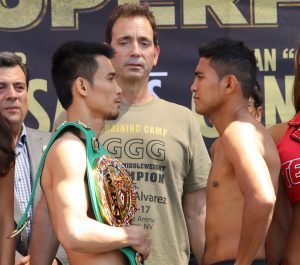
A telltale tell it was, too, when Chocolatito began his Saturday appeals before the fight was a halfround old. Sor Rungvisai ignored the referee and watched Chocolatito, unblinking – and did you notice the man didn’t blink even once during their Friday postweight staredown in the brilliant California sun? – then knew he had the little Nicaraguan and acted like it. Sor Rungvisai brutalized Chocolatito with the punches Chocolatito blocked and worse yet with those he didn’t: Welcome to super flyweight, flyweight! Just because Chocolatito’s body no longer wished to touch 112 pounds semiannually did not him a super flyweight make, and if Carlos Cuadras spoke such to him in short declarative sentences last year Sor Rungvisai growled it in March and roared it on Saturday.

However Chocolatito prepped for their rematch, and one senses a wrongheaded emphasis on Sor Rungvisai’s head headed Chocolatito’s camp itinerary, it all got obviously scrambled to apart before the second round was through and probably well before that. Whatever his supporters told him about a March robbery that truly wasn’t Chocolatito rededicated himself, etc., to avenging his career’s first loss and got properly flattened in fewer than four rounds, and when he returns to Managua and those who love him tell him to consider retiring he will do well to heed their admonishments.

The problems Chocolatito has with super flyweights cannot be remedied with strategy or tactics or anything at all, save borrowing Juan Manuel Marquez’s personal trainer and supplements regimen, and since VADA shan’t smile upon that, it’s time for Chocolatito to call it a once-in-a-generation career and make his living doing something that is not prizefighting. Videos out of Nicaragua show Chocolatito’s dad and aunt hissing about managerial malfeasance and what illadvice moved Chocolatito from 112 pounds to 115 (and American television and American purses), but when ambulance videos from Carson get seen in Managua bygones should remain bygones at least till a retirement announcement comes.

Roman Gonzalez leaves behind a weightclass and sport very much better than he found it. He topped mythical status lists and an HBO broadcast without ever performing within 80 pounds of the average American male’s weight and bequeathed to his fellow tiny warriors an incredibly healthy ecosystem. Better, too, the decisiveness with which Sor Rungvisai removed him from the division; one retrospectively fears what might’ve come of Chocolatito’s health in an 18-month stretch that comprised a brutal rubber match with Sor Rungvisai and a title defense with Mexican Juan Estrada and a culminating decimation at the fists of Japan’s Naoya Inoue.

Those other two too plied their wares Saturday and promised many good things for aficionados and no good things for Chocolatito. HBO hasn’t the funds or impetus at the moment to unify heavier divisions with heavier purses, but Mexican Carlos Cuadras, who lost a fair and very close decision to Estrada in Saturday’s co-comain, would surely make a wonderful scrap with Inoue, and Estrada, who boxes with fantastic precision and class, would need every one of his wiles to relieve Sor Rungvisai of his belt. Such a card could not sell 10,000 pay-per-views but might sell 7,500 tickets in Carson and confirm HBO as the unlikely but enthusiastically welcomed new home for our beloved sport’s longsuffering aficionados.

Bart Barry can be reached via Twitter @bartbarry


FOLLOW RUNGVISAI – GONZALEZ 2 LIVE

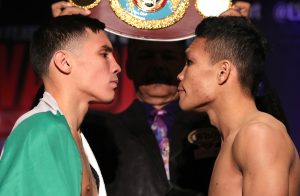
Follow all the action as Srisaket Sor Rungvisai defends the WBC Super Flyweight title in a highly anticipated rematch with 4-division champion Roman Gonzalez.  The action kicks off at 10:15 ET / 7:15 PT / 9:15 am Sunday in Thailand and 8:15 PM in Managua with a two fight undercard as Naoua Inoue defends the WBO Super Flyweight title against Antonio Nieves and Carlos Cuadras takes on Juan Francisco Estrada in an All-Mexican Super Flyweight showdown.

NO BROWSER REFRESH NEEDED.  THE PAGE WILL UPDATE AUTOMATICALLY  

12 ROUNDS–WBC SUPER FLYWEIGHT TITLE–SRISAKET SOR RUNGVISAI (43-4-1, 39 KOS) VS ROMAN GONZALEZ (46-1-1, 38 KOS) 
ROUND 1 2 3 4 5 6 7 8 9 10 11 12 TOTAL
 RUNGVISAI  10  10                    29
 GONZALEZ  9  10  10                    28

Round 1: Accidental headbutt/no cuts…Straight left from Rungvisai

Round 2 Gonzalez being aggressive…combinatons..Good right…

Round 3  Tremendous toe to toe action..Hard right from Gonzalez…hard left from Rungvisai..

Round 4 Body work from Rungvisai…HARD RIGHT HOOK AND DOWN GOES GONZALEZ…HARD RIGHT AND DOWN GOES GONZALEZ AGAIN…HE IS KNOCKED OUT

12 ROUNDS–WBO SUPER FLYWEIGHT TITLE-NAOYA INOUE (13-0, 11 KOS) VS ANTONIO NIEVES (17-1-2, 9 KOS) 
ROUND 1 2 3 4 5 6 7 8 9 10 11 12 TOTAL
 INOUE  10 10   10 10   10 10               60
 NIEVES  9  9  8  9              53

Round 1: Jab-right hand from Inoue…1-2…Hard 3 punch combination..Hard left from Nieves..Body shot from Inoue..

Round 2 Right from Nieves to the body..right…Jab from Inoue..2 body shots..Body shots from Nieves..Body shot from Inoue..Right..left to body..combination

Round 3 Uppercut from Inoue..Body shots..3 punch combination

Round 4  Inoue lands a left to the body..another one..

Round 5:  LEFT TO THE BODY AND DOWN GOES NIEVES..Hard left hooks

Round 6:  good right from Inoue..Left hooks to the body..Right and left to the head..Vicious right...FIGHT STOPPED AFTER THE ROUND

12 ROUNDS–SUPER FLYWEIGHTS–CARLOS CUADRAS (36-1-1, 27 KOS) VS JUAN FRANCISCO ESTRADA (35-2, 25 KOS) 
ROUND 1 2 3 4 5 6 7 8 9 10 11 12 TOTAL
 CUADRAS 10   10  10  10 10  10   9 10   8  10 115
 ESTRADA  9  9  9  9  9  10 10   10  9 10   10  10  114

Round 1: Body work from Cuadras

Round 2 Combination from Cuadras…Counter right from Estrada

Round 3 Left hook from Cuadras…Jab..Combination..1-2…Left hook from Estrada..Left hook

Round 4 2 left hook from Cuadras…

Round 5 Hard uppercut from Estrada..Counter right from Cuadras…Left hook..Good left hook from Estrada..Right..Body shots and left hook from Cuadras..

Round 6 Hard jab from Estrada..Hard 1-2..Right..left hook..Big right from Cuadras..Big right from Estrada..

Round 7 Hard right from Estrada..Hard flush right..Uppercut from Cuadras..Good right

Round 8 Straight right and jab..left hook to body from Estrada..Right from Cuadras..Good body shots…Good right from Estrada..

Round 9 Uppercut from Cudras..Good right…combination and right hand…

Round 10 Hard right from Estrada..HARD RIGHT AND DOWN GOES CUADRAS..2 Hard right hands…Right…Cuadras lands a lopping right

Round 11 Good left hook from Estrada..Body shot from Cuadras..Good left from Estrada..Left hook from Cuadras..Left hook inside for Estrada..Big left hook..

Round 12: Good right from Estrada..Big left hook..Combination from Cuadras…Hard right over the ropes from Estrada..Left hook from Cuadras…

114-113 on ALL CARDS FOR  JUAN FRANCISCO ESTRADA


All In The Family: Another Benavidez fighting to become youngest ever

By Norm Frauenheim-

David Benavidez wants to do what his older brother has already done. To wit: Make a little history. As a noteworthy accomplishment, being the youngest ever with a title is already in the family scrapbook.

Jose Benavidez Jr. pulled it off in 2009 when, at 16, he became the youngest to ever win a national Golden Gloves title.

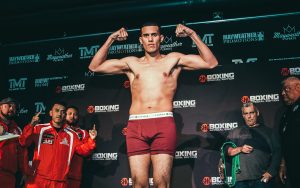
Eight years later, younger brother David, less than a year removed from his teens, hopes to become the youngest super-middleweight champion Friday (Showtime 10:05 p.m. ET/PT) in a bid for a vacant World Boxing Council belt against Ronald Gavril at Las Vegas’ Hard Rock.

“This opportunity means the world to me,” the 20-year-old Benavidez (18-0, 17 KOs) said. “I’ve been working for this since I was a little kid.’’

Truth is, the younger Benavidez, of Phoenix, is out to prove he’s more of a prodigy than just a kid, especially against an unknown Gavril (18-1, 14 KOs), a 31-year-old Romanian.

There are questions about how Gavril even got into a position to fight for a title vacated by Badou Jack. He’s there because 2004 Olympic bronze medalist Andre Dirrell withdrew because of injury. The 34-year-old Dirrell is well-known, which might be another saying he’s shop-worn. Gavril is more unknown, which might make him a lot more dangerous.

Hard to say. What is known — and known in abundance, however, is that Benavidez has been beating up his elders since he went pro in Mexico at the same age his older brother won one of the biggest prizes of all in the amateur remarks. Sixteen, Sweet 16, if you’re a Benavidez.

Another display of David Benavidez’ power would further solidify his credentials as a mature player at 168 pounds and eventually at every other weight from light-heavy to heavy. He’s only going to get bigger, certainly on the scale and maybe in name recognition.

“Winning the championship would be enough on its own’’ David Benavidez said. “But the opportunity to be the youngest in the sport is a major accomplishment and the biggest of my life so far.’’

For now, David has a bigger name than brother Jose, a major prospect in 2010 and an interim junior-welterweight champion in 2014 with a controversial decision over Mauricio Herrera. But the older brother in the family’s youngest-ever tandem is hoping to work his way back into contention.

Jose Benavidez’ career was interrupted in August 2016 when he was shot in a knee while walking his dog in Phoenix, according to Phoenix police. In the spring, the knee had healed enough for Benavidez to begin running.

Now, he’s ready to resume his career, probably at welterweight. Jose Benavidez visited his promoters Thursday at their Top Rank offices in Las Vegas Thursday to discuss a comeback bout later in the year, possibly in November.


Key to Chocolatito City

By Bart Barry-

Nicaraguan super flyweight Roman “Chocolatito” Gonzalez seeks to avenge his career’s first loss against Thailand’s Wisaksil “Srisaket Sor Rungvisai” Wangek in the main event of this Saturday’s extraordinary “Superfly” card in Carson, Calif., a card HBO will broadcast and in so doing stake an unlikely and indisputable claim to 2017’s best boxing broadcast. The comain will have Japan’s Naoya “The Monster” Inoue making his first match in the U.S. And the co-comain will have yet another 115-pound man, Mexican Carlos “Principe” Cuadras, whose claim as the world’s best super flyweight is not an unreasonable one, making combat with countryman Juan Francisco Estrada.

Frankly it’s an honor to cover a card of this quality. A quick query to the memory brings back a nullset of a better constructed threematch finale to a card I’ve attended – though Barrera-Juarez II in 2006 comes tumbling forward on the virtue of what Israel Vazquez did to Jhonny Gonzalez in the co-comain (while Marco Antonio Barrera bemused Rocky Juarez too thoroughly in the main to make the card actually historic, despite its fine construction).

Most importantly it could be the last chance to see a historic prizefighter like Chocolatito in the mainevent of a consequential card. Whatever happens Saturday Chocolatito is unlikely to retire and stay retired, a more likely occurrence is that long past the viable economics of the act Chocolatito’ll continue to work for backwages in a futile bid to do things the Money way, and he’s too good and decent for that to be a thing worth traveling to Los Angeles or Managua to witness.

The march upwards in weightclass and age is too much for any man to endure flawlessly much past his 40th fight or 30th year if he weighs less than 120 pounds, and in March Sor Rungvisai played reminder of this much as its cause. Chocolatito did more to accomplish less against Sor Rungvisai than any Sor Rungvisai predecessor and being reminded of it exhausted Gonzalez till the ratio trebled but still Chocolatito spun and whacked and resisted what disbelief surely came thumping. If there were special preparations Sor Rungvisai made for Chocolatito he did not betray them; perhaps his fruitfullest tactic was treating a legend like a shortnotice swingbout replacement to be butted and beaten as whim bade.

Whatever the weighting supposedly be, a good metric for ring generalship, that squirrely criterion with which we justify our biases when scoring rounds that’re close, is: Who files first appeal to the referee? who petitions an official’s intervention in lieu of making justice with his proper fists?

In March it was Chocolatito and an unfailingly bad sign. If Sor Rungvisai’s heady comportment was less than purely sporting Chocolatito’s conduct was more worrisome. Great fighters are dirty fighters and Chocolatito is a great fighter by this measure and every other but in March Chocolatito was a statesman, and offended too. He knew what Sor Rungvisai did was not accidental but once referee Steve Willis refused to be more officious than a point’s deduction from the Thai’s tally Chocolatito needed to remedy fouls with fouls, as craft told him he should, but Chocolatito did not and did something oh so much worse: He let selfindulgence touch him a touch.

Such indulgence begets brutalization and it surely did in March. Chocolatito’s face and head was an ugly mess by the concluding bell. What stung worse than his first career loss coming at the hands and head of an unclassed brute like Sor Rungvisai was Chocolatito’s realizing he’d have to face the man again and immediately if he chose not to retire – something like what the late Vernon Forrest felt the day after losing to Ricardo Mayorga. If Sor Rungvisai did not inflict the same mental cruelty on Chocolatito as Mayorga did Forrest he distributed a commensurate physical cruelty that would render a lesser man cautious in rematch.

Fortunately for Chocolatito there is only one strategy in the ring and a startling array of tactics for employing it – endeavor to attrition any man toeing the line before you. He expected Sor Rungvisai to fold of his own discouragement and got surprised when Sor Rungvisai did not. Class did not tell ultimately in March because it got thwarted by Sor Rungvisai’s fouling and obliviousness of his opponent’s class, which may be a roundabout way of writing class, of a certain sort, did indeed tell.

Expect Chocolatito to be the offender Saturday; if Sor Rungvisai did not pack a cup packed with reinforced beltline padding for his trip from Thailand he will regret it; Chocolatito will be targeting that beltline and a few inches above and below it from the opening bell until he is told to stop and after he is told to stop until a point gets deducted and maybe after that, too. Accustomed to enjoying benefits of all scoring doubts in his career’s 27 or so championship matches Chocolatito did not expect to lose March’s decision and now says in a convincing tone he intends to strip Sor Rungvisai of his fitness to continue, and if so, what difference will a point deduction in round 3 and another in round 8 matter?

There’s a genuine possibility, though, Chocolatito’s belting Sor Rungvisai early and often will not avenge his first loss. Sor Rungvisai well may have Chocolatito’s number; he well may have too much physicality and chin and derringdo for this 30-year-old, 115-pound iteration of Nicaragua’s second alltime great, remanding Gonzalez to retirement but leaving HBO with enough pieces – in Sor Rungvisai and Cuadras and Inoue, at least – to make an historic unification of the super flyweight division.

Bart Barry can be reached via Twitter @bartbarry


Two fights, two very different legacies

By Norm Frauenheim-

The canvas and ropes will be the same. So will the arena. Only a couple of ounces will separate the gloves. Two events within three weeks look an awful lot a like. But they aren’t.

In fact, they couldn’t be more different. Floyd Mayweather Jr.’s TKO of mixed-martial artist Conor McGregor on Aug. 26 at Las Vegas’ T-Mobile Arena and the looming Gennady Golovkin-Canelo Alvarez middleweight fight in the same building on Sept. 16 are separated by differing perceptions of the same concept.

Legacy.

It’s an overused word these days. Yet, it’s always there. But what exactly is a legacy? Turns out, it’s exactly in the eye of beholder.

For Mayweather-McGregor, legacy means money. The bigger the money, the bigger the legacy. Mayweather and McGregor made GDP-like sums.

For Golovkin-Canelo, the fight is more for their place in history. Mayweather has enough money to buy his piece of history, securing a predictable victory that allowed him to surpass Rocky Marciano with a 50-0 record against a novice boxer.

Golovkin and Canelo have different takes, even between themselves about legacy and what it means. For Canelo, it’s Mexican history and a chance to perhaps fight his way to a spot alongside Julio Cesar Chavez. For GGG, it’s about the middleweights and his fight to be recognized alongside the division’s iconic names.

They’ll make plenty of money, yet probably only a fraction of what Mayweather and McGregor did. But Mayweather-McGregor was, first and foremost, about money. Their event accented the Prize in prizefighting.

For Canelo-GGG, the accent is on the Fighting. Amid all the talk of pay-per-view records that could double or triple Mayweather’s $100-million guarantee, that sounds almost quaint. But it’s a welcome kind of quaint, comforting from at least this perspective.

“I want to win this fight because maybe for me this win will be like a history fight, like (Sugar Ray) Leonard vs. (Mavin) Hagler,’’ Golovkin said Wednesday during a conference call.

Golovkin went on to talk about the great names in the division and some of their own accomplishments. He is about to make a 19th successive defense of his middleweight title. He’s within one defense of matching the 20 straight by Bernard Hopkins, who is a Golden Boy executive in the company that promotes Canelo.

“Right off the top, the interest for me is it’s a huge fight,’’ GGG said. “The story — in the middleweight division, it’s a long story. I don’t know, I remember a lot of great champions, like Carlos Monzon, Sugar Ray Leonard, Marvin Hagler, Bernard Hopkins. Right now, I think new stories, new times for us. So many stories are huge in the middleweight division. To be a champion is huge.’’

There was a time when Mayweather would hear some of those names and argue that he was better than any of them. Out of that argument, he created TBE, The Best Ever, which became another commodity, another way to sell caps and T-shirts. From the man who calls himself Money, it is always about how much he made and less about whom he beat. On one level, he is TBE, as in The Biggest Earner ever.

For GGG, however, the sense is that he wants to be remembered for whom he beat in a career that will put him alongside a gallery of names all worthy of some TBE consideration

“I respect boxing,” GGG said. “If you respect boxing like me, watch my fight.’’

It sounds like a good investment in an old craft respected more for what the fighters did than what they earned.


Mayweather-McGregor: The uniquely fatiguing experience of being punched often

By Bart Barry-

Saturday in Las Vegas retired welterweight champion Floyd “Money” Mayweather (50-0, 27 KOs), a 40-year-old American, beat mixed martial artist “The Notorious” Conor McGregor (0-1, 1 KO), a 29-year-old Irishman, to a fraction of himself until referee Robert Byrd’s intervention after the first minute of round 10. If the match ended predictably, it gave its pay-per-viewers unpredictably more entertainment than we deserved. Mayweather-McGregor was way better than expected.

Credit for that properly goes to McGregor, whose unorthodox approach to boxing and his pronounced vulnerabilities – the greatest of which was not knowing how pronouncedly vulnerable he was – made Mayweather comfortable enough to eschew what thick, goopy layers of cliche form his public persona, remember the hardened amorality at his core, and hurt the man across from him until he was ordered to stop.

What makes boxing different from all other combat sports is that no matter how defensively adept you fancy yourself you are going to get hit often, and getting hit often is a uniquely stressful experience. No fighter’s fantasies comprise being hit thusly, but boxers expect it and vigilant themselves accordingly. The act of being hit repeatedly and the unwavering threat of being hit repeatedly more is what surprised McGregor the most. You can do roadwork and elasticarm bends and backflips and CrossFit and all the rest, and maybe even some sparring with undersized guys, too, but there’s nothing to condition you for being punched a whole lot but being punched a whole lot.

Mayweather gave McGregor a combination of force and precision no sparring partner did (or that sparring partner would be Mayweather), and McGregor receded and wilted subsequently. And wilted is the proper word for what happened to McGregor – a thing we see in boxing gyms round the world every weeknight when two equal physical specimens begin to punch each other and one grows mighty and the other wilts until a coach shortshifts the bell and waves the session off. McGregor’s handlers likely’d not’ve known to do that, and fortunately for them Saturday’s otherwise incompetent referee did instead.

McGregor, in a weakly megalomaniacal way, indicated in his postfight interview when he gets tired his legs get wobbly. Yes, son, that’s called fatigue, and it makes cowards of us all, it makes us not want to fight – it makes us go whole minutes of combat without doing anything but flee – and it’s a universal sign in our beloved sport, the manly art of selfdefense, a match is concluded.

Even claims of quick stoppages are universal, not something invented by McGregor; any aficionado who’s attended an undercard has seen some version of the 10 1/2-count, when a fighter remains on his knee till 10 then leaps upwards, arms spread, pleading to continue, all strength miraculously restored. Except McGregor didn’t get that far because, in lieu of taking a knee and regrouping, he decided to use the “just energy” of going “wobbly” while a professional fighter placed the middle knuckle of his left and right fists on his chin and temple. More exotic strategy and tactical innovation by The Notorious, perhaps, but also a loud plea for official assistance.

Good that it came, too, because McGregor hadn’t enough time in his brief career as a boxer to learn how to comport himself when things went awry. He was a frontrunner, not unlike prime Mayweather or anyway Mayweather against a fellow boxer, and didn’t have a plan C, once McGregor’s vaunted power never activated and his one uppercut counter failed to cut Mayweather’s lights.

For a threeround, though, it was interesting – far more interesting than expected. The larger man, by what looked like three weightclasses at opening bell, intended to win by decision, outpointing the spoiler unless the spoiler took scoring chances as the fight progressed. If that wasn’t the most suspenseful happening, it was quite unexpected and a little dramatic; it set the imagination cooking with ingredients of Mayweather like a risktaker and knockout needer.

By round four, when Mayweather had done very little and yet McGregor was suddenly diminished, arming and pawing punches like someone less than a novice, the standard Mayweather slowmarch was underway, and one hoped only something conclusive might happen. Tradition dictates the worst thing that might befall a pay-per-viewer is Mayweather realizing, with an audible click, his opponent cannot hurt him, as tradition dictates that be the time for Money to begin melding time and space together till the final six rounds of a championship prizefight, a thing which should be both dramatic and suspenseful, become an 18-minute lump of bodyjabs and a rolling lead shoulder and talk of Money’s legacy and retirement plans (Saturday’s was his fourth or fifth final fight). Instead McGregor was defenseless enough for Mayweather to accelerate for once and do what you are supposed to do with a defenseless man in front of you: Try to take his consciousness violently.

If it’s the last we see of Mayweather, it’s an image that should please him is the last we have: eyes predatory, mouth maliciously set, punches properly leveraged for force and angled intentionally: Floyd Mayweather, a prizefighter – not a Pretty Boy or a Money, but a man professionally committed to hurting other men with his fists. It took some fraudulent matchmaking to get there, a professor against a bachelor’s degree, but Mayweather got there with his wealth and wits intact.

Enjoy your retirement in good health, Floyd, and now leave our sport be.

Bart Barry can be reached via Twitter @bartbarry


FOLLOW MAYWEATHER – MCGREGOR LIVE!!

Follow all the action as undefeated legend Floyd Mayweather takes on UFC sensation Conor McGregor in a highly anticipated boxing match.  The show begins at 7 PM ET with a 5 fight undercard that will feature Gervonta Davis taking on Francisco Fonseca in a lightweight bout (Fonseca can win the IBF Jr. Lightweight title which Davis vacated at the scales.  Nathan Cleverly defends the WBA Light Heavyweight title against former super middleweight champion Badou Jack.  Undefeated Andrew Tabiti takes on former two-time world champion Steve Cunningham in a cruiserweight battle.

NO BROWSER REFRESH NEEDED.  THE PAGE WILL UPDATE AUTOMATICALLY

12-ROUNDS–JR. MIDDLEWEIGHTS–FLOYD MAYWEATHER (49-0, 26 KOS) VS CONOR MCGREGOR (PD) 
ROUND 1 2 3 4 5 6 7 8 9 10 11 12 TOTAL
 MAYWEATHER  9 10   9 10   10  10  10  9 10         87
 MCGREGOR 10   9  10  9 10   9  10  9        85

Round 1: McGregor lands a left…Uppercut

Round 2: Right from Mayweather..Right from Mayweather…Right from McGregor..Left to body..Right from Mayweather..

Round 3 Jab from McGregor..Jab..Right to body from Mayweather..

Round 4 McGregor lands a a left…2 rights from Mayweather..combination..Jab from McGregor..Right from Mayweather..Left from McGregor..Lead right from Mayweather..Left uppercut from McGregor..

Round 5 Right to body from McGregor..Left from Mayweather..right

Round 6 Jab from McGregor..Right to body fro Mayweather…lead right..right from Mayweather…Left to body from McGregor…good body work..left..Good counter right from Mayweather..

Round 7  Right from Mayweather..uppercut from McGregor..Combination and right from Mayweather,,2 rights..

Round 8 Good left from McGregor..2 rights from Mayweather..Combination from McGregor..Jab from Mayweather..

Round 9 Body shot from McGregor…hard combination…Right from Mayweather…hard right,,McGregor hurt..Hard right rocks McGregor.

Round 10 2 HUGE RIGHTS….MCgREGOR HURT…1 MORE SHOT…ROBERT BYRD STOPS THE FIGHT

 12-ROUNDS–IBF JR. LIGHTWEIGHT TITLE–GERVONTA DAVIS (18-0, 17 KOS) VS FRNACISCO FONSECA (19-0-1, 13 KOS)
ROUND 1 2 3 4 5 6 7 8 9 10 11 12 TOTAL
 DAVIS  10  9 10   9  10  10 10             68
 FONSECA  9  10  10  9  9  9            65

Round 1: Left to body from Davis..Left uppercut..Right to body from Fonseca..Counter left Davis..Right to body from Fonseca

Round 2 Nice combination from F9nseca…Body shot from Davis…Left hook from Fonseca..Hard uppercut from Davis..

Round 3: Huge combination featuring uppercuts from Davis..Left from Davis…Good counter from Fonseca…

Round 4 Huge uppercut from Davis…Right and left from Fonseca..Good left..Body shot

Round 5  Fonseca lands a left to the body…Hard body shots from Davis..right to body…Counter from Fonseca…

Round 6 Lead left from Davis…Nice left

Round 7  Good right from Fonseca..Good right and left uppercut from Davis…Right to body from Fonseca..Left from Davis

Round 8 LEFT TO HEAD…FONSECA DOWN AND COUNT REACHES 10…FONSECA CLAIMING BEHIND THE HEAD

 12-ROUNDS–WBA LIGHT HEAVYWEIGHT CHAMPIONSHIP–NATHAN CLEVERLY (30-3, 16 KOS) VS BADOU JACK (20-1-3, 12 KOS) 
ROUND 1 2 3 4 5 6 7 8 9 10 11 12 TOTAL
 Cleverly  9  9  9  9                 36
 Jack  10 10  10   10                  40

Round 1: Right from Jack..Body..2 rights..Right from Cleverly..Good right from Jack..Jab from Cleverly..left from body..uppercut from Cleverly…Nice right

Round 2 Body shot from Jack..2 rights from Cleverly..1-2 from Jack..Nice body shot..overhand right

Round 3 Body shots from Jack..Right hand..Good uppercut..Short body shot..Jab from Cleverly

Round 4 Hard shots from Jack..Nice left hook and right..Big left hook..Big 3 punch combo.Clecer;y bleeding from the nose

Round 5 Hard left from Jack..Jack landing big shots on ropes…Left from Cleverly..Jack pounding Cleverly on the ropes..BIG UPPERCUT FIGHT STOPPED–TKO FOR BADOU JACK

 10-ROUNDS–CRUISERWEIGHTS-ANDREW TABITI (15-0, 13 KOS) VS STEVE CUNNINGHAM (29-8-1, 13 KOS)
ROUND 1 2 3 4 5 6 7 8 9 10 11 12 TOTAL
 TABITI 10   10 10   9 10   10 10   10  9     97
 CUNNINGHAM  9  9  9 10   10  9  9  9  10      93

Round 1 3 jabs from Tabiti..counter jab from Cunningham..Right from Tabiti..Jab..Jab from Cunningham..Lead right from Tabiti..Counter from Cunningham..

Round 2 Double jab..right hand from Tabiti..Nice counter right from Cunningham…Combination from Tabiti…Left hook for Cunningham..

Round 3 Combination from Tabiti..Right to body..Counter from Tabiti..Jab from Cunningham..

Round 4 Tabiti lands a right to the body..Jab from Cunningham..Jab..Right

Round 5  Right from Tabiti..2 jabs from Tabiti..Left from Cunningham..uppercut..Double jab

Round 6 Counter right from Tabiti..Right from Cunningham..short right from Tabiti

Round 7  Right to body from Tabiti..Jab..Nice exchange

Round 8  Right from Tabiti…right uppercut

Round 9 Combination from Tabiti..Counter right from Cunningham..

Round 10 Double jab from Cunningham…

Tabiti landed 112-315       Cunningham 89-329

97-93 twice and 100-90 for Tabiti

10 ROUNDS-WELTERWEIGHTS–THOMAS DULORME (24-2, 16 KOS) VS YORDENIS UGAS (19-3, 9 KOS) 
ROUND 1 2 3 4 5 6 7 8 9 10 11 12 TOTAL
 DULORME  7  9  10  9 10   10 10   8      91
 UGAS  10 10   10  9  10  10  8  9  9  10     95

Round 1 Right from Ugas…

Round 2:  Right from Dulorme….Uppercut..GOOD UPPERCUT AND DOWN GOES DULORME..Good body shot…HARD RIGHT AND DOWN GOES DULORME

Round 3:  Big flurry from Ugas.. Right from Ugas…Hard hook to the jaw..

Round 4:  Dulorme lands a straight right…

Round 5 Right from Ugas..Hard right..Trading uppercuts…Hook from Ugas..uppercut and right…

Round 6 Right from Ugas…Body shot from Dulorme…

Round 7:  DULORME DEDUCTED A POINT FOR A LOW BLOW…Uppercut from Ugas..BIG LEFT AND DOWN GOES UGAS

Round 8:  Hard uppercut from Dulorme…Left hook from Ugas..Left from Ugas..2 hooks from Dulorme..

Round 9:  Hard hooks from Dulorme

Round 10:  DULORME DOCKED A POINT FOR A LOW…Hook from Ugas..

94-91 and 93-92 TWICE FOR YORDENIS UGAS

 10-ROUNDS–MIDDLEWEIGHTS–JUAN HERALDEZ (12-0, 8 KOS) VS JOSE BORREGO (12-0, 11 KOS)
ROUND 1 2 3 4 5 6 7 8 9 10 11 12 TOTAL
 HERALDEZ  10  9 10  9  10 10  10  10  10       96
 BORREGO  9  10  10  9  9  10  9 10   9     94

Round 1 Double jab and hook from Heraldez..Combination..

Round 2 Combination from Borrego..Body shot from Herladez

Round 3 Triple jab from Heraldez…Combination..Borrego bleeding…Hook from Heraldez

Round 4:  Borrego counters on ropes..

Round 5 Combination from Heraldez..

Round 6 Straight left from Borrego..Combination from Heraldez..

Round 7 Combination from Borrego..Right from Heraldez..Good left..

Round 8 3 jabs from Heraldez..Right…Left from Borrego…Borrego bleeding from his nose..Good combination from Heraldez…Body shot

Round 9  LEFT AND DOWN GOES HERALDEZ …Good body shot…Good left hook..

Round 10 Left from Borrego..Jab from Heraldez…Body shot..

96-93, 97-92 TWICE FOR JUAN HERALDEZ


Cheers for McGregor, boos and most of the bucks for Mayweather

By Norm Frauenheim-

LAS VEGAS –The beat went on — and on — Friday in the parade to an event that looks and sounds more like spectacle than sport.

Conor McGregor screamed. His Irish fans screamed. And Floyd Mayweather Jr. did what he has always done. He’s more than just unbeaten.

Mayweather’s ability to generate money is unmatched, if not unprecedented. Boos-for-bucks is a formula that has transformed him into perhaps the high-earning athlete ever.

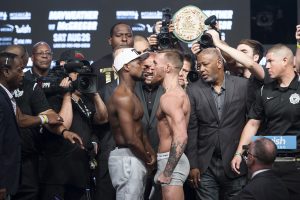
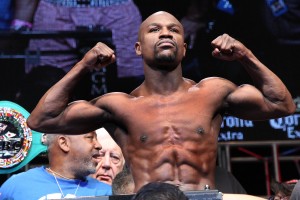
The boos were there, off the scale, Friday for the ritual weigh-in at T-Mobile Arena where Mayweather is favored Saturday night to extend his 49-0 boxing record to 50-0 against a mixed-martial arts star with zero experience as a professional boxer.

Depending on who and what you believe, McGregor’s chances at derailing Mayweather’s bid at equaling Rocky Marciano’s historical record are the numerical equal of his boxing experience. We’re talking zero. So-called sharps – an oddsmakers’ term for smart bettors — have been descending on the Vegas books over the last 24 hours.

One wagered $1 million Thursday with the chance to win about $182,000 on Mayweather. A second bet of $1.2 million was also reported. More of the same was expected before Saturday’s pay-per-view card (Showtime/6 p.m. PST/9 p.m. EST).

But a zero chance is chance enough for fans who just want to see Mayweather lose, even if it could only happen in the event of an accident, say, an asteroid striking T-Mobile Arena’s roof so that it only collapses on where Mayweather is standing. Hey, bleep happens.

In addition to beating everybody he has ever faced, Mayweather has been generating bucks through boos at almost every turn. Reports are that he could earn $200 million for Saturday night’s event.

Before weighing at 149.5 pounds for the 154-pound show, he ensured some more enmity from the weigh-in crowd by stepping on the scale in Irish green shorts that said Paddy Power across the waist band. The crowd roared in anger and McGregor led the way.

After tipping the scale at 153 pounds, McGregor (21-3 in UFC bouts) pose for the traditional face-off with Mayweather with his mouth open in what looked like a perpetual stream of expletives. It was an Irish temper turned up as high it could go.

“I see a man afraid,’’ said McGregor, who is guaranteed a reported $100 million.

Maybe, but the odds makers are beginning to see something different in a man they think is closing in on some easy money. For him. And them


Mayweather-McGregor: Lots of money, lots of questions, few answers

By Norm Frauenheim-

LAS VEGAS – The Strip is kind of the ultimate fantasy camp. Only the hangovers are real. Everything else is about it is as believable as Donald Trump, whose name adorns one of the countless towers at the other end of a dizzy street from where another fantasy is about to unfold Saturday night.

Floyd Mayweather Jr.-versus-Conor McGregor is supposed to be a fight. Mayweather says it will be. McGregor says it will be. The Nevada State Athletic Commission sanctioned it, so it must be, right?

Yet, suspicions abound, despite all the trappings, including money, more money — did we mention money? – and a media tent almost big enough to hide an aircraft carrier.

I’m seated in that tent right now, across the street from the Luxor, a hotel named for an ancient Egyptian city with a front that includes the sculpted face of a Pharaoh with enigmatic blue eyes that seem to be asking:

What the hell am I doing here?

I can’t say I have an answer. After all, I’m a boxing guy who believes McGregor has about as much of a chance as the first three letters in his first name might suggest. From a UFC star with no reported experience as a pro boxer, it sounds like a Con.

“I’m going to out box this man at his own game,’’ McGregor said Wednesday at the MGM Grand during the final news conference for a 12-round event scheduled for T-Mobile Arena.

Really? That would be about as believable as Mayweather saying he would outkick or out grapple McGregor, whose 21-3 record seems to say that he isn’t quite as proficient at the mixed arts as the 49-0 Mayweather has been at his own.

It just doesn’t add up, although McGregor’s cocksure tone suggests that maybe he’s conned himself into believing he can win as much as he has conned his fans. The money on McGregor has been pouring in like Guinness from a busted tap. Late Thursday, Mayweather was a 4-1 favorite.

In other words, the odds give McGregor a better chance at beating Mayweather than Marcos Maidana, a world-class boxer. Maidana, who as far we know never had to kick anyone to win, was about a 7-1, 8-1 underdog in each of his losses to Mayweather.

Like I said, it just doesn’t add up. McGregor’s chances at beating Mayweather at a skill he has mastered like few ever have appears to be about as likely as the truth and nothing but the truth from that aforementioned guy whose name adorns that gold-trimmed tower at the other end of the Strip.

In a much larger sense, however, McGregor has already won. According to various reports, he could collect $100 million. For him, the task is not to do something stupid. There’s a clause in his contract that prohibits MMA tactics.

In effect, it’s a clause that could take away his instinct. Can he really fight that way? Can any fighter? I’ve always believed in Mike Tyson’s famous line about what happens to well-practiced plans when the first big punch lands. It’s then when a fighter becomes who he really is.

McGregor appears to be imminently hittable. Mayweather’s precise punches will land repeatedly and with power augmented by gloves lighter than usual for the 154-pound division. The Nevada Commission approved eight ounces, instead of the usual 10. McGregor celebrated the move, but the guess here is that he’ll regret it. Mayweather has promised a KO and the lighter gloves will help him accomplish exactly that.

The question is McGregor’s reaction when Mayweather’s punches put him into the dangerous daze between $100 million and instinct. Will he carefully protect the money or become the guy he really is with a kick as instinctive as it would be disqualifying?

The Pharaoh didn’t have an answer for that one either.


Terence and Floyd: Juxtaposed by the calendar

By Bart Barry-

Saturday in Lincoln the fighting pride of Nebraska, Terence “Bud” Crawford, unmanned and unbellied Namibian Julius Indongo on ESPN to become the first unified champion of the junior welterweight division in . . . who knows, maybe the history of that young division. Most importantly, Crawford did it with aggression and form, beating the sauce out his man.

This Saturday Floyd “Money” Mayweather enters the silly season of his career with a special-attraction-championship-exhibition match against an Irish MMA champion named Conor McGregor.

What these events have in common is the calendar. Let us not waste that.

Unifying titles in this era the way Crawford just did is, conversely, less likely and less admired. If it’s less admired it’s a consequence of the saturation grift sanctioning bodies perpetrated on the sport with promoters’ and networks’ assistance decades ago – the belts mean nothing, so he who collects them is the king of nothing. That may well be aficionados’ reality but it’s not one common among prizefighters. They know the difference between meaningful belts and less meaningful belts because they suffer to come by them and keep a precise accounting thereby.

The odder part of the unification labyrinth, though, is the logistical difficulty of this generally thankless feat. It’s not enough to imply the sanctioning bodies are indifferent to sharing a champion with one another – they’re fully and actively against the ruse. Once a man has unified all the belts he is larger than their sum, and many multiples larger than any one of them, and boxing’s major crime families move swiftly against him; each sanctioning body has a unique mandatory challenger and invariably a unique mandatory challenger behind him, and so to keep his unified titles unified a unified champion must fight eight times in about 11 months against men nobody has heard of and far fewer would pay to see.

The sanctioning bodies are collectors, not distributors, they are sponsored, not sponsors – they expect their titlists to take whatever prestige accrues to those titles and vend like hell to pass a percentage of winnings their sanctioners’ way. One wrong move, too, one misplaced obscenity, one improper flirtation with an unsanctioned challenger or promoter, and the stripping commences. If it be nigh impossible to unify titles, it is irrational to keep them that way.

Terence Crawford knows this and knows too what logistical gymnastics were required to get to Saturday’s match and knows still better there ain’t no money in satisfying sanctioners’ requirements one moment after unifying. He owns the junior welterweight division just seven matches after joining the junior welterweight division (Gennady Golovkin, conversely, has been trying to unify the middleweight division since beating Nilson Julio Tapia [14-2-1] in 2010). Crawford benefits greatly from a promoter that knows what it’s doing, a promoter that has been here oftentimes before, knows which levers work and where to set the fulcrum and, perhaps most importantly, doesn’t lowball the owners of what titles its champion seeks to unify.

Top Rank likely overpaid some of the opponents Crawford whupped these last two years, but it now has a man near to being a household name as boxing gets, who is also a regional ticketseller, and after an abominable showing on pay-per-view, something of a chastened economical realist. Top Rank continues increasing the quality of its fighters’ opponents until its fighters lose and thereby assert a quest for greatness that goes: I took my talent far as humanly possible.

Nobody knew this better than Floyd Mayweather; had Mayweather wished to be “TBE” Floyd would’ve stayed with Top Rank and, like every realistic candidate for the “TBE” title, Floyd eventually would have lost. Floyd didn’t like Top Rank’s compensation algorithm in the least – way way too much risk for way way too little reward – and followed his heart to great wealth but now enters a carnival stage in his career to silence what angsty voices nag a talented man who knows he didn’t take his talent to its limits. A dangerous space for the man because if Saturday goes as expected, what comes next?

Nobody who believes Floyd squandered his talent in part on handicapping every match to near bloodlessness – swerving Kostya Tszyu and Antonio Margarito completely; swerving prime versions of Manny Pacquiao and Miguel Cotto; fighting Juan Manuel Marquez three weightclasses high, etc. – will suddenly reform his opinion after watching Money safely avoid an MMA dude for 36 minutes. Since he can’t stay retired, obviously, what does Floyd do next to make himself feel great – fight the Brothers Charlo at the same time? throw hands with Adrien Broner from a stripper pole?

(Having never seen a minute of a Conor McGregor fight but having trained at a predominately MMA gym for years and boxed some of the lads, I assume the chalk is right and McGregor hasn’t a prayer, with one caveat: How many folks who are positive Floyd will win were just as positive Hillary would win, and of those same folks that say “predictions in boxing and politics are completely different!” how many wouldn’t’ve used the exact same logic if the events’ chronology were reversed? The trend: Folks who aren’t always right but are never uncertain.)

The calendar juxtaposes Floyd and Terence for us, and the comparison may well be apt. Floyd was 35 fights in his career when he got off the Top Rank track, buying his way out of a promotional contract that guaranteed some unsavory combination of Margarito and Cotto, to fight instead Carlos Baldomir. Crawford is 32 fights in a career that did not begin auspiciously as Mayweather’s but is becoming increasingly dominant. He has not peaked yet as a fighter or as an attraction. He hasn’t Floyd’s upside as a fighter or an attraction.

But Floyd never put more than 75-percent of his talent on the line and Crawford will have to if he stays with Top Rank. The question then becomes: Is 100-percent of Terence Crawford’s talent greater than 75-percent of Floyd Mayweather’s? If so, many millions of Americans more are about to watch Crawford’s prime happen on ESPN than ever saw Floyd’s on HBO, and we know how finicky be public opinion and what polling writes history. Poor Floyd.

Bart Barry can be reached via Twitter @bartbarry


Chaos Eclipse: Crawford-Indongo a rare moment when boxing’s bodies will align

By Norm Frauenheim-

Unity and boxing are an unlikely complement. Link them in the same sentence and you’ve got something that looks, feels and sounds like an oxymoron. You know, jumbo and shrimp.

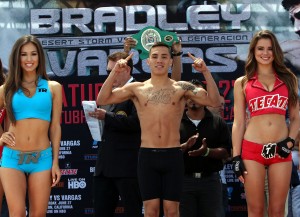
But unity is part of the story Saturday in an intriguing fight for all the pieces to the 140-pound title between unknown Julius Indongo and better-known Terence Crawford in Lincoln, Neb.

A fight for a unified title happens about as often as a solar eclipse, which coincidently – or maybe not – is supposed to happen Monday.
But if heavenly bodies can align once in a while, so can the acronyms in a business that practices chaos as if there were no other way.

There is a way, of course, and Top Rank will attempt to make it work for itself, ESPN (7 p.m. PT/10 p.m ET) and couple of junior-welterweights who are a lot more skilled than they are known.

“It was very difficult,’’ said Top Rank President Todd DuBoef, Crawford’s promoter who worked like a diplomat with all the various organizations for a rare bout with Indongo, a Namibian promoted by Matchroom’s Eddie Hearn of the UK. “We had to work hand in hand with Matchroom, because obviously Matchroom and Indongo had two belts and Top Rank and Crawford had two belts and there were mandatories and everything that was coming into play.

“There were people that we had to appeal to and we said, ‘Hey, this is a rare opportunity that we are able to do this. Let’s try and work together and have a positive solution for the sport.’

“I think we delicately managed it.’’

The winner will be the first champion with four belts – WBC, IBF, IBO and WBO – since middleweight Jermain Taylor 12 years ago. It’s symbolic. But it’s also practical for fighters who have proven themselves within in the ropes, yet are still fighting for name recognition.
For Crawford, that means a chance to strengthen his claim on No. 1 in the pound-for-pound debate.
“Of course,” said Crawford, who holds the WBC and WBO belts. I think I have been doing a lot in the sport of boxing and I have had my name mentioned in the top three.

“I will be looking forward to being the top one, or maybe two after this fight. It just depends on how people look at it. In my eyes I think I am top two already.’’

For Crawford (31-0, 22 KOs), ESPN’s role in the bout also represents a source of motivation, perhaps on a couple of level. For one thing, it’s chance to break out of pay-per-view anonymity.

Crawford, who says he’d vote Andre Ward No. 1 if he couldn’t vote for himself, hopes to introduce himself and pay-per-view claim to larger cable audience. Then, Crawford has a chance to prove ESPN wrong. In the network’s latest pound-for-pound ranking, he’s No. 6.

For Indongo (22-0, 11 KOs), a unified title is about country and even continent.

“Wherever I travel, I will be representing all of Namibia,’’ said Indongo, the IBF and WBA belts holder who is fighting for the first time in the U.S. after attention-grabbing victories over Eduard Troyanovsky in Moscow and Ricky Burns in Scotland. “It’s like I have the whole country of Namibia on my shoulders issued by my president. So I have to rely on the game plan and that is the confidence that I rely on.

“I know that my country and Africa is on my shoulders and when the team travels from Namibia to the fight, I can only focus on the fight. It motivated me a lot.’’

Motivation, perhaps, for a new business model, too.


Hall Of Friendship: Nevada Hall turns old infamy into famous friends

By Norm Frauenheim

LAS VEGAS – Memories, laughs and even a few tears were there. But there was no bitterness. No punches either. The fifth annual Nevada Boxing Hall of Fame dinner was many things, including friendships hard to imagine decades ago.

Sugar Ray Leonard was there to introduce the rival who almost beat him in a defining fight 36 years ago.

But this time Leonard came to praise, not punch Thomas Hearns.

“He’s a guy who has been my dear friend for a long time now,’’ said Leonard, who stopped Hearns in an epic welterweight fight in 1981 on back lot not far from the Caesars Place ballroom where he spoke Saturday night. “”I won that fight.’’

But, Leonard then conceded, his friend paid him back in a forgettable rematch at super-middleweight in 1989.

“He beat my ass,’’ Leonard said.
Hearns smiled at the memory. Smiled at Leonard, too.

“My roughest fight, but now my best friend,’’ said Hearns, the last inductee in a 2017 class that also included Michael Carbajal, Richie Sandoval, the late Ken Norton, Lucia Rijker, the late Salvador Sanchez, Erik Morales, Michael Spinks and his brother Leon.

Then, there was Morales and Marco Antonio Barrera. They are are buddies long after a rivalry as contentious and bitter as any in boxing’s modern history.

But there they were about 15 years later, old enemies in an alliance once as unlikely as ever. Barrera introduced Morales.

“I want to congratulate a great champion and my dear, dear friend,’’ said Barrera, who lost a wild split decision at super-bantamweight to Morales in 2000 and went on to win rematches at featherweight in 2002 and super-featherweight in 2004.

Then, Morales countered with gratitude instead of a hook. Among other things, each inductee was awarded a ring. Morales turned to Barrera and said he wanted to give his ring to his dear friend. In the spontaneous exchange, the ring tumbled out of the box through their hands and onto the floor.

Quickly, they both reached down to recover it. Then, they smiled, this time laughing like old friends instead of sworn enemies.

The dinner also included a few surprises. Rapper Flavor Flav introduced an ailing Leon Spinks, who is best remembered for his 1978 upset of Muhammad Ali.

For Sandoval and Carbajal, the ceremony was a fitting moment. Their careers were linked in 1988. Twenty-nine years later, they were together again, linked by their inductions to the same Hall on the same night.

It was Sandoval who talked Top Rank promoter Bob Arum into signing Carbajal, who had won a silver medal at the Seoul Olympics. Arum was reluctant.

Carbajal, a junior-flyweight from Phoenix, fought in a division that in those days was hard to sell. But Sandoval, a bantamweight, told Arum there might be a big future at a weight as forgotten as it was diminutive.

Turned out, there were also some heavy money at the light end of the scale, too.

Carbajal became the first fighter at 108 pounds to collect $1 million for a 1994 rematch with rival Humberto Gonzalez, who won a controversial decision and went on to collect $1 million in the third step of a trilogy that began with Carbajal getting up from two knockdowns for a dramatic stoppage in The Ring’s 1993 Fight of the Year at the then Las Vegas Hilton.

Their purses still stand as the record for the sport’s little guys. No fighter at 108 pounds, or 112 for that matter, has ever collected $1 million since then.

Top Rank publicist Lee Samuels told the story about how Sandoval persuaded a skeptical Arum to sign Carbajal.

“Michael turned out to be one of the great, great fighters in Top Rank history,’’ Samuels said in his introduction of Sandoval to the dinner crowd. “Thank you, Ritchie Sandoval.’’

In the end, it was that kind of night. There were thanks all around for a fifth Nevada Boxing Hall of Fame class, which also includes publicist Debbie Munch, cutman Rafael Garcia, late matchmaker Mel Greb, late referee Davey Pearly and Dr. Elias Ghanem, a 14-year member of the Nevada State Athletic Commission who died in 2001.


De La Hoya says fans know the difference between what’s real and what’s not

By Norm Frauenheim-

Oscar De La Hoya isn’t losing any sleep worrying about whether the potential pay-per-view audience for Canelo Alvarez-Gennady Golovkin on Sept. 16 will suffer some erosion because of Floyd Mayweather-Conor McGregor on Aug. 26.

Fans know the difference between what is real and what isn’t, De La Hoya, Canelo’s promoter, said during a conference call this week.

“We’re concentrating on our fight,” De La Hoya said Tuesday on a call that included Canelo. “We’re concentrating on our event, our fight. Obviously we have the real fight. We have a serious fight. This is a serious fight, a serious event. Two of the best fighters, fighting each other. And I think that the fans have recognized that.

“…So have the sponsors and a lot of the media people. They’ve recognized that this is the real fight. This is the fight that they want to be at. This is the fight that they want to see. A clear indication is we sold out in ten days.’’

If the quick sellout is a reliable indicator of pay-per-view expectations, Golden Boy Promotions is way ahead of the game with Canelo-GGG, which De La Hoya believes can be the biggest fight in middleweight history, bigger than even Marvin Hagler’s legendary victory over Thomas Hearns in 1985.

According to a report in the Los Angeles Times last week, thousands of tickets remained unsold for Mayweather-McGregor at Las Vegas’ T-Mobile Arena, also the site for Canelo-GGG.

For now, the best explanation for the slow sale rests in exorbitant ticket prices. Ringside seats are $10,000. The cheapest seats were $500. They sold out. According to reports about three weeks before opening bell, as many as 7,000 tickets could still be available. Mayweather didn’t toss that many dollar bills into the air during his international press tour with McGregor.

Lower the prices and a sellout will quickly follow, according to rival promoters. But what if De La Hoya is right? What if fans have decided that the long-awaited Canelo-GGG clash is the only true contest. It’s quickly becoming a pick-em fight, one that could easily lead to a rematch. Or two

Despite betting odds – anywhere from 7-1 to 5-1 – that appear to give McGregor a real chance, the consensus is that Mayweather, the best boxer of his generation, wins easily. McGregor, a UFC star, has never boxed professionally.

If McGregor somehow lands a lucky punch for a stoppage, it might go down as an upset bigger than even Buster Douglas’ 1990 KO of Mike Tyson in Tokyo. Douglas, who had a lot more experience as a boxer than McGregor ever had, was a 42-to-1 underdog.

Nevertheless, Mayweather-McGregor continues to generate a lot of talk on the internet and at water coolers. Not even Canelo could escape it Tuesday. He was asked if would fight McGregor if the Irishman some how won.

“If that miracle was to happen, then it’s a different conversation,’’ Canelo said. “You know, if that miracle was to happen. But I doubt it very much.’’


Back to the Future: Carbajal in Vegas for Hall of Fame induction

By Norm Frauenheim-

LAS VEGAS – Michael Carbajal is back in the city where his fame began.

Carbajal, who got up from two knockdowns for a seventh-round stoppage of rival Humberto Gonzalez in 1993 at the then-Las Vegas Hilton, will be inducted to the Nevada Boxing Hall of Fame at Caesars Palace.

“This means everything to me,’’ said Carbajal, a Phoenix junior-flyweight and one of history’s best little guys. “People know me for that fight.’’

In the non-Nevada resident boxer category, Carbajal joins Thomas Hearns, Michael and Leon Spinks, former four-division titleholder Erik Morales, women’s star Lucia Rijker and the late featherweight champion Salvador Sanchez.

Elected to the Nevada resident boxer category was late former heavyweight champion Ken Norton and former bantamweight champ Richie Sandoval.

Late referee and judge Davey Pearl, public relations specialist Debbie Munch, late Las Vegas promoter Mel Greb, trainer/cut man Rafael Garcia and Dr. Elias Ghanem, the late Nevada State Athletic Commission chairman will also be inducted.

The fifth annual dinner is scheduled for 6 p.m. to 10 p.m. (PT) at The Roman Ballroom.


Rerun Season on ESPN

By Jimmy Tobin-

Saturday night at The Microsoft Theater in Los Angeles, Vasyl “Hi-Tech” Lomachenko tormented Miguel “The Scorpion” Marriaga to a corner stoppage at the end of the seventh round. For the third consecutive fight, a Lomachenko opponent stayed on his stool, bereft of answers, reconciled to leaving the ring with his senses and whatever palliative might be salvaged from the better part of valor.

Lomachenko had his way with Marriaga as everyone expected, and as no other fighter has; though the point about expectations should dominate the narrative. He lost perhaps a handful of seconds over the course of the fight, scoring two knockdowns, including one at the end of the seventh that started with a Lomachenko left hand but finished courtesy of Marriaga’s stumbling escape. This is what Lomachenko does: beat opponents into a doomed retreat, one that ends with them slumped on their stools, peeking past protective handlers like baby musk oxen. There is no award for best between-round corner stoppage of the year, alas.

Thus went another showcase bout for Lomachenko, who for better and worse has turned his last half dozen or so fights into such spectacles; one-sided affairs that illuminate not the intimacy of combat so much as a fighter’s ability to resist it. The chasm between Lomachenko’s ability and that of his opponent’s is profound, which is perhaps why the commentary of those fights echo each other so. Only this showcase, televised on ESPN, was intended to present Lomachenko to a broader audience than HBO (and certainly HBO PPV) could reach. With the fight starting after midnight on the east coast, however, when you are more likely to find ab-routines and ultra-blenders showcased on cable than you are elite practitioners of niche sports, it is fair to wonder how many new eyes found Lomachenko that night. An NFL Hall of Fame broadcast that ran late and required viewers to switch from ESPN to ESPN2 and back to follow the card didn’t help. That is not Lomachenko’s fault of course, though should the ratings disappoint rest assured he will shoulder much of the blame.

So too will he be skewered for what little heat was born of the friction between him and Marriaga. Lomachenko treated Marriaga like he does all his opponents, which is to say disdainfully, though it took some time for that disdain to culminate in visuals that might leave a new viewer wondering what sharing the ring with Lomachenko might be like, and as a result of that thought experiment, what things might be preferable to such an experience. Yet it is abstractions like these that so often drive interest in a fighter.

Nor does Lomachenko’s wizardry—an entire catalogue of basics applied in spellbinding concert—easily lend itself to such abstractions. And in this sense he benefits from the commentary: a trained company eye will be able to point out for viewers the individual elements of Lomachenko’s craft. That process of identification is complete at about the time when an opponent too is finished; a measured approach begets a measured analysis. When the conclusion is not a prone fighter but one on his stool accepting mercy, however, the likelihood that talk of the fight survives to the watercooler Monday is lessened some.

And that is why you are as likely to find gifs of Lomachenko showboating against Marriaga as you are the two knockdowns he scored. In particular, there was Lomachenko’s homage to Roy Jones Jr.’s taunting of David Telesco, with Lomachenko backing himself into the corner and beckoning Marriaga to attack. Like Telesco, however, Marriaga quickly learned the penalty for accepting such an invitation and froze in the face of it. To you, the initiated, Lomachenko’s antics were probably a sign that either he could not put Marriaga away, or that he should have. And, if a fighter won’t accept what appears to be a free shot, what does that say about the quality of the fight?

In the context of a showcase bout, however, where a fighter, not a fight, is meant to dominate the discussion, the currency Lomachenko’s showboating may have should not be entirely dismissed. There are worse things for an unknown boxer to be than reminiscent of Jones. Generational talent and athleticism are bewitching at first, second, third, glance, and while you, the initiated, mark certain other similarities between Lomachenko and a great fighter who clowned no-hopers there are surely others discussing that little tattooed white guy who did “that thing Roy Jones did.”

Thankfully, for you, the initiated, that is not all Lomachenko showed against Marriaga. He looked significantly bigger than Marriaga which means Lomachenko can be expected to invade another division in confirming greatness already bestowed. His body attack, deliberate, ruthless, brings a smile, though it betrays what little regard he had for Marriaga that Lomachenko waited until the second half of the fight to employ it. Lomachenko’s response to a cut from a headbutt is also worth noting. Bleeding above his left eye, he stepped immediately to Marriaga when the action resumed.

That is a meager yield in terms of entertainment, sure, but for a fighter who in the minds of aficionados lives primarily in the future, where better opponents will make greater demands of him, these little forecasts are informative.

As for that future—it is coming, right?


High technology, low fidelity

by Bart Barry-

Saturday Ukrainian super featherweight titlist Vasyl “Hi-Tech” Lomachenko defeated Colombian featherweight Miguel Marriaga after seven rounds when Marriaga’s corner decided not to continue. Though Lomachenko felled Marriaga in round 7 it was Lomachenko’s face, not Marriaga’s, bleeding when the fight got stopped by a trainer that was merciful – the sort of mercy we’re told often is a proper substitute for suspensefulness.

By a show of hands, how many aficionados want another Soviet Bloc nonheavyweight Olympic medalist to dash through showcase matches with undersized men while his handlers claim nobody will fight him?

Nope, didn’t think so.

Me either.

What made Lomachenko so initially refreshing dissipates with each showcase match and subsequently so does the refreshment of watching his technical acumen. Back when Lomachenko was an undercard fighter for “Son of the Legend” Julio Cesar Chavez Jr. he performed in San Antonio and did not impress. Lomachenko got roughed and decisioned by Orlando Salido a year after Salido got dropped a fourtime by Mikey Garcia.

I recall two sensations ringside that night: Sympathy and relief. Lomachenko clearly prepared for a contest betwixt sportsmen more than a fight and hadn’t technology high enough to discourage Salido’s hitting him wherever Salido pleased after the Mexican missed weight whimsical audaciously the day before. That brought sympathy. The sense of relief came with a rude pop just after the decision got read and Lomachenko’s hyperbole balloon burst.

Though evidently it’s forgotten now, back then there was a burgeoning controversy about Lomachenko’s actual record, too. Editorial instructions from The Ring led my report to read:

“Lomachenko (7-1, 1 KO), whose official record on Fight Fax showed as 7-0 before Saturday, counting the six World Series of Boxing matches for which Lomachenko received payment . . .”

That clause happened prefight when all assumed Lomachenko’s tilt with Salido be a limp formality, not a lesson that was stiff, and journalism wanted to preempt loose promoter taglining on record this and historic that. Lomachenko got manhandled forthwith, and I recall thinking: Good, he’ll have to go deep and redemptive before we hear exclamation marks about him again.

So naive. Not only do veteran commentators now parrot Lomachenko’s promoter, but Lomachenko believes so deeply his run is historic he cannot believe a 130-pound athlete who speaks Golovkin English is not a sensation in the United States already and the rest of the world. Well. If he thinks boxing owes him a celebrity run at super featherweight like Manny Pacquiao’s he needs be told boxing thinks he owes us a Marquez, a Barrera and a pair of Morales.

Lomachenko gave us Gary Russell in 2014 and Nicholas Walters in 2016, both are good and neither belongs in the preceding sentence, but Lomachenko’s 2017 is not thusfar near so dazzling. Instead, with Marriaga, Lomachenko’s handlers began down the tired path Lomachenko’s fellow Olympian blazed for them: No 130-pound man in the world dares face Lomachenko, so we had to get a 126-pound man to do it!

This ain’t gonna work for a few reasons, the first being th’t that trail is already blazed, razed and worn baldly. The second concerns the 70 pounds of opponents between Lomachenko and heavyweight among which must be found a handful that do not cower at the syllables Hi Tech. The third if not final reason is Lomachenko’s promoter and its new network. Top Rank is better than Lomachenko-Marriaga; it’s the sort of jam-it-past-the-keeper garbage-goal the outfit scored often and lucratively on HBO.

It feels like ESPN knows this. Compared with Horn-Pacquiao what happened Saturday and the way it was broadcasted was inferior. Along with leaving Friday Night Fights’ crew in place like wait-and-see ESPN overwrote the twofight undercard with a reheated NFL marathon of football players making speeches – something unimprovable by metaphor.

You give us a Donaire-Narvaez main, we put your undercard on a smartphone app.

Nevertheless aficionados now are expected to play the opponents-in-common game with Lomachenko in lieu of seeing him compete, like: “Yes, Nicholas Walters and Oscar Valdez each beat Marriaga in the last two years, but they didn’t stop him, and speaking of Walters, Lomachenko beat him the way Sugar Ray Leonard beat Roberto Duran.”

This game is one more lamentable part of the fallout from the illadvised buildup to Mayweather-Pacquiao, when the hypothetical wholly supplanted the actual, and therefore one more lamentable effect Money May took on boxing. If we play this game we put ourselves in a bidding battle with our own imaginations till we see in an undertested titlist Harry Greb’s footwork and Sonny Liston’s jab. Or we can choose not to play. We can say: You look supercute in a kiwi bodystocking, yes, and you have more angles than a cubed octagon, but your career mark is 2-1 in fights anyone thought you could lose and that is the squareroot of historic.

Whatever Teddy and Max opine of Lomachenko the lad is yet to do fractionally enough in his career to make appealing the way he taunted Marriaga, who looked more than a weightclass smaller. Your promoter puts you on national TV with a little guy coming off a loss, you snatch his consciousness in three – you don’t squaredance your way to cuts and a midrounds corner stoppage.

There’s nothing invincible about Lomachenko – Salido proved that – and he can make fantastic and compelling fights against larger men. Even a 135-pound version of someone like Marriaga might’ve been interesting. But a few more showings like Saturday’s and there’s a good chance ratings are going to remand Hi-Tech himself to the high technology of ESPN’s smartphone app.

*

Author’s note: This column will not appear next week, as its author will be in Peru en route to being conquered by Montaña at Machu Picchu.

*

Bart Barry can be reached via Twitter @bartbarry
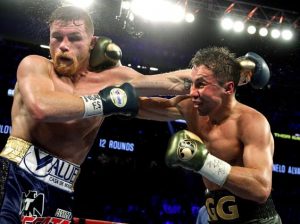


Righteous Retirement: Wladimir Klitschko picks the right time to say goodbye

By Norm Frauenheim-

It’s time for a change and he knew it. As always, Wladmir Klitschko did the right thing.

That’s how he’ll be remembered in the writing and rewriting of heavyweight history. Klitschko, who retired Thursday, was neither dramatic nor sensational. He was just righteous in a reliable sort of way at a time when the old flagship division had begun to look like a sunken relic beneath the waves of some bygone battle.

When it appeared as if the heavyweights were vanishing, there was always Klitschko winning, setting records, or staging a comeback. He was a pillar, a significant caretaker of a division that maybe can now move back on to a relevant stage with Anthony Joshua and Deontay Wilder. We’ll see.

Whatever happens, Klitschko gave them and the sport that chance with his long, predictable reign at the top of the division.

Will he go down as an all-time heavyweight? Tough to say. We know the numbers, all record-book quality, yet also compiled against collection of nobodies in a division that was at the bottom of a historical decline. We’ll never really know how good he was, mostly because of the business itself.

Evander Holyfield and Lennox Lewis were the best in the division when Klitschko won his belt, yet he never fought either. Blame the business. It suffered for that. So will Klitschko’s ring legacy.

Think of it this way: Put Klitschko into a fantasy tournament with some of history’s greatest heavyweights. Here’s just one Sweet 16: Muhammad Ali, Joe Louis, Jack Johnson, Rocky Marciano, Jack Dempsey, George Foreman, Joe Frazier, Jersey Joe Walcott, Floyd Patterson, Sonny Liston, Larry Holmes, Ezzard Charles, a young Mike Tyson, Holyfield and Lewis. Add Klitschko and you’ve got 16. Put them in brackets. Match them any way you like. Would Klitschko get out of the first round? I’m skeptical. Had he fought Holyfield and/or Lewis, we’d have a better guess.

His nine-year run as the champ, including 18 successive title defenses, is an amazing stat. But boxing isn’t baseball. It’s measured by more intangibles. One punch can knock out all of the analytics. In judging Klitschko, intangibles matter. They did – they do – with Ali.

Foreman has his own take on the classic, cross-generational argument about whom was the greatest: Louis or Ali? Foreman, who lost to Ali in the legendary Rumble in the Jungle, argues that Louis was a greater fighter than Ali. But, he says, Ali was a greater man.

It’s impossible to separate Ali’s stand against the Viet Nam War and his fight for civil rights from his heavyweight era. They are one and the same. Apply the same standard to Klitschko. He has stood up for the Ukraine against Russia alongside his brother and ex-heavyweight champ, Vitali. In retirement, the guess is that he will take on more political fights en behalf his country and what he thinks is right, which is what will always keep him among history’s greats.


No Alarms and No Surprises: Garcia Cruises Past Broner

By Jimmy Tobin-

Saturday night, at Barclay’s Center in Brooklyn, New York, Mikey Garcia dealt Adrien “The Problem” Broner a wide and comprehensive 12-round defeat in a fight of little fire and scant revelation. Garcia is Broner’s fighting superior at any weight the two might conceivably meet at, a reality that speaks little to professionalism, however much Broner’s detractors might wish to see that flaw of his precipitate his undoing. No, Broner, on weight, clean shaven, and thus motivated anew (!), was found wanting (again) because he stepped up in class (again).

Since living too large for lightweight, where his imposing physicality acted as a force-multiplier for a handful of appreciable tricks, Broner has been anything but a problem. Like a ship in the swath of a lighthouse, Broner has spent years moving in and out of the spotlight, advancing on a course set for his own wreckage. Unfortunately for him, the response to his first defeat was so ecstatic that future ones will be fractionally satisfying.

If one does not go in for his antics, there is little that is particularly fetching about Broner, save for when he is matched appropriately: which is to say a few rungs below where his ego would prefer and even an hour or so earlier than a headliner hits the stage. But a fighter who makes for a few thrills, a nod, an appreciative smile or two, when matched against the mediocre; a fighter who loses conclusively against the best, who serves at best to confirm that his conquerors warrant consideration for if not membership in an elite fraternity—what title is ascribed to such fighters? Is “opponent” too harsh?

He is not yet an opponent, though his showing against Garcia smacked of a man who ranks preservation ahead of victory. Perhaps a forgivable order of concerns provided it be arranged under duress, such a change in priorities is hardly endearing when not prompted by pain (and whatever Garcia’s dominance, he appeared to hurt Broner not once). Speed, power, determination, Broner flashed all enough to remind us that there is a quality fighter under the patina of disorder and buffoonery that, more than anything he has done in the ring, have been his hallmarks. Outfitted with those glimpses of Broner’s best self, a commentary team equally concerned with preservation could encourage viewers to wonder what might happen if Broner were to next time or even the time after that, suddenly not be himself anymore. But at this point no one, not even his bandmates, can resuscitate such delusion. And why should they? Better to match Broner appropriately and drain what value from him you might. A stoppage of Broner? Why that still would mean something.

Is it any wonder then that Garcia agreed to fight him? Back but a year from a two-and-a-half year self-imposed retirement, a recently crowned lightweight titlist who, at least early in the promotion, made clear his plans to return to 135 pounds, why would Garcia accept the fight if not because he and his team recognized an easy mark? By fight time the odds may not have reflected the mismatch that was to unfold, but odds do not reflect competitiveness so much as promote gambling. Provided he did not get hit with something disastrous there was little chance Garcia would lose. Hit with something disastrous; wording the puncher’s chance in the would-be victim’s perspective does not alter whatsoever the message implied.

A counter-puncher by nature and craft, Garcia was able to eschew his trademark style and play the aggressor against Broner, figuring quite rightly that both the pace and Broner’s stiff switches between defense and attack would keep Garcia safe. If there was anything new learned Saturday night it was that Garcia is capable of initiating the action—a revelation that might shrink considerably the list of things he cannot accomplish in the ring—though the question of whether he could employ such a strategy against a more formidable opponent will linger until he finds one.

And should he find one, more vulnerability might come to bear. There was a tremor in Garcia’s resolve when Broner came for him late in the fight; typically unflappable, Garcia wavered, became hurried, a little too concerned with what damage might be accruing on his face. These were signs Broner intimated but could not fully exploit, but they showed Garcia vulnerable in ways his supporters might prefer to ignore for the moment. There is plenty of room for error in reading such behavior, of course, especially with the evidence Garcia has given to the contrary, but that behavior is there. Might he go to pieces should the right kind of fighter unnerve him? Perhaps, though there is likely only one fighter below welterweight with the skill and power to make Garcia consider again the lure of the badge.

His post fight comments, where Garcia expressed his desire to fight anyone willing and able to fight on Showtime were curious for the same reason that Adonis Stevenson’s talk of network/promotional allegiance was curious. Garcia understands the business, which bodes poorly for interest in his future. For the sake of that interest, one would hope the business allows ESPN fighters to fight on Showtime once or twice.


No problem: Garcia decisions Broner

By Bart Barry–

Saturday in Brooklyn a junior welterweight special attraction broadcast by Showtime saw California’s Mikey Garcia decision Cincinnati’s Adrien Broner by three fair if fairly generous (to Broner) scorecards. There were no knockdowns, no kneetremblers and only a trickle of noseblood in 36-minutes of fistfighting.

It was an average fight, however much reporting so betrays the narrative.

Garcia, who has long been considered at least as good as he is and on occasion considerably better, decisioned convincingly a b-grade fighter and a-grade selfpromoter without once imperiling either man. It was, in other words, about the best fare for which one dares hope from PBC and its many broadcasting benefactors and affiliates and aliases. Now aficionados’re expected to attempt a contortion like: It was a great fight between two great fighters that lacked action because Garcia’s extraordinary class neutralized Broner till he was the sort of mediocre fighter who might get decisioned 8-4 or 9-3 in a championship match.

Afterwards Garcia’s brother and trainer said Mikey only looks basic when you watch him, 1-1-2 and 1-2 and 1-2-1-1, but in the ring, where we might assume none of us will spend time with Mikey, he’s altogether more complicated. Perhaps. But truly there’s nothing wrong with basic boxing – in fact in just about any confrontation any man is likely to have in any lifetime basic boxing beats the stripes off its myriad of alternatives. Even in prizefighting.

There was absolutely nothing wrong with Garcia’s performance Saturday. It was perfect for those who want to build Garcia as an undefeated attraction and for familiars who of course wishn’t see their brother or son elephantgunned, but it left a goodish amount to be desired by aficionados who watch for what entertainment spontaneity brings, which is different from watching to confirm one’s own expertise.

Broner never lacked offensive artistry and made himself famous in large part by being a large part bigger than his opponents; much of his early run happened via his ability to absorb others’ punches to deliver his own. It happened so fast, oftenly, and others’ punches so lacked effect, it was unapparent Broner traded evenly. Then Marcos Maidana, a slugger considered limited even by his fans then, exposed Broner in the fairest sense of the word and made 12,000 San Antonians euphoric in so doing. That win got Chino a chance at Floyd Mayweather that went so much better than expected Maidana got a second chance at Mayweather, but aficionados’ collective estimation of Broner improved little along the way. Maidana, after all, hit Floyd with sky hooks and sundry oddities, not clean lefthook leads – Broner’s defense against which was a stiffarmed thing he flashed in his other loss, to Shawn Porter.

Whether he extended his arms downwards, elbows locked knuckles ogling the canvas, or upwards, elbows locked knuckles saluting the ceiling, Broner did not have a fundamental sense of what to do when a likesized man charged him. Even the forearm shimmy Mayweather mentored him worked less well against a man of comparable strength. Broner ever suffered the imitator’s dilemma: He could passably ape an innovator like Floyd without understanding why. Where Floyd successfully improvised defensive adjustments, Adrien queried the database first what Floyd would do and when a nullset came back Adrien tried to improvise himself – which victoried his hands overhead or downed them pistonpopping.

Had he a classic sense of discipline Broner might’ve stayed at 135 pounds and enjoyed a historic run as a lightweight anyway but AB was about billions not selfrestraint which kept him in his best weightclass for merely a twofight.

Long forgotten in the Mikey remake is Garcia’s own struggles with discipline, specifically a 2013 featherweight title defense against cult hero Juanma Lopez that saw Mikey miss weight by 32 full ounces after comporting himself questionably enough against Orlando Salido five months before th’t aficionados who took him for boxing’s future in 2012 took a harder look. That harder look was only commencing when Garcia disappeared in a contractual conflict. Garcia’s comeback is but three fights along and in 37 prizefights Adrien Broner marked his sternest test; let us not hyperbole just yet.

There’s a frontrunner’s perfection about Garcia but nary an adjustment to be found. This makes him less entertaining than Terence Crawford, even while future comparisons of their reigns should prove apt. Crawford mightn’t have stopped Broner Saturday either but at least would’ve switched stances a halfdozen times between southpaw and orthodox. Garcia made no offensive adjustments and showed no creativity in the championship rounds because he was unsure his footing – whatever private desire he had to finish Broner stayed altogether private because after 30 minutes with Mikey’s fists Broner was not shaped half badly as expected.

Bullies and buffoons be expected to fold, but no matter Broner’s buffoonery the man does not fold. Ask anyone at Alamodome for Broner’s first loss: Aside from Richard Schaefer everyone in attendance was there to see Broner get jigsawed proper, so everyone in attendance was more than a bit tense after round 11. If this reads like a nostalgic sendoff for AB it shouldn’t; yes, there’s a wee bit of nostalgia one should give any man who courts others’ hatreds and does not bend, but no, Broner’s not going anywhere. Hell, PBC’s braintrust fully expected Broner to prevail Saturday because the company’s cultural cornerstone is a concert promoter, not a matchmaker.

Probably Broner’ll fight again before Garcia does, and probably Garcia’s next opponent won’t be anyone you want him to be. When 2018 begins Broner will remain about billions and Garcia will remain undefeated.

Bart Barry can be reached via Twitter @bartbarry
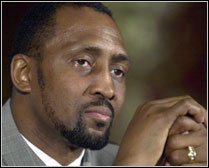


FOLLOW BRONER – GARCIA LIVE FROM RINGSIDE

Follow all the action LIVE from Ringside at Barclays Center when Adrien Broner meets Mikey Garcia in a 140-lb showdown.  The action begins at 9 PM ET / 6 PM PT with a WBC Middleweight elimination bout between Jermall Charlo and Jorge Sebastian Heiland

THE PAGE WILL UPDATE AUTOMATICALLY..NO BROWSER REFRESH NEEDED

12-ROUNDS–SUPER LIGHTWEIGHTS–ADRIEN BRONER (33-2, 24 KO’S) VS MIKEY GARCIA (36-0, 30 KOS) 
ROUND 1 2 3 4 5 6 7 8 9 10 11 12 TOTAL
 BRONER  9  9  9  9  9  10 10   110
 GARCIA  10  10 10   10  10  10  10  10  9  10  10  9  118

Round 1: Right from Broner..Left from Garcia…Right and left from Garcia..

Round 2:  Broner jabs..2 left hooks from Garcia..Right to body..

Round 3:  Left hook from Broner..Jab from Garcia..Harc counter left hook..Right..Hard combination on the ropes..

Round 4 Quick counter from Broner..Right,,Left to body and uppercut from Garcia,,,Left

Round 5: Left hook from Broner..left..Right from Garcia..Right..Jab from Broner…Right to body and straight right from Garcia (snaps Broner head back)

Round 6 Jab from Garcia,,Kab from Broner,,,Right to body from Garcia

Round 7 Right from Broner…Jab…Jab..Right and left from Garcia…Right from Broner,..Right to body from Garcia..Right..Flush right

Round 8 Good counter right from Broner…Right from Garcia,,Jab from Broner..Right from Garcia,,4 punch combination..

Round 9 Right and jab from Broner,,Counter right,Uppercut from Garcia..Body work and a right from Broner,,Good counter left hook

Round 10 Garcia jabbing..Jab from Broner,,Hard right to body from Garcia,,Right to body,,Body shot and right,,straight right..

Round 11 Body shot from Garcia,,counter right..right,,right to body..combination

Round 12 Lead right from Broner…Left from Garcia…straight right…Right from Broner…Blood dripping from nose of Garcia..Body combination from Broner..Good flurry at the end of round

117-111, 116-112 TWICE FOR MIKEY GARCIA 

12-ROUNDS–MIDDLEWEIGHTS–JERMALL CHARLO (25-0, 19 KO’S) VS JORGE SEBASTIAN HEILAND (29-4-2, 16 KO’S) 
ROUND 1 2 3 4 5 6 7 8 9 10 11 12 TOTAL
 CHARLO  10 10  10                     30
HEILAND   8  9                   26

Round 1 Jab from Charlo

Round 2 Hard right from Charlo..HARD RIGHT AND DOWN GOES HEILAND..Hard left and uppercut from Charlo…Big right..Right buckles Heiland..5 hard shots on the ropes

Round 3 Right from Charlo..uppercut..

Round 4 Doctor checking on Heiland before round starts…Left from Heiland..Right from Charlo..Hard uppercut..HUGE LEFT HOOK AND DOWN GOES HEILAND AND FIGHT IS OVER


Ali hopes victory will get him back into title mix

By Norm Frauenheim-

TUCSON, Ariz. — Brooklyn welterweight Sadam Ali hopes to fight his way back into title contention Saturday against well-traveled Johan Perez in an ESPN2-televised bout at Casino del Sol in the second Golden Boy Promotions card at the southern Arizona casino since Oscar De La Hoya’s signed a 43-fight deal in January with the cable sports network.

Ali (24-1, 14 KOs), a 2008 Olympian and the first boxer of Yemeni descent on a U.S. team, has won two straight since Jessie Vargas stopped in the ninth of his only world-title bout in 2015.

Perez, a 34-year-old Venezuelan who beat a then-unbeaten Yoshihiro Kamegai in 2013, also has won his last two, but he’s 3-2-1 over his last six.

Ali was at 147 pounds Friday at a weigh-in that included a mount when Perez jammed his nose into Ali’s nose during the ritual stare down for the photographers. Perez was at 146.6 pounds.


Another interview with the boxing writer by the boxing writer

By Bart Barry-

Editor’s note: Eleven months ago we asked Bart Barry to interview himself about the state of the craft. On Tuesday Bart sent a note saying he’d no idea a subject for this week’s column, his seventh such note of the year. To spark his flagging interest, once again, we asked him to return to the subject of writing and boxing.

BB: Sometime soon, maybe even next month, Conor McGregor fights Floyd Mayweather in what is widely expected to be . . .

BB: . . .

BB: . . .

BB: Go on.

BB: You were supposed to interrupt and rail against this mess.

BB: Nah.

BB: Then you support it?

BB: I won’t be watching.

BB: That’s slippery.

BB: I have no strong feelings about it, pro or con. I saw enough enthusiasm on Twitter to watch some clips of those staged performances in the cities, and it didn’t do much for me.

BB: Were you familiar with McGregor’s work previously?

BB: No.

BB: Were you impressed by his gift for trashtalking?

BB: Are we considering that a gift now – like athleticism or perfect pitch or eloquence?

BB: Aren’t we?

BB: No. As you know from watching Mayweather it’s a con created for five-second sound clips. It’s like a live rehearsal with a hundred takes. They say the same thing over and over and over, and then they keep the best one for YouTube.

BB: Floyd was outgunned.

BB: He’s a great, great fighter. But he’s not witty or creative. He’s a miserable dude. The best sorts of performers in the hiphop set, which has never seen Floyd as one of its own – unlike, say, Tyson – take the craft of wordplay incredibly seriously but not themselves. They wink at you. Floyd gets this backwards. He takes himself altogether too seriously and says the same unoriginal thing every promotion. During the best performances, the artist interrupts himself to say he’s only kidding, then at the end you realize how serious he was. Floyd interrupts himself to say how serious he is, then after the fight he tells you he was kidding the whole time.

BB: Not sure that works as an analogy.

BB: Then edit it out.

BB: And defeat the purpose of this?

BB: Don’t take ourself so seriously.

BB: Name one professional athlete you’ve never met but would like to.

BB: Bode Miller.

BB: Last year you’d given up on boxing but were approaching the craft of writing with immense enthusiasm and hope. This year, that has switched.

BB: Started to, anyway. Something started to happen in January, it’s too early to say what, but the compulsion to write, and by extension to read, dissolved very quickly. It was like waking up one morning, looking in the mirror, and discovering I was now a seven-foot woman from Beijing. An attractive, intelligent woman with a loving husband, maybe, but still an entirely different identity than I took to bed the night before.

BB: Seventeen years of saying “Hello, I’m Bart, a writer” sort of became “Hello, I’m Bart.”

BB: Yet there’s an optimism in your view of our beloved sport you haven’t had for years.

BB: Very true. It coalesced during the Horn-Pacquiao broadcast.

BB: You sure about this?

BB: Yes. Because it was unplanned. The opposite was planned, frankly; it was to be a chance to criticize ESPN’s approach to sports broadcasting and roll eyes at Arum telling the truth tomorrow, again.

BB: But instead you enjoyed it?

BB: I really did. The volume was off, so I don’t know what that commentary did to the experience for others. But the sunshine, and the vindication for the longshot, and Pacquiao’s always infectious enthusiasm. It just felt warm. It felt good. It felt authentic. Real fans, really smiling, really caring.

BB: Yet your column was satirical.

BB: In retrospect I didn’t trust my own enthusiasm. The last few years have taught us to trust reflexively our doubts but rarely our enthusiasm. I trust my enthusiasm for a fighter, for Chocolatito as an example, but not for events. Boxing was always cynical, but somewhere within that cynicism there was authenticity – genuine men genuinely bleeding. PBC changed that, methinks.

BB: A Mayweatherization of boxing.

BB: Yeah.

BB: That’s changing because of Top Rank’s alliance with ESPN?

BB: I’m almost ready to say yes with an exclamation mark. Top Rank has the best development plan for its fighters and the best matchmakers. But for the longest time they’ve trapped themselves in this premium-cable-capture game, where they try to get one over on HBO or sell Showtime a dud. There’s nothing to save it for now.

BB: And they don’t have a Pacquiao in the pipeline.

BB: There’s no obvious pay-per-view star in their stable, no. They have to make the best fights on the best network. It’s no longer about Arum outsmarting a few corporate guys. It’s now about the entirety of Top Rank’s outfit proving it is what it thinks it is.

BB: Why didn’t PBC’s model work?

BB: That’s the sweet irony of this. It did! PBC sold its product at a massive, anticompetitive loss for a couple years in order to get a major network interested enough in boxing to pay for the rights to broadcast it. That network was ESPN. But it chose to pay Top Rank instead.

BB: The longer a fight goes . . .

BB: The more class tells, yes.

BB: Whither HBO?

BB: Who cares?

BB: Go on.

BB: That’s not flippant. Does an NBA fan worry about the health of basketball based on what “Real Sports” says? Does an NFL fan think football is dead if “Hard Knocks” gets cancelled? Some of HBO’s cards this year are good, and that one in September is perfectly excellent. But more and more, if you’re not ordering HBO PPV, you halfway expect to see a Just for Men ad between rounds.

BB: Showtime?

BB: They’ve got the heavyweight champion of the world. And he’s another reason for a recrudescing excitement about our sport. They’ve got PBC’s stable whenever they want it.

BB: Why couldn’t Haymon go back to HBO?

BB: HBO’s no longer that rich or that dumb.

BB: You look healthy, kid.

BB: I feel good.

BB: This was fun.

BB: Dave Grohl looks at Paul McCartney and says, “Why can’t it always be this easy?” And McCartney says –

BB: “It is!” Touché.

Bart Barry can be reached via Twitter @bartbarry


Adrien Bleep: Broner a changed fighter with a familiar promise

By Norm Frauenheim-

They’re promising a new and improved Adrien Broner on July 29 against Mikey Garcia, but Broner is promising what he has always promised.

“I’m coming to eff him up,’’ Broner said Thursday during a conference call for his intriguing 140-pound bout with Garcia at Brooklyn’s Barclays’ Center.

First, full disclosure: Broner didn’t really say eff. But you get the idea. Broner says he is older and wiser, but he’s as profane as ever in a business punctuated by punches and profanity.

“The hurt business,’’ says Broner, who repeated Mike Tyson’s apt summation of a brutal craft once known as The Sweet Science.

Not so sweet anymore, at least not for Broner, whose ups and down in and of the ring are an inseparable part of his story, perhaps his temperament and probably his motivation.

Maybe, he’s more mature, but there’s no doubt about the anger. Besides, you just wouldn’t know him without the F-bombs.

Any doubt about that was eliminated in the way he opened his segment of the conference call.

“At this point, eff the press,’’ he said. “They’re all against me. I’m ready to fight. …So, I’m ready to to get the eff off this call.’’

He didn’t, of course. Too effing much to say. Broner loves to talk. That said – and plenty was, Broner said he has worked to get beyond a long list of problems, including jail time. He has talked about leaving the “ghetto stuff” behind.

By that, he says he means to take “boxing more seriously.’’

Against Garcia, he’ll have to. Garcia, unbeaten and an emerging pound-for-pound contender in a talked-about fight with Vasyl Lomachenko, is the favorite.

According to some betting sites, odds favoring Garcia are as high as 7-1, despite a couple of key advantages that Broner holds in his capable hands.

He’s younger. Broner will celebrate his 28th birthday next Friday, the day before opening bell in Brooklyn. Twice beaten at 147 pounds, he’s unbeaten at 140. Garcia, a 29-year-old lightweight champion, has never been more than 138 pounds at a weigh-in.

The theory, however, is that Garcia has a more varied skill set. He has said he will outbox Broner.

“That’s a damn lie,’’ Broner said. “…He knows he’s not a better boxer than me.’’

Throughout the call, Garcia did most of the listening and some of the talking. He says he wants to fight the best possible Broner and all of the profanity seemed to say that he would.

“That’s exactly the Broner I want to hear,’’ said Garcia, who figures to hear a lot effing more next week.


The good on B.A.D., and the innovative

By Bart Barry-

Saturday in Inglewood, Calif., Mexican Miguel “El Alacran” Berchelt defended his super featherweight title against former titlist Takashi Miura in a good mainevent televised by HBO’s “Boxing After Dark” program. Meanwhile, one state to the east, an improved broadcasting experience happened.

Miguel Berchelt is a good fighter who won his belt the right way – as a b-side, by knockout – but not a world champion so long as Vasyl Lomachenko can make 130 pounds and not a great Mexican super featherweight, either, so long as there survive men who saw Marco Antonio Barrera or Erik Morales or Juan Manuel Marquez at that weight. Berchelt will experience some accumulating ambivalence about that; because of those three men casual fans now watch prizefighters who weigh 100 pounds less than those fans’ general preference, and because of those three men Berchelt will be judged by his merits more than his birthplace and judged to be considerably less than he thinks he is.

El Alacran came of age in Mexico when broadcasting logistics precluded the best Mexican fighters and their best fights from happening on public airwaves, which meant far fewer Mexican boys found a passion for boxing. More ambivalence for Berchelt: It is much easier for a talented prizefighter in this generation to get out of Mexico, but he is unlikely to fare nearly so well at the championship level as his predecessors did. If Berchelt’s path to a title had included a prime version of Barrera or Morales or Marquez, in other words, Berchelt would’ve remained an undercard gatekeeper very, very far from an HBO main event.

This is no criticism of his Saturday win. Berchelt found himself matched against a worn veteran who knew lots of tricks and years ago had better technique then Berchelt imposed the rude force of youth on his elder, exactly as one should. Berchelt adhered to his handlers’ strategy and made Miura move much more than a man of Miura’s age and resume wishes to anymore. Berchelt fought no more than he had to fight. That kept Miura discouraged from opening bell to closing. When things got rougher for Berchelt than he preferred he made appeals to the referee that received sympathy, including an uncommon timeout for rabbit punching.

Something about El Alacran, maybe his pleas to Raul Caiz Sr. or the wide punches or his neck tattoo, feels a bit fragile, alas. And he is way open to counters. That’s what gets one thinking about previous generations of Mexican prizefighters and the comparative cleanliness of their technique: Marquez never wasted a step, Barrera never floated his chin, Morales never threw an arm punch. These were men told from a very young age they could not expect to be the fastest or the strongest or even the toughest in a championship prizefight, and therefore they must employ at all times precision, economy and leverage. To see Berchelt bounce in wide circles and cock his chin much as he cocked his punches and swim forward flailing was to imagine how quickly a 130-pound Manny Pacquiao might’ve raced through him.

If Berchelt never will rival Marco Antonio or Erik, in his best moments he does resemble slightly Juan Manuel’s little brother Rafael. Berchelt has Rafael Marquez’s frame and desire to win with his right hand but not quite Rafael’s matchstopping power.

Still, it’s proper to applaud HBO for the informal super featherweight tournament Boxing After Dark has hosted thus far in 2017. Though the network lost the division’s most talented fighter when Top Rank departed for ESPN, the division’s most talented fighter lost most of the competition that could justify what hyperbolic acclaim he enjoys, too, and while Vasyl Lomachenko’s technical domination of contender-level competition already grows tired, ferocious combat between Latino and Asian prizefighters will not.

Writing of broadcasting: Saturday also comprised a card from Arizona that featured an innovative medium worthy of discussion. Roy Jones Jr. Boxing promoted a show presented on pay-per-view ($0.99) by Ultracast, a company specializing in 360-degree content. Effectively, Ultracast is a bunch of cameras pointing in different directions mounted above a single ringpost, with their various feeds stitched together in a way that allows a viewer to both zoom and roam his perspective in most every direction he could move his eyes were he similarly situated atop a ringpost.

I used the Ultracast app for Android on a Samsung Galaxy S8 phone, and despite the comparatively small screen it was a more rewarding experience than most fight-viewing parties and any sportsbar. It’s not a social way to partake of our beloved sport, but it exceeds the standard HDTV experience and rivals the ringside experience – and all previous jokes about stationing stepladders for visually impaired judges aside, it presents a surprisingly apt and innovative way to score fights more accurately.

What you experience is a static, unobstructed look at two fighters – no anxiously orbiting referee blocking you, no videogame-emulating camera switches from the production truck, no narrative-building replays between rounds. You see every punch (from an unfamiliar angle, yes, but still), you see the entirety of the fighters’ bodies – including, and most importantly for those who know what they’re watching, the fighters’ feet – and you see as far as the backdoor of a small arena and as near as a ringside doctor taking notes during an undercard match. If I were a trainer or fighter reviewing footage of a future opponent, it is absolutely the view I would wish to have.

Without seeing the hardware involved, one imagines it’s far less cumbersome than previous attempts with 3D, which means it might be a portable solution that complements Showtime’s recent modernization attempts with live sports on social media platforms (something HBO surely will adopt once AT&T finishes selling off its parent company’s assets). Take Ultracast, switch the commentary team for an enhanced arena-sounds audio feed, charge $0.99 for every fightcard in the land and $5 for world championships, and call it The Aficionados App: Eventually you could get a reliable $50/year from about 500,000 hardcore boxing fans. That might just be viable.

Bart Barry can be reached via Twitter @bartbarry
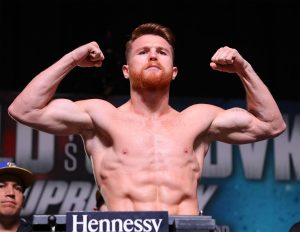


Hide The Kids: Mayweather-McGregor tour is an X-rated ride

By Norm Frauenheim-

Other than to say it was hard to watch, it was hard to know what to make of the first three stops this week in the Floyd-Mayweather Jr.-Conor McGregor tour.

It was funny in Los Angeles. Kind of.

It was silly in Toronto. Sort of.

It was embarrassing in New York. Period.

It was impossible to think there can be any kind of an encore in London. More than a tour, the exhibition for their Aug. 26 event in Las Vegas has been a steep decline into a tired exchange of gestures and obscenities.

Not any role models here, not that any were expected. But I’m guessing it’s not something that Mayweather or McGregor would want their kids to ever see, much less emulate.

Both are going to make tons of money and then have to spend a lot of it just to make sure their kids don’t grow up to be like daddy.

All the profane posturing and over-the-top insults appear to be exactly the spectacle that some predicted would be more entertaining than the match itself. A classic boxer, the best of his generation, versus a mixed martial arts star in sanctioned boxing bout?

As an event, it is neither fish nor fowl, which means nobody will be surprised if the pay-per-view audience screams foul after paying the $99.95 price tag for high-def.

If anything, disappointment in the so-called fight seems to be baked into the expectation for fans more amped about a chance that McGregor might kick Mayweather in the face at the Vegas weigh-in.

After all, there’s just not a whole lot to say after Los Angeles, Toronto and New York. These fans want spectacle, not substance, and it’s spectacle they’re going to get. The guess from this corner is that the bout will be about as meaningful as Donald Trump’s “take down” of Vince McMahon at ringside of a WWE production in 2007.

Then again, that bit of lowbrow theater went from fake news to real news a couple of weeks ago when Trump re-tweeted a redone video of the staged moment with the CNN logo as McMahon’s head.

Serious journalists debated that one, right alongside health care. Seriously. Maybe, spectacle is today’s substance. I’ll leave that one up to people a lot smarter than an old boxing writer still not sure what to make of Mayweather-McGregor.

There are the betting odds, only 7-to-1 in favor of Mayweather. Really? The best in the business for about a decade against a novice boxer, and yet the odds give the novice a real chance?

Then, there are news reports this week about Mayweather’s tax liability. I’m not sure what to believe about the reported numbers or even if he in fact owes the IRS for back taxes. But I heard the crowds this week, chanting “Pay your taxes, pay your taxes.’’

The reports are troublesome on a couple of levels. If accurate, they might be symptomatic of a deeper financial problem. Consider this scenario: Instead of scoring a one–sided TKO of McGregor with a couple of precise counters midway through the event, let’s say that Mayweather wins a decision close enough to argue for a rematch.

That’s when those chants might get nasty. To wit: He needs the rematch to pay those taxes. The again, what’s a good spectacle without some suspicion?


Gnawing, helpless monotony: David “The Destroyer” Lopez (1977-2017)

By Bart Barry-

Thursday night Mexican middleweight contender David “The Destroyer” Lopez and his son were attacked in Nogales, Sonora, Mexico, Lopez’s hometown, while driving in Lopez’s pickup truck. Lopez was declared dead at the site of the shooting and his son was taken to the hospital in critical condition. No motive for the shooting is currently known, or at least none is being reported by Mexican media. The murder of Lopez is a boxing death that appears to have nothing to do with boxing but leaves anyone who covered Lopez’s career with what gnawing sense of helpless monotony one feels after receiving tragically bad news.

I did not know Lopez well but sat ringside for seven of his matches in Southern Arizona at Desert Diamond Casino, a property of Tohono O’odham Nation not technically in Tucson though nearby. More to the point Desert Diamond Casino is an hour’s drive north on I-19 from Nogales, a bordertown that exists in both Arizona and Sonora – effectively a single city with a large wall slicing its middle – once a place of reasonably safe diversion. Many aficionados made that drive northwards to Desert Diamond; Lopez drew disproportionate to his talents. He was a durable spoiler type, a natural underdog, an attrition fighter, without any particular punch or charisma. For a stretch, though, 2005-2009, Lopez was Nogales’ hometeam, and 800-1,000 Arizonans and Sonorans reliably attended his every match.

When Oscar De La Hoya and Richard Schaefer created Golden Boy Promotions they began hosting bimonthly cards at Desert Diamond as a farm league of sorts for their growing stable of prizefighters. The cards were exceptionally well constructed by local matchmaker Roger Woods and exceptionally well attended for what were effectively Spanish-language telecasts of club shows. Invariably Golden Boy would send one of its partners along, too, Marco Antonio Barrera or Shane Mosley or Bernard Hopkins or De La Hoya himself, and Desert Diamond’s publicity team would ensure those guys were available for interviews with local media. After each undercard match publicists would visit the press table and ask if anyone were interested in a postfight interview then lead the winner and loser to a small conference room in the back, beside the fighters’ dressing rooms, and let us ask whatever we wished. During those four years every Golden Boy fighter – Juan Manuel Marquez, Winky Wright, Robert Guerrero, Kassim Ouma, Deontay Wilder, Rocky Juarez – spent time in that small conference room politely conversing with the same dozen reporters. (Even Richard Schaefer occasionally dissembled for our amusement.)

Back then Telefutura’s fantastic “Solo Boxeo” program was at its best and the main and comains were generally excellent. But no one drew like The Destroyer. Lopez built his fanbase quickly and passionately with a TKO loss to Colombian Fulgencia Zuniga the first week of 2005, just before Zuniga made another wonderful Arizona fight with Mexican Jose Luis Zertuche – not long before both Zuniga and Zertuche got pistonstroked by Kelly Pavlik. The loyalty Lopez’s fans showed was the sort best founded upon a courageous loss – these were middleaged, workingclass, bordertown men who didn’t respect or trust sparkly things. Lopez returned to Desert Diamond four months later in the comain of a card that marked Alfredo Angulo’s professional debut, coincidentally, and began a torrid streak that saw him go 8-0 (4 KOs) at Desert Diamond, while converting himself from a narrow middleweight to an even narrower super welterweight in the hopes of a world title challenge.

That challenge came eight months after his final match at Desert Diamond, in the form of a lopsided decision loss to Austin Trout. It broke the spell for Lopez. He fought six more times in the four years that followed and posted a typical, career-unwinding record of 2-3-1 against foes like Jose Uzcategui in venues like the Salinas Storm House.

Even that torrid run of eight Desert Diamond wins in four years isn’t particularly torrid-looking, is it? Yet there was something electric about Lopez’s fights in that venue, an accidental chemistry of performer and stage few enjoy and no one quite explains.

Lopez was somewhat prickly after his matches, much like Desert Diamond’s other synonymous performer, Jhonny “Jhonny” Gonzalez, and memorable for his terse, tense answers about wanting his title shot. At the ringside media table we didn’t really understand Lopez’s popularity but didn’t deny it either. Guys who wrote for Tucson papers knew they had to cover Lopez because local interest in Lopez was genuine. Sincere inquiries about The Destroyer’s outsized popularity from Phoenix journalists generally got some jocular variation of “Because he’s ‘The Destroyer’!”

We didn’t understand his career and evidently understood the fortunes of his retirement even less. If someone’d’ve asked me to name Desert Diamond fighters I expected to have pleasant lives after boxing I mightn’t have named Lopez straight away but if the followup question had been “What about David Lopez?” I’m certain I’d have said “Yup, him too.” Some sort of dreadful twist changed that Thursday night. The tenor of the reports from Mexico suggests Lopez was a target – the victim of heavily armed shooters, not a traffic dispute gone to lunacy.

Mexico has always been a dangerous country in the style of every other region of the Spanish conquest and possessed of a cultural view of death quite different from its neighbor’s to the north. But the last decade’s internal war has created a toxicity that beggars scale. It poisons the root of a people famous the world over for its humility and friendliness; every Mexican has been traumatized by it regardless of residence. David Lopez’s death is a reminder unpleasant as it is unneeded.

Bart Barry can be reached via Twitter @bartbarry
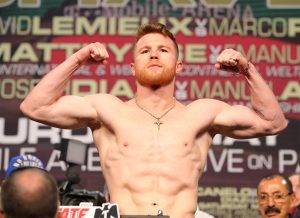


Argue the decision, but there’s no argument about Pacquiao’s future

By Norm Frauenheim-

A contentious blame game in the wake – and we do mean wake – of Manny Pacquiao’s controversial loss to Jeff Horn is almost as regrettable as it is predictable. Above all, it’s all too familiar.

It’s the acrimonious noise that always seems to be there at the end of a legendary career. It’s as if few could foresee the ride was headed for a crashing conclusion. In hindsight, I suspect Pacquiao promoter Bob Arum did. He issued a warning few days before last weekend’s opening bell Down Under, saying that Horn could really fight.

It sounded like a warning, Arum’s way of saying that Pacquiao might lose if he wasn’t ready for a real fight. By now, we know he wasn’t. Argue about the scorecards all you want. On this one, Pacquiao was a 115-113 winner.

But I didn’t see the robbery that was so loudly alleged at ringside. Neither did Arum. Turns out, neither did Pacquiao trainer Freddie Roach, who in the aftermath of Horn’s 115-113, 117-111, 115-113 decision hinted at a less than satisfactory training camp and a fighter with energies divided between the gym and the Filipino Senate.

“To me, they were so overconfident going in — [conditioning coach] Justin Fortune tells the press that the only way Horn can win is if Manny trips going into the ring,’’ Arum told the Los Angeles Times a couple of day after the welterweight bout in Brisbane. “I had seen the kid. I told everybody he was a big, tough kid who could take a punch. I didn’t think he’d beat Manny, but it wasn’t the same Manny.”

It wasn’t. Truth is, Pacquiao hasn’t been the same Manny since his last stoppage in 2009, a 12th-round TKO of Miguel Cotto. Eight years are a career for some fighters. For Pacquiao, the power drought represents a drip-drip-drip in an erosion of an identity created by astonishing stoppages of Erik Morales, Ricky Hatton and Oscar De La Hoya. We had waited for that defining characteristic to reappear. But it never did, not against Brandon Rios or even Chris Algieri.

A great fighter without a stoppage over nearly eight years is bound to lose a few on the fickle scorecards. It happened against Timothy Bradley in 2012. To a lesser degree, it happened again in Australia, where it appeared Pacquiao was poised to finish it after a ferocious beating of Horn in the ninth, yet didn’t in the 10th simply because it just isn’t in him and hasn’t been for a while.

From religion to politics – there were different interests. From partying to gambling, there was a different lifestyle. He had changed, changed for good and forever. Still generous and likeable, the old instinct was gone. Inevitably, the physical reflexes would begin to go, too.

I don’t need a rematch to see whether Pacquiao can still be Manny. There’ll be a sequel with Horn if he decides to exercise his contracted right to one. But are we really going to see something more from a fighter whose decline has been evident for so long?

Imagine if Pacquiao had escaped with a scorecard victory over Horn in Las Vegas instead of Australia. Even in victory, there would still be the same doubts about whether he should continue, especially if that meant a fight against Terence Crawford. But his performance the workman-like Horn is proof that a fight against the emerging Crawford would be a sad end to a Pacquiao career as dramatic and colorful as any.

As of Thursday, there was no word on whether Pacquiao would fight on. I take that as good news. But I fear he’ll be tempted by one more bite at the financial apple. He’ll never be able to make as much as he did in the ring. In the political business, he’ll never have as much money as he needs. That means he’ll always be tempted.

But I prefer to remember Pacquiao when he was the Manny with one punch that launched Hatton so high that I could see the bottom of the Brit’s shoes from my ringside seat. I’ll remember the Manny who made De La Hoya quit after eight rounds.

I can only hope Pacquiao recalls what De La Hoya said on that December 6th night in 2008. After the fight was stopped, De La Hoya crossed the ring and told Roach, his old trainer: “You’re right, Freddie. I don’t have it anymore.’’

De La Hoya was 35 then. Pacquiao is 38 today.

“My heart still wants to fight, that’s for sure,” De La Hoya said then. “But when your (body) doesn’t respond, what can you do?”

Retire.