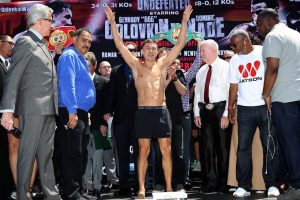
Chavez Jr.-Canelo: If not for a father and a son, there might not be a fight

By Norm Frauenheim

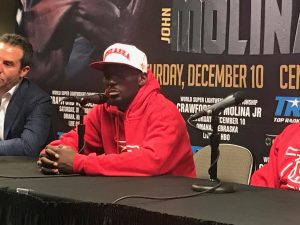
LAS VEGAS – The sunglasses could have used a couple windshield wipers. They were that big. Julio Cesar Chavez Jr. hid behind them, a little bit like a guy trying to shield himself from the sight of an imminent collision.

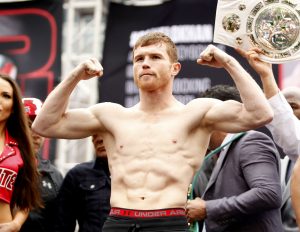
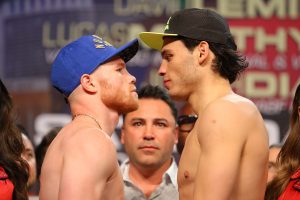
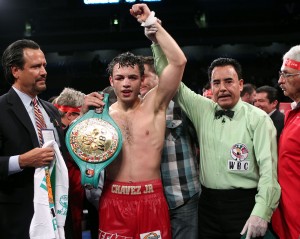
Chavez Jr., foresees something else, of course. Otherwise, he wouldn’t be here talking about how and why he expects to upset Canelo Alvarez Saturday in a HBO pay-per-view fight about Mexico, history, tradition, a father and a son.

“I came here to win, not just fight,’’ Chavez Jr. said before a formal news conference Wednesday.

The betting odds suggest there might be some rose-colored lenses in those glasses. Canelo was a 5-to-1 favorite late Wednesday to win the 164.5-pound bout at T-Mobile Arena

It’s impossible not to see how big a role the father and the son have in the event. This fight might not have happened at all without their name. Chavez Sr. stirs up memories and passions of a nation that identifies with his stubborn toughness. They see the son and remember the father against Meldrick Taylor, Hector Camacho and Edwin Rosario. He was a hard man, an undisputed tough guy. Next to Hugo Sanchez, a soccer star in the 1980s, there is no bigger sports name in Mexican history.

Canelo recalls meeting the famous dad when he was a 16-year-old kid in Guadalajara. Julio Sr. encouraged him to work hard. Did Canelo get his autograph?

“No,’’ Canelo said with a smile Wednesday.

Ten years later, the 26-year-old Canelo intends to get something a lot more significant. He intends to claim the Chavez legacy as a Mexican icon. He intends to put it in his name. Make it his own.

Only the son can stop him.

There’s huge pressure in that, especially for a son who exasperated his father’s fans with haphazard training, an inability to make weight and disappointing performances. For the son, the Canelo bout represents a last stand of sorts. He doesn’t think so. At least, he doesn’t during the final days before opening bell. After all, there’s pressure enough in trying to deal with Canelo’s punishing combinations.

“Both of us have a lot of pressure,’’ said Chavez Jr., who said he was at 168 pounds Wednesday.

His dad’s legacy, he said, would stand alone, no matter what happens Saturday. But it’s hard to separate the legacy from this fight. Subtract it, and you lose the drama that is inherent to a bout that has become an event. The bout at catch-weight doesn’t need a title belt. It’s got a legacy that is almost like a family heirloom for the father who created it and passed it on to his son.

“His fans, I think, are his father’s fans,’’ Canelo said during a conference call 10 days ago.

The fans were there Wednesday, chanting “Julio, Julio.’’ It was hard to tell whether the chants were for Junior or Senior. Still, there were moments at the news conference when it looked as if the father was feeling more pressure than the son.

“A very, very tough fight,’’ Julio Sr. said with unblinking eyes that flashed like flint off coal.

Maybe, he was just acting like a nervous little-league parent. But some of that old edginess was evident in the father. Throughout the formal news conference, he chewed on his lower lip. He pulled on his eyebrows as if he were about to pull them off. He looked as if he wanted to fight. Almost as if he were ready to fight.

After all, it’s his legacy, one with a fate that now rests in his son’s unproven hands.


Joshua Delivers on Heavyweight Expectations

By Jimmy Tobin-

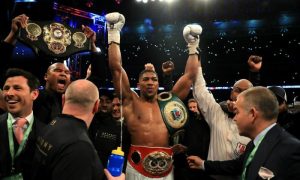
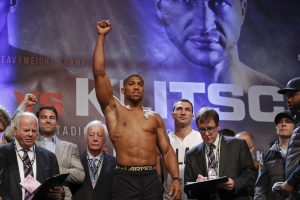
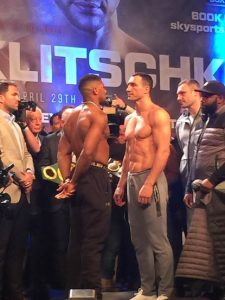
Heavyweights Anthony “AJ” Joshua and Wladimir “Dr. Steelhammer” Klitschko met before 90,000 or so strong at Wembley Stadium in London Saturday night and put forth a spectacle deserving of what national pride and expectations surged each man through the crowd and into the ring. It was Joshua who emerged victorious, ending Klitschko in the eleventh courtesy of a barrage born of a right uppercut likely to attend each man’s glory as a compliment from that moment forth. A proper heavyweight prizefight, delivered on the grandest stage—it is okay to feel good about that.

A word on what could have been. Joshua could have quickly cut down the 41-year-old former champion. There was proof enough in Klitschko’s recent performances to think he would go quietly. His unimpressive decision over debunked contender, Bryant Jennings, was evidence enough of slippage, though at the time that evidence was outweighed by a career of boring decisions against opponents with the audacity to strike back. Then there was Klitschko’s embarrassing effort against Tyson Fury, who lifted all of Klitschko’s hardware and much of his pride in 2015 and who has been an embarrassment in his own right ever since, reminding all that titles are made by the men who carry them.

Of course, there was nothing in Joshua’s résumé to indicate he was ready for Klitschko; the calculus for his victory drew primarily on his gaudy eye test scores and Klitschko’s deterioration. The aged Klitschko might’ve drawn Joshua into the type of fight the younger man had yet to experience, clutching and grabbing between right hands, waltzing dully the future of the division into limbo.

Instead, what transpired was drama the heavyweight division hasn’t offered in years, the type of fight that produces the rarest and often most painful of feelings in aficionados: hope.

As no such spectacle can be achieved without two willing participants it bears repeating that one of them was Klitschko; a man whose near decade reign was marked by dominance, yes, but also by the irreconcilable image of a 6’7”, 240-pound, chiseled specimen clinging desperately to men who would go willingly to their end should he only show the nerve to send them there. Yet in what might be his last performance, and almost certainly will be the last performance he could give of such quality, Klitschko was his most daring and inspired self, earning what his history never hinted at: a dignified defeat. For Klitschko to fight as he did required he suppress his strongest instincts and a decade of programming. He did not discover a more aggressive spirit or remove the patina of self-preservation—rather, he fought in spite of himself, fought remarkably, admirably, for as long as he could.

Yet did Klitschko momentarily heed the voices pleading retreat? Was it their warning that saw him squander a sixth-round knockdown and 100 seconds at arm’s length of an opponent dazed and temporarily exhausted? Perhaps. Perhaps it was timid old Klitschko getting the best of himself; but then, who is to say what the fifth round—a round likely to develop its own identity—took from him? Perhaps surviving a knockdown thirty seconds into that round and eventually turning the tide, battering Joshua as the round drew to a close took what fire Klitschko would have used to finish Joshua minutes later.

Either way, Klitschko pressed on to his own and Joshua’s glory. And that is for the better, not simply because of the quality of the fight—which was very good—but because those eleven rounds served to ratify the future, something Manny Pacquiao has yet to do, something Floyd Mayweather could not. The future, be it of the division, of boxing, of athlete earnings, looks like Joshua. And that can be said with greater confidence because of the quality of the challenge he faced. Had Klitschko folded at the first left hook it would be easier to still dismiss Joshua because it would be easy to dismiss Klitschko’s effort. But Joshua had to prove himself Saturday, and while he proved that there is some work to be done you cannot say he is a fabrication. Or perhaps you still can, because you are joyless, or committed to being contrarian, or have lost your love for boxing if not your obsession with hearing yourself speak about it.

Because Joshua is a reason to be excited. He crumpled from a perfect right hand delivered by a proven puncher, yet weathered not only that punch but all of the unknown awaiting him that night, and with the fight very much in the balance, stormed through his opponent to in the championship rounds. His chin is better than assumed, though his stamina is not, and his defense has holes, but he is a fast learner, evidenced by how few right hands Klitschko landed once Joshua figured out when to slip them. There is work to be done with Joshua, but it is not unreasonable to think that he will learn his craft turning back the best fighters in the division, which is almost all that can be asked of him. He will do so before crowds that would make American promoters, were they capable of embarrassment, blush.

There was his conduct in the aftermath of the stoppage, too. When referee, David Fields, wedged himself between the two fighters Joshua simply turned and walked away, no more than a brewing smile on his face even as his team mobbed him in jubilation; he is the anti-Wilder in that regard (and many important others). Joshua carries himself like a man who believes he is entitled to a success he cannot doubt is coming; the biggest win of his career merely confirmed what he believes of himself, which is why he responded to it as he did—without a hint of surprise. A champion constituted for his calling—it’s okay to feel good about that too.


Anthony Joshua did it the right way

By Bart Barry-

Saturday at Wembley Stadium in London, before a crowd of 90,000 or so, British heavyweight Anthony Joshua defeated by 11th-round technical knockout Ukrainian Wladimir Klitschko to become the undefeated, undisputed heavyweight champion of the world – in an excellent and valorous four-knockdown brawl anticipated by nothing on Klitschko’s resume. Any impulses to lead a treatment of Joshua’s victory with Klitschko’s age or previous knockout losses to men unremarkable as Ross Purity or Corrie Sanders should be stayed by a paragraph or two, even if they weren’t just now.

What belongs at the top of any consideration of Joshua from this moment till the end of his career is that he became recognized as heavyweight champion the right way.

Perhaps Klitschko was no longer what we considered him in his 30s but he was still the best prizefighter above 200 pounds in the world – as there is nearly no doubt he’d’ve beaten Tyson Fury in a rematch the Gypsy King avoided shamelessly. Klitschko’s reign was, again, unremarkable as any in the modern era, a string of mostly mediocre performances against mostly mediocre opponents with occasionally some emphatic violence against an occasional, emphatically bad opponent. He left Saturday’s ring entirely diminished in physical stature if not legacy. Klitschko’s legacy was to remain the same, win or lose; he got dropped and stopped by, let’s see if it’s possible to get this right, A YOUNG HUNGRY LION and therefore will not rise in historians’ esteem anytime soon; but if Klitschko’d’ve won Saturday historians’d’ve moved him no higher in historic ranking because no one would yet know if it were feat or farce till Joshua revealed his true self in the decade that followed, sort of the way aficionados’ esteem for Fury underwent a nineminute revisionist fever after Klitschko dropped Joshua in round 6.

When Joshua tore out his corner to open the championship rounds, comporting himself like nothing so much as a champion, and Wlad’s legs got somehow stiffer in flight than they were in pursuit, my spirits lifted a touch. The hyperbole was en route, desperate as British fightfans are for a man who justifies their passions, but it was not going to be misplaced as other recent happenings like the Fury coronation. When Joshua’s right uppercut took Klitschko from Go-Go-Gadget neck to legless jitterbug and you knew there was no way a 41-year-old was getting to round’s end my spirits crested then fell then rose anew: It’s hard for a disinterested viewer to escape some sense of sympathy when a man enormous as Klitschko shrinks to a bony quivering thing, his physique transformed from ripples to lumps; that sight dropped my emotions and their descent got further weighted by what faux expertise was then sure to awaken and now does awaken – when every toughguy with a microphone or pen who abandoned boxing after Lennox Lewis tenderized Mike Tyson 15 years ago comes roaring back, old hungry lions they be, to tell us how much the new champion reminds them of their favorite old champion who reminded them of themselves and that time in the bar or backalley when they brought extreme justice in a bareknuckle violence orgy for whose storied perpetrator local authorities today continue their search.

A couple seconds of those thoughts, though, happily yielded to a sense of relief and gratitude; relief for the Brits in our legion, as no one save the Mexicans has done so much to keep our beloved sport afloat this last decade, and gratitude that our new face of boxing is so preferable to our last face of boxing. In the deafening cheers of 90,000 spirited Brits one heard many things among which was a crashing halt to the Money May era. Anthony Joshua is already better at every facet of prizefighting than Floyd Mayweather, with the exception of fighting itself – and Joshua’ll never be more than half as good at that as Mayweather, so it hardly matters.

(No, a 147-pound version of Joshua would not win a round against Mayweather, the same way a 130-pound version of Klitschko would not survive a round with 2005 Manny Pacquiao.)

One now halfway hopes Klitschko retires while splitting the other half of his hopes between an immediate rematch and a pasting of Deontay Wilder in PBC’s consolation league. Dancing Wlad lacked the movement and energy to dissuade Joshua for more than a halfhour and will fare still worse on the next go, but he’s still way too young and active to lose to “Wilder &” Wilder, which would make Joshua-Klitschko II an even bigger spectacle than Saturday’s was. Joshua, meanwhile, has no earthly reason to fight anywhere but London for the foreseeable future; in all of boxing only Canelo in Mexico City or Pacquiao in Manila could hope to sell half as many tickets as Joshua just did. There’s absolutely no reason for him to do Las Vegas or Madison Square Garden; he’s already larger than both those venues, and there’s not currently an American heavyweight who belongs in the same arena as him.

There’s much room for Joshua to improve as a prizefighter, but here’s to hoping he doesn’t; he’s good enough to ice any man in the world but not good enough to jab-jab-hold smaller men to decision victories. Joshua is perfect as he is right now. May he remain that way for a good long time.

Bart Barry can be reached via Twitter @bartbarry


FOLLOW JOSHUA – KLITSCHKO LIVE

Follow all the action as Anthony Joshua defends the IBF Heavyweight champion Wladimir Klitschko in front of over 90,000 fans at Wembley Stadium in London.  The action starts at 4:30 PM ET / 1:30 PM PT / 9:30 PM in London and 11:30 PM in Kiev.

NO NEED TO REFRESH BROWSER.  THE PAGE WILL UPDATE AUTOMATICALLY

12 ROUNDS–IBF HEAVYWEIGHT TITLE–ANTHONY JOSHUA (18-0, 18 KO’S) VS WLADIMIR KLITSCHKO (64-4, 53 KO’S) 
ROUND 1 2 3 4 5 6 7 8 9 10 11 12 TOTAL
 Joshua  10  10 10   10 10   8  10 9  10 10      97
 Klitschko  9  9  9  8  10  9 10   9      91

Round 1: Joshua lands a right..Jab..left to the body..right to body..Right..Jab from Klitschko

Round 2:  Right from Klitschko..Jab from Joshua..Right

Round 3:  Uppercut from Joshua..Right..

Round 4:  Hard 1-2 from Klitschko..Right from Joshua..Jab from Klitschko..Right to body from Joshua…Right..Jab

Round 5:  Jshua lands a booming left KLITSCHKO IS HURT..BLEEDING OVER HIS LEFT EYE..HARD LEFT AND DOWN GOES KLITSCHKO…Hard left from Klitschko..Hard left..Big left..Joshua is hurt..Huge uppercut from Klitschko

Round 6: Big right from Klitschko…HARD RIGHT AND DOWN GOES JOSHUA…Huge left hurts Joshua..

Round 7 Jab from Klitschko..Right to body and left to head from Joshua..

Round 8 Jab to body from Joshua..Jab from Klitschko..another jab..hard jab..Jab from Joshua..Jab from Joshua

Round 9:  Jab from Klitschko..Good right from Joshua…left hook to the body..Nice right..Swelling under left eye of Klitschko..Shoe-shine body work from Joshua..

Round 10 1-2 from Joshua.Counter right..left-right..left hook..Big right from Klitschko..

Round 11:  Big right from Klitschko..Huge right from Joshua..Klitschko holding on..Short left hook..Huge uppercut..BIG RIGHT AND LEFT AND DOWN GIES KLITSCHKO..STRAIGHT RIGHT AND HUGE LEFT HOOK …KLITSCHKO IS DOWN AGAIN…LEFT AND RIGHT ON THE ROPES AND THE FIGHT IS STOPPED…WINNER BY TKO —ANTHONY JOSHUA


Heavyweight Rebirth? Wembley crowd of 90,000 hopes to witness one

By Norm Frauenheim-

The looming spectacle of 90,000 people at London’s Wembley Stadium Saturday for Anthony Joshua against Wladimir Klitschko is a sure sign that heavyweight boxing hasn’t gone the way of Tyrannosaurus Rex.

Heavyweight power frightens and fascinates. Always has. Always will. Yet, I still wonder whether it will ever capture worldwide attention the way it did for so long. From Jack Johnson to Joe Louis to Muhammad Ali to Mike Tyson, there was always a heavyweight who dominated an era with power or personality or controversy or all of the above.

In part, Joshua-Klitschko is being sold as the genesis of a new era, The Joshua Era. Maybe. I’m a little skeptical on that one. It’s still hard to judge the 2012 Olympic gold medalist. He’s powerful, but has yet to display the fluid delivery of punches and the agile footwork that identified so many of the great names in heavyweight history.

Klitschko has done enough to have his signature on his own era. The numbers are astonishing. He held a world heavyweight title for nine years, seven months and seven days, second only to the aforementioned Louis.

But mention the Klitschko era to just about anybody and – fair or not — they’ll tell you it was forgettable. It was, I think, because Klitschko simply couldn’t find an American rival. He tried, but that business partner just wasn’t there. No rival simply meant there was no reason to watch. Klitschko couldn’t draw in the U.S. He began to fight primarily in Europe. In the U.S., he became a footnote. The American focus was on Floyd Mayweather Jr. and Manny Pacquiao.

The closer we get to Saturday’s opening bell, the less certain I am that Joshua wins. He’s favored. I’m still picking him, picking youth to prevail over age. Joshua (18-0, 18 KOs) is 27 and Klitschko (64-4, 54 KOs) is 41. Enough said.

But I’ve seen old heavyweights rediscover a younger self in big fights. In terms of the Wembley crowd and worldwide attention, none is bigger than Saturday. Klitschko, who looked finished in losing to Tyson Fury 17 months ago, has never lost successive fights. He’s very capable of springing a surprise over the untested Joshua

Even if Joshua loses, however, he wins a rematch – and there are 90,000 reasons to do one. If not Saturday, Joshua will be the face of the heavyweight division sometime in 2017. Then what?

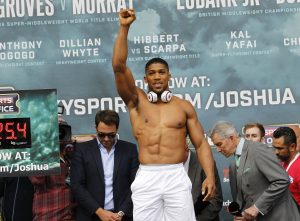
In a conference call Wednesday, Joshua talked about fighting in the U.S.

“I’ve made sure I fought some Americans on my way up, so we could get a buzz out there,’’ he said from London. “But I think I have to come out there for a fight for sure. That’s important.

“America is the mecca of boxing. If we can cross over into the States and keep the fan base in the UK, I think we’ve cracked it. That’s mega stuff. That’s global boxing. You’ve got a big guy, heavyweight with a name that’s easy to pronounce and speaks English well.

“I can relate to the U.S. market. All I have to do is get out there, show them what my trade is and hopefully they’ll appreciate it and hopefully we can start talking about setting up major fights and bringing the same attention in the UK to the U.S. That would be phenomenal.”

Deontay Wilder is the big guy he mentioned. It’s no coincidence that Wilder will be at ringside, doing Sky Sports commentary for a fight that can been seen live on Showtime (4:15 p.m. ET/1:15 p.m. PT). Wilder has a title (WBC). He’s a good talker. He has great power. He’s likable. But there are persistent doubts about his overall skill. Maybe, he gets better. If he doesn’t, however, there just aren’t many other American heavyweights in line behind him. Name one.

As I write this, I’m listening to the first day of the NFL Draft. It occurs to me that if Joshua had been born in the U.S. instead of the UK, he would have gone in Thursday’s first round, probably as a defensive end. All of America’s potential great heavyweights are in the NFL these days. Wilder had dreams about playing for his hometown Alabama Crimson Tide before he turned to boxing because he just didn’t have the athletic skill to play for college football’s perennial powerhouse.

I’m not sure the heavyweight division can ever be what it once was without a viable American in the business equation. Maybe, I’m wrong. Maybe, Joshua will prove me wrong. But he needs an American to help him do that. There’s only one and that’s Deontay Wilder. Otherwise, The Joshua Era could be about as forgettable as the Klitschko era.


Two fun Saturdays

By Bart Barry-

Saturday at England’s Wembley Stadium British heavyweight Anthony Joshua will fight Ukraine’s Wladimir Klitschko. One week later at Las Vegas’ T-Mobile Arena Mexican Saul “Canelo” Alvarez will fight Mexican “Son of the Legend” Julio Cesar Chavez Jr. Both matches have their charms.

But one undefeated man to be found in the fourman bunch, too. Aficionados didn’t care much about undefeated marks before Money May – the fixation on Rocky Marciano’s record never felt like a product of aficionados so much as what casuals necessarily predominated a sport that dominated American culture in that time (like nonmusicians harping on albumsales because they have to have an opinion on what’s current and can’t very well muse about chord progressions) – and evidently don’t care much in our wasteland of a post-Money sport.

Look how quickly Mexicans forgave Canelo’s moneymaker of a whitewash against Money May. Too they forgave Son of the Legend’s loss to Maravilla Martinez; there was no dishonor in being wholly outclassed by a superior athlete and nothing but honor in that final round – which, for whatever we opined of Chavez every day before and every day since, nevertheless yielded the most suspenseful 90 seconds of prizefighting anyone has seen in a generation at least.

Hating Canelo or Chavez has never enchanted anyone the way he hoped it might. Canelo exudes professionalism, shows up ontime and ripped for every weighin, fights with reliable intensity, and stiffens lesser opponents with a quickness (and count me among those who verily do not hold it against Canelo he’s yet to move up in weight to fight a man who’s never moved up in weight). Son of the Legend, meanwhile, is nearly a legend in his own right – a different sort of legend, granted, but, well. For all his tries at channeling Dad’s pride and intensity Junior will ever be a raspberry-briefed cereal-scarfing goofball to the rest of us, and bless his heart, he knows it. You glare contemptuously at Junior for squandering his birthright, and he looks back at you through puffy bloodshot eyes and says, “Dude, what’s your problem?” – and if that doesn’t disarm you giggling, you’re wound too tight, and that’s not Junior’s problem either.

Both guys can fight a bit too. Canelo is a b-level novelty act in any good era, as Juan Manuel Marquez bitterly exclaimed years ago, and Chavez is a backup accordion player lipsynching on Televisa for Banda Ensalada de Fruta in that same era, but chance has put them together in this unserious era and they’re here to party and have some fun – which is about all the hundreds of thousands of Mexican fans who’ll buy their pay-per-view want anyway. There’s no sense scolding los mexicanos; they know better, obviously, but why not buy the fight – it’ll be fun!

Less fun but indeed more serious is Saturday’s spectacle between a perfectly untested British heavyweight and Wlad Klitschko, whom a panel of experts just rated the 16th greatest heavyweight of all time for “The Ring” – which means, conceivably, the future ratings of James Jefferies (15), John L. Sullivan (14) and Gene Tunney (13) could be at stake if Klitschko upsets Joshua, though Lennox Lewis (T-11) and Evander Holyfield (T-11) are right to rest easy. Truthfully, Klitschko might’ve jab-jab-held his way to a decision victory against at least a few of the top-10 guys on that list, but what is most clearly reflected in Klitschko’s lowly seeding is: Wlad has brought to sport a larger ratio of size-to-risktaking than any fighter, nay professional athlete, before him. Even in Klitschko’s greatest wins, whatever those were, one got the sense the physical advantage Klitschko enjoyed was preposterous – and yet there was nervous Wlad, chin 40 inches behind his lead foot, rippling quadriceps primed for a balletic leap backwards at an opponent’s first twitch.

In Joshua, though, Wlad faces a second consecutive opponent over whom he enjoys less than his career-standard sixinch height advantage, and worse yet for Wlad’s chances, a man whose physique looks every bit enhanced as Wlad’s always has. It’s improper to note this, of course, but with 70,000 attending Super Bowl LI and 90,000 about to attend Joshua-Klitschko, it doesn’t look like 2017’ll be the Year of the Antidoping Crusader, does it?

Maybe Joshua-Klitschko will deliver in a way Klitschko-Haye disastrously did not, maybe Klitschko, stripped of his physical advantages and sympathetic officiating and hometown scorekeepers, will reveal a sinister ferocity that makes all gasp as he chops down the Joshua tree then steelhammers a dozen drunken Brits at ringside in a rage only brother Vitali (17) can extinguish.

No probably not. It’ll be incumbent on Joshua to supply all the meaningful aggression Saturday, and across from a man roughly 50-times accomplished as anyone he’s faced heretofore, chances are good, Joshua’s going to need to warm to the task. If the final bell rings on this fight stamp an L in the column of public perception for Joshua; if Klitschko stays upright for 36 minutes nobody will leave Wembley Stadium satisfied. Drunk, yes, but not satisfied.

The same cannot be said quite of how Mexican fans will perceive Canelo if he fails to circuitbreak Chavez a week later. Chavez hasn’t the defense to make a fight boring, and if Canelo is dumb enough to retreat for long Chavez will catch him and cream him. What’s far more likely is a far better fight than Joshua-Klitschko.

All this haggling is ungrateful. Both fights promise suspenseful moments because both fights’ outcomes are unknowable. Let’s take it, say thank you, and walk away smiling.

Bart Barry can be reached via Twitter @bartbarry


Burden of Proof: Valdez wants to win more respect in title defense

By Norm Frauenehim-

CARSON, Calif. – Oscar Valdez Jr. has a belt, but that’s just a fraction of what he is seeking. He wants to be acknowledged as the best, both by rivals and fans.

A second defense of the WBO’s featherweight title Saturday night on a Top Rank pay-per-view card (6 p.m. PT/9 p.m. ET) against Miguel Marriaga at StubHub Center represents a timely chance for Valdez to prove a point.

Despite his title, Valdez has yet to win the kind of respect given Leo Santa Cruz, Carl Frampton, Gary Russell Jr. and Abner Mares.

“I want to make it clear that I’m the best featherweight in the world,’’ said Valdez (21-0, 19 KOs), who made weight at 125.6 pounds Friday. “I want that belt to mean something. Other featherweights call themselves world champions. That bugs me.”

Valdez, a Mexican Olympian who went to school in Tucson, faces perhaps his toughest test against Marriaga (25-1, 21 KOs), a Colombian who was at 125.4 pounds Friday. Marriaga’s lone loss was to Nicholas Walters. Among featherweights without belts, Marriaga is the best contender, says Valdez trainer Manny Robles.

“He’s the consensus No. 1,’’ said Robles, who worked Marriaga’s corner in a TKO victory over Chris Martin in Santa Monica three years ago. “But Oscar is too quick for him. Oscar wants to unify the titles. He’s ready for the big fights.’’

The Top Rank card also includes 122-pound champion Jessie Maldonado (24-0, 17 KOs) against Adeilson Dos Santos (18-2, 14 KOs) of Brazil and super-middleweight champ Gilberto Ramirez (34-0, 24 KOs) against Maxim Bursak (33-4-1, 15 KOs) of the Ukraine in title fights. Maldonado tipped the scales at 121.8 pounds; Dos Santos was at 121.2. Ramirez weighed in at 167.8 pounds; Bursak was at 167.4.

Shakur Stevenson, a 2016 Olympic silver medalist, will also make his pro debut at featherweight. He weighed in at 124.8 pounds. Opponent, Edgar Brito (3-2-1, 2 KOs) of Phoenix, was at 125.0.


Cornerman’s Craft: Carpenter Robles showing he knows how to build champs

By Norm Frauenheim

CARSON, Calif. – An old union card is little bit like a driver’s license for Manny Robles. It’s how he identifies himself.

Robles is a carpenter, Local 409.

These days, he’s busy, building champions like Oscar Valdez Jr. and Jessie Magdaleno in a southern California gym not far from where they will defend their respective titles Saturday night at StubHub Center.

For now, Robles has put down the hammer. But like that union card, it’s always there if Robles needs it. It represents an enduring fundamental, a timeless skill he learned from a late dad who gave his son a trainer’s know how as though it were an old tool.

Robles watched his dad, Manny Sr. as he worked with junior-featherweight great Israel Vazquez, super-flyweight champion Martin Castillo and middleweight champ Reggie Johnson. He also fought a little, or at least until his dad told him he might be better off in some other line of work.

Robles listened, then learned carpentry. He liked working with his hands. But he also thought that maybe he could teach fighters how to use theirs.

He remembered something he heard from the late Chuck Bodak, a legendary cut man who hung out at his dad’s gym.

“You’re a teacher, not a coach,’’ Robles said Bodak told him repeatedly.

Robles, a student too, never forgot the refrain.

He has applied it to Valdez (21-0, 19 KOs), who faces a dangerous challenge from Colombian Miguel Marriaga (25-1, 21 KOs) in the main event of a Top Rank-produced pay-per-view card (6 p.m. PT/9 p.m. ET, $44.95) in a second defense of his WBO featherweight title.

He used it to re-energize Magdaleno ((24-0, 17 KOs), who will defend the WBO’s 122-pound title against Brazilian Adeilson Dos Santos (18-2, 14 KOs) after taking it from Nonito Donaire in a stunner last November.

For Robles, the task has been a holistic one. Discipline, diet and routine are all part of it, of course. But there’s family, too. He says he has worked to be the father that his own dad was.

“It’s more than just trainer and boxer,’’ Robles said. “It has to be.’’

It’s an approach that has begun to win over like-minded fighters in a business so often known for fierce independence. Super-middleweight champion Gilberto Ramirez and his trainer Hector Zapari joined Valdez and Magdaleno for workouts at The Rock gym in Carson.

On a loaded card that also includes 2016 Olympic silver medalist Shakur Stevenson in his pro debut, Ramirez (34-0, 24 KOs) faces Max Bursak (33-4-1, 15 KOs) for the WBO title he won in a decision over Arthur Abraham a year ago.

Top Rank promoter Bob Arum calls them Three Amigos. It’s a reference to a 1986 film, a comedy.

For Robles, it’s probably more like My Three Sons, a television golden oldie. For him, boxing and family have always been inseparable.

The two have guided him through tough times. There was a period after his dad died in 2007, he said, when life was a struggle.

“I lost my dad, I lost my mom, I lost my job,’’ he said. “I was leaving in a one-room place. It was tough, real tough.’’

But there was boxing, including another fundamental about what to do when you get knocked down. Get back up. Robles has done that. Repeatedly he says.

“You start over, start over all over again,’’ he said.

He did, working with amateurs. He even coached Sri Lanka. Yeah, Sri Lanka has a boxing team. Surprised me, too.

Along the way, Robles saw a young Mexican who shares some of his roots. Robles immigrated to the US with his dad from Mexico when he was a kid.

So did Oscar Valdez Jr. He was born in Nogales, Mexico, just on the other side of the border, south of Tucson. As a kid, he moved to Tucson where he went to school and began to box. He returned to his birthplace in his early to mid teens.

Robles recalls seeing him for the first time in fighting for Mexico at tournaments from Milan to Brazil.

“Because of my background, I’ve always been split, cheering for the Americans and the Mexicans,’’ Robles said. “I was in the crowd for the 2009 World Championships, cheering for Oscar. I think that was the first time he saw me. He waved at me. Gave me a thumbs-up. That was also the year he lost to Vasyl Lomachenko.

“Then I was even in the opposite corner from him at a 2012 Olympic qualifier in Brazil, coaching Joe Diaz for the American team. Diaz beat Oscar that day. Today, he jokes with me about that one.’’

For years, they had been circling one another, exchanging greetings from afar in 2009 and competing against each other three years later. Nearly three years ago, the circle was joined.

Top Rank asked Robles to work Valdez’ corner for his 12th pro bout for a minor title in Phoenix on an Iron Boy Promotions card in July 2014.

“I said sure, but I didn’t expect it to be more than that,’’ Robles said. “I was subbing for a coach who couldn’t be there because he was sick or injured. I said sure, and I really didn’t expect anything more than that.’’

Valdez won a decision, one of only two on his record and the first after beginning his pro career with 11 straight KOs.

“Then I got a call,’’ Robles said. “It was Oscar. He said he wanted me to be his trainer. He told me he thought I was the perfect fit.’’

The decision was simple. Perfect, too.
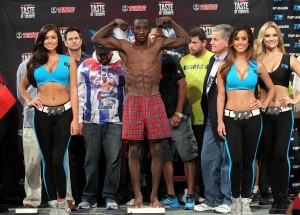


Joshua-Klitschko, Showtime-HBO: A touch of mediation

By Bart Barry

The biggest prizefight since Froch-Groves II, as measured by ticketsales (an idea at once novel and ancient), is nearly upon us, but near as anyone can tell Americans don’t yet know on which channel we may watch British heavyweight Anthony Joshua against Ukraine’s Wladimir Klitschko. This may well be a plot to drive the last 50,000 committed boxing fans in our nation to pirated streams, but it probably isn’t – though it does ask a question like: If Showtime and HBO wanted to send what few subscribers of theirs still subscribe because of boxing to unauthorized outlets, how would they behave differently?

Nope, I can’t think of any ways either.

This latest premium-cable conflict is the sort that happens in an environment of mutual distrust where public facesaving is a higher priority than it should be. HBO, long supposed to be the A-side of American cable boxing providers, found itself some years back, with Manny Pacquiao’s departure for a fight preceding Floyd Mayweather’s departure for many fights, the B-side, and its esteem as a network has yet to recover.

Showtime has problems of its own, obviously, with its boxing content provider now succumbing to the inevitable – or did anyone really think PBC’s powertrident of inconstant matchmaking, oversized purses and contempt for unbought media was a visionary approach? – but it also has exclusivity with the heavyweight division’s two ascendent names, Anthony Joshua, who probably can fight a bit, and Deontay Wilder, who absolutely positively cannot.

Meanwhile HBO has its aged Ukrainian – along with every other prizefighter raised in the former Soviet Union – and not a whole lot else going on. Never stronger, never better, I know, but HBO Sports is about to join the downward spiral if it hasn’t already: Budget reductions to ensure profitability lead to subscriber departures that lead to further budget reductions to stave away takeovers or supplement “Game of Thrones” or somesuch and that leads to more cablecutting, and before you know it a $3 million licensing fee to broadcast the best-attended heavyweight prizefight since Tunney-Dempsey II is worth a 100-day catfight with a network that used to be your farm-league affiliate for both prizefighter and executive talent.

Some mediation is required, clearly, and that will be the case, still, when this issue gets resolved acrimoniously this week or next. It shouldn’t’ve come to this; it makes the participant leaders of Showtime and HBO look tiny. As one reads over the rumored obstacles in this negotiation, who gets to announce the results of the fight, who gets to announce the results of the negotiation, it reads like so much Money May branding, and we used to laugh about that stuff. The absurdity of it hasn’t changed nearly so much as the players and stakes have – and both for the smaller.

How these details get negotiated by dealmakers in New York didn’t matter to a single generation of fight aficionados until this one, but this generation of American aficionados, for all our suffering, at least preceded the country’s exasperation at giving one’s hopes to a dealmaker from New York.

Likely what is most needed in these negotiations between Showtime and HBO now and in the future is a little magnanimity, a little farsightedness. Regardless of what happens in Joshua-Klitschko I there’s no chance Wlad Klitschko is the future of boxing and at least a fair chance Anthony Joshua is. So negotiate the future accordingly.

If you’re HBO recognize you’ve got the weaker hand here and give away your overpaid veteran for some future draft picks – when Showtime’s beneficiary-cum-sponsor-cum-beneficiary auctions off his assets in 2018. Add a lunacy clause, though, à la Michael Lewis’ “Big Short,” whereby, in the unlikely event both Joshua is a fraud and British judges are honest, and Klitschko somehow decisions Joshua at Wembley Stadium, you rip Showtime’s guts out with rematch fees. Showtime’ll probably sign-on because catastrophes are necessarily improbable; some combination of Showtime’s inevitable dismay with the Joshua product and the disaster insurance you bought from them in negotiating the first fight will lead Showtime to give you full rights to the rematch to do with as you wish (pay-per-view).

If you’re Showtime, realize you’ve got the better product and will have for the next five years at least, and show a willingness to let HBO stay afloat with premier nonheavyweight talent till 2022 or so. When PBC collapses and its fighters return to the predations of the open market, you’re going to have more money than you know what to do with, which matters little ultimately, and the heavyweight division cornered, which matters greatly – or as New York’s most famous dealmaker’d put it: Bigly.

Take your eyes off this moment, in other words, and show some vision, both of you.

The respective heads of Showtime and HBO boxing are young enough to have to make deals with one another for the foreseeable future and the benefit brought by a bit of good faith could be disproportionate. That’s a soft idea, of course, which means a mediator better than a network executive should introduce it. Eleanor Roosevelt, though, had a durable line about such things:

“Great minds discuss ideas; average minds discuss events; small minds discuss people.”

Klitschko and Joshua are people; Klitschko versus Joshua is an event; good faith negotiating is an idea. Probability says the winner of the Joshua-Klitschko negotiation will be the longterm loser, anyway, so either HBO or Showtime should recognize this, advise the other side of it, and then let the other side win, let them enjoy their big event unencumbered by pettiness and subversion, and then enjoy the fruits of that choice for years to come.

Bart Barry can be reached via Twitter @bartbarry


All Bets Off: Canelo-Chavez Jr. is generating a surprising buzz

By Norm Frauenheim

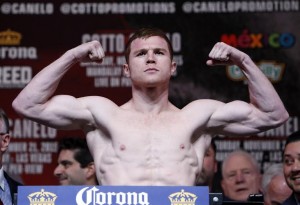
Miguel Cotto vs Canelo Alvarez
PPV Weigh-in 11-20-2015
WBC Middleweight Title
Miguel Cotto 153.5 vs. Canelo Alvarez 155
photo Credit: WILL HART

From day to day, it’s a fight that grows more interesting. It began with a bet that was sealed by a handshake in front of cameras and all of Mexico. The wager, winner-take-all, is off the table.

“No,’’ Canelo Alvarez said Tuesday when asked if his bet still stood for his May 6 bout at Las Vegas T-Mobile Arena with Julio Cesar Chavez Jr. “His dad didn’t let him.’’

Father knows best.

Increasingly, it is beginning to look as if all bets are off for a fight that in the beginning appeared to be a tune-up for Canelo’s possible showdown with middleweight champion Gennady Golovkin later this year.

But the Canelo-GGG possibility has been shoved into the background amid emotions unleashed by a match-up that unlocks Mexico’s fierce pride in a long and rich boxing tradition. No major title is at stake. It’s being fought at a catch-weight, 164.5 pounds. It shouldn’t matter. But it does. Does it ever.

“Titles are very important to me, but this is above that,’’ Canelo said during an international conference call. “This goes above a title, any title. It’s for honor, for pride.’’

It’s also for money, which is the reason father and Mexican icon Julio Cesar Chavez pulled that bet off the table. The Nevada State Athletic Commission probably would have declared it illegal anyway. But Chavez’ dad acted quickly to ensure his son gets something for all his work in a bout that many believe his son can’t win.

But perceptions are changing about a pay-per-view event battling to become a fight, the reverse perhaps of the Sergey Kovalev-Andre Ward rematch on June 17. Kovalev-Ward II looks to be a fight struggling to become an event. More on that at a later date.

The surprise in this corner — and a few others — is how Canelo-Chavez has captured so much attention on so many different levels. It has even taken on a political edge in an ad that takes on President Donald Trump and his controversial plan for a wall along the border between the U.S. and Mexico.

http://www.mediaite.com/online/exclusive-boxing-promo-features-mexican-fighters-busting-through-trumps-wall/

In terms of place, Mexico City’s Azteca Stadium would be more appropriate. Imagine a crowd that would rival the record 132,274 fans for the senior Chavez’ second-round stoppage of Greg Haugen in 1993. But dollars still rule and never more so during a time when the Cinco de Mayo celebration has become a big winner for the Vegas economy.

The fight at Vegas’ T-Mobile is a business decision, yet also an opportunity for advertisers, marketers and opinion makers. It’s a chance to make a big statement on a stage that seems to be getting bigger all the time. Even Canelo promoter Oscar De La Hoya is surprised.

“In terms of the event, of how big it is, I cannot remember a fight against two Mexicans that has created so much interest, anticipation,’’ said De La Hoya, who predicts the bout itself will prove to be as dramatic as Erik Morales-Marco Antonio Barrera. “So this is probably the biggest boxing event with two Mexican fighters.’’

It will, perhaps, because it’s been simmering, off and on, for most of the last decade. Over the last couple of years, however, it was virtually forgotten by fans weary of Chavez Jr. He failed to make weight. He failed drug tests. He looked like a failure in quitting after nine rounds against light-heavyweight Andrzej Fonfara in 2015.

“Everything’s possible in boxing,’’ Canelo said when asked if he could make Chavez Jr. quit too. “And as the great Bernard Hopkins once said: ‘Once a quitter, always a quitter.’ So anything’s possible.’’

Oh yeah, Canelo doesn’t like Chavez Jr. Feigned dislike is part of any promotion, but this time it is intense, genuine and mutual.

It is as simple as Canelo’s dismissive remark about Junior’s dad canceling the bet. From this corner, it was Canelo’s way of saying there’d be no fight if it weren’t for the legendary dad and his unshakable hold on the loyalty of so many Mexican fans.

“As a person, you know, I don’t know him well, but just from what I hear from his actions and all, it’s like a guy that just doesn’t sustain what he says,’’ Canelo said. “You know, he just says a lot of things. It’s almost like he’s a little kid.

“Look, my fans are there. My fans know that I started from nothing, from the bottom up, from zero, and have worked my way up with a lot of sweat and sacrifices.

“He has his fans, as well. But I think a lot of his fans are more his father’s fans than his. His fans follow his father, what his father says, because he’s shown a lot of ups and downs in his career. He, himself, has not had a real disciplined career. He is not a role model for the young children and the young fighters.’’

But boxing has never been about role models. It’s often about the underdog, battling back from impossible odds and adversity. Chavez Jr. is that underdog, although he put himself there by squandering all of his inherited advantages. Nevertheless, there’s an appeal in that, especially among Mexican fans who identify with the underdog.

There’s also a sense that he inherited some of the lightning his father had in his hands. That kind of power is hard to squander. There’s an astonishing moment in 2012 when Chavez Jr. overcame a listless 11 rounds and nearly knocked out then-middleweight champion Sergio Martinez in a final round as wild as any in boxing’s crazy history. Martinez survived for a one-sided decision, but he was finished as a fighter. He fought two more times and after a loss to Miguel Cotto, he retired in 2014.

It’s a reason, perhaps, to think Chavez Jr. has a chance, a puncher’s chance and just another compelling reason for the unexpected buzz.


Hi-Tech’s Competition and Critics Need an Upgrade

By Jimmy Tobin-

Saturday night, at the MGM National Harbor in Oxon Hill, Maryland, Ukrainian super featherweight Vasyl “Hi-Tech” Lomachenko stopped New Jersey’s Jason “El Canito” Sosa in nine rounds. The fight was over within minutes, however long it took for the end to come. It was what could become a typical Lomachenko performance: one where an overmatched opponent exercises the only power remaining to him, choosing the moment to lose rather than lament that choice’s departure over another handful of hopeless rounds.

Sosa was a good opponent, good enough to make Nicholas Walters miss the featherweight division, good enough to win a fringe title by knockout, but his haplessness was evident before even a commentary team eager to celebrate Lomachenko would have it (a whiff of danger being welcome if only to celebrate its impotence). In the first round, Sosa threw a right uppercut/left hook counter so late he appeared to be shadowboxing alone. A deep breath followed, as did a nod, and in his body language Sosa betrayed his role in the forthcoming puppetry. Sosa’s greatest attribute was a doggedness that charmed for as long as the fight did; but courage, bravery, resolve—if all they can offer is confirmation of themselves, well, then a fight losses much of that which makes it sporting.

To make too much of Sosa’s comportment is to compensate for the severity of the mismatch. There is a proselytizing quality to such talk, a propagandistic one too; and the force of those arguments reflects the strength of resistance they meet. (It should come as no surprise then, that Lomachenko’s enthusiasts are so passionate: they are railing against the most passionate fanbase in the sport, one that will never find much glory in the practice of hitting and not getting hit).

And yet much of the criticism of Lomachenko smacks of inauthenticity too, seemingly the product of a bitterness, of a frustration with Lomachenko being offered the crown without having earned it. But why get upset over praise from people whose opinions you neither share nor credit? And why act as if a fighter is responsible for what is said of him? Especially when that fighter has on many occasions tempered the highest praise he has been paid?

What can honestly be said of Lomachenko is that he is stylistically and athletically unique among peers and that he has used this idiom to tantalizing effect. Lomachenko shrinks the ring not by closing avenues of escape but by giving his opponents turning sickness, and the angles and body positioning he uses leave opponents one-handed. All the while he chips away at their bodies and resolve with combinations of varying speed and power; surprise as much as leverage his force multiplier. Excellent defensively without being defensive, the moments in a Lomachenko fight when he is not on the attack are few; that it takes Lomachenko time to force a stoppage says more about his style than his mentality (though there is surely a relationship there). One need only see how Lomachenko responded to the concentrated belligerence of Orlando Salido to recognize there is something primal beneath his artifice. And his confounding of Gary Russell Jr. which, not coincidentally, was Lomachenko’s first fight after the Salido loss, was plenty malicious.

Those who relish in destruction, however, may not shine to Lomachenko’s brand of discouragement, especially when he imposes it on men who can offer little resistance. His performances are cold in the way Gennady Golovkin’s are, in a way Sergey Kovalev’s are not. Still, there is also something appealing about a fighter who makes his opponent’s quit; who can persuade men to relinquish their shields rather than leave on them, fully aware of what shame and humiliation may await such a reasonable decision. Yet when the challenge is minimal so too is the shame. And there is the challenge to fully appreciating Lomachenko: you begin by being impressed (even spectacularly so) and your mind conjures up images of his superlative ability tested by a world-class opponent, but then you remember how likely such a contest is, and that is when something too close to ennui or futility or disappointment sets in.

Still, though only nine fights into his career and with a loss on his record, Lomachenko is in a position where already every victory increases the magnitude of a possible defeat. Expectations for Lomachenko are such that he represents one of the premier scalps in the sport—and if you agree you also agree that he is one of its premier talents because knocking off a hype job means very little. Consider, for example, what praise the first man who knocks Deontay Wilder stiff will receive, and how hushed that praise will sound in comparison to the cacophony of laughs had at Wilder’s expense.

The penalty (and reward) for such esteem is that there are already but a handful of acceptable opponents for Lomachenko. If he wanted to clean out his division like Golovkin he would come under fire in a way “GGG” never has. And could you imagine the uproar if he created the 131-pound division? If you believe Mikey Garcia is the fighter to short circuit Lomachenko, you are paying the latter a compliment. If you believe Terence Crawford is Lomachenko’s Waterloo, you are acknowledging that it will take an immensely skilled junior welterweight to hang a defeat on a super featherweight with but nine fights. And then there are those who resort to evoking the 130lb versions of Floyd Mayweather Jr. and Manny Pacquiao to bring Lomachenko back to earth—as if such measures are anything but flattering.

Lomachenko’s mystique currently exceeds his accomplishments, but how many of the compliments he is paid are greater than those bestowed by the would-be matchmakers who want to see him beaten?


Traction controlled: Lomachenko cruises to another victory

By Bart Barry-

Saturday in Maryland, Ukrainian Vasyl “Hi-Tech” Lomachenko, super featherweight champion of HBO, beat New Jersey’s Jason Soto to a corner stoppage at the conclusion of round 9. The performance was tactical and cold as wintertime in Kiev with Sosa being exactly durable and outclassed as promoter Top Rank anticipated.

Some thoughts:

I drive a Mini Cooper six-speed and despite its pep, at all times it feels too safe because of traction control (and disabling traction control in any car equipped with traction control is a universally bad idea because it was designed with traction control in mind and its engineers generally don’t consider the fate of any motorist dumb enough to disable it). You can still ruin yourself in my car if you’re hellbent on the task but it’s much tougher than you might think, especially if you take a corner too fast, at which point traction control kills the engine and in many ways takes over administration of the automobile. The Texas Hill Country has sundry winding roads that should be intoxicatingly dangerous in a small quick car with a Sport setting, but I’m disappointed to report driving aggressively a car with traction control more nearly resembles a videogame than a mechanical feat (and a Mini – British designed, German engineered – is fractionally so videogamelike as any Japanese sportscar).

I mention this because watching Vasyl Lomachenko fight increasingly reminds me of driving a car with traction control; yes you can slam in a tree if you aim for one but even moderate danger brings the dashboard light with the skid pattern and a cessation of all fun. Lomachenko’s not interested in ringside risktaking – I know, I know; it’s his right as a higher being recognized by Michael Buffer as “the greatest amateur fighter in boxing history” to follow his druthers to no risk whatever – but I’m quite interested in seeing risktaking and as uncouth as this admission may appear, if Lomachenko plans to take no risks going forward I’d rather he used his supernatural gifts to levitate above the ring and strike opponents down with the Force or whatever.

Thankfully Lomachenko lost early enough in his professional career he still has some sense of debt – otherwise we’d be subjected to the Jones/Golovkin Defense: It’s not that Roy beat schoolteachers and Gennady cancer survivors because they can collect generous paydays taking no risk whatever, no, it’s that they’re so dominant everyone except a fulltime government employee or a man strengthened by chemotherapy is frightened of them.

Lomachenko lost foul and square to Orlando Salido a few years back but comported himself with honor throughout and forewent all opportunities at assigning culpability elsewhere. He is indeed a gifted fighter. But until he’s subjected to championship prizefighting’s crucible again and again – where, once more, the object is to hurt the man in front of you, not tally points in flurries like in the amateurs – we won’t know what we have, no matter how incessantly his copromoters Bob Arum and HBO tell us he’s an historic happening (and as an annual reminder: Arum once told this site Kelly Pavlik “will be much bigger than Oscar De La Hoya ever was”).

However incredible Lomachenko’s footwork and artistry, fact remains the Ukrainian just ain’t accurate with his punches as graphical representations imply. Saturday’s opponent was not previously mistaken for elusive but managed to make TGAFIBH miss surprisingly often in the opening 10 minutes by employing rudimentary head movement and not much of it. Lomachenko fights with an arrogance that isn’t quite contempt – again, a probable consequence of losing early in his career – but strays close to it, close to a Jonesian touching of the gloves behind his back, once he determines an opponent is not skilled as he but able to absorb a hundred punches without being felled.

Lomachenko complements this near-contemptuous comportment with regular infight instructions for the referee, undoubtedly a prerogative of being TGAFIBH but a bit of an annoyance too. He treats opponents as targets more than men of volition and if that doesn’t affect the outcomes of his matches, outcomes beginning to feel unappetizingly inevitable, it evidently affects the viewing experience of at least one aficionado. To date Lomachenko has proved a magical solo act but not much of a band leader; he entertains concertgoers with hits from the TGAFIBH catalog – the matador shimmy, the guard slap, the hi-low – but he demonstrates precious little of what intimacy with an opponent the greatest sportsmen find; he is too unaffected to gel or swirl or whisper with another combatant.

It’s an unfair comparison to pit Lomachenko against the Chocolatito standard but since the aforementioned Roy Jones, hyperbolic about anyone who reminds him of himself as he’s understated about everyone else, made the comparison some weeks back, saying Roman Gonzalez was only the world’s best prizefighter if one went strictly by record, much like Warren Buffett is only the world’s greatest investor if one goes strictly by investments, it’s worth a sentence or two to consider the difference between the way Chocolatito fights and Lomachenko does.

Hi-Tech approaches opponents with all the interest of a Gmail spam block; offenders don’t make it to the inbox and Lomachenko remains a great product. Chocolatito meanwhile melds with other men, empathizing with them and guiding them and hurting them and then empathizing with them once more, in a spectacular union of violence and beauty. Some of that is cultural, sure, but other of it reduces to how each man sees his opponents. Lomachenko would do well to feel greater respect for those men and Top Rank would do well to match their guy with more respectable opponents.

Bart Barry can be reached via Twitter @bartbarry


Follow Lomachenko – Sosa Live

Follow all the action as Vasyl Lomachenko defends the WBO Junior Lightweight title against Jason Sosa.  The action begins at 10 PM ET with the WBO Cruiserweight title bout with Aleksandr Osyk taking on Michael Hunter.  Oleksander Gvozdyk will take on Yunieski Gonzalez in a Light Heavyweight bout.

NO BROWSER REFRESH NEEDED; THE PAGE WILL UPDATE AUTOMATICALLY

12-rounds–WBO Junior Lightweight Title–Vasyl Lomachenko (7-1, 5 KO’s) vs Jason Sosa (20-1-4, 15 KO’s) 
ROUND 1 2 3 4 5 6 7 8 9 10 11 12 TOTAL
 Lomachenko*  10  10 10  10   10 10  10  10   10        90
 Sosa  9  9  9  9  9  9  9  9  9       81

Round 1: Left from Lomanchenko..

Round 2 Straight left from Lomachenko..Body shot..Combinations

Round 3 Combination from Lomachenko..Hard right to body from Sosa..Left uppercut..

Round 4 Sosa left eye beginning to swell..Body shots from Lomanchenko…4 punch combination..Straight left..

Round 5 Straight left from Lomachenko..Hard body shot…

Round 6 Sosa gets in a right…Left from Lomaachenko..Hard body shot…Lomachenko outlanding Sosa 156-41

Round 7 Body shot from Lomachenko..Combination on the ropes..

Round 8 Lomachenko lands a body shot…hard flurry on the ropes..Sosa in trouble

Round 9 Lomachenko lands hard body shots…..FIGHT STOPPED AFTER ROUND…LOMACHENKO TKO END 9

10-Rounds–Light Heavyweights–Oleksandr Gvozdyk (12-0, 10 KO’s) vs Yunieski Gonzalez (18-2, 14 KO’s) 
ROUND 1 2 3 4 5 6 7 8 9 10 11 12 TOTAL
 Gvozdyk*  9 10  TKO                     19
 Gonzalez  10                      19

Round 1 4 Punch combination from Gonzalez..Left hook from Gvozdyk

Round 2 Uppercut from Gvozdyk..Good right hand

Round 3 Left hook to body from Gonzalez..COUNTER RIGHT AND DOWN GOES GONZALEZ..Gvozdyk laning hard shots..Gonzalez hurt..Gonzalez nose bleeding..RIGHT HAND AND DOWN GOES GONZALEZ..GONZALEZ CORNER STOPS THE BOUT

12-Rounds–WBO Cruiserweight title–Aleksandr Usyk (11-0, 10 KO’s) vs Michael Hunter (12-0, 8 KO’s) 
ROUND 1 2 3 4 5 6 7 8 9 10 11 12 TOTAL
 Usyk 10   9 10  10   10 10  10  10   10  10  10  118
 Hunter  9  10  10  9  9  9  9  9  9  9  8  109

Round 1 Hard left by Usyk..  Hunter out threw Usyk 50-27

Round 2 Hunter being scrappy

Round 3 Counter right from Hunter..Hunter hitting and moving ..Hard left from Usyk..

Round 4 Usyk working the body…Good left hook from Hunter

Round 5 Hard left from Usyk..Right from Hunter..

Round 6 Usyk lands 3 punches to the head..2 hard straight lefts..Right Hook

Round 7 Good uppercut from Usyk..

Round 8 Hard combinations from Usyk.. straight left..

Round 9 Body shots from Usyk

Round 10 Left to body from Usyk..3 more hard body shots..Hard right hook..Barrage of punches..Hunter taking a lot of punches..Good right from Hunter

Round 11 Left to body from Usyk..4 punches to the head..

Round 12 Big left hurts Hunter,,Hunter getting with relentless shots…HUNTER GETS AN 8 COUNT…Usyk all over Hunter,,Usyk gets in 10 more big shots…Hunter struggles to make the final bell

Punches:  Usyk 321-905   Hunter 190-794

117-110 ON ALL CARDS FOR USYK


Memories: Boxing spins the Golden Oldies in search of a golden future

By Norm Frauenheim

There are more great anniversaries than great fights these days.

The latest is the 30-year anniversary of Sugar Ray Leonard’s controversial decision over Marvin Hagler.

The debate rages on and on over the three decades since the legendary middleweight clash in an outdoor ring on a back lot behind Las Vegas’ Caesars Palace on April 6, 1987.

Generations of young fighters hear it and probably wonder what in the hell these old guys are talking about. For the record, I’m one of those old guys. Yet, I sympathize with those younger fighters. On a day when Don Rickles – another legend from the 1980s — died, we must sound like a bunch of hockey pucks.

I confess, there are moments when boxing resembles an old man with only memories to sustain him. It was only a few weeks ago that Leonard’s welterweight stoppage of Thomas Hearns in 1981 was recalled in the promotional build-up to Keith Thurman’s decision over Danny Garcia on March 18.

It was unfair to Thurman and Garcia to suggest that their fight could ever be the second coming of Leonard-Hearns. It wasn’t, of course. Only a fool would have thought it might be.

That said, legends remembered are one way of keeping a troubled sport alive. A legend forgotten is just an eroding antiquity, an ancient ruin from a bygone time.

If not exactly healthy, boxing is hardly bygone. Fact is, it’s thriving in some places. To wit: The UK.

A crowd of 90,000 at London’s Wembley Stadium is expected for heavyweights Wladimir Klitschko and Anthony Joshua on April 29.

Please-please-please, hold all the parallels to Joe Louis-Max Schmeling, Muhammad Ali-Joe Frazier and Ali-Foreman. Within the ring, Klitschko-Joshua won’t be that. Not even close. But that anticipated crowd at Wembley adds up to interest still lively as ever. Done right, there’s still nothing like a good fight.

Bob Arum knows that better than anyone. That’s why I applaud him for remembering Leonard-Hagler the way he has over the last week. Sure, there’s self-interest in the scheduling. He’s a businessman, after all.

He talked about his Hagler-Leonard memories last week during a conference call that helped promote an April 22 card at StubHub Center in Carson, Calif. It features emerging featherweight champion Oscar Valdez Jr., super-middleweight champ Gilbert Ramirez, junior-featherweight champ Jessie Magdaleno and Olympic silver medalist Shakur Stevenson in a pro debut.

Then, there was a news conference for Vasyl Lomachenko’s next title defense on Thursday, the same day as the Hagler-Leonard anniversary.

In Lomachenko, Arum has a fighter whom he says has Ali-like skills. Translation: Lomachenko, who faces Jason Sosa Saturday night (HBO 10 pm ET/PT) in Oxon Hill, MD, could be a key to restoring the business. On a historical day, Arum introduced a fighter who he thinks can make history, maybe even repeat some.

On the call with Valdez, Ramirez, Magdaleno and Stevenson, there was a different tactic. Arum was both boxing promoter and history professor. Hagler-Leonard happened before the four twenty-something fighters were born.

Arum asked each to watch and score the fight. The exercise was intriguing, mostly because it brought to life a debate lively then and lively now. Valdez scored it 115-113 for Hagler, favoring Hagler’s aggression. Ramirez and Stevenson scored it 115-113 for Leonard, both favoring Leonard’s quickness. Magdaleno had it for Leonard, 116-112, also favoring Leonard’s overall skill and speed.

“Hagler-Leonard,’’ Stevenson said, “that was a great era but now it’s our turn to begin our own legacy and create our own era where we have fights like that down the line. I can’t wait for that to happen.’’

Throughout the call, Arum never predicted that Valdez, or Ramirez, or Magdaleno, or Stevenson would lead boxing back to a future defined by late journalist and author George Kimball’s Four Kings – Leonard, Hagler, Hearns and Roberto Duran. That would have been unfair to the young fighters. It would foolhardy for the promoter.

At the end of the call, I asked if Ramirez thought he could hang with them. Ramirez, nicknamed Zurdo, was no longer on the line. But Arum was. He immediately jumped in, calling out Gennady Golovkin.

“He doesn’t have to worry about hanging with those guys,’’ Arum said. “The fight Gilberto wants, if he is successful on April 22, is GGG and I would agree to take that fight winner-take-all. I think Zurdo destroys Golovkin the same way that he destroyed Arthur Abraham.”

I asked if Arum agreed with those who argue that the years have begun to catch up with GGG, who turns 35 on Saturday.

“Yes we all do, even me,’’ Arum said. “I’m 85 and showing my age. But, yeah, sure he is. There’s no question. There’s a great A.E. Housman poem, To An Athlete Dying Young. An athlete’s life is relatively short.’’

But the memory of him can be very long if the business reminds the athletes after him of everything he made possible.


Performing pre-performance pain: Chambers, Schwarzenegger, Vazquez, et al

By Bart Barry-

SAN ANTONIO – Saturday at this city’s fantastic Luna Music Bar & Lounge a talented blues singer from Houston named Annika Chambers, also a friend, expertly played to an enthusiastic full house. As the blues as an artform so obviously comes from a place of pain, and as Annika so exquisitely balances this pain with expressions of euphoria and sexuality, and proper stagecraft, the show afforded hours of opportunity to consider pain’s role in performance, and the traditional if not so uplifting tariff it demands from performers.

Saturday brought a reminder that if you’re going to endeavor to entertain others you must sell it out and leave little of yourself at the end or there’ll be resentment or worse indifference. There’s a sort of preparational willfulness that enables flowing through a performance, even one such as this, but it’s a dangerous place to be, this mania for one’s own maniacal preparation, because it posits some knowledge of others’ preparation, a thing that cannot be better than an estimation and usually much less, and comes with a trickier-still definition of “others” to include one’s past self.

One wonders if it’s possible to flow simply from practice to performance – like a chipping style golf embraced a generation ago wherein a player takes practice chips, three or four, within his stance, then merely extends his hands a few inches out for the fifth practice swing, connecting with the ball and overcoming what anxiety brings yips – or if performance integrity requires one make an intentional shift, one to the other, before doublingback years later to realize all previous performances are in fact practices. When we talk of seasoning and experience in boxing as in the arts we refer to this doublingback, this feedback loop, wherein the performance experience benefits the performer more than further practice would.

But whither preparation?

And again.

Blessed be the performers who ply their wares without this autointerrogation: Either they’re joyful beginners who’ve yet to make improvements substantial enough to interrogate or they’re joyful masters who recognize such questions’ futility as they arise. And in between comes the obligation to make it look masterful onstage regardless of doubt, to occupy one’s performance personality and show boundless authority – because an abundance of authority fools all but the masters (never more’n a handful in any discipline) while an absence of authority is the one sin no member of any sort of audience forgives.

Prizefighters used to know all this and only recently forgot it, using publicity mechanisms to offset their lacking authority onstage, successfully fooling themselves and a few kids following the sport on illegal streams but absolutely nobody who would purchase a ticket or pay-per-view. From here a few will luck into competitive confrontations, matchmade accidentally, and win a relative sort of acclaim and a relative sort of wealth but ultimately it all feels authentic as paying an alltime great like Sugar Ray Leonard to liken Thurman-Garcia to his first match with Thomas Hearns; not Leonard or Hearns or Keith Thurman or Danny Garcia could respect or even like anyone who fell for this.

It betrays a variably concealed sort of contempt for its audience one finds in the very roots of the PBC; where Bob Arum and Oscar De La Hoya, and before him Don King, often lie boldly and baldly to and about us they do it to keep the balls in the air and attract attention to whatever they’re vending, but the PBC’s founding vision appears to be something like: Anyone who would watch something violent as boxing is a lowlife, a savage, a malcontent, and to that sort of organism only brutality and volume matter, so give them half-naked men punching and lots of neon and noise, then sit back and watch the jackpot pay-out.

We’ll see.

This seems good a place as any to consider the role pain plays in performance, so let us. Some 19th century thinker – must’ve been a German – wrote something about pain being a primary source of creativity, and if it was truer then than now it is only just. Pain brings an agitation of sorts that is alleviated or endured a number of ways, and for some of us no way more effectively than creating, which in this context may be a synonym for performing (which may be a lunge too desperate to connect this column to Saturday’s concert to boxing [we’re about to find out], but in case it isn’t, watch this:).

In the enduringly excellent documentary “Pumping Iron” the preternaturally charismatic Arnold Schwarzenegger, before he became a Hollywood icon or California governor, talks about a willingness to experience a transcendent sort of pain that necessarily changes a person from a contender to a champion, and to punctuate his point Schwarzenegger encourages lifting weights till unconsciousness or vomiting intervene. On the other end of this suffering, provided it be horrendous enough, lies acclaim, which takes one directly to Marvelous Marvin Hagler’s silk-pajamas conundrum. But working backwards, notice how few prizefighters find acclaim enough to stroll happily away from our beloved sport – or for that matter how few writers arrive at a state from which the acclaim-seeking act of publication appears absurd, or how few stage performers blissfully retire on their own terms.

Those who have reserves of pain abundant enough to master their craft – and recall: longevity is an equal partner of talent and originality’s – probably deplete themselves so fully in the performance act they continually return to a weakened state that lets more pain seep in. That’s the ambivalence Annika’s performance brought Saturday that was the same ambivalence Israel Vazquez’s third match with Rafael Marquez brought years ago at ringside: As an admirer I have no right to ask this much of another person; but as an audiencemember, gosh, I’m glad their preparatory suffering was so thorough.

Bart Barry can be reached via Twitter @bartbarry


Pound-for-Pound: There’s a vacancy at the top of this debate

By Norm Frauenheim-

Pound-for-pound, it might be the most overrated argument in the debate business. Who is No. 1? Who’s No. 2? Who cares? Most of these guys won’t fight each other any way. But it’s still a way to fill the dead time and there’s been plenty of that since the top of the argument, Roman Gonzalez, lost a controversial decision.

In a subsequent rush, ratings have been re-evaluated and redone. Everybody seems to have a new No. 1 and it’s not Gonzalez. No surprise there, although it seems unfair to end Gonzalez’ unprecedented reign after a decision roundly ripped by the same people who run the various rankings.

To rip Gonzalez’ loss to Thailand’s Srisaket Sor Rungvisai as a scorecard robbery and then to yank him from the top spot only seems to compound the crime. It’s as if Nicaraguan – the smallest fighter to ever occupy No. 1 — was only there for as long as it took to sort out a noisy version of musical chairs.

Gennady Golovkin is No. 1 in some. Andre Ward is favored in others. Prodigy Vasyl Lomachenko gets the nod in a few. But, come on, shouldn’t No. 1 just be left vacant? That’s the choice here. Nobody has really made a decisive claim on the spot that Floyd Mayweather Jr. once owned.

I understand why Gonzalez is no longer atop the debate. For him, the trend has been problematic. The flyweight great has struggled at junior-bantamweight. But there’d be no argument here or anywhere else if the decision March 18 had gone his way at Madison Square Garden a couple of weeks ago when he got up from a first-round knockdown. Gonzales was the Lord of the Flies when he ascended to No. 1 when Mayweather retired. Yet with one lousy loss, his pound-for-pound run suddenly has a fly’s life span??? In fairness to him and his still-dynamic skillset, it’s reasonable to vacate the spot and give him a chance to regain it in a Rungvisai rematch that would be judged alongside performances delivered by GGG, Ward, Lomachenko and few others.

GGG remains unbeaten, yet his recent performances against Kell Brook and then Danny Jacobs, also at Madison Square Garden a couple of weeks ago, left questions, not unlike those asked about Gonzalez.

GGG is considered a small middleweight. He looked as if he often struggled in winning a decision against a bigger Jacobs. Can he adjust? He might have to against a bigger Canelo Alvarez. If – if, if, if — there is a GGG-Canelo fight in September, it’ll be one piece in the pound-for-pound puzzle.

Another one would be Ward-versus-Sergey Kovalev in a rematch, possibly on June 17. Ward won a decision over Kovalev in November. It was unanimous on the scorecards and unanimously controversial among fans. It was 114-113 on all three cards. Had two of the judges scored it for Kovalev instead, the Russian would be the undisputed No. 1. Instead, there’s Ward, the pick in some ratings despite suffering a second-round knockdown. Like Gonzalez, Kovalev deserves a rematch in a sequel with more pound-for-pound implications now than there were in November.

Then, there’s Lomachenko. He’s the provocative pick for No. 1. Publicists and writers, alike, portray the two time Olympic gold medalist from the Ukraine like a magician, Houdini in boxing gloves. Maybe, but Houdini’s pro resume is hard to judge. He only has eight bouts, including a loss to Orlando Salido.

Lomachenko is intriguing. But his pound-for-pound credentials are still to be tested, perhaps by Mikey Garcia, who has 28 more fights and no losses on a record that represents just another compelling reason for a vacancy at the top of this pound-for-pound debate.


Struggling to 1,000 words by watching Golovkin-Jacobs with the volume off, etc

By Bart Barry-
— Photo Credit : Chris Farina – K2 Promotions
SAN ANTONIO – So goes a Sunday afternoon at Brown Coffee some miles north of downtown, across Broadway from The Pearl:

This is the sort of thing you do when there’s nothing interesting you in a sport about which you’ve found a way to write 1,000 words every Sunday for a dozenyear: You’re well away from writer’s block which handicaps you counterintuitively enough since you no longer worry what might come of your column if you approach it unprepared – gone years from sweating Saturday nights over the blank page – you come to the page blankly filled with enthusiasm at some capacity for improvisation then don’t improvise and don’t worry but do begin wondering when the alarm might sound. And sound it doesn’t because you’ve muted it – experience, presence, other numbing agents. There you sit bypassing the alarm right to indifference, certain the alarm will sound later and you’ll not end so uneventfully as apathy, then begin combing YouTube hoping something’ll spur you to begin wordstringing and it does, Golovkin-Jacobs on mute, having watched it as you did with a roomful of others live, the room comprising East Coast lads in the house of a Brooklynite Puerto Rican, a collection of guys crying Robbery at the screen when scorecards got read, you wonder if, as you suspected then, the room’s commentary offset HBO’s banter, interested as the Golovkin promoter HBO immodestly became a few years ago.

Instead a welladjusted and attractive woman, 19 years your junior, comes in the coffeeshop where y’all’ve conversed before and you offer a seat at your table and confess you’ve not an idea what this week’s column should treat, and since she knows it’s ostensibly about boxing she says:

“How about that new Ed Sheeran video?

“It’s bad, but he’s boxing. You could write your column about the way boxing is done in that video.”

And you playfully laugh and return to Golovkin-Jacobs, round 2, and get bored and do in fact watch the Ed Sheeran video, song muted, and the boxing isn’t bad at all. Sheeran, a southpaw, was on an episode of “Top Gear” you saw years ago and seemed humbly likable, and you find yourself cheering for him more in that video with the female pugilist than you cheered for either Golovkin or Jacobs eight days ago (though you made theatrical overtures to Jacobs’ chances to ensure you got invited back for Chavez-Canelo in a couple months) then the love interest disappears from Ed Sheeran’s video while the deus ex machina cranks rustily along and a sumo wrestler shows up bareassed, and it’s back to Golovkin-Jacobs a spell.

Golovkin has maybe a robot’s head movement so his defense is but punching power, though occasionally he picks-off a shot, keeping his redtaped black-n-white Grants up till an opponent strikes them; an ability to catch shots on his chintip and not buckle composes his defense mostly. Therein lies the reason Golovkin is not moved upwards in weight and will not be: Without chloroform on each knuckle he surely would not take with him to 168 pounds, Golovkin has little technique or tactical whatnots in his tricksbag – sorry, Abel! He would make an average super middleweight and way too much has been promised about him to afford any average happenings. Round 3 Jacobs lands his first lead shoulder of the match, a tool upon which he relies increasingly, but bless his heart it’s a fight, so why not (he writes, in large part because Jacobs’ shoulder slamming Golovkin’s jaw is not some Thai super flyweight’s head slamming Chocolatito’s head – and you can’t adjust for bias until you recognize bias).

And now a muscular and charismatic lesbian – who insists against all evidence she’s actually bisexual – comes in the coffeeshop and starts talking trash about your new haircut while the young attractive girl at your table recommends for your column a hypothetical effort on what might happen if you and she sparred, and you assure her the hypothetical is already welltrod in these columns.

Now Jacobs begins grimacing and flexing at Golovkin, and it’s not a good idea. Perhaps in the mirror or across from outmatched sparring partners what Jacobs elicits in his shows of rage is fear but in the ring with a man who punches hard as he does and absorbs better Jacobs’ glares and ripples make him look mentally fragile and a little too hopeful: He doth protest his toughness too much, wethinks.

It’s impossible to tell in realtime if Golovkin’s punches felled Jacobs in the fourth because HBO cameraswitches between Golovkin righthands, and it’s one more reminder how much presentation influences what we think we see when we watch a boxing broadcast. While Jacobs doesn’t appear particularly compromised by the knockdown or what blows caused it he does switch wisely out his southpaw stance when combat resumes. The knockdown on replay looks a touch tangled, and before anyone reports it’s not a tangle but Golovkin’s nuclear power, he’s advised to recall Jacobs withstood that power for 24 more minutes after the knockdown. And by the end of round 8 Jacobs is quite obviously the faster fighter even while the order of his punches doesn’t make much sense.

Now the charismatic, muscular lesbian joins our table and you introduce her to your attractive friend from a loving family and nothing chemical or dangerous happens but talk turns to loves lost, and it’s right depressing – so back to Golovkin-Jacobs and a finish you know won’t be suspenseful for anyone who knows its result.

In the ninth Golovkin actually ducks a punch and then eats a shoulder and then for some reason Jacobs begins clowning rough again while Golovkin breathes deeply round his gumshield. In the fabled championship rounds there appears to be little on either guy’s punches and even less on Jacobs’. Clearly exhausted Jacobs begins to throw floppy wrists like Steven Seagal running.

The decision’s a fair one for an honest scrap between two good middleweights. But let us have no more loose talk of greatness.

Bart Barry can be reached via Twitter @bartbarry


FOLLOW LINARES – CROLLA II LIVE

Follow all the action as Jorge Linares and Anthony Crolla fight in a rematch of their terrific fight that took place last September.  The bout, which will be for Linares’ WBA/Ring Magazine Lightweight title will begin at 6 pm ET / 10 PM in Manchester

NO BROWSER REFRESH NEEDED.  THE PAGE WILL UPDATE AUTOMATICALLY

12-rounds–WBA/Ring Magazine Lightweight title–Jorge Linares (41-3, 27 KO’s) vs Anthony Crolla (31-5-3, 13 KO’s) 
ROUND 1 2 3 4 5 6 7 8 9 10 11 12 TOTAL
 Linares 10   10  10 10  10   10  10  9 10   9 10   10 118
 Crolla  9  10  9  9  9 10  10  10 111

Round 1: Crolla lands a body shot..Right hand..Linares lands a right to the body..Body shot..Right..

Round 2 Body shot from Crolla…Overhand right from Linares..

Round 3 Linares lands a right..uppercut

Round 4 Linares lands a good right..uppercut,,Good right..Left from Crolla..

Round 5 Body shot from Linares..Hard body shot..

Round 6 Uppercut from Linares..Right..Crolla is cut over his left eye..left from Linares..

Round 7 HUGE LEFT UPPERCUT AND DOWN GOES CROLLA…Big combination on the ropes..Right from Crolla

Round 8 Right from Crolla..3 big uppercuts from Linares..Body shots from Crolla..Body shot from Linares..Body and head from Crolla..Uppercut from Linares..

Round 9 Right over the top from Crolla..Hard uppercut from Linares..

Round 10 Combination from Crolla

Round 11 Good uppercut from Linares..Good right

Round 12 Linares boxing and moving

118-109 ON ALL CARDS FOR JORGE LINARES


Mayweather-McGregor: A license to make money, but not history

By Norm Frauenheim

It’s beginning to look as if Floyd Mayweather Jr. and Conor McGregor are just a few dancing bears away from reaching an agreement on whatever it is they intend to do in June, or September or, whenever.

All of the talk is creating its own momentum. Where there’s smoke, there’s cash these days and there should be enough of the latter to ensure that the spectacle will happen.

By all accounts, it’ll be a boxing match, although there are good reasons to think it’ll turn into something else.

It’s no secret that McGregor has no boxing experience, which is another way of saying he’d have no chance against the best boxer of the last decade. McGregor knows that. If he doesn’t, he’d find out soon enough.

At the very second he discovers he’s got no shot, the guess here is that he’d kick Mayweather in the head. McGregor gets disqualified and probably fined. But what would he have to lose? He’d still bank seven, maybe eight, figures and his MMA loyalists would love the crazy moment.

Yeah, it would be outrageous. But isn’t that a reason so many people are talking about it?

After all, Mayweather-McGregor wouldn’t be about sportsmanship. We aren’t talking about a gentle game of lawn croquet here, although their respective fans might watch even that. Who knows? McGregor might pick up one of those mallets and drop Mayweather faster than Victor Ortiz.

Truth is, it’s hard to know exactly what to make of Mayweather-McGregor. Neither fish nor fowl. More like fishy and foul.

From a boxing perspective, the real problem rests with Mayweather’s pursuit of legacy. It’s not about the cash. Mayweather is better at making money than just about anybody under the big top. Money is his nickname.

He’ll be remembered more for that than even his ample boxing skill. Still, legacy is important to him. If it weren’t, he wouldn’t be selling those T-shirts and caps bearing that familiar acronym, TBE – The Best Ever.

But it would be a cheap insult to history if Mayweather were allowed to go 50-0 – one victory better than Rocky Marciano’s iconic record – against a mixed-martial artist with no boxing experience.

If Nevada or New York or any other state agency sanctioned Mayweather-McGregor as a boxing match, the result – win, lose or draw – becomes a matter of record.

There’s already precedent for that. In an internet event on pay-per-view in Phoenix a year ago, Roy Jones Jr. added a victory and knockout to his record (65-9 47 KOs) in an Arizona-sanctioned boxing match against an MMA novice, Vyron Phillips, who told the AZ commission that he had boxed as an amateur.

McGregor, of course, says he will pull off a global shocker and knock out Mayweather. What else is he going to say? Other than his MMA loyalists, however, there is no argument in any language about McGregor’s chances. It’s zero, nada, bupkis.

It would be against Manny Pacquiao in a rematch, or Timothy Bradley, or Keith Thurman, or Shawn Porter, or Danny Garcia, or Errol Spence, or Kell Brook, or Amir Khan, or Jessie Vargas. Any of them would be a truer test than McGregor could ever be.

Come to think of it, all of them and more should sign a petition and deliver it to state commissions, asking that McGregor-Mayweather not be sanctioned as a boxing match.

License it for what it is: A big money-maker, but not a history-maker.


Chocolatito catches up to defeat

By Jimmy Tobin-

Saturday night at Madison Square Garden, Roman “Chocolatito” Gonzalez lost a majority decision to an unheralded if not entirely overlooked Thai fighter named Wisaksil “Srisaket Sor Rungvisai” Wangek in a fight that was not expected to confirm Gonzalez’ greatness yet did just that, judges’ appraisal of his performance be damned.

For those who have never been particularly enamoured with Gonzalez, those who find little intimidating about a prizefighter who barely meets the height requirements of a rollercoaster, or who are predisposed to antipathy whenever a collective enthusiasm swells too quickly and coincidently, too utterly, Gonzalez’ loss to a fighter likely to be remembered not by his name but by some strung together series of attributes like “That-Thai-Guy-Who-Beat-Chocolatito” must be satisfying. More so even, considering “The-Bum-That-Exposed-Roman” is Gonzalez’ fighting inferior in every way, owing any advantage he held Saturday night exclusively to size—which is to say, to little he could take much credit for. Nor does decrying the decision mitigate the defeat. Gonzalez was dropped in the first round and abused regularly, such that establishing his dominance in a manner that was convincing not simply in its craft but in the response that craft produced required every one of the 33 remaining minutes he had.

Gonzalez falling just short should not come as a complete surprise both because of the diminished returns Gonzalez has found as a super flyweight and because he has been pursuing defeat his entire career. In hindsight, it is easy to trace a fighter’s path to defeat, to see the harbingers of the inevitable often overlooked in victory. This applies to Gonzalez as well, who is still a near-perfect weapon but one now short on firepower (ever a problem for an undersized pressure fighter). Yet Gonzalez is special in the way that he willingly, consistently put himself in a position to encourage this induction.

There is a telling moment in HBO’s “2 Days: Roman ‘Chocolatito’ Gonzalez” where, speaking of fighters who have fallen short of their dreams, Gonzalez says: “They don’t realize that the more you win, the tougher the fights.” What is first striking about this statement is how naive it sounds. Gonzalez envisions a sport where fighters are not regularly rewarded for victories with easier fights, where their reputations are not frequently established off little more than a noteworthy win or two and preserved via machinations meant to secure a narrative rather than sound out the truth. And what of his speaking of tougher fights when so many of his fraternity would have employed the word “bigger”? It implies that Gonzalez still trusts in the role of meritocracy in his sport. Charming that; rare too, and indicative perhaps of what influence a country’s fighting idol can have on its gloved hopefuls. America, then, should not expect to produce the next Gonzalez.

His words also reveal the psychology of a fighter who pursues defeat; that it took Gonzalez twelve years to find it had nothing to do with risk aversion, his unbeaten streak is not the product of culling a feeble herd. A singular talent, that people still assert otherwise of Gonzalez when so many fighters make their reputations off the eye-test is baffling. In his march through four divisions, Gonzalez has cut down plenty of deserving adversaries while treating any Dierry Jeans, Dominic Wades, Blake Camparellos, and Alexander Brands he met along the way as a fighter of his stock should.

But you need know none of that—you need only watch him to understand what a unique fighter Gonzalez is.

And has he ever been greater than he was in the twelfth round Saturday night? When, with cuts from headbutts accidental and otherwise left his right eye streaming blood, taxed from twelve rounds with an opponent he could crack but not shatter, an opponent whose physical presence alone made demands of him that smaller better fighters could not, Gonzalez stepped to center ring and left no doubt about what kind of fighter he is?

While Wangek punched and pushed, pushed and held, Gonzalez set about his work: weaving into and chopping away at an opponent who more and more seemed eager to simply survive, to take whatever punishment he need to find sanctuary in a clinch. Using angles that not only allowed him to find softer targets for his punches but left his opponent one-handed, how masterfully did Gonzalez make his final bid for victory. There would be no dramatic stoppage, that much was clear, yet Gonzalez continued his assault, forcing the bigger, stronger, harder punching man into a fight he wanted little to do with until, finally spent, Gonzalez had to simply catch Wangek’s closing flurry on his gloves and offer one last jab as the bell sounded.

Against this latest daunting opponent, that effort was not enough. And that is as it should be, considering Gonzalez has spent so much of his career tempting just such a night. It is entirely possible that a series of losses come in the wake of his first if only because it is hard to imagine Gonzalez taking anything but a difficult fight. But his losses will never define him: they will be expected, forgiven, perhaps even celebrated.

What does it mean to pursue defeat? In short, to pursue greatness. Gonzalez finally caught up to the former which is why the latter was his long ago.


A humbling

By Bart Barry-

Saturday the Chocolatito Era concluded when Nicaraguan Roman Gonzalez got narrowly and perhaps unfairly split-decisioned by Thailand’s Wisaksil “Srisaket Sor Rungvisai” Wangek in a brutal 12-round affair. In the mainevent a different tradition of matching the world’s best middleweight against a fellow middleweight began, when Gennady “GGG” Golovkin decisioned Daniel Jacobs, and let us hope this new era endures fractionally long as the other one did.

Whosoever would be idiot enough to write something like this: “After the decade Chocolatito labored in obscurity it brings no joy to write a match of his does not belong on American television much less HBO PPV, but heavens to Murgatroyd, this one verily does not”?

Guilty, my friends, and decisively so.

Whether Sor Rungvisai deserved to become a champion Saturday he belonged in a ring with Chocolatito in a way no one before him has done and once there he made brutal combat – disrespectful, randyrough, unfair, despicable – till he was eligible for a title few gave him a chance at (even if no one publicly gave him less of a chance than this column’s agebadly effort).

It was inevitable: If a prizefighter moves upwards in weight as he moves upwards in age someday he gets beat by a man who is not good a prizefighter as he is but able to offset class with physicality by absorbing what punches smaller men cannot and damaging with less effort than smaller men can. Exactly that happened to Chocolatito, every bit Saturday his diminutive suffix -ito, who struck Sor Rungvisai with the same accurate shots he strikes everyone with and applied much of the same tactical originality he applies to every opponent’s head and body but the difference was Sor Rungvisai’s size and desire and apparent obliviousness of who was the man punching him. Whereas the mainevent saw a b-level middleweight will himself past an obvious consciousness about his opponent’s identity – and in so doing reveal quite a lot about the actual quality of the middleweight champion (and how about the postfight sparkle in Golovkin’s eyes when asked about a September return to a junior middleweight opponent!) – the comain saw a man who showed up for a world title fight against an anonymous smaller man and acted like it.

Wherever or however Sor Rungvisai hit Chocolatito in round 1 he dropped him true and it tolled Chocolatito’s psyche finding himself seated, a ref fingerflashing overhead. It portended still worse things for anyone who hoped to enjoy Chocolatito for more than another match or two, too: You don’t make a fight-of-the-year candidate with Sor Rungvisai and go on to enjoy a long pleasant stay in your new super flyweight division. Instead you cautiously win a wellpaying rematch then cash yourself out – making, as an aside, charismatic Carlos Cuadras Saturday’s biggest loser.

On a personal note the emotions went something like: Excitement (here we go) to surprise (Chocolatito’s on the blue mat) to shame (what did I write?) to sadness (Chocolatito looks so small) to elation (he’s spinning him gorgeously!) to indignation (that butt was intentional) to anger (he butted him again) to amusement (butting when in you’re in trouble is effective in its way, isn’t it?) to excitement (he’s spinning him again, yes!) to disappointment (the geometry’s wrong) to nervousness to sadness.

Whatever dudgeon happened in the moment and however much pain Chocolatito is in today and tomorrow and the rest of the week, fact remains Sor Rungvisai, as a large southpaw, sold accidental headbutts sufficiently to remain undisqualified while severely altering a championship match’s trajectory with his head. There was little if anything accidental about any but the first butt and it was apparent three ways: 1. The timing of the accidents, 2. Chocolatito’s evident disgust with the accidents, and 3. The asymmetry of their effect. When two fighters’ heads keep colliding whenever one fighter is hurt, and the other fighter is the only one buzzed and bleeding afresh after each collision, there’s no chance at the championship level anything accidental is happening.

There are ways to remedy these things and Chocolatito, who has gone below the belt plethoras of times in his career, did none of them, and one suspects he didn’t do them because he didn’t think them necessary. First time, shame on Sor Rungvisai; second time . . . expect Chocolatito to go low early and often in a rematch the Nicaraguan’ll take personally and more seriously than their first match – and expect the new champion to be looking refereewards in the rematch more than his challenger.

While the damage suffered in the comain was asymmetrical the card itself did conclude with a symmetric quality of sorts: Chocolatito nearing the end of a career marked by increasing weightclasses and challenges; GGG beginning what one hopes is a career of fighting men large enough to hurt him – and looking only a touch better than average in so doing. While ESPN scrambles to revise its bro-science feature on Golovkin’s otherworldly power (something about Daniel Jacobs’ episode with cancer making his chin exponents more resilient than it was before both cancer and Dmitry Pirog) and HBO manufactures demand enough for Canelo-GGG to put this uncomfortable Jacobs episode behind us all, aficionados can use what they saw Saturday to temper, once more, their opinions of undefeated records.

Bart Barry can be reached via Twitter @bartbarry


FOLLOW GOLOVKIN – JACOBS LIVE FROM RINGSIDE

Follow all the action LIVE from Madison Square Garden as Gennady Golovkin and Daniel Jacobs square of the world Middleweight championship.  There will be a 3 fight undercard that starts at 9 PM et / 6 PM headlined by Roman Gonzalez defending the WBC Super Flyweight title against Srisaket Sor Rungvisai.  Also Carlos Cuadrad battes David Carmona.  The action kicks off with Ryan Martin against Bryant Cruz

NO BROWSER REFRESH NEEDED.  THE PAGE WILL UPDATE AUTOMATICALLY

12-ROUNDS-WORLD MIDDLEWEIGHT TITLE–Gennady Golovkin  (36-0, 33 Ko’s vs Daniel Jacobs (32-1, 29 KO’s) 
ROUND 1 2 3 4 5 6 7 8 9 10 11 12 TOTAL
 Golovkin  9  9 10   10  10  9  10  112
 Jacobs  10 10   9  8  9  10 10   10  9  10 10  10   115

Round 1: Jacobs lands a combination

round 2  Left inside from Jacobs..Jab

Round  3 Hard uppercut from Golovkin

Round 4..BIG LEFT AND DOWN GOES JACOBS..Golovkin landing heavy rights..Left inside from Golovkin..trading jabs..Left and right frin Golovkin

Round 5 Big right from Golovkin…Jab,,Hard left to body,,Big right…Left from Jacobs

Round 6 Jacobs jabbing from southpaw stance..Staright left..Right from Golovkin..Body shot from Jacobs..Good right..Right from Golovkin..Body combination from Jacobs

Round 7 Combination from Jacobs..Hard right from Golovkin…Left and right from Jacobs…Good right..right and jab from Golovkin..Straight left from Jacobs..1-2…Hard jab from Golovkin…Great action after the bell

Round 8 Hard right from Jacobs…Straight left..Body work..Combination on the inside..Left to the head..Right from Golovkin..

Round 9 Jab from Golovkin…Jab. from Jacobs..Good right..left to body..Jab and uppercut from Golovkin…Hard uppercut hurts Jacobs,,Big flurry on the ropes

Round 10 Jacobs popping the jab..Hard right,,Jab,,1-2..Good left

Round 11 Right from Golovkin..uppercut..Left from Jacobs..Combination inside..good uppercut..Combination..Jacobs faster hands are the difference

Round 12 Right from Golovkin..B0dy shot from Jacobs..Good right from Golovkin..Hard right and uppercut from Jacobs..Left from Jacobs..

115-112 twice…114-113 golovkin

12-rounds–WBC Super Flyweight Title–Roman Gonzalez (46-0, 38 KO’s) vs Srisket Sor Rungvisai (41-4-1, 38 KO’s) 
ROUND 1 2 3 4 5 6 7 8 9 10 11 12 TOTAL
 Gonzalez  8  10  9 10   10  10 10  10  10   10  9 115
 Rungvisai 10  9  10  9  9  9  9 9  9  10  10 112

Round 1 Body shot from Rungvisai..left and right…HUGE RIGHT TO THE BODY AND DOWN GOES GONZALEZ..

Round 2 Right from Rungvisai..head combination..Right from Gonzalez…combination..right,,,

Round 3 Gonzalez is cut around his right eye.Left from Runvisai..Great toe to toe action..Right from Gonzalez..Cut ruled a headbutt

Round 4  Left from Rungvisai..Good right, left and left hook from Gonzalez..Hard right from Gonzalez..striaght rght and body shot..4 hard shots to the head

Round 5 Right to body from Gonzalez..left from Rungvisai..Body shot..right from Gonzalez..Right Combination to the head..

Round 6 Straight right from Gonzalez…Left from Rungvisai…1-2 from Gonzalez..Hard body shot..ANother head butt/cut on Gonzalez

Round 7 Right from Gonzalez..Good right to the body…

Round 8 Right to body from Rungvisai..right to head,,hard right inside..right,,,left,,,hard left

Round 9 Gonzalez lands a left..Combination from Rungvisai…right from Gonzalez..Left hook..Uppercut from Rungvisai..Left from Gonzalez…

Round 10 left from Gonzalez..Left from Rungvisai..Right back Rungvisai..

Round 11  Hard right from Rungvisai

Round 12 Left from Rungvisai…Hard right from Gonzalez..Left from Rungvisai..

113-113 ; 114-112 TWO TIMES FOR RUNGVISAI

10 Rounds-Super Flyweights–Carlos Cudras (35-1-1, 27 KO’s) vs David Carmona (20-3-5, 8 KO’s) 
ROUND 1 2 3 4 5 6 7 8 9 10 11 12 TOTAL
 Cuadras 10   9  10  10 10   10  10  9  10      97
 Carmona  9  10  10  9  9  9  9  10  10  9      94

Round 1: Cuadras gets in a left hook..Right to body..1-2 from Carmona…hard left hook from Cuadras

Round 2 Left hook from Carmona

Round 3

Round 4 Combination from Carmona..Right over top from Cuadras….Left hook..1-2 to the body

Round 5 Left from Cuadras

Round 6   Right from Carmona..left from Cuadras..right from Carmona

Round 7 Jab from Cuadras

Round 8 left from Carmona..left to body

Round 9 1-2 from Carmona..

Round 10 Jab from Carmona….1-2 from Cuadras..jab..Body shot from Carmona…Body from Cuadras..Left..

CUADRAS WINS 97-93 TWICE AND 96-94

10 Rounds–Lightweights–Ryan Martin (17-0, 10 KO’s) vs Bryant Cruz (17-1, 8 KO’s) 
ROUND 1 2 3 4 5 6 7 8 9 10 11 12 TOTAL
 Martin  10  10  10 10   10  10  10  TKO          
 Cruz  9  9  9  9  9            

Round 1-7 :  Martin dominating usinh is length

Round 8:   hard ComBINATION AND THE FIGHT IS STOPPED

WINNER BY TKO –RYAN MARTIN


Hoops or PPV: It’s a tough sell for GGG-Jacobs

By Norm Frauenheim-

— Photo Credit : Chris Farina – K2 Promotions
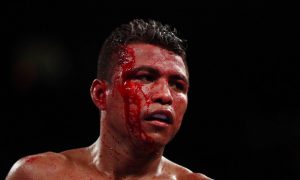
April 22, 2016 , Los Angeles, Ca. — Boxing Superstar and Unified World Middleweight Champion Gennady “GGG” Golovkin, 34-0 (31KO’s) and Undefeated Mandatory Challenger Dominic Wade, 18-0 (12KO’s) weigh in Friday in Los Angeles, California.
Boxing Superstar and Undefeated, Unified World Middleweight Champion Gennady, “GGG” Golovkin, 34-0 (31KO’s) will defend his titles (WBA, IBF, IBO and WBC “Interim’) against Undefeated Mandatory Challenger Dominic Wade, 18-0 (12KO’s) on Saturday, April 23 at the Fabulous Forum in the main event at UNDEFEATED.
Co-featured will be Consensus #1 Pound-For-Pound Fighter and WBC Flyweight World Champion Roman “Chocolatito” Gonzalez, 44-0 (38KO’s) battling World Ranked Contender McWilliams Arroyo, 16-2 (14KO’s) of Puerto Rico.
Both bouts will be televised Live on HBO World Championship Boxing® beginning at 10:00 p.m. ET/7:00 p.m. PT.
Tickets for UNDEFEATED, priced at $400, $300, $200, $100, $60 and $30, are now on sale through Ticketmaster (Ticketmaster.com, 1-800-745-3000) and the Forum Box Office.
Golovkin vs. Wade is promoted by K2 Promotions, GGG Promotions and in association with TGB Promotions. Gonzalez vs. McWilliams is presented by K2 Promotions in association with Teiken Promotions and PR Best Boxing Promotions.

It’s a many-sided fight, loaded with intrigue and potential for explosive surprises at just about every level. But will Gennady Golovkin-Danny Jacobs Saturday night sell?

It’s an HBO pay-per-view fight screaming for attention during the first week of the NCAA basketball tournament.

Although already perilously close to joining boxing at the sporting fringe from November through February, college basketball still comes off the edge and squarely into the spotlight for three weeks from mid March to early April.

It’s a spring rite, an annual fast break full of moms and pops with brackets in one hand and a few dollars to wager in the other. Office pools are everywhere and that means everybody is watching, especially during the first couple of rounds when big upsets are likely.

If you’ve ever been in Las Vegas for a fight during the first week of the NCCA tournament, you know what I’m talking about. The books are jammed. Lines stretch from the betting windows almost out on to The Strip with people wanting to bet on the next Cinderella. A very good fight might be at the casino’s arena that Saturday night. But nobody knows about it.

In America’s virtual village, Golovkin-Jacobs, at New York’s Madison Square Garden, is that fight. Looks to be good, could be great. Jacobs is a terrific story. He beat cancer and he’s been beating everybody in front of him ever since.

Golovkin (36-0, 33 KOs) has been that force of nature, an unbeaten and unstoppable middleweight who hopes to pound out a legend the equal of any in a division with a rich history. His bout against Jacobs has been called a steppingstone to a bigger confrontation with Canelo Alvarez. Yet, Jacobs (32-1, 29 KOs) is a challenge – perhaps GGG’s biggest ever as he approaches another birthday. He’ll be 35 on April 8.

If the fight had been in mid-February or mid-April, it would have had a better chance at a solid PPV number. In an era of declining expectations, solid would mean anything from, say, 250,000 to 300,000. GGG’s pay-per-view sample is too small to judge. He has fought on PPV only once, against David Lemieux in October, 2015 in an HBO telecast that did a reported 150,000.

With the Canelo showdown still on the horizon and the compelling Jacobs story as part of Saturday’s promotion, there’s more reason to watch. But it happens on a day with second-round NCAA tournament games on CBS, TNT and TBS scheduled from noon (ET) to 9:30 p.m. (ET) and all without a PPV price tag.

The day’s final tournament game is scheduled a half-hour after the start of the PPV telecast of a card that includes pound-for-pound king and junior-bantamweight Roman Gonzalez (46-0, 38 KOs) against Srisaket Sor Rungvisai (41-4-1, 38 KOs).

It’s a good card. Maybe great. On a day full of basketball for free, however, is it worth $54.99 for the standard telecast, $64.99 for high-def? After wall-to-wall hoops, I’m guessing a lot of casual fans will just pass and wait for the replay.

That’s unfortunate, especially for the under-appreciated GGG, Jacobs and Gonzalez.

GGG, who sells out arenas, draws a solid audience in non-PPV bouts. His victory over Kell Brook in September drew 843,000 for a London bout that happened earlier in the day in the U.S. His April victory over Dominic Wade at The Forum in Inglewood, Calif., posted a biggie, 1.34 million.

Let’s assume Golovkin does the expected and beats Jacobs. If the victory is spectacular, yet the PPV number isn’t, it creates a potential complication for him in negotiations with Canelo, whose May 6 bout with fellow Mexican Julio Cesar Chavez Jr. could be PPV blockbuster. Let’s assume Canelo does the expected and beats Chavez Jr., yet with a PPV number three to four times bigger than GGG’s number against Jacobs.

What should be a 50-50 fight, won’t be in terms of what Canelo says he’s worth. He’ll ask for the lion’s share of a 60-40 or 55-45 split. GGG, who has been the consensus champ at 160, wouldn’t be the first fighter to be insulted by that kind of proposal. He also wouldn’t be the first to walk away from the table, further delaying a fight the business desperately needs.

That begs a question: On a weekend dominated by attention on the NCAA tournament, why-oh-why is GGG-Jacobs on pay-per-view? That answer is a slam-dunk.


Chocolatito debuts against Thailand’s debut conqueror

By Bart Barry

Saturday at Madison Square Garden on the undercard of HBO’s pay-per-view match for the unified middleweight championship of the world, the world’s best prizefighter, Nicaraguan Roman “Chocolatito” Gonzalez, will defend his super flyweight title against Wisaksil “Srisaket Sor Rungvisai” Wangek, a fighter whose recent reign of terror on Thailand’s amateur program Chocolatito should bring to a brisk and violent conclusion – and perhaps rekindle in so doing.

After the decade Chocolatito labored in obscurity it brings no joy to write a match of his does not belong on American television much less HBO PPV, but heavens to Murgatroyd, this one verily does not. Instead this represents the sort of back-wages wager Bernard Hopkins taught prizefighters to make with their managers and promoters and broadcasters, today marginally more one-in-the-same as they’ve ever been, once acclaim was had and serious observers were seriously interested in observing one fight. We shall hitherto call it the Morrade Hakkar Clause in homage to the silly Frenchman HBO approved for the second defense of a middleweight title Hopkins won from Felix Trinidad in the greatest moment of Hopkins’ career to that point. Before Hopkins’ negative fighting style and self-intoxication were considered alternately brilliant and charismatic they were considered properly unbearable but HBO was hot on the trail of a rematch between Hopkins and Roy Jones Jr. in 2002 and eager to agree to most any demands Hopkins made, and Hopkins’ demands, inspired by Jones’ demands, were wild for a man who couldn’t sell 8,000 tickets in his hometown but reasonable through a lens of his accomplishments and Time Warner’s annual corporate revenues. HBO acquiesced and Hopkins-Hakkar was atrocious.

And Trinidad put Hopkins through fractionally the suffering Chocolatito experienced against Carlos Cuadras in September, writing of back wages, which is part of the reason Chocolatito mentioned HBO by name in December:

“I’m 29 years-old, and one has to seize the moment we are in,” Chocolatito said. “I will give a rematch to Cuadras, but I need a good purse from HBO. I believe I deserve it.”

As a craftsman of course Chocolatito deserves it but as an entertainer he likely doesn’t and it’s no one’s fault he believes he does because, after all, America sells meritocracy to the rest of the world, and so why shouldn’t the prizefighter American aficionados consider the world’s best make 0.4-percent the purse the last guy Americans considered the world’s best made against Manny Pacquiao? Because we didn’t know what the hell we were doing a few years ago and we still don’t – that’s the honest answer, but what American businessman’s honest enough to say it, and what Nicaraguan’d be ingenuous enough to believe it?

Instead we’ll cite the dynamics of a free market, when convenient, while having the world’s best fighter defending a title in his fourth weightclass on the undercard of a middleweight-unification bout, HBO champion vs. PBC, between two men who’ve never chanced a moment outside the middleweight division, though the HBO champion is frequently reportedly willing to fight anyone between 154 and 168 pounds and hobbled only by junior middleweights who won’t come up to 160 and super middleweights who won’t come down to 160 but otherwise ready, willing and able. The main event is expected to be mismatched enough for last week’s prefight promotion to be about gossiping whether the HBO champion has time between Saturday’s inevitable defense and September’s better-paying inevitable defense to make another inevitable defense in June.

Not to be outdone Roman Gonzalez will fight Wisaksil “Srisaket Sor Rungvisai” Wangek, a man whose last two opponents sported a cumulative record of 0-0 before Sor Rungvisai, in his 45th and 46th prizefights respectively, welcomed them harshly to the professional ranks, in a match Gonzalez will win decisively no matter his opponent’s physical advantage. There’s no way to rehearse for someone gifted as Gonzalez, though if fighting men in their pro debuts properly prepares Sor Rungvisai for Chocolatito, one weeps for the futures of amateur heavyweight boxers with Deontay Wilder on the loose. Absurd as we rightly consider most athletic commissions in the U.S. how about that Thai commission(s) approving the WBC silver super flyweight champion for four 2016 matches against opponents with a cumulative record of 15-19! (Sor Rungvisai fought as many men making their pro debuts in his eighth year of professional fighting in Thailand as he did the year he made his own pro debut.)

There’s no occasion for not being snide on occasions such as these but enough of the griping: Any opportunity to see Chocolatito ply his wares must be embraced because Chocolatito is a rare talent, and as aficionados we owe HBO a debt of gratitude for bringing him more exposure, a debt all aficionados will argue is still much less than the cost of an HBO subscription and quarterly pay-per-view bills, but some gratitude’s due nevertheless. From Saturday’s victory things’ll go one of two ways for Chocolatito: After taking another 36 minutes of abuse from a career super flyweight he’ll double his demands for a rematch with Carlos Cuadras and price himself back to obscurity, or he’ll glide so easily through Sor Rungvisai and receive such disapprobation from the Nicaraguan media – “Stop talking about money like an American, Alexi never did; you’re better than that, you’re a Nicaraguan” – he’ll abandon his campaign to match compensation to achievement and return to beating fellow world champions for somewhat less than he deserves but way more than another 115-pound athlete makes in the world.

Making him what Floyd Mayweather would call a “dummy” and historians will call an “all-time great.”

Bart Barry can be reached via Twitter @bartbarry


No, No: Boxing biz moves on despite combo that didn’t happen

By Norm Frauenheim-

A couple of things didn’t happen during the last week, neither one much of a surprise and yet both significant for a sport that is either dying, or rebounding, or just going nowhere.

Item One: Nothing about Keith Thurman’s split decision over Danny Garcia last Saturday resembled Sugar Ray Leonard’s classic over Thomas Hearns in 1981. It was more like the Leonard-Hearns rematch in 1989. Don’t remember that draw? Neither does anybody else.

Item Two: Manny Pacquiao and Amir Khan announced a fight in the United Arab Emirates and then found out a promised $38-million was, well, fake news. The real story: There was no money, no fight at all.

What to make of it?

Bottom line, there is no more lotto at the end of a boxing rainbow that appeared like an illusion in 2015 when Floyd Mayweather Jr. collected between $220-and-$230 million for a dull bout that netted Pacquiao a reported $180 million.

Promoter Bob Arum, who warned Pacquiao about another UAE tease, told the Los Angeles Times that the Filipino and advisor Michael Koncz “were talking to the wrong people.’’

Truth is, there are no right people anywhere – not in the UAE, or Dubai, or Vegas, or New York — willing to invest $38 million in a boxing card these days.

The business is starting over, which might be bad news for Pacquiao, a Filipino Senator who is generous to a fault and always looking for a way to fund his next political campaign.

He needs the money. That’s no secret. If the Senator is entering his prime as a politician, however, he’s past his peak as a fighter. No secret there, either.

Pacquiao, who was guaranteed $4 million for a victory over Jessie Vargas in his last bout, is caught in a changing market. The irony is that he helped fuel the astonishing run-up of purses that climaxed with his loss to Mayweather.

Now, however, there are younger welterweights willing to fight for a fraction of the wages he and Mayweather earned.

That brings us back to Thurman and Garcia. Each had career-high guarantees of $2 million for a CBS fight that generated big ratings in prime time. The audience averaged 3.74 million over the 12 rounds and peaked at 5.1 million.

The fight itself is hard to judge in terms of whether it won over some disaffected fans. There were no knockdowns. Over the final three rounds, Thurman played it safe, staying out of harm’s way. The split scorecards say that was a risky tactic. But, in the end, it worked for him.

The bigger debate is about whether the bout was another turn-off for casual fans. The guess in this corner: It wasn’t. There was no pay-per-view, a fee that almost ensures outrage if it isn’t a classic.

The parallel to the first Leonard-Hearns bout was an impossible reach. But it was free. It didn’t cost anybody $100 for the right to get bored and then angry, all in high definition.

In part, that was always Al Haymon’s plan when he introduced Premier Boxing Champions a couple of years ago. He foresaw that pay-per-view was killing the business. His validation rests in the numbers for CBS’ primetime telecast.

Mayweather-Pacquiao set a pay-per-view record. At its peak, the 5.1 million for Thurman-Garcia was bigger than the 4.6 million PPV number for Mayweather-Pacquiao.

Under the old PPV model, Thurman and Garcia would still be invisible to casual fans. They aren’t now. They are introducing themselves to a bigger audience and doing it for price that might sustain the business as it finally moves into the post Mayweather-Pacquiao era.


No, Please, One Time Was Enough

By Jimmy Tobin-

Saturday night at Barclay’s Center in Brooklyn New York, Keith “One Time” Thurman won a split decision over Danny “Swift” Garcia adding another alphabet trinket to his collection while doing little to stake his claim to welterweight supremacy. What distinguished Thurman-Garcia was not an interplay of fists, but an absence thereof. Thurman earned the victory because in those early moments when a fight appeared imminent, he seemed most eager to conjure one—and because when he wanted anything but Garcia could not coerce him enough to the contrary.

There were moments of drama between Thurman and Garcia, to be sure. Such moments are near guaranteed every time Thurman steps into the ring, and they came, as they almost exclusively now do in his fights, in the opening rounds. It is in those rounds that Thurman best embodies his moniker, trying to spark opponents with his considerable athleticism and less considerable power, throwing punches with a ferocity that speaks to the sense of performance he does not always honor but always carries within him. Thurman landed a few of those punches on Garcia who, whatever he suffered, responded without a hint of retreat, cranking little semi-circles from his left shoulder, measuring the counter left hooks that would soon enough inter Thurman’s daring.

Garcia proved, rather unsurprisingly, that he could handle whatever evil was delivered in Thurman’s early gusto. The clearer that message became, the more Thurman abandoned his combinations, his connection with the ground when he threw them, and eventually, his commitment to the moment. His chances of a finish quick and spectacular having evaporated, Thurman employed instead a brand of “boxing” antithetical to the reputation he—less convinced and less convincingly—encourages we preserve. If this is what passes for an offensive welterweight, perhaps Floyd Mayweather, who also landed less than fifteen punches a round but was at least skilled enough to stand directly in front of his opponent while doing so, was less a defensive specialist than he is often (disparagingly) remembered as.

For his part, Garcia was hardly better, worse even, if you consider his effort to take the rounds Thurman needed to spare and was willing to concede. Still, he stood his ground against Thurman, as he did against former boogeyman, Lucas Matthysse, digging the balls of his feet into the canvas and committing fearlessly a retort to every Thurman punch.

How undauntedly Garcia stares down daunting power; how quickly does this defiance shake an opponent’s confidence. Garcia is a more complete fighter than Thurman, there is more that is impressive and instructive in his game. But when all he needed were the basics, when a double jab would have won him the rounds Thurman tried to steal with an ill-placed blow and a cloud of smoke, Garcia too often holstered his weapons. If you believe enough of the Thurman narrative, he left an opportunity to distinguish himself in the ring. Garcia left victory there, however, and that mentality will make an opponent of him sooner rather than later.

What is perhaps most frustrating about what transpired is the absence of consequences both fighters stand to face for their performance. This is not to say fighters should be punished for poor performances, at least not exactly. But the lack of fallout for failing to live up to expectations, whether those expectations are the product of promotional ballyhoo or the proclamations of the fighters themselves, is a bit difficult to take. Again Thurman was placed in a position to distinguish himself as the future made present, and instead he was again left speaking laudatorily of his boxing ability (evermore a Thurman euphemism for a night he goes the distance). Garcia merely adds a disputed loss to his trio of disputed victories. He is likely to see little financial penalty despite scaling back his competition again in the aftermath of a loss that, as close as it was, he need waste no one’s time regrouping from. Matchmaking is already too glacial in its pace, and the concept of the comeback feels empty when a defeat carries none of the penalty, physical or otherwise, that need be recovered from.

The hope is that Thurman moves quickly, moves within the next four or five months to an opponent who presents the type of challenge that will not allow him to bore. Again, Thurman is a fighter, and pressed—as he was by Shawn Porter last year—he often responds like one. Whatever his limitations, he appreciates his responsibility to the crowd. And while he is not fighter enough to consistently embrace that responsibility a better opponent might give him no choice but to. For Garcia, there should be only fights that demand he comport himself like a loss means more than simply defeat—no more fights whose outcomes, good or bad, seem to barely register with him. And if that is asking too much of either fighter so too is asking for a charitable assessment of them.


Keith Thurman: Captain of the junior varsity

By Bart Barry

Saturday welterweight Keith “One Time” Thurman majority-decisioned Danny “Swift” Garcia to become the undefeated, undisputed, unified champion of the PBC. The fight went along like PBC championship bouts often do, with neither man felled or bloodied and both in conscious attendance at the reading of official scorecards, guardedly optimistic. As PBC tradition tends to dictate the gloves looked too big in round 12 – Thurman’s patriotic Rivals and Garcia’s neon-canary Reyes – and both men looked fresh enough to box till a 15th round despite laying everything on the line and giving all their blood sweat tears nuts and guts etc.

It wasn’t as much of a PBC-style spectacle as others in the storied management company’s predecessor years because it featured evenly matched titlists, something no one in Al Haymon’s outfit anticipated being fiscally mandated until 2020 at the earliest. Turns out, not even casual fans are quite dumb as the PBC business model supposed which might’ve been obvious – not even the diehardest Patriots fan’d watch a season full of Pats v. Browns – had more than mere market saturation been considered during the company’s formation but apparently wasn’t.

Danny Garcia has long been a Haymon-model outlier while Keith Thurman’d be its purest incarnation were it not for Deontay “Windmill” Wilder. That started Thurman a few points ahead on PBC scorecards that came in fairly for a reason like: Garcia is a 140-pound athlete who outgrew the junior welterweight division, not a welterweight, and therefore his properly applied counterpunches did a few fractions less than sufficient to win rounds Thurman successfully stole in their final 10 seconds. Fair play all round.

But color me enduringly unimpressed with Thurman, now the unified welterweight champion of the PBC if probably not the world. What adjustments did Thurman make Saturday? He holstered his righthand for about three rounds after Garcia baloonpricked his liver a twotime but there’s no calling that a strategy or tactic when words like “compromise” and “surrender” remain available. Aside from that Thurman ferally overshot with 2/3 his powerpunches and did the retreating resting skipping thing the PBC calls “boxing” in homage to master “boxer” Amir Khan’s signature flight pattern, while Thurman must’ve reminded his Florida trainer of no one so much as fellow Floridian Jeff Lacy who once walloped hapless opponents with thrice Thurman’s rage till he came to someone competent and hadn’t the squareroot of a plan b.

Thurman manages to have roughly Lacy’s accuracy with a whole lot more hedging on his shots, often swimming tentatively forward in a way Lacy never did. Combine that with PBC matchmaking and opponents born in lower weight divisions, with the noble exception of Thurman’s single 2016 tilt against Shawn Porter, and you have a unified champion and comparative superstar, as planned, even if not yet sharing celebratory stature with Deontay “Wilder &” Wilder.

I began watching Saturday’s fight with no particular sense for it – and again, credit where it’s due: with no certain forecast – but a suspicion Garcia’s craft and experience’d crack Thurman for having faced at least three men superior to Thurman at junior welterweight (and probably four [Nate Campbell] and possibly five [Kendall Holt]), and when Thurman spent the better part of rounds 4-6 with his right elbow protectivepinned to his liver one rightly assumed Thurman’d get wild and get countered properly, and he did, and it didn’t matter. Credit to Thurman’s whiskers or PBC’s matchmaker but really not both.

Even in losing a fair decision Garcia was simply the more compelling man to watch Saturday in part because he plays against type in a way few of his coworkers do: He dresses gaudily and gives his dad’s jackassery free reign but then throws punches proportionately audacious, which in a different time might’ve been expected but surely isn’t these days. Experience leads one to anticipate Garcia’s ringwalk anticipates an accordion’s posture before adversity but Garcia does the opposite surprisingly often – he imperils himself and chances embarrassment or worse by whipping hooks with little technique allotted to selfpreservation.

Say what you will about his dad, their pairing works very well and not merely for the obvious reason Angel Garcia makes a target of himself for the terminally anxious so his son isn’t one. Somewhere in Garcia’s audacity lies a trust in his father’s judgement; if Garcia’s gambles on hooks bankrupt him, Dad will intervene before any too-permanent damage accrues. That’s much more than can be said for most prizefighter-trainer relationships, isn’t it? Tomorrow Garcia can fill PBC’s welterweight-gatekeeper role when Robert Guerrero and Shawn Porter are unavailable and spoil a few coronations, too, but his days as undefeated top billing are through.

Which leaves the PBC welterweight champion Keith Thurman, captain of the junior varsity, in a better professional position than his resume or technique necessarily justify. According to PBC highlights Thurman is all things to all people: a ferocious beast in the ring and a philosopher of pacifism outside it, a classically trained pugilist and a selftrained flautist, a man so mindful he meditates before cameramen. Neither Thurman nor his matches are nearly good as PBC tells us they are, but that’s where we find ourselves, still, in 2017.

Bart Barry can be reached via Twitter @bartbarry


FOLLOW THURMAN – GARCIA LIVE FROM RINGSIDE

Follow all the action LIVE from Ringside as undefeated welterweight champions Keith Thurman and Danny Garcia get it on in a much anticipated bout from Barclays Center in Brooklyn, New York.  The action kicks off at 9 PM ET / 6 PM PT with a Junior Middleweight bout between Erickson Lubin and Jorge Cota

NO BROWSER REFRESH NEEDED.  THE PAGE WILL UPDATE AUTOMATICALLY

12-Rounds–WBA/WBC Welterweight titles–Keith Thurman (27-0, 22 KO’s) vs Danny Garcia (33-0, 19 KO’s) 
ROUND 1 2 3 4 5 6 7 8 9 10 11 12 TOTAL
 Thurman  10   10  9  10 10   9  9  10  9  113
 Garcia  9  9  10  10  9  9  10  10  9  10 10  10   115

Round 1: Thurman trying to push the action…Hard right from Garcia..Counter right..left to body..left..Huge left and right from Thurman…Right…right to head

Round 2 Right to body for Thurman..Right from Garcia..Right from Thurman..another right over the top

Round 3 Right from Thurman..right to the head..Combination from Garcia..Jab from Thurman..Right to body for Garcia..

Round 4 Counter right to body from Garcia..Jab..Counter right..Big right from Thurman..jab..

Round 5 Right from Thurman…Hard right..right…Counter left From Garcia..

Round 6 Thurman sneaks in a right to the body.Counter left..Good right from Garcia..Overhand right from Thurman

Round 7 Right from Garcia..Combination..Good right from Thurman..overhand right from Garcia..Garcia warned for a low blow..Left from Garcia..

Round 8 Right to body by Garcia..Left hook from Thurman..Jab..Counter right from Garcia..

Round 9 Left from Thurman..Uppercut..Right from Garcia

Round 10 Right from Garcia..jab..right..Thurman lands an overhand right..Hard uppercut from Thurman..Counter right from Garcia.

Round 11 Counter left from Garcia.Garcia working  on the ropes..

Round 12 Counter right from Thurman..right…Right from Garcia..Hard combination..

116-112 THURMAN…115-113 GARCIA…115-113 THURMAN

12-Rounds–Super Welterweights–Erickson Lubin (17-0, 12 KO’s) vs Jorge Cota (25-1, 22 KO’s) 
ROUND 1 2 3 4 5 6 7 8 9 10 11 12 TOTAL
 Lubin  10  10  10                    30
 Cota  9  9  9                    27

Round 1 Left from Lubin..

Round 2: Body work for Cota…Right hook from Lubin..Jab from Cota..Hard straight left and right from Lubin..

Round 3 Lubin working body on the ropes…Hard combination rocks Cota..Hard overhand left

Round 4 HUGE LEFT AND DOWN GOES COTA…HE GETS UP BUT THE FIGHT IS STOPPED


Back To The Future: Leonard Sees It In Thurman-Garcia

By Norm Frauenheim-

Boxing loves history. It remembers, yet it can’t repeat. Not yet, anyway. I’m not sure it has to. These days, just a good fight is enough. Keith Thurman-Danny Garcia Saturday in CBS prime time looks as if it fits the latter part of the bill.

With the year only a couple months old, it’s the best in 2017 thus far. It has a chance to be better than anything seen last year. History can wait, perhaps on a rematch in the evolution of a classic rivalry. Yet, the parallels are there, as irresistible as they are inevitable. In part, that’s why Sugar Ray Leonard will be there as a CBS analyst and a ringside symbol of what the sport would like to be all over again.

Thurman, the WBA’s welterweight champion, and Garcia, the WBC champ, are fighting for the same titles that were at stake when Leonard and Thomas Hearns battled each nearly 36 years ago in a September, 1981 bout that ranks among the all-time classics.

Changes since Leonard prevailed — retaining the WBA’s belt and taking the WBC’s version from Hearns in a 14th-round stoppage– at an outdoor ring behind Las Vegas Caesars Place and before a reported network television audience of 300 million – have forever altered boxing. There are countless titles and more television networks than acronyms. There are fewer fighters these days. More great athletes risk head trauma on the football field than they do in the ring anymore.

“Fortunately, I was in an era where there were just a lot of guys out there who were so talented,’’ Leonard said during a conference call before Saturday’s bout (PT 6-8 pm/ET 9-11 pm) at Barclays Center in Brooklyn.

For Leonard, there were so-so many, although it’s ironic that the rivalry with Hearns was a business partnership that fell short of its potential. They fought a second time, nearly eight years later in 1989.

But it was forgettable, a draw that left nobody interested in a third step of a trilogy. Still, there was Roberto Duran and Iran Barkley and Marvin Hagler and all of the other legends of that time. There were so many chances at creating legacies, and Leonard, Hearns, Duran and Hagler did exactly that.

There aren’t as many opportunities these days and perhaps the willingness to do so just isn’t there anymore. The game conducts itself according to Floyd Mayweather Jr.’s business model: The biggest reward for the smallest risk. It worked for Mayweather, who fulfilled his Money nickname millions of times over. But it has created problems for fighters who might have had a better chance at a legacy for themselves in Leonard’s era.

“I always thought that we had to continue to raise the bar as a fighter, as a champion, and continue to fight better and better competition,’’ he said “When I was fighting, I swear, I wanted to be the underdog -psychologically, spiritually and mentally. If I wasn’t challenged, if I wasn’t considered somewhat of an underdog, I couldn’t perform the way I normally would. It’s what would get me going.’’

For Thurman (27-0, 22 KOs) and Garcia (33-0, 19 KOs) those kind of challenges loom in a bout that is only the third between unbeaten welterweight champions and the first since Felix Trinidad’s controversial victory over Oscar De La Hoya in 1999.

Thurman-Garcia is also intriguing for elements not reflected in their records. Thurman is a compelling personality. He is boxing’s enlightened warrior, a fighter who studies Eastern religions, plays music and talks philosophy.

He’s likable, the flip side to Danny Garcia’s offensive trainer and father, Angel, whose racial slurs at a news conference a few weeks ago left questions about whether the New York State Athletic Commission would license his to work the corner. It did, which adds a controversial edge. Will Angel’s presence put additional pressure on his son?

Danny Garcia is likable in his own way, but his father has turned him into the bad guy. Every great fight needs some good-and-evil, but Danny Garcia has been forced into an ill-fitting role by an offensive dad.

Meanwhile, the ever-poised Thurman has kept his cool throughout the race-baiting rhetoric from Angel Garcia. At opening bell, however, will he be motivated to make the son pay for what the dad said? There’s a danger in that, too especially against the counter-punching Danny Garcia, whose left is as lethal as any if it is allowed to land.

There’s potential on several levels for the kind of fight that Leonard experienced and endured.

“It is an out-of-body experience,’’ said Leonard, who on Wednesday picked Thurman to win. “It’s déjà vu. Like holy, I’m 60. It’s a kind of thing that is so special. It’s so rare of a unification. it seems like. It speaks volumes to me as far as the significance of it. And these guys, Keith and Danny, they know it.

“They realize it.”

Leonard has been there. Maybe, Thurman Garcia and will get there.


Bronze bombing heavyweight titles, undefeated records and knockout percentages by Bart Barry

By Bart Barry-

Saturday at Legacy Arena in Birmingham, Ala., Alabamian Deontay “Bronze Bomber” Wilder dropped California’s Gerald Washington in round 5 then went nuts long enough to frighten a technical stoppage out the match’s Canadian referee and retain a WBC heavyweight title.

The preceding words are believable if you didn’t endure the PBC broadcast but incredible if you did. The Bronze Bomber: Seeing is disbelieving.

It’s nigh impossible to write well about mediocre subjects and far as Wilder is from even mediocre this column ought be submitted in Crayola magicmarker on cardboard so adjust expectations accordingly. Things aren’t even farcical with Wilder anymore because they’re not fun and that might be the cruelest turn of all: Wilder was a fun dude when first he turned pro. You knew then at ringside he’d not amount to much of a prizefighter but tall as he was and friendly, too, you cheered for him to sprint through hopeless men a few years before his handlers fed him to a Klitschko or less but never did you or anyone ringside foretell a record of 38-0 (37 KOs) because lads like Harold Sconiers (17-20-2) and Jason Gavern (25-16-4) are both rarer and better than Wilder’s handlers expected or at least rarer than the rest of us did.

Yet here we are, miraculously enough; Wilder’s approaching one of the great matchmaking feats in modern boxing history and doing it with a 97-percent knockout ratio that makes a piker of K2 Promotions’ stabling of cautiously matched titlists. Oh, but Wilder wants to travel to foreign lands to obliterate formidable challengers and true champions alike, but nobody can pass a drug test or meet reasonable contract demands or whatever else. There’s far too much irony in boxing to believe anything that happens anywhere but the blue canvas and fly the most-feared canard in Wilder’s direction, but if you’re PBC and you can fool naifs in Alabama the target is altogether too rich not to try.

Wilder looked awful in the opening rounds Saturday and the closing seconds, too, being pulled windmilling off an opponent who appeared in no serious jeopardy, and that’s symmetrical a thing as might be written about anything Wilder does in gloves. Washington, ostensibly an overmatched 34-year-old in only his 19th professional fight, didn’t flinch when Wilder feinted in the match’s opening 10 minutes which presented a problem for Wilder whose primary strategy was looking ominous for the opening four or so rounds. If Washington didn’t buckle Wilder with his jab he did move him and if it wasn’t by hurting Wilder it was by exploiting his poor footwork and questionable balance. Both men fought with their guards lowered in part because they didn’t know they should be raised and in larger part to taunt PBC viewers.

Washington threw punches more than his contract terms dictated – much as Wilder made for the fight he didn’t inconvenience himself with more than a handful of attempts every three minutes, and much less as Washington surely earned for his challenge he didn’t need to fight like he did – and this sent Wilder scrambling a few times to the ropes where he sort of yanked his chin backwards and leaned rightwards, or maybe to his left, no matter, and assumed he was long enough to stay out Washington’s range, which he was, just.

Wilder’s record and what’s said about him on PBC broadcasts raises this fear: There’s more to Wilder than appears and it behooves all of us to find it. Since nobody has found it, since little more than commentary on Wilder’s height and ferocity fills analyses of his success, I selfishly watched part of Saturday’s match with an open mind hoping to crack the riddle but got tired and missed swaths of inactivity and inevitably abandoned the enterprise yet again.

Deontay Wilder is not a good prizefighter and won’t become one in our lifetime. He’s not one Emanuel Steward from setting title-defense records the way Wladimir Klitschko evidently was; Klitschko had offensive form and footwork and needed a psychologist more than a trainer so once Steward had Klitschko’s fragile psyche and chin tucked nervously behind jabjabhold jabjabhold jabhookcross there were lots and lots of fightstarved Germans to feed Wlad’s signature attrition style. The last thing Wilder needs is a psychologist; if the day arrives Deontay looks inwards or down from the tightrope he now treads the entire charade crashes momentarily so it is better he despise his opponents or attack bystanders in hotel lobbies but not seek to improve at the craft of prizefighting.

Fortunately for Wilder and the entire Alabama ecosystem he sustains there’s no chance Wilder is about to start improving. If anything he looks worse today than he did upon turning pro 8 1/2 years ago, even when a spectator considers the (slightly) improved competition he now confronts: The Bronze Bomber I saw at Desert Diamond Casino in 2009 threw a much straighter and necessarily better cross than what whirligig-dervish finisher PBC viewers routinely witness and with each passing year Wilder borrows from craft to pay rage.

It’s worked so far and no one at PBC should hasten to change this formula: Get decent fighters picked-off with drugtesting, put matches in locales with inexperienced commissions, let Wilder’s lunacy frighten referees into premature stoppages, and get VADA on the Anthony Joshua trail soon as possible. To hell with cashouts – Deontay Wilder could be the undefeated, undisputed, unified heavyweight champion of the world by this time next year!

Bart Barry can be reached via Twitter @bartbarry