Arum looks at Oscar Valdez Jr. and foresees another legend

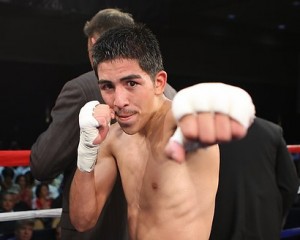
Oscar Valdez
By Norm Frauenheim-
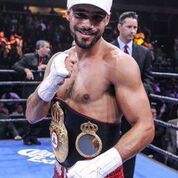
LAS VEGAS – From Salvador Sanchez to Marco Antonio Barrera and Erik Morales, the history of Mexican featherweights reads like royalty. Is Oscar Valdez Jr. next in line? Bob Arum thinks so.

Arum anointed Valdez as a heir apparent Thursday during a news conference for the 25-year-old’s bid for his first major title against Argentina’s Matias Rueda on the undercard of the pay-per-view bout featuring junior-welterweights Terence Crawford and Viktor Postol Saturday night at the MGM Grand.

“The great Mexican featherweights include Morales and Barrera,’’ said Arum. “Juan Manuel Marquez campaigned at featherweight for a while. We believe Oscar Valdez can surpass those legends.’’

Valdez smiled. Might have gulped a little bit, too. It’s great to be mentioned alongside all-time greats. But predicted potential can also be thorns on a burdensome crown.

“I think he exaggerated,’’ said Valdez, whose easy-going streak of humility includes a healthy sense of humor.

Valdez (20-0, 17 KOs) grew up in Tucson and Nogales on the Mexican side of the Arizona border as a kid who idolized Morales. The two-time Mexican Olympian has met Morales. He’s always wanted to be like him. But Valdez has taken his dad’s advice. Oscar Valdez Sr. said he told his son to forget about the comparisons.

“I don’t like to think that way, about Oscar becoming a Mexican idol like Barrera and Morales,’’ said Oscar Valdez Sr., who introduced his son to boxing in Tucson and then moved back to Nogales where he lives and works in real estate today. “I’d like him to go just step-by step.

“I don’t like to think that he’s a big star now, because he’s not. So, I tell him he needs to go, little-by-little. I told my son not to think he’s the big super-star, because he’s not.’’

Father knows best. Valdez has no illusions about the here-and-now, which is the immediate task of facing an unknown, unbeaten Argentine with 23 knockouts in 26 victories for a WBO title vacated by new junior-lightweight champion Vasyl Lomachenko.

“To be compared to Erik Morales means a lot to me, but I ‘ve got a long way to get to what he and Marco Antonio Barrera did,’’ Valdez said. “A long, long way.’’

Valdez said he was surprised to hear Arum say he would surpass his heroes.

“Yeah, it did surprise me,’’ he said. “Of course, it did.’’

Arum’s projection creates bigger expectations for the promising Valdez. But, as Charles Barkley once said, pressure is for tires. Valdez doesn’t seem to feel much, if any. Above all, he appears to enjoy the bigger stakes and heightened attention.

“It puts me on the spot, ‘’ said Valdez, the potential star on an Arizona-accented undercard that includes former junior-welterweight Jose Benavidez Jr. of Phoenix at welterweight against Francisco Santana (24-4-1, 12 KOs) “But it’s good. I never get pressured. I’m very focused on what I do in training. I’m aware of what I’m capable of.’’

Against Rueda, he plans to display some more of those emerging capabilities. Rueda is fighting for only the second time in the United States. He won a bout in Tampa in October, 2015. He’s unknown. Then again, so was fellow Argentine Marcos Maidana before he stunned Victor Ortiz in 2009.

“I’ve seen tapes of him,’’ Valdez said. “Sometimes, he barely hits guys and they fall. So you can tell he has a hard-hitting punch. But I’m ready for him. I’m ready.’’

Ready for Rueda and everything else that might be next, too.
Attachments area


ShoBox poised to celebrate 15-year anniversary

By Norm Frauenheim-
Adam Lopez
Adam Lopez, a former Phoenix super-bantamweight now of San Antonio, hopes to celebrate 15 years of ShoBox with a victory of his own.

The unbeaten Lopez (15-0, 7 KOs) is in the main event for the 15th anniversary of “ShoBox: The New Generation” Friday night (Showtime 10 ET/PT) against Roman Ruben Reynoso (18-1-1, 7 KOs) of Argentina at the Foxwoods Resort Casino in Mashantucket, Conn.

Lopez hopes his career unfolds the way other careers have during the long run of the Showtime series. Deontay Wilder and Andre Ward, to name just two, fought on ShoBox early in their careers.

Lopez is coming off a decision over Mario Munoz for a minor title on Feb. 19 in Atlantic City. Reynoso has won 10 straight.


Deontay “1.7x” Wilder

By Bart Barry-
Deontay Wilder
Saturday at the Bartow Arena in Birmingham the reigning Alabama and PBC heavyweight champion Deontay “Bronze Bomber” Wilder discouraged California’s Chris Arreola to a referee or corner stoppage after the eighth round of a match Arreola took on short notice because he was going to lose anyway after Wilder’s intended opponent anticipated his country’s ban from the Summer Olympics by failing a drug-related IQ test. The PBC on Fox in conjunction with Showtime but not CBS and NBC as part of a synergistic agreement with ESPN, Spike and Fox Sports 1 (though not Fox Now’s buggy app) had the call in the U.S. and apparently much of the broadcast was ad-free.

Though Wilder’s confidence grows with each title defense his precision diminishes more quickly.

Somewhere in the last month or so I read about the virtues of watching television programming at increased speeds. The article grew from an unrelatable foundation like: There’s so much television one simply must watch today and so little time when one considers other necessities like, I suppose, Facebook updates and Snapchats th’t one must utilize technologies to gulp what one’s parents sipped. I neither sip nor gulp from television and so I filed the article under curios and downloaded the Chrome plugin to procrastinate from doing something strenuous as yoga – and if you don’t know what a Chrome plugin is you probably paid three times too much for your laptop. Since then I’ve deactivated my Flash player and casted about for a chance to be amazed by this amazing new technology and none presented itself till Sunday morning.

There’s always something better to do on a Friday or Saturday night than watch PBC matches live because the main reason to watch live sports is to prevent others’ robbing you of the suspense and drama of outcome (unless you’re one of those few honest folks who entertains the collective delusion one’s witness to an event from distance changes the event, which remains probable as it is impossible to prove) and PBC matchmaking delivers both suspense and drama at ratios low enough to be historic. Anyone interested in our sport enough to read this column could run his index finger down the next two years of PBC main events and mark the winner with 95-percent accuracy and Saturday’s mismatch was more mismatched than usual. Where the pessimist drops his head in his hands and gnashes teeth at what’s become of boxing, though, the optimist sees an opportunity to test a wonderful new technology he downloaded sometime in the last month, with a YouTube video of Saturday’s main event.

Pay close attention because a bit of technological dexterity may be needed to decipher the riddle of the next few sentences.

You should not watch a PBC heavyweight match on YouTube at 2x speed because you’ll miss a few of the punches and the Scottish guy on the commentary team sounds muddy more than muddled and while his insights are reliably nil his garbled consonants distract from the action before you at speed. You should try 1.5x; anything less is not worth the trouble of a plugin download and if you’ve not been watching much faster and better prizefighting in lower weightclasses for the past two decades you may find heavyweights moving 50-percent faster than usual a touch too suspenseful. Goldilocks says 1.7x is the perfect rate.

It’s so right and Sunday morning’s 20 minutes were so proper I’ve decided to put the perfect viewing rate of a PBC heavyweight match right in the name of the PBC’s flagship commodity: Deontay “1.7x” Wilder. At the 1.7x rate his Saturday opponent moved like a cruiserweight and even appeared at various intervals to want to fight the man across from him.

There are two reasons Wilder did not stop Arreola in Alabama. The first is Arreola’s sense of pride that trends inversely with his conditioning in a ratio that allowed Arreola to lumber from a fat guy who could box to a trimmer guy who bleeds on cue and absorbs like a paper towel. The second reason is Deontay Wilder is awful at boxing.

According to breathless ringside reports Saturday night Wilder tore his right bicep while punching. Do you have any idea how difficult that is from an orthodox stance? To turn the trick one cannot merely throw a straight punch wildly crooked but also must touch no part of his knuckles to the target at impact. It’s a feat of both technical incompetence and faulty depth perception; if you throw the right hand correctly while being blind in one eye or throw the right hand incorrectly while trusting a third dimension exists, either one, you cannot tear your right bicep while punching and that means you fail in a way Wilder succeeded Saturday.

He succeeded for the right reason at least and that was rage. When Wilder gets another man hurt in front of him he verily loses his mind and while his finishing moves resemble an infant in tantrum more than a predator in the wild he looks dangerous to inexperienced eyes, 9,000 of which showed a patriot’s zeal in Birmingham.

Wilder is a great regional champion, the best heavyweight in Alabama and perhaps the entirety of America’s South, but in a meritocratic world he’s a scalp. Even at age 50 Vitali Klitschko would wear Wilder’s silly bronze mask like a codpiece.

Bart Barry can be reached via Twitter @bartbarry


FOLLOW WILDER – ARREOLA LIVE

Deontay WilderFollow all the action live as Deontay Wilder defends the WBC Heavyweight title against Chris aArreola.  The action begins at 8 PM with a Jr. Middleweight bout between Erickson Lubin taking on Ivan Montero.  The co-feature will pit Sammy Vasquez Jr and Felix Diaz in a welterweight bout.  After Wilder – Arreola, stick around for bonus action as Gerald Washington takes on former world title challenger Ray Austin in a heavyweight bout, former world champion Vic Darchinyan battles Enrique Quevedo in a super bntamweight tilt and welterweights Jamal James and Wale Omotoso do battle.

THE PAGE WILL UPDATE AUTOMATICALLY–NO BROWSER REFRESH NEEDED

12 Rounds–WBC Heavyweight title–Deontay Wilder (36-0, 35 Kos) vs Chris Arreola (36-4-1, 31 Kos)
ROUND 1 2 3 4 5 6 7 8 9 10 11 12 TOTAL
Wilder 10  10 10 10  10  10  10  10 80
Arreola  9  9  9  8  9  9 9 9 71

Round 1 Right from Wilder..

Round 2 Wilder lands a right.  Arreola cut on the nose.

Round 3 Arreola working the body..Chopping right and another right from Wilder..

Round 4 Uppercut from Wilder..BIG COMBINATION AND DOWN GOES ARREOLA..Arreola bleeding from his right eye..Big right rocks and wobbles Arreola

Round 5 Wilder lands a hard jab…left hook..Body shot from Arreola..Uppercut from Wilder

Round 6: Jab from Wilder..

Round 7 Wilder lands a jab…Good right..3 punch combination..right hand..Big right at the bell

Round 8 Nice jab from wilder..3 punch combination..Body shot..Arreola left eye is closing..Left hook…THE FIGHT IS STOPPED IN THE CORNER

8 Rounds Jr. Middleweights–Erickson Lubin (15-0, 11 KOs) vs Ivan Montero (20-1, 8 KOs)
ROUND 1 2 3 4 5 6 7 8 9 10 11 12 TOTAL
Lubin   10  10  10  10  10  10  10  10 80
Montero  9  9  9  9  9  9  9 9 73

Round 1: Lubin working the body

Round 2 Combination and body shot from Montero.  Combination and Body shot from Lubin..Good left..Nice left hook..Over hand left..

Round 3 Lubin working the body…Straight left

Round 4 Jab from Lubin..Body shot…

Round 5 3 body shots from Lubin

Round 6 Good combination from Lubin..2 jabs..right to body

Round 7:  Uppercut from Lubin

Round 8

10 Rounds–Welterweights–Sammy Vasquez Jr.(21-0, 15 KOs)  vs Felix Diaz (17-1, 8 KOs)
ROUND 1 2 3 4 5 6 7 8 9 10 11 12 TOTAL
Vasquez  10  9  9 9  9  9 9 9 9  9 91
Diaz  9 10 10  10  10  10  10  10 10  9 98

Round 1:  Body shot from Vasquez

Round 2  Diaz getting through with a couple lefts

Round 3 Diaz lands a body shot

Round 4 Diaz lands a body shot..Both going ti the body..Good uppercut from Diaz,,

Round 5:  Diaz continuing with the left

Round 6: Vasquez lands a body shot…Straight left by Diaz..Combination

Round 7: Right from Diaz..Good body shot

Round 8:  Vazquez beginning to bleed from his left.  Diaz lands an uppercut…Right Hook

Round 9:  Diaz lands a shot in the corner ..Jab..Good left…Vasquez lands a left

Round 10 Vasquez cut over the right eye..Vasquez lands a left..Vasquez deducted point for spitting out mouthpiece

96-93, and 95-94 twice for Diaz


A Postol victory over Crawford could force Freddie Roach into an awkward corner

By Norm Frauenheim
Freddie Roach
A Viktor Postol victory over Terence Crawford could lead to a Postol-Manny Pacquiao fight and force trainer Freddie Roach to choose between Postol and Pacquiao.

It sounds awkward. But Roach, trainer for both Postol and Pacquiao, says it wouldn’t be.

“It wouldn’t be the worst position in the world,’’ Roach said Thursday during a conference call nine days before the Postol-Crawford junior-welterweight bout July 23 at Las Vegas’ MGM Grand. “I feel like Viktor has done everything to get ready for this fight, to win this fight.’’

“If that does happen, I’ll have to deal with it.’’

The possibility emerged this week amid reports that Pacquiao would fight later this year in his first bout since he was elected to the Filipino Senate a few weeks after his rematch decision over Timothy Bradley in a welterweight bout in April.

Danny Garcia appears to be the leading possibility when — and perhaps if — Pacquiao decides to resume his career. Longtime Pacquiao promoter Bob Arum, who also promotes Crawford and Postol, also said the July 23rd winner could land a shot at the Senator with a spectacular performance.

Postol and Crawford will fight at 140 pounds, which many believe is Pacquiao’s ideal weight.

“If that fight will happen, we’ll then sit down with each team to see how it goes,’’ Top Rank vice-president Carl Moretti said.

Then, Moretti couldn’t resist the chance to deliver a good punch line.

“As far as Freddie goes, it would be great to see him run back-and forth, from corner-to-corner,’’ Moretti joked.

That wouldn’t happen, of course. Roach’s longtime role as Pacquiao’s friend, confidante and corner man dictates that he would be in the Filpino’s corner.

“Me and Manny have been together for 15 years,’’ Roach. “It would be very difficult to go against him, of course. But, you know, I know Viktor is a very good fighter also.’’

If the Postol-Pacquiao happens, Marvin Somodio, Roach’s longtime aide, would probably train Postol.


Who the hell is Isaac Chilemba and why’s he on HBO (again)?

By Bart Barry-
Isaac Chilemba
Sometime soon – or conceivably as you read this – light heavyweight champion Sergey “Krusher” Kovalev will beat up a South African named Isaac Chilemba in a Russian city called Yekaterinburg. HBO will air the mess sometime this evening as part of a yearlong promotional attempt to have Kovalev fight Andre Ward in the network’s one anticipated fight of 2016.

Since now everyone is a promoter anyway . . .

This afternoon the man who calls himself “The Golden Boy” but others know as the Joburg Jo and the Malawi Malcontent, the Gauteng Gatlin Boy and the Terror of Turning Stone, Miguel Isaac Chilemba Zuze, brings his broadfists and rage in a Russian ring with the express purpose of mauling Sergey Kovalev not far from the Soviet Union’s best-known nuclear-waste dump. Frankly the broadcast in broad daylight should be rated R and the reason HBO will not do its tapedelay till after dark. That a network specializing in naked violence and graphical gore like “Game of Thrones” would ultimately flinch at a live broadcast of a boxing match reports to its viewers the unalloyed peril that accompanies Chilemba whenever gauze mounts his knuckles and leather rides his flying fists.

Actually Chilemba is the right man for the job of launching HBO’s one-off MNB series as men returning from second shifts at work will conduct an informal race with Krusher to determine if Kovalev can put Chilemba to sleep before Chilemba snatches the consciousness from HBO’s viewing audience. Such suspense now heralds the Monday arrival of the manly art of self-defense.

The case of Chilemba raises what has become a common question for main events in a way it once was a common question only in undercards and walkouts: Does Chilemba know he is going to lose or will awakening from unconsciousness bring him more than the standard surprise? And if he does know he’s going in the ring as a sacrifice, did he know it before signing the contract or while boarding his flight to Russia or during the weighin that probably happened while this got written?

There was a time so many Mexican taxistas and albañiles staffed the nohoper side of undercards one brought his opera glasses to spot Alfonso Zayas at welterweight or Tun Tun at straw, a time competent matchmakers allowed nary a victor to shuffle from the red corner across a 12-match marquee. After showing valor and a certain whimsical willfulness for a quarter hour this hopeless opponent of the prospect being developed would catch a left hook or right cross flush and drop as if shot then rise to his right knee before the seven count and retain his crouch till the fabled 10 1/2-count at which time he would spring upright and spread his gloves to plead the ref allow his continuance. The referee would make some avuncular gesture or other embracing the lad to tell him neither could conscience his absorbing one more blow. Then the nohoper would do a shameless lap of posture and disbelief before conceding it was not the prospect’s fault and in a show of abiding sportsmanship raise the victor’s taped fist high above both heads.

After a short medical suspension this taxista or albañil would be back on the circuit making enough money to bid zealously on a used pickup truck postfight (my favorite such character was the supremely courteous Genaro “Trancazos” Trazancos who after beginning his career 1-1-1 managed to get himself on television a number of times and fight Miguel Cotto’s older brother and Steven Luevano and Edwin Valero in a three-loss streak that became a curtain-calling 1-11 [10 KOs] close to his career). Such men had no believable chance of prevailing but truly believed they might ring one up and slice the other man just once – since it takes only a punch – and gave honest fighting efforts in a way few of us circumstanced similarly would do. Their job was to ensure a knockout. They were stuntmen who expected to complete the jump but didn’t mind a net stretched just below.

With the advent of the PBC and its quality bending effect there’s no longer any banking on an opponent’s honest effort. Most of the a-siders have adjusted to this and found solace in admonitions to win tonight and look good next time and while that next time never comes it’s not a thing PBC handlers think a biographical video cannot fix. Writing of biographical videos, the only reasonable explanation for HBO’s signing a contract that binds the network to air this farce is a chance to roll viewers towards a Terence Crawford infomercial for a pay-per-view match that mayn’t find its 100,000th viewer in a couple weeks.

Kovalev is a problem for the contemporary nohoper arrangement. He’s a bully-cum-sociopath who derives open joy from torturing lesser men. One might hope performing before a crowd of fellow Russians would leash his psychopathy a teensy-weensy bit until one recalls Kovalev killed Roman Simakov in the very same city five years ago. Kovalev is a loving father now, we’re told, and probably appreciates human life fractionally more than he did then and so Chilemba may well be safe this afternoon.

Therein lies another explanation for boxing’s moribund fanbase: Another main event, an HBO main event no less, finds aficionados fixated on the health and safety of its network-sanctioned opponent.

Bart Barry can be reached via Twitter @bartbarry


Kovalev finds unfamiliar changes in a familiar place

By Norm Frauenheim-
Sergey Kovalev
Sergey Kovalev returns to Russia on July 11 for his first fight in nearly five years with titles and an emerging celebrity he never had or perhaps could have ever envisioned.

Kovalev won his first championship, the WBO ‘s light- heavyweight version, in Wales with a 2013 stoppage of Nathan Cleverly. He defended it for the first time in the French-Canadian town of Quebec City with a knockout of Ismayl Sillah , also in 2013.

The Russian, a first-time champ in Wales with an initial title defense in Canada, gained his first chance at American-style stardom a 2014 upset of an enduring American legend, Bernard Hopkins in Atlantic City.

Therae was a Robin Williams’ line in Moscow on The Hudson, a 1984 film about the defection of a musician in the old Soviet circus during a tour stop in New York.

“Yesterday, I bought my first pair of American shoes,’’ the Williams character wrote in a letter home. “They were made in Italy.’’

In true American fashion, Kovalev is made of a lot of things, many of which are still being discovered in an ongoing story that is moving toward what could be a defining chapter against Andre Ward on Nov. 19 in Las Vegas.

First, however, a few things have to happen and not happen. Kovalev (29-0-1, 19 KOs) has to beat Isaac Chilemba (24-3-2, 10 KOs) in Ekaterinburg, 137 miles from Kovalev’s hometown, Kopeysk, in a bout that HBO will televise, tape-delay (10:15 p.m., ET/PT).

“I must get my victory for my next possible fight,” Kovalev said. “You lose once, everything goes broke.’’

Broke comes with a double meaning. The much-anticipated Ward-Kovalev bout sets up the winner as one of the game’s potential big earners. In a poll featuring boxing’s top earners in 2016, for Fortune magazine this week, Ward is ranked No. 5 and Kovalev No. 6.

Given the decision by Canelo Alvarez–Fortune’s No. 1–to bypass No. 3 Gennady Golovkin until at least next year, Kovalev-Ward looms as the biggie in 2016.

Ward has to uphold his part in the deal on Aug. 6 against Alexander Brand in Oakland. The guess here is that neither Kovalev nor Ward is in much risk of a loss. The bigger threat is an injury that could delay the fight, using it into 2017.

Kovalev, often as bold before a fight as he is dangerous during one, is already promising to do what no one else has.

Chilemba, awkward and mostly unknown, has never been stopped.

“Nobody has ever knocked Chilemba out,’’ Kovalev said. “I want to be the first.’’

Fighting at home for the first time since 2011 might come with some unfamiliar pressure on Kovalev. A hometown crowd might want something spectacular from a newborn star, who has been deadly on the road. Who knows how he’ll react at home?

There’s another element in all the plot lines surrounding the geography. Kovalev will be back in the same arena where his opponent, Roman Sinkov, died after he won by a stoppage.

Since then, Kovalev has said little about the tragedy. The people around him talk about it more than he does. For Kovalev, the job is more about the here –now, the immediate task in front of him.

Nevertheless, the Sinkov death is an unmistakable part of the Kovalev story in each day and every step he takes toward opening bell on Monday. If he wins as expected, he ‘ll have a definitive answer.

Maybe that’s just one reason he has gone home. Unresolved questions are a little bit like unfinished fights. They have to be confronted and Kovalev has yet to back away from one in a lifetime full of traveling from one confrontation to the next.


Things to do on Independence Day weekend instead of writing a boxing column

By Bart Barry-
boxing-ring-1024x690
SAN ANTONIO – There’s a coffeehouse and bar concept called Halcyon in the south-downtown part of this city called Southtown and what brought me here the first time years ago were the make-your-own open-flame s’mores they bravely serve under the paintings local artists hang for-sale on their walls. What brought me here this afternoon was the eclectic crowd that assembles on Sundays and Mondays. If this column is about boxing at all its author’ll be surprised.

There’s a finch nest tattered in the corner above the window that reflects beside my seat. The nest hung there a month or so and by design was unnoticeable unless you were seated directly beneath it when an occupant flew home or you were an airborne predator and in the second case it was still necessarily unnoticeable. The nest came apart a half hour ago when the wind took the dominant strand away and the unraveling accelerated to disorder. The occupants returned a few minutes ago, a couple – not unlike the folks who just sat across from me on a couch fractionally comfortable as it looks and we’ll see how long they endure it. The finches have no apparent memory how was the nest when they departed but recognized instantly the place they alighted on is uninhabitable currently but shows potential as a home with some repairs – a fixerupper possibly in foreclosure. They set off fusslessly on their task and collect from the ground a blessedly large collection of twigs – what good fortune, this! – that is their former nest unbeknownst to them.

The lass across from me is attractive but covered in tattoos each with a story and pretty clearly in the throes of a tinder date with a douchebag of sorts who nonetheless satisfies the Texas female’s one mating requirement: He is tall. He’s whispering to her about me and it raises an interesting question for any writer: Did he know I thought this about him before I read what I’d written and realized I thought this about him because I didn’t realize I’d noticed him so much as the finches, much less like a competitor, till the beginning of this runon sentence? They’re giggling girlishly now (about my hat probably) and it brings to mind the timeless wisdom of Sir Mix-A-Lot: “I’m a giggle wit’em, ‘cause I wanna get wit’em.”

It’s later than usual and that keeps the brunch crowd from occupying too many tables and it makes the mix in Halcyon right now quite good – modellish women, bearded men, students, lesbians, a few toddler siblings dressed in matching purple outfits by their conscientious mom. The temperature is rising unfortunately because there’s only so much of the good fight any establishment might wage against the summer suffocation of South Texas and if the cooling system kept things below 75 when the place was 1/3 full it’s got no chance against the arrival of the second- and third-third. Its initial emptiness signed departed South Texans, our townsfolk off and enjoying the holiday elsewhere, and much as one hoped the city removed itself to Calgary or Montreal to enjoy rejuvenating climes the greater likelihood is folks who’d otherwise be here brunching were instead floating inebriatedly southwards on one of our many waterways.

Even a year ago I might’ve glanced at a boxing calendar on some site or other before writing a column about not writing a boxing column but it didn’t cross my mind last night when the idea for this column scurried on in. That marks its own demarcation of an extraordinary sort: There was a time I started worrying about my next column Tuesday morning and chastised myself openly if Wednesday evening didn’t bring a workable plan. While I haven’t quite drawn a bead on what my more honorable and mechanical self of 2005 should’ve opined about the writer I am now I suspect he’d have been amused – an appreciation of absurdity being the one thing that held constant in the boiling variable stew of this last decade. Or so I hope.

A good column in a good paper this morning returned me to a months-old pledge to read more Rudyard Kipling and so I enjoyed “The Drums of the Fore and Aft” before going to Central Library, this city’s colorful architectural event that comprises a Botero sculpture in the front atrium and Chihuly glass in its middle. There was a time a tale of cowardice and redemptive courage such as Kipling’s on a Sunday morning would’ve won a tangential inclusion in the week’s column. Instead its allusion here is direct and freely unrelated. Read Kipling because he’s imaginative and not in order to learn something.

Funnily enough the working title for this column was to be “Planning a trip to Johannesburg instead of writing a column” – as planning was what I’d planned to be do doing – but thoughts of a short and wonderfully cheap flight to Cape Town midway through a two-week stay in South Africa seemed unacceptably premeditated when set below all that preceded. It’s something like intuition the way these destinations get chosen or a feeling assembled preconsciously of sounds and images and promised delight from Dublin to Barcelona to Bogota to Joburg.

And now I’m going to mention the young lady who replaced the tall-n-tatted couple on the lima-green sofa, in a faded midnight-blue blouse with upsidedown pink elephants marching between paisleys because I just imagined a conversation with her in which I’d tell her I’m writing about the rebuilding birds’ nest reassembling above us in lieu of writing about boxing and after a 20-minute soliloquy about creative process at the end of which she’d say in exasperation she was overdue at her boyfriend’s or girlfriend’s place I’d tell her to check this column the next morning and see if I was joking when I said I’d mention her.

Bart Barry can be reached via Twitter @bartbarry


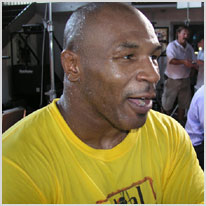
Happy 50th: Mike Tyson celebrates birthday few thought he’d ever see

By Norm Frauenheim
miketyson
The birthday was a long shot. Few guessed it would ever happen. Mike Tyson is 50. Buster Douglas probably faced smaller odds when, as a 42-to-1 underdog, he beat Tyson more than a quarter of a century ago.

Tyson’s milestone, instead of an early headstone, came and went Thursday amid some headlines, but none of the deafening craziness that defined him for so long.

That’s an upset. Tyson’s biggest victory, too.

In doing a cover story on Tyson for The Ring in 2014, he told me: “Let’s be men about this. Be honest. You didn’t think we’d be talking to each other like we are right now. Did you? Come on now, be real. You thought I’d be dead, right? Hey, I thought I’d be dead.’’

Tyson survived — survived prison, drugs, booze, outrage from the infamous bite he took out of Evander Holyfield’s ear and all the rest – because he learned how to deal with the personal demons, who once outnumbered the crowd in his entourage. How did he do it? He grew up.

It sounds simple enough. But it wasn’t, especially for a kid from the streets of Brooklyn’s Brownsville neighborhood who won the world heavyweight title faster than anyone in the fabled division’s history. He was 20, which is another way of saying he just wasn’t ready for worldwide attention and unprecedented money.

“There ain’t no future in my past,’’ he told me in 2014.
He began to figure to figure that out after the past landed him at rock bottom. He was virtually finished as a fighter when he arrived in Phoenix in the fall of 1998, searching for a way to resurrect his career after the infamous Bite Fight disqualification at Las Vegas’ MGM Grand in 1997. He was in Arizona for counseling and to train at an old gym that the city was about to demolish.

Central Boxing was scheduled for the wrecking ball when Tyson decided he wanted to train there in beat-up building without air-conditioning. There’s AC there, now. But Tyson liked it for the hot box it was. Within its old walls, temps could hit 130 degrees during summer days in the Arizona desert.

Tyson saved the gym. It’s still there, near the state capitol and with AC. But nothing could save his career, which Holyfield effectively ended by stripping him of the intimidation that defeated so many frightened opponents before opening bell. After moving to Phoenix, he fought 10 times, winning five, losing three and getting no-contest in two. But he scared no one any more, other than himself.

It was that period in Tyson’s life when he used talk, often ad nauseam, about what a waste it had been. Again and again, he said he was sick and tired of boxing. He knew he didn’t want to be in the ring anymore, but he was because of a tax bill and other financial responsibilities.

When I first met him as a reporter for The Arizona Republic newspaper, I was cautious, fearful perhaps that he’d go off on a rant and take a piece of my ear. I’d stop at Central and he’d look through me as if he had never seen me. Then, there were times he welcomed me like an old boyhood friend. He just wanted to talk and he would, almost non-stop.

After one workout, I told him I had to leave. He followed me out into the mid-summer heat and to my truck. I opened the door and Tyson dropped his heavy right hand on my left elbow. I felt a hint of the power that frightened the heavyweight division for so long.

With one quick yank, he could have pulled my arm right out of its shoulder socket. I froze. Tyson talked. I listened.

It was then I realized Tyson was mostly afraid of himself, especially when he knew he was finished as a fighter. What was next for somebody who knew nothing else? He talked then, and continued to talk for another couple of years, as though he was trying to exorcise the demons. I was skeptical that he ever could. But he did, confronting tragedy when a 4-year-old daughter, Exodus, died in an accident on treadmill in Phoenix in 2009.

The tragedy helped forge the man. He would be back in Phoenix to visit ailing Muhammad Ali before Ali’s death on June 3. A week later, Tyson was a pallbearer for Ali’s funeral in Louisville.

Tyson was there to honor Ali. It was a sad moment, a reason to grieve, yet also fitting in terms of a heavyweight history full of champions, each different and yet each linked by what they did and how they did it.

Happy Birthday, champ.


Good if not quite timeless: One Time decisions Showtime

By Bart Barry-
Keith Thurman
Saturday in Brooklyn, Florida welterweight Keith “One Time” Thurman hit Ohio’s “Showtime” Shawn Porter many many times and all over though not too often on the chin and beat him by three fair scores of 115-113. Social media reacted with uncharacteristic sobriety to a match Showtime-on-CBS-presented-by-PBC commentary mistook for a historic war from opening bell to closing after promising a historic war over and over and over.

The match was better than expected and about a third what viewers heard it was from the PBC’s circusbarking play-by-play dude. Somewhere in his relentless drumbeat of historic punchstat figures and legendary power this contradiction became obvious in a way best posed like a question: How come Mike Tyson never set any activity records in his heyday?

Television, mankind’s greatest yet enthusiasm-dissemination device, embraces then amplifies emotions as they arise, picking them up and setting them down instant by instant, and therefore no conflict registered to Saturday’s on-air lunacy. But here it is in a plainspoken way television can’t do: If Keith Thurman hits so damn hard, how come 200 chops with the Thurman axe didn’t dent much less fell the Porter tree? How come a Sunday morning camaraderie pic of Thurman and Porter saw Porter looking so clean, safe and sane?

Because Porter has a legendary chin! Sure, right, whatever; legends don’t get dropped by clowns like Adrien Broner and Porter did.

Great acts of combat inspire great prose.

“They both appeared exhausted in the final round but let it all hang out,” wrote ESPN’s Dan Rafael.

“With the kind of tremendous action they created in the ring, a rematch is a no-brainer and an easy sell,” wrote USA Today’s Mike Coppinger.

Porter was what his supporters believed he was and Thurman was a bit less. Like every other volume puncher in history Porter erred with his chin over his front knee, too anxious to impose himself and consequently wide open to counter uppercuts. Thurman landed a few and more of other counters like his left hook but often Thurman was in such frantic and tanglefooted retreat the punches did not measure on Porter’s chin the way they attacked PBC viewers’ ears.

Congratulations of a sort for that: The missing component of television broadcasts has long been its flattening audio that makes all punches sound the same. PBC raced directly past that issue in a wide circle that now has every punch sounding much louder and the same.

It is easy to call Porter a fun fighter without calling him or Saturday’s match legendary and probably advisable too. Being anywhere but Brooklyn for a columnist had the advantage of being far from the event’s boorish puppet-promoter sweating and screaming across press row about the quality of his product. Porter combines athleticism, desire, and yes, intelligence the way young Timothy Bradley and Juan Diaz did. He is aware of his limitations in a way his opponents are not; volume guys do not fear violence or exhaustion or ridicule the way they shudder at others’ right uppercuts but it takes a Juan Manuel Marquez – much more than a Keith Thurman – to plant and hold steady with a wildman racing your way. Porter’s jab wasn’t merely the decoy it appeared but wasn’t much more than that either. When the two men jabbed together Porter’s jab was often the first arriver but no credible source ever said Thurman had a great jab.

What Thurman has is a right hand and sometimes a left hook but it’s been so long since he fought an opponent bad enough to make him look invincible it’s admittedly hard to recall what made us so excited about him years ago but speed and intensity are good places as any to look. Or perhaps it was our delirious search to find some welterweight who might ice Floyd Mayweather that made us see in Thurman more than was there. Whatever images once danced in our heads Thurman’s footwork today rates, on a scale of novice-to-master, about: Amir Khan + 1.

Porter was able to jab him out of position and spin him fairly easily because, whatever postfight allusions Thurman concocted about Muhammad Ali (who as an aside gave away opening rounds in order to knock George Foreman out, not decision him narrowly) Thurman’s feet rarely anchored his body properly. His vaunted power, which took precious little fight out of Porter, relied heavily on Porter’s aggressiveness and Porter delivered that aggressiveness, swinging and missing ferally and fairly often(ly), but Thurman was out of position or in-position and retreating at the time of Porter’s arrivals mostly. A generation raised to confuse wide circles and wasted effort with great defense surely saw in Thurman’s tactics something like genius but not the rest of us. Better put: In 36 minutes of what horizontal ferocity snaps heavybags from gym ceilings vertically Thurman didn’t once show Porter as much conviction or technique or effect as “About Billions” did.

Still, Thurman-Porter 1 was dramatic throughout and suspenseful occasionally. Let us see an immediate rematch. According to their Sunday pic neither guy was ruined by Saturday’s match and according to previous box-office receipts neither guy is popular enough to spend another year starching novices. Provided the check clears this week CBS should agree to air the rematch in December, too – maybe even at a discount.

Bart Barry can be reached via Twitter @bartbarry


FOLLOW THURMAN – PORTER LIVE FROM RINGSIDE

Thurman_Porter weigh in

Follow all the action live from ringside as Keith Thurman defends the WBA Welterweight championship against former IBF champion Shaw Porter.  The action begins at 9 PM ET / 6 PM PT with a battle of welterweights Jarrett Hurd & Oscar Molina.

NO BROWSER REFRESH NEEDED

12 Rounds–WBA Welterweight title–Keith Thurman (26-0, 22 KO’s) vs Shawn Porter (26-1-1, 16 KO’s)
ROUND 1 2 3 4 5 6 7 8 9 10 11 12 TOTAL
Thurman 10  9 9  10  10 9  9  9 9  10  10 10  114
Porter  9 10 10  9  9  10  10  10  10 9  10  9  115

Round 1: Left from Thurman…counter right..right,,,left to body…

Round 2: Right from Porter..rights and left from Porter on the ropes…left…Porter smothering Thurman on the ropes and landinginside left..

Round 3: Left from Thurman..right from Porter..Good right from Porter…Hard right and left from Thurman..Porter comes back with a flush right and left..

Round 4:  right to top of head by Thurman..left..left..Left from Porter..Trading big shots…left hurts Thurman…

Round 5:  Tremendous exchange…Jab from Porter..Body shot from Thurman..Both land good rights..

Round 6: Jab from Porter…right over the top..Porter applying a lot of pressure..Counter right from Thurman..right over top from Porter…

Round 7: Left from Porter…inside left from Thurman..Left from Porter..Good right from Thurman..Hard right from Porter..

Round 8:  Combo from Thurman…Hard left to the body hurts Thurman..Uppercut on inside..right,,,

Round 9: Right from Thurman…left to body…Big combination from Porter..Thurman is cut over left eye..Great exchange on the ropes..Left from Porter..Cut caued from Headbutt

Round 10:  Big right from Thurman..right…good exchange on ropes..left from Porter…Left buckles Porter,,,another exchange in the corner..

Round 11:  left from Thurman…Right to body from Porter..

Round 12:  Right from Thurman..Left..

115-113 on all cards…AND STILL WBA WELTERWEIGHT CHAMPION, KEITH THURMAN

10-rounds-Jr. Middleweights–Jarrett Hurd (17-0, 11 KO’s) vs Oscar Molina (13-0-1, 10 KO’s)
ROUND 1 2 3 4 5 6 7 8 9 10 11 12 TOTAL
Hurd 10 10 10  9  10  10  9 10  10  TKO  88
Molina  8 9  9  10  9  9  10  9  9  82

Round 1:  Hurd jabbing to the body..Molina digging with the left..left to head..left from Hurd…BIG RIGHT UPPERCUT AND DOWN GOES MOLINA..

Round 2: Hurd lands a left to the body

Round 3: Jab from Hurd…triple jab..left uppercut…Left hook to head from Molina…Jab to body from Hurd..

Round 4:  Right from Hurd…Molina lands a counter right…left to body..right to body from Hurd..uppercut from Molina…trading left hooks..right to body from Molina…

Round 5:  left to body from Hurd…left to body from Molina…left to head…right from Hurd…right on insde…flicking right and left…left from Molina

Round 6: Right from Hurd drives Molina back…left on inside…uppercut and right…hard right uppercut…

Round 7:  Left from Molina..hard right from Hurd…Hard left hook from Molina..right…left from Hurd

Round 8: Combination from Hurd..Hurd working inside..Jab..hard counter right…right..big right

Round 9:  Right and left from Hurd…1-2 from Molina..Jab from Hurd…Good work by both fighters..Good right from Hurd…

Round 10:  Hurd shoves Molina to canvas…Right from Molina…left and right from Hurd..Hurd pounding the body..Counter right from Molina..3 SHOTS TO THE HEAD THE FIGHT IS STOPPED FOR HURD


FOLLOW JOSHUA – BREAZEALE LIVE

Joshua_Breazeale Weigh in

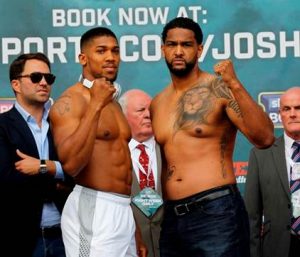
Follow all the action as Anthony Joshua defends the IBF Heavyweight title against Dominic Breazeale in a battle of undefeated former Olympians.  The action begins at 5:15 ET / 2:15 PT and 10:15 PM in England

BROWSER WILL REFRESH AUTOMATICALLY


ANTHONY JOSHUA VS DOMINIC BREAZELE–12 ROUNDS IBF HEAVYWEIGHT TITLE
ROUND 1 2 3 4 5 6 7 8 9 10 11 12 TOTAL
Joshua   10 10 10  10 10  10 60
Breazeale 9  9 9  9 9  9 54

Round 1: Joshua lands a 3 punch cobination

Round 2:  Upercut and right rock Brezaele

Round 3:  Joshua showing good hand speed.  Brezeale taking shots well.

Round 4:  Joshua lands a big uppercut

Round 5:  Breazeale right eye beginning to swell.

Round 6:  Joshua teeing off on the bad eye of Breazeale

Round 7: Joshua lands a hard right..FOLOW UP COMBINATION DROPS BREAZEALE.    JOSHUA LANDS A HARD LEFT HOOK..3 MORE PUNCHES DOWN GOES BREZEALE AGAIN AND THE FIGHT STOPPED


Thurman-Porter: Trying for enthusiasm

By Bart Barry-
Keith Thurman
Saturday in Brooklyn in what remains of an anticipated title match for an expiring sport Ohio welterweight “Showtime” Shawn Porter will square up with Florida’s Keith “One Time” Thurman in a match that figures to disappoint what exaggerated expectations desperate aficionados have affixed to it. This will be yet another chance and in all probability one of the last for PBC to captivate a nationwide audience and win new fans to its brand of boxing.

Thurman and Porter have nearly identical records and nearly identical stretches of inactivity, and while that sort of thing once may have marinated things richly today it does little more than serve as a reminder of the incompetence with which they’ve been handled. Their manager/promoter group, once the brainchild of a visionary and rapidly becoming what kids these days call a cautionary tale, has taken whatever whitehot enthusiasm ever existed for either of these fighters and doused it to soggy.

Thurman, a charismatic action fighter whom an accomplished promoter like Bob Arum might’ve made an international heartthrob, is now a joke of sorts. He has steadily lost others’ esteem even while not losing a match. Wait, when did I last see him fighting? – you probably wonder. In a July homecoming fiasco that saw Luis Collazo wave off his own bout to ensure the PBC darling got another w and Collazo got his name engraved on the PBC Employee of the Month plaque hanging above a headquarters restroom with what majesty GoPros hang off PBC-referee headbands.

Is that too irreverent? Then let us acknowledge the irreverence as a reflective surface off which bounces former aficionados’ disgust with what has become of their, our, oncebeloved sport.

Nothing holds constant in this game. That is the lesson of what has happened to a sport that was passably popular if not thriving just five years ago. No, folks round the proverbial watercooler were not fluttering their tongues about prizefighting but those who cared about the sport had four or five annual events worth traveling to, incredible happenings in no way tarnished by others’ absent interest. That is gone now. Quickly as the quality of combat deteriorated the reverence for sanctioned combat accelerated directly past it. Boxing attracts misanthropes and was long vulnerable to its supporters’ routine sneers. What it collects now is fulltime indifference occasionally interrupted by derision. People, often former readers, now ask boxing writers what sort of writing we’re doing these days, convinced it couldn’t be boxing and too uninterested to find our URLs in the forgotten Boxing folder of their Favorites bar.

Do Porter and Thurman deserve the blame for all that? Of course not, but their manager and promotional network deserves a halfshare.

Thurman postponed the match, too, helping folks to assume someway it would not happen. But that postponement should not undo our memories; if this fight had happened when it was scheduled to go off, the gap in both men’s careers still would’ve been unacceptable: Sugar Ray Leonard and Thomas Hearns, two fighters whose first match in 1981 remains the standard against which all welterweight tilts are measured 35 years later, each fought less than three months before their championship match – a true superfight.

This is what that has come to: Both Thurman and Porter went in tough about a year ago, Porter barely surviving Adrien Broner and Thurman needing Collazo’s selfejection to remain undefeated. Neither Leonard nor Hearns would’ve needed more than five rounds to obliterate either Collazo or Broner (or Thurman or Porter), and both men would’ve fought again round Labor Day having done so. With the collective departure of Mayweather and Pacquiao, Thurman and Porter are two of the world’s three best welterweights and considered the benevolent PBC god’s reply to years of aficionados’ futile prayers.

The worst part is the fight won’t be great and likely not entertaining either. Porter, for all his ferocity, just isn’t very good. He’s a boxing-is-bodybuilding sort whose physique anticipates a concusiveness well subverted by his technique. But what musculature!

Whatever we thought Thurman was three or four years ago he hasn’t been very much of it in recent fights. If your talent or tactics see you grinding out a lame decision against a 40-year-old Leonard Bundu, you’re probably not going to go HAM on someone with 16 career knockouts. Expect a keepaway effort from Thurman, while the announcing team drills and exercises about courage and nonstop whatever.

It will be sanitized, too, whatever else it is. PBC boxing feels far too safe to keep serious fans or attract casual ones. It is Mayweather’s brand of violence without Mayweather’s brand of promotion. It is men behaving like gentlemen in press conferences and amateur boxers in the ring, concerned with points and safety and so forth more than violence or pain or willfulness.

I’ll take Thurman by dull decision, in a match social media, queued by PBC commentary, initially mistakes for a historic war.

Bart Barry can be reached via Twitter @bartbarry


The Fight Goes On: Remembering Ali means legacy is more than a T-shirt

By Norm Frauenheim-
Muhammad Ali
Legacy is for sale these days. Bottle it, slice it up into parcels, package it, label it with an acronym and sell, sell, sell it on caps and T-Shirts. Just dial 1-800-LEG-ENDS, and you can have one too.

It’s become a cliché, mouthed in locker rooms, gyms and studios so often as to become meaningless. But Muhammad Ali’s death re-defined it for what it really is. Legacy ain’t cheap.

In fact, it can’t be bought at all, at not least in the dollars that these days seem to serve as the final arbiter of what and who has value. Of what and who doesn’t.

It took Ali’s death on June 3 and an extraordinary funeral on June 10 in hometown Louisville to remind us of that. This is not meant to be another eulogy of who he was and what he means. How history looks at him will change and evolve from generation to generation.

In the here-and-now, however, Ali’s singular place as a heavyweight champion and a cultural icon serves as an example of what boxing has been, can still be, yet isn’t because of a business model gone awry.

The worldwide reaction to Ali’s passing is a sure sign that there is still a global fascination with boxing. I know, I know. Media and corporate elites uncomfortable with the sport’s inherent brutality say Ali was bigger than boxing. But he would have been just another gasbag if not for a ring that allowed him amplify his fearless nature.

Fifty years from now, I’m willing to bet he won’t be remembered for pictures alongside Malcolm X or of him being escorted out of a federal building in Houston after saying no to the Army’s draft at the height of the Viet Nam war. It’ll be that Neil Leifer photo of him posing over a fallen Sonny Liston.

That was Ali in a snapshot.

It sums up the fighter and personality who didn’t calculate his career and life in terms of the risk-to-reward ratio, an equation built to enhance the money while eliminating the chance of defeat.

He took the risk. Paid for it too, in a brutal 1975 victory over Joe Frazier in a second rematch and a 1974 victory over George Foreman in a fight famous for the rope-a-dope. Ali exhausted Foreman by absorbing punches that make you wonder whether one night’s tactic led to the Parkinson’s discovered a decade later.

Parkinson’s terrible symptoms were what subsequent generations of fighters would see and many would avoid.

At the same, time, the best of those generations would always strive to achieve what Ali had in his legacy-defining career. The unusual twist is that Ali never talked about legacy during his battles with Liston, Frazier and Foreman. Who did? It could have been a brand of cologne for all he or anybody else knew.

It became a part of every fighter’s vocabulary because of Floyd Mayweather, Jr., who has said he surpassed Ali. TBE – The Best Ever, Mayweather calls himself, mostly because he is unbeaten (49-0) and Ali wasn’t (56-5). The TBE acronym is on shirts and caps in every size. Just try one on. No legacy is too small or too big.

But this off-the-rack legacy cheapens what Ali did and, in turn, has turned off most of those in the global congregation that mourned his passing.

Mayweather’s real legacy is money. Nobody in any sport has ever earned as much. Maybe, TBE means The Biggest Earner, because that’s what Mayweather is and will be for awhile, if reports of his $240 million for a victory over Manny Pacquiao in May, 2015 are accurate.

In today’s dollars, Ali’s $6 million for his ‘75 victory over Frazier would be about $27 million. Very big money, but just a few more Bugatis in Mayweather’s garage.

Mayweather, a terrific boxer and a better businessman, turned Ali’s legacy into a calculation that enriched him, yet left the rest of the business scrambling in the wake of his victory over Pacquiao.

On-and-off negotiations for Mayweather-Pacquiao inflamed the public’s imagination for years. It’s no coincidence that the global appetite for boxing, dormant for so long, suddenly came alive in anticipation of a bout some thought would be the second coming of Ali-Frazier.

That didn’t happen. Not much of anything happened, other than the consequences. That’s no secret in an ongoing decline reflected in crashing PPV numbers – a reported 400,000 to 500,000 for Pacquiao’s rematch victory over Timothy Bradley in April and 450,000 to 600,000 for Canelo Alvarez’ knockout of Amir Khan in May.

That’s not a legacy anybody would want

In the weeks after Ali’s death, boxing starts over. It’s no coincidence that he will be mentioned often. That will begin June 25 for Keith Thurman-versus-Shawn-Porter in a CBS-televised welterweight bout at Brooklyn’s Barclays Center.

It will be the first time CBS has televised boxing in primetime since Leon Spinks upset Ali on Feb 2, 1978. Appropriately enough perhaps, it set the stage for another of Ali’s trademark comebacks – a decision over Spinks – the following September for his third heavyweight title.

“With the return of boxing to CBS Primetime, we’ve got big shoes to fill,’’ Stephen Espinoza of Showtime, a CBS subsidiary, said during a conference call this week. “It took something very special for CBS to step back in, and that’s exactly what we have.’’

Call it a moment, a chance, to remind a lost generation of fans that legacy is more than a T-shirt.


Interview with San Fernando Gymnasium

By Bart Barry
boxing-ring-1024x690
Originally conducted for the San Antonio Historic Preservation Society in 2012, this interview is reprinted with the gymnasium’s permission.

BB: I sure appreciate your getting together to do this chat with me. It’s an odd request, I admit.

SF: Not a problem. Surprises me more people don’t ask. This isn’t going to be a podcast?

BB: No, this is for print.

SF: Obscurity does not offend me.

BB: You began as a bowling alley, correct?

SF: In part. The apartments (Soap Works, today) round me were all part of a campus. We were a Catholic school, and I its gymnasium. The legend is another thing.

BB: Of the church or the saint?

SF: The church. I don’t know much about my namesake. We feel our influences but don’t know our fathers too well. What I know comes from construction chatter as the walls went up.

BB: Before we began, you mentioned being a young edifice in an old city is a different experience from being a young edifice in a young city. These things are relative, too. But what informs your thinking of one city being older than another?

SF: Friendliness. I notice it when there’s a tournament upstairs or down. People come from younger cities. They’re used to bending edifices which way they want. They’re gentler to the walls, harsher to the regulars and staff. Things break all over me after big tournaments. Always with the water. They talk faster. They talk about making a difference to their sons or the generation after that. That’s young-city talk.

BB: That’s not refreshing in some sense?

SF: In no sense. If they get their way, I get torn down, made into more hospital parking or another hotel in –

BB: But you recognize the value of touri –

SF: Some of the buildings I admire most are hotels and hospitals, yes.

BB: As someone who moves around on your mats –

SF: (Smiling) I’ve seen you.

BB: Figuratively speaking, then, as someone who moves around on your mats, there’s a unique, almost hollow feeling. There’s not concrete on –

SF: There’s concrete down here, but you don’t want to touch it.

BB: It’s wooded-over, then?

SF: Yes, exactly. I began as a bowling alley. Some of the wood rotted. It’s been a half century. Those were fun times. Made quite a racket. The buzzer is not torturous as the candlepins were noise-wise. But it’s worse in its way.

BB: Not volume?

SF: Not at all. It’s soft and tinny by comparison.

BB: Then?

SF: My concept of time is decades. It’s hard for me to imagine increments less. Like y’all with millimeters –

BB: Milliseconds?

SF: Yes. I prefer metric. The buzzer goes off so often, so many times, and it builds this terrible anticipation. Like waiting for the next water to drop on your forehead. Relief comes when the damn thing gets turned off at night.

BB: Speaking of which, you’re well preserved in part because of how little time you’re actually open these days. You get mornings off.

SF: That is true. I do enjoy a lighter schedule. It began round 1980, six years after the Close Call.

BB: When they were going to raze you?

SF: Pretty euphemism.

BB: How close did you come?

SF: Well. They had demolition guys walking round. You think they do that at Monticello?

BB: How the hell do you know –

SF: Be surprised the things one picks up.

BB: Basketball game?

SF: Roller derby. They began coming on Tuesday nights some years ago. Then there’s the basketball people. And you guys in the ring below.

BB: Ever have any famous roller-derby participants?

SF: Any what?

BB: How about basketball players?

SF: Doubtful.

BB: Boxers?

SF: Plenty.

BB: How can you tell?

SF: It’s a congregation thing. There’s a way men and women upstairs look at certain players. It’s an admiration, like they’re watching while they imagine themselves being those persons. Then there are the looks sometimes downstairs. It’s a look of incredulousness. It’s the look persons give to persons they did not think they would ever see in front of them.

BB: It’d help this exercise a lot if you remembered any names.

SF: Julio Cesar Chavez, Mike Tyson, Danny Lopez, Jack Johnson, Oscar De La Hoya, Evander Holyfield, Salvador Sanchez.

BB: Those guys have all been here?

SF: Except Jack Johnson. Made that one up.

BB: He was from Texas at least.

SF: Like me.

BB: I’ve read there’s a rule every building grows. But you seem not to have grown.

SF: Inside, some, but no, not outside. They’ve updated bathrooms and put on coats of paint. The lockers and shower downstairs, those weren’t with me before. There are walls inside, concrete. The materials are cheaper inside than out. Because of that infernal heater, I guess.

BB: It’s the only part of you I hate. Who the hell installs an industrial heater in steamy South Texas?

SF: The crazy Portuguese, that’s who!

BB: Joe Souza?

SF: Yes. He did all my interior decorating, too. Such as it is.

BB: These are his fight posters?

SF: All of them. They say his family wants them. The Parks & Rec guys will probably paint me again once they’re gone.

BB: How long have you been city property?

SF: 1974.

BB: Does it bother you?

SF: Not like it did. We are not all destined to be museums, coddled and soft, temperature-controlled this and that. There’s the historic-preservation people, too. Seeing y’all makes me hopeful. It means if someone decides to buy me from the city, which I do not expect to happen, these people will not be able to tear me down.

BB: That’s good.

Bart Barry can be reached via Twitter @bartbarry


Ali: In the end, still fearless and always ready

By Norm Frauenheim–
Muhammad Ali
Muhammad Ali’s journey, 74 years long, ends Friday where it started. The world that worshipped him will gather in the city where he was born. Heads of state, old rivals, actors, rappers, preachers, priests, promoters, poets and punchers are in Louisville for the Funeral of the Century.

Ali, who lost to Joe Frazier in the Fight of the Century 45 years ago, planned it. He’d give the eulogy if he could, but not even The Greatest could manage that. He’ll have to let former President Bill Clinton speak for him. He’ll have to let the crowd cry, cheer and chant his name.

Ali Bomaye! Ali Bomaye!

That was the African chant before, during and after his 1974 stoppage of George Foreman in what was then Zaire. Listen for that and for the butterfly, the bee and everything else on the sound track that helped define the young Ali, who once said he was so mean he’d make medicine sick.

He’ll be remembered for all the crazy words. For Foreman, Frazier and Sonny Liston, too. For Malcolm X. For refusing to serve in the U.S. Army because of his opposition to the Viet Nam War. For changing his own name, too. Born Jan 17, 1942 as Cassius Marcellus Clay in Louisville, he returns to the Kentucky city with the Muslim name that will never be forgotten.

He might not have been history’s greatest fighter, a spot that belongs to Sugar Ray Robinson. He might not even have been the greatest heavyweight. Joe Louis probably hit a little harder and didn’t let his hands drop in a way that left Ali perilously open, leaving only his durable chin as a defense.

Only Ali would take punches from the powerful Foreman and label the tactic as rope-a-dope. It was risky and unexpected. But Ali did it, exhausting Foreman in a bout that makes you wonder whether it was factor in the terrible disease that would befall him a decade later. Ali couldn’t exhaust Parkinson’s, but he fought it – day-to-day, hour-to-hour – with quiet dignity for 32 years before he died in Scottsdale, Ariz., last Friday at 9:10 p.m. (PST).

I’m not sure how I’ll remember him. As an Army beat living in faraway bases, I had my ear pressed against my dad’s radio to hear what ever I could above the static of the blow-by blow accounts of his victories over Liston.

As a young sportswriter in Florida, I watched the back-and-white telecasts of his 1971 loss to Frazier at a closed circuit venue. I went to a crowded movie theater to see him beat Frazier in their first rematch. Then, I saw him beat Foreman and Frazier again in Manila, all in grainy-and-gritty black-and-white.

It wasn’t long before I moved to Phoenix. My interest in boxing was still there and had peaked with eventual Hall of Famer Michael Carbajal, whom I began to cover at the 1988 Olympics.

Then one day in 2005, I looked up and saw Ali standing in front of me at halftime of a Phoenix Suns game. We shook hands, yet said very little. I wasn’t sure whether Parkinson’s had yet robbed Ali of his speech. I soon found out that it had not. He grabbed me from behind and whispered in my ear.

“You sure are uglyyyyyy,’’ he said.

Surprised, I turned and looked into dancing eyes full of playful mischief. On other encounters, there were the familiar magic tricks.

Then, there was an afternoon in downtown Phoenix about eight years ago. I sat next to him at a Diamondbacks game. He grabbed my notebook and pen. Fifteen minutes later, he gave them back.

On a page in the notebook, there’s a sketch, a stick figure walking toward a leafless tree that seems to be on the edge of a faraway canyon. I wasn’t sure what to think of it then. But I looked at it again this week while thinking of Ali’s death and his funeral Friday. Ali was looking at the uncertainty of the end he knew was coming.

He did the only thing he could do. He got ready.


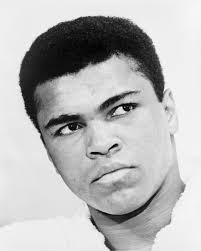
The obligatory: Muhammad Ali, 1942 – 2016

By Bart Barry-
Muhammad Ali
Muhammad Ali died Friday evening at the age of 74. His death was long anticipated by those who follow our sport and know the ruinous effect it visits on each of its professional practitioners. Round the world Saturday persons instantly and for the most part sincerely began to mourn a man most had not thought about in decades, reliably imparting how much larger Ali was than his and our sport.

The happiest benefit of writing for a site like this, a boutique affair designed for aficionados, is the relief that washes over a writer when he remembers on days like these he does not need to put the accomplishments of a prizefighter in the larger context of others’ fantasies. If he doesn’t have a champion’s record memorized, quite, he has access to memories enough to write confidently about the only interest a reader should bring to a site like this. It isn’t liberating in the wildeyed gamboling-through-a-daisy-patch way we lately understand the word but it’s sufficiently liberating to make an exercise futile as this one doable.

This won’t be a piece that cherrypicks anecdotes showing how well the deceased represented my specific and fairly narrow worldviews, a selfhelp epic stiffened by another man’s violence, and it won’t be an exhaustive and autobiographical drumroll either; my earliest recollection of Ali was his being a sad foil to Larry Holmes, and therefore no amount of YouTube immersion makes Ali’s effect on me deep or enduring as those taken by champions of my youth and adolescence like Marvelous Marvin Hagler and Mike Tyson.

If you’re here for a definitive obituary you’re going to be disappointed. What follows is better read as an honest attempt at an obligatory act.

It begins with violence. In the press to canonize Ali his impulse to violence has been scoured till bleached. He danced and floated with a gorgeous face and an enchanting physique and golden glow because he was a pacifistic poet who would shape a generation and show a worldful of people their better selves. No, not really, but the cardboard saint must be propped high – the better to reflect us for us.

Doubt not the importance of Ali’s reflective surface on the legacy so many now celebrate. As Parkinson’s (disease, syndrome, etc.) made a marble facade of his once-expressive and often-offensive countenance Ali’s capacity for challenging others’ ideals to a point of repugnance and rage congealed to a face tailored for beloving. Ali went along with it because he did love others’ adoration and because he also loved money and because, ultimately, how much choice did he have as he watched in amusement an entire country following a pattern of attraction seen in bars round the world every night: Repulsion to curiosity to fixation?

Ali was an original who inadvertently provided future marketing masterminds a template they ably applied to Tiger Woods then Barack Obama, neither of whom was possible before Muhammad Ali.

Back to violence. Look closely at how Ali set his mouth when he threw righthands – hurting punches thrown with every intention of bringing pain or unconsciousness or both to the men across from him. Don’t dismiss this as an anomaly either; Ali had athleticism and charisma enough to make his living quite a few ways other than hurting others but he hurt others for a living because he was great at it in a way we rightly call historic. That is an aesthetic judgment, not a moral one; it is a reminder Ali’s ascent from Olympic gold medalist to heavyweight champion of the world relied necessarily on his conversion from an athlete who boxed for points to a fighter who hurt other men, and he didn’t do it reluctantly.

Look at his mouth when he threw right hands and look at his eyes when he took other men’s consciousness. Ali was all fighter. Since that is not palatable to many target demographics today we are told how much larger than his profession Ali was by people who for the most part do not understand Ali’s profession and wish to assert the greatness of their times by making the greatest of their times relatable to absolutely everyone.

This collision happened a lot in the obituaries that happened in the hours after Ali’s death, obituaries many sportswriters began composing a decade ago. What to say about a great man when one’s peers in radio and television use the word “great” to describe a hundred things weekly? Ultimately, if you have any craft at all you revert to understatement and hope for the best, as many of our craft’s best craftsmen did. Otherwise you convict language itself of inadequacy then use a sprinkler-system approach, dashing from accomplishment to accomplishment in the hopes some rule of sheer yardage will capture the totality of the man.

Inspiration is ephemeral but sexy to claim from another. Of those millions who today claim Ali as the source of their inspiration, it is proper to ask: Inspiration to do what?

Social media answers the question in most cases: Try to become famous.

Those claiming to be inspired by Ali to do other things are persistently unreliable with one exception: Fighters. There’s some mention of Ali in every boxing gym across the land (at our gym, curiously, there’s a black-on-gold mural of Ali with a quote attributed to him that goes: “Champions are not made in the gym”) and Ali surely inspired a large number of fighters in the generation following his to don gloves and dance, hands lowered, looking pretty. And most every one of those guys got his clock cleaned in month one and retired instantly thereafter.

To the cultural critics goes the task of naming, numbering and coloring-in every way the man was larger than his profession. To aficionados it need go no further than this: Muhammad Ali was the very best fighter in his division’s very best era.

Bart Barry can be reached via Twitter @bartbarry


Going Pro: Or is Olympic boxing just going away?

By Norm Frauenheim-
Olympic_Rings.svg
Olympic boxing’s long slide into irrelevancy continued this week with an acronym’s decision to let pros fight amateurs for medals.

The outrage was predictable because, of course, it’s dangerous. Men shouldn’t be allowed to fight boys, although that’s been going on ever since the Cubans began their dominance of the medal stand’s top pedestal generations ago.

Olympic boxing has been an unfolding accident ever since Roy Jones Jr. got robbed of gold in a documented fix at the 1988 Seoul Games. In the wake of a scandal at an Olympics also marred by 100-meter dash winner Ben Johnson’s positive test for steroids, there were some cosmetic moves.

Olympic bureaucrats altered the scoring, replacing the cards with computers. But software is as corruptible as pen and paper. Since Seoul, the whiff of corruption has hung over Olympic boxing. There has even been speculation that Olympic movers-and shakers have thought about eliminating the sport altogether.

That would be tough to do, mostly because countries without the money for swimming pools and equestrian can always produce a boxer or two. Nevertheless, the sport has moved from the midway to the fringe, from prominence to obscurity. Sugar Ray Leonard won his gold at a Montreal venue near the gymnastics arena where Nadia Comaneci won her 1976 gold.

Twenty-eight years later, you had to leave the main Olympic park to find the boxing venue, a rundown building in rundown part of Athens, to see Andre Ward win in 2004, America’s last gold.

Four years later, the city was different, but boxing was as hard to find in Beijing as it was in Athens. It was if the Olympic establishment and the sponsoring networks wanted to keep it out of sight, if not out of mind. In 2008, a scandal erupted over how judges were assigned. There were allegations that some shadowy figure in an Eastern European country was offering money in an attempt to influence the assignment of favorable judges.

A news conference was called and held late at night, somewhere in between Michael Phelps’ eighth gold medal at the pool and Usain Bolt’s first at the track.

A couple of reporters, including this one, showed up. Stories were written, filed and ignored. Point is, nobody cares about Olympic boxing anymore. There’s outrage at AIBA’s decision to allow pros into the ring, starting this summer with the 2016 Rio de Janeiro Olympics, the Zika Games.

But it will subside, a little bit like the Olympic sport itself. AIBA’s decision pushes boxing closer to tragedy – a serious injury or fatality – than it has ever been. Then, it really will vanish. But will anybody really care?


Southwest boxing roundbench

By Bart Barry-
Boxing Ring
“By the time the matador enters with his cape and sword, the bull is already swaying sideways and forwards as if at sea, with punctured and twitching muscles – surprised, I think, and offended, but here is the thing – seeing itself for the first time in true relation to something else, no longer alone and dominant, but suddenly half of a two-way exchange.” – Samantha Harvey, Dear Thief

Cast
RAMIREZ …. Barber and trainer, former amateur boxer in San Antonio, tall.
SIL …. Aircraft engineer, former Texas Golden Gloves champion in Dallas, fast.
BIG RICK …. Construction worker, former Alabama defensive lineman, strong.
SAFE HANDS …. Writer, fifty pounds overweight, relaxed.

RAMIREZ: Big Rick gets done with him, and I say, ‘Another victim.’ Safe Hands starts auctioning it all off. He donates his headgear to the gym, kept his gloves, and gives a Mexican kid that hightech mouthpiece he was so proud of.

BIG RICK: Was a surprise, dude. I didn’t think it was that bad.

SAFE HANDS: It was that bad. Let me be clear.

SIL: Good chin and a long fuse when we sparred, Safe Hands.

RAMIREZ: Same thing with Big Rick.

SAFE HANDS: Y’all weren’t getting hit by him.

BIG RICK: I went easy. I didn’t put it on you. What would’ve happened if I did?

SAFE HANDS: No worse because you’d have tensed up, slowed down. Only time in my life I had this terrible thought: What if he kills me by accident?

RAMIREZ: Never been there. I take that shit personal.

SIL: Me either. It’s a fight.

RAMIREZ: Safe Hands, you kept leaning left, putting yourself in cannon alley.

SAFE HANDS: I was out of my mind. Every time Big Rick hit me, I wondered why the hell I was still conscious.

BIG RICK: You make me into more than I am.

SAFE HANDS: Bullshit. Fear doesn’t lie.

RAMIREZ: You ever spar him, Sil?

SIL: Safe Hands? Lots.

RAMIREZ: Big Rick.

SIL: Once. I don’t know about them right hands. I wasn’t availing myself of them.

BIG RICK: Frustrating as shit, man. I couldn’t find him anywhere I looked.

RAMIREZ: I only did pads with him. Did that before I put him in with Safe Hands. I knew what was coming.

SAFE HANDS: Thanks, friend.

RAMIREZ: (Laughing) You’re welcome, friend.

SIL: Why they start calling you ‘Safe Hands’?

SAFE HANDS: Ask Ramirez – his nickname.

RAMIREZ: I seen this lazy whiteboy barely hitting the bag. Putting in no work. Three minutes was his finish line, and he don’t care how he gets there. But he knew how to wrap hands. Safest hands in the gym, ain’t that right, Safe Hands?

SIL: He used to war a little with me.

SAFE HANDS: You brought it out, Sil. That incessant tapping. He’d make me wear headgear, which I hated, just so he could aim at that Everlast label on my forehead. A target.

SIL: I told you.

SAFE HANDS: No lie. He told me to get headgear with a label so he’d have something to aim those jabs at. Tap, tap, tap.

SIL: Eventually he’d get mad and pounce. It was either wrestle him or war with him, and we usually wrestled. He had a chin and some hook. I don’t war with that.

RAMIREZ: Why didn’t we ever spar, Safe Hands?

SAFE HANDS: I’ll tell you exactly why. That kid Joe. He was my height, much faster and about half my age. I watched you run him into that left elbow four times. Fifth time you split his eyebrow.

RAMIREZ: You’re gonna to be a tall Puerto Rican in Little Mexico, kid, you better have something. I got scalps with that elbow.

BIG RICK: Ramirez can crack. Tall skinny dude who brings it.

RAMIREZ: It’s the chinups. I tell the kids do chinups. A knotted upper back is how you get power.

SAFE HANDS: Or you can be three hundred pounds of muscle like Big Rick.

RAMIREZ: That’ll do.

SIL: Not every big guy –

RAMIREZ: Was just going to say that.

SIL: – knows how to punch. You weigh three hundred pounds, you can hurt another man. But there’s a difference between that muscle-punching and a guy who has technique.

SAFE HANDS: Big Rick was rough when I first saw him. I told my wife, ‘Black guys hate getting hit in the face. I’ll just put a jab in his face, his hands’ll go way up, I’ll jump in under his elbows, and he’ll get tired after a couple rounds.’

BIG RICK: You were right about hitting me in the face.

SAFE HANDS: Did I?

RAMIREZ: You landed a couple.

SAFE HANDS: Big Rick got out of range so damn fast. That first step backwards, man, that’s what did me in. He’d be out of range, and I’d be soldout over my left knee, and then, boom!

BIG RICK: I’m strong as shit, dude, but I can move.

SAFE HANDS: I wasn’t ready for that. Sil, sure, he’s polished. But not you, Big Rick.

BIG RICK: I ain’t moved like Sil in my life.

SIL: (Smiling) Put the sweetness in the science, brother.

SAFE HANDS: How tall are you, Sil?

SIL: I tell people six-foot.

RAMIREZ: I’m six-four, Sil, and I got you by half a foot.

SIL: Hush, child.

SAFE HANDS: First ten times I sparred with Sil, I swore he was seven-foot. He was ten feet away from me. I’ve never sparred with anyone who understood space like Sil.

BIG RICK: I still ain’t hit him, seen him.

SIL: Got to keep the young folks at bay.

RAMIREZ: You calling Safe Hands ‘young’? How old are you Sil?

SIL: Not important.

RAMIREZ: He shaves his head and refuses to talk.

SAFE HANDS: What do you guys think of that quote at the top?

BIG RICK: About the bull?

SIL: I kinda liked it. But I like sparring more than sex truly. Moving around is a drug for me. It’s why I’m still doing it –

SAFE HANDS: At whatever age.

SIL: There you go.

RAMIREZ: You ever get sparring so good you don’t care if you lose, if you look bad, because you’re just so glad you found someone you match so well with?

BIG RICK: Hell no.

SIL: Nah.

RAMIREZ: Me either. But I hear stories.

SAFE HANDS: I have.

RAMIREZ: Fucking Safe Hands.

Bart Barry can be reached via Twitter @bartbarry


Duran: A legend and lesson about the value of being genuine

By Norm Frauenheim-
roberto_duran_image
Roberto Duran has been everywhere lately. He was in France, at the Cannes film festival, a few days ago, hanging out with Robert DeNiro, for the first look at the big screen portrayal of his life, Hands Of Stone.

He was in Las Vegas a few weeks ago for the Canelo Alvarez-Amir Khan bout, marketing the movie and mostly doing what he does best:

Being himself.

This weekend he’s in Arizona, where he has some roots. His father used to work and live in Flagstaff in the mountains a couple of hours north of Glendale, a Phoenix suburb where on Saturday night he’ll be working a corner for Shane Mosley in the 44-year-old’s ongoing comeback against David Avanesyan at Gila River Arena in a CBS Sports Network-televised bout (10:30 p.m. ET/7:30 pm PT) on a seven-fight card scheduled to begin at 5 p.m. (PT).

There’s an ongoing fascination with Duran that doesn’t need twitter or Facebook or some other modern manifestation of social media to further it. The film, starring DeNiro as trainer Ray Arcel, is just the latest expression of how there’s no end in the interest the public has for Duran, who ironically was once known for uttering no mas.

The growing Latin influence in American media and culture helps explain some of it. The current generation of Latino fight fans all had dads who told their sons about Duran. But there’s more to it than just that.

From this corner, Duran has become the face of what boxing once was. Through the days before Canelo’s crushing stoppage of Khan on May 7, I ran into Duran hugging fans, kissing babies and telling stories. History is full of the so-called People’s Champ. But, I suspect, a true measure of one is what happens long after the final bell. So many just vanish from our collective memory. They show up at staged events and autograph shows. They’re there for a few sound bites and then are gone all over again.

But Duran is still in the crowd, stirring up emotions and imaginations if he had never left. One of those weathered hands of stone will grab you and leave an indelible mark.

Every time I see him, I go back to a memorable 40 minutes that Bart Barry, my longtime colleague and wordsmith extraordinaire, and I had with him. He was in Phoenix. We were a couple of reporters, alone in big ballroom for a press conference otherwise ignored by local media. Had it been just about anybody other than Duran, he’d been gone, angry and embarrassed at the lack of attention.

But for the people-centric Duran, two reporters were an audience he couldn’t resist. He talked to Bart and me as if the New York Times and Wall Street Journal were in the room. He talked about punching out a horse for the chance to win a fifth of Chivas Regal, which was worth more than the purse he got for winning an earlier bout in Panama City.

He talked about injuries he suffered in auto accident in Argentina. Barry, bi-lingual, was the designated translator. Through Bart, he said he had been in a coma for two months. In English, I immediately interrupted by saying “Two months?’’

Here came that hand of stone. It grabbed my forearm. Suddenly, Bart’s able translation was not necessary.

“Two months, two weeks, two days, two hours, two minutes,’’ Duran said in English. “A coma, OK?’’

OK.

He talked about being in the hospital, although it didn’t appear to be a hospital when he first awoke. He said he looked up and saw a white circle above him. He explained through Bart that he took that as a heavenly sign. He had made it, he said. And, he said, he started chanting exactly that, loudly and often.

Suddenly, he said, an arm reached out and grabbed the wrist on one of those hands of stone. Then, there’s a voice from the occupant of a nearby bed, an old man, who told him to shut up, because he was only in a hospital room.

I didn’t know how much was true, or embellished. At that point, however, it didn’t mater. Bart and I didn’t care. We didn’t know whether to believe the story, but we just wanted to hear him tell it. There was a generosity in Duran’s spirit and energy in just telling a story. It was more than a sign that Duran liked to perform. It was a moment – one of 40 – that said Duran genuinely liked people, no matter how many there were or who they represented.

This is the same fighter who agreed to a rematch with Sugar Ray Leonard within six months after winning a unanimous decision over him in Montreal on June 20, 1980. On November 25 of that year, Duran lost the rematch by uttering the then- infamous no mas during the final seconds of the eighth round.

In explaining the circumstances leading up to that fight, Duran said he had been living in New York, celebrating non-stop.

“Women-women-women, drink-drink drink, eat-eat-eat,’’ he said through Bart.

Somewhere between the women, the booze and the food, Leonard’s management offered the rematch. The money, Duran said, was too good to pass up. But I also suspect that Duran knew he owed something to fans. He loved them as much as the women, the booze and the food.

He owed them a rematch –a bout — that they wanted as soon as possible. Would that happen these days? Could it? It took years for Floyd Mayweather Jr.-Manny Pacquiao to happen. The same scenario appears to be unfolding amid all the talk about Canelo-Gennady Golovkin.

Duran said yes to the Leonard rematch despite the fact there really wasn’t enough time to get ready. Duran took the risk, suffered for what he did and said, yet re-emerged nearly 36 years loved as much, if not more, than ever.

It was genuine then and looks to be more genuine now in when compared to today’s way of throwing up artificial delays that only wind hurting the people.

Duran’s people.


The tension into

By Bart Barry-
boxing-ring-1024x690
It finds the men squaredoff and relaxed in their postures from the prebell instructions of their trainers, assurances of their conditioning and readiness and the high number of times those trainers have been there, here, exactly in this place, so trust me.

It starts in the tops of the hips a quarter of the way from the points to the knees and hollows them, thinning their thighs from dense meatslabs to brittle scaffolding to papier-mâché shells. Knee weakness sings the alarm causing fright. The doublingback on itself begins nature’s progression: Notice begets more fatigue begets concern begets more fatigue begets worry begets more more fatigue begets fear begets more more more fatigue begets panic begets more more more more more fatigue begets resignation. Tension succeeds by beginning its doubts here: Am I ready for this? why do I ask? because I don’t know if they know what they’re talking about? but if they’ve been here so many times before? have they? was it like this? were others like me? were their opponents anything like him? why did I agree to this? what happens tomorrow? when, demons, will that bell ring?

It finds the ref watching the fighters closely because he wants to be fair clearminded effective in his task of ensuring a just outcome imposing little permanent injury as possible. There are the cameras to mind. His trademarked tagline shouted he wants to be deliberate not fidgety; he wants to be invisible to the spectators unless some intolerable something happens then be fleet. But if he’s invisible he relies on chance to get noticed all that fairness effectiveness wasted ignored unacknowledged. Be noticed only to be recognized by strangers? No not that – to be seen participating interacting watching closely watching in case something like that other time happens and a kid falls of his own weight really not a punch, sideways, a slipped punch that began a tilt that became a lean that fired the canvas’s upwards launch at an awareness disconnected offduty lazy. No count, the tension reminds him, no need for a count but flailing at a wrong corner as from a different corner men rushed towards the center of the ring a brother trainer or father and the stretcher paramedics’ scrabbling for an oxygen mask.

The tension gets him by a proportion this queer: The louder the applause for the departing gurney the greater the recrimination for the referee who let the fight go too far.

It finds the judges confident in their intention or their execution of someone else’s. “Score a round 10-10 if you have to and let posterity work it out,” one tells himself and affirms it with a quick nod. Then the cheering becomes disproportionate for the right ethnicity and he begins bleeding from a punch caused by a cut or was it butted accidentally – damn it why doesn’t this referee e-nun-ci-ate for us like the cameras when he tells us these things! The tension mounts him and his two peers with iterations of the same thought: If that round was close and they both scored it opposite the way I scored it my card will look wrong to the majority and I’ll have to defend myself to the commission next week unless I’m sure so I better watch both guys (the other guy) more closely this round in case it’s close.

It finds the promoter defacto manager of the a-side considering his work a success arena full and television revenues pop an accidental cut on the a-side makes the crowd gasp. Awkward as all hell that sound. We haven’t recouped even the signing bonus, says the tension, much less the dozen signing bonuses for other prospects much less the broadcast idea the studio stupidity the infomercial production a hundred takes at a hundred a take, and kid’s up there hamming and gushing and gushing and hamming round like the blood is rolling in his ears listen to the crowd for God’s sake.

It finds the publicist happily looking over press row counting noses ranking noses numbering distribution lists and enthusiasm so very much for the YouTube highlights 20,000 hits and the merchandising to come. Look for action to remind the major writers about: Remember when he landed that left hook, kaboom, the way the crowd jumped this guy told me he had a soundifier-thingy app on his phone and he’s’n last row of the upper balcony, and when the left hook landed, this guy tells me, his app gets an error cause it can’t read that much sound. Not sure his name but I’ll find out. The tension finds him watching the writers watching and squinching their adoring faces about just a little bit of blood no big deal best cutman in the business and you get hit more when you hit the other guy a lot. Boxing 101.

It finds the writers in their usual spot the tension doesn’t have to search for because it never departs them.

It finds the celebrity actorguest with his fist raised for the roving camera that records him to have an image to beam at the arena to ensure the unfortunates they’ve attended for once a happening and are exotic. Did it linger on me long as it lingered on the basketball player long as it lingered on the former fighter? The tension finds him and asks why if he is the star of an incredible upcoming series is his date looking at the former fighter who is shuffling over with a fake smile for him and an arm round her waist for a selfie she promises to send him if he gives her his number?

At the arenaback in the filthy b-side dressing rooms filmed by wet tape shreds and bloody towels it finds the vanquished studying their commission checks and wondering if there’ll be more checks and this one’ll get the eviction sticker off the keyhole of the tiny apartment he shares with his girlfriend and her newborn son Gustavo.

Bart Barry can be reached via Twitter @bartbarry


FOLLOW LARA – MARTIROSYAN; CHARLO-TROUT; CHARLO-JACKSON LIVE

weigh in-0011 - Erislandy Lara and Vanes Martirosyan

Follow all the action as Erislandy Lara defends the WBA Super Welterweight title in a rematch against Vanes Martirosyan; The action begins at 9 PM ET with the WBC Super Welterweight title bout between Jermell Charlo and John Jackson; Jermall Charlo defends his IBF Jr. Middleweight title against former world champion Austin Trout

Page will refresh automatically

12 Rounds WBA Super Welterweight title–Erislandy Lara (22-2-2, 12 KO’s) Vanes Martirosyan (36-2-1, 21 KO’s)
ROUND 1 2 3 4 5 6 7 8 9 10 11 12 TOTAL
Lara  9 10  9  10  10  9  10 10 9  9  10  10 115
Martirosyan  10 9  10  9  9  10 10  9  10  10  8 9  113

Round 1 Good counter right from Martirosyan..straight right..Good body shot…

Round 2 Lara lands a left and a counter

Round 3 Good left hook to the body from Martirosyan..Good counter from Lara..Body shot from Martirosyan..Right..left hook to the body..2 more. and another right to the body

Round 4 Nice hook from Lara..1-2…Right from Martirosyan…

Round 5 2 lefts to body from Martiroysan…combination from Lara..another combination and a straight left…Left from Martirosyan…

Round 6 1-2 from Lara,,lead left hook to body from Martirosyan..Counter from Lara..double left hook to body from Martirosyan..

Round 7 Right from Martirosyan..Lara lands a body combination..Martirosyan gets in a uppercut

Round 8 Lead left from Lara…Left to body from Martirosyan..Nice left from Lara

Round 9 2 left uppercuts from Martirosyan..Combination…Left from Lara…

Round 10 Left from Martirosyan..3 lefts…Good left from Lara…

Round 11 MARTIROSYAN DEDUCTED A POINT FOR LOW BLOWS…Combination for Lara..Jab..

Round 12 Counter jab from Lara…straight left..Martirosyan forcing action..Lead left from Lara..Martirosyan landing to head and body..Lara lands a straight left

Lara landed 162-424   Martirosyan was 94-474

115-112, 116-111, 116-111 for Lara

12-rounds IBF Jr.Middleweight championship–Jermall Charlo (23-0, 18 KO’s) vs Austin Trout (30-2, 17 KO’s)
ROUND 1 2 3 4 5 6 7 8 9 10 11 12 TOTAL
Charlo  9  9  9  10 10  10  10 10  9  9 10  9 114
Trout  10 10  10 10  9 9  9  9  10 10 10 10 116

Round 1 Counter left from Trout..Jab from Charlo…Uppercut from Trout..Straight right from Charlo..

Round 2 Counter left from Charlo..Counter left from Trout..Jab from Charlo…Uppercut from Trout

Round 3 Good body work from Trout..Good right from Charlo…Hard right stings Trout…Body and right from Trout

Round 4 Charlo lands an uppercut..Left from Trout..Jab from both guys

Round 5 Hard rights from Charlo..Swelling around the right eye of Trout

Round 6 Right from Charlo…Good combination..lead right hook from Trout

Round 7 Good exchange..Charlo backing Trout up..combination to the head..double jab, straight hand..Good right uppercut from Trout…Jab from Charlo..lead right..Straight left from Trout…straight left…counter right from Charlo..

Round 8 Counter left from Trout…Counter right from Charlo..Good right..

Round 9 Double-Jab and right from Charlo…Exchanging jabs…Combination and straight left from Trout..counter left..Jab…stiff jab from Charlo..

Round 10 Right from Charlo..Cut over the right eye of Trout (1st time in his career that he is cut)..Counter left from Trout..counter right…left to the body..Stiff jab from Charlo…

Round 11: Counter left from Trout..Body shot from Charlo…Good combination from Trout..Right to body from Charlo..Good lefts from both guys…Good left uppercut from Charlo at the bell

Round 12 Counter left from Trout..Check hook..counter left..Jab from Charlo..counter left to the body from Trout..Good counter right from Charlo..good exchange…..

115-113, 116-112, 116-112 for Jermall Charlo

 12 Rounds–WBC Super Welterweight title–Jermell Charlo (27-0, 12 KO’s) vs John Jackson (20-2, 15 KO’s)
ROUND 1 2 3 4 5 6 7 8 9 10 11 12 TOTAL
 Charlo 10 9  10  9  10  10 9 67
 Jackson  10 10  10  10  9  9 10  68

Round 1 Charlo lands a left..Jackson lands a big left hook..

Round 2 Jab from Charlo…Counter left from Jackson..Counter

Round 3 Jackson lands an uppercut..Left hook to body from Charlo

Round 4 Nice left hook to the body from Jackson..Jab and right from Charlo..right uppercut and left from Jackson..good right uppercut inside

Round 5 Charlo lands a left hook…good body and head combo with the right

Round 6 Counter hook from Charlo…

Round 7 Nice right from Charlo…Jackson lands a combination…left hook..body shot

Round 8 HUGE LEFT AND JACKSON IS LIMP ON HIS FEET AND THE FIGHT IS OVER


A Civil Alliance: Jones, Toney move forward as old comrades and co-promoters

By Norm Frauenheim
toney19
TUCSON – There was no main event. There was only a reunion.

Roy Jones Jr. and James Toney stole the show — their own show — Friday night, as co-promoters of a card at Casino Del Sol that lost its main event when junior featherweight Hanzel Martinez was hurt Wednesday night in an auto accident.

Jones and Toney, once sworn enemies in a 1994 super- middleweight out called Uncivil War, re-emerged as business partners in what they say is just the beginning.

“We’re going to take over the world, man,’’ said Toney, who made his old rival laugh at his dance steps, jokes and gestures as they stood in the ring, almost arm-in-arm, before each bout televised by the CBS Sports Network. “We’re just starting.’’

More like starting over.

Twenty years ago, the guess was that the two would only meet again in a bitter rematch or an old-fashioned duel. There could only be sequel of the hostility that lingered after Jones’ unanimous decision over Toney in a clash at Las Vegas MGM Grand.

“Nah, nah, nah’’ Toney said. “You gotta get past all of that. Time to grow up.’’

John “Pops” Arthur — Toney’s CEO, advisor, mentor and confidante — said Toney and Jones ran into each other last year at a boxing meet-and-greet.

“James had always wanted a rematch, yeah,’’ Arthur said. “I told him to move on and put his anger aside. I told him to approach Roy like a businessman. When people saw them together, I think they probably thought they’d only agree to rematch.’’

Given their pasts, it would have been a reach to think anything else. Both fighters have continued to fight far beyond their primes, despite calls from fans and media for them to retire.

This time, Arthur said, they shook hands. But not for a remake of some old hostility. This time, it’s all about business, Arthur said.

Arthur foresees a long-term partnership, which would be a lot better for their financials and their brain cells than a rematch ever could be.

“We’ll do a lot more of these, no doubt,’’ Toney said.

With the Martinez-Prosper Ankrah bout off the card because of a concussion and back injury suffered by Martinez during an accident in Tijuana, the show went on with Emmanuel Robles in an eight-rounder against Pipino Cuevas in a junior welterweight bout.

In his first bout since signing with Roy Jones Jr. in early March, Robles (15-0, 4 KOs) made it look easy against an out of-shape Cuevas

Robles floored Cuevas (17-16-1, 15 KOs), winless over his last seven bouts, with a crushing left in the third round. Cuevas got up, but blood poured from his nose. He looked beaten. in the fourth, he would be.

At 25 second of the round, referee Tony Zaino stopped it when Robles landed a series of blows against a defenseless Cuevas.

On The Undercard

Keenan Carbajal (11-2, 6 KOs) wore red-and-white trunks cut in the style of his Hall of Fame relative, junior-flyweight legend Michael Carbajal. Flashed a little bit of his power, too.

Keenan Carbajal, bigger and more confident than ever, delivered a lethal succession of combinations, overwhelming an overmatched Lorenzo Trejo in the second round.

The featherweight bout was scheduled for eight rounds. Carbajal, of Phoenix, could have put Trejo (35-31, 22 KOs), of Mexico, onto the canvas that many times or more, if not for referee Rocky Burke, who ended it at 2:21 of the second and Trejo on the canvas for the third time in the round.

An introduction of Randy Moreno’s power was warning enough for Christopher Turton. Moreno (3-0, 2 KOs), of Las Vegas, rocked him, sending Turton stumbling across the canvas midway through the first round of a lightweight bout scheduled for four. A dazed Turton (2-3, 1 KO), of Colony, Tex., took a seat after the first and quit before the second ever began.

Tucson cruiserweight Jesus Santamario’s debut was a knockout, but not exactly the kind of knockout a young fighter envisions for his first pro bout. Edgar Ramirez (3-0, 1 KO), of Mexico City, crushed him with power he had never encountered, bouncing him off the ropes and onto the canvas for a quick knockdown, then finishing him with short right to the back of the head at 1:13 of the first.

Before the CBS telecast, Phoenix super-flyweight Elihu Soto (5-0, 3 KOs) employed precise and painful body blows to score a four-round unanimous decision over Yezber Romero (2-2, 1 KO) of Eugene, Ore.


Canelo’s surrender of WBC title is an empty gesture

By Norm Frauenheim

Miguel Cotto vs Canelo Alvarez PPV Weigh-in   11-20-2015 WBC Middleweight Title  Miguel Cotto 153.5 vs. Canelo Alvarez 155 photo Credit: WILL HART
Miguel Cotto vs Canelo Alvarez
PPV Weigh-in 11-20-2015
WBC Middleweight Title
Miguel Cotto 153.5 vs. Canelo Alvarez 155
photo Credit: WILL HART

It’s hard to know what to make of Canelo Alvarez’ surrender of the WBC’s middleweight title late Wednesday in an announcement that wasn’t exactly a shocker.

A disappointment, yeah. But a surprise? Not these days, not in the wake of a fan base eroding faster than political civility in the year since the Floyd Mayweather Jr.-Manny Pacquiao dud.

The best that can be said of Wednesday’s move is that it was an empty gesture.

In boxing speak, Canelo “vacated” the title about a week before a deal was mandated for bout with Gennady Golovkin In a prepared statement, he said he did so because he didn’t want reported negotiations with GGG to be subjected to “artificial deadlines.”

Vacated and artificial are just a couple of ways of saying empty, empty.

Put it this way: Canelo gave up a 160-pound title that he won and defended at 155 pounds. GGG was awarded a title he has long pursued without ever having to throw a punch.

Meanwhile, Canelo is still the division’s lineal champ, meaning he beat the man who beat the man. Think of a flow chart, lines of succession. I’m not sure where any of the lines really lead, other than nowhere in boxing’s current climate.

At best, it was a subtle way of saying that Canelo-GGG won’t happen until next year. But didn’t we suspect that anyway? In so many ways and words during the days before Canelo’s dramatic knockout of Amir Khan on May 7, that was the message.

During trainer’s roundtable a couple of days before opening bell at Las Vegas new T-Mobile Arena, Canelo’s corner man Eddy Reynoso essentially told everybody they’d have to wait until at least next year.

He said that Canelo would not fight a true middleweight in his first bout after Khan, who jumped from welterweight to sacrificial lamb in a bold, yet futile bid to upset the maturing Mexican.

“No, not at all,’’ Reynoso said through an interpreter.

When asked when Canelo would face a fighter with a proven record at 160, Reynoso said: “Maybe in two or three fights. But now, not at all.’’

In giving up the WBC title, Canelo might be getting out from under mounting pressure for him to defend a time-honored title at a catch-weight while forcing the 34-year-old GGG to wait until after still another birthday.

The move also could weaken whatever leverage GGG had in negotiations, which both sides say are still ongoing. He’s no longer the mandatory challenger.

But does any of this matter to fans? Canelo promoter Oscar De La Hoya has said that the GGG-Canelo fight is the antidote for a lingering hangover from Mayweather-Pacquiao. No argument, there.

But De La Hoya is caught in a dilemma. What’s best for boxing might not be best for Canelo and De La Hoy’s business. He’s trying to maximize the money he and his star client can make in a long-awaited confrontation against GGG.

Okay, but the timing is risky. Crashing pay-per-view numbers since the Mayweather-Pacquiao turnoff are evidence that GGG-Canelo has to happen ASAP.

De La Hoya likes to refer to promoter Bob Arum’s old term about how to market a major bout. Marinate, says Arum, who likes to let public demand stoke the fires for a while.

But while Canelo vacates, the public marinates in familiar exasperation and further impatience. An empty gesture this week threatens to create more empty seats everywhere. That’s a lousy recipe in any book.


Into the tension

By Bart Barry–
boxing_image
Arrived too early in their dressing rooms, to satisfy broadcaster’s schedules, and bored, the main event guys do anything to calm themselves: text watch the monitors’ undercard scraps stretch nap . . .

There’s weightshifting in the queue, left to right to right right to left. Someone has a small banner in the right leg of his jeans covered in clever script about a cousin’s friend on the undercard and he fingers its stitching to a rash. Many of the guys wear shiny suitjackets or shirts with shiny script congruent to the MMA fashion show (a redundancy) of the decade past. Others wear flared-tight-flared white buttondown ensembles with roughsilk piping and bluejeans with logos and an overpriced belt they think women notice, a profession of physique and badassery to put others on notice if anyone were able to distract himself from autofixation long enough to notice.

pace undress partially redress, not time yet, talk through handlers’ concerns meet local celebrities absorb familiars’ fears laugh senselessly at a promoter’s lame support tell a bottling company exec how much his sponsorship means

The few women in line clutch their men’s hands in an unspoken theatrical treaty: If all these guys are posers like you, sweetie, then I have nothing for you to protect me from and that’ll make you feel emasculated enough to drink too much and create a petty confrontation to save me from, so let me act a little frightened in this ridiculous red dress you bought me for this occasion to impress your buddies.

lower eyelids cradle napes with folded fingers imagine remembering a hundred training tips fantasize about the purse check stretch stretch doubt the other guy’s routine envy no one

Security at the door is a hyperbolic symmetry of the same sorts of men in line, though paid marginally less, and trying to put a charismatic mask on faces quick to trigger and show offense, all faux players in a faux presentation of peril and might. Keys, wallet, belt and hat resecured, there are the concession lines to navigate, which way’s the beer and why must bottled water be poured in a cup?

listen for noise from the other guy’s room field rumors about the other guy’s camp make fists then relax replay the weighin with goodfaith replay the weighin with badfaith worry what the eyes betrayed of fear or excitement like fear or calm like fearlessness feel lonely enough to blame the manager and familiars

Inside the usual human gambit of imitation for affirmation’s sake finds too many beers bought causing overwrought reactions to a combatant’s bravery via its contrast – his opponent’s inactivity, resignation, caution; failure. No fight is average, no match is scored fairly, no prizefighter makes a simple decent account of himself; every match is a war or a waste of time like I told ya was going to happen, every decision has a corrupt judge or an honest judge whose virtue is wildly offset by two villains, every prizefighter is a future great I saw first or worthless.

feel misunderstood wish the whole thing might be called envision a loss and how it can be soothed tomorrow catch scold think about bills say everything is handled concentrate worry concentrate worry worry worry concentrate begin to exert in relaxing postures get anxious about the middle knuckle of the left hand forget about that knuckle text a compassionate someone, wife friend mom, i love you

The lights dimmed and the main event entrance tunes beginning to roar, press row fills with yawns inexplicably – except yawns as a circuitbreaker, not an expression of boredom, a fatigue courted by anticipation, a recognition of the coming fight’s value, a collective plea that what happens next bring an unbearable spectacle but not quite, all underwritten by a collective of individual fears about talent and presence and the tall pile of unpredictables and unknowables and uncontrollables (luck) that conspire to make a written account of combat either something that duly honors its subject or doesn’t.

obey orders begin to warm meet the referee and seek connection try to read sympathy get frustrated by the cameras and their effect take the trunks off their hanger and leave the robe adjust the cup both balls in and snug but not tight or queasiness put the boots on and slam the heel left foot first and tie the laces watch the other guy’s trainer watch the hands get wrapped notice the games transcend the games wonder if feeling above the games is being a victim of the games then try to be oblivious of the other trainer’s games unless it’s too much but what is too much if it’s his job to be too much

The heeltapping triples its time under the collapsible tables as young writers do a last rewrite of their prework and old writers wish they would just get on with the fight for fuck’s sake.

punch palms with freshwrapped fists out of habit force the open hands in leather stiffness and scent watch the white taperoll go round round round round wonder what the official’s blackmarker scribble means to him more posturing hit the pads endure the national anthem going on and on hear the name amplified wish it were over hear the first notes push through the door surge surge surge clear bright loud glide doubt affirm affirm nod trust hope doubt hope hope . . .

The bell rings and everywhere everything wiggles: relief, no relief, relief, no relief.

Bart Barry can be reached via Twitter @bartbarry


Just Say Nyet: Wilder’s biggest victory would be a boycott of Russia

By Norm Frauenheim-
DEONTAY WILDER
Deontay Wilder, an emerging champion and a compelling personality, wants to make history. Maybe, he should just make a statement, instead.

Wilder is about to leave for Moscow and become the first American heavyweight champion to defend his title there on May 21 against Alexander Povetkin in a risky venture complicated by ongoing disclosures of Russia’s systematic doping.

Depending on the source and based on a very big assumption that all will be on the up-and-up, the fight is a toss-up. Wilder might win. Might lose. But he would score a victory for everybody – boxers, skaters, skiers, sprinters and swimmers – if he just said, hell no, he won’t go until the Russians clean up their act.

What would he have to lose? Plenty, at first. He’d lose a paycheck. He’d risk lawsuits and his title. The World Boxing Council probably would have no choice but to strip him of the belt. Then, there are crazies in the boxing crowd who would question his guts and his promise to knock out Povetkin.

A Wilder victory on Russian scorecards would have to go down as a contender for Upset of the Year. After all, this is a country that, according to the New York Times, conducted a urine exchange – dirty for clean — though a hole in the wall at the Sochi Olympics.

http://www.nytimes.com/2016/05/13/sports/russia-doping-sochi-olympics-2014.html?_r=0

Yet despite Russia’s Hole In The Wall Gang, there have been no criminal charges while the country continues to move forward on plans for the 2018 World Cup.

https://www.theguardian.com/sport/2016/apr/08/russian-doping-scandal-no-criminal-charges-sports-minister

http://www.business-standard.com/article/news-ians/russian-doping-scandals-won-t-impact-2018-world-cup-preparations-116051200324_1.html

The fight will happen two weeks after the WBC announced its Clean Boxing Program, year-round testing that will be administered by the Voluntary Anti-Doping Association President Dr. Margaret Goodman.

Wilder Promoter Lou DiBella said Wednesday during a conference call that testing has been underway for seven to eight weeks. However, DiBella also said he would have preferred to have had the testing begin earlier.

The unfolding scandal probably means the Russians will be very careful not to exchange urine samples like shots of vodka before opening bell next week. The world is watching. But that’s not the point.

Thus far, we’ve heard from bureaucrats representing all of the world’s sporting acronyms. We’ve heard threats to ban Russia’s track-and-field athletes from this summer’s Brazil Olympics. Blah, blah, blah. It’s bupkis, or business as usual after the fight. We’ve yet to hear from an athlete in a substantive way. Enter Wilder, who has a chance to say and do something that – long term – would stand as a courageous triumph.

It wouldn’t be the equivalent of the U.S.-led boycott of the 1980 Moscow Olympics for Russia’s invasion of Afghanistan. Over time, the boycott, ordered by then-President Jimmy Carter, has been judged to be a mistake. Athletes were caught in the middle, forced to pay a price for an international confrontation they didn’t create.

But state-run doping is all about the athletes. It puts their integrity, livelihood and health in jeopardy.

The heavyweights have a rich history of making a real difference. Jack Johnson broke the color line before Jackie Robinson, becoming the first African-American to win the heavyweight title during an era that spawned The Great White Hope. Joe Louis knocked out Germany’s Max Schmeling in a 1938 rematch that came to symbolize the coming world war between democracy and fascism. Muhammad Ali was stripped of his title and license when he refused to be drafted because of his opposition to Viet Nam.

They are remembered for how they responded when confronted by events, each in their own time. It’s Wilder’s time.


Tabiti fighting to get into cruiserweight title mix on ShoBox

By Norm Frauenheim-
Andrew Tabiti
Andrew Tabiti, a Floyd Mayweather Sr, trained fighter, hopes to take some of the snoozer out of cruiser against Keith Tapia Friday night in the 200-pound division tonight at Las Vegas Sam’s Hotel and Gambling Hotel in a bout televised by ShoBox: The New Generation.

Tabiti (12-0, 11 KOs), of Las Vegas, is looking for victory over Tapia (15-0, 6 KOs), of of Puerto Rico, that would put him into the championship mix of a Euro-dominated division.

It’s no coincidence that the card (10 p.m. ET/PT) features another cruiserweight bout between 2012 U.S. Olympian Michael Hunter (11-0, 8 KOs) against Isiah Thomas (15-0, 6 KOs) of Detroit.

The undercard includes Tucson welterweight Alfonso Olvera (7-2, 3 KOs) against Sanjarbek Rakhmanov (4-0, 3 KOs) of Uzbekistan.


Theater of the fully expected

By Bart Barry-

Miguel Cotto vs Canelo Alvarez PPV Weigh-in   11-20-2015 WBC Middleweight Title  Miguel Cotto 153.5 vs. Canelo Alvarez 155 photo Credit: WILL HART
Miguel Cotto vs Canelo Alvarez
PPV Weigh-in 11-20-2015
WBC Middleweight Title
Miguel Cotto 153.5 vs. Canelo Alvarez 155
photo Credit: WILL HART

Saturday at T-Mobile Arena in Las Vegas lineal middleweight champion Saul “Canelo” Alvarez wrung Amir “King” Khan’s neck with a single and singular righthand in round 6 of their mismatch. No count was needed and fortunately no stretcher either. It was another installment of contemporary boxing’s Theater of the Fully Expected, a distasteful inversion of most that once made our sport widely palatable.

Let us have no more talk of Khan’s exceptional bravery in waging a fight everyone knew he would not win, already, because if we do that we must also credit Canelo’s equal bravery, and how badly does anyone wish to do that? The 19th century military theorist Carl von Clausewitz teaches us courage requires a sort of symmetry that relies necessarily on a doubtful outcome. Rarely is there cowardice in boxing; an absence of bravery in the ring manifests itself as resignation caused by a doubtless outcome, not openwinged flight.

To be courageous in victory a winner must entertain doubt of a contest’s outcome; to be courageous in defeat a loser must also retain doubt about that outcome – when a 300-pound bouncer snatches the consciousness from a drunk 150-pound fratbro no one credits the bouncer’s courage and, quite properly, no thinking person credits the fratbro’s bravery either. Von Clausewitz’s insistence on a doubtful outcome makes courage an intensely personal quality, a thing only its bearer can certainly audit. As it should be.

There are no fans of reductionism here, so let us traffic in probabilities and possibilities. Is it possible Amir Khan, a fighter 29 of 30 experts expected to lose, did not expect at any time during the proposal and promotion and performance of his fight with Alvarez that he might possibly win and went through with the discombobulating ruse only to amass a fortune? Yes, definitely possible; no, definitely not probable. Is it possible when Alvarez felt that first underpronated right cross from Khan in round 1 Canelo thought, “This is madness, I’m in with a beast, my victory is nigh impossible, and my survival unsure!”? Again possible, not probable.

Somewhere between these poles is where most of life and all but an instant of Saturday’s match happens/ed. Whatever postsalesmanship went off during the telecast with the team’s squinting to assure buyers they’d gotten at least nine minutes of competitiveness more than feared and Harold Lederman ably ratifying their pitch, writing as one person who picked Canelo to win by knockout I can offer without equivocation there were not three seconds of the 900 that comprised the opening five rounds during which even a pinhole of doubt flashed my mind. Khan was going to sleep unless Andre Ward’s trainer mounted the apron midround.

Frankly one didn’t even need to watch Khan’s customarily jittery approach to know it; Canelo’s mien told the entire tale. Certain as I am I did not doubt Canelo would take Khan’s consciousness is how uncertain I am I watched Khan as more than a prop in the opening five rounds – like a fidgety double-end bag. It was not until the fifth round brought palpable contempt in Canelo’s bearing, though, the outcome became doubtless. Canelo got Khan with the same move with which Canelo cut James Kirkland’s lights a year ago in Houston. He even got Khan’s hopeless, unwinding left to play corkscrew and win Canelo his second consecutive knockout of the year, and congrats on that.

Canelo dishragged Khan and it was magical.

The entertainment runnerup Saturday was the contortionist’s trick of HBO broadcasters mentioning repeatedly Mexico City’s WBC and its suddenly binding resolution to make the HBO middleweight champion of the world the WBC middleweight champion, without mentioning the WBC by name. It felt born of what fantastic consequence the nearly inconsequential media assigns itself; with a new man at the helm of the WBC here’s a chance for him to get his agency’s acronym back in our throats (even if half our infomercial series and all of our introductions and postfight festivities are a voluminous WBC endorsement in highdef) but if the new guy chooses not to strip with urgency his country’s most popular fighter, why, he can say adios to a future “Real Sports” feature and an edgy “On Mauricio Sulaiman” film and even a perky journalist saying amazing things about him on “The Fight Game.”

Canelo is selfaware and arrogant enough to know HBO and the WBC need him much more than he needs them, and good luck dictating terms to him about ratifying Gennady Golovkin as the greatest middleweight champion in recent memory (an authoritative prepositional phrase we use when we’re too young to know very much or too lazy to do research more than google). Golovkin will fight Canelo on Canelo’s calendar and by Canelo’s rules or Golovkin will cost HBO increasingly more money in promotional subsidies subsidized by revenues from Canelo’s pay-per-view matches. That seemed to be the message in Canelo’s postfight use of the Spanish term “mamadas” (better even than the colorful translation it got): Your network can take the funds I raise and use them to erect and decorate another fighter at my expense but before you say any of this to my face, Max, remember who works for whom, who pays your salary and Gennady’s promotional fees.

If David Lemieux starts dieting right now there’s a good chance he can make 155 for Sept. 16.

Bart Barry can be reached via Twitter @bartbarry


FOLLOW CANELO – KHAN LIVE!!!

Alvarez Khan Weigh in


Follow all the action as Canelo Alvarez defends the Middleweight title against Amir Khan.  The action begins at 9 PM ET / 6 PM PT with a 3 fight undercard with David Lemieux battling Glen Tapia; Mauricio Herrera taking on Frankie Gomez and Patrick Teixeria fighting Curtis Stevens

No Browser Refresh needed

12 Rounds WBC Middleweight title–Canelo Alvarez (46-1-1, 32 KO’s) vs Amir Khan (31-3, 19 KO’s)
ROUND 1 2 3 4 5 6 7 8 9 10 11 12 TOTAL
Alvarez  9 9 9 10 10 47
Khan  10 10  10 10  9 49

Round 1 Hard right from Khan…Combination…right to body from Canelo…Hard left hook..left

Round 2 Alvarez reaches for a right to the body..1-2 from Khan..Left hook from Alvarez..

Round 3 Canelo lands a left hooks..Khan lands a 1-2

Round 4 Good right from Khan…Right to body from Canelo…Left to the body..Counter left from Khan…

Round 5 Canelo lands a right..Good right to the body

Round 6 Hard body shot and left to head from Canelo…Good right from Khan…Jab from Canelo…HUGE RIGHT AND DOWN GOES KHAN AND KHAN IS NOT MOVING FLAT ON HIS BACK

10 Rounds–Middleweights–David Lemieux (34-3, 31 KO’s) vs Glen Tapia (23-2, 15 KO’s)
ROUND 1 2 3 4 5 6 7 8 9 10 11 12 TOTAL
Lemieux 10 10 10  30
Tapia  9  9  9  27


Round 1 3 punch combo from Lemieux..left hook..uppercut…

Round 2 Body shot and right from Tapia…2 rights…Left hook fro, Lemieux…right..Huge body shot hurts Tapia..2 good body shots from Tapia…

Round 3 Uppercut from Lemieux…Good jab from Tapia…

Round 4 HARD LEFT HOOK AND DOWN GOES TAPIA…TAPIA’S CORNER STOPS THE FIGHT

10-rounds–Welterweights–Mauricio Herrera (22-5, 7 KO’s) vs Frankie Gomez (20-0, 13 KO’s)
ROUND 1 2 3 4 5 6 7 8 9 10 11 12 TOTAL
Herrera 9  9  9  9 9  10  9  10  9 9 92
Gomez  10 10 10  10  10  10  10 9  10  10  99

Round 1 Gomez gets in a left

Round 2 Combination from Gomez…Herrera is cut under the left eye…Good  uppercut

Round 3 Right from Gomez…Herrera lands a good body shot…Gomez lands a good right…

Round 4 Hard right from Gomez..

Round 5 Good combination from Gomez..2 good body shot…

Round 6 Gomez flurries on the ropes..Body shot…

Round 7 Gomez moving…boxing well

Round 8 Herrera flurries

Round 9 Gomez lands a right…jab…Hard right to the body

Round 10 Uppercut and combination..Counter right from Gomez

100-90 on all cards for Frankie Gomez

10-rounds-Middleweights–Patrick Teixeira (26-0, 22 KO’s) vs Curtis Stevens (27-5, 20 KO’s)
ROUND 1 2 3 4 5 6 7 8 9 10 11 12 TOTAL
Teixeira  9  9
Stevens 10  10

Round 1 Stevens coming out aggresive..Hard left hurts Texeira

Round  2:  Texeira lands 2 lefts…COUNTER LEFT AND DOWN GOES TEXEIRA…TEXEIRA WOBBLES ON THE WAY UP AND THE FIGHT IS OVER


FOLLOW CROLLA – BARROSO LIVE

DANGER ZONE FINAL PRESS CONFERENCE RADDISSON HOTEL,MANCHESTER PIC;LAWRENCE LUSTIG WBA LIGHTWEIGHT TITLE CHAMPION ANTHONY CROLLA AND CHALLENGER ISMAEL BARROSO COME FACE TO FACE IN BEFORE THEY MEET AT THE MANCHESTER ARENA ON SATURDAY(MAY7)
DANGER ZONE FINAL PRESS CONFERENCE
RADDISSON HOTEL,MANCHESTER
PIC;LAWRENCE LUSTIG
WBA LIGHTWEIGHT TITLE
CHAMPION ANTHONY CROLLA AND CHALLENGER ISMAEL BARROSO COME FACE TO FACE IN BEFORE THEY MEET AT THE MANCHESTER ARENA ON SATURDAY(MAY7)

Follow all the action as Anthony Crolla defends the WBA Lightweight title against undefeated Ismael Barroso.  The action kicks off at 2:30 PM ET with an appearance by former world title challenger Martin Murray.  Also a big Heavyweight elimination bout between former world title challengers Dereck Chisora and Kubrat Pulev

Page will refresh automatically

12 Rounds WBA Lightweight ttle–Anthony Crolla (30-4-3, 12 KO’s) vs Ismael Barroso (19-0-2, 18 KO’s)
ROUND 1 2 3 4 5 6 7 8 9 10 11 12 TOTAL
Crolla 9 9 10 10 10 10  KO 58
Barroso  10  10  9  9  10  9  57

Round 1 Crolla gets in a right..Barroso gets in 2 lefts..sharp combination..

Round 2 Body shot from Barroso…uppercut..Left to the body..

Round 3 Barroso gets in a right hook..Crolla gets in a right..

Round 4 Right from Crolla..body shot..Combination from Barroso..Right from Crolla…uppercut…Barroso throwing alot…Crolla cut over his right eye

Round 5 Body shot from Barroso…left to the body…uppercut and body shot from Crolla..

Round 6 Hard right staggers Barroso…another right…Crolla has Barroso in trouble

Round 7 HARD FLURRY AND DOWN GOES BARROSO…HE DOES NOT BEAT THE COUNT


12-rounds Heavyweights–Dereck Chisora (25-5, 17 KO’s) vs Kubrat Pulev (22-1, 12 KO’s)
ROUND 1 2 3 4 5 6 7 8 9 10 11 12 TOTAL
Chisora 9  9  10 9  9 9 9  9  10 10  9  9 111
Pulev  10  10  9  10 10 10  10  10 9 9  10  10 117


Round 1 Right from Pulev

Round 2 1-2 from Pulev..

Round 3 Chisora gets in a round…working the body..uppercut from Pulev

Round 4 Right over top by Chisora…Good combination from Pulev..Jabs and rights on the ropes..

Round 5 Uppercut from Pulev..Jab..2 hard rights

Round 6 Hard right from Pulev..Good right from Chisora..Pulev is cut over his left eye…Right from Pulev…another right..

Round 7 Chisora lands a right to the body..Right from Pulev…Right

Round 8 Right from Pulev..3 hard rights on the ropes..

Round 9 Chisora lands a left..right…Right..Body shot and right from Pulev

Round 10 Body shots from Chisora

Round 11 Hard right and body shot from Pulev…Chisora right eye beginning to swell

Round 12 Right from Pulev..Jab..

116-112 Pulev; 115-113 Chisora; 118-110 Pulev…PULEV VIA SPLIT DECISION

10-rounds–Super Middleweights–Martin Murray (32-3-1, 15 KO’s) vs Cedric Spera (12-4, 2 KO’s)
ROUND 1 2 3 4 5 6 7 8 9 10 11 12 TOTAL
Murray  10  10
Spera  9  9

Round 1 Murray working the body

Round 2 MURRAY LANDS A LEFT TO THE BODY AND DOWN GOES SPERA…RIGHT HAND AND DOWN GOES SPERA AND THE FIGHT IS OVER–TIME 1:47


10-rounds-Welterweights–Shayne Singleton (22-1, 7 KO’s) vs Adil Anwar (22-5, 8 KO’s)
ROUND 1 2 3 4 5 6 7 8 9 10 11 12 TOTAL
Singleton  10  9 10 9 9  10 9 TKO 66
Anwar 8  10  9  10  10  9  10  66

Round 1 Singleton lands a sharp right..Right..DOUBLE LEFT HOOK AND DOWN GOES ANWAR

Round 2 Anwar lands a hard right…2 punch combination

Round 3 Singleton lands a solid right..Left shakes Anwar

Round 4 Right from Anwar

Round 5 Combination from Anwar

Round 6 Good right from Singleton..Right…left hook..

Round 7 Anwar lands a left…Jab from Singleton..Left hook..Right from Anwar

Round 8 BIG RIGHT AND DOWN GOES ANWAR…SINGLETON ALL OVER ANWAR AND THE FIGHT IS STOPPED