Canelo gets the victory and the boos

001 Alvarez vs Angulo IMG_8569
LAS VEGAS – Canelo Alvarez got the victory. Got the boos, too

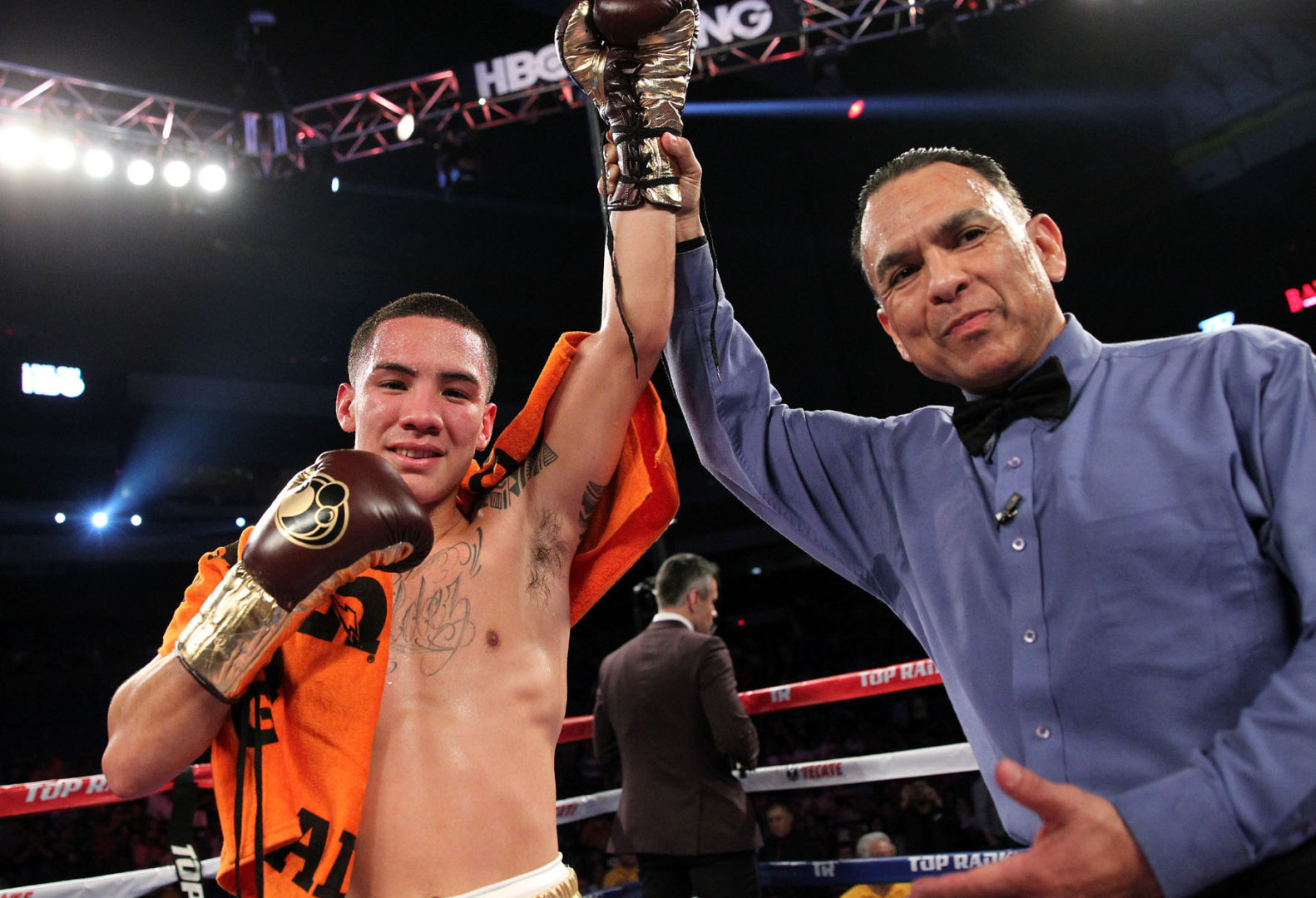
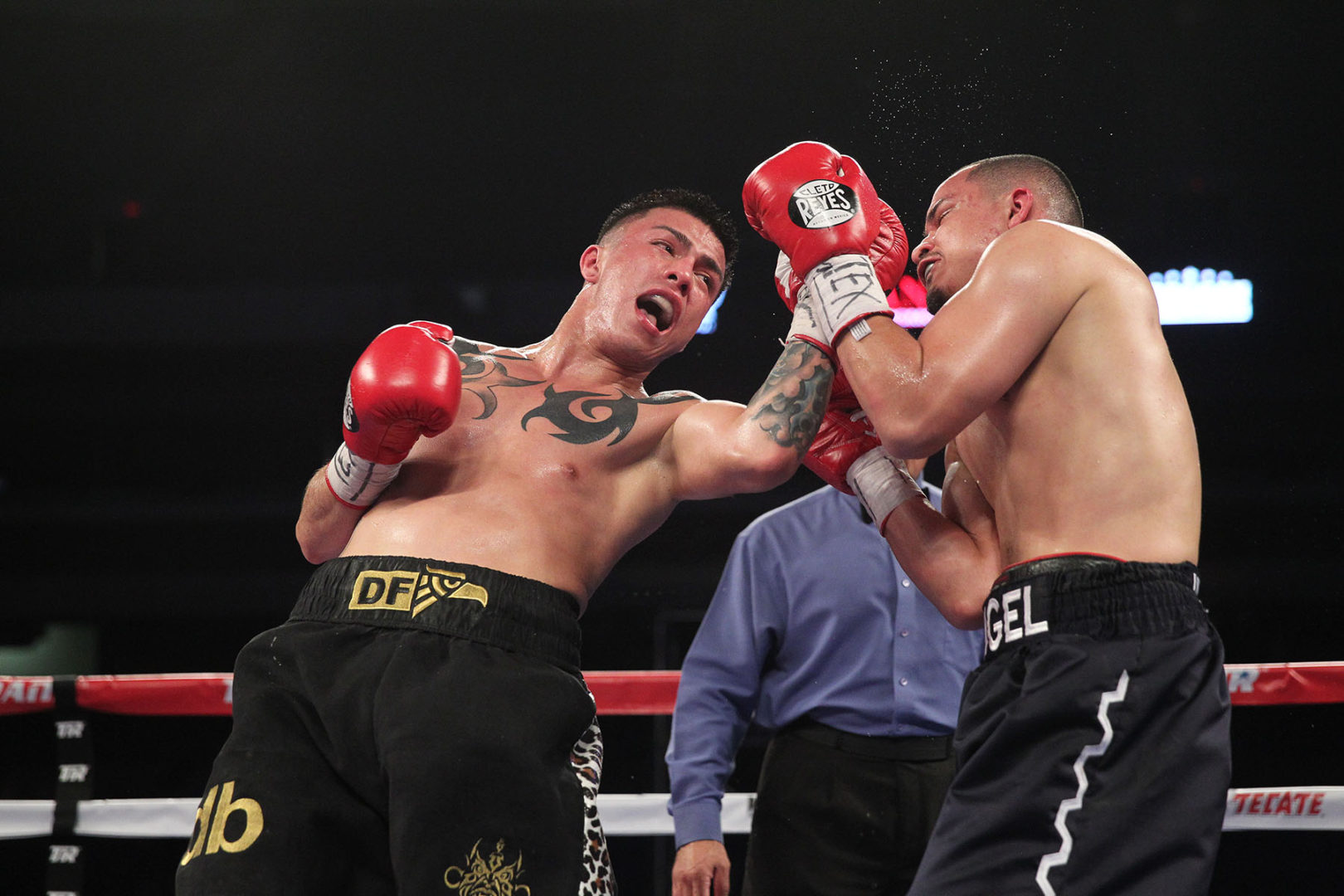
Alvarez won the fight, but failed to win back many of his disaffected fans with a 10th-round technical knockout of Alfredo Angulo Saturday night at the MGM Grand.

Canelo’s first fight since a loss to Floyd Mayweather Jr. in September was supposed to restore his popularity among Mexican fans, many of whom weren’t sure what to think of him after he had looked so ordinary in such a one-sided defeat.

If an arena full of boos was any indication, some of their ambivalence turned into anger Saturday night.

Fans were as frustrated as Angulo at referee Tony Weeks’ stoppage at 47 seconds of the 10th. Both of Angulo’s eyes were swollen and surrounded by darkening bruises when Weeks stepped in and said no more. Angulo complained loudly. He screamed that he should have been allowed to fight on.

“The ref was wrong,’’ Angulo said.

No, he wasn’t, Canelo said.

“The referee is the marshall,’’ Canelo (43-1-1, 31 KOs). “He stopped the fight, because he knew what was going on. I was still doing my job, working my jab. Sure, I was a little tired. But I was ready to fight on. I could have gone 10 more rounds if I had to.’’

Canelo led on all three scorecards at the time of the stoppage. Judge Craig Metcalfe had it 89-82. So did Dave Moretti. On Jerry Roth’s card, it was 88-83.

Going into the fight, there was lot of talk about whether Angulo’s scarred face could withstand sustained punishment. A grotesque welt above one eye result in him losing a 10th-round TKO to Erislandy Lara, whom he knocked down twice.

Sure enough, signs that injury would again stop Angulo were there early against Canelo. In the second round, swelling began to appear above Angulo’s right eye, which Canelo quickly targeted with a jab that landed repeatedly and with a baseball bat’s deadly impact.

Late in the third and again in the fourth, the stubborn Angulo’s persistence began to pay off with occasional bursts that seemed to stun Canelo. For a fleeting moment late in the fourth, there was a look of doubt in Canelo’s eyes. Maybe, he was suffering from the fatigue that has been one of his habitual weaknesses. Or, maybe, he was just surprised to see the sight of Angulo (22-4, 18 KOs) persistently moving forward and straight at him.

Canelo backpedaled in the fifth and again in the sixth. Angulo always followed. No matter what Canelo threw at him, or how much he busted up the right eye and then the left, there was Angulo moving forward and willing to endure more punishment. In the eighth, the crowd went wild when the junior-middleweights, fighting at an official weight of 155 pounds, stood and traded. By the ninth, it was evident Angulo would be there until the end. No matter what Canelo threw at him, there he was, like the incoming tide.

Finally, Weeks did what Canelo couldn’t.

He stopped it, sparing Angulo from further punishment and maybe much more. In time, Angulo might be able to see that and be thankful that he can see at all.

Rest of Pay-Per-View Card

008 Santa Cruz vs Mijares IMG_3211
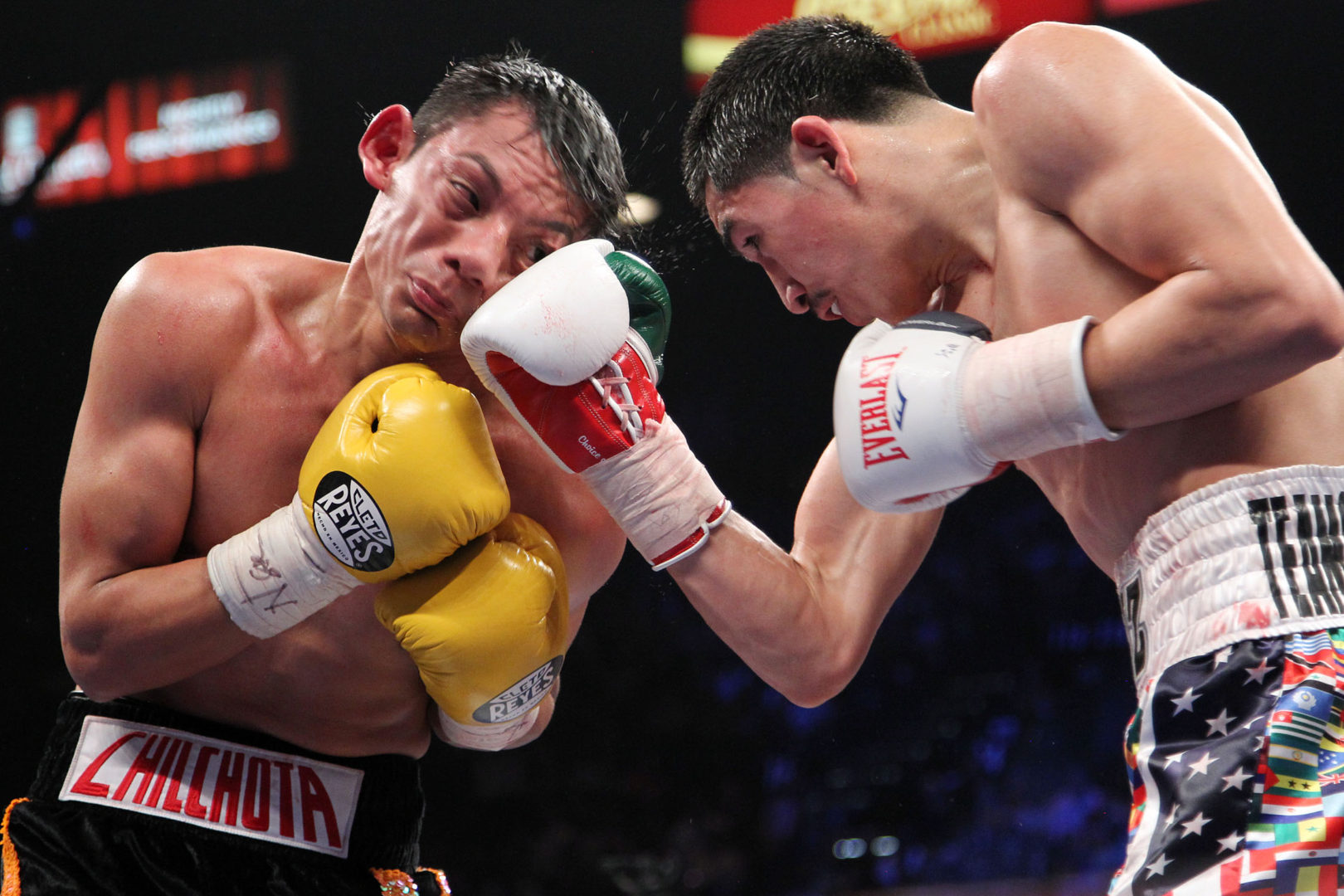
Los Angeles super-bantamweight Leo Santa Cruz (27-0-1, 16 KOs) was methodical and efficient, yet short of sensational, defending his acronym-sanctioned version of the title with a unanimous decision over Mexican Cristian Mijares (48-8-2, 22 KOs), who absorbed a variety of body shots and left Santa Cruz with a bloodied right eye from a fourth-round head butt.

006 Linares vs Arakawa IMG_2626
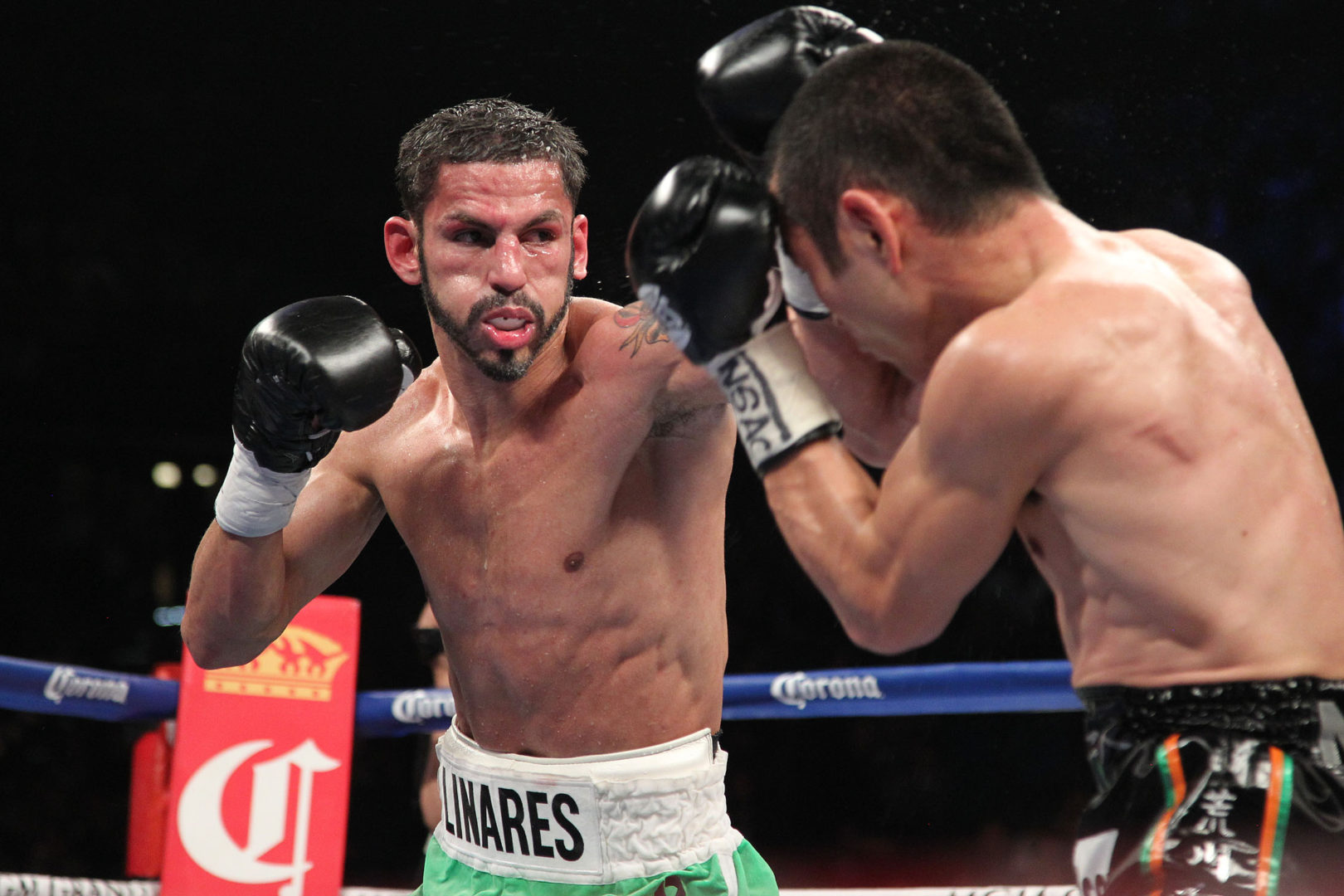
Jorge Linares (36-3, 23 KOs), a Venezuelan living and training in Japan, kept himself in the mix for a shot at a lightweight title with superior speed and punishing blows for a unanimous decision over Nihito Arakawa (24-4-1, 16 KOs), a 135-pound Japanese fighter who endured and had a few moments, yet never a real chance.

004 R Alvarez vs Thompson IMG_2016
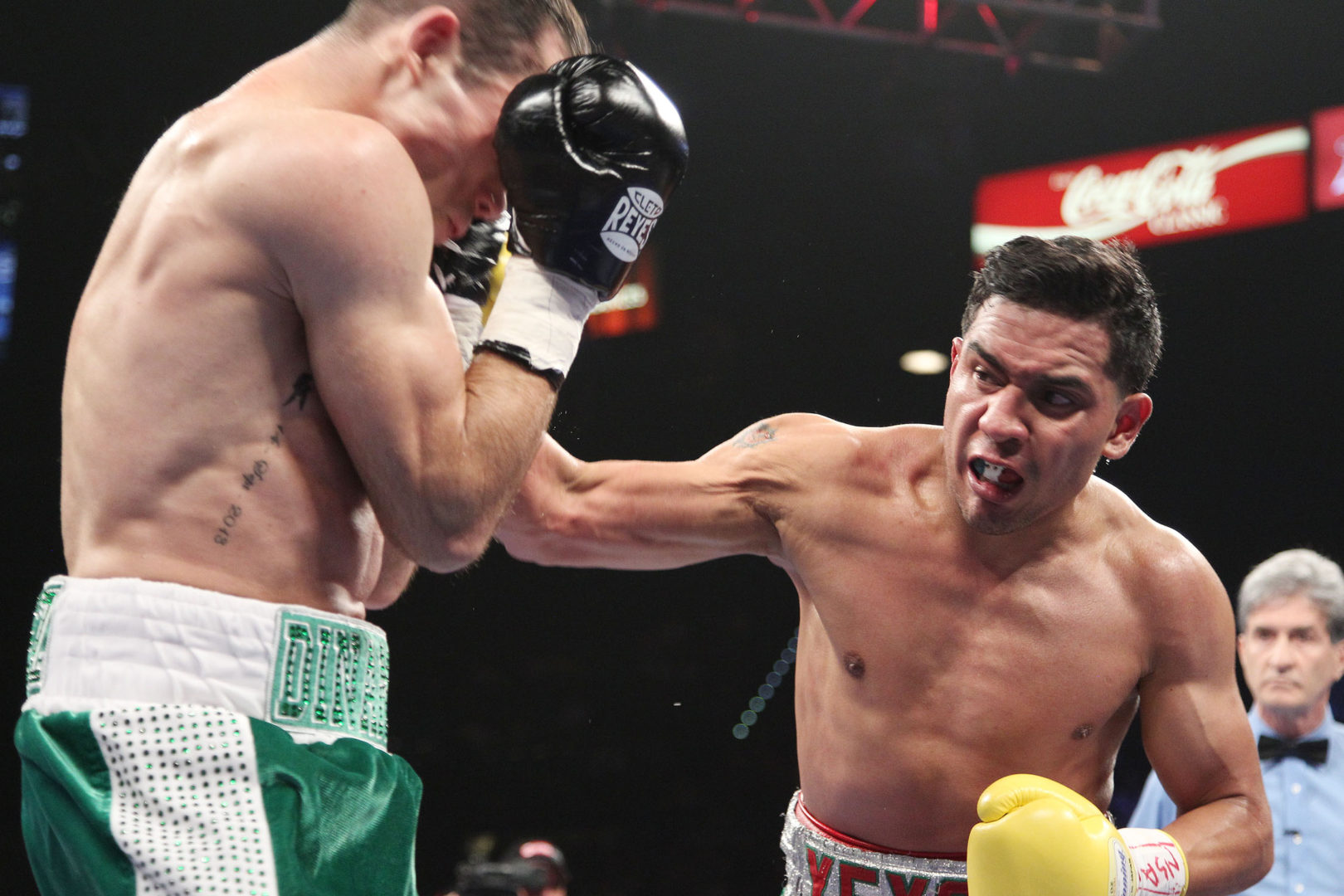
The Alvarez family got off to a rough start on the card’s first pay-per-view bout. Canelo’s brother, lightweight Ricardo Alvarez (23-3-3, 13 KOs), suffered two knockdowns in losing a unanimous decision to fellow Mexican Sergio Thompson (29-3, 26 KOs), who took the fight on short notice. A Thompson left in the second sent Alvarez falling into the ropes. If not for the ropes, Alvarez would have fallen into a ringside seat. That was the first knockdown and a sign of things to come. A clean right in the eight floored Alvarez for the second time.

Pre-TV

Junior-lightweight Jerry Belmontes (19-3, 5 KOs) scored a one-sided decision over Australian Will Tomlinson (21-1-1, 12 KOs), who suffered a bloody gash over his right eye in seventh-round head butt; Mexico City junior-lightweight Francisco Vargas (19-0-1, 13 KOs) survived a spirited challenge for a unanimous, 10-round decision over Puerto Rican Abner Cotto (17-2, 8 KOs); former Olympian Joseph Diaz (9-0, 7 KOs) of South El Monte, Calif., cautiously, for four rounds before scoring a fifth-round super-bantamweight TKO of Puerto Rican Jovany Fuentes (5-4, 4 KOs); junior-welterweight Keandre Gibson (9-0-1, 4 KOs) landed a succession of punches that seemed to render Mexican Antonio Wong (11-8—1, 6 KOs) unconscious before he hit the canvas in a fourth-round stoppage; Australian light-heavy Steve Lovett (7-0, 6 KOs) stayed unbeaten with a second-round stoppage of Mexican Francisco Molina (2-3, 2 KOs).


FOLLOW ALVAREZ – ANGULO LIVE

Canelo Alvarezalfredo-angulo
Follow all the action LIVE as it happens when former Super Welterweight champions Canelo Alvarez and Alfredo Angulo fight in a 12 round bout. The action begins at 9 pm eastern with a 3 fight undercard which we be highlighted by a a 122 pound world title fight between Leo Santa Cruz and Cristian Mijares. Former world champion Jorge Linares squares off with Nihito Arakawa in a Lightweight bout and the card kicks off with a Lightweight fight between Ricardo Alvarez and Sergio Thompson

NO NEED TO REFRESH…IT WILL REFRESH AUTOMATICALLY

12 Rounds–Super Welterweights–Canelo Alvarez (42-1-1, 30 KO’s) vs Alfredo Angulo (22-3, 18 KO’s)

Round 1 Canelo coming out blistering..Left to the body..right…jab..10-9 Canelo

Round 2 Big right/left uppercut…Nice left hook to the body…right uppercut…double jab..body//uppercut..right uppercut..20-18 Canelo

Round 3 canelo lands a left hook…right to the bod..left to the head..huge uppercut..right///left hook..Angulo lands a combination..Left hook from Canelo..4 punch combination..Combination from Angulo..big rights and left from Canelo..30-27 Canelo

Round 4 1-2 from Canelo..combination (left hook to the head)…left..counter left hook..2 punch combination..right…40-36 Canelo

Round 5 Canelo lands combination that snaps Canelo head back..Body shot from Angulo..50-45 Canelo

Round 6 Canelo lands a left hook…uppercut..right..double left..Angulo lands an upper..Jab from Canelo..Left hook…60-54 Canelo

Round 7 Double left hook from Canelo..combination..This is getting ugly…Combination from Angulo..Short uppercut/body from Canelo..Left from Canelo..Combo from Angulo..70-63 Canelo

Round 8Canelo lands a jab..good back and forth on the ropes…3 punch combo from Canelo..
left hook…Great action both ways..Canelo could be tired...80-72 Canelo

Round 9 Jab…right uppercut from Canelo..Hard right from Angulo..3 huge uppercuts to Angulo’s jaw…he is showing an incredible chin..90-81

Round 10 Lead left from Canelo..lead left and TONY WEEKS STOPS THE FIGHT

12 Rounds–WBC Super Bantamweight title–Leo Santa Cruz (26-0-1, 15 KO’s) vs Cristian Mijares (49-7-2, 24 KO’s)

Round 1 Right from Santa Cruz..10-9 Santa Cruz

Round 2 Mijares lands a jab…Santa Cruz lands a right and left..20-18 Santa Cruz

Round 3 Santa Cruz lands a a left…combination…right from Mijares…30-27 Santa Cruz

Round 4 Headbutt…Cut over right of Santa Cruz…Body shots by Santa Cruz…Body/head..right uppercut…over hand right…right uppercut…flurry…40-36 Santa Cruz

Round 5 Mijares running, making Santa Cruz miss…right from Santa Cruz..

Round 6 Hard right from Santa Cruz buckles Santa Cruz…left uppercut from Mijares..60-55 Santa Cruz

Round 7 Santa Cruz continuing to pressure..70-64

Round 8Santa Cruz lands a jab…left and right…Jab…Body..Right uppercut and another 80-73 Santa Cruz

Round 9 Santa Cruz contined to dominate…lands a 4 punch combination..blood dripping down the right side of his face...90-82 Santa Cruz

Round 10 Right over the top from Santa Cruz…sweeping right…100-91 Santa Cruz

Round 11 More of the same with Mijares resigned to surviving…110-100 Santa Cruz

Round 12 Santa Cruz lands a right…ride to head..left uppercut on inside..Good action at the bell…120-109 Santa Cruz

119-109, 120-108 twice for Santa Cruz

10 Rounds Lightweights–Jorge Linares (35-3, 23 KO’s) vs Nihito Arakawa (24-3-1, 16 KO’s)

Round 1 Both land body shots..right from Linares..10-9 Linares

Round 2 Right from Linares..20-18 Linares

Round 3 Arakawa lands a hard combination..Linares lands a left uppercut

Round 4 right and left from body from Arakawa..3 punch combination..3 more punches…hard combinations..40-36 Linares

Round 5 left to body from Arakawa…Combination from Linares..Combination from Arakawa...49-46 Linares

Round 6 Left hook to body from Linares…Right hook from Arakawa..right to body from Arakawa..right from Linares..Short left from Arakawa…right from Linares..Cut around right of Arakawa…Right from Linares…Combination from Arakawa..straight from Linares..Arakawa lands a looping left,,,58-56 Linares

Round 7 Left from Linares..body combination..right hand..Arakawa lands a body shot..hard combo from Linares..left uppercut..left uppercut..Arakawa.. lands a lead left…right from Linares…68-65 Linares

Round 8 Linares lands a left hook..left uppercut…straight right..body and then right to the head..78-74 Linares

Round 9 Linares cut from a headbutt..exchanging body..combination from Linares..Arakawa right eye bleeding..hard combination from Linares..88-83 Linares

Round 10 Both guys coming out swinging..Linares gets in a right…hard combination..98-92 Linares

98-92, 100-90 twice FOR JORGE LINARES

10 rounds Lightweights–Ricardo Alvarez (23-2-3, 14 KO’s) vs Sergio Thompson (28-3, 26 KO’s)

Round 1: Thompson lands a right that hurts Alvarez…Hard combination..Left to the body/right to the head…Hard right…10- Thompson

Round 2 ALvarez lands a body…Thompson land 2 body shots..4 punch combination..combination (Body/Head)…Alvare lands 3 uppercuts…Thompson lands a right…20-18 Thompson

Round 3 Staright right, ALvarez goes INTO THE ROPES FOR A KNOCKDOWN..30-26 Thompson

Round 4 Left to head and jab from Thompson..2 jabs from Alvarez…jab..Jab from Thompson and left hook to the body..good right to the jaw..40-35 Thompson

Round 5 Double jab from Thompson…Jab from Alvarez..left to body..Swelling from left eye of Alvarez..left from Thompson..double jab from Alvarez..49-45 Thompson

Round 6 Alvarez lands 2 uppercuts…Hard right wobbles Alvarez..straight right..uppercut..left hook and a right,..jab…59-54 Thompson

Round 7Thompson lands a jab…Alvarez lands a handful of jabs..uppercut and right..big combination…Counter right from Thompson off the ropes..uppercuts from Alvarez..double jab…jab.right from Thompson…counter combination..right to body..4 jab from Alvarez…68-64 Thompson

Round 8 HUGE RIGHT AND DOWN GOES ALVAREZ…Left hook by Alvarez…2 jabs from Thompson..Alvarez lands a right…78-72 Thompson

Round 9 Thompson lands to the body and head…right..Alvarez lands a jab..88-81 Thompson

Round 10 Right from Thompson…Thompson gets hit in the break…Alvarez lands 2 lefts..uppercut..Thompson lands a stiff jab…Thompson lands a hard right to the nose…exchanging jabs…98-91 Thompson

95-93 twice, 97-91 for Sergio Thompson


Mayweather draws a crowd at any time and against anybody

By Norm Frauenheim
Floyd Mayweather
LAS VEGAS – Floyd Mayweather Jr. was an hour late Saturday for his own news conference. But a crowd stuck around, waiting for him to arrive anyway. It just goes to show that Mayweather can draw a crowd even if he’s fighting nobody.

Marcos Maidana is next on Mayweather’s rich Showtime card, May 3 in a pay-per-view bout at the MGM Grand. Maidana didn’t make it to the first formal news conference since he was picked to fight Mayweather instead of Amir Khan. Maidana stayed at home in Argentina to be with his pregnant wife.

“He did the right thing,’’ said Mayweather, who apologized for being late and blamed it on a late night at the
tables in the MGM Grand’s casino. “He’s supposed to stand by his wife.’’

Maidana’s understandable absence didn’t matter much anyway. It’s the Mayweather brand that accounts for the biggest numbers in boxing these days. The HBO audience for his victory over Oscar De La Hoya in 2007 is still the pay-per-record. His victory on Showtime over Canelo Alvarez in September set the revenue record.

“They used it to call it pay-per-view,’’ Mayweather said in a video promo for a fight dubbed The Moment. “Now, it’s May-per-view.’’

Some early odds indicate that Maidana will go the way of Robert Guerrero and Canelo, who was getting ready to fight Alfredo Angulo while Mayweather was holding court. Some off-shore odds-makers have favored the unbeaten Mayweather by as much as 10-1. That’s the kind of chance a nobody gets. Yet, Maidana’s heavy-handed power and his December upset of Adrien Broner, a Mayweather wannabe and friend, moved him to the head of the line, or least ahead of Khan.

“Marcos Maidana is young, strong, a great competitor and one I can’t overlook, because anything can happen,’’ Mayweather said, his promotional mouthpiece firmly in place.

By now, it’s no secret that Mayweather picks and carefully choose who he fights. Maidana was the choice in many social media polls. In his own poll, Khan was the choice. But he picked Maidana anyway. The decision, he said, was based mostly on each fighter’s last four fights. Maidana had earned his way onto the ticket; Khan had not.

But it’s clear that polls didn’t make the choice. Only Mayweather did. And does

“I’ve earned my stripes,’’ said Mayweather, who said he began sparring last week. “I earned the right to pick and choose who I fight.’’

Nobody at the MGM Grand had any complaints about that prerogative Saturday. Golden Boy CEO Richard Schaefer, Mayweather’s promotional partner, said 14,700 tickets were gone within hours after they went on sale at 10 a.m. (PST). According to Schaefer, the early rush amounts to a live gate of more than $12 million. Tickets were still for sale. A crowd of about 16,000 for a gate of about $16 million is expected.

“Nobody is forced to watch,’’ Mayweather said.

But they do.


Test Time: Canelo’s faces questions and Angulo in his first bout since his first loss

Canelo Alvarez
By Norm Frauenheim

Canelo Alvarez hears the question more often than he saw Floyd Mayweather Jr.’s shoulder roll, roll and roll on a long, one-sided night nearly six months ago. Defeat is a lesson, says Alvarez, who really can’t say anything else about his first pro loss. If it’s not a lesson, it’s a problem. Simple as that.

Multiple-options are nice, but Alvarez doesn’t have that luxury Saturday night against Alfredo Angulo in his first bout since suffering his first loss in a September wipeout administered by Mayweather.

Win, and he leaves the ring with proof that the lesson was learned and his identity intact. Lose, and he leaves with damage to his career and agonizing self-doubt about whether he was ever the fighter who had been hyped as perhaps the brightest prospect in a new generation.

It’s not complicated. It’s just dangerous.

“This will be a savage, savage affair,” Angulo trainer Virgil Hunter said Thursday during the formal news conference at Las Vegas MGM Grand.

Hunter’s prediction probably helps boost the pay-per-view sales for the Showtime bout from the same Grand Garden Arena where Canelo lost a decision to Mayweather. Savagery, or even the promise of it, sells. It’s hard to to judge whether the always cool Canelo is buying into all the talk about a knock-down, blood-and-guts encounter between Mexican warriors. Angulo is known for his well-advertised power. He knocked down Erislandy Lara twice, Yet, he suffered a grotesque welt above one eye in losing a 10th-round TKO to Lara because of a couple of other things well-advertised:

Angulo gets hits often. His scarred face bloodies and bruises easily.

The 23-year-old Canelo (42-1, 30 KOs), seemingly wise beyond his years, must know that and even more. At the news conference, he talked about how styles make fights as if to say that, yeah, watch this one, because it will provide the violence so often promised. But Angulo’s style also seems to be perfect for Canelo’s skill-set. He couldn’t find Mayweather. But Angulo (22-3, 18 KOs) figures to be there, stubbornly moving forward and providing a willing target for Canelo’s arsenal of well-executed combinations. There’s a hedge, however. There’s growing sentiment that Angulo might have a chance after all, because of lingering questions about Canelo’s endurance. He seems to tire in later rounds. The task for Angulo is to take him beyond the sixth. Perhaps, Angulo has learned how to do that in sparring with the Hunter-trained Andre Ward and Amir Khan.

“There seems to a shift going on,” Golden Boy Promotions CEO Richard Schaefer said about a tide of second opinion that suddenly favors Angulo.

A patient, cautious Angulo in the early going could lead to a more tactical fight and not the one promised in the Toe-To-Toe advertising. Hunter, in a somewhat ominous tone, made it sound as if a wild, chaotic fight is the only possibility. He talked almost as if he feared for each fighter.

“I don’t think both men will walk out the same,” said Hunter, who during Thursday news conference also said: “It’s been taken out of my hands.”

Hunter sounded nervous. Perhaps, he knows that Angulo will have a hard time resisting the temptation to slug it out early, especially in the first pay-per-view fight of his career. The junior-middleweight also will be making his debut at the MGM Grand.

Canelo has been there. Has lost there.

Maybe, learned there too.

Angulo will be the first test of whether in fact he has.


Mexican veterans, (former) Soviet newcomers, and autodidacts

Orlando_Salido
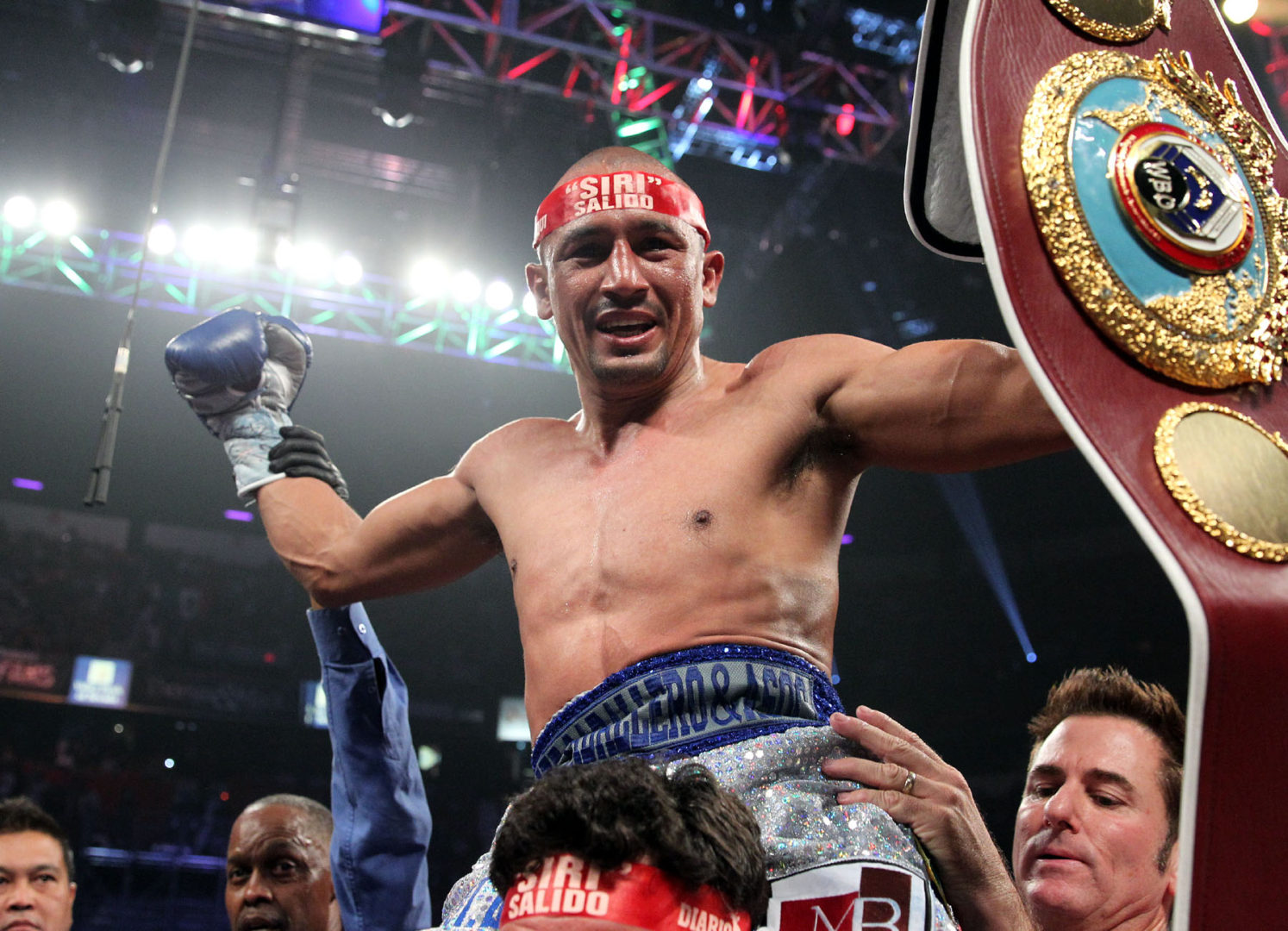
SAN ANTONIO – In this city’s Alamodome on Saturday, before Mexican Julio Cesar Chavez Jr. could whup Austin’s Bryan Vera and position himself for a match with undefeated Kazakhstani Gennady Golovkin, Mexican Orlando Salido took undefeated Ukrainian Vasyl Lomachenko to school and found him wanting, decisioning him by split scores of 113-115, 116-112, 115-113. Salido also forced upwards a number of tardily raised eyebrows about the propriety of his vacated title even being available to such an untested challenger.

What was lost on most, prefight, and understandably so, was the injury to Orlando Salido’s pride the Lomachenko match inflicted. There were other matters that needed consideration, of course: Vasyl Lomachenko was in pursuit of an ambiguous sort of history, one that came with editorial disclaimers galore of the sort that sparks proportionate debate among insiders as yawns among fans; the ongoing invasion of boxers from the former Soviet Union was set to continue; and Orlando Salido didn’t care enough to defend the WBO title, one he won from Orlando Cruz in 2013 after losing it to Mikey Garcia in 2013 after winning it from Juan Manuel “Juanma” Lopez in 2011, to come within 2 1/2 pounds of the featherweight limit.

For the second time in about as many months, one is put to remembering Mexican Marco Antonio Barrera’s 2001 victory over Englishman Naseem Hamed, or at least the disproportionate attention the business of boxing paid the sparkly object that was “Prince Naseem” at the expense of a former world champion and possessor of 52 professional victories. Lomachenko was polished to be another of our sport’s sparkly objects, a man of incomparable sparring prowess, one who emerged from behind an Iron Curtain that exists, anymore, solely in the collective imagination of what ageing generations still buck giddily round allusions to the Cold War.

Salido had earned his featherweight title, though, and if he was unable to retain it at Friday’s weighin that did not change what natural resentment he harbored for a rival and boxing infrastructure that allowed a man in only his second fight since turning “pro” the sort of title-challenging opportunity Salido was not afforded till his 34th prizefight. In some sense, it is not unlike what distrust and faint derision an autodidact feels for a degreed colleague, whichever their field. One man toiled in obscurity, often doing a number of coincidental other jobs in the hopes of someday having but one, learning his craft quietly and passionately, delaying indefinitely a wholly unguaranteed reward, while the other enjoyed an academy’s protection and comfort, longer in others’ expectations, yes, but much much shorter in risks.

If Salido and an army of other veteran fighters did not give voice to what resentment they surely felt for Lomachenko – going from headgear, spongy gloves and a cutiepie points system straight to a title challenge, via a 12-minute way station named Jose Ramirez in October, and getting a chance to wear a world championship belt without first navigating others’ elbows and heads and shoulders and skinned gloves and irregular calendars and hometown favoritisms – they surely felt the resentment in their collective marrow and cheered unsilently at home for Salido. Or as the Mexican journalist to my left said about the entire idea of the fight, after round 4, when it appeared Salido had a very real chance of beating Lomachenko: “¡Que insulto!”

That sense of insult was expressed best and most graciously by the aforementioned Juanma Lopez, a man twice vanquished by Salido, who nevertheless called Salido in his Alamodome dressing room before Saturday’s match.

“I’m with you 200-percent,” Juanma told his surprised former rival. “Go win the fight!”

And it was a fight for Salido, from the opening bell, in the sort of personal sense December’s match with American Adrien Broner was a fight for Argentine Marcos Maidana. Salido fouled Lomachenko continuously. He used a rangefinder hook to Lomachenko’s protective cup in the first round, and when that went undetected by referee Laurence Cole, he drove the knuckles of his right fist, bolo-style, at the front of Lomachenko’s left hipbone whenever Cole meandered over to break them. Salido’s awareness of Cole’s positioning was fantastic and very much better than Cole’s awareness of Salido’s positioning, which is a special sort of indictment when one considers Salido was extrapolating Cole’s position while calculating, at once, the acceleration and trajectory of another man’s onrushing fists.

Lomachenko had little idea what to do with Salido for much of the fight. The Ukrainian’s defense of Salido’s body blows, and later Salido’s mere feints, was a jackknifing sort of motion that involved throwing his abdomen backwards to where his spine had been and causing a forward-folding that anticipated no chance of retaliation. Salido might not have seen such amateurishness since he was a teenager in Sonora, if ever, but 54 previous fights told him one thing: This man is not in a position from which he can strike me. The American journalist to my right, happily enough my favorite Monday columnist, recognized early the surprising fact Lomachenko did not know how to use an uppercut to discourage Salido’s attack on his abdomen (and hips, and cup, and thighs, and right knee).

Lomachenko deserves plaudits, nevertheless, for comporting himself like a fighter, realizing in round 1 he was in a state where fights are often barely sanctioned things and reserving his complaints only for Salido’s most egregious infractions. After the fight, one that ended with Lomachenko very nearly stopping Salido, who made a four-limbed poncho of himself when hurt in the final 90 seconds, reveling in what lawlessness governed the small blue patch of Texas territory policed by Sheriff Cole, Lomachenko shrugged away questions of Salido’s tactics with an appeal to the profession both chose.

Sometime before Lomachenko’s 0 had to go, Saturday’s press section rippled with news that, mourning the recent death of his father, undefeated Kazakhstani middleweight titlist Gennady “GGG” Golovkin would be unable to make his unofficially scheduled next match, affording Julio Cesar Chavez Jr., in town primarily for Friday’s weighin, one chance at least to proctor for Golovkin the sort of stern test Salido gave Lomachenko. GGG’s legion of enthusiasts should welcome it.

Bart Barry can be reached at bart.barrys.email (at) gmail.com


Diaz prevails, Najera entertains, and Saucedo disappoints (somewhat) in South Texas

Diaz_Robles_140301_001a
SAN ANTONIO – Houston lightweight Juan “Baby Bull” Diaz, a former world champion, found across from him in Saturday’s sixth and final off-television match a motivated opponent with a workable gameplan and little respect for Diaz’s resume. It was no matter – Diaz dispatched of him with time anyway.

Diaz (39-4, 19 KOs) whacked and wore-down Mexican Gerardo Robles (18-13, 9 KOs), snatching his will and decisioning him easily if not quite easily as official scores indicated: 100-90, 99-91 and 99-91.

After a spirited first round from Robles, one in which the rambunctious Mexican alternately countered and led Diaz with surprising effect, Diaz came off his stool in the second and reestablished the proper order of things, lashing Robles with signature hooks and activity, and reducing Robles’ activity considerably. Once order was returned Diaz then went to work on Robles like so many once-strong men before him, breaking the Mexican’s spirit with constant activity and relentless violence.

Though Diaz never managed to imperil Robles – and though Diaz found his own legs stiffened in the seventh, in an exchange that sent the Houstonian to the canvas but was ruled a slip by referee Jon Schorle – Diaz closed space, controlled time, and generally took the fight away from his less-experienced opponent.

Diaz is not what he once was, no, and hasn’t been since his first fight with Juan Manuel Marquez, but he is still entertaining, and still acquitting himself honorably every time he steps in a prizefighting ring.

Valdez_Sanchez_140301_001a
Saturday’s fifth match saw undefeated Mexican featherweight Oscar Valdez (9-0, 8 KOs) score a controversially concluded technical knockout victory over Dallas’ Samuel Sanchez (5-6-1, 1 KO), a limited opponent there for the beating, a beating that was concluded somewhat prematurely at 2:03 of round 3, much to Texas fans’ bemusement.

NajeraAY1J2416
Local lightweight Ivan “Bam Bam” Najera acannot help himself, for there are two things in a prizefight he loves to do: Devour opponents’ right hands, and make an intense and intensely suspenseful match with every man he faces.

The fourth bout of Saturday’s eight-fight Alamodome card saw Najera (13-0, 9 KOs) win yet another firefight, this time with a fellow Texan, McAllen’s Angel Hernandez (8-2, 4 KOs), a man Najera dropped with a gorgeous counter left hook in round 1 and then got dropped by with a stiff right cross in round 2. And then after that, it was like every other Najera fight, with both men landing repetitively throughout, and Najera remaining undefeated by unanimous scores of 78-72, 77-73 and 77-73.

Tough and entertaining as he is, Najera continues down a path of making caveman-like spectacles that promise no longevity. He is aware of everything in and around a prizefighting ring, it seems – even taking time to blow a kiss to a ringside female journalist during Saturday’s fourth round – everything that is, except the glove an opponent wears on his right fist. Of right hands, Najera is seemingly oblivious, dropping his own left hand through every fight, and getting cracked continually by most every right thrown his way.

So long as he lasts, though, Najera is the stuff of which local attractions are made.

ALEX SAUCEDO VS. GILBERTO VENEGAS
Undefeated Oklahoma welterweight Alex Saucedo has stalled in his development. Once a darling of insiders, Saucedo has been moved perhaps too prudently and now finds himself getting hit far too hard by journeymen types who do not move backwards or go down when first struck.

Saturday’s second match saw Saucedo (13-0, 9 KOs) win most every minute of his six round match with Illinoisan Gilberto Venegas (12-13 4 KOs), and win a lopsided decision judges scored unanimously, 60-54, 60-54 and 59-55. But those scores tell nothing of the two or three flush Venegas left hands that snapped Saucedo’s head leftwards. This match was a step-up affair for Saucedo – and against a .500-fighter, that is something of an indictment.

UNDERCARD
Saturday’s third fight saw undefeated California welterweight Jose Zepeda (19-0, 17 KOs) go directly through overmatched South Carolinian Johnnie Edwards (15-7-1, 8 KOs), stopping him at 2:10 of round 2, in a fight that showed nothing but questionable merit.

The evening began with a competitive if light-hitting scrap between undefeated Houston featherweight Jerren Cochran (11-0, 4 KOs) and Mexican Aduato Gonzalez (11-10, 4 KOs), a match that saw Gonzalez dropped in round 5 and bleeding throughout though game to the end. Judges scored the match unanimously for Cochran: 59-54, 59-54 and 60-53.

Cochran, whose punches are accurate not hard, showed certain class but remained surprisingly susceptible to looping overhand rights thrown blindly by his limited opponent.

Opening bell rang on a cavernous Alamodome at 5:17 PM local time.


Tough Sell: Mayweather will have an easier time beating Maidana

Floyd Mayweather
Floyd Mayweather Jr.’s biggest challenge on May 3 won’t come from Marcos Maidana. Not even Maidana’s heavy-handed power has much of a chance at knocking Mayweather off his pound-for-pound perch.

But Mayweather’s promotional skill faces a real test as he reaches what could be the halfway point of a Showtime deal for a possible six fights and a potential $250 million. Maidana-Mayweather looks to be a tough sell, especially at a pay-per-view price for the Showtime telecast that figures to be $60, or $70 for high definition.

Mayweather’s biggest rivals will be in a busy PPV market during the next few months. There’s Canelo Alvarez-Alfredo Angulo on Showtime PPV on March 8. On April 12, Manny Pacquiao and Tim Bradley engage in a PPV rematch offered by Home Box Office. After Mayweather-Maidana, there’s Miguel Cotto-Sergio Martinez on June 7, also an HBO pay-per-view bout.

To watch all four in high-def, it’ll cost $280. That’s not much if you’re in Mayweather’s income bracket. For the average fan, however, that’s a lot of groceries.

Mayweather’s marketing team will invest time and ad money into saying that Maidana is dangerous. He is – he was – in beating Adrien Broner in a December upset that shoved Amir Khan to the back of the line and earned Maidana the big payday that comes with a shot at Mayweather.

But some of the early betting odds indicate that the public will need a lot of convincing. Mayweather could be a 10-1 favorite. Translation: The bookies are saying that the betting public thinks that Maidana has no chance. Compare that to Pacquiao-Bradley in a sequel of Bradley’s hugely controversial decision over the Filipino Congressman in June, 2012. Pacquiao is a slight favorite.

Odds are, Pacquiao-Bradley is the better buy.

There’s a theory, often offered by Showtime, that people will watch Mayweather no matter who he fights. OK, Mayweather possesses singular speed and skill. But this isn’t Olympic figure skating. It’s a fight. If there isn’t much doubt, there isn’t much drama.

Maidana is a tough sell for at least two reasons:

· Khan, whose reputation has taken the biggest beating in the polling and guessing game over who Mayweather would anoint as his next foe, beat Maidana in what was the 2010 Fight of the Year.

· Maidana lost a one-sided decision to Devon Alexander in 2012. On only one of three scorecards did Maidana win a single round. He was shut out on two cards. The 10-round loss to the quick Alexander could serve as a preview to what might happen to Maidana against Mayweather, who has lost some foot speed but still had enough to confound Robert Guerrero and Canelo. Maidana has one thing in common with Guerrero and Canelo. He’s flat-footed, which represents two more reasons to think he has virtually no chance on May 3.

Mayweather, whose career has generated a reported 12.8 million PPV customers for about $800 million in gross revenue, is averaging 1.5 million PPV buys over his last eight bouts, according to reports from the networks and television media.

It’ll be harder to maintain that average than it will to stay unbeaten.


The Legend’s Son returns to returning

Chavez_Lee_120612_001A
SAN ANTONIO – Mexican “Son of the Legend” Julio Cesar Chavez Jr. returns to this city sometime in the next few days, returns to a local scale sometime Friday afternoon, and returns to an Alamodome ring Saturday night against Austin’s Bryan Vera. The middle spectacle, Friday’s, should prove the week’s most suspenseful, and if Chavez somehow misses weight also its most tragic. If Chavez makes weight, evincing proper preparation for his rematch with the profoundly limited Vera, though, let us hope Saturday’s match does not end tragically.

But for that possibility, this is all a bit tired, isn’t it? The “Road to Chavez Jr. vs. Vera II” promotional piece felt obligatory as a husband’s trip to the mall. Gone are the mildly alluring touches of collaring whichever journalists were in town for whichever other event, to give aficionados a chance at least to see admired writers mention, in very short clips, why they think this fight may be compelling (with the flashed and handsome exception of our site’s intrepid editor at 1:21). Instead we get HBO’s commentary team rehashing what they said the night of the first fight with what they’ve digested since, in promotional spots that boast all the journalistic panache of actors from this season’s cast of “Dexter” holding their fists aloft while advising viewers they’ve been buzzed – and if that is a mashup, as the kids are calling it, of two different networks’ original programming concepts, it’s honestly arrived at because no enterprising mind should keep 2014’s thus-far-banal prizefighting offerings compartmentalized.

That promises to change, at least in spirit, Saturday, when this city opens its gracious arms to a rematch of a not particularly compelling 2013 match, one that finds Chavez once more collecting his father’s back wages from his promoter or his network or his Mexican fans, a collective that must be dwindling.

Into the curiousness of this arrangement meanders Junior, never hurried, marking promoter Top Rank’s return to a city whose venues it has not graced in the 23 months since Kelly Pavlik used the force to smash apart Aaron “Jedi” Jaco in the debut of Leija-Battah Promotions, an outfit that looked a temporary license-holding company for Las Vegas- and Los Angeles-based promoters, alike, before evolving, quickly and audaciously, into something more and better. What consequently drove the local promoter from Top Rank after one show is anyone’s guess, but it was a thing that did carry consequences, as Top Rank has since made medium-sized Texas shows in Houston, Dallas, Corpus Christi and Laredo but not Alamo City, a place where Son of the Legend began to become more than a mascot by decisioning John Duddy in 2010 at Alamodome, the venue where his father, The Legend, set an attendance record still standing.

There’s no telling how ticket sales might be going for Saturday’s show for a couple reasons: First, there isn’t an engaged local promoter endeavoring to recoup its large investment by blitzing inboxes with promotional tidbits, and second, with most of the money for this fight coming exclusively from HBO, there’s not nearly the same urgency there was round this time last year when, openly snubbing his proximate rival, Mexico’s Saul “Canelo” Alvarez declined to fight on Floyd Mayweather’s May undercard – firing the starter’s pistol on a frantic effort to find a venue, and accompanying local entrepreneur, to host Alvarez on short notice. What resulted, an April match between Alvarez and New Mexican Austin Trout, brought nearly 40,000 fans to Alamodome, an attendance figure that established in a bold stroke Alvarez’s coveted standing as Mexico’s most popular prizefighter. Alvarez then sprinkled cinnamon in his promoter’s gears in September, winning perhaps 90 seconds of his 36-minute match with Mayweather.

Displaying his father’s relentlessness and talent for smashing microscopic fissures into gaping wounds, then, Chavez Jr. snatched the corona right off Alvarez’s bowed redhead by icing his countrymen’s bruised national pride, 14 days later, with a victory over Bryan Vera that is remembered, still, for its preparation, savagery and workrate.

Oh, if ever a sentence were typed round derisive giggles.

Instead of doing something memorably good or even forgettably bad, Son of the Legend chose that inauspicious time to hold a pound-auction at the Friday weighin, having done the considerate thing, he explained for HBO’s “Road to” cameras, and informed the Vera camp ahead of time he would weigh, well, something higher than what 168 pounds he was legally obliged to make. Then Son of the Legend made a lionlike contender of Bryan Vera, a good guy of good work ethic and giver of a goodish impersonation of Colorado’s Mike Alvarado, were Alvarado not a once-great high school athlete.

Wait, Vera a “contender”? Yes, contender: As Son of the Legend reminded viewers, apropos of his figurative hunger – unmistakable in its modesty for Junior’s literal hunger – he was a “world champion” once, wearing proudly the garish, gold-and-whipped-pea strap the WBC stole from lineal middleweight champion Sergio Martinez in 2011, making Chavez technically a champion and making Vera technically a contender – cute a reminder as any that Vera outworked television’s original “Contender,” Sergio Mora, in August 2012 at the converted Alamodome venue called Illusions Theater, in a Leija-Battah-promoted rematch of Vera’s finest hour, a controversial 2011 decisioning of Mora in Fort Worth, an hour not nearly fine as Vera’s decisioning of Chavez Jr. in a September match official judges, alone, scored widely for Son of the Legend.

We circle back to Saturday, then, meandering round the subject like a pothead in peach underwear doing living-room laps for roadwork – so great is his hunger as world champion – to address briefly a match that should not be competitive, and, one prays, will not end tragically for Vera. Whatever long list of bad habits Vera’s trainer Ronnie Shields credits himself with red-penning from the Austinite’s dossier, he sure as hell did nothing for Vera’s plunging right hand, a hand Vera holsters at his waist before throwing either glove at opponents. That flaw portends nothing good for Vera.

I’ll take Chavez, then, KO-11, in a terribly lopsided spectacle even Junior’s legion of detractors will wish had been stopped after nine.

Bart Barry can be reached at bart.barrys.email (at) gmail.com


Vazquez defends Lightweight crown over Shafikov

Miguel Vazquez
Miguel Vazquez defended his IBF Lightweight title with a 12 round unanimous decision over Denis Shafikov at the Cotai Arena at the Venetian in Macao, China.

Vazquez picked, pecked, got in, got out and held before Shafikov could mount any offense throughout the contest. Shaifov was cut on the forehead and over the right eye.

Vazquez of Mexico won by scores of 119-110, 116-112 and 115-113 and is now 34-3. Shafikov, of Russia is 34-2.

Shiming_Kokietgym_140222_001a
Zou Shiming scored his 1st professional stoppage when he took out Youthong Kokietgym in round 7 of their scheduled 8 round Flyweight bout.

Shiming dropped Kokietgym three times in the 7th round which was much to the delight of his hometown fans and the fight was stopped at 2:09 of round 7.

Shiming, 111.75 lbs of China is 4-0 with 1 knockout. Kokietgym, 110.5 lbs of Bangkok, THI is now 15-4.

Photos by Chris Farina / Top Rank


Going To The Polls: Chavez Jr., Canelo are back and confident that their fans are too

Chavez_Lee_120612_001A
The first two Saturdays in March are a window that will provide a look at whether two heavily-hyped fighters, Julio Cesar Chavez Jr. and Canelo Alvarez, have retained their popularity among their loyal fan base.

Chavez comes off controversy on March 1 in a rematch of his hotly-debated decision over Bryan Vera. Then, Canelo tests his Q rating on March 8 against Alfredo Angulo in his first bout since losing to Floyd Mayweather Jr. in a decision seen as one-sided by everybody but a judge, C.J. Ross, who scored it a draw.

Chavez and Canelo may never share the same ring because of all the usual divisiveness in boxing’s balkanized business. Still, they are linked, almost like a couple of rival politicians, in an ever-shifting race for allegiance among Mexican and Mexican-American fans. If presented a ballot these days, some of those fans might be tempted to vote none-of-the-above. Neither distinguished himself in his last outing.

Of the two, however, Chavez suffered more damage to his reputation and legendary name than Canelo sustained in a predictable loss. The difference: Chavez did it to himself. Canelo had it done to him.

Chavez appears to be closer than ever to losing a nation of fans who revere his dad, yet have grown ever more exasperated with the son’s apparent sense of entitlement and lack of maturity. Chavez continued to make a mockery of making weight and training before he got a gift on the scorecards against Vera in September. They booed him.

“I owe the fans,’’ says Chavez, a brand new father.

Is Chavez just talking or serious about sustaining a commitment to his craft this time around? It’s fair to wonder about that. Ratings for his HBO rematch at San Antonio’s Alamodome with Vera will say a lot about whether fans have given up on him.

That said, fans also might decide to wait-and-see. It will take more than one good fight from Chavez to win them back. If he is in shape, he figures to beat Vera easily. But the real proof would be in what he does over the next couple of fights. After a victory, he too often gets comfortable, falls off the wagon and into a lifestyle with no discipline. Roadwork consists of midnight laps around the couch and to the fridge.

For Canelo, there’s a different kind of skepticism. His pound-for-pound credentials took a big hit when he was so out-classed by Mayweather in September. Not to worry, Canelo promised in a conference call.

“I learned a lot from that fight,’’ he said. “I learned a lot from the Mayweather fight. He’s got a style that’s very complicated. He’s got a style that’s very intelligent and he fights intelligently. I think that his whole purpose is just to win. But I learned a lot. I learned a lot about the fight itself inside the ring and outside the ring as well.’’

In Angulo, Canelo took a fight he figures to win. Still, it’s dangerous. Angulo is tough and heavy-handed. He knocked down accomplished Erislandy Lara twice in June, before losing 10th-round stoppage. He also might have learned some valuable new tricks in sparring with Andre Ward. Virgil Hunter trains both Angulo and Ward.

Let’s put it this way: Angulo has better shot at scoring an upset than Vera does.

Yet, Golden Boy Promotions is betting that Canelo will emerge with his career and popularity intact. Canelo’s Showtime-televised comeback against Angulo at Las Vegas’ MGM Grand is a pay-per-view bout.

“I have loyal fans and I’m very grateful for that,’’ Canelo said. “They’re always going to be with me. I feel that they’re going to support me through thick and thin. They’re going to follow me in this Pay-Per-View.’’

If they don’t, only Canelo will pay.


Dmitry Salita talks Ukrainian Politics situation

Former world title challenger and promoter Dmitry Salita talks about the recent political unrest that is going on his native Ukraine.

1. What are your thoughts of Vitali Klitschko going into Politics

I think Vitali is a man of the people. You look at his career and see how he over came difficulties early on
to become one of the greatest heavyweights in history that says something about a man. His character and persistence can not be denied. In the ring through sports and definitely through boxing you can see what ingredients a man is made off. Over coming learning from your experiences and becoming better is the goal of all of us in life and Vitaly was able to do that. He also represented Ukraine on the world stage in a very honourable way for many years. He has the education of Europe as well as America as a politician being able to identify with different people from all over the world is essential. I believe that Vitaly has those ingredients from being
an elite boxer and a star around the world.

2. What are your thoughts of boxers going into politics in General.

I think it’s very good! Boxers are hard working people that come from humble and usually poor beginnings! Boxing is a poor mans sport, and to be a good politician you need to identify with the common man and with people that are struggling you need to have empathy for those people and experiences. Most boxers understand what those feelings are about. Manny Pacquiao and Vitaly Klitchko are great examples of boxers that remember about their roots and want to improve the life of their countryman.

3. You are from the Ukraine. What Problems does that country face

Well Ukraine become more westernized and Democratic certainly since I left Odessa, Ukraine in 1991. People want to voice their opinion and make their feelings known. Now I believe is a crucial stage in the direction that the country will go. Most important is for the common man and people to feel satisfied. It seems that the situation has stabilized some what and both sides are talking.

4. Do you think with Klitschko being a high profile man, he will help or hurt The Ukraine.

I think it will help, the fact that world news is focusing on what is happening in Ukraine is to a large extent because Klitschko is the Heavyweight champ of the world. One of the premier titles in the sports world. He has the experience of dealing with people from all over the world and the Klitschko brothers are their own promoters so they made some pivotal decisions in their career as fighters and business man. The Klitchko brothers have proudly and positively represented Ukraine on the world stage. I think that their understanding of world culture, media and politics will only benefit the people. Several years ago when Wladimir fought at MSG he has a press conference for the Russian community in Rasputin restaurant. Vitaly was starting his political career then, I told him that he will make Ukraine proud and I think he will be president of Ukraine one day. He smiled and I think that day will come one day.

5. He was just involved in a couple of incidents that were obviously politically motivated. What were your thoughts when you saw those videos?

He is out in the street protesting with his people on the front lines a peoples man. I saw that he held himself back after he got attacked that to me was very mature and a sign of a leader.


Visiting “Age of Impressionism” while reading “Juan Diaz and the Age of Impressionism”

Juan Diaz
HOUSTON – Returned to Texas’ largest city and the fourth-largest city in our country, a day before a day we celebrate the father of our country’s birthday by acknowledging all the presidents’ birthdays in a single day because federal holidays, if mismanaged, might force the private sector to pay time-and-a-half, I looked across boxing’s landscape, barren yet again, and thought making a reciprocal tribute of sorts to a tribute of sorts was a workable idea. To wit:

This city’s Museum of Fine Arts’ “Age of Impressionism” is an exceptionally good exhibition that has little to do with boxing but may be instructive in its parallels to boxing writing, a discipline that requires a weekly entry even though nary a meaningful thing is yet to happen in prizefighting this year, as we enter 2014’s eighth week. And so, afforded a chance to celebrate Presidents Day, I made a Friday decision to spend Saturday and Sunday at Museum of Fine Arts’ outstanding exhibition, one I initially partook of in December and was prompted to revisit by a guest piece Kelsey McCarson wrote for us Tuesday.

In “Juan Diaz and the Age of Impressionism,” McCarson juxtaposes Juan Diaz and Pierre-Auguste Renoir, among others, in a way I’d not considered, or at least not quickly as I’d considered juxtaposing McCarson and other fine young boxing writers, Jimmy Tobin in particular, with mid-19th-century Paris’ Salon de Refusés, a groundbreaking show in 1863 that came about when works by Impressionism’s predecessors – Gustave Courbet, Édouard Manet and Camille Pissarro, most notably – got rejected by the Paris Salon, the French state’s annual recognition of its best painters, and held an exhibition of rejects that was successful enough to erect a bridge between an academic style Manet mastered and an entirely new movement whose greatest practitioner, Claude Monet, initially found himself accused by Manet of stealing the great man’s name. McCarson and others who write regularly and seriously about our beloved sport, and take the craft of writing seriously, have been denied entry in the Boxing Writers Association of America, our craft’s equivalent of the Salon, and might be well advised to form their own association of rejects – an idea McCarson toys with on Twitter.

This city’s Juan Diaz remains one of my most favorite fighters I’ve covered, though I cannot think of a painter or movement to whom I would readily liken his style. He’s not an Impressionist, he’s not experimental enough, and he’s not an academic or Renaissance type, either, as his use of offense as defense offends purists’ sensibilities. He might be a Modernist or Surrealist but for his never effecting stylistically radical devices; he’s not endeavoring to interpret anything so much as strike his opponent often as he can.

The worst part of visiting an art museum is its patrons. Most are not interested in seeing art so much as being seen seeing art – Kelsey McCarson and his wife, of course, being noble exceptions – and the audio tours and white-plate explanations museums proffer do not palliate this. Viewing others viewing “The Age of Impressionism” shows all too clearly what is wrong with fields like art history, where future curators expend many times more time memorizing biography than practicing technique.

What makes unique the Impressionist painters, Monet and Eugène Boudin, especially, but also Renoir when he is best, as he is in MFAH’s current exhibition, is not that they painted outside or quickly or with fewer layers than Renaissance masters but that they offered an original rebuttal to the invention of photography, not an effort to imitate it. Perhaps the best piece in MFAH’s exhibition is Monet’s “Spring in Giverny,” a landscape done in light pastels. It is best, and Monet is his movement’s best artist, because it improves proportionate to the time one spends before it.

Writing about Renoir’s “Sunset at Sea,” McCarson partially captures why: “Isn’t this completely unlike any picture even the most advanced camera could help you collect?” It is exactly that because it is binocular, using the requisite imperfection of images pieced together with data from two different points, à la human sight, and not monocular, as photography is. Impressionism captures a moment, and in any moment, a human eye is unable to see with its fovea, the part that perceives fine detail (the part of the eye with which you are able to read no more than two of these words at a time, regardless of font), more than a comparatively tiny percentage of what its eye perceives. All the rest is perceived in the periphery and necessarily coarse.

Human peripheral vision is marvelous and comprises what stimuli necessarily compose our senses of things. Peripheral vision, and the brain’s handling of its coarse data, are what the Impressionists were after, and for this reason, as one’s eyes fatigue, causing their neurons to misfire, the best of Monet and Renoir’s works begin to dance on the canvas, coming to life the same way, and for the same reason, Leonardo’s “Mona Lisa” smiles when you look her in the eyes but not the mouth.

The first work in MFAH’s “Age of Impressionism,” somewhat ironically, is a large portrait by William Adolphe Bouguereau, an academic painter whose later work “Admiration” received the highest award in the 1900 Paris Salon, 37 years after the first Salon de Refusés. And today, Claude Monet’s name is known even to philistines, while Bouguereau’s is lost to all but connoisseurs – something the BWAA’s membership committee might note.

Bart Barry can be reached at bart.barrrys.email (at) gmail.com


Magdaleno stops Pazos in 4

D.Magdaleno_Pazos _140215_002a
Former world title challenger Diego Magdaleno scored a 4th round stoppage over Jorge Pazos in a scheduled 10 round Lightweight fight at the C. Robert Lee Activity Center in Hawaiian Garden, California.

Magdaleno dropped Pazons in round three with a straight left. Magdaleno finished things in the next round by sending Pazos to the canvas for referee Jack Reiss’s ten count from a flurry of punches at 2:27 of round 4.

Magdaleno, 133 lbs of Las Vegas, NV is now 25-1 with 10 knockouts. Pazos, 132 1/2 lbs of Quamachil, MX is now 9-7.

Falcao_Robertson_140215_001a
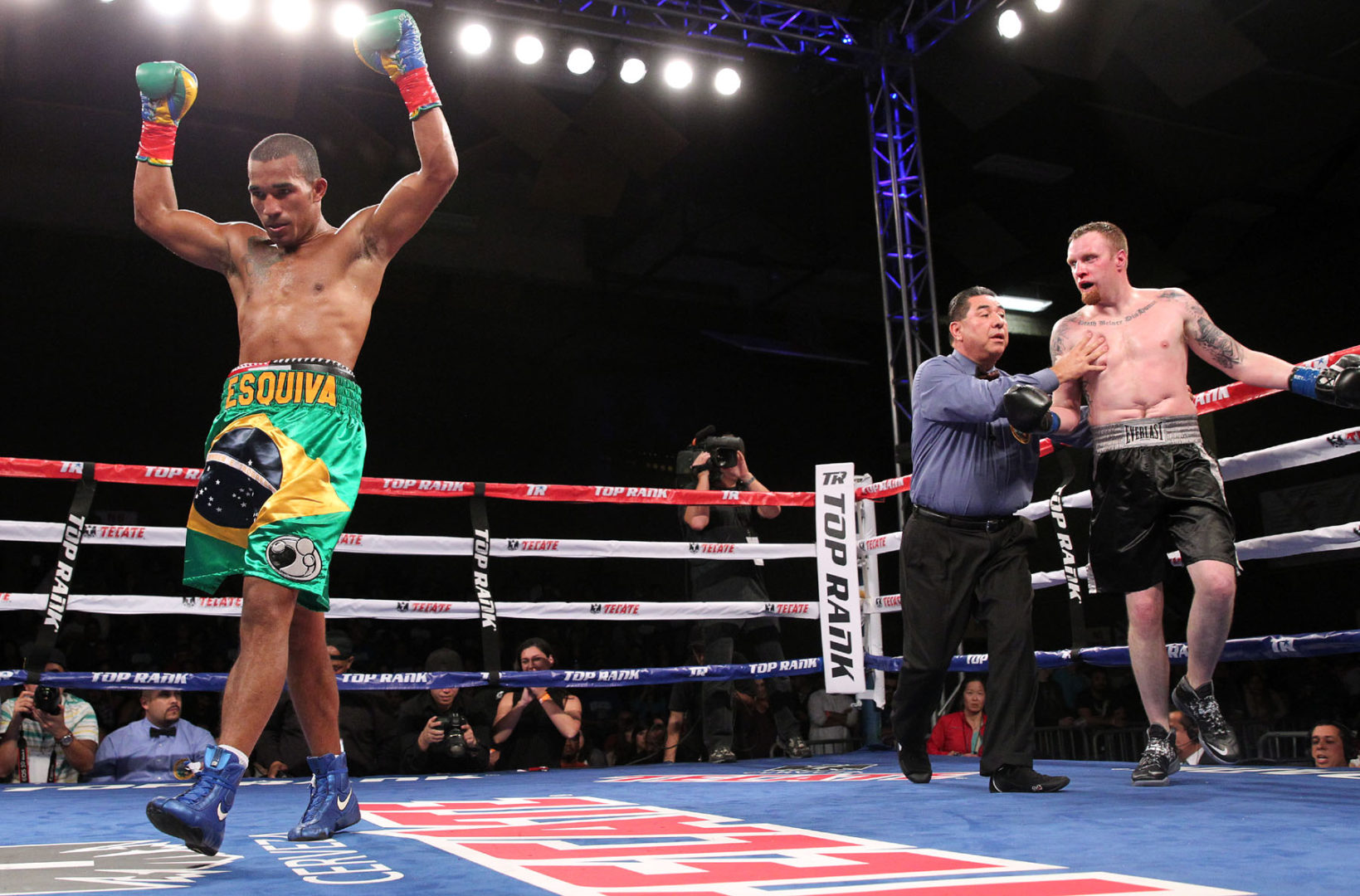
2012 Olympic Silver Medal winner Esquiva Falcao won his professional debut as he stopped Joshua Robertson in round four of a scheduled six round Super Middelweight bout.

Robertson hung tough early but the southpaw Falcao started show his class in round three and in round four, Falcao bloodied Robertson’s nose and the biut was stopped after an accumulation of punches by referee Jerry Cantu at 2:36 of round four.

Falcao, 165 lbs of Vitoria, BRA is now 1-0 with 1 knockout. Robertson, 164 1/2 lbs of Lynchburg, VA is now 5-5.

J.Magdaleno_Castaneda _140215_001a
Jesse Magdaleno scored a 5th round stoppage over Roberto Castaneda in a Featherweight bout scheduled for 8 rounds.

Magdaleno dropped Castaneda in round two from a hook to the side of the head. Moments later, the two had an exchange that saw Magdaleno get the better of and land another hook that sent Magdaleno down for a 2nd time in the round. In round five, the two went to war and Magdaleno landed a hard right hook that sent Castaneda down to a knee and the fight was stooped at 2:48 of round 5.

Magdaleno, 127 1/4 lbs is now 18-0 with 14 knockouts. Castaneda, 125 lbs is now 20-6-1.


History 101: Kathy Duva remembers what she doesn’t want Kovalev to repeat

Kathy Duva
Sergey Kovalev’s projected path to the top of the light-heavyweight division is at a stage in a well-worn process that is necessary, yet often dangerous for promising fighters who don’t know their history. The good news is that Kovalev has a promoter who won’t let him forget it. Kathy Duva has lived it.

Duva’s historical lesson was delivered a couple of times Thursday during a conference call for Kovalev’s next fight, March 29 in a HBO-televised bout in Atlantic City against Cedric Agnew. Agnew, of Chicago, is unbeaten and has impressive amateur credentials. But he could have been Cedric The Entertainer for all anybody knew.

Repeatedly, Kovalev was asked more about Adonis Stevenson, possibly in a fight later this year. Repeatedly, Duva reminded an audience, which included Kovalev, about a fight that happened 24 years ago, almost to the day.

Main Events, the Duva’s family business, promoted Evander Holyfield. A Holyfield-Mike Tyson fight was a hot possibility. First, however, Tyson had a fight with Buster Douglas on Feb. 11, 1990 in Tokyo.

“We know what happened,’’ Duva said.

Douglas beat Tyson, scoring a 10th round knockout, in an upset as big as any in history. Momentum for Holyfield-Tyson was gone. Instead of late 1990, six years and nine months came and went before Holyfield and Tyson fought for the first time – Nov 9, 1996. Excuse Duva, but she doesn’t want to re-live the past. One Upset of the Century is enough in any lifetime.

Kovalev might not be as big a favorite to beat Agnew as Tyson was over Douglas. But it doesn’t matter. In real time, a loss to Agnew would be devastating for the Russian, who has stopped six straight opponents within four rounds.

For now, Kovalev finds himself in a situation similar to middleweight Gennady Golovkin. Both are at a stage where their drawing power isn’t enough for a big-name opponent to take the chance. They fall into that most-feared category. Like Golovkin, however, HBO is interested in Kovalev. If HBO begins to attract an audience for Kovalev, money and opponents will follow. It’s a potential formula that dictates some urgency, or at least due diligence.

“On March 29, Sergey will be fighting two things, in my opinion,’’ Duva said. “He’ll be fighting Agnew and the temptation to look past him.’’

Reasons to look past Agnew are on his 26-0 record, which includes 13 knockouts. Agnew went the distance with Yusaf Mack in March, winning a 12-round unanimous decision. Against well-known fighters, Mack didn’t last. Carl Froch knocked him out in three rounds in 2012. Tavoris Cloud stopped him in eight in 2011. Glen Johnson stopped him in six in 2010.

Agnew believes he has the right skillset to beat Kovalev, whose nicknames include Krusher and the Terminator. Kovalev’s intimidating record (23-0-1, 21 KOs) includes a tragic death. Roman Simakov died three days after he lost a seventh round TKO to Kovalev in Russia in December, 2011.

“I don’t look at him as no Terminator,’’ Agnew said. “He’s a human being. He can be hurt just like anybody can.’’

If Agnew was impressed by Kovalev’s knockout ratio and the hype that comes with it, he didn’t reveal it.

“My personal opinion: I think he’s ordinary,’’ Agnew said.

Meanwhile, Kovalev seems to understand the stakes. He can’t afford a misstep if he hopes for a showdown with Stevenson, a power puncher in his own right with 20 stoppages in 23 fights on a record that includes one loss. Stevenson might fight in May on HBO in Montreal. A possible opponent is Polish light-heavyweight Andrzej Fonfara (25-2, 15 KOs), now of Chicago.

“Last year, the best in my division was Stevenson,’’ Kovalev said. “I have to beat Stevenson if I want to be the best.’’

To get that chance, he has to remember to take care of business against Agnew. Kathy Duva’s history lesson is good reason to believe he will.


Juan Diaz and the Age of Impressionism

Juan Diaz
In the 1870s, a group of artists in Paris, including Pierre-Auguste Renoir, decided to stop submitting their works to the official annual exhibition of the Académie des Beaux-Arts, also called the Salon. Dubbed “Impressionists,” these brave new visionaries instead mounted eight independent exhibitions of their own, featuring works done in a new, informal style based on modern subjects of everyday life and leisure, an idea which had originally been pioneered at and rejected by the Salon.

At least, that’s what the sign outside the door told me as I entered the Houston Museum of Fine Arts last Saturday afternoon after spending the morning watching former lightweight titlist Juan Diaz train and spar at his new gym, Baby Bull Boxing Academy.

I don’t know as much as I should about art. My wife and I are members at the museum, but only because we like to look at the paintings. I don’t know much about history or theory, but when we travel through the giant halls of paintings and such, I can’t help but read all the boxes of text surrounding these magnificent works.

This particular collection, The Age of Impressionism, has traveled all around the world. It was put together over time by Sterling and Francine Clark, heirs of the Singer Sewing Machine Company fortune. It features 73 paintings by artists such as our friend Renoir, as well as Édouard Manet, Edgar Degas, Claude Monet, Berthe Morisot, Camille Pissarro and Alfred Sisley and others. This was the last stop of the tour. After traveling to Tokyo, London, Barcelona, Milan, etc., etc., etc., the collection would stop in Houston before returning back home to The Sterling and Francine Clark Art Institute in Williamstown, Massachusetts.

Juan Diaz has traveled the world, too. He’s the heir to his own fortune, though, wrought the hard way and from a very young age. Diaz was born Sept. 17, 1983 in Houston, Texas to Fidencio and Olivia Diaz, a young couple from Guerrero, Mexico. When he was just eight years old, Fidencio, a rabid boxing fan, took little Juan to Willie Savannah’s boxing gym.

Diaz entered and won his first tournament at 12. At 16, he qualified for the Mexican Olympic team, but was three months too young to compete at the 2000 Summer Olympics. Later that year, with a 105-5 amateur record, Diaz decided to turn pro.

Diaz had a solid career as a professional. By the end of things, he was one of HBO’s regularly featured darlings. He won lightweight title belts and even fought two big money fights against all-time great Juan Manuel Marquez for the lineal lightweight championship. Diaz was a fan favorite during his heyday, and after the second loss to Marquez he seemed to be getting out of the fight game while the getting was still good. At age 27, with all brain and bodily functions still intact, Diaz decided to hang up the gloves and get on with the rest of his life.
But Diaz is back in boxing now. After almost three years of pause, Diaz unexpectedly returned to the ring and knocked out Gerardo Cueves in April 2013 in six rounds. Houston’s most popular fighter rounded out the year with two more wins over similar fare, knocking out Adailton De Jesus in five and going the 10-round distance with Juan Santiago.

Diaz is older now. He does not fight with quite the same frenetic energy but he still appears aggressive and hungry. At 30, he has won three straight on his way back up the ranks, and he’s still able to make the lightweight division with relative ease, something that should only help him in his effort to recapture former glory. And that’s what it’s all about for him.

“It’s not about money,” Diaz said. “It’s about world titles.”

I don’t know as much as I should about boxing. My wife and I cover the fights for various websites, but only because we like the sport. I like boxing history and theory but wouldn’t consider myself a great historian or anything. I’ll read a boxing book if I come across one that suits me, though, because I can’t help but read about these magnificent figures of sport.

As I watched Diaz spar that morning, I mostly wondered what he’d look like when he steps up past tomato cans like March 1 opponent Gerardo Robles. Diaz thinks he’ll be the same champion he was before, only smarter and more skilled. But fighters always think that. They have to. The minute they start believing otherwise is the minute their careers are over.

This is what I’m thinking about during the brief seconds between standing and staring at paintings at the museum. I don’t know many genres of art, but the Impressionists always seem to catch my eye. To me, they capture the beauty and the power of life but in a way that appears at once magical and realistic.

Take Renoir’s Sunset at Sea. Is this not what you’d see looking across the ocean at the glimmering majesty of the setting sun? But at the same time, isn’t this also completely unlike any picture even the most advanced camera could help you collect? To me, Impressionism is both less and more than life.

Diaz sparred eight rounds that morning. He went three against TV fighter Lanard Lane and five against local lightweight Danny Garcia. Diaz was aggressive but not stupid. His corner men, Derwin Richards and Timothy Knight, hurled instructions at him from across the ring, telling him more or less exactly that.

“Bend your knees,” said Richard. “Now turn…turn!”

“Keep that jab going,” added Knight. “Jab!”

Diaz did all these things, but he threw hooks and uppercuts to the body and torso of his opponent less like a man who wants to box smart and more like a man who just wants to be in a good fight. That kind of thing is what made him so popular in the first place, I suppose, but it was also his undoing.

But Juan Diaz is going to be Juan Diaz, and that’s something we could probably all learn from.

After witnessing the two Saturday exhibitions, Juan Diaz and The Age of Impressionism, I can’t help but wonder if Diaz will be able to pull off what the Impressionists did all those years ago. Reactionaries to the prevailing sentiment at the Salon, artists like Renoir have now become measuring sticks for others. No one who studies art skips over what they did during their time. And no one has forgotten them now that they’ve turned to dust.

In a similar way, our present culture’s Salon doesn’t think Diaz should be boxing anymore either. After all, they reason, Diaz has a college degree and several successful businesses. More than that, he’s smart, sharp and affable enough to get along better than most everyone else without trading punches in the ring for money.

So I think Diaz’s comeback might also be a reaction, one to the idea that men should only fight if they have no other way to earn, the one that says boxing isn’t suitable for Diaz now because he could make money doing other things. It’s as if we are to believe the dignity of a human being, the value of a soul, is something that can be measured by one’s capabilities or by how one chooses to make his way through the world.

Diaz rejects this premise. And who knows? Perhaps 150 years from now, some silly writer and his wife will roam around a museum on a Saturday afternoon to revere Diaz the way we did Renoir and the Impressionists.

I wonder what they’ll do that morning.


Bling and blast: Maldonado stops Nater after four

SAN ANTONIO – Albuquerque welterweight Fidel Maldonado has the bling – sparkly purple trunks, gold trimmed, matching tights and safety-green boots – and occasional flashes of power, but ultimately a Monday Night Boxing main event in a Cowboys Dancehall bullring will likely mark the peak of his televised accomplishments.

If that is the case, Maldonado’s (18-2, 15 KOs) corner stoppage of Puerto Rican John Nater (13-5, 10 KOs), effectively a replacement for the man who replaced Maldonado’s original opponent, Steve “Two Pound” Forbes, should lead the highlight reel of Maldonado’s career, with Monday’s conclusion – referee Jon Schorle stopping the match before the fifth round of a Leija-Battah Promotions main event – being the most of what Maldonado can ask for.

After some foul-filled opening moments Monday, Maldonado clinched Nater then brought savagery his way in round 3, whupping the Puerto Rican in clinches and catching him with a surprisingly effective left-cross counter, thrown from the New Mexican’s southpaw stance, in the round’s final minute. The fourth saw more of the same, including a second trip to the blue mat for Nater, whose corner sagaciously concluded matters before any more damage might be done.

Maldonado appears three parts glittery special effects for every one part fighting prowess, but with his promoter needing to fill Monday night slots, there’s no reason to think he’ll not get a few more moments on Fox Sports 1.

ERROL SPENCE VS. PETER OLOUCH
While the rest of his 2012 Olympic teammates seemingly have stagnated in the professional ranks, Texas welterweight Errol Spence (11-0, 9 KOs) has continued to improve, throwing his punches with greater leverage, bettering his footwork and hitting to hurt, not merely score points. African Peter Olouch (12-7-2, 6 KOs) found out all about Spence’s capacity to hurt, in Monday’s co-main event, getting knocked cold at 1:39 of round 4.

Spence attacked Olouch from the match’s opening round, using well-leveraged punches thrown from his southpaw stance to concuss the lanky African with most each blow that landed. After sending Olouch to his knees in the first minute of the fourth, Spence finished the job with a left hybrid cross-uppercut, surprising as it was concussing for being so concussing. Olouch dropped, and no 10-count was needed, though assistance was needed for Olouch, about three minutes’ worth, before the African regained his feet and left the ring of his own power.

TERRELL GAUSHA VS. GEORGE SOSA
Cleveland middleweight and former U.S. Olympian Terrell Gausha (13-2, 6 KOs) fought in Monday’s first televised match and looked decisively mediocre while winning a one-sided decision over Pennsylvania journeyman boxer George Sosa (13-6, 13 KOs).

After an opening few rounds in which Gausha did not succeed at imposing or defending himself, in the fourth, after being buckled by Sosa’s aggression more than his accurate punching, Gausha landed a number of stout punches, too, taking advantage of a suddenly squeamish Sosa. The Pennsylvanian,-though, was squeamish for a reason: His left glove had slipped off his fist and had to be refitted and retaped.

Once the men returned to even terms, Gausha was more sound than fury, yelping as he threw power punches that affected Sosa only slowly, and the fight devolved into an attritional affair with Gausha hurling inaccurate punches that occasionally landed, and Sosa looking forward exclusively to the final bell.

Official scores all went to Gausha: 80-72, 80-72 and 79-73.

Gausha appears to have increased his muscle mass and perhaps improved his conditioning, but the fact remains he does not appear to have improved as a prizefighter. He has eschewed the activity he employed effectively in the amateurs to load-up on power punches as a pro. It is not an effective tack for him to have taken, as he lacks the speed and accuracy to deploy such power.

Undefeated since turning professional or otherwise, Terrell Gausha fights more amateurishly today than he did as an amateur.

TRAVELL MAZION VS. JUSTO VALLECILLO
Before that, Austin junior welterweight Travell “Black Magic” Mazion (7-0, 6 KOs), a student of noted trainer Ann Wolfe’s and a man who, standing over six feet tall and weighing round 140 pounds, looks like a young, inexperienced, and perhaps anorexic Thomas Hearns, made decisive work of local opponent Justo Vallecillo (6-16, 3 KOs), stopping the wholly overmatched Texan with a trio of righthands at 1:37 of round 3.

Immediately following Mazion’s victory, he and trainer Wolfe danced a series of celebratory verses in the center of the ring, choosing to celebrate Monday evening before setting to work on Mazion’s habit of floating his chin in retreat, one hopes, on Tuesday morning.

JOSEPH RODRIGUEZ VS. JESUS GARZA
Monday’s fifth match saw local undefeated junior lightweight Joseph “Texas Mongoose” Rodriguez (5-0, 2 KOs) beat in rugged style fellow Texan Jesus Garza (2-4-1), of Dallas, by official scores of 40-36, 40-36 and 40-35. Rodriguez may not punch with particular ferocity, but he brings physicality and activity enough, along with a nifty tendency to throw a pivoted right uppercut when inside, to make fellow San Antonians cheer him without fear of disappointment.

Attendance was stellar in Cowboys Dancehall bullring for a Monday night.


Malignaggi gets his Taub

Paulie Malignaggi
SAN ANTONIO – A small band of boxing media and bystanders gathered Sunday afternoon near an entrance of the Home Depot Center in Alamo Heights, an incorporated city in this city’s central-north quadrant, to see the weigh-in for Monday’s “Golden Boy Live!” show in the bullring of a local cowboy dance hall named, unerringly, Cowboys Dancehall. At least one of us was there because a Saturday blast email from Leija-Battah Promotions promised Paulie Malignaggi would host. Yet there was Jesse James Leija playing emcee.

Halfway through the roster for Monday, there was a slight rustling, and then, sporting a black sweatsuit of some crushed fabric or other, along strolled the 2013 winner of the Boxing Writers Association of America’s award for excellence in broadcast journalism, an award named after Sam Taub, a fellow New York commentator. Malignaggi’s eyes bulged in the nearest thing he has to a signature look, and his gestures, just as customarily, pushed through whatever it is that delimits energy and anxiety. Leija hurriedly handed boxing’s best broadcast journalist a microphone – whereupon Malignaggi announced he didn’t know anything about hosting the event, he’d just got off a plane, and he was exhausted.

It was a frank declaration with a staccatissimo delivery, and vulnerable. Just like Malignaggi’s best commentary.

The very thing that makes Malignaggi’s career knockout ratio slight is, in large part, what makes his insights on the air timely and exceptional. Malignaggi does not punch hard, and he did not punch particularly hard even before his chronically injured hands were so prone to injury. His smallish frame and surgically reconstructed right fist, both, contribute to his acclivity for icing opponents, especially at the championship level, but they also evince a courage that is easy, quite easy, too easy, to miss after a Malignaggi promotion comes to its end with an opening bell – after he finishes playing a caricaturist’s Yankee Fan, and sets about swapping blows, usually in a weirdly tassled trunk or eccentrically coifed do.

If journalistic compulsion has stayed me from ever exactly cheering against Malignaggi, I confess, it has hardly strained its binds in keeping me from cheering him on. Not until I prepared in January for a magazine piece that had nothing to do with Paulie Malignaggi did I pause long enough to realize how much my distaste for his pre/postfight persona had kept me from properly appreciating a fighting style every bit courageous, in its way, as any volume puncher’s.

Malignaggi needs more wiles than even that guy, really; he doesn’t move forward into opponents’ space and discomfit them. He courts their aggression even while knowing he hasn’t a punch, or reliable enough hands, necessarily, to keep-off him men who, first and foremost, endure human fists expertly hurled. Malignaggi must read other men’s bodies, and compile that data and send its resulting queries to his repository of foiling techniques, and incorporate whatever algorithm returns him, many times faster than a man possessed of a weighty punch. When he’s on the air watching what aggression he has watched for tens of thousands of rounds in gyms, he can’t help himself: He sees what happens many times faster than men who’ve never had their consciousnesses on the line in front of millions, and he says what he sees many times clearer than other pugilist-broadcasters.

Malignaggi is a talker, a social creature, a man who likes to be seen and talked to and challenged to explain himself; he is comfortable in a public role – he talks over an interviewer in a voracious desire to assert a new point or clarify an old one, in a way few prizefighters do – he wants to share himself and his mind. This is much of the rest of his talent for broadcasting; most fighters, whatever they tell themselves about their prescript and preheated shtick, know from experience in elementary schools they have little to contribute but autobiography, and untimely reticence recurs when their microphones greenlight.

Malignaggi, conversely, must be quieted – he has lots to share and a desire to share it – and in a very short amount of time, he has married this need to quiet himself with what proclivities for abnegation mark a man who makes weight to make money, and made himself, according to my peers in the BWAA, boxing’s very best broadcaster in 2013.

When I spoke to Malignaggi last month, the usable material of our interview didn’t exceed five minutes – still plenty – but we spoke for 47 in the sort of meandering way social creatures do, unscripted, vulnerable, free to differ in good faith, and it caused me to conclude our conversation by imparting an anecdote well-suited to close this column.

In 2008 I had the good fortune of exercising in the same L.A. Boxing gym in which cruiserweight contender B.J. Flores trained. Flores shares much of Malignaggi’s garrulousness, but where Malignaggi’s upbringing, New York, liberates him to disagree with a man even if he doesn’t dislike him, Flores’ Midwestern upbringing makes him more likely to be agreeable, and this makes his commentary, at times, vibrate with the low-growling hum of salesmanship. Both, though, are men who, unlike their peers, could have succeeded in fields where intellectual merit civilly delivered composed their essential parts. Apropos of a recent Malignaggi outburst – Texas judging maybe? – I told Flores in concise a way as I could muster I did not like anything about Paulie Malignaggi, and the following interaction resulted.

B.J.: Have you ever met Paulie?
Bart: No.
B.J.: You need to meet him.
Bart: Why would I need to do that?
B.J.: It’s impossible to meet Paulie and not like him. He’s a good man. Meet him.

It took seven years to prove, but I’m happy to say Flores was right. Congratulations to Paulie Malignaggi on winning the 2013 Sam Taub award for Excellence in Broadcast Journalism.

Bart Barry can be reached via bart.barrys.email (at) gmail.com


Only one winner in the Khan-Maidana poll

Amir Khan
Polls can be as reliable as scorecards. About as scientific, too. That’s why it’s hard to know what to make of Floyd Mayweather Jr.’s question to fans about his next opponent.

Marcos Maidana?

Or Amir Khan?

From this corner, Khan still looks like Mayweather’s likely foe on May 3 no matter what the poll says. The only numbers that seem to matter are summed up by Mayweather’s nickname, Money. Follow it and you can get a pretty good look at what Mayweather is attempting. Against Britain’s Khan, Mayweather has a shot at a share of the UK’s big pay-per-view potential. Against Argentina’s Maidana, he doesn’t.

That’s a theory anyway. On second thought, however, perhaps it’s too simple. Mayweather is a gambler only at Vegas’ sports books. As a boxer, he’s careful about whom he fights and when he fights. He manages the risk, which helps explain his longevity and maybe his unbeaten record, 45-0 and counting.

The Maidana-or-Khan poll is the result of an argument that emerged after Maidana’s beat-down of Mayweather wannabe Adrien Broner in December. Then, there was already public discontent about whether Khan deserved the opportunity. He has won twice, yet struggled since Danny Garcia upset him. In April, he had to get up from a fourth-round knockdown for a narrow decision over Julio Diaz. Maidana, who lost to Khan in the 2010 Fight of the Year, has done more to stake his claim. Fair enough, but this is boxing. Fair is often an illusion, if not an artful feint.

Few give Khan a chance against Mayweather. Yet despite his vulnerable chin and recent struggles, he still possesses fast hands and agile feet. Mayweather has been at his dominant best against foes he has called flat-footed. Can it be a coincidence that Robert Guerrero and Canelo Alvarez were the first two opponents on his rich Showtime contract? He called them flat-footed and he proved it with dominant victories over both.

No matter what you think of Khan, he’s not flat-footed. Add his fast hands, and Mayweather could have a problem, at least for a while. It’s simple as that old line about styles. They make fights. Few understand that quite as thoroughly as Mayweather.

The risk against Khan might look slim, but it’s bigger than the one Mayweather would face against Maidana. The Argentine has heavy-hands, but they land in a predictable, almost plodding way. Put Maidana in a foot race with Canelo and Guerrero, and you’ve got a dead heat.

Mayweather figures to beat either Maidana or Khan. But if it’s Maidana, he limits the risk. Doesn’t he always?

The poll gives him a chance to pass off the responsibility. Madiana was the poll’s early leader. Let’s assume it finishes with Maidana as the pick. If somebody accuses Mayweather of taking an easier fight in Maidana, he can simply say that he’s only giving fans what they want.

For the moment, let’s assume that Khan is Mayweather’s opponent, regardless of the poll. Then, it could become another example of Mayweather’s gamesmanship. Khan, who said weeks ago that he already has signed to fight Mayweather, appears as nervous as a politician fearful of losing an election.

Within hours of learning that Maidana was leading the poll, Khan was on Twitter, saying:

“Mayweather says he needs a easy fight and fans want to see a knock out so maybe thats the reason he doesn’t want fight me n wants Maidana ??”

“for those that hate me & think FM can KO me, then let’s see him try. Fight me! #SkillvSkill SpeedvSpeed.”

No matter what happens in this poll, the only winner is the guy conducting it.


An adieu to viciousness

Victor Ortiz
The meaningful part of American welterweight “Vicious” Victor Ortiz’s odd career ended Thursday night in an off-Broadway show with an off-Broadway opponent, about seven miles off Broadway, when Ortiz’s vicious tendencies got him corkscrewed in the blue mat of Brooklyn’s Barclays Center by a second-round right hook from Brooklyn southpaw Luis Collazo, while Ortiz’s own late-arriving right hook was still arriving. It was an ending sad in its own goofy, unpredictable way.

It was not a symmetrical close to a career that has made little sense over the years, but it was a close just the same – for a welterweight titlist does not need a Fight of the Year to best Andre Berto, go winless for the next three years, get his mouth wired shut by a junior welterweight, and then get penanced by Luis Collazo, without his empire needs erecting outside the fight game.

Ortiz was once the brightest prospect in the brightest stable in boxing; he shared top billing with Juan Manuel Lopez seven years ago on a ShoBox card in Phoenix’s Dodge Theater, a card whose photos were accompanied by a caption that read “Top Rank’s New 1-2 Punch.” Lopez, a man later described as a “world class dissipater” by someone who’d know, had a comparatively fulfilling career, despite shortening it with hard living, while Ortiz got himself alternately remembered for telling Staples Center he did not deserve to get beat up, getting his lights vengefully cut by Floyd Mayweather, getting his jaw broken by Josesito Lopez, and getting his face lubed while dancing with the stars.

Ortiz inadvertently leaped, Julio Cesar Chavez Jr.-like, from a dear place in aficionados’ hearts to a ridiculous one. He should not have said what he did to HBO’s viewers after finagling his way out a 2009 match with Argentine Marcos Maidana, telling them that, comfortable as he was with prizefighting’s rewards, he did not approve of its risks, but he never recanted, remaining defiantly defiant about it with those whose ticket and pay-per-view purchases enriched him, saying recently as March: “Sorry I’m not sorry.”

He speared Floyd Mayweather a couple years after losing to Maidana then kept apologizing till Mayweather punched him to make him stop, scoring for “Money May” a second knockout since 2005, and leading to a historic conference call in which an as-yet-unrehabilitated Oscar De La Hoya endeavored to out-crazy Ortiz’s loony then-manager, Rolando Arellano, while Ortiz, a transplanted-Kansan surfer, played the dude-of-reason before a disbelieving press corps, a member of which would live-tweet the call was “the worst idea in the history of bad ideas.” Nine months after that debacle, Ortiz auditioned for a chance to make a superstar of Mexican Saul Alvarez, returning to Staples Center, where he never failed to draw, for a match with a four-loss 140-pounder named “Josesito.” Lopez broke Ortiz’s jaw and led him to a hospital-bed revelation about building the “Vicious” brand away from boxing, with a 1-2 combo of celebrity dancing and skincare endorsement.

That was the last time I spoke with Victor. It was a 27-minute phone interview for a 500-word magazine piece about his pending appearance on “Dancing with the Stars” – an interview noteworthy for several reasons, the most of which was its promptness and courteousness. Ortiz’s small management team scheduled an early morning phone call, replying to an initial inquiry almost immediately, and Ortiz not only answered the call on its first ring but did so after doing roadwork without a fight on his 2013 calendar. Ortiz was not merely honest in the sincere way we tell celebrities we want them – “real” being the catchall modifier so prized by kids these days – but lucid, friendly and eloquent.

I mentioned, by way of introduction, a weighin-day bus ride he and I shared to Alamodome in 2007, and he cheerily recalled our conversation and his opponent’s name, before imparting the 20-year-old kid I’d sat beside that afternoon in San Antonio would likely be “disappointed” in his career, though supportively so: “He’d probably be like, ‘Hey man, you’re doing all right for yourself.’”

He sure wasn’t doing all right for himself Thursday at Barclays Center across from Luis Collazo, a man able to stop Ortiz (29-4-2) quicker than any opponent since Collazo stopped Richard Heath (1-1) nine years ago. Perhaps that does not set the hands on the Collazo clock properly as this will: In September, fighting in a San Antonio dancehall bullring, Collazo won a 10-round decision over someone named Alan Sanchez that was so aesthetically displeasing a 20-year boxing columnist on press row not only called it “one of the five worst fights I’ve covered” but felt strongly enough about the matter to impart this very judgment to Collazo himself, who, despite being covered nearly to the centimeter with tattoos, still affected sheepishness in a reply treating his quality of opposition.

Both men in that exchange, as it happened, were right. Collazo proved quite capable of excitement against Ortiz, reminding viewers of the excellent spectacle he made with Andre Berto five years ago, round about the time Berto made his first metaphorical appearance on posters that read “Protected Child” – pinups on which the Haitian Olympian remained until Victor Ortiz unpinned him in 2011. Maybe it was symmetrical, in a b-level-irony sort of way, then, Collazo was the man to end his promoter’s hopes of making Ortiz once more Showtime-ready.

It is tempting to treat Ortiz’s career as a cautionary tale, with its initial precociousness, manufactured homeless-in-Kansas narrative, promoter hopping, loopy outbursts and spectacular losses. Such temptations should be foregone, though. Ortiz came in every fight a picture of fitness, gave his version of events publicly in unfiltered a way as possible, and never, not once, made a boring prizefight – or as his 2007 self might have said through his 2013 self: “Hey man, you did all right.”

Bart Barry can be reached via bart.barrys.email (at) gmail.com


Andy Nance: Boxing Lifer

AndyNance300The sport and business of boxing has a way of testing a participant’s resolve and determination. No matter what angle or level of involvement one has in the sport, ups and downs simply come with the territory. For this reason perhaps, the fraternity of real boxing people is such a small group. Andy Nance, a former amateur standout and professional contender-turned matchmaker and manager, is one of those real boxing people. Successful at every level, Nance still hit the inevitable roadblocks and dead ends that face anyone that stays in this sport long enough. Through it all, Nance remained driven and unwavering and looks to have one of his biggest years in the sport yet.

Despite his great success as an amateur boxer, where he compiled a 118-17 record, Nance had no designs on turning professional. The young Marin County, California fighter had one square focus as he moved up the unpaid ranks. “I wanted to go to the Olympics in 1980, but that didn’t happen so I had decided to pretty much stop boxing,” recalls Nance. “When I was younger, all I ever wanted to do was go to the Olympics. I didn’t think about going pro. I just figured I would go to the Olympics and then go to school and then go to work. So I stopped boxing and was going to college and working, but then I started to miss boxing.”

Had it not been for the inquiry of prospective boxing managers Joe and Marv Pheffer one day at Nance’s place of business, a lifelong career in boxing may never have got off the ground. “These guys came into the restaurant where I was working and talked to me about wanting to manage me and asked if I had any interest in turning pro,” remembers Nance. “I told them at the time I wasn’t interested, but they did give me their number. Not long after that I called them back and told them I had changed my mind and I was interested in turning pro.”

The Pheffers became two parts of a quartet that managed Nance as part of the company LMJ. Though Nance was their first charge, LMJ sagely moved Nance to an 11-0 record within a year of turning pro in May 1982. The group would manage Nance his entire pro career. “I was the first fighter that they ever managed and they just did a great job, especially for never having managed a fighter before, or even really being in boxing,” says Nance. “They were boxing fans, but they had never been in the boxing business. So for never having done anything like that before and basically getting me to the point where I was going to fight for a world title, they just did a tremendous job.”

Nance plugged away, fighting mostly in his home area with the occasional appearances in Reno and Oregon, before getting the call to fight on national television on short notice in February 1984. “Gene Hatcher pulled out of a fight, scheduled to be a ten-round main event on ESPN,” says Nance. “I took the fight [with Hector Sifuentes at the Showboat Hotel & Casino in Las Vegas, Nevada] on like ten days’ notice. I won by a tenth-round knockout and got offered a contract by Top Rank right after that.”

Winning a fight on ESPN was a game-changer for the rising pro, who had become a hometown celebrity of sorts, on several fronts. “It was a big turning point in my career, because of the national recognition,” says Nance. “It changed things for my managers too, because now they were getting contacted by people and getting the offers instead of looking around. I remember going to the [Golden State] Warriors game a week later and so many people were coming up to me at the arena. I didn’t realize how many people were watching, but I was getting recognized. So it changed things all around.”

NanceRobertoJuarez300By late 1986, Nance was in prime position to land a shot at a world title. Nance had put together a long unbeaten streak since his one pro loss years prior, including a big third-round stoppage in a local mega fight with fellow once-beaten Bay Area native Mitchell Julien, which took place at the Circle Star Theatre in San Carlos with the California State Light Welterweight title Nance had claimed a year earlier on the line and a decision victory over recently dethroned former world champion Lonnie Smith in his last two bouts of the year.

IBF Light Welterweight titleholder Joe Manley was scheduled to defend his recently claimed belt against unbeaten Terry Marsh in Basildon, Essex, United Kingdom in March 1987. If the favored Marsh claimed the title, which he ultimately did, Nance was scheduled to be his first defense that June in London, England. Unfortunately, Nance opted to take a fight the same day as the Manley-Marsh clash that would turn out to be his last. “I took what I thought was a tune-up fight with a guy Kelly Koble to defend my State title,” recalls Nance. “That was the fight I got injured and never got my opportunity to fight for the world title.”

Nance, who was hit while he was down in the second round, ended up winning that fight with Koble via ninth-round stoppage, but a severe concussion he suffered during the contest would be the end of his fighting career. No trip to England and no title shot.

“At the time it was devastating,” laments Nance. “I had pretty much sacrificed my whole life to get to that point. Once I made the decision to turn pro, the goal was to win a world title. I trained very, very hard every day. I ran every day, rain or shine. 100 percent dedicated to training. I was lost and I just didn’t know what I was going to do. My whole goal was to win a world title and it was devastating. But it is just like anything else, you move on because you have to.”

Just as when his dream of making the U.S. Olympic squad ended, Nance soon found other avenues to pursue in the sport of boxing. Within months after his career-ending injury, Nance was in the gym training fighters, some of whom he would eventually manage. During the mid-‘90s the former fighter was also involved in co-promoting a series of events before he fell into what would become his main focus.

“In 2007, I had a guy Daniel Castillo that was going to fight on the undercard of Vernon Forrest and Carlos Baldomir in Tacoma, Washington and right before I went up there John Beninati, the matchmaker for Gary Shaw, called and asked if I could help him make a fight to replace one of the ones that fell out at the last minute,” recalls Nance. “When I got up there, he asked me if I liked doing that and I told him I did. He told me, ‘Call me on Monday, I have three or four more fights I can give you and you can help me make.’ And that’s how it started.”

In short order, Nance would become one of the most active and respected matchmakers in boxing. Nance, like every other fighter, had to make sacrifices to pursue his fighting career. In order to pursue a career in matchmaking, Nance again made some sacrifices as he pursued a career that kept him in the sport that he loves. “I fell in and started matchmaking full-time almost immediately,” recalls Nance. “I had a real estate license from 1987-2007. I got my license and sold real estate for twenty years. I was making good money in real estate, six figures a year, but it wasn’t something that really interested me. It wasn’t my passion, but the boxing I loved. So I took a huge pay cut, and luckily I had some money saved, so I was able to make ends meet.”

Nance is one of the few prolific matchmakers that actually had a career inside the squared circle, something that benefits him as he looks to put together the right fights. “You really understand what’s going on as a former fighter,” says Nance. “I can talk very intelligently, especially to the boxers or trainers, with my perspective of being an ex-fighter. Also, I get a really good feeling of how a fight is going to go based on my knowledge of boxing. It is so much different being an ex-fighter as opposed to not being an ex-fighter. Honestly, I don’t know how some people do it. I think some are winging it a lot. For me, I use my experience as an ex-fighter daily as a matchmaker.”

In addition to the matchmaking, Nance also manages a handful of fighters at various stages of their careers. Among the fighters on his roster are tough luck veteran light heavyweight Paul Vasquez, veteran heavyweight Danny Batchelder, durable journeyman light heavyweight Billy Bailey, rugged featherweight Christian Cartier, as well as comebacking cruiserweight Joe Gumina, who he co-manages.

Nance also helms the career of former national amateur standout heavyweight LaRon Mitchell of San Francisco, California. Mitchell narrowly missed making the U.S. Olympic Team in 2012, due to a controversial loss at the Trials and some politicking in its aftermath. Nance has helped guide Mitchell to an unblemished 3-0 record, with all three wins coming by way of stoppage. Nance hopes to secure a promotional pact with Thompson Boxing Promotions and already has Mitchell signed to fight in the Bay Area for the first time on April 5th.

Nance is involved with another boxing venture, as he has joined up with King Sports, an upstart promotional company. “King Sports is an up-and-coming promotional company that I believe one day can be the biggest promotional company in boxing, period,” Nance claims. “They are signing top-level fighters and putting their fighters in real fights. They are not babying their fighters. When they sign a fighter, all his soft fights and tune-ups, they’re done. From now on, you are in a real fight and you are going to earn your money and we are going to move you. You have got to be a real fighter to fight for King Sports. You are going to have to fight real fights against real fighters to fight for King Sports.”

With everything he has lined up and in the works, Nance hopes to have one of his best years yet in the sport. “I’m looking have a big year in 2014, for both myself and the fighters I work with,” says Nance.

Andy Nance is one of those people in the sport that can honestly say they eat and sleep boxing. It took drive and determination as a young fighter to get to the doorstep of a world championship. Today Nance is just as passionate about the sport he loved as an 18-year-old. The world title may come one day through one of the fighters he represents, but even if it does not, Nance’s story is one that proves that there is a way around almost any roadblock and success can be found in the field you love if you are willing to work hard and sacrifice to make it happen.

Title Photo by Erik Killin

Mario Ortega Jr. can be reached at Mario@OrtegaBoxing.com or on Twitter @MarioG280


Joshua stops Darch in 2

Lee Selby

2012 Olympic Gold Medal winner Anthony Joshua scored a 3rd round stoppage over Dorian Darch in a scheduled 6 round Heavyweight bout.

Joshua ripped Darch with a hard combination on the ropes at the end of the 1st frame. Joshua landed several hard shots in round two and then landed a ripping left hook that sent Darch into the ropes and the fight was stopped at 51 seconds of round 2.

Joshua, 241 1/2 lbs is now 4-0 with 4 knockouts. Darch, 241 lbs, is 7-3.

Gary Buckland registered a 12 round split decision over former world champion Gavin Rees in a spirited battle in a British lighteight elimination bout.

The action started off quick with Rees landing the to the body with the right hand. The stood in the “phone booth” for much of the fight with Rees continuing to work the body and Buckland countering with shirt uppercuts on the inside. In round five, Buckland started to up his activity level but in the next round, Rees got back to landing some thudding body shots as well as mixing right;s to the head.

Buckland’s activity level picked it up again in round eight as he started to back Rees up on the ropes. As the round’s went on, Buckland’s activity rate was very consistent. Both guys continued to dig deep but Buckland probably got the 10th frame when he naded a right hand that drove Rees back to the ropes. Rees’right eye started to shot from all the contact in this intense battle. Both guys wanted it in the 12th in this fight that could have gone either way. In the last last 30 seconds alone, Rees rocked Buckland with a hard right but Buckland came right back with furious combination.

Buckland, 134 3/4 lbs of Cardiff, Wales won by scores of 116-113 and 115-114 while Rees got a card 116-113.

Buckland is now 28-3. Rees, 135 lbs is now 37-4-1.

In a terrific back and forth battle Dale Evans scored a 8 round decision win over Erick Ochieng in a Welterweight bout.

It was a back and forth slugfest with both guys being rocked throughout the bout.

Evans, 148 1/4 lbs won by a 77-76 tally in the referee’s scorecard and is now 8-1-1. Ochieng, 148 3/4 lbs is 14-3.


One More Time: Pacquiao-Bradley rematch inevitable

Bradley_Pacquiao_120609_002a
Rematches can be predictable remakes, or tiresome redundancies, or just unnecessary. But Manny Pacquiao-Timothy Bradley is none of the above. It had to happen.

In some ways, April 12 is more of a resumption than a rematch of Bradley’s rancorous split-decision over Pacquiao on June 9, 2012. Once the controversy subsided to a dull roar, only questions were left in the debris. If this were business as usual, there would be no answers and only the futility that surrounds the never-never land of a Pacquiao-Floyd Mayweather Jr. possibility.

But Pacquiao and Bradley will pick up where they left off in the same MGM Grand ring where their first chapter ended in what ranks as boxing’s noisiest controversy during the Twitter era.

Economics and a collection of dwindling options probably had more to do with the agreement than anything. Robert Guerrero’s name popped up as a Pacquiao possibility, but Bob Arum quickly dismissed that one.

If Arum hopes to re-affirm Pacquaio as a pay-per-view star after a reported audience of 475,000-to-500,000 bought his victory in China over Brandon Rios, he needed an attraction. Guerrero would have been a tune-up, another Rios. But a rematch with Bradley represents compelling drama with stage and story already in place.

It’s a dangerous fight, especially for Pacquiao. Most of the momentum appears to be with Bradley. In announcing the rematch, Arum called Bradley a different guy. In the public eye, he is. He underwent a remarkable transformation in the months since he was unfairly portrayed as a villain for the scorecards that gave him the debatable decision over Pacquiao.

He displayed courage in beating former Pacquiao sparring partner Ruslan Provodnikov in the 2013 Fight of the Year. Then, there was his poise and patience in outworking Juan Manuel Marquez, whose one-handed stoppage of Pacquiao in December 2012 put him face down and face-to-face with doubts the Filipino has yet to knock out. He looked good in scoring a decision over Rios in November. Only against Bradley, however, can he really prove he’s still the whirlwind we remember.

There’s plenty of uncertainty about whether he can. Indications are that Pacquaio will be about 7-4 favorite. At opening bell in 2012, he was favored 4 ½-to-1. If the speed and angles employed by Pacquaio in the first fight are still there, Bradley is in trouble. At least, that’s the theory.

But a couple of things happened in 2012 . Bradley suffered injuries to both ankles then. He showed up at the post-fight news conference in a wheel chair. In a sport that has seen it all, there’s no record of the winner ever addressing the media while confined to a wheel chair.

It’s fair to assume that Bradley’s ankles will hold up this time around. What happens then? Bradley without limits on his mobility has a much better chance in what figures to be another close fight.

Meanwhile, close fights have become a Bradley trademark, if not identity. He’s won each of his last three by narrow decision – Pacquiao and Marquez by split and Provodnikov by one point on two cards and three on the third. Debate the scoring all you want, but they add up to a resiliency. The unbeaten Bradley finds a way. He’s a survivor, which means he won’t waste a second chance.

Pacquiao’s motivation is no secret. He has a right to think he was robbed in 2012. He’s anxious to correct the record, to claim what should have been his all long. That’s an intangible, yet powerful. Still, it’s hard to get a good read on just who Pacquiao is these days. There’s been plenty of evidence he has lost some speed and power. To wit: The Pacquaio of old would have stopped Rios within five rounds.

There’s also talk about money problems and reports about tax issues. Who really knows? But know this: Pacquiao could have told Arum to put a hold on Bradley. He could have demanded Guerrero in a dull, yet safe step that might have kept alive talk about Mayweather, who started his Showtime contract with tune-up victory over Guerrero.

Pacquiao’s contract with Arum is set to expire at the end of 2014. Could Arum have said no? Pacquiao apparently listened to Arum. In terms of the bottom line, Bradley makes sense. In terms of Pacquaio’s career, there was no other choice. He had to pick Bradley if he wanted the public to take him seriously. But it’s very dangerous. So know this too:

Pacquiao has a history of agreeing to perilous rematches. He gave Marquez three extra chances when he really didn’t have to. The third chance proved devastating. But it was also fair and fearless, just two more elements in a series that has it all and begs for more.


Collazo knocks out Ortiz in two

Collazo Wins
Luis Collazo scored a stunning 2nd round stoppage over Victor Ortiz in a battle of former Welterweight title holders at Barclays Center in Brooklyn, NY.

OrtizCollazo_Hoganphotos1
Not much happened over the 1st rounds with Ortiz looking for the big shot and Collazo got in a few counters. The end came suddenly and with a big thud as Ortiz landed a straight left but Collazo landed a perfect right hook to the jaw that spun Ortiz to the ropes and on the canvas and was counted out by referee Benji Esteves at 2:59 of round 2.

Collazo, 146 1/2 lbs of Brooklyn is now 35-5 with 18 knockouts. Ortiz, 146 1/2 lbs of Ventura, CA is now 29-5-2.

“I had no doubt in my mind that I was going to win,” said Collazo. “I went through hard times and maybe I wasn’t ready before, but I was ready today.

“When I was in the locker room, the joy, happiness and excitement hit me that I have the opportunity to perform in Brooklyn in front of my fans and the people I grew up with here,” he continued.

“I knew Ortiz was going to come out and be aggressive and I had to stay focused and stick to the game plan. People say that I can’t punch, but I guess they’re wrong.”

“I’m good,” said Ortiz. “I got caught. No big deal. It happens. I put my heart out there.”

Eddie Gomez scored a 7th round knockdown en route to a 10 round unanimous decision over DeQuann Arnett in a battle of previously undefeated Welterweights.

Gomez controlled most of the first six rounds with solid power punching and using some good body work. Arnett would sneak in the occasional right hand that kept Gomez honest. In round seven, Gomez landed a thunderous body punch that sent Arnett to the canvas. Arnett got to his feet but Gomez opened up with a barrage of punches that had Arnett staggered. Arnett recovered enough to attempt to time Gomez’wide power shots and even got through with a few of his own shots.

Gomez, 147 1/4 lbs of Bronx, NY won by scores of 98-91 and 97-92 twice and is now 16-0. Arnett, 148 1/2 lbs of Orlando, FL is now 11-1.

Gomez continued to be the leader down the stretch and he cruised home with the victory.

“I just took my time in there and did what I had to do,” said Gomez. “Now I’m just happy.”

Gomez continued, “I should have gone to the body earlier and I think I could have gotten him in four or five rounds. I’m just thankful for the opportunity to get this fight. I took full advantage and worked hard.”

“This is the beginning for me not the end,” said Arnett. “I am going to come back stronger and will take this and learn from it.”

Super prospect Gary Russell Jr. scored a tremendous 4th round stoppage over Miguel Tamayo in scheduled eight round Featherweight bout.

Russell controlled the 1st three round with fast hands as featured a rights to the body. In round four, he landed a huge right that hurt Tamayo and a follow up right dropped Tamayo for the ten count at 1:04 of round four.

Russell, 126 3/4 lbs of Capitol Heights. MD is now 24-0 with 14 knockouts. Tamayo, 126 1/2 lbs of Obregan, MX is now 14-8-2.

“I felt good in the ring tonight,” said Russell Jr. “I paced myself and worked towards what I wanted. I felt prepared. I went through six weeks of training and I rose to the occasion.

Russell Jr. continued, “I am looking toward the future and getting a shot at a world title.”

In non-televised undercard action, some of New York’s most exciting young prospects showcased their skills with impressive wins.

Barclays Center regular “Sir” Marcus Browne (9-0, 7 KO’s) of Staten Island made the most of his seventh appearance at the arena as he went the distance against Shreveport, LA’s Kentrell Claiborne (4-9, 3 KO’s) in a six-round cruiserweight bout. The 2012 U.S. Olympian was happy that his opponent had a “head made of stone” so that he could get more experience in the ring.

“I got some good rounds in,” said Browne. “I’m learning how to be a distance fighter and to prove I could keep my composure.”

Local Bronx up and comer Emmanuel “Manny” Gonzalez (14-0, 7 KO’s) went the distance against Victor Sanchez of Houston, TX (5-8-2, 2 KO’s) in an eight-round featherweight matchup that saw Gonzalez winning nearly ever round on all three judges’ scorecards despite a point deduction for holding in the seventh round. Gonzalez also looked at his eight-round bout as a learning experience.

“This is the first eight-rounder that I’ve fought [that has gone the distance] in about a year and a half,” said Gonzalez. “I definitely got a little winded, but I will work even harder next time and continue to be undefeated.”

Newly-signed Golden Boy Promotions prospect Zachary “Zungry” Ochoa (6-0, 3 KO’s) of Brooklyn put on a strong performance in a four-round super lightweight fight against Jose Valderrama (3-7, 3 KO’s) of Manati, Puerto Rico in Ochoa’s inaugural performance as a member of the Golden Boy Promotions stable.

In the first fight of the evening, Rafael Vasquez of Brooklyn, NY (10-1, 8 KO’s) scored a first-round technical knockout over Bradley Patraw (10-7, 5 KO’s) of St. Paul, Minn. in featherweight action that was scheduled for eight rounds.


Garcia is ready to be redeemed by Gamboa

Mikey Garcia
Saturday in the little room at Madison Square Garden, Oxnard’s Mikey Garcia made another admirably professional showing, this time in the super featherweight division, against another wholly outmatched opponent, this time in the form of Mexican Juan Carlos “Miniburgos” Burgos, on HBO – a network quite supportive of Garcia. This match readied the table for a war in the summertime between Garcia, a technically flawless counterpuncher, and the Cuban chloroform dispenser named Yuriorkis Gamboa.

We’ve been here before, haven’t we? HBO is aflutter with the possibility of matching an undefeated marquee name from the Top Rank stable with the fantastically flawed but still undefeated Gamboa, a prizefighter whom the network has been building for some while now with enthusiasm irregular as Gamboa’s chin. It was four years ago, nearly to the day, on Jan. 23, 2010, that HBO’s “Boxing After Dark” program featured Gamboa on the same card as undefeated Puerto Rican Juan Manuel Lopez. Gamboa laid waste to Rogers Mtagwa, who’d brought “Juanma” within a sip of drowning in the deep waters of their title match four months prior, Lopez retired Steven Luevano, and HBO aroused its viewership with overtures of Gamboa-Lopez in the very near future.

Bob Arum, head of Top Rank, promoter of both men, addressed HBO’s anxious viewership thusly: “I know what people want, and they can go f–k themselves.”

Lopez and Gamboa continued to circle one another, recycling opponents. Then in March 2011, Gamboa solicited from poor Jorge Solis a concession no one, certainly not Manny Pacquiao, hit hard as Gamboa. The moment was ripe for Lopez-Gamboa to not-happen for a second year. What suspenseful bleating the non-event was about to incite, though, got muted 21 days later when Lopez got flattened by Orlando Salido and all thoughts of what Arum anticipated would be “the biggest featherweight fight of all time” instead moved inexorably toward a day when, in an attempt to make Gamboa’s 2012 match with someone named Michael Farenas enticing, rapper-cum-promoter Curtis “50 Cent” Jackson would chant unevenly over background vocals while being lowered from Top Rank’s video apparatus above an MGM Grand ring erected for what became Juan Manuel Marquez’s razing of Manny Pacquiao and Top Rank’s 2013 top line.

Since a Lopez fight with Gamboa by then made no sense, especially not after Juanma again got stopped in his 2012 rematch with Salido, Top Rank seasoned Lopez for a feeding to Mikey Garcia – a young fighter already supplanting his temperamental stablemate, Nonito Donaire, as the future of Top Rank, even before the flashy Filipino got undressed by a Cuban named Guillermo Rigondeaux who is much, much better than his fellow islander Gamboa. This brought things limping to Dallas in June where Juanma took the scale on a makeshift dais in American Airlines Center’s concourse and looked a perfect 125 1/4-pound feast for Garcia.

Ah, but Mikey’d been doing some off-menu grazing and missed the match’s contracted weight by a clean two pounds. For once Arum was sincerely irate. He sat silently in the middle seat of the first row of chairs, shoulders hunched and so tight – as John Updike once put it – if you’d have tapped him he’d have rung like a gong. One of Top Rank TV’s microphoned models filmed Father’s Day greetings onstage while Garcia ostensibly tried to make weight, and when she misread Arum’s first refusal to say something mirthfully paternal to her network’s viewers and asked again, she got a reply whose words and temperature were akin to Arum’s January 2010 greetings to HBO viewers.

Garcia came back a couple hours later, dry as he’d left, signed a piece of paper and left again. Arum announced the main event cancelled, and like that, much sheen came off the Garcia bust. Mikey stretched Juanma in four the following night – the fight back on! – then stopped Roman Martinez in Corpus Christi five months later.

Garcia is no longer held in the esteem he was previously, which is neither unfair nor particularly tragic, as more than a few aficionados looked askance at the bizarre stoppage of his fight against Orlando Salido a year ago – when the fight was called-off and sent cardsward because Mikey’s nose was broken, an occurrence more common in prizefights than goals in soccer games. Saturday’s dull decision over “Miniburgos,” now 0-1-2 in his last 18 months, did little to restore Garcia’s luster.

Enter Gamboa. There probably could not be a better opponent for Top Rank’s Garcia-restoration purposes than “El Ciclon de Guantanamo” – a guy with no discernible defense, reflexes not quite quick as he thinks they are, and hours of titillating knockout-reel footage for HBO’s documentarians to mine. By the time “Countdown to ‘Gamboa’s Guantanamo: Extraordinary Rendition’” completes its fifth replay and opening bell rings, casual fans, glancing with anticipatory horror through partially covered eyes, will be both admiring and surprised Little Mikey was courageous enough even to toe the line for a second round. And when Garcia starches Gamboa in the later rounds – and likely not late as we think – when he finishes a job most of Gamboa’s recent opponents have started, we’ll have little choice but to admit Garcia is what we secretly hoped he was, and begin accusing Floyd Mayweather Jr. of ducking him.

The serious folks in the room, meanwhile, will bite our tongues, knowing contemporary boxing could still do much worse for its face than Mikey Garcia.

Bart Barry can be reached at bart.barrys.email (at) gmail.com


Garcia defends 130 lb with decision over Burgos

Garcia_Burgos_141025_002a
NEW YORK–Mikey Garcia remained perfect as he scored a 12 round unanimous decision over Juan Carlos Burgos to retian the WBO Jr. Lightweight title at the Theater at Madison Square Garden.

It was a lackluster part for the most part. Burgos one shining moment came in round two when he landed a hard right hand that buckled Garcia badly. But Garcia rocked Burgos in round three and that shot seemed to make Burgos more hesitant to make anything happen. Garcia was able to settle down and box Burgos at his own pace and basically won every round there on after.

Garcia, 129.2 lbs of Oxnard, CA won by scores of 119-109, 118-110 and 118-110 and is now 34-0. Burgos, 129 lbs of Tijuana, MX is now 30-2-2.

Jennings_ Szpilka_141025_001a
Bryant Jennings scored a 10th round stoppage over Artuz Sziplka in a battle of undefeated Heavyweights.

The fight started off with both guys showing good movement for heavyweight.s In round twom Jennings started to get through with shots. He started to work the body throughout and landed a right hand to the body that sent Szpilka to a knee. Jennings kept up the dominance and dropped Szpilka with a short right and left. Sziplka got to his feet but it wasn’t long bfore a barrage of punches forced referee Michael Ortega stopped the bout at 2:20 of round 10.

Jennings, 225 lbs of Philadelphia is now 18-0 with 10 knockouts. Szipilka 223.6 lbs of Warsaw, POL is now 16-1.

“I came out here to put on a show and I think I accomplished that goal,” said Jennings. “Szplika is a very tough fighter and I give him credit for lasting as long as he did. After the first knockdown I didn’t think he would last much longer but he showed great heart and almost went the distance.”

“I’m ready to step up and challenge for a world title,” Jennings continued. “I’m going to take it one day at a time and see what my team presents me. I want to thank Gary Shaw, Antonio Leonard, James Prince and HBO for giving me this opportunity.”

“Jennings showed he’s a very talented fighter,” said Gary Shaw. “Boxing needs heavyweights that can close the show and Jennings proved that tonight on his HBO debut. I will talk with James Prince and Antonio Leonard to see what is next for Jennings. He’s the first American heavyweight in many years that has a legitimate shot to be the World Champion. The Polish Prince put up a great fight, but tonight it was all about the USA. Right now I’m very happy with Jennings performance.”

“Bryant Jennings is no joke,” stated co-promoter Antonio Leonard. “He’s going to take the heavyweight division by storm and I see him becoming a world champion very soon.”

“I know Jennings has the talent to take over the heavyweight division,” manager James Prince said. “Tonight he took a giant step toward a world title shot. Boxing fans here in the U.S have a heavyweight in Jennings they can rally behind. We are gunning for the best out there.”

Verdejo_Alcantar_141025_001a
Felix Verdejo scored an explosive just 21 seconds into his bout with Lauro Alcantar in a battle of undefeated Lightweights.

Verdejo landed the “6 inch left hook” right on the chin of Alcantar and he was splattered on the canvas and the fight was stopped.

Verdejo, 1346 lbs San Juan, PR is now 10-0 with 7 knockouts. Alcantar, 135.2 lbs of Agua Prieta, MEX is now 8-1.

Jesse Hart scored a six round unanimous decision over Derrick Frinley in a Super Middleweight bout.

Scores were 60-54 om all cards for Hart, 169 lbs pf Philadelphia and is now 12-0. Findley, 168.2 lbs of Gary, IN is now 20-12-1-1.

Alberto Marchado scored a spectacular 2nd round stoppage ove Nuwan Jayakody in a scheduled 6 round Featherweight bout.

Machado blasted Jayakody with a left hook that sent him to the canvas. Jayakody tried to get his feet but stumbled down and the fight was stopped at 1:34 of round two.

Machado, 126 lbs of San Juan, PR is now 6-0 with 4 knockouts. Jayakody, 125.8 lbs of Nittabuwa, Sri Lanka is now 2-4-1.

Francisco Vargas scored a 1st round stoppage over four round Lopez in a scheduled four round Weltereight bout.

Vargas drilled Lopez with hard right hook that him flat on his back and the fight was stopped at 1:59.

Vargas, 149 lbs of San Juan PR is now 2-0 with 2 knockouts. Lopez, 146.4 lbs of Denver, CO is now 1-1.

Seanie Monaghan scored a 1st round stoppage over Matt Vanda when Vanda had to retire with a bicep injury. The time of stoppage was 2:51 for Monaghan, 175 lbs of Long Beach, NY who is 20-0 with 13 knockouts. Vanda, 173.2 lbs of St. Paul. MN 45-16.

Julian Rodriguez scored a 1st round stoppage over Neyeine Muang in a scheduled four round Super Lightweight bout.

The time was 1:51 for Rodriguez, 141.4 lbs of Hasbrouck Heights, Nj is now 3-0 with 2 knockouts. Muang, 141.2 lbs of Utica, NY is now 1-1-2.


Ali comparison to Sherman’s rant is just more trash talk

Richard Sherman’s controversial interview with Erin Andrews after Seattle’s NFL playoff victory over San Francisco is being interpreted and analyzed more often than the Gettysburg Address. Much of the ongoing discussion leads to Muhammad Ali.

Please, can everybody just leave the Ali comparison in the spit bucket.

I suspect Sherman would if he could and that’s a compelling reason to like the Seahawks cornerback. He admires Ali. In Ali’s time, there was a personal price for what he said. In Sherman’s time, there might be an endorsement.

A few days after the heated comments about 49ers receiver Michael Crabtree, Sherman told reporters that Ali was confronted by circumstances “100 times crazier” than anything surrounding today’s generation of athletes.

The big difference – one forgotten amid today’s attention on mere words and only words – is that the true measure of Ali was in what he did. Yeah, he said a lot, a hell of a lot. But it was always what he did, whether it was his opposition to Viet Nam or his rematch victory over Joe Frazier. There are as many Ali imitators today as there are Elvis impersonators. But they’re cheap knock-offs, more outrage than substance.

Over the years, Ali has become the father of trash talk. I’m not sure it’s a title he ever sought. But it’s his and it always will be. Nevertheless, words were just part of the game for Ali. He used them like an artful feint and mostly before a fight in an attempt to rattle, unsettle and even intimidate an opponent before stepping into harm’s way.

His words were often cruel, especially when directed at Frazier. Ali portrayed him as an Uncle Tom. There was a racial edge and Frazier never forgave him for it. But much of what Ali said was tempered by how he said it. Look at the video. Look at his playful eyes. Listen to his sing-song tone. He was having fun with the pre-fight byplay that has been heard in boxing for as long as there’s been an opening bell.

Compare those moments to what we saw from Sherman. There was a scowl on his face, anger in his eyes and a threat in his tone. It was like watching road rage.

As it unfolded, I didn’t think of Ali. I thought of Floyd Mayweather Jr. and his infamous outburst at Larry Merchant after his controversial stoppage of Victor Ortiz in September 2011. Merchant, now retired from his HBO role as a ringside analyst, asked about the timing of Mayweather’s punches, which landed when Ortiz was looking at referee Joe Cortez. Merchant called the punches a legal cheap shot. Mayweather erupted, telling Merchant he didn’t know bleep about boxing and that HBO should fire him.

Merchant’s response was classic old-school.

“I wish I was 50 years younger and I would kick your ass,’’ Merchant told Mayweather.

If only Merchant had been there instead of Andrews. Sherman’s rant might have ended then and there, saving us all from an Ali comparison that just doesn’t work.


The Legend’s Son comes back to home (too)

Vera_Chavez_PC
SAN ANTONIO – Thursday, Mexican “Son of the Legend” Julio Cesar Chavez Jr. strode across the Alamodome stage to a podium that would conceal, for once, a fairly lean version of Junior, a version of him that surprisingly looked within 20 pounds of his next match’s contracted fighting weight, six weeks out, a match that will be a rematch with Austin’s Bryan Vera, a man who likely deserved a better result than what he received in September and will more than likely deserve better than the savage beating he collects March 1.

“And thank you, Texas,” Chavez said in accented English, to close. “Because this my home too.”

Chavez appeared chastened. Years back, Argentine Sergio Martinez, incensed his WBC belt was unfastened from his waste and bestowed upon Chavez by the late Jose Sulaiman – a man ever more beloved in Mexico, for codifying the country’s importance in prizefighting, than in the United States – arrived at a postfight press conference in Houston after Chavez beat up and beat down Peter Manfredo who, personably enough, indulged bystanders’ curious requests to hear him say “fugettaboutit” after he was stopped and announced a stop to his career (a retirement that lasted, stereotypically enough, nary a twelvemonth), to challenge Chavez in his finest hour, and Martinez was uncharacteristically dismissive too. He asked rhetorically if he wouldn’t knock Chavez out easily. At the time it seemed quite probable.

Fewer than 10 months later, Chavez nearly ended Martinez’s reign as a world champion, coming preposterously close to becoming the linear middleweight champion, affixing himself to a bloodline of Marvelous Marvin Hagler and Carlos Monzon and Sugar Ray Robinson and Harry Greb, in a fight that changed both men, shortening Martinez’s career and the lucid years of Chavez’s life. Lost in the justifiable contempt aficionados reserve for Chavez is any consideration for the consequences of the sustained whupping he took from Martinez’s fists, and the incredible number of punches he took square and unmolested to his cranium – each punch nearly the force of what single blow put Paul Williams prostrate on a blue mat in Atlantic City.

Chavez wishes to be taken seriously, by himself and others, one hears from men who should know, and certainly should know better if it is not so – men who’ve seen, fallen victim to, or perpetrated, every hustle yet known in our beloved sport. Chavez does take boxing seriously, they say. If this is so, and again some suspension of disbelief is required, he may now be suffering from a combination of genetics and a damaged brain.

Boxing has rarely come upon a more naturally unsympathetic figure than Chavez; Adrien Broner and Floyd Mayweather, of course, have as large a percentage of attendees at their matches cheering their demise, yes, but those men worked hard to cultivate odious public personalities, and those men, too, remain for the most part popular within their own ethnicity. Chavez, conversely, now holds a unique place in boxing’s landscape as a man who, through no overt effort of his own – through no detectable effort of any kind, one might say – has transformed an entire ethnic enclave, Mexican-American, from a default sort of projected affection, the son of my hero is my friend, to another thing entirely. Chavez is aware of this even without his father reminds him, though Chavez Sr. appears the kind of dad who might be willing to grunt just such a suggestion to a filial epigone like Junior, privately.

Senior’s popularity has a variety of sources, but an occasionally overlooked one is historical: Mexico collapsed in an epic sort of way in 1994 – and such a collapse injured cruelly a proud and surprisingly innocent country, one whose residents, when called upon by their government to help La Patria recover its economic footing, sent gifts and sundries varied as live chickens to Mexico City – and for the next number of years, Chavez Sr. was, as one Mexican journalist put it at what became Chavez Sr.’s final fight, “the only thing that went right for us.” Junior was a part of that Mexico more than Americans, and most Mexicans, care to realize.

Watch the ringwalk that preceded Chavez Sr.’s worst professional moment to that point, his official draw in 1993 with Pernell “Sweat Pea” Whitaker, a singular boxer whom shot commentator Ferdie Pacheco continued to call “Peewee” through the pay-per-view broadcast. Who sits atop one of the entourage’s shoulders, looking down on his father while the legend sings along to the Mexican national anthem before a record-setting crowd in this city’s then-four-month-old Alamodome? It is Junior’s unmistakable chubby-cheeked visage one sees, a face portending a lifetime of weight struggles regardless of profession, spreading tentatively beneath a red headband like his dad’s.

“Son of the Legend” has been part of boxing his entire life, the number of those memories a fair auditor would call euphoric barely outnumbering those classifiable as euphoria’s opposite, and he understands, as Freddie Roach recognized in the first week as his trainer, “the geometry of the ring.” He probably believes he beat Bryan Vera in September, potshotting him the way Sergio Martinez amassed a lopsided lead on Chavez himself the year before, and knowing, as television didn’t show, Chavez’s punches were many times harder and flusher than Vera’s. He also knows how many people hold him in contempt and knows he now deserves it in a way he probably did not before. He is much better than Bryan Vera, and if he is motivated and conditioned – and again, he appeared reasonably trim Thursday – he may put a tragic type of beating on Vera, who for all his activity, is not nearly strong or elusive enough to dissuade Chavez in an emergency.

For once Texas should not worry about judges but ringside medical officials willing to intervene if Vera’s corner comports itself too courageously on March 1.

Bart Barry can be reached via bart.barrys.email (at) gmail.com
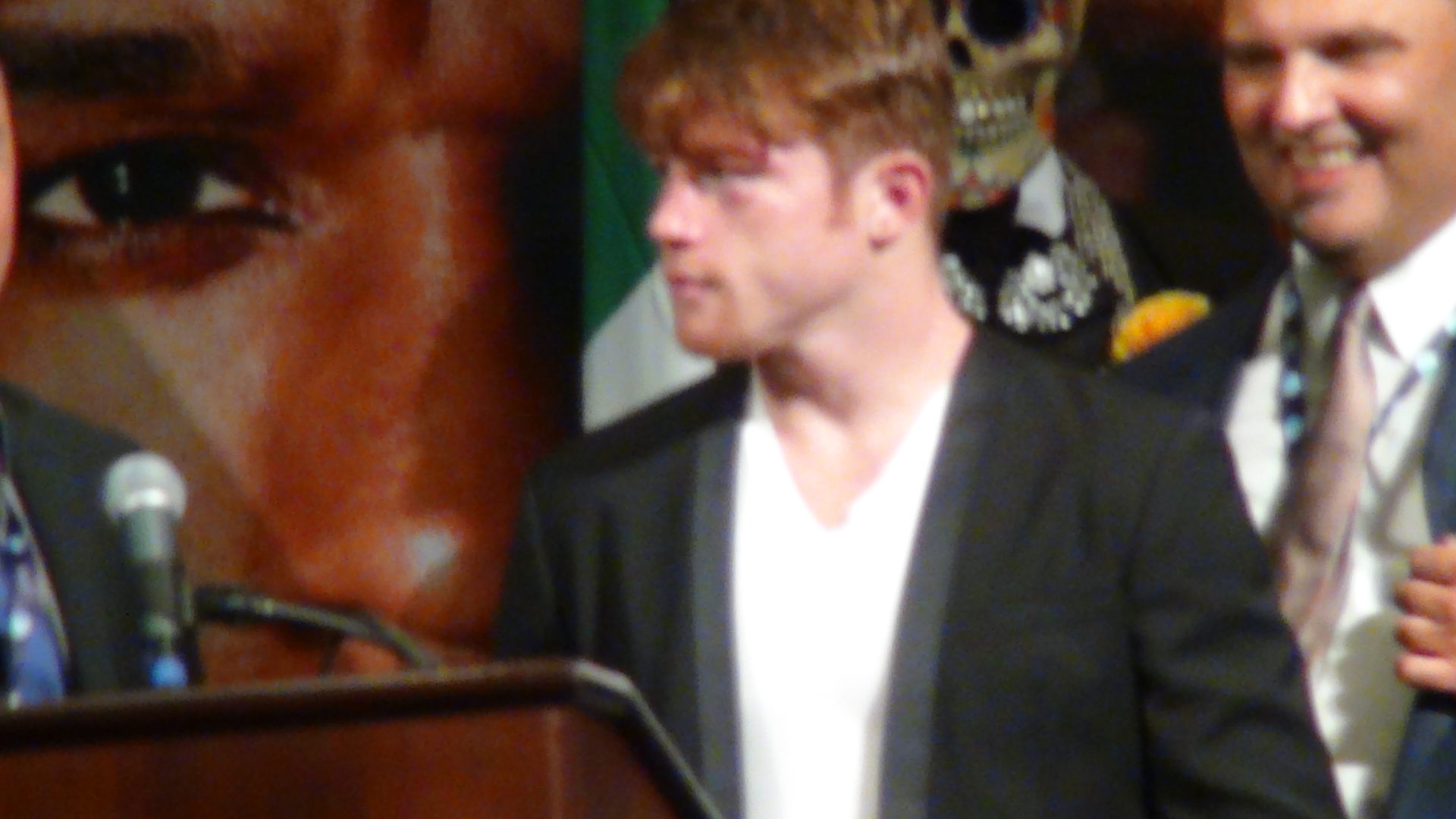


Sanchez blows out Demecillo in four

David Sanchez scored a 4th round stoppage over Marco Demecillo in a scheduled 12 round Super Flyweight bout in a Hermosillo, Mexico.

Sanchez dropped Demcillo with a hard body shot and the fight was stopped at 2:56 of round four.

Sanchez, 115 lbs is now 24-2-2 with 19 knockouts. Demecillo, 115 lbs is 19-2-1.

Francisco Rodriguez stopped Ernesto Guerrero in round five of a scheduled eight round Flyweight bout.

The fight was stopped when Guerrero suffered an apparent rib injury and the fight was stopped at 2:11 of round five.

Rodriguez, 112 1/4 lbs is now 13-2 with 10 knockouts. Guerrero. 113 lbs is 17-9.

Luis Castro and Gilbert Gutierrez battled to a four round majority draw in a Flyweight bout.

Scores were 39-37 for Castro, 38-38 and 38-38.

Castro, 112 lbs of Hermosillo, Mexico is now 3-0-2. Gutierrez, 114 1/2 lbs is now 1-0-1


Stars Needed: Mikey Garcia makes the short list

Mikey_Garcia
The best in a new and diverse generation is about to make its claim on future stardom with a wave of new accents and surprising possibilities that could further re-make the face of the game. It used to be as familiar as a cheeseburger and fries. But today it’s more like an international food court.

“A lot is happening in boxing,” Top Rank promoter Bob Arum said Tuesday in a conference call. “And it happens real quick.”

So quickly, in fact, that Arum looks around and sees the American brand facing more challenges than perhaps it ever has, especially from fighters from the former Soviet Union.

Arum’s search for a few good Americans in the New Year starts with Mikey Garcia, who defends his junior-lightweight title in a significant test of his pound-for-pound credentials on January 25 against Juan Carlos Burgos at New York’s Madison Square Garden in an HBO-televised bout.

“Mikey is one of the few American stars in boxing,” Arum said. “We have Mikey and Andre Ward, Floyd Mayweather and Timothy Bradley. There are not many other Americans who qualify as superstars.”

Not everybody is sure that Garcia qualifies for super-stardom. But Arum mentioned him because of the potential he has exhibited over the last two years. The unbeaten Garcia’s thorough skill set looks like a good fit for a place alongside better-known names in bouts that could transform him into a pay-per-view attraction. Garcia-Burgos is not a PPV bout.

In Tuesday’s call, Arum mentioned Manny Pacquiao, one of the biggest PPV draws in the business , as a possibility. That alone is a sure sign that Garcia has arrived. It was the first time his name has been thrown into the Pacquiao mix. At 130 pounds, however, Garcia is still a couple of weight classes lighter than Pacquiao.
Garcia didn’t mention the Filipino by name. But he did say he’d consider a move up in weight.

“We will have to look at the options after this fight,” said Garcia, who was in Macao in November for Pacquaio’s welterweight victory over Oxnard, Calif., stablemate Brandon Rios. “Hopefully, everything turns out well next week and we can move forward with our plans. We’d have to look at the top fighters in the next weight class, and if I do that, I have to grow into the weight class.

“I would like to unify the titles before moving up, but if there is something better at 135 then I will go there. Then I can unify the titles there or move up to 140, if the right fight is there.”

A more immediate option might be Vasyl Lomachenko, the two-time Olympic gold medalist who in October won a major featherweight title in his first and only pro fight.

Lomachenko, a Ukrainian and one of the greatest boxers in Olympic history, is among emerging fighters from the former Soviet empire. He joins Gennady Golovkin, Sergey Kovalev and Ruslan Provodnikov in an Eastern Boxing Bloc that had a profound impact in 2013 and could have an even bigger one in 2014.

Arum said he envisioned Garcia “taking on a lot of these non-Americans in really big fights.”

But, Arum said, “where that takes him, I’m not sure.”

A spot the in pound-for-pound debate sounds like a pretty good place.


Procrastination’s affirmer: Notes from the craft

Bottles
SAN ANTONIO – This week I began painting glass jugs instead of writing. Reading, socializing, Twitter, documentaries, laundry – all of these, it turned out, were not effectively enough keeping me from writing, despite many years of service in the enterprise. A vigorous new distraction came to the fore. The perfect week for it, too; a 2,000-word cover feature due in a few days, novel 8 stalled at 92,000 words, and this column needing to be written, read, colored, shortened, lengthened, and read thrice more.

A local supermarket put its organic apple juice in exquisite glass bottles some months back, bottles so lovely I could not bring myself to refuse them, and so they accumulated on the counter till a visiting friend told me about a YouTube video of a bachelorette party – there’s your muse! – that had colorful acrylics poured and baked in mason jars. Now a lengthy process is hatched, a tidy sum is sunken, and bottles five and six sit drying as these words happen.

“If anything can stop you from writing, let it.” That is about the best advice I’ve yet come across concerning this craft. I read it somewhere and don’t recall who said it, so I’ll put it in quotes and attribute it away from myself. Then I’ll google it and find it was in a book that attributed the quote to “an editor named John Dodds.” It’s advice I occasionally impart and more often credit myself with imparting to younger writers.

It speaks to the compulsion required to do this thing, it speaks to the lack of affirmation, it speaks to how disproportionately longer it takes to write something than it does to read it, and quite often in an inverse sort of proportion to that disproportion; the worst writing, what often takes the longest to endure reading, gets written fastest, which is not nearly tragic, from a writer’s perspective, as that proportion’s inverse and what it says to writers who whale away at their prose, flensing it till nary a transition remains from one idea to the next, then go back over it thrice more, under the auspices of once more, before reading it aloud, sighing, shrugging and filing it – triumph free.

That is not the worst of it usually. The next morning is the worst of it, when the writer first sees his inadequate effort through the eyes of a reader and panics at how terrible it is. A few hours pass, an email or two comes in, if he’s lucky, and he’s able to decide it’s not quite awful as imagined. By midweek, in fact, he’s often forgiven himself, which is good because the idea for next week’s piece is already overdue and the next deadline is bearing down, as it will do. A few weeks later, or anyway at year’s end, the writer returns to that inadequate effort of his, and if he truly worked at it when he wrote it, he is surprised how good it was. That leads inevitably and instantly to a brand new horror: What happened to me? why can’t I write that well anymore? will I ever recover that guy’s vocabulary or insights?

It’s good a time as any to write this column because it’s the time of year members of the Boxing Writers Association of America try to determine what pieces of theirs to submit for the BWAA’s writing contest, and putting aside the legitimacy of any contest that judges art, those writers who do the craft right, those writers admired by their peers, should have to struggle with this choice because they wrote hard as they could every time and didn’t write a few pieces much better than others to target hypothetical judges for contest time.

The other night, haunted by calls I’d not made for that long feature and questions I’d procrastinated preparing for interviews because prepared questions were my trigger for making the calls whose making I dreaded – which, as an aside, is an amateurish mistake, and an idiocy, and thrice the idiocy from any writer who has commented often enough to remember: “I’m always glad I’ve made the call by the time I hang-up” – I closed the dark screen of my laptop, set it on the sofa and found “Deceptive Practice,” a documentary about prestidigitator Ricky Jay, and marveled at his ability and willingness to spend 14 daily hours shuffling a deck of cards. No sooner, though, does a craftsman marvel at another’s compulsion than he begins a spiral of self-loathing at his own comparative half-assery.

A month ago, during fightweek for Maidana-Broner, I had the pleasure of walking home from the Friday weighin with my favorite Monday columnist, and when conversation turned to the nature of column writing, somewhere right about Houston Street & Soledad, we began interrupting one another and completing the other guy’s sentences about the tariff a column like this exacts from its writer. The collapsed marketplace for good writing – how much did you pay to read this? – takes each day more of what remains of the dilettantes, leaving mostly the quixotic and compelled.

This craft is not about having “something to say”; that’s a cliché and simplification made by people who couldn’t do what we do. It’s about other, better things that include this: Euphoria at a process that places a certain chunk of one’s identity in a hermetically sealed compartment that, for its seeker, can be durable a refuge as exists. So let’s end here: I first came across the word “prestidigitator” while reading Henry Miller in 2000, and you’re damn right it felt good finally to use the word in print, and correctly, nearly 14 years later, up in graf 7.

Bart Barry can be reached at bart.barrys.email (at) gmail.com