The Mares and Garcia composition


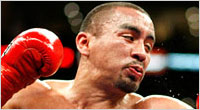
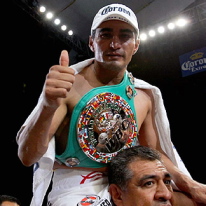
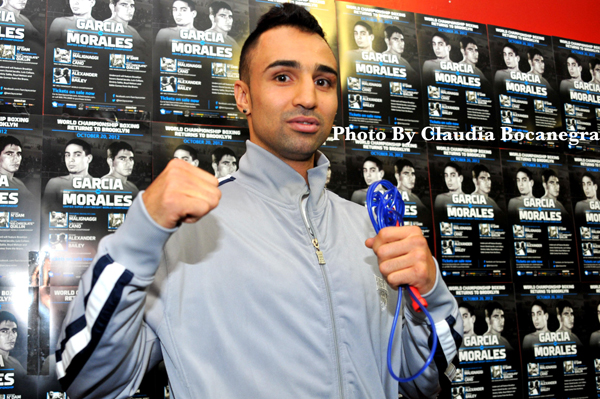
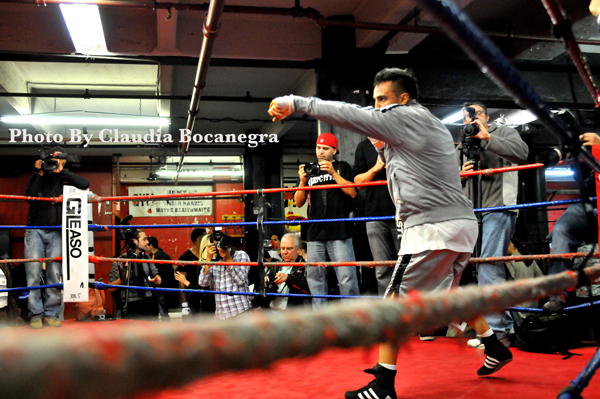
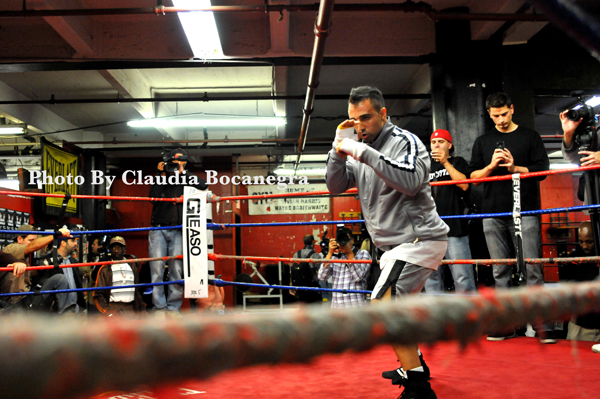
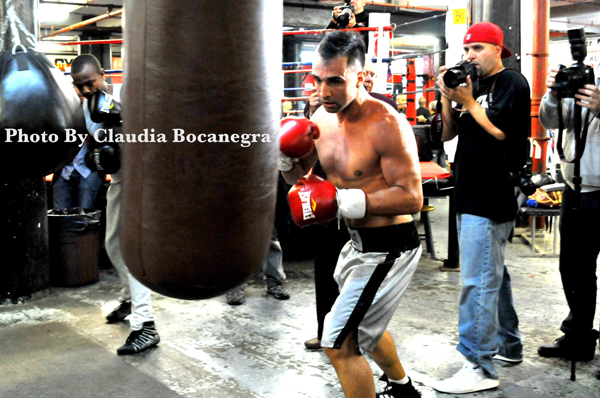
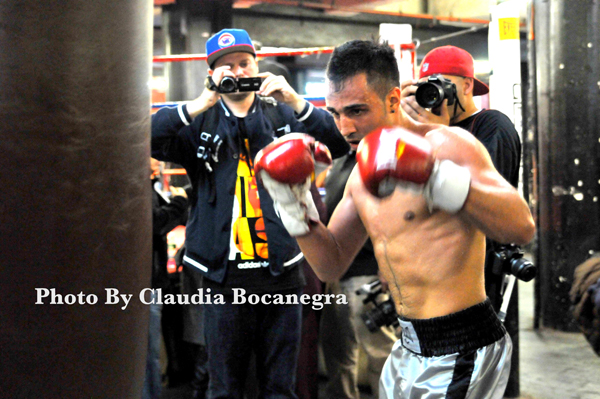
Taken in composite, Mexican Abner Mares and American Mikey Garcia make a quite compelling fighter, and despite competing networks and the promoters that milk and direct them, Saturday brought a chance to see the men in a composite – not to compare them, though that day might yet come, and neither to see how they complement each other, but rather to see how, together, as the important fighters on their respective cards, Mares as main on Showtime and Garcia as co-main on HBO, they made Saturday an enjoyment.

Garcia, who found a late replacement for Mexican Orlando Salido in Argentine Jonathan Barros, who was overmatched then not overmatched then, yes, overmatched, enjoys a credibility advantage because of who promotes him, and that might as well be set forth early: Top Rank is good at developing fighters, as fighters then attractions, as any promotional company in boxing history. Golden Boy Promotions is not, or certainly not yet.

Top Rank makes a high virtue of never putting a fighter in a match for which he is unprepared; when a Top Rank project like Julio Cesar Chavez Jr. or Juan Manuel Lopez loses, it is not because Top Rank hurried him but rather Top Rank, or more specifically Bruce Trampler, our sport’s finest noncombatant practitioner, believes nothing more can be done to prepare him for what elite opponents remain. Once a fighter has proved himself fully developed, Top Rank’s bent changes from research and development to sales; while prospect Alex Saucedo’s next opponent is being chosen right now to determine and maximize Saucedo’s potential as a prizefighter, regardless of what revenue he brings in 2013, Manny Pacquiao’s next opponent was chosen to maximize Top Rank’s earnings. An excellent model, that.

Golden Boy is all sales all the time. Projects appear chosen for their bilingualism and beauty – the assets responsible for Oscar De La Hoya’s ascent, his company believes – or other qualities that strike scouts as exceedingly marketable. Golden Boy’s is not a model sustainable as Top Rank’s because it involves either overpaying for proven commodities or investing in developmental ventures that go nowhere for their want of selection criteria and strategy. Abner Mares is the exception.

Saturday at Staples Center in Los Angeles, Mares made another brutal and entertaining match against another well-regarded opponent, a Panamanian named Anselmo Moreno, who, in aficionados’ imaginations at least, had the exact tools to disarm him. Mares can be disarmed but not dissuaded, so long as an opponent allows him to move recklessly, and therefore wreckingly, forward. He is a consummate Mexican prizefighter in this sense, all tenacity and hooks to the body with an overhand right he hurls head-down, though he’s somewhat less Mexican in his devotion to fouling energetically till the referee stops him. A traditional Mexican code says a prizefighter solely fouls an opponent he is not man enough to defeat fairly – and that ethic says it is better to lose honorably to a better man, in a fight to unconsciousness or worse, than foul one’s way to a different outcome.

Mares’ methods, in this sense, seek refuge in American clichés: “winning is everything”, “if you’re not cheating you’re not trying”, “bend the rules to their breaking point”. Mares charges to set his shoulders beneath your elbows, a position in which he has you handcuffed and is free to whale away, and if you retaliate by setting yourself on the back of his neck, to push his lowered head a little lower, he blasts you in the balls then comes up shrugging. He does not have-to throw that punch, no, but then you didn’t have to lean on his neck, and he knows the worst that cup shot will bring is a double warning, offsetting fouls, and whereas he had every choice to throw that punch or not, you had little choice to do what you did. You’ll do it again, reflexively, a few more times, and if the referee does not penalize you, Mares’ll put knuckles where your cherries grow in the meantime.

Mares gets, and quite possibly deserves, the benefit of officiating doubts because he is trying to make a fight at every moment of every match, to a point of dropping his shiny purple gloves and loping after an opponent, as he did in the 12th round Saturday. Mikey Garcia would not do that. He is more polished than Mares, more apt to throw the perfect punch with perfect leverage at the perfect moment. Garcia is fantastic but also imperfect, as we got reminded Saturday.

That Garcia is hittable is not truly worrisome; while there was nothing edifying about how he turned away from Barros after the Argentine’s left hook snapped his chin in round 7, aficionados appropriately trust if Garcia hadn’t a chin, his promoter would have discovered that 15 fights ago. It’s the technical flaws that bring concern with Garcia, specifically an urge to parry, with his right hand, jabs to the body. That is a major no-no and sets one to imagining what’ll happen the first time Orlando Salido, or worse, Yuriorkis Gamboa, feints that jab, watches Garcia’s right hand drop, and remortgages his home on a left hook to Garcia’s right chin. Salido will answer that question graciously, and perhaps gratuitously, in Garcia’s next fight in January, while being more durable before Garcia’s own left hook than Barros was.

Abner Mares wants his next opponent to be Top Rank’s Nonito Donaire, and it was refreshingly uncouth the way Mares demanded that Saturday. Donaire’s December opponent, Mexican Jorge Arce, was not, in his prime six years ago, good as Mares is right now, and one can rightfully assume if Donaire-Mares never happens it is because Top Rank did not think Donaire was ready, or did believe there was much more and easier money elsewhere.

Bart Barry can be reached at bart.barrys.email (at) gmail.com.


Mares scores unanimous decision and asks for Donaire all over again

LOS ANGELES – It was one fight full of many styles. From slick to awkward and lots of good, bad and unlikely in between, there was not much that Abner Mares and Anselmo Moreno didn’t try.

In the end, however, Mares found the best fit.

Mares did so with the smarts and patience of a man dangerous and clever enough to pick a lock. The combination to unlocking Moreno was simple enough, although elusive long enough to even rattle Mares. But Mares recovered and remembered what he had practiced and how the twelve rounds had started.

Body shots and the right hand were always the key. One after the other Saturday night added up to Mares’ unanimous decision over Moreno for the World Boxing Council’s super-bantamweight title at Staples Center. The judge’s scores were 116-110 on two cards and an out-of-whack 120-106 on a third.

“There was a moment when I Iost my composure in the middle rounds,’’ Mares ( 25-0-1, 13 KOs) said.

His corner’s advice and an ability to think through adversity, however, saved him from a loss that would have eroded his hopes of battle for supremacy of the 122-pound division.

“I want to fight Nonito Donaire,’’ said Mares, a Golden Boy fighter who is caught in limbo in the feud between his promoter and Top Rank, Donaire’s representative.

Only a Golden Boy-Top Rank alliance can make that happen. World peace might happen before then. But the fearless Mares will continue to lobby for what he wants and continues to earn. Against Moreno (33-1-1, 12 KOs), he encountered an elusive Panamanian who moved one, then another and always out of range. But Mares pursued, often running straight at Moreno. The early body punches were designed to slow him down. For a while, they did. But Moreno began to stand his ground and exchange with Mares. That was a surprise.

But in the fifth, Moreno paid for the move. Mares knocked him with a beautiful.

“It’s the first time anybody has ever knocked him down,’’ Mares said. “I couldn’t let him get comfortable with his style, because he’s too good at it.

“I made it my fight.’’

The card also included Los Angeles bantamweight Leo Santa Cruz (22-0-1, 13 KOs) in an impressive ninth round knockout of Victor Zaleta (20-3-1, 10 KOs) for the International Boxing Federation’s 188-pound title. Santa Cruz looms as potential Mares’ opponent. He’s a Golden Boy fighter. Give the current state of the game, no other explanation is necessary But don’t tell that to Mares.

“I want Nonito Donaire,’’ Mares said once, twice, three times. “Santa Cruz is a good fighter. But I want to fight the best.’’

Enough said.

Free and Still Powerful: Angulo back with quick KO
They took away his freedom, but none of his power.

It took Alfredo Angulo less than a minute to reclaim a future that had been in doubt throughout a seven-month stretch in a California detention center for a reported immigration violation. Fifty-six seconds after the opening bell, Angulo (21-2, 18 KOs) unleashed a sweeping left hand that knocked out Raul Casarez (19-3, 9 KOs) while exorcising long hours of waiting, wondering and never knowing.

Angulo knows now.

“Perro is back,’’ said Angulo, a Mexican junior-middleweight nicknamed Dog.

Exactly when wasn’t certain Saturday night.

“I could fight again in 20 minutes,’’ said the bearded Angulo, whose biggest victory was in just knowing that there would be a chance at another one.

Cleverly stays in Hopkins hunt with TKO win
Talk about a Nathan Cleverly-Bernard Hopkins fight only figures to get a lot louder after his eight-round TKO of Shawn Hawk.

Cleverly (25-0, 11 KOs), a Welshmen and the World Boxing Organization’s light-heavyweight champion, dropped Hawk (22-3-1, 16 KOs) twice in the seventh round and again in the eighth. Cleverly was stronger than Hawk. More important, Cleverly’s work rate simply overwhelmed the fighter from Sioux Falls, Iowa. That’s not much of a surprise. Cleverly’s trainer is Enzo Calzaghe, who trained son Joe to beat Hopkins.

Cleverly is one of three-to-four possibilities for Hopkins in a bout projected for March 9 at Barclays Center in Brooklyn, N.Y. The UK also has been mentioned.

On The Undercard
The Best: Garden City, Kan., has given keys to the city to Brandon Rios and Victor Ortiz. City fathers might need to make a third one. Junior-welterweight Antonio Orozco is beginning to look like the third world-class fighter to emerge from an unlikely boxing town in southwest Kansas.

Orozco (16-0, 12 KOs), born in Mexico and raised in Garden City, was brilliant in scoring a sixth-round stoppage of Danny Escobar (8-2, 5 KOs) of Riverside, Calif. Orozco stunned Escobar midway through the sixth, then swarmed him and dropped him along the ropes at 2:06 of the round. Escobar had to be helped off the canvas and onto a stool before he could leave the ring.

The Rest: Ohio middleweight Chris Pearson (6-0, 5 KOs) won a TKO, but there was nothing technical about his crushing stoppage of Jeremy Marts (8-13, 6 KOs) of Iowa at 44 seconds of the first round; welterweight Alonso Loeza (3-7-1, 3 KOs) of Gilroy, Calif., scored a fourth-round TKO of Zachary Wohlman (5-0-1, 1 KO) of Hollywood, Calif.; Texas bantamweight Isaac Torres (3-0, 2 KOs) won a majority decision over David Reyes (2-3) of Montebello, Calif.; and Cincinnati junior-welter Robert Easter (1-0, 1 KO) enjoyed a knockout debut with a second-round stoppage of Eddie Corona (0-2) of Omaha.


Elusive tasks: Mares faces Moreno amid talk about Donaire


A sure sign of Abner Mares’ emerging stardom is a mixed blessing. Mares is one of those fighters mentioned in a bout that hasn’t happened because of the tired feud between Golden Boy Promotions and Top Rank.

For the Golden Boy-promoted Mares, that means talk about Top Rank’s Nonito Donaire. On a growing list, Mares-Donaire is there, another never-never possibility, right behind Manny Pacquiao-Floyd Mayweather Jr. Donaire-Mares is one of those fights everybody wants to see, but few believe they ever will because of the Golden Boy-Top Rank stand-off.

For Mares, the Donaire speculation also looms as a potential distraction for what might his toughest task to date Saturday night in a Showtime-televised super-bantamweight bout at Staples Center in Los Angeles.

Both made weight Friday, also at Staples. Mares was at 121.8 pounds. Moreno, fighting for the first time in the 122-pound division, was a pound lighter, at 120.8.

Mares (24-0-1, 13 KOs) promises he won’t be distracted. Against the slick Moreno (33-1-1, 12 KOs), he can’t be.

Moreno, of Panama City, has been compared to Pernell Whitaker. He’s hard to beat, because he’s hard to hit. A distraction of any kind could make it more difficult for Mares to keep a vigilant eye on an elusive target that will never be in front of him for long.

“Yeah, without a doubt, it’s frustrating,’’ Mares said when asked about Donaire during a conference call. “Again, I know my time will come. I’ve just got be patient. I have to keep pushing. We’ll see after this.’’

Only a loss could quiet the talk about a fight that, for now, is waged only in the public imagination. Mares, who grew up in Southern California and is Golden Boy’s first fighter to win a major title, understands the stakes.

“He’s really technical,’’ Mares said of Moreno. “But he hasn’t fought any one like me. Okay, he hasn’t fought any one like I’m going to be. I’m going to go in and figure him out. That’s what this beautiful sport is all about – figuring out your opponent. You’re going to see a different Abner, as you always do.”

Mares’ versatility includes an innate ability to adjust on the fly. He’ll probably have to against Moreno, who has no illusions about the challenge he faces in Mares’ hometown.

“This is going to be a very, very tough fight for me,’’ Moreno said. “I understand that.’’

On the undercard
· International Boxing Federation bantamweight champ Leo Santa Cruz weighed in at 117.8 pounds, just under the 188-pound limit. Opponent Victor Zaleta was at 117.

· In his first formal weigh-in since a seven-month detention for an immigration violation, Mexican junior-middleweight Alfredo Angulo was at the mandatory 154 pounds. Opponent Raul Casarez was at 153.8.


Steward’s genius still alive for Wladimir Klitschko


Wladimir Klitschko’s best friend won’t be there. Emanuel Steward is gone. But Steward’s genius is still around. It never dies.

In a bout dedicated to the trainer he calls a genius, Klitschko hopes for a performance Saturday against Mariuz Wach in an Epix/EpixHD.com bout that will represent all that Steward meant to him and a sport still mourning his death.

It’s easy to call somebody a genius these days. It’s not so easy, however, to know what it is. Genius is hard to find, harder to define. But Klitschko saw it in Steward and knows what it has done for him in a heavyweight career that was in peril nearly nine years ago.

“He was not a conservative person.’’ said Klitschko, who has won 16 straight in his stranglehold on the heavyweight division since a 2004 loss to Lamon Brewster in his first bout with Steward. “In his 68 years, he has been around young people all of the time. His spirit was young. He was always learning. He never stopped.

“He said one line: ‘You know, Wladimir, fighters are smarter than trainers.’ ‘’

If there’s genius in simplicity, there it is, distilled in a few words. The last five should be etched in stone above the door whenever they re-locate Steward’s Kronk Gym in or around Detroit. Fighters are smarter than trainers. It’s a bit of wisdom that means vigilance from a trainer looking out for the best interests of a fighter, whose only teammate is that guy in the corner armed only with a bucket, advice and encouragement. For any of it to work, he must know how to listen.

“He’s right about that,’’ Klitschko (58-3, 51 KOs) said in a conference call from Hamburg, Germany where he faces Wach (27-0, 15 KOs) at the O2 Arena. “You have to be flexible. As a trainer you tell a boxer: ‘This is the way you do it, and you do it.’

“I would express my point of view and he would express his point of view and we’d try to work it out to get to one solution. He was incredibly flexible in his way of understanding things.’’

For the philosopher and academic in Klitschko, Steward represents a role model for anybody in any pursuit.

“In life you have to be flexible also,’’ said Klitschko, who will have Steward student Jonathan Banks in his corner just one week before a Banks bout against Seth Mitchell in Atlantic City, N.J. “Every person has certain qualities: See it, use it and don’t kill it. That is a description of Emanuel. Exactly what he was.’’

What’s unknown, however, is exactly how much Steward’s voice will be missed between rounds. The 6-foot-6 Wladimir Klitschko will have to deal with something new. Wach, another unknown in a division known only for Wladimir and brother Vitali, is big. At 6-7 ½, Wach, of Poland, is taller than any fighter Wladimir Klitschko has ever faced.

If there’s potential trouble lurking in Wach’s advantage on the tale of the tape, however, it wasn’t evident during Klitschko’s hour-long session with the media.

“We had an open workout with Maruisz Wach and his coach made a little fun by putting my face on the pads and hitting my face many times.’’ He said. “It was something that was entertaining to watch. However, in the ring on Saturday, he will face the real Wladimir Klitschko. Not just images on the pads.’’

That’s part of the genius, too. If you’re worried, never do or say anything that might let them know that you are. Never let them see you sweat. Steward never did. He was way too cool for that.


Four more years: Consequence vs. eventfulness

This will not be a political piece by any means other than its acknowledgement of what tomorrow, known in these United States as the first Tuesday after the first Monday in November, or Election Day, will bring, which, it predicts here, is four more years, because American history says it requires a remarkable political talent to overcome the myriad of advantages an incumbent President enjoys, and this year’s challenger enjoys some talents shy of a myriad.

If four more years is how things are fated to go Tuesday, it is not a bad way to think about boxing this week, as the next four years will move us far from where we are now. In November 2016, Floyd Mayweather will be months from his 40th birthday, Manny Pacquiao will be heading to 38, and both Juan Manuel Marquez and Sergio Martinez will be too old to be making a living in combat – though Bernard Hopkins, 51 years young and still citing Graterford, will likely be calling someone out, and HBO will be negotiating a way to broadcast it with options on future matches if he wins.

The apparent bet is Adrien Broner will, in 2016, be an approximation of what Floyd Mayweather is right now. An approximation or facsimile is all “The Problem” will be because he’ll not have the benefit of discovery Mayweather has. Whatever one opines of Mayweather’s villainous “Money” character, Mayweather deserves recognition aplenty for inventing it, recognition whose reserves will not be spent on Broner if he never becomes more than Money May with a talking hairbrush, his current azimuth.

Or perhaps Broner will in four years be where most imitators end up in American entertainment: making an unreasonably good living as a courier from the last innovator to the next. We’ll surely not be rid of him, no matter what happens Nov. 17 within or without the confines of a new stretch of beach formerly known as Atlantic City, where Broner is scheduled to confront Mexican southpaw Antonio Demarco in what will be at least Broner’s biggest test in four fights and quite possibly more than he can handle. Broner-Demarco is the most consequential fight from here to New Year’s because its outcome is unknowable and will tell us if boxing is headed where its plotters and plotting wish to take our wallets.

Rocky Juarez’s upset of Antonio Escalante in San Antonio a few Saturdays ago brings a timely reminder: No favorite is safe in the main event of a Golden Boy Promotions card, especially if he is aligned with Golden Boy Promotions. If Broner or his team knows what they’re courting with Antonio Demarco, no evidence suggests it. Broner’s high self-esteem, one suspects, keeps him from watching others’ highlight reels, and Broner’s promoter never knows what an opponent will bring.

Broner’s shoulder-rolling, counter-right-uppercutting style is all wrong for a well-chinned southpaw three inches taller than him, a man whose straight left is the punch that picks the shoulder-roll lock (six years since Money May’s last southpaw opponent is no coincidence), one who brutalized Jorge Linares, a Venezuelan more highly touted by aficionados in his day than Broner is now, last year, and needed less than a minute to stop John Molina (24-0) in September. Demarco can be beaten, the late and prodigious Edwin Valero proved that, but Broner (24-0) has yet to merit inclusion in Valero’s company, which is a fine reminder of what makes this fight indeed so consequential: If Broner beats Demarco, however he does it, and especially if he does it spectacularly, the sharp edge of aficionados’ resentment will be dulled. Broner’s next four soft touches on HBO may not be suffered gladly, but neither will they be accompanied by feelings of betrayal for those exulting in the hairbrush narrative or the hairbrush narrator.

That a commodity annoyingly unproven as Broner can be in the most consequential of upcoming fights, with Manny Pacquiao and Juan Manuel Marquez set to take their rivalry from trilogy to tetralogy three weeks later, uncovers a comment on the difference between consequence and eventfulness. Pacquiao-Marquez IV at MGM Grand on Dec. 8 will be the largest event of the second half of the year, but it will not be consequential because no one mistakes the likely winner, Marquez this time, as the future of prizefighting, and even the specter of Marquez ending (muted) calls for The Fight to Save Boxing now brings with it a fraction of schadenfreude’s once tangy delight. Time and other agents, but time most of all, have corroded the fantastical Pacquiao-Mayweather brand such that even Pacquiao’s unexpectedly stopping – in his fourth try – a man Mayweather whitewashed three years ago will bring demands barely more than perfunctory for them finally to settle accounts in the ring. Make no mistake about either man’s coming need to settle accounts, though.

Chances are good Pacquiao will be busy enough this time against Marquez to win on cards scored with a 2009 pen but will see his opponent, for the second time in 2012, shown all the scoring benefits Pacquiao once enjoyed. That should be for Mayweather a frightening outcome while he plans next year’s Vegas fundraiser, particularly if Adrien Broner, the man scheduled to replace him, does something definitive against Antonio Demarco.

Bart Barry can be reached at bart.barrys.email (at) gmail.com


Freedom fits Angulo like an old pair of shoes


There are all kinds of symbols on the road to freedom. Some are as grand as the Statue of Liberty. Some are as simple as a pair of shoes.

“Tennis shoes,’’ Alfredo Angulo said.

For a while, they were as elusive as Angulo’s release from a detention center in El Centro, Calif., where the Mexican junior-middleweight sat, waited and worried during a seven-month stretch for what was reported to be an expired visa.

Angulo couldn’t train. It was hard enough to jog.

“No, the reality is that they didn’t let me train in there,’’ Angulo said Thursday in a conference call for his Nov. 10 appearance on the undercard of the Abner Mares-Anselmo Moreno super-bantamweight clash at Los Angeles’ Staples Center in his first fight since his release in mid-August. “It was a simple thing. They didn’t let me have tennis shoes.

“For some reason, they didn’t let me have the shoes for two months.’’

When he finally got them, tennis wasn’t on the agenda. There are no clay courts in the detention center’s yard. Then again, there isn’t a ring, either. But there was handball, Angulo’s only physical outlet while waiting for his case to be resolved and his hopes restored.

“I’m here legally,’’ said Angulo (20-2, 17 KOs), a former 154-pound champion who faces unknown Raul Casarez (19-2, 9 KOs) of Edinburg, Tex. “Everything is fine. I’m ready to move forward.’’

After a nightmarish year, that’s a victory in its own right. A year ago, Angulo lost a wild sixth-round TKO to James Kirkland in Cancun. About five months later, he says he turned himself into immigration authorities in an effort to clear up questions about his legal right to live and work in the U.S. Angulo, who grew up in the border town of Mexicali, says he wanted to pursue his boxing career in America. More important, he wanted to spend time with his daughter, wherever and whenever he wanted to. She was born in the U.S.

There are unanswered questions as to why Angulo was held for so long. He has no reported criminal record.

“I had no idea when I was going to get out,’’ said Angulo, who held an interim version of the World Boxing Organization’s junior-middleweight title. “I was told it was going to be a short time. Obviously, that didn’t happen.’’

The best guess is that he got caught in delays inevitable throughout the web of immigration politics and bureaucracy. Like so many, he was just another face among the many with lives by a border. Unlike many, however, Angulo was lucky. He had Golden Boy Promotions. He had Oscar De La Hoya, who visited him in El Centro, just 14 miles north of the Mexican border.

Golden Boy’s resources and Angulo’s potential were factors that finally led to his release. It’s another question as to whether that will lead to a realization of the early promise he displayed. Incarceration of any kind has proven to be hazardous to a ring career. Maybe, it’s the idle time. Maybe, it’s the diet. Maybe, it’s the handball instead of sparring. Maybe, it’s all three and much more.

For Angulo, that lesson was in front of him in his last fight. Kirkland, who overcame a first-round knockdown before stopping Angulo last November, spent 18 months in a Texas prison on a 2009 weapons charge. After his release, Kirkland easily won two tune-ups before suffering a stunning first-round stoppage against unknown Nobuhiro Ishida.

Angulo re-enters the ring for the first time in a year predictably confident. He has new trainer in Andre Ward’s corner man, Virgil Hunter, who moves into a job once occupied by Nacho Beristain.

“I’m still Alfredo ‘El Perro’ Angulo,’’ he said in a reference to his nickname, Dog. “There’s no change in style. It’s just that Virgil Hunter has added things.’’

But no addition is quite as valuable as what Angulo re-acquired. Hopefully, he’s also kept those tennis shoes. They are a well-worn symbol of what freedom means.


Juarez reminds; Leija recalls

SAN ANTONIO – Three miles east of the Alamodome stands Freeman Coliseum in the southwestern part of an enormous lot it shares with AT&T Center, home of the Spurs. Saturday evening Freeman felt cavernous because it was mostly empty, especially compared to the Vicente Fernandez concert nextdoor. Nevertheless old Freeman allowed a redemptive act to happen in its ring, an act made by Houston’s Rocky Juarez – boxing’s serial contender.

There stood Juarez prefight, waiting in the smoke of an improvised made-for-televisión walkway next to a curtain that covered empty space in the back of an historic old arena, where a locker room and a steep gray ramp and little else were. He was in white, green and gold, and serious. Serious is the word; none other works for Rocky – not charismatic or enticing, certainly, though perhaps humble.

Juarez is humble and serious, like a Mexican prizefighter with a countenance more Asian than Spanish, though Texas-born, and once a standout in USA Boxing before it was an embarrassment. Professional is the other word for Juarez, a man who, no matter what palpable discouragement preceded his career’s palpable disappointments, soldiered forward, pressuring and attacking in a style nostalgic for a 15th round, without ever quite getting to the place that makes special fighters.

There was a moment in most every prime-Juarez fight when he, as the shorter man with the shorter brown arms, maneuvered himself through footwork efficient and proper to just the spot from which to throw decisive punches. Then he paused. It was rarely more than an instant, but an instant that still expands in supporters’ minds today till it is mostly what they recall of Juarez’s championship challenges.

That instant when Rocky paused to ensure all was just right, and everything got away. The opponent, shocked by his good fortune, escaped, or did something – a parrying jab or wildly missed hook, or anything – that caused Juarez to doubt himself, reset and return to the hard task of maneuvering back in range (or get caught, one time, with an audacious right-uppercut lead Juan Manuel Marquez threw his way in their 2007 fight in Tucson, Ariz., when the air audibly escaped the hydraulics of Juarez’s fighting spirit). Rocky: walking to his corner, red blood streaming from a deep and accidental cut, smart enough to wonder how the hell he’d got hit with such a punch, schooled enough to know what it portended.

Rocky: head bowed, seriousness and frustration all over his face, but not urgency, no urgency, shuffling to his corner after each round of his second fight with Marco Antonio Barrera, a Las Vegas rematch of a 2006 fight Juarez deserved to win in Los Angeles four months earlier, a second fight whose closing bell saw Barrera, spiteful in a way few yet realized, spit his mouthguard in his palm and chase Juarez to the Houstonian’s corner to tell him, as Barrera recounted in the mall at Caesar’s Palace an afternoon later: I will always be a master, and you will always be a student.

Before five months had passed there was Juarez at Desert Diamond Casino in a “Solo Boxeo” main event, when Telefutura still had a franchise of which it was proud and protective, willing to fight for a fraction what he’d been paid on Mexican Independence Day. “The way I look at it, this is the most money I’ve ever made for a Telefutura fight,” Juarez said with a nod, not a shrug: serious. He got other chances, and he never got there. So he became an opponent, a target with a name and something of a following, whose defeat might bolster the credibility of a new promotional signee.

Do not doubt that was the plan Saturday when Juarez, 0-6-1 these last four years, got matched against Antonio Escalante, recent signee of a three-fight deal with Golden Boy Promotions. Aside from the main event, the blue corner – from which Juarez fought – went 1-5, Saturday. But Juarez, the b-side who emerged from that improvised white smoke to precede the new signee to the ring, made a professional spectacle of himself, throwing properly leveraged if less telegenic punches at Escalante, dropping him in the third and finishing him in the eighth, and drawing a line beneath Golden Boy Promotions’ inability to spot talent and inability to learn to spot talent.

There was, for once, a small sense of joy at a Juarez fight, especially in the shiny black chairs of Freeman Coliseum’s tiny, empty media section, where a very few of us who’d attended a number of Juarez fights smiled at Rocky’s unlikely accomplishment. In its size and location – now 20 rows back of the ring – and dwindled attendance, Freeman Coliseum’s media section worked well as any metaphor for the boxing community at large when the honorary 10-count came for trainer Emanuel Steward, who passed away after a short fight with a vicious disease, Thursday.

This followed a reminder of how small boxing’s community is, Friday afternoon, when James Leija, one half of Saturday’s Freeman Coliseum host, Leija-Battah Promotions, spoke about Steward, who, posterity oughtn’t forget, worked Leija’s corner at Alamodome in the first of Leija’s four matches against Azumah Nelson, 19 years ago.

“I even posted something on Facebook where it was he and I in the ring when he worked the corner,” said Leija. “During my whole career, it was one of those things where, whenever he sees you, he says, ‘I’ll never forget those guns at the Alamodome.’ He always brought that up, and that was one of those things we had going: ‘I remember walking out to the ring, and those guns blaring.’

“During the fight, he was saying, ‘Keep your jab up high, keep your jab up high.’ What he meant by that was: Don’t drop your jab, because Azumah Nelson’s trying to counter.

“We’d talk in Vegas or wherever we saw each other, and he’d go, ‘I’ll never forget those guns!’

“And he always had that smile.”

Bart Barry can be reached at bart.barrys.email (at) gmail.com


Alamo City beat down: Juarez stops Escalante


SAN ANTONIO – Whenever a boxing match can be reduced to a good athlete versus a good fighter, one is advised to bet the fighter. Rocky Juarez, for all his career’s near misses in championship matches, has never been mistaken for less than a professional fighter. Antonio Escalante, for all his athleticism, was out of his depth with a man precise and serious as Juarez, and it told.

Saturday at Freeman Coliseum a few miles east of the downtown area, in the main event of a sparsely attended seven-fight card presented by Leija-Battah Promotions and televised by Telefutura, Houston junior lightweight Rocky Juarez (29-10-1, 21 KOs) stalked, stung, dropped and ultimately beat-down El Paso’s Antonio Escalante (27-5, 19 KOs), stopping him at 1:29 of round 8.

“I want to fight the biggest names at 126,” Juarez said afterwards. “I’m in the gym. I’m focused. I knew I was going to knock him out.”

After an opening round that was close and saw Escalante busier and Juarez more powerful, the next two stanzas found Juarez gradually grinding Escalante down. Escalante would throw more and land more, but every punch Juarez landed, whether a left to the body or a counter right cross, mattered more. Escalante looked impressive. Juarez was effective.

“I’m not interested in fighting at 130,” Juarez said, when asked afterwards about the prospect of a match against Gary Russell Jr. “I want to fight the biggest names at 126.”

After dropping Escalante in round 3, Juarez allowed Escalante’s confidence to return in the fourth, fifth and sixth – making those at ringside familiar with Juarez’s litany of near-misses apprehensive. The seventh, however, saw Juarez land a left hook to the body followed by an overhand right that wobbled Escalante. The end was preordained after that. Juarez charged out his corner at the beginning of round 8 and beat on Escalante till referee John Schorle abided no more.

BENJAMIN WHITAKER VS. JAWNTA MANSON
Saturday’s opening bout saw local middleweight Benjamin “Baby Boy” Whitaker (2-0) continue a career that began in August on another Leija-Battah Promotions card against a tricky and awkward opponent. Saturday’s opponent, Austin’s Jawnta Manson (2-3-3 1 KO), was neither as tricky nor as awkward as Whitaker’s debut opponent, though, despite his appearance, he was conditioned well enough to take Whitaker’s best punches – which, Saturday, were right crosses.

Both men began at a quick pace and exchanged zealously in the fight’s opening round. But a few Whitaker left-hook counters took most of the fight out of Manson. Soon enough, Whitaker detected it and began to deliver left hooks to Manson’s soft midsection. The hooks led to crosses, and the crosses brought a knockdown.

All three judges saw the fight Whitaker’s way, giving “Baby Boy” his second career decision win.

KENDO CASTANEDA VS. ALBERT ROMERO
Pro debuts before hometown crowds are supposed to be highlight-reel affairs: The celebrated local amateur comes in, throws his favorite combination, the designated opponent folds, and talk of future golden belts fills the arena. None of that happened for San Antonio lightweight Kendo Castaneda (1-0) against Austin’s Albert Romero (1-3-1) Saturday.

After starting well, gliding and setting and popping Romero in the first round, things got tougher for Castaneda in the second. By the third, as he pressed Romero to the ropes, collapsed space too much and put himself in a place Romero was comfortable having him, Castaneda began to eat left hands from his southpaw opponent. Castaneda, whose heart proved his best asset, nevertheless fought back gamely, worked through his difficulties and dropped Romero as the bell rang to end the fourth and final round.

That knockdown was decisive, as Castaneda escaped his debut with a unanimous decision victory – three scores of 38-37 – that was going in the books as a draw till the last instant.

UNDERCARD
Saturday’s co-main event, California featherweight Julian Ramirez (5-0, 4 KOs) against Fort Worth’s Steven Gutierrez (4-2-1, 2 KOs), started fast, continued fast, and ended violently, with the southpaw Ramirez too good from the outside and the inside, defeating Gutierrez by knockout at 0:16 of round 5.

Among the evening’s most entertaining bouts was a four-round scrap between Texas lightweights, Saul Montes (3-0) from San Antonio and Marty Gutierrez (1-1) of Robstown, a match Montes won by unanimous decision despite fading late and employing a genuinely bizarre habit of touching his lead glove to his trunks before throwing each jab.

Opening bell rang on the professional portion of the card in a quiet Freeman Coliseum at 7:20 PM local time.


Abregu shocks Dulorme in seven

Luis Carlos Abregu scored a mild upset when he stopped previously undefeated super prospect Thomas Dulorme by scoring a seventh round stoppage in a scheduled ten round Welterweight bout at the Turning Stone Resort in Verona, New York

Dulorme came out showing superior speed with the jab. In round three, Abregu shocked everyone when he landed a big right hand that sent Dulorme to the canvas for the first time in his career. Abregu tried to close the show and landed a few more hard shots that staggered Dulorme but the Puerto Rican was able to make it through the round. Dulorme steadied himself a little bit in round four from the southpaw stance.

Abregu came back to have a solid round six as he featured a couple quality right hands. In round seven, Abregu landed a hug right that sent Dulorme back. Abregu chased Dulorme and landed a flurry of punches that was culminated by a right to the head that sent Dulorme to the deck for a second time. Dulorme got to his feet but his corner stopped the bout at 2:38 of round seven.

Abregu, 147 1/2 lbs of Salta, ARG is now 34-1 with twenty-eight knockouts. Dulorme, 147 lbs of Carolina, PA is now 16-1.

“He was too young and maybe with time he’ll become a better fighter,” said Abregu. “He couldn’t get away from my right hand and I knew at some point he was going to get caught with it. As you can see he did and his corner stopped the fight.”

“I didn’t want them to stop the fight but I respect their decision because they were looking out for me.” Dulorme stated. “I was controlling the fight but he caught me with a good punch but I came up and I was ok. I’ll take this experience and learn from it.”

Karim Mayfield scored a ten round unanimous decision over Mauricio Herrera in a Jr. Welterweight bout.

The fight was slow paced until round seven when Mayfield started getting through with some hard power shots. Herrera showed a good chin and walked through the punches. Mayfield landed some more power shots in the next frame which Herrera took well.

Even though Herrera was the busier fighter, it was the power shots of Mayfield that proved to be the difference as Mayfield won by scores of 98-92, 97-93 and 96-94.

Mayfield, 140 lbs is now 17-0-1. Herrera of Riverside, CA is now 18-3-1.

“My conditioning was good and I neutralized his punch output with my smothering,” said Mayfield. “I didn’t get hit with too many big shots and I’m happy with the win. Next time I step into the ring I’m going to pick up my punch count.”

“I felt I was landing the better shots on the inside,” Herrera said. “I felt I won the fight but the judges weren’t scoring the body shots I was landing in the trenches. I’ll be back

Miguel Vazquez made the fifth defense of the IBF Lightweight title with a split decision over Marvin Quintero.

It was a tactical bout with Quintero coming forward and Vazquez boxing and moving. Alot of the rounds were very close and neither man was able to seize any type of control.

Vazquez, 135 lbs of Guadalajara, MX won by scores of 118-110, 116-112 while Quintero won a card 115-113. Vazquez is now 32-3. Quintero, 133 3/4 lbs is now 25-4.


Emanuel Steward: He’s gone, but his voice will always be in somebody’s corner

There’s an empty corner in boxing’s battered soul today. There’s always a couple. But none looks quite so large and profoundly sad as the one left by Emanuel Steward’s death Thursday. Gone is his dignity. Gone is his poise. Gone is a gentleman.

I want to say the void will never be filled. But I can’t. Steward won’t let me. Wladimir Klitschko said Wednesday, a day before Steward’s death was confirmed, that his trainer’s “spirit” is always there.

“I can always hear his voice,’’ Klitschko said when asked how he would react without Steward in his corner against Mariusz Wach in Hamburg, Germany for a November 10 bout televised by EPIX.

It’s a voice still heard, because it was without the histrionics associated with a business so noisy that it often sounds as if it includes only extremes and screamers. Steward was never one of those. In his optimistic eyes, you could see calm in the storm. Throw chaos at Steward, and he’d give you that wry smile and a way to conquer it.

I first met him in Phoenix, where his daughter was a student at Arizona State University. He brought Thomas Hearns and Lennox Lewis to train there. He promoted there. For a while, he operated Kronk West, an extension of his fabled Detroit gym, in Tucson.

One of his longtime friends, Steve Eisner, lived in Phoenix. Eisner, a promoter, was one of those storybook characters that only boxing can produce and Damon Runyon could portray. Steward was forever loyal to Eisner, who died in 2003. He was living in Detroit when Steward won a national Golden Gloves title as an 18-year-old bantamweight in 1963. Eisner urged him to go pro. Eisner wanted to manage him. But Steward resisted. Instead, he paid his bills with work as an electrical lineman and followed his voice by coaching, first at Joe Louis’ old gym – Brewster Recreational Center — and then at his own, Kronk.

Eisner was always convinced that Steward would have been a world champion in his own right. As a trainer, however, Steward left a more significant legacy with a list of 41 world champions, starting with Hilmer Kenty in 1980 and one which continues with Klitschko.

Throughout his 68 years, Steward did much more. There was ringside commentary for HBO. He was solid in the role, but that tuxedo never seemed to fit. He belonged in a fighter’s colors with a towel over a shoulder and a bucket in one hand. His familiar presence in a corner was comforting. Despite cliched criticism and tired calls for boxing to be abolished, it always said to me that that the game was in good shape.

That corner, I believe, captures how he wants to be remembered. He was a natural trainer, and there are never enough of them. Had he grown up in a different place or another time, he might have been a great military man. He understood how to wage combat without emotions that lead to panic. He was in the fight business, yet he was able to stay above the dust-ups – the fray — that always comes with it. That’s not easy to do.

I last saw him during the week before Tim Bradley’s controversial victory over Manny Pacquiao on June 9 at Las Vegas’ MGM Grand. I was writing in the press tent. He came up behind me, grabbed me and gave me a hug. He talked about Eisner. Talked about Bradley and Pacquiao. Talked about boxing. I don’t know if he knew then that he was ill. Speculation about his health began to circulate before Sergio Martinez beat Julio Cesar Chavez Jr. on Sept. 15, also in Vegas. He wasn’t there. The talk was ominous. He was in the hospital then and had told those close to him not to reveal his dire condition.

It’s outrageous that some media ghouls chose to pursue the story without regard for his family, which wasn’t allowed to mourn in the peace provided by privacy. The pain was evident early Thursday in denials to death reports that included no confirmation from anybody in the Steward family. It would have been nice if that segment of the media had respected Steward the way he had respected them. But my anger at that crowd is tempered by Steward’s voice. Media are just part of the fray. Stay above it and the media’s pathetic rivalries.

Only the fight matters. Remember that. And remember Steward’s instinctive optimism. It’ll tell you that voids are meant to be filled and fights are there to be won. Thanks, Emanuel.


Monaghan decisions Saunders

NEW YORK— Dibella Entertainment provided a great opportunity for some of New York City’s brightest boxing up and comers Wednesday night at the Roseland Ballroom. Sean Monaghan (15-0, 10 KO’s, 174lbs) took another step in the direction of the national spotlight when he took on Rayco Saunders (22-17-2, 9 KO’s, 174lbs).

Monaghan, hoping to showcase his ever improving boxing ability began the fight working behind a stiff jab and would occasionally follow up with a right hand over the top. Saunders has been in the ring with many young talents, and Monaghan was aware of this before entering the ring. Technique would be the difference maker in the fight.

Saunders went into a shell early on in the fight, only opening up to shoot the occasional right hand at the tail end of any combinations from Monaghan. With only one knockout in his long career, it was evident early that Saunders did not want to take many risks in this fight. Monaghan maintained his composure. Constantly sticking his strong jab and only opening up with combinations during lulls in the action. Monaghan was winning the first half of the fight with his work rate and effective punching.

The sixth round saw some interesting action as Monaghan was able to land a clean straight right hand that seemed to stun Saunders a bit. Saunders began making faces in Monaghan’s direction, possibly hoping to entice Monaghan into throwing too much and making a mistake. Monaghan didn’t bite though, and took his time while landing two combinations behind his jab.

The second half of the fight saw Saunders up his work rate. Like man veterans who have faced younger fighters, he was likely hoping to let Monaghan tire himself out before taking matters into his own hands. Monaghan seemed to expect this, and only threw combination punches when Saunders created openings. The tables turned, but it was still Monaghan in control.

The final two rounds saw some exciting action. Monaghan had Saunders pinned on the ropes for the entirety of the ninth, throwing dozens and dozens of punches. Towards the end of the round, while still on the ropes, Saunders began to land some heavy blows of his own. In the tenth, Monaghan controlled the pace by slipping Saunders’ punches, and punishing him with counters; stunning his opponent at one point. The final scores read 98-92, 99-91, and 99-91 giving Monaghan a unanimous decision victory and the WBC Continental Americas Light Heavyweight title.

Rising star Ivan Redkach (11-0, 10 KO’s, 136lbs) squared off against Tebor Brosch (7-3-5, 2 KO’s, 137lbs) in a very one sided bout. Redkach, as usual, came out gunning for a knockout. He was a bit more calculated than usual, waiting for the right moments to land his heavy hands, but Brosch allowed for the big hits to come with his weak guard. The left hook was Redkasch’s favorite punch, as he landed it frequently and powerfully. After a hard left hook rocked Brosch into the ropes, Redkasch wasted no time pouncing. After numerous hard punches, the referee was forced to call a halt to the action at the 2:07 mark of the first, giving Redkasch a TKO victory.

Gabriel Bracero (19-1, 3 KO’s, 141lbs) came out in full force when he took on hard puncher Erick Cruz (16-10-3, 16 KO’s, 147lbs). Despite the fact that Cruz has the stellar knockout ratio, Bracero had no problem getting inside to test Cruz’ mettle. The early rounds saw Bracero landing the harder blows and countering very well. Cruz, on the other hand, seemed to try and time his quick fitted opponent, but was unable to do so.

From the outside with pinpoint hooks, to the inside with lightning fast combinations, Bracero controlled every aspect of the bout. As the fight bore on, Bracero fought with his hands down, showing no respect to Cruz’supposed power. In the eighth and final round, Bracero unleashed dozens of punches, hurting Cruz, who had to be saved by the bell. The final scores were all in favor of Bracero and read 79-73, 80-72, and 80-72 for a unanimous decision victory.

New York City’s newest ticket seller, Heather Hardy (1-0, 124lbs) squared off against Unique Harris (Debut, 120lbs) of Philadelphia, PA in a bout scheduled for four rounds. Like Hardy’s debut, it started off with fireworks. Hardy landed huge hooks from the outside, and then was able to work Harris into the ropes with a viscous body attack. Harris, being no pushover herself, was able to sneak in some some powerful counter hooks on her own, occasionally keeping Hardy at bay. By the end of the second, despite losing, Harris was able to open up a cut over Hardy’s right eye. This didn’t seem to bother Hardy very much, as she was able to continue her high punch output, landing flush punches time and time again. The final scorecards read 40-36, 39-37, 39-37, and 39-37 giving Heather Hardy a unanimous decision victory.

The popular Floriano Pagliara (13-4-2, 6 KO’s, 130lbs) took to the ring against Jeremy McLaurin (9-4, 5 KO’s, 130lbs) in a bout scheduled for eight rounds. McLaurin started the fight throwing multiple jabs towards his shorter opponent. Pagliara worked behind his own jab, but his jab was used to set up harder follow-up blows. McLaurin seemed very hesitant to trade with Pagliara, so the opening stanza was very one-sided. Pagliara upped his output as the bout progressed, and McLaurin’s only response was wild haymakers that rarely connected.

The middle rounds saw Pagliara stay in complete control of the bout, landing multiple combinations to McLaurin’s body and head. McLaurin still had no response, and his haymaker punches were smothered by Pagliara. In the late rounds, Pagliara’s output slowed a bit, allowing McLaurin to actually land some blows. Even still, Pagliara dominated those rounds. In the end, the final scorecards read 78-74, 80-72, and 80-72, giving Pagliara a unanimous decision win.

Young prospect, Travis Peterkin (4-0, 3 KO’s, 178lbs) squared off against the very tough Hamid Abdul-Mateen (3-2-2, 0 KO’s, 175lbs) in a bout scheduled for four rounds. Peterkin looked very calm to start the bout, focusing on his southpaw left hand to knock Abdul-Mateen off his game-plan. Whenever he stunned Abdul-Mateen, he would jump all over him with strong flurries. As the bout progressed into the second half of their fight, Peterkin was in complete control, and Abdul-Mateen had no answer in response. Left hand after left hand came at Abdul-Mateen as the bout ended. The final scores read 39-37, 40-36, and 40-36 in favor of Peterkin, giving him a unanimous decision victory.

Delen Parsley (8-0, 2 KO’s, 160lbs) stepped up to the middleweight division to open up the evening as he took on Ibaheim King (10-7, 4 KO’s, 159lbs) in a bout scheduled for six rounds. Both fighters opened up hoping to make their strengths an immediate factor. Parsley is a tall and rangy fighter, and his jab came out hard and often, while King worked his way inside behind his southpaw straight right. Neither fighter took complete control throughout the fight, and they took turns landing hard punches. But it was Parsley who was getting better as each round passed, while King began to lose his accuracy.

By the end of the fifth, though, King seemed to grow visibly frustrated, which escalated at the end of the round when he wouldn’t sit on his stool, instead opting to pace around the ring shouting at himself. Both fighters tried finishing strong, but it was Parsley who was the better fighter in the ring. The final scores read 58-56, 59-55, and 59-55 giving Parsley a unanimous decision victory.


Erik Morales’ Terrible goodbye


This is not a grateful farewell to Erik Morales. That column happened six years ago, when it was still merited. This, rather, is an acknowledgement “El Terrible” has fully amortized his legend and no more is due him. No longer must his failures in the ring be treated in reverent, hushed words wrapped with dignity. Anymore, the dignified aura Morales wears is a projection – some combination of a recently more approachable self when his gloves are off, and aficionados’ appreciativeness for what he gave us the first 50 matches of his career.

There was nothing dignified about Morales’ performance Saturday in the inaugural main event of Brooklyn, N.Y.’s Barclays Center, and there was nothing dignified about the maneuvering last week to ensure it went off. And there was nothing dignified – splendid, perhaps, but not dignified – about the way Danny “Swift” Garcia defended his junior welterweight titles by screwing Morales into the blue mat with a gorgeous left hook at 1:23 of round 4, after taking Morales’ measure in the final minute of the opening round by nimbly retreating from Morales and noticing he did not bother to give chase.

Morales is Erik the Terrible no longer. He is Erik the bloated, today, Erik the uninterested, Erik the mercenary, Erik the unmotivated salesman who tells you he’s got a product that sells itself. The “El Terrible” to remember and tell kids about ended his career with aplomb March 19, 2005. That night Morales, having lost the third match of his trilogy with Marco Antonio Barrera fewer than four months ago, beat back the man becoming known as “The Mexicutioner.” That night, in a show of mindless bravery, Morales, leading on all scorecards after 11 rounds, fought Manny Pacquiao as a southpaw for the 12th, an act in contemporary prizefighting without equivalent.

Since then Morales’ record in world title fights is 1-6. The best part of Morales’ career was over when Barrera was through with him, though no one suspected it. The prime Morales looked starved, his ribs countable on a skinny, almost weird body that conjured paeans to malnutrition more than athleticism. He looked frail enough for his fellow Mexicans to go for those ribs, and his liver, and get served right-uppercut counters unlike anything their palates knew before.

Within six months of his signature victory over Pacquiao, though, Morales’ face was puffy in a way it has been ever since, flesh glommed onto the pits where his cheeks were once hollow – when his lightweight debut saw him undressed by Philadelphian Zahir Raheem. Saturday it was Garcia, a different Philadelphian, who undressed him. More accurately: Morales got stripped, not undressed, Saturday, the remnants of his greatness in a prizefighting ring yanked from one arm, spinning him rightwards, then snapped off his legs, spinning him left.

In a merciful twist Morales should find absurd on reflection, the lower two ropes preserved years on the end of his life. Had Garcia’s seeing-eye left hook caught Morales in the center of the ring, Morales’ torqued shoulders would have pushed into the blue mat and bounced the back of his head off of padded plywood, jostling his brain and ageing it still further. The knockout was violent enough to bring Morales’ chief second rushing at the same ropes that now tangled his charge and struggling through them as the 10-count commenced. If Morales wanted an exclamation point on the end of a sentence that told him to give up boxing, Garcia put two punctuation marks on it in homage to their Spanish heritage: ¡Retírate ya!

It is no longer easy to doubt Morales’ capacity for absurdity as it once was, because Morales is no longer as honest a prizefighter as he once was. There was a time his then-promoter Bob Arum rightly compared El Terrible to Marvelous Marvin Hagler – a professional who showed up and fought whomever under whatever circumstances. There was a refreshing obliviousness about Morales then; if he knew what others opined of him, he did not let on. He has long been more self-aware than that, long been fluent enough in English to know exactly what is written and said of him and react to it, but this awareness of himself as a legendary figure whom tradition stopped constraining years ago, the awareness he now brings beneath a layer of fat to each weighin, is unseemly.

Did he take the banned substance clenbuterol to suppress his appetite during training camp – as U.S. Anti-Doping Agency’s samples A and B and C and D but apparently not E and F indicated last week? More must be learned on that score, but no disinterested observer can put banned substances outside the reach of any modern athlete, much less one whose name has long cashed checks his body was unable to cover. Most disinterested observers should admit, too, American sportsfans don’t care a bit about PEDs, deep down, as the NFL’s popularity in America would be said to have grown proportionately with its players – had the league’s 53,200-percent increase in 300-pound players between 1970 and 2010 not made that a mathematical impossibility.

Nutritional pharmacology is a science like economics, not physics – filled, that is, with invented constructs, like “metabolism” and “caloric value,” used to obfuscate more than clarify – but this much about the effects of central nervous system (CNS) stimulants like clenbuterol can be proved: They suppress appetite and race the heart. Coming off them, though, is a horror of deep headaches and malaise. It is an understatement, indeed, to say a suddenly clean athlete whose body has acclimated itself to CNS-stimulant use might begin a competition, or even the perusal of a morning newspaper, “sluggishly.”

Would clenbuterol, known colloquially as “clen” in boxing gyms everywhere, make it easier for an aged fighter like Morales to starve himself but still have adequate energy and concentration for the daily toil and boredom of a training camp?

Does Antonio Margarito like ephedrine with his coffee?

Bart Barry can be reached at bart.barrys.email (at) gmail.com


Garcia trashes Morales in four

BROOKLYN, NY–There was a a lot of doubt weather the fight would go on as scheduled but Danny Garcia left no doubt by scoring a spectacular fourth round knockout over future hall of famer Erik Morales to retain the WBA/WBC/Ring Magazine Super Lightweight title that highlighted the first ever boxing card at the Barclays Center in Brooklyn.

Morales showed some spunk and craftiness in the first round but Garcia started getting his shots especially ti the body. At the end of of round three, Garcia landed a big right that rocked Morales to the point that he walked to the wrong corner. Garcia landed a vicious left hook that spun Morales around and crashing into the ropes that had Morales father/trainer Jose jump into the ring and stop the fight at 1:23 of round four.

Garcia, 139.8 lbs of Philadelphia is now 25-0 with sixteen knockouts. Morales, 139.2 lbs of Tijuana, MX is 52-9.

The fight almost did not come off after a failed drug test for a diuretic was discovered that Morales and it took last minute negotiating weather the fight would go through

“That left hook, I got that from my mom,” said a jubilant Garcia after the fight. “Her side of the family is all left handed.”

The 36 year old Morales was dejected and humble after the fight. He graciously accepted the loss and said (through a translator), “Time goes by. This is a sign that the end is near.”

“He’s a crafty veteran,” said Garcia of his opponent, a virtual lock for the Hall of Fame. “I really thought we’d go 12 rounds. He hit me with a couple of good shots, but I came back strong.

“In our first fight, I laid back a little too much. In this fight, I was more confident and I knew I could set up my punches and land some big shots.

“You know I’ll fight anyone. I never duck anyone and I know those guys want all these belts. They have to come get them from me.”

Paulie Malignaggi won a twelve round split decision over Pablo Cesar Cano to retain the WBA Welterweight championship.

Cano was not able to win the belt as he weighed in a pound over 147 pound weight limit in Friday.

It was a tactical fight that saw Malignaggi box in his patented style by jabbing up and down and moving. He caused a cut over the left eye of Cano. That did not deter Cano as he started to come forward and the overhand right was his punch of choice.

The two traded rounds with Cano landing the harder blows until Cano landed a huge booming right that sent malignaggi to the canvas. The made the action heat up in the twelth with both guys cut and giving as good as they received.

Malignaggi won two cards by 114-113 tallies while Cano grabbed a third card at 118-109.

Malignaggi is now 32-4. Cano is now 26-2-1.

Peter Quillin dropped reigning champion Hassan N’Dam six times en route to capturing the WBO Middleweight championship via twelve round unanimous decision.

N’Dam showed some sneaky boxing skills over the first three rounds that may have befuddled Quillin. In round four, Qullin landed a booming right hand that sent the champion to the canvas. Clearly shaken, N’Dam tried to fight fire with with but was being bounced all over the ring until he ate a massive left hook that put him on his back at the end of the frame. After steadying himself in round five, Quillin dropped N;Dam from a big left hook in the corner a second knockdown in round six came from a right which could have been ruled a slip.

The second half of the fight saw some terrific back and forth action with the champion showing a tremendous heart after being rocked and coming back. In the final round, Quillin sealed the deal by dropping N’Dam twice and came home with a 115-107 win on all cards.

Quillin, 159.2 lbs of New York is now 28-0. N’Dam, 159 lbs of Pantin, FRA is now 27-1.

Devon Alexander wrestled the IBF Welterweight championship with a lackluster twelve round unanimous decision over champion Randall Bailey.

The fight was void of action with the exception of round two where Bailey landed a big right hand. ALexander boxed and moved and threw more punches and cruised to the 117-109, 116-110 and 115-111 victory.

Alexander, 146.8 lbs of St. Louis, MO is now 24-1. Randall Bailey, 147 lbs of Miami, FL is now 43-8.

Former world title challenger Dmitry Salita pounded out a six round unanimous decision over Brandon Hoskins in a Welterweight bout.

Salita bloodied the left side of Hoskins face and won by scores of 60-54, 59-55 and 59-55.

Salita, 150 lbs of Brooklyn is now 35-1-1. Hoskins, 147.2 lbs if Hannibal. MO is now 16-3-1.

In the past year Danny Jacobs knocked out cancer, tonight Jacobs knocked out Josh Luteran in sixty-nine seconds of theire scheduled eight round Middleweight bout.

Jacobs landed a hard right hand that sent Luteran down with his has pounding off the canvas and the fight was stopped.

Jacobs, 161.2 lbs of Brooklyn, NY is now 23-1 with twenty knockouts. Luteran, 161.8 lbs of Blue Springs, MO is now 13-2.

Former world champion Luis Collazo scored a eight round unanimous decision over Steve Upsher Chambers in a Welterweight bout.

Collazo repeatedly beat Chambers to the bunch and landed hard combinations on the ropes and picked Chambers apart in the center of the ring. Chambers put up a valiant effort and landed some good shots but Collazo won by scores of 80-72, 79-73 and 77-75.

Collazo, 146.8 lbs of Brooklyn is now 32-5. Chambers, 148.6 lbs of Philadelphia is now 24-2-1.

Hot shot prospect Eddie Gomez scored a second round stoppage over Saul Benitez in a scheduled four round Jr. Middleweight fight.

One knockout was scored and the bout was stopped at 1:23 of round two.

Gomez, 151 lbs of Bronx, NY is 11-0 with eight knockouts. Benitez, 149.6 lbs of Phoenix, AZ is now 2-3.

Boyd Melson & Jason Thompson christened the building by fighting to a six round draw in a Jr. Middleweight bout

Thompson dropped Melson with a hard right hand in round one. Melson got even in round three when he landed a big right hook that sent Thompson to the canvas. Melson boxed well down the stretch and landed some decent punches but it wasn’t enough to offset the quick start from Thompson and the bout was a ruled a draw by scores of 56-56 om cards

Melson, 155 lbs of Brooklyn, NY is now 9-1-1. Thompson, 151 lbs of Brooklyn is now 5-6-2.


SHOWTIME–BARCLAYS SHOW PREVIEW


We already covered tonight’s Garcia vs. Morales main event. Now on Showtime, it is the main event, but in the Barclays Center there is another main event.

Brooklyn’s main event.

Paul Malignaggi (31-4, 7 KO’s) vs. Pablo Cesar Cano (25-1, 19 KO’s)
Paul Malignaggi was once a young talent begging for a title shot. Now he’s the veteran about to face a talented young fighter. Pablo Cesar Cano is no joke. His one loss came against Erik Morales in a fight that he took on very short notice, and had to stop the match due to a cut. Otherwise, his record is virtually blemish proof against some very stiff opposition.

But Malignaggi has a not so secret weapon. He is fighting as the titleholder in his hometown of Brooklyn, NY. This is something he never imagined happening to himself. Mostly due to the fact that Brooklyn never had a venue to facilitate world title fights. At the pre-fight press conference, Cano made a mention of this fight being a war. This doesn’t phase Malignaggi.

“Listen, man, we can do wars. We can do boxing matches. I have done it all. I have 35 pro fights. I’ll be 32 next month, and I have been in there with the best and fought some of the best, won some, lost some. Won two world titles as you know. There is nothing that I have not seen. So, be at war, a tactical match. So, there is nothing new on Saturday night that I can expect to see that I haven’t already seen and that I’m not prepared to deal with.”

Peter Quillin (27-0, 20 KO’s) vs. Hassan N’Dam N’Jikam (27-0, 17 KO’s)
For those in the know, this match-up is the one that most believe will be the fight of the night. Both fighters are undefeated and both are very good. For anyone able to view fight footage of N’Dam, one thing stood out. He is the real deal. He isn’t your typical euro-fighter that has faced soft opposition. Quillin, a native New Yorker, is poised to impress. He has been yearning for a big opportunity on this stage. Both fighters can box and are very capable of keeping things technical, but don’t be surprised if you see them showcasing power punches.

“But, I know that I have the skill to pay the bills. And come October 20, I will look you in the eye, Hassan, and you will see all the pain I will endure on you,” stated Quillin. N’Dam’s response was, “I do want you to see a show on Saturday night. I am a French showman.”

Randall Bailey (43-7, 37 KO’s) vs. Devon Alexander (23-1, 13 KO’s)
This match-up is the perfect clash of styles. Bailey is one of the most feared punchers in the game while Alexander is one of the fastest stylists in the game. While Alexander looks to be the favored fighter, Bailey is not concerned. He has been the underdog against young gunners in the past. And he prevailed.

“I am still going to prove myself by taking on Randall Bailey. You guys say that he’s Knockout King Bailey, but Saturday night I will show you what I’m going to do to him. I don’t run from anybody. I will fight anybody. I’m a throwback fighter. And I’m ready to rock ‘n’ roll. I have been ready since September 8,” said a confident Alexander. Bailey, a man of few words, stated, “So, I’m looking way too forward to Saturday night. It will be a great show. I plan on putting on a great show, along with all of the other fighters come Saturday night.”


Holyfield celebrates a birthday and a place on one list of all-time heavyweights


Happy Birthday, Evander Holyfield.

A couple of lifetimes have been jammed into your half-century of heavyweight titles, improbable comebacks, surprises and disappointments. You lost your money and even a piece of your ear, but never your defiant pride.

You lost in a classic to Riddick Bowe and you were there as an eye witness on the night that the Fan Man dropped into the ring like the 82nd Airborne Division on the night of the rematch at Las Vegas’ Caesars Palace.

You saw Mike Tyson for the bully he was and then slayed the beast when few thought anybody could. Tyson’s only counter was to tear off a piece of your ear in a rematch that spawned chaos throughout the MGM Grand and the streets surrounding the Vegas casino.

You were fearless, yet flawed.

Within the ropes, your mix of tactical skill and instinctive poise was often brilliant.

Outside of the ropes, your contradictions as a preacher with many wives and children were exasperating.

The critics gathered, calling you a hypocrite and then demanding that you retire. But you stood up to all of it, just as you stood up to Tyson, in your characteristically quiet manner. That’s why I say Happy Birthday. Few live life on their own terms, but at 50 you have, no matter how terrible the cost.

I’m not sure you’ll stay retired. Every time you have to pay alimony — $3,000 a month — and a reported $500,000 in child support, there will be the temptation to step through ropes one more time for a bout that will allow some shameless promoter to cash in on your name. My wish is that you stay retired. I hope it is yours as well. But that’s your business.

In retirement, it will be left to history to decide where you belong among the great heavyweights. About that, I have no doubts. As a four-time heavyweight champ and – for now – America’s last great heavyweight, you belong in the all-time top 10.

Here’s an informal list that will always be subject to debate and revision. Over the years, however, I suspect Holyfield will be always be there for the tenacity, technical proficiency and resiliency that have yet to be fully appreciated.

1. – Joe Louis. Great speed, power and furious combinations created the heavyweight who has been transformed into a historical figure for his rematch victory over Germany’s Max Schmeling in a 1938 bout symbolic of an imminent world war.

2. – Muhammad Ali. Few have ever possessed better foot work, which was matched by fast hands and a mouth that has roared down through decades since he changed his name and a lot minds during the 1960s and early 70s.

3. – Jack Johnson. The early 1900s were a very different time, but Johnson’s defense and some modern training would have made him the equal of anyone in any time. He went unbeaten for a decade. His place in history is secure. Without him, there would have been no “Great White Hope.’’

4. – George Foreman. He won a heavyweight title in 1994 when he was 45, in part because of the skills and sheer power he possessed as a younger man. He lost to Ali in the famed “Rumble in the Jungle.’’ But there were very few who could withstand the concussive force he had in both hands.

5. – Joe Frazier. His relentless pressure made him dangerous for anybody who dared stand in front of him, including Ali, who lost the first fight in a series that has become the standard for any great rivalry.

6. — Lennox Lewis. Size, speed and power made him virtually unbeatable and when he was on top of his game throughout the 1990s and during the first few years in the new millennium. Sometimes, however, his focus seemed to wander. When it did, he left his vulnerable chin open to a knockout shot.

7. – Evander Holyfield.

8. – Jack Dempsey. He would relentlessly attack and was quick to capitalize on any weakness he exposed during the 1920s. In a modern parallel, Dempsey has been compared to Roberto Duran, who was inexhaustible and unstoppable during his days as perhaps the greatest lightweight of all time.

9. – Larry Holmes. He was as great a tactician in the 1970s as there has ever been in the heavyweight division. His jab serves as a model.

10.– Rocky Marciano. He swarmed opponents in the 1950s with a brawling style hard to beat. Or in his case, impossible to beat. There’s a debate about whether his unbeaten record (49-0) was compiled against fighters past their prime. It also eliminates a key yardstick: How would he have responded to a loss? In a sport built on adversity, that’s a key. It helps us judge Holyfield, who came back from defeat more than once. Still, it keeps Marciano on this list.


The right way

Here’s what happened Saturday. An excellent junior welterweight prizefight scheduled for 10 rounds ended in the seventh. The busier and more effective man through the match’s opening five rounds was startled in the sixth and wobbled in the seventh. Headbanging on stiffened legs, he was one landed-punch from unconsciousness but not felled. A referee erred on the side of caution, and the right man won. Both fighters were gracious afterwards. Each was open to a rematch.

If Brandon Rios’ technical-knockout victory over Mike Alvarado on the tennis courts of Carson, Calif.’s Home Depot Center was not every fanciful thing for which youngsters set their DVRs, it was close enough. It was, in fact, fantastic. Its six rounds, one minute and 57 seconds – the fight’s duration when it was stopped with Alvarado still on his feet – were the equal, in courage and violence and brutality, of every 12-round fight yet seen, and likely to be seen, in 2012.

The fight was decided by right hands: where they were placed, and where heads were, or weren’t, put to avoid them. It made for a curious spectacle when the match turned on a midfight adjustment made by our sport’s proudest caveman, Brandon Rios, and not his larger, more refined, better-situated opponent. That adjustment was the everything-must-go right hand Rios threw in the sixth and ended Alvarado with in the seventh.

Did Rios mean to wait so long to throw it? After his 12 unskilled rounds with Richard Abril in April and the opening 16 or so minutes with Alvarado, you’d have thought: No, it’s impossible Rios didn’t throw a punch, out of strategy. Rios doesn’t bother himself with strategy because it tires him more than having his brain sloshed round its protective shell, evidently. After the adjustment was made, though, made and returned to – trainer Robert Garcia cheering, not plotting, once Rios discovered it himself – you at least must wonder.

But first is the question of how Rios got himself in a position to throw the punch, and the answer, truly, is that he got in position for the right hand by taking himself entirely out of position for the left. And he did that to avoid Alvarado’s right uppercut, a punch Alvarado lustily winged in the fight’s opening round and nearly every round after. It’s the only punch a prizefighter of Rios’ pedigree fears because there is nothing inescapably disorienting or jarring as dropping one’s head on another man’s upwards-rushing fist. It is a punch that needn’t travel more than a foot to devastate its target. Rios solved the problem of Alvarado’s right uppercut – a punch Rios was acutely aware Alvarado had in his arsenal, and constantly sought to avoid – by placing his head outside Alvarado’s left shoulder, on the way in.

Rios then did the same astoundingly wrong thing with Alvarado he perfected against Abril: Punching a man in the head with your left fist after settling your head behind the man’s left shoulder. A contortionist’s error of such stupefying lines Picasso couldn’t have drawn it, Rios’ tactic was to uncoil a punch from an already, and entirely, uncoiled position. It didn’t work. And while it wasn’t working, Alvarado, the larger and smoother and better balanced man, moved Rios round the ring with his jab and right hook.

Channeling Floyd Mayweather – ultimately to his detriment – Alvarado threw right hooks round Rios’ high guard the very way Mayweather did to Miguel Cotto in May. And Alvarado’s right hands stung the smaller man more than Mayweather’s right hands stung his larger man in May. Alvarado, too, kept his lead, left, hand low in an effort to catch Rios’ right hands with his raised left shoulder. Such a defense is a counterpuncher’s specialty and an inane tactic for an offensive fighter like Alvarado to employ, and his corner said as much several times. Mayweather catches opponents’ right hands on his high lead shoulder because Mayweather looks for opponents’ right hands at every fraction of every second of every round, and has for years. Alvarado, incredibly, dropped his lead guard then forgot Rios had a right hand at all.

Wrong as it was for Rios to start left hooks from outside his opponent’s left shoulder, that spot was the perfect place to begin right hands from, as Rios discovered (or planned?) in round 6. His body cocked rightwards, his left shoulder turned forward in an otherwise squared-up stance, Rios yanked his head across the plane of Alvarado’s chest, and brought his right hand behind it. Rios’ overhand rights landed in a way reminiscent of southpaw Sergio Martinez’s left hand on Paul Williams in 2010, with one difference that might lead purists to credit Rios more than one is generally inclined: Rios kept his eyes on Alvarado’s chin the whole way, ensuring the punch landed precisely where he aimed it.

Was the stoppage by referee Pat Russell too quick? Yes, by a punch. Alvarado was absolutely in peril, genuinely out of his mind. He was still upright, though, and appeared to be readying either to hold Rios’ head down or clinch him. Would it have made a difference? That is doubtful.

“Maybe the ref should have given him a little more time,” said Rios, whose words, for coming from a masochist more than a sadist, have weight.

“I thought that was stopped a little too early,” said Alvarado afterwards. “Yeah, I was surprised by it.”

The fight’s stoppage precluded the exact parallels to the Gatti-Ward I and Corrales-Castillo I fights aficionados were hoping to draw, and so – very well. There’s an even better trilogy that began with a fight that did not see the eighth round, though: Rafael Marquez versus Israel Vazquez. Let the first man who does not wish to see Rios-Alvarado II call Saturday’s match a failure of any kind.

Bart Barry can be reached at bart.barrys.email (at) gmail.com


Donaire stops Nishioka, but can’t stop the boos


CARSON, Calif. – Surgery isn’t pretty. But sometimes it’s necessary.

It was Saturday night for Nonito Donaire in a well-crafted, yet careful ninth-round stoppage of Toshiaki Nishioka in a super-bantamweight bout booed by a Home Depot Center crowd that had just witnessed some Fight of the Year drama in Brandon Rios’ victory over Mike Alvarado.

There was no way Donaire and Nishioka could put together a satisfying encore. Who could?

Then again, there also aren’t many times when a fighter with world-class credentials lands only 49 punches. That was Nishioka’s total, according to Compubox, which broke it down to 23 jabs and 26 power punches. Rios and Alvarado landed more punches in their walk from the dressing room for opening bell.

Nishioka, a 122-pound fighter from Japan with an accomplished resume, looked listless and perhaps a little surprised. From the beginning, he looked confused. He tried to avoid instead of engage Donaire. Fewer punches magnified the ones that did land, especially from Donaire.

“Nonito is a surgeon,’’ Donaire (30-1, 19 KOs) said.

In the sixth, the Doctor was in.

Donaire delivered a left- uppercut that dropped Nishioka (39-5-3, 24 KOs). Donaire said he hurt his left hand sometime in the middle of the fight. After the sixth, he said he had to rely on his right.

No problem. In the ninth, he dropped Nishioka and the curtain with a straight right. Referee Raul Caiz called it at 1:54 of the round.

“I’ve never seen a fighter with that kind of speed,’’ Nishioka said.

For Donaire, it’s hard to know what’s next. He wants to fight Abner Mares. But Donaire is a Top Rank fighter and Mares is promoted by Golden Boy. Peace on earth has a better chance than a Golden Boy-Top Rank alliance.

Then again, maybe a good surgeon can mend the promotional rift that stands in the way of the only 122-pound fight anybody wants to see. Dr. Donaire can hope.
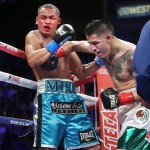

Rios wins TKO on a night when he and Alvarado deliver

They hoped for Arturo Gatti-Micky Ward. They talked about Jose Luis Castillo-Diego Corrales. They promised a lot.

Brandon Rios and Mike Alvarado delivered.

In their own way.

First, there were punches. Then, there were counters. Then, there were chants. Then, there was astonishment. Never was there an interruption, until Rios suddenly found energy where everybody else had begun to see signs of potential fatigue. They weren’t looking in the right place.

But it was there, somewhere inside Rios (31-0-1, 22 KOs), who marshaled his energies Saturday night for a dramatic seventh-round TKO of Alvarado (33-1, 23 KOs) in what might be the Fight of this Year and few other years.

Rios, of Oxnard, Calif., caught Alvarado with an overhand right. The punch seemed to land on Alvarado’s left temple. He appeared dazed. He slumped against the ropes. That was an invitation the instinctively aggressive Rios could not resist. He swarmed Alvarado at a rate that the Compubox computer at ringside must have had a hard time counting. The punches were hard to see. Alavardo surely couldn’t

Appearing defenseless, referee Pat Russell called it at 1:57 of the round, awarding Rios a TKO and perhaps a shot at the Manny Pacquiao-Juan Manuel Marquez rematch on Dec. 8.

“I knew the overhand right would do it,’’ Rios said, who had a slight bruise under his right eye.

Rios, fighting for the first time at junior-welterweight, waited for his chance to land it while enduring one cracking uppercut after another from Alvarado. After six rounds, the bout was tied, 57-57, on each of the cards held by judges Max Deluca and Zach Young. On James Je Kin’s card, Rios led, 58-57.

Alvarado, of Denver, was showing Rios a shoulder and rolling it in a defensive tactic. Amid a relentless body attack, Alvarado finally abandoned the tactic. That was the beginning of the end to a drama that had a capacity crowd of more than 7,000 at the Home Depot Center on its collective feet and roaring its approval.

Rios listened and broke into a smile that said:

“I told you so.’’

Never, he said, was there a moment when he thought Alvarado might have gained the momentum and begun to do enough to win.

“Hell, no,’’ he said to a question thrown at him by HBO Max Kellerman moments after he was declared the victory.

Hell, yes, was the response from an audience that knew Rios and Alvarado had been to hell and back. And, hell yes, everybody was happy to have been along for the ride.


Benavidez rocked, yet survives to win unanimous decision

There’s always been one question about Jose Benavidez Jr.

Could he take a punch?

That punch landed Saturday.

For one fight, at least, Benavidez had an answer. He could take one. He could endure, at least long enough to remain unbeaten in his brief career.

Benavidez (17-0, 13 KOs), a junior-welterweight from Phoenix, was rocked by a left hook from Pavel Miranda (19-8-1, 10 KOs) of Tijuana with about 45 seconds left in an eight-round fight. Dazed and unsteady, Benavidez stumbled across the canvas at an outdoor ring at Home Depot Center, yet managed to hold on to victory by unanimous decision and his status as an unbeaten prospect.

If Miranda’s hook had landed earlier, or if he had followed up with another punch, or had the fight been scheduled for 10 rounds, the story might be very different. Benavidez might be anguishing over his first defeat.

Those are questions that the 20-year-old Benavidez will now have to confront and answer against better, more powerful opponents. There’s never a definitive answer. There are only lessons and more fights, many more of both for Benavidez, who relied on his jab to claim a victory that was nearly taken from him during the bout’s desperate last moments.

The Best
Light-heavyweight Trevor McCumby only enhanced the likelihood he’ll be offered a Top Rank contract this week with his seventh stoppage in seven victories. McCumby, a Chicago native who trains in Phoenix and Oxnard, Calif., at Robert Garcia’s gym, was never challenged in a first-round demolition of Mexican Eliseo Durazo (4-4, 1 KO).

The Rest

Lightweight Javier Garcia (8-2-1, 7 KOs) of Oxnard, Calif., knocked down Jose Roman (14-0-1, 11 KOs) in the first round. Roman, of Garden Grove, Calif., returned the favor in the second. But the ringside physician had the final say. He stopped the fight after the third because of a cut sustained by Garcia, although it appeared the wound was cause by a punch. The fight was declared a technical draw.

Featherweight Evgeny Gradovich (14-0, 7 KOs) calls himself the “Mexician Russan.’’ He needed Mexican tactics and toughness to score a unanimous decision over Jose Angel Beranza (36-25-2, 27 KOs) in a brawling, give-and-take eight-rounder.

Miami super-middleweight Ronald Ellis (4-0, 3 KOs) came into the ring wearing sunglasses. He took them off, fought for four rounds, put them back on, stepped out of the ring and into the sunshine with a unanimous decision over Denver’s Katrell Straus (2-3, 1 KO). Easy as that.

A super-featherweight bout between Mexican Cesar Garcia (6-12-1, 1 KO) and Saul Rodriguez (6-0-1, 5 KOs) was ruled technical draw. The ringside physician stopped it after two rounds because of bloody cut suffered by Garcia in an apparent head butt.

Top Rank signs Mexican Olympian
Top Rank announced Saturday that it has signed Mexican Olympian Oscar Valdez. Valdez, a two-time Olympian, lost to eventual silver medalist John Joe Nevin of Ireland at bantamweight during the London Games in August. Valdez, 22, grew up in Nogales, which is a town on the border with Arizona.

Photos by Chris Farina / Top Rank


FOLLOW DONAIRE – NISHIOKA; ALVARADO – RIOS LIVE


Follow all the action as Super Bantamweight champion Nonito Donaire defends against Toshiaki Nishioka. In the much anticipated cofeature, Brandon Rios and Mike Alvarado go out in a much anticipated Jr. Welterweight bout that will be sure be on many fight of the year lists. The action begins at 10p, eastern / 7 pm pacific.

12 Rounds–WBO SUPER BANATAMWEIGHT TITLE–NONITO DONAIRE (29-1, 18 KO’S) VS TOSHIAKI NISHIOKA (39-4-3, 24 KO’s)

ROUND 1 Not much Donaire more active…10-9 Donaire

Round 2 not much.either…20-18 Donaire

Round 3 Donaire lands a lead right…Nishioka not throwing punches..Donaire lands a right…30-27 Donaire

Round 4 Donaire lands a body shot..40-36 Donaire

Round 5 Donaire lands a combination..Nishioka jab..Donaire a right..triple jab/right to the body..Donaire lands a jab..50-45 Donaire

Round 6 Nishioka lands a left..Donaire lands a right…Left from Nishioka…BIG SHOT ON THE INSIDE AND DOWN GOES NISHIOKA..Left from Nishioka..Combination..Hook from Donaire…left..right …60-53 Donaire

Round 7 Right from Donaire..Left from Nishioka..Left from Donaire…body..right..clash of heads..Jab from Nishioka..Jab from Donaire…70-62 Donaire

Round 8 Donaire lands a right..left from Nishioka..Straight right from Donaire…Combination from Nishioka..Right from Donaire..80-72 Donaire

Round 9 NISHIOKA GETS DROPPED FROM A COUNTER…THE FIGHT IS STOPPED

10 ROUNDS–JR. WELTERWEIGHTS–BRANDON RIOS (30-0-1, 22 KO’S) VS MIKE ALVARADO (33-0, 23 KO’S)

ROUND 1: Trading rights but Rio’s was more effective..Left from Rios and another hard left..Good combo from Alvarado..good right to the body..Trading rights..Rios lands a jab..tremendous trading at the end of the round...10-9 Rios

Round 2 Rios lands an uppercut..Alvarado lands a chopping right..good uppercut from Rios..Alvarado lands a big right..Huge uppercut and right..Body/head combo from Rios..left..good left..20-18 Rios

Round 3 Combination from Alvarado snaps Rios head back…Good left from Rios, Alvarado answers..Good left and chopping right and left from Rios..Right hand..Alvarado lands a short right and left from Rios at the bell..30-27 Rios

Round 4 Good left from Rios..Blood from Alvarado’s mouth..Good right from Alvarado that followed a jab..Good left and uppercut and a right from Alvarado..39-37 Rios

Round 5 Huge right from Alvarado..Short right inside..trading hooks to the body..Right from Alvarado..Alvarado landing heavy shots..these guys are just wailing away…48-47 Rios

Round 6 Good left and right inside from Alvarado..left from Rios..ALvarado answers back..2 short lefts from Rios..Right From Alvarado..Huge rights from Rios..left from Alvarado..58-56 Rios

Round 7 Rios landing huge shits…Alvarado is hurt….. MASSIVE SHOTS FROM RIOS AND THE FIGHT IS STOPPED


Growing Up: Benavidez gets serious by getting rid of an expensive toy.


CARSON, Calif. – If maturity is measured in knowing what to keep and what to shed, there is some good news in Jose Benavidez Jr.’s transformation from prospect to pro.

Benavidez got rid of an expensive toy, a Maserati, as though it were an excess pound.

“It was costing me too much to insure and too much to maintain,’’ said Benavidez, whose insurance premium on the high-performance sport car was $1,500-a-month. “I’ve got more important things to do.’’

Did you just hear a loud sigh of relief? No need to get your ears checked. It came from dad, Jose Benavidez Sr. who a year ago worried about his son’s purchase of the high-performance sports car. It attracted too much attention. Dad worried that fans might begin to think that his son was more interested in expensive toys than hard work. No worries. None at all.

“Oh yeah, it’s a good sign,’’ the senior Benavidez said. “To me, it means he’s figuring it out. He’s getting serious. Sometimes, I have to get on him about some things. But he is starting to get it.’’

Benavidez (16-0, 13 KOs) is still about seven months away from a birthday that will turn him into a 21-year-old adult. Yet, his wisdom often belies his years. He is quick to say he still has much to learn and many to fight.

“I’ve got a lot of work to do, a whole lot,’’ said the Phoenix prospect, who goes back on the job Saturday night at the Home Depot Center against Pavel Miranda (19-7-1, 10 KOs) of Tijuana on the undercard of two HBO-featured fights, junior-welterweights Mike Alvarado (33-0, 23 KOs) of Denver against Brandon Rios (30-0-1, 21 KOs) Oxnard, Calif., and super-bantamweights Nonito Donaire (29-1,18 KOs) of the Philippines against Japan’s Toshiaki Nishioki (39-4-3, 24 KOs) of Japan.

At a formal weigh-in Friday in a crowded hotel ballroom in nearby Manhattan Beach, Donaire was at 121.6 pounds and Nishioka 121.8, both under the 122-pound limit for their title fight. Meanwhile, Rios, unable to make the 135-pound mandatory at lightweight in his last couple of outings, had no trouble at junior-welter. He was at the limit, 140. Alvarado tipped the scales at 139.8.

Miranda was at 144.2 pounds and Benavidez 143.4 for a bout scheduled for eight rounds and officially classified as super-lightweight. In another sign of Benavidez’ ongoing maturity, however he is closer to becoming a welterweight than a junior-welter.

“Anymore, I walk around at 160-pounds,’’ Benavidez said. “At some point, I’ll be a welterweight.’’

That official jump might not happen until sometime next year.

“If we could fight for a youth title or something like that, 140 pounds wouldn’t be a problem,’’ Benavidez Sr. said.

If Benavidez wins as expected against Miranda, he could be ticketed for a bout on the Dec. 8 card featuring the third rematch between Manny Pacquiao and Juan Manuel Marquez at Las Vegas’ MGM Grand.

“But he’s got to be ready for everybody now,’’ Benavidez manager Steve Feder said. “Every young guy out there wants to be the one to upset Jose Benavidez Jr. He’s become a target.’’

But not a flashy one.

NOTES: The Carson card also includes a light-heavyweight bout between light-heavyweight Trevor McCumby (6-0, 6 KOs) against Eliseo Durazo (4-3, 1 KO). McCumby has the look of a prospect. He has been training in Phoenix and at Robert Garcia’s gym in Oxnard. Another big McCumby win Saturday night might lead to a Top Rank contract next week.
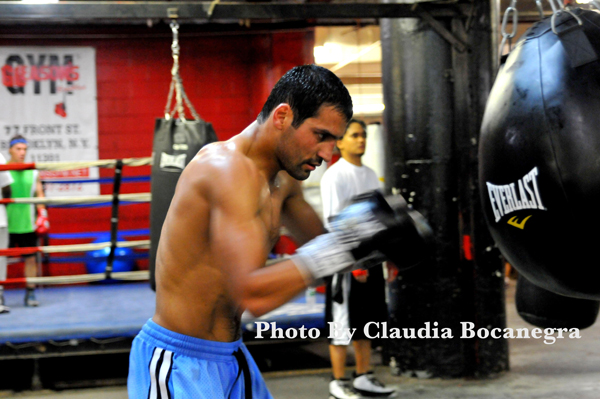
And the card had yet to sell out Friday, but there was a buzz at a weigh-in crowded with more Japanese media than American for a main event featuring Nishioka, who grew up in Nagasaki and trains in Tokyo.


Donaire finished with experiments and ready to re-empower himself


Boxing’s equivalent of lighting in a bottle was captured by Nonito Donaire nearly two years ago when he knocked out accomplished Fernando Montiel within two rounds of a stunning statement that transformed him into a pound-for-pound contender.

Everything since then has been like time in a high school class. Donaire studied, did his homework and roadwork. Yet, he yearned for that bold stroke of reality that still has fans and media talking about him.

“The last three fights were experimental,’’ Donaire said in a conference call. “This fight, we are going back to boxing and being unexpected. We relied on the power in the last three fights. But this fight we will come out throwing lots of punches.’’

In a statement that sounds a lot like a bid to re-insert himself into the pound-for-debate amid doubts about whether Manny Pacquiao can beat Juan Manuel Marquez in a third rematch and only silence from Floyd Mayweather Jr., Donaire promised to reaffirm his credentials in a significant test Saturday night against another accomplished foe, Toshiaki Nishioka of Japan.

It’s another step up for Donaire (29-1, 18 KOs), whose version of the super-bantamweight titles – the International Boxing Federation and World Boxing Organization – will be at stake in an HBO-televised bout from the Home Depot Center in Carson, Calif. In beating Montiel in February, 2011, Donaire stopped an acknowledged master of tactical skill. The proof was in Montiel’s record, then 44-2-2 with 35 KOs.

Flip the calendar forward, jump up in weight and you’re looking at Nishioka, whose record (39-4-3, 25 KOs) adds up to mastery of a division, 122 pounds, that he has quietly ruled since 2004.

“This is a fight Nonito has wanted for a very long time,’’ said manager Cameron Dunkin, who sounded as if he worried Donaire might regret that his wish was granted.

A Donaire advantage appears to be his age. At 29, he should be stepping into his prime. At 36, Nishioka is probably a step beyond his. There is also Nishioka’s recent inactivity. He hasn’t fought since a unanimous decision over skillful Rafael Marquez a year ago.

“We don’t want to take any chances at all,’’ said Donaire, who this year has fought twice at 122 pounds and won both, beating Jeffrey Mathebula and Wilfredo Vazquez Jr. by decisions. “I believe when we are at this level and at this age and even if he hasn’t fought in a while, he can be very dangerous.’’

A potential disadvantage for Donaire is the absence of trainer Robert Garcia for much of his camp. The busy Garcia was also working with Brandon Rios, who faces Mike Alvarado in a junior-welterweight clash that has potential to upstage Donaire-Nishioka.

Nishioka’s advantage rests in experience and smarts. He hasn’t been stopped once and that was in 1995 in only his second pro bout. If Donaire is trying to re-energize his pound-for-pound claim with emphasis – meaning a knockout, he might have picked the wrong guy.

“Sometimes, you don’t get the results that people look for,’’ Donaire said. “ People expect a lot from me. We have been trying to change things up to get different results. Against Nishioka we can’t let our guard down and going back to the old Nonito Donaire style of fighting smart.

“When it comes, it comes. But the proper game plan will show my power, which is what I was known for – lightning fast counters that were knocking people out because they never saw it coming.

“No matter how tough you are, if you don’t see where it’s coming from, you don’t expect it and it will knock you down.’’

And maybe knock him squarely back into pound-for-pound talk.


Malignaggi & Jacobs massive workout Photo Gallery

Claudia Bocanegra was back and proved she hasnt missed a beat when she took the vivid images of Tuesday’s Media workout at Gleason’s Gym in Brooklyn where WBA Welterweight champion Paulie Malignaggi and former world title challenger Daniel Jacobs worked out in advance of their October 20th fights at the Barclay Center in Brooklyn

CLICK ON IMAGE FOR FULL VIEW


Alvarado-Rios: Redeem yourselves, rid us of pestilence, make a masterpiece


DALLAS – Four miles north of this city’s Main Street District, on Southern Methodist University’s beautiful campus, stands Meadows Museum – a collection of Spanish art so extensive it fulfills founder Algur H. Meadows’ vision of a “Prado on the Prairie.” Complementing perhaps the finest collection of Diego Velazquez’s work outside Madrid are works by Spanish masters Murillo, Goya and El Greco. Here hangs, as well, an excellent Fernando Yanez work of Saint Sebastian, cheekily called “the pin-cushion saint” by art students.

Sebastian, a third-century Christian martyr, was a subject treated often by Renaissance painters and always with arrows piercing his body. Tradition says those arrows represent pestilence. Martyrdom, pestilence and masterpieces compose a vantage fitting as any from which to preview Saturday’s undercard scrap between Colorado’s Mike Alvarado and California’s Brandon Rios, a junior-welterweight title-eliminator match that will begin HBO’s “Boxing After Dark” program. It is a fight to which both men seem eager to martyr themselves, a fight to rid boxing briefly of its pestilence, and a fight more likely to become a masterpiece than any this year or next.

Beside my laptop sits a six-year-old media credential that acts as a reminder Mike Alvarado was once something quite different from what he is today. On June 2, 2006, Alvarado represented a future of sorts for his promoter, Top Rank. That night in Tucson, Ariz., at a venue called Club Envy, Alvarado was the main event even if he wasn’t in the main event.

The night’s final match, actually, was Jesus Soto-Karass against “Cool” Vince Phillips in a brutal fight broadcasted by Telefutura’s once-invaluable “Solo Boxeo” program. Soto-Karass beat down the man who stopped hall of famer Kostya Tszyu in 1997 – and yes, Phillips, himself, is on this year’s ballot – in a fashion so assiduous and harsh Phillips tried to retire immediately afterwards. Programming issues, though, prevented Phillips’ public retirement, and so, unsurprisingly, Phillips was back in a prizefighting ring, this time in Russia, one year later.

But my credential makes no reference to Phillips or Soto-Karass. It emphasizes boxing, Top Rank and Mike Alvarado – in order of font size. Alvarado went through a welterweight target named Maximino Cuevas that night, stopping the overmatched New Yorker in round 5. One paragraph about Alvarez from the Tucson report stands out:

“Despite absorbing a number of right hands in the first round, Mike Alvarado quickly adjusted to Cuevas’s style by the start of the second, allowing more distance and landing straight punches. In the closing moments of Round 2, Alvarado rocked Cuevas with a fierce right uppercut that was the fight’s best punch.”

Two notes: 1. Six years ago Alvarado was open to right hands as he is today, and 2. Alvarado’s arsenal included, and one assumes still does, a fight-changing right uppercut. That is germane to Saturday’s match because the right uppercut is not a punch anyone but the peerless Juan Manuel Marquez throws as a lead. It is ever a counter, one thrown at a volume-punching aggressor who unadvisedly gets his weight over the lead knee. It is a punch executed by taking a quick hop backwards, planting one’s right elbow just about on the right hip and shooting both upwards at once. The counter right uppercut is devastating for a volume puncher – the one blow they all fear. It requires of its thrower poise enough to take a hop backwards, geometric awareness enough to establish a tempting plain for the aggressor to stretch himself over, and timing enough to drop that aggressor’s chin on an upcoming fist.

In 2006, after only 28 months of prizefighting, Mike Alvarado’s record was 14-0. Seventy-six months later, Alvarado’s record is 33-0. This dramatically slowed rate is attributable, in part, to time Alvarado spent in jail. His career has been a disappointment. He is 32 years old, which surprises fans who believe they’ve made the discovery of a new action fighter. Alvarado is more exciting than ever, now, because he has to be.

He and Brandon Rios are the sorts of fighters Top Rank makes an industry of. They are the prizefighters Bob Arum threatens other fighters with, the way he shook Antonio Margarito, like a fist, at Jose Luis Castillo when the latter got his rubber match with Diego Corrales canceled because of twice missing weight.

If that sounds at all familiar, it is because twice is how many times Rios has missed the lightweight limit of 135 pounds since ruining Urbano Antillon in July 2011. Remember, the plan was for Rios to fight Juan Manuel Marquez in Cowboys Stadium three months ago, not Mike Alvarado in a co-main event on the tennis courts of Home Depot Center.

Alvarado can outbox Rios because Alvarado is a better athlete than Rios and because, as Richard Abril demonstrated in April, Rios can be thoroughly outboxed. Whatever his amateur pedigree, Rios’ ring IQ is questionable. Alvarado chooses to make savagery with others because he has to, Rios because he can – for when he has to, as he did against Abril, Rios often trips over himself. Alvarado represents for Rios his largest opponent; Rios represents for Alvarado his best.

Both men need redemption. Their fight is, in essence, Margarito versus Margarito – and promises to be that entertaining. In redeeming themselves through suffering, in absorbing abuse that will probably shorten their lives and invariably compromise what health they take to retirement, Alvarado and Rios will also, like Saint Sebastian, rid us of the pestilence that adheres to our sport – for a spell anyway.

I’ll take Alvarado, MD-12, in a savage affair that redeems both men.

Bart Barry can be reached at bart.barrys.email (at) gmail.com


Rios looks at Alvarado and sees a chance at a Ward-Gatti remake


The nickname is Bam Bam. Bold and Bolder might be more appropriate for Brandon Rios, who isn’t afraid of promises or punishment.

Rios’ confrontation with Mike Alvarado on Oct. 13 at Carson, Calif., is generating buzz about a possible Fight of the Year. But Rios raised the bar, or at least the blood lust, for a junior-welterweight bout that could upstage the main event, Nonito Donaire versus Toshiaki Nishioka.

“A Micky Ward-Arturo Gatti kind of fight,’’ Rios said Thursday during a conference call.

For bruises, danger and drama, Ward-Gatti is the modern standard. It’s not the sort of fight that Floyd Mayweather Jr. or Andre Ward would seek. They see themselves as scientists who try to balance their craft with a sweet balance of offense and defense. Their philosophy has been heard for as long as there has been an opening bell. They live by one credo: Hit and not get hit. Delete the not from that formula and add as many hits as possible, and you’ve got a pretty good idea at what Rios hopes to inflict and perhaps endure.

That stretch of canvas between the ropes is no checker board for Rios, who is moving up in weight, to 140 pounds, after a controversial failure to make the lightweight limit, 135. He has no patience for what he calls “little chess games.’’

When Rios looks at the unbeaten Alvarado, he could be looking into a mirror. He sees a similar style and the same stubborn streak of pride that demands, if not welcomes, a walk though harm’s way.

“It’s going to be a bloody, massacre fight,’’ said Rios, who told trainer Robert Garcia that he has been dreaming about a chance to do battle in a fight that would be the equal of Gatti-Ward. “I’ve been telling Robert since I started as a professional I’ve been waiting for that type of fight and hopefully this is that fight.’’

Whether that chance will be there in an outdoor ring above the Home Depot Center’s tennis court, however, depends on Alvarado. Alvarado’s trainer, Henry Delgado, left it open-ended as to whether Rios will encounter the Alvarado he expects.

Fans and media have yet to see Alvarado’s boxing skill, Delgado says. His instincts draw him into exchanges from which there is no retreat.

“He makes it tougher than it has to be, because he’s a warrior,’’ Delgado said. “But we’ve got some surprises coming. We have options, lots of options.’’

Options are often forgotten after the first big punch lands, of course. That’s when even the most seasoned fighter reverts to what he knows and does best.

“He looks to come forward; I like to come forward,’’ said Rios, who says there’s nothing new about a heavier weight which he believes makes him stronger and able to hit with the power of a welterweight. “I don’t change my style.’’

Or his hopes of realizing a dream that many avoid like a nightmare.

Tyson can’t escape 20-year-old controversy
New Zealand’s withdrawal of Mike Tyson’s request to enter the country because of his conviction for raping Desiree Washington is just another sad chapter in a 20-year-old controversy.

Tyson, who was scheduled to speak at series of events in New Zealand, has long denied that he committed the crime. Legal experts, including Harvard professor Alan Dershowitz, criticized the 1992 Indianapolis trial and Tyson’s legal defense.

In 2001, Tyson underwent a lie-detector test in Phoenix, where he was living at the time. According to test results acquired by The Arizona Republic, Tyson was truthful when he said he did not rape Washington. But the conviction will always be on his record. Fair or not, it also will always be there for people seeking to make political capital out of it, no matter what he says or they believe.

AZ Notes
Unbeaten Phoenix prospect Jose Benavidez Jr. (16-0, 13 KOs) has a change in opponents for his undercard appearance on Donaire- Nishioka undercard on Oct. 13. Benavidez now is scheduled to face Pavel Miranda (17-7-1, 7 KOs) of Tijuana, Mexico.

Iron Boy Promotions of Phoenix is back at Celebrity Theatre Saturday, Oct. 6, with a card full of young fighters, including Phoenix super-bantamweight Emilio Garcia (6-0-1) against Jensen Ramirez (2-1-1) of Tucson. Opening bell is scheduled for 6 p.m.


Vincent Valdez, and boxing as metaphor


SAN ANTONIO – Five miles northwest of the Alamo stands a remarkable edifice and concept known colloquially as “The McNay,” Texas’ first museum of modern art. It comprises a collection of more than 700 works bequeathed by Marion Koogler McNay, a childless and eccentric heiress who, in her femininity and childlessness and eccentricity and wealth, helped compose a tiny cohort of 20th century Americans: Those who were not for sale.

Last week The McNay opened its fall exhibition, “Estampas de La Raza,” a somewhat forgettable collection of prints that nevertheless features a marvelous mini-exhibition, “America’s Finest,” by local artist Vincent Valdez. “America’s Finest” comprises, among other works, six large, graphite-on-paper portraits of prizefighters. Expertly hung in a minimalist style that spaces the rich works – pencil drawings with no backgrounds, framed by white wood – evenly across a bare white wall, “America’s Finest” reminds South Texas art aficionados what talent lives in our community and prizefighting aficionados how many things our sport is about.

What Valdez is after is boxing as metaphor. In interviews, he’s confessed he is not enamored of prizefighting. There is an element of brutality to it that likely offends what reservoir of empathy makes him capable of art. He is able to wade into brutality’s immediate effects and distant consequences and make art of them, but he is doubtfully drawn to the living, bleeding spectacle of one man pulping another’s face and spirit.

The nearly demolished human spirit is another thing Valdez is after. He is not interested in the underdog’s senseless self-belief – that uncertainty of outcome Carl von Clausewitz taught us is a prerequisite for courage – but rather what irrepressible thing makes a fighter lumber forward to collect a whupping in silence. Valdez is after what possesses a man, far removed from any chance of victory, to sanctify an unwillingness to be broken. As a creator Valdez knows such men are not like him; they construct nothing. But he understands, and proves, they are essential as fundament; they are the crushed and melted and hardened elements upon which an ethnicity constructs its identity in America. In this way the characters Valdez portrays are both our “finest” in their superiority of character, and in the nature of what particles remain once they’ve been pulverized for our amusement.

All Valdez’s works are evocative. None is substandard. They begin with a man whose shimmering trunks bear the Star of David atop the outside of his thick right quadriceps. He is followed by a Native American, done up in a headdress and trunks that partially read “Big Chief” – his promotional costume complemented by Saint Sebastian’s arrows, both as a reminder of what comical gimmickry boxing employs, and what cultural expiation the man performs.

The only of Valdez’s six drawings that features an immediately recognizable figure is his black prizefighter – one who, with his heavy eyelids and gangly frame, could be no one but the Motor City Cobra, Thomas “Hitman” Hearns. Curiously, Valdez situates him atop a black panther-skin rug. The next figure is either an Irishman or an Italian, coins and bills scattered at his feet, a tattoo of a sinking ship circled by banners that read “THIS TOO SHALL PASS” on his tensed left forearm.

Valdez’s most interesting study is his Latino prizefighter. Posed in a ready stance, his right heel lifted, the man wears two teardrop tattoos beside his left eye, signifying either familiars he has lost or others’ familiars he has taken. The band of his trunks has an “N” placed before its iconic “EVERLAST” brand. Beside the fighter a memorial wreath hangs on a squat stand, and across its flowers slumps a satin ribbon whose calligraphic letters spell “NI MODO,” a Spanish phrase used in dismissal. Literally translated, “ni modo” means “neither mode,” the exact opposite of what English speakers mean by “either way.” Figuratively translated, Valdez’s “NI MODO” means “it didn’t matter”; whatever volition the individual showed, larger forces predetermined his ruin.

The final figure is an Asian fighter, a serpentine dragon tattoo circling his shoulders and wrists, with his face, blood streaming from its right nostril, a reminder to those old enough to remember the misshapen countenance of Duk Koo Kim – a South Korean man killed by an American prizefighting ring. An improvised altar of tattered prayer cards and candles spreads before the toe of his left boot.

Much like the black and white photographs in Holger Keifel’s “Box” (a book found in museum giftshops), Valdez’s work shows what the violence of our sport does to the human form. Valdez’s “Big Chief” has much of the left side of his face caved-in from punches, his eye shuttered and its brow peaked and sharpened, his left cheek swollen, even the feathers on the end of his headdress seemingly shaved away. Whomever’s right fist hit him however many times, its concussion induced a stroke victim’s dull mask.

Valdez concerns himself with the aloneness in which a prizefighter traffics. While members of a prizefighter’s ethnicity elect him their savage representative, someone to remind other Americans what a man who goes to synagogue or lives in Chinatown can do them if wrongfully provoked, he is wholly alone in the violence he perpetrates and endures. In a poetic explanation stenciled on the wall opposite his drawings, Valdez is more celebrative than political but confident in what his work is about:

“These poor men, these boxers, these representatives of multitudes
ranked by color of skin, width of nose, and kink of hair,
stand guard above the sacred symbols that mortared and bricked,
hammered and sawed, planted and picked this country
with broken, bandaged hands.”

Praise boxing, then, for inspiring this art, for giving our flinching contemporary culture a place it can still revel in ethnic pride and work through its resultant conflicts. Boxing is America’s most truthful sport, and praise Valdez for capturing it.

*

Author’s note: Large photographs of four of Vincent Valdez’s six portraits, including the one above, can be found at the artist’s website.

*

Bart Barry can be reached at bart.barrys.email (at) gmail.com


Talk of Pacquiao-Mayweather doesn’t matter if the old Manny doesn’t show up against Marquez


Talk about Manny Pacquiao-Floyd Mayweather Jr. is back like a bad hangover. Everybody seems to have an interpretation, if not a prediction, in the wake of a settlement to Pacquiao’s defamation suit and his offer to give Mayweather the lion’s share in a 55-45 split.

It’s as if Pacquiao’s rematch with Juan Manuel Marquez in their fourth meeting on Dec. 8 doesn’t matter. Maybe, it doesn’t, which is good reason for Marquez to worry about Robbery IV. The public and media fixation on Pacquiao-Mayweather won’t go away and perhaps won’t let anything stand in its way

That said, there’s been a shift in public sentiment and in Pacquiao himself. Combine the two, and only Marquez matters – or should – in any talk about Pacquiao-Mayweather. If Pacquiao loses, the Filipino Congressman becomes a full time politician. He has talked about leaving the ring. Marquez could hasten that departure.

Pacquiao trainer Freddie Roach is concerned on a couple of levels.

First, there’s sympathy for Marquez and his argument that he was robbed in the narrow decisions, split and majority, that went against him in the first and second rematches. Scorecards can be like ballots. They’re subjective.

“I think we go into the fight three to four rounds down already,’’ Roach said about the Marquez bout when it was still being negotiated a couple of days before he worked Julio Cesar Chavez Jr.’s loss to Sergio Martinez on Sept. 15 at Las Vegas’ Thomas & Mack Center.

That means Pacquaio has to win by knockout. That would be a first. Marquez, who has six losses, has never been stopped. Given the narrow 36 rounds that already have transpired and Pacquiao’s record of no stoppages in five fights since a 2009 TKO of Miguel Cotto, Pacquiao by KO is a very tall order.

Roach says the task in camp at the Wild Card Gym will be to rediscover Pacquiao’s old aggression, which has withered for reasons that aren’t clear.

Compassion, perhaps the born-again expression of Pacquiao’s return to a Catholic lifestyle, has lessened the ferocity for which there was no refuge for so many of his fallen foes, Roach says. It was evident in 2010 when Pacquiao almost begged referee Laurence Cole to stop what he wouldn’t in a brutal decision over Antonio Margarito at Cowboys Stadium in Arlington, Tex.

Then again, it wasn’t enough in 2004 when Pacquiao, then at his ferocious best, knocked down Marquez three times in the first round, but never out during the next 11 in a bout that ended in a draw.

Roach says Pacquiao’s physical skills are as sharp as ever, although there seemed to be a missing gear in the hand speed throughout his controversial loss by decision to Timothy Bradley on June 9. From Erik Morales to Oscar De La Hoya, Pacquiao threw punches at a rate that overwhelmed. Against Bradley, that rate proved pedestrian.

But Roach is convinced that those hands will move at a ruthless rate if Pacquiao’s heart still has the streak of larceny needed in a brutal business.

Will it?

“I don’t know,’’ Roach said. “That’s the challenge.’’

The only one.


And still . . .


The best writing in Thomas Hauser’s new collection, “And the New . . .” (The University of Arkansas Press; $24.95), barely treats boxing at all. Hauser’s best writing, instead, comes in his book’s final piece, “Elvis (and Ali),” and concerns itself with the ruinous effect celebrity, and what brings celebrity, visits on the lives of exceptionally gifted Americans.

Hauser evidently set out to write about Elvis Presley, but because Hauser is a writer, because he discovers a subject during its writing and not necessarily before, he found in his treatment of Presley a unique metaphor and parallel with Muhammad Ali: Both men were shorn – of hair in Presley’s case, of the heavyweight championship in Ali’s – by the establishment, and then softened in exile, their sharpest edges grinded on, before being permitted to return as icons. Presley was not the same force after his time in the Army, and Ali was not the same force after refusing induction.

“And they were so good when they were young,” Hauser wistfully concludes about those two Americans on the final page of his latest book.

At 235 pages, “And the New . . .” is the shortest of Hauser’s recent collections about boxing. It is more digestible. There is little missing from the 80 or so pages not in this book. Any boy who is eight years old today and just hearing about this sport of ours, a boy who in 10 years will be an adult who visits a bookstore to learn about boxing generally and what happened in 2011 specifically, will find as apt a summary of the year in this Hauser collection as another.

The likelihood, though, is that no one who reaches adulthood in 2022 will have a bookstore to visit. If you’ve been in a Barnes & Noble lately you already sense it; the last of our country’s largest booksellers is a Starbucks sharing floorspace with Toys “R” Us and Sam Goody, with an airy attic of books whose covers sparkle with raised print. Hauser and his work stand athwart this movement because it is exceedingly important to Hauser that whatever he writes make its way onto paper, a medium of endurance for a few millennia now.

“And the New . . .” is a more optimistic book than Hauser’s last collection, “Winks and Daggers,” felt. If boxing is not in a more hopeful place today, it is at least in a place where sabotage is suspected less. Everyone is acting in a rapaciously self-interested way, business as usual, but there appears a modicum less cynicism now that the premium networks have had their little shakeups, with HBO Sports’ chief pursuing other opportunities, Showtime Sports’ leader replacing him, and a lawyer replacing him. To revisit some of the programming choices made in 2010 and 2011 by HBO is to wonder if there were not poison pills being sewn; if the network’s loyalty to certain fighters were not a means of subverting the next regime.

Ah yes, HBO – the subject for whose treatment Hauser is perhaps best known. No longer. In March, Hauser became a consultant for the network. Urgent criticism in our small community greeted this news, some of it in good faith, much of it not. The good-faith concern was this: HBO’s greatest critic is no longer free to criticize. That is indeed a loss. Calls for Hauser’s removal from the full-member rolls of the Boxing Writers Association of America went out and were heeded, showing, in a fine twist, that among writers, HBO is considered a promotional entity more than a journalistic one.

Touché. This decision on the part of the BWAA’s leadership, though, brought one terrible consequence: Hauser resigned from his post at the head of the BWAA membership committee, where he still retains a vote. Hauser is a writer first; he speaks the language of writing, cares about prose, and understands the rigors of rewriting in a way deadline reporters do not. Hauser’s motto of event coverage – not first but best – is authentically different from the wires’ or their editors’.

As head of the membership committee, Hauser combed the internet for good writing about our beloved sport, caring considerably more about what words he found on a page than what URL floated in the address bar above. Hauser reached out to otherwise unknown writers. He elevated our work. Because Hauser is a writer, he knows this: Only the words endure. Page views, Twitter followers, breakfasts with a promoter; all of that is ephemeral noise when set against a writer’s words.

“And the new . . .” has plenty of good writing, of course, and Hauser’s usual number of good choices. “It was as though someone had shoved a tennis ball beneath the skin and painted the entire area purple,” Hauser writes of a fighter’s countenance in “Rodriguez-Wolak: A Great Fight,” an unplanned piece he was moved to write after being ringside for Pawel Wolak and Delvin Rodriguez’s surprisingly excellent first match.

Much of Hauser’s event coverage treats Manny Pacquiao and the possible repercussions his move to Showtime would cause. It was a fling, we now know, and seismic only so much as it cost the leader of HBO Sports his job. But there is a strain in some of it; Hauser captures well the lugging that began 21 months ago when the announcement came that Pacquiao would fight Shane Mosley on Showtime. So desperate were we for change of some kind after 2010 that we squinted to find meaning that was not there, interrogating every press release like a poem by Hart Crane.

We’re in a better, more relaxed place now. No promoter today would schedule another midnight conference call about Pacquiao not-fighting Floyd Mayweather. No one would dial in if he did.

Bart Barry can be reached at bart.barrys.email (at) gmail.com


Terrible Ending Robs Mendez of Possible Glory

WOODLAND, CALIFORNIA – In a good scrap that he was leading, Paul Mendez unfortunately robbed himself of praise that he likely would have attained justifiably had the fight not ended with a clear-cut low blow in the seventh round of his Telefutura-televised main event against DonYil Livingston at the Woodland Community & Senior Center on Saturday night. After an errant left hand hit Livingston below the belt, the out of position referee counted the down fighter out and awarded Mendez the stoppage victory – a decision that will likely be overturned after an appeal.

Livingston (8-2-1, 4 KOs) of Palmdale, California opened the first as the aggressor, landing his jab, before Mendez (10-2-1, 4 KOs) of Delano, California backed him to the ropes moments later. When Mendez, 162, got Livingston, 162, trapped, he did not manage to land anything really telling as the Palmdale resident covered up.

In a close second round, Livingston found a home for a hard left hand, but midway through the act it was Mendez that found his range and kept his opponent on the end of his shots.

Mendez took control of the fight in the third, hurting Livingston with a solid overhand right and flurrying his smaller adversary to the ropes. Livingston looked steady on his feet as the fourth began, but not so much as the round came to a close. Mendez rocked the cousin of Andre Ward with a hard combination and had him in trouble before the bell to end the round.

Mendez had another solid round in the fifth, but Livingston began to show renewed life as the round ended. Livingston came on the start the sixth, landing in combination as Mendez’ shots turned a bit wide. Livingston landed a hard left, before Mendez closed the round with a decent combination.

What looked to be a fight going into the final two frames, ended abruptly as Mendez caught Livingston way south of the border with a hard lefthand. Unfortunately, referee Dan Collins was over Livingston’s left shoulder, in admittedly no position to make the call. According to the attending Commission supervisor, the referee should have polled the ringside judges for the call. Judge Kermit Bayless was asked and told Collins he did not see the blow. The other two judges were unavailable to make a comment to 15rounds.com on the fight’s ending.

Scores at the time of the stoppage, which came at 43 seconds of the seventh round, were 58-56 and 59-55 twice for Mendez. The result will very likely be overturned to a no-contest, considering the Telefutura replay will clearly show the blow was low. Livingston should have had five minutes to be ready to continue, according to the rules of the California State Athletic Commission. Had he not been able to continue at that point, Mendez would have been declared a TKO winner. Given the ending, it is unfortunate for Mendez that a solid showing will likely go to waste, at least in terms of his won-loss record.

Moving up to the eight-round distance, progressing super bantam Manuel Avila (10-0, 3 KOs) of Fairfield, California showed off his jab and lateral movement en route to a measured unanimous decision win over the naturally smaller John Alberto Molina (32-20-3, 20 KOs) of Fort Myers, Florida by way of Caucasia, Colombia.

Despite the size disadvantage, it was Molina, 121.5, who pressed the action throughout. Though getting on inside was Molina’s only hope, his plan played into the hands of the comfortable counter-puncher Avila. The young prospect, 123, seemed happy to jab and move his way to the points win soon after the fight got under way. The little bit of action the fight provided was in the few moments Molina managed to back Avila into a corner or to the ropes, forcing his undefeated foe to exchange before moving back out of range.

After eight rounds of bull versus matador back-and-forth, Avila was given the nod on all three judges’ cards. All three officials had Avila a winner in seven of the eight rounds, with the final tally of 79-73 across the board.

Local favorite Guy Robb (9-1, 4 KOs) of Sacramento, California sent his strong contingent home happy as he dropped the durable Jonathan Alcantara (6-9-2, 1 KO) of Novato, California en route to a wide six-round unanimous decision victory.

Despite his accomplished amateur background, Robb, 126.5, is becoming known for his relentless inside game and that trait stood out in the opening rounds against Alcantara, 128, a late fill-in opponent.

After utilizing his harder and more accurate shots through two, Robb dropped Alcantara with a combination punctuated by a stiff right hand in the opening seconds of the third. Robb applied pressure soon after Alcantara rose, forcing the Novato resident to stumble back with another clean combo. However, by the finals seconds, Alcantara seemed to have regained his legs and even began to offer back with some ineffective attempts of his own. Just to show Robb he was still present, Alcantara shoved Robb as the bell rang to end the third.

Robb, coming in off one of his longer layoffs as a pro, may have winded a bit after the third and eventually tempered his offense as the rounds wore on. Acting more as a counter puncher, Robb found success in the latter rounds. Picking his shots, Robb outboxed Alcantara in the final round en route to the shutout decision, 60-53 across the board. Robb will return to the ring October 6th in his hometown at the famed Sacramento Memorial Auditorium.

Despite an uneven start, Jonathan Chicas (7-0, 3 KOs) of San Francisco, California outgunned journeyman Jose Mendoza (7-7, 3 KOs) of Oxnard, California by way of Jalisco, Jalisco, Mexico for the second time in just under a month.

Chicas, 140, fought a bit recklessly in the opening rounds, but found a home for his power shots in each stanza. Mendoza, 139, was successful when he opened up, particularly in the second and third rounds. However, as was the case in their first encounter, Mendoza did not have the power to earn Chicas’ respect. Even when was hit clean, Chicas mostly walked through the punches and fired back in combination. Chicas regained complete control in the last two acts and was named the winner, 49-45 across the three cards. Back in August, Chicas took a shutout four-round decision over Mendoza in Fairfield, California.

A scheduled four-round super featherweight bout between former amateur standout Andy Vences of San Jose, California and Carlos Higuera Gonzalez (1-1) of Los Angeles, California was scratched from the card this afternoon. Gonzalez’ required blood work was not completed in time which forced the California State Athletic Commission to remove him from the fight. No opponent could be found to save the night for Vences, who was scheduled to make his debut. Vences now hopes to debut on the aforementioned October 6th card in Sacramento.

Photos by Erik Killin

Mario Ortega Jr. can be reached at ortega15rds@lycos.com


It’s time for Chavez Jr. to test positive for some maturity


Is anybody surprised that Julio Cesar Chavez, Jr., tested positive for marijuana?

Didn’t think so.

News of the test in the wake of Chavez’ loss by one-sided decision Saturday night to Sergio Martinez at Las Vegas’ Thomas & Mack Center is just more of the same in an exasperating pattern of behavior from a man-child who won’t grow up.

Already, Chavez’ enablers are trying to muddy up the issue by arguing that pot is as much a performance-enhancer as a bacon-cheeseburger. It should be legal, they say. It’s already legal in some places. Smoke it for therapy. Smoke it as a sleep aid. Soon, Barack Obama and Bill Clinton will be tossed into all that smoke. The current president inhaled it and a former one said he didn’t. Blah-blah-blah

So what’s the problem?

It’s not the pot. It’s the irresponsibility.

If Chavez, Jr., smoked a joint after a fight that included an epic 12th round, that’s his choice. But the positive test indicates he was indulging when he wasn’t training throughout a haphazard camp, which included weird hours and sessions when apparently his road work was limited to a few laps around the couch in his Vegas’ living room.

Instead of fulfilling his obligations with some sweat equity, it looks as if the former middleweight champ was getting stoned. That was irresponsible to trainer Freddie Roach, who sometimes would be summoned to supervise a workout at midnight or 3 a.m. It was a breach of what Top Rank and fans expected him to do.
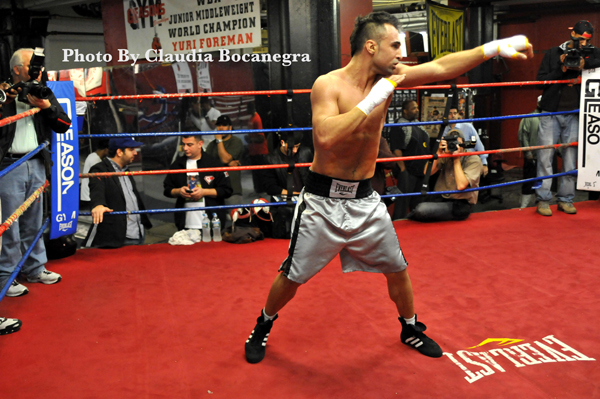
Chavez has been allowed to skate from accountability throughout his young life because of his name. He’s the son of Mexico’s beloved Julio Cesar Chavez, Father Legend. If there’s a burden in carrying on the name, it includes favors that have postponed maturity.

More troubling and perhaps ominous, he hasn’t learned from his father’s mistakes. In addition to a durable chin, there are signs that the 26-year-old Chavez inherited dangerous habits that led his dad into substance-abuse and rehab. Chavez Jr. talked about his dad’s problems a couple days before the Martinez bout. In a forthright manner, he talked about fears his dad would die. He called the experience “horrible.’’ But he didn’t call it a lesson.

It’s not as if Chavez Jr. didn’t know he would be tested. His history dictated that he, perhaps more than any fighter, would be. In 2009, he was suspended for seven months after testing positive for a diuretic. In January, he was arrested for DUI. In June, Andy Lee trainer Emanuel Steward questioned the legitimacy of a test that Chavez underwent before he beat Lee in El Paso.

By now, Chavez knows the rules. If he had trouble sleeping, he should have used something else other than pot to help him get his rest. Marijuana is still on the banned list. It’s fair to argue whether it should be. But that’s an argument for another day.

Today, the argument is only about Chavez Jr. In a Don’t Worry, Be Happy style, he’s likable. He has potential. But that’s all he’ll ever have if the people around him continue to postpone the battle to mature. For now, it’s the only fight that matters.


Pacquiao – Marquez press conference report


New York – Manny Pacquiao and Juan Manuel Marquez took to New York City as part of their three city tour to announce their upcoming showdown set for December 8th in Las Vegas. This would be their fourth time meeting each-other in the ring. All three of their bouts were closely contested and hotly debated, with two of the fights being fight of the year candidates.
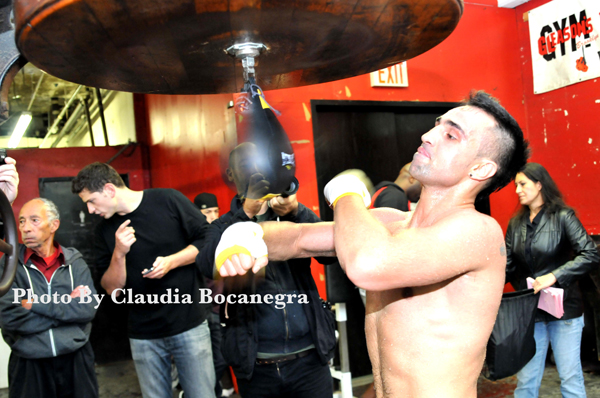
To put things into perspective, combining all of the judges’ scorecards from all three fights, Pacquiao has a slight advantage on points over his rival by a margin on 1024-1017.

On Wednesday at the Edison Ballroom in Times Square, Pacquiao took to the podium and stated, “I’m looking forward to winning impressively and to make the fight as short as possible. We need to get back to the aggressiveness and hunger from when I was twenty-five years old.”

In his always improving English, Marquez stated, “December 8th I have a new challenge again. I don’t need to prove nothing, because I won the last three fights!.”

Kerry Davis took to the podium to briefly announce a the ongoing strategic alliance between HBO and ESPN, and to stay tuned for more in the future.

Promoted by Top Rank, in association with MP Promotions, Zanfer Promotions, Márquez Boxing, Tecate and MGM Grand Hotel & Casino, tickets to Pacquiao-Márquez 4 will go on sale Friday, September 28 at 1:00 p.m. ET / 10:00 a.m. PT. Tickets are priced at $1,200, $900, $600, and $400 and are limited to 10 per person. To charge by phone with a major credit card, call Ticketmaster (800) 745-3000. Tickets also are available for purchase at www.mgmgrand.com or www.ticketmaster.com.

The Pacquiao vs. Márquez telecast, which begins at 9:00 p.m. ET / 6:00 p.m. PT, will be produced and distributed live by HBO Pay-Per-View


Momento de Maravilla


LAS VEGAS – Only prizefighting, among all sports, is able to induce a vicarious sensation so near to personal tragedy one’s mind, in a headlong rush for homeostasis, begins to tamper with its stimuli, misreading moments and writing them in memory more creatively than truthfully. To see a man so large in what gorgeous violence he perpetrates on another suddenly diminished, panicked, desperately swimming towards his foe like a drowning child after pool’s edge, is to witness sport extended to its legal limit.

That is what happened Saturday in the final two minutes of 37-year old Argentine Sergio “Maravilla” Martinez’s successful defense of his lineal middleweight championship against 26-year old Mexican titlist Julio Cesar Chavez Jr. at Thomas & Mack Center, a match Martinez won by lopsided unanimous-decision scores after being forced to the blue mat twice in its 12th round.

There was “Maravilla” in the final 80 seconds, eyes big, body failing, fright both overwhelming and accelerating his exhaustion – the man who boasted before training camp that in his matches “99 percent is studied” beforehand; every wink, every straightening of his trunks, every shoulder shimmy, every smile, every word, all of it, devised in his downtime, planned in his training, executed by a tyrannical actor/director who does not abide improvisation on the set after a bell calls Action. Then none of it was planned.

Felled as much by fatigue as Chavez’s short left hook, a punch that hadn’t found a meaningful mark more than a pair of times in Chavez’s 34 1/2 minutes of winging it, Martinez emoted a confused panic even he didn’t know was in his theatrical range. Martinez rose and tackled Chavez, causing a second knockdown ruled a slip because it didn’t matter how it was ruled because the scorecard never mattered a whit to Chavez. Entirely unconscious of himself or strategy or script, Martinez fought a just-exhausted-enough Chavez off him in a minute that Martinez’s curious mind and creative memory will now stretch to a width most hours of his life will not rival for duration or anxiety.

Anxiety was the large part of that extraordinary final minute. After a 10th round that saw Chavez cast his fourth and fifth urgent and nearly hopeless glances at referee Tony Weeks, beseeching him to do something about Martinez’s low punches or dangerous head, the Argentines in the arena began to serenade their champion and each other. They filled Thomas & Mack with song. A Buenos Aires fútbol rally in the middle of a city that was once Mexico, on the weekend of El 16 de Septiembre: ¡Pinches argentinos, hijos de la Chingada!

After the 11th, a round that saw Chavez land his most meaningful right hand of the evening then see another rally extinguished by Martinez’s sense of the moment and its augmentative, momentum, the aisle in section 112 began to fill with well-dressed Mexicans stomping up the stairs towards the exit. There was no suspense at the end of the 11th, and let no one tell you otherwise.

The suspense happened when the bell to begin the 12th rang and Chavez remained on his stool. Martinez raised both hands above his head, certain he’d beaten “Son of the Legend” yellow on the eve of Mexican Independence Day. Then Chavez, that child of privilege and man of an eccentric nonchalance almost goofy, showed Martinez his mouthguard and hopped off his stool.

When Chavez’s left hook came home and Martinez’s wondrous legs finally failed him moments later, an energy coursed through Thomas & Mack Center like no other. It was a catharsis whose pursuit is the very reason any self-respecting experientialist pays his airfare to Vegas and endures its gauche price-gouging ways – to experience a mindless union with 18,000 others, a burst of something so chemically pure the body hates it, an intensity unendurable for more than a few seconds. The moment could not have been improved upon; its potency was a product of surprise: “Maravilla” in an instant diminished, worn, fragile, spent, withered, more miserable than he’d made Chavez in a half hour of smacking his face with knuckles.

Does it detract from the moment to price it? Surely it does, but that’s why it’s called prizefighting after all. The most terrifying moment of Sergio Martinez’s career will be the one that makes him a much wealthier man. He is now damaged and old, more likely to find underestimation than over. Somewhere from Floyd Mayweather’s fighting soul – the sacred part of him as yet unsullied by “Money” – there must today be a voice that says, “You’re gonna tell me I gotta avoid a guy Little Chavez had out?”

And while Julio Cesar Chavez Jr., right now, knows just how physically ruinous Martinez’s 300 flush blows were to his young body and younger brain, Mexicanismo will ensure he forgets posthaste: “¿Qué haría tu papá, Júnior?”

Whatever he said about it afterwards on Saturday night, his head still thrumming with concussion and ears throbbing each beat of his heart, Sergio Martinez is too introspective, too gentle-spirited, not to have doubt. “Maravilla” is not delusional and does not wish to become so. He fought Chavez perfectly Saturday, just enough playfulness and just enough clean striking and just enough macho, and came within a punch of drowning. It will not be lost on him what will come if he fights imperfectly in a rematch.

Bart Barry can be reached at bart.barrys.email (at) gmail.com