VINNY LaMANNA: BOXING MANAGER

He didn’t start out as most in the boxing business but Vinny LaManna has accomplished a lot in his twenty-plus years in boxing.

LaManna, who now resides in Toms River, New Jersey wasn’t even particularly a sports fan until he walked into a bar in Northern New Jersey and was captivated by what he saw what was playing on the television.
“It was the 1988 Seoul Olympics and they were showing a fight involving (eventual Gold Medalist) Ray Mercer and thought to myself wow what an exciting athlete and from there my love and passion for the sport was born”, said the forty-eight year old father of three.

LaManna then became friends with Greg Pessolano who was an agent with Triple Threat boxing who just happened to be the management company of Mercer.

Through the mutual friends, LaManna was introduced to Mercer and that sparked LaManna’s interest in getting into the business.

“Any fool with $20 can get a managers license” and then LaManna preceded to manage a Light Heavyweight named Anthony Sutton.

“Sutton lost his first fight with me and he never fought again”

That didn’t deter LaManna as he has gone on to manage over forty-plus fighters that included His only world champion, IBF Cruiserweight champion Imanu Mayfield, Leo Loiacano, Michael Covington, Derrick Graham, and his influence into boxing Ray Mercer.

“I have done shows with the biggest names. We have been involved with fights with Don King, Bob Arum, Goossen, you name it”

Mayfield, who was LaManna’s only champion was actually brought to him after his manager Curtis Ford had a brain aneurysm.

Loiacano was big ticket seller in North Jersey so that brought LaManna a name in his home area.
Graham was the one that LaManna could have been great as he said that he had all the talent but never took the sport serious.

“Mercer and Mayfield were able to make handsome livings”

LaManna has had his battles and detractors over the years but has mostly good things to say about the business.

On the present New Jersey Boxing Commission “Larry Hazzard knew the sport and currant Aaron Davis is a fair man and because of his regulating we have seen an increase in live events”

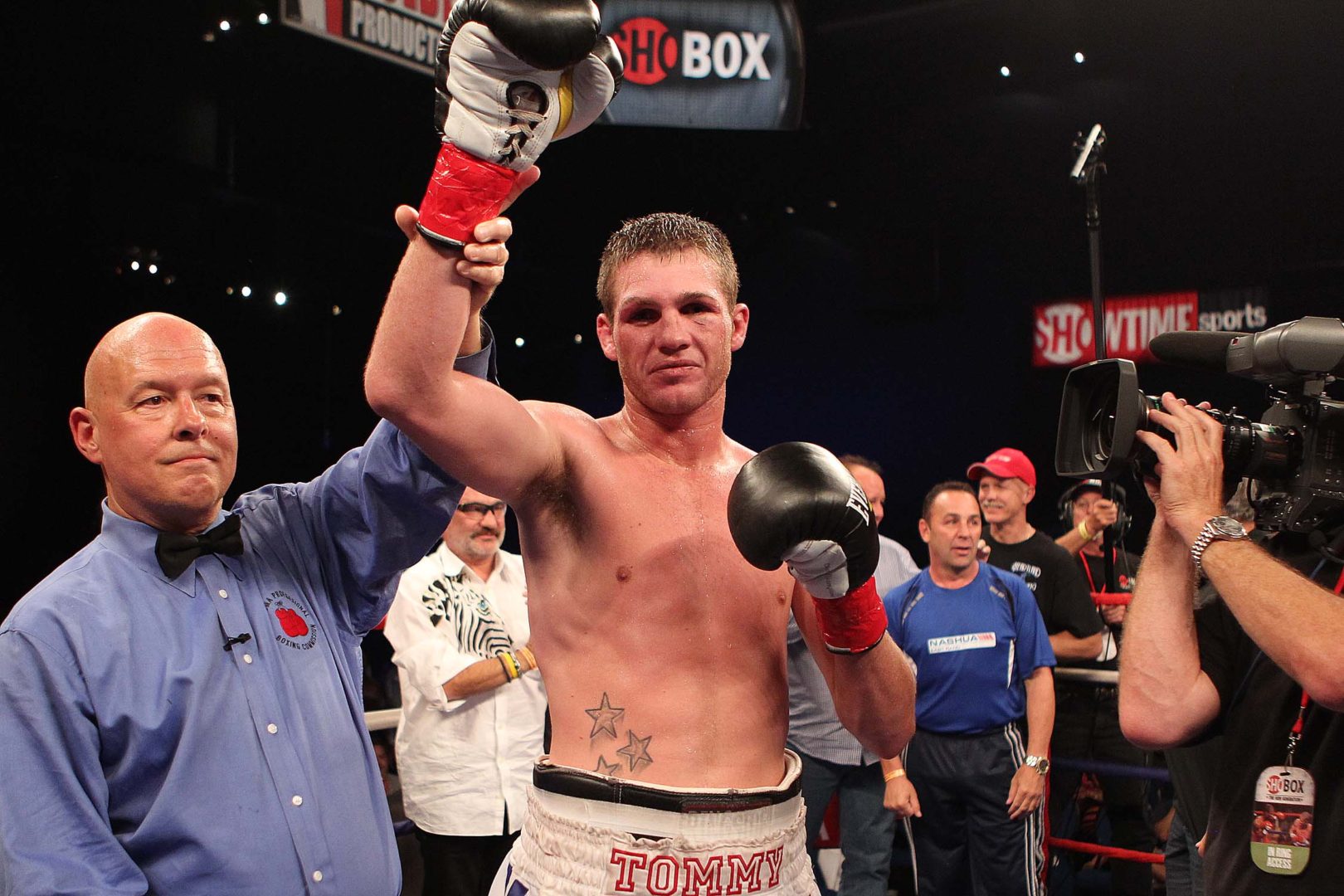
LaManna has been at the championship level but now he is involved in his most personal project in managing his own son, Twenty-year old undefeated Jr. Middleweight Thomas “Cornflake” LaManna.

“I don’t have to be as careful and he is learning more and more. All of my decisions are business and the fights we make, I have to take the mindset that he was any other fighter that I have managed”

The younger LaManna will be back in the ring this Saturday night at Ballys in Atlantic City (www.gfl.tv -$9.99 at 7:30 pm) when he takes on Yolexcy Leiva in a bout scheduled for six rounds.

LaManna has seen some distract changing in the game in his two decades in the business.

“There are some bad people and the sport needs to be regulated. There are too many people running around the business who don’t understand it and that leads to lots of fighters getting screwed”

Like everyone else, LaManna has his own opinion of the continued failed negotiations between Floyd Mayweather and Manny Pacquiao.

“They should just be able to come to some kind of fair split when you are talking hundreds of millions of dollars. To me it just looks like two guys making excuses not to fight each other”

“Being from New Jersey, I am big proponent of the State Title. I think it’s a great way to promote and give fighters on the way up an opportunity to fight for a title”

LaManna took matters into his own hands when he and longtime Philadelphia cutman/promoter Joey “Eye” Intreri formed the BAM (Boxing Association of Machismo )

“It’s a title for kids to fight for something, it’s more of a trophy but the winners of these fights get belts and there are no sanction fees. When we feel two guys want to step up in an era when nobody wants to fight each other, we try to reward those fighters”

LaManna, also runs and operates Starwaste Service, which is a large sanitation company in New Jersey


Observations about local fight promotion from behind black cocktail dresses

SAN ANTONIO – Saturday saw the return of national figures and national Spanish-language television, Telefutura this time, to the northernmost fraction of Alamodome, a pastel-highlighted and becurtained area called Illusions Theater. Seven undercard matches whose blowouts were either unexpected or presented local prizefighters doing the blowing-out rallied an enthusiastic Alamo City crowd for what was an entertaining main event.

Rugged Texan Brian Vera decisioned crafty Sergio Mora, a national figure who won the first “Contender” program and briefly held the WBC’s light middleweight title in 2008. The judges’ decision was correct, if unfairly wide in two cases, and Mora stormed to his dressing room and had a conniption. As neither Vera nor Mora, nor their rematch, provided new insights about prizefighting, it should prove more constructive to examine local shows and the promoters who host them.

One needn’t cover the sport of prizefighting for a decade to see his first dozen promoters fail. The pattern becomes familiar: A man successful in some other venture decides his hometown’s consumers have not been adequately tapped. He has an angle of some kind, often an assumed familiarity with his city, a familiarity whose supposed lack caused other promoters’ previous failures. Occasionally his angle is a direct line to a stable of talented local prospects, and in the best scenarios it is access to a prizefighting grandee.

The new promoter sets out to make his first card a conquest. He leases the talent and services of a national outfit or at least a well-regarded matchmaker. He rents a noteworthy venue. He begins to employ what salesmanship made his other venture a success. Everything runs crisply. Press releases get released. Open workouts open on time. Promotional events promote relentlessly. Advance ticket sales advance. The local promoter loses between $20,000 and $40,000.

But the debut gets good reviews. He has already promised to do a minimum of five shows or more because he understands the importance and finickiness of momentum – even if his burn rate has already trebled startup estimates. His second card goes much like the first. The local promoter approaches a crisis stage and thinks maybe conjuring a reliable audience for prizefights is not as his initial calculus concluded.

Boxing is filled with local freelancing operatives who haven’t succeeded at previous business ventures but believe, on the strength of their betrothing common observations and uncommon vocal cords, boxing is where a fortune, their fortune, can be made. If it’s not an impossible scenario, it’s neither a probable one. The promoter turns to these freelancers for enthusiasm if not advice because optimism is at least infectious.

For his third card, the new promoter decides he’s learned much about the business from national outfits as he’s likely to. He cuts PR costs dramatically, though keeps the matchmaker and venue. Reviews are not raved as before, but of course expenses are lower. He stocks the card with local talent – the national guys, after all, sell television licensing (which their national promoters keep), not tickets – and maybe attempts affiliation with his city’s thriving amateur scene. Keep things homegrown and intimate.

But even small events are more expensive than they feel to attendees. Members of the local media, wary of a diminishing infrastructure they’ve seen before, lose some interest. They’ll be there fightnight, perhaps, but no longer have an impetus to act as tools in the promotional apparatus. This brings a capitulation stage, wherein the local promoter leaves boxing, feeling in no small part bamboozled, and tries his luck with amateur MMA or writes-off entirely his errant undertaking.

Leija-Battah Promotions, by all appearances, approached a crisis stage after its second show, a small Cinco de Mayo event that drew a reasonable crowd to the bullring of a large San Antonio dancehall but nevertheless featured talent more national in price than notoriety. Then came a kickoff press conference in June for its third show, Mora-Vera II, a press conference made complete by an appearance from the Golden Boy himself, Oscar De La Hoya, beside his one-time rival and new promotional partner Jesse James Leija. Locals reasonably anticipated future Golden Boy sightings. But the June press conference – despite promises of a Thursday “meet & greet” and Friday weighin at 1 PM – was the last De La Hoya was seen in South Texas. His June affair was about selling the event to Leija-Battah Promotions.

Friday’s weighin was inexplicably moved to 3 PM, Thursday night, which did not correspond to blue-collar dads’ lunch breaks. Saturday’s card featured a media section nothing like the first Illusions Theater configuration Top Rank’s Lee Samuels arranged in March. Rather than two consecutive rows of tables, there was one row, restricted mostly to television personalities who never materialized, and a second table well back of it. Between the two tables were five or six rows of “media seating” that featured black cocktail dresses in lieu of notebooks – which was good because had these credentialed writers brought so much as a pen with them, they’d have had to balance the reports they scribbled on their spectacular, shapely knees.

The card itself left one hopeful, nonetheless. It showcased local talent like Adam Lopez, Javier Rodriguez, Steve Hall and Benjamin Whitaker. The main event was excellent too. There were 17 amateur bouts before the professional show, and each of those amateurs was tasked with selling 25 tickets. Attendance was estimated above 3,000, and while it is not likely so many tickets were sold, seeing more than 1,500 people gathered for boxing in a local venue is always edifying.

What comes next for the promotional partnership between local businessman Mike Battah and local hero Jesse James Leija is unknowable. Being a prizefighting promoter, a profitable one, is unlike any other venture.

Bart Barry can be reached at bart.barrys.email (at) gmail.com


Vera decisions Mora by questionably wide scores in South Texas

SAN ANTONIO – If you come to Texas and fight a Texan you have to beat that Texan down. Californian Sergio Mora returned to Texas and did not beat Austin’s Brian Vera down (though he probably outboxed him), and again the result went Vera’s way.

Saturday in the main event of a “Solo Boxeo” card promoted by local outfit Leija-Battah Promotions within Alamodome’s Illusions Theater, in an excellent rematch of their 2011 fight Vera (21-6, 12 KOs) decisioned Mora (23-3-2, 7 KOs) by split scores of 114-114, 118-110 and 117-111. The first score was accurate, the others were likely too wide by half.

Afterwards, a furious Mora, who goes by the moniker “Latin Snake,” had venomous things to say about the decision and the state of Texas.

From the opening bell, insiders knew the fight would be determined by Mora’s accuracy or Vera’s activity. Vera’s activity won. Though Mora landed a multitude of right crosses from his shifting stance, and often had Vera outclassed, Vera’s relentlessness impressed the local judges more.

After an opening three rounds that saw Vera busier and Mora significantly more accurate, Vera’s busyness began to tell. Mora, who’d successfully set up shop in both neutral corners and snapped Vera’s head back with counter uppercuts, found his mouth open and his activity diminished as the middle rounds came and went.

But as the championship rounds approached in a match for a vacant NABO middleweight title, and as Vera’s pace slowed slightly, Mora appeared to become the aggressor, landing with hard combinations in the fight’s closing six minutes. Ultimately, though, it was an effort by Mora ineffective as it was tardy, and Vera had his second victory over Mora in as many fights.

ANTONIO ESCALANTE VS. LEONILO MIRANDA
An old saw goes: The man is most dangerous when he is hurt.

That old saw proved itself true once more Saturday when El Paso featherweight Antonio Escalante, retreating on buckling knees, stopped, planted and connected with a short right cross from which Mexican Leonilo Miranda could not rise.

The official end came at 1:19 of round 2, after an uneventful first round saw neither Escalante (27-4, 19 KOs) not Miranda (26-5, 25 KOs) land anything meaningful. Early in the second, though, Miranda connected with a left hand that affected Escalante, putting him on stiff legs.

Then Miranda leaped in, emboldened by Escalante’s retreat, and Escalante snapped a perfect right hand. The 10-count was unnecessary.

BENJAMIN WHITAKER VS. GERMAIN CARSON
Saturday’s first match featured a professional debut by Benjamin Whitaker, a local welterweight, against an awkward fellow Texan named Germain Carson – an entirely successful debut by Whitaker that saw him win by stoppage at 2:33 of round 2.

After a first round that found Whitaker (1-0, 1 KO) leaning with right-hand leads on the southpaw Carson (0-2), leads Carson picked up and evaded for the most part, Whitaker began to move forward and look for openings. With Carson’s high chin, Whitaker found a big opening quickly enough.

“I felt better, actually,” Whitaker said of using lighter gloves and fighting without headgear for the first time. “My hands felt lighter. I liked it.”

A left hook from Whitaker caught Carson late in the second round and dropped him for the full count of 10. It was an excellent debut for a likable local prospect before a lively crowd.

DAQUAN ARNETT VS. ISHWAR AMADOR
The evening’s second bout, a junior middleweight match between undefeated Floridian Daquan Arnett (6-0, 4 KOs) and many-times-defeated Mexican Ishwar Amador (11-11, 7 Kos) did not last long. In fact, it lasted only so long as it took Arnett, an Al Haymon-advised fighter with a Floyd Mayweather style, to land his first right hand.

That right hand was a crisp cross that found its home on Amador’s chin and resulted in a no-count-needed knockout for Arnett at 0:36 of round 1. Arnett, who has both talent and proper management, is a fighter to keep an eye on.

ADAM LOPEZ VS. MARIO DELGADO
The evening’s third match found former local amateur standout Adam Lopez (4-0, 2 KOs) making quick work of fellow Texas bantamweight Mario Delgado (0-3) of Brownsville, stopping him with a left hook to the belly at 1:21 of round 1. Lopez, who suffered a flash knockdown in the first round of his last appearance at Illusions Theater, fought more effectively Saturday, though his competition has diminished considerably lately.

STEVE HALL VS. MILTON RAMOS
In the undercard’s most entertaining match, a battle between Texas welterweights, local fan favorite Steve Hall (5-3, 5 KOs), an Englishman who wears a sombrero and serape to the ring, went through six hellish rounds with Milton “Bad Boy” Ramos (8-3-2, 2 KOs) of Waco, in a match Ramos won by unanimous scores of 60-54, 59-55 and 58-56.

From the opening minute, when a balance shot stunned Hall, Ramos found his San Antonio opponent with most every right hand he threw. Hall was game, though, wading into whatever Ramos served, and tasting three or four of them at a time, in the hopes of landing a right of his own or a left hook behind Ramos’ right elbow.

The match was closer than six-rounds-to-one, but the right man was victorious, much to local fans’ dismay.

UNDERCARD
Saturday’s fifth match saw local junior featherweight Javier “Pitbull” Rodriguez (3-0-1) decision fellow San Antonian Kermit Hendricks (1-3) by three scores of 39-37.

The penultimate match of the evening, a swing bout between Texas featherweights Jerren Cochran (5-0, 3 KOs) and Jesus Rocha (3-3), began on a very entertaining note and ended in a unanimous decision for Cochran – scores of 40-35, 40-35 and 39-36 – who got hit with a surprising number of punches for a man who fights out of a shell.

Opening bell rang on the card’s professional bouts at 7:10 PM local time. Attendance was estimated by someone associated with the promotion at about 3,000.


Staying Home: Jose Benavidez Jr. is happy he went to the pros instead of London


It’s hard not to think about Jose Benavidez Jr. while watching the sad and inevitable demise of American boxing at the London Olympics. In another time, Benavidez would have been there. But today that time looks lost in the collapse of an American tradition. For nearly a century, the American men dominated the medal count. In London, they couldn’t count one. They were shut out for the first time ever.

Some of the best Americans just don’t go anymore. Pick the reason: Disarray in USA Boxing or computer-based scoring system, or coaching, or 24 years of controversy since Roy Jones Jr. and Michael Carbajal were robbed of gold at the infamous 1988 Games, or all of the above.

“It’s just not the way it used to be anymore,’’ said Benavidez, 20, an unbeaten junior-welterweight prospect from Phoenix who was projected to be a star for the 2012 U.S. team before he signed with Top Rank as a 17-year-old. “A lot of guys just go pro. That gold medal isn’t worth what it used to be.’’

The computer-scoring, Benavidez says, is the biggest reason he went pro.

“I decided I didn’t want to continue boxing as an amateur because of that system,’’ said Benavidez (16-0, 13 KOs), who on Nov. 4 fought in Las Vegas instead of London, winning a fourth-round stoppage over Javier Loya. “It’s just throw- throw-throw, throw as many punches as fast as you can. But sometimes, you might land two shots and they won’t score them. It was just frustrating, real hard to understand.

“All along, I’d been taught to fight like a pro. I like to take more time, set up my shots. It just made more sense to go straight to the pros when Top Rank made me that offer. I don’t have any regrets. None at all.’’

Benavidez knows all about the long run of Olympic controversy, which continued in London with a referee who was expelled from the Games after he failed to rule a single knockdown in a round when the same fighter was on the canvas six times. But the controversies are older than he is. Benavidez wasn’t even born when Jones and Carabjal, also of Phoenix, lost at the Seoul Games in controversial scoring by judges who were linked to suspected bribes in the subsequent disclosure of old East German secret police files.

Still, the uninterrupted controversies have devalued the gold medal once so important in launching a pro career. For the best American amateurs, it also has created a culture in which the Olympics are no longer a priority.

Before the 2004 Olympics, I recall an interview with Rafael Valenzuela, then a terrific amateur with the kind of hand speed that might have been able to score with keypad punchers posing as judges. Valenzuela, a Phoenix featherweight, represented the U.S. in the 2003 World Championships in Thailand. In the ready room before a preliminary bout, Valenzuela said a Cuban looked at him and told him:

“You’re an American. Why did you Americans even come here? You’re going to get screwed.’’

Valenzuela came home and quickly went pro.

USA Boxing has a lot of work to do and perhaps a few good ideas about how to rebuild its Olympic fortunes. One plan includes a permanent national coach, instead of the patchwork collection of coaches. The revolving door continued to cripple American chances in London with the April dismissal of Joe Zanders and the late hiring of his replacement, 2004 coach Basheer Abdullah, who wasn’t allowed to work any American corner in London reportedly because he worked with a pro.

Lost in the shuffle was Freddie Roach, the Hall of Fame trainer who amid much fanfare had offered to work as a consultant, yet ultimately was rebuffed. Roach worked with a few of the Americans. Yet, Roach never made it to London.

No wonder the Americans looked confused. From day-to-day and perhaps from round-to-round, they didn’t know who would be in their corner. A permanent national coach might be a good step. But that coach will have to change a culture in which an Olympic medal has mattered less and less. After London, it doesn’t matter at all.

QUOTES, ANECDOTES

· There’s been a lot of talk about sending pros in a bid to re-assert American dominance in the same way USA basketball did in 1992 with the Dream Team. Even a roster including America’s best pros, however, might have had a tough time in London. “Most of our pros would lose, because they don’t understand that scoring system,’’ Roach said. Muhammad Ali, now an Olympic icon and a light-heavyweight gold medalist in 1960, might have had a tough time winning if the computer had been at ringside for the Rome Games.

· In terms of media perception, America’s failure to medal is devastating. But mainstream media in the U.S. doesn’t care about boxing anyway. No American medal figures to have no impact on the pro game. Here’s why: Mexico didn’t win a medal either. Medal hopeful Oscar Valdez, a bantamweight from Nogales on the other side of the border from Arizona, was eliminated, 19-13, by Ireland’s John Joe Nevin. Mexico is the world’s best boxing country. Without Mexican fighters and fans, the pro game wouldn’t be the same. For boxing’s most important audience, the medal count doesn’t count.

Photo by Stephanie Trapp


A call for military intervention

For a brief time Friday, the hours between the elimination of Team USA’s last male boxer and his reinstatement on appeal, the 2012 Men’s Boxing team was, by record, the worst in American history. If welterweight Errol Spence is able to win Tuesday and Friday, assuring himself at least a silver medal, the 2012 Men’s Boxing team will be redeemed: By medal count, it will be the second-worst in American history.

This team is not the aesthetic disaster that 2008 brought. Kids like Spence, Joseph Diaz, Jose Ramirez, Jamel Herring and Terrell Gausha fight in a physical, forward-pressing, ineffective-aggressiveness-is-better-than-inactivity style that makes them easier to cheer than our last Olympiad’s counter-hook specialists were. If that’s a comfort, though, it’s a frigid one.

Americans were furious enough Friday to demand substantive change. Begin the housecleaning Saturday, not Monday! Oscar De La Hoya, in a fit of sincerity CNBC reported without irony, recruited himself and Mark Breland and Sugar Ray Leonard to coach the 2016 squad, on Twitter. The usual calls for professional trainers went out. A call for existing American pros – Dream Team style – got dusted off. None of these is a solution, of course, but they at least represented Americans’ readiness for radical reform.

Put the military in charge, then. An answer to each riddle insiders pose about how to reform USA Boxing lies in Department of Defense’s Armed Forces Sports Council (AFSC), whose directors are culled from the Army, Marine Corps, Navy, Air Force and Coast Guard. Soldiers, airmen and marines already clean-up at many regional Golden Gloves tourneys round the country, and if they are not our sport’s very best athletes, they’re close enough. The AFSC can then set about resolving reform riddles like:

“There are too many warring factions in USA Boxing.” Anyone who’s ever asked any authority what is wrong with our Olympic team hears this sort of thing early and often. The cited factions usually organize round ethnic and geographic loyalties. The Armed Forces has a pretty good record of razing such loyalties in the name of a cohesive fighting unit.

“USA Boxing does not have enough money.” Setting aside the economic realities of those countries whose boxers routinely best ours and going along with this canard for a second, Americans can now sigh with relief, for once, after a glance at the annual budget over at DoD.

“Our kids do not get enough international experience.” A child to the funding explanation, this point is actually an essential one and worthier than its predecessors. International experience, after all, was the difference in Friday’s match between Team USA’s Errol Spence and Indian welterweight Vikas Krishan – a match Krishan had won until Americans, made rabid by the decision, browbeat the International Amateur Boxing Association into reversing itself on confounding hypothetical grounds. Good for Errol, though; he’s one of ours, and physical too.

How did he lose the initial decision? By corruption! No, actually, Spence lost by driving Krishan to dead spots on the mat – places where few of the five judges, perhaps not even three, could see his punches land cleanly. Once there, Spence taught the judges to see his punches as non-scoring blows, repeatedly assaulting Krishan’s raised guard with all manner of ferocity, such that when an occasional scoring blow did sneak through for Spence the judges were desensitized to it. Behind after two rounds, Spence allowed himself to be held in the third, and then, in the moments after the ref broke the fighters – the very moments the judges’ eyes were best focused – he allowed Krishan to leap in with single, looped blows that were easy to detect. Spence absolutely outfought Krishan, yes, but he did not understand international scoring the way Krishan did, and neither did his coaches.

The next time you’re in a gym that is part of USA Boxing’s network – you do go to the gym, right? – ask any of the kids where the judges were positioned for his last fight. Ask him where the dead spots on the canvas were, where the judges’ viewing was likely obstructed. Ask his coaches. Count the blank looks you get.

That’s because they’re not preparing for international competition! But why not? Every Cuban is. Why don’t we have an American boxing system crafted to please international judges’ eyes the way successful countries do? Because for the last 20 years we’ve been busy teaching “fundamentals” and “preparing them for the pro game”? Well.

American civilians do not like to learn new systems that do not promise quick and vast riches. We’re all ferocious individualists, often in a way inversely proportionate to our talents, and we pass that along to American children. Much of what ails Team USA ails USA in general.

Put AFSC in charge of boxing, then. For the next three Olympiads at least, make only boxers who are on active duty in the Armed Forces eligible for international competition. These kids will represent us proudly; they already box full-time, they pass drug tests, they successfully adjust to what excellent coaches like USMC’s Jesse Revelo teach them, they are uniform in every way – which Team USA, during its Las Vegas appearances in June, was not – they do not bat their lashes at professional promoters, and it is a metaphysical impossibility the Pentagon will run out of money.

For everyone else, here’s an even better option: Promoter-run farm systems. Like they do in baseball and hockey, kids who think they’ve got a chance at making a living in boxing can join a new Golden Boy league or qualify to fight at Top Rank’s Double- or Triple-Gloves levels. These kids will gain valuable experience and insight from knowledgeable professional trainers and matchmakers. They will learn a pro fighting style and skip the inconvenience of international-scoring clinics. They can make professional debuts on their 18th birthdays, enriching their families and managers and advisors.

You were mad enough Friday to demand something radical. There it is.

Bart Barry can be reached at bart.barrys.email (at) gmail.com


Rua stops Vera in four round War


Former Pride Middleweight and UFC Light Heavyweight champion Mauricio “Shogun” Rua scored a fourth round stoppage over Brandon Vera in a Light Heavyweight bout that headlined a UFC card at Staples Center in Los Angeles.

It was a back and forth battle that saw Vera attempt to choke Rua out in round one. Round two saw Rua rock Vera with some hard shots that caused a cut from the left eye of Vera. The two went back and forth landing hard shots on each other and the fight was setting up to be a war of attrition. Rua landed a huge right hand in round four that sent Vera wobbling back towards the cage. Rua quickly followed up with with punches to head while Vera was trying to cover up on the ground. Referee Herb Dean stopped the bout at 4:09 of round four.

Rua, 205 lbs of Cuntigua, Brazil is now 21-6. Vera, 203.8 lbs of San Diego is now 12-6-1.

Former Light Heavyweight champion Lyoto Machida scored a chilling second round stoppage over Ryan Bader.

Machida dominated the first round with kicks to Bader, not offering Bader any opportunity to get inside. When Bader attempted to do that in round two, he got got with a huge right on the chin that had him down and out. Machida landed two needless punches before the fight was called.

After the show UFC head Dana White was to decide which of between Rua and Machida would get a crack at the winner of the upcoming UFC Light Heavyweight battle between Jon Jones and Dan Henderson

Machida, 201 lbs of Belem, Brazil is now 18-3. Bader, 205 lbs of Tempe, AZ is now 15-3.

Joe Lauzon scored a third round choke out of Jamie Varner in a thrilling Lightweight bout.

Varner came out strong as he landed some fast combinations. Lauzon had a strong round two as he had Varner in several near submissions. In round three, Lauzon was successful in locking in a triangle choke and Varner tapped at 2:44 of round three.

Lauzon, 155.8 lbsof Bridgewater, MA is now 21-7. Varner, 156 lbs of Dobson Shores, AZ is now 20-7-1-2

Mike Swick made a triumphant return after a lengthy illness as he knocked out DaMarques Johnson in round two of their Welterweight bout.

The two traded heavy blows in round one with Swick getting the better. In round Two, Johnson fell short with a right kick and Swick seized the counter opportunity and landed a booing right hand that sent Johnson to the canvas and two flush follow up right hands to the defenseless face of Johnson had the fight stopped at 1:20 of round two.

Swick, 170 lbs of San Jose, CA is 15-4. Johnson, 171 lbs of Salt Lake City, UT is now 18-11


What resurrection? Robbery still the story of Olympic boxing

We were hoping for a rebirth. Instead, we got another robbery.

On a day when I had hoped to write that three-time heavyweight gold medalist Teofilo Stevenson was a greater Olympian than swimmer Michael Phelps, boxing continued to trash its own legends and any chance at credibility with a referee and judges who didn’t even bother to wear ski masks in the attempted heist Wednesday of Japan’s Satoshi Shimizu at the London Games.

No reason to hide. The undisguised spree has gone on, without interruption and without an apology, since 1988. That’s when judges in Seoul robbed Roy Jones Jr. of a gold medal that went to South Korea’s Park Si Hun. The theft was subsequently proven when the judges’ fingerprints were found throughout files kept by East Germany’s old secret police.

Yet, the Seoul scandal was allowed to stand. Jones never got the medal he rightfully won and Olympic boxing never got the message that it was time to clean up its act. Instead of gold, the International Olympic Committee gave Jones a conciliatory trinket. The IOC awarded him something called an Olympic Order, which didn’t include an order for the judges to pose for mug shots.

It was outrageous 24 years ago, yet as current as Twitter Wednesday while watching Shimizu knock down Magomed Abdulhamidov of Azerbaijan six times in the third round. Somehow, referee Ishanguly Meretnyyazov of Turkmenistan missed all six. It was as if Meretnyyazov thought that Abdulhamidov had slipped on a wet London sidewalk. The bout should have ended there, a stoppage as clear cut as any.

But no, oh-no.

Not only did Meretnyyazov fail. The scorecards, compiled by computer operators posing as judges, did too. Abdulhamidov won a 20-17 decision. The Japanese protested. The decision was reversed. Meretnyyazov was banned from working the rest of the 2012 Games. Boxing’s ruling cartel, AIBA, fired an international technical official.

Yet, no action was reported against the judges. For all we know, they are still there for the next round of outrage between now and the gold-medal bouts on August 11 and 12. With some of the usual suspects still in place, a BBC story about money for medals has re-emerged. In September, the BBC reported that Azerbaijan, host for the World Championships last fall, loaned AIBA $10 million. The payback was reported to be two gold medals for Azerbaijan.

There was an investigation, conducted by AIBA. Surprise, surprise, the cartel dismissed the BBC report. At this point, it’s hard to know where the IOC is in all of this. Then again, it’s hard to know where the acronym was more than two decades ago in the aftermath of a Seoul scandal that still makes Olympic boxing look as if the ring is surrounded by yellow crime tape instead of those traditional ropes. If history is a guide, the IOC is MIA.

There’s an argument that it’s time to just drop boxing from the Olympic program. On the politically-incorrect scale, however, the 2012 introduction of the women makes elimination unlikely. Major endorsement money and media attention for American Marlen Esparza might make it impossible.

The real problem might come from the boxers themselves. The London controversy is fueled by suspicions that the referee and judges acted together in an attempt to fulfill a reported loan that, if accurate, will surely mean that good boxers, like fans, will stay away. In an interview with Jones for the August issue of The Ring, I asked him if he would have fought in the Olympics today.

“If I saw what I went through, I’d say: ‘Hell no, I won’t go,’ ’’ the former pound-for-pound champ said. “No way. You invest too much of your time and yourself to take that chance. I mean not only can they cheat you. They’ll stick to it if they do.’’

Before long, they might have only themselves to stick it to.


Oosthuizen outlasts Bryant at Broadway Boxing


Dibella Entertainment’s Broadway Boxing was back with a bang at the Roseland Ballroom in New York City as Thomas Oosthuizen (19-0-1, 11 KO’s, 167lbs) put his IBO title on the line against Rowland Bryant (16-1, 11 KO’s, 168lbs) in a very high profile bout. It is thought that either fighter could see a showdown with Carl Froch in the near future. Both fighters fought a measured pace in the first three rounds, but it was clear that they both possessed some serious firepower as a few of their exchanges drew “oohs” and “aahs” from the crowd.

Oosthuizen tried utilizing his 6”4’ height to his advantage, by fighting from the outside and dropping long blows. Bryant worked to counter Oosthuizen’s attack by coming over the top. That worked in the second round, as Bryant was able to land some hard shots upstairs. By the fourth, Oosthuizen had established his jab, which was working on keeping Bryant at bay. Bryant’s only response was to throw wild haymakers that smacked loudly against Oosthuizen’s gloves, but did no damage.

The fifth round saw Bryant try and work Oosthuizen into the ropes, but Oosthuizen was more than happy to allow Bryant to smother his own punches while allowing himself to chip away with small blows on the inside. The sixth saw a change of pace as Bryant was able to land a hard looping right hand that rocked Oosthuizen. He followed that up with multiple hooks with Oosthuizen against the ropes. Halfway through the round, things calmed down and Oosthuizen was back on the offensive throwing hard shots of his own. In the seventh and eighth rounds, things were back in Oosthuizen’s favor as he worked behind his jab and was able to back Bryant into the ropes on different occasions.

Throughout the bout, Oosthuizen incorporated body blows between his long punches from the outside. That might have taken a toll on Bryant because his punch output slowed to a near halt by the eighth round. He saw a glimmer of success in the ninth, where he landed three hard right hands against Oosthuizen, but provided little else. Oosthuizen came into the tenth landing some serious blows of his own, stunning Bryant with a hard combination.

The twelfth and final round saw Bryant come out swinging wildly for a Hail Mary style knockout, but that didn’t come. The final scores read 118-110, 117-111, and 117-111 in favor of Oosthuizen, giving him a unanimous decision victory.

Despite being the fight of lesser profile, Sean Monaghan (14-0, 9 KO’s, 176lbs) was actually the last bout of the evening when he took on George Armenta (14-9, 11 KO’s, 174lbs). Monaghan has a large and very boisterous following in the New York City area.

The ever improving Monaghan began the fight patiently, waiting for Armenta to open up with a wide punch. The opportunity came for Monaghan, and that was when he unleashed his hard blows. Armenta continued to be aggressive early on, but it was Monaghan who was landing the more telling blows; picking the right moments to make the most of his strength. Then, as the bell for the second round rang, Monaghan landed a powerful hook that sent Armenta crashing down to the canvas. Armenta’s corner was already in the corner with their stool out, but the referee was still required to count. Monaghan came out at the start of the third round throwing hard punches that rocked Armenta, but Armenta had already regained his composure by this point. But Monaghan remained aggressive and as the round was about to close, another hook sent Armenta down flat on his back. Armenta barely beat the count, but was completely dazed. The referee called a halt to the action at the 2:25 point of the third round, giving Monaghan a TKO victory.

The popular Boyd Melson (7-1, 3 KO’s, 154lbs) and his opponent, Khalik Memminger (6-8-3, 3 KO’s), created fireworks in their six round bout. Melson dominated early on; utilizing his superior ring generalship alongside his aggressive stance. Melson has a unique style where he often points his elbows outward while staying in a low crouch. What sets Melson apart from his opponents is that he is able to always be in range for his own attacks, while staying out of his opponent’s range.

The first five rounds of the bout saw Melson in total control. He landed multiple combinations from his southpaw stance, and Memminger found it difficult to move away from Melson’s right hook. The sixth round is what bought a gasp from the crowd. Memminger timed a straight right hand perfectly as Melson came forward. Melson was on shaky legs, and Memminger stormed in hoping to score a dramatic come from behind KO. He was able to land numerous hard punches flush against Melson’s head, but Melson stayed on his feet. After some time, Melson was able to regain his senses and mount an offensive of his own. As the final bell sounded, it was Melson who had his opponent backing up. The final scores all went for Melson as the judges had it the same with scores of 59-53, giving Melson the unanimous decision victory.

Heather Hardy (119lbs) made her much anticipated professional debut against Mikayla Nebel (0-2, 117lbs). Things did not start well for her as Nebel was able to score a hard right hand early in the first round that sent Hardy down. After the knockdown, Hardy came back strong, landing multiple punches while Nebel was back against the ropes. Nebel was only able to respond with her right hand…a powerful one. The second round saw Hardy maintain control with her high work rate. Nebel still used her right as a weapon, but Hardy’s output was a difference maker in that round. The third and fourth saw Hardy stun Nebel multiple times with her constant barrage. The final scores read 38-37 on all judges’ scorecards in favor of Hardy, giving her a unanimous decision victory.

Floriano Pagliara (13-4-1, 6 KO’s, 130½lbs) faced off against Willie Villanueva (10-4-2, 2 KO’s, 130½lbs) in a bout scheduled for six rounds. Both fighters hoped to establish themselves in the first two rounds, but neither was comfortably in control. By the third round, Villanueva was the one backing away from Pagliara due to higher punch volume. Villanueva’s only response was to occasionally counter with a hard hook. It would occasionally land, but Pagliara’s chin stayed strong. Pagliara remained in control in the fourth round, working Villanueva into the ropes time and time again. At this point in the fight, Villanueva’s looping counterpunches were not able to land, as Pagliara had timed the counter attacks from his tiring foe. The fifth round saw better action out of Villanueva, but there was a whole lot of running en between any bursts of action. Pagliara responded in the sixth round by coming out aggressive, strafing Villanueva against the ropes and bloodying his nose. The bout ended to cheers and the final scores read 58-56 for Villanueva, 58-56 for Pagliara, and 57-57, ruling the fight a split draw.

Zachary Ochoa (1-0, 1 KO, 139lbs) disposed of Cody Osbourne (0-2, 139lbs) in quick fashion. All it took was one short left hook, and Osbourne was on the canvas. He beat the count, but seemed visibly shaken in the corner, and the referee stopped the bout at the: 42 second point of the first round.

Jonathan Cepeda (11-0, 10 KO’s, 161lbs) made short work of his opponent, Orphius Waite (7-4-2, 5 KO’s). Cepeda came out and landed a huge blow early that sent Waite crashing to the canvas. Waite was able to beat the count, but was on very shaky legs. Cepeda saw this and pounced on Waite. The referee was forced to stop the bout, giving Cepeda a TKO victory in the first round.

The opening bout of the evening featured Allan Benitez (6-1-0, 1KO, 136lbs) in the ring against Osnel Charles (9-3-1, 1 KO, 133lbs). Benitez was in control throughout the six round bout, utilizing his superior footwork and hand speed. Charles remained competitive, but Benitez was too much, taking a unanimous decision victory of 59-57, 59-57, and 58-56.


A Big Apple Dream


As a child born and raised in South Africa, Thomas Oosthuizen, dreamed of fighting in New York City. Even at a young age, it was not difficult for him to understand what that meant. His father was Charles Oosthuizen; the pride of South African boxing, and their middleweight champion. Thomas idolized his father, and it wasn’t long before he laced up the gloves himself to continue in his father’s footsteps.

Despite being the son of a hero, Oosthuizen did not take the easy road up the rankings. Since turning professional in 2008, he has compiled a 19-0-1 record against some stiff opposition. Observers of the sport have grown accustomed to fighters facing off against poor opposition in their early years. Oosthuizen did not take this route. Instead, his opponent’s record in his first twenty fights was 197-46-7, which is a 78.8% win percentage. To put that into perspective, former Olympic gold medalist and current #1 super middleweight in the world, Andre Ward, faced opponents with a 79.9% winning percentage in his first twenty fights.

Oosthuizen faces a very tough test on Thursday night when he defends his IBO super middleweight title against Rowland Bryant (16-1, 11 KO’s). Bryant is coming off of a shocking third round TKO victory over Librado Andrade. Thursday night’s showdown is the best Broadway Boxing event New York has seen in some time.

“It’s the heart of Boxing in the world,” stated Oosthuizen on Tuesday afternoon at a press conference. “Before coming here, I told my sponsor that I couldn’t imagine that I would be here.”

Oosthuizen credits his success to his training. He is trained by Harold Volbrecht, another South African hero who is no stranger to guiding a fighter to the United States. “The easy work comes on [fight night],” stated Oosthuizen at a press conference on Tuesday. Train hard enough and the fights will be the easiest part.

The co-feature of the evening features the ever-improving Sean Monaghan (14-0, 9 KO’s) against George Armenta (14-9, 11 KO’s). If Mr. Armenta happens to be reading this, don’t point out any flaws. “It insults me and then it motivates me,” stated Monaghan on Tuesday. What does he do when motivated? “He trains three times a day half the week, and twice a day the other half,” stated Monaghan’s trainer.

Monaghan had a short amateur career of fewer than twenty fights before turning professional. Many pundits have been quick to make judgments on Monaghan’s style without realizing that he is still an extremely young boxer. With only about fifteen amateur fights and fourteen professional fights, Monaghan is as inexperienced as they come. The improvements that Monaghan has made in his technique and approach to boxing are amazing when things are put into perspective. He expects to showcase new improvements to his arsenal on Thursday against Armenta, who has long experience against young and undefeated fighters.

Managhan’s last statement at Tuesday’s press conference was a confident, “I got more to show you.”

Also on the card will be a number of the New York area’s most exciting and popular fighters, including Boyd Melson (8-1, 4KO’s), Floriano “L’ Italiano” Pagliara (13-4-1, 7KO’s), former amateur standout Zach Ochoa (1-0, 1KO), and Heather Hardy in her professional debut.

Tickets are priced at $125, $85, $65, and $45, and are on sale now. Tickets can be purchased through any Ticketmaster outlet, visiting Ticketmaster.com, or calling (800) 745-3000.


Ghost story


Just south of Tucson in November 2007, Robert “The Ghost” Guerrero made the definitive statement of his prizefighting career. Defending an actual world title – IBF featherweight, as opposed to NABO this or “intercontinental” that or “interim” the other – against a proven contender, Mexico’s Martin Honorio, Guerrero, fighting for a wife recently diagnosed with leukemia, charged out his corner, moved elegantly, and with the first left hand he landed, knocked Honorio silly.

Honorio rose from the blue mat, staggered across the canvas and allowed referee Tony Weeks to save him, only 56 seconds in the contest. That was almost five years ago. Guerrero has never improved on the form he showed in Arizona, but his PR team sure has – explaining away inactivity, accusing sundry champions of avoiding him, and making Casey Guerrero the centerpiece of its marketing strategy. Or aren’t we allowed to call it that?

Robert and Casey’s story was retold once more Saturday, this time by Showtime, as the leadin for Guerrero’s interim WBC welterweight title match with the WBC’s Silver welterweight titlist, Selcuk Aydin of Turkey, in San Jose, Calif.’s HP Pavilion, a match Guerrero won by fair, unanimous-decision scores. The Guerreros’ tale is one of privation, commitment and resilience, and medical triumph. That it should become grist for a press-release mill is an apt commentary on this unfortunate era.

Robert Guerrero is not a welterweight, even if he is now an interim welterweight titlist. Guerrero does not belong in the division because his best punches are not forceful enough to keep a middling opponent off him, and this fact is more important than any tactical counsel he may or may not receive and may or may not heed. The layman’s favorite advice to his favorite fighter is to “move” and “use angles” or “box” more. But because the ring is only so large and three minutes within it is a disproportionately long time, fleeing an opponent whom one is unable to hurt is both an evolutionarily obvious tactic and a rarely successful one. A prizefighter must find a way to hurt his opponent, or else.

This is the difference between the sport Guerrero engaged in Saturday night in San Jose and what amateurs did Saturday night in London. Punches in Olympic boxing are judged by aesthetics, not effect; a punch that passes unobstructed from one man’s shoulder to another’s head is the best kind in the Olympics, regardless of shape or consequence. Olympic boxing, and the effects its scoring has wrought, are often and appropriately compared to fencing.

Fencing provided the shuffle step Selcuk Aydin preceded his jab with in the opening rounds Saturday – one of several clever and overlooked techniques Aydin featured. It was a similar step to what Miguel Cotto used against Shane Mosley a week after Guerrero blitzed Honorio in 2007, when much to onlookers’ surprise Cotto’s jab was consistently quicker than Mosley’s.

Guerrero has plenty of class and showed a good bit of it Saturday, and the earlier the better. His best combination – because it is boxing’s best combination – was uppercut/hook. As Guerrero is a southpaw, the combination began with a left uppercut thrown at Aydin’s lowered, charging head.

The uppercut transfers its thrower’s weight to his front foot and pushes his back shoulder forward. The hook then returns all the weight to his back foot, snapping the front hip round and pulling on the back shoulder. The front hand follows its hip and collides with an opponent’s just-raised head. The beauty of this combination, along with the leverage it generates, is that a fighter who lands the uppercut is unlikely to miss with the hook.

Guerrero did not miss with his left uppercut or right hook in the opening rounds of Saturday’s match. And neither punch had any meaningful effect on Aydin because Guerrero does not punch like a welterweight. Aydin walked through Guerrero’s blows. There were times Guerrero used activity and footspeed, and clinching and more clinching, to fluster Aydin and reduce the Turk’s activity, but there were very few moments Aydin stepped backwards because of anything Guerrero did.

Afterwards, Gilroy, Calif.’s Guerrero, goaded by his hometown followers’ euphoria at his victory, did something a wee bit maniacal. He called-out Floyd Mayweather, last seen bouncing right hooks and crosses off the head of a 154-pound Miguel Cotto. Against Aydin, Guerrero showed a large susceptibility to right hands. By insistently dipping to his left, Guerrero put his head in a place even a sloppy orthodox fighter could find it. Mayweather is not a sloppy orthodox fighter. Mayweather may well be boxing’s most accurate puncher, putting the middle knuckle of his right fist within a dime’s radius of wherever he aims it, with terrible frequency.

Guerrero needs to revisit what thoughts and emotions he experienced in the second half of Saturday’s 10th round, when the only way he precluded Aydin’s punches from moving him round the ring was by placing both hands behind Aydin’s back and doggy-paddling to the ropes, then ask himself if welterweight is really the place to make his living. If somehow he decides the answer is yes, he should fight Victor Ortiz before Ortiz’s jaw heals or hope Andre Berto fails another drug test. Guerrero ought to return to lightweight, instead, and work on winning a meaningful title there.

One thing he cannot be allowed to do is face Floyd Mayweather. Guerrero is a good guy, as we’ve been told so very many times, and he doesn’t deserve what Mayweather would do to him.

Bart Barry can be reached at bart.barrys.email (at) gmail.com


Promoter DeGuardia stable after serious car accident


Just hours after promoting a stellar show at the Paramount Theater, Star Boxing promoter Joe DeGuardia was in a serious car accident that left one motorist dead.

The accident occurred around 4:15 am on the westbound side of the Long Island Expressway as motorist drove the wrong way and slammed head on into DeGuardia’s Mercedes. The driver was killed with a passenger being critically injured.

Nassau County Sargent Steven Fitzpatrick told 1010 WINS Radio said that after impact the cars contiued moving approximately 150 feet.

DeGuardia was listed in guarded but stable condition.

When reached by text, DeGuardia was quoted “Lucky to be alive”

There is no word at this time as to why the car was traveling in the wrong direction

15rounds.com wishes DeGuardia a speedy recovery.


Guerrero Shines in Welterweight Debut

SAN JOSE, CALIFORNIA — Some questioned whether former 126, 130 and recent 135-pound titleholder Robert Guerrero could handle a true welterweight in his first appearance above the lightweight limit. Guerrero answered those questions in fine form as he outfought previously unbeaten and longtime WBC #1 ranked Selcuk Aydin to claim the vacant interim version of the 147-pound title on his home court, the HP Pavilion.

Guerrero (30-1-1, 18 KOs) of Gilroy, California looked like a physical equal to career-long welter Aydin (23-1, 17 KOs) of Hamburg, Germany by way of Trabzon, Trabzon, Turkey. Guerrero, 145.8, surprisingly opted to stand and trade rather than rely on his superior boxing ability for much of the fight. Despite getting the type of fight he needed, Aydin, 146.6, could not handle Guerrero’s output. Aydin, who had held the WBC Silver title before signing on for the Showtime-televised bout with Guerrero, just did not have a Plan B when his Plan A was clearly not going to get it done.

The fight started with frantic action, as both men looked to take the initiative early. Guerrero placed some shots to the body and timed a couple combinations, but Aydin did not take more than a couple steps back.

The fight got rough as round two came to a close. Both challengers looked to get the edge on the inside, and both took a shot after the bell with Guerrero throwing last. After the late exchange, Guerrero and Aydin stood and stared each other down before their cornermen came to pull them away from each other.

The roughhousing continued through the third, as both combatants looked for any advantage possible. This round it was Aydin that got the better of it on the inside, as he landed a solid two-punch combination starting with the body and ending upstairs.

Guerrero became the first to hurt his opponent when he landed a picture-perfect counter left hand that violently snapped Aydin’s head back in the fourth. Guerrero followed up and controlled the round, but Aydin seemed to recover from the shot fairly quickly.

Guerrero controlled round five, but two right hands that landed for Aydin served as a reminder of the danger that will exist throughout fights as the Gilroy native and former 126-pounder moves up in weight.

Aydin broke through to hurt Guerrero for the first readily apparent time in the fight, highlighting a combination with a right uppercut that landed clean in close late in the seventh. Likely egged on by his corner between rounds, Guerrero stormed out and rocked Aydin back to open the eighth. Aydin came back with a right uppercut again in close, took some more from Guerrero and returned fire after the bell.

Midway through the tenth, Aydin bothered Guerrero with something in close and that had the local hero holding on inside. Aydin had trouble giving himself room to follow up, and Guerrero made it out of the round without taking anything else flush.

After a tough tenth, Guerrero found his range again in the eleventh and did well to keep Aydin at the end of his jab, A frustrated Aydin pulled down Guerrero’s head and attempted a downward strike to the back of the head right at the bell to end the round.

The fight started fast again in the twelfth as Guerrero opted to fight inside again. Aydin, unable to land the type of blow to rescue the bout, showed his frustration again, rubbing his laces against the Gilroy resident’s face and repeatedly attempting to land behind the head. Guerrero continued to fight unfazed and battled with Aydin to close the round.

When all was said and done, scores read 117-111 and 116-112 twice for the new WBC Interim Welterweight titleholder Robert “The Ghost” Guerrero. Of course, pound-for-pound king Floyd Mayweather Jr. holds the full version of the title. It is unclear what sort of timeframe Mayweather has with the WBC to decide if he is going to return to 147-pounds after his prison stint, or keep the 154-pound belt he won from Miguel Cotto last time out. Guerrero and his team have aggressively pursued the “Money” Mayweather fight for years, but it has never appeared that Floyd has any interest in the prospective bout.
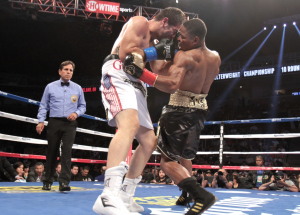
Shawn Porter (20-0, 14 KOs) of Cleveland, Ohio remained unblemished with a fairly dominant ten-round unanimous decision against gatekeeper Alfonso Gomez (23-6-2, 12 KOs) of East Los Angeles, California by way of Guadalajara, Jalisco, Mexico in the televised co-feature.

Porter, 146.2, just had too many facets for the one-dimensional former title challenger and reality star Gomez, 146.4, to keep up with for ten frames.

The first round had its moments. An accidental headbutt opened a cut over one of Porter’s eyes. At the sight of his own blood, Porter upped his output in retort, only to have Gomez come right back as the bell sounded. The steady action continued into the second, as did the accidental headbutts. Despite the vastly apparent deficit in hand speed, Gomez got the better of Porter as the second round winded down. The right hook especially looked good for Gomez, and may have been enough to seal it for him.

Porter picked up his output again in the third, giving Gomez trouble with his hand speed. Gomez looked to place one or two when Porter paused, but the Ohio native’s breaks were brief. By the time Gomez threw or landed, Porter had an answer. Another heated exchange highlighted the fourth, but this time it was clear who was landing the harder shots – Porter. Gomez especially had trouble handling Porter’s right hand.

Porter again had the game as always Gomez in trouble in the fifth, landing loaded combinations at close range. Just when it looked like Gomez would wilt against the ropes, the longtime underdog fired back for an entertaining exchange. However, the momentum was still clearly with the surging Porter.

Gomez rebounded to a degree in the sixth, due in part to Porter’s decision to fight on his toes. Gomez was allowed to come forward without paying much of a price, and appeared to be the aggressor throughout the round.

The fight began to fall into the rhythm as the rounds wore on. Gomez continued to hang tough, but the cumulative punishment had left him a step or two slower than he already was heading into the contest. At that point, there was not much Gomez could do to turn around the fight.

Perhaps a small ray of hope entered into the bout, as an accidental head clash opened a nasty gash over Porter’s left eye in the tenth. After referee Edward Collantes brought Porter over for a long examination, the fight resumed and Gomez seemed to have renewed interest in the fight. The swing was fleeting, as Porter handled the blood well and returned to his close range attack to close the fight.

In the end, scores read 96-94, 97-93 and 98-92 for Porter. With the victory, Porter claims the vacant WBO NABO Welterweight title, which will more importantly lead to a world ranking with the WBO at 147-pounds.
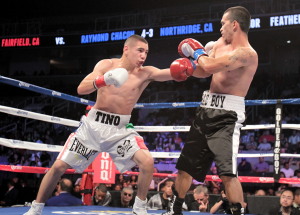
Super bantamweight prospect Manuel Avila (8-0, 2 KOs) of Vacaville, California moved past Raymond Chacon (4-4) of Los Angeles, California in less-than-thrilling fashion in a bout shortened to four-rounds to fit the Showtime Extreme undercard television time slot.

Just as he has in other recent bouts, Avila, 122.5, had too much class for his overmatched opponent Chacon, 121.6, but the Cameron Dunkin-managed prospect failed to really make a lasting statement. Scores read 40-36 and 39-37 twice for the still undefeated and untested Avila. The Vacaville resident, who trains in nearby Fairfield, returns to the ring in the latter city’s Sports Center on August 25th.
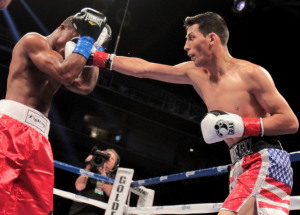
In a dreadful fight, heralded prospect Hugo Centeno (15-0, 8 KOs) of Oxnard, California simply went through the motions against the much smaller Ayi Bruce (22-8, 14 KOs) of Albany, New York by way of Accra, Ghana en route to an eight-round unanimous decision.

Centeno, 152, went for the stoppage in the first and had Bruce, 151.4, in a bit of trouble early. However, from round two through the end, Centeno was satisfied to step around Bruce while placing one or two shots at a time. When the fight ended, much to the delight of the crowd, scores read for Centeno 79-73 and 80-72 twice.
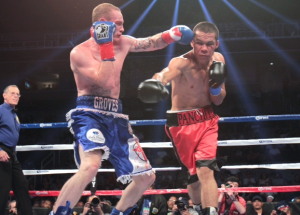
WBC #5/IBF #9/WBA #11 ranked super middleweight contender George Groves (15-0, 12 KOs) of Hammersmith, London, United Kingdom showed resilience before ending the night of Francisco Sierra (25-6-1, 22 KOs) of Tepic, Nayarit, Mexico at 2:15 of sixth-round in the first televised fight of the night.

Groves, 169.4, opted to slug it out with the brawling Sierra, 170, for an entertaining close to the third round. The round saw Groves’ face opened up, but the injury never seemed to be a factor in the fight. An overhand right started the trouble for the underdog, as Sierra was downed in hard in the sixth. The Mexican fringe contender gamely returned to his feet. However, two clubbing rights were enough for Sierra’s cornerman to hurry up on the steps and sidearm the white towel through the ropes. Groves had been reportedly scheduled to fight September 14th in Wembley Arena in London, England, but it remains to be seen if the cut he suffered will prevent that date from sticking.

Paul Mendez (8-2-1, 2 KOs) of Delano, California took a workmanlike six-round unanimous decision over weathered journeyman Leshon Simms (5-11, 3 KOs) of Hemet, California in the second warm-up of the card. Mendez, 160.2, picked his way to the win, but never went in for the kill against Simms, 161.4, who goes by the nickname of “Scrappy Mix.” All three official cards read 59-55 for Mendez. The Delano resident, now fighting out of Salinas, California, returns to action August 25th at the Fairfield Sports Center in Fairfield, California.

Imposing heavyweight Gerald Washington (1-0, 1 KO) of Vallejo, California pounded hopeless Blue DeLong (0-4) of Glendale, Arizona for about two-and-one-half minutes en route to a first-round stoppage in the night’s opening bout. Washington, a mammoth figure at 246.6 pounds, scored one official knockdown of Delong, 254.4, who spent much of the night on the canvas. Referee Ray Balewicz ended the clobbering after Delong fell to the mat one too many times 2:36 into the fight. Ironically Washington shares the same nickname as Paul Mendez, the fighter in the fight that followed his – “El Gallo Negro.”

Photos by Stephanie Trapp

Mario Ortega Jr. can be reached at ortega15rds@lycos.com.


London is the first round in boxing’s fight to resurrect itself

Boxing attempts to become more than just Olympic history in London during the next couple of weeks in a fight to reclaim an identity that just hasn’t been the same since the Seoul scandal in 1988.

Muhammad Ali, a 1960 gold medalist, is in London like royalty. He is attached to the Olympics like a sixth ring, a ceremonial symbol of what they were and boxing was. But Roy Jones Jr. is the current symbol of what the Olympics have become for a sport that has fallen off the marquee and into the margins in the 24 years since gold was stolen from the former pound-for-pound king.

In a story for the August edition of The Ring, Jones confirmed what I have always believed. To

wit: Boxing’s long decline – in the Olympics and pros – began on that infamous afternoon in Seoul when judges robbed him of light-middleweight gold with a decision unequalled in outrage.

It happened before the internet and long before the immediate anger at Timothy Bradley’s split decision over Manny Pacquiao in June. Imagine if twitter had been around when Jones was left with silver and judges were suspected to have collected some.

The tweets, digital graffiti, might have been enough for Olympic officialdom to finally banish a sport it has never much liked anyway. As it was, the ringside corruption, confirmed in the subsequent disclosure of East Germany’s secret-police files, was enough to push boxing into a medal sport seemingly on perpetual probation. Squeamish officials tolerate it, mostly because they have to. Even the poorest nations in the third world can send a boxer to London. But countries without swimming pools can’t compete with Michael Phelps.

With boxing shoved out of the Olympic limelight and away from the NBC cameras, however, the pro ranks were robbed of a significant step in development and marketing.

“At the time, I didn’t really realize what had happened,’’ Jones told me in an interview for The Ring. “What I didn’t realize was how much it hurt boxing. The reason I say that is because, truthfully, the Olympics was where boxing kind of gets a little jump start.’’

http://ringtv.craveonline.com/images/toc/ring_aug12_contents.pdf

That jump start is gone, Jones says, because of 1988 and the subsequent move to computerized scoring. There’s no way to correct what happened in Seoul. But there are lessons. An intriguing step will come after London when computerized scoring will end. At the 2016 Games in Rio de Janeiro, boxing will go back to traditional scorecards instead of computer operators who act as judges by punching a button as way to count the punches they see land.

Jones welcomes the move, although it reopens the possibility of the 1988 scoring in one of the greatest scandals in Olympic history. Nevertheless, it’s a step that Jones says will regenerate Olympic interest in amateurs who have a chance at pro careers.

There’s also been talk about bringing pros into the Olympics. Who knows, maybe, Floyd Mayweather Jr., can turn the bronze he won in 1996 into gold in 2016?

However, George Foreman, a 1968 gold medalist at the Mexico City Games, doesn’t like the prospect of pros at the Olympics.

“The Olympics have always been a chance for a nobody to become somebody,’’ said Foreman, a former heavyweight champ who is The Ring’s super-heavyweight on a Dream Team, an all-time American Olympic roster. “For me, other things were probable. But the gold medal? It was impossible. For me, that was the beginning.’’

Foreman is convinced that, in time, boxing will find the young fighter who will resurrect an Olympic sport known for him, Sugar Ray Leonard, Oscar De La Hoya, Floyd Patterson, Jones, Andre Ward and a light-heavyweight named Cassius Clay, now known simply as Ali.

“We don’t even know who he is yet,’’ Foreman said. “But he’s out there. Look at what Michael Phelps has done for swimming. More than 30 years after Mark Spitz, he turned it in the sport people want to see. It only takes one person. Nothing is wrong with Olympic boxing.’’

Nothing but a comeback.

Notes, Anecdotes
· Trainer Freddie Roach, already busy training Julio Cesar Chavez Jr. for his Sept.15 middleweight clash with Sergio Martinez at Las Vegas Thomas & Mack Center, has no plans to be in London for Olympic boxing. He worked with some of the American s as a consultant to the U.S. team. But that was before a late shuffle in the U.S. coaching staff.

· Golden Boy Promotions CEO Richard Schaefer is already in London. If he can sign some of the best prospects, he hopes to introduce them to the pro ranks on an Oct. 14 card, a Sunday, at Las Vegas’ Mandalay Bay. On Oct. 13, Schaefer has plans for a card that might include junior-featherweight champion Abner Mares, also at Mandalay.

· Just wondering: Could NBC’s renewed deal for pro boxing lead to more network coverage of Olympic boxing? After years of seeing more ribbon-waving girls in rhythmic gymnastics than boxers, any boxing coverage at all would be a lot.


Promociones PM Returns to Tijuana

TIJUANA, BAJA CALIFORNIA – Former world champion turned promoter Diego “Pelucho” Morales is back giving young aspiring fighters in the border city opportunity to show their skills before their local followings beginning tomorrow night with a six-bout offering at the Salon Mutualista. Fighters weighed-in Thursday afternoon at the offices of the Comision de Box, Lucha Libre y Kickboxing de Tijuana next door to the famed Auditorio Municipal.

In the main event, local favorite Jesus “Bombardero” Valadez (5-1, 2 KOs) of Tijuana takes on determined Edgar Vazquez (4-2-1, 2 KOs) of Tijuana in a six-round light welterweight bout. Valadez, just 18-years-old, has become known for his crowd-pleasing action style. Vazquez is looking to rebound from a March stoppage loss to more experienced Miguel Zuniga. Both fighters weighed-in at 63.5 kilograms or about 140-pounds.

In a heavyweight attraction, Juan Manuel Dominguez (2-0, 1 KO) of Tijuana hopes to keep rolling against Rodrigo Ramirez (0-1) of Tijuana in a four-rounder. Dominguez, who scaled 104 kilograms (229.3-pounds), will already be fighting for the third time since turning pro in March. Ramirez, who came in at 118 kilograms (260.1-pounds), has been out of action since a second-round stoppage loss back in September of 2010.

Another active newcomer, former Tijuana amateur champion Erick Cebreros (2-0) will take on debuting Benny Guevara of Tijuana in a four-round featherweight fight. Cebreros, who turned professional only in April, scaled 57.7 kilograms (127.2-pounds). Guevara, faced with a tough assignment for his premier outing, came in at 56 kilograms (123.5-pounds).

Former U.S. amateur standout Aldwayne Simpson (1-0, 1 KO) of Richmond, California by way of Kingston, Jamaica ends a nearly three-year hiatus in a four-round light welterweight bout against Miguel Nava (0-3) of Tijuana. Simpson scaled 64.8 kilograms (142.9 pounds). Nava, never in an easy fight, was not present at Thursday’s weigh-in and will take to the scales Friday morning. Simpson recently wrapped up a training stint alongside former world champion Robert Guerrero.

Ciro Arrellanos (1-0) of Mexico City, Distrito Federal meets Tijuana’s debuting Martin Gomez in a four-round light welterweight fight. Arrellanos, one of three fighters on the card out of the Ray Solis Boxing Gym, scaled 64 kilograms (141.1-pounds). Gomez, fighting out of the Torito Gym, weighed-in at 64 kilograms as well.

Two fighters looking for their first win square off as Pedro Garcia (0-2) of Tijuana takes on Luis Contreras (0-2) in a four-round lightweight fight. Garcia, of the Chavez Gym, scaled 61 kilograms (134.5-pounds). Contreras, of the Xico Gym, came in at 61.4 kilograms (135.7-pounds).

Tickets for the event, promoted by Promociones PM, are available at the Perro Salado Billiards Hall, the offices of Box Latino and Hollywood Beauty Supply.

Quick Weigh-in Results (in pounds):

Light Welterweights, 6 Rounds
Vazquez 140
Valadez 140

Heavyweights, 4 Rounds
Dominguez 229.3
Ramirez 260.1

Featherweights, 4 Rounds
Cebreros 127.2
Guevara 123.5

Light Welterweights, 4 Rounds
Simpson 142.9
Nava*

Light Welterweights, 4 Rounds
Arrellanos 141.1
Gomez 141.1

Lightweights, 4 Rounds
Garcia 134.5
Contreras 135.7

*will weigh-in Friday morning

Mario Ortega Jr. can be contacted at ortega15rds@lycos.com.


Hopkins to commentate August 11 Cloud – Pascal fight for Showtime


Reliable sources have told 15rounds.com that legendary world champion Bernard Hopkins will be a guest color analyst for the August 11 IBF Light Heavyweight title fight between champion Tavoris Cloud and Jean Pascal.

The source intimated that it could be more then just a coincidence that the future Hall of Famer was tabbed by Showtime as Hopkins has shown a desire to fight on and he is still the biggest name in the Light Heavyweight division.

Hopkins has two memorable fights with Pascal with a draw and then his historic win last May to become the oldest man to win a world championship and a fight with Pascal could be a fight that Hopkins could very well be interested in.

Hopkins is sitting in for Antonio Tarver, who tested positive for a banned substance following his June 2 fight with Lateef Kayode. Ironically Hopkins has a decision win over Tarver.


Adults gone missing in Cincinnati


Cincinnati’s Adrien Broner (24-0) is not the next Floyd Mayweather. At best, he is New Mayweather, a product that compensates for recent layoffs in R&D by hiring an outside marketing team. Broner does not have Mayweather’s pedigree: he did not win an Olympic bronze medal at age 19, he did not come from an immediate family of talented prizefighters, and he sure as hell did not just stop an undefeated Diego Corrales (33-0, 27 KOs) to remain champion at 130 pounds.

That’s what Mayweather did in his 24th professional fight – after becoming a world champion by beating Genaro “Chicanito” Hernandez into retirement, blitzing Angel Manfredy and making five successful title defenses. Broner, conversely, picked up a vacant 130-pound belt from unknown guy with an 0-1 record outside his native Argentina, made one title defense, and then missed weight by 3 1/2 pounds, Friday, before stopping an outmatched and outweighed Vicente Escobedo (26-3, 15 KOs) Saturday.

There was an uncomfortable lack of adult supervision in Cincinnati last weekend, as Broner jeopardized his first HBO main event by missing weight twice. The one adult present was Broner’s manager, Al Haymon, who, reports say, was embarrassed by what his charge pulled. Haymon is exceptionally good at what he does – identifying marketable athletes, outsmarting network executives – but in his roots, he is a concert promoter, not a boxing guy. His eye for fighter talent is arguable. He is, in some senses, Bob Arum without matchmakers Teddy Brenner and Bruce Trampler – which makes him a lot like Richard Schaefer.

Which means nobody knows exactly how to develop Broner as a fighter; he is more AndreBerto2.0 than a second coming of Money Mayweather, whose development as a prizefighter, some might recall, was handled by Top Rank. Broner does some things very well. One is throw the counter right uppercut against plodding Latino fighters who were taught at a young age every confrontation reduces to a game of Left Hook to the Liver. Broner whipped the right uppercut at Escobedo in round 2 and took most of the fight right out of him.

One sees this in the gyms of the Southwest. Every Mexican kid, or at least every kid with Mexican parents, is taught to keep his right hand high on his cheek when he swoops in to throw his left hook. This defensive posture assumes his opponent will be throwing a left hook of his own at the same instant, and whoever lands first will invariably corkscrew the other guy in the canvas. But none of them, as he sets his weight too far forward and gets his chin over his left knee, has a defense for a right uppercut right up the middle. Some guys in Detroit have noticed this. Someday, Mexican trainers will give their fighters Joe Frazier’s advice – set your right fist palm down, between your chin and the top of your chest, when you throw the 3 – but that day isn’t arrived yet.

Besides, there may be only one way to overcome the shell defense Broner learned from watching Mayweather, and Roy Jones Jr. is not about to tell us what it is. This column has no such loyalty: A long jab is what picks the shell’s lock. Designed to catch the right cross with a high lead shoulder and thwart the left hook with a high right hand, the shell can either slip the jab or counter it, but not both. Jab the shell effectively enough, and the right hand moves from cheek to chin – and then interesting things happen. This is why Escobedo’s most effective punch Saturday was a jab, and it’s why, of the names Broner said “can get it” next, Antonio Demarco, a lightweight titlist who stands 5-feet-10, is most interesting.

Broner is an altogether lesser fighter than Mayweather, but the biggest difference between them is not a stylistic one; it is something measured by the way others react to them. Other prizefighters like Mayweather. He is one of them, and better than they are. There was a mishap with the Juan Manuel Marquez weighin, yes; Mayweather borrowed more advantage than he needed then saw how tiny Marquez was and paid him handsomely for the difference, all the while acting annoyed by his contracted promoter.

Other fighters don’t seem to like Broner. It takes a whole lot for a guy like Vicente Escobedo, Saturday’s sacrifice, to come out of a beating and still be frustrated by an opponent – as opposed to begrudgingly impressed. But frustrated is what he was. In Escobedo’s postfight tears was a statement like this: You could have beaten me fair and square, but you chose not to, which means you are not one of us.

What happened with Broner, his outgrowing a weight class, is nothing new. That it was preceded and followed by such classlessness, though, is a bit novel. Broner has a man’s body, a man’s strength, and perhaps a man’s ring IQ, but emotionally he is a 14 year old. He does not connect actions to consequences and does not appear particularly adept at pattern recognition. He is not, in other words, intelligent or mature. Most professional athletes aren’t – they stop maturing the day a coach or parent recognizes their exceptional reflexes – but Broner’s case appears predetermined for unpleasantness because there are no adults to provide the guidance needed by someone of his temperament.

Adrien Broner’s dad needs to put the hairbrush down, then, cancel his son’s Twitter account, and say, “Boy, stop acting a fool.” For if his dad doesn’t, Broner’s manager just might.

Bart Barry can be reached at bart.barrys.email (at) gmail.com


Cano wins interim Super Lightweight crown with technical decision over Perez

Pablo Cesar Cano won the WBA Interim Super Lightweight title with a seventh round majority technical decision over previously undefeated Johan Perez on Cancun, Mexico

The bout was stopped after the seventh frame when a cut suffered by Cano over his right eye was streaming blood. The cut was caused by a head butt.

Cano, 140 lbs of Mexico is now 26-1-1. Perez, 139 1/2 lbs of Venezuela is now 15-1-1

Jorge Romero scored a wild fourth round stoppage over Rudy Lopez in a scheduled ten round Lightweight bout.

Romero dropped Lopez from a big right hand in the first round. Later in the round, Lopez was credited with a knockdown but replays showed a headbutt caused Romero to fall to the canvas. In round three, Romero landed a booming left hook that sent Lopez down to the canvas. Lopez fought back and was able to get out of the round. Romero ended things in the next round as he was relentless and the bout was stopped.

Romero, 135.4 lbs of Culican, MX is now 23-5 with twenty knockouts. Lopez, 135.8 lbs of Cancun, MX is now 25-6-2.

Manuel Perez scored a ten round unanimous decision over Jose Miguel Cotto in a Jr. Welterweight bout.

It was a tough competitive bout that had a lot of action.

Perez, 139 lbs of Honolulu, Hawaii is now 18-7-1. Cotto, 140 lbs of Caguas,Puerto Rico is now 33-4-1.


Reasons on a scorecard that a fallen Khan can come back


Amir Khan, who wears lightning bolts on his dark trunks, is a lightning rod for controversy, especially in the week after Danny Garcia stopped him in the fourth round of an upset that few foresaw.

The attention on Khan is unfair to Garcia, but that’s built into a modern star system created and sustained by social media. Khan, a designated star since the 2004 Olympics, knows how to use it. Garcia, a relative newcomer with an annoying trash-talker for a dad, does not.

Stardom looms for the unbeaten Garcia.

It’s not quite so clear for Khan.

But here is a scorecard, a guide of sorts, on what Khan should do and not do:

Retire: Ridiculous. Fellow Brit Carl Froch said he was misquoted by the BBC. Whatever Froch said or didn’t say, it’s safe to assume Froch would have a more damning comment if the 25-year-old Khan did in fact retire. There’s another way to describe a young fighter who retires a few years from his prime. He’s called a quitter. Khan is not. He proved that by fighting back after the third-round knockdown and getting up from a knockdown early in the fourth.

The chin: Golden Boy promoters insist that Khan proved he could withstand power in 2010 when he survived Marcos Maidana’s crushing blows in the 10th round. But the Maidana fight created a dangerous illusion that Khan could take a big punch. Khan believed it. That’s why he decided to brawl in the fourth against Garcia, who dropped him twice in the round. Remember, Maidana’s punches landed late. Garcia’s biggest punch landed early – in the third. If it hadn’t ended in the fourth, it would have in the fifth or sixth or seventh. Khan fought as if he thought Maidana had inoculated him from having a weak chin. No, he just needs to know he must use superior skills to protect it with his reach, jab and feet. A fragile chin, which Khan leaves high and exposed, is not a career-ender. From Floyd Patterson to Lennox Lewis, history is full of fighters who have learned to fight despite it and perhaps succeed because of it.

Freddie Roach: Don’t fire him. UK media are full of stories about Khan hiring a new trainer who can teach defense. Roach is known for emphasizing offense. Hard to blame him. A little more offense from Manny Pacquiao might have resulted in a stoppage that would have averted the flap over his split-decision loss to Timothy Bradley. It’s an insult to say Roach can’t teach defense. Boxing isn’t football. Offense and defense aren’t played by different squads and coached by different coordinators. They are inseparable. Khan just has to suspend a confidence bordering on arrogance and remember to execute a Roach plan with tactics defending the chin while augmenting the offense.

Time: There is still plenty of it left. It’s too easy of think of Khan as much older, perhaps because he’s been a star since the Athens Olympics when he was a 17-year silver medalist. He is still maturing. In a couple of years, Pacquiao will probably be a full-time Filipino politician. A couple of more fights are left in Pacquiao’s career. Pacquiao’s retirement would mean more time for, say, a rematch with Garcia.

Quotes, Anecdotes
· A sign of Khan’s over-confidence can be found in what was missing in his contract with Garcia. It didn’t include a rematch clause. A loss to Garcia never seemed to be even a remote possibility to Khan, who in pre-fight interviews often talked about fighting Floyd Mayweather Jr. in December.

· Several possibilities have been mentioned for Garcia’s next bout, including Zab Judah and Paulie Malignaggi. A rematch with Khan was eliminated by Garcia’s dad, Angel, who in pre-fight exchanges insulted Khan’s Pakistani roots. “Why should we give him a rematch when he didn’t give us any respect?’’ Angel said.

AZ Notes
Phoenix super-bantamweight Alexis Santiago (11-2-1, 5 KOs), nicknamed Beaver, is scheduled Friday night for an 8-rounder in Santa Ynez, Calif., against Roman Morales (10-0, 6 KOs) of San Ardo, Calif., on a ShoBox-televised card featuring former World Boxing Association lightweight champ Miguel Acosta (29-5-2, 23 KOs) of Argentina against Armenian Art Hovhannisyan (14-0-2, 8 KOs).


A solution for the Sept. 15 conflict: Move Canelo-Lopez to Sept. 14 at the MGM Grand


You know the cliché. It’s trotted out after nearly every controversial decision. Yeah-yeah, reasonable people can disagree. Trouble is, that’s all they ever seem to do in boxing.

As the business approaches a potential fiscal cliff of its own making on Sept. 15, however, there’s an opportunity for reasonable minds to actually work in behalf of the customers who just seem to be in the way of promoters hell-bent on destroying each other with dueling cards — the Golden Boy-promoted Canelo Alvarez-Josesito Lopez at Las Vegas’ MGM Grand and Top Rank’s Julio Cesar-Chavez Jr.-Sergio Martinez just a fast-break away at Thomas & Mack Center.

Here’s a way out of the conflict: The Grand Garden Arena at the MGM Grand is available Friday night, Sept. 14.

How hard would it be to re-schedule Alvarez-Lopez from Sept. 15 to Sept. 14 as a way to kick off a weekend celebration of Mexican Independence on Sunday, Sept. 16? First, Canelo-Lopez on Friday. Then, Chavez- Martinez on Saturday. Finally, Mana, a concert featuring the popular Mexican rock band scheduled for Sunday at the Grand Garden Arena.

The weekend-long fiesta sounds simple enough. Perhaps too simple. It hasn’t been suggested, at least not by the reasonable people who only know how to disagree. The topic dominated conversation before and after Danny Garcia’s stunning fourth-round stoppage of Amir Khan last Saturday at Mandalay Bay. From bar-tenders to serious fans, it was the same question: How come nobody is talking about making that move?

Above-all, it’s a win-win for fans, regardless of whether they prefer Canelo or Chavez Jr. They’ll have a chance to see each fight live, rather than being forced to pick one instead of the other. For the respective television networks, it’s a chance at attracting the biggest possible audience. Showtime will carry Canelo-Lopez. HBO plans a pay-per-view telecast of Chavez Jr.-Martinez for the middleweight title. If on the same night, each figures to lose some of its audience.

Then, there’s the MGM Grand and Wynn-Las Vegas, which will be the hotel site for news conferences and other pre-fight events in its role as a sponsor of Chavez-Martinez. All customers can’t be at both places at the same time.

There has been a suggestion that maybe one main event can be scheduled a few hours before the other. To wit: On Sept. 15, schedule Canelo-Lopez for 5:30 p.m. and Chavez Jr.-Martinez for 8:15 p.m. But that is fraught with potential headaches. Logistically, there might be an impossible crush to get a cab and rush hour-like traffic on the short road from one parking lot to the other. There’s also talk that Televisa, the Mexican network aligned to Canelo, wants the fight only at night instead of late-afternoon or early evening.

Even if that one doesn’t work, there’s still a way out of the dilemma. But so far a possible solution has been ignored and reason set aside for a winner-take-all confrontation that Golden Boy and Top Rank are promoting more than any fight and at any cost, even to themselves.


Garcia stops Khan in stunner


LAS VEGAS – Danny Garcia calls himself Swift. Now we know why. He was swift to emerge from anonymity. He was swift to impose himself on the junior-welterweight ranks. And he was so swift to dispose of heavily-favored Amir Khan Saturday night that it might take Khan awhile to understand what happened.

Garcia appeared to be outclassed for three rounds by the speed in Khan’s hands and feet when suddenly Khan was down and looking as if he had been trampled. One looping left from Garcia seemed to catch Khan between his jaw and neck dropped him as if he were a pedestrian hit by a speeding truck.

Khan got up, but his eyes looked as hollow as his future.

The inevitable end was there, in those eyes and like that nickname on Garcia’s trunks and robe. It was swift. In the fourth, it was over. Khan was finished, a TKO loser at 2:28 of the round at Mandalay Bay. A wobbling Khan ran into straight a right that put him back on to the canvas early in the fourth. Late in the round, two Garcia rights, a double shot, proved to Khan’s last call. Again, Khan managed to get up. But referee Kenny Bayless looked at him once, looked at him again, asked him a question and said no more.

“Maybe, they made the right decision,’’ Khan (26-3, 18 KOs) said.

No maybes about it.

Khan said his mind was clear and that he was ready to fight on as he had against Marcos Maidana in the in the 2010 Fight of the Year. But his advantage was gone. Garcia (24-0, 15 KOs), bloodied over his right eye in the second round, had proven what Breidis Prescott exposed in a first-round KO of Khan in 2008. It’s called a suspect chin. It’s not suspect anymore. It’s forever stamped as fragile.

“I always knew I was going to win this,’’ said Garcia, who was about a 4-to-1 underdog and an 8-to-1 shot to win by knockout. “I needed a great fighter in front of me to show how great a fighter I was.’’

There were doubts about Garcia’s credentials, which now includes the World Boxing Association’s version of the 140-pound title to go along with the World Boxing Council’s belt. He beat a fading Erick Morales. But the wear-and-tear on the aging Morales left questions about that victory.

“I hit him with the same shot that I hit Morales with,’’ said Gracia, who collected $540,000, $410,000 less than Khan’s $950,000. “That shows how good a fighter Morales still is.’’

And, maybe, how great a fighter Garcia is about to be.

On The Undercard
The Best: Puerto Rican lightweight Abner Cotto (14-0, 6 KOs), Miguel Cotto’s nephew, showed he understands the family business with an eighth-round stoppage of Mexican Juan Manuel Montiel (7-6-3, 2 KOs).

Cotto rocked Montiel with a blinding succession of punches along the ropes. Dazed and already flat-footed, Montiel looked as if were ready to surrender. Referee Jay Nady didn’t give him the chance. Nady ended it 1:03 of the eighth.

The rest: Super-middleweight Fernando Guerrero (24-1, 18 KOs) scored a knockdown in the second round and points through the next eight for a unanimous decision over Jose Medina (17-11-1, 7 KOs) of Tifton, NH; Toronto junior-middleweight Phil Lo Greco (24-0, 13 KOs) needed more time to walk to the ring than he needed to stop Brandon Hoskins (16-2-1, 8 KOs), a Missouri fighter who was knocked down twice and beaten by TKO 86 seconds after the opening bell; super-middleweight J. Leon Love (12-0, 7 KOs) of Dearborn Heights, Mich., scored two knockdowns in the first round and then relied on an accurate jab for a unanimous decision over Joseph De Los Santos (10-1-3, 4 KOs) of Puerto Rico; Orlando junior-middleweight Daquan Arnett (5-0, 3 KOs) had a short night, scoring a second-round KO of Eddie Cordova (3-3-1, 1 KO) of Clearfield, Utah; Jamie Kavanaugh (11-0-1, 5 K0s), an Irish lightweight training at Freddie Roach’s Wild Card Gym in Hollywood, Calif., scored a unanimous decision over Paul Velarde of Orange, Calif.


Khan, Garcia are light on the scale in a weigh-in light on the buzz


LAS VEGAS – Amir Khan and Danny Garcia were light on the scale Friday at a weigh-in that included all of the usual poses and promises, yet little of the buzz that puts some drama into the pre-fight ritual.

A crowd of a few hundred watched Khan and Garcia weigh in at 139 pounds, one under the limit for their junior-welterweight bout Saturday at Mandalay Bay. From Garcia’s potential emergence to Khan’s bid to re-assert his claim on stardom after a controversial loss, the ingredients for an interesting fight are there. But there are questions about whether many paying customers will be.

Ticket sales have been slow, according to sources at the box office. Barring a good walk-up during the hours before opening bell, a small crowd would raise familiar questions about Khan’s marketability in the United States. He’s a British fighter of Pakistani descent. Some of his fans were there Friday, dressed in T-shirts that said Khan’s Army. But it was a small army.

In part, there’s been a dilution of interest in his bout with Garcia in the UK because of the heavyweight brawl Saturday between Dereck Chisora and David Haye in London. Much of the UK media stayed home for Chisora-Haye instead of traveling to Las Vegas for Khan’s first fight since his controversial loss to Lamont Peterson in Washington D.C.

Then, there’s Garcia (23-0, 14 KOs), a Philadelphia fighter who is still relatively unknown, even in his own country. His dad and trainer, Angel, has been trash-talking non-stop in an evident attempt to gain some notoriety for his 24-year-old son. But if early ticket sales are an indication, the public hasn’t been paying attention. What’s more, the bookies aren’t impressed with Angel Garcia’s braggadocio. Khan (26-2, 18 KOs) was about a 5-to-1 favorite on Friday. That means he is expected to win the HBO-televised bout easily.

“I will knock Danny Garcia out,’’ Khan said. “ I will take the world titles home. I know Danny didn’t train as hard as me. I promise I will knock him out. That is the only way.’’

Khan said it with the conviction of fighter who knows he must be sensational in his bid to eliminate questions that have lingered since his mixed performance against Peterson, who was forced out of rematch by a positive test for a synthetic testosterone.

Khan also had a message for Garcia’s dad, who has said he has never seen a good fighter of Pakistani descent.

“I cannot wait until after the fight when we stand here and I have knocked your son out,’’ Khan said. “He is going to see what a Pakistani-British fighter can do. I cannot wait to get in there.’’

Angel Garcia couldn’t wait to deliver a rhetorical counter.

“This fight is going to show the world who is the boss,’’ Angel said. “Danny is the boss. Khan has never faced a Latino like Danny. This is Latino blood. A nation. We are going to show the world who is the boss.”

Well, a fraction of the world anyway.


Learning from defeat? Khan can


A zero on the right side of a rare won-lost ledger can be a doughnut hole full of illusions. It’s hard to confront and harder to learn from something that amounts to nothing. Amir Khan doesn’t have that problem.

There’s opportunity on that side of the equation for Khan, who is coming off a loss to Lamont Peterson in a decision as controversial as any, including the latest twitter-driven flap over the split scorecards favoring Tim Bradley over Manny Pacquiao. Without returning to the grassy knoll full of lousy decisions and subsequent suspicions, let’s just say that Khan has another chance to define himself in the way great fighters always have.

They are remembered for their victories, but they are measured by how they respond to the adversity that comes with a loss, no matter how controversial. Defeat is the great divide between good and great. Khan (26-2, 18 KOs) won’t make the leap in one night Saturday against the unbeaten and untested Danny Garcia (23-0, 14 KOs) in a HBO-televised bout at Las Vegas’ Mandalay Bay.

But Khan can re-assert his potential, eliminate doubt left in the wake of the Peterson performance and show that he is ready to move on, from junior-welterweight to welter. Don’t expect him to send any thank-you notes to Peterson, who was forced to withdraw from a scheduled rematch because of a positive test for synthetic testosterone. Without Peterson and the timing of the loss last December in Washington D.C., Khan might not have been forced to acknowledge and presumably correct mistakes that could have set him for more significant trouble later one.

“At times, we got lazy and stuff,’’ Khan said in a conference call. “We weren’t feeling the effects of his punches, so we just stood there and took punches that we shouldn’t have taken. I think we were too brave really. That’s why I knew in the rematch I was not going to do what I did in the first fight and make the silly mistakes I did make. There are some things that we did in the fight that I shouldn’t have done.

“Also, outside of the ring there were a few things in training camp I did that I’ll never do again. I’ve changed them around and I feel like a totally different fighter now.

“It was a great learning curve for me, the Peterson fight, because it made me realize that, ‘Look, I need to do things and I have to be more professional and I can’t do this and I can’t do that.’

“Sometimes, it’s a good wake up call.’’

A willingness to change has already been evident in Khan’s camp, which was interrupted by news of Peterson’s positive test and the announcement he would fight Garcia instead. Khan fired conditioning coach Alex Ariza and hired Ruben Tabares.

“Yeah, we’ve changed from Alex to Ruben Tabares and it was just a change I needed because it’s always good to have a change and work on new things,’’ said Khan, whose chin has been suspect ever since his first loss – a first-round KO to Breidis Prescott in 2008 . “There are a few things in camp I changed and I didn’t change. It was a big wake up call for me after the Peterson fight and there were a few things I could change. This was one of the things that changed.’’

Tabares, he says, has forced him to re-focus by altering routines.

“It’s a new challenge, as well, which kind of drives me and I think that’s what young fighters need because you can get bored doing the same thing.’’

In dumping Ariza, Khan did what Pacquiao, his stable mate at trainer Freddie Roach’s Wild Card Gym, would not. Tension between Arizona and Roach muddied the waters before the Bradley fight.

On HBO’s 24/7, Roach said Ariza would not be in the corner. Then, however, Pacquiao stepped in and said that Ariza would be there. Pacquiao, a Filipino Congressman, often acts like that politician who wants to please all of the people all of the time. The impossibility of that task is no secret, especially in the contentious boxing business. The controversial Ariza was in Pacquiao’s corner on June 9, but there was still speculation about lingering tension between him, Roach and cutman Miguel Diaz. Ariza repeatedly insulted Diaz after the Diaz-trained Marcos Maidana lost to Khan in the 2010 Fight of the Year.

Unlike Pacquiao, Khan eliminated any chance of Ariza becoming an issue against Garcia or presumably anybody else. It’s a sign that he has moved on in perhaps one small, yet significant step toward crossing that great divide.

QUICK HITS
· The U.S. economy is headed for a fiscal cliff on Jan. 1 if politicians can’t agree. By then, the boxing business will already have driven off its own fiscal cliff if the Top Rank-promoted Sergio Martinez-Julio Cesar Chavez Jr. fight at Thomas & Mack Center and Golden Boy’s Canelo Alvarez-Josesito Lopez bout go off on the same night, Sept. 15, in the same city, Las Vegas.

· Any odds on who will outweigh whom by more on Sept 15? Chavez, a 160-pound champion has been entering the ring at 180 pounds and more at opening bell. Lopez, who has never been at more than 144 pounds, is facing a junior-middleweight (154) in Canelo.


Reevaluating the Filipino Flash


In February local fans attended “Welcome to the Future” in San Antonio’s Alamodome to see how Julio Cesar Chavez Jr. would finally fare against a fellow Mexican. Aficionados, though, attended the event to see the “Filipino Flash” – a man whose talents were large enough to place his name among prizefighting’s elitist. Nobody was disappointed, and nobody was overwhelmed.

Saturday in what appeared to be a half-filled Home Depot Center tennis stadium in Carson, Calif., Nonito Donaire returned to HBO’s airwaves, this time a headliner, against a tall South African super bantamweight named Jeffrey Mathebula. Donaire won a unanimous decision, dropping Mathebula in the fourth round and generally outclassing the gangly South African throughout, and again nobody was disappointed and nobody was overwhelmed.

But the birdy hop made another appearance. It was its third apparition in as many fights for Donaire, a thing that happened before the midway point of each fight, within a round or two of Donaire’s realizing he’d be unable to stop his opponent in the spectacular, one-shot way he stopped Vic Darchinyan five years ago or Fernando Montiel two Februaries past.

The birdy hop happens when Donaire squares his feet, drops his hands to his sides, sets his face forward, and begins to hop frantically about an opponent, like an incited goldfinch, flapping his gloves threateningly. Sometimes he throws punches, occasionally he lands them cleanly, but mostly he hops hither and yon in an expression of frustration intended to provoke an opponent’s reciprocal frustration.

It is a wonder Donaire’s trainer Robert Garcia allows the birdy hop; it seems antithetical to what Garcia’s gym of seriously striving Mexican journeymen tries to be about. One imagines if the birdy hop came out in sparring with another of Garcia’s charges, five or six of his mates would gang up on Donaire in the restroom of an Oxnard restaurant and deliver schoolyard justice. Or is that “bullying”? The reason that doesn’t happen seems to be that Donaire doesn’t belong in Garcia’s gym as much as Kelly Pavlik does, and Pavlik – a long pressure fighter with a once-stupendous right cross – belongs there only insomuch as Oxnard, Calif. is not Youngstown, Ohio.

In San Antonio, Donaire did a mitts session with retired champion Jesse James Leija, and Leija came away from the session impressed by Donaire’s interest in trying new things – an informal curiosity betrayed by Donaire’s casual employment of the word “fun” in fight descriptions. Donaire’s pursuit of fun in the ring, though, now begins to undo his pursuit of stardom.

Local newspaper reporters always come away from boxing’s prefight promotions impressed by a B-side’s charisma and how much more time he has for them than the A-side fighter does. Donaire has a special gift for being an A-side fighter who makes himself B-side accessible during a promotion. He performs a public-workout routine where he invites youngsters to join him in the ring. He dresses well and speaks so respectfully most overlook his saying the same things everyone else does.

All of this is tolerable, nay, commendable, when Donaire blows through highly regarded opponents. The façade’s plastic shell, though, become less impressive the more time Donaire spends across from men like Omar Narvaez (UD-12) and Wilfredo Vazquez Jr. (SD-12) and Jeffrey Mathebula (UD-12). HBO viewers, three times now, have turned on a Donaire fight to see a prodigy and instead have seen talent shy of prodigious, shy of the mark set by the man whose image is meant to be conjured by the “Filipino” part of the Flash’s nickname.

Against Narvaez, Donaire’s elite talents were stymied by his opponent’s defensive posture – what Carlos Acevedo, with characteristic panache, called “airplane-crash position” – against Vazquez it was a broken hand or blood vessel, and against Mathebula it was a pair of sleepy legs.

Much has been made of Donaire’s noble choice to subject himself to year-round Voluntary Anti-Doping Association (VADA) testing. The group’s evangelists hope Donaire’s example will become a standard in prizefighting. Donaire’s unripped physique, stay-at-bantamweight power and dead legs, though, do not thus far bode well for the group’s prospects. There is an important balance to be struck between entertaining spectacle and fighter safety – which are not allies – and it remains to be seen if year-round drug testing is the way to accomplish it.

Balance is also part of what has claimed Donaire’s power in his most recent three fights. His balance was perfect when he clipped Montiel 17 months ago in one of his career’s two signature knockouts, but it has been imperfect since. Some of this is performance anxiety; as a man who nears his 30th birthday, Donaire realizes he’ll not be a “young superstar” in boxing much longer and tries to force a spectacular knockout in the first five minutes of each match. Some of it, too, is the nature of added weight. Just three years ago, Donaire fought 10 pounds lighter than he does now.

Quite a bit of Donaire’s newly imperfect balance, though, is attributable to his being hit more often. After Saturday’s fight, he said imperfect balance was the only thing that came between his dropping Mathebula with a round-4 counter left hook and taking Mathebula’s consciousness entirely. That’s true, but so is this: Donaire’s balance was compromised by catching most of Mathebula’s right cross with the left side of his head before throwing the counter hook over Mathebula’s outstretched arm.

Postfight talk turned to Donaire’s next opponent and his trying to become the next Asian fighter to accumulate titles of all different kinds in all different weight classes. It will not be lost on historians, however, that Donaire did not unify the bantamweight division before moving on to 122 pounds, missing quite notably the winner of Showtime’s Bantamweight Tournament. And it will not be lost on anyone if Donaire grows his way out of the super bantamweight division without first fighting Guillermo Rigondeaux.

Bart Barry can be reached at bart.barrys.email (at) gmail.com


Donaire unifies 122 lb title with decision over Mathebula


Nonito Donaire defended the WBO and captured the IBF Super Bantamweight title with a twelve round unanimous decision over Jeffrey Matthebula at the Home Depot Center in Carson, California..

It was a tough fight for the pound for pound entrant, Donaire as Matthebula used his four inch height advantage and pumped out fifty-plus jabs a round early in the contest. Mathebula began to bleed from the nose in round four. Late in that frame, Donaire landed a huge left hand that sent the South African to the canvas. The two traded off some middle rounds with Donaire using angles to land some good power shots.

In round eleven, Donaire landed a big right to the jaw that drew blood from Mathebula’s mouth and the slowed his punch out down for the remainder of the fight.

Donaire, 121 1/2 lbs of General Santos City, Philippines won by scores of 119-108, 118-109 and 117-110 and is now 29-1. Mathebula, 121 1/2 lbs of South Africa is 26-4-2.

Former Middleweight champion Kelly Pavlik continued his comeback with a workmanlik ten round unanimous decision over Will Rosinsky in a Super Middleweight bout.

It was a solid scrap that Pavlik score a knockdown in round two from a little right inside. That did not phase Rosinsky continued to press the action. Pavlik landed alot more often and had more pop behind them and he was never really in any danger.

Pavlik, 168 1/4 lbs of Youngstown, OH won by scores of 98-91, 98-91 and 97-92 to up his mark to 40-2. Rosinsky, 168 1/4 lbs of Queens, NY proved he could be competitive with some of the elite Super Middleweights is now 16-2.


Soto-Karass stops Gonzalez in Five


Jesus Soto-Karass scored an entertaining fifth round stoppage over Euri Gonzalez in a scheduled ten round Super Welterweight bout at the Hanger at OC Fair & Events in Costa Mesa, California.

The two stood toe to toe throughout the fight until Soto-Karass landed a booming right hand in round five that put Gonzalez down. He got to his feet and tried to stand and fight until another right hand rocked Gonzalez back to the corner and the fight was stopped at 1:50 of round five.

Soto-Karass, 151 1/2 lbs of Los Mochis, MX is now 26-7-3 with seventeen knockouts. Gonzalez, 151 1/2 lbs of Santo Domingo, CA is now 20-3-1.

Francisco Vargas remained undefeated as he stopped Irving Torres in the first round of a scheduled eight round Jr. Lightweight bout.

Vargas landed a left to the body that was followed by a right to the head that dropped Torres to a knee for the ten count.

Vargas,131 lbs of East Los Angeles is now 12-0-1 with ten knockouts. Torres, 131 lbs of Albonto, PR is now 9-3.

Santiago Guevarra scored a four round unanimous decision over Ricardo Garcia in a Jr. Lightweight bout.

Guevarra landed a wild right to the head that sent Garcia down in round one. The two shared some wild and entertaining exchanges over the next three rounds until a left sent Garcia down in round four just before the bell signaled the end of the fight.

Guevarra 132 lbs of Montebello, CA won by scores of 40-34, 39-35 and 39-35 and is 3-0.

Javier Torres scored a spectacular one punch knockout over Francisco in the first round of their four round Heavyweight bout.

Torres landed a huge Left hand that sent Diaz down violently and the was stopped immediately.

Torres, 223 3/4 lbs of Long Beach, CA is now 4-6 with two knockouts. Diaz, 228 lbs of Perris, CA is 2-1.

Joet Gonzalez made a successful pro debut with a four round unanimous decision over Jesus Carmona in Super Bantamweight bout.

Scores were 40-36 on all cards for Gonzalez, 120 3/4 lbs of Los Angeles. Carmina, 120 3/4 lbs of Chula Vista, CA is 0-3.


Fortuna Makes a Statement

LAS VEGAS, NEVADA — Rising featherweight prospect Javier Fortuna flashed the speed, athleticism and power that combine to make him one of the most talked about prospects in the game in a two-round destruction of former champion Cristobal Cruz at the Hard Rock Hotel & Casino on Friday night.

Fortuna (20-0, 15 KOs) of Oxnard, California by way of La Romana, La Romana, Dominican Republic came out swinging in the first before eventually landing a left on the top of Cruz’ head to score a knockdown. Cruz (39-14-3, 23 KOs) of Tijuana, Baja California, Mexico got up and looked to hold, but wound up tripping to the canvas, which was ruled a slip. Cruz returned to his feet, but was soon rocked by a wild left. Fortuna, almost coming out of his shoes with some of his swings, shortened up on a right to Cruz’ ear that hurt the Mexican late in the round.

Fortuna, 129, continued to rely on his left to great effect in the second. Fortuna, the WBA #3/IBF #6/WBC #8 ranked featherweight, hurt Cruz, 128, with a left hand over the top early in the round. Seconds later, Fortuna decided to lead with his left, which came at Cruz like a laser. Cruz, clearly not coping with Fortuna’s speed, tried to roughhouse and grapple, but Fortuna made room with a backwards step and landed a hard short left to drop the Mexican flat on his face. Referee Robert Byrd counted, but his efforts were not really necessary. Time of the stoppage was 2:22 of the second round.

With the kayo, Fortuna became the first to stop Cruz in nearly ten years. Though Cruz his not the same fighter that defeated Orlando Salido to claim a featherweight strap four years ago, Friday’s win was an impressive result for Fortuna nonetheless.

What looked to be a solid, competitive co-feature on paper turned out to be a one-sided drubbing, as Magomed Abdusalamov (15-0, 15 KOs) of Oxnard by way of Makhachkala, Republic of Dagestan, Russia remained perfect with a second-round stoppage of Maurice Byarm (13-2-1, 9 KOs) of Philadelphia, Pennsylvania.

Both landed some sweeping shots in the early going, but Abdusalamov, 229, appeared to be unfazed by anything Byarm, 239, managed to land. By the end of the first, Abdusalamov had broken through Byarm’s guard as the Philadelphian covered up in a neutral corner. When the bell rang to end the first, Byarm had weathered a storm, but found his corner as if he was taking a sobriety test after a few too many drinks.

Abdusalamov’s corner saw Byarm’s struggle to find his stool, and instructed their man to come out and finish his opponent. Abdusalamov landed a crushing left that put down Byarm, who gamely rose before referee Tony Weeks could finish his count. However, it was just a matter of time before Abdusalamov flurried, forcing Weeks’ hand for the stoppage at 36 seconds of the second round. With the win, Abdusalamov retains his WBC USNBC Silver Heavyweight title and will likely find himself in the WBC’s top fifteen world rankings next time they are released.

Still searching for his first professional knockout, local favorite Rocco Santomauro (9-0) of Las Vegas pleased the crowd on hand in taking a four-round unanimous decision over awkward southpaw DeWayne Wisdom (2-4, 1 KO) of Indianapolis, Indiana.

Santomauro, 124 ½, pressed perhaps looking for the stoppage and came close to scoring a knockdown in the second round, but Wisdom, 125, was never in any serious danger. After closing the show in the fourth, Santomauro went on to win by scores of 40-36 and 39-37 twice.

Sampson Boxing prospect Ronald Gavril (3-0, 2 KOs) of Los Angeles, California by way of Bucharest, Romania gave the crowd little time to warm-up in the show’s opener, as a series of unanswered punches were enough to warrant a stoppage in referee Joe Cortez’ eyes against Kenneth Taylor Schmitz (2-3, 1 KO) of Saint Joseph, Missouri.

Gavril, 167, pressed Schmitz, 169 ½, from the early going, eventually forcing him against the ropes. Schmitz did little more than cover up for a half round. Realizing such, Gavril kept throwing until Cortez leaped in at the 1:53 mark of the first. Though he did not appear hurt, Schmitz seemed at peace with the referee’s call.

In what became a four-round war of attrition, William Mitch Williams (6-2-1, 4 KOs) of Jackson, Michigan survived a rocky third round en route to a four-round unanimous decision over Manuel Otero (2-4, 1 KO) of Peralta, New Mexico in the walkout bout.

Williams, 181, controlled the first two rounds before Otero, 184, caught him in the third. Williams was in trouble, but made it out of the round. Otero left nearly all he had in the third, leaving little to get him through the fourth and final round. Williams, rejuvenated, punished him for most of the three minutes, but the New Mexican resident made it the distance. Despite his solid third round showing, all three judges gave the fight to Williams via shutout, 40-36.

Mario Ortega Jr. can be reached at ortega15rds@lycos.com.


Comeback Map: Look for signs to see if Pavlik is ready for the next step


Kelly Pavlik is somewhere in the middle of that comeback story few can resist, especially in a business with a soft spot in its battered heart for an attempt as perilous as it is compelling. It’s impossible to know where it will end. It’s also impossible to ignore.

A sign of its destination will be there Saturday night on HBO’s Boxing After Dark in a Pavlik bout against an unknown, who for now is best known for wearing a T-shirt that mocks his own anonymity. Who Is Will Rosinsky?, says the shirt worn by an entertaining super-middleweight from New York with the same name.

Lose to Rosinsky (16-1, 9 KOs), and Pavlik (39-2, 34 KOs) might as well open up a T-shirt shop. The guess is that he won’t. Rosinsky is just the third step in Pavlik’s fight to come back from a messy bout with alcohol and subsequent erratic behavior, including an abrupt withdrawal from a fight last year with Darryl Cunningham, reportedly because he was unhappy with a purse worth more than $50,000. Had he beat Cunningham, he was in line for $1.35 million against Lucian Bute.

“I know there are some things Kelly wants to accomplish on this comeback, and we do call it a comeback because of all the changes that he made,’’ said manager Cameron Dunkin, who stood by Pavlik through all of the turmoil.

In the wake of two stays at the Betty Ford Clinic, Pavlik left old temptations and former trainer Jack Loew home in Youngstown. Then, he moved to Oxnard, Calif., and into Robert Garcia’s busy gym.

“The move out here to Oxnard was the best move I could make,’’ Pavlik said during a conference call about 10 days before facing Rosinsky on a Carson, Calif., card that includes Nonito Donaire (28-1, 18 KOs) against South African super-bantamweight Jeffrey Mathebula (26-3-2, 14 KOs). “I didn’t think I was ever going to get this opportunity again if I stayed back home training. We had to make that move.’’

It’s one among many in a plan that puts routine back into a lifestyle gone awry. Pavlik, who beat Scott Sigmon on June 8 in Las Vegas, is fighting Saturday for the second time within a month. Staying busy means a couple of things: There’s the patient re-discovery of fundamentals. And there’s staying sober. Sobriety is a difficult question, yet also inevitable after all the headlines about what went wrong after a loss to Bernard Hopkins in 2008.

Pavlik doesn’t like the question. Hard to blame him. But publicity has made it inevitable and perhaps turned it into just another opponent for the former middleweight champ in what might be his last chance.

“Right now I am in training,’’ Pavlik said when asked what he knew was coming. “You see people mentioning the last couple of incidents. But that is a three-year-old question. I will talk about my fight coming up and the opponent I am fighting.’’

Move on. It’s all he can do.

A sign of progress was there, in tone and words, when he talked about his victory over Sigmon. Before the seventh-round stoppage, it looked as if Pavlik got tired. But it wasn’t fatigue that kept the fight going a couple rounds after some at ringside thought it should have ended. It was fun.

“I wasn’t tired,” Pavlik said. “I was having a little bit of fun in that fight with Sigmund. I kind of made it look that way and that was my fault. Robert kept telling me: ‘Keep your distance, keep your distance.’ If he had some power to threaten me or keep me on my toes I wouldn’t have fought that way. But he didn’t have anything. I was enjoying what I was doing in there.’’

A rediscovery of simple joy in an old craft might be an intangible, yet it is no less significant than the re-application of a consistent jab and skillful defense. Pavlik is glad to be back and ambitious for a return to the big stage he once occupied.

“I am ready for the big fight now,’’ said Pavlik, who hopes his horizon after Rosinsky opens up to include Carl Froch or Bute or even pound-for-pound contender Andre Ward. “…Ward impressed me the most. He won the Super Six hands down and his overall boxing is good. I would love to fight him because he is the man. But he’s got a fight with (Chad) Dawson right now (Sept. 8). Froch, I would love to fight. Bute, also.

“There are a lot of opportunities out there.’’

And each a reason to hope that this comeback ends the way it was intended.

AZ Notes
In his first fight since a unanimous decision over Josh Sosa on May 26 in Tucson, Phoenix junior-welterweight prospect Jose Benavidez Jr. (15-0, 12 KOs) is scheduled for an Aug. 4 bout at Las Vegas’ Texas Station against Raul Tovar (10-5-1, 4 KOs) of Mission, Tex.

However, Benavidez’ opponent might change. Tovar has a July 13 bout scheduled against emerging Chris Algieri (14-0, 7 KOs) in Huntington, N.Y. An injury could force Tovar to withdraw. Benavidez was somewhat tentative in May in his first bout since surgery on his right wrist. Top Rank wants to ensure that his hands stay healthy with the right gloves and proper taping. Then, it hopes to step up the level of competition with tougher opponents.


The “K9” cure

Here’s one more reason to attend fights whenever possible rather than sit complacently on a couch feeling satisfied by a medium that tells you to: Delightful spectacles happen at ringside. In January 2011 at Pontiac Silverdome, a decidedly undelightful venue, one such delight happened in the form Cornelius “K9” Bundrage’s copiously furred winter coat draped over its bearer’s impressive shoulders while he circulated press row – its writers all runny noses and doubt – flashing his unforgettable smile and schmoozing and distributing laminated brochures about himself.

Whatever one knew about Bundrage’s fistic rage or justifiable displeasure with then-promoter Don King, who happened to be co-hosting a major card in the IBF light middleweight titlist’s backyard without inviting him to participate, one strained to take Bundrage seriously in that shimmering, furry getup. Which was fine; as Showtime viewers saw in Bundrage’s barking postfight interview, Saturday, “K9” does not take himself too seriously either.

That interview came after Bundrage blitzed and assaulted former world champion Cory Spinks, stopping the son of Leon and nephew of Michael at 2:32 of round 7, after forcing him to the canvas four times with an assortment of blinding and blind overhand rights.

Bundrage pitched the right hand at Spinks in their rematch the same way he threw it in their 2010 match: without regard for anything but ferocity. It was a faithful effort; Bundrage believed, in accordance with very limited evidence, if he stepped outside, removed his eyes and head fully from his target, and sailed the right hand in a wide enough arc, it would devastate Spinks.

It is a task to describe adequately how awful Bundrage’s punching form can be. Usually his overhand right overshoots its mark by being too wide to clip even a target’s far ear or temple. When it scores, it does so by bringing the outside of the knuckle of Bundrage’s right index finger crashing into some part of the left side of an opponent’s face. The “outside of the knuckle of Bundrage’s right index finger,” really, is too charitable by half. It’s the pleated folds of the Grant glove between the V where the thumb breaks from the fist and the small strip of leather that fastens the appendage back on at its thumbnail – that is what crashes against the left side of an opponent’s face.

From there Bundrage’s Sunday punch is mainly muscle. The cuff of his right glove pressed to an opponent’s chin, Bundrage throws the opponent downwards, as his right foot swings over his left like a little-leaguer on a dangling rubber whose lost footing unbalances the follow-through. Often the most devastating part of the Bundrage right hand comes from the blue mat onto which his opponent is tossed. Such was the case, Saturday, when the most concussing blow of Bundrage’s seventh-round barrage came when the apron bounced off the back of Spinks’ head.

But Bundrage, bless his soul, is all fighter. He is not an athlete who nearly got a basketball scholarship and dejectedly followed a friend downstairs after a pickup game, put on a pair of gloves, collected immediate compliments on his hand speed and reflexes and athleticism, and then set about doing his best Roy Jones Jr. impersonation. (Though that does appear to be what Bundrage is after.) Like golfer Lee Trevino imagining his swing on Ben Hogan’s plane, Bundrage looks nothing like RJJ. All the better; he lacks everything a prime Jones had, including an aversion to combat and well-matched opponents.

Jones once peppered a postfight interview with this suspicious and suspiciously delivered suspicion: “Y’all just want to see me bleed.” Bundrage would bleed on-command if asked to. Because any eye can see Bundrage’s formless ferocity, though, those who purport to be experts turn their heads away in disapproval, tacitly implying anyone could do what Bundrage does. That’s wrong.

Bundrage, for all his spread-eagled awkwardness Saturday, consistently placed his lead foot well outside the southpaw Spinks’. Perhaps Bundrage is not in boxing’s doctorate program, but critics must concede he’s well past putting Boxing 101 on his transcript.

Writing of transcripts, does anyone think Manny Steward wants a picture of Bundrage on his hall-of-fame-trainer résumé? One imagines Steward watching Bundrage spar fellow Kronk Boxing Gym standout Andy Lee and wondering what other marvels life might bring. How the hell did these two end up apprenticing in the same studio? Steward is among boxing’s great trainers because he is offense-oriented, and boxing, when done properly, is too. That much Steward must love deeply about Bundrage; “K9” never needs to be peptalked with a street poem about an opponent’s trying to steal food from his family.

“K9” already takes punches so personally the only enemy to the fight in that dog is fatigue, which is Bundrage’s great affliction of course. One doesn’t wear Bundrage’s short, tight musculature, and keep it tensed at all times, without dropping his jaw to suck breath, as Bundrage does early and often.

If Saturday’s card, opened by effectively undefeated Cuban southpaw Erislandy Lara and closed by Detroit’s Cornelius Bundrage, was a casting call for Mexican Saul “Canelo” Alvarez’s next supporting actor, it was a failure. Neither Lara, “age 29,” nor Bundrage, age 39, should be allowed the unconscionable leap from ShoBox: The New Generation to pay-per-view main event. But if Golden Boy Promotions and Showtime do make plans for hara-kiri on Sept. 15, Bundrage-Lara could make an excellent co-main.

Lara, who has every boxing tool, often fights reluctantly, and fights not at all once an opponent gets inside his punches. Bundrage, whose toolbox comprises only a piece of jab and a stub of cross tossed carelessly on a bed of befuddlement and fierceness, wants nothing but to fight. Let Lara try that no-hand head-butt trick on “K9,” and watch what chaos ensues. There are worse ways to spend an undercard, no?

Bart Barry can be reached at bart.barrys.email (at) gmail.com


Looking ahead: The next pound-for-pound generation


The furor surrounding Tim Bradley’s victory over Manny Pacquiao is more of the same in a tiresome, if not redundant, succession of lousy decisions. But there was not much argument about Pacquiao, who has been robbed more by time than judges.

Speed, especially in hands once as lethal as lightning, is gone. That suggests more controversy on the scorecards for his remaining fights, be they against Bradley or Juan Manuel Marquez or Miguel Cotto.

The big tease, Pacquiao-Floyd Mayweather Jr., is now full of more potential controversy than drama, simply because both are in decline. What Pacquiao has lost in his hands, Mayweather has lost in his feet. A better bet than a Pacquiao-Mayweather fight later this year, or early next year, or in any year is that Mayweather and Pacquiao won’t be No. 1 and No. 2, respectively, in Forbes’ 2013 ranking of the world’s highest-earning athletes.

In the rush to find crooks, or conspiracies, or fault with the failing vision of aging judges, there’s still a simple solution as fundamental and reliable as a jab. Who’s next? Stardom’s successor is out there. Retirement is on the horizon for the current pound-for-pound generation that includes Mayweather, Pacquiao, Cotto, Marquez, the Wladimir-and-Vitali Klitschko empire and Bernard Hopkins.

What will that pound-for-pound crowd look like a couple of years from now? Here’s a guess from No. 1 to No. 10.

1 –Andre Ward. The reigning super-middleweight possesses classic skill, poise and surprising toughness. Everything, it seems, but a large fan base. In a media session before the June 9 craziness over Bradley’s split decision over Pacquiao, Ward said “give it time.” It’ll happen, he said. Give him the right opponent, too. An insightful friend says the right foe might be Julio Cesar Chavez Jr., who is growing into Ward’s weight class. Chavez also has his dad’s legendary name and the Mexican audience, which might like what it sees in Ward when introduced to him.

2 – Nonito Donaire. He has been riding a crest of popularity since his crushing knock out of Fernando Montiel last year. There have been some mixed performances since then, perhaps brought on by a promotional controversy. Now that he’s back and apparently comfortable with Top Rank, he figures to regain the dramatic edge he had against Montiel. “He might be the best pound-for-pound fighter there is,’’ manager Cameron Dunkin said of Donaire’s 122-pound bout on July 7 against South African Jeffrey Mathebula in Carson, Calif. “In my opinion, he is. Five, six, seven titles? Who knows?’’

3 — Sergio Martinez. The Argentine middleweight often looks beatable, but the former soccer player’s unusual style has made fools of nearly everybody who has tried. The junior Chavez is expected to try on Sept. 15 at Las Vegas’ MGM Grand. It’s a defining bout for Martinez, mostly because Chavez is beginning to define himself with some toughness that few thought he had. If Martinez beats Chavez, he’ll have to move up in weight and onto another defining step against Carl Froch, Arthur Abraham and even Ward.

4 – Chavez Jr. and junior-middleweight Saul “Canelo’ Alvarez. We could break this tie if Top Rank, Chavez’ promoter, and Golden Boy, Canelo’s promoter, could sit down at the same table, break bread and agree on a date and weight. Then again, we’d probably get only a food fight. Too bad. Canelo’s combinations against Chavez’ emerging toughness would be a beauty.

6 – Abner Mares. If you’re sick of hearing about Pacquiao-Mayweather and Chavez-Canelo, prepare for more indigestion. At the lighter weights, there’s not a fight the public wants more than Mares-versus-Donaire. It could be the best rivalry in the lighter divisions since Michael Carbajal-Humberto Gonzalez. Without an end to the Top Rank-Golden Boy food fight, however, it won’t happen. Mares is a Golden Boy fighter and its first prospect to win a major title. Donaire is promoted by Top Rank. Mares has many of the qualities that makes Ward so intriguing. He’s smart, tough and skilled.

7 – Adrien Broner. What’s not to like about the unbeaten junior-lightweight from Cincinnati? He has speed in his hands and feet. He’s also a lot of fun. He likes to talk almost as much as he likes to fight. The showmanship includes a brush that might be worth some endorsement money if and when he moves to lightweight and junior-welterweight in search of name opponents and bigger victories.

8 — Chad Dawson. His bout on Sept. 8 with Ward will say something about his staying power, although the light-heavyweight will be at disadvantage in Oakland, Calif. – Ward’s hometown — and at Ward’s weight – 168 pounds instead of 175. A close loss wouldn’t keep him off this list, however. His future still might be at heavyweight, where the search for the next great American continues. Yeah, it might be former Michigan State linebacker Seth Mitchell. A couple of years from now, however, it could be the more experienced Dawson.

9 – Amir Khan. The UK junior-welterweight has as much to prove as he has potential. His split-decision loss in December to Lamont Peterson in Washington, D.C., was every bit as bad as the one that went against Pacquiao in the loss to Bradley. But it also left doubts about whether Khan is as good as he looked in victories over Marcos Maidana and Zab Judah. We’ll know more on July 14 against young Danny Garcia at Las Vegas’ Mandalay Bay. The athletic Khan is smart and knows how to market himself. If one punch exposes a suspect chin, however, he could quickly fall to the canvas and off this list.

10 – Bradley. It would be interesting see him in a Pacquiao rematch with healthy ankles. He injured both – a sprain to the right and damaged ligaments in the left — early in the June 9 bout. With both ankles intact, the result might be the same, but without the controversy.


Machito time, European girls and blue-raspberry slurpees

SAN ANTONIO – Saturday, Hector “Machito” Camacho Jr., fighting for the first time in 16 months, dropped an overmatched opponent on the red canvas of an outdoor ring erected in La Villita’s Maverick Plaza about a two-minute stroll from the River Walk. Meanwhile at ringside, and on message boards everywhere, and on YouTube, debate about Bradley-Pacquiao continued, though in significantly politer terms.

Camacho’s comeback, as these things go, does not appear a particularly serious one. He is George Foreman, with the religious awakening and cheeseburgers but without the stopping power. Camacho is a Puerto Rican welterweight/junior middleweight/middleweight/super middleweight, not an American heavyweight, and so he also must rely on shtick more than Foreman did. Shtick is a family specialty, though; cry not at all for Machito.

His dad, without whom the Camacho name in Puerto Rico would be more obscure, by far, than the Chavez name in Mexico, does not care a whole lot about his son’s conversion to Islam, one that finds Junior prefacing statements with “God is great” and donning a white thobe that clings more than billows at ringside. Saturday, Camacho’s shiny silver trunks, too, clung, in a summer look that said, Whoa, even I didn’t think my ass could get this full. And “full” is good a word as any to describe Camacho’s physique.

Four and a half years ago, when he weighed an embarrassing 173 pounds in Scottsdale, Ariz., for a fight the day before Super Bowl XLII, Camacho said he thought maybe he should get down to 147, to prove he was serious. He’s not down there yet, though he claimed Friday he weighed as little as 157 before his opponent fell-out and he learned the sacrifice they were trucking up from Corpus Christi would be well over the middleweight limit. That sacrifice, J.D. Charles, caught a Camacho left uppercut to the belly in the second minute of their main-event tilt and went down and stayed down. Afterwards, he said he could have gotten up but didn’t. With the short notice and purse they offered him, in other words, he’d more than fulfilled his obligation when the 120th second passed. Camacho didn’t grandstand or insult Charles.

Therein lies a little of the appeal Camacho holds for those who’ve crossed paths with him during his 16-year campaign. He can actually fight when he wants to and is so wonderfully self-deprecating, and therefore empathetic, he would never fault a fellow prizefighter for wanting effort. Camacho understands the exact brutality of our sport and talks candidly about it. In all his court-jesterliness, he is, when the bell rings, additionally a reminder of something Carlo Rotella wrote in an excellent 2003 book called “Cut Time”:

“The lowliest of professional opponents . . . can fight better than almost everybody else on earth. Any one of them could beat the hell out of the typical top-flight contact-sports jock remotely his size, and any one of them could single-handedly clear out a bar full of fight-goers, writers, and other smart alecks who dismiss him as a stiff when he boxes in the ring.”

Camacho, seeming stagy but sincere, tells you he is embarrassed about what shame he’s brought on his career. Then he tells you about the women he enjoyed during that run – and you realize the insincerity of those lines about shame. For a short, chunky kid with a birthmark that runs the left side of his face, he’s done things to women more than reason expected. Where his father was a character, a leading actor in many a hijinks, Machito is a storyteller, a supporting actor who doubles as narrator. Had his reflexes been a tad slower, he’d have made a good cameraman in gonzo pornography – such is his charisma, timing and capacity for disarming inquisitors.

“F–king the girls I was f–king in my days?” Camacho Jr. explained in the foyer of Allstar’s Gentlemen’s Sports Club, Friday. “You can’t blame me, man! I was f–king the baddest girls, from Switzerland and Europe. You cannot blame me, man!”

Ah, the effects of the camera. Saturday, a third ringside experience in as many weeks brought another chance to reflect on what happened in Bradley-Pacquiao, and what happened to those at ringside and those at home. Locked in a narrative that said Pacquiao would win an easy decision, after the sixth round, many a serious ringside journalist on a tight deadline – thank Pacquiao’s fascination with the NBA playoffs, in part, for that – put his head down and wrote while the last 15 minutes of the fight happened. Then he turned-in a scorecard that was not close as perhaps it should have been, for a fight all three professional judges saw turn on a single round.

The home viewer? He was treated to an experience that bore only a derivative resemblance to reality, and primed for another outrage. That outrage was nearly universal, but rather than fixate on the “universal” part of that clause, in a maniacal search for absolute consensus some have fixated on the “nearly” part. Well. You’ll get no apologies for those three ringside scorecards that dissented, so stop asking.

A few days after the latest unconscionable robbery that is the reason no one will ever watch another prizefight again in the history of humankind, apropos of nothing at all I had a conversation like this:

“I like the ‘blue raspberry’ slurpees at 7-Eleven better than real raspberries.”

“You know those drinks are filled with artificial sweeteners, concocted in laboratories to be delicious, unfilling, and to make you buy more, right?”

“They still taste better.”

The televised-fight experience – with its infallible commentators, scorecards and superduper slow motion – may well taste better than the real, ringside experience. But for goodness’ sake, do not tell a gardener that the corn-syrupy, synthetic blue mess in a plastic cup you got at the corner store tastes “more like real raspberries” than what he picks from red canes.

Bart Barry can be reached at bart.barrys.email (at) gmail.com