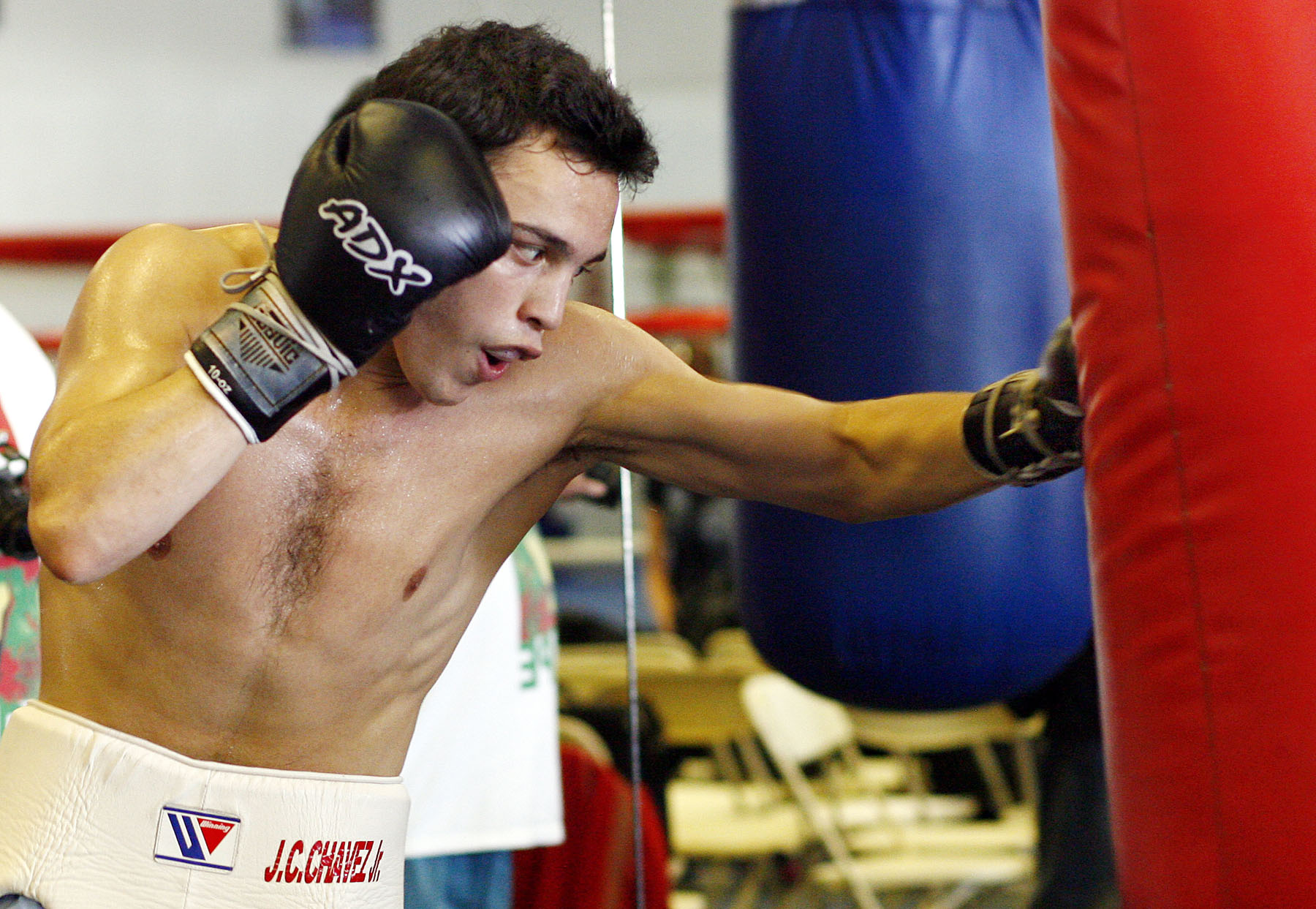
Recalling Ali-Frazier while wondering if there will ever be another Fight of the Century

On the 41st anniversary Thursday of the first Muhammad Ali-Joe Frazier fight, random reflections and recollections while wondering if there will be ever be a Floyd Mayweather Jr.-Manny Pacquiao anniversary:

· Sorry for wondering at all, but at least I didn’t have to wonder for long. Chances aren’t good that history will repeat itself with a fight remembered in the next century.

· Thursday’s anniversary of Frazier’s epic decision over Ali in 1971 at Madison Square Garden is the first since Frazier died in November. On the 25th anniversary, I sat with Frazier in Indianapolis at a luncheon sponsored by the U.S. Olympic Committee during 1996 swimming trials. Film of the bout played on screens in every corner of the room. I asked Frazier about Ali’s terrible fight with Parkinson’s. “You see that right hand, you see that left,’’ Frazier, a 1964 gold medallist, said as he pointed at the screen with the right he had landed that night. “That’s why he has problems.’’ Frazier never forgot. Rest in peace, Joe.

· Some Puerto Rican history is at stake Saturday night at Roberto Clemente Stadium in San Juan. For two decades, Puerto Rico’s proud boxing heritage has been sustained, first by Felix Trinidad and then by Miguel Cotto. Juan Manuel Lopez has been the designated successor. But that uninterrupted line of succession is in danger in a Showtime-televised rematch with Mexican Orlando Salido, who in April knocked out Lopez. Lopez has talked about distractions – marital strife and weight problems – before the loss. Safe to say, Puerto Ricans don’t want hear about any more distractions. At home, all of the pressure is on Lopez. The pick here: Lopez, in a late-round stoppage.

· Pacquiao is suing an Asian journalist for libel in a story that linked him to a carjacker, is thinking about running for the Filipino presidency and is facing a complaint from Filipino tax authorities, who have questions about his documentation. Those are the headlines, all within a couple of days and each with only passing reference to the Congressman’s June 9 fight against dangerous Timothy Bradley. Distractions have always followed Pacquiao. But these aren’t about singing, or basketball, or movie-making. They are the kind that dog and define prominent politicians. Fulltime ones, too.

· Just when I thought Missing was a new ABC series starring Ashley Judd as a mom searching for her son, Yuriokis Gamboa doesn’t show up. Gamboa went missing, not one but twice, first in Miami and then in Los Angeles for news conferences scheduled to hype what now appears to be a tentative – very tentative – bout with Brandon Rios on April 14. Rumor is that Gamboa is unhappy with Bob Arum’s Top Rank and wants to jump to Floyd Mayweather Jr.’s promotional company. If true, that will be another reason for Arum, Pacquiao’s promoter, to detest Mayweather and just another reason to think that Pacquiao-Mayweather won’t happen.

AZ NOTES
Another chapter in Arizona’s comeback from the immigration controversy, SB 1070, will happen this spring, first on March 23 at Tucson’s Casino del Sol with a ShoBox-televised card featuring Las Vegas super-featherweight Diego Magdaleno.

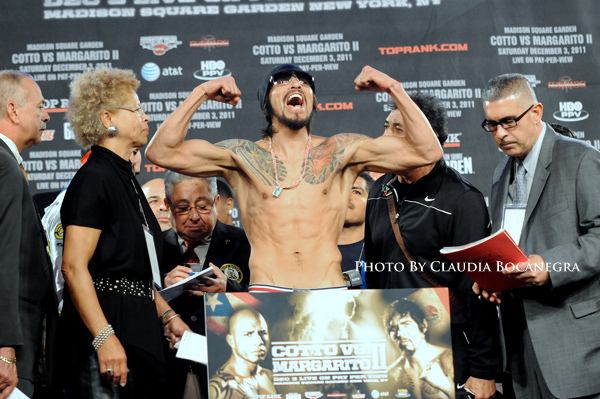
It’s intriguing, in part because Antonio Margarito’s brother-in-law, bantamweight Hanzel Martinez, is scheduled for the undercard. Martinez got interested in boxing when he used to run with Margarito. The March 23 card might set the stage in May for a Margarito fight in Arizona, his first since his loss in a December rematch to Miguel Cotto.

On April 21, Iron Boy Promotions plans to be back in Phoenix for an encore of its Feb .17 debut in front of near capacity crowd at Celebrity Theatre in Phoenix. On May 4, Michelle Rosado, who took the lead in re-opening the Phoenix boxing market, will promote in southern Arizona for the first time on May 4 with a card at Desert Diamond Casino, where Golden Boy Promotions had a good run before leaving because of the cost and license restrictions brought on by SB1070.


Perez decisions Figueroa at Broadway Boxing


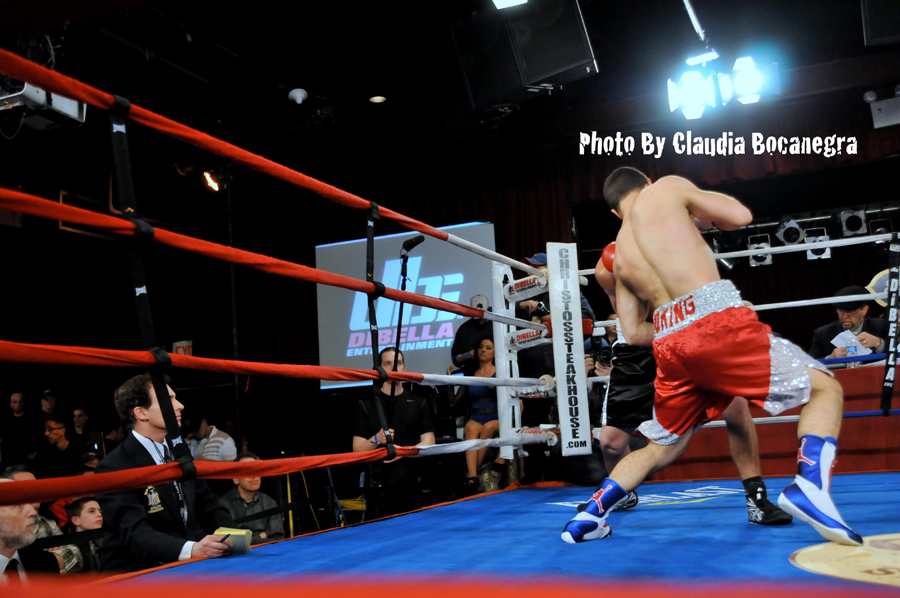
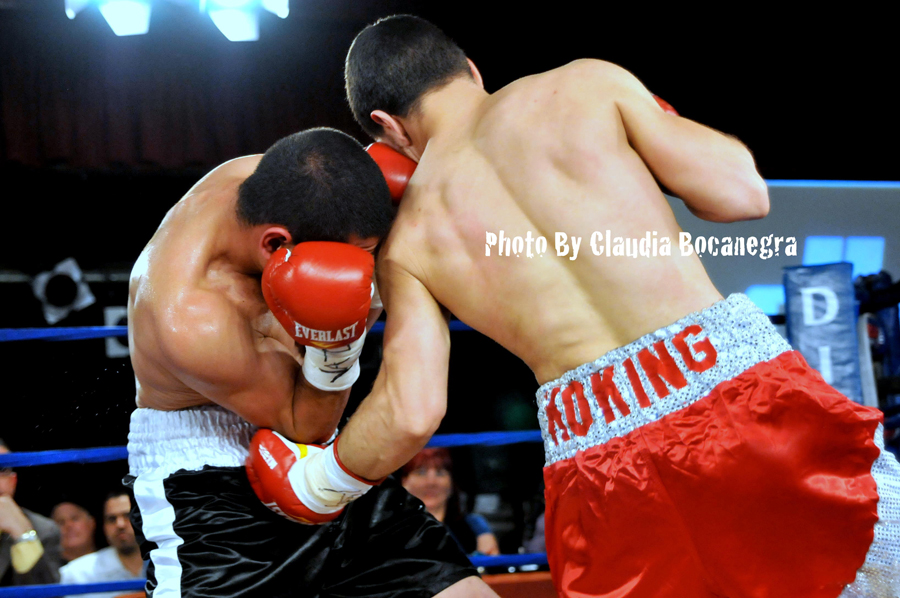
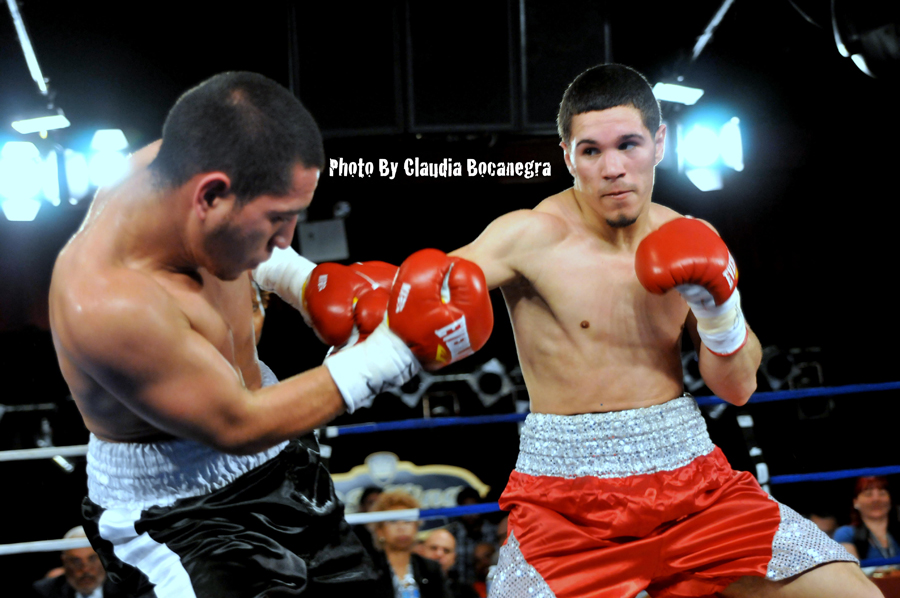
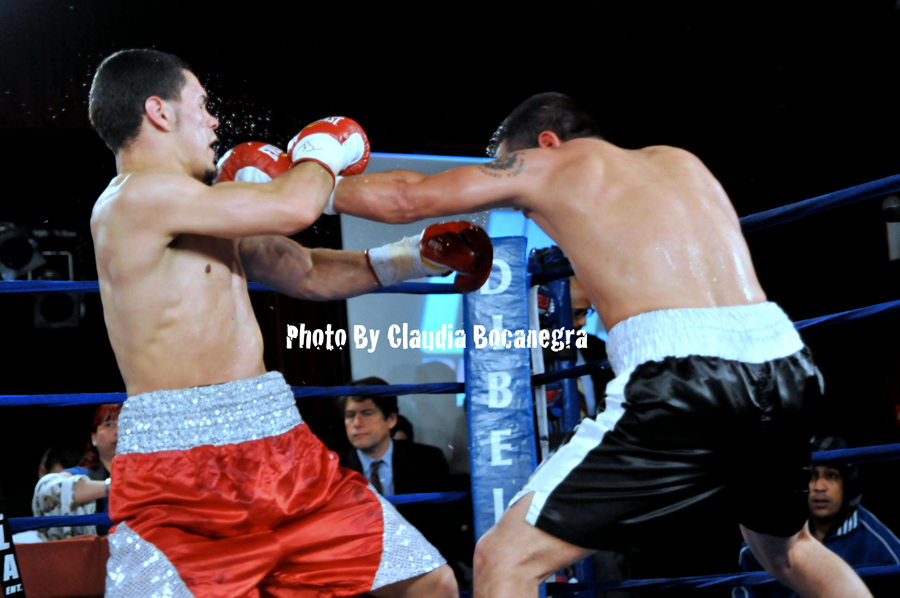
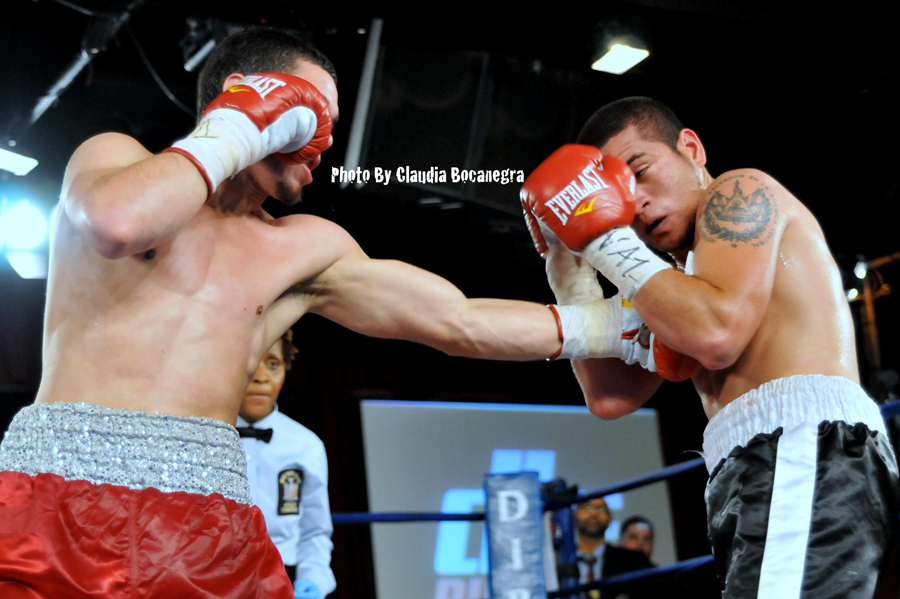
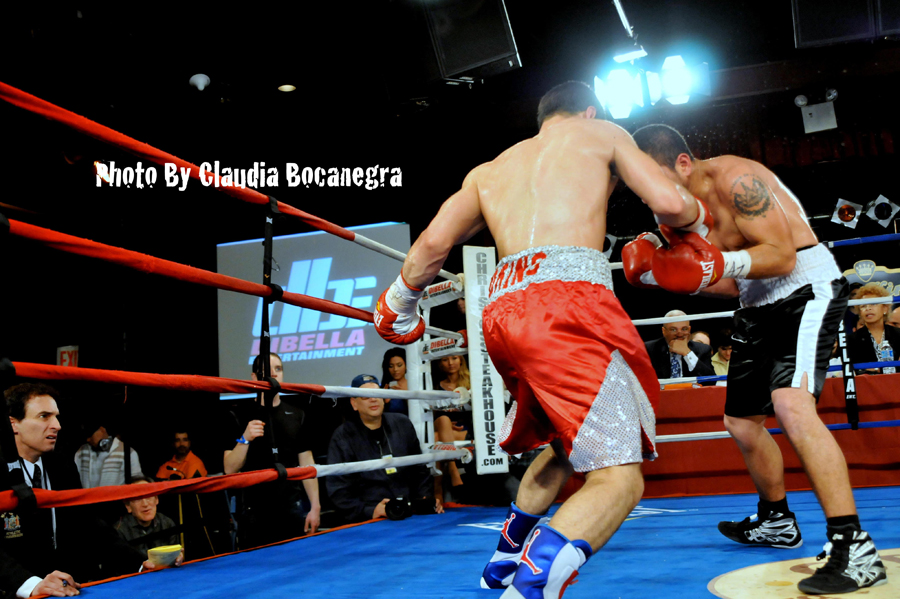
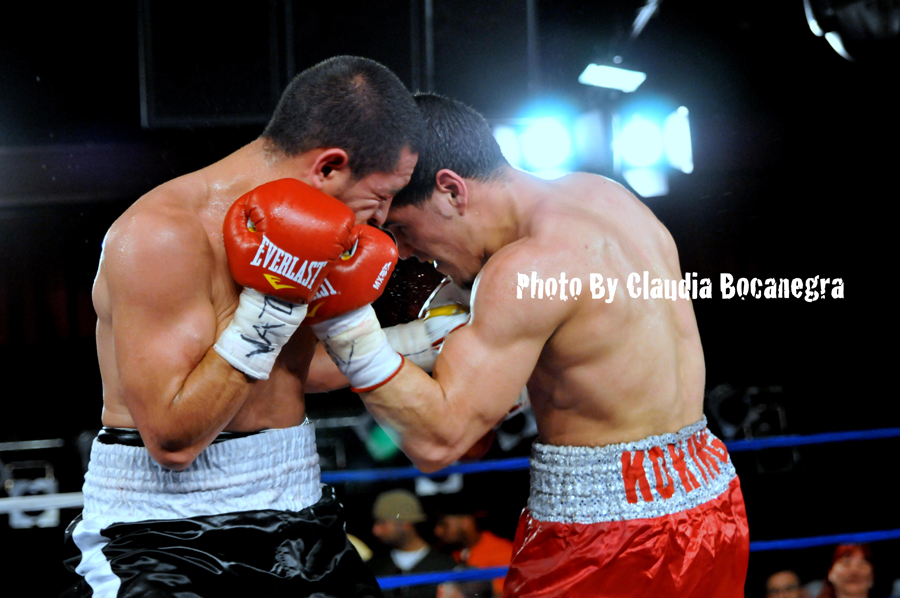
NEW YORK–In what was hailed as as one of the mist intriguing main events in the history of the popular Broadway Boxing series, Alex Perez scored a ten round unanimous decision over Francisco “Gato” Figueroa in a Welterweight bout at BB Kings.

Figueroa was active early as he was able to get inside and land some shots which included some nice uppercuts early in round one. Perez started using combination punching and started to seize control in round three as he kept Figueroa on the ropes while continuing to move his hands. In round four, Perez scored a hard knockdown as he caught Figueroa with a solid left hand that had Figueroa springing off the ropes and into a second flush left that sent Figueroa down. Figueroa was able to get to his feet only to suffer a huge rally from Perez. Figueroa motioned on two occasions to referee Gary Rosato that he was OK so the fight was able to continue. Perez was unable to to finish the job. In round five, Figueroa was able to regain his senses and engage in some solid exchanges and even getting the better of those flurries.

Perez used his seven inch height advantage well as he kept Figueroa at arms length for much of the fight. Figueroa, who had a decided advantage, was urged on by his fans but he simply could not overcome the early success by Perez as well as the physical advantages that more natural Welterweight, Perez had going into the fight.

Perez, 145 lbs of Newark, NJ won by scores of 99-90, 98-91 and 96-93 remains perfect at 16-0. Figueroa, 147 lbs of Bronx, NY is now 20-4-1.

“I broke my hand in the fourth round,” said Perez. I respect Gato, he is a tough fighter, but the only problem for me tonight was my hand. I know I would have knocked him out if I didn’t suffer the injury.”

“Hopefully I don’t have to take too much time off. My plan is God’s plan and that is to go straight to the top.”—Marc Abrams

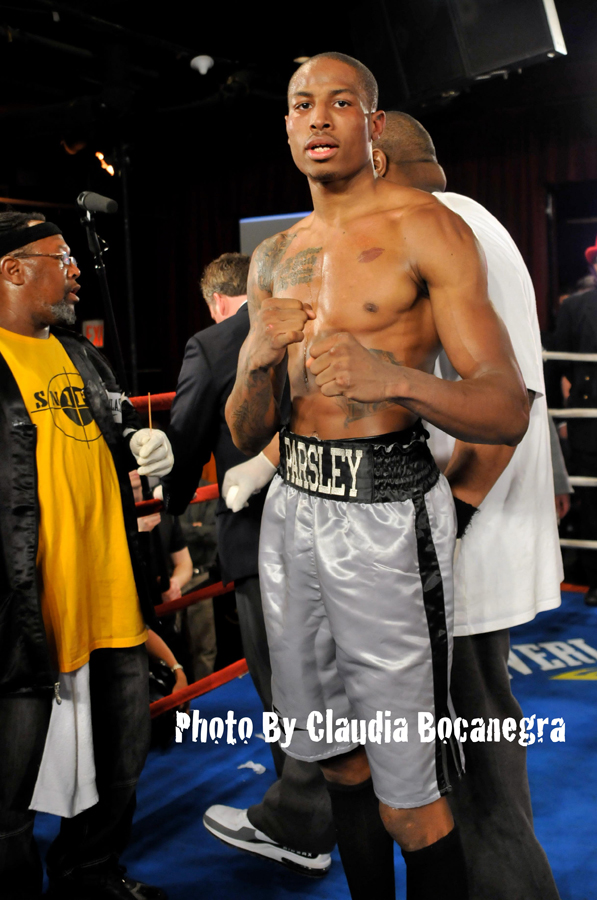
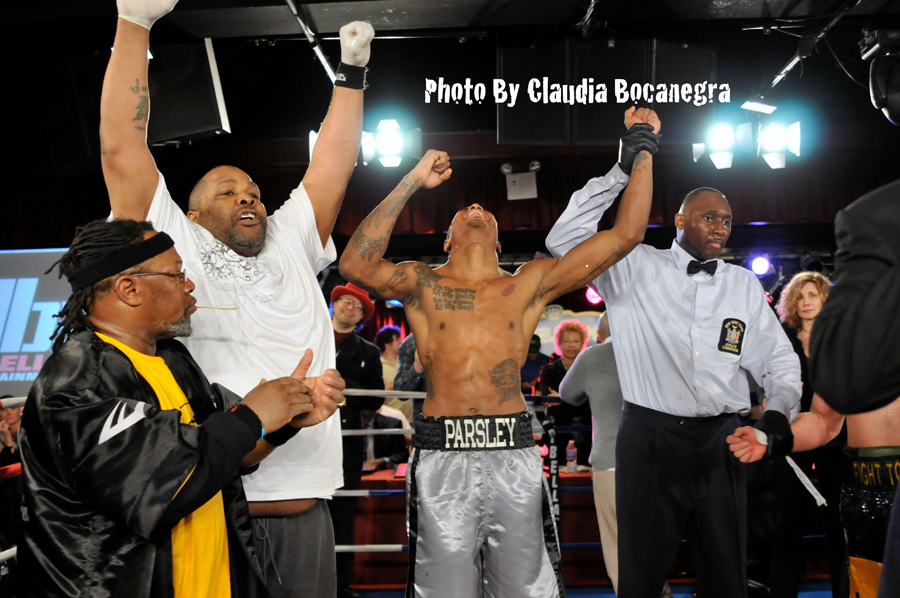
In what was a blazing co-feature of undefeated Jr. Middleweights, Delen Parsley survived two knockdowns to score a final round knockdown which propelled him to a razor thin if not controversial eight round split decision over Boyd Melson.

Melson was aggressive early with Parsley trying to counter which he punctuated the first frame with ahard right hand. Round two saw Melson work his way inside. Melson landed two hard shots with the second shot got the fighters tangled up and Parsley went down to the canvas but it was ruled a slip. Melson continued to land clean shots that hurt Parsley. Melson continued to land looping shots for which the final one sent parsley down to the canvas. Parsley was badly hurt but made it put of the round. Parsley got his legs back in the next round and was able to hold off Melson’s aggressive attack. The fight started getting sloppy in the fourth frame and parsley was able to counter and land some good shots.

Parsley started getting sharp in round five which could have been attributed to a slowly fatiguing Melson. Melson looked much better in round six as he was able to score his second knockdown of the fight from a body shot. Parsley showed he wasn’t hurt as he was able to land a hard right that momentarily staggered Melson at the end of the frame. The seventh was much of the same with Melson fighting very aggressive from the southpaw stance with parsley landing hard shots late.

With the fight seemingly in the balance, the eighth round provided high drama as Parsley started out the round with a hard right hand that dropped Melson. Melson was hurt but was able to beat the count. parsley jumped all over Melson with big shots. Melson was able to buy a few seconds when he landed a punch behind the head that put Parsley down but the punch was ruled a rabbit punch. Both fighters brought the crowd to their feet with toe to toe action until the final bell.

Parsley, 153 1/2 lbs of White Plains, NY won by scores of 76-73 on two cards while Melson, 154 1/2 lbs of White Plains, NY took a card at 75-74 (same as 15rounds.com ringside score).

“Boyd showed me that he is a real fighter,” said Parsley. “When he knocked me down in the second round, I was definitely hurt. He also showed me things that I learned about myself as a fighter. I regrouped and began to box him to get myself back into the fight. Boyd is like a brother to me and no matter what he will always be.”

Melson, bitterly disappointed with the loss briefly said, “I was doing what coach told me. When that stopped working I changed it up. I feel like I won the fight.”

Parsley is now 7-0. Melson is 8-1.

Will Rosinsky came back from his first pro defeat to put a three round drubbing over Zane Marks in a eight round Light Heavyweight fight.

Marks came out very aggressive to the body. Rosinky remained calm and then landed a right followed by a left hook of his own to Marks body that sent Marks to the canvas. Whem Marks got to his feet, the two brawled and Rosinsky landed another left that sent Marks down for a second time. Marks was able to beat the count and got out of the round. Round two saw Rosinsky beginning to pummel Marks. Marks would try to get in shots but had little power behind them. Rosinsky went back to work in the third and continued to beat on Marks until the fight was stopped at 1:26 of round three.

Rosinsky, 172 lbs of Queens, NY is now 15-1 with nine knockouts. Marks, 170 lbs of Golden Meadow, LA is now 17-7.

“The body shots were part of the game plan from the start. We trained for that in the gym. He was a very tough customer and he forced me to fight at a very fast pace. I know a big fight is coming my way but I just want to get into the ring again as soon as possible. I would like the winner of Rodriguez-George next week on HBO.”

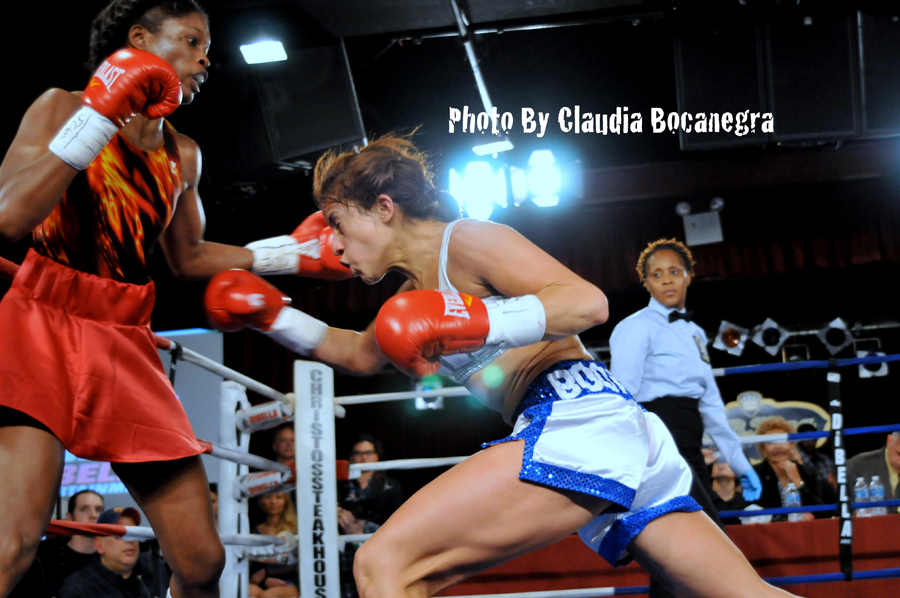
In a four round Ladies Flyweight bout, Keisher McLoed Wells and Patty Alcivar engaged in an entertaining scrap.

McLoed moved around and landed little combinations on the hard charging Alcivar, who herself was able to land some some good shots of her own. McLoed scored a flash knockdown when Alcivar walked into a jab in round three. The two fought some close rounds with Alcivar scoring a scoring a knockdown from an overhand right in the final frame.

It was McLoed, 109 lbs of New York getting the split decision by tallies of 5-55 on two card while Alcivar took a card at 57-55.

McLoed Wells is now 5-2-1. Alcivra, 110 lbs of Queens, NY is now 5-1.

Heavyweight Tor Hamer was impressive in disposing Dieuly Aristelde in round two of a scheduled six round bout.

After a tentative first round, Hamer took control and dropped Aristelde twice in round two with the final come from a big right hand and the fight was stopped just one second before the end of the round.

Hamer, 233 lbs of Harlem, NY is now 14-1 with ten knockouts. Aristelde, 218 lbs of Miami, FL is now 9-5.

Floriano Pagliara scored an entertaining six round unanimous decision over James Lester in a Jr. Lightweight bout.

The fight saw good periods of action with both guys giving there with Pagliara getting the better of the fight.

Pagliar, 130 1/2 lbs of Brooklyn, NY won by scores of 60-64; 60-54 and 59-55 and is now 12-4-1. Lester, 129 1/2 lbs of Detroit is now 9-7.

Luis Rosa used a strong body attack in scoring a six round unanimous decision over Jonathan Alcantara in a Jr. Featherweight bout.

Rosa, 122 lbs of New Haven, CT is now 10-0. Alcantara, 121 lbs of Los Angeles is now 5-7-2.

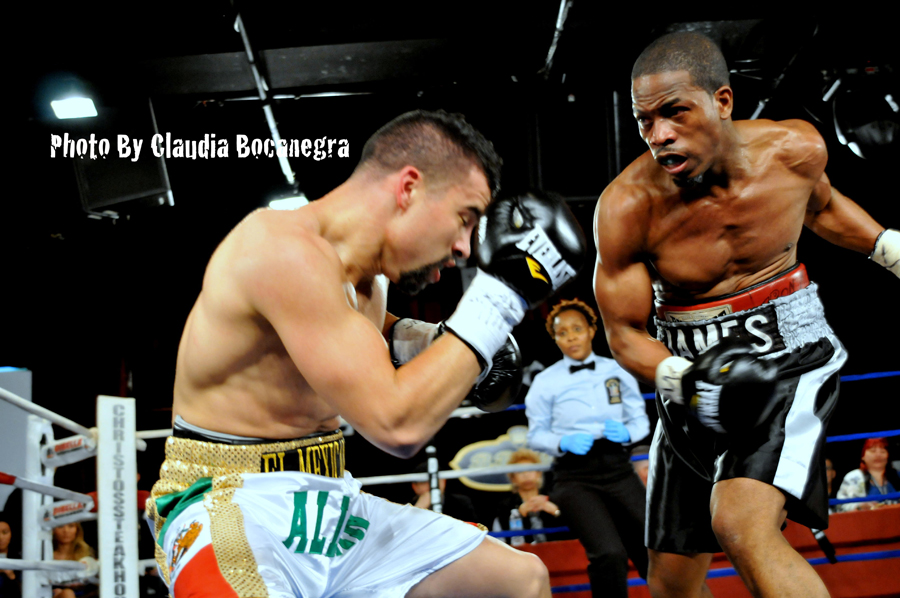
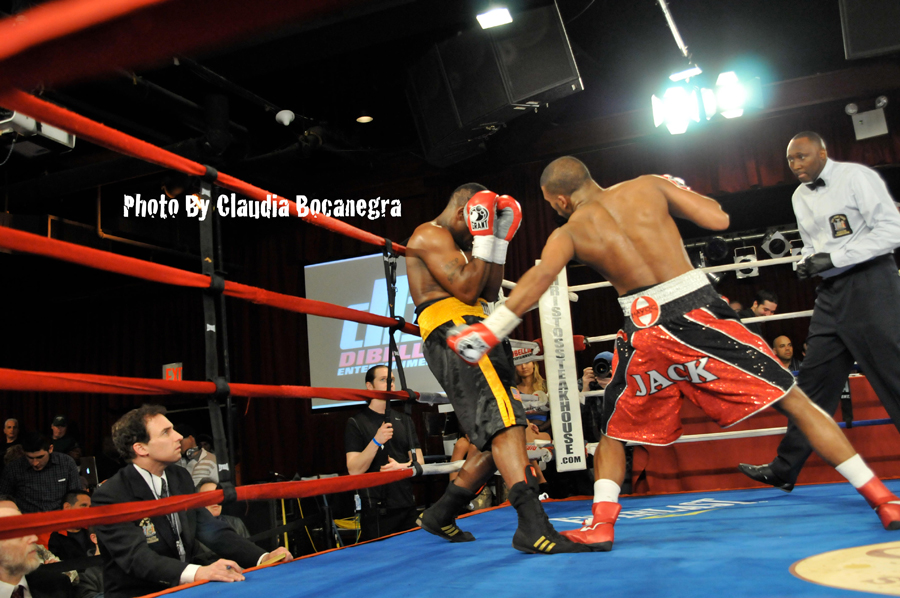
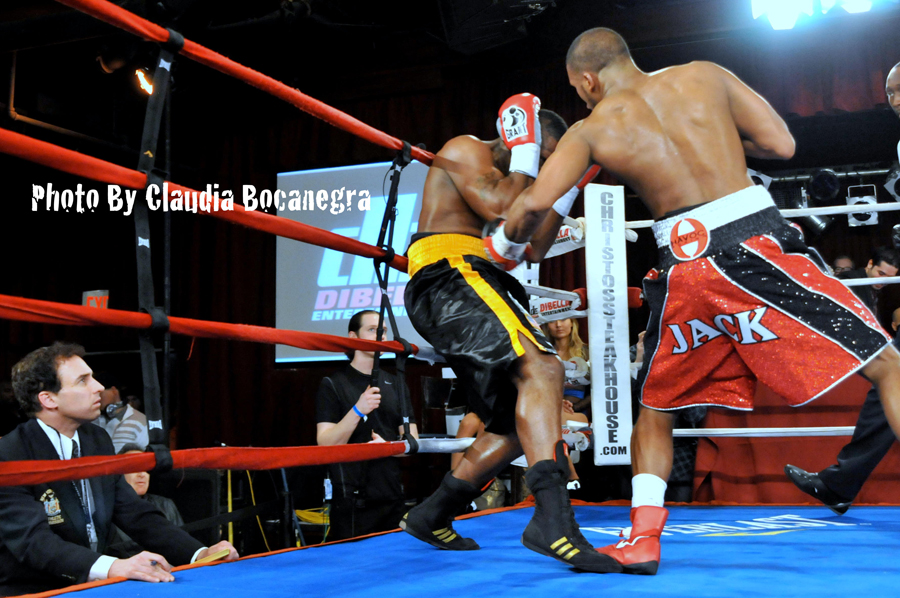
In a six round Light Heavyweight bout, undefeated Badou Jack scored a six round unanimous decision over Grover Young.

Jack showed youth and a better offensive arsenal and cruised to the 60-54; 59-55; 58-56 victory and is now 10-0. Young is 6-6-1.

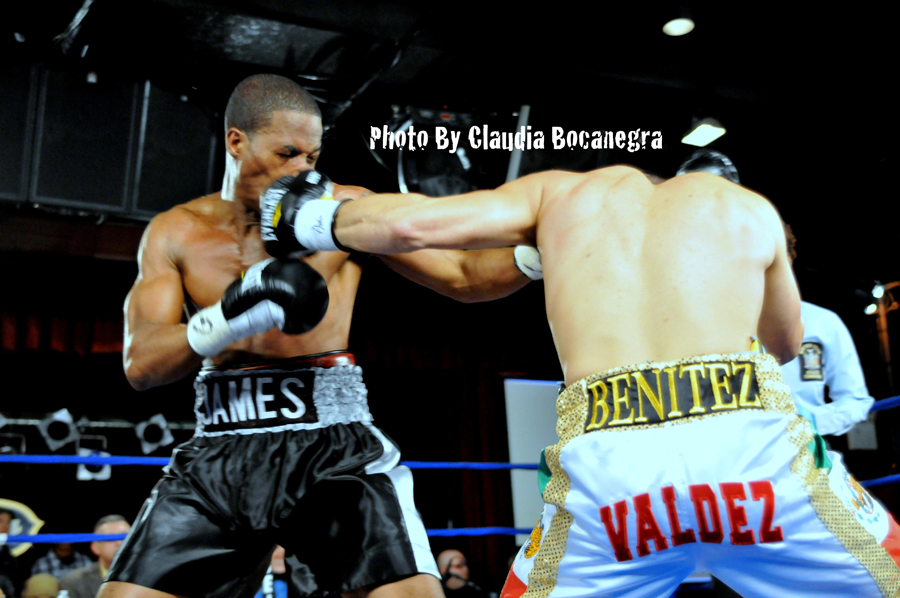
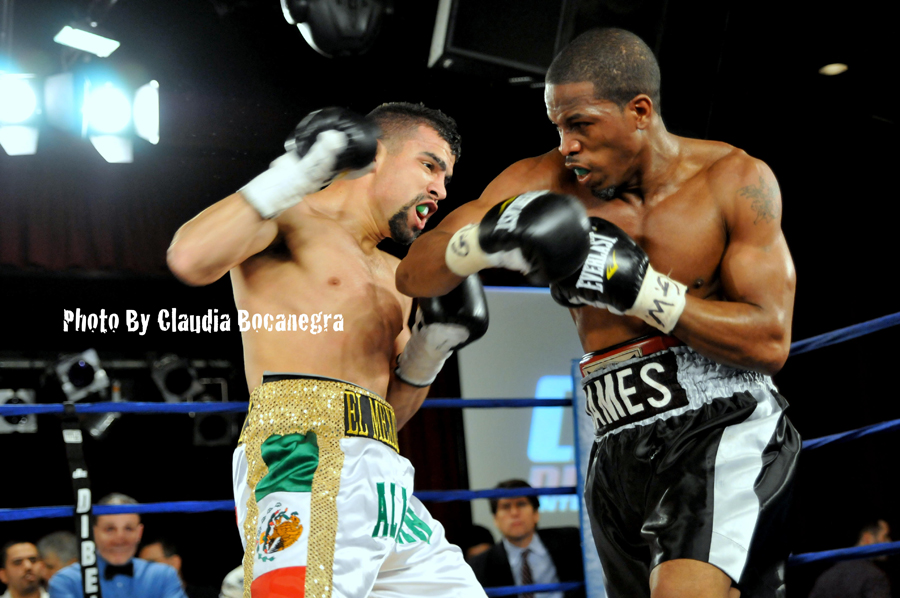
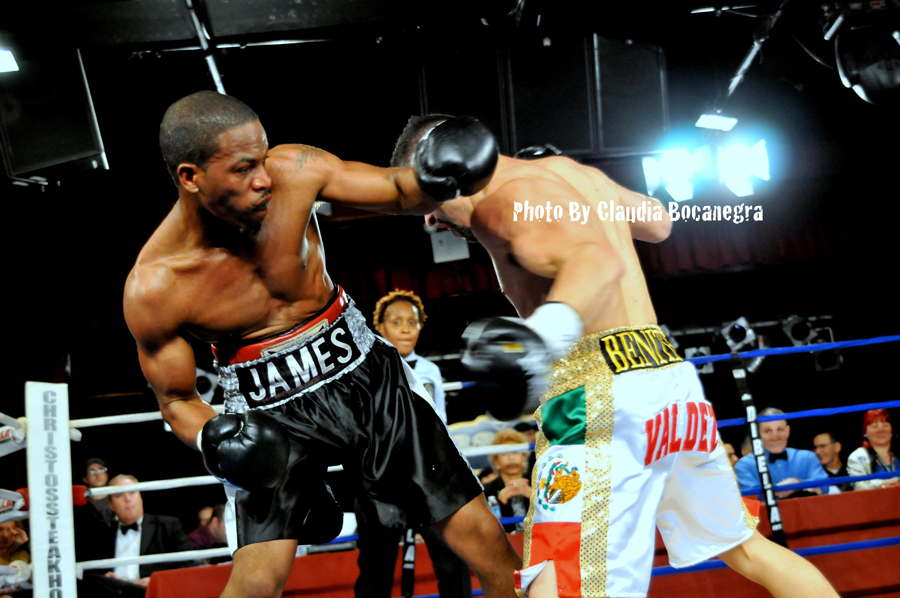
In the opening bout, Allan Benitez dropped Ian James with a left hand in round four en route to a four round unanimous decision in a a Jr.Lightweight bout.

Scores were 40-35; 40-35 and 39-36 for Benitez, 133 lbs of El Paso, TX and is now 4-1. James, 133 lbs of Brooklyn, NY is now 1-3.


Into the filth

In his 2001 essay “A rough trade,” British novelist Martin Amis writes ferociously, and with ironic humanity, about the increasing violence one finds in the pornographic-movie industry, probably America’s last bastion of pure capitalism. He employs an invocative clause – “jack-knifed over his flying fist” – before sorting out what is what in an industry that generated $8 billion annually, 10 years ago, and today generates much more than that. Then Amis sets out, in resume-builder fashion, the requirements of a porn actor.

In the middle, Amis lists “suffer(ing) from nostalgie de la boue” – a French term which denotes “yearning for the mud” while connoting “attraction to what is unworthy, crude, or degrading.”

What follows, too, will suffer nostalgie de la boue. It will plunder the trashcans of boxing gyms, Petri dishes of human waste kept at a humid temperature that would make a jungle envious.

Boxing gyms test their participants’ immune systems much as their chins and balls. If the American hospital has become world heavyweight champion of places to acquire a staph infection, boxing gyms nonetheless fight nobly on as sturdy, stubborn contenders. The fluids that flow in them are, in the frequency of their secretions: perspiration, saliva, blood, urine, semen and excrement.

A true boxing gym, as opposed to a fitness club, submits to the presence of sweat. Trapped in a 19th century ethic, boxing gyms, even in the world’s most humid spots, employ heaters. They keep themselves well above 90 festering, oppressive degrees, as if to answer the late Joe Souza’s rhetorical inquiry: “How else will our fighters make weight?” Boxing gyms are like lungs.

But they smell worse. Their scent is a fetid mix of human exertion and whatever industrial cleaners film these exertions’ leather surfaces. Handwraps, worked hard and put away wet, emit a stench curiously resembling corn chips. These are twisted round fists then pushed in the nylon interiors of gloves dutifully sprayed with an agent that is like PAM.

Fighters rub their bodies with Albolene, a makeup remover that induces perspiration, then climb in a shared contraption called a “sauna suit,” a plastic garbage bag with elastic seals for the neck, wrist and ankles. A sauna suit is not wrung-out afterwards but emptied like a wineskin. Then it dangles off a bench to drip dry – a state it never reaches, passing directly from wilted to crunchy.

A cotton t-shirt worn in a boxing gym is soiled irreparably. It will come out the dryer smelling like any other piece of laundry, yes, but add even a drop of perspiration, and its funk revives as a menace worse and more elusive than cat piss.

Bernard Hopkins says a proper boxing gym is one in which you can spit on the floor without drawing notice. If there is a human fluid ubiquitous as sweat in a boxing gym, it is saliva. In the documentary “Rumble in the Jungle,” Ferdie Pacheco refers to what comes off a fighter’s mouthpiece as “slobber” – the same white froth that accompanies a tennis ball wrestled from a dog’s mouth. The dainty latex gloves doctors wear on television are not worn in boxing gyms, places those ringside physicians would condemn on first visit.

Fighters plagued by chest colds, too, hawk phlegm from their throats then cast furtive glances at dark corners and concrete walls before looking for more polite receptacles.

Blood stains much fabric in gyms, and diversely enough that no forensics team could finger its source. Headgear precludes flesh-cutting better than brain-concussing, and so most blood comes from noses. Once a boxer’s nose begins to bleed in sparring, it is wiped by a trainer with some towel, any towel, between rounds. This, like most preventative acts taken during sparring, is to preclude humiliation. Careless official judges, they say, “score the blood” – but not nearly as much as fellow boxers leaning on a ring apron do.

A lonely urinal generally sits beside the shower in a boxing gym’s bathroom. The best way to tell the difference of the two spots is the height of their drains. The shower smells like the urinal. Its washing water is the same, of course, and whatever cleansing effect that may take, a mildewed towel is often passed over its bather’s body, just after the towel is pulled from a sweating locker, or communally employed.

There’s an old trainer’s tale that abstinence is a prerequisite for a prizefight; sex, the saying goes, weakens the legs. Perhaps. But more than one trainer, when frustrated by a charge’s tension, has counseled masturbation. A former Texas Golden Gloves champion imparted this anecdote:

I was a smooth boxer, so I needed to be relaxed. My coach told me to go in the men’s room before a bout and jerk-off before gloving up. I did it the first time, and it worked; I moved that day like syrup. Before my next match, I decided more would be better, and did it twice (ah, youth!), and I tell you it took my legs away. No more of that, Coach said.

Then there’s excrement. It happens round heavyweights, men whose diets are untroubled by making weight. They take lots of proteins in the ring with them because they have that luxury. A cruiserweight contender once fresh from a heavyweight’s training camp described what happened when a third-round body blow shocked the man’s large intestine into vacation.

“We took a break. He excused himself and went to the bathroom. Nobody mentioned it. Then we went back to work.”

All of this foulness, and the often-public way one is subjected to it, though, serves a purpose of its own: It tests a man’s desire to make combat, asking what he will endure to come out of a fight whole. It also creates a bond among its participants. It is, like much in boxing, cruel and essential.

Bart Barry can be reached at bart.barrys.email (at) gmail.com
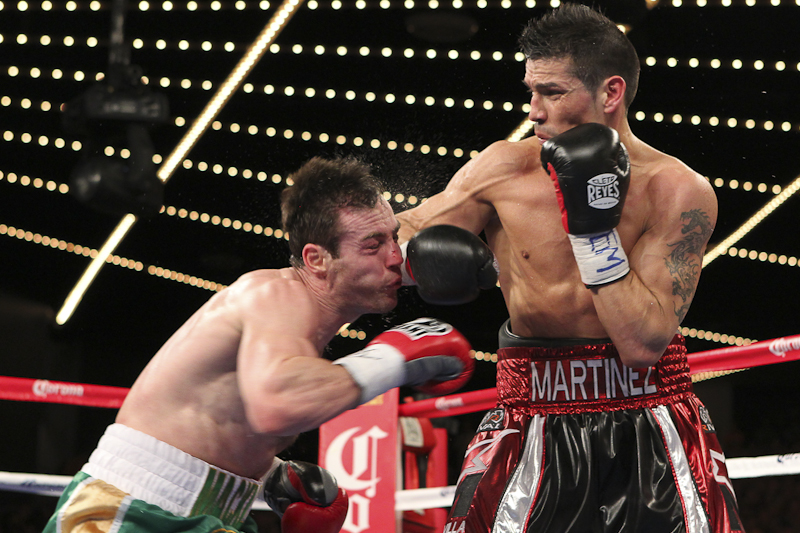


Klitschko trashes Mormeck in Four; gets knockout number fifty


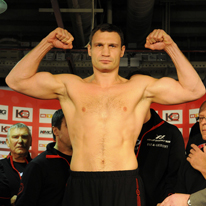
Wladimir Klitschko made his eleventh consecutive defense of his world Heavyweight championship by destroying undeserving challenger in former Cruiserweight champion Jean Marc Mormeck in round four at the Espirit Arena in Dusseldorf, Germany.

All Mormeck tried to was get inside without throwing any punches. He did that successfully but that may have been the highlight of his fight because he was dropped hard at the end round two from a big right hand. Klitschko got closer until uncorking a perfect left-right-left combination that sent Mormeck down to the canvas for the count of referee Luis Pabon at 1:12 of round four.

Klitschko notches is fiftieth knockout that sees his record raised to 57-3. Mormeck is now 35-5.


To the Klitschkos belong the spoils, including frustration


Heavyweights, a division in exile if not endangered, are making a lot of Euros, but American ambivalence at what was a piece of Americana frustrates Wladimir Klitschko trainer Emanuel Steward in a way he could have never imagined when he was an amateur growing up in Detroit, Joe Louis’ hometown.

Frustration said it all in a conference call.

Steward said it once, again and often — first at the criticism he hears about Klitschko’s opponent, former cruiserweight champion Jean-Marc Mormeck, Saturday in Dusseldorf in the third round of an Epix-televised trilogy (4:30 p.m. EST/1:30 p.m. PST) and again when asked whether there are any worthy challengers at all in a division that draws crowds in Germany and yawns in the United States.

“It’s so frustrating, these comments we’re reading,’’ said Steward, who says Klitschko (56-3, 49 KOs) will be confronted by a style he has yet to see in a smaller body that could make the 39-year-old Mormeck (36-4, 22 KOs) an awkward target.

Steward expects Klitschko to solve the problem with the calculating skill of a chess player. But check-mate isn’t what fans expect. Only an early knockout will do.

“According to all the experts, if the fight goes over three or four rounds, it’s a terrible performance,’’ Steward said. “If Wladimir knocks him out in a minute, it’s what he was supposed to do. We’re going into a definitely no-win situation.’’

No-win is a byproduct of the dominance Wladimir and his older brother, Vitali, have exerted over the heavyweights in the longest family reign since the Hapsburgs ruled Austria. The Klitschkos have won it all. Between them, they possess every acronym attached to a championship belt, including Vitali’s victory in a WBC-title defense three weeks ago over Dereck Chisora in Munich.

Chisora slapped Vitali at the weigh-in, spit in Wladimir’s face before opening bell and brawled with David Haye after the bout. Chisora got a split decision, losing the fight and winning the outrage, within a couple of circus-like days that brought a lot of attention to the heavyweights, but not because of the Klitschkos. They were there, doing what they always do: Winning. Steward is right. They only become news if they lose, or at least face what is perceived to be a real threat.

It’s within that context that Steward’s frustration is understandable. It’s hard to know where the Klitschkos belong. How would they have done in the Muhammad Ali era of the late 1960s and ‘70s? There’s only an argument and perhaps one day a video game.

“Unfortunately, this is probably – maybe – the worst heavyweight time in history,’’ he said. “It’s frustrating for us sometimes, too.’’

That frustration isn’t new. Larry Holmes suffered through it, post-Ali. Steward recalled a time when Joe Louis dominated the division so thoroughly that he turned it into his bum-of-the-month club. Each barren stretch, however, was followed by a rebirth.

“I think that those heavyweights are coming up,’’ said Wladimir, who at 35 is confident history will repeat itself in time for a true measure of where he belongs. “Think about Mike Tyson. He was 20-years-old. Nobody would ever think that a 20-year-old – boy or man – would become the youngest heavyweight champion in history.

“It always has been like that in the past. And it’s going to be like that in the future.’’

Amid renewed signs of life in the dormant division, Steward and Wladimir talk as if that future will have to happen in the U.S. against an emerging American contender. But who, please, who? Wladimir mentioned Chris Arreola. But Arreola is already a Klitschko victim. He was overwhelmed by Vitali in a 2009 mismatch at Los Angeles’ Staples Center. A better possibility might be Seth Mitchell, a promising apprentice and a former Michigan State linebacker who has talked about fighting a Klitschko, perhaps in early 2013. Wladimir has talked about Mitchell a couple of times during the last few months. It’s as if he sees him as a ticket back to the American stage.

Steward is hopeful, yet cautious.

“He looks good,’’ he said of Mitchell. “He’s a fundamentally good fighter. He comes in and he throws punches. He doesn’t wait. He’d be a good challenger.’’

But here’s the caveat and perhaps the frustration:

“Too bad we don’t have a bunch of them,’’ Steward said.

With Wladimir and Vitali, there are only two, too few.

AZ might be Margarito’s next stop

Tucson and Phoenix are possibilities for Antonio Margarito’s first fight since his December loss to Miguel Cotto, who won a 10th-round stoppage in New York when the ringside physician ended the rematch because of blood and swelling around Margarito’s problematic right eye.

Margarito wants a tune-up in May that will put him in line for a shot at Julio Cesar Chavez Jr. Tijuana, his home, has been mentioned. But Top Rank and his company, Showdown, already are doing a co-promotion of a ShoBox-televised card on March 23 at Casino del Sol in Tucson. Margarito’s brother-in-law, super-flyweight Hanzel Martinez, is scheduled for the undercard against fellow-Mexican Alex Rangel.

Margarito accompanied Martinez to a news conference at Casino del Sol a couple of weeks ago. Despite all the controversy that surrounds him, he is comfortable in Arizona, where he fought three times early in his career.

When there were questions about whether New York would license him for the Cotto rematch because of his surgically-repaired eye, US Airways Center in Phoenix became an alternate site. The Arizona State Boxing & MMA Commission said it would have licensed Margarito. Sergio Diaz, Margarito’s manager, said he believes the fight would have gone to Phoenix if New York had said no to the license and Cotto had agreed to the move.


Yusaf Mack to defend USBA Light Heavy Crown against Sheika


Sources confirmed to 15rounds.com that a battle of former world title challengers will take place as Yusaf Mack will defend the USBA Light heavyweight crown against Omar Sheika on April 27th at Resorts Casino in Atlantic City.

The bout, will be the kick off to a huge Light Heavyweight weekend in Atlantic City as the next night Bernard Hopkins defends his Light Heavyweight championship against Chad Dawson.

Sheika (32-11, 21 KO’s)who competed for the Super Middleweight crown four times is coming off two straight wins including a thrilling victory over Tony Ferrante this past Friday night in Chester, PA.

Mack (29-4-2, 17 KO’s) of Philadelphia will be making his his first ring appearance since dropping his bid to win the IBF crown last June when he was stopped by Tavoris Cloud.

The bout has received interest from several television outlets.


Examining the conscience before confessing the scorecard

We begin in a discomfiting place – Catholicism’s examination of conscience – and hope to move to an optimistic one. This column should be a secular spot, one where believers and nonbelievers frolic playfully as one, but as a column priding itself on finding instructions wherever they occur, it goes like this: If there is one Catholic tradition that will survive what its priests did to children for decades, it may be the examination of conscience.

According to this tradition, a believer creates an inventory of sins committed since his last confession. He reviews what thoughts and deeds composed his behavior, privately and best he is able, and takes the list to a confessional, in the hopes of absolution and a not-too-long penance to say. This inventory is by its nature useless if incomplete. Who would the believer fool by being dishonest?

The examination of conscience, as it happens, may also be a way for an aficionado to review his scorecard before he confesses it. (These are metaphors, of course; the stakes are comparatively low even for the most committed of Sweet Science’s flock.)

Nothing but coincidence attends this discussion and Devon Alexander’s Saturday victory over Marcos Maidana. Alexander, who may not actually be very good – or who, conversely, may be the man to prove first Timothy Bradley’s greatness – unmanned Maidana, who, it can be conceded, was never good as Victor Ortiz and Amir Khan made him look. Alexander-Maidana happened to be the televised fight that happened after Tavoris Cloud’s controversial decision victory over Gabriel Campillo in Corpus Christi, Texas, and all the questions about scorekeeping it necessarily raised.

An examination of conscience was in order before the next scorecard got confessed, then. So many well-intentioned folks took such exception with that Cloud-Campillo ringside scorecard that it was right for the scorer to look at himself. Coincidence again interfered, though, and confessing a one-sided scorecard with which all three official judges concurred is not so courageous. Alas.

An honest scorecard admits, after the fact, its biases of vantage point, ethnicity, style and personality. It is self-conscious in the best sense of that term; it qualifies its certainty by considering its limitations and imperfections. To wit:

For seeing Alexander’s jab is wrongly thrown, early in his career, I confirm this each time he fights. I believe Ortiz and Khan are media creations partially exposed by Maidana, and so I’ve not been fully convinced of Maidana’s ferocity or persistence. I believe I favor Latino fighters over African-American fighters – because I lived in Mexico, speak Spanish, and like volume punchers more than boxers – and so I try to offset this perceived bias when scoring (which may have influenced a Cloud-Campillo card that I marked 114-113 for Cloud). I know very little of Maidana’s biography but have felt a fraternal sort of pride about what boxing helped Alexander escape in his native St. Louis. I believed, going in, Alexander’s chin was as underestimated as Maidana’s power was overestimated. I believed that since Alexander-Maidana was only 10 rounds, Steve Smoger was a perfect choice of referee because he would allow Maidana to rough Alexander up, if it came to that. I believe Alexander’s trainer, Kevin Cunningham, is overrated. And finally, Timothy Bradley is one of my favorite fighters, and any victory for Alexander, whom Bradley beat, feels like a win-by-proxy for Bradley.

There. What is above is written in good faith and seems to predict I would score close rounds for Alexander, which I did, marking both rounds 1 and 3 for him and scoring round 2 even, while watching on HBO.

Is a fight better scored from ringside? Yes, otherwise judges would score fights from high-definition monitors in quiet backstage rooms. A ringside scorecard is also, for the most part, free of others’ opinions; nobody lasts long on press row if he talks through each round. Television commentary, on the other hand, is about exactly this. It is very difficult to ignore, because television is about keeping your attention, and why you tune in is fractionally important as keeping you tuned-in is.

Contrary to what sports-talk radio might say, what is important for an aficionado scoring a fight is not that his scorecard be right but that it be honest, which is why no examination of conscience is complete without ethnic considerations. Anyone who says fighters’ ethnicities do not color his scorecard stands somewhere between naïve and cynical.

All of this hopes to improve the ongoing argument that consensus is overrated. Did your friends agree with your scorecard? did your editor? did the guys at the gym? These questions are important to one who doesn’t know his own mind – or conscience, as the case may be. Your biases are secrets held only between you and yourself, though; everyone else sees them pretty clearly. Discovering them openly compromises your infallibility only with people silly enough to believe in infallibility.

Boxing gyms are invaluable in this sense; everyone expects everyone else to favor others who look like he does, and everyone laughs at himself when he finds out it’s true. This makes boxing gyms wonderful spots for examinations of conscience because they are some of the very few places in America where race is discussed openly and properly, and in good humor.

We go back to the scorecards.

Years from now you’ll probably not remember how you scored Cloud-Campillo or whatever next month’s hellish travesty is. But a postfight examination of conscience might lead to a cathartic moment of discovery. And if you can concede such cathartic things happen suddenly and at the oddest moments, why not posit they can happen while scoring a fight, and then pursue them?

Bart Barry can be reached at bart.barrys.email (at) gmail.com
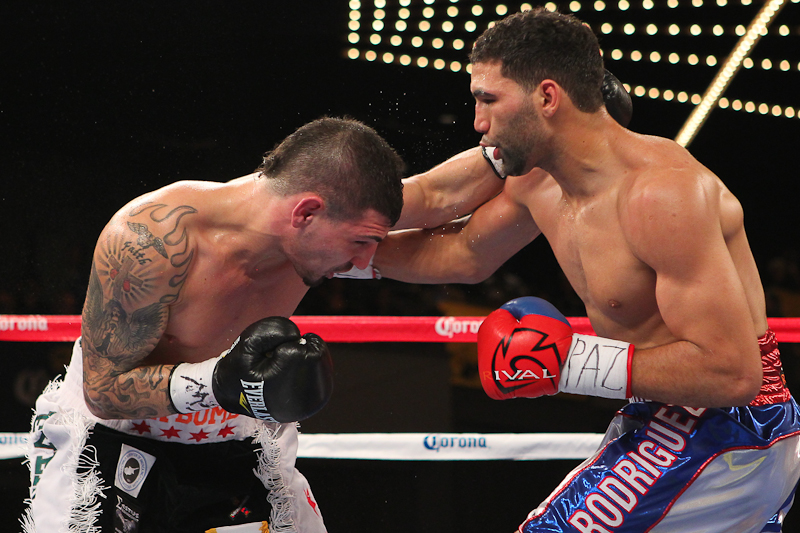


Alexander decisions Maidana


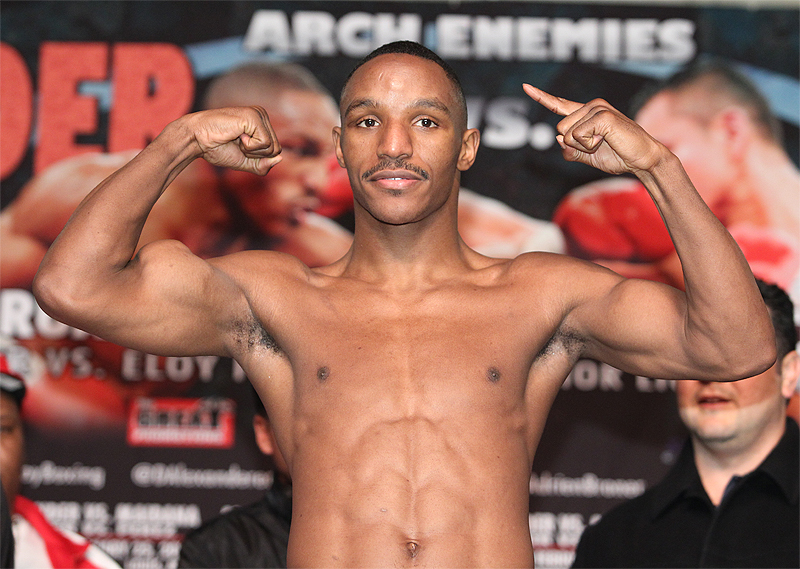
Former Jr. Welterweight champion Devon Alexander made a pretty loud statement in his Welterweight debut with an impressive ten round unanimous decision over Marcos Maidana in a fight between two former Jr. Welterweight champions at the Scottrade Center in St. Louis.

Alexander was brilliant as he mixed up his punches with right hooks to the body and straight lefts to the head. Alexander never let Maidana get into any type of groove as his speed and assortment of punches kept Maidana off balance. Alexander had Maidana in trouble on a few occasions and Alexander looks solid both skill wise and physically at this weight.

Alexander won by scores of 100-90; 100-90 and 99-91 and is now 23-1. Maidana, 146 3/4 lbs of Santa Fe, Argentina and is now 31-3.

Adrien Broner defended his WBO Super Featherweight title with a one punch fourth round stoppage over previously undefeated Eloy Perez.

Broner showed the skills and speed that have made him one of the most talented fighters in the world as he landed some solid shots over the first three frames. Perez fought hard and got in a few hooks but he was out skilled by the man known as “The Problem”

Broner landed a perfect right hand that sent Perez down face first in the fourth round. Perez tried to get to his feet but was unable and the fight was stopped.

Broner, 130 lbs of Cincinnati, OH is now 23-0 with nineteen knockouts. Perez, 130 lbs of Salinas, CA is now 23-1-2.


Vargas Outlasts Tyner in Ugly affair, Latimore Dodges a Bullet

Poise might have been the area that veteran Lanardo Tyner(25-7-2 15 ko’s) chose to target more than any other in his welterweight bout with prospect Jessie Vargas(18-0 9 ko’s), but the 22 year old showed composure beyond his years, and outlasted Tyner in an ugly ten round affair littered with fouls.

Vargas opened up the fight long exchange in illegal blows by catching Tyner low in the first round, part of a sustained body attack. Tyner was granted time to recover by referee Tony Weeks, and was visibly angry as he rose to his feet, and converted his frustration into an offensive rally to close out the first round.

The two men exchanged combinations inside, until round four when Tyner evened the score with a low blow of his own that sent Vargas to the canvas, reeling in pain. After a recovery period Tyner pounced on his weakened opponent, putting punches together and scoring well. Vargas turned the tables once again, however, with another shot below the belt in retaliation, which infuriated the 36 year old Tyner.

The fighters were able to keep things moderately clean for the next few rounds, with the exception of a few exchanges after the bell that were quickly broken up. Vargas continued to work well inside, but showed a few defensive flaws, and ate some unnecessary shots from Tyner.

Vargas stepped on the gas pedal in round 7, teeing off on Tyner with hooks, and right hands to the body and head. The offensive showcase drew a reaction from the crowd until Tyner smiled and beat his chest at the younger Vargas, and pressed forward with a successful combination of his own.

After a rough and tumble eighth round that saw the two men wrestle their way through the ropes and out of the ring momentarily, Vargas was able to clean up the pace of the bout, and get the better of Tyner in close quarters, outworking his man down the stretch.

In what started out as a firefight, Jessie Vargas was able to keep his cool in the late rounds, and outlast a savvy veteran opponent for a lopsided decision victory with scores reading 99-91 all the way across. It was an ugly affair for the centerpiece of Floyd Mayweather’s promotional stable, and while room for improvement is clear, Vargas was able to pick up a big win, and a valuable learning experience.

“I don’t think this was my toughest or hardest fight, but it was a good fight,’’ said Vargas, who was sporting a cut on the upper left side of his head afterward. “This was just another learning experience. I need these kinds of fights against these kinds of fighters to stay in position to move forward.

“I probably could have moved and boxed more, but he took my out of my game plan a few times. There were times when all I wanted to do was connect with the big shot.

“That low blow he got me with in the fourth round was definitely the hardest low blow I’ve ever been hit with. I’ve never been nailed with anything like that before.’’

Latimore vs. Nunez

“The Bull’ took on the role of matador when Deandre Latimore (23-3-1) survived a late rally from short notice replacement Milton Nunez (23-4-1) and took home a majority decision win.

St. Louis native Latimore, originally slated to face Ryan Davis (who failed his eye exam), brought a conservative game plan into Friday’s bout, working his jab, and making the Columbian miss with wide hooks. In round three the 26 year old Latimore found a rhythm, landing to the body and putting combinations together, staggering Nunez at certain points.

24 year old Nunez, who was brought in on 48 hours notice, stayed competitive, but wasn’t able to do any significant scoring. Until round 9 that is. In the final minute of the ninth Latimore’s sharp defense offered up a costly opening, which Nunez capitalized on with a hard right hand. With Latimore visibly staggered Nunez charged forward with a wild, but effective flurry that dropped Latimore to the canvas. Latimore rose to his feet, still out of sorts, but was saved by the bell to end the round.

Latimore was able to slow the pace down a little bit to open round ten, staying defensive and jabbing himself out of trouble. Nunez, however, was able to find another opening and drop Latimore once again inside of the round’s final minute, winning over the crowd, and earning his paycheck.

Latimore was announced the majority decision winner, to a mixed reaction from the crowd at Hard Rock in Las Vegas, improving him to 23-3-1.

“It was my first start in nearly a year and I’m just happy to get the win,’’ said Latimore, who was making his first start for new trainer Jeff Mayweather. “Honestly I didn’t care if I won by 10 points or one, I just wanted the win. I had to pace myself at times but I did what I had to do and what Jeff wanted me to do,

“The second knockdown wasn’t a knockdown. I went down from headbutts. It is what it is, though, and I look forward to getting back to work in the gym and fighting on a regular basis.’’

“I knocked him down and was hitting him with a barrage of right and left hands and the referee (Joe Cortez) moved in and stepped between us. I thought he was going to stop it. You don’t do what the ref did and not stop the fight.

“Still, I thought I’d done enough to win.’’

Undercard

Junior Welterweights Joaquin Chavez (0-0-1) and Jalani Wilson (0-0-1) put both their passion and inexperience on display. Chavez was able to land significant shots throughout the four round affair, while Wilson lunged forward with hooks, landing on occasion but failing to inflict any meaningful damage. The bout was ruled a draw after four rounds.

Antonio Orozco (13-0 8 ko’s) looked sharp as nails in a dominating performance over Rodolfo Armenta(11-5 9 ko’s).

Orozco stayed tight with his combination punching, working the body, and scoring upstairs. Armenta was game, but overmatched by the hand speed of “The Simple Man”. Orozco scored a well earned stoppage in round 4 with a combination that dropped Armenta for the count.

In a California vs. Nevada border war David Clark(4-2-1) blitzed Rocco Espinoza(3-3-1) for an easy TKO1 via 3 knockdown rule. Espinoza had no answer for Clark’s immediate pressure and collapsed to the canvas three times early on for the quick loss.

New mantle cell lymphoma research from University of Virginia outlined. see here mantle cell lymphoma

Biotech Week November 24, 2010 Researchers detail in ‘Management of mantle cell lymphoma: key challenges and next steps,’ new data in mantle cell lymphoma. “Mantle cell lymphoma (MCL) is regarded as an aggressive lymphoid malignancy that exhibits varied clinical behavior and prognoses, reflecting the biologic heterogeneity of the disease. In most cases, patients with MCL achieve a shorter median survival compared with more common B-cell lymphomas, such as follicular lymphoma, and are less likely to achieve a durable response with chemotherapy,” scientists writing in the journal Clinical Lymphoma, Myeloma & Leukemia report (see also Mantle Cell Lymphoma).

“Currently, there is no defined standard of care for patients with MCL. Rituximab-containing immunochemotherapy strategies are commonly used, but the addition of rituximab to conventional induction chemotherapy has produced suboptimal responses that are relatively short-lived and have not resulted in a survival advantage. Further intensification of the chemotherapy component, including autologous stem cell transplantation, has increased response and survival rates but has not proven to be curative while being associated with higher toxicity. Clearly, there is a need for developing novel agents and strategies that will improve clinical outcomes for patients with MCL. Targeted therapies and new cytotoxic agents are showing great promise and may have a role in maintenance and/or initial therapy. This summary highlights current challenges in the management of MCL, and outlines expert perspectives, key questions, and future directions. For the third consecutive year, a panel of global experts in MCL assembled to deliberate on topical issues in MCL including advances in pathobiology, strategies for risk-adapted therapy, front-line treatment options, consolidation approaches, and novel therapeutic strategies. The proceedings of this workshop, held December 3, 2009 in New Orleans, LA, are summarized here,” wrote M.E. Williams and colleagues, University of Virginia. website mantle cell lymphoma

The researchers concluded: “It must be emphasized that this synopsis is not meant to serve as an exhaustive review of MCL biology and management, but is a distillation of the expert discussions, highlighting key questions and future directions identified.” Williams and colleagues published their study in Clinical Lymphoma, Myeloma & Leukemia (Management of mantle cell lymphoma: key challenges and next steps. Clinical Lymphoma, Myeloma & Leukemia, 2010;10(5):336-46).

Additional information can be obtained by contacting M.E. Williams, University of Virginia School of Medicine, Charlottesville, VA USA.


Bradley’s head might get in the way of any chance at Pacquiao-Mayweather


For the congregation that still prays for Manny Pacquiao-Floyd Mayweather Jr., pray a little harder that the born-again Pacquiao isn’t struck by a head butt from Tim Bradley that ruptures old wounds above a right eye with scars that might as well look like a target.

A perfect storm of circumstances are aligned for just such a collision in the Bradley-Pacquiao fight on June 9 at Las Vegas’ MGM Grand. Head butts are already more likely in a bout between a southpaw and an orthodox fighter. Between the left-handed Pacquiao and the orthodox Bradley, one and more are an even better bet than a Pacquiao victory.

Start with each fighter’s past. Start with Bradley’s head. It has become a weapon, notorious and dangerous. Accidental butts led to cuts that resulted in his last victory, a 10th-round technical decision, over a bloodied Devon Alexander last winter in Detroit.

Pacquiao has suffered cuts above the right eye repeatedly, once in a decision last year over orthodox Shane Mosley in May and again in November with a gash deep enough to expose bone in the 10th round of his controversial decision over orthodox Juan Manuel Marquez. It was caused by – you guessed it – a head butt. Twenty-eight stitches were needed to close that one.

The lengthy healing process was mentioned as a reason Pacquiao couldn’t fight Mayweather on May 5. The real truth might be more about money than stitches. The danger now, however, is that there won’t be any argument left about Pacquiao-Mayweather next November if Bradley’s head lands all over again.

Remember this: A cut over that same eye appeared to the biggest factor in Pacquiao’s last loss by unanimous decision to orthodox Erik Morales in 2005. The cut was sustained in the fifth round from a clash of heads. Then, it was called accidental. If it happens again, it won’t be called coincidental. It will be remembered as an avoidable obstacle standing in the way of the one fight the world has wanted to see.

Gonzales wants to fight on
Jesus Gonzales of Phoenix plans to continue fighting despite a loss that, at first glance, appeared to be a career-ender Saturday when Adonis Stevenson dropped him with left hands 99 seconds after the opening bell in Montreal.

The 27-year-old Gonzales (27-2, 14 KOs) wants to move back down in weight, from super-middle (168 pounds) to middle (160), according to his promoter, Canadian Darin Schmick of FanBase.

Stevenson (17-1, 14 KOs) overwhelmed Gonzales, perhaps because he was the bigger, stronger fighter, although Gonzales never even attempted to circle away from the known power in Stevenson’s left . He simply walked right into it, almost as if he were walking into an oncoming locomotive.

Gonzales also has talked about finding a new trainer. He has mentioned Robert Garcia, who is already busy with Brandon Rios, Nonito Donaire and Antonio Margarito. A revolving corner has been a problem for Gonzales, who took the Stevenson fight on late notice.

In Montreal, Gonzales father, Ernie, was back in his corner. His dad, his trainer for the first part of his pro career and throughout his brilliant days as an amateur, had decided to step away. But he worked with him for nearly four weeks of training in Calgary.

Gonzales’ plans, however, hinge on an MRI to determine if he suffered head trauma, Schmick said. Gonzales, who lost by TKO in 2005 to Jose Luis Zertuche in his only other loss, was knocked out for the first time in his career by Stevenson. The KO means he’ll need a clean MRI to get licensed, said Schmick, who was trying to put Gonzales in position for a shot at Andre Ward. Ward’s last loss was to Gonzales when both were amateurs.

NOTES, COUNTERS
Alexander tries to put his career back on track against dangerous Marcos Maidana Saturday in St. Louis, Alexander’s hometown. He said he’d like another shot at Bradley, although he also said something in a conference call that might serve as a warning to Pacquiao. “You can’t train for head butts,’’ Alexander said. “You can’t train to get head-butted and to get your eye all messed up.’’

And there’s no truth to the rumor that the Texas Department of Licensing & Regulation – the Lone Star State’s boxing commission — conducted the drug testing for Milwaukee Brewers slugger Ryan Braun, whose 50-game suspension was overturned Thursday. Apparently, protocol wasn’t followed. In San Antonio, the Texas commissioners forgot to test Julio Cesar Chavez Jr. after he beat Marco Antonio Rubio on Feb. 4. Details, those pesky details.


Jermaine White, The Midwest’s “Hawk”


At the time of my interview with Jermaine White (17-4 9ko’s) being scheduled he was slated to face Vivian Harris in what would have been an opportunity to take a significant step forward, and kick off the second act of his career. White, the Chicago based welterweight, considers it the second act because he is returning from a hiatus with renewed passion, and a revamped team surrounding him. By the time the interview date had rolled around, however, the fight card was scrapped, and for the second time in mere months “The Hawk” had watched a fight with Harris fall through.

Frustration is a common trend amongst fighters. White’s attitude, however, is not.

Watching White in the gym it becomes clear that he is a fighter with a world of talent, who has been done no favors by the business end of boxing. Talking with White you’ll find that he is something of a boxing historian, and a student of the game. What makes him so easy to root for is the way he takes each setback and converts it into confidence. After suffering four losses to top notch company, including Anthony Peterson, and Julio Caesar Chavez Jr. White has hit the gym with a chip on his shoulder, and a genuine belief that he is better than almost anyone you put in front of him.

Jermaine White is now in Las Vegas, under the tutelage of Eddie Mustafa Muhammad, and aims to open up the second act of his boxing career this Spring, I caught up with him for a conversation on where he’s been, where he is, and where he plans to go.

On his next fight, and plans for the near future:
I’m hoping to get in on March 31 in Seattle, Washington. They want me to come to 136 but I think we’re going to try a catchweight, maybe 140 or something. I feel good at 147, I feel strong. I’m used to guys that are fast and throw a lot of punches. Coming up in weight guys are a little slower, and a little easier to me.

On his previously scheduled fight with Vivian Harris falling through:
It fell through, I don’t know what the issue was, some kind of promotional issue. The first time we were scheduled to fight we had blood work that was done wrong on my behalf, we both signed waivers but the commission didn’t let us fight. Vivian Harris was supposed to be the fight that catapulted me to the next level. It’s very frustrating. My whole career has been frustrating but I take it in stride. It builds character when everything doesn’t come on a silver platter. I didn’t have the perfect matchmaker coming up. I just have to get on the right course.

On his 4 career losses:
If it wasn’t for those losses I wouldn’t have gotten better, I wouldn’t have learned. In reality you have to be prepared. Taking fights on short notice you’re bound to lose. My losses weren’t really decisive losses, I lost to Peterson with 3 pinched nerves in my back, I did manage to swell his eye with my left hook. I fought Chavez at 147, In El Paso, across the street was Mexico, literally, across the street . I signed for a fight at 144 lbs. they said we had to be at 147 when I got there. So I was a blown up lightweight fighting what was pretty much a junior middleweight. It was a promotional game that they got me with.

On the second chapter of his career and training in Vegas:
People looking at my record see 17-4 but fighting in places like Indiana you have to kill their guys to get a decision. People out here in Vegas have told me that I have the best slip game in the business. I think I could beat a lot of these people out here. I had to get rid of some people and gain people on my team that I need to go forward. I’m with Eddie Mustafa Muhammad my main trainer now, Kevin Henry working drills. I get some good help at home in Chicago.

On who he would compare himself to:
I would say the Black murderer’s row. For people who don’t know who they are, they were Great fighters in the 1940’s who just didn’t get the right opportunities. Charlie Burley, one of the great fighters of all time, just didn’t have the management to get a world title shot. Sugar Ray Robinson said “he’s too good for his own good” I feel like one of those kind of guys. I’m a slip master, I frustrate a lot of guys. Real old school style. I can dance, I can square up, and I can bang. Mike Tyson was in here and said “that little man can punch” that meant a lot to me. I think I’m going to surprise a lot of people. A lot of fighters are real basic now days and I think I’m a style that’s hard to deal with.

On his career up to now:

My career and life have been tough. I’ve done well, I won a lot in the amateurs, Nationals, Silver Gloves, all that. But it’s been hard and that taught me a lot about life. There’s been a lot of character building along the way. I see a lot of guys making more money than me but they also have a lot more problems that go along with it. I think I’m in a better situation because of the people around me. I’d much rather have less and be surrounded by people who I know genuinely care about me.

On the next 12 months:
This year I will get some kind of belt, might be regional, anything like that. I will get a belt. Hopefully I can get the Vivian Harris fight again. I think that’s something I’d really like to finally get done, but either way I think it’s going to be a big year and I will have a belt of some kind very soon.


Something less than photo realism on the Bay


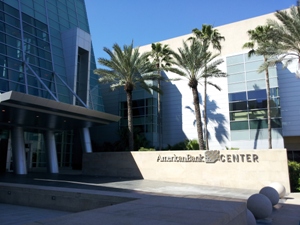
CORPUS CHRISTI, Texas – If you were here in the beautiful coastal climes of the Gulf, 65 degrees with a cool saltwater wind, you felt differently about “Triple Threat” than if you were not. The ringside experience, with its emptied press-row tables, unfamiliar faces and well-lubricated fans just beyond, had none of the rabid emotion – investigate this! protest that! suspend the other guy! – sincerely expressed by those who were not at American Bank Center Arena.

Make of that what you wish, after you consider that television’s primary role is entertainment. Television succeeds when it provokes strong emotion. To assign it greater merit than entertainment is to overestimate the medium.

Saturday on the Bay brought a swirl of emotions and impressions and other happenings. They ranged from a feeling of disappointment to a narrative of injustice to an inference of unapproachable rage and ultimately ended, as these swirls inevitably do, with exhaustion and boredom. If that is unfair to a semi-rehabilitated fighter or a wronged one, or his outraged manager set to file protest Monday, it is nevertheless honest – though oblivious of what narratives shape it.

There is likely no lead here, just an unkempt swirl of hastily chosen words. But that might be the best way to express a rage that was directly proportionate to one’s distance from its catalyst.

Art Museum of South Texas, which shares a lovely spot and parking lot with Saturday’s fight venue – which had half its 10,000 seats curtained off and its upper bowl closed – is running a three-month exhibit called “Art of the Dive: Portraits of the Deep,” an appropriate subject for a collection that overlooks the Bay. The exhibit is a mild disappointment, with a few pleasant surprises that use impasto.

It has some good works of photo realism, a movement that is better than photography when done right because it accesses thrice the color palette of a lens and film. But it is a movement still subverted by a thought: Did the artist paint this or trace it?

It must not be a simple task to present subaqueous themes; what we know of them is already passed through multiple filters – diving mask, bubbles, refracted light – and anticipated for most of us by television cameras.

Do not discount the importance of anticipation; it colors what follows. If, to use a timely example, you anticipated a tightly wound knockout artist would fade against a loose-handed, stiff-legged, southpaw cutie whose mastery is regularly missed by fair judges – none of whom ply their trade in the crooked Lone Star Republic – you might see something different from a person, say, who showed up to watch the main event and didn’t think many thoughts during the co-main aside from: Yes, enjoyable!

But O, to borrow Shakespeare, for in every honest hand a whip / To lash the rascals naked through the world / Even from Houston to th’ El Paso.

Very well. But do not consider a team of broadcasters much more than a single voice. And do not cite the disapproval of a Spanish-speaking crowd deep in its cups and stirred by a black promoter’s earlier employment of an ethnic slur. Few of the thousands in attendance would recognize Tavoris Cloud in a diner tomorrow morning, but they began without hesitation a chorus of “Don King sucks!” after a Spanish-speaking challenger lost to King’s fighter.

That was in Saturday’s best match, a scrap for the IBF light heavyweight belt. Florida’s Tavoris “Thunder” Cloud defeated Spanish southpaw Gabriel “Chico Guapo” Campillo by scores (116-110, 111-115 and 114-112) that were outrageous on Twitter and TV and almost right at ringside, where an inexperienced local press corps – guys who later argued the WBC International Silver belt denoted a championship at stake – barely shrugged.

Reasonable men at ringside, too, had Cloud narrowly winning. We’ll take our lashings. But when a fighter who lost a round 10-7, never hurt his opponent, and cruised and clowned during the championship rounds, then loses a split decision, do not yell “robbery!” if you wish to be considered reasonable.

Campillo won on many viewers’ cards because he did what they thought he would do, which is to imply their scorecards were not blank when the opening bell rang. Alas, no one’s scorecard ever is.

Chris Arreola, the ticket-seller in South Texas, took umbrage with Don King’s use of the word “wetback” and then took it out on Texas heavyweight Eric Molina, making a wondrous 150 seconds of violence, punctuated by a decisive overhand right. Arreola’s gatekeeper disgust with King’s saying “wetback” at a Thursday press conference was not forced, but neither was it devoid of theatrics. Nothing Arreola does in public is.

“I’m a commodity,” Arreola said Saturday. “A big Mexican commodity.”

Arreola is a fine showman who is quieter and more approachable in reality than on television. King, a fine showman of his own who clearly did not intend offense and rebutted “We all wetbacks, baby,” chose his words poorly and got roundly booed by American Bank Center, which was justice enough – no need for a coerced apology or further gnashing of teeth.

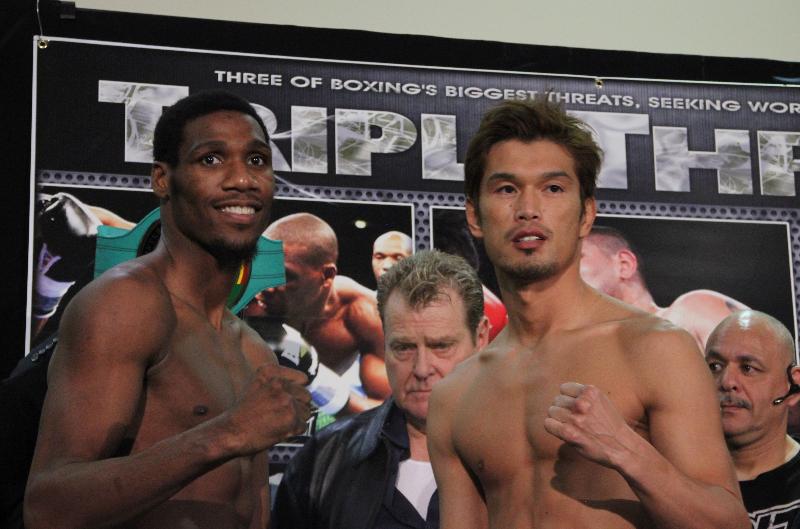
Paul Williams, ostensibly “Triple Threat’s” main-event draw, won a decision over Nobuhiro Ishida, a sturdy Japanese super welterweight, in a fight that put the arena to sleep, regardless of its participants’ activity. Hundreds of punches were thrown and landed in 36 minutes – question never Williams’ activity or desire – and yet writers played on their cell phones and fans discussed ring-card girls’ asses, while Williams outclassed Ishida.

Why a Williams fight is boring is hard to say. That it is boring, though, is not. It is difficult to read Williams’ biography or watch him politely interact with people at a weigh-in and cheer against him. It is just as difficult, unfortunately, to look forward to his next fight.

Bart Barry can be reached at bart.barrys.email@gmail.com


Williams brings silence, Cloud brings controversy, Arreola brings violence


CORPUS CHRISTI, Tex. – Paul “The Punisher” Williams burst on the scene years ago as a gangly, volume-punching giant whom no manager wished to match his fighter against. That made him entertaining. He is the same man today. But no one is entertained by it any longer.

In the main event of Saturday’s “Triple Threat” card from American Bank Center Arena, Williams (41-2, 27 KOs) beat Japanese super welterweight Nobuhiro Ishida (24-7-2, 9 KOs) by shutout scores of 120-108, 120-108, 120-108. Not one of the three judges scored a round for Ishida. And not one of the fans attending Saturday’s card seemed to care.

“This win feels really good,” Williams nevertheless said afterward.

Through the opening quarter of Saturday’s main event, an awkward nine minutes that saw the fighters’ limbs entangle, dropping Ishida twice on non-knockdowns, Williams was the slightly busier and more aggressive man, though Ishida gave little ground.

Round 4 found Williams finally landing effective punches, employing several times a right hook-left cross combination that backed Ishida up. After more of the same in round 5, Williams allowed Ishida to come inside in the sixth. Once inside, though, Ishida found that wasn’t necessarily where he wanted to be, as Williams, a much better in-fighter than his frame anticipates, continued to land.

And so it went.

As the crowd slowly deflated and American Bank Center Arena’s energy went away, Williams-Ishida went from main event to walk-out bout, regardless of the concerted effort both men made. When the final bell rang, the arena was quiet as it had been when the doors opened five hours earlier.

“We’re going to make it back to the top again,” Williams said, though by then the arena had emptied.

TAVORIS CLOUD VS. GABRIEL CAMPILLO
Dressed like a tiger, IBF light heavyweight titlist Tavoris “Thunder” Cloud walked into something of a lion’s den, Saturday, fighting Gabriel “Chico Guapo” Campillo, a tricky southpaw Spaniard, before a partisan-Spanish-speaking crowd, and emerging with his title but lots of controversy.

The three official judges disagreed on what happened in many of the rounds, turning in split-decision cards of 116-110, 111-115 and 114-112 for Cloud. The 15rounds.com ringside scorecard, too, had the match for the champion, 114-113.

“He was the busier fighter, and that is what the crowd here in Corpus Christi responded to,” said Cloud, in explanation for the crowd’s vociferous disapproval of the official result.

From the opening bell, Cloud (24-0, 19 KOs) wasted no time whatever, charging out his corner and cracking Campillo (21-4-1, 7 KOs) with a lunging right cross that dropped the handsome Spaniard in the fight’s opening two minutes. Cloud would drop Campillo again with a barrage of rights and lefts, 30 seconds later, winning the first round 10-7.

“He won the first round,” Campillo said afterwards. “But after that, I dominated.”

Campillo proved his mettle in the second round. Having risen from the blue mat twice in the opening stanza, Campillo outboxed Cloud, catching him with left uppercuts and right hooks from his southpaw stance and then outclassing him with slick movement in the third.

Rounds 4, 5 and 6 found Cloud, still bemused by Campillo’s tricky style, pressing forward with greater aggressiveness, no longer retreating to the ropes and trying to set traps. Still, Campillo had the better movement and more accurate punches, while some sting appeared to come off Cloud’s blows.

The fight’s most even round, its seventh, saw a cut over Cloud’s left eye begin to bleed and cause the referee to take a double look after each clinch. The blood flowed even more loosely in the eighth, after a sustained assault by Campillo backed the champion into a corner. Cloud fought back when pressed, but Campillo’s left-uppercut lead was a riddle Cloud never solved all night.

After a trip to the doctor’s corner midway through the 11th caused Cloud to fear the fight could be stopped on account of his left eye, Cloud increased his aggressiveness three-fold, narrowly winning the championship rounds on two of the three judges’ cards.

“I felt like I won the fight,” Cloud said of his effort.

CHRIS ARREOLA VS. ERIC MOLINA
If Texans circled one match on the American Bank Center card, if there was one fight that brought them out Saturday night, it was California heavyweight Chris “The Nightmare” Arreola (34-2, 30 KOs) against Texan Eric Molina (18-2, 14 KOs), and the match was excellent while it lasted. Unfortunately for fans, it lasted only 150 seconds, as Arreola, despite being hurt early, dropped and stopped Molina at 2:30 of round 1.

Arreola, who has lost at least 20 pounds from previous fighting weights, now appears somehow less menacing in his trimmer figure but nevertheless brings a row every time he steps between the ropes. Molina learned this harsh lesson after stunning Arreola 90 seconds into their match.

“I said before the fight that if I had him hurt, I would come in and try to finish, and I did,” Molina said afterwards. “And he caught me.”

Arreola has more class than his detractors are often wont to admit. He looks and talks like a face-first brawler, but this brash exterior belies a stellar amateur pedigree and an impressive ability to land seemingly blind overhand rights on contender-caliber heavyweights. After being backed to the ropes by Molina and forced to clinch, Arreola used a pair of such right hands to get Molina off him.

And then it was a walloping right hand that put Molina’s lights out.

“I did my best,” said Molina.

Arreola did better.

MALIK SCOTT VS. KENDRICK RELEFORD
The evening’s first undercard fight televised by Showtime Extreme, an eight-round scrap between undefeated Philadelphia heavyweight Malik Scott (33-0, 11 KOs) and Texan Kendrick “The Apostle” Releford (22-16-2, 10 KOs), saw a technically superior though light-hitting Scott preserve his ‘0’, decisioning Releford by unanimous scores of 79-73, 80-72 and 80-72.

Throughout the occasionally sober match, Scott tagged Releford with right uppercut-left hook combinations that snapped Releford’s braided hair upwards and leftwards but did not imperil him.

Scott has every punch in the boxing lexicon, and appears to commit to each one, too, but whatever the mysterious force that gives a prizefighter one-punch stopping power, Scott does not possess it.

UNDERCARD
The undercard ended well with a competitive four-rounder between two Texas lightweights. Corpus Christi’s Gregorio Gutierrez (5-1, 2 KOs) prevailed over Brownsville’s Hector Garza (3-5, 2 KOs) by three scores of 39-37.

Saturday’s fifth fight saw the evening’s biggest upset, when unknown New Orleans super middleweight Justin Williams (4-5-1, 2 KOs) decisioned local and well-known contender Alfonso Lopez (22-3, 17 KOs) by unanimous scores of 57-56, 58-55 and 58-55. Williams was faster and better throughout, dropping Lopez once and doing everything necessary to win a fair and well-deserved victory.

Before that, hometown welterweight Julian Barboza (2-0, 2 KOs) made decisive work of San Antonio’s Arturo Lopez (0-1). Lopez, making his professional debut, came out quickly and boxed confidently for the bout’s opening minute, but then Barboza began to take him apart with tight combinations, stopping him at 2:11 of the second round.

Saturday’s first match, a hesitant six-round affair between undefeated Washington D.C. light heavyweight Thomas Williams Jr. (7-0, 4 KOs) and Louisiana’s Kentrell Claiborne (2-5, 1 KO), went to Williams by three unanimous scores of 40-35.

Opening bell rang on a silent American Bank Center Arena at 6:22 PM local time.


FOLLOW WILLIAMS – ISHIDA LIVE!!


Follow all the action LIVE from Corpus Christie, Texas when former two division champion Paul Williams takes on former champion Nobohiro Ishida. The card will feature the IBF Light Heavyweight championship bout between Tavoris Cloud and Gabriel Campillo plus bouts involving heavyweight contenders Chris Arreola and Malik Scott. The action begins at 8pm eastern/7pm in Texas

12 ROUNDS SUPER WELTERWEIGHTS–PAUL WILLIAMS (40-2, 27 KO’S) VS NOBUHIRO ISHIDA (24-6-2, 9 KO’S)

Round 1 Williams lands a straight left…10-9 Williams

Round 2 Ishida lands a left..Williams lands a straight left to the body…20-19 Williams

Round 3 Williams lands a combination…Straight left…Ishida lands a jab…Williams lands a good straight left…Ishida lands a counter right..body shot..left hook..Right hook from Williams…30-28 Williams

Round 4 Ishida lands a good hook..Lead left hook..Counter right..Williams lands a straight left that backs up Ishida..39-38 Williams

Round 5 Williams lands a nice combinations…2 up jabs..Heavy combination..uppercut..straight left..49-47 Williams

Round 6 Williams shoeshining…3 right uppercuts…Right to the body..ishida lands 2 rights…59-56 Williams

Round 7 Lead uppercut from Williams…69-65 Williams

Round 8Williams Volume punching to the body and head..Ishida gets in a right….79-74 Williams

Round 9Lead right staggers Ishida…89-83 Williams

Round 10Williams working inside…99-92 Williams

Round 11Williams letting his hands go..109-101 Williams

Round 12 Williams punching in bunches..ishida lands a couple counter rights…Straight left from Williams…119-110 Williams

PUNCH STATS
Williams 248-934 Ishida–147-671

120-108 all 3 judges for PAUL WILLIAMS

12 ROUNDS–IBF LIGHT HEAVYWEIGHT TITLE–TAVORIS CLOUD (23-0, 19 KO’S) VS GABRIEL CAMPILLO (21-3-1, 8 KO’S)

Round 1 BIG RIGHT AND DOWN GOES CAMPILLO…CLOUD ALL OVER CAMPILLO AND DROPS HIM AGAIN…10-7 Cloud

Round 2 Campillo lands a 1-2…19-17 Cloud

Round 3 Campillo lands an uppercut..28-27 Cloud

Round 4 Cloud lands a right to the chest..Campillo lands a combination..Countering..Blood from Left eye of Cloud…37-37…CUT WAS RULED FROM A PUNCH

Round 5 Cloud lands a short left hook…Campillo lands a combination..Uppercut…Cloud lands a left hook…47-46 Campillo

Round 6 Both guys trading body shots…Campillo landing combinations..57-55 Campillo

Round 7Campillo lands a combination that moves Cloud back..Cloud lands a flurry..Campillo pressuring Cloud..Cloud lands a right..66-65 Campillo

Round 8 Campillo lands a right hook…Huge jab that is followed by a combination..straight left…76-74 Campillo

Round 9 Campillo lands an uppercut…86-83 Campillo

Round 10 Campillo continuing to land combinations..Cloud lands a right…Campillo lands a straight left and jab…96-92 Campillo

Round 11Campillo beginning to land hard shots on Cloud…Doctor now looking at the cuts on Clouds face…Cloud can continue…Cloud coming forward…Campillo landing a combination..Big right from Cloud backs up Campillo…106-101 Campillo

Round 12 Campillo lands a left…Cloud outlanding Campillo…115-111 Campillo

115-111 CAMPILLO; 116-110 CLOUD; 114-112 CLOUD

6 Rounds Super Middleweights–Alfonso Lopez (22-2, 17 KO’s) vs Justin Williams (3-5-1, 2 KO’s)

Round 1 Williams lands a short right,…Good right..10-9 Williams

Round 2 BIG RIGHT AND DOWN GOES LOPEZ…20-17 Williams

Round 3 Good right from Williams…2 uppercuts…Good left has Lopez holding on…Lopez lands a left and right…double right…right to top of head..Williams lands a right at the bell..30-27 Williams

Round 4 Good jab from Lopez…Good jab…39-37 Williams

Round 5 Double left from Lopez...48-47 Williams

Round 6 Lopez lands a combination…57-57

57-56; 58-55; 58-55 FOR WILLIAMS

10 ROUNDS HEAVYWEIGHTS—CHRIS ARREOLA (34-2, 29 KO’S) VS ERIC MOLINA (18-1, 14 KO’S)

Round 1 Body shot from Molina…Right to the body…Big right Hurts Arreola…...HUGE RIGHT AND DOWN GOES MOLINA AND HE CANT BEAT THE COUNT…FIGHT IS OVER

8 ROUNDS HEAVYWEIGHTS–MALIK SCOTT (32-0, 11 KO’S) VS KENDRICK RELEFORD (22-15-2, 10 KO’S)

ROUND 1 Scott lands a combination..2 body shots…right to head..left to body..Releford lands a jab…Scott lands a nice right..nice uppercut…good tight and an uppercut…Hard lead uppercut..combination..right over top….10- 9 Scott

Round 2 Scott lands an uppercut…left…3 punch combination that ends with a great uppercut..20-18 Scott

Round 3 Scott lands a right..Relford lands a combination…Scott lands a left..right..good left to the body..good left..4 punch combination…30-27 Scott

Round 4 Good right to the body/left to the head….good right from Scott..3 punch combination..40-36 Scott

Round 5 Good left from Scott..Releford bleeding from nose…Good right from Scott..50-45 Scott

Round 6Scott lands a lead uppercut…Left from Releford…..60-55 Scott

Round 7 Double left to the body and a sharp right from Scott…uppercut…70-64 Scott

Round 8 Scott Jabbing…Good body shot..80-73 Scott

PUNCH STATS
Scott 181-530 Releford 88-523

79-73; 80-72; 80-72 UNANIMOUS DECISION SCOTT


Klitschko decisions Chisora to retain Heavyweight crown


Vitali Klitschko made the eleventh successful defense (over two interrupted reigns) of the WBC Heavyweight title when he scored a twelve round unanimous decision over willing challenger Dereck Chisora in Munich, Germany.

Klitschko basically won the fight with one hand as as he landed some solid right hands in every round. Unlike most Klitschko opponents, Chisora actually fought hard and came to win for all twelve rounds but he was unable to land the big shot as he was caught time and again by the right hand. Klitschko used his size to cut off Chisora but the champion was better in all aspects.

Klitschko of Ukraine won by scores of 118-110; 118-110 and 119-11 and is now 45-2. Chisora of England is now 15-3.


LaManna stops Crabtree in Three


NUTLEY, NJ — In the very gymnasium where Martha Stewart once took phys. ed, Nutley native Thomas “Cornflake” LaManna TKO’d Ohio’s Daniel Crabtree igniting the hometown crowd, as well as almost starting a riot.

The first round was favorable for the taller LaManna, who showcased his impressive arsenal of offensive weapons. He worked well behind his stiff jab and pieced together crisp combinations.

The second round, however, proved to be a bit tougher for LaManna, who increasingly on the receiving end of Crabtree’s punches.

When the bell rang to signal the start of round three, LaManna once again began to press the action. Cornflake landed a hugh right hand that sent Crabtree off balance, forcing his glove to touch the canvass in order to keep him on his feet. Referee Randy Neumann, however, didn’t witness the glove scraping the mat, and never ruled the knockdown.

LaManna showed great natural instincts immediately rushing to finish off the injured Crabtree. He chased the Ohioan from corner to corner until finally, referee Randy Neumann stepped in to call a halt to the bout.

Immediately after Neumann’s stoppage, which was arguably premature, Crabtree’s trainer rushed into the ring to give the New Jersey Hall of Fame ref a piece of his mind. He then got into it with LaManna’s father, Vinny LaManna, who engaged him in a brief shoving match before authorities intervened.

With the win, Thomas Cornflake LaManna stays undefeated and improves to 7-0, 5 KO, while Crabtree falls to 3-4, 3 KO.

Richard Pierson v Anibal Acevedo — 6 Rounds, middleweight

Anibal Acevedo is a 38 year old Puerto Rican fighter who looks 48, at best. He sports a mostly-gray head of hair and a somewhat lengthy goatee for a boxer. His skin on his face, neck, and chest were wrinkled and a bit rubbery — think Ric Flair circa 1998. His opponent, Richard Pierson, although only 8 years his junior, sports a baby face and is in phenomenal shape.

The first round was rather interesting. Acevedo, a southpaw, exhibited craftiness — sneaking uppercuts here and there, landing some impressive shots along the way. But the round ultimately belonged to Pierson, who kept sticking his stiff jab in Acevedo’s face. As the round came to conclusion, Acevedo walked back to his corner, sat on his stool and immediately began wincing in pain. The referee almost instantly signaled the bout was over and motioned for the EMTs to enter the ring.

The word ringside was maybe a rib, or even his testicles. But whatever happened to Acevedo, it had him in what looked to be unbearable pain. An oxygen was placed on his face, his shorts were cut open, and he was placed on a stretcher and taken to a hospital for further examination.

Acevedo’s record now reads 13-9-1, 11 KO, while Pierson improves to 10-2, 7 KO.

John Thompson v Laureno Laracuente — 4 Rounds, middleweight

Newark’s John Thompson battered Puerto Rico’s Laureno Laracuente for twelve straight minutes en route to a TKO 3 victory. From the onset it was clear that Laracuente would be overmatched and that Thompson was the more skilled, more athletic boxer. After twelve minutes of being on the receiving end of Thompson punches, trainer Jose Rosario stepped in and saved his fighter from suffering any more punishment. With Laracuente failing to answer the bell for 4, his record fell to 7-5-1, 2 KO, while Thompson stays undefeated and moves to 6-0, 2 KO.

John Lennox v Miles Kelly — 6 Rounds, heavyweight

In an extremely strange heavyweight bout, local attraction John Lennox scored a first round KO over Arkansas’ Miles Kelly. Much like the night’s other heavyweight scrap, Lennox and Kelly came out guns-a-blazin’. About thirty seonds into the first round, Kelly sucked the air out of the Nutley High gymnasium when he landed a crushing right hand on Lennox’s left cheek that wobbled the big man’s legs. Kelly followed up until Lennox collapsed to the canvass. After beating Randy Nuemann’s ten count, Lennox still stood on wobbly legs. He moved slowly and his steps were deliberate — it was as if his feet were in two buckets of cement.

Kelly didn’t take advantage, however, and Lennox soon recovered. Towards the end of round one, Lennox landed a massive right of his own sending Kelly to the canvass where we would remain until Nuemann reached the count of ten.

The time of stoppage was 1:28 in the first round. Lennox improves to 10-1, 5 KO, while Kelly drops to 2-7, 2 KO.

Godson Noel v Satchell James — 4 Rounds, middleweight

In his professional debut, Bloomfield, New Jersey’s Godson Noel disposed of Alabama’s Satchell James via first round KO. James seemingly punched himself out in the first 90 seconds or so, and paid the price for the last 90 seconds. Noel battered James during the final minute of the first round, ultimately sending him to the canvass where he was unable to beat referee Sparkle Lee’s 10 count.

The time of the stoppage was 2:59 into the first round.

Noel’s professional career begins with a record of 1-0, 1 KO.

James, who was also making his professional debut, starts his career 0-1.

Alantez Fox v Fitzgerald Johnson — 4 Rounds, middleweight

Fitzgerald Johnson will likely have trouble sleeping tonight.

Heading into the fight — on paper — this looked like a mismatch. Alantez Fox — who is managed by Cameron Dunkin — entered the ring with at least a 4” height advantage over Fitzgerald and he also sported a perfect record of 6-0, 3 KO.

At the conclusion of the first stanza, it was clear that this wouldn’t be a one-sided fight, but Fox was in control; he was snapping his jab, maintaining distance between himself and his shorter foe.

But midway through round three everything changed with one short, crisp hook delivered on Fox’s chin courtesy of Johnson’s left fist. Fox stumbled backward, his legs turned into Jell-O. Fox’s knees bent funny and he quickly found himself with his back against the ropes. When he stepped forward, his legs almost gave out again.

Instead of immediately rushing forward to try and finish off his opposition, Johnson nonchalantly walked forward and allowed himself to get tied up. As Fox retreated to the other side of the ring, Johnson stalked him, but with no urgency. By the time Johnson let his hands go again, Fox had enough of his legs back under him to survive the round and ultimately win the fight.

All three judges had Fox winning 39-37, giving him rounds 1, 3, and 4.

Fox improves to 7-0, 3 KO, while Johnson falls to 2-6, 1 KO.

Aaron Kinch v Donnie Crawford — 4 Rounds, heavyweight

Brick City’s Aaron Kinch treated his hometown crowd to a third round KO victory over West Virginia’s Donnie Crawford. The two big men traded wild punches right from the opening bell — like two lumberjacks hacking away at a Redwood with a dull axe. Their swings were wild, aggressive, and with purpose. While both men had success at times, it was ultimately a sweeping right hands to Crawford’s gut that sent the Mountaineer down to a knee wincing in pain. Before referee Randy Nuemann could even reach the count of 10, Crawford waved Nuemann off to signal that he wouldn’t be able to continue. Kinch improves to 2-0-1, 1 KO, while Crawford drops to 1-3, 1 KO.

Jose Calderon v Jonathan Garcia — 4 Rounds, junior welterweight

In the night’s opening bout — a battle between two Boricuas — Jonathan Garcia scored a majority decision victory against Jose Calderon, who suffered his first professional loss. Judges Larry Layton and John McKaie scored the contest 39-37, while judge Julie Lederman saw the bout a draw, 38-38. With the majority decision victory, Garcia improves to 2-1, 1 KO, while Calderon tastes defeat for the first time and now possesses a record of 3-1, 3 KO.


Oh Brother, Vitali and Wladimir are a dominant combo


History will have the last say on where Vitali and Wladimir Klitschko rank among great brothers. Their unprecedented reign is either a reflection of a fading heavyweight division full of more clowns than Ringling Brothers or an enduring statement about their power, skill and smarts. If they were American instead of Ukrainian, they might be more appreciated. Then again, they might have been NFL defensive ends instead of fighters.

The good news – good sense, too – is that neither Klitschko is in a race with time or Floyd Mayweather Jr. to define their place. Can’t win that one. But they can beat the next guy in front of them, Dereck Chisora for Vitali on Saturday in Munich and Jean Marc Mormeck for Wladimir on March 3 in Dusseldorf in an EpixHD.com trilogy that includes lots of autobahn miles and Alexander Povetkin-versus-Marco Huck on Feb. 25 in Stuttgart.

“My career is not over,’’ Vitali said in a conference call.

At 40, it is a lot closer to the end than it is the beginning. Even with a political career in his future, however, there was no spin about when he might quit or how he hopes to be remembered.

“It’s always very difficult to talk about myself,’’ he said. “It’s you, as boxing experts, who know about that better. You can be objective, much more objective.’’

Okay, maybe some spin. With his own political party, The Punch, and talk about a third run for mayor of Kiev, his political footwork is as artful as any he employs in the ring. A little flattery for the media is a beautiful feint. Nevertheless, there was a tone that says he knows he will encounter an emerging, perhaps surprising, new face in what looks to be a division that is dormant, if not near extinction.

“Lennox Lewis was a big star, a big star,’’ said Vitali, who nearly upset Lewis in 2003 at Los Angeles’ Staples Center. “Right now, all the big stars have retired. Evander Holyfield and Mike Tyson are not there. Lennox Lewis is not there.

“No big names, and that’s why everyone from the new generation who challenges the Klitschkos gets stopped. Any moment, there can be a new guy. He can be tough. He can give us a tough challenge. One of them is Dereck Chisora.’’

But Chisora’s experience doesn’t add up to much of a chance. With only 17 pro bouts including two losses and nine knockouts, Chisora is an apprentice on a master’s canvas that includes the World Boxing Council’s title, 43 victories, 40 knockouts and two defeats. There nothing new about that, at least not during a Klitschko reign that some say has been suffocating.

“For a real challenge, it would have to be somebody who can beat a Klitschko,’’ Vitali said. “But we don’t give anyone a chance inside the ring. We leave no room for doubt that we are stronger than our opponents. That’s why everybody is talking about a crisis in boxing because nobody can beat us.

“No, it is not a crisis, although somebody told us the name of the crisis is the Klitschko brothers, because nobody can beat the Klitschko brothers.’’

Barring an upset Saturday or on March 3, only they can. But that’s a fight that will happen only as a computer game. Vitali said they promised their mom that they would never fight each other. Besides, it would be biblical-like spectacle offensive by even boxing’s elusive standards. That’s not to say there isn’t a sibling rivalry. It happens on the ping-pong table. It’s there again in the swimming pool when Vitali makes it sound as if he is trying to beat Michael Phelps.

“Other than a hairy chest, he’s much better than me,’’ Vitali says of heats in a 50-meter pool. “Sometimes in ping-pong, but it is more difficult.’’

Wladimir, 35, is the athlete in the family, Vitali says.

“My brother has a big talent in boxing and in sport,’’ he says.

Only at the chess board and as a dad does Vitali say he has an advantage. Vitali has three kids. Wladimir has none.

“I dominate him, three-to-zero,’’ he said.

Dominant is the only way to describe the both of them.

Gonzales puts a grudge into his Montreal date with Stevenson
Phoenix super-middleweight Jesus Gonzales’ challenging trip to Montreal for a bout Saturday against Adonis Stevenson exploded Wednesday into a nasty grudge match.

At a Montreal news conference, Gonzales (27-1, 14 KOs) talked about Stevenson’s criminal past, which includes an 18-month jail sentence for assault and his role in a Quebec gang that forced young girls into prostitution. Gonzales’ public comments enraged Stevenson (16-1, 13 KOs), who used a series of expletives in a promise to knock him out.

Stevenson, who was charged with the crimes 14 years ago, also went to his Facebook page and alleged that Gonzales used a racial slur, the N-word. Gonzales denied it. It’s not clear why the Haitian-born Stevenson waited to write the allegation in a Facebook missive. A racial slur usually sparks an immediate, face-to-face response.

Gonzales is a Mexican-American who has heard many slurs. In my years around him, however, I’ve never heard him make one. But it’s evident he has angered Stevenson, who might be further angered at the sight of a logo – APECA — that Gonzales plans to wear on his trunks. It stands for the “Protection of Exploited Children and Adults.” Gonzales, who took the fight on short notice, says he will wear it in support of Natalie’s House, a women’s shelter near Phoenix.

The bout for the No. 2 spot in the International Boxing Federation’s 168-pound ratings is scheduled to be telecast by Fight Now TV, which can be accessed by cable and satellite distributors.

AZ NOTES
Arizona’s first card in 2012 is scheduled for Friday night at Celebrity Theatre. At least eight bouts are planned, including two amateur, on Iron Boy Promotion’s first event in the state. Roger Mayweather is scheduled to work a couple of corners for young fighters from the Mayweather gym in Las Vegas. First bell is scheduled for 7 p.m. (MST).


Lucky punches and Paul Williams’ threat of a triple


The prizefighter formerly known as “Boxing’s Most Feared” has a problem with misfortune. Paul Williams, in his mind and his handlers’, has been a victim of bad luck. Williams’ trainer, George Peterson, sees no reason to make changes, Williams seems unsure if he’s ever technically lost, and Dan Goosen, who receives a promoter’s fee from Williams, says Miguel Cotto is a redemptive tale for Williams because Cotto just signed a big contract for a fight he will almost certainly lose.

With friends like these, Williams returns to battle, Saturday, against Japan’s Nobuhiro Ishida at American Bank Center in Corpus Christi, Tex. Williams will be joined by IBF light heavyweight titlist Tavoris “Thunder” Cloud, in a match with Spain’s Gabriel “Chico Guapo” Campillo, and California heavyweight Chris (Chico Menos Guapo) Arreola. Showtime “Championship Boxing,” a program whose name deserves quotation marks round it this time, will broadcast the action on a couple of its channels and in Spanish, too.

The card is called “Triple Threat,” which is fitting; it is exactly what Williams’ career now faces. Having lost by 2010 Knockout of the Year to Sergio Martinez, and having won by 2011 Robbery of the Year against Erislandy Lara, Williams is in danger of making the sort of triple performance that would take him off premium cable in the future.

Is this just? Technically. Were he not going to make a rubber match with Martinez, one might argue, and many did, Williams did not deserve a rehabilitation match on HBO in July. HBO’s commentators caught this drift and effectively retired Williams in the final third of his match with Lara. That the judges’ decision went to Williams mattered little to anyone. Other events were unfolding.

Back to those in a bit. First, there is Williams’ ongoing implication that he is a victim of misfortune. This sets up a tricky conundrum for Williams. If luck was all it took for the southpaw Martinez to land an overhand left on Williams, one that cut Williams’ lights long before he landed facefirst on an Atlantic City canvas, luck is probably what got Williams his breakout decision over Antonio Margarito in 2007, his blowout rematch victory with Carlos Quintana in 2008, and his bizarre victory over Kermit Cintron in . . . OK, let’s not get carried away; luck may have had nothing to do with Cintron tossing himself out that California ring in 2010.

Luck is a poor choice of culprit for a prizefighter. It exists, sure, but it behooves no one to enter his training camp citing it. And not even luck can explain Williams’ collecting so many left hands from the southpaw Lara that observers had genuine concerns for his health in the championship rounds. Williams has no defense for fellow southpaws’ left hands, we now know – even if no one in Williams’ camp does.

But about those other unfolding events. Williams has lost favor in a way disproportionate to his performances. Never particularly popular – as a polite black man from Georgia, apparently, he offended multiple ethnic sensibilities – Williams nevertheless took a righteous path to his welterweight title by outworking Margarito and being ballsier than him in their 12th round. He then avenged a decision loss to Quintana, beat down Verno Phillips, decisioned Winky Wright and made a wonderful first match with Martinez.

But a curious thing went against Williams, very much the way it went against Juan Diaz three months or so before. Diaz, you’ll remember, made a close 2009 match with Paulie Malignaggi in Diaz’s native Houston. The decision could have gone either way, but Texas judge Gale Van Hoy gave the match to the hometown kid by a ridiculous margin, 118-110. So folks turned on Diaz.

Williams-Martinez I could have gone either way, too. But New Jersey judge Pierre Benoist favored Williams by an inexplicable 119-110 margin. And folks began to turn on Williams. Five months later, Martinez won the lineal middleweight title from Kelly Pavlik. A month after that, Williams watched in disbelief as Cintron dove through the ropes and exited their match on a stretcher, punching an ambulance door. When Williams and Martinez made their rematch in November 2010, Martinez was the prizefighter folks wanted to cheer, and Martinez gave them every reason to.

Another curious thing worked against Williams. Al Haymon, boxing’s quietest mastermind and Williams’ advisor, became a target of aficionados’ ire. Haymon, the narrative went, was chief among the reasons HBO Sports lost its way. Some of this was rival Bob Arum’s lusty spinning, and some of it was true.

Everyone h’d had enough of the Haymon-influenced regime at HBO Sports by the time Williams made his 2011 fight with Lara. When Williams spent most of the second half of that fight being abused by Lara, only to see his hand raised by majority-decision scores, Williams won the very ire aficionados had been saving for his advisor, ire that only grew when the New Jersey State Athletic Control Board – the very same group that took no umbrage with Pierre Benoist – suspended the three Williams-Lara judges.

Maybe there is something to be said for Williams’ finding a culprit in bad luck.

Ultimately, though, Williams has never stopped being in the ring what he always was: a freakishly large, volume-punching southpaw who makes entertaining matches against even difficult opponents. Outside the ring, his demeanor has turned a bit surly, but that surliness is honestly acquired. He likely feels wronged but has no idea by whom.

I’ll be in Corpus Christi, Saturday, for a couple reasons. First, Texas is my beat, and Art Museum of South Texas shares a parking lot with American Bank Center. Second, and more importantly, I do not want to think of myself as someone who wrongs Paul Williams. Boxing would be a better place if it were populated by more guys like Williams, and it will be an honor to cover him.

Bart Barry can be reached at bart.barrys.email (at) gmail.com


Alvarez – Mosley added to Mayweather – Cotto card on May 5th


Dan Rafael of espn.com is reporting that WBC Super Welterweight champion Saul Alvarez will take on future Hall of Famer Shane Mosley on May 5th in Las Vegas as part of the Floyd Mayweather – Miguel Cotto Pay per View undercard.

“This is more of a fight to prove myself. I know I didn’t look good in my last couple of fights and I really to make a statement in this fight,” Mosley told ESPN.com on Friday night. “I just want to get in the ring, fight a world champion and win another belt.

“I’m very excited and happy. It’s another chance for me to show that I still belong. He’s a young guy and it’s a tough fight, but I’m excited to get the fight. A lot of guys want to be in the position I am in to have this type of fight.”

Said Alvarez, “This is the fight I was looking for. Shane Mosley is a tremendous fighter with a lot of experience and big victories in his storied career. Even though I have enormous respect and admiration for Mosley, because he is a great person outside of the ring, my goal is to defeat him with a great performance.

“It’s Cinco de Mayo, so when you add Mexico’s biggest star to a card that already has Mayweather, the pound-for-pound king, and Cotto, Puerto Rico’s biggest star, and ‘Canelo’ is fighting Mosley, who is a legend, that is a huge night,” said Golden Boy Promotions CEO Richard Schaefer, who had been working for weeks on the fight.

“It was not an easy fight to put together because it is really a main event on its own and could have sold out a venue on its own or even been its own pay-per-view,” he said. “But this takes a mega event with Mayweather and Cotto, which is a huge fight and didn’t need any help at all, and takes it to a totally different level. With these two fights on the card, it’s one of the biggest events we’ve ever promoted. It will be a celebration of the sport of boxing, a shining moment for the sport. To have Mayweather, Cotto, Canelo and ‘Sugar’ Shane Mosley all on the same card, I get the chills thinking about it.”

“I have to give a lot of credit to Oscar,” Schaefer said. “He worked very hard on this to get this done. He did a terrific job. He pulled it together. He dealt with Canelo. It was challenging to secure the spot than getting the actual fight done. But Canelo knows it’s a big fight. When we met with him, he said he knows it’s a dangerous fight. Shane Mosley knows he has his back against the wall. He knows it’s do or be done and that makes a veteran that much more dangerous.” “Canelo said he’s going to go into the fight and make a statement and that would be to stop Mosley, because nobody has ever done that before.”

“I didn’t have any negativity about being the co-main event,” he said. “I know I am not a co-main event fighter, but I want to get in the ring. To fight someone like Canelo Alvarez will be tremendous for me at this stage of my career. I believe I’m a lot more experienced that he is. It’s youth against experience. It’s ‘Sugar’ against ‘Cinnamon.'”

“I have no grudges against Golden Boy, they’re a good company,” he said. “I can do business with them. I can do business with Top Rank, whoever is going to be fair. I wanted this fight, so we did what we had to do to get it. It would be great to beat somebody like Canelo to kind of show that the naysayers that say I’m old and can’t do it anymore and should retire are wrong. This will be the victory to show I am still here and I haven’t left yet.”


Margarito promises to fight on, but says he would retire if he lost to Chavez Jr.


TUCSON — The long hair and large dark glasses were there. They identify Antonio Margarito wherever he goes these days. On Wednesday, he was in Tucson at a Casino Del Sol news conference for a March 23 ShoBox card promoted by his company, Showdown, and Top Rank.

That hair and those glasses almost have become a costume in Margarito’s role as one of boxing’s bad guys. I’m not sure it’s a part in the bloody theater that he ever wanted, or expected. But it’s there because of controversies as hard to heal as the battered skin around his right eye. He’s a target for well-aimed punches and pointed questions. Yet, he accepts it all with stubborn consistency and moves forward as he always has, in the ring and outside of it.

The bad-boy portrayal was belied for a few hours in Tucson by a patient, approachable personality who is as comfortable as ever in his own skin, despite the scars. He sat with fans, writers, security guards, waiters and anybody else seeking an autograph or an answer. The bad guy was just a regular guy, which I think has always been his real role since long-ago days when he entered the ring at an open-air mercado in Phoenix with an old-shower-curtain for a robe. He is as unassuming now as he was then. But that might not be enough in a dangerous business that often demands a star become his own boss by assuming control of what he sees and what surrounds him.

Believe what you want about the right eye damaged by Manny Pacquiao and bloodied by Miguel Cotto. Believe what you want about whether Margarito knew his gloves were loaded in the handwrap controversy that started before his loss to Shane Mosley. I’m not sure I do. The eye is hidden behind those glasses. Handwrap-gate is hidden in a cloud of allegation. But know this: Margarito has never changed his own story about any of it. Despite my skepticism, I admire him for that.

He arrived in Tucson with the same mindset he had when he left New York in November after his dramatic rematch to Cotto was stopped in the 10th by the ringside physician. Margarito continues to say that the doctor acted prematurely, because of the pre-fight controversy about whether New York would even license him. He doesn’t have any immediate plans to quit, despite mounting talk in Mexico and the U.S. that it’s time. Vision in the surgically-repaired right eye is good, he says, although weakened tissue around the eye is vulnerable to further cuts. He wants to fight fellow-Mexican Julio Cesar Chavez Jr., despite questions about whether the Mexico City-based World Boxing Council would sanction the bout. His future, he says, would be determined by the Chavez bout.

“People are opinionated and, sure, they are welcome to those opinions,’’ Margarito said in Spanish translated by Gerry Truax, Showdown’s Arizona promoter for a card featuring unbeaten super-featherweight Diego Magdaleno (21-0, 7 KOs) of Las Vegas in defense of his North American Boxing Federation title against Miguel Beltran Jr. (26-1, 17 KOs) of Mexico. “I still feel strong. I’d be a good fight for an up-and-coming contender such as Julio Cesar Chavez Jr. Chavez hasn’t fought anybody at my level. I think that’s a good fight for me.

“If he winds up beating me, then it’s time to retire.’’

No matter what the WBC decides or whether Sergio Martinez emerges as a more viable challenge for the young Chavez, Top Rank and Sergio Diaz of Showdown first want Margarito to fight a tune-up.

“Get a win,’’ Top Rank matchmaker Bruce Trampler said.

A tune-up might restore some confidence and, more important, test the problematic eye. In a post-fight examination after the junior-middleweight loss to Cotto, Diaz said physicians determined that the vision is good. But the skin around it is not. Diaz said doctors recommend that Margarito ice it down before opening bell. He also said Margarito might have to adjust his ring style. Instead of the forward-moving machine with the indestructible chin, Margarito might have to become more defensive. He has to protect the eye from punches that will cut and unleash the carnage that will force another stoppage.

But that begs a question: Can Margarito change that style? I’m not sure he can any more than he can change what he has said about all of the many controversies that, fair or not, have become part of his portrayal. He is proud of his career and how he foresees his place in history.

“I am indebted for life to my fans,’’ he said when asked how he wants to be remembered. “I’m loved wherever I go. People remind me that I’m a three-time world champion. That’s how I expect to be remembered. For that and that I always gave everything for my fans. I never left anything in doubt.’’

Questions are still there. Always will be. But about Margarito’s consistency, there’s no doubt. No doubt, either, about a regular guy’s loyalty for regular fans.

AZ NOTES
During the Tucson news conference, Magdaleno, who will fight for the only the second time outside of Nevada in 22 bouts, calls Beltran “a brawler with a raging-bull mentality’’ Magdaleno hopes for a shot at a major title some time in 2012.

Phoenix super-middleweight Jesus Gonzales heads to Montreal on Feb. 13 for a tough bout on Feb. 18 against Adonis Stevenson at the Bell Centre. In the corner opposite of Gonzales, there will be Stevenson trainer Emanuel Steward, who once called Gonzales the potential star of the 2004 Olympic team. At the time, Steward was projected to be the U.S. coach. Before the Athens Games, however, Gonzales went pro and Steward withdrew as the American coach.


Chavez Jr. and Warhol, juxtaposed


SAN ANTONIO – Tuesday, three or so hours after Julio Cesar Chavez Jr. skipped an open workout at Jesse James Leija’s gym, a workout that might have given local insiders a more favorable view of him, a remarkable new exhibition opened at The McNay – the crown jewel of South Texas art museums. “Andy Warhol: Fame and Misfortune,” a collection that includes 150 of Warhol’s works, examines the fascination we have with celebrities, especially when tragedies befall them.

Several days later, more than a few of the more than 14,000 South Texans who gathered in Alamodome to see Chavez fight fellow Mexican Marco Antonio Rubio no doubt looked forward to a tragedy befalling a celebrity in the main event.

Alas, they were disappointed once more. Chavez, confronting for the first time since 2007 another Mexican national, went chest-to-chest, head-to-head and elbow-to-shoulder with Rubio for at least 30 of their 36 minutes together and beat the smaller man convincingly, or at least unanimously.

Ringside judges had the match for Chavez by scores of 115-113, 116-112 and 118-110. Scoring from ringside, my card, too, went for Chavez, 116-114. That’s not a typo. I scored the first two rounds even, 10-10, before scoring rounds 3, 5, 6, 8, 10 and 11 for Chavez, and the rest for Rubio. I scored the first two rounds even because it seems a scorer’s job is not to strain to divine a winner in each round but rather allow the combatants to strain for his favor.

Why juxtapose Culiacan’s Chavez and Pittsburgh’s Warhol, when aside from a temporary accident of geography, the two men have nothing in common? Because fame, a thing that happened naturally for the less talented – though not that much less talented – Chavez was a point of endless pursuit and fascination for the late Warhol who is, and will remain, more influential in the world than Chavez or the father whose name he won at birth.

A note about that name. At the kick-off press conference in January, Chavez was more animated than usual. Rubio and Sergio Martinez had been calling for fights with him, using, of course, the none too subtle implication Chavez was as protected in his prizefighting career as in his early life. The WBC’s Jose Sulaiman had recently risen from his wheelchair to wrest the belt from Martinez’s person and give it to Chavez – giving the Argentine middleweight champion a fair claim on some future match with Chavez.

“They want to make money with my name and my fame,” Chavez responded in Spanish, without even a theatrical touch of irony. “Of course I am frustrated.”

Wait, whose name and fame?

That question is a poser for Warhol’s philosophy, as it turns out. Warhol saw fame and achievement and commercial success, all, as one in the same thing. He raised cupidity to an art form, mass producing screen prints in a workshop and publicly measuring their value by the strictest monetary means. He reduced aesthetics to economics, and in so doing showed Americans, those curious children of the world’s most ambitious salesmen, a pastel-coated reflection of themselves. And instead of being revolted, we very much liked it.

Warhol endures today in large part because he was a first mover – to employ a marketism that should revolt any art critic. Warhol anticipated everything from the logo on the t-shirt you wore this weekend, to HBO’s “24/7” program and the celebrity it has made of Money May, a character who, in his desperation and grasping, likely would have enchanted Warhol. But Warhol also had an Eastern Orthodox sense of justice (incidentally, he was quite religious).

He wanted fame to be earned in some way. Which is where the Chavez case makes things interesting. Famous in his country from about the time he began grade school, Chavez never wanted for notice or celebrity. When he made his pro debut, without so much as an amateur tune-up, it was nationally televised in Mexico – the sort of acclaim Americans no longer accord even Olympic gold medalists, if ever we have another of those.

Chavez was famous solely for another man’s toils, and one might infer such an outcome would not have enchanted Warhol.

But what about today’s Chavez, the man who shoved and whacked Marco Antonio Rubio round the ring, Saturday? That’s a more interesting question. This Chavez, still resentful of underclass usurpers, still prone to the majestic rights of doing whatever the hell he pleases – showing up 30 pounds overweight for training camp and then adhering to the spartan ritual of driving the streets of Los Angeles allegedly drunk at 4:30 on a Sunday morning – this Chavez, as a self-inventing celebrity of his own, is another thing entirely.

He has something for each observer to loathe and admire at once; anyone who still thinks Chavez is all good or all bad is employing a filter too many.

Chavez can fight a little bit, can’t he? Rubio was probably just past his expiration date, as predicted, but power is the last thing to go, as the old timers say, and Chavez absorbed plenty Rubio right hands. Lefts, too. What did Chavez do? He moved closer to his aggressor, wading into the beating rain of Rubio’s fists till he found a quieter, softer place. Exactly as you’re supposed to do. Who would have thought that five fights into a collaborative experiment with trainer Freddie Roach – and weightloss guru Alex Ariza – Chavez Jr. would be fighting so much more like Chavez Sr.?

Misfortune will befall Chavez eventually; it befalls everyone who makes his living in this brutal, gorgeous game. Chavez will be stretched prone across the canvas by someone in the next 10 years, finally making of himself an apt subject for a Warhol canvas.

Chavez, as a subject, grows more interesting with each fight.

Bart Barry can be reached at bart.barrys.email (at) gmail.com


Chavez Jr. retains Middleweight crown with decision over Rubio


Julio Cesar Chavez Jr. retained the WBC Middleweight title with a hard fought twelve round unanimous decision mandatory challenger Marco Antonio Rubio in front of an enthusiastic crowd as the Alamo Dome in San Antonio, Texas.

Chavez swept through early rounds by landing the crisper shots inside. It was a solid performance for Chavez as he was dealing with struggling to make the 160 pound weight limit and the recent reports of an alleged DUI charge in Mexico.

The fight heated up in the last three rounds with the two guys standing to toe with Chavez landing some solid head shots which was a deter from his noted body assault.

Although Rubio threw over 400 more punches he landed about twenty less and the less powerful shots then the son of the legend.

Chavez, 159 1/2 lbs of Cuilcan, MX won by scores of 118-110; 116-112 and 115-113 and is now 45-0-1. Rubio, 159 lbs of Terron, MX is 53-6-1.


Nonito Donaire claimed the WBO Super Bantamweight championship with a twelve round split decision over former champ Wilfredo Vazquez Jr.

Donaire controlled the fight with power shots as he worked the body and head. In round three he had Vazquez against the ropes as he landed a hard left hook and followed up with a flurry on the ropes. That caused a mouse under the left eye of Vazquez which was visible as early as round four. Vazquez had good round’s five and six as he started popping the jab that he followed with some straight rights.

Donaire started landing some hard shots in eight and nine that culminated with a huge uppercut that was followed by a left hook that sent Vazquez to the canvas for the first time in his career. Donaire coasted down the stretch as he switched between orthodox and southpaw picking Vazquez apart from distance.

Donaire, 121 1/2 lbs of General Santos City, Philippines won by scores of 117-110 on two cards while a third judge somehow saw the fight 115-112 in favor of Vazquez.

Donaire is now 28-1-1. Vazquez, 122 lbs of Bayamon, Puerto Rico 21-2-1.


EARLY RESULTS FROM SAN ANTONIO

SAN ANTONIO – The final undercard match of Alamodome’s “Welcome to the Future” card featured Mexican super bantamweight Raul Hirales (16-0-1, 8 KOs) against Colorado’s Shawn Nichol (5-9, 5 KOs), in a six-round match that was the evening’s least-inspired, one in which Hirales prevailed by curious split-decision scores of 59-55, 55-59 and 58-56.

ALEX SAUCEDO VS. JEAN COLON
The undercard’s best knockout was scored in its sixth bout when Mexican-born Oklahoman Alex Saucedo (2-0, 2 KOs) stretched Florida welterweight Jean Colon (0-2) at 1:03 of the first round, with a devastating left hook.

ADAM LOPEZ VS. RICHARD HERNANDEZ
In the night’s biggest match of local interest, San Antonio amateur superstar Adam Lopez (1-0, 1 KO) made his professional debut and did it emphatically, stopping fellow Texas bantamweight Richard Hernandez (0-2) at 2:53 of round 1. Lopez showed the speed and technique that made him a finalist for the U.S. Olympic team, snapping Hernandez’s head leftwards with hooks and dropping him twice.


VANES MARTIROSYAN VS. TROY LOWRY
Saturday night, undefeated perma-prospect Vanes Martirosyan (32-0, 20 KOs) of California knocked out oft-defeated Minnesotan Troy Lowry (27-12-0-2, 15 KOs) at 2:53 of round 3, successfully hoisting the WBC Silver super welterweight belt overhead.

WALE OMOTOSO VS. NESTOR ROSAS
In the evening’s third match, Nigerian welterweight Wale “Lucky Boy” Omotoso (21-0, 18 KOs) remained undefeated if not particularly enthralling, stopping Texan Nestor Rosas (9-3, 6 KOs) at 0:55 of round 6. After establishing a superiority of craft early, Omotoso gradually wore Rosas down until the referee could abide no more.

IVAN NAJERA VS. DAVID CASTILLO
Before that, local lightweight Ivan Najera (6-0, 6 KOs) of host city San Antonio remained both undefeated and unchallenged, scoring a technical knockdown at 2:54 of round 2 over New Mexico’s David Castillo (2-4).

JEREMY LONGORIA VS. RICARDO VALENCIA
Saturday began with an exciting four-round featherweight match between two Texans. In a mild upset, theretofore un-victorious Ricardo Valencia (1-2-1) of Houston decisioned theretofore unbeaten Jeremy Longoria (3-1, 1 KO) of Corpus Christi by unanimous scores of 38-37, 39-36 and 39-36, dropping him with a body shot in round 2.

First bell sounded on a half-full Alamodome at 6:15 PM local time.


Home-sweet-home: Ali had one in Dundee’s corner on history


He was a trainer by trade. He was called an ambassador by everybody who knows that boxing desperately needs one. Angelo Dundee was all of that and yet so much more.

“That one minute with Angelo between rounds was like coming home to your mother and father,’’ said Bill Caplan, who worked in 1974 for George Foreman when he lost in Zaire with Dundee in Muhammad Ali’s corner and again when Dundee was there two decades later for a 45-year-old Foreman in his 1994 knockout of Michael Moorer for his second heavyweight title.

Mom-and-dad’s wisdom passed Wednesday night with Dundee’s death at his home near Tampa, Fla. Foreman mourns. Caplan mourns. Boxing mourns. Ali got the news while at home in Phoenix, less than a month since a reunion with Dundee at Ali’s birthday party in Louisville, said Jimmy Walker, the founder of Celebrity Fight Night, Ali’s annual fund raiser in the battle against Parkinson’s Disease.

The 90-year-old Dundee was there, confined to a wheelchair after undergoing hip-replacement surgery. Ali, confined by Parkinson’s terrible symptoms, sat next to him. Time marches on and often over. But Ali and Dundee remain inseparable. They have a corner on history.

“You could see, really feel, this chemistry between them,’’ said Walker, a Phoenix businessman who joined Ali in Louisville, his hometown, for his 70th birthday.

Other than Manny Pacquiao and Freddie Roach, it’s the kind of chemistry you don’t see much of anymore, perhaps because Dundee was always more loyal to people than money. Sounds quaint today. Then again, boxing was at its best when Dundee was in a corner. He was with Sugar Ray Leonard after Ali and Carmen Basilio before him. But it was his time, a lifetime, with Ali that defined his generosity and gentleness in a sport not known for either.

Ernest Hemingway once said that courage is grace under pressure. Few have been able to put that one into action like Dundee. Hemingway’s definition defines Dundee. He was there to guide a fighter through the rigors of training and the subsequent adversity of a fight, yet he never interfered with their lives outside of the ropes.

He knew all the tricks. One of them saved Ali from a loss to Henry Cooper in 196 at London’s Wembley Stadium. Ali was on the mat and in trouble in the fourth round. Dundee bought some time by alerting the referee to a tear in Ali’s gloves. Officials searched for a new pair and never found them, allowing Ali to regain composure and confidence. Years later, Dundee acknowledged he saw the tear before opening bell. It was there to use, just in case. That’s part of the game. Interference in Ali’s decision to become a Black Muslim and change his name from Cassius Clay, his opposition to the Vietnam War and his public bravado during the polarized ‘60s was not.

In a sport and time loaded with controversy, Dundee was never a controversial man. In boxing, only the back-stabbers outnumber the low blows. If anybody has ever had a bad word to say about Dundee, I’ve never met him. Caplan remembers a man who just liked people.

“He genuinely cared about everybody he met,’’ Caplan said. “In the days before e-mail and cell phones, Angelo would send post cards to the boxing writers of the day from where ever he was in the world at the time. He was just that kind of guy.’’

He’s gone. But his example lives on. Like Ali, I live in Arizona where we talked about civility after the shooting of Tucson Congresswoman Gabrielle Giffords, but practice it rarely in our politics, or on our streets. I cover boxing, a business in which trash-talk passes for civil discourse. Listen to the never-ending talks for a Pacquiao-Floyd Mayweather fight. Then, listen to Mitt Romney and Newt Gingrich debate in the Republican race for the presidential nomination. Different games, same insults.

Wouldn’t it be nice if Pacquiao, Mayweather, Romney, Gingrich and the rest of us could spend that minute in Dundee’s corner? Mom and pop always knew what to do, how to do it.

AZ NOTES
The 2012 Celebrity Fight Night is scheduled for March 24 at the Marriott Desert Ridge and Spa in Scottsdale, Ariz. Last year’s event raised $6.6 million in Ali’s annual fight against Parkinson’s.

Las Vegas super-featherweight Diego Magdaleno replaces Dallas super-bantamweight Roberto Marroquin on the Mach 23 ShoBox-televised card at Tucson’s Casino del Sol. Magdaleno (21-0, 7 KOs) is scheduled for the main event against Miguel Beltran Jr. (26-1, 17 KOs) in the main event for a North American Boxing Federation title. The fighters are scheduled to be at a news conference Wednesday (2 p.m. MST) at Casino del Sol.


Donaire entertains locals, shows eye for talent at open workout


SAN ANTONIO – “Filipino Flash” Nonito Donaire is already celebrated among boxing insiders for his hand speed, footwork, power and charisma. Now insiders have one more gift of Donaire’s to celebrate: an eye for talent.

Wednesday at ChampionFit Gym, Donaire conducted an open workout for fans and media, as part of promotional festivities for his Saturday super bantamweight title fight with Puerto Rican Wilfredo Vazquez Jr. at Alamodome. After light stretching, Donaire invited two local boys to join him in the ring. The first one demurred, but the second bound through the ropes.

Seeing the boy was a southpaw, Donaire held his right hand aloft and ordered jab, double-jab, and jab-cross combinations. After four combos, Donaire had seen enough, looked at the ringside crowd, and said, “He’s going to be good!”

Turned out, he already is. Jesse “Bam” Rodriguez was the youngster Donaire thrilled and complimented Wednesday, not knowing that in offering his bare hand to the diminutive Rodriguez, Donaire was absorbing blows from a 2012 National Silver Gloves finalist. Rodriguez was in the gym with his dad to see Donaire – Rodriguez’s favorite fighter – before leaving later in the day for Missouri, where he will compete for a national title.

Also present to supervise Donaire’s open workout was former world champion Jesse James Leija, owner of ChampionFit Gym. Leija watched Donaire work with trainer Robert Garcia and spoke about his own experience of a handpad workout with Donaire earlier in the week.

“He kicks like a mule,” Leija said. “He has power and speed, and what I really like is that he says, ‘I love trying new things.’”

Asked if he thought Donaire had a high ring IQ, Leija was emphatic.

“Very!” he said. “You can’t do the things he does without knowing.”

For his part, Donaire was confident but humble, answering questions for local media before climbing in the ring and entertaining gathered fans. Unsurprisingly, based on his roots and promoter, Donaire was asked several times to compare himself to Filipino icon Manny Pacquiao.

“If you ask me (who’s better), I am going to tell myself that I am,” Donaire said, before clarifying that such self-belief is essential to any successful prizefighter.

Asked about trash-talking and being disrespectful of opponents, Donaire was animated.

“I respect my guys,” he said. “I respect everyone. I don’t do that sh-t.”

Donaire and Vazquez Jr. will join headliners Julio Cesar Chavez Jr. and Marco Antonio Rubio for a Friday weigh-in, before Saturday’s event. Friday’s trip to the scales will be held in front of the Alamo at 2:00 PM CT. It is open to the public.


Mayweather – Cotto ON!!!


At today’s Licensing hearing for Pound for Pound king Floyd Mayweather, it was revealed that he will take on Miguel Cotto May 5th at the MGM Grand in Las Vegas.

Part of the licensing hear for Mayweather was to make sure he had an opponent and when asked, Mayweather responded with Cotto.

The hearing took place due to Mayweather’s plea to a assault charge that will land him in jail for eighty-seven days.

If granted the License, the fight will bring in major revenue for Las Vegas, which was part of the rationale for Mayweather’s delayed sentence.

It’s official. Boxing superstar Floyd “Money” Mayweather will return to the ring, step up in weight and challenge three-division World Champion Miguel Cotto for his WBA Super Welterweight World title in what will be a gargantuan showdown between two future Hall of Famers who bring excitement and fierce competition every time they step into the ring. Mayweather vs. Cotto will take place on Saturday, May 5 at the MGM Grand Garden Arena in Las Vegas, Nev. and will be televised live on pay-per-view.

Mayweather, a seven-time world champion in five weight classes, is excited to be facing the heavier, much-tested Cotto, who is the pride of Puerto Rico and has the experience, heart and determination to give pound for pound king Mayweather the toughest fight of his career.

“Miguel Cotto is a world class fighter who can never be taken for granted and continues to prove he is one of the best in boxing,” said Mayweather, whose only other fight at super welterweight came in a World Boxing Council (WBC) world title win over Oscar de la Hoya in May 2007. “It will be a challenge for me to compete with him at this weight, but this is the type of test I thrive on and gives me the motivation to train even harder. I have no doubt in my mind that my title belt collection will increase once again and Cotto’s reign as champion will come to an end on May 5.”

Cotto, coming off of the second defense of his title, a spectacular tenth-round technical knockout win over Antonio Margarito in December 2011, is ready to face Mayweather and believes he is Mayweather’s most competitive career challenge to date.

“I am here to fight the biggest names in boxing,” said Cotto who true to his warrior spirit that has distinguished his entire career has accepted this challenge to face the undefeated Mayweather. “I’ve never ducked anyone or any challenge in front of me. I have accepted everything to give the fans what they like…great and exciting fights. That is what the sport of boxing is all about; making the fights that the fans want and deserve to see. On May 5, stay tuned, because I will convincingly beat Floyd Mayweather.”

In addition to agreeing to the terms of the bout which will take place on Cinco de Mayo, one of boxing’s biggest weekends, both fighters have agreed to Olympic-style drug testing for the fight.

“Floyd always asks us to find the best available competition for him to fight and we have found that in Miguel Cotto,” said Leonard Ellerbe, CEO, Mayweather Promotions. “This is a very risky fight for Floyd as Miguel is a solid 154-pound champion who has already proven to have great boxing abilities and to be a very competent and strong puncher. This is a big test for Floyd, but as always I believe, he is the superior fighter with unmatched skills. This will make the difference and lead to another Mayweather victory the night of May 5.”

“What we have here are two champions of amazing caliber set to meet in the ring on May 5 and give boxing and sports fan one of the most compelling match-ups in the sport’s history,” said Richard Schaefer, CEO, Golden Boy Promotions. “Floyd Mayweather has already achieved worldwide recognition as one of the best fighters ever and Miguel Cotto is one of the greatest fighters of this era. I commend both fighters for agreeing to the fight each other on one of the biggest weekends for boxing and also commend them for agreeing to participate in Olympic style drug testing, a precedent set by Floyd, which continues to uphold the integrity of the sport.”

The undefeated Mayweather, (41-0, 25 KO’s), a seven-time world champion in five weight divisions, remains boxing’s biggest attraction, wowing crowds and generating record pay-per-view numbers each time he steps into the ring. During his extraordinary career, he has amassed wins over world champions such as Diego Corrales, Jose Luis Castillo, Arturo Gatti, Zab Judah, Oscar de la Hoya, Ricky Hatton, Juan Manuel Marquez and Shane Mosley. His last fight against then WBC Welterweight World Champion Victor Ortiz on September 17, 2011 not only showed his boxing skills, as he took the younger Ortiz to school in the first three rounds before knocking him out in the fourth stanza. He is also no stranger to appearing on the classic Mexican celebratory weekends such as Cinco de Mayo and Mexican Independence Day as his fight with Cotto will mark the fifth fight of his career to land on one of those weekends. Mayweather returns to face Cotto in an attempt to capture his eighth world championship.

Cotto (36-2, 29 KO’s), from Caguas, Puerto Rico, has held a world title every year since 2004 while winning 16 of the 18 world championship bouts in which he has fought. Puerto Rico’s most exciting fighter and one of its greatest of all time, Cotto held the World Boxing Organization (WBO) Junior Welterweight crown from 2004-2006, successfully defending it six times before vacating it to capture the WBA Welterweight title at the end of 2006, a title he held for nearly as long. After losing the WBA title to Margarito in July 2008, Cotto won his second welterweight belt in February 2009, knocking out Michael Jennings in the fifth round to become the WBO Welterweight champion. He lost the title in his second defense in November 2009, but captured the WBA Super Welterweight title in June of 2010 at Yankee Stadium in New York by stopping then-undefeated defending champion Yuri Foreman. Cotto successfully defended that title by stopping Two-Division World Champion Ricardo Mayorga in the 12th round in March of 2011 and, in his last fight, finally avenged his loss to Margarito, once again retaining his title and giving him true peace of mind.

Mayweather vs. Cotto, a 12-round fight for Cotto’s WBA Super Welterweight World title, is presented by Mayweather Promotions, Golden Boy Promotions and Miguel Cotto Promotions. More information on Mayweather vs. Cotto, including ticket prices, pay- per- view information as well as press tour dates and cities, will be announced shortly.


Things to do in Alamo City


SAN ANTONIO – I can see Alamodome from my window. It’s a mile southeast of where I sit, and its southwestern spire is visible between Henry B. Gonzalez Convention Center and Tower of the Americas. Alamodome’s history is interesting in a way that enkindles barbershop dialogues. Indulge me a bit.

Before he became the 10th secretary of Housing and Urban Development – and inadvertently fired the starter’s pistol on policies that brought economic ruin 15 years later – Henry Cisneros was a mayor enchanted by the idea of professional football in Alamo City. Build a stadium, his thinking went, and the NFL will come.

The city built Alamodome, but professional football never came (unless one counts the Saints’ 2005 refugee appearance after Hurricane Katrina). The local branch of University of Texas began its inaugural football season last fall, and Alamodome will have an Arena Football League team later this year. But you get the picture.

Saturday, happily enough, Alamodome will return to doing what it does well as any stadium in the country: host prizefighting. Two upcoming stars – one by inheritance, the other ingenuity – will headline the card. Nonito Donaire, the ingenious one, will make his super bantamweight debut against Wilfredo Vazquez Jr. And Julio Cesar Chavez Jr. will defend a middleweight title against Marco Antonio Rubio, using the patronym that set an attendance record at Alamodome five months after it opened in 1993.

Or perhaps Chavez-Rubio will be 2012’s best fight. Nobody knows how these things go. This city certainly does not and even if it did would be reticent to say so. That’s part of San Antonio’s special character. Its downtown area is an intriguing, maddening, wonderful snarl of Mexican culture and German industriousness – the sort of place that can provoke a comfortable type of marvel.

If you’re in town for fightweek, spend some time off the well-worn track. You’ll get a chance to see the Alamo, fear not; the weigh-in will happen in front of the place once known as Misión San Antonio de Valero, Friday. But there are four other founding Spanish missions within five miles of the Alamo, and each is a picturesque history unto itself.

If you travel with any sort of frequency, you’ve no doubt before made this proclamation: “I want to go someplace tourists never go!” Here’s a suggestion, then. Once you finish dutifully marching the commercial loop of River Walk, head west to the part of San Antonio River that locals use. Make a right and go north. You’ll find yourself beneath the country’s seventh-most populous city, surprised by its tranquility. Under each bridge you’ll see a unique installation by a local artist. Eventually you’ll come to historic Pearl Brewery where you can catch a ride home on a river taxi.

You’ll be back in your hotel with time for a nap before Saturday’s card. Get to Alamodome before 6:00 PM, though. Adam Lopez, our city’s best amateur, will make his professional debut on the undercard, beginning an adventure that will try to fill the prizefighting void Jesse James Leija left when he stopped fighting and started training. There’s another good place to visit, actually: Leija’s Championfit Gym is five miles up San Pedro Avenue and worth the drive.

The portion of the card televised by HBO – the first major event of the year – should be a pleasant departure from what the words “HBO Boxing” have come to connote with aficionados recently.

Nonito Donaire is what baseball scouts call a five-tool player. He is very large for a 122-pound fighter. He has speed, technique, and power in both hands. He must have a chin, too, though he rarely needs it.

That might change Saturday. Wilfredo Vazquez Jr. comes to fight. He is not large, quick or confident as Donaire, but he is the son of a Puerto Rican super bantamweight who made some history of his own in this city when, in 1995, he upset WBA world champion Orlando Canizales. Vazquez Sr. will be in his son’s corner, exactly where he was when Vazquez Jr. made one of 2011’s best fights against Jorge Arce. Expect Donaire to win, but expect him, also, to know he was in a fight.

Whither the main event? It will be entertaining because Julio Cesar Chavez Jr. makes entertaining matches. He is not a natural like his father, but he is better than you think. He is technically adequate and improving under trainer Freddie Roach. He understands how combat works from having watched his father do it during the 10 years of Chavez Sr.’s prime. And best of all, Chavez Jr. gets pissed off when he’s hit.

Marco Antonio Rubio should test Chavez early the way John Duddy did in Alamodome 17 months ago. Round the gyms down here, folks give Rubio a chance. That’s good; it’s what they’re supposed to do. We all did it with Duddy, Sebastian Zbik and Peter Manfredo. These were serious men, remember, more serious than Chavez anyway, we assumed, and they’d test his whiskers and balls. And they did, too.

And Chavez passed, too. Rubio’s talent is likely a day beyond its expiration date. His reflexes, canniness and desire to win probably went sour in 2011, but we don’t know it yet and won’t till Chavez opens the carton and takes a sniff. Chavez doesn’t know it either, and at the kick-off press conference he seemed unusually peevish about Rubio’s calling him out. Rubio is a fellow Mexican fighting before a partisan-Mexican crowd, too, so you never do know. But it says here Top Rank’s master matchmaker would never have Chavez postpone a reckoning with world middleweight champion Sergio Martinez to lose a fight with Marco Rubio.

Let’s end here: If you’re staying downtown this week and wish to visit a legendary local spot, come by San Fernando Gym any weeknight and honor the memory of the late Joe Souza.

Bart Barry can be reached at bart.barrys.email (at) gmail.com
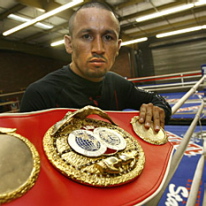


Ortiz’ big heart needs some maturity to go with it


Just a year ago, Victor Ortiz was accused of having no heart. Turns out, everybody was wrong. Just the opposite has been revealed in two very different ways about a personable fighter impossible to predict. The only thing we know for sure about Ortiz is that he has too much heart.

Within nine months, it propelled Ortiz to a dramatic triumph which was followed by a bizarre series of events in a bout as controversial as any.

So who is he?

The Ortiz who gained sudden popularity and a healthy measure of personal vindication in beating Andre Berto last April? Or the Ortiz who butted, hugged and kissed Floyd Mayweather Jr., then dropped his hands and took his eyes off the world’s most calculating fighter before he was knocked out in September by a combination he never saw?

I have no idea.

Ortiz is that restless kid in the back of the class. He’s likable, funny, precocious, and thoroughly exasperating. The teacher has to constantly remind him to concentrate on the task at hand. That kid was there in a conference call Wednesday in the build-up to his rematch with Berto in a welterweight bout on Feb. 11 at Las Vegas’ MGM Grand.

“I am me,’’ Ortiz said. “If you don’t like it, change the channel.’’

Ortiz made the remark while addressing a question about his appearance a couple of weeks ago before the Nevada State Athletic Commission, which had ordered him to explain comments that, yeah-oh-yeah, he was trying to break Mayweather’s nose with that infamous head-butt.

Nevada heard him, granted him a conditional license and Ortiz has moved on. Changed the channel, if you will. Now, I’m beginning to wonder whether Ortiz (29-3-2, 22 KOs) can stay focused long enough to channel his abundant energy and emotion with the maturity he needs to master a brutal craft. In large part, that will be the story of Ortiz’ Showtime-televised encore with Berto (28-1, 22 KOs) in the first major bout of 2012.

Ortiz’ heart-on-the-sleeve demeanor is as genuine and spontaneous as it is good box-office. Without discipline to keep it in check, however, it is a combustible source of potential trouble. Ortiz’ record includes a habit of saying and acting before thinking.

His comment about trying to break Mayweather’s nose is as hard to understand as dropping those hands while standing in front of a fighter who never misses an opportunity. In the noisy aftermath of his September loss, Ortiz, promoter Oscar De La Hoya and manager Rolando Arellano condemned Mayweather’s fight-ending combo.

They had support from that side of the media that called the shots legal, yet devoid of sportsmanship. Then, Ortiz undercuts his own argument by saying he wanted to break Mayweather’s nose???? Okay, then Mayweather had good reason to throw that combo while Ortiz was looking at referee Joe Cortez. Those two punches were a pre-emptive strike. Mayweather prefers a nose that remains intact. Hard to blame him.

The guess here is that Ortiz simply did what he has always done: He said what his heart told him to. He didn’t stop and think about consequences. On Tuesday, he turns 25. Time to grow up and become the consummate pro he’ll have to be against Berto.

AZ NOTES
Phoenix super-middleweight Jesus Gonzales (27-1, 14 KOs) finally signed a contract Wednesday for a fight on Feb 18 against Canadian Adonis Stevenson (16-1, 13 KOs) at Montreal’s Bell Centre. The bout, an eliminator for a possible shot at the International Boxing Federation’s title, had been rumored for a couple of weeks. Gonzales and his Calgary-based promotional team, Fan Base, had second thoughts. Stevenson has a criminal past. In 1998, he was arrested. He was linked to a Quebec gang that forced girls into prostitution. Gonzales and his promoter were uncomfortable at a business deal with a fighter who has a notorious past. On Gonzales’ trunks, there will be a sign he is fighting for abused women. He plans to wear a logo for Natalie’s House, a Goodyear, AZ, organization that helps youth exploited in the sex trade.

News that Phoenix junior-welterweight prospect Jose Benavidez, Jr. underwent surgery Tuesday in Los Angeles for a troublesome injury to his right wrist means he probably won’t fight on March 23 at Tucson’s Casino del Sol. “The doctor said we could get back in the gym, maybe as early as next week to work on the left and other things,’’ said Benavidez’ dad and trainer, Jose Sr., who said Thursday that his son’s right hand is in a cast. Initial projections indicate that the 19-year-old Benavidez won’t be able to fight for two months. “At his age, it’s important and a good time for us to get it fixed now,’’ his dad said. The ShoBox-televised card in Tucson, a Top Rank and Showdown promotion, will go on as planned with super-bantamweight prospect Roberto Marroquin in the main event, said Gerry Truax, Showdown’s promoter in Phoenix. Undercard plans include Cuban welterweight Yordenis Ugas (11-0, 5 KOs).


Pontiac Redux, Part 2


Pontiac’s Business district wasn’t. Early on a Saturday afternoon nothing was open. I parked the Kia well off the curb of a sidestreet, confident there would be no traffic to impede, and ambled up and down Saginaw and Pike Streets. There were what appeared to be panhandlers, but as they shuffled along, in lieu of risking their bare hands in the cold, they shrugged and frowned. Why the hell bother? A few of the buildings in the Business District had silhouettes of their last occupants’ names on them, but most had been bare long enough to be unhaunted.

There was no place to eat, and after the previous evening’s Coney dog it felt unsporting to sit in the Marriott bar with the boxing folks, discussing yet again who would win this mythical matchup or that. A mile of driving brought me to Chili Bowl. The establishment sat 12 within the concrete blocks of its yellow façade. Chili Bowl was in its 59th year of business. Its interior featured pictures and newspaper writeups. Its put-a-good-face-on-itness brought the queasy sort of sympathy one feels for a person oblivious of his plight – though its grillman was in no way oblivious.

I sat at the counter, read “Theatre of Fish” – a travelogue cum history of Newfoundland – and wondered at John Gimlette’s talent. The book was accessible for another writer, it wasn’t untouchable as “At the Tomb of the Inflatable Pig” had been, but it was remarkable enough in its styling to send an aspirant to places both cold and forgotten, in search of adventures to recount.

In the Courtyard elevator, I chanced on Timothy Bradley’s Mexican father-in-law. Bradley’s suegro was delightful. Somewhere between the lobby and floor 3, though, Spanish failed us; a language born in the Mediterranean lacked sufficient words for “snow” and “frigid” and “hopelessly blanketed” to imply what we both wished to say about Pontiac. So we gave each other the “alli se va” smile, a Mexican salute these days, and offered wishes of good fortune.

The next elevator was not so amiable. Tucked off a corner of a hidden staircase at Silverdome preceded by a tiny sign reading Credential Pickup, the service elevator that brought a few of us and a security-guard escort to the back entrance of the kitchen was a reminder how little preparation had been done after the kick-off press conference. Nobody knew where anything was. The security guide said as much; his first time in the building was yesterday.

I strode round the mezzanine, hoping to find a souvenir t-shirt that would someday prove I’d attended the last prizefight ever held in Pontiac. There were more makeshift barriers along the unlighted hallway than vendors and fight fans. Nary a poster or commemorative plastic cup could be found. There would be no evidence of “The Super Fight.” But that was no harbinger; it was not so mysteriously worded. It was boxing speaking in a short, declarative sentence: Nobody gave a fuck.

There was a single staircase open from the mezzanine to the floor of a venue that once accommodated 93,000 wrestling fans. On the other side of the curtain were parked eight trailers and a medium-sized yellow crane, with room enough for 10 other such combos. Inside the curtain were plenty of available seats.

The temperature along press row never rose above 55 degrees. Silverdome, despite its long-lost pretensions, was not outfitted with a heating system that could warm so many empty acres, and there weren’t live bodies enough to lend a hand. Writers paused before the laptops that illuminated their red cheeks to dab at runny noses. Many filed copy that night in winter coats.

None of our winter coats, though, rivaled Cornelius “K9” Bundrage’s. The IBF light middleweight champion in exile patrolled the aisles in a black getup with copious amounts of fur. If you’d never before met Bundrage – and thanks to his promoter, few of us had – he was a great surprise. Bundrage handed out media kits about himself that should have said: “I’m from Detroit, my promoter is Don King, we are 30 miles from Detroit, at a Don King show, and I am not on this card, FYI.”

I sat beside a handsome, friendly guy from HBO. Through the night, he received a number of other handsome, friendly visitors from HBO. The network covered itself doggedly; it surrounded the story of HBO and reported the hell out of it.

The main event ended with a cut caused by an accidental headbutt. Devon Alexander, by all accounts a role model and good guy, had not fought well, and the word “quitter” got whispered along press row. The words “dirty fighter,” too, plagued the main event’s victor, Timothy Bradley.

I don’t know what Bradley or Alexander said at the postfight press conference, because propelled by an unexpected burst of disgust, I quit my search for the service elevator after 10 minutes, marched up a blocked staircase and began throwing my shoulder against doors till one opened. I was five steps in the snow before I realized I was perhaps a half mile from where I’d parked the Kia. And the door clicked behind me a moment before I learned an eight-foot chainlink fence stood between me and the parking lot. With the help of a snow bank, I scaled the fence, hurled my laptop case at a 12-inch cushion of white and stomped a lap round Silverdome in a tanglefooted dance called Good Riddance.

Five hours later, I walked the Southwest Airlines terminal of Detroit’s Metro Airport. Not far behind me was Timothy Bradley, fully anonymous. His face was a swollen mess because the headbutts had gone both ways. It was not yet dawn, and the new unified champion of the 140-pound division was flying home to California on a discount carrier. Were you surprised when Bradley later forwent a fight with Amir Khan – a match he would have won – to escape his promoter?

I wrote my Monday column in an empty kiosk of Southwest’s Nashville terminal because there were no direct flights from Detroit to San Antonio. I wrote with abandon, pissed off, letting the words fly. Sometimes that works. Other times it’s dreadful. This time it worked.

Editor’s note: For Part 1, please click here

Bart Barry can be reached at bart.barrys.email (at) gmail.com
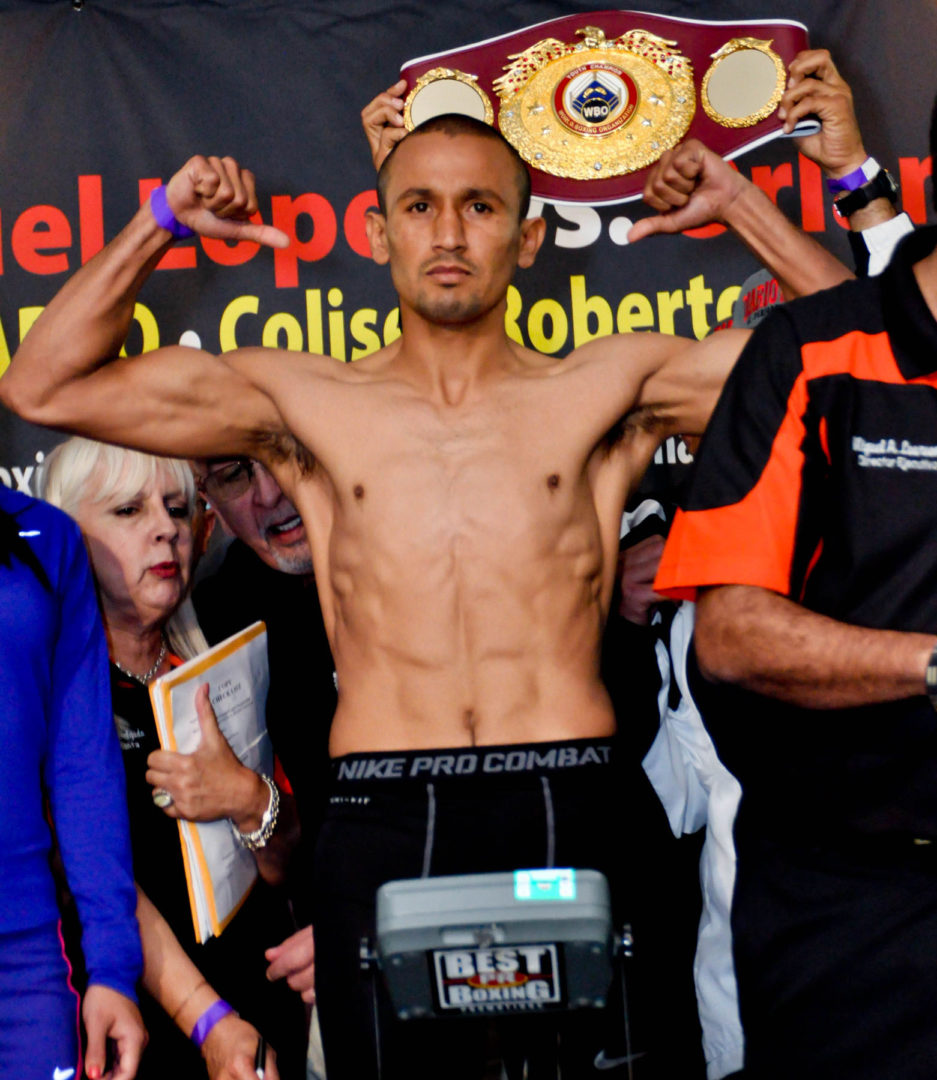


Pontiac Redux, Part 1


This week brings an ignominious anniversary for our beloved sport. Sunday will mark a year since “The Super Fight” – Timothy Bradley versus Devon Alexander – happened in Pontiac, Mich. The fight itself was inconsequential; neither man has done anything in the junior welterweight division since. But the consequences for HBO Sports were noteworthy, and perhaps more importantly, it still feels as though there is more to impart about the event, its city and arena, and Detroit.

A week or so before “The Super Fight,” sources learned Showtime would broadcast Manny Pacquiao’s next match. HBO had lost Pacquiao. The brass at HBO, who’d ignored the toy department for much of the preceding half-decade, suddenly went on notice. Their antennae went up. And with those antennae erect and tingling, “The Super Fight” went off in an abandoned airport hangar of a building in a depressed city.

What follows is a brief memoir of snow, dilapidated edifices, hidden service elevators, endless concrete expanses, a hopped chainlink fence, more snow, and an encounter in the Southwest terminal of Metro Airport. It will include some boxing.

*

About 10 days before “The Super Fight,” circumstances converged to make my trip possible. I procured a weird tangle of crisscrossed flights and rental car accommodations and wrote a preview of Bradley-Alexander that included a first-person conclusion assuring readers I would be there to see it. In the two days that followed, a goodish number of persons whose minds I admire called or wrote to ask me what the hell I was doing. I had two reasons for my trip to Pontiac in January: To honor Timothy Bradley – who was and remains one of my favorite active fighters – and to see if Detroit could be bad as accounts said it was.

My rental car was a Kia that when loaded with my laptop case and travel bag weighed perhaps a hundred pounds more than I did. The Kia and I set off for Pontiac in quickly accumulating snow. I had learned to drive in snow as a native New Englander, but in the 18 years since my departure for the Southwest I had not improved at the craft. The car slid all over the road, occasionally even working the oncoming side of where the yellow line would be found in April.

Friday morning I arrived on the outskirts of what my phone’s GPS said was Pontiac and surveyed the local FM dial in search of local flavor. One Motown station featured The Supremes followed by a familiar cackle and faux interview in which promoter Don King rattled off a handful of other Detroit-founded groups and invited locals to come to Silverdome tomorrow night for a super fight.

There was King, later that afternoon, in a private club on the end of Silverdome opposite where the ring would be constructed for Saturday’s fight. Or was the ring already constructed? A few of us gathered at the enormous glass wall where the weigh-in was held, and we peered and squinted at what could have been a black pocket square floating in a gray blazer. That was the curtain that both hid Saturday’s ring and marked the nearest point of Saturday’s converted arena – across hundreds of yards of empty concrete. Boxing’s chutzpah is at times extraordinary; who else would prod a hibernating venue to life then cordon off 90 percent of it?

King was alive if tired. When you speak with him he violates personal space till you realize how enormous a man he is. Your ears fit between his eyebrows, and his voice shakes your hair and scarf. He knew you would be there because you appreciate what is great in this sport, nay this land, and it thrills him the love he has for you, my brother, because as Shakespeare said, in his grandiloquence of verbositous garrulity, “If she say I am not fourteen pence on the score for sheer fisticuffs, score me up for the lyingest knave in Michigan!”

Promoter Gary Shaw, shorter and paler and rounder, was there too. A study of contrasts, King and Shaw. King is twice himself in person as he is on television, while Shaw is half. Shaw is softspoken and reasonable and willing to explain his talent lies in logistics more than spectacle. In his prime, King would have treated Shaw as an employee – Alan Hopper as publicist, Shaw as matchmaker – but King was by then far from his prime as he could be and still renew a promoter’s license.
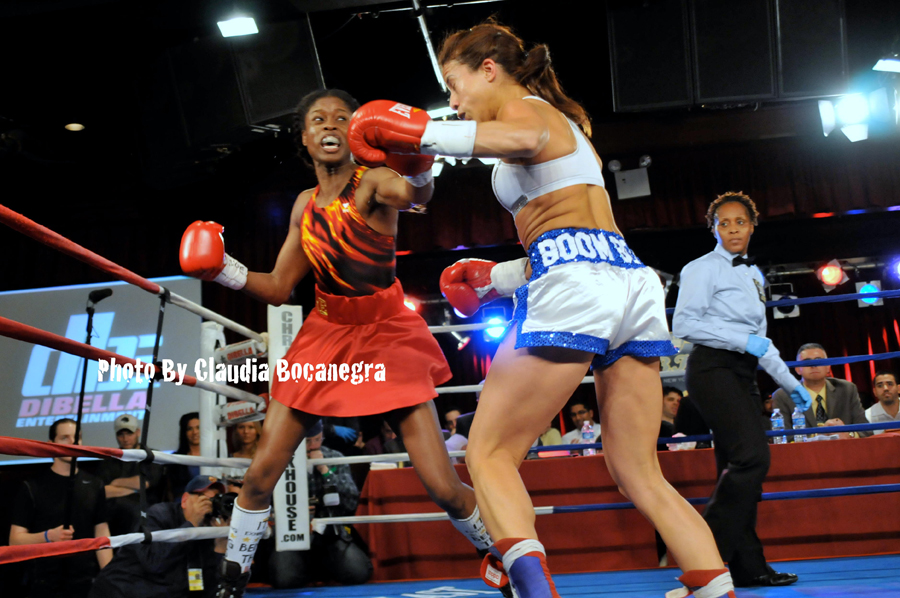
Friday night brought an ill-advised drive to Detroit proper, a few bars, a rave, and an early morning Coney dog at the second-best Coney dog eatery in the city because the very best was being used that night as a set for some cop show starring Tony Soprano’s tequila-sipping protégé. The night is a not a blur for the reasons you think. It is a blur because of what followed: Somewhere just north of 8 Mile Road on I-75, when my phone’s battery died with its GPS and the falling snow became a white wall seen from the driver’s side window as my Kia went sideways toward Pontiac, I became suddenly aware of how easy it would be to get lost, run out of gas and not be found till springtime.

And like that I was lost. Snow was accumulated on the freeway signs. The sky was a dark pillow gently shaking one feather-like flake after the next. I had been driving 30 miles per hour for an hour but knew I had not gone 30 miles. The entire episode was not frightful in its actuality – I located the Marriott village in Pontiac before the gas light went out – but frightful in its manufacturing. A terrible time to have an imagination.

Saturday morning I went looking for downtown Pontiac.

***

Editor’s note: Part 2 will be published on Wednesday, Feb. 1.